WILLIAM SHEPHERD
In Memorium
WESTERN RELIQUARIES


![]()


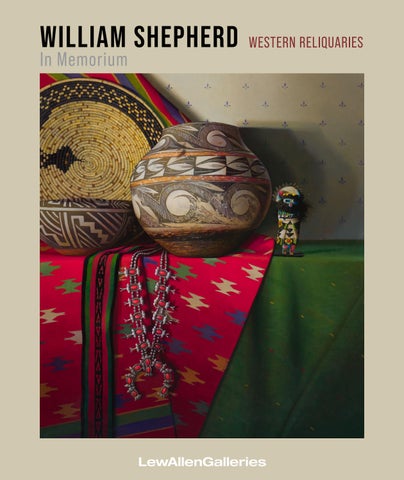
William Shepherd (1943–2024) reimagined American Realism by treating the canvas as a site for optical innovation, shifting away from traditional still life picture-making toward a rigorous technical study of perception. While subjects such as Navajo textiles, Pueblo pottery, and Western artifacts root his work in the heritage of the American West, a primary subject also became for him the physical behavior of light. Through a masterful, Dutch-inspired technique involving as many as thirty individual oil glazes, Shepherd constructed luminous images where light does not merely sit on the surface but appears to emanate from the depths of the paint itself. In so doing, Shepherd elevated his work to one of the most distinctive and accomplished forms of still life painting in the history of American painting. It is also with this technique of extraordinary illumination that Shepherd became a master of creating signal images that are as much visual reliquaries of honored objects from the Old West and Native American craftspeople as they are beautiful still lives connoting Western culture of bygone days. These works attain their vaunted status not only as a result of this magnificent lighting but notably as a result of Shepherd’s approach to his subject. Growing up in Wyoming, he collected found objects including both discarded tools that ranchers used in their work and old household objects, as well as beautiful Native American crafts and pottery, blankets and jewelry.
Whether pieces from ordinary life or works of art, Shepherd conferred the utmost sense of reverence for those who once crafted the objects he assembled into the tableaus he ultimately painted. He was well-known for taking hours to ponder his shelves full of these objects in his small adobe studio built in 1890 that once was part of a grain mill complex outside of Santa Fe. He regarded every piece—whether pewter mugs, Navajo blankets, medicine bags, blown glass vases, copper platters, Pueblo pottery or silver jewelry—with utmost respect. As an artist composing a still life, he saw each object as the component of something even greater than the whole
From this process of studied contemplation and artistic intuition, Shepherd would then proceed slowly to choose objects, one by one, take them down from his shelves and begin to assemble them into a composition that, in the combining, attained for him the identity, not of individual objects, but of a work of art. As he once related to a magazine writer: “I look for ‘authority’ in the objects I select for my

paintings. They have to manifest a visual component that appeals to me. I often say the object needs to have ‘presence,’ an undefined quality that transcends.” The process of arranging the objects was equally complex with the juxtaposition of the parts being essential to the construction of the whole, combined with interplay of light, shadow and color.
Indeed, the valorization of this combining in the solitude of the artist’s tiny adobe studio was so great, so deep, that the vignette became for Shepherd a poetic blend of artistry, memory and legend.
Various of the objects harkened back to his youth in Wyoming and the Indigenous craft pieces had histories he revered resonating with his profound veneration of the cultures of those who made them. Together in the interaction of the colors, shapes, textures, patterns, materials, reflections of light and the echoes of distant pasts emanating from the assembled objects that became for Shepherd – but now also for his viewer – a visual polyphony reverberating in time and space.
The intensely labored-over combination transformed to become itself an entity, a poetic image. Just as poetry inaugurates a form for many artists, this vignette was now ready for Shepherd to translate into his painting as a final work of art. A definitive manifestation of his mastery in executing this final artwork is, of course, his remarkable treatment of physical material as an optical lens. In general terms, the depiction of water or hand-blown glass as transparent material is never as a static prop. They are tools that reconfigure a setting in a still life by rendering the subtle breaks and fluid abstractions of a background textile seen through a vessel. Shepherd’s use of blown glass vases forces an acknowledgment of the tangible presence of these objects occupying the space between the eye and the wall as a result of this lens effect. This lens effect transforms the fixed geometries of a background textile into dynamic distortions, inviting a closer inspection of how materials mediate vision.
Shepherd’s facility with light of this sort derives from his early career and his detailed beds of river rock paintings. In these explorations of moving water, he captured the heightened chromatic intensity that occurs when stones are submerged—a vibrancy akin to the saturation found in wet minerals. Beyond the bending of form, these works documented the complex phenomenon of how even water casts a shadow of itself upon a riverbed as sunlight passes through the current. The glass vessels of his later still lifes are the direct descendants of the water in those riverbeds; both serve as transparent barriers that challenge the artist to document the exact physics of visibility and the interplay between light, liquid, and solid form.
The complexity of these compositions is deepened by a sophisticated treatment of compounding shadows. Utilizing multiple light sources—suggestive of the indirect or shifting light found in his Nambé adobe studio—Shepherd created an architecture of overlapping shadows that lend a rhythmic weight to the work. Within these dark spaces, he captured specular highlights—tiny reflections of the studio environment that exist even on obscured surfaces. These shadows within reflections demonstrate that every object exists in a constant state of absorbing and throwing light, ensuring that no area of the canvas remains eternally dormant. There is an embedded potential in these shadows; they suggest a latent energy, implying that the composition is not a frozen moment but a living environment where the light possesses the inherent capacity to evolve and shift the viewer’s perception.

The power of these arrangements is amplified by a selective use of trompe l’oeil. By meticulously rendering the intricate surface topologies of Navajo wool or the morphology of Pueblo pottery, Shepherd eliminates traditional perspective, making background textiles appear to hang physically within the space. The hyper-realistic detail creates a tactile presence that dissolves the distance between the viewer and the subject.
And so it is that in this memorial exhibition there is the opportunity to honor a great artist of the cultural legacies of the American West in still life painting, whose ability, through combinations of objects he revered and technical skills he masterfully employed, allowed him to create some of the most enduringly beautiful expressions of their kind. He will be remembered too for his many wonderful personal qualities, but as an artist he will be celebrated for creating truly remarkable paintings that with a combination of select, curated objects transcend their subjects to create a hidden grandeur through their immensity of historical and cultural depth. This truly was an extraordinary gift. And Shepherd has left it to the world.
Kenneth R. Marvel