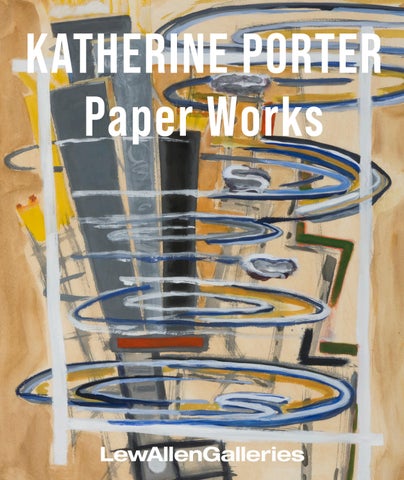
Paper Works KATHERINE PORTER

Here Comes Carey, 1999, mixed media on paper, 39.25 x 27.5 in


1980, oil on paper, 30 x 22.75 in
Untitled

Morocco Noon 2000, oil on paper, 29.25 x 25 in
PAPER WORKS : K ATHERINE P ORTER
Katherine Porter (1941-2024) had the extraordinary ability through her imagination to channel and process the complexities, discords and dissonances of her times and world. Then through the media of drawing and painting she generated powerful aesthetic statements that expressed some of the raw angst of Abstract Expressionism using her own unique visual vocabulary that is equal parts geometric, chromatic, and gestural, creating imagery that pulsates with vibrant kinetic energy. Her work has the unusual distinction of being consequential both because the artist’s inner world was of a piece with the outer world in which she lived and worked but also because her work maintained a sophisticate and refined aesthetic that transcended it. It is no wonder that her paintings and works on paper are growing in recognition by museums and major collectors.
The noted art scholar and critic, Irving Sandler, once wrote of Jackson Pollock that his work “can be said to have invented chaos.” If so, it can also be said that Katherine Porter, in hers, took chaos, and through her remarkable capacity for creative spontaneity, turned it into sheer brilliance.
Evidence of this assertion can be experienced in viewing LewAllen Galleries’ latest exhibition of Porter’s work – in this case, a tight showing of her high energy and dazzling mixed media and oils on paper. These works further demonstrate the artist’s muscular engagement with chaos as a foil for the harmony she imagines – and longs for – in the world at large. They are reminiscent of, but on a different scale than that of the tumult waged on the surfaces of her majestic canvases.
On paper the fray is conducted with geometric devices familiar from her paintings but used in these works with a discernible diminuendo to convey her responses to the conflicts inherent in life. These include the gestures and marks she wields with such signature aplomb that they’ve become unmistakably Porter. These works are stunningly effective in advancing her visual scrums through the use of swirling vortexes, vibrating scribbles, circles and streaks, lines weighted with jousting colors, scaffolds and lattices – all signature signs of the artist’s presence.
Like many artists living through events of the 1960s through the 1980s –the racial conflicts, America’s overt and covert interventions in the affairs of other countries, the war in Vietnam, and much else – Porter uses explosive visual components in her work to provide means to express visceral reactions set to paper or canvas to create order out of “unorder,” manifesting her personal response to the conditions in the world around her. These continued as elements of effective visual rhetoric for more contemporary subjects of her concerns through later decades of her life as well.
Her work became her effort to challenge and manage the chaos she felt descending heavy on her from the injustices and rupturing mayhem of various sorts she felt imperiling the teleological balance of the universe. Picture-making was Porter’s way of harnessing the chaos and repurposing it. She expressed a brilliant sense of spontaneity and aesthetics in her quest for equilibrium in a world of imbalance. Porter perceived her work
Continued on page 10

1982, oil on paper, 39.5 x 27.75 in
Untitled

PAPER WORKS : K ATHERINE P ORTER (continued)
to be visual poetry, and one might view it in league with that of poets of engagement such as Pablo Neruda and Federico García Lorca, both of whose work she admired greatly. Like theirs, Porter’s art became her cri de coeur, her cry of the heart, for a better world.
The well-spring of Porter’s art was always her social consciousness and moral imperative felt by her with unrelenting passion and firm commitment. Also, too, the art Porter produced never lost its obvious and utterly compelling aesthetic power. The vigorous kinetic explosions of chromatic exuberances that manifest on her canvas and paper are in celebratory if stark contrast with the artistic motivations that drive them. It is as if the cauldron of chaotic flux simmering within Porter’s psyche inevitably burst forth to yield up some of the strongest, most vigorous art of its kind and time; art that could hang with ease next to that of Hans Hofmann, Willem de Kooning or Joan Mitchell who she was in key with.
With their lush chromatic and geometric exhilarations, Porter’s images would seem to have exploded from some generative process of near inevitability – revealing what is meant by “the brilliance of spontaneity untamed.” In viewing Porter’s works, one is filled with the joy of beautiful color and moved by its vibrant, soul-stirring power. Indeed, from studied contemplation of the charisma of her surfaces one can sense the energy radiant from the work, that which is derived from and connected to the fervency within the inner being of the artist.
In this way, beyond monuments to a time and deeply personal reactions to events occurring in her lifetime, Porter’s compelling works demonstrate primal energy, informed by the turbulent state of the world. These coalesce with the sensibilities of a brilliant artistic mind and an extraordinarily capable technical hand. As another great critic of the abstract expressionist era, Clement Greenberg, claimed about Pollock that his artistic superiority lay in his ability “to create a genuinely violent and extravagant art without losing stylistic control,” a similar observation was made about Porter. Writing about her extraordinary independence of artistic expression and “vast domain of spontaneity untamed”, the great Picasso scholar, Lydia Casato Gasman, extolled Porter’s explosive gestural creativity while noting perceptively it was nevertheless remarkably well “tempered, subjected to rational control by a supreme act of self-critical concentration.”
And it is precisely the quality of mindful control that lends her work the very balance that she seeks in the world itself. Porter thought as a designer about the facture of her work and anchored it with rigorous compositional control. She controlled application of her pigments and covered surfaces with scrupulous care. Through the dialectic between the power of her spontaneity in image making and the rigor of her pictorial process, there emerges from her work the possibility to recognize both beauty in its aesthetics and sanctity in the truth of the tragedies that have inspired it. In that convergence is the sublimity of her legacy – and its amazing grace.
Kenneth R. Marvel

Untitled n.d., oil on paper, 26 x 20 in

Isis Lauriat
mixed media on paper, 59 x 56

1997, mixed media on paper, 63 x 42 in
Cyclamen

Untitled
mixed media on paper, 30 x 22.5 in


Untitled
mixed media on paper, 20.5 x 27.75 in

Montreal 2003-2004, mixed media on paper, 39 x 25.25 in

Five O’Clock Burn 1999, gouache on paper, 55 x 42
Fast Forward

acrylic on paper, 65 x 42 in

Untitled
2012 - 2015, collage on paper, 35.25 x 27.75 x 2 in

Global Warming 2000, oil on canvas, 29.5 x 25 in