
Kushner_Digigtal Catalog

Page 1


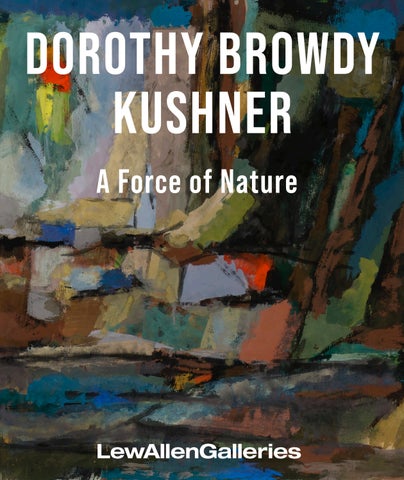
DOROTHY BROWDY KUSHNER

A Force of Nature

A Force of Nature : D OROTHY B ROWY K USHENR

As Linda Nochlin explained in her inspiring 1971 essay, "Why Have There Been No Great Women Artists?" there were always great women artists (despite nearly insurmountable obstacles) yet social structures and gender norms denied art history’s embrace. For five decades Dorothy Browdy Kushner pushed her creativity and imagination to reinvent abstract landscape painting. Kushner’s paintings stand firmly with the history of abstraction but were never incorporated into the canon. Many women artists and many California artists faced this same fate, once marginalized, now rectified due to contemporary art history research.

Dorothy Kushner is one such artist who deserves reexamination, based on the strength of her paintings, especially those from the mid-1950s to the mid-1970s that form the subject of this show. This artist was rarely bitter despite the obvious obstacles to fame and fortune, pouring her ambitions into a series of artistic experiments that simultaneously surprise and impress. The energetic brushwork of Oncoming Storm, ca. 1964, can be seen as an amalgam of masters–from Bonnard to de Stael. Its strokes of oil paint in a range of greens, punctuated by the artist’s signature red highlights, practically raises the humidity in the gallery. Just as it incorporates classic approaches to landscape, it also predates the work of many of today’s leading artists such as paintings by Peter Doig and Per Kirkeby. This juxtaposition of past and present is an accomplishment of a most talented artist who goes beyond the limited understanding of “woman-painter,” particularly at the time it was made.

In fact, this artist never limited herself to the confines of domesticity. Born in 1909 to Russian immigrants, Dorothy Ruth Browdy grew up in Kansas City, Missouri, the eldest of five children. Her talent was recognized early, winning first prize at a state high school competition. After college, she attended Kansas City Art Institute, where she studied with Thomas Hart Benton and went to Chicago Art Institute, the University of Wisconsin, and New York’s Art Students League where she studied with Reginald Marsh. When not enrolled in academic programs, this young artist traveled to western locations: Mexico, California, and Santa Fe. Later in 1937, she moved to New York City to pursue a Masters Degree in Education at Columbia

University Teachers College. This training was deliberate and intentional, suited to a determined professional artist.

When Browdy married Joseph Kushner and moved to Altadena, California in 1946, her palette and approach changed dramatically to appropriate the light and bright colors of a completely different landscape. She continued her training with watercolorist James Couper Wright. She paid close attention to the artists of the Blue Four, particularly Lyonel Feininger, in the collection of the Pasadena Art Museum, now the Norton Simon Museum. She frequently exhibited and won awards with the Pasadena Society of Artists and Los Angeles Art Association. The vibrant and experimental art scene in Los Angeles was not that far from her life in Arcadia, where the Kushners moved in 1951. Rather than resign to isolation, Kushner organized local women artists into The Group, a collection of female abstract painters who critiqued and promoted each other's work until the 1970s.

Continued on page 8

Oncoming Storm , circa 1964, oil on board, 30x40
Precipice, 1958, casein on paper, 36x24
Rocky Coast, circa 1960s, casein, 30x40

They visited the museums and galleries in LA frequently, despised Ferris Gallery and Andy Warhol, while admiring the works of Richard Diebenkorn. Browdy was occasionally included in group shows during this period, but never considered part of the Boy’s Club of the period and predated breakthrough feminist art projects such as Womanhouse, launched by Judy Chicago and Miriam Schapiro at Cal Arts in 1972.

The works from this twenty-year period—1955 to 1975—are among Kushner’s strongest. In her earliest works, she uses the textural possibilities and subdued pigments of casein to create cubist scenes, such as Moon Over the Pines, 1955. Ten years later, bright hued intervals break up what appears to be a rock formation or canyon in Megalith, 1964. By the 1970s, the palette had changed to acrylic paints of bright greens and blues, reflecting her new home in Costa Mesa, near the sea. The wet-on-wet brushstrokes, applied rapidly before they could dry, are filled with conflict and harmony, resolved into a landscape of growth and renewal. True optimism, however, can be found in her flower paintings, a further experimentation in color and form. Kushner always had an interest in flower groupings which she treated as monumentally as her landscapes. These bouquets were indeed created while working her larger landscape works. Most impressive is Purple Flowers, a diptych from ca. 1974 that reaches almost 50 by 50 inches. At first glance, these rectangular forms could be neon signs, canyons or toppling buildings. Looking more closely, the viewer sees a unique bundle of irises which blossomed yearly at the artist’s studio door. Kushner's bold depiction of flowers is not traditional ikebana nor is it Georgia O’Keeffe. Kushner uses this subject to demonstrate how many forms and how much space can be found with a selective eye. These are an explicit refutation of the stereotypical work of a mid-century housewife, arranging flowers as decorations for the home.

Much of what we now know about Dorothy Kushner comes from the interest and support of her son, the artist Robert Kushner, who has preserved her archives and helped tremendously with this exhibition. Born in 1949, Robert grew up in his mother’s

studio, making his own first stabs at creativity from childhood through graduating from UC San DIego. By the 1970s, he was living in New York City, recognized as a founder of the Pattern and Decoration movement, where his paintings and prints repeatedly used flower iconography. The P&D movement included such artists as Joyce Kozloff, Valerie Jaudon, Kim MacConnell, Miriam Schapiro and many more, receiving major attention at museums and galleries. Kushner’s mother met them all and they in turn always treated her as a serious artist. The Pattern and Decoration Movement intentionally sought to subvert the canon by using iconography and decorative crafts as methods and content of “high art.” It was viewed by its participants as an antidote to the narrow mindedness of the art world that did not appreciate global art practices, outsider art and domestic skills. It is ironic, but probably intentional, that Robert was participating in such a movement just as his mother was reaching the peak in her skills.

This exhibition, therefore, doubles in importance when considering the intergenerational influences that brought it to be. On the one hand, we have Dorothy Kushner’s paintings, beautifully composed forcefields of energy. On the other hand, we can see these artworks through the eyes of another generation of art viewers, who can appreciate their strengths without belittling the creator. In the subsequent generations since Kushner’s death in 2000, we have seen that many artists, once disregarded and overlooked, deserve to be reevaluated and elevated. Here is an artist who richly deserves such reconsideration.

Barbara Pollack is a renowned artist, critic, curator, and writer. She attended Brandeis University and Northeastern University in Boston, has written for The New York Times and Artnews, and has curated exhibitions in major museums such as the Museum of Modern Art, New York and the Shanghai Art Museum. Pollack has written extensively on contemporary Chinese art as an expert in the field, as well as authored several books, including The Wild, Wild East: An American Art Critic’s Adventures in China and Brand New Art from China: A Generation on the Rise. She is also an abstract artist. In her portrait of artist William Pope.L, he is out of focus around moments of light and color, creating a reflective depiction of the artist known for his experimentations in contemporary art.

Trees, 1965, oil on canvas, 39.75 x 63.75

Landscape, circa 1959-1960s, casein on paper, 28.25x38.25

Megalith, 1965, casein on board, 30x40

Thrust, circa 1967, casein, 30 x 40

Rocas, 1958, casein on board, 30 x 40
Purple Flowers (diptych), circa 1964, oil on board, 47.75 x49
Glissade, circa 1967, casein, 30x40
Moon Over The Pines , 1955, casein on board, 28x20
Above: Landscape (#1143), 1975, acrylic on board, 30 x 40 in
Spring in California, n.d., acrylic on canvas, 36x48
Vistas, 1971, acrylic on canvas, 38.5 x 57.5
Red Landscape, acrylic on board, 26 x 35.25
Sky, Land and Sea, 1975, acrylic on board, 40 x 30
Yellow Landscape, circa 1970s, oil on canvas, 38.5 x 57.75
Autumn Trees II, 1975, acrylic on canvas, 44 x 24
Red V, 1970-1971, acrylic on board, 40x30
Autumn Trees 1 , 1975, acrylic on canvas, 44x32

DOROTHY BROWDY KUSHNER

Born: March 20, 1909, Kansas City, MO

Education

M.A., Fine Arts (1938) - Columbia University, New York, NY

Further Studies

• Kansas City Art Institute (with Thomas Hart Benton), Kansas City, MO

• Art Students League (with Reginald Marsh), New York, NY

• Art Institute of Chicago, Chicago, IL

• University of Wisconsin, Madison, WI

• California State University of Los Angeles, Los Angeles, CA

Solo Exhibitions

2008: Dorothy Browdy Kushner, Work from the 1930s to the 1950s, Susan Teller Gallery, New York, NY

1989: Carlson Gallery, San Francisco, CA

1979: Color Configurations: Nature in Art, Senior Eye Gallery, Long Beach, CA

1978: University of California, Irvine, CA

1977: Arnold Gallery, Newport Beach, CA

1977: Santa Ana Public Library, Santa Ana, CA

1974: Santa Monica Library, Santa Monica, CA

1973: McFadden Library, Santa Ana, CA

1971: Design Flower Show, YWCA, Pasadena, CA

1969: Tower Gallery, Los Angeles, CA

1967: Ruth Phillips Art Gallery, West Hollywood, CA

1965: Jack Carr Gallery, Pasadena, CA

1965: Dodson Galleries, Fresno, CA

1965: Creative Arts Gallery, Sierra Madre, CA

1961: Ramon Lopez Gallery, Sierra Madre, CA

1961: The Twelve, Hass Gallery, Duarte, CA

1954: Monterey Park Public Library, CA

Additional Solo Exhibitions (dates unknown)

Arcadia Public Library, Arcadia, CA; Duarte Public Library, Duarte, CA

Group Exhibitions (Selected)

2012: Americans in Mexico, Susan Teller Gallery, New York, NY

2011: Dorothy Browdy Kushner & Robert Kushner: Re configured Flora, Susan Teller Gallery, New York

2010: The Huntington Art Collections, San Marino, CA

2007: Picturing Oz, Susan Teller Gallery, New York, NY

2006: Under the Influence, Susan Teller Gallery, New York, NY

2002: My Mother’s an Artist, curated by Sheila Pepe, Ernest Rubinstein Gallery, The Educational Alliance, New York, NY

1979: All Membership Show, National Watercolor Society, Long Beach Museum of Art, Long Beach, CA

1978: 58th Annual Exhibition of the National Watercolor Society, Brand Library Art Galleries, Glendale, CA

1972: 53rd Annual Exhibition of the California National Watercolor Society, Otis Art Institute, Los Angeles, CA

1968: 48th Annual Exhibition of the California National Watercolor Society, Los Angeles Municipal Art Gallery, Los Angeles, CA

1960: 40th National Exhibition of the California Watercol or Society, Los Angeles County Museum, Los Angeles, CA

1960: Library of Congress, Washington, D.C.

1958: 22nd Exhibition – The Society of Washington Printmaker, U.S. National Museum, Washington D.C.

1956: 89th Annual Exhibition of the American Watercolor Society, National Academy Galleries, New York, NY

1955: 13th National Exhibition of Prints, Library of Congress, Washington, D.C.

1935: Kansas City Art Institute, Kansas City, MO

Additional Group Exhibitions (dates unknown)

Los Angeles Center for Modern Art, Los Angeles, CA; Newport Harbor Art Museum, Newport Harbor, RI; Los Angeles County Fair, Los Angeles, CA; Santa Fe Public Library, Santa Fe, NM

Permanent Collections

•Tate Modern, London, England

•Library of Congress, Washington, DC

•Philadelphia Museum of Art, Philadelphia, PA

•Huntington Library, San Marino, CA

•Los Angeles County Museum, Los Angeles, CA

•Virginia Museum of Fine Arts, Richmond, VA

•Nelson Atkins Museum, MO

•St. Louis Mercantile Library, St. Louis, MO

•Citibank (Corporate collection), NY

Bibliography (Selected)

•St. Gaudens, Maureen and Morsman, Joseph.

Emerging from the Shadows: A Survey of Women Artists Working in California 1860-1960. Atglen, Schiffer, 2015.

•Cotter, Holland, “Art in Review; International Fine Print Dealers Association Fair,” New York Times, November 3, 2006.

•Howell, Betje, “Dorothy Browdy Kushner,”

Santa Monica Evening Outlook, 1979.

•“Newport, Costa Mesa Watercolorists

Honored,” Los Angeles Times, July 26, 1979.

•Donelson, Kay, “Valley Profile: Dorothy Kushner,” San Gabriel Valley Tribune, July 28, 1968.

Other Press Mentions

•Los Angeles Times (1974, 1971, 1964, 1957, 1956, 1955)

•San Gabriel Valley Tribune (1968)

•Independent Star News (1965, 1962)

References (Books / Directories)

•The California Style, California Watercolor Artists, 1925 – 1955, by Gordon T. McClelland & Jay T. Last (Hillcrest Press)

•Who’s Who in American Art

•Who’s Who in the West

•Who’s Who in American Women

•Women Artists in America

•World’s Who’s Who of Women

Awards

1970: Award, Pasadena Society of Artists 46th Annual Exhibition, Pasadena Art Museum, Pasadena CA

1964: Sculpture Award, 40th Annual Exhibition of the Pasadena Society of Artists, Pasadena Art Museum, Pasadena, CA

1963: 1st Prize in Watercolor, 39th Annual Exhibition of the Pasadena Society of Artists, Pasadena Art Museum, Pasadena, CA

1963: 1st Prize in Oil, American Association of University Women

1962: 1st Prize in Prints, 38th Annual Exhibition of the Pasadena Society of Artists, Pasadena Art Museum, Pasadena, CA

1926: Medal, University of Missouri, MO

Teaching Experience

• Citrus College, Glendora, CA

• Rio Hondo Jr., College, Whittier, CA

• Pasadena City College, Pasadena, CA

•Arcadia Junior High and High Schools, Arcadia, CA

•Grover Cleveland High School, Queens, New York, NY

•Scarritt Elementary School, Kansas City, MO

•Paseo High School, Kansas City, MO

Professional Affiliations / Memberships

•American Watercolor Society, New York, NY

•American Color Print Society, Philadelphia, PA

•American Association of University Women, Washington, DC

•California Watercolor Society, Los Angeles, CA

•Los Angeles Art Association, Los Angeles, CA

•Pasadena Society of Artists, Pasadena, CA

•Kansas City Society of Artists, Kansas City, MO

•Laguna Beach Art Association, Laguna Beach, CA

•New York Teachers Guild, New York, NY

Turn static files into dynamic content formats.
Create a flipbook