Elena Vigliocco_Designing Forms for Future Solarscapes

Page 1


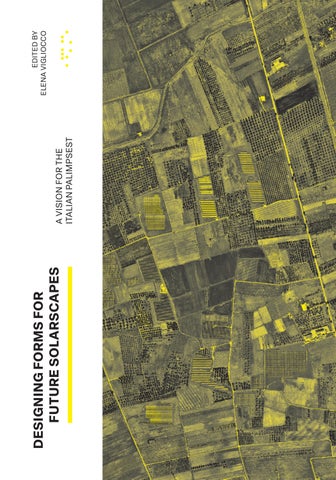
A VISION FOR THE ITALIAN PALIMPSEST

DESIGNING FORMS FOR FUTURE SOLARSCAPES

261 Alleli / Research Series

Scientific Committee

Edoardo Dotto

Antonella Greco

Emilio Faroldi

Nicola Flora

Bruno Messina

Stefano Munarin

Giorgio Peghin

This study was carried out within the Next generation solar landscapes. Methods and tools for the design of new generation solar landscapes: the renewal of photovoltaic fields at the end of life project – funded by European Union – Next Generation EU within the PRIN 2022 program (D.D. 104 - 02/02/2022 Ministero dell’Università e della Ricerca). This manuscript reflects only the authors’ views and opinions and the Ministry cannot be considered responsible for them.

ISBN 979-12-5644-141-9

First edition December 2025

© LetteraVentidue Edizioni

© Elena Vigliocco

© Texts and images: respective authors

No part of this book may be reproduced or transmitted in any form or by any means, including photocopying, even for internal or educational use. If any mistakes or omissions have been made concerning the copyright to the illustrations we will be happy to correct them in the next reprint.

Unless otherwise indicated, images and drawings are to be considered the property of the individual authors of the chapters.

LetteraVentidue Edizioni Srl

Via Luigi Spagna 50 P 96100 Siracusa, Italy

www.letteraventidue.com

DESIGNING FORMS FOR FUTURE SOLARSCAPES

A VISION FOR THE ITALIAN PALIMPSEST

Elena Vigliocco FOREWORD INTRODUCTIONS

Elena Vigliocco NEXT SOLARSCAPES REVERSING THE GAZE ON SOLAR ENERGY PRODUCTION

Sara Protasoni ENERGY LANDSCAPES PALIMPSEST, PROCESS AND SCALES

MEASURES AND DENSITIES

Ilaria Tonti - Riccardo Ronzani MAPPING KNOWLEDGE THREE ATLASES

PROCESSES AND TRACES

Giulia Cazzaniga - Sara Anna Sapone DESIGN THE DECOMMISSIONING

PERSPECTIVES

Elena Vigliocco

DESIGNING

Brindisi / San Pietro Vernotico

Riccardo Ronzani Innovating Productive Landscape

Sara Anna Sapone Reprogramming the energy landscapes

Ravenna / Lugo

Elena Guidetti Filling the interstices

Simone Baccaglini Towards a conscious agrivoltaic landscape

Cuneo / Fossano

Simone Parola

Boosting the infrastructure

Giulia Cazzaniga

Renaturation as radical design

Amedeo

FOREWORD ELENA VIGLIOCCO

October 2025

This book is the primary outcome of the research MUR program PRIN2022 Next Genetarion Solar Landscapes. Method and Tools for next generation solar landscape design: the renewal of photovoltaic fields at the end of life The main goal of the research was to promote new knowledge about the reuse and redesign –decommissioning and revamping – of photovoltaic fields at the end of life. The study assumed that reusing and redesigning these photovoltaic fields can be essential in constructing a new energy policy and renovating the landscape culture. The research intended to identify innovative interpretative methods that, through the optimisation of land use, can decrease the degraded and unused areas. In particular, the study has investigated the opportunities offered by the reuse and redesign of photovoltaic fields to develop new settlement models which can mend impoverished and fragmented landscapes and provide the partial recovery of agricultural productions. Since photovoltaic fields are spread across many Italian regions, the research project aimed to foster the identification of shared knowledge and landscape development strategies. The research team consisted of three research units with distinct characteristics. The first research unit, composed of Elena Guidetti, Roberta Ingaramo, Simone Parola, Matteo Robiglio, Riccardo Ronzani, Ilaria Tonti, Elena Vigliocco (Principal Investigator and Reseach Unit Coordinator), with the contribution of Marco Cappellazzo and Antonia Spanò (LabG4CH), from Politecnico di Torino,

ELENA VIGLIOCCO

examined the architectural impacts of photovoltaic fields and identified morphological strategies to re-evaluate the relationship between solar fields design and landscape design. The second research unit, composed of Simone Baccaglini, Morris Brenna, Giulia Cazzaniga, Sara Anna Sapone, and Sara Protasoni (Research Unit Coordinator), with the contribution of Marco Agosti, from Politecnico di Milano, grounded in landscape research, focused on processes that have transformed the landscape to highlight new opportunities for decommissioning and revamping solar fields. The third research unit, composed of Stefano Maruccia, and Amedeo Reyneri di Lagnasco (Research Unit Coordinator), from the Università degli Studi di Torino, experts in agronomic research, focused on the specific evaluation of the opportunities/criticalities triggered by decommissioning. Due to this creative partnership, the research contributes to the definition and adoption of the best policies and practices addressed to policymakers and practitioners, aiming to increase the environmental, social, cultural, and economic impact of the reuse and redesign of photovoltaic fields. At the end of this brief foreword, I would like to thank my colleagues who actively participated in the development and drafting of a multidisciplinary research project exploring a little-researched design field with uncertain operational implications. I thank the tenacity of my research unit and the young researchers who, alongside me, chose to venture into the field of architectural design applied to solar landscapes.

MAPPING KNOWLEDGE

THREE ATLASES

ILARIA TONTI - RICCARDO RONZANI1

1 The two authors jointly conceived and wrote this chapter, defining its theoretical framework, structure, and methodological approach, as well as the critical reflections. Ilaria Tonti curated all the mapping elaboration, from data collection and harmonisation at national and regional scales. Riccardo Ronzani contributed to the graphic post-production of the maps in the first section dedicated to the three Atlases of Brindisi, Ravenna, and Cuneo.

2 Jamer Corner (ed.), Recovering Landscape: Essays in Contemporary Landscape Architecture, New York, Princeton University Press, 1999. And, Jill Desimini, Charles Waldheim, Cartographic grounds: Projecting the landscape imaginary, New York, Princeton Architectural Press, 2016.

3 Stan Allen, From object to field, in "Architectural Design", n. 5-6, 1997, pp. 24-31.

4 David Bauer, Santiago Martínez Murillo, Philipp Misselwitz, Yulia Navatskaya, Joseph Smithard (eds.), Power, flows, and transformation: Portraits of Berlin-Brandenburg energy spaces, Belin, Jovis, 2025.

5 Martin Junior Pasqualetti, Sven Stremke, Energy Landscapes in a Crowded World: A First Typology of Origins and Expressions, in "Energy Research & Social Science", 36, 2018, pp. 94-105.

6 Sven Stremke, Dirk Oudes, Paolo Picchi, Power of Landscape: Novel Narratives to Engage with the Energy Transition, Rotterdam, nai010 Publishers, 2022.

Measuring and mapping is a cognitive act. What does it mean to be able to measure a territory and, starting from those measurements, construct maps that can reproduce the image of a landscape? What is the value of mapping energy morphologies in order to compare different contexts? Moreover, how can this operation open up the project?

The role of cartographic exploration

Mapping is not limited to census, systematization, and data representation. On the contrary, it has the potential to become an actual process of cartographic exploration capable of connecting critical observation, interpretative processes, and the identification of meanings, as well as highlighting both the spatial relationships and the contradictions of the contemporary landscape. Therefore, the map does not merely record phenomena, but orders, reworks, and makes them legible within a design-oriented logic. Mapping is both an analytical tool and a performative device that frames reality and constructs new narratives of the landscape2. Defining the concept of "field"3 provides a conceptual framework of fundamental importance. It is neither sufficient nor proper to construct maps by isolating individual objects; rather, it is necessary to read extensive systems of relationships, flows, and transformations. An example of this is the morphology defined by different energy infrastructures (dedicated to energy production and distribution), which today significantly impacts large areas of land. Even more evident than other energy systems, renewable energies, spread over vast land areas, are a force for spatial reconfiguration4 and landscape transition5. This transformative force requires new forms of representation, as shown by recent theoretical reflections on the relationship between energy transition and landscape design6. Photovoltaic fields have a particularly significant impact among all renewable energies due to their characteristics and extent.

In this sense, mapping ground-based photovoltaic fields means documenting and measuring the spatial impact on the ground of a phenomenon that began a few decades ago but is still at the center of a growing debate

Atlas 2 RAVENNA

N 44° 26' 32'' - E 11° 54' 22''

Photovoltaic Surfaces

< 500 kW | < 0,62 ha | Small

500 kW - 1 MW | 0,62 ha - 2,12 ha | Small-Medium

1 MW - 5 MW | 2,12 ha - 6,2 ha | Medium

5 MW - 10 MW | 6,2 ha - 18 ha | Large

> 10 MW | 18 ha - 155 ha | Extra Large

Aerial Electric Lines

Extra High and High Voltage Lines

Transformers

Cartographic sources

Photovoltaic fields: Coperture vettoriali uso del suolo di dettaglio 2020, updated 2023, 1:5.000, Geoportale Regione Emilia Romagna; © OpenStreetMap Contributors.

Aerial electric line: DBGT - Database GeoTopografico Regionale 2017, updated 2021, 1:5.000, Regione Emilia Romagna.

Atlas 3

30 x 30 km

10 x 10 km

6 x 6 km

Atlas 2

N 44° 26' 32'' / E 11° 54' 22''

Atlas 1

N 40° 30' 50'' / E 17° 59' 15''

30 x 30 km

10 x 10 km

6 x 6 km

Photovoltaic system

A comparison of the distribution models of photovoltaic fields in the three case studies reveals some common trends and some specific differences. Due to economic incentives and the simplification of bureaucratic processes, minor to medium-sized fields are spread throughout the territory, especially between 2010 and 2014. This trend, which is particularly visible and impactful in the case of Brindisi, has specific characteristics in the other two case studies. In the Cuneo area, small clusters of two or more photovoltaic fields reveal an attempt to optimize the infrastructure connecting to the electricity distribution network. In the Ravenna area, on the other hand, in a highly infrastructured territory, even before the installation of the fields themselves, isolated fields are common, often located far away from each other. Most of the photovoltaic fields installed are static, with a few bi-axial installations built between 2011 and 2012. This condition confirms the approaching end-of-life phase of these plants and highlights the need to address the challenges related to their decommissioning, revealing the urgency of developing new strategic and planning visions.

Hydrogeomorphology and infrastructure

In examining the relationship between photovoltaic systems and local infrastructures, it is important to recognize the variety of elements involved – ranging from natural and artificial hydromorphological features toroad networks and electricity distribution lines. In the case of Brindisi area, where the water canalization network is silent and almost unrecognizable in the landscape, the distribution of photovoltaic fields is based on the dense network of paved and dirt roads that fragment the agricultural countryside. In the case of Ravenna area, the dense network of Roman grid centuriation still dictates the rules for the distribution of photovoltaic fields. In this case, the rivers and artificial irrigation canals are separate elements, even if the presence is densely diffuse and articulated in all the plain. On the contrary, the presence of the Stura di Demonte river is an extremely important factor in the case of the Cuneo plain; some of the main photovoltaic fields in this area are located along the riverbanks, thus exploiting areas that would have been impossible to use in other ways.

Atlas 1

Risk factors

The risk factors are linked to natural systems, ecosystems, and the territory's specific geomorphological and hydrographic characteristics. While the Brindisi area, thanks to its characteristics – flat terrain, limited water bodies, rare heavy rainfall, etc. – is ideal for the widespread proliferation of photovoltaic fields, the other two case studies present different conditions. Particularly striking is the risk analysis of the Ravenna plain, where the flooding risk is evenly distributed and quite significant. This same risk affects the Cuneo area, but in this case, it is concentrated only along the main waterways. The high riverbanks that raise the entire southern Piemonte plain limit the risk to certain areas. The analysis of risks present in each territory is fundamental both in terms of imagining possible and more suitable futures for the fields in which photovoltaic plants are decommissioned, and in terms of planning where to locate new photovoltaic fields that can replace those of the previous generation.

Innovating productive landscape

1 Preface by John Ruskin in Robert Somervell, A Protest against the Extension of Railways in the Lake District, London, Simpkin, 1876. And José Palma-Oliveira, A New Theory for the Explanation of the NIMBY Effect, in M.P. Cottam, D.W. Harvey, R.P. Pape, J. Tait (eds.), Foresight and precaution: Proceedings of ESREL 2000, Rotterdam, A.A. Balkema, 2000.

2 Salvatore Settis, Paesaggio Costituzione cemento. La battaglia per l'ambiente contro il degrado civile, Turin, Einaudi, 2010.

3 Emilio Sereni, Storia Del Paesaggio Agrario Italiano, 2nd ed., Rome, Laterza 1974.

4 Among the others, we can mention the Brodacre City, described in Frank Lloyd Wright, The Disappearing City, New York, Payson, 1932.

5 Among the others, Katriina Soini, Eija Pouta, Maija Salmiovirta, Marja Uusitalo, Tapani Kivinen, Local residents' perceptions of energy landscape: the case of transmission lines, in "Land Use Policy", vol. 28, issue 1, 2011, pp. 294-305.

6 Among the others, Denis Cosgrove, Social Formation and Symbolic Landscape, Beckerham, Croom Helm Ltd, 1984, and Eugenio Turri, Il paesaggio come teatro. Dal territorio vissuto al territorio rappresentato, Venice, Marsilio Editore, 1998.

The construction of large infrastructure projects in the landscape has often caused feelings of scepticism, if not outright rejection1, to the point of generating the belief that the productive landscape built by man has become divorced from the concept of nature and is ruining landscape quality2.

In architecture, productive morphologies have been an essential key to understand natural landscapes modified by humans. They constitute a fundamental part of the iconic and cultural landscapes created by humans throughout history3, or they can become the design key for planning new ways of dwelling the territory4. When it comes to renewable energy, which has been implemented urgently and on a massive scale in recent years, this relationship seems to break down5. Technical elements, such as photovoltaic panels or wind turbines, must necessarily be separated from the concept of beauty.

Is it possible to mend this rift and create a new order between productive infrastructure and the natural landscape, integrating energy production activities within agrarian landscapes?

This question finds a practical application in the development of a new design proposal for the solar energy landscapes of southern Italy, an iconic symbol of the Mediterranean landscape. One of the protagonists of this type of landscape is the olive-growing landscape of Salento, in Puglia. In light of these considerations, the project developed for the area around the village of San Pietro Vernotico has as its primary objective the reconstruction of the link between agricultural morphologies and those defined by renewable energy production infrastructures.

According to the concept of stratification of natural environments and human actions within the landscape6, the Salento landscape has been altered in recent years by two main features and two events.

Map of the area around the municipality of San Pietro Vernotico (BR). There are numerous small photovoltaic fields scattered throughout the area, both along the main infrastructure and in more isolated fields in the countryside.

existing

Perspective section,
condition, photovoltaic field, Lugo di Romagna.

The book was carried out within the Next generation solar landscapes. Methods and tools for the design of new generation solar landscapes: the renewal of photovoltaic fields at the end of life project – funded by European Union – Next Generation EU within the PRIN 2022 program (D.D. 104 - 02/02/2022 Ministero dell’Università e della Ricerca). The main goal of the research was to promote new knowledge about the reuse and redesign of photovoltaic fields. Aiming to increase the ecological and perceptive quality of the Italian landscape affected by the presence of these electricity production plants, thanks to a multidisciplinary consortium composed of the Politecnico di Torino, the Politecnico di Milano, and the Università degli Studi di Torino, the book presents a series of possible and alternative design options related to the decommissioning or revamping of end-of-life photovoltaic fields.

ISBN 979-12-5644-141-9 € 22

www.letteraventidue.com

Turn static files into dynamic content formats.
Create a flipbook
Issuu converts static files into: digital portfolios, online yearbooks, online catalogs, digital photo albums and more. Sign up and create your flipbook.