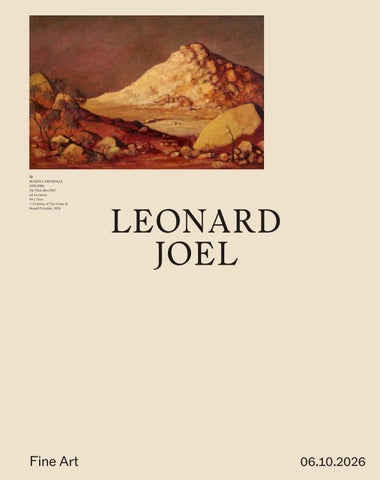
13 RUSSELL DRYSDALE (1912-1981) The White Blow 1967 oil on canvas 49 x 75cm © Courtesy of The Estate of Russell Drysdale, 2026
Fine Art
06.10.2026
Fine Art 06.10.2026, 6pm Melbourne
VIEWINGS
CONTACTS
viewing in melbourne fri 02 – sun 04 oct 11am – 5pm 2 Oxley Road, Hawthorn, VIC 3122
wiebke brix head of art 03 8825 5624 wiebke.brix@ leonardjoel.com.au amanda HAYWARD (née North) senior art specialist 03 8825 5644 amanda.hayward@ leonardjoel.com.au
lot 2 GRACE COSSINGTON SMITH (1892-1984) Still Life with Lilies oil on board 43.5 x 38.5cm $40,000-60,000 © Courtesy of The Estate of Grace Cossington Smith, 2026
1
53 © Emily Kam Kngwarray/Copyright Agency, 2026
2
A Sense of Place
opposite lot 53 EMILY KAM KNGWARRAY (c.1910-1996) (Language group: Anmatyerr) Summer Awelye 1991 synthetic polymer paint on linen 130 x 220cm $200,000-300,000 next page lot 54 (detail) MAKINTI NAPANANGKA (c.1920-2011) (Language group: Pintupi) Lupulnga 2006 synthetic polymer paint on linen 91 x 61cm $7,000-10,000 © Makinti Napanangka/ Copyright Agency, 2026
The Australian landscape has always offered artists far more than a subject to observe and record. It can hold memories, shape identity and create a sense of belonging. It can be a place of beauty and hardship, a source of cultural knowledge, or a setting through which human experience is explored. Throughout Leonard Joel’s October Fine Art auction, interpretations of landscape and the natural world form a common thread, connecting artists whose approaches, histories and visual languages are otherwise very different. Among the highlights of the sale are significant paintings by Russell Drysdale, William Delafield Cook, Emily Kam Kngwarray and Arthur Boyd. Each artist presents a distinct understanding of place. Looking at these works together, I was struck by how profoundly the Australian environment has shaped their imaginations, and how differently each has found a way to express that connection. Russell Drysdale’s The White Blow belongs to the vision of inland Australia that established him as one of the most important Australian painters of the twentieth century. His transformative journey through drought affected New South Wales in 1944 introduced him to the parched plains, exposed rocks, skeletal trees and isolated communities that would remain central to his work. In The White Blow (Lot 13), Drysdale reduces the terrain to essential elements of line, colour and form, creating an image that is at once recognisable and almost abstract. More than a depiction of a geological curiosity, the painting conveys the vastness, strangeness and enduring presence of the outback. William Delafield Cook approached the Australian landscape from a very different perspective. Although he lived much of his adult life in England, Australia remained the place to which he repeatedly returned and the landscape he felt compelled to paint. Hillside, Euroa (Lot 8) grew from his extensive travels and from the photographs, sketches and memories he carried back to his London studio. There, over many months, he reconstructed the scene with extraordinary precision. Every rock, tree and patch of earth feels carefully considered. Yet despite the labour involved, the finished painting possesses a remarkable quietness. It is both intimate and monumental, transforming a particular Victorian hillside into a meditation on memory, time and belonging. For Emily Kam Kngwarray, Country cannot be separated from culture, ceremony and identity. Painted at Delmore Downs in October 1991, Summer Awelye (Lot 53) belongs to a period of extraordinary innovation within her brief but prolific career. Beneath its luminous field of pink, red and yellow dots, traces of a darker structure remain visible. These underlying forms relate to anwerlarr, the pencil yam associated with Kngwarray’s Alhalker Country, and to the broader cultural and ceremonial knowledge embodied in her painting. This is not landscape observed from a distance. Instead, Country is experienced as something living, layered and continually unfolding. The repeated marks create movement and energy, while the painting as a whole retains a profound sense of balance. Nature also assumes a deeply symbolic role in Arthur Boyd’s extraordinary image of the Bride over Shoalhaven (Lot 5). The figure first appeared in Boyd’s celebrated paintings of the late 1950s and continued to evolve as he returned to the subject throughout his career. Here, a luminous passage of white rises through the composition, appearing at once like a veiled figure and a cascade of water. Boyd allows the bride and the landscape to flow into one another, creating a poetic image shaped by love, longing, vulnerability and isolation. Across these paintings, landscape is never merely a background. It becomes an active presence. It carries memory for Delafield Cook, cultural knowledge and authority for Kngwarray, psychological and symbolic meaning for Boyd, and a distinctive vision of inland Australia for Drysdale. Each artist encourages us to look more closely and to consider the relationships we form with the places around us. The October Fine Art auction brings these remarkable paintings into conversation with an engaging selection of many more outstanding Australian and international artworks. We warmly invite you to visit Leonard Joel during the viewing, experience the scale and physical presence of the works firsthand, and perhaps discover your own connections across the collection. wiebke brix head of art
3
4
5
1
1
ELIOTH GRUNER (1882-1939) She-oaks in France 1924 oil on panel signed, dated and inscribed lower right: E. GRUNER/ FRANCE/ 1924 artist’s name and title inscribed on gallery label verso 36 x 44.5cm provenance The Collection of Mrs. John Maund, Sydney Christie’s, Melbourne, 22 August 2000, lot 43 Philip Bacon Galleries, Brisbane (label verso) Private collection, Queensland exhibitions Elioth Gruner Memorial Loan Exhibition, National Art Gallery of New South Wales, Sydney, 17 April 31 May 1940, cat. no. 155; (then touring) National Gallery of Victoria, Melbourne, 5 July - 4 August 1940 cat. no. 26 (label verso) $30,000-50,000
6
2 © Courtesy of The Estate of Grace Cossington Smith, 2026 2
GRACE COSSINGTON SMITH (1892-1984) Still Life with Lilies oil on board signed lower right: G Cossington Smith. 43.5 x 38.5cm provenance Sotheby’s, Melbourne, 22 April 1991, lot 298 (unsold) Private collection, Melbourne Thence by descent other notes Grace Cossington Smith (1892–1984) was one of Australia’s most significant modernist painters. Born in Sydney, she studied under Antonio Dattilo Rubbo, whose teaching introduced her to the ideas of European modernism and Post-Imparessionism. Following a period of travel to Europe and classes at Winchester School of Art in England and at Stettin in Germany, she returned to Sydney in 1914, bringing with her an interest in the expressive possibilities of colour. Cossington Smith developed a highly individual visual language based on colour, pattern, light and rhythmic brushwork. She transformed ordinary subjects such as landscapes, interiors and still lifes
into vibrant arrangements of colour. Cossington Smith spent most of her working life at the family home, ‘Cossington’ in Turramurra, where her domestic surroundings became an important source of inspiration and led to her adopting the name as part of her artist identity.1 The still life genre provided an opportunity to examine the visual relationships between objects, colour and light, while finding beauty in everyday life.
to make a still life arrangement feel dynamic and alive. Her characteristic short, rhythmic brushstrokes create movement across the entire surface. The leaves and flowers appear to expand beyond the boundaries of the vase, while the patterned cloth creates an additional field of colour beneath them. Rather than relying on traditional modelling and realistic shading, she allows adjacent colours to build the impression of form and light.
Flowers were particularly significant to the artist, and her still lifes demonstrate her fascination with colour and the changing qualities of light, while also suggesting a deeper awareness of the fragility and transience of life. Rather than treating flowers as merely decorative subjects, she transformed them into energetic compositions in which colour itself becomes expressive.
Cossington Smith’s still lifes transform familiar domestic subjects into exuberant modernist compositions. The apparent simplicity of flowers arranged in a vase become an exploration of colour, rhythm and perception. Her love of the still life genre was not simply a preference for domestic subjects, but part of a sustained exploration into how painting could make the everyday appear new, luminous and alive.
This can be seen in Still Life with Lilies. At the centre of the composition is a vase filled with lilies and abundant foliage, surrounded by patterned fabric that merges into a richly coloured background. The flowers are immediately recognisable, yet their forms are broken into vigorous strokes of yellow, green, orange, and red. The work demonstrates her ability
Amanda Hayward (née North) Senior Fine Art Specialist 1. Hart, D. (ed.), Grace Cossington Smith, National Gallery of Australia, Canberra, 2005.
$40,000-60,000
7
3
3
NORA HEYSEN (1911-2003) In the Green Room 1974 oil on canvas signed and dated lower right: Nora Heysen /74 title inscribed verso 48 x 38cm provenance The Collection of Ivy Elizabeth Chalmers, Sydney c.1975 Private collection, Sydney $10,000-15,000
8
4
4
WALTER WITHERS (1854-1914) (Eltham Landscape) oil on canvas on panel signed lower right: Walter Withers/ M 34 x 54.5cm provenance Private collection, Melbourne Thence by descent other notes After Walter Wither’s death in 1914, his daughter Margery Withers added the initial ‘M’ beneath her father’s signature to paintings that remained in his studio. This helped to identify artworks that she had signed or authenticated after his death. $20,000-30,000
9
Arthur Boyd
1 . Pearce, B., Arthur Boyd: Retrospective, The Beagle Press in conjunction with the Art Gallery of New South Wales, Sydney, 1993, p. 12. 2. Heide Museum of Modern Art, “Arthur Boyd: Brides”, www.heide.com.au/exhibitions/arthurboyd-brides, accessed 30 August 2026. 3. Philipp, F., Arthur Boyd, Thames and Hudson, London, 1967.
10
Among the familiar figures that recur throughout Arthur Boyd’s long career, none is more evocative than the bride. First conceived during the late 1950s, she would remain within Boyd’s imagination for decades, continually reappearing in altered landscapes and assuming new meanings. In the present work, the bride is no longer a conventional human presence. Her body has been transformed into an extraordinary sweep of translucent white paint, at once veil, waterfall and force of nature. Boyd’s original cycle was titled Love, Marriage and Death of a Half Caste, although it subsequently became known simply as the Bride series. The series was inspired by Boyd’s visit to Central Australia in 1951, where he witnessed the poverty, segregation and social exclusion experienced by First Nations people. As Barry Pearce writes, Boyd’s travels provided a “devastating experience of the state of Aboriginal life in Central Australia,” and he subsequently gave “cathartic expression to his feelings in the Bride series.”¹ Painted initially between 1957 and 1960, the series developed an imagined narrative centred upon a First Nations man and his mixed-race bride. Through their frustrated pursuit of love, Boyd addressed the racial divisions embedded within Australian society. The lovers encounter separation, persecution and tragedy, their private suffering becoming an allegory for a wider history of dispossession and prejudice. The earliest paintings are populated by recognisable protagonists and an elaborate personal vocabulary of flowers, animals and creatures with threatening red eyes. Boyd never presented the story as a coherent sequence. Instead, individual episodes unfold with the uncertain logic of memory, dream or myth. His figures float, dissolve or merge with the surrounding earth, while the Australian landscape becomes an active presence within their unfolding drama. The series was first exhibited at Australian Galleries in Melbourne in 1958 and was expanded for Boyd’s exhibition at Zwemmer Gallery in London in 1960.² Its combination of social conscience, psychological intensity and bold expression established the Bride paintings as an important achievement within Boyd’s career. By the 1960s, however, the bride began to move beyond the original narrative. Boyd had relocated with his family to England in 1959, yet the imagery of Australia continued to exert a powerful hold upon his imagination. Removed from the landscape that had first inspired the paintings, he increasingly transformed it into an internal, poetic landscape. The specific racial and social dimensions of the early series remained part of the bride’s history, but her later appearances expanded into more universal meditations upon love, longing, vulnerability and isolation. This evolution is central to the present painting. The bride’s physical identity has been almost entirely absorbed into the landscape. Only the rounded form of her head and the brilliant white expanse of her veil allow her to be recognised. Her dress rises diagonally across the composition, cutting through the muted riverbank and densely wooded escarpment like a sudden shaft of light. Its pale blue and white surface is animated by vigorous strokes, scratches and fine linear marks. The steep diagonal introduces a sense of movement into an otherwise still landscape. It may be read as a veil caught by the wind, a stream of water, a beam of illumination or the visual trace of a body in flight. Boyd repeatedly exploited such ambiguities. In related paintings, the bride drinks from a river, collapses beside the water or assumes an almost insectlike form, suspended between human figure and natural phenomenon.³ The surrounding landscape is rendered with equal imaginative freedom. The hill is built from layered touches of ochre, pink, violet, blue and olive green. Slender trees descend like vertical threads, their forms hovering between observation and calligraphic notation. A small tent and solitary figure appear at the base of the hill, minute in relation to both the bride and the surrounding terrain. These details establish a human scale, but they also deepen the painting’s atmosphere of estrangement. Boyd’s return to Australia in 1971 and his subsequent encounter with the Shoalhaven River brought a renewed grandeur and specificity to his landscapes. Yet he did not abandon the symbolic figures of his earlier work. Instead, the bride, the bridegroom and other mythic presences entered these later environments, binding personal memory to observed place. The landscape was never merely descriptive for Boyd. It offered a stage upon which human desire, guilt, violence and redemption could be repeatedly enacted. wiebke brix head of art
5 © Arthur Boyd/Copyright Agency, 2026
5
ARTHUR BOYD (1920-1999) (Bride over Shoalhaven) c.1982 oil on board signed lower right: Arthur Boyd 120 x 90cm provenance (possibly) Art Galleries Schubert, Queensland Private collection, Melbourne $100,000-150,000
11
6
6
ELIOTH GRUNER (1882-1939) Rural Landscape under Cloudy Skies European Garden scene verso oil on canvas on board, double sided signed lower left: Gruner 19 x 24cm provenance Sotheby’s, Melbourne, 24 July 1988, lot 257 Private collection, Sydney Davidsons Auctions, Sydney, 19 March 2023, lot 2 Private collection, Melbourne $15,000-20,000 6 (Verso)
12
7 © Arthur Boyd/Copyright Agency, 2026
7
ARTHUR BOYD (1920-1999) The White Cloud watercolour and gouache on paper signed lower right: Arthur Boyd title inscribed verso 22 x 15.5cm provenance Australian Galleries, Melbourne Private collection, Melbourne Thence by descent $8,000-12,000
13
William Delafield Cook
Painting the Australian landscape resonated for William Delafield Cook as a timeless musing on beauty, memory, love and loss. He chose photographic realism as his style. To look at his work is to both absorb a view of a world held within replications of the intricacies, grandeur and diversity of a particular landscape and one that, through his meticulous approach, he constructed and contrived. Hillside, Euroa (1987) is a very fine example of his painterly fascination with the landscape. Born in Caulfield in 1936 it did not take Delafield Cook long to acknowledge his desire to pursue life as an artist. He followed in the footsteps of his grandfather, the artist William Delafield Cook Senior (1861-1931), a painter of soft glowing views of Heidelberg, the Dandenong Ranges and the coast, exhibiting at the Victorian Artists Society alongside Tom Roberts. Yet Delafield Cook, like many others, left Australia in the fifties and journeyed overseas to pursue an artistic career. After a period of study and lengthy stay in England, a marriage and family with the inimitable Sally Bovington, Delafield Cook’s home became London, and he enjoyed a burgeoning career as an artist as well as teaching positions. Despite the contentment of domestic life, it was to Australia that the family regularly travelled, at one point purchasing a Sydney home, regularly driving across the nation, Delafield Cook photographing, documenting, sketching and searching for views that ignited his imagination. He commented on the personal nature of his landscapes as being “not just “landscape”, they are a part of my life. If I’m painting Australia (and for some reason I’ve never really had any interest in painting the English landscape) I’m painting, among other things, my thoughts, my childhood, my sense of place, where I belong.”1 Delafield Cook developed an intense style of painting, often reducing the evidence of his brushstrokes by sanding and smoothing the painted surface. The realism of his studies ignites a desire to probe, inspect and explore. He often constructed his vast works from views of a centrally located organic entity. He favoured haystacks, clumps of trees seemingly majestically rising from the depths of a lake, appearing like a mirage, or a barren clump of rocks, archaic and desperately ancient. A canvas such as Hillside, Euroa required the commitment of several months of drawing and painting. Delafield Cook gathered his source material of photographs and sketches and pinned them on boards in his London studio so that he might dissect, filter and refine the images into his final work, memory of his visits equally as active. Despite the activity required to make the picture, the result is one of quiet contemplation, and stillness. Euroa, a town in northern Victoria, is perhaps best known for its association with the mythology of Ned Kelly’s gang who roamed its countryside. It is typical of Delafield Cook to choose locations that are not without a colourful history (he also painted Hanging Rock), his somewhat muted colouring belying that which simmers within the shadows or fallen leaves and crusted dirt as though he searches for the very footprints of Ned Kelly, however the depiction of any human or animal is not to be found. Indeed, the landscape of Euroa, once he became acquainted with the formations of its earth, developed into an obsession for Delafield Cook and resulted in one of his most significant series. Repeated visits in the late eighties and early nineties inspired him to centre his focus upon the rocky and vegetated mounds, some exposed as quarried rock faces, others naturally occurring. Two similar and equally fine examples are held in the collection of the Art Gallery of New South Wales. In The Quarry, Euroa (1989-90) and Rocky Hillside, Euroa (1990) Delafield Cook has chosen views sparse and stripped of vegetation, his colouring subdued against a pale incipient sky bereft of clouds. In both works, either through quarrying of the land or an unforgiving expanse of dry earth sporadically populated with smoothed emerging rocks, there is little to suggest plant-life will spring forth.
1.
14
Hart D., William Delafield Cook, Sydney, Craftsman House, 1998, p.167.
In Hillside, Euroa his approach is subtly different; he depicts a jutting rock formation discovered on private property. The mound appears to have existed for thousands of years, the symmetry held in the enduring patterns, time’s erosion evidenced in smaller rocks distributed in a formation around the base, the foreground of cleared land providing the viewpoint for the hill’s majesty. Spindly trunks of trees cling to patches of available earth amongst the harsh rock environment, leaves a fertile green, lit by the remnants of a golden sunset on the horizon while others appear unable to survive, tree branches bare and relegated to the fringes of the vegetation’s central core. It is tempting to suggest Delafield Cook is critiquing society and its ruthless structure that assigns the vulnerable to its fringes, just as the unforgiving Australian climate is too overwhelming for a young defenceless tree, fallen branches scattered like lances in Paolo Uccello’s The Battle of San Romano. Rock after rock, scattered with smaller stones, is detailed as though to forsake one would disrupt the balance of the painting, each rock contributing to the overall composition. A photograph cannot bring such gravitas, such meaning to a work. Delafield Cook spells out each component of his composition asking us to linger and contemplate his perspective, a parting of the vegetation just beyond the centre of the painting a possible trail that delineates the darker side of the hill. Delafield Cook’s Australian influences are many; the silvery grey-green colouring of gum trees painted by Tom Roberts, the horizontal vistas and mounds that populate the work of John Glover and the expansive views by Eugene von Guérard. These artists also journeyed, searching for motifs and expressions of their artistic traditions and a national identity. Nature and its many manifestations dominated their work just as Delafield Cook immersed his practice in the impact the environment could have upon his very being. A winner of the Wynne (1980) and Sulman (1981) prizes, the uncompromising brilliance of Delafield Cook’s body of work locates him as one of Australia’s great artists, works on the scale and significance of Hillside, Euroa rarely available. It is the intimacy and grandeur of the landscape that captured the artist and permeates the space of the viewer. Looking elsewhere is almost impossible. Dr Julie Cotter Dr Julie Cotter is the author of three books, has worked as a lecturer and in public policy roles, written and presented documentaries, is widely published in a range of journals, magazines and catalogues and has been a member of many public art and grant committees. Her book, Tom Roberts and the Art of Portraiture (Thames & Hudson 2015), was shortlisted for the 2016 Prime Minister's Literary Award for nonfiction. Her most recent book is Portia Geach: Portrait of an Activist (Joyce Press 2024). It tells the story of the first Australian woman to be admitted to the Royal Academy of the Arts.
William Delafield Cook, Rocky hillside, Euroa 1990, Art Gallery of New South Wales, gift of Frank Lowy and the Westfield Group in memory of Donald Stephens 1991. © William Delafield Cook, image © Art Gallery of New South Wales
15
16
9
17
9
William Delafield Cook in his studio with Hillside I, 2004 – 11. Photographer unknown
9
J.H. SCHELTEMA (1861-1941) (Cattle Grazing) oil on canvas in the original John Thallon frame (label verso) signed lower right: J.H Scheltema 69.5 x 99.5cm provenance Leonard Joel, Melbourne, 17 June 1954, lot 2199 Private collection, Melbourne $10,000-15,000
8
WILLIAM DELAFIELD COOK (1936-2015) Hillside, Euroa 1987 synthetic polymer paint on canvas signed and dated lower right: Delafield Cook 87 artist’s name and title on gallery label verso 111 x 281.5cm provenance Art Galleries Schubert, Queensland (label verso) Private collection, Queensland exhibitions Hart D., William Delafield Cook, Sydney, Craftsman House, 1998, p.167 (illus.)
10
HAROLD SEPTIMUS POWER (1878-1951) (Shoeing the Horse) watercolour on paper signed lower left: H.S.POWER 31.5 x 42cm
related works William Delafield Cook, The Quarry, Euroa 1989-90, synthetic polymer paint on canvas, 162 x 294.5cm, Art Gallery of New South Wales, Sydney William Delafield Cook, Rocky Hillside, Euroa 1990, synthetic polymer paint on canvas, 88.8 x 300cm, Art Gallery of New South Wales, Sydney $200,000-300,000
provenance Private collection, Melbourne $3,600-4,600 10
18
11
HAROLD SEPTIMUS POWER (1878-1951) (Farmyard at Feeding Time) oil on linen signed lower right: H S POWER 50 x 60cm provenance Private collection, Melbourne Thence by descent $5,000-7,000 12
J.H. SCHELTEMA (1861-1941) (Pulling Stumps, Early Morning) oil on canvas signed lower right: J. H. Scheltema 62 x 121cm provenance Private collection, Adelaide Thence by descent $15,000-25,000
11
12
19
Russell Drysdale
20
Sir Russell Drysdale was one of the most significant Australian painters of the 20th century and indeed his award of a knighthood in 1969 was clear recognition of the esteem in which he was held at every level. His paintings sit at the peak of the Australian collector market and are seen to be pure expressions of some ‘real’ Australia, far removed from the bland urban sprawl that is home for the vast majority of Australians. The White Blow is an exemplar of that genre, an image both desolate and yet compelling at the same moment. Born in the English seaside resort town of Bognor Regis in 1912 to an established family with Australian pastoral interests, he came to Melbourne in 1923. The young ‘Tas’, as he was known, was enrolled at Geelong Grammar School, one of the state’s most prestigious private schools. Favoured as the school for the sons of Western District grazing families, it held a cohort of students that Drysdale could relate to, especially when in 1926 his father acquired ‘Boxwood Park’, a Riverina grazing property. Tas was a keen sportsman, but his life took a difficult turn in 1929 when he suffered a detached retina that would see him lose the sight of his left eye. As a form of therapy, he was given drawing lessons five times a week, an activity that would have a profound effect on his outlook and subsequent career. Learning perspective and the formal techniques of drawing were a challenge and Drysdale developed a love for illustration and a considerable skill as a draftsman. In another quirk of fate, the Melbourne surgeon engaged to correct his eye was Julian Smith, a noted photographer and central character in the local art scene. Smith encouraged Drysdale to pursue his art interests and introduced him to George Bell who, with Arnold Shore, would found an art school teaching modernist art in a direct contrast to the entrenched conservatism of the National Gallery Art School, the nation’s premier art academy. While Drysdale fitted in well enough with Bell, he wanted more and, thanks to his comfortable family situation, was able to travel to London in 1932 to pursue his art interests. After two years exploring all that was offered at the ‘centre’ of the art world, he realised that the modernism of Bell, far removed from his original ‘traditional’ training, was in fact the way art was going and he returned to Australia, and to Bell, to pursue the life of an artist. Three years working with George Bell developed his own personal style and also introduced him to a cohort of enthusiastic young artists, most notably Peter Purves Smith, who would become a close friend and artistic mentor. Newly married, Drysdale returned to London for further experience, but the trip was cut short by the threat of war and he returned to Australia and settled in Sydney just as war broke out. Drysdale hoped to enlist and do his bit for the nation, but the eye issue blocked any chance of active service and, after the Japanese attacks on Sydney in 1942, he moved to Albury, a safe place on a direct line between Sydney and Melbourne. While he might have been a civilian, he was living in a town that became a staging post for thousands of soldiers who were training in the area before heading off to the conflicts in South East Asia and the Pacific. The works he created depicting the men gathering at the local railway station and the Army camps became unique expressions of the home front. The powerful insights he made into the world of soldiers in uniform led to a life changing opportunity in 1944, when he was commissioned by the Sydney Morning Herald to document the effects of the drought that was devastating inland Australia. As a person well familiar with rural life, Drysdale knew the times of both drought and plenty, but the journey he made took him further and deeper into inland Australia than he’d been before. The works he created sowed the seed for his art for the rest of his life. Dry creek beds, huge rocks, leafless trees, barren plains and dead animals became the subject for paintings and drawings that would be central to his art for the rest of his career. A friendship with fellow artist Donald Friend, who had served as an Official War Artist in Borneo, took him to a number of remote locations and their ‘discovery’ of the abandoned towns of Sofala and Hill End opened up a new suite of subject matter that found a broad following around Australia. His painting of the empty main street of Sofala won the Wynne Prize for 1947. The colour and atmosphere, the barren emptiness of a lost community could not have been more different to the ‘Australia’ of the Heidelberg School, the golden plains of Streeton, the vigorous, engaged human subjects of Tom Roberts and the towering splendour of Heysen’s great gum trees. Drysdale produced a series of iconic works that became embedded into the Australian imagination.
As Drysdale continued to travel to the outback and far north, he began to engage with the Aboriginal people and he became acutely aware of the way they had been moved about and disengaged from their own lands as mining and agricultural companies pushed further out into the wilderness. In his later years Drysdale concentrated on landscapes depicting the unique nature of the outback and he sought out areas of visual and geological interest. One outstanding find was a unique rock formation near the gold-mining town of Ravenswood, 55 kilometres east of Charters Towers in North Queensland. The ‘White Blow’ was created when the covering rock was gradually worn down to expose a pure white quartz ‘hill’ - a great lure for prospectors and the artist alike. In creating landscapes like The White Blow, Drysdale showed that a painting could verge on the abstract while also being an accurate rendition of the outback. Line, form and colour combine to give the spirit of the barren land. Many perhaps first saw them as works of the imagination, but as time moved on ‘driving into the outback’ became a pursuit for tens of thousands of Australians and international tourists alike. The availability of rugged new vehicles and outback aircraft made no place unreachable and travellers realised that Drysdale had captured both the appearance and the very spirit of the land. Whether inhabited by a couple of scrawny workers, a group of seemingly lost Aboriginal people or an uninhabited wilderness, he brought to Australian art, and the Australian people, a lasting vision that is treasured today. Gavin Fry OAM MA MPhil Gavin Fry is a writer, artist and art historian with more than 60 years experience working in Australian museums, galleries and educational institutions. He has 30 books of Australian art and history to his name and designs and publishes books for other artists and writers.
Max Dupain, Russell Drysdale 1945 / Alamy
21
Russell Drysdale, Broken Mountain 1950, National Gallery of Victoria, Melbourne. Presented through The Art Foundation of Victoria by the National Australia Bank Limited, Honorary Life Benefactor, 1990. © Courtesy Russell Drysdale Estate, image © National Gallery of Victoria
13
RUSSELL DRYSDALE (1912-1981) The White Blow 1967 oil on canvas signed and dated lower right: Russell Drysdale / 67 titled and inscribed verso: “THE WHITE BLOW” – RUSSELL DRYSDALE/ C/O W.J. MCLAUGHLIN/ 46. EDGECLIFF ROAD/ BONDI JUNCTION - SYDNEY 49 x 75cm provenance The Collection of William J. McLaughlin, Sydney (inscribed verso) Artarmon Galleries (Artlovers), Sydney 1971 (label verso) The Collection of Mr. & Mrs. Michael Richards, Sydney Sotheby’s, Modern Australian Paintings and Drawings - The Mr. & Mrs. Michael Richards Collection, Sydney, 13 October 1983, lot 13 The Estate of Judith Barbara Mactaggart, Sydney Thence by descent related work Russell Drysdale, Broken Mountain 1950, oil on canvas, 66.2 x 102cm, National Gallery of Victoria, Melbourne Russell Drysdale, Road with Rocks 1949, oil on canvas, 66.6 x 102cm, Art Gallery of New South Wales, Sydney $180,000-220,000
22
13 © Courtesy of The Estate of Russell Drysdale, 2026
23
14 © William Dobell/Copyright Agency, 2026
14
WILLIAM DOBELL (1899-1970) Creek at Lake Macquarie c.1949 oil on board signed lower right: WDOBELL artist’s name, title and date on gallery label verso 24 x 29cm provenance Christie’s, Sydney, 31 November 1990, lot 81 Philip Bacon Galleries, Brisbane (label verso) Private collection, Queensland $15,000-25,000
24
15
HANS HEYSEN (1877-1968) Landscape with Gums and Cattle 1940 watercolour on paper signed and dated lower right: HANS HEYSEN. 1940. 38 x 30cm provenance Leonard Joel, Melbourne, 6 November 1975, lot 223 Private collection, Melbourne $12,000-16,000 16
JOHN STUART DOWIE (1915-2008) Bust of Sir Hans Heysen bronze with marble base signed at base: DOWIE 28 x 21 x 26cm; 45cm (height, including base) provenance Private collection, Melbourne exhibitions On loan to the Castlemain Art Gallery 2014-2021 $3,000-5,000
15 © Hans Heysen/Copyright Agency, 2026
16
25
Arthur Streeton
1 . Arthur Streeton to Sydney Ure Smith, 16 June 1922, quoted in Letters from Smike: The Letters of Arthur Streeton 1890-1943, Melbourne, OUP, 1989, p.164. 2. Smith G., “Arthur Streeton and the Australian Coast,” in Arthur Streeton and the Australian Coast: MPRG Mornington Peninsula Regional Gallery 11 December 2004 – 6 March 2005, (Mornington), Mornington Peninsula Regional Gallery, (2004), p.27.
26
The aftermath of World War I brought a desire for peace, stability and the security of home. Arthur Streeton, like many Australians who experienced the war on British and European shores, returned to seek the familiar, to again enjoy life immersed in the idyllic isolation and sunny vistas of Australia. Commissioned as an Official War Artist, it was a time of intense productivity (he produced over 180 works in six months), his contract sending him to the Somme where he painted soldiers marching from one battle to the next amongst smoke plumes, workers in makeshift hospitals, a dutiful nurse beside injured soldiers dealing with the trauma of war. Streeton arrived with his family in February 1920 and other than a lengthy overseas trip in 1922-23, he remained in his homeland for the rest of his life, the inhumanity of war, looming Spanish flu and political upheavals contributing to his motivation. But he had not returned home to rest. With his brushes and paints, few financial worries, Streeton embarked upon a series of journeys across Australia, the quiet and lustrous town of Lorne part of his campaign to cast his eye over new locations. A crowded calendar in 1920 filled with exhibitions in Sydney and Melbourne meant Streeton waited until 1921 to undertake the longed-for coastal journeys to Lorne, Sorrento and Portsea in the first half of the year. Travel to Lorne was not easy and required a train journey to Deans Marsh, a transfer to coaches passing along rough bush tracks over the Otway Ranges before dense forests gave way to reveal Louttit Bay and the crystal waters of the Southern Ocean. The magnificence of the landscape aside, Lorne was also on the cusp of something far greater. Construction of the Great Ocean Road had been announced in 1918, Lorne central to the proposal to build a twisting snake like slick of road blown out of treacherous cliffs that reached from land to sea and gave little indication of a pathway. The project was designed to both employ returned servicemen and increase access to the Western District. It would become the world’s largest war memorial. Streeton’s journey to Lorne may have been prompted by environmental concerns. The works he painted, however, are more than pre-emptive documentation. They are personal and central to his reflection upon that which he valued; his war service, a childhood spent in the Victorian seaside town of Queenscliff, the taste of salty air on his lips, his early days standing on rocks in Sandringham where it all began. Our picture, (Lorne and the Bay), takes full advantage of the spectacle that emerges when the glorious sweep of Lorne comes into view with its sparkling aquamarine waters and a beach, dotted with swimmers and walkers, that stretches its way into a township that is perfectly framed by impenetrable cliffs. In a letter to Sydney Ure Smith, Streeton considered his Lorne pictures amongst his best from this period.1 A 1919 photograph held in the Lorne Historical Society’s archives shows a view of Lorne from the opposite side to Streeton’s perspective, the placement of the houses and shops dotted throughout suggesting Streeton was accurate with his brush, a large stately home, possibly his interpretation of Kincraig on Mount Joy Parade, dominant. “How lucky!” he must have thought as he sat with one hand on his easel, the southerly winds that can race along the coastline never far away, the spindly trees in the foreground offering little protection, the wide brushstrokes freely dotted throughout suggesting the wind was, indeed, a factor. And he paints with a surety and spontaneity of one who knows the Australian landscape and its value, his view looking down and across into deep space one he had painted many times. It is a landscape he dreamt of during heart breaking war years. It is a landscape he understands; the summery blue haze of the mountains, the raw and brown umbers that define many of his Australian pictures, the composition so perfectly balanced, wispy clouds floating and signalling that soon they will clear and Lorne again will be charged with sunlight. There are at least five paintings of Streeton’s visit to Lorne, a reacquaintance with his famous ‘Streeton blue’ evident in the work, Ocean blue, Lorne, held in the collection of the Geelong Art Gallery, a view of the ocean framed by towering gum trees. In 2004, Geoffrey Smith gave his definitive perspective on Streeton’s 1921 series of coastal views. “These are amongst the most significant of all his Victorian coastal subjects” he wrote “yet remain largely unknown in his oeuvre; for relatively small in number they were purchased from their initial exhibitions by private collectors and disappeared from public view.”2 Dr Julie Cotter
Portrait of Arthur Streeton, photographer Jack Cato, 1889-1971. Source: State Library of Victoria
27
Arthur Streeton, Ocean Blue, Lorne, 1921, Collection of the Geelong Art Gallery Photographer: George Stawicki
17
ARTHUR STREETON (1867-1943) (Lorne and the Bay) 1921 oil on canvas signed lower left: A STREETON 50.5 x 76cm provenance (possibly) The Collection of Miss Regina Milne Private collection Christie’s Australia, Melbourne, 27 - 28 November 2000, lot 49 (unsold) Private collection, Sydney Private collection, Perth Thence by descent exhibitions (possibly) Spring Exhibition 1922, Victorian Artists’ Society, Eastern Hill, 23 October - 5 November 1922, cat. no. 89 (as “Loutit Bay, Lorne”) literature (possibly) Streeton, A., The Arthur Streeton Catalogue, self published, Melbourne, 1935, p.132, cat. no. 721 (as “Lorne and the Bay”) related work Arthur Streeton, Ocean Blue, Lorne 1921, oil on canvas, 64 x 76.5cm, Private collection Arthur Streeton, An Ocean Bay 1926, oil on canvas, 22.8 x 71cm, Private collection $200,000-300,000
28
17
29
18
18
WILL ASHTON (1881-1963) (Seascape) oil on canvas signed lower right: WILL ASHTON 57.5 x 73cm provenance Private collection, Melbourne $7,000-9,000 19
WILL ASHTON (1881-1963) La Perouse Monument c.1919 oil on canvas signed lower right: WILL ASHTON 28 x 38cm provenance Leonard Joel, Melbourne, 6 July 1983, lot 769 Private collection, Victoria Menzies, Melbourne, 27 February 2020, lot 86 Private collection, Melbourne Leonard Joel, Melbourne, 27 June 2023, lot 42 Private collection, Melbourne $5,000-7,000 19
30
20 © Lloyd Rees/Copyright Agency, 2026
20
LLOYD REES (1895-1998) Morning Impression - North Down Tasmania 1976 acrylic and pastel on paper signed and dated lower left: L REES/ 1976 artist’s name, title and date on gallery label verso 55 x 75cm provenance David Sumner Gallery, Adelaide (label verso) The Collection of Norman Feather, Adelaide Thence by descent $5,000-6,000 21
DAVID BRIAN WILSON (1946-1998) Through the Window bronze with marble base 99 x 67cm; 189cm (height, including base) provenance The Artist Cooperate collection, Melbourne
21
other notes Please note: Due to the weight, this sculpture requires professional carriers to move. $5,000-7,000
31
22 © John Olsen/Copyright Agency, 2026
22
JOHN OLSEN (1928-2023) Bird at the Window 1953-54 oil on canvas signed lower right: John Olsen 59.5 x 74cm provenance Savill Galleries, Melbourne Private collection, Melbourne $20,000-30,000
32
23 © Leonard French/Copyright Agency, 2026
23
LEONARD FRENCH (born 1928-2017) The Netmenders 1987-89 enamel and gold leaf on hessian covered hardboard signed lower right: French artist’s name, title and date inscribed on gallery label verso 121 x 136cm provenance Powell Street Gallery, Melbourne (label verso) Private collection, Melbourne exhibitions Leonard French: Paintings 1987-89, Powell Street Gallery, Melbourne, 9 - 29 June 1989, cat. no. 9 $20,000-30,000
33
Christopher Wood
1. The Redfern Gallery, Chrisopher Wood, accessed on 23 August 2026: https:// www.redfern-gallery.com/artists/76christopher-wood/overview 2. Ibid. 3. Tate Britian, Christopher Wood, accessed on 23 August 2026: https:// www.tate.org.uk/art/artists/christopherwood-2167 4. The Redfern Gallery, Chrisopher Wood, accessed on 23 August 2026: https:// www.redfern-gallery.com/artists/76christopher-wood/overview 5. Ibid.
34
“Fate decreed that he should die at the age of 29, but fate allowed him to live just long enough for his work to be an outstanding event in the history of British art”. (Eric Newton, Christopher Wood, Redfern Gallery 1938) Christopher Wood's career lasted barely a decade, yet his paintings occupy a distinctive place in British modernism. Born in Liverpool in 1901, Wood initially studied architecture and medicine before moving to painting, encouraged by the Welch painter Augustus John.1 In 1921 he travelled to Paris and enrolled at the Académie Julian, beginning a relationship with the city that would profoundly shape his artistic development.2 Paris introduced Wood to the international avant-garde. While moving between Paris and London, he encountered artists such as Jean Cocteau and Pablo Picasso, as well as Sergei Diaghilev, for whom he produced set designs for the Ballets Russes production of Romeo and Juliet in 1926, although they were never used.3 Despite the influence of Paris, Wood was never simply a British supporter of French modernism, as his work absorbed the lessons of Post-Impressionism and modernist simplification, while retaining an instinctive, almost naïve directness that became increasingly characteristic of his style. The painting titled Paris offers a particularly vivid expression of this synthesis of styles. The composition is dominated by intensely coloured blocks of architecture, including crimson red, greens, yellow ochres and deep, midnight blues. Dark, twisting trees cut across the buildings, flattening out the space and creating a theatrical framework. At street level, small groups of figures animate the lively scene of Paris after dark. The figures scale is deliberately subordinate to the architecture, yet they give the painting its sense of everyday life. Wood’s encounter with the Ballet Russes and set design is evident in his work as the architecture seems almost stage like. Facades become painted backdrops, trees become graphic devices and the figures appear to perform their small daily activities in the scene. Wood's depiction of Paris is less a conventional cityscape and more a psychological landscape. Perspective is compressed, forms simplified and colour becomes expressive. The red facades seem to glow against the dark, blue-grey atmosphere, while the large blue building on the right, creates a dramatic counterweight. The city is both real and imagined. The buildings are solid, its figures recognisable and the trees are firmly rooted in the street, however, Wood's colour and flattened perspective transform them into something more elusive. The result is a painting that feels less like a record of Paris and more like a memory of it, one that is vivid, fragmentary, theatrical and dynamic. This combination of directness and sophistication places Wood within the remarkable circle of British artists who were redefining painting during the 1920s. His friendship with artists such as Ben and Winifred Nicholson was particularly significant. In 1926 he joined the Seven and Five Society and the London Group, then a year later, he exhibited with the Nicholson’s at the Beaux Arts Gallery (April - May 1927), becoming close to them personally and professionally.4 Whilst on a trip to St Ives, Wood and Ben Nicholson encountered the self-taught painter Alfred Wallis, whose simplified forms and instinctive approach to painting had a profound influence on both artists.5 The importance of Paris to Wood's development is also evident in his artwork titled Bridge over the Seine 1927 in the National Galleries of Scotland collection. The painting depicts a Parisian bridge and the river Seine with buildings and factory chimneys set in the background, while a mother and child are overlooking the scene. The work emphasises the ordinary activities of Parisians rather than an idealised view of the city and demonstrates Wood's recurring fascination with figures, architecture and daily life, as elements within a highly personal visual language. Wood’s life and career came to an abrupt ending when he died in 1930 at twentynine, after a period of increasing psychological instability and opium addiction. His reputation nevertheless grew rapidly after his death. The Redfern Gallery in London held a Christopher Wood exhibition in 1936 and later organised a major retrospective in 1938, in which the artwork Paris was exhibited, which helped establish his position within the history of British modern art. The body of work that Chrisopher Wood produced in his fleeting career demonstrates why his work continues to fascinate contemporary audiences. His paintings are modern without being doctrinaire and sophisticated without sacrificing spontaneity. In his depictions of Paris, the cityscape, architecture, trees and people are transformed into a vivid arrangement of colour and line. Paris becomes not simply a place Wood observed, but a place he reinvented, a city of memory, sensation and imagination. Amanda Hayward (née North) Senior Fine Art Specialist
24
24
CHRISTOPHER WOOD (British, 1901-1930) Paris oil on board signed lower left: C. Wood artist’s name and title on gallery label verso 37.5 x 45.5cm provenance The Redfern Gallery, London, January 1936 (label verso) The Collection of J. T. Tweddle, Melbourne Thence by descent exhibitions Christopher Wood, The Redfern Gallery, London, January 1936 (label verso) Special Exhibition of Contemporary British and Continental Artists, National Art Gallery of New South Wales Sydney, 19 October - 31 December 1938 (label verso) $80,000-120,000
35
25 © Marc Chagall/Copyright Agency, 2026
25
MARC CHAGALL (Russian-French, 1887-1985) L'Animal Aile 1974 monotype in colours on Japon nacré paper, unique signed in black ink lower left: Marc/ Chagall dated verso: 1974 (concealed) 42 x 32cm (plate); 67 x 53cm (sheet) PROVENANCE Art Focus, Zurich, 2001 (accompanied by original purchase receipt) Private collection, Sydney LITERATURE Cramer, G., Marc Chagall, Monotypes 1966-1976, Genf 1976, og. 56/57, no. 234 $40,000-60,000
36
other notes Marc Chagall began working with monotype in 1961, encouraged by his friend and publisher Gérald Cramer and in collaboration with master printer Jacques Frélaut. Over the next fourteen years, he produced more than 300 monotypes. Working directly onto a copper plate with oil colour, the process allowed Chagall to work freely and spontaneously, bringing the qualities of painting into his printmaking.
Created in 1974, the present work dates from the final years of Chagall’s work in the medium. During 1974 and 1975, he and Frélaut produced close to one hundred monotypes, returning to subjects that had long occupied Chagall, including lovers, musicians, animals and flowers. Unlike his editioned prints, each monotype exists as a unique impression, with variations in colour, surface and line that come directly from the printing process.
26 © Donald Friend/Copyright Agency, 2026
26
DONALD FRIEND (1915-1989) Temple Offering and Village Animals, Bali mixed media and collage on paper signed and titled lower right: Temple Offering and Village Animals, Bali/Donald Friend 78 x 133cm provenance Philip Bacon Galleries, Brisbane The Collection of Dr. Robert Cooke, Brisbane Thence by descent $15,000-20,000
37
27 © Ray Crooke/Copyright Agency, 2026
27
RAY CROOKE (1922-2015) (Islanders) oil on canvas signed lower centre: R.Crooke 50 x 40cm provenance Framed Gallery, Darwin Private collection, Melbourne $8,000-12,000
38
28 © David Boyd/Copyright Agency, 2026
28
DAVID BOYD (1924-2011) (Swimming under the Trees) oil on canvas signed lower left: David Boyd 89.5 x 74cm provenance Private collection, Melbourne $15,000-20,000
39
29
29
HERMANUS WILLEM KOEKKOEK (Dutch, 1867-1929) A Scene from the Franco-Prussian War oil on canvas signed lower left: Herm W Koekkoek 49.5 x 74.5cm provenance Collection of Sir Harold Gengoult Smith, Melbourne Leonard Joel, Melbourne, 2 November 1934, lot 36 Private collection, Melbourne Thence by descent $20,000-25,000
40
30
30
CHARLES ROLANDO (1844-1893) Forest Stream and Bush Walker oil on linen signed lower left: C Rolando 90.5 x 70.5cm provenance Deutscher~Menzies, Melbourne, 28 November 2001, lot 125 Private collection, Melbourne $10,000-15,000
41
AntoineCharles Vauthier
OTHER NOTES Antoine-Charles Vauthier was one of the leading natural history illustrators of early nineteenth century France, celebrated for his scientifically accurate and artistically refined depictions of exotic fauna. These two watercolours are original preparatory drawings executed for René Primevère Lesson’s Compléments de Buffon: Des Mammifères (1838), where they were engraved and published as Plates 24 and 59. They depict the Red Panda and Hog Badger, and the Addax Antelope, demonstrating Vauthier’s exceptional ability to combine anatomical precision with elegant composition. The works originating from the renowned Marcel Jeanson Collection, one of the most important private collections of natural history illustration assembled in the twentieth century. They were sold by Christie’s, London, in 2000 alongside a companion drawing of the Tasmanian Tiger, now held in the National Gallery of Australia. Their distinguished history, direct relationship to one of the great nineteenth century zoological publications, and provenance make these rare watercolours highly significant examples of Vauthier’s work.
31
ANTOINE-CHARLES VAUTHIER (French, 1790-1879) Antelope (Antilope Gibbosa) watercolour and gouache on paper signed lower left: Vauthier pxit 11.5 x 16.5cm (image) provenance The Collection of Marcel Jeanson, Paris Christie’s, The Jeanson Collection, London, 19 June 2000, lot 209 Peter Walker Fine Art, Adelaide Imperial Antiques, Melbourne Private collection, Hobart Thence by descent $10,000-15,000 31
42
32
32
ANTOINE-CHARLES VAUTHIER (French, 1790-1879) Panda - Lesser Panda (Ailurus Fulgens Balisaur) and Hog Badger (Arctonyx Collaris) watercolour and gouache on paper signed lower left: Vauthier pxit 16.5 x 11cm (image) provenance The Collection of Marcel Jeanson, Paris Christie’s, The Jeanson Collection, London, 19 June 2000, lot 209 Peter Walker Fine Art, Adelaide Imperial Antiques, Melbourne Private collection, Hobart Thence by descent $10,000-15,000
43
33
33
34
MORTIMER MENPES (1855-1938) Watching the Play c.1890 oil on panel signed lower right: Mortimer Menpes artist’s name, title and date on gallery label verso 15 x 10.8cm provenance Peter Walker Fine Art, Adelaide (label verso) Private collection, Sydney literature Menpes, M., Japan: A Record in Colour, A & C. Black, London, December 1901, p.4 (illus.) related work Mortimer Menpes, Watching the Play, Kyoto, etching ed. AP, 21 x 29cm, Private collection $10,000-15,000 34
GEORGE EDWARDS PEACOCK (1806-1890) Sydney N.S.W in a S.W. Squall 1845 oil on canvas on panel initialled, titled and dated verso: Sydney N.SW./ in a S.W.Squall/GEP 1845 13.5 x 18.5cm provenance Private collection, Melbourne $15,000-20,000 35
JEAN-BAPTISE CAMILLE COROT (French, 1796-1875) French Alps Village at Base crayon and pencil on paper initialled lower right: C.C inscribed and dated illegibly lower right 21 x 32cm provenance The Collection of R.S Walker Burn & Son Auctioneers, Hobart, 19 October 1966, lot 23 Private collection, Victoria Private collection, Melbourne, acquired from above $3,000-5,000 35
44
36
EUGENE VON GUÉRARD (1811–1901) Deep Creek [Victoria] Mr Wilson’s Model Farm 1865 oil on canvas inscribed and dated lower right: Deep Creek/ 1865 titled on exhibition label verso 21 x 35.5cm
exhibitions Australasia, Old and New, Francis Edwards Ltd., London, 1928, cat. no. 614 Australian Paintings, Joshua McClelland Print Room, Melbourne, 1968, cat. no. 12, (as “artist unknown”) Views of Melbourne and Geelong, Joshua McClelland Print Room, Melbourne, 26 February – 7 March, 1980, cat. no. 12, (as “Eugene von Guérard”) Eugene von Guérard: Nature Revealed, National Gallery of Victoria, Melbourne, 16 April – 7 August 2011 (label verso)
provenance Francis Edwards Ltd, London, 1928 Maggs Brothers, London, from whom acquired by the following (according to Terence Lane’s research) Joshua McClelland Print Room, Melbourne 1968 Private collection Joshua McClelland Print Room, Melbourne 1980 The Collection of Terence Lane, Melbourne Thence by descent
literature Bruce, C., Comstock, E., and F. McDonald, Eugene von Guérard 1811–1901: A German Romantic in the Antipodes, Alister Taylor Publishers, Martinborough, New Zealand, 1982, p. 284 (as “Whereabouts Unknown”) Pullin, R., Eugene von Guérard: Nature Revealed, Council of Trustees of the National Gallery of Victoria, Melbourne 2011, pp. 196–197
36
other notes The artwork depicts part of ‘Arundel’, the ‘model farm’ set up by the journalist and co-owner of The Argus newspaper Edward Wilson (1813–1878) on Deep Creek (now called the Maribyrnong River), north of Keilor on Melbourne’s north-west outskirts (the site of the farm now being between the south-west side of Melbourne airport and the Calder Freeway). Von Guérard visited ‘Arundel’ in March 1865 while staying at the still-extant ‘Glenara’ a short distance to the north, also on Deep Creek, in preparation for his famous view of that property, Mr Clark’s Station, Deep Creek, near Keilor (National Gallery of Victoria, acc. no. A2-1986). $50,000-70,000
45
Ida Kohlmeyer
Ida Kohlmeyer (1912–1997) created a distinctive visual language of animated signs, rhythmic structures and exuberant colour. Although closely connected with Abstract Expressionism, she resisted remaining within the orbit of her celebrated mentors, transforming their lessons into a unique practice grounded in experimentation, intuition and play. Born Ida Rittenberg in New Orleans to Polish Jewish immigrant parents, Kohlmeyer initially studied English literature at Newcomb College, graduating in 1933. A formative journey through Mexico the following year awakened her interest in the visual arts, although she did not commence formal artistic training until 1947, when she enrolled at the John McCrady School of Art. She subsequently returned to Newcomb College, completing her Master of Fine Arts in 1956 under Pat Trivigno. Reflecting on this concentrated period of development, Kohlmeyer identified “three really tremendous influences in my life: Hans Hofmann, Pat Trivigno and Mark Rothko.”¹ Immediately following her graduation, Kohlmeyer attended Hans Hofmann’s summer school in Provincetown. The encounter proved transformative. Recalling her rapid conversion from figurative painting to abstraction, she declared: “Overnight I became an Abstract Expressionist.” What liberated her was “the dynamism of the work, the felt quality, the emotion, the freedom...” ² Hofmann’s principles of spatial tension and colour remained foundational throughout her career. Mark Rothko provided another important model when he taught at Newcomb during the late 1950s. Kohlmeyer absorbed his floating forms, veiled colour and softened edges, but became increasingly determined to establish her independence. She later explained: “I didn’t want to be that dependent on anybody.”³ Her response was to move away from Rothko’s expansive rectangles, introducing circles, hard edges and linear elements. These signs became central to Kohlmeyer’s mature work. Arranged within irregular grids or dispersed across vividly coloured fields, they suggest an invented alphabet without prescribed meaning. Kohlmeyer firmly rejected symbolic or narrative interpretations, explaining that she selected each form according to its compositional function, often using individual elements to direct the viewer’s eye across the canvas. Her paintings instead operate through rhythm, repetition and variation, producing a visual language comparable to music. Kohlmeyer remained in New Orleans despite encouragement to relocate to New York, teaching at Newcomb College from 1956 to 1964 and at the University of New Orleans from 1973 to 1975. Her first museum exhibition was held at the institution now known as the New Orleans Museum of Art in 1957, followed in 1959 by a significant solo exhibition at Ruth White Gallery in New York.⁴ In later decades, she expanded her pictographic language into sculpture, including major public commissions such as Aquatic Colonnade for the Audubon Aquarium of the Americas. Across painting and sculpture, Kohlmeyer united formal discipline with spontaneity, creating an art of remarkable vitality and unmistakable individuality. Painted in 1982, Synthesis #B belongs to a dynamic period of Kohlmeyer’s career, when her distinctive vocabulary of signs, lines and chromatic forms had reached full maturity. Its title reflects her ability to unite the seemingly opposing qualities that shaped her practice: structure and spontaneity, discipline and play, abstraction and the suggestion of language. Works by Kohlmeyer are rarely encountered in the Australian market, making the appearance of Synthesis #B a rare opportunity to acquire a significant painting by an important American artist whose work remains unmistakably her own. wiebke brix HEAD OF ART
1. Berman A., Oral History Interview with Ida Kohlmeyer, 17–20 May 1989, Archives of American Art, Smithsonian Institution 2. Ibid. 3. Tulane University, Ida Kohlmeyer (NC ’56), newcombalumnae.tulane.edu/node/3206 (accessed 25 August 2026)
46
37
37
IDA KOHLMEYER (American, 1912-1997) Synthesis #B 1982 oil and mixed media on canvas signed and dated lower right: Kohlmeyer 1982 120 x 120cm provenance The Elaine Horwitch Galleries, Arizona 1983 Private collection, Sydney $30,000-50,000
47
38
MARC ETHERINGTON (born 1973) Take Me Home 2017 acrylic on linen signed, titled and dated verso: Marc Etherington 2017 Take Me Home 140 x 160cm provenance Michael Reid Gallery, Sydney Private collection, Melbourne
38 © Courtesy of The Artist and Michael Reid Gallery, Sydney, 2026
exhibitions Marc Etherington, Take Me Home, Michael Reid Gallery, Sydney, 2017 $6,000-8,000 39
IMANTS TILLERS (born 1950) The Enigma of Arrival VII 1997 synthetic polymer paint and gouache on 54 canvasboards, no’s. 52180-52233 25 x 35cm (each); 227.5 x 212.5cm (overall) provenance Corporate collection, Melbourne Private collection, Perth literature Hart, D., Imants Tillers: One World Many Visions, National Gallery of Australia, Canberra, 2006 The work of Philipp Otto Runge (1777-1810) was such an inspiration to Tillers. “Tillers first became aware of Runges’s works in 1996 when he travelled to Amsterdam to participate in a group show, The World Over/Under Capricorn at the Stedelijk Museum. On show at the same time, in the Van Gogh Museum was an exhibition of the work of Runge, which included the drawing Cherubim. Tillers was struck by the modernity of this early nineteenth century image, by its insistent multiplicity and re-conception of nature. He first painted a couple of small works that included one or two cherubic heads, followed by a series, titled The Enigma of Arrival.” related works Imants Tillers, The Enigma of Arrival XIII, synthetic polymer paint and gouache on canvasboards, 228.5 x 213.5cm (overall), Heide Museum of Modern Art, Melbourne Imants Tillers, Monaro 1998, synthetic polymer paint and gouache on 288 canvasboards, 305 x 853cm (overall), Art Gallery of New South Wales, Sydney $18,000-24,000 39 © Imants Tillers/Copyright Agency, 2026
48
40 © Courtesy of The Artist and Fox Jensen Gallery, 2026
40
MATTHEW ALLEN (New Zealander, born 1981) Blue over Green 2011 oil and acrylic on linen signed, titled and dated verso: blue over green 2011/ MatthewAllen 91.5 x 71cm provenance Sullivan+Strumpf, Melbourne 2012 Private collection, Melbourne exhibitions Matthew Allen, Meetings Along the Edge, Sullivan+Strumpf, Melbourne, 6 - 22 December 2012 $4,000-5,000
49
41 © Courtesy of The Artist, 2026
41
ANDREW BROWNE (born 1960) The Space Between 2009 oil on linen signed, titled and dated verso: ANDREW BROWN 2009/ “THE SPACE BETWEEN...” 90 x 298cm provenance The Artist Cooperate collection, Melbourne $10,000-15,000
50
OTHER NOTES In The Space Between, Andrew Browne transforms a closely observed fragment of vegetation into a monumental and psychologically charged landscape. Across the painting’s panoramic format, dense networks of pale branches extend inward from either side, framing an expanse of uninterrupted darkness. The landscape is reduced to its most essential elements: line, light, texture and space. Browne is known for finding visual and emotional potential within overlooked aspects of the natural environment. Rather than presenting a conventional picturesque view, he isolates a seemingly incidental detail and enlarges it. Here, tangled branches become calligraphic marks.
Browne’s use of pronounced tonal contrast recalls the visual language of photography, particularly the stark illumination of a subject emerging from darkness. Yet the painting resists photographic certainty. Its enlarged scale and limited palette shift the image towards abstraction, allowing the branches to be read simultaneously as vegetation and as an intricate arrangement of lines. Measuring almost three metres across, The Space Between envelops the viewer’s field of vision. Its restrained palette and meticulous execution create a work that is visually commanding without sacrificing its sense of stillness. Familiar natural forms are, revealing a landscape suspended between observation and imagination, presence and absence.
51
42 © Lottie Consalvo/Copyright Agency, 2026
42
LOTTIE CONSALVO (born 1985) It Held the Sky Above the Sea 2018 acrylic on board signed, titled and dated verso: It Held The Sky Above the Sea/ 2018/ Lottieconsalvo 122.5 x 104cm provenance Dominik Mersh Gallery, Sydney Private collection, Victoria $6,000-8,000
52
43
43
JASON BENJAMIN (1971-2021) This is Forever 2001 oil on canvas signed, titled and dated verso: this is forever/ July ‘01/ Benjamin 122 x 182cm provenance Metro 5 Gallery, Melbourne Private collection, Melbourne exhibitions (possibly) Jason Benjamin: This is Love, Metro 5 Gallery, Melbourne, 17 April - 5 May 2002 $20,000-30,000 44
BILL HENSON (born 1955) Untitled from ‘Kindertotenlieder’ 1976-2016 archival mineral pigment print, ed. 1/10 44.5 x 36.5cm provenance Deutscher Fine Art, Melbourne (label verso) Private collection, Melbourne $8,000-9,500 44 © Courtesy of The Artist, 2026
53
45
45
DAVID KEELING (born 1951) The Road to West Head 2001 oil on linen signed, titled and dated verso: D. Keeling/ 2001/ ‘The Road to West Head’ 122 x 122cm provenance Niagara Galleries, Melbourne (label verso) Private collection, Melbourne 2001 exhibitions David Keeling, Niagara Galleries, Melbourne, 2 - 27 October 2001, cat. no. 2 $7,000-9,000
54
46 © Holly Greenwood/Copyright Agency, 2026
47
LESLIE RICE (born 1976) As the Sun Sets Slowly in the West, Tityos is Consumed Eternally by Vultures 2012 acrylic on velvet artist’s name, title and date on gallery label verso 60 x 90cm 46
HOLLY GREENWOOD (born 1992) Lee’s Lane at Dusk 2019 oil on board 120 x 170cm provenance James Makin Gallery, Melbourne Private collection, Victoria $4,000-6,000
provenance Jan Murphy Gallery, Brisbane (label verso) Private collection, Melbourne exhibitions Leslie Rice, Jan Murphy Gallery at the Melbourne Art Fair, Royal Exhibition Building, Melbourne, 1 - 5 August 2012 $4,000-6,000
48
ESTHER STEWART (born 1988) Out of Step 2021 acrylic on aluminium 109 x 80cm provenance Station Gallery, Melbourne Private collection, Melbourne exhibitions Esther Stewart, Zip, Step, Site, Station Gallery, Melbourne, 21 August – 18 September 2021 $8,000-12,000
55
49
ESTHER STEWART (born 1988) The Moral of the Fable 2021 acrylic on aluminium 109 x 80cm
50 © Courtesy of The Artist, 2026
provenance Station Gallery, Melbourne Private collection, Melbourne exhibitions Esther Stewart, Zip, Step, Site, Station Gallery, Melbourne, 21 August – 18 September 2021 $8,000-12,000 50
ROBERT CLINCH (born 1957) Guardian 2017 automotive paint and two-pack on etch-primed aluminium signed and dated lower right: Clinch-2017 artist’s name, title and date on gallery label verso 45 x 51.5cm provenance The Artist Lauraine Diggins Fine Art, Melbourne (label verso) Private collection, Melbourne exhibitions Robert Clinch: The Goggomobil D’art Project, Lauraine Diggins Fine Art, Melbourne, 25 March - 6 May 2017 $4,000-6,000 51
51 © Courtesy of The Artist, 2026
ROBERT CLINCH (born 1957) Gemini 2017 automotive paint and two-pack on etch-primed aluminium signed and dated lower right: Clinch-2017 artist’s name, title and date on gallery label verso 45 x 51.5cm provenance The Artist Lauraine Diggins Fine Art, Melbourne (label verso) Private collection, Melbourne exhibitions Robert Clinch: The Goggomobil D’art Project, Lauraine Diggins Fine Art, Melbourne, 25 March - 6 May 2017 $4,000-6,000
56
52
EUAN HENG (born 1945) Bee Baw Babbity 2004 oil on linen signed, titled and dated verso: Euan Heng 04 Bee Baw Babity [sic] artist’s name, title and date in gallery label verso 244 x 138
52 © Courtesy of The Artist and Niagara Galleries, 2026
provenance Australian Galleries, Melbourne (label verso) Private collection, Melbourne $18,000-24,000
57
Emily Kam Kngwarray
References Cole K., Perkins H. and Green J, Emily Kam Kngwarray. National Gallery of Australia, Canberra, 2023. Isaacs J., Smith T., Ryan J., Holt D. and Holt J., Emily Kngwarreye Paintings. Craftsman House, Sydney, 1998. See Kame Flowers 1, 1991, Delmore Gallery cat. no. 91J18, p. 66, pl. 18. Margo N. (ed.), Emily Kame Kngwarreye: Alhalkere—Paintings from Utopia. Queensland Art Gallery / Macmillan, Brisbane, 1998. Sotheby’s. Aboriginal Art. Sydney, 29 July 2003, lot 209: Emily Kame Kngwarreye, Summer Awelye, 1991, Delmore Gallery cat. no. 91J21. Sotheby’s. Aboriginal Art. London, 26 September 2018, lot 38: Emily Kame Kngwarreye, Kame– Summer Awelye II, 1991. The Delmore Collection: Selected Exhibition and Survey of Works 1989–1995. Mary Place Gallery, Sydney, 7 November–3 December 1995. McDonald J., “Mary Place Gallery.” Artist Profile, 8 March 2018.
58
Painted at Delmore Downs in October 1991 and registered as Delmore Gallery cat. no. 91J21, the work belongs to a concentrated period in which Emily Kam Kngwarray was recalibrating the relationship between underlying structure, dot and colour. Kngwarray painted from within a practice already fully formed when she first held a brush to canvas. By the time she produced her first acrylic painting in 1988–1989, she had spent decades as a senior ceremonial leader of the Anmatyerr people, with authority for awelye associated with Alhalker Country and deep knowledge of Altyerre. Her eight-year canvas career was not a departure from that practice. It was its continuation by other means. Kngwarray’s early paintings retained something of the lightness and layered processes of her earlier batik practice. Moving from silk to canvas, she carried forward trailing lines and fields of marks articulating the above- and below-ground life of anwerlarr, the pencil yam associated with her Country at Alhalker. From 1988/89, these elements were transformed through paint. The dot became increasingly powerful as both a structural and expressive device, accumulating across the surface until the lines beneath were, in some works, almost completely obscured. In Summer Awelye, the dense concentration of dots transforms the underlying armature into a conceptual foundation. Hints of sinuous forms emerge beneath the chromatic field, recalling the underground growth of the yam and the interconnected systems of plant, animal and ceremonial life with which Kngwarray’s painting was connected. Yet the surface no longer depends on these structures being clearly legible. The dotting asserts a pictorial life of its own. Meaning has not disappeared as the visibility of line diminishes; Kngwarray alters the terms through which it is made present. Painting at Delmore gave Kngwarray sustained access to materials and opportunities to work on physically ambitious canvases. Summer Awelye is executed with measured focus: a long, slender brush creates rising and falling plumes of pink, red and yellow, while precise dots move across the surface, evoking endlessness. The work can be precisely located within her production of October 1991. Kame Flowers 1, Delmore Gallery cat. no. 91J18, was painted in the same month and registered only three works earlier in the Delmore sequence. While the paintings should not be assumed to carry identical meanings, their formal proximity is striking. Both build dense fields of warm colour over darker underlying structures and demonstrate the increasing independence of the dot from earlier graphic frameworks. Seen within the works from late 1991, Summer Awelye occupies an important position, foreshadowing a further loosening of the tightly worked dot field that would become increasingly apparent in paintings made into 1992. Within a few months, Kngwarray would push this relationship with the dot even further. In Kame–Summer Awelye II, painted in December 1991, the underlying tracery becomes markedly less visible and softer, and larger dots float more freely across the picture plane. The importance of Summer Awelye, however, does not rest simply on anticipating what followed. It records Kngwarray altering the balance between line and surface, concealment and disclosure, without severing those forms from the cultural and ceremonial structures from which they emerged. Kngwarray’s practice is better understood as a continual recalibration rather than a succession of discrete styles. Linear structures, fields of dots, expanses of colour and later body-line paintings do not simply replace one another. Across the extraordinary compression of her painting career, Kngwarray repeatedly reconstituted the visual language through which Country, awelye and cultural authority could enter the picture. Increasing visual abstraction did not mean increasing distance from Country. Recent scholarship has reinforced this reading. The 2023 National Gallery of Australia retrospective, co-curated by Kelli Cole and Hetti Perkins, and its subsequent presentation at Tate Modern in 2025, grounded Kngwarray’s practice first in cultural authority, Country and knowledge systems rather than Western abstraction. Her formal achievement cannot be separated from the cultural knowledge, ceremonial responsibility and sustained relationship to Country from which the paintings emerged. The title Summer Awelye belongs to the Delmore system of naming and recording works rather than to Kngwarray herself in the Western sense of assigning a fixed title. Its October date therefore need not be reconciled literally with the conventional calendar season of summer. More useful is the way the title draws together awelye, the ceremonial domain through which Kngwarray exercised authority for Country, and the seasonal transformations through which that Country changes. Colour here is not a release from Country but one means through which its vitality becomes pictorially present.
Four years after it was painted, Summer Awelye was selected for The Delmore Collection: Selected Exhibition and Survey of Works 1989–1995 at Mary Place Gallery in Sydney, 7 November–3 December 1995. By then, Kngwarray had been painting on canvas for several years, yet the formal evolution of the work was already substantial enough to warrant retrospective survey. Its inclusion indicates that the painting had already been identified within Delmore’s own account of the changes in her practice since the beginning of Delmore’s survey period in 1989. Mary Place was an important part of that story. Interstate galleries, dealers and curators used the independent Paddington venue for focused exhibitions outside their home cities. Delmore used it for this survey as Kngwarray’s reputation was rising, and returned in later years for further presentations of Utopia artists and works retained in the Delmore Collection. The 1995 exhibition thus placed Summer Awelye within an early act of historical reflection, during Kngwarray’s lifetime, on a body of work already distinguished by extraordinary speed and transformation. What makes Summer Awelye compelling is not simply where it falls within that chronology. The painting changes the relationship between what can be seen and what remains embedded within the work. Structure persists beneath colour; awelye and Country remain active without being offered up as readily decipherable signs. The disappearance of visible structure was never the disappearance of meaning. Its significance lies in the remarkable pictorial intelligence with which Kngwarray continually reconstituted the terms of her own painting. Vanessa Merlino Vanessa Merlino is a Curator and Writer, her work is grounded in over two decades of engagement with First Nations art across remote community, commercial gallery, curatorial and research contexts. She has written extensively on Australian First Nations artists and exhibitions, with a particular research interest in the work of senior women artists, including Emily Kam Kngwarray. Her writing and curatorial practice brings close attention to individual artistic careers, the cultural and historical contexts in which works are made, and the place of First Nations artists within broader histories of Australian and international art. Vanessa has authored more than forty exhibition catalogue essays and edited Paddy Bedford: Gouache (2024). Her curatorial projects have been presented in Melbourne, Sydney, New York and London, including collaborations with Pace Gallery, alongside an ongoing program of artist talks, conversations and public programs.
Emily Kam Kngwarray in Utopia Central Australia / Alamy
59
53
EMILY KAM KNGWARRAY (c.1910-1996) (Language group: Anmatyerr) Summer Awelye 1991 synthetic polymer paint on linen inscribed verso with artist's name and Delmore Gallery cat. no. 91J21 130 x 220cm provenance Commissioned by Delmore Gallery, Alice Springs Corporate collection, Sydney Private collection, New South Wales exhibitions The Delmore Collection: Selected Exhibition and Survey of Works 1989-1995, Mary Place Gallery, Sydney, 7 November - 3 December 1995 RELATED WORKS Emily Kam Kngwarray, Kame Flowers 1 1991 synthetic polymer paint on linen, 151 x 90cm, Delmore Gallery cat. no. 91J18, Private collection Emily Kam Kngwarray, Kame-Summer Awelye II, synthetic polymer paint on canvas, 135 x 300cm, Delmore Gallery cat. no. 91L33, Private collection Emily Kam Kngwarray, Untitled (Alhalker) 1992, synthetic polymer paint on canvas, 166 x 481cm, Art Gallery of New South Wales, Sydney $200,000-300,000
53 © Emily Kam Kngwarray/Copyright Agency, 2026
60
61
54 © Makinti Napanangka/Copyright Agency, 2026
54
MAKINTI NAPANANGKA (c.1920-2011) (Language group: Pintupi) Lupulnga 2006 synthetic polymer paint on linen inscribed verso with artist’s name and Papunya Tula Artists cat. no. MN0401008 91 x 61cm provenance Papunya Tula Artists, Northern Territory (accompanied by the certificate of authenticity) Private collection, Melbourne other notes “This painting depicts designs associated with the rockhole site of Lupulnga, south of the Kintore Community. The Peewee (small bird) Dreaming is associated with this site. A group of women visited the site before continuing their travels north to Kintore. The lines in the painting represent spun hair-string which is used in the making of hair-belts worn during the ceremonies associated with the area.” As stated on the Papunya Tula Artists certificate of authenticity $7,000-10,000
62
55
EMILY KAM KNGWARRAY (c.1910-1996) (Language group: Anmatyerr) Alhalkere 1994 synthetic polymer paint on linen inscribed verso with artist’s name and Delmore Gallery cat. no. 941039 51 x 41.5cm provenance The Collection of Donald Holt, Delmore Gallery Sotheby’s, Supporter of the Arts Charity Auction, Melbourne, 31 May 2000, lot 13 Private collection, Melbourne
55 © Emily Kam Kngwarray/Copyright Agency, 2026
other notes This painting was acquired at Sotheby’s Melbourne in the 2000 Supporters of the Arts charity auction. The initiative brought together leading collectors, gallerists, philanthropists and prominent public figures, who donated works to raise funds for some of Victoria’s most significant cultural institutions, including the Melbourne Theatre Company, Opera Australia, the Australian Ballet, Arts Centre Melbourne and the Melbourne Symphony Orchestra. The painting was donated by Delmore Gallery, then under the direction of Donald Holt, Emily Kame Kngwarreye’s representative. According to the Sotheby’s catalogue, Holt commissioned the work while Emily was at Delmore Station in 1994. He remarked, “Emily enjoyed painting this work, my family and friends have always liked it. I’m sure it will be appreciated in the future!” Before donating it to the charity auction, Holt told the current owner that the painting had hung in his own living room, further underscoring its quality and distinguished history. Emily Kam Kngwarray is widely regarded as one of Australia’s most significant Indigenous artists, with her paintings among the most sought after works in the Australian art market. $30,000-50,000
63
56
GINGER WIKILYIRI (born c.1932) (Language group: Pitjantjatjara) Ilpin 2009 synthetic polymer paint on canvas inscribed verso with artist’s name and Tjungu Palya cat. no. TPGW09282 138.5 x 94cm provenance Tjungu Palya, South Australia (accompanied by the certificate of authenticity) Private collection, Melbourne $4,000-6,000
56 © Ginger Wikilyiri/Copyright Agency, 2026
64
57 © Walangkura Napanangka/Copyright Agency, 2026
57
WALANGKURA NAPANANGKA (c.1946-2014) Tjukurla 2006 synthetic polymer paint on canvas inscribed verso with artist’s name and Papunya Tula Artists cat. no. WN0612092 90.5 x 61cm provenance Papunya Tula Artists, Northern Territory (accompanied by the certificate of authenticity) Private collection, Melbourne other notes “This painting depicts designs associated with the lake site of Tjukurla, near where the community now stands in Western Australia. The roundels in this work represent the rockholes at this site. The lines depict the surrounding sandhills and the arc shapes represent the surrounding puli (rocky outcrops). During mythological times a group of ancestral women gathered at this site to perform the dances and sing the songs associated with the area. While at Tjukuria the women spun hair-string with which to make nyimparm (hair-string skirts) which are worn during ceremonies. The women also gathered large
quantities of the edible fruit known as pura, (also known in Pintupi as pintalypa) or bush tomato from the small shrub Solanum chippendalei. This fruit is the size of a small apricot, and after the seeds have been removed, can be stored for long periods by halving the fruit and skewering them onto a stick. Upon completion of the ceremonies the women continued their travels north toward the rockhole site of Illpilli and then onto a site near Nyirrpi.” As stated on the Papunya Tula Artists certificate of authenticity $3,000-5,000 58
NYILYARI TJAPANGATI (c.1965) (Language group: Pintupi) Wilkinkarra 2010 synthetic polymer paint on linen inscribed verso with artist’s name and Papunya Tula Artists cat. no. NT1002102 91 x 61cm provenance Papunya Tula Artists, Northern Territory (accompanied by the certificate of authenticity) Private collection, Melbourne
other notes “This painting depicts designs associated with the salt lake site of Wilkinkarra (Lake Mackay). In ancestral times a large group of Tingari Men visited this site on their travels towards the east. The men had previously visited the rockhole site of Winparku (Mt. Webb) further south. The concentric squares in this painting depict the soakage waters near Winparku, while the jagged lines represent the path of the Tingari men as they travelled towards Wilkinkarm. This design is also consistent with those used during rain making ceremonies. Since events associated with the Tingari Cycle are of a secret nature no further detail was given. Generally, the Tingari are a group of ancestral beings of the Dreaming who travelled over vast stretches of the country, performing rituals and creating and shaping particular sites. The Tingari men were usually followed by Tingari women and were accompanied by novices, and their travels and adventures are enshrined in a number of song cycles. These ancestral stories form part of the teachings of the post initiatory youths today as well as providing explanations for contemporary customs.” As stated on the Papunya Tula Artists certificate of authenticity $2,000-4,000
65
59
59 © Robert Fielding/Copyright Agency, 2026
ROBERT FIELDING (born 1969) (Language group: Yankunytjatjara) Kunkarangkanypa Tjukurpa (Seven Sisters) 2010 synthetic polymer paint on linen inscribed verso with artist’s name and Mimili Maku Arts cat. no. 620-10 152 x 111cm provenance Mimili Maku Arts, South Australia (accompanied by the certificate of authenticity) Private collection, Melbourne other notes “My painting is the story of the seven sisters and wati (man). This is an old story that has been told to Anangu for thousands of years. You can see the seven sisters today at night as a group of stars in the sky. A long time ago, the seven sisters came down from the sky and walked on the earth. They traveled north from Port Augusta, a wati (man) saw them and followed them. The seven sisters were then being chased by this wati. When the sisters would stop for a break the wati would watch them and decide which sister he liked the most. Much of this story is secret/ sacred and only a small part can be revealed.” As stated on the Mimili Maku Arts certificate of authenticity $7,000-9,000
66
60 © Betty Pumani/Copyright Agency, 2026
60
BETTY PUMANI (born 1963) (Langauge group: Pitjantjatjara) Antata 2011 synthetic polymer paint on linen inscribed verso with artist’s name and Mimili Maku Arts cat. no. 72-2011 150 x 150cm provenance Mimili Maku Arts, South Australia (accompanied by the certificate of authenticity) Private collection, Melbourne
other notes “Antara is a sacred place for Anangu. It holds may tjukurpa (songlines) stories that cross this land. One of these stories is Maku Tjukurpa. Kungka Kutjara ananyi tjukula, a long time ago two women went to apu katu (top of the rock), the hill that surrounds Antara. They were singing inma (songs) and hitting the rock with a punu (stick). After they had finished singing, Maku tjuta came from the Maku tree (Ilykuwara) Witchetty Bush. This painting depicts this place, the rocks, rockhole and surrounding landscape.” As stated on the Mimili Maku Arts certificate of authenticity $10,000-15,000
67
62 © Katjarra Butler/Copyright Agency, 2026
61
LILY HARGREAVES (c.1930-2018) (Language group: Warlpiri) Women Dreaming 2015 synthetic polymer paint on linen inscribed verso with artist’s name and Warnayaka Art cat. no. 430-15 85 x 50cm provenance Warnayaka Art, Northern Territory (accompanied by the certificate of authenticity) Private collection, Melbourne other notes “This dreaming tells about a women’s ceremony. Only the women know this dreaming. It talks about travelling from north to south, east and west teaching all the young kids. They all teach people from different skin groups, so that the dreamings are passed along to the young children.” As stated on the Warnayaka Art certificate of authenticity $800-1,000
68
62
KATJARRA BUTLER (born 1946) (Language group: Pintupi/Ngaanyatjarra) Kuurrmankutja 2011 synthetic polymer paint on canvas inscribed verso with artist’s name and Tjarlirli Art cat. no. 10-010 100 x 91cm provenance Tjarlirli Art, Western Australia (accompanied by the certificate of authenticity) Private collection, Melbourne $4,000-5,000
63 © Courtesy of The Artist Estate, 2026 63
PADDY BEDFORD (1922-2007) (Language group: Gija) Untitled 2003 gouache on acid free crescent board 51 x 75.5cm provenance The Artist, painted in the Kimberley Region, Western Australia Jirrawun Arts, Western Australia, cat. no. PB WB 2003.76 Paddy Bedford Trust The Estate of Paddy Bedford literature Michael, L., (ed.), Paddy Bedford, Museum of Contemporary Art, Sydney, 2006, pp. 122 & 170 (illus.) Merlino, V., (ed.), Paddy Bedford: Gouache, The Estate of Paddy Bedford and D’Lan Contemporary, Melbourne, 2024, p. 20 (illus.) $10,000-15,000 64
PADDY BEDFORD (1922-2007) (Language group: Gija) Untitled 2003 gouache on acid free crescent board 51 x 75.5cm provenance The Artist, painted in the Kimberley Region, Western Australia Jirrawun Arts, Western Australia, cat. no. PB WB 2003.126 Paddy Bedford Trust The Estate of Paddy Bedford literature Michael’, L., (ed.), Paddy Bedford, Museum of Contemporary Art, Sydney, 2006, p. 173 (illus.) Merlino, V., (ed.), Paddy Bedford: Gouache, The Estate of Paddy Bedford and D’Lan Contemporary, Melbourne, 2024, p. 35 (illus.) $10,000-15,000 64 © Courtesy of The Artist Estate, 2026
69
65
WEAVER JACK (c.1928-2010) (Language group: Yulparija) Walk Around Country synthetic polymer paint on canvas inscribed verso with artist’s name and Short St. Gallery cat. no. 24366 122 x 90cm provenance Short St. Gallery, Western Australia (accompanied by the certificate of authenticity) Private collection, Melbourne
65 © Weaver Jack/Copyright Agency, 2026
other notes “Weaver says “we been walking all through this one. This one plenty different desert country. It got the warla (mud flats), the double jila (living water holes) and trees.” As well as the features of Weaver’s desert country, the painting shows the peoples’ walking tracks and where they sat down to rest. Weaver says this is the country around Well 33.” As stated on the Short St. Gallery certificate of authenticity $4,000-6,000 66
MANUPA BUTLER (1936 -2018) (Language group: Ngaanyatjarra) Tjakura synthetic polymer paint on linen inscribed verso with artist’s name and Kayili Artists cat. no. 08-148 151 x 101cm provenance Kayili Artists, Western Australia Private collection, Melbourne $4,000-5,000
70
67
IVAN SHEPHERD (born 1944) (Langauge group: Ngaanyatjarra) Tingari synthetic polymer paint on canvas inscribed verso with artist’s name and Warakurna Artists cat. no. 860-07 102 x 75.5cm provenance Warakurna Artists, Western Australia (accompanied by the certificate of authenticity) Private collection, Melbourne other notes “Ivan Shepherd was born near Lapaku between the Rawlinson Ranges and Lake Christopher in the Ngaanyatjarra Lands, Western Australia. He is a senior man and lives in Warakurna with his family. Ivan’s painting depicts his father’s story of Tingari men travelling through country meeting other Tingari men for business and Warrmalla (Feather-foot men). The Tingari men travelled from Lapaku to the Warakurna side of Jameson camping at a place called Nganturn meeting another mob of Tingari men. All the young and old men camped together for business the other side of Lapaku. The feather-foot men from past Lapaku came and killed the Tingari men.” As stated on the Warakurna Artists certificate of authenticity $3,000-4,000 68
GINGER BAKER (1938-2011) (Language group: Pitjantjatjara) Wati Kalaya 2011 synthetic polymer paint on linen inscribed verso with artist’s name and Tjungu Palya cat. no. 11332 (concealed) 117 x 90.5cm
68 © Ginger Baker/Copyright Agency, 2026
provenance Tjungu Palya, South Australia (accompanied by the certificate of authenticity) Private collection, Melbourne other notes “Nyangatja (this here) is Wati Kalaya (Emu Man) and Wati Kipara (Bush Turkey Man). They are making kali (boomarang) and that kipara hit that kalaya right there in the chest. That’s him lying down there, that’s my brother. After that the kipara went around behind all the kalayatjuta and started to whistle and all the kalaya children got scared “whats that, who’s whistling? Must be mamu (evil spirit)” and they got really scared and ran off, all the way to Watarru.” As stated on the Tjungu Palya certificate of authenticity $3,000-5,000
71
69 © Charlie Tararu Tjungurrayi/Copyright Agency, 2026
69
CHARLIE TARARU TJUNGURRAYI (c.1921) (Language group: Pintupi) Walungurra 1985 synthetic polymer paint on canvas inscribed verso with artist’s name and Papunya Tula Artists cat. no. CT850206 60 x 120cm provenance Papunya Tula Artists, Alice Springs (accompanied by the certificate of authenticity) Private collection, South Australia Lawson~Menzies, Sydney, 31 May 2005, lot 396 Private collection, Melbourne other notes “This painting depicts designs associated with teh site of Walungurru in the Kintore Ranges. The three circles represent the two large hills at Walungurru and a cave which is situated between them. In this cave an old man sits. On the northern hill are a large group of women. On the southern hill are two women of the Nakamarra kinship subsection who are digging for a large Perentie (lizard). The background design represents the surrounding country.”
70 © Courtesy of The Estate of Nyapanyapa Yunupingu and Roslyn Oxley9 Gallery, Sydney, 2026
72
As stated on the Papunya Tula Artists certificate of authenticity $6,000-8,000
70
NYAPANYAPA YUNUPINGU (1945-2021) (Language group: Gumatj) Untitled (Yidaki) natural earth pigments on Yidaki carved by Djalu Gurruwiwi 150cm (height) provenance Buku-Larrnggay Mulka Centre, Yirrkala, Northern Territory cat. no. 4058B (accompanied by the original cataloguing tag and a letter dated May 2022 pertaining to the artwork’s attribution and authenticity) Private collection, Melbourne other notes “Acclaimed for her extraordinary gift of markmaking and storytelling, Ms N. Yunupingu (19452021) was one of the most celebrated and influential Aboriginal Australian artists. Her art practice remains independent of bark painting traditions that she inherited from the Yirrkala region/Yolngu people of Arnhem Land where she lived. Her figurative and abstract works unleash a unique set of personal narrative paintings revolving around her own experiences.” (excerpt, Roslyn Oxley9 Gallery) $10,000-15,000
71
DAVID COX (born twentieth-century) (Language group: Gooniyandi/Walmajarri) Sing-Out Spring natural earth pigments on canvas inscribed verso with artist’s name and Warmun Art Centre cat. no. WAC442/07 100 x 80cm provenance Warmun Art Centre, Western Australia (accompanied by the certificate of authenticity) Private collection, Melbourne other notes “Sing Out Spring lies in Yiyili country on Louisa Downs Station, near Halls Creek in the Kimberley. In the Ngarrangkarni (Dreamtlme) three men were walking in the country near Yiyili. They were visitors to the country and had not been welcomed to the country. They came across a large natural spring and bent down to drink the cool water. In the spring lived a large water snake who was keeper of that country and as the men bent down to drink the water, the snake swallowed them. When a stranger comes to new country they should be welcomed to that country. The traditional way is to use a rock and dip it in the water and wipe the sides of the visitor and then throw that rock into the water. This is so the snake can smell the visitor and know that they have been welcomed. Cox has painted hills surrounding the waterhole. Yiyili is Cox’s country.” 71 © David Cox/Copyright Agency, 2026
As stated on the Warmun Art Centre certificate of authenticity $800-1,200 72
DAVID MALANGI DAYMIRRINGU (1927-1999) (Language group: Djinang/Liyagalawumirr) Mortuary Rites for Gurrmirringu natural earth pigments on bark 55 x 28.5cm provenance The Artist, Milingimbi, Northern Territory Private collection, Melbourne, acquired as gift of the Artist 1975 Thece by descent other notes “David Malangi Daymirringu learnt to paint by watching his elders prepare for ceremony, later beginning his art practice at the mission on Milingimbi Island off the coast of Arnhem Land in the Northern Territory in the 1950s. The funeral of Gurrmirringu, as depicted in this bark painting, became his signature subject, one he would return to and experiment with, focusing on different aspects and perspectives. The story of the great ancestral hunter Gurrmirringu is related to a place called Mulanga in Manharrngu country in Central Arnhem Land. On returning home after a successful hunt, Gurrmirringu rested under wurrumbula, the white berry bush, but an evil spirit disguised as dharpa, the king brown snake, was hiding in the tree roots. The snake bit and poisoned Gurrmirringu and, as he was the first man, his death brought forth the Marnharrngu clan’s first mortuary rites.
Malangi was born into the small clan group of Manharrngu, the people of the mangrove. Through his father he inherited the Dhuwa moiety lands of Mulanga and Nurrunyuwa on the eastern bank of the Glyde River, and Dhamala and Dhabila on the western side of the river, and through his mother the Yirritja moiety lands further west near Yathalamarra billabong. Framing the central scene of Malangi’s bark painting is the wurrumbula in flower. As a formal structure these trees divide the painting, the symmetry honouring the highly ordered structure of the ancestral narrative and funerary ceremony to which it is linked. In the shadow of the trees’ boughs lies Gurrmirringu’s body as he is prepared for burial, the crosshatched designs on his torso representing his clan. Surrounding figures play the clap sticks and didjeridu, while the animals and triangular sections of wallaby meat signify both the spoils of Gurrmirringu’s hunt and the mortuary feast.” (Museum of Contemporary Art Australia, Sydney) $3,000-4,000 72 © David Malangi/Copyright Agency, 2026
73
73 © Illuwanti Ken/Copyright Agency, 2026
73
ILLUWANTI KEN (born 1944) (Language group: Pitjantjatjara) Tjilpul Tjuta 2013 synthetic polymer paint on linen inscribed verso with artist’s name and Tjala Arts cat. no. 240-13 121 x 151cm provenance Tjala Arts, South Australia (accompanied by the certificate of authenticity) Private collection, Melbourne other notes “The birds. Iluwanti says the birds have lessons for Anangu women how to hunt and how to care for ones children. Iluwanti says the women look to the birds for these lessons.” As stated on the Tjala Arts certificate of authenticity $3,000-4,000
74
76 © Tiger Palpatja/Copyright Agency, 2026
74
MICK WIKILYIRI (born 1940) (Language group: Pitjantjatjara) New Artwork synthetic polymer paint on linen inscribed verso with artist’s name and Tjala Arts cat. no. 536-08 120 x 90cm provenance Tjala Arts, South Australia Private collection, Melbourne $4,000-5,000 75
TERESA BAKER (born 1977) (Language group: Pitjantjatjara) Kalaya 2011 synthetic polymer paint on linen inscribed verso with artist’s name and Tjungu Palya cat. no. 11043 200 x 120cm provenance Tjungu Palya, South Australia (accompanied by the certificate of authenticity) Private collection, Melbourne
other notes “Kalaya tjuta nyinanyi (all the emus are sitting). There are travelling tracks where they have been travelling around looking for food. They have been eating kampurarpa (desert raisins), parka-parka and talwpa-talwpa. Kapi tjukula kutjara (there are two deep rockholes). The emus have eaten kuka mitika (bettong) and left the bones in the sun. Mai kutupakutupa. Kalaya tjuta pukulpa pulka. The emus are happy there are so many different bush foods. Inmaku pakani (they get up and dance). They leave their dancing tracks in the sand. At Kanpi rockhole the water falls over the rocks after the big rains, like a waterfall. This is my grandfathers country Jimmy Baker. He told me “you think about my country and my story. Kalaya Tjukurpa - the Emu Creation.” And I learned from my grandfather the story about his country. This story joins up with Watarru. There is a song line where the emu’s travelled south from Kanpi to Tipul. That Watarru mob is all our family too. This is the story for the Kalaya, (Emu man). The story for Kanpi. Tjukurpa mulapa (this is a true story from the creation time).” As stated on the Tjungu Palya certificate of authenticity $3,000-5,000
76
TIGER PALPATJA (c.1920-2012) (Language group: Pitjantjatjara) Wanampi Tjukurpa 2009 synthetic polymer paint on canvas inscribed verso with artist’s name and Tjungu Palya cat. no. TPTP09395 128 x 90cm provenance Tjungu Palya, South Australia (accompanied by the certificate of authenticity) Private collection, Melbourne $3,000-5,000
75
77 © Bugai Whylouter/Copyright Agency, 2026
77
BUGAI WHYLOUTER (born c.1940) (Language group: Manyjilyjarra) Balfour Downs synthetic polymer paint on linen inscribed verso with artist’s name and Martumili cat. no. 08/776 61 x 91cm provenance Martumili, Western Australia (accompanied by a ceritifcate of authenticity) Private collection, Melbourne $1,000-1,500 78
BONNIE CONNELLY (c.1936-2024) (Language group: Pitjantjatjara) Ngurra Tjalaku synthetic polymer paint on canvas inscribed verso with artist’s name and Tjarlirli Art cat. no. 13-215 89.5 x 119.5cm provenance Tjarlirli Art, Western Australia (accompanied by the certificate of authenticity) Private collection, Melbourne
78 © Bonnie Connolly/Copyright Agency, 2026
other notes “Bonnie has painted a Tjukurrpa story about a man who was hunting out near Docker River, through the gap. There was a woman digging for honey ants close to the caves.” As stated on the Tjarlirli Art certificate of authenticity $3,000-5,000
76
79 © Langaliki Langaliki/Copyright Agency, 2026
79
LANGALIKI LANGALIKI (born twentieth-century) Ngayuku Ngura 2012 synthetic polymer paint on canvas inscribed verso with artist’s name and Ernabella Arts cat. no. 529-12 145.5 x 68.5cm provenance Ernabella Arts, South Australia (accompanied by the certificate of authenticity) Private collection, Melbourne $2,000-4,000 80
HARRY BROWN (born 1957) (Language group: Pitjantjatjara) Tjawatjawan 2013 synthetic polymer paint on canvas inscribed verso with artist’s name and Spinifex Arts Project cat. no. SAPHB13010 46 x 88cm provenance Spinifex Arts Project, Western Australia (accompanied by a certificate of authenticity) Private collection, other notes “This is Tjawantjawan its this side of Warburton. This is my country from birth and a place where I spent time growing up. There is a good creek here that you can get water from.” As stated on the Spinifex Arts Project certificate of authenticity $1,500-2,500
77
81 © Barbara Mbitjana Moore/Copyright Agency, 2026
81
BARBARA MBITJANA MOORE (born 1964) (Language group: Anmatyerre) Ngayyuka Tjuta 2014 synthetic polymer paint on linen inscribed verso with artist’s name and Tjala Arts cat. no.110-14 197 x 198cm 82
provenance Tjala Arts, South Australia (accompanied by the certificate of authenticity) Private collection, Melbourne other notes “In this painting Barbara has depicted her country. The different colours and designs represent variations in the landscape.” As stated on the Tjala Arts certificate of authenticity $5,000-7,000
78
SANDY BRUMBY (born c.1940) (Language group: Yankunytjatjara) 50 Downs synthetic polymer paint on linen inscribed verso with artist’s name and Ninuku Artists cat. no. NKSB10431 122.5 x 107cm provenance Ninuku Artists, South Australia (accompanied by the certificate of authenticity) Private collection, Melbourne
other notes “This painting is of a story about my father’s country 50 Downs, near Amata community. Lots of women were at this site collecting Kampurapa (bush tomatoes). A man came along and asked the women for the mai (food) but the women didn’t give any to him. So the man had no mai. After that the man left and the women fed all the mai to the tjitji (children) and the children were full-up. The man came back again and the group went together to Pangkupiri which is near Tjukula and close to Mr. Brumby’s mother’s country.” As stated on the Ninuku Artists certificate of authenticity $3,000-5,000
83
KATJARRA BUTLER (born 1946) (Language group: Pintupi/Ngaanyatjarra) Ngamurra 2010 synthetic polymer paint on canvas inscribed verso with artist’s name and Tjarlirli Art cat. no. 10-118 121 x 118cm provenance Tjarlirli Art, Western Australia (accompanied by the certificate of authenticity) Private collection, Melbourne other notes “These two waterholes are of Ngamurru. Ngamurru is my home. The painting shows the waterholes of Ngamurru. It is not like a spring the waterhole dries out after a while. At these waterholes many women were staying here for a short while in the creation time (Dreamtime). These women were Nangala, my mothers. Another group of women, a group of Nungurrayi and Nangala were travelling to Marrpirnti/ Kiwirrkura while the Nangala women were at Ngamurru. At Ngamurru the Nangala women collect, cooked and ate the bush tucker wanpurru that goes on sandhills. They then set off to the east to Papun and Ngartan.” As stated on the Tjarlirli Art certificate of authenticity $5,000-7,000 84
83 © Katjarra Butler/Copyright Agency, 2026
JOHNNY YUNGUT TJUPURRULA (c.1930-2016) (Language group: Pintupi) Ralyalnga 2010 synthetic polymer paint on canvas inscribed verso with artist’s name and Papunya Tula Artists cat. no. JY1009004 91 x 61cm provenance Papunya Tula Artists, Northern Territory (accompanied by the certificate of authenticity) Private collection, Melbourne other notes “This painting depicts designs associated with the rockhole site of Ralyalnga, north-west of the Kintore community. In mythological times a large group of Tingari men visited this site during their travels to Wilkinkarra (Lake Mackay). Since events associated with the Tingari Cycle are of a secret nature no further detail was given. Generally, the Tingari are a group of mythical characters of the Dreaming who travelled over vast stretches of the country, performing rituals and creating and shaping particular sites. The Tingari men were usually followed by Tingari women and accompanied by novices and their travels and adventures are enshrined in a number of song cycles. These mythologies form part of the teachings of the post initiatory youths today as well as providing explanations for contemporary customs.” As stated on the Papunya Tula Artists certificate of authenticity $2,000-3,000
79
85
DAVID MILLER (born c.1950) (Language group: Pitjantjatjara) Wati Ngintaka 2009 synthetic polymer paint on canvas inscribed verso with artist’s name and Tjungu Palya cat. no. TPDM09116 134.5 x 102cm provenance Tjungu Palya, South Australia (accompanied by the certificate of authenticity) Private collection, Melbourne
85 © David Miller/Copyright Agency, 2026
other notes “Wati ngintaka (ancestoral perentie man) was sitting at home, Arran. He heard a beautiful sound like music. He followed that sound east for a long time and came to a camp of people. The noise was a grinding stone. He was given some mai (bush food) that had been ground with that stone and it was the best he had ever tasted. Next day when everyone was going out hunting wati ngintaka said he had a sore foot and stayed back at camp. He thought he was alone but there was a young boy watching him while he stole that grinding stone. He made many tracks, to confuse the others when they tried to follow him. When everyone returned to camp from hunting they found the grinding stone and wati ngintaka were both gone. The young boy showed them which way he went and they chased after him. Wati ngintaka could hear all the noise as they approached and hid the grinding stone before stopping to rest. The others searched him but found nothing so let him keep going but knowing he had hid it somewhere, He made it back to his own camp and went off to find some mai (bush food). He put the grinding stone on top of his wiltja (small shelter). When he returned he saw a big mob waiting for him and they had the grinding stone. He tried to fight but they killed him and cut off his tail.” As stated on the Tjungu Palya certificate of authenticity $2,000-3,000
80
86
GINGER WIKILYIRI (born c.1932) (Language group: Pitjantjatjara) Waltjanya 2008 synthetic polymer paint on canvas inscribed verso with artist’s name and Tjungu Palya cat. no. 08/342 115 x 101cm provenance Tjungu Palya, South Australia (accompanied by the certificate of authenticity) Private collection, Melbourne other notes “Apu wiuld (all the rocky country) Kunamata ila (close to Kunamata, south of Nyapari community). Tjukurpa tjuta, Tjukinpa kiuipu (this place has an important creation story). Nyii Nyii Tjukurpa (the creation story of the Zebra finch people). Ngayuku ugura (this is my country). I know the song for this story, this country. I’m looking after this place.” As stated on the Tjungu Palya certificate of authenticity $4,000-6,000 87
EUBENA NAMPITJIN (born c.1925-2013) (Language group: Wangkajunga) Kinyu 2006 synthetic polymer paint on linen inscribed verso with artist’s name and Warlayirti Artists cat. no. 209/06 120 x 90cm
86 © Ginger Wikilyiri/Copyright Agency, 2026
provenance Warlayirti Artists, Western Australia Bond Aboriginal Art, Adelaide Private collection, Adelaide Leonard Joel, Melbourne, 25 October 2012, lot 56 Private collection, Adelaide $7,000-9,000 88
BAI BAI NAPANGARTI (born 1939) (Language group: Warlpiri) Untitled 2003 synthetic polymer paint on linen inscribed verso with artist’s name and Warlayirti Artists cat. no. 583/03 120 x 80cm provenance Warlayirti Artists, Western Australia Private collection, New South Wales Lawson~Menzies, Sydney, 14 November 2007, lot 243 Private collection, Adelaide $3,000-5,000 87 © Eubena Nampitjin/Copyright Agency, 2026
81
89 © Courtesy of The Estate of Dorothy Braund, 2026
89
DOROTHY BRAUND (1926-2013) Beach Scene 1994 oil on board signed and dated lower left: Braund ‘94 title inscribed verso 60 x 91cm provenance Eastgate Gallery, Melbourne Private collection, Melbourne $6,000-9,000 90
ARCH CUTHBERTSON (1924-2000) Coastline 1988 oil on belgian linen signed and dated lower right: Cuthbertson/ 88 90.5 x 100cm provenance The Artist Little Malop Fine Art Gallery, Victoria Cooperate collection, Melbourne $1,500-2,000 90
82
92 © Estate of Tim Wilson / Tim Wilson Gallery
91
RICK AMOR (born 1948) Webb Dock, Melbourne 1997 watercolour on paper signed and dated lower right: Rick Amor 14/2/97 title inscribed on frame verso 37 x 55.5cm provenance Tony Palmer Art Dealer, Sydney Private collection, Sydney Deutscher and Hackett, Melbourne, 29 April 2009, lot 157 Private collection, Melbourne $4,000-6,000 92
TIM WILSON (New Zealander, 1954-2020) Makarora River 1994 oil on board signed and dated lower right: A H T. Wilson 94 artist’s name, title and date on gallery label verso 44 x 43.5cm provenance Tim Wilson Gallery, Auckland (label verso) Private collection, Melbourne $8,000-12,000
83
93 © Courtesy of The Artist and Lennox St. Gallery, 2026
93
DEAN HOME (born 1961) (Still Life) 2003 oil on board signed and dated lower right: D. Home 2003 70 x 209.5cm provenance Qdos Gallery, Victoria Private collection, Melbourne exhibitions Dean Home: New Work, Qdos Gallery, Victoria, 2004 $8,000-12,000
84
94
BILL COLEMAN (1922-1993) 2D Still Life c.1970 oil on board signed lower right: Bill Coleman 74 x 100cm provenance The Artist’s Estate Private collection, Canberra Menzies, Sydney, 10 December 2015, lot 129 Private collection, Melbourne $5,000-7,000
95
ARCH CUTHBERTSON (1924-2000) Blue Landscape c.1989 oil on paper on board signed lower right: Cuthbertson 73.5 x 99cm provenance The Artist Little Malop Fine Art Gallery, Victoria Cooperate collection, Melbourne $800-1,200
96
CHARLES BLACKMAN (1928-2018) Untitled charcoal on paper signed upper left: Blackman 54 x 74cm (reveal) provenance Gift of the Artist to Roslyn and Axel Poignant, Sydney The Estate of Roslyn Poignant Thence by descent Private collection, Melbourne, acquired from the above Private collection, Melbourne $4,000-6,000 94
85
97 © Courtesy of The Artist Estate, 2026
97
JAMES NICHOLAS FARDOULYS (1900-1975) Shearing A La Australiana 1972 oil on board signed, titled and dated lower right: -.SHEARING .A.LA. AUSTRALIANA. J.FARDOULYS. 1.2.1972 39.5 x 49.5cm provenance Powell Street Gallery, Melbourne (label verso) Private collection, Melbourne $6,000-8,000 98
JAMES NICHOLAS FARDOULYS (1900-1975) Dolly’s Leaving Home 1971 oil on board signed, titled and dated lower right: DOLLY’S LEAVING HOME J.FARDOULYS.10.8.71 39 x 49cm provenance (possibly) Powell Street Gallery, Melbourne Private collection, Melbourne $6,000-8,000 98 © Courtesy of The Artist Estate, 2026
86
99
99
SAM BYRNE (1883-1978) Mootwinge Rockhole oil on board signed lower right: Sam Byrne titled lower left 52 x 64cm provenance Private collection, Melbourne $4,000-6,000 100
GUY BOYD (1923-1988) Tennis Player Maquette (Evonne Goolagong) c.1975 bronze signed and numbered to base: Guy Boyd/ 3 20 x 40.5 x 6.5cm provenance National Trust, South Australia Private collection, Melbourne related work Guy Boyd, Tennis Player 1975, bronze, 51 x 81 x 15.5cm, edition of 6 (Von Bertouch, A., and Hutchings, P., Guy Boyd, Lansdowne Press, Melbourne, 1976, p.78 (illus.)) $5,000-7,000 100
87
102 © David Boyd/Copyright Agency, 2026
101
RAY CROOKE (1922-2015) (Islander) oil on canvas signed lower left: RCrooke 50 x 39.5cm provenance Private collection, Melbourne Thence by descent $8,000-12,000 102
DAVID BOYD (1924-2011) Playing in the Apple Orchard oil on canvas signed lower left: David Boyd title inscribed on frame verso 44.5 x 59.5cm provenance Private collection, Melbourne Leonard Joel, Melbourne, 24 October 2010, lot 81 Private collection, Melbourne $15,000-20,000 103
DAVID BOYD (1924-2011) (Children by the River) oil on board signed lower right: David Boyd 59.5 x 69.5cm provenance Private collection, Melbourne $10,000-15,000 103 © David Boyd/Copyright Agency, 2026
88
104 © Robert Dickerson/Copyright Agency, 2026
104
ROBERT DICKERSON (1924-2015) (Portrait of a Woman) pastel on paper signed lower right: DICKERSON 74 x 54cm provenance Private collection, Melbourne $7,000-9,000
89
106 © Robert Dickerson/Copyright Agency, 2026
106 105
COLIN COLAHAN (1897-1987) Draped Nude c.1947 oil on canvas signed upper right: Colahan 110 x 85.5cm provenance Private collection, Melbourne $3,000-5,000
90
ROBERT DICKERSON (born 1924) (Portrait of a Woman) charcoal on paper signed lower right: DICKERSON 74.5 x 53cm provenance Leveson Street Gallery, Melbourne Private collection, Melbourne $6,000-8,000
107 © Rick Amor/Copyright Agency, 2026
107
RICK AMOR (born 1948) Study for Silent River 1999 watercolour on paper signed and dated lower left: Rick Amor 2/9/99 artist’s name, title and date on gallery label verso 27 x 37cm provenance Niagara Galleries, Melbourne (label verso) Sullivan+Strumpf, Sydney (label verso) Company collection, Melbourne Lawson~Menzies, Sydney, 25 September 2008, lot 201 Private collection, Sydney Lawsons, Sydney, 7 June 2010, lot 543 Private collection, Melbourne $4,000-6,000 108
GARRY SHEAD (born 1942) D.H. Lawrence and Frieda 1990 oil on board signed and dated lower right: Shead 90 artist’s name, title and date on gallery label verso 22 x 29.5cm provenance The Collection of Eva Breuer, Sydney (stamp and label verso) Thence by descent Private collection, Sydney $10,000-15,000 108 © Garry Shead/Copyright Agency, 2026
91
109 © Tim Storrier/Copyright Agency, 2026
109
TIM STORRIER (born 1949) Zam Zung synthetic polymer paint on canvas artist’s stamp lower centre: Tim Storrier inscribed verso with artist’s name and title 152.5 x 122cm provenance Holdsworth Galleries, Sydney Private collection, New South Wales Sotheby’s, Sydney, 21 March 2005, lot 180 Private collection, Adelaide exhibitions (possibly) Group Show, Holdsworth Galleries, Sydney, 1969 $12,000-18,000
92
110 © Dean Bowen/Copyright Agency, 2026
110
DEAN BOWEN (born 1956) Transmetropole 2007 oil on linen signed lower right: Dean Bowen signed, titled and dated verso 152 x 182cm provenance The Artist Corporate collection, Melbourne $6,000-9,000
93
111
ROBERT DICKERSON (1924-2015) Boy with Cat c.1969 charcoal on paper signed lower right: Dickerson artist’s name, title and date on gallery label verso 71 x 53cm provenance Savill Galleries, Melbourne (label verso) Private collection, Melbourne $7,000-9,000 112
DANILA VASSILIEFF (1897-1958) The Marriage c.1953 oil on composition board signed lower left: Vassilieff 89.5 x 120cm provenance Sotheby’s, Melbourne, 25 August 1997, lot 233 Private collection, Perth literature St John Moore, F., Vassilieff and His Art, Oxford University Press, Melbourne, 1982, p.159 (illus.), cat. no. 301 $15,000-20,000 113
JAMIE BOYD (born 1948) (Early Evening Shoalhaven Riverbank) oil on canvas signed lower right: Jamie Boyd 61 x 75cm provenance Private collection, Melbourne $3,000-5,000 111 © Robert Dickerson/Copyright Agency, 2026
113 © Courtesy of The Artist and Australian Galleries, 2026
94
114
ROBERT DICKERSON (1924-2015) Pensive Girl pastel on paper signed lower right: DICKERSON title inscribed verso 73 x 53cm provenance Johnston Gallery, Brisbane (label verso) Private collection, Melbourne $6,000-7,000 115
CHARLES BLACKMAN (1928-2018) Floating Girl c.1960 charcoal on paper signed lower right: Blackman initialled lower left 27 x 38.5cm provenance The Artist Private collection, Melbourne $3,000-5,000 116
CHARLES BLACKMAN (1928-2018) Schoolgirl in the Street c.1953 pencil on paper signed lower right: BLACKMAN title inscribed verso 30.5 x 38.5cm provenance The Artist Private collection, Melbourne $2,000-4,000
114 © Robert Dickerson/Copyright Agency, 2026
115 © Charles Blackman/Copyright Agency, 2026
95
117 © Hugh Sawrey/Copyright Agency, 2026
117
HUGH SAWREY (1923-1999) The Out-Station Alexandria Downs, Northern Territory oil on canvas on board signed with artist’s thumb print lower right: SAWREY titled verso 74 x 97.5cm provenance (possibly) Philip Bacon Gallery, Brisbane Private collection, Queensland $8,000-12,000 118
HUGH SAWREY (1923-1999) The Cottage in the Rye oil on canvas signed with artist’s thumb print lower right: SAWREY titled verso 48 x 59cm provenance Private collection, Queensland $6,000-8,000 118 © Hugh Sawrey/Copyright Agency, 2026
96
119
119
PRO HART (1928-2006) Picnic 1984 oil on canvas signed, titled and dated lower centre: “PICNIC” PRO/HART 84 90 x 90cm provenance (possibly) Philip Bacon Gallery, Brisbane Private collection, Queensland $6,000-8,000 120
PRO HART (1928-2006) Mining Town oil on canvas signed lower right: PRO/HART titled lower left: MINING TOWN 60 x 90cm provenance The Artist Private collection, Melbourne $6,000-8,000 120
97
Artist Index
A Allen, Matthew 40 Amor, Rick 91, 107 Ashton, Will 18, 19 B Baker, Ginger 68 Baker, Teresa 75 Bedford, Paddy 63, 64 Benjamin, Jason 43 Blackman, Charles 96, 115, 116 Boyd, Arthur 5, 7 Boyd, David 28, 102, 103 Boyd, Guy 100 Boyd, Jamie 113 Bowen, Dean 110 Braund, Dorothy 89 Brown, Harry 80 Browne, Andrew 41 Brumby, Sandy 82 Butler, Katjarra 62, 83 Butler, Manupa 66 Byrne, Sam 99 C Chagall, Marc 25 Clinch, Robert 50, 51 Colahan, Colin 105 Coleman, Bill 94 Connelly, Bonnie 78 Consalvo, Lottie 42 Cook, William Delafield 8 Corot, Jean-Baptise Camille 35 Cossington Smith, Grace 2 Cox, David 71 Crooke, Ray 27, 101 Cuthbertson, Arch 90, 95 D Dickerson, Robert 104, 106, 111, 114 Dobell, William 14 Dowie, John Stuart 16 Drysdale, Russell 13
F Fardoulys, James Nicholas 97, 98 Fielding, Robert 59 French, Leonard 23 Friend, Donald 26 G Greenwood, Holly 46 Gruner, Elioth 1, 6 Guérard, Eugene Von 36 H Hargreaves, Lily 61 Hart, Pro 119, 120 Heng, Euan 52 Henson, Bill 44 Heysen, Hans 15 Heysen, Nora 3 Home, Dean 93 J Jack, Weaver 65 K Kam Kngwarray, Emily 53, 55 Keeling, David 45 Ken, Illuwanti 73 Koekkoek, Hermanus Willem 29 Kohlmeyer, Ida 37 L Langaliki, Langaliki 79 M Malangi Daymirringu, David 72 Menpes, Mortimer 33 Miller, David 85 Moore, Barbara Mbitjana 81 N Nampitjin, Eubena 87 Napanangka, Makinti 54 Napananka, Walangkura 57 Napangarti, Bai Bai 88
O Olsen, John 22 P Palpatja, Tiger 76 Peacock, George Edwards 34 Power, Harold Septimus 10, 11 Pumani, Betty 60 R Rees, Lloyd 20 Rice, Leslie 47 Rolando, Charles 30 S Sawrey, Hugh 117, 118 Scheltema, J.H. 9, 12 Shead, Garry 108 Shepherd, Ivan 67 Stewart, Esther 48, 49 Streeton, Arthur 17 Storrier, Tim 109 T Tillers, Imants 39 Tjapangati, Nyilyari 58 Tjungurrayi, Charlie Tararu 69 Tjupurrula, Johnny Yungut 84 V Vassilieff, Danila 112 Vauthier, Antoine-Charles 31, 32 W Whylouter, Bugai 77 Wikilyiri, Ginger 56, 86 Wikilyiri, Mick 74 Wilson, David Brian 21 Wilson, Tim 92 Withers, Walter 4 Wood, Christopher 24 Y Yunupingu, Nyapanyapa 70
E Etherington, Marc 38
opposite lot 39 (detail) IMANTS TILLERS (born 1950) The Enigma of Arrival VII 1997 25 x 35cm (each); 227.5 x 212.5cm (overall) $18,000-24,000 © Imants Tillers/Copyright Agency, 2026
99
Fine Jewels Auction 05.10.2026
melbourne 2 Oxley Road, hawthorn, vic 3122 t: (03) 9826 4333 info@leonardjoel.com.au leonardjoel.com.au
image: Paspaley, pair of 18ct white gold, diamond and south sea pearl ‘Jellyfish’ earrings $50,000-70,000
Timepieces Auction 05.10.2026
melbourne 2 Oxley Road, hawthorn, vic 3122 t: (03) 9826 4333 info@leonardjoel.com.au leonardjoel.com.au
image: Tudor Oyster Prince Submariner Ref. 9401/0, a stainless steel bracelet watch, circa 1980 $6,000-9,000
Works from the Charles Blackman Estate Auction 22.10.2026
melbourne 2 Oxley Road, hawthorn, vic 3122 t: (03) 9826 4333 info@leonardjoel.com.au leonardjoel.com.au
Cartier, London Necklace 1934, special order. Cartier Collection © Cartier. Photo: Nils Herrmann (background) Image: Studio Sabine Marcelis
AMANDA BELL / AMANDA BENNETTS / NICHOLAS CURRIE / NAVEED FARRO / CAESAR FLORENCE-HOWARD / DIEGO RAMÍREZ / EJ SON
ACCA is pleased to announce the return of the much-loved NEW exhibition series, celebrating the most compelling emerging artists from our region through bold and ambitious new commissions.
@ACCA_MELBOURNE | ACCA.MELBOURNE
18 September — 22 November 2026 Australian Centre for Contemporary Art Delve into NEW26 at: acca.melbourne
Conditions of Business / Summary special conditions of sale – jewellery Jewellery and watches offered by Leonard Joel are sometimes accompanied by an Independent valuation as stated in the catalogue. These valuations are conducted by registered valuers and are offered purely as independent opinions. Variation may be found as to the colour, clarity and size of stones described in these reports, consequently Leonard Joel does not guarantee these Independent Valuations. Where stones can be weighed accurately, weights will be provided. Weights of set stones are estimates only and are provided to the best of our technical ability. Gram weight on gold and other precious metals are also given as an approximation. Wristwatches and pocket watches are offered in there current condition and Leonard Joel does not guarantee that they are in working order. Items may be thoroughly inspected during the viewing period or by prior arrangement. authenticity certificates As various manufacturers may not issue certificates of authenticity, Leonard Joel has no obligation to furnish a buyer with a certificate of authenticity from the manufacturer, except where specifically noted in the catalogue. Unless Leonard Joel is satisfied that it should cancel the sale in accordance with the Limited Warranty provided in the General Conditions of Business, the failure of a manufacturer to issue a certificate will not constitute grounds for cancellation of the sale. gst In the event that the vendor is registered for Goods & Services Tax (GST), the invoice to the buyer will provide a separate entry for the GST which is included in the purchase price. All Leonard Joel charges for services referred to in this catalogue are exclusive of GST. Overseas buyers may be entitled to a rebate for GST charged. For further information contact: accounts@leonardjoel.com.au admission Leonard Joel has the right at its sole discretion without assigning any reason therefore to refuse admission to the premises or attendance at any of its sales of any person. commission (absentee) bids Leonard Joel will execute absentee bids when instructed. Lots will be bought as cheaply as allowed by other bids and/or reserves. telephone bidding Buyers interested in bidding by telephone should contact Leonard Joel as soon as possible. Please note that telephone bidding facilities are available on a first-come, first-served basis. bidder registration To recognise bidders during the sale all intending buyers are required to complete a Bidder Registration Form providing full photo identification and appropriate references if required before the Sale which will enable them to bid by way of a numbered paddle allocated to them. buyer’s premium There will be a buyer’s premium added to all purchases.The buyer’s premium will be calculated at the rate of 25% of the hammer price on each lot. This is inclusive of GST. The buyer’s premium is reflected by a reduction in the Seller’s Commission and is a common practice throughout Australia and overseas. property subject to the artist resale royalty Lots with the § sign will be subject to payment of the Artist Resale Royalty in the event that the lot is sold for a hammer price of $1,000 or more. The Australian Resale Royalty is a flat rate of 5 percent (5%) levy on the hammer price (including GST). The Australian Resale Royalty is payable by the buyer in addition to the buyer’s premium plus applicable GST.
105
damage Any viewer who damages a Lot will be held liable for all damage caused and shall reimburse Leonard Joel for all costs and expenses relating to rectification of such damage. title Leonard Joel guarantees good title to all lots. warranties and condition reports Condition reports will be available for any lot upon request, subject to conditions. estimates Estimates are a reflection of Leonard Joel’s opinion of the current market values, based on historic and current market realisations of similar lots. Estimates are inclusive of any GST, which may be applicable. Actual prices at this sale may fall short or exceed the estimates. payment In any event accounts must be settled with Leonard Joel no later than 4pm two days after the auction. Attention is specifically drawn to condition 22 of the Buyer’s Conditions of Sale. Payment may be made by way of cheque, most credit cards, eftpos or telegraphic transfer. Please note: payments made by cheque are subject to a 5 day clearance before goods can be collected. Credit card fees may apply. Bank telegraph transfers should be directed to: account name: Leonard Joel Pty Ltd address: Westpac Banking Corporation 150 Collins Street, Melbourne VIC 3000 Australia bsb: 033–364 account no: 942956 collection of lots Purchased lots must be collected no later than two days after the auction; otherwise lots shall be moved to storage at the Buyer’s expense (see below). Lots are at the Buyer’s risk from the fall of the hammer. It is strongly advised that overseas and interstate purchasers and absentee bidders make their arrangements with Leonard Joel in advance of the Sale. Charges are outlined below and are quoted in Australian dollars. removal and storage Any lots not collected within two days after the auction, may be stored or resold at the Buyer’s expense.
Information about the PMCH Act, the Protection of Movable Cultural Heritage Regulations 1987 and the 1970 UNESCO Convention, can be found on the Department of the Environment, Water, Heritage and the Arts website at: www.environment.gov.au/heritage/movable/index exporting significant australian cultural heritage The export of Australia’s significant cultural heritage is regulated under the Protection of Movable Cultural Heritage Act 1986 (PMCH Act.) It is not intended to restrict normal and legitimate trade in cultural property and does not affect an individual’s right to own or sell within Australia. The PMCH Act implements a system of export permits for certain heritage objects defined as ‘Australian protected objects’. More information is available on the Department of the Environment, Water Heritage and the Arts’ website: www.arts.gov.au/movable_heritage Enquiries can be made to the Cultural Property Section at the Department of the Environment, Water, Heritage and the Arts, T: 02 6274 1810 E: movable.heritage@environment.gov.au cites regulations It is the buyer’s sole responsibility to comply with all export and import regulations relating to your purchases and also to obtain any relevant export and/or import licences. The refusal of any import or export licences, any delay in obtaining such licences or any limitation on your ability to export a lot shall not permit the cancellation of the sale. Please note that all lots marked with the symbol * are subject to CITES regulations when exporting these items outside of Australia. Information about these regulations may be found at www.environment.gov.au/biodiversity/tradeuse/cites/index.html or may be requested from: The Director International Wildlife Trade Department of Sustainability, Environment, Water, Population and Communities GPO Box 787 CANBERRA ACT 2601 leonard home delivery Purchases can be delivered to your door via Leonard Home Delivery. Please note this service is available in Melbourne (Select suburbs) only and is not available for Sydney auction purchases. For any enquiries about this service please contact delivery@ leonardjoel.com.au recommended carriers For recommended carriers please refer to our website.
removal charges Each lot: $55 storage charges Each lot: $33 per day protection of movable cultural heritage act 1986 (pmch act) Buyers should be aware of the PMCH Act which protects Australia’s heritage of movable cultural objects and supports foreign countries’ right to protect their heritage of movable cultural objects. The PMCH Act regulates the export of nationally significant heritage objects, it is not intended to restrict normal and legitimate trade in cultural property, and does not affect an individual’s right to own or sell objects, within Australia. The PMCH Act was enacted in response to the 1970 UNESCO Convention on the Means of Prohibiting the Illicit Import, Export and Transfer of Ownership of Cultural Property. It is the responsibility of the Buyer to ensure that the export of any lots purchased are not subject to, or in breach of, this Act.
This document has been produced to international environmental management standard ISO14001 by Ellikon Fine Printers, a certified green printing company.
105
Our Specialists Managing Director & head of important collections John Albrecht, BA LLB MBA sydney Madeleine Mackenzie BFA, BComm, MLitt, Head of Decorative Arts & Art Ella Nail, Office Manager & Administrator Ronan Sulich, Senior Adviser fine art Wiebke Brix, Head of Art Amanda Hayward (née North), Senior Art Specialist Hannah Ryan, Senior Art Specialist, Manager of Specialty Auctions Daisy Giuffrida, Administrator and Registrar decorative arts Chiara Curcio BA, Head of Department David Parsons, Head of Private Estates and Valuations, Decorative Arts Specialist Amie Paternoster, Administrator asian art Luke Guan MLitt, Head of Department Kyle Walker, Administrator and Coordinator Zoe Cenche, Curator & Senior Specialist C.C. Chen, Chinese Painting Consultant fine jewels & timepieces Annie Soust, FGAA GAA, Head of Department, Melbourne Lauren Boustridge BSc, AJP, GG (GIA), Head of Department, Sydney Patricia Kontos F.G.A.A., Senior Timepieces & Jewellery Specialist Piper Jiang, Jewellery & Luxury Administrator Hui Chong, Jewellery Administrator, Sydney Bethany McGougan, Senior Auctioneer and Jewellery Consultant John D'Agata, Senior Jewellery Consultant Henrietta Maiyah, Consultant modern design Rebecca Stormont, Senior Modern Design Specialist luxury Sisi Levinson, Luxury Specialist prints Hannah Ryan, Senior Art Specialist
106
furniture Alex Sargeant, Manager Inigo Fleming, Assistant Dylan Halcrow, Assistant Zach Coles, Assistant Shawn Mitchell, Interiors Consultant jewellery Anna Akacich, Manager Zoe Tsamis, Jewellery Assistant art salon Millie Lewis, Manager Patrick Curtis, Assistant objects & collectables Kieran Grogan Carpenter, Manager Charlotte Dippie, Assistant valuations David Parsons, Head of Private Estates and Valuations, Decorative Arts Specialist Troy McKenzie, Head of Private Collections, Queensland Anthony Hurl, Representative Specialist, South Australia John Brans, Representative Specialist, Western Australia accounts Ety Liong, Finance Manager Michelle Draper, Accounts Manager Vishwa Patel, Finance & Accounts Assistant client services Kim Clarke, Saleroom & Office Manager Amelia Lewis, Client Services Liaison Richard Grieve, Client Services Liaison operations & logistics David Price, Operations, Delivery & Logistics Manager marketing & communications Blanka Nemeth, Head of Marketing & Communications Lucy Lewis, Marketing & Database Coordinator photography Paolo Cappelli, Senior Photographer & Videographer Adam Obradovic, Photographer & Videographer Jon Bader, Photographer & Videographer, Sydney graphic design Maria Rossi
melbourne 2 Oxley Road, Hawthorn, VIC 3122 (03) 9826 4333 sydney The Bond, 36-40 Queen Street, Woollahra, NSW 2025 (02) 9362 9045 brisbane 54 Vernon Terrace, Teneriffe, QLD 4005 0412 997 080 adelaide 429 Pulteney Street, Adelaide SA 5000 0419 838 841 perth 0412 385 555 info@leonardjoel.com.au leonardjoel.com.au
AUCTION CATALOGUE VOLUME 19 ISSUE 15 LJ8822