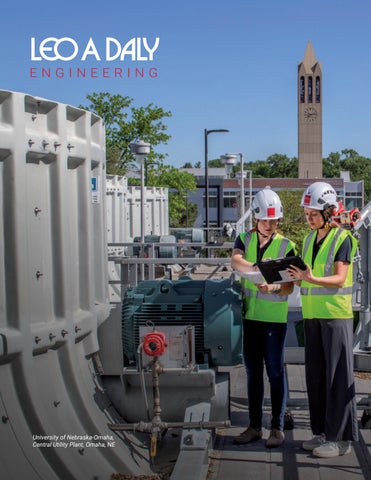
University of Nebraska-Omaha, Central Utility Plant, Omaha, NE
![]()

University of Nebraska-Omaha, Central Utility Plant, Omaha, NE
LEO A DALY is an internationally recognized leader in integrated design. For 110 years, our dedication to design excellence has produced exceptional spaces that enhance and enrich the human experience.
Our success is rooted in our “whole project” approach, which combines experts from every design discipline into collaborative teams at the outset of every project. This singular blend of creative and technical expertise allows us to push the limits of high-performance design and deliver excellence to every client.


To engineer a sustainable future that strengthens our communities and elevates the built environment.
Our engineering practice delivers innovative, high-performance solutions through cross-disciplinary collaboration. By uniting specialized expertise, we create safe, resilient, efficient, and future‑ready environments. From navigating complex environmental challenges to upholding the highest standards of safety and performance, our engineers are equipped to deliver.
Our comprehensive engineering capabilities include:
• Structural
• Mechanical + Plumbing
• Electrical
• Architectural Lighting
• Technology
• Fire Protection + Safety
• Energy Modeling + High Performance Design
• Commissioning
• Post Occupancy Evaluation


When you work with us, you can count on a team that delivers dependable, high-caliber solutions on time and within budget. Our engineers follow industry standards, perform rigorous quality checks, and collaborate closely with stakeholders to make sure every aspect of your project performs as expected — today and for years to come.
We design with the future in mind. Our team integrates energy efficiency, resiliency, low impact materials, and sustainable practices into every project. This forward-thinking approach helps you reduce operational costs, minimize your environmental footprint, and maximize the long-term value of your investment.
We leverage the latest technologies, tools, and methods to solve complex problems and bring your unique vision to life. From digital twins and BIM coordination to advanced simulation and automation, our team is constantly exploring new ways to make your project smarter, more adaptable, and more future-proof.
We’re passionate about delivering the best possible return on your investment. Our engineers identify cost-saving opportunities, streamline design and construction processes, and apply innovative strategies to maximize functionality without adding unnecessary expense — all while honoring your financial goals.

Joshua Roehm Vice President, Senior Director

Kaitlin Radmacher Associate, Senior Marketing Manager

Kim Cowman Vice President, Director


Mark Bradby
Senior Associate, Practice Lead, Mechanical
Doug Nelsen
Vice President, Practice Lead, Electrical
Chad O'Donnell Associate, Practice Lead, Structural

Nancy Melby Vice President, Director of Operations


Abby Goranson Senior Associate, Commercial/Civic Team Lead
Mark Bradby
Senior Associate, Senior Engineer, Mechanical
Ben Ries
Associate, Senior Engineer, Electrical
Tim Morrison Associate, Senior Engineer, Structural


Ryan Richard Associate, Health & Wellness/Federal Team Lead
Ryan Richard Associate, Senior Engineer, Mechanical
Doug Nelsen Vice President, Senior Engineer, Electrical
Chad O'Donnell Associate, Senior Engineer, Structural
SPECIALTY SERVICES


Denise Allacher Senior Associate, Practice Lead, Commissioning, Specialty Services Team Lead
Trevor Hollins Associate, Practice Lead, Lighting
Cody Largent Practice Lead, Technology
Denise Allacher
Sr. Associate, Practice Lead, Commissioning
Brian Rippentrop Associate, Practice Lead, Fire Protection
Nick Lassek
Associate, Practice Lead, High Performance Design


79
5
4 ACTIVELY PURSUING CALIFORNIA LICENSURE
Our engineering team brings deep experience throughout California and the broader West Coast, delivering high-performing solutions across a wide range of project types and market sectors. Our West Coast experience is part of our full national and international portfolio reach. Our engineers successfully execute projects across multiple regions throughout the United States and around the world, adapting to the unique demands, climates, and regulatory environments of each geography.
The following pages highlight a selection of our California and West Coast work, demonstrating our expertise in these markets as well as the strength and versatility we bring to clients nationwide.

Our engineering practice draws strength from a portfolio that spans a wide range of market sectors, giving us the broad perspective and specialized insight needed to deliver resilient, high-performing solutions across diverse project types. This experience not only sharpens our problem-solving capabilities but also ensures our work is informed by lessons learned across multiple industries.
Importantly, we have extensive experience in the same market sectors where Delawie has built a strong legacy, allowing us to integrate seamlessly with their team and contribute immediate value through aligned expertise and shared sector knowledge. Below are just a few project examples demonstrating our work in the same market sectors where Delawie has established a strong presence.


Our integrated engineering practice enables us to deliver a full suite of specialty services in-house—an approach that strengthens coordination, enhances quality, and streamlines project delivery. By providing these services under one roof, we eliminate the inefficiencies and disconnects that can arise when multiple outside consultants are involved. This cohesive model ensures unified technical direction, faster decision‑making, and solutions that are holistically aligned with project goals from concept through occupancy, delivering measurable value to our clients and their teams.
Our specialty service engineering capabilities include:
Architectural Lighting
Working in partnership and harmony with architecture and interiors, our lighting design teams provide beautiful, sustainable, and functional solutions unique to each project.
Technology
Planning and designing intuitive technology systems and infrastructure to seamlessly integrate into and enhance the built environment.
Protecting occupants from fire hazards and ensuring people are safe in emergencies.
Our building performance modeling provides actionable insights that drive sustainable, costeffective, and high-performing building design.
Commissioning
Aligning the project vision with real-world performance, ensuring optimized systems, long-term efficiency, and a building that exceeds expectations.
Post-occupancy evaluation services give building owners clear insights into how their spaces actually perform—unlocking opportunities to enhance comfort, efficiency, and occupant satisfaction while maximizing long-term value. It’s the key to turning real-world data into smarter decisions for better buildings.


In our commitment to sustainability, we are focusing our practice around five key principles of sustainable design that allow us to implement a holistic approach to how we build and implement a sustainability-driven culture and process across our operations and portfolio.
Key Principles:
• High-Performance Design
• Decarbonization
• Responsible Materials
• Wellbeing
• Post Occupancy Evaluation
These principles are reinforced through our development of subject matter expertise, our selected industry commitments, our internal processes, and execution of project design.

We serve as champions of sustainable design practices and are signatories of industry-leading sustainability commitments. Together, we can build a sustainable future.

The AIA 2030 Commitment aims to transform the practice of architecture to respond to the climate crisis in a way that is holistic, firm wide, project based, and data driven, delivering carbon-neutral buildings by 2030.

The Structural Engineers 2050 Commitment Program is designed to ensure substantive embodied carbon reductions in the design and construction of structural engineering profession all in the name of achieving zero net carbon structure by 2050.

The AIA Materials Pledge shifts how the industry evaluates the products and finishes specified on a daily basis. Participants commit to five overarching statements that will lead to more intentional product specifications across their portfolios over time.

The MEP 2040 Commitment seeks to dramatically reduce the embodied carbon emissions associated with mechanical, electrical and plumbing systems through data-driven, collective action among committed design firms and supporting organizations.

Elements of our design process adapt to the needs of each client and each project. The core of our design approach, though rooted in a spirit of inquiry, is a constant. To pursue a high-performance design agenda in alignment with our vision, we embrace the AIA Framework for Design Excellence as a tool for integrating all systems into a considered whole. We also identify four essential components to add to our design process in the early phases of all projects.
Establishing project goals is the critical first step in our design process. Beyond project management objectives, these also include design and sustainability objectives which reflect the more aspirational ambitions of the practice.
The Workshop is an opportunity to collaborate as a team in the initial design stages to elaborate on the project goals by developing detailed, project specific performance goals focused on meaningful and measurable impact.
As a key component of the AIA 2030 Challenge, early phase energy modeling informs the team about the energy consequences of siting and massing alternatives early enough in the design process to allow for meaningful change
Firmwide design reviews occur at early concept phase and schematic design phase as a tool to track project design and sustainability goals and to hold ourselves accountable for their implementation.


As described by the AIA, the Framework is both a vision of what the profession aspires to achieve and a set of practical guidelines outlining a path forward. The 10 principles provide a comprehensive structure of sustainability objectives and priorities for each design discipline in service of the whole.
The Framework serves as the outline for our project integration workshops. While the Framework itself is not a process, it offers a set of tools to apply to any design process. The first principle, “Design for Integration”, asks for the big picture – the conceptual whole that the other nine principles serve. This critical step in our design process follows from the initial goal setting and concept studies and focuses the direction of the project workshops. The structure the framework provides also facilitates tracking the progress and implementation of sustainability measures throughout all design and documentation phases.

Joshua J. Roehm, PE, PMP Vice President, Senior Director, Engineering JJRoehm@leoadaly.com
C: 817.374.3082
Kimberly R. Cowman, PE, LEED AP, HFDP Vice President, Director, Engineering KRCowman@leoadaly.com
C: 402.677.1017

PLANNING ARCHITECTURE
ENGINEERING INTERIORS