
Marriage: A CALL TO HOLINESS & SELFLESSNESS



Springfield, MO
Two annual diocesan Wedding Anniversary Celebrations were recently held: One on Feb. 1, in St. Mary Cathedral, Cape Girardeau; the second on Feb. 8, in St. Elizabeth Ann Seton Parish, Springfield. Surrounded by friends and family, each couple renews their wedding vows and is able to celebrate their marriages with the liturgy, a reception, and fellowship.
Homily by Bishop Edward Rice
Our annual diocesan Wedding Anniversary Celebrations are a local part of National Marriage Week where we have an opportunity to focus on highlighting the role of marriage and family in our culture. In our day and age it is more important than ever to spread the word and hope about the value of the institution of marriage. Marriage is the bedrock of our society. When marriage crumbles, our homes and families crumble, our children struggle, and our communities have to deal with their ripple effects. Our nation grows weaker or stronger, based on home, family, and marriage. What is required is commitment which is the very thing that some people fear. Will my commitment work? Will it last a lifetime? In pondering these questions we’re left with answers that we can’t give. You just have to go with it: Life is a mystery when you make a commitment not knowing how life is going to unfold. I’ve been celebrating these wedding celebrations now for 10 years in our diocese and I think for the past 10 years I’ve highlighted the same point, that on the day when a couple gets married, they are totally clueless as to what they’re getting involved in. They have
no idea what life will throw at them but they believe in their hearts that their love for each other will help them to get through any challenge or difficulty. In trusting that, they become a source of hope for others, they become a light that shines in the darkness, a light that makes a difference for others.
Marriage is the building-block of society. The relationships that are formed through a mutual commitment, a lifelong commitment, is what stabilizes family and society and again, when that crumbles through a lack of commitment, everyone suffers.
That is not to say that marriage will be easy but it does indicate that in the Sacrament of Marriage, Christ is the glue that binds the sacrament together: Christ is enough, Christ makes the difference. Being the light in our communities, these thoughts are perfect for us to discern as we celebrate our Diocesan Wedding Anniversaries today.
Each couple here, whether you’re celebrating your first anniversary or approaching your 60th or 70th, upon entering into a sacramental marriage, you became light for others. You recognized your need for God in your marriage. You lived out that verse, together as a couple, to “be the light, be the salt,” and in doing so Christ became a part of your marriage, the glue that binds it all together.
UNCONDITIONAL, SELFLESS LOVE
Why is glue necessary to bind it all together? Because in our weakness we can be selfish at times and selfishness has no place in a marriage. As I’ve said countless times, the love of a husband and a wife is to reflect the love of Christ on the cross. The love of Christ on the cross, is a total, unconditional love, lived out and expressed in the love of a husband and wife poured out into family and children. Selfishness has no place in a marriage.
I’d mentioned before the question posed by Pope St. John Paul II, when he asked what is the opposite of love? Most people would go to the easy response and say hate. Love and hate are opposites.
But, according to some philosopher he said no, the opposite of love is selfishness. I’ve never forgotten that, it impressed me and I often bring it up in a wedding homily I might give.
In many respects marriage has fallen on hard times these days. Young people are putting off marriage if they enter into it at all. Why? Well, maybe a career, or to travel the world, they want to do things that maybe they saw their parents were never able to do. Which is sort of ironic because the parents often did without for the good of their children and now those same children, as adults, don’t want to sacrifice. We live in a culture of “I,” “me,” “what I want.” We live in a “selfie culture,” a selfish culture. It has affected marriage just as it has affected the priesthood and the religious life as well.
In living for others, we become a light! Jesus gives a different vision, a different way of navigating through this world of ours. Instead of grasping, gathering all the things of this world to ourselves, making it all about “me,” each of us is invited to live for others, starting in the relationship of a husband and wife, then poured over into family and society.
Today we also remember the goal of marriage. Every husband should have as his goal the sanctification of his wife and children so that they can all get to heaven. Every wife should have as her goal the sanctification of her husband and children so that they can all get to heaven. Marriage is a call to holiness, a beautiful journey, fraught with sadness and sorrow, and with tremendous joys and blessings. That’s life, this side of heaven.
And so I thank all of the couples for your witness to the sanctity of marriage and family life. As the family goes, so goes the nation and so goes to the Church. ©
TM
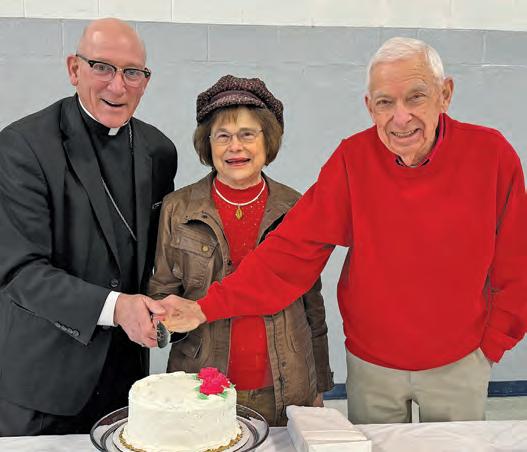
60TH WEDDING ANNIVERSARY Bishop Rice helped Janice and Robert Shirley of Cape Girardeau cut the cake at the reception after the annual diocesan Wedding Anniversary Mass held Feb. 1 in St. Mary Cathedral. The Shirleys celebrated their 60th wedding anniversary in September of 2025. (The Mirror)
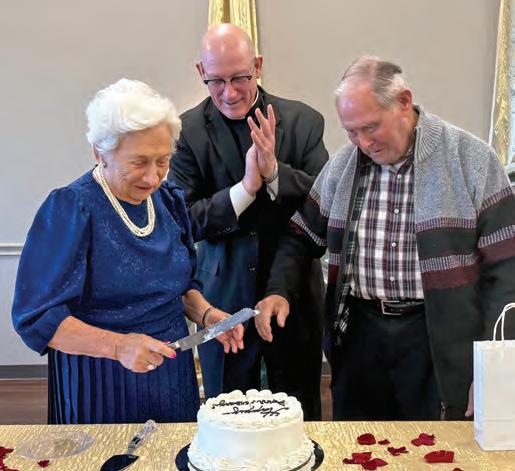
71ST WEDDING ANNIVERSARY Bishop Edward Rice clapped in congratulations for Helen and Ron Stander of Bolivar after they cut the cake at the reception after the annual diocesan Wedding Anniversary Mass held Feb. 8 in St. Elizabeth Ann Seton Parish, Springfield. The Standers have been married for 71 years. (The Mirror)
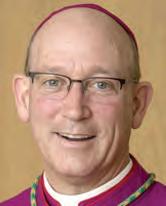
TCOME, AND YOU WILL SEE
Bp. Edward M. Rice
his is a powerful time for our diocese as we begin the Lenten season, entering into the traditional works of prayer, fasting, and almsgiving, leading up to Holy Week and Easter. I pray that everyone will take full advantage of this season through extra Masses during the week, daily rosary, the sacrament of penance and reconciliation, stations of the cross, and praying with the Scriptures. Please be mindful of the Rice Bowl program, the Lenten Youth Project for Mother’s House in Hayti, MO, and the obligation placed upon us by Holy Mother Church for our sanctification regarding fasting and abstinence. Be thinking about it now before Ash Wednesday, Feb. 18 next week!
At the same time, we continue our preparations for our Diocesan Eucharistic Congress on August 15, in West Plains, MO. Have you registered yet? I encourage all Knights of Columbus, PCCW members, youth groups, OCIA, catechists—everyone to please get registered and attend this beautiful moment for our diocese as we celebrate our 70th anniversary.
THE ASHES OF LENT
I continue to offer reflections from Meditations Before Mass, by Romano Guardini, this column focusing on
Pondering mortality challenges us to live life to its fullest
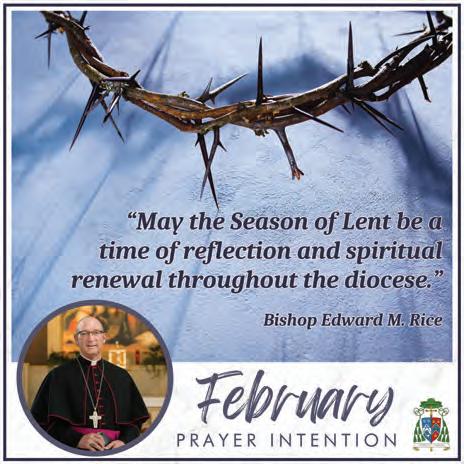
“ashes.” What can we possibly learn from such a thing? A lot!:
“A passerby picks a flower, loses interest in it and throws it into a fire, and in the short moment all that is left of that splendid show is a thin streak of grey ash. What fire does in an instant, time is always doing to everything that lives. The delicate fern … the nimble squirrels, all of them, equally, sooner or later, by accident, disease, hunger, cold—all of this flourishing life, turns to a little ash, a handful of dry dust, which every breeze scatters this way and that. All this brilliant color, all the sensitive, breathing life, falls into pale, feeble,
dead earth, and less than earth, into ashes. It is the same with ourselves. We look into an open grave and shiver: a few bones, a handful of ashgrey dust. Remember man that thou art dust and unto dust thou shalt return.
Ashes signify man’s overthrow by time. Our own swift passage, ours and not someone else’s, ours, mine. When at the beginning of lent the priest takes the burnt residue of the green branches of the last Palm Sunday and inscribes with it on my forehead the sign of the cross, it is to remind me of my death.”
As a side note, there are two verses, either of which can be used for the imposition of the ashes. The traditional prayer says, “Remember that you are dust and to dust you shall return.” The alternate option states, “Repent, and believe in the Gospel.” While either is valid, I’ve always used the traditional verse because I just don’t think we ponder our mortality. In an age of Botox, liposuction and injections to lose weight and with the desire to have a fresh face, we push the reality of death farther and farther away. By no means is it morbid to ponder our mortality. A phrase attributed to St. Anthony of Padua is helpful here, “Every day is a good day to live, and every day is a good day to die.”
Pondering our mortality should challenge us all the more to live life to the fullest.
Guardini continues his reflection on ashes: “Everything turns to ashes, everything whatever. The house I live in, these clothes I am wearing, my household stuff, my money, my fields, meadows, woods, the dog that follows me, my horse in his stall, this hand I am writing with, these eyes that read what I write, all the rest of my body, people I have loved, people I have hated or been afraid of, whatever was great in my eyes upon earth, whatever small and contemptible, all without exception will fall back into dust.”
Good things to ponder in this Lenten season. O Sacrament Most Holy, O Sacrament Divine, all praise and all thanksgiving be every moment Thine. ©TM


Before his retirement
referencing his travels to the schools, or time with friends, family, or other bishops. The Mirror has decided to share a few of these in an ongoing series entitled, “Another walk through: ‘Walking Together.’” We hope you enjoy them.
November 11, 1994
“If you think you’re healthy after only three sessions,” the psychiatrist told his client, “you’re crazy!”

November 18, 1994 “I’m sorry I forgot your birthday, honey,” a husband told his wife. “It’s difficult for me to remember your birthday because you never look any older.”
November 25, 1994 In the old days, a man who cut his face with his razor got a nick. Now with razors having twin blades, he gets a ditto mark!

in 2008 as the Fifth Bishop of the Diocese of Springfield-Cape Girardeau, Bishop John Leibrecht wrote a standing column in The Mirror entitled, “Walking Together.” At the end of each article, Bp. Leibrecht would normally share a funny story
By Bishop Emeritus John J. Leibrecht
WHY LENT? A Guide to Its Core Practices
It’s easy to take things that we’re used to doing for granted. Lent’s just one of those Catholic customs that come around every year as the liturgical year moves through its cycles. But if we actually think about why we practice it, it may help us to get more out of it. I’d like to explore the “why” behind it to help us be more intentional in how we enter into Lenten practices this year.
Why Do Christians Observe Lent?
Lent exists to prepare us for Easter, the greatest Christian feast, helping us to be ready to receive its grace and celebrate with a renewed heart. Lent began as a multiday fast for new converts and those preparing them, as we see in one of the Church’s oldest documents, The Didache: “Before Baptism let the baptizer fast, and the baptized, and whoever else can; but you shall order the baptized to fast one or two days before.” The Easter Vigil was the primary time for Baptism as it marked the true Passover of moving from the death of sin into the true life of Christ. As we see in the quote, everyone was encouraged to fast with the converts, making the days before Easter a time of conversion for all Christians, marking a renewal of baptismal promises.
Why does it last 40 Days?
Technically, Lent is forty-six days with forty days of fasting, as we do not fast on Sundays. From a couple of days in the first century, Lent expanded over the next two hundred years, until, by the fourth century, it matched the forty days Jesus fasted in the desert after his Baptism. In the early Church, serious sins required extended periods of penitence before receiving absolution, and Lent provided an important time
THE CATHOLIC CULTURALIST
Dr. R. Jared Staudt
for penitents to embrace fasting and other acts of penance before reconciliation at Easter.
An extended penitential period caught on for the whole Church to imitate Jesus’ time in the desert. Taking more than just a few days helps us to break bad habits and to get into a rhythm of prayer and asceticism.
Why Prayer?
The three key practices of Lent are prayer, fasting and almsgiving. Of the three, prayer is the foundation, because union with God is the goal of the Christian faith, giving life to everything we do. Jesus is our model during Lent, as he “withdrew to the wilderness and prayed” (Luke 5:16). During the forty days in the desert, the devil assaulted him, but he withstood him, rooted in relationship with the Father. To be like him, we must withdraw to listen to the voice of the Father, to seek his will above all else.

Practically, this means taking time during Lent every day in silence, meditating on Scripture and embracing God’s presence in the stillness. The desert symbolizes this withdrawal from distractions to concentrate on the life of the spirit. But, like Jesus, there will be an assault on this time by the enemy, throwing up distraction, boredom and dryness. The battle of prayer requires perseverance in order to bear fruit, becoming a font of living water in the desert wilderness.
Why Fasting?
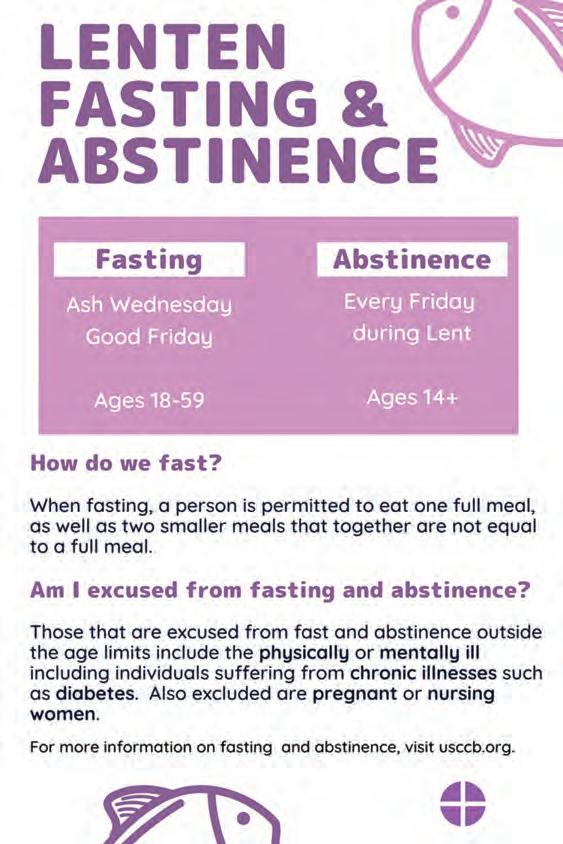
If Jesus is our model, we must fast: “And he fasted forty days and forty nights, and afterward he was hungry” (Matthew 4:2). It may seem obvious to point out that he was hungry, but, in the Beatitudes, Jesus says that those who are hungry are blessed, for they will be satisfied. He teaches us to pray for our daily, supersubstantial bread, which is given by the Father from Heaven. If we stop filling ourselves with material food for a time of fasting, we may develop a deeper hunger for the things of the spirit. Throughout its history, Lent consisted essentially of a forty-day fast. Originally, it entailed fasting completely during the day, though in the Middle Ages, a collation (or snack) was allowed. No meat or animal products were permitted for the whole forty-six days.
For us today, we can return to the forty-day tradition of fasting by forgoing at least some food every day of Lent (except Sundays). While it’s common to give up a favorite food, some actual fasting by skipping meals will help us recapture the original spirit of Lent and grow in spiritual hunger.
Why Almsgiving?
While we don’t see Jesus giving alms, his whole ministry consisted of lavishly bestowing his Father’s
treasury of love and mercy. He teaches us to pray, fast and give alms in Matthew 6, echoing a powerful line from the Book of Tobit: “Prayer is good when accompanied by fasting, almsgiving and righteousness. … It is better to give alms than to treasure up gold. For almsgiving delivers from death, and it will purge away every sin” (Tobit 12:8-9). Almsgiving goes beyond the tithe we owe to the Church, giving charity directly to the poor and those in need.
During Lent, we seek forgiveness from God and make reparation for our sins in this time of penitence. Jesus unlocks the key: if you desire mercy, show mercy to others. Prayer seeks God, but we find him also in the poor and needy. That’s why we unite prayer and almsgiving. To have a fruitful Lent, we need to commit to taking concrete steps to provide financial assistance and other gifts to those in need. While it’s good to give charitable donations to ministries, it’s also important to find Christ person to person in the poor.
Why Spiritual Reading?
In addition to the three pillars of prayer, fasting and almsgiving, another traditional practice is to read a spiritual book during Lent. St. Benedict advised his monks to pick a book from the library and to read it straight through. A good spiritual book can give structure to our Lenten prayer, becoming a kind of focused retreat. Two recommendations are St. Alphonsus’s The Passion and the Death of Jesus Christ and Bishop Erik Varden’s Healing Wounds, which he wrote as Bloomsbury’s 2025 Lent Book.
May you have a blessed Lent, serving a moment of renewal to prepare to receive the grace of the Resurrection anew at Easter. ©TM
Dr. Staudt’s column is syndicated by the Denver Catholic, the official publication of the Archdiocese of Denver.

Priest Symposium equips clergy for renewal of Catholic education in parish schools
Florissant, MO
Held on the Augustine Institute campus from January 20-22, four priests of the Diocese of Springfield-Cape Girardeau attended the Priest Symposium given by the Institute for Catholic Liberal Education (ICLE) at the Augustine Institute in Florissant, MO. ICLE was founded to help bolster Catholic education in the areas of faith formation and a more “traditional” approach to education in general.
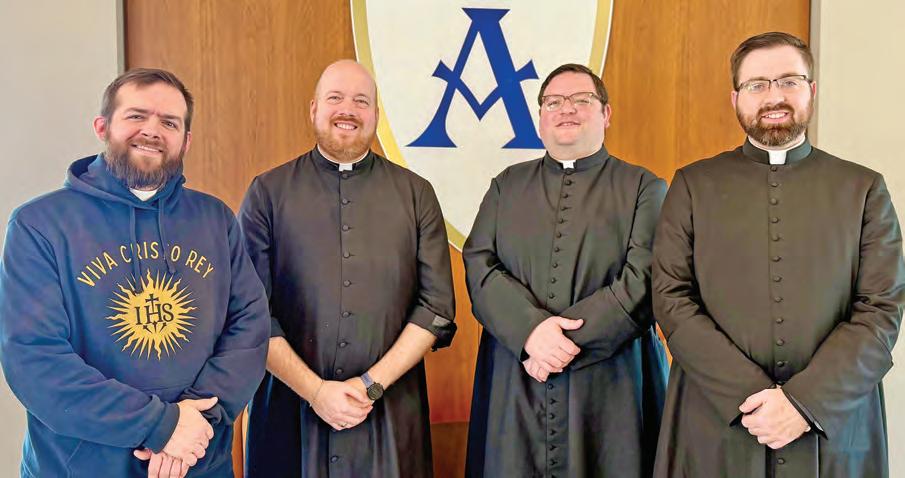
Diocesan priests included: Fr. Joseph Kelly, Pastor of Guardian Angel, Oran, and St. Ambrose, Chaffee; Fr. Brian Straus, Pastor of St. Peter the Apostle, Joplin; Chaplain to McAuley Catholic High School and the Campus Minister at Missouri Southern State University; Fr. Allen Kirchner, Pastor of Sacred Heart, Poplar Bluff, and St. Benedict, Doniphan; Fr. Charles Peirano, Pastor of St. Leo the Great, Ava, Immaculate Heart of Mary, Mansfield, and St. William, Gainesville.
From the ICLE Website:
DIOCESAN NEWS/ADULT FAITH
“The Institute for Catholic Liberal Education inspires and equips Catholic educators to renew today’s Catholic schools by drawing on the Church’s tradition of education, which frees teachers and students for the joyful pursuit of faith, wisdom, and virtue. The institute proposes to fulfill its mission by:
1. Reflecting on Church teachings and historical approaches to guide today’s education
2. Recovering and adapting the classical tradition of liberal education as embraced and developed by the Church
3. Supporting Catholic educators through conferences, teacher development programs, in-service workshops, consultation, and publications
4. Advancing this vision among schools, colleges, dioceses, and other individuals and institutions involved in Catholic education.”
During this Symposium, about 20 priests from various dioceses around the country attended seminars and lectures on implementing and maintaining true, Catholic identity in Catholic schools through a focus on components found in liberal arts education, and offered various techniques and direction as to how priests can be supported in this endeavor and how they can be of better support to their educators.
“I was edified by the number of priests who came from all over the
country from various school situations,” said Fr. Allen Kirchner. “They came, not just to talk about the problems in Catholic schools, but seeking real practical changes that we can implement to recapture the mission of Catholic education. I recommend every priest check it out and send a teacher or principal to begin a relationship with ICLE.”
The days also consisted of communal prayer, Holy Mass, and fraternal time together.
The next ICLE Priest Symposium is slated for October of 2026. More information may be found at https:// catholicliberaleducation.org/events/ symposium-for-priests/. ©TM
UPCOMING CURSILLO WEEKENDS
UPCOMING MEN’S WEEKEND : February 26-March 1, 2026
Pinecrest Camp & Conference Center, Fredericktown, MO
UPCOMING WOMEN’S WEEKENDS : March 19-22, 2026
Pinecrest Camp & Conference Center, Fredericktown, MO
April 23-26, 2026
Carthage, MO


SCAN QR CODE for more info and to register online!
You can also contact Dale Gerecke at (573) 450-3335 or dale@gereckelaw.com, contact a Cursillista in your parish, or go to www.dioscg.org/cursillo
The Cursillo® Movement pursues two purposes or objectives. The immediate purpose is to provide a conduit for living what is fundamental for being a Christian, namely, the on-going and total conversion of the person. The end purpose is to vertebrae Christianity in society by means of these persons who live what is fundamental for being Christian (the love of God and neighbor) in their daily lives.


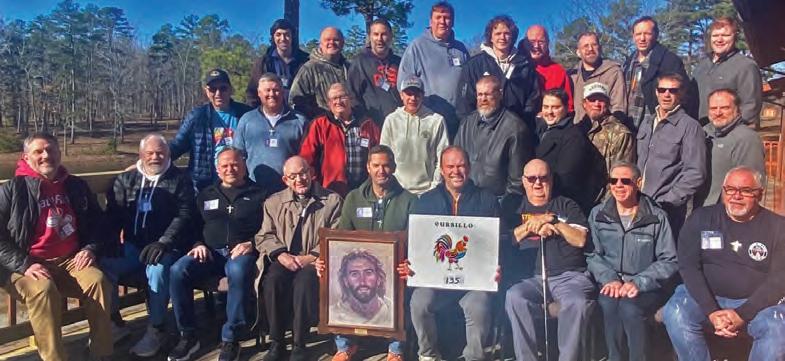
CURSILLO 135 A Men’s Cursillo Weekend was held Dec. 4-7 at at Pinecrest Camp, Fredericktown, MO, assisted by Deacon Tony Peters and Fr. David Coon. (Submitted photo)
RICHES OF CATHOLIC EDUCATION—Fr. Joseph Kelly, Fr. Brian Straus, Fr. Allen Kirchner, and Fr. Charles Peirano recently attended a three-day conference at the Augustine Institute facilitated by the Institute for Catholic Liberal Education on the riches of Catholic Education and its renewal in parochial schools. (Submitted photo)
DIOCESAN NEWS/ADVERTISING

AVA Fish Fry Benefit, A homemade plate of fish, fries, green beans, cole slaw, dessert & drink; Fri., Feb, 27, 4-6pm. Cost: $10; $5-kids | St. Leo Catholic Church, Old Hwy 5-1 mile north of the roundabout in Ava. Dine-in & carry-out.
FREDERICKTOWN—St. Michael the Archangel Parish will have Fish Fry-Days (Fridays): Feb. 20, March 6, and March 20, 4-7pm. Catfish, hush puppies, fries, slaw, mac & cheese, baked beans, green beans, drink & dessert. Cost: $15; ages 5-7 yrs: $7; under age 5: free.
and under, eat free.

JACKSON—Jackson Knights of Columbus #6405 will have its Lenten Fish Fries, Fridays during Lent, 4:307:30pm | Lower Knights of Columbus Hall. Fried fish, fried chicken, fries, hush puppies, baked beans, slaw, homemade mac & cheese, water, tea & lemonade; Cost: $15. Dine -in or carry-out.
JOPLIN Lenten Fish Fry, Fridays during Lent, 5-7pm | St. Peter the Apostle, 812 S Pearl Ave. Cost: $10-All You Can Eat; $5-ages 5-12 yrs.; Age 4
LEBANON The Knights of Columbus #6871 will have Fish Fries, Fri., Feb 27, Fri., March 13, and Fri., March 27, 5-7pm | St. Francis de Sales Parish Family Center, located at 345 Grand Ave. Fried fish, fries, hush puppies, coleslaw, drink & dessert. Cost: your goodwill donation. Proceeds will benefit the local charities supported by the K of C and pro-life activities.
MARSHFIELD Fish Fry
Fundraiser, Enjoy a great meal of fried or baked catfish, fries, hush puppies, green beans, cole slaw, and tasty desserts; Fri., Feb. 27; Fri., March 13, and Fri., March 27, 5-7pm. Holy Trinity Catholic Church, 515 E Washington St. |Cost: $12-Adults; $7-ages 5-12 yrs.; Age 4 and under, eat Free. (credit & debit cards accepted).
OZARK Lenten Fish Fry, Fridays during Lent, 5-7pm | St. Joseph the Worker Catholic Church. Cost: $15; $10-ages 6-12 yrs.; Meatless spaghetti-$5.
Cape Girardeau—Notre Dame Regional High School Performing and Visual Arts will host Trivia Night, Fri., Feb. 20, 7pm, in King Hall. Cost is $160 for a table of eight. Ticket purchase includes a trivia night seat, Heads or Tails, Buy-A-Student, Mulligans for each round, popcorn, and soda. Doors open at 6pm, game play at 7pm. All proceeds to benefit Notre Dame Visual and Performing Arts! Register Online at www.notredamehighschool. org/trivia.
Cape Girardeau—Summer is coming and so are Notre Dame Summer Camps Registration is now open! See the full camp lineup and register Online at www.notredamehighschool.org/camps. Get ready for an incredible summer of athletics, arts, and STEM fun!
Carthage Worldwide Marriage Encounter Weekend—March 20-22, 2026. Make a good marriage a great marriage! The Worldwide Marriage Encounter Weekend experience is the perfect way to renew, refresh, and reignite your marriage! The next weekend, held March 20-22, will take place in the Congregation of the Mother of the Redeemer Retreat Center. For more information and to register Online, go to: https://wwme.org/.
Dexter—Sacred Heart Parish will have its Parish Mission-The Eucharist, March 2-March 5, 7pm. Presenter will be Fr.

Denis Lemieux, Chaplain at Marian Acres, Salem, MO. All are invited to join in this time of spiritual renewal and refreshment and to renew your devotion and love for Jesus’ Real Presence in the Blessed Sacrament.
Jackson—The Knights of Columbus Ladies Auxiliary will host a BUNCO BASH, Sun., March 22, in the upper KC Hall, located at 3305 N High St. No preregistration, doors will open at 12:30pm, play begins at 1pm. Cost: $10/player, snacks will be provided. Money raised will be used to support our scholarship program and various other organizations, such as: Options for Women, Birthright, Special Olympics, and many others.
Sikeston SAVE THE DATE: St. Francis Xavier Catholic School will hold its 2026 Dinner Auction: Down on the FARM, Sat., March 21, 2026.
Springfield—Save the Date! 40 Days for Life is an internationally coordinated 40day campaign that aims to end abortion locally through prayer and fasting, community outreach, and a peaceful allday vigil in front of abortion businesses. 40 Days for Life- Spring 2026 campaign will run Feb. 18-March 29 in front of Springfield Planned Parenthood, located at 626 E. Battlefield Rd. For more information or to sign up to participate at https://www.40daysforlife.com/en/ springfieldmo.


ABOUT THE MANY EMPLOYMENT OPPORTUNITIES AROUND THE DIOCESE!
DioSCG.org/employment
HEAD BOYS SOCCER COACH—Notre Dame Regional High School
Notre Dame Regional High School, Cape Girardeau, is accepting applications for a boys head soccer coach. Candidates should submit a coaching and teaching resume (if applicable), along with a cover letter and references. Teaching positions are available based on qualifications. Materials should be sent to Principal Paul Unterreiner at paulunterreiner@notredamecape.org by February 23, 2026
SIXTH GRADE, JUNIOR HIGH MATH, PART-TIME
TECHNOLOGY FOR GRADES 5TH-8TH, AND PART-TIME MUSIC
—St. Vincent de Paul Catholic School
Cape Girardeau’s St. Vincent de Paul Catholic School is accepting applications for the following positions for the 2026-2027 school year. Sixth Grade, Junior High Math, Part-time technology for grades 5th-8th, and Part-time music. Preference may be given to practicing Catholics. For an application, please call (573) 334-9594 or Email Kay Glastetter at kglastetter@svcape.eduk12.net

‘WE ARE THE NOW’
— Missouri college students organize statewide Catholic summit
‘There was a real community aspect to this.’
By Jack Figge, The Pillar Jefferson City
Afew years ago, Archbishop Shawn McKnight floated an idea in his previous diocese, the Diocese of Jefferson City, MO.
He wanted to host a Catholic local conference for the state’s college students. But limited resources, an episcopal move, and the chaos of daily diocesan life placed the idea on a chancery back-burner, left simmering but untouched.
Until a senior at the University of Missouri (Mizzou) learned about the idea.
Emma Johnson, a senior majoring in hospitality management, thought a conference would be a great event for the state’s young adult community. In prayer, she felt prompted to help organize and plan it.
Johnson had spent two summers as an intern for the Archdiocese of St. Louis’ Office of Youth Ministry, helping to plan and coordinate the annual Steubenville Youth Conferences hosted by the archdiocese.
She figured her experience would be helpful in planning a conference for college students.
But first, she needed to convince the diocese to help make the idea a reality.
So when Johnson saw Maureen Quinn, the director of youth and young adult ministry for the Diocese of Jefferson City, at Mass, she leapt at the opportunity to pitch her idea.
“Maureen was so down with the idea,” Johnson said. “When I saw her, I definitely expected to have to convince her. But that’s just Maureen, she’s super excited to take on something like this.”
“There was really no convincing needed. She gave me her business card and said we’ll be in touch.”
“And the next thing you know, we are rounding up people from every university in the diocese to help plan this thing.”
A year and a half later, the Sheer Goodness Missouri Catholic Summit will take place at the end of this month, Feb. 28, at the Cathedral of St. Joseph in Jefferson City. So far, about 200 people have signed up, and the organizers are hoping for another hundred.
Plans for the day have been enhanced with the input and leadership of local students, and now Quinn is excited that the project, first floated back when the now-college seniors were still in high school, is coming to fruition.
“At the end of the day, we want this to be for them,” Quinn said. “Having their voices be part of that and really help steer this helps the success of the entire opportunity. If we’re going to invest in something like this, we want it to be successful, and we have always found in ministry the more we get people involved that are really going to be part of that program, the more success that
opportunity is going to have.”
From the outset, Quinn wanted the proposed summit to bring together college students and young adults from across Missouri. As the initial planning phase kicked off last winter, Quinn reached out to students at three local Newman Centers — Mizzou, Truman State University, and Missouri Science and Technology (S&T) — inviting them to find students to join the planning committee.
“ We are not just Mizzou, which is our largest Newman Center,” Quinn said. “We have three very unique Newman Centers and they all have such different communities. So, it was really important to get voices from all three locations in that planning process.”
Each Newman Center recruited two students to help plan the event. Kayle Gough, a sophomore nursing student at Truman University, gladly volunteered when approached. He said he sees the day as a unique opportunity to help his fellow young adults.
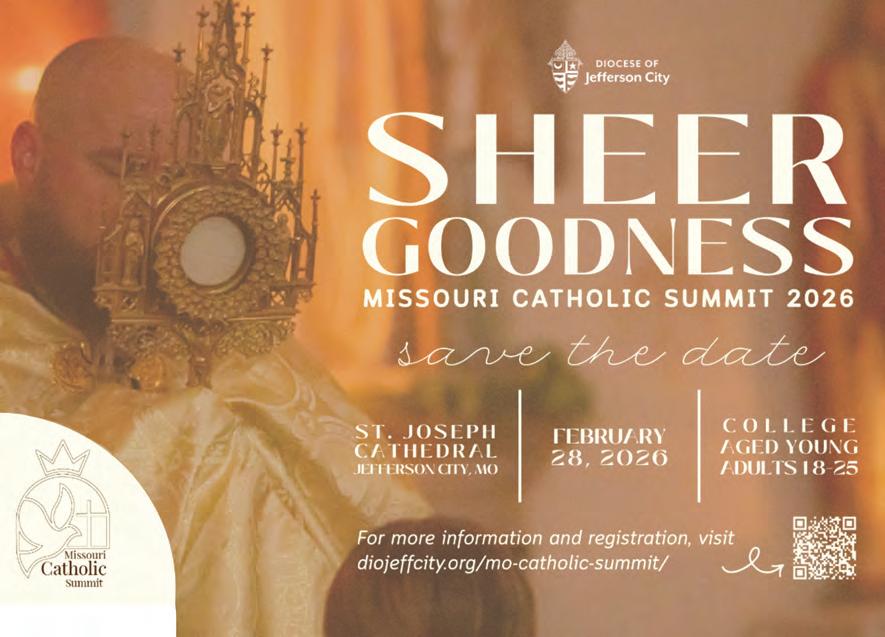
“ We are a smaller university with a small Catholic community, so I really saw the fruit in connecting with other Newman Centers around the state and other college students as it really shows the testament of our Catholic faith and how we’re universal,” Gough said.
Over a series of monthly, and eventually weekly, Zoom meetings, plus an in-person, daylong gathering, the team of college students and Quinn set about organizing the one-day summit.
While Quinn and other diocesan personnel sat in to provide support and help with logistical matters such as speakers, food, and venue, the
college students brainstormed the vision, discussed a focus for the event, and identified potential speakers.
“They are really the ones who helped create the theme and the overall vision for the day,” Quinn said.
For a theme, the group settled on a paragraph from the very beginning of the Catechism: “God, infinitely perfect and blessed in himself, in a plan of sheer goodness, freely created man to make him share in his own blessed life. For this reason, at every time and in every place, God draws close to man. He calls man to seek him, to know him, to love him with all his strength.”
This quote, the group decided, provided a framework that would be beneficial for young students to reflect on and pray with.
“College students often feel isolated, alone, lost in their faith,” Gough said. “By going back to Catechism 1, it really takes us back to the root of knowing that we were created by God and created for God. For college students, in their moments of busyness, their distractions, their isolation on their college campuses, God is always there for them.”
In building the agenda for the day, the planners kept the timing of events in mind.
“It’s a three-hour drive for some people attending, so we had to try to keep it like kind of within nine-to-nine, so people could still get home if they wanted to, because we don’t want people to have to pay for a hotel or anything since we are trying to keep it all free,” Johnson said.
“ We wanted to do the men’s and women’s sessions because we thought that it would be good to have a talk speaking directly to each group.”
They also made sure there was free time during the day.
“Sitting through a bunch of talks is a hard ask for students who maybe aren’t that into the faith,” Johnson said. “That way the day isn’t too long or anything.”
Organizers also reached out to the schools and parishes across Missouri,
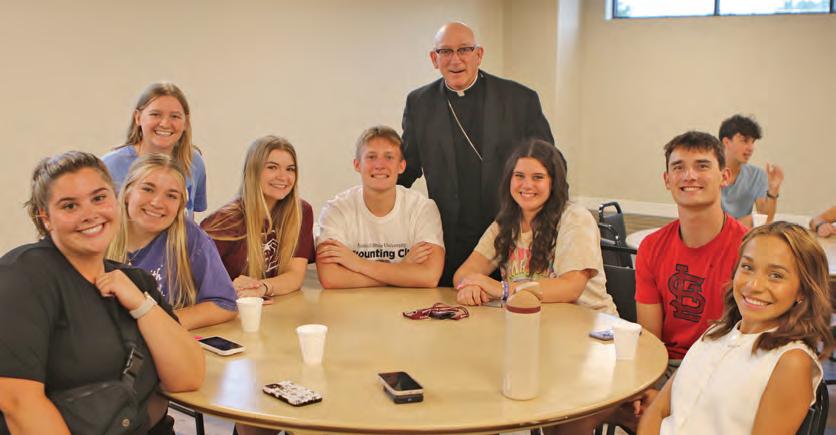
CATHOLIC COLLEGE STUDENTS—Bishop Edward Rice chatted with Catholic college students in the O’Reilly Catholic Student Center, Springfield. A group of students from Springfield’s Catholic Campus Ministry are organizing to attend the ‘Sheer Goodness’ Missouri Catholic Summit on Feb. 28 in Jefferson City, MO.
(The Mirror)
inviting them to attend the event.
“I’ve been emailing every single parish in the state. I’m still getting through it, you never think that there are this many parishes until you have to email all of them,” Johnson said. “We talked a lot about how this is a really good thing for a lot of people who are more rural, or don’t have a great young adult community at their parish, so I wanted to make sure that no parish was forgotten.”
So far, parishes and schools are responding well, excited about the initiative and opportunity for young Catholics to gather together.
“A lot of the people that I emailed are really excited. The other schools that we’ve contacted are pretty excited. We are talking to people from Southern University of Illinois, Edwardsville and people from Rockhurst University in Kansas City, and their students are
DIOCESAN NEWS/ADVERTISING
coming,” Johnson said.
“Everyone sounds excited, especially because it’s free and the meals are free. I think it’s a really easy event that people are willing to go to.”
“ We’ve seen a lot of interest in the summit from our Newman Center,” Gough said. “What’s helped a lot of the interest is it’s one day, it’s just a twohour trip to Jeff City as opposed to going to a bigger conference in Ohio or down in Texas, and the cost of it is completely free so that’s really enticing to college students.”
Enlisting the talent and help of college students has been an asset to the planning process, Quinn said, something that is often underutilized in the Church today.
“In our office, we have limited resources. I oversee religious education, youth and young adult ministry, which is really common across the United
States, but that means I am spread thin,” she said. “But because of these college students’ desire to really make this happen and really put a lot of effort into it, to see their willingness to really step in and help make this happen, made this project feasible.”
“Their enthusiasm helped us understand and really see that they really desired this, but it also helped us know that we weren’t doing this alone, that there was a real community aspect to this,” she added.
Gough said that having local college students plan the event creates a more personalized experience, curated to the specific needs of a local community.
“ We are the ones with feet on the ground. We know what is going on on their college campuses and in their Newman Center and what their peers and community needs to experience and needs to hear.
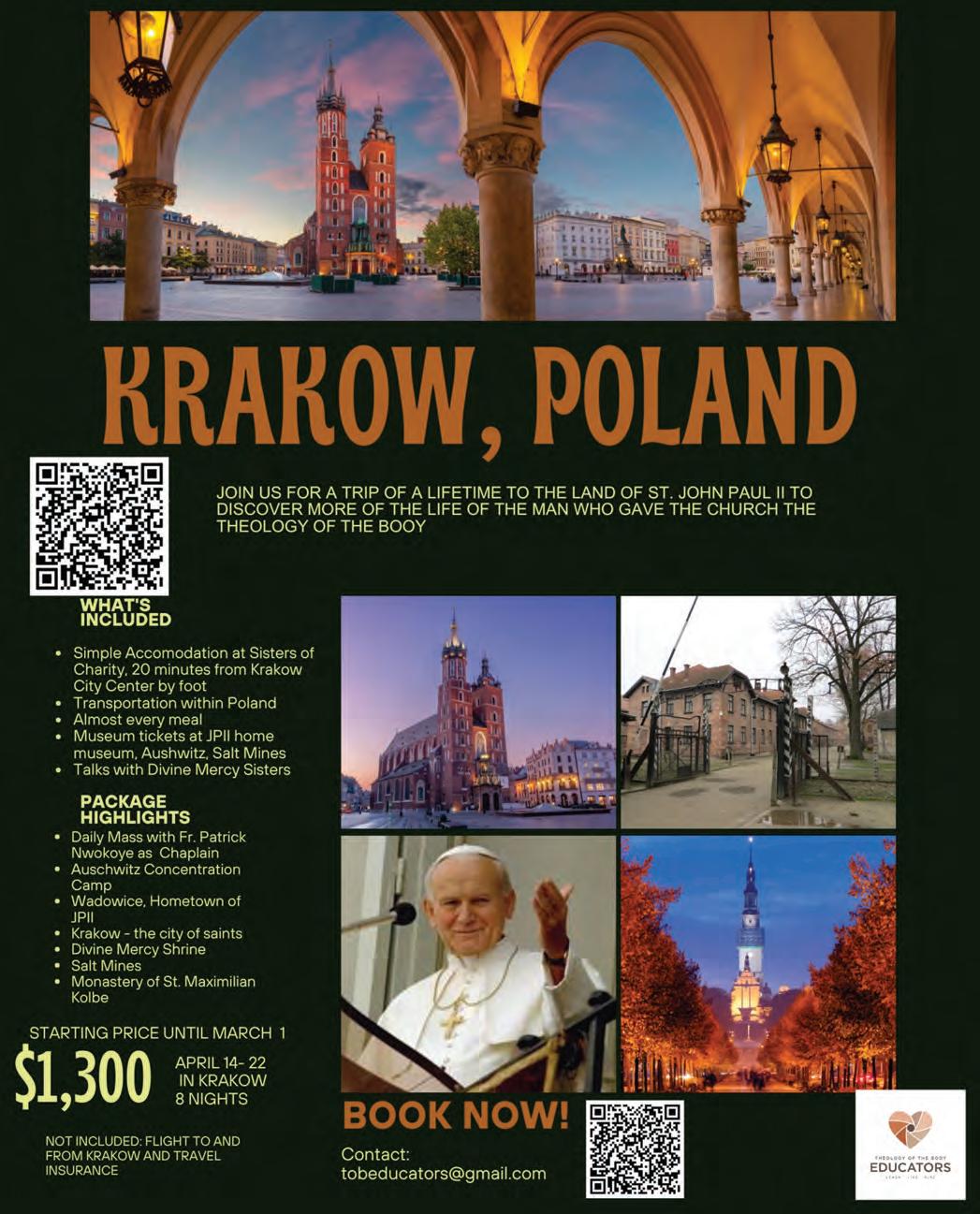
“This summit is the fruit of that lived experience.”
For the college students who planned the event, the process also offered the lesson that individuals – and not just dioceses or Catholic organizations – have a role to play in the Church.
“ We are the future, but we are also the now,” Johnson said. “If we really want to make something happen, we can do it. It might be hard at times, but it can definitely still happen, especially something that you think the Lord really wants you to do and is calling you to do.”

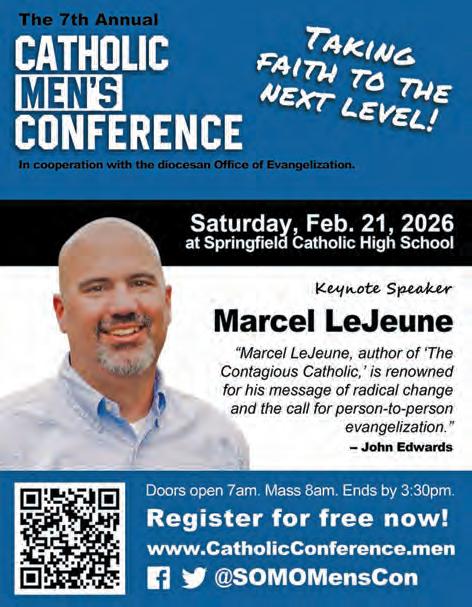
Prices are all inclusive w/airfare from anywhere in the continental US.
Several trips to different destinations: Holy Land, Italy, Greece, France, Portugal, Spain, Lourdes & Fatima, Ireland & Scotland and much more...
We specialize in custom trips for Bishops, Priests & Deacons! Currently hiring Deacons to promote our many pilgrimages. ATTRACTIVE compensation.
DIOCESAN NEWS/ADVERTISING
Area Catholics help bring about a pro-life program supporting infants
By Paula Wright Fruitland, MO
ASafe Haven Baby Box has been installed within the Fruitland Fire Department. The first of its kind in Cape Girardeau County was dedicated and blessed on Oct. 7, 2025. Safe Haven Baby Boxes offer a compassionate option for mothers in crisis who are unable to care for their newborns. The climate-controlled safety devices are integrated into the walls of fire stations and medical facilities to allow parents in crisis to anonymously surrender newborns without fear of prosecution. The organization aims to eliminate infant abandonment by offering a secure alternative that immediately alerts emergency responders once a child is placed inside. Under Missouri state law, parents can legally leave infants up to 45 days old in these boxes, though the broader Safe Place for Newborns Act offers protections for surrenders up to 90 days.
“guinea pig.”
“After learning about the Safe Haven Baby Boxes program, the foundation team was excited about the program and wanted to bring one to the area,” said Jeremiah 29:11 Foundation founder, a southern Missouri Catholic who asked to remain anonymous.
“Because we were so excited about the program, we never imagined hearing ‘no’ to the project after our presentations. It was a bit shocking to hear so many decline to participate, and it was hard to not become discouraged.”

“But we did not give up. And then I learned that after an initial “no” response, the Fruitland Fire Department was interested,” Anonymous said. Encouraged by the advocacy of administrative staff and a connection through the Knights of Columbus Ladies Auxiliary, it took a second approach with the Fruitland Fire Department to gain approval.
FRUITLAND FIRE HOUSE—A Safe Haven Baby Box was dedicated and blessed last October in Fruitland, MO. (Submitted photo)
The Fruitland project was funded by the Jeremiah 29:11 Foundation, with additional support from local partners including Drury Southwest Foundation, H&R Alarms, and Putz Construction. When the founder of Jeremiah 29:11 first heard about Safe Haven Boxes, it became a mission to have one installed in southeast Missouri. At the time, this would have been the first Safe Haven Box for the state of Missouri. The project faced numerous rejections because fire district boards were hesitant to be a

have a contact name to follow up with. I’m a member of the Knights of Columbus Ladies Auxiliary in my parish. At our meeting that same week, I asked everybody if they would please pray for me because I was trying to make this happen at the fire department. And someone who knew who to call just happened to be at that meeting! So, I was able to reconnect, and the Safe Haven Baby Box project began.”
ENTHUSIASM GROWS
The local community is very supportive of the program.
“ When we installed it and we shared on our Facebook page that we were doing this, that we were having an open house for the blessing of the box, that is probably the most likes and shares that our Facebook page has ever received,” stated Diebold.
Community members have also donated surrender kits.
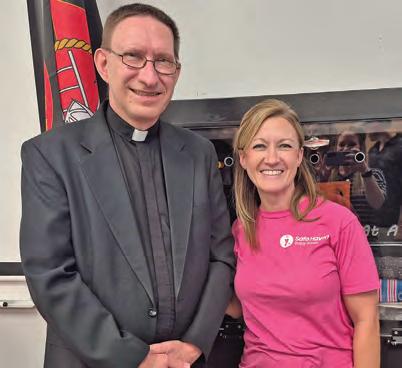
AREA CATHOLICS SPEARHEAD SAFE HAVEN BABY BOX—Father Glenn Eftink was onhand during the dedication and blessing of the Safe Haven Baby Box at the Fruitland Fire Station on Oct. 7, 2025. He is pictured with a parishioner of Immaculate Conception Parish, Jackson, who was instrumental in getting the box established in the community. Father Eftink is Pastor of St. Joseph Parish, Advance. (Submitted photo)
“ When we first heard about the program, there were no boxes in the state of Missouri, and because of that our board did not want to move forward. About six months went by, and we had learned about several fire departments in the state that had installed a Safe Haven Baby Box,” said Judy Diebold, Fruitland Fire Department Administrative Assistant and Immaculate Conception, Jackson, parishioner.
“I spoke with our firefighters, and they were all on board and thought it was a great thing. So, I re-approached the board about moving forward and they said yes, they would be willing to look at it. At this point, I realized I didn’t
SAFE HAVEN BABY BOX TIMELINE
• The first meeting with the Fruitland Fire Department in March 2025.
• They then had their board meeting on April 9, where they signed the Safe Haven Baby Box contract.
• Installation was on July 18.
• The Safe Haven Baby Boxes organization came to bless the box on October 7. ©TM
“We’ve had a member of our fire district who found out about this, and she wanted to help out in some way. She created two cutely-packaged boxes that include blankets, wipes, clothing, and other items that will go with any baby we take in so they have something with them at the hospital,” Diebold said.
The blessing ceremony included local pastors and representatives from health departments and crisis pregnancy centers. Fr. Glenn Eftink, Pastor of St. Joseph Parish, Advance, attended the blessing ceremony.
“It was quite an experience to be part of the dedication. Thank heaven the Fruitland Fire Department took this on,” Fr. Eftink said. “Although the hope is that it never has to be used, the Safe Haven Baby Box offers another pro-life solution for women in crisis. These babies will be protected, given opportunities, and hope. They will be placed in adoption with parents that can care for them.”
There are currently 11 Safe Haven Boxes within the state of Missouri with more planned. Within the Diocese of Springfield-Cape Girardeau, in addition to the Fruitland location, they can be found at the Joplin Fire Department and Carthage Fire Department. Each Safe
Haven Box costs approximately $20,000 for the unit and total project installation costs around $40,000. Once installed, the units are maintained weekly to ensure functionality. The Fruitland Fire District conducts weekly tests simulating a surrender to verify that alarms and notification times are within safety parameters. These records are monitored by the state annually.
Since 2016, Safe Haven Baby Boxes have provided a discreet and secure option for parents to surrender their newborns. The Safe Haven Baby Box initiative serves as a critical extension of Missouri’s Safe Place for Newborns Act. The expansion of these boxes across Missouri indicates a growing consensus that they are an essential resource for protecting the most vulnerable members of society and supporting mothers in crisis.
In addition to the physical sites, the national Safe Haven Baby Box program provides a 24-hour crisis hotline and educational resources to support families and ensure infant safety. These community-funded initiatives are described as lifelines that offer dignity and hope to parents who feel they have no other options.
For more information, visit their Website at www.shbb.org/. Their crisis line may be called or texted at 1-86699BABY1. ©TM

In faithfulness to the Good News of Jesus Christ, the Missouri Catholic Conference (MCC) seeks through education and advocacy to foster a culture that respects the sanctity and dignity of all human life, especially the most vulnerable among us. In the light of the moral teaching of the Catholic Church, the MCC and the Missouri bishops call upon government officials, legislators and all citizens to engage in a respectful dialogue about the challenges facing our state and nation. This agenda does not reflect all of the MCC’s concerns, but those calling for action at this time.
PROTECT HUMAN LIFE
Recognizing that the right to life is the foundation for all other human rights, the MCC will defend against violent attacks on human life, such as abortion, euthanasia, experiments involving the destruction of human embryos or the use of aborted fetal remains, and the death penalty. The MCC promotes a culture of life by supporting alternatives to abortion for mothers who choose life for their children, as well as alternatives to the death penalty, such as incarceration that protects the public.“It is impossible to further the common good without acknowledging and defending the right to life, upon which all the other inalienable rights of individuals are founded and from which they develop.” (Saint John Paul II, Gospel of Life, No. 101)
WELCOME AND ACCOMPANY
IMMIGRANTS
AND REFUGEES
The MCC affirms the God-given human dignity of all immigrants and refugees, including the undocumented and those displaced by war, persecution, and natural disasters. The MCC reminds lawmakers of the right of people to migrate and urges Congress to enact comprehensive immigration reform, including adequate provisions and
Missouri Catholic Conference sets 2026 public policy priorities

funding for refugee resettlement. “Every stranger who knocks at our door is an opportunity for an encounter with Jesus Christ, who identifies with the welcomed and rejected strangers of every age.” (Pope Francis, 2017 Message for World Day of Migrants and Refugees)
ADVANCE SOCIAL AND ECONOMIC JUSTICE FOR ALL
Pope Francis called for all people to hear the cry of the poor and to reform “unjust social structures” that deny basic necessities and opportunities for social and economic advancement. The MCC will support adequate funding for Medicaid and mental health services, protection of social programs that benefit the poor, care for creation and the environment, and stronger consumer protections, including payday lending reform. The MCC also works to heal racial and cultural divisions while fostering vibrant communities that serve the common good. “Certainly, it is the proper function of authority to arbitrate, in the name of the common good, between various particular interests; but it should make accessible to each what is needed to lead a truly human life: food, clothing, health, work, education and culture, suitable information, the right to establish a family, and so on.” (Catechism of the Catholic Church, No. 1908)
UPHOLD AND STRENGTHEN MARRIAGE AND FAMILY
Family is the basic cell of human society and the foundation of civilized life. Today, the institutions of marriage and family are threatened by a culture that no longer values authentic marriage and stable families. The MCC will support legislation and funding for programs that strengthen two-
parent families; assist single parents and their children; promote responsible parenthood; support victims of domestic violence; and, provide aid to families experiencing poverty or raising children with health challenges or disabilities.
“The importance of the family for the life and well-being of society entails a particular responsibility for society to support and strengthen marriage and the family.” (Catechism of the Catholic Church, No. 2210)
DEFEND RELIGIOUS LIBERTY
At the Second Vatican Council, the Catholic Church affirmed that the freedom to exercise oneʼs religious faith without threat of coercion is grounded in the dignity of the human person and that no person should be forced to act in a manner “contrary to his conscience,” (Dignitas Humanae, par. 3). The MCC will oppose unjust discrimination against people of faith, including the targeting or registering of any particular faith, and will support religious liberty protections in all human rights laws.. “[T]he right to religious freedom has its foundation in the very dignity of the human person as this dignity is known through the revealed word of God and by reason itself.” (Declaration on Religious Freedom, No. 2)
SUPPORT EDUCATIONAL OPPORTUNITIES
Parents are the first educators of their children and have the right to choose the form of schooling that best serves their children’s needs and reflects their moral and religious convictions. When necessary, parents should also have access to assistance that enables them to exercise this right. The MCC will support educational opportunities for all children across all school settings: public, private, or religious. The MCC also advocates for financial assistance that helps families meet their children’s educational needs and opposes policies
that discriminate against children who attend private and religious schools. “As those first responsible for the education of their children, parents have the right to choose a school for them which corresponds to their own convictions.” (Catechism of the Catholic Church, No. 2229)
REFORM CRIMINAL JUSTICE
The Catholic Church calls for a criminal justice system that holds the offender accountable, supports victims, and engages the community in helping offenders successfully reintegrate into society. The MCC will support meaningful reforms, such as allowing greater judicial discretion in criminal sentencing, reasonable possibilities for parole, and policies that ensure individuals have realistic pathways to employment upon release. “We believe that both victims and offender[s] are children of God. Despite their very different claims on society, their lives and dignity should be protected and respected. We seek justice, not vengeance.” (U.S. Bishops, A Catholic Perspective on Crime and Criminal Justice, Nov. 2000)
PROMOTE CIVILITY AND FAITH IN THE DEMOCRATIC PROCESS
Saint John Paul II said that Democracy needs wisdom and virtue if it is to flourish. Pope Francis told Congress that the primary purpose of politics is the common good. The MCC will encourage civility and bipartisan cooperation among elected officials, strong ethical standards for those in public office, respect for the rule of law, and measures that enable citizens to more fully participate in their government. “[R]esponsible authority also means authority exercised with those virtues that make it possible to put power into practice as service (patience, modesty, moderation, charity, efforts to share), an authority exercised by persons who are able to accept the common good, and not prestige or the gaining of personal advantages, as the true goal of their work.” (Compendium of the Social Doctrine of the Church, No. 410). ©TM

Missouri State Capitol Building
IMMACULATE CONCEPTION SCHOOL
DISTINGUISHED GRADUATE RECIPIENT 2026
James Keusenkothen
Jackson, MO
Immaculate Conception School Board in Jackson is pleased to announce that James Keusenkothen is the recipient of the NCEA Distinguished Graduate Award for 2026. Keusenkothen is a 1976 graduate of Immaculate Conception Catholic School and a graduate of Notre Dame Regional High School, in Cape Girardeau. He attended Southeast Missouri State University where he earned a degree in Business Administration. Keusenkothen is currently a Pastoral Minister for the Cathedral of St. Mary of the Annunciation in Cape Girardeau. He is the director of the Catholic Social Ministries Food Pantry, which is the largest distributor in Cape Girardeau County. His many accomplishments
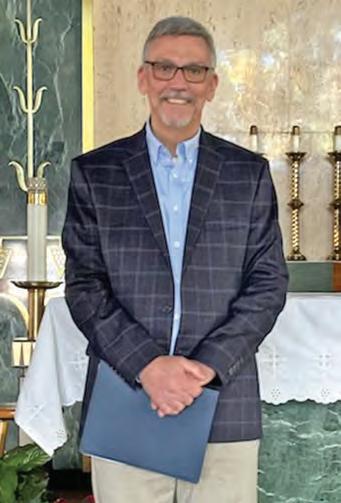
DISTINGUISHED GRADUATE—James Keusenkothen is the recipient of the 2026 NCEA Distinguished Graduate Award. The 1976 graduate of Immaculate Conception Catholic School and a graduate of Notre Dame Regional High School, Cape Girardeau, Keusenkothen is currently a Pastoral Minister for the Cathedral of St. Mary of the Annunciation and Director of the Catholic Social Ministries Food Pantry, which is the largest distributor in Cape Girardeau County. (The Mirror)
include multiple years of leading TEC and Cursillo retreats and teaching RCIA/OCIA classes for people who want to learn about joining the Catholic Church. These ministries reflect characteristics of the education Keusenkothen received at Immaculate Conception: helping those most in need, sharing the truth of our faith with others, living as an example of Christ’s love, and leading others to Jesus and his Church. We are extremely proud to recognize Jim Keusenkothen as an alumnus of Immaculate Conception School and as its 2026 Distinguished Graduate. This award was presented at all-school Mass on Wed., Feb. 4, 2026.


The VIRTUS Protecting God’s Children Safe Environment training for adults is
available online.
Preregistration is necessary: If you are a new registrant please go to www.virtus.org and click on “first time registrant” on the left, and follow the prompts to register for Online training. Instructions for the registration process can also be found on the Child and Youth Protection Page of the diocesan Website.
www.dioscg.org/wp-content/uploads/How-to-Register-for-a-VIRTUS-withOnline-Option.pdf
Both in-person and online training sessions are for adults only.
Before engaging in activities involving minors and/or vulnerable adults, new volunteers or employees are required to complete the VIRTUS Protecting God’s Children training for adults, submit a current Background Disclosure and Authorization Form, and read, sign and submit the annual Code of Conduct, which are available on the VIRTUS Website and the Diocese of Springfield-Cape Girardeau Child and Youth Protection Webpage: www.dioscg.org/childyouth-protection/ For more information, please contact the Office of Child and Youth Protection, childandyouthprotection@dioscg.org; or Bill Holtmeyer, billholtmeyer@dioscg.org; or Shelly Ferry, sferry@dioscg.org, (417) 866-0841.
Bishop Rice celebrates World Day of the Sick in Mercy Springfield
Springfield, MO
Based on the Gospel of the Good Samaritan on Feb. 11, Pope Leo chose the theme for this 34th World Day of the Sick, “The Compassion of the Samaritan: Loving by Bearing Another’s Pain.”
He notes first the question that is raised, “Who is my neighbor,” and how the story of the robbers who attacked the man was an invitation to Relationship. The Samaritan entered into a relationship with the man who had been attacked. The others who avoided the man on the side of the road, chose not to be in relationship with him.
We can think about in Catholic health care, every time a doctor, nurse, technician, a dietician or physical therapist enters the room of a patient, they are entering into a relationship. It may be brief, but the time does not matter. How both are treated is

GOD’S HEALING MERCY—Based on the Gospel of the Good Samaritan on Feb. 11, Pope Leo chose the theme for this 34th World Day of the Sick, “The Compassion of the Samaritan: Loving by Bearing Another’s Pain.” Bishop Rice celebrated World Day of the Sick with the community of Mercy Springfield. (The Mirror)
important, hopefully with compassion and loving care because ultimately that reflects the love and the care of God.
By not simply passing by, in not ignoring the man in his suffering, the Samaritan looked at him with an open and attentive gaze, enabling him to
“act with human and compassionate closeness.” Pope Leo highlights the fact that as the Samaritan approached him, they became neighbors to each other.
In caring for the robber, the Samaritan put love in action and made a decision to love. It was not just a good deed but the giving of oneself to the other
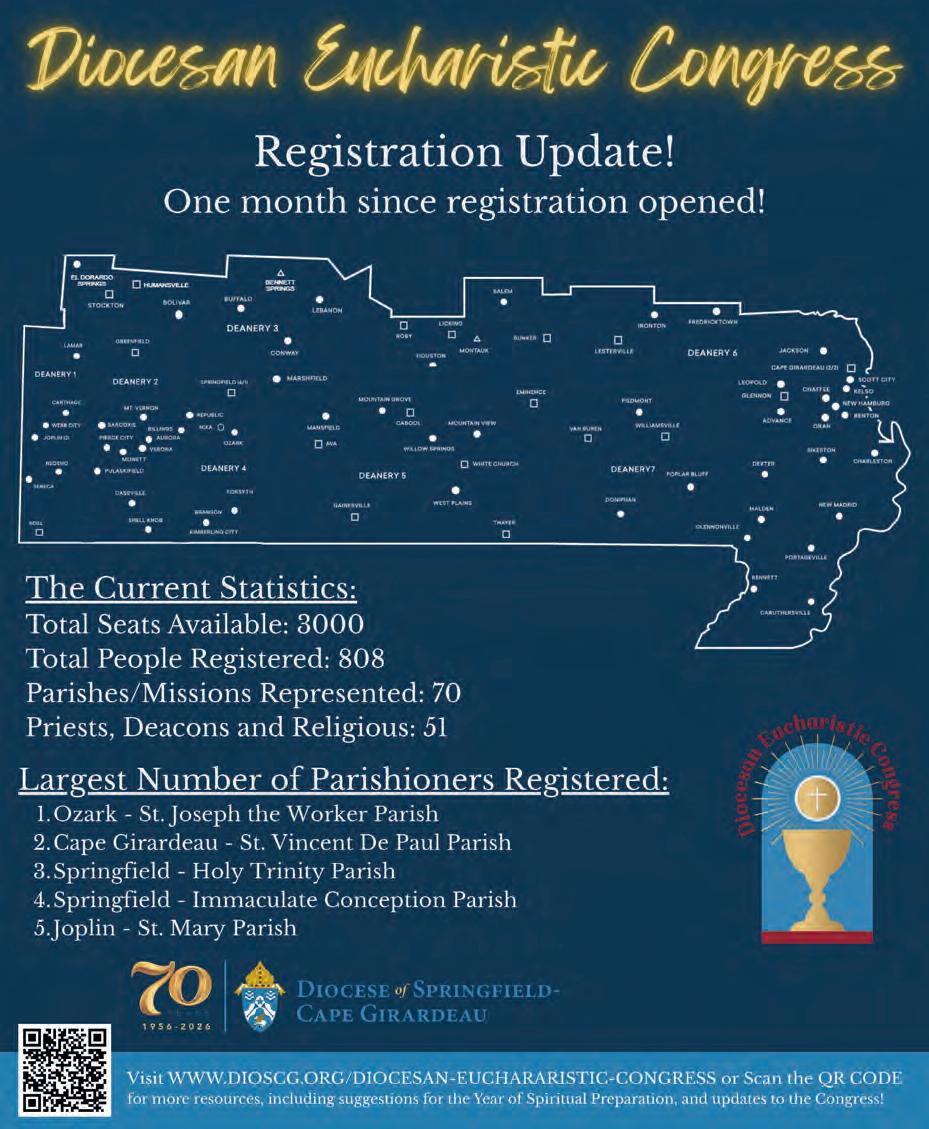
AUGUST 15, 2026
as a gift. I would like to think that that happens constantly in the interactions with patients and the Good Samaritans in Catholic health care: disguised as doctors, nurses, and staff, you are a gift to one another.
The gift of encounter flows from our union with Jesus Christ. He is the ultimate Good Samaritan who has brought us the greatest healing in the promise of eternal life and so we strive to make Him present when we reach out to the sick. We are all part of the Body of Christ and we are called to respond with the Lord’s compassion to those who suffer from sickness of any kind. Their pain is our pain. And in our efforts to heal the sick, we build up the Body of Christ.
On this Feast of Our Lady of Lourdes, Feb. 11, our Holy Father reminds us, “Let us raise our prayers to the Blessed Virgin Mary, Health of the Sick, asking her to assist all those who suffer and are in need of compassion.” He ends with this beautiful prayer, “Sweet Mother, do not part for me. Turn not your eyes away from me. Walk with me at every moment and never leave me alone. You who always protect me as a true mother, obtain for me the blessing of the Father, Son, and Holy Spirit.” Amen. ©TM


WEST PLAINS CIVIC CENTER
Homily of Bishop Edward M. Rice
ADULT FAITH

It is still a fairly common assumption that the Catholic Church absolutely and everywhere forbids cremation as an option for the disposition of someone’s earthly body after death. This is not the case. In fact, most Catholic funeral ritual books that priests use have contained provisions for cremated remains since about 1997.
Even though the practice of cremation is permitted, there are still important conditions attached to that permission. The body must always be treated with respect, and cremation must never be chosen as a denial of the resurrection — even of the physical body of each person — at the Second Coming. There can be many logistical or practical reasons why a family might choose cremation, even as they continue to live fully according to their Catholic faith.
One of the provisions connected to cremation, however, often causes confusion. It is found in the Order of Christian Funerals, paragraph 417. In short, it states that cremated remains must be treated with the same respect that is given a body. To quote it specifically: “The cremated remains of a body should be treated with the same respect given to the human body from which they come.”
Respect for the Body
What does this mean in practice? The
What does the Church allow us to do with cremated remains?
text goes on to explain that the remains must be placed in a worthy vessel, just as a body would be placed in a casket. They should be transported with dignity and placed in an appropriate and reverent place.
The ritual text makes it very clear that the presumed practice of the Church is that cremated remains will be placed in a grave, mausoleum, or columbarium. It further forbids the practices of “scattering cremated remains,” or “keeping cremated remains in the home of a relative or friend of the deceased.” The text uses strong language, stating that these practices are “not the reverent disposition that the Church requires.”
but only with clear expectations
DURING THIS EUCHARISTIC REVIVAL, FR. DAVID COON OFFERS THE FOLLOWING QUOTE FOR THE REFLECTION ON THE EUCHARIST:

So what does this mean in concrete terms? There is a right way to repose cremated remains, and there are wrong ways. While it is difficult to list every possible improper practice, the Church is clear about many of them. Scattering ashes and keeping them in a home are explicitly forbidden. Other practices are also excluded by extension. Placing remains in a pod to become a new tree or plant, sending them into space, using them in fireworks (yes, this has been done), or incorporating them into jewelry, among many other possibilities, are not permitted by the Church and cannot be condoned. Even if such practices are presented as symbolic or meaningful, they do not respect the dignity of the body. The Church’s language is very clear: cremated remains must be treated exactly as the body itself would be treated, both in life and in death.
“God is everywhere ... but not in the same way. He is present--Body, Blood, Soul, and Divinity--in the Blessed Sacrament. We consume the Eucharist; and we seek to pray before the Sacrament, in the same way that we prefer the physical presence of a loved one over the virtual. Christ desires us; He awaits us.”
— FR. JEROME KELLER, OP
What, then, is the right way? The right way is that cremated remains must be buried or interred in a place set apart for this sacred purpose and for the prayers of the faithful for the deceased. They should be placed in the ground, in a mausoleum, or in a columbarium.
They should be marked with the usual identifying details that we provide for every deceased member of our human family: their name, date of birth, and date of death. This should be done in the same manner that we would bury a body following a funeral liturgy. Ideally, there should also be a procession to the place of interment, where the cremated remains are laid to rest to await the coming of our Lord.
Proper interment
It is also important to acknowledge that there are many people of faith who may currently have cremated remains in their home or who may have used one of the other methods mentioned above. If this is the case, there is no need to panic or feel ashamed. For many years, there has been confusion about what the Church teaches regarding cremation — and even about whether cremation is allowed at all. If you find yourself in possession of cremated remains, or know someone who is, the encouragement is simple: talk to your parish priest. We are very willing to help families correct these situations and to find a proper and reverent place for a loved one to be interred. It is not uncommon for priests and parishes to assist in these circumstances.
The dignity of the human body is always of great importance to the Church, even after death. That is why the Church approaches cremation carefully: it is permitted, but only with
clear expectations about how cremated remains are to be treated and laid to rest. In this way, we honor the body, express our faith in the resurrection, and continue to pray for those who have gone before us as they await the coming of our Lord. ©TM
Fr. Belken is Pastor of St. Denis Parish, Benton, and St. Lawrence Parish, New Hamburg, and serves as diocesan Director of the Office of Worship and Liturgy.

with Rev. Daniel Belken
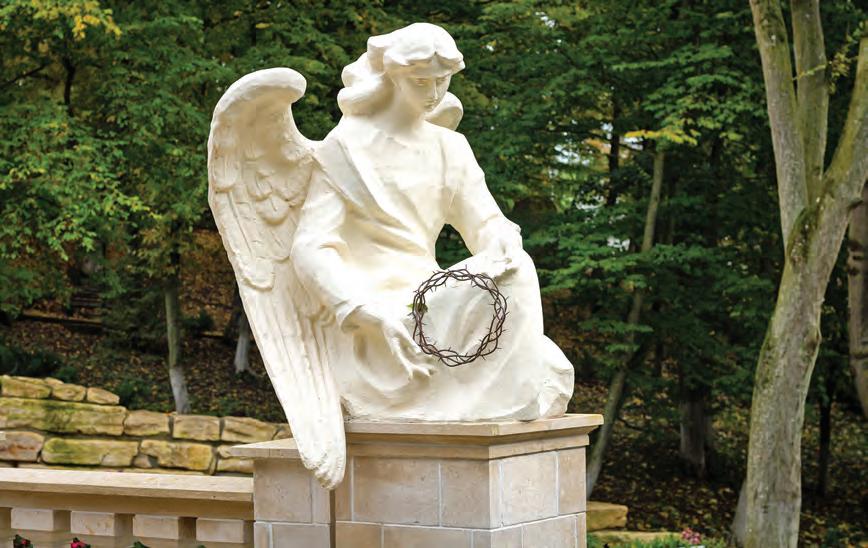
FAITH IN THE RESURRECTION—The dignity of the human body is always of great importance to the Church, even after death. That is why the Church approaches cremation carefully: it is permitted,
about how cremated remains are to be treated and laid to rest. (Getty images)
Father Coon is Pastor of Sacred Heart Parish, Dexter. He serves the Diocese as Priest Minister for Spiritual Deliverance & Exorcism and the Confraternity of Priest Adorers of the Eucharistic Face of Jesus.
A column by Fr DanielBelken