

—e.g.
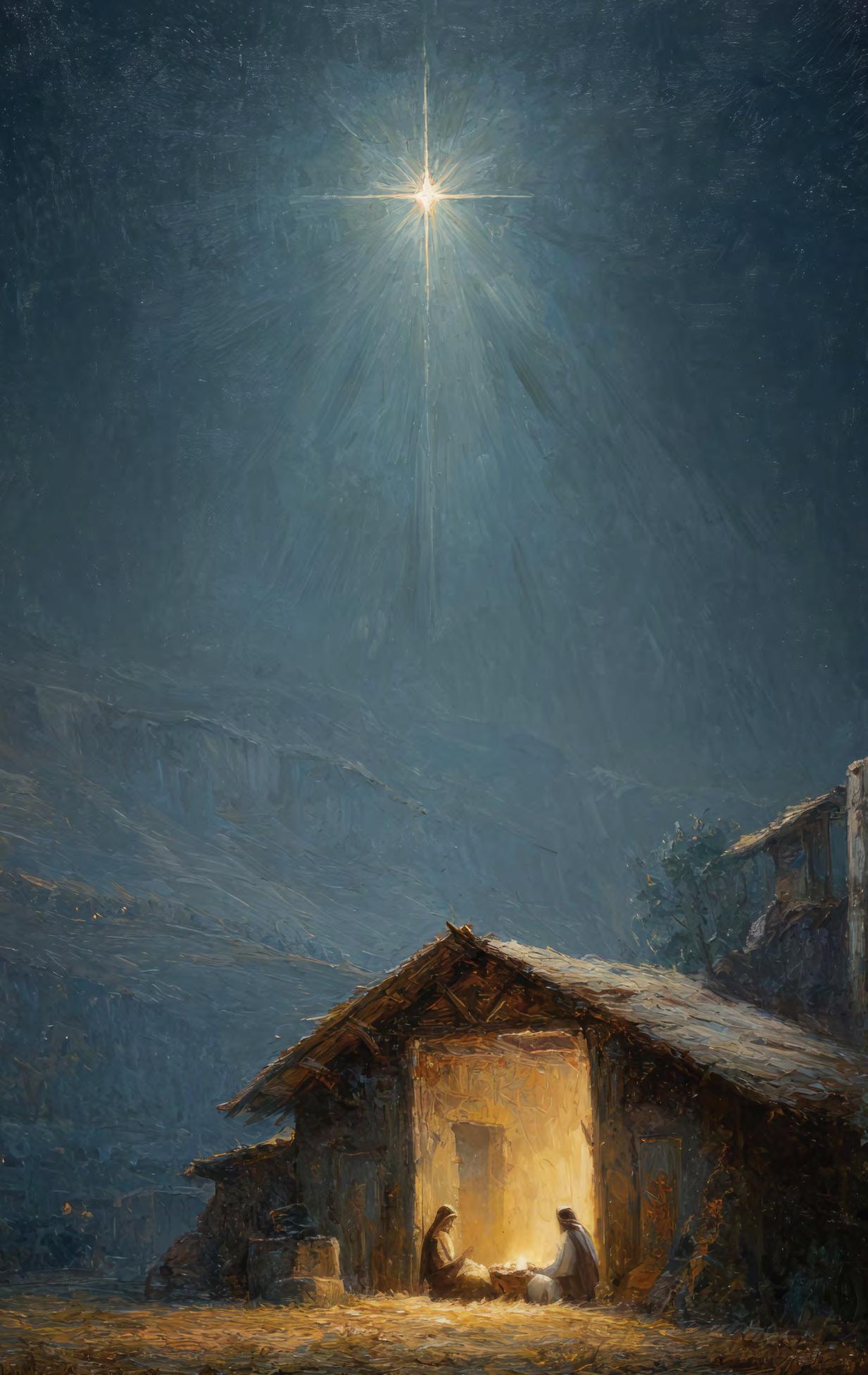
(Art by Alex Moren/Comfort Art Store-Etsy)
AND YOU WILL SEE
Bp. Edward M. Rice
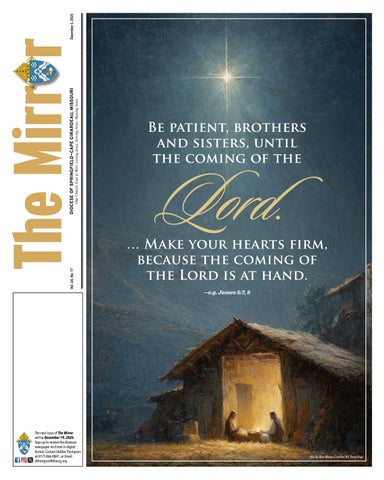
—e.g.
Bp. Edward M. Rice
May the joy of the newborn king, the Prince of Peace, be in every heart!
I write this column at the end of November, knowing that our diocesan newspaper, The Mirror, only comes out twice a month. With that in mind, I must always be thinking not just two weeks ahead but having already written my column for Christ the King, now I must focus on Christmas.
I often receive complimentary copies of magazines in the mail and as I go through them I make an immediate decision to pitch or keep. I have a rather large stack of the “keep” pile, which I end up pitching after a couple of months. However, there are monthly commentaries on the liturgical season or the Mass which I find helpful for homilies. So there I was in my chapel on Wed., Nov. 26, the day before Thanksgiving, thinking about my Christmas homily. And I picked up an Advent booklet to read the reflection for Dec. 25. The reflection told of a man who had travelled extensively with his son, buying expensive pieces of art throughout his life. Unfortunately, the son passed away and the father commissioned a portrait in memory of his son. And eventually the father, too, died. And all the beautiful works of art that have been purchased throughout his life were auctioned off, beginning with
his son’s portrait. But no one wanted the portrait of the son, they wanted the expensive artwork. But the condition of the auction was that the son’s portrait be auctioned off first. And so finally the portrait was purchased for $97. And with that, the auctioneer announced the auction was over. The father had arranged the auction so that whoever got the son, got it all!
As I sat in my chapel the day before Thanksgiving pondering that last statement, “Whoever gets the son, gets it all,” my heart soared! In the midst of all the busyness of the season; with decorating, gift-giving and food preparation, the profound meaning of Christmas can sometimes be forgotten. So often, by the time Christmas comes along, we can be so exhausted that we plop into the pew for Christmas Mass
completely unaware of the great mystery we’re celebrating.
Galatians 4:4 reminds us: “But when the fullness of time had come, God sent forth His Son, born of woman.” John 3:16 proclaims, “God so loved the world, that He gave His only Son, that whoever believes in Him should not perish but have eternal life.”
Reflecting on the mystery of “the word made flesh,” the busyness of the Christmas season and then pondering the gift of Jesus, everything else seems like cheap tinsel. Meaning, It’s pretty to look at, but it has no substance. If the Advent season has been lived well, it becomes a preparation of the heart. Let the heart be considered a manger where the Holy Infant can be born anew!
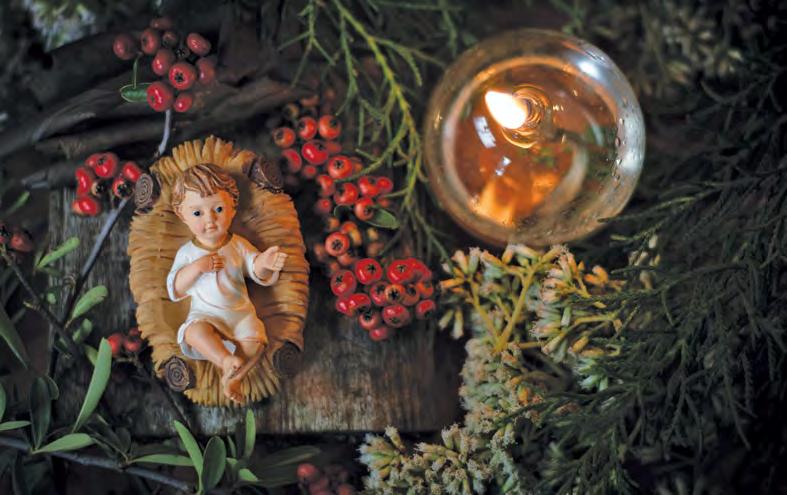
I’ve often mentioned the beautiful tradition of visiting manger scenes in various churches, making a visit, giving your heart to the Christ Child and, as a reminder, taking a piece of straw from the Manger to

By Bishop Emeritus John J. Leibrecht
Before his retirement in 2008 as the Fifth Bishop of the Diocese of Springfield-Cape Girardeau, Bishop John Leibrecht wrote a standing column in The Mirror entitled, “Walking Together.” At the end of each article, Bp. Leibrecht would normally share a funny story referencing his travels to the schools, or time with friends, family, or other bishops. The Mirror has decided to share a few of these in an ongoing series entitled, “Another walk through: ‘Walking Together.’” We hope you enjoy them.
April 29, 1994 All of us know that April 15th is a day for the Internal Revenue Service. Our DDF Sunday, May 1, is for the Eternal Revenue Service.
May 6, 1994 “Next Sunday,” the minister said to his congregation, “I’m going to preach on the topic of lying. To prepare yourselves, please read the 17th chapter of the Gospel of Mark.” The following Sunday the minister began his sermon by asking, “How many prepared for today’s topic by reading the 17th chapter of Mark? “A number of people raised their hands. “We need to talk,” the minister said. “There is no 17th chapter of Mark!”
May 13, 1994 The number-one problem in our country seems to be apathy—but nobody cares!
put in your wallet or purse to remind you throughout the year of that great gift that is given to us. Whoever gets the Son, gets it all!
Throughout the year I hold all the people of the diocese in my heart. As I drive through southern Missouri, praying the rosary, your intentions are always at the forefront of my prayers. I pray for the spiritual and temporal needs of our diocese. I pray for the priests and religious of our diocese, that as they strive to grow in holiness they will inspire a new generation of vocations to the priesthood and the religious life to serve in our diocese. I pray for the renewal of marriage and family life. I pray for the sick, the unemployed, and for those who will die that day. All of these intentions are near and dear to my heart. And during this Advent/ Christmas season, I pray that each one of you may open your heart to receive the great gift of Jesus. Whoever gets the Son, gets it all!
Merry Christmas and Happy New Year. ©TM

Dec. 21 - Dec. 31, 2025
SUNDAY, DEC. 21
FOURTH SUNDAY OF ADVENT MASS
8:30 a.m. St. Mary of the Annunciation Cathedral, Cape Girardeau
WEDNESDAY, DEC. 24
MASS AT NIGHT / CHRISTMAS EVE
11 p.m. St. Agnes Cathedral, Springfield
THURSDAY, DEC. 25
THE NATIVITY OF THE LORD / CHRISTMAS DAY MASS
8 a.m. St. Agnes Cathedral, Springfield
WEDNESDAY, DEC. 31
HOLY HOUR & MIDNIGHT MASS FOR SOLEMNITY OF MARY , THE HOLY MOTHER OF GOD
11 p.m. St. Agnes Cathedral, Springfield

What if our best leadership this Advent came not from achieving more, but from being more present to Christ?
Advent doesn’t just invite leaders to slow down — it demands something more profound within us. It’s ironic that year-end pressure, crowded calendars and relentless noise also dominate the season of Advent.
Advent, a time of repentance, calls leaders to quiet the cultural rush and noise and tend to their interior life. The season challenges us to live, and thus also to lead, not from urgency but from awareness; not from end-of-year performance but from being present. Before we can guide others, Advent should make us aware of the need first to prepare our own hearts — a truth that struck me unexpectedly years ago during a visit to the Church of the Nativity, the site of Christ’s birth.
As I walked toward the entrance, the lyrics of Silent Night came to mind: “Silent night, holy night, All is calm, all is bright…”
I expected peace, quiet and reverence. I was in awe as we approached the doors. Instead, what I experienced was more like a zoo.
Pilgrims and tourists crowded shoulder to shoulder, pressing toward the narrow staircase that descends into the small space below the altar — the place of Christ’s birth, the scene of the Nativity. In the tight space, people angled for a position to take their photos of the silver star that marks the spot where Christ was born.
At first, I was upset by the scene, but then I realized it reflects the Christmas
season back home.
Today, “the most wonderful time of the year” has become the noisiest and busiest time of the year. The weeks leading up to Christmas, meant to be a time of reflection and preparation, are filled with deadlines, travel plans, shopping lists and work, wrapping up projects and trying to reach end-of-year goals. Hardly the stuff that leads to calm.
In the corporate world, December is a sprint to “make the numbers.” In family life, it’s often a scramble to check every box on the holiday to-do list and shopping list. With all that going on, Advent can sometimes get reduced to choosing which Mass to attend so as not to conflict with Christmas Day events.
each week of Advent to help us prepare. The themes of hope, peace, joy and love provide us with a way to pause and reflect on our inner life and leadership.
First Sunday: Hope
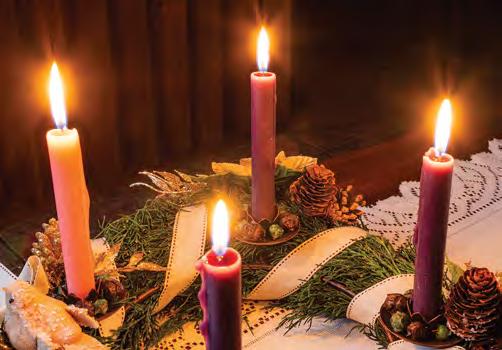
Hope comes from our renewed longing and vigilant expectation for Christ’s coming — past, present and future.
St. Paul calls us to “wake from sleep” and “cast off the works of darkness and put on the armor of light,” in order to live in hopeful readiness for the Lord who continually approaches the soul (Romans 13:11-14).
Reflection for this week:
The irony is that the quieter our hearts become — which admittedly is difficult to do any time of the year — the louder God’s voice can be heard.
The Advent season helps to quiet the soul. It’s a penitential season that includes fasting, almsgiving and prayer. The focus should not be on buying gifts but on preparing ourselves to be present to welcome and appreciate Christ on Christmas Day.
Luckily, the Church did the heavy lifting for us and gave us themes for
‘COME HOLY SPIRIT’
Where am I in need of shaking off a work of darkness to awaken from spiritual or leadership complacency? How can I renew my hope in God so I can mirror Christ in the way I lead, influence and prepare the people entrusted to me?
Second Sunday: Peace
Peace comes from trusting God’s nearness, knowing he wants to help us in his time.
Reflection:
Where is God inviting me to let go of my anxiety and self-reliance so I can lead from a place of peace, trusting that he is near, he will help and he does not delay

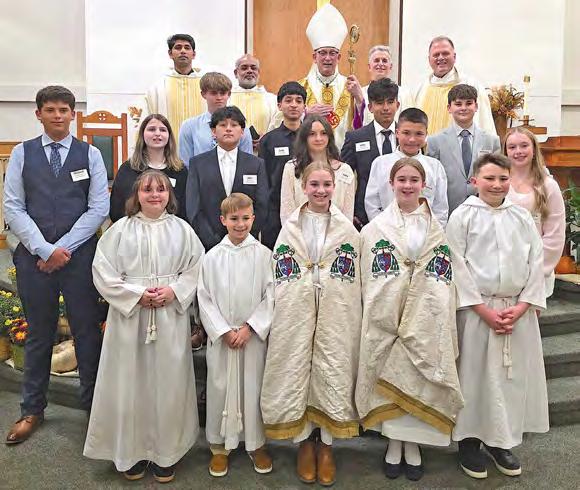
On November 8, 2025, Bishop Edward M. Rice Confirmed 10 youth in Our Lady of the Lake Catholic Church, Branson. Pictured with the confirmands and Bishop Rice were Parochial Vicars Fr. Dhaneesh Thomas, OSB, and Fr. Johny Manickathan, VC, Deacon Dan Vaughn, and Fr. J Friedel, pastor. Nine of the youth are parishioners of Our Lady of the Cove Parish, Kimberling City, and one youth attends Our Lady of the Lake Parish, Branson. (Submitted photo)
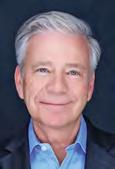
By Paul Winkler CATHOLIC AUTHOR, FOUNDER AND PRESIDENT OF ATTOLLO
in giving the grace needed for the work before me?
Third Sunday: Joy (Gaudete Sunday)
“Rejoice in the Lord always. I shall say it again: rejoice! … The Lord is near. Have no anxiety at all…” Philippians 4:4-6.
Reflect this week:
If Christ is truly near in my life and my work, how would knowing that nearness change the way I lead, decide, respond and bring joy into my sphere of influence this week and beyond?
Fourth Sunday: Love
The final week, the theme is love. As Catholic leaders, love should be the driving force of our leadership.
Reflection:
During this week of Advent, think about how you, as a leader of others, can better reflect God’s endless love for humanity with the people that you lead.
The scene I experienced in Bethlehem—chaotic, noisy, even irreverent— kind of mirrored my own heart at times: chock-full of good intentions, crowded with distractions.
But just as Christ entered a crowded, noisy, chaotic world in a humble manger, he will enter our restless hearts if we make him room.
As we move through Advent, may we prepare not just for Christmas Day, but for Christ himself: in our homes, in our leadership and in the workplace cultures we shape.
Paul Winkler’s column, “The Vocation of Business,” is distributed by the Denver Catholic, the official publication of the Archdiocese of Denver.
As our diocese approaches its 70th anniversary on August 15, 2026—an extraordinary milestone that providentially coincides with our Diocesan Eucharistic Congress—we are invited to turn our eyes once again to the heart of our faith: the Most Holy Eucharist. Anniversaries are moments of gratitude, remembrance, and renewal. They offer us the chance not only to look back at the graces that have shaped our local Church, but also to rediscover the source from which those graces have always flowed.
In Chapter III of “Ecclesia de Eucharistia” (EE), Pope St. John Paul II leads us to contemplate a truth that is both ancient and ever-new: The Eucharist is not merely a sacred reminder of Christ’s Passion and Resurrection, nor simply a profound symbol of his saving love. It is, as he teaches, the very foundation of the Church’s apostolic identity (EE, 18). The Eucharist is inseparable from the Apostles because it was entrusted directly to them by Christ in the Upper Room. Thus, it is inseparable from the Church today because it continues to be handed on through their successors in an unbroken chain of faith.
In other words, the Eucharist and the apostolic nature of the Church stand or fall together. The Eucharist and the apostolic nature of the Church are inseparable: one cannot exist authentically without the other. The Church remains truly apostolic not only because she preserves the Apostles’ teaching, but because she continues to celebrate the very mystery they received from the Lord on the night before he died. Likewise, the Eucharist remains truly what Christ intended only within the living, apostolic Church he founded. This mutual bond is the foundation of our unity as believers—and the anchor of our diocesan mission as we look toward the future.
Receiving & preserving the apostolic gift
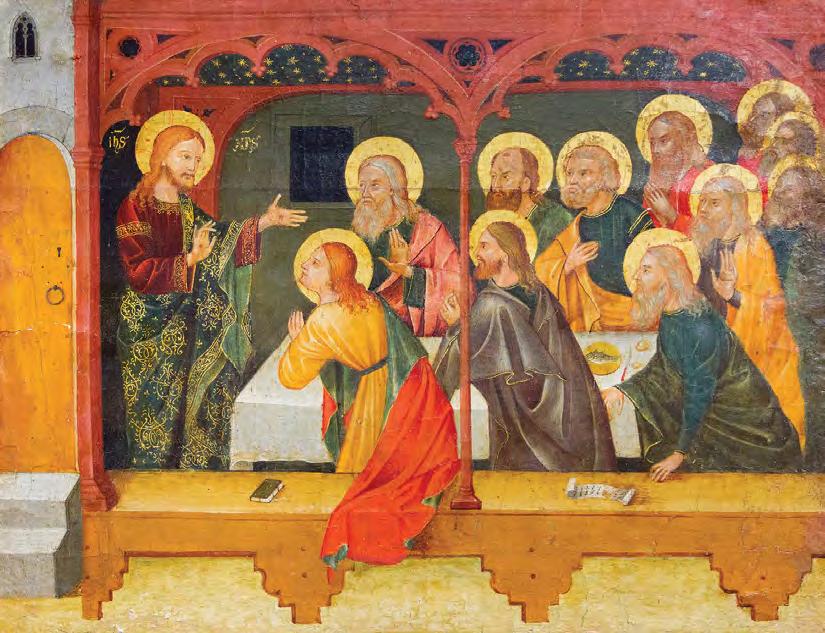
To be apostolic is to be built on the foundation of the Apostles (“Lumen Gentium,” 18). From the very beginning, the Eucharist was received, not invented. Christ himself instituted it at the Last Supper, giving his disciples the command: “Do this in memory of me” (Lk 22:19; 1 Cor 11:23–25). In turn, the Apostles ensured that this gift would be preserved for generations.
Pope St. John Paul II reminds us that the Church does not “possess” the Eucharist as a ritual of its own making. Rather, she safeguards it as a treasure entrusted by Christ through the Apostles (EE, 18). Every Mass is an opportunity to enter into that first Paschal night, to stand among the Apostles as they
INSTITUTION
received Christ’s Body and Blood. This continuity is what allows the Eucharist to remain authentic and lifegiving, connecting each believer to the Apostolic Church across time.
Apostolic succession: Guarantee of Authentic Eucharist
Chapter III of Ecclesia de Eucharistia stresses that the Eucharist is inseparable from apostolic succession. Only a bishop or priest who participates in the unbroken line of the Apostles can validly preside over the Eucharist (EE, 28). This ensures that each celebration is truly sacramental, making Christ’s sacrifice present, rather than merely symbolic or commemorative.
Christ entrusted the Eucharist to the Apostles, who, in obedience to his command, passed it on to their successors. This apostolic chain is not a formality—it safeguards the integrity of the Eucharist and guarantees that the Church celebrates the same mystery Christ instituted two millennia ago. The Eucharist, therefore, is a living link between Christ, the Apostles, and every generation of the faithful (Catechism of the Catholic Church, 1548).
The Eucharist builds the apostolic Church
The Eucharist does more than preserve continuity; it actively forms the Church into an apostolic community (EE, 20). Every Mass invites the faithful to share in the Apostles’ faith, their mission, and their witness to Christ’s death and resurrection. By receiving the Body and Blood of Christ, we are strengthened to
live and proclaim the Gospel with the same courage and conviction that transformed the early Christian world.
For our diocese, this means that every parish celebration, every liturgy, and every outreach initiative flows from the Eucharist. It nourishes our community spiritually and strengthens our mission, reminding us that the Church is not a building or an organization but a living Body, rooted in the Eucharist and guided by apostolic faith.
The Eucharist unites across time & space
Chapter III also emphasizes the Eucharist as a sacrament of unity (EE, 39). Every celebration of the Eucharist connects us not only to our diocesan community, but also to the universal Church across history.
In the Eucharist, we are united with the faithful of every age: the Christians of the early Church, the saints of the medieval monasteries, missionaries who carried the faith to distant lands, and all believers who have preceded us.
This unity is tangible: through the ministry of priests in apostolic succession, we are brought into communion with the Church that spans continents and
By The Very Rev. Shoby Chettiyath, JCL, V.G.
centuries. The Eucharist is therefore not merely a ritual meal but the bond that unites the Body of Christ, making the Church one across time and space.
Fidelity to the Eucharist is fidelity to the apostolic Church
Pope St. John Paul II issues a pastoral reminder in EE Chapter III: the Church weakens when the Eucharist is separated from its apostolic roots—when its sacrificial nature is minimized or when the norms of its celebration are disregarded (EE, 10).
Fidelity to the Eucharist is fidelity to the Apostles. Celebrating it with reverence and adherence to tradition is not legalism but an expression of love for the gift Christ entrusted to his Church. The Eucharist preserves our unity, strengthens our mission, and ensures that the Church remains apostolic in faith and action (Catechism of the Catholic Church, 1388–1389).
Anchored in the apostolic gift Chapter III of Ecclesia de Eucharistia brings us to a truth that defines who we are: The Church remains apostolic because the Eucharist keeps her anchored to the Apostles—anchored to Christ himself.
As our diocese approaches the Diocesan Eucharistic Congress (DEC) and celebrates 70 years of grace, we are called not simply to remember our history but to return to its source. Every generation of believers—those who built
DURING THIS EUCHARISTIC REVIVAL, FR. DAVID COON OFFERS THE FOLLOWING QUOTE FOR THE REFLECTION ON THE EUCHARIST :
“Every member of the Church must be vigilant in seeing that the Sacrament of Love shall be at the center of the life of the people of God so that through all the manifestations of worship due Him shall be given back ‘love for love’ and truly become the life of our souls.”
— POPE ST. JOHN PAUL II
Father Coon is Pastor of Sacred Heart Parish, Dexter. He serves the Diocese as Priest Minister for Spiritual Deliverance & Exorcism and the Confraternity of Priest Adorers of the Eucharistic Face of Jesus.
our parishes, founded our ministries, and handed on the faith—drew their strength from the same Eucharist entrusted to the Apostles in the Upper Room.
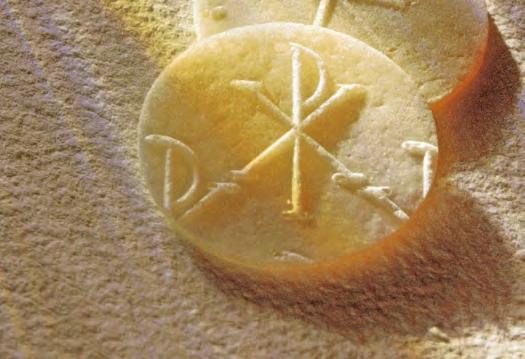
To receive the Eucharist is to let Christ form us as his witnesses and disciples. To celebrate the Eucharist is to stand in the unbroken line of the Apostles. To be faithful to the Eucharist is to be faithful to the very identity of the Church.
The Eucharist is the pulse of our diocesan life—our unity, our mission, our hope. It is the altar from which the Church rises, the fire that rekindles our zeal, and the pledge
that Christ remains with us “to the end of the age.”
May this anniversary year renew in us a deeper love for the Eucharist and a firmer commitment to live as an apostolic people— rooted in Christ, strengthened by his sacrifice, and sent forth by the power of his real presence.
As St. John Paul II reminds us, in the Eucharist “the Church draws her life” (EE, 1). Let us draw deeply, faithfully, and joyfully—so that our diocese may continue to grow in holiness and witness for generations to come. ©TM
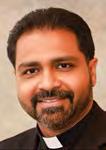
The Very Rev. Shoby Chettiyath, JCL, V.G., serves as Vicar General, Moderator of the Curia, and Vicar for Religious in the Diocese of Springfield-Cape Girardeau. He is Pastor of St. Francis of Assisi Parish, in Nixa, and Holy Trinity Parish, Springfield.
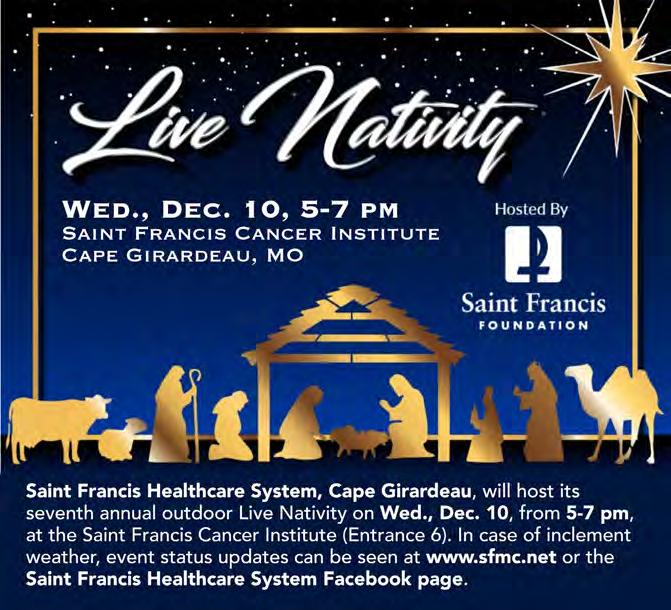
Belleville, IL The 56th Way of Lights Display at the National Shrine of Our Lady of the Snows runs through Dec. 31, 2025, using over 1.5 million beautifully colored and white lights to depict the journey of Mary and Joseph as they traveled to Bethlehem. Activities include camel rides, kettle corn, selfie station, gift shop, arctic exhibit, and food stand with hot dogs, hamburgers, etc.! Check out the new and improved light display! For more information, call (618) 397-6700 or visit https://snows.org/ wayoflights.
Leopold—St. John PCCW will host its annual Country Christmas Home Tour, Sun., Dec. 14, 1-4pm. Tour 5 beautifully decorated homes, stop at the church, 3-4pm for Christmas organ music, followed by homemade soup and cookies, served next door. Please contact Geri at (573) 208-6445 for more information.
Springfield-area—You are invited to join The Cornerstone for Catholic Scripture study, day and evening sessions are available in three locations in the Springfield (plus Zoom sessions) Please check our Website for one near you: www.thecornerstonescripturestudy. org; or call Bruce at (417) 833-7913. Sessions will resume in January for study of The Acts of the Apostles.
Parishes and organizations are invited to submit notices of future events to be printed on a space-available basis. There is no fee.

By Father Robert J. Hater OSV News
During Advent, traditional reflections remind us that our call to evangelize involves waiting and anticipation. As we move toward Christmas, we relive the longexpected coming of the Messiah by the Jewish people. The Mass readings and Liturgy of the Hours recall this Jewish expectation that was vaguely promised in Genesis 3:15: “I will put enmity between you (the serpent) and the woman.” This yearning intensified with the prophets, especially Isaiah. The preaching of John the Baptist and Jesus’ baptism brought it to a climax.
Reflecting on prophesies of a coming Messiah in the Old Testament affords us the opportunity to thank God that we live in this post-Messianic time. Such reflections help us better appreciate Jesus, the Son of God, who came to earth, walked among us and who continues to live in people and in the sacraments. Living in a postPentecostal era allows us to give thanks and anticipate Jesus’ second coming, and prepare for our final journey into eternity.
And yet, we can anticipate more. This “more” involves a new attitude of waiting that centers around Jesus’ ministry to the poor and downtrodden. It invites us to shift our attitude of waiting from looking to some distant past or future to the waiting that happens in everyday life. We adopt a new way of waiting during Advent by looking forward to our daily opportunities to reach out to the poor in our families, neighborhoods, and workplace. This involves an “intentional attitude of waiting,” in the here and now.
By doing so, we commit ourselves to wait for opportunities that afford us the chance to respond like Jesus did when he responded to the woman with an issue of blood, to the Samaritan woman at the well, or to the 10 lepers who approached him. This attitude enables us to anticipate the poor among us and help them as Jesus did. Our daily lives become occasions to live as Christian disciples, called to proclaim Jesus’ Good News to those we meet daily.
We wait with an open heart for the poor and disenfranchised in whom we recognize the risen Lord, and we reach out to them. We anticipate serving the poor by acknowledging economically, psychologically, spiritually, and physically poor people as living
invitations to serve Jesus who lives in our midst.
We may recognize him in an elderly mother living in a nursing home, a teenage child suffering from drug addiction, an insecure spouse, or a neighbor without a job. Advent invites us to put our everyday acts of mercy under the lens of the Gospel, recognizing the needy, poor, and outcasts as hinges that join Jesus’ mission and ministry with our discipleship.
While this path is often related with the ministry of Church leaders, it applies to all Christians in service of their brothers and sisters. We describe this path of Christian discipleship by using four words: welcome, accompaniment, discernment, and integration. These summarize the pastoral attitudes needed to deal with any situation of hurt or brokenness. Together, they afford us with a new model of Christian discipleship.
We support a person’s move from a sometimes dry riverbed of life to the living waters of a stream suffused with the power of the Holy Spirit. Welcome is the underlying perspective; accompaniment happens as we support the needy; discernment occurs as we help them discern God’s will; and integration results as we help integrate them in some way into the Church community.
The Holy Spirit, at the center of this evangelization process, leads the parent, child, work associate, or friend that we assist. We are the Holy Spirit’s ambassadors.
These four attitudes provide the framework for our remarks about anticipating the poor in our midst, as we focus on Advent and responding as Christian disciples. Seen in the context of evangelization, the following sections explain them, connect them to each other and offer stories or examples of sharing Jesus’ Good News, especially with the poor.
The path of a Christian disciple begins with the family and returns there. We concentrate on family as a starting point, then move to neighbors, friends, work associates, and the parish.
Welcome begins in the family. A child becomes aware of parents, siblings, and environment before becoming aware of the child’s own self. The external environment of the home
redounds on the child’s developing selfconcept. It’s vital that children feel loved and cared for, even before they develop a clear sense of their own self. Love and affiliation set the foundation for human interchanges later on. They introduce children to a welcoming, loving family.
As children grow, relationships and the home environment play a big part in how they respond to others. Whether at home, in the workplace, or at church, welcome is the foundation for a positive attitude toward life.
The welcoming climate of the home affects children’s religious formation and attitudes. Religious rituals, prayers, and religious artifacts, like a crucifix or a Bible, play an important part in a welcoming religious home environment.
To illustrate the significance of welcome for Christian discipleship, I cite a story from my childhood. Our home and our small dry-goods store strongly influenced my early upbringing. Both part of my family’s climate, they established the foundation for who I am today. Our store in the west end of Cincinnati was a happy place where neighborhood folks bought merchandise and knew that everyone, mostly poor Black and white people, felt welcome.
The old store is gone now, but memories live on. The special sense of welcome that those coming into our store felt continues to inspire me in my ministry and moves me to welcome everyone, especially in church. Remembering our home and the old store, I realize more deeply how God’s love and human kindness bring a sense of welcome and new life. Applied to Christian discipleship, we learn that hospitality is a fundamental attitude as a Christian disciple.
Jesus must have possessed a remarkable way of welcoming others, especially the poor and needy who flocked to him. If we hope to reach out to the poor, it is imperative that we make them feel welcome.
If not, other efforts to evangelize often bear little fruit. The call to discipleship invites us to be a welcoming
person, regardless of whether this welcome happens at our home, in the neighborhood, or in the parish.
Besides the welcome extended by individual Christians, parishes as a whole are challenged to be welcoming communities. This goes beyond the pastor greeting people before or after Mass on Sundays. It extends to how the secretary answers the rectory phone or whether minority groups feel welcome. Welcome is strongly affected by the climate of the entire parish. If this climate is not a welcoming one, attempts to evangelize will be severely limited. Welcome is the starting point, and Advent is the time to seriously consider it.
Welcome roots accompaniment, which also begins in the family and extends outward into the neighborhood, work, and the parish. Parents develop their attitude of accompaniment as their love grows, and it extends to their dealings with the entire family unit.
Reflect on your family and accompaniment in family ministry as you join me on an aspect of my journey that occurred in the spring of 2016. Uncertainty filled the hearts of my sister, Joan, and myself as we drove to Columbus, OH, to visit my dying brother, Tom, at the James Cancer Hospital. On our trip north, we remembered our other sister, Mary Ann, seriously ill in Cincinnati at Good Samaritan Hospital. Arriving at the hospital, we stood outside of Tom’s room. Seeing us, his feeble voice invited us to enter. After a visit with family and friends, everyone left the room except Joan and me. I asked Tom, “Do you want us to pray with you?” He answered, “Sure!” As we said the Our Father, I looked at his trembling lips and the worry on Joan’s face.
Coming to the words, “Thy kingdom come,” my mind flashed back about 75 years. I remembered our mother teaching us children this prayer and praying it with Mary Ann, Joan, Tom, and me. It was almost as if we were
transported back in time to a core moment that united us together as a family.
Thinking of Mom praying with us, I experienced powerfully what Pope Francis called accompaniment as we said, “Give us this day our daily bread.” Through life, our family members nourished each other in our joys and sorrows, made possible by faith-filled parents.
As I left Tom’s room that day, not long before he died, I realized more deeply that faith is born in and nourished in the family, where we grow in love, mercy, and forgiveness through life’s ordinary events.
Accompaniment, built into a family as they strive to support one another, is the foundation for how we reach out later in life to be with and support the needy, especially in troubled times. Consider accompaniment in a broad sense. It can happen when supporting a student having difficulty learning mathematics, consoling a high school football player who tore his meniscus, supporting a boy caught stealing from a store who tries to amend his ways, advising a widowed Catholic wondering about the next step in her life, or counseling a divorced Catholic struggling with whether to remarry. In each case, the path of Christian discipleship calls us to walk with and
support them, as they discern the workings of the Holy Spirit in their lives.
Discernment is an essential quality along the path of Christian discipleship. Put simply, it is the process whereby we attempt to decide what is right or wrong, good or bad, true or false. Often, discernment centers around a particular event, way of acting or decision to be made. This can be as simple as helping a child see why it is wrong to lie, to grappling with a complicated ethical matter. Regardless, it focuses on helping someone discern how the Holy Spirit is leading the individual.
In conscience formation, a person has the obligation to do one’s best to develop a well-formed conscience—that is, one formed in light of the guidance of the Holy Spirit, the teachings of the Church, the wisdom of learned or holy people, and the Scriptures. In this process, the Church teaches us that the ultimate monitor of whether a person is morally responsible for actions before God is the judgment of the individual’s practical reason. Such a decision must be made sincerely, while listening to the movements of the Holy Spirit.
The path of Christian discipleship involves developing a well-formed conscience, often done with the assistance of another committed
By Debbie Gaines Oran, MO
Oran High School held its annual Veterans Day Assembly on Nov. 11 and Guardian Angel Catholic School students and staff were invited to attend.
To coincide with the honoring of the veterans, the Veterans of Foreign Wars (VFW) holds an essay contest each year for grades 6-12. The contest for grades 6-8 is called “Patriot’s Pen,” while the high school students compete for the “Voice of Democracy.” The topic each year is centered around veterans and the essays must be 300-400 words, typed in English, and be the original work of the student.
Christian. In the interchange between the listening disciple and the individual searching for the right thing to do, both must seek the wisdom of the Holy Spirit. From childhood to old age, conscience formation requires discernment. We need to make every effort necessary to make sure that we recognize the way the Holy Spirit is moving us.
Integration means that for the path to discipleship to reach fulfillment, contact with a believing Christian community is necessary. For the seeking Catholic or one in some irregular situation, it’s important to receive the support of the Catholic community, usually the parish. How many times has it happened that someone going through the Order of Christian Initiation of Adults (OCIA [formerly RCIA]) stops attending or falls away not long after being received into the Church? This indicates that the welcome, accompaniment, and decision to enter the Church must be connected with integration into the parish. Otherwise, the fruits of God’s grace received during the OCIA process can be lost afterward.
Something similar may occur when someone who has left the Church wants to return. Usually, this often does not occur overnight. Whether in big steps or small ones, the person accompanying

such an individual must never give up, but keep encouraging the individual to take small steps until he or she acknowledges the value of returning to an active, faith-filled life in the Church community.
A person, divorced and remarried outside of the Catholic Church without a declaration of nullity, may sense the Holy Spirit’s urging him or her to return to the Church but not receive holy Communion as long as he or she lives in an irregular situation. The one accompanying this person can encourage them to attend Mass and be integrated into other aspects of the parish.
Steps like these may someday lead to a return to full communion in the Church if one’s personal situation changes.
Advent invites us to evangelize by reaching out to the poor. We do this when we let anticipation and waiting, an integral part of Advent, be the attitude that enables us to recognize daily opportunities to support the needy and downtrodden as we welcome, accompany, discern with them, and integrate them deeper into the faith life of the Church. ©OSV News
Father Robert J. Hater, PhD, is a priest in the Archdiocese of Cincinnati and a professor emeritus of the University of Dayton.
Springfield, MO

FIRST PLACE TOP ESSAY Standing in front of the wall of honor in Oran High School for community veterans who gave the ultimate sacrifice, Guardian Angel Catholic School 7th grader Cora Hourchins holds the First Place certificate she was given for writing the top essay for “Patriot’s Pen,” an essay contest by the Veterans of Foreign Wars (VFW). Hourchins was one of three Guardian Angel students recognized for their top essay submissions. (Submitted by Debbie Gaines )
Guardian Angel School was honored to have three of its junior high students win the “Patriot’s Pen” and be awarded monetary prizes. Seventh grade student Cora Houchins’ essay won First Place among all the Guardian Angel, Oran Public,
and Scott County Central students’ essays. The essay will be sent on to District 12 VFW, with district winners competing for Nationals. The other two winners at Guardian Angel were Chloe Hahn and Elaina Hahn, both in 7th grade. ©TM
The National Speech & Debate Association is proud to announce and congratulate Vivian Sharp, Springfield Catholic High School Senior, on earning the National Speech & Debate Association’s Academic All-American award! This coveted award recognizes academic rigor, competitive success in speech and debate, and personal excellence.
There are more than 141,000 student members of the National Speech & Debate Association; fewer than 1% of the students earn the Academic All-American award


each year.
This distinguished award recognizes Sharp and others who have completed at least five semesters of high school, earned the degree of Superior Distinction in our Honor Society, achieved rigorous criteria for GPA and /or test score requirements, and demonstrated outstanding character and leadership.

Congratulations, Vivian Sharp, Class of 2026! ©TM SHARP
LEARN ABOUT EMPLOYMENT OPPORTUNITIES AROUND THE DIOCESE!
DioSCG.org/ employment

By Rebecca Peters Cape Girardeau, MO
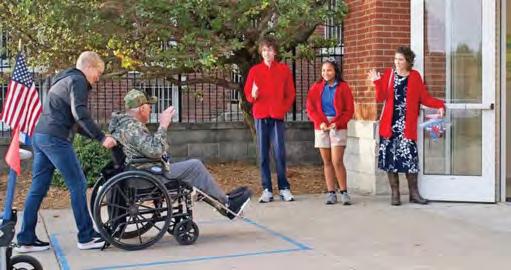
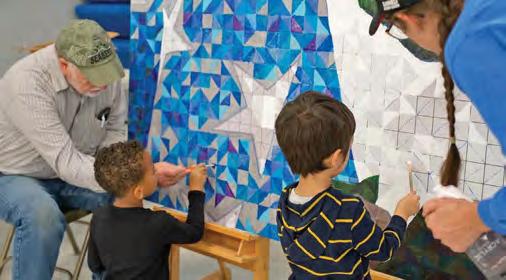
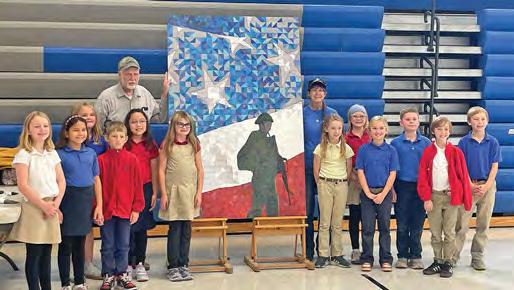
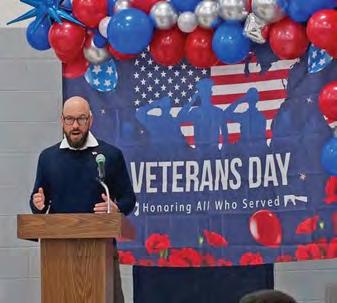
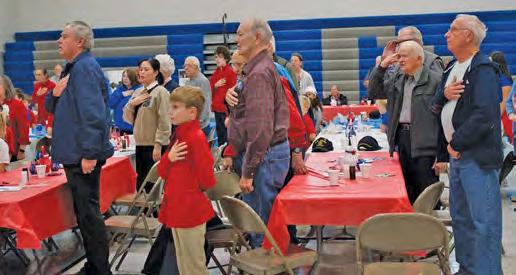
Saint Mary Cathedral Catholic School, in Cape Girardeau, recently held a Veterans Day Breakfast and Assembly to honor the Veterans in the community. On Nov. 13, students served breakfast to over 30 veterans from the area and the local Veterans Home; recited “In Flander’s Field” and “The Gettysburg Address;” led the Pledge of Allegiance and explained the meaning of the POW table; and listened to a guest speaker that spoke about service to others and showing others you are a Christian, not just saying it.
All students were also able to participate in Paint for a Cause after the assembly, which is a communitywide collective mural that will be prominently displayed on the large, red barn beside the Stars and Stripes Museum in Bloomfield, MO. ©TM


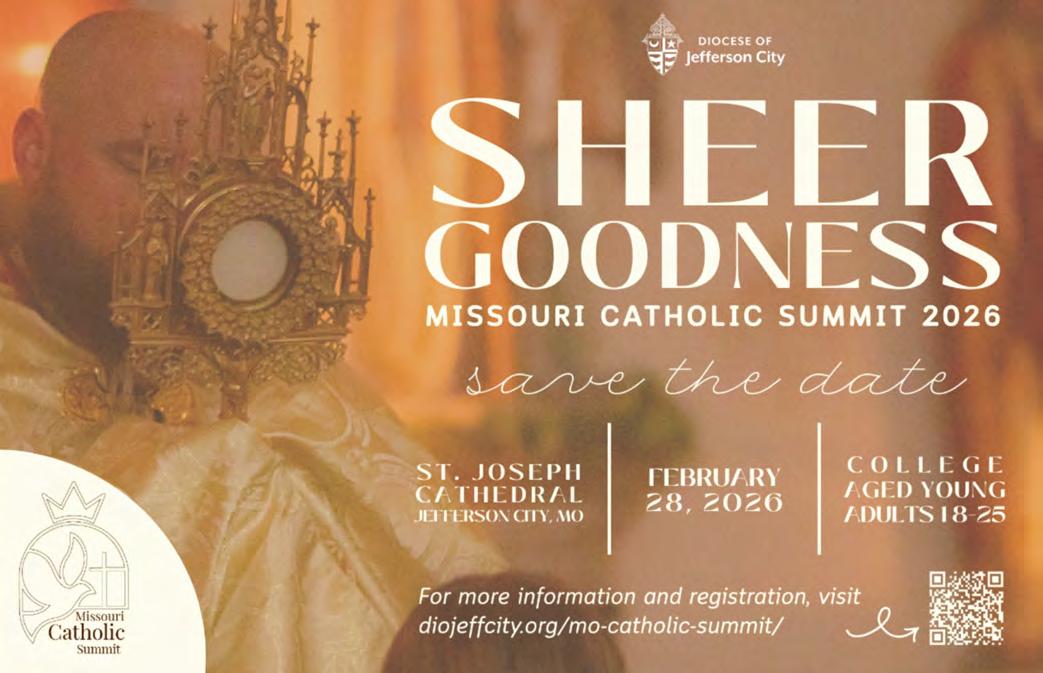
The Diocese of Jefferson City is inviting young adult (18-25 years old) Catholics to attend the Missouri Catholic Summit on Feb. 28, 2026. The MCS, which will be held in the Cathedral of St. Joseph, in Jefferson City, aims to bring college-aged Catholics from all over the state to encounter Christ in a community setting. The event is themed “Sheer Goodness,” inspired by the description of God’s plan for creation outlined in the first paragraph of The Catechism of the Catholic Church. The MCS will feature talks from Catholic speakers, live music, a vigil Mass, Eucharistic adoration, and more. Registrants can purchase coffee and T-shirts at the summit. Registration for this event is 100% free (including lunch & dinner). Any young adults interested in this opportunity to celebrate the Catholic faith with their peers in Missouri are encouraged to learn more about the Missouri Catholic Summit and register for the MCS at the official Webpage: https://diojeffcity.org/mocatholic-summit/. ©TM
SBy George Weigel
urveys indicate that reading books is dropping precipitously across all age groups. This is a tragedy in itself; it’s also a social disaster, as a post-literate society risks becoming a post-rational society. All the more reason, then, to consider giving books for Christmas: books that entertain, inform, and open new horizons of understanding. Here are eleven suggestions, including recent publications and what the Sixties radio DJs used to call “oldies but goodies”:
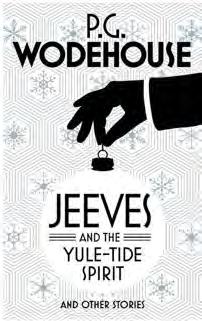
Jeeves and the Yule-Tide Spirit and Other Stories, by P.G. Wodehouse: The idyllic, imaginary world of foolish Bertie Wooster and his intrepid gentleman’s gentleman, Jeeves, is both completely unbelievable and totally credible. And if Wodehouse doesn’t make you laugh, you have no sense of humor.
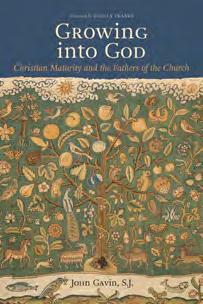
Growing into God: The Fathers of the Church on Christian Maturity, by John Gavin, S.J.: Catholics who pray the Liturgy of the Hours meet the great Christian spiritual masters of the first millennium almost daily. Father Gavin, who teaches at Holy Cross, is a sure and accessible guide to the riches of the patristic period, the rediscovery of which is one of Catholicism’s great theological accomplishments of the past century and a half.
the story of the “Church’s best kept secret” up through Pope Francis. Highly recommended as a textbook.
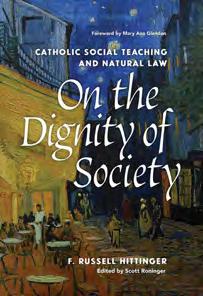
On the Dignity of Society: Catholic Social Teaching and Natural Law, by F. Russell Hittinger (edited by Scott J. Roniger): In the era of Pope Leo XIV, many find themselves wondering about Pope Leo XIII. Russ Hittinger is our most accomplished commentator on that great pope; the pivotal chapter in this fine essay collection, “The Accomplishment of Leo XIII,” is required reading.
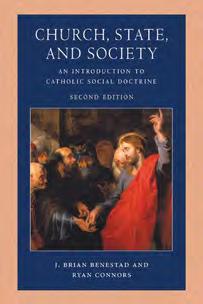
Church, State, and Society: An Introduction to Catholic Social Doctrine (Second Edition), by J. Brian Benestad and Ryan Connors: This revised and expanded edition of a masterful work brings
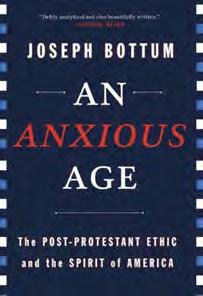
An Anxious Age: The Post-Protestant Ethic and the Spirit of America, by Joseph Bottum: Why has the United States become so cranky in recent decades? Poet and philosopher Bottum offers an intriguing proposal — because the old Protestant cultural hegemony collapsed when liberal Protestantism imploded into post-Christian wokery; Catholicism failed to fill the cultural vacuum (as it might have done through the teaching and example of John Paul II); and spiritual anxiety reigns supreme, taking various bizarre forms. Think of this distinctive work as both a primer for the New Evangelization and a penetrating analysis of the roots of our 21stcentury political discontents.
took Merton as his confessor for fifteen years, even as they were battling over various aspects of monastic life. That the two men are buried side by side at the Abbey of Gethsemani has always struck me as something deeply Catholic; this uneven but fascinating book confirmed that intuition.
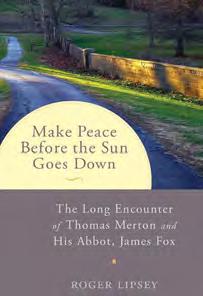

Make Peace Before the Sun Goes Down: The Long Encounter of Thomas Merton and His Abbot, James Fox, by Roger Lipsey: Abbot James is typically presented as the authoritarian nemesis of the world’s most famous Trappist during their lifetimes. The relationship certainly had its complexities, but Dom James

Zbig: The Life of Zbigniew Brzezinski, America’s Great Power Prophet, by Edward Luce: Catholic readers will be particularly interested in Ed Luce’s discussion of the relationship between Brzezinski and Pope John Paul II, which had a significant effect on history during the rise of the Solidarity movement in 1980 and the Soviet threat to crush it by military force.
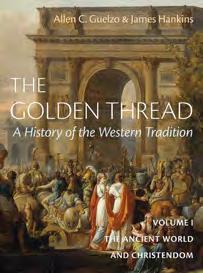
The Golden Thread: A History of the Western Tradition, Volume One, by Allen C. Guelzo and James Hankins: A magnificent, detailed overview of the evolution of the West from antiquity to the Renaissance, and, thanks to the good people at Encounter Books, the
most beautiful piece of bookmaking in decades. Give it to every college student you know. If Russia Wins: A Scenario, by Carlo Masala: A brief, deeply informed analysis of what might happen around the world if the United States and Europe do not gather the wit, will, and capacity to resist the new Russian imperialism.

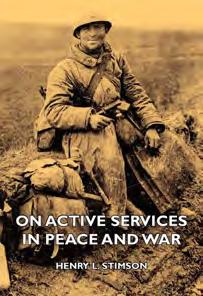
On Active Service in War and Peace, by Henry L. Stimson: A reminder of the days when men of experience and character brought distinction to public service rather than getting notoriety from it, and an elegy for the days when bipartisanship characterized U.S. foreign policy.
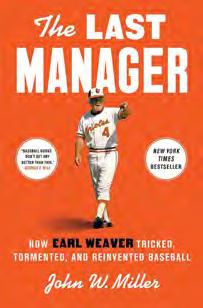
The Last Manager: How Earl Weaver Tricked, Tormented, and Reinvented Baseball, by John Miller: Given the subject’s salty vocabulary, don’t read this aloud with children around. But if you want to know how contemporary baseball “analytics” trace their roots to a bookie in Depressionera St. Louis, this fine biography of the “Earl of Baltimore” is for you, and for anyone who loves the great game.
George Weigel is a Distinguished Senior Fellow and William E. Simon Chair in Catholic Studies at the Ethics and Public Policy Center. George Weigel’s column ‘The Catholic Difference’ is syndicated by the Denver Catholic, the official publication of the Archdiocese of Denver. Phone: 303-715-3230.

By Mady Grider Sikeston, MO
In a shared meal filled with joy, gratitude, and sincere appreciation, the St. Francis Xavier Parish family gathered to surprise and celebrate Antonia Grojean following the 10:30 a.m. Mass on Sun., Nov. 9. A steadfast pillar of faith, compassion, and community leadership, Grojean was honored for her decades of devoted lay ministry.
Her service to St. Francis Xavier Parish began 42 years ago when she volunteered to help as a PSR teacher, which she did for four years from 1983-1986. In her next volunteer role, she was the Coordinator of Religious Education beginning in 1987, and she served in that capacity until 1993. It was then that she began her compensated role, when she became the Director of Religious Education, a job she held for the next 32 years. She obtained her master’s degree in religious education from Loyola University in 1999, which helped deepen her own understanding of and faith in Catholic teaching. Sharing her Catholic faith with others and bringing them into a closer personal relationship with God has been her primary goal, her true passion, and her life’s work.
the sacraments and has brought numerous people into the Catholic Church through her guidance in Order of Christian Initiation of Adults (OCIA). She has given so much of her time, talent, and treasure to the Church over her 42 years of service! Grojean dearly loves her family, but each year she would sacrifice spending time with her own children and grandchildren so that she could lead a retreat for the confirmands joining the Church at the Easter vigil. She truly regards these new parishioners as her church-family and loves them like her own.
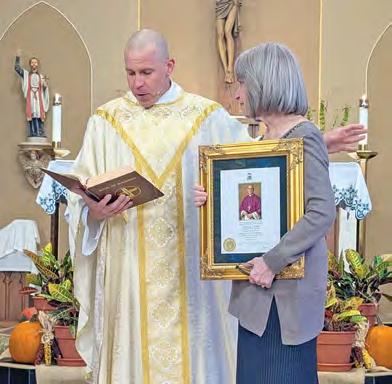
EPISCOPAL BLESSING During a surprise retirement celebration held Nov. 9 in St. Francis Xavier Parish, Sikeston, Fr. Colby Elbert presented parishioner Toni Grojean an episcopal blessing from Bishop Edward M. Rice. Grojean has served the parish as both a volunteer and paid employee for 42 years. (The Mirror)
Her retirement celebration, held at the St. Francis Xavier Parish Center, was a testament to the lives she’s touched: a room overflowing with laughter, family, and shared memories. From handmade cards crafted by the schoolchildren to a personal episcopal blessing from Bishop Rice, the afternoon reflected Grojean’s legacy—a life rooted in prayer, purpose, and people. As a token of collective gratitude, parishioners pooled their resources to give her a well-deserved cruise vacation for two.
For more than 40 years, Grojean served with humility and heart—guiding ministries, mentoring generations, and embodying the spirit of servant leadership. She has prepared countless parishioners to receive
Though she steps back from her formal role as DRE, Grojean plans to keep serving St. Francis Xavier Parish as a volunteer, continuing to teach OCIA. Her impact continues to ripple through the diocesan family. Her example reminds us that faith is not merely professed— it is lived, day by day, in quiet acts of love. Congratulations Toni Grojean: May God continue to richly bless you! ©TM

Prices are all inclusive w/ airfare from anywhere in the continental US.
Several trips to different destinations: Holy Land, Italy, Greece, France, Portugal, Spain, Lourdes & Fatima, Ireland & Scotland and much more...
We specialize in custom trips for Bishops, Priests & Deacons!
Currently hiring Deacons to promote our many pilgrimages. ATTRACTIVE compensation. For more information contact: Karen@proximotravel.com
To register call 855-842-8001 or at www.proximotravel.com.


By Jaymie Stuart Wolfe OSV News
If you’re not careful, planning a wedding can easily become a full-time job. Keeping it all under control doesn’t look hard, at least theoretically. You just have to take a rational approach: Decide to keep things as simple as they can be kept, prioritize what’s genuinely important, and let go of all the rest.
But there’s a reason “wedding planner” is a profession. Weddings seem to have a life of their own, one that resembles a giant snowball rolling down a mountainside; a havoc-wreaking globe that gains volume, velocity, escalating intensity as the date draws nearer. The most confident and well-matched couples can’t seem to escape it. And even the most organized and undemanding bride still becomes overwhelmed by the sheer number of choices set before her.
“Decision fatigue” is real.
Putting on a wedding is a big deal, with every additional detail on that endless to-do list comes anticipation and joy.
I imagine that God’s plan for salvation was a lot like planning a wedding. Since the moment he created humanity, the Father longed for us to
share his life and love. Like a faithless fiancée, we failed to grasp the depth of what we had in him, grasped for something else instead, and fell away. But God did not give up on us. He simply waited through the centuries and planned his next move.
In the Blessed Virgin Mary, whose Immaculate Conception we observe on Dec. 8, God’s wedding plans began to take shape. Saved from the stain of original sin at her conception, Mary was entirely pure and free from disordered desires. A bride herself, she alone would be worthy of ushering the Divine Bridegroom into the world, the fallen and human world of his bride, the Church. When you’re planning a wedding, there’s only one date that matters. Similarly, all of human history was centered on and directed to the incarnational moment. As the words of the Exsultet tell us, heaven was wed to earth in a match made not just in heaven, but by heaven. In Nazareth, God became human, like us in all things except sin, so that we could become like him. That
is, so that we could take his name as our own and become one with him.
Salvation history is a love story, a romance between God and every human being. Think I’m pushing it? The Bible clearly tells us that the happily ever after for which we all long is a marriage.

of the bridegroom mourn as long as the bridegroom is with them’” (Mt 9:15)?
Salvation history is a love story, a romance between God and every human being.
“As a young man marries a virgin, so your builder will marry you. As the bridegroom rejoices over his bride, so shall your God rejoice over you” (Is 62:5).
“I am not the Messiah, but I have been sent ahead of him. He who has the bride is the bridegroom. The friend of the bridegroom, who stands and hears him, rejoices greatly at the bridegroom’s voice. For this reason my joy has been fulfilled. He must increase, but I must decrease” (Jn 3:28b-30).
“Jesus said to them, ‘Can the friends
“For I am jealous for you with a godly jealousy. For I have betrothed you to one husband, that I may present you as a chaste virgin to Christ” (2 Cor 11:2).
It’s easy to forget that we are called to the eternal wedding supper of the lamb not as guests, but as the bride. Heaven is the wedding God has been planning forever. There, we won’t have to worry about vendors or venues. When the day of the Lord arrives, all “to-do” lists will disappear. The Bridegroom will come for his bride. Our only task is to be radiant and ready to welcome him.
©OSV News
Jaymie Stuart Wolfe is a sinner, Catholic convert, freelance writer and editor, musician, speaker, pet-aholic, wife, and mom of eight grown children, loving life in New Orleans.
By Jackie Weidenbenner Cape Girardeau, MO
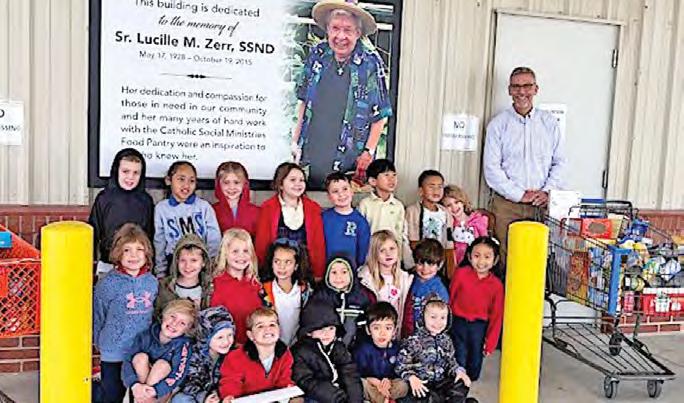
Pre-K and Kindergarten classes of St. Mary Cathedral Catholic School in Cape Girardeau recently took a friend trip to its neighboring food pantry.
On Wed., Nov. 19, the youth took over a bunch of food that the students and their families brought in as donations to the Catholic Social Ministries Food Pantry

inspired by and the building named for Sr. Lucille M. Zerr, SSND. Jim Keusenkothen, the director of the food pantry, gave the kiddos a tour and talked to them about what the food pantry does and why it’s so important to provide for those less fortunate, especially at this time of the year. ©TM
Weidenbenner serves St. Mary Cathedral Catholic School as its Kindergarten assistant and Spanish teacher.

The VIRTUS Protecting God’s Children Safe Environment training for adults is available online.
Preregistration is necessary: If you are a new registrant please go to www.virtus.org and click on “first time registrant” on the left, and follow the prompts to register for Online training. Instructions for the registration process can also be found on the Child and Youth Protection Page of the diocesan Website.
www.dioscg.org/wp-content/uploads/How-to-Register-for-a-VIRTUS-withOnline-Option.pdf
Both in-person and online training sessions are for adults only.
Before engaging in activities involving minors and/or vulnerable adults, new volunteers or employees are required to complete the VIRTUS Protecting God’s Children training for adults, submit a current Background Disclosure and Authorization Form, and read, sign and submit the annual Code of Conduct, which are available on the VIRTUS Website and the Diocese of Springfield-Cape Girardeau Child and Youth Protection Webpage: www.dioscg.org/childyouth-protection/
For more information, please contact the Office of Child and Youth Protection, childandyouthprotection@dioscg.org; or Bill Holtmeyer, billholtmeyer@dioscg.org; or Shelly Ferry, sferry@dioscg.org, (417) 866-0841.



Rev. Mark J. Binder
Rev. Mark G. Boyer
Rev. John S. Braun
Rev. Michael Casteel
Rev. M. Oliver Clavin
Rev. John M. Harth
The Most Rev. John J. Leibrecht
Rev. Michael V. McDevitt
Rev. Paul J. McLoughlin
Rev. David L. Miller
Rev. Fergus Monaghan
Rev. Matt Rehrauer
Rev. Msgr. Thomas Reidy
Rev. James J. Unterreiner
Rev. Msgr. Normand G. Varone
Rev. Mitchell S. Wilk
Rev. James Patrick Wissman
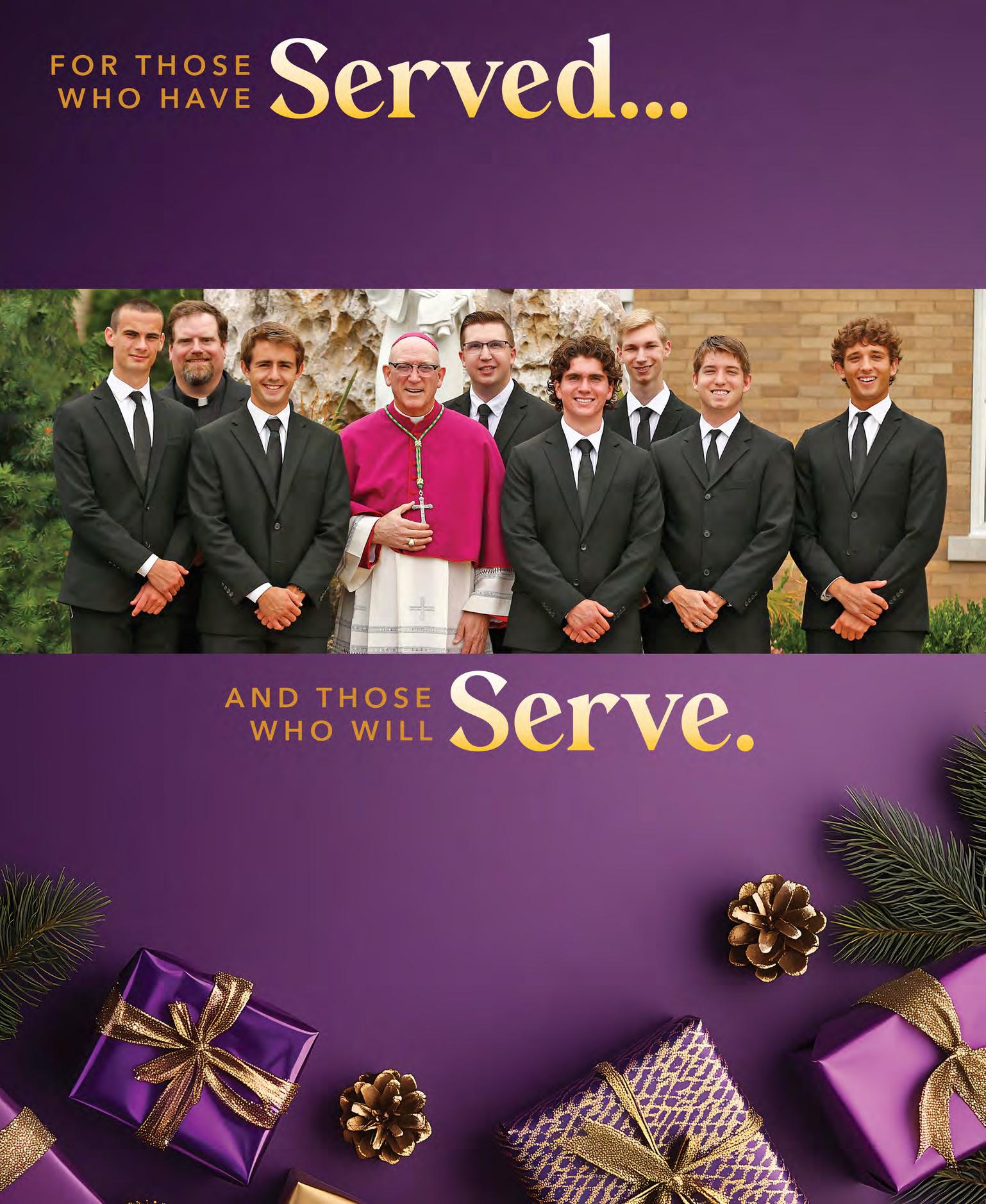
Support the past & future of the Church in the annual Christmas Collection in your local parish
Few things are more important for the future of the Church than supporting the young men who respond to the call of Christ to become priests and for us to attend to the needs of our elderly priests.
Please be generous in your support to the 2025 Christmas Collection at your local parish.