The Way of Saint James A Pilgrimage
“We are all pilgrims and we are always pilgrims, walking as we seek to follow the Lord, and as we seek the path that is truly ours in life. That’s certainly not easy, but with the help of the Lord, the intercession of the saints, and by encouraging one another, you can be certain that, as long as you remain faithful, trusting always in God’s mercy, the experience of this pilgrimage will continue to bear fruit throughout your lives.” —Pope Leo XIV
By Dan Williams Cape Girardeau, MO
In June and July of this year, I made a pilgrimage to Santiago de Compostela with some of my family and friends. This pilgrimage is known as the Camino de Santiago, or The Way of Saint James.
What is a pilgrimage?
A pilgrimage is a journey to a sacred or special place, undertaken for spiritual or religious reasons, often to seek deeper understanding, connection, or enlightenment. In the case of the Camino de Santiago, the sacred place is the Cathedral in Santiago de Compostela—it is here that the bones of Saint James the Apostle are located.
First, a little history: the Camino began in the 9th century after the discovery of the remains of Saint James the Apostle (Santiago). A church was built on that spot, and later a cathedral. Believers from across Spain began to travel to this site to pray and offer their trials on the way to God. By the 12th century, it was one of the most frequented pilgrimage sites in the world, rivaling Rome and Jerusalem. Today the Camino has experienced an intense resurgence in popularity, with people from around the world going to Spain to discover why pilgrims have been walking this route for over 1,000 years.
following year.
Father Andrew called his mother and me, and we realized that we could make it work as well.
Father Joseph Stoverink (Fr. Andrew’s best friend) also was able to get the time to go. So, the six of us planned to go in mid-June.
The Camino is made of several routes, each with its pros and cons. The most common is the Camino Francés (French Way). It is a 30-day journey of 485 miles that begins in France and crosses all of northern Spain.
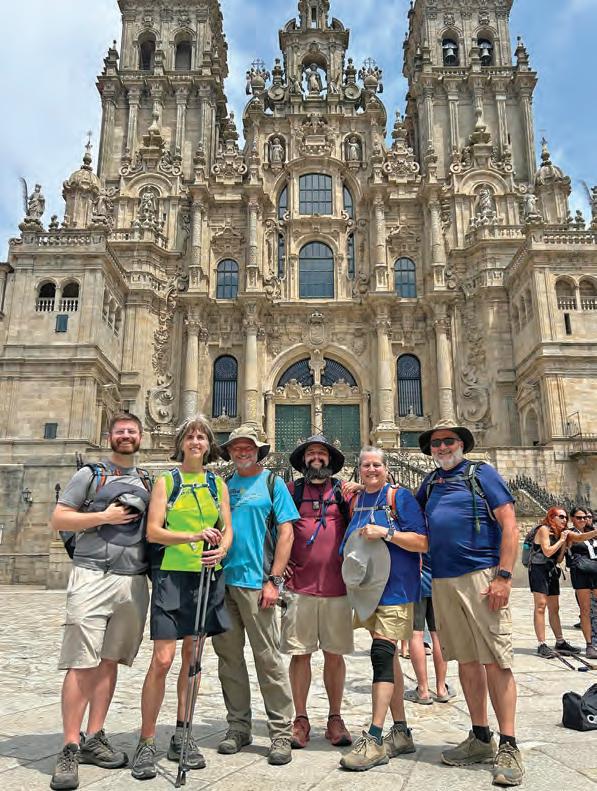
THE WAY OF ST. JAMES Santiago de Compostela Cathedral is pictured in the background at end of the 200-mile pilgrimage in June and July by Fr. Joseph Stoverink, Nicola Mullins, Dr. Randy Mullins, Fr. Andrew Williams, and his parents: Marsha and Dan Williams. The Camino Primitivo begins in Oviedo, Spain, in the province of Asturias, at the Cathedral of San Salvador. It ends in the province of Galicia, at the Santiago de Compostela Cathedral—a walking distance of 200 miles. This route is the original path followed by King Alfonso II of Asturias in the early 9th century. (Photo by Dan Williams)
The Camino Portugués (Portuguese Way) is the next most popular route. It begins, as you might guess, in Portugal and is 385 miles. It takes about 28 days to complete and follows a coastal route. Next is the 512mile, 35-day walk of the Camino del Norte (Northern Way). It is less crowded and more rugged than the more popular routes.
transfer our bags from one place to the next. As I struggled up long inclines with my day pack, I was very happy with our decision to leave the luggage transfer to the professionals.


newspaper via Email in digital format: Contact Debbie Thompson at (417) 866-0841, or Email: dthompson@dioscg.org.
Our personal Camino began a few years ago, when our son, Fr. Andrew Williams, began speaking with Dr. Randy and Nicola Mullins. They are parishioners at Holy Trinity Parish, in Springfield and knew Fr. Andrew when he was assigned there. They expressed an interest in walking a Camino, but it would require quite a bit of time to do so—something that none of them had. Still, they kept it in the back of their minds.
In 2024, the three of them realized that they would be able to do it the
Finally, there is the route which we chose—the Camino Primitivo (Original Way). It is the oldest Camino route and considered the most physically demanding, as it travels through the mountains. However, it is only 200 miles and can be completed in two weeks. It is probably the least traveled of the routes, which was very good for us. We set aside a few days at the beginning and end of the trek, as well as a rest day in the middle, and we were ready. When walking a Camino, there are a couple of ways to do it. The first is the way that most pilgrims do it—they carry everything with them and stop along the way at albergues or hostels at night to sleep. Camping is not allowed in Spain along the Camino, and in these albergues a peregrino (pilgrim) can get a bed in a bunk room, a hot shower, and sometimes a meal or two for a low cost. This gives the pilgrim a lot of freedom to walk at their pace and make choices along the way. The other way to do it is the way we did it—we booked our trip with a travel company (Mac Adventures) and they made reservations at hotels months in advance of our trip. They also booked a luggage service to
We signed up Online to register with the Pilgrims’ Office in Santiago, to let them know of our intent to walk the Camino. As we walked, we would get our Credencial (a booklet) stamped along the way to prove that we had hiked the route. Then, when we arrived in Santiago, we would show them proof and they would issue us our Compostela certificate.
Physically demanding
As our departure day approached, my wife, Marsha, and I trained almost daily. We’re in our 60s, and we knew that this would be challenging physically. Marsha had a total knee replacement done 18 months prior, and we were a bit apprehensive about that as well. Our training primarily consisted of walking—particularly walking on an incline. By the time we left for our trip, we were comfortable walking several miles almost daily. We got together with the Mullinses and Fr. Andrew and Fr. Joseph for a longer test-hike in Branson, and we felt like we were ready.
The Camino Primitivo begins in Oviedo, Spain, in the province of Asturias, at the Cathedral of San Salvador. It ends in Santiago de Compostela in the province of Galicia, at the Santiago de Compostela Cathedral—a walking distance of 200 miles. This route is the original path
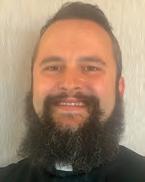
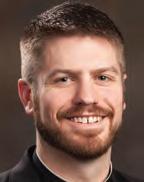
FR. STOVERINK
FR. WILLIAMS
NAND YOU WILL SEE
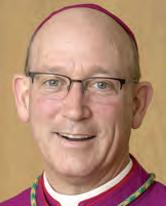
Bp. Edward M. Rice
‘Viva Cristo Rey:’ Long live Christ the King COME,
ovember is the month during which we remember our loved ones and friends who have died. Beginning on Nov. 1, All Saints Day, we remember all the non-canonized saints throughout the history of the Church. While they may not be officially recognized with canonization, they were the holy men and women down through the ages who answered the “universal call to holiness” by fulfilling the obligations incumbent upon them through the vocation to marriage, single life, and priesthood and religious life. I always like to say that you probably know some of these “non-canonized” saints—your parents, a teacher, or someone who inspired you in the faith. This is their feast! And, through their example, we someday hope to be included, unless we actually become canonized.
November 1, All Saints, is followed by Nov. 2, All Souls Day, a day dedicated to praying for the souls of all the faithful departed. I invite everyone to send me the names of their loved ones and I will place those names in my chapel at the residence, remembering your deceased loved ones in my prayers throughout the month of November. This time-honored practice of remembering the deceased is rooted in the Book of Maccabees, where a collection was taken up for a temple sacrifice on behalf of the soldiers who had died in battle, all with the hope of a future resurrection! Every Catholic should know the traditional prayer, “Eternal rest grant unto them, O Lord, and let perpetual light shine upon them. May they rest in peace. Amen.”
The Prayer of St. Gertrude is invoked for Souls in Purgatory and for living sinners:
“Eternal Father, I offer Thee the Most Precious Blood of Thy Divine Son, Jesus, in union with the Masses said
throughout the world today, for all the Holy Souls in Purgatory; for sinners everywhere; for sinners in the universal Church; those in my own home, and within my family. Amen.”
Having Holy Mass offered for our deceased loved ones is the greatest act in which we can participate. Even if they were deceased decades ago, in the divine economy nothing is wasted!
Remembering our deceased loved ones makes us grateful for what our loved ones have done for us, especially our parents. So, arrange to have a Mass offered for the repose of the souls of your loved ones. Visit the cemetery and pray the traditional The Lord’s Prayer, Hail Mary, and The Glory Be for their repose. I still have Holy Mass offered for my parents on the day of their deaths. It brings me comfort.
From Nov. 1-8, anyone visiting a cemetery to pray for the departed can gain a plenary indulgence for the souls in purgatory. Conditions include confession, receiving Holy Communion, praying for the Pope’s intentions (one ‘Our Father,’ Hail Mary and Glory Be) and being completely detached from sin. A partial indulgence can be earned by visiting a cemetery and praying for the dead on any other day of November.
SOLEMNITY OF OUR LORD, CHRIST THE KING
On December 11, 1925, Pope Pius XI proclaimed, “Therefore by Our Apostolic Authority We institute the Feast of the Kingship of Our Lord Jesus Christ to be observed yearly throughout the whole world on the last Sunday of the month of October—the Sunday, that is, which immediately proceeds the Feast of All Saints. We further ordain that the dedication of mankind to the Sacred
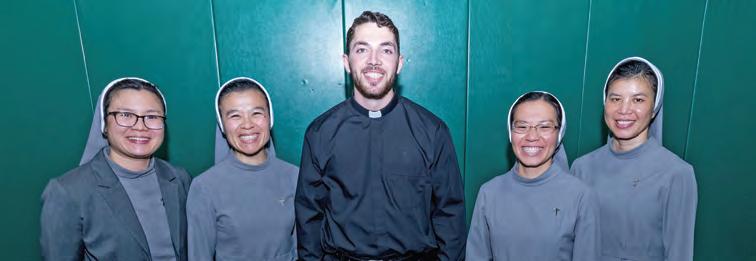
FIRST FRIDAY MASS for VOCATIONS
Join Bishop Rice on the First Friday of each month to pray for an increase in Vocations to the priesthood and religious life in the Diocese of Springfield-Cape Girardeau. The Rosary will be prayed following the liturgy. Parishes are invited to do the same as we continue to pray for more vocations to the priesthood and religious life in the diocese.
Heart of Jesus, which Our predecessor of saintly memory, Pope Pius X, commanded to be renewed yearly, be made annually on that day.”
Pope Pius XI also mentioned the 16th centenary of the Council of Nicaea which “defined and proposed for Catholic belief the dogma of the Consubstantiality of the Only Begotten with the Father, and added to the Creed the words ‘of whose kingdom there shall be no end,’ thereby affirming the kingly dignity of Christ.”
Pope Paul VI transferred the feast to the last Sunday of Ordinary time, with a desire to culminate the liturgical
Assumption Abbey 2860 State Hwy OO, Ava, MO 65608 (417) 683-5110 www.assumptionabbey.org guesthouse@assumptionabbey.org
year with the Kingship of Christ. We are blessed with a mission in Bunker, Christ the King. Except during the pandemic, I think I have joined them every year for the feast and the meal that follows. I encourage every pastor and invite everyone to acknowledge the kingship of Christ in their lives by dedicating the family to the Sacred Heart.
“He must reign in our wills…He must reign in our hearts…He must reign in our bodies and our members.” “Viva Cristo Rey,” “Long live Christ the King.” ©TM
CLARIFYING ALL SAINTS & ALL SOULS DAY
Please note that ALL SAINTS AND ALL SOULS DAY fall on Saturday and Sunday this year. This means that All Saints Day is not a Holy Day of Obligation. Also, please note the schedule of what to anticipate where Mass is celebrated: Friday into Saturday morning is the celebration of All Saints Day. Saturday evening into Sunday is the celebration of All Souls and *not* the normal Sunday. On Saturday evening, there is an option to celebrate an *additional* All Saints Day Mass. However, it will not be the usual anticipatory (vigil) Sunday Mass.
Please check the schedule of Mass times in local parishes.

by Bishop Emeritus John J. Leibrecht
Before his retirement in 2008 as the Fifth Bishop of the Diocese of Springfield-Cape Girardeau, Bishop John Leibrecht wrote a standing column in The Mirror entitled, “Walking Together.” At the end of each article, Bp. Leibrecht would normally share a funny story referencing his travels to the schools, or time with friends, family, or other bishops. The Mirror has decided to share a few of these in an ongoing series entitled, “Another walk through: ‘Walking Together.’” We hope you enjoy them.
February 18, 1994 Pulling her son off another boy, a mother said, “I told you that when you get angry not to fight but to count to 10.” The boy said, “I was doing that, but Jimmy only counted to five.”
February 25, 1994 Small children often have creative interpretations about a bishop’s vesture. I still remember the small server at Mass, assigned by the pastor to take care of my crosier, who said to me excitedly, “Bishop, I get to carry your spear!” Last week, as I walked down the aisle in the entrance procession wearing the bishop’s large, pointed hat (mitre), a little boy said to his father, “Daddy, look at the pirate!”
March 4, 1994 The only way to have the last word in some arguments is to say, “I guess you’re right!”
ADULT FAITH
DO YOU KNOW HOW TO AVOID THE DEMONIC?
By Adam Blai OSV News
We are living in a challenging generation in terms of our belief in and understanding of the spiritual. Many Christian ideas that used to inform our families, communities, and laws have faded. What used to be seen as dangerous or even evil is now normalized and often celebrated.
Starting in the 1970s, just about all seminaries taught that possession is a psychiatric problem, and many taught that the devil is not a person but an idea. Western culture significantly dabbled in the occult in the form of the spiritualist movement from the late 1800s through the post-World War II era. We have been in a revival of this in the form of paranormal investigating, brought about this time by myriad television shows on the topic. Witchcraft (“Wicca”) is now an official religion in the United States, and Satanism has pushed for recognition and an open presence in the culture.
Seminarians are often taught very little about the dangers in the spiritual world and the rules God set up to protect us from them. In many cases we seem to be embarrassed by the ideas that spirits are real, that angels and demons exist, and that exorcisms are not an ancient misunderstanding of neurological problems. Because many shy away from these ideas, our young people are usually left uninformed by the Church. They are then taught by the internet and Hollywood about these things.
Church is rich with the supernatural
There is a natural and inherent curiosity in human beings about the spiritual. From a Catholic-Christian perspective, we say that our souls naturally yearn for God. We also have a rational curiosity about what happens after our death, and whether lost loved ones are somehow alright and/or whether we can communicate with them. Many people seek a direct interaction with the spiritual, and the various occult systems claim to offer that.
If young people do not believe in the Real Presence of Jesus in the Eucharist, they may seek that direct connection elsewhere. When we combine this with our lack of teaching on the reality and the dangers of the occult, we see problems.
Given this situation, the first thing we can do is start to educate our young people on what the Church knows and can teach. We have a broad and deep understanding of the spiritual world and its manifestations in the Catholic faith. We understand poor souls (“ghosts”), angels, demons, saints and, of course, God. We have a deep understanding of mysticism and miracles. We have well-documented and externallyverified healings, apparitions of Mary in many places around the world (and to hundreds of thousands of people), saints who have levitated into the air,
documented cases of people with the stigmata, and it goes on and on. The Church is rich with the supernatural.
The Church also understands and knows how to deal with the preternatural. We have the Old Testament stories that set up the need for Jesus to open the way back to the Father that was closed by our fall to temptation in the garden. We have the examples Jesus gave in seven of the major Gospel miracles. We have His direct command to go forth and cast out demons. We have the many stories of the apostles and the early Church doing the same.
The First Commandment is: I am the Lord your God; you shall not have strange gods before me. When we turn to spirits other than God for comfort, information, or power, we are breaking the First Commandment. The usual ways this is done is turning to divination (a spirit or a psychic telling us about the future), necromancy (calling the dead to talk with them), or black magic (cutting a deal with a spirit for some favor).
Many young Catholics do not know that these are mortal sins, or how strongly they are condemned in Scripture. There are a number of relevant Scripture passages, but one suffices: “Let there not be found among you anyone who causes their son or daughter to pass through the fire, or practices divination, or is a soothsayer, augur, or sorcerer, or who casts spells, consults ghosts and spirits, or seeks oracles from the dead. Anyone who does such things is an abomination to the Lord, and because of such abominations the Lord, your God, is dispossessing them before you. You must be altogether sincere with the Lord, your God” (Dt 18:10-13).
So we see in the word of God that God sees talking to spirits, divining the future (an “augur” is a diviner who foretells events) or casting spells as an abomination—which is “something regarded with disgust or hatred.”
These practices violate the First Commandment. They also become a mortal sin when we do them willfully with full knowledge of their gravity. Not only do these practices cause God disgust and cut off our spiritual life (until we confess them), they also start or deepen a relationship with a demon.
God limits demon activity
What spirit will respond to the ghost hunter? What spirit will come to the black magician who tries to summon something? Not a saint, as they would not contribute to such sin. Not a poor soul in purgatory, as they also would not facilitate such sin. Nor a holy angel, for the same reason. What is left is the demons and perhaps the damned souls that are their unfortunate property. These deceptive spirits will pretend to be dead people or a lost loved one. They will also pretend to be helpful or our friends in the beginning.
Just about every extraordinary demonic case (their ordinary activity is temptation, while their extraordinary is infestation, oppression, and possession)
I’ve been aware of stems from a First Commandment violation. Someone in authority over something or someone has turned to the demons and entered into a relationship with them.
God limits demons’ activity especially their extraordinary activity, until we know we are dealing with demons and continue on anyway. At that point, we are rejecting our relationship with God and embracing a relationship with the demonic. In practical terms, this is usually the serious black magic practitioner or someone who has willfully engaged with them in some way.
Many of the practices that lead to these dire situations are normalized or even celebrated today. Ghost hunting is a staple of cable TV, psychics who talk to the dead are a theme in TV dramas, and youth books celebrate the “misunderstood demons,” and glamorize the witch and magician. In addition, we have a number of eastern traditions that have become popular in the west.
become aware of how sinful we really are and realize how much we are likely disappointing God. Then there is the illuminative way. During this phase one starts to try to live out the virtues in order to please God. Essentially, “start doing good.” One set of the virtues that Pope Gregory I recorded are: chastity, temperance, charity, diligence, patience, kindness, and humility. The soul starts to practice these not out of fear of God but out of love for God.
CATHOLIC SPIRITUAL LIFE
With Halloween just a week away, the Church reminds us that this sacred holy day is not a celebration of witchcraft, ghostly hauntings, spells, hexes, and death. Rather, it is a a celebration of the promise of Eternal Life in Heaven for those who believe in Jesus Christ and are faithful to him in their lives on earth.
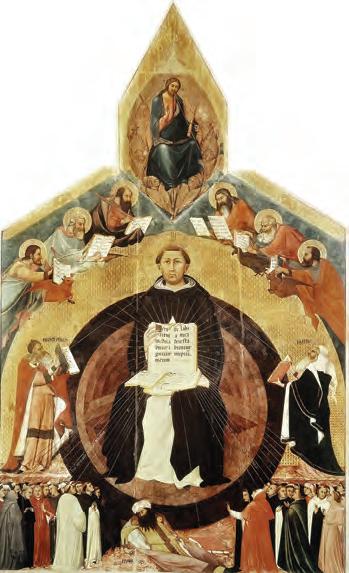
The spiritual life for the Catholic Christian has been well-defined by St. Thomas Aquinas and St. Teresa of Avila, among others. (Getty images)
All of this can lead to a simple list of things to avoid, but perhaps we can put it in a bigger context. The spiritual life for the Catholic Christian has been well-defined by St. Thomas Aquinas and St. Teresa of Avila, among others. This journey is usually defined as the purgative way, the illuminative way, and the unitive way.
Catholic spiritual life
The first phase of the spiritual life, the purgative way, is about purging sin from our lives as much as we can. Essentially, “stop doing bad.” This process starts with understanding what constitutes sin, what God wants us to avoid. Then there is a process of rooting out sin by not just stopping it but by finding what in ourselves gives rise to it. As we address our wounds and the bad lessons we learned, there is less driving us to sin. There is never a state completely free from sin, but one can root out most of the sources of mortal sin over time. This phase is usually motivated by a fear of God when we
The final stage, the unitive way, is when the soul starts to have some direct experience of God in this life. It is like a limited foretaste of heaven while still alive. St. John of the Cross wrote poetry to try and convey this in a limited way, but he clearly said that no human language could capture it. Our culture, in many cases, would have us assess ourselves by our own standards, not God’s, and likely conclude, “I’m a good person.” There is rarely objective truth or a need to conform to it in modern culture. Usually each person “has their own truth,” which honestly amounts to do whatever you want and then justify it afterward.
The Ten Commandments and the cautions that derive from them are objective truths. The breaking of God’s laws provided in that truth has consequences. Jesus paid the price for our sins on the cross, but that does not free us from the responsibility to know and live God’s word in this life. When we reject God’s word and laws, we break our friendship with him and start walking life with another spirit. No amount of self-justification and post-modern imagined self-definition will change that.
Even though our culture and media have become less Christian and more sinful, we do not have to live that way. We can choose to do the work to get to know God and the freedom that comes from following his laws, which protect us from the bondage of the enemy.
©OSV News
Adam Blai is the peritus in religious demonology and exorcism for the Diocese of Pittsburgh.
Children’s book illustrates Catholic origins of Halloween
By Tony Gutiérrez OSV News
Much has been written about keeping Christ in Christmas but Catholic children’s author Anthony DeStefano’s new book is helping to keep the Hallow—or “holy”—in Halloween.
With the fun of spooky season—such as decorations (I currently have six inflatables in my front lawn and am scheduled to attend at least two trunk-ortreats)—it’s easy to forget the Catholic origins of Halloween.
DeStefano addresses this in his introductory note to parents— filled with scary dad jokes such as “Tomb it may concern.” He identifies Halloween by another name, All Hallow’s Eve, the first of the three days that make up All Hallow’s Tide, along with All Saints Day, Nov. 1, and All Souls Day, Nov. 2.
Like some of his previous books, DeStefano’s use of the AABB rhyme scheme maintains the rhythm and pace of the story, allowing for 48 pages to go much quicker.
Using a fictional childhood version of his sister-in-law Shi as the narrator, DeStefano tells the story of four friends wandering into a cemetery on Halloween to tell scary stories. The foursome is interrupted by an older woman who chastises them for mocking the dead as she sweeps their graves and prays: “To talk such nonsense isn’t right / That’s not the purpose of this night.”
By sharing a story within a story, the woman addresses the need for many to be purified in purgatory before continuing to heaven, explaining that “Their spirits must be quarantined / While they’re swept and washed and cleaned.” This lesson then inspires the children to carry out the corporal and spiritual works of mercy of burying and praying for the dead.
A note about illustrator Erwin Madrid’s art: His use of expressions on the character’s faces allow the reader to identify more with them. His use of dark colors through most of the story allows for the spooky vibe of

”ALL HALLOWS’ EVE” by Anthony DeStefano; Sophia Institute Press (2025) 48 pages, $14.99
the story, especially in his use of shadows. Contrasted with flashbacks that are colored bright pink, Madrid uses color theory to highlight the difference between blissful ignorance and the reality of mortality. However, with heaven being the ultimate goal, he brightens up the book toward the end.
This new take reintroduces an old tradition to children of this generation. The Catholic view of life after death and purgatory is certainly unique, particularly in the Bible Belt, and it’s not a topic that really gets a lot of attention. DeStefano’s book invites children to learn more about this and to ask questions, allowing for a catechetical opportunity for parents.
Without giving away any spoilers, I should give a warning about this “boo-k,” as DeStefano writes. If you have children who scare easily, it may not be the best story to read right before bedtime. Ask me how I know. ©TM
Tony Gutiérrez writes for OSV News from Phoenix.
DIOCESAN NEWS
REGISTRATION IS NOW OPEN FOR #IGIVECATHOLIC FOR GIVING TUESDAY!
You’re invited to participate in a great fundraising opportunity! #iGiveCatholic is a 501c3 organization that partners with our diocese to make Online giving campaigns available for our parishes, schools, and ministries for GivingTuesday.
Here are some examples of past fundraisers:
• Schools—student lunches, classroom supplies, family crisis fund;
• Parishes—security upgrades, food pantry supplies, tables for the parish hall, outdoor Nativity set;
• Ministries—supplies, direct donations in support.
#iGiveCatholic takes place on Giving Tuesday, December 2, 2025, with the Advanced Giving Day Phase opening for donations beginning at midnight on Mon., Nov. 17
All parishes, schools, and ministries are invited to consider this fundraising opportunity. Please register before Nov. 1 as Registration closes Fri., Nov. 1, 2025.
If you have any questions, please contact Kandice Riley at kriley@dioscg.org. ©TM




Benton—St. Denis Home & School will host its 26th annual Winter Wonderland of Treasures craft show, Sat., Dec. 6, 8 a.m.-2 p.m., in the Parish Center. Interested in becoming a vendor? We welcome all talents—woodworking, art, jewelry, soaps, signs, candles, or other items. Booth or table rental available, for more information, text or call Crystal at (573) 264-1217.
Cape Girardeau—St. Mary Cathedral will hold its annual Craft & Bake Sale, Sat., Nov. 15, 7am6pm, and Sun., Nov. 16, 7:30am12-Noon, in the school gym. Lots of amazing homemade crafts, yummy baked goods, (including favorites of peanut brittle & cinnamon rolls), there will even be a section with second-hand treasures! Tickets will be available for a one-night stay at a Drury Hotel, $100 cash, a framed diamond dot picture, or a fourpiece set of “The Greatest Story Ever Told” figurines.
Jackson—Immaculate Conception School will host its annual Fall Craft Fair on Sat., Nov. 8, 9am-3pm, in the school gym, located at 300 S Hope St. Over 50 vendors, with Christmas gift items, handmade crafts, woodworking, soap, home decor, jewelry, and more. Concessions, pulled-pork lunch, and bake sale available. Admission is $2 for ages 13 and up. For more information: iccraftshow@gmail.com.
Leopold—St. John PCCW will host its annual Country Christmas Home Tour, Sun., Dec. 14, 1-4pm. Tour five beautifully decorated homes, stop at the church, 3-4pm for Christmas organ music, followed by homemade soup and cookies, served next door. For more information, please contact Geri at (573) 208-6445.
Marshfield—Holy Trinity Parish is hosting its Holiday Craft Fair & Bake Sale, Sat., Nov. 8, 9am –3pm. Offering a delightful array of unique handcrafted items and mouthwatering homemade treats. This event is perfect for getting into the holiday spirit and finding special gifts for your loved ones.
Springfield—St. Agnes Cathedral will hold its annual Holiday Market, Sat., Nov. 1, 9am.-4pm., and Sun., Nov. 2, 8:30am.-1pm, in the school gymnasium, located next door at The Catholic Center. There will be a variety of crafts and other products
AROUND THE DIOCESE!
for sale. For more information, contact Judy at (641) 751-6632, or judyhauschildt@gmail.com.
Springfield—Holy Trinity Parish Council of Catholic Women will hold its Fall Bazaar, Sat., Nov. 8, 9 am-5 pm and Sun., Nov. 9, 9 am-12 pm. Vendors will offer a wide variety of items, including original artwork and crafts; children and baby hats, blankets, and clothing; Christmas gifts and décor; jewelry; homemade candy, and hand-crafted items. Tickets available to purchase for a homemade quilt. Huge White Elephant Sale and Gardening Booth with lots of houseplants and gardening tools. Coffee & donuts available both mornings, lunch available on Saturday, from the Knights of Columbus-enchilada meal, beverage, dessert, hotdogs/ chips too! Everyone Welcome… stop in and browse! For questions, contact Mary Tilton at (417) 4968500, marymtilton@gmail.com or Jana Hukriede at (417) 840-4109, janahukriede@gmail.com.
Springfield—St. Elizabeth Ann Seton PCCW will hold its annual Fall Bazaar, Sat., Nov. 1, 9am-6pm & Sun., Nov. 2, 8am-1pm in the SEAS Pavilion and the gymnasium— located to the west of the main building. We have many returning vendors as well as new vendors: Come see us!
Springfield— Immaculate Conception Parish PCCW will hold its annual Holiday Sale, Sat., Nov. 8, 8 am-6pm and Sun., Nov. 9, 8am-1pm. Start your Christmas shopping at our Holiday Sale (huge White Elephant & Bake Sale) in Community Rooms A & B. There will also be breakfast items & lunchsandwiches, soup & dessert served. For more information, call Sandie DeFrank (417) 300-1930. Beginning Oct. 20, we are accepting clean and working items you would like to donate for the White Elephant sale. Please, no clothing or electronics.
Springfield—Sacred Heart Parish will hold its 2025 Vendor & Craft Sale, Fri., Dec. 5, 5-9pm and Sat., Dec. 6, 10am-4pm. You are invited to a holiday shopping extravaganza. Get all your holiday gift shopping done under one roof! We will be selling our Sacred Heart holiday cookies “By the Pound.” This event is being held in conjunction with the Midtown Victorian Christmas Homes Tour.
DIOCESAN NEWS
ANNOUNCEMENTS
Aurora—All are welcome as Holy Trinity Parish will celebrate the First Saturday devotion to the Blessed Virgin Mary, every first Saturday with a rosary at 7:30am, followed by Mass at 8am.
Bellville, IL—The 56th Way of Lights Display at the National Shrine of Our Lady of the Snows starts Nov. 21 and goes through Dec. 31, 2025, with over 1.5 million beautiful colored and white lights to depict the journey of Mary and Joseph as they travel to Bethlehem. Activities available include camel rides, kettle corn, selfie station, gift shop, arctic exhibit, and Shrine food stand with hot dogs, hamburgers, etc.! For more information, call (618) 397-6700 or visit https://snows.org/wayoflights.
Carthage— St. Ann Parish will have its Chili Supper, Thu., Nov. 6: chili, soup, pie, coffee & tea. Cost: $10-adults; $7-children, ages 12 and under. Serving times: Lunch-11am-1pm & Supper-5-7 pm. Bulk c hili, soup, soda & tamales available for an additional cost. Dinein, carry-out, and delivery available—call (417) 358-1841.
Dexter—Sacred Heart Parish invites you to its Annual Turkey & Ham Dinner on Sun., Nov. 2, 11am-1 pm, in the parish hall: Ham, turkey & dressing, mashed potatoes & gravy, sweet potatoes, corn, green beans, rolls, drink & dessert. Cost: $14-adults; $7-children, ages 6-12 yrs.; under age 6-free. Drive-thru & carry-out meals are available with the adult ticket.
Monett St. Lawrence Fall Feast will be held Sun., Nov. 2, 11am-1pm, at St. Lawrence Parish: Turkey, ham, dressing, mashed potatoes/gravy, green beans, corn, salads, bread, and dessert—all homemade by the Parish Council of Women. Cost: $10-adults, $6-children, ages 5-11 yrs.
Jackson—The Knights of Columbus Ladies Auxiliary will host BUNCO, Sun., Nov. 2, at the Jackson Knights #6405 Upper Hall. Doors open at 12:30pm; play begins at 1pm, pre-registration is not needed. Cost is $10/ person. Light snacks will be provided. Money
raised will fund the scholarship program and charitable organizations such as Options for Women, Birthright, Veteran’s Home, and others. For more information, contact Deena at (573) 382-1745 or jacksonkcaux@gmail. com.
Jackson—Jackson Knights of Columbus #6405 will have a Sausage & Pancake breakfast, Sun., Nov. 2, 7-11am: Homemade sausage, pancakes, eggs, hashbrowns, and biscuits & gravy, all for a free-will offering. Proceeds benefit the Jackson Ministerial Alliance Food Pantry. Taking orders for sausage—link and 1-lb. bulk packaging. For information or to order, contact the Knights Hall at (573) 243-5464 or kchalljacksonmo@ att.net.
Sikeston—The Women of St. Francis Xavier Parish will have its annual (40+ years!) Chili & Soup Day, Fri., Nov. 14, 10:30am-1:30pm, in the school gymnasium: Chili & Soup, dessert & drink for $10.
Springfield—You are invited to join the Followers of Francis, the local fraternity of Secular Franciscans in the Springfield area, following Christ in the footsteps of St. Francis of Assisi, which gathers every second Saturday of the month at Sacred Heart Parish, 11am-3pm, for prayer and Scripture study. For more information, contact Chris Rice, Christoph.rice@gmail.com or (417) 771-9604.
Webb City—Sacred Heart Catholic Church will hold its annual Turkey Dinner, Sat., Nov. 1, 11am-7pm and Sun., Nov. 2, 11 am-5 pm: turkey, stuffing, mashed potatoes/ gravy, green beans, roll and dessert while supporting the many functions of the parish. Carry-out available. Cost: Adults-$10, children-$5. Pre-sale tickets will be available in the parish hall after weekend Masses or by calling the parish office at (417) 673-2044. More information may be found at http:// www.sacredheartwebbcity.org/2025-turkeydinner.html.
Parishes and organizations are invited to submit notices of future events to be printed on a space-available basis. There is no fee
DURING THIS EUCHARISTIC REVIVAL, FR. DAVID COON OFFERS THE FOLLOWING QUOTE FOR THE REFLECTION ON THE EUCHARIST:
“When I come to a human heart in Holy Communion, My hands are full of all kinds of graces which I want to give to the soul. But souls do not even pay any attention to Me; they leave me to Myself and busy themselves with other things. Oh, how sad I am that souls do not recognize love! They treat Me as a dead object.”
— JESUS TO ST. FAUSTINA

Father Coon is Pastor of Sacred Heart Parish, Dexter. He serves the Diocese as Priest Minister for Spiritual Deliverance & Exorcism and the Confraternity of Priest Adorers of the Eucharistic Face of Jesus.
THE UNSEEN HARVEST: PESTICIDES, CANCER AND RURAL MISSOURI’S HEALTH CRISIS
By Alex Cox, Adeleine Halsey, Kyla Pehr and Savvy Sleevar
Nestled in Missouri’s Bootheel is the small town of Kennett, the Dunklin County seat. With just over 10,000 residents, it’s a close-knit community where good-natured teasing is a common show of affection.
Once a sprawling swampland, it has since been transformed into an expanse of flat, fertile fields where agriculture stands as the backbone of the region’s economy.
Kennett’s houses don’t get much taller than one story, and as visitors stroll down the main street, they’re welcomed by a mix of restaurants, boutiques and a cozy hair salon. These buildings are dwarfed in size by a silent, boarded-up hospital, its vacancy a remembrance of what the community has lost.
It’s the kind of community where if something tragic happens, everyone finds out.
Bobbi Bibbs found this out the hard way. She discovered she had cancer in her colon in December 2023, which then metastasized to her liver, making it a stage four diagnosis.
Bibbs isn’t alone. Dunklin County is among the 10 counties with the highest rates of that type of cancer in the state. This isn’t just a statistic, Bibbs said she can see it and almost can’t fathom it.
“There are so many (cases) where we are from,” Bibbs said. “Like, it’s got to be coming from somewhere.”
Bibbs is surrounded by people who understand her struggles, many of whom work in the agriculture industry. In Dunklin County, there are hundreds of thousands of acres of crops — and most of that land is blanketed by pesticides.
Estimates suggest that thousands of kilograms of pesticides are sprayed over Missouri cropland each year. In some places, wastewater sludge containing “forever chemicals” — per- and polyfluoroalkyl substances — is applied on farmland as fertilizer.
Multiple scientific studies have explored
a connection between pesticide use and cancer, pointing to a silent public health crisis hitting rural communities particularly hard.
The University of Missouri, in partnership with Investigate Midwest, conducted a county-by-county analysis of cancer rates and pesticide use, using the most recently available data for pesticides that are repeatedly cited in research as likely to be associated with cancer risk.
The six counties with the highest use of these pesticides per square mile are all located in the Bootheel, including Dunklin. Four of those counties are in the top 15 for overall cancer rates in Missouri. All counties with the highest rates of cancer are rural.
So in Kennett, there are high rates of chemical usage, high rates of cancer and the nearest trauma center in the state is more than an hour and a half away.
In other words, it’s a typical rural town in Missouri.
GREEN HILLS AND KILOGRAMS OF CHEMICALS
While Missouri has its share of rolling hills covered in trees and wild foliage, much of the land is well developed to suit the needs of farmers and their crops. There are about 27 million acres of Missouri farmland being cultivated and nearly 88,000 farms, according to the Rural Farm & Finance Policy Analysis Center.
The biggest business in the state is agriculture, employing about 460,000 statewide, according to the Missouri Department of Agriculture. Soybeans, corn and wheat are some of the crops
that color most of the state’s landscape. Farming is a dangerous job that requires a good deal of heavy equipment and specialized tools. Those tools include chemicals.
Isain Zapata is a data scientist who researched the relationship between pesticides and the incidence of cancer. He looked at the complex mixtures of pesticides tailored to specific crops that are sprayed in different regions.
“ When we look at those pesticides, it’s not just one — it’s all a cocktail,” Zapata said. “It’s the whole rainbow of different colors.”
He found that these colorful combinations are strongly linked to certain cancer rates across the nation.
“Non-Hodgkin’s lymphoma and leukemias are very intimately associated with pesticide use,” Zapata said. “But we also saw that the overall pesticide use has an effect on all the other nonobvious cancers.”
Other research shows an association between certain pesticides and an increased risk of brain, prostate, breast, kidney and colon cancers.
Pesticides are a classification of substances used to protect crops. This includes killing weeds, insects or even strengthening wood to prevent pests from harming the plant. Farmers typically apply pesticides to crops using methods such as aerial spraying or ground-based equipment.
Serious risks are posed by pesticides because they can harm both human health and the environment. Exposure may lead to short-term or long-term health problems, while also contaminating soil and water, which may disrupt ecosystems and affect wildlife.
But pesticides do what they do best. Zapata emphasizes that without pesticides, agriculturebased economies and the communities tied to them would suffer.
“I am not in favor or against pesticides,” Zapata said. “I know we need them. I don’t like them, but I know why they have to be there.”
He said rural agricultural areas are home to an intense combination
of factors that multiply the risk level.
Farmers are under pressure to maintain or increase their productivity, and that comes at the cost of using compounds that carry health risks, Zapata said. Rural areas are often underserved by health care facilities, meaning there are often too few health providers and resources in theose areas to monitor and manage the added risk of using pesticides.
“It’s just the perfect storm,” Zapata said. “You combine several factors (heavy pesticide usage, poor regulation and monitoring, socioeconomic disparities), you’ve made it worse.”
THE MILLION-ACRE HIGHWAY
Mike Milam is a local expert in pesticide application. Based in Kennett, he is a field specialist in agriculture and environment for MU Extension, serving Dunklin, New Madrid and Pemiscot counties.
“I’ve had people tell me, especially the ones who don’t like chemicals at all (that) our bodies weren’t designed to breathe these chemicals,” Milam said. “And they’re right about that.”
The herbicide Roundup is the target of thousands of lawsuits claiming it causes cancer, putting it in the spotlight. Milam listed other chemicals that have caused concern, including paraquat, vydate and dicamba.
Farmers and the workers hired to harvest crops frequently interact with chemicals. From mixing to pouring to spraying, they are there for all of it. They also encounter other farmers’ chemicals when a substance sprayed in one area drifts somewhere it was not intended to be.
“I have known a situation (where) people out in the fields got sprayed, or they sprayed next to them, and then it drifted over. And things like that,” Milam said. “Matter of fact, when I was in graduate school, I was in a field down in Louisiana, and they were spraying right next to us. We actually had to leave the field.”
Direct drift occurs when an applicator applies a pesticide and the wind blows it elsewhere, making monitoring weather conditions an integral part of the process. The stronger the wind, the stronger the potential is for drift.
That said, farmers have a limited
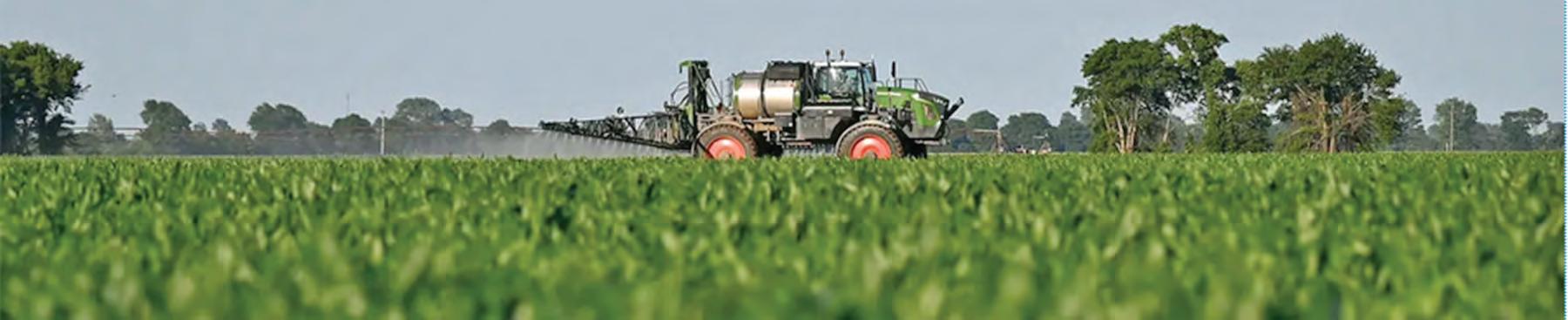
RURAL FARMING A farmer sprays pesticides, which are a classification of substances utilized to protect crops, on May 21 in Senath. (Photo by Michael Baniewicz for Investigate Midwest)
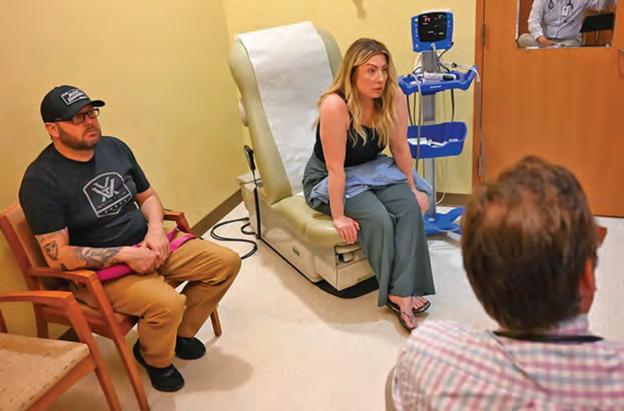
Bobbi Bibbs visits with her oncologist, Dr. Andrew Moore, on May 21 at the Mercy Cancer Center in Cape Girardeau. (Photo by Michael Baniewicz for Investigate Midwest)
window to seed and fertilize their fields during planting season. Fluctuating weather conditions can make this even more difficult. This spring alone, the Bootheel faced tornadoes, dust storms and historic flooding, all of which have the potential to hinder field work.
“ We go out here, we can plant a crop, it looks beautiful, a flood wipes it out and we gotta start back over,” said state Sen. Jason Bean, a Holcomb Republican and a fifth-generation Bootheel farmer.
Milam said that some farmers end up spraying their crops when conditions aren’t ideal.
“The farmers aren’t paying attention or just decide to go ahead and (apply) anyway because they need to get it done,” Milam said. “They are under a lot of stress, they’re trying to get the crops in.”
Jason Mayer, a fourth-generation Bootheel farmer and one of the directors for the Missouri Soybean Association, believes that, nine times out of 10, farmers are doing the right thing. In his mind, it is the “bad actors” going against best practices. Bean compares this to speeding on the highway.
In his analogy, like drivers on the road minding the speed limit, most farmers follow the rules. Just as there will always be that driver blowing past everyone else in the left lane, there will be farmers who break the rules.
Agricultural regulators — such as the Missouri Department of Agriculture or EPA — serve as the cop on the side of the road in the metaphor. They step in when misuse is suspected. Environmental Protection Agency inspectors can show up at any time and ask to see a farmer’s records, Milam said.
With millions of acres of farmland in Missouri, that’s one big highway to watch. So if agencies don’t catch someone breaking the rules, it can fall to local farmers to report their neighbors to the state pesticide control office.
Bean emphasized that proper pesticide application isn’t just about compliance, it’s also in the farmer’s best interest. Misuse wastes costly chemicals, reduces crop effectiveness and decreases consumer trust in locally grown produce.
“I’d say we’re great stewards of the land,” Bean said. “We’re going to continue that, because in the big picture, farmers want to produce for the world the safest, abundant product.”
Milam said the key is to use the chemicals appropriately to minimize exposure. He said wearing personal protective equipment during application is a best practice. So doing things like wearing long pants, long-sleeved shirts, masks and goggles is essential for safe use.
Bean does not believe pesticides cause or increase the risk of cancer. Mayer echoes this sentiment, emphasizing his lifelong experience around crops and chemical applications.
“I’m 42 — knock on wood — today,” Mayer said. “I’m still relatively young, perfectly healthy, and I’ve been on the farm since I was 14.”
WAITING ON A WAITING ROOM
Striking up a conversation about health care in Kennett is bound to lead to one topic: the hospital.
Kennett doesn’t have one anymore; Twin Rivers Regional Medical Center closed its doors in 2018.
For quick stitch-ups or infection treatment, St. Bernards Urgent Care is open every day. It closes at 7:30 p.m., meaning that Kennett residents have to go elsewhere for their nighttime care.
There are various options in nearby counties, or even in neighboring states, but if someone needs emergency care, for example, it’s a trek.
While there’s a Mercy Hospital located in nearby Dexter with a rotation of specialty doctors, the closest Missouri trauma center to Kennett is in Cape Girardeau, about an hour and a half away.
“(If ) I have a heart attack at eight o’clock at night, or stroke, and if (the urgent care) was still open, they could give me that little fancy pill and help get me to the hospital to help,” said Cheryl Bruce, the executive director of the Dunklin/Stoddard Caring Council, an organization based in Kennett offering an assistive services program to Dunklin County residents with cancer.
Kennett’s old hospital building is still standing on the town’s main drag. The windows are boarded up, and walking through the halls requires ducking wires and tiptoeing over glass shards.
The current owner is in a zoning battle to turn the hospital into something. They haven’t been able to find buyers yet because they need various approvals from the city to do any work to make the building sellable.
Kennett isn’t alone in facing minimal health care access. Since 2014, 21 hospitals have shut down statewide, including 12 in rural areas, according to the Missouri Hospital Association.
Additionally, the Center for Healthcare Quality and Payment Reform’s 2023-2024 report found 26 rural hospitals in Missouri are at risk of closure due to financial strain — nine of them are at an “immediate risk.”
The Twin Rivers CEO said in a 2018 statement that the hospital’s closure was part of an effort to consolidate operations with Poplar Bluff Regional Medical Center, “as health care delivery evolves and medical innovation makes inpatient services less needed,.”
KFVS12 TV reported at the time. It was a palpable loss for Kennett — people miss the hospital, Bruce said.
“ When the hospital closed, all anybody has ever talked about is, ‘Are we going to get another one?’ ” Bruce said.
From 2020 to 2024, the Caring Council’s cancer assistive services program spent $22,650 helping over 400 people with transportation. For cancer care, folks in Kennett often travel an hour to Jonesboro, Arkansas, or an hour-and-a-half to Cape Girardeau in Missouri. Whatever kind of cancer care you need,, Bruce said, you’ve got to drive to get it.
The lack of health care providers also means early detection of medical issues, including cancer, can be harder to get.
Some health care transportation programs are available in rural areas, but Bruce said she sees a need in her community for more robust services.
“I’m not asking for a bus system like in St. Louis or Kansas City or Jeff City,” Bruce said. “I’m just asking for access to care, whatever that means.”
SPRAYED ON ALL SIDES
Wherever you go in Kennett, there will be someone who’s called it home their whole life. Kennett’s City Clerk Jan McElwrath is one of those people. Aside from a brief stint at the University of Missouri, she’s spent nearly all of her 68 years in town.
She came back for a classic reason: love. She got married, raised a family and built a life rooted in the same streets where she grew up.
Over the decades, she’s seen businesses open and close, celebrated countless community milestones and weathered natural disasters. Through it all, McElwrath has observed one constant: despite differing beliefs and opinions, the people of Kennett always find a way to come together.
“Our strength is our people, hands down,” she said.
This is especially important when considering the unique challenges of rural living.
An index created by the CDC shows that Dunklin is the county in Missouri least prepared to deal with economic or environmental challenges. According to Feeding America, over 20% of Dunklin County is food insecure, despite the fact that the region is covered in farmland. Milam said that this is largely because the farms in Dunklin are agronomic, which is when crops aren’t always grown for direct human consumption.
“It would help a lot of people if they had fresh vegetables,” he explained.
As manufacturing jobs moved out of many places in the Bootheel, Kennett felt the economic sting. Though Cim-Tek Filtration’s arrival two years ago brought back some manufacturing jobs, Kennett lost its Emerson Motor Company plant in 2006.
One industry that remains is agriculture.
The land is dotted with cotton, soybean and rice row crop operations. McElwrath calls the rows of cotton ready for picking “southern snow,” but to get that snow, farmers usually have to give plants a nudge with defoliants.
Defoliation is a natural process, though it can be artificially induced when chemicals are applied to the plants to get them to open up, making the white cotton easier to harvest.
McElwrath said it’s hard to notice farmers defoliating at first. But then, suddenly, your sinuses sting, your eyes burn, maybe a headache creeps in. It always seems to hit around the same time every year, right when the county fair is going on — with the dust, the dry soil, the demolition derby — everything blending together.
It’s not just that the defoliants make things happen quicker; they help make the cotton a higher grade — that means there is less debris affecting the final product. The grade determines the value.
Many residents of Kennett recognize the need for defoliants and other agricultural chemicals. For some of them, that’s what puts food on the table. But then the time of year creeps around again, and they all experience that familiar sensation.
“ We’re surrounded by agriculture,” McElwrath said. “We recognize (chemicals) as a risk, but our economy here is very dependent on agriculture.” ©IM
This article first appeared on Investigate Midwest and then the Missouri Independent under the Creative Commons Attribution, @ missouriindependent.com.
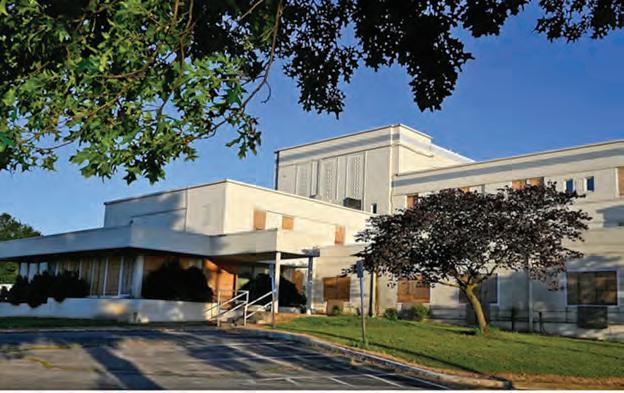
HOSPITAL CLOSURE The building formerly known as the Twin Rivers Regional Medical Center is seen vacant with its windows boarded up on May 21 at 1st Street in Kennett. After the hospital shut down in 2018, the city of Kennett has been without an around-the-clock health care option. (Photo by Michael Baniewicz for Investigate Midwest)
ABy The Very Rev. Shoby Chettiyath, JCL, V.G.
THE EUCHARIST: THE HEART OF THE CHURCH AND SOURCE OF HER LIFE
An invitation to Eucharistic Amazement: 70th Anniversary Diocesan Eucharistic Congress
s the Diocese of Springfield–Cape Girardeau approaches the joyful celebration of its 70th anniversary, we are invited into a season of reflection and renewal, a time to rediscover what lies at the very heart of our faith: the mystery of the Eucharist. Since its erection in 1956, the life of our diocesan family has been intimately shaped and sustained at the Eucharistic table. In every parish, mission, and apostolate, Christ has continued to nourish, strengthen, and send forth his Church to bring his love and mercy into every corner of southern Missouri.
To mark this milestone, the diocesan family will gather for the Eucharistic Congress on August 15, 2026, at the West Plains Civic Center. This gathering will unite clergy, religious, and laity from all corners of the diocese for a day of worship, catechesis, and renewal centered on the Real Presence of Jesus Christ in the Eucharist.
In preparation for this celebration, the Diocese is also undertaking a series of seven articles based on Pope St. John Paul II’s encyclical, “Ecclesia de Eucharistia” (“The Church Draws Her Life From the Eucharist”) The encyclical is designed to guide the faithful in rediscovering the richness of the Eucharist as the source and summit of the Church’s life. Beginning with the introduction, which emphasizes that “the Church draws her life from the Eucharist” (EE, 1), each subsequent article will illuminate a chapter of the encyclical, examining key themes such as the sacrificial and communal dimensions of the Eucharist, its role in unity and mission, the importance of Eucharistic adoration, and the call to live a Eucharistic life in daily service and love.
Drawing life from the Eucharist
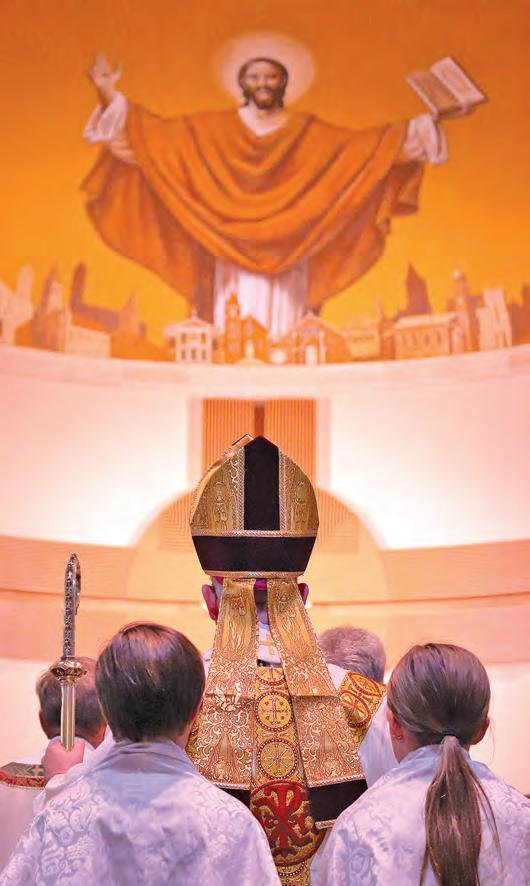
SPIRITUAL RENEWAL BEFORE OUR 70TH ANNIVERSARY—Bishop Edward Rice processed into St. Agnes Cathedral, Springfield, during a recent liturgy, where a mural of Jesus Christ is seen above the altar. “[Eucharistic] amazement is expressed not only in prayer and adoration but also in how we live our faith,” says The Very Rev. Shoby Chettiyath, “in acts of charity, in reconciliation, and in the pursuit of justice. ... And overflow into our homes, schools, parishes, and wider society, shaping a Church that is both deeply prayerful and actively missionary.” (The Mirror)
diminish the Church’s encounter with her “most precious possession” (EE, 1). Therefore, the faithful are invited to approach the Eucharist with reverence, devotion, and a renewed sense of awe.
The Eucharist: the heart of the Church
The Eucharist is the heart of the Church because it is the tangible encounter with Christ’s self-giving love. In receiving His Body and Blood, we are incorporated into His life, nourished spiritually, and empowered to be His witnesses in the world. St. John Paul II reminds us that the Eucharist is the supreme gift that the Church can give to the faithful and the means by which she herself grows and is built up (EE, 21; CCC, 1326).
encouraging sacramental participation, and providing opportunities for worship and adoration, ensuring that Christ’s presence shapes every aspect of parish life.
Eucharist: Unity and communion
In the introduction to Ecclesia de Eucharistia, Pope St. John Paul II proclaims, “The Church draws her life from the Eucharist” (EE, 1). This simple yet profound statement captures the essence of the Church’s identity. The Eucharist is not merely one aspect of Church life among many; it is her source and summit, the wellspring from which all grace flows (Catechism of the Catholic Church [CCC] 1324). Every initiative of the Church, every work of charity, every act of evangelization, and every vocation arises from the Eucharistic table. The Pope emphasizes that the
Eucharist is not merely a symbol or memorial of Christ’s sacrifice, but the living and real presence of Jesus Christ himself. In every Mass, the mystery of Christ’s Passion, Death, and Resurrection—the mysterium paschale is made present sacramentally. We do not only remember His saving act; we enter into it (1 Cor 11:23–26; John 6:51–58). Christ’s self-offering continues in time and space, uniting heaven and earth in an eternal act of love.
St. John Paul II also highlights the “cosmic” dimension of the Eucharist: the Bread of Life draws all creation into praise of God and manifests the profound unity of all things in Christ (EE, 3). Yet misunderstandings and abuses, such as confusion regarding the nature of Christ’s presence or a casual approach to the Mass, can
For the Diocese of Springfield–Cape Girardeau, this has profound pastoral implications. Every parish initiative, every form of ministry, and every act of service begins at the Eucharistic table. From the smallest mission chapel to the largest parish church, Christ’s presence nurtures our communities, forming disciples who are sent forth to witness his love. The faithful are called to draw from this source continuously through active participation in the Mass, frequent reception of Holy Communion, and devotion to Eucharistic Adoration. Families can cultivate Eucharistic life at home through prayer before meals, Scripture reflection, and discussion about the meaning of the Eucharist (CCC 1389–1405). Parish communities can support this growth by promoting catechesis,
St. John Paul II highlights the Eucharist as both sacrifice and banquet, noting that “the Eucharist is both a sacrifice in the strict sense and a sacrificial banquet” (EE, 12). In the Mass, the one sacrifice of Calvary is made present sacramentally, and through it, the Church draws her life. The Eucharist builds communion first with Christ and, through Him, with one another. Sharing one Bread, the faithful are united as the Mystical Body of Christ (1 Cor 10:17). At a diocesan level, this Eucharistic communion is a lived reality. It transcends divisions of age, geography, culture, or social status. The Eucharistic Congress in August 2026 will be a visible manifestation of this unity, bringing together clergy, religious, and laity in a single act of worship, reflecting the truth that all are one in Christ (Eph 4:4–5). Living this communion daily calls for the transformation of hearts and relationships, fostering forgiveness within families, hospitality within parishes, and reconciliation within communities. Worship outside of Mass, such as Eucharistic Adoration, nurtures the life of communion and shapes it in acts of charity and mercy (EE, 25).
Eucharist: Mission and sending forth
Every Mass concludes with the words, “Ite, missa est.” “Go, you are sent.” The Eucharist is never meant to remain enclosed within the walls of the church. As Pope St. John Paul II notes, “a Eucharist which does not pass over into the concrete practice of love is intrinsically fragmented” (EE, 20). The faithful are called to become what they receive: Christ’s Body, broken and given for the life of the world (1 Cor 11:24–25). Participation in the Eucharist sanctifies ordinary life, directing the faithful toward acts of mercy, reconciliation, and service, forming missionary disciples who bear Christ’s love in families, parishes, workplaces, and society at large.
A Diocesan Eucharistic Congress is planned Aug. 15, 2026, to launch the 70th Anniversary of the Diocese of Springfield-Cape Girardeau. The DEC will be in the West Plains Civic Center with registration opening on Jan. 12, 2026.
See more on p. 12 of this issue of The Mirror.
The Eucharistic Congress will renew this sense of mission within our diocesan family. It will be a moment to deepen gratitude for the gift of the Eucharist, to strengthen communion with Christ and one another, and to recommit to living the mission to which Christ sends us. Every act of service, every expression of charity, and every effort toward justice flows from the Eucharistic table (EE, 20–21).
A call to Eucharistic amazement
In the introduction to Ecclesia de Eucharistia, St. John Paul II concludes with a heartfelt call to recover what he calls “Eucharistic amazement” — a profound awe before the presence of Christ in the Blessed Sacrament. He reminds us that the Eucharist contains “the whole mystery of our salvation” (EE, 61), a reality so magnificent that it can never be reduced to routine or treated as ordinary. The Eucharist is both the source of life for the Church and the summit toward which all her worship is directed (Lumen Gentium, 11). It is the sacrament in which Christ continues to give himself fully to his people, nourishing our faith, inspiring our mission, and uniting us in love. As we prepare for the diocese’s 70th anniversary and the DEC, this invitation to amazement is deeply
ADULT FAITH/DIOCESAN NEWS
pastoral. It challenges every member of our diocesan family — clergy, religious, and laity — to approach the Eucharist with renewed reverence, gratitude, and devotion. It is a call to encounter Christ not as a distant figure, but as the living Lord who comes to dwell within us, transforming our hearts, our families, and our communities (CCC, 1324-1327).
Saint John Paul II warns that the Eucharist is “too great a gift to tolerate ambiguity and depreciation” (EE, 10). This challenges us to ensure that our worship, catechesis, and daily living reflect the mystery we celebrate. Eucharistic amazement is expressed not only in prayer and adoration but also in how we live our faith — in acts of charity, in reconciliation, and in the pursuit of justice (EE, 20; CCC, 1391). The amazement we cultivate before the Blessed Sacrament should overflow into our homes, schools, parishes, and wider society, shaping a Church that is both deeply prayerful and actively missionary.
Our Diocesan Eucharistic Congress will be an extraordinary opportunity to witness this amazement in community. Gathered from across southern Missouri, we will stand together before the One who gives Himself as the Bread of Life (Jn 6:51),
proclaiming, “the Church draws her life from the Eucharist” (EE, 1). Through liturgy, catechesis, and adoration, we will be reminded that the Eucharist is not only a gift to be received but also a mission to be lived — forming us as Christ’s hands and heart in a world that longs for his love.
May this time of preparation be a spiritual pilgrimage for the entire Diocese. Let each parish, each family, and each individual embrace the call to Eucharistic amazement, allowing it to deepen our communion with Christ and with one another (EE, 34). As we celebrate 70 years of diocesan life, may this sacred encounter renew our identity and our mission as One Church, East to West: Loving Jesus, Serving
Jesus, Sharing Jesus. May the Eucharist continue to shape our faith, strengthen our unity, and inspire us to bring Christ’s love to every corner of our diocese and beyond. ©TM
The Very Rev. Shoby Chettiyath, JCL, V.G., serves as Vicar General, Moderator of the Curia, and Vicar for Religious in the Diocese of Springfield-Cape Girardeau. He is Pastor of St. Francis of Assisi Parish, in Nixa, and Holy Trinity Parish, Springfield.
SCAN the QR code for more resources, including suggestions for the Year of Spiritual Preparation, and updates to the Congress!
CURSILLO WEEKENDS
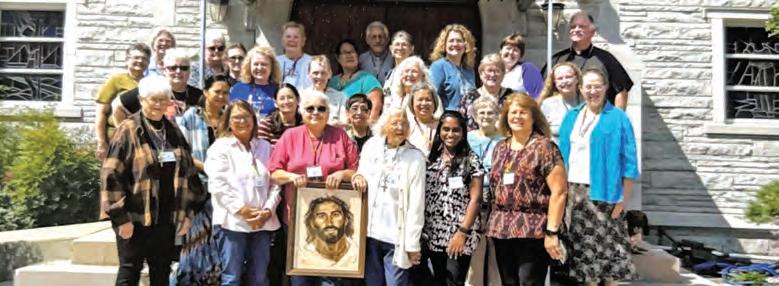
UPCOMING WOMEN’S WEEKEND : Nov. 20-23, 2025 Pinecrest Camp
PRIESTS:
Rev. Patrick Teter, Nov. 21, 33 yrs.
Rev. John Braun, Nov. 27, 38 yrs.
Rev. David Miller, Nov. 27, 44 yrs.
Rev. Randy Tochtrop, Nov. 29, 29 yrs.

UPCOMING MEN’S WEEKEND : Dec. 4-7, 2025 Pinecrest Camp

SCAN QR CODE for upcoming dates and more info!
All persons who have not yet attended a Cursillo weekend (Cursillo means “A Short Course in Christianity”) are invited to attend one of the upcoming weekends. A Women’s Weekend will be held Nov. 20-23 and a Men’s Weekend Dec. 4-7. The weekend events are at Pinecrest Camp near Fredericktown, Missouri. Weekends are also scheduled in the Spring 2026 in case you can make one of these weekends. For more info, contact Dale Gerecke at (573) 450-3335, or dale@gereckelaw.com, or contact a Cursillista in your parish, or search “Cursillo” on the diocesan Website: dioscg.org
The Cursillo® Movement pursues two purposes or objectives. The immediate purpose is to provide a conduit for living what is fundamental for being a Christian, namely, the on-going and total conversion of the person. The end purpose is to vertebrae Christianity in society by means of these persons who live what is fundamental for being Christian (the love of God and neighbor) in their daily lives.

During this Jubilee Year of Hope, we are reminded that the poor reveal to us the truth of the Gospel. As Pilgrims of Hope, we draw strength from Christ—the source of all hope—and are called to “Go and Do Likewise.”
At Catholic Charities of Southern Missouri, we serve as the hands of hope and love—helping homeless families, pregnant mothers, veterans, and individuals with developmental disabilities. In 2024, we assisted over 2,000 people across southern Missouri.
As one Church, East to West, let us bear witness to hope, love, and mercy. Please support Catholic Charities of Southern Missouri. Be a Pilgrim of Hope: “Go and Do Likewise.”
CURSILLO #128 Sept. 5-8, 2024
followed by King Alfonso II of Asturias in the early 9th century.
Mac Adventures did an excellent job of mapping out our routes. First, the Camino is extremely well-marked. There are large markers or the traditional seashell pointers that let you know which trails to take that lead you to Santiago. We knew each day where we would sleep that night, and how many miles and how much elevation change we would have for the day. Our 14 days of hiking meant we hiked between 10 and 20 miles each day. We had a phone App that showed where we were on our route at any given time, as well as paper maps with descriptions of what we were seeing as we traveled.
How to summarize our walk? I think, first of all, I should mention the absolute beauty of this part of the world. We walked over mountains, through fields with cattle grazing beside us, through small hamlets, and into larger cities. In the towns, the consistent theme was that everything was neat and clean, and there were flowers almost everywhere. The locals we encountered were friendly and didn’t seem to be irritated by pilgrims walking through their town or beside their barns. We would call out to those on the road, “Buen Camino” (“Good Way” or “Good Road”), which is the traditional greeting, and they would respond accordingly. There were quite a few old churches and pilgrim sites where we could stop and pray. Some were open but most were not. We thought that perhaps we could stop for Mass at some of these churches, but rarely did our times align with theirs, so that only happened a few times. Other days we celebrated Mass as a group.
As for the hiking itself—it was hard. There is a reason not everyone goes on this route, and I think that reason is the mountains. As beautiful as they are, you have to walk up and down them every day. To compound the distance and elevation changes, Spain—and really much of Europe—was having a heat wave that
DIOCESAN NEWS/ADVERTISING
lasted for 12 of the 14 days we were there. The heat was almost unbearable, so we compressed our walking to very early in the morning and pushed hard to be finished before the afternoon heat set in. Blisters on our feet were a constant worry as well, and we were thankful Dr. Mullins was there to help patch us up. I don’t want to overstate the difficulty, but it was hard. In fact, there were days that, due to illness or injury, we could not make the walk and took a cab to the next hotel. The rest of the group would make the walk, while the sick or injured person could have a rest day.
We reached our destination on our 14th day of walking. All of the pilgrims from the various routes descend on the Cathedral. We brought in our Credencials that had stamps proving we walked the route. They checked them and then issued us our Compostela, our certificate of completion. I felt so very happy that we had all completed our pilgrimage.
Pilgrims Mass at the cathedral
The highlight of our pilgrimage, for me, was the Pilgrims’ Mass at the Cathedral. This has been offered for many centuries, and I could feel the prayers of the many souls who prayed there. During Mass, Fr. Andrew and Fr. Joseph concelebrated, and I was able to receive Communion from my son. After Mass, we were treated to the Botafumeiro—an enormous thurible that produces a lot of smoke. It is so large it is hung on pulleys and operated by eight men called tiraboleiros. It was swung across the entire width of the Cathedral while one of the priests sang a hymn.
After Mass, I asked myself the question I had been asking many people along the way: “What do you hope to gain from this pilgrimage?” My answer was overwhelmingly a sense of profound gratitude—for the trip, for my family, for my faith, and everything that God has given me in my life. I am so grateful.
Buen Camino! ©TM

Prices are all inclusive w/airfare from anywhere in the continental US.
Several trips to different destinations: Holy Land, Italy, Greece, France, Portugal, Spain, Lourdes & Fatima, Ireland & Scotland and much more...
We specialize in custom trips for Bishops, Priests & Deacons! Currently hiring Deacons to promote our many pilgrimages. ATTRACTIVE compensation.
For more information contact: Karen@proximotravel.com.
To register call 855-842-8001 or at www.proximotravel.com.


DIOCESAN
THE GREAT HOT WHEELS RACE HELD IN ORAN
Oran, MO
It was an exciting week for the kindergarten class at Guardian Angel Catholic School, in Oran. This was the week that “Mr. H” came to visit and help the students learn about words starting with the letter “H.” Last year, Mr. H was so excited and requested a hot wheels race. Everyone had so much fun, the kindergarten class of 2025-26 decided to hold the race again.
All the students were to bring a hot wheel car to school on Wed., Oct. 8, so that each student could participate in the race. Cindy Seyer, the kindergarten class teacher, borrowed her grandson’s hot wheel track, which had six lanes on it. Five to six students were able to race against each other, during each race session.
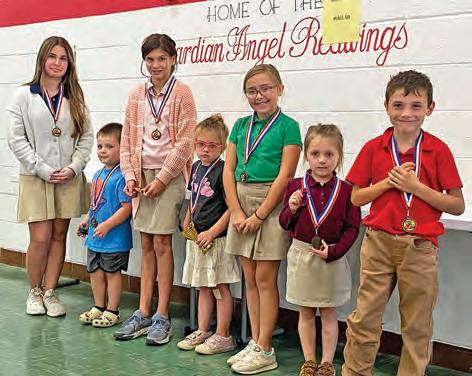
AND THE WINNERS ARE—The winners of the hot wheel race held in Guardian Angel Catholic School, Oran, for each classroom are Elaina Hahn (7th/8th), Hudson Felter (Pre-K/3), Laynie Priggel (5th/6th), Lennon Rendleman (Pre-K/4), Amelia Kyle (3rd/4th), Tenley Glastetter (K), and August Graviett (1st/2nd). Each student-winner received a medal. Rendleman was the overall winner and also received a hot wheel trophy for her efforts. (Submitted photo)

The VIRTUS Protecting God’s Children Safe Environment training for adults is available online.
Preregistration is necessary: If you are a new registrant please go to www.virtus.org and click on “first time registrant” on the left, and follow the prompts to register for Online training. Instructions for the registration process can also be found on the Child and Youth Protection Page of the diocesan Website.
Both in-person and online training sessions are for adults only.


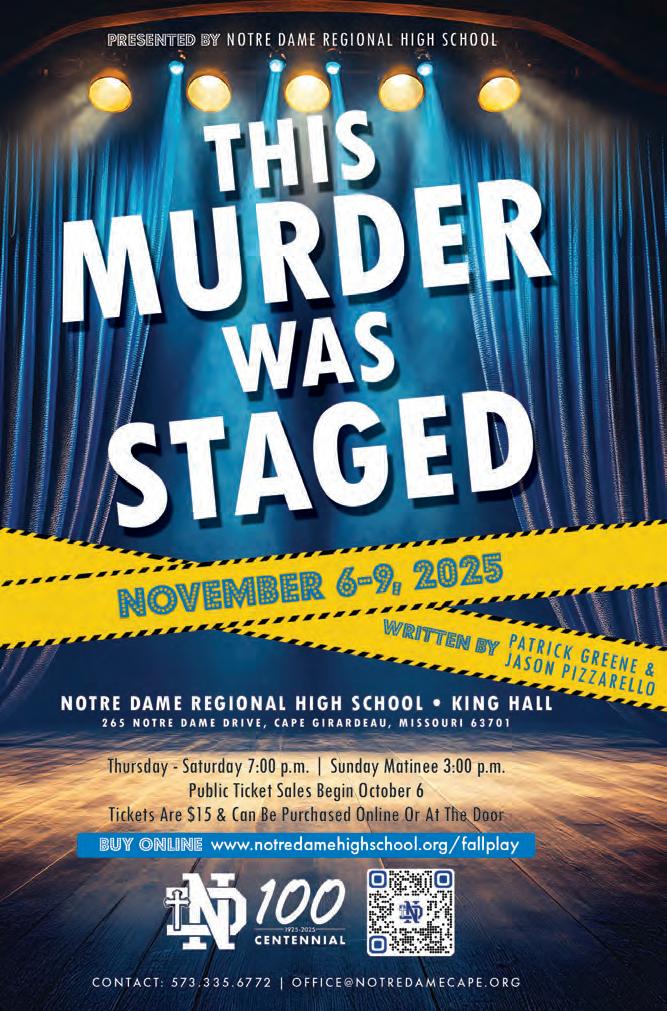
Kids in Pre-K through 3rd grade are welcome to trick-or-treat through the halls of Notre Dame Regional High School on Fri., Oct. 31! Students & faculty will be handing out candy from 10 a.m. - 11 a.m. Bring your best costume & a
bag/bucket for candy! Grade schools are invited to field trip to Notre Dame. If your child is not in school on Oct. 31, you are more than welcome to come trick-or-treat! RSVP online at https://www.notredamehighschool. org/halloween or scan the QR code!
For more information, please contact the Office of Child and Youth Protection, childandyouthprotection@dioscg.org; or Bill Holtmeyer, billholtmeyer@dioscg.org; or Shelly Ferry, sferry@dioscg.org, (417) 866-0841. www.dioscg.org/wp-content/uploads/How-to-Register-for-a-VIRTUS-withOnline-Option.pdf
Before engaging in activities involving minors and/or vulnerable adults, new volunteers or employees are required to complete the VIRTUS Protecting God’s Children training for adults, submit a current Background Disclosure and Authorization Form, and read, sign and submit the annual Code of Conduct, which are available on the VIRTUS Website and the Diocese of Springfield-Cape Girardeau Child and Youth Protection Webpage: www.dioscg.org/childyouth-protection/
D6 Ministries
SAVE THE DATE: Diocesan Eucharistic Congress 2026
AUGUST 15, 2026 WEST PLAINS CIVIC CENTER
On August 15, 2026, we will celebrate the 70th Anniversary of the foundation of our diocese (Aug. 24, 1956) during our first ever Diocesan Eucharistic Congress to be held in the West Plains Civic Center. All people of the diocese are invited to participate in a year of spiritual preparation for these momentous celebrations by participating in the activities listed at www.dioscg.org/ diocesan-eucharistic-congress.
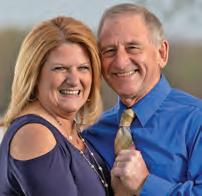
D6 Ministries – Paul and Kay Halfmann
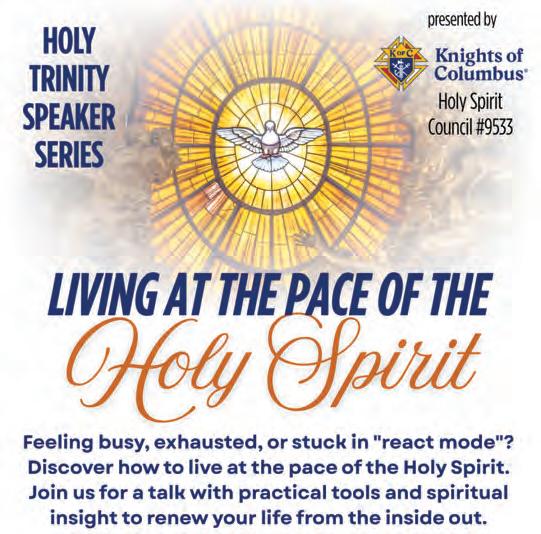
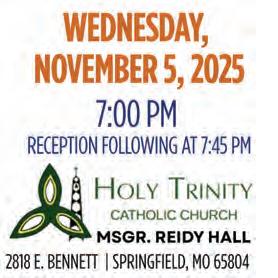
Forming a Firm Foundation of Faith in Your Family(This session is recommended for parents with children 10 years old and younger.) The Halfmanns will share simple and effective examples of methods for creating a culture of prayer and forgiveness in your family.
Raising Up Faith-filled Teens (This session is recommended for parents with teenagers or children approaching teen years.) This session will focus on strategies for parents, and their supporting community of family and friends, to keep teenagers engaged in their Catholic faith.
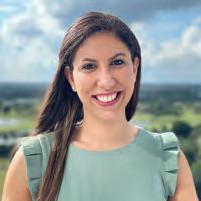
Mari Pablo
“Behold and Be Sent: The Missionary Call of the Eucharist”
Discover what it means to be a Eucharistic missionary today: to witness Christ’s love with your life, to bring His presence to all, and to let your encounter at the altar become a sending into the world. (Separate sessions offered for both English & Spanish)
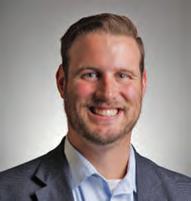
Brian Miller
“Walk with One”God can work through you to reach someone in your life right now, and invite them to a deeper relationship with God and His Church.
SCAN HERE to learn more!
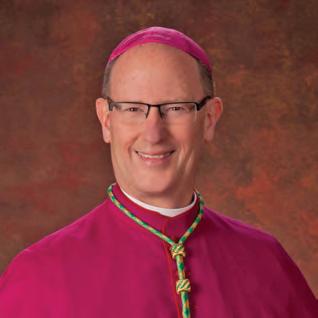
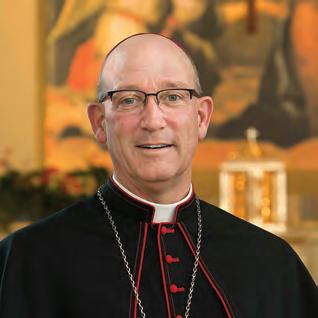
• Celebration of the Holy Mass with Keynote speaker Bishop James Conley, Bishop Edward Rice, and the priests of our diocese
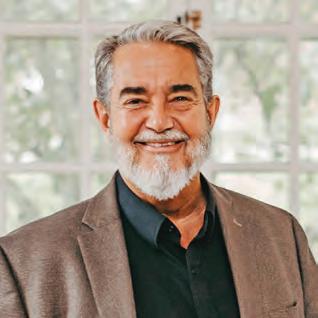
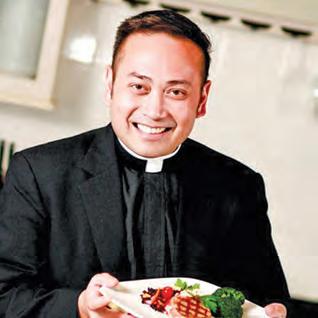
• National Speakers: Author & Theologian Dr. Scott Hahn; Award-winning chef, radio & TV host Fr. Leo Patalinghug of “Plating Grace,” and more!
• Youth speaker tracks for kids and teens
• Exhibit Hall with displays, games, Catholic products

Fr. Leo Patalinghug
Dr. Scot Hahn
Bishop Edward Rice
Bishop Ja mes Conley
Bria n Miller
Mari Pablo