2.2019
D 7,50 €
02
ENGLISH EDITION
D 19088 F
Alain Keler Thomas Keydel Ulrich Grill Cédric Viollet
I 8,80 €
UK 6,90 £
F E B R UA RY | M A R C H
NL B L 8,70 €
4 198801 1 1 307506 3 6
L E I C A F OT O G R A F I E I N T E R N AT I O N A L
Holger Sà
Lfi 2. 2019
p o rt f o l i o l i gh t b ox
F / s to p
1 0 4 | L f i . G a l l e ry
9 0 | m 1 0 - P Sa fa r i
Over 23 000 photographers present more that 300 000 pictures at the LFI.Gallery. In this issue: an Ethiopian hairdressing salon, sandals in Portugal, and a hotel lobby in Singapore
The latest member of the M10 family has arrived: the Leica M10-P “Edition Safari”. At the same time, Leica have launched an olive green variant of the Summicron 50 f/2
Ph oto
94 | M l e n s e s At the beginning of the year, Leica introduced new design variations of the Apo-Summicron-M 50 f/2 Asph, Summilux-M 28 f/1.4 Asph, and Summaron-M 28 f/5.6
114 | Leica Galleries
Cédric Viollet: from the Gallops of Morocco series
9 8 | v i e n n a Au c t i o n The 33rd WestLicht Photographica Auction was also the last: we take a look at past highlights and future auctions in Wetzlar’s Leitz-Park
118 | exhibitions
Alain Keler 6 | L e i c a c l a ss i c
The French photojournalist has been a tireless eye witness reporting for decades from crisis regions around the planet
Cédric Viollet 3 4 | G a l l o ps o f M o r o c c o
Unified design with a touch of adventure: the new M10-P “Edition Safari”
The new Leica galleries in Taipeh and London, as well as a comprehensive overview of the exhibitions at Leica galleries around the world
Endless dunes, wild manes, luxury labels: this unusual fashion spread was produced during a horse race in Morocco
Holger Sà
Erwin Olaf in The Hague; Luigi Ghirri in Paris; Martin Parr in London; Your Mirror, ICP, New York; and Berenice Abbott in Barcelona 120 | books New publications by Joshua Dudley Greer, Laia Abril, Alexa Vachone, Vivian Maier and Annie Leibowitz 1 2 2 | I n t e rv i e w With Thomas Seelig, the new Director of the photographic collection of the Folkwang Museum in Essen, talking about his new role and his intentions
50 | between worlds
Amid the hustle and bustle of models, stylists and dresses: rare and discreet images of the action behind the catwalk
Ulrich Grill 62 | Da r k S h a p e s o f I c e la n d
Dynamic contrasts: the monumental landscapes of Iceland, captured as poetic miniatures in black and white
126 | my picture Endless and timeless: after a long journey through nowhere, Clara Vannucci reached the polar landscape of Spitsbergen 126 | imprint
Thomas Keydel 7 2 | LA d a k h
The Manali-Leh highway in India is dangerous. Lorry drivers, as much as nomads and herd of goats, take it at their own peril
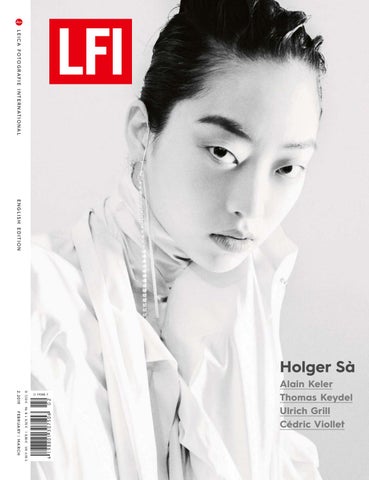
Cover: Holger Sá – the world of fashion backstage
lFI
| 3
Eye
Witness lFI
| 7
L e i c A C l a ss i c
Alain Keler He first gained international attention with his black and white Leica photographs – today Alain Keler counts among the most renowned French photojournalists of his generation. He has dedicated the past four decades to reporting on human suffering in the world’s war and crisis zones. We share some excerpts from his body of work, and take a look at his latest book.
8 |
lFi
lFI
| 9
LeicA SL
CĂŠdric Viollet G a l l o p s o f M o r o cc o
Warm colours and poetic imagery. Anyone taking a look at this fashion spread would scarcely believe it was shot in adverse conditions during a horse race in the Moroccan desert.
34 |
lFi
46 |
lFi
Viollet acquired his feeling for light and shadow as a photographer of skateboarders
lFI
| 47
LeicA SL
Holger SĂ B e tw e e n Wo r l d s
SĂ used his SL to document the hustle and bustle behind the scenes at a fashion show. A discrete glimpse at the productive chaos somewhere between hectic,high pressure and Haute Couture.
50 |
lFi
58 |
lFi
LeicA SL
Ulrich Grill Da r k s ha p e s o f Ic e l a n d
The Austrian photographer proves that the nature of Iceland can have real impact even without colour – and he goes a step further: with great love of detail he brings overseen aspects to the forefront, breathing life into landscapes that are in themselves already surreal.
“I’m intrigued by a direct look at the earth’s history and how the earth’s interior meets the outside elements. It has a brutal force that you can’t avoid.”
62 |
lFi
lFI
| 63
68 |
lFi
Clockwise from the top left: Painter 3, Stokksnes Beach; Fear, Vatnajรถkull National Park; Success, Vatnajรถkull National Park; Approach, Stokksnes Beach. Next page: Bare, Landmannalaugar lFI
| 69
LeicA M
Thomas Keydel
L A DA K H
82 |
lFi
Along the roadside, nomads live a life beyond the cities and villages. They breed goats and yaks, producing Kashmir wool – Pashima for them – made from their fur coats. Below: In the morning, a woman releases goats from their pen at Tso Kar (White Lake). ÂAbove left: A nomad tent at night. Because there is no electricity supply in the area, the nomads use small solar modules or car batteries to produce light. Middle left: Women from Leh separate bad grain from good. Below left: One of the women milking a yak. The milk is used to make butter and butter tea
lFI
| 83
t h e sa fa r i lo o k M 1 0 - P & S u m m i c r o n 5 0 f/ 2 “ S a fa r i ”
The original concept of Leica’s olive-finish M models was conceived some fifty years ago, initially with military institutions in mind. Now Leica have chosen the term ‘Safari’, with its more appealing connotations, to describe their latest M10-P variant and matching 50mm Summicron.
Whenever a new model of the Leica M is introduced to the market, it tends to mark the start of a gradually expanding family. One such example is the Leica M10, which was first launched in January 2017; in August 2018, a ‘professional’ version of the camera – the M10-P – was added to the catalogue (LFI 7/2018, p. 86); just two months later, this was followed by the display-less M10-D (LFI 8/2018, p. 78). The course of these expansions does not adhere to any discernible pattern – for example, there is no way of predicting whether there will ever be an M10 Monochrom, or if the next Monochrom model will instead be based on a future incarnation of the M. We can only look to the present, which currently revolves around the latest 90 |
lFi
member of the M10 family: the M10-P “Edition Safari”. Traditionally, Leica’s olive green models have always occupied a special status in the company’s product catalogue: they tend to be released neither in special editions that are strictly limited (such as the Leica M10 ‘Edition Zagato’), nor as standard serial models with a more or less openended production run. M o du la r fl exi bi li t y.
In his volume Leica Chronicle, Leica expert Erwin Puts writes: “The Leica M body has a very modular design: transport lever, rewind mechanism, top cover, bottom cover, rangefinder magnification and selection of frame lines, body covering can be changed and mixed at will. It is not surprising that the regular camera
bodies have been offered with a bewildering range of options, the black chrome and silver chrome versions included. Black paint and titanium versions are also common, where the titanium is not pointing to the material, but to a titanium layer that is attached to the standard metal parts. Leitz and later Leica has always been keen on using special events and special serial numbers to commemorate significant anniversaries and jubilees with out-of-the-box cameras in limited batches.” Lon g h eri tag e. Cameras with an olive green finish have a long tradition in the history of Leitz and Leica. The first Leica models to be treated with this colour were produced for military institutions in the late
1950s, and bore the simple suffix ‘Olive’: the M3 Olive (believed to have been produced from 1957 to 1968), the M1 Olive (1960) and the M4 Olive (1970). The term ‘Safari’ seems to have been introduced in 1977 with the release of the R3 Safari, accompanied by Safari R lenses in a corresponding finish. The first-ever Safari M was a M6 TTL variant launched in 2000. In 2008, it was followed by the first digital Safari model – an M8.2 manufactured in an edition of 500; Leica’s most recent Safari camera, up until now, was the Leica M-P (Typ 240) produced in 2015 in a run of 1500 units. t h e M 1 0 - P “E d i ti on Sa fa ri ” . Leica’s olive-fin-
ish camera models quickly established a reputation for being particularly →
The M10-P “Edition Safari” and the Summicron-M 50 f/2 “Safari” are sold separately, rather than in the form of a set. Leica are planning to manufacture 1500 units of the camera, and 500 units of the lens. The exceptionally hard-wearing, baked-on enamel paint creates a robust and unified exterior
lFI
| 91
b e s t o f LFI . G a l l e r y
C o o l Du d e “I was on the way to my Leica dealership in Montreal, when this scene opened up before me: the young man looked like he was posing for a professional photo shoot, but there was no camera team in sight. So I pressed the trigger, while he simply stood there and hardly moved.� Arturo Pianzola Leica M10 with Summicron-V 35mm f/2
104 |
lFi
l igh t b ox