Emily Davies is a freelance writer based in the Nottinghamshire village of Ruddington. She has a passion for the great outdoors, indie film, and a good pun. She works as a writer and marketing consultant with a focus on helping smaller companies express themselves through the written word. As screen editor for LeftLion, Emily is enjoying the chance to immerse herself in the fantastic community of filmmakers here in Nottingham. When she’s not busy writing, Emily spends most of her time worshipping the family cat, Ruby, or painting Warhammer minis.
123 Learning, 35A Creative, Aaron Murray, Alan Underwood, Alex McFarlane, Alison Gove-Humphries, Alison Hedley, Alison Knox, Anamenti, Andrew Button, Audrey & Lizzy & Margot, Ash A & Merro Events, BadGrammar MakesMeSic, Barbara Morgan, Ben Martin Saxophone, Ben Stewart, Beth and Cam, Big Bob McPlop, Carl Inglis, Caroline, Caroline Le Sueur, Cat Kearney, Cerys Gibson, Charlie Baylis, Chris Jarvis, Chris Underwood, Claire Foss, Clare Foyle, Cyra Golijani-Moghaddam, Dan Hemmings, Daniel Ison Jones, David Belbin, David Keyworth, David Knight, Dominic Morrow, Donna Rowe-Merriman, Eden PR, Ellie, Erika Diaz Petersen, F C and E Ledger, GC, Gemma Barfoot, Grant Butterworth, Grass Roots Garden Care, Graye Wilde, Half Moon Holistics, Harry Turner, Hayley Howard, Holden Johnson, Holly's Merry Moggies, Ian Carroll, Ian Phillips, Ian Storey, Ian Yanson, Ian Webster, Jack Moore, James Horsley, James Place, James Verran, Janine Lees, Jason Clifford, Jean Forsey, John Dunstan, John Haslam, John Hess, John Holmes, John & Jackie Scruton, Jonathan Day, Jon Roberts, Joshua Heathcote, Julian Bower, Julian McDougall, Justyn Roberts, Kay Gilby, Kaye Brennan, Kiki Dee the Cat, Lawrence Poole, Laura Wilson, Leigh Woosey, Lilian Greenwood, Livi & Jacob Nieri, Liz Hollier, Louise Duffield, Luke Richardshon, Lyn, Marc Weaver, Mark, Mark Barratt, Mark Dickson, Mark Jacobs, Martin Curtis, Mary, Matthew Riches & Justin Clark, MC, Mike & Margaret Astill, Mike Carter, Mike Cole, Miri Debah, Monica White, Nic, Nick Palmer, Nigel Cooke, Nigel King, NottingJam Orchestra, Paul, Paul Boast, Peachy Ground Designs, Pearl Quick, Pete Nash, Philip Renshaw, Rachel Ayrton, Rachel Morton, Raphael Achache, RevJonn, Richard Donovan, Richard Epton, Richard Goodwin, Rob Arthur, Rob Maddison, Robert Wyles, Rose Harvey, Roy Manterfield, Russell Brown, Ruth Hoyland, Saara Maqbool, Sam Fia, Sam Hudson, Sam Stiling, Sandra Pink, Sarah Colborne, Sarah Manton, Selectadisc, Shane P, Sheridan Chilvers, Simon Evans, Simon Malcolm, Tessa Duell, The Sparrows’ Nest, Tim, Tom and James, Tom Dee, Steve Benton, Steve Lyon, Steve Wallace, Sue Barsby, The Edgar Family, Tom Huggon, Tony Shelley, Tracey Newton, Vanessa Shaw, Wayne Norrie, Will Horton.
E Q D
Thinking university isn’t for you...?
University level study at Nottingham College might be!
We offer flexible ways of learning on a full or part-time basis with Foundation Degrees, BA (Hons) Top-ups, and HNC / HND programmes available in over 16 subject areas.
We don’t believe your jouney needs to look like everyone else’s. This is university done differently.
Take me home, County Road
Straight off the top
Take a deeper than average dive into Nottingham music and you’ll probably fall in love with improvisation events… Joe Egan and Parisa East talk the joy of jamming.
A Semester in Nottingham
American photographer John Dean tells us about the photos he took while studying abroad in 1970s Notts, currently showcased in Bonington Gallery.
Fungi Foray
LeftLion editor Sophie Gargett joins an expedition led by
the Nottingham Forager, and learns about the wild foods and medicines which most of us can no longer identify.
Lace Thief
We catch up with local musician Laura Dickinson, AKA Lace Thief, who talks interweaving her skills in fashion, video, poetry and music, in advance of her debut record out this month.
Blurry photos
Dave Rowntree is coming to Metronome this month, touring his photography book No-one You Know…
Rolling in the deep Bridie Squires talks about mindfulness and meditation with the director of Notts group Deep Yoga, Dr Steven Athwal.
Ay up readers, and welcome to April!
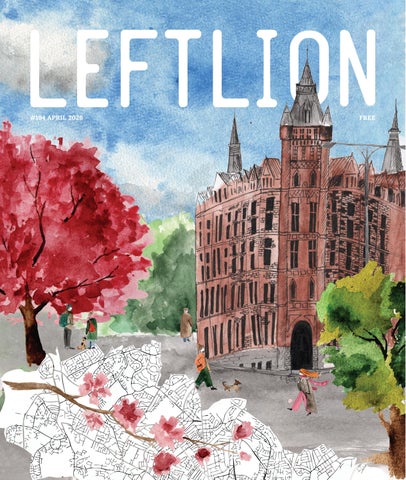
Amongst all the chaos of the world at the moment, it truly feels like a blessing to have nature waking up around us, light in the evenings and the sun popping its head out. Along with this month’s beautiful spring cover by artist April Seaworth, we have a selection of articles that may inspire you to get out and enjoy the city and its green spaces. Back in March, I thoroughly enjoyed a walk with The Nottingham Forager to learn more about our local edible plants and fungi (p.12) while historian Russell Davies talks about the history of King George V parks on page 38.
We’ve inadvertently gone a bit retro this month, with interviews with 90s band James and Dave Rowntree of Blur, who will both be visiting the city this month, plus a full run down of the city’s record shops ahead of Record Store Day. You can also dip into some nostalgia with some snaps of Notts in the 70s by photographer John Dean, whose work is on display at Bonington Gallery, or hear
Out of Time
Coffee shops have a much longer and idiosyncratic history than we often appreciate – here’s the storied history of one which through the 20th century dominated Nottingham’s java scene.
Panya the Poet Influential local poet and cultural historian Panya Banjoko tells us about her latest digital work and how she’s creatively marking ten years of Nottingham City of Literature.
A Walk in the Park Russell Davies looks at how the King George V memorial fund helped keep Notts green spaces available for generations to come.
Remembering Julie
Looking back at the restlessly creative life of Julie Pritchard, LeftLion columnist and founder of the pioneering Nottingham Forest fanzine, Brian
about the famed Kardomah coffee house that once sat on Clumber Street on p.25.
In keeping with this old-school theme, you may notice – back by popular demand – we’ve brought back our event listings. Peruse what’s on at the back of the mag, or head to our new online events site notts.com, where you can also upload and promote anything you have going on in the city.
Elsewhere, we’ve been speaking to influential poet and cultural historian Panya Banjoko about her new StoryArcs fellowship (p.35), dipped into some musical jam nights (p.18) and taken a look at the accomplishments and future of the Nottingham film industry (p.30), plus much more to pique your fancy.
Whatever you find yourself up to this month, I hope you enjoy this month’s slice of Notts culture. As always a big thank you goes to our wonderful writers, illustrators and photographers who help make this magazine happen.
Until next time,
where's this?
Last month's answer: "Water's edge" Colwick Park
"A wander with Tumnus"
Notts County goalkeeper James Belshaw tells us about his circuitous route through the world of football, from studying in North Carolina to a stint in the Bristol Rovers.
Lucy Buckle, AKA
"Mate, he's loaded. He's got a houseful; there's cash in every room. He can't spend it fast enough!"
“Isn't it crazy that clowns have been around longer than Christianity?”
"Be nice! I told you if you were nice to me, I'd let you share my Monjauro!"
“Bro, imagine if we had to go around, like, hunting bison…”
“Swimming isn't a bad sport for your knees.”
“I know, I think that's why they put dogs in pools.”
In Cobden Chambers:
“I did have a good portfolio until my cat pissed all over it.”
Nottingham’s most opinionated grocers on...
Records
Before Rough Trade there used to be a record shop on Stoney Street, it was tiny and they’d have queues down Goosegate. We bought a nice Sony record player about ten years ago and have a lot of records. We like Tom Jones singing Can’t Help Myself – the beginning is fantastic – and we listen to George Michael, the South Pacific musical and Paint Your Wagon. We also like popular classical music, but nothing too highfalutin.
The Kardomah Café
We remember the one on King Street! The sixth form girls at the High School were done for drugs there once, and the boys were done at the Grosvenor. We know a lady who was one of those that were done. But it was fantastic. It was very upmarket – you had to go downstairs and inside it looked like a Lyons tea shop. But everything comes and goes doesn’t it?
King George Parks
“Look at that cathedral!”
Someone pointing at the council house:
“She's got more screws loose than an IKEA wardrobe.”
Pick Six
For this month’s Pick Six we turned to local playwright, Jane Upton , who’s new show Scenes from a Friendship comes to Nottingham Playhouse from Friday 15 May.
@Janeuptonwriter
TV Show
All parks should be made royal. Vernon Park was made royal years ago, and the Queen came to open it. It means that it can’t be built on. If you look at Woodthorpe Park, they’ve nicked two sections to build on, and it’s not there to nick. It’s very important for people’s mental health to have a stroll in the park.
I have a crap memory for stuff
I’ve watched, but the first show that popped into my mind was the nineties cult hit, This Life. I viscerally remember me and my brother staying up late to watch it after mum and dad had gone to bed. We were wideeyed teenagers and we hung off every word. I need to watch it again now that I'm older than all the characters.
Book
I have lots but I recently read Paper Girl by American journalist, Beth Macy. I live in the town where I was born and I often wrangle with that, particularly in the past few years with the rise of nationalism. In the book, Macy, who grew up poor in Ohio, returns to her hometown attempting to discover how and why she’d become politically divided from her family and friends who remained there… I was furiously making notes in the margins.
Holiday destination
Last year, thirteen of us went to Corfu to celebrate my Dad’s eightieth birthday – my brother, my sister, and our families. Dad booked it two years before, as a massive treat, so the anticipation was palpable. I hadn’t been on an aeroplane in ten years, and our kids had never flown. It was hot every day; we ate watermelon on the beach, got dressed up for dinner, did karaoke, and climbed a massive hill to find a hidden swimming pool in the woods. There was so much magic, a moment in time. I’ll never forget it.
Notts Spot
Top three runners-up would be Hopkinson Antique Centre, Broadway (obviously), and Nottingham Contemporary. But, The Playhouse has to be my top spot. I’ve seen so much great theatre there over the decades and it’s played a big part in my journey as a playwright. I have great memories of going to panto there with my family as a kid and we reignited the tradition a few years back once we all had our own kids.
Restaurant
We rarely eat out – because who can afford that?! But on a special occasion my husband and I (I sound like the queen…) love a cosy dinner at Café Roya, Beeston. Neither of us are vegetarian but the food there is stunning. Homecooked, unfussy and rich with unusual flavours. If I’m eating out, I like it to be something I can’t cook (but who am I kidding? That’s pretty much everything).
Song
Who even has a favourite song? It changes every day; songs are magical time machines. June Hymn by The Decemberists makes me think of a moment of hope after a traumatic few months with our second child. Kylie Minogue’s I Should be so Lucky takes me to my seventh birthday party. So many songs make me think of my mum and it reduces me to tears. She used to take me for nighttime drives as a teen to try out mix tapes I’d made –top tier mumming.
Ode to a Boiled Egg II
This shell was built with care, designed to crack: a measured wall of chalk and lacking seam. It keeps its charge ensconced, this cosy sac, until the hour arrives to split the scheme. No creature leaves unbroken what confined its tender start in calcium and care.
The beak must break what nature has designed; the breach makes way for wings to greet the air.
But then the waiting hand with silver spoon bestows a measured tap upon the shell. The yielding sphere surrenders all too soon and guarded gold escapes its chalky cell.
The egg fulfils the logic of its making: it brings forth life and sustenance in breaking.
Marjie Griffiths
Reasons to be
Cheerful
words: Poppy Begg photo: Luke Brennan
Beat the Streets
It has been revealed that this year’s Beat The Streets festival, in January, raised more than £50k for Framework to help rough sleepers in Notts. Launched by DHP Family in 2018, the annual festival brings together artists, bands and poets for a day of live performances across Rock City, Rescue Rooms, Rough Trade and The Bodega. Over the years, the event has helped fund a range of initiatives, from new accommodation to mental health support. This year’s total will go towards Lee House – Framework’s accommodation for men with a history of rough sleeping.
Green fingers
Staff and students from the University of Nottingham, Bluecoat Aspley Academy, and Nottingham College recently celebrated a two year milestone in the Wilding Campuses Project, delivered by environmental charity Students Organising For Sustainability. It’s seen significant biodiversity gains on our city’s campuses, including the enhancement of grassland areas, a wildflower meadow outside a student hall of residence, and improving existing green spaces, plus delivering opportunities for young Notts folks to connect with the outdoors. Our city’s pretty highly ranked across the UK with respect to how we take care of our green spaces, so initiatives like this are definitely important – set to only further elucidate that status.
Listen for Life
On World Hearing Day, March 3 2026, Nottingham was officially announced as the first Listen for Life city in the United Kingdom, recognising our commitment to protecting and prioritising hearing health across the city. The initiative highlights efforts across healthcare, education and the community to raise awareness about hearing protection and early support. By promoting better understanding of hearing loss and encouraging preventative care, the campaign aims to help people protect their hearing throughout their lives. It’s really positive step towards tackling global concerns about regular exposure to high sound environments without compromising our cultural vibrancy.
UNDERCOVER ARTIST
The stars align this month, as our regular contributing illustrator April Seaworth presents our April 2026 cover. Below April talks about her work, inspirations, and why we should listen closely to the city and to nature…
Tell us a bit about yourself…
My name is April, I’m a poster artist and illustrator from Russia. I moved because of the war, and that experience has shaped how I see art: it needs to be honest, direct, and understandable to everyone. I love creating visual statements that speak immediately about what matters.
I’m fascinated by how art can bring people together — regardless of race, religion, or political beliefs. My goal is to create work that feels alive in space and time, challenges the viewer, and stays with them after they’ve seen it. For me, visual work is a way to talk about the times we live in and the state of the world without explaining everything directly.
What’s the story behind the cover?
This cover began with a simple question: how do you draw a city that never stands still? I wanted to capture the recognisable architecture of Nottingham’s city centre — the familiar building which now houses The Alchemist, a landmark many of us pass without thinking. The cherry blossoms are deliberate. They don’t belong to stone or brick — they belong to time. For a few weeks each year (in April!), they soften the geometry of a UK city. They interrupt routine. The cut-out urban map layered through the composition acts like a second skin — a reminder that every modern city is built on invisible grids, systems and histories. We navigate it daily, often unconsciously.
I was interested in the contrast between speed and stillness — Nottingham, to me, feels like a city balancing heritage and reinvention. That tension is where the cover lives.
What inspires you as an artist?
I’m inspired by almost everything. Lately, I pay more attention to emotions, political events, how the planet breathes, and how people feel. I try to weave all this into
another world – one that everyone can understand. Connection with nature is also essential for me. It’s important because nature teaches us to notice the small details that often get lost in everyday life.
Tell us about some projects you’ve worked on in the past…
I have an amazing little book about London that’s still waiting for a publisher. It’s built from children’s stories about their favorite places, and I simply illustrated and designed it. Sometimes children even sent handwritten letters to be part of the story. The book isn’t published yet, but if it ever happens, it will probably feel like a shared triumph.
Do you have any tricks for getting started and staying inspired as a creative?
I believe that if we rely only on inspiration, we’ll never truly become artists. Art requires skill, dedication, and discipline. In Russia, there’s a saying: ‘talent you can’t drink away — no matter what, you’ll always stay an artist.’ But honestly, I don’t believe in talent. Some people may have more natural aptitude, but without work, nothing happens. My main advice if you’re exhausted – draw every day – even ten minutes is better than zero.
If you could sit down and chat with any artist in your field, who would it be and what would you talk about?
There are so many artists I’d love to talk to. Definitely Igor Gurovich, Marina Abramović, the brilliant El Lissitzky, Alexander Rodchenko… I’d ask them how to stop feeling like a bad artist, how to stop fearing what others might think, and how to push beyond the limits of your artistic self.
Is there anything else you’d like to tell the LeftLion readers?
Always notice absurdities and small details around you — they hide unexpected meaning and inspiration. Play with form and chaos and look for unusual combinations, even in everyday life. It keeps your view of the world alive and helps you see things that normally go unnoticed.
FIND US
Bonington Gallery
Nottingham Trent University
Dryden Street
SATURDAY 21 MARCH – SATURDAY 9 MAY 2026
Bonington Gallery is delighted to present THROUGH A MIRROR, DARKLY, a new three-channel film by Turner Prize nominated artist Naeem Mohaiemen. The film explores memorialisation, protest, and political violence through the lens of events in May 1970, when American students protesting domestic racism and overseas wars were met by state violence.
THROUGH A MIRROR, DARKLY is approximately 90 mins long, and will be screened at intervals throughout the day.
Nottingham NG1 4GG
Monday – Friday, 10 am – 5 pm Saturday, 11 am – 3 pm
Nadia on...
Student loans
A few months ago, I decided to look at my student loan balance. It stood at around a whopping £48,600, just £1,000 less than I originally borrowed. Almost everything I had paid in the last six years had been paying off the interest. As an MP, I’m fortunate to be in the top 5% of earners in the country - a salary which I choose to partially give away to local causes - so my own repayments are manageable, but the number was shocking because it lays bare how badly the student loan system has been working for everyone else.
Analysis shows that you now have to earn on average a salary of £66,000 before your repayments are bigger than the interest accrued on your loan. Given that the average UK salary sits at around £39,000, many graduates are paying into a system that continues to grow their debt through no fault of their own.
I took out a Plan 2 student loan in 2016, when tuition fees had recently risen to £9,000 a year. Politicians reassured prospective university students at the time that repayments would only kick in above a certain salary and that whatever remained after thirty years would be written off anyway. What many didn’t know was how quickly interest would accumulate.
While studying, all borrowers were charged the Retail Price Index (RPI), a measure of inflation which has been criticised for overestimating price increases, plus 3%. During the high-inflation years following the pandemic, some graduates saw record-high interest rates applied to their balances before they had even started repaying. After graduation, the rate varies with income, but even those earning under £28,470 have interest added at the RPI rate.
We also didn’t know that governments would freeze repayment thresholds, making graduates pay more in real terms over time. With the current government recently freezing the repayment threshold until 2030 for those who, like me, took out a Plan 2 loan, millions will now be forced to pay more each month during a cost-of-living crisis that is already pushing many people to the limit. We are a generation navigating a housing crisis that has made homeownership feel out
of reach for most, with rents swallowing an ever-larger share of our pay. Many graduated into the economic uncertainty of the pandemic, only to be hit by the energy and food price shocks that followed. Jobs are harder to come by, and more young people are still living at home because the alternative is unaffordable. It is clear within this wider context that the student loan system is fundamentally unfair. Those who were able to pay their fees up front avoided accruing interest entirely. Whereas graduates who had no choice but to take out loans are seeing large deductions from their pay packets each month. To make matters worse, many borrowers are finding that their original loan balances have substantially increased, leaving them facing the prospect of repaying their debt for up to forty years. It was found last year that more than 150,000 people in the UK now have student loan debts exceeding £100,000, with one person owing £298,000.
we shouLdn’t expeCt graduates to surrender a signiFiCant portion oF their saL ary For deCades, espeCiaLLy at a time when so many are aLready struggLing
I have had many constituents write to me recently about student loans, explaining that the monthly deductions feel significant when the cost of everything keeps rising, or that it feels deeply unfair that the financial goalposts keep shifting. I agree with them and was pleased to hear that the Treasury Committee is launching a new inquiry to determine if the current system of university finance is fair for young people. Because how can a fair system make it so that teachers, nurses, and social workers end up repaying more than their higher-paid peers? Or how can it be fair that the parental earnings threshold, which determines how much student maintenance loan you get based on your parents’ income, has been frozen at
£25,000 since 2008? Why haven’t student maintenance loans for students in England risen anywhere near the value of inflation? And how is it fair that the repayment window for new graduates has increased from thirty years to forty years?
I’m also concerned about the growing individualistic narratives around student debt, as though it is simply a price people have to pay for their 'personal investment'. This framing treats education as a transaction rather than a public good that benefits our society as a whole. An educated society is healthier, fairer, sustains our public services, and produces the artists, scientists, and engineers that all of us depend on. From a purely economic perspective, we know that an educated population has higher rates of productivity.
If it were up to me, tuition fees should be scrapped altogether, universities would be funded through general taxation, and we would look at how existing student loan debt could be written off. Figures show that students in England graduate with an average debt that is higher than in any other developed country. We know this is a political choice because many European countries offer higher education for free. In Germany, public universities charge around £115 a year in administration fees. In France, tuition at public universities is capped at £186. In Denmark, higher education is entirely free, with students offered a monthly living grant instead. Closer to home, Scottish students attending university in Scotland are also entitled to free undergraduate education.
At the very least, the government must reverse the freeze on student loan repayment thresholds and reform interest rates so balances do not grow faster than repayments, particularly for those on lower and average incomes. We shouldn’t expect graduates to surrender a significant portion of their salary for decades, especially at a time when so many are already struggling.
nadiawhittome.org
words: Nadia Whittome photo: Lux Gagos
A Fungi Foray
Nestled in roadside thickets, hidden amongst hedgerows and sprouting from our local playing fields, parks and playgrounds, a world of forgotten foods quietly grow. With shoots spurting from the ground as we move into spring, Sophie Gargett spent some time with Lucy Buckle, aka The Nottingham Forager, to discover more about identifying, picking and eating wild food.
It’s a briskly chilly day in March and we’re exploring the woodlands and fields of Broxtowe Country Park. Led by Lucy Buckle, our group of a dozen includes everyone from toddlers to elders – some carrying baskets for collecting finds – and bags are passed around for picking litter along the way. Lucy leads the way in a bright rainbow jacket which cuts through the grey of the day, stopping at intervals to share her knowledge in identifying fungi and edible plants, explaining lookalikes and how to notice dangerous or inedible varieties, and what to do with the more tasty discoveries.
Growing up rural in Derbyshire, Lucy credits her first foray into foraging to her grandparents, who passed on their knowledge of local plant life, from brambles to fungi. When she went to study a degree in Business Management at Nottingham Trent University, she thought the urban environment around her halls of residence would curtail her foraging excursions, but was happily proved wrong.
“I went for a walk at the Arboretum and found field mushrooms. So I was like, oh actually you don't need to be in the countryside, you could just be in the middle of the city.”
Most of the group have never been foraging before, but curiosity is certainly piqued as to what treasures we might discover. Lucy eases us in gently, pointing out that at one time or another, we’ve probably all picked blackberries and most people have a knowledge of what to look for, when to harvest, and how to use them. Identifying other plants in this way, she says, is a slow and steady process of observing and learning as the seasons change.
Along with a greenery such as wild garlic and threecornered leek, today we’re on the lookout for a few of the more sturdy fungi that emerge during the colder months; jelly ears, scarlet elf cups, turkey tails and perhaps, if they’re early, St George’s mushrooms. Knowing the habitat and conditions in which certain fungi grow, Lucy is instrumental as our guide, but it is factors such as weather, timing and watchfulness that will decide whether we come across any. At various points throughout the session people call out ‘mushroom!’ and the group gathers excitedly to see what has been discovered. Our first find is a King Alfred’s Cake – a hard, charcoal coloured fungi that grows on decaying wood. Not something you’d want to eat, these useful little
chaps are also known as tinder bracket and were used for thousands of years as portable fire lighting material, safely carrying embers across distances.
Next up, Lucy points out bunches of heart shaped leaves nestled in grass off of the path. Rather non-descript, but they are Jack By The Hedge, or garlic mustard. Rich in Vitamin A and C, it can be added to salads and pestos to add a slight bitter flavour. We all take a nibble, as Lucy gives us a brief history lesson: “During Elizabethan times it was kept as a pot herb, and people swore by it. If you had something wrong with you, you’d chew some of that,” she says. “Over time we just sort of lost track and stopped using it, but it’s everywhere.”
aLong with wiLd garLiC and threeCornered LeeK, today we’re on the LooKout
For the more sturdy Fungi that emerge during the CoLder months; jeLLy ears, sCarLet eLF Cups, turKey taiLs and perhaps, some earLy st george’s mushrooms
It turns out that many of the edible plants around us are densely rich in nutrients; wild garlic is said to have antimicrobial, anti-inflammatory, and anti-oxidant effects, aiding in digestive and cardiovascular health, while the often-spurned nettle contains a multitude of vitamins and is said to reduce inflammation, hay fever symptoms, blood pressure and blood sugar levels. While Lucy is happy to share this information, she advises people to do their own research, reminding us, “I’m no doctor, just a lady in a rainbow jacket.”
The more we explore and learn about these unassuming plants, the more it comes to mind how much our connection to our land and food has been severed over time. Here in the woods, away from the concrete urbanity, our reliance on supermarkets, factory farming, and shiny packaged foods seems starkly unnatural.
“People are genuinely scared of picking mushrooms and plants,” Lucy explains. “That fear has been built up from
various sources, but a lot of that is feeling like we shouldn't be getting hands on with nature. People think they're going to get their hand slapped for foraging.”
As we walk, we come across a deep green sea of wild garlic coating the woodland floor, several bright scarlet elf cups hiding amongst mossy fallen branches, and an abundance of turkey tails covering a log. This fan-shaped polypore is too tough to eat, but as one of the most scientifically researched fungi in the world, it is reported to have great effect in bolstering immune function and aiding in cancer treatment. In 2025, the turkey tail was reclassified in the UK as a ‘novel food’ and taken off sale in the UK.
“It’s maybe a problem in Western thinking. The laws will eventually catch up,” says Lucy. “But turkey tails are everywhere in England, and as it stands we are still allowed to forage them.”
Indeed, between legal issues around foraging on private land, the dangers of deadly plants, and conversations around conservation, foraging has occasionally been given a bad reputation, which Lucy believes is unjust. “They're not destroying things or stealing,” she says. “Actually foragers are, most of the time, the most sustainable and environmentally conscious people that I know.”
For Lucy, this means working with smaller groups and educating on which plants and fungi can be sustainably picked. A general rule foragers go by is the ‘1-3 rule’ – no more than a third of any plant or patch should be taken, the rest left for regeneration or wildlife. She also presses that proper identification should be taken seriously before ingesting anything you’ve picked.
By the end of our walk most of us have a small bag or basket of finds, but the true bounty of the day has been both the knowledge of, and mindful connection to, the local plant life which we’ve today looked at more closely.
I ask Lucy if she has any final tips for budding foragers: “I would encourage people to explore their local spaces –you don’t have to go far,” she says. “If you head out once, you’re just getting a snapshot, but getting to know them throughout the seasons is how you understand what plants look like from start to finish and where the good mushroom patches are. You’ll eventually build a map in your head.”
@nottingham_forager
words: Sophie Gargett illustration: Isobelle Farrar
Take Me Home, County Road
Born and raised in Clifton in a Notts County-supporting household, James Belshaw took a circular route to finally becoming Notts County’s goalkeeper. After dropping out of the Magpies youth system in 2005, at the age of 35 he finally signed for the club last January. This followed a journey via the USA, the English National Leagues, two play-off final wins for Harrogate (including one against Notts), and player of the season award at the Bristol Rovers…
Tell us a bit about your early life in Nottingham… I was born and brought up in Clifton. I went to Blessed Robert Primary School and then to The Becket School, where my brother teaches English now. So we've both kind of gone full circle, me coming back to Notts and him going back to our old school to teach. Notts County played a huge part in my upbringing. My dad has been a season ticket holder for sixty-odd years now – he brought me and my brother to the games as kids.
What are your early memories of supporting Notts? My first memories are from around 1996. I was a mascot on my sixth birthday. We played Bristol Rovers and drew 1-1, Tony Agana scored. I remember Darren Ward was my first footballing idol. I was also a big fan of Gary Strodder and I've got a vivid memory of meeting him and being awestruck. I have fond memories from the Sam Allardyce promotion season in 1997–98; seeing Gary Jones scoring thirty odd goals in that team, alongside players like Ian Hendon and Mark Robson. Another team that stands out was the Munto team with Lee Hughes, Kasper Schmeichel, Neal Bishop and Ricky Ravenhill all managed by Steve Cotterill in 2009-2010.
It’s important to remember the successful times, because there's been a lot of dark times over the last thirty years of following Notts too. If our current team were to do something special this season, I know that will resonate with the younger Notts fans coming up, and that’s really important.
Which other players were around when you were in the youth set-up at Notts that went on to make careers in football?
The age group that everyone pinned their hopes on was a bit older than me and included players like David McGoldrick and Leon Best. Jermaine Pennant was around too, but I think he was a little bit before my time. Some of those players went on to have exceptional careers and you only have to look at what McGoldrick is doing now for Barnsley – it’s incredible at his age.
You were released by Notts and had a chance to sign for Walsall, but you decided to go and take a scholarship in
the US instead. Tell us about that…
Firstly, when I left Notts I went over to Forest briefly, but I was up against Karl Darlow. I didn't really grow until I was seventeen or eighteen, so I was on the smaller side, and he was just a better keeper. Then I went into local non-league football with Dunkirk Reserves and Heanor Town, which is when I got scouted for Walsall. I was still at sixth form at the time, and getting good grades, but Walsall came to an arrangement about my schooling and I ended up on their bench in League One a few times, but never made an appearance.
notts County pL ayed a huge part in my upbringing. my dad has been a season tiCKet hoLder For sixty-odd years now and he brought me and my brother to the games as Kids.
In the meantime I was speaking to Duke University in North Carolina, USA, about pursuing an academic education alongside playing football. I got offered a contract by Walsall, but felt I'd just be a third-choice keeper for them. So I took a big leap of faith and decided to go to the States and spent four years out there getting my education, including degrees in history and business management. Out there the collegiate system is different. You're like a professional, you train every day, play matches, and then you go into lectures in the afternoon. I'd never been to the States before, but I ended up being really successful on the pitch and got a great education as well.
You graduated in 2013, but after some soul-searching decided to return to England to give it another go here. What happened next?
I went back into Walsall for a bit, then to Cambridge who were in the conference at the time, but for various reasons nothing came of either. Then I represented Great Britain at the World University Games at Kazan in Russia and we ended up losing in the final to France in extra time. That was an unreal experience. Then I went to Nuneaton,
played a couple of pre-season games and they signed me. They had Dimitar Evtimov on loan from Forest at the time and for a couple of months we rotated games. Then he got injured and I took over.
I played for England C against the Czech Republic Under-21 team in Woking one Tuesday, but when I got back the Nuneaton Chairman told me they’d bought in a new Dutch Keeper called Kelle Roos, who Notts fans will be familiar with as he is who I replaced here. He ended up playing a few games for Nuneaton, while I was stuck on the bench. Then they sold him to Derby that January and I got back in and played the rest of the season.
I assume during this time you were only part-time and working another job as well?
Yes, I was working as office manager for a software company that wrote specialist systems for cars. I did that for a few years, but football was always my passion. After Nuneaton, I signed for Tamworth in the National League North and did another three seasons there whilst working at the same place. In my last season at Tamworth I'd started up my coaching business, East Midlands Elite Soccer, which I still run today in Nottingham. I was working full time, playing for Tamworth and doing that, so something had to give.
Towards the end of that season Harrogate offered me a deal and they were going full-time the year after. It was a big pay cut overall, but I wanted to give full-time football a go. I was 26 and it started to feel like it was now or never. There was a group of us that signed at that time; players like Josh Falkingham, George Thomson, Warren Burrell and Jack Muldoon. I played nearly 300 games for Harrogate and they were all in most of them. They’re still among my closest friends in football and we got two play-off promotions together.
Yes, one of them being against Notts County in August 2020 at an empty (covid-era) Wembley. There must have been some mixed emotions from you that day?
It’s weird to look back on it and quite surreal in a sense. I actually managed to sneak my dad into that game on one of the fifteen tickets Harrogate got for their directors.
interview: Jared Wilson
photo: Notts County FC & the Belshaw Family
I think, looking back on it, the weirdness of the occasion helped us win that day. Had fans been allowed in the stadium, there would have been 5000 from Harrogate and 20,000 plus from Notts. It would have made a difference.
Personally I wanted to see Notts get promoted, but obviously I had a job to do for Harrogate and I also realised this could be my last chance at playing in the Football League. It also helped that Notts weren’t wearing black and white that day; I was playing against a team in green and that definitely made it a bit easier for me.
What do you remember about your football league debut?
It was on 3 October 2020 for Harrogate against Bolton Wanderers, just over a week before I turned thirty. I missed a few games before it, as I was out with an injury having broken my thumb. Also it was a home game, but we played it at Doncaster’s Keepmoat stadium because our pitch was being relaid. We lost 2-1, but it was still a day I'll cherish forever.
After that first season back, you ended up signing for Bristol Rovers. What made you want to move?
Harrogate had signed a new keeper from Southend, Mark Oxley. He’s a great guy and a friend who is still there now. They’d given me squad number 21 and made it clear he was their new first choice. I felt a bit let down and I wanted to play, so I started looking around for moves. I went to Bristol Rovers on trial and they signed me as back up to Anssi Jaakkola, a Finland international. I threw absolutely everything into it and Anssi got injured. I ended up getting a chance and from that point I played pretty much every game and got voted as the club’s Player of the Season.
At the end of that season we ended up getting promoted in the most dramatic fashion, we were 18th on New Years Day and got into a great run of form. We signed a nineteen-yearold Elliot Anderson in January, which definitely helped. On the final day of the season we were fourth and Northampton were third. We were level on points, but we had a five goal
deficit in goal difference. Northampton were playing Barrow away and we had Scunthorpe at home, who were already relegated. They won 3-1, but we ended up winning 7-0. We were relentless and it was the only time that season we’d been in the top three. I’ve had three promotions in my career so far, but that is definitely the most special. After that you played a fairly full season in League One? Yes, I was number one for most of that season. They brought in Ellery Balcombe from Brentford, in the January window and part of his loan contract was that he had to start a few games. So the gaffer chopped and changed a bit, but I got plenty of games. From where I’d been, playing at places like Hillsborough, the Valley, Fratton Park and Portman Road was amazing. However, I only had a year left on my contract and had an inkling they were looking to either replace me.
it's
stiLL surreaL to see my name on a notts team sheet, to put a notts Kit on and to wear the badge. hearing the Kop sing "he's one oF our own" wiLL ne Ver get oLd.
I had interest from Notts and it was the summer they got promoted back to the football league, after I’d watched them at Wembley. I’d heard they were interested and I definitely was too. But at the time they were talking to me they were putting all their efforts into bringing David McGoldrick back. Then they signed Aidan Stone and my move was over. So I was still under contract to Bristol Rovers and went back there. They signed a goalkeeper on loan and I was told I was free to go. But it turns out I wasn't and after that it all got quite messy with the gaffer there.
The gaffer being the rather notorious Joey Barton… Yeah, he basically said I could leave, but then blocked
various moves for me in the summer. Then he came out in the press saying I'd asked to leave the football club, which I hadn't. Then I was just frozen out. I went to Forest Green on an emergency loan for two or three months. Then Harrogate got back in touch and signed me on an emergency loan in December 2023, with my first game back being against Notts County. Although, not knowing this had happened, Notts County also got back in touch with me on the Friday before also trying to sign me on an emergency loan to play for them against Harrogate. Strange to think that happened.
So you finally became a Notts player, at the fourth attempt, in January 2026. How did it feel to finally get the deal over the line?
It felt amazing! We’d agreed all the details a week or so before it was announced and Harrogate knew I really wanted the move and were great about letting me go. Although, after previous attempts, I was praying their other keeper didn’t get injured or nothing else came up to scupper the move this time.
On a practical level it’s great for me. We bought a family home here in 2020 and all the time I was in Bristol and Harrogate I was living in digs or commuting from Nottingham. My daughter goes to nursery in West Bridgford and I can go and pick her up after training. Everything is easier and I can concentrate on my football, rather than traffic. Everything kind of clicks into place.
It's still surreal to see my name on a Notts team sheet, to put a Notts kit on and to wear the badge. Hearing The Kop sing He's One of Our Own will never get old. I've said before and I'll say it again, I'd do anything this football club wants me to do. To be playing for Notts and contributing on the pitch, during a pretty decent spell in terms of results; it just means the world. I'm just enjoying and soaking up every single minute of being here and hopefully it can last for a few more years yet.
The funniest player? Hmmm… there's a few lads that have put themselves up there. I'm going to go with Lewis Macari. Without going into particular examples he does a lot of stuff that makes me laugh.
The most intelligent player (apart from you)?
Biggest wind-up merchant? Jodi Jones. Him and Maz Kouhyar have been winding up another lad (who shall remain nameless) by making parts of his gear disappear. Anytime anything's happening, you can usually point to Jodi and Maz. Ollie Norborn likes to get a little bit involved too, but is good at keeping his hands clean.
Who controls the stereo? Nick Tsaroulla takes control of the music. He plays a bit of everything really. Before games it's your standard football dressing room stuff; house, dance, R&B, rap, etc. Then afterwards, if we've won, it can go more R&B, poppy and cheesy.
James on the Notts County dressing room...
Ooh I like how you said "apart from me. I'd go with our skipper, Matty Palmer. I've come across him a few times because one of his best mates plays for Harrogate. He’s got a few things going on investment-wise and is very clued up.
lace thief
words: Phil Taylor
Laura Dickinson's Lace Thief project epitomises the creative spirit of Nottingham: unafraid of challenge, independent, and deeply committed to her art. In advance of her debut record’s release, Laura talks to us about family, curiosity, and the city that has helped her express herself.
Laura Dickinson's pathway to music was a road less travelled. The Basford born and bred, multi-disciplinary artist first performed a song in public in 2022, and her first recording was made in 2023. Only three years later, the debut Lace Thief album, Inheritance, will be with us. By any measure, that is quick progress.
“I think it’s the mindset I have,” Laura muses, when asked what her secret is. “I always need probably three things going on at any one time to be happy in life! I always over-commit to stuff, and it spirals and becomes much bigger than it ever needed to be. I think that’s just the way I am!”
Although the Lace Thief musical project is relatively new, Laura regards it as the natural next step in a life of artistic expression. It all began as a child with an intense need to create.
“I probably infuriated my family with wanting to have my hand in lots of different pies,” she says. “I always really enjoyed making things... I think it’s just how my brain works.”
“I’m really excited by creating something and having something to say, and then thinking. ‘Is that an exhibition, or an artwork –or a song?’” she adds.
It was that creativity –plus plenty of natural curiosity – that led Laura on a path through fashion (a discipline she now lectures in at Leicester’s De Montfort University), video, poetry and, of course, music.
scene in Nottingham that has shaped me, not just to want to participate but to do really well. That definitely reflects in what I’ve done with the Lace Thief project.”
“Everybody is going to the next level with something yet it’s not about one-upping each other competitively but searching for the next thing to do better. That’s what makes the scene zoom sometimes.”
Inheritance was recorded at Mount Street Studios with producers Matt Robinson and Catherine Glenister (who also contributed backing vocals). Despite a steep learning curve, Laura says the album came together naturally.
“I must have had five or six songs ready to record, then by the time I’d recorded those, I’d written more. In the end there were only two songs that didn’t work on an album, and the rest fitted together. It kind of happened as we went along,” she reflects.
Given Laura’s multi-faceted skills, it was inevitable that her debut album would be more than just a collection of songs. Inheritance is a multi-medium product where the music is supplemented with visual responses.
there’s a CompetitiVe but aLso reaLLy weLComing sCene in nottingham that has shaped me, not just to want to partiCipate but to do reaLLy weLL
Each of the twelve tracks has been offered to a different artist (all with connections to the Midlands); each artist used the music as a starting point to respond in their preferred medium (including photography, mixed media, sculpture and metalwork). Each finished artwork will be formatted into a poster and the collection of posters forms what Laura calls a ‘visual album’. She plans to exhibit the original creative works in a Nottingham gallery (and also hopes to take the show on the road to neighbouring cities including Leicester and Derby). Inheritance is also a deeply personal album for Laura. It is one she says “holds onto the memories of loved ones and follows the reverberating impact they have even after parting ways” and “explores the parts of ourselves we inherit from the people around us and how in a beautifully circular way they continue to live through us and us through them.”
“I’ve always loved music … it’s always been there but it’s never been something that I really trained in until I was in my 20s,” she explains. “For my 21st birthday I asked for a guitar and taught myself to play… I also started writing poetry and then taking part in poetry slams.”
Poetry landed well for Laura: she won the Semantics Poetry Slam Championship in 2021. After that, she explains, she began to feel the need to say more through her writing.
“I did loads of poetry open mics before I started to segué into music. People started to ask me to come back and do a little bit of poetry and a little bit of music,” she says. “I guess that’s where the musical element came into it: I started to mash everything together – having a little bit of poetry, a little bit of song, a little bit of terrible guitar – and it spiralled from there.”
Music became one of the main ways for Laura to process her feelings and express what she really wants to say, but other types of art remain an essential part of what she does.
“For me, music is part of a bigger practice,” she continues. “When I think about music, I feel quite visual about it.”
Having lived here her whole life (except for one year of university), Laura regards Nottingham as a vital part of who she is now. It is a place she has found herself embraced, and challenged, by an ambitious kind of energy.
“Nottingham is inclusive but there’s also this push to do really well. You’ve got to do something really well to do well,” she says. “There’s a competitive but also really welcoming
Laura illustrates this by explaining how the foundational title track is dedicated to and inspired by, a late family member who she credits for getting her into music.
“I’d spend so much time with my great uncle Ralph growing up. He was always really interested in music but he couldn’t play any instrument,” she says fondly. “One day he saw a baby grand piano and bought it. He lived in a tiny house in Bobbers Mill and they decided to put it in the spare bedroom upstairs – bear in mind this is a two-up two-down – so he took out the bathroom wall to put this piano in the spare room. That’s how I ended up having piano lessons, because he wanted somebody to be able to play this piano in the house!”
Laura’s song Inheritance is her way of processing memories of her uncle, the fact of his passing, and the creative gifts he has given her.
“The whole album comes out of that. Everything is about different people and life experiences –people and places,” she explains. “I’ve got tracks about my sister moving away, connections to other women, and there’s stuff about Nottingham on there. It’s all about my experiences and the people I’m grateful to have around me.”
Inheritance is released on Saturday 25 April, plus Rough Trade will host Laura for an album launch show that day. Look out for exhibitions of the accompanying artworks and artefacts in the autumn.
@lacethiefmusic
photo: Kingdom Hudson
Straight off the top
Anyone who takes a deeper than average dive into Notts music will probably come across a corner of the scene with a very particular kind of magic – jam sessions – improvisation events where new connections are forged and the music is completely different each time. Acoustickle’s Parisa East and Joe Egan, founder of popular jam Perkalater, talk about why these occasions are valuable.
I’m playing keys at Heatcoate Street’s Jam Café, in front of an audience, with a guitarist, bassist, vocalist, and drummer. It’s a nerve wracking scenario regardless, but three facts make the adrenaline flow particularly intensely: one, I’ve never met these other musicians, two, we’ve not planned to play anything, and three, someone is holding up a sign which tells us to play ‘square’. What does that mean? Who knows. Best let the subconscious mind take over.
This is but one of the musical curveballs regularly thrown out at Perkalater – a monthly jam session, which local jazz musician Joe Egan has facilitated for roughly three years now. Rising phoenix-like from a jazz jam called Bitches Be Brewin’, which in the late 2010s Joe co-ran at Jam Café, Perkalater’s first home was JT Soar.
“There was a slightly different community of musicians around JT Soar,” Joe says. “They put a lot of punk stuff on – that DIY type of mentality. So I was able to connect with that community as well, which was great. They were super supportive.” A driving factor for starting up Perkalater was Joe’s research master's; he investigated how with his Christian faith he could best foster a sense of community through musical jams.
After finishing that master’s, Joe brought Perkalater back to Jam Café – where he first learned to run these kinds of events. His vision for it has never been clearer.
“One thing that came up in my research was traditions – traditions are important. A jazz jam has rules – and by attending and being part of that community you learn them. The gap I’m trying to fill with Perkalater is that the rules are such that anybody can engage, be part of it, and their contribution be valued, which is harder than it sounds.”
Perkalater removes what Joe calls a “high barrier of entry,” which often characterises traditional jazz jams. In its current form, a Perkalater jam starts out with the names of three musicians randomly picked (from a kettle, not a hat, of course). They get up to perform, the only rule being that they can’t say anything to each other.
Later, performers are directed by cue cards which read ‘faster’, ‘slower’, ‘backwards’, and the like. It’s pretty exciting to both watch and be part of – a structure that effectively levels the playing field between skill levels. And if what’s being played “doesn’t sound good,” then that’s fine, Joe emphasises, because “everyone’s contribution is totally valid.”
Through its existence in UK music, jamming has often been a way of ‘levelling the musical playing field’. In the 1920s and 30s, Soho jazz clubs in London would host expert musicians from West End orchestras, dropping in late at night after work to unwind and improvise, with other musicians operating in a less formalised context than they were. That was how early jazz styles like Bebop emerged.
That improvisational ethos is today at the heart of most music genres. Whether we’re talking about guitar bands making stuff up in a rehearsal studio, or hip hop artists showcasing their skill with freestyles, for about as long as ‘popular’ music has existed, musicians have gotten together with zero plans and few rules other than to create, socialise, and see what happens.
the gap i’m trying to FiLL with perKaL ater is that the ruLes are suCh that anybody Can engage, be part oF it, and their Contribution be VaLued, whiCh is harder than it sounds
Parisa East leads seventeen-year-old Notts music promotion company Acoustickle. Jamming is pivotal to her work as both an artist and promoter: “When I go to a jam session I’m talent scouting at the same time, seeing whoever’s there and whether we’d gel together,” she says. “I go to stretch myself artistically – especially if you’re a vocalist, you really want to come up with something brand new, and that’s quite a test on the brain. I find it quite exciting and it’s a passion thing.”
And improvising is, of course, inherently social – one of the best ways, if you’re musically inclined, of meeting new people. That particular kind of magic drives Build Beats – an event intended as a networking opportunity for dance and hip hop adjacent musicians, which Parisa helps facilitate with promoter Oli Gibbons at Hockley venue Movers.
At Build Beats, after producers showcase their work, the event ends with a jam, where, “any vocalist that wants to jump on a beat – grab the mic and jam – any musicians in the room, plug in your instruments, and let’s work together to create something,” says Parisa, “because we’re introducing artists – there’s unlimited potential with that.”
For Joe, seeing connections made at Perkalater is one of the most gratifying parts of leading the event. “Playing music together, it’s quite intimate and vulnerable,” he says. “Someone might have different politics to you, or a different worldview, but you’re going to play music together first, by which time you might have made a couple of jokes, musically, and built some kind of trust.”
“And knowing musicians, we’re often not the most socially capable,” Joe says, “But something like Perkalater allows someone to build those social connections in a gentle and facilitated way. You don’t have to chat to people, but you probably will once you’ve done a bit of playing, because it’s broken the ice and made that introduction.”
It’s easy to understate the impact that these kinds of events affect lives too. They’re very spur of the moment, after all, and require regular attendance by similar people to see their best possible success. Joe however has seen people undergo some impressive musical evolutions.
“There was one drummer who played at the first sessions at Jam Cafe – Bitches Be Brewin’. He went on and was kind of terrible, he must have been twelve or thirteen. But he went on to study drums, and that’s really cool – I value that.”
Midway through my experience of Perkalater, I watch as two drummers and one bassist are called up to play together – a combination which any musician knows is one of the most awkward. But they make it work. It sounds amazing.
“It stops it from being personal,” Joe says, when I later mention that occurrence to him. “It helps people accept that there’s random chance involved, and they’re just going to engage with it as it falls. It helps people to think a bit more freely too – if you’re one of those two drummers, you have to let go of ‘showing what you can do’. It challenges the ego a bit,” – an experience we could all probably do with a bit of.
It’s often spoken about nowadays how people tend to be a little less selfless or willing to connect with others, and getting up to play music on the spot is bound to strip that issue away, at least in part.
Perkalater occurs on the first Thursday of every month at Jam Café. Build Beats occurs regularly at Movers.
words: Caradoc Gayer illustration: Lucy Holt
blurry photos
interview: Jared Wilson
As well as being one quarter of seminal English alternative rock band Blur, Dave Rowntree has been a politician, lawyer, animator, composer and alcoholic (not necessarily in that order). He’s heading to Metronome this month to showcase No One You Know, a book of photos from the early days of the band…
Tell me about the book. What inspired you to put it out after all these years? It was finding the photos again. I lost them for probably 25 years and didn't find them again until the country went into lockdown. Tim Burgess from The Charlatans did these Twitter listening parties, where they’d get people across the world to listen to an album and someone from the band would narrate it on Twitter. I was lucky enough to do three of those for Blur, and so by the third, I was kind of desperate for images to tweet. When I found them I was blown away by what was there. They were very different from the pictures I remember taking. They cover the first three or four years of the band, so right up to the release of our first album Leisure
Why is it called No One You Know? I can’t trace that as a reference to a song lyric or anything…
It's from our first American tour. The bus had a hand-cranked roller that used to have the destinations on, and the driver had customised this to describe the band that he had on the bus. He took one look at us and put that up there and that became our tagline for the whole of the first American tour. He was a very acerbically witty guy, but he was right. At that time, nobody knew who we were. We were a tiny band playing relatively unfashionable music, traveling around the world together for the first time. It was a weird juxtaposition of a jet-set life, yet still getting home without a penny to rub together. It was in the days before digital cameras became popular and no-one else was documenting it apart from me.
it made me reaLise how muCh Fun we were haVing. i remember it being bLoody hard worK in those earLy days, but what Comes aCross in the piCtures is the joy we were taKing in it aLL
Do you feel you learned anything new about yourself or your bandmates from looking back through those old photos three decades later?
Two things, really. Because we know each other so well, and have spent so much time with each other, we're kind of like brothers, really, for better or worse. You don't really notice your family aging, do you?
So whenever I look at the band, I still see the kids in those photos. When I look at Damon, I still see the twentyyear-old Damon. It’s only every so often, there's this kind of glitch in the matrix and suddenly the kind of middleaged us pokes through.
Secondly, it made me realise how much fun we were having. I remember it being bloody hard work in those early days, but what comes across in the pictures is the joy we were taking in it all. It was what we'd always dreamed
of doing and the first time any of us had been to these places and started immersing ourselves in the different cultures. I think it probably allowed us the kind of perspective that travel gives you, allowed us to figure out what it meant to be English too and what we liked about the place. It was after that tour that we really started to focus on Englishness, a theme that ran through at least our next few albums. In some ways it was the beginning of Britpop, really.
I'm told the journalist Miranda Sawyer worked with you on the book. Can you tell us a bit about her role?
She was the editor, and the motivating force behind it. I’d never put a book together before and I was struggling with it on my own for six months, not knowing how to do it. So I sent her a selection of the photos, and she showed me the ropes and helped me come up with techniques for things. This ranged from selecting and ordering the photos, to writing all the captions.
The first time I saw Blur, I was fourteen years old, and you played a gig at the Heineken Beer Festival in Nottingham. It was a free gig with no barriers or anything and was a pretty seminal moment in my teenage life. Do you remember anything about that gig?
Not that specific gig, I’m afraid as there was always a lot of booze involved back then and it was thirty-odd years ago. But we played Nottingham quite a lot. It was one of those early places that kind of took us to their hearts, really. We could be guaranteed a good audience and guaranteed to have a good show.
Another Blur in Nottingham memory I have is of you playing at Rock City in 1997 in the same week Beetlebum went to number one. What are your memories of that time?
Well, there was a shift and it seemed that mainstream music changed pretty quickly. For most of our early career, people's focus was on something else. First there was Manchester, and then Nirvana and grunge. But suddenly there was us and Oasis, and a few other bands doing something quite different, and the mainstream switched almost overnight. As for Rock City itself, it was always part of what was rather disparagingly called ‘toilet circuit’, wasn't it? Although I'm not sure if Rock City was included in that, because I think it was always quite nice for musicians backstage compared to a lot of the other places we played.
More recently, outside of Blur, you’ve been making soundtrack music for film and TV. This included the excellent 2018 documentary, Bros: After the Screaming Stops. How did you get involved in that? Nowadays film scores are my day job really, but that film started it all for me. I knew the director and he rang me at 6pm one day and said, I need this by 9am tomorrow. I managed to do it and after I started to get offered other work too. I've been in the studio this week finishing off a score for the BBC show The Capture and I've currently got another two shows on the go, one for Amazon and one for Channel 5. It keeps me busy and out of trouble.
Dave Rowntree will be in conversation with BBC Nottingham’s Dean Jackson about No-one You Know at Metronome on Friday 10 April 2026. Tickets are priced at £15 face value.
metronome.uk.com
A Semester in Notts
words: Dani Bacon photos: John Dean
In the Spring of 1976, a then twenty-year-old photography student named John Dean arrived in Nottingham unaware that he would go on to capture some of the most beautiful, compelling and personal street photographs our city has ever seen. Five decades later, many of those images are being shown for the first time in a new exhibition at Bonington Gallery; A Semester in Nottingham, 1976. Ahead of his exhibition, held at the very university that he briefly studied at fifty years ago, Dani Bacon sat down for a transatlantic Teams call (with a questionable signal), to talk to John about his time in Nottingham, his career and why he’s chosen now as the perfect time to unveil his photographs.
Growing up in Baltimore, Maryland, John knew early on that photography was in his DNA. Inspired after seeing photographs captured by his father during World War Two, and later being handed a Box Brownie at the age of seven, John’s flare for the medium became the foundations of a lifelong career.
“In the very beginning with that Box Brownie camera, I started just taking pictures. I didn't question why I was doing it. It felt very natural. It just became the only thing I ever wanted to do.” He explains, whilst merrily swaying on a battered swivel chair, that he later says gleefully was an old gift from a chair-making client, who he shot for onceupon-a-time. Behind him are a selection of his photographs, crudely taped to the wall, a modest display mirroring playful decision making for his upcoming exhibition.
“Later, I got better cameras and used better films. got an Instamatic and I would take pictures at school, on school trips, of my friends and where we used to go. Then I got serious and in high school I got my first proper film camera, the Minolta SRT 101, which I saved up for. It led to me becoming a yearbook photographer in school.”
i remember the sort o F grittiness. i t was a mixture o F the wonder F u L sme LL s o F the C ity ming L ed with the diese L F rom the buses and the C oa L dust in the air. t he sme LL o F the urban en V ironment stru CK me as something i wi LL a Lways remember.
John later enrolled at the Maryland Institute College of Art, where he took part in an exchange programme with what was once called Trent Polytechnic, now Nottingham Trent University. Arriving in January 1976, John was immediately greeted with cold and windy streets, immediately feeling a little less Baltimore… and a little more Baltic.
“We didn't have central heating. I was in the garret on the top floor of this little Victorian row of houses near the Arboretum on
Corporation Oaks, which recently found is still standing, unlike many of the others that were torn down during that time. We had to slot coins into a little box to give us heating, so we could have hot water for a bath. But the box didn’t even have a bottom so the coins would just drop out onto the floor.
“I remember the sort of grittiness. It was a mixture of the wonderful smells of the city mingled with the diesel from the buses and the coal dust in the air. The smell of the urban environment struck me as something I will always remember.”
Proudly referring to himself as a tourist, John tells me about how he immediately took to the streets, frequently exploring spaces like the Arboretum, Hyson Green, the Market Square and more, capturing black and white portraits of everyday Nottingham life.
“I found most people pretty approachable. Like the guy with the dog, I think his name was Joe and the dog’s name was Becky and I assume that next to him was his granddaughter. But I saw Joe on a few different occasions, and we talked about lots of different things. remember him telling me about the harmonica player Larry Adler.
“A lot of people dislike tourists. I think being a tourist is what makes life interesting. always thought anywhere I visit, the places and buildings are interesting, but the people are what draw me in, you know?”
Within John’s extensive collection of Nottingham photos, captured over the space of just under six months, there’s a marvel of characters amongst familiar (and not so familiar) locations.
“It was a really interesting time to be in Nottingham then because of all the demolition that was going on, and the kids were roaming the streets and playing in these abandoned buildings.” In the late 70s, Nottingham underwent ‘slum clearing’, which saw many old buildings pulled down, leaving 30,000 residents having to relocate to newer housing.
I’m keen to find out if John has a favourite from this series. Pointing towards a photo of six children huddled on a bench together, pinned to the wall behind him, John explains “That might be one of my favourites from the whole experience. You can see the kid with a flashlight in his hand, probably from looking in all those abandoned buildings, and they’re just relaxing in the Arboretum, just having a minute.
“That was kind of a lucky shot. The 4x5 camera was a little bit unusual, because for that type of shot you would usually ask someone to pose and you get behind the dark cloth to focus. But these kids were just sitting on the bench and said, ‘Hey, take our picture.’ Today, with modern cameras, it would be like, click, done. But back then it was like, ‘okay hold on a second’, and under the dark cloth I went.”
baCK then i thought a Lot oF it was just student junK, but when my assistant penny LooKed at it, she said there's something here
I’m surprised to learn that John hasn’t set foot in Nottingham since the day he returned to Baltimore in June 1976, so I ask why he decided it was time to revisit these photos and put on an exhibition.
“I began digitising all my old work, and when started mining the archives of my Nottingham negatives, it just became evident that there was a lot that I never really shared, many of my 35mm pictures had never seen the light of day.
“Back then I thought a lot of it was just student junk, like, ‘Oh, this is just me pointing the camera every which way’, but when I looked at it recently, and more importantly, when my assistant Penny looked did, she said there's something here.
“It just became that simple, looking at stuff that was somewhat forgotten. And you
know, the nostalgia enters into it. Look at their shoes. Who has shoes like that anymore? Nostalgia is always a love affair.
“When you look at shows like Mad Men and you think, ‘Oh, the 60s, that was a lovely time’, you forget about all the bad things; people smoking their brains out and drinking like crazy. But the look was something that Mad Men did quite beautifully. They sort of romanticise the view of that time, the style of clothing, the cars, everything. I watch that and I remember my love of Morris Miners, which was the car we drove around in back then. A lot of us are nostalgic for a time, being young and seeing things for the first time.
“Maybe I've reached a point in my life where I'm looking back a little more, I was twenty then and now I'm seventy. So, I guess there's not so much ahead as there was behind.
"I'm so grateful to have this opportunity to look at the work again myself, and to share it with the new Navajo.”
Returning his photographs to the walls of Trent’s Bonington Gallery, where John once roamed the quarry tiled halls as a student half a century ago, feels like a full circle moment. “I'm so happy that my work is back at Trent. One of the pictures in the exhibition, I believe, was taken in a space that became the main Bonington Gallery. It was a place where we used to have critiques, a big open space, and we'd hang the prints up on the wall. It feels very meaningful.
Since graduating from university, John has built a remarkable career as a producer and videographer, creating historical and
educational media for museums and nonprofit organisations across the United States, plus publishing multiple books. This exhibition will be the first time he walks down the memory lanes of Nottingham again, with hopes to recapture some of the same areas he once wandered while catching up with the doe-eyed and roughkneed kids from his portraits, now likely in their sixties.
As a film photographer and lover of history myself, there’s no doubt in my mind that John Dean’s exhibition will be one to remember… and Nott to be missed.
John Dean’s A Semester in Nottingham, 1976 is on show at Bonington Gallery until Saturday 9 May.
boningtongallery.co.uk
words: Bridie Squires photos: Roy McCready
Rolling in the Deep
After finding Deep Yoga both deeply relaxing, and deeply difficult to master – especially when attempting to fashion a somewhat nonchalant expression during an unbalanced Half Moon Pose – Bridie Squires spoke to Dr Steven Athwal, Director of Deep Yoga in Nottingham, about his journey into yoga and why local studios matter more than ever…
I’m in Warrior Two. Making sure the knee doesn’t go over the toe. Opening the hips. Energy into the outer back foot. I’m looking down the middle finger of the hand that’s reaching out in front of me.
I’m remembering the details I’ve been taught. It feels strong and grounded. And then I hear: “Be happy. It’s only yoga.”
That’s Dr Steven Athwal. Yoga teacher and Director of Deep Yoga. I’ve been going to Steven’s classes for a few years at a commercial gym in Nottingham. Steven’s teaching style is very detail oriented. He’ll talk about the edge of the foot, the lift of the triceps, the direction of the gaze. But then he’ll say something that cuts through the seriousness.
For Steven, yoga is simple. “You can make yoga very complicated,” he says. “Or you can say: ‘as long as you’re breathing, just come.’” There’s no prerequisite, aesthetic, or performance standard.
Steven grew up with values closely aligned to yoga philosophy through his Sikh background, particularly sevā: ‘selfless service’, which often entails community participation.
“Many people go out and do selfless service,” he says. “If someone was trying to cross the street, visually impaired, nine out of ten people would help. That is yoga. So everybody is doing yoga, they just don’t know it.”
Yoga wasn’t initially a career move. It was personal. Steven practised regularly in the UK while working full time in scientific research. Over time, his practice would raise deeper questions, like: what is yoga beyond the physical postures?
That question took him to India. He spent over a year researching yoga schools before choosing to study under teachers with strong philosophical lineages, including traditions rooted in Rishikesh.
After returning to the UK, Steven began teaching alongside his job, emphasising breath, accessibility, autonomy and philosophy. “Yoga isn’t just a physical practice,” he says. “It’s community. It’s personal wellbeing.”
Then life intervened. The R&D division he worked in closed, making him redundant. Shortly after, COVID lockdowns removed immediate employment options. Instead of seeing it as a setback, he used the time intentionally. He wrote a comprehensive yoga teacher training manual and prepared to open a Yoga Allianceaccredited school.
Through a community connection, he learned of an
available space and took it over during lockdown. Alongside Daneesha Dhillon and accountant Dan Roper, he renovated and prepared the studio – much of the physical labour they did themselves.
“We’ve never had a launch,” says Steven. “We just opened one day,” which says a lot about Deep Yoga.
On my first visit to Deep, it was interesting to see Steven out of that commercial gym context. The studio is in the Oldknows Factory off Mansfield Road. Inside it’s warm, with plants, mood lighting, space to breathe, and a real sense of community.
Steven is clear about what the studio is, and what it isn’t. “The studio is just a platform. It’s there to help people experience yoga, for whatever that practice is for them.”
That ethos shapes everything. Teachers have autonomy. “Teachers should teach yoga the way they’ve been taught to.” he says. “In a corporate environment yoga can become a formula. Someone decides what works, and everyone fits into that. Yoga doesn’t really work like that.”
t hat quiet time is massi V e. swit C hing the phone o FF F or an hour, you don’t rea LLy get that otherwise
“At Deep,” he continues, “you might have someone doing a handstand up against the wall, and right next to them is someone under a blanket with eighteen bolsters and sandbags on them. Nobody’s judging any of them. They’re just doing their own thing. We literally don’t care who you are, just come.”
That non-judgement is palpable. There are Ashtanga sessions led by Dr Hind Elhinnawy, also a Director of Deep, which I’ve enjoyed in their intensity and precision alongside Rachel Frodsham's restorative Yin classes, where poses are held for longer and nervous systems can be reset. All, of course, alongside Steven’s sessions.
Community-priced classes are available for those unable to pay, with the opportunity to pay more and subsidise supported sessions for those who can afford it. Outreach sessions and collaborations extend beyond the studio walls. It’s paying it forward without making a big thing of it – it’s ingrained in what Deep Yoga does.
Rian Charles, who runs MOAI Gym in Bulwell, a strengthtraining studio, had been doing yoga on and off before
attending Deep. “Coming to Deep made me actually start to understand it,” he says. “It stopped just being something you pop into now and again.”
He was attracted to Steven’s teaching style. “Straight to the point. I respect that,” Rian says. “It makes you want to come back every week.”
One of Rian’s favourite classes is Deep Yoga’s ninetyminute hot class on a Friday night. “That’s my little me time,” Rian says. Even if he’s working, he’ll try and get away so he can make it.
For someone rooted in strength training, the contrast is interesting. “Strength training can be pretty ego driven,” he says. “You’re lifting more. You’re pushing harder. You’re comparing numbers. Yoga’s the opposite, you’re not thinking about anyone else in the room. You’re actively practising that reduction of ego.”
Mentally, the benefits are just as significant. “That quiet time is massive,” he says. “Switching the phone off for an hour, you don’t really get that otherwise. And that little bit of stillness at the end of class, lying in savasana, is probably the most valuable part.”
It took nearly ten years of practising yoga with various teachers before I decided to train as one myself. It was a gradual process; years of moving, listening, paying attention.
Completing my training in Bali felt like a natural extension. It wouldn’t have happened without the foundation and steady encouragement embedded in Steven’s classes.
Local studios like Deep matter. They are grassroots spaces. They exist because people show up, because someone is willing to paint the walls during lockdown, because teachers are trusted to teach as they were taught. They offer something that corporate spaces often can’t: continuity, community, and non-transactional care.
In a world that constantly asks for more, it’s important to make time to move our bodies, open the lungs, step away from our phones and egos, and breathe. To support the spaces that allow us to do that.
And maybe that’s the point. Yoga can mean complexity, philosophy, lineage, anatomy, and community. But it can also be simple. In the words of Steven: as long as you’re breathing, just come. deepyoga.co.uk
Beeston Trinity square Sherwood
At The Pudding Pantry we have created an afternoon tea that is modern memorable and full of flavour. verything is made by us in our kitchen from the petit fours to our sausage rolls. Pushing the traditional boundaries of afternoon tea but keeping it classy & delicious.
Served 7 days
Private dining available
book for afternoon tea
Out of Time
words: CJ DeBarra illustration: Emily Giddings
Coffee or tea shops soared in popularity during the Edwardian period, particularly among women, as an alternative place to hang out from pubs. It was considered disgraceful for women to be in such surroundings, so tea or coffee houses provided a higher-class establishment, thus giving women a bit of freedom. The sixties saw another coffee boom as espresso machines made their way over from America.
One of the most well-known coffee and tea houses was the Kardomah. The Kardomah was not unique to Nottingham, as it was a chain that originated in Liverpool in 1844. The Vey Brothers, who originally owned the business, imported tea and coffee from around the world, managing it from their Pudsey Street headquarters.
The number of Kardomah outlets in Nottingham appears to have been three: the main (most well-known branch) on Clumber Street, then two more addresses at King Street (1929) and Market Street. The staff were selected for their knowledge of teas and coffees. Albert E. Procter, the manager, proudly advertised in the local press that six “fine” blends were available at the shop, including their own Ceylon tea, which was “soft on the palate.”
Kardomah would have bought its tea from UK suppliers, as it would have focused on its core business rather than supplying. Old tea caddies show that Kardomah focused on teas from Darjeeling and Ceylon. One of their possible suppliers at that time was the Ceylon Tea Growing Association – they had a branch on Triumph Road, Lenton, as their founder, Mr Robert James Brown, was based in Beeston.
During the Second World War, troops often marched through Nottingham, particularly the city centre. Oral history reports that men would assemble at an empty garage on Alfred Street in Sneinton, which the army had used before, and march to Market Square. To the sound of public applause, they would then make their way up
Coffee shops have a much longer history than we often appreciate – when they first appeared in Britain, during the mid-17th century, they quickly became hubs helping to define their city. Nottingham’s no different, and today has no shortage of spots for a cup of joe; you can’t throw a stone in the city centre without hitting a Costa, Nero, or Starbucks, plus some incredible independents like Effy and Dispatch. But here we’ll take a step back in time – here are some places that have become more of a legend than a place to grab a latte.
Listergate, before stopping at Lyons Coffee House and Kardomah for specially prepared meals, before marching through Radford, Lenton and other areas.
The central location of the cafe made it a popular choice – although it appeared to be a dangerous one at times. The coffee grinders were very prone to catching fire, and the flames easily spread to the fabric sacks of coffee. One incident in the 1930s shows that the basement coffee sacks caught on fire after someone threw a light down the grating outside. Another such incident in 1946, by no means the only fire at the Kardomah, saw customers seated, drinking coffee, yet oblivious to a fire on the second floor. Staff were desperately trying to dispense water from fire hoses in one area of the cafe that they had closed off.
t he C entra L L o C ation o F the C a F e made it a popu L ar C hoi C e – a Lthough it appeared to be a dangerous one at times. t he C o FF ee grinders were V ery prone to C at C hing F ire, and the FL ames easi Ly spread to the Fabri C sa CKs o F C o FF ee
Another source of pride for the cafe was its electric lift. For this, the cafe sought young men to operate the doors as they needed to be pulled shut. Oral history reports also recalled the strong smell of coffee, which wafted outside the door, enticing customers in. The coffee was ground on-site while customers waited, then placed in bags or tins to take away. The branches often sold decorative coffee tins, which have become collectors’ items today. Former customers also recalled the booths and cake displays.
The café was an accepted part of the street – a popular
meeting spot until the chain began to die out in the 1960s. Although this was in a time when milky coffee was often served in a glass cup and saucer.
Even as it was demolished in 1962, the Nottingham branch refused to stop catching fire. It suffered multiple fires because it was a building site, causing panic among local businesses. Number 28 on Clumber Street had different businesses in it, so it must have been terrifying to watch. It took three jets and two fire brigades to get one such fire under control… at the front of the building. Another was then discovered at the back, bringing the total number of blazes to four in twelve weeks. The demolition of the Kardomah on Clumber Street left the remaining smaller branches in Nottingham.
The brand was acquired by the Forte Group in 1962, and then Cadbury’s/Schwepps/Typhoo in 1971. It became part of Premier Brands between 1980 and 1997. The last remaining Kardomah Cafe exists in Swansea, Wales. Welsh poet Dylan Thomas and his circle of friends frequented this branch with such regularity that they were known as “the Kardomah boys.”
It is unclear when the Kardomah on Market Street closed. The last adverts for the King Street restaurant (it was advertised as such rather than a café) appeared in October 1970, and in 1972 the staff donated money to a charitable cause. By 1976, Mario and Patricia Boem, from Reading, ran the King Street branch as tenants working for Forte, which wanted the place’s image and decor kept intact. Again, the closure date of King Street is also unknown, but it later became Zizzi’s Italian restaurant.
The former Kardomah building on Clumber Street later became a Sports Direct shop, which certainly indicates how, even in our city’s most mundane locations, history's been made, and is being made, all the time – even in that Starbucks you quickly popped into before work.
On the record
On 18 April it’s Record Store Day – a celebration of that unique grassroots culture which, even in the face of constant adversity wracking the UK music scene, endures and provides a community for innumerable lovers of physical media. Since the fifties, Nottingham’s been a hub for well-visited record stores, some becoming legendary like Selectadisc – which once hosted The Clash in store – and Way Ahead – who as well as selling vinyl also sold tickets for one of Oasis’ biggest tours. Music has changed a lot over the last few years, but here’s eleven record shops still worth checking out
Fac1968
This relatively new but slightly retro vinyl and clothing store opened in Nottingham city centre in 2024, celebrating their first Record Store Day this year. With a long and incredible list of stock being sold on the day, ranging from Jeff Buckley to the Sex Pistols to Olivia Dean and many more, they’ll also have live DJs in store. Owned by the lovely couple Gary Prail and Cheryl Marshall, with a name inspired by Manchester’s legendary Factory Records, this quirky and cool store offers a huge range of clothing items and record vinyls.
5-7 St James's Street, NG1 6FG | @fac1968ltd Fopp
Fopp first came to Nottingham in the 2000s and for many years ran a well-loved store on Queen Street. The brand grew from a one-man Glasgow market stall, founded in 1981, to an independent records, films and books empire that was spread widely across the UK. In the late 2000s they sold out to HMV, but in 2024 they reopened on Bridlesmith Gate. Customers are able to browse thousands of vinyl albums, CDs, books and Blu-Rays. As such, if you’re searching for a piece of physical media that you can enjoy and treasure for a long time to come, this spot is worth a visit.
Still holding it down in Victoria Centre after all these years! HMV as a company actually dates right back to 1921 (or 1898 if you count The Gramophone Company which preceded it). The store expanded from gramophone sales to become a dominant global music and film chain and anyone over the age of forty is likely to remember their old Listergate store, which was opened with a special appearance by Depeche Mode in 1986. It’s been a rocky road for them over the last decade with the huge rise in digital, but it’s still a good spot for vinyl records, CDs, films, box sets and pop culture merchandise
Unit 95, Victoria Centre, NG1 3QE | hmv.com
Hopkinson
Over on Station Street Hopkinson’s is a colourful and vibrant community, made up of numerous independent businesses and creatives. A warren of a place where
you can spend a good few hours rummaging, it is one of Nottingham’s top retail attractions and a favourite destination for lovers of vintage, handmade items and antiques. They offer everything from vintage fashion and homewares to handmade items, rare collectables, and oneof-a-kind finds, including vinyl records.
21 Station Street, NG2 3AJ | @hopkinson21
Ice Nine
You’ll probably know Hockley’s most recognisable corner shop, Ice Nine, for its cool and unique silver jewellery, alternative clothing and waft of incense. Since 1979, they have been a jewel at the heart of Nottingham’s historic Hockley, and are still providing that old school shopping experience. Downstairs you can find a wide selection of vinyl, including many rare and unusual records.
9-13 Goose Gate, NG1 1FE | icenine.co.uk
Music Inn Records
This shop, formerly known as Papworth’s, celebrated its 100th anniversary in 2019. The company was launched by Mr Rose’s great grandad, Sanders Papworth in 1919. The name was changed to The Music Inn in the 1970s, at a time when Eric, Mr Rose’s dad would tour with bands across the country, selling records at gigs, with artists including Tony Bennet. For over a century now, this shop has been kept in business by the pure love and enjoyment of music in the physical form.
12 West End Arcade, NG1 6JP
Rob’s Records
Hidden in Hurts Yard, an almost secret narrow passage tucked between shops and bars off the busy Upper Parliament Street, you’ll find one of Nottingham’s most unique record shops. After 45 years of ownership, the founder and owner, Rob Smith, has shown that doing things differently to the norm hasn’t done any harm to business but instead he continues to draw in new customers. This place is a hidden gem within the chaos, each record a needle in a haystack.
Since opening in West London, back in 1976, Rough Trade
Records have remained an independent company, and now own bricks-and-mortar stores spanning the UK, USA, and Germany. Their Nottingham branch opened twelve years ago, and it remains a great place to connect with fellow music lovers. They also have a cosy, well-loved gig space that has pulled in some big name artists. Whether you want to enjoy a gig in that space, often featuring artist signings, find some profoundly exclusive vinyl, or pick up some flashy merch or a good read about music history, they’ve got you covered.
5 Broad St, Nottingham NG1 3AJ | @roughtradenottm
Running Circle
Three years in, this independent record label and music merchant, located right in the heart of Sneinton Market Avenues, offers a great choice and wide selection of vinyl. Owned by Guohan Zeng and Tom Towle, musicians and DJs themselves, have turned this once empty unit into a welcoming space with opportunities for other upcoming artists to launch events as well as sell their records.
Freckingham St, NG1 1DQ | @runningcirclerecords
Vinyl Attraction
A lovely shop in the town centre of Newark set up by lifelong music enthusiast Tony Mills in 2019. Mills previously spent 35 years in the motor trade before following his passion for vinyl records and memorabilia in opening the store. The shop specialises in a wide variety of new and used vinyl records across genres like rock, soul, and punk. It also sells music-related t-shirts and memorabilia and is taking part in Record Store Day with various goodies on offer.
Set up in 2022, this is second-hand lovers paradise is located on Arnold’s main strip which both buys and sells vinyl. Manager Mark Levy has been a resident of Arnold for around 35 years and worked in retail before following his dream in opening the store. He regularly bulk buys from vinyl fans looking to downsize their collection and if you dig through his crates there’s plenty of treasures to be found.
29 Front St, Arnold, NG5 7EA
words: Poppy Begg photo: Clay Banks
NOTTS SHOTS
Want to have your work featured in Notts Shots? Send your high-res photos from around the city (including your full name and best web link) to photography@leftlion.co.uk or tag #nottsshots on Instagram.
Larking at Lakeside
@danielkingstonphotography
People
@_littlefeatures
Busy Bodega Jon Robson @henkyrobson
Night Nails
Reuben Beck
Analogue
Robin Hardman
Daniel Kingston
White Weekday Cross Daniel McKoy
The Not So Mute Swan Simon Withers
Rain and Sun Calum Smith @calumsmith0308
The Big Picture
For Charlie Sharp, one of the friendly faces behind local cinema collective Lounge Trip, one of the most favourable aspects of film creation in Nottingham is collaboration. A smaller ecosystem of filmmakers, who are all friends of friends, has led to a totally unique creative sphere in which indie films tend to flourish.
“Nottingham is a smaller city than Manchester or Birmingham,” he said. “That means everyone knows each other’s projects, and there’s a large interconnected community here. Nottingham is an exciting place at the moment.”
What’s more, is that unlike those larger cities Nottingham doesn’t play host to major studio productions or large television shoots. However, some would argue that this absence has paved the way for a different kind of filmmaking, where cast and crew can work on their own terms.
“There are a lot of independent filmmakers here who are excited to create work,” Sharp said. “That energy is what’s building the scene.”
Derry Shillitto, fellow filmmaker and writer of Nottsmade 2025 dystopian thriller The Correction Unit, agrees that the smaller size of Nottingham always offers many strategic advantages when it comes to shoot days.
Whether you’re seeking out familiar suburbs, Victorian side-streets, or open green spaces, the city offers a huge variety of locations within minutes of each other. This is a massive logistical advantage when you’re trying to shoot films, and when you’re working on a shoestring, those logistical advantages make all the difference.
An example of this was during the production of The Correction Unit, where Nottingham’s collaborative streak proved invaluable.
“As the first assistant director, I saw firsthand how having Nottingham as a location supported our budget constraints,” Sharp said. “We’d have struggled to get this particular film made at the same budget level in another city.”
Another enormous advantage of shooting The Correction Unit in Nottingham was having a network of local contacts, all a stone's throw away from the action.
“We were fortunate to ask for a lot of favours from local people,” he explained. “That helped us access locations and resources that wouldn’t have been possible elsewhere.”
Pair this with the city’s compact nature, and you instantly get a streamlined filmmaking process which makes production much simpler than in larger cities.
According to Shillitto, a substantial pool of local talent is by far the biggest advantage of shooting in Nottingham. The city is known for producing some serious cinematic heavyweights, particularly from the Television Workshop – for example, Samantha Morton, Vicky McClure, Bella Ramsey, Jack O'Connell, Joe Dempsie, and Aisling Loftus.
And beyond actors, many impressive filmmakers have made Nottingham a professional home, like Shane Meadows, whose work has long drawn from Midlands stories.
When asked how the city can attract bigger projects, filmmaker Luke Radford didn’t hesitate. “Writers – every element. Broadway is amazing. Confetti is amazing, but there’s still more to build,” referring to amazing opportunities provided by the Confetti Institute of Creative Technologies, offering courses in film, television, and media for young people.
t he ideas are here. t he stories are here. w hat we need are opportunities
For Shillitto, issues when it comes to feature film funding are clear: “There is simply no infrastructure in Nottingham for feature films,” he said. “You can get support for short films through BFI Film Hub Midlands, which is great. But funding a feature here is almost impossible, especially if you’re an emerging filmmaker.”
He believes that the solution to this lies in smallerscale private investments.
“There’s an opportunity for finance capital companies to invest between £50,000 and £500,000 into independent films here,” he suggested. “If you build a slate of micro-budget films shot in the city, you could really grow the industry.”
One of the other major themes surrounding the evening was talent retention. We produce so many skilled filmmakers, actors and technicians yet so many of those talented individuals eventually leave to find work in larger hubs like London.
“The ideas are here,” Radford said. “The stories are here. What we need are opportunities.”
Sharp had similar concerns. “There’s always that push towards moving to London,” he said. “But Nottingham could retain a lot of that talent if there
was a bigger emphasis on promoting projects being made in the city.”
For Shillitto, a solution to this is hiring more Nottingham-based crew members to work in senior production roles.
“At the moment most local crew make their money doing corporate video,” he said. “It’s rare to have consistent paid work on narrative film here.”
We’re very lucky to be home to two fantastic universities, both producing successful graduates in film, media and performance. “Having two local universities means there’s always new filmmakers coming through,” states Sharp.
Through Lounge Trip, he has been working to connect those students with the wider industry.
“As part of The Correction Unit, we helped over thirty young filmmakers get work experience on set,” he said. “For many of them it was their first production role.”
Universities also supported the film in practical ways. Both NTU and Confetti provided filming locations, including at Metronome, plus other studio spaces.
“Confetti and NTU educated a lot of the filmmakers involved in The Correction Unit,” said Shillitto. “Some of those relationships go back more than ten years.”
Despite the challenges and lack of funding, the mood at Broadway was anything but pessimistic. If anything, the crowd gathered for the Q & A seemed excited in the face of such a challenge.
“I think Nottingham is uniquely positioned to become an indie feature powerhouse,” Sharp said. “We’ve got strong talent, bold ideas and supportive communities.”
“There’s momentum here,” Shillitto agree d. “There’s no money for features right now, but people are still making them anyway.”
It’s that quintessential rebellious and determined Notts attitude which he thinks will catch the eyes of investors and production companies.
“There’s an opportunity to make Nottingham a city like Manchester or Birmingham where big companies come to shoot,” he said. “But we need to keep making great films and making noise about them.”
Lounge Trip are hosting their next screening at Broadway on April 21. Head to Broadway’s website to find out more.
Last month, we were lucky enough to be invited to the Q & A screening of The Correction Unit hosted by the folks at cinema collective Lounge Trip. From there, we mingled with the cast and crew of the film as well as local filmmakers to find out just what Nottingham needs in terms of funding for films, plus one big question: could Nottingham become the UK’ next indie film capital?
words: Emily Davies illustration: Sophie Stevenson
FiVe bottomLess brunChes (with a twist)
words: Lucy Campion
There is only one social occasion where it’s acceptable to be double-parked with margaritas before midday, and the best part is it sometimes comes with pancakes. Bottomless brunch has become a go-to activity for catch-ups with friends, thanks to the promise of unlimited cocktails without sacrificing a good night’s sleep. Nottingham has dozens of bottomless brunch experiences but these five independents all have something unique to offer, from drag queen bingo to table-side magic and even a sober option for foodies
The Magic Garden — 24-26 Low Pavement, NG1 7DL (£41.95)
If you’re looking for maximum booze for your buck, The Magic Garden is the place to go. A bottle of Prosecco greets you on arrival, and from there your ninetyminute slot becomes a flurry of cocktails, bubbly and spell-binding tricks. You get two tapas (the cauliflower wings are a must-try) plus bread and dipping oil to share. Keep an eye out for the roaming magician for a show-stopping performance without leaving your seat.
For everyone who’s ever lamented that ‘bottomless’ refers to the booze rather than the brunch, sister venues Tropichol and Muchos Locos have the answer. Tiki Taco Thursdays offer unlimited tacos for ninety minutes every week. Drinks are available but not included, so you can stay sober and skip the hangover or enjoy your cocktails at a more leisurely pace. If you’re after a boozier affair, they also run standard bottomless brunch sessions on Saturday afternoons.
If you have a sweet tooth, The Pudding Pantry includes a second course especially for your dessert stomach in their bottomless brunch offering. Pick one dish from the brunch menu (which includes their famous American pancake stacks) and
From the KitChen
with rose CoLyer, head CheF at maLt Cross
What person has been the biggest influence on your cooking and why?
When I was a kid it was Delia Smith as those were the cook books in my parents house. As I got older I was definitely more influenced by Ottelenghi, Bourdain, and Gary Rhodes.
Describe your venue in three words… Stunning, welcoming, charitable.
What's the best-selling item on your current menu and why?
It definitely varies from week to week, but by figures alone our Sunday roast beef (which is a beautiful rump joint from chef’s cut butchers), and on our normal menu it’s often the chicken schnitzel or the pie of the week. I think these all sell so well as they’re the kind of pub classics done well which our customers enjoy!
What’s your personal favourite item on your current menu and why?
I love doing our catch of the day, it gives me and the team an opportunity to make something different all the time, and I really love cooking fish. Or the tofu katsu – it’s such a lovely vegan option with great flavours and colours.
What/where was the best meal you have ever eaten? And who cooked it?
Most recently my fiancé made me the most incredible dahl with rice, yoghurts, and naan bread, which was amazing, but I have eaten many incredible meals.
Other than your own place, where do you eat out most in Notts?
Kushi-ya, Chai Yo Thai and Uchi are definitely my most frequented, but I also go to the Work in Progress menu once a season at Jericho, which is incredible, and worth the trip!
Head to the Malt Cross at 16 St James’ St, NG1 6FG.
one from the pudding menu (or their well-stocked cake counter). Find yourself defeated by the first course? You can box up your pudding and enjoy a tipsy treat later.
The Hockley Arts Club — 20a Carlton Street, NG1 1WN (£22.95)
This one’s for the cheese and wine lovers. The Hockley Arts Club offers a sophisticated take on bottomless brunch and it’s perfectly suited to smaller appetites. Choose from a mixed, vegetarian or vegan charcuterie board while sipping on a welcome cocktail, then enjoy ninety minutes of red, white, rosé or sparkling wine. A great choice if you prefer conversation and good company to dancing until your feet hurt.
Das Kino — 22 Fletcher Gate, NG1 2FZ (from £41.95)
If you’re looking for a loud and lively bottomless brunch, Das Kino’s is the selfproclaimed ‘wildest in town’. This fun-packed event is guaranteed to get you in the party mood, with drag queen bingo, live entertainment and a playlist of the best and worst tunes from the 90s, 00s and 10s. With daytime and after-dark sessions every Saturday, you decide whether you want to go hard and go home at a respectable hour or carry on into the night.
LiFe behind bars
Tell us something interesting about your bar…
We have a large rolling shutter installed in the front of the venue that we open during the summertime, which is a nod to the old fire station that used to stand on the site years ago!
What’s the best thing about your job?
Definitely the community around Beeston – we have so many wonderful people who I’ve had the pleasure of serving over the years, and who regularly come in for a drink and a chat no matter how awful the weather.
What’s your best selling drink?
During the weekdays I’m usually pulling pints, but as it gets closer to the weekend we have a lot of cocktails flying off the shelves – people love having the Twister just for the Twister lolly that comes on top.
What’s your most expensive drink?
The Perrier-Jouet Gran Brut – I once sold a few bottles to a group of friends on a Saturday night who were meant to be having ‘a quiet night in’.
Describe your bar in three words. Eccentric, lively and an all-rounder.
Who’s the most famous person you’ve had drinking in your place?
Larry Lloyd and John McGovern – two ex Forest players who pop in every now and then!
What’s the best thing a customer has ever said to you?
A couple who had just moved to Beeston told me that they were so happy that they’d found their new local bar only a few minutes away from their new home.
Head to the Beeston Social at 2 Station Rd, NG9 2WJ.
maltcross.co.uk
@thebeestonsocial
with ViCKy pamo simpLes, bar superVisor at beeston soCiaL
art
For this month’s Art Works, tarot creator Kerry Ward shares her Light in the Dark tarot deck, which was inspired by her family’s mining history. This deck is titled The Light in the Dark Tarot & Oracle. It feels like the culmination of ten years of writing, reading and creating within tarot. It’s the most personal project I’ve made. The idea originates from a story my dad once told me about working down the mines. He said he processed the grief of losing his brother during the long underground walk from the shaft to the coal face. That image – carrying light into darkness – struck a chord. Tarot, for me, has always been exactly that: not fantasy or escapism, but a way of finding comfort and clarity inside difficult spaces. Many things have to be faced alone, in private, before they can be said out loud and brought to light, and tarot is a great ally in those times.
tarot, For me, has aLways been not Fantasy or esCapism, but a way oF Finding ComFort and CL arity inside diFFiCuLt spaCes
The process of creating a deck is long and layered. This one took nearly three years from concept to final print. It begins with notebooks – themes, metaphors, questions I want the cards to hold. I conceived the visual idea for this deck on holiday in Krakow, where I watched people in beautiful churches seek and receive solace and comfort. This sparked the idea of making the cards look like prayer cards (which I have long collected).
After that, I worked closely with illustrator Misha (@visionsin.blue.art on Instagram), now on our third project together. We discussed symbolism, mood, texture and colour palettes. There’s a constant backand-forth between meaning and image. She breathes life into my words and it’s a beautiful relationship. We have never met – she lives in India – but our collaboration is four years strong and still going places.
I live in Nottingham and feel rooted here. My craft developed through writing and years of reading tarot for people from all walks of life. I’ve been reading, teaching and working
artworks
with tarot for over thirty years, plus writing professionally for over a decade. My earliest pieces were about demystifying tarot – making it accessible and grounded. I’ve always wanted it to feel practical, not obscure. Inspiration comes from many places: folklore, family history, classical art, symbolism, and literature. I am a magpie, always collecting stimulus – it all goes into the mix. I’m also inspired by the everyday: conversations, resilience, and people navigating life’s troubles.
I am very much a ‘mainstream mystic’. I write about tarot and astrology in mainstream publications like The Sun, Metro and Cosmopolitan. I don’t gatekeep or put up barriers – everything I do is to make tarot, oracle, astrology accessible. I have now created five decks, and three books, with both another deck and book coming later in 2026. Ultimately, this deck is an ally in dark times and can remind people that even in the shadows, there is insight to be found. Sometimes the act of looking closely – at a card, a story, or ourselves – is its own kind of light.
@mytarotbella
Colour outside the lines
Two immersive experiences, bringing to life the work of two of the world’s most iconic and loved artists, are lined up at Motorpoint Arena, ready to enchant and whisk away our city’s art lovers…
Beyond Monet and Beyond Van Gogh are two immersive art shows celebrating two legendary painters. This summer, between July and August 2026, they’ll feature at Motorpoint Arena, on separate days across a threeweek run.
Beyond Monet brings together some of Claude Monet’s (1840-1926) most famous paintings – including Poppies , Impression: Sunris e, plus his exquisite Water Lilies series, with lesser-known works also included.
Beyond Van Gogh , meanwhile, brings together more than 300 paintings – including The Starry Night , Sunflowers , Terrace of a Café at Night , and many more. The paintings are showcased through cutting edge technology and a specially curated soundtrack – telling the story of one of history’s most influential artists.
If you’re somebody with even a passing love for historic art, you’re bound to remember this event for a long time if you choose to attend – there’ll be some truly beautiful, 3D installations, including a space inspired by Monet’s gardens at Giverny, and a ‘sunflower alley’ embodying what we all find so beautiful about Van Gogh’s work. We’re also lucky to experience this, here in Notts, as the event only received its world premiere in Liverpool last summer, before touring in a select few UK cities that year.
Moreover, if you fancy doing some stretches to a backdrop of Starry Night, there’ll be the opportunity to do so, as
there will be a series of five yoga sessions facilitated as part of both exhibitions by experienced instructors. These sessions are selling out fast, so if you like the sound of them make sure you book in to avoid disappointment.
Anna Parry is Business Development Director at Annerin Productions – who produced both experiences –she said: “I’m really excited to be bringing not one but two memorable experiences to the fantastic and culturally vibrant city of Nottingham. Beyond Van Gogh has been enjoyed by seven million people across the world so far, and offers visitors the chance to experience Vincent’s visionary view of the world around him, while at the same time learning more about the man who left us these amazing artworks to enjoy.”
“Beyond Monet is another stunning show packed with many of his most important and most powerful artworks, immersing art lovers in his revolutionary impressionist landscape and accompanied by a wonderfully evocative soundtrack,” she continued.
Motorpoint Arena
Nottingham CEO Martin Ingham added: “It’s a real pleasure to host such magnificent productions that will draw visitors from across the city, the region and the country to experience the magic of art brought to life from two of the world’s greatest artists.”
The Motorpoint Arena hosts Beyond Van Gogh and Beyond Monet from Sat 18 July to Fri 7 August.
Panya Banjoko is a Nottingham-born poet and cultural historian and a tour de force in our local literature scene. She’s also the keeper of the Nottingham Black Archive and has been a Patron of Nottingham UNESCO City of Literature since it first received the accolade in 2015. We talk to Panya about past and current projects, her new StoryArcs fellowship and why mature ladies get more done…
How did you first get into poetry?
I was very shy as a youngster and afraid to speak in front of people. So I set myself a challenge: to perform poetry in front of an audience. The first few times, in my early days, I was an absolute mess. But I persisted, because I felt I had something to say. It was a dare to myself, a challenge to overcome my shyness. I started writing at about sixteen, inspired by people like Linton Kwesi Johnson and Jean Binta Breeze. The genre I started in was dub poetry, which is quite musical, and I kind of went on from there. You've got two collections of your own poetry out there. Tell us about them.
Some Things was my debut collection, released in 2018. It's a mix of my experiences as a Black British person – second generation immigrant – growing up in Nottingham. I was really pleased with it. It's published by Burning Eye Books, which is a Bristolbased publisher. Then my second collection, Reframing the Archive, came out in 2022, just as we were coming out of the pandemic. That was a mixture of poetry about my love of archives and history; looking at the archive from different perspectives.
You're the founder of the Nottingham Black Archive, which turns seventeen years old this year. Tell us about that…
It’s a great love and a great burden, being responsible for this history. If you know anything about community archives, their existence is precarious. We've moved around different places and funding is always an issue, but since October 2025 we've been at Backlit Gallery, and we're moving from strength to strength once again
Is the archive a big physical collection?
Yes, it's physical, though we do have some digital material, and we record oral histories too. In terms of items, we have lots of newsletters and political letters, and various objects as well. We have a cabinet, the kind that almost all Caribbean families had in their homes. We have a very early pedigree doll, one of the very first Black pedigree dolls, which is actually older than me at about 75 years old. I
think the oldest physical items we have are things pertaining to World War II, from George Powe's collection. He was a very prominent activist in the city and wrote a pamphlet called Don't Blame the Blacks in the mid-1950s, which is one of the earliest examples of political literature coming out of Nottingham from somebody in the African Caribbean community.
some peopLe probabLy FeeL i shouLd be sitting in a roCKing Chair somewhere Knitting. but what they don't reaLise is that as you get oLder, you beCome more ConFident in yourseLF and want more ChaLLenges to Keep you aLert
In 2022 you declined an MBE. Tell us why you decided to say no to that…
I realise that a lot of people crave and covet an MBE. It’s flattering to be offered one, but I declined it because of the whole 'empire' element. We live in a world where we still have inequality and injustice and I didn't want to be associated with an organisation that doesn't recognise that. Also, the word 'empire' has such negative connotations, especially for people like me, that I didn't want to be associated with it.
Let's talk about your relationship with Nottingham City of Literature…
I was one of the founding patrons ten years ago now. I've always had a special place in my heart for it, obviously as a writer, but also as somebody who was there right at the beginning, when it was being formed. It's a wonderful accolade for Nottingham, because we do have a really brilliant, rich literary history with great writers of both the past and of the present.
Tell us about StoryArcs, the programme and your fellowship with them?
StoryArcs is a programme designed to harness the power of storytelling to address real world challenges. It’s funded by the UK government and led by Bath Spa university. The fellowship came at a really great time for me. Two or three years ago, I got a grant from the Arts Council to move my poetry from the page into the digital realm. I was given funding to buy equipment and it bought time for me to work on creating digital poetry and create videos. That was really fulfilling and after it came to an end, I wanted to continue exploring story-making in a digital way. Then I saw the advert for this and that it was connected to Nottingham City of Literature. I saw an opportunity to unite two of my favourite things.
What can we expect from you as outputs of this fellowship?
I’m creating work to mark and celebrate ten years of Nottingham becoming a UNESCO City of Literature. I've been doing that using digital poetry and making poetry films. I've made one film already, which is called 10 Ways to Read a Book. It's light-hearted and fun, and it's aimed at encouraging children and young people to pick up a book and read.
Are you a one-woman team with this?
Yes, I write the poem, read it, film it and edit it. Sometimes I’m even in front of the camera too. There's a lot to think about and a lot to do, and I'm still working on honing my craft, but I'm getting there slowly.
It’s cool you’re doing this in your mature years. What is it that keeps you going?
Some people probably feel I should be sitting in a rocking chair somewhere knitting, and not be involved in anything at all. But what they don't realise is that as you get older, you become more confident in yourself. You take more creative risks, and you want more challenges to keep you alert. I'm achieving more now in my more mature years than I was in my 30s and 40s. Age really is nothing but a number. Don't write off the older ladies.
panyabanjoko.com
interview: Jared Wilson photo: Nigel King
Poetic State of Mind
What motivated you to start Free Minds?
Cae: I’d been in the poetry spaces for a couple of months, and really enjoying it. I’d joined the GOBS Collective, and performed at the Nottingham Poetry Festival and Speech Therapy. I’ve hosted events in the past so it felt like a natural progression to start one. It came from a want to start something new – a community for people.
Jas: I met some of the people in those spaces and was enamoured with not only what they were speaking about, but also the performance aspect. Seeing that they were community-based, with an inclusive age range, and diversity, was inspirational.
The name implies that this place is a ‘freeing’ for people to find. Why is it important to have spaces like this?
Cae: People need community and a big part of that is sharing joy and grievances, and connecting with people on that. It’s often difficult to find those spaces where you can share those thoughts and feelings, and though Free Minds isn’t a therapy thing, I guess we kind of provide a holistic approach to communitybased communication.
Jas: I find it incredibly precious to see people open up and share something, through want of their own. It’s a creative environment and very open. It’s also nice to be able to do that in an informal way.
Do you find that informality helps new people to engage?
Cae: It lowers the bar for entry and makes it more accessible. Poetry can be gatekept often. Free Minds stands very firmly against that – a space for people to be involved for the merit of their ideas. It’s less about who they are but more about what they want to say.
You talked before about community, so what does this mean to you and your creative circle?
Cae: Community is the backbone of everything we do, both within Free Minds and generally in life. I think what’s going to protect us from the world becoming more and more chaotic is strong community, strong bonds. It’s the idea of a village; of being together and making the effort to support each other.
Jas: There should be more investment in grassroots community-funded events, whether it be art, poetry, music, moving your body, whatever. The cuts to the arts means there’s not as much importance resting on the shoulders of community-based action projects and it’s sad to see. I think community makes people feel rooted in each other, rather than othered, which
is what our government is kind of telling you to feel all the time.
What do you think is the biggest threat to young creative people today?
Cae: The cost of living is a big one. People can’t really afford to be artists, which means your creative craft kind of falls behind. I think also the kind of fearmongering – the manufactured immigrant crisis, is destroying creativity because we are a melting pot of culture and history.
Jas: It’s interesting because there’ll be points when our somewhat right-leaning government will be like, ‘Oh we’re so grateful that we are multi-cultural’, when in reality they are the ones putting up these walls that divide people and British culture. And as Cae said, the cost of living really affects creatives, because we are being told that we are not going to make it anywhere if we’re involved in the arts.
p utting C reati V ity into L itt L e aspe C ts o F your L i F e ta K es the power ba CK F rom these roots o F C onditioning that haV e been set into us, that we need to a Lways be progressing or a C hie V ing something.
Creativity is a radical idea when we look at the ways capitalism tells us to monetize progress, so why do you think spaces like this are important in combating that?
Cae: Well, we’re a free event and we don’t try to monetize ourselves in any way. Our aim isn’t to make money. The cost is our time but that is what building a village is.
Jas: I understand that in this climate that being creative means you sometimes ask yourself, well how can I profit from this? How can I scramble to make money from this? And that is fair, but it can take the joy out of making for making – writing for writing. So you encourage art as expression rather than something to profit from?
Jas: Yes. Not that I don’t see the value in money. I know how important it is. But it’s also important to create the space for art to be a free practice. You shouldn’t have to have experience or equipment or background in order to take part in it. Putting
creativity into little aspects of your life takes the power back from these roots of conditioning that have been set into us, that we need to always be progressing or achieving something.
Audre Lorde said that poetry can lay the foundation for a future of change. Where do you guys align with this and how do you believe that poetry can be used as a force for change?
Cae: The most powerful and oldest form of expression is verbal communication. Poetry predates written language, and what makes humanity so distinct is our communication. The fact that we can deliver meaning with so much complexity is kind of unheard of. When it comes to emotion and feelings, there’s something particular about voice and language that is universally understood.
Jas: We get wonderful poets who talk about how nervous they are, or how scared or angry they are, and everyone’s like, ‘wow you’re feeling the same way I’m feeling’. It’s the little marks of power in a small room that feel big. You go away knowing that you’re not alone in how you’re feeling.
Cae: The strongest conductors of change are people with strong communication skills – people like Martin Luther King, Malcolm X – Mujica in South America. They all use words and language to communicate emotion, feelings and ideas – that’s what moves people. Someone who can turn thoughts into words in a way that the masses can understand; that is such a powerful form of change.
How do you see the future of this community?
Cae: I want there to be lots of opportunities for people to work. We’ve started being booked for events. I’d like there to be some kind of organic growth. But if it stays like this for the next two years and we carry on delivering a service to the people of Nottingham, to the drinkers of the King Billy, and the poetry community, then that’s what we will do. We are fulfilling the primary goal of Free Minds already, so anything in the future is a bonus.
Free Minds runs every second Wednesday of the month at The King Billy in Sneinton. So if you’re ever around and looking to find your creative community, head down from 7:30pm.
@free.minds.poetry
In the current climate of economic instability and political discourse, creative communities face bigger threats to remain connected. Poppy Thomason caught up with Caetano Capurro and Jasmine McCallion, the co-hosts of Free Minds – a free poetry open mic night at The King Billy pub – to ask them about the power of expression within accessible creative spaces.
words: Poppy Thomason photos: Mark Bond
open door policy
While getting a haircut is a fairly ordinary part of life for some, having a stranger alter your appearance can feel daunting for others, especially if you’re trans or non-binary and find yourself tangled up with widely-debated, unequal gender-based prices, or neurodivergent and don’t feel great about the socially-sanctioned small talk. Nottingham’s ANTI All Genders Barber is looking to provide a solution to that…
When you walk by ANTI on St Peter’s Gate, the most notable thing that sticks out is their logo. For the establishment’s owner Harry Souter, the unique name speaks for itself: “It was a bit on the nose,” he explains. “We were trying to be different from other shops. It’s super easy to remember, and in simple terms - it was just about us being opposite to everyone else.”
Harry began his journey into the world of hair as a more traditional high street hairdresser around fifteen years ago, before moving to Lincolnshire where he honed the craft of being a barber. After arriving in Nottingham in 2022, he noticed a lack of inclusivity for the trans and non-binary community in barber and hairdressing shops.
At Harry’s previous workplace in Notts, the idea for somewhere new started gestating, “I was able to do modern haircuts that were popping up on TikTok, think wolf cuts, shags and mullets. It became increasingly apparent that more and more non-binary and trans people were coming to me.”
He saw that the traditional pricing structure –different prices paid based on gender – could cause upset, given the vulnerability surrounding that for customers who were non-conforming.
“When we opened ANTI, the biggest shift was changing the pricing system. We have kept it as simple as possible, giving people a clear concise description of each cut,” Harry says. He’s since had the chance to create a safe space and valuable service for many clients who have had adverse experiences price-wise – experiences which, not uncommonly, tilt into transphobia.
During our chat he shares a story of one of his clients who was turned away mid-appointment because they asked for a men’s haircut in a
traditional high street hairdressers. “They left that appointment completely distraught. They now travel from outside Nottingham to come to me; I’m so glad I can offer them the safe space and service they deserve,” he explains.
“I’ve done a lot of gender affirming haircuts, which is really nice,” says Harry. “I’ve built up a bit of a reputation for chopping lots of hair off, and giving people a cut that is closer to their personality, not on how they look.” A client of ANTI – Roxie – attests to this: “I love that Harry brought about an inclusive barber to the city, welcoming haircuts regardless of all gender identities.”
i ’ V e bui Lt up a bit o F a reputation F or C hopping L ots o F hair o FF, and gi V ing peop L e a C ut that is CL oser to their persona L ity, not on how they L oo K
But gender isn’t where ANTI’s inclusivity ends, for they work equally as hard to remain accessible for people who are neurodivergent. This is partly achieved through a very simple measure – quiet appointments – available as an option if the client so chooses. Another client Holly sees the value of this. “While I love a good natter,” she says, “the offering of quiet appointments to many who find these interactions challenging or uncomfortable is incredibly valuable”
Finally – there’s no understating the value of interior decor, and its accompanying atmosphere, in a barber shop. Harry and the ANTI team regularly kept this in mind when putting the establishment
together, and the result is something very “light,” and “laidback”, as Holly describes it.
“The dark floor was already here,” says Harry. “We wanted a colour scheme that would counteract that. Unfortunately a lot of hairdressers keep everything very monochrome, and we really didn’t want it to feel like a typical lads' barbershop – so we went for pink.”
And what’s next for ANTI? Harry has big ideas –“I’d like to have a bigger shop, so I can offer more services. With such a wide demographic, there’s always going to be people who want colour. Right now I send them to people I know in the city, but ideally I’d like to bring them on board, and have a collaboration of sorts.”
Having founded the shop in his thirties, Harry also hopes to bring in new haircutting talent, and mix up the shop’s resident personalities. “I don’t want to be standing behind the chair forever, I’d like to get to a point where I can manage the business, with a little bit of client facing input. I want to allow new, young people to take over in time. I am a cisgender, straight man, trying to push a gender neutral shop, so I would like to get more people into the fold that understand the wider demographic better.”
Above all, he wants to share his strong appreciation for clients who continue to support him: “I want to thank all of you, some of you travel quite far just to come to me, which means a lot. We’ll keep on cutting your hair, for as long as you keep coming.”
Visit ANTI All Genders 8-10 St Peter's Gate, Nottingham NG1 2JG @antibarbers
words & photos: Bee Green
A Walk in the Park
words: Russell Davies illustration: Lizzie Bosworth
We’re lucky to have lots of local parks in Nottingham – but they don’t just establish or maintain themselves. As the lungs, playgrounds, and life-givers of our city, they’ve seen a whole range of uses over time, from wartime food growing through to cricket grounds, football pitches, and skate parks. Celebrating the enduring legacy of King George V’s memorial fund, genealogist and local historian Russell Davies of Leaves of History digs deep into the origins of the parks it bestowed, and their shifting purposes and stewardship.
This year marks the ninetieth anniversary of the King George V Memorial Fund, a national initiative that has quietly shaped the landscape of parks and green spaces across the United Kingdom. Although the influence of King George V on the country’s parks is rarely discussed, his legacy is evident in the playing fields and public spaces that continue to benefit communities, especially in Nottinghamshire.
Established in honour of King George V, the Memorial Fund was supported by contributions from people of all backgrounds. Its impact was substantial, with £400,000 specifically allocated to the King George V Playing Fields Fund. The aim was to create accessible green spaces and playing fields for the enjoyment and wellbeing of the general public.
In Nottinghamshire, the administration of these playing fields fell to the Notts Playing Field Association which was founded in 1927. Their drive to establish parks and playing fields was a response to a pressing health crisis affecting the poorer and working-class population. Many homes lacked gardens, which led to issues with health and hygiene in the cities and large towns. Recognising the urgent need for outdoor spaces, Parliament initiated legislation requiring parks and green spaces to be built across the country.
Several committees organised by the local Corporation (a previous incarnation of the City Council) took on the task of transforming neglected spaces into vibrant community assets. This included repurposing disused burial grounds such as Barker Gate and Walnut Tree Lane (now known as People’s College on Maid Marian Way) into public parks. These new and revitalised spaces were needed for older people to enjoy the outdoors and the new parks featured playing fields for football, tennis, and cricket, and pitch-and-putt golf courses. The parks and playing fields continued to be built on, with public events when new areas were opened, like on 27 July 1950 the Sheriff of Nottingham Mr W. Murby opened the children’s play park at Aspley.
The coronation in 1937 made good use of the parks across Nottingham, with floodlights on prominent buildings, and bands playing at the Forest, the Embankment, the Castle grounds, the Arboretum, King George V Playing Fields in Aspley, Wollaton Park, Woodthorpe Grange, Vernon Park and King Edward Park. During 1939 a new playing field was
created on Carlton Hill and this was also named after King George V. It was greatly celebrated by Mr R. Assheton MP, who was overjoyed that it was named after the late King.
Perhaps the greatest legacy of the King George V playing fields is the proliferation of sporting opportunities. Today, Nottinghamshire boasts nonleague football clubs, local cricket teams, and tennis centres, all rooted in the parks established by the Memorial Fund. Many residents have fond memories of cheering on their local teams from the sidelines of a King George V park.
these spa C es are not a Lways guaranteed. w ithout proper respe C t and preser Vation, par Ks and green spa C es C an be L ost to antiso C ia L behaV iour or so L d o FF F or de V e L opment in the name o F progress
“I remember as a boy watching my local non-league football team (Arnold Town) on King George V park on Hallams Lane,” said resident David P, who grew up in Arnold. “I would try to attend as many home games as buying tickets using any pocket money my parents had given me. If memory serves, I believe I used to be able to buy historic Nottingham Forest programmes from the club at half time.”
During wartime, these parks also served practical purposes, such as growing food; over four tons were produced in Aspley alone, which helped bring people closer together in those dark times.
Colwick Hill Park holds a unique place in local history, having been the site of a zeppelin raid targeting searchlights and anti-aircraft guns. Later, as the flight of the R101 airship was seen across Nottinghamshire, people gathered in parks to watch it pass overhead.
This highlighted one of the delights of these parks, the breathtaking views they offer; some elevated locations provide views stretching into Derbyshire, Leicestershire, and Lincolnshire, granting locals a rare perspective on their surroundings.
The benefits of these green spaces extend well beyond sport, contributing to public health, community spirit, and social cohesion. The Arboretum has events across the year and a lot of these parks have a connection to Nottinghamshire families, being the grounds to stately homes and manor houses, now open to the general public. Their positive influence has sometimes been overlooked or even politicised by officials, but their significance cannot be overstated.
I spoke with Sara Davies, Walk Notts Strategic Lead with Active Notts, who aim to inspire, support and enable residents and communities in the county to walk (and wheel) in their everyday lives.
“It’s of vital importance that everyone has safe and well-maintained green spaces and parks on their doorstep,” said Sara. “They’re so good for people’s mental and physical health; enabling social and community cohesion and connectedness as well as providing benefits for nature and climate. They also provide much needed spaces for families, friends and communities to come together – to go for a walk and a talk, play, socialise, and picnic. We all feel so much better for connecting with nature – listening to the birds sing, watching the flowers grow, the trees blossom, the squirrels scampering around and feeling the breeze in your hair.”
It’s easy to take for granted the ability to stroll through a park or enjoy a game on a local playing field. However, these spaces are not always guaranteed. Without proper respect and preservation, parks and green spaces can be lost to anti-social behaviour or sold off for development in the name of progress. We’re fortunate that King George V playing fields are protected by a trust, and along with many enthusiastic volunteer Friends groups defending, restoring, and litter-picking many of these spaces today – networked by the Nottingham Open Spaces Forum charity–- they should be here for generations to come.
From the passing of a monarch who cherished the outdoors to the enduring legacy of parks, playing fields, and community events, the King George V Memorial Fund has changed the face of the nation. Its impact continues to be felt in Nottinghamshire, offering countless opportunities for sport, relaxation, and togetherness – an achievement well worth celebrating.
Remembering Julie
It is with deep sadness that we mark the passing of Julie Pritchard – regular football columnist for LeftLion and the founder of the original Nottingham Forest fanzine, Brian. She passed away after a short illness on 17 February 2026…
Born in Bristol, but long adopted by Nottingham, Julie was one of the most distinctive voices in late20th-century football writing. She launched Brian in 1988, largely because she’d “waited for someone else to do a Forest fanzine, but no one did”. Back then, the landscape of football writing and indeed supporting was overwhelmingly male, frequently narrow in tone and rarely welcoming to women. Julie did not set out to make a point about that; she just ignored it. What emerged was an iconic zine, shaped by a punk-inflected cut-and-paste aesthetic; literal scissors-and-glue production, typewriters salvaged from junk shops, layouts that felt gloriously on the brink of collapse.
Brian had the chaotic energy of a gig flyer, combined with wit and insight. It didn’t always work; some pieces were better than others. Julie took risks and trusted instinct. At times, she certainly published bits just to fill space, faced with a tight deadline! There were quirks, foibles and obsessions; the long-running Brian Rice Appreciation Society, in defence of the ‘whipping boy’ of the time, being one of them. Julie refused to polish when rough edges felt more honest. It was, though, ‘literate’ in its way. Undeniably, Julie was a gifted writer – a real talent and hugely influential on many of us who still put pen to paper, or finger to keyboard. She was extraordinarily well read in the broadest sense and a veritable human football encyclopaedia.
That DIY spirit mirrored Julie herself: she was a oneoff, a free thinker, with little interest in conforming to expectations of how a woman in football should behave, write, or organise. She gathered contributors who did not always see themselves as writers, and coaxed from them voices that were sharper and braver than they imagined. Community was not a byproduct of Brian; it was the whole point. That, and to provide a voice at a time when football supporters were universally thought of as nothing but thugs, not deserving of one.
The Brian community found its spiritual home in the much-lamented Newshouse (The St James’ Street variant), then the epicentre of many people’s worlds. On matchdays and between long midweek evenings, contributors, musicians, dreamers, drinkers, oddbods and assorted Forest obsessives would cluster there.
Julie was the social glue for much of that congregation; a character amongst characters, not through force of personality, but through curiosity and generosity. She listened and she connected. She remembered who should meet who and brought many people together. Many of the friendships formed in that room, near the pool table, accompanied by the world’s greatest jukebox, under the supportive wings of hosts Pete and Pat, have endured for decades. In a pre-digital age, before forums and social media, Julie
built a living, breathing network the old-fashioned way: face to face at the pub and down the match.
Though proudly Bristolian (Rovers inclined) and spending much of her late-teens and early-twenties in London, she was wholly devoted to Nottingham and Forest. For several years she missed virtually no matches, home or away, travelling across Britain and abroad, including pre-season tours around the world.
There was mischief too. At the time when Brian Clough was denied a well-deserved Manager of the Month award after confronting and belting pitch invaders, Julie and fellow Brian contributors presented him with a gallon of whisky as a substitute tribute. Clough, with a glint in his eye, reportedly referred to her with amusement as “that cheeky young minx”. She liked that!
t hat rest L ess, C reati V e, quiet Ly de F iant spirit remains her L asting L ega Cy
Her commitment to, and indeed obsession with, Nottingham Forest was absolute and never faded. Julie and her partner Rob still had season tickets, did most away matches, and enjoyed several European adventures this season. Most recently, only days before her passing, plenty of her friends met and toasted her in bars in Istanbul, recommended by her. Julie’s knowledge and recall of bars globally was as impressive as that of football. Need to find a nice little boozer in Armenia and who scored at the Chelsea away in the Full Members Cup 1989? Julie knew (Chapman, Gaynor, Pearce. and Parker by the waybut I had to look it up).
Music ran parallel to football throughout her life.
Julie’s first fanzine as a teen, Dreams of Children, was dedicated to The Jam, a popular 80s rock band. Later, Julie shared a particularly close friendship with The Pogues, whose blend of romance and rebellion, not to mention a fondness for a bevvy, suited her perfectly. Gigs were less events than gatherings.
Her partner for many years was the late Darryl Hunt, bass player for The Pogues, who was deeply supportive of Brian in its formative years. Hunt’s earlier connection to Nottingham, through the celebrated cult 1970s pub-rock/proto-punk band Plummet Airline, added another thread binding Julie’s musical world to her adopted city.
Julie also carried what she jokingly called her “big secret”; though those of us close to her always knew about it. Eventually. She was quietly proud to be the daughter of Lee Sheridan of Brotherhood of Man fame and – while it didn’t really fit the image – she talked fondly of being a ten year old at the side of the stage
as they won the Eurovision song contest in 1976. That heritage was woven into her love of music, even if she wore it lightly and without pretence. Her dad, Lee, her mum, and her sister were constants in her life; a loving family who grounded her adventurous spirit. For all her independence and irreverence, family mattered deeply to Julie, and she spoke of them with warmth and fierce loyalty.
Beyond punk and Save All Your Kisses For Me, she carried a lifelong love of Northern soul: all-nighters, dance floors – obscure 45s spun with reverence. That scene’s devotion to discovery, obscurity, and emotion resonated with her. Julie loved an underdog, and Northern songs are full of them. She was drawn to the overlooked and the unfashionable, whether that meant a lower-league away end, a Belgian title outsider, or a forgotten B-side.
In later years her football horizons widened even further, notably through a fanatical and genuinely profound love of Royale Union Saint-Gilloise; at first hopeless Belgian lower leaguers, later unlikely toplevel champions plying their trade in the big European competitions. Sound familiar? They play in the Brussels suburb of Forest and hate Anderlecht too, which maybe explains something.
There were wider travels still – joining the merry band of maybe a dozen or so who persistently followed the Gibraltar national team to some of Europe’s less obvious outposts. For Julie, football was never merely the match; it was the journey, the friendships, and stories carried home.
In recent years, Julie found something that gave her immense happiness and peace: her relationship with Rob. With him she had truly found a kindred spirit and soulmate. It was a partnership built on shared curiosity, humour, music, travel, and football; but more than that, on deep mutual understanding. To see Julie so content, so settled yet still so full of spark, was a gift to those of us who loved her. Rob brought her joy, and she brought him the same in return.
What endures is not only a pioneering fanzine, preserved for posterity in digital archives and influential in shaping supporter-led publishing, but a way of doing things: instinctive, generous, with humour, and without a hint of entitlement, arrogance, or conceit. Here in Nottingham and far beyond, there are and will continue to be groups who gather, in pubs, at gigs, on terraces, because Julie once brought them together. That restless, creative, quietly defiant spirit remains her lasting legacy. The cheeky minx!
In 2024 LeftLion worked with Julie on a National Lottery Funded project to digitally archive the entire back catalogue of Brian fanzine from 1988 - 1996. You can read them all online at brianfanzine.com. Julie’s more recent ‘Left Brian’ columns are also available to read at leftlion.co.uk/sport
sport
words: Pete Hillier photo: Jared Wilson
Dusty4Track
How Did I Get Here (Album)
Husky vocals, bluesy keys and the kind of poetically stark reflections on life that come at the wrong end of a night of drinking make up this long awaited release from Will Jeffery (94 Gunships) and Benjamin James (KaBen). With six singles and countless live performances garnering the duo quite a following over the past few years, this album has evidently been distilled over time like a fine cask whisky, and provides many delicious drams. From the dazed, happy-go-lucky vibes of Metronome and Waster, to the resonant riffs of the exceptional How Did I Get Here (which perfectly evokes the rueful headache after a night of questionable choices). Then to clear any hint of hangover, the cycle is topped off by the foot-stomping Get Down and Dancing Shoes, reminding us once again of the fun of a little debauchery. (Sophie Gargett)
Kezia Gill @keziagillmusic
All On Red (Album)
Vee Adu @veeadu
Sax Solo (Stripped Back) (Single)
Owner of a timeless, soulful voice that immediately stops you in your tracks, Vee Adu is the kind of artist you feel lucky to discover as soon as you do so. Her second release is another slice of emotion-laden gorgeousness, which sees her pining for the sweetest notes love can bring. The instrumentation is perfectly judged. A piano-led ballad at its core, the music is laid back yet sprinkled with summery strums of acoustic guitar. She holds onto a lightness that allows her vocals to skip and swirl atop the surface; the all-encompassing emotion of love allowed to pour out of every note. Beautifully melodic and brimming with feeling, this is not one to miss. (Kieran Lister)
This local lass dared to dream of reaching the big time, staking everything by putting it All On Red and spectacularly succeeding with this, her latest album. Containing eleven new songs that were born within Kezia’s very being, this album deals with Gill’s profoundly emotional and personal issues of self-reliance, ambition, relationship breakups, and just a sprinkling of devil-may-care. Opening strong with the prophetic All You Ever Dreamed Of, her journey progresses with each song, displaying her independence confidently in Dublin’s Outta Whiskey. Later, Money In The Bank offers a fun, raunchy message that love is more important than money. And finally, This House Would Sing reflects a deeply passionate remembrance of Kezia’s home life. (Claire Spencer)
Willow Bay @willowbay_uk Evangeline (EP)
Matt McCarthy @mattmccarthy_music Never Easy (Single)
After a nearly year-long hiatus, Matt McCarthy is back. His latest single seems to be the greatest and boldest step so far in his endless artistic evolution, and exists beautifully within a contradictory space; its melancholic – and often nihilistic – lyricism manages, somehow, to appear exuberant and motivating to listeners' ears. The accompanying backing-track continues the trend with a lead guitar that seems to blend the shadow with the sun, to create the perfect landscape for McCarthy’s lyrics. The opening words are dripping with a real poetic honesty, a sentiment that lasts throughout the song and a real testament to his songwriting. Never Easy is by far Matt McCarthy’s most radical change in sound to date. It still retains his brand of alternative writing, but he has shed the nostalgic groove leaving behind a track that is unashamedly honest. (Max Christian)
Nottingham’s finest folk-trio have unveiled their debut EP – and what a striking first offering it is! The seven-track record marks a confident introduction to Willow Bay’s warmly crafted sound; blending indie-folk textures with subtle country inflections, Evangeline is rooted in storytelling. With soft guitar riffs, angelic harmonies, and nostalgic banjo chords, each track draws upon intimate lived experiences. With themes of love and care, melodies unfold gently and lyrics linger, inviting the listener to find their own reflections within them. As described by band-member Matt, it’s “a real labour of love”, an “accumulation of just over a year’s hard work.” The EP is an imprint of human emotion: tender, deeply-resonant, and unapologetically true to itself. For those seeking a soundtrack to life’s more softer, reflective moments, Willow Bay’s debut offers a musical journey well-worth taking. (Madeline Wood)
If you’re from Nottingham and want to get added to our list of music writers or get your tunes reviewed, hit us up at music@leftlion.co.uk
To listen to these tracks and more, check out the LeftLion channel on Spotify.
james: laid bare
Plenty of legendary bands have come out of Manchester but James are one of the most enduring. Through four decades the group have continued to evolve – delivering iconic indie anthems like Sit Down, She’s a Star and Laid – alongside their famously unpredictable live performances. They’re playing Motorpoint Arena this month, as part of a UK tour in support of their new Definitive Best Of collection – in advance bassist and founding member Jim Glennie looks back on the story of the band…
The Old Vic, 1986 – one of James’ very first shows here in Nottingham.
Since then, the venue has closed and transformed into what we now know as Das Kino – the premises changing to reflect the current times. Poetically, James have also done this over the years – a key element in their continuing longevity.
Around the time of that show James were still finding their feet, making their name as resident support act for the Cyprus Tavern, Manchester, playing shows to anyone, whenever they could. It wasn’t until another Manchester band took a chance on them, that they finally got their big break – that band was The Smiths.
“They took us on a two-week tour of Ireland, playing something like thirteen shows. Places like Cork, Galway and Limerick, which back then bands wouldn’t normally play. In one place we played at a cinema, because that was the only venue you could get a thousand people in!” says Jim.
“Then they gave us the Meat Is Murder tour, which was six weeks long – the biggest tour of the year,” he continues. “They were offered tens of thousands by major labels to take one of their bands on that tour instead – they refused because they wanted us to go. And they had to pay us, because we had no money!”
The rest was history – James went on to be one of the defining bands of the 90s. Riding a wave of globally charting albums and huge top ten singles, the band looked unstoppable. However, in 2001 James would shock their fans, calling it a day following the departure of lead singer Tim Booth. After a hiatus the band – including Tim – reformed in 2007, reinvigorated, and now with more creative control.
“We’ve found a way to do this that is not damaging and destructive,” says Glennie. “Back in the 90s we didn’t manage that. It was chaotic – it was a car careering down the road. I think we needed that break to come back with a different attitude. Otherwise, people would’ve just got ill – you can get away with that stuff when you’re in your twenties, you bounce a bit more.”
Looking after themselves is one reason why James are still going today, but another is simply making sure that they keep things fresh. Whether it’s working on new material any moment they can, mixing up their setlists every night, or even improvising when they’re on stage, the band’s refusal to play it safe is one of their defining traits. For Glennie this is becoming a lost art.
“We as people fear things going wrong – it’s human nature. Therefore, a lot of bands and artists rehearse things to death now, because they want the safety – and that makes things a little bit sterile, which I think is a bit of a shame,” says Jim, adding, “you’re denying the reality of the situation you’re in – it should be scary! You’re playing in front of however many thousand people; you should feel fear and adrenaline. Don’t take that away and pretend it's not there – try and use it.”
heartfelt. We’ve found a way to make it work and connect with it again.”
Over forty years into their career, James are showing no signs of slowing down. Glennie mentions that the band are already working on new material, with potential plans to debut some new songs on the April tour, alongside their best-loved hits. When asked if the band have discussed a career end point, he says it couldn’t be further from their minds right now.
“It feels like we’ve got a few more albums left in us at least. And if you think three or four albums, that’s probably another eight or ten years! So, for me, it certainly doesn’t feel like we’re winding down, it’s the opposite if anything. From our perspective, we’re getting bigger. We’re doing more shows in the UK – there’s two extra arenas on this April tour than we did last time around two years ago. I don’t know what it is that the resurgence is based on, but long may it last!”
The band’s upcoming show at Motorpoint Arena is in support of their recent Nothing But Love: The Definitive Best Of compilation – a collection of 58 songs from their 40+ year career and 400+ catalogue. Their relationship with their biggest hits has often been quite complicated. For years tracks like Sit Down and Laid weren’t included in their setlists. But after COVID, Sit Down in particular took on a whole new meaning.
“The theme of Sit Down is all about shared experiences of difficulty. When you’re going through pain or troubles in your life, somebody else will be having that too. It’s that shared communal experience, and we lost that through COVID – not just because of gigs, but because people and families couldn’t get together. So, when we came back, it just fitted. We put it back in the set, different versions of it. I wouldn’t say we play it every night, but it’s in the set a lot now for that reason – it’s sincere and
As someone who has done just about everything in the music industry, Glennie is keen to give opportunities to a new generation of artists, the same way The Smiths did for them all those years ago. So, if he could give any advice to bands breaking through now – or indeed his younger self – what would he say is the key to a long, successful career in the music industry?
“My advice is you’ve got to do this for the right reasons – because you love it. If you’re doing it because you want to make a career out of it, or you want success and money, then forget it,” he says. “As an artist, inherently it’s about creating – it’s about creating songs, making music. Finding that love and joy within yourself and developing that, then trying to connect it with the big wide world of the music industry. It’s a creative art – don’t think industry, don’t think selling, don’t think marketing – that stuff is secondary. So do it for the right reasons I would say – anything else is a bonus.”
James play the Motorpoint Arena on Tuesday 14 April with support from Doves
words: Karl Blakesley
photo: Ehud Lazin
WANT A WEEKLY FIX OF LEFTLION?
Every Wednesday lunchtime we release a new email newsletter into the wild, featuring exclusive Nottingham-related content, competitions and more.
Sign up for it at leftlion.co.uk/newsletter
We will never share your details with anyone else.
Across 2. Su Pollard’s 80s sitcom set at fictional holiday camp Maplins (2, 2, 2)
4. Kanneh-Mason pianist who performs at Lakeside Arts this month (5)
6. Basford brewery known for their distinctive monochrome artwork (5, 4)
8. Shaun of the Dead pub, also found in Sherwood (3, 10)
10. Indie gift shop on St Peter's Gate established in 1973 (10)
Toilet Humour
Something made you laugh in the lavs? Send your funniest quips to editorial@leftlion.co.uk
TRUTH
OR
LEGEND?
Unpicking Nottingham's Weird History
The Case of the Notts Whomobile
words: Matthew Blaney
Whether a sonic screwdriver is your weapon of choice or you are someone who prefers the great outdoors, there is no denying the impact that the Time Lord has had on British pop culture. I would even venture to say that the programme’s writers have proven writer’s block to be a complete myth. There’s no end to their creativity – so much so that Peter Capaldi’s Doctor spent an episode defending Sherwood Forest, alongside Robin Hood, against a robotic knight army – and all before AI!
But while I would love to ponder on where ideas for the Doctor’s adventures come from, I must focus our attention on one particular Nottingham legend behind the creation of one of the Time Lord’s very own spaceships… Back in the 70s, Pete Farries, a very creative car manufacturer from Beeston, was showcasing one of his latest automotive designs at a Ford Showroom in the city. Purely by chance, the third Doctor, and dandy supreme Jon Pertwee, spotted one of his designs and approached Pete to build an entirely original vehicle for the next season of Doctor Who. Presumably, he said yes, and in six months’ time had built a spaceship-car that featured in various escapades of the show’s 1973/74 series.
began circulating that Pertwee allegedly wanted to be buried in the Whomobile, but since the flashy silver coating had begun to fade to an unpleasant yellow, it was decided that a silver coffin would suffice.
Whilst Farries’ Whomobile was arguably one of his most famous designs, he also constructed a plethora of quirky and memorable automobiles during the 70s, with some of his designs capable of reaching 60mph in three seconds – others were displayed at motor shows across the UK.
Farries didn’t restrict his creations to time travelling aliens but also constructed several vehicles for circuses around the country, most notably a slightly horrifying clown car made for the Blackpool circus. I pray that this was only driven in the daytime, as I personally would enter a state of fear if it approached me in the dark (google it for evidence), especially if it were travelling at its top speed of 80mph.
While clearly an adrenaline junkie, Pete Farries’ weird and wonderful creations were surprisingly road legal. They also speak to a not-todistant time when health safety regulations were much laxer, and asbestos considered the number one insulator for homes, garden sheds, and Tardises. Perhaps asbestos poisoning is the real reason behind the Doctor’s countless regenerations. Seems the only possible reason for fifteen different galactic GPs.
Down
1. Sedimentary rock on which Nottingham is built (9)
3. You can find Rob's Record Mart in this city centre jitty (5, 4)
5. Victorian pumping station is situated in this Notts village (10)
7. Notts chef and proprietor of the two-Michelin star Restaurant (3, 5)
9. Dukeries estate home to the Harley Gallery and the Welbeck Farm Shop (7)
It measured 14ft long and 7ft wide – creating the illusion that it was a hovercraft – with 8inch rubber skirting hiding its three wheels. Whilst it was unfortunately land bound, the vehicle could reach up to 105mph (genuinely terrifying considering it was only on three wheels). Pete once said in an interview that it’s the only thing he’d ever seen that “moves lorries” as “when they glance in their mirrors to see you’ve got no wheels, they quickly shift over.” It’s of course not difficult to spot the spacecraft tearing down the M1 at 100mph in pursuit of Cybermen. The car was auctioned off in the early 80s and has not seen the light of day since 1996. Rumours
illustration: Lily Keogh words: Natalie Braber (Professor of Linguistics at NTU)