G reen B lotter
Green Blotter is produced by the Green Blotter Literary Society of Lebanon Valley College, Annville, Pennsylvania. Submissions are accepted year round. Green Blotter is published yearly in a print magazine and is archived on the following website. For more information and submission guidelines, please visit:
www.lvc.edu/greenblotter
Managing
Katherine Buerke ‘26
Art
Phoebe Bidelspach ‘27
GREEN BLOTTER
Editors
Poetry
Kohai Pavan ‘27
Design
Aiden Deppen ‘27
Assistant Managing Tala Rose McMath ‘29
Phoebe Bidelspach ‘27
Sam Bross ‘28
Colbey Brown ‘29
Katherine Buerke ‘26
Jonathan Cabello ‘27
Aiden Deppen ‘27
Ashlynn Godfrey ‘26
Briana Gonzalez Cepero ‘29
Emily Graney ‘27
Prose
Brielle Krepps ‘26
Reviews
Abby Lavery ‘26
Assistant Prose Ashlynn Godfrey ‘26
rEadEr Board
Rose Grisbacher ‘28
Fallon Hakobyan ‘29
Gavin Hummel ‘29
Brielle Krepps ‘26
Rowan Lambdin ‘26
Abby Lavery ‘26
Ashley McAllister ‘28
Ashley McCann ‘28
Bernadette McLain ‘29
Faculty advisor
Holly M. Wendt
Tala Rose McMath ‘29
Kohai Pavan ‘27
Katelyn Price ‘26
Andie Soto ‘28
Grace Strong ‘29
Breana-Belle Wigren ‘29
Grace Wolfe ‘29
Elliott Yeagle ‘28
Mika J. Manini....................................
Samantha Candalla.............................
Grace Calabrese..................................
Lydia Blythe........................................
Elizabeth Holloway.............................
Reagan Preisz......................................
Ren Blauch..........................................
Aiden Deppen......................................
Jordon Perkins....................................
Rose Grisbacher..................................
Grace Strong........................................
Phoebe Bidelspach..............................
Aiden Deppen......................................
Ashley Duchnowski.............................
Charlee Kurtz......................................
Aiden Deppen......................................
Corinna Bevier....................................
Elizabeth Main....................................
Emily Graney......................................
Colbey Brown......................................
Phoebe Bidelspach..............................
Jadyn Cerna........................................
Kaela Li Kellogg...................................
Ross Uhler...........................................
Molly Gerard.......................................
Claire Remsnyder...............................
Lauren Jancsarics...............................
Isabella Bickenbach............................
Lainee Partin.......................................
Agapi Alexandris.................................
Kaitlyn Altobelli..................................
Phoebe Robbins..................................
Rose Grisbacher..................................
Mika J. Manini
There’s a woman dancing on the sidewalk like she just won the lottery. The sky is beautiful, made of religion, clammy palm of clouds rolling fields of pink sun
There’s a man staring up at the clouds looking dumb like me. I want to write it all down but she won’t let go of my hand, my fingers splayed and squirming but she won’t let go but it’s okay, I remembered it all anyway.
O’Hara
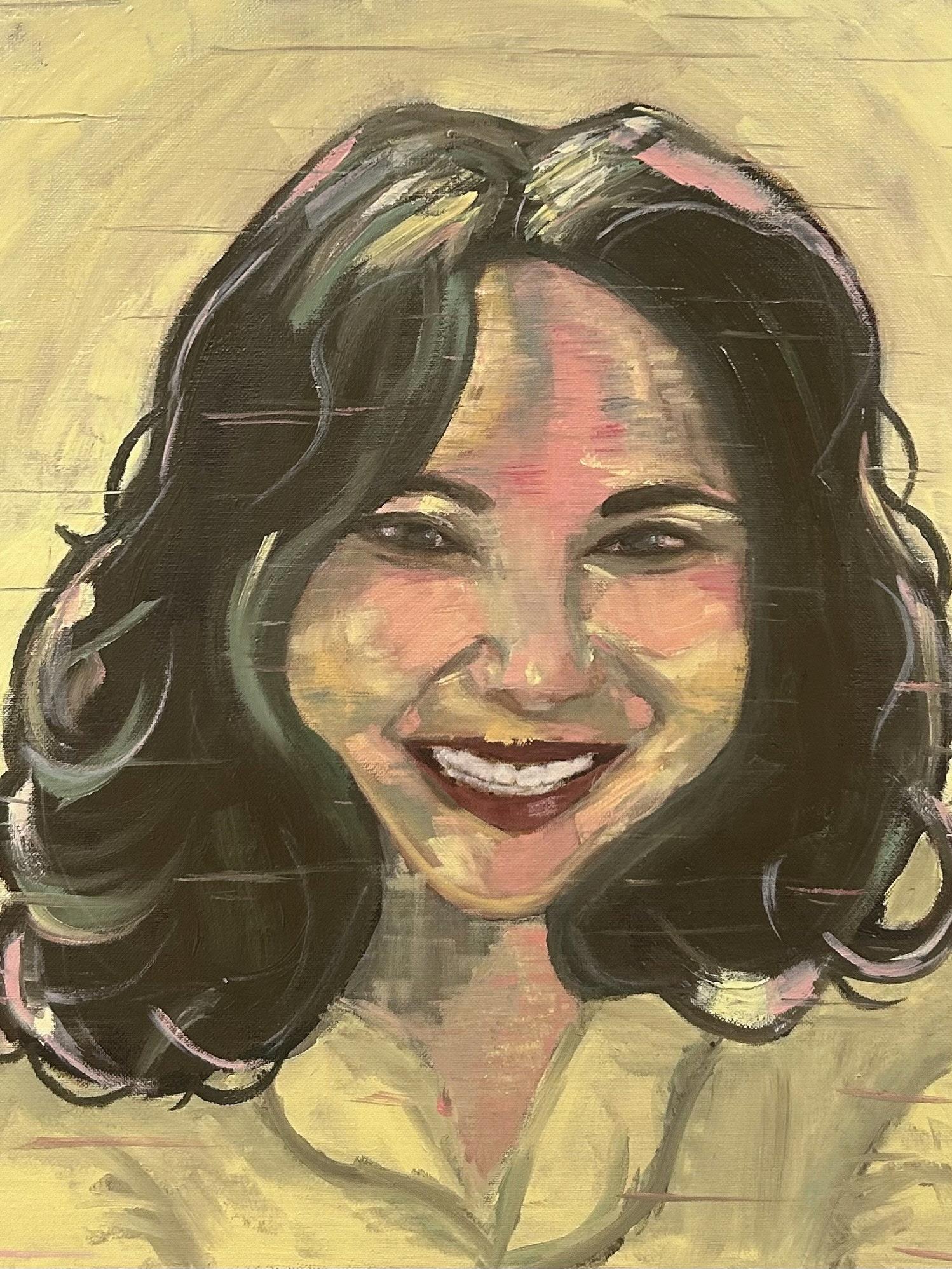
In Retrospect
Samantha Candalla
Louisa Grace Calabrese
Grief struck me like lightning. Repeatedly, but never in the same place twice, yet just enough to shatter me into pieces.
Her absence was present in every room and in every conversation. There were so many words left unsaid.
I miss her smile and her laugh and I swear I smell her perfume still stuck to her clothing that’s now mine.
In the labyrinth, I’ll go to find answers for losing her: Twists, turns, and dead ends will face me, but I’ll keep searching and wrangling
To pick up the pieces for myself but most importantly for her.
A Printer Used to be a Person
Lydia Blythe
When I say the word “printer,” what do you think of? Do you picture a machine in your work or home office, one that rolls in paper down below, rolls it out up above, reproducing your thoughts quickly, efficiently, precisely, your Roboto font robotically perfect?
Well, a printer used to be a person. A printer used to be a man working long hours to feed his family, setting type like building a puzzle, feeding it ink with a fatherly hand. A printer used to make mistakes, set the type wrong, arrange the pages out of order. He’d grumble and curse and end up laughing about particularly amusing misprints with other printers making similar mistakes.
When I say “computer,” what do you think of?
Do you picture your PC? A compact Chromebook, a set of monitors, perhaps ENIAC and its 1,800 square feet of resistors and capacitors?
A computer, too, used to be a person. A computer was someone who had numbers running through their veins, connecting with nature through the left side of their brains, allowing Man to sift moondust through his fingers, holding the fabric of the universe together with nothing but their love of precision, puzzle-solving, finding the right answer.
A computer used to be a black woman working for NASA, struggling every day to be recognized in a room of white skin.
What else will no longer be a person in my children’s or grandchildren’s lives? A secretary?
A CEO or government official? A writer, A painter, A babymaker?
What other words will future generations ascribe to machines, words that used to be living, breathing, seeing, touching, hearing, laughing, struggling . . . . . . loving?
Your Amy and Her Sal
Elizabeth Holloway
Your earliest memory was of the shaggy beige carpet with mysteriously dark circles. The one in the little cubic room with only two cheap felt blankets, a few fuzzy ball toys that you never quite liked, and two big bowls for kibble and water that you shared with the rest of the litter. You were the runt, the outcast in your litter of nine kittens. It didn’t help that your mother was a bright-orange Munchkin cat, passing down to you an already abnormal stature. Your legs were like jelly-beans balancing a bread roll body and dense bobbly head. Not a very pretty kitty, you figured. You watched the smiling faces of couples and kids fall in love with your brothers and sisters, watched your brothers and sisters find a home one by one, until all that was left was you and Mom.
Until the day you met Sal and Amy. Tears welled in Amy’s rich brown eyes at the sight of you. She smelled like warm apple cider and wore a dangly gold analog watch that was always fun to bat around. From the very first moment she sat on the floor and pulled you to her lap, you loved her. You were hers. Sal stood leaning on the door frame, his hands stuffed deep in khaki pants. He didn’t look at you. Instead you watched him watch Amy, and you knew, he was hers too.
They kept you in their room for the first couple of nights. Amy hardly left your side. At night you would curl into her neck and nuzzle your head in her velvety auburn hair. And on the other side was always Sal, breathing softly into the crown of her head.
Once you adapted to your new environment, they let you explore the rest of their little apartment. There was the small kitchen with a black and white tiled floor that was cold on your paws in the morning and a black fridge covered in magnets holding pictures, postcards, and macaroni art of Sal and Amy holding hands under a noodle sun. Next to the square table there was an opening leading into a room with a large burnt orange couch and deep green decor. You spent many evenings curled up with Amy while she read on that couch. Their bathroom was a tight little cube with a toilet, tall glass shower, sink, and your potty box squeezed in the corner. It was quaint, but that’s all the three of you needed. This was your first home, and you loved it dearly.
It didn’t take long to establish a routine. Sal would silently slip out of bed before even the birds were awake, careful not to stir Amy, and, in turn, you. You would watch, heavy-eyed, as Sal combed back his sandy blonde hair and put on a perm-pressed suit. He would give you a gentle head pat and kiss Amy softly on the temple before heading out the door. Once the sun started to spill through the flimsy white blinds, it was time to get up. You would climb to the foot of the bed and nibble on the little bumps you knew to be Amy’s toes to get her up and moving. She always made that sharp sweet giggle noise before she turned her head to you, and you crashed your head into her. Amy was a writer. She would roll out of bed, pour a cup of coffee from the pot Sal had made for her, and hover over her glossy green typewriter. Sal once brought home a shiny new “laptop” for her, saying words like “cutting-edge technology” and “much more proficient,” words you didn’t quite understand. You did understand Amy, and that she loved the meditative clacking of her typewriter, much more than the stiff clicks on the black-light up box Sal brought home.
Hours of your life were spent weaving between the legs of the wooden chair she sat on with her legs pulled tight to her body. Or sitting dutifully at her desk transfixed by her slender, meticulous fingers click clacking away. When she got stuck on an idea she would talk to you, read you passages of her work and ask your opinions. Every word she spoke mesmerized you, simply by the musical purr of her voice; you would typically meow your approval. She worked from home, mostly earning her way through freelance work while she worked on her third poetry collection and second novel, so she was all yours, everyday.
Or every weekday at least. Saturdays and Sundays you had to share with Sal, but you never minded it. You loved the days when Sal worked in the kitchen, flicked on those gentle orange lights and the record he would always say was “the best of The Beatles.” He would pour rich red liquids in a tall glass for Amy and sing to her. They would dance and laugh; you liked when he made her laugh, her unabashed cackle as he spun and dipped her. They were a sight to behold, you felt you could have stood in that door frame and watch them twirl about, looking in each other’s eyes, forever. Once they sat to eat they always flicked little drops of creamed potatoes and shrimp on the floor for you.
There was the time Amy’s mom got sick, when she curled into Sal’s arms on the couch and cried until she couldn’t breathe. He kissed her and held her and you licked away her salty tears.
She flew back home the next morning, asked Sal to stay and take care of you. And Sal was sweet to you. He gave you the tube treats you loved, he stroked your back as you laid in his lap. Those nights you would curl into his warm chest, right in Amy’s place, and rest your head on his heartbeat. You wanted to feel what she did, you missed her. And Sal held onto you like you were a part of her. She was gone for a month, caring for her mom until her very last breath. The day Amy came back, the moment she walked in she broke down, and Sal was there to catch her. He ordered Pad Thai from that trashy place down the road that Amy loved and you wove in between their legs as they watched her favorite musicals: Little Shop of Horrors, Mamma Mia, Rocky Horror Show. Despite her puffy eyes and occasional tears, she still sang along to every song. You always admired how Sal could make her smile again.
They weren’t perfect. Sal took excessive overtime and forgot to text Amy here and there. He didn’t get along with Amy’s dad, the man who worked construction all his life and called Sal a “Pansy Liberal.” Amy wished Sal could ignore her dads remarks for a dinner or two, after all Amy was all her dad had left. When she got mad sometimes she would lock the bedroom door and ignore Sal’s knocks. But she always eventually let him in, and he always went to the dinners and made up for the extra time spent at work.
There was that one time he made her really cry. It was a Friday, normally Sal’s easy days. He would come home at a decent hour and you three would bundle up and watch the newest episode of Survivor, but this time he came home in the wee hours of the night without a text or call. Amy wanted to stay up and wait for him, so of course you stayed up with her on the couch. Finally, when Sal walked in like a zombie, Amy shot up and asked him where the hell he’d been. That week he had been given a particularly hard account at work, and he was near a breaking point. He snapped. He spoke to Amy in a way you had never seen him speak before. Sensitive, sweet Sal, at that moment you wanted to hurt him, but you didn’t. You hid beneath the couch as their shouting voices reverberated against the plaster walls. You shivered as if their icy words spit in fiery tones would clash in a cataclysmic collision, splitting the world in two beneath your feet and making you fall in between the cracks of what you have always known to be. Until it all came to a close in one rattling door slam. Sal had left, and Amy fell to her knees, head in her hands, and quietly cried. You stood with your front paws on her thigh, your cheek rubbing to hers, feeling the sharp bounce of her
shoulders. And when her heavy, puffy eyes finally gave in and she fell asleep on the hardwood floor, you laid over her like a blanket until the morning.
Amy laid in bed the whole next day. While Amy was asleep, around 4am the next morning, you heard the door creak open. You ran out to find Sal in the same clothes as the day before, looking horribly decrepit, as if returning from The Long Walk. His arms were crowded with reusable bags that he set down and began unpacking. You watched quizzically as he unpacked bouquet after bouquet of dianthus, forget-me-nots, forsythia, baby’s breath, colors and petals all in full boundless bloom. You watched as he cleaned every dust follicle and hair from the apartment, replacing them with flowers and love-notes he hid in every nook and cranny. He set out a pile of new books Amy had been ogling beside a small breakfast buffet he cooked. When the sun began to bleed through the kitchen, filled with the sweet and savory smell of maple and bacon, Amy came out. Sal rushed to greet her and they both dissolved into tears and sorrys and wet kisses.
He told her he had something to show her. They ate, showered, got ready, and left the apartment together. You stood by the door until they came back, bubbly and giggling. They exchanged so many “I love you”’s and kisses before eventually closing you out of their bedroom.
Then came the boxes. Over the course of the next week Sal and Amy packed all of their belongings into cardboard boxes that were quite fun for you to play around in. Finally, after the home you had always known was stripped bare, Amy packed you in a kennel and you were off.
The new house in the suburbs was over twice the size of the apartment, with a big circle top window seat in the living room for you to watch the robins nesting in the maple tree out front. It was a kingdom of deep forest green wall paper and ornate bronze trim, and Amy was its queen. She could not have been happier. She fit into that house like a missing piece, like the house was always meant to be hers.
Five days into unpacking and the house was still a construction zone of new furniture and random, yet-to-be-organized items. Sal had taken some time off work for the move, but it had come time for him to return. Amy was spent. She was so over unpacking and told you all about it. You couldn’t offer much but a lick on the finger and a headbutt, but you liked it when she ranted to you. Eventually she talked herself into the conclusion that she needed a break, something relaxing out of the house. You were sad that you couldn’t go with her, but you wanted her to take care of
herself. You only ever wanted her to be happy. She got all dolled up in a flowy brown midi skirt and a creamy cashmere sweater, and went off to wander about the city: window shop, stroll through the park, visit the library, she told you the possibilities were endless. You sat on the beige mat in the entry way, surrounded by half-full boxes and shoes, waiting for her to come back to you. She never did. The sun set, and she hadn’t returned. Sal hadn’t come home from work. You stayed eyeing the door. The sun rose the next morning. No Amy, no Sal. Two more sunsets and rises passed. You didn’t eat. You hardly slept. You sat on that beige mat staring at that door, willing it to open.
And when it finally did, you shot up. Sal was standing in the doorway. He looked how he did the night he and Amy got in a fight; decrepit, bloodshot eyes, days old clothes. Except this time was different, something in his eyes told you he had no fight left. No flowers or grand gestures, he had no more moves to play. Something inside him was broken, gone. He fell to the ground, scooped you in his arms, and began sobbing into your fur. He soaked you in his spit and tears. You could feel his inhales and guttural moans ringing through your little body. Just Sal, no Amy.
If you lived about five minutes closer downtown, you would have heard the sirens. If the TV had been left on, you would have seen the headlines in all of the news channels, “Another tragedy today . . .” You would have seen the families crying by police tape, the flashing photos and names read in the monotone reporter voice, showing those who were shot. One of them being Amy. You would have seen the ambulances and police cars surrounding the library Amy loved to visit. You wouldn’t have known why, how could you? Not even the humans knew why these things happened. But you didn’t get to know why Amy didn’t come home, why you would never sleep in her warm apple cider hair again. You only knew, every morning when you woke up on that beige mat, the door didn’t open. She wasn’t coming back. Sal didn’t go to work, or so much as leave the bed, for days. For days there was still the faint smell of her fingers on the keys of her typewriter, and if you closed your eyes and focused you could almost hear her typing away.
You didn’t know life without Amy, she was your life. She was the gravity that tethered you to earth and you didn’t know if you could ever find the ground again without her. You spent a week wasting away on the beige mat waiting for her or curled beside her typewriter pretending she was just taking a quick bathroom break and would be back at any minute. Finally, by day nine, you went
into the bedroom. The room was thick with sweat and tears like heat in late August. Sal was sinking into the bed deeper as each day passed. You climbed beside him and the two of you locked eyes. You stayed like that, looking at each other, for what felt like twenty minutes. Then, you crawled into the hallowed cavern of his chest and curled into him. You could feel the heavy rise and fall of each of his breaths, sometimes catching. You felt the living beat of his heart and imagined it was Amy’s, letting the melodic rhythm lull you to sleep.
The next morning Sal got up, ate, showered, brushed his teeth, and called his work. You heard him say he wasn’t ready to go back yet, but he was ready to start somewhere. He said he would work from home for the time being.
Now in the mornings you and Sal wake up before the sun rises. He lets you lie on the table while he drinks his morning coffee and rereads Amy’s book. He converted the room that would have been a nursery into a home office that he spends most of his days in. Sometimes you sit on his lap while he works, sometimes you curl at his feet. Sometimes you still spend all day by Amy’s typewriter.
And at night you always curl into Sal’s chest and fall asleep to its beat. You drift off into dreams of golden brown eyes and rich auburn hair. You hear Amy’s soft voice read you the poems she wrote about love and violence. And when you wake up the next day, you do it again and again and each time it hurts a little less.
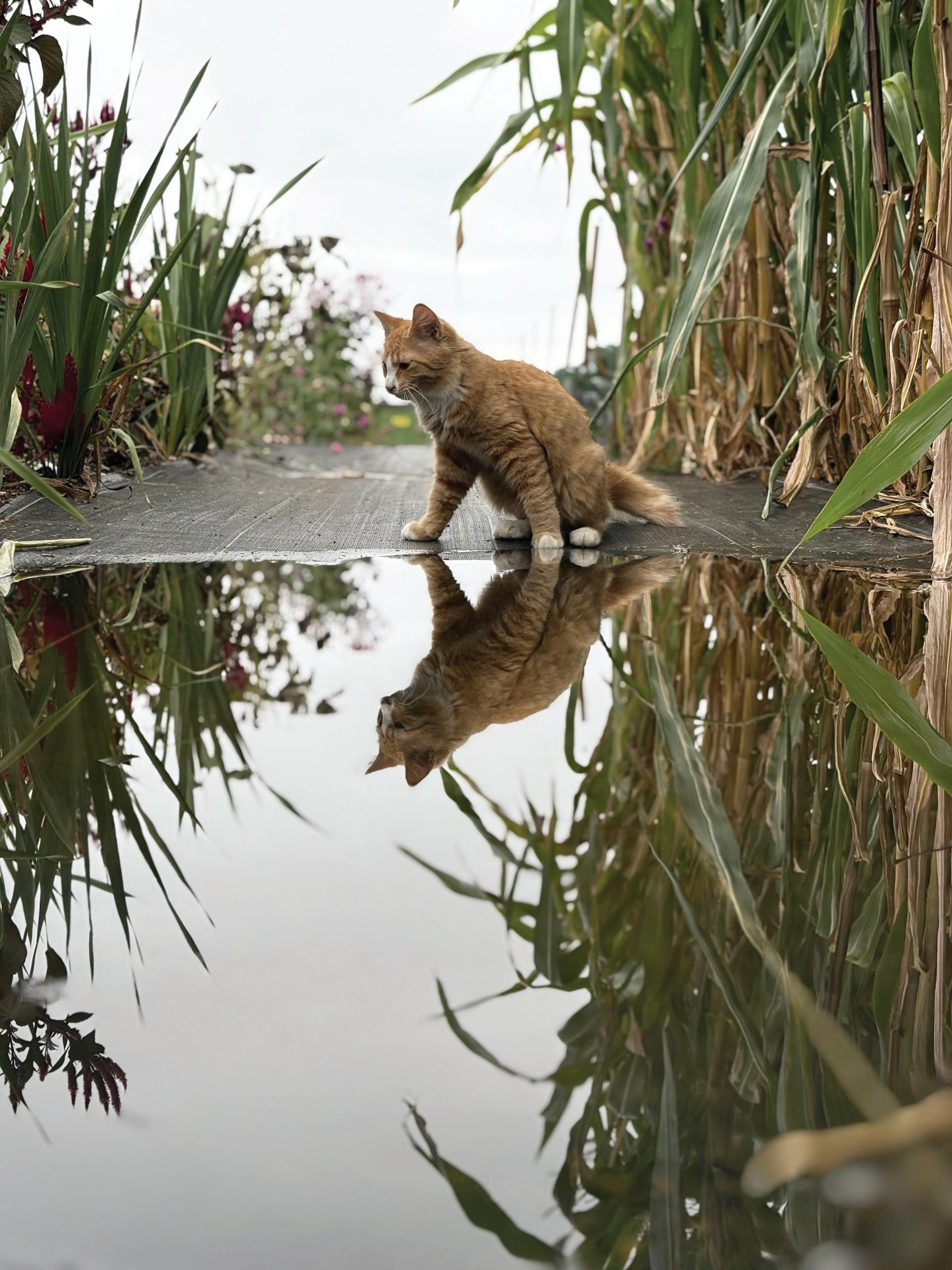
cat pose Reagan Preisz
Little Fins
Ren Blauch
The fish drifts, light as a whisper, bones wrapped in the shimmer of scales and nothing more. The others flash past in silver streaks, strong tails curving waves, mouths open, unafraid.
But this one—
This one folds its fins against its sides. Delicate, sharp as glass.
“See how little I need?” it thinks, floating just beneath the surface, where the light bends but does not break.
It has learned the art of less.
Less movement, less hunger, less weight to pull it down. The others feast in the deep, bellies full, bodies wide, but this small-finned fish stays above, proud in its hollow grace.
A current rushes through, a force too strong and too sudden.
The fish flutters, thin fins trembling at the power, too weak to fight, too light to sink, too proud to let go.
The sea does not care for smallness, it knows only how to swallow
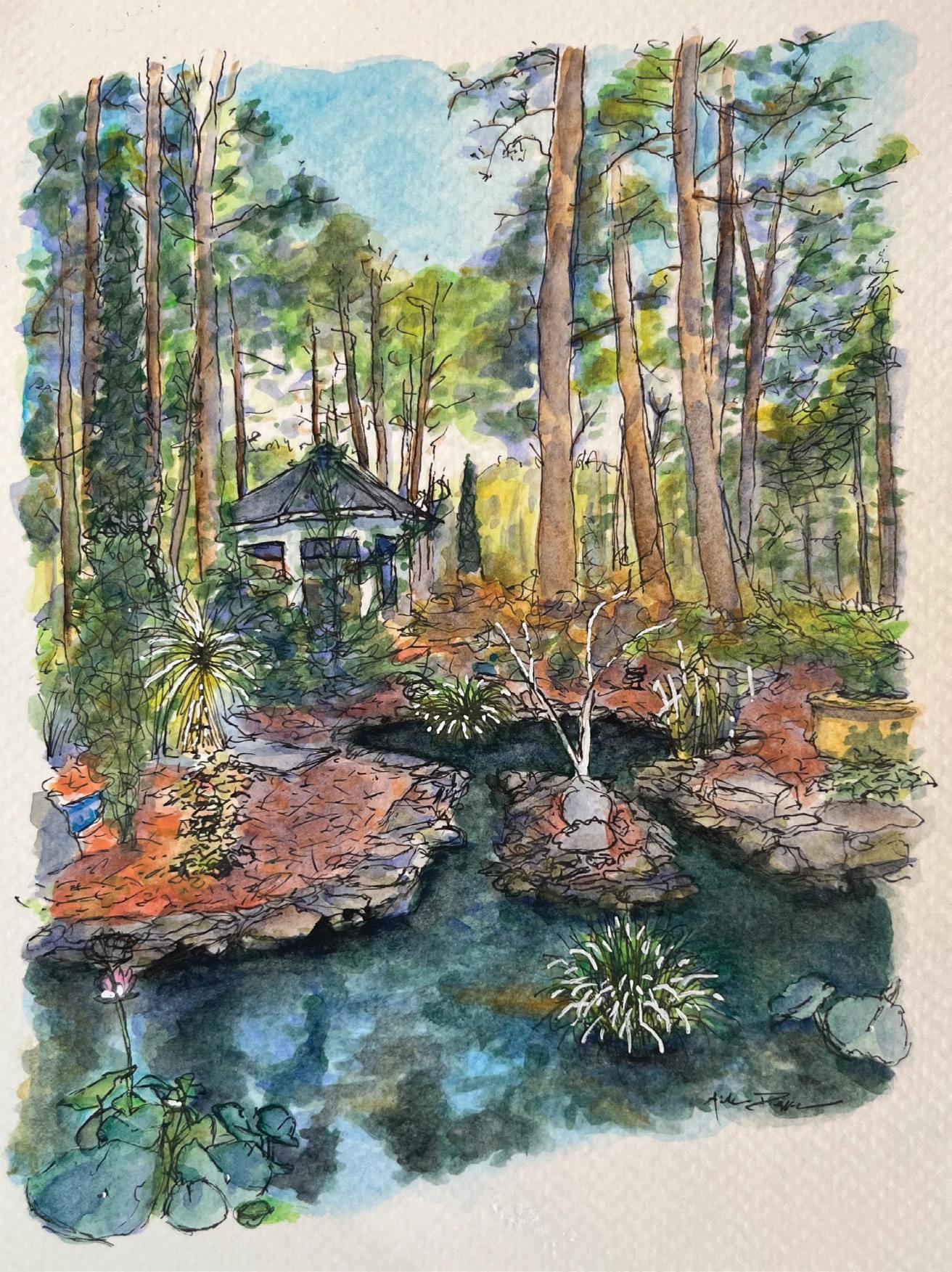
Turtle Pines Aiden Deppen
Petals
Jordon Perkins
I was first labeled a pansy at 12: an older boy was told to ad lib in our school play. Some snickered, some sneered, some were shocked. At that moment, I felt like the only person in costume. Caked in makeup, burned by spotlight, that was the first time my petals shuttered shut, shielding my stigma and stamens. That was the first time someone noticed I was a flower in a field of grass.
In the locker room, just us two, as we laced up our spikes, my captain told me I talked like a queer. The musky air hung humid in the space between us I didn’t respond, I didn’t look at him. I urged my petals to push inward, dig deeper, and hide my insides more completely. I thought, if I closed up hard enough, I could become a swaying grass. rustle rustle rustle rustle, I wished. He got fed up at my silence and left, the door squawking shut behind him.
The shaking started in my legs— horrid, Hellish convulsions that worked their way up my torso and invaded my head. All I felt was shame— engrossing, evergreen shame. I sat on the bench, closed my locker, and finished tying my shoe.
I didn’t dare make a noise, sure that any utterance would let slip my pansihood, sure that any sound would blip on someone’s radar and compel them to tell me they knew compel them to validate the monstrous, herbicidal shame that drowningly engulfed me.
✷
I stomped my spikes into the concrete floor.
✷✷✷
I savored the reverberations that shot up my shin.
✷✷
I stomped alone, relishing the echoes that rang through the room, harder and harder until the pain took over and I couldn’t bear any more. Slumped back on the bench, the shame enshrouded me again; my petals closed in on themselves, locking tight.
I zipped up my bag and hobbled to the bus.
For years, I wished to rustle. For years, I wished my sepals would shoot up and sway like grass. It was years before I would bloom again. My head saw the Sun slowly, as each petal, one at a time warily peeled open, revealing a pansy. For I was a pansy: a beautiful, freakish, purple pansy. (and I did talk like a Queer.)
My blooms wax and wane; sometimes I still wish to rustle, but now, in the field of grasses, my pansy petals see the Sun more often than darkness.
I’ve found company in a green carnation, a violet, a hyacinth— we get together every other rainy day— and with them, my petals are always vibrantly ajar.
I will grow; watch me!
I’m blooming.
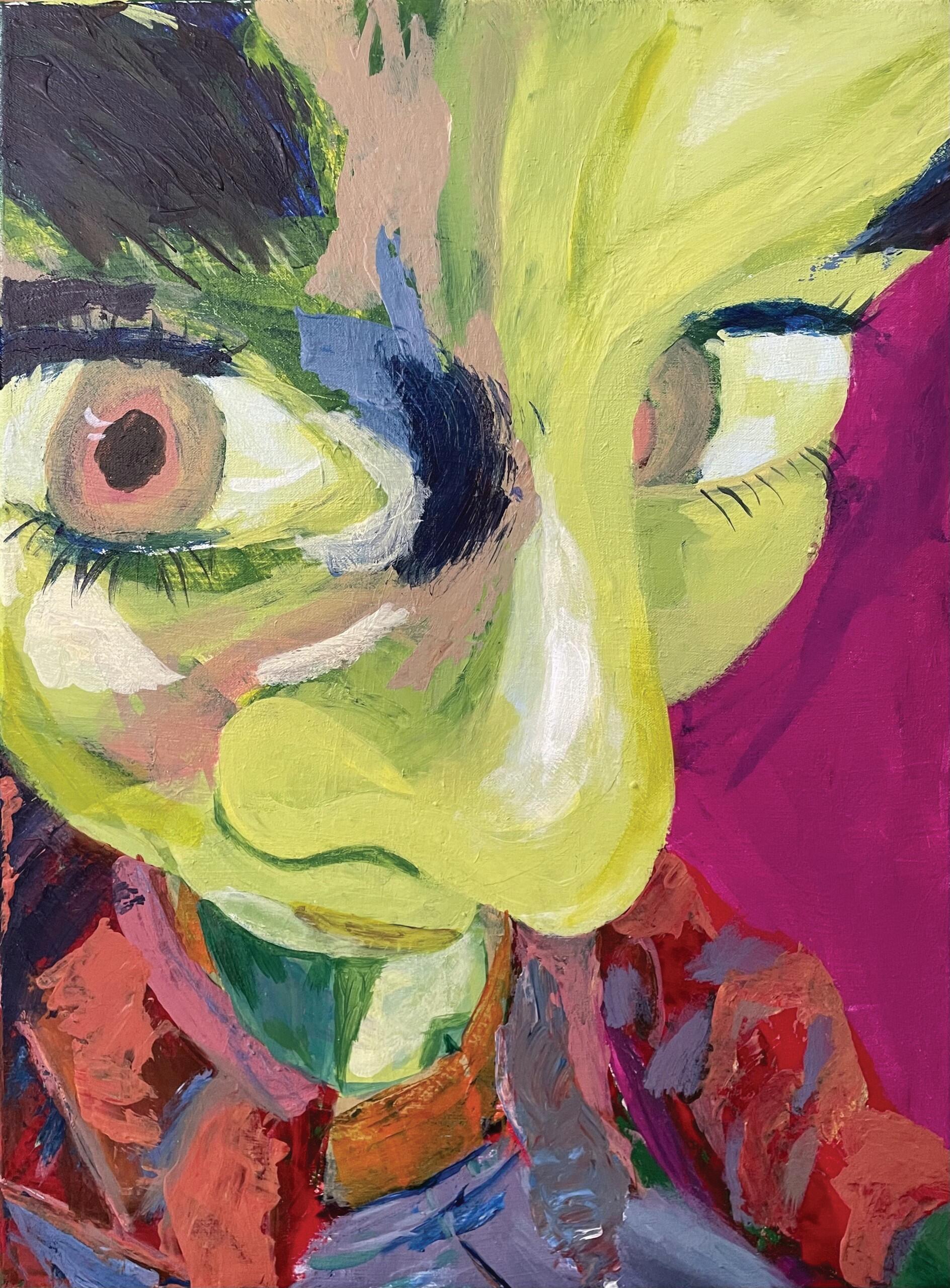
Look Me in the Eyes
Rose Grisbacher
Grace Strong
I tried to cut my thumb off when I was eight years old. I attempted roughly four different methods: by shutting it in a door, by trapping it under the mattress, by taking it to a knife, and finally by scissors. I figured, all things considered, it would be easier to escape my thumbs being taken if I took them first.
My family isn’t really German, but my mother had studied there and taught it for a number of years, and thus my thoughts were hauntingly consumed by the folktales that told of the fates of “misbehaving” children. It’s not as if I was a child particularly inclined to misbehave. I sat patiently through my siblings’ concerts, lest I be kidnapped in the night. I ate all my food at dinner, lest I never eat again. My one vice, however? Sucking my thumb.
The trouble seemed to begin when my sister, four years older and infinitely wiser, decided that I was too old to be sucking my thumb at five years old. I followed her, as I always had and always would, a blanket of knitted pink trailing behind me. We sat shoulder to shoulder on my parents’ bed with a book of folktales open between us. I couldn’t read at least not like she could so I placed all my trust in my sister. In her words. And then, a singular page turn on an otherwise ordinary May evening, resigned me to a life of shame and nightmares. She smiled at me, a vicious, unkind thing, pointing to the picture.
“That’s Scissorman, he’ll cut off your thumbs if you don’t stop sucking them.” My vision blurred as I stared down at the book. The man, his fingers spindly and sharp like eight sewing needles forged together, a pair of gigantic, piercing scissors for each hand, morphed into my greatest fear. He would appear in my nightmares for the first time that night.
I was alone in my bedroom. This in itself was strange, seeing as I shared the room with my other sister, the one who didn’t think I was an embarrassment. Nearly everything in the room had
Scissorman
faded into a bleak sort of darkness, a dunkelheit, save for my bed. I sat with my back to the wood, knees to my chest with my thumb in my mouth. I could hear my mother’s voice in my head, insisting I didn’t need the comfort of my thumb. You better cut it out. My sister’s voice echoed. He’s gonna get you. You better cut it out. Voices that were once used to soothe me to sleep now threatened me viciously.
I tried desperately to rip my thumb from my mouth, but it was immovable. I couldn’t stop. I took my other hand, tugging, tugging on my fist so hard I thought it would bruise. The room warped, and even my nightmarish, paralyzed self whimpered. He was there. In the shadows. The Scissorman. I kept tugging, tugging at my fist to no avail. Snip. Snap. Snip. Snap. I could feel each time the scissors opened in my chest, as if he was going to cut my heart strings rather than my thumbs. Snip. Snap. He was two steps away from me now, I stared down at my free thumb. I was torn off the ground and held up as if a sacrifice by the back of my pajama shirt. I could hear the seams ripping. I twisted, twisted, twisted. His spindly needles dug into my back, my chest, my arms, my thumbs. He reached a scissor hand out, opening the blades painfully slowly. Closer . . . closer . . . closer . . . until I woke with a gasping breath.
The threat of Scissorman didn’t stop at five, or even six. His presence loomed at seven, when the doctor asked why I kept getting sick. Nothing major, just a cold every other week or so. It wasn’t alarming per say, but it caused enough concern that my mother gave me a disapproving look.
“She’s probably picking up germs from sucking that thumb all the time.” My mother smiled and I flinched. “She knows that Der Struwwelpeter will find her if she doesn’t stop, though.” I had never liked how harsh my mother’s voice became when she spoke German. Somehow it sounded even harsher when she mentioned him. The doctor looked over at me, her smile kinder, not yet infected with embarrassment or exasperation.
“Well, that sounds scary!” She offered me a lollipop and winked. “We better work on that then.” I offered her a weak smile. Later, as I was washing my hands in a sink that smelled of antiseptic, I would look at myself in the mirror. I would swear that just behind the girl with the
fearful grey eyes and the flushed cheeks, something was there. I would swear that there were spindly fingers tapping on my shoulders and rotten breath brushing my cheeks. I blinked and shoved my thumb in my mouth.
This is all I can recall about my family’s attempts to end my self-soothing at eight: there was something spicy on my tongue. It wasn’t a pleasant sort of spicy, like hot wings or salsa that restaurants give you while you’re waiting for your meal. It was spicy like burning. Spicy like bile rising in the back of your throat and reaching your tongue. Whatever it was coated my thumb and stung my eyes, because for some reason it couldn’t best me.
I was unsettled, an insomniac if I couldn’t be eased by sucking my thumb, so I refused to quit. My tongue bubbled, like it was being disintegrated from the very touch of my thumb. Snip. My thumb twitched. Snap. I couldn’t shut my eyes because he would be there. He was there. Snip. I held my thumb up to the light, and for a minute I couldn’t see it. I panicked; I wiggled my fingers frantically until I could count all five. One . . . two . . . three . . . SNIP . . . four
SNAP
five
. SNIP! One . . . two . . . SNIP . . . THREE . . . SNAP . . . FOUR . . . FIVE! Over and over and over, until my voice was raw. Over and over and over until I could wiggle all my fingers and I couldn’t hear the snip of scissors. I scrubbed my thumb until my cuticle bled.
There came a point, around age ten, where I realized Der Struwwelpeter would simply follow me to the ends of the earth. He was inescapable as long as my two thumbs remained stubbornly attached to my hands. Perhaps that’s what made him so terrifying; no amount of joy subdued my nightmarish comparison. This meant that, horrifyingly, my most vivid memories of Disney World were steeped in fear, in furcht.
“If you suck your thumb here,” my father warned, “everyone is going to get sick.”
“And think you’re a baby.” My brother pitched in.
“Struwwelpeter will definitely come for you then,” my mother so helpfully added. I don’t think they really understood that I couldn’t exactly quit, though it wasn’t for lack of trying. I sat next to my oldest brother on the monorail, pressing my lips together in a tight line. My thumb
tingled. He can’t find me here, right? I’m too far away from home.
An older man rushed onto the monorail, and his hair twisted into red-brown curls that hid scissors. A teenage boy, twice as tall as myself, took the seat directly across from my brother and I, and his fingers transformed into long, pointy needles. A father was carrying a stuffed animal in each hand, but to me they appeared as oversized scissors, with blades as threatening as the jaws of a shark. I scratched at my thumb as the monorail seemed to move slower, as the car seemed to close in. Snip . . . my brother swatted at my hand . . . snap . . . I tried to crush my thumb in my palm, as if it was sand that could sift through. My mouth was dry; I started to suck my thumb. A phantom pain tore through the stubby finger, and I pictured blood dripping down my hand, pooling at my feet. I pictured the silver glint of steel as it sliced through skin, penetrating the tendons of the thumb.
When my sister got a stomach bug two days after we got home, I thought I ought to make the pictures a reality. I would rather cause pain to myself then have to face it at the hands of Der Struwwelpeter, the Scissorman. My bedroom door wasn’t heavy enough to do anything more than a little red bump, covering half a knuckle. The mattress expanded the bump to a full knuckle, bruising it a watercolor blue. There was a lock on the drawer for the grown-up knives, the ones that could have taken off a hand rather than a finger. The butter knife left a thin, horizontal, red line across the bottom of my thumb, but didn’t even draw blood.
My eyes fell on the scissors, shining in the sunlight, and I reached a grubby hand up. Snip . . . I opened them, slowly moving towards my left thumb . . . snap . . . I held them there for just a moment, enough to see him in the reflection . . . snip . . . My sister stomped into the kitchen and froze, watching me with wide eyes . . . snap! I closed my eyes and mustered every bit of force into closing the scissors. My sister screamed. I hissed. The scissors didn’t even leave a mark.
I quit sucking my thumb the day I got braces on. The orthodontist put a guard in the back of my mouth so I could barely get anything past my lips. I figured that if I had to relearn how to eat, I would get to stop imagining my thumbs as bloody stumps. That night, I stared at the planks of my bunk bed. I held both thumbs up above me and studied them carefully, noticing my left thumb was
slightly shorter than the right. I shut my eyes. Snip. I could feel the metal in the back of my mouth, and I prodded at it with my thumb. Immovable. Snap. I felt overheated, burning from the inside out.
I tossed my comforter on the floor and crawled to the bookshelf, my hands trembling as I pulled at the spines of each book. One dropped to the floor with the pull of my thumb, and it fell open to a page I knew all too well. And there, on an otherwise ordinary May evening, I ripped out the page that had haunted my childhood. I placed both my thumbs, side to side, on the carpet. In the corner, next to a crumpled page of a storybook, Der Struwwelpeter crumbled to staub, dust.
in explanation of the bitemarks on my wrist
Phoebe Bidelspach
a fox in a trap will chew its leg off on instinct, it knows no good option ≠ no option. there is always a choice there is always a choice there has never been a good choice there will always be a choice. this is how the ardent fall: on their swords with a bloody prayer on their lips. take away our options, and we will make our own.
the fox in the trap will chew her own leg off; she shouldn’t have to.
You try to lighten up Aiden Deppen
but never kick it.
They all have a Nerf gun fight you’re so afraid of getting hit, then remember what’s to come tonight; they all have a Nerf gun fight as you sneak off inside, then remember what’s to come tonight. Each moment you subdivide as you sneak off. Inside, the mom asks if you’re okay; each moment you subdivide to decide to stay for his birthday.
The mom asks if you’re okay a silent nod and wander off to decide to stay for his birthday. It seems to be some form of a trade-off; a silent nod and wonder off in your mind. The light is always on it seems to be some form of a trade. Off in the tent, you try to force a yawn
in your mind; the light is always on for hours, the quiet still remains polluted. In the tent, you try to force a yawn as they now all lay still and muted.
Four hours the quiet-still remains polluted. You lie there, the last in this night hour, as they now all lay still & muted and regain (and drain) your willpower.
You lie: they’re the last in this night. Our so-called friends are up and primed and regain & drain your willpower. We’re up against the red team; well-timed so called friends are up & primed and in action, restless for a brawl. We’re up against the (red) team well, timed as you always run, too. The bawl & inaction; rest less for a brawl. You’re so afraid of getting hit as you always run to the ball, but never kick it.
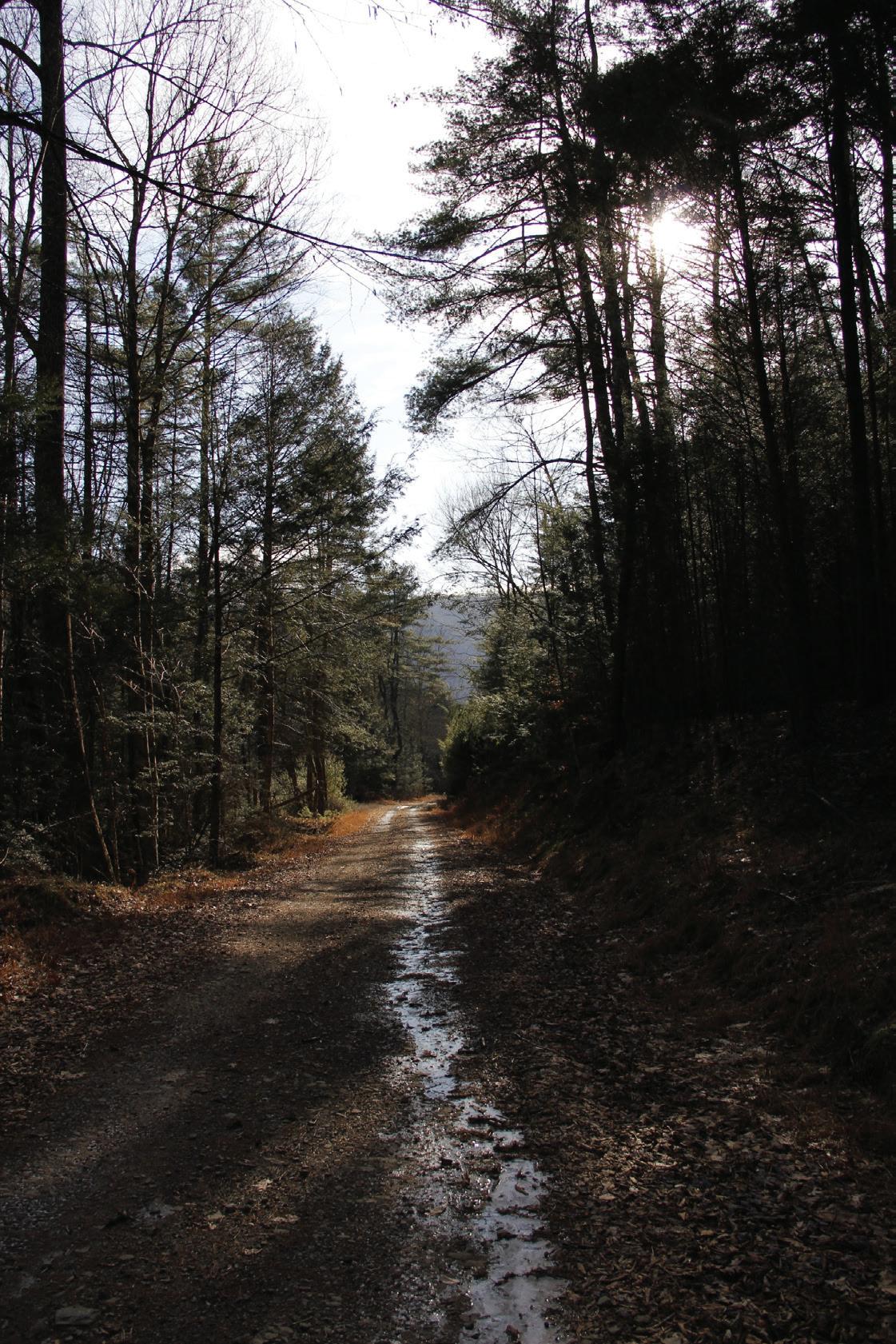
Lost Ashley Duchnowski
A Dictionary of Cross-Country Terms
Charlee Kurtz
cross-country [kraws-kuhn-tree] noun. 1 A sport that requires racing over fields, through woods, grass, dirt, hills, etc., rather than on a road or path. 2 It’s the sport I know not like the back of my hand, but like the soles of my feet. Inquisitive spectators mutter, “Why would anyone do such a thing?” Kneeling to secure my spikes, pulling the laces until they are as tight as the anticipation building in my chest, I realize I do not know the answer. I do not know why someone would voluntarily race through grass fields and mud-laden hills, fighting both the heat of a September sky and the time of a ticking clock. I do not know why someone would exhaust their lungs until failure to see how quickly their limbs can carry them for 6 kilometers. All I know is that I will stand behind the starting line in twenty minutes, side-by-side with my teammates and competitors, listening to the shaky breaths of athletes waiting to test their limits. It is my sixth year devoting my ambition to this sport, but every time I wait for the sharp bang of the starter’s pistol, I still search for meaning. Struggling to steady the drumming of my beating heart, I long to define the answer to the question: why do I do this?
endurance [en-door-uhns] noun. 1 The ability or strength to continue or last, especially despite fatigue, stress, or other adverse conditions; stamina. 2 Behind the starting line, I stand next to over two hundred women with one trait in common: the ability to continue despite hardships. What an honor, to be amidst a crowd so powerful. We lean forward with our knees slightly bent, waiting in anticipation for the gun. Silence pierces the air, louder than the blades of a helicopter. For once, it becomes clear that only the present moment exists. “Ladies, on your mark, get set . . .” Bang! Suddenly, there is a commotion. Like water rushing from a broken dam, our spikes leave the line, pounding into the grass, digging into the dirt, as fiercely as the claws of an animal. There is cheering. Like the cries of fans who just witnessed a touchdown, our families, friends, and coaches chant words of encouragement. And, of course, there is fatigue. As one forceful stride follows the other, I remind myself to control my breathing. Easing my thoughts, I reminisce about the training that
led to this moment: the 7 a.m. practices, the long grueling miles, the hill sprints on a hot afternoon. I am capable of hard things. “Nice work! Go get purple,” my coach yells from the sidelines. Concentrating on the purple jersey in front of me, I let my body do the work. A runner knows that the mind quits before the body; the body can overcome greater feats than we allow.
kick [kik] noun. 1 A sudden burst of speed at the end of a race. 2 There it is, that sensational feeling when the finishing stretch is in sight, and the mind tells the body it is capable of one final surge, one last burst of effort, in desperation to cross that line. My coach, clutching his stopwatch, yells, “Kick!” A hunger for victory, for improvement, fuels each depleted muscle, and suddenly each stride becomes longer, and each facial expression becomes more strained. Squinting against beads of sweat and blinding rays of sunlight, my tired arms swing as if I am tugging on a rope to reel in my reaching footsteps. Legs aching from tackling the uneven ground of the last hill, I cling to the fact that I am almost there. A cowbell jangles; there are only two hundred meters left. I think of my teammates. As much as this final moment hurts, each second counts. I run for them.
team [teem] noun. 1 A number of persons forming one of the sides in a game or contest. 2 Once the line has been crossed, and relief has flooded my veins, I pace back and forth several times with my hands on my hips, fighting to catch my breath. I circle back to the finish line to find the people who make every moment worthwhile. We clasp sweaty palms, share joyous grins, and fold into each other’s outstretched arms. No matter the times, no matter the rankings, we are proud of one another. Where there once was fear, there is now laughter. I fill a plastic cup with water and hand it to Abby. “I couldn’t have done this without you. I admire your strength,” I tell her. Collecting ourselves, we walk back to our team tent, where we can watch a portion of the next race, the men’s 8k.
willing [wil-ing] adjective. 1 Ready, eager, or prepared to put in effort or endure difficulty. 2
From the sidelines where I am watching, I see the front pack of runners. They sweep the course like horses galloping around a track. Their powerful strides strike the ground like hooves on dirt. As the last runners pass, the dust settles, and I see him. He is wearing dark sunglasses. He clutches
the end of a rope. His guide, wearing an orange vest as fluorescent as a traffic cone, holds the other end, muttering words of encouragement and direction. Together, they take one graceful stride at a time. It occurs to me that, perhaps, this young man was once asked, “Why would you ever do such a thing?” Why would someone expose themselves to the elements of a cross-country course, if they cannot see? I imagine this young man has faced many setbacks in his life. I imagine many people have looked at him and seen weaker potential. Yet, this boy has goals and ambitions for himself that are undefined by the expectations of others. He is here, defying limits. Perhaps he knows exactly why he is here. Perhaps he is here for the same reason I am. Why do we do it? Maybe it is for the adrenaline rush: the crack of the gun, the screaming of the crowd, the gift of living in the present moment. Maybe it is for the love of our teammates: the type of bond that only forms through shared struggles and successes. But maybe it is for every moment we have convinced ourselves we are not enough. Racing tests the mind as much as the body. With consistency, and with determination, racing shows us that we can accomplish more than we ever thought was possible. We may tremble on the line, nervous to test our limits, but to define the motivation of a cross-country runner is simple. We have something to prove to ourselves. We are not strangers to pain. And despite the tribulations we may face, we are willing.
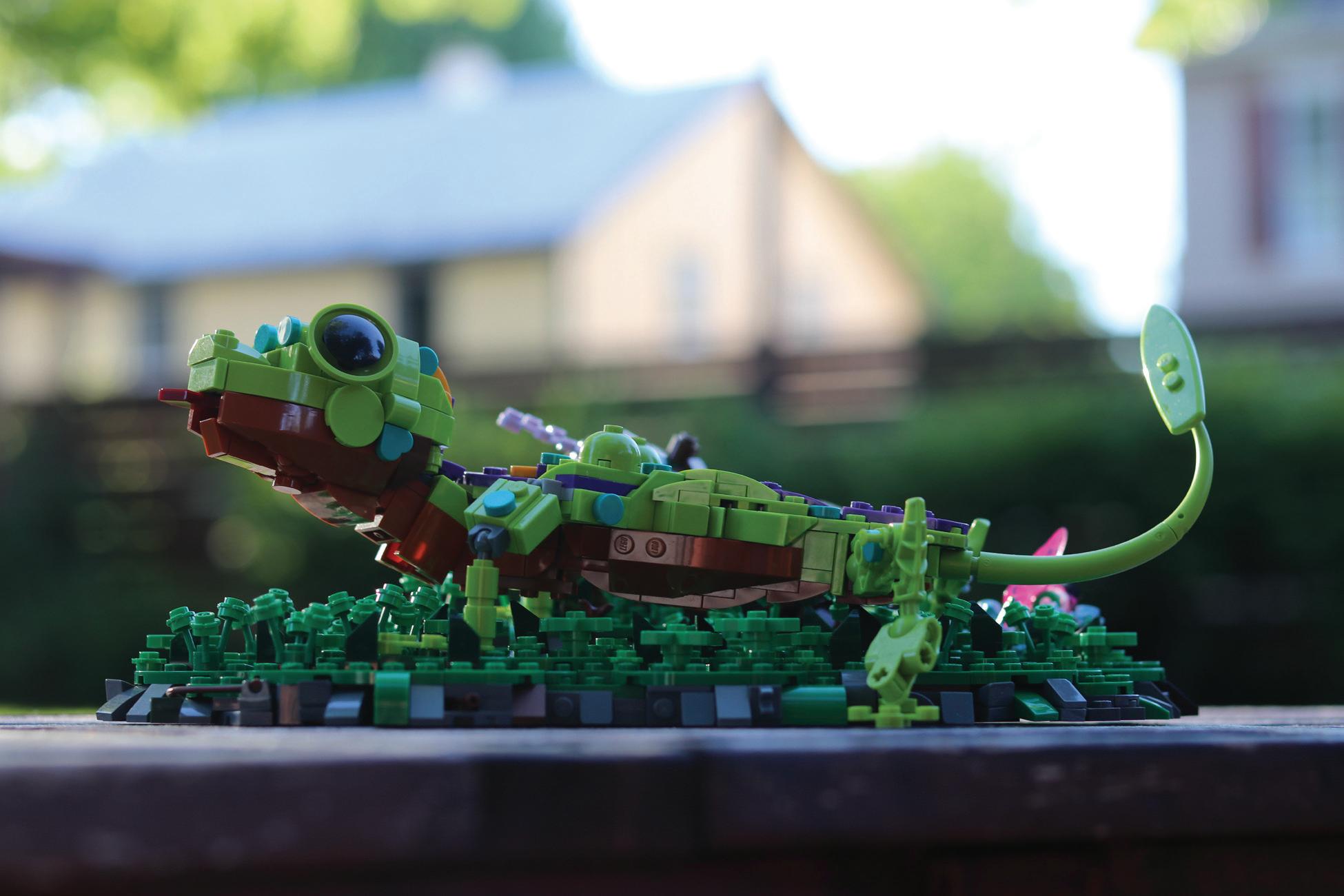
Greebled Gecko Aiden Deppen
Corinna Bevier
On the internet, I scroll through the rows and columns of wrinkled doll-sized dresses, shoes, tennis rackets, birthday crowns, raincoats, and ribbons that they have rounded up and priced just for people like me,
so that we, after a long day, will be reminded of paper catalogs that used to come folded in the mail, and the lonely doll with the braids and blinkable eyes that we shoved to the bottom of a dusty cardboard box.
And even though thirty dollars is a lot to pay just to feed nostalgia, we’ll send it to a perfect stranger across the country, who will box it up and send it in the mail, and all the while we’ll think about the heavy smell of glue, our sticky fingers on the tablecloth, and the paper dolls our mothers cut-up for us, out of catalogs and cereal boxes, that didn’t cost an extra penny.
Elizabeth Main
Beneath the dirt the worms will congregate
Planning how they’ll overtake me
My flesh falling away
Revealing pale bone
What will I be?
Dirt?
Rotten flesh, slowly being torn apart?
Or just Stray meaningless matter, within a universe that does not care about its inhabitants.
No, I decidedly will not be those things.
I will be peaceful
I will be a provider in death
I will care for the earth and beings around me. I will be nutrients.
I will be Food.
I will be the earth and all of its creatures
And I will continue the cycle.
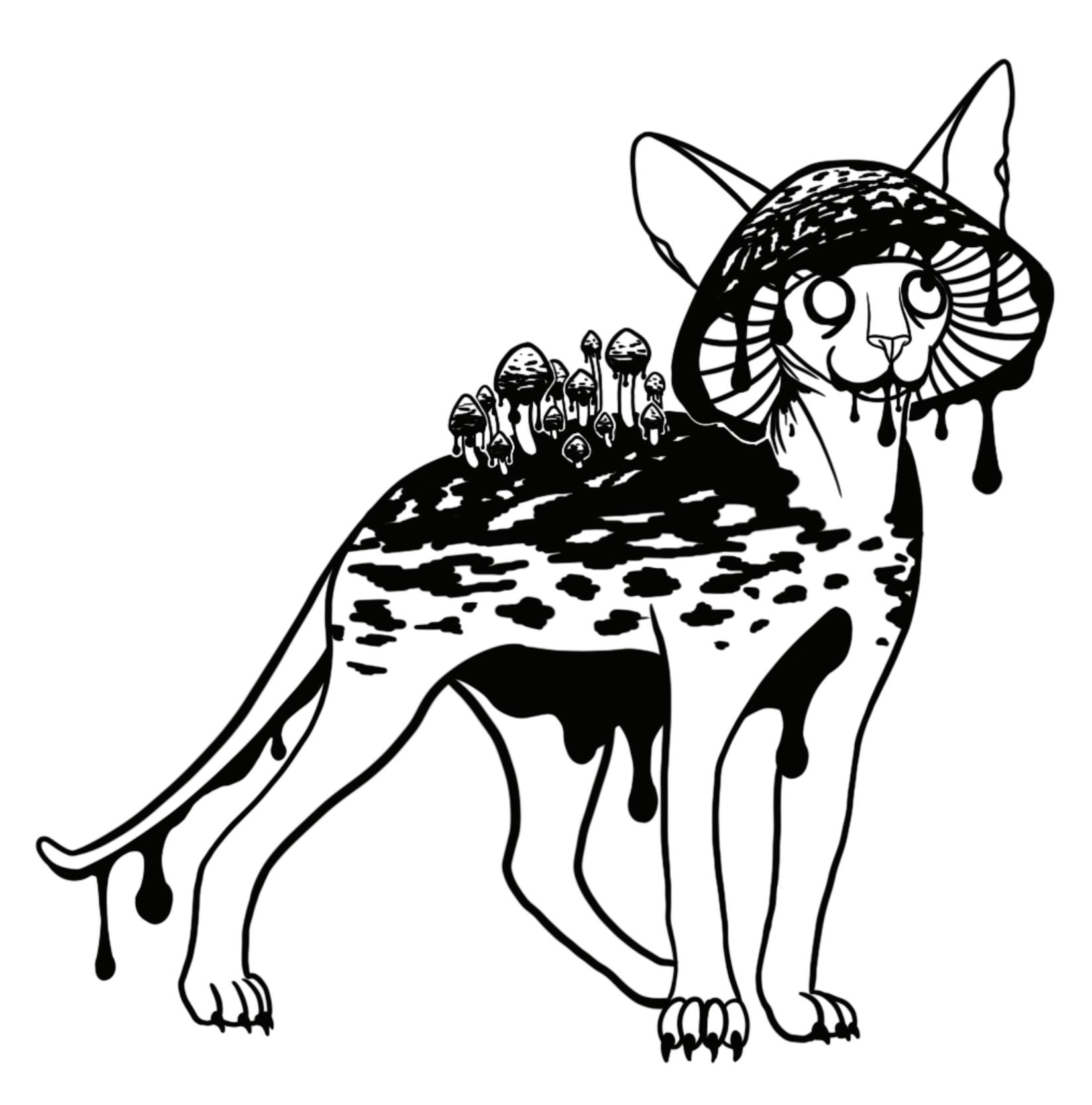
Inky Cat Emily Graney
Arrival of the Spectral Reaper
Colbey Brown
There was a damp chill in the air as the hooded hunter followed the path up to the mansion. It was an old house, built in the days when keeping human beings as property was considered a sign of class. Ornate railings styled like thorny branches ran alongside prison-like balconies. The front door hid behind tall pillars of solid marble, standing tall and defiant like they guarded the gates of hell. It was elegant, in its own snobbish way.
Leading the way to the house was a rose garden. Wild vines and thorny briars twisted around neat hedge squares. Roses the color of ice reached towards the pale moonlight, bright beacons in the dark blue of the night. Paths of cobbled stone led up to a fountain long dried up, but now decorated with roses in colors of ebony and snow. It matched, almost too well, with the dark night sky above.
And yet, despite the clean white siding, despite the neatly trimmed hedges, despite the blooming roses and the clean, uncracked paths, nothing could distract from the chill. The sense of uneasiness that laid over the mansion like a blanket of fog. The feeling of peering eyes watching you from the bushes.
The startle of curtains in dark rooms, behind locked windows.
The hunter was not a stranger to this house. When she was young, too young to remember much but feelings, she’d visited this manor. She’d admired the unnatural roses, strolled alongside the hedges that led her everywhere and nowhere. She remembered thinking that the mansion was like a statue: beautiful at a distance, but slightly uncanny when looked at up close. As a child, she’d ignored this feeling, cowering, hiding her face until she ran from its leering gaze.
But she wasn’t a child anymore.
Now, a few years older but many decades wiser, she had a better understanding of these feelings her young mind couldn’t voice. The hunter knew that this mansion this cursed, quiet, haunted mansion was more than it seemed. She supposed she had always known that there was a reason for the shivers it produced, even if she couldn’t put it into words. It had been proven to her again and again, the terrors it housed, the scares it produced.
She knew, deep down in her soul, more than anyone would ever know. But, if her hunt was successful, after tonight, no one would have to know the lengths she did.
A rustle of branches caught her eye. She paused, hand reaching for her weapons. The knife at her side, adept for scaring off unwanted naysayers, the hatchet on her back for everything else. She stood still, waiting for action, for something to appear.
The bushes parted.
She clutched her knife harder.
And out stumbled a man, or the shell of one, really. Thin and gaunt with big eyes that had seen too much. A small hound, a perfect match to his human, shivered at his feet.
She sighed heavily and released the blade. The hunter knew this man, and had encountered him briefly on her original trips here. He looked virtually the same, only paler, thinner, and more terrified. Still, it was only the caretaker. Nothing to be concerned over.
“Yo . . . you sh-shouldn’t be here,” the caretaker stuttered, fumbling for a match to light his lantern. His voice shook terribly, like the fear had gotten down and sunken into his bones. “T . . . the ghosts . . . t-they’re in a bad way tonight.”
Are they? she thought, eyeing the still, silent mansion.
The caretaker finally lit the match, shaking it down to an ember as he tucked it into his light. “B-beware! Leave now, or be forever doo . . .”
He cut out as the lantern illuminated her face.
She knew it couldn’t be helped, the look of shock and horror spread across his face. Still, it moved her in a way she hadn’t expected. She knew she didn’t look well. Weeks of running and fighting and clawing her way back to life had changed her in ways she still didn’t fully understand. Her face was somber now, stuck in a state of blank indifference. Eyes that once sparkled were dull with resignation. A soul once full of hope now dark with anger.
The caretaker didn’t need to know this, didn’t have to, because he knew who she was. Quite an impressive feat, really. She’d been here for days, walking alongside many people she’d once considered friends or family, and yet none had recognized her.
She didn’t know whether to be thankful or saddened for that.
“M-Miss Evangelo—”
“Don’t.” Her eyes stung bitterly. “That was my father’s name, not mine.”
“Bu-but miss,” he went to speak again, paused, then finally sputtered out. “Y-You’re s-ssupposed to b-be dead!”
“Dead as a doornail,” she panned, a morbid smile splitting her face.
The caretaker and his dog shared a look of terror between them, this new horror standing before them after half a century. The mongrel whimpered and tucked himself behind his owners’ legs, his body so thin that he was completely hidden by the baggy pants. Lost for words, the caretaker just stood and trembled. She waited patiently for him to gather his courage.
“I . . . I imagine you’re here for them.”
She nodded curtly.
“T-they won’t t-take it w-well, you know.”
Her head tilted as she appraised him. It was odd, hearing him speak. He’d never spoken to her before, not once. She’d never learned his true name, had only heard him be dubbed “the Caretaker.” She thought about this, this silent figure finally given a voice.
“I . . . I . . . I suppose nothing I say will stop you.”
He seemed . . . different than she remembered. Still afraid, deathly afraid, but understanding. Like he knew, after years and years of spreading ghoulish delights, that perhaps the spirits deserved a fright of their own.
Perhaps she was not the only one to change over these past years.
She reached into her pocket, hidden just past her knife. The caretaker and his dog flinched and recoiled, tripping over themselves to put distance between them. The hunter put up a hand, indicating that she meant no harm. Slowly, she pulled the turkey-leg, half-eaten and covered in various juices, out from its hiding place. In slow, carefully timed movements, she knelt and placed it in front of the dog. She wasn’t naturally cruel, had never been, and this poor, pitiful creature deserved some meat on his bones.
He sniffed at it tenderly, hesitated, then seized a tiny bit of fat hanging off the bone. He chewed it slowly, savoring it. Or perhaps it hurt him to eat after so long.
The caretaker watched in amazement as his dog ceased shaking the more he consumed. By the look on his face, he had expected far worse to come to him and his companion from this
encounter. He let out a sigh, his shoulders lowering as he recognized that he would not be harmed today. As the dog finished his meal, the caretaker looked at the girl with silent wonder, and perhaps a little bit of pity.
She frowned, turning away from him and his dog. “I have no problem with you or him. Leave now, don’t come back until morning.” The caretaker began to protest, but a flick of her wrist and the shine of moonlight on steel silenced him. “If anyone asks, you never saw me.”
The hunter looked over her shoulder, daring him with her eyes to contradict him. The man shivered, looking from the knife to her. His lips parted, and for a moment, it almost seemed like he was going to say something. Something about her past, something about what she was going to do. But, his courage faded, having been used up long ago, and he motioned for his dog to follow him.
His last words were a mere whisper, almost too quiet for the hunter to decipher. “Thank you.”
She closed her eyes, took a deep breath, and squared her shoulders. She steeled her resolve, focusing on the mansion once again, tucking the knife away and closing the distance between her and the mansion. The hunter strode up the stairs, leaving the caretaker scurrying for the exit, his poor dog trailing lopsidedly behind him. She paused when she was under the shadows of the porch, and she waited until she heard the resounding clang of gates closing. She unsheathed her axe, feeling its weight in her hands, and knocked on the door.
A pale-faced butler, almost a twin to the caretaker, answered. “Yes? Can I help you?”
And she swung her axe towards his head.
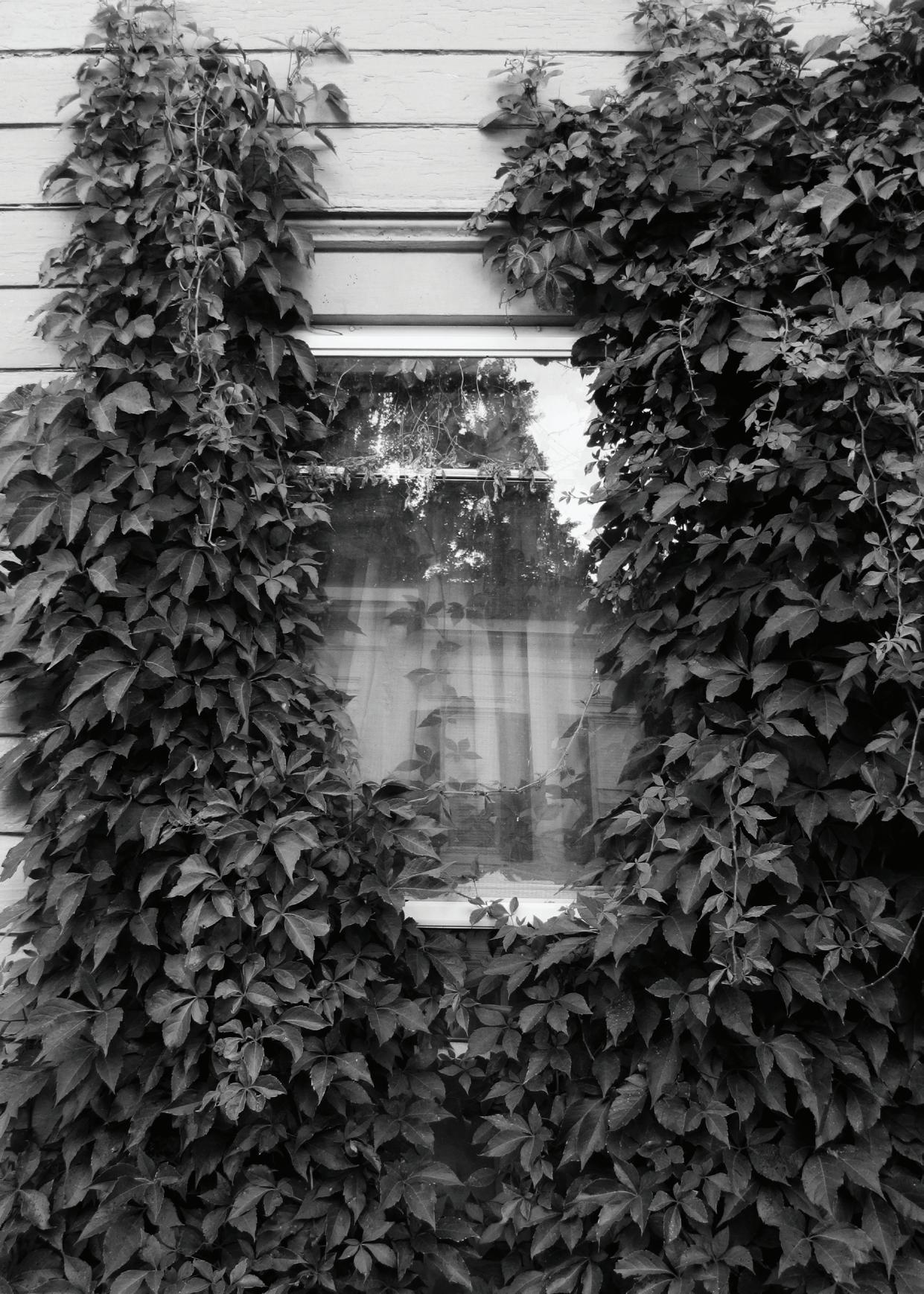
Invasion
Phoebe Bidelspach
Heartbeat
Jadyn Cerna
Let me listen to your heartbeat
Hold me in your arms like a mother holds her child
Press my ear to your chest
To that steady thump thump thump
Which drowns out the buzzing thoughts in a pumping river of blood
Please keep me here when my own heart beats so fast it stops or is squeezed until it bursts within my chest or its pieces are smashed into dust
Those moments where I forget how to breathe and ice has filled my veins instead, embalming me
Remind me of what warmth and fresh air is like
One day, I promise you, I will remember how to be alive to feel for my own pulse in scarred blue wrists and know my heart will always be there thump thump thump
Thumping
Even when I thought it was long gone
But in the meantime, as I lay here exhausted and worn cold and suffocated feeling like I’m already dead Let me listen to your heartbeat
Hole in the Sidewalk
Kaela Li Kellogg
There is a hole in the middle of the sidewalk. No one knows where it came from. It was not in the sidewalk yesterday.
A few people stand and stare at it. Most walk around it. Their heads are glued to their phones, their eyes fixed on empty space, their hands in their pockets or wrapped around bags; they skirt around the edge of it and pretend it doesn’t exist.
But the hole is getting larger, and it is not going away, so eventually the city sends someone to scope it out. They feel around its edges (jagged) and they reach their hands inside (nothing) and they throw down a stone to see how deep it goes (bottomless).
Okay, says the city, and they cordon it off. Maybe if we push and shove at the edge of it, we can at least move it into a building and out of sight. So they haul and push and heave at the hole, but nothing happens. If anything, it grows larger.
Okay, says the city. No problem. We’ll just build a bridge on top of it. So they send construction workers who build scaffolding around the hole. But the planking they lay down rots and the metal snaps; the bridge collapses. One of the construction workers slips and falls, down, down, down, into the hole. Bye bye, construction worker.
Well, that’s unfortunate, says the city. Okay. I guess we’ll just have to fix it.
So they gather all the experts in the world, and tell them about the hole in the sidewalk. And all the experts in the world puzzle and research and scratch their heads. They note its size, and its color, and the events before its arrival. They scribble notes furiously on their clipboards and compare notes and ideas. Finally, they each offer an explanation to the city, each more outlandish than the last.
It is the Chinese digging a hole through the center of the earth! says one.
It is gravity collapsing in on itself! says another.
It is the Dark Mother of the earth coming to swallow us all! says the third.
But the experts have no solutions, and therefore are of no use, so the city sends them away.
At last, when all hope has been lost, the son of a council member a little boy of eight or nine pulls his father aside and says, I think the hole is hungry. I think it has been lonely and sad and hungry this whole time. The hole got smaller when it ate the construction worker. I think if we feed it, it will go away.
Aha! cries the city, having overheard. That’s it.
So the entire city works together to find all the food they can. Pastries, breads, meat dishes, and vegetables; carton loads of Cheez-Its and mounds of Babybel; fresh apple turnovers and steaks done medium rare. And they gather these mounds of food up by the truckful, and tip them slowly into the hole. The food vanishes into the depths the hole, but the hole does not go away.
We need more! cries the city. Books! Knowledge! So the city gathers their libraries on their backs. Children fill CD cartons with Anne Lamott poems; college students trek in with tomes of traumatic Tolstoy; bibles, self-help books, trope-filled romances, and textbooks as dry as the Sahara bundled up with twine; even the neighboring farmers hunt down all the manuals in their houses and bring them in on wheelbarrows. They form great lines of people from every direction around the hole, tipping their precious books into it. And the hole swallows the books up too, but the hole does not go away.
Light! cries the city, desperate now. Light to fill the darkness of the hole! So the people of the city put their exhaustion aside and gather together their lamps, their lightbulbs, and their flashlights. They carry flames on impromptu torches, hoist power generators onto their shoulders and find glow in the dark chemicals, they bring special black light equipment and everyday reading lights. And when they all come together at the center of the city, the light is so bright that astronauts might have seen it from space. Every person’s face is lit up, and there are no shadows in the entire
street, except for the one in the hole. And slowly, solemnly, one by one, they drop their light into the hole and peer over the edge to see if it has made any difference. At last there is only one light left, in the hand of a little girl. She stands at the edge of the hole, and drops in a nightlight in the shape of Vincent Van Gogh’s Starry Night; the nightlight flickers as it falls, and then vanishes. The hole takes the nightlight, but it does not go away.
Enough, cries the city in defeat. We have done all we are able. Leave the hole to itself. Indeed, let the hole take care of itself.
And they all leave until there is only one little boy left. It is the same little boy who had said the hole seemed sad. He knew that because he has the same kind of hole hidden in his chest, right below his collarbone. He sits down at the edge of the hole, and wonders what he should do. For lack of anything better, he talks to it.
He talks about his favorite colors and animals and tv shows. About his teachers and parents and classmates. About how he loves cereal, and he hasn’t eaten any since yesterday, and he won’t be able to eat any tomorrow . . . but that’s okay, he adds quickly, he doesn’t blame the hole for it! He pats the ground reassuringly.
“If you eat me,” he asks at last, “will you be full?”
The hole does not reply.
“I don’t think you will. How can I feed you when I’m hollow?”
The question is too heavy for a boy his age. The words trip and fall out of his mouth, plop a few times on the pavement, and fall heavily into the hole.
More silence.
“You make everyone afraid.”
The hole seems bigger than ever.
“It’s okay,” says the boy. “I understand. I’ll stay with you.”
And he does.
For the rest of the night, he fills the hole with words, and some of them may have been the wrong ones, and some of them may have been the right ones. But the hole stays with him and listens anyway.
At the end, the boy cries. Big, fat, heavy tears. They fall onto the concrete and sink into the stone, until it looks like it has been raining in just that one spot.
Three weeks later, the hole is gone. The city cannot believe it. They don’t know what to think. They run their hands back and forth of over the gray, spit-stained concrete, searching for a seam or trace. They tap the sidewalk with mallets and put their heads to the ground to see if it is hollow. But if it is there, they cannot find it. (And perhaps they are not looking so very hard: no one wants a hole.)
The city goes back to its regular life. Slowly they replace the things they had given up. First the food, and then the lights, and then finally the books, because that is the order in which you need them to live.
Occasionally someone will skirt around where the hole used to be, and every now and then a child will stop and point, but most of the time not.
And every now and then, an elderly person with an especially sensitive soul and the wisdom of experience will draw their cardigan closer and shiver, but most of the time not.
And every now and then, a truly bright, brave person will cross over it, look back, and think, there used to be a hole there.
But most of the time not.
No. It is the starkly, viscerally discerning people the ones who speak too little or too much and make a habit of watching others, the ones who sniff out hurricanes before they arrive and walk
the other way from frightening strangers on the subway, the ones who tremble and clench their hands to hide their trembling, or smile and bite their lips to hide their smiling who will look at it and think, the hole is still there. It’s sitting right there underneath the concrete. One day it will come back.
Everybody has a hole.
But for now, for now. The city enjoys its sidewalk.
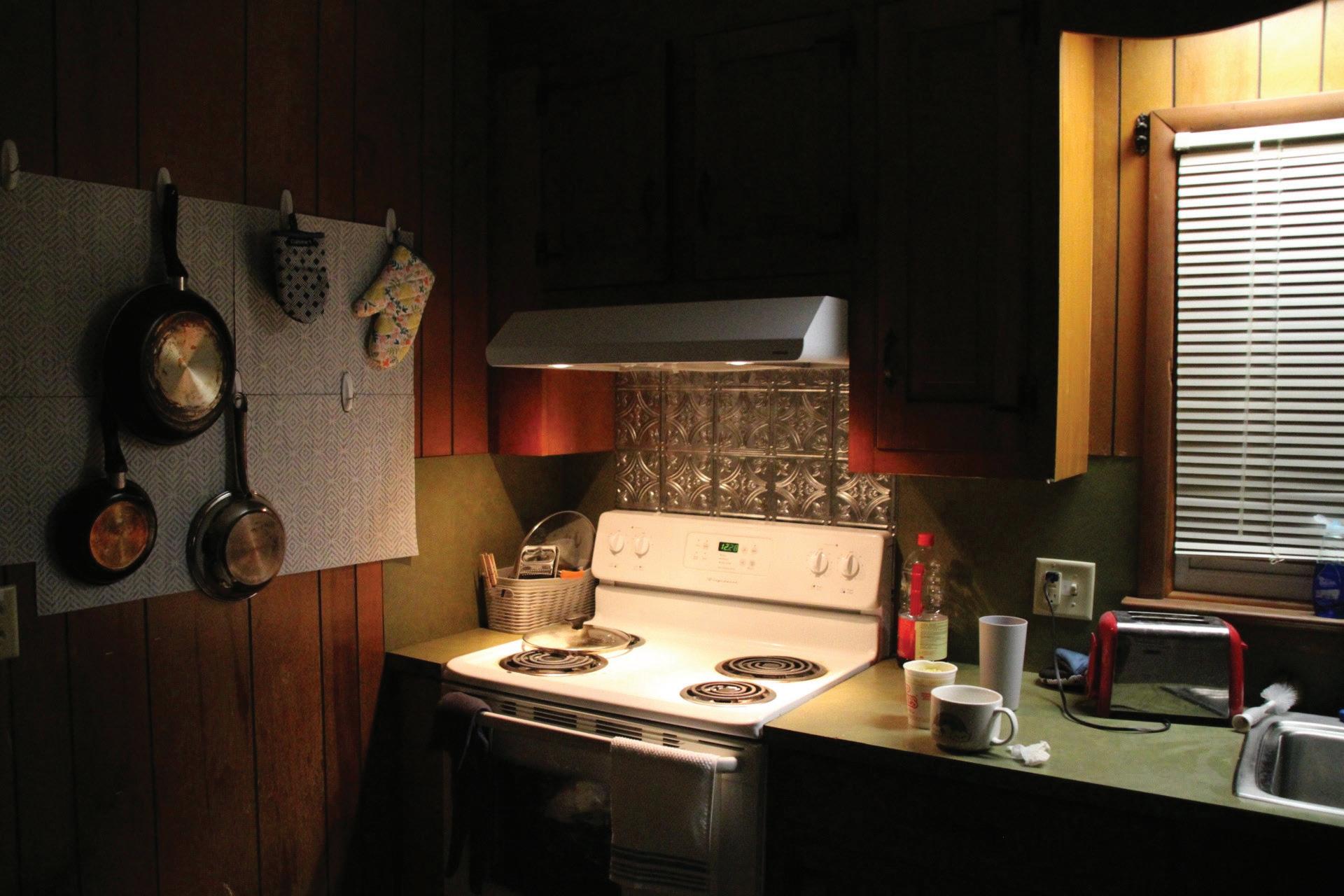
Untitled Ross Uhler
Molly Gerard
One piece of news, and the victories of the day dissipate with the ceiling fan, turn to late night fog looming outside the window, and the sole desire I have to feel completely alone in my home. All the focus I have trained on the door.
There was that one time, he asked her if I was in my room If he asks again, tell him I’m out, tell him I’m out.
I thank the invention of little lies. And remember three years ago, when we sat on the hallway floor. He clipped a clear lock to the banister so he could crack it open.
We watched the phantom rise and fall of barrels clicking into place. 1:47 now and I get up, turn the deadbolt, the line of salt across the door.
gills
Claire Remsnyder
it has been raining for three days days have no end or beginning there is only space between dreaming and in dreams the water comes up over windowsills seeps through cracks in siding swallows houses whole. the fish come on the fifth day first speckled trout and sunfish then herring and cod. late in the night, a manta ray floats past, pale and ghostly. on the ninth day they come belly up bloated and thick, amphibious defines survival dead tuna in the dining room a catfish on the bed
sea levels rising— the next-door neighbor goes green with bioluminescence gills and bony fins cracking out of spines air becomes too stagnant to inhale we forget what it means to be terrestrial adapt to silvery skin and breathing in moisture. it is easier beneath the surface cool slippery blue enveloping bodies tired of staying afloat.
no one knows how long it’s been when the rain stops day by day, water seeps back into the ground oceans re-form
no one talks about the carcasses littering the streets no one knows whether they are human or fish
no one talks about the gills.
I buy a pair of scissors and a shovel slice the webbing between my fingers and bury the manta ray in the backyard.
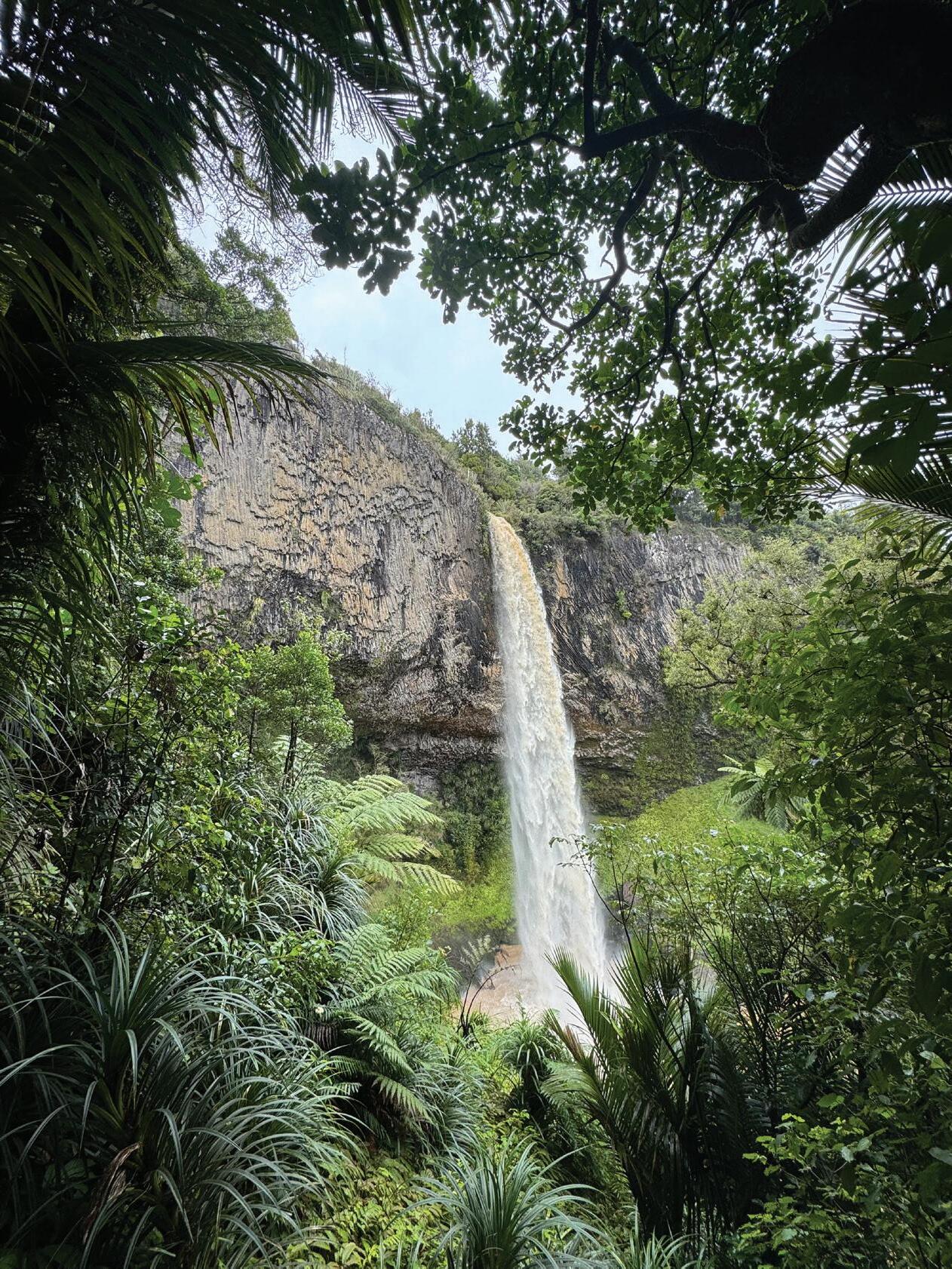
Bridal Veil Falls Lauren Jancsarics
Thoughts
Isabella Bickenbach
my thoughts are too loud
i can no longer hear the rain. she .threw. away. my roses.
the trees were stacked like toothpicks in a box. her eyes were as white as marbles her eyes her eyes round & blank her marbles round eyes her white eyes round & round
what a mess you’ve made.
my windshield hosts a colony of raindrops don’t push them away.
you see that dome over there? that’s the planet i’m from.
i live in that colony of raindrops don’t push them away. they were red roses the real kind violets are blue don’t trust the violets.
that tree over there is not a toothpick that tree she broke her spine.
she was an artist who only painted one thing.
if you dream at night you’ll leave the dome. she said the pile of splinters was safe she never lied i don’t think. what is the world like right side up?
the pounding in my ears is from the planets outside the dome.
Unfinished Lainee Partin
We assumed they would arrive in our image. Arms, eyes, a hunger to expand. Our very best qualities reflected on familiar faces. But they did not arrive. They had always been arriving, hidden in the moments that belonged to us.
The silver screen could not have prepared us for them. They tore a gaping hole in the fabric of understanding. The fine silk of the conceivable was shredded entirely. There was no roar of engines announcing their appearance. Only presence like the memory of a shadow before the light turns on.
Reality warped at the center and returned in the shape of a question mark.
We asked them for a name. They answered in geometry, in a time that bloomed rather than passed.
We thought we were the story the final stanza in the long poem of life. But we were a line break.
A pause.
A necessary forgetting.
Some called it an apocalypse. Others called it grace. The end was not a fire, but a quiet unlearning. And as they turned our gaze away from stars that once answered to us, we saw not our extinction, but our smallness, beautiful and unfinished.
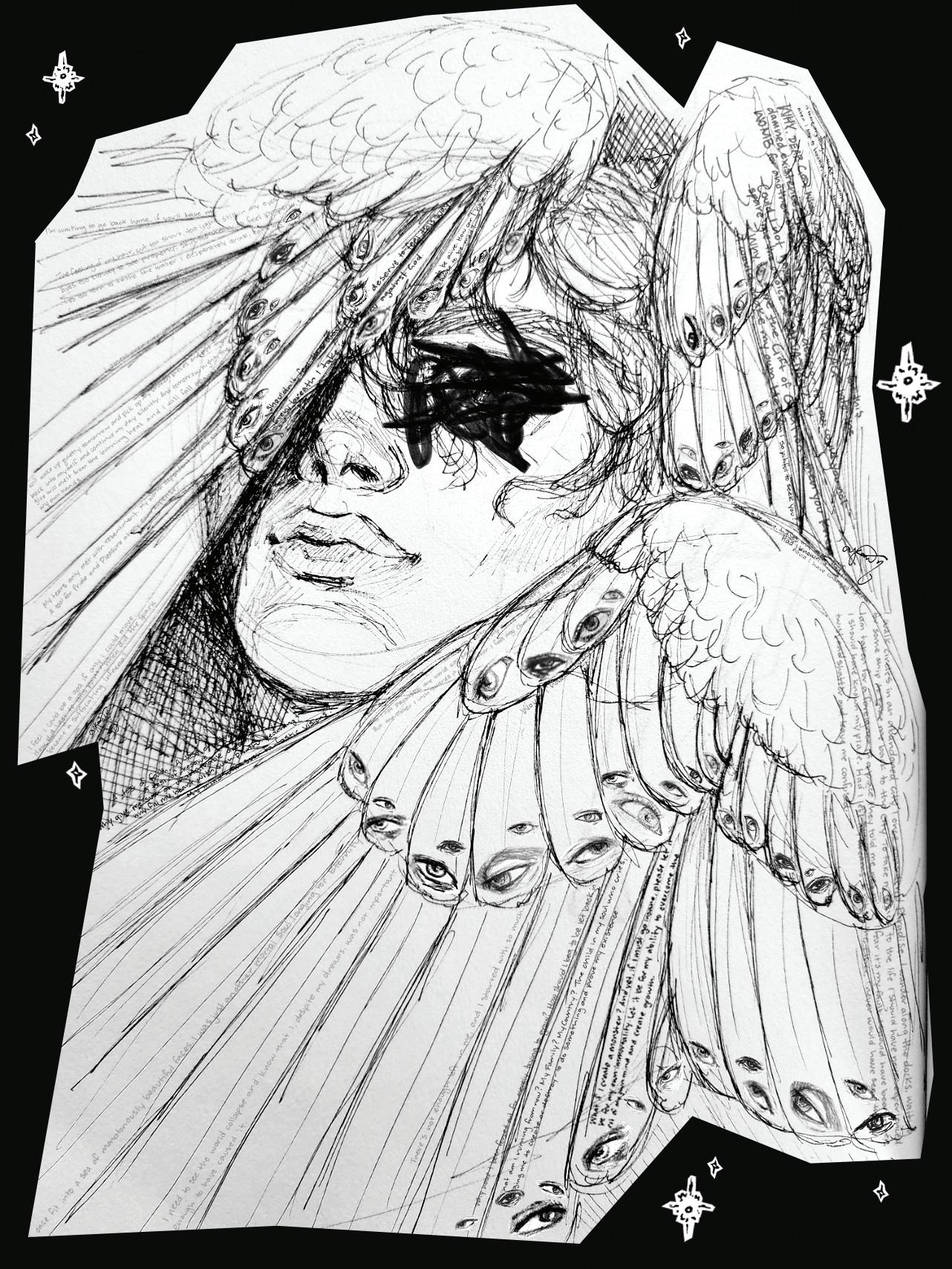
The Agnostic’s Guide to Italian Churches
Kaitlyn Altobelli
✟
CHURCH OF SANTA MARIA DELLA FAVA
Fava Square, Venice
Italy was always the dream. Victoria spent her childhood imagining the world of her Nonna’s stories: sunlit cobblestones, winding canals, bittersweet lemon air. If only she were here to meet Nonna’s brothers or find her favorite Neapolitan restaurant. Her grandmother passed long before she could tell her about this study abroad, and it was more for students in fashion and architecture than biology, but she was still here. In that regard, she found kinship in Ruth: a computer science major who she assumed was also here to fulfill the dream.
But that was proven not-quite-true when Ruth asked if someone would come with her to visit the church they kept passing. She was Catholic. Because yes, Italy was often the dream for family heritage, but it was also the peak destination of Catholicism.
Nonna was Catholic, and she would’ve wished her granddaughter was. She’d love to hear that Victoria visited an Italian church. Was it even worth going if Nonna couldn’t know? Then again . . . at least they couldn’t talk about why she never went to church at home. Or her granddad’s firm belief that this newfangled sexuality nonsense would light her on fire the second she touched holy water.
Well. She’d be a good friend. Nonna would like that. And if God wasn’t a fan of who she liked, there was no proof He even existed, so . . . there! She didn’t need holy water anyway.
The Church of Santa Maria Della Fava was next to the station, so they went before their highspeed train to Florence. It was lovely, but Victoria didn’t quite get it. She eyed carved angels warily, half-expecting them to smite her with their stone gaze. And the holy water really just looked like normal water. But when she caught Ruth’s eye and recognized delight, she couldn’t help a smile.
DUOMO DI FIRENZE
Florence, Tuscany
Without Ruth, Victoria would’ve gotten thoroughly lost in Florence. It hummed with the vibrancy of life: music, art, everything that made it worth living. She’d explore the streets ceaselessly if she could.
But Ruth kept looking longingly at the Duomo. “We don’t have to go in,” she said. “I’d like to, but I don’t want to wait alone. If you don’t want to . . .”
Victoria didn’t. The line was long, and the inside of a church was hardly as exciting as street dancing. But Ruth helped her find gelato and explored the Accademia Gallery with her. It was only fair.
Of course the Duomo was gorgeous. She didn’t expect anything less than lavishness. So many resources spent on a thankless God who’d never return the favor. Admirable construction, but Victoria couldn’t see any life in this place.
Yet Ruth came to life here. She beelined for the chapel’s center, hands clasped and closed eyes to the sky. He won’t respond, thought Victoria, but that’d never stopped Nonna from praying. If she were here, she would’ve danced on the streets and prayed in the Duomo.
Ruth would say she did in heaven. The thought was comforting, if not believable.
BAPTISTERY OF ST. JOHN
Pisa, Tuscany
The wide-open Baptistery was a relief after the Leaning Tower’s dizzyingly narrow stairs. But it was disturbingly empty, void of the art she anticipated. Alone and uneasy, Victoria wandered the stone void until she settled on a bench to hear a man sing. It was a wordless chant, hallowed and haunting, and it made her shiver. She rubbed her watering eyes.
Slowly, other seats filled. A professor, a couple students, and Ruth. Together, spellbound, they watched and wondered: could this really still be Earth?
ST. PETER’S BASILICA
Vatican City
Vatican City was beautiful, but discomfort crawled through Victoria’s skin. This was papal territory, and the new pope believed that family required a union of man and woman. His opinion went for Catholics, didn’t it? She shuddered to imagine Nonna disappointed in her.
Outside the basilica, Victoria screwed up her courage to ask Ruth if she thought so.
Ruth tucked a veil into her hair. “Was your Nonna a kind woman? Did she love you as you are?”
Victoria nodded.
“I don’t see why not, then. No one else here is wearing a veil, but the crowd’s judgments don’t matter. Religion is about love, not hate. Our God loves us as we are. A true Catholic wouldn’t forsake you for that.”
In St. Peter’s Basilica, the place Catholics around the world flocked to, Victoria felt . . . better than expected. The statues and shrines were crafted with enough reverence to root her stubborn heart in place. There was a sense of holiness here: a presence harder to deny than before. She looked up at the ceiling and didn’t see God. But she didn’t think He would burn her alive for that.
CHURCH OF SANTA MARIA ASSUNTA
Positano, Amalfi Coast
How must it feel to worship so close to the gorgeous blue Tyrrhenian Sea? God’s creation in motion. Perhaps if she lived here, she’d feel it so deeply it wouldn’t matter what she saw.
The church on the coast was small, but worth the walk. Alone at the altar, Victoria lit a solemn candle. Nonna, I’ll always love you. We didn’t get to know each other fully, but I am at peace with your memory.
✟
CHURCH OF CARMINE
Sorrento, Amalfi Coast
Victoria’s first Catholic mass was delivered in Italian. She didn’t know a single word, but she listened. Ruth kneeled beside her, eyes closed in exaltation. It didn’t feel right to send her to mass alone.
Buttery yellow walls ensconced them in warm welcome. Victoria examined the bloody, oilpainted details of Jesus on the cross. God or not, he was stabbed and hung ruthlessly for his beliefs, and he bore it all. He faced persecution long before any relative called her sinner.
No, she didn’t believe. But, she thought after mass, with her friend’s heart aglow and hers not much colder, she could see why Ruth did.
1916
Phoebe Robbins
The waves crash hard as the wind rages through the girl’s hair, sweeping it this way and that.
The melancholy blue of her dress matches the sea, whose fury befits the clouds above.
The storm has cast over the isle a darkness unlike any the girl has seen,
And the distant cliffs preside over the scene, executioner.
Out beyond the break, waves crash over a vessel split by the water, a battle between women. The sea and the ship.
Her sails torn, useless in the roaring winds, yet they whip at the waves, desperate to stave them off.
A sail post washes up beside the girl, and she staggers a step forward, hearing the screams.
Above the winds and the waves’ plunge into the beach, shouts of fear.
She feels her heart pumping her blood loudly through her veins, and She clutches at her heart.
Unsure of how or if she can help, she breathes through parted lips, panting in horror.
Her hair flies across her face, and she sends her hand up to block it.
A futile effort in the face of such a storm, but she tries.
Her flame red hair is the only thing bright in the dusky storm light. Thunder cracks.
If she could, she would leap into the frigid waters and join this women’s war.
She’d fight to save the lives of those screaming men, quieter now.
But she knows she cannot. So instead, She wishes.
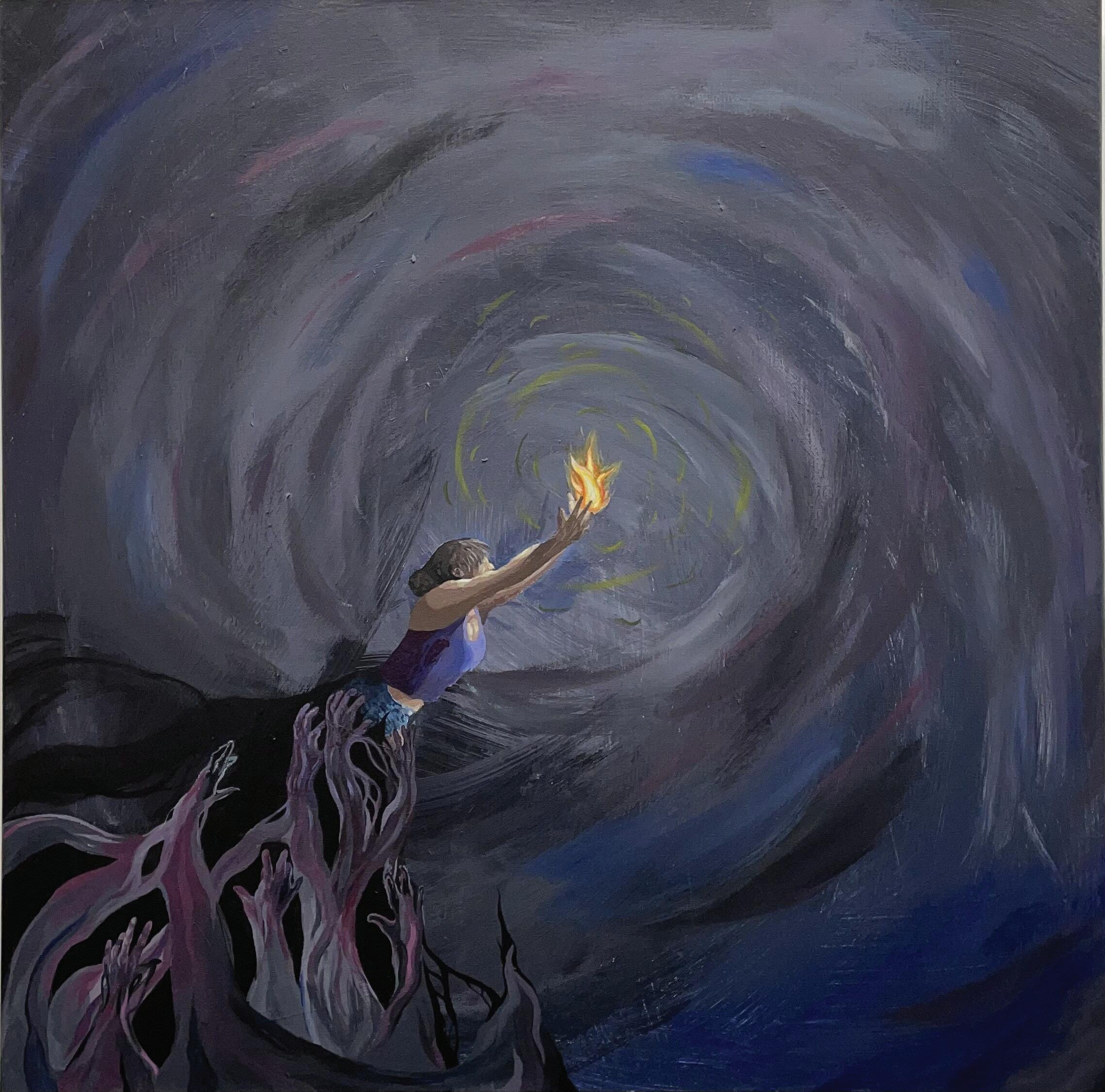
Rose Grisbacher
Nolite te Bastardes Carborundorum
Agapi Alexandris is a fourth-year Architecture major at the University of Oklahoma, where she spends her time immersed in design of all kinds, from digital renderings to physical paintings. Agapi has been involved in art since her childhood, and she enjoys exploring different media and finding new ways to approach traditional styles. Now, as she nears the end of her architecture program, Agapi focuses on creating visual narratives through her art, using design as a way to tell her story.
Kaitlyn Altobelli is a third-year student at Bowling Green State University pursuing a BFA in Creative Writing. She serves as a prose editor for Bowling Green’s national literary journal, MidAmerican Review, and as a poetry editor for their undergraduate journal, Prairie Margins. Her work has been previously published in 30 North and earned second place in the Toledo Museum of Art 2025 Poetry Prize. Follow her writing journey at https://linktr.ee/kaitlynaltobelli.
Corinna Bevier is an undergraduate student based in Michigan, currently pursuing a degree in English literature. Her work centers on family, nostalgia, and a fondness for the sentimental, and has previously appeared in Mosaic Art & Literary Journal.
Isabella Bickenbach could always be found, ever since she was little, curled up with a book or writing down stanzas on restaurant napkins. Currently, she is studying Media, Culture, and Communication at New York University. In her free time, she enjoys writing for the Sports Column at the Washington Square News, competing in ice dance for NYU Figure Skating, and playing piano and guitar. In 2023, she founded a peer support group for student athletes named S.H.A.R.P (Sportsmanship, Health, Attitude, Respect, and Positivity).
Phoebe Bidelspach is a junior studying Creative Writing, English, and Creative Arts at Lebanon Valley College. She has many interests, including music, travel, and photography. She enjoys exploring the outdoors (especially when there’s moss and critters). She is also super excited to be serving as the art editor of this lovely magazine!
Ren Blauch is a young writer who began exploring poetry and prose after taking a creative writing course in the spring of 2025. They are exploring some heavy themes that touch them personally, from eating disorders to religion. They are excited to continue developing their writing style and skills in the coming years. They are very proud of the works they have developed over the past semester and are excited to submit to a literary magazine for the first time.
Lydia Blythe is a writer of poetry and short stories from Bixby, Oklahoma. She is currently a junior at Northeastern State University where she is pursuing an English degree. She drinks gallons of tea and enjoys reading Poe, Plath, and Pound, among many others. Her dream is to write stories and poetry that reach those who believe themselves to be unreachable.
Colbey Brown is a first-year Creative Writing major, currently enrolled in Lebanon Valley College. They have a boundless imagination that is best put to work in writing or acting. Her expertise is in fiction, but she’s interested in all kinds of genres and creative outputs. Aside from the AnnvilleCleona Literary Magazine, the Dutchman Voice, she has not been published in any kind of literary magazine.
Samantha Candalla is a third-year Economics-Mathematics major at the University of Pittsburgh. She is an editor on the University’s undergraduate journal, Forbes & Fifth. Aside from painting, she enjoys reading, writing, and eating her way through Pittsburgh.
Grace Calabrese is a senior English major with a minor in pre-law at Ohio Northern University. She is originally from Cleveland, Ohio, and has hopes of returning to her hometown to attend law school after her undergraduate studies. Her dream is to become a successful lawyer, specializing in family law, while also writing creatively in her free time.
Jadyn Cerna is a Media Studies major at Rhodes College. Her work has previously been published in the Dredge and the Bridge Street Newspaper, and she has had experience with writing and directing her own plays.
Aiden Deppen is a junior majoring in English, Creative Writing, and Psychology, and minoring in Music at Lebanon Valley College. He is involved musically at LVC, participating in the Pride of the Valley Marching Band and the percussion ensemble. In his spare time, he enjoys urban sketching and designing buildings and sculptures out of LEGO.
Ashley Duchnowski is a fourth-year Digital Media and Creative Arts dual major at Lebanon Valley College. Her work incorporates her life and the things around her. She focuses on things that mean the most to her and expresses it in both photography and painting. Ashley is part of the Kappa Pi Art Honors Society at LVC. In her free time, she enjoys cheerleading, nature, and spending time with family.
Molly Gerard is a Writing and Communications Interdisciplinary major from Loyola University Maryland with a minor in Sociology. Her poetry primarily revolves around topics of nature and stories of human connection. Her previous work appears in Corridors Magazine and Teen Ink. In her free time, she likes to play Ultimate Frisbee, practice guitar, and collect ever more eccentric hobbies.
Emily Graney is a junior English, Creative Writing, and Art triple major at Lebanon Valley College. She is not at all bothered that she’s been instructed to speak about herself in the third person for her bio at all. Why would you think that? Did you peep the majors? She can totally write about herself if she needs to. Why would you think she’d ramble to fill space? So she needn’t talk about herself. Outrageous accusations she’ll hear no more of.
Rose Grisbacher is a current junior at Lebanon Valley College who is studying Creative Arts and Creative Writing. She has been deeply interested in the arts since she was a child, which accumulated to years of mixed media training under her belt. Her specialty is painting, but she has experience in other mediums like ceramics.
Elizabeth Holloway is studying English and Creative Writing at Central Michigan University in Mount Pleasant. She is expected to graduate her undergraduate degree in May of 2027 and plans on returning to Central for her Creative Writing master’s. Beth has published poetry in the past two publications of CMU’s literary magazine, Central Review. She loves using poetry, fiction, and music as creative expressions to defamiliarize and better understand the complexities of life.
Lauren Jancsarics, a senior at Lebanon Valley College, will graduate with a B.S. in Exercise Science in May 2026 and a Doctor of Physical Therapy in May 2028. She studied abroad at the University of Waikato, New Zealand, in Spring 2024. Lauren is a first-generation college student and currently serves as a global ambassador. She is an active member of Gamma Sigma Sigma, a national service sorority, and was also a member of the LVC Women’s field hockey team for a majority of her undergraduate education.
Charlee Kurtz, a junior at Lebanon Valley college pursuing a double major in Neuroscience and Creative Writing, and a member of the cross country and track & field team, is an aspiring neurobiologist who enjoys spending her free time writing, running, or writing about running.
Elizabeth Main is very excited to have submitted an entry to the Green Blotter! She loves writing in her free time and hopes to submit more in the future if possible.
Mika J. Manini is a junior at Virginia Wesleyan University. She is majoring in English with a concentration in Creative and Professional Writing, and minoring in Gender, Women, and Sexuality Studies. She is a transgender lesbian poet using art to explore her identity and the world around her with honesty and a healthy dose of wit. When she’s not writing, she’s probably playing Dungeons and Dragons with her favorite people, listening to sappy folk love songs, or reading on her porch.
Lainee Partin is a sophomore at Ohio Northern University where she is pursuing degrees in Literature and Creative Writing. She received the English Talent Award at Ohio Northern University for her outstanding written work. Lainee has been writing since she was twelve years old and she once began working on her own novel, which was definitely a knockoff version of Divergent.
Jordon Perkins is a junior at Concordia College in Moorhead, Minnesota. At Concordia, he serves as the editor-in-chief of AfterWork, the college’s literary and art journal, and sings in the Concordia Choir. Jordon’s work has previously been published in AfterWork, The Albion Review, Cicada, and Prairie Margins.
Reagan Preisz is a junior Creative Arts major and Business double major at Lebanon Valley College. She has been interested in the arts since she was a young child and has been pursuing it since high school. Reagan enjoys doing photography in her free time and is looking to further her abilities in photography.
Claire Remsnyder is currently a sophomore at Lebanon Valley College pursuing an English degree.
Phoebe Robbins is a senior at Widener University, where she studies English and Creative Writing. This marks her first publication, and she is forever grateful to Green Blotter for the opportunity to share her work. When she isn’t writing, she enjoys spending time with her friends, thrifting trinkets galore, and reading, often cuddled up with her beloved cat.
Grace Strong is a first-year Creative Writing student who loves sharing anything from poetry to personal essays. (Her favorite thing to write poetry about is, of course, flowers). She’s originally from Delaware, but hopes to one day inspire people all around the world and truly make a difference through her writing!
Ross Uhler is a senior art student at Lebanon Valley College and an intern at the Suzanne H. Arnold Gallery. His work is inspired by the abstract expressionist movement and involves the use of experimental materials and techniques. Most of his portfolio consists of abstract paintings but includes sculpture and photography as well. In 2025, Uhler given The Michael P. Manubay ’11 Award in Art for “demonstrating outstanding potential for creating large-scale experimental art.”