The magazine of the League Managers Association
Issue 9: Autumn 2011
Gus Poyet Paulo Sousa Hugh Morris Bob Paisley OBE Chris Sulley Gary Ablett Brendan Rodgers Alan Curbishley
LONG-TERM LEADERS How to get ahead... and stay there
IF YOU CAN’T BEAT THEM...
Howard Wilkinson on the lesson we should learn from Barcelona
BEATING THE CLOCK
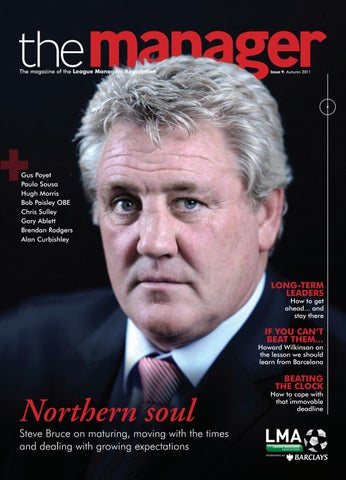
Northern soul
How to cope with that immovable deadline
Steve Bruce on maturing, moving with the times and dealing with growing expectations SPONSORED BY
DELIVERING PERFORMANCE INSIGHTS • Performance Analysis • Player Recruitment • Research & Consultancy Official Technical Partner
DELIVERING PERFORMANCE INSIGHTS SINCE 1998 WWW.PROZONESPORTS.COM
THE MANAGERS’ VOICE “It is time the game reviewed the current system of transfer windows and deadlines”
The end of summer, frantic last-day transfer deadline activity highlights the need for football to continue to review its systems and practices. A survey of business leaders questioning the most important aspects of their role would no doubt highlight the recruitment of talent to their teams as one of their primary responsibilities. The ‘recruitment process’ in the business world is an industry in itself and one that absorbs significant investment, both financial and in terms of human capital. The process is considered and painstaking and employees do not move quickly from firm to firm... and certainly not on artificial deadlines. In football, the recruitment of talent or ‘scouting’ has progressed significantly over recent years. It has become a highly skilled, extremely scientific and international function. When one considers that the Barclays Premier League clubs spent in excess of £485m this summer alone then it is fair to say the stakes are high. ‘Deadline day’ rumours and speculation can be exciting for fans, but its structure adds significant time pressure to clubs and can undo or ignore much of the valuable work that has been done in the preceding months. Perhaps there is no perfect system, but there are elements of the current structure that are clearly flawed. In 2008 UEFA president Michel Platini implied he would like to see changes and that a review of the system should be undertaken, but to date this has not happened. The LMA’s members are at the sharp end of football’s recruitment market, it is one of the most visible and debated parts of their role. It is time that a review was implemented; a review in which the LMA should play an important role. Globally, football has never been more profitable, but a closer look at the game reveals worrying trends: the start of the season delayed in two of football’s biggest leagues, Spain and Italy; a club thrown out of the UEFA Champions League over match-fixing allegations; players’ wages continuing to spiral upwards; and the continuing issues of governance and transparency right at the top of the game. Football is the industry in which the LMA’s members earn their living. Individual issues such as the transfer window have a direct impact on a manager’s working environment; other broader issues are no less important and can have an equally significant influence on the day-to-day lives of those working in the game. The LMA and its members are keen to ensure that, as a collective, the managers in England, past and present, continue to share their knowledge and experience (from well over 100,000 games at the top level) and contribute to the strategy of the game moving forward. During the forthcoming season, we will be coordinating a series of ‘think tanks’ and forums bringing together our members, managers from across Europe and all of the game’s stakeholders, to discuss and debate football’s issues. The game – at all levels, from grass roots to national, from panregional to global – needs to develop more coherent, three, five and 10-year plans, that review and assess, move the game forward and place it in a strong position to tackle issues when they arise. RICHARD BEVAN LMA CEO
the manager AUTUMN 2011
We’ve created an oil so strong We had to engineer the tests to prove it.
engineered With
Today’s engines work harder, run hotter and operate under higher pressures, to demand maximum performance in these conditions you need a strong oil. That’s why we engineered Castrol EDGE, with new Fluid Strength Technology™. Proven in testing to minimise metal to metal contact, maximising engine performance and always ready to adapt wherever your drive takes you.
Find out more at castroledge.com
the most coveted address in golf—
hamilton grand With an unparalleled location set by the 18th Green and fairway of the world’s most famous Golf Course. Hamilton Grand is being sensitively restored with an “Art Deco” interior. Offering a truly exhilarating and uniquely Scottish experience. This is a unique real estate opportunity for those who want to own a home in the birthplace of golf and in a premier destination that is rich in history. To discuss the opportunity to buy an apartment at Hamilton Grand, please contact the Sales Team at Hamilton Grand. Helen Parker: Helen.parker@oldcoursehotel.co.uk +44 (0) 1334 468144 HamiltonGrand.co.uk
This is not an offer directed to residents of any state in which registration is required, but in which registration and/or licensing requirements have not yet been met. California residents please refer to the Hamilton Grand website (HamiltonGrand.co.uk/legal) for further disclaimer.
This advertising material is being used for the purpose of soliciting sales of vacation membership timeshare interests.
— WELCOME —
46 Mind Games
22
48 The Technical Area
Beat the clock
THE BACK OFFICE Mike Carson examines the negative internal monologue; and outlines a strategy to help silence it
8 KICKING OFF
8 From The Dugout
All of the latest developments from within the LMA and across the wider business of football
12 Get On With The Game
Richard Scudamore, chief executive of the Barclays Premier League, outlines his organisation’s latest initiative
14 Talking Point
Leading criminal lawyer Jeremy Summers explains the ramifications of the recently introduced Bribery Act
Howard Wilkinson pays tribute to FC Barcelona and reveals the one lesson we should all learn from their success
50 The Coach’s View
Leeds United’s academy manager Chris Sulley reveals some of his findings from a recent study into European player development
Deadlines... and learning to love them
38
26 30
53 Financial Insights
Greg B Davies of Barclays Wealth stresses the need for considered action in a volatile market
56 Health and Wellbeing Dr Dorian Dugmore offers useful advice on lifestyle management
58 Castrol Analysis
Are the newly-promoted teams destined for relegation? Not according to the Castrol EDGE data
32 50
LEADERS
16 Steve Bruce
Sunderland manager Steve Bruce talks about his management career to date and the new challenge of meeting raised expectations
22 Gus Poyet
12
26 Paulo Sousa
LMA PEOPLE
Brighton’s fans seem to wear permanent smiles these days; we find out why from the man responsible Having left England’s ‘hire and fire’ culture behind him (for now), the former Portugal international is facing a new challenge in Hungary
60 Manager of the Year
30 The Insider
A look back at the life and career of Liverpool legend Bob Paisley
Gary Ablett talks candidly about his continuing battle with cancer and his plans for life after football
32 The Outsider
With English cricket flying high, we speak to the ECB’s Hugh Morris about how the country has achieved its success and where it goes from here
THE BUSINESS
34 Staying Ahead
Business leaders reveal the secrets of their long-term success
38 Meeting That Deadline Some useful advice on how best to beat the ticking clock
42 Making Your Mark
How to succeed with a new venture; even in the most competitive market
Behind the scenes at the 19th LMA Annual Awards Dinner
64 Hall of Fame
67 Brendan Rodgers
How the Swansea City manager gave himself a (real) mountain to climb
69 Alan Curbishley
The LMA committee member reports back from this summer’s Barclays Asia Trophy tournament in Hong Kong
70 Stoppage Time
The new Libya unveils itself and its flag to the world through football
16
“Management’s not just about picking teams and winning matches” Steve Bruce
the manager AUTUMN 2011
64
KICKING OFF
— NEWS —
KICKING OFF news and views from the dugout TRANSFER SPEND RETURNS TO RECORD LEVELS
8
9
Spending by Barclays Premier League clubs approaches £500m during 2011 summer transfer window
Sergio Aguero’s €40m transfer from Atletico Madrid to Manchester City represented the single biggest deal during the summer transfer window.
Spending by the Barclays Premier League clubs during this summer’s transfer window showed a marked increase over activity in the same period last season, according to figures published by business analyst Deloitte. This increase means that England’s top clubs are once again spending at the levels last seen between 2007 and 2009. This summer’s combined figure of £485m was an increase of almost £120m over last summer’s outlay, an uplift of 33 per cent. Five of the top flight clubs – Arsenal, Chelsea, Liverpool, Manchester City and Manchester United – each spent more than £50m on transfers during the summer (amounting to roughly 66 per cent of the entire division’s spending), while Stoke City broke their transfer record by signing Peter Crouch from Tottenham Hotspur for £10m. “This summer’s spending is largely focused amongst the top end Premier
League clubs; those most strongly competing for domestic and European success and the consequent financial rewards,” said Dan Jones, a partner in Deloitte’s Sports Business Group. One notable difference in this season’s spending patterns was that more money was spent between English clubs than has been the case in recent seasons. Fees paid to overseas clubs amounted to roughly £205m, down 25 per cent on the previous season. “The football authorities’ encouragement of home grown players has contributed towards the increased scale of fees for the transfer of young English talent this summer,” said Jones. This upward trend is not confined to the Barclays Premier League, as spending was also notably higher than last season in the npower Championship (where clubs spent £30m) and in some of the major European leagues. “Despite domestic difficulties delaying the start of their seasons, transfer spending was considerably up amongst clubs in Serie A and La Liga,” said Jones.
US CLUBS COMBINE TO WORK IN HARMONY Major League Soccer teams form consortium to attract music revenue
A group of teams from America’s Major League Soccer have formed the Soccer Stadium Alliance, with a view to attracting the biggest names in music and entertainment industry to their stadiums. The alliance brings together the Columbus Crew, Colorado Rapids, FC Dallas, Sporting Kansas City, Philadelphia Union, Portland Timbers and Vancouver Whitecaps. The seven teams will approach artists and their management as a consortium, but each venue will act as its own show promoter, carrying all of the risk and reward. While the alliance has partnered with the music production and marketing
organisation Modern Music Services, venues will also be able to continue their relationships with other promoters such as Live Nation or AEG Live. “It is our enterprise’s goal to be a leader, both within soccer and across the global entertainment industry,” said Columbus Crew president and general manager Mark McCullers. “The creation of this alliance will give us greater opportunities and exposure within the concert industry and will allow agents and managers to bring their worldclass artists to our world-class venues,” said Donnie Frizzell of Modern Music Services.
the manager AUTUMN 2011
SCHOOL OF FOOTBALL
The business of football now has its own higher education institution. The UCFB College of Football Business, based at Burnley FC, will deliver degree courses in the sport’s operational and business facets. Former FA chief executive Brian Barwick will chair the college’s advisory board, while former Government advisor (and Burnley fan) Alastair Campbell is also involved.
— NEWS —
79,200
The average attendance at FC Barcelona’s Camp Nou stadium last season – the highest in Europe. Borussia Dortmund were just behind (with 79,100) while Manchester United came in third with an average of 75,110.
THE EXECUTIVE COACH with
UEFA TARGETS CORRUPTION Governing body to build international network
FERGUSON HONOURED BY ITALIAN UNIVERSITY Sir Alex Ferguson has added to his already noteworthy list of honours and achievements by collecting a sports ethics award from Rome’s Sapienza University. The Manchester United manager was presented with the Tor Vergata Ethics in Sport award by the Italian players’ association president Damiano Tommasi at a ceremony in Rome on September 5th 2011. Previous recipients of the award include Tommasi himself (a former midfielder with Roma) and UEFA president Michel Platini.
UEFA is to ramp up its fight against corruption in football by establishing a European network of integrity officers. This decision was reached at a recent meeting of the organisation’s executive committee, where members approved the recommendations made by the working group on corruption and match-fixing. Once established, the network will cover all 53 of UEFA’s national associations and will foster collaboration with state authorities. “In the countries where it has been possible to fight matchfixing, it has only been possible thanks to the support of the authorities,” said UEFA general secretary Gianni Infantino. “We cannot do this alone, as we are only a sports organisation, but what we can do is act strongly. If you don’t eradicate the cancer before it starts to grow, then it can become a danger – and we will not permit it to become a danger.”
MANAGER OF THE MONTH
A run-down of the managers whose results and performances have most impressed the judging panels during the first month of the season AUGUST 2011 AWARDS
CLUB
DETAILS
Manchester United
W 3
D 0
L 0
Brighton and Hove Albion
W 4
D 1
L 0
Manager of the Month Karl Robinson
MK Dons
W 4
D 1
L 0
Manager of the Month Andy Scott
Rotherham United
W 4
D 1
L 0
Manager of the Month Sir Alex Ferguson CBE Manager of the Month Gus Poyet
the manager AUTUMN 2011
ROBERTO FORZONI NEGATIVE MINDSET
Whether you’re running a business or a sports team, one of the inevitable factors is that at some stage your outcomes may not be achieved and you may not get the results you want. Many factors will contribute to this lack of performance, some within your control and some not. One aspect you are likely to encounter that certainly won’t help the situation is team members with a negative mindset. The worse the situation, the larger the potential problem. Whilst your team may be divided into some members with positive mindset (the ‘energisers’), some negative thinkers (the ‘energy zappers’) and many in between, the influence of the energy zappers can spread to the group and lead to further performance deterioration. How then do you change the thinking of team members to maximise opportunities to get back on track?
Where you guide team members to direct their attention will influence where they direct their thoughts. Be specific, optimistic and supportive. Certainly, by setting very specific outcomes, combined with process and performance goals, team member attention can be directed to more useful thinking and, consequently, behaviour. Reminding team members of how they had previously achieved an objective is a useful tool to use.
www.robertoforzoni.com
— NEWS —
7,500
The milestone (in number of games) passed by the Barclays Premier League on Saturday, September 10th 2011.
QPR TAKE FLIGHT WITH TWO SPONSORS
ASIDES
Barclays Premier League newcomers sign sponsorship deal with both AirAsia and Malaysia Airlines
WITH
Queens Park Rangers have become the latest club to develop an innovative sponsorship deal, with the announcement that their shirts will display the logos of two airlines during the 2011/12 season. The Barclays Premier League newcomers will sport the logo of Malaysia Airlines on their home kit, while their two away strips will carry the branding of AirAsia. The agreements, which have been described by the club as a “multi-million pound shirt sponsorship”, were brought about by the two airlines’ connections with QPR’s new owner, Malaysian businessman Tony Fernandes (who is also the chief executive of AirAsia). “We are extremely positive about building a thriving relationship with both businesses in a bid to broaden our exposure,” said the club’s chief executive, Philip Beard, at the launch of the new kit.
JOHN COLLINS
1. WHEN DID YOU KNOW YOU WANTED TO BE A MANAGER? Like most players, I started to think about it when I hit 30. I didn’t start to take my coaching badges until I was 35, though, as I didn’t really have the time until I retired from international football. 2. WHICH MANAGER HAS INFLUENCED YOU MOST? That’s an unfair question. I’ve worked with too many good ones; Billy McNeill, Tommy Burns, Craig Brown, Walter Smith, Jean Tigana... Pat Stanton gave me my professional debut at Hibs when I was only 16 (and a half), so if I had to choose one it would probably be him. 3. WHO’S THE BEST PLAYER YOU’VE WORKED WITH? When I was at Monaco, I played alongside a young lad called Thierry Henry. That was a joy... all I had to do was slip the ball behind the full back and watch him do his thing. 4. WHAT WAS THE BEST ADVICE YOU EVER RECEIVED? When I first started out as a professional player, my Dad told me that I should never take anything for granted and to appreciate every single day of my career. He was right. 5. WHAT’S THE BEST GROUND YOU’VE EXPERIENCED? That’s an easy one. Celtic Park, especially on a European night. When we’d just scored and the fans started singing... that noise gave me goose bumps every time. 6. WHO WAS YOUR BOYHOOD HERO? As a kid, I always admired players who attacked from deep; players like Kenny Dalglish, Glenn Hoddle and Bryan Robson. Being Scottish, and a Celtic man, I suppose Kenny stood out above the others. 7. MARADONA OR MESSI? Messi. Maradona was sensational – especially on the biggest stages like the World Cup – but I see Messi week in week out, getting knocked over and just jumping straight back up and starting again. He has all the skills that Maradona had, but a better temperament.
the manager AUTUMN 2011
1,063
10
11
The former Hibernian and Charleroi manager responds to our survey
The number of goals scored in the Barclays Premier League during the 2010/11 season (at an average of 2.8 goals per game). This set a new record.
— NEWS —
£1,012,470,221 The total TV revenues distributed by the Barclays Premier League to its member clubs (and the four former members still receiving ‘parachute payments’) during the 2010/11 season.
MOTHERWELL COURT SUPPORTER CONTROL Scottish Premier League club launches an initiative designed to eventually turn ownership over to the fan base
Motherwell FC have outlined an ambitious ownership plan which could eventually turn control of the club over to the supporters. This move comes in the wake of the resignation of former club chairman (and majority shareholder) John Boyle, who has gifted his holding in the club to an independent trust. Motherwell’s plan is to establish a new organisation ‘The Well Society’ which will allow fans to participate in (and eventually assume) ownership of the club. Under the new scheme, fans will become members of the new society, paying a oneoff membership fee and then an annual subscription. The long-term goal is that the society will eventually assume a controlling interest in the club. “This is a historic opportunity for the club and its supporters to really make a mark for the future,” said Motherwell chief executive Leeann Dempster. “There are too many negatives around Scottish football at this time, but together, the club and fans have a real chance to do something incredibly positive and secure the future of this club for our children and our children’s children. Perhaps even point the way forward for the whole of Scottish football.” The scheme (which is awaiting approval from the Financial Services Authority) was launched at a public meeting in September, with former Motherwell player James McFadden signing up as the first member of The Well Society. Motherwell manager Stuart McCall... is he soon to report directly to the fans?
Senior figures from the LMA turned out to support Castrol at the launch of its professional product range at London’s Savoy Hotel in July 2011. Pictured (from left to right) are: LMA chief executive Richard Bevan, Castrol’s European sponsorship manager Simon Meehan, England manager Fabio Capello, Castrol EDGE European brand manager Irene Quero, Arsenal manager Arsene Wenger, former West Ham manager Avram Grant and former Chelsea player and coach Ray Wilkins.
81
The number of players from Spain who will participate in this season’s UEFA Champions League. France contributes the secondlargest number (with 77) with Brazil coming in third (with 69). There are 42 English players registered to play in this year’s competition.
PERFORMANCE OF THE WEEK
From basement battles to title deciders, FA Cup heroics to European exploits – any team’s efforts could earn them the LMA’s Performance of the Week award. Recent winners are... WEEK ENDING
MANAGER
25/08
Darren Ferguson
PERFORMANCE Peterborough United 7 Ipswich Town 1
18/08
Nigel Adkins
Ipswich Town 2 Southampton 5
11/08
Lawrie Sanchez
Portsmouth 0 Barnet 1 (Carling Cup)
The F&C Thames River Performance of the Week is decided by a five-man panel consisting of Sir Alex Ferguson, Howard Wilkinson, Joe Royle, Dave Bassett and Barry Fry. The winner receives an engraved crystal vase, in a presentation screened on Sky Sports’ Soccer Saturday programme.
the manager AUTUMN 2011
KICKING OFF
— BARCLAYS PREMIER LEAGUE INITIATIVE —
GETTING ON WITH THE GAME Richard Scudamore, chief executive of the Barclays Premier League, outlines the main elements of that organisation’s Get On With The Game initiative, which was refreshed in advance of the current season
12
13
WHEN THE PREMIER LEAGUE
launched its Get On With The Game initiative at the beginning of the 2008/09 season, it was against a backdrop of some high profile cases of unacceptable on-pitch behaviour. Bad behaviour was not rife – in fact the on-pitch behaviour of Barclays Premier League players and managers is generally excellent, especially considering the pressure, intensity and emotion of their work – however we did see how we could introduce measures that would prevent an entire weekend of quality football being dominated by one incident of unacceptable behaviour. Get On With The Game was the Barclays Premier League’s response to the FA’s wider Respect programme and focused on limiting unacceptable behaviour within the game, especially towards match officials. Working with the clubs, the League Managers
Richard Scudamore (right) and West Bromwich Albion manager Roy Hodgson at the pre-season press conference where the new initiative was formally announced
Association and the Professional Footballers Association we introduced three specific measures in 2008: ■ The introduction of captains’, managers’ and chairmen’s charters. All 20 Barclays Premier League clubs now sign the charter, which reiterates the importance of shared responsibility and commitment towards standards of behaviour. ■ The removal of television monitors from the technical area, with the aim of reducing unnecessary tension between coaching staff and match officials. ■ The insistence that captains and senior coaching staff members of both teams be present at the exchange of team sheets with the match officials in advance of every Barclays Premier League fixture. All three have had their benefits, particularly the team-sheet exchange. This has developed into an opportunity for referees and team captains to develop and improve their relationship. This has been complemented by enhanced use of captains on the pitch to help manage the game with the referee, who now seeks their cooperation in dealing with players whose behaviour is threatening to lead to a formal sanction. In refreshing the programme in advance of this, the twentieth season of the Barclays Premier League, we have decided to focus on unacceptable behaviour, which includes:
the manager AUTUMN 2011
■ Visibly disrespectful behaviour towards match officials. ■ Players turning their backs on match officials. ■ Players surrounding match officials. ■ Any lack of respect shown by managers towards match officials, specifically behaviour in the technical area and post-match confrontation. The support we have received from managers and also from the LMA’s chief executive, Richard Bevan, has been excellent. All 20 Barclays Premier League managers attended the pre-season meetings (which were very constructive) and we look forward to developing a regular dialogue with the managers through our colleagues at the LMA. The managers are fully aware that we don’t want to stamp out constructive criticism in post-match interviews, but they also know that if the line is crossed when it comes to the integrity of a match official that there will be disciplinary ramifications from the FA. While there will continue to be issues on occasion, I am confident that they will decrease in number and there will be fewer incidents for the FA to deal with. This stems from the willingness of the managers to engage in this area in their customary professional, thoughtful and constructive manner. www.barclayspremierleague.com
— BARCLAYS PREMIER LEAGUE INITIATIVE —
PREMIER KIT FOR KIDS In addition to its Get On With The Game initiative, the Barclays Premier League also welcomed the 2010/11 season with the launch of its Players’ Kit Scheme; a new £500,000 fund that will provide U16 clubs, schools and youth organisations in England and Wales with free football kit and equipment.
the manager AUTUMN 2011
KICKING OFF
— TALKING POINT —
UNGREASING THE WHEELS
14
15
Leading criminal lawyer Jeremy Summers looks at the recently introduced Bribery Act and assesses its potential impact on UK executives and businesses AFTER MUCH FANFARE and debate the Bribery Act 2010 came into force on July 1st 2011. The Government hopes that it will transform the way business is done, and so has required companies to take greater responsibility for the conduct of people that act on their behalf. To back this up, the penalties for bribery are now harsher and include a maximum sentence of 10 years and/or an unlimited fine. It is important that all business executives have a clear understanding of what the act says and what it means to them. The act has three principal features: it repeals the existing corruption offences (although these remain relevant for conduct occurring up to
ABOUT JEREMY SUMMERS
Jeremy Summers is a leading white collar criminal lawyer at Russell Jones & Walker, the LMA’s solicitors, with more than 20 years’ experience in advising individuals and businesses in both London and Hong Kong.
June 30th 2011); it is intended to make it easier to prosecute cases of corruption; and it brings in a new offence of failing to prevent bribery. It is this last point where the greatest change is intended to lie. Prior to June 30th 2011, if an executive at your company had acted corruptly then the company, provided they had not known of the activities,
“Companies must now tailor their compliance systems to the risks that they face” would not have needed to be concerned about liability. Since July 1st, that position has changed and the company can be found liable – and risk an unlimited fine – for failing to prevent bribery, unless the company can show that it had adequate procedures in place designed to prevent such conduct. The act creates four new offences. There are two core offences directed at individuals targeting the paying of bribes (section 1) and receiving bribes (section 2). In essence these offences will be committed if a person seeks to induce someone else to perform a relevant function or activity improperly, or secure a reward for acting improperly. An obvious
the manager AUTUMN 2011
example would be a person making a payment to someone to unfairly secure the award of a contract or, equally, requesting a payment in return for awarding a contract. Both offences are deliberately wide and can be committed even if all the relevant conduct occurs overseas. A further offence (section 6) makes it unlawful to bribe a foreign public official intending to influence him or her acting in their official capacity. Finally, the new corporate offence (section 7) brings in the new level of corporate criminal liability. If a person associated with a commercial organisation can be shown to have committed an offence under either section 1 (paying a bribe) or section 6 (bribing a foreign public official), then the organisation will be guilty of failing to prevent bribery, unless it can show it had adequate procedures in place to prevent bribery. But what exactly will constitute adequate procedures? This is the issue that has caused most debate and which will continue to do so until there is certainty as to how the act will be interpreted by the courts. In an effort to allay some of the concerns voiced by business, the Ministry of Justice has published guidance detailing what may constitute adequate procedures (for further details, go online to www.justice.gov.uk/guidance). This makes it clear that there is no ‘one size fits all’ approach to compliance and that companies must therefore tailor their individual systems to the risks that they face.
— TALKING POINT —
In deciding what systems to have in place, companies are encouraged to consider six key principles. These should assist you in ensuring that you comply with act: 1) Proportionate procedures. Procedures should be proportionate to the bribery risks that you face. 2) Top level commitment. Top level management should take a zero tolerance approach to bribery. 3) Risk assessment. What is the extent of the risk that your company could face? 4) Due Diligence. What due diligence do you need to protect your company from those risks? 5) Communication (including training). Do your staff know what your anti-bribery policy is and understand it? 6) Monitoring and review. Any system is only as good as its implementation, and so should be regularly reviewed and improved where necessary. The guidance, though, gives little in the way of concrete assurance, with one notable exception. Many company executives have asked me whether taking someone to an event at Wembley or a day at the races could amount to an offence. The guidance makes it clear that legitimate and proportionate corporate hospitality will not trigger the act. It’s impossible to say exactly how the act will be enforced, but it seems unlikely that there will be a significant number of additional prosecutions. The authorities will, however, be keen to get cases before the courts, as they believe that early convictions will act as a deterrent. A key driver for the authorities however is to incentivise companies to ‘self report’ issues of concern so that, where appropriate, improper conduct can be sanctioned without the need for a full prosecution. For example, in July 2011 Macmillan Publishing paid £11.2m to the Serious Fraud Office by way of a civil settlement relating to historical conduct in Africa, but was not prosecuted.
To enforce the new corporate theme, if a company commits bribery with the consent or connivance of a director or senior officer, that officer can also be prosecuted and face a 10-year sentence. So what should you do to comply with the act? In my experience (from more than 20 years in practice, advising companies and executives on regulatory issues) if problems are uncovered, the authorities will closely examine the approach that a company has taken (over a period of time) to determine whether the issue can be viewed as broadly isolated or whether it could be viewed as more systemic. It will be critical, therefore, for you to show that there has been an objective attempt to assess the risk of bribery arising in your business and to have implemented proportionate procedures to guard against those risks. In undertaking that exercise, some of the common issues that might need to be considered include: ■ Do you know who you are doing business with and how reputable are they? ■ Are you being forced to use an agent in circumstances where it is not necessary or justified? ■ Does your contract involve a Government official? ■ Are you doing business in a country with a poor reputation for bribery? ■ Are you being asked to make ‘grease’ or facilitation payments to get things done? ■ Are your staff offering ‘hospitality’ that could be viewed as
the manager AUTUMN 2011
unreasonable and linked to a lucrative contract that you are attempting to win? ■ Are you being offered ‘hospitality’ as an inducement to award a contract? ■ Does your contract have any unusual terms not normally expected in a transaction of that type? ■ Is there a lack of transparency in the way in which a contract is recorded? ■ Are payments being made to parties or bank accounts not connected with the transaction? All of these issues could be warnings of corruption, but all may be capable of proper explanation. The point going forward is that companies who do not have systems in place to detect such issues and ensure that necessary questions are asked, may well not be viewed with sympathy by the courts if a problem later arises.
LEADERS
— STEVE BRUCE —
16
17
THE GREAT UNKNOWN Although he’s been in the public eye for more than three decades, there’s still a great deal we don’t know about Steve Bruce and his football philosophy. The Manager heads north to learn more about the Sunderland boss WORDS SUE MCKELLAR PHOTOGRAPHY BOWLES ASSOCIATES
FOR A MAN WHO’S BEEN a major face in English football for more than 30 years, Steve Bruce still retains a certain air of mystery. This can be attributed largely to Bruce’s humble approach when reflecting on his professional achievements. Such humility, combined with a work ethic garnered from his north-east upbringing has seen Steve Bruce impress in his 13 years as a manager. Bruce was born in Corbridge, Northumberland on New Year’s Eve 1960. Although he showed exceptional promise as a schoolboy footballer, he managed to elude the major clubs’ scouts and was about to start as an apprentice with the Swan Hunter
shipyard when he was signed by Gillingham, then operating in the old third division. (Bruce travelled to Kent for trials with another lad from his local team, Wallsend Boys Club, but was the only one of the pair who was selected. His travelling companion? The future England forward Peter Beardsley.) Having moved steadily up the football ladder (his 205 senior appearances for Gillingham had been rewarded by a move to Norwich City in 1984) Bruce made the move that defined his playing career, by joining Manchester United during the 1987/88 season. Although Bruce’s move to United didn’t bring immediate
the manager AUTUMN 2011
success, his signing marked the beginning of a new era for the club and the rest, of course, is history. During his nine seasons at Old Trafford, Bruce played his part in winning three Barclays Premier League titles, three FA Cups, one League Cup and the club’s first European trophy in more than two decades, the European Cup Winners Cup. He was the first Englishman to captain a doublewinning team... but surprisingly he was never selected to play for England. Having led his team to another title win in the 1995/96 season, Bruce (by now 35 years old) decided to move on, rather than become a ‘bit part’ player in the club’s ongoing success story. ➽
the manager AUTUMN 2011
— STEVE BRUCE —
18
19
➽ The leadership skills that defined Bruce’s playing career highlighted him as a natural candidate for management. Despite being approached about a number of managerial vacancies, he decided that he still had a few seasons left as a player and signed for Birmingham City. After almost two seasons with the Midlands club, Bruce was invited to take the reins at Sheffield United and this time, feeling the time was right, he took his first step into management. Bruce’s early career in management saw a succession of quick-fire moves, from Sheffield United to Huddersfield to Wigan to Crystal Palace, all within the space of three years. However, it
Bruce lifts his first piece of silverware as a manager, the 2002 play-off trophy which he won with Birmingham
was on his return to Birmingham City in 2001 that Bruce settled into the role, taking the club into the top flight for the first time in 16 years at the end of his first season in charge. In almost six years in charge at St Andrews, Bruce experienced both highs and lows, including one relegation and two promotions to the Barclays Premier League. Then, in late 2007, Bruce was approached by the Wigan Athletic chairman, Dave Whelan, about the possibility of his returning to the club where he’d had a brief spell in 2001. Having enjoyed the working dynamic of his previous partnership with Whelan, Bruce accepted the offer and returned to take control of team affairs at the DW Stadium, where he
spent the next two seasons. Finally, in the summer of 2009, Bruce returned ‘home’ to the northeast... not to take charge of the club he’d supported all his life, but to lead their rivals, Sunderland. Under Bruce’s leadership, the ‘Black Cats’ finished the 2010/11 season in tenth place in the Barclays Premier League... only the third time the club had enjoyed a top ten finish in half a century.
Q
When did you first decide that you wanted to go into management? My playing career was coming to an end and, like most players do at that stage, I started to think about the next step. The idea of taking charge of a youth team appealed to me, but then I got the opportunity to join Sheffield United as player manager. Player management is possibly the most difficult thing that you can do, though, and to be honest, I wouldn’t recommend it. I learned my trade, but it was a harsh learning curve, not least because it was a difficult time for Sheffield United, financially. I learned that football management’s not just about picking teams and winning matches; it’s also about balancing the books and working on a tight budget, which is a far more difficult thing to do. It was a real eyeopener for me, as I went straight from playing at a high level to managing at a totally different level; certainly in terms of funding and finance. Did you find many of your strengths were transferable from playing to management? I can’t say that I had too many natural strengths as a player, but I always had a hunger to succeed. I always, always tried to give as good as I could, whether it was in training or in matches. I think it’s because I come from the north-east of England, which is a tough, working-class area where people have to work hard and that’s stood me in good stead. That has shaped my approach to management. What I require from my
the manager AUTUMN 2011
players and coaching staff is to work hard and give as much as they can; if they do that they will never hear a complaint from me. Has the fact that you played for so long under Sir Alex Ferguson at Manchester United impacted on your management style? Yes, definitely. He has got to the top by being very, very gifted at what he does, but at the same time I have never known anybody work as hard as he does; I leave home for training at seven in the morning and he is already at his training ground by then. When I first rang him about management he said: “Don’t look for confrontation, because it will find you.” He was absolutely right. How has your management style developed over the 13 years you’ve been in the role? You learn and mature as you get older. Experience is vital because nothing prepares you for the moment when you become the boss and all of your club’s problems fall on you. I was a bit hasty and headstrong when I was first learning my trade, particularly when I worked with [then chairman] Simon Jordan at Crystal Palace. I’ve spoken to Simon since and I think we’ve both mellowed a bit in the intervening years; we were probably both a bit too young when we worked together. I needed the stability that I got from spending six years at Birmingham, as
Celebrating Manchester United’s first Barclays Premier League title with Bryan Robson in 1993
— STEVE BRUCE —
changed in 100 years, so sometimes it makes sense to revert back to the old ‘boot room’ ways. I try to strike a balance between the two. The traditional management and coaching methods used in this country have produced great players in the past and there’s no real evidence that all of the science is improving the ability of the English player. It’s absolutely necessary to embrace the science side, but it’s important that we don’t lose sight of exactly what the game is.
Bruce enjoys a close working relationship with the Sunderland chairman... his one-time Manchester City rival Niall Quinn
prior to that I had been perceived as constantly ‘jumping ship’ which was never really the case. It was important for me to lose that tag. It’s often said that ‘you should never go back’, but you did two spells with Wigan. Was your relationship with the chairman different during your second spell at the club? When I first joined Wigan I didn’t know if I was going to stick with football management or not. I’d had two cracks at it, at Sheffield United and Huddersfield, and I’d started to wonder if management really was for me. I took a break for four or five months and had a good, long think about it. Wigan were in the old second division when I was approached by Dave Whelan and we decided that we’d try working together for six weeks. During that short spell Dave proved to me what a really good chairman could do for you and how vital it is that you have a good relationship with your boss. Dave Whelan is as straight as they come; he’s honest, he wants his club to do well and he’s prepared to fund it. I went on to enjoy working for him for six months before the opportunity arose to work in London with Crystal
Palace. Something inside me told me that I should leave the north-west and the comfortable environment that I’d been in for about 18 years to have a crack at London. I had no hesitation
“Nothing prepares you for when you become the boss and all the problems fall on you” in going back, by which time Wigan were struggling near the bottom of the Barclays Premier League. I went back because of the relationship I had with Dave. I knew he was good to work for and a terrific chairman, which is what every manager needs. Would you say that your management methods are more ‘modern day’ or ‘old school’? You’ve got to embrace the science of football and move with the times, but the pitch is still the same, the ball is the same shape and the goals haven’t
the manager AUTUMN 2011
How would you define your managerial philosophy? I never ask anyone on the staff – from the tea lady to the players – to do anything that I wouldn’t enjoy doing myself. Nowadays a football club is too big an organisation for a manager to look after everything, so I concentrate on the area where I have the most responsibility, the training ground. I want everybody to come into work and enjoy what they’re doing; if you create that environment then you get the best out of people. Has the relationship between players and management changed since your time on the other side of the fence. Trust is a vital part of it now. These young boys are paid handsome sums of money from an early age and, as a result, there are big demands placed on them. The crucial thing for me is that I want my players to behave and I try and put down some ground rules with them that will ultimately stand them in good stead. Boys will always be boys, but there are certain ground rules that we have here at Sunderland which I would hope they would obey. What, in your opinion, are the most important skills the modern manager has to master? Communication and planning are both absolutely crucial. There is so much that you need to get across in a team talk; you need to give the players a detailed analysis of the opposition, but you also need to motivate them. I concentrate on one or two points ➽
— STEVE BRUCE —
➽ that I want to get over, because if you try to get too much across then it becomes too much for the players to consume. You have to keep the message clear and simple so that your point gets across. Obviously there is the planning that goes in to training during the week and we are very, very meticulous about that. Then, of course, all of your plans may have to change because of injuries or whatever, so sometimes it becomes very instinctive. The planning that goes on around the training
“The people might not have a lot of money, but the support that we get is magnificent”
year, which is terrific from a region that is struggling financially. You spent money before this season which naturally raises expectations; how do you manage those expectations? This area thrives on football because it has very little else at the moment; it’s been hit harder than most and has probably been in recession for about 20 years since the pits and shipbuilding went. The people around here might not have a lot of money, but the support that we get is magnificent and managing the fans’ expectations is the hardest thing. For instance, we finished tenth last season, which was the club’s third highest finish since 1955; now, we’re expected
20
ground is paramount; my staff and I are at work by 7:45 every morning to plan the session and the week ahead. It’s vital that when the players go out to train everything is meticulously organised. And communication with the fans... is that equally important? I try to be as honest as I can, because they don’t take too kindly to ‘flannel’ in the north-east. I always try to explain how things are. A good example is the sale of Jordan Henderson; we explained to the supporters that we didn’t really want to lose him, but that if we did we would use the money to strengthen the squad. If you explain things to the supporters and they can see that you’re truthful with them, then they may not agree with your decisions but at least they can see what you’re trying to do. It’s vitally important to myself and [Sunderland chairman] Niall Quinn that the supporters trust us; we were the fifth or sixth best supported team in the Barclays Premier League last
Working on the training ground with one of Sunderland’s preseason signings, John O’Shea
the manager AUTUMN 2011
to aim for Europe. The club has been very supportive, which was one of the reasons why I joined. I have a great chairman and the club’s owner [American equity dealer Ellis Short] deserves a big pat on the back for how he has gone about supporting us... he really has been exemplary. His remit to me was: “Get me a team which can compete in the top half of the division, I don’t want to be involved in relegation battles, I just want my club to be an established Barclays Premier League club.” Our aim is to improve on last year’s position and we have to have an outstanding chance of achieving that. www.leaguemanagers.com/ managers/profile-345.html
23 22
LEADERS
— GUS POYET —
SEASIDE SPECIAL He’s already brought a smile to the faces of Brighton’s longsuffering supporters... what else can Gus Poyet achieve? WORDS CIARÁN BRENNAN
IN TERMS OF dry statistics, it’s
probably fair to say that this is not the highest point ever in Brighton and Hove Albion’s 100-year history. If you were to judge success simply in terms of the club’s place in the league ladder, then Brighton’s best period was that brief spell between 1979 and 1983 when ‘The Seagulls’ graced the top division and also reached their first (and so far only) FA Cup final. However, if you’re to take into account that great intangible that’s sometimes known as ‘the feelgood factor’, then right now is, unquestionably, the best time ever to be a Brighton fan. Not only are the team flying high at the top of the npower Championship (which they reached by taking the npower League One title in record-breaking style), but every home game is played out in front of near-capacity crowds in a brand-new, 22-000 seater stadium. There are many people who can claim some responsibility for Brighton’s resurgence. There’s the former chairman (and now life president) Dick Knight who took
over the (then homeless) club in 1997 and saved it from almost certain extinction. Then, of course, there’s Tony Bloom, the millionaire who succeeded Knight as chairman and has overseen the club’s move to the new ground and worked to ensure its financial stability.
“We’re slowly building an identity for this club and for a manager that’s amazing” But if you were to ask a straw poll of Brighton supporters to name the one person that’s done the most to bring a smile to their faces over the past two years, they would most likely respond with one name... that of the former Uruguayan international
the manager AUTUMN 2011
footballer and current Albion manager, Gustavo Poyet. “Yes... it’s a perfect time to be working at Brighton,” agrees Poyet. Although he’s only been in charge at the club for less than two years, Poyet has already achieved the kind of results that have raised the fans’ expectations. When he took charge, the team were struggling to survive in npower League One; now, they’re more than holding their own in the next division up... and winning admirers with their attractive, attacking football. While Poyet believes that he’s capable of taking the pressure that comes with these raised hopes, he also thinks that Brighton fans may have to temper their expectations a little as this season progresses. “I don’t like that people are taking things for granted,” he says. “We have a group of players who haven’t played in the Championship before and this is a totally different division; it’s really tough, with big teams spending big money and we need to cope with our situation. We’ve got a decent, middle of the table budget, which is great for ➽
24
25
— GUS POYET —
➽ me as a manager, but we need to make sure that we use it wisely. Sometimes when you put everything together – a new stadium, new players and so on – it takes time to work. We’ll have to wait and see.” Although Poyet is right to point out that Brighton are now playing at a different level to last season, the club did signal its intent to progress with the pre-season signing of Craig Mackail-Smith – who chose the south coast despite interest from a number of arguably bigger clubs. That one transfer coup was enough to show that Brighton were now a force to be reckoned with and Poyet believes it shows that everyone at the club is thinking the same way. “That signing was the result of good work by the whole club, especially the chairman. We all did our jobs, we knew how much we could spend and we knew we could convince people that we’re going places.” Poyet, who had brief spells as assistant manager with Swindon Town, Leeds United and Tottenham Hotspur before making his managerial début with Brighton, believes that he’s found the right man to work with. “To have a Chairman like Tony Bloom in my first managerial role is perfect. I know how ambitious he is; he wants to get to the Barclays Premier League but I know that he is cautious when he has to be… so even if we want to get there as quickly as possible, he knows that it may take a few years.
Poyet takes on Peter Beardsley in his days as a Uruguayan international, and...
...outjumps Arsenal’s Tony Adams for Real Zaragoza in the 1995 European Cup Winners Cup final
For me, that’s great... there’s pressure, but it’s not crazy.” Having seen just how precarious the manager’s position can be during his spells as assistant to Dennis Wise and Juande Ramos, Poyet knows that the one thing all managers need – but very rarely get – is time. He does, believe, however, that Bloom will not be as ‘trigger happy’ as many of his counterparts. “During last pre-season, when it became clear that we had a good chance of being promoted, I talked to the chairman and he agreed to extend my contract. Now I have the time to establish a strong Championship team, playing the football that we like and, hopefully, making progress every year.” But Poyet is experienced enough to know that it’s not just about making his squad and team a little better;
he knows that there are a number of teams in the npower Championship with access to greater resources than his, who also have their eyes firmly fixed on taking the next step up. “The Championship has more quality than League One,” he says. “It’s got some massive teams and they’re all pushing for the Barclays Premier League. If you’ve got, say, 10 teams pushing for promotion and only three can go up, does that mean that the other seven have failed? Every year you have teams who promise their fans that this is the year they are going to make it, but that’s unrealistic. It’s great to have ambition, but you need to be careful and realistic.” Poyet’s caution is understandable, especially as recent history is littered with stories of teams who reached the top flight before they were properly prepared, only to drop straight back down after a single (mostly miserable) season. “If we do go up, I want us to stay there. To get up one year and go straight back down would be a real shame, because it takes a long, long season and many, many games to win promotion. For now we will try to do our best, win as many games as possible and make sure that we’re a proper Championship team... then we’ll see about the next step. Although he’s relatively new to the manager’s office, Poyet spent the last few years of his playing career watching and learning from the people he played under so that he
Poyet celebrates winning the npower League One title with Brighton chairman Tony Bloom
the manager AUTUMN 2011
— GUS POYET —
would have some idea of what to do when his time came. “I think it was when Gianluca Vialli took the job at Chelsea that I realised that I needed to pay attention to everything that was going on around me,” he says. “I quickly went back and looked at how things had worked under Ruud Gullit and then kept learning from people like Claudio Ranieri, Glenn Hoddle and David Pleat. I also played under a manager called Victor Fernandez when I was with Real Zaragoza and he made every day of training a pleasure, so I try to do that too.” But while he was happy to learn from the people he played under, Poyet knows that, to succeed, he will have to be his own man. “I would love to be as relaxed outside football as Ruud Gullit is, but that’s not my character,” he says. “Also I would like to understand the game and to see the quality of things like Glenn Hoddle, but he had his own way. I think that I’ve taken things from everyone I’ve played for, while at the same time avoiding the bits that I didn’t like... which, of course, I won’t tell you,” he says, laughing. Poyet laughs a lot. In fact, during his playing days he enjoyed the reputation of being a dressing room joker. Has he had to put this aspect of his character to one side, now that he’s the man in charge?
“I think that I’m very relaxed with the players,” he says. “I call it ‘business’. When we’re doing business – when we’re training, in the dressing room or during a game – I can be the worst, depending on the situation. But at other times I have no problem relaxing with and talking to the players. I’m able to separate the person from the player; just because
“If I keep progressing and the players keep getting better we will all move up together” a player was a nightmare in training one day, doesn’t mean that I’m not going to talk to him for three days. I do talk to them... and I make sure that they remember when we’re doing business. That’s the way I like it and I can’t complain about the way that it’s worked up until now.” So while he’s clear about his plans and expectations for Brighton... is Poyet equally sure about his personal ambitions?
“I have spoken to the chairman and the fans about this and they know that I’m not the sort of person who’s going to lie,” he says. “I want to get as high as I can in football and at the moment I have a great opportunity to progress here. I cannot say that I will never move on, but at the moment we need to keep getting better together. If I keep progressing as a manager, the players keep getting better and the club keeps progressing then we will all move up slowly together. But if we were to hit a ceiling tomorrow and there was nowhere to go above that, then I would move on.” But before Brighton fans start to worry, Poyet is quick to point out that there’s no sign of that ceiling appearing just yet. “As of now we have the club working the way we like it,” he says, “and I believe that we’re creating something that we will be proud of for the rest of our lives. Right now, the first team and the second team play in exactly the same way and this season we are going to take that down to the Under 18 and Under 16 teams too. We’re slowly building a style and an identity for this club and for me as a manager that’s absolutely amazing.” And you would imagine that it’s pretty amazing for the Brighton fans too. www.leaguemanagers.com/ managers/profile-1688.html
THE BRIGHTON & HOVE ALBION ROLLERCOASTER 1983 Reach FA Cup final, but relegated to old Second Division
1979 Promoted to
the old First Division
2011 Win npower League One
1992 Lose stadium (the Goldstone Ground) and relegated to the old Third Division
2003 Relegated back to npower League One
2006 Relegated to npower League One
2002 Win npower League One championship
1995 Relegated to the bottom division
1996 Narrowly escape dropping out of the League
2001 Win npower League Two championship 2004 Promoted to npower Championship
1999 Move into temporary home, the Withdean Stadium
the manager AUTUMN 2011
2009 Gus Poyet appointed manager
LEADERS
— PAULO SOUSA —
HUNGARY TO SUCCEED Having experienced the English game’s notorious ‘hire and fire’ culture at first hand, Paulo Sousa is now testing his mettle in a whole new environment
26
27
WORDS CIARÁN BRENNAN
IT’S NO SECRET THAT the modern football manager has about as much job security as a department store Santa. Figures for the 2009/10 season state that, at that time, the average manager’s tenure was one year and four months – down from three and a half years back in 1992. Paulo Sousa has suffered as much, if not more, from this knee-jerk ‘hire and fire’ culture than most. In fact, with spells of 26 and 12 games in charge of the two English clubs he’s managed (Queens Park Rangers and Leicester City respectively) Sousa must look at that average tenure with a fair degree of envy. Sousa can hardly be blamed for this situation, though; he’s one of 10 people to have occupied the QPR manager’s office since Ian Holloway vacated the post in 2006 and one of nine Leicester managers in roughly the same period. Between those two spells Sousa enjoyed a full season with Swansea City, falling just short of reaching the Championship play-offs. The foundations he laid with the swans have been built upon by his successor,
“We work every day in training to get to the English level of intensity” Brendan Rodgers, who’s taken a team built largely on Sousa’s squad into the Barclays Premier League. But despite the setbacks he’s suffered in his time working in the Championship, Sousa has lost none of his appetite for management. He showed his passion for the game – and confounded many pundits – in May of this year when it was announced that he had agreed to take the reins at Videoton FC, an obscure Hungarian team which had just won its domestic league title for the first time. So how did Paulo Sousa find himself managing at a club in a town 40 miles south west of Budapest?
the manager AUTUMN 2011
“The opportunity came along in the same way that they all do,” he says. “I met with the owner [Hungarian businessman István Garancsi] and he explained a little about the club’s history and his plans for the future. We discussed what needed to be done to make the club progress and, after a few more meetings, we developed an agreement and I took the job.” Sousa was thrown straight in at the deep end, almost immediately taking charge of the team for their first ever UEFA Champions League qualifying games. Despite beating the vastly more experienced Austrian side Sturm Graz 3-2 in the home leg of their tie, they went out 4-3 on aggregate. That experience gave Sousa a taste for the competition and he’s keen to get back for another attempt at qualification for the group stages next season. “We were beaten by a team which had mostly been together for three or four years,” he says. “We will have more experience next year and we are already making plans which will give us a better chance of qualification for the main competition.” First, though, Videoton will ➽
the manager AUTUMN 2011
— PAULO SOUSA —
28
➽ have to win the Hungarian league again. And while Sousa has brought in some new recruits from overseas to help with this campaign (including three from his native Portugal) he’s aware that he will have to build on a foundation of local talent. To get the best from this talent, Sousa has brought with him two coaching staff with experience at the highest level of the Spanish game, his assistant Joan Carrillo and fitness coach Ignacio Torreno. “We’re working with everyone from the academy up to restructure the club and develop our own football philosophy,” he says. “If we can get everyone working to our model, we’ll be able to make the next step and start to compete regularly in Europe.” Sousa is keen to bring something of the English game to his new charges. “At the moment they play a very different style of football,” he says. “In England there is a much higher level of intensity... but we are working every day in training to get our players to reach this level of intensity because we will need that if we are to compete at an international level every season.” Having competed at the highest level of European club football (in Portugal, Germany and Italy, winning the UEFA Champions League twice) Sousa can bring a little more to his new squad than English intensity. “I’ve learned a little from all of the great managers I played under,” he says. “From when I was a child I have always tried to observe and learn from every situation, paying attention to
Sousa leads from the sidelines during Videoton’s UEFA Champions League qualification match with Sturm Graz
detail and getting the most that I can. “For example, I learned a lot about tactics from Marcello Lippi, Carlos Queiroz taught me about developing a winning mentality and Ottmar Hitzfeld was a master at working out who could be leaders on the field and working with them off the field to help them read the game better.” Sousa has also learned from the English managers he played for. “I only worked with Roy Hodgson for a short time in Italy, but I loved the way that he worked with players to develop their mentality – and Sir Bobby Robson... he brought such a lot of enthusiasm to the training pitch.” Enthusiasm is something which Sousa has in abundance and his commitment to Videoton is clear. He believes that Budapest is a nice place to visit, but he’s so committed to getting things right at Videoton that he hasn’t had time to see the city. He has also left his family behind in Portugal and doesn’t plan to bring
them to Hungary until next season. “We moved a lot last year, so my wife and I thought that it would be better to get some stability, especially with our daughter at school,” he says. “Also, myself and my staff will have to work very hard to get everything organised this season, so our families wouldn’t have seen much of us.” And if and when Sousa moves on from Hungary, would he consider returning to England? “Of course,” he says. “English football is in my blood; I hope I will get another opportunity to prove myself in a country with the best football in the world.” But what about the way he’s been treated by the owners of English clubs to date... wouldn’t that make him a little more cautious next time around? “Not really,” he says, “as long as I can find one who makes a plan and sticks to it, I should be okay.” www.leaguemanagers.com/ managers/profile-1658.html
THE LIFE AND TIMES OF PAULO SOUSA 1970: Born in Viseu, Portugal 1986: Joins Benfica as a youth player 1989: M akes senior début for Benfica and first international appearance, playing for the U20 team as one of Portugal’s ‘golden generation’ 1991: M akes full début for Portugal, the first of 51 caps 1993: Leaves Benfica for rivals Sporting Lisbon, but only stays a single season 1994: M oves to Italy, signing for Juventus, where he wins a Serie A title and the Champions League 1996: L eaves Juventus for German side Borussia Dortmund, winning the Champions League again in his first season (beating Juventus in the final)
1998: R eturns to Italy, signing for Internazionale, but begins to suffer from injuries 2002: P laying career ends in Spain with Espanyol (after brief spells with Parma in Italy and Panathinaikos in Greece). Travels to the World Cup with the Portugal squad, but doesn’t play and international career ends soon after 2008: A ppointed manager of Queens Park Rangers by then chairman Flavio Briatore 2009: Appointed manager of Swansea City 2010: Leaves Swansea for Leicester City 2011: Signs a three-year contract to manage Hungarian champions Videoton FC
the manager AUTUMN 2011
A MASTERPIECE RESTORED Our 38 Chamber Suites offer the utmost comfort and grandeur and boast: • Exclusive access to the private Chambers Club • • St Pancras Spa Vouchers • Butler Service • • Dedicated relations team to help plan your trip • St Pancras Renaissance Hotel, Euston Road, London NW1 2AR TELEPHONE: + () stpancrasrenaissance.co.uk
LEADERS
Insider THE
GARY ABLETT
30
31
HAVING FACED THE GREATEST CHALLENGE OF HIS LIFE, THE FORMER LIVERPOOL AND EVERTON DEFENDER PREPARES TO HIT THE ROAD AND SHARE HIS EXPERIENCES WITH A WHOLE NEW AUDIENCE GARY ABLETT HAS never been one to shirk a challenge. An athletic and versatile defender in his playing days, he managed to break into the all-conquering Liverpool team that included such defensive stalwarts as Alan Hansen, Mark Lawrenson and Steve Nicol. In the face of strong competition, he made the Liverpool left-back position his own and went on to win two league championships and one FA Cup with the club. Then, in January 1992, he faced up to what was possibly the greatest challenge of his playing career, swapping Liverpool’s red shirt for the royal blue of their arch-rivals Everton... becoming the only player to win the FA Cup with both teams. When Ablett’s playing career came to an end, he moved seamlessly into coaching; working first with Everton’s youth academy and then returning to the red side of the city to take control of Liverpool’s reserve team. Under Ablett’s guidance, Liverpool’s reserves swept all before them, becoming national champions in 2008. Ablett moved into management in 2009, taking the reins at struggling Stockport County. The club was in administration and the resulting off-field problems undoubtedly had an effect on the team’s performance; with the result that Ablett left after just one season. A coach of Ablett’s ability and qualifications (he holds the UEFA Pro licence) wasn’t going to remain idle for long and, just prior to the 2010/11
season, he was snapped up by Roy Keane to take up the position of first team coach with Ipswich Town. However, before he could get to grips with his new role, Ablett found himself facing the greatest challenge – not just of his career, but of his life. “I’d only been working with Roy for about two weeks,” says Ablett. “I felt unwell after we’d come back from playing a pre-season match against
“I think I have a broad spectrum of experiences from right through my career and life” PSV. I went to bed on that Tuesday and couldn’t even get up again until Friday, so it was obvious that something was seriously wrong.” Ablett soon discovered just how serious his situation was; he was diagnosed with non-Hodgkin’s lymphoma (a cancer which affects the body’s lymphatic system) and was almost immediately catapulted into a world of round-the-clock treatment. “From being diagnosed to the first bout of chemotherapy was three
the manager AUTUMN 2011
days,” he says. “It took a number of weeks for me to come to terms with everything, but apart from the time that I spent in various hospitals, which totals about four months, I guess the past year has gone pretty quickly.” Once they’d recovered from the initial shock, Ablett and his family made a conscious decision to approach the treatment in as positive a way as possible. “We had a great deal of support from the doctors, nursing staff and good friends,” he says. “The environment for the last nine or ten months has been very positive and that positivity has helped me get to where I am today.” Ablett is quick to point out the huge role that his wife Jacqueline has played in his progress. “Jacqueline would have a good chance of qualifying to be a doctor now, with all that she’s learned about nonHodgkin’s lymphoma,” he says. “She made a point of being around whenever the doctors saw me, so that she could listen and ask questions. She knows all the medications I’m on and how much I need, so it’s basically like having my own nurse living with me. She has been absolutely fantastic and I don’t know where I’d have been if she hadn’t have been the way she has.” Ablett has also received great support from the manager he didn’t quite get to work with, Roy Keane. “Roy has been magnificently supportive,” he says. “When I was in hospital in Cambridge, Roy and every member of the Ipswich team
and staff came all the way down from Middlesbrough to see me immediately after their first game of the season. That was special. Roy’s been in constant touch throughout the past year and has been a good friend.” Following chemotherapy and a bone marrow transplant, Ablett is now starting to plan for the future – although it’s unlikely that he will be returning to the training ground anytime soon. “Twelve months ago I wouldn’t have imagined myself doing anything outside of football, but circumstances change,” he says. Ablett has decided to use his recent experiences as a positive and is preparing to take to the road as a public speaker, drawing on both his experiences in football and the lessons he’s learned over the past year. “I had to identify what skills I possessed, apart from the physical aspects of football which is all I have known for my entire life,” he says. “I never had a problem standing up and speaking in public, in fact I always enjoyed it, so this seemed like the right step.” Working with a number of experts, including sports psychologist (and former England cricketer) Jeremy Snape, Ablett has developed a presentation which brings together all of his life’s experiences. “There are crossovers between what I have experienced in my professional and personal lives that transfer to the corporate world; in terms of staying motivated, working as a team, coping with change and inspiring people,” he says. “My first target audience will be the scholars at the football academies, but in the longer term I aim to take it into the corporate arena, to schools and to other non-football audiences. As a footballer I played at a high level and always tried to excel and I want to deliver a presentation that is high quality and thought provoking.” Ablett’s presentation (for which he is currently seeking a sponsor) goes under the all-too appropriate title of ‘Testing Times’. “I’ve had testing times throughout my career,”
he says. “From being a local kid stepping up to sharing a dressing room with Liverpool’s superstars and wondering if I could really fit in, to leaving Liverpool for Everton. I was in the team at Hillsborough when that tragedy happened and was at Heysel as well, so I think I have a broad spectrum of experiences and challenges from right through my career and life.” One thing which Ablett is keen to stress is that his presentation – and, in fact, his future career – will be about much more than just ‘the big C’. “My presentation is more than just a story of my battle
the manager AUTUMN 2011
with cancer,” he says. “It’s about overcoming adversity, the choices you make in life and the paths you decide to follow. I will talk about self-doubt and overcoming challenges and obstacles. I will also look at teamwork; whether you’re in a football team, a medical team or are part of a team in a business environment you need to work together to try and achieve the best possible results. It’s about change, choices and challenges. In fact, I hope to show people that there are a lot more than just one ‘big C’.” www.leaguemanagers.com/ managers/profile-1680.html
LEADERS
THE
Hugh Morris WORDS CIARÁN BRENNAN
32
33
WITH ENGLAND AT THE TOP OF THE INTERNATIONAL TEST CRICKET RANKINGS, WE TALK TO THE ECB’S MANAGING DIRECTOR ABOUT HOW THEY GOT THERE AND WHERE THEY GO FROM HERE ENGLAND HAS the best team in the world... it’s a matter of fact. This fact, of course, doesn’t apply to the football team, but to their counterparts in cricket, whose accomplished performances over the summer have propelled them to the top of the ICC test rankings for the first time. Impressive as this is, it’s even more noteworthy when viewed in the context of where English cricket was just over a decade ago. Back in the summer of 1999, English cricket hit an all-time low when defeat to New Zealand left the country at the bottom of the world test rankings, below Zimbabwe and seemingly playing a different game to the then-dominant Australians. Hugh Morris, the managing director of England cricket, has experienced every moment of the roller-coaster ride that has seen the national team rise from that late 1990s low to the current peak (with a few bumps along the way). Morris joined the ECB in November 1997 after a 17-year playing career which saw him play three times for England. He assumed his current role in the wake of the ECB’s most recent restructure, which was brought about by England’s 5-0 defeat to Australia in the 2007 Ashes. Painful as that setback was, it proved to be little more than a blip in an international success story that has been gathering momentum since 2004 (and includes victories in three of the last four Ashes series). Much of the foundation for England’s current success, Morris
believes, is down to the improvements to the development of England’s elite coaches, which were put in place at the beginning of this century. One of Morris’s first tasks on joining the ECB was to review the organisation’s junior development programme. “The coaching scheme that we had at that time had hardly changed in almost 50 years,” he says, “and we wondered why we weren’t producing quality coaches.” England’s cricket now has a tiered coaching structure, from ‘level one’
“Like a lot of organisations we plan in four-year cycles and I’m responsible for driving that process forward’” coaches who work with children at grass roots level up to the ‘level four’ coaches who work with the elite players in the county and international games. The ECB’s elite coaching programme has, in the past 10 years, produced more than 100 level four qualified coaches, including the current England team director, Andy Flower. But while he’s happy with the results to date, Morris knows that
the manager AUTUMN 2011
elite coaching needs constant monitoring and updating. “What we don’t want is for coaches to get to level four and stop at that,” he says, “so we’ve put in place a continual professional development programme. This involves bringing small groups together for regular workshops and then, once a year, bringing everybody who has graduated through the level four programme together for a threeday conference.” The ECB’s coaching scheme also ensures that each coach who goes through the level four programme has access to an experienced and qualified mentor, further ensuring that they emerge with all requisite skills and knowledge of best coaching practice. But it’s not just the coaching structure that’s changed; the ECB has also made changes to the game which Morris believes have contributed to the national team’s success. “At junior level we shorten the pitch and use smaller balls,” he says. “Twenty20 cricket has been a really important development tool as well; not only do we get a lot of kids into our grounds, it’s also a really vibrant game in schools and at grass roots level.” Morris’s role can, in some respects, be compared to that of a director of football within a professional football club. There has been a marked resistance to that role within English club football, but Morris hasn’t encountered any similar reservations within the cricket community. “My role is very much a strategic one,” he says. “Like a lot of organisations we plan in four-year
cycles and I’m responsible for driving that process forward. I’m the conduit between Andy Flower and the board. The buck stops with me, but on a daily basis Andy has the authority to implement our plans and I try and give him the space to do that.” It’s not just about the England test team, though, as Morris knows that for the elite game to operate at its peak the sport has to thrive at all levels. “It’s really important that we have a common culture throughout the game’s structure – an ‘England way’ if you like,” he says. “I work with the entire management team to ensure there’s a common philosophy from the age of 16 all the way through to the senior team.” With his role covering all age groups, Morris is aware that cricket is in constant competition with other sports to attract the best young players. “What we’ve got to do, particularly at grass roots level, is make sure that we can intrinsically motivate kids to choose our sport ahead of others,” he says. “We’ve lost a few to football – Joe Hart and the Neville brothers are recent examples – but that’s bound to happen as we haven’t got the financial riches that football’s got at the moment. What we try to do is to make sure that we give the youngsters that come into our programmes every opportunity to come through the system and really enjoy themselves. “We’re fishing in the same talent pool as football, rugby and a number of other sports, so we have to do everything we can to identify and select the best youngsters, make sure that they’re with the best coaches and support staff and that they’re working in the best possible environments; it’s not rocket science.” So now that England’s test team has hit the top, what’s next for English cricket? “Our next big goal is the ICC World Cup,” says Morris. “We’ve been chasing that for the last 36 years. Winning the Twenty20 tournament in the Caribbean last year was a big step for us, but the World Cup in Australia in 2015... that’s the holy grail.”
the manager AUTUMN 2011
THE BUSINESS
— COMPETITIVE EDGE —
STAYING POWER It's one thing making it to the top, but quite another to stay there. The Manager talks to leading businesses to find out how they stay ahead of the competition
34
35
WORDS ALICE HOEY
WHY IS IT THAT some brands remain so high profile, year after year, while others come and go? Some of the most familiar faces on the British high street have disappeared in recent years, while even online retailers and social networking sites have struggled to hold onto once-loyal customers. While, for some, the recession may have dealt the fatal blow, it can't be held entirely responsible. It doesn't matter how strong your brand or how high quality your goods, maintaining a competitive edge when all around you is changing is no mean feat. Fail to keep up and your products and services can go from being 'must-haves' to 'has-beens' alarmingly quickly. The financial crisis and ensuing recession has taught a stark lesson to businesses in all sectors – to stay ahead, you have to stay on your toes. But if change is essential to continued success, what should drive it? Should businesses keep one eye on the competition for inspiration or is there some truth in the old saying 'if it ain't broke, don't fix it'? Forte Village Resort in Sardinia has
been voted the world's leading resort by top international travel agents for the past 13 years – an enviable achievement, especially considering that hospitality is such a highly competitive and saturated market. Managing director Lorenzo Giannuzzi (right) puts the consistent success of his business down to the unique nature of its offering. “Forte Village provides the kind of first class and hugely personalised service that you would normally expect from only the most exclusive boutique hotels,” he says. “But we also offer the variety of activities and class of facilities that only
“Is there some truth in the old saying 'if it ain't broke, don't fix it'?” the manager AUTUMN 2011
a hotel with a substantial critical mass of clients such as Forte Village can afford to offer to its guests.” There are two main elements to the Forte Village strategy for maintaining standards and staying ahead of the game. “We continuously invest and upgrade, both to improve our infrastructure and facilities and to train our staff,” says Giannuzzi. “Secondly, we aim to always be innovative. Our motto is 'surprise and delight'... and we do that by always offering our guests something above and beyond what they can get from the competition. That applies to the choice of activities, services and facilities we offer, as well as the high standard of service that guests receive.” But what shapes what Giannuzzi invests in and how he develops the business? “We closely monitor what our competitors are doing,” he says. “We also keep a close eye on the economy as a whole and on individual markets, especially in the countries where we promote our resort most actively. Then we adapt our strategy according to the changing ➽
Forte Village Resort's managing director Lorenzo Giannuzzi follows these five rules to keep his business ahead of the competition: • Manage by example • Think out of the box • Be passionate about your business • Provide intensive training for your staff • Develop a sense of belonging among staff
the manager AUTUMN 2011
37
36
ABOUT FORTE VILLAGE RESORT Situated in one of Sardinia's most scenic locations, the 55-acre Forte Village Resort boasts a stunning white beach with crystal clear sea, superb cuisine prepared by world famous chefs, the world class 'Thaermae Del Forte' spa and thalasso and a host of sports and leisure facilities, including the Chelsea Soccer School and the Rugby Academy with Austin Healey and Will Greenwood. www.fortevillageresort.com
the manager AUTUMN 2011
— COMPETITIVE EDGE —
➽ conditions of each market.” Paul Stephenson, CEO of Naim Audio, takes a similar view: “We keep an eye on what our competitors are doing and on changes in the market. You can’t live in an isolated world, as your products have to stand up alongside other brands,” he says. Keeping an eye on the market also enables you to identify new opportunities to improve and get ahead, he adds: “However, it's important to keep sight of who you are and why we do what you do. Playing the ‘me too’ game can mean you lose your point of difference.” Naim designs and manufactures high-end audio equipment, for which it has received a number of product awards, including 'product of the year' from What Hi-Fi in 2010. Stephenson says setting the bar high on Naim's products also has a knock-on effect elsewhere. “By creating a standard of excellence in what you sell, it resounds throughout the business,” he says. “It's essential to deliver the same attention to detail, whether the customer is aware of it or not.” Not everyone, however, sees what others in the market are doing as the most important benchmark. “The way we keep ahead of the competition is mostly by ignoring them and finding out what our customers want,” says Charlie Mullins, a self-made millionaire and managing director of the UK’s largest independent plumbing firm, Pimlico Plumbers. “Customers are more likely to pay us for making the effort,” he points out. “Having figured out what they want, and what we aren’t delivering as well as we could, we move the goalposts or change them completely.” Mullins adds that it can be useful to look to other industries for new and innovative ideas. “Come up with – or adapt or borrow – something new to your industry and you’ll stay ahead of the rest,” he says. Complacency is a very dangerous thing at the best of times. In an economic environment where customers want more for their money, are less loyal and more proactive in
sniffing out a good deal, it's suicidal. But what does that mean for planning? To stay at the top, should you form a rigid strategy and stick to it or flex with the wind? Giannuzzi believes that while some kind of roadmap is important, flexibility is essential. “We have a longterm plan that we revisit every year according to the changing economic environment, globally, and in the countries that are most relevant to our
“By creating a standard of excellence in what you sell, it resounds throughout the business” business, and according to trends in consumer demands.” Mullins agrees, saying: “Clearly you need to have a proper plan in place, but that doesn’t mean that you have to be inflexible when it comes to making changes quickly. Doing nothing or taking ages to react just because it doesn’t fit in to your current model is a recipe for disaster.” Stephenson adds that planning isn't
Forte Village Resort's four 'Beachcomber' suites feature spectacular sea views, beach access and sunbathing terraces
the manager AUTUMN 2011
as easy as it once was. “There was a time when putting a plan together a couple of years in advance was a great plan in itself,” he says. “You had something to work to and knew exactly how you were going to get to where you wanted to.” But things changed. “Change has become the accepted daily norm and you find yourself in a planning cycle that covers a period of months (or even weeks at times), rather than years. We have had to adapt our planning processes and become much quicker to respond to everything – be that customer, technology or supplier issues. Our ability to change our internal systems and processes to cope with this changing market is one reason we've managed to stay ahead when others have fallen behind.” If the events of the last three years have taught managers anything, it is that no business can expect to stay ahead – or even just survive – simply by carrying on doing things as they've always been done. Changes in your core market, the demands of your customers and the wider economic environment can all have a considerable impact on your success and standing, so you must be prepared to steer your business and your staff on a new course. As Forte Village's Giannuzzi says, “We're proud to be a leader, rather than simply following others.”
THE BUSINESS
— TIME MANAGEMENT —
BEAT THE CLOCK Whether you’re bringing an iconic hotel back to life or preparing for a new season, you can’t stop time. You can, however, slow it down. The Manager explains how...
38
39
WORDS DAVE ROBERTS
the manager AUTUMN 2011
— TIME MANAGEMENT —
A VERY WITTY man once said: “I love deadlines. I love the whooshing sound they make as they fly past.” That man was the late Douglas Adams (who was notoriously ‘late’ even when he was alive) author of The Hitchhiker’s Guide to the Galaxy and many other wellloved books. But Adams, of course, worked in the arts; a rarefied place where cut-off dates are treated more as guidelines than deadlines. In other, harsher, areas of life and business, they are more immutable beasts... the New York Stock Exchange’s closing bell rings at 4.00pm every day and you can’t put Christmas Day back to December 26th. Football managers and players know, for example, that their season will start on a specific Saturday in August. They also know that the transfer window will slam shut at a very specific point – with Sky Sports News crossing ‘live to Big Ben’ just to hammer home the momentousness of that particular moment. In other businesses too, immovable deadlines are set, sometimes internally
and sometimes by external forces. Take, for example, the restoration of London’s St Pancras Renaissance Hotel; early in the process it was decided that the venue would be reopened on May 5th 2011, to mark the date of its original opening back in 1873. As soon as that decision had been made, the clock started ticking and the deadline loomed. The hotel’s sales and marketing director Ed White (below), who joined the project in May 2010, remembers: “At first it seemed a long way away, but when we mapped out the task and the
“You can’t just all aim for one point and hope to hit it at the same time” scale became apparent, it soon focused the mind and the challenge suddenly became very real. Everything revolved around the deadline; it was always there in everyone’s mind. And then there were deadlines within deadlines; you can’t just all aim for one point and hope to hit it at the same time. Things had to be staggered.” White describes how every area of the business was tuned into the deadline, giving everyone involved in the project a common goal. “In other jobs, the goal might be to do with revenue or quality and some people buy into it and some don’t,” he says. “But when the goal is simply... ‘be ready, hit this deadline’, everyone buys into it. The camaraderie and morale at all levels was excellent.” That’s not to say that the looming ➽ the manager AUTUMN 2011
FIVE WAYS TO MEET DEADLINES 1. Break it down There are very few projects that can’t be broken down into a series of smaller tasks, so do just that – create a list of ‘sub-tasks’ and set each one a deadline of its own. 2. Spread the pain Don’t put off starting a project until the last moment. As soon as the deadline’s in your diary, schedule some time every day to work on the project. 3. Switch the world off When ‘crunch time’ arrives, don’t be afraid to switch off your phone and – yes – the internet. It will take some discipline, but with practice it is possible to only check your email every couple of hours. 4. Appoint a conscience You may already have a boss breathing down your neck to ensure that the job is done, but if you don’t... appoint one. Get a colleague or friend to act as your ‘conscience’, reminding you that the deadline is looming. 5. Set you own date Set your own ‘internal’ deadline, at least two days in advance of the actual date. This way you build in enough time not only to allow for overruns, but also to review and revise your work before submission.
40
41
— MEETING DEADLINES —
➽ deadline didn’t bring its own particular stresses and strains. “The last couple of weeks were extremely stressful,” says White, “but we had great relationships with all of our suppliers; we warned them that because we were under pressure, we would pressure them – and they responded.” White explains that prioritising is a key skill when a deadline looms: “You need to know what’s essential and what’s a luxury and focus your time and resources accordingly. If we had a wonderful, glossy brochure, that would be lovely, but if we didn’t have room keys that worked, that would be a disaster.” Mark Ellen, editor of The Word magazine, has lived with deadlines for more than 30 years. He has put in shifts on NME, Record Mirror, Smash Hits, Q, Mojo, Select and many more and, while each of these publications was unique in its own right, they all had one thing in common... the final print deadline. Ellen believes that, for many people, deadlines aren’t so much a burden as an inspiration... or at least a motivation. Deadlines, he says: “Make things happen.” Ellen also believes that deadlines don’t have a downside;
they focus the mind and have to be hit. He also has little sympathy (or, indeed, budget) for those who disagree: “Writers who file on time get 10 times more work than those who don’t,” he says. “Those who miss their deadlines tend to never have worked in an office, so have no idea of the chaos and misery they’re causing.” As for his own record of beating the clock? “I’ve only missed two deadlines
“Those who miss their deadlines have no idea of the chaos and misery they cause” in 33 years,” he says, “and they were both for features commissioned by myself. I still gave myself a good talking to, though.” Ellen also talks about a pyramid of focus, workload and detail – and uses the monthly magazine model as an example: “The first week is planning
and like being on an annual. The second week, when production starts, is like working on a quarterly. The third week is mildly strained and much like a weekly. The last week is like five consecutive days on a daily newspaper. You start the month thinking of ‘blue sky’ feature concepts and end up arguing about whether it’s a long dash or a semi-colon.” But then, when that deadline is eventually met, comes the sigh of relief and the feeling of release. For White and the team at the St. Pancras Hotel it was quite a moment: “On the morning of the 5th at 7:30am the entire team was in the lobby in uniform; we all had a glass of Champagne and we toasted our achievement,” he says. “Then we put the glasses down and got on with business. But, yes, at the end of that day there were hugs and high fives.” And, of course, the end result was worth the months of hard work and focus: “All of us remembered wandering around in hard hats, getting lost in corridors that possibly didn’t lead anywhere, that sort of thing. There was a tremendous sense of pride and achievement, of having done a good job, having hit the deadline and having done it together.”
NO ADDED TIME WHEN PREPARING FOR KICK-OFF
Dave Jones: not a fan of the deadline imposed by the transfer window
In football, two deadlines loom largest: the start of the season and the closing of the transfer window. Former Southampton, Wolves and Cardiff boss Dave Jones says that they both start to play on the manager’s mind almost as soon as the final whistle blows for the last game of the season. “It never really goes away and certainly as soon as the season finishes you’re thinking about who you need, who you want to move on, talking to the chairman about budgets and so on,” he says. Jones believes, however, that the imposition of the ‘transfer window’ system hasn’t had a positive impact on the game. “It leads to some strange decisions,” he says “and I’d scrap it, to be honest. I think maybe there should be no transfers for the
the manager AUTUMN 2011
last six weeks of the season or so, but apart from that it doesn’t do anyone any favours, especially as everyone’s waiting to see who they can get in before they ship anyone out – which leads to a mad rush in the last couple of days.” As for the rush to get ready for the start of the season? Jones says things have changed a lot: “Players used to come back from their break half a stone overweight or whatever and you’d have to run that off them, but now they keep themselves in shape and we find that we’re working with the ball from day one. That said, it does usually take a few games to bed in, because no matter how fit you get pre-season, there is no substitute for the pace and pressure of the real thing.”
— MEETING DEADLINES —
A GRAND DESIGN
THE MIDLAND GRAND HOTEL opened its doors for the first time in 1873, at the height of the Victorian age of innovation. Designed by George Gilbert Scott, who also created the Albert Memorial in Hyde Park, the building was conceived in the ornate Gothic style which was fashionable at that time (the similarly-Gothic Palace of Westminster, perhaps better known as the houses of parliament, was also designed and built in roughly the same period). As befitted a state-of-the-art luxury hotel of that era, the Midland Grand featured the very latest in technology, including two ‘hydraulic ascending chambers’ (or ‘lifts’ as we now know them) and the world’s first revolving door. Another innovation was the hotel’s flushing toilets, which must
have caused gasps among a clientèle which was at that stage still used to using chamber pots. However, it was the arrival of internal plumbing which led to the Midland Grand’s premature demise. While internal plumbing had been a novelty when the building was opened, it very soon became a basic requirement. However, the hotel’s unique structure – which included thick, fireproof concrete floors – made it impossible for state-of-theart plumbing to be introduced and the hotel gradually lost ground to its less ornate rivals. The hotel soldiered on until 1935, when it finally shut its doors to the public. Soon after, now renamed St Pancras Cambers, the building began its new life as offices for British Rail. Having survived the Luftwaffe’s best efforts to destroy it during WWII, the building almost succumbed to the
the manager AUTUMN 2011
will of London’s city planners in the 1960s when plans were drawn up to replace the structure with ‘modern developments’. Thanks largely to a campaign by the poet Sir John Betjeman, however, the building was saved and secured a Grade 1 listing in 1967. It was still to be many years, however, before a consortium led by the Manhattan Loft Company stepped in to reform the old building to its original glory. Now known as the St Pancras Renaissance Hotel (and a part of the Marriott group) the hotel is once again fully functional and allows guests to experience the glories which first captured the imagination of the Victorian public almost 140 years before... only this time with the welcome addition of hot and cold running water. www.stpancrasrenaissance.co.uk
THE BUSINESS
— MARKET PROFILE —
MAKE YOUR MARK As few businesses operate in a market free from competitors, The Manager looks at ways to stand out from the crowd
42
43
WORDS CIARÁN BRENNAN
IT’S A RARE BUSINESS which starts out with a completely clear field; because if something is worth doing, it's very likely that someone is already doing it. In fact, one of the first questions that any budding entrepreneur should ask is: “If this is such a good idea, then why has no-one come up with it before?” No matter how competitive a market is, there is almost always room to get in, as long as the start-up business does its research and finds an opportunity it can exploit or a niche it can fill. Take, for example, Archerfield Links, the golf club and country retreat which opened for business in 2004 roughly 20 miles from Edinburgh on the East Lothian coast, an area which keen golfers will know already boasts two of the UK's finest courses in Muirfield and North Berwick Golf Club. So how did Archerfield set out to separate itself from the field? “We were entering into a very competitive market,” says head of sales Alan Murray, “so we needed to make sure that we stood out from the crowd. We knew that we would be able
to provide excellent facilities – and we've done that – but we also knew that would be the very least that was expected of us. We made a conscious decision to differentiate ourselves by our approach to hospitality. Our ethos is 'we play a different game' and we do all that we can to live up to that.” To immediately set themselves apart, the Archerfield team decided to move away from the rule-ridden atmosphere that pervades most long-established golf clubs and instead make their club a more relaxed venue which would
“Our ethos is 'we play a different game' and we do all that we can to live up to that” the manager SPRING 2011
welcome players and their families. “This is a club for the 21st century,” says Murray. “We have no clubhouse cliques, no petty rules and no stuffy dress code... all we ask is that our members wear 'smart casual' clothes in the clubhouse and on the courses. We make it possible for golfers to get the maximum from their game, while their families can take full advantage of the rest of the facilities we have to offer, including fishing and access to our new spa which offers treatments using the finest products from around the world. "We're not a hotel; we're a golf club with excellent accommodation and we like to think that we treat our members and guests as individuals." Graeme Struthers of Get Games has his own view on how companies can squeeze in to crowded markets. "When you're operating against a bigger operation, you should look out for cracks in the pavement," he says. "The way big companies operate means they will leave gaps... niches that companies like ours can live in quite comfortably." Get Games is a UK-based digital download service that sells computer
games to customers across the world. The game download business, which is predicted to generate $3.6 billion in revenue this year, is dominated by one '800lb gorilla', the US-based Steam (which boasts 35 million users in 237 countries and operates in 21 different languages). It's this singlecompany dominance which leads Struthers to believe that "only two or three companies" are making a profit from selling games by download. That, though, is of little concern to him, as long as Get Games is one of them. "The smaller you are, the more innovative you can be," he says. "Smaller operations can accommodate the sort of creative 'madness' that bigger companies simply aren't built to cope with, which can allow you to gain a competitive edge." Ultimately, though, Struthers believes that smaller companies simply need to try harder, especially when it comes to dealing directly with their customers. "Although we operate in a global marketplace, we like to think and act like an internet corner shop," he says. "We like to think that we're
like people's favourite record shop used to be. If you're a smaller organisation it's likely that you're going to be more like your customers and, therefore, better able to engage with them." Archerfield's Murray also firmly believes in customer engagement; indeed, the club is as well known for its top-quality customer service as it is for its state-of-the-art facilities. He also believes that all businesses need to continue to innovate, which is something Archerfield has done
Archerfield Links boasts a wide range of accommodation, including the 12 Pavilion Rooms
the manager SPRING 2011
with the introduction of an all-new 'residential membership' option. "Our residential offering is unique," Murray explains. "It's a straightforward annual membership which offers six nights use of one of our fantastic threebedroom lodges. The best part is that you can use them in any permutation you like; if you fancy taking them as six individual stays, you can; equally, you can put them all together and use them as a six-night break. Whatever way you choose to use them, you ➽
— MARKET PROFILE —
The beautifully restored, Grade I listed Archerfield House is the centrepiece of Archerfield Links' 600-acre estate. With a history dating back to the 13th Century, Archerfield has played host to a number of historical figures including Mary, Queen Of Scots, Winston Churchill and Herbert Asquith.
44
➽ get to play 12 rounds of golf during your stay and, of course, all of the other facilities are available too." Murray believes that this form of membership is a great introduction to Archerfield's facilities and should also appeal to people who can't get to the course as often as the local members. "We're only 40 minutes from Edinburgh Airport, so it should appeal to people from anywhere within the UK and, indeed, abroad," he says. Those who do travel to Archerfield have a range of accommodation options to choose from; there's Archerfield House itself, the 12 'Pavilion Rooms' which sit alongside the main building, the Marine Villa and a host of rustic lodges... in total, more than 70 bedrooms. “We know that there are already a number of fine places to stay and play golf in Scotland, so we need to excel to stand out from the crowd,” says Murray, “but I think that with the combination of our facilities, atmosphere and excellent service we've managed to do that.” www.archerfieldgolfclub.com
A TRULY MODERN CLUB, WITH VERY DEEP ROOTS Archerfield Links offers golfers a choice of two courses, both designed by the noted course designer DJ Russell. Dirleton is a traditional coastal links course with sweeping fairways, deep, menacing bunkers and undulating dunes, while tree-lined Fidra (a little further inland) offers an entirely different challenge. Both courses are situated on an estate which can date its affinity to golf back for more than five centuries. The current courses are close to the site of a 13-hole course which was enjoyed by members of the Archerfield House and their guests in the latter half of the 19th Century. The modern courses have challenged a number of leading players, including Rory McIlroy and Lee Westwood, and have played host to some prestigious events, including Ian Woosnam's pro-am, Gary Player's European Invitational and Sir Ian Botham and Darren Clarke's charity tournament.
the manager SPRING 2011
PROBIZ ACCOUNTANCY Change to a PROBIZ Accountant today!!! PROBIZ provides a range of added-value solutions for business owners and individuals ranging from general accountancy to business advisory and wealth management opportunities... Over 100,000 business individuals are serviced through accountants that subscribe to the PROBIZ values, culture and business solutions. More and more businesspersons are looking
Mark Allen Technical Director
for a proactive accountant. One that does more than crunch the numbers. More and more successful businesses and sporting individuals are changing to a PROBIZ accountant. An initial FREE consultation will show you why. Now credible sports clubs are officially partnering with PROBIZ. For example, PROBIZ are Official Partners to Premier League side West Bromwich Albion, Engage Super League clubs Castleford Tigers and Wigan Warriors, County Cricket Sides Sussex, Lancashire and Hampshire. In addition, PROBIZ are now the Commercial Partner of the LMA and will be sponsoring the Managers’ Cup in association with The Prince’s Trust. Our team of experienced professionals are on hand to offer specialist advice across a wide range of business disciplines.
Feisal Nahaboo PROBIZ founder If you wish to arrange a FREE one to one no obligation consultation, please visit - www.probiztax.com and complete the enquiry form, or alternatively call a member of our team on 0800 032 6268.
CALL NOW! 0800 032 6268 news@probiztax.com www.probiztax.com
PROBIZ ARE OFFICIAL PARTNERS OF:
THE BACK OFFICE
MINDGAMES MIKE CARSON, A LEADING CONSULTANT IN THE FIELD OF TRANSFORMATIONAL LEADERSHIP, LOOKS AT THE OFTEN DAMAGING INTERNAL DIALOGUE THAT PREVENTS LEADERS FROM REACHING THEIR FULL POTENTIAL... AND SUGGESTS WAYS TO STOP THIS HAPPENING
TAKE CONTROL OF YOUR INNER VOICE
46
47
WHEN SALLY GUNNELL (below)
overcame illness to break the world record for the 400m hurdles in Stuttgart in 1993, her main emotion was sheer disbelief. She had just added a World Championship victory to her Olympic gold, but the personal hurdles she’d cleared along the way had been greater than the simple wooden barriers on the track. Two years before, her biggest
opponent was her inner voice or, as her coach called it, the duck on her shoulder. She was a superb athlete with amazing potential and yet she says: “The voice constantly sowed doubts and negativity”. Many business leaders I work with suffer from a similar underlying sense of inadequacy. The acknowledged number one fear of CEOs is the fear of being found out... do they really have what it takes? And if we’re honest, most of us struggle with this in some form or another. Timothy Gallwey, a former tennis professional and coach and author of the Inner Game series of books, describes this inner voice as “interference”. As a young player, Gallwey missed a simple smash at a critical moment in the US Open junior final. That miss plagued him for years; he knew he should have put it away; but in the moment he didn’t. Where was the root cause? Inside himself. This is a serious challenge for leaders. Most frame it initially as: “How do I get the most from my
the manager AUTUMN 2011
people?” Most managers believe that if they can put together a consistently high-performing team, then everyone will be happy and successful. But the reality is that the leadership challenge starts inside; great leaders know themselves well and are comfortable with who they are. When Mike Brearley took over as captain of the England cricket team part way through the unforgettable 1981 Ashes series, he was facing the usual multiplicity of challenges that faces leaders in a ‘turnaround’ situation. Not only was the ship sinking, he also had a very pressing human crisis on his hands. The outgoing and unsuccessful captain was the young and prodigiously talented Ian Botham. Brearley was not the world’s best batsman (he wasn’t even the best in the side) but he was secure enough in his own strengths to offer something powerful to Botham and the team. He didn’t drop Botham, instead his message was: “you do your thing and I’ll do mine”. The effect was transformational; Botham turned around the match and the series, and the team won an impossible victory. Brearley led from his own strengths, but most leaders do not. We try too hard to be something we’re not, something we believe that other people want us to be. We listen to our inner voice and, not trusting our true self, we put on a mask. This can work, but only for a while. Most will begin
Ian Botham... a great man in a crisis. But even a player with his gifts needs considered leadership
the negative voice. Some people use a physical action: Alan Shearer when he missed an attempt at goal would stand still and breathe out, releasing it before moving on. play something different. 3 Role Perhaps the most powerful thing
a leader can do is adopt the role of a servant. Most interference comes from preoccupation with the self: what will others (colleagues, parents, teammates) think of me? Once we begin to focus on others – on their growth and flourishing – then the self takes back stage. Not only that, but you begin to radiate something new and different – something that others will pick up and pass on in turn.
work with your people. 4 Actively As a leader, you are free to create
to fear failure or (worse still) exposure. They close down, try to make themselves invulnerable and descend into a protective downward spiral that doesn’t inspire anyone. They have created a false self. But even when we play from our ‘true’ self, our inner voice has another trick up its sleeve. Gunnell reflected that after her Olympic victory, she found it hard to get used to her newfound greatness. “You get scared of who you are and what you might do,” she said. Like many, she had become afraid of her potential. So how can we move from selfdoubt to self-belief? From ‘no way’ to gold medal? From protective mask to inspiring leader? The journey isn’t trivial, but there are some practical steps you can take.
something like: “You idiot... what’s the matter with you?” it and move on. This 2 Silence is easier said than done. One
approach is to articulate things about yourself that are relevant and beyond challenge. For example: “The last three times I’ve presented to my shareholders, they have overwhelmingly supported me”. This builds self-belief and begins to silence
the high performing team you have always wanted. Work with them to remove their own interference. Encourage them – not with vague words of praise, but with forensic precision, taking time to spot and name the things they do well and could build on still further. Work with them to identify where their greatness truly lies and fan it into flame. Ultimately, the single most important lesson to be learned is that if you want to lead a team of Bothams, you must first adopt a touch of Brearley.
ABOUT MIKE CARSON
Mike Carson is Managing Director of MCA, a fast growing consulting firm which specialises in the field of transformational leadership. He and his colleagues work with large businesses across Europe, coaching senior leaders and designing and facilitating programmes to support lasting change. His reputation for creating space for life-changing insights and for handling large and difficult groups has led to many high-profile and challenging assignments. He is married to Clare and is father to four young children, whom he is raising to be Manchester City supporters like himself.
the voice. It will have 1 Identify an accusing tone, and will
leave us feeling incapable or guilty. When a professional tennis player is grumbling after a poor shot, the voice is rarely saying: “Don’t worry, you’re great, remember you’re in the world’s top 10.” It’s almost always saying
the manager AUTUMN 2011
THE BACK OFFICE
BROUGHT TO YOU BY
The LMA chairman argues that you may not be able to play like Barcelona, but there’s no reason why you shouldn’t try to think like they do
48
49
Howard Wilkinson WHILE WATCHING England play against Spain in this year’s European Under-21 Championship, I turned to UEFA’s technical director Andy Roxburgh and said: “I could enjoy watching Spain winning nil-nil.” Such was their complete and masterful dominance of the contest at that point. At the moment, Spanish football – and by that I mean the Spanish senior team, their U21s and, in particular, FC Barcelona – is generating a tidal wave of admiration which, at times, borders on reverence. If your team was due to play Barcelona, you’d almost be forgiven for contemplating throwing in the towel before the kick-off. Given the amount of possession they regularly enjoy in a game, it’s difficult to see how they can be beaten. As a manager, the only question you can sensibly ask yourself is not “How do I make my team better than Barcelona?”, but “How can I beat them in this game?” It’s possible to beat any team in a one-off match, but taking an existing team and making them play better than Barcelona? That’s probably not going to happen. That’s one reason why I don’t hold the (currently popular) view that everyone should try to play like Barcelona. For starters, it would
be a totally unrealistic expectation, especially in the elite sector of the game. Unachievable expectations are okay for those not in the trenches, but not in the real world. It’s also true to say that most managers and players are happy just to win – and most fans are happy to see that happen. However, while I don’t think that everyone can play like Barcelona, I do
“If you can’t be a star, don’t be a cloud... stars shine brightest in a clear sky” believe that more coaches, players and teams could behave like them. Analysis of the current Spanish champions always seems to focus on technical issues; their total mastery of the ball, their passing, turning, dribbling skills, imagination and movement. However, in looking for an insight into how they develop their young players, I think they have something else in their make-up – an
the manager AUTUMN 2011
element which is even more important and which is key to their success at the very pinnacle of the game. In his days as manager of West Ham, Ron Greenwood summed up his own world-class centre half in one short sentence: “Grace under pressure, that’s what sets Bobby Moore apart.” I thought he was talking about Moore’s technical ability, but I was wrong; he was referring at least as much to his temperament. When Pele and Moore embraced so warmly at the end of their epic encounter in the 1970 World Cup in Mexico, it was clearly no obligatory gesture; that was two great players expressing genuine mutual respect for each other as two people who could compete at the highest level in the right way. It is here where I think the boys from Barcelona have the edge. Their humility, their generosity to each other, their respect for the game, for the team and for the culture, history and traditions of their club shines through every time I watch them. This is best exemplified in their phenomenal work ethic; not one of these galactic ‘stars’ is ever too big or too self-important to roll up his sleeves and do his bit. They press as ferociously as Arrigo Saachi’s (and later Fabio Capello’s) AC Milan used to, but they do it without the safety-
net that was available to that great Italian side... the old, rigid offside law. As David Sexton used to say: “It’s amazing what a team can achieve, if nobody minds who gets the credit.” Could this be the reason that Lionel Messi seems so totally comfortable in his own skin at Barcelona and yet struggles to reproduce the same form when playing for Argentina (where sometimes the only common thread appears to be stereotypical Latin unpredictability and ego)? There was a phrase I used to use with my players: “If you can’t be a star, don’t be a cloud. Remember, stars shine brightest in a clear sky.” Don’t be fooled, these admirable qualities are no accident, they are expected from every player from the moment that he signs for the club. Reliable sources within the Barcelona camp assure me that the same qualities pervade their private lives, where modesty and humility are bywords. Everything is very low-key, sponsorship deals are not seen as opportunities to exploit their talent; they strive to underplay their wealth, paranoid about the possibility of being seen as extravagant and ostentatious and mindful of the working lives of most of their supporters. Xavi Hernández, Andrés Iniesta and Messi all know and understand the value of a strong family and the responsibility that comes with that. This ‘family’ ethic also extends to their working lives, where players ensure that those who work around the club and the team, whatever their role, are treated with equal respect and care. There could have been no better spontaneous example of this than that moment after last season’s Champions League final at Wembley, when Michel Platini handed the trophy over Éric Abidal. Xavi and Carles Puyol were equally entitled to that moment – it’s surely every player’s dream to life the European Cup as captain – but both happily and genuinely conceded that the honour and the hour should belong to Abidal, whose torment they had all shared during his
Barcelona’s Éric Abidal lifts the European Cup at Wembley Stadium on May 28th 2011
life-threatening illness. If you want to know what team spirit looks like, just picture that moment. For me, it’s this very strong and clear sense of identity and team, shaped by a well defined (and intentional) club culture which shapes and develops the way they think, behave and react during games. This is what gives them the real winning edge. Other teams may well have fallen into the trap, so carefully prepared by Real Madrid in the semi-final of the same event, and been provoked into trying to fight fire with fire. Not Barcelona, their rock-like belief in what they do and how they do it, probably energised by a sense of professional indignation, drove them on to deal with Real Madrid in the
most effective way. They kept their powder dry and, come show-time, let their feet do the talking, delivering a football master-class in the process. So, at the risk of being accused of football heresy, I don’t believe everybody should play like Barcelona, because, in reality, not everybody can. However, I do believe it critical that player developers should understand that all players can think, believe and act like them, because it is the values instilled in them which give them that most precious of team strengths, genuine team spirit. Catalonia may have banned bullfighting, but the spirit of the matador; commitment, courage and – above all – grace under pressure, lives on in this great team.
Prozone is the leader in the field of Performance Analysis, offering advanced solutions for team analysis and player scouting. Prozone has built a reputation as the most respected and reliable performance analysis service in world football by consistently providing the most objective performance insights through a combination of expertise, cutting-edge technology and innovative product solutions. Established in 1998, Prozone now supports more than 100 clubs, leagues and federations across the world and analyses more than 6,000 games every season, including every game in the Barclays Premier League, La Liga, Serie A, Bundesliga, Ligue 1, the npower Football League Championship, MLS and Ekstraklasa, as well as a selection of games from many other leagues throughout the world. Call 0113 244 9296 or email lma@prozonesports.com to see how Prozone can assist you with your specific needs. www.prozonesports.com
the manager AUTUMN 2011
THE BACK OFFICE
THE COACH'S VIEW
50
51
LEEDS UNITED’S ACADEMY MANAGER CHRIS SULLEY REVEALS SOME FINDINGS FROM HIS STUDY OF EUROPEAN YOUTH DEVELOPMENT OF THE 26 PLAYERS who took part in the 2010 FIFA World Cup final in Johannesburg, 10 played for, or had recently left, English clubs. Not one, however, had been developed by the English system. Remarkably, exactly half of those involved in the match had been through the youth development systems of just two clubs; Ajax and Barcelona. This, I believe, says a great deal about how our player development systems compare with those of our European neighbours. Prior to taking up my role at Leeds United in March of this year, I spent 10 months travelling Europe studying youth academies in all of the major leagues, in an effort to find out what constitutes ‘best practice’. Seeing how things are done overseas at first hand confirmed some things that I had
already suspected, but also opened my eyes to some things that I hadn’t previously been aware of. Let’s start with money. Recent figures suggest that the average youth development budget, as a percentage of gross turnover, is between seven and 15 per cent. Barcelona, Europe’s top producer of elite young players invest the most in youth development, with €16m going into their academy at La Masia. The 20 clubs in the Barclays Premier League spend less than £40m per season (in total) on their academies. It’s not just about money, though, it’s also about ambition. Many of the clubs that I visited tasked their academies with producing a set percentage of first-team squad players. What’s more, many of these clubs employ sporting or technical directors,
who therefore bring the subject of youth development up to board level. It’s no coincidence that the clubs which consistently bring talent through from their academies to their first teams (Barcelona, Bayern Munich and Ajax, for example) all have a ‘club way’, an identity that is almost tangible and can be described by all. These clubs also promote a consistent playing style at all age levels and many use ‘big name’ former players to coach their young talent; for example, Ajax’s U13s and U14s are coached by Frank De Boer and Dennis Bergkamp, while Roy Makaay does a similar job with the U15s at Feyenoord. These former superstars are given an opportunity to develop their coaching skills, while the young players get to learn from fantastic role models. While local recruitment is always a priority, all of the clubs I researched also recruited internationally (with most showing an especially strong interest in African talent). When these clubs identify and recruit from outside their area, they provide local accommodation and schooling. All players, whether recruited locally or from overseas, can avail of flexible schooling arrangements. This flexibility has been enjoyed for many years by the foreign clubs, but is only recently being exploited by clubs in England through the ‘gifted and talented’ initiative and the new academy schools programme. Although some
POINTS TO PONDER Chris Sulley believes that English clubs could learn a lot from their European counterparts, including... Consistency is key Barcelona’s success is the fruit of a 20-year commitment to youth development. The most successful clubs and/ or associations have had the same person in charge of youth development for between 13 and 30 years. See the big picture Other European countries appear to take a more ‘joined up’ approach to their academy systems than we do. Many of the national youth sides take selections of players several times over the year for training weeks. This approach serves to facilitate the ‘best working with the best’, a proven method for developing elite players.
Focus on the long-term European organisations focus on development, above and beyond results, striving to create the best ‘development environment’ for cultivating talent. Less haste, less waste Data suggests that it takes longer to gain the skills necessary to reach the top level than we tend to allow. Many European clubs keep players in their system until their early 20s; we release players at 18 or 19. Develop problem solvers Most European academies emphasise possession. The criteria for identifying talent therefore centres around ball handling and decision making, as opposed to size and strength which we tend to focus on in England.
the manager AUTUMN 2011
clubs have experimented in the past with arrangements of this type (Nottingham Forest and Arsenal, for example) they have all abandoned them for one reason or another. Clubs such as Manchester United, Watford and West Bromwich Albion are leading the way in developing links with schools that provide the required curriculum flexibility. The approaches to accommodation varied from club to club, but most had a ‘mix and match’ structure. For example, AJ Auxerre put their 16-19 year-old boys in club accommodation, but they separate the age groups into different buildings. Bayern Munich, on the other hand, have only a small hostel on site catering for the few foreign boys and those boys from other parts of Germany, with some club flats that they allow the U19s and slightly older players to use. There is some merit in using group accommodation in the first year, to allow the players to be inducted into the club’s culture. After this, most choose to place their players in ‘home stay’ accommodation, allowing them to switch off from football. A lot of the academy directors expressed their preference for either homes stays or travelling from their own home. It is probably prudent to retain flexibility within this structure to decide what will fit each individual situation. I was interested to note that all of the clubs I visited had adopted a ‘same site’ system for their academy. Work undertaken by Dr Martin Littlewood in 2003 alluded to the fact that the most productive academy clubs in England at that time were those who used a same site system. We can learn a lot from the practices employed by our European neighbours. If, however, I could only take one thing from my research it would be that we, as a country, need to make a greater commitment to the development of our young players... and the Barclays Premier League’s Elite Player Performance Plan offers that opportunity. It’s clearly working for Germany, the Netherlands and Spain and I’m convinced that it would work for us too.
ABOUT CHRIS SULLEY
Chris Sulley is academy manager at Leeds United. A former professional player (who made more than 400 appearances for AFC Bournemouth, Dundee United, Blackburn Rovers, Port Vale and Preston North End) he gained a Masters in Business Administration to complement his move into management. Chris has worked in youth development with Preston North End, Blackburn Rovers and Bolton Wanderers, where he spent eight years as academy manager. In addition to coaching, Chris has also lectured at the University of Central Lancashire in areas of high performance coaching and performance analysis.
the manager AUTUMN 2011
Well, we’ve always been good sports. And here’s another sporting gesture from Virgin Atlantic. On top of your regular free baggage allowance, we’ll let you take one extra piece of sports luggage, weighing up to 23kg, for free. So whether you plan to play soccer in the States, cricket in Sydney or golf in Vegas, we’ll help you go the distance.
To find out more contact Virgin Flightstore on 0844 8111 519
Your sports equipment baggage must not exceed 23kg in weight. Additional restrictions specific to certain sports equipment apply - please see www.virginatlantic.com/ sportsequipment for more details.
THE BACK OFFICE
— INVESTMENT ADVICE —
FINANCIAL INSIGHTS FROM
GREG B DAVIES, HEAD OF BEHAVIOURAL FINANCE AT BARCLAYS WEALTH LOOKS AT RECENT TRENDS AND OFFERS ADVICE ON HOW TO KEEP A COOL HEAD IN A VOLATILE MARKET VOLATILE MONTHS in the financial
markets – such as the August we’ve just been through – test more than our ability to manage our investments; they test our ability to manage ourselves. However, with an understanding of our specific behavioural vulnerabilities, we can equip ourselves to sail smoothly through the tempest. The recent volatility was not unexpected. We might not have known when (or from what region, country or sector) it was going to arise, but we could be sure that it was coming. Anyone who invests in long-term risk assets must expect to live through days, weeks, months and even years when their portfolio experiences losses. Just as there is no free lunch, there is no such thing as a high-return, low-risk portfolio. It is uncertainty that generates a return above the risk-free rate. Markets prices build in the emotional cost of volatility. By standing firm, you earn your risk premium. It is in turbulent times that our investment strategy is put to the test, not only in terms of asset allocation, but also in terms of emotional control and foresight. When crafting a portfolio, we think about how it will perform in both the best of times and the worst of times, but we should also think about how we will react to volatility spikes. Recent events have shown us (in a
remarkably short period) that volatile markets offer both benefits and dangers – and that the real danger is determined by how we react to them. The environment we seek to control is deceptive to our mental machinery. A well-known artefact of financial markets is that the more frequently you monitor returns, the higher the proportion of losses you see. So the
“There is no such thing as a high-return, low-risk portfolio” stock market can appear extremely risky when we judge it based on single-month periods, when the proportion of losses is 39 per cent. If we look at returns from holding assets for one year, we observe losses only 22 per cent of the time. Over five years, the proportion of losses drops to nine per cent, making it seem fairly safe. During volatile periods (such as the one we experienced in August 2011) the heightened feeling of short-term uncertainty, and the fear it engenders, can drive the market more than usual. This myopic risk aversion has real effects on long-term performance. In
the manager AUTUMN 2011
particular it can mean that we exit at just the times when markets post their biggest daily gains, which can have a disproportionate effect on long-term returns. Financial risk works both ways – you risk being in the market during crashes and out of it during rallies. And yet volatile markets feel like a call to action. While complacency may be acceptable in calm markets, when the market is gyrating wildly it feels like we must do something. This desire for action (the ‘action bias’) can be seen in many arenas of life. Take football, for example. When faced with a penalty kick, goalkeepers dive to either side of the goal 94 per cent of the time. However, 29 per cent of shots are aimed at the centre, implying that goalkeepers would probably achieve more by doing less. We see similar effects in investment portfolios; the more investors trade, the worse their net returns. We published evidence of this in one of our recent ‘Insights’ reports, Risk and Rules: The Role of Control in Financial Decision Making. In our survey of 2,000 wealthy individuals from across the globe, we examined the role that self-control strategies play in determining the success and satisfaction with financial outcomes and decisions. Those respondents with a higher desire for financial discipline had lower financial satisfaction. Amongst these, those who didn’t use self-control strategies also had lower wealth levels. Attempting to time the market (as a specific strategy) appeared to be responsible for a surprising number of negative outcomes. Individuals who attempted to time the market both felt they traded more than they should, and were less satisfied with their financial situation as a result (see Figures 1 and 2, overleaf ). That survey also gave us insight into strategies which do work. Respondents believed that rules (such as using cooling-off periods and social support) are more effective in their financial lives ➽
%
— INVESTMENT ADVICE — 50
54
➽ than in life generally, and the use of rules was associated with higher satisfaction and net worth. The advice we can give during periods of market turmoil will not prevent you from experiencing interim losses, nor will it they guarantee high returns. What we can do is help ensure that you are organised to react to periods of large losses and gains. First, don’t ‘micro monitor’ your portfolio; markets can move dramatically within a day or a week, and yet this can all signify nothing. The volatile week of August 8th 2011 was particularly poetic... after all the ups and downs, equity markets ended almost precisely where they began. Second, if you do want to take action, ensure you do it with a clear and calm mind. Let markets (and yourself ) settle overnight. This can reduce the influence of immediate fear, and decisions can be made based on what you think will happen, rather than past events. Third, ensure you talk to an advisor or partner before making a decision. In addition to having a different set of information and perspective about markets, they may also have a less urgent and longer-term perspective on the best course of action. A second opinion is always valuable, even if it confirms your views. Finally, use periods of volatility as an opportunity to rebalance intelligently. Odds are that after periods like those we’ve just experienced, your portfolio’s asset allocation has already become more defensive, as equity prices fall and bonds rise. If you were already underweight in equities, it will have become very conservative. The simplest investing advice has always been ‘buy low, sell high’, and increasing equity exposure right now is definitely not ‘buying high’. While we aren’t trying to time the bottom perfectly, equities are historically inexpensive and it’s always best to buy goods when they are on discount. And that has nothing to do with what will happen this month or next, but it will help over the long term.
Figure 40 1 – I trade more than I should
% 30 50 20 40 10 30 0 20 Disagree
<<
>>
Agree
Disagree
<<
>>
Agree
10
0
I attempt to strategically time the market Source: Barclays Wealth
Figure 2 – I am satisfied with my financial situation
% 50
40
% 30 50 20 40 10 30 0 20 Disagree 10
<<
>>
Agree
I attempt to strategically time the market Source: Barclays Wealth
Barclays 0 Wealth is the wealth management division of Barclays. With offices in more than 20 countries, Barclays Wealth focuses on private Disagree << >> Agree and intermediary clients worldwide, providing international and private banking, investment management, fiduciary services and brokerage. For more information and help on how to implement the strategies outlined on these pages in your portfolios, please contact: Nick Wood, head of sports, media and entertainment for Barclays Wealth, 020 3134 0826 or nick.wood@barclayswealth.com.
the manager AUTUMN 2011
THE BACK OFFICE
HEALTH &
WELLBEING WITH DR DORIAN DUGMORE
56
57
OPTIMISE PERFORMANCE THROUGH LIFESTYLE MANAGEMENT LOOKING AFTER YOUR lifestyle clearly has a major benefit in terms of improving your performance; you don’t just benefit in terms of increased energy, you will also find that your ability to cope under pressure is enhanced. Lifestyle management starts, inevitably, with exercise. The first thing any manager should do is build a minimum of three hours of moderate exercise per week into his or her schedule. Moderate exercise means exercising between 70 and 85 per cent of your maximum age-related target heart rate (see ‘Follow Your Heart’, opposite). If, however, you’ve been sedentary for more than 12 months and are on the wrong side of 40, it’s advisable to have a full cardiorespiratory exercise treadmill or cycle ergometer test before you begin a new exercise regime. These tests should be carried out either to volitional exhaustion or symptom-limited end points (which should be decided by an appropriately skilled healthcare professional or physician). And why should you put yourself through this? Because up to 80 per cent of cardiovascular problems don’t reveal themselves until you push yourself beyond 80 per cent of your capacity. Some tragic deaths (in marathons or on the squash court, for example) could have been avoided if the people involved had undertaken such a test prior to harming themselves through exhaustive exercise. In short, these tests could identify risk at an early
stage and help avoid health problems caused by inappropriate exercise. Your body should always tell you if there’s something amiss, so it pays to look out for the danger signals. Warning signs of heart problems include: central chest pain (behind the breast bone), radiating pain into the arms, profuse sweating with shortness of breath (sometimes accompanied by a feeling of fear or impending doom), pain that extends from the central chest area to the jaw and rapid heart rhythms that make you feel short of breath (especially if these are continuous). If you ever feel any of these get checked out immediately; this could be a life saver and quick action is the key. Exercise is only a part of the equation; another major factor in healthy living is nutrition. You will get the best results by eating a Mediterranean-style diet, high in antioxidants (usually found in fresh fruits and vegetables, the deeper coloured the better). Antioxidants combat the body’s production of ‘free radicals’, which act like ‘molecular outlaws’, reducing immune function and damaging heart vessels. As part of this diet, you should make sure to eat at least three to four servings of oily fish (for example, fresh salmon, tuna or mackerel) every week; these promote the body’s good fats and are high in the cardioprotective Omega 3 and Omega 6 oils. Look at one of the longest living nations in the world on the island of Crete, their population eats the above, garnished with lots of antioxidant rich extra
the manager AUTUMN 2011
virgin olive oil and herbs. Fruit and vegetables are also important; these can be blended together into a drink to help boost the body’s antioxidants. It’s something of a cliché, but you are what you eat. Putting good food into the body boosts energy reserves and helps protect against heart disease and cancer. No matter how good your diet, you could probably help your body further by the use of supplements. Although these should never be seen as a replacement for natural foods, they can be very useful. We know amino acids such as ‘L Arginine’ are powerful precursors to forming nitric oxide in the body; this helps promote smooth linings in the arteries, aids in lowering blood pressure and even helps promote recovery after exercise. Some of the latest research also suggests that ‘parent essential oils’ benefit health tremendously and may even help lower the risk of cancer (see ‘Expert Comment’). Finally, you should write your own ‘wellness mission statement’. This provides focus, will help to identify where you need to improve and gives you a target to aim for. You do this for your business... why not do it for your own health? Dr Dorian Dugmore is founder of the LMA’s Fit To Manage programme, run in association with Wellness International at the adidas Wellness Centre in Stockport, funded by the Barclays Premier League
ARMCHAIR ATTACK
EXPERT COMMENT “Parent Essential Oils provide the perfect balance of Omega 6 (Linolenic Acid) to Omega 3 (Alpha Linolenic Acid) which is valuable to your health, helping to reduce cardiovascular and cancer risk and unlike some supplemental fish oils where the phsysiologic dose of Omega 3 can be up to more than 500 times more than the body needs.” Phil Hawes, Bio Age Ltd
Research in the New England Journal of Medicine (February 2008) reported a significant increase in cardiac events in spectators during the 2006 World Cup in Germany. The adrenaline rush and stress of watching sport, especially if accompanied by alcohol, can be potentially disastrous as this combination can irritate the heart muscle and even cause heart attacks.
FOLLOW YOUR HEART Here’s how to calculate how many minutes of exercise a week you should take. First, subtract your age from 220 (for this example, we’ll use a fictitious 40 year-old). 220 – 40 = 180 This is your maximum age-related target heart rate. Now calculate 70-85 per cent of that figure... 70-85% of 180 = approximately 130-150 bpm Convert into minutes and divide by four to find how long you should exercise, four times a week... Exercise prescription = 35-45 minutes, four times per week (minimum)
In addition to this scehdule of general exercise, you should also aim to perform a minimum of 2025 minutes of resistance training twice per week, using a weight you can lift with good form 10-12 times (reps), and perform this three times (sets). Followed regularly, this exercise regime has the potential to not only reduce the risk of heart disease and osteoporosis (brittle bone disease) but also lower risk of cancer by between 30 and 40 per cent. In short, if we could put this into a pill, everyone would take it.
the manager AUTUMN 2011
THE BACK OFFICE
ANALYSIS
DATA ANALYSIS PROVIDES BOOST FOR BARCLAYS PREMIER LEAGUE NEW BOYS
58
59
DANIEL FINKELSTEIN SIFTS THROUGH THE DATA RELATING TO NEWLY-PROMOTED CLUBS AND FINDS THAT THEIR PROSPECTS MIGHT NOT BE AS BAD AS MANY PRE-SEASON PUNDITS PREDICT JUST BEFORE EACH new Barclays Premier League season, the pundits put their collective heads together and decide that life in the top flight is going to be very difficult for the three newly-promoted teams. Some external factors are occasionally taken into consideration in this dialogue: the fact that the team is returning after just a single season in the npower Championship, perhaps, or maybe the manager’s previous record in the top flight. Even at this point, however, the prognosis is usually the same... the new boys are going to struggle and then go straight back down again. But does the reality match up with
ABOUT DANIEL FINKELSTEIN
Daniel Finkelstein is executive editor of The Times and author of its weekly Fink Tank column on football data
this gloomy forecast? Not according to our old friend, the Castrol EDGE data; this, in fact, suggests that while life in the top flight will be tough for the newly-promoted, instant relegation is by no means inevitable. Let’s have a look at this season’s crop; Queens Park Rangers, Norwich City and Swansea City. It’s possible to calculate their chances using the Castrol EDGE rankings to measure performance. To assess what we call ‘underlying class’, we look a team’s goals (and shots on goal) over a two-year period, weight that data appropriately, then simulate the season. The results show that in each case, this season’s promoted teams are more likely to stay up than they are to go down. There is, however, an anomaly. The underlying class of the sides over two seasons (which is usually the best predictor of future performance) does not correspond with the finishing positions of the three promoted sides. It is Swansea City, promoted through the play-offs, who have the highest chance of survival (74 per cent), compared to Norwich City and QPR, each of whom have a 52 per cent chance of avoiding relegation. How unusual is this? Well, given the received wisdom about promotion and relegation, it’s interesting to note how often clubs survive their first year. The percentage of title winners that survive the first year, historically, is 63 per cent. The runners-up are in almost the same position, with 61 per cent surviving. It’s only the play-off team that is relegated more often than not – 63 per cent of sides that earn promotion
the manager AUTUMN 2011
through the play-offs go back to where they came from within 12 months. (Incidentally, don’t believe the myth that a club’s previous experience of competing in the top flight helps them to stay up; the figures show that this makes no difference.) Aside from relaxing because things aren’t as bad as they seem, what else can the newly-promoted managers do to help themselves? Well... I’m afraid the first point is blindingly obvious; they can try to persuade their clubs to spend money. The powers-that-be at most promoted clubs are so concerned that they are going to go straight back down again that they conserve their money. This has the result of ensuring the club has a much greater chance of relegation. Managers should show their board the figures from the 2004/05 season, which show that teams with a £10m wage bill had a 49 per cent chance of survival, while the chance for those with a £20m bill shot up to 78 per cent. There is only so much a manager can do without funding and board members need to understand this. The second thing to do is to spend whatever money is available on defenders and goalkeepers. Look at the difference between the automatic promotion sides which tend to stay up and the play-off teams that tend not to. The big difference is in goals conceded, not in goals scored. So... persuade your board to loosen the purse strings, tighten up at the back and, who knows? You may well be around to experience ‘that difficult second season’. Best of luck..
THE CASTROL LMA MANAGERS’ PERFORMANCE TABLE Pos
Div
Manager
Club
P
WP
DP
GS
CS
WM
CP
PTS
TT
Manchester United
56
317
75
97
20
60
67
636
114
1
P
Sir Alex Ferguson CBE
2
C
Nigel Adkins
Southampton
52
314
39
86
20
64
63
586
113
3
1
Gus Poyet
Brighton & HA
53
302
62
85
20
53
54
576
109
4
P
Roberto Mancini
Manchester City
53
292
54
80
22
56
63
567
107
5
P
Carlo Ancelotti
Chelsea
49
290
45
86
18
62
21
522
107
6
P
Arsène Wenger OBE
Arsenal
53
250
57
92
14
53
92
558
105
7
C
Neil Warnock
QPR
46
260
77
70
24
50
1
482
105
8
2
John Sheridan
Chesterfield
50
256
81
85
15
46
33
516
103
9
1
Lee Clark
Huddersfield Town
59
286
70
81
17
44
94
592
100
10
C
Paul Lambert
Norwich City
49
250
84
83
11
39
11
478
98
11
C
Brian McDermott
Reading
54
228
100
82
15
40
55
520
96
12
C
Brendan Rodgers
Swansea City
55
280
49
76
22
51
50
528
96
13
P
Kenny Dalglish
Liverpool
21
119
10
36
9
26
0
200
95
14
2
Graham Turner
Shrewsbury Town
52
242
74
72
17
45
33
483
93
15
2
Gary Waddock
Wycombe Wanderers
52
240
78
69
17
34
44
482
93
16
C
Dave Jones
Cardiff City
50
252
60
74
14
43
14
457
91
17
1
Russell Slade
Leyton Orient
55
204
72
71
15
36
102
500
91
18
2
John Coleman
Accrington Stanley
52
186
109
73
17
37
50
472
91
19
P
Harry Redknapp
Tottenham Hotspur
50
229
85
80
10
32
11
447
89
20
1
Darren Ferguson
Peterborough United
49
206
55
90
13
46
25
435
89
The Castrol LMA Managers’ Performance Table (powered by Prozone) allows managers to test themselves against one another. Points are awarded for wins and draws, with results away from home scoring higher. Points for clean sheets and goals scored accumulate throughout the season, while a team’s winning margin also counts towards the total. POINTS SYSTEM Home win 10 points Goal scored 1 point
Away win 12 points Clean sheet 1 point
Well... he did it again. Despite fierce competition from an unlikely source (take a bow, Mr Adkins of Southampton) Sir Alex Ferguson topped the Castrol Performance table at the end of 2010/11. Other notable performances came from Sir Alex’s old sparring partner Kenny Dalglish, who ended the season with mid-table respectability (despite enjoying less than half a season in charge of Liverpool) and Brighton’s Gus Poyet who, along with Adkins, managed to break up the ‘big four’ at the top of the table.
Home draw 5 points Away draw 6 points Winning margin per goal 1 point
There is also a factor included in respect of knock-out matches (cup points, or ‘CP’), based on the league status of the relevant club. Points are divided by the number of games played. This number is then multiplied by ten – to exclude decimals – producing the final score.
the manager AUTUMN 2011
WP Win points DP Draw points GS Goals scored CS Clean sheets WM Winning margin per goal CP Cup points
Season 2010/11, Final Standings
LMA PEOPLE
— EVENTS —
60
61
19TH LMA ANNUAL AWARDS DINNER
THE 19TH ANNUAL LMA awards dinner, which took place at London’s Park Lane Hilton hotel on May 23rd, saw Sir Alex Ferguson scoop the top prize, the LMA Manager of the Year award sponsored by Barclays. The award was earned in recognition of Manchester United’s season, which saw them win the Barclays Premier League and reach the UEFA Champions League final for the third time in four seasons. The league triumph set a record in English football, as Manchester United became the first team to win the tile 19 times. In addition to the main award, Ferguson was also presented with the Special Merit award sponsored by Barclays in recognition of his setting two records; passing 2,000 games in management and becoming the longest serving manager in Manchester United’s history. On receiving the awards, Ferguson said: “It’s a great honour to be acknowledged by your peers. I’d like to congratulate all of the managers throughout the divisions on a job well done this season.” LMA Chairman, Howard Wilkinson, said: “Sir Alex fully deserves this recognition, once again he has demonstrated genius at critical moments. It’s not just his longevity at one of the world’s biggest clubs which is remarkable, but also his consistent delivery of success.”
The full list of award winners is as follows: •L MA Manager of the Year sponsored by Barclays: Sir Alex Ferguson CBE •L MA Special Merit award sponsored by Barclays: Sir Alex Ferguson CBE •B arclays Premier League Manager of the Year: Sir Alex Ferguson CBE •n power Football League Championship Manager of the Year: Paul Lambert •n power Football League One Manager of the Year: Gus Poyet •n power Football League Two Manager of the Year: John Sheridan •L MA Service to Football award sponsored by npower: Jimmy Hill OBE •B arclays Community Sports award: Rabiyha Ahmed
the manager AUTUMN 2011
— EVENTS —
Opposite page: Sir Alex Ferguson (who was unable to attend the event in person) accepts his award via video link from Old Trafford (top); and Chesterfield’s John Sheridan collects his npower League Two Manager of the Year award from England manager Fabio Capello and npower’s Emma Collins. This page (clockwise from above): the FA’s head of elite development Gareth Southgate addresses the audience; LMA chief executive Richard Bevan delivers the opening address; Wolverhampton Wanderers’ Mick McCarthy and Aston Villa’s Alex McLeish put their midlands rivalries aside for the evening; and former players Paul Elliott and Les Ferdinand compare notes.
the manager AUTUMN 2011
— EVENTS —
62
Clockwise from top: former England rugby player Martin Bayfield hosts the proceedings; Amelia Whiteman sings grace; LMA chairman Howard Wilkinson announces Sir Alex Ferguson’s award; Sky Sports anchor George Gavin presents the evening’s awards section; Norwich City’s Paul Lambert proudly displays his npower Championship Manager of the Year award; and Steve Cooper (managing director of Barclays - Business & Personal Banking Solutions) and Gareth Southgate present the Barclays Community Sports Award to Preston teenager Rabiya Ahmed, for her work with the Fishwick Rangers Youth Development Scheme.
the manager AUTUMN 2011
LMA PEOPLE
HALL OF FAME BOB PAISLEY OBE
IN ASSOCIATION WITH
The Manager revisits the career of a man who adopted Liverpool as his home and managed the red side of the city to its greatest successes
64
65
PERHAPS THE MOST difficult task
in football is to fill the shoes of a successful manager. The one major exception to this rule is Bob Paisley, who inherited a hugely successful Liverpool team from his boss Bill Shankly... and somehow managed to take them up a level. Born on the outskirts of Sunderland in 1919, Paisley made such an impression playing for the Bishop Auckland amateur side that he soon attracted the interest of professional clubs from around the country. A tenacious wing half with a powerful throw-in, Paisley stayed with Bishop Auckland long enough to collect his first major medal (for winning the 1939 FA Amateur Cup) before moving across the country to sign for Liverpool. However, like many players of his generation, Paisley’s career was interrupted by the second world war. Paisley signed up, trained as an anti-tank gunner and soon found himself in North Africa as one of Field Marshall Montgomery’s ‘desert rats’. In June of 1944, Paisley rode into Rome on an Allied tank as one of the eternal city’s liberators. Little did he know at that point that he would return to Rome 33 years later with his Liverpool team to beat Borussia Mönchengladbach in the 1977 European Cup Final. Upon returning to Liverpool when hostilities ended in 1945, Paisley quickly got back into his stride, picking up a League Championship
winners medal in 1946/47. He went on to make a total of 278 appearances as a player for Liverpool before retiring in July 1954. Paisley was never likely to stray far from football and as soon as he hung up his boots he returned to Anfield as a member of the back room staff. Starting out as assistant trainer, he worked his way up to chief trainer and, eventually, to become Shankly’s
“Its not about the long ball or the short ball, its about the right ball” BOB PAISLEY
right-hand man and assistant manager. When Shankly retired in July 1974, Paisley stepped up to take the manager’s role. Shankly had made such an impression on English football in general, and Liverpool in particular, that many people predicted that Paisley would struggle to follow him. This was understandable, as Shankly had brought unprecedented success to the Merseyside club, winning three League Championships, two FA Cup finals and bringing home the club’s first ever European trophy, the 1973 UEFA Cup. Although he had been initially reluctant to take the job on, Paisley
the manager AUTUMN 2011
eventually accepted and set about building on the foundations that his predecessor had laid down. Equipped with a deep understanding of the game and a quiet determination (which contrasted with Shankly’s more confrontational style), Paisley achieved the near-impossible, by taking the team his predecessor had built, improving it and even going on to exceed Shankly’s haul of trophies. Perhaps because he moved into the manager’s role from the number two position, Paisley was able to effect an evolution at Liverpool, rather than the revolution that most new managers attempt to accomplish. For example, when Liverpool’s star player, Kevin Keegan, moved to Hamburg in 1977, Paisley ensured a smooth transition by signing an ideal replacement in Glasgow Celtic’s Kenny Dalglish. Paisley’s tenure at Liverpool was marked by the signing of a number of players who have gone on to be Liverpool legends. He brought Graeme Souness, Ian Rush and Alan Hansen to the club, among others, and developed an attacking and combatitive style of play which swept everything before it... not just in England, but in European competition too. In June 1983, after more than nine years in charge of first team affairs, Paisley decided it was time to step down. He remained with the club, first as an advisor to his successors (first his own assistant, Joe Fagan,
“There’s no magic formula, no mystery about Anfield. It’s down to pure talent... and Bob Paisley epitomises that” BRIAN CLOUGH
then Dalglish) and then by joining the board of directors. In 1992, after 53 years of association with the club, Paisley finally severed his official ties with Liverpool. Ill health was cited as the reason and it was soon revealed that Paisley had started to suffer from Alzheimer’s Disease. When Paisley died in February 1996 Canon John Roberts, the honorary chaplain of Liverpool Cathedral, described him as: “an ordinary man of extraordinary greatness”. In April 1999, Liverpool FC unveiled ‘The Paisley Gateway’ as a lasting memorial to their most successful manager. Paisley, though, had already created his own legacy, in the form of six League Championships and three European Cups. www.leaguemanagers.com/ managers/profile-5.html
BOB PAISLEY FACT FILE Born: Hetton-le-Hole, January 23rd 1919 Playing career: Wing-half. Bishop Auckland (1938); Liverpool (1939-1954) Honours and achievements: FA Amateur Cup (1939); First Division (1947)
Managerial career: Liverpool (1974-1983) Honours and achievements: First Division (1976, 1977, 1979, 1980, 1982, 1983); League Cup (1981, 1982, 1983); European Cup (1977, 1978, 1981); UEFA Cup (1976); awarded OBE (1977); inducted into English Hall of Fame (2002)
the manager AUTUMN 2011
LMA PEOPLE
— PROFILE —
RODGERS HITS PEAK
Swansea manager prepares for first season in top flight with gruelling charity climb MOST MANAGERS who’ve just taken their team into the Barclays Premier League know they have a proverbial mountain to climb. Swansea City’s Brendan Rodgers was slightly different... he knew he was about to climb an actual mountain. It was no ordinary mountain either; just two weeks after leading his team to victory over Reading in the npower Championship play-off final, Rodgers packed his bag and set off as part of a 17-strong team (which also included fellow LMA member Aidy Boothroyd and Sky Sports pundit Chris Kamara) to climb Africa’s highest peak, the 19,341ft Kilimanjaro. The team took on the challenge to raise funds for Marie Curie Cancer Care, but Rodgers also had a more personal reason for getting involved. “My mother had worked throughout her life as a volunteer for [the Irish overseas aid charity] Trocaire, travelling the world and raising hundreds of thousands of pounds,” he explains. “She passed away in February of 2010 and it was on her anniversary that I first started to think about how I might be able to take on some charitable work and carry it out in her honour. “Also, in December of last year, my father was diagnosed with terminal lung cancer and, having seen what the Marie Curie people do for people in his
situation, I had no hesitation in getting involved when I was approached.” Although the climb was physically gruelling, Rodgers thoroughly enjoyed the experience. “There was a great sense of equality up there,” he says. “We had people from all walks of life, all pulling together and helping each other along. It gave me a great sense of fulfilment when we eventually made it to the top.” Rodgers set himself an initial target of raising a total of £2,000 in sponsorship, but exceeded his own expectations by eventually bringing in more than £25,000 for the charity. Although he’s unlikely to find much time to undertake any further challenges over the course of his first season in charge of a top flight team, Rodgers is keen to ensure that the African trek will not be the end of his fund-raising efforts. “It’s impossible to commit myself to anything outside of football at the moment,” he says, “but I would definitely like to do something similar every year if I can.” And Swansea City fans can take heart from the fact that their manager now has valuable experience of climbing mountains under his belt. www.mariecurie.org.uk/fundraising-volunteering Brendan Rodgers (front row, fourth from right) and the rest of the team celebrate achieving their goal
the manager AUTUMN 2011
An Estate of Sporting Excellence Discover London’s Country Estate. 8 years as hosts of national and international football, rugby and NFL teams | 1 Premiership quality playing field (renovated 2010) | 18 Championship golf tees | 3 heated swimming pools | 1 award winning spa & gym | 1 beach volley court | 300 acres with running and cycling trails All this just 30minutes from Central London, 18 miles from Wembley Stadium and 10 miles from the London Colney Training Centre
THE GROVE | Chandler’s Cross, Hertfordshire WD3 4TG +44 (0)1923 807807 | darren.hart@thegrove.co.uk www.thegrove.co.uk
LMA PEOPLE
— PROFILE —
CURBISHLEY HEADS EAST
LMA committee member visits Hong Kong to witness the Barclays Asia Trophy IN THE SUMMER months of these odd-numbered years, when there’s no major international tournament to focus on, most people involved with football take the opportunity to enjoy a slightly longer break than usual. Not so LMA management committee member Alan Curbishley who, instead of heading for a welcoming sun lounger, took a flight to Hong Kong to work as a TV pundit at the The Barclays Asia Trophy. The Barclays Asia Trophy, which was contested for the fifth time in July of this year, is the only Barclays Premier League affiliated competition held outside England. This year’s tournament featured three English clubs, Chelsea, Aston Villa and Blackburn Rovers, and the Hong Kong First Division league champions Kitchee. So how was the arrival of these English clubs and their star players greeted by the local fans? “They reminded me of fans of a band who had bought all the CDs, but never seen them live on stage,” says Curbishley (above, right, with TV anchorman John Dykes). “This was their opportunity to see their heroes live for the first time and it was as if some of them couldn’t quite believe what they were seeing.” Curbishley, who was visiting Hong Kong for the first time, was impressed by the reception that the event received. “I took Charlton to Shanghai and a few other places for a pre-season tour about 10 years ago and I’ve been to Singapore for a break and both times I got a
sense of how big our football is in that part of the world, but I was still taken aback by the enthusiasm and knowledge that the Hong Kong fans showed.” That enthusiasm rubbed off on the visiting teams, as Curbishley affirms: “The English clubs really embraced the tournament and got into the swing of it,” he says. “Chelsea even put on a fun training session for the fans and thousands turned out to watch it.” And did the local team, Kitchee, embrace it too? “I think they were a bit overawed,” says Curbishley. “I got the feeling that they’re probably a bit better than they showed, especially in the first game against Chelsea. They were a little depleted because Hong Kong were playing a World Cup qualifier at the same time and they’d lost some players to that, but I think a lot of it was to do with nerves; they were a bit like a lower league team playing one of the bigger teams in a cup match. They expressed themselves a lot better in their game against Blackburn.” That extra training session must have had the desired effect, as Chelsea went on to win the tournament, beating Aston Villa in the final. But, as the old cliché has it, football was the real winner out there. As Curbishley says: “I don’t think anyone was left in any doubt as to how well the Barclays Premier League is supported in that part of the world.” www.barclayspremierleague.com
the manager AUTUMN 2011
STOPPAGE
TIME
70
LIBYA VICTORIOUS UNDER A NEW FLAG, SEPTEMBER 3RD 2011
The new ‘post-Gaddafi’ Libya unveiled itself to the world through the international language of football, beating Mozambique 1-0 in a 2012 Africa Cup of Nations qualifier. In a joyous evening for the new nation, the team made a symbolic break from the old regime, wearing a new, all-white kit, taking the field to the pre-Gaddafi anthem and celebrating their victory with the traditional Libyan flag, which has been restored by the national transitional council.
the manager AUTUMN 2011
The classic American steakhouse experience at London’s Grosvenor House on Park Lane. Think tender hand-cut selections of dry-aged American USDA beef, grilled to perfection. Crisp salads, fresh seafood and mouth-watering desserts, all prepared with inimitable flair. Classic crafted cocktails and a boutique menu of rare cask bourbons. Relax on the terrace overlooking Hyde Park. JW Steakhouse: for the best steak in town.
86 Park Lane, London W1K 7TL T. 020 7399 8460 F. 020 7399 8142 www.jwsteakhouse.co.uk info@jwsteakhouse.co.uk