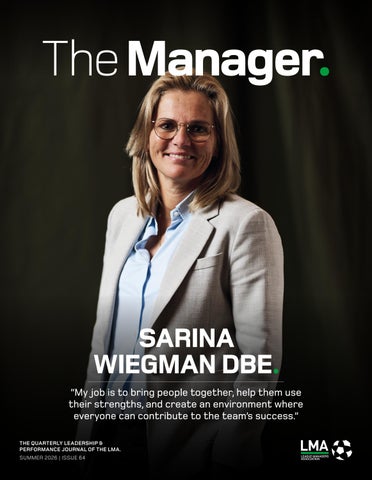
SARINA WIEGMAN DBE. “My job is to bring people together, help them use their strengths, and create an environment where everyone can contribute to the team’s success.” THE QUARTERLY LEADERSHIP & PERFORMANCE JOURNAL OF THE LMA. SUMMER 2026 | ISSUE 64
THE MANAGER
LMA Chief Executive
RICHARD BEVAN OBE. 2025/26 was another exceptionally busy and exciting season, with our members at the heart of creating new chapters in the history of the game. Our commitment to recognising excellence across our membership was reflected at the 34th LMA Annual Awards Dinner at the JW Marriott Grosvenor House London.
2
Alongside celebrating this year’s award winners, we were proud to induct Steve Bruce and LMA Chair Martin O’Neill OBE into the LMA Hall of Fame 1,000 Club, recognising two remarkable careers that continue to inspire managers and coaches across the game. There was also recognition for LMA members Lou Macari and Lee Carsley in the King’s Birthday Honours List, with each
The Manager Journal
awarded an MBE for their services to association football. Lou’s honour also included his extraordinary commitment to supporting homeless people in Stoke-onTrent through the Macari Foundation. It’s always fantastic to see the hard work and dedication of our members being celebrated in such a prestigious manner. Football is truly global, with the international make-up of the LMA’s membership
highlighted at the recent 2026 FIFA Men’s World Cup, in which 18 LMA members managed or coached teams. As the game becomes more internationally connected, we were honoured to attend a landmark forum hosted earlier this year by the Portuguese National Association of Football Coaches to discuss the creation of a global association of coaches. The LMA is at the centre of discussions to shape how this
might be structured, sharing best practice and expertise with our global counterparts. As we look ahead to a new season, our team is working on a new 2026-29 LMA strategy that ensures we remain agile and adaptable in our approach. We will continue to use our standing within the game to influence and push for positive change, including increased central game investment in the coaching workforce. We will
League Managers Association
continue to serve our members with relevant and high-quality support, empowering them to maximise their potential and thrive, while building strong and purposeful partnerships that deliver tangible value to global brands as well as committed charity and community organisations. Since 1919, our members have been at the heart of football and the centre of our association. We are our members.
3
QUALITY ALWAYS SHINES THROUGH Windows • Doors • Conservatories anglianhome.co.uk 0800 876 6408 Quote ref: LMA2026
Anglian Home Improvements is a trading name of the ASHI Group Limited and is a credit broker, not a lender. Registered office: Liberator Road, Norwich, NR6 6EU. Registered in England No. 2540020. Authorised and regulated by the Financial Conduct Authority for consumer credit activities. S3493 V1 March 2026.
THE MANAGER
Alice Hoey
FROM THE EDITOR. Every day, we make countless assumptions, about what others think, outcomes and causes, and our own and other people’s abilities. These assumptions shape our decisions and behaviours, influencing what we prioritise and how we respond in social situations.
In essence, these cognitive shortcuts are designed to save time and energy. However, they’re also often flawed, based not only on facts but on personal biases, past experiences, fears, insecurities and social conditioning. Assumptions can stop us listening properly (we already know what they think), trying something new (we can’t do that), or communicating clearly (they understand already). As Claire Davidson outlines on page 26, assumptions can also prevent us from identifying and resolving problems because, in our haste, we bark up the wrong tree. “If you are trying to solve the wrong problem, even the best solution in the world will fail,” she says, advocating digging deeper, listening to different perspectives, and focusing on evidence and observable behaviours. This was precisely the approach adopted by the More than Equal programme, which aims to create the first female Formula
League Managers Association
One world champion. As Main Board Advisor Kate Beavan explains on page 48, the programme avoided jumping to conclusions about the causes of the gender gap in motor racing or how to address it. “We realised that in order to achieve our goal we first needed to understand properly what barriers were preventing girls from reaching the podium,” she says. “There was no central database for any of this, so we had to build a picture from scratch.” Beavan also assembled a team of experts from outside motor racing, recognising that fresh thinking and different perspectives would be needed to solve a problem that F1 had failed to address for 50 years. It was a masterstroke. As Davidson says, “Every person and environment is different, so past experiences should guide curiosity, not replace it. The more perspectives we can draw on, the more complete the picture.”
5
THE MANAGER
EDITOR Alice Hoey alicehoey1@gmail.com EDITOR FOR THE LMA Sue McKellar sue.mckellar@leaguemanagers.com ART DIRECTOR Matt Draycott matt.draycott@leaguemanagers.com CONTRIBUTING EDITOR Luke Johnson luke.johnson@leaguemanagers.com SENIOR WRITERS Marc Williams marc.williams@leaguemanagers.com Jake Henry jake.henry@leaguemanagers.com Thomas Peace thomas.peace@leaguemanagers.com PUBLISHER Jim Souter jim.souter@leaguemanagers.com The League Managers Association, St. George’s Park, Newborough Road, Needwood, Burton upon Trent DE13 9PD The views and opinions expressed by contributors are their own and not necessarily those of the League Managers Association, its members, officers or employees. Reproduction in whole or in part without written permission is strictly prohibited. www.leaguemanagers.com
BUSINESS DEVELOPMENT Adam Tarrant adam.tarrant@leaguemanagers.com DESIGN Luna Studio PHOTOGRAPHY Action Images, Alamy, Chester FC, Fulham FC, Getty Images, Hoar Cross Hall Hotel and Spa, Indeed, iStock, Kitchee SC, More than Equal, Premier League, Reuters, The FA. PRINT PARTNER Jellyfish Solutions Limited
6
The Manager Journal
PARTNER ADVERT SPECIFICATION & GUIDELINES The Manager is changing to a new larger size, please read and follow the below
Page Size: 190mm (w) x 245mm (h) Recommended safe zone (no key text or logos outside of this): 160mm (w) x 215mm (h) allowing for a 15mm border
Summer 2026 // Issue 64. The quarterly leadership and performance journal of the LMA.
30
SARINA WIEGMAN DBE
WELCOME.
2
THE LEADER.
25
LMA CEO: Richard Bevan OBE
2
Column: Claire Davidson
26
The Editor: Alice Hoey
5
On the cover: Sarina Wiegman DBE
30
In tribute: Kenny Jackett
10
38
LMA Awards, sponsored by Vitality
14
Feature: Media communications, with Darren Ferguson, Tim Percival and Simon Felstein From another sport: Kate Beavan, More Than Equal
48
Interview: Hayden Mullins
54
The view from: Iñigo Calderón
60
Interview: Garreth Hayes, Indeed
66
Interview: Brian Barry-Murphy
72
Key takeaways: Anika Leslie-Walker
78
8
The Manager Journal
THE MANAGER
LMA NEWS.
83
LMA events and corporate activity
84
Annual Technical Masterclass
88
LMA Institute
96
LMA In the Game
98
Technical: SkillCorner
100
PERSONAL PERFORMANCE & WELLBEING.
103
Column: Oliver Patrick
104
Feature: Filling the void
108
10 Ideas: Interview techniques
114
Feature: Reset. Refocus. Lead.
118
How to: Build a strong core
122
THE GAME.
125
Premier League
126
The FA
128
Just a Moment
130
54 HAYDEN MULLINS
60 IÑIGO CALDERÓN League Managers Association
THE MANAGER
IN TRIBUTE
KENNY JACKETT 1962-2026 Photography: Reuters // Action Images
10
The Manager Journal
10 IDEAS: KENNY SCREENING JACKETT
“ KENNY WAS ONE OF THE MOST RESPECTED MANAGERS TO HAVE PLIED HIS TRADE IN THE EFL, A HUGELY CAPABLE LEADER WHOSE WORK ACROSS FOUR DECADES HAS LEFT A LASTING INFLUENCE ON THE MANY PLAYERS, COACHES AND COLLEAGUES WHO BENEFITED FROM HIS GUIDANCE. HE EMBODIED EVERYTHING WE LIKE TO SEE IN A MANAGER: HUMILITY, PROFESSIONALISM AND A DEEP CARE FOR HIS PLAYERS AND STAFF. HE IMPROVED EVERY CLUB HE SERVED AND DID SO WITH QUIET DIGNITY.” Richard Bevan OBE LMA Chief Executive
Kenny Jackett progressed through the ranks at Vicarage Road under Graham Taylor, becoming a key figure in one of the most exciting eras in Watford’s history. He made 428 appearances for the club and won 31 caps for Wales. When he was forced into early retirement, Kenny made an immediate and seamless transition into coaching at Watford, working initially with young players before progressing to become assistant manager and eventually manager. Those years formed the bedrock of his coaching identity: detailed preparation, clear communication, and an unswerving belief in hard work and collective responsibility. Throughout his career, colleagues and players spoke of his integrity, calmness under pressure and meticulous approach on the training ground. Kenny’s first major managerial
success came at Swansea City, where, after taking charge in 2004, he achieved promotion from League Two in 2004/05, while also winning the Football League Trophy and back-to-back FAW Premier Cup titles. He then moved to Millwall, where he guided the club to promotion via the League One play-offs in 2010 before establishing them in the Championship. In 2013, Kenny took the helm of Wolverhampton Wanderers, winning the League One title at the first attempt, setting a new divisional points record of 103 and restoring pride and identity to Molineux. He followed that with a seventhplace finish in the Championship, narrowly missing out on the play-offs, underlining his capacity to rebuild and reenergise major clubs. Kenny became manager of Portsmouth in 2017 and, over
League Managers Association
nearly four years, kept Pompey competitive, reaching the playoffs and delivering a memorable day at Wembley in 2019 by winning the EFL Trophy against Sunderland after a dramatic penalty shootout. Across a career spanning more than 900 games with Swansea City, Millwall, Wolves, Portsmouth, Rotherham United and Leyton Orient, his teams reflected his style: organisation without rigidity, intensity without loss of control, and a strong emphasis on character. Later, Kenny moved into senior technical and strategic roles, including a spell as director of football at Gillingham, where he continued to mentor staff and support long-term planning. Even away from the touchline, his experience and measured judgement remained highly valued throughout the game.
11
Kenny Jackett celebrates with fellow Watford first-team coach Luther Blissett and manager Graham Taylor after securing a place in the Nationwide Division 1 play-offs. May 1999. Action Images // Richard Heathcote
Millwall manager Kenny Jackett celebrates promotion to the Championship with Paul Robinson. May 2010. Action Images // Alex Morton
Portsmouth’s Kenny Jackett with Arsenal’s Mikel Arteta before their FA Cup fifth-round tie. March 2020. Reuters // Action Images
QPR assistant manager Kenny Jackett during the side’s Nationwide Division 2 tie against Barnsley. August 2002. Action Images // Mick Walker
12
The Manager Journal
Kenny Jackett celebrates victory in the Football League Trophy final against Carlisle. April 2006. Action Images // Lee Mills Livepic
Wolves manager Kenny Jackett and his players lift the Sky Bet Football League One trophy after victory against Carlisle. May 2014. Action Images // Henry Browne
Portsmouth manager Kenny Jackett lifts the Checkatrade trophy after the side beat Sunderland in the final at Wembley Stadium. March 2019. Alamy
League Managers Association
13
LEAD SPONSORS
AWARD SPONSORS
EVENT SPONSORS
THE MANAGER
Many congratulations, Frank. Your personality as a manager and a leader is so clearly defined in how your team has played great football this season, with confidence and self-belief, and I’ve enjoyed watching them. I know from speaking with you that you have great humility and that important quality of a curious mind for learning. SIR ALEX FERGUSON CBE LMA COMMITTEE MEMBER
16
The Manager Journal
LMA ANNUAL AWARDS DINNER
To be recognised by his fellow managers and presented with this accolade is a richly deserved honour, reflecting the significant impact he has made at the club. MARTIN O’NEILL OBE LMA CHAIR
Coventry City head coach Frank Lampard OBE was awarded the Sir Alex Ferguson Trophy for LMA Manager of the Year presented by Vitality. The coveted award, voted for by the full LMA membership, was announced at the 34th Annual Awards Ceremony at JW Marriott Grosvenor House London in May. The seven other managers in contention were: Keith Andrews (Brentford), Mikel Arteta (Arsenal), Unai Emery (Aston Villa), Pep Guardiola (Man City), Andoni Iraola (Bournemouth), Michael Skubala (Lincoln City) and Andy Woodman (Bromley). The Barclays Premier League Manager of the Year Award went to Mikel Arteta, who successfully guided Arsenal to their first league title since 2004, and first UEFA Champions League Final appearance in 20 years. Andrée Jeglertz of Manchester City Women won the Barclays Women’s Super League
Manager of the Year Award after a remarkable debut campaign, which included winning the Barclays WSL title and reaching the Adobe Women’s FA Cup Final. Karen Hills capped a brilliant season in charge of Charlton Athletic Women by winning the Barclays Women’s Super League 2 Manager of the Year following promotion to the WSL. Meanwhile, Frank Lampard OBE was crowned Sky Bet EFL Championship Manager of the Year, following an outstanding season in which he galvanised the city of Coventry on the way to leading the Sky Blues back to the Premier League for the first time in 25 years. Michael Skubala, who achieved an incredible 103-point season with Lincoln City, won Sky Bet League One Manager of the Year, while Bromley manager Andy Woodman collected the Sky Bet League Two Manager of the Year following the side’s historic title win, highestever league finish and second promotion in just three seasons.
League Managers Association
The evening also provided the opportunity to induct LMA members Steve Bruce and Martin O’Neill OBE into the LMA Hall of Fame 1,000 Club, celebrating the remarkable achievement of managing 1,000 competitive matches throughout their storied and iconic careers. Lionesses manager Sarina Wiegman DBE received the John Duncan Special Achievement Award in recognition of her incredible back-to-back European Championship wins with England, and her ongoing contribution to the development and advancement of the women’s game. Graeme Souness CBE also received a John Duncan Special Achievement Award for his incredible work to raise awareness and funds for DEBRA UK. The John Duncan Service to Football Award was presented to Eileen Gunn who has dedicated 40 years of service and support to Bradford City and the wider game.
17
THE MANAGER
On behalf of the LMA, I would like to congratulate all of this year’s winners, whose dedication, resilience and professionalism continue to shine bright. To be recognised by your peers, those who truly understand the demands and challenges of football management, is a very special honour. I wish to thank our Awards Partners Vitality, the Premier League, Sky Sports, Nike, Everest, Guinness, Barclays, Sky Bet and Mappin & Webb for their ongoing support throughout. RICHARD BEVAN OBE LMA CHIEF EXECUTIVE
18
The Manager Journal
League Managers Association
19
20
The Manager Journal
LMA ANNUAL AWARDS DINNER
League Managers Association
21
THE MANAGER
2025/26 AWARD WINNERS. THE SIR ALEX FERGUSON TROPHY FOR THE LMA MANAGER OF THE YEAR
FRANK LAMPARD OBE
BARCLAYS PREMIER LEAGUE MANAGER OF THE YEAR
BARCLAYS WOMEN’S SUPER LEAGUE MANAGER OF THE YEAR
BARCLAYS WOMEN’S SUPER LEAGUE 2 MANAGER OF THE YEAR
MIKEL ARTETA
ANDRÉE JEGLERTZ
KAREN HILLS
22
The Manager Journal
LMA HALL OF FAME 1,000 CLUB
STEVE BRUCE MARTIN O’NEILL OBE LMA JOHN DUNCAN SPECIAL ACHIEVEMENT AWARD
SARINA WIEGMAN DBE GRAEME SOUNESS CBE LMA JOHN DUNCAN SERVICE TO FOOTBALL AWARD
EILEEN GUNN
SKY BET EFL CHAMPIONSHIP MANAGER OF THE YEAR
SKY BET LEAGUE ONE MANAGER OF THE YEAR
FRANK MICHAEL LAMPARD OBE SKUBALA League Managers Association
SKY BET LEAGUE TWO MANAGER OF THE YEAR
ANDY WOODMAN 23
A NE W ER A OF GOLF BEGINS Elevate your game with TaylorMade’s most premium custom fitting experience, then extend the experience with championship golf and a luxury stay at The Grove.
www.thegrove.co.uk
@thegrovehotel
SCAN TO EX PLORE
THE MANAGER
THE LEADER.
League Managers Association
25
THE MANAGER
LEADER COLUMN
Claire Davidson
CLEAN THE PROBLEM. One of the biggest mistakes we make is to spend too much time searching for a solution before we fully understand the problem.
26
The Manager Journal
LEADER
Most environments in sport and business are incredibly solutionfocused. Coaches, managers and support staff are under pressure to act quickly, so the natural instinct is to jump straight into fixing something. We ask questions like: What training can we add? What intervention can we use? What mental skills can we teach? If you are trying to solve the wrong problem, however, even the best solution in the world will fail. That’s why I spend a lot of time helping clubs and organisations ‘clean the problem’ before trying to fix it. A perfect example came from my time working with a football club. We had a player who was one of our standout midfielders when we played away from home, but during home games his performances dropped significantly. After a difficult few years, the club’s fans had become rather hostile, so it was assumed that the player simply wasn’t coping well with this reception. Naturally, perhaps, it was suggested that the player do more pressure training, confidence work and psychological skills sessions, but despite trying various interventions, nothing really changed. It was only when I sat down with the player and really explored the situation that the actual problem
revealed itself. The player had a newborn baby with severe reflux and he was barely getting any sleep. He was exhausted, stressed and emotionally drained before home matches, but rested for away games, when the team would stay overnight in a hotel before the match. The solution, therefore, was not complicated mental training, but simply arranging for him to stay in a hotel before home matches as well, so he’d be fresh and able to perform at his best. That experience reinforced something I see repeatedly in performance environments: once you identify the correct problem, the solution is often far simpler than you expect. This is a subject explored in detail in the book ‘Pig Wrestling’ by Pete Lindsay and Mark Bawden. I sometimes use the example of Amsterdam Airport when explaining this idea. Years ago, the airport was spending huge amounts of money dealing with hygiene issues in the men’s toilets. They tried awareness campaigns, signs and messages encouraging people to be more considerate, but nothing changed. Eventually, someone realised that the real issue was not motivation or awareness, but simply a lack of good aim. They etched a tiny fly into each urinal at which men instinctively aimed, and cleaning costs
League Managers Association
reportedly dropped dramatically. Again, the solution only became obvious once they understood the real problem. In psychology, there are several key areas I look at when I suspect a club or team may be solving the wrong issue. The first is to ask what has already been tried. If lots of different solutions have been attempted without success, there is a good chance they are tackling the wrong problem entirely. We often overcomplicate performance issues when, in reality, the right answer can be surprisingly simple. How, then, can we get to the root of the problem? One important step is to stop using labels and instead focus on behaviours. In sport, we might call a player ‘lazy’, ‘mentally weak’, ‘too emotional’ or ‘not a good teammate’, but these labels are vague and emotionally loaded, and they rarely tell us what is actually happening. Behaviour, however, is observable. Instead of saying a player is lazy, we should be asking what they are, or are not, doing. Are they failing to track back after losing possession, for example? Are they avoiding responsibility in key moments, or disengaged during training? The more specific we can be about behaviour, the easier it becomes to understand and change. Another technique I often use is something called the ‘miracle
27
Very often, the answer is already somewhere within the club or organisation. The challenge is creating enough curiosity, openness and collaboration to uncover it.
question’. I ask people, ‘If we waved a magic wand overnight and the problem disappeared tomorrow, what would we see differently?’ This helps us move away from vague descriptions and toward concrete behaviours. I also ask whether the issue happens in every environment, because we know that a huge percentage of human behaviour is shaped by context. A player may behave differently depending on who is present, the atmosphere around them or the situation they are in. For example, in youth football, coaches often notice a completely different version of a player when a parent is watching from the sidelines. That tells us the environment itself may be influencing their behaviour. Trying to solve complex problems alone is extremely difficult because we all carry our own biases and blind spots, and may make assumptions about what is going on based on what we’ve seen before or experienced ourselves. Every person and environment is different, so past experiences should guide curiosity, not replace it. The more perspectives we can draw on, the more complete the picture. In elite sport,
28
The Manager Journal
players often reveal different sides of themselves in different environments. A physio may hear things a manager never hears, for example, while a coach might notice patterns invisible to support staff. In the case of the player struggling at home, it was actually conversations in the physio room about sleepless nights with young children that first pointed us toward the real issue. That is the power of open, trusting communication. Very often, the answer is already somewhere within the club or organisation. The challenge is creating enough curiosity, openness and collaboration to uncover it. Because in performance psychology, the hardest part is not always solving the problem, it’s identifying the right one in the first place. Claire has spent the last 14 years working in professional football, and for the last five has led performance psychology delivery within The FA. A published author and researcher, she acts as a member and advisor on several boards and senior leadership teams. Beyond sport, Claire provides keynote talks, workshops and executive coaching, helping businesses and leaders apply high-performance psychology to their fields.
PRIVATE BANKING
–
WEALTH PLANNING
–
INVESTMENT MANAGEMENT
Your career. Your wealth. Our expertise.
At Arbuthnot Latham, we understand the rewards and uncertainties of a career in football. That is why we work closely with players, managers, coaches, and their advisers to manage, protect, and grow their wealth – from first contract to retirement and beyond. Private banking and wealth management that matches your ambitions. Sam Green Senior Private Banker +44 (0) 7795 308180 SamuelGreen@arbuthnot.co.uk arbuthnotlatham.co.uk/sportsmedia Registered in England and Wales No. 819519. Arbuthnot Latham & Co., Limited is authorised by the Prudential Regulation Authority and regulated by the Financial Conduct Authority and the Prudential Regulation Authority.
SARIN WIEGM SARINA WIEGMAN DBE
CONNECTIONS.
In her 20 years as a coach, Sarina Wiegman DBE has won the 2017 European Championships and reached the 2019 World Cup final with the Netherlands and, as England’s head coach since 2021, has guided the Lionesses to two successive UEFA Women’s Euro titles, the inaugural 2023 Finalissima and the 2023 World Cup final. Here, she reflects on her early career journey and the values at the heart of her leadership. Interview: Sue McKellar Photography: Getty Images // Reuters // Action Images
NA MAN
My job is to bring people together, help them use their strengths, and create an environment where everyone can contribute to the team’s success.
I GREW UP IN THE MULTICULTURAL DUTCH CITY OF THE HAGUE. I come from a working-class background. My parents have a really strong work ethic and it was important to them that I, my twin brother and my sister had a good education so we’d have more opportunities later in life. Born during the war, my parents weren’t able to stay in school and get a good education. They had to work really hard in life.
in a boys’ team with my twin brother, because there weren’t opportunities to play as a young girl. Women’s and girls’ football was far more established in the US, however, so after I graduated from high school in 1988 and had the opportunity to study and play football at the University of North Carolina, I jumped at it. It was an environment where you were accepted and appreciated, and it was already breeding top-level talent.
THE US WAS A PARADISE FOR WOMEN’S FOOTBALL. I always loved to play football growing up, but at that stage it wasn’t accepted as the norm for girls to play, so I was always ‘that girl who plays football’. When I was six, I cut my hair to play football
The focus was on elite performance. Alongside my studies, I trained intensively with really talented players, including strength and conditioning work, and travelled across the country for matches. I loved the experience and it expanded my thinking.
32
PHYSICAL EDUCATION SEEMED LIKE THE OBVIOUS PATH. When I returned to the Netherlands after my studies, women’s football wasn’t a fulltime profession, so I still needed to work while playing for my club and the Netherlands national team. Keen to work with people and in sport, I worked as a PE teacher for about nine years. It taught me many things that proved invaluable in my coaching career. I was managing a class, planning lessons, learning how to organise and motivate people, deal with different personalities, and create an environment where everyone can learn and improve. Like coaching, teaching is about influencing behaviour and supporting individuals as
Having led the Lionesses to the World Cup final in 2023, Sarina Wiegman DBE and her side now have the 2027 World Cup in Brazil in their sights. Getty Images
Having previously been the Netherlands’ assistant and interim coach, Sarina Wiegman DBE became head coach in 2017, leading them to victory in the Euros. Two years later, they reached the final of the 2019 FIFA Women’s World Cup. Reuters // Action Images
During her nine-year playing career, Sarina Wiegman DBE played for Ter Leede, and earned 104 caps for the Netherlands and captained the side. Reuters // Action Images
Of course we wanted to win, but our focus needed to be not on the outcome but on what we could control, the actions and preparation that would get us there.
34
Sarina Wiegman DBE says she loves working with people, enabling them to grow and helping to give opportunities and a voice to people who might not otherwise have them. Getty Images
they grow. I also learned about psychology, which I’ve always been really interested in, physiology, anatomy, educational theory, teaching methods and strategy, language and communication, all of which influenced me as a coach. FOOTBALL MANAGEMENT WAS ALWAYS MY VOCATION. I already knew from around the age of 17 or 18 that I wanted to be a manager. Some of my football coaches may have found me a little annoying,
because I always had a strong opinion on things. I was really interested in studying football and how, together, we could connect and play the game. I BELIEVE IN BUILDING STRONG CONNECTIONS. Connections and supporting growth are some of my most important responsibilities as a coach. For that, I need to understand why people behave the way they do. I’m naturally curious about people and am constantly asking
questions: Why is someone behaving this way? What does this person need to perform at their best? How can I support them better? How can I help them improve while also helping the team succeed? I believe that the better we understand one another, both on and off the pitch, the stronger our relationships become. That also helps when giving feedback, because when people know that it’s coming from a place of support and respect, they’re more likely to
League Managers Association
accept and learn from it. At the highest level, those connections make a genuine difference. CLARITY, TRUST AND COMMUNICATION ARE INCREDIBLY IMPORTANT. People need to understand their roles, responsibilities and expectations. When someone feels comfortable being themself and knows exactly what is expected of them, they’re more likely to take ownership of their actions and perform at their best.
35
Sarina Wiegman DBE was awarded the John Duncan Special Achievement Award at the LMA Annual Awards 2026. Reuters // Action Images
There’s now so much expertise among the players and staff that my role is largely to create an environment where everyone can excel. That requires honest, open communication. Players won’t always agree with my decisions, and that’s fine. Everyone deserves the opportunity to express their feelings and opinions, so long as we respect one another and continue to learn about each other. Open conversations help us to understand one another better and create stronger relationships. MY FIRST PRIORITY AS ENGLAND HEAD COACH WAS TO LISTEN. When I arrived in England I didn’t want to change
36
everything immediately. It was important I understood what was already working well and where I could add value. That meant having one-toone conversations with every player to find out what they thought could be improved and what should continue. One message came through clearly: everyone desperately wanted to win a major tournament with their country. I understood the sentiment, but asked if we could change the focus and remove the sense of ‘desperation’. Of course we wanted to win, but our focus needed to be not on the outcome but on what we could control, the actions and preparation that would get us there.
The Manager Journal
TIME AWAY FROM FOOTBALL KEEPS ME BALANCED. Before we start the hectic process of qualifying or preparing for a major tournament, I’ll schedule in a week’s holiday for me, and ask the same of my staff, so we have time to rest and recover before we go into that period. As a coach, people are constantly looking to you for decisions and guidance, and it’s essential that you take care of yourself so you are physically and mentally fresh, and can concentrate fully on the challenges ahead. When I am in camp, in conjunction with already being well prepared for the job ahead, I find yoga, breathing and meditation really help me.
Sarina Wiegman DBE believes that open communication within an environment of respect helps to build connections, which ultimately enhances performance. Getty Images
Simple things like spending time back in the Netherlands, walking my dog, going to the beach or having dinner with my husband and our daughters are really important. SUCCESS COMES FROM CONTINUOUS IMPROVEMENT. I’m always asking what we need to keep doing, what needs to improve, and what we should stop doing. We identify what’s changing, what the trends are on and off the pitch, and what that means for us as the England team. Whether the goal is a World Cup, a European Championship or just the next match, the process remains the same: identify what is needed and work towards it
Connections and supporting growth are some of my most important responsibilities as a coach.
every day. The reality is that success at major tournaments is never guaranteed. Even when you prepare perfectly and perform at your highest level, you can still lose because the competition is so strong. What matters is focusing on the things you can control, maintaining belief and giving yourself the best possible chance of success.
can help open doors for others who haven’t had those opportunities. Even if I can make a small difference through football, I want to use my platform to do that. I didn’t become a coach because I wanted attention or recognition, but because I love working with people and enjoy helping them to learn, grow and reach their potential.
FOOTBALL IS ABOUT MORE THAN WINNING MATCHES. I’m passionate about helping to improve the position of women in football and giving opportunities to people in society who may not always have a voice. I feel fortunate to have had opportunities in my own life, and I believe sport
Although the head coach leads the team, success is always a collective effort. My job is to bring people together, help them use their strengths, and create an environment where everyone can connect and contribute to the team’s success. That, more than anything, is what coaching means to me.
League Managers Association
37
LEAD THE NARRATIVE. From managing reputations and navigating crises to engaging fans and shaping narratives, media communications sits at the heart of modern leadership. Here, three experts give their perspectives on some of the challenges and opportunities this presents. Words: Alice Hoey Photography: Reuters // Action Images // Alamy
Who do you like and respect, and how do they speak and present themselves in interview?
40
The Manager Journal
LEAD THE NARRATIVE
SIMON FELSTEIN. From the very first press conference that you give as a new manager, you’re making an impression not just on those in the media, but on the fans, the players, the board and everyone else at the club. It’s therefore a fantastic opportunity to convey who you are as a person and a coach, and what your plans are for the side, and hopefully to get people on board for the journey. It’s your chance also to address head on any concerns that they might have. The fans don’t see the manager throughout the week, or get to
witness how they engage with the players on the training field. Their impression is therefore almost entirely formed by how you present yourself in media interviews and press conferences. If you are generous with your time and insight, and likeable and authentic, you’re far more likely to garner the support of the media and fans, and to win yourself valuable time with them when things get tough. Because the manager is the only one at the club who speaks to the media on a weekly basis, they will often find themselves
Simon Felstein Simon is a communications specialist with more than 20 years’ experience in professional football. He spent 16 years at Tottenham Hotspur in a range of senior communications roles and has worked as a consultant to the LMA for the past five years, advising managers and coaches on media performance, leadership communication and reputation management.
41
fielding questions not only on football issues but a range of things unrelated to their own job. When that happens, you’re not just speaking for yourself, the players or staff, but for the club as a whole. In that situation, you can simply prepare a stock response and try to move things on, but it’s worth thinking in advance about any tricky issues you’re likely to be asked that are outside your realm of expertise. Speak to those who are in the know, the decision makers and policy makers, so that you’re better equipped to give an informed response on behalf of the club. It’s important to understand,
42
however, that you can have as much control of the situation as you want to have, by planning carefully how you want to come across, and the messages you want to communicate. Don’t assume that you know everything or that you’re expected to. Share your ideas with your coaches and other staff and get their opinions before you go and say them publicly. There are so many people you can influence in that public forum, whether it’s the media itself, the players, board or fans, so think about how you might best target each of them. The ability to perform in the media is now a major
The Manager Journal
part of the manager’s role, and can influence not only the level of support you have in your current role, but also your long-term reputation and future job prospects. Therefore, it’s important to learn from your past performances as well as from other people, both in football and outside of sport. Who do you like and respect, and how do they speak and present themselves in interview? For example, authentic communicators will match their words with their body language. Try watching past interviews on mute so you can focus on what your body is doing when you’re answering questions.
LEAD THE NARRATIVE
TIM PERCIVAL. Be authentic, but understand there’s still an element of presentation.
One of the biggest challenges for managers today is just how intense the scrutiny is, much of it driven by social media. Interviews are clipped up, shared and picked over by fans online, often within minutes, which means there’s very little room for mistakes. A single off-hand comment can quickly take on a life of its own. Managers are also speaking to lots of different audiences at
Tim Percival Tim is the Communications Lead for the England Rugby team. He has held senior communications and marketing roles across professional sport, including with The British & Irish Lions and Northampton Saints. His book, On The Record & On The Ball: How elite coaches master the media, was recently shortlisted for Sports Entertainment Book of the Year.
once. They may be answering a journalist’s question, but they’re also trying to manage the mood of the dressing room, connect with supporters, protect their players and sometimes send messages to the club hierarchy. Then there’s the emotional aspect. Often, interviews will take place immediately following defeats, when emotions are still very raw,
People respond when they feel a coach is genuine and speaking like a real person.
44
and coaches are expected to stay composed in moments where most people probably wouldn’t be. I spoke to Graham Potter about this for my book, and he said simply, “You’ve got to get yourself into the best mental state that you can,” adding that he tries always to be aware of his emotions. Being self-aware enough to recognise whether you’re calm or raging is essential. That goes equally for body language, because communication isn’t just about words. Audiences form impressions within seconds,
The Manager Journal
and your non-verbal cues can be just as powerful as what you actually say. If you appear tense or frustrated, that’s often how you’ll come across, regardless of the content of your response. All of this requires coaches to have excellent emotional intelligence and, in fact, this skill has become central to modern coaching. In many ways this reflects a broader shift in society, whereby people expect their leaders to be in tune with them and to consider their situation before acting.
The best managers today are often those who are able to communicate clearly under pressure, but above all they need to connect with people. That’s really the heart of it. Whether it’s players, supporters or the media, people respond when they feel a coach is genuine and speaking like a real person. Jürgen Klopp is a great example of someone who stood out not only for his success, but for the connection he built with the Liverpool supporters. He felt like one of them, and that sense of belonging is incredibly powerful in modern management.
For most fans, media interviews are effectively the face of the club’s leadership, because they’re not party to what goes on at the training ground or internal conversations. I make the point in my book that the Amazon ‘All or Nothing’ documentary helped Mikel Arteta in his first season at Arsenal, because it offered fans a deeper understanding of his methods and, ultimately, helped build his relationship with them, even during a period when they finished in
League Managers Association
their lowest league position for 25 years. Is there a secret to good media comms for a manager or indeed anyone in leadership? Well, there’s a paradox here. My one piece of advice is to be yourself, because authenticity builds trust. At the same time, however, giving an interview is performative. It’s not an act in a fake sense, but you are aware that you’re being watched and judged, so there’s a balance: be authentic, but understand there’s still an element of presentation.
45
THE MANAGER
DARREN FERGUSON. When speaking to the media, you’re not just talking to fans, you’re also sending messages to players, staff and stakeholders. It’s important, therefore, to take a little time before speaking to compose yourself and consider what messages you want to send to each of those groups, because they’re all listening. I like to speak to my players first, before going to my office or a quiet space to gather my thoughts. Sometimes, especially after a big game, you don’t get as much time as you would like to reflect. It can be helpful on those occasions to hear what the opposition manager has to say first, to get their perspective on things and afford yourself a little more time to shape your response. When results are going well that’s easier, but when you’ve just lost a match or the performance wasn’t great you have to be more careful. There have been times in my career when I’ve lost my temper in interviews and have regretted it. Experience has taught me that it’s always better to focus on giving credit to the
46
opposition than to lay into your own team. I will talk to the players individually and as a group about what we need to improve; there is no value at all to criticising your players in public. At the same time, though, there’s no point pretending. The fans aren’t stupid. They’ve watched the same game as you. So, whether you’re under pressure, winning or losing, it’s best to be honest and give a fair assessment, while keeping it constructive. How you come across in interviews is important, because you need the fans and everyone else on side, especially when things aren’t going well. It’s important, therefore, to be self-aware and make sure you’re getting across not just the right messages but who you are as a person. There was a point in my career, for example, when I realised I was sounding repetitive and dour in press conferences, which I’m not. Since then, I’ve made an effort to mix things up a bit and be more positive.
The Manager Journal
The relationship between a manager and the press is important and valuable, on both sides. Most important of all is the relationship you build with your local newspaper or reporter, because the local fanbase is key. You don’t need to be best friends, but you do need close communication. If that means asking for advice or feedback from time to time, then do it. It may help you to improve.
The relationship between a manager and the press is important and valuable, on both sides.
League Managers Association
Darren Ferguson Darren has nearly 20 years’ experience as a manager, most notably with Peterborough United, with whom he achieved four promotions, three of them to the Championship, and where he was at the helm most recently in 2025. Ferguson also achieved promotion with Doncaster Rovers in 2017.
47
FROM ANOTHER SPORT:
KATE BEAVAN
THE ISSUE ISN’T CAPABILITY, IT’S OPPORTUNITY. For half a century, Formula One has existed without a woman on the grid. With More than Equal, however, Kate Beavan has set the wheels of change in motion. Interview: Alice Hoey Photography: More than Equal
People will stop asking whether women can do it and will focus instead on how many more will be coming along.
Motor racing is a gender-neutral sport, but you wouldn’t know it. Viewed as a male-only arena for many decades, only a tenth of licensed drivers globally are women, and no woman has competed in a F1 Grand Prix since 1976. The talent, however, is undeniably there, and increasingly women are taking their rightful place, both on and off the track. “Most fans don’t know that there are women doing highly technical roles in F1,” says Kate Beavan, who has over 30 years of experience in F1, primarily on legal, licensing and hospitality projects. “For example, in 2019, four out of the 10 F1 teams had
50
female race strategists, one of the most important and difficult roles in the sport,” she says. “Race strategists spend weeks prior to a race building simulations and preparing for every possible scenario, then they communicate with the drivers during a race, making split-second decisions that can win or lose it.” The problem, therefore, is not one of talent, but visibility. What’s more, while headway has been made behind the scenes, women are noticeable by their absence on the track, an imbalance and injustice close to the heart of former F1 racing driver David Coulthard.
The Manager Journal
“Growing up, both he and his sister were avid and expert kart racers,” says Beavan, but while they were equally talented, only he was given the opportunity to progress through the ranks to F1. So, after I stepped away from my career in F1 to establish an advisory firm, David approached me, alongside entrepreneur and philanthropist Karel Komarek, with the aim of tackling the absence of women at the top of the sport. UNDERSTANDING THE PROBLEM Their insight and ambitions were the starting point for More than Equal, a non-profit organisation with the singular aim of creating
the first female Formula One world champion. But while the ‘what’ and the ‘why’ were clear, the ‘how’ was far from obvious. Should they fund a young driver, sponsor some girls or create an academy? Would their efforts be better spent building a team or starting a race series of their own?” Rather than rushing into a solution, Beavan pushed for something the sport had never properly undertaken before: comprehensive research on women’s participation in motorsport. “We realised that in order to achieve our goal
we first needed to understand properly what barriers were preventing girls from reaching the podium. There was no central database for any of this,” Beavan explains, “so we had to build a picture from scratch.” Researchers examined data from 180 countries to determine how many women and girls were competing, interviewing key figures across Formula One, surveying fans and gathering extensive qualitative information.
Kate Beavan Originally practising as a lawyer in Oxford, Kate moved into the world of performance cars and sport in 1996, and was later recruited by Bernie Ecclestone at Formula One Management to work on numerous commercial and legal projects. In 2017, she became Director of the Global Hospitality and Experiences division, introducing a raft of innovative initiatives. Kate left Formula One in 2021 to pursue her own advisory business. As well as being the Main Board Advisor to More Than Equal, she is Deputy Chair of the European board of the Sport Integrity Global Alliance.
The findings revealed two major challenges, the first being the low number of girls entering the sport. “Across global racing,
League Managers Association
51
only one tenth of all licence holders are female,” says Beavan, “so, if girls aren’t entering karting at the bottom of the pyramid, they can’t rise to the top of it.” The second problem is retention and progression. “Those girls who do enter the sport don’t tend to stay in the pipeline as long as the boys,” Beavan says. “While you’d expect girls to represent 10 per cent of those at elite junior level, the figure is actually more like four per cent.”
Born in 2010, Skye Parker is a British go-kart racer from Trelogan, North Wales. She is the only British female pilot in the CIK/FIA European Championships in the OK-Junior category. More than Equal
A BESPOKE PIPELINE As a small non-profit organisation, More than Equal knew it couldn’t singlehandedly solve the problem of participation across the sport. That was a challenge it threw out to the industry as a whole. “We could, however, address performance. This became the foundation of More than Equal,” says Beavan, “to create a talent identification and high-performance programme tailored specifically to girls.”
KATE BEAVAN
The talent is undeniably there, and increasingly women are taking their rightful place, both on and off the track.
One of her first decisions was, perhaps, a surprising one: to recruit a multidisciplinary team of experts from outside of motorsport. “It was time for fresh thinking,” she says, pointing out that F1 had, after all, failed to solve the gender gap for 50 years. “I wondered what solutions and perspectives might be employed in other sports.” The organisation’s first CEO came from Sport England, while its current head, Tom Stanton, contributed to British Cycling’s success at the London 2012 Olympics. This cross-sport approach also influenced the programme’s use of data and performance analysis, with a Moneyball-type system called Future Lab proving key to identifying female F1 potential. “Currently, the biggest indicator of success in racing is how wealthy your parents are, but we wanted to look beyond that and analyse hidden indicators of talent,” says Beavan, “qualities that conventional scouting
methods often overlook. For example, our research told us that girls often find themselves pushed off the track by the boys, which distorts the race data. We therefore started looking at metrics like fastest laps, development trajectories, consistency and improvement curves. That’s what the programme is about. We’re research and evidence focused, and aim to identify talent early and create a system capable of consistently developing elite female racers.” IT ONLY TAKES ONE Beavan has no doubts about their ability to unlock the huge potential that’s out there, and knows that race teams will happily sign up female drivers, provided they are fast enough. However, even she accepts that, as it stands, most of the girls rising up through the programme will ultimately fail to progress. “One of the biggest obstacles in the sport is funding, because
League Managers Association
sponsors will almost always choose to give the opportunity to a boy over a girl, even when they show equal talent and potential,” she says. “From their perspective it’s sensible – they’ve only ever seen men succeed in F1 – but it’s a vicious circle. Without adequate funding for girls, they get less track time, improve more slowly and so attract fewer sponsors.” What More than Equal is essentially trying to do is break that cycle, producing that one breakthrough moment when a woman gets onto the podium and changes people’s perceptions of the sport, permanently. “It will only take one to change the conversation completely. People will stop asking whether women can do it and will focus instead on how many more will be coming along,” says Beavan. “That’s why we’re laser-focused on creating that first champion, because once you achieve the first, many more will follow.”
53
HAYDEN MULLINS
PERSONAL BEST. Having started his coaching career with Watford’s youth sides, and as caretaker for the first team, Hayden Mullins managed Colchester United and the Turks and Caicos Islands before becoming Fulham U21 head coach in July 2023. In 2024, he won the U21s Premier League Cup, and this year was awarded PL2 Head Coach of the Season. Here, he talks learning and leading in an academy environment. Interview: Jake Henry Photography: Fulham FC // Premier League
THE MANAGER
EVERY PLAYER IS ON THEIR OWN UNIQUE JOURNEY. When I took my first proper role in youth coaching with the Watford U21s, I was determined to get every player ready for the first team. However, in reality, not everyone is going to make it, and you have to accept that early on. What’s more, even those that do get there do so by quite different means and with different motivations. Development isn’t linear. Some players need more time than others, a loan spell or simply more guidance. At Fulham, my role is to help players progress into the professional game, wherever that may be. It’s not just about pushing everyone towards the first team; it’s about supporting each individual to reach their own best level. PATIENCE IS CRUCIAL. First-team football is highly results driven and ruthless, so if someone isn’t playing at the right level they’ll be left out of the squad. At academy level, we can allow the players time to develop so they’re ready; that’s crucial because they’re the club’s future assets. At Fulham, there’s real alignment between our work and that of the first-team coach, which means that when the players step up to first-team
56
football, they’re familiar with roles and expectations. At the same time, we have our own academy objectives, so my job is to balance the two: developing players within the academy framework while preparing them for the first team or potential loans. I EMPOWER EVERYONE TO TAKE OWNERSHIP OF THEIR ROLE. I think I’m naturally quite inclusive and encourage my assistant coaches and sports science staff to play big roles. Often, meetings such as postmatch reviews and unit work are led by our analysts. I may not even be in the room, because I want the players to feel that they can engage openly and honestly. If I’m always leading it can feel like a classroom rather than a discussion. There’s some valuable experience within my support staff – my strength and conditioning coach has first-team experience, for example – but others are early on in their careers. Giving them opportunities to lead meetings or deliver sessions is therefore an important part of their growth. I can’t, and shouldn’t, try to control everything. IT’S OK TO MAKE MISTAKES. If a player makes the wrong decision, that’s fine. What
The Manager Journal
Hayden Mullins says his job at Fulham isn’t to get players to a certain level, but to help each individual reach their potential. Fulham FC
Whatever happens, it’s important to remain authentic, trust your methods, and aim to be the best version of yourself.
THE MANAGER
matters more is what happens next. Do they respond positively and try to win the ball back, or do they disengage? We don’t criticise players for trying things out; in fact, we encourage it, but we do demand the right reactions and behaviours. That’s where standards come in. We place a huge emphasis on personal standards. It’s not just about what we demand; it’s about what the players demand of themselves. MY COACHING STYLE FOCUSES ON TEMPO AND DISCIPLINE. Sessions are high-intensity, and when we’re working we’re fully focused. We try to replicate match tempo as much as possible, because the game is played at speed. Players need to be able to make quick decisions, often within one or two seconds, so training has to reflect that. If we can get the tempo right in training, it will carry into the players’ match performances and help them to develop more quickly. ADAPTABILITY IS KEY. We focus heavily on matchday preparation. We’ll work through different scenarios, how to play against different pressing structures, for example, or press against different build-up shapes. That way, if something
58
changes during the game the players will already have the solutions. If we need to adjust something more significantly, meanwhile, we’ll address it at half-time using video and live analysis tools. We also work on being adaptable during games, including shifting formations if needed. PL2 football presents a lot of different challenges and the quality of the players is high, so adaptability is key. I’M PROUD OF WHAT WE’VE ACHIEVED. The most rewarding part of the job is seeing the work that we do off the pitch come to life during matches. The strong alignment we have across the staff here, the coaches, analysts, sports science, and so on, is reflected in the players’ performances. We had a strong unbeaten run this season, and I’m proud of how the players have progressed, going out on loan, gaining recognition, and building their careers. For me, that’s what it’s all about. IT WAS AN HONOUR TO BE NAMED PL2 HEAD COACH OF THE SEASON. The fact that the accolade was nominated not only by the Premier League but by my fellow coaches, who understand the challenges of academy football, makes it especially
The Manager Journal
Hayden Mullins accepts the PL2 Coach of the Season award from Premier League Director of Football Neil Saunders. Premier League
This award is something to be cherished, because it’s an affirmation that we’re doing things right.
meaningful. It reflects not only my work, but the achievements of the entire club, particularly our unbeaten run during the campaign. Managing an U21 side is challenging, not least because your squad can change at short notice due to first-team involvement, but we are consistently viewed as a well-organised and competitive team. This award is something
to be cherished, because it’s an affirmation that we’re doing things right. THERE’S ALWAYS MORE TO LEARN. I want to continue developing my delivery, in particular exploring different ways to communicate and engage with groups. As a leader, I feel comfortable in the role, but
League Managers Association
you’re always learning. Every year brings new experiences and new challenges, and that’s part of the journey. My career so far has been a rollercoaster, with plenty of highs and lows, but I try to stay positive and focused. Whatever happens, it’s important to remain authentic, trust your methods, and aim to be the best version of yourself. Most of all, enjoy the journey.
59
THE VIEW FROM:
IÑIGO CALDERÓN
FROM TRANSITION TO TRIUMPH. When former Bristol Rovers manager Iñigo Calderón took the helm at Kitchee, Hong Kong, in 2025, he traded League One relegation battles for League titles and the chance to compete on a new world stage. Words: Alice Hoey Photography: Kitchee SC
Viewed by some as a left-field choice when he was appointed head coach of Bristol Rovers in late 2024, Iñigo Calderón stepped directly into League One without any previous first-team managerial experience. It was to be something of a baptism of fire, a fight for survival in which he lacked the manager’s greatest resource, time. Yet Calderón had brought with him modern coaching ideas and a highly considered approach to leadership, an approach grounded as much in education as in experience. Calderón’s playing career began in his native Spain, before he spent five years at Brighton and Hove Albion and then shorter spells in Cyprus and India. During that time he completed a degree in sports science, a master’s in sports psychology and his UEFA Pro Licence. Calderón then found coaching
62
IÑIGO CALDERÓN
There is a level of respect and reverence of teachers and coaches over here that goes way beyond what we might find in Europe.
experience at former clubs Alavés, where he was assistant manager to the reserves, and Brighton, as U18 head coach. There, he earned plaudits for developing young talent and implementing an attractive, possession-based style of football, and it was this reputation, in particular, that drew the attention of Kitchee. Once a dominant force in the Hong Kong top league, the club had won seven league titles during its golden era, but had slipped to fourth in consecutive seasons prior to Calderón’s arrival. While they were eager to challenge for titles again, they were equally committed to developing their academy. REFINEMENT, NOT REVOLUTION Asked about whether it was a difficult decision to accept the job at Kitchee, Calderón says, “The first thing I did was grab a
map!” Having located the club in Kowloon, he began considering the move in broader terms than football alone. “Hong Kong was totally new to me, but everything I had heard about it from people who had lived there was positive. The lifestyle and the culture were such that people tended to stay for a number of years,” he says. “Before making a decision, I took into account not only the demands and opportunities of the job itself, but how it might work with my family, and our lives more generally. Coming from a completely different background, culturally, I thought it would be an incredible chance to open my mind, and to access a whole new market, professionally.” As for the challenge that awaited him, Calderón says the fact that the club had slipped from its position of dominance in the league was appealing rather than
League Managers Association
daunting. He also understood that cultural and structural context mattered, and knew the danger of attempting wholesale change too quickly. “I love to chase titles,” he explains, “and I had no concerns about the quality of the team. We were starting from a good place, and I could see that it would be more a question of making small changes than anything sweeping. I didn’t need to change the whole philosophy of the club, and that’s a good thing; I learned at Bristol Rovers that building something takes time, and you don’t always have that luxury.” Instead of revolution, therefore, Calderón focused on refinement. He brought in some new players, which he says helped him to implement his new strategy, and quickly identified areas for improvement. “The changes I made were more
63
tactical than anything else,” he says. “I knew that if we could improve our analysis and work on our control and shape during games then we could make a real impact.” That impact was immediate. Calderón guided Kitchee to the league title, reached the League Cup final and secured qualification for the AFC Champions League, Asia’s premier club competition. For a coach whose playing and managerial career had largely been rooted in Europe, the prospect carried real significance. “To be a part of a huge international competition like that is something I’ve always dreamed of doing,” he says, “and would have been incredibly difficult in Europe.” COMMUNICATION AND CULTURE His success on the pitch demonstrates his aptitude at leadership off it, not least bringing together players from Hong Kong, Spain and Brazil, each carrying different expectations around authority, communication and responsibility.
Iñigo Calderón accepts the award for 2025/26 Coach of the Year in recognition of an outstanding season with Kitchee. Kitchee SC
64
“I try to speak English most of the time, and certainly it helps with the Spanish players that we have a shared language, but I also use translators, especially
… never simply assume that your message has hit home. I will repeat and double check until I’m sure that everyone has got it.
in team meetings,” he says. “It’s important to ensure that everyone understands what you’re trying to say, so you should never simply assume that your message has hit home. I will repeat and double check until I’m sure that everyone has got it.” On other occasions, Calderón learned that body language and authority would need to be adapted to his new environment. “I remember one time I was unhappy with the performance of a Japanese player and so I raised my voice a little and was waving my hands about,” Calderón recalls. “He came to me afterwards and let me know how unhappy he was with that, especially as I’d done it in front of the other players.” He adds, though, that the same player returned from visiting his family
in Japan later that year and presented Calderón with a box of homemade biscuits. “There is a level of respect and reverence of teachers and coaches over here that goes way beyond what we might find in Europe,” he says. One of Calderón’s biggest surprises, culturally, however, concerned his role developing the young players in the academy. “Whereas in England, academy players are often expected to commit fully to football, in Hong Kong the balance is markedly different,” he says. “School is incredibly important here, so as soon as the young players had exams or even school football matches, they became the priority. While I wanted to train them and play these players, it wasn’t always possible, and I had to accept and respect that.”
League Managers Association
Even the scale of football itself required adjustment. After Bristol Rovers, where attendances were frequently around the 10,000 mark and facilities reflected the intensity of English football culture, Hong Kong initially felt disarmingly low key. “It came as quite a shock to be performing at much smaller, more basic stadia in front of two or three thousand people,” Calderón admits. “But, ultimately, the demands of the club are the same, and as soon as the whistle blows it’s still the same job, the same passion and drive.” While it’s a different country, a different culture and different pressures, the task of the leader remains unchanged: understand your people as individuals, adapt quickly to your new environment and challenges, and keep learning.
65
INTERVIEW
GARRETH HAYES
THE MATCHMAKERS. Operating in over 60 countries and used by more than three million companies, Indeed is one of the largest job search engines in the world and an LMA Commercial Partner. Here, Senior Marketing Director for UK, Benelux and Ireland Garreth Hayes discusses why that relationship matters, and looks at wider trends in the jobs market. Interview: Alice Hoey Photography: Indeed // iStock
Increasingly, employers are placing more value on skills and characteristics such as adaptability, resilience, problem solving and coachability, and we’re encouraging them to do so. 68
THE MATCHMAKERS
OUR MISSION IS SIMPLE: TO HELP PEOPLE FIND JOBS. I’ve been in my role for more than seven years, helping job seekers make the most of our platform to find meaningful work, and helping employers of all sizes attract and engage the best talent. I directly manage six people, but the wider marketing function numbers around 500 people globally. In an organisation of that size, understanding how to navigate the business and build relationships becomes really important. Experience and tenure therefore become incredibly valuable, because I know who to speak to across different areas of the organisation when I need advice or support. OUR WORK REALLY RESONATES WITH THAT OF THE LMA AND ITS MEMBERS. Many of the people we work with are in HR and talent acquisition, so they’re naturally interested in culture, performance, leadership and development. Professional sport offers fascinating insights into all of those areas. Through our relationship with the LMA, we can bring clients together with athletes, coaches, psychologists, data analysts and performance specialists to discuss topics such as culture, wellbeing, resilience and high performance. Those conversations are incredibly valuable, because
League Managers Association
the lessons from elite sport often translate directly into business environments. When we run these events, people consistently return because they find them genuinely useful and insightful. INDEED’S SCALE AND QUALITY OF MATCHING ARE HUGE DIFFERENTIATORS. There are over 600 million job seeker profiles on Indeed globally and around 27 people get hired on Indeed every minute, roughly the time it takes for an F1 pit stop. In any marketplace, scale improves outcomes; the more employers and candidates you have, the more likely you are to create successful matches. Technology is central to that, but innovation never stops. You constantly have to improve the platform, invest in technology, and keep the brand relevant. AI, IN PARTICULAR, IS MAKING THE HIRING PROCESS MORE EFFICIENT. Employers are now able to identify strong candidates automatically, schedule interviews, and use tools such as automated interviews and candidate ranking systems. For job seekers, meanwhile, AI can help to identify missing skills on a CV, and match them to suitable employers. In fact, most hires on Indeed now come through recommendations generated by our systems, rather than people manually searching for jobs.
69
THE MANAGER
Younger generations value the opportunities that remote work affords them, but in turning their back on office-based jobs they may also be missing out on valuable opportunities to learn and build relationships.
THE MATCHMAKERS
MONEY IS NOT THE JOB SEEKER’S ONLY MOTIVATOR. Our research shows that pay is still the biggest factor when people are looking for a new role, but not by as much as you might think. Naturally, many people move jobs in order to earn more, but beyond that they want opportunities to learn, grow and develop in their roles. Culture matters too. People want to feel like they belong, and areas such as sustainability, corporate social responsibility and inclusion are increasingly important. Those priorities haven’t changed dramatically over time and they’re important considerations for organisations looking to hire the best talent. THE PANDEMIC COMPLETELY CHANGED THINGS. With the exception of certain sectors such as healthcare and retail that can’t operate without staff present, Covid caused a huge and lasting shift in working patterns, particularly for office-based organisations. Flexible working is now a major consideration for job seekers, especially knowledge workers, and companies have responded to this demand
with very different approaches, including full remote working and various hybrid approaches. As a whole, though, we are now seeing companies gradually encouraging, or even mandating, that their staff return to the office. IT’S IMPORTANT TO STRIKE THE RIGHT BALANCE. Younger generations value the opportunities that remote work affords them, but in turning their back on office-based jobs they may also be missing out on valuable opportunities to learn and build relationships. A lot of this happens informally in offices, with new recruits able to ask questions on the spot, observe and shadow colleagues, get to grips with company culture, and even benefit from mentors. These things are harder to achieve in a remote environment, where interactions have to be structured and scheduled. SOME JOBS CAN BE A HARD SELL. Employers may find it difficult to attract young talent if they aren’t able to offer the flexibility that they now demand. Some companies can offer flexibility; others simply can’t, so while
League Managers Association
expectations have definitely shifted across generations, operational realities still matter. Recruitment can be challenging, too, for industries where the work is inherently demanding. We work closely with healthcare organisations, for example, where roles in social care tend to be extremely rewarding and purposeful, but also difficult and poorly paid. It’s a challenge for organisations to present those jobs honestly while still attracting the talent and dedication they urgently need. WE NEED TO SHIFT AWAY FROM OUTDATED INDICATORS OF TALENT. Historically, attending certain universities, for example, was viewed as a proxy for hard work or ability, but we now know that’s not necessarily true. Increasingly, employers are placing more value on skills and characteristics such as adaptability, resilience, problem solving and coachability, and we’re encouraging them to do so. Most jobs will evolve constantly over the course of someone’s career, so companies need people who have the ability and the will to evolve with them.
71
BRIAN BARRY-MURPHY
BUILDING THROUGH YOUTH. Having progressed to the role of first-team manager at Rochdale, Brian Barry-Murphy furthered his coaching education with roles in youth development at Manchester City and then at Leicester City as assistant coach before taking the helm at Cardiff City. There, with an emphasis on building the talent from within, he won promotion to the Championship in his first season as manager. Interview: Thomas Peace Photography: Alamy
THE MANAGER
Brian Barry-Murphy never set out to become a football manager, falling into it by chance towards the end of his 23-year playing career. His coaching journey began not with a grand plan, but with an opportunity to learn.
able to get involved in lots of different things, to work with a wide range of ages and learn from some brilliant people, including academy manager Tony Ellis and several coaches who I still work with to this day.”
“I started off in the academy at Rochdale, when Keith Hill was the first-team manager, and he gave me a lot of licence to be player-coach, and develop my skills and passion for coaching younger players,” he explains. “It was also a role in which I was
SINK OR SWIM The learning curve was about to get steeper still when BarryMurphy was unexpectedly thrust into senior management. “My friend and manager had just been sacked, and I assumed I was next, but instead he
Oldham Athletic’s Harry Kewell and Rochdale’s Brian Barry-Murphy during a pre-season friendly, August 2020. Alamy
recommended that I be given the caretaker job,” he recalls. With Rochdale fighting to remain in League One, the challenge would have been daunting for an experienced manager. For a first-team novice fresh from completing his badges it was a baptism of fire. “If I’m being honest, I didn’t feel prepared; I hadn’t really thought about managing,” he says. “But when you’re thrown in at the deep end like that, and have to pick a team and make
BRIAN BARRY-MURPHY
difficult decisions straight away, all you can do is learn as quickly as possible and make the best of it.” With an in-depth knowledge of the club’s emerging talent and some carefully selected loan signings, however, BarryMurphy managed to build a side capable of surviving several seasons, and while the third brought relegation, there was also opportunity.
had done, particularly with young players, had not gone unnoticed, and he had built strong connections at Manchester City’s academy through the loan market. When an opportunity arose to take charge of the Elite Development Squad, they turned to him. “I knew it was an opportunity I probably would never see again,” says Barry-Murphy, “especially the chance to work under Pep Guardiola.”
AN INSPIRED MOVE The work that Barry-Murphy
The move exceeded his expectations. “People talk
I saw them work with the biggest talents in the world and strip it right back to the most basic form of body shape, receiving skills, first touch and passing technique.
often about his tactical ideas and innovation, but what I took from him more than anything else was his obsession with training and breaking the game into very simple training ideas that were done over and over again,” he continues. “I saw them work with the biggest talents in the world and strip it right back to the most basic form of body shape, receiving skills, first touch and passing technique,” he says. It was something of a lightbulb moment; players need
Cardiff City head coach Brian Barry-Murphy looks on during the side’s home game against Barnsley, January 2026. Alamy
confidence that they’ve got the technical capability to deliver the tactics you demand of them. “I always had an idea of how I wanted the game to be played,” he adds. “What I took from Guardiola and his team, especially his physical performance expert Lorenzo Buenaventura, was a way of training it, to bring that game idea to life.” A PREMIER LEAGUE EDUCATION After three formative years at Manchester City, BarryMurphy felt ready for another challenge, this time as firstteam coach at Leicester City in the Premier League. Working
76
under Ruud van Nistelrooy and alongside experienced professionals such as Jamie Vardy, Conor Coady, Jannik Vestergaard and Harry Winks, the role tested his coaching and leadership during what would prove to be a difficult year for the side. “Sometimes it’s difficult to appreciate in the moment, when you’re going through a difficult period as we were, but I can look back and see how beneficial the experience was for me,” he says. Having grown further in skill and resilience, Barry-Murphy took up his next leadership challenge in June 2025, as head
The Manager Journal
When the players have difficulties or moments where things don’t go to plan, you have to stick by them and help them to improve.
BRIAN BARRY-MURPHY
coach at Cardiff City. Having spoken with the owner and the board early on, he ensured there was alignment and clarity around expectations from the outset. ACTION NOT WORDS “I knew I needed to find success or I wouldn’t be there long; that was the challenge I signed up for,” he says. “But equally, I made it clear that I felt there were some good young players who had come through, but who hadn’t been used much in previous seasons. I wanted to give them a chance, both for the performance of the team and
because it would be good for the supporters to see the club’s own young players coming into the first team and performing well. It might create a much-needed momentum and energy.” Rather than pursuing wholesale recruitment, therefore, he backed the young players already in the side, staying true to his ethos and experience around giving people the belief and support they need to deliver their best. Deliver they did; Cardiff kicked off the season with an unbeaten run of six games, winning Barry-Murphy
Manager of the Month, an award he would pick up again in December. They went on to win automatic promotion to the Championship. “When the players have difficulties or moments where things don’t go to plan, you have to stick by them and help them to improve. Guardiola spoke all the time about the idea of being curious about what the players can achieve and just keep improving,” Barry-Murphy says. “It is a mindset that shifts the focus away from short-term outcomes and towards long-term growth. Once you have that mindset, anything is possible.”
Cardiff City’s Brian Barry-Murphy during a Sky Bet League One away match against Port Vale, August 2025. Alamy
THE MANAGER
KEY TAKEAWAYS
ANIKA LESLIE-WALKER
EVIDENCE INTO PRACTICE. In an insightful LMA Webinar, Anika Leslie-Walker discussed inclusive leadership, and practical ways to change governance, coaching pathways and football environments. Here are our highlights. Words: Alice Hoey Photography: iStock
78
The Manager Journal
10 IDEAS: SCREENING
EDI IMPROVES PERFORMANCE From a performance perspective, equality, diversity and inclusion (EDI) is a huge advantage, expanding the available talent pool and mitigating the risk of structural bias. These biases may be present in recruitment systems, or in the pathways by which your people progress, or occur through what we call ‘cultural reproduction’, whereby cultural norms and practices are passed from one generation to the next. In an environment such as football, where success is often determined by fine margins, inclusion means more efficient identification and use of talent. DIVERSITY ISN’T SKIN DEEP When we think about diversity, we tend to think immediately of things like race, gender and ethnicity. However, it’s important to remember that it isn’t just what we can see; there’s also diversity of thought, mindset and lived experience. While you can’t measure these kinds of diversity as you might using physical characteristics,
they will play an important part in shaping the culture of your organisation or club. RECRUITING A DIVERSE WORKFORCE IS NOT ENOUGH Leaders must also create environments where varied viewpoints are genuinely valued, and the needs and requirements of all individuals are catered for. Modern football squads, for example, are often highly multicultural and diverse, but do those people feel a sense of belonging, and that they’re able to voice their opinions when they need or want to? Inclusive leadership means recognising those differences and adapting communication, management and support systems to help all team members feel valued and able to perform at their best. WE HAVE MULTIPLE CHARACTERISTICS The Equality Act 2010 plays a major role in protecting players and staff from discrimination in the workplace. The protected characteristics covered by the
League Managers Association
Act include race, sex, disability, religion and sexual orientation, but it’s important to understand that these are intersecting rather than standalone characteristics. US author Kimberlé Crenshaw coined the term ‘intersectionality’ to describe how someone might have, for example, a disability, a specific religion or belief, and an ethnicity. What might their unique experience be and how might they be best supported? OFTEN, TRAITS ARE KEPT HIDDEN Over the last five-to-10 years, people have become much more aware of neurodiversity, which includes conditions such as autism, dyslexia, anxiety and ADHD. Research by the PFA suggests many professional players have neurodivergent traits that they haven’t disclosed to their clubs. It’s important that leaders educate themselves about neurodivergent traits, communicate openly, and listen to people’s needs and preferences in terms of support, rather than making assumptions.
79
REPRESENTATION AT THE TOP IS LAGGING Black people account for around 40 per cent of players in the Premier League but only 4.4 per cent of those in managerial roles. It’s important to challenge your recruitment pathways, looking at how you recruit, who’s on the recruitment panel (does everybody look the same?), and what kinds of questions are being asked. Think also about talent ID and how that’s measured, as well as the scouting systems that you have in place from an EDI perspective. How rigorous are they, not just in terms of visible diversity but diversity of thought. Are you seeing the same kinds of players or staff coming through all
80
the time, and what does that mean to you as an organisation and as a leader? DISCRIMINATION IS STILL RIFE Recent data from Kick It Out shows that there has been a rise in reports of racism and sexism across the professional and grassroots game. As a leader, it’s important to respond quickly to any incidents that are reported, following transparent procedures, and seeking legal or organisational support where necessary. Tackling discrimination requires clear communication, accountability, and a proactive and cohesive approach from organisations and their leaders.
The Manager Journal
About Anika Leslie-Walker A Senior Lecturer in Sociology of Sport at Nottingham Trent University and the author of various academic publications, Anika has considerable experience working in the football industry. She has worked with organisations including the Premier League and UEFA, and is a non-executive director at Manchester Football Association.
The experts in tailor-made travel experiences Official Travel Partner of the LMA
W
ith our 50 years’ experience in
As an LMA member, you’ll receive the highest
creating highly personalised luxury
level of service from our dedicated team:
holidays, you can trust that we offer the utmost
in discretion and attention to detail when it comes to handling your travel plans. Whether it's the best seats at an iconic sporting event, an indulgent beach escape, or a private villa for a special occasion, our Travel Specialists are here to support.
24-hour support while travelling 100% holiday protection Concierge-style service Dedicated travel experts To connect with us, contact Jimmy Rowan: jimmy.rowan@itc-uk.com |
07464 922 788
THE MANAGER
LMA NEWS.
League Managers Association
83
LMA EVENTS & CORPORATE ACTIVITY. Making a Manager Podcast Series > ANDRÉE JEGLERTZ, AMY MERRICKS, MARC SKINNER, KAREN HILLS, MARTIN HO, TANYA OXTOBY, NATALIA ARROYO, CHARLOTTE HEALY, CASEY STONEY MBE, DARIO VIDOŠIĆ The LMA supported WSL Football with the launch of a new podcast series, featuring some of the biggest managerial names in the women’s game. Making a Manager provides wide-ranging insight, from building winning cultures to making tough calls under pressure. The series opened with interviews featuring Manchester City head coach Andrée Jeglertz and Birmingham City’s Amy Merricks.
84
The Manager Journal
LMA EVENTS & CORPORATE ACTIVITY
Indeed High Performance and Leadership Series > JOHN BARNES MBE, PHIL GILES The LMA secured appearances from England legend John Barnes MBE and Brentford FC Director of Football Phil Giles at the inaugural Indeed High Performance and Leadership Series at Wembley Stadium. The evening, which centred around the theme of ‘Leading Talent with Insight’, brought together senior HR and talent recruitment leaders from a wide range of industries. It delivered a powerful blend of football, leadership and strategic thinking, highlighting the crossover between elite sport and modern talent acquisition.
Sports Interactive and Man v Fat Community > STUART PEARCE MBE, NEVILLE SOUTHALL The LMA was delighted to support Sports Interactive and Man v Fat for their ‘Amazing Losers’ football match at Walsall FC, with LMA member Stuart Pearce MBE and Ambassador Neville Southall managing the two teams. The annual event celebrates the extraordinary weight-loss achievements of participants from across the Man v Fat community and the life-changing impact that football can have in society.
League Managers Association
85
Toshiba at St. George’s Park > RYAN GIGGS OBE, STUART PEARCE MBE, SEAN DYCHE The LMA provided expert organisational and operational support for Partner Toshiba’s leadership conference at St. George’s Park. The event, which focused on leadership, culture and teamwork, brought together the Toshiba and Viessmann brands, along with 150 clients, with the aim of raising standards within the industry. The LMA also facilitated Q&A sessions with LMA members Ryan Giggs OBE, Stuart Pearce MBE and Sean Dyche.
Vitality ‘Break the Burnout’ > DONNA FRASER OBE The LMA supported Partner Vitality at its ‘Break the Burnout’ event held at Stockport County’s Edgeley Park, aimed at encouraging local business leaders to explore the links between mindset, performance and wellbeing at work. The event featured an in-depth Q&A session with four-time Olympian and Director of EDI at the PCA Donna Fraser OBE, and panel discussions with England’s all-time Test Match run scorer Joe Root MBE and former Wales international footballer Ashley Williams.
86
The Manager Journal
LMA EVENTS & CORPORATE ACTIVITY
St. George’s Park In April, the LMA hosted its 2nd Annual Partner Tournament at St. George’s Park, bringing together LMA members, colleagues and valued Corporate Partners. Eight teams competed in this year’s edition, managed by an exceptional line-up of managers, but it was Garry Monk’s Guinness side who triumphed, successfully retaining their title. The event, which also included a live Q&A session, is a great opportunity for the LMA to strengthen its relationships with its Partners, and for LMA members to reconnect with their peers.
League Managers Association
87
ANNUAL TECHNICAL MASTERCLASS. In Association With
More than 300 LMA and LCA members came together for the two-day LMA and LCA Annual Technical Masterclass at St. George’s Park. Words: Jake Henry Photography: Reuters // Action Images
Now in its third year, the event showcased elite-level, on-pitch coaching delivery alongside, for the first time, off-pitch insight from Premier League and UEFA Champions League-level managers. Opening the on-pitch programme was England Men’s assistant coach Justin Cochrane, supported by FA YDP Lead for Talent ID Michael Johnson. Their session on Attacking Overloads provided a progressive framework, highlighting the importance of initiating quick, precise attacks, creating advantageous 2v1 scenarios, and identifying optimal positions in the final third. Rehanne Skinner, another leading figure in club and international football, led a session on Creating Opportunities to Break Lines, alongside former Ipswich Town Women’s first team manager Joe Sheehan. The session emphasised the power of language in coaching, with clear and consistent terminology supporting key concepts such as eliminating players, enabling freedom of decision-making, and manipulating opposition structures through ball movement and positioning.
90
The Manager Journal
ANNUAL TECHNICAL MASTERCLASS 2026
League Managers Association
91
92
The Manager Journal
ANNUAL TECHNICAL MASTERCLASS 2026
Off the pitch, Coventry City head coach Frank Lampard OBE delivered a highly technical Q&A, underlining the importance of a clearly defined and structured philosophy in building a titlewinning team culture. He shared the principles that have underpinned Coventry’s return to the Premier League after 25 years, offering insight into both playing identity and coaching staff alignment. Former Benfica, Wolverhampton Wanderers, and Botafogo head coach Bruno Lage provided an in-depth exploration of his training methodology, speaking openly about his coaching journey, the structure and design of his sessions, and the critical role that these elements play in shaping a successful playing philosophy. Lage and coach Rúben Fernandes brought this methodology to life on day two with a tactical session focused on fluid build-up play from goalkeepers and defenders. The session demonstrated how strong foundational principles in the build-up phase can significantly enhance a team’s attacking output.
League Managers Association
93
ANNUAL TECHNICAL MASTERCLASS 2026
There was also a live, in-game coaching session from Steve McClaren and Darren Moore, supported by PDP staff from Walsall and Derby County. This explored how tactical decisions are formed and communicated in the technical area and included a pre-match briefing, live half-time team talks, and a post-match debrief. The event was further enhanced by the presence of FA coach developers, who facilitated post-session debriefs and Q&As with each presenter, helping to consolidate key learning points and encouraging deeper reflection among attendees.
94
The Manager Journal
01
LMA INSTITUTE OF LEADERSHIP AND HIGH PERFORMANCE. 96
The Manager Journal
02
03 01 LMA Media Masterclass The LMA delivered a Media Masterclass in partnership with TV Trainers, providing members with an immersive TV studio and broadcast experience at Scale Space Studios in London. Led by an expert team, featuring ITV Sport presenter Mark Pougatch, ICC TV Director Gavin Scovell and experienced broadcaster Patrick Owen-Browne, the masterclass combined industry insight with sessions designed to replicate the demands of a live media environment. Participants were able to develop their on-screen presence through tailored practical exercises, including match analysis, live commentary and post-match interviews.
02 LMA and LCA Leadership Q&A – Mick McCarthy In this Q&A, Mick McCarthy drew on his extensive managerial experience to provide attendees with valuable insight on leadership, teamwork and navigating the demands of modern football management. Among the themes he explored were the importance of establishing shared values, fostering unity, and creating a strong sense of belief within a group, as well as the role of clear and effective communication in inspiring confidence, particularly under pressure. He also reflected on the importance of resilience, tactical adaptability, and a commitment to continuous improvement.
League Managers Association
03 03 LMA and LCA Short Courses The LMA and LCA concluded the spring delivery of four online short courses: LMA Lead, LMA Perform, LMA and LCA Coach, and LCA Care. 89 participants from across the LMA and LCA membership completed the 12-week programme, delivered through fortnightly online sessions on a carefully selected range of subjects. Each course was designed to address distinct aspects of the modern football environment, from leadership and performance to coaching practice and player care, reflecting the evolving demands placed on those working within the game.
97
01
LMA CHARITABLE SUPPORT. During the recent LMA Annual Awards dinner, a raffle and auction raised funds for the LMA’s In the Game charity, which provides support to members and their families during times of need. Elsewhere, the LMA continues to support its charity partners and member education, using football as a platform to help build awareness and encourage wider community support.
98
The Manager Journal
02
01 DEBRA The LMA Annual Awards Dinner also provided an opportunity to recognise members for their support and charitable contributions. Graeme Souness CBE was presented with the John Duncan Special Achievement Award in recognition of his outstanding work and commitment to DEBRA, to which the LMA has made a donation.
02 Eve Appeal LMA Partnerships Manager Luke Johnson successfully completed the TCS London Marathon, raising over £3,000 for LMA Partner Eve Appeal. Thanks to all the members and partners who supported Luke on this fabulous effort.
League Managers Association
03
03 Prostate Cancer UK LMA Committee member Roy Hodgson CBE joined Prostate Cancer UK to unveil the Prostate Cancer Memorial, a powerful touring remembrance structure in honour of those affected by prostate cancer.
99
CONTEXTUAL PROFILING. SkillCorner’s dynamic On-Ball Engagement data allows for more precise analysis of defensive behaviour tied to specific game situations.
100
The Manager Journal
SKILLCORNER
With these new metrics and flags it’s possible to assess defensive behaviours in specific systems and phases of play.
Scalable analysis of defenders has long been hindered by the limitations of standard event data. Metrics like tackles and interceptions only record direct actions on the ball, ignoring the situational context and off-ball behaviours that define a defender’s profile and help to answer the questions raised in match and opposition analysis.
defensive behaviours in specific systems and phases of play. These include:
SkillCorner’s On-Ball Engagements (OBE) solve this by tracking dynamic defensive interactions, allowing you to profile centre-backs based on the tactical principles they execute on the pitch.
• Low-block defending: Isolate deep defensive structures to evaluate efficiency in protecting the penalty area, or go a step further to identify players capable of protecting the goal by engaging opponents in dangerous areas to limit clear chances.
While we know that Abdukodir Khusanov and James Tarkowski operate in contrasting contexts, for example, we now have the data to quantify that difference. With these new metrics and flags it’s possible to assess
• High-line defending: Measure a defender’s propensity to break the line to step forward, drop off to cover space in behind or execute rapid recovery runs when the defensive line is bypassed.
This level of contextual analysis has clear benefits across numerous workflows, from assessing tactical fit in recruitment to establishing benchmarks for performance
League Managers Association
analysis and development plans, right through to profiling opponents in search of potential weaknesses. The utility also goes well beyond use with centre-backs, allowing for deep analysis of midfield pressing profiles, for example, or how full-backs handle being isolated against a winger. What’s more, these metrics form just part of our wider Game Intelligence suite, providing you with the information you need to evaluate behaviour and performance in specific game situations relevant to your game model or style of play.
Scan for our full analysis of centre-back behaviours
101
Format unleashes the potential of your creative team - remove bottlenecks, reduce production time by 90% and eliminate mistakes.
01 Design confidence for non-designers
02
Built to support your creatives
03
A productivity partner for busy teams
Book a demo to see how Format can help your team
visit format.social
THE MANAGER
PERSONAL WELLBEING & PERFORMANCE.
League Managers Association
103
THE MANAGER
PERSONAL WELLBEING & PERFORMANCE COLUMN
Oliver Patrick
ALWAYS ON. Sometimes the most productive thing you can do is nothing at all.
104
The Manager Journal
PERSONAL WELLBEING & PERFORMANCE
There was a time when recovery happened naturally. The commute home created a transition between work and life. Evenings were quieter. Days off provided genuine downtime. Moments of boredom existed. Minds wandered. Nervous systems recovered. Today, those moments have largely disappeared. We live in what many physiologists now recognise as an ‘alwayson’ culture – an environment characterised by perpetual stimulus, constant connectivity, and an unprecedented competition for our attention. Every spare moment has become an opportunity for input. Podcasts during walks. Emails between meetings. Social media while waiting for coffee. Streaming content before bed. For many people, modern life feels increasingly relentless, not necessarily because we are working harder than previous generations, but because opportunities for genuine recovery have become far less common. This is where the concept of allostatic load becomes particularly important. ‘Allostasis’ refers to the body’s
ability to adapt to stressors. It is a healthy and necessary process. Training, competition, travel and difficult conversations all create stress, but the body adapts and becomes more resilient. This is growth and a vital part of life. The problem arises when those stressors become continuous. Allostatic load describes the cumulative burden placed on the body when recovery never fully occurs. It is the physiological cost of constantly adapting. Elevated cortisol, disrupted sleep, reduced heart rate variability (HRV), impaired immune function, poorer decision-making and, eventually, burnout can all result when the body remains in a prolonged state of activation. For those working in professional football, this challenge is particularly relevant. Modern football extends far beyond 90 minutes on a Saturday afternoon. Players, coaches and performance staff operate within an environment of relentless demands: fixture congestion, travel schedules, media commitments, performance reviews, recruitment discussions and
League Managers Association
constant digital communication. As a result, many individuals never truly switch off. Even during periods labelled as ‘recovery’, the mind often remains engaged. A player may finish training, but continue consuming football content online. A coach leaves the training ground, but spends the evening analysing footage. A practitioner checks wellness data, answers messages and reviews reports long after the working day has ended. Physiologically, the body struggles to distinguish between physical workload and mental workload; both contribute to the total stress burden. At the same time, we are all participants in what economists have termed the ‘attention economy’. Every technology platform, media channel and social network competes for one finite resource: our attention. The challenge is not simply the volume of information available. It is that attention has become monetised. Every notification, recommendation and endless scroll mechanism is designed to keep us engaged for longer. The consequence is that genuine downtime has become increasingly rare.
105
THE MANAGER
The best use of wearable data is not to encourage more hyperoptimisation, but to encourage better recovery decisions.
Interestingly, this may explain the growing popularity of what many now call ‘slow living’. Across society there is a noticeable shift back towards analogue experiences, which provide a welcome break from our increasingly digital lives: reading physical books, walking without headphones, gardening, cooking, journaling and spending time outdoors without documenting every moment. These activities are not simply nostalgic. They provide something many modern environments fail to deliver: reduced stimulus. The nervous system requires periods of lower demand to restore itself. Just as muscles require recovery between
106
training sessions, the brain requires recovery between periods of attention. This trend is also reflected in the rise of recovery-focused technologies. Wearables have evolved beyond counting steps and calories. Increasingly, devices measure markers such as heart-rate variability (HRV), resting heart rate and sleep quality. HRV in particular has become a valuable window into autonomic nervous system balance, helping individuals understand whether they are adapting well to stress or accumulating excessive physiological load. Importantly, the best use of wearable data is not to encourage more hyper-
The Manager Journal
optimisation, but to encourage better recovery decisions. In short, are they managing their allostatic load or not? The message from physiology is remarkably simple. Performance is not created solely through stimulus, but through the interaction between stimulus and recovery. In a world that constantly encourages us to consume more, do more and remain permanently connected, recovery is becoming a competitive advantage. Whatever high-performance environment you work in, the ability to deliberately create periods of stillness may become one of the most valuable skills of the modern era.
FILLING THE VOID. How you deal with the loss of one job can determine how emotionally and mentally fit you are for the next one. Stability, says psychiatrist Dr David Prossor, trumps strategy. Words: Alice Hoey Photography: Chester FC // iStock
FILLING THE VOID
Many of us will, at some point in our careers, lose our job and experience a period out of work before embarking on a new challenge. In football management, it’s almost a rite of passage, with more coaches and managers looking for work at any one time than are secure in a job. Whether it’s the first time it’s happened to you, though, or something more familiar, it always hurts, and how you deal with it can make a big difference to both your short-term wellbeing and longer-term success. According to Dr David Prossor, the psychological fallout of losing a job tends to follow a predictable pattern, with anxiety, low mood, and a loss of confidence being the most common issues, sometimes deepening into clinical depression. Research shows that significant psychological problems are more than twice as common in unemployed people compared to those in work, while rates of depression among those out of work for a year or more are estimated to be as high as 50 per cent. What’s key is the duration of the stress. “Each new pressure reactivates the full stress response, and without adequate recovery windows, the system doesn’t habituate, it
League Managers Association
compounds,” says Prossor. “The sacking itself, a brief albeit intense event, is survivable. It’s the formless months that follow where the real damage occurs.” LOSS AND GRIEF There is also a neurological dimension that goes beyond mood, he adds. The nervous system is thought to move through three phases when under sustained threat, known as Polyvagal Theory. There’s a regulated, socially engaged state; a fight-or-flight state; and finally, when fight-or-flight is no longer viable, a shutdown or burnout state. This is characterised by dissociation, numbing and withdrawal. “It is not a psychological choice,” he points out, “it’s a measurable neuroendocrine response.” The stress caused by the loss of employment is particularly intense due to the fact that, for many people, professional identity is deeply fused with personal identity. Losing a job therefore means more than simply losing a salary; psychologically, it impacts our three basic needs: autonomy, competence and relatedness. “Job loss structurally severs all three simultaneously,” says Prossor. “Autonomy, because outcomes are no longer in your hands, competence because media narratives and public
109
What matters most in the interim is rebuilding structure into daily life.
scrutiny are decoupled from actual performance quality, and relatedness because the daily peer connection, shared purpose, and social identity of the role disappear overnight.” Disruption to routines such as group meals and sleep patterns, the loss of emotional support structures and access to facilities such as gyms all add to the sense of instability. With no structure to the day, no deadlines or schedules, time can quickly lose shape, and the vacuum gets filled, often poorly. “Similarly,” adds Prossor, “without anything to divert or focus attention, people tend to ruminate and dwell on events, stuck in repetitive and often negative thought loops that become self-sustaining.” STEP BY STEP How, then, should we face up
110
to this sudden change and barrage of stress? Prossor cautions against immediately updating CVs, making calls and projecting confidence to potential employers before first reaching a state of emotional stability. “This typically leads to scattered, ineffective effort. Stability,” he says, “must precede progress.” Journalling, working with a therapist, and deliberate reflection can all help to process and reframe the experience and to understand the emotions that follow. Your immediate response to the stress of losing a job will almost certainly be emotional. “This is not a character flaw,” Prossor says, “it’s a neurochemical cascade, whereby under significant stress there’s a rapid shift from reflective, prefrontal
The Manager Journal
cortex-mediated regulation to reflexive, amygdala-driven responses. Chronic stress biochemically disables the very systems responsible for strategic thinking, impulse control and emotional modulation.” Into that neurological vacuum familiar coping patterns tend to reassert themselves, whether adaptive or maladaptive. “Someone who previously drank alcohol to manage stress may find that drinking migrates from weekend evenings to weekday afternoons, while someone with pre-existing anxiety or depression is particularly vulnerable to gambling,” says Prossor. These maladaptive coping mechanisms often only compound negative emotions and thinking patterns, leading to further unhelpful behaviours.
FILLING THE VOID
“There was a common assumption that once someone gets a new job that person reverts to their previous habits and behaviours, but there is neurobiological evidence to the contrary,” says Prossor. “While episodic acute stress may raise anxiety and reduce productivity, chronic stress over months or years carries a fundamentally different risk profile: major depressive disorder, generalised anxiety disorder, hypertension, cardiovascular disease, and compromised immunity.” READY TO GO Prossor emphasises again the importance of stabilisation rather than strategy in the aftermath of a job loss. “Proper career transition is essential, because if you haven’t allowed yourself that initial phase of adjustment and acceptance, you’re likely to carry unprocessed grief and dysregulated coping patterns back into work with you,” he says. “Re-employment in itself does not reset the clock. It adds the demands of a new role on top of an already depleted system.” Even then, activity around finding a next challenge should be done in such a way that it protects psychological energy, scheduling in rest breaks and limiting unscheduled calls, and exposure to content from your former workplace. “These
kinds of interactions can be genuinely costly,” says Prossor, “and managing that cost is not avoidance; it is sound energy management.” He advocates setting aside a weekly timeslot dedicated to career planning and job searching rather than making a scattered daily effort. What matters most in the interim is rebuilding structure into daily life, he says, with morning exercise, a productive task and a leisure activity, and avoiding long undefined stretches of time. “Research shows that wellbeing anchors are the first things to be sacrificed in a period of transition, and their loss accelerates deterioration, so identify your anchors, be it a sport or hobby, and protect them fiercely.” Aerobic exercise, he says, is particularly important, with research finding its effects to be equivalent to antidepressant medication for low-grade symptoms and general psychoemotional distress. Among the benefits are repair of neurons damaged by chronic cortisol exposure, improved discharge of stored muscular tension and a reduction in problems falling asleep, one of the most common and damaging features of the employment gap. Creating structure and staying physically active can also help to minimise intrusive thoughts
League Managers Association
and negative thinking, but when repetitive thoughts do arise, Prossor says it’s better to acknowledge them. “Suppression has a high physiological cost and erodes over time, so the goal should be to pause and notice the thoughts, recognising them as just that, thoughts, rather than facts, then redirect attention to a physical task.” Finally, and perhaps most important of all, is to reach out to your network inside and outside of the game, and do so early on, before feelings of anxiety, selfdoubt and disconnection become entrenched. This includes open, honest communication with friends and family, and seeking professional help if anxiety or depression lasts more than two weeks, if relationships are suffering or if you’re turning to substance use to cope. “Recovery from career disruption is not a solo endeavour,” says Prossor. “Regulation, remaining calm, clear, and effective under pressure, is built and sustained by relationships. The science is unambiguous: these systems are modifiable. The floor can rise. Recovery times shorten. The baseline lifts. Career disruption is a transition phase, not a permanent definition.” For more information on the range of services offered by the LMA’s Mental Fitness and Performance Clinic, contact Sophie Cliff or Becky Gentle.
111
What I was conscious of straight away was the need to stay fresh, relevant and match-fit for the next opportunity.
112
The Manager Journal
FILLING THE VOID
PHIL PARKINSON MANAGER, CHESTER FC Being let go can hit your ego hard, especially when you don’t completely agree with the reasons behind it. There’s an initial feeling of helplessness, and then reality kicks in: What am I going to do next? I could have sat around feeling sorry for myself, waiting for something to happen, or even walked away from football altogether and returned to teaching. I was in a slightly different position to many coaches because I’d had a career before, and alongside, football, so I had options. But after coaching under pressure, performing week after week in front of packed stadiums and major stakeholders, it’s hard to imagine stepping back into something that feels so much smaller in scale. What I was conscious of straight away was the need to stay fresh, relevant and matchfit for the next opportunity. Social media helped with that because it kept me connected to the game and the people in it. It allowed me to maintain a presence and show that I was still engaged, still learning and
ready to work. Platforms like LinkedIn have also helped me connect with people in different industries, both inside and outside of sport. Sometimes people I’ve never met, but who enjoyed my work in the past, have reached out to talk about things I’ve shared, and that’s been really valuable. I’ve also been proactive about visiting clubs and staying close to the game. I’ve largely avoided podcasts and interviews. While I was disappointed to leave my last club, I had no bitterness and didn’t want to be drawn into criticism of somewhere I enjoyed so much success and genuinely loved my time. Every manager experiences these situations differently. Some leave after a particularly difficult spell and may already be mentally exhausted, which can make the period afterwards even harder. That wasn’t really the case for me; I felt ready to go again. What people don’t always appreciate is that losing a job affects more than just
League Managers Association
your finances or sense of direction. You lose routines too. Even something as simple as access to a gym disappears overnight. I missed that, so I started training in my garage. Staying physically active helped me stay mentally sharp and perhaps replaced some of the dopamine hit that football naturally gives you. For me, the key has been staying positive and productive. I don’t want to be busy for the sake of it, but inactivity doesn’t suit me either. When I’m bored, my mind can drift to places I’d rather avoid, so I try to fill my days with constructive things that keep me moving forward. It would be easy to dwell on the negativity surrounding a departure, but once you’ve taken the lessons from the experience, you have to create some distance from it. Ultimately, it’s about growth. I’ve always had a growth mindset. I’ve got one life, and I want to make the most of it, in my career, with my family, and in everything I do.
113
THE MANAGER
10 IDEAS: INTERVIEW TECHNIQUES. With thanks to Anna Edwards, Managing Partner, Elite Performance Partners
1
114
TELL THEM WHAT YOU CAN DO, NOT WHAT YOU’VE DONE Usually, it’s your experience that gets you an interview. But unless you’re looking to do exactly the same thing you’ve done previously, in the same context and environment, experience won’t be what gets you the job. Instead of running through a list of your past experience and qualifications, focus on what you can do now and in the future. Allow them to visualise you in this new position.
The Manager Journal
10 IDEAS: INTERVIEW TECHNIQUES
2 3
PAINT THEM A PICTURE The assumptions that people make about your past roles or situations may not always be accurate, nor do you justice. To enable the interviewer to fully understand what experience you bring, take the time to explain what your work environment is or was like, its culture, the resources available, and the reality of your role and responsibilities. If you were let go from a role, explain the challenges and lessons from your side, in a non-defensive way.
NO ELEPHANTS IN THE ROOM While you might leave an interview feeling glad to have escaped talking about something – a past event or gap in your experience, for example – it’s far better to address everything upfront. Given the chance to have your say, you may be able to put any concerns to bed. If not, the residual doubts that the employer has may be enough to prevent them from hiring you.
4
SHOW SELF-AWARENESS Interviewers may skirt around sensitive topics, but you can avoid leaving important things unsaid by raising them yourself. At the end, when you’re asked if you have any questions, consider saying, ‘If I were you, I’d be wondering about this past event. Would you like me to explain it from my perspective?’ This shows self-awareness, vulnerability, humility and gives you a chance to bust some myths. Make sure you have other insightful questions prepared too.
League Managers Association
115
THE MANAGER
5
HAVE A NARRATIVE Prepare a 30-second overview of yourself and your career in the event that you’re asked to introduce yourself. You might even offer upfront to tell them a little about yourself. This narrative needs to be short, memorable, and ideally have a thread that pulls it together. The aim isn’t to take people through your whole career journey, but rather to give a sense of who you are, your values and motivations. Know it, but don’t learn it by heart, as it needs to feel authentic.
6 7 116
THE RULE OF THREE One useful method to remember what you want to say in a narrative is to use the ‘rule of three’. Research tells us that people remember things best in sets of three, so start by saying there are three key moments, values or sections to your life, and even count them off on your fingers as you go along. Using the rule of three will make what you’re saying more memorable for both you and the interviewer.
BE A CHAMELEON Preparing for an interview isn’t just thinking about what you want to say, it’s also thinking about who you are saying it to and how. Interviewing is a two-way endeavour and your audience is key. While you shouldn’t change who you are for different people, you will need to explain things differently depending on who is present in the interview, their KPIs and what they will need from this new hire. Understand who you’re talking with, and prioritise and frame your information accordingly.
The Manager Journal
10 IDEAS: INTERVIEW TECHNIQUES
8 9
CREATE PRESENCE Creating the right impression is important, and even more so if you’re interviewing online, as many of the usual cues are missing. Think not only about what you are wearing, but the tone of your voice, your breathing, posture, hand gestures and eye contact. Practise creating the right presence, whether that be calm, energetic, passionate or measured, and watch out for any nervous tics that might betray you, such as repeatedly touching your face or wringing your hands.
OWN YOUR PRESENTATIONS If you’re asked to prepare something, remember that a picture paints a thousand words. Too much writing is distracting and your audience will likely stop listening as they struggle to read what’s on the screen. Charts should be prompts, not sources of information. The purpose of the task is to find out how you think, not to test your public speaking skills, so while it’s good to learn as much as you can in order to engage with your audience, don’t worry if you need to check your notes.
10
BE YOURSELF Anyone can learn to gamify an interview process or show up as they think they should be, but only really authentic leaders can thrive once they’ve got the role. Pretending to be something you’re not, or hiding elements of your personality and leadership style, will benefit no one in the long run. Remember, if you’re not for the role, it’s probably not for you either.
League Managers Association
117
ADVERTORIAL
IN CONVERSATION WITH
PHIL MURPHY
RESET. REFOCUS. LEAD. Nestled amidst 50-acres of woodland and gardens in the Staffordshire countryside, Hoar Cross Hall Hotel and Spa manages to stay fresh and modern while respecting its 150 years of heritage. We speak to Managing Director Phil Murphy to find out more. Interview: Alice Hoey Photography: Hoar Cross Hall Hotel and Spa
ADVERTORIAL
ADVERTORIAL
Our mission statement is to treat every guest like a friend of the family.
Alice: I understand Hoar Cross Hall has one of the largest spas in the UK. Phil: That’s right, we have over 100m2 of spa facilities, cater for up to 300 guests a day, and 96 per cent of our activity is leisure spa breaks. In fact, we’re unique in being a spa with a hotel, rather than the other way around. While we have a small corporate business, the majority of our guests are looking to relax and unwind, something that becomes evident when you come down for breakfast or lunch and find almost everyone in a robe. Alice: How do you make sure you create exceptional and memorable experiences for your guests? You must place a lot of trust in your staff. Phil: Absolutely, and it starts at the induction and onboarding
120
stage. We want people to understand that this is a culture where we recognise, celebrate and trust people to make decisions. When they feel empowered and unconstrained they feel relaxed, and that really shines through in the service they provide to our guests. We also make sure that we hire people who are aligned with our mission statement: to treat every guest like a friend of the family and provide them with an experience that brings them back, again and again. I like to think that every member of the team remembers that mission and uses it daily. Alice: Ultimately, that culture and alignment comes down to you as a leader. How would your team describe you? Phil: Hopefully as someone who is super-present and
The Manager Journal
approachable. I walk the guest-facing spaces regularly, interacting with team members, talking to guests and physically checking the facilities. We actively promote two-way communication here, and I want every staff member, from frontline team members to supervisors and managers, to feel comfortable speaking up if they have an issue or an idea. To that end we hold regular open forums for staff to communicate, and I operate a strict open-door policy. I also personally look through every single piece of feedback we receive as part of my daily routine. If you aren’t actively responding to feedback and making yourself available to your staff, you can’t expect the business to keep moving forward. Those are my non-negotiables.
ADVERTORIAL
Alice: With a staff of more than 450, how do you ensure that people feel part of a team?
Phil Murphy is Managing Director of Hoar Cross Hall, one of Europe’s largest luxury spa destinations. Drawing on extensive experience across hospitality, leisure and wellness, Phil is passionate about creating high-performing cultures, embracing innovation, and shaping the future of luxury wellbeing and sustainable hospitality.
Phil: We have various structures in place, including engagement events and monthly meetings for our management team, and quarterly meetings, which are open to everyone. These enable people to stay up to date with the progress and direction of the business. We also make a point of celebrating successes in the team, be they big or small, including at our annual awards event, and we don’t operate as a siloed, departmental business, so everyone feels like they are working toward a collective goal. Alice: Managing such a historic estate comes with a certain responsibility. Is it difficult to respect that heritage while also innovating?
League Managers Association
Phil: The fact that the building is 150-years old and Grade II listed certainly poses some challenges, but this tends to be behind the scenes, where we need to update or remodel our infrastructure. Introducing new guest experiences, like innovative spa treatments, is much easier, and I have a very flexible, driven team that wants to be at the forefront of new technologies and respond to trends and new demand. About a year ago, for example, we recognised a distinct shift in demand towards outdoor experiences, and so built a spa terrace. As well as increasing our occupancy and boosting our average room rates, this has helped me to retain a really strong core team here at Hoar Cross Hall. Our team culture promotes staff retention, and that stability is exactly what allows the business to move forward.
121
THE MANAGER
HOW TO: BUILD A STRONG CORE. Words: Dr Premasundaram, HCA Healthcare UK
TRAIN THE WHOLE CORE
STABILITY BEFORE INTENSITY Building core strength is one of the most effective investments you can make in your long-term health, and it starts with stability. Exercises such as planks, dead bugs and bird-dogs help to train the deeper abdominal and spinal muscles that support posture and protect the lower back. Mastering controlled movements enables you to create a strong foundation before you progress to more advanced exercises.
122
A strong core is about far more than visible abdominal muscles. It also involves the obliques, lower back, diaphragm, glutes and pelvic muscles. Your core acts as the body’s central support system, helping with posture, balance, movement, injury prevention and overall physical performance. A balanced approach using rotational movements, balance exercises and resistance training helps to improve functional strength for everyday life, sport and exercise performance.
The Manager Journal
PRIORITISE GOOD TECHNIQUE Quality is more important than quantity. Performing exercises slowly and with control activates the correct muscles while reducing the risk of strain or injury. Poor form can place unnecessary pressure on the neck or lower back, so it’s important to focus on posture, breathing and controlled movement.
CONSISTENCY DELIVERS RESULTS USE FULL-BODY EXERCISES Many people associate core training with endless sit-ups, but some of the best core exercises are not traditional abdominal movements at all. Squats, lunges, kettlebell exercises, rowing, swimming and press-ups all require the core to stabilise the body throughout movement. Incorporating these exercises into training routines helps build practical, functional strength, naturally.
Core strength is best developed gradually over time, and short, regular sessions performed twoto-four times per week are often more effective than occasional intense workouts. Even 10-to-15 minutes of focused work on your core, perhaps tagged into an existing fitness routine, can lead to noticeable improvements in strength, posture and mobility.
DON’T OVERLOOK RECOVERY Building a stronger core is not just about exercise. Sleep, hydration, nutrition and adequate protein intake support muscle recovery and strength development, and are essential for performance and long-term progress. Meanwhile, maintaining a healthy body weight and reducing excess visceral fat can improve core function and reduce strain on the lower back and joints.
League Managers Association
123
KERRY LONDON HOME INSURANCE PERSONALISED ADVICE TO E N S U R E YO U R C OV E R E VO LV E S WITH YOUR LIFESTYLE
T 020 8225 1000
E lma@kerrylondon.co.uk
W kerrylondon.co.uk/private-clients
IN PARTNERSHIP WITH
Kerry London Limited is authorised and regulated by the Financial Conduct Authority.
KL0353-2605
THE MANAGER
THE GAME.
League Managers Association
125
THE MANAGER
FIVE YEARS OF ACTION. The Premier League’s No Room For Racism Plan continues to provide opportunities to people from diverse backgrounds who aspire to contribute to the game. Photography: Premier League
126
The Manager Journal
PREMIER LEAGUE
The Premier League recently published a five-year update on its No Room For Racism Action Plan, outlining its efforts to tackle discrimination and support players who experience abuse, as well as to improve diversity across the game. The Action Plan was launched in 2021, setting out a series of commitments and targets designed to combat discrimination, enhance pathways into football for underrepresented groups, support communities through education, and embed equality across club operations. The update shows continued progress being made in each of these areas. This work was highlighted in an event that brought together
figures from across football, including coaches Darren Moore, Paul Nevin, Nicole Farley and Jon-Paul Pittman. Farley and Pittman have progressed through the Premier League’s inclusive programmes, the Coach Inclusion and Diversity Scheme (CIDS) and Professional Player to Coach Scheme (PPCS), run jointly with the EFL and PFA. Farley came through the CIDS and is now West Ham Women’s U21 coach, while Pittman progressed through the PPCS to become Brentford U18 Individual Development Plan Coach. Initiatives under the League’s Action Plan were on display through a workshop for coaches on inclusive schemes, watched by referee Farai Hallam, alumni from Premier League Futures
League Managers Association
and members of the Premier League’s Black Participants Advisory Group (BPAG). Representing the BPAG were former Premier League player and manager Moore, and former England assistant coach Nevin. They saw how the Premier League’s programmes have supported 100 under-represented coaches with employment and training, enabling 85 per cent to be employed full-time in football today. “Diversifying the game is really important,” said Moore, who advises the Premier League on matters relating to race and ethnicity. “I know many people in and around the game who aspire to be part of it and to make it better. The platform is there for them to do it, and long may it continue.”
127
THE MANAGER
A TOUR DE FORCE. Ahead of the Emirates FA Cup Final between Chelsea and Manchester City, the iconic FA Cup trophy visited Alzheimer’s Society services in London and Manchester. Photography: The FA
128
The Manager Journal
As part of the official charity partnership between The FA and Alzheimer’s Society, fans whose lives have been affected by dementia had the chance to get up close to the silverware and meet legendary players of the two clubs. At an Alzheimer’s Society Dementia Cafe session in Hammersmith and Fulham, attendees had their photos taken with the cup and met surprise guest Paul Canoville, who played over 100 times for The Blues during the 1980s. “The FA and Alzheimer’s Society are using football to break down barriers and make sure nobody feels alone in what they’re going through,” said Canoville. “Football is a language that cuts through everything.”
The trophy then went to an Alzheimer’s Society Singing for the Brain session in Manchester, where the special guest was Shaun Wright-Phillips, who notably won the competition for both Manchester City and Chelsea. Singing for the Brain is an uplifting and stimulating group activity for people affected by dementia, in which music and songs help them to engage different parts of the brain. “It’s awesome to see what music can do for people,” said Wright-Phillips. “You can see the smiles on their faces as they remember the songs and even some dance moves. That’s the great thing about music; it plays a part in all of our lives and it always brings you back somewhere.”
League Managers Association
Alzheimer’s Society CEO Michelle Dyson added, “Local services are a vital part of the support we offer people affected by dementia, offering a listening ear, advice, and the chance to socialise. The visit of the Emirates FA Cup and former players to our services in Chelsea and Manchester has been a fantastic, unique opportunity made possible thanks to our partnership with The FA. We are grateful to have collaborated with them on awareness-raising activities like this since 2021, ensuring fans with dementia remain part of the game.” If you’re worried about dementia, call Alzheimer’s Society’s Dementia Support Line on 0333 150 3456 or visit alzheimers.org.uk for more information on support and services.
129
JUST A MOMENT
In April 2026, Marie-Louise Eta was appointed interim head coach of Bundesliga side Union Berlin, making history as the first woman to manage a team in the top five European football leagues. Alamy