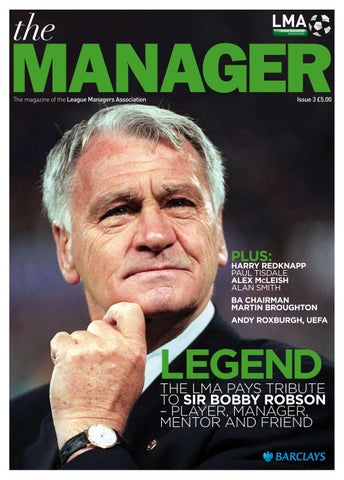
theManager Autumn 2009
the
Manager The magazine of the League Managers Association
Issue 3 £5.00
Small steps Plus: Harry Redknapp paul Tisdale Alex McLeish Alan Smith
ba chairman martin broughton Andy Roxburgh, uefa
legend
the lma pays tribute to sir bobby robson – player, manager, mentor and friend
comment editor
One thing that stands out as we start the new season is the wealth of experience among managers in the top flight. With the economy unlikely to return to its reckless past for some time, it’s understandable that businesses should want solid, reliable leaders at the helm. It makes sense not only for what the manager might achieve, but for the message it sends out to the team, supporters and stakeholders. It says “have confidence in us”, the subtext perhaps being “keep spending or investing – we’re safe”. Managers such as Harry Redknapp, who speaks exclusively with Sue McKellar in this issue of The Manager, can draw on vast reserves of wisdom to get them through the challenges, high expectations and mixed emotions of the season ahead.
If managers in football or any their teeth at a lower level, it may be no bad thing. Working as an assistant, under a mentor or in an other field have to environment where you can make and learn from mistakes is healthy for anyone trying to expand their cut their teeth management skillset. at a lower level, it In this edition, we speak with four aspiring managers, who are chomping at the bit to put what may be no bad they’ve learnt into practice, but who also understand thing that a long development journey lies ahead. But if the preference for experience means young
managers in football or any other field have to cut
We also speak with Eddie Howe, who is proof that if a club puts its confidence in a young coach it can pay off. Despite being the youngest manager in the football leagues, Howe has already guided Bournemouth through some of the toughest situations a team is likely to face. Yet, neither youth nor inexperience – he was only given the job of permanent manager in January – have stopped him producing great results under extraordinary conditions. One has to ask what impact this kind of pressure can have on a manager. I suspect it can only be a positive one. By rising up through the ranks and getting some battle scars along the way, young managers in any business should be in a better position to stay the distance. Alice Hoey Editor
Published for the LMA by Caspian Publishing Ltd. Opinions expressed by contributors are their own. Reproduction in whole or in part without written permission is strictly prohibited. Publishing enquiries: 020 7368 7177 Fax: 020 7368 7178 www.caspianpublishing.co.uk Editor: Alice Hoey Group editor: Keith Ryan Account manager: Tina Franz Creative director: Nick Dixon Art editor: Clare Meredith Production manager: Karen Gardner Advertisement manager: Matthew Blore Business development director: Frances Hughes Commercial director: Roger Beckett Founder and communications director: Matthew Rock Founder and editorial director: Stuart Rock Picture credits: Action Images/ Getty Images/Alamy/Rex Features/istockphoto The League Managers Association The Camkin Suite, 1 Pegasus House, Tachbrook Park, Warwick CV34 6LW Tel: 01926 831 556 Email: lma@lmasecure.com www.leaguemanagers.com For annual subscription (£20 for four issues): 020 7368 7200 Fax: 020 7368 7201 or subscribe online at www.themanagermagazine.com
autumn issue the line-up
20
08
12
12
22
40
04 kicking off News and views from the past
44 the next generation
quarter-season.
We meet the hopefuls vying to be the leaders of the future.
08 HARRY REDKNAPP Staying calm and in control isn’t
48 mind, body and goal
easy when the pressure’s on. We
Backstage at the theatre or a spot
find out what makes the Tottenham
of retail therapy? According to Alan
Hotspur manager so grounded.
Smith and Paul Tisdale, pre-season training doesn’t have to take place
12 SIR BOBBY ROBSON
The Lawrie McMenemy Centre for
Few managers have influenced so
Football Research sizes up the
many lives and careers. The LMA
available options.
16 head start
52 game over? What does going
pays tribute to a footballing legend and a great man.
on the football pitch.
30 eye to the ground
into administration
Tottenham Hotspur has big plans
mean for a
for its stadium development.
manager and his
16
team? Eddie
Talent won’t grow all by itself, you have to nurture it. We ask acclaimed
34 get personal
Howe speaks
producer Nik Powell, Dutch
Beside every good manager is
from experience.
football’s Gerard Marsman and John
a great PA, as Arsène Wenger
Feaver of the Peter Jones Academy
can attest.
54 Let’s talk business
why centres of excellence are key.
36 strength in diversity
When John Collins joined
22 martin broughton
Unifying a multicultural team has
as manager of Belgian side
The BA chairman on why short-term
become an essential management
Charleroi, communication wasn’t his
thinking has to fit within a long-
discipline, says UEFA’s Andy
only challenge.
term game plan.
Roxburgh.
58 raise the net 26 Self-defence
40 great scot!
Next year’s tax changes are likely to
To survive in a
When was the learning curve
have big implications for UK clubs.
tough market,
steepest for Alex McLeish
Barclays’ Paul Richardson explains
clubs will need
and how influencial was
a sustainable business model.
36
how to mitigate them.
his former coach and
54
mentor, Sir Alex
60 lma events
Ferguson?
Highlights from a season of events.
Kickingoff News and views FROM THE DUGOUT
make Friends & influence While businesses might be cutting costs here, there and everywhere at the moment, it seems that face-to-face networking with fellow managers, clients and associates is still high on the agenda and a worthy investment. According to a study by business community Business Scene, two-thirds of small to medium-sized businesses are now networking in person at least once a week. Aside from helping you stay abreast of what’s going on in the market, what your customers want and competitors are doing, meeting with colleagues and associates can be a wise career move. In an increasingly competitive job market, the more you can raise your profile, make friends and influence people the better. What’s more, sharing experiences can help even the most seasoned leaders to develop and improve. Looking ahead, the autumn holds some fantastic opportunities to meet and learn from other managers, starting with the LMA’s
$182m
inaugural conference, Touchline to Boardroom, on 24 September.
Estimated combined debt of Argentina’s first division sides, which has led to the start of the season being postponed. Fewer signings of Argentine players by European clubs – a knock-on effect of the recession – is thought partly to blame.
On the job on the up Cash-strapped businesses are increasingly turning to apprentices and interns to fill the gap created by redundancies or to avoid the cost of recruiting paid staff. While the trend has already raised concerns on
Food for thought
social mobility grounds, it’s difficult to condemn a system with the potential to be so mutually beneficial. Giving
92%
Hot list
of Brits feel happier after eating a takeaway, with
Chicken/Beef Madras
the opportunity of on-the-job training,
spicy curries coming top for stress relief.
Vindaloo
albeit unpaid, is laudable. It could
Thai red curry
provide a vital advantage when they
Pasanda
enter the paid job market and have to
Jalfrezi
compete for scarce positions.
Why? >> The red chilli in curries releases endorphins, while some vegetables (in particular, tomatoes) are rich in mood-enhancing seratonin
>> No washing up – bonus! >> Most takeaways are eaten at the start of
the weekend (and often with alcohol!)
school-leavers and young graduates
For businesses, recruiting eager youths in non-core roles can be a cost no-brainer. But the savvy businesses will be thinking long-term, using the opportunity during recession to build their talent base from within. As well
(source: just-eat.co.uk)
as massive savings in the short term, it could help ensure a more solid future.
The Manager
Richard Bevan
7 pillars The essence of sport, life & business
Perform In business, as in sport, you’re on stage and under scrutiny – more often than you think. Your mini-performances and personal interactions in the workplace leave a legacy.
Managers take centre stage Welcome to Issue 3 of The Manager, which coincides with the LMA’s inaugural Annual Management Conference at the
Compete
Emirates. This is a fantastic opportunity to bring together
Competition is the essence of elite sport
Barclays Premier League managers and leading figures in
and at the heart of a market economy.
football and business to discuss and debate the issues at
You need sound preparation, well
the heart of good management and leadership.
developed skills and a healthy review process to get ahead.
With one eye on next summer’s World Cup, the conference, entitled Touchline to Boardroom, will explore what defines success, how you build a winning team and
Focus
how you develop that team’s winning mentality. We are
Roger Federer doesn’t
delighted that Stuart Pearce, manager of the England
book his flights and
Under-21s, has agreed to join Arsène Wenger, David Moyes
accommodation – he
and Gianfranco Zola, among many others, at the event to
concentrates on playing
provide an insight into preparations for South Africa. They
tennis. It’s where
will share a stage with some of the most respected leaders
he creates value. In
in business to identify what it takes to be a great manager,
business, it’s easy to get
through good times and bad.
distracted away from what we’re good at.
The LMA’s members occupy some of the most pressured and visible management roles in any industry. With weekly AGM’s in front of 20,000 or more passionate fans, there’s
Develop
nothing quite like it. The LMA’s conference is part of our
Nurturing the potential of your people is
expanding commercial programme, bringing businesses
even more essential in a recession. Find
together through the LMA’s corporate management
ways to get your team to perform to all
network to gain an understanding of the principles and
new heights.
practices of football management at the highest level.
Lead
the game, Sir Bobby Robson. Without doubt, he achieved
Great leaders need the full gamet of skills
more than most in football, his successes spanning decades,
– from integrity and passion to public
countries, leagues and tournaments. However, it was his
speaking and the ability to understand
passion for the game that will live longest in the memory.
This issue also pays tribute to one of the legends of
and motivate people.
Sir Bobby was an inspiration to many of the LMA’s current membership and a massive advocate
Partner up
of the development of future coaching and management
Relationships, internally and externally
talent. He influenced so many of today’s managers
with customers and suppliers, are crucial
– providing advice, support and mentoring in his own,
to a successful operation.
unique way. The LMA is proud to have had Sir Bobby as its vice-president and he will leave a huge gap in
Get psyched
our close-knit community.
Mindset plays a huge role in all performance-related industries. Managing
Richard Bevan the League Managers Association
your mental downtime and factoring human motivation into decisions is even more vital in a recession. www.andrewthorp.co.uk
For more information on the LMA’s Corporate Management Network please contact Jim Souter on 07769 906295
The Manager
Eastern promise According to Arsène Wenger, more effort is needed to uncover China’s next generation of football stars. Visiting Beijing on behalf of Castrol Football, Wenger said, “I refuse to believe that a country as big as China cannot be one of the best countries in the world.” Despite topping the gold medal tallies at the Beijing 2008 Olympics, China has come up short when it comes to football. Ranked 97 in the FIFA standings and having failed to qualify for the 2010 World Cup, all eyes will be on its sports schools in the coming years to produce some much-needed talent. The Barclays Premier League also visited the country recently on the brink of Beijing’s inaugural International Football Season. Richard Scudamore said the organisation was committed to a range of activities to help China develop as a major footballing nation: “The Barclays Premier League recognises that the development of the game in China is critical to football’s future as the world’s sport of choice.”
Hitting home Keen to ensure Cardiff City gets maximum matchday revenue from the city’s new stadium, chairman Peter Ridsdale is seeking inspiration and guidance from an unlikely source. Ridsdale recently hooked up with senior staff at baseball’s New York Mets, which took residence of a state-of-the-art new stadium earlier this year. He hopes to draw on the Mets’ considerable marketing experience and optimise Cardiff City’s earning potential from its 27,000-capacity stadium.
The Manager
Exeter City fans will be taking special interest in the performance of new signing James Norwood, after the Supporters’ Trust helped to pay for his transfer. The Trust created a fund specifically aimed at signing new players and will contribute each month towards the cost of Norwood’s wages.
Life lines In a career spanning more than 32 years, Lennie Lawrence has managed more than 1,000 games and gained a valuable insight into the evolution of the game and the manager’s role. His new autobiography promises to be a revealing read. Contact Green Umbrella Publishing, 01793 778225 for more info.
Boots ‘n’ all Players from the Tranmere Rovers Academy have donated 30 pairs of football boots to the Boots for Africa scheme. The charity has so far collected around 5,000 boots, which it cleans, packages and ships out to South Africa Ethiopia, Ghana and Zambia. Wrexham and Grimsby Town have also supported the charity.
EXTRA TIME Cheltenham Town manager Martin Allen (top) raised nearly £15k for the club by completing a sponsored bike ride from his home in Berkshire to Cheltenham. Allen, who cycled the 70-mile journey with six fans, said it wasn’t just about the money: “It was a commitment to the club from the staff, the players and the supporters,” he said. Huddersfield Town’s Dean Hoyle also took to two wheels recently on behalf of the Keep It Up campaign, which supports the club’s academy and Yorkshire Air Ambulance. Hoyle came up with the idea of cycling to
Project Malawi Premier Skills, the Barclays Premier League’s leading international
the club’s first away game before realising it would be in Southend, some 242 miles away. Glenn Hoddle (above, bottom)
grassroots project, has launched its latest project in Africa. The innovative
has succeeded in turning out talent
course, in Malawi, will help to improve the coaching skills of around 40
from his academy in southern Spain.
young men and women, as well as teaching them how to use football as a
Four players have so far returned to
tool to develop skills in the community.
clubs in England and Spain from the
Premier Skills projects, which are run in partnership with the British
Glenn Hoddle Academy, which aims
Council, have already taken place in countries across Africa, including
to give young players a route back
Botswana, Morocco and Uganda.
into professional football.
The Manager
»
Experience
You take the job home with you. If you get beaten, the whole weekend is a disaster
The Manager
Harry Redknapp The Spurs boss on starting out, staying at the top and keeping a cool head in a highpressure job. interview:SUE MCKELLAR Photographs:Tom Willcocks
You started your management career in an assistant role. How important was that? I actually started off with a year at non-league club Oxford City with Bobby Moore, which was a great learning experience. It taught me a lot about the non-league scene – when you’re dealing with parttime players, you have to hope that they’ll turn up after they finish their day job. When I subsequently joined Bournemouth, as assistant manager and then manager, I was able to draw on that knowledge of non-league players, something many young managers never have any experience of. How did you find the transition from player to manager? When I was assistant manager to
David Webb, he really let me get involved in the coaching, which I thoroughly enjoyed, so the transition wasn’t too difficult for me. When you’re in the assistant role, your job is primarily in training, so it’s still possible to be the players’ pal. It’s only when you become a manager and start having to leave people out of the team that it becomes a different job entirely. What were the biggest lessons you learnt in those early days? Certainly that you can’t be everybody’s friend. When I first took over at Bournemouth I felt very much on my own. It was pretty much just me and the kit man. Money was also tight at that time, so I didn’t have many staff to
The Manager
»
Experience
bounce ideas off or talk to. When you first become a manager, it can be a pretty lonely existence. You’re not able to be friends with the players anymore; you’re sitting at the front of the coach on your own rather than at the back having a laugh with the rest of the team. And you take the job home with you; if you get beaten, the whole weekend is a disaster. Take me through some of your biggest challenges in management so far… When I took over at Portsmouth for the first time it was a big challenge because, in all honesty, the club wasn’t going anywhere at that point. Then I joined their rivals Southampton, which, looking back, was possibly crazy. And, of course, people also thought I was mad to return to Portsmouth when the club was bottom of the league. I really put my career on the line there, as I did when I joined Tottenham. They were bottom of the league and had I failed to turn things around it would probably have been the end of my career. I’ve given my utmost for every club I’ve managed. But you learn a lot when things are tough, in particular, about other people around you. That’s why it’s so important to have good staff on your side. I have had Kevin Bond with me for a long time and also Joe Jordan, who is a fantastic man of staunch character. Especially when you join a club, you want people around who will watch your back, who have terrific knowledge of the game, who care and want to succeed with you.
10 The Manager
What gives you most satisfaction and motivation day-to-day? In football, you can only really think about the week ahead. You rarely get a chance to enjoy your success, because within 30 minutes of one game finishing, you’re thinking about the next match. It means you don’t have the time to sit back and dwell on your achievements. This business is entirely results-led; five or six bad results and your position can be in jeopardy. I love to watch players do fantastic things in training, as well as on a match day. When you have a great team and they’re zipping the ball about and scoring goals, it’s like watching a great racehorse on the gallops. How important do you think cultural fit is between a manager and his club? I think a good manager can be successful anywhere. Being a good judge of players is key to that success. A bad judge will buy bad players. You have to be convinced that there is something important in every player you buy, something that will improve your team and create the right balance. Who has most influenced you as a manager? I was lucky to grow up as a young player under Ron Greenwood at West Ham. Without doubt, he was the best coach in England at that time. Ron was a fantastic manager – very forward thinking and his training sessions were always interesting and engaging. Then I worked under John Bonds at Bournemouth, who was a disciple
of Ron’s, but more flamboyant in style. They were both important influences on me. How would you describe your own style of leadership? I believe that confidence plays a huge part in all walks of life and try to instil self-belief in my players. I don’t criticise them too often and if, on occasion, I do get stuck into them they know they deserve it. I tell them straight what I think. However, I’m not one for shouting and hollering – I’d rather explain to them what they can do to improve and give them encouragement. I am pretty relaxed and laid back, so I’m not one for stringent rules, fining players or ruling with an iron fist. I try to treat my players as responsible adults – if they can’t respond to that and behave themselves, I don’t want them in my team. How do you maintain such a well balanced outlook when the job is fraught with pressure? When things aren’t going well it is, of course, difficult to remain relaxed. However, it helps that I’m able to go home to my family and have quality time with them. My wife Sandra and I are involved with charities like Leukaemia Busters and the Round Table Children’s Wish, and that certainly keeps the football part of my life in perspective. I love football and, like everyone in the game, I want to be very successful. But I also know that there are other important things in life – when all is said and done, football is a game, not a matter of life and death.
The Manager 11
»
a tribute
Sir Bobby robson football legend A remarkable man, admired leader and oustanding ambassador for the game, Sir Bobby’s passion and dedication will live on in the countless individuals he has inspired over the years. We pay tribute.
PLAYER 1950-56 Gives up work as a colliery electrician’s apprentice to play for fulham 1956-62 West Bromwich albion, (club captain) 1962-67 Fulham 1957-1962 dons the England shirt 1958 plays in the world cup in sweden
Sir Bobby never forgot his northern roots or his mining background. “His character was hewn out of the coalface,” said Sir Alex Ferguson
69 goals for Fulham in 152 appearances 20 caps for england
Sir Bobby was the second most successful manager to lead the national side. Paying tribute to a great leader, LMA chairman Howard Wilkinson said, “Bobby had the capacity to create in those who worked with him, and for him, a massive sense of obligation. You quickly felt that you couldn’t let him down.”
manager 1968 Fulham 1969-82 Ipswich Town (FA Cup winners in 1978, UEFA Cup champions in 1981) 1982-90 England (quarter-finals in 1986, semis in 1990) 1990-92 PSV Eindhoven (league titles in 1991 and 1992) 1990 awarded cbe 1992-94 Sporting Lisbon 1994-96 FC Porto (league and cup double in 1995) 1996-97 FC Barcelona 1997 European Manager of the Year 1998-99 PSV Eindhoven 1999-2004 Newcastle United 2002 knighthood 2003 Enters the England Hall of Fame 2005 Becomes honorary freeman of city of Newcastle 2006 Becomes assistant to ireland coach Steve Staunton 2007 Receives the BBC Sports Personality of the Year’s Lifetime Achievement Award 2008 Becomes honorary freeman of Ipswich
When Scotland manager George Burley joined Ipswich Town at the age of 15, Sir Bobby took him under his wing. His continued encouragement and inspiration fuelled a successful playing and management career. “I couldn’t possibly get my head around how my career would have gone were it not for Sir Bobby,” said Burley. “I owe him everything and hope to be guided by his inspiration.”
The Manager
»
a tribute
Bill Shankly once called me at 2am to buy a player. when i complained to my club they said, ‘listen Bobby, enjoy it, because when Bill Shankly calls you up at 2am to buy your players you’ve arrived’. Shankly didn’t get him Sir bobby robson
Speaking last year at a dinner held by the LMA in his honour, Sir Bobby said, “Managers are the most important people in the game. If there is anything wrong with the club they change the manager, not the chairman, the board of directors or the players. The manager is the fulcrum; everything revolves around him. A good chairman will get the right manager and then give that manager a chance. That’s all we ask.”
I was never too big or proud to ask him for advice, which he gave freely and unconditionally Sir Alex ferguson
trophy cabinet European Cup Winners’ Cup, Uefa Cup, FA Cup, 2 Dutch league titles, 2 Portuguese league titles, Spanish Cup, Spanish Super Cup, Portuguese Cup
10 The Manager
Jose Mourinho owes much to his former mentor. Spotting the natural leadership ability of the then-schoolteacher, Sir Bobby took him on board his coaching staff at Sporting Lisbon, then with him to FC Porto and Barcelona.
He is immortal – he left a mark on everyone who knew him jose mourinho
THE SIR BOBBY ROBSON FOUNDATION It is testament to his unselfish nature that, despite fighting his own battle with cancer, Sir Bobby founded a charity to help future sufferers. The Sir Bobby Robson Foundation, which focuses on the early detection and treatment of cancer and the clinical trial of new drugs, raised its initial £500k target in its first seven weeks. This helped to equip a new research centre at the Northern Centre for Cancer Care. To donate or for more information please visit www.sirbobbyrobsonfoundation.co.uk
The Manager 11
»
development
Whereas young boys once played football in the streets, there are now fewer safe spaces in which they can do so. We have to artificially create those opportunities to practice 16 The Manager
Head start Unlocking the potential of the UK’s young talent will be essential to its future success. With The FA’s National Football Centre, remarkably, still at blueprint stage after ten years, we look at why national centres and academies are the key to developing excellence. According to business tycoon and
step-change in the delivery of
serial entrepreneur Peter Jones,
enterprise education. “We need
despite having always been an
entrepreneurs to stimulate the
enterprising nation, Britain has been
economy and businesses will need
somewhat lax when it comes to
inspired employees to help their
equipping its future generations to
companies recover quickly,” he says.
continue the trend. Furthermore, this
Having recognised the shortfall in
lack of foresight has implications not
long-term planning, the government
only for the young people missing
has pledged £8 million towards the
out, but for the future success of
NEA, which has also attracted
the economy as a whole.
considerable interest and support
While the education system
from the business community.
covers off most bases, the skills integral to success in enterprise have
Tooling up
been woefully underappreciated –
One of the key challenges for the
until now. Spotting a gap in the
NEA, says Feaver, is changing
market, Jones launched a new
people’s perceptions and
venture, dedicated to developing the
understanding of what enterprise
potential of Britain’s future high-
and entrepreneurship are.
fliers. The National Enterprise
“Traditionally, they have been defined
Academy (NEA) will offer the UK’s
in quite narrow terms – a vague
first full-time education programme
notion of business start-ups,” he says.
in enterprise and entrepreneurship,
“The reality is that entrepreneurship
providing as yet unavailable
is a skill that can be taught like any
qualifications. According to John
other. Entrepreneurs are not born,
Feaver, a former Davis Cup tennis
they are made.”
player who is on board the NEA team, now is the perfect time to create a
Whereas a conventional educational facility will send out
The Manager 17
0.3% of the £3.3 billion turnover of the UK film industry was re-invested in developing its future workforce in 2006 qualified graduates each year – who,
students will also have the
with similar grades, may be difficult
opportunity to address business
within structured exercises, each
to separate in terms of ability – a
issues and solve real problems,
designed to test, challenge and
centre of excellence should do more
even to set up and run their own
develop a different aspect of their
than simply tick boxes in the key
small business.
creativity. “The actor Alan Alder once
skills. The real benefit of a facility
Practice at the NFTS takes place
said that originality is unexplored
such as the NEA is its focused
Arts and crafts
territory – you get there by carrying a
programme, based on the toolset
The National Film and Television
canoe, not by taking a taxi,” recalls
required to succeed, but with an
School (NFTS) is another UK centre
Powell. “That’s very much the
emphasis on applying those tools in
of excellence where putting skills into
approach at the school.”
practice. While some things can be
practice is at the heart of learning.
taught, others must be learnt.
Nik Powell, one of the UK’s top film
Forward pass
producers and director of the NFTS,
The NFTS is a major part of a
and A-Level have often relied on a
agrees that to be competitive in a
coordinated plan to re-invest more
traditional approach to learning –
global industry you can’t be insular or
of the industry’s revenue into
heavily focused on the theory of
learn things in isolation.
education, training and personal
“Business studies courses at GCSE
business and delivered through
“To negotiate their way up the
development. This was in dire need:
textbooks in a formal classroom
greasy pole, students need to
in 2006, only 0.3 per cent of the
environment,” explains Feaver. “This
understand the landscape of the
£3.3 billion turnover of the UK film
approach, while extremely valuable,
industry and the economic models
industry was re-invested in
can’t replicate the real business
within it,” he says. “Many of the
developing its future workforce.
world. Being entrepreneurial is about
decisions they’ll have to make in their
Yet, even this tiny amount looks
managing and exploiting risk, being
careers will depend as much on their
substantial when compared to the
creative and innovative, and
knowledge of the industry as a whole.
proportion of revenue that finds its
challenging current methods.”
“Someone’s success in the film
way back into the UK football
It isn’t, therefore, only the
and television industry depends on a
industry. According to Deloitte’s
qualifications that are new at the
combination of their core skills or
Annual Review of Football Finance,
NEA. “We are pioneering a
‘crafts’ and their creative personality.
of the £2.5 billion revenue generated
completely new approach to
The NFTS works on these in parallel,”
by the top 92 clubs in the Barclays
teaching entrepreneurship, with a
says Powell. “You do what you have
Premier League and Football
strong focus on the practical side of
to do in order to do what you want to
Leagues, only around 0.02 per cent
learning,” says Feaver. “As well as
do,” he tells his students. “The job of
was put back into education and
teaching business knowledge and
an institution like ours is to create the
training for its technical and
theory, our programmes will feature
right environment in which to
management staff.
input from a wide range of
develop those technical skills and
entrepreneurs and business people,
then provide as many opportunities
the UK football industry depends
who will act as coaches and mentors
to put them into practice as possible.
heavily on the level of forward
to the students.” Through
Through their mistakes, they will fine-
planning today. A lack of investment
masterclasses and work experience,
tune their natural creative ability.”
in its future workforce has similarly
18 The Manager
Just as in enterprise, the future of
Peter Jones believes the National Enterprise Academy (NEA) can help transform the entrepreneurial culture of the UK, help make the UK a global leader in enterprise education and strengthen the UK economy.
Examples of the positive wider impact of centres of excellence also exist in the arts, says the NFTS’ Powell. He notes, in particular, the success of the National Film School of Denmark and the transformation that has taken place in the Danish Film Industry as a result. In part, the impact of such a school on its industry will be down to the talented individuals it produces. But, more than that, the bar tends to bleak implications for the state of
things up at a later stage, it becomes
be raised for all involved – students
the industry as a whole. Unless
much more difficult. The earlier you
and coaches. Any training or
budding players and coaches receive
start to learn, the better.”
development facility worth its salt
the professional support needed
Marsman says that changing
to fulfil their potential, there are
lifestyle trends in recent years has
coaches alongside its intake. “One of
plenty of other nations that will be
made the provision of structured
the central tenets of the teaching at
more than happy to come in and take
training in clubs and, especially,
the NFTS is engagement between
their place.
academies even more important.
students and staff,” says Powell.
In Holland, the emergence of
“Whereas young boys would once
will be nurturing experienced
“Each year, we get a new influx of
dedicated training academies has
have played football in the streets,
students, who bring their own
been key to the nation’s emergence
there are now fewer safe spaces in
culture, originality and freshness. It’s
as a major footballing power over the
which they can do so,” he says.
the job of the younger generation to
past five to ten years. Dutch
“Instead, children are now spending
challenge their elders; it prevents
professional footballers and coaches
more time sedentary, playing on the
things from becoming stale and
have become increasingly sought-
computer. We have to artificially
reminds you that there is more than
after by clubs worldwide and the
create those opportunities to
one way to achieve something.”
nation is considered by many to be at
practice football.”
the fore when it comes to progressive
Since the emergence of the Dutch football academies, Marsman has
Knock on
seen an increased openness to new
In the same way that French football
ideas in Holland’s football industry:
and coach and now director of the
was revitalised by the success of its
“While for many years there was a
Dutch equivalent of the League
Clairefontaine national football
complacency among our coaches,
Managers Association, believes the
centre and a number of youth
more recently there’s been a
Dutch system of starting training
academies, Holland’s new culture of
realisation that the learning never
young has been central to its success
professional development has had
stops. You have to work hard every
in developing players.
marked effects on the Dutch game.
day to improve yourself, learn from
As well as turning out great players, it
other coaches, other countries and
boys as young as four or five playing
has gained Holland an enviable
other sports. You can’t be
in club sides, learning the core
reputation and resulted in there
complacent or blind to what’s going
technical skills and becoming familiar
being a number of highly respected
on. You have to keep looking for ways
with the basics of the game. “From
Dutch coaches and managers.
to improve.”
training and development. Gerard Marsman, a former player
In Holland, it’s common to find
an early age, they receive formal training in everything they will need,” he says. “That’s very important
There are numerous opportunities for businesses to get involved and support
because, while it is possible to pick
the National Enterprise Academy. For more information visit www.thenea.org
20 The Manager
»
forward planning
While there will always be fires to fight, you can never take your eyes off the end goal. Martin Broughton, chairman of British Airways, gives us the long and short of planning in adversity. interview:Alice Hoey Photographs:Paul Stuart Never forget where you are trying to get to. Whether you’re in business or football, there will always be short-term problems that require your immediate attention. You can’t be blinkered to what’s going on around you or ignore what the competition are doing. Your customers certainly won’t. However, if you focus too much on the short-term issues, there is a danger that you’ll lose sight of your long-term goals. It is, as Charles Hummel wrote, “the tyranny of the urgent”. I believe you can only deal with the short-term challenges with any real integrity if you remain mindful of what you are trying to achieve in the long term. At British Airways (BA), it is our long-term objective to remain a sustainably profitable premium airline. To fulfil our long-term goals will require not just short-term measures, but permanent structural change. After all, when the recession ends and things start to return to normal in the economy, we won’t necessarily see that translate into immediate change within the business. To an extent, we are shooting in the dark. There aren’t many industries where you have to make such major longterm financial commitments in an environment where external factors – from terrorism to pandemics to global recession – can affect your business so dramatically. It is one of the main reasons why airlines, in general, have been less profitable than businesses in many other sectors. For example, in 2007, we started a ten-year programme of renewal for our long-haul fleet, the first delivery of aircraft being in 2011 and the last due around 2020. When you consider that these aircraft will be flying for at least 20 years after that, we were making a purchase decision in 2007 on something that will still be in operation in 2040.
»
forward planning
Essentially, we have to make huge decisions and investments without knowing what the market is going to be like. It only takes a look back at the structural change that has taken place over the last 30 years to see that things can change very dramatically. Sharing with competitors can make good sense. Few businesses would ever think of cooperating with their competitors in the way that we do in the airline industry. Instead – as has been the case in many sectors, especially consumer goods – you get consolidation. The strong get stronger as the weak go out of business or are acquired by their larger competitors. However, for various legal reasons, mergers and acquisitions are very difficult in the airline industry, as they are in football. The next best thing – and really the only other option – is to share our routes and resources with other airlines, principally through our alliances. Not only do these kinds of partnership give the business a more rational structure and position, they are also in the best interest of the consumer. Rather than two airlines flying to a destination at a similar time, for example, it makes more sense for them and their customers if they agree to spread the flights. I’m surprised that more football clubs don’t share their facilities. While Inter-Milan and AC Milan are fierce competitors, their arrangement to share the San Siro stadium has been a very successful one.
24 The Manager
Complacency is dangerous. It is much easier to hold on to your existing customers, so it’s tempting to focus on acquiring new ones. However, ensuring your customers are happy and spending is a far better strategy. Customers who have had a good experience with your company won’t always convey that to others, but if they’re not happy they will certainly spread the word. If you lose one customer, it usually has a knock-on impact. Pride is a great motivator. People like to be part of a winning team, whatever business they are in. To be part of an organisation that feels like it is going backwards, shrinking or is on the defensive can be very demoralising. That’s why it is essential that we demonstrate to our customers and employees that we’re constantly innovating and investing in the customer. As many BA staff are not office based, communication can be a particular challenge. However, in a service-oriented business like ours, effective internal and external communication is essential. A significant proportion of our workforce is interfacing with customers all the time and their job satisfaction depends largely on whether those customers are happy. If they sense that you are cheapening the product, you will lose them. It comes down to pride. Whenever you speak publicly, it’s important to recognise that you are addressing a wide range of audiences – shareholders, staff, the media – who will each
interpret your words differently. The key is to ensure that your messages are consistent; try to deliver a different message to each audience and you’ll be caught out. There has been insufficient investment in nurturing Britain’s future talent. It is one of the things that most frustrates businesspeople when it comes to government education policy. There’s a widely held view that schools should focus not only on teaching academic skills, but
You can’t be blinkered to what’s going on around you or ignore what the competition are doing. Your customers certainly won’t
also employability skills. These are simple, but essential, things like communication and teamworking. The next level up is adult education, on which the business community spends £37 billion a year – a massive investment compared to the £3 billion spent by the government. But, because businesses are having to shoulder the burden of this education, they tend to tailor it according to their own needs. This means that future generations of businesspeople are acquiring important, but somewhat narrow, skillsets.
A recession can generate innovation and opportunities. Some of the biggest names in business – Microsoft and Google, to name just two – have emerged from recessions, so it is possible to draw positives from the experience. And it can effect change. We’re already beginning to see a shift in the way that companies approach working patterns. Businesses are showing greater flexibility in the number of hours worked and a willingness to compensate staff for lost earnings, through benefits or a share in
future success. Employees are also becoming more willing to take the pain in the short term – perhaps in terms of wages or hours – in order to secure a better long-term future for the business and reap the rewards when it pays off. It’s likely that we’ll see a move toward these kinds of share schemes, which traditionally have been difficult to establish on a wide scale. Going through hard times is always salutary – nobody looks forward to it, but you soon learn who your friends are.
The Manager 25
»
s t r at e g y
Selfdefence How clubs position themselves in the changing market will determine which sink and which swim. We ask the Lawrie McMenemy Centre for Football Research to review the challenges ahead for clubs and identify some winning business models. It was during the UK’s last recession in the early 1990s that the Premier League was born. Since then, the economy has flourished and the Barclays Premier League has become the most watched and lucrative league in the world. The incredible growth rates have been partly fuelled by an increasing domestic and global media profile. While domestic television rights are currently valued at £1.8bn, some experts predict that overseas rights, currently valued at £625m, will eclipse this figure when they come up for renewal in 2010. The potential combined revenues of some £4bn
» siz ing up the opposi tion Sponsorship Many traditional and
secure the short-term credit they need for day-to-day activities.
potential sponsors are
Likewise, larger-scale
now reconsidering how
projects, such as building
much, if anything, they
new stadia or facilities, or
are prepared to pay to
developing talent may have
feature their name on a
to be postponed.
team’s shirt or billboard.
may help to insulate clubs in the
Firms large and small are
Barclays Premier League from some
downsizing their sponsorship
Many clubs have had to stabilise
of the problems of the downturn.
strategies across a number of sports.
admission prices and are finding it
One effect of the growing appeal of
Some sponsors may even have gone
increasingly difficult to sell lavish
the Barclays Premier League, here
out of business.
hospitality packages to corporate clients.
and abroad, has been a change in
Ticketing
Indeed, in their 2009 Review of Football
the dynamic of club ownership and
Financing
Finance, Deloitte’s Sport Business Group
sponsorship. Increasingly, foreign
With financial institutions reluctant to
identified an almost universal change
investors are adding Barclays
lend, clubs may find it more difficult to
in policy, with clubs either freezing or
26 The Manager
Dr Sue Bridgewater (pictured) is associate professor of marketing at Warwick Business School, where she leads the Certificate in Applied Management
Demand at small and medium-sized clubs can be variable; the problems associated with the recession are likely to be more pronounced
reducing prices across the board for
shirt when a player moves on. For all their
Expensive assets
the 2009/10 season. To fill their stadia,
enthusiasm, families may have to choose
Players continue to
many clubs are now relying on the kind
between the shirt or going to a match.
command premium
of expensive sales promotion techniques
Being known as a former successful player can be Adams aTonyblessing. It can also be a curse wages. In the
more commonly found in retail,
Ownership
especially as other spectator sports and
Globalisation has seen a sharp increase
League, the wage
entertainment can often compete better
in the number of wealthy club owners
bill has increased
for the public’s limited spending.
from overseas, which exposes clubs to
by 23 per cent since
new vulnerabilities. These can be seen
2007 and the wages-to-
Merchandising
at a global level, but are felt very much
turnover ratio currently sits at 62
As UK households tighten the purse-
at local club level and by the supporters.
per cent. Some clubs will be unable to
strings, sales of replica shirts – for years an easy market
Potential club owners are
increasingly aware of the
Barclays Premier
accommodate these high prices, while others, predominantly those outside of
– may fall. Some families
risks associated with football
the top flight, may be forced to prune
may not be able to afford
club ownership and may
back their squads and be more realistic
to buy both home and
be less willing or able to
about what can be achieved with their
away kits, or to replace a
take them.
existing players.
The Manager 27
Premier League football clubs to
»Wi n n ing tactics
their investment portfolios, while
The community chest
global sponsors continue to align
Local affection and support towards a club can be turned into a marketable
themselves at the top of football’s
brand. This can generate revenue through the sale of a wide variety of local
global hierarchy.
goods and services, not necessarily related to the game. This strategy often
While it is too early to predict the full effects of this latest phase in
works best where there are few other teams in the area of the same stature.
the globalisation of football, it could
The nursery school
expose clubs to new vulnerabilities.
A club can use its expertise to develop young
Consider, for example, the case
talent, then sell those players. This strategy
of West Ham United. The club
requires young, talented players to be
lost its primary shirt sponsor – XL
showcased in the first team, which tends
Airways was an early casualty of the recession – then faced further financial uncertainty when Icelandic bank Landsbanki went into receivership. However, West Ham remained focused on the future and was able to absorb the losses. Other clubs may not be as durable. This example highlights the fact that, while there will be significant challenges for all professional
to lead to exciting, if inconsistent, performances. It is possible to achieve a high position and a measure of solvency with this strategy, but care must be taken to retain some players or fans can become disillusioned.
The high roller A club might invest heavily in its squad in the hope that subsequent on-field success will pay the bills. While a club is unlikely to be able to consistently achieve the highest honours with any other kind of strategy,
football clubs, many in the Barclays
the risks are enormous. Should the squad fail to blend or the backer become
Premier League are relatively
dissatisfied with performance, it can leave the club with crippling debts and a
protected. However, while the
depleted squad.
big clubs remain commercially appealing, demand at small and
The yo-yo
medium-sized clubs is somewhat
Some clubs find themselves bouncing between divisions and leagues fairly
more variable. There, the problems
regularly. However, provided that fans and backers don’t develop unrealistic
associated with the recession and an
expectations or invest too highly, this can be a workable strategy, with the income
uncertain economic future are likely
from the higher levels paying off debts and bills.
to be more pronounced. The strategic positioning of any business is vital for both short and longer-term success. As the
needs and allows them to deal
brings fresh challenges in the
recession bites and during the long
with the challenges of an uncertain
coming years, how clubs position
recovery period, football clubs will
economic environment.
themselves to adapt will become
have to position themselves in such a way that suits their individual
Football clubs have the capacity to position themselves as some of the ultimate passion brands 28 The Manager
Get the strategy right and it
increasingly important. For those
can secure a club’s future post-
clubs that rely heavily on their fans
recession. Get the strategy wrong,
for revenue, it will be vital.
however, and it could lead to the kind of freefall already seen in clubs
With thanks to...
across the country.
Centre director Dr Richard Elliott,
On the most optimistic note,
and centre members John Cross and
it is important to remember that
Dr Steven Henderson. The Lawrie
football is part of the very fabric
McMenemy Centre for Football Research,
of England’s social and cultural
located at Southampton’s Solent
identity. Therefore, football clubs
University, provides expert support for
have the capacity to position
the football industry, as well as delivering
themselves as some of the ultimate
a range of sports-based higher education
passion brands. However, as
professional and undergraduate courses.
the changing financial market
Visit www.solent.ac.uk/lmcfr
»
bigger picture
EAR TO THE
GROUND
As well as improving the club’s revenue potential, Tottenham Hotspur’s new stadium development promises to deliver considerable social and economic benefits for the local community. 30 The Manager
In stadia terms, size matters, especially when you have a waiting list of over 22,000 for season tickets. Fortunately, some big thinking has gone into Spurs’ planned grounds. As well as accommodating more spectators, the plans will provide valuable new revenue streams for the club, including enhanced corporate facilities for use on matchdays and the sale of naming rights for the stadium. Consideration has also gone into the revenue potential of non-matchdays. “The stadium will be a major new conference and events facility, which with the new 150-bed hotel will provide a new destination for businesses,” says project manager Paul Phillips. “Making the most of these commercial revenues will be key in securing the club’s long-term future and achieving greater success.”
Tottenham Hotspur has been in Haringey for 127 years and is inextricably linked with the borough. “We are extremely proud of these roots, so it was always the preferred option to stay here,” says Phillips. “With around a million visitors a year, we are the borough’s top visitor attraction and one of its largest employers, pumping many millions of pounds into the local economy,” he adds. Extensive consultation with the
local community, including several public exhibitions and engagement with local organisations, schools and colleges, has helped to shape and add value to the development. “For example, feedback following the first phase of consultation led to the addition of a hotel and reduction in the density of housing to the south of the scheme.” The resulting development promises to act as an important catalyst for regeneration in the area.
The brief for the stadium from Chairman Daniel Levy was very clear – build a world-class stadium, that retains the unique atmosphere of the existing one and gives the fans the best possible experience
The 58,000-capacity stadium will help to ensure that Spurs can continue to compete at the highest level and attract, develop and retain the most talented players. But other elements of the development will have wider benefits. Additions include 450 new homes, a supermarket, hotel, club shop and museum and a new public space with considerable potential for the community. The Tottenham Hotspur Foundation will also get a new base from which to run a range of sportsbased programmes with local children.
The Manager 31
»
recruitment
GET PERSONAL What makes a great personal assistant and why has it become one of the most important roles in business? THE AGENT
two parties share the same values
As we push ourselves to achieve
and can meet each others
more, in business and leisure, time
expectations. On paper, it can be
has become the ultimate luxury for
easy to match a candidate to a job.
many people. Senior professionals
However, the most successful
increasingly realise that a strong PA
partnerships are achieved when the
can free up that time and enable
boss interviews a small selection of
them to be more productive, in and
candidates, hand-picked to suit his or
out of the boardroom.
her own personality.
People at every level of the
At the top level, PAs should also
corporate ladder are now adept at
have a good understanding of the
dealing with technology. As a result,
business they are in and bring
the main focus of the PA’s role is no
relevant experience to the role. They
longer typing emails and keeping
must be effective from day one,
diaries. It has evolved to incorporate
rather than taking time to learn the
high-level research and project work,
sector. Having good local knowledge
perhaps even presenting papers to
can also be of great value, especially
the board.
when the role requires an amount of
Whereas the PA was once reactive
personal work – whether it’s selecting
– waiting for work from the boss –
the right junior school or knowing
today, a good PA must always be one
who to schmooze to get a table, the
step ahead and proactive in
less a boss has to explain, the more of
anticipating their needs.
their time is freed up.
As with any relationship, it will always be more satisfying when the
Kirsty Miall, Attic Recruitment
The focus of the PA’s role is no longer typing emails and keeping diaries. It has evolved to incorporate high level research and project work
»
recruitment
THE CHAIRMAN
THE CORPORATE PA
great at the job you have to think
A great PA in whom you
Since I started working for Martin
ahead of your boss, get answers to
have absolute faith is
five years ago, my job has been
questions before they ask them and
worth their weight in gold.
revolutionised by technology. He has
initiate better ways of working. You
Being able to feel
embraced flexible working – making
also have to be reactive, as unforeseen
relaxed about delegating
good use of his PDA and remote
events can send your day spinning in
authority to them takes
access to the British Airways
an unexpected direction. One call can
network – and he’s happy for me to
change my priorities in an instant.
the hassle out of life; it lets you focus on what’s most
do the same. This has dramatically
Working for the head of an
important. And that needn’t only
reduced the time I have to spend on
organisation can be isolating, so
be in business – if a PA can help with
certain administrative tasks, freeing
knowing exactly where to go for
your personal admin, it leaves you
me up to venture into other areas of
information is very important. You
more time to deal with the job in hand.
interest, such as customer relations.
have to build and maintain a strong
Proactivity should be second Martin Broughton, Chairman, BA
34 The Manager
nature to a good PA, but to be really
network and use it effectively. Experience has taught me never to
Arsène Wenger’s assistant, Sheila Horne, retires this year after nearly 39 years as an Arsenel manager’s PA. Among the managers she has worked with are Bertie Mee, Terry Neill, Don Howe, George Graham and Bruce Rioch. The football PA
put a smile on someone’s face. It’s
As the game has become more
nice to know that, while I’m behind
commercial over the years, the
the scenes, I’m part of the team.
demands on the football manager’s time have increased. On top of
Sheila Horne, PA, Arsenal
training and matchday responsibilities, they now have
THE MANAGER
numerous commitments, both within
Whereas life can be like a bumpy
the club and externally.
road, a good PA makes it more
Before we had a press office and
like a motorway – smoother and
commercial team at Arsenal, it was
easier. In a profession that is already
down to me to deal with these things.
filled with a lot of stress, they can
I remember handling the requests for
take away a lot of the unnecessary
George Graham’s pre-match press
worries and get rid of the things you
interviews. Having those wider
don’t want to deal with.
responsibilities meant I was more
Having a PA as proficient as
involved with what George Graham
Sheila, who really knows the club,
did; I always knew where he was. In
was especially important when I first
any relationship between a boss and
started. I had a double handicap – I
his PA, it’s important to like and
was unfamiliar with the culture of the
respect one another. That respect
club and the country.
comes naturally if you’re good at your job. To do the job well, it’s important
A club is a very complicated organisation and it is very difficult to determine how much individual
to have a good understanding of
people contribute to the team. But
assume, to learn quickly from
football. For example, you must be
the success of a club is based on
mistakes and realise there’s no such
sensitive to the impact of a poor
human relationships; if you don’t get
thing as a stupid question.
result and show empathy with the
that right, things can be very difficult.
A purely professional relationship
manager, colleagues and fans. Come
Mutual respect between the
between a PA and their boss can work
Monday morning, I can gauge when
manager and his PA is essential, as
fine. However, only a close
it’s appropriate or necessary to
are positive feelings towards each
partnership, based on mutual respect,
bother the manager and when I can
other. Of course, when you have
will get outstanding results. My
handle something on my own. No
worked together for such a long time,
admiration for Martin’s style and
two days are ever the same, and
through good and bad periods, you
ethics and the mutual trust that we
much depends on match results.
develop affection for one another. It’s
share motivate me to do my very best
That keeps the job interesting and
during the difficult times that you
for him.
me on my toes.
discover just how much you can rely
Football is an emotional game and Samantha Pitman, PA to Martin
can play a huge part in people’s lives,
Broughton
so it’s rewarding to be able to help
on someone. Arsène Wenger
The Manager 35
»
leadership
to recruit the very best people, businesses are ignoring national borders and fishing in the global talent pool. But unifying a team of people from different backgrounds is not without its challenges.
Strength in diversity words:ALICE HOEY If someone can perform at the
highest level and generate the results your business needs, where they come from becomes a mute point. Yet, we’ve become so comfortable with national and cultural diversity that it can be all too easy to forget the subtle, but important, nuances that exist in working practices and mindsets. While these differences can enrich the fabric of your organisation, if not managed properly, they have the potential to disturb the smooth functioning of a team and hamper individual and team performance. Inevitably, the task of gelling together an international team falls at the manager’s feet, especially in the upper echelons of football management and in multinational corporations. Globalisation of business has added an extra dimension to the already complex manager’s job. “In football, the constant exposure of managers to a variety of cultures means it’s no longer possible to be parochial,” says Andy Roxburgh, UEFA technical director. He adds that the profile
36 The Manager
of the manager has evolved in tandem with the players. “The increase in player power over the last 20 or 30 years and their freedom to move between clubs has led to a very different style of management,” he says. He recalls Frank Lampard’s comment last season that Guus Hiddink would bring to Chelsea much-needed “tough love”. “It was a fantastic description of what is required of any manager these days,” says Roxburgh. “They must have a clear vision of what they want to achieve and the strength of character to impose that on the team – not in a dictatorial way, but through clever management of players. The best managers are those who can relate well to the players and impose on them their philosophy and strategy – no matter how rich or famous they are or where they come from.”
Vive la différence At the core of that leadership skill is a simple understanding of cultural differences and an appreciation that there are methods and styles other
than your own. A person’s default mindset and habits are likely to differ according to how and where they were educated or trained, and might clash with your own or those of team members. Rather than allowing these differences to strike a wedge, a good leader will leverage them. “Diversity isn’t about treating everyone the same, but giving them the chance to achieve equal goals by breaking down visible and invisible barriers,” says Jonathan Ferrar, HR director at IBM UK and Ireland. “Leaders today need to be more culturally intelligent and aware of their behaviour and that of their team, whether that’s driven by unconscious bias or microinequities,” he adds. “We’ve seen a cultural shift with our own leadership team, who understand the growing need for cultural adaptability.” While people might be separated by background and language, they can be united by a common objective, shared passion or dedication. “The most important thing for a manager is to create a very clear common culture within the club,” says Roxburgh. “Then you have to select your team very carefully, bringing in players who you are confident have the potential to adapt to that culture.”
Going “glocal” At IBM, they have adopted a new Global Diversity Framework, which, Ferrar explains, includes what they call a “glocal” approach. “We have defined a set of global imperatives that provide a roadmap for our strategy. But, while our overall strategy is global, it is flexible enough to be adapted for local relevance,” he says.
The Manager 37
»
leadership
In football, the constant exposure of managers to a variety of cultures means it’s no longer possible to be parochial Andy Roxburgh (below)
Crucially, the company doesn’t view diversity in its global workforce as something to manage so much as a valuable asset to encourage and nurture. In 2008, the company brought together global leaders to refine its diversity strategy, based on an acknowledgement that the greater the diversity of people within an enterprise, the greater the impact a team can have on delivering innovation to clients. While corporate or club culture is important in integrating people into a team, it can also be a major factor in attracting them in the first place. According to Ferrar, IBM’s recruitment strategy is about hiring, retaining and developing a diverse global workforce of the very best people, but, “Perhaps more important is creating a global culture that enables understanding and acceptance of the rich diversity of thought and perspective that exists in our global workforce. Diversity is no longer just about race, gender, sexual orientation or disability – or numbers. We need to broaden the definition and objectives and create a globally sensitive corporate culture that fosters and leverages diversity of thought and relationships.”
Lost in translation The language barrier is something that managers and their employees must quickly overcome if everyone is to perform at their best. If a manager can only communicate with his or her team through
38 The Manager
skills and personality. If there are language or cultural barriers, that can be an even greater challenge.”
Team selection
a translator, their role becomes somewhat one-dimensional – you can get across the basics, but the subtleties are lost. The players, meanwhile, are likely to function more as separate entities than a properly gelled team. Building a team is complex, requiring harmony, a focus on common aims and the ability to harness personalities and individual skills – all of which takes communication. “On the pitch, communication is less of a problem because football is a common language. In the changing room, however, it is critical,” says Roxburgh. “Managers today must wear three hats – technician, day-to-day manager and leader. You might get by with the former two skills, but it is the leadership qualities that make the difference in performance at the highest level. To be a truly effective leader, you need to be able to inspire and persuade people, using your communication
Despite the challenges of integrating players from abroad, they are easily offset by the advantages of having the best talent at your disposal. The key to making the most of a melting pot of individuals, however, is in the team you create from them. Rather than viewing someone’s skills, experience and personality in isolation, they must be recruited based on their compatibility with others in the team. “The most important thing at a club is getting the chemistry right,” agrees Roxburgh, “not only in terms of technical ability, but team spirit and relationships.” A change in the attitude of some players over the years has put greater emphasis on acquiring people with the right mindset. “Arsène Wenger has said there are two types of player at the top level – those that love the game and those that use it,” says Roxburgh. “As a manager, you want the former around you, not people who would use your club for fame or money. It comes down to picking the right people. Is it better to focus on the team or the individual? Both. The team comes first, but you have to deal with the individuals to create that team. It’s a delicate balancing act.”
»
mentoring
Great Scot!
Three of Sir Alex Ferguson’s protégées – Alex Mcleish, Mark Hughes and Steve Bruce – are now managers in the top flight. Coincidence or influence? McLeish talks to sue mckellar about his learning curve.
Your success at Rangers shows your ability to meet high expectations. How did that help you to handle the pressure of managing in the Barclays Premier League?
It helped to have been through it before. As any “old firm” manager will tell you, it’s extremely intense and there’s nowhere to hide when you lose. Even a draw is a crisis if your opposition is anybody other than Celtic. The success I had at Rangers far outweighed the tough times, but the tough times prepare you to deal with other challenges. It preconditioned me to deal with the pressure of expectation at Birmingham City and to believe in our ability to get back into the Barclays Premier League. Circumstances can change, but expectations never do. I’m only human and I feel the pressure of expectation the same
40 The Manager
as anyone else. But nobody puts greater demands on me than I do myself. It’s always been like that. I beat myself up at times because I’m very conscientious about my job. However, it’s never been about me; I’ve always been a team player – I want to make the fans happy. Success is an addiction for the fan and I’m fulfilled if I can feed that addiction. In management, whether you succeed or fail, you have to do it your own way. With time, your personality comes through. I try to be honest with the players, while maintaining their confidence and motivation.
France had been World Cup finalists the season before, so we knew that, tactically, we’d have to be meticulous. If we played open football against France, they’d have destroyed us. But, while I knew our chances would be limited, I had belief in the team. Before the game, I said to the players, “One day, France will lose at home – why can’t we be the team that beats them?” Our players had great organisational skills and I could trust them. Trust is vital and we had it in abundance that night. Managers are always learning, but what has been the most formative stage in your career?
You were manager when Scotland did the unthinkable and beat France on their own turf, another example of your ability to deliver results on the big occasions...
Without question, the move from Hibernian to Rangers accelerated my learning process. At the time, I thought the next step in my management career would be
The McLeish CV Player ›› 1978-1994 Aberdeen ›› 1994-1995 Motherwell ›› 1980-1993 Scotland Manager ›› 1994-1998 Motherwell ›› 1998-2001 Hibernian ›› 2001-2006 Rangers ›› 2007 Scotland (With a win percentage of 70%, McLeish was statistically the best Scotland manager ever) ›› 2007–present Birmingham
to move to England and work my way up, so the call from Rangers came as a real surprise. I suppose it was indicative of the financial climate in Scotland and at Rangers that they would take a chance on a young manager. It was a great opportunity. Taking part in the Champions League, in particular, was a huge learning experience and helped me to prepare for management in England. I also learnt immediately how important it was for Rangers to win every single week. But I already had the winner’s mentality, having played under Sir Alex Ferguson at Aberdeen. As a manager, you will never be able to say that you’re infallible or that you have a game completely sussed. I suspect even Sir Alex would admit that. The important thing is to learn from any mistakes that you make. Football management is a precarious profession and the game is so fickle that you’re only as good as your next game. But managers tend to have a masochistic streak that means we love it. How did playing under Sir Alex Ferguson influence your decision to go into management?
I didn’t have a game plan to be like him or any of my other managers. But anyone who has played under Sir Alex has experienced his intensity and love of the game and it rubs off on you. We’ve probably all taken things from him, subconsciously, into our management careers. His philosophies on selecting players, in particular, have stuck with me. Sir Alex doesn’t choose players lightly – they must have great mental strength and the character to succeed. Management is very different now to how it was in Sir Alex’s early career. Even in the 12 years that I’ve been a manager, I’ve seen a marked change in the players and the psychological aspect of management. Yet, while many managers couldn’t make the transition, Sir Alex has successfully evolved and adapted to the changing requirements. For example, at Aberdeen, he corrected every mistake that we made and instilled in us a desire to win; if you do that with the current generation of players you disable them, so you have to use other forms of motivation. Sir Alex’s ability to move with the times marks him out as a great leader.
Mentor hall of fame Actor and director Kevin Spacey has credited Oscar winner Jack Lemmon (top) with inspiring his acting career and advising him to go out and find his own protégées. Sir Freddie Laker, (above) the man behind the first lowcost airline, SkyTrain, and a subsequent series of airlines, has been a hero of Virgin’s Richard Branson since he was a child and became a valuable business mentor and friend. With jeremy darroch, chief executive of bskyb, and ian livingstone, bt chief executive, both former protégées, the success of former dixons boss sir stanley kalms seems to have rubbed off. turn over for jeremy darroch’s thoughts on his influences
The Manager 41
»
mentoring
FOLLOW THE LEADER Back in 2000, a fresh-faced Jeremy Darroch joined the Dixons group as assistant to finance director Ian Livingstone. There, the two men worked under the legendary Sir Stanley Kalms, the now-retired head of the electrical goods retailer. With Darroch and Livingstone now chief executives of BSkyB and BT, respectively, did Kalms influence their success? Darroch: “I’ve been lucky, very lucky. I worked for a number of people when I was with Proctor and Gamble and then at Dixons from whom l learnt a great deal. I think in any job you look at the people around you and are influenced by their different styles and how they get results. You constantly look for new sources of inspiration and learning. Sir Stanley was unique in terms of the business that he built, but there were others as well.” And the biggest lessons of the past 12 months? “In a recession you have to make sensible choices, focus on priorities, and orientate yourself around the customer. It’s all too easy just to hunker down and focus only on the short term. Successful businesses are flexible in the short term, but willing to prioritise the things that are really important. At the same time, they invest sensibly in the long term, focusing on what will provide sustainable success. It will be the businesses that stay on top of what is most important to them and to their sector that will emerge from the recession in the best shape.”
42 The Manager
»
the future
NEXT GENERATION
Young, keen and itching to prove their mettle in the dugout, we hear the expectations and ambitions of four future managers. INTERVIEWS: SUE McKELLAR
STEVEN PRESSLEY I’ve always been intrigued by management and got my first taste of it a few seasons ago when George Burley left Hearts. I was made joint caretaker/player manager for a couple of weeks while the board decided on their new manager. Then, when George Burley became Scotland manager, he asked me to join his coaching staff while I was still playing. Having that hands-on experience with Scotland has been terrific for me. I feel extremely honoured to have been given that platform from which to learn how top players in Scotland and around the world work. I’ve been involved with on-field performances as well as some very difficult, well publicised off-field situations with players. Seeing how they were dealt with has been hugely educational. I’ve learnt a great deal about management through working with George Burley and Terry Butcher. I was only 20-years old when I did my B licence. I went on to take my A licence and UEFA Pro Licence, which I believe all aspiring coaches and
Young managers get little time to prove themselves. I intend to make sure I’m as well prepared as possible
managers should do. It opens your eyes to everything from what happens on the training field to dealing with your club’s board of directors. On the Pro Licence in Scotland, managers such as Sam Allardyce, David Moyes and Kenny Dalglish gave seminars and shared their insight. It was hugely educational.
44 The Manager
I know that the ability to handle different characters will be important as a manager, as will an appreciation of the types of training that players respond to. In the modern game, you have to get the right blend of tactics and team preparation, while still
JIMMY FLOYD HASSELBANK
allowing your players to enjoy
Football is my life and I’d like to
he was very honest and fair. If he
training. Since my appointment as
give something back through
put you on the bench he’d explain
assistant manager at Falkirk in June,
management. I hope that my
why. George Graham, meanwhile, is
I’ve worked hard with manager Eddie
determination and desire to get
one of the best at getting the most
May to strike that balance.
things right will help me to succeed.
out of players. I’m hoping to get
However, it’s important that the
the opportunity to visit other
of my past managers. Gordon
players buy into that desire,
managers, such as Arsène Wenger,
Strachan was very intelligent and
because while you can guide them
Jose Mourinho, Sir Alex Ferguson
greatly respected by the players. He’d
in the direction you want them to
and David Moyes, to watch and
punish them when necessary, but
go, they make the final on-field
learn from them.
would keep it in the dressing room
decisions. One of the biggest
rather than making it public. I also
challenges I foresee as a manager
in me and that will give me the time
thoroughly enjoyed working with
will be communicating with the
I need to prove myself. And one that
Walter Smith and Craig Levein.
team. You have to be flexible
is aiming high, not just happy to
Young managers get little time to
enough to communicate effectively
survive. It would also be great to
prove themselves these days. I intend
with players at both ends of the age
work alongside an older, more
to make sure I’m as well prepared as
spectrum, give individuals the level
experienced assistant manager,
possible. My roles with Falkirk and
of attention they need and manage
who can advise me and provide a
Scotland will be of huge benefit to me
different personalities.
different perspective. There are so
I have learnt something from each
I’d like to join a club that believes
I’m currently studying for my A
many talented and experienced
coach and do some all-important
licence at Chelsea and have had the
coaches in English football and
networking in the industry. It is great
opportunity to coach the U17s
their knowledge is valuable.
to be able to learn on the training field
team. I’m also going to FC Twente
I hope my experience of playing
and experience a range of situations,
in Holland for a month to coach
overseas and knowledge of the
without having the burden of making
under Steve McClaren and learn
English game will be a good basis
the final decisions just yet.
from him. I will certainly try to
for my career. I want to manage in
emulate some of my former
England, so it’s encouraging to see
England at the highest level. For many
managers. For example, while Guus
former colleagues like Gianfranco
years, there have been very positive
Hiddink was a hard taskmaster to
Zola and Roberto Di Matteo being
role models in English football for
play under, he was greatly
successful here. For me, there’s a
young Scottish coaches.
respected by the players because
light at the end of the tunnel.
in that, giving me time to develop as a
One day, I’d like to manage in
The Manager 45
OLE GUNNAR SOLSKJAER From an early age, I’ve been interested in the tactical side of football and I’ve always seen myself going into coaching at some point. When I was a young boy, I’d play computer games where you could be the manager and when I watched football matches on TV every Saturday in Norway I’d make a note of the team line-ups and what systems they were playing. I had planned that after I retired from playing I’d take six months or a year off – I’d promised my wife. But, about 20 seconds after I told the gaffer I was retiring he said, “Why don’t you stay and coach my forwards?” I couldn’t say no to a learning opportunity like that with Manchester United. So I said yes and had to go back and tell my wife. Sir Alex Ferguson has made reference to how well I read a game when on the bench and I take that as a compliment. It wasn’t something I did on purpose, it was just natural for me to sit and analyse a game. I feel very privileged to be in this position. Now I’m no longer a player, I can pick
After Solskjaer retired as a player in 2007, Sir Alex Ferguson asked him to coach the Manchester United forwards, later appointing him reserve team manager.
his brains more and he opens up and
same way, I pick the best qualities of
summer. It’s very important that you
talks to you in a different way. He’s
each manager and aspire to that. You
have a base and structure to what you
very generous at imparting
have to be yourself, but you can learn
are doing, because moving from
knowledge and advice and I’ve learnt
from other people as well. I believe
playing into management and
many things over the last two years –
encouragement is an effective way to
coaching is a big change. When you
in particular, how he deals with
get what you want out of the players,
have the opportunity to coach, you can
people and picks players.
so I always try to look at the positives
put the theory into practice and deal
when I’m coaching, as well as
with issues when they arise, but having
couldn’t be the same as Ryan Giggs
correcting mistakes where necessary.
formal training and qualifications
or David Beckham, but I could try to
I have passed my A & B licences and
When I was a player, I knew I
be good at one thing they did. In the
I will start my UEFA Pro Licence this
prepares you for the reality. I’ve been offered a few head coach jobs in Norway, but as reserve
It’s important to have a base and structure to what you are doing, because moving from playing into management is a big change 46 The Manager
team manager you can learn without the pressure or limelight. But I’m not afraid of that pressure – I’m looking forward to experiencing it again, as I did as a player. I am delighted to have this job in which I can progress and learn from my mistakes.
TIM FLOWERS When I was a player, going into management didn’t really cross my mind and I didn’t take any coaching badges. In hindsight, that was a mistake, because they give you more perspective on the game and really make you think about everything. I’ve now my done my A and B
Having been an assistant manager, I understand the responsibilities that come with management. You get very little time to make an impact
licences and would advise any young player to do the same.
have to overcook it. Both also had an
prepared as possible and draw on
When I had to retire through
eye for a good player and I learnt
what experience you have. Having
injury, my manager at Leicester City,
from them that recruitment is a
been an assistant manager, I
Micky Adams, asked me to stay and
massive part of successful
understand the responsibilities that
coach the goalkeepers. Kevin Keegan
management. I often reflect on my
come with management. Once
then asked me to join his coaching
past managers and how they would
appointed, you get very little time to
staff at Manchester City, which was a
handle certain situations.
make an impact, so need to be quick
great opportunity to work with
I want my training sessions to be
in assessing your players and
different people with different ideas.
upbeat, sharp and enjoyable. I have
conveying your ideas to them. I know
I thoroughly enjoyed working for
found that if a session goes on for too
that it’s hard work and I’m conditioned
both Kevin and then Stuart Pearce.
long or there’s too much information,
to the long hours that come with the
the players tend to switch off. I know
job. But I have plenty of energy and
of the blue and asked me to be his
that Arsène Wenger does everything
it’s the job I want to do.
assistant manager at Coventry, I
on the clock.
When Iain Dowie called me up out
jumped at the chance to take on
It’s not easy to get an
more responsibility. I later went on to
interview for a manager’s
be his assistant at QPR. Since leaving
job these days, let
QPR, I’ve been watching and learning
alone a job. You
from football at all levels.
have to be as
The transition from player to manager was probably harder for me at Leicester City, because I went straight from being one of the lads in the dressing room to being a member of the coaching staff. Going to Manchester City was easier as I didn’t know many of the players. I was the goalkeeping coach and not a former colleague. As well as working as Iain Dowie’s assistant, I’ve worked under many great managers, either as a player or a coach, and have learnt a great deal from them. I won the Barclays Premier League title under Kenny Dalglish and the League Cup under Martin O’Neill and the thing that struck me about their two tenures was the simplicity of their approach to winning. They believed you don’t
The Manager 47
»
p r e pa r at i o n
Mind, body and goal At the core of pre-season training is mental preparation, says Exeter’s Paul Tisdale. And, as he and Alan Smith have discovered, a little creative thinking can help get your message across. “Managers don’t have time for
In the theatre, performers must deliver to the highest standard every time – something all football coaches want from their team 48 The Manager
gimmicks,” says Alan Smith. “As it’s best to avoid experimenting too much with your players, you have to be pretty confident that your methods will work. “However,” he adds, “there is a tendency in football to think inwards, so it’s good to step out of the bubble sometimes.” As manager of Crystal Palace, Smith (left) found a novel way to get his message across – in particular, the importance of consistency. “I came up with the idea of taking the players to London’s West End after meeting the conductor for Joseph and his Technicolor Dreamcoat,” he recalls. “I was amazed by her enthusiasm, despite playing the same music over and over, and her ability to get the same high
standard out of herself and the orchestra every night.” After one performance of the show, Smith introduced his players to the musicians. “In the theatre, performers have to deliver to the highest standard every time – something all football coaches want from their team,” says Smith. “I was keen to get across to the players the importance of delivering that consistency.” He is now using similar methods in his new role as football consultant at Middlesbrough football club. Having played the female lead in West End hits such as Mamma Mia and My Fair Lady, Helen Hobson can attest to the high demands of work in the theatre. She sees clear parallels between performing on stage and on the pitch and found Smith’s idea to be very innovative:
The Manager 49
»
p r e pa r at i o n
“Before a performance, each team will warm up and receive a pep talk or director’s notes. And they are both physically demanding roles, requiring a high level of fitness.” She adds that, while there might be star performers, both are team games. “You rely on each other to deliver the final product,” says Hobson (above). “Sometimes you might feel below par, but you still have to go on and deliver a great show for your audience.” Despite playing the same role every night, she has never found it boring: “I take a pride in what I’m doing and each time I step onto the stage it feels different.”
No nonsense While he is a staunch advocate of sticking to the norm when it comes to pre-season training, Exeter manager Paul Tisdale (below) has also used non-football examples to get his messages across. When he was head coach of the football side at Team Bath – Bath University’s sports brand – Tisdale took his players to the London offices of Ted Baker. As a friend of founder and chief executive Ray Kelvin, Tisdale saw an opportunity to give the players a unique window into another business. “I wanted to show them that, despite being very different types of business, many of the same rationales, such as structure and discipline, apply.” If it wasn’t for the unfavourable logistics, Tisdale might repeat the exercise with his Exeter team. As it is, he regularly visits
Ted Baker for inspiration and a fresh perspective on management. The priority in pre-season training, says Tisdale, is mental preparation, rather than technical or physical work: “To achieve that, the most important things are creating the right culture and ensuring that management is structured, honest and rational. Once you have a stable, consistent environment, it becomes easier to deal with the people in it.” When it comes to preparing players physically for the new season, Tisdale isn’t in favour of the archetypal three or four weeks of intensive physical work, nor training away from the normal environment. “Players need to know where they stand and their expectations should match up to the reality,” he says. “My preseason training regime differs little from during the season – in fact, it is probably less intensive. I prefer to start slowly and steadily, thereby minimising the risk of injury. Then I give the players every chance possible to train, from day one right through to the end of the season.” Tisdale suspects his straightforward, logic-based approach stems partly from his apprenticeship at Team Bath. “My early management career was spent with elite-level professionals from a variety of sports, but not football,” he says. “I learnt many disciplines, from sports science to psychology, and saw the elements that underline good performance management in any business – common sense, structure and rationale. I’m not reinventing the wheel,” he adds. “If you get the environment and the processes right, the results will come.”
Queen and country As part of their preparations for the recent npower Ashes series, the England cricket team visited Ypres in Belgium. They laid wreaths at the Tyne Cot cemetery, where more than 12,000 WWI servicemen are buried, visited preserved trenches and took part in a memorial service at Menin Gate, where the names of 54,332 men who fell in the Salient, but have no known grave are listed. The visit was, said team director Andy Flower, part of ongoing efforts to broaden their horizons and learn more about the role of leadership and team ethics. Having paid special tribute to those England cricketers who perished in the conflict, captain Andrew Strauss said the team learnt a great deal about the sacrifices made by their forefathers. “It’s important to take a step back from cricket at times. This visit was a deeply moving and humbling experience for all of the players and management,” he said. “Everyone came away with a greater understanding of what it really means to stand shoulder to shoulder and fight for your country,” added Flower. Eight years ago, the Australians embarked on a similar bonding exercise, which captain Steve Waugh said at the time should be a regular part of the team’s Ashes schedule. The side returned to the Gallipoli peninsula, Turkey, where more than 8,000 Australian troops died in battle in 1915. For the cricket team, a sloping cotton field known as Shell Green struck a particular chord. It was here that a group of Australian troops played a game of cricket in an attempt to distract the Turks from the departure of allied troops. Speaking about the Gallipoli visit in his autobiography, Waugh wrote: “True bonding experiences stand the test of time and become part of you, and most certainly, visiting Gallipoli together on our way to England for the 2001 Ashes tour had a profound effect on most of the squad.”
The Manager 51
»
adversity
game over? Going into administration doesn’t always mean the final whistle. It can be a fresh start for the business and, for a manager like eddie howe, valuable experience. words: alice hoey 52 The Manager
Waterford Wedgwood, Coffee Republic, Woolworths… compiling an up-to-date list of
failed businesses in 2009 would be a futile task. Faced with falling revenue, rising costs and dour prospects, businesses are finding it increasingly difficult to pay their creditors and many are heading into administration. The football industry has not escaped unscathed,
Liquidation is like a hearse, administration is an ambulance – for the company, there are all sorts of prognoses
Insolvency, he explains, can go
eventually buckling under financial
one of two ways: “Liquidation is
pressures that had been evident
like a hearse, because the business
since the club’s move to a new arena
is dead with no hope of revival.
in 2003. Poor attendance, partly
Administration, on the other
due to the recession, was the nail in
hand, is an ambulance – for the
the coffin, leaving the club knee-
company inside there are all sorts of
deep in debt.
prognoses. It may die, it may recover
While the administrator sought
quickly or it might need to undergo
a buyer for the club, it was forced
some kind of surgery before
into desperate cost-cutting
emerging in better shape.”
measures, releasing players from
Administration effectively
their contracts and making coaching
provides a breather, freezing any
and administration staff – including
action from creditors and winding
caretaker manager Martin Gray
up proceedings from HMRC, who
– redundant.
may be trying to recoup unpaid
On the flipside, where
taxes. “Having taken control, the
administration results in employees
administrator must come up with
being able to remain in an
a rescue strategy that will secure
organisation, the outcome can be
the best possible return for all
very positive. Once back to business,
stakeholders,” says Taylor. “That
staff will often find themselves in a
includes not only creditors, but staff
company with far greater financial
and anyone who deals with the
stability, and purged of its previous
company on an ongoing basis.”
debt and uncertainty.
Hold tight
Down to penalties
While existing management,
Of course, unlike in other business
directors and stakeholders might be
sectors, administration brings an
consulted during the administration
extra kick in the teeth for football
process, they are out of the loop
clubs – a ten-point deduction. After
when it comes to decision-making.
a valiant fight to avoid the drop, it
For football managers and other
was this points penalty that sent
He may be the youngest manager
club employees, the impact of
Bournemouth into League Two for
in the UK football leagues, but
the administration process will
the 2008/09 season. Once there,
Bournemouth’s Eddie Howe has
depend largely on the agreed
the club was hit by a further 17-point
already faced some tough challenges
rescue package. They are unlikely
deduction, due to unresolved issues
– and is stronger for it.
to find themselves the subject of
with its creditors. According to
investigation.
manager Eddie Howe, the impact
Company directors, meanwhile,
on the team was severe. “Morale
Southampton, Darlington and
would be wise to seek professional
was the lowest it has ever been and
Stockport County among the clubs
advice the minute insolvency looms.
it was a major factor behind our
hit by insolvency so far in 2009.
Make the wrong decisions and they
disappointing start to the season.”
As Andy Taylor, an insolvency
could face personal liability or,
When former boss Jimmy Quinn
lawyer with southeast-based asb
worse, disqualification from acting
lost his job in December 2008,
law, points out, football clubs face
as a director in the future. Unless the
Howe, then assistant manager,
additional pressure to stay afloat:
administrators report back that they
took over as caretaker. Just two
“Unlike most businesses, sports
have acted in the interests of the
games later, the position was made
clubs have an important community
creditors, they could incur the wrath
permanent, which at 31 made
dimension and it can take
of the regulators. This can mean
him the youngest manager in
considerable time and money to
having to cash in or loan out players
English football. He faced an uphill
assemble something of quality. For
or make staff redundancies to cut
challenge. “We were in the middle of
the fans, the idea of their club going
running costs.
a massive relegation fight and there
out of business is abhorrent.” But,
For some clubs, the implications
was a lot of negativity in the club,
he adds, “Administration can be the
of that can be serious. Darlington
which I needed to turn around,”
best chance of long-term survival.”
entered administration in February,
recalls Howe. “I set the players a
The Manager 53
series of targets to hit in order for
assistant Jason and I have relished.
us to escape relegation, and used
We’ve tackled it head-on rather than
team-building and bonding sessions
feeling sorry for ourselves.”
to lift their morale. It was important that the team spend as much time
What doesn’t kill you…
together as possible to lift their
With potentially very positive
team spirit and hopefully transfer
long-term consequences, it would
that onto the pitch.”
be a mistake to speak about
Since a transfer embargo was
administration with a sense of
placed on Bournemouth in January
finality. After the short-term trauma
2009, Howe’s biggest hurdle has
and change, there is often a fresh
been an inability to bring new talent
injection of capital, backers with
to the club. “In this kind of situation,
enthusiasm and a solid strategy and
you’re met by financial barriers
a sense of security that may have
at every turn,” he says. “It can be
been lacking for some time.
frustrating when you can’t do the
For Southampton, whose holding
little things, like organising team
company went into administration
events or a massage for the players.”
in April, a knight in shining armour
However, Howe adds that there
rode in at the 11th hour. Fans and
FAIR COP? It might seem like kicking a dog when it’s down but, says Andy Taylor, the ten-point rule isn’t simply a punishment: “When a club is in administration, it still needs to fulfil player contracts and keep the squad strong. Players, therefore, tend to be paid in full, while other creditors are not. Meanwhile, administration allows the club to divest itself of debt, which may include transfer fees owed on its players. The result can be a club, under a new company, with a great squad but none of the associated debt. The penalty is meant to make things fairer on other clubs in the same league.”
are plenty of positive things you can
stakeholders will have been buoyed
do that don’t rely on money and it’s
by Swiss businessman Markus
these he has focused on. It worked.
Liebherr’s confident words about
From a precarious position at the
rebuilding the club and planning for
“People can be quick to write you
bottom of the table, Howe led the
the long term.
off, but that’s motivational; it’s been
side to a series of impressive results
Bournemouth’s future also looks
a good opportunity to prove them
and safety from the drop. “How you
more stable following its takeover
wrong,” he says. “Things can’t get
train and communicate with your
by a consortium led by local
much tougher than they have been,
players is free,” he says. “It has been
businessman Terry Murray. Howe
so if we can come out the other
a huge challenge, but one that my
remains positive and determined.
side, we’ll be much stronger for it.”
“It’s been a whirlwind, but the attitude of the players and staff has been exceptional” – Eddie Howe
54 The Manager
»
experience
Let’s talk
business Getting your message across in English can be hard enough, but French? When John Collins took the manager’s job at Belgian side Charleroi, communication was just one of many challenges. “It was a real eye-opener,” said the
Talk the talk
former Scotland international and
It was, however, a challenge Collins
Hibernian manager of his arrival
was keen to take on, not only to
in Charleroi – a small, struggling
advance his coaching skills and gain
club in a down-at-heel, working
experience of a foreign club, but to put
class town. The side was points
his communication skills to the test. In
away from relegation and fighting
the end, he says, this proved one of the
to survive.
most satisfying aspects of the job.
When you take leadership of a
“I speak French, but part of the
business in such a precarious position,
challenge for me was to coach in it,
expectations can be pretty low. But, as
use it to motivate the players and deal
Collins points out, it also lands you
with the media. Good communication
with a heavy responsibility.
is 95 per cent of the manager’s job,
“Morale is low and you’re under
especially when you move lower down
intense pressure from the players and
the leagues. To get the absolute
club employees to get results,” he
maximum out of every player –
says. “You’re always looking over your
physically and mentally – you need to
shoulder and thinking about the
push, motivate, train and get to know
realities of the situation; people could
them. You can only achieve that
lose their jobs. That makes it a very
through excellent communication.”
difficult environment to work in.”
While the majority of his players spoke
Good communication is 95 per cent of the manager’s job, especially when you move lower down the leagues 56 The Manager
The Collins CV Player ›› 1984–1990 Hibernian ›› 1990-1996 Celtic ›› 1996–1998 Monaco ›› 1998-2000 Everton ›› 2000–2003 Fulham
›› 1 988-1999 Scotland 58 caps & 12 goals Manager ›› 2006-2007 Hibernian ›› 2008-2009 Charleroi
BUSINESS IN BELGIUM – THREE FAUX PAS ››
The linguistic divide between the French-speaking Walloon region and Dutch-speaking Flanders (there is also a small German enclave) is distinct and somewhat sensitive. Speak French to a Fleming and he may well resent it; address a Walloon in Dutch and they’re unlikely to understand you.
››
“What do you do?” might seem a natural conversation opener, but not so in Belgium. Personal topics and boasting about achievements are a no-no.
››
While café culture and lunchtime meetings are part of Belgian culture, getting overly exuberant or animated in public is not. Don’t let the Duval go to your head.
closed. “It was very difficult to have a player signed without my knowledge,” he says. “That might be how it works at some clubs, but it isn’t the way forward in my view.” Other than his assistant, who joined him at Charleroi, Collins chose to work entirely with the club’s existing staff, who he found to be a huge asset. “You have to embrace the local talent and knowledge within the club, and spend a lot of time really getting French, one surprise for Collins was
on time, every day. These little things
to know your staff and players,” he
the cultural diversity at Charleroi and
can annoy you, but you have to learn
says. And, he adds, the relationship-
in Belgian football as a whole. It meant
to adapt to them.”
building has to go both ways. “It’s vital
working with players from a range of
that you earn the respect of your team
Fitting in
and demonstrate your enthusiasm for
Collins also had to adapt to an
the job, especially in the first weeks
your comfort zone and forces you to
unfamiliar structure within the club,
after you arrive,” he says.
be adaptable,” says Collins, who as a
working for the first time in his career
player spent several seasons at
with a director of football.
backgrounds. “Working abroad takes you out of
Monaco. “You can’t turn up with a set
“I believe this kind of club set-up
While Collins’ contract at Charleroi was only short term, the experience he has gained with the Belgian side –
view of how to do things, because
can work well for a manager, in
from adapting to a different culture
players respond in different ways.”
particular, in helping to secure their
to leading a team on and off the pitch
preferred players,” he says. However,
– is likely to bolster his confidence
particular cultural sticking point with
in one memorable incident at
and add a valuable string to his bow
some of his players. “I really had to
Charleroi, Collins found himself with a
as a manager.
drum into members of the team the
player he’d neither seen nor heard of,
importance of turning up to training
just before the transfer window
For Collins, timekeeping proved a
Collins now looks forward to the next challenge, wherever that may be.
The Manager 57
»
finance
Raise the net
In an increasingly global football industry, competition for the best talent is about to get even tougher. But, says Barclays’ Paul Richardson, a little financial planning can help UK clubs to stay ahead. For businesses across the board, offsetting falling revenue with cost cutting measures has become an essential skill in the recession survival kit. But when your most expensive asset offers arguably your biggest chance of success and growth, juggling the finances can be a considerable challenge. These are uncertain times for English football clubs. Sponsorship and TV deals in sport are increasingly difficult to come by and clubs facing dwindling attendance figures may be forced to cut ticket prices or offer incentives to tempt cash-strapped spectators through the turnstiles.
Taxing times Yet, even against this backdrop, a bigger obstacle looms. “The changes to UK tax laws, effective from April 2010, will bring some major challenges for football managers,” says Paul Richardson, a director of Barclays Wealth and global head of sports media and entertainment. “The new 50 per cent tax rate for the highest earners – up from the current 40 per cent – will make it increasingly difficult to compete for players and could have serious cost implications for clubs’ already substantial wage bills.” Under the current tax regime, a player at an English club earning £100k a week will take home a net income of £60k. However, once the rate goes up, that will drop by £10k. “Players are likely to demand a higher gross salary from their
58 The Manager
band for footballers is 25 per cent, a player on £100k a week gross would take home a net of £75k, some £25k more than they would get at a UK club after the tax hike.
Level the field
The new tax rate will make it increasingly difficult to compete for talent clubs to offset the additional tax and prevent any drop in their net earnings,” explains Richardson. “If the clubs agree, it will dramatically increase their wage costs. If they don’t, they could find it difficult to attract players from overseas. Players already in the UK, meanwhile, may well look to foreign clubs with more favourable financial terms.” In Spain, for example, where the maximum tax
Yet, there are things UK clubs can do to maintain their competitive edge without the financial hit. “Often, when a player comes to the UK from abroad, their tax structure isn’t as efficient as it could be,” explains Richardson. “If a club comes to us early on, before the player has signed a contract, we can look at the most efficient tax vehicles for their salary, putting a certain amount offshore. This means the club may not have to raise their gross salary to the same extent and so can compete better on a tax basis with foreign clubs.” One option where the foreign player is well known, he adds, is to use their image rights as a tax vehicle: “Where they have a genuine ‘image’ and are performing duties outside the UK, some of the cash earned can be paid offshore, where it will avoid the 50 per cent tax deduction.” Like any businesses, football clubs are now looking for ways to manage their working capital more effectively. As Richardson says, “By helping managers to mitigate the impact of next year’s tax changes, we can ensure they prevent player wage bills from escalating, and help them retain and attract the international talent so important to their success.”
»
lma news & Events
Charity match pays tribute An England side, managed by LMA chairman Howard Wilkinson and featuring the likes of Alan Shearer and members of the 1990 World Cup squad, played Germany in July, beating them 3-2. The proceeds of the charity match, held at St James’ Park, went towards the Sir Bobby Robson Foundation, which has already raised more than £1.3 million for trials and treatments in the fight against cancer. The charity’s founder, the late Sir Bobby Robson, attended the match, providing the players and the many personalities who turned up for the event the opportunity to honour the great man and his achievements. Don Howe, Howard Wilkinson’s assistant on the day, said of Sir Bobby, “If someone says ‘you can’t do that Bob’, he’ll get it done. He’s got that inner determination.”
60 The Manager
»
lma news & Events
Salon Privé, the UK’s ultimate threeday Super Car event at the exclusive Hurlingham Club, provided the setting for a recent charity evening in aid of the LMA Community Fund. The focus of the Sportsman’s Dinner, held jointly by the League Managers Association and the Professional Players Federation, was a managers versus players mastermind, with teams facing questions on their specialist subjects as well as general knowledge. The managers, represented by Dave Bassett, LMA chairman Howard Wilkinson and Lawrie Sanchez (left to right, below), came out on top, beating Paul Elliott MBE, Gladstone Small and Andy Gomarsall MBE, (left to right, below left). An auction of items kindly donated by the LMA’s commercial partners, made a significant contribution to the LMA Community Fund.
Starter for 10
62 The Manager
»
coming up
NEXT ISSUE… Don’t miss full coverage of Touchline to Boardroom, the inaugural LMA Annual Management Conference at the Emirates Stadium on 24 September. Featuring live debate and insight from: Arsène Wenger OBE, BA’s Martin Broughton, Stuart Pearce, David Moyes, Prudential’s Tidjane Thiam, Gianfranco Zola OBE, Michael Vaughan OBE and Iain Dowie, among many others For more information on this and future events contact us on +44 (0)20 7368 7109
Hosted by:
Event Partner:
www.leaguemanagers.com