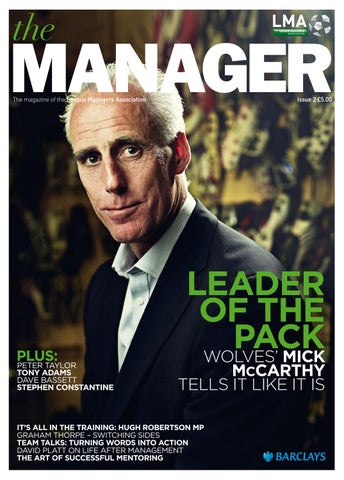
theManager Summer 2009
the
Manager The magazine of the League Managers Association
Issue 2 £5.00
Small steps
Plus: peter taylor
tony adams dave bassett stephen constantine
leader of the pack wolves’ mick
mccarthy tells it like it is
it’s all in the training: hugh robertson mp graham thorpe – switching sides team talks: turning words into action david platt on life after management the art of successful Mentoring
comment editor
How did your team do? Did they rise to the challenge and prove their mettle or struggle against tough competition and low morale? Depending on their level of ability, fitness and motivation, your people can be your most valuable asset or your biggest cost. Few managers have the luxury of a blank cheque with which to re-stock the organisation with fresh blood and new ideas. Recognising the talent within and getting the very best from existing resources is, therefore, an essential skill. Those starting next season at the helm of a new ship will have to identify and exploit their strongest assets quickly if they are to get results in those crucial early months. These days, new managers are afforded precious little time to prove themselves, despite often having to work with a legacy of club politics, finances and players. In this edition, we ask how the right words, said in the right way, can make people up their game. Does the carrot or the stick work best in spurring on a losing team? According to business leader John Timpson, instigating change is less about the words and more the groundwork you have already laid: “However inspirational the speech, if people don’t respect you and believe in your message, it won’t work.” Mick McCarthy agrees that getting team buy-in requires mutual respect, and that this has its foundations in honesty. Speaking exclusively with The Manager, he says, “[The players] are welcome to ask me a question, but they must be prepared for the
Those starting next season at the helm of a new ship will need to identify and exploit their strongest assets quickly
answer. I’m brutally honest and say it like it is.” Getting dedication and performance from a group of individuals takes a particularly skilled leader, especially in the face of adversity. And, according to MP and ex-military man Hugh Robertson, simply shouting at people when conditions are tough gets you nowhere. In our interview, he echoes the need for trust, but adds that it also comes down to preparation: “In the army, we used to say ‘train hard, fight easy’, and I believe that’s a great lesson for life.” This summer will mean hard training and tough decisions for many clubs and businesses. But get it right and the pay-off could be well worth the effort. I for one look forward to finding out. Alice Hoey Editor
Published for the LMA by Caspian Publishing Ltd. Opinions expressed by contributors are their own. Reproduction in whole or in part without written permission is strictly prohibited. Publishing enquiries: 020 7368 7177 Fax: 020 7368 7178 www.caspianpublishing.co.uk Editor: Alice Hoey Group editor: Keith Ryan Account manager: Tina Franz Creative director: Nick Dixon Art editor: David Twardawa/Clare Meredith Production manager: Karen Gardner Advertisement manager: Matthew Blore Business development director: Frances Hughes Commercial director: Andy Rice Founder and communications director: Matthew Rock Founder and editorial director: Stuart Rock Picture credits: Action Images/Getty Images/Alamy/Rex Features/istockphoto The League Managers Association The Camkin Suite, 1 Pegasus House, Tachbrook Park, Warwick CV34 6LW Tel: 01926 831 556 Email: lma@lmasecure.com www. leaguemanagers.com For annual subscription (£20 for four issues): 020 7368 7200 Fax: 020 7368 7201 or subscribe online at www.themanagermagazine.com
summer issue the line-up
20
08
12
22
12
04 kicking off
30 big boots
and manager David Platt turned his
News and views from the past
In football and business, family ties
hand to business.
quarter-season.
can be strong and productive. We
08 mick mccarthy
look at the highs and lows of
46 one careful owner
following in the family footsteps.
The manager-owner dynamic can
The Wolves boss speaks exclusively
make or break a club, says
approach to leadership, and why
34 timeline to greatness
you have to trust in your team.
Profile of the longest-
about his open, honest and direct
Professor Stuart Timperley. But how do you make it work? With Dave Whelan.
serving manager
12 crossing the line
of all time,
The transition from player to
Fred Everiss.
50 culture club
manager isn’t always easy, writes Graham Thorpe and actress-turned
36 world’s apart
-playwright Manjinder Virk speak
Working abroad
than the sum of
from experience.
might be daunting,
its parts. We ask
Sue Bridgewater. Tony Adams,
An organisation is much more
34
but the effort can
18 word play
really pay off. Stephen
Say the right thing and you can
Constantine reports back
motivate and inspire. How do John
from Sudan.
Dave Bassett why corporate identity matters and where the
manager fits in?
Timpson, Peter Taylor and Roberto Where do you begin when trying
54 don’t lose any sleep over it!
22 watch and learn
to turn around an ailing business?
Stress and poor sleep can be a
Everybody wins from a successful
According to our experts,
vicious circle. Here’s why, with
Forzoni approach the team talk?
mentoring relationship, so why
38 on a mission
re-igniting success starts
aren’t we all at it?
Dr Dorian Dugmore.
with your people.
56 equal measures 26 train hard, fight easy
42 what next?
MP Hugh
Making a radical
Robertson on the
career change
importance of broad
takes guts.
experience and why sport is undervalued.
5454
Every aspiring manager, black or white, should get the support and opportunities they deserve, says Kick It Out’s Piara Powar.
What happened
60 lma events
when ex-player
Highlights from a season of events.
Kickingoff
Richard Bevan
can you do better?
News and views FROM THE DUGOUT
Enter the dragon
As always in football’s summer season, the headlines are dominated by news of transfers, club sales, discussion about debt and finance, and
Ex-Millwall chairman and now Rymans chief executive
In the run up to this edition going to press, we saw the
doing business in the football industry. “You need an
record-breaking transfer of Ronaldo from Manchester United
asbestos suit, because at some point or other you will
to Real Madrid. This has sparked a debate about the growing
get burned,” he said. “It’s an incredible industry,” he added, “but the money it generates isn’t enough to sustain it, so it needs benefactors. Any business that is reliant on benefactors is a difficult one.” Now probably best known for his role in TV show Dragon’s Den, Paphitis spent eight years as chairman of Millwall, taking it out of administration into the Championship and an FA Cup final. “The biggest challenge when you’re trying to turn around a business is getting everyone to believe in and follow you,” he said. “If you can achieve that then you’ll make it a success.” Paphitis is a director of the Football League and an FA counsellor.
Burnley’s BOGOF For many companies, slashing budgets and restructuring won’t be enough to see them through the summer of discontent. As customers are increasingly open to offers, companies need to raise the bar to ensure their client base stays loyal and spending. While its local top-tier rivals can reduce their ticket prices, for Burnley, which gets a larger proportion of its revenue from attendance, smarter thinking was in order. At the start of the 2008/09 season, the club pledged that everyone buying a season ticket would get their money back the next season should they make it into the Barclays Premier League. While it meant that the club would lose out on around £2m, chairman Barry Kilby was confident that, in the context of a £60m promotion payout, it would be worth it. The unique incentive proved to be a fantastic way to boost attendance and share the club’s success with its supporters.
The Manager
hopes and expectations for the coming season.
Theo Paphitis spoke recently about the challenges of
Tips from the top flight It’s not every day you get to quiz a leading football manager about the highs and lows of the job. At the inaugural LMA Business Club event, in association with Real Business, Fulham’s Roy Hodgson fielded questions from host John Inverdale and a captivated audience of some 70 invited business leaders. The theme of the evening, “winning against the odds” was timely, Fulham having triumphed 2-0 over Manchester United shortly before, and struck a chord with businesses facing the challenges of a recession.
23%
rise in wage costs in the Barclays PL
£187m
investment by top 92 UK clubs in facilities
16%
compound annual growth rate between 1992 and 2008 vs 5.4% for the UK economy
The Coca-Cola Championship
is the 3rd-best attended league in the world
£3.1bn
net debt of Barclays PL clubs, up from £2.7bn last season
26%
growth in revenue for top 20 clubs Highlights from Deloitte’s Annual Review of Football Finance 2007/08
emphasis on money in football – is it a case of “how much?” over “how good?”, with some asking whether it is sustainable? I believe the past season is proof that talent still has a major role to play in success. And a manager’s ability to get the most from his team and the resources available to him is vital to achieving that. Take David Moyes, who steered Everton close to the top four, into Europe and to the FA Cup final. He also collected the LMA Manager of the Year award, sponsored by Barclays, for a record third time. Further down the league, pre-season favourites for relegation Hull City and Stoke City – both smaller clubs with limited funding – defied the odds and maintained their positions in the game’s richest league. The performance of Phil Brown and Tony Pulis, respectively, must not be underestimated in those achievements. Looking ahead to next season, the Barclays Premier League welcomes Owen Coyle’s Burnley back to the top flight for the first time since 1976. Nobody knows whether they’ll manage to stay up, but relegation is certainly not a given. In his ground-breaking bestseller, Moneyball, Michael Lewis explored the success of one of baseball’s smallest teams, the Oakland As, and its general manager, Billy Beane. The sport may have been different, but the message is transferable: there are always different ways to do things, to challenge convention and get more from a team than the sum of its parts. Beane was one of baseball’s brightest young talents as a player, but it was in management that he really made a name for himself. He created the vision, built the strategy and shaped a team, with staggering results. Pushing to find new, better ways to manage is a challenge we all face daily, and never more so than in times of adversity. On 24 September, the LMA will host its inaugural management conference (www.touchlinetoboardroom.com) at the Emirates. In the company of the likes of David Moyes, Stuart Pearce and British Airways’ Martin Broughton, we will unite the worlds of business and sport, and explore and debate what makes great managers tick. I look forward to seeing you there.
Richard Bevan the League Managers Association
The Manager
Kickingoff
Richard Bevan
can you do better?
News and views FROM THE DUGOUT
Enter the dragon
As always in football’s summer season, the headlines are dominated by news of transfers, club sales, discussion about debt and finance, and
Ex-Millwall chairman and now Rymans chief executive
In the run up to this edition going to press, we saw the
doing business in the football industry. “You need an
record-breaking transfer of Ronaldo from Manchester United
asbestos suit, because at some point or other you will
to Real Madrid. This has sparked a debate about the growing
get burned,” he said. “It’s an incredible industry,” he added, “but the money it generates isn’t enough to sustain it, so it needs benefactors. Any business that is reliant on benefactors is a difficult one.” Now probably best known for his role in TV show Dragon’s Den, Paphitis spent eight years as chairman of Millwall, taking it out of administration into the Championship and an FA Cup final. “The biggest challenge when you’re trying to turn around a business is getting everyone to believe in and follow you,” he said. “If you can achieve that then you’ll make it a success.” Paphitis is a director of the Football League and an FA counsellor.
Burnley’s BOGOF For many companies, slashing budgets and restructuring won’t be enough to see them through the summer of discontent. As customers are increasingly open to offers, companies need to raise the bar to ensure their client base stays loyal and spending. While its local top-tier rivals can reduce their ticket prices, for Burnley, which gets a larger proportion of its revenue from attendance, smarter thinking was in order. At the start of the 2008/09 season, the club pledged that everyone buying a season ticket would get their money back the next season should they make it into the Barclays Premier League. While it meant that the club would lose out on around £2m, chairman Barry Kilby was confident that, in the context of a £60m promotion payout, it would be worth it. The unique incentive proved to be a fantastic way to boost attendance and share the club’s success with its supporters.
The Manager
hopes and expectations for the coming season.
Theo Paphitis spoke recently about the challenges of
Tips from the top flight It’s not every day you get to quiz a leading football manager about the highs and lows of the job. At the inaugural LMA Business Club event, in association with Real Business, Fulham’s Roy Hodgson fielded questions from host John Inverdale and a captivated audience of some 70 invited business leaders. The theme of the evening, “winning against the odds” was timely, Fulham having triumphed 2-0 over Manchester United shortly before, and struck a chord with businesses facing the challenges of a recession.
23%
rise in wage costs in the Barclays PL
£187m
investment by top 92 UK clubs in facilities
16%
compound annual growth rate between 1992 and 2008 vs 5.4% for the UK economy
The Coca-Cola Championship
is the 3rd-best attended league in the world
£3.1bn
net debt of Barclays PL clubs, up from £2.7bn last season
26%
growth in revenue for top 20 clubs Highlights from Deloitte’s Annual Review of Football Finance 2007/08
emphasis on money in football – is it a case of “how much?” over “how good?”, with some asking whether it is sustainable? I believe the past season is proof that talent still has a major role to play in success. And a manager’s ability to get the most from his team and the resources available to him is vital to achieving that. Take David Moyes, who steered Everton close to the top four, into Europe and to the FA Cup final. He also collected the LMA Manager of the Year award, sponsored by Barclays, for a record third time. Further down the league, pre-season favourites for relegation Hull City and Stoke City – both smaller clubs with limited funding – defied the odds and maintained their positions in the game’s richest league. The performance of Phil Brown and Tony Pulis, respectively, must not be underestimated in those achievements. Looking ahead to next season, the Barclays Premier League welcomes Owen Coyle’s Burnley back to the top flight for the first time since 1976. Nobody knows whether they’ll manage to stay up, but relegation is certainly not a given. In his ground-breaking bestseller, Moneyball, Michael Lewis explored the success of one of baseball’s smallest teams, the Oakland As, and its general manager, Billy Beane. The sport may have been different, but the message is transferable: there are always different ways to do things, to challenge convention and get more from a team than the sum of its parts. Beane was one of baseball’s brightest young talents as a player, but it was in management that he really made a name for himself. He created the vision, built the strategy and shaped a team, with staggering results. Pushing to find new, better ways to manage is a challenge we all face daily, and never more so than in times of adversity. On 24 September, the LMA will host its inaugural management conference (www.touchlinetoboardroom.com) at the Emirates. In the company of the likes of David Moyes, Stuart Pearce and British Airways’ Martin Broughton, we will unite the worlds of business and sport, and explore and debate what makes great managers tick. I look forward to seeing you there.
Richard Bevan the League Managers Association
The Manager
Fighting talk
Box clever “One more round” wrote James J Corbett, World Heavyweight boxing Champion from 1892 to 1897. His poem of the same name now sits in the
Roy Keane is getting tough with his Ipswich
office of QPR performance manager John Harbin, for whom those three
Town side as they prepare to battle for
words have provided a constant source of inspiration and motivation.
promotion next season. The manager
“I’ve used the saying for the past 20 years,” says Harbin, a former
plans to send players on a gruelling pre-
rugby league coach who has also worked at Oldham Athletic, Crystal
season training course with the Parachute
Palace and Coventry City. “It means that no matter what your situation
Regiment, where they will be put through
– be it in sport or life – there’s always one more round to fight.”
their paces, military style. At the Merville Barracks training centre in season training, courses are designed to
EXTRA TIME
promote team cohesion, develop leadership
Tony Pulis (left) ran this year’s London
Colchester, a potential venue for the pre-
skills and improve physical fitness. The centre
Marathon on behalf of the Donna Louise
is currently used in the recruitment of young
Children’s Hospice. Management, staff and
soldiers. Keane will be hoping its motto, “Ready for anything” proves to be justified.
Calling time
SPOTLIGHT
After 14 years in charge, Graham Turner leaves his post as manager of Hereford United at the end of this season. Turner, who will remain chairman and director of football at the club, is currently the second longestserving manager in England behind Sir Alex Ferguson, CBE. He has managed clubs in each of the top five tiers of English football, resulting in 30 years of managerial experience.
Joe Royle, who recently turned 60, returned to Oldham Athletic as caretaker manager in March. During his previous 12-year spell at Boundary Park, Royle guided the club to the Premier League, two FA Cup semi-finals and a Littlewoods Cup final. Royle moved to Manchester City in February 1998, and in his first full season in charge the club achieved promotion. A year later, they went up into the Premier League. Having taken charge of Ipswich Town in November 2002, Royle led the club to the play-offs in 2004 and 2005.
On the money In its first year, the cancer charity founded by Sir Bobby Robson has raised more than double its goal of £500,000. According to a Press Association report, the Sir Bobby Robson Foundation achieved the initial target in the first seven weeks, topping £1.2 million within a year. The charity was set up to provide early cancer detection and treatments, and to trial new drugs at the Northern Centre for Cancer Care in the Freeman Hospital. “As long as the commitment and belief is there, I’ll continue to help for as long as I can,” said Sir Bobby.
The Manager
1,000
Having each managed 1,000 games, Steve Coppell and Graham Turner have entered the LMA’s elite Hall of Fame, the 1,000 Club. Coppell took on his first managerial role aged 28, becoming the youngest to ever manage in the Football League. During his career, he achieved three promotions and one FA Cup final and has twice been named LMA Manager of the Year. Graham Turner received the LMA Service Award, sponsored by Coca-Cola, recently. His achievements have included two promotions and three league titles.
players at Stoke City have been supporting the charity for several seasons. Alan Curbishley recently unveiled a £2.5 million sports facility in the London Borough of Bexley. It is hoped that the new outdoor sports changing pavilion and education and leisure facility at Hall Place will give a considerable boost to sport in the local community. Watford FC’s Brendan Rodgers (right) has been delivering some motivational words to aspiring footballers. Speaking to students on the football excellence programme at West Herts College, he emphasised the opportunities that coaching can offer as a career, should they not make the grade on the field. As part of the LMA’s Community Fund, Spurs manager Harry Redknapp recently attended the first leg of the Special Olympics Great Britain (SOGB) Unified Football Roadshow alongside striker Robbie Keane. The event was hosted by the Tottenham Hotspur Foundation at the club’s training ground. The LMA Community Fund works in partnership with several charity and community partners, including the Special Olympics. This summer, Les Reed will be hoping to steer the GB team to victory in one of the world’s largest sporting events by participation – the Maccabiah Games. Although primarily for Jewish athletes, Arab Israelis can participate in the games, which like the Olympics are held every four years and are sanctioned by the International Olympic Committee and World Federation of Sports.
The Manager
Fighting talk
Box clever “One more round” wrote James J Corbett, World Heavyweight boxing Champion from 1892 to 1897. His poem of the same name now sits in the
Roy Keane is getting tough with his Ipswich
office of QPR performance manager John Harbin, for whom those three
Town side as they prepare to battle for
words have provided a constant source of inspiration and motivation.
promotion next season. The manager
“I’ve used the saying for the past 20 years,” says Harbin, a former
plans to send players on a gruelling pre-
rugby league coach who has also worked at Oldham Athletic, Crystal
season training course with the Parachute
Palace and Coventry City. “It means that no matter what your situation
Regiment, where they will be put through
– be it in sport or life – there’s always one more round to fight.”
their paces, military style. At the Merville Barracks training centre in season training, courses are designed to
EXTRA TIME
promote team cohesion, develop leadership
Tony Pulis (left) ran this year’s London
Colchester, a potential venue for the pre-
skills and improve physical fitness. The centre
Marathon on behalf of the Donna Louise
is currently used in the recruitment of young
Children’s Hospice. Management, staff and
soldiers. Keane will be hoping its motto, “Ready for anything” proves to be justified.
Calling time
SPOTLIGHT
After 14 years in charge, Graham Turner leaves his post as manager of Hereford United at the end of this season. Turner, who will remain chairman and director of football at the club, is currently the second longestserving manager in England behind Sir Alex Ferguson, CBE. He has managed clubs in each of the top five tiers of English football, resulting in 30 years of managerial experience.
Joe Royle, who recently turned 60, returned to Oldham Athletic as caretaker manager in March. During his previous 12-year spell at Boundary Park, Royle guided the club to the Premier League, two FA Cup semi-finals and a Littlewoods Cup final. Royle moved to Manchester City in February 1998, and in his first full season in charge the club achieved promotion. A year later, they went up into the Premier League. Having taken charge of Ipswich Town in November 2002, Royle led the club to the play-offs in 2004 and 2005.
On the money In its first year, the cancer charity founded by Sir Bobby Robson has raised more than double its goal of £500,000. According to a Press Association report, the Sir Bobby Robson Foundation achieved the initial target in the first seven weeks, topping £1.2 million within a year. The charity was set up to provide early cancer detection and treatments, and to trial new drugs at the Northern Centre for Cancer Care in the Freeman Hospital. “As long as the commitment and belief is there, I’ll continue to help for as long as I can,” said Sir Bobby.
The Manager
1,000
Having each managed 1,000 games, Steve Coppell and Graham Turner have entered the LMA’s elite Hall of Fame, the 1,000 Club. Coppell took on his first managerial role aged 28, becoming the youngest to ever manage in the Football League. During his career, he achieved three promotions and one FA Cup final and has twice been named LMA Manager of the Year. Graham Turner received the LMA Service Award, sponsored by Coca-Cola, recently. His achievements have included two promotions and three league titles.
players at Stoke City have been supporting the charity for several seasons. Alan Curbishley recently unveiled a £2.5 million sports facility in the London Borough of Bexley. It is hoped that the new outdoor sports changing pavilion and education and leisure facility at Hall Place will give a considerable boost to sport in the local community. Watford FC’s Brendan Rodgers (right) has been delivering some motivational words to aspiring footballers. Speaking to students on the football excellence programme at West Herts College, he emphasised the opportunities that coaching can offer as a career, should they not make the grade on the field. As part of the LMA’s Community Fund, Spurs manager Harry Redknapp recently attended the first leg of the Special Olympics Great Britain (SOGB) Unified Football Roadshow alongside striker Robbie Keane. The event was hosted by the Tottenham Hotspur Foundation at the club’s training ground. The LMA Community Fund works in partnership with several charity and community partners, including the Special Olympics. This summer, Les Reed will be hoping to steer the GB team to victory in one of the world’s largest sporting events by participation – the Maccabiah Games. Although primarily for Jewish athletes, Arab Israelis can participate in the games, which like the Olympics are held every four years and are sanctioned by the International Olympic Committee and World Federation of Sports.
The Manager
»
cover story
Q How did you find the transition from player to manager at Millwall? A One of the biggest lessons I learnt in those early days as a manager is that as soon as you put your head above the parapet you get shot at. Being a highly experienced footballer certainly doesn’t prepare you for management. Players take criticism together as a team. As a manager, you are very much the figurehead and you take criticism on behalf of the players, club and fans. Taff (Ian Evans), now a colleague at Wolves, was a coach at Millwall at the time. The club was near the relegation zone and I had to start making decisions straight away, so having his guiding hand was invaluable. I would have found it extremely difficult to go from the shop floor straight into management without any help. I was learning on my feet and all I had was the knowledge I’d gained as a
Leadership can be learnt and fine-tuned, but at its heart is
personality and passion.
Step forward Mick McCarthy, whose direct but honest, friendly but firm approach to management has earned him the respect of his team and a place in the Barclays Premier League.
player. I’ve since taken all of my qualifications; it’s essential to have these tools as a manager.
Words:Sue McKellar Photographs:David short
»
cover story
Q How did you find the transition from player to manager at Millwall? A One of the biggest lessons I learnt in those early days as a manager is that as soon as you put your head above the parapet you get shot at. Being a highly experienced footballer certainly doesn’t prepare you for management. Players take criticism together as a team. As a manager, you are very much the figurehead and you take criticism on behalf of the players, club and fans. Taff (Ian Evans), now a colleague at Wolves, was a coach at Millwall at the time. The club was near the relegation zone and I had to start making decisions straight away, so having his guiding hand was invaluable. I would have found it extremely difficult to go from the shop floor straight into management without any help. I was learning on my feet and all I had was the knowledge I’d gained as a
Leadership can be learnt and fine-tuned, but at its heart is
personality and passion.
Step forward Mick McCarthy, whose direct but honest, friendly but firm approach to management has earned him the respect of his team and a place in the Barclays Premier League.
player. I’ve since taken all of my qualifications; it’s essential to have these tools as a manager.
Words:Sue McKellar Photographs:David short
»
cover story
The Mccarthy CV
Nobody can be right all of the time. I’m open to suggestion and discussion. But I have the final say, and the club lives or dies by those decisions Q How difficult is it for a young
you have to act things out
manager to get the buy-in of
at times. When you’ve lost a
his team?
match, you put on your best “bib and tucker”, smile and try
A Results determine that. If
to look as if you are in control
you go in with a set way of
of everything, including your
doing things, you’d better have
emotions. At other times, you
instant success. No one knows
do what Taff calls “the red nose,
everything, so you have to be
silly hat, juggling routine” to
prepared to listen to others.
lift everybody’s mood, whether
I know what I want to do,
you feel like it or not. In a way,
how I want to play and who I
you are acting, but sometimes
want around me. Nobody can
that’s what managing and
be right all of the time and I
motivating people is about.
Player 1977-92 ›› Barnsley, Manchester City, Celtic, Lyon and Millwall ›› 1984-92 Republic of Ireland Manager ›› 1992-96 Millwall ›› 1996-02 Republic of Ireland ›› 2003-06 Sunderland ›› 2006-present Wolverhampton Wanderers
am open to suggestion and discussion. But I have the final
Q What lessons did you take
say, and the club lives or dies
from your international career?
by those decisions. A There was a real bloodyQ Do you have a turnaround
mindedness about the Republic
strategy when you join a club?
of Ireland; we believed that, wherever we went, we’d give a
A No, you have to be able to
good account of ourselves. We international manager and the
better than that. I have kept myself
A I bought Michael Kightly from
which went back to the days of Jack
huge responsibility that goes with
and the players on an even keel all
Grays Athletic for £25,000, which
be stand-offish. I’ll sit and chat, and
Charlton. I remember when I was
that. You are a figurehead for the
the way through the season and
turned out to be a great piece of
you evaluate your resources and
get to know them. I like to create a
a player in the World Cup walking
nation and you represent it to the
tried to manage the expectations of
business. We’ve had unbelievable
then work with that. Player injuries
good working atmosphere. I’ll have
around the stadium to get a feel for
world in everything you do – how
the club and fans.
success in identifying talent, here
mean you’ll have to keep making
fun with them and join in with the
it. There was a match being shown
you look, speak and conduct
changes. You can’t plan for that
banter, but if, on matchday, I say
on the big screen, so we sat down
yourself with the media.
– you just have to think on your feet
“jump”, I expect them to ask “how
in the middle of the pitch, still in
and get on with it. But, no matter
high?” It’s about mutual respect –
our training kits and flip-flops, to
what the circumstances, I maintain
you can’t get anything out of people
my standards and beliefs.
adapt. I’ve been managing for
also had a cute way about us,
17 years and my approach remains
I couldn’t go in every day and
the same; when you arrive at a club,
During one particularly tough
and at previous clubs. We look for
period, I brought in sports therapist
players who are young, hungry and
Bill Stevens. I was concerned that
with real desire. I’m a grafter and I
Q Expectations of Wolves were very
a fear might be developing among
recruit people who I know will give
watch. The Italians, who we were
high towards the end of the season.
the players that we would lose the
every last drop of sweat. If you have
if it’s just one way. I am fair, but the
due to play, were also there, looking
How did you motivate the team?
campaign. After all, the pleasure of
players with those attributes, it
team know the ground rules; it’s
pristine. I think they underestimated
winning only comes when you have
makes the job of management
Q How would you define your
important to be consistent. And I’ve
our ability, organisation and desire
A You can’t pull the wool over the
won something, the fear of losing
far easier.
relationship with the players?
never asked anything of anyone that
because of our appearance that
players’ eyes, because then they
is always there. Bill certainly had a
I wouldn’t have done as a player.
day. When I became manager of
don’t trust you or believe in you. My
positive effect on the team.
the Republic of Ireland I tried to
assistant manager, Terry Connor,
maintain that special character.
and I have been motivating the team
this as a young manager, you learn
recruitment team of Dave Bowman
I remember walking down a
day-by-day throughout the season.
with maturity, experience and
and Taff. If they recommend that I
street in New York when I was
But at no point have we been
knowledge that this kind of action
sign a player and I’m unable to see
A First and foremost, I treat them with respect and I’m honest. It’s
Q Is yours a conscious management
important that the players can talk
style or part of your personality?
to me about anything, so my door
While I would never have done
Spotting great talent doesn’t happen by chance; it takes hard work. I place a lot of trust in my
is always open. But, while they are
A It’s an extension of me. I am what
manager and builders shouting and
dancing on the table, claiming we’d
doesn’t weaken your hand, it adds
him, I say sign him. The three of us
welcome to ask me a question, they
I am and I don’t change according
waving to me. I couldn’t believe
win this or that.
to your armoury.
have been working as a team for
must be prepared for the answer.
to whether I’m with players, fans
I was getting recognised in New
It has been my mantra from the
They’re not, of course, because I’m
or the chairman. However, there’s
York. It made me realise just how
start that we finished seventh last
Q In any business, spotting talent is
my eyes and ears. They know what
brutally honest and say it like it is.
no question that, as a manager,
big your profile is when you are an
season and we would have to do
crucial; you’ve had real success…
makes a Mick McCarthy player.
10 The Manager
25 years and I can trust them to be
The Manager 11
»
cover story
The Mccarthy CV
Nobody can be right all of the time. I’m open to suggestion and discussion. But I have the final say, and the club lives or dies by those decisions Q How difficult is it for a young
you have to act things out
manager to get the buy-in of
at times. When you’ve lost a
his team?
match, you put on your best “bib and tucker”, smile and try
A Results determine that. If
to look as if you are in control
you go in with a set way of
of everything, including your
doing things, you’d better have
emotions. At other times, you
instant success. No one knows
do what Taff calls “the red nose,
everything, so you have to be
silly hat, juggling routine” to
prepared to listen to others.
lift everybody’s mood, whether
I know what I want to do,
you feel like it or not. In a way,
how I want to play and who I
you are acting, but sometimes
want around me. Nobody can
that’s what managing and
be right all of the time and I
motivating people is about.
Player 1977-92 ›› Barnsley, Manchester City, Celtic, Lyon and Millwall ›› 1984-92 Republic of Ireland Manager ›› 1992-96 Millwall ›› 1996-02 Republic of Ireland ›› 2003-06 Sunderland ›› 2006-present Wolverhampton Wanderers
am open to suggestion and discussion. But I have the final
Q What lessons did you take
say, and the club lives or dies
from your international career?
by those decisions. A There was a real bloodyQ Do you have a turnaround
mindedness about the Republic
strategy when you join a club?
of Ireland; we believed that, wherever we went, we’d give a
A No, you have to be able to
good account of ourselves. We international manager and the
better than that. I have kept myself
A I bought Michael Kightly from
which went back to the days of Jack
huge responsibility that goes with
and the players on an even keel all
Grays Athletic for £25,000, which
be stand-offish. I’ll sit and chat, and
Charlton. I remember when I was
that. You are a figurehead for the
the way through the season and
turned out to be a great piece of
you evaluate your resources and
get to know them. I like to create a
a player in the World Cup walking
nation and you represent it to the
tried to manage the expectations of
business. We’ve had unbelievable
then work with that. Player injuries
good working atmosphere. I’ll have
around the stadium to get a feel for
world in everything you do – how
the club and fans.
success in identifying talent, here
mean you’ll have to keep making
fun with them and join in with the
it. There was a match being shown
you look, speak and conduct
changes. You can’t plan for that
banter, but if, on matchday, I say
on the big screen, so we sat down
yourself with the media.
– you just have to think on your feet
“jump”, I expect them to ask “how
in the middle of the pitch, still in
and get on with it. But, no matter
high?” It’s about mutual respect –
our training kits and flip-flops, to
what the circumstances, I maintain
you can’t get anything out of people
my standards and beliefs.
adapt. I’ve been managing for
also had a cute way about us,
17 years and my approach remains
I couldn’t go in every day and
the same; when you arrive at a club,
During one particularly tough
and at previous clubs. We look for
period, I brought in sports therapist
players who are young, hungry and
Bill Stevens. I was concerned that
with real desire. I’m a grafter and I
Q Expectations of Wolves were very
a fear might be developing among
recruit people who I know will give
watch. The Italians, who we were
high towards the end of the season.
the players that we would lose the
every last drop of sweat. If you have
if it’s just one way. I am fair, but the
due to play, were also there, looking
How did you motivate the team?
campaign. After all, the pleasure of
players with those attributes, it
team know the ground rules; it’s
pristine. I think they underestimated
winning only comes when you have
makes the job of management
Q How would you define your
important to be consistent. And I’ve
our ability, organisation and desire
A You can’t pull the wool over the
won something, the fear of losing
far easier.
relationship with the players?
never asked anything of anyone that
because of our appearance that
players’ eyes, because then they
is always there. Bill certainly had a
I wouldn’t have done as a player.
day. When I became manager of
don’t trust you or believe in you. My
positive effect on the team.
the Republic of Ireland I tried to
assistant manager, Terry Connor,
maintain that special character.
and I have been motivating the team
this as a young manager, you learn
recruitment team of Dave Bowman
I remember walking down a
day-by-day throughout the season.
with maturity, experience and
and Taff. If they recommend that I
street in New York when I was
But at no point have we been
knowledge that this kind of action
sign a player and I’m unable to see
A First and foremost, I treat them with respect and I’m honest. It’s
Q Is yours a conscious management
important that the players can talk
style or part of your personality?
to me about anything, so my door
While I would never have done
Spotting great talent doesn’t happen by chance; it takes hard work. I place a lot of trust in my
is always open. But, while they are
A It’s an extension of me. I am what
manager and builders shouting and
dancing on the table, claiming we’d
doesn’t weaken your hand, it adds
him, I say sign him. The three of us
welcome to ask me a question, they
I am and I don’t change according
waving to me. I couldn’t believe
win this or that.
to your armoury.
have been working as a team for
must be prepared for the answer.
to whether I’m with players, fans
I was getting recognised in New
It has been my mantra from the
They’re not, of course, because I’m
or the chairman. However, there’s
York. It made me realise just how
start that we finished seventh last
Q In any business, spotting talent is
my eyes and ears. They know what
brutally honest and say it like it is.
no question that, as a manager,
big your profile is when you are an
season and we would have to do
crucial; you’ve had real success…
makes a Mick McCarthy player.
10 The Manager
25 years and I can trust them to be
The Manager 11
»
p l ay e r t o m a n a g e r Dr Sue Bridgewater (pictured) is associate professor of marketing at Warwick Business School, where she leads the Certificate in Applied Management for Football Managers.
Crossing the line
What happens when you go from being one of the lads to the gaffer? Good players can become great managers but, says Warwick Business School’s Dr Sue Bridgewater, few are prepared for the transition. photography:charlie hopkinson
Imagine the scene. You consider yourself part of the team. You join in with changing room banter, are respected for your on-the-pitch skills, and are perhaps even a mover and shaker on the social scene. Then the manager is sacked and the chairman calls you in. You’re delighted to be offered the role of caretaker manager, perhaps in time becoming permanent. The players will love having one of their own in the top spot and will give you their unstinting support. Won’t they? As director of the PFA and LMA Certificate in Applied Management for Football Managers, it’s fascinating to learn from the expectations and experiences of football players who
manager are very different. They are
Being known as a former successful player can be a blessing. It can also be a curse
no longer just “one of the lads”.
Tony Adams
make the transition into management.
Singled out When taking up their first managerial appointment – often due to a change in personnel – former players quickly discover that the rules of engagement between the player and
Even a manager coming to the role via the coaching route will find the manager’s relationship with his players is different. While it is perfectly acceptable, and probably
12 The Manager
R ea d t h e i n terv i ew »
The Manager 13
»
p l ay e r t o m a n a g e r Dr Sue Bridgewater (pictured) is associate professor of marketing at Warwick Business School, where she leads the Certificate in Applied Management for Football Managers.
Crossing the line
What happens when you go from being one of the lads to the gaffer? Good players can become great managers but, says Warwick Business School’s Dr Sue Bridgewater, few are prepared for the transition. photography:charlie hopkinson
Imagine the scene. You consider yourself part of the team. You join in with changing room banter, are respected for your on-the-pitch skills, and are perhaps even a mover and shaker on the social scene. Then the manager is sacked and the chairman calls you in. You’re delighted to be offered the role of caretaker manager, perhaps in time becoming permanent. The players will love having one of their own in the top spot and will give you their unstinting support. Won’t they? As director of the PFA and LMA Certificate in Applied Management for Football Managers, it’s fascinating to learn from the expectations and experiences of football players who
manager are very different. They are
Being known as a former successful player can be a blessing. It can also be a curse
no longer just “one of the lads”.
Tony Adams
make the transition into management.
Singled out When taking up their first managerial appointment – often due to a change in personnel – former players quickly discover that the rules of engagement between the player and
Even a manager coming to the role via the coaching route will find the manager’s relationship with his players is different. While it is perfectly acceptable, and probably
12 The Manager
R ea d t h e i n terv i ew »
The Manager 13
»Tony Adams, MBe When the job at Wycombe Wanderers
to rebuild the club. But, while I
became available, I was in the middle
stopped the rot in the year I was
of a Sports Science course at Brunel
there, I had little opportunity to
desirable, for a coach to be close to
University, but I decided to go for it.
coach and develop the players. It
his players – to put an arm around
In hindsight, that was probably the
wasn’t building my abilities as a
them and know what’s going on in
wrong decision. Taking my coaching
manager, so I decided to leave. You
their lives – the manager must be
qualifications, including the LMA’s
never know until you get into a job
more at arm’s length.
Certificate in Applied Management, had
what it will be like, but I did my best
There are various reasons why.
whetted my appetite for management,
with the resources at my disposal. Faced
First, the manager needs to be able
and I was impatient. Professional football
with the same scenario seven years on, I
to make important decisions, for
qualifications add to your palette of
think the result would be the same.
the good of the club, without the
skills, but there’s nothing like hands-on
When I left Wycombe, I thought
pressure or influence of friendships.
management and coaching experience.
“right, where do I get trained as a coach?”
It’s also hard to get a strategic overview and work out how best
» G r ah a m T h o r p e , M BE
to achieve success if you are too
That first job was great for developing
Holland appealed; at the last World Cup
my business management skills, as it was
there were four Dutch coaches managing
my remit was to save the club financially.
teams, but not a single English one. I met
a seasoned manager is very valuable. It
heavily involved in the day-to-day
When I first started to coach I had
As batting coach, then assistant coach,
In those early days, I had to let 21 players
with former Celtic manager Wim Jansen,
shields you while you learn. It’s important
action. It can be difficult to see the
to adjust to the lack of control you
I gained experience of working both
go and was focusing hard on recruitment
at the time an advisor for Feyenoord, who
to be yourself, but you can also draw on
wood for the trees.
have during a game. There’s a sense
with individuals and the team. I was an
agreed to give me a free hand at coaching
the influence of your managers. Arsene
of helplessness, because unlike the
important cog in the coaching system.
there. I worked with the under-eights right
Wenger was a fantastic physiologist,
gain the players’ respect. Taking
players you can’t directly influence
One of the most important things I
through to the under-23s, before coaching
George Graham was great with detail
part in banter is fine, but what was
what happens on the field. As a player
learned during the transition from player
at Utrecht for a month. I didn’t have such
and organisation, and Terry Venables has
acceptable as a player may not be
you feel you have more control over
to coach was the importance of taking
a high profile as a player in Holland,
great coaching ability and charisma.
so for the manager. Likewise, while
the outcome. But when you start to see
two steps back before speaking. You
being the last one to leave the bar
that you are making a real difference
can have a great playing career, but it
might afford a player certain kudos,
– perhaps only in small ways at first,
doesn’t necessarily make you a good
it sets a bad example as the boss.
but more so the longer you work with
communicator. You have to be able to
players – that’s very rewarding.
deliver the right message, whether it’s
Furthermore, the manager must
Home truths Sometimes the players are first to recognise the new and invisible lines that are drawn once their former colleague has stepped into management. One player who made the transition to caretaker manager said, “I walked into the dressing room to get changed before the first match. I was quite hurt because they all just turned around and looked at me. One of my friends said, ‘you
After taking level 2 and 3 coaching
giving advice to a player or speaking
qualifications, I secured a role in New
to the media. I’ve learned to stop and
South Wales, Australia. It was a very
consider my response rather than
professional set-up and in many ways
speaking just for the sake of it.
the perfect start to my coaching career. It took me out of my comfort zone.
To earn the respect of the players, I always try to be honest with them. As a player, I liked those coaches who
the thorpe cv
were prepared to open up, not only
Player ›› Surrey (1988-2005) 21,937 runs, ave 45.05 ›› England (1993-2005) 6,744 runs, ave 44.66
about cricket but life in general. I’ve had my fair share of ups and downs,
The Adams CV Player ›› Arsenal 14yrs as captain. 4 league titles, 3 FA Cups, 2 League Cups, 1 UEFA Cup, 1 UEFA Cup Winners Cup ›› England 66 caps, 5 goals Manager ›› Wycombe Wanderers (manager) ›› Feyenoord/Utrecht (coach) ›› Portsmouth (assistant manager) ›› Portsmouth (manager)
professionally and personally, so I can
which allowed me to get on and learn.
Management is a very different job to
Being known as a successful player can
playing – you need attributes other than
be a blessing – I don’t think I’d have the
on the technical side. But if someone has
opportunities I have now otherwise. But
been very driven as a player, has character
at times it can also be a curse because
and is a club man, it may help in the
people are always going to think “why
transition, because successful managers
haven’t you got a great defence?”
impose their personality on the team.
When I joined Harry Redknapp at
The best managers are often in their
Portsmouth, he said, “I’ll give you enough
50s or 60s. Experienced in the job and
rope to hang yourself with son” and told
in life, they are seen as a safer pair of
me to get on with it. I knew it would be a
hands for a club. My education is ongoing.
very interesting learning experience. The
I’m still young and have 20 years of
most important thing I learnt from Harry
development ahead of me.
was in recruitment. He really knows the player market worldwide. Working with
interview:sue mckellar
put things in perspective and relate to some of the players’ issues. You have to understand how individuals work, what
arranged for everyone to go out
Power shift
suspicion, more so than someone
You’re the gaffer’. So they made me
their background is and what makes
the following week. I wasn’t sure
These stories raise a number of
from outside of the club. After all,
move to the referees’ room on my
them tick. Everyone is very different,
whether I should still go. Was it
issues associated with the transition
the poacher-turned-gamekeeper
so what you say to one person won’t
acceptable for the manager to
from player to manager. First, the
knows what goes on.
necessarily work with the next.
go out with the lads? Would I be
changes are often unexpected and
welcome, or would they think I
sudden. Even if the player has given
power to hire and fire, a change
abilities as a coach and to help my
was cramping their style? I asked
management some consideration
not everyone will find easy to deal
players develop, as sportsmen and
the opinion of one of the senior
and has done his coaching badges,
with. Senior players may be jealous,
people. With experience comes humility
players and he advised me to go,
he is likely to be unprepared.
while others will feel the need to
and dignity – I want the players to have
but neither I nor the players felt very
He will need to build a new
create more distance. One manager
that, on and off the field.
comfortable. It was like the end of
relationship with the players, even
was amazed to learn that one of his
an era and it happened overnight.”
his friends. He may be viewed with
players dared not ask if he could run
can’t get changed in here now.
own. I suddenly realised how big a step I’d made and how different things would be from now on.” Another former player spoke of the change in perceptions: “I was very much a social organiser in the squad, arranging nights out for the lads. When I was asked to be caretaker manager, I had just
14 The Manager
Coach ›› NSW batting coach (2005-07) ›› NSW batting assistant coach (2007) ›› Surrey CCC batting coach (2008)
I’m always looking to improve my
The individual suddenly has the
The Manager 15
»Tony Adams, MBe When the job at Wycombe Wanderers
to rebuild the club. But, while I
became available, I was in the middle
stopped the rot in the year I was
of a Sports Science course at Brunel
there, I had little opportunity to
desirable, for a coach to be close to
University, but I decided to go for it.
coach and develop the players. It
his players – to put an arm around
In hindsight, that was probably the
wasn’t building my abilities as a
them and know what’s going on in
wrong decision. Taking my coaching
manager, so I decided to leave. You
their lives – the manager must be
qualifications, including the LMA’s
never know until you get into a job
more at arm’s length.
Certificate in Applied Management, had
what it will be like, but I did my best
There are various reasons why.
whetted my appetite for management,
with the resources at my disposal. Faced
First, the manager needs to be able
and I was impatient. Professional football
with the same scenario seven years on, I
to make important decisions, for
qualifications add to your palette of
think the result would be the same.
the good of the club, without the
skills, but there’s nothing like hands-on
When I left Wycombe, I thought
pressure or influence of friendships.
management and coaching experience.
“right, where do I get trained as a coach?”
It’s also hard to get a strategic overview and work out how best
» G r ah a m T h o r p e , M BE
to achieve success if you are too
That first job was great for developing
Holland appealed; at the last World Cup
my business management skills, as it was
there were four Dutch coaches managing
my remit was to save the club financially.
teams, but not a single English one. I met
a seasoned manager is very valuable. It
heavily involved in the day-to-day
When I first started to coach I had
As batting coach, then assistant coach,
In those early days, I had to let 21 players
with former Celtic manager Wim Jansen,
shields you while you learn. It’s important
action. It can be difficult to see the
to adjust to the lack of control you
I gained experience of working both
go and was focusing hard on recruitment
at the time an advisor for Feyenoord, who
to be yourself, but you can also draw on
wood for the trees.
have during a game. There’s a sense
with individuals and the team. I was an
agreed to give me a free hand at coaching
the influence of your managers. Arsene
of helplessness, because unlike the
important cog in the coaching system.
there. I worked with the under-eights right
Wenger was a fantastic physiologist,
gain the players’ respect. Taking
players you can’t directly influence
One of the most important things I
through to the under-23s, before coaching
George Graham was great with detail
part in banter is fine, but what was
what happens on the field. As a player
learned during the transition from player
at Utrecht for a month. I didn’t have such
and organisation, and Terry Venables has
acceptable as a player may not be
you feel you have more control over
to coach was the importance of taking
a high profile as a player in Holland,
great coaching ability and charisma.
so for the manager. Likewise, while
the outcome. But when you start to see
two steps back before speaking. You
being the last one to leave the bar
that you are making a real difference
can have a great playing career, but it
might afford a player certain kudos,
– perhaps only in small ways at first,
doesn’t necessarily make you a good
it sets a bad example as the boss.
but more so the longer you work with
communicator. You have to be able to
players – that’s very rewarding.
deliver the right message, whether it’s
Furthermore, the manager must
Home truths Sometimes the players are first to recognise the new and invisible lines that are drawn once their former colleague has stepped into management. One player who made the transition to caretaker manager said, “I walked into the dressing room to get changed before the first match. I was quite hurt because they all just turned around and looked at me. One of my friends said, ‘you
After taking level 2 and 3 coaching
giving advice to a player or speaking
qualifications, I secured a role in New
to the media. I’ve learned to stop and
South Wales, Australia. It was a very
consider my response rather than
professional set-up and in many ways
speaking just for the sake of it.
the perfect start to my coaching career. It took me out of my comfort zone.
To earn the respect of the players, I always try to be honest with them. As a player, I liked those coaches who
the thorpe cv
were prepared to open up, not only
Player ›› Surrey (1988-2005) 21,937 runs, ave 45.05 ›› England (1993-2005) 6,744 runs, ave 44.66
about cricket but life in general. I’ve had my fair share of ups and downs,
The Adams CV Player ›› Arsenal 14yrs as captain. 4 league titles, 3 FA Cups, 2 League Cups, 1 UEFA Cup, 1 UEFA Cup Winners Cup ›› England 66 caps, 5 goals Manager ›› Wycombe Wanderers (manager) ›› Feyenoord/Utrecht (coach) ›› Portsmouth (assistant manager) ›› Portsmouth (manager)
professionally and personally, so I can
which allowed me to get on and learn.
Management is a very different job to
Being known as a successful player can
playing – you need attributes other than
be a blessing – I don’t think I’d have the
on the technical side. But if someone has
opportunities I have now otherwise. But
been very driven as a player, has character
at times it can also be a curse because
and is a club man, it may help in the
people are always going to think “why
transition, because successful managers
haven’t you got a great defence?”
impose their personality on the team.
When I joined Harry Redknapp at
The best managers are often in their
Portsmouth, he said, “I’ll give you enough
50s or 60s. Experienced in the job and
rope to hang yourself with son” and told
in life, they are seen as a safer pair of
me to get on with it. I knew it would be a
hands for a club. My education is ongoing.
very interesting learning experience. The
I’m still young and have 20 years of
most important thing I learnt from Harry
development ahead of me.
was in recruitment. He really knows the player market worldwide. Working with
interview:sue mckellar
put things in perspective and relate to some of the players’ issues. You have to understand how individuals work, what
arranged for everyone to go out
Power shift
suspicion, more so than someone
You’re the gaffer’. So they made me
their background is and what makes
the following week. I wasn’t sure
These stories raise a number of
from outside of the club. After all,
move to the referees’ room on my
them tick. Everyone is very different,
whether I should still go. Was it
issues associated with the transition
the poacher-turned-gamekeeper
so what you say to one person won’t
acceptable for the manager to
from player to manager. First, the
knows what goes on.
necessarily work with the next.
go out with the lads? Would I be
changes are often unexpected and
welcome, or would they think I
sudden. Even if the player has given
power to hire and fire, a change
abilities as a coach and to help my
was cramping their style? I asked
management some consideration
not everyone will find easy to deal
players develop, as sportsmen and
the opinion of one of the senior
and has done his coaching badges,
with. Senior players may be jealous,
people. With experience comes humility
players and he advised me to go,
he is likely to be unprepared.
while others will feel the need to
and dignity – I want the players to have
but neither I nor the players felt very
He will need to build a new
create more distance. One manager
that, on and off the field.
comfortable. It was like the end of
relationship with the players, even
was amazed to learn that one of his
an era and it happened overnight.”
his friends. He may be viewed with
players dared not ask if he could run
can’t get changed in here now.
own. I suddenly realised how big a step I’d made and how different things would be from now on.” Another former player spoke of the change in perceptions: “I was very much a social organiser in the squad, arranging nights out for the lads. When I was asked to be caretaker manager, I had just
14 The Manager
Coach ›› NSW batting coach (2005-07) ›› NSW batting assistant coach (2007) ›› Surrey CCC batting coach (2008)
I’m always looking to improve my
The individual suddenly has the
The Manager 15
Depending on results, you can be the hero or villain, and you’ll bear the brunt of plaudits or abuse far more intensely than any player some coaching sessions. He thought
knowledge has been shown to be
required. There is no substitute for
he was still approachable, whereas
critical to success. For example,
experience and learning by doing.
the player was concerned about
Dr Amanda Goodall’s research
Sadly, in the turbulent world of
overstepping the mark with his boss.
at Warwick Business School
football management, many young
Being a football manager is
shows that vice chancellors with
managers are not given long to
lonely and there are tough decisions
strong research records are more
get it right. The average tenure for
to make. Instead of being one of the
successful than those without.
a football manager stands at just
group, you are the lone figure in the
In football, however, our research
under one-and-a-half years, with
spotlight. Depending on results, you
suggests that there is no particular
almost half of first-time managers
can be the hero or villain, and you’ll
relationship between how good a
never getting a second chance.
bear the brunt of plaudits or abuse
player you were and how good a
far more intensely than any player.
manager you will become. Yet, as
and Warwick Business School
This is why the FA, LMA, PFA
Roy Hodgson explained at a recent
are committed to trying to help
Same sport, different boots
LMA Business Club event, “being
players fast-track the skills they will
a great horse doesn’t necessarily
need. Coaching and management
The transition from player to
make you a great jockey”.
qualifications, together with
manager goes through several
experience, provide a toolkit of
stages. After initial adjustments,
Practice makes perfect
players and fans often respect the
The player and manager are, after
new manager because of their skill
all, very different. The former
their experience, can benefit
on the pitch. But once this short
is based on individual skill and
from continual improvement, but
honeymoon period is over, he’ll be
application, whereas being a great
help is particularly vital in the early
judged on his success as a manager.
manager is about understanding the
transition phase. It is a shocking
Popular myth would have us
abilities of your players and bringing
waste that potentially great
believe that great players don’t
out the best in others. A great player
managers are judged on
necessarily make great managers.
may well have these aptitudes
their abilities before they have
“What about Bobby Charlton?”
in his locker, but it can take time
had the chance to mature into
they say. In some sectors, expert
to develop them to the standard
the role.
ideas and skills. All managers, regardless of
» Manjinder virk, actress/writer Having found success as an actress – winning plaudits for dramas such as Britz and Doctors – Manjinder Virk turned her creative talent to writing. Now a published playwright, how did she find the transition from reading to writing scripts? I always wanted to be an actress, but I’ve been writing for about eight years. While it started as a hobby, I’m now taking myself more seriously and focusing on it as much as acting. The feedback and support I had early on was very important. I was given a lot of encouragement and help in nurturing my skills. People who know me as an actress are often surprised to hear I’m writing, but are usually interested in reading or hearing more about that side of my work. My acting experience has been useful in writing screenplays. I’ve read so many, so have learnt what works and what doesn’t, although you never truly know. I’ve also gained a lot from watching plays. I think my ability to write good dialogue, in particular, stems from my acting experience. I still have much to learn as a writer. Writing is a longer-term process than acting – going from your initial vision all the way to production. I get a different type of satisfaction from that; it’s more personal and requires more patience. I got the opportunity to direct my own short film recently. It was daunting at first, but then you realise just how much you know and are capable of. People shouldn’t be afraid to try their hand at something different.
16 The Manager
»
t e a m ta l k s
Word play You prepared as best you could, trained hard and selected the team wisely. Yet here you are, staring defeat in the face. With minutes to address (swear at, comfort, plead with) your team, how can you instigate a change? illustrations:nicola jennings
John Timpson, chairman of Timpsons Motivation comes from the mutual
fantastic, but that they haven’t yet
respect that exists between you and
shown it on this occasion.
your team. And to respect you they
Like many businesses at the
must believe you have what it takes and
moment, I’m having to shore up
trust your judgement, whatever the
confidence in my team. I’m focusing on
situation. There’s no substitute for
our successes and the opportunities
being the real article.
that exist, and backing that up with
I don’t like the use of fear as
figures. You have to sell yourself and
a management tool. Your message has
your ideas for the business. But you also
to be communicated in a positive way
have to be totally open about any
– “you can win” not “you can’t lose”.
problems. If people think that you’re
As a leader, it’s your responsibility to
holding something back or doubt your
get people to believe in
ability to respond to the challenges,
themselves and every other
they won’t give you their best.
member of the team. You have to
Leadership is about personality and
take away any reason they might
passion, honesty and inspiration. There
have for not being successful.
will, no doubt, be pivotal instants when
When it comes to what has gone
you sense the moment and say the
wrong or right, I tell it like it is.
right thing. But, however inspirational
Whether it was down to you as a
the words, if people don’t trust and
manager or poor performance by
respect you and believe in your
the team, say so, and be clear about
message, those words won’t work. In
what you’re going to do to rectify it.
that sense, before you’ve even opened
Communicate any faults in a positive
your mouth, the groundwork will
way – tell them you know they are
already have been done.
» PS:There’s more... John Timpson will be joining David Moyes and other high-profile leaders for a live debate about building enduring success at the LMA conference in September. Visit www.touchlinetoboardroom for more information
18 The Manager
However inspirational the speech, if people don’t trust and respect you and believe in your message, it won’t work
The Manager 19
»
t e a m ta l k s
Word play You prepared as best you could, trained hard and selected the team wisely. Yet here you are, staring defeat in the face. With minutes to address (swear at, comfort, plead with) your team, how can you instigate a change? illustrations:nicola jennings
John Timpson, chairman of Timpsons Motivation comes from the mutual
fantastic, but that they haven’t yet
respect that exists between you and
shown it on this occasion.
your team. And to respect you they
Like many businesses at the
must believe you have what it takes and
moment, I’m having to shore up
trust your judgement, whatever the
confidence in my team. I’m focusing on
situation. There’s no substitute for
our successes and the opportunities
being the real article.
that exist, and backing that up with
I don’t like the use of fear as
figures. You have to sell yourself and
a management tool. Your message has
your ideas for the business. But you also
to be communicated in a positive way
have to be totally open about any
– “you can win” not “you can’t lose”.
problems. If people think that you’re
As a leader, it’s your responsibility to
holding something back or doubt your
get people to believe in
ability to respond to the challenges,
themselves and every other
they won’t give you their best.
member of the team. You have to
Leadership is about personality and
take away any reason they might
passion, honesty and inspiration. There
have for not being successful.
will, no doubt, be pivotal instants when
When it comes to what has gone
you sense the moment and say the
wrong or right, I tell it like it is.
right thing. But, however inspirational
Whether it was down to you as a
the words, if people don’t trust and
manager or poor performance by
respect you and believe in your
the team, say so, and be clear about
message, those words won’t work. In
what you’re going to do to rectify it.
that sense, before you’ve even opened
Communicate any faults in a positive
your mouth, the groundwork will
way – tell them you know they are
already have been done.
» PS:There’s more... John Timpson will be joining David Moyes and other high-profile leaders for a live debate about building enduring success at the LMA conference in September. Visit www.touchlinetoboardroom for more information
18 The Manager
However inspirational the speech, if people don’t trust and respect you and believe in your message, it won’t work
The Manager 19
cent off the ball. The other 20 per cent is motivation. Q Do young, inexperienced players need a different kind of team talk? Yes, as do teams lower down in the Football Leagues or the Conference League compared to in the Barclays Premier League. I only really get uptight
Peter Taylor, manager, Wycombe Wanderers
as a manager when I ask something of a player and they don’t respond. As a manager, you can take that quite personally. But it happens less with
Q How did the team talks you received as
Q When do you start planning what you’re
a player influence your own approach?
going to say?
Keith Burkinshaw, my manager at
The day before a match, I give myself a
Tottenham, and Malcolm Allison at Crystal
good hour to gather my thoughts
Palace couldn’t have been more different.
together. I write a page on the opposition,
Keith was incredibly direct and would tell
a page about my team in possession and
you if he expected more. As a player, you
a page on our defence. But I don’t take
don’t always want to hear that, but I loved
those three pages into the dressing room;
him for being so honest.
I just take one small piece of paper with a
Malcolm was very different; he
series of bulletpoints.
made me feel like the best player in the
When I was a player, I liked to know the
world. He’d say things like “You’re too
key tactical information and I took that on
good and too quick for the left back
board as a manager. Players have to be
marking you”. His approach was to
clear about what is required of them on
instil confidence, highlighting the
the pitch. You must have a good plan and
weaknesses in the opposition, but
then trust that your players will do
making you feel ten-feet tall.
everything they can to make it work.
My own approach is improving with
I like to give my players an idea of how
age. I’m getting better at building
I expect the match to pan out. For
players’ confidence and I like to use a bit
example, if an opposing player turns out
of reverse psychology. I’ll say things like
to be a particular threat, I need the team
“You realise that you haven’t scored for
to be prepared for that and to know how
seven games, but you know that today
to deal with it.
you will”. I now understand that players sometimes need a bit of a cuddle. As a young manager I probably got too
I try to get across to them how we can hurt the opposition, as well as how they can hurt us. If you only talk about how
uptight about things. At times, all
good the other side is, you risk causing too
managers can take things a little too
much fear. I’d say my team talks are 40 per
personally. I’m calmer now.
cent about tactics on the ball and 40 per
seasoned professionals. With less experienced players, you have to talk them though everything in more detail and give reminders right up to kick off. I managed the England side against Italy for one game in 2000 and it was probably one of the easiest I’ve done. I was really up for the experience and knew that I was dealing with very good players. I prepared, as always, the night before. I didn’t need to give a big motivational speech; it was more a case of strategy. Q What made you give David Beckham his first England captaincy in that match? Two things influenced my decision. The first was how David handled the criticism when he was sent off against Argentina during the 1998 World Cup. The following season he was getting hammered at every away game, as well as in the press, but he showed incredible character. Then, when I worked with him as a coach to the England team, I saw just how much he enjoyed playing for the national side and his dedication to international duty. I thought he deserved a chance.
interview:sue mckellar
My team talks are 40 per cent about tactics on the ball and 40 per cent off the ball. The other 20 per cent is motivation 20 The Manager
Roberto Forzoni, performance psychologist and consultant As things start to go pear-shaped, you should be working through a check-list of questions: is your strategy working? Are people in the right positions? Is the competition behaving as you expected? You can then work out how to negate their threat and maximise your opportunities. But once your new plan is in place, how do you convince your team that they can make it work? (www.robertoforzoni.com)
Words into action: 10 steps
1
Stay calm. To be able to think quickly, you need to remain emotionally detached from the problem. The team won’t respond well if they see you’ve lost your cool. Perhaps take a few minutes out with trusted colleagues before addressing the team as a whole.
2
Listen. Management is not about having all the answers, and enforcing decisions. Engaging staff and players, asking the right questions and listening can help you make appropriate changes and raise performance levels.
3
Don’t waste time. Simply going over what could or should have happened, or passing blame is not the best use of your time.
4
Have a clear strategy. If you make changes, ensure people understand what they are and why you are making them. The team needs to know that you are in full control and can make difficult decisions when the pressure is on.
5
Be specific. It’s easy to generalise when under pressure. Don’t. Give specific reasons why something needs to be changed. Ask yourself what’s important now?
6
Keep it professional. Things said in the heat of the moment may be regretted later on. Focus on behaviour or actions, but don’t make it personal. And remember that sarcasm has no place in elite level performance.
7
Mind your language. Using absolute terms like “must” and “should” add pressure to an already difficult situation. Let the team focus on what you need them to do.
8
Share the blame. Don’t fall into the habit of using “we” when things are going well and “you” when they are not.
9
Take pride. Reminding the team of why they are there can help remove self pity.
10
Give hope. Be a practical optimist and take it step by step. Remind the team of past success, particularly any similar situations in which they have overcome the odds.
The Manager 21
cent off the ball. The other 20 per cent is motivation. Q Do young, inexperienced players need a different kind of team talk? Yes, as do teams lower down in the Football Leagues or the Conference League compared to in the Barclays Premier League. I only really get uptight
Peter Taylor, manager, Wycombe Wanderers
as a manager when I ask something of a player and they don’t respond. As a manager, you can take that quite personally. But it happens less with
Q How did the team talks you received as
Q When do you start planning what you’re
a player influence your own approach?
going to say?
Keith Burkinshaw, my manager at
The day before a match, I give myself a
Tottenham, and Malcolm Allison at Crystal
good hour to gather my thoughts
Palace couldn’t have been more different.
together. I write a page on the opposition,
Keith was incredibly direct and would tell
a page about my team in possession and
you if he expected more. As a player, you
a page on our defence. But I don’t take
don’t always want to hear that, but I loved
those three pages into the dressing room;
him for being so honest.
I just take one small piece of paper with a
Malcolm was very different; he
series of bulletpoints.
made me feel like the best player in the
When I was a player, I liked to know the
world. He’d say things like “You’re too
key tactical information and I took that on
good and too quick for the left back
board as a manager. Players have to be
marking you”. His approach was to
clear about what is required of them on
instil confidence, highlighting the
the pitch. You must have a good plan and
weaknesses in the opposition, but
then trust that your players will do
making you feel ten-feet tall.
everything they can to make it work.
My own approach is improving with
I like to give my players an idea of how
age. I’m getting better at building
I expect the match to pan out. For
players’ confidence and I like to use a bit
example, if an opposing player turns out
of reverse psychology. I’ll say things like
to be a particular threat, I need the team
“You realise that you haven’t scored for
to be prepared for that and to know how
seven games, but you know that today
to deal with it.
you will”. I now understand that players sometimes need a bit of a cuddle. As a young manager I probably got too
I try to get across to them how we can hurt the opposition, as well as how they can hurt us. If you only talk about how
uptight about things. At times, all
good the other side is, you risk causing too
managers can take things a little too
much fear. I’d say my team talks are 40 per
personally. I’m calmer now.
cent about tactics on the ball and 40 per
seasoned professionals. With less experienced players, you have to talk them though everything in more detail and give reminders right up to kick off. I managed the England side against Italy for one game in 2000 and it was probably one of the easiest I’ve done. I was really up for the experience and knew that I was dealing with very good players. I prepared, as always, the night before. I didn’t need to give a big motivational speech; it was more a case of strategy. Q What made you give David Beckham his first England captaincy in that match? Two things influenced my decision. The first was how David handled the criticism when he was sent off against Argentina during the 1998 World Cup. The following season he was getting hammered at every away game, as well as in the press, but he showed incredible character. Then, when I worked with him as a coach to the England team, I saw just how much he enjoyed playing for the national side and his dedication to international duty. I thought he deserved a chance.
interview:sue mckellar
My team talks are 40 per cent about tactics on the ball and 40 per cent off the ball. The other 20 per cent is motivation 20 The Manager
Roberto Forzoni, performance psychologist and consultant As things start to go pear-shaped, you should be working through a check-list of questions: is your strategy working? Are people in the right positions? Is the competition behaving as you expected? You can then work out how to negate their threat and maximise your opportunities. But once your new plan is in place, how do you convince your team that they can make it work? (www.robertoforzoni.com)
Words into action: 10 steps
1
Stay calm. To be able to think quickly, you need to remain emotionally detached from the problem. The team won’t respond well if they see you’ve lost your cool. Perhaps take a few minutes out with trusted colleagues before addressing the team as a whole.
2
Listen. Management is not about having all the answers, and enforcing decisions. Engaging staff and players, asking the right questions and listening can help you make appropriate changes and raise performance levels.
3
Don’t waste time. Simply going over what could or should have happened, or passing blame is not the best use of your time.
4
Have a clear strategy. If you make changes, ensure people understand what they are and why you are making them. The team needs to know that you are in full control and can make difficult decisions when the pressure is on.
5
Be specific. It’s easy to generalise when under pressure. Don’t. Give specific reasons why something needs to be changed. Ask yourself what’s important now?
6
Keep it professional. Things said in the heat of the moment may be regretted later on. Focus on behaviour or actions, but don’t make it personal. And remember that sarcasm has no place in elite level performance.
7
Mind your language. Using absolute terms like “must” and “should” add pressure to an already difficult situation. Let the team focus on what you need them to do.
8
Share the blame. Don’t fall into the habit of using “we” when things are going well and “you” when they are not.
9
Take pride. Reminding the team of why they are there can help remove self pity.
10
Give hope. Be a practical optimist and take it step by step. Remind the team of past success, particularly any similar situations in which they have overcome the odds.
The Manager 21
»
development
Watch and learn
We all learn from experience. But the really clever people learn from the experience of others. Words:christian doherty
Where the mentoring relationship
time,” says Payne. “Add to that lower
Fabio Capello in the England
develop the new breed of talent, it
“Football can and must continue to learn from business, as well as
is properly understood, the benefits
mortality and longer life expectancy
set, he has seen up close the real
retains the knowledge and expertise
other sports such as rowing and cycling, where mentoring
can be considerable and long term
in the UK, and more people are likely
value of working with more
of the mentor. It would, after all, be
flourishes. We must adapt their best practices and methods to our
on both sides. “Mentoring is different
to look to those who are older or
experienced colleagues.
sacrilege to let the know-how of the
specific requirements. The LMA can draw on a huge pool of
to directing, story-telling or fault
more experienced for help.”
“It is absolutely vital,” says Pearce.
likes of Rinus Michels and Guus
experienced and talented former managers and coaches. We’re
“There’s a tendency in football to try
Hiddink disappear without first
focused on building a programme to ensure they can continue to
passing to the next generation.
help develop the next generation of managers and coaches at all
finding,” says Alistair Smith, who set
The trend is already evident
up company Alite to provide learning
among businesses, which are waking
to catapult inexperienced players
and motivation programmes for
up to value of having their younger
and coaches to stardom on the back
educators, developers and parents.
employees guided and advised by
of a couple of games. Then, when
has been more haphazard. Many
“It is a relationship that succeeds or
people who have seen it and done it.
things take a dip, we hang them out
managers fresh from a playing career
fails on integrity and trust.”
Large organisations such as BT and
to dry. That can’t be right – the
don’t seek out an older, wiser head.
Club. He believes the role of the
Everyone’s a winner
Microsoft have run mentoring
players and coaches of the future
They may not want to be seen to be
mentor is often misunderstood. “It
Rapley says there are certain key
schemes for some time.
need all the support they can get.”
asking for help or simply lack an
should be thought of as being on a
ingredients to a successful mentoring
understanding or appreciation of the
continuum, with mentoring at one
relationship: “Trust, rapport,
mentor-mentee relationship.
end and coaching at the other,” he
communication and an openness to
says. “It’s about passing on
learn from both sides, because it’s not just a one-way thing.”
And, as a means of developing true potential, it is back in fashion. Susan Payne, who founded a fund
To date, football has lagged
In the UK, the use of mentoring
levels. Experience doesn’t fade – if we’ve got it, we should use it.” Richard Bevan, chief executive, LMA
management company after a career
behind – in the UK at least. Yet the
Train of thought
at blue chip firms such as Goldman
benefits of mentoring are obvious.
That’s something the Dutch have
Sachs, believes the economy and
Stuart Pearce is now rebuilding his
understood. Many clubs, and indeed
the GB swimming team, now runs his
knowledge and asking questions.
social climate may have a lot to do
promising career as England U21
the national federation, have long
own performance management
Coaching, on the other hand, is
with it. “This complex and difficult
coach after a difficult stint at
paired younger coaches with older
company and is a mentor and advisor
basically enabling a person to
symbiotic relationship, because both
environment will be with us for some
Manchester City. Working alongside
heads. Not only does this help to
for Leicestershire County Cricket
become better at what they do.”
mentees and mentor can win from it.”
22 The Manager
Alan Rapley, a former captain of
Susan Payne agrees: “It’s a
The Manager 23
»
development
Watch and learn
We all learn from experience. But the really clever people learn from the experience of others. Words:christian doherty
Where the mentoring relationship
time,” says Payne. “Add to that lower
Fabio Capello in the England
develop the new breed of talent, it
“Football can and must continue to learn from business, as well as
is properly understood, the benefits
mortality and longer life expectancy
set, he has seen up close the real
retains the knowledge and expertise
other sports such as rowing and cycling, where mentoring
can be considerable and long term
in the UK, and more people are likely
value of working with more
of the mentor. It would, after all, be
flourishes. We must adapt their best practices and methods to our
on both sides. “Mentoring is different
to look to those who are older or
experienced colleagues.
sacrilege to let the know-how of the
specific requirements. The LMA can draw on a huge pool of
to directing, story-telling or fault
more experienced for help.”
“It is absolutely vital,” says Pearce.
likes of Rinus Michels and Guus
experienced and talented former managers and coaches. We’re
“There’s a tendency in football to try
Hiddink disappear without first
focused on building a programme to ensure they can continue to
passing to the next generation.
help develop the next generation of managers and coaches at all
finding,” says Alistair Smith, who set
The trend is already evident
up company Alite to provide learning
among businesses, which are waking
to catapult inexperienced players
and motivation programmes for
up to value of having their younger
and coaches to stardom on the back
educators, developers and parents.
employees guided and advised by
of a couple of games. Then, when
has been more haphazard. Many
“It is a relationship that succeeds or
people who have seen it and done it.
things take a dip, we hang them out
managers fresh from a playing career
fails on integrity and trust.”
Large organisations such as BT and
to dry. That can’t be right – the
don’t seek out an older, wiser head.
Club. He believes the role of the
Everyone’s a winner
Microsoft have run mentoring
players and coaches of the future
They may not want to be seen to be
mentor is often misunderstood. “It
Rapley says there are certain key
schemes for some time.
need all the support they can get.”
asking for help or simply lack an
should be thought of as being on a
ingredients to a successful mentoring
understanding or appreciation of the
continuum, with mentoring at one
relationship: “Trust, rapport,
mentor-mentee relationship.
end and coaching at the other,” he
communication and an openness to
says. “It’s about passing on
learn from both sides, because it’s not just a one-way thing.”
And, as a means of developing true potential, it is back in fashion. Susan Payne, who founded a fund
To date, football has lagged
In the UK, the use of mentoring
levels. Experience doesn’t fade – if we’ve got it, we should use it.” Richard Bevan, chief executive, LMA
management company after a career
behind – in the UK at least. Yet the
Train of thought
at blue chip firms such as Goldman
benefits of mentoring are obvious.
That’s something the Dutch have
Sachs, believes the economy and
Stuart Pearce is now rebuilding his
understood. Many clubs, and indeed
the GB swimming team, now runs his
knowledge and asking questions.
social climate may have a lot to do
promising career as England U21
the national federation, have long
own performance management
Coaching, on the other hand, is
with it. “This complex and difficult
coach after a difficult stint at
paired younger coaches with older
company and is a mentor and advisor
basically enabling a person to
symbiotic relationship, because both
environment will be with us for some
Manchester City. Working alongside
heads. Not only does this help to
for Leicestershire County Cricket
become better at what they do.”
mentees and mentor can win from it.”
22 The Manager
Alan Rapley, a former captain of
Susan Payne agrees: “It’s a
The Manager 23
»
development
Successful mentoring depends less on in-depth technical knowledge and more on listening, analysing and posing questions Follow the leader Behind many of the best managers is, or was, a great mentor. Kenny Dalglish made no secret of the amount of time he spent with Bob Paisley when he took over at Anfield. Then there was Sir Alex Ferguson’s relationship with Jock Stein. “For any man seeking to further his education in football, Jock was a oneman university,” Sir Alex said. Raymond Domenech often credits much of his success to his relationship with previous French manager Aime Jacquet. And perhaps the two greatest footballing mentors were from the twin beacons of beautiful football. Mario Zagallo has helped develop countless coaches in his native Brazil since winning World Cup medals as a player and coach. Finally, Rinus Michels, the originator of Total Football and FIFA’s Coach of the Century, spent over 30 years helping mentor Dutch coaches. His work lives on today in the likes of Guus Hiddink, Dick Advocaat and Frank Rijkaard.
Having mentored countless people
posing questions. It is about learning
he says. “They should act as a
over the past two decades, she
lessons on management, which can
sounding board and help the mentee
understands that mentoring is not
come from any source.
to find the best solution.”
about teaching how, but challenging
According to Smith, who has
Smith agrees that it isn’t about
and improving the mentee’s
been involved in mentoring with
imposing a view or method. “Develop
decision-making. “The key thing is
Football League managers for the
the individual, rather than come up
that mentees are allowed to consider
last four years, the guidance that
with ready-made solutions,” he says.
broader options and are forced to
managers seek from their mentors is
“The mentor should be skilled at
think more laterally,” she says.
often related to relationship issues
asking the right questions at the right
“Mentoring allows them to capitalise
and communication. “No one phones
time and in the right way.”
on another person’s successes and
me on a Friday night to ask about
experience in order to make better
specific tactics, but they may want to
grey hair has so far proved invaluable:
choices themselves.”
discuss decisions they have to make,
“When my playing career at
to get a balanced view.”
Manchester City ended, I was
It’s fair to say that, at times,
For Pearce, having access to some
football can be accused of insularity,
Rapley is positive that a young
fortunate enough to work for three-
favouring experience in a manager
manager could benefit from a mentor
and-a-half years under Kevin Keegan
over the promise of youth. But
with no background in their
and Arthur Cox. I still regularly seek
successful mentoring depends less
particular sport or business. “The
advice from Arthur. Many managers
on in-depth technical knowledge and
mentor should never exert their
need that kind of guidance, because
more on listening, analysing and
expertise on the relationship,”
we’re all still learning.”
24 The Manager
»
experience
Hugh Robertson, MP, and shadow minister for sport and the Olympics, is a rare breed. We meet the ex-military man who took the tough route to Westminster.
Train hard fight easy I joined the military straight from school.
leader in the army is easy – that it’s
It seemed a good way to get some
about shouting orders and enforcing
travel in before university, earn a little
discipline. But to lead soldiers in active
money and gain some valuable skills. I
service is one of the most testing
only intended to stay for six months,
leadership roles there is. I’ve been in a
but I enjoyed it so much I ended up
situation where the troops and I were
staying for ten years.
shelled for some 23 consecutive nights.
There’s a perception that being a
During my military career, I saw
You’re sleeping on cold concrete and
active service around the world – in
each morning face the carnage of the
charge of a platoon of 30 soldiers in
previous night’s action.
Northern Ireland, as an adjutant of a
To keep people safe and working at
tank regiment in the Gulf War and in
their best in that sort of situation,
command of the British detachment in
shouting makes little or no difference.
Sarajevo. One thing to your advantage
You have to be very well trained, have
as a leader in the army is your team are
your team’s trust and keep reminding
incredibly well trained. We used to
them of the bigger picture. It must have
say “train hard, fight easy” and I believe
been incredibly difficult in Iraq to
that’s a great lesson for life. When
motivate the soldiers when back in the
you’re in charge in that sort of situation,
UK people were questioning whether
it’s essential that people trust you.
they should be there. In that sense, I
You have to earn that trust from day
was lucky, because when I was in active
one, and then demonstrate that you
service there were very clear national
are worthy of it as you take them
security or humanitarian reasons
through training.
behind what we were trying to do.
Everything you do and every time you meet someone, you gain something. That makes you a better politician and a better leader
»
experience
Hugh Robertson, MP, and shadow minister for sport and the Olympics, is a rare breed. We meet the ex-military man who took the tough route to Westminster.
Train hard fight easy I joined the military straight from school.
leader in the army is easy – that it’s
It seemed a good way to get some
about shouting orders and enforcing
travel in before university, earn a little
discipline. But to lead soldiers in active
money and gain some valuable skills. I
service is one of the most testing
only intended to stay for six months,
leadership roles there is. I’ve been in a
but I enjoyed it so much I ended up
situation where the troops and I were
staying for ten years.
shelled for some 23 consecutive nights.
There’s a perception that being a
During my military career, I saw
You’re sleeping on cold concrete and
active service around the world – in
each morning face the carnage of the
charge of a platoon of 30 soldiers in
previous night’s action.
Northern Ireland, as an adjutant of a
To keep people safe and working at
tank regiment in the Gulf War and in
their best in that sort of situation,
command of the British detachment in
shouting makes little or no difference.
Sarajevo. One thing to your advantage
You have to be very well trained, have
as a leader in the army is your team are
your team’s trust and keep reminding
incredibly well trained. We used to
them of the bigger picture. It must have
say “train hard, fight easy” and I believe
been incredibly difficult in Iraq to
that’s a great lesson for life. When
motivate the soldiers when back in the
you’re in charge in that sort of situation,
UK people were questioning whether
it’s essential that people trust you.
they should be there. In that sense, I
You have to earn that trust from day
was lucky, because when I was in active
one, and then demonstrate that you
service there were very clear national
are worthy of it as you take them
security or humanitarian reasons
through training.
behind what we were trying to do.
Everything you do and every time you meet someone, you gain something. That makes you a better politician and a better leader
»
experience
There comes a point when you don’t want to live out of a suitcase anymore.
role is to hold the government to
should have from the National
account in the area of sport and the
Lottery, we’d be in a very different
Olympics. I have to support them
place today.
I had some fantastic opportunities
when they get things right and
and experiences in the military, but
speak up and offer alternatives
because of the role models it
reached the stage in my life when it
when they don’t.
produces. It’s important to get the
was time to move on and start
But elite level is also important
I also represent the views of the
balance right between investment in
something new. I wasn’t one of those
public, so being able to speak in public
grassroots and elite level, because
people who wanted to be a politician
is essential. The army was good in
one drives the other.
from the age of 16. If you’d told me
developing that skill – it helped me be
then that I would be doing this now I’d
able to address a large audience.
Community work is the great untold story of football. I set out last year to visit every club in
think I could continue to do some
Sport is not high on the political agenda in this country.
good, and help to improve people’s
I was lucky enough to go to Australia
doing. There’s a lot of great work
lives in some way.
a few years ago and I was incredibly
being done, which many people don’t
impressed by how well sport is
realise, but also a big difference
impossible to go straight from the
organised there and how central it is
between the clubs. As a government,
army into politics and thought it was
to life. Of course, they have to their
I would want to interfere less with
important to have some kind of
advantage better weather and lots of
how the football business runs itself,
experience in business.
space, so even in the cities it’s quite
but in return I’d expect clubs to do as
Far too many people go into
easy to find facilities. While the sports
much as possible within their local
politics without sufficient experience
minister in Australia has pretty much
communities. Football can have a
of other things. Just as in football,
direct access to the prime minister, it
massive impact on people’s lives and I
you’re more likely to find success as a
is less of a political tool here – it won’t
would see our role as government to
manager if you’ve had varied
rise up the political agenda until
support clubs in capitalising on that.
experience along the way, rather than
leaders believe that it would influence
jumping straight in.
the public to vote.
have thought you were mad. But the idea grew on me, particularly during my work in Northern Ireland. I liked to
I knew that it would be almost
I worked in the investment
the Barclays Premier League to see what community work they were
Richness of experience is very important.
I believe sport is one of the most
management side of Schroders for
effective tools available to
You never stop learning, and the more
seven years. I’m extremely glad I had
government. There’s considerable
you can do in your career, the more
the chance to work in the City,
evidence that children who take part
experience you pick up. Everything
especially now in my work on the
in sport perform better in school and
you do and every time you meet
London 2012 Olympics. That
are healthier, happier and more
someone, you gain something. That
understanding of finance and
socially cohesive. Sport has also
makes you a better politician and a
budgets and how to put a major
proven to be an incredibly effective
better leader. I’d like to see more
development like this together has
tool in tackling some of the problems
people come into politics later in life,
been invaluable.
in our inner-cities. It can get into
when they’ve had other careers and
communities, draw people off the
built up a bank of experience.
I have to meet high expectations, but within limits.
streets in the evening and provide
As in football management, it’s about
teamwork, leadership and standards.
making the most of the brief in front
them with something constructive to do. It’s a great proxy for teaching In that sense, sport is a very
of you. I have to work within the
under-explored asset for government
constraints of budgets and the
and I’d like to see them taking it
direction of the party. As an
more seriously. If grassroots sports
opposition spokesman, my principal
had received the level of funding it
28 The Manager
Leadership in active service is one of the most testing roles there is. Shouting makes little difference
It’s also important to take time out. When I entered politics I was unprepared for the 24/7 nature of the job. You are constantly in the public eye and, short of bolting the front door, it can be difficult to get away from that. But it’s important to do so – that way you return refreshed and re-energised for the job in hand.
The Manager 29
»
experience
There comes a point when you don’t want to live out of a suitcase anymore.
role is to hold the government to
should have from the National
account in the area of sport and the
Lottery, we’d be in a very different
Olympics. I have to support them
place today.
I had some fantastic opportunities
when they get things right and
and experiences in the military, but
speak up and offer alternatives
because of the role models it
reached the stage in my life when it
when they don’t.
produces. It’s important to get the
was time to move on and start
But elite level is also important
I also represent the views of the
balance right between investment in
something new. I wasn’t one of those
public, so being able to speak in public
grassroots and elite level, because
people who wanted to be a politician
is essential. The army was good in
one drives the other.
from the age of 16. If you’d told me
developing that skill – it helped me be
then that I would be doing this now I’d
able to address a large audience.
Community work is the great untold story of football. I set out last year to visit every club in
think I could continue to do some
Sport is not high on the political agenda in this country.
good, and help to improve people’s
I was lucky enough to go to Australia
doing. There’s a lot of great work
lives in some way.
a few years ago and I was incredibly
being done, which many people don’t
impressed by how well sport is
realise, but also a big difference
impossible to go straight from the
organised there and how central it is
between the clubs. As a government,
army into politics and thought it was
to life. Of course, they have to their
I would want to interfere less with
important to have some kind of
advantage better weather and lots of
how the football business runs itself,
experience in business.
space, so even in the cities it’s quite
but in return I’d expect clubs to do as
Far too many people go into
easy to find facilities. While the sports
much as possible within their local
politics without sufficient experience
minister in Australia has pretty much
communities. Football can have a
of other things. Just as in football,
direct access to the prime minister, it
massive impact on people’s lives and I
you’re more likely to find success as a
is less of a political tool here – it won’t
would see our role as government to
manager if you’ve had varied
rise up the political agenda until
support clubs in capitalising on that.
experience along the way, rather than
leaders believe that it would influence
jumping straight in.
the public to vote.
have thought you were mad. But the idea grew on me, particularly during my work in Northern Ireland. I liked to
I knew that it would be almost
I worked in the investment
the Barclays Premier League to see what community work they were
Richness of experience is very important.
I believe sport is one of the most
management side of Schroders for
effective tools available to
You never stop learning, and the more
seven years. I’m extremely glad I had
government. There’s considerable
you can do in your career, the more
the chance to work in the City,
evidence that children who take part
experience you pick up. Everything
especially now in my work on the
in sport perform better in school and
you do and every time you meet
London 2012 Olympics. That
are healthier, happier and more
someone, you gain something. That
understanding of finance and
socially cohesive. Sport has also
makes you a better politician and a
budgets and how to put a major
proven to be an incredibly effective
better leader. I’d like to see more
development like this together has
tool in tackling some of the problems
people come into politics later in life,
been invaluable.
in our inner-cities. It can get into
when they’ve had other careers and
communities, draw people off the
built up a bank of experience.
I have to meet high expectations, but within limits.
streets in the evening and provide
As in football management, it’s about
teamwork, leadership and standards.
making the most of the brief in front
them with something constructive to do. It’s a great proxy for teaching In that sense, sport is a very
of you. I have to work within the
under-explored asset for government
constraints of budgets and the
and I’d like to see them taking it
direction of the party. As an
more seriously. If grassroots sports
opposition spokesman, my principal
had received the level of funding it
28 The Manager
Leadership in active service is one of the most testing roles there is. Shouting makes little difference
It’s also important to take time out. When I entered politics I was unprepared for the 24/7 nature of the job. You are constantly in the public eye and, short of bolting the front door, it can be difficult to get away from that. But it’s important to do so – that way you return refreshed and re-energised for the job in hand.
The Manager 29
»
e x p e c tat i o n
Following in the family footsteps can have its perks, but it is a double-edged sword. Will you be judged on your own merits, and what if the boots you are trying to fill belong to a legend?
Big boots
trade, especially when the business
When I stepped into the family shoes I realised it was my future
is of their own making. Liam Griffin is now managing director of Addison Lee, a company founded by his father John. He works alongside his brother Kieran, who is the sales and marketing director. While his ambition had always been to work in the City, Liam eventually chose to use his economics degree to play a central role in expanding Addison Lee. The firm is now London’s largest minicab company, serving 10,000 corporate clients and carrying ten million passengers a year. “My father always hoped, rather than planned, for a family succession,” says Liam. “Whereas my brother Kieran joined the company straight from school, I went to
words:Carrie Dunn
university, working at Addison Lee
Many people would argue that it’s
highly successful. All eyes will be on
during my summer breaks, then
unwise to work alongside a close
you to live up to the family name. And
heading to the US to work as a
relative. Sibling rivalry, high
if you manage to live up to their high
football coach. My mother always
expectations and over-familiarity all
expectations, many will suspect your
envisaged me taking a job in a City
make for a potentially fraught and
success to be the result of favouritism
firm, while my father just wanted me
complicated business relationship.
and string-pulling rather than ability.
to do something I would enjoy.”
Harry Redknapp would probably
Outsiders can feel envious of the
disagree. His brother-in-law, Frank
real or perceived opportunities
Home from home
Lampard Senior, was his assistant at
available to someone who has family
In the end, Liam could see nothing
West Ham for seven years and it’s
ties to the business. “The idea that
more enjoyable than a job in the
likely that the managerial partnership
someone has been employed for who
family business, partly because of the
worked because, not in spite, of their
they are rather than what they can do
special atmosphere. “The sense of
family connection.
can have a negative impact on the
loyalty and passion is far stronger in a
And the football lineage of Messrs
attitude of other staff,” says Richard
family firm, not just for myself and
Redknapp and Lampard doesn’t stop
Hawkes, chairman of coaching and
Keiran, but for all of our employees,”
there, having successfully passed on
learning development company
their knowledge and ability to their
Unlimited Potential. “Also, should
at Manchester United. However,
his father’s knack for management.
becoming manager of non-league
of promoting from within and
sons. Harry managed his son Jamie at
that person be underperforming, it
his experience was quite different.
In his first management position at
side Burton Albion in 1998. 11 years on,
offering our staff opportunities to
Bournemouth and Southampton,
can be difficult to sack them. That
With opportunities limited at Old
Peterborough United, Ferguson has
after learning his trade and making
grow and develop. That’s all down to
while Frank Lampard Junior has
can have long-term repercussions.”
Trafford, Darren moved on and
led his side from League Two to the
impressive progress with Burton, he
our family company ethos.”
enjoyed a successful career with
Coca-Cola Championship in just over
was rewarded with the opportunity to
On a personal level, Liam thinks
Wolves and Wrexham.
two years, making him one of the most
take over the reins of his father’s alma
that working together also improves
coveted young managers around.
mater, Derby County.
relationships within the family. “Being
achieved a level of fame eclipsing even his father’s.
Like father, like son
he says. “We have a proud tradition
But following a parent’s career
With dad Sir Alex in the hot-seat,
But, what Ferguson didn’t gain
path in this way isn’t always easy,
cynics might have expected son
from family favouritism, it seems he
especially when that parent has been
Darren Ferguson to get an easy ride
made up for in genes, having inherited
30 The Manager
Nigel Clough stepped out of his father’s considerable shadow by
Parents often harbour a desire to see their children carry on the family
in touch on a day-to-day basis means we are extremely close,” he says.
The Manager 31
»
e x p e c tat i o n
Following in the family footsteps can have its perks, but it is a double-edged sword. Will you be judged on your own merits, and what if the boots you are trying to fill belong to a legend?
Big boots
trade, especially when the business
When I stepped into the family shoes I realised it was my future
is of their own making. Liam Griffin is now managing director of Addison Lee, a company founded by his father John. He works alongside his brother Kieran, who is the sales and marketing director. While his ambition had always been to work in the City, Liam eventually chose to use his economics degree to play a central role in expanding Addison Lee. The firm is now London’s largest minicab company, serving 10,000 corporate clients and carrying ten million passengers a year. “My father always hoped, rather than planned, for a family succession,” says Liam. “Whereas my brother Kieran joined the company straight from school, I went to
words:Carrie Dunn
university, working at Addison Lee
Many people would argue that it’s
highly successful. All eyes will be on
during my summer breaks, then
unwise to work alongside a close
you to live up to the family name. And
heading to the US to work as a
relative. Sibling rivalry, high
if you manage to live up to their high
football coach. My mother always
expectations and over-familiarity all
expectations, many will suspect your
envisaged me taking a job in a City
make for a potentially fraught and
success to be the result of favouritism
firm, while my father just wanted me
complicated business relationship.
and string-pulling rather than ability.
to do something I would enjoy.”
Harry Redknapp would probably
Outsiders can feel envious of the
disagree. His brother-in-law, Frank
real or perceived opportunities
Home from home
Lampard Senior, was his assistant at
available to someone who has family
In the end, Liam could see nothing
West Ham for seven years and it’s
ties to the business. “The idea that
more enjoyable than a job in the
likely that the managerial partnership
someone has been employed for who
family business, partly because of the
worked because, not in spite, of their
they are rather than what they can do
special atmosphere. “The sense of
family connection.
can have a negative impact on the
loyalty and passion is far stronger in a
And the football lineage of Messrs
attitude of other staff,” says Richard
family firm, not just for myself and
Redknapp and Lampard doesn’t stop
Hawkes, chairman of coaching and
Keiran, but for all of our employees,”
there, having successfully passed on
learning development company
their knowledge and ability to their
Unlimited Potential. “Also, should
at Manchester United. However,
his father’s knack for management.
becoming manager of non-league
of promoting from within and
sons. Harry managed his son Jamie at
that person be underperforming, it
his experience was quite different.
In his first management position at
side Burton Albion in 1998. 11 years on,
offering our staff opportunities to
Bournemouth and Southampton,
can be difficult to sack them. That
With opportunities limited at Old
Peterborough United, Ferguson has
after learning his trade and making
grow and develop. That’s all down to
while Frank Lampard Junior has
can have long-term repercussions.”
Trafford, Darren moved on and
led his side from League Two to the
impressive progress with Burton, he
our family company ethos.”
enjoyed a successful career with
Coca-Cola Championship in just over
was rewarded with the opportunity to
On a personal level, Liam thinks
Wolves and Wrexham.
two years, making him one of the most
take over the reins of his father’s alma
that working together also improves
coveted young managers around.
mater, Derby County.
relationships within the family. “Being
achieved a level of fame eclipsing even his father’s.
Like father, like son
he says. “We have a proud tradition
But following a parent’s career
With dad Sir Alex in the hot-seat,
But, what Ferguson didn’t gain
path in this way isn’t always easy,
cynics might have expected son
from family favouritism, it seems he
especially when that parent has been
Darren Ferguson to get an easy ride
made up for in genes, having inherited
30 The Manager
Nigel Clough stepped out of his father’s considerable shadow by
Parents often harbour a desire to see their children carry on the family
in touch on a day-to-day basis means we are extremely close,” he says.
The Manager 31
»
e x p e c tat i o n
“There’s definitely a stronger bond between us all and we share an ambition to make the business as successful as possible.” “Members of the same family who work together have a common interest,” agrees Professor Cary Cooper, author of Business and the Beautiful Game. “That gives them a better understanding of the pressures each faces in the job.” There also tends to be a strong empathy between family members, says Hawkes. “They are more likely to be able to anticipate one another’s moods and actions.”
Brothers in arms Siblings who work alongside one
Considering that Gary and Phil Neville have been a solid and regular presence
another can add an interesting
in the England squad for over a decade – starting more international games
dynamic to a business. In the late
together than any other siblings – working with one another clearly hasn’t
1980s, Luton Town fans were treated
been a hindrance. The duo’s parents also worked together for many years at
to the dual playing power of brothers
Bury Football Club. Jill remains club secretary, while Neville retired recently
Mark and Brian Stein. Having always
from his role as commercial manager.
been a little overshadowed by goal machine Brian, younger sibling Mark came into his own later in his career,
Boodles, the long-established
clients. “Some buyers want big global
jewellery firm, has been family run
brands, but many people want to deal
More recently, both Manchester
since its inception. Brothers Michael
directly with those in charge,” he says.
United and England have benefited
and Nicholas Wainwright are now at
“The fact that we are a family business
from the Neville family genes.
the helm. “We’ve been working
is, therefore, a major selling point.”
Brothers Gary and Phil started out
together for 25 years without a cross
among a number of fledging players
word,” says Michael. “The large age
their nephews with them on the board
under Sir Alex Ferguson’s watchful
gap between us means less sibling
of directors, something they believe
eye and have gone on to have highly
rivalry.” He thinks the fact that
provides a certain security. “I can trust
successful careers for both club
Boodles is a family business affects
my nephews and my brother
and country.
the way it operates and attracts
completely and that counts for an
when his brother had retired.
The Wainwright brothers now have
awful lot,” says Michael. “We know
Keep it in the family When it comes to club loyalty, they don’t get much
and the year after, whereas for many companies boards are transient.” Regardless of which family
stronger than in the Curtis clan. Joan Curtis, now 70,
members are involved, when there’s
has worked as a commercial assistant at Bury Football
a long-standing family trade, there
Club since she was 32. The family connection, however,
can be pressure to fall in line. But
goes back to 1936, when Joan’s father, Bill Gorman,
that wasn’t the case for Michael
made his debut as a fullback for the Bury side.
Wainwright, a chartered accountant
Joan’s daughter Lynn now works alongside her as
32 The Manager
we’ll be working together next year
by training. “While I once harboured
commercial secretary, while son Michael has been
ambitions to make it big on the
head groundsman at Gigg Lane for over 20 years.
stock market, when I stepped into
Unsurprisingly, perhaps, Joan says Bury Football Club
the family shoes I realised it was
has been her life and she has no plans to retire.
my future.”
»
t i m e l i n e t o g r e at n e s s
Fred Everiss
1882 – Born in West Bromwich
1896 – aged 14, Everiss joins the West Bromwich Albion (WBA) staff as an office boy, in charge of programmes and general clerical work
Having clocked up 46 years, he is the game’s longest-serving manager. His dedication to football and to one club, West Bromwich Albion, is inspirational. illustration:Christopher gibbs
1902 – Appointed secretary-manager after the resignation of Frank Heaven, Everiss would go on to hold the post for an incredible 46 years 1910-11 – WBA are crowned Football League Division Two Champions 1919-20 – WBA are crowned Football League Division One Champions 1927 – Everiss becomes secretary of the Football League Secretaries’ and Managers’ Association, later becoming chairman 1930-31 – WBA are crowned FA Cup winners 1948-1951 – Everiss retires from his management position, but takes on a directorial role until his death
The Manager
The Manager
»
t i m e l i n e t o g r e at n e s s
Fred Everiss
1882 – Born in West Bromwich
1896 – aged 14, Everiss joins the West Bromwich Albion (WBA) staff as an office boy, in charge of programmes and general clerical work
Having clocked up 46 years, he is the game’s longest-serving manager. His dedication to football and to one club, West Bromwich Albion, is inspirational. illustration:Christopher gibbs
1902 – Appointed secretary-manager after the resignation of Frank Heaven, Everiss would go on to hold the post for an incredible 46 years 1910-11 – WBA are crowned Football League Division Two Champions 1919-20 – WBA are crowned Football League Division One Champions 1927 – Everiss becomes secretary of the Football League Secretaries’ and Managers’ Association, later becoming chairman 1930-31 – WBA are crowned FA Cup winners 1948-1951 – Everiss retires from his management position, but takes on a directorial role until his death
The Manager
The Manager
»
nepal, india, sudan... stephen constantine knows a thing or two about fitting in with local cultures and learning from the experience.
60
British coaches and managers are currently holding positions abroad – five of them in Africa, three in Asia and eight in the Caribbean
Competing in the semi-final of the South Asian Federation Games, Stephen Constantine wore the Himalayan national costume of his side, Nepal, helping to inspire his team.
the extra mile
hospitable. I haven’t seen anything that makes me feel in any way unsafe,” he says. Despite this, Constantine was recently advised not to attend Sudan’s World Cup qualifier against Mali because of safety concerns. His advice for managers going to live overseas is to not immediately assume that working practices learnt at home will still apply. “You have to respect the local culture,” he says. “There may be things that seem very strange, but every culture has a style of play that suits them. If you do it the right way, within their boundaries, you can achieve great things.”
» B E P R E PA R E D “Immerse yourself in their way of life. The more you can mix with the locals the better,” advises Sean McPheat, managing director of Management
colleagues with him. However, he
Training and Development (MTD), a
believes working with local talent
company that offers cultural awareness
has its advantages. “In all of my
training for businesses.
international posts, the assistant
Despite running courses for a range
manager has tended to be local. It
of blue-chip companies, such as Coca-
can be useful, especially early on,
Cola, Pfizer and Ford, McPheat says
as he’ll be more familiar with the
training on its own is not enough.
players than I am.”
“Many of the cultural differences can’t be picked up or learnt on a course. Get
Stephen Constantine’s CV reads like a roll call for a UN meeting. The half-British, half-Greek manager spent his early career leading clubs in the US and Cyprus and has, over the last decade, managed a clutch of national football teams. These have included Nepal, India, Malawi and, since February, Sudan’s Desert Hawks. He also spent a year as first team coach for Millwall during the 2005/06 season. “The first international job I was offered was Cambodia and when I told my wife she went silent,” says
36 The Manager
FAR AND WIDE British coaches currently working abroad include:
›› Bobby Williamson – Uganda
›› Bob Houghton – India ›› Peter Reid – Thailand ›› Gary Stempel – Panama ›› Tommy Taylor – Grenada
Constantine. “Eventually she said, ‘Isn’t that where the Killing
in the local culture to do a good job. For a team that had not won two
Foreign office
involved and soon you’ll become a lot
In recent years, security has become
more streetwise – that’s where the real
an increasingly important issue for
knowledge comes from,” he says.
Fields were?’ Fortunately or
consecutive games in five years,
anyone thinking of going overseas
unfortunately, the Nepal job came
Constantine proved an inspiration.
to work. For any business sending
MTD’s courses surrounds the subtleties
up shortly afterwards, so that’s
With just seven weeks of
employees on foreign assignments,
of working abroad. “It’s the little things
where we went.”
preparation, and despite a lack of
ensuring they are safe and have
that make the difference,” says McPheat.
Knowing little about the place
equipment, medical team or proper
the support they need is a must.
“Knowing the pace at which people
other than Everest and the Gurkhas
diet for the players, he got the side
Working in Sudan, it’s an issue
work, the level of detail that they need,
didn’t throw Constantine: “It wasn’t
into the South Asian Federation
Constantine is only too aware of.
local nuances and what is expected of
too much of a culture shock as I’m
Games. For his efforts, Constantine
The Foreign and Commonwealth
staff is very important.”
pretty open-minded.” This is a man
received the Nepali equivalent of an
Office advises against travel to
who will eat anything (although he
OBE from the king himself.
many parts of the country.
Some of the most valuable advice on
He believes that working successfully overseas is not just about learning business
declined rats in Malawi), learns the
When taking a new job,
lingo (he can still get by in Nepali)
Constantine says he is normally
of the political situation, but I have
do business in these countries, it’s also
and is prepared to immerse himself
asked if he wants to bring existing
so far found the people to be very
about their way of life.”
“It’s a very difficult place because
etiquette. “It’s not only about how people
The Manager 37
»
nepal, india, sudan... stephen constantine knows a thing or two about fitting in with local cultures and learning from the experience.
60
British coaches and managers are currently holding positions abroad – five of them in Africa, three in Asia and eight in the Caribbean
Competing in the semi-final of the South Asian Federation Games, Stephen Constantine wore the Himalayan national costume of his side, Nepal, helping to inspire his team.
the extra mile
hospitable. I haven’t seen anything that makes me feel in any way unsafe,” he says. Despite this, Constantine was recently advised not to attend Sudan’s World Cup qualifier against Mali because of safety concerns. His advice for managers going to live overseas is to not immediately assume that working practices learnt at home will still apply. “You have to respect the local culture,” he says. “There may be things that seem very strange, but every culture has a style of play that suits them. If you do it the right way, within their boundaries, you can achieve great things.”
» B E P R E PA R E D “Immerse yourself in their way of life. The more you can mix with the locals the better,” advises Sean McPheat, managing director of Management
colleagues with him. However, he
Training and Development (MTD), a
believes working with local talent
company that offers cultural awareness
has its advantages. “In all of my
training for businesses.
international posts, the assistant
Despite running courses for a range
manager has tended to be local. It
of blue-chip companies, such as Coca-
can be useful, especially early on,
Cola, Pfizer and Ford, McPheat says
as he’ll be more familiar with the
training on its own is not enough.
players than I am.”
“Many of the cultural differences can’t be picked up or learnt on a course. Get
Stephen Constantine’s CV reads like a roll call for a UN meeting. The half-British, half-Greek manager spent his early career leading clubs in the US and Cyprus and has, over the last decade, managed a clutch of national football teams. These have included Nepal, India, Malawi and, since February, Sudan’s Desert Hawks. He also spent a year as first team coach for Millwall during the 2005/06 season. “The first international job I was offered was Cambodia and when I told my wife she went silent,” says
36 The Manager
FAR AND WIDE British coaches currently working abroad include:
›› Bobby Williamson – Uganda
›› Bob Houghton – India ›› Peter Reid – Thailand ›› Gary Stempel – Panama ›› Tommy Taylor – Grenada
Constantine. “Eventually she said, ‘Isn’t that where the Killing
in the local culture to do a good job. For a team that had not won two
Foreign office
involved and soon you’ll become a lot
In recent years, security has become
more streetwise – that’s where the real
an increasingly important issue for
knowledge comes from,” he says.
Fields were?’ Fortunately or
consecutive games in five years,
anyone thinking of going overseas
unfortunately, the Nepal job came
Constantine proved an inspiration.
to work. For any business sending
MTD’s courses surrounds the subtleties
up shortly afterwards, so that’s
With just seven weeks of
employees on foreign assignments,
of working abroad. “It’s the little things
where we went.”
preparation, and despite a lack of
ensuring they are safe and have
that make the difference,” says McPheat.
Knowing little about the place
equipment, medical team or proper
the support they need is a must.
“Knowing the pace at which people
other than Everest and the Gurkhas
diet for the players, he got the side
Working in Sudan, it’s an issue
work, the level of detail that they need,
didn’t throw Constantine: “It wasn’t
into the South Asian Federation
Constantine is only too aware of.
local nuances and what is expected of
too much of a culture shock as I’m
Games. For his efforts, Constantine
The Foreign and Commonwealth
staff is very important.”
pretty open-minded.” This is a man
received the Nepali equivalent of an
Office advises against travel to
who will eat anything (although he
OBE from the king himself.
many parts of the country.
Some of the most valuable advice on
He believes that working successfully overseas is not just about learning business
declined rats in Malawi), learns the
When taking a new job,
lingo (he can still get by in Nepali)
Constantine says he is normally
of the political situation, but I have
do business in these countries, it’s also
and is prepared to immerse himself
asked if he wants to bring existing
so far found the people to be very
about their way of life.”
“It’s a very difficult place because
etiquette. “It’s not only about how people
The Manager 37
»
teamwork
on a mission when an organisation is struggling to survive, it takes a focused manager and a dedicated team to rebuild it. Words:christian doherty
Most professional football clubs will find
by poor results and morale among team members will
themselves in need of a saviour at some point.
probably be low.
The ebb and flow of the game and the fact that there
The corporate world has long placed considerable
will always be both winners and losers, mean club
value on turnaround expertise, drawing on the know-
turnarounds – on or off the pitch – are common.
how of experts such as Joe McClean. Working out of
There is, therefore, a thriving market for Red Adair
Grant Thornton’s Newcastle office, McClean has been
managers capable of coming in, identifying the
helping companies to reverse their fortunes for over a
problems and turning the ship around.
decade. He has an established routine when arriving at
For some, the opportunity can be priceless: with
a stricken business. “The first thing to do is establish a
confidence likely to be rock-bottom, the incoming
rapport,” he says. “The people running the organisation
manager often has little to lose. “Usually, when you’re
may have been under intense pressure for some time.
brought in with the aim of restructuring people are in
They need to feel that you’re someone with whom they
so much denial that their expectations are very low,”
can share their problems.” The key to this, he adds, is
says Ian Gray, a turnaround expert currently advising
trust. “When I first visit a business, I listen carefully to
hardware firm Robert Dyas and with assignments at
what the directors have to say. It is their business, after
numerous high profile PLCs under his belt. “People
all. I ask them what’s keeping them awake at night and
tend to doubt that you’ll be able to make any kind of
that begins to establish trust and rapport.”
difference,” he says.
Having made a career of helping businesses recover
Clubs and businesses in need of help will
from seemingly hopeless situations, Gray emphasises
most likely have systemic problems that have
that the success or failure of any turnaround project will
long gone ignored. While much is made of
depend largely on the people within the organisation.
the boost engendered by the arrival of a
“In any situation, you will have three types of people,”
new manager, achieving successful and
he says. “The first are believers who know what they’re
sustainable change is about more than
doing, see that the business has a future and will work
simply making a dead cat bounce. It’s about assessing where the organisation wants to be, what has gone wrong in its attempts to get there, and then putting appropriate solutions in place.
Fresh thinking Taking on a turnaround project has its challenges, not least lifting the mood of the organisation. Previous management may have found themselves exhausted
»
teamwork
on a mission when an organisation is struggling to survive, it takes a focused manager and a dedicated team to rebuild it. Words:christian doherty
Most professional football clubs will find
by poor results and morale among team members will
themselves in need of a saviour at some point.
probably be low.
The ebb and flow of the game and the fact that there
The corporate world has long placed considerable
will always be both winners and losers, mean club
value on turnaround expertise, drawing on the know-
turnarounds – on or off the pitch – are common.
how of experts such as Joe McClean. Working out of
There is, therefore, a thriving market for Red Adair
Grant Thornton’s Newcastle office, McClean has been
managers capable of coming in, identifying the
helping companies to reverse their fortunes for over a
problems and turning the ship around.
decade. He has an established routine when arriving at
For some, the opportunity can be priceless: with
a stricken business. “The first thing to do is establish a
confidence likely to be rock-bottom, the incoming
rapport,” he says. “The people running the organisation
manager often has little to lose. “Usually, when you’re
may have been under intense pressure for some time.
brought in with the aim of restructuring people are in
They need to feel that you’re someone with whom they
so much denial that their expectations are very low,”
can share their problems.” The key to this, he adds, is
says Ian Gray, a turnaround expert currently advising
trust. “When I first visit a business, I listen carefully to
hardware firm Robert Dyas and with assignments at
what the directors have to say. It is their business, after
numerous high profile PLCs under his belt. “People
all. I ask them what’s keeping them awake at night and
tend to doubt that you’ll be able to make any kind of
that begins to establish trust and rapport.”
difference,” he says.
Having made a career of helping businesses recover
Clubs and businesses in need of help will
from seemingly hopeless situations, Gray emphasises
most likely have systemic problems that have
that the success or failure of any turnaround project will
long gone ignored. While much is made of
depend largely on the people within the organisation.
the boost engendered by the arrival of a
“In any situation, you will have three types of people,”
new manager, achieving successful and
he says. “The first are believers who know what they’re
sustainable change is about more than
doing, see that the business has a future and will work
simply making a dead cat bounce. It’s about assessing where the organisation wants to be, what has gone wrong in its attempts to get there, and then putting appropriate solutions in place.
Fresh thinking Taking on a turnaround project has its challenges, not least lifting the mood of the organisation. Previous management may have found themselves exhausted
»
teamwork
Depending on results, you can be the hero or villain, and you’ll bear the brunt of plaudits or abuse far more intensely than any player hard to make it work. Then there are the
asked and not everyone will be happy
blockers, who are likely to respond to
about it. According to McClean, to be
your efforts with ‘I’ve been here for
a successful turnaround professional
25 years and it’s always been this
you need a thick skin allied to a
way. I’m not going to change’.
friendly smile. “Experience tells
“The third set of people fall
me that organisations often
in the middle – you may have
need to have their perspectives
to mentor or train them in a
challenged and a bit of devil’s
different way of doing things.
advocacy,” he says.
The success of a turnaround
But, while feathers might
will depend partly on the
have to be ruffled, the experience
balance of those types of people
need not be overly brutal. It
in the organisation.” In Gray’s view,
helps if the expert coming into
quickly assessing who to keep and
the business can spend time with
who might be better moving on will
employees and ask the right questions
save precious time. For a football manager, that skill comes into
in an empathetic way. “Find out what the key problems are, then go through them, one by
play every half-time, but especially so when a quick
one. You can start to pick out what the root cause of
change in progress is needed. Speaking at a recent
each issue is,” says McClean. “Some businesses need an
LMA Business Club event, Fulham’s Roy Hodgson said,
external and unemotional opinion.”
“You have to think very carefully about what difference
While the stresses and obstacles of trying to reignite
a substitute can make,” adding that “you have to be as
success can be greater than expected, the rewards
comfortable with plan B as with plan A.”
are likewise. “It’s like seeing a light go on when people
Once the key people are on board, the chances
realise that there is a different and better way of
of success are much greater. Those that remain will
doing things,” says Gray. “It’s hugely satisfying every
require a clear vision, mapping out what the main
time I go to a business and see people become more
difficulties are and what is needed to ensure survival.
excited about what’s happening within the company.”
Harnessing the goodwill and enthusiasm of the people
And for those who successfully arrest a slide through
within the organisation is, therefore, high on the list of
careful intervention, clever remedies and considerable
any manager striving for change.
teamwork, it can be a passport to greater glory.
No pain, no gain
» PS:There ’s more ...
Rarely, though, will the course of a turnaround run entirely smoothly. Any attempts at major change in a
Hear turnaround guru David Buchler’s advice on managing
business or football club will involve a degree of pain.
through difficult times at the LMA conference in September.
Some very tough questions will certainly need to be
Visit www.touchlinetoboardroom for more information
» r ev er sa l o f fortu nes Marks and Spencer – When Stuart Rose arrived in May 2004, he faced a business that appeared to have forgotten what it was supposed to be doing. Six months later, he had identified non-performing staff and assets, junked an expensive IT system and refocused the business on what it did best. M&S returned to the top of the pile. Liverpool, 2005 – The ultimate turnaround? Ali Semi Yen Stadium, Istanbul, May 2005. Liverpool are 3-0 down at half time against AC Milan in the Champions League final. Rafael Benitez totally changes tactics, removes an unhappy player and convinces those left that the cause is not lost. After pulling three goals back, Liverpool win on penalties. Espanyol, 2008-09 – With ten weeks left of La Liga, Espanyol were bottom on 22 points, eight away from safety, with only four wins to their name. It would take a miracle, so coach Mauricio Pochettino asked for one, hiking 12km to Montserrat. After his pleas to the Virgin, Espanyol finished tenth, ten games and eight wins later.
40 The Manager
»
the skillset
I have to make sure we deliver on our promises. My name’s behind it, so I stand to lose more if something goes wrong
And now for something completely different. David Platt swapped the pitch for the fairway. But what happens when you change your career trajectory?
is a well-trodden route for professionals seeking a radical change, boosted by government promotion and moves to shorten and clear the route to the classroom. After a 20-year career, accountant Geoff Haynes had risen to become financial director of two subsidiaries of a major bank. However, he was disillusioned and ready for a fresh
words:Mark Williams
challenge. “I was a parent governor at my daughter’s school, and when I saw teachers in their fifties who
When former England skipper
– in football and beyond. After being
clearly loved their jobs, it inspired
David Platt first quit his job as
let go by Manchester United as a
me,” says Haynes. “My office was
England U21 coach, he wasn’t sure
youth player he showed resilience,
also closing down, so I faced a long
whether his departure from football
guts and determination in resurrecting
commute to London or a relocation.”
management would be permanent.
his career at Crewe. Supreme skill,
Instead, Haynes went for a
“Then I had my son,” he says. “I
great tactical awareness and an
more radical option – he signed
wanted to spend as much time
uncanny knack for finding the net saw
up for teacher training. “It was
with him as possible, so decided
the hardworking midfielder become
a tough decision,” he admits,
against going back into full-time
a star performer at Villa Park and,
“especially as it meant a 40 per cent
management.” He and some friends
thriving on big-stage pressure, one of
drop in earnings.” Haynes joined
had been germinating an idea
the nation’s most consistent players.
Peterborough’s Thomas Deacon
for a business for some time. The
Natural leadership and effective
Academy, where his considerable
venture, while requiring Platt’s full
communication skills meant he was
experience enabled him to join the
commitment, would allow him more
soon wearing the skipper’s armband
teaching ladder a few rungs up.
flexibility in his home life than would
and handling post-match media
have been possible in the dugout.
interviews with ease.
Having turned the idea into
While some of Haynes’ friends thought he had lost his marbles,
Platt says the skills he picked up
others could see that he was ideally
something more solid, Platt is
as a football manager have come
to the highs and lows of football
generating some buzz, you might
it, so I stand to lose much more if
suited to his new calling. He was, for
now managing director of Major
into their own in his new venture.
management? Platt compares the
think that being David Platt helps.
something goes wrong.”
example, naturally inclined to work
Golf Events, which organises
“Organisation and attention to
satisfaction of seeing an event come
But how helpful is it to be known for
prestigious golf events for small
detail are key to both roles,” he
together on the day to the kind of
groups at premium courses. “I
says. “In the golf business we work
started the venture with three close
While developing Major Golf
with people. “At one stage at the
one talent or business if you have
Events, Platt hasn’t cut the ties with
bank I was an operations manager
instant feeling of success or failure
shifted onto a quite different career
the beautiful game and is still visible
in charge of 35 people, which was
with small groups, but these are
following a game. But, as in football,
path? “The name can open doors,”
in the media. “I hope I’ll always have
great. It is individuals that make
friends,” says Platt. “Two are golf
prestige events so everything has
real, long-term success is more of
admits Platt. “People might show
a connection to football,” he says.
organisations – something that is
professionals – our ambassadors
to run like clockwork.” He adds that
a slow burn. “In football, winning a
more interest initially if they receive
“The work I do in that area gives me
often forgotten in finance.”
in the golf world, if you like – while
while planning is vital, there’s also
match brings instant satisfaction,
an invitation from me, and they
a great deal of enjoyment. Football’s
the third has 30 years’ business
an element of thinking on your feet.
but it’s short-lived – very quickly
may have more confidence in our
still in my blood.”
experience. He makes sure our
“Like in football management, you
you must focus on the next fixture.
business proposition or marketing
decisions are sound and I take care
have to prepare as much as possible
The only real, ongoing satisfaction
literature. But for the most part it
Pleased Sir
of a Masters”), but he needed to
of the hands-on, organisational side.”
beforehand, but then respond to
in football comes at the end of the
doesn’t hold much sway with our
Beyond the world of football,
pass a one-year post-graduate
situations as they unfold on the day.”
season. It’s the same in business – it
target market.” He adds that putting
wholesale career changes are not
certificate in education. Classroom-
But when the golfers have
takes time to spread the word and
your stamp on something such
unusual. With the crisis in the
based training convinced him he was
As a player, Platt was already
packed up their tees and gone
see a new business come to fruition.”
as this can add to the pressure: “I
economy, many in financial services,
making the right career move. When,
displaying attributes that would stand
home, how does the feeling of
In terms of building the
have to make sure we deliver on
in particular, are being forced to
in September 2006, Haynes became
him in good stead for management
seeing an event through match up
reputation of the business and
all our promises. My name’s behind
rethink their career paths. Teaching
a full-time maths teacher he found
Transfer window
42 The Manager
Obviously, Haynes’ maths skills were impeccable (“My accountancy qualifications were the equivalent
The Manager 43
»
the skillset
I have to make sure we deliver on our promises. My name’s behind it, so I stand to lose more if something goes wrong
And now for something completely different. David Platt swapped the pitch for the fairway. But what happens when you change your career trajectory?
is a well-trodden route for professionals seeking a radical change, boosted by government promotion and moves to shorten and clear the route to the classroom. After a 20-year career, accountant Geoff Haynes had risen to become financial director of two subsidiaries of a major bank. However, he was disillusioned and ready for a fresh
words:Mark Williams
challenge. “I was a parent governor at my daughter’s school, and when I saw teachers in their fifties who
When former England skipper
– in football and beyond. After being
clearly loved their jobs, it inspired
David Platt first quit his job as
let go by Manchester United as a
me,” says Haynes. “My office was
England U21 coach, he wasn’t sure
youth player he showed resilience,
also closing down, so I faced a long
whether his departure from football
guts and determination in resurrecting
commute to London or a relocation.”
management would be permanent.
his career at Crewe. Supreme skill,
Instead, Haynes went for a
“Then I had my son,” he says. “I
great tactical awareness and an
more radical option – he signed
wanted to spend as much time
uncanny knack for finding the net saw
up for teacher training. “It was
with him as possible, so decided
the hardworking midfielder become
a tough decision,” he admits,
against going back into full-time
a star performer at Villa Park and,
“especially as it meant a 40 per cent
management.” He and some friends
thriving on big-stage pressure, one of
drop in earnings.” Haynes joined
had been germinating an idea
the nation’s most consistent players.
Peterborough’s Thomas Deacon
for a business for some time. The
Natural leadership and effective
Academy, where his considerable
venture, while requiring Platt’s full
communication skills meant he was
experience enabled him to join the
commitment, would allow him more
soon wearing the skipper’s armband
teaching ladder a few rungs up.
flexibility in his home life than would
and handling post-match media
have been possible in the dugout.
interviews with ease.
Having turned the idea into
While some of Haynes’ friends thought he had lost his marbles,
Platt says the skills he picked up
others could see that he was ideally
something more solid, Platt is
as a football manager have come
to the highs and lows of football
generating some buzz, you might
it, so I stand to lose much more if
suited to his new calling. He was, for
now managing director of Major
into their own in his new venture.
management? Platt compares the
think that being David Platt helps.
something goes wrong.”
example, naturally inclined to work
Golf Events, which organises
“Organisation and attention to
satisfaction of seeing an event come
But how helpful is it to be known for
prestigious golf events for small
detail are key to both roles,” he
together on the day to the kind of
groups at premium courses. “I
says. “In the golf business we work
started the venture with three close
While developing Major Golf
with people. “At one stage at the
one talent or business if you have
Events, Platt hasn’t cut the ties with
bank I was an operations manager
instant feeling of success or failure
shifted onto a quite different career
the beautiful game and is still visible
in charge of 35 people, which was
with small groups, but these are
following a game. But, as in football,
path? “The name can open doors,”
in the media. “I hope I’ll always have
great. It is individuals that make
friends,” says Platt. “Two are golf
prestige events so everything has
real, long-term success is more of
admits Platt. “People might show
a connection to football,” he says.
organisations – something that is
professionals – our ambassadors
to run like clockwork.” He adds that
a slow burn. “In football, winning a
more interest initially if they receive
“The work I do in that area gives me
often forgotten in finance.”
in the golf world, if you like – while
while planning is vital, there’s also
match brings instant satisfaction,
an invitation from me, and they
a great deal of enjoyment. Football’s
the third has 30 years’ business
an element of thinking on your feet.
but it’s short-lived – very quickly
may have more confidence in our
still in my blood.”
experience. He makes sure our
“Like in football management, you
you must focus on the next fixture.
business proposition or marketing
decisions are sound and I take care
have to prepare as much as possible
The only real, ongoing satisfaction
literature. But for the most part it
Pleased Sir
of a Masters”), but he needed to
of the hands-on, organisational side.”
beforehand, but then respond to
in football comes at the end of the
doesn’t hold much sway with our
Beyond the world of football,
pass a one-year post-graduate
situations as they unfold on the day.”
season. It’s the same in business – it
target market.” He adds that putting
wholesale career changes are not
certificate in education. Classroom-
But when the golfers have
takes time to spread the word and
your stamp on something such
unusual. With the crisis in the
based training convinced him he was
As a player, Platt was already
packed up their tees and gone
see a new business come to fruition.”
as this can add to the pressure: “I
economy, many in financial services,
making the right career move. When,
displaying attributes that would stand
home, how does the feeling of
In terms of building the
have to make sure we deliver on
in particular, are being forced to
in September 2006, Haynes became
him in good stead for management
seeing an event through match up
reputation of the business and
all our promises. My name’s behind
rethink their career paths. Teaching
a full-time maths teacher he found
Transfer window
42 The Manager
Obviously, Haynes’ maths skills were impeccable (“My accountancy qualifications were the equivalent
The Manager 43
England 1, Belgium 0 – Everyone remembers David Platt’s late winning goal at Italia 1990.
Swede dreams Few post-football
it easy to adjust. “I was lucky in that
a number of military job fairs, it
I started at a brand new academy,”
was the prison service that held the
he says. “All the teachers were
biggest draw. “It is quite a common
careers have been
new, so I wasn’t the new boy.
route for ex-military personnel,” says
as varied as Tomas
I was able to contribute
John. “This is partly due to the job
Brolin’s. Once
significantly right from the
security. There will, after all, always
one of world
word go,” he adds. “The
be criminals. But I also wanted to be
football’s greatest
managerial skills I’d learned
involved in rehabilitating offenders.”
talents, the former
at the bank were very useful
John joined the prison service in
Sweden, AC Parma
and I still help our management
the same month he left the navy and,
and erstwhile Leeds and
team when asked for advice.”
after training, became an officer at
Crystal Palace midfielder never
But, coming from a well-paid,
a London prison. Other than having
fully recovered from a broken
highly regarded career in financial
to wear a uniform, he has found
leg in 1994, and he hung up
services, are the benefits in
them to be entirely different worlds,
his boots four years later, aged
teaching as generous? “The rewards
but some of the attributes that he
just 28. After seven games
are more tangible and being able
gained in the Royal Navy have served
at Selhurst Park as assistant
to contribute in a positive way
him well. “Discipline and respect for
manager to Attilio Lombardo,
gives me an added buzz,” says
rank were obviously second nature
Brolin returned to Sweden in
Haynes. “You have challenging
to me,” he says. “I also knew how to
1998, where he soon opened
days – maybe a difficult class or
communicate effectively with people
Italian restaurant Undici (Italian
student – but I still love it. There’s
from all walks of life, which has
for eleven – his shirt number
much more to job satisfaction than
helped me hugely in my new career.”
at Parma).
the salary. I could be earning more
The past 18 years have seen
if I’d remained a finance director
John work in numerous facilities,
1999 when his car was badly
– but would I enjoy it as much? The
and he became a governor in 2001.
damaged following a collision
answer, most definitely, is no.”
“It is a highly demanding position,”
He hit the headlines in
with an elk. After briefly selling
he says, “and it requires the ability
shoes online, investing in real
Prison break
to manage accounts and people
estate and (rather bizarrely)
and to understand the political
former chart-topping purveyor
Unlike in financial services and football, few people who work in the armed services do so throughout their working lives. After joining the Royal Navy in 1986, John R spent five years as an able seaman, seeing active service in the Persian Gulf and elsewhere.
of Euro dance Dr Alban and has
“When I left, I wanted to spend
but it has been good to me and I
advertised Jacuzzis on TV in his
more time with my wife, but I had
still enjoy it. Looking back, I’m glad
native land.
no idea what I wanted to do for a
I took the risk and started out on a
career,” recalls John. After attending
new career path. I’ve no regrets.”
marketing a revolutionary vacuum cleaner nozzle, in 2006 Brolin became a semi-pro World Series Poker player. He once starred alongside tennis ace Björn Borg in a pop video by
44 The Manager
environment.” Does he have any regrets about leaving the navy? “I miss the people – there were many good times – and the travel, but it’s a single man’s career. The prison service is hard work and the hours can be long,
»
working together
One careful owner Owners, like managers, are a diverse set. Each has
of assets. This kind of ownership is also characterised
their own motive for buying into a club and exerts a
by the incentivising of senior management through
particular influence on its stability, performance and
performance-based rewards or even equity positions.
culture. While there have been many well-publicised
What relevance does this have for football? A
examples of dysfunctionality between the owner and
considerable amount, in that much of what is happening
management, the converse also applies. It’s striking how
in the football industry reflects this broader context
more stable, better-performing clubs are characterised
of trading, performance and exploiting assets. Clubs
by open, realistic relationships between board and
are bought and sold, football finance is a source of
management. In successful clubs, there’s often a balance
considerable interest, and changes in ownership create
between pragmatism and risk, and a strong sense of
speculation and the potential for change. New investors
collective ambition.
are constantly being sought and the profile of owners,
Football, of course, is not alone in this respect. The credit crunch has highlighted the consequences
shareholders and chairmen is heightened. Why is all this important? New owners and significant
of an ineffective relationship between company
shareholders often feel the need, understandably, to
shareholders, governance (boards) and management.
provide a rationale for their involvement. That, in turn,
But, even before the financial crisis, the emphasis
generates interest and debate among the support base
on governance in the corporate world was gaining
and can have huge significance for the manager. It
momentum. Shareholders were exerting increasing
essentially creates the climate within which managers
pressure on boards to get better performance from
have to operate.
management. And, while the desire for more influence wasn’t always successful, the intention to tighten up the
Time and tide
relationship was apparent.
Although ownership in football is clearly fluid, many existing major or controlling shareholders have held
Just returns
their positions for years, which would suggest stability
Having conducted many board reviews in public
of ownership. Yet the circumstances of clubs change
companies and in the public sector, I can testify to the
regularly (it is part of the DNA of football) with
scrutiny now given to issues such as remuneration, risk,
competition, promotion, relegation and the threats,
succession, business model, capability, sustainability
promises, risks and opportunities that this brings. The
and the balance between short-term performance and
elusive nature of success – achieving it and maintaining
strategic direction. What has also been interesting
it – and the lurking prospect of failure – avoiding it and
is the impact of private equity and hedge fund
dealing with it – are the basis of the constant challenges
ownership, where leveraged funds and debt are used
faced by clubs.
to buy companies. The emphasis there is on creating
The circumstances and motivations of owners also
value for shareholders through significant and speedy
change over time, whether in anticipation of, or in
improvements in performance and more effective use
response to, the club’s position and issues, or due to
46 The Manager
The success of a club depends not only on the nature and quality of the owner and manager, says Professor Stuart Timperley, but on the relationship between them.
»
working together
One careful owner Owners, like managers, are a diverse set. Each has
of assets. This kind of ownership is also characterised
their own motive for buying into a club and exerts a
by the incentivising of senior management through
particular influence on its stability, performance and
performance-based rewards or even equity positions.
culture. While there have been many well-publicised
What relevance does this have for football? A
examples of dysfunctionality between the owner and
considerable amount, in that much of what is happening
management, the converse also applies. It’s striking how
in the football industry reflects this broader context
more stable, better-performing clubs are characterised
of trading, performance and exploiting assets. Clubs
by open, realistic relationships between board and
are bought and sold, football finance is a source of
management. In successful clubs, there’s often a balance
considerable interest, and changes in ownership create
between pragmatism and risk, and a strong sense of
speculation and the potential for change. New investors
collective ambition.
are constantly being sought and the profile of owners,
Football, of course, is not alone in this respect. The credit crunch has highlighted the consequences
shareholders and chairmen is heightened. Why is all this important? New owners and significant
of an ineffective relationship between company
shareholders often feel the need, understandably, to
shareholders, governance (boards) and management.
provide a rationale for their involvement. That, in turn,
But, even before the financial crisis, the emphasis
generates interest and debate among the support base
on governance in the corporate world was gaining
and can have huge significance for the manager. It
momentum. Shareholders were exerting increasing
essentially creates the climate within which managers
pressure on boards to get better performance from
have to operate.
management. And, while the desire for more influence wasn’t always successful, the intention to tighten up the
Time and tide
relationship was apparent.
Although ownership in football is clearly fluid, many existing major or controlling shareholders have held
Just returns
their positions for years, which would suggest stability
Having conducted many board reviews in public
of ownership. Yet the circumstances of clubs change
companies and in the public sector, I can testify to the
regularly (it is part of the DNA of football) with
scrutiny now given to issues such as remuneration, risk,
competition, promotion, relegation and the threats,
succession, business model, capability, sustainability
promises, risks and opportunities that this brings. The
and the balance between short-term performance and
elusive nature of success – achieving it and maintaining
strategic direction. What has also been interesting
it – and the lurking prospect of failure – avoiding it and
is the impact of private equity and hedge fund
dealing with it – are the basis of the constant challenges
ownership, where leveraged funds and debt are used
faced by clubs.
to buy companies. The emphasis there is on creating
The circumstances and motivations of owners also
value for shareholders through significant and speedy
change over time, whether in anticipation of, or in
improvements in performance and more effective use
response to, the club’s position and issues, or due to
46 The Manager
The success of a club depends not only on the nature and quality of the owner and manager, says Professor Stuart Timperley, but on the relationship between them.
their personal circumstances and
strategic issues is crucial in creating
interest levels. In such a fluid and
a realistic and clear framework in
volatile industry, it’s remarkable
which to operate.
to find stable major or majority ownership that has lasted for long
Recognise where the power and
periods and that, in some cases,
influence lie. Organisationally, clubs
has presided over and handled a
vary considerably. While a manager
number of transitions. Particularly
might favour a particular structure
remarkable is when that is
of expertise and specialists to
accompanied by periods of success.
support him, the board or chairman
club, and you can’t run it like you
The norm, however, suggests a
might want a part of that decision.
would other business interests.
more rapidly changing position with
DAVE WHELAN, OWNER, WIGAN ATHLETIC It’s a unique thing, a football
a variety of motives apparent and
Work with the club culture. There’s
you own, you will run it with
With any other business that
a changing pattern of ownership
no one way to manage a club and
sense and caution and an eye on
status and philosophies. I believe
each has a distinct culture, which
the future. But a football club
that when the Football League
the manager must understand.
is very different – decisions are
invited club owners for discussions
Years ago, as a club chairman,
driven by passion. You have to be
recently, defining who to invite was
I wanted to write a book about
a risk-taker; there’s no other way
difficult, such is the complicated
different club cultures and their
in football.
nature of ownership.
impact on the manager’s job. I
I can read a game of football,
It is against this backdrop that
didn’t – I would never have got
so I’ll speak frankly with the
we should look at the relationship
manager about what I’ve seen
between the manager and owner
happen on the pitch. But I won’t
– or, for simplicity’s sake, the
It’s easy to identify clubs where
interfere. The decisions I make
chairman. What are the main issues
problems and crises seem a way
relate to club finances, the
for managers operating in what can
of life – normally characterised by
stadium and when we’re signing
be radically different organisation
ownership and leadership vacuums,
or selling players. Football is
environments?
dysfunctional structures, self-
the manager’s domain and they
invited to another game.
interest, boom and bust financials or
need to be in complete charge
Clarity and realism about
a fragmented culture. But, equally,
of everything relating to that.
objectives. Before taking a job,
there are clubs that handle transition
get a clear mandate (not a job
well, have agreed and understood
of the most difficult things in
description, but a simply and easily
ambitions, objectives, values and
football, because there are so
understood set of expectations)
constraints, and that respect the
many people out there who think
that will serve as a reference point
spheres of influence and autonomy
they can do the job.
and a guide for future relationships.
boundaries. They understand
Understanding and agreeing the
the balance between short-term
applied, I wanted him. If you
basis on which you can plan,
performance requirements and a
don’t have a good working
develop and run the football side
coherent plan for building a viable
relationship between the owner
of the club would seem a sensible
future, and put mutual self-interest
and manager the club will fail.
starting point.
above individual self-interest.
see eye-to-eye and have a strong
Understand the business model
are many clubs and managers
partnership. And the keys to
and financial position. Anyone
who achieve these things, some
making that relationship
managing the mainstream activity
exceptionally so. For the rest, there
work are mutual respect and
of a club should be aware of its
lies the target.
trust. Sometimes that can
proposed strategic direction, the
take more than one season to
choices emanating from that and
develop, but without it you’re
the financial constraints. I would
Timperley is a past chairman and now a
dead in the water.
argue that a manager’s buy-in to the
director of Watford Football Club.
Appointing a manager is one
The minute Steve Bruce
It’s an absolute must that the two
48 The Manager
Idealistic, maybe, but there
A highly respected business school academic and advisor, Prof Stuart
»
c o r p o r at e c u lt u r e
Identify yourself when things get tough, standing out from the crowd can be a competitive advantage. but how do you foster and exploit a positive culture and personality? words:Steve Bates Corporate culture or identity is
success vastly improves.
increasingly being recognised
In the case of football, Timperley
as a potentially positive force
says, building culture within
in business. And, according to
a club isn’t necessarily
Professor Stuart Timperley – an
a question of
expert in the field of corporate
geography; it doesn’t
and strategic advice and a non-
centre on a particular
executive director of Watford – few
city or region.
businesses offer a clearer window
“It’s more about
on this concept than football clubs.
having a strong
“It’s clear that identifiable
sense of purpose,” he
cultures within a business can
says. “You must have
seriously facilitate growth for that
a group of players
company,” says Timperley. “But
who share the same values
what exactly is a culture? For
and ambitions.”
me, there are three key elements:
For that reason, the choices
leadership, choices and action.
a manager makes – especially
These are the ingredients that
in terms of the team he
determine an organisation’s culture.
assembles around him – are
“Cultures tend to be more about
vital in shaping a club’s culture. The
actions than words,” he adds. “What
people who make up the club will
the culture he’s trying to build.
you say and what you do can be
form its philosophy.
It’s the power of example – and
quite different, but it is largely
football is an incredible universal
through a business leader’s actions
Badge of honour
language with which to convey
that they will earn their credibility.”
According to Timperley, the pattern
your intentions.”
that is created by that ethos and
Few managers know more about
Creating an environment that promotes cooperation, camaraderie and harmony among team members is vital. It takes a visionary leader
Pulling together
the shared direction are something
fostering club identity than Dave
a fighting unit – the “Crazy Gang”
beat Liverpool in the FA Cup final
successful team is having everyone
An alignment of goals is, perhaps,
other players will also pick up on.
Bassett, the man behind one of the
– which regularly upset much bigger
– an upset that still has a special
focused on where you are going,”
the most important aspect in
“Players will watch the decisions
ultimate club cultures – Wimbledon.
clubs. It did so with a mix of hungry
place in English football folklore.
says Bassett. “Lay down what you
forging an organisation’s culture.
a manager makes carefully,” he
In the 1980s, Bassett successfully
players, who shared a desire to
Bassett, who had by then handed
want to achieve and a timeframe for
If you can get everyone pulling in
says. “His decisions to keep certain
transformed the club from a lower
overcome the odds. That culture
the reins to Bobby Gould, said, “The
meeting that goal. Then work out a
the same direction, your chance of
players and sell others define
division side with no history into
peaked in 1989, when Wimbledon
most important factor in building a
realistic plan for how to get there.”
50 The Manager
The Manager 51
»
c o r p o r at e c u lt u r e
Identify yourself when things get tough, standing out from the crowd can be a competitive advantage. but how do you foster and exploit a positive culture and personality? words:Steve Bates Corporate culture or identity is
success vastly improves.
increasingly being recognised
In the case of football, Timperley
as a potentially positive force
says, building culture within
in business. And, according to
a club isn’t necessarily
Professor Stuart Timperley – an
a question of
expert in the field of corporate
geography; it doesn’t
and strategic advice and a non-
centre on a particular
executive director of Watford – few
city or region.
businesses offer a clearer window
“It’s more about
on this concept than football clubs.
having a strong
“It’s clear that identifiable
sense of purpose,” he
cultures within a business can
says. “You must have
seriously facilitate growth for that
a group of players
company,” says Timperley. “But
who share the same values
what exactly is a culture? For
and ambitions.”
me, there are three key elements:
For that reason, the choices
leadership, choices and action.
a manager makes – especially
These are the ingredients that
in terms of the team he
determine an organisation’s culture.
assembles around him – are
“Cultures tend to be more about
vital in shaping a club’s culture. The
actions than words,” he adds. “What
people who make up the club will
the culture he’s trying to build.
you say and what you do can be
form its philosophy.
It’s the power of example – and
quite different, but it is largely
football is an incredible universal
through a business leader’s actions
Badge of honour
language with which to convey
that they will earn their credibility.”
According to Timperley, the pattern
your intentions.”
that is created by that ethos and
Few managers know more about
Creating an environment that promotes cooperation, camaraderie and harmony among team members is vital. It takes a visionary leader
Pulling together
the shared direction are something
fostering club identity than Dave
a fighting unit – the “Crazy Gang”
beat Liverpool in the FA Cup final
successful team is having everyone
An alignment of goals is, perhaps,
other players will also pick up on.
Bassett, the man behind one of the
– which regularly upset much bigger
– an upset that still has a special
focused on where you are going,”
the most important aspect in
“Players will watch the decisions
ultimate club cultures – Wimbledon.
clubs. It did so with a mix of hungry
place in English football folklore.
says Bassett. “Lay down what you
forging an organisation’s culture.
a manager makes carefully,” he
In the 1980s, Bassett successfully
players, who shared a desire to
Bassett, who had by then handed
want to achieve and a timeframe for
If you can get everyone pulling in
says. “His decisions to keep certain
transformed the club from a lower
overcome the odds. That culture
the reins to Bobby Gould, said, “The
meeting that goal. Then work out a
the same direction, your chance of
players and sell others define
division side with no history into
peaked in 1989, when Wimbledon
most important factor in building a
realistic plan for how to get there.”
50 The Manager
The Manager 51
»
c o r p o r at e c u lt u r e
On your side
ten years or so,” says
Often, adds Bassett, seeing that
Sir Alex. “A club like
plan through to fruition comes down
Manchester United can
to money and staff: “Recruiting the
never stand still. You
right people is incredibly important.
always have to be receptive
In business and football, there will
to new ideas, while maintaining
always be competitors with bigger
the fundamental beliefs that
budgets than you, but it’s still
shape your club.”
possible to succeed with less. It is essentially the people that make the
Force for good
business. As a manager, you have
But, just as a successful culture
the business pulling in different
to create a framework for them to
can be a positive force, should a
directions. Alternatively, it could
perform at their best. That means
negative one emerge, it can result in
be that there are one or more
providing a clear path to follow, as
chaos and fragmentation.
disruptive team members who
well as opportunites to develop their
“Often, you will see a
are not conducive to team spirit.
individual skills.
dysfunctional club or business,
If a manager is able to resolve
where the key parts of the
these issues it can improve his
atmosphere and structure at
organisation are simply not working
credibility. That a good manager
Wimbledon, based on a certain
in harmony with each other,” says
can do so also reinforces my
ethos. I did the same thing later at
Timperley. “Sometimes, that will
belief that, when it comes to
Sheffield United,” says Bassett. “The
be down to ownership issues,
organisational culture, actions
result was we were a great team
where there are different areas of
speak louder than words.”
“I was able to create an
and everyone knew their own role.”
Bassett has first-hand knowledge
Creating an environment that
of this kind of situation. “When I
promotes cooperation, camaraderie
was manager at Nottingham Forest,
and harmony among team members
I had one player who thought he
is vital, and requires the presence of
was the most important person at
a visionary leader.
the club,” he explains. “He thought
“Clubs that are successful over
he was chairman, manager, coach
a long period tend to have strong
and player all rolled into one. He
relationships and common strategic
destroyed team spirit at Forest
aims, particularly when a manager
by going on strike after the club
is involved in all areas of the club,”
refused his request for transfer. We
says Timperley. “They have stability.”
went from being in a strong, winning
Sir Alex Ferguson is a prime
position to a team in decline.
example of a powerful personality shaping a club’s culture. He has created a situation where words and actions inspire employees to deliver better. To remain successful requires an open mind and Sir Alex’s ability to embrace change has been key in keeping him and Manchester United at the top for almost 20 years. “Managing change has been one of the most important aspects of my job, particularly in the last
52 The Manager
“At Wimbledon and Sheffield
If [the team] didn’t believe someone was working for the common cause, they’d rebel against it
United, on the other hand, everyone was pulling in the same direction. There was a team togetherness at those clubs that meant if they didn’t believe someone was working for the common cause they’d rebel against it.” In any business, to have such a strong ethic running from top to bottom – with the sense of security and robustness that comes with that – is invaluable.
»
h e a lt h & w e l l b e i n g
Sleep is the interest we have to pay on the capital, which is called in at death; and the higher the rate of interest and the more regularly it is paid, the further the date of redemption is postponed
Nothing cures insomnia like the realisation that it’s time to get up Author unknown
Arthur Schopenhauer
E x p e r t v i e w:
D r D o r i a n D u g m o re
Of insomnia is thought to be the result of stress
To perform at your best, it’s essential to give the body sufficient downtime to recharge its batteries and regenerate its cells. But it’s the constant stressors – the ones you can’t just walk away from – that tend to be the main cause of poor quality or insufficient sleep.
The reticular ac t i vat i n g syst e m ( RAS ) = a twoway pathway of nerve cells that extends from the spinal cord via the lower and mid-brain to the cerebral cortex. The RAS is stimulated by excessive stress as well as by poor quality sleep. When an individual’s RAS is turned on too frequently, it can remain on, resulting in a likely short-term rise in blood pressure, increased production of cholesterol and a reduction in the body’s immune response. This often occurs through the production of excessive amounts of cortisol, which tends to lower resistance to infections and viruses.
The global downturn will be giving business leaders numerous reasons to lie awake at night. Meanwhile, in football, the spring may
»Magic number
Insomnia is a gross feeder. It will nourish itself on any kind of thinking, including thinking about not thinking
bring the threat of relegation or pressure to bring home the silverware. At any time of year, the life of a football manager is highly conducive to sleepless nights. On top of an 80 to 100-hour working
We all need different amounts of sleep but, on average, eight hours is required by the body to fully wind down and replenish its energy stores.
week, they face constant job insecurity, the highs and lows of competition and fierce expectations. The solution? After all, their passion for the game means managers are unlikely to walk away in search of an easy life and a lie-in. The LMA’s Fit To Manage programme is all about prevention – helping managers to cope with stress, learn to relax and check their health and fitness at regular intervals. If you can pick up the warning signs early, potential health problems may be nipped in the bud. Players and managers have also benefited from interventions such as Performance on Demand (POD), a measurable programme that helps executives and athletes to control and enhance their
Clifton Fadiman
performance. According to the Sports Institute of Northern Ireland, users of the POD programme experienced significant reductions in cortisol levels, thought to have an influence in sleep quality. The
Vicious circle: Red u c ed q ua l i t y/ q ua n t i t y o f s l ee p
benefits apply equally in business. A recent study of FTSE top 20 companies using the POD techniques showed a 79 per cent reduction in tiredness, 74 per cent reduction in feeling exhausted and a 75 per cent improvement in perceived quality of sleep. Good sleep is an essential element of a manager’s health and fitness and vital in effective management and clear decision-making. Keep a regular check on your wellness, learn to relax and aim to be centred, even under severe pressure. Optimise the quality of your sleep through practiced techniques that make you less sympathetically dominated (the body’s natural fight or reaction). This produces lower levels of adrenaline and cortisol. It will also help you cope more effectively with the stresses of the game. Sleep tight.
vulnerability to: irritability, anxiety, depression, disturbed thinking, physical disorders and premature illness
The best cure for insomnia is to get a lot of sleep WC F i e l d s
Dorian Dugmore is director of the LMA Fit to Manage Programme, run in association with Wellness International at the adidas Wellness centre in Stockport, funded by the Barclays Premier League.
Sleeping is no mean art: for its sake, one must stay awake all day Friedrich Nietzsche
»
h e a lt h & w e l l b e i n g
Sleep is the interest we have to pay on the capital, which is called in at death; and the higher the rate of interest and the more regularly it is paid, the further the date of redemption is postponed
Nothing cures insomnia like the realisation that it’s time to get up Author unknown
Arthur Schopenhauer
E x p e r t v i e w:
D r D o r i a n D u g m o re
Of insomnia is thought to be the result of stress
To perform at your best, it’s essential to give the body sufficient downtime to recharge its batteries and regenerate its cells. But it’s the constant stressors – the ones you can’t just walk away from – that tend to be the main cause of poor quality or insufficient sleep.
The reticular ac t i vat i n g syst e m ( RAS ) = a twoway pathway of nerve cells that extends from the spinal cord via the lower and mid-brain to the cerebral cortex. The RAS is stimulated by excessive stress as well as by poor quality sleep. When an individual’s RAS is turned on too frequently, it can remain on, resulting in a likely short-term rise in blood pressure, increased production of cholesterol and a reduction in the body’s immune response. This often occurs through the production of excessive amounts of cortisol, which tends to lower resistance to infections and viruses.
The global downturn will be giving business leaders numerous reasons to lie awake at night. Meanwhile, in football, the spring may
»Magic number
Insomnia is a gross feeder. It will nourish itself on any kind of thinking, including thinking about not thinking
bring the threat of relegation or pressure to bring home the silverware. At any time of year, the life of a football manager is highly conducive to sleepless nights. On top of an 80 to 100-hour working
We all need different amounts of sleep but, on average, eight hours is required by the body to fully wind down and replenish its energy stores.
week, they face constant job insecurity, the highs and lows of competition and fierce expectations. The solution? After all, their passion for the game means managers are unlikely to walk away in search of an easy life and a lie-in. The LMA’s Fit To Manage programme is all about prevention – helping managers to cope with stress, learn to relax and check their health and fitness at regular intervals. If you can pick up the warning signs early, potential health problems may be nipped in the bud. Players and managers have also benefited from interventions such as Performance on Demand (POD), a measurable programme that helps executives and athletes to control and enhance their
Clifton Fadiman
performance. According to the Sports Institute of Northern Ireland, users of the POD programme experienced significant reductions in cortisol levels, thought to have an influence in sleep quality. The
Vicious circle: Red u c ed q ua l i t y/ q ua n t i t y o f s l ee p
benefits apply equally in business. A recent study of FTSE top 20 companies using the POD techniques showed a 79 per cent reduction in tiredness, 74 per cent reduction in feeling exhausted and a 75 per cent improvement in perceived quality of sleep. Good sleep is an essential element of a manager’s health and fitness and vital in effective management and clear decision-making. Keep a regular check on your wellness, learn to relax and aim to be centred, even under severe pressure. Optimise the quality of your sleep through practiced techniques that make you less sympathetically dominated (the body’s natural fight or reaction). This produces lower levels of adrenaline and cortisol. It will also help you cope more effectively with the stresses of the game. Sleep tight.
vulnerability to: irritability, anxiety, depression, disturbed thinking, physical disorders and premature illness
The best cure for insomnia is to get a lot of sleep WC F i e l d s
Dorian Dugmore is director of the LMA Fit to Manage Programme, run in association with Wellness International at the adidas Wellness centre in Stockport, funded by the Barclays Premier League.
Sleeping is no mean art: for its sake, one must stay awake all day Friedrich Nietzsche
»
recruitment
Equal measures The number of black managers in UK football is woefully unrepresentative of the ethnic diversity of its teams. But things are starting to change.
“While there have been many professional black footballers playing in the UK for a number of years, there are still only two senior black managers,” remarks Piara Powar, director of Kick It Out, football’s equality and inclusion campaign. He believes the imbalance is partly down to a short-sighted perception about black players. “They just aren’t seen as potential managers,” says Powar. “That view isn’t unique to football and it isn’t necessarily a conscious thing,” he adds. Broadcaster and former Stoke City and Spurs favourite Garth Crooks goes further: “There’s a lack of belief that black players can deliver as managers. If people still don’t think that black people have what it takes to manage, in any walk of life, they’re living in the Dark Ages. Talent is talent.”
Primed and ready Until recently, the pool of black former players who had taken their coaching qualifications was relatively small. However, progress is ongoing to ensure that anyone interested in coaching gets all the support and opportunities they need to pursue that ambition.
You don’t deserve a managerial job because you’re black, but you do deserve an equal opportunity to apply “In 2003, several black ex-players approached the
bring with them experience of multi-racial environments
Professional Footballers’ Association (PFA), frustrated
and different recruitment techniques.” Barnes believes
at the lack of response they were receiving when they
American football could also provide a useful blueprint.
applied for coaching jobs,” recalls Bobby Barnes, PFA
“In the US, they have a code of practice called the
assistant chief executive. “They weren’t even getting
Rooney Rule, whereby at least one person from an
onto resident coaching courses.”
ethnic minority must be shortlisted for every advertised
The PFA has since introduced regular meetings for
coaching job. The will to get more black people into
aspiring black coaches, and provides help and advice on
coaching has borne fruit and the proportion of black
applying for courses and jobs. “While the Pro Licence
coaches is now much more representative. Both
course was invitation-only, with few black participants,
managers at the Super Bowl final two years ago were
the PFA now sits on the selection panel and every
black,” he notes.
course includes five or so black players,” says Barnes. “Similarly, the number of black players on the Applied
The ball’s rolling
Management course at Warwick has quadrupled.”
Of course, whenever change is set in motion, it takes
As in many sports, recruitment practices in football
time to see tangible results. It will, says Powar, be a
have traditionally been more informal than in the
generational shift. “We have to ensure there’s a wide
business world. But Powar sees this changing and the
pool of qualified coaches with the resources they need,
process becoming more formal and open. Kick It Out
and that the people recruiting take a good look at their
has its own equality standards document covering
processes,” he concludes. “It’s partly about education.”
equality and diversity policies, which it works to support
In addressing the imbalance, neither Crooks, Powar,
clubs through. “It’s about asking the right questions of
nor Barnes favours positive discrimination or token
a club’s recruitment processes, not only in management
gestures. “There are many talented black players who
but right throughout the organisation,” says Powar.
want to manage and coach, and we need to ensure
He adds that the growing number of owners, chief
equal opportunities and justice,” says Crooks. “You don’t
executives and board members coming from outside
deserve a managerial job because you’re black, but
the UK is having a positive influence on perceptions
you do deserve an equal opportunity to apply. English
and practices within game. “Having worked previously
football needs to protect and nurture all its homegrown
in countries such as the US, many sports professionals
talent, regardless of colour.”
58 The Manager
»
lma news & Events
Pride of Britain David Moyes has become the first manager to win the LMA’s coveted Manager of the Year Award three times. The accolade, which is sponsored by Barclays and voted for by managers in the top four leagues, was presented to Moyes at the annual awards evening in May. Speaking at the event in Nottingham, LMA chairman Howard Wilkinson said of the Everton manager, “David has not only transformed the club’s fortunes, he has also created a huge fan base, including many of his fellow managers. With only modest fortunes, he has shown what can be achieved through discipline, dedication and an innate ability to get the best out of every player.”
Meet in the middle The League Managers Association
management and the challenges of
hosted its first ever Midland
leadership at the highest level.
Managers’ Dinner in April, bringing
The event was also a great
together four of the game’s
fundraising platform for the LMA
brightest stars. Martin O’Neill, Tony
Community Fund, which places
Mowbray, Alex McLeish and Mick
LMA members in community and
McCarthy took part in a relaxed
charity initiatives and actively
Q&A session, giving their insight
engages them in programmes on an
into the highs and lows of football
ongoing basis.
The winners: Over 200 guests came together at the Birmingham Metropole Hotel to hear about leadership at the highest level from four managerial greats.
David Moyes previously took home the award in 2003 and 2005.
LMA Manager of the Year, sponsored by Barclays: David Moyes LMA Special Merit Award, sponsored by Barclays: Sir Alex Ferguson, CBE LMA Service to Football Award, sponsored by Coca-Cola: Graham Turner Barclays Premier League Manager of the Year: Sir Alex Ferguson, CBE Coca-Cola Football League Championship Manager of the Year: Mick McCarthy Coca-Cola Football League One Manager of the Year: Darren Ferguson Coca-Cola Football League Manager of the Year: Paul Tisdale Hall of Fame 1,000 Club inductees: Steve Coppell and Graham Turner
60 The Manager
The Manager 61
»
lma news & Events
Pride of Britain David Moyes has become the first manager to win the LMA’s coveted Manager of the Year Award three times. The accolade, which is sponsored by Barclays and voted for by managers in the top four leagues, was presented to Moyes at the annual awards evening in May. Speaking at the event in Nottingham, LMA chairman Howard Wilkinson said of the Everton manager, “David has not only transformed the club’s fortunes, he has also created a huge fan base, including many of his fellow managers. With only modest fortunes, he has shown what can be achieved through discipline, dedication and an innate ability to get the best out of every player.”
Meet in the middle The League Managers Association
management and the challenges of
hosted its first ever Midland
leadership at the highest level.
Managers’ Dinner in April, bringing
The event was also a great
together four of the game’s
fundraising platform for the LMA
brightest stars. Martin O’Neill, Tony
Community Fund, which places
Mowbray, Alex McLeish and Mick
LMA members in community and
McCarthy took part in a relaxed
charity initiatives and actively
Q&A session, giving their insight
engages them in programmes on an
into the highs and lows of football
ongoing basis.
The winners: Over 200 guests came together at the Birmingham Metropole Hotel to hear about leadership at the highest level from four managerial greats.
David Moyes previously took home the award in 2003 and 2005.
LMA Manager of the Year, sponsored by Barclays: David Moyes LMA Special Merit Award, sponsored by Barclays: Sir Alex Ferguson, CBE LMA Service to Football Award, sponsored by Coca-Cola: Graham Turner Barclays Premier League Manager of the Year: Sir Alex Ferguson, CBE Coca-Cola Football League Championship Manager of the Year: Mick McCarthy Coca-Cola Football League One Manager of the Year: Darren Ferguson Coca-Cola Football League Manager of the Year: Paul Tisdale Hall of Fame 1,000 Club inductees: Steve Coppell and Graham Turner
60 The Manager
The Manager 61
»
lma news & Events
The first ever Managers’ Cup proved the perfect opportunity for LMA members to give something back to the community.
Youth on their side
“This was a fantastic event, boosting the confidence and motivation of those youngsters who took part,” said Nick Smith, head of sport development at The Prince’s Trust. But whether the young players or the managers enjoyed
The League Managers Association
and all participants in a Prince’s
the tournament more is up for
joined forces with The Prince’s
Trust Football Initiative, benefited
debate. It’s not often you get
Trust in March to run the first ever
from the expert advice of Keith
eight leading football managers
Managers’ Cup five-a-side football
Alexander (Macclesfield), Simon
competing in one place in such a
tournament at the Manchester
Davey (Barnsley), Iain Dowie
short space of time. Needless to say,
South Powerleague.
(Newcastle), Dave Bassett, Aidy
there was a fair amount of banter
Boothroyd, Terry Dolan, Paul Jewell
and a lot of competitive spirit.
Having set up its Community Fund in 2008, the LMA is building
and Lawrie Sanchez.
However, only one team can
relationships with a
win and it was Aidy
number of different
Boothroyd’s Buckley Hill
community and charity
that took the honours. The
partners. One of the
victors were presented
aims of the fund was to
with the very first Prince’s
develop ways in which
Trust Managers’ Cup by
LMA members can become
Tony Pulis.
more involved in initiatives
“To get this initiative
that help to grow football
going and bring people
in the community.
together from different
The Managers’ Cup
communities and different
proved the perfect
areas is absolutely
opportunity. Youngsters,
fantastic,” said the Stoke
aged between 16 and 25
City manager.
62 The Manager
»
lma news & Events
Charity duel On a very hot day in June, UNICEF and the LMA Community Fund held a charity pitch day at Old Trafford, in which Lou Macari, ex-Celtic manager and former Manchester United striker, and Denis Smith, member of the LMA Hall of Fame 1,000 Club, managed opposing sides. Manchester United Foundation chief executive John Shiels welcomed the teams – a home team put together by captain Jon Meenaghan, and the Football Nights team, made up of four smaller groups. Blackburn manager Sam Allardyce was on hand to present the winners’ trophy, which went to the home side. “It’s great to see UNICEF, the Manchester United Foundation and the LMA Community Fund organising these charity matches. I hope it’s the first of many,” said Macari. Meenaghan thanked everyone for an amazing event: “For all involved, it was one of the most memorable days of their lives.”
64 The Manager
Denis Smith (above left) and Lou Macari (above right) managed competing teams.
www.leaguemanagers.com