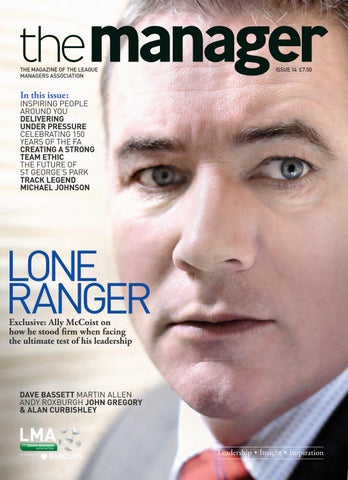
The magazine of the League Managers Association
In this issue:
Inspiring people around you Delivering under pressure celebrating 150 years of The FA Creating a strong team ethic The future of St George’s Park Track legend Michael Johnson
LONE RANGER Exclusive: Ally McCoist on how he stood firm when facing the ultimate test of his leadership
Dave Bassett Martin Allen Andy Roxburgh John Gregory & Alan Curbishley
SPONSORED BY
Issue 14 £7.50
IMPACT. PRESSURE. STRENGTH.
STRENGTH TO PERFORM Castrol EDGE is strong enough to respond and adapt to incredible engine pressures – up to 10,000* times greater than the pressure generated by striking a football. Reducing friction and increasing efficiency^ – giving you the confidence to drive with freedom.
www.castroledge.com * This figure is an estimate based on Castrol’s calculations and has been derived from studies, by third party scientists, which were commissioned by Castrol in the areas of sports science and automotive engineering. ^ With the exception of Castrol EDGE 10W-60.
RIchARd bEvAN, lMA cEo
a golden year As we approach the end of the calendar year it heralds time for reflection. First and foremost it has been a fantastic year for sport, led by this summer’s Olympic and Paralympic Games. Our athletes truly excelled and behind all great performances lies backroom teams that help to drive such elite sporting performance. London 2012 was an incredible achievement and what is now key is to ensure a sporting legacy for future generations to get involved and ultimately enjoy sport. On the football front, we have celebrated 20 years of the Barclays Premier League, a fantastic competition, which is arguably the best league in the world. This is evident with the huge growth in broadcasting revenues which will top £5bn, reflecting the popularity of the Premier League on the world stage. It is a compelling product followed by people from all walks of life on every continent. Regarding football management, we have seen excellent examples of great stewardship of football clubs, most noticeably with Sir Alex Ferguson surpassing 25 years in charge of Manchester United and David Moyes and Tony Pulis celebrating ten years at the helm of Everton and Stoke City. This stability allows clubs and managers to develop long-term strategies and sets an excellent example to others in football especially when you consider that the rate of dismissals so far this season across the leagues stands at the highest level since 2007-2008. The opening of St George’s Park augurs well for an exciting and successful era in English football. Any sector that wishes to be ‘world-beating’ has to invest in human capital and St George’s Park will provide a focal point for the football family, encouraging openness and collaboration between the football stakeholders which will take English football to the next level. Well done to David Sheepshanks and The FA for getting this fantastic facility off the ground and fully operational. The LMA’s move to SGP is a vital and exciting
Everton manager David Moyes was one of many LMA members to pass notable milestones in 2012.
3
step in the association’s development, specifically with the evolution of our Leadership and Management programme. The LMA vision for this innovative programme is to provide our managers, and those of the future, with the best learning and development programmes in order to equip them with the essential skills required for the ever increasing demands of a highly volatile profession. There is a healthy appetite within the membership to learn and develop as managers working in such a unique and pressurised environment. Also key for the LMA is to further develop our influence in technical matters and starting from this season, the LMA with the PGMOL and PFA have organised referee training at a number of Premier League and Football League clubs. There is no doubt this represents a very significant step forward in the sharing of different viewpoints on refereeing issues with managers. Additionally, this initiative provides a good example of how the stakeholders can and should work together for the overall benefit of the game. Continuing on a technical theme, the LMA recently published the first LMA European Managers and Coaches Survey with our performance partner, Castrol. The results of the survey produced some fascinating findings and armed with this information, the LMA is in a better position to continue to lobby and represent their interests to the game’s governing bodies. The full results can be accessed on www.leaguemanagers.com. As our commercial and member services programme continues to expand, I am also delighted to welcome Mercedes as the latest commercial partner of the LMA. Finally, there is no doubt the New Year will bring fresh challenges to the game, the football clubs and our members but it is also important to celebrate the many positives that exist within football and the impact it has on society.
SPORT MOBILE
OUTSTANDING GRASS. ALL YEAR ROUND. BAR 50 SOS is a remarkable overseeding ryegrass blend providing superior germination and establishment in very cool soil temperatures. It’s ideal for repairing and sustaining winter grass cover and is trusted by top turf professionals worldwide.
Call 01359 272000 or visit bar50sos.co.uk
WINTER 2012/13
contents 46
cover cstory: Ally M Coist It’s been a rollercoaster ride at Ibrox over the past few months, but in the revered former Scotland striker, Rangers can count on a man with the passion and the experience to lead them back to the top.
Inspiring people
26
hall of fame
Bassett’s sweet success
28
How seven-time promotion winner and Wimbledon idol Dave Bassett moulded his Crazy Gang of unheralded ‘misfits’ into a top flight force that all teams feared.
Insider Persuading those you work with to share your vision is all-important to becoming a respected leader, believes New York Red Bulls’ sporting director Andy Roxburgh.
OUTsider The man tasked with heading up the Psychology Specialist On-Call team at London 2012, Dr Phil Hopley, explains how to build resilience for handling those stressful situations.
7
78
+2 Austin Healey, Will Greenwood.
OUR STARS AWAIT YOU.
Ever dreamed of a five-star luxury suite which opens onto a stunning beach and blends in effortlessly with the sea? Ever imagined scoring a try with English rugby stars Austin Healey and Will Greenwood? Want to play alongside trainers from Chelsea Football Club or the stars of tennis, golf and cricket? How about dinner among the most celebrated of Michelin stars? You’ve already joined the Forte Village constellation. And you are the real stars. www.fortevillageresort.com
World’s Leading Green Resort 2011
World’s Leading Resort 2011
+ 39 070 9218820
holiday@fortevillage.com
WINTER 2012/13
contents Business
ThE MANAGER MAGAZINE MEANs busINEss 38 SaIlInG ThROUGh The STORmy WaTeRS OF ReceSSIOn How the development of a strong team ethos has helped marine clothing specialist Gill to become a major player in their sector.
13 86
The fourth LMA Annual Conference gave incredible insight into leadership at an elite level and helped establish St George's Park as a major event venue.
Among the star guests was a multiple World and Olympic champion athlete... he goes under our microscope and reveals his path to glory.
17
36
caTch OF The day Roberto Forzoni explores the ‘fish’ philosophy and how it can help managers motivate.
TakInG FlIGhT Dr Dorian Dugmore offers useful tips on to how to take the stress out of the business of flying, from avoiding jet lag to ensuring you have the correct medical coverage.
19 heRe cOme The GIRlS Increasing the popularity of women’s football is just one way the Football Association aim to capitalise on their 150th anniversary next year.
20 dOGGed deTeRmInaTIOn One of the Football League’s biggest characters, Martin Allen, on Gillingham’s flying start to the npower League season.
30 delIveRInG UndeR PReSSURe Thorough preparation helped the London 2012 British Gymnastics team peak when it counted.
56 PROFIle: mIke JOhnSOn The CEO of Castrol advocates that investment and technological development are key to the lubricant giant’s continued growth.
42 hOWaRd WIlkInSOn’S TechnIcal aRea What is the best way for English football to make the most of the fantastic new facilities at St George’s Park? The LMA’s chairman outlines his thoughts.
70 a maTTeR OF TRUST Former Aston villa and Queens Park Rangers manager John Gregory believes backing those around you is essential in the worlds of football and business.
9
70
LMA member? We’ll treat you like a VIP. Book Upper Class as an LMA member and we’ll give you 10% off your fare*, as well as instant Silver membership into our Flying Club. Not to mention the usual complimentary limo to and from the airport, and access to our award-winning Clubhouses. To book, call Virgin Atlantic Flightstore on 0844 811 1518 and quote LMA. To register for Silver Flying Club membership, visit virginatlantic.com/LMA
*Excluding taxes and surcharge. Chauffeur driven car service available at most destinations with selected Upper Class fares (J, D, I & C class). Mileage restrictions apply. Lounge facilities vary at each destination.
EdIToR
Wimbledon's Crazy Gang embodied what can be achieved when working as a team.
in it together
editor Terry Bowles
P
oint to any success in a group environment - be it in sport or business - and it’s a cast-iron certainty that teamwork in all its various guises figured strongly in bringing it about. It’s a theme that features very noticeably throughout this issue of the Manager, which as always sets out to offer a selection of articles that highlight those special values of Leadership, Insight and Inspiration. Teamwork was certainly needed at Rangers - on at off the field - when the famous old club was pitched into the deepest of crises and Ally McCoist gives a fascinating insight into how he generated a special togetherness while the world looked on. Martin Allen explains how the decision to encourage his players to write their own rulebook has been a key factor in Gillingham’s push for promotion, and in our popular feature on a Hall of Fame member, Dave Bassett - the man who nurtured the Crazy Gang - reflects on Wimbledon’s fouryear rise from the basement division to top flight. As all three will tell you, a strong team ethic is crucial, just as it is at Castrol, whose chief executive officer Mike Johnson is the subject of our business and leadership profile, and at Gill, whose small yet tight-knit team have enabled their specialist marine clothing business to become a global player.
editor for lma Sue McKellar
The League Managers Association, St George's Park, National Football Centre, Newborough Road, Needwood, Burton upon Trent DE13 9PD
Publisher Jim Souter managing editor Sam Bowles
The views and opinions expressed by contributors are their own and are not necessarily those of BowlesAssociates or the League Managers Association, its members, officers or employees. Reproduction in whole or in part without written permission is strictly prohibited.
contributors Matt Amos; Leah Bradley; Hilary Campton; Simon Cleaves; Vicky Elwick; Matt Halfpenny; Alice Hoey; Steve Sadler; Claire Sage Photography Action Images; portraitcollective.com; Steven Stuart
www.leaguemanagers.com
advertising sales Phil Turner 07979 498034 phil@themanager-magazine.com
Nick Hallam 07843 483536 nick@themanager-magazine.com
SPONSORED BY
lma head of business development Tim Munton +44 (0) 7515 912468 tim.munton@lmasecure.com Designed & produced in partnership with the LMA by BowlesAssociates bowlesassociates.com
11
On the cover Ally McCoist photographed at Murray Park by Sam Bowles, exclusively for the Manager magazine
KIcKING oFF
62%
The percentage of respondents in favour of goal-line and video technology in the inaugural Annual Castrol LMA European Managers and Coaches Survey, which has gathered the views of top-level managers across Europe on the most important issues in modern football.
latest packages look ship-shape Jumping aboard a cruise ship or flying across the world need not be an excuse for missing live football in future after the Barclays Premier League secured a deal to show matches on cruise ships and aircraft. The deal with IMG Worldwide will mean games already broadcast in more than 200 countries are screened on select airlines and shipping lines using technology not available when the last TV deal was struck three years ago. Matches will be shown live and in highlights on the Sport 24 channel on specially-equipped Lufthansa and Gulf Air planes, as well as Norwegian Cruise Liners, according to IMG, and discussions are taking place with a number of other
airlines and cruise liner companies. The deal will add an income boost to the Barclays Premier League total broadcast revenue, which is heading towards £5.5 billion for the next three years. “We know IMG well and are looking forward to working with them as they distribute the Barclays Premier League in a way that allows our fans to enjoy the competition while travelling overseas,” said chief executive Richard Scudamore. Richard Wise, senior vice president of IMG Media, said: “The Barclays Premier League is the most popular and exciting league in world club football. Our goal is to continue to distribute the very best live sports action.”
nutrient-rich
haMMer tiMe
to russia with love
Improving player development will be the strong focus of the 2013 Science+Football Conference at the London SoccerDome, formerly the David Beckham Academy in North Greenwich. The content will align with EPPP guidelines with presenters delivering practical and theoretical sessions in the key areas of coaching, sports science, sports medicine, and performance analysis. The conference will be held on March 23 and 24 and is aimed at staff working at both professional and youth level. For full details visit www.scienceandfootball. com or call 0844 8094911.
West Ham United managers past and present, Alan Curbishley and Sam Allardyce, were the star guests at Acora’s private dinner held at the St Pancras Renaissance Hotel in recognition of their long-serving employees. The duo entertained with stories from their football careers, followed by a Q&A session hosted by former Chesterfield manager John Duncan.
Moscow and Saint Petersburg are set to become the main hubs of activity during the 2018 FIFA World Cup and the 2017 Confederations Cup warm-up tournament - the Russian organising committee have confirmed. Moscow is proposed to stage the World Cup’s opening match, one semi-final and final, while St Petersburg has been put forward for the other semifinal and the Confederations Cup Final. FIFA’s executive committee will review the proposals in December.
Premier League chief executive Richard Scudamore is keeping television coverage on the move.
the 21st lma annual awards sponsored by barclays
12
KICKING OFF
Image: Bath Chronicle
93
The age of Ivor Powell when he retired as the world record holder for the oldest working football coach. The former Welsh international passed away in November at the age of 96.
The Conference is part of my continuing education and it’s excellent to hear people with great knowledge speaking. If we can get more managers to come to this - and give them more time to come - it can only benefit them and their clubs.”
The speakers were superb. Although they were very diverse, they were all at the top of their respective trees and you could only learn from them.” Terry Connor
Stuart Pearce
St George’s Park hostS ANNUAL LMA CONFERENCE St George’s Park was the venue for the LMA’s Annual Management Conference, sponsored by Barclays, and it featured a lineup of big names and charismatic characters. More than 300 LMA members, partners and sponsors came together for a full programme of keynote addresses under the theme of Leadership, Insight and Inspiration. Speakers included legendary athletics star Michael Johnson, former Cabinet Secretary Lord Gus O’Donnell, award-winning conductor Charles Hazlewood and Stoke City manager Tony Pulis, along with his club’s owner Peter Coates.
I’ve probably had a natural approach to leadership, having captained every side I played for, but all of us here are open-minded and want to learn and develop ourselves.”
It was an extremely fruitful day because as a manager, you always want to be learning. The way you study leadership and the relationship with the different components of the club is vital for a manager.”
Sean Dyche
GÉrard Houllier
13
KIcKING oFF
93-94
The last season standing was permitted in the Barclays Premier League, aside from Fulham’s temporary permission in 2000-01. Aston villa have become the first club to publicly back a new trial of safe standing areas. culture Shock: a handbook for 21st century Business, published by Wiley.
savings on spectacular london 2012 gaMes
in these tough econoMic tiMes, creating an uplifting work culture that is More open and deMocratic can certainly help...
The cost of the London Olympics and Paralympics is set to come in £377m less than expected, according to the government. The combined budget for the two events was £9.29bn while the projected cost is £8.92bn, with savings said to have come from a drop in security, transport and construction expenses. Another £103m from a contingency fund was also left unspent, meaning a total of £480m still remains from the original budget.
PePsI gIves CRICkeT leAgUe eXTRA FIZZ Global beverage giant PepsiCo has paid almost $78m for the five-year title sponsorship rights of the 20-over Indian Premier League,
The IPL - cricket's richest competition - combines Bollywood glamour with the world's best players.
domestic cricket’s most lucrative tournament. The tournament will be known as PepsiIPL until 2017, with the figure paid doubling the original title sponsorship deal agreed with DLF in 2008. Pepsi outbid Indian telecommunications company Airtel for the tender by $14.5m. Following a meeting of the Board of Control for Cricket in India’s marketing committee in Mumbai, IPL governing council chairman Rajiv Shukla said: “So far our record of selling various properties of IPL has been very good. We have doubled, tripled or quadrupled the amount while selling some of the properties.” Gautham Mukkavilli, CEO, Beverages, PepsiCo India region, said that in a country where “cricket was a religion,” the IPL had become the “most revered temple where the faithful flock to.”
14
While business landscape has changed profoundly over the last five years, fuelled by advancing technology, managing director of one of the hottest online marketing and social consultancy firms in the UK, Will McInnes, believes most business cultures remain unchanged and organisations largely closed, secretive, siloed, static and hierarchical. In his book, Culture Shock, he provides an insight into the way he insists business should be done in the 21st century, using a culture of connectedness, openness, participation happiness and simplicity. McInnes offers straight-talking, practical insights and tools to create an upbeat, forward-thinking environment that can transform business. Packed with real-world examples and with material and feedback sourced from others through social media, Culture Shock is presented as a step-by-step guide to understanding and implementing modern day social business practices.
well engineered The 140th anniversary of the very first FA Cup final between Wanderers and the Royal Engineers was recreated at the Kia Oval - with a complete reversal of result. The original tie was won 1-0 by Wanderers but, this time, they were brushed aside 7-0, leaving the Royal Engineers to be presented with the original FA Cup trophy.
getting shirty Shirt sponsorship in Europe’s top leagues has smashed the 500 million Euro barrier for the first time, according to Sport+Markt’s latest European Football Jersey Report. The Barclays Premier League generated the most revenue - a total of 148.7 million Euro.
KIcKING oFF
8
The number of years SK Brann were promoted and relegated between 1979 and 1987 - a world record for the number of consecutive relegations and promotions.
QUARTeT COlleCT AWARDs
vintage displays WARM UP IN YOUR OFFICE AFTER A HARD-FOUGHT WINTER BATTLE manoir de Gay, Pomerol 2007, £18 A bottle of this juicy Pomerol is just the thing to warm the cockles on a cold winter night. Full bodied and ripe, this has all the voluptuous Merlot fruit of Chateau de Gay, but without the hefty price tag. The 2007 vintage offers superb drinking now, with heady aromas of red and black cherries and cocoa, leading to a juicy palate of black fruits and complex notes of mocha and new wood. It’s a perfect, indulgent wine for quiet occasions.
Middlesbrough boss Tony Mowbray claimed the npower Championship Manager of the Month award for October as his side surged into promotion contention. With four wins and a draw achieved from their five October fixtures, the former Boro player has had fans dreaming of a return to the top flight and their great form in the league has also supported by a fine Capital One Cup run. In npower League One, Sheffield United’s Danny Wilson claimed the award after guiding his side to 16 points from a possible 18 and second place in the table come the end of the month. Completing the roll of honour was Cheltenham Town manager Mark Yates, who was rewarded for his side’s fine form in October, which saw them lose just once, by collecting the npower League Two award. The judging panel comprised of former Charlton Athletic manager Alan Curbishley, Sky Sports’ Football League expert Don Goodman, Football League chief operating officer Andy Williamson, BBC Sport’s Mark Clemmit, the League Managers Association deputy chief executive Olaf Dixon and npower’s head of sponsorship Emma Collins. Meanwhile, Manchester United’s Sir Alex Ferguson was named as Barclays Manager of the Month for October. His side moved to the top of the Barclays Premier League table with the help of wins over Newcastle United, Stoke City and Chelsea. It was the 27th time he has picked up the award on the 26th anniversary of him taking charge.
TOAST THAT UNFORGETTABLE CUP TRIUMPH IN STYLE henri Giraud ‘code noir’ Rosé, aÿ Grand cru champagne, £76 A stunning way to celebrate the New Year or that memorable Cup victory, the deep pink glows in the clear glass bottle. Set aside any preconceptions of rosé you may have, this is a unique, full bodied, oak fermented dry wine made from the very best Pinot Noir grapes in Champagne. The weight and length of flavour is exceptional, making this one of the few rosé wines that can be drunk from aperitif right through a meal, even during dessert.
Our wines have been selected by David Allen MW, Coe vintners Fine Wine Manager. For offers open to LMA members, contact David on 020 8418 2823 or email davida@coevintners.com
15
nouriSH me now is a new natural sports recovery drink. Our dairy-based drink has a 4:1 carbohydrate to protein ratio. Three delicious flavours: Cherry, Green Tea & Lemon, Blackcurrant, White Tea & Vanilla, Mango, Green Tea & Lime Visit our website to meet our sponsored athletes from Team GB Triathlon, rugby league and the UK’s leading climbers. www.nourishmenow.co.uk. Contact us for free samples via the website or at rachel@nourishmenow.co.uk or lynwen@nourishmenow.co.uk.
No chemicals, just nature – you can’t lose! @nourish_me_now
nourishmenow
Belmont 9 Hole Golf Course
A challenging course of Par 3’s, 4’s and 5’s. Total yardage – 2413
Pay as you play from £8.50
Season tickets available – no joining fee. Golf lessons available by Carl Roberts.
Set in secluded rural countryside surrounded by woodland and farmland.
Beginners classes and junior lessons available.
Clubs and groups welcome.
Email: belmontpro@belmontgolf.co.uk 16 bay floodlit driving range
Coffee lounge / snack bar
Pro Shop
Regular competitions / events
Belmont Road, Needwood, DE13 9PH 01283 814381 www.belmontgolf.co.uk 5 minutes away from St George’s Park BelmontGolf_HP.indd 1
OPENING TIMES Mon – Fri 9.30 until late Sat – Sun 9.30 until 5pm Early tees available on request. Discounted rates for 18 holes 16
9/5/2012 5:20:40 PM
KIcKING oFF
5,260 km
The distance (3,270 miles) between the stadiums of Australian A-League rivals Perth Glory and Wellington Phoenix, who meet in what’s known as the ‘Distance Derby’ after enduring one of the longest journeys in professional league football.
adopting the ‘fish’ philosophy Roberto Forzoni considers four efficient uses of ‘psychological tactics’ that can help managers get the best from players and improve results. Most leaders will spend a significant amount of time focusing on strategic decisions and tactics to help them achieve success, and with good reason. Then comes planning for action. In the case of football managers and their assistants, much time will be spent on the prime objective of improving their players individually, and collectively, and generally with an immediate focus on beating their next opponents. In order to do that, planning will include practices to help the team play in a certain way, maximizing their strengths and working on areas that need improvement; at the same time an eye might be on how to exploit weaknesses of their next opponents and neutralise their strengths. Therefore, training sessions are put together to help achieve these aims and objectives. At the same time, input is now sought from support staff on intensity levels, periodisation and work-rest ratios. It’s a wonder that with everything else a manager has to do, he has time to maximize every area that needs attention. One consideration that may get lost in the ball juggling that can be football or organisational management is how, by regularly using some simple psychological tactics, you might gain significant return in terms of motivation, confidence-building, engagement, enhanced learning and ultimately improved on-field results. Stephen Lundin wrote a best-selling book called Fish! It looks at four components that will help enhance a workplace, add a spark to the working environment and improve performance; these principals can be used for any team or organisation and are well worth the small time investment or consideration. From the multitude of leadership books on the market this one
has really stood the test of time. The four guiding principles are : Be there - how do you
engage physically and mentally with colleagues and team members so you can seize opportunities and maximise performance? Being really ‘engaged’ and ‘fully present’ with one of your staff or team members will help enhance trust and respect. The benefits are positively disproportionate to ‘considered’ time invested here. Make their day - how
do you genuinely connect with colleagues and team members alike to help create an engaging work environment and better experience for your team members? Simple but consistent personal engagement, even in the form of a quick word walking out to the training field or after a meeting, can bring more benefits than you might imagine. Ensuring sessions are well planned, challenging and progressive are also valuable components of ‘making their day’.
have fun - while training is not designed to be fun, embracing a playful state of mind at appropriate times makes you more energetic, enthusiastic and creative. How often do you see Messi smile? Work made fun gets done. choose your attitude leaders often try to improve and change attitudes among team members and colleagues. How often do you check your own attitude? During my time working with Steve Coppell, he would often say to players: “Attitude is contagious…is yours worth catching?”- a delightful phrase and one worth keeping at the forefront of your role. Bill Beswick often said: “Attitude precedes performance” - another little gem. If you find yourself with an attitude that is not what you want it to be, choose a new one. If, at the end of every staff preparation meeting or planning session, or every morning before engaging with staff and players, you spend a few moments self-checking these four aspects you will be pleasantly surprised at the return you gain. Enjoy.
ROBeRTO FORZOnI
A highly qualified and experienced peak performance consultant working within the game, he currently consults with a number of football managers on strategy implementation and performance issues and has written the booklet on The Laws of Effective Teamwork. He also manages Tooting & Mitcham United FC. robertoforzoni.com
17
KICKING OFF
£128m
Stay hydrated & fighting fit
The amount UK businesses are saved by regular cyclists taking one less sick day each year, according to LSE.
DUO's F&C INPUT A sound investment Roy Keane and Andre Villas-Boas have been in table-topping form as special guests at a series of dinners put on by LMA sponsors
Roy Keane and Andre Villas-Boas (top) have been popular figures at F&C Investments' dinners.
F&C Investments for their clients and guests. The former Ipswich and Sunderland manager and the current Tottenham Hotspur boss were on hand to answer questions on the subjects of talent management, analytics and tactics - topics addressed in a business sense prior to each dinner. Keane was guest at F&C’s event at the Great John Street Hotel in Manchester, while Villas-Boas was in attendance at the Grosvenor in London. Another event is scheduled with Norwich City manager Chris Hughton at Dunston Hall, Norfolk in December. There are also dinners planned for the New Year in Southampton, Glasgow and Birmingham.
It’s not so grim up north If you want to feel at ease, then living in the country and heading north would seem to be the key, according to a survey by the Office for National Statistics. Residents in Eilean Siar, Orkney and Shetland, all in the north of Scotland, were found to be less anxious than anywhere else in the UK.
18
It’s always been an essential part of a sportsman’s modus operandi to keep hydrated, but it can be just as beneficial to all during the winter months, when we are at increased risk of illness. Water makes up almost 70 per cent of your body and helps to get rid of waste material, aids oxygenation of the blood and digestion, helps keeps joints well lubricated and regulates temperature. But at this time of year, one of the most important effects is to fight off illness and colds. Water is part of lymph fluid vital to your immune system and can assist in staving off headaches, back pain, muscle weakness and fatigue. Water also helps remove dangerous and possible cancer-causing toxins from your body. It’s good practice to arrive at the office with a full bottle of water, refill it whenever you can and work on sipping your water throughout the day instead of guzzling it. Also important if you are engaging in exercise is to ensure you put nutrients back in the body, such as antioxidants and vitamins, which lessen inflammation and increasing exercise endurance. “For elite and recreational athletes alike, it is important to bear in mind that recovery is not just about one product at one point in time; it is about a 24/7 nutritional strategy adapted on an individual basis to meet an individual athlete’s needs.” said Lynwen Harrison, a triathlete and physiotherapist who founded the nouriSH me now sports drink. “I believe that natural foods can support the athlete in training and recovery, but the importance of keeping well hydrated especially as those around you are picking up bugs - should not be underestimated, whatever industry you are in.”
nouriSH me now supply recovery drinks to a number of sports teams, including npower League Two side Chesterfield.
the fa
Celebrating the nation’s game It promises to be an extraordinary next 12 months for English football at all levels, as Jamie Bradbury of the FA’s Communications Division explains.
The 150th Anniversary of the Football Association will attract some of the biggest names and biggest games to Wembley Stadium in 2013. Roy Hodgson’s England team take on Brazil, Republic of Ireland and, of course, the Auld Enemy Scotland, while the men’s and women’s Champions League Finals will also return to London. A commitment to The FA’s strategic goal of ‘football for everyone’ will be at the heart of the landmark celebrations, with a particular emphasis on the national game and women’s football. In 1863, Ebenezer Morley, a solicitor and sportsman living in Barnes in southwest London, thought that football should have a set of rules in the same way that the MCC had for cricket. And it was his initiative that led to the meeting on October 26 at the Freemasons’ Tavern, near Holborn in central London, at which The Football Association was formed. Today, the governing body of football in England, a not-for-profit organisation, is responsible for growing participation and regulating the sport. The grassroots game has seven million people of all ages playing football in parks, on playgrounds and in organised league
football. There are 1,100 such leagues, collectively totalling 29,000 clubs and 115,000 teams. Helping run the grassroots game throughout the year are 400,000 volunteers, 27,000 qualified referees and more than 300,000 coaches. St George’s Park, The FA’s new national football centre and home of its education
The original minute book used at the Football Association's inaugural meeting in 1863.
arm FA Learning, will help boost the number of referees and coaches in the coming years. More coaches, in particular, will hopefully see an increase in the technical ability. “FA150 is a real chance to give the
19
national game its moment in the spotlight because 98 per cent of football is played by children and in grassroots football,” says The FA’s Head of National Game, Kelly Simmons. “It’s a real chance to promote that work and promote the opportunities for people to get involved in football.” 2013 will also mark 20 years since The FA took over the running of the women’s game in this country, and in October The FA launched its plans for the future of women’s football, entitled ‘Game Changer’, to harness the momentum of the Olympics and drive the game forward at every level. And at the elite end, National Coach Hope Powell wants England to be the leading nation in women’s football by 2018. “The Elite Performance Unit will make sure our best talent gets to the top,” she said. “It’s now about commercial deals for the women’s game, it’s about participation and it’s about growing the game.” For more on The FA’s plans for 2013, kicking off with the FA England Awards at St. George’s Park and England v Brazil at Wembley Stadium in February, visit www.TheFA.com
gathering intelligence
PORTRAITs steven stuart
20
never stop learning
With 41 points in the bank before the end of November, Martin Allen steered Gillingham to the top of npower League Two in spectacular fashion. We felt we needed someone with managerial experience to dig out the secreat of his success and asked Ian McParland, the former Notts County manager and Nottingham Forest and Ipswich Town coach, to do the honours... I've always admired Martin Allen's approach to life and his pragmatic approach to pursuing fresh challenges. Despite only taking over at Priestfield Stadium in the summer, he already looks part of the furniture and after Gillingham’s dramatic start to the season, supporters very much want it to stay that way. As I ready myself to quiz him, Allen is relaxing on the sofa - with ever-faithful dog Monty - and even though his side lost a five-goal thriller at home to Exeter City the night before, he is his normal bright and breezy self. He’s clearly enjoying life in the Garden of England. You look very much at home here Martin. Do you think - at last - now you’re 47 years old and managing your seventh club, that this could be the real deal for you?
“A lot has been made of my comings and goings but in most cases, the reason I didn’t stay too long was because I was sacked. It wasn’t my choice to leave Notts County, nor Leicester, and when I left Barnet it was to move up two divisions. At Brentford I resigned after two crazy years of - both times - reaching the Play-offs and the fifth round of the FA Cup because I was exhausted.”
21
Point taken - but I understand you’ve made Gillingham chairman Paul Scally a promise that you will see out your two-year contract, unless, perhaps, a Barclays Premier League offer comes along. Do you accept that it would be good to get a sign of stability on your CV?
“The chairman said to me when I arrived that he thought I would do well and he wanted to know how I’d react if we were winning matches and another club came for me. I told him I’ll see out my contract and we shook hands on it. And as anyone who knows me will tell you, I’m a man of my word.” I know that you feel recruitment of good players has been key to your excellent start to the season but I’m interested to know more about your relationship with Andy Hessenthaler. You’re a man who certainly likes to do things your own way so is it a problem for you to work with a Director of Football?
“You mustn’t forget that Andy’s team finished eighth for each of the last two seasons and we didn’t have a ‘clean sweep’ when I took over. I’ve been able to add to the squad by signing experienced players like Adam Barrett, Stuart Nelson and Deon Burton and with some talented home-grown youngsters also emerging, it has all come together very nicely. People don’t believe me but it’s true when I say that I’ve never ever been at the top of the League before. It really is a fantastic feeling and I can’t tell you how much I want to stay there.” “My relationship with Andy has been brilliant since I arrived here. He managed ›
never stop learning
During his time at Gillingham Martin Allen and his players have 'worked together to make a really good football club'
22
NEvER sTop lEARNING
I’ve adopted an attitude of not blaming any of those who sacked me and I’ve shown no bitterness or anger towards them. Instead of that, I’ve tried to look deeply at why it happened and what I must do to avoid a repeat” Gillingham in the Championship for five years. He had a tremendous career at this club as both player and manager and now he is here to help me. What more could I ask for? ”He helps in dealing with the youngsters, agents and loans and he regularly gives me his opinion because I ask him for it. He’s a proper bloke. I promised him in the summer when he brought me here that we’d work closely together and I’d make his transition to Director of Football an easy one. I think it has been.” i get the iMpression your ManageMent style is to Be incrediBly supportive of your players - and woe Betide anyone you hear criticising theM.
“The policy at this club is that we never publicly criticise players unless they step out of line. It’s my fault if we play badly and lose - not theirs. They can always come and talk to me whenever they like. I have a lovely office and they are welcome to come here and we’ll work things out together. “We don’t have a fines system in place. I left it with the senior players to decide what is right and wrong and since they wrote out what they thought was needed, the senior staff have done their best to put it in place. “The players wanted a professional, well-run club and we’ve tried to create that. We’ve brought in a sports scientist, an analyst and a part-time masseur and since they said they wanted the food to be better, we’ve provided that and turned
the players lounge into a restaurant. We’ve worked together to make this a really good football club.” i can’t help noticing that you have a very iMpressive selection of sports Biographies on the shelf Behind you. do we read into that that you still have a thirst for More knowledge?
“Very much so. When I first started out in management, as Alan Pardew’s assistant at Reading, he set up a library of books that could expand your understanding about leadership, psychology, training and so on - and he encouraged the players to use them. I do the same here. “Management of players has changed – the old style is absolute history. It used to be the case that if you played for England you got a good job but not any more. One of the most successful managers ever [Jose Mourinho] was an interpreter and the likes of Brendan Rodgers, Karl Robinson and Rafael Benitez have shown that you don’t have to play the game at a high level to become successful managers. These days, man-management and sports science skills are absolutely key if you want to be successful. “I’ve worked to improve myself and maybe that is now coming through. The sackings have definitely helped. I’ve adopted an attitude of not blaming any of those who sacked me and I’ve shown no bitterness or anger towards them. Instead of that, I’ve tried to look deeply at why it happened
23
and what I must do to avoid a repeat.” i reMeMBer you as a coMpetitive Midfielder with queens park rangers, west haM and portsMouth and there were tiMes when your nicknaMe of Mad dog was very fitting. how exactly did you get that?
“Ian Bishop landed me with it when we were together in the West Ham midfield. He did the smiling and I did the snarling. One day I was apparently foaming at the mouth during an especially hard game and he said: ‘You look like a mad dog’. It’s not very complimentary in some respects, but how many people have a nickname that’s known up and down the country? I love characters and personalities - and maybe that runs in my family. When I used to ›
never stop learning
F AC T F I LE
F AC T F I LE
Interviewee Martin Allen Born Reading Career highlights Winning promotion twice as a player with West Ham; building a team at Barnet that was destined for promotion before moving to Brentford; taking the Bees to the Play-offs in 2004-05 and 200506, then Milton Keynes Dons in 2006-07; has overseen Gillingham’s best-ever start to a season.
Interviewer Ian McParland Born Edinburgh Career highlights Scoring 69 goals in 221 games for Notts County; taking relegationthreatened Nottingham Forest to the brink of the Play-offs as caretakermanager in 2006; beating Arsenal in the Carling Cup as caretakermanager of Ipswich Town.
watch my dad Dennis playing for Reading, he was known as Daisy. He loved to make the crowd laugh and they all used to sing: ‘Daisy, Daisy, Give Us A Goal or Two’. He added value to their afternoon and hopefully, in some way, I do the same.” So have you felt the need since you went into management to live up to your nickname? As you must admit, some of your antics have been - shall we say - unorthodox.
“I would say that 97 per cent of the
time, they’ve just been things that I’ve done off the cuff and, with virtually all of my antics, there’s been a method to my madness. Like the time soon after I joined Brentford when I swum across the river after we finished our training session at Hartlepool. I’d listened to the players talking about doing it but when it came to the crunch, no one did. So I just ran along the riverbank and jumped in - and I said to them afterwards that they have to be brave enough to carry out their threats. “There was an important message in what I did that day. After that, we only lost one of our last nine games and avoided relegation by a point. And the motto we carried with us was: ‘If you say you’re going to do it, do it’. “A lot of people ridicule me for the wacky things I’ve done, but not everyone. I remember getting a call from David Pleat when he was manager of Tottenham and we chatted for two hours about the reasons why I did things and the psychology behind it. I also bumped into Terry Venables when he was manager of England and he said: ‘I love what you are doing’. “Am I really so mad? Everyone gets bored at work, so why not do something that helps
I learned from Alan Pardew at Reading. He set up a library of books that could expand your understanding about leadership, psychology, training and so on - and he encouraged the players to use them. I do the same here”
24
to stimulate them? Anything that opens people’s minds surely has to be good.” Presumably now your challenge is to keep Gillingham fresh and motiovated and maybe there will be money to spend in the January window following the moves of Matt Jarvis and Paulo Gazzaniga.
“The first half of the season has been amazing and now we have to start again and make sure we don’t allow it to go to waste. There’s still an enormous amount of hard work to be done but our goal is to get to Benidorm in April. The bonus schedule is in place with the chairman… it’s two nights in a two-star hotel with the worst possible flights for everyone who makes a League appearance.” One last thing to finish on … I know from personal experience that you’Re in the habit of texting outof-work managers - right out of the blue - inviting them to “come and do some coaching”.
“It’s so, so difficult for a manager when you are out of work. You get lonely and depressed and inevitably have the feeling that there’s no future. You wonder where and when another job is going to come your way. The LMA helped me by fixing up various jobs and I’ve done work for talkSPORT and Sky Sports but once you’ve known the buzz of being a manager, you are bored rigid. All of our scouts are out-of-work managers and because I’m in a position to help with getting people like you back on the training ground, I’ve happily done so. If in some way it has boosted your self-esteem and kept you going, I’m really pleased.”
Fibrelastic® the natural choice for professional players Things are hard enough in football right now without adding to it by specifying an artificially hard unfriendly pitch for your professional players. Completely natural, Fibrelastic® turf pitches look like any other premier playing surface - but with added elastic fibres mixed into the rootzone. They have been proven to be more player-friendly with less jarring of limbs and fewer cumulative stress related injuries. Developed after successful independent trials, Fibrelastic® is now a well proven surface and set to be the stadium and training pitch of choice for professional teams looking to maximise their performance. Fibrelastic® - the future of natural grass professional pitches - call Mark Robinson on 01623 622441 or visit our website to find out more.
Softer surface Greater resilience Player-friendly Mansfield Sand Company Limited, Sandhurst Avenue, Mansfield, Nottinghamshire. NG18 4BE. Tel: 01623 622441 Fax: 01623 420904 Email: mark.robinson@mansfield-sand.co.uk Website: www.fibrelasticturf.co.uk
inspiring people
Former Scotland manager Andy Roxburgh learned during an 18-year stint at UEFA that uniting people behind a common goal and inspiring them is not always easy. As the new sporting director of New York Red Bulls, he’s tasked with doing that all over again - and believes the leadership skills he has acquired can yield success Stateside. WORDS Matt Halfpenny
Upping sticks and moving across the Atlantic at an age when others are slowing down might not be to everyone’s taste, but in the city that never sleeps, Andy Roxburgh is living the dream. With his twice-extended contract as technical director having expired at UEFA - where he played a key role in developing coaching throughout Europe - the former Scotland schoolboy, youth
and amateur international, a professional player with the likes of Queen’s Park, Partick Thistle, Falkirk and Clydebank, was free to pursue other things for the first time in almost two decades. No-one would have batted an eyelid had Roxburgh given it all up to tell stories of his successes in leading Scotland to the World Cup Finals of 1990 and the European
Championships two years later. Yet there was never any danger of him settling for retirement. His undeniable devotion to the game he has served so unstintingly and earned him an OBE is far too strong for that. In following in the footsteps of international coaches Carlos Alberto Parreira, Bora Milutinovic, Bruce Arena and Bob Bradley at the New York Red Bulls, Roxburgh has
The old-fashioned leader was larger than life, aggressive and dictatorial. Today it’s more about quietly but confidently putting your point across” 26
some big shoes to fill. Yet he is not intimidated. He’s merely inspired by those illustrious forerunners, and hopes he can prove just as inspirational to those around him as he bids to secure a first Major League Soccer title. “Sir Alex Ferguson, who I played with at Falkirk, has always said retirement is for young people,” enthused Roxburgh. “I think if you are healthy and still fit enough, enthusiastic and passionate, then age has got nothing to do with it. I talked to Gérard Houllier, Carlos Alberto Pereira and Sir Alex and they said I should go for it. “It’s not quite full circle, but I am back
Andy Roxburgh was a highly respected figure during his time as technical director at UEFA.
on the coal face, albeit a different type of coal face, to the one I’m used to. People have told me about the subtleties of the US League, but I believe you just have to embrace those kind of things, adapt and learn quickly.” Roxburgh’s arrival in early November has seen him required to hit the ground running, but he is not scared of getting his hands dirty. He said: “I’m not personally managing the team, but it’s my job to support them and create the squad. As I see it, there are three aspects. There
inspiring people
are the technical aspects on the pitch, there is the management where you deal with the organisation and all that, and then you have to be a leader, which is the most important of all. “You need someone who can inspire, persuade, create a vision and influence change. It’s about responding to adversity and persuading people to go in the direction you want to take it. I have to play a leadership role here and take responsibility. It means I have to make big decisions and, within 10 days of arriving, along with Gérard Houllier, I was already involved in reshaping the playing squad and the backroom staff.” For Roxburgh, getting his message across lucidly is, he believes, absolutely essential. He insists communication in the modern game must be a two-way thing. “As soon as I came here I gathered all the players around to speak to them - I was keen to open up the channels of communication straight away,” he said. “The important thing then is to give some kind of target and
common goal - that’s what Roxburgh believes Thierry Henry can leadership is all about. be his 'leader on the “You don’t need to be pitch' at New York too specific, you can add Red Bulls. the detail later, but people have to know where you are trying to go. How can someone follow you if you don’t know where you’re going yourself? There has to be trust between players and staff. The old-fashioned leader was larger than life, aggressive and dictatorial, but today it’s more about quietly but confidently putting your point across.” That day-to-day involvement comes as a complete antithesis to his stint at UEFA where his pioneering role saw him work with no less than 53 different football federations, both at the top and grass roots level. In that environment, where he coached the coaches from countries across Europe, getting his message across was arguably even more crucial. “Each one of the federations has an equal right to your efforts and attention, but all had individual needs, their own strengths, resources and expectations,” he explained.
27
“You set benchmarks of standards for each of the countries, but then provide the individual nations with support and guidance. “I would bring them all together on a regular basis and I would keep them all up-to-date with the latest developments. Although we had simultaneous translation to get over the language problem, if I was going to do a presentation on a screen then I would always make sure there was something visual in it that appeals to a different way of learning.” In the football management industry, of course, it’s results that are so crucial for any manager, but Roxburgh has already eyed some handy lieutenants at New York. “I have known Thierry Henry since he was 16 and Tim Cahill as well,” he said. “Thierry is a fantastic leader on the pitch as well as in training. For me leadership needs to not just be from the top but innate. You need leaders all over the field. You have to encourage and develop other leaders.” And he will, that is for sure - past experience tells you that. Roxburgh will not rest until his Bulls are on a charge. F AC T F I LE
Name Andy Roxburgh Born Glasgow Position Sporting director, New York Red Bulls Career highlights Winning UEFA European U18 Championship with Scotland; Leading the Tartan Army to the 1990 FIFA World Cup Finals and 1992 UEFA European Championships; Developing the coaching structure at UEFA
inspiring people
It’s not always easy to stay focused in the heat of battle, whatever your walk of life. Dr Phil Hopley has successfully trained a cross-section of clients in building resilience and coping with pressure, putting his expertise to good use when the Olympics ‘came home’ to London.
For superstars like Michael Phelps and Usain Bolt it came as second nature, but there were plenty of athletes who found performing at the London 2012 Olympics an overwhelming prospect. Thankfully, all 10,000-plus athletes had help at hand - including those countries with only a handful of competitors and little support staff. On call 24 hours a day to address any mental demons were a specialist team of 12 dedicated professionals - six psychologists and six psychiatrists. They were charged with responsibility for focusing the minds of those going for gold.
Asked to lead that team was Dr Phil Hopley, a vastly experienced consultant psychiatrist whose own background made him a standout candidate for the role. Not only had he previously worked closely with the Rugby Players’ Association, Professional Cricketers’ Association, GB Rowing and UK Athletics as managing director of LPP Consulting, he also played semiprofessional rugby union for Wasps alongside brother Damian, who played three times for England. “It was an honour to be able to provide a worthwhile service in the context of such a major event,” said Dr Hopley. “Some nations didn’t have anything in terms of back-up. We were able to effectively help a number of athletes who were not used to dealing with such intense levels of stress. We kept them participating and ensured they didn’t crumble away in what, for many, was an opportunity of a lifetime. I think the experience of playing elite sport yourself gives you insight and confidence to engage with people from that world.”
F AC T F I LE
Name Dr Phil Hopley MRCPsych Born London Position Consultant psychiatrist and managing director of LPP Consulting Career highlights Kicking the winning goal for Wasps at the 1993 Middlesex Sevens; watching brother Damian win his first full England cap from the stands at Twickenham in 1995; scoring a hat-trick for the Barbarians in 1997; helping London 2012’s athletes perform at their best
28
Building Resilience What can we all learn from the top sporting performers of the year? Dr Phil Hopley explains. 2012 - what an incredible year of success for UK sport. The highlights? What about the nail-biting last day drama of the Barclays Premier League; Bradley Wiggins becoming the first Brit to win the Tour de France; Andy Murray winning Britain’s first Men’s Grand Slam in 76 years; Rory McIlroy’s US PGA triumph; Europe’s unbelievable final day at the Ryder Cup led by the fist-pumping Ian Poulter? Oh and then the Olympics: Mo Farah’s amazing double; Jess Ennis doing the business in the Heptathlon; Kenny, Trott and Co in the cycling; our rowers; our sailors and then came the Paralympians: Jonny Peacock, Ellie Simmonds and David Weir with his staggering four golds... “What are the secrets behind these successes? Common sense tells us that elite sportspeople have that essential combination of talent, commitment
inspiring people
Golden Games: David Weir waited 12 years to claim his first Paralympic medal but showed the resilience to bounce back from previous disappointments by winning two gold medals in Beijing 2008 and four more in London 2012.
and years of hard graft at the core. Built around that are excellence in planning, training and coaching with the right support staff and facilities. But what is it about the stars that sets them above their competitors? What is it that gives them that extra one or two per cent? “The key to gaining that edge lies in their mental skills, particularly the ability to stay focused and perform consistently under pressure, and to bounce back from setbacks. We call this ‘Psychological Resilience’. “The good news is that Psychological Resilience is not innate, it is a skill that can be taught and learned with practice. Better still, this is not just the stuff of elite sport, it is just as relevant to success in management and business. Research has shown that not only does psychological resilience enable people to cope better with pressure, it is associated with improved productivity and wellbeing.”
• Coping with Pressure
“We are all neurologically ‘hard wired’ with a survival mechanism, known as the fight-or-flight response. This primes the body and mind for battle or a quick get-away. We perceive a threat and our brain reacts by releasing specific chemicals - adrenaline and cortisol - which fire us up to respond quickly and forcefully. “Life-saving in centuries gone by, in the modern era we rarely face extreme physical danger. Therefore the stress response which sports and business people
experience now is usually triggered by perceived threat, rather than actual physical danger. “And that is where the problems start. For example, a footballer might line up to take a penalty kick which sparks his stress response and leads to anxiety, negatively affecting the execution. In business, a heated conversation with a colleague triggers the stress response leading to anger, loss of control, unhelpful comments being made and unnecessary further problems." psychological Resilience is the key to performing effectively under pressure.
Resilience is based on mental skills that can be quickly improved through practice.
Often overlooked, resilience is as relevant to success in business as it is in elite sport
29
• Pressure in the mind
“A key task of mine is to help people understand how thinking processes and thought distortions can trigger a stress response in situations where it is not helpful and therefore interferes with performance. In other words, what we think and how we think has a significant impact on the emotions we experience and our ability to perform under pressure. “Once understood, the process focuses on overcoming the common everyday perception/ thinking errors that we make – the so called ‘mind traps’. By learning to check, challenge and change our unhelpful thoughts we are well on the way to controlling our stress response and improving our ability to stay focused under pressure. “This process is called cognitive behavioural coaching and it is the key to building psychological resilience. The skills can be taught to individuals over the course of six to eight sessions, or in small group workshops run over a day.”
delivering under pressure
HANG TOUGH At the London 2012 Olympics, the microscope was on the men’s British gymnastics team like never before as they competed in front on an expectant home crowd. The challenge was to somehow shut out those huge expectations and, in a sport in which the slightest mistake can spell disaster, perform at their peak under the most intense pressure. WORDS Matt Halfpenny
30
dElIvERING uNdER pREssuRE
I
n artistic gymnastics’ established world order, this was not the way things were supposed to be. At an Olympic Games, Great Britain’s men, traditional also-rans, were standing on the London medal rostrum with bronze medals proudly around their necks. As Louis Smith - he of Strictly Come Dancing Fame - and the rest soaked up the adulation of an ecstatic North Greenwich Arena crowd, they could reflect on a job well done. They had peaked to perfection and delivered the goods when it mattered most. There had never been any doubting the rising ability of this particular squad. That was clear to see at the 2008 European Junior Championships, where they secured a history-making first ever gold. But the challenge was always going to be converting youthful potential into senior success, a transition that, among other things, would require a strong mental resolve from relatively inexperienced athletes. History was against them. A decade ago, it would have been unthinkable for GB to win their first team medal at the Olympics in a century, after they finished as low down as 17th in the 2004 European Senior Championships. Tim Jones, the team’s performance director and a former Olympic swimmer, knew that attention to detail in a sport where 100ths of a mark can be the difference between triumph and despair was critical, and managing the mind of the squad was quickly identified as a key area. “We tried to create an environment
Louis Smith was just one of the Great Britain gymnasts to deliver on the big stage of London 2012.
right from the start whereby a strong and collective belief would enable them to compete on a par with the very best,” said Jones. “We pointed out their success at junior level and asked why they couldn’t carry it on. Reinforcing our belief in them helped them to believe in themselves. A huge positive was that three big events leading up to the Games were all on home territory – and that enabled them to learn how to mentally handle the home crowd.” That process began at the 2009 World Championships at London’s O2 Arena, where Jones’ team set about surveying all the athletes about their experiences, good and bad. He said: “Some people were inspired by those watching and cheering, but others found it a challenge - and it made them nervous. We had to find a way of managing that. “For instance, there were a whole ›
some people were inspired by those watching and cheering, but others found it a challenge - and it made them nervous. We had to find a way of managing that” TIM JONES, PERFORMANCE DIRECTOR, BRITISH GYMNASTICS
31
108 Medical Chambers at 108 Harley Street is a consultant-led and delivered independent clinic offering the highest standards of professional care with a minimum of delay in relaxing and friendly surroundings. Our specialist clinics include: The Gilmore Groin and Hernia Clinic – Over 30 years’ experience of the diagnosis and treatment for sportsmen and sportswomen with Groin Disruption / Sportsman’s Groin (Gilmore’s Groin) and adductor injuries, together with herniae of all types both primary and recurrent. Both open and laparoscopic repair are available as appropriate. The London Sports Injury Clinic – A cutting edge, multidisciplinary service that specialises in non surgical solutions for sports and orthopaedic injuries. In addition the clinic focuses on human performance and wellness. “You don’t have to be a professional athlete to be treated like one”.
MEDICAL CHAMBERS 108 HARLEY STREET LONDON WIG 7ET
For more information visit the clinic’s website: www.108harleystreet.co.uk Tel 00 44 (0)207 563 1234 / info@108harleystreet.co.uk The Home of
WE HAVE uniquE AccEss to tHE tHougHts And opinions of somE of tHE most rEcognisAblE nAmEs in footbAll spEAk to us About AdVErtising & bEspokE sponsorsHip opportunitiEs WitHin tHE mAnAgEr mAgAzinE
call phil turner: 07979 498034 phil@themanager-magazine.com or nick Hallam: 07843 483536 nick@themanager-magazine.com
32
delivering under pressure
key thing here is to not fight those emotions and don’t beat yourself up for experiencing them. Instead, notice them, let them pass and then you can refocus on what it is you are trying to accomplish.”
Great Britain's fantastic five are all smiles after picking up their Olympic bronze medals.
bunch of volunteers and supporters wanting to wish individuals well. We quickly realised there needed to be a time and a place for that and 30 seconds before their routine was due to start, when they were trying to stay calm and focused, that wasn’t necessarily ideal. It was a case of educating the support networks, and that allowed our athletes to focus on the task in hand.” Team members were able to call on performance psychologist Pete Lindsay in the lead up to the Olympics. Based at the English Institute of Sport in Sheffield, he also assisted the preparation of GB Boxing, who were equally successful at London. Lindsay believes understanding the mind is an important part of any elite athlete’s preparation, and says a few simple pointers - such as these - can help competitors to stay mentally strong in those critical moments.
• Don’t fight your emotions
“When the brain is surprised and experiences something unexpected, it is thrown into what we call ‘threat mode,’” he said. “The
• Turn around the negative
There is a possibility that it might not go well, which you have to acknowledge, but challenge yourself to ask what won’t change” PETE LINDSAY, performance psychologist
33
thought chain
Individuals often start a negative thought chain when under duress, which leads them to think of what happens when they lose in sport, or don’t pull off that deal in business. They can start thought chaining through a range of consequences about losing their position or job, or even more extreme, ending up destitute. Lindsay said: “There is a possibility that it might not go well, which you have to acknowledge, but challenge yourself to ask what won’t change. You are still likely to have family support and future opportunities. Counter ‘what if ’ with ‘whatever happens’.”
• it's an opportunity...
At the London Olympics, GB athletes were reminded that as the competition hadn’t yet happened, they weren’t going to lose anything; it was an opportunity to go out and grab a medal. Lindsay said: “It was a ›
delivering under pressure
bit like the £32,000 question on Who Wants to be a Millionaire in that they had nothing to lose - and you can use the same outlook. Those athletes would all have been desperate to be in that position six months previously, with a chance to excel, so it’s something to try to embrace.”
• Clear the clutter
One of the things studies have shown is that people are more impulsive when they have more things on their mind – increased cognitive load - whether in a gymnastics arena or in the boardroom. “A simple technique that can help is to write down those things on paper, which can help manage your emotions,” said Lindsay.
• Team members don’t have to be best friends
Many leaders become stressed in team environments if the social cohesion is not there - but they needn’t be. He said: “While it can be of benefit if team members and management get on socially in their competitive or work environment, what matters much more is that they have task cohesion; that everyone has a common goal and is pushing towards it.” The lead up to London underlined that a strong mentality was important not just among the gymnasts, but the management too. Jones recalls the 2011 World
The last time great britain won an olympic team gymnastics medal prior to london 2012
Championships in Japan, where Great Britain failed to qualify for the Olympics at the first attempt, as they had expected, by finishing in 10th place. He said: “We fell apart in that competition when we should have rallied. There was a fair bit of soul-searching after that and the realisation that everyone, including the coaches, had to know how to react in the future. They knew after that they could not be passengers and had to know when intervention was needed.” Post-London, Jones must live with the inevitable conclusion of cynics who will say that London was a flash in the pan, but he instead believes that a blueprint for Great Britain to win further medals at the highest level - both men and women - has been established. “Everyone who knows me knows my mantra: pay attention to detail, plan and evaluate,” said Jones. “There’s a determination to ensure the effective processes put in place follow through to the next Olympic cycle.”
34
dElIvERING uNdER pREssuRE
keeping cool, calM and collected Highly-respected LMA member Alan Curbishley remembers how he prepared Charlton Athletic for one of the biggest days in the club's history…
P
Going up… an elated Alan Curbishley lifts the Championship Play-off winners’ trophy after sealing Charlton Athletic’s promotion to the Barclays Premier League in 1998.
laying for a place in the Barclays Premier League, the stakes could hardly be higher. Alan Curbishley went into the 1997-98 Championship Play-off Final knowing the pressure to deliver was well and truly on his shoulders. The Londoner became a legend at the valley after leading the Addicks into more than 500 games in sole charge between 1995 and 2006. Yet it is for that famous Wembley occasion that he recalls like no other the tension of needing to get it right when it mattered, playing for the right to visit Manchester United and Arsenal the following season. “The pressure was well and truly on because the prize was so huge, not just in terms of the money but also the prestige for me as a manager, the players, staff and supporters,” said Curbishley. “I also knew that my team would be broken up if I didn’t get Charlton up - and that I would lose three or four of my best players. The key thing from my point of view was to keep calm and not get over-agitated or excited. My players were looking for guidance and if they could see I had lost my cool, then how could I complain if they did?” In the build-up to the game, Curbishley did his best to plan everything meticulously - including training on a pitch with the exact dimensions of the Wembley playing surface. He also took care to tell those who would not be starting well before the game to ensure any disappointment they had was well
35
out of their system come matchday. He said: “My job was to try to get the team to focus on the task in hand, because it is easy to let the mind wander to the fact it could be life-changing. I didn’t want the lads to freeze because it was a different environment to what they were used to, so I was keen for them to approach it like any other game. I told them not to wave at their loved ones and concentrate on the task in hand. You can see it in the pictures as the players are walking out even now - Sunderland’s players are all bubbly and smiley and my lads are stony-faced.” But Curbishley knew that not everything would go to plan - and didn’t - and said it was important to be flexible. “It was not ideal that we went straight through the traffic and got there early, and it definitely wasn’t ideal that we were 2-1 down early in the second half, just minutes after my half-time talk about using our 1-0 lead to hit them on the counter!” he said. “You have to be prepared to reassess things as you are going along - and at 3-2 down I put three strikers on. It’s like in a 1,500m race, someone can go to the front who you didn’t expect - you have to react.” It was a formula that worked for Curbishley as his side beat Sunderland 7-6 on penalties after a memorable 4-4 draw over 120 pulsating minutes to seal a place in the top flight. The pressure had gone, and it was mission accomplished.
sTAy WEll; pERFoRM bETTER
health & wellBeing
I M M I G R AT I O DEP
N
ARTED
Manage Programme, under of the LMA’s Fit to Fo , ore players gm Du n ria Do Dr travel involved for today’s air of nt ou am g sin rea the affects. draws attention to the inc on how best to deal with and managers and advises
c
onditions on board the plane disrupt your system, as does flying across time zones. Interestingly, cabins are tightly sealed so fresh air on planes is drawn inside and then conditioned by an ‘environmental control unit’ at an increased loss in fuel efficiency. Consequently, provisions to ensure air quality can be lacking as basic design standards for ventilation in air cabins are minimal and may not be switched on until the plane is fully loaded and ready to go. That means being delayed and sitting on a plane, when air and ventilation controls are not being used, can encourage the transfer of ‘bugs’ and viruses very quickly before and during a flight.
ventilation is up to five times better in business and first class when compared with economy”
Air trav el is becom ing an part of essenti th al life - es e football man pecially ager’s of Euro pean in with the grow th ter-city to that fo the cos mopolita otball. Add game, n natur where e manag ers and of the can no Also, aircraft are not w even players c tr o a ntinents vel acro perfectly pressurized so the ss and tim the imp e zones air is thinner, similar to that at ortance , and an altitude of 5,000 feet, and safe an of flying in a d healt the effect of alcohol is almost hy way is clear. twice as great! Therefore, if you feel the need for alcohol, consume only one drink at the most, accompanied by a glass of still water. Also, when descending, ease sinus and ear discomfort by pinching your nostrils, closing your mouth and trying to blow out slowly, this will help clear any potential pressure build up, especially in the ears. Cabin air is drier than normal air, which can cause dryness of the eyes, nose and mouth, so drink plenty of non-alcoholic fluids during flights; saline nose drops may also be helpful. Long periods of sitting can also hamper digestion, circulation and flexibility, often causing feet to swell and most airlines these days will have suggested stretching guidelines to help mobilise the feet and encourage the promotion of venous return to the heart. Also, to avoid the potential for deep vein thrombosis (DVT), it’s advisable to loosen up and walk around the cabin at least every hour coupled ASK THE FL with light stretching. It’s is a good idea to also IGHT ATTENDAN T TO REQUE wear special airline socks that reach up to your ST THAT THE C APTAIN knee, additionally supporting venous return from INCREASES THE AIRFLO W, EvEN IF IT the lower limbs towards the heart. Even taking an MAY CO ADDITIONAL NSUME enteric coated baby aspirin (75 mg) two to three FUEL. days before you fly maybe useful to help prevent blood clotting, but you should check with your doctor before you do that.
lhr
tip
cdg
36
sTAy WEll; pERFoRM bETTER
COPING WITH FLYING. handlInG JeT laG
g diet the Jet la high protein
ss lA sC es sIN bU
Crossing time zones cau ses fatigue, insomnia and often energy loss. Jet lag is caused by a disruption of normal sleeping/wakin g patterns, disturbing the normal biological clock and circadian rhythms. Flying westward length your day and flying eas ens tward shortens it. The latt er particularly compresse the normal day/night cyc s le and is most likely to produce jet lag, hence adage ‘east to west is the best, west to east you will like least’. To compen if flying east to west, sta sate rt shifting your sleep/wa ke cycle to the new tim by going to bed and get e ting up an hour later eac h day for three days bef departure. Flying west ore to east? Then move you r sleep time an hour ear each day. If you’re flyin lier g a great distance schedu le a stop over if you can .
Medical coverage
other countries, s can differ in s Medical standard r medical record you iew rev vel so before you tra y doubts, particularly if you have r An and insurance. ed by your docto should be review summary of any recently been ill, n itte Carrying a wr before you leave. r passport is a good idea after any health issues in you h any immunisation records. Also wit y illness, together h you should an r medications wit take a list of you need to be aware of this (heart es medical authoriti vised if possible to include a copy ad ether with their patients are also ctrocardiogram togphone number). ele of their recent st’s tele iali ec sp alth he r verage, check doctor's and/o offers medical co m with you. If your credit card the rry ca d an you travel the details before travelling outside the developed Equally, if you are d allow at least six r immunisation an you travel. world, get prope e for be n tio isa un weeks for any imm
Bc n
eat a It may help to e trying to stay ar u yo diet when carbohydrate gh hi d an e awak eep. u need to sl diets when yo arch shows that se US military re ets three days e di starting thes ht helps. Sunlig al before flying ic og ol lp your bi may also he rive at ar u yo n he w clock adjust end ion. Try to sp your destinat cially pe es , rs oo td some time ou lable, when avai if sunlight is e. riv ar you
airline food Airlines are require d to offer specialist meals, usually you can bo ok these up to 24 ho urs before flying.
hydration: When
you fly it’s easy to become dehydrated. That will accelerate the feeling of jet lag, tirednes s and general ma laise. Drink plenty of wa ter before, during and after your flight. Co ol still water is be tter as carbonated wa ter can hinder the absorption of essential minerals into the cells.
flying d n a k is r y coronar hed traveller can find flying stressedfucal. nGcaettinusge
t accomplis ganisation need Even the mos cardiac ds and the or ow cr , ys la is a history of de body. If there lasty/ to the airport, e op th gi in an es an on horm r example, if Fo . open or a rise in stress ct to do er lloon cathet k with your to istered - a ba gh in problems chec ou m en ad t fi en be be cently ual should vid di ep in de an stenting has re h ug s ro to relax th ronary arterie ng some time ) can up blocked co o weeks. Taki tw of the Manager to es e su on is r us te io ev pr lated travel af re in ss ed re nefit any st niques (cover n of tension and be tio breathing tech ce uc du od re pr s, e te th ra heart to neutralise g in lp help moderate he by r at may occu arrhythmias th dy. es within the bo on rm ho stress
Football man their team w gers and members of ill during the se undoubtedly be flying times. We ha ason and during vaca tio research on ve found through our n programme the “Fit to Manage” th increase re at coronary risk may la modern day ted to the stresses of th should certa game. These guidelines e in problems du ly help to avoid ring air trave l.
Mow
37
suMMary
team skills
Steering the right course It’s not just the ‘big boys’ who can become players in the global business market. Technical marine clothing specialists Gill have made a significant impact on the world stage by sticking to their principles and developing a strong team ethic derived from inspirational leadership. words Matt Halfpenny PORTRAITs portraitcollective.com/Vicky Elwick
It is the kind of scene you might expect to see at stock exchanges around the world, not walking into offices on a Midlands industrial estate. However, the juxtaposition of a clock marking the time in Long Eaton amid those for Atlanta, Paris, Hong Kong, Tapei and Sydney perfectly reflects Gill’s status - a small, local business that has grown steadily through its pursuit of excellence to become a world leader in its niche sector. What started out as one man’s vision to address a gap in the market he discovered from his own personal sailing experiences has morphed into a dynamic, vibrant brand producing high-quality, technical marine clothing, thanks to a highly-skilled team of around 50 employees who clearly relish their work. Gill products are trusted by the world’s best sailors and clients have included Olympic and round-the-world yachtsmen, as well as Oxford and Cambridge boat race crews. Not only that, but the business has become highly and increasingly profitable too, with turnover jumping from around £6million in 2007 to nearly double that today, largely through exports which account for around for 75 per cent of sales and led them to be awarded the prestigious Queen’s Award for Enterprise for International Trade in April. It all started in 1975 when Nick Gill combined his passion for sailing with his final-year Business Studies degree project to set about designing the best clothing on the market, which he felt was “mediocre”. Realising he was onto something, he made the most of an unused corner of his father’s lace factory to turn his experimental venture into a full-time business and he’s still going strong now, albeit as chairman
Top right: Nick Gill was photographed at Gill's head offices in Long Eaton, Derbyshire Right: Gill's equipment is fully put to the test out on the open ocean.
38
rather than a jack-of-all trades. But that original ethos, which encourages innovation and the finest attention to detail with every product, remains unchanged and is, Gill believes, central to the business’ on-going success story at a time when a double-dip recession has been biting hard. He explained: “One of the strengths of the business has been the decision to stick to our core market. We haven’t been distracted by trying to get involved with the high street. And we don’t compromise in terms of design and development. “It was very tempting to diversify and at one time we did have a little foray into the cycling market, but we soon came back to our core because it split our resources. It’s always difficult to make a major change until you have very significant profits to work with. You could argue that you could try to develop some of the things we have done in two years rather than three, or even one, but that’s one of the things that sets us apart. We drive some of our factories mad getting things right, but they know it’s a long process and that there will be a nice three-year production run at the end of it. “We’re very proud of our reputation for being reliable and trustworthy and that’s one of our key brand strategies. People can trust Gill to provide technical, high-quality products at a reasonable price and, as a result, we’re probably now in a stronger position than we’ve ever been.” Astutely, Gill quickly realised that getting ahead of his rivals was one thing, but staying there was what would ensure the survival of the business. Since ›
Page name
“We drive some of our factories mad getting things right, but they know it’s a long process and that there will be a nice three-year production run at the end of it” NICK GILL, CHAIRMAN
Foodie Adventurer Sports Enthusiast Hotelier Power Shopper Gamer World Traveler Space Cadet Tree Hugger
Ok, we admit it. We love our jobs. We work at a company that’s flat out cool. After all, where else on Earth can you experience rocket launches, the Australian Open, championship games, climbs up Half Dome, 5-star resorts and the handiwork of a master chef? And that’s all in a day’s work. It’s no wonder we’re one of the most admired privately held hospitality companies in the world. From L.A. to London and everywhere in between, Delaware North Companies’ focus is consistent: it’s all about the guest. Whether it’s fine-dining in one of our private luxury suites or you’re among the sea of fans on a game-day at Wembley, Emirates or Pride Park stadiums, our worldwide, chef-driven culture makes world-class service an everyday occurrence at each sporting venue at which we operate. And that service doesn’t stop on non game-days; no matter the event – big or small – we come to work with a smile, around the globe (all 55,000 of us). Please contact us to discuss your business opportunities, 0208 453 5060 Delaware North Companies (UK) Ltd, 11th floor, York House, Empire Way, Wembley, HA9 0PA A g lo b A l l e A d e r i n h o s p i tA l i t y A n d f o o d s e r v i c e
CommErCiAL PArtNEr to tHE LmA
www.DelawareNorth.com
TEAM sKIlls
three groundBreaking products that have helped gill rule the waves
Oc1 RaceR JackeT Took three years to develop and uses a three-layered fabric stronger than any other on the market. Remained intact after 200,000 cycles on an abrasion machine.
cOmPReSSOR veST Made from 13 different panels to hug the body, regardless of size, yet still gives the wearer full mobility and meets EU buoyancy standards.
the beginning he has stayed in close contact with the sailing world to gauge opinion. That inside knowledge has enabled him to make informed decisions in his role as a leader. He said: “The fact that it’s a two-way street is key. The first thing we do is start a research project and talk to people, from Olympic standard to your ‘weekend warrior’. We get people to come in with their kit bags, showing us what they like and what is wearing away. “One of the years developing the Ocean Range was spent communicating with someone in a round-theworld race, getting emails and samples to look at. It’s not me sitting here saying ‘this is how you do it’ and ‘this product is right’. Clients have always said: ‘You should do this,’ or ‘so-and-so is doing that, but maybe you could do it better’. We’ve tried to listen.” As the business has grown, so it’s been a necessity for Gill to develop his leadership skills, preferring a mildmannered approach. He said: “My style is very inclusive. It is very much about listening to what everyone has to say and working within a team. I have always set out to make myself easy for our customers to deal with. “ One of Gill’s biggest triumphs as a leader has been knowing when to relinquish his personal ownership of the project, enabling expansion. “It’s definitely helped being on the front line because you understand everything from the manufacturing process to the dispatch, but there comes a point where you have to take a step back,” he said. “You want to be involved in everything and sometimes intervene when actually you have a good team who are doing it on your behalf. We now have a managing director and he runs the business day-today. That has freed up a lot of my time and given me more scope to visit customers here and overseas, time I wouldn’t have if I had to take every decision.” Until the early 1990s everything was manufactured
eXTReme GlOveS Particularly innovative for the development of ‘gun cuts’ - ridges in the grip - that help gain extra purchase and an intricate design to ensure no seams are present in areas where abrasion occurs.
41
Nick Gill has always considered teamwork to be essential to his business' ongoing success.
in the UK, but as domestic production costs rose and skilled labour became scarce there was a necessity to look overseas in order to stay competitive. Production was slowly transferred to a selection of factories in Asia. That decision has enabled the business to be increasingly strong overseas, exporting to 37 countries including North America, Western Europe, Scandinavia, the Southern Hemisphere and in emerging markets such as the Czech Republic. Gill said: “When you talk to people it surprises them how small the marine market is. But we’re a big player within that and most people who sail have one piece of our kit, even if it’s just a pair of gloves, which is good to know.” Gill the business continues to be as durable as their products.
sT GEoRGE's pARK INsIGhT
technical area powered By
Howard Wilkinson, chairman of the LMA, argues that it’s “unfair and unhelpful” to judge St George’s Park in terms of the national team’s achievements. As one of the architects of the project, he’s perfectly placed to recognise its potential and believes the world-class facility will have a hugely positive influence on the English game for generations to come. The National Football Centre at St George’s Park finally and officially opened its doors on October 9, 2012. The opening, just 14 years after the birth of the concept, was the result of nearly three years research, taking in all four corners of the globe. David Sheepshanks, who was responsible for the exhumation, resuscitation and revival of the project, was determined the facility should be more than just fit for purpose, and it is. It’s simply the best facility of its kind anywhere in the world. Fourteen years earlier, as the FA’s Technical Director, I had placed the NFC firmly on the Football Association’s radar. Like David, I had also travelled the world in my bid to ensure that we would be cutting-edge, not just in terms of facilities but likewise with our vision, our plan and our philosophy. The visit which left the deepest impression was to the much-lauded French NFC at
Clairefontaine, 50 miles outside Paris. To my surprise, what I found there was not only inspirational, but also at the same time somewhat disappointing. Yes, there were superb pitches and plenty of them, but in the main, the rest of the infrastructure ranged from the ordinary to the barely adequate. Their indoor training pitch, for instance, was little more than a large opensided barn, just about big enough for a decent five-a-side. The accommodation for the senior national team players was basic, for the youngsters verging on Dickensian. However, as I talked to Gérard Houllier, the then Technical Director of the French Football Federation, I began to realise why football in France was being transformed. What Clairefontaine, the collective of pitches, facilities and buildings, really represented was the result of the vision the Technical Director of the French Federation, Georges Boulogne, who was
sGp in itself will not be successful, but what it will do is to give the strategy, the plan and the people tasked with the delivery of that plan the very best chance to succeed” very ably supported by the President of the French Federation. Gérard eventually became Technical Director, overseeing the development of their national teams from youth to senior. When France won the World Cup in 1998 they were two extremely pleased and proud people! The impression Clairefontaine radiated most of all was one of strong leadership, vision, planning, commitment, long-term thinking and very importantly, ‘buy-in’. The whole of
42
sT GEoRGE's pARK INsIGhT
St George's Park has been designed with the aim of reinvigorating English football. Left page: The French national squad are put through their paces at their national football centre in Clairefontaine, which has helped develop a series of worldclass players; Below: Former national coach Gérard Houllier played a key role in the transformation of football in France.
French football was enthused and animated by it, and engaged in it wholeheartedly. As we know, the plan delivered and continues to deliver, as do similar plans in Spain, Germany and Holland, also in smaller European countries like Switzerland and Iceland. But, it’s important to note that the reformation in France was only possible because of the cooperation and commitment of all partners in the game, and most importantly, the partners showed patience and gave it time to bear fruit. After its opening, St George's Park was understandably the focus of massive media attention, scrutiny and analysis. Naturally, the questions: “Will SGP succeed and how long before we see the green shoots of success?” featured prominently. For me however, to ask this question is to miss the point. SGP in itself will not be successful, but what it will do is to give the strategy, the plan and the people tasked with the delivery of that plan the very best chance to succeed. The collection of buildings, the facilities and the quintessentially breathtaking English parkland setting have ‘excellence’ written
43
right through them, and it is that ‘excellence’ to which those responsible for delivery will have to aspire. The nuts and bolts of St George's Park will be primarily education, research and development. Via these areas, it will interface with all aspects of our game, from the deepest root to the tallest branch. Two of these areas, coach education and player development, have received and will continue to be the focus of very close scrutiny. Over the past 14 years, through my association with UEFA, I have had many opportunities to observe and assess the quantity and quality of coach education provision of all the leading providers in Europe. In my humble opinion, what we offer is far better than most and as good as the best. If the FA succeed in their stated aim of increasing the number and quality of the coaches they develop in order to ensure that there is an appropriately qualified, highquality coach available to any player and any organisation at any level, that will be a further massive plus. However, as we have witnessed already, the media and therefore an awful lot of the general public, will ultimately judge all that SGP stands for and offers, by the success ›
ST GEORGE'S PARK INSIGHT
or otherwise of the national team, and that spotlight will first focus its beam post Brazil 2014. That would be very unfair. More importantly, it will merely serve to muddy the water with respect to the future prospects of our national team. The facts show that the strength of your national team is directly related to the number of players you have available for selection who are playing regular first-team football in the top five or six leagues in Europe, and preferably for the top five or six clubs.
The overall percentage of English players currently figuring in the starting line-ups of Barclays Premier League clubs
Relative to the Barclays Premier League and English players selected to start, at the moment this amounts to around only 25 per cent of the total. Facts also demonstrate that to compete with the best in international football, you need to have in excess of 50 players available for selection who are confirmed international standard or deemed to have real international potential. The Premier League’s very laudable ‘Elite Player Performance Plan’ will, after its teething problems are eradicated,
raise the bar as far as youth development is concerned at our clubs. The Barclays Premier League will continue to attract the world’s very best players and consequently, all players appearing regularly in that League will benefit and improve by playing with the best and against the best. We will continue to see better young players emerging and competing in the Premier League and npower Football League. However, we need to recognise that improved youth development will raise the standard of all youngsters in the system, not just the English. Managers, rightly so, will continue to select their teams on merit, not nationality. It is therefore difficult to see a time when we will have significantly more English boys gaining the necessary regular and appropriate first-team experience. It is also worth noting that the national team is perhaps the FA’s most valuable commercial product and as such, a very important source of its revenue. It’s therefore a cruel irony that much of the control of this extremely valuable asset lies outside the hands of the FA. To judge SGP and what it stands for simply in terms of the national team is therefore unfair and unhelpful. If people want to see significant improvements in the national team, they need to look elsewhere. To find answers to this problem would require radical thinking and change, the likes of which the football authorities have never seen and furthermore are unlikely to consider.
44
The range and quality of facilities on display at St George's Park are undoubtedly among the best in the world.
Prozone is the world leader in the field of Performance Analysis offering advanced solutions for team analysis and player scouting. Established in 1998, Prozone has built a reputation as the world's most respected and reliable performance analysis service by consistently providing the most objective performance insights through a combination of our expertise, cutting-edge technology, and innovative solutions. Today, Prozone supports over 240 professional clubs in 39 countries and delivers performance information on over 60,000 players from 50+ leagues and competitions worldwide. Call +44 (0) 113 244 9296 or email lma@prozonesports.com to see how Prozone can assist with your specific needs. www.prozonesports.com
fox in th e b ox Catch exciting fixtures in the A to Z of the football universe. Watch quality games from the Barclays Premier League, giant killers in the FA Cup with Budweiser and exclusive UEFA Europa League banana skins. We speak your kind of football.
we sp e ak your sp ort
search espn uk
covER sToRy
staying centred in the eye of the storM WORDs suE McKEllAR PhOTOgRAPhy poRTRAITcollEcTIvE/sAM boWlEs
Ally McCoist's determination, drive and devotion to the Rangers cause during his 15 years as a player was never in doubt. Now those same traits are serving him well as Rangers' manager, during one of the most turbulent periods in the club's history. McCoist shares his experiences of handling Rangers' recent financial plight with the Manager.
46
cover story
47
cover story
W
hen circumstances knock a leader off centre their ability to react and maintain a positive frame of mind is crucial. Clarity of decision making and the ability to communicate the way forward can determine an organisation's immediate and long term future. When Rangers FC's financial plight led them first into administration and then liquidation, first-time manager Ally McCoist found himself firmly in the eye of the storm. Even for the most experienced of leaders in business or sport, their first experience of Crisis Management can present one of the biggest and most daunting challenges of their careers. Despite his club's demotion from the Scottish Premier League to the bottom tier of Scottish League football McCoist has displayed a remarkable array of leadership skills that have seen him remain calm, centred and effective in leading Rangers through some of their darkest days. The Manager magazine speaks with Ally McCoist to learn how he has retained his resilience. Following three years as Scotland first team coach and four and a half years as Rangers assistant manager, how well prepared did you feel when you were appointed Rangers manager in June 2011?
“In terms of preparing to become a manager I was incredibly fortunate. It was the chance of a lifetime to be part of the Scotland management team and working with Walter Smith and Tommy Burns was a perfect start to my education. I already had all of my coaching badges but nothing can beat hands on experience. Looking back at it, my four and a half years as assistant Rangers manager was an incredible piece of succession planning by Walter Smith. During my apprenticeship with him he gave me
responsibility for our Scottish Cup games - I prepared the team, was involved in the tactics, did the press conferences; the campaign was officially my responsibility. He actually presented me with his Scottish Cup medal after we won the final and said ‘that’s yours’ and it was the final piece in the jigsaw for me of being fully prepared to manage. Being appointed as manager of one of the Old Firm clubs could be a monumental task so to be able to serve an apprenticeship during which I was allowed to have responsibility for coaching and managing Rangers in the Scottish Cup was an invaluable piece of experience.” Your career as Rangers manager started promisingly but no apprenticeship could have prepared you for the financial plight that unfolded at Rangers which saw them enter administration in February 2012... how much of a shock was that?
“It was an unbelievable shock. Once the club's situation came to light I realised there was a fair chance that we could go into administration, but I genuinely never believed that a club like Rangers would actually go into administration. You can prepare for the possible eventuality but until it actually happens it doesn’t really hit you - and then it hits you hard. My immediate thoughts were for the welfare of everybody within the club and how it would affect them and their jobs. I thought ‘this is going to be horrendous because we are dealing with people’s livelihoods.’ In the days that followed the announcement there was chaos and as you can imagine the volume of press and media coverage was incredible. There were meetings here, there and everywhere and administrators were appointed.” Leaders can be knocked off centre and how they recover and the example they set is so important. How did you personally react to this set-back?
“I felt that how we reacted to the bombshell announcement of administration was very, very important. It didn’t take me long to accept the situation because I had to. We had no chief executive, managing director or board so effectively it was just me and the administrators. I was lucky that I had good people surrounding me with Ian Durrant, Kenny McDowall and Sandy Jardine and I’m not ashamed to say that I wasn’t afraid to pick up the phone to Walter Smith and Sir Alex Ferguson to seek their thoughts and ›
48
49
cover story
advice. I think it would have been negligent of me not to have contacted them - to be fair they hadn’t experienced a situation like it either. The one thing I did gather straight away, which I don’t say lightly or flippantly, was that the staff behind the scenes, probably more so than the players, needed a focal point, someone to lead them and fight their corner. It was important to do that. I had three to five phone calls or meetings daily with the administrators. We achieved good channels of communication so that I could pass on what little information that I did have at that stage to the staff and players.” How did you manage yourself on a daily basis in what was a very fluid
set of circumstances?
“I just had to approach it one day at a time. All managers know that football management is never a 9 to 5 job and if anything my role became even more of a 24 hours commitment with phone calls late at night and early morning, but that was fine. Quite literally, every day was a new experience with two days never the same and there were days when everyone was shocked and upset. Despite the circumstances it was very important to try and keep a level of energy and positivity to carry people through. I think our players reacted terrifically well both on and off the pitch during this period and to still finish second in the SPL when we were a seriously wounded animal was no mean achievement.
50
Despite the circumstances it was important to try and keep a level of energy and positivity to carry people through”
cover story
to the players ‘look this isn’t ideal but it’s just what we’ve got to do’ and they were really great. The circumstances certainly did affect the start of our season and we only settled down mid-November in terms of the players. You look back now and realise that it was chaos and we were in the midst of crisis management. In a bizarre way at the time I didn’t have
The focal point needed to be you and when you instinctively said ‘This is my club, the same as it is for thousands and thousands of Rangers supporters and we don’t do walking away’ you generated an incredible cohesion with the fans...and a slogan an advertising agency would be proud of!
“That was quite amazing and it was genuinely was not a rehearsed line – I was asked how I felt and having been at Rangers for 15 years as a player and four and a half as assistant manager it wasn’t hard for me to say how I felt. I think that the supporters recognised that I was one of them expressing how both I and they felt. They know that I will always try my best and if I ever make a mistake it will be an honest one made trying to do my best for the club. It was an instinctive thing for me to say and I think that it summed up our fans and not just me. The fans grabbed hold of that statement and they have been incredible and voted with their feet in an outstandingly positive way. Within five days of us asking for support in terms of season tickets we had sold over 36,500 season tickets. That was during a time when we didn’t have a bank so they couldn’t buy their season tickets on line and for five days we had thousands upon thousands of people queuing outside Ibrox Stadium to buy season tickets and that was heart warming.” There’s no doubt that you have been
enough time to sit back and realise is was crisis management because you are in the eye of the storm and just have to deal with it.”
From left: An ever-passionate Ally McCoist enjoys the 'winning feeling' as a manager; trophy success with Paul Gascoigne as a player; leading by example in a training session.
in the midst of a Crisis Management situation – just how extensive has that disruption been?
“Between January 2012 and pre-season we lost about 29 players, so we had an exodus of players which probably no club has seen before. Then we had the problem of bringing in new players and mixing them with the two or three who had stayed with us and the youth we had. We didn’t have a licence to play in any league so we couldn’t organise a pre-season fixture and had to cancel pre-season trips to Germany and Austria. We only got a licence to play a couple of days before the new season started so the pre-season was madness and totally unacceptable in terms of preparation and totally out of our control. We just said
51
How did you persuade players like Lee McCulloch and Neil Alexander to stay and agree to drop down from the SPL to play SFL League 3?
“You become a salesman as best as you can and through my history with Rangers I should be as qualified as anyone to be a salesmen for the club. The likes of McCulloch and Alexander were great and said ‘fine, we’re staying, we want to be part of the adventure of revitalising the club.’ It is important to communicate the proposition clearly and you have to lay it on the line and say ‘right here’s the deal - we are going to be part of SFL 3, it isn’t going to be an overnight fix, it’s going to be a long, hard road back to the SPL and there will be some bumps and bruises along the way. But I’ll tell you what, get yourselves strapped in because what a ride it’s going to be!’ Once those senior players had committed to stay we were then asking a group of players who a month before the start of the season didn’t know each other (and that was practically all of them) to gel instantly. Football people understand that getting ›
covER sToRy
I wasn’t afraid to pick up the phone to Walter smith and sir Alex Ferguson to seek their thoughts and advice - I think it would have been negligent of me not to have contacted them"
players to gel is fundamental and that it can often take time just to integrate even one new player into a group. They may not have hit the ground galloping but they certainly all hit the ground running and the big positive has been seeing them gel with each passing game. We have a long way to go but I can steadily see improving performances as players get to know and understand each other and the senior players have played an important role in that.” how have you had to adJust the players Mindset to coMpete in league 3?
“Each match in SFL3 is like a cup game with the opposition looking for a giant killing every week so that is the mindset that the players must adopt for every single fixture. The biggest problem I had at the start of the season was making sure that this didn’t sound like an excuse whilst trying to manage expectations. The fact of the matter was we were the exact same football club but we were nothing like the same team and we’d lost arguably between £25-40 million worth of talent and replaced it with free transfers and members of our youth team. It would have been arrogant and disrespectful to think we could arrive in SFL3 and sweep all of the opposition aside. Neither I nor the players will ever underestimate the capability of the opposition in any shape or form. That said
we have our own belief that we should win the league and that will always be the case. How we do it will be determined over the season but we must do it and we feel we will do it and that is not an arrogance, that is a belief. At the start of the season when we hadn’t won an away game and had got a couple of draws, people were questioning whether I should still be the manager, which I of course know goes with the territory. I did have a wry smile to myself because I firmly believed that the people expressing this opinion didn’t appreciate the situation. There was always a good appreciation from our supporters of what this transition had done to us as a team and now there is a better appreciation of this from beyond our support.” how did you align your own career plan and aMBitions as a Manager as rangers circuMstances unfolded?
“As far as I am concerned my career has never stood still as a manager in terms of my own self development. Circumstances have dictated that my job is now completely different. It never occurred to me to abandon Rangers, my attitude was ‘let’s get the sleeves rolled up and get on with it!’ I think that was the very least that the Rangers supporters deserved because they had no directors, no board, and practically no players. Out of negative situa-
52
tions you must take positives and one of the positives from this is that you get to know your players inside out in a short period because these players now probably need a manager more than ever. The vast majority of the players have never played for Rangers before and playing for Rangers is a big deal, particularly if you are a 17-year-old player running out in front of 50,000 supporters. I’ve no doubt that this situation has rapidly accelerated my learning as a manager and I’ve expanded my skill set through all the new situations I’ve needed to deal with and understand. I do feel like I have demonstrated a resilience and I know that is important because your players and staff look to you for direction and they need to see that you are handling the pressure and that you are in control. Even if you aren’t always feeling in total control as a leader you certainly need to look like you are! Naturally I remain very ambitious - of course I want to manage in the SPL and Champions League again with Rangers and one day perhaps follow the example of other Scottish managers and test myself in the Barclays Premier League. However, my clear priority now is to turn around Rangers circumstances and since Charles Green and his takeover bid have been successful I can definitely see a little blip of light at the end of the tunnel.”
cover story
53
advertisment: finance & investments
Supporting the next generation Entrepreneurs are like academy footballers - the development and success of both is key in their respective fields. Entrepreneurs are key for growth of the wider UK economy says Richard Phelps, Head of Corporate and Employer Solutions within the Wealth and Investment Management division of Barclays. SPONSORED BY
Whether it be the likes of under-21 Barclays Premier League footballers who achieve international status or young players scoring their first goal at that level - all football managers acknowledge the value in nurturing and developing the next generation by giving promising youngsters their chance to shine. The same can be said for entrepreneurs. It is no surprise, therefore, that during the political party conference season the one item that has been on all the three main parties’ agenda has been how to support and stimulate the economy, creating future employment and wealth across the UK. Barclays supports this sector of the economy in many ways. One example is as a lead sponsor of this year’s Top Track 250 - a publication that highlights the contribution made by the country’s successful midmarket companies - the unsung heroes that deserve recognition and emulation. Supporting these companies is a Britain-wide issue as there are 137 on this year’s league table headquartered outside of London and the south east of England, including 32 in the northwest, 24 in the Midlands, 26 in Scotland, and 10 in Northern Ireland. When you consider that together these companies are employing half a million people, and on average each one is generating sales of £285m and profits of almost £20m, their continued growth has to be one of the country’s priorities. For that we need to highlight what success looks like, celebrate it and encourage others to aspire to do the same – in the same way that the likes of current players inspire the next generation of footballers. Fast Track’s research for the league table shows that while trading conditions
remain tough, particularly for some of those companies primarily focused on the domestic market, the underlying picture is one of improved corporate health. Our own research tells us that those companies opting to sell to a trade or private-equity buyer are more profitable companies than was the case a year ago. They are much healthier, fitter, leaner and better companies than before.
However, we also need to acknowledge that success is not achieved overnight, but takes years, requiring persistence not only by the founder and owner but also their financial backers. As part of this we need to accept the fact that initial failure is part of the process and provides a chance to fine tune what could turn into highly profitable business ideas.
54
For those ultimately achieving their vision, the financial success of the company is often intertwined with the financial wellbeing of the owners, whether that is the equity-holding founders, family members or professional management teams. All of these companies will have been on a journey, the people founding and running them enduring times when they have to make personal and financial sacrifices. Most on this year’s league table are now at the point where they are reaping the rewards of their hard work. Entrepreneurs and business owners instinctively look to reinvest rather than withdraw their wealth and that is not wrong. However, that means their personal fortunes can be highly concentrated on one line of business and many decide to diversify their wealth. For instance, one largely unappreciated fact is quite how many successful entrepreneurs use their wealth to back the next generation of entrepreneurs. Taking dividends from trading profits to release wealth is just one in a number of options available to business owners, but the main moment of wealth creation is when some form of a sale occurs. While the number of deals is low in historic terms, some on this year’s league table have also chosen to divest subsidiaries, to consider a trade or private-equity sale or plan to issue shares on the public markets. Banks can play a part by helping individuals running mid-market companies such as those appearing on this year’s league table, from start-up, through growth, to exit, and beyond. We as a bank are focused on providing an improved, seamless service, across our corporate and investment banking, trade, advisory, employee benefit consulting
advertisment: finance & investments
and personal wealth management services so they meet the needs of both company and management. That is our priority and one that we hope will support mid-market companies across the UK to the benefit of the wider economy. You could say that this is our commitment to the Britain’s economic ‘academy’ and nurturing the generation of business success. Please be aware that investments can fall in value as well as rise and you may get back less than you invest. Barclays is a major global financial services provider engaged in personal banking, credit cards, corporate and investment banking, and wealth and investment management. With more than 300 years of history and expertise in banking, Barclays moves, lends, invests and protects money for customers and clients worldwide. As a leading global wealth and investment manager, Barclays provides international and private banking, wealth planning, trust and fiduciary services, investment management, brokerage
Fast Track’s research shows that while trading conditions remain tough, the underlying picture is one of improved corporate health”
services and research to private and intermediary clients across the world. Additionally our clients benefit from access to the breadth of personal, corporate and investment banking expertise across Barclays, one of the largest financial services groups in the world. The global presence of Barclays, along with a specific team of individuals who work in the Sports, Media and Entertainment space, puts us in a prime position to be able to give well- researched and thought out advice both while managers and players are in the UK and to be able to continue to give advice should they move overseas.
for further information please contact Paul De La Salle, head of football, barclays wealth and investment management on +44(0)203 134 3136 or Paul.DeLaSalle@barclays.com
Barclays offers wealth and investment management products and services to its clients through Barclays Bank PLC and its subsidiary companies. Barclays Bank PLC is registered in England and authorised and regulated by the Financial Services Authority. Registered No. 1026167. Registered Office: 1 Churchill Place, London E14 5HP.
55
Germany v Portugal, Arena L'viv, Ukraine. Official sponsor Castrol EDGE gets close to the action at UEFA Euro 2012.
56
busINEss pRoFIlE
well drilled According to Mike Johnson, the chief executive officer of Castrol, innovation is in the company's DNA. We find out why developing new ideas is so important to his company, to the economy and to leadership. WORDs AlIcE hoEy
B
eing a technology leader in our field is what we stand for and always has been,” said Mike Johnson, who recently launched the 20/20 Challenge, a major new initiative to encourage entrepreneurs, innovators, investors and Castrol executives to help shape the company's future with bold new ideas to uncover the latest technologies or business models. Ten companies were selected to each attend a twoday event in either London or Shanghai, where all the companies received mentoring from successful entrepreneurs, investors and Castrol executives. The winners also got the opportunity to develop their ideas further with Castrol's support. The enterprise is characteristic of a company that ploughs considerable investment into its own research and development centres in China, UK and Germany. It also encourages a culture of ideas, something Johnson believes is integral to his role as a leader. “It has to come from the top, because innovation tends to require a lot of investment and rarely provides a quick return,” he said. “You need a level of authority ›
57
Castrol's research and development centre in China.
business profile
to put money and trust into new ideas, many of which will never come to anything. It's also good motivation for people throughout the organisation to see those at the top thinking about innovation.” According to Johnson, creating a truly innovative organisation starts with fostering the right culture. “You have to give people the freedom to come up with ideas and the confidence to come forward with them,” he added. “At Castrol, people know that they can present something new and they will get a hearing, and possibly the chance to develop it further. Never say, 'that was a terrible idea', because nobody will ever risk putting their head above the parapet. You have to accept that many ideas simply won't work, and that's ok.”
East meets West Economically too, Johnson sees technology development as key, both in Europe and in Asia, where Castrol has had a presence for a number of years. “We have been active in India since 1917, so we have a long history of pioneering in Asia. Today, the emerging markets in the region account for a large part of our profits and we see it as our main source of growth,” he said. But Castrol, like other companies trading in the East, needs to rethink its strategy for exploiting these emerging markets, he says. “The UK boasts some great brands and technology companies with leading-edge technologies, which is just what the East wants. But while many Western companies have successfully taken their products East, there needs to be more focus on developing products in the East for the Eastern markets. Eventually, there will be a reversal of trade patterns and those products will end up back in the West,” he explained. “So, while the government should focus much more on encouraging innovation in engineering and technology-based products, some of that development may need to take place in the East in partnership with Chinese and Indian companies.” Castrol's strategy has been to focus on and invest in the big growth countries, while remaining committed to the core countries of Europe and the US. So has the global economic crisis altered its path? “What's changed is that we've accelerated our investment in the emerging markets,” said Johnson. “We also plan to move some of the big global roles, such as marketing - which used to be based in Europe - over to Asia.” Unsurprisingly, decisions such as these can take their toll on morale, something Johnson concedes is a challenge. “We are still financially successful in Europe and the US, and we will continue with our traditional markets, so it's all about getting the right balance,” he said. “But many of the people who come to work for Castrol do so because of the opportunities we provide to work and travel abroad, as many roles are based in the UK, but involve travel to China or India. What is more difficult is motivating those working in the smaller countries in Europe, where there isn't
58
business profile
The business was purchased by BP - one of the world's largest energy companies - in 2000 Castrol has $9 billion turnover with direct presence in more than 50 countries
The name derives from its castor oil ingredient, first introduced into the motor industry in 1906 Parent company BP's main activities are exploration and production of crude oil and natural gas; oil refining, marketing and transportation; and gas marketing and power generation BP's Alternative Energy business is actively involved in developing renewable energy including solar, wind and decarbonised fuels
castrol by industry a lot of growth potential or opportunity for career development. That's where the real challenge lies.” And that is when strong leaders come into their own. Johnson believes clarity of vision is essential in good leadership, as is setting strategic milestones. But a central pillar is trust. “You can't be a great leader if people don't trust you and vice versa,” he said. “People don't have to like you or your style, but they need to have confidence that you will act as you say you will, and treat them fairly and decently.” Engagement is also crucial, he added. “That's not the same thing as communication; you have to really listen as well as talk.” Johnson estimates he spends some 70 per cent of his time travelling around the world, meeting people at all levels of the organisation. “If you listen to what people have to say you can learn more about your business than from any financial report or powerpoint presentation,” he said. Johnson's own clear leadership ability is the product of 40 years' experience in business and a natural desire to learn and improve. “I'm always watching people and looking for tips. I think one of the biggest mistakes that leaders make – which tends to be the case as you go further up in organisations – is to become convinced of their own stature and importance. When you stop listening to people and think you are important and infallible, you won't succeed as a leader. I know I'm not the finished article.”
Above: Mike Johnson believes innovation is central to Castrol's continued success.
market leader
Left from top: Finnish driver Mikko Hirvonen puts his Castrol EDGE sponsored car through its paces; Johnson with deputy governor of Shanghai Pudong New District Zhu Jiajun, at the opening of Castrol's technology centre in China.
key player
59
lEAdERshIp ThEoRy
AN eNgAgINg bUsINess Leadership expert and author, Steve Radcliffe, shares another aspect of his Future - Engage - Deliver approach to growing leaders, which forms a part of the LMA’s Leadership Programme. This time, he focuses on Engage...
I was saddened the other day to see the results of a survey into the quality of leadership in organisations around the world. One of the lowlights was that only 38 per cent of people in middle and senior positions rated the leadership of their organisation as ‘very good’ or better. This is a dreadfully low figure. Of all the ingredients in an organisation, leadership is the one that gets the best out of all the others like strategy, the processes and the people. Yet after thousands of years of studying it, we’ve only got to the point where just over a third of organisations on the planet are very well led. Ridiculous! What has not helped is a leadership industry that is forever making leadership seem complicated. That’s why I created the Future - Engage - Deliver approach to developing leaders and captured it in the book, ‘Leadership Plain and Simple’, the UK’s number one book on leadership. We wanted a simple, no-nonsense approach that would help people anywhere grow quickly as leaders. Let me tell you about Tim, the head of a high-profile organisation where he leads tens of thousands of people. He’s a worldclass example of how not to engage people. Tim is clear on what future he wants for the organisation but his predominant style is to ‘transmit’ and ‘tell’, rather than connect with people, build relationships with them and ‘engage’ them. People around him feel talked at and at times talked down to. It’s as if he simply expects people to obey. And although they go along with a lot of what he wants, crucially Tim does not leave people wanting to bring out their very best, and go that extra mile. In contrast, we have seen many times
the magic of what’s possible when people are truly engaged. So I continue to be amazed that I regularly come across ‘Tims’ who are miles away from tapping into the brilliance of the people around them because they ‘tell’ and ‘transmit’. My encouragement to you is not simply to ‘transmit’, ‘present’, ‘report’ or ‘tell’ but look to ‘engage’ people so they want to work with you and build a Future with you. This is how you add pace and velocity to what you’re leading towards. How do you do this? Well, I’d point you to three steps: arrive with an intent to engage.
Notice what mindset you are in ahead of meetings, with your people, in interactions everywhere. Do you arrive aiming to engage people, connect with them, know them better and bring them with you? Or do you show up ready to ‘present’ and ‘transmit’? Work on the basis that your engagement of others happens inside your relationships with them. The result is that so much of your
future success will depend on how great you are at building relationships that have people feeling valued and so willing to join forces with you. make sure you get feedback about when you’re engaging or not. We cannot work this out for
ourselves. You might be surprised at what you hear. To learn more visit www.futureengagedeliver.com or email steve@steveradcliffe.com
60
TAkINg CARe Stephen Lehane, HR Director, Health & Beauty Division, Alliance Boots, is a real champion for engagement being a central plank of leading, not just in Boots UK but also in his work with the government initiative to encourage more engaging leadership throughout Britain. We started to work with senior leaders at Boots UK seven years ago. It quickly became clear that success in the Future for Boots depended on their staff providing something more than just excellent customer service; it had to be excellent customer care. The immediate problem was that you cannot tell people to care. Rather, you have to
The level of care the leader shows, and the level of trust this creates as a result are key” STEPHEN LEHANE engage them in a sense of Future that had them wanting to bring their care to others. And so we set about developing the senior players at Boots UK as engaging leaders who naturally brought the best from others. Stephen talks about how this leadership development has been a key reason why Boots has out-performed many on the High Street in the last few years. “Our customer mission is ‘to champion everyone’s right to feel good’ and we are building the internal organisation to support this. Put simply, you can’t create great places for people to shop unless you can create great places for people to work. “The key component in achieving that is how people are led - the level of care the leader shows, and the level of trust this creates as a result. People want to follow others who are confident in their purpose and are interested in them.”
Cotton House, Mustique
Daios Cove Luxury resort & Villas, Crete
raffles Praslin, seychelles
exCePTionAL Luxury TrAVeL in an ever more crowded marketplace, we believe service and sincerity is something you can’t put a price on. We’ve built our reputation on delivering exceptional holidays to some of the world’s most desirable destinations in ultimate luxury, backed by an informed team. With our experience, proven track record and countless awards, our travel credentials are as impressive as the holidays we create for you.
CoTTon House, MusTique
DAios CoVe Luxury resorT & ViLLAs, CreTe
rAFFLes PrAsLin, seyCHeLLes
2 FREE nights plus receive wine and canapés on arrival
Early booking discount plus up to 150 euro resort credit
2 FREE nights and an exclusive complimentary room upgrade
7 nights bed & breakfast from £1,995 per person in a Cottage including flights and transfers.
7 nights bed & breakfast from £699 per person in a Deluxe sea View room including flights and transfers.
7 nights bed & breakfast from £2,945 per person per person in an Panoramic Pool Villa including flights and transfers.
Saving up to £370 per person
Saving up to £250 per person
Saving up to £1,140 per person
Valid for travel completed between 13 Apr - 13 Dec 2013
Valid for travel completed between 1 May - 31 oct 2013. Book by 31 Jan 2013
Valid for travel completed between 10 Jan – 30 Apr 2013
To make your reservation simply call 01244 355 317 or e-mail managersclub@itc-uk.com. For further information on The Managers Club Membership please visit www.itcclassics.co.uk/managersclub All prices are based on 2 adults sharing and flights from London Airports. All offers subject to availability. Prices correct at time of going to print.
WHAT you GeT exTrA • Access to a variety of exclusive offers and added value upgrades • Dedicated concierge service to book all those special touches • A Personal Account Manager • Award-winning service • 38 years of Travel expertise
Telephone: 01244 355 317
LIVE THE SUITE LIFE
Enjoy unrivalled facilities and service in the heart of London. Relax in your choice of guest room or suite. Dine in style at the iconic Rib Room Bar & Restaurant. Unwind after a long day with a swim or workout at The Peak Health Club & Spa. You’ll experience the finest in British hospitality with a stay at Jumeirah Carlton Tower, Knightsbridge.
To book, visit jumeirahcarltontower.com or call +44 (0)20 7235 1234
Personal, Business & Corporate Travel UK Wide 62
busINEss
on the road in... west london
Courtesy of Victoria and Albert Museum, London
One of the most cosmopolitan destinations in the UK, you'll never be short of places to stay, dine out or visit. We pick out some of the very best places to unwind when you next visit the capital for that vital scouting trip...
art attack Victoria and Albert Museum, South Kensington
As the world’s largest museum of decorative arts and design housing a permanent collection of over 4.5 million objects, the V&A as it is commonly known is the perfect way to relax and while away a few hours in the capital. Founded in 1852, it has grown to cover over 12.5 acres (51,000 m2) and features 145 galleries. Its collection spans 5,000 years of art, from ancient times to the present day, in virtually every medium, and encompasses the cultures of Europe, North America, Asia and North Africa. The holdings of
ceramics, glass, textiles, costumes, silver, ironwork, jewellery, furniture, medieval objects, sculpture, prints and printmaking, drawings and photographs are among the most important and comprehensive on the globe. With regular guest exhibitions and free entry, a visit is an absolute must. Opening: Daily (10am to 5.45pm, Fridays 10am to 8pm). Closed December 25, 25 and 26. Cromwell Road, London SW7 2RL. bookings.office@vam.ac.uk. 0207 9422711.
ReTAIl TheRAPy Fortnum & Mason, Piccadilly This London institution has been serving the capital’s well-heeled since 1707. Famous for their window displays and legendary hampers. Opening hours: Monday to Saturday (10am - 9pm), Sunday (12noon - 6pm). Piccadilly, London W1A 1ER. 0207 2924601. www.fortumandmason.com
63
ground spotting Basing yourself in the heart of fashionable Kensington, there are four Barclays Premier League and npower Football League clubs within easy reach:
chelsea Fulham QPR Brentford
1.9 miles 3 miles 2.6 miles 6 miles
busINEss
on the road in... west london
PeRFeCT ReTReAT The Grove, Chandler’s Cross Should you wish to get away from the hustle and bustle of the city, just a short car or train journey away is this idyllic five-star resort set in beautiful Hertfordshire countryside. Amid the stunning scenery lies a superb golf course which hosted the 2006 World Golf Championship, won by the legendary Tiger Woods. There are extensive practice facilities for you to warm up, changing rooms, locker facilities with complimentary towels and a golf shop. Plus you can arrange to get a few tips on your swing courtesy of the professional instructors. Breakfast or a post-round meal is available in The Stables restaurant and The Halfway House provides a selection of snacks and refreshments. Deluxe overnight accommodation is also available should you wish to extend your stay. Opening: All year round. London's Country Estate, Hertfordshire WD3 4TG. tee.time@thegrove.co.uk. 01923 294266.
hot stuff Naga, Kensington For a touch of Pan-Asian sophistication, this brand-new Oriental restaurant and bar hits the spot, combining chic and contemporary décor with a warm and welcoming atmosphere. When previewing earlier in the year, the venue won Best Chinese Restaurant in London at the prestigious Asian Curry Awards. A stone’s throw from the High Street, guests can relax with a cocktail at the unique, mottled glass-fronted bar, while the restaurant is split over two mezzanine-style floors and is covered by a beautiful glass roof. The menu is inspired by modern Chinese and Vietnamese cuisine, offering signature starters, mouthwatering mains and an express lunch selection. Opening: Tuesday to Sunday (12pm to 2.30pm), Monday to Sunday (6.30pm to 11pm). Abingdon Road, London W8 6AF. www.nagarestaurants.co.uk. 0207 7956060.
AmeRICAN DReAm Honky Tonk, Chelsea Good old fashioned rock ‘n’ roll is the theme at this New York-inspired bar/restaurant where regular live music offers a variation of the blues, jazz and rockabilly played more than 100 years ago. Adorning the walls are original music posters, while other quirky design features include hand-drawn black and white polka dot wallpaper and a rusty 1950s concertina lift door. The menu is eclectic and spans classic all-American dishes, elements of Italian and deli-inspired food, while you can choose to sip from a wide selection quality bourbons. Opening: Tues to Sat (6pm-12.30am). Hollywood Road, London SW10 9HY. info@honkytonkchelsea.com. 0207 3511588.
64
Outsourced IT services aligned to your strategic focus Outsourced IT services for visionary mid-market business leaders. While others focus on incomes, we focus on outcomes. We help visionary leaders shape the correct technology solution and the right level of service to perfectly meet their business strategy. And we don’t mind if we deliver it, host it, support it or provide the people on the ground to manage it. Our breadth and depth of expertise enables us to talk peer to peer and deliver the right service for your business.
✆ +44 (0) 844 264 3333 acora.com
barclays premier league
Funding a lasting sporting legacy ‘Sporting Legacy’ may have finally become a hot topic in 2012 yet it has driven the Premier League since its earliest days. The managers of two of the country's biggest clubs are firmly behind a new initiative that is looking to the future. A new League initiative, the Premier League Community Facility Fund, typifies its long-term commitment to significantly increase sports participation by making investments that create lasting impact. The Fund is investing £18 million over three years to create or upgrade sports facilities for local people across England and Wales. The Fund is open to all football club community-led organisations from the Premier League, Football League, and Football Conference, including the Conference North and South Divisions. Manchester United manager, Sir Alex Ferguson, joined Richard Scudamore, Premier League Chief Executive and Football Foundation Trustee, to help launch the Fund at the city’s Stretford High School. Ferguson unveiled a brand new, full-size, floodlit third-generation artificial grass pitch, built with the help of a £350,000 PLCFF grant. Transforming the school’s previously poor sports facilities, the new pitch is a key part of the recently developed Stretford Sports Village. The site is exactly what the PLCFF is all about, developing facilities that can become venues for the clubs’ outreach work while strengthening links between professional football clubs and their communities. The commitment of Sir Alex to Stretford High stretches back to before the Premier League started, as he opened the school in February 1992. He though paid tribute to the longevity of the Premier League’s commitment and PLCFF. “The great thing about the Premier League is that they’ve been doing this kind of work for a long time now. They don't get the publicity they deserve and without their funding initiatives like this it wouldn't happen,” Sir Alex said before adding. “The Stretford Sports Village is a fantastic facility for young people. Whether the young people who use it ever become a champion or not, play for Manchester
United or not, that is not the issue – the thing is they’ll be enjoying playing sport and they should take great inspiration from it.” Stretford High is now the Manchester United Foundation’s eighth community hub and a great base to further develop its outreach work in North Trafford. The Foundation runs Kickz sessions from the site. It will also be a venue for Manchester’s FA Coach Education Programme, 9v9 football and junior, women’s and disability football teams. Initiatives aimed at reducing anti-social behaviour will also be delivered at the facility. It is estimated that over 3,000 local people (including 1,100 pupils) benefit from the superb community facility every week. Scudamore reiterated the commitment to the grassroots game that drove his League to establish the Football Foundation alongside The FA, the DCMS and Sport England 12 years ago, saying: “The Premier League has been banging the drum for sports participation for many years now and it is heartening to see that this issue is moving higher up the political agenda. The Premier League Community Facility Fund is all about providing sports facilities that reinvigorate local communities.” Praise for the PLCFF also came from Newcastle United’s Manager Alan Pardew as he presented a Premier League cheque for almost £340,000 to further improve the Walker Activity Dome in Newcastle’s east end. A host of Foundation programmes are run from the Dome. Whilst the City Council has already revamped the football centre, the grant will fund a new playing surface, lighting and accessible changing facilities. Once completed the state-of-the-art Dome will inspire the local community to get involved in even greater numbers. “This is a tremendous boost,” declared Pardew. “We are very grateful indeed to the Premier League and the Football Foundation. Facilities such as this mean our Foundation can do so much more in the region and you never know, maybe we will unearth the Premier League Stars of tomorrow.”
66
Clockwise: Sir Alex Ferguson joins pupils from Stretford High School to launch the PLCFF in Manchester; Newcastle United midfielder Cheick Tiote shows a clean pair of heels at the Walker Activity Dome; Alan Pardew passes had high praise for the facilities that will be created.
barclays premier league
67
pERFoRMANcE ANAlysIs
Danny Finkelstein uses Castrol data analysis to weigh up whether the depth of a club’s squad really does influence their position in the League table. How important is squad depth? For fans and pundits alike, the answer seems to be “very”. When a team do badly, everyone shakes their head and says: “It’s because they haven’t got much of a squad”. And if they are doing well, everyone shakes their head and says: “Yes, but they haven’t got much of a squad”. I always wonder about this. And what I wonder is - how do they know? You see, squad depth is a measurable idea. You can work out if a team have a deep squad, and you can see how much it matters. I am, therefore, pretty suspicious of people who guess. Fortunately with the help of Castrol we can provide some answers. The work they sponsor allows the measurement of performance and from that you can draw conclusions about the impact of squad depth - its direction and its size. It allows us
squad depth is measurable. you can work out if a team have a deep squad, and you can see how much it matters”
to see how good each player is, what value they add, and how much performance will be lost when a player is off injured and replaced by someone else in the squad. Before the numbers, let’s try some common sense. First, all teams weaken with injuries to some extent. Naturally, by and large the team fielded when free of injuries is better than that fielded when a player is injured. Second, the team fielded when a player is rested will also be weaker. However, over the long term the team should be better on average if the performance of the best players is improved by the rest they get. Third, the more money a team has, the better the quality of the players brought in and the less impact injuries and resting will have even in the short run. All these seem obvious, so what can
68
FC Barcelona's phenomenal success in recent years has owed much to the strength in depth within its squad, with big-name players taking their turn on the bench.
data analysis add? Well, to begin with, any modelling work raises a further point that should have been obvious but is easily forgotten. When two teams play each other it is highly likely that both will carry injuries. Thus the impact of a player missing from the action will often be cancelled out. This however, will only be the case if two teams that meet each other both suffer the same damage when they have a normal rate of injury. So do they? The normal percentage chance of injury of a player is six per cent. You can then simulate the season over and over again
performance analysis
using this rate of injury and other rates. Using the Castrol data you can see what injuries do to the quality of a team by forcing them to use less good players At the normal rate of injury, the team impacted most strongly in the Barclays Premier League suffers a decrease of team quality of just two per cent. The team impacted least strongly in the Premier League suffers a decrease of one per cent. In other words the impact is very small and the gap is tiny. But what if there is a catastrophic injury rate of 18 per cent? Well, the worst affected team will suffer a nine per cent decline in their squad strength, while the least will suffer a four per cent decrease. It is worth noting that in different parts of the field the gap can be just a tad bigger. One side has a 19 per cent fall in its quality if it has an 18 per cent injury rate in attack. Right, now let’s analyse the numbers. The first point is that the run of the mill injury rate is the most common by definition. The others are out of the ordinary. And in ‘out of the ordinary circumstances’, you will get an out of the ordinary impact. But even then, it’s important to keep it in perspective. Just to give you some way of gauging how important the whole thing is - the least strong side in the Premier League is 34 per cent as good as the best side. In other words, the disparity in squad depth is far less of an issue than the original distribution of squad strength. Another point - by and large, the weakest sides in the Barclays Premier League also have the thinnest squads. This leaves room for confusion. It means that the best sides may be regarded as superior because they have a deeper squad, when in fact they are superior because they simply have better players. Which leaves one more thing - resting. Fans are quite odd about this. They want players to be well rested, while getting cross with the manager for tinkering with the team. Which impulse is correct? Probably the second. It is impossible to measure the morale effect of tinkering. It may be vital to keep a squad happy. If you never bring a player on you may lose them and they won’t be there to play when you need them. But beyond that? The evidence in favour of resting players is pretty slight. There doesn’t seem to be much of a fall-off in performance when the number of games rises. So squad depth does matter. There is an impact and the bigger and richer teams do gain an edge. But that edge is only large in fairly rare circumstances... and squad strength matters a great deal more.
Kenny Jackett led the Castrol LMA Managers’ Performance table for the second quarter of the 2012-13 season (up to November 29) after the Lions continued their fine start to the npower Championship by putting themselves into Play-Off contention. Just three points behind was Eddie Howe, who has enjoyed an excellent start to his second spell at AFC Bournemouth with the Cherries 10 games unbeaten under his charge at the start of December. Third in the table was Tony Mowbray, manager of npower Championship high-flyers Middlesbrough, while Paul Sturrock of npower League Two promotion chasers Southend United sat fourth. Every competitive game counts towards a manager’s individual score in the table. Points are awarded for victories and draws, with results away from home scoring higher. Points for clean-sheets and goals scored accumulate throughout the season, while a team’s winning margin also counts towards the total (TT).
lma managers’ performance table
P
PTS
P
PTS
1
Kenny Jackett Millwall
9
119 132
TT
11
Martin Allen Gillingham
10
105 105
2
Eddie Howe Bournemouth
10
129 129
12
Steve Evans Rotherham United
11
115 105
3
Tony Mowbray Middlesbrough
10
118 118
13
Uwe Rosler Brentford
10
104 104
4
Paul Sturrock 10 Southend United
115 115
14
Phil Parkinson Bradford City
11
113 103
5
Dean Saunders Doncaster Rovers
11
125 114
15
Keith Curle Notts County
11
111 101
6
Sir Alex Ferguson CBE Manchester United
11
124 113
16
Mark Robins Coventry City
10
99
99
7
Micky Adams Port Vale
10
111 111
17
Ian Holloway Crystal Palace
9
89
99
8
Roberto Mancini Manchester City
10
107 107
18
Chris Hughton Norwich City
8
79
99
9
Gianfranco Zola OBE Watford
9
96 107
19
Danny Wilson Sheffield United
11
107
97
10
Karl Robinson Milton Keynes Dons
10
106 106
20
Michael Laudrup Swansea City
8
77
96
P Games played in this period; PTS Points won; TT Castrol LMA Performance points accumulated
69
TT
our people section is brought to you by
name Page trust
The Fairview New Homes Group is a privately owned residential developer and home builder to Find your new fairview home visit: www.Fairview.co.uk
70
TRusT
keep the faith High achievers have a clear understanding of the value of trust and the essential role it plays within successful partnerships. Former Barclays Premier League manager turned businessman John Gregory is just one who has benefited first-hand from having confidence in his colleagues. WORDs MATT hAlFpENNy PORTRAITs AcTIoN IMAGEs/pAul chIlds
John Gregory has always placed a high value on trust. As a player with Aston Villa, Brighton, Queens Park Rangers and Derby, the former England international knew who he could rely on. He also had close allies to call on when managing at the likes of Villa Park and Loftus Road. It’s a prudent policy he’s carried into the business world, too, proving to be a key component in his entrepreneurial success. Together with business partners John and Bev Shepherd, Gregory has established Sportmobile as a leading provider of mobile phone services to high-profile managers and star footballers across the country. David O’Leary, Les Ferdinand, Andrew Cole, Rio Ferdinand, Peter Crouch and Carlos Tevez are just a handful of a select group of around 600 on their books that also includes an expanding clientele in other sports, such as boxers Nigel Benn and Joe ›
John Gregory and John Shepherd get down to business at The Grove, Hertfordshire; in his playing days with Queens Park Rangers.
71
Elite Soccer is the only magazine containing sessions written by professional coaches in the English leagues • Six cutting-edge coaching sessions per issue • Barclays Premier League & npower Football League managers • Professional sessions to use with your team
Sir Alex Ferguson’s coaching session from Elite Soccer
Find out more about Elite Soccer at:
www.elitesoccercoaching.net/themanager
trust
Calzaghe and cricketer Chris Woakes. The partnership stems from Gregory’s time in charge of Aston Villa and has flowered considerably since they set up the business in 2004. But the former midfielder’s faith in the Shepherds has been there from the beginning - they agreed to go into business on the back of a handshake - and quite simply, it has had to be that way. Gregory lives in Ascot, more than 140 miles away from the Sportmobile offices in Shropshire. Not only that, but he is a regular commentator for Premier League Productions, which takes up a significant chunk of his time. Without a strong bond with
I think part of being a good leader is knowing when to take a step back and delegate” John Gregory
the Shepherds, who carry out all of the day-to-day decision-making, it is unlikely the business could have taken off as is has. From the humble beginnings of three clients and a first-month profit of just £54, expected turnover this year is £2million. “I don’t think it could work the same if we didn’t have that trust,” said Gregory. “I live in the London area while John and Bev, who are based near Telford, just get on with the business. It’s more their baby than mine and though I assist them however I can, I’ve never really interfered with how things are run. Sure, we come up with ideas between us and discuss how we should do it, and I’m only a phone call away, but generally it’s about their knowledge of the mobile phone industry, while I have helped out with a lot of the clients. I leave them to get on with it, because I have that confidence in them. “They always say you should never go into business with your friends, but the good thing is that we have never lived in each other’s pockets. I have had one or two chairman in my time who have been good friends, but ultimately they have to say goodbye because of external pressures, but we don’t have that. We are the bosses and are answerable to each other.” Shepherd agrees that the watertight relationship between them has been critical to their success - and will be in the future as they look to expand further.
John Gregory led Aston Villa to a sixth place finish in the 1998-99 season and the FA Cup Final in 2000.
73
He added: “Even now, today, that trust level is really important. It’s something that has grown and developed more and more over time since I met John in 1998, and we have built our business on that.” Plenty of past players have successfully turned their hand to business when their careers have come to an end, but managers following suit is less frequent. However, Gregory is a firm believer that the leadership skills he developed on the touchline have given him a head start when it comes to running a company. “What you learn as a manager is that you can be totally in control of everything that goes on within your club,” he said. “You can ask the youth team manager why he is playing a certain system, or the goalkeeper coach why he is training his ‘keepers this way or that, but then you can take your eye off what you are supposed to be there for. “I’ve been able to step back in business, as I tried to do as a manager. I employed a goalkeeping coach because I wanted him to coach goalkeepers. My assistant-manager was there to assist, so I let him. It’s the same with this. I trust the experts. I think part of being a good leader is knowing when to take a step back and delegate. I watched a lot of managers when I was a player who had to be involved in absolutely everything, but they wore themselves out mentally.” Shepherd said: “I think the key thing is that ›
LMA EXCLUSIVE
OFFER
Receive a complimentary meal for two when staying for two nights. Quote: LMA2012
300 acres
just 30 mins from central London.
Urban chic has moved
to the country.
www.thegrove.co.uk
THE GROVE | Chandler’s Cross Hertfordshire WD3 4TG | T: 01923 807807 | E: info@thegrove.co.uk | www.thegrove.co.uk
trust
PLOTTING THE RISE They say in football you should never go back, but Tony Pulis and Peter Coates’ success at Barclays Premier League Stoke City is living proof that particular adage does not always ring true. The current Potters’ manager and chairman became well acquainted between 2002 and 2005, during which Pulis was serving his fifth club as a boss. It was a mutual respect and trust that saw neither Pulis nor Coates have any hesitation in renewing their working relationship at the Britannia Stadium a year later, in 2006, even if some of the supporters had their reservations. A shared vision, ambition and strategy bound the two men - and paved the way for much of the success that Stoke have since enjoyed, including a return to the
we have got people with different strengths in the business who are allowed to use them. My strength is the knowledge of the industry, John’s is his contacts network and Bev runs the show in the office. We stick to our strengths as leaders of the business.” The feeling of trust extends beyond the directorial team to be an integral part of their business strategy. One of the principal attractions to clients is the extra level of security, which Shepherd points out is key following the recent phone hacking scandal. “For us to be able to offer them something that gives them total privacy is what they want,” he said. “That’s something that has developed in our partnership with LMA and I think they understand the benefits.”
A strong sense of trust between John Gregory and business partner John Shepherd have been crucial to the growth of their Sportmobile business; Below: Conductor Charles Hazlewood, a speaker at the LMA's Annual Management Conference 2012, strives to secure the 'unstinting backing' of each orchestra he works with.
MUSIC, MAESTRO
Trust at the top is just as important in other walks of life too. Take Charles Hazlewood, the renowned English conductor, for instance. During his time working with some of the world’s best musicians, he has come to learn that commanding the unstinting backing of each orchestra is vital. “There has to be between me and every orchestra I work with an unshakable bond through which we can spin a musical narrative that we all believe in,” he said. “In early years, conductors were more dictatorial and less about a two-way street, but now there is a shared vision.” Musicians, he has found, behave in different ways in different parts of the world and in South Africa, where he conducted for theatre company Dimpho Di Kopane, he encountered the challenge of trying to unite black and white singers in post-Apartheid South Africa. “We sang and sang and, through a shared vision and creativity, we sensed being part of something bigger than ourselves. New bridges of trust, friendship and passion grew,” he said. “Of course, it’s about individual contribution, but it’s also about a collective pull from everyone around you that makes it truly amazing, which is the same for sport.”
75
top flight for the first time in 23 years, an FA Cup Final appearance in 2011 and European football. “I said with the right plan and the right backing within three years we could be in the Barclays Premier League,” said Pulis, who was a guest alongside Coates at the LMA’s Annual Management Conference. “Within 10 minutes of meeting Peter on my return I knew I would be given a chance. That’s one of the biggest things - getting the backing - and he has been true to his word. “It wasn’t difficult going back because I respected Peter as a football man and person and I trusted him. That was the big thing because the relationship between a manager and chairman is vital to success, especially in football, where you’re in one of the most insecure jobs in the world. He understands how football works and win, lose or draw you know he is going to be level and back you. He has been such a calming influence and very understanding.” Coates, who became majority shareholder in 1989 after establishing Signal Radio and Bet 365, believes there is no big secret to the way they work in tandem. He said: “This game is easy when you’re winning and tough when you’re losing. You really have to back your manager. It’s an old saying ‘back him or sack him, but there’s a certain truism in that. If you don’t support him it won’t work. It’s a binding agreement for a club to go somewhere. “Tony’s very intense because it means so much to him. I think you have to understand how people are and their nature.”
LEADERSHIP IN SPORT
Theory
It’s most definitely a team thing...
The leadership strategy advocated by Dr Howard G Awbery proposes that strong relationships with close team members is critical to high performance. Jane Rawden of Awbery Management Centre explains this theory - and how it is especially pertinent for those working in the pressure-cooker environment of sport. In the business world the role of the manager has changed significantly to become a role with a greater emphasis on leadership, which requires a new skill set to complement existing management skills. When it comes to sport, however, there are a whole new set of challenges that require additional, unique skills. Stephen Covey has been a frequent commentator on the leadership and management debate and he believes that: “Effective leadership is putting first things first. Effective management is discipline, carrying it out.” It acts as a useful working definition of the leader’s role.
Working ‘on’ as well as ‘in’ the business The first point to recognise is that successful managers in sport, as with their business counterparts, need a cocktail of both management skills and leadership skills. They need to balance working ‘in’ the business at an operational level with working ‘on’ the business and to be able to adapt and adopt the appropriate skill in response to situations and circumstances. It can be difficult to balance the two skill sets. More often than not, in times of stress, business leaders migrate to micromanaging as a means of improving business performance. It’s a philosophy that is as naively misguided as it is widely held. Sports and business leaders alike should consider whether their time would be best spent working ‘in’ or ‘on’ the business.
A high intensity environment All leaders are paid to deliver results. The challenge within sport, however, is that
their future can sometimes only be as far as the next game, requiring them to make the right decisions daily. There is little room for trial and error in decision making and short term results are essential to secure long-term stability. Additionally, decisions are transparent and public - and the success or failure of them immediate - a situation not shared to the same extent by the business world. A number of academic studies conclude that over extended periods, longterm stability presented above-average performance. While short-term changes can generate improvements, it will only be initially before cracks begin to show again.
The importance of team dynamics A high performing sports team is measured by the effectiveness of the whole of the manager’s team; from coaches to dieticians, from scouts to physiotherapists. This is arguably no different to any business leader, with the statement ‘he/she is only as good as the team around them’ holds true. Research by Dr Howard G Awbery reinforces that view and the importance of managers developing high performing dyads - one on one relationships - with members of their team. He concludes that
Satisfying the stakeholders... now Business leaders face neither the constant conflict of pleasing their four stakeholders the fans, players, owners, media - on a daily basis nor the weekly ‘AGM’ that is a matchday. This level of accountability requires the manager to develop high levels of emotional resilience, mental toughness and emotional intelligence to survive. Managing the psychological highs and lows of players and helping them keep their confidence when under pressure during a game is crucial. A sports leader has to consciously choose the right words at halftime, knowing it will have an immediate impact on the result - and the way they are viewed by stakeholders. It’s much rarer for business leaders to need to operate at such a level of public intensity. Most business leaders have the luxury of privacy and time to make business decisions and certainly do not make then within a time frame of 30 to 45 minutes.
76
The major skill that sports leaders demonstrate over some of their business counterparts is ability to perform at pace and under the intense pressure”
lEAdERshIp IN spoRT
The hIgh PeRFORmINg DyAD mODel
Manager
a high-performing team needs to have a successful blend of a single, visionary leader and a group of subordinate managers who can deliver outstanding results. A specially nurtured relationship needs to exist with each subordinate manager for the formula to work.
InheRITInG a Team However, rarely does a manager have the luxury of selecting their teams from scratch. More often than not they inherit teams and need to make early judgements on who are the ‘in’ subordinate managers and who are ‘out’. Each must share the same deep-rooted set of values and an unerring belief in the potential of their partnership. Without the strategic fit of vision and operational application, maximum results can never be achieved. Sports psychologist Dr Misia Gervis argues that managers should have three key aims: To develop more effective interpersonal communication skills, to enhance understanding of group dynamics, and how to affect them, and to focus on personal stress reduction.
Assistant manager
UndeRSTandInG emOTIOnal InTellIGence Coaches
Medical
Scouting
Transfers
One on one relationships, or dyads, are intergral to successful coaching in sport and business.
Finance
Psychologist Daniel Golemen is convinced today’s sports managers need to ‘understand themselves emotionally, understand others and understand how to influence others.’ The major skill that sports leaders demonstrate over some of their business counterparts is ability to perform at pace and under the intense pressure created by this pace, particularly in decision-making and communication. To protect themselves from early burn out, their emotional intelligence and mental toughness needs to be honed from day one - an area from which many business leaders could learn much. With the right balance of management and leadership skills, and by surrounding themselves with strong team members, leading a high performing team within tight deadlines can become a reality. For 20 years Awbery Management Centre has been committed to developing the latest leadership thinking, helping provide answers to the challenges of today. For more details visit www.awberymanagement.co.uk
77
hall of fame
Dave Bassett is a member of two very exclusive groups, having led teams to promotion on seven occasions and also taken the same club from the basement section right through to the top. He knew how to generate the winning mentality and how to get the very best out of the resources available to him. WORDS terry bowles
Dave Bassett knows all the stats off by heart. He’s one of only three managers - the others are Neil Warnock and Graham Taylor - who have seven promotion triumphs on their CV but as he jokes, he has the ‘edge’ because each of his, at Wimbledon, Sheffield United and Nottingham Forest, was by the automatic route. In a way, it tells you something about the man because his career record, which includes a number of life-changing decisions, clearly suggests that he’s the all-ornothing type of guy. He served nine clubs over a period of 24 years from 1981 until 2005, taking in 979 League games along the way, and enjoying a win ratio in excess of 40 per cent. But it was his time with Wimbledon, in the quaint surroundings of Plough Lane, with which football people readily associate him.
He only made 35 League appearances as a player, helping the Dons rise from non-league circles, but his heart was always set on a career in management hence the fact that he gained his preliminary coaching badge at the age of 21 and his full badge 10 years later. His big chance came in January 1981, when he stepped up from assistant-manager and went on to achieve things at Wimbledon that will surely never be repeated in the modern era, leading a club whose history was based on amateur pots and FA Cup giant-killings from the Fourth Division right through to the top flight in the space of four remarkable years. It was a feat otherwise achieved by no more than a handful of managers, and it’s a measure of Bassett’s achievement that he recalls: “Our wage bill in 1987, when we finished sixth in the top flight and did the double over Manchester United and Chelsea, was £300,000. And that included me and my staff!” Ask any football fan what pops into
their mind when you mention the name of Bassett and it’s a safe bet that they will go for Crazy Gang and the long-ball game. He added: “When I was there as a player, we always had the Crazy Gang mentality. We won the Southern League Championship three years on the trot and there were a lot of strong, forthright characters who believed in living life to the full.” The antics of the likes of Vinnie Jones, Dennis Wise, Glynn Hodges, Wally Downes, Dave Beasant and Alan Cork were legendary. So how did Bassett manage to impose control over them? “It wasn’t as hard as people thought,” he explained. “I’m a strong guy and although I enjoy a laugh with the best of them, the players were never in any doubt about who was the boss. When I decided it was time to work - we worked. “People thought they were talentless clowns and I soon realised that we could turn that into a strength. The biggest mistake they could make was to underestimate us - and they carried on doing that for ›
Dave Bassett joined a struggling Wimbledon in 1981, in just seven years they would be FA Cup winners; facing page: Vinnie Jones celebrates the semi-final victory.
78
hall of fame
“The biggest mistake people could make was to underestimate us - and they carried on doing that for years as we worked our way up the leagues”
79
hall of fame
years as we worked our way up the leagues. “We had a great spirit and structure. Everyone knew their jobs and they were sold on the system. Between us we generated tremendous self-belief and everything followed from there. Non-believers didn’t last long in our dressing room.” One of those life-changing decisions came when they were top of the League and flying in 1983 - and Bassett decided to totally change their style of play. “We were using the sweeper-system at the time and it was going very nicely. But I thought we could play faster football by
Clockwise: with Ade Akinbiyi at Leicester City; Wally Downes, who was an integral part of the Crazy Gang and saw first-hand how Bassett defied the odds to mould a winning team a Wimbledon; yet more success at Sheffield United.
“I believe very strongly in the LMA and what they stand for - helping managers and coaches to develop their careers”
delivering the ball forward a lot quicker,” he said. “It was a massive decision to change but the players were brilliant about it. They worked really hard to perfect the system and other teams couldn’t cope with us. “People think it’s easy to play the longball game but they’re wrong. Every ball was delivered with a purpose and the only way opponents could match us was if they prepared correctly. Not a lot of teams were prepared to do that. “When I played under Allen Batsford, he didn’t believe in passing for the sake of it and Charlie Hughes, the FA’s Head of Coaching at that time, also had a big influence on me. They helped me understand the value of pressuring teams and turning them around – and the importance of set-plays.” Although Wimbledon went straight up and down again in Bassett’s first two seasons in charge, chairman Sam Hammam stood by him and his reward was back-to-back promotions in spectacular fashion. Then, in June 1984, came another of those major decisions as he left to take charge of Crystal Palace - but sensation-
80
ally returned just three days later! He recalled: “Ron Noades offered me 50 per cent more than I was earning and convinced me that Palace were a bigger club but as soon as I arrived there, it just didn’t feel right. “There was no point in going through with it under the circumstances and in the end, it turned out terrific for everyone. Palace appointed Steve Coppell and I went back to completing the job of getting Wimbledon into the top flight.” That was achieved in 1986 and a year later, after they had finished a remarkable sixth in the table, the curtain came down on Bassett’s dream. “It was sad in a way but I don’t think Sam ever really forgave me for the Crystal Palace business,” he reflected. “When the time came to negotiate a new contract, he wanted a clause inserted that would allow him to pick the team if he wanted - so the writing was on the wall.” After a brief stint with Watford, he headed north for eight enjoyable and successful years with Sheffield United winning two promotions and making the financially stricken club £5million in transfer fees, before moving on to manage numerous other clubs. Now 68, he spends his time these days doing media working and acting as a consultant, most recently with Sheffield United and AFC Wimbledon, and he continues to serve on the LMA Board, as he has done since the late Eighties. He said: “I believe very strongly in the LMA and what they stand for - helping managers and coaches to develop their careers and giving them someone to turn to when they need professional advice.”
ahead of the game
Few people are better qualified to talk about Dave Bassett better than Wally Downes - a fully paid up member of the Crazy Gang. The former Brentford manager, now firstteam coach at West Ham, was a key man in the Wimbledon rise to prominence. He and Bassett later joined forces again briefly to help write the success story at Sheffield United. “I first met Dave when I was 15,” he said. “He was still playing at the time - a good player he was too - and he took me right through my career from beginning to end. “As switched on as people are in the game today, with all the new technology that’s now available, he was attempting to do things in a revolutionary way at Wimbledon a long, long time ago. He had a chap cutting up videos long before it became fashionable in the game. “He was a very smart guy who was always ahead of the game… a terrific coach who kept us on the training ground for hours and hours. These days everything is visual but back then, it was all about repetition - out on the grass. “A lot of people think of him as a long-ball coach but that’s really unfair because he proved he could do it the other way. I was the sweeper when we used that system and we were playing brilliantly in 1982, beating everyone. But then we went to Bristol City one day and lost 1-0 and Dave announced afterwards that he was going to change things. “He coached us superbly with the long-ball method and we had tremendous success. But it’s just not right to say that he could only do it that way.”
Gayle d Brian nes an Jo ie n Vin asant, ave Be ang's D G y z The Cra
lma hall of fame dinner honours three all time greats This year’s Hall of Fame Dinner at Wembley Stadium, sponsored by The FA and Barclays, was a celebration of three of English football’s greatest-ever managers - Bob Paisley, Brian Clough and Sir Alf Ramsey. Between them, they won the League Championship no less than nine times and tributes were paid by some of those who played for them, including World Cup winner Martin Peters. Joining them in the elite Hall of Fame were Lawrie McMenemy and David Pleat, who were inducted on the night. McMenemy, who was in charge of Southampton from 1973 until 1985 and Pleat, the former Luton Town and Tottenham Hotspur manager, were recognised for the huge contribution they have made to the profession. McMenemy said: “It’s been almost 50 years since my first managerial appointment and to receive this accolade is really humbling.”
Frank Clark (left) and Martin O'Neill reflect on life under Brian Clough; Graeme Souness discusses his role within the Liverpool team that enjoyed such incredible success under Bob Paisley.
81
FORTE VILLAGE RESORT
Nobody does it better An ever-growing portfolio of impressive sporting academies at Forte Village Resort in Sardinia, a Commercial Partner of the LMA, seems certain to ensure its position is maintained as officially the world’s leading resort. Sports fans of all ages know they are in for a treat when they book a holiday at Forte Village Resort. Named the world’s leading resort at the World Travel Awards for the past 14 years, Forte Village combines the very best in luxury hospitality and service with week-long coaching programmes for guests
in a wide range of sports, all led by elite performers who reached the very top of their game. Lorenzo Giannuzzi, Managing Director at Forte Village, explained: “A holiday at Forte Village offers the perfect chance to widen your sporting horizons. Our sports programmes are ideal for all holidaymakers who want to try out a new discipline with the help of highly qualified coaches. “We welcome international stars to the resort every year to act as coaches, and they devise and run the plans and schedules for their respective courses. It’s a big thrill for all our guests to know they will be meeting and training alongside their sporting heroes.” The Chelsea Soccer School opened at the resort in 2008. Offering a week of training and practice to youngsters between the ages of four and 14, the course is run by professional coaches from the Blues who operate a training programme that mirrors
82
We have never wavered from our aim to ensure we continue to provide a truly memorable holiday for our guests” Lorenzo Giannuzzi
the schedule of the senior professionals at Stamford Bridge. Open throughout the summer season, the popularity and success of the academy prompted Forte Village to expand their offering to include rugby, featuring coaching from England World Cup winners Will Greenwood and Austin Healey, alongside the Five Star Tennis Academy, run on the resort’s 12 courts by former Wimbledon champion Pat Cash and world number fours Jonas Bjorkman and Thomas Enqvist. The 2012 summer saw the opening of the Wentworth Golf Academy, with coaching from the famous UK course’s PGA professionals, a swimming academy led by Olympians Raffaele and Giovanni Franceschi and featuring underwater filming and computer analysis of your stroke, as well
Above left: The Wentworth Golf Academy is a popular draw at Forte Village; Right: Professional coaches help ensure the Chelsea Soccer School puts smiles on youngsters' faces.
as a cricket academy run in conjunction with Super Skills Travel, which saw England stars Alec Stewart, Michael Vaughan and Paul Nixon passing on their experience and skills to youngsters, as well as playing in a ‘legends match’ with adult guests. Set in 47 hectares of grounds on the southern Sardinian coast, Forte Village is made up of eight four and five-star hotels, with 21 restaurants and 14 bars. Staff at the
83
resort take a huge pride in providing the very best customer service and according to Giannuzzi, it’s this factor, alongside the first-class facilities on offer, that leads to more than 50 per cent of guests returning for future holidays. Giannuzzi added: “We have been delighted by the success of the sports academies and it’s all part of the holiday experience at Forte Village. Every year we renovate some of the resort and add new services, restaurants or activities. “It’s no secret that times have been tough in the Italian economy recently, but we have never wavered from our aim to ensure we continue to provide a truly memorable holiday for our guests and that has helped us to maintain our position as the world’s best.”
targetelite
insight in sight TargetElite offer a new approach to developing awareness of the unique strengths and personalities of players. A total of £490 million was invested on players in the last transfer window, £4.4billion over the last 10 years. The challenge of uncovering bargains in an increasingly competitive transfer market or developing home-grown talent is becoming more difficult each year. While sports science has never been more valued in providing individual data-based analysis to drive performance, one question consistently posed is: Why do players thrive in some environments but fail in others? It’s a question TargetElite have spent the last 18 months researching with clubs up and down the country. With over 10 years of experience working with elite performers and clients that include international coaches and Olympic gold medallists, they believe they now have a product that potentially is as valuable to football clubs as performance stats data has been in recent years. As much as the role that psychology plays at clubs has increased immensely in recent years, psychologists are often still underutilised assets, predominantly engaged
TargetElite's Matrix Software captures key player information; Above: Jason Oliver of TargetElite, shares information with Charlton Athletic coach Damian Matthew.
retrospectively to deal with issues and problems. Personality analysts, TargetElite believe in adopting a more proactive, holistic approach to help clubs develop a greater awareness of their players’ unique strengths and personality traits. This can provide coaches, psychologists and sports scientists with a new layer of information that sits alongside existing performance analysis data. The real key to profiling, however, is in the interpretation and application of that data to ensure players perform at their potential. Their mantra, ‘Understand the person....coach the player’ embraces every aspect of their work. Simple and specific, evaluations are designed to be used daily by coaches and players who don’t necessarily have a scientific background or time to trawl through pages of analysis. Each report is individually written and gives an insight into a player’s strengths and typical behaviours in various football-related situations. Perhaps the biggest impact they can have is to help accelerate the ‘getting to know you’ process when a manager is new to a club or to assist with integrating new players into a squad. “Our Matrix Software gives coaches the platform to easily view their players’ personality profiles, make notes quickly and share information with key staff,” said TargetElite
84
In one hour of assessment TargetElite can give coaches the kind of information it takes months to uncover on the training pitch” Joe Royle, Former Everton & Manchester City manager
Partner, Jason Oliver. “That helps the clubs make better decisions in terms of coaching, team selection and recruitment planning.” npower Championship side Charlton Athletic’s first team coach, Damian Matthew, added: “The modern day player needs intelligence; not only on the pitch but also off it. This process is enhanced by TargetElite whose work supports, confirms and challenges the individual to perform and succeed.” www.targetelite.com
FITNESS = PERFORMANCE = RESULTS.
SO HOW FIT ARE YOUR FINANCES? You know that to get the best results from your players, they need to be at the peak of their fitness. Well the same thing applies to your finances, which is why you should be asking the question - just how fit are they? Make sure you’re getting the best performance by trying our financial health check: ■
■
Have you made a Will or protected your family’s financial security in the event of your own death - including covering your loans? Have you recently reviewed your pensions to make sure they are on target for your retirement goals?
■
Are you making use of tax efficient investments? What about reducing your inheritance tax liability?
■
If you or a spouse/partner suffer a long-term illness or disability, is your income, mortgage or business protected?
■
Do you have adequate private healthcare or a cash fund available for emergencies and periods of ill health? Is your family protected?
■
Have you recently reviewed your existing mortgage and insurances to make sure they are adequate for your current situation and you are getting the best deal?
■
Will you be able to afford school/college fees?
Just call Kingsland on 01743 231 954 and we’ll make sure you’re match fit all year round! Levels and bases of, and relief from, taxation are subject to change and their value depends on the individual circumstances of the investor. Not all areas of tax or estate planning are regulated by the Financial Services Authority. Your home may be repossessed if you do not keep up repayments on your mortgage. The value of your investment and any income from it may go down as well as up. You may not get back the original amount you invested. Kingsland Wealth Management Ltd is an appointed representative of pi financial ltd, which is authorised and regulated by the Financial Services Authority. Registered in England & Wales. Registered office address as opposite. Registered number 4414865.
85
www.kingsland-ifa.co.uk Kingsland Wealth Management Ltd 1 Brassey Road, Old Potts Way, Shrewsbury SY3 7FA Telephone 01743 231954 Fax 01743 235794
post match interview
Q&A
Staying on track
Never was the phrase ‘leading from the front’ more applicable than for Michael Johnson, the legendary four-time Olympic gold medallist, who was a principal guest at the LMA’s 2012 Annual Management Conference. He’s on the line... What can people in any walk of life take from your meticulous preparation? “To understand that it’s important to make the most of your chances when they come along. When the gun goes off you have to be ready to execute the strategy you’ve been working on.”
So how did you first get into athletics? I grew up playing American football, soccer, basketball and baseball, but I was always fast and fell in love with sprinting from the very beginning. It wasn’t really until I started my university career that I thought I could be one of the best in the world. How did you make the transition from promising athlete to world star? “I sat down with my coach during collegiate years and tried to figure out why I was getting injured so much. We worked out I wasn’t committed enough to my strength training or flexibility programme. I started to understand that I had to do small things that I didn’t want to do and wasn’t necessarily good at if I wanted to be successful. That was a big turning point.” What was it about your approach that made you such a focused competitor? “You need to strive for perfection. I understood what mindset and environment I needed to be in; what type of training routines I needed and which training partners I worked best with. You also had to analyse each performance, regardless of whether you’d won or lost, work out what it was that made you perform at to your best and extract a platform for success.”
Are some people so talented they can be champions without searching for perfection? “The scary thing is that Usain Bolt could be faster, because he’s one of the most talented athletes I’ve ever seen. But whether he really wants to be faster, I don’t know. I knew I could have been faster than all the others by running slower, but I wanted to be the best I could be. I was chasing history. If I broke a record I wanted to break it by even more.” It would seem dedication was the name of the game for you then? “I believe that running fast is more than just a God-given talent. It’s a skill that can be perfected by good coaching and good technique. I was always told to work hard, but then when I got to world level, everyone was doing that. Then it’s all about how smart you work.”
86
How important is mental strength? How did you cope going into a race? “You need to practice being mentally ready just as much as physically. Ten minutes before a race, you are going to sit and ask yourself: ‘Have I done everything possible to prepare for this?’ The days you skipped, or didn’t give it your all, will come back to you. I didn’t want to miss opportunities in training because I knew the big days would come.” How did you go about motivating yourself to stay at the top? “There was a great sense of pride that I felt after every victory on my way up, but it was always important to understand how I could build on it. I got to the point where it wasn’t news for me to win, but it would be if I lost - so I tried to stay out of the news!” What makes a great Olympian? “I’ve interviewed Bolt, Coe, Redgrave and Joyner-Kersee and the most striking similarity is that each knew their strengths and weaknesses better than most - and worked on weaknesses, rather than hiding from them.” Michael Johnson now runs Michael Johnson Performance, helping athletes of all ages to reach their full potential. michaeljohnsonperformance.com