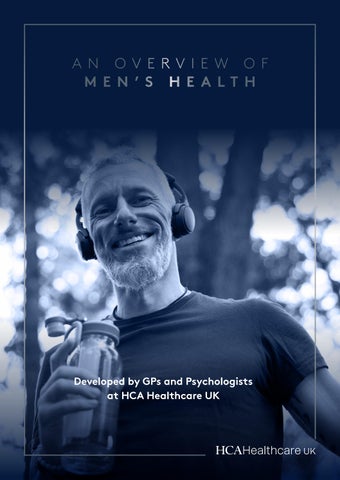
A N O V E RV I E W O F M E N ’ S H E A LT H
Developed by GPs and Psychologists at HCA Healthcare UK
20-30 years Young men tend to experience comparatively few health issues, but could be at risk from an attitude of invincibility. At this age, men need to be aware of the signs of testicular cancer, sexually transmitted diseases (STDs) and the negative effects of drugs and alcohol.
T H E M A I N H E A LT H I S SU E S FO R M E N
W H Y I S I T I M P O RTA N T TO TA L K A B O U T M E N ’ S H E A LT H ?
Put simply, it’s important to highlight the physical and mental health issues men face because male mortality is higher than females across every age group, and life expectancy overall is lower.
Typically, men delay seeking health advice from their GP and other health professionals when they experience symptoms or feel unwell. Men also tend to lead less healthy lives than women – they tend to smoke more, drink more and display risk-taking behaviour. As a result, the leading causes of death in men across the UK include cancers, cardiovascular diseases, coronary heart disease and respiratory diseases.
|2|
Throughout a man’s lifetime, his risk of certain illnesses changes with age. However, these conditions can affect men at any stage of their life, so vigilance is key.
30-40 years As they get older, men need to focus on preventative care and laying a good foundation for their future health. Common issues that can arise include stress, diabetes and hair loss.
40-50 years Approaching middle age, men need to start to consider their risk of heart disease more seriously and continue to manage stress.
50-60 years Into their fifties, men need to remain vigilant around heart health issues, while also being aware of their prostate and colorectal health and erectile problems.
|3|
W H AT M E N S H O U L D LO O K O U T F O R I N T H E I R 20s
Testicular cancer: the facts •
• •
|4|
Testicular cancer is the most common cancer in men between the ages of 18 to 34 Around 2,000 cases are detected each year in the UK If detected early, testicular cancer can be cured
How do I check for testicular cancer?
Sexually transmitted diseases (STDs)
Alcohol and drug misuse
All men are encouraged to carry out a monthly testicular self-examination in order to help with early detection of the disease.
STDs are the UK’s most common infections after colds and the flu, and can affect anybody who has unprotected sex. While the most serious, HIV, is uncommon in the UK, there are around 25 other STDs, all of which are highly contagious and affect millions of young men each year.
Long hours, high-stress, anxiety and peer pressure can all lead to recreational drug use and drinking becoming a problem. Whether it’s using stimulants to overcome tiredness, drinking to mask anxiety or as a reward, dependence can creep up quickly and unexpectedly.
They include:
Warning signs to look out for:
•
•
Relationship problems/break-ups
•
Poor decision making
•
Risk-taking – both in and outside work
•
Declining productivity
First, get to know your body – this will allow to spot any changes more easily. The testicle should be rolled between the fingers and thumb to check for any lumps, swellings or changes in their size and weight. If you notice anything unusual, speak to your GP or a health professional.
Chlamydia, Gonorrhoea and Mycoplasma – often no symptoms, but can cause pelvic floor infections in women which may impact fertility
Make an appointment with your GP if you have:
•
Syphilis – ulcers and rashes
•
an unusual lump or swelling in part of one testicle
•
LGV – anal bleeding and pain
•
Herpes – painful ulcers
•
a sharp pain in the testicle or scrotum
•
•
a heavy scrotum
Pubic lice, known as crabs – uncomfortable itching
•
an increase in the firmness or feel
•
an unusual difference between one testicle and the other
If you’re concerned about yourself or anyone else please reach out to a medical professional.
For most STDs detection and treatment is easy, so regular check-ups are recommended.
|5|
W H AT M E N S H O U L D LO O K O U T F O R I N T H E I R 3 0s
Stress
Obesity
Male pattern hair loss
Stress is a person’s perceived ability to cope with various factors in their life. When experiencing these feelings, men can often turn to what are known as nonadaptive coping skills such as overwork, gambling or turning to alcohol and drugs.
In the UK, one in four adults are obese. There are multiple causes of obesity, including sedentary lifestyle, poor sleep, poor diet and other underlying medical conditions. Being overweight or obese is a significant risk factor for a number of serious health conditions, including heart disease, gout, arthritis and breathing disorders.
Male pattern hair loss is perfectly natural. Temporary hair loss can be caused by an illness, stress, cancer treatment, weight loss and iron deficiency. For many men, however, hair loss is permanent, caused by a genetic disorder inherited through the X (male) chromosome.
Adaptive coping skills are much healthier and more effective too. These include taking regular exercise, practising relaxation, mindfulness and meditation, and developing psychological skills.
For most people, Body Mass Index (BMI) is a good measure of whether they’re a healthy weight for their height. It’s not used to diagnose obesity alone because it doesn’t measure fat percentage, but waist size can be used to measure excess fat. Men with a waist size of more than 94cm (37in), or 90cm (35.5in) for men of South Asian origin, are more likely to develop obesity-related health problems.
BMI
BMI
Classification
(men of South Asian origin)
|6|
<18.5 <18.5
Underweight
18.5 - 24.9
18.5 - 22.9
Healthy
25 – 29.9
23 - 29.9
Overweight
>30
>30
Obese
If you have any concerns about sudden hair loss, developing bald patches or losing hair in clumps, you should see a GP.
Some top diet tips to help reduce weight and obesity risk: •
Eat regular meals
•
Choose wholegrains instead of white or refined carbohydrates
•
Choose whole fruits over fruit juices to get more fibre
•
Seek advice from a qualified dietitian
If hair loss is causing distress, there are treatments available with a private prescription. For more information, speak to a GP. It’s important to bear in mind these treatments don’t work for everyone, and they stop working after treatment ceases.
It’s also recommended that adults in the UK do at least 150 minutes of moderate intensity exercise spread out during the week and or 75 minutes of vigorous exercise with two resistance training sessions a week.
|7|
W H AT M E N S H O U L D LO O K O U T F O R I N T H E I R 40 s Heart health Cardiovascular disease is currently the leading cause of death in men under the age of 65 in Europe. Coronary artery disease (CAD) occurs when a build-up of plaque (cholesterol deposits) within the arteries causes them to narrow. This then limits or blocks the blood flow through the arteries, leading to a heart attack or heart failure. CAD risk factors to watch out for include:
|8|
•
Smoking
•
Abnormal cholesterol ratio
•
High blood pressure
•
Diabetes
•
Abdominal obesity
•
Stress
•
Sedentary lifestyle
•
Poor diet
K E E P
A N
E Y E
O N
CHOLESTEROL
BLOOD PRESSURE
DIABETES
There are two types of cholesterol in the body:
High blood pressure is overwhelmingly (90%) down to genetics, but other risk factors still impact it. Obesity, inactivity and high dietary alcohol and salt intake all contribute. There is also evidence to suggest that cocaine – and even liquorice – can increase blood pressure.
In simple terms, diabetes is when the body has difficultly using sugar and removing it from the blood stream. It’s a serious condition that can impact health in a number of ways, causing visual problems, peripheral nerve damage, kidney issues and cardiovascular disease.
Ideally, blood pressure should remain at 120/80mmHg. A reading of more than 140/90mmHg is considered high-risk.
Genetics, obesity and diet are all contributing risk factors for type 2 diabetes, but it can be managed by implementing a healthy diet and taking regular exercise.
1. LDL cholesterol: Low Density Lipoprotein damages artery walls which can lead to heart attack. High LDL cholesterol can be genetic, but it’s also increased by a diet high in trans and saturated fats and is associated with obesity. 2. HDL cholesterol: High Density Lipoprotein removes LDL from circulating within the body by returning it to the liver, where it’s removed from the body. High HDL cholesterol is often associated with being a healthy body weight, and evidence shows that regular exercise, reducing alcohol intake and increasing dietary omega-3 can increase HDL levels.
|9|
W H AT M E N S H O U L D LO O K O U T F O R I N T H E I R 50s
Prostate problems
Prostate cancer
Bowel cancer
Erectile dysfunction
Prostate problems are relatively common in men over the age of 50.
The most common type of cancer in men, there appears to be an increased risk for black men and those with a family history of prostate cancer under the age of 60. There’s also some evidence to suggest that having a close female relative with breast cancer increases a man’s risk of developing it.
Bowel cancer can be prevented through a healthy lifestyle and diet. Limiting consumption of red meat and alcohol, increasing fibre intake through fruit and vegetables, exercising regularly and quitting smoking will all reduce risk.
At some point during their lifetime, most men will experience problems with erections. There are many effective treatments, so if there are concerns, it’s important to speak to a GP as soon as possible.
Other risk factors for bowel cancer include:
Smoking is a well-known cause of erectile dysfunction for men of all ages, but problems coping with stress, alcohol and mental health can also have a big effect. Highblood pressure and diabetes are also factors and, while old age is not usually a cause in itself, some medications more commonly prescribed for older men, such as bloodpressure medications, can cause problems.
A small gland that surrounds the urethra, the prostate is about the size of a walnut, and tends to get bigger as a man gets older. This is common – more than one in three men over the age of 50 will have some symptoms of prostate enlargement. This can be down to a number of conditions, including:
Prostate cancer tends to be slow-growing, so the outlook is generally good. However, as there are often no symptoms in the early stages, regular check-ups with a GP are essential to catch it before it spreads.
•
Prostate enlargement
•
Prostatitis (infection of the prostate)
Symptoms to look out for include:
•
Prostate cancer
•
Frequent and/or nocturnal urination
•
Poor urine stream
•
Post urination dribbling/inability to fully empty the bladder
•
Blood in the urine
•
Pain or blood on ejaculation
For men over 45, or those who have a family history of prostate cancer, screening is available in the form of a simple blood test that detects prostate specific antigen (PSA).
| 10 |
•
Age (50+)
•
Family history of the disease
•
Obesity
•
Inactivity
•
Radiation exposure
Bowel cancer screening is available every two years via the NHS for everyone between the ages of 60 and 74 registered with a GP in England. This simple test looks for small amounts of blood within the stools. The main symptoms to look out for are: •
Unexpected weight loss
•
Abdominal pain
•
A change in bowel habits
•
Blood in the stools
| 11 |
M A K E H E A LT H A P R I O R I T Y
W H AT C A N M E N D O TO STAY H E A LT H Y
| 12 |
•
Limit alcohol intake to 14 units per week
•
Have at least three alcohol-free days each week
•
Quit smoking. For more advice, please visit: nhs.uk/live-well/quit-smoking/nhs-stop-smoking-services-help-you-quit
•
Get an annual blood pressure check
•
Get an annual cholesterol check
•
Have a body composition assessment – including body fat percentage, waist circumference and BMI
•
Manage stress levels
•
Eat wholegrains and limit consumption of red and processed meat
•
The medditeranean diet is recommended - choose wholegrains, fruits, vegetables and oily fish and limit saturated fat and sugar
There are many reasons why men may find it difficult to break bad habits – stress, a lack of discipline and motivation, and scepticism about the benefits a lifestyle change might bring are just a few. Ultimately, however, adopting a healthy lifestyle will reduce a man’s risk from a wide range of diseases and help to prolong life. It’s never too early to start, and men should encourage each other and their children to do so. Family, friends and colleagues can also help, by encouraging lifestyle changes and offering support. Reducing the stigma surrounding mental and physical health issues in men through awareness and education will encourage many to seek medical advice and intervention sooner. This, in turn, will allow for earlier diagnosis and treatment of serious issues, leading to much more favourable outcomes than if left undetected.
Keep mental health in mind Overall, the number of men seeking intervention for mental health issues continues to rise, and we can support this further by looking out for symptoms of common mental health issues, such as depression and anxiety. Start conversations with men about mental health on a regular basis and share available resources to help men make healthy lifestyle changes.
| 13 |
Connect with us
Our group
The Harley Street Clinic The Lister Hospital London Bridge Hospital The Portland Hospital The Princess Grace Hospital The Wellington Hospital The Christie Private Care GP Services HCA UK at University College Hospital HCA UK at The Wilmslow Hospital Leaders in Oncology Care
corporatewellbeing@hcahealthcare.co.uk V1 05/22