Published: June 2026 | Read Time: 12-15 minutes | Category: Customer Experience CRM
Hyper-Personalization in CRM: The New Standard Every Business Must Embrace in 2026
The days of "Dear Customer" are over. In 2026, hyper-personalization is not a competitive edge it is the baseline expectation. Brands that fail to personalize don't just miss opportunities; they actively frustrate 76% of their own customers. This guide is your complete roadmap.
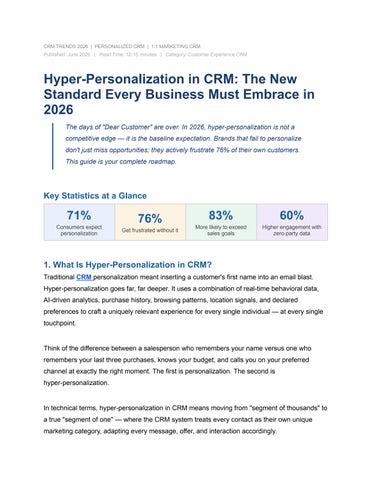
Key Statistics at a Glance
Consumers expect personalization
Get frustrated without it
More likely to exceed sales goals 60% Higher engagement with zero-party data
1. What Is Hyper-Personalization in CRM?
Traditional CRM personalization meant inserting a customer's first name into an email blast Hyper-personalization goes far, far deeper It uses a combination of real-time behavioral data, AI-driven analytics, purchase history, browsing patterns, location signals, and declared preferences to craft a uniquely relevant experience for every single individual at every single touchpoint
Think of the difference between a salesperson who remembers your name versus one who remembers your last three purchases, knows your budget, and calls you on your preferred channel at exactly the right moment. The first is personalization. The second is hyper-personalization.
In technical terms, hyper-personalization in CRM means moving from "segment of thousands" to a true "segment of one" where the CRM system treats every contact as their own unique marketing category, adapting every message, offer, and interaction accordingly
Real-World Example
A retail clothing brand no longer sends a generic sale email to all subscribers. Instead, its CRM sends each customer a curated selection based on their size, style preferences, past purchases, average order value and even the weather forecast in their city that day. The result: open rates triple and conversions double.
2. Why Hyper-Personalization Is Non-Negotiable in 2026
Customer expectations have undergone a seismic shift over the past three years The proliferation of AI-native apps, recommendation engines, and personalized streaming services has permanently raised the bar. Here is why ignoring hyper-personalization is simply no longer an option:
a) Customers expect it — and punish brands that don't deliver According to McKinsey, 71% of consumers now expect companies to deliver personalized interactions More critically, 76% say they get frustrated when brands fail to do so That frustration translates directly into churn, negative reviews, and lost lifetime value
b) AI has made it achievable at scale
The barrier to hyper-personalization used to be scale You simply could not manually craft individual experiences for 10,000 customers. AI has completely eliminated that barrier. Modern CRM platforms equipped with machine learning can now generate millions of personalized touchpoints automatically, in real time, without human intervention.
Gartner predicts that by end of 2026, 40% of enterprise applications will include task-specific AI agents In the CRM space, these agents don't just send emails they monitor data streams, adjust lead scores, trigger next-best-action workflows, and even prepare customized demo environments, all autonomously
c) The ROI is proven and massive
Businesses using AI within their CRM are 83% more likely to exceed sales goals. AI enhances sales forecast accuracy by over 40% and increases repeat sales through hyper-personalization
by up to 15% The global CRM market is on track to exceed $100 billion by 2030, with organizations reporting an average return of $8 71 for every dollar spent on CRM implementation
d) Generic marketing is dying fast
"Generic emails are dead Behaviour-driven communication is the new normal CRM is no longer a system that sends campaigns It is a system that thinks, interprets, and responds in real time " Claritysoft, 2026
3. The 4 Core Pillars of CRM Hyper-Personalization
To implement true hyper-personalization, your CRM strategy must be built on four interconnected pillars. Miss any one of them and your personalization efforts will fall short.
Pillar 1 — Real-Time Behavioral Data
At the heart of hyper-personalization is real-time data Your CRM must capture what customers are doing right now not last week, not last month This includes:
• Pages visited and time spent on each page
• Products viewed, added to cart, or abandoned
• Email opens, clicks, and reply patterns
• Support tickets raised and resolution history
• Social media engagement and sentiment signals
When a high-value customer spends seven minutes on your pricing page and then reads your enterprise documentation, that is a powerful buying signal A hyper-personalized CRM detects this immediately and responds adjusting their lead score, notifying the right sales rep, or triggering an automated personalized outreach sequence
Pillar 2 — Artificial Intelligence & Predictive Analytics
AI is the engine that makes hyper-personalization scalable In 2026, agentic AI systems have moved far beyond simple automation They can:
• Predict which leads are most likely to convert this week
• Identify customers at risk of churning before they show obvious signs
• Recommend the next best action for every contact in your pipeline
• Generate personalized email copy, subject lines, and offers automatically
• Clean duplicate data and flag incomplete customer profiles in real time
The transition from generative AI assistants to agentic AI is the most significant leap in CRM technology in 2026 Earlier AI could draft an email or summarize a meeting Today's agentic CRM systems possess a level of autonomy where they monitor data streams and execute complex workflows without waiting for a human prompt
Pillar 3 — Omnichannel Consistency
Hyper-personalization only works when the customer experience is seamless across every channel A customer who speaks to your support team on Monday should not have to re-explain their issue when they email on Tuesday A prospect who downloaded your whitepaper should receive a follow-up call that references that specific document
This requires your CRM to act as a single source of truth aggregating data from email, phone, chat, social media, in-store visits, and even IoT devices into one unified customer profile. Modern CRMs now rely on stream-processing frameworks to ingest data from all these sources simultaneously and update the customer record in milliseconds.
Pillar 4 — Zero-Party Data & Trust
Third-party cookies are dead Privacy regulations have intensified The hyper-personalization strategies that work in 2026 are built on zero-party data information that customers willingly and proactively share because they trust you and see value in doing so
Brands that use zero-party data inside their CRM workflows see 35–60% higher open and engagement rates. More importantly, companies that built privacy-first CRM strategies in 2025 are seeing 31% higher customer trust scores and 18% better overall engagement in 2026.
Collecting zero-party data means building preference centers, running interactive surveys, offering personalised quizzes, and giving customers genuine control over their data The CRM
then uses this explicit, high-quality data to deliver personalization that feels intuitive rather than intrusive
4. Hyper-Personalization Across Every Customer Touchpoint
One of the most powerful aspects of modern CRM hyper-personalization is its breadth. It does not stop at email. Here is how it manifests across the entire customer journey:
Email Marketing
AI-powered CRM systems now generate individually tailored emails for each recipient not just different subject lines, but entirely different content, product recommendations, CTAs, and even send times Behaviour-driven triggers replace scheduled campaigns When a contact takes a specific action (visiting a pricing page, opening a competitor comparison article, or going silent for 30 days), the CRM fires the appropriate, perfectly timed email automatically
Sales Outreach
Sales reps using hyper-personalized CRM tools see every conversation armed with full context: the prospect's recent activity, their pain points based on support interactions, their industry's typical objections, and AI-generated suggested talking points. This transforms cold outreach into warm, contextually relevant conversations that convert significantly faster.
Customer Support
When a customer contacts support, a hyper-personalized CRM instantly surfaces their full history products owned, past issues, communication preferences, and even their predicted lifetime value Support agents no longer ask "how can I help" blindly; they can open with contextual empathy: "I see you've been using the Enterprise plan for 8 months and had a billing question last quarter let me make sure we resolve this quickly for you "
Website & Landing Pages
Dynamic CRM-driven personalization now powers real-time website customization. Returning visitors see personalized landing pages, product carousels, and CTAs based on their profile. A
returning visitor spending time on a pricing page likely signals purchase readiness and the website adapts instantly to serve that intent with relevant social proof, case studies, and offers
Loyalty & Retention Programs
Hyper-personalized loyalty programs move beyond generic points systems CRM data powers tiered rewards based on individual preferences, personalised milestone celebrations, and proactive retention offers triggered the moment churn signals are detected Amazon's sophisticated approach drove over 38% of its revenue from personalised recommendations by end of 2025 up from 35% the prior year.
5. Step-by-Step: How to Implement Hyper-Personalization in Your CRM
Here is a practical, actionable roadmap for businesses at any stage of their CRM journey:
1 Step 1: Audit your current customer data
Before you can personalize, you need clean, complete, unified data Audit your CRM for duplicates, incomplete profiles, and disconnected data sources Data quality is the foundation garbage in, garbage out
2. Step 2: Unify data from all sources
Integrate your CRM with your website analytics, email platform, support desk, e-commerce system, and social channels Every customer interaction should flow into a single unified profile
Consider a Customer Data Platform (CDP) layer if your data architecture is complex
3. Step 3: Build your zero-party data strategy
Create preference centers, onboarding surveys, and product recommendation quizzes
Incentivise customers to share their preferences explicitly This data is gold higher quality and more actionable than any behavioural inference
4 Step 4: Implement AI-driven segmentation
Move beyond static demographic segments Use machine learning to create dynamic segments based on behavioural patterns, predicted intent, and lifecycle stage Your CRM should update these segments in real time as customer behaviour changes
5 Step 5: Set up behaviour-triggered workflows
Map out your customer journey and identify key behavioral triggers at each stage Build automated workflows that fire personalized actions when triggers occur a pricing page visit, a cart abandonment, a 30-day silence, a NPS score below 7 Start with five high-impact triggers and expand from there
6. Step 6: Personalise every channel
Roll out personalization across email, sales sequences, website content, support responses, and advertising Ensure your CRM is the central hub that powers personalization consistently across all channels, so no customer ever receives a contradictory or repetitive experience
7 Step 7: Measure outcomes and refine
Track personalization impact at every stage: email open rates, conversion rates by segment, customer lifetime value, churn rate, and NPS. Use A/B testing to continuously refine your personalization models. Let AI learn from outcomes and improve recommendations over time.
6. Privacy-First Personalization: The Strategic Advantage in 2026
Hyper-personalization without trust is surveillance And in 2026, customers are more privacy-aware than ever GDPR enforcement has intensified The California Consumer Privacy Act has expanded Data breaches are front-page news The brands that win are those that treat data ethics as a growth strategy, not a compliance checkbox
Leading CRM platforms now incorporate Privacy by Design, with automated consent management that adjusts data usage based on evolving global regulations Advanced systems include Self-Sovereign Identity integrations giving customers genuine control over their digital identity and transparent explanations for every recommendation: "We are suggesting this product because you viewed similar items last week "
"Customers are more likely to share data with systems that demonstrate clear value and respect for their digital boundaries Ethical personalization is not just a legal requirement it is a strategic advantage " Tomoson, 2026
The business case is compelling: companies with privacy-first CRM see 31% higher customer trust scores, 18% better engagement, and significantly higher zero-party data collection rates which in turn fuels better personalization, creating a virtuous cycle of trust and growth
7. Common Mistakes to Avoid
Despite its enormous potential, many hyper-personalization initiatives fail. Here are the most critical pitfalls to watch out for:
• Personalizing without permission using data customers don't know you have damages trust faster than generic messaging ever could
• Over-personalizing to the point of being creepy there is a fine line between "they know me" and "they're watching me." Transparency is the antidote.
• Poor data quality even the most advanced AI cannot create meaningful personalization from inaccurate, duplicated, or incomplete data Data hygiene must be a continuous process, not a one-time project.
• Channel silos — personalizing email brilliantly but delivering a generic experience on your website or in support calls creates a jarring disconnect that undermines the entire strategy
• Implementing everything at once start with one high-volume workflow (lead handoff, renewal campaigns, or onboarding sequences), prove the value, then expand.
• Measuring activity instead of outcomes tracking emails sent is not a metric. Track conversion lift, retention improvement, and revenue impact per personalized segment
8. The Future: Agentic CRM and the Segment of One
Looking beyond 2026, the trajectory is clear CRM hyper-personalization will become increasingly autonomous, increasingly predictive, and increasingly invisible to the customer who will simply experience it as a brand that genuinely understands them
Agentic AI systems will handle entire customer journeys end-to-end, from first touch to renewal, without human intervention except for the highest-value relationships Voice-enabled CRM will add real-time personalization to phone and video interactions IoT data will feed CRM profiles from physical products, enabling personalization that bridges the digital and physical worlds seamlessly
The organizations that start building their hyper-personalization infrastructure today investing in data quality, zero-party data collection, AI integration, and omnichannel unification will hold a durable competitive advantage as these capabilities mature. Those that wait will find the gap impossible to close.
Conclusion: Personalization Is Now the Price of Entry
In 2026, hyper-personalization in CRM is not an advanced strategy reserved for tech giants with unlimited budgets It is the baseline expectation of every connected customer The technology is accessible, the ROI is proven, and the cost of inaction 76% of customers frustrated by impersonal experiences is too high to ignore.
Start with clean data Build trust through transparency Let AI scale what humans cannot Personalize every touchpoint with purpose And always measure outcomes, not just activity
The brands that win customer relationships in 2026 and beyond will not be the loudest or the biggest They will be the ones that make every single customer feel like the only customer
Target Keywords: personalized CRM | customer experience CRM | 1:1 marketing CRM | hyper-personalization CRM | AI CRM 2026 | CRM trends 2026