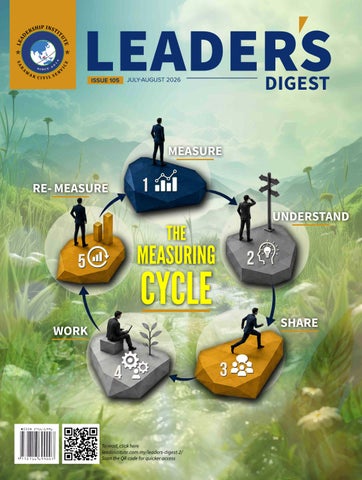
LEADERS ISSUE 105
JULY-AUGUST 2026
DIGEST
MEASURE RE- MEASURE
THE
UNDERSTAND
MEASURING
CYCLE
WORK
To read, click here leadinstitute.com.my/leaders-digest-2/ Scan the QR code for quicker access
SHARE
LEADERS
DIGEST
Publication Team Editor-in-Chief Datu Dr. Haji Azhar bin Haji Ahmad Editor Diana Marie Capel Graphic Designers Awang Ismail bin Awang Hambali Abdul Rani Haji Adenan
* Read our online version to access the hyperlinks to other reference articles made by the author.
Contents
ISSUE 105 I JULY-AUGUST 2026
04 GROWTH MINDSET IS A DAILY MECHANISM
22 THE LESSONS DON’T STOP
10 FINDING YOUR CRUNCH POINT: HOW LEADERS
24 HALFWAY THROUGH 2026: WHAT IS YOUR BIGGEST
14 COURAGE ISN’T A FEELING
26 THE MOST UNDERRATED LEADERSHIP SKILL IS
15
THE MOST POWERFUL PRODUCTIVITY HACK IS CHANGING THE DEFAULT
29 LEADERSHIP INSTITUTE OF SARAWAK CIVIL SERVICE
17
THE MID-YEAR LIFE REVIEW: A SIMPLE GUIDE TO RESETTING YOUR SECOND HALF
31
NAVIGATE PRESSURE WITHOUT BREAKING
LESSON THIS YEAR?
SEEING POTENTIAL BEFORE IT PERFORMS
TO MOVE TO NEW PREMISES
BOOK SUMMARY & REVIEW: TRUE NORTH
20 SIX COMMON MISTAKES TO AVOID WHEN PURSUING YOUR GOALS
LET US KNOW If you are encouraged or provoked by any item in the LEADERS DIGEST, we would appreciate if you share your thoughts with us. Here’s how to reach us: Email: corporate@leadinstitute.com.my Leader’s Digest is a monthly publication by the Leadership Institute of Sarawak Civil Service, dedicated to advancing civil service leadership and to inspire our Sarawak Civil Service (SCS) leaders with contemporary leadership principles. It features a range of content contributed by our strategic partners and panel of advisors from renowned global institutions as well as established corporations that we are affiliated with. Occasionally, we have guest contributions from our pool of subject matter experts as well as from our own employees. The views expressed in the articles published are not necessarily those of Leadership Institute of Sarawak Civil Service Sdn. Bhd. (292980-T). No part of this publication may be reproduced in any form without the publisher’s permission in writing.
2
Issue 105 I July-August 2026
LEADERS
DIGEST
From the
Editorial Desk
LEADING CHANGE, SHAPING THE FUTURE CHANGE IS A CONSTANT. It may manifest through physical transformation or through new approaches, technologies, systems and procedures. Whatever its form, change is driven by purpose and brings implications that can shape the direction, performance and sustainability of an organisation. Over the past six decades since the formation of Malaysia, Sarawak has undergone remarkable transformation across its political, economic, social and physical development landscape. Today, guided by the post-COVID-19 Development Strategy 2030 (PCDS2030) and other comprehensive development plans, Sarawak is firmly pursuing its aspiration to become a developed and prosperous State by 2030. Achieving this aspiration requires more than good policies and well-crafted plans. It demands strong leadership, collective commitment, effective execution and consistent delivery at every level. As planners and implementers of government policies, the Sarawak Civil Service (SCS) carries a profound responsibility to translate the State’s aspirations into tangible outcomes for the people. This places leadership at the heart of transformation.
“
.................................................................................
Leading in an environment of continuous change requires more than the ability to make decisions and achieve targets.
Equally important is the readiness of our people. Transformation can succeed only when our workforce possesses the right mindset, attitude, knowledge, skills, and collective spirit to adapt to new realities. Leaders therefore have a critical role in creating an environment where people are willing to learn, unlearn, collaborate and continuously improve. As Sarawak moves towards 2030, SCS leaders must evolve from merely responding to change to anticipating, influencing and shaping it. We need leaders who are agile in thinking, courageous in decision-making, collaborative in action and compassionate in leading people. The journey ahead will undoubtedly present challenges and uncertainties. Yet, every change also creates opportunities to rethink how we work, improve how we serve and strengthen our capacity to deliver. Ultimately, the transformation of Sarawak is not only about infrastructure, technology or economic progress. It is also about the transformation of leadership, institutions and people. The quality of our leadership today will significantly influence the Sarawak we build tomorrow. We may not always be able to control the changes around us, but we can choose how we respond, how we lead, and how we shape the future. Let us therefore lead change with clarity, courage, and collective purpose, and turn every challenge into an opportunity to create a stronger, more resilient, and future-ready Sarawak Civil Service.
Leaders must provide clarity amidst uncertainty, build confidence during transition and inspire their people to embrace change with purpose. They must also recognise that organisational performance and people’s well-being are not competing priorities. Both must be pursued in long-term resilience. .................................................................................
“
balance to ensure sustainable performance and
Datu Dr. Haji Azhar bin Haji Ahmad Chief Executive Officer
Issue 105 I July-August 2026
3
LEADERS
DIGEST
Source: Image by Courtney Cantu on Unsplash
Growth Mindset is a Daily Mechanism BY TAREEF JAFFERI
If growth mindset is one of your core values, where does it show up on a Tuesday afternoon?
The mechanism is harder, more interesting, and is the only thing that produces the outcome the poster is meant to point at.
Growth mindset has been on every company’s values poster for a decade.
This piece argues for the second path. Growth mindset as installed infrastructure, not as exhortation.
In most companies, the poster is the entire program. There was a workshop in 2019. The L&D team ran an offsite. Carol Dweck got mentioned. Someone made the slides. People nodded. Six weeks later, the team behavior was the same as before, and nobody could quite explain why. The instinct of most leaders at this point is to do another workshop. Or to hire a coach. Or to embed it more visibly in the values list. None of this works, and the reason is straightforward. Growth mindset is not a cultural value. It is a daily operating mechanism. Companies that treat it as a value end up with a poster. Companies that treat it as a mechanism end up with the compounding effect Carol Dweck originally described. The poster is cheap.
4
Issue 105 I July-August 2026
What growth mindset actually is Growth mindset, in Carol Dweck’s original work, is the belief that ability is developed through effort, learning, and persistence rather than fixed at birth. The hard part of the work, mostly missed in corporate adoption, is that the belief is sustained by what happens daily in the environment around the person. It is not produced by a poster. It is produced by feedback patterns, recognition patterns, learning patterns, and manager patterns that signal, over hundreds of small moments, that effort is what matters and improvement is what gets seen. Best for CEOs, L&D leaders, and senior HR running companies of 50 to 5,000 people where the value is on the wall and the behavior is not, and the leadership team is willing to install a daily mechanism instead of running another workshop.
LEADERS
DIGEST
The hollow corporate version Most companies that say they have a growth mindset have something else. They have a value on a wall. They have a workshop that happened. They have a leader who occasionally says “growth mindset” in town halls. They have a 360 review process that asks about it as a competency. None of these is wrong. None of them adds up to the thing. The signal that you have the hollow version is simple. Ask a team member what changed in their week because of the company’s growth mindset commitment. If the answer is “nothing” or “I’m not sure,” the value is on the wall and not in the work. The hollow version is not malicious. It is what happens when an organization tries to install a behavioral system through a communications channel. Communication can announce a behavioral system. It cannot install one. The installation is a separate piece of work, and it is daily.
The compounding math The reason growth mindset matters for company outcomes (and the reason your CFO should care) is compounding. A 1% daily improvement, compounded across 365 days, is 37.78x improvement in a year. The math is 1.01 raised to the 365th power. It is not aspirational. It is arithmetic. The same arithmetic runs in reverse. A 1% daily decline, compounded, is 0.026x in a year. That is a team that has lost 97% of where it started. Most teams are not improving 1% daily, but they are also not declining 1% daily. They are flat. Flat means 1.00 raised to the 365th power, which is still 1.00. A year of flat is a year of standing still while every team that compounded moved past you.
The interesting version is the worked example. Consider an engineering team of 12. Average 4 hours of focused work per person per day, 240 days per year. Baseline annual focused work, 11,520 hours. If the team adds a 1% daily improvement in three specific dimensions (feedback specificity, learningloop closure, recognition density) and each dimension contributes a small but compounding lift in effective output per hour, the team’s annual effective output approaches what 18 to 22 engineers would produce at the baseline rate. The headcount line on the org chart did not change. The output ceiling moved. This is the number a CFO should be looking at when L&D asks for budget. The math is brutal in both directions. It is also entirely operational.
The four components of the daily mechanism The components are not mysterious. They are uncomfortable because they require daily discipline, not annual budget.
1 Specific feedback as the default conversation The thing growth-oriented environments do that growth-averse environments do not is generate specific feedback at high frequency. Not “good job.” Not “you crushed it.” A specific, datable, named observation: “The way you reframed the customer’s concern in the third call was the move I want everyone on the team learning from. Here’s why it worked.” Or, on the corrective side, “The third paragraph of the strategy doc treats the cost question as solved. It isn’t, and the next reader will catch it. Try again.” Specific feedback is the substrate of growth mindset. It is also what most teams lack. The reason teams lack it is not that their managers are unskilled. It is that the default conversation became status updates, and specific feedback is a deliberate choice that has to be made every day.
Issue 105 I July-August 2026
5
LEADERS
DIGEST
2 growth behaviors
Real-time recognition that catches the
Recognition that arrives quarterly is congratulating people for things they have forgotten. Recognition that arrives the same week is shaping the behavior. Real-time recognition is not about being effusive. It is about catching the moment when someone did the harder version of the work and signaling clearly that the harder version is what gets seen. The 9x trust multiplier on peer recognition has a specific role here. When peers recognize each other for growth behaviors (struggling through a hard problem, taking a feedback note seriously, choosing the learning version of a task over the comfortable one), the social signal that growth matters is being produced by the network, not by leadership. Network-produced signal is far more durable than leadership-produced signal.
of any platform or program above them. The manager is the upstream. Everything else is downstream amplification. This is also why most growth-mindset programs fail. They aim at the employee instead of aiming at the manager who shapes the employee’s daily environment. The leverage is upstream.
Why the shape varies by organization This is the insight most growth-mindset content misses, and it is where the field is genuinely confusing. A growth mindset in an engineering organization looks different from a growth mindset in a sales organization. Different in surface expression, identical in mechanism. •
Engineering: specific feedback on technical decisions, recognition for elegant solutions, microlearning on systems patterns, manager 1:1s that include code review and architectural reasoning.
•
Sales: specific feedback on calls and pipeline reviews, recognition for the difficult deal saved through better discovery, micro-learning on customer empathy and negotiation, manager 1:1s that rehearse the hard conversations.
•
Creative work (design, content, brand): specific feedback on craft and originality, recognition for taking the risky version of an idea seriously, microlearning on technique and reference, manager 1:1s that include critique culture.
•
Operations: specific feedback on process design and quality, recognition for the unsexy improvement that compounds, micro-learning on systems thinking, manager 1:1s that ask “what can we make better this week.”
3 Micro-learning prompts in the flow of work The L&D model that growth mindset companies have moved past is the workshop. Workshops are point events. Growth happens in the gap between the workshop and the next time the person faces the situation, and most of the workshop content is gone by then. The replacement is micro-learning that arrives in the flow of work. A prompt at the moment of the hard conversation, not three months before it. A reference at the moment of the design decision. A coaching note from a manager who saw the moment and named it. The unit shrinks from a day to a minute, and the cumulative effect is larger because the spacing is right.
4 Manager coaching cadence as the upstream All of the above sit on top of the manager cadence. If managers run weekly 1:1s that go beyond status, give specific feedback, prompt the micro-learning, and recognize the growth behaviors, the mechanism runs. If managers don’t, the mechanism doesn’t, regardless
6
Issue 105 I July-August 2026
The mechanism (specific feedback, real-time recognition, micro-learning in the flow, manager cadence) is the same in all four. The expression is shaped by the work being done.
LEADERS
DIGEST
The mistake most companies make is copying the surface expression from a famous case. “Google has this kind of feedback culture, we should have it too.” Or, “Pixar has this kind of critique culture, let’s run that.” The surface expression is the part that fits the specific company’s work. The mechanism is what transfers. Most copying gets the surface and misses the mechanism, which is why most cargo-cult attempts at growth mindset fail.
The right move is to install the mechanism in your own context and let the expression take its own shape. What “specific feedback” looks like on your engineering team is what your engineering team builds it into. The work is to make sure the mechanism is running, daily, at the resolution where it matters.
Poster-style growth mindset vs daily-mechanism growth mindset
Where it lives
Wall, values page, town hall slide
1:1s, recognition flow, feedback cadence, learning prompts
Time horizon to effect
Indefinite, often never
60 to 90 days for first visible shift, 12 months for compounding
Cost structure
Annual L&D budget, periodic workshops
Daily manager time plus a behavioral platform
Adoption rate
High during launch, drops to baseline within 6 weeks
Builds slowly, sticks because daily
Effect on attrition
Negligible
Top quartile retention improves measurably
Compounding direction
Flat to slightly positive
Up to 37x over a year when the mechanism runs
What fails it
Reorgs, manager turnover, end of L&D budget
A senior leader who actively models the opposite
Measurable in
Survey self-reports
Daily behavior, feedback density, learning loop closure
The two columns are not gradations of the same thing. They are different programs producing different outcomes. The poster-style program produces messaging. The daily-mechanism program produces compounding.
Issue 105 I July-August 2026
7
LEADERS
DIGEST
If / then: where to start A simple sequence that holds up across most companies. •
If your managers don’t run consistent 1:1s: start there. No other component of the mechanism works without the cadence. Manager scorecards that surface 1:1 completion make the absence loud and the practice normal.
•
If your 1:1s are status updates: introduce a specific signal per 1:1. A pulse data point, a recognition cluster, a feedback prompt. The conversation gets specific because the manager has something specific to bring.
•
If your recognition is sparse: install peer recognition as a daily habit with low friction. Specific. Visible. Frequent. Volume matters as much as quality in the early weeks.
•
If your L&D budget is going to workshops: rebalance toward micro-learning that arrives in the flow of work. Workshops can still exist; they should not be the main spend.
•
If your senior leadership models a fixed mindset publicly: that is a precondition problem. No infrastructure fixes a senior leader who responds to mistakes with blame. The fix is on the leadership team itself, not on the platform.
Honest tradeoffs
It can be gamed if poorly designed. A recognition system that rewards quantity produces empty recognition. A feedback system that rewards completion produces empty feedback. Calibration matters. The design has to reward signal density, not surface volume. It does not fix a fundamentally fixed-mindset CEO. If the leadership team responds to failure with blame, the mechanism downstream cannot survive. The work is at the top first. It does not compress the time to mastery on hard skills. Growth mindset improves the conditions for learning. It does not replace the years of practice some skills require.
Happily.ai as growth mindset as a service Most companies do not want to build the daily mechanism from scratch. They want the infrastructure already running. That is what Happily.ai is. Growth mindset as a service. The four components of the daily mechanism, installed and running on day one. •
Specific peer and manager feedback flows through the platform as a daily habit, not as a quarterly review. Recognition events are dated, specific, and visible.
•
Real-time recognition with the 9x trust multiplier turns peer recognition into the network signal that growth behaviors are what get seen.
•
AI coaching prompts put the micro-learning in the flow of work. The right reference at the right moment, not at the next workshop.
•
Manager scorecards track the upstream that everything else depends on: 1:1 cadence, followthrough, feedback density, recognition rate. Managers running the mechanism are visible. Managers who aren’t are visible earlier than a yearend review would catch them.
The mechanism is not a silver bullet. It takes time to compound. The 37x number is annual. The first 60 days are mostly invisible. The leadership team has to believe in the math during the quiet stretch. Companies that lose patience in week 8 don’t get the year. It exposes managers who weren’t coaching. When the cadence becomes the standard, the managers who avoided it become visible. Some will adapt. Some will leave. The net is usually positive but not free.
8
Issue 105 I July-August 2026
LEADERS
DIGEST
•
•
DEBI (Dynamic Engagement Behavior Index) moves daily by team, with the compounding direction visible in the trend. Teams running the mechanism show in the curve. Gem-based recognition with redeemable rewards is the layer that gives top performers (the people compounding) high-value perks they can actually use, which sustains the motivation to keep compounding.
Adoption sits at 97% across the deployed base against an industry average near 25%. That gap is the entire reason the mechanism works at all. A growth-mindset platform that the workforce doesn’t use produces no compounding because no daily mechanism is running. The 97% is the difference between a year of compounding and a year of flat. This is what we are. An employee engagement and experience platform built so the daily mechanism actually runs, day by day, until 1% becomes 37x.
FAQ How is this different from L&D? L&D is a content investment: workshops, courses, programs. The daily mechanism is a behavioral investment: feedback, recognition, micro-learning, manager cadence. L&D produces knowledge people might use. The daily mechanism produces practice people actually do. The two work together. The mechanism is the missing layer in most L&D-heavy companies.
We tried a similar tool. Why would Happily work? The adoption gap. Most engagement tools sit at 20% to 30% adoption. The daily mechanism requires daily use. A tool the workforce doesn’t open does not produce compounding. The 97% adoption rate is not a marketing claim; it is the precondition for the mechanism to work at all. Does this work for technical and specialist roles? Yes, with the surface expression adjusted. Engineering teams get feedback on technical decisions and recognition for elegant solutions. The mechanism is identical. The conversation in the 1:1 is different. What about senior people who think they’re past needing this? Senior people are the ones who model whether growth mindset is real. If they take feedback poorly in public, no infrastructure compensates. The work for senior people is not the platform; it is the willingness to be coachable in visible ways. The mechanism amplifies what leadership models. Is the 37x number realistic? The arithmetic is exact. The application is uneven: some dimensions compound, some don’t, and not every team sustains the daily rate. A reasonable expectation is a 2x to 6x effective output improvement over 12 months on judgment-heavy work where the mechanism runs well. The number is meant to communicate the direction, not to promise the exact multiple.
Won’t this just gamify growth into surface compliance? It can if designed badly. A recognition system that pays out for volume produces noise. A system that rewards specific, dated, visible recognition produces signal. The fix is design: rate-limit the recognition flow, weight by network breadth, audit for compliance behaviors, and tune.
TAREEF JAFFERI Tareef is a product-focused innovator passionate about data, design, and using tech for good. He believes technology should make us better: happier, and healthier.
Issue 105 I July-August 2026
9
LEADERS
DIGEST
Source: Image by Cup of Couple on Pexels
Finding Your Crunch Point: How Leaders Navigate Pressure Without Breaking BY MICHELLE GIBBINGS
Picture this scenario… You’re three weeks out from a major deliverable. Your calendar has no white space. Two of your direct reports have flagged issues that need your attention. A senior leader has just added a last-minute meeting for Monday morning. Your inbox is filling faster than you can clear it, and every conversation seems to create another decision, dependency or issue you need to follow up. Sound familiar? This is the ordinary pressure of leadership, and because it’s not unusual, it’s not always a sign that something is wrong. In fact, some pressure can sharpen focus, lift effort and help you rise to the challenge. The right amount of stretch can be energising and bring clarity and momentum. 10
Issue 105 I July-August 2026
But pressure has a tipping point, at which the same force that once helped you perform starts to drain your capacity. Your focus narrows, patience thins, small issues feel bigger, decisions become harder, and recovery takes longer. You may still be functioning, but you are no longer operating at your best. This means that the problem isn’t pressure itself. The problem is missing the moment when productive challenge tips into overload. So how do you find your crunch point, the point where pressure tips from performance fuel into performance drain?
LEADERS
DIGEST
Why Some Pressure Works Pressure activates us. When we face a genuine challenge, our brain and body mobilise energy, sharpen attention and prepare us to respond. In the right conditions, that activation can help us focus, lift our effort and stay engaged with something that matters. Psychologist and endocrinologist Hans Selye introduced the distinction between eustress and distress in the 1970s, using eustress to describe stress that can be energising or adaptive.¹ The difference is not just how much pressure you feel. It is about whether the demands are meaningful, manageable, and sufficiently resourced to support engagement rather than overwhelm. Does the challenge stretch you, or does it exceed you? Professor Mark Cavanaugh and colleagues offer a useful distinction between challenge stressors and hindrance stressors. Challenge stressors, such as a meaningful deadline, greater responsibility or a complex goal, can support motivation, learning and growth when people have the capacity and resources to meet them. In contrast, hindrance stressors, such as unnecessary bureaucracy, role ambiguity or organisational politics, are more likely to drain energy and block progress.² This is why pressure is not automatically good or bad. A demanding goal can be motivating when it feels purposeful and possible. The same level of demand can become draining when it feels pointless, poorly supported or beyond your control. The Yerkes-Dodson Law, first described by psychologists Robert Yerkes and John Dodson in 1908, is often used to explain the relationship between arousal and performance. It suggests that performance can improve as arousal increases, but only up to a point. Once arousal becomes too high, performance can deteriorate, particularly when the task requires complex thinking.³
For leaders, this matters because your work rarely involves simple effort alone. It requires judgement, perspective, patience, emotional regulation and decision-making under uncertainty. Those capabilities are precisely the ones most vulnerable when pressure moves beyond your optimal zone. The leadership skill is learning to recognise where that zone is for you, and to notice when you have drifted out of it. [Note: If you want to understand the broader science of stress types and how to build the right environment for your team, this earlier piece covers that ground.]
Your Crunch Point Is Personal The challenge is that your optimal pressure zone is not fixed and is not the same as that of the person sitting next to you. It shifts based on the nature of the work in front of you, how much autonomy you feel over that work, your current energy reserves and recovery, and the quality of support around you. What felt manageable last quarter may feel overwhelming this week, not because you have become less capable, but because the conditions have changed. An important variable in that shift is autonomy. Professor Robert Karasek’s Job Demand-Control Model, an influential framework in occupational stress research, shows that pressure is shaped not only by job demands, but also by the degree of decision latitude people have over their work4. High demands paired with meaningful control can create more active, engaging work. High demands with low control are far more likely to produce strain. This means that when autonomy is low, even moderate demands tip into distress. The feeling of being micromanaged, or of having no meaningful choice over how you work, is a form of pressure that shrinks your zone considerably.
Issue 105 I July-August 2026
11
LEADERS
DIGEST
Consequently, pressure is never just about volume; it’s about ownership. When you feel like an active agent in your situation, you cope differently than when you feel things are being done to you.
That is where the PACE framework comes in. It gives you four deliberate moves to make in the moment, before pressure makes the decision for you.
And that distinction, between feeling in control and feeling acted upon, is often the earliest signal that something has shifted.
Before you react, stop. Even briefly.
P: Pause and Appraise
When Pressure Stops Working For You
When you are operating at the edge of your capacity, your brain’s threat-detection system is running hot, which means that your thinking narrows and your responses become more reactive. The pause interrupts that pattern.
Which brings us to the question worth asking regularly: How do you know when you have moved out of your optimal zone and reached your crunch point?
Ask yourself: Is what I am facing a genuine challenge I am equipped to meet, or has the demand exceeded my current capacity?
It starts by paying attention to the signals your system is already sending. It can look and feel like:
Answering that question can shift you from reaction to a wise response.
•
A: Audit Your Autonomy
You have lost your sense of control or meaningful choice over what matters most
•
Progress has stalled, or you feel as though you are going backwards
•
Overwhelm has replaced focus: everything feels equally urgent, and nothing gets done well
•
You are ruminating, not reflecting, and so you run the same loop, repeatedly, without resolution
•
The challenge in front of you has started to feel like a threat rather than an opportunity
•
You are running on adrenaline and telling yourself you will rest later. Later keeps moving
Finding Your Footing in Real Time Recognising these signals is the first act of leadership. But recognition alone is not enough. The question is what you do next, and how quickly you can move from noticing to responding with intention.
12
Issue 105 I July-August 2026
Identify, concretely, what you can control and what you cannot. When pressure is high, attention tends to collapse onto everything that feels beyond your control. That focus is exhausting and unproductive. Auditing your autonomy means deliberately redirecting your energy toward the decisions and actions that are genuinely within your sphere of influence. Ask yourself: What choices do I have here, and am I directing my energy there? Even in a highly constrained situation, there is almost always something you can decide: the pace, order, communication, boundary you set and so on.
C:
Calibrate Your Capacity Pressure tolerance rises and falls with sleep, physical health, emotional load, recovery time, and the strength of your relationships.
LEADERS
DIGEST
I have written before about the moment I stopped seeing self-care as optional and started treating it as a performance variable. When I am not sleeping, moving and recovering enough, my pressure tolerance shrinks significantly. The work doesn’t change, but my capacity to navigate it does. Calibrating your capacity means being honest about where you are right now, not where you were last month or where you think you should be. Part of that honesty is recognising that recovery isn’t optional, and what happens when cumulative stress goes unaddressed is worth understanding before you reach your limit. Ask yourself: Am I trying to operate at full capacity with a depleted tank?
E: Expand or Exit the Zone Intentionally
Your optimal zone has two edges, and both carry risk. If you are under-pressured, bored, and disengaged, that is not a safe place to stay. Apathy and drift impose costs on your performance, growth, and engagement. The antidote is to seek a stretch that helps you grow. For example, find the work that makes you slightly uncomfortable, or the project that requires you to extend beyond what you already know you can do.
The Leader’s Multiplier Effect There is a reason this framework starts with you and not your team. Leaders who cannot recognise their own crunch point are poorly positioned to recognise it in others. And the cost of missing it is high. Burned-out leaders struggle to inspire, support, or retain the people around them, which compounds the pressure across the whole team. The pace of work, the complexity of decisions, and the volume of competing demands are permanent conditions of modern leadership. The leaders who thrive in those conditions are not the ones who feel less pressure. They are the ones who have developed the awareness of where they are on the curve and the courage to act on what they find.
Republished with courtesy from michellegibbings.com.
If you are over-pressured, and the previous three steps have confirmed it, something needs to change. Not eventually. Now. This is the moment for a deliberate choice: restructure what is possible, renegotiate a deadline or scope, delegate with genuine authority, or ask directly for support. Leaders sometimes resist these moves because they feel like admissions of failure. In reality, they are the decisions of someone who understands performance well enough to protect it and who has the selfawareness to act before the situation acts for them. Ask yourself: Am I staying in an unsustainable zone because I am waiting for someone else to notice? Or am I going to make a deliberate choice to change something today?
MICHELLE GIBBINGS Michelle Gibbings is a workplace expert and the award-winning author of three books. Her latest book is ‘Bad Boss: What to do if you work for one, manage one or are one’.
Issue 105 I July-August 2026
13
LEADERS
DIGEST
Courage Isn’t A Feeling BY DAN ROCKWELL
5 Acts of Courage Ryan Holiday argues that courage is action when fear invites retreat.
1. Name the fear. Vague fear expands. Specific fear shrinks. Ask, “What exactly am I afraid will happen?”
2. Count the wolves. Imagination multiplies enemies. Critics seem more numerous before you count them.
3. Focus on what’s in front of you. You don’t need courage for next year. You need courage for the next conversation.
4. Act before confidence arrives.
Choosing action over fear Fear doesn’t say, “Be a coward.” It says, “Be careful.” You need more information. The timing isn’t right. People might disapprove. Fear’s Strategy Fear says save yourself. It doesn’t ask: • What needs to be done? • What serves the team? • What does the mission require? It does ask: • What if I look stupid? • What if they don’t like me? • What if I fail? Fear concerns self. Courage serves others.
14
Issue 105 I July-August 2026
5. Serve something bigger than yourself. Self-protection shrinks courage. Purpose expands it. The question isn’t, “How do I stay safe?” Ask, “What does the mission require of me now?” Courage isn’t feeling brave.
Courage is answering the call while fear is on the line.
“
Source: Image by Muzammil Soorma on Unsplash
Confidence follows action. • Speak up. • Make the call. • Set the boundary. • Ask the question.
Reflection: What conversation, decision, or action are you postponing because fear feels like wisdom? Where does your courage come from? This article was originally published on Leadership Freak. DAN ROCKWELL Dan Rockwell is a coach and speaker and is freakishly interested in leadership. He is an author of a world-renowned leadership blog, Leadership Freak.
LEADERS
DIGEST
The Most Powerful Productivity Hack is Changing the Default BY JULIET FUNT
Source: Image by Bruno BD on Unsplash
What if the next improvement isn’t something new?
Designing Friction in the Right Direction
I recently had the opportunity to spend time with the U.S. Army Corps of Engineers. If you don’t know much about the Corps, they’re one of those remarkable institutions that keep enormous parts of our country functioning behind the scenes. They build military facilities, manage dams, waterways, flood protection, and critical infrastructure. Their work touches millions of people who may never know their name.
Most organizations have an invisible operating assumption: everything stays unless someone fights to eliminate it. Need another meeting? Sure. Need another report? Can’t hurt. Need another approval? Better safe than sorry. Addition is effortless, but subtraction requires permission, debate and bravery.
Like every large organization, they wrestle with something familiar: over time, work accumulates. Approvals multiply. Reports pile up. New requirements get layered onto old ones. Nobody intentionally designs bureaucracy this way. It simply grows. But what fascinated me was their novel approach to tackling this ever-growing pile of tasks: Instead of making it difficult to remove requirements, they made it difficult to add them. Project teams now begin with the minimum required process. If someone wants an additional review, another approval, or another layer of oversight, they have to justify adding it. That may sound like a subtle distinction. It isn’t.
Eventually, leaders spend enormous energy pruning overblown systems they never would have intentionally designed in the first place. In my line of work, I spend a tremendous amount of time helping organizations simplify. But perhaps that’s the wrong battle. Maybe the better question is: Where have we accidentally made addition easier than subtraction? What if every standing meeting came with a sunset date? What if every report expired after six months unless someone justified renewing it? What if every approval step had to defend its existence instead of quietly becoming permanent? Notice what’s happening. We’re no longer asking individuals to exercise extraordinary discipline. We’re redesigning the system so better choices become the default.
Issue 105 I July-August 2026
15
LEADERS
DIGEST
Why Defaults Matter More Than Discipline
The Best Systems Protect People From Human Nature
What the Army Corps did reminded me of one of the most famous studies in behavioral economics. Researchers Eric Johnson and Daniel Goldstein compared organ donation rates across Europe and discovered something remarkable.
One of the things I appreciated most about the Army Corps’ approach is that it acknowledges something deeply human: Given the choice, most of us add, and with the best of intentions. We add because we’re trying to reduce risk, or we’re trying to be helpful, or because more feels safer than less.
In countries where citizens had to opt in to become organ donors, participation rates ranged from roughly 4% to 27%. In neighboring countries where citizens were donors by default and simply had to opt out, participation rates routinely exceeded 90%.
The solution isn’t asking people to become extraordinary minimalists. It’s designing systems where simplicity wins automatically. So here’s the question I’ve been sitting with:
Think about that. The cultures weren’t radically different, and people’s values weren’t dramatically different. The default was different. That single design choice produced one of the largest behavioral effects ever documented. Why? Because defaults carry enormous psychological weight. They feel like the recommended path, they require less effort, and most people simply follow them.
Where in your organization have you accidentally made addition the default?
Organizations work exactly the same way. When the default is “add another layer,” layers accumulate. When the default becomes “justify why this needs to exist,” entirely different behavior emerges.
This was also published on Juliet Funt’s LinkedIn.
The Army Corps didn’t ask people to fight bureaucracy harder. Instead, they changed the architecture that creates bureaucracy in the first place.
16
Issue 105 I July-August 2026
Because sometimes the most transformational leadership decision isn’t asking your people to change; it’s changing the framework so everyone is set up for success.
JULIET FUNT Juliet Funt is the founder and CEO at JFG (Juliet Funt Group), which is a consulting and training firm built upon the popular teaching of CEO Juliet Funt, author of A Minute to Think.
Source: Image by Bruno BD on Unsplash
LEADERS
DIGEST
The Mid-Year Life Review:
Source: Image by Lilartsy on Unsplash
A Simple Guide to Resetting Your Second Half BY GREGG VANOUREK
How to Recalibrate When the Year Feels Off Track Are you having a good year so far? How can you set yourself up for a successful second half of the year? One of my favorite things to do is to look for the question behind the question. In this case, it’s something like this: Are you crafting a good life—a life you’ll be grateful for? What needs to change to get you back on track? Most people do performance reviews at work, but few do life reviews and mid-year life reviews. Why not check in on how your life is actually going while you have time to course-correct? A mid-year life review gives you clarity on how things are going. It helps you spot patterns, revealing what’s helping you thrive and what’s not. Most importantly, it sets you up for action so you can finish the year well.
If you’re resistant to the idea of doing one, it may be because you suspect something is wrong and you’re hesitant to address it. Do you have goals that you haven’t achieved yet?. Obstacles that got in your way? Fair enough. Even so, isn’t it better to take a real, clear look at where things stand? With the World Cup now captivating billions of fans around the globe, it’s noteworthy that one of the most pivotal events in every match is halftime. That’s when players and coaches step into the locker room to regroup and talk about key factors: What’s working? What’s not? What needs to change? What’s our plan for the second half? Now it’s your own halftime. I invite you to pause, reflect, and decide what changes you’d like to make. Issue 105 I July-August 2026
17
LEADERS
DIGEST
The Benefits of Doing a Mid-Year Life Review Why do this? A mid-year life review gives you clarity. It’s a chance to step away from the day-to-day swirl and see how things are really going. It snaps you out of drifting mode so you can start steering your life again. If you’re feeling stuck, it can be a nudge that gets you moving again. The mid-year life review is also a chance to reconnect with what matters and double-down on it. The process can reignite your motivation to pursue your top priorities while letting you celebrate progress and reflect on what you’re grateful for. A good review doesn’t just look backward. It helps you look ahead and turn insight into action, so you move into the rest of the year with focus and momentum.
How to Conduct a Mid-Year Life Review How does this work? It’s simpler than you might think. First, find a peaceful place where you can focus without getting pulled away. Bonus points for a spot that inspires you and that takes you out of your usual surroundings. Give yourself real time: an hour or two, or half a day at most. Do it in one sitting or break it into chunks, but don’t rush it. The linchpin? Be brutally honest.
“
If you want to be successful, you must respect one rule: Never lie to yourself. - Paolo Coelho, Brazilian novelist By digging deep and getting to the essence of things, you’ll invite true transformation.
18
Issue 105 I July-August 2026
Note: Choose three or four of the eight items below. You don’t have to do them all. Go with the ones that call to you.
1 Review Your Trajectory, Not Your Goals So many review templates focus almost exclusively on goal achievement. That’s fine, but it misses where your current path is likely to take you. Ask yourself: • On my current path, where would the current trajectory of my life take me by December? • Am I heading toward a good destination that calls to me? • Or am I just moving efficiently in the wrong direction? • Am I just helping someone else get to where they want to go?
2 Measure Alignment, Not Productivity Instead of simply looking at how much you’ve accomplished, ask yourself the following: • • • •
Am I becoming the person I want to become? Does my schedule reflect my priorities? Is my calendar aligned with my values? Does my life have a sense of purpose and bring me deeper fulfillment? • Is there a good fit between who I am and how I’m living and working?
3 Take Stock of Your Energy, Not Just Your Time Too often, we focus on time management and miss the essential role that energy plays in our lives. Ask the following: • What has given me the most energy so far this year? • And what has drained it the most? The answers to those questions hold clues about how you should rearrange your time and priorities for the rest of the year.
4 Look for Signs of Drift, Not Just Progress Life rarely falls apart overnight. Instead, it tends to drift, like you’re out on the ocean being moved by the wind and waves. Ask yourself:
LEADERS
DIGEST
• Am I letting my health slip? • Am I letting my relationships with my spouse or partner, my family, or my friends slip away? • Am I drifting away from my core values? • Is joy seeping out of my life?
5 Look for Quiet Wins, Not Just Obvious Ones It’s common to celebrate big things like raises, promotions, new homes, graduations, weddings, and anniversaries. Fair enough. But sometimes that makes us miss the other meaningful things that are going on. Ask yourself: • Have I established healthier boundaries and become more comfortable saying no? • Have I grown in patience? • Am I calmer under pressure? • When life knocked me down, did I bounce back well? • Am I more willing to ask for help instead of trying to do everything myself?
6 Identify Your Trap Theme Sometimes we’re so caught up in looking at goals and progress that we end up missing the things that are holding us back from the things we want most. What are the traps of living that are inhibiting your happiness, quality of life, and fulfillment? Look at the list below and ask yourself: • Which of these traps has held me back the most this year? • Which trap(s) have I conquered recently—or made the most progress on this year so far? Avoidance / Blaming / Catastrophizing / Comparing / Complacency / Conforming / Disconnection / Drifting / Ego / Fear / Indecision / Excessive materialism / Negative self-talk / Not moving on / Numbing / Outer-driven living / Overthinking / Overwork / Perfectionism / Postponing / Self-deception / Self-doubt / Settling / Thinking it’s too late.
7 Focus on Subtraction, Not Addition When it comes to life and work reviews, it’s easy to fall into the trap of only generating new ideas and action items—of only adding to your plate. The problem: your plate may already be pretty full, if not overfull. Ask yourself: • What should I stop doing? • What should I do less of? This is essential because it frees up your time and energy for the most important things.
8 Do the Review Together, Not Alone It’s fine for you to do this mid-year life review process solo, but it’s far more powerful with a partner. Find someone you trust (a spouse or partner, close friend, mentor, coach, or small group) and share your review with them. Even better if you swap reviews and talk them through together. It’s bound to deepen your relationship. Plus, two heads are better than one. You can brainstorm together, cheer each other on, catch hidden patterns, and keep each other on track.
Conclusion The year isn’t over. It’s only halftime. There’s still a full half left to play. You get to decide how it goes. Take a little time to reflect. Have fun and be creative with it. And be brutally honest. Then get back out there on the pitch and make things happen. It can make a huge difference. Wishing you well with it—and let me know if I can help. This article was originally published on Gregg Vanourek’s LinkedIn.
GREGG VANOUREK Gregg Vanourek is an executive, changemaker, and award-winning author who trains, teaches, and speaks on leadership, entrepreneurship, and life and work design. He runs Gregg Vanourek LLC, a training venture focused on leading self, leading others, and leading change. Gregg is co-author of three books, including Triple Crown Leadership (a winner of the International Book Awards) and LIFE Entrepreneurs (a manifesto for integrating our life and work with purpose and passion).
Issue 105 I July-August 2026
19
LEADERS
DIGEST
Here are six common mistakes to watch out for when pursuing your goals.
Six Common Mistakes When Pursuing Your Goals 1 Source: Image by Edward Howell on Unsplash
Six Common Mistakes to Avoid When Pursuing Your Goals BY AMIRAH NADIAH
What’s really standing between you and your goals? Halfway through the year, our goals may be coming into clearer focus as we make progress. Be it career milestones, personal ambitions, or simply the desire to become better versions of ourselves, setting a goal may be easy. Staying committed to it is often where the real challenge begins. Many of us misunderstand what pursuing a goal is really about. Once the journey starts to come with growing pains, it can be tempting to assume that whatever we are pursuing is not meant to work out. But the choices we make at every stage of the journey ultimately shape who we become along the way. Despite our best intentions, missteps are inevitable. Some may slow our progress, but what matters most is that we do not lose sight of why we started in the first place.
20
Issue 105 I July-August 2026
Not Having a Clear Plan
Having a goal is a good starting point, but knowing where you want to go is only half the journey. Many people jump straight into action without first thinking about the steps needed to get there. Even the most ambitious goals become more manageable when broken down into measurable milestones. A clear plan also gives us something to evaluate along the way, allowing us to adjust our approach when necessary.
2
Procrastinating Too Often
Sometimes, the biggest obstacle standing between us and our goals is not a lack of ability, but our reluctance to take the first step. Fear, self-doubt, or a lack of confidence can make it tempting to put things off until we feel more prepared. Unfortunately, waiting for the ‘perfect’ time can keep us stuck in the same place. The longer we delay taking action, the harder it can become to make meaningful progress.
3
Being Unprepared for Challenges
No journey is entirely free of obstacles or unexpected changes. Plans can fall apart, circumstances can shift, and progress may not always happen as quickly as we hope. Staying flexible and being willing to adjust our approach can help us navigate setbacks without losing momentum.
LEADERS
DIGEST
Source: Image by Freepik
4
Underestimating the Effort Required
We may set ambitious expectations without fully considering the time, energy, and commitment required to achieve them. Having a realistic understanding of what lies ahead allows us to manage our expectations and prepare ourselves for the work involved.
5
Focusing Too Much on the End Result
When we become too focused on the destination, we may overlook the value of the journey itself. Every experience we encounter along the way can teach us something new. In many cases, who we become while pursuing a goal can be just as important as whether we achieve it.
6
Neglecting Personal Development
Our goals may change over time, but the person we become along the way stays with us. As you work towards your goals, remember to invest in your own growth. The knowledge, skills, and lessons gained throughout the journey are achievements in their own right. They can open doors to new opportunities and prepare you for challenges that may lie ahead. It is also worth taking time to appreciate the small wins. Recognising even the smallest signs of progress can boost motivation and remind us that every step forward, no matter how small, still counts.
The Importance of Motivation in Achieving Your Goals What keeps you going when the initial excitement of pursuing a goal wears off? For some, it is the satisfaction of doing something they genuinely enjoy. For others, it may be recognition. These reflect two broad forms of motivation, intrinsic and extrinsic. Intrinsic motivation comes from within. It may be driven by personal interest, a sense of fulfilment, or the desire to keep growing and improving. When we do something because we genuinely enjoy it or find meaning in it, we are often more likely to persevere, even when the journey becomes difficult. Extrinsic motivation, on the other hand, comes from external factors. Rewards, recognition, incentives, or even the desire to avoid punishment can all influence our behaviour. These factors can provide the initial push we need to get started, but they may not always be enough to sustain our commitment over the long term. The two forms of motivation, however, do not have to exist separately. External rewards may encourage us to take the first step, while personal interest and a strong sense of purpose can help us keep going when the initial excitement fades. Ultimately, achieving a goal is rarely a straight path from point A to point B. By recognising the mistakes that can hold us back and understanding what drives us forward, we can navigate the journey towards our goals with greater purpose and clarity.
AMIRAH NADIAH Amirah Nadiah holds an academic background in Malay Language and Linguistics. This foundation, combined with her passion for reading and staying current on contemporary issues, enables her to maintain a sharp awareness of diverse topics. As a Content Editor, she specializes in translation and is actively involved in creating engaging and compelling content.
Issue 105 I July-August 2026
21
LEADERS
DIGEST
The lessons don’t stop.
The Lessons Don’t Stop
That voice in your head — be kind. Work hard. Don’t take yourself too seriously. Do the right thing even when no one’s watching — that’s them. It was them all along. And it’s still shaping how you show up. Still shaping how you lead. Still shaping who you are when the room is empty, and no one is measuring you.
BY SONIA MCDONALD
The people who raised us are quite literally wired into us. The values they modelled become the defaults we reach for under pressure — the instinct before the strategy, the reflex before the plan. Neuroscience has a lot of language for it. But you don’t need the science to know it’s true. You feel it every time you catch yourself doing something exactly the way they did.
Source: Image by Chris on Unsplash
So let me go first.
Someone is learning from you today.
My parents taught me three things: grit, hard work, and kindness.
Sam Neill died this week. And one clip has stayed with me ever since.
I didn’t fully understand the weight of those words until life tested them. Years ago, as a single mum, I was knocked back from job after job — forty rejections in a row. Forty times being told no, with a child who needed me and bills that didn’t care how I felt.
It’s from The Assembly — the ABC series where autistic journalism students interview well-known Australians, mentored by Leigh Sales. Sam was their very first guest. Episode one, season one. At one point, he speaks about his mother and the father she lost in the first war. And he breaks. This is a towering talent. Jurassic Park. The Piano. Peaky Blinders. A CV bursting at the seams, a knighthood, and five decades of work that the whole world watched. And in that moment, none of it is in the room. He is simply a son, undone by the weight of what his family carried long before he ever arrived. I’ve watched it more times than I’d care to admit. Here’s what struck me. No matter who you are — no matter how impressive the title on your email signature — your parents keep teaching you long after they’re gone.
22
Issue 105 I July-August 2026
Grit was what got me out of bed on the mornings I had nothing left. Hard work was building LeadershipHQ from absolutely nothing — one client, one conversation, one late night at a time. And kindness? Kindness was the one I could have quietly let go of in that season. It would have been so easy to go hard. To let the rejection curdle into something bitter.
“
But their voice wouldn’t let me. Be kind. Even now. Especially now. Those three words became the foundation of everything I’ve built since. They’re the reason Human Leadership isn’t just a phrase to me — it’s personal. My parents handed me a way of moving through the world, and I’ve spent more than 35 years trying to be worthy of it, and to pass it on to my own daughter.
LEADERS
DIGEST
Catch people doing it right. The behaviours you notice out loud are the ones that get passed on. Praise the kindness and the courage, not just the results.
Because here’s the thing. We spend so much of our working lives chasing the external markers. The promotion. The corner office. The keynote. The logo on the slide. And there’s nothing wrong with ambition — I’ve built a life on it.
Tell the stories. Values travel through stories, not policies. Share the moments that shaped you. Your team learns what you truly stand for from what you’re willing to be human about.
But leadership was never about the title. It’s about the values you carry and the ones you pass on. It’s the way you treat the person who can do nothing for you. It’s whether the people who work with you leave your presence feeling bigger or smaller. It’s an attitude — one you inherited and one you’re handing to someone else right now, whether you mean to or not. That’s the part that moved me about Sam. Not the fame. The tenderness underneath it. The reminder that the most accomplished people you’ll ever meet are still, somewhere inside, carrying their mother’s grief, their father’s pride, and the small daily lessons that shaped them long before the world knew their name. And here’s the part we don’t say often enough: we’re doing the same thing. Every day, we’re the voice someone else will carry. Our kids. Our teams. The young ones are watching how we handle the hard moments. They won’t remember our titles either. They’ll remember how we made them feel and what we stood for when it would have been easier not to.
“
Run the empty-room test. Ask yourself who you are when no one is measuring you. That answer — not your title — is the legacy you’re actually building.
So this is your reminder and mine. The legacy you’re building isn’t the title. It’s the values. It’s what people feel in your presence and what they carry forward when you’re not in the room — and one day, when you’re gone. Lead like it matters. Because it does. And because someone is learning from you the way you’re still learning from the people who raised you. Vale, Sam Neill. Thank you for the stories. Rest gently. So tell me — what’s the most important lesson the people who raised you taught you? Mine gave me grit, hard work and kindness. I’d love to read yours in the comments.
So if you want to lead in a way that the people who raised you would be proud of, here’s where I’d start. This article was originally published on Sonia McDonald’s
Name the voice. Write down the three words the people who raised you drilled into you. You can’t lead from values you’ve never named — and once you name them, you start noticing when you’re living them and when you’re not. Model it on your worst day. People don’t copy what you say in the all-hands. They copy what you do under pressure. Your defaults quietly become their defaults, so lead like someone is learning from you — because they are.
LinkedIn.
SONIA MCDONALD Sonia is CEO of LeadershipHQ and has vast experience in organisational development, learning and development, facilitating, and leadership development. She is passionate about building long term partnerships with her clients and making sure she achieves the best results for their business and people.
Issue 105 I July-August 2026
23
LEADERS
DIGEST
Source: Image by Karsten Würth on Unsplash
Halfway Through 2026:
What Is Your Biggest Lesson This Year? BY MANISHA MUTIARA
Answer These 5 Questions Before Moving Forward Somehow, we’ve already reached the halfway point of 2026. A few days ago, I glanced at the calendar and realized the first six months of the year had already slipped by. It feels like only yesterday many of us were setting New Year’s resolutions and imagining what life might look like by the end of the year. Yet here we are, already at the midpoint of the journey. As the mid-year mark approaches, the instinctive question we ask ourselves is usually, “What have I actually achieved?” When reality doesn’t match our expectations, disappointment easily creeps in. We start comparing our pace to others who seem to have checked off a dozen milestones in the last six months. However, the middle of the year serves as a beautiful opportunity to truly understand the path we’ve walked. 24
Issue 105 I July-August 2026
Often, our greatest growth has more to do with the resilience it took to keep moving forward when things got tough. Before stepping into the next six months, take a few minutes to reflect on these five questions.
1 What has been the best thing that’s happened to you this year?
The best thing that happened this year may well be a major milestone. Perhaps you landed a new job, earned a promotion, or finally completed a project that had been weighing on you for months. Those achievements deserve to be celebrated—they’re often the result of months or even years of hard work. At the same time, not every meaningful moment comes with an announcement. Maybe you’ve spent more quality time with your family, discovered a hobby that brings you joy, or met someone who has added positive energy to your life.
LEADERS
DIGEST
Reflecting on this question reminds us to appreciate the full picture of our year. Big wins are worth celebrating, and so are the quieter moments that make life richer. Both have shaped who you’ve become over the past six months.
2 What challenges have you overcome? Everyone fights their own battles. For some, it’s workplace pressure or family struggles; for others, it’s financial strain or quiet self-doubt. When we focus entirely on unmet goals, we often overlook the resilience it took just to get through our own difficult days. Looking back at the challenges you’ve overcome can remind you that you’re stronger and more resilient than you often give yourself credit for.
3 Which habits have helped you the most over the past six months?
Success rarely comes from one life-changing decision.
5 Who do you want to become by December?
This may be the most important question of all. Instead of focusing only on what you want to achieve, think about the kind of person you hope to become by the end of the year. Do you want to be more confident? More disciplined? More willing to embrace new opportunities? Or perhaps someone who maintains a healthier balance between work and personal life? When you invest in becoming a better version of yourself, many of the goals you’re chasing naturally begin to fall into place. The halfway point of the year isn’t a time to judge yourself for falling short of the plans you made back in January. You still have plenty of time left in 2026, and the best way to honor your journey is simply to appreciate how far you’ve come and keep walking towards the path that matters to you.
The last six months have likely been shaped by small routines you’ve subconsciously built. Acknowledging these daily wins gives you the blueprint to finish the year strong. Give yourself credit for the dedication it took to build them.
4 What do you need to let go of? Not everything deserves a place in the next six months. You don’t need to carry every old habit, fear, or heavy expectation into the next six months. Growth is often a process of subtraction—sometimes the best way to move forward is simply to leave behind what is holding you back.
MANISHA MUTIARA Manisha is an editor and writer at Leaderonomics. She believes that writing has the power to facilitate learning and drive change by inspiring many people.
Issue 105 I July-August 2026
25
LEADERS
DIGEST
THE MOST UNDERRATED LEADERSHIP SKILL IS SEEING POTENTIAL BEFORE IT PERFORMS BY SEBASTIAN TAI JIAN HAW
Why we often miss talent too early As refugee issues continue to shape conversations across the region, most public attention stays on policy, legality and the pressure on social systems. But beyond those discussions, there is another question that gets far less attention. It is about people, and more specifically, about potential. For Sebastian Tai Jian Haw, this question became much clearer through his work mentoring refugee youth in Malaysia. While his career has largely been shaped by leading teams across digital commerce, healthcare and transformation, it was outside the corporate world where he found himself rethinking leadership in a much deeper way. What stood out to him was not just the hardship these young people had gone through. It was how easily their potential could be missed. In many workplaces, people are judged quickly. Leaders look at how someone speaks, how fast they learn, how confident they appear, and how they perform under pressure. These things matter, but they also create a certain bias. They make it easier to recognise those who are ready now, while overlooking those who may become exceptional later. That difference, Sebastian believes, is where leadership often begins.
26
Issue 105 I July-August 2026
Source: Image by Steph Meade on Unsplash
Potential does not always arrive polished When he first started working with refugee youth, Sebastian noticed that many of them were quiet and careful. Some hesitated to speak. Some held back even when they clearly had ideas. On the surface, they did not immediately stand out. But over time, that changed. As trust built and the environment became more comfortable, many of them started opening up. They became more curious, more expressive, and more willing to take ownership. Slowly, qualities that were hidden in the beginning started becoming visible. What Sebastian saw was not sudden growth, but revealed potential. That distinction mattered.
LEADERS
DIGEST
It reminded him that some people do not need to be changed. They simply need the right conditions to be seen. This is something many leaders miss. In fast-moving environments, there is often pressure to assess quickly and decide quickly. But people do not always reveal themselves on our timeline. Sometimes, leadership requires waiting.
But once they entered spaces where their voices mattered, their behaviour changed. They asked more questions. They spoke with more clarity. They became more willing to lead. That shift made Sebastian think about workplaces too. How many employees stay quiet, not because they lack ideas, but because they do not feel safe enough to share them? How often do leaders label someone as passive, when what they actually need is trust? Good leadership is not always about pushing harder. Sometimes it is about creating the kind of space where people naturally step forward.
Confidence is shaped by environment One of the strongest lessons from this experience was understanding how much confidence depends on the environment around a person. Confidence is often treated as something natural, as if some people are born with it and others are not. But Sebastian saw it differently. In many cases, confidence is built through repeated experiences of safety, trust and encouragement. For many of the refugee youths, hesitation was not weakness. It was a reflection of uncertainty. Some had spent years adapting to unstable environments where speaking up may not have always felt safe or useful.
Issue 105 I July-August 2026
27
LEADERS
DIGEST
Resilience is often invisible Another thing that stood out to Sebastian was resilience. It is a quality every organisation says it values, but one that is often hard to recognise in traditional ways. Resilience does not always show up in a polished interview or a strong presentation. Sometimes it shows up in how someone keeps going despite uncertainty. Many of the refugee youths he mentored had already experienced disruption and instability at an age when most people are still building their foundation. That experience shaped them. It taught them to adapt, to stay patient, and to keep moving even when the path was unclear.
If leaders only reward those who perform fastest, they may not always be rewarding the most capable. Often, they are rewarding the most prepared. That is an important difference. Working with refugee youth reminded Sebastian that talent is not always easy to spot. Sometimes it takes time. Sometimes it takes trust. And sometimes it simply takes one person willing to see it before anyone else does. That, perhaps, is one of the most important things leadership can offer. Not just direction.
But belief.
These are powerful qualities. Yet in many systems, they are easy to miss because they do not fit the usual signals of success. For Sebastian, this was an important reminder that strength does not always look impressive at first. Sometimes it looks quiet. Seeing potential is part of leadership At the heart of it, Sebastian believes leadership is not just about managing people who are already doing well. It is also about recognising who could do well, even if they are not there yet. That takes patience. It also takes belief. Not everyone starts from the same place. Some people enter the workplace with confidence, support and opportunity already around them. Others arrive carrying barriers that are less visible.
28
Issue 105 I July-August 2026
SEBASTIAN TAI JIAN HAW Sebastian Tai Jian Haw is an APAC digital commerce and transformation leader with over 15 years of experience across healthcare, FMCG, technology, and eCommerce. He also serves as an Industry Mentor at Asia Pacific University of Technology & Innovation, an MBA Mentor at Xiamen University Malaysia, and supports refugee students through Fugee. Based in Kuala Lumpur, Malaysia.
LEADERS
DIGEST
LEADERSHIP INSTITUTE OF SARAWAK CIVIL SERVICE TO MOVE TO NEW PREMISES KUCHING: The Leadership Institute of Sarawak Civil Service will relocate to its new campus at Jalan Rampangi here, in the near future, with the project now awaiting the submission of its occupation permit (OP), marking the final stage before the move.
“We have not moved yet, but we wanted to hold this gathering early instead of leaving suddenly. We hope our departure to the new campus will be accompanied by prayers from our friends and leave behind fond memories,” he said.
Its chief executive officer Datu Dr Azhar Ahmad said the new campus, located after the Santubong Bridge next to the Centre for Technology Excellence Sarawak (CENTEXS), is about 99.8 per cent complete and is currently being fitted with new office furniture.
Azhar noted that LI has been based in Semenggok for the past 20 years, during which it forged close ties with neighbouring institutions and agencies.
“The consultant is expected to submit the OP soon. Once that is done, we are almost ready to move. We are already receiving new furniture for the new offices, so the relocation is expected in the near future,” he said when officiating at the Bridging Communities, Building Lasting Connections programme here today. He said the appreciation programme was organised ahead of the relocation to allow LI staff to express gratitude to its long-time neighbours and collaborators, particularly the Sarawak Agriculture Institute and Rumah Seri Kenangan, rather than as a farewell event.
“Twenty years is not a short period. We have shared many experiences, both good and challenging, not only within LI but also with our neighbours, including the Sarawak Agriculture Institute, Yayasan Sarawak International School and other agencies in the Semenggok area.”
Issue 105 I July-August 2026
29
LEADERS
DIGEST
“It is a very nostalgic place for us, and this programme reflects our appreciation for everyone who has been part of our journey,” he said. He added that the corporate social responsibility (CSR) programme symbolised LI’s commitment to strengthening community ties and fostering a caring culture among its staff despite its core responsibilities in leadership training, academic programmes and capacity building. Azhar also praised the conducive environment at Semenggoh, describing it as a green, peaceful and vibrant ecosystem that has provided an ideal setting for work over the past two decades. “Beyond the beautiful surroundings, what impressed me most is the welcoming culture and positive social environment here. It has been a pleasant place to work, thanks to the friendly people and healthy ecosystem built by everyone,” he said. He assured that although the campus would soon relocate, the strong relationships established over the years would continue.
30
Issue 105 I July-August 2026
“We must not forget the kindness and support extended by our neighbours over the past 20 years. These relationships should continue even after we move,” he said. Meanwhile, Sarawak Agriculture Institute Principal Latip Bundan expressed appreciation to the institute for leaving behind well-maintained facilities that would benefit the department. “The Leadership Institute’s aspiration has become a reality. The buildings they are leaving behind are one of the most valuable gifts to us. “All the buildings remain in excellent condition and are well maintained. Although we are parting ways, I hope the staff of the Leadership Institute will not forget Semenggok. Even after moving to Santubong, please continue visiting us here.” “We may not have worked in the same organisation, but we have shared the same place for 20 years. We hope those friendships will continue,” he said. Source: News by Sarawak Tribune.
LEADERS
DIGEST
TRUE NORTH by Bill George Bill George’s True North is a seminal work on authentic leadership, offering a roadmap for professionals to discover their inner compass and lead with integrity, purpose, and empathy. At its core, the book argues that leadership is not defined by titles, power, or external success, but by the ability to remain grounded in one’s values and to act consistently with them. Drawing from interviews with over 100 global leaders, George demonstrates that effective leadership stems from selfawareness and the alignment of personal values with professional actions. Leaders who understand their life stories, motivations, and guiding principles are better equipped to navigate challenges, inspire trust, and build resilient organisations. The book emphasises that authenticity is cultivated through reflection and practice: leaders must confront their vulnerabilities, learn from failures, and embrace feedback to grow. By doing so, they strengthen their moral compass, their “true north”, which enables them to make principled decisions even under pressure. George also highlights the importance of purposedriven leadership, where service to others and contribution to society outweigh personal ambition. Authentic leaders foster collaboration, empower their teams, and create cultures of accountability and trust. In today’s complex corporate environment, this approach not only enhances organisational performance but also builds long-term credibility and stakeholder confidence. Core insights from the book include the following.
Authenticity as Leadership Foundation: True leaders remain grounded in their values, even amid external pressures.
Purpose and Service: Leadership is defined by contribution, not position, serving others and advancing a shared mission.
Resilience Through Adversity: Challenges refine character and strengthen moral conviction.
Empathy and Collaboration: Building trust and empowering teams are central to sustainable success. Bill George’s True North provides a reflective yet practical framework for transforming leadership, prompting leaders to shift from mere ambition to authenticity, promoting cultures rooted in trust and accountability. Its insights are applicable across corporate, public, and non-profit sectors, making it a key resource for leadership development and organisational change. This book reimagines leadership as a journey of selfdiscovery and moral clarity. It urges executives to lead by example rather than authority, aligning their values, vision, and actions to foster organisations that are purposeful and integrity-driven.
DIANA MARIE
Diana Marie is a team member at the Leadership Institute of Sarawak Civil Service attached with Corporate Affairs who found love in reading and writing whilst discovering inspiration in Leadership that Makes a Difference. Issue 105 I July-August 2026
31
BUILDING LEADERS TO MAKE A DIFFERENCE TO OUR SOCIETY AND STATE
Leadership Institute of Sarawak Civil Service Jalan Sultan Tengah, Rampangi, Santubong, 93050 Kuching, Sarawak.
info@leadinstitute.com.my
www.leadinstitute.com.my
Leadership Institute of Sarawak Civil Service