Virginia Turfgrass Journal - March / April 2026

Page 1


Experience Superior Turf with TifTuf ®

In just seven years, TifTuf®’s installation of over 2 billion square feet has saved more than 48 billion gallons of water. It’s the only Bermudagrass to top National Turfgrass Evaluation Program trials 93% of the time, far ahead of Tahoma at 73%. Recognized for its drought tolerance, TifTuf® is the USDA Specialty Crop Research Initiative’s standard for future university testing and has earned the #1 ranking in the USDA/NTEP ET-Based Water Deficit Research Trial.

TifTuf ®’s water efficiency has garnered numerous awards, including the Smart Approved Water Mark from Australia’s Water Services Association, the Georgia House and Senate’s Extraordinary Water Conservation award, and the

Georgia Association of Water Professionals’ Water Wise Award. It’s also named the Turfgrass of Choice by Southern Living Inspired Communities.

TifTuf® is the most produced proprietary Bermudagrass globally, with more produced in the U.S. than all other varieties combined worldwide. It is the preferred choice for new golf courses, sports fields, and residential and commercial landscapes, and it’s the only Bermuda

sold through Home Depot and Lowe’s by Harmony Outdoor Brands.

While others check boxes, TifTuf® redefines them. Experience the exceptional quality and innovation of TifTuf® turfgrass.

Carolina Green Corp. 22 www.cgcfields.com

East Coast Sod & Seed 22 www.eastcoastsod.com Greene County Fertilizer Co. 5 www.greenecountyfert.com

Home Field Fertilizer / Meadowspring Turf Farm ........................ 25 www.meadowspringturf.com

Smith Seed Services 5 www.smithseed.com

Smith Turf & Irrigation Back Cover www.smithturf.com

The Turf Zone 7, 25, Inside Back Cover www.theturfzone.com

The Turfgrass Group Inside Front Cover www.theturfgrassgroup.com

Trimax Mowing Systems 19 www.trimaxmowers.com

Virginia Turfgrass Council (VTC) serves its members in the industry through education, promotion and representation. The statements and opinions expressed herein are those of the individual authors and do not necessarily represent the views of the association, its staff, or its board of directors, Virginia Turfgrass Journal, or its editors. Likewise, the appearance of advertisers, or VTC members, does not constitute an endorsement of the products or services featured in this, past or subsequent issues of this bimonthly publication. Copyright © 2026 by the Virginia Turfgrass Council. Virginia Turfgrass Journal is published bimonthly. Subscriptions are complimentary to members of VTC. POSTMASTER: Send change of address notification to VTC, P.O. Box 5989, Virginia Beach, VA 23471. Postage guaranteed. Thirdclass postage is paid at Jefferson City, MO. Printed in the U.S.A. Reprints and Submissions: Virginia Turfgrass Journal allows reprinting of material published here. Permission requests should be directed to VTC. We are not responsible for unsolicited freelance manuscripts and photographs. Contact the managing editor for contribution information. Advertising: For display and classified advertising rates and insertions, please contact Leading Edge Communications, LLC, 206 Bridge Street, Suite 200, Franklin, TN 370643394, (615) 790-3718, Fax (615) 794-4524. Deadlines are the first of the month prior to the following month’s publication. (Example: August 1 for the September issue.)

Healthy Turf starts with Greene County Fert.

President’s Message

Are You Connected?

How do you communicate with potential clients, employees, or personal relations?

Years ago, our company realized we needed a better way to inform potential clients about the value and scope of our services. Once we built our website, we saw the value this communication tool provided. Phone inquiries changed from “not sure if you guys do this’’ to ‘’I see you guys install and maintain lawns; we’d like to get a quote!”Actually, phone inquiries decreased as email became the preferred method of communication. Potential clients and employees use internet search tools and sometimes I think they know more about our company than we do.

The next step was social media: Facebook and Instagram worked well for a time until hackers had their way. The learning curve has been interesting and now it’s time to update the website (according to the unsolicited emails from web designers). Several years ago, we started an annual newsletter to remind clients of the important work we’ve done throughout the year.

Throughout the process we realized the power of social media to promote ourselves and the value of our services. One thing that became apparent was people like pictures of our work.

The Virginia Turfgrass Council and VTC Environmental Institute use email blasts, Facebook, X, Instagram and the Virginia Turfgrass Journal to promote our programs and events. We appreciate the likes and shares as we all understand the importance of those actions.

Now we want to promote you. Email Beck (beckallenstanley@gmail.com) with photos of your work, projects and happy employees performing duties and let us promote you on social media. We want to share with the universe the ongoing value and importance of what our industry does on a daily basis to improve the environment and provide Virginia workers with economic opportunities.

Virginia Turfgrass Journal is the official publication of

The Virginia Turfgrass Council P.O. Box 5989

Virginia Beach, VA 23471

Office: (757) 464-1004

Fax: (757) 282-2693

vaturf@verizon.net

PUBLISHED BY

Leading Edge Communications, LLC 206 Bridge Street, Suite 200 Franklin, Tennessee 37064 (615) 790-3718

Fax: (615) 794-4524

info@leadingedgecommunications.com

VTC OFFICERS

President Wes Bray Lawns & Gardens Plus (757) 422-2117

Vice President Harris Wheeler, CTP

Richmond Public Schools (retired) (804) 475-4561

Secretary / Treasurer

Ray Funkhouser PBI Gordon (retired)

Past President

Phil Bailey, CGCS Isle of Wight County Parks & Recreation (757) 572-1981

VTC DIRECTORS

Sam Burris

Jack Findling

Jesse Johnson

Richard Linsday

Bruce Sheppard T.J. Skirsky

Craig Zeigler

VTC ADVISORY MEMBERS OF THE BOARD

Mike Goatley, Ph.D. (Chair)

Shawn Askew, Ph.D.

Alejandro Del Pozo-Valdiva, Ph.D.

Jeffrey Derr, Ph.D.

David McCall Ph.D.

Dan Sandor, Ph.D.

Cynthia Smith, Ph.D.

EXECUTIVE DIRECTOR / DIRECTOR OF PROGRAMS

Beck Stanley

VIRGINIA TURFGRASS FOUNDATION

Brandyn Baty (757) 585-3058

The Renewal of Spring

Spring has sprung and with it a flurry of activity at the VTC. In January we had a sold-out crowd for Come to the Bay, where our friends at the Hampton Roads AREC hosted us once again for this important education event. Over 150 members were recertified, the sponsors who attended expanded their customer base, and despite the weather, we all stayed warm indoors.

As I write this note to you ahead of publication deadlines, we have not yet held our Road Show in Fredericksburg, but all signs point to another successful event under the direction of VTC board member Sam Burris. This year, we are attracting new sponsors, more vendors, and more attendees. It’s exciting to say the least, as we build on the strong foundation my predecessor, Tom Tracy, spent decades building. Thank you, Tom.

I also want to thank everyone in the broader turfgrass space for their many calls of support and encouragement over the last few months. As you may hear, I pick up the phone day or night and am always accessible to anyone working in this beautiful industry, regardless of whether they are a member or not. I truly enjoy hearing from you all and staying in touch. My favorite call so far came from a newer member whose business had been struggling to find enough labor, so I paired them up with state resources who assisted them in their search. Sometimes it’s just a simple connection or relationship that can make all the difference for someone.

It’s certainly made a big difference in my life. My wife often wonders aloud why I go so far out of my way to befriend people we come across, stay in touch with them as the years race by, and reconnect whenever possible. It is because friendship and connection are the reasons why we do all the other necessary things in life. As we reflect on the renewal of spring, I urge you to renew a relationship or two you’ve maybe been too busy to remember. Visit a neighbor you may not know. Call that cousin you had so much fun with when you were a kid. Call an old friend. You won’t regret doing so.

Relationships and trust in Richmond are exactly what has set us on a good trajectory legislatively this year, and while we have a few loose ends to tie up ahead of April’s reconvene session, our most pressing goals were met as we defeated harmful legislation targeting our members and the tools they rely on. For our victories, I credit each and every one of you who supports our mission. Thank you.

On behalf of the VTC, we wish you all a successful season and a Happy Easter.

Your friend,

Shawn D. Askew, Ph.D.

Virginia Tech 435 Old Glade Road Blacksburg, VA 24061 540-231-5807

askew@vt.edu

Alejandro Del Pozo-Valdiva, Ph.D. Virginia Tech

Hampton Roads

Agricultural Research Station 1444 Diamond Springs Rd. Virginia Beach, VA 23455 757-363-3900 adelpozo@vt.edu

Jeffrey F. Derr, Ph.D. Virginia Tech

Hampton Roads

Agricultural Research Station 1444 Diamond Springs Rd. Virginia Beach, VA 23455 757-363-3912 jderr@vt.edu

Mike Goatley Jr., Ph.D. Virginia Tech 420 Smyth Hall Blacksburg, VA 24061 540-231-2951 goatley@vt.edu

David McCall, Ph.D. Virginia Tech 435 Old Glade Road Blacksburg, VA 24061 540-231-9598 dsmccall@vt.edu

Dan Sandor, Ph.D. Virginia Tech

170 Drillfield Dr. 411 Price Hall Blacksburg, VA 24061 540-231-9775

dsandor@vt.edu

WITH SUPPORT FROM: Thomas P. Kuhar, Ph.D.

Virginia Tech Dept. of Entomology

216 Price Hall 170 Drillfield Drive Blacksburg, VA 24061 540-231-6129

tkuhar@vt.edu

Come to the Bay

TheVirginia Turfgrass Council once again teamed up with the staff of Hampton Roads AREC for our annual Come to the Bay gathering. This year, we sold out all indoor space at the AREC and certified over 140 applicators. VTC Chairman Wes Bray led short courses, and VT’s Dr. Jeffrey Derr and his colleagues at the AREC helped lead a wide array of recertifications and educational sessions.

Thanks to our dedicated sponsors, Lawns and Gardens Plus and SiteOne, we were able to keep attendee costs low and provide high quality instruction. Later this year, we will host our annual Field Day at the AREC. We

encourage you to keep an eye on our website and attend if you are able. On the website, you’ll also see a new offering this calendar year: our members-only webinar series. These informative, one-hour sessions will feature leading experts in emerging markets, consolidation, accounting, legal advisory, software, and more.

Thank you for supporting the Virginia Turfgrass Council!

VTC’s Executive Director-Emeritus Dr. Tom Tracy leads a recertification course at Come to the Bay

Turfgrass Research, Partnership, and Progress:

10 YEARS

of the Virginia Tech Turfgrass Research Classic & Field Day

Many of Virginia’s turfgrass industry professionals will gather at Independence Golf Club on Monday, May 18, 2026, to celebrate a major milestone: the 10th anniversary of the Virginia Tech Turfgrass Research Classic & Field Day. The inaugural event was held on May 15, 2017 across the James at the Country Club of Virginia’s Tuckahoe Creek and James River courses, during establishment of the VT Turf Team’s partnership with leadership at Independence Golf Club. In fact, sprigs were spread on Independence Golf Club’s Bear Short Course that evening in what has turned into a decade-long partnership that has reshaped on-site research in Virginia. Hosted in Midlothian, VA, this year’s event is designed to bring together golf course superintendents, sports turf managers, lawn care specialists, sod producers, landscapers, vendors, and other green-industry professionals for a full day of learning, networking, and support for turfgrass research.

At its heart, the event showcases the strong partnership that has powered a decade of progress. For the past ten years, the Virginia Golf Course Superintendents Association (VGCSA) has been the driving force behind the Turfgrass Research Classic, providing leadership and support that have helped raise more than $500,000 for Virginia Tech turfgrass research through the Virginia Turfgrass Foundation (VTF). Beginning in 2026, VGCSA will continue this role as the Title Partner of the Turfgrass Research Classic & Field Day, working in partnership with the VTF, Virginia Tech, and our allied associations to expand the event’s reach and impact across the broader turfgrass industry.

This anniversary year also marks an important evolution in how the event is organized. Beginning in 2026, the Virginia Turfgrass Foundation is taking the lead in coordinating both the Field Day and the Research Golf Tournament, in close collaboration with VGCSA, the Virginia Tech Turfgrass Team, and industry partners. Centralizing sponsorships through the Foundation streamlines the process for supporters, maximizes nonprofit benefits, and ensures that contributions are tax-deductible and directed to Virginia Tech Turfgrass Research. The result is a more efficient, aligned effort that benefits the entire turfgrass community and strengthens the future of research and education in Virginia.

The day will begin with the Virginia Tech Turfgrass Field Day from 8:30 to 11:30 a.m., featuring a dynamic walking tour around the Independence Golf Club’s Bear Short Course. Multiple research stations will be set up across the property, where attendees can hear directly from leading researchers and industry experts. While this event is held on a golf course, most of the topics covered apply across a variety of turfgrass uses. These topics include updates on winterkill and spring recovery strategies, water-use efficiency, sensing tools and technology, targeted application strategies, turfgrass pathology and disease prevention, turfgrass weed management, and turfgrass entomology and pollinator protection. Breakfast and lunch, hosted by the Virginia Turfgrass Foundation, will give participants time to connect with colleagues and continue discussions beyond each station.

The afternoon will shift to the Turfgrass Research Classic golf tournament, with a shotgun start at 12:00 p.m. Participants will tee off alongside fellow professionals, sponsors, and researchers in a fun, friendly competition that directly supports turfgrass research and education. All proceeds benefit the Virginia Turfgrass Foundation and the Virginia Tech Turfgrass Research Program, meaning every round played helps fuel the science that drives the profession forward. Whether attendees are competitive golfers or simply enjoy a day on the course, the tournament offers camaraderie, networking, and the satisfaction of investing in the industry’s future.

Vendors and sponsors will also play a central role in this year’s celebration. The 10th anniversary format offers expanded opportunities for engagement and visibility, including vendor tables, on-site demonstrations, high-visibility sponsorship packages, and broad promotional reach across the turfgrass industry. For the first time, all sponsorships and donations will flow through the Virginia Turfgrass Foundation, providing charitable tax deductions. These contributions help fund essential research, student scholarships, needed equipment, and educational programming that strengthen Virginia’s turfgrass sector and support the next generation of leaders.

As the event marks ten years of partnership, innovation, and shared commitment, organizers emphasize that this is more than just another field day or golf tournament. It is a celebration of

Virginia Tech 2026 Turfgrass Field Days

SAVE THE DATES!

Midlothian, VA – Independence Golf Club

• Sunday, May 17 – Inaugural Sponsor, Donor, and Industry Appreciation Event in Midlothian, VA.

• Monday, May 18 – Virginia Tech Turfgrass Field Day at Independence Golf Club, followed by the Turfgrass Research Classic Golf Tournament & Fundraiser.

Blacksburg, VA – Virginia

Tech TRC

• Monday, August 24 – Goatley Rules Golf Fundraiser and Industry Networking & Appreciation Dinner in Blacksburg.

• Tuesday, August 25 – Turfgrass Field Day at Virginia Tech’s Turfgrass Research Center, featuring tours, education, and vendor engagement.

IN COOPERATION WITH

the industry’s collective achievements and a strategic investment in the continued advancement of turfgrass science in Virginia.

Those interested in attending, sponsoring, or exhibiting are encouraged to register or secure their support by visiting www.vaturfgrass.org or contacting Brandyn Baty, at brandyn@ vaturfgrass.org or 757-585-3058 for details on registration, sponsorship packages, or vendor opportunities.

Presented by the Virginia Turfgrass Foundation in partnership with Virginia Tech Turfgrass Research, the VGCSA, and the VTC, the 2026 Virginia Tech Turfgrass Research Classic & Field Day promises to be a milestone event the entire turfgrass industry can rally behind.

For sponsorship and participation opportunities, please contact ask@vaturfgrass.org or visit: www.vaturfgrass.org The Virginia Turfgrass Foundation is a 501 (C) 3 non-profit organization. All donationsare 100% tax-deductible.

Virginia Turfgrass Council

Virginia Turfgrass Journal allows you to get your message directly in the hands of your customers. The magazine is a key benefit of membership in the Virginia Turfgrass Council – providing valuable research, education, and industry information to each member. Readers can also access the Digital Edition through The Turf Zone website. Archived issues ensure that your advertising will be seen indefinitely, for long-ranging impact. VTC members include:

The VTC Blows Away Leaf Blower Ban

Virginia General Assembly once again heard multiple bills seeking to allow localities to ban gas powered leaf blowers and other equipment essential to our industry. This bill has become what we call a “perennial bill” as it returns every January like clockwork. Thanks to the support of membership and partner organizations, we have been able to delay and significantly reduce the impacts of this bill over the last several years. I found myself overjoyed, at times even breaking into grins at the outcome this year, when the legislature tabled the measure until 2027 in the House and outright killed the bill in the Senate. The bill blew away when we pointed out that electric blowers require batteries that must be charged… by gas powered generators.

Proponents of leaf blower bans will be back with more aggressive legislation in the future, and we must stay in the fight, pointing out the many environmental benefits of managed turf: erosion control, water filtration, and in the case of leaf removal, important mold prevention that protects the health of children and pets. As you discuss this issue in your home communities, please keep such details in mind.

Currently, the only locality in Virginia that has successfully enacted a ban is Alexandria, and it was upheld by a Republican controlled Attorney General’s office in a 2025 opinion. Like many other issues we lobby, this is another where we must educate members from all sides of the political sphere. While the day is coming when these bans reach other places, there is much we can do to prepare in the meantime. After all, many other states watch Virginia’s early legislative session each year and get ideas for new laws in their states. We must keep in mind: the stakes

are high in Virginia, and our success or failure here can have ripple effects for our partners across the country.

What made this year’s bill different is how it was originally written: it can only offer the option to ban to localities with a population density of 2500 residents per square mile. But I’d like to take this opportunity to explain to readers how legislators, in this case Delegate Rip Sullivan, set negotiating markers in bills with the intent to later change, alter, delay, or amend the legislation. I do not know if this is what Delegate Sullivan is trying to do, but it sure seems like it. He is a skilled legislator well familiar with these tactics. Thankfully, we are, too.

As the bill comes back next year to blow its way through the lengthy process - committees, subcommittees, floor votes, crossover to the Senate, and plenty of scrutiny along the way - the patron could decide to adjust this population density criteria, add new language, or strike the bill altogether. The latter would provide our members with the time needed to prepare for the coming electric equipment migration. We have pointed out to his staff that, unfortunately, premature implementation of gaspowered bans impacts our smallest members the most. These are members who often have the least resources on hand to afford expensive new electric blowers, batteries, charging infrastructure, and repairs. I believe he is sympathetic to

that reality and has good intentions, so I won’t be posting up outside his office charging my batteries with a loud gas-powered generator anytime soon.

In conclusion, we have to be realistic about evolving laws and plan accordingly. The reality today is that battery life is not yet advanced enough to meet the needs of the industry. As those batteries improve, costs come down and run times increase, the transition to electric blowers begins to make more sense. In the meantime, enjoy the grins - and this small victory on your behalf.

Delegate Sullivan (below) and Senator Salim (above) Carried Legislation to Ban Essential Leaf Blowers. The bills will return in 2027.

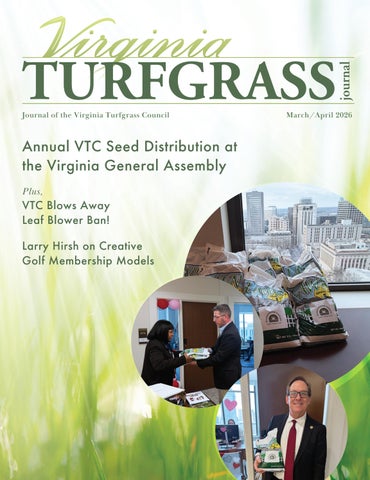
“We Annual Seed Distribution at the Virginia General Assembly

are so glad to see you all again!” was commonly heard in the halls of Virginia’s General Assembly Building. From elected officials to clerical staff, smiles appeared when they saw our wagons full of 3-pound bags of fescue seed. They knew a greener future awaited them! Kurt Fellenstein of Trinity Turf donated every one of those 350 bags of good will. Diligent and purposeful work, such as distributing seeds and Service Projects, have cultivated a very positive view of our industry among decision makers across the state. Make plans to join us at next year’s seed distribution.

Above: House and Senate Budget Leaders Received Grass Seed from the VTC on the 14th Floor
Below: VTC Board Members Visit with VDACS Leadership
Below: Board Members Sam Burris and Bruce Sheppard visit with General Assembly Staff

Assessing Application Error on Sports Fields Across Varying Levels of Sprayer Technology and Operator Experience

Figure 2. An inexperienced operator making an application using the GNSS sprayer at Southwood Park
Figure 1. The experienced operator making an application using the GNSS sprayer at Veterans Park
By Weston Floyd, CSFM, Megan Muesse, Hailey Tucker, Opeyemi Alabi, Jacob Winger, and Chase Straw, Ph.D. Department of Soil and Crop Sciences, Texas A&M University, College Station, Texas, USA

The

demand for precise input application and operational efficiency in turfgrass has driven the development of Global Navigation Satellite System (GNSS)-equipped sprayers, which offer several advantages over conventional systems. Features like individual nozzle control and automated operation within preset boundaries reduce the need for manual boom control, while enhancements such as sub-centimeter precision correction and autosteer further minimize human error.

Despite these benefits, GNSS sprayers have seen limited adoption in the broader turfgrass industry, with increased interest primarily in the golf course sector. Early adopters report benefits such as reduced treated area, shorter application times, less reliance on operator expertise, and improved accuracy. However, testimonials remain scarce in sports field management, where skepticism about the technology’s value persists.

As the sports field industry increasingly embraces sustainable practices and faces rising labor costs, the demand for technological solutions is expected to grow. Overcoming hesitancy toward new technologies will require extensive demonstrations to promote adoption. Currently, there is limited unbiased data on the benefits of GNSS-equipped sprayers for sports field managers.

This research aims to fill that gap by quantifying application errors on sports fields using different sprayer technologies and operator experience levels. The hypothesis is that as technology advances, discrepancies in misses, overlaps, and overspray will decrease, reducing the total sprayed area and minimizing differences between experienced and inexperienced operators.

Study design, equipment, and application process

Research was conducted from winter 2022 to summer 2023 in College Station, TX, at Veterans Park and Athletic Complex and Southwood Athletic Park. Identical studies were performed on softball/baseball and soccer fields at both locations. Using a crossover design, six treatments—manual, GNSS, and GNSS + autosteer sprayer technologies, each operated by both experienced and inexperienced operators—were applied to three fields of each type at both locations. Each field received all six treatments to evaluate technology performance across operator skill levels.

At Veterans Park, a Toro Workman 200 Spray System (18 ft. boom) with Ninja GPS Spray Control, a Smart7 GNSS receiver, and Polaris autosteer was used (Figure 1). At Southwood Park, a John Deere ProGator with an Above Par Tech sprayer (20 ft. boom), a GPS 7500 GNSS receiver, and SteadySteer autosteer was employed (Figure 2). Both sprayers featured correctional services, individual nozzle control, automatic rate control, on-screen guidance, and adjustable spray parameters.

One experienced operator with nearly 20 years of sports field spraying experience, including three years with GNSS and autosteer, was assigned to each location. Four inexperienced college students, new to both spraying and the technology, were assigned to specific locations and field types, ensuring their inexperience remained consistent. Each student received a 30-minute training session on sprayer controls before their first application.

Field boundaries were georeferenced once using the sprayers’ GNSS receivers to establish consistent target areas for all fields, aiding in GNSS and GNSS + autosteer treatments. The average target areas were 74,899 ft² for Veterans Park’s softball fields and 37,631 ft² for Southwood Park’s baseball fields, with soccer fields averaging 88,244 ft² and 33,644 ft² at Veterans and Southwood, respectively. Water was used for treatments at 65 gallons per acre, and designated level areas were marked for filling and draining the sprayers. Sprayers were filled to 150 gallons for Veterans Park and 80 gallons for Southwood, based on field size.

At Veterans Park, the dual-nozzle sprayer used FastCap 422FC11004 and 422FC11006 nozzles, while Southwood Park used a single-nozzle sprayer with COMBO-JET SR110-08 nozzles. The accuracy of the water volume in the tank was confirmed by measuring in five-gallon increments and validating the flow meters against the computer outputs before the initial treatments.

Treatment applications occurred from December 2022 to May 2023 at Veterans Park and from June to July 2023 at Southwood Park, depending on field availability and weather. To prevent tire tracks from being used as a guide, sufficient time was allowed between applications for the tracks to disappear. Sprayers operated at 2.5 mph, controlled by a speed regulator.

For manual treatments, monitors were covered, and foam markers guided operators, who manually controlled the booms. GNSS treatments used foam markers and on-screen maps, while GNSS + autosteer treatments added autosteer. Both GNSS treatments featured individual nozzle control, with a 100% overlap setting. After each treatment, remaining water was drained via valve and hand pump. Spray data were stored in the sprayers’ computers and later exported for analysis.

Data processing and analysis

The study measured target area misses, overlaps, and overspray. Data downloaded from the sprayer computers included field boundaries, sprayer paths, and coverage. The percentage of target area missed and overlapped was calculated by comparing the spray coverage to the field boundaries, excluding non-target areas. Missed areas were identified where no spray was applied and overlaps where sections were sprayed more than once. These percentages were then calculated as a proportion of the total target area. Overspray was calculated by subtracting the amount of water left in the tank after spraying from the initial volume. The percentage of overspray was determined by dividing the actual volume applied by the intended volume for the target area, then multiplying by 100. Any values over 100% indicated overspray.

The percent total volume saved between treatments was determined by subtracting the lower percentage from the higher one, dividing the absolute value of this difference by the higher percentage, and then multiplying by 100 to convert it into a percentage. For example, if treatment A used 105% of the intended volume (i.e., 5% overspray) and treatment B used 110% of the intended volume (i.e., 10% overspray), then the total volume savings by using treatment A is 4.6%, calculated as ((|105110|)/110)*100 = 4.6%.

Only the 422FC11004 nozzles were used at Veterans Park in manual mode because individual nozzle control could not be turned off when dual nozzles were active, resulting in a lower spray volume since the sprayer isn’t designed for single-nozzle operation. Therefore, the percent target area overspray was analyzed separately by location, as the manual total volume applied data from Veterans Park was unreliable. However, this issue did not affect the percent of the target area missed and overlapped, as spatial spray data were recorded for all treatments.

Misses, overlaps, and overspray on softball / baseball fields

The results for percent target area missed were similar across locations, so data were combined for treatments and locations. Inexperienced operators using manual sprayers had the highest percentage of missed areas (3.7%), while experienced operators showed no major differences across sprayer technologies. There was also no difference in missed areas between GNSS and GNSS + autosteer, regardless of operator experience. Southwood Park had more missed areas (2.4%) compared to Veterans Park (1.4%).

For percent target area overlapped, results differed by location, so data are presented separately for each. At Veterans Park, the manual sprayer used by inexperienced operators caused the highest overlap (8.3%). In other cases, both experienced and inexperienced operators performed similarly across sprayer technologies. As technology advanced, overlap decreased, with GNSS + autosteer reducing overlap to less than 2% (Figure 3).

At Veterans Park, overspray was similar between operators within each technology level, but advanced technology reduced overspray. GNSS + autosteer led to 2.1% overspray compared to 6.3% with GNSS, saving 4% of the total water volume. For inexperienced operators, autosteer reduced overspray by 3.3%.

At Southwood Park, there were no significant differences in overspray between operators within each technology level, but experienced operators generally had higher overspray. While there wasn’t a clear advantage between manual and GNSS

or GNSS and GNSS + autosteer, switching from manual to GNSS + autosteer significantly reduced overspray. For experienced operators, overspray dropped from 11.5% with manual to 6.5%, and for inexperienced operators, it dropped from 9.7% to 5.7%, resulting in a 3.7% reduction in total water used.

Misses, overlaps, and overspray on soccer fields

The results for percent target area missed on soccer fields were consistent across locations, so data were combined for treatment analysis. The manual inexperienced operator had the highest

percentage of missed target area (2.8%), which was higher than all other treatments. There were no differences in missed areas among experienced operators across any level of sprayer technology. Additionally, there was no difference in missed areas between GNSS and GNSS + autosteer, regardless of operator experience.

Similarly, the results for percent target area overlapped were consistent across locations, so data were pooled for analysis. The manual inexperienced operator had the highest overlap (6.4%), significantly more than the manual experienced operator (4.3%). The manual experienced operator’s overlap was similar to that of the GNSS inexperienced operator (3.6%), and both operator

Figure 3. Maps of target area overlapped on softball fields at Veterans Park across manual, GNSS, and GNSS + autosteer sprayer technologies (rows) and operator experience (columns).

types showed similar results within the GNSS and GNSS + autosteer technologies. Overlap decreased as sprayer technology advanced, with both operator types achieving less than 1% overlap using GNSS + autosteer (Figure 4).

The results for percent target area oversprayed differed slightly between locations, so data are presented separately. At Veterans Park, operator experience did not affect overspray with the GNSS sprayer, with both experienced and inexperienced operators having similar overspray rates (6.2% and 6.5%, respectively). However, the addition of autosteer reduced overspray to 2.3% for experienced

operators and 3.8% for inexperienced operators, resulting in total water savings of 3.7% and 2.5%, respectively.

At Southwood Park, overspray results were similar between operators within each sprayer technology level, though the inexperienced operator consistently had slightly higher overspray. For experienced operators, overspray decreased from 11.1% with manual to 8.3% with GNSS, but there was no further reduction with GNSS + autosteer (6.2%). For inexperienced operators, overspray dropped from 12.1% with manual to 10.2% with GNSS and further to 7.0% with GNSS + autosteer.

INEXPERIENCED OPERATOR EXPERIENCED OPERATOR

Overall, both operator types saw a reduction in overspray as sprayer technology advanced. Moving from manual to GNSS technology reduced overspray by 2.8% for experienced operators and 1.9% for inexperienced operators. Upgrading from GNSS to GNSS + autosteer reduced overspray by 2.1% for experienced operators and 3.2% for inexperienced operators. Switching from manual to GNSS + autosteer technology resulted in total water savings of 4.4% for experienced operators and 4.6% for inexperienced operators.

Recommendation for sports field managers

Inexperienced operators using manual spray mode had the highest rates of misses and overlaps, except for overlaps on Southwood Park’s baseball fields. GNSS and autosteer technologies significantly reduced these errors across all locations and field types (Figure 5). Standard deviations of misses and overlaps decreased with advanced technologies, especially when comparing inexperienced manual mode to GNSS + autosteer, indicating more consistent applications. Additionally, advanced technology reduced overspray and the total volume applied. Investing in GNSS-equipped sprayers with autosteer minimizes reliance on experienced operators, reduces errors, and enhances consistency. This study used factory settings, so further improvements might be possible by adjusting overlap parameters

Acknowledgements

The authors wish to extend their gratitude to the Texas Turfgrass, Research, Education, and Extension Endowment for providing funding for this study. They also want to express their thanks to GLK Turf Solutions and Traqnology for providing the Above Par Tech sprayer and real-time kinematic correction service, respectively, for use in the study. Additionally, appreciation goes to Stephan Richardson, the Parks Operations Manager of the City of College Station, Curtis Richmond, the Southwood Park Supervisor, Keith Fails, the Veterans Park Supervisor, and Ken Rost and Cam Schafer from Frost, Inc. for their support of this project.

Figure 4. Maps of target area overlapped on soccer fields at Southwood Park across manual, GNSS, and GNSS + autosteer sprayer technologies (rows) and operator experience (columns).
Southwood Park

x.com/theturfzone

Figure 5. An inexperienced applicator making a pass using manual mode (left) and GNSS + autosteer (right) on soccer fields at Veterans Park.

Creative Membership Models for Private Clubs

Among the intriguing elements of the private club world are the various membership models that exist. Of course, there are equity, where the members own the club and non-equity, where an investor owns the club; but within each category there are numerous variations. Clubs exhibit a wide variety of operating models, typically designed to suit their market, economics and their club culture.

Of late, a lot of the “news” in the private club world has come from the newly developed, uber upscale clubs often with entrance fees well into six figures, or even seven. Some have a partial refundability element, and as one might expect are very exclusive. However, of those I’ve encountered of late, I’d like to focus on a few I find intriguing as ways to help grow the game, encourage club membership and broaden golf’s appeal. Most contradict the concept of exclusivity that many clubs seek, but such exclusivity isn’t always for the best, either economically or socially.

Of interest in resort and vacation areas is the model I’ve encountered whereby placing your vacation home in the rental pool entitles the owner to a substantial discount on dues and guests and extended family members discounts on golf and other fees. Obviously, this creates financial incentive for property owners

to participate by reducing club dues but of course exposes the property owner to (usually short term) tenants and the risks inherent in same. With resort guests/renters also having access to club facilities, exclusivity is limited, however clubs with a variant of this model typically establish privileges, preferences, access or activities exclusive to members to establish and cultivate a culture of membership.

Among the more unique membership models I’ve (recently) heard about is one residential golf community club where resident members join the club but pay their initiation fee upon the sale of their home.

Another model which I’ve always found of interest is that often found in Scotland and other areas of the United Kingdom and Europe where even top clubs are much more inclusive than many in the US and rely on visitor fees for much of their revenue. The benefits of this model are that membership dues are maintained at more nominal levels, and the culture of the club is quite different than many elite clubs in the US. As Royal Dornoch General Manager Neil Hampton wrote in the club’s recent newsletter, “What I have always enjoyed about Royal Dornoch is that it is an inclusive club. There are so many different facets to the club, yet everyone comes together as one and has fun with each other. We have visitors playing seven days a week and invite them to share our courses and clubhouse just as we do. I think it is wonderful and epitomizes the Highland way, that we do not have separate areas for members or visitors and everyone mixes together, sharing their experiences.” Privileged to be a member at Royal Dornoch, I agree with his comments.

I’m sure there are many more I’m not yet familiar with.

One thing I’ve always maintained is that every club needs to know what it wants to be. To some, golf (especially club membership) is a status symbol, to others it’s an “everyman’s” game. At some clubs, one’s net worth is estimated halfway down the first fairway. Each club establishes, develops and maintains its own culture and that is often dictated by the extent of the club rule book which in turn can often determine the membership models for the club. At some clubs the financial commitment alone excludes many. At others it’s social status or heritage. At more inclusive clubs the membership is typically much more diverse.

One of the most creative membership models more prominent in past years was the refundable deposit where the member was entitled to the return of his entrance fee after a specified period of time or upon resignation based on certain conditions. While still available at some clubs, this option is quite sensitive (for the club) to economic fluctuations and fell out of favor in the preCOVID period from 2000–2020 when the golf/club industry was experiencing challenging times. Whether this experiences a resurgence will be interesting to see.

I’ve always fallen back on the definition of “club”. Webster’s dictionary most relevant and simple definition of a club is: to unite or combine for a common cause. At the clubs we’re talking about, that basically means social and athletic activities. Sometimes it’s much more complex than that.

linkedin.com/company/theturfzone

x.com/theturfzone

facebook.com/theturfzone

Turn static files into dynamic content formats.

Create a flipbook