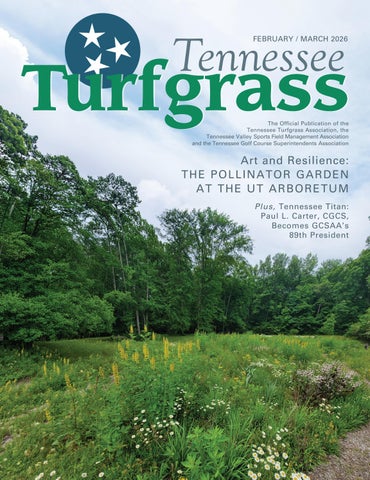
Tennessee Turfgrass - February / March 2026

Page 1


Bermudagrass

Where the Grass Grew Up with the Game

Baseball is tradition. NorthBridge® Bermudagrass is, too. With tough performance, vibrant color and rapid recovery, it’s the grass that stands up to cleats, crowds and summer after summer of America’s pastime.

GROW THE GAME ON NORTHBRIDGE.

“Guys will walk around barefoot before practice starts. And I think that’s one of the biggest compliments you can have.”

—BRENDAN SEAVER

Director of Field Operations - Columbus Clingstones

Every comeback starts from the ground up.

Growing Strong As

we start the year, I am honored to be the new President of our Association, and I look forward to the challenges and growth that lie ahead. Having served on the Board of Directors for the past 10 years, I have been able to meet people all across our state through our association. The unique mix of knowledge that is available to us through our diverse members in sports turf, golf courses, sod production, and our industry partners is what makes our association special. When you combine this with the research, education, and extension work that the University of Tennessee provides, our association becomes the central organization across the state for all things turfgrass related.

I am happy to report that the 60th Annual Tennessee Turfgrass Association Conference and Show was another success this year. It is amazing to see our conference continue to grow as we had well over 550 registrants this year, and we once again sold out our entire tradeshow floor space. Thank you to everyone on the Board of Directors for working together to make this year excellent, and to our industry partners who support our efforts each year. I also want to say an extra thank you to our Executive Director Melissa Martin and to Dr. Becky Bowling, the head of our education committee. They both do an amazing job keeping us all on track, and they spend a lot of time working behind the scenes to make the conference a success.

As the Spring season is upon us, I hope everyone has a chance to get out and visit other members and take advantage of all TTA has to offer. Take some time to get out of your comfort zone and see what others are doing, either in your area or across the state. Together, we all make up the turfgrass industry.

TTA President

Golf Course Superintendent

Holston Hills Country Club

The Tennessee Turfgrass Association serves its members in the industry through education, promotion and representation. The statements and opinions expressed herein are those of the individual authors and do not necessarily represent the views of the association, its staff, or its board of directors, Tennessee Turfgrass Magazine, or its editors. Likewise, the appearance of advertisers, or Turfgrass Association members, does not constitute an endorsement of the products or services featured in this, past or subsequent issues of this quarterly publication. Copyright © 2026 by the Tennessee Turfgrass Association. Tennessee Turfgrass is published bi-monthly. Subscriptions are complimentary to members of the Tennessee Turfgrass Association. Third-class postage is paid at Jefferson City, MO. Printed in the U.S.A. Reprints and Submissions: Tennessee Turfgrass allows reprinting of material. Permission requests should be directed to the Tennessee Turfgrass Association. We are not responsible for unsolicited freelance manuscripts and photographs. Contact the managing editor for contribution information. Advertising: For display and classified advertising rates and insertions, please contact Leading Edge Communications, LLC, 206 Bridge Street, Suite 200, Franklin, TN 37064, (615) 790-3718, Fax (615) 794-4524.

Tennessee Turfgrass is the official publication of The Tennessee Turfgrass Association

400 Franklin Road

Franklin, Tennessee 37069 (615) 928-7001 info@ttaonline.org www.ttaonline.org

PUBLISHED BY

Leading Edge Communications, LLC

206 Bridge Street Franklin, Tennessee 37064 (615) 790-3718

info@leadingedgecommunications.com

EDITOR

Dr. James Brosnan

TTA OFFICERS

President Ryan Storey Line to Line LLC

Vice President

Ryan Blair, CGCS Holston Hills Country Club

Secretary / Treasurer

Bart Cash Crossroads Sod Farm

Past President

Chris Sykes

PGA Golf Club

Executive Director

Melissa Martin

Tennessee Turfgrass Association

TTA BOARD OF DIRECTORS

Adam Adkins

Jason Bradley

Ben Dodd

Dan Johnson

Cal Hill

Jeff Huber

Bill Marbet

Wells McClure

Bob McLean

William Newsom

Kevin Noble

Mark Stovall

John Wagnon

Jeff Wyatt

TTA ADVISORY MEMBERS OF THE BOARD

Bill Blackburn

Dr. Jim Brosnan

Joe Hill

Dr. Brandon Horvath

Lynn Ray

Jeff Rumph

Dr. Tom Samples

Dr. Dennis Shepard

Dr. John Sorochan

Dr. Wes Totten

THE POLLINATOR UT ARBORETUM GARDEN AT THE RESILIENCE: ART AND

Figure 1. The plot of ground near the Auditorium selected for the Pollinator Garden. Image courtesy of Google Earth.
Figure A. Aerial view of the Pollinator Garden and Visitor Center.

Asour relationship with Nature and access to natural spaces have become increasingly constrained by urban and suburban growth, we have seen a growing desire by homeowners, parks and municipalities for naturalistic landscapes that showcase plants as communities. This naturalistic planting design often seeks to abstract naturally occurring ecological habitats and put them in a context that, allows people to interact with the plants and their associates in more intentional ways.

Pocket prairies, urban meadows, pollinator gardens, even rain gardens can serve these naturalistic functions that whether in bloom or in winter dormancy, can inspire the heart and captivate the mind.

One such place is the Michelle Bradley Campanis Pollinator Garden at the UT Arboretum in Oak Ridge, Tennessee (Figure A). The pollinator garden has developed into something really special during the last five years. In many ways this special garden resource serves as a prime example of resilience in design and the blending of that resilience with the art of landscape and planting design.

My involvement with this project dates back to June 2020. At the time I had been at the University of Tennessee for almost a year and with covid, all educational programs, field days, master gardener and outreach events had moved online. I had been asked by the UT Arboretum team to give a talk on ecological landscape design. During the presentation I mentioned that I thought there should be a wildflower center in every state. This was something I brought up during my job interview back in 2019. I still feel strongly about that need. At the talk in 2020, the idea of a wildflower center for Tennessee resonated with Michelle Campanis, who is the Education Coordinator at the UT Arboretum who was at the zoom meeting. She reached out and said they had an area at the Arboretum that would be a great place for a meadow…would I be interested in helping to create it?

And so began a multi-year collaboration with the UT Forest Resources AgResearch and Education Center (REC), Tennessee Naturescapes, undergraduate PLSC students from the Sustainable Landscape Design concentration in the Herbert College of Agriculture, and graduate students from the School of Landscape Architecture in the College of Architecture and Design.

Brainstorming and Breaking Ground: Planning the First Steps

Our initial discussions centered around a stretch of ground that was next to the recently constructed auditorium and its extensive rain garden. The ground that was identified had become a field of invasive plants, weeds, and assorted woody shrubs and small trees. The team’s idea was to create a space that provided visual appeal from the auditorium and that also would contribute to future educational programs that, like the rain garden, could be focused on sustainable and resilient landscapes.

In keeping with that charge, it was determined that in addition to shedding the invasive field (Figure 1) we would use fire, herbicide, and solarization as ways to suppress the significant invasive species pressure on the site. Michelle led volunteers through weeding and prepping the site, Kevin Hoyt, the director of the UT Forest Resources AgResearch and Education Center and the Arboretum staff oversaw bush hogging, prescribed burns, and pesticide application. Don Williams and Tennessee Naturescapes provided the solarization material and I began working with students and research assistants to develop initial plant lists (Figure 2).

Figure 2. A data sheet records counts of plant species that reflects dynamic change in the pollinator garden compared with the list of initial installed plants.

The key to successful projects like this one that relies on using abstracted ecosystems is the ability to convey the concept across all collaborative partners. The effective control of invasive and weedy species in the selected site and the shared vision for the pollinator garden were essential for keeping the project moving forward across the last four years.

Art and Resilience in Landscape Design

An intentional landscape plan is at its most evocative when it marries art and science to varying degrees to bring about experientially rich moments for people to interact with their designed surroundings. It can take the form of extravagant fountains and terracing like the Italian renaissance garden at Villa d’Este (Figure 3) or the over-the-top grandeur of French baroque landscape designs of master paysagiste, Andre Le Notre, or perhaps our more familiar works from Frederick Law Olmsted and Jens Jensen. However, as evocative as these landscapes are, they were not conceived within a conceptual framework that accounted for an understanding of ecology as a discreet science nor to anticipate disturbance regimes that included wildfire, site construction, drought or flooding.

This is precisely where the pollinator garden fits into our contemporary sphere of landscape design practice (Figure 4). The art of planting design, the artful shape, color, and texture of the plants utilized balanced with the realities of ever-changing precipitation, management regimes, unpredictable weather and scheduling approvals for prescribed burn permits, and fluctuating volunteer schedules and knowledge bases. All impact the success and perception of the project.

At the end of the day, the pollinator garden must be both beautiful and functional. It must serve the educational and ecological goals of the REC, as well as benefitting the casual visitor to the Arboretum. It needs to support the well-attended annual Butterfly Festival and other University field days that are part of the education and outreach component of the land grant mission that the REC serves. It must above all support pollinators and their diverse life histories. The resilience and the art must be linked for the project to succeed.

Figure 4. An early concept sketch of the Pollinator Garden as a functioning ecological system and interactive space.
Figure 3. The fountain and gardens at Villa d’Este estate in Italy.

Experience Superior Turf with TifTuf ®

In just seven years, TifTuf®’s installation of over 2 billion square feet has saved more than 48 billion gallons of water. It’s the only Bermudagrass to top National Turfgrass Evaluation Program trials 93% of the time, far ahead of Tahoma at 73%. Recognized for its drought tolerance, TifTuf® is the USDA Specialty Crop Research Initiative’s standard for future university testing and has earned the #1 ranking in the USDA/NTEP ET-Based Water Deficit Research Trial.

TifTuf ®’s water efficiency has garnered numerous awards, including the Smart Approved Water Mark from Australia’s Water Services Association, the Georgia House and Senate’s Extraordinary Water Conservation award, and the

Georgia Association of Water Professionals’ Water Wise Award. It’s also named the Turfgrass of Choice by Southern Living Inspired Communities.

TifTuf® is the most produced proprietary Bermudagrass globally, with more produced in the U.S. than all other varieties combined worldwide. It is the preferred choice for new golf courses, sports fields, and residential and commercial landscapes, and it’s the only Bermuda

sold through Home Depot and Lowe’s by Harmony Outdoor Brands.

While others check boxes, TifTuf® redefines them. Experience the exceptional quality and innovation of TifTuf® turfgrass.

D EXPERIENCE JAKOB’S Student’s Perspective –

uring my time at The University of Tennessee I have had the opportunity to work with professors who saw the value of engaging students in projects with real world implications. In our digital age the value of hands-on learning experiences is exponentially important. With the reality of the direction of education experiences that can now be fully gained online, the value of face to face or hands to dirt learning is something that can never be fully replaced. There is immense importance in actually seeing how hard work can lead to the physical manifestation of an idea.

As I was nearing the end of my undergraduate studies in Sustainability, I was still unsure of how I wanted to utilize the knowledge I had gained in the classroom. Through a series of experiences being on site and taking the classroom outside to the world I discovered my true passion. My first experience with the UT meadow began in April 2022, while I was pursuing my undergraduate degree in sustainability with a minor in plant sciences. During this first visit to the arboretum I didn’t know much about real world implementation of planting design…I knew how to dig a hole to its proper depth and to break up root bound plants, I knew how to identify certain plants that I was looking at, I knew the value in what these ecosystems provide, and I knew that I was excited to be a part of something bigger than myself. During this initial phase of the project I had the opportunity and guidance of Mike to mark out the boundaries for the planting zones, strategically stage the plants so there was structure, areas of reveal and lines of sight. Tasks that may seem minor to the average gardener, but these tasks would help jumpstart my pursuit of a career in Landscape Architecture.

The next visit to the UT Arboretum was as a class, we began the laborious process of digging hundreds of holes for the plugs and containerized plants with the hope that the site would become a place where people and nature can meet or reconnect.

Getting the opportunity to work under someone that is so knowledgeable in a field of study which aims to build and support communities of people and plants was an honorable task. It taught me that it was much more than just placing plants in the landscape, it was conversations about the plant communities and the species they support, the structural variation creating moments of wonder and others of reveal, it was about the intentionality of having bursts of color in moments along the path, and conversations about how amazing this place will be. It was through these types of conversations I was ignited with an inspiration that I too could gain these skills and knowledge to create places that provide beauty to our world while creating opportunities for essential ecological services to be provided.

Upon graduating with my degree in Sustainability I began a summer job in landscape construction and that fall would begin my pursuit of my master’s in landscape architecture. After about 3 years from the time I first helped plant at the arboretum I was invited back, this time to utilize the skills and knowledge I had been gaining through graduate school. My task this time was to help establish formalities in the design that assist in creating a sense of arrival into the meadow, as well as create opportunities for gathering. Through the collaboration and support of Michelle Campanis and Kevin Hoyt and oversight of Mike Ross I was entrusted with my first stand-alone landscape construction project. With the use of recycled on-site stone, I constructed planter beds to support Tiger Eye Sumac specimens (Rhus typhina ‘Bailtiger’, pictured below) to create a gathering space in the middle of the meadow. The entrance for the meadow was designed by Mike Ross and Margaret Mando (a fellow UTK School of Landscape Architecture student) and I was given the opportunity to do detailed construction design, material selection and sourcing as well as the actual building of the entrance. It has allowed me to create, to problem solve and to feel the fulfillment of turning something from just an idea on paper into a physical manifestation in the landscape. From my first experience of walking into a barren field of dirt to walking through the meadow and seeing a diverse mix of Carolina lupine, rattlesnake master, columbine, bee balm, big blue stem, husker red penstemon, false blue indigo, milkweed, mountain mint, and many more plants, I have sharpened my skills and sensibility as a designer, I have built relationships with people and the land, I have deepened my appreciation for our natural world and more importantly found a cause that I want to dedicate my life to…. creating places where people can feel a sense of wonder, beauty, peace and learn with nature. Through the opportunity and foresight of people like Michelle Campanis, Kevin Hoyt, Mike Ross and many more I have realized the true power and impact that a single experience of hands-on learning can provide to someone that is still learning and developing their place in the world. For these experiences I am eternally grateful.

Above, inset: MLA student Jakob Johnson

The Significance of People as Part of an

Informed Design Process

A key component in this project has always been the students and volunteers who have dedicated so much time and invested so much of themselves to this undertaking. Whether planting, weeding, constructing, maintaining accessible circulation, or controlling invasive plants; through their efforts we have been able to make this project happen. With that said, I think it is particularly meaningful when the work allows student interactions with the garden to reinforce and teach meaningful skills that can shape their own understanding of the profession of landscape design and management (see Jakob’s Experience sidebar, page 12). Students working as part of the Living Systems Design Group and the Ross lab developed plans, researched plant material, learned how to design on-site, set up and space plants, use technology, review spreadsheets, and managed the prairie and meadow ecosystem establishment.

In some cases, I would bring my graduate and undergraduate classes out to help with planting (Figure 5). More than once, I had the distinct honor of teaching a beginner student how to plant a plant. While this may seem small or trivial, it illustrates how even students who are drawn to landscape and horticulture may have had very limited past opportunity to plant, grow, and interact with vegetation beyond the occasional house plant.

The work we have undertaken at the UT Arboretum has shaped the professional practice and career aspirations of many students. This outcome is further evidence of the immense value that hands-on experiential learning has for future designers, landscape architects, professional gardeners, horticulturists, and landscape managers (Figure 6).

Ongoing Lessons Learned in Managing a Designed Ecological System

As the pollinator garden has continued to establish and grow, there have been key management and maintenance decisions that we have made that will shape its long-term success. First and foremost, controlling invasive and weedy plant encroachment is key to maintaining the structure and visual impact of the garden. Woody plants, even native ones, can markedly change the form and structure if allowed to establish in the meadow. While intentional use of woody plants for their structural and aesthetic

An undergraduate student has marked a plot and arranged several specimens of different plant species to “fit” within the architecture of the original as-planted design.

6. A group of students in Associate Professor Ross’s PLSC 480 Sustainable Landscape Design Synthesis and Application class gain firsthand experience in learning the in’s, out’s, and how to’s of transplanting native perennial plants into the pollinator garden. For some students, the opportunity was a first for getting their hands dirty as future Green Industry professionals.

Figure 5.
Figure

contributions must be maintained, careful removal of woody seedlings plus annual burning (Figure 7) has helped us keep the invasive and weedy plants in check. Fire, manual removal, ethical and judicious use of herbicides each contribute key roles in controlling plant compositions throughout the garden.

Some species, such as goldenrods (Solidago sp., dogfennel (Eupatorium capillifolium), and asters (Symphyotrichum and Eurybria sp.) were always planned to be intentional parts of the project, yet these plant species were not intentionally planted or purchased; we knew from past experience that these species would naturally find their own way into our meadow plots and could be expected to colonize on their own. By that same logic, our expectation has also meant that some individuals of these species can show up anywhere and can regenerate in great profusion if left unmanaged. For these plant species, proper thinning, selective removal, and well timed cutting all aid in keeping these important pollinator plants behaving as good neighbors to the rest of the meadow community.

Additionally, when plants are weeded and pulled up, native seed from flowering annual species that we intend to keep well represented in the design, are purposefully re-applied into areas of soil disturbance. In this way, there is propagule competition with the weedy species, and this interaction helps to offset the natural suppressive effect of longer-lived perennial plants on early colonizing annuals.

Finally, because the garden exists as an interactive educational space, maintaining and managing circulation and pathways is an ongoing task. Plants mature and spread, sometimes obscuring pathways or sprawling into areas that are intended for more contemplative experiences. Thinning and plant relocation are important tasks needed for keeping the structure and design vision in place.

All of this effort is dependent on volunteers and students who are coordinated by Michelle Campanis. Through continued effort and dedication, the garden is establishing nicely and keeping the vision flexible and resilient while not losing sight of the initial concept.

A Look Into the Future

As the project moves forward through the establishment and management phase, plants will continue to be added or subtracted. This is necessary to restate important design concepts, improve the aesthetic appeal, and keep up with the educational opportunities and needs of the UT Arboretum and REC.

Figure 7. Undergraduate students in FORS 305 Prescribed Fire Management class work under direction of Dr. Jennifer Franklin, Professor in the UT School of Natural Resources to safely apply prescribed fire to manage invasive woody plant weeds and winter annual weed seedlings in the Pollinator Garden.
The Michelle Bradley Campanis Pollinator Garden at the UT Arboretum in Oak Ridge, Tennessee.

linkedin.com/company/theturfzone

x.com/theturfzone

facebook.com/theturfzone

Final Thoughts

The first formal discussions of this project that I was involved in began in June 2020 and this coming spring of 2026 the project receives its official name, the Michelle Bradley Campanis Pollinator Garden. While its official establishment date is attributed to 2022, the reality is that projects like this take years of dedicated work, advocacy, and commitment by many people, professionals, students and volunteers.

We would like to thank Michelle Campanis, Don Williams, Kevin Hoyt, Jakob Johnson, Hailey Wright, JD Zimmerman, and my students past, present, and future that have and will work on the pollinator garden to help care for it into the future.

ADDITIONAL READING

Ludwig, A., Ross, M., Roark, M., Choi, S. 2023. W1137 Rain Gardens for Tennessee: A Homeowner’s Guide. UTIA Extension Bulletin.

Ross, M., Zimmerman, J. 2023. Achieving Sustainability in the Landscape: The Sustainable SITES Initiative. Tennessee Greentimes, 24(4) Winter 2023

Ross, M., Roark, M. 2021. Cleaner Water Through Site-Specific Floating Treatment Wetlands. Tennessee Greentimes. 22(3) Fall 2021.

Ross, M. 2020. Restoring Client Experience with the Natural World. Tennessee Greentimes. 21(4) Fall 2020.

For Volunteer Opportunities at the UT Arboretum: Please contact Michelle Campanis, University of Tennessee Arboretum Education Coordinator, mcampani@utk.edu

Your Water Partners

Chris Vincent, CGCS Southeast Territory Manager cvincent@aquatrols.com (919) 901-7348

THE TURFGRASS TEAM AT THE UNIVERSITY OF TENNESSEE, KNOXVILLE

José Javier Vargas Almodóvar Research Associate II Turf & Ornamental Weed Science

The University of Tennessee 2431 Joe Johnson Drive 252 Ellington Plant Sci. Bldg. Knoxville, TN 37996 (865) 974-7379 jvargas@utk.edu tnturfgrassweeds.org @UTweedwhisperer

Greg Breeden Extension Specialist, The University of Tennessee 2431 Center Drive 252 Ellington Plant Sci. Bldg. Knoxville, TN 37996-4561 (865) 974-7208 gbreeden@utk.edu tnturfgrassweeds.org @gbreeden1

Jim Brosnan, Ph.D. Professor, The University of Tennessee Director – UT Weed Diagnostics Center 112 Plant Biotechnology Bldg. 2505 EJ Chapman Drive. Knoxville, TN 37996 Office: (865) 974-8603 tnturfgrassweeds.org weeddiagnostics.org mobileweedmanual.com @UTturfweeds

Kyley Dickson, Ph.D. Associate Director, Center for Athletic Field Safety Turfgrass Management & Physiology (865) 974-6730 kdickso1@utk.edu @DicksonTurf

Midhula Gireesh, Ph.D. Assistant Professor and Extension Specialist Department of Entomology and Plant Pathology

The University of Tennessee UT Soil, Plant and Pest Center 5201 Marchant Drive Nashville, TN 37211 mgireesh@utk.edu (615) 835-4571

Becky Bowling, Ph.D. Assistant Professor and Turfgrass Extension Specialist The University of Tennessee 112 Plant Biotechnology Bldg. 2505 E.J. Chapman Dr. Knoxville, TN 37919 (865) 974-2595 Rgrubbs5@utk.edu @TNTurfWoman

John Stier, Ph.D. Associate Dean

The University of Tennessee 2621 Morgan Circle 126 Morgan Hall Knoxville, TN 37996-4561 (865) 974-7493 jstier1@utk.edu turf.utk.edu @Drjohnstier

Brandon Horvath, Ph.D. Associate Professor, Turfgrass Science

The University of Tennessee 252 Ellington Plant Sci. Bldg. 2431 Joe Johnson Drive Knoxville, TN 37996 (865) 974-2975 bhorvath@utk.edu turf.utk.edu @UTturfpath

John Sorochan, Ph.D. Professor, Turfgrass Science The University of Tennessee 2431 Joe Johnson Drive 363 Ellington Plant Sci. Bldg. Knoxville, TN 37996-4561 (865) 974-7324 sorochan@utk.edu turf.utk.edu @sorochan

Nar B. Ranabhat, Ph.D. Assistant Professor and Extension Plant Pathologist Department of Entomology and Plant Pathology

University of Tennessee UT Soil, Plant and Pest Center 5201 Marchant Drive, Nashville, TN, 37211 (615) 835-4572 nranabhat@utk.edu @UTplantPathoDoc

Keele

Carolina Green Corp. 19 www.cgcfields.com

Coosa Valley Turf Farms 23 www.coosavalleyturffarms.com

Corbin Turf & Ornamental Supply 17 www.corbinturf.com

Crossroads Sod Farm 18 www.csfsod.com

Greene County Fertilizer Co. 19 www.greenecountyfert.com

Leading Edge Communications 29 www.LeadingEdgeCommunications.com

McCurdy Sod Farms, LLC 27 www.mccurdysodfarms.com

Regal Chemical Company Back Cover www.regalchem.com

Smith Seed Services 21 www.smithseed.com

Smith Turf & Irrigation 5 www.smithturf.com

Sod Solutions 3 www.SodSolutionsPro.com

Super-Sod 7 www.supersod.com

Sur-Line Turf, Inc. 21 www.surlineturf.com

The Aquatrols Company 16 www.aquatrols.com

The Turfgrass Group 11 www.theturfgrassgroup.com

The Turf Zone 15 www.theturfzone.com

Tri-Turf Sod Farms Inside Back Cover www.triturfsod.com

Trimax Mowing Systems 27 www.trimaxmowers.com

Turf Mountain Sod, Inc. 23 www.turfmountain.com

Winstead Turf Inside Front Cover, 30 www.winsteadturffarms.com

Turf

SPRING WITHOUT THE STARTUP SCRAMBLE

A Simple Operating Plan for Your Busiest Season

Spring can feel like a wild sprint in the turfgrass industry. Demand rises fast, the weather shifts by region, and crews are expected to move from preparation to production with little margin for error. Whether you own a large landscape company, supervise grounds, or work independently, the same business question pops up this time of year: how do you stay organized when everything speeds up at once?

Tennessee makes this even more important because spring does not look the same across the state. Both cool-season and warm-season grasses are grown in Tennessee, with cool-season grasses performing best in spring and fall, while warm-season grasses are slower to green up in spring and grow best in summer. That means your startup plan needs to align with your region, turf type, and service mix, rather than relying on a single statewide timeline.

Here is a framework for all types of turfgrass managers:

1. Set your spring capacity before you fill the calendar.

A full schedule doesn’t always mean a profitable schedule. Start by estimating what your team can realistically handle each week based on labor hours, travel time, equipment availability, and the complexity of your work. For a sports turf manager, this may mean planning field preparation windows around game schedules and weather. For a landscape business owner, it may mean separating recurring maintenance from installation work so one category does not disrupt the other. For an independent operator, it may mean limiting new clients until recurring customer routes stabilize.

This step helps you avoid the spring trap of saying yes too quickly and spending the next six weeks fixing preventable delays. It also gives you a better basis for quoting timelines, setting expectations, and deciding whether to outsource any work.

2. Build a startup checklist for equipment and supplies.

Spring problems often look like labor problems when they are really equipment and supply problems. A mower down for two days can throw off an entire route. A missing part can delay an athletic field prep. A late material delivery can create a client communication issue that your team then has to manage.

Create one checklist for startup readiness and assign dates to each item. Include inspections, maintenance, blade sharpening, tire checks, calibration, backup equipment options, and commonly used supplies. If you manage a crew, assign ownership to specific people and confirm completion in writing. If you work alone, schedule this work like billable time because it protects billable time later.

The goal is not perfection. The goal is fewer surprises when everyone needs service at once.

3. Standardize your onboarding before hiring pressure hits.

Many businesses wait until they are short-staffed before considering training. Spring is the worst time to build onboarding from scratch. A simple onboarding process can help new hires become productive more quickly and reduce the burden on your strongest crew members.

Keep it practical. Focus on safety, equipment basics, site expectations, communication standards, and what good work looks like in your operation. For sports turf settings, include event-day expectations and the chain of communication. For landscape crews, include job-site photos and quality examples. For independent operators who occasionally bring in help, use a one-page field guide that outlines your process and customer standards.

Education is one of the strongest retention tools available because it helps people build confidence and feel invested in their work. It also protects quality when the pace increases.

SPECIALIZING IN:

4. Protect your schedule with proactive client and stakeholder communication.

Spring startup gets harder when communication becomes reactive. A short round of outreach before your busiest stretch can prevent many avoidable issues. Confirm service windows, clarify what is included, and explain what may shift due to weather or field use.

For sports turf professionals, this can mean a quick pre-season update to athletic directors, coaches, or facility contacts about timelines, field conditions, and scheduling limits. For contractors, it can mean a reminder about spring demand, response times, and approval timelines for add-on work. For independent operators, it can mean confirming your route days and the best way to reach you for non-urgent requests.

Clear communication reduces interruptions and helps people understand that good turf outcomes require planning, timing, and patience.

5. Track a small set of weekly numbers.

You do not need a complex dashboard to run your Spring startup well. You need a short list of numbers that tells you whether your plan is holding up. Pick metrics that align with your role and review them weekly.

EXAMPLES INCLUDE:

• labor hours scheduled versus labor hours worked

• completed jobs or field tasks versus planned

• equipment downtime

• callbacks or rework

• weather delays

• material usage on high-volume items

• outstanding approvals or invoices

These numbers help you spot problems early. If labor hours are running high every week, your route density or staffing plan may need adjustment. If callbacks spike, training or quality checks may need attention. If equipment downtime keeps increasing, preventive maintenance may be slipping.

6. Build your plan around your market, not a generic template.

The turf and landscape industry is broad, and that matters for business planning. NALP (National Association of Landscape Professionals) reports that the landscape services industry reached a market size of $188.8 billion in 2025 and includes more than 692,000 landscaping service businesses. That scale reflects a wide range of business models, from solo operators to larger firms, along with very different customer expectations across markets.

A startup plan that works for a municipal sports complex may not fit a residential landscape route. A plan that works in one region may need adjustment in another. The NC State Extension puts it plainly: “No one type of grass is best suited to all situations.” The same principle applies to operations. Build your plan around your turf, clients, team, and region.

A practical spring takeaway…

Spring will always be busy. While we can’t remove the pressure, we can reduce preventable chaos.

A simple operating plan can do that. Set your capacity, prep equipment early, standardize onboarding, communicate before problems start, and track a few meaningful numbers. These steps require intention, and they pay off when the season starts moving faster than expected.

In a profession built on timing, spring success often starts before the first rush arrives.

CALENDAR OF EVENTS

MAY 5

Turf Tuesdays: A Historic Career in Turfgrass Management

Location: Virtual

Points offered?: Yes

More Information: https://www.tnturfgrassweeds.org/turftuesday

Contact: Dr. Jim Brosnan, jbrosnan@utk.edu

MAY 15

Grounds Management Short Course (Day 2)

Location: Knoxville, TN

Points offered?: Yes

More Information: https://knox.tennessee.edu/grounds-management

Contact: Knox Co. Extension Mr. Lee Rumble 865-215-2340 or drumble@utk.edu

COOSA VALLEY TURF

JUNE 2

Turf Tuesdays: Sports Turf Management Across Tennessee

Location: Virtual

Points offered?: Yes

More Information: https://www.tnturfgrassweeds.org/turftuesday

Contact: Dr. Jim Brosnan, jbrosnan@utk.edu

JUNE 11

Green Industry Field Day

Location: Knoxville, TN

Points offered?: Yes

More Information: https://plantsciences.tennessee.edu/ green-industry-field-day

Contact: Dr. Amy Fulcher, afulcher@mail.tennessee.edu or Tennessee Nursery and Landscape Association (931-473-3951)

TENNESSEE TITAN

Paul L. Carter, CGCS, Becomes GCSAA’s 89th President

Carter sets sights high for the association’s Centennial year.

GCSAA might be a professional association built by and for folks in the golf course management profession, but the way the 100-year-old association’s new president sees it, GCSAA’s reach goes much, much farther.

“We’re carrying the torch,” says Paul L. Carter, CGCS, “for everyone involved in golf.”

And now Carter is the lead torchbearer.

Carter, superintendent at The Bear Trace at Harrison Bay in Harrison, Tenn., director of agronomy for the nine-facility Tennessee Golf Trail and a 33-year association member, officially became GCSAA’s 89th president during the GCSAA Conference and Trade Show in early February in Orlando.

He’s stepping into the role as the association rolls into its Centennial year.

GCSAA members are seeing the benefits of several new or expanded programs, like a focus on career pathways, crew development, advocacy, continuing education, best management practices and diversity. That GCSAA Conference in Orlando saw a record number of seminar seats and nearly 13,000 attendees, a fourth straight year of growth. Membership, well over 21,000, is nearing an all-time high.

No wonder Carter enters his presidential year with both appreciation for the past and aspirations for the future.

“GCSAA is the golf course superintendents’ association, but it has to do with everyone who’s involved in golf,” he says. “It’s great to see where we are and where we’re heading, and I feel very blessed and very honored to be in this position.”

‘He had a knack’

Carter wasn’t always such a champion for the golf course superintendent.

In fact, the profession wasn’t even on his radar when he enrolled at Auburn University, intent on studying horticulture.

He recalls that, early in his Intro to Horticulture class, students went around the room, saying who they were, where they were from and what their professional aspirations were.

“As they introduced themselves and talked about their post-college plans, I thought, ‘This is a lot of competition,’” Carter recalls.

His introduction to golf course management was “pretty much an accident.”

One day, a guest speaker, Coleman Ward, Ph.D., visited the class. His son was a golf course superintendent, and Ward talked about turfgrass management.

GCSAA President Paul L. Carter, CGCS, has been superintendent at The Bear Trace at Harrison Bay in Harrison, Tenn., since 2001. Photos by Justin Wojtczak

That sparked something in Carter.

“I talked to one of my advisers, who said there’s horticulture work in golf courses,” Carter says. “He said, ‘You can be on a golf course and do horticulture work.’”

That’s exactly what Carter thought he’d be doing when he landed an internship at the Country Club of Birmingham in Birmingham, Ala., working under Lee McLemore, CGCS.

Carter reported for duty and was immediately put to work — on the golf course management team.

“I was green as anything,” Carter says. “The first five or six days, I’d done all golf course work. I thought maybe it was some sort of orientation. I went to Lee and said, ‘I thought I was going to be on the horticulture crew.’ He said, ‘No, there’s no room on the horticulture team.’ By that time, I’d already mowed greens and everything and thought, ‘This might be more fun than horticulture.’”

McLemore, a 40-year GCSAA member, is still the CC of Birmingham’s director of golf course operations. Like Carter, McLemore interned there while he was a student at Auburn. Hired there upon graduation as an assistant, McLemore immediately interviewed for the head superintendent job when it became open. “I was an assistant for about four-and-a-half, five weeks,” McLemore says.

That was 39 years ago. Over that span, the club’s robust internship program has brought in about 110 interns, McLemore says.

Carter was among those few who stood out.

“Obviously, he was smart,” McLemore says. “He was driven. Sometimes you get those young guys, and sometimes it’s hard getting them to focus on the right things. But you could see he had something special then. You always remember the good ones. Unfortunately, you remember the bad ones, too, but he was one of the good ones. He had a knack.”

Making his way

After graduating from Auburn, Carter became first assistant superintendent at Valley Hill Country Club in Huntsville, Ala., under Jeff Lee, CGCS. That’s where Carter met his wife, Melissa. Carter later became an assistant under former CC of Birmingham assistant Paul Hood at Willow Creek Golf Club in Knoxville, Tenn.

He landed his first head superintendent job at Medalist of Avalon in Lenoir City, Tenn., a move that quickly turned into a learning experience.

“That was one of those life lessons where it sounds good, it looks good on paper, they’re throwing a big chunk of money at you,” Carter says. “I thought, ‘I’m ready.’ Riding the golf course that day, I had my doubts. I took the job. I lasted about a year.”

Carter wasn’t let go, but sensing he might soon be, he submitted his resignation.

“That was one of those blessings that doesn’t seem like a blessing at the time,” he says. “But it taught me to listen to your instincts and listen to other people.”

Carter kicked around a bit, working on another ground crew and eventually being hired as landscape superintendent for Council Fire Golf Club in Chattanooga, Tenn. (Melissa’s twin sister lives there, “So it wasn’t a hard sell,” Paul Carter says.)

Carter ran a three-man crew tending to residences and townhomes at Council Fire GC before he was contacted about the superintendent job at The Bear Trace at Harrison Bay. The superintendent then was splitting time between there and The Bear Trace at Cumberland Mountain — a bit of a hike; it’s even in a different time zone — and Tim Brock, then equipment manager at Cumberland Mountain and now superintendent at Deer Creek Golf Club in Crossville, Tenn., remembered Carter from their time together at Willow Creek.

“He said, ‘Why don’t you give Paul a call and see if he’s interested,’” Carter says. “That’s how I came out here, how I got to this point.”

But it wasn’t without a bit of trepidation.

Carter visited The Bear Trace at Harrison Bay and played a round in early 2001 with Council Fire GC superintendent Gary Weller. They found the course … needed some work.

“We talked about me taking this job, and Gary said, ‘Are you sure you want to do this?” Carter says. “I was married and felt I needed to provide more than I was, and I saw this as an opportunity to get back in golf, so I accepted. Sometimes I need to learn the same lessons a few times.”

Carter met his wife, Melissa, when he was an assistant at Valley Hill Country Club in Huntsville, Ala.

Eating the elephant

Borrowing again from previous lessons, Carter set to work improving the course.

“There was a lot of work to be done,” Carter says. “But from my days at Avalon, I learned not to eat the whole elephant at one time.”

Carter and crew focused on bunkers first, then roughs and tees. They regrassed greens from bentgrass to Champion ultradwarf bermudagrass in 2003 — an event Carter, like many superintendents, can measure in meaningful life events. “It was two days after my daughter, Hannah, was born. She was born on the ninth; we regrassed greens on the 11th.”

Ultimately, Carter and his crew turned The Bear Trace at Harrison Bay around.

“We just started working and working. We got a fabulous crew in here. Most of them are still here,” Carter says. “We’ve gone from having people come in from the turn wanting their money back because the course was so bad to people coming in from the turn wanting to book another 18 holes that day because it’s so good. We’re well ahead of where we were.”

Another curveball came Carter’s way in 2005, when the management company that ran The Bear Trace at Harrison Bay, along with three other courses, failed to make lease payments, prompting the state to take over.

“So we became employees of the state,” Carter says. “All the processes and red tape you have to deal with at a municipal … if you want to do something three years from now, you’d better start planning today.”

Carter also has served as director of agronomy for the Tennessee Golf Trail, nine courses spread across the state from the northeast corner (Warriors’ Path) to the southwest (Pickwick Landing), since 2015. Over the last four or five years, Carter says, work has ramped up across the Trail to improve all the other courses.

“There’s always something to do,” he says. “As director of agronomy, I don’t do the day-to-day superintendent work. We have superintendents at those facilities. If they need me, I’ll answer questions or make suggestions. Sometimes they’re strong suggestions. But we’ve got great superintendents. It’s their golf course, their responsibility.”

Carter is especially proud of the “growth” he has seen in his assistant at Harrison Bay, Willie Hamby, a nine-year association member.

“We’ve got a fabulous crew,” Carter says. “I tell people, my assistant, Willie, has grown so much since I’ve been on the Board. It’s been nice to see him grow and flourish. When I’m here, I just try to stay out of his way. He could take over today. I’m very proud of him.”

Giving back

Given all he has on his plate overseeing nine courses, what prompted Carter to tackle the added responsibility that goes along with national Board service and the presidency?

The Carter family, from left: daughter Hannah, Paul and Melissa.
Carter oversees nine courses in the Tennessee Golf Trail. Carter’s courses have been in the forefront of golf course management, from the use of robotic mowers to electric equipment.

“It goes back to my childhood,” he says. “My parents were both community servants. They were on committees at church. It was a small town. That’s what you do. You do what you have to do to help your community. Golf courses are now my community. My dad told me, ‘Never complain about something if you’re not willing to provide or work toward a solution.’ I’ve always tried to live by that.”

His first foray into service came during attesting for CGCS, when Bill Francis was president of the Tennessee Turfgrass Association.

“I had never been on any committees before,” Carter says. “He said to me, ‘You should run for the Tennessee Turfgrass Association board.’ He was doing my attesting, so I didn’t want to say no.”

Another can’t-say-no moment came a few years later. Carter made the TTA board and served as its president 2014-15. After becoming Certified, he was asked to serve on GCSAA’s Certification Committee.

“That was my first time at headquarters,” he says. “That got me kind of introduced, and I’ve been hooked on committees ever since.”

Another telling moment came after then-superintendent Shelia Finney joined GCSAA as its senior director of member services, vacating her position as Tennessee GCSA’s chapter delegate.

“(GCSAA CEO) Rhett (Evans) stole Shelia away from us,” Carter says. “She was our delegate forever. She called me up and said, ‘I need a favor. I need you to do something for me.’ When she says that, you just say, ‘Yes, ma’am, what do you need?’ She said, ‘I need you to be a chapter delegate this year. Just do it for a year. We’ll walk you through it. The next year comes and, ‘You know, we couldn’t find anybody. Why don’t you just do it again?’”

Another Finney request came after an Annual Meeting in Orlando.

“Shelia says, ‘Sit down. Let’s have a talk,’” Carter recalls. “She said, ‘You should be on that stage (with the national Board of Directors). I said, ‘I don’t know about that.’ But I thought about it and decided, why not throw my hat in the ring one time?”

Carter first consulted with his wife and daughter, then his assistant, Hamby, his golf pro, Robin Boyer, and his higher-ups with the state.

“Everybody approved, so I said I’d give it one year,” Carter says. “I was fortunate I got elected. For me, it’s about giving back, and I’m very grateful for the great support of my supervisors in Nashville to allow me to give back to GCSAA and serve our association at the national level.

“Being a municipal superintendent over multiple courses gives me a different perspective on the board than I’ve seen in the past. I wanted to give a voice to municipal superintendents. We’re going from T.A. (Barker), with his family-owned public golf course to a municipal superintendent. I think that’s very representative of all our membership. We’ve got good representation now of all our members. It makes for some interesting conversations, some interesting points of view. Hopefully we’re making the right decisions, and I think we are.”

McLemore, one of Carter’s mentors, was in Orlando in February for Carter’s ascension.

“It’s a commitment to serve in those roles,” McLemore says. “I think it shows you what kind of leadership ability he has. He was able to start at the state association and move on up. He paid his dues all the way up. Every time you go through any of those positions, you learn something. To see him go all the way to national … it’s a proud moment. To see someone make it all the way, it’s like it’s one of your children. We’re proud of him.”

Centennial Coincidence

Paul L. Carter, CGCS, didn’t aim to become president of GCSAA in time for the association’s 100-year anniversary.

In fact …

“I joke with everybody that I had four spreadsheets open (calculating when to make his move toward the presidency),” Carter says. “No, I had no earthly clue the Centennial was coming up when I first became involved. I was about two years in before somebody did the math and figured I’d be president during the Centennial year.”

Carter was inducted as president at the 2026 GCSAA Conference and Trade Show in Orlando

Tennessee Turfgrass allows you to get your message directly in the hands of your customers. The magazine is a key benefit of membership in the Tennessee Turfgrass Association, Tennessee Golf Course Superintendents Association and Tennessee Valley Sports Field Managers Association. Readers can also access the Digital Edition through The Turf Zone website. Archived issues ensure that your advertising will be seen indefinitely, for long-ranging impact. Members include:

Thus Carter will serve as GCSAA’s 89th president during its 100th year. The anniversary of GCSAA’s founding is Sept. 13.

“I’m blessed,” Carter says. “It’s a tremendous honor, but it’s also a tremendous amount of added pressure. It’s our 100th year. There’s always great pressure to have a great Conference and Show. But the events that are going to happen in 2026, they’re not going to happen again, and they never happened in the previous 100 years. It’s a special moment.

Carter hopes the association can use the Centennial to continue to lift up the superintendent’s standing in the golf world.

“Being our Centennial year, I want us to celebrate our association and our membership,” he says. “We’ve worked so hard for 100 years to get to this point. The reputation of GCSAA is on the rise. My challenge is to spend the year celebrating and also plastering GCSAA everywhere. I’d challenge all our members not to be afraid to plaster GCSAA everywhere — stickers, embroidery, signs, ad campaigns. Be proud of being a GCSAA member.

It’s a perfect opportunity to get everybody who plays golf to realize without us, there’s no game or business of golf.

“It’s great to see where we are and where we’re heading. I never really thought about it before, but I feel very blessed and honored. I’ll be the 89th president. Only 89 people have held that office in our 100-year history. It’s a very unique and small group of people.”

This article was originally published in GCMOnline Magazine, March 2026 and is reprinted with permission.

WINSTEAD TURF MATRIX

1. What is Matrix?

• Reinforced product grown at bottom of sand based profile

• Sprigged field to insure highest percolation rates

• Ready to Play product

2. Where is it used?

• High demand athletic fields: football, soccer, baseball, softball, and rugby.

• High traffic areas: Horsetracks, goalmouths, and tournament crosswalks.

Turn static files into dynamic content formats.

Create a flipbook