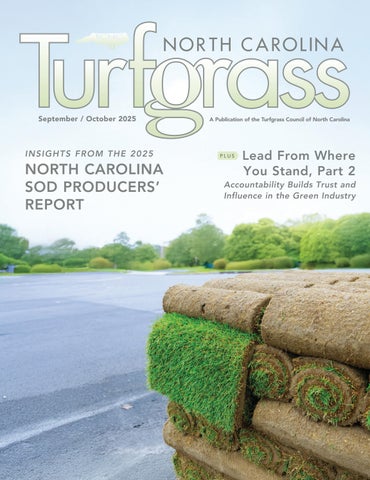
September / October 2025
IN S I G H T S F R O M T H E 2025
NORTH CAROLINA SOD PRODUCERS’ REPORT
A Publication of the Turfgrass Council of North Carolina
PLUS
Lead From Where You Stand, Part 2
Accountability Builds Trust and Influence in the Green Industry
W W W . T H E T U R F G R A S S G R O U P. C O M
Table of Contents September / October 2025
RECENT EV EN T
F EA TUR E S
MOR E FE ATUR E S
14 NC CALS Field Day
24 Lead From Where
From the President
MEMBER SPOT L I G HT
18 Gary Michels
You Stand: Accountability Builds Trust and Influence in the Green Industry
28 Success of the USDA-
Funded Resist Poa Project
CO V ER STO R Y
NC State Turf Team Calendar of Events New Members News from TCNC
20 Insights from the
2025 North Carolina Sod Producers’ Report
TCNC Deluxe Members
NCCTP Program Read this issue online: TheTurfZone.com
Index of Advertisers
6 8 8 9 9 9 10 15
The Turfgrass Council of North Carolina (TCNC) serves its members in the industry through education, promotion and representation. The statements and opinions expressed herein are those of the individual authors and do not necessarily represent the views of the association, its staff, or its board of directors, North Carolina Turfgrass, or its editors. Likewise, the appearance of advertisers, or TCNC members, does not constitute an endorsement of the products or services featured in this, past or subsequent issues of this bimonthly publication. Copyright © 2025 by the Turfgrass Council of North Carolina. North Carolina Turfgrass is published bi-monthly. Subscriptions are complimentary to members of TCNC. Presorted standard postage is paid at Jefferson City, MO. Printed in the U.S.A. Reprints and Submissions: North Carolina Turfgrass allows reprinting of material published here. Permission requests should be directed to TCNC. We are not responsible for unsolicited freelance manuscripts and photographs. Contact the managing editor for contribution information. Advertising: For display and classified advertising rates and insertions, please contact Leading Edge Communications, LLC, 206 Bridge Street, Suite 200, Franklin, TN 37064, 615.790.3718, Fax 615.794.4524.
14
18 28
4 North Caro lina Turf gra ss
w w w . turfgra s s c ounc i l n c . o r g
S e p t e m b e r / Oc t o b e r 2 0 2 5
PRO GOLF MAKES IT HAPPEN. Manage equipment and crews on your course even when you’re offsite within John Deere Every day you’re pulled a dozen directions. Dealing OnLink Golf Course Management Solutions. Learn how ourmonitoring technology and equipwith crews, equipment, controlling overhead ment can take your game to the next level at FinchTurf.com or RevelsTractor.com. and irrigation long before the sun comes up. Pro Golf lets you manage every aspect of your course from any connected device. Making it easier for you to lead your team from the location of your choice. Connect with Beard Equipment or Revels to schedule a Pro Golf demo.
BeardEquipment.com | RevelsTractor.com
From the President
North Carolina Turfgrass is the official publication of the Turfgrass Council of North Carolina P.O. Box 641 Wake Forest, NC 27588 984.301.5460 www.turfgrasscouncilnc.org
Passion for Excellence As
summer winds down, I would like to extend a sincere thank you to everyone who participated at this year’s Turfgrass Field Day at Lake Wheeler Lab. It was another incredible opportunity to connect with turfgrass professionals, see old friends, and get a firsthand look at the research that continues to move our industry forward. The NC State Turfgrass Program faculty and staff once again delivered an exceptional event. The opportunity to learn directly from leading experts and see their research in action remains one of the most valuable experiences of the year. This issue of NC Turfgrass Magazine continues that spirit of learning with a variety of articles highlighting current challenges and opportunities across our industry. I specifically want to point out the annual Sod Producers’ Report by NCSU, which offers an in-depth look at trends in supply, pricing, and production throughout North Carolina. The insights provided in this year's report are sure to inform your decision-making and help you stay ahead of the curve. Thank you for your ongoing involvement in TCNC and your passion for excellence in turfgrass management. I’m looking forward to the enthusiasm we’ll share this fall. Warm regards,
Wil Sutton
President Turfgrass Council of North Carolina
CHIEF STRATEGY OFFICER Marcy Cottle info@turfgrasscouncilnc.org 984.301.5460
Published by: Leading Edge Communications, LLC 206 Bridge Street Franklin, TN 37064 615.790.3718 Fax 615.794.4524 info@leadingedgecommunications.com
TCNC OFFICERS PRESIDENT Wilson Sutton Emerald Golf Club New Bern, NC
VICE PRESIDENT Greg Harris Leap Frog Land Care, Inc. Fuquay-Varina, NC
TREASURER Jonathan Richardson, NCCTP NCCTP Chairman Green Resource Dunn, NC
PAST PRESIDENT Kevin Herrmann Fairway Green Inc. Raleigh, NC
DIRECTORS Alpha Jones Fayetteville Woodpeckers Fayetteville, NC
Spencer Thomas Keith Hills Country Club Lillington, NC
6 North Caro lina Turf gra ss
CARY 919-836-0492
RALEIGH 919-836-0492
HENDERSONVILLE 828-681-5000
CHARLOTTE 704-525-8873
MOORESVILLE 980-444-2347
SIGN UP NOW FOR YOUR LANDSCAPER PRO ACCOUNT GET WHOLESALE PRICING | CHOOSE PICKUP OR DELIVERY DATES | REQUEST EXPEDITED DELIVERY | VIEW YOUR PURCHASE HISTORY
TCNC Deluxe Members
NC State Turf Team
Companies wishing to support TCNC with multiple members can join as Deluxe Members. Deluxe Memberships can be purchased in one of three tiers: 1–5 employees; 6–10 employees; or 11+ employees.
CROP AND SOIL SCIENCES
If you'd like to learn more about the Deluxe Membership, please contact the TCNC office at 984.301.5460 or info@turfgrasscouncilnc.org.
Thank You to Our DELUXE MEMBER ORGANIZATIONS Barefoot Lawn Care and Landscaping Services
NaturaLawn of America (Raleigh)
Canopy Lawn Care
Nature's Select
Carol Woods Retirement Community
McConnell Golf
Carolina Green Corp City of Asheville Parks and Recreation City of Raleigh Parks and Recreation Duplin Sod Edison Landscaping Emerald Green ETM Coastal Fairway Green of Charlotte Fairway Green of Raleigh Fayetteville Tech Gates Four Golf and Country Club Green Resource JRM Inc.
Morehead City
Dr. Travis Gannon Assistant Professor 919.515.2647 travis_gannon@ncsu.edu Navdeep Godara Assistant Professor Turf & Forage Weed Science ngodara@ncsu.edu Emily Erickson Crop Science Lecturer 919.513.2034 emily_erickson@ncsu.edu Ray McCauley Extension Associate 919.515.2647 rkmccaul@ncsu.edu Dr. Susana Milla-Lewis Professor & University Faculty Scholar 919.280.3443 susana_milla-lewis@ncsu.edu
Dr. Grady Miller Professor & Extension Specialist 919.515.5656 grady_miller@ncsu.edu Dr. Rob Richardson Associate Professor & Extension Specialist 919.515.5653 rob_richardson@ncsu.edu Dr. Wei Shi Professor 919.513.4641 wei_shi@ncsu.edu Dr. Qiyu Zhou Assistant Professor 313.782.2892 qzhou9@ncsu.edu
Quality Turf Sod Solutions Southern Ag
ENTOMOLOGY AND PLANT PATHOLOGY
Southern Garden Southern Seeds, Inc. The Biltmore Company The Sunrock Group Tillery Country Club Town of Cary Public Works
Dr. Terri Billeisen Extension Associate 919.515.7464 tlhoctor@ncsu.edu
Lee Butler NC State Turf Diagnostics Lab 919.513.3878 ebutler@ncsu.edu
Dr. James Kerns Professor and Extension Specialist 919.513.4820 jpkerns@ncsu.edu
Town of Garner Triangle Chemical Company
HORTICULTURE SCIENCE
Turf Mountain Sod, Inc. UNC – Chapel Hill
Keith Hiils Golf Club
Wake Forest University
Leapfrog Landcare
Weed Man
Dr. Danesha Seth Carley Director, Southern IPM Center & Associate Professor 919.513.8189 danesha_carley@ncsu.edu
Renewal as of June 2025 Don't see your company's name?
www.turffiles.ncsu.edu/people/
Renew today at www.turfgrasscouncilnc.org
8 North Caro lina Turf gra ss
w w w . turfgra s s c ounc i l n c . o r g
S e p t e m b e r / Oc t o b e r 2 0 2 5
Calendar of Events
News from TCNC
October 10, 2025
NC Turfgrass WORD SEARCH
Bolivia Pesticide Safety School N.C. Cooperative Extension Brunswick County Center
For answers, turn to page 15
25 Referendum Dr NE, Bolivia, NC 28422
December 4, 2025 Turf Research Symposium NCSU Plant Sciences Building 840 Oval Dr, Raleigh, NC 27606
Welcome, New Members Bobby Chambers
Brandon Osterkamp
Morehead City Morehead City, NC
Morehead City Morehead City, NC
Nick Cunningham
Jerry Pittman
Morehead City Morehead City, NC
Pitt Community College Greenville NC
Devon Koepp
Robert Remington
Fayetteville Technical Community College Sanford, NC
Sandhills Community College (Student) Southern Pines, NC
Michael Doucette
Joe Simpson
Morehead City Morehead City, NC
Canopy Lawn Care Raleigh, NC
Bryan Fleek
Seth Skorput
Morehead City Morehead City, NC
Canopy Lawn Care Raleigh, NC
Scott Grubbs
Tyler Sutton
NaturaLawn of America Cary, NC
Falling Creek Country Club Kinston, NC
Brett Howard
Christopher Truelove
Fayetteville Technical Community College Hope Mills, NC
Morehead City Morehead City, NC
Erich Kolb
Hogan White
Seagreen Lawn Care and Irrigation, Inc. Little River, SC
Canopy Lawn Care Raleigh, NC
William Mitchell University of North Carolina Chapel Hill Chapel Hill NC
A P u b l i c a t i o n o f t h e T u r f g r a s s C o u n c i l o f No rth C aro l i n a 9
NCCTP Program
Fast Facts about the NCCTP Enrollment Requirements:
Become a NC Certified Turfgrass Professional!
The
North Carolina Certified Turfgrass Professional (NCCTP) program is a comprehensive program developed to enhance the technical competency of turfgrass professionals, while elevating their professional image, that of your business and of the turfgrass management industry. Administered by the Turfgrass Council of North Carolina, the NCCTP designation confirms your expertise in turfgrass management to prospective customers and your peers.
Reasons to Begin Earning Your NCCTP Designation Today he NCCTP program increases and enhances your turfT grass industry knowledge, career, and business development through a course of study of in-depth coverage of the science of turfgrass management. The NCCTP designation offers immediate confidence and credibility of turfgrass management practices to customers and prospective employers. Promote and market yourself as a North Carolina Certified Turfgrass Professional. • Use the NCCTP logo on your business materials. • Use NCCTP pins, uniform patches, and vehicle decals. • Your TCNC Member Directory listing is distinguished with the NCCTP designation.
We Are Partnered With The NC State Turfgrass Professional Short Course The NC State Turfgrass Professional Short Course, a comprehensive turfgrass education program, is offered at select NC State Extension offices and at NC State University. This Short Course offers a full curriculum of the science of turfgrass management as well as Continuing Education Credits for NCDACS Pesticide and NCLCLB Landscape Contractors’ license holders, and it will help you prepare for the NCCTP exam. This Short Course is recommended but not required to take the NCCTP exam.
10 North Carolina Turf gr a ss
w w w . t urfgra s s c ounc i l n c . o r g
old a current TCNC membership. If not currently a H member, go to www.turfgrasscouncilnc.org and click ‘JOIN NOW’ to join online or download an application. Have a minimum of one full year of work experience in the turfgrass industry. Agree to the Certified Turfgrass Professional Code of Ethics as detailed on the application form. Submit: • A current and valid NC Pesticide Applicators license •A completed NCCTP application (current TCNC members may apply online). • NCCTP Program Application: $150 • Self-Study Materials: $50 • Exam Fee: $50
Curriculum and Exam urriculum covers nine core areas: Turfgrass CharacterisC tics; Establishing Turfgrass; Soils & Nutrient Management; Cultural Practices; Pests & Integrated Pest Management; Pesticides & Plant Growth Regulators; Landscape Safety & Pesticide Use; Calculations & Calibration; Turfgrass Business & Economics. Candidates have six months from the date of their enrollment acceptance to complete the NCCTP exam. Candidates have six hours to complete the exam and must score 80% or more on each section to receive the NCCTP designation. Exams can be taken at the TCNC office in Raleigh during normal business hours, or arrangements can be made at your local NC State Extension location. Exams will not be graded if any application information is missing or if TCNC membership status cannot be confirmed. Please allow two to three weeks for exam grading and reports. Upon successful completion of the exam, candidates will receive communication with their results and either next step options or their graduation packet.
Maintenance Requirements Maintain a current TCNC membership as a means of demonstrating ongoing support for the industry. Submit an annual $50 renewal fee, which supports the NCCTP program and related promotional activities. Designation year is the same as the TCNC membership year, from July 1st to June 30th. Hold a current NC Pesticide Applicator’s License. Subscribe to, actively support and uphold the TCNC Certification Code of Ethics. The NC Certified Turfgrass Professional designation (NCCTP), the NCCTP logo and related programs materials are the trademarked property of the Turfgrass Council of North Carolina and cannot be used without TCNC’s written permission. For additional information, contact TCNC at 984.301.5460.
S e p t e m b e r / Oc t o b e r 2 0 2 5
Better Built. Quality Results. Period. Sports field, Park and Estate Mowers
Contour / Rough Finishing Mowers
Turf Grass Production Mowers
Roller Mower cutting widths: 65”, 90”, 10.5’, 12’, 15.5’, 22’*, 29.5’*
Contour/rough finishing mower: Pro-Flex™ 120B 10’ cut TDR-X™ roller mower 10.5’ cut
Tri-Deck cutting widths: 12’, 15.5’, 22’*, 36’*
* available with bolt-on galvanized deck shells
Progressive Turf builds the right mowers and rollers for any field. For over 35 years they have set and re-set the standards in commercial grade mowing equipment.
Precision. Quality. Performance. Contact Us Today!
WWW.PROGRESSIVETURFEQUIP.COM
1.800.668.8873
Quality built in North America and supported by a world-wide Dealer network.
ZERO DAILY MAINTENANCE Now with Trimax Titan roller bearing system and maintenance-free wheel hubs
Trimax SteadFast sealed spindles requires no greasing or regular maintenance
Redefines productivity and operational efficiency
CALL FOR MORE INFO
770-412-8402
News from TCNC
12 North Carolina Turf gr a ss
w w w . t urfgra s s c ounc i l n c . o r g
S e p t e m b e r / Oc t o b e r 2 0 2 5
2 0 2 5 P ART N E RS P L A TIN U M
E ME RA LD
G OLD
SILV E R
A Pu b l i c a t i o n o f t h e T u r f g r a s s C o u n c i l o f No rth C aro l i n a 13
R E C E NT E VE NT
Lake Wheeler Turfgrass Field Day
R
ain or shine, the Turfgrass Council of North Carolina was proud to be on site at this year’s Lake Wheeler Turfgrass Field Day, continuing our long-standing commitment to supporting the groundbreaking work being done at NC State. For decades, TCNC has invested in the future of the turfgrass industry by contributing hundreds of thousands of dollars toward research, innovation, and education.
14 North Carolina Turf gr a ss
w w w . t urfgra s s c ounc i l n c . o r g
Events like Field Day give us a front-row seat to the progress we’re helping to drive. We also enjoyed connecting with our members, industry partners, and faculty. Field Day is always a highlight on our calendar, and this year was no exception—even with a side of showers. Thank you to everyone who stopped by, shared updates, and showed your continued support for North Carolina turfgrass.
S e p t e m b e r / Oc t o b e r 2 0 2 5
Index of Advertisers
continued | News from TCNC
BuySod / SodStarPro.................................. 21 www.sodstar.com
NC Turfgrass WORD SEARCH
Carolina Green Corp................................... 19 www.cgcfields.com
For puzzle, turn to page 9
Carolina Turf Farms, Inc............................. 29 www.carolinaturffarms.com Divots, Inc................................................... 27 www.divotssand.com DMG Turf, Inc............................................. 25 www.dmgturf.com Revels Tractor Co. Inc................................... 5 www.revelstractor.com Green Resource............................Back Cover www.green-resource.com Greene County Fertilizer Co...................... 23 www.greenecountyfert.com Leading Edge Communications.................. 16 www.LeadingEdgeCommunications.com Morgan Sand Company.............................. 23 www.morgansandco.com Progressive Turf Equipment Inc................. 11 www.progressiveturfequip.com Quality Turf, Inc.......................................... 27 www.qualityturfnc.com Smith Seed Services.................................... 29 www.smithseed.com Smith Turf & Irrigation.................................. 3 www.smithturf.com Sod Solutions.............................................. 31 www.SodSolutionsPro.com Southern Specialty Equipment................... 15 www.ssequip.net Super-Sod...................................................... 7 www.supersod.com The Turf Zone....................................... 17, 19 www.theturfzone.com The Turfgrass Group..................................... 2 www.theturfgrassgroup.com Triangle Turf and Ornamental.................... 19 www.triangleturf.net
Southern Specialty Equipment, Inc.
• Ease of Operation
Trimax Mowing Systems............................. 11 www.trimaxmowers.com
• Low Operating
Solid & Dependable Rotary Finishing Mowers
Over 50 Years of Harvesting Innovation
Email: jim@ssequip.net
Website: ssequip.net
Costs • Single Axle
Turf Mountain Sod, Inc................................. 9 www.turfmountain.com Vandemark Farms....................................... 26 www.vandemarkfarms.com
New, Used & Refurbished
Truck Use
Office: 877-366-5399
Mobile: 352-284-8029
A Pu b l i c a t i o n o f t h e T u r f g r a s s C o u n c i l o f No rth C aro l i n a 15
Don’ t Miss Out ! PROMOTE YOUR BUSINESS IN THE NEXT ISSUE OF
NORTH CAROLINA TURFGRASS
North Carolina Turfgrass allows you to get your message directly in the hands of your customers across North Carolina. The magazine is a key benefit of TCNC membership – providing valuable research, education and industry information. Readers can also access the Digital Edition through The Turf Zone website. Archived issues will ensure that your advertising will continue to be seen indefinitely, for long-ranging impact. The Turfgrass Council of North Carolina are:
Golf Course Superintendents
Landscape Contractors
Commercial Grounds Managers
Sod Producers
Lawn Care Operators
Parks & Recreation Supervisors
Sports Turf Professionals
Equipment Suppliers
Contact us today to learn about effective and unique advertising strategies that target turf industry professionals.
888-707-7141 or sales@leadingedgecommunications.com
Follow for TURFGRASS RESEARCH, NEWS, EVENTS & MORE linkedin.com/company/theturfzone
x.com/theturfzone
facebook.com/theturfzone
Contact us today to learn about effective and unique TurfZone marketing strategies that target turf industry professionals.
888–707-7141 or sales@leadingedgecommunications.com
M EMBER S P O TLIGHT
GARY MICHELS O WNER OF LA W NS IN C .
A
fter retiring from the nuclear industry, Gary Michels was looking for a new challenge. With a lifelong love of the outdoors and a desire to return to business ownership, he launched Lawns Inc., where he now enters his second year as owner. “I wanted a challenge in a new career after retirement from the nuclear industry, so I chose what I love to do, work outside in open green spaces,” Gary says. “Let’s face it, cutting grass is a lot of fun!”
The certification also offered credibility. “The close relationship between TCNC and NC State, one of the premier college turfgrass programs in the country, helped me decide,” Gary explains. “Also, the close ties between the Turfgrass Council and the Agricultural Extensions. This lends great credibility to the NC version of the Turfgrass Professional. A certification can only be as valuable as the issuing governing body.” Though relatively new to the turfgrass industry, Gary’s motivation and discipline reflect a seasoned professional. His advice for others considering NCCTP certification is practical: “Refresh your Botany. Take a field guide out to parks and identify both turf and weeds. Practice basic geometry math.” Like many in the green industry, Gary is watching environmental conditions closely. “All industries for all times have faced the same basic challenge: staying current and relevant in changing times,” he notes. “But specifically for turfgrass, right now our biggest challenge is a warming climate.”
But fun didn’t mean easy. Gary brought with him decades of discipline and certification experience from his previous career and approached turfgrass with the same level of commitment. “I held many major certifications in nukes, so becoming certified as a turfgrass pro seemed natural. I was able to use NCCTP as a path forward.” Gary recently earned his North Carolina Certified Turfgrass Professional (NCCTP) designation. This is a milestone he views as personal achievement and as a professional responsibility. “I wanted a recognized certification demonstrating mastery over all aspects of turfgrass management. My clients deserve it.” That mindset led him to join the Turfgrass Council of North Carolina. The need for credentials is what initially drew him in. “There is a technical knowledge base plus a business knowledge base built within the Turfgrass Professional Certification curriculum. One cannot pass the exam with only one or the other.”
18 North Carolina Turf gr a ss
w w w . t urfgra s s c ounc i l n c . o r g
Gary credits Professor Grady Miller for providing early support and direction. “Professor Grady Miller steered me to some grass identification resources. I suppose that is as good a start a guy could hope for.” Outside of work, Gary enjoys downtime when he can get it. “Starting a business does not provide for an excess of free time. I suppose just sitting with my feet propped up, watching British Detective Drama and spy movies qualifies.” He’s also proud of his family. “I got married to Sharon in 1986, and she is still the love of my life.” He also has four grown children. Whether it’s launching a new company, preparing for certification, or adapting to a changing climate, Gary Michels has embraced his second career with the same tenacity that defined his first. And when it comes to the turfgrass industry, he’s exactly where he wants to be.
S e p t e m b e r / Oc t o b e r 2 0 2 5
NO NEED TO SWEAT THIS SUMMER! Partner with Triangle for the best choices from the best companies in the world of nursery, landscape, and golf course care. With nine distribution points strategically located to serve the Southeast, good company is always just around the corner.
For more information visit www.trianglecc.com 2024
NEW EPISODES IN 2026
PODCAST
theturfzone.com/podcasts
SAND BASED SOD WITH INFILTRATION RATE OF 11 IN/HR
www.cgcfields.com TENSILE SRENGTH 88% GREATER THAN 1” THICK CUT SOD SHEAR STRENGTH 43% GREATER THAN 1” THICK CUT SOD
Cover Story
2025 Sod Producers’ Report Offers Key Insights into Industry Trends Based on the 2025 Sod Producers’ Report for North Carolina by Grady L. Miller, PhD
Figure 1. Percentage of bermudagrass, tall fescue, and zoysiagrass producers reporting adequate to excellent supply for the past six years.
T
his spring, North Carolina State University released its tenth annual Sod Producers’ Report, offering a decade-deep perspective on the supply, pricing, and operational outlook of North Carolina’s sod industry. With responses collected from nearly half of the state’s sod farms, the 2025 report captures a moment of cautious optimism amid ongoing workforce challenges and shifting market demands. Conducted in April, the survey reflects the current state of sod inventory across warm- and cool-season grasses, price trends, workforce dynamics, and acreage plans for the year ahead. The data was gathered through an anonymous online survey completed by 20 sod producers representing a range of farm sizes from operations under 200 acres to those with more than 800.
“The 2025 report captures a moment of cautious optimism amid workforce challenges and shifting market demands.”
Inventory Outlook: Gains with Caveats
Table 1. Average North Carolina Sod Prices in 2024 Turfgrass Produced On-the-Farm (# of growers responding) price/sq ft Bermudagrass (16) $0.42 Zoysiagrass (11) $0.58 Centipedegrass (12) $0.38 St. Augustinegrass (6) $0.63 Tall fescue (4) $0.49 Tall fescue + Kentucky bluegrass (6) $0.46 Kentucky bluegrass (1) $0.50 *Delivered to either the closest urban market or within 100 miles of the farm.
Delivered* price/sq ft $0.46 $0.64 $0.44 $0.66 $0.55 $0.65 $0.62
Table 2. Ranking of Industry Segments for 2024 Sales of Turfgrass Produced in North Carolina of Industry Segments for 2024 Sales of Turfgrass Produced in North Carolina Industry Segment Landscape contractors Homeowners Sports / athletics Golf courses Retail garden centers Brokers *Average percentage of total sales
20 North Carolina Turf gr a ss
Rank (Change from last year) 1 (same) 2 (same) 3 (up two) 4 (same) 5 (up one) 6 (down 3)
w w w . t urfgra s s c ounc i l n c . o r g
Average (%)* 71.7 15.4 6.5 4.8 1.1 0.5
For most warm-season species, producers are projecting increased availability in 2025 compared to last year. Bermudagrass and zoysiagrass supplies are both expected to grow, yet roughly 38% and 36% of surveyed producers, respectively, still anticipate shortages. Centipedegrass and tall fescue are also facing tighter supply conditions, with nearly half of respondents predicting shortfalls in tall fescue and 17% citing expected centipedegrass shortages. St. Augustinegrass saw a more favorable projection, with only 7% of producers anticipating limited availability. While these forecasts suggest improvement in some areas, the lingering anticipation of shortages reflects the delicate balance producers must maintain between weather impacts, labor constraints, and customer demand.
S e p t e m b e r / Oc t o b e r 2 0 2 5
Price Pressures and Species-Specific Trends The 2025 report also sheds light on pricing trends across turfgrass species. Producers reported price increases ranging from 5% to 13% for warm-season sod, signaling steady demand and possibly higher input costs. In contrast, cool-season grass pricing remained relatively flat, with tall fescue holding steady and a notable drop of up to 35% reported for Kentucky bluegrass. However, it’s important to note that only one producer reported Kentucky bluegrass pricing this year, so this sharp decline may not represent statewide trends.
“Producers reported price increases between 5% and 13% for warm-season turfgrass species in 2025.”
Shifts in Sod Types and Certifications Beyond supply and pricing, the 2025 survey indicates a notable shift in how sod is produced and certified across North Carolina. There was a 22% decline in the number of growers reporting the use of proprietary turfgrass varieties. Certified sod growers also decreased by 16%, suggesting that producers may be shifting toward more commonly available, noncertified grass types—potentially in response to customer demand or reduced labor capacity. This change could have implications for quality assurance and brand differentiation, especially among producers serving high-specification clients such as sports turf managers and municipal contracts.
Production Acreage Holding Steady Despite some workforce and economic challenges, North Carolina sod farms are not scaling back operations. In fact, production acreage is expected to increase in 2025 at a rate comparable to 2024.
Cover Story | continued
This trend reflects producer confidence in long-term demand and an effort to meet evolving needs among landscape contractors, athletic field managers, and residential developers.
Figure 2. Historical perspective of average prices for North Carolina sod, from 2020 to 2025.
Workforce Contraction and Labor Shortages While production acreage is on the rise, staffing levels tell a different story. The average number of both full-time and seasonal employees per sod producer declined by 43% in 2025, underscoring a growing labor shortage that continues to challenge the industry. This drop in staffing may impact everything from harvesting schedules to delivery timelines, and it raises questions about long-term sustainability unless labor recruitment or mechanization efforts increase in pace.
“The average number of full-time and seasonal employees per producer decreased by 43% in 2025.”
Figure 3. Price ranges of the turfgrass species sold on-farm by North Carolina producers in 2025. The horizontal line in the center of each bar represents the median price.
Sod Sales Trends: A Mixed Picture Average sod sales dropped by 5% compared to 2023, a decline that reflects overall market softening. However, not all producers experienced setbacks. A majority—55%—reported increased sales in 2024, suggesting a degree of variability in how different farms are faring across the state. Landscape contractors remained the largest customer segment, accounting for nearly 72% of all sod sales. This continued dominance underscores the strong link between residential and commercial landscape demand and overall sod production viability in North Carolina.
22 North Carolina Turf gr a ss
w w w . t urfgra s s c ounc i l n c . o r g
S e p t e m b e r / Oc t o b e r 2 0 2 5
GROW YOUR BUSINESS, WE’LL GROW YOUR TURF. Survey Snapshot This year’s survey captured responses from 20 producers spanning a wide range of operation sizes: • Eleven respondents managed farms with less than 200 acres • Six represented farms between 201 and 500 acres • Two operated between 501 and 800 acres
GET READY. Aeration and overseeding time is coming fast. Get the best results with GreenePOP™ 16-21-2 and N-Ext RGS™. With your work and our fert, lawn renovation season will be better than ever.
• One respondent reported over 800 acres in production According to the North Carolina Sod Producers Association (NCSPA), these 20 respondents represent approximately 50% of all sod farms in the state. Importantly, based on farm sizes, the survey sample reflects a significant portion of the total sod production acreage statewide.
Looking Ahead As the sod industry navigates ongoing labor shortages and fluctuating demand, the 2025 Sod Producers’ Report offers valuable insights for growers, contractors, and end-users alike. With warm-season supplies trending upward, pricing changes in play, and labor challenges remaining top of mind, producers are adapting their strategies to sustain and grow in a competitive market. For those seeking to stay informed and responsive to industry trends, the annual report continues to be a vital resource.
“This year’s report provides a grounded snapshot of North Carolina sod production—its challenges, resilience, and potential.”
Ships direct. Pro Support always included.
GreeneCountyFert.com MFR/HQ: Greensboro, GA
Feature
L EA D FRO M W HE R E Y OU S T A N D
Accountability Builds Trust and Influence in the Green Industry By Alpha Jones
In
the green industry, leadership is rarely about a title. It’s about how you show up for the work and the people you work with. If our first Stolons of Leadership article on Work Ethic showed us how leading by example sets the tone, then accountability takes it one step further. It’s how you prove that you’re dependable—not just when things go right, but especially when they don’t. The word “accountability” can feel heavy. It is often associated with blame. But that’s not what accountability is about. Blame looks backward and focuses on what has happened and cannot be changed. Accountability looks forward. It’s about taking ownership of outcomes, whether you’re directly responsible or not. It’s stepping up and saying, “I’ll fix this,” even when it would be easier to point fingers. Pointing fingers changes nothing. Years ago, during a busy summer maintenance schedule, a crew I managed accidentally scalped a client’s newly renovated lawn. No one spoke up. By the time I noticed, the damage was obvious, and the client was furious. Contrast with another situation where my crew leader called in immediately after having a tense exchange with a car owner when a member of his team accidentally blew grass clippings onto a store patron’s car. The leader owned it, explained what happened, and laid out a plan to fix it. The car owner wasn’t thrilled, but they respected the honesty. When it was all said and done, the car owner apologized for making a big deal about something small. That’s the difference accountability makes. It won’t make the mistake disappear, but it can preserve—and even strengthen— the trust you’ve built. Accountability isn’t an abstract concept; it’s visible in everyday details. Here’s what it looks like at different levels: • Entry-level employees: Checking the trailer before it leaves the yard without being told. Reporting a broken irrigation head instead of leaving it for someone else to find. Taking responsibility for a mistake and helping fix it. • Crew leaders: Being transparent about scheduling errors. Admitting when something was missed and resetting expectations with the client. Modeling the kind of ownership they want from their team. • Managers and owners: Owning hiring mistakes, setting clear standards, and taking responsibility when operations fall short instead of pushing the problem down the line. These actions build credibility. When people know they can rely on you, they work harder for you, trust you more, and follow your lead. Leadership is influence, not authority. And one of the fastest ways to build influence is through accountability.
24 North Carolina Turf gr a ss
DMG TURF Leaders in the Turf Industry
DMG Turf is a family owned and operated business, serving North Carolina with cool and warm season grasses. From small residential projects to large commercial jobs including golf courses, athletic fields, and much more, our commitment to customer satisfaction has been our top priority since 1999. Our friendly and knowledgeable staff are ready to serve you with delivery to your location, or you can schedule a pickup at our sod farm in Angier, NC.
dmgturf.com | 919.639.4027 | 997 Matthews Mill Pond Road, Angier, NC
Feature | continued
Picture this: Who would you rather follow? The person who ducks responsibility, or the one who owns the problem and gets to work fixing it? When your crew sees that you take ownership, they feel safe bringing up issues before they become disasters. They work harder because they respect you. Clients trust you because they know you won’t hide mistakes. And your organization becomes more resilient because you address problems instead of burying them. To quote Simon Sinek, he said, “Leaders eat last… but they take responsibility first.” So how do you live out accountability on the job? Start small and be consistent: • Admit mistakes early. For example, if you installed the wrong plant variety at a client’s property, call them immediately and set a plan to replace it before they notice the issue themselves. • Take action on what you can control, even if the situation wasn’t your fault. If a storm damages the sports field you manage, coordinate cleanup and repairs instead of waiting for someone else to take the lead.
26 North Carolina Turf gr a ss
w w w . t urfgra s s c ounc i l n c . o r g
• Communicate clearly when something’s wrong. For instance, if a parks and rec facility’s irrigation system is malfunctioning, notify the maintenance supervisor with clear details and next steps instead of letting it slide. • Don’t pass the blame. If your landscape installation crew falls behind because of a scheduling error, own the delay and focus on getting back on track instead of pointing fingers. • Give credit where it’s due. When your team completes a complex playground installation safely and on time, make sure leadership and the client know exactly who contributed to the success. • Ask for feedback — and receive it without defensiveness. If a manager points out that a jobsite was left disorganized, acknowledge the concern and implement a cleanup checklist rather than making excuses. This isn’t just about owning your part. Accountability also means holding others accountable in a way that builds them up, not tears them down. Correcting someone doesn’t have to be criticism; it can be a way to raise the standard for everyone.
S e p t e m b e r / Oc t o b e r 2 0 2 5
Accountability is contagious. When you model it, others start to adopt it. Teams that value accountability are more efficient, more trustworthy, and more unified. On the other hand, when accountability is absent, a culture of blame sets in—and that’s a fast track to burnout and turnover. Here’s the hard truth: You can’t ask for accountability if you don’t demonstrate it yourself. You can’t expect your team to admit mistakes if you’re unwilling to do the same. And you can’t build a culture of trust if you’re constantly shifting responsibility. In our Stolons of Leadership series, we’re using the stolon metaphor for a reason. Stolons are the stems of a plant that grow horizontally, putting down roots as they go and creating new plants. Accountability works the same way: it spreads outward, reinforcing the foundation for other critical leadership traits. Work Ethic and Accountability are the first two stolons because they support everything else. Without work ethic, accountability doesn’t hold. Without accountability, integrity, the next stolon, has no grounding.
Your Leadership Challenge Your challenge: What is one small thing you can take full ownership of this week? It doesn’t have to be big. Maybe it’s following up with a client before they call you. Maybe it’s owning a missed detail before someone else brings it up. Or maybe it’s simply showing your crew that you’re in it with them.
Pro Tip: Catch up on the first Stolons of Leadership article on Work Ethic if you missed it in the July/August edition of NC Turfgrass Magazine. Each article builds on the last, and the full series will help you grow your influence from the ground up.
FORE SALE!
GREEN DIVOT MIX PREMIUM QUALITY SAND (40 lb. Bags or Bulk)
Topdressing Sand Black Topdressing Sand Bunker Sand Drill & Fill Blends Time to Buy Your Divot Mix for the Golf Season! Distributorships Available: Visit www.DivotsSand.com for Details
DIVOTS, INC.
Phone: 919-775-9732 • Email: sales@divotssand.com • www.DivotsSand.com 248 Palace Drive • Sanford, NC 27330
Leadership doesn’t start when you get a title. It starts when you stop waiting for someone else to go first. Looking Ahead: In the next installment of this series, we’ll dig into Integrity. It’s what happens when no one’s watching, and it is inseparable from accountability. In the meantime, keep leading from where you stand. Your crew, your clients, and your industry need you to set the standard.
A Pu b l i c a t i o n o f t h e T u r f g r a s s C o u n c i l o f No rth C aro l i n a 27
Feature
Success of the USDA-Funded
RESIST POA PROJECT By J. Scott McElroy Professor, Turfgrass Management and Weed Science, Auburn University
and James D. McCurdy Professor and Extension Specialist, Turfgrass Management, Mississippi State University
G
iven the current climate surrounding federal funding discussions, we want to provide detailed information about research outcomes from the ResistPoa project. Our goal is transparency about what taxpayer dollars accomplished when this project received funding. For information regarding this project, please see http://resistpoa.org/.
Project Background ResistPoa launched in 2018 as a nationwide initiative to tackle the growing problem of herbicide-resistant annual bluegrass (Poa annua) in turfgrass systems. This four-year, $5.7 million project, funded by the USDA Specialty Crop Research Initiative brought together 16 scientists from 15 universities across the country. The project had clear objectives: develop better management practices for annual bluegrass control, map the extent of herbicide resistance nationwide, and create decision-support tools for turf practitioners. Essentially, we needed to understand how bad the resistance problem really was and give golf course superintendents, sports field managers, and other turf professionals the tools to fight back. Annual bluegrass might seem like a small problem, but it’s not. This weed costs the turfgrass industry millions of dollars annually in control measures and lost playability. When herbicides stop working, managers face expensive reseeding, overseeding, and intensive maintenance schedules that strain budgets and resources.
Nationwide Resistance Survey Our team’s biggest accomplishment was conducting the first comprehensive national survey of herbicide resistance in annual bluegrass. We collected and tested over 1,300 populations from turf sites across five different climate zones. The results were sobering—by 2023, we documented populations resistant to up to nine different herbicide modes of action.
28 North Carolina Turf gr a ss
This wasn’t just academic research. These findings gave turf managers concrete data about what to expect in their regions. Instead of guessing whether an herbicide might work, superintendents could now reference our maps and data to make informed decisions about their control programs.
Understanding Resistance Mechanisms We dug deep into the science behind why annual bluegrass develops resistance. Through molecular analysis of dozens of populations, we identified specific genetic mutations that allow the weed to survive herbicide treatments. For example, we discovered a novel mutation in the β-tubulin gene that helps annual bluegrass resist popular pre-emergence herbicides like prodiamine. But genetics wasn’t the whole story. We also found that annual bluegrass uses other tricks—enhanced metabolism and reduced herbicide uptake—to survive treatments. These non-target-site resistance mechanisms were particularly common with ALS-inhibiting herbicides like foramsulfuron (Revolver) and trifloxysulfuron (Monument).
Finally, something they can agree on
Practical Management Solutions Research is only valuable if people can use it. Our team tested alternative control methods that don’t rely solely on herbicides. We demonstrated that aggressive fraise mowing (essentially shaving the turf surface) could dramatically reduce annual bluegrass infestations in bermudagrass turf. While this technique isn’t suitable everywhere, it gives managers another tool in their arsenal. We also examined how cultural practices affect the weed’s competitiveness. Studies in Oregon showed that adjusting irrigation frequency and phosphorus fertilization could influence how well annual bluegrass competes with desirable grasses. These findings are being incorporated into our best management practice guidelines.
Raeford, NC | 910-875-6141 | 800-927-1479 | CarolinaTurfFarms.com
BLEND
Feature | continued
Human Factors Research
Scientific Output
What makes ResistPoa unique is that we have included social scientists to study the human side of weed management. Through surveys and interviews with turf managers, we identified real barriers to adopting better practices: budget constraints, risk aversion, and simple lack of awareness about resistance.
The project generated over 20 peer-reviewed publications in journals like Weed Science, Crop Science, and Weed Technology. This wasn’t just about meeting academic requirements—these papers ensure the knowledge is archived and accessible to guide future research and management decisions. Our management guides are “Open Access”—you can download them from the Crop, Forage & Turfgrass Management Journal.
We developed a user-friendly decision support tool—essentially a calculator that helps superintendents visualize the long-term benefits of diversified management versus short-term cost savings. This economic modeling helps justify upfront investments in integrated approaches rather than relying on the same herbicide year after year.
Sharing Knowledge From day one, we emphasized getting information to the people who needed it. The project created ResistPoa.org as a central hub for resources, now hosting about 70 educational documents that users can filter by turf system and control method. We produced a best management practices poster explaining herbicide modes of action and effective rotation strategies. This poster was distributed to over 2,000 stakeholders in print and downloaded more than 1,000 times online. Our team organized field days, workshops, and webinars across the country. These weren’t just presentations—they were hands-on demonstrations where turf managers could see control trials in action and ask questions directly. Perhaps most importantly, we trained the next generation. At least 22 graduate students, 25 undergraduates, and roughly 10 postdoctoral researchers received training through ResistPoa. These students are now professors, consultants, and golf course managers, multiplying the project’s impact.
Industry Impact The real test of success is whether the turf industry is actually using our findings. Early indicators are positive. Golf course superintendents are referencing our resistance maps to make proactive decisions about herbicide rotations. Instead of waiting for a product to fail, they’re switching to different chemistries based on what our survey showed in similar conditions. We worked closely with industry advisory panels from the beginning, including golf course superintendent associations, sod growers, and lawn care companies. This collaboration ensured our research reflected real-world conditions and that recommendations fit industry needs. When preliminary results showed certain populations surviving standard herbicide rates, industry partners helped us quickly alert practitioners so they could adjust rates or tank-mix with other products. Seed producers worked with us to test for annual bluegrass contamination and resistance in turfgrass seed lots.
30 North Carolina Turf gr a ss
w w w . t urfgra s s c ounc i l n c . o r g
Our investigators delivered dozens of conference presentations at weed science and turfgrass meetings, sharing results throughout the project’s duration rather than waiting until the end.
Long-term Value ResistPoa created lasting benefits beyond its four-year timeline. The network of scientists, Extension agents, and industry professionals formed during the project continues to collaborate on turf challenges. We’ve seen the power of coordinated research, and that collaboration model is being applied to other problems. The students and researchers trained under ResistPoa have spread throughout the industry, carrying this knowledge into their new roles. This multiplier effect means the project’s impact extends far beyond the original $5.7 million investment. Turfgrass represents a $100 billion industry encompassing millions of acres of golf courses, sports fields, and maintained landscapes. ResistPoa demonstrated how targeted federal investment in specialty crop research can protect this industry and the green spaces Americans value. Annual bluegrass remains a formidable opponent, but the collective action marshaled by ResistPoa has given the industry evidence-based tools to manage this weed sustainably. The project exemplified how integrated approaches—combining science, education, and industry partnership—can tackle complex agricultural challenges effectively.
References Bagavathiannan, M. V., McCurdy, J. D., Brosnan, J. T., & McElroy, J. S. (2018). National team to use $5.7 million USDA award to address annual bluegrass epidemic in turfgrass. Texas A&M AgriLife News. Grubbs, B., McCurdy, J., & Bagavathiannan, M. (2019). Poa annua: A plan of action. Golf Course Management Magazine. Rutland, C. A., Brosnan, J. T., McElroy, J. S., & Zuk, J. W. (2023). Survey of target site resistance alleles conferring resistance in Poa annua. Crop Science, 63(5), 3110-3121. McCurdy, J. D., and others (2023). Developing and implementing an integrated weed management program for herbicide resistant Poa annua. Crop, Forage & Turfgrass Management, 9(1), e20225. Allen, J. H., and others (2022). Herbicide resistance in turf systems: insights and options for managing complexity. Sustainability, 14(21), 13399. USDA-NIFA. (2020–2022). ResistPoa Project Extension and Training Outputs. USDA-NIFA Annual Reports.
S e p t e m b e r / Oc t o b e r 2 0 2 5
We love the texture of Latitude 36. The combination of density and very fine leaf texture makes this grass a showstopper. It responds very well to fertility and aggressive cultural practices.” — I A N C H R I S T I E , D I R E C TO R O F AT H L E T I C G R O U N D S – D U K E U N I V E R S I T Y
Wallace Wade Stadium, home to Duke University’s Blue Devils football team features Latitude 36 ® Bermudagrass, a high-performance turfgrass selected for its exceptional playability and visual appeal. The stadium, named after legendary coach Wallace Wade, underwent a significant renovation in 2016, and the playing surface was upgraded to meet the demands of a fast-paced, high-contact sport. Latitude 36 was chosen for its ability to handle intense foot traffic, quick recovery between games and tolerance to the transition zone climate. V I S I T L AT I T U D E 36 B E R M U DA . C OM
Seed
Erosion
EARLY ORDER PROGRAM
Triad
5204 Highgreen Court Colfax, NC 27235 (336) 855-6363
Triangle
1218 Mangement Way Garner, NC 27529 (919) 779-4727
Chemicals
Fertilizer
Coastal
2407 Ocean Hwy, West Shallotte, NC 28459 (910) 363-1230
Winston 90 Piedmont Industrial Drive Winston-Salem, NC 27107 (336) 793-9230
Ladson
9492 Hamburg Road Ladson, SC 29456 (854) 999-4039
CALL YOUR GREEN RESOURCE SALES PROFESSIONAL AND SAVE!
MAXIMIZED SAVINGS IN OCTOBER
EXTENDED PAYMENT TERMS
AUTHORIZED DISTRIBUTOR
10404 Granite Street, Ste K Charlotte, NC 28273 (704) 927-3100
Charlotte