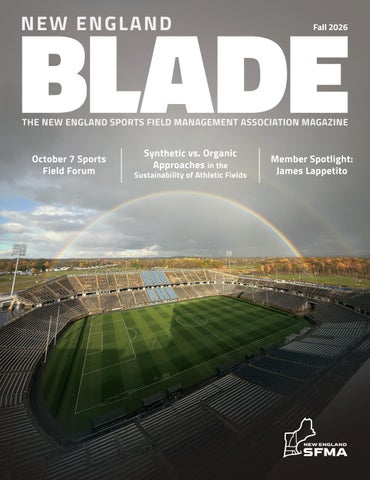
Fall 2026
October 7 Sports Field Forum
Synthetic vs. Organic Approaches in the
Sustainability of Athletic Fields
Member Spotlight: James Lappetito
ALL OUT, ALL GAME, ALL SEASON LONG. POLYON® fertilizer is a radically different fertilizer concept – one that can deliver radically better growing results for you. The key to the consistent, predictable release of POLYON® fertilizer is all in the exclusive, durable polymer membrane that coats each granule (our proprietary reactive-layer coating, or RLC). During the coating phase of the manufacturing process, a bond is formed with the substrate ensuring consistency and durability in every particle. Choose POLYON® fertilizer and you will get guaranteed results backed by our POLYGRAPH® Guarantee.
For more information, visit www.harrells.com/polyon or contact your sales representative today! JIM FAVREAU MASSACHUSETTS jfavreau@harrells.com (978) 227-2785
JIM WIERZBICKI CT, RI jwierzbicki@harrells.com (860) 424-7250
IAN WILLIAMS NORTHEAST iwilliams@harrells.com (781) 664-4519
MIKE KROIAN RI, MA mkroian@harrells.com (401) 265-5353
KENT LEMME NORTHEAST klemme@harrells.com (413) 281-8087
CONNOR CINQUE NORTHEAST ccinque@Harrells.com (603) 930-1861
TOM LOPEZ CT tlopez@harrells.com (860) 488-2649
TOM HOFFER NORTHEAST thoffer@Harrells.com (401) 871-2916
LANCE BLASS NE MASSACHUSETTS lblass@harrells.com (570) 956-0974
JIM STUDLEY RHODE ISLAND jstudley@harrells.com (401) 743-7616
www.harrells.com | 800.282.8007 Employee -Owned
Low Impact Products for High Performance Landscapes
Athletic Fields
Premium Biochar
ADA Pathways
Topdressing
Bioretention
Golf Materials
READ CUSTOM SOILS 800.924.5335 readcustomsoils.com
6
10
14
CONTENTS • Fall 2026 FEATURES 140 S ynthetic vs. Organic Approaches in the
Sustainability of Athletic Fields Part 1: Effects on Wear Tolerance and Ball Bounce
180 R esearch Update from NERTF
UPCOMING EVENT
DEPARTMENTS
90 S ports Field Forum, October 7th
MEMBER SPOTLIGHT 100 J ames Lappetito
On the cover: Pratt & Whitney Stadium at Rentschler Field, East Hartford, CT site of October 7 Sports Field Forum.
Directors
Board of Trustees
President
Tom Barry, CSFM Greens Farms Academy Greens Farms, CT
Mike Lueders Medfield, MA
President Elect
The official publication of the New England Sports Field Managers Association (NESFMA), the New England Blade is dedicated to educating, advising, and informing members of the profession and furthering the goals of the Association. The New England Blade carries news and features related to the sports field management profession. Publisher is not responsible for unsolicited material and reserves the right to edit any article or advertisement submitted for publication and to refuse advertising not in keeping with the goals of the Association. Publisher assumes no responsibility for the validity of claims in connection with items appearing in the New England Blade. Mention of a commercial product does not imply endorsement by the New England Blade, NESFMA, or Leading Edge Communications, or preference over similar products not mentioned. The New England Blade is published quarterly. Subscriptions are complimentary to members of NESFMA. Presorted standard postage is paid at Jefferson City, MO. Printed in the U.S.A. Advertising: For display and classified advertising rates and insertions, please contact Leading Edge Communications, LLC, P.O. Box 246, Brentwood, TN 37024.
4 • New England BLADE • Fall 2026
Find this issue, Podcasts, Events and More: TheTurfZone.com
Officers Art Goodhind Town of Natick Natick, MA
Advancing professionalism in sports turf management and athletic field safety through education, research, and scholarships.
6 President’s Message 6 NE-SFMA News 8 Index of Advertisers
Ryan Bjorn Gillette Stadium Foxborough, MA
Treasurer
Andrew Carlisle, CGM Worcester Technical High School Worcester, MA
Past President
Chris McGinty Framingham Parks Department Framingham, MA
Official Chapter
Bryan Conant Nashua Parks & Recreation Nashua, NH Brendon Connor Holy Cross Worcester, MA Adam Ferrucci Read Custom Soils Wareham, MA Scott Lagana Turf Products Corp. Holden, MA Christopher Lilly Blackstone Valley Regional Technical Vocational High School Upton, MA Michael Malvoso Needham Parks & Forestry Needham, MA Scott Vose Tom Irwin Advisors Tyngsborough, MA
Edward Olsen Needham Parks & Forestry Needham, MA Victoria Wallace University of Connecticut Storrs, CT
Management Team Virginia Wood Executive Director Charissa Sharkey Membership Manager Peggy Benjamin Bookkeeper
New England Sports Field Management Association, Inc. 67 West Street Medfield, MA 02052 (508) 653-1241 NE-SFMA.org
Slater Farms integrates high-quality sand, gravel and organic products into its numerous diverse offerings supporting the playful side of life.
COMMERCIAL
RECREATIONAL
SPECIALTY
Slater Farms provides products and commercial operations including but not limited to landscaping, well drilling, nurseries, farming, and field construction.
We provide core products to support recreational activities including but not limited to golf courses, sports fields, volleyball, squash courts, and equestrian.
We listen to your needs and our production process will ensure consistency and quality to enable your success.
Our manufacturing facility produces damp and dry products necessary to support your specifications.
Our state of the art facility includes washing, drying, screening, blending, and packaging and is dedicated to achieving your specifications. We can help you reach your objectives. Whether it’s a unique root zone performance specification or a high visibility wetlands reclamation project, our resources are available to you.
T: 401-766-5010 | F: 401-762-4976 | E: Info@slaternaturalfarms.com
Slater Farms is a division of
www.slaternaturalfarms.com
The Chas. C. Hart Seed Co. Here for you since 1892!
More than just seed! We have the products, resources and expertise to ensure your field is always healthy and tournament ready. Main Warehouse: 304 Main Street Wethersfield, CT 06109 hartsturfpro.com
P: 860-529-2537 F: 860-563-7221 E: turf@hartseed.com T: @HartsTurfPro Fall 2026 • New England BLADE • 5
PRESIDENT’S MESSAGE
NE-SFMA NEWS
Scholarships Awarded – Congratulations!
Hello members and friends, This summer has certainly been exciting for Sports Turf Management. The New England area and our association members were celebrated on a worldwide scale with the excitement of FIFA and the World Cup. Our membership accepted the challenge and helped to provide remarkable and meaningful memories for the world. Congratulations to Ryan Bjorn, his crew and the volunteers at Boston Stadium for a successful series of events. Congratulations to all other regional partners that accepted the challenge to host teams for practice facilities. The dedication of our professional community was amazing. Thank you to all of those who attended the Mark DeWolf Memorial Golf Tournament at Brookmeadow Country Club in July. The weather was beautiful, the golf course was in great condition, and the experience of friendship and camaraderie was joyful. Congratulations to our two scholarship recipients Noah Cutler and Ryan Lagana. May our community inspire them as the next generation of leaders. Thank you to all our sponsors and partners, as well as a special thanks to the Woo Sox, the New England Patriots community, and others for donating incredible prizes to add to our new raffle. I am excited for the upcoming Sports Field Forum on October 7 at Rentschler Field in Connecticut. Our association board and management team are planning a great event with pesticide license credits! Thank you to James Lappetito for hosting — please be sure to check out the Member Spotlight on James. I hope to see everyone in Connecticut. For our Connecticut community, we are pleased to share an article from Dr. Scott Ebdon. Dr. Ebdon coauthored peer-reviewed work with the late Dr. Bill Dest of the University of Connecticut. This article and information seemed like a perfect fit for this issue of The Blade and timed perfectly with our visit to Rentschler Field. Thank you Dr. Ebdon for sharing this data and carrying forward the work of Dr. Dest.
Noah Cutler is from Wallingford, Connecticut. He is a student at Franklin Pierce University in New Hampshire majoring in Sports and Recreation Management. His well-rounded experience includes becoming an Eagle Scout, working on the Grounds Crew at Choate Rosemary Hall, and excelling at track and field as a student athlete. As he said in his application, “My goal is to continue learning, growing and helping create the same kind of athletic environments that have had such a positive impact on my life.” Ryan Lagana is from Holden, Massachusetts. He is an incoming freshman at the University of Maine majoring in Wildlife Ecology. Ryan plans to combine his love of science, animals, and the outdoors while helping to develop solutions to environmental problems and actively participate in conservation work.
Cheers,
His enthusiasm and commitment to safeguarding wildlife and protecting biodiversity is evident. As Ryan said in his scholarship essay, “There is something incredibly meaningful about getting your hands dirty in service to something larger than yourself.” •
Art Goodhind NE-SFMA President
NE-SFMA’s next scholarship deadline is December 10 for the Charles Mruk Scholarship. Learn more at https://nestma.org/ page-18138.
BLEND
6 • New England BLADE • Fall 2026
Noah Cutler (left) and Ryan Lagana each received $1500 DeWolf Outdoor Education Scholarships at the Golf Tournament on July 23.
SFMA Opens Sports Field of the Year Applications The application period for SFMA’s Field of the Year (FOY) Awards is officially open!
SFMA Field of the Year Awards This is one of SFMA’s signature recognition programs, celebrating excellence in sports field management across our profession. We encourage everyone to help spread the word throughout your networks and among deserving colleagues who consistently demonstrate outstanding field management. Field of the Year Awards recognize excellence in three facility categories: • Schools & Parks • Colleges & Universities • Facilities Used by Professional Athletes Within each category, awards are presented in five sports: • Baseball • Football • Softball • Soccer • Sporting Grounds (including sports such as lacrosse, rugby, and other specialty fields) This year, applications have moved into SFMA’s new Member Portal. Applicants simply log in and access the application under the Awards & Scholarships section. • Applications are due October 15, 2026, with recipients notified in November.
ADVERTISER INDEX Greene County Fertilizer Co................................................. 12 www.greenecountyfert.com Harrell’s LLC...............................................Inside Front Cover www.harrells.com Leading Edge Communications.............................................. 13 www.leadingedgecommunications.com Read Custom Soils.....................................................................3 www.readcustomsoils.com Slater Farms, LLC........................................................................5 www.slaternaturalfarms.com Smith Seed Services..................................................................6 www.smithseed.com The Aquatrols Company.......................................11, Back Cover www.aquatrols.com The Charles Hart Seed Company..........................................5 www.hartseed.com The Turf Zone..............................................Inside Back Cover www.theturfzone.com Turf Optix......................................................................................7 www.turfoptix.com 8 • New England BLADE • Fall 2026
My FIFA World Cup Experience By Dante Filadoro
G
etting the opportunity to work on the field crew for the World Cup at Boston Stadium was an experience I will never forget. Being part of an event of that size was incredible, but what made it even better was getting to work alongside so many great people from throughout the turf industry. The crew brought together local turf managers from just about every area you could think of, including parks and recreation, colleges, high schools, golf courses, sports turf, consulting, and landscaping. Everyone had different experiences and knowledge to bring to the table, and it was great being able to work side by side, share ideas, and learn from each other. It showed how strong the turf community is and how people from completely different parts of the industry can come together and work toward the same goal. I especially want to thank Ryan Bjorn and the crew he has at Boston Stadium. Everyone on that team was welcoming, helpful, and willing to share their knowledge. They are some incredibly smart turf managers who take a lot of pride in what they do. Even with the long days and pressure that comes with preparing a field for an event like the World Cup, they made it an enjoyable experience and treated everyone like part of the crew. It was also awesome getting to work alongside so many Stockbridge alumni. Seeing people who went through the same program and have gone on to work in different areas of the turf industry was something I really enjoyed. Having everyone come together for an event this big made me even more proud to be part of the Stockbridge community. Most of all, I can’t thank Ryan, Drew, Chris, and the rest of the Field Crew team enough for allowing me to be a part of this experience. I learned a lot, met some great people, and made memories that I’ll carry with me throughout my career. Being able to help prepare a field for the World Cup is something I’ll always be proud of, but the people I got to work alongside are what made the experience truly special. It was an amazing opportunity and one that I will remember forever. • A recent UMass Stockbridge graduate, Dante Filadoro (first on left, back row, in photo) is Operations Manager at New England Sports Turf in Chelmsford, MA. He is a 2025 DeWolf Outdoor Education scholarship recipient.
SPORTS FIELD FORUM MAXIMIZING PLAYABILITY: LEVERAGING SOIL SURFACTANTS TO ENHANCE PLAYING SURFACES
WEDNESDAY, OCTOBER 7, 2026 8:00 a.m. – 2:00 p.m.
RENTSCHLER FIELD • EAST HARTFORD, CT
Managing moisture is one of the biggest challenges in maintaining safe, consistent playing fields. You’ll learn how soil surfactants can help improve water movement, reduce dry spots, and create more uniform playing conditions. From understanding the basics of how water behaves in the soil to applying surfactants in everyday field management, you’ll gain practical strategies that can help improve turf health, field consistency, and athlete safety.
Maximizing Playability: Using Soil Surfactants to Improve Playing Surfaces Christian Baldwin, Ph.D. Scientist, Educator & Researcher The Aquatrols Company
Learn how soil conditions affect water movement and field performance, and how today’s surfactant technologies can help turf managers address common challenges such as localized dry spots, uneven moisture distribution, and inconsistent playing conditions. The classroom session will also touch on synthetic fields, including approaches to infill stabilization, static control, and overall playability management.
Putting Soil Surfactants to Work James Lappetito Head Sports Turf Manager Rentschler Field at Pratt & Whitney Stadium As home to UConn Football and host to major concerts and events, Rentschler Field demands high-performing surfaces under a wide range of conditions. Following the classroom session, we’ll head out to the field with James Lappetito and his team to see how scouting and monitoring are used in realworld operations to improve field consistency, maintain playability, and support athlete safety. Attendees will gain firsthand insight into the decision-making, techniques, and tools used to manage one of New England’s premier sports and entertainment venues.
Approved for New England Pesticide License CEUs.
Learn more and sign up at NE-SFMA.org today! Fall 2026 • New England BLADE • 9
N E-S F M A M E M B E R S P OT L I G H T
James Lappetito Head Sports Turf Manager
Pratt and Whitney Stadium at Rentschler Field East Hartford, CT
How did you get your start in the sports field industry? I went to Michigan State University for a BS in crop and soil science specializing in Turfgrass management. While in school I did an Internship with the Colorado Rapids MLS team. This was a 25-field mostly soccer facility. Including two synthetic fields, one sandbased practice field and the main stadium field. Where did you go from there? Denver Broncos Training facility (CO) – two natural grass field and one 70 yard plastic field: Game Day Inc (VA) – Mostly field construction and sprigging but managed our George Mason University account caring for all athletic fields; Dominion Valley CC (VA) – Two 18 hole courses; Maryland Soccerplex (MD) – 24 field soccer complex with cool season warm season and plastic fields; PPL Park (PA) – One high end stadium field; Pratt and Whitney Stadium(CT) – One High end stadium field and 110 acres of property. Who were your mentors when you were first starting out in the industry, and why? Bret Baird (Dicks Sporting Goods Park) – He was my first boss/trainer in the industry. Great teacher. He was my main driver early on to continue down the sport turf path and assisted in my employment with the Broncos. Jerad Minnick (Maryland Soccer Plex) – One of the most innovative turf minds I’ve ever met. He’s always pushed me to be the best turf manager I can be. Amazing teacher and friend. Has been one of my closest turf peers over the years. What’s the best business advice you’ve ever received? Sometimes the best but hardest thing you can do for turf is nothing. You need to let the plant just do what it does and grow. Once you have your plan in place you need to give time for the turf to react before you know if it’s working. Consistency is key.
10 • New England BLADE • Fall 2026
STATIC REDUCTION FOR IMPROVED PLAYABILITY Keep infill in place, not on your players.
Generative image for illustrative purposes only.
XStatic Benefits Include: • Reduce static buildup on synthetic or artificial turf athletic fields • Diminish off field migration of crumb rubber, cork and other infill mixes • Improve field aesthetics and playability • Protect your investment
Learn more at AquatrolsCompany.com
VISIBLE RESULTS • INVISIBLE SHIELD • THAT’S SARGE 2.0 • ULTRA-RICH COLOR + UV PROTECTION =
HEALTHIER MORE RESILIENT TURF
NUMERATOR TECHNOLOGIES, INC.
www.NumeratorTech.com
What is the next “game-changer” you see on the horizon for the sports turf industry? Testing improvements. The better we get at quality and useful data collection, the better we can do our jobs. I love data! Takes away the guessing when needing to make decisions. Robotics will also become more involved in our lives, but they aren’t quite ready for the high-end fields yet. What’s your favorite/most useful: Equipment? Anything related to surface hygiene, Sweepers, Turf rakes, Verticutters, Aerifiers, Spring Tine harrows Product? Any product that helps manage Organic Matter and water movement Technology? SGL Pods or any tool that helps monitor soil conditions What advice would you share with people starting out in sports field management today? When starting out, prioritize experience over status. Some of the best jobs experience I got early on were at places with small crews and budgets. Can you share a bit about your family life and/or what you enjoy doing in your free time? Kristin and I have been married since 2017. We have one daughter and two cats (currently dogless but that never lasts with us). We are both avid gardeners and scuba divers. I use my plant and soil science skills to push our extensive garden to new levels. I absolutely love cave diving, but any time spent underwater blowing bubbles brings me peace. Turf is my profession, Surf is my passion! Is there anything else you’d like to share with your fellow NE-SFMA members? Sports turf management is fun and rewarding, don’t forget that when you’re in the grind. •
12 • New England BLADE • Fall 2026
Don’ t Miss Out ! PROMOTE YOUR BUSINESS IN THE NEXT ISSUE OF
NEW ENGLAND BLADE
New England Blade allows you to get your message directly in the hands of your customers across New England. The magazine is a key benefit of NESFMA membership – providing valuable research, education and industry information. Readers can also access the Digital Edition through The Turf Zone website. Archived issues will ensure that your advertising will continue to be seen indefinitely, for long-ranging impact. The New England Sports Field Management Association are:
Sports Turf Managers
Public Works Managers
Coaches & Athletic Directors
Industry Suppliers
Stadium & Facility Managers
Directors of Parks & Recreation
Architects, Engineers & Field Builders
Educators
Contact us today to learn about effective and unique advertising strategies that target turf industry professionals.
sales@leadingedgecommunications.com
FEATURE
Synthetic vs. Organic Approaches in the Sustainability of Athletic Fields: I. Effects on Wear Tolerance and Ball Bounce By Dr. William M. Dest, University of Connecticut – Storrs and Dr. J. Scott Ebdon, Emeritus Professor, University of Massachusetts – Amherst
Author’s Note The research summarized here was the final research conducted by Dr. Bill Dest before his death in April 2021. A man of great academic curiosity, Dr. Dest was also a great mentor to many students (Photo 1). This work was published after his death (Dest and Ebdon, 2025) and spanned an 8-year period (2010 to 2017). Due to environmental concerns, there has been increased interest in organic practices. Long-term comparisons over several years (i.e., sustainability) between organic and synthetic approaches is lacking in sports turf research. To that end, this research compared organic (natural) land care practices for athletic and recreational fields with synthetic practices that rely on pesticides and standard (synthetic) fertilizers. Player safety (surface hardness) and plant health (wear tolerance) are summarized below. Also, soccer ball bounce was studied comparing two heights of cut – 1.25 inch (elite athletic fields) and 2.5 inch (municipal recreational fields). Soil health properties (soil organic matter, soil bulk density, soil aggregate stability) were also investigated but are not discussed here.
Study area and simulated traffic The study was established on Kentucky bluegrass (KBG) sod at the Troll Turf Center, South Deerfield MA (University of Massachusetts – Amherst). The soil was a native silt loam with a sand, silt and clay composition of 24.4, 66.6, and 9.0%, respectively, and soil organic matter (SOM) content of 2.7%. The sod was inter-seeded yearly in combination with simulated traffic and aeration practices. Wear was fall applied weekly each year (Table 2) using a differential slip wear machine (D.S.1, Canaway, 1976) fitted with steel football-soccer cleats (Photo 2). A blend of turf-type perennial ryegrasses (PRG) seeded at a rate of 7 lb./1000ft2 and a blend of KBG at 2 lb./1000ft2 were inter-seeded during simulated traffic to cleat-in the seed. 14 • New England BLADE • Fall 2026
Plots received weekly wear irrespective of the weather. Generally, 12 passes were made over all plots each time wear was imposed. Main plots (14 × 14 ft) with three (3) replicates consisted of synthetic or organic management practices (Table 2). Main plots were split as subplots (7 × 7 ft) according to height of cut (HOC, 1.25 inch mowed with reel mowers 2 to 3 times weekly and 2.5 inch mowed once weekly with rotary mowers). Approximately ¼ of the subplots received wear treatments.
Organic and synthetic practices Fertilization of synthetic and organic management systems is shown in Table 2. Leaf compost (~1.1% N, 0.2% P) (New England Organics, Photo 3) and corn gluten (9-0-0) (Harrington’s Organic Land Care) were generally applied within one to two weeks of each other. Organic 8-0.9-3.3 (N-P-K) (Sustane, 7.2% water insoluble N from aerobically composted turkey litter, feather meal) was applied with aeration and overseeding. These organic fertilization practices were repeated throughout the study (Table 2). Leaf compost in the fall was raked into plots following core aeration in association with overseeding (Photo 3). The synthetic managed plots followed the same basic schedule (Table 2) using a complete fertilizer (25-1.3-8.3, N-P-K) (25% as SRN from coated urea-N). In the early fall 21-0-0 (100% water soluble N from ammonium sulfate) was used during overseeding and aeration.
Pest management Heavy overseeding used in this study was effective in suppressing broadleaf weeds in wear treated plots (Gannett et al., 2021). Synthetic plots were treated with conventional insecticides and pre- and post-emergent herbicides. Weed removal by hand from organic plots was necessary to prevent the ingress of weeds from compromising the plots as observed in previous studies (Brosnan et al., 2014; Miller and Henderson, 2013). Organically managed plots received an application of corn gluten meal (Table 2) for early-season crabgrass control at a rate of 11.2 lb./1000ft2 (Christians, 1993). In some years any crabgrass escape was removed by hand in the organic plots. Organic plots were treated with parasitic nematodes (Heterorhabditis bacteriophora) for annual white grubs control.
Soccer ball bounce (BB) and surface hardness Surface hardness was measured using a Clegg Impact Soil Tester (Clegg, 1976; Photo 2). A 2.25 kg missile was dropped from a height of 30 cm with surface hardness measured as gravities (g). Four measurements were taken in September on wear treated plots and then averaged. Different locations were used for the hardness measurements. Hardness was measured during the same week and in all years as ball bounce.
Table 1. The numbers and frequency using D.S.1 wear simulator along with the corresponding equivalent soccer games played. Year
Frequency
Total passes
Cumulative
Soccer gamesa
2010
6 events
72
72
24 center area 18 goal area
2011
4 events
72
144
24 center area 18 goal area
2012
5 events
60
204
20 center area 15 goal area
2013
5 events
60
264
20 center area 15 goal area
2014
4 events
48
312
16 center area 12 goal area
2015
5 events
60
372
20 center area 15 goal area
2016
5 events
60
432
20 center area 15 goal area
504
24 center area 18 goal area
2017 a
6 events
72
Photo 1. Dr. Bill Dest demonstrating the Clegg Impact Soil Tester for measuring surface hardness (9 June, 2017) with students at the Troll Turf Center, South Deerfield, MA.
Photo 2. Slip wear machine used to apply wear to plots fitted with soccer cleats. Troll Turf Center, South Deerfield, MA.
quivalent number of games played in the center area of the soccer E pitch (one game = 3 passes per week) and games played in the goal area (one game = 4 passes per week). Derived from the frequency of passes of the D.S. 1 wear simulator according to Canaway (1981).
Table 2. Fertilizer comparing synthetic and organic management systems. Field studies were conducted from 2010 to 2017 at the Joseph Troll Turf Research and Education center at the University of Massachusetts Amherst, MA. Season
N lb./ 1000ft2
P lb./ 1000ft2
Leaf compost (1.1% N, 0.2% P)
Spring + fallb
1+1
0.18 + 0.18
Organic (80% SRNa) 8–0.9–3.3 (N–P–K)
Fallb
1
0.11
Corn gluten meal 9–0–0
Spring
1
0.0
Total organic
–
4
0.48
Spring + summer + mid-fall
1 + 1 +1
.05 + 0.05 +0.05
21–0–0 (100% WSN)
Early fallb
1
0.0
Total synthetic
–
4
0.16
Management system ORGANIC
SY N T H E T I C Synthetic (25% SRNa) 25–1.3–8.3 (N–P–K)
a 5
low release N from coated or water insoluble forms. S Combined with fall aeration with overseeding.
Photo 3. Leaf compost applied to organic plots before raking. Repeated use of leaf composts in the spring and fall (¼ inch depth per application) totaled 91 lb./1000ft2/yr. Troll Turf Center, South Deerfield, MA.
Wear tolerance decreased as the number of years under traffic (wear) progressed (Table 3). Wear injury was greatest by the 7th (2016) and 8th year (2017) of the test. Even with repeated aerationoverseeding, heavy-simulated traffic used in this study (Table 1) caused a progressive decline in wear tolerance from 6.1 (2010) to 3.8 (2017) based on yearly averages. Under these intensely trafficked conditions, other practices including the redistribution of traffic, water management, and resodding may be required in addition to overseeding to maintain acceptable grass cover.
Photo 4. Ball bounce apparatus used to measure soccer ball bounce in the study. Steve Rackliffe, UConn Extension Professor, at Rentschler Field. Photo – Bill Dest.
Both the organic and synthetic practices were maintained under identical annual N rates (4 lb./1000ft2, Table 2) and overseeding practices. That said, in 5 of 8 years the synthetic management program was statistically better than organic practices and afforded acceptable wear tolerance in 4 of 8 years compared to only one year of acceptable wear tolerance for the organic approach (Table 3). The lower HOC (1.25 inch) was statistically better than the taller HOC during the early years of the study (2010 to 2014) while during the later years (2015 to 2017) no difference was observed between HOC (Table 3). In addition, the lower HOC was acceptable in overall wear tolerance in all years except the later years (2016 and 2017) while the taller HOC (2.5 inch) never afforded acceptable tolerance to traffic. Trafficked plots fully recovered by spring (April and May) following fall overseeding and exhibited recovery from wear with ratings greater than 8. If the objective is better traffic (wear) tolerance, the synthetic management system and closer HOC (typical of elite sports fields) are preferred to the organic approach and taller HOC (typical of municipal-recreational fields).
Photo 5. Mowed Kentucky bluegrass comparing 1.25 vs. 2.5-inch HOC. The 1.25-inch HOC used in this study exhibited twice the density – affording better wear tolerance (Table 3). The 1.25-inch HOC was mowed 2 to 3 times per week – providing higher and more consistent ball bounce (Table 4). Troll Turf Center, South Deerfield, MA.
A Diadora FIFA-approved soccer ball inflated to 70 kPa was released from a height of 3 m (9.8 ft) to measure rebound height (Photo 4). Ball rebound (BB) for association football (soccer) recommend BB relative to 3 m drop height of 0.6 to 1 m (20 to 33% BB) (Baker and Canaway, 1989). To that end, four readings were taken on each plot and then averaged. Measurements were made in early-September in all years. Ball rebound was measured in the wear treated areas of plots concurrently with Clegg surface hardness.
Wear tolerance – Results Visual wear injury ratings were taken weekly in October to early December of each year. A scale of 1 to 9 was used in rating injury, with 1 indicating no grass, ≥6 indicating acceptable injury (tolerance), and 9 indicating excellent quality. The last three weekly measurement periods of each year were averaged to represent the wear tolerance for that reporting year. 16 • New England BLADE • Fall 2026
As the hours of use per year increased, turf density decreased indicated by the lower wear tolerance ratings (Table 3). The loss in turf density has been shown to relate to an increase in player-to-surface injuries. In a survey of 12 high school and collegian sports fields in New England, 15% of the injuries recorded by athletic trainers in soccer and American football were attributed to the lack of grass cover caused by traffic (Dest and Ebdon, 2011).
Ball bounce (BB) and surface hardness – Results No significant effect was observed between synthetic and organic practices on BB or surface hardness. Taller (2.5-inch) HOC grass generally exhibited softer surfaces and lower BB (Table 4). As years progressed soccer ball bounce decreased with surface hardness. Surface hardness in the study ranged from 36 to 63 gravities and BB ranged from 28% (2.7 ft BB) to 43% (4.2 ft BB). The largest differential occurred in 2014 when a 20-inch (1.7 ft) higher BB and 12 gravities greater hardness was observed at the lower 1.25-inch HOC (Table 4). In our study, a strong (positive) correlation (r = 0 .627, p ≤ .001, n = 96) was observed between soccer BB and surface hardness. For both approved tennis balls and soccer balls, the vertical height of the bounce is known to increase with increasingly harder surfaces (Ebdon and Buras, 2026). According to Baker (1999), most professional soccer players (United Kingdom) prefer BB values between 30% (2.9 ft BB) to 45% (4.4 ft BB) with a preferred BB for amateur play of 20% (2 ft BB) to 50% (4.9 ft BB). Hardness values according to surveys
of approximately 2000 Australian football players indicated that preferred hardness values ranged between 55 to 70 g using the 2.25 kg Clegg (Aldous et al., 2005). In general, players prefer to fall on ground that have hardness values below 105 gravities.
REFERENCES Aldous, D. E., Chivers, I.H., and Kerr, R. (2005). Player perceptions of Australian Football League grass surfaces. Int. Turfgrass Soc. Res. J. 10(Part 1):p. 318-324. Association of American Plant Food Control Officials. (2017). Official publication. AAPFCO, West Lafayette, IN.
In the same survey by Dest and Ebdon (2011) they also reported the average hardness of soccer field-center areas (goal-to-goal) to be 55.8 gravities. Their survey of surface hardness is measured in the center areas at the end of the football, soccer or lacrosse playing seasons and is similar to our observed hardness values (Table 4). It’s important to recognize that our measurement of surface hardness (Table 4) is based on controlled-simulated traffic equivalent to 24 soccer games typical of the center circle (Table 1).
Baker, S.W. (1999). The playing quality of turfgrass sports surfaces. P. 231244. In D.E. Aldous (Ed.) International Turf Management Handbook, Chapter 14, Butterworth-Heinemann. Brosnan, J.T., Dickson, K.H., Sorochan, J.C., Thoms, A.W., and Stier, J.C. (2014). Large crabgrass, white clover, and hybrid bermudagrass athletic field playing quality in response to simulated traffic. Crop Sci., 54,1838–1843. Canaway, P.M. (1976). A differential slip wear machine (D.S.1.) for the artificial simulation of turfgrass wear. J. Sports Turf Res. Inst., 52, 82–99.
Interestingly, we found soccer BB on shorter 1.25-inch HOC grass when mowed 2 to 3 times per week to be as much as 1.7ft higher in BB but also 70% more uniform-consistent (less variable from bounce-to-bounce) than mowing once per week at the 2.5-inch HOC (Photo 5). Generally, as surface hardness increases, the uniformity-consistency of BB is also observed to increase (Ebdon and Buras, 2026).
Canaway, P. M. (1981). A comparison of real and artificial wear. J. Sports Turf Res. Inst., 57, 108-121. Christians, N.E. (1993). The use of corn gluten meal as a natural preemergence weed control in turf. Intl. Turfgrass Soc. Res. J., 7, 284–290. Clegg, B. (1976). An impact testing device for in situ base course evaluation. Australia Road Res. Bur. Proc. 5, 1-6.
Study findings after eight years
Dest, W.M., and Ebdon, J.S. (2011). Study: Natural turf use levels. Sports Turf Magazine. Study: Natural turf use levels | SportsField Management (sportsfieldmanagementonline.com)
When traffic (wear) tolerance is the priority for turf managers, then the synthetic program offers a major advantage over the organic approach. In most years shorter cut grass (1.25-inch) consistently provided better wear tolerance, higher and more uniform ball bounce than taller cut grass (2.5-inch).
Dest, W. M., and Ebdon, J. S. (2025). Sustainability of athletic field turf comparing organic and synthetic practices under two heights of cut. Crop Science, 65, e21317. https://doi.org/10.1002/csc2.21317 Ebdon, S., and M. Buras. (2026). Anyone for tennis - research?. New England Blade. p. 14-16, 18-19.
Both organic and synthetic management systems provided surface hardness and ball bounce values consistent with player preferences. As part of this same study, the organic management approach offers other benefits over synthetic management such as better soil health; which will be discussed in a future issue of New England Blade.
Gannett, M., Bray, N. Lampman, J., Lerner, J., Murray, K., Wallace, V., et al. (2021). Repetitive overseeding for ecological management of grass playing fields. HortScience, 56, 226-233. Miller, N. A., and Henderson, J.J. (2013). The effects on playing surface characteristics and soil physical properties. Crop Sci., 53, 637-646. •
Management
2010
2011
2012
2013
2014
2015
2016
2017
Synthetic
6.2ab
6.4a
5.2def
5.7bcd
6.0abc
6.2abc
5.2def
4.1g
Organic
6.0abc
5.3def
5.1f
5.6cde
5.4de
5.1ef
4.3g
3.5h
Within and between columns and rows, means followed by the same letter are not significantly different.
Significance†
NS
*
NS
NS
*
*
*
*
HOC
2010
2011
2012
2013
2014
2015
2016
2017
†NS, nonsignificant between management systems or HOC within year. *Significant between management systems or between HOC within year.
1.25 inch
6.5b
7.2a
6.1bcd
6.5b
6.3b
6.0cd
4.8efg
3.6j
2.5 inch
5.7cd
4.5ghi
4.2hi
4.8efg
5.1ef
5.3de
4.7fgh
4.0ij
Significance†
*
*
*
*
*
NS
NS
NS
HOC (inch)
2010
2011
2012
2013
2014
2015
2016
2017
Table 3. Fall visual wear tolerance ratings (1 to 9, ≥ 6 minimal acceptable, 9 = highest) between management system and height of cut (HOC) with year.
Table 4. Soccer ball bounce (% of drop height, upper section) and surface hardness (gravities, g, lower section) comparing different height of cut (HOC) with year. Within and between columns and rows, means followed by the same letter are not significantly different. †NS, nonsignificant between HOC within year. *Significant between HOC within year.
Percent of drop height, 9.8 ft drop 1.25
34.7cd
32.3de
40.2b
42.1ab
36.7c
35.5c
36.2c
28.4fg
2.5
37.0c
37.3c
41.3ab
42.9a
19.7h
31.5e
30.7e
27.9g
Difference (inch)†
2.8
6.0*
1.3
1.0
20.4*
4.8*
6.6*
0.6
HOC (inch)
2010
2011
2012
2013
2014
2015
2016
2017
1.25
52.2h
59.5b
57.7bcd
56.0cde
52.8fgh
50.2h
44.3i
35.7l
2.5
57.8bc
62.5a
55.0def
54.1efg
40.5jk
38.7k
42.3ij
38.7k
Significance†
*
*
NS
NS
*
*
NS
*
Surface hardness, g
Editor’s Note: This is the first installment of a two-part series. Part two will appear in the next issue of The Blade • 17
Turfgrass Research By Gary Sykes, NERTF Executive Director
W
hen the Foundation was created, it was the goal to fund substantial turfgrass research at our local universities. We had expected research proposals from UMass, URI and UNH since they had some ongoing activity already within their programs along with highly skilled personnel. The idea was that local research would be the most valuable to our local industry and that would be our focus. We were unaware that things were changing. In New Hampshire the program diminished due to some retirements, but in Connecticut their administrators were convinced that by dedicating funds and support to their Turfgrass Program would be beneficial to the school and the industry. It was a good hunch! New hires to grow the program immediately made a positive impact including the expansion of the turfgrass research facility. Since 1998, the Foundation has had its hand in distributing $3.4 M in research proposal funding to the universities, mostly UConn, UMass and URI.
6. Autonomous Mowing Impacts on Canada Geese Foraging Behavior and Cool-season Turfgrass Quality During Dormancy and Active Growth, (Dr. Jason Henderson, UConn, 2 Years)
What is the Foundation up to today? Currently, the foundation has agreed to fund $180,195.77 for 2026 divided between 8 separate research projects. Here are the projects being funded in 2026:
Just a word of appreciation to always remember that without the New England Regional Turfgrass Conference and Show (March 2 – 4, 2027), we would not have the funds for this capacity of research, and without the commitment of attendees, exhibitors, sponsors, and speakers, we would not have a show or a pot to you-know-what in! Our united focus has made this all work and continue to perform beyond expectations. What does the future hold? Let’s hope for fair seas and following winds, but let’s always prepare for future challenges! •
1. A Chemical Scent Lure to Attract Bumble Bee Queens to Nest in Irrigation Valve Boxes (Dr. Steve Alm, URI, 3 Years)
2. Autonomous and Conventional Mowing Strategies Impact on Mowing Quality, Turfgrass Quality and Disease Incidence in Cool-Season Grasses (Dr. Jason Henderson, UConn, 2 Years)
7. Evaluating Autonomous Mowing Schedule for Turf Quality and Dollar Spot Management (Dr. Geunhwa Jung, UMass, 1 Year)
8. Optimizing the Growth Rate of Sports Turf by Integrating Plant Growth Regulators and Cultural Practices (Dr. Evan Mascitti, UMass, 3 Years)
3. Evaluating Factors Impacting the Winter Survival and Spring Recovery in Cool-Season Turfgrasses (Dr. Michelle DaCosta, UMass, 2 Years)
4. Management of Yellow Ring Symptoms Associated with an Emerging Turfgrass Pathogen (Dr. John Inguagiato, UConn, 2 Years)
5. Pre- and Post-Emergence Application Timings for Goosegrass Management in New England. (Dr. Maureen Kahiu, UConn, 2 Years) 18 • New England BLADE • Fall 2026
Ben Polimer, NERTF President, and Mike Buras, NERTF Director, are NESFMA’s representatives on the NERTF Board of Directors. For additional details on NERTF grant awards, and the March Turfgrass Conference, visit NERTF.org.
Follow for TURFGRASS NEWS, RESEARCH & EVENTS linkedin.com/company/theturfzone
x.com/theturfzone
facebook.com/theturfzone
Contact us today to learn about effective and unique TurfZone marketing strategies that target turf industry professionals.
sales@leadingedgecommunications.com
Don’t Miss Out
on Your Rewards!
Sign Up Now!
2027 Early Order Program
EARLY ORDER HAS NEVER BEEN EASIER WITH THE AQUATROLS COMPANY! Once signed up, start earning points during the ordering windows listed below. Points are awarded as soon as your distributor reports the purchase, and points can be redeemed at any time for an array of rewards including Visa gift cards, distributor account credits, and a wide range of merchandise options.
BOOK EARLY FOR MAXIMUM EARNINGS! Place your qualifying product order during the month of October and earn extra points. See website for complete details. MUST BE ENROLLED IN APPROACH PRIOR TO PURCHASE TO EARN POINTS.
Scan for full details, or visit: https://aquatrolscompany.com/approach