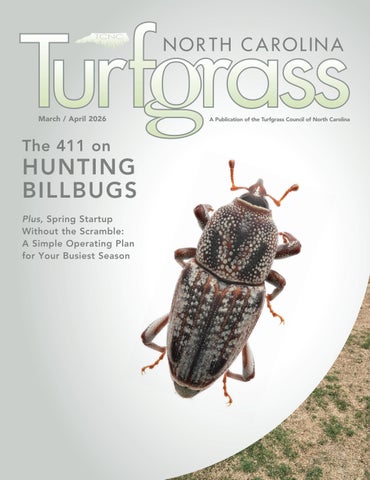
March / April 2026
The 411 on HUNTING BILLBUGS
Plus, Spring Startup Without the Scramble: A Simple Operating Plan for Your Busiest Season


Experience Superior Turf with TifTuf ®
In just seven years, TifTuf®’s installation of over 2 billion square feet has saved more than 48 billion gallons of water. It’s the only Bermudagrass to top National Turfgrass Evaluation Program trials 93% of the time, far ahead of Tahoma at 73%. Recognized for its drought tolerance, TifTuf® is the USDA Specialty Crop Research Initiative’s standard for future university testing and has earned the #1 ranking in the USDA/NTEP ET-Based Water Deficit Research Trial.
TifTuf ®’s water efficiency has garnered numerous awards, including the Smart Approved Water Mark from Australia’s Water Services Association, the Georgia House and Senate’s Extraordinary Water Conservation award, and the

Georgia Association of Water Professionals’ Water Wise Award. It’s also named the Turfgrass of Choice by Southern Living Inspired Communities.
TifTuf® is the most produced proprietary Bermudagrass globally, with more produced in the U.S. than all other varieties combined worldwide. It is the preferred choice for new golf courses, sports fields, and residential and commercial landscapes, and it’s the only Bermuda

sold through Home Depot and Lowe’s by Harmony Outdoor Brands.
While others check boxes, TifTuf® redefines them. Experience the exceptional quality and innovation of TifTuf® turfgrass.

Sola Stands Alone.
Not all St. Augustine grasses are created equal.
The Turfgrass Council of North Carolina (TCNC) serves its members in the industry through education, promotion and representation. The statements and opinions expressed herein are those of the individual authors and do not necessarily represent the views of the association, its staff, or its board of directors, North Carolina Turfgrass, or its editors. Likewise, the appearance of advertisers, or TCNC members, does not constitute an endorsement of the products or services featured in this, past or subsequent issues of this bimonthly publication. Copyright © 2026 by the Turfgrass Council of North Carolina. North
bi-monthly. Subscriptions are complimentary to members of TCNC. Presorted standard postage is paid at Jefferson City, MO.
Submissions: North Carolina Turfgrass allows reprinting of material published here. Permission requests should be
unsolicited freelance manuscripts and photographs. Contact the managing editor for contribution information. Advertising:
rates and insertions, please contact Leading Edge Communications, LLC, 206 Bridge Street, Suite 200, Franklin, TN

and


North Carolina Turfgrass is the official publication of the Turfgrass Council of North Carolina
P.O. Box 641
Wake Forest, NC 27588
984.301.5460
www.turfgrasscouncilnc.org
Regional Connections
Dear TCNC Members,
Spring is here, and with it comes the stretch of the year when turf schedules get tighter and the pace ramps up. One of the best ways to stay sharp through the season is to stay connected to those in the industry. That is why I am excited about what TCNC is building this year through more regional opportunities.
On March 12th, we hosted our first regional event of 2026 in Goldsboro. This was a chance to get practical education close to home and connect with other professionals in your area. If you have not attended a regional event before, they are easy ways to plug in without the travel time that bigger events can require.
We are planning additional regional stops later this year, including Charlotte in July and Winston-Salem in November. The goal is to meet members where they are and create more chances for learning and connection across the state. Keep an eye on TCNC updates on social media as these dates and details come together.
We also hosted An Afternoon on the Green, which was created to support our advocacy efforts and strengthen the future of turfgrass (and our entire green industry) in North Carolina. On behalf of TCNC, I would like to extend a special thanks to my work home, Walnut Creek Country Club, for hosting TCNC! Events like this help create relationships across sectors and support the work that keeps our industry moving forward. If you have ever benefited from mentorship, education, or a strong professional network, you already understand why these efforts matter.
Thank you for supporting TCNC and for the work you do every day. I hope to see you this spring!
Wilson Sutton President Turfgrass Council of North Carolina

CHIEF STRATEGY OFFICER
Marcy Cottle
info@turfgrasscouncilnc.org 984.301.5460
Published by:
Leading Edge Communications, LLC 206 Bridge Street Franklin, TN 37064
615.790.3718
Fax 615.794.4524
info@leadingedgecommunications.com
TCNC OFFICERS
PRESIDENT
Wilson Sutton
Walnut Creek Country Club Goldsboro, NC
VICE PRESIDENT
Greg Harris
Leap Frog Land Care, Inc. Fuquay-Varina, NC
TREASURER
Jonathan Richardson, NCCTP NCCTP Chairman Green Resource Dunn, NC
PAST PRESIDENT
Kevin Herrmann
Green Group, the Division of Turf Masters Brands Raleigh, NC
DIRECTORS
Alpha Jones
Duke University Durham, NC
Spencer Thomas
Keith Hills Country Club
Lillington, NC


Companies wishing to support TCNC with multiple members can join as Deluxe Members. Deluxe Memberships can be purchased in one of three tiers: 1–5 employees; 6–10 employees; or 11+ employees.
If you'd like to learn more about the Deluxe Membership, please contact the TCNC office at 984.301.5460 or info@turfgrasscouncilnc.org.
Thank You to Our DELUXE MEMBER ORGANIZATIONS
Barefoot Lawn Care and Landscaping Services
Canopy Lawn Care
Carol Woods Retirement Community
Carolina Green Corp
City of Asheville Parks and Recreation
City of Raleigh Parks and Recreation
Duplin Sod
Edison Landscaping
Emerald Green
ETM Coastal
Fairway Green of Charlotte
Fairway Green of Raleigh
Fayetteville Tech
Gates Four Golf and Country Club
Green Resource
JRM Inc.
Keith Hiils Golf Club
Leapfrog Landcare
NaturaLawn of America (Raleigh)
Nature's Select
McConnell Golf
Morehead City
Quality Turf
Sod Solutions
Southern Ag
Southern Garden
Southern Seeds, Inc.
The Biltmore Company
The Sunrock Group
Tillery Country Club
Town of Cary Public Works
Town of Garner
Triangle Chemical Company
Turf Mountain Sod, Inc.
UNC – Chapel Hill
Wake Forest University
Weed Man
Renewal as of June 2025
Don't see your company's name?
Renew today at www.turfgrasscouncilnc.org
CROP AND SOIL SCIENCES
Dr. Travis Gannon Assistant Professor 919.515.2647 travis_gannon@ncsu.edu
Navdeep Godara Assistant Professor Turf & Forage Weed Science ngodara@ncsu.edu
Emily Erickson Crop Science Lecturer 919.513.2034 emily_erickson@ncsu.edu
Ray McCauley Extension Associate 919.515.2647 rkmccaul@ncsu.edu
Dr. Susana Milla-Lewis Professor & University Faculty Scholar 919.280.3443 susana_milla-lewis@ncsu.edu
Dr. Grady Miller Professor & Extension Specialist 919.515.5656 grady_miller@ncsu.edu
Dr. Rob Richardson Associate Professor & Extension Specialist 919.515.5653 rob_richardson@ncsu.edu
Dr. Wei Shi Professor 919.513.4641 wei_shi@ncsu.edu
Dr. Qiyu Zhou Assistant Professor 313.782.2892 qzhou9@ncsu.edu
ENTOMOLOGY AND PLANT PATHOLOGY
Dr. Terri Billeisen Extension Associate 919.515.7464 tlhoctor@ncsu.edu
Lee Butler NC State Turf Diagnostics Lab 919.513.3878 ebutler@ncsu.edu
Dr. James Kerns Professor and Extension Specialist 919.513.4820 jpkerns@ncsu.edu
HORTICULTURE SCIENCE
Dr. Danesha Seth Carley Director, Southern IPM Center & Associate Professor 919.513.8189 danesha_carley@ncsu.edu


PLATINUM
2026 PARTNERS GOLD


Become a NC Certified Turfgrass Professional!
TheNorth Carolina Certified Turfgrass Professional (NCCTP) program is a comprehensive program developed to enhance the technical competency of turfgrass professionals, while elevating their professional image, that of your business and of the turfgrass management industry. Administered by the Turfgrass Council of North Carolina, the NCCTP designation confirms your expertise in turfgrass management to prospective customers and your peers.
Reasons to Begin Earning Your NCCTP Designation Today
The NCCTP program increases and enhances your turfgrass industry knowledge, career, and business development through a course of study of in-depth coverage of the science of turfgrass management.
The NCCTP designation offers immediate confidence and credibility of turfgrass management practices to customers and prospective employers.
Promote and market yourself as a North Carolina Certified Turfgrass Professional.
• Use the NCCTP logo on your business materials.
• Use NCCTP pins, uniform patches, and vehicle decals.
• Your TCNC Member Directory listing is distinguished with the NCCTP designation.
We Are Partnered With The NC State Turfgrass Professional Short Course
The NC State Turfgrass Professional Short Course, a comprehensive turfgrass education program, is offered at select NC State Extension offices and at NC State University.
This Short Course offers a full curriculum of the science of turfgrass management as well as Continuing Education Credits for NCDACS Pesticide and NCLCLB Landscape Contractors’ license holders, and it will help you prepare for the NCCTP exam.
This Short Course is recommended but not required to take the NCCTP exam.
Enrollment Requirements:
Hold a current TCNC membership. If not currently a member, go to www.turfgrasscouncilnc.org and click ‘JOIN NOW’ to join online or download an application. Have a minimum of one full year of work experience in the turfgrass industry.
Agree to the Certified Turfgrass Professional Code of Ethics as detailed on the application form.
Submit:
• A current and valid NC Pesticide Applicators license
• A completed NCCTP application (current TCNC members may apply online).
• NCCTP Program Application: $150
• Self-Study Materials: $50
• Exam Fee: $50
Curriculum and Exam
Curriculum covers nine core areas: Turfgrass Characteristics; Establishing Turfgrass; Soils & Nutrient Management; Cultural Practices; Pests & Integrated Pest Management; Pesticides & Plant Growth Regulators; Landscape Safety & Pesticide Use; Calculations & Calibration; Turfgrass Business & Economics.
Candidates have six months from the date of their enrollment acceptance to complete the NCCTP exam. Candidates have six hours to complete the exam and must score 80% or more on each section to receive the NCCTP designation.
Exams can be taken at the TCNC office in Raleigh during normal business hours, or arrangements can be made at your local NC State Extension location.
Exams will not be graded if any application information is missing or if TCNC membership status cannot be confirmed. Please allow two to three weeks for exam grading and reports. Upon successful completion of the exam, candidates will receive communication with their results and either next step options or their graduation packet.
Maintenance Requirements
Maintain a current TCNC membership as a means of demonstrating ongoing support for the industry.
Submit an annual $50 renewal fee, which supports the NCCTP program and related promotional activities. Designation year is the same as the TCNC membership year, from July 1st to June 30th.
Hold a current NC Pesticide Applicator’s License. Subscribe to, actively support and uphold the TCNC Certification Code of Ethics.
The NC Certified Turfgrass Professional designation (NCCTP), the NCCTP logo and related programs materials are the trademarked property of the Turfgrass Council of North Carolina and cannot be used without TCNC’s written permission. For additional information, contact TCNC at 984.301.5460.
New Members
Robby Andrews NCSU
Michael Bovender Surry Maintenance Service, Inc.
Pat Bowers PBI Gordon
Alan Estes PBI Gordon
Troy Kellogg Canopy Lawn Care
Larry Lancaster Small Town Landscaping, LLC
Darrin Paschal Triden Bionutrients
Kelly Scott Nature’s Select Premium Turf Services
Eric Steffensen PBI Gordon
Scott Waltz BASF


March 25, 2026
Guilford County Regional Turfgrass Conference
8:00 am – 12:00 pm
April 7, 2026 Lunch and Learn –Invasive Weed Identification and Control 12:00 pm – 1:00 pm
August 12, 2026
Turfgrass Field Day – Raleigh 7:30 am – 2:00 pm


linkedin.com/company/theturfzone
x.com/theturfzone

facebook.com/theturfzone
BILLBUGS HUNTING The 411 on
Emily Roeder and Terri Billeisen, Ph.D., Turfgrass Entomology Lab, North Carolina State University
Over one-sixth of billbug species native to North America are pests of managed turfgrass (1). In North Carolina, the hunting billbug, Sphenophorus venatus vestitus, is the most common pest of turfgrass (2). While they are frequent inhabitants of warm-season grasses, like zoysiagrass and bermudagrass, hunting billbugs can also be found on cool-season turfgrasses, including perennial ryegrass and fescues (3). In order to properly manage this insect, it is important to understand its biology and seasonality, as well as monitoring strategies and appropriate chemical control options.
Description and Biology
Hunting billbug adults range from five to eleven millimeters in length (Fig. 1). They vary in coloration from black to dark grey and occasional shades of reddish brown. Hunting billbugs are heavily punctuated and covered in small depressions. There is an obvious lack of punctuation on the pronotum, just behind the head, creating a distinctive Y-shape and two parenthesis-like markings (Fig. 2). This pattern is characteristic of the species. Adults are ground-dwelling and most active at night when they crawl across and within the turfgrass canopy (2).
Hunting billbug larvae look similar to other common grubs. They are typically cream-colored with a dark tan to brown head (4). These larvae are distinct from other grubs in that they are legless and tend to be thickest in the middle (Fig. 3). Larvae range in size but are larger than annual bluegrass weevil larvae and smaller than white grubs. Hunting billbug larvae spend the first few larval life stages inside the stem of the grass plant. As they grow and prepare for pupation, they will exit the plant and inhabit the crown and top one inch of the soil profile (2).
Distribution and Seasonality
Hunting billbugs have a wide distribution range and are found from Washington, D.C. to Florida and as far west as Texas and parts of Kansas (2). They are found throughout the entire state of North Carolina but often go undetected as billbug damage is often confused with that of white grubs.


In North Carolina, there are two hunting billbug generations each year (Fig. 4). Adult activity begins in mid-spring and lasts from April to June. The second peak starts in late summer and lasts from August to October (5). From May to September, adults lay eggs, which hatch in 3–10 days. Larvae are commonly recovered from the soil between May and October (2).
Damage
Hunting billbugs can be particularly destructive as they feed on every part of the grass from blade to root. Adults chew grass blades and stems, creating circular holes in the plant called notches. This is done for both feeding purposes and oviposition, or egg laying. Smaller larvae feed within the stem, hollowing it out from the inside. As larvae grow, they leave the stems and feed on the crowns, stolons, and roots. This feeding damage initially presents as stressed, yellowing turfgrass that progresses to brown and tan irregularly shaped patches (Fig. 5).
Hunting billbug damage can be difficult to diagnose due to its similarities to both annual bluegrass weevil damage and white grub damage, as well as turfgrass diseases, like dollar-spot disease (6). Similar to hunting billbug larvae, annual bluegrass weevil


Sampling Method Description Pros Cons
Active Sampling
Soil Sampling
larvae are also known to feed inside the turfgrass stem. Annual bluegrass weevils, however, infest cool season turfgrasses and are only established turfgrass pests in western North Carolina. Hunting billbug damage resembles white grub damage as the root and crown feeding of both insects results in yellowing turfgrass areas as an early damage symptom.
Monitoring
Monitoring populations throughout the year is a crucial step in determining the identity and appropriate management strategy of an insect pest. Several methods to detect hunting billbugs in turfgrass include pitfall traps, night scouting, tug tests, and soil sampling (Fig. 6). These methods are not only effective for hunting billbugs but can also allow you to detect a wide range of turfgrass-inhabiting insects.
Soil sampling in and around damaged areas is the most effective method for finding billbug larvae. Cut a 1-square-foot section of the damaged area, making sure to include at least four inches of soil material. Sift through the soil and slowly pull apart plant material to look for larvae. Check multiple sites within the turfgrass stand to avoid a false negative.
Cut 1-square-foot section of turf and lift to examine soil and plant material underneath. Sift through the soil to look for larvae. Check multiple sites in damaged areas to avoid a false negative.
Directly confirms infestation causing damage, few materials required
Requires some damage to turf
Nightscouting
Test
Active Sampling
Focus light beam of a head lamp or flashlight on the turfgrass surface and look for insects crawling on top of grass blades.
Increased detection with night activity, non-destructive
Time constraints, difficult if visually impared
Active Sampling
In areas with visible damage, lightly tug at the crown of the grass. If it seprates and lifts from the soil easily, this can indicate hunting billbug damage. You may also be able to see insect frass (sawdust-like pockets) in the top inch of soil.
Sawdust-like frass is very distinctive of billbug or weevil activity, non-destructive
Does not directly ID larvae or adults, only effective in heavily infested areas
Pitfall Trap
Passive Sampling
Dig a cup-sized hole in the ground and insert a plastic cup, making sure the lip of the cup is flush with the ground. Use sod staples on cup edges to secure it to the ground. Add one inch of soapy water to the cup and check contents weekly for insects.
Requires minimal maintenance, can reveal multiple insects
Fig. 6 Descriptions and Evaluation of Different Monitoring Techniques
More effective in areas of past infestation so damage is sometimes already present, non-specific sampling
If you are a night-owl, you can scan the turfgrass canopy at night to scout for hunting billbug adults crawling on the surface. Use a head lamp or flashlight and sweep the light slowly across the turfgrass to find small, black insects on the top of grass blades.
A tug test is a time-efficient way to check for hunting billbugs in damaged areas. Grip the turfgrass with your hands and lightly tug on the grass blades. If the aboveground plant material separates from the soil surface easily, this can be a good indication of hunting billbug larval damage. You may also be able to see insect frass, or sawdust-like pockets, in the crown, which can be indicative of larval feeding.
Pitfall traps can be a great passive method for collecting billbugs although it will require a disruption in turf canopy coverage. Dig a cup-sized (4 in diameter, 6 in depth) hole in the ground and insert a plastic deli cup, making sure the lip of the cup is flush with the ground. You can use sod staples on the sides of the cup to secure it to the ground. Add ½ cup of soapy water to prevent insects from escaping. Adult insects will fall into the cup as they walk across the turfgrass canopy. This method will not only collect hunting billbugs, if present, but will also collect other surface insects.
Management
Although both adult and larval life stages cause damage and are targeted with insecticides, billbug larvae can be very deep in the soil and difficult to reach with a chemical application. Target the first generation of adults early in the spring (March/April) as they emerge from overwintering sites. Pyrethroids (bifenthrin, lambda-cyhalothrin, and deltamethrin), diamides (chlorantraniliprole, cyantraniliprole and tetraniliprole) and combination products (clothianidin + bifenthrin or imidacloprid + bifenthrin) work well for adult control. Diamides and neonicotinoids (clothianidin, imidacloprid and thiamethoxam) work best to control larvae.
Billbugs are active now so the earlier you treat for adults, the better. Try to apply adulticides no more than three weeks after adult activity begins in March. If you have a site history of billbug activity, install pitfall traps or scan the turfgrass at night to see if adults are active. Remember, a critical component of effective turfgrass insect management is getting the timing right. Using a consistent monitoring program can help narrow the application window and improve insecticide performance.
REFERENCES
1. Vaurie P. Revision of the Genus Calendra (Formerly Sphenophorus) in the United States and Mexico (Coleoptera, Curculionidae). Bulletin of the American Museum of Natural History. 1951 December 28; 98(2): 29–186.
2. Brandenburg RL, Billeisen T. Hunting Billbugs in Turf. NC State University Extension. 2017, October 25; https://content.ces.ncsu. edu/hunting-billbug-in-turf
3. Dupuy MM, Ramirez RA. Biology and Management of Billbugs (Coleoptera: Curculionidae) in Turfgrass. Journal of Integrated Pest Management. 2016 April 1; 7(1): 1–10. doi: 10.1093/jipm/pmw004.
4. Woodruff R. Hunting Billbug, Sphenophorus venatus vestitus Chittenden (Insecta: Coleoptera: Curculionidae). 2001, May; https:// ask.ifas.ufl.edu/publication/IN364
5. Doskocil JP, Brandenburg RL. Hunting Billbug (Coleoptera: Curculionidae) Life Cycle and Damaging Life Stage in North Carolina, With Notes on Other Billbug Species Abundance. Journal of Economic Entomology. 2012 December 1; 105(6): 2045–2051. doi: 10.1603/EC12110
6. Reinert J, Drees BM. 2011. The hunting billbug: an emerging pest of Texas turfgrass. The Pallet. 2011, April; 6-10. https://landscapeipm. tamu.edu/ipm-for-turfgrass/pests-turfgrass/hunting-billbug
NO NEED TO SWEAT THIS SUMMER!


HUNTING BILLBUG FAQs
1. If I spray for annual bluegrass weevil (ABW), will the application kill the billbugs as well?
A: It depends. If you are applying an adulticide (pyrethroid) in the spring, you may kill both ABW and hunting billbug adults. However, timing will vary and annual bluegrass weevils generally emerge from overwintering sites several weeks before hunting billbugs are active. Larval applications are more likely to overlap as those occur during summer months.
2. How do I tell a white grub from a billbug larva?
A: Although they both look like a “grub”, white grub larvae have three pairs of legs and the posterior (back end) of the abdomen is gray. Billbug larvae are legless and are cream-colored throughout.
3. I had a late-season billbug problem last year. Should I be scouting for the adults this year?

A: Yes! Billbugs tend to damage the same areas year after year. Now is the perfect time to scout for adults so get out there, find and identify them, and treat!
4. During which months is hunting billbug damage most likely or evident?
A: Although adult damage symptoms can appear as early as April, billbug damage is most evident during the summer months (June-August) in North Carolina. Some years, we can also see significant fall damage which is likely from overlapping (adult and larval) life stages.


Spring Startup Without the Scramble:
A Simple Operating Plan for Your Busiest Season

Spring can feel like a wild sprint in the turfgrass industry. Demand rises fast, the weather shifts by region, and crews are expected to move from preparation to production with little margin for error. Whether you own a large landscape company, supervise grounds, or work independently, the same business question pops up this time of year: how do you stay organized when everything speeds up at once?
North Carolina makes this even more important because spring does not look the same across the state. Both cool-season and warm-season grasses are grown in North Carolina, with coolseason grasses performing best in spring and fall, while warmseason grasses are slower to green up in spring and grow best in summer. That means your startup plan needs to align with your region, turf type, and service mix, rather than relying on a single statewide timeline.
Here is a framework for all types of turfgrass managers:
1. Set your spring capacity before you fill the calendar.
A full schedule doesn’t always mean a profitable schedule. Start by estimating what your team can realistically handle each week based on labor hours, travel time, equipment availability, and the complexity of your work. For a sports turf manager, this may mean planning field preparation windows around game schedules and weather. For a landscape business owner, it may mean separating recurring maintenance from installation work so one category does not disrupt the other. For an independent operator, it may mean limiting new clients until recurring customer routes stabilize.
This step helps you avoid the spring trap of saying yes too quickly and spending the next six weeks fixing preventable delays. It also gives you a better basis for quoting timelines, setting expectations, and deciding whether to outsource any work.
2. Build a startup checklist for equipment and supplies.
Spring problems often look like labor problems when they are really equipment and supply problems. A mower down for two days can throw off an entire route. A missing part can delay an athletic field prep. A late material delivery can create a client communication issue that your team then has to manage.
Create one checklist for startup readiness and assign dates to each item. Include inspections, maintenance, blade sharpening, tire checks, calibration, backup equipment options, and commonly used supplies. If you manage a crew, assign ownership to specific people and confirm completion in writing. If you work alone, schedule this work like billable time because it protects billable time later.
The goal is not perfection. The goal is fewer surprises when everyone needs service at once.
3. Standardize your onboarding before hiring pressure hits.
Many businesses wait until they are short-staffed before considering training. Spring is the worst time to build onboarding from scratch. A simple onboarding process can help new hires become productive more quickly and reduce the burden on your strongest crew members.
Keep it practical. Focus on safety, equipment basics, site expectations, communication standards, and what good work looks like in your operation. For sports turf settings, include event-day expectations and the chain of communication. For landscape crews, include job-site photos and quality examples. For independent operators who occasionally bring in help, use a one-page field guide that outlines your process and customer standards.
Education is one of the strongest retention tools available because it helps people build confidence and feel invested in their work. It also protects quality when the pace increases.
4. Protect your schedule with proactive client and stakeholder communication.
Spring startup gets harder when communication becomes reactive. A short round of outreach before your busiest stretch can prevent many avoidable issues. Confirm service windows, clarify what is included, and explain what may shift due to weather or field use.


For sports turf professionals, this can mean a quick pre-season update to athletic directors, coaches, or facility contacts about timelines, field conditions, and scheduling limits. For contractors, it can mean a reminder about spring demand, response times, and approval timelines for add-on work. For independent operators, it can mean confirming your route days and the best way to reach you for non-urgent requests.
Clear communication reduces interruptions and helps people understand that good turf outcomes require planning, timing, and patience.
5. Track a small set of weekly numbers.
You do not need a complex dashboard to run your Spring startup well. You need a short list of numbers that tells you whether your plan is holding up. Pick metrics that align with your role and review them weekly.
EXAMPLES INCLUDE:
• labor hours scheduled versus labor hours worked
• completed jobs or field tasks versus planned
• equipment downtime
• callbacks or rework
• weather delays
• material usage on high-volume items
• outstanding approvals or invoices
These numbers help you spot problems early. If labor hours are running high every week, your route density or staffing plan may need adjustment. If callbacks spike, training or quality checks may need attention. If equipment downtime keeps increasing, preventive maintenance may be slipping.


6. Build your plan around your market, not a generic template.
The turf and landscape industry is broad, and that matters for business planning. NALP (National Association of Landscape Professionals) reports that the landscape services industry reached a market size of $188.8 billion in 2025 and includes more than 692,000 landscaping service businesses. That scale reflects a wide range of business models, from solo operators to larger firms, along with very different customer expectations across markets.
A startup plan that works for a municipal sports complex may not fit a residential landscape route. A plan that works in one region of North Carolina may need adjustment in another. The NC State Extension puts it plainly: “No one type of grass is best suited to all situations.” The same principle applies to operations. Build your plan around your turf, clients, team, and region.
A practical spring takeaway…
Spring will always be busy. While we can’t remove the pressure, we can reduce preventable chaos.
A simple operating plan can do that. Set your capacity, prep equipment early, standardize onboarding, communicate before problems start, and track a few meaningful numbers. These steps require intention, and they pay off when the season starts moving faster than expected.

In a profession built on timing, spring success often starts before the first rush arrives.

Influence of Management on the Microbiome of Turfgrass Systems
By Benjamin Snell, Graduate Student, NC State University


Home lawns, golf courses, and athletic fields account for the majority of the turf industry. A considerable amount of research has been conducted within these areas of the industry, with a primary focus on management strategies. Improving management strategies is crucial for turf managers to produce high-quality turf that is economically and environmentally sustainable. One area within the turfgrass industry where knowledge is limited is the impact of these management strategies on the soil microbiome. Previous research has demonstrated the benefits and importance of these microorganisms for plant health. Multiple claims have been made that organic products promote microbial growth, whereas traditional products, such as pesticides and synthetic fertilizers, can negatively affect these microorganisms. With the development and release of new molecular tools, more scientific conclusions can be drawn. Understanding whether and how turf management affects the soil microbiome is crucial for turf managers to sustain high-quality turf and maintain a beneficial soil microbiome.
To understand the influence of different management practices on soil microbiomes, a trial was designed to simulate a typical home lawn management plan, with treatments using traditional synthetic fertilizers and pesticides and others using OMRI-approved organic products. This trial was conducted at Lake Wheeler Turfgrass Research and Education Center in two popular homeowner grasses, zoysiagrass (Zoysia spp. Willd.) and tall fescue (Schedonorus arundinaceus (Schreb.)). Turfgrass quality, soil physical and chemical properties, and the soil microbiome have been measured for each treatment over the last year and will be measured for the final time two years after the initial sampling. The soil microbiome was characterized by extracting DNA from soil samples and submitting it for 16S/ITS sequencing. Using the raw sequencing reads, Qiime2 was used to identify the fungi and bacteria present in the trial. Soil samples were also collected from golf courses and athletic fields to determine how these management styles affect microbial communities. These samples include looking at creeping bentgrass (Agrostis stolonifera L.) and bermudagrass (Cynodon dactylon (L.) Pers.) putting greens and athletic fields in North Carolina. The samples from these have been collected once and will be collected again one year after the initial sampling for comparison.
Visual data from the trials, focusing on the differences between organic and conventional management strategies, have been analyzed. After one year of treatments, a significant difference in turfgrass quality was observed among treatments in the tall fescue trial under disease pressure. Turfgrass quality is rated on a scale of 1-9, with one being the lowest and nine the highest. The highest turf quality was observed in the treatment that received both synthetic fertilizer and pesticides,

DMG TURF
The Triangle’s Premier Turfgrass and Sod Farm
DMG Turf is a family owned and operated business, serving North Carolina with cool and warm season grasses. From residential projects to large commercial jobs including golf courses, athletic fields, and more, our commitment to customer satisfaction has been our top priority since 1999. Our friendly and knowledgeable staff are ready to serve you with delivery to your location, or you can schedule a pickup at our sod farm in Angier, NC.
which was significantly higher than the organic treatments, the synthetic fertilizer-only treatment (no fungicide applied), and the non-treated control. In the presence of disease, organic treatments, synthetic fertilizer-only treatments, and the non-treated control all resulted in decreased turf quality. Based on this preliminary data, organic treatments will begin to fail or have little effect on disease presence.
In addition to turf quality, initial sequencing data from the tall fescue and zoysiagrass trial have been analyzed. This data was collected before any treatments were applied. These preliminary
Tall Fescue
results indicate that microbiome communities differ significantly between tall fescue and zoysiagrass. These findings are expected, given how different environmental factors can impact these communities. More sampling, analysis, and evaluation will help determine whether and how these management practices affect these communities. Golf course and athletic field samples are currently being analyzed to identify further how various cultural practices influence these microbial communities. Understanding how management practices influence soil microbiomes will encourage managers to promote a more diverse microbial community while maintaining a highly acceptable turf stand.

Southern Agricultural Insecticides, Inc. is a distributor of pesticides, fertilizers, potting soils, and horticultural supplies with locations in Florida and North Carolina.
MANUFACTURERS OF… DISTRIBUTORS FOR…
Blue Colorant
Chelated 5% Iron
Chlorpyrifos 2.5% G
Chlorpyrifos Mole
Mole Cricket Bait
Defoamer
Latron B–1956
Methylated Seed Oil
Snail Bait
Soil Acidifier
Soil Wetting Agent

Soluble 10–30–20
Soluble 30–7–14
Soluble 20–20–20
Spreader Sticker
Surfactant for Herbicides
Tank Cleaner
Turf Green
Tweak
12–0–0–6% iron
GOLF COURSE SALES STAFF
Jim Wells — West Central Florida (941) 720–2712
Roger Welker — East Coast Florida (772) 260–0282
Kevin Downing — South Florida (561) 427–4501
Jeff Strother — Southwest Florida (941) 270–0470
Andrew Wampler — Western Carolinas (828) 674–2594
Brandon Hicks — Central North Carolina (336) 906–0803
Nathan Biggs — North Carolina...................... (704) 996–5125
AMVAC Andersons
Aquatrols
BASF
Bayer
BioSafe Systems Bioworks
Certis
Corteva Agriscience
Envu
FMC
Gowan
LebanonTurf
Milliken
Milorganite Nufarm OHP
Old Castle PBI / Gordon
Quali-Pro
Rightline
SePRO
Sipcam Agro
Solo
Sunniland
Syngenta UPL Yara
Boone, NC (828) 264-8843
Hendersonville, NC (828) 692-2233
Palmetto, FL (941) 722-3285
Be Confident Of Your Course


