

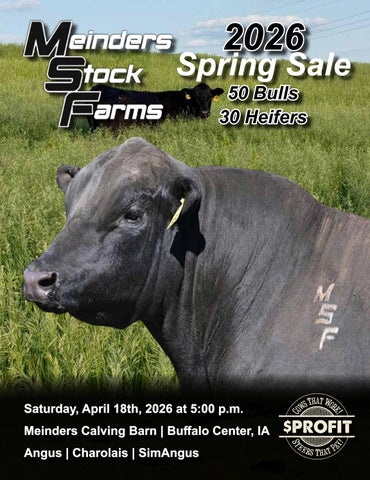
2026 Spring Sale
50 Bulls 30 Heifers


Saturday, April 18th, 2026 at 5:00 p.m.
Meinders Calving Barn | Buffalo Center, IA
Angus | Charolais | SimAngus
Cattlemen,


Welcome to the fifth annual Meinders Stock Farms Spring Sale! We are excited about our offering of Angus, SimAngus and Charolais bulls and open yearling heifers! We aim to be a one-stopshop for your bull and female needs, by offering multiple breeds that can meet any herd’s needs. We are very focused on building cattle who have balanced EPDs with an emphasis on moderate cow size, feed efficiency, and marbling.
For the last thirteen years, we have been marketing Stabilizer bulls through Leachman Cattle. We are still sending our Stabilizer bulls to Wyoming, but we now market our registered cattle here in Iowa! With Leachman, we were introduced to their $Profit, $Ranch, and $Feeder indexes which have helped us improve our herd at a rapid pace. $Profit is the best overall index in the industry and all of our sale cattle will sell with this index, most in the top 5% of the industry! We encourage you to read more about $Profit, $Ranch, and $Feeder later in the catalog and we believe that those indexes will help you make the best decision for your herd’s needs.
All cattle in the sale have been feed efficiency tested, which is unique data that most seedstock producers do not offer. Feed consumption is the #1 driver of cost in the cow herd and must be taken into consideration, especially with today’s feed prices. We try to collect as much data as possible to offer the highest accuracy EPD’s and Indexes so you can buy with confidence. Every animal in the sale will also sell with genomically enhanced EPDs.
We are also excited to offer a calf buy-back program on all calves sired by bulls bought in our sale! We have great confidence in our genetics and will gladly pay premiums for those calves. Those premiums will be paid based on the $Feeder indexes of the sires, so the better bulls you buy, the higher the premium we will pay! Contact us for more information on that opportunity!

These are exciting times in the cattle industry! Take advantage and invest in the best genetics you can afford! We hope to see you on sale day!
Zach Meinders


Zach, Macie, Tenley and Dirk
Jake, Brittany, Ellis, Hadley & Mason

Schedule of Events
Friday, April 17th
Meinders Stock Farms Spring Sale
Saturday, April 18, 2026
Meinders Calving Barn • Buffalo Center, Iowa Sale starts at 5:00 p.m. (CST)
5:00 p.m. Pre-Sale Presentation at Titonka Brewing Company. (223 1st. Ave NW Titonka, IA 50480)
Saturday, April 18th
1:00 p.m. Cattle available for viewing
4:00 p.m. Social Hour - Drinks & Snacks
5:00 p.m. SALE BEGINS!
6:30 p.m. Brisket Supper
7:00 p.m. Live Music - Max Deboer
Sale Day Phones
Zach Meinders • 515-320-3835
Jake Meinders • 515-320-3738
Lee Leachman • 970-219-8519
Craig Hays • 660-373-1897
Kurt Schenkel • 740-503-6270
Aaron Rasmussen • 308-763-1361
Auctioneer
Cody Lowderman • 309-313-2171
Representatives

Adam Conover, American Angus Association • 816-676-8560
Brice Conover, Midwest Marketer • 515-979-3890
Kyle Hansen, Special Assignment • 712-541-5253
Bill Zimmerman, ASA SimSpecialist • 612-875-9509
Hadley Schotte, Charolais Association • 785-562-6632
Sale Location and Directions
The sale will be held at the Meinders Calving Barn, which is located at 2304 380th St. Buffalo Center, IA 50424. From Wesley, IA (HWY 18), drive North and proceed 15 miles, then take a left (West), and proceed ¾ mile on 380th St. From Buffalo Center, IA (HWY 9), drive 2 miles West, take a left (South), proceed 5 miles then take a right (West) on 380th St. and proceed ¾ mile.
Suggested Lodging
Brookstone Lodge & Suites, Algona, IA • 515-200-0030
AmericInn, Blue Earth, MN • 507-800-1542
Cobblestone Inn & Suites, Forest City, IA • 641-638-7162
Hampton Inn, Fairmont, MN • 507-235-2626
Herd Health
Bulls have been vaccinated post weaning against 5 strains of Lepto with Spirovac L5. They also received Clean-Up Pour-On on March 1st. They sell with a complete breeding soundness evaluation.
Retained Semen Interest
Meinders Stock Farms will retain 50% semen interest in all bulls selling. If the buyer would like exclusive semen marketing rights, they may choose to double the final bid price to own 100% semen interest. In that case, Meinders Stock Farms still retains the right to collect the bull for in-herd use.
Sale Order
Cattle will sell in catalog order.
Delivery
Delivery information in the back of the catalog.
Volume Discounts
We will offer volume discounts (bulls only) starting at 5% off of your purchase of 5 bulls, 6% off of 6 bulls, and so on up to a max of 10% off your total bull purchases.
Boarding
We will board bulls for free until June 1st. For bulls that do not sell locally, we may ask buyers to take possession sooner, so we can schedule trucking as affordably as possible.
Online Bidding
Online viewing and bidding will be available at DVAuction.com. Find more information on that later in the catalog.


Meinders Stock Farms
Calf Buy-Back Program

We will pay you a premium for your Meinders Stock Farms sired feeder calves!
• Premiums will be paid above and beyond the “top” of our regional feeder calf sales.
• Premiums will be determined by the $Feeder index of the bulls you buy!
• Benchmark your herd by DNA testing your replacement heifers with Inherit Select.
• Vaccinate your calves with our recommended herd health protocol.
• Drop off your calves on one of our designated delivery days.
• Receive data on your calves after they are harvested and sold on the grid.
Calf Buy-Back Example
John has just begun buying Meinders Stock Farms bulls. We are going to assume he has been using bulls at industry average for $Feeder, which is $65. The new MSF bulls he has bought average $331 $Feeder (about the average Angus bull in the sale). We expect those bulls to add about $266/head ($331-$65) of genetic value to John’s calves. MSF will pay out 50% of that added genetic value as a premium which would be $133/head on this set! If John has 100 calves to sell, that’s $13,300 in Premiums!
If John’s bulls averaged $399 $Feeder, the math would be $399-$65=$334. 50% of that would be a $167/head premium MSF would pay.
As John buys more and more MSF bulls over the years, we will give more credit to his herd’s $Feeder which will result in higher future premiums. Better yet, if John DNA tests his herd with Zoetis Inherit genomic test to get EPDs on his females, we can learn exactly where his cow herd is genetically and pay premiums on his calves accordingly!


Youth Heifer Giveaway!

MSF2 Lassie NM046
ASA# 4562054 · DOB: 3/15/2025 CLRS Huckleberry 8307H x TJ Horsetooth 452D Homozygous Black • 1/2 SM 1/2 AN MSF2 LASSIE NM046
All youth ages 8-17 will be eligible to win this registered SimAngus heifer on sale day! Attend the sale, put your name in the hat, and a winner will be drawn at the beginning of the sale! Must be present to win and must be accompanied by a parent or relative. We are excited to support the next generation in the cattle industry! Winner will be asked to report back from time-to-time on the status of the heifer and how she’s working in his or her herd.
Since 1902...

Dirk Meinders, who emigrated from Germany to the US in 1882, purchases 160 acres outside of Buffalo Center, IA for $27.50/acre.
1902
Wilbert is drafted. He arrived in Korea in February of 1952 and returned home safe in April of 1953. Goes back to work on the farm with his dad, Henry.
1952-1953

1920’s - 1956
Henry, Dirk’s middle son, owns and runs the farm. Dairy cows, hogs, chickens, and used Belgian horses to farm the land.


1962

Gary & Dale raised Spot breeding stock, including an Iowa State Fair Champion Boar! 1 9 7 4
1967
Wilbert and his four kids, Gary, Dale, Janet & Bruce sitting on their John Deere 4020.

1987
Meinders Brothers (Gary & Dale) purchase their first beef cows. Hereford cross cows and a Simmental Bull.


Set of Hereford steers (and pigs) on feed.

With the addition of Smartbunks, we began measuring individual feed intake on all of our bulls & replacement heifers.


Meinders Stock Farms (Zach & Jake) purchase their first seedstock heifers from Leachman Cattle of Colorado Spring Sale. 6 Registered Angus Open Heifers. Started selling bulls as a Leachman cooperator herd two years later. 2011
2018

First Meinders Stock Farms Bull Sale. Sold 30 Yearling Bulls & 10 Open Heifers. High selling bull was MSF Swagger G072J going to RA Brown Ranch in Texas.
2022
2000

Meinders Brothers purchases 6 elite bred cows from Leachman Cattle in Billings, MT. One of those had a LHMN King Rob 8621 calf who we used as a herd sire for years. We were even pictured in their next catalog!


2 0 2 0
Leachman Groomsman (raised at Meinders Stock Farms) is one of the high selling bulls on the Leachman Spring Sale. One of the most impactful Stabilizer sires in the breed.
2023

Meinders Stock Farms aquire the Mike Pay SimAngus cow herd. One of the highest API & $Profit herds in the country.

Jake & Zach at the sale.
$PROFIT® WHAT IS
& WHY IS IT IMPORTANT?
The $Profit® index stands as one of the most innovative and effective tools in modern beef production. Designed to help cattle producers maximize their profitability while improving the efficiency of their herds, the $Profit® index has gained recognition across the beef industry as a game-changing resource. By focusing on longterm sustainability and optimizing genetic potential, The $Profit® system empowers producers to make informed decisions that benefit both their bottom line and the future of the beef industry as a whole.
WHAT IS THE $PROFIT® INDEX?
At its core, the $Profit® index is a genetic selection tool that calculates the expected profitability of beef cattle based on specific genetic traits. It is a comprehensive program that goes beyond the typical focus on individual traits like weight gain or carcass quality and instead integrates a range of factors that affect overall production costs and returns. The system evaluates 22 traits such as growth rates, feed efficiency, reproductive success, and carcass merit, assigning each animal a profitability score that reflects its overall potential for long-term profitability.
In the cattle business, you have to balance all of the traits that impact profitability. This is nearly impossible for anyone to do without understanding the tradeoffs and economic impact of each trait. Simply put, $Profit® does this work for you. By selecting for $Profit®, your cowherd will become more profitable (Cows that Work) and your feeder calves will make more money (Steers that Pay).
The $Profit® index utilizes a powerful algorithm to consider the various inputs that contribute to profit, including both direct and indirect costs associated with production.
This allows beef producers to select animals that not only perform well in traditional areas, such as
weaning weights or ribeye area, but also in more complex aspects like feed efficiency and herd longevity. As a result, the program offers a more holistic view of genetic potential and provides a roadmap for selecting the bulls and cows that will yield the best financial outcomes.
HOW IS $PROFIT® CALCULATED?
The $Profit® score is calculated by taking into account a variety of economic factors. These include:
Reproductive Performance: Since the production of each calf is a major source of income, reproductive efficiency is critical. Bulls that produce cows with higher reproductive performance contribute to the overall profitability of the herd by ensuring higher calf crop percentages.
Longevity and Durability: Cows that live longer and continue to produce calves effectively contribute to long-term profits, reducing replacement and depreciation costs for herds.
Feedlot Performance: The $Profit® system incorporates expected performance data for animals as they enter feedlots, taking into account how efficiently they will gain weight and how well they will grade once processed.
Carcass Merit: Factors like carcass weight, marbling, ribeye size, and yield grade are all considered to predict how well the animal will perform in the marketplace. Higher carcass quality leads to higher premiums at the packing plant, increasing profitability.
$Profit® is generated from a combination of industry standards, genomic testing, and performance records from Leachman Cattle and the broader cattle industry. By assigning a dollar value to each trait, the $Profit® score provides a numerical representation of the expected profit an animal can generate across its lifetime.
Leachman financial indexes allow you to HAVE IT ALL !
$RANCH®: Profit from birth through weaning. Includes:
• Fertility, Milk, Growth
• Cow feed intake and mature size
$FEEDER®: Profit from weaning to harvest. Includes:
• Feed conversion
• Carcass value
• Carcass weight
$PROFIT®: $RANCH® + $FEEDER®. Puts it all together.
• One number that predicts your bottom line!
FEED:GAIN: Difference in the amount of feed a bull's progeny will consume to produce one pound of gain.
Example: A -0.50 F:G EPD means this animal's progeny will consume 1/2 pound less feed per pound of gain than would progeny of a 0.00 F:G EPD sire.
FEED INTAKE: Difference in feed consumption of each of a bull's progeny in a 112 day feeding period. Example: A steer whose sire has a -100 Intake EPD will eat 100 pounds less feed in 112 days than one whose sire had a zero Intake EPD.
FEED EFFICIENCY
ACROSS BREED COMPARISONS
DARE TO COMPARE:
You can’t afford to make mistakes in your breeding program. Choosing to use sires with incomplete or low‑value data can unknowingly make your herd less profitable. Same work, same cost, poor results — unacceptable.
Leachman ABC’s are the most reliable and comprehensive EPDs in the industry. They are backed by a large (nearly a million), long‑standing (over 30 years), multi‑breed (over 15 breeds) database. Using this system assures you of making sound breeding decisions with minimal risk of failure.
CALVING EASE: The predicted calving ease if you use the bull on heifers.
The easiest calving bulls in the industry
Use on smaller heifers with minimal assistance needed
Use on larger heifers with some assistance expected (If no stars are shown, the animal is recommended for use on cows only)
DISPOSITION: An observation of the sires disposition.
GOOD BETTER BEST
Average – respects flight zones and handles well, but is not a pet

Angus Bulls
More Marbling • Less Feed


Lot 1
Angus Bulls Lots

Lot 2
Nighthawk is the natural calf of our top donor, MSF May GG022. She has put 5 sons into registered herds and is also the grand
Add
Night Owl is a sleepat-night calving ease bull with an outcross pedigree! Check out his elite level of Marb & REA! Very unique herd sire prospect!
3 MSF Nighthawk G055N

3


Lot 4
Sire - MSF Longmire G343L
Angus Bulls Lots 1-18
MSF LONGMIRE G003N


Lot 5 Lot 6
Angus Bulls Lots 1-18
MSF MERIT G025N


Angus Bulls Lots
MSF LONGMIRE G006N

Lot 12
ENDEAVOR G037N
Angus Bulls
MSF LONGMIRE G022N
MSF LONGMIRE G005N


Study thedata!
Harvest Data from a group of MSF Angus & SimAngus sired steers & heifers out of commercial cows. These calves earned $151/head in QG & YG premiums! The Prime calves averaged 0.93 Marb., $184 $Feeder, & $22,900 $Profit. The Angus bulls in this sale average 1.58 Marb., $330 $Feeder, & $33,100 $Profit! Think of the potential the calves sired by these sale bulls will have!


Charolais Bulls


Flush Brother to LP054 Donor - MSF Kinnick P041K
Norway is the only bull in the breed with his elite combination of BW, YW, Marb, & REA! He has impeccable foot shape, a gentle disposition, & powerful phenotype. This flush (Lot 19-21) was a slam dunk! Homo Polled & PA Free!

Lot 19
20
MSF NATURAL P001N

NORDIC P002N


22 MSF FLATLAND
Lot 20
Lot 21
23
MSF ENCOMPASS P030N

24 MSF ENCOMPASS P028N
25 MSF ENCOMPASS


SimAngus Bulls
More Muscle • More Fertility


LONGMIRE M043N

SimAngus Bulls

9


Lot 29 Lot 30
SimAngus Bulls

LANDMARK 14L


Lot 36
CAPITALIST
Lot 35
SimAngus Bulls Lots
MSF2 231A M038N
MSF2 CAPITALIST K021N
SimAngus Bulls
46
MSF2 JERICHO S471N
MSF2 JAILBREAK M013N
“Our cows check all the boxes!“

Gary, Hunter, Dale, Hayden, Zach & Jake Meinders

Finished Stabilizer cattle in the crowd tub before loading on the truck to Cargill. Heavy muscled, ideal fat cover, and an extremely valuable carcass underneath the hide.
“Half of our calf crop is sold as breeding bulls or retained as replacement heifers. In 2025, the remaining steers and heifers, who were primarily Stabilizer sired, graded 43% Prime, 49% CAB, 8% Choice, and 0% Select! They did that with a 2.65 Yield Grade and a 966 carcass weight on the steers and 860 on the heifers.”
- Gary Meinders


Our cows primarily graze in river bottom pastures along the Buffalo Creek in the summers. These pastures can be very productive but are prone to bad flooding. The cows that are hardy, easy fleshing and low to medium for dry matter intake handle these conditions best. Here we are pregnancy checking cows on the hill of a flooded pasture last summer.
“We feed efficiency test 100% of our bull calves and replacement heifers.”
“Feed consumption is the #1 driver of cost in the cow herd and by improving the feed efficiency in our herd, we can run more cows on less acres.”
– Zach Meinders
In our SmartFeed Bunks, we can measure individual feed intake, feed:gain, and average daily gain so we can identify the most efficient cattle.
Leachman MSF 49er P013B was one of the first Charolais we raised at Meinders Stock Farms. A very unique Charolais sire with great calving ease, marbling, fertility, udder quality and phenotype. He has had a big impart on the Leachman herd and is in the pedigree of two of our donors!


MSF Swagger G072J sold for $15,000 to R.A. Brown Ranch in our first Meinders Stock Farms Spring Bull Sale in 2022. We couldn’t have asked for a better bull to lead off our first sale and he is still $32701 $Profit today! Still a go-to Angus sire for marbling and fleshing ability.
Dirk Meinders, the next generation, learning the ropes!

Open Yearling Heifers


Lot 51
Flush Sister to Lot 51's Dam - MSF May KG042
Angus Heifers Lots

Lot 52

Lot 53
Angus Heifers Lots
MSF MISS BELLE NG021
57 MSF FIONA MG091
ELLA
SimAngus Heifers

Lot 62
NK004 is an elite Terminal Index & $Feeder donor prospect with top 1% Claw. High performance female with 111 WW ratio, 115 YW ratio & a 126 REA ratio.

SimAngus Heifers


SimAngus Heifers Lots


SimAngus Heifers Lots
MSF2 NORA

Donor Dam - ADV MS GENESIS J1039

Lot 72
MSF2 PRIDE NS083
SimAngus Heifers Lots


Lot 76
SimAngus Heifers
79 MSF2 SONYA NS073
CRYSTAL NS191

PROTECT YOUR INVESTMENT


Free $200/Head
$400/Head
$600/Head
$800/Head
Free nationwide delivery on total purchases of $25,000 or more.


Breed Percentile Tables


How to Read the Catalog
1. Breed Registration Number
2. Breed
3. Birthdate
4. Color: BLK=Black, BBK=Homozygous Black, BRC=Black Red Carrier, BWF=Black White Face, RED=Red, RWF=Red White Face, WHT=White
5. P = polled. S = scurred. H = horned. PP = Homozygous Polled. PH = Heterozygous Polled, PHS = Heterozygous Polled & Scurs.
6. Sex: Bull, Heifer, or Cow.
Performance
7. Actual Birth Weight / Ratio
8. Adjusted Weaning Weight / Ratio (100 is average,106 is 6% above average)
9. Adjusted Yearling Weight / Ratio
10. Adjusted Yearling Scrotal
11. Adjusted Yearling Intramuscular Fat / IMF Ratio
12. Adjusted Yearling Ribeye / Ribeye Ratio
13. Adjusted Yearling Frame Score
Scores
MSF2 Lazarus S225N
14. Calving Ease is the predicted calving ease if you use the bull on heifers. If there is a number in the brown box, this indicates the breed calculated calving ease direct EPD. In addition, we provide our Leachman estimated calving star system. ***** The easiest calving bulls in the industry. **** Use on smaller heifers with minimal assistance needed *** Use on larger heifers with some assistance expected.
15. Disposition: Our traditional score of 1-5 on disposition. Score 5 bulls are bulls you can walk up to and touch. Score 3.5 is about average. The bulls scored 2 or 2.5 are nervous.
Breed EPDs
16. Calving Ease Direct (CED), is expressed as a difference in percentage of unassisted births, with a higher value indicating greater calving ease in first-calf heifers. It predicts the average difference in ease with which a sire’s calves will be born when he is bred to first-calf heifers.
17. Birth Weight EPD (BW), expressed in pounds, is a predictor of a sire’s ability to transmit birth weight to his progeny compared to that of other sires.
18. Weaning Weight EPD (WW), expressed in pounds, is a predictor of a sire’s ability to transmit weaning growth to his progeny compared to that of other sires.
19. Yearling Weight EPD (YW), expressed in pounds, is a predictor of a sire’s ability to transmit yearling growth to his progeny compared to that of other sires.
P002N
20. Dry Matter Intake (DMI), expressed in pounds per day, is a predictor of difference transmitting ability for feed intake during the postweaning phase, compared to that of other sires.
21. Yearling Height EPD (YH), is a predictor of a sire’s ability to transmit yearling height, expressed in inches, compared to that of other sires.
22. Scrotal Circumference EPD (SC), expressed in cm, is a predictor of the difference in transmitting ability for scrotal size compared to that of other sires.
23. Heifer Pregnancy (HP), is a selection tool to increase the probability or chance of a sire’s daughters becoming pregnant as first-calf heifers during a normal breeding season. A higher EPD is the more favorable direction and the EPD is reported in percentage units.
24. Calving Ease Maternal (CEM), is expressed as a difference in percentage of unassisted births with a higher value indicating greater calving ease in firstcalf daughters. It predicts the average ease with which a sire’s daughters will calve as first-calf heifers when compared to daughters of other sires.
25. Maternal Milk EPD (Milk), is a predictor of a sire’s genetic merit for milk and mothering ability as expressed in his daughters compared to daughters of other
26. Mature Weight EPD (MW), expressed in pounds, is a predictor of the difference in mature weight of daughters of a sire compared to the daughters of other sires.
27. Functional Longevity EPD (FL), expressed in number of calves, is a predictor of the number of calves a sire’s daughters are predicted to produce by 6 years of age compared to that of other sires’ daughters. A higher EPD is the more favorable direction indicating more calves produced on average.
28. Docility (Doc) EPD, is expressed as a difference in yearling cattle temperament, with a higher value indicating more favorable docility. It predicts the average difference of progeny from a sire in comparison with another sire’s calves. In herds where temperament problems are not an issue, this expected difference would not be realized.
29. Claw Set EPD (Claw), is expressed in units of claw-set score, with a lower EPD being more favorable indicating a sire will produce progeny with more ideal claw set. The ideal claw set is toes that are symmetrical, even and appropriately spaced.
30. Foot Angle EPD (Angle), is expressed in units of foot-angle score, with a lower EPD being more favorable indicating a sire will produce progeny with more ideal foot angle. The ideal is a 45-degree angle at the pastern joint with appropriate toe length and heel depth.
31. Pulmonary arterial pressure EPD (PAP), is expressed in millimeters of Mercury (mmHg), with a lower EPD being more favorable indicating a sire should produce progeny with a lower PAP score. PAP score is an indicator of susceptibility to high altitude disease commonly experienced at elevations greater than 5,500 feet. Selection for this trait aims to improve the genetic potential for a sire’s progeny to have lower PAP scores thus a lower chance of contracting high altitude disease increasing the environmental adaptability of cattle living in mountain areas.
32. Hair Shed EPD (HS), is expressed in units of hair shed score, with a lower EPD being more favorable indicating a sire should produce progeny who shed their winter coat earlier in the spring. Selection for this trait should improve the genetic potential for a sire’s progeny to shed off earlier increasing the environmental adaptability of cattle living in heat stressed areas and producers grazing endophyte-infected (hot) fescue.
33. Carcass Weight EPD (CW), expressed in pounds is a predictor of the differences in hot carcass weight of a sire’s progeny compared to progeny of other sires.
34. Marbling EPD (Marb), expressed as a fraction of the difference in USDA marbling score of a sire’s progeny compared to progeny of other sires.
35. Ribeye Area EPD (REA), expressed in square inches, is a predictor of the difference in ribeye area of a sire’s progeny compared to progeny of other sires.
36. Fat Thickness EPD (Fat), expressed in inches, is a predictor of the differences in external fat thickness at the 12th rib (as measured between the 12th and 13th ribs) of a sire’s progeny compared to progeny of other sires.
Angus Indexes
37. Maternal Weaned Calf Value ($M), expressed in dollars per head, predicts profitability differences from conception to weaning with the underlying breeding objective assuming individuals retain their own replacement females within herd and sell the rest of the cull female and all male progeny as feeder calves. The model assumes commercial producers will replace 25% of their breeding females in the first generation and 20% of their breeding females in each subsequent generation. Traits included are as follows: calving ease direct, calving ease maternal, weaning weight, milk, heifer pregnancy, docility, mature cow weight, claw set and foot angle.
38. Beef Value ($B), a terminal index, expressed in dollars per carcass, to predict profitability differences in progeny due to genetics for postweaning and carcass traits. This terminal index assumes commercial producers wean all male and female progeny, retain ownership of these animals through the feedlot phase and market these animals on a carcass grid. Traits included in the index are as follows: yearling weight, dry-matter intake, marbling, carcass weight, ribeye area and fat.
39. Combined Value ($C), an index, expressed in dollars per head, which includes all traits that make up both Maternal Weaned Calf Value ($M) and Beef Value ($B) with the objective that commercial producers will replace 20% of their breeding females per year with replacement heifers retained
within their own herd. The remaining cull heifer and steer progeny are then assumed to be sent to the feedlot where the producers retain ownership of those cattle and sell them on a quality-based carcass merit grid.
Simmental EPD’s Indexes
48. AVERAGE DAILY GAIN (ADG), Reported as the difference in post-weaning pounds gained on a daily basis.
49. Mature Weight (MW), Reported as the difference in pounds of cow body weight at six years of age and body condition score of 5. A higher value indicates a genetic tendency for heavier daughters at maturity. A lower value indicates a genetic tendency for lighter daughters at maturity.
50. Stayability (STAY), percent of daughters remaining in the cow herd at 6 years of age.
51. $GAIN ($G), Expressed as the dollar difference per head per day during the post-weaning period. $Gain is a prediction designed to identify animals that are more economically efficient in the feedlot converting feed into weight. $Gain is a combination of Dry Matter Intake (DMI) EPD and Average Daily Gain (ADG) EPD, where ADG is weighted by the value of a pound of gain, and DMI is negatively weighted by the cost of a pound of dry matter. A higher value is more favorable.
52. All-Purpose Index (API): Evaluates sires for use on the entire cow herd (bred to both Angus first-calf heifers and mature cows) with the portion of their daughters required to maintain herd size retained and the remaining heifers and steers put on feed and sold grade and yield.
53. Terminal Index (TI): Evaluates sire for use on mature Angus cows with all offspring put on feed and sold grade and yield.
Charolais EPD’s & Index
54. Total Maternal EPD (MTL) A value to predict the weaning weight performance of calves from a animal’s daughters due to genetics for growth and maternal ability.
55. Terminal Sire Index (TSI) is a formal method of combing EPD’s – BW, WW, YW, REA, CW, MARB and FAT – into one single value on which to base selection decisions. TSI uses estimates of the genetic relationships between traits with an economic default value based on three year rolling USDA data.
Leachman EPD’s & Indexes
40. F:G is the pedigree estimated feed to gain EPD that predicts the feedlot efficiency of the bulls offspring. A negative number means that the bull’s progeny will feed more efficiently. Example: -0.50 means that the bulls progeny will require ½ pound less feed per pound of gain.
41. Intake: is an estimate of the amount of feed that the bull’s progeny will consume over a 112 day feeding period. It is expressed in pounds. Animals with higher intake will consume more throughout their life. Animals with lower intake will consume less.
42. Teat Score (TS), expressed in units of teat size score, with a higher EPD indicating a sire will produce daughters with smaller teat size compared to that of other sires’ daughters.
43. Bag Score (BS), expressed in units of udder suspension score, with a higher EPD indicating a sire will produce daughters with tighter udder suspension compared to that of other sires’ daughters.
44. Fertility: (Cow Fertility) Predicts the number of calves that a bull’s daughters will have in the first 8 years of their life. A higher number indicates the bull’s daughters will have more calves than a bull’s daughters with a lower Fertility EPD.
45. $Ranch EPD: This Leachman profit index that predicts weaning profitability based on calving ease, weaning weight, maternal milk, cow cost, and FERTILITY. Based on producing 100 calves. This EPD assumes a slide on calf prices of $10 / cwt.
46. $Feeder EPD: This number is expressed in terms of the bull’s added value to the sale price of your feeder calves. It is expressed in dollars per head. Thus when comparing a +100 bull vs. a +50 bull, we expect the first bull to sire calves worth $50 per head more at weaning (regardless of their weight).
47. $Profit™ EPD: One, simple, proven number that gives each trait a weight according to its impact on profit.


Purchase Inherit Select® through a Leachman representative and unlock $PROFIT®, $RANCH®, and $FEEDER® indexes for your herd at the best test price available.


