





Dear LBSAA Family,
July came in fast and is going out even faster — and what a month it was! As we turn the page into August, we’re here to bring you up to speed: the wins, the milestones, and everything happening across our LBS community.
This newsletter is more than updates. It’s our monthly gathering place as one connected community. A chance to celebrate one another, share life’s big moments, draw strength from each other’s stories, set our sights on the important activities and programs ahead, and remember that we’re part of something bigger. At the heart of LBSAA is this: we show up for one another. We share the wins. We hold space in the hard moments. We draw inspiration from being part of one network that’s building Africa and beyond.
Take a few mindful minutes to read through this edition of the newsletter. You’ll see familiar faces, find remarkable achievements, and reasons to feel proud that you’re a stakeholder in LBS. And remember: these pages are yours too. We’re here to celebrate your milestones next.
To keep you well updated, we have packed the newsletter with reports of exciting activities and important events that took place all through the month. You can also find the celebration of milestones recorded by some members of our community and share in the joy of the 344 graduands of the LBS executive education that became part of the LBSAA this July There is also highlights from Prof Bongo’s exciting inaugural lecture on 17 July, among other exciting stories from around the network. th
Another standout highlight for the month was the LBS Dean’s visit all the way to Abuja to share a momentous evening with the LBSAA Northern Chapter. We looking forward to having her tour all the local chapters in the coming months.
Editorial Team
Henry Andoh
Joe Umechukwu
Joshua Mbak
Melody Uponi
We hope you enjoy reading through. If you have any feedback or would like to contribute to a future edition, please get in touch at alumnirelations@lbs.edu.ng
Here’s to a great August ahead.
Best Wishes,
The Newsletter Editorial Team


Hey friend,
You know that feeling when your brain starts to be like a browser with 44 tabs open? Work tab. Family tab. "Did I reply that email?" tab and so on. That’s your cue. It’s time for a holiday And it is not because your to-do list is fully done. Not because you ’ ve “earned” it. But because you need, knowing that you’re human And humans don’t run well on empty.
We tend to treat our phones better than ourselves. We plug them in at 20%. But us? We wait till we’re at 2% and running on caffeine and vibes A holiday is the charger. It could be 3 days by a beach in Lagos. A weekend eating suya in Abuja. Or 10 days somewhere that has always captured your imagination: Lisbon, Kyoto, Medellín, or Santorini.
It doesn’t really matter the destination. What really matters is that you find yourself in a location full of history, culture, unforgettable learning, beautiful landscape and people. That you step away long enough to remember what “rested” feels like You come back and suddenly the problems that looked huge and daunting now look workable and light.
Travel doesn’t just show you new places. It shows you new versions of yourself.

The best souvenir sometimes isn’t in your luggage. It’s in your head. It is the auntie in Cotonou who taught you how to bargain with a smile. It’s the grandmother in Oaxaca, Mexico, who showed you how to make tortillas by hand.
It’s seeing how another culture does family, food, faith, and time slower, louder, warmer, different You start to see your own life from the outside. And that’s where the real learning happens



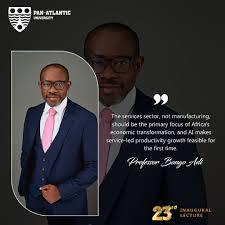
Professor Bongo Adi Calls for a New Economic Playbook for Africa in the Age of Artificial Intelligence
Lagos Business School (LBS), PanAtlantic University hosted its 23rd Inaugural Lecture on Friday, 17 July 2026. It was delivered by Professor Bongo Adi, on the theme, The 'End of Development Economics': A Manifesto for Post-Industrial Policy." The lecture brought together members of the academic community, alumni, students, policymakers, and industry leaders for a timely conversation on the future of economic development in Africa
In his address, Professor Adi challenged the long-held belief that industrialisation and manufacturing alone remain the primary pathways to economic growth He argued that advances in artificial intelligence, automation, and evolving global trade dynamics have fundamentally changed the global economic landscape, making it necessary for developing economies to rethink traditional development models
Professor Adi proposed a shift towards a postindustrial policy framework that prioritises innovation, digital transformation, entrepreneurship, research, and human capital development. He emphasised the importance of stronger collaboration between governments, universities, businesses, and the private sector to build resilient, knowledgedriven economies that can compete in an increasingly technology-led world.
The lecture concluded with a call for African nations to embrace forward-looking policies that leverage technology, strengthen institutions, and invest in people. By adopting a new approach to development, Professor Adi noted, Africa can position itself to seize emerging opportunities and achieve sustainable, inclusive economic growth in the digital era.

The Lagos Business School Alumni Office proudly welcomed 344 new members into the Lagos Business School Alumni Association (LBSAA) during the Executive Education graduation ceremony held on 4 July 2026 at the Honeywell Auditorium, Lagos Business School, Pan-Atlantic University The induction into the Lagos Business School Alumni Association (LBSAA) was conducted by the newly inaugurated LBSAA President, Valentine Okelu, marking the official transition of participants from HRA 4, SMP 97, SMP 98, SMP 99, and OMP 44 into the LBS alumni community.
The induction signified the beginning of a new chapter in the graduates' LBS journey one built on legacy, lifelong learning, collaboration, and meaningful impact. As members of the LBSAA, they now join a vibrant network of accomplished leaders, entrepreneurs, innovators, and changemakers committed

to advancing ethical leadership and responsible business across Africa and beyond.
Addressing the new alumni, the LBSAA President encouraged them to keep the spirit of the LBS community alive by leading with character and conscience, serving with excellence, and working collaboratively to create lasting impact in their organisations and communities. They were reminded that the knowledge, values, and relationships cultivated during their time at Lagos Business School will continue to guide them as they take on leadership roles across industries and sectors
As ambassadors of Lagos Business School, the new alumni were urged to uphold the institution's core values wherever they go, demonstrating integrity, professionalism, and a commitment to positive change
The Alumni Office reaffirms its commitment to supporting their continued growth through the LBSAA, ensuring that they remain connected to a thriving community dedicated to lifelong learning, meaningful engagement, and shared success.
Dear MBA Alumni,
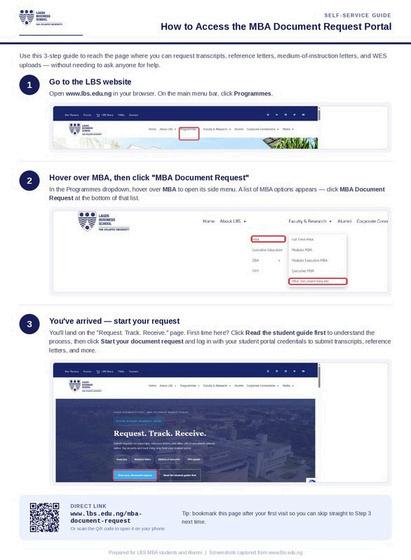
We are excited to announce the launch of the MBA Document Request Portal, your new selfservice platform for requesting academic documents such as transcripts, statement of results etc., from the MBA Department, Lagos Business School.
With the new portal, you can conveniently request, pay, track, and receive your academic documents online, all in one place.
Access the portal here:
https://www.lbs.edu.ng/mba-document-request/
To help you get started, we have attached a Self-Service Guide containing step-by-step instructions on how to access the portal from the Lagos Business School website and submit your request. The guide also includes a QR code for quick access.
We encourage you to use the portal for all future MBA academic document requests and keep the guide for future reference
Should you require any assistance, please do not hesitate to contact the MBA Data & Administration Unit.
Thank you, and we hope you enjoy this improved service experience "
Kind Regards,
In line with the tradition of the Lagos Business School Alumni, the OMP 45 class held elections into the class EXCO on Friday, 17 July, in the penultimate week of their program, ably officiated by the Alumni Office in a convivial, family like atmosphere. In like manner, the AMP 45 held theirs on Thursday, 23 July. The elections ushered in two sets of leaders who will pilot the affairs of the class in the next two years. They have been bequeathed with the task of keeping the class together, bonded and connected as a vibrant community, especially as they leave the confines of the LBS classroom and join the global LBS Alumni community.
As stipulated in the LBS Alumni Charter, the EXCO is given the mandate of appointing or electing two other officers – the Socials Officer and Treasurer, as they may deem fit, to complete the Executive Committee
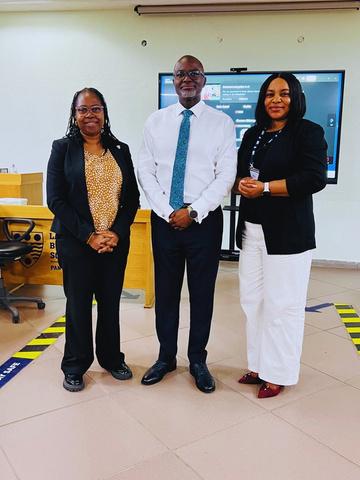
Below are the members of the inaugural EXCOs, as constituted:
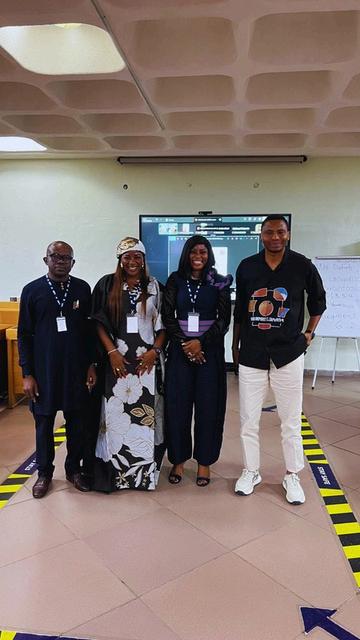
Tobias Eze – President
Adebimpe Shekoni – Vice President
Susan Ozenogu – Secretary
Gbenga Falokun - President
Aretha Awaits - Vice President
Karo Akaba - Secretary (not in the picture)


During a recent visit to Lagos Business School, Olawale Rotimi Opeyemi, President of the AgMP09 Class and CEO of JR-Farms, was finally presented with the plaque for the LBS Best Class Award in the AgMP category. The award, which was announced at the LBSAA President's Dinner 2025, recognises the AgMP09 Class for its outstanding commitment, participation, and contribution to the Lagos Business School Alumni Association.
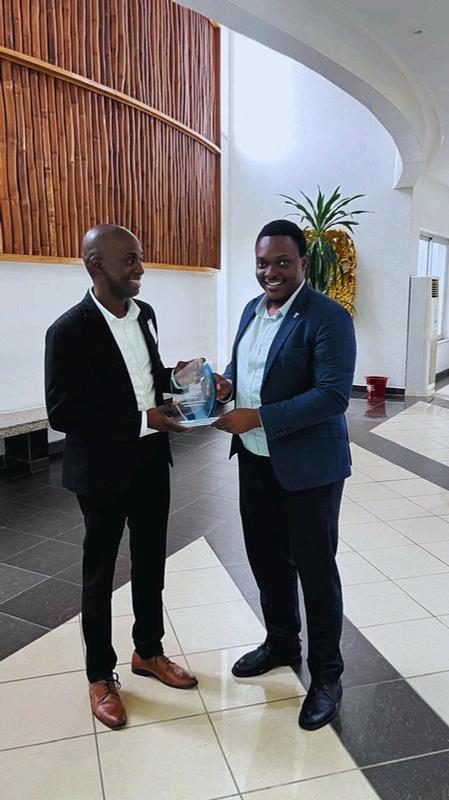
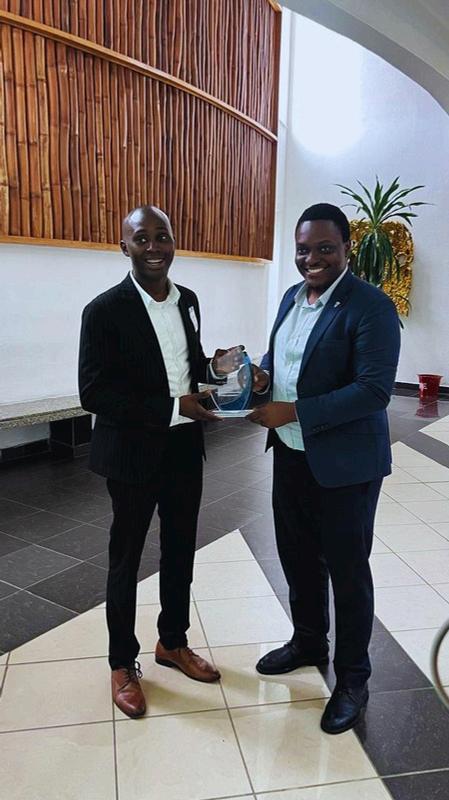
His visit to the Alumni Office presented an opportunity to officially present the award in recognition of the class's achievement. The Alumni Office congratulates Olawale and the entire AgMP09 Class on this well-deserved recognition and commends their continued commitment to strengthening the LBS alumni community

The Lagos Business School Alumni Association (LBSAA) South-West Chapter successfully hosted its Fitness Workout Session on Saturday, 11 July 2026, bringing together alumni, their families, and fitness enthusiasts for a refreshing morning of exercise, networking, and fellowship.
Held under the theme, "Boardroom & Fitness: Strong Minds. Strong Bodies. Stronger Together," the programme reinforced the importance of maintaining a healthy lifestyle while pursuing professional excellence. Participants engaged in a variety of workout activities
designed to improve physical fitness, boost mental well-being, and encourage healthier living
Beyond the fitness activities, the event provided an opportunity for alumni to reconnect, strengthen existing relationships, and build new ones in a relaxed and engaging environment It also reflected the chapter's commitment to fostering meaningful engagement beyond the boardroom, creating opportunities for members to support one another both personally and professionally.
The successful workout session highlights the LBSAA South-West Chapter's continued dedication to promoting holistic well-being, strengthening the alumni community, and organising initiatives that inspire collaboration, lifelong connections, and purposeful leadership
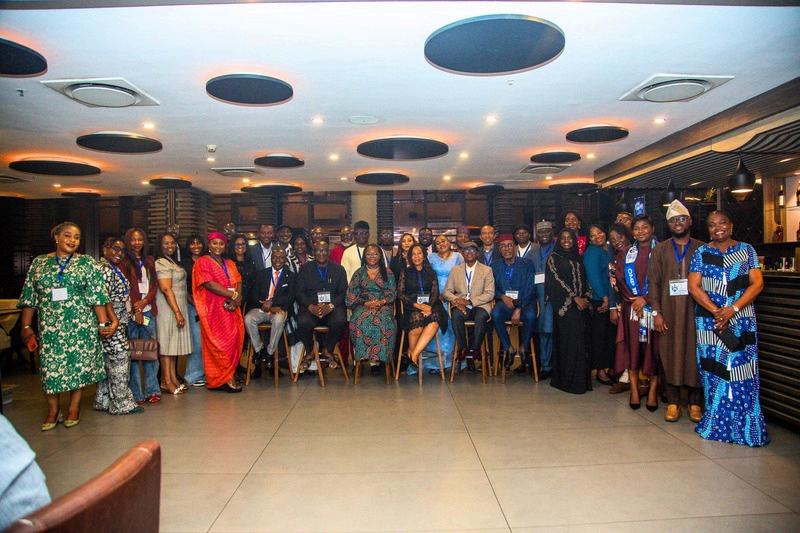
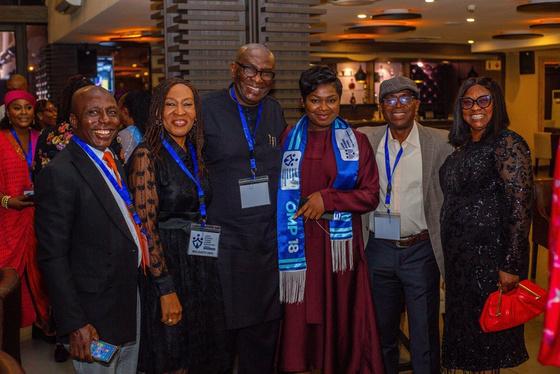
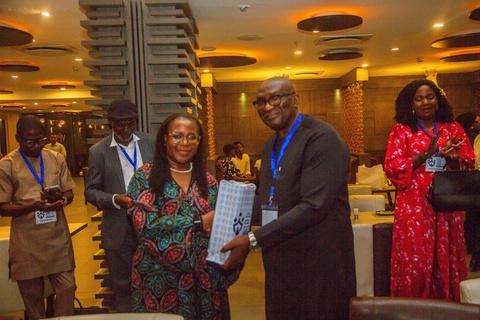
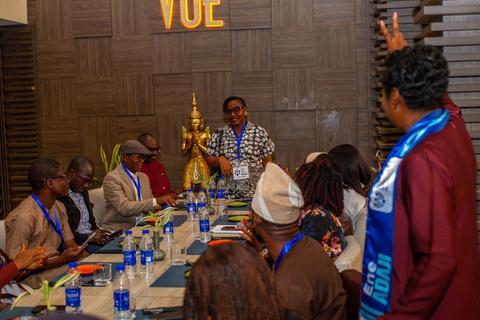
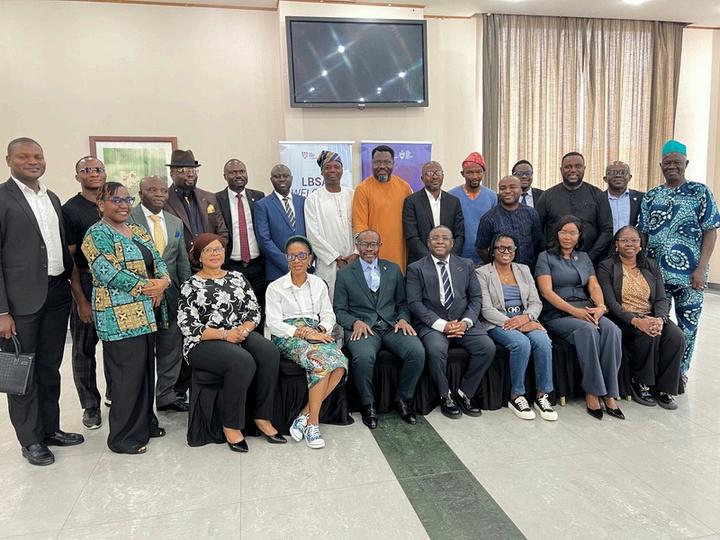
How do meaningful conversations strengthen the LBS community? Here's a glimpse from the LBS Northern Chapter Alumni Mixer.

LBSAA Mid-Year Economic Outlook 2026 Examines Nigeria's Economic Trajectory and the Path to Sustainable Growth
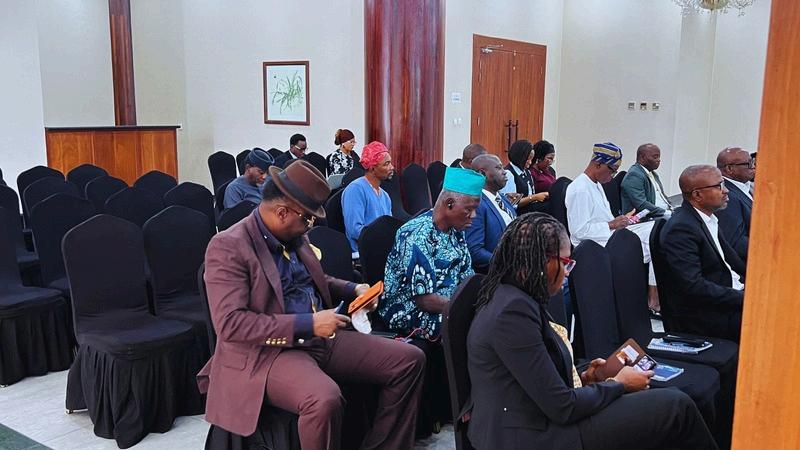
The Lagos Business School Alumni Association (LBSAA) hosted its MidYear Economic Outlook 2026 on 23 July 2026, bringing together alumni, business executives, policymakers, academics, and industry leaders for insightful conversations on the state of Nigeria's economy. Themed "A Tale of Two Cities: Will There Be a Convergence?" The event examined the country's macroeconomic performance, ongoing reforms, and the policy actions required to achieve sustainable and inclusive economic growth.
Delivering the keynote presentation,
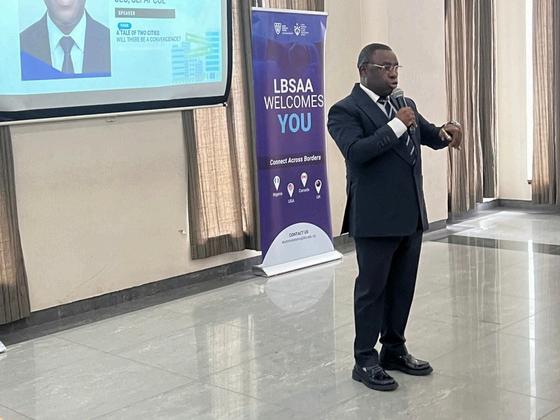
Professor Bongo Adi challenged conventional measures of economic performance, arguing that Nigeria's progress should be assessed through Core GDP productive activities such as private investment and net exports rather than overall GDP growth.
He noted that while recent economic indicators suggest recovery, much of the growth has been driven by government spending and household consumption, resulting in what he described as "jobless growth," where rising GDP has not translated into improved livelihoods, employment, or purchasing power. He also highlighted the impact of inflation on low-income households, describing it as a "poverty penalty," and urged businesses to improve efficiency, embrace innovation, diversify revenue streams, and position themselves for long-term resilience.
Offering a historical and structural perspective, Dr. Nnaemeka Obiaraeri emphasised that Nigeria's economic challenges stem largely from governance and institutional weaknesses rather than a lack of resources. He advocated bold structural reforms, including greater transparency in the oil and gas sector, fiscal restructuring, and policies that encourage investment in agriculture, mining, manufacturing, and other productive industries. He also pointed to emerging opportunities in renewable energy, carbon credits, and electric mobility as sectors capable of driving future economic growth and job creation.
The programme concluded with an engaging interactive session, where participants exchanged ideas with the speakers on Nigeria's economic outlook, investment opportunities, and the practical steps required to strengthen the country's competitiveness. The discussions reinforced the importance of sustained reforms, productive investment, and collaboration between government, the private sector, and development partners in building a resilient and inclusive economy.
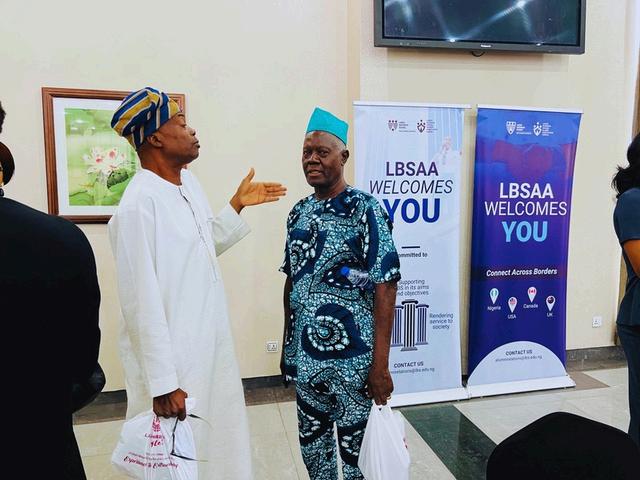
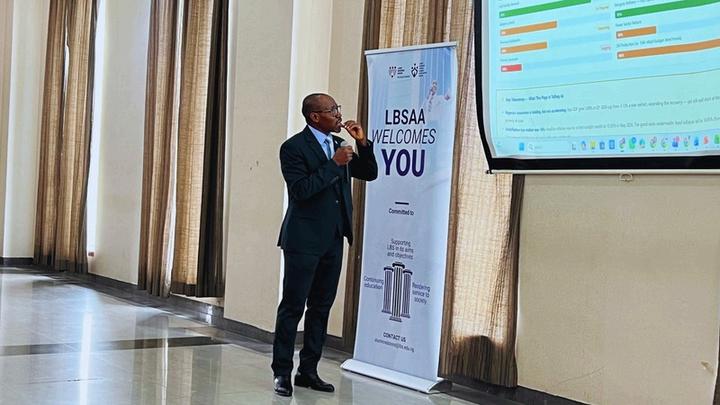
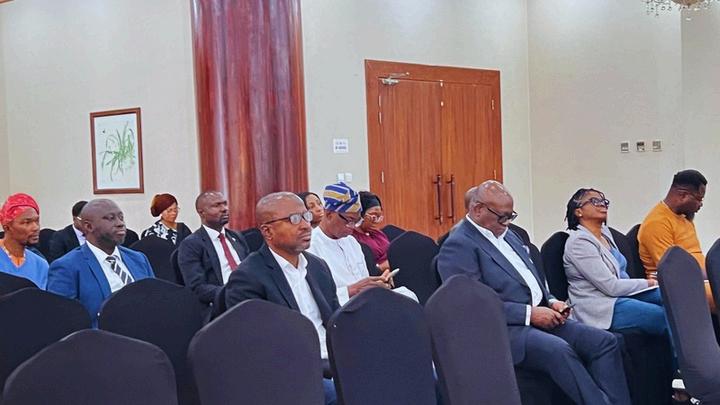
The LBS Alumni Office recently paid a courtesy visit to alumni at Aero Contractors and OAS Helicopters, reaffirming its commitment to building strong relationships within the LBS alumni community
Here in the pictureChukwuemeka Odigboh (SMP 96), Chidinma Chikeleze (SMP 91), and Sola Omoniyi (SMP 90) with Judith Chukwu & David Okafor from the LBS Alumni Office
More on the courtesy visits to Aero Contractors and OAS Helicopters. Here pictured are Chukwuemeka Odigboh (SMP 96) of Aero Contractors and Nora Nnaji (SMP 94) of OAS Helicopters, joined by Judith Chukwu & David Okafor from the LBS Alumni Office.
For six years, Dr. Owen D. Omogiafo, OON (AMP 32), dedicated herself to the service and growth of the Lagos Business School Alumni Association, first as Vice-President for two years and subsequently as President for another two years, providing steady leadership that strengthened the Association and inspired the alumni community.
A distinguished business leader and President/Group CEO of Transnational Corporation Plc (Transcorp Group), Dr. Owen brought strategic vision, discipline, and a passion for excellence into her volunteer leadership at LBSAA. While her corporate achievements continue to shape Nigeria's business landscape, her impact on the alumni community is equally remarkable.
During her tenure on the Executive Committee, the Association experienced significant growth in engagement, partnerships, and member participation. Under her leadership, the LBSAA President's Dinner reached an unprecedented level of support and sponsorship for its time, raising the bar for what the Association could achieve through collective commitment and collaboration. More importantly, she demonstrated that with clear vision, teamwork, and purposeful leadership, the alumni community could aspire to even greater possibilities
Her administration championed stronger alumni connections, encouraged greater member participation, and reinforced the values of service, excellence, and lifelong engagement that define the Lagos Business School community. She led with humility, inclusiveness, and an unwavering
commitment to ensuring that the Association remained relevant to alumni across generations
Dr. Owen's tenure should not simply be measured by milestones achieved, but by the foundation she helped build for those who would come after her. Her leadership has created momentum that future administrations can continue to build upon as the Association pursues even greater heights.
As Immediate Past President, Dr. Owen leaves behind a legacy of purposeful service, visionary leadership, and a stronger, more connected alumni community. The Lagos Business School Alumni Association celebrates her outstanding contributions and thanks her for helping shape a future of continued excellence.
PalmPay Group has announced the appointment of Samuel Oluyemi, an alumnus of Lagos Business School’s Special Management Program (SMP53), as Chief Operating Officer (COO) for its Nigeria operations, marking a significant step in the company's strategy to strengthen operational leadership and deepen financial inclusion across the country.
Oluyemi joins PalmPay with over two decades of experience at the Nigeria Inter-Bank Settlement System (NIBSS), where he played a key role in the development and adoption of several landmark payment solutions, including NIBSS Instant Payment (NIP), Nigeria's first real-time interbank transfer system. His expertise in digital payments, operations, and financial innovation positions him well to support PalmPay's continued growth in Nigeria
As COO, he will oversee the company's Nigeria operations, drive operational excellence, and work closely with regulators to ensure PalmPay's expansion aligns with Nigeria's financial and digital inclusion goals
His appointment comes at a time when Nigeria's digital financial services sector is rapidly evolving, with increasing focus on innovation, cybersecurity, and expanding access to inclusive financial services

Samuel Oluyemi (SMP53)
Chief Operating Officer for Nigeria
PalmPay
Commenting on the appointment, PalmPay Nigeria Managing Director, Chika Nwosu, described Oluyemi's extensive industry experience as instrumental to the company's next phase of sustainable growth. Oluyemi also expressed his enthusiasm about joining PalmPay, reaffirming his commitment to delivering secure, reliable, and customer-focused financial solutions while contributing to the continued evolution of Nigeria's digital financial ecosystem.
Congratulations to Samuel Oluyemi on this well-deserved appointment. The Lagos Business School Alumni Association celebrates this remarkable milestone and wishes him continued success as he leads PalmPay Nigeria into its next phase of growth and innovation.
The Lagos Business School Alumni Association congratulates Mrs. Ebelechukwu Nwachukwu (AMP 34) on her historic inauguration as the 27th Chairman of the Nigerian Insurers Association (NIA), becoming the first woman to lead the Association since its establishment. Her appointment marks a significant milestone for Nigeria's insurance industry and underscores the growing recognition of visionary and inclusive leadership at the highest levels

Mr. Luqman Bakare (AMP 34) Managing Director/Chief Executive Officer, Infinity Trust Merchant Bank
A distinguished insurance executive with nearly three decades of experience, Mrs. Nwachukwu has built an exceptional career across some of Nigeria's leading insurance companies She previously served as Managing Director/Chief Executive Officer of Zenith General Insurance, where she led the company through a period of strong revenue growth and profitability. She later served as MD/CEO of NSIA Insurance, driving a comprehensive transformation programme that strengthened the organisation's culture, operations, and performance, earning the company recognition as a Best Place to Work in 2019.
As the Managing Director/Chief Executive Officer of Rex Insurance
Limited, Mrs Nwachukwu has spearheaded one of the industry's most notable corporate transformation initiatives. Under her leadership, the company successfully transitioned from Royal Exchange General Insurance to Rex Insurance, introducing a refreshed corporate identity, expanding its digital capabilities, strengthening customer service and claims delivery, and developing innovative insurance solutions, including products focused on agriculture, climate-related risks, and financial inclusion.
Her emergence as Chairman of the NIA Governing Council is widely regarded as the beginning of a new chapter for the Nigerian insurance industry one expected to promote innovation, digital transformation, collaboration, and deeper insurance penetration across the country
The Lagos Business School Alumni Association celebrates Mrs. Nwachukwu on this landmark achievement and wishes her every success as she leads the Nigerian Insurers Association into a future of sustained growth, innovation, and industry excellence
Last month, we introduced leadership as a soft s powerful impact and examined its three core functio edition, we continue by exploring common leaders Next month, we will conclude the series by exam makes an effective leader and the impact of lead organizational success
Every effective act of leadership accomplishes three essential outcomes:
Leadership provides clarity and answers the fundamental question: Where are we going? Effective leaders establish a compelling vision and communicate clear goals that guide organizational efforts
2. Building Alignment
Direction alone is not enough. Leaders must ensure that people move together toward shared objectives. Alignment creates understanding, commitment, and coordination. It helps team members understand not only what needs to be done, but also why it matters and how their roles contribute to success.
People are motivated by more than compensation. They seek purpose, growth, recognition, and a sense of belonging Effective leaders connect everyday responsibilities to a larger mission, helping individuals find meaning in their work while supporting their personal and professional development.

motivation, they are leading—regardless of whether they possess a formal leadership title or not.
Leadership effectiveness often depends on a leader's ability to adapt to different situations. Leadership expert Daniel Goleman argues that effective leaders do not rely on a single style; rather, they adjust their approach based on circumstances and organizational needs.
Autocratic leaders retain decision-making authority and provide clear instructions with limited consultation.
Most effective when:
Working with inexperienced employees
Time-sensitive decisions are required
Strict compliance or control is necessary
Deadlines are critical
Also known as participative leadership, this style encourages employee involvement in decision-making and problem-solving.
Most effective when:
Building team commitment
Encouraging innovation and collaboration
Developing employee capabilities
Enhancing job satisfaction and engagement
Transactional Leadership
Transactional leaders motivate through structured rewards, recognition, and performance expectations.
Most effective when:
Goals and outcomes are clearly defined
Deadlines must be met
Performance standards need reinforcement
Relationships are primarily task-oriented
Transformational Leadership
Transformational leaders inspire people through vision, purpose, innovation, and personal example. They encourage followers to transcend
self-interest for the greater good of the organization.
Most effective when:
Driving organizational change
Building long-term commitment
Creating a shared sense of purpose
Fostering innovation and growth
Often described as a hands-off approach, this style provides employees with significant autonomy and decision-making freedom.
Most effective when:
Team members are highly skilled and experienced
Employees are self-motivated and accountable
Specialist professionals or consultants are involved
Minimal supervision is required
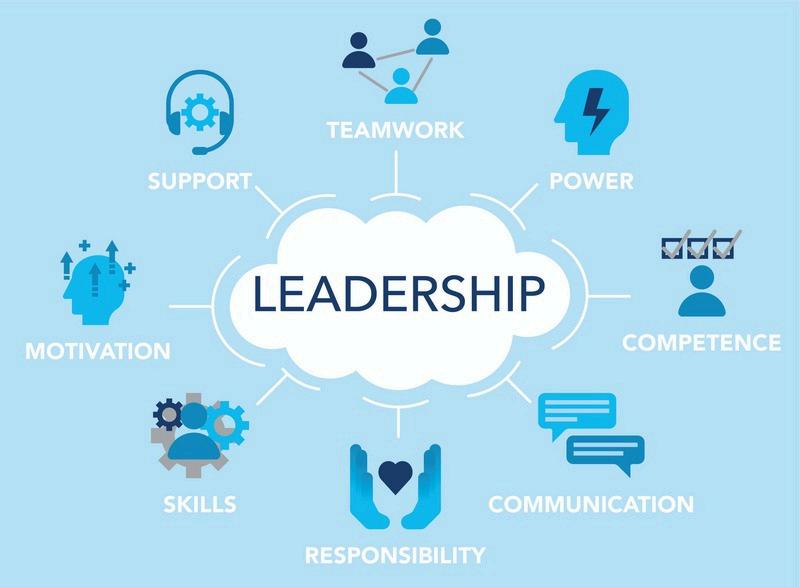
“AI is a multiplier. It multiplies whatever operating model already exists. Make sure the operating model is worth multiplying.”
There is a version of the AI adoption story that has become very popular in executive conversations. It goes roughly like this: our execution is struggling, our teams are stretched, our processes are slow, and AI is going to change that. AI will automate the friction.
AI will fill the capacity gaps AI will deliver the efficiency that the current operating model cannot.
This version of the story is not entirely wrong AI can improve specific processes, automate specific tasks, and reduce specific friction points.
But it contains a critical misunderstanding about how AI works in practice one that is leading organizations into a predictable and expensive failure pattern.
AI is a multiplier. It multiplies whatever operating model it is deployed into If that operating model has strong governance, clear strategic priorities, and effective execution infrastructure, AI will amplify those strengths.
If the operating model has fragmented governance, unclear accountability, and weak execution disciplines, AI will amplify those weaknesses efficiently and at scale
The organizations deploying AI into broken execution environments are not fixing their execution gaps. They are automating them.
What execution gaps actually look like
Execution gaps are rarely a mystery to the leadership teams experiencing them. They are the familiar patterns that appear across strategy cycles, portfolio reviews, and leadership assessments: strategic priorities that are clearly articulated but inconsistently delivered; initiatives that consume significant resources and produce activity without measurable outcomes; accountability structures that are nominally assigned but functionally diffuse; and decision-making that is slow, contested, or disconnected from the information needed to make it well.
These gaps are not caused by a lack of tools. They are caused by operating model weaknesses: governance architectures that do not connect strategy to execution; portfolio management disciplines that track delivery activity without tracking value realization;
leadership alignment that holds at the top and fragments in the middle; and capability deficits that mean people are being asked to execute strategies they do not have the skills to deliver.
Deploying AI into this environment does not resolve these root causes. It interacts with them. An AI-powered analytics platform deployed into an organization with weak data governance produces faster access to unreliable data.
An AI-assisted project management tool deployed into an organization with unclear accountability produces better visibility of execution that no one has clear authority to course-correct. An AI content generation tool deployed into an organization with no editorial governance produces more content, faster without the quality standards or strategic alignment that would make that content valuable.
The multiplier effect in practice
The multiplier dynamic is not speculative It is already visible in organizations that have run significant AI deployments. The pattern is consistent: AI amplifies existing organizational capability, in both directions.
Organizations with strong portfolio governance find that AI tools enhance their ability to monitor investment performance, identify risk signals early, and allocate resources with greater precision.
The tools add meaningful value because the governance architecture exists to translate that value into decisions. Organizations without
portfolio governance find that AI tools generate more data about portfolio status without the decision-making infrastructure to act on it.
Organizations with mature execution disciplines find that AI automation accelerates delivery without compromising quality, because quality standards are defined and enforced by the operating model, not delegated to the tool.
Organizations with weak execution disciplines find that AI automation speeds up delivery of work that does not meet the required standard because the standard is not defined clearly enough for any system, human or AI, to reliably apply it.
This is the multiplier at work. The tool does not determine the outcome. The operating model determines the outcome. The tool amplifies it.
What needs to be in place before AI deployment
This is not an argument against AI adoption. It is an argument for sequencing. Organizations that want AI to produce sustainable returns need to ensure that the operating model into which they are deploying AI is worth multiplying Three things must be in place.
First, governance architecture. Before deploying AI at scale, organizations need clear answers to: who owns AI governance at the leadership level? How are AI investments evaluated and approved? How is AI risk identified, classified, and managed? How are AI-generated decisions
audited? These are governance questions, not technology questions. The answers need to exist in organizational practice, not just in policy documents.
Second, execution infrastructure.
The operating model needs functional execution infrastructure: portfolio management disciplines that connect investment to return; accountability structures that are real, not nominal; and performance management practices that track outcomes rather than activity. AI can improve the efficiency of execution infrastructure that exists. It cannot substitute for execution infrastructure that is absent.
Third, capability alignment.
The people who will govern, manage, and work alongside AI need the capabilities to do so effectively. This does not mean universal AI literacy. It means that leaders have the governance literacy to own AI outcomes, that managers have the judgment to oversee AI-assisted decisions, and that practitioners have the skills to identify when AI outputs require human override.
These are different capabilities from knowing how to use AI tools. Building them requires deliberate investment, not assumption.
The diagnostic question
The most useful question an executive team can ask before committing to a significant AI deployment is not “what can AI do for us?” It is: “what would our current operating model
produce with twice the speed and three times the scale?”
If the honest answer is “better outcomes at greater speed,” AI deployment is likely to produce value. If the honest answer is “more of our current execution problems, faster and at greater scale,” the productive investment is not AI deployment. It is operating model improvement followed by AI deployment into a stronger foundation. Many organizations find the second answer uncomfortable, because it requires acknowledging execution weaknesses that have become normalized.
But this diagnostic honesty is precisely what separates organizations that use AI to accelerate genuine competitive advantage from those that use AI to accelerate the appearance of progress.
The operating model first
iCentra’s work with organizations across sectors consistently reveals the same pattern: the organizations achieving the strongest returns from AI investment are not those that moved fastest to deploy.
They are the organizations that invested in governance, execution infrastructure, and capability before they deployed and then deployed AI into a foundation worth building on.
The sequence matters. AI deployment is not a substitute for operating model development. It is a multiplier of it.
AI is a multiplier. It multiplies whatever
operating model already exists. The strategic imperative of this moment is not simply to deploy AI. It is to ensure that when you deploy it, the operating model it multiplies is one worth the investment.
Taopheek Babayeju is the CEO of iCentra, a global technology and business solutions company helping organizations build the execution infrastructure, governance capability, and strategic alignment required to lead with AI sustainably. Learn more at icentra.com.
By Taopheek Babayeju, CEO, iCentra

Happy Birthday to all our LBS Alumni celebrating in July!
Wishing you good health, joy, and continued success in the years ahead. May this new chapter bring greater opportunities and lasting impact. Have a wonderful celebration!
LBS Alumni Team
Want us to celebrate you here? Or you wish to celebrate a classmate or fellow alumnus/alumna on their special day?
Send us your birthday shout-outs, and we'll be delighted to feature them in this section.
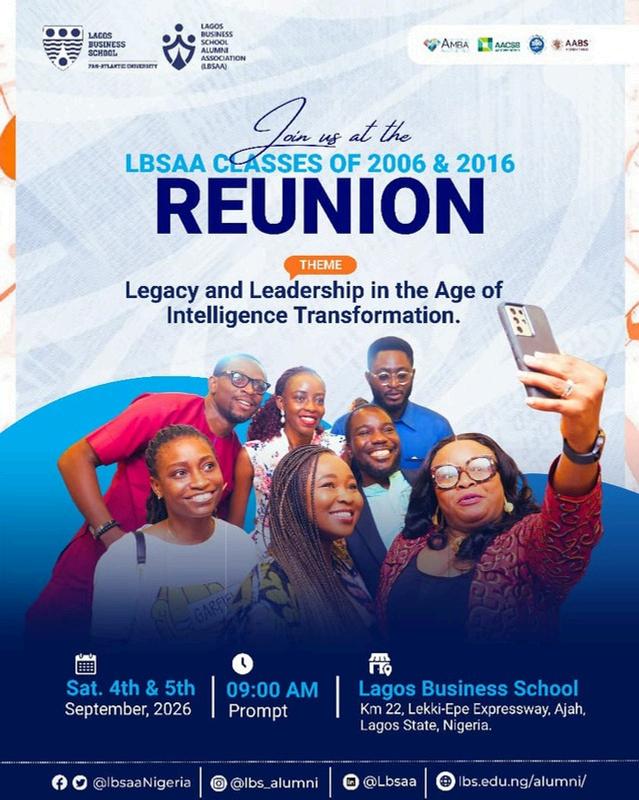
The Lagos Business School Alumni Association (LBSAA) Classes of 2006 & 2016 will host its reunion on Saturday, 4 September and Sunday, 5 September 2026, at Lagos Business School, Pan-Atlantic University.
The event, themed "Legacy and Leadership in the Age of Intelligence Transformation," will bring together members of the Classes of 2006 & 2016 to reconnect, celebrate a decade(s) of shared achievements, exchange ideas, and strengthen their lifelong relationships built at Lagos Business School.
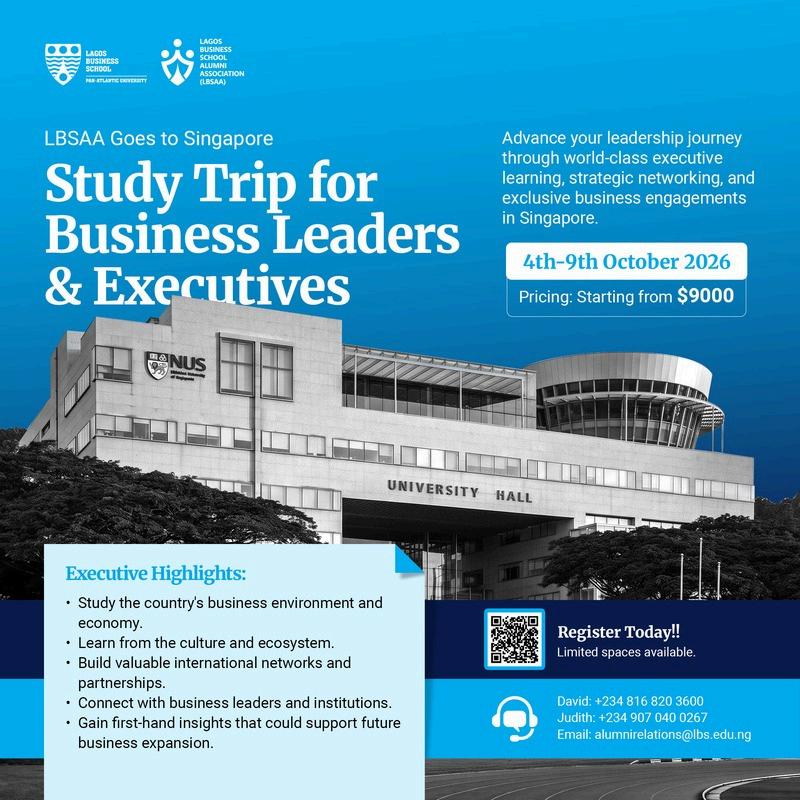
The Lagos Business School Alumni Association (LBSAA) invites business leaders and executives to an exclusive Study Trip to Singapore, taking place from 4–9 October 2026.
Designed to advance participants' leadership journey, the programme offers world-class executive learning, strategic networking, and exclusive business engagements.
Attendees will gain valuable insights into Singapore's business environment and economy, learn from its culture and innovation ecosystem, build international partnerships, and connect with leading business institutions.
With pricing starting from $9,000, this immersive experience presents a unique opportunity for executives seeking global perspectives and practical insights to drive business growth and leadership excellence. Limited spaces are available, and interested participants are encouraged to register early.
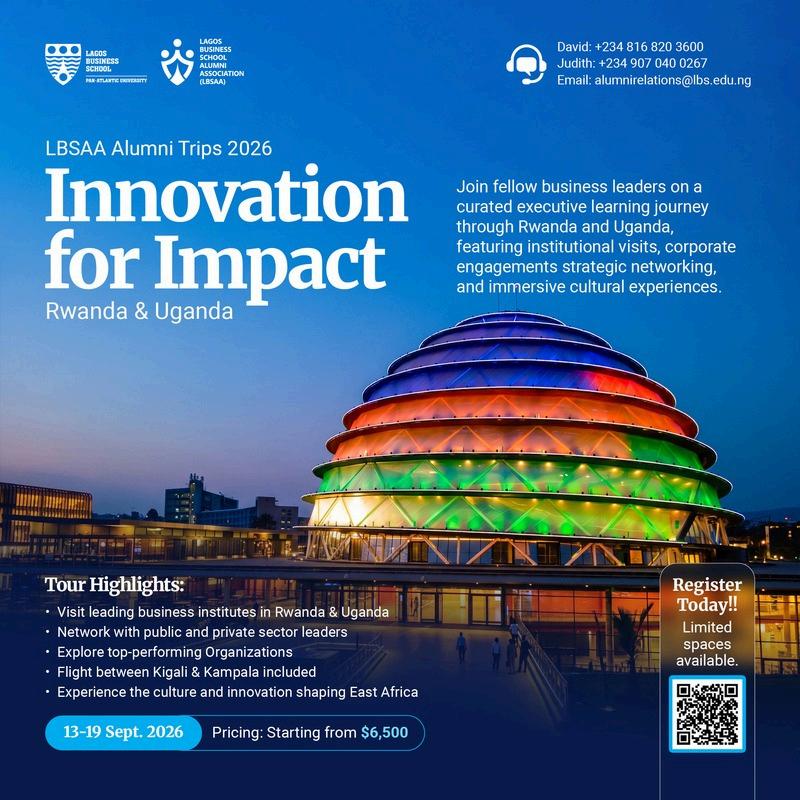
The Lagos Business School Alumni Association (LBSAA) invites business leaders and executives to participate in Innovation for Impact – Rwanda & Uganda, a curated executive learning experience taking place from 13–19 September 2026
The programme will provide participants with first-hand exposure to East Africa's thriving innovation ecosystem through institutional visits, corporate engagements, strategic networking, and immersive cultural experiences.
Highlights include visits to leading business institutions and top-performing organisations, networking with public and private sector leaders, and travel between Kigali and Kampala Pricing starts from $6,500, with multiple participation categories available.
This unique learning journey is designed to broaden global perspectives, foster valuable connections, and equip participants with practical insights to drive innovation and business growth. Limited spaces are available, and early registration is encouraged.
In line with Lagos Business School's vision of developing responsible leaders to inspire Africa's growth, the alumni office continues to recognise classes who contribute to this dream through various means.
We are proud of the numerous initiatives of LBS alumni towards creating a better society wherever they find themselves.
We are encouraged to, not just be an Oasis of Sanity, but a Citadel of Excellence in the society that is ravaged by many sore examples.
This year's class awards will look deeply into how classes (and individuals within them) contribute their Time, Treasure, Talent and Tribe to help in inspiring Africa's growth. Please assist us in providing information of any and indeed every activity that would help us to make the best judgement for this year's awards
Kindly fill this form whenever you carry out any activities as contained in the class award slides shared with your class: