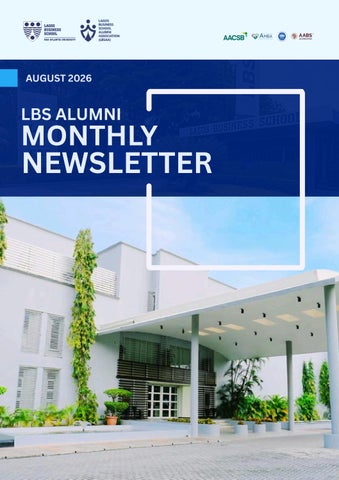
AUGUST 2026
LBS ALUMNI
MONTHLY
NEWSLETTER
WELCOME Dear LBS Alumni Family,
Welcome to the August 2026 Edition of the LBS Alumni Newsletter. August is, in many ways, a month of transition. With September on the horizon, the mood shifts. The mid-year ease of “let it flow” gives way to a more urgent question: “Where are we so far?” Before we know it, we are caught in the purposeful momentum of the final stretch — the last 4 months that often define the year.
In business, companies are revisiting their 2026 budgets and strategic objectives. The focus is on measuring progress and building on what’s working as we head into the ‘ember’ months. At home, families are returning from holidays and quality time together, and turning attention to a new school term. Personally, it is a season to pause, review our goals, and make the adjustments that will help us finish strong. Across all these shifts, one thread remains constant: our focus on what truly matters — family, relationships, networks, values, and purpose. These are what give our work meaning.For us as LBS Alumni, a core part of that value is our community — the connections, the support, and the sense of belonging that set us apart. As we approach our flagship events — Homecoming/Reunion in October and Alumni Day/President’s Dinner in November — let us lean into this network. Let’s use this season of transition to refocus, reconnect, and finish 2026 strong. We invite you to explore this edition, celebrate the achievements of fellow alumni and stay engaged with the opportunities and conversations shaping our network.
Editorial Team
For feedback, contributions or stories for future editions, please contact alumnirelations@lbs.edu.ng.
Henry Andoh Joe Umechukwu Joshua Mbak Melody Uponi
Best Wishes,
2
The Newsletter Editorial Team
REFLECTIONS EVERY DECISION HAS A HUMAN STORY LOOKING BEYOND POLICIES, PROCESSES AND NUMBERS TO THE PEOPLE AFFECTED BY THEM. Think about the last decision you made that produced a result. Can you remember who it affected? Perhaps it was a decision at work. You changed a process, moved a deadline, approved a request, gave someone feedback, chose one person for an opportunity, or decided that something could wait. You probably had your reasons. You were trying to solve a problem, meet a target, improve efficiency or simply do what you believed was right. But beyond the result, what happened to the people involved? We often measure decisions by outcomes—what changed, what was achieved, what improved. Yet people experience decisions differently.
The decision may take five minutes to make but its impact may last much longer.
A manager may see a restructuring exercise. An employee may see uncertainty about their future. A leader may see a performance conversation. A team member may remember the words long after the meeting.
And sometimes, it is not the decision itself that people remember, they rather remember the way they were treated while it was being made.
You may see a request you declined. Someone else may see the loss of an opportunity they have been hoping for.
Were they listened to? Were they given an explanation? Did they feel respected, even when the answer was no?
3
There is also the impact of the decisions we don't make—the conversation we postpone, the feedback we withhold, the concern we choose not to address, or the person we keep failing to check on. Inaction is still an experience. We have all been on both sides of this. We have made decisions that seemed reasonable to us, and we have also experienced decisions that seemed small to others but meant something significant to us. So perhaps, before making our next decision, we can ask one simple question: What might this look and feel like from the other side? Because behind every policy is a person. Behind every process is a person. Behind every number is a person. And behind every decision is a human story. Our decisions may define outcomes. But the way we show sensitivity to people’s feelings defines what they remember long after the experience.
4
NEWS AROUND LBS/PAU 5
Vendors Registration: bit.ly/mktplcv
Group: bit.ly/MarketPlaceGroup
Lagos Business School Hosts 24th Inaugural Lecture Professor Olamitunji Dakare’s inaugural lecture at Pan-Atlantic University, titled “Informal Strategy Approaches: A Bone, Not a Skin, in the Nigerian Small and Medium Enterprises,” explored how Nigerian SMEs use informal approaches to survive, adapt, and build competitive advantage. He noted that although SMEs make up a significant part of Nigeria’s economy, they continue to face challenges such as limited finance, poor infrastructure, and an unpredictable business environment. These conditions make traditional, highly formal approaches to strategy difficult to apply. Professor Dakare explained that many successful SMEs rely on experience, intuition, personal relationships, local market knowledge, flexibility, and quick decision-making. He also highlighted how business owners in places such as Aba, Balogun, and Onitsha collaborate by sharing resources, information, and supplies to overcome challenges. He emphasised that informal strategy should not be seen as a weakness. Instead, it can be a source of competitive advantage, particularly in uncertain environments
8
48
Professor Olamitunji Dakare
Professor of Strategic Management, School of Management and Social Sciences, PanAtlantic University, Lagos He recommended that SMEs adopt a hybrid approach, combining the flexibility of informal strategies with appropriate formal planning and documentation. He also called on policymakers, academics, and educational institutions to better recognise and support the informal practices that contribute to SME success in Nigeria. Key takeaway: The informal strategy is not merely a response to Nigeria’s business challenges. When properly harnessed, it can become a powerful tool for resilience, adaptability, and sustainable business growth.
LBS MBA STUDENTS’ CONFERENCE 2026 ‘LEADING WITHOUT A BLUEPRINT’
The 2026 Lagos Business School MBA Students’ Conference, held on Saturday, August 15, 2026, at the Honeywell Auditorium, brought together MBA students, alumni, faculty and business leaders to explore the realities of leadership in an uncertain and rapidly changing world. The conference, themed “Leading Without a Blueprint: How to Build and Lead When There Are No Proven Models to Follow,” focused on how leaders can make decisions, drive transformation and create value when there is no established path to follow. In his special guest address, Prof. Yemi Osinbajo emphasized that leadership requires the ability to make sound decisions even when certainty is unavailable. He highlighted judgement, courage and responsibility as essential qualities for leaders navigating complex situations.
9
49
The keynote address was delivered by Dr. Owen D. Omogiafo, OON, President/Group CEO of Transcorp Group, alumna and Immediate Past President of the Lagos Business School Alumni Association. She focused on the importance of creating a path forward when there is no established blueprint. She emphasised the need for a clear vision, trusted people and the right capabilities to turn ideas into results. She also encouraged leaders to remain curious, continuously learn and adapt to changing circumstances. A fireside conversation featuring Ashwin Ravichandran, Africa Director, BMONI, and Prof. Patrick Utomi, Founder, Centre for Values in Leadership, explored leadership, innovation, transformation and value creation. The MBA student panel also provided practical perspectives on building from the ground up, navigating unfamiliar challenges and developing the confidence to lead without relying solely on established models.
Overall, the conference reinforced the message that effective leadership is not about having a ready-made answer for every situation. Rather, it is about having the courage to act, the judgement to make informed decisions, the resilience to adapt and the vision to create new possibilities. The event concluded with networking and meaningful interactions among students, alumni, faculty and industry leaders, leaving participants with a clear reminder: when there is no blueprint, leaders must have the courage and capability to create one.
10 10
4
The event concluded with networking and meaningful interactions among students, alumni, faculty and industry leaders, leaving participants with a clear reminder: when there is no blueprint, leaders must have the courage and capability to create one.
Lead the Future with Climate & ESG Strategy Climate change and ESG are reshaping business, investment and risk. Equip yourself to lead confidently in this evolving landscape. The LBS Sustainability Centre presents the Climate Action & ESG Business Strategy for Africa Certification Programme—a self-paced executive learning experience designed for Africa’s business environment. Gain practical tools to integrate ESG into strategy, manage climate-related risks and build long-term organisational resilience. Learn. Lead. Shape the Future.
11 11
4
Ikeja Hangout Mark your calendar! If you live, work, do business, or will be around Ikeja on 25 September, don't miss the LBSAA Alumni Hangout. Join fellow alumni for an evening of networking, reconnecting, and collaboration. For enquiries or support, Contact: David on +234 816 820 3600 or alumnirelations@lbs.edu.ng.
12 12
4
Late Tickets
NOW AVAILABLE
180,000
1.8m
Register Here: https://events.lbs.edu.ng/PD26#/ 13 13
4
MBA Document Request Portal
Dear MBA Alumni, We are excited to announce the launch of the MBA Document Request Portal, your new selfservice platform for requesting academic documents such as transcripts, statement of results etc., from the MBA Department, Lagos Business School. With the new portal, you can conveniently request, pay, track, and receive your academic documents online, all in one place. Access the portal here: https://www.lbs.edu.ng/mba-document-request/ To help you get started, we have attached a Self-Service Guide containing step-by-step instructions on how to access the portal from the Lagos Business School website and submit your request. The guide also includes a QR code for quick access. We encourage you to use the portal for all future MBA academic document requests and keep the guide for future reference. Should you require any assistance, please do not hesitate to contact the MBA Data & Administration Unit. Thank you, and we hope you enjoy this improved service experience." Kind Regards,
14 14
4
Alumni
Diaries
15
LBSAA Southwestern Chapter Hosts “The AI Advantage” Webinar
Driving Business Growth, Professional Excellence and Strategic Value Through Artificial Intelligence
Driving Business Growth and Professional Excellence” on Friday, August 14, 2026.
The Lagos Business School Alumni Association (LBSAA) Southwestern Chapter hosted an engaging webinar titled “The AI Advantage:
The session brought together alumni and professionals for an insightful conversation on how organisations can move beyond using Artificial Intelligence (AI) for individual productivity and begin
16
leveraging it as a strategic driver of business growth, operational efficiency and competitive advantage. Moderated by Omotayo Akinyede, the webinar featured a keynote presentation by Professor Bongo Adi, Professor of Economics and Data Analytics at Lagos Business School and Pan-Atlantic University. Executive remarks were also delivered by Valentine Okelu, President of the LBS Alumni Association; Dr. Tobi Adeuyi (MAP 20, EMBA 31); and Akinnusi Oluwole, LBSAA Southwestern Chapter Executive. Professor Bongo Adi highlighted the changing role of AI, describing it not simply as a software tool but as a thinking partner capable of supporting data analysis, task orchestration, coding, content creation and strategic thinking. However, he stressed that human accountability remains essential, noting that professionals must critically review AI-generated outputs and retain responsibility for decisions. A key focus of the session was Nigeria’s growing individual adoption of AI compared with the slower pace of institutional integration. Professor Bongo explained that while many Nigerians are already using AI in their daily work, organisations must move beyond individual experimentation and integrate AI into their core business processes to unlock meaningful value.
17
417
Professor Bongo Adi highlighted three levels of AI value creation: improving individual tasks, redesigning business workflows, and creating new products, services and revenue opportunities. He emphasised that successful AI adoption requires strong leadership, quality data and a focus on real business challenges. The session also explored how AI is reshaping professional skills, requiring a shift from answering to asking, execution to judgment, and doing to orchestrating. Participants were introduced to a practical roadmap focused on identifying highfriction processes, prioritising valuable initiatives, redesigning workflows and measuring business impact. During the Q&A, discussions covered AI tools, organisational resistance, data security and the importance of human expertise. Professor Bongo encouraged organisations to start with practical projects that demonstrate measurable results. The webinar concluded with remarks from Dr. Tobi Adeuyi, Akinnusi Oluwole and LBSAA President Valentine Okelu, reinforcing the Association’s commitment to equipping alumni with practical knowledge for technology-driven business growth.
Read the Report Here
What a way to wrap up 14 incredible days of movement! The LBSAA President's Global Virtual Walkathon 2026 Grand Finale, held on the 1st August 2026, brought alumni together at Purple Lekki iFitness Gym for an energising morning of fitness, community, and connection. From the 10K community walk and wellness activities to networking and celebrating our winners, the finale was a memorable event that truly embodied the spirit of health, unity, and lifelong connections. Thank you to everyone who participated and made the event a success! View Pictures below: https://drive.google.com/drive/folders/1cy3MBjtxhMAABiid9SlTUaPNTa5cSK-o? usp=sharing
18 18
4
Alumni Visits
Alumni Visits
Courtesy Visits
The Lagos Business School Alumni Association (LBSAA) team paid a visit to the MTN office, strengthening relationships and creating an opportunity for meaningful conversations and knowledge exchange. The visit provided a valuable platform to connect, share perspectives and explore areas of mutual interest.
Courtesy Visits
The Lagos Business School Alumni Association (LBSAA) team visited the Southwestern Chapter, engaging with alumni leaders and strengthening relationships. The visit provided an opportunity for meaningful conversations, knowledge exchange and exploring areas of collaboration.
20
We Want to Celebrate You! Greetings from the LBS Alumni office! We wish to call on all our alumni and leaders of our alumni class sets to be more intentional about sharing news of your personal milestones, standout class activities or other newsmaking events. Keep in mind that your successes and accomplishments are a source of pride and inspiration, not only for Lagos Business School, but for the over 11,000 members of the LBS alumni community. As a community bound together by shared values we support, celebrate, and turn up whenever necessary for each other. So, allow us to give your stories the recognition and visibility they deserve so they can make maximum impact. Let this community celebrate you. Be it personal milestones, from your organization or updates from class social impact initiatives, we would like to spotlight them on our media outlets and feature them in different alumni publications. Please send your stories and pictures by email to alumnirelations@lbs.edu.ng or Contact/WhatsApp: Joe: 08066165183, Joshua: 07068883990. We look forward to receiving them.
21 21
4
Spotlight/ Milestone
Spotlight A Journey of Leadership, Excellence and Impact Leadership is built through experience, continuous learning, professional excellence and service. The journey of Pharm. Valentine C. Okelu reflects these qualities, from his early career in the pharmaceutical industry to his current roles as Managing Director/CEO of Neimeth International Pharmaceuticals Plc and President of the Lagos Business School Alumni Association (LBSAA). An alumnus of Lagos Business School’s Advanced Management Programme (AMP 19), Pharm. Okelu completed the programme in 2007. His relationship with the School has continued to grow over the years, culminating in his elevation as President of the LBSAA in June 2026, following two years of service as Vice President. A Distinguished Career in Pharmaceuticals A pharmacist and accomplished business leader, Pharm. Okelu holds a degree in Pharmacy and a Master of Pharmacy in Pharmacology and Toxicology from the University of Nigeria, Nsukka. He has also undertaken executive programmes in marketing, strategy and management at leading institutions, including London Business School and the University of London. His professional career began as a Medical Sales Representative at Rhone Poulenc Rorer/May & Baker Plc.
23
Valentine C. Okelu MD/CEO, Neimeth International Pharmaceuticals Plc
Leading Neimeth Pharmaceuticals
International
Since August 2023, Pharm. Okelu has served as the Managing Director/Chief Executive Officer of Neimeth International Pharmaceuticals Plc, a leading Nigerian pharmaceutical company involved in the manufacture, marketing and distribution of pharmaceutical, animal health and healthcare products. With decades of industry experience, he brings strategic leadership and deep knowledge of the pharmaceutical sector to his role at Neimeth, contributing to the company's continued growth within Nigeria's healthcare landscape.
A New Chapter of Alumni Leadership Pharm. Okelu's journey with LBS extends beyond the classroom. After serving for two years as Vice President of the LBSAA, he assumed the presidency in 2026, taking on the responsibility of strengthening alumni engagement, fostering connections and creating greater value for members of the LBS community. His journey—from pharmacist and industry professional to corporate executive and President of a global alumni network—is a testament to the power of continuous learning, leadership and service.
24
24
As he begins his tenure as President of the LBS Alumni Association, the LBS community celebrates an alumnus whose career and commitment to service continue to embody leadership, excellence and impact.
Mind
Over Matter
Delegation As An Effective Tool For Increased Productivity: Doing Less So More Gets Done By the nature of modern-day management, most executives are confronted with a familiar everyday challenge: overflowing inboxes, packed calendars, reports waiting to be reviewed and presentations to be made. And as if these are not suffocating enough already, they have work teams waiting for their leadership and direction, especially where every decision and command still comes from the same source. The study, The Anatomy of Work Global Index 2023 (https://asana.com/resources/anatomy-ofwork), shows that executives in different organizations use approximately 62% of their workday to perform repetitive and mundane tasks. Consequently, when the metrics are measured, oftentimes the busiest executive is not always the most productive executive. The most productive executive is the one who knows how to set a boundary between what must be done and what can be ‘outsourced’. And as we shift gears in order to optimize results in the last 4 months of the year that is upon us, the difference between leaders who finish strong and those who experience burn out might come down to one skill: delegation. Applying the right mindset, an executive would see delegation, not as a path to losing control, a way of dumping work,
26
26
EFFECTIVE DELEGATION FLOWCHART
encouraging downtime or compromising quality but rather a practice with the potential of multiplying results. When done right, it frees the executive to work more on the strategic tasks in the organization, help his team grow to potential, and prevent needless bottlenecks and ‘hold-ups’ that kill momentum. REASONS DOWN
DELEGATION
BREAKS
It is understandable that most executives do not delegate because they have seen it wrong. As a result, they go the ‘better safe than sorry’ route. That is when you hear statements like "It’s faster when I do it myself" or “They will mess it up”. Unfortunately, by that attitude the leader may become the bottleneck to progress without knowing it. Performances don’t improve when you get stuck in ‘doing the same thing over and over again while expecting a different result’ routine. Again, the danger in this instance is that the workplace culture will over time become anti-innovation as employees play it safe to avoid making mistakes. The question then is, how will employees and subordinates learn, improve and grow if they do not get to do it themselves, even if they come up short sometimes?
Some might say, “I delegated, but I had to redo it". The questions to ask in such a case are: was the brief clear enough and unambiguous? Were the right steps to delegating followed? Was proper handholding and guidance part of the process? Were subordinates intentionally prepped over time to take charge of the task? Like in different solutions that work, the risk of failure is not enough to dismiss the huge chance of success. Records show that high-performing executives delegate greater percentage of tasks and keep the remaining part for decisions that only they can make. THE 5-STEP DELEGATION PROCESS THAT WORKS STEP 1: Choose the right task to delegate. Better to begin with one than many at the same time. STEP 2: Pick the most suitable person. Take time to handhold them. STEP 3: Be clear, detailed and firm in your briefing STEP 4: Set checkpoints. Keep tract, not micromanage STEP 5: Actively review, give feedback and redirect if necessary
BARRIERS TO DELEGATION
Next
27
DELEGATION IN PROJECT MANAGEMENT
CAN WE BECOME DIALECTICAL THINKERS? This is both a question and an appeal, because dialectical thinking is a virtue we need in our society today more than ever. Unfortunately, it is hardly taught in our educational institutions, and the idea is rarely discussed in our religious centres.
One of the important lessons from the PSLC programme at the National Institute for Policy and Strategic Studies (NIPSS), Kuru, Jos, is the understanding that “different is not better.” This simple statement carries a profound lesson. Dialectical thinking begins from the recognition that people can see the same situation differently without one person necessarily being right and the other wrong. We often struggle with this in Nigeria. If someone supports a different political party, we quickly assume that the person is either foolish, corrupt or an enemy. If someone belongs to another religion, ethnic group or social class, we sometimes approach their opinions with suspicion. In our homes, a child who challenges the opinion of a parent can easily be labelled disrespectful. In our workplaces, questioning the boss can be interpreted as disloyalty. But what if opposition?
difference is not necessarily
Dialectical thinking teaches us to examine opposing ideas, understand the reasoning behind them and search for a better understanding that may emerge from the two positions.
28
28
It does not mean that every opinion is correct. Neither does it mean that we should abandon our convictions. Rather, it teaches us to listen, question, examine and think beyond our first conclusion. Imagine a Nigerian home where parents encourage their children to ask, “Why?” Imagine a home where a child can respectfully disagree with an adult and the response is not punishment but conversation. Imagine schools where students are taught not only what to think, but how to think. Imagine religious centres where believers are encouraged to engage difficult questions rather than being afraid of them. We would be raising a different generation. Nigeria does not only need more educated people; we need more people who can think. We need citizens who can hold two competing ideas in their minds long enough to discover a better solution. Our greatest national problems will not always be solved by choosing
one side against another. Sometimes, the solution lies in understanding both sides and creating something better from their tension. Perhaps dialectical thinking should begin where every society begins: in the home. If we teach our children that different is not necessarily better or worse, but simply different, we may raise Nigerians who disagree without destroying one another. And perhaps that is one of the intellectual revolutions Nigeria needs. Can we become dialectical thinkers? I believe we can. But we must first become willing to listen to ideas different from ours By Xolomon Wuche.
29
29
Birthday Shoutout
30
BIRTHDAY
Happy Birthday to all our LBS Alumni celebrating in August! Wishing you good health, joy, and continued success in the years ahead. May this new chapter bring greater opportunities and lasting impact. Have a wonderful celebration! LBS Alumni Team
Your Birthday Shout-Outs Want us to celebrate you here? Or you wish to celebrate a classmate or fellow alumnus/alumna on their special day? Send us your birthday shout-outs, and we'll be delighted to feature them in this section.
31
UPCOMING EVENTS & PROGRAMS 32
LBSAA Goes to Singapore: Study Trip for Business Leaders & Executives The Lagos Business School Alumni Association (LBSAA) invites business leaders and executives to an exclusive Study Trip to Singapore, taking place from 4–9 October 2026. Designed to advance participants' leadership journey, the programme offers world-class executive learning, strategic networking, and exclusive business engagements.
33
Attendees will gain valuable insights into Singapore's business environment and economy, learn from its culture and innovation ecosystem, build international partnerships, and connect with leading business institutions. With pricing starting from $9,000, this immersive experience presents a unique opportunity for executives seeking global perspectives and practical insights to drive business growth and leadership excellence. Limited spaces are available, and interested participants are encouraged to register early.
LBS
ALUMNI
BESTCLASSWARD In line with Lagos Business School's vision of developing responsible leaders to inspire Africa's growth, the alumni office continues to recognise classes who contribute to this dream through various means. We are proud of the numerous initiatives of LBS alumni towards creating a better society wherever they find themselves. We are encouraged to, not just be an Oasis of Sanity, but a Citadel of Excellence in the society that is ravaged by many sore examples. This year's class awards will look deeply into how classes (and individuals within them) contribute their Time, Treasure, Talent and Tribe to help in inspiring Africa's growth. Please assist us in providing information of any and indeed every activity that would help us to make the best judgement for this year's awards.
Best Class Awards Form
Click Here Kindly fill this form whenever you carry out any activities as contained in the class award slides shared with your class:
34 13 NEWS AROUND LBS/PAU
Download Criteria Here
Click Here
35
36
WE VALUE YOUR
FEEDBACK Thank you for being part of our community. Please take a moment to share your feedback by clicking the link below.
Click here
SATISFACTION SURVEY WE VALUE YOUR
FEEDBACK Click here
37
STAY IN TOUCH
CONTACT US Joe - +234 806 616 5183 Joshua - +234 706 888 3990 Email - alumnirelations@lbs.edu.ng