trendsetters by Ci nde W. Ingram
Capturing design inspirations Netting consumers’ desires
The symbol of a butterfly changing from one form to another holds meaning for at least one of the three innovative designers Casual Living features this month. Whether adapting their talents to design widely different products from fast cars to furniture or using a variety of materials, these designers demonstrate their skills for creating solutions. Since 2005, Casual Living has profiled some of the most influential designers of outdoor furniture and accessories. This designer profile series started with the best-known designers in our industry, including Richard Frinier, John Caldwell, Philip Behrens, Frederic Doughty, Scott Coogan, Carl Muller, Marshall Mullins and Shaun Sweeney. Names of other designers we featured may not be as well-known, but each deserves a chance to be recognized for their contribution to the outdoor styles and accessories that sell so well. Trifu Boronka of Designer Wicker & Rattan has died since he was profiled in our August 2007 Design Issue, but his outdoor and indoor furnishings designs remain a legacy. Other featured design pros include the following: n2 006 – Michael Burridge, Paul Eskildsen, Peter Homestead, Robert Mainville n 2007 – Trifu Boronka, Zac Bryant, Dale Campbell, Victoria Dawson, Mike Farrell n 2008 – Marcia Blake, Dougan Clarke, Rebecca Cole, Joe O’Brien, Pride Sasser, Kirsten White n 2009 – Monica Ritterband, Paul Rogers, Bill Vanderminden, in-house design teams at Surya and New River Furniture n 2010 – Noel Asenjo, Nancy Beckham & Jane Issa (Beckham & Issa), Andrew Bockner, Joe Cooper, Liora Manné, Jason Phillips, Juan Quintana, Marc Ross n 2011 – Robert Brunner, Janice Feldman, Mathias Hoffmann n 2012 – Will Ambroson, Stephen Burks, Normand Couture, Angelo Surmelis n 2013 – Dann Foley, Brian Mehler, Carsten Ovesten, Joe Ruggiero Read on to learn more about the inspirations and personalities of this year’s talented trio of designers: Christopher Panichella, Robert Taunton and Davide Tonizzo.
36
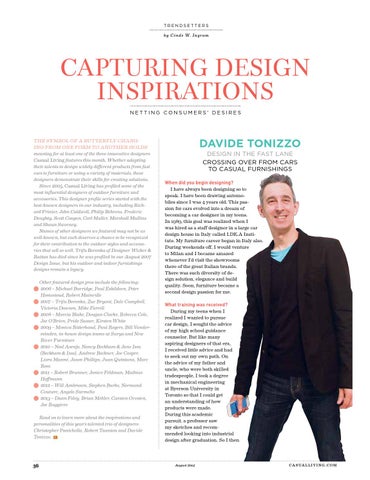
Davide Tonizzo Design in the fast lane Crossing over from cars to casual furnishings
When did you begin designing? I have always been designing so to speak. I have been drawing automobiles since I was 4 years old. This passion for cars evolved into a dream of becoming a car designer in my teens. In 1989, this goal was realized when I was hired as a staff designer in a large car design house in Italy called I.DE.A Institute. My furniture career began in Italy also. During weekends off, I would venture to Milan and I became amazed whenever I’d visit the showrooms there of the great Italian brands. There was such diversity of design solution, elegance and build quality. Soon, furniture became a second design passion for me. What training was received? During my teens when I realized I wanted to pursue car design, I sought the advice of my high school guidance counselor. But like many aspiring designers of that era, I received little advice and had to seek out my own path. On the advice of my father and uncle, who were both skilled tradespeople, I took a degree in mechanical engineering at Ryerson University in Toronto so that I could get an understanding of how products were made. During this academic pursuit, a professor saw my sketches and recommended looking into industrial design after graduation. So I then
August 2014
ca s ua l l i v i ng . c o m
trendsetters Conti nued
portant standpoint, it’s great to work with recyclable and recycled materials. It gives me a satisfying feeling knowing that the ecofootprint of the product is minimized.
studied part time at OCADU (Ontario College of Art and Design University). But the most intense training I received was on the job. Working in Italy gave me a tremendous opportunity to work with global brands such as Fiat, Ferrari, Alfa Romeo, Lancia and Mercedes Benz. It was there that I learned the importance of creating products with a cohesive design language that were also innovative and improved the quality of life for the user. What inspires you to design? Storytelling is what inspires me. I draw inspiration from many sources: nature, automobile design, art, etc., and have a vast array of different aesthetic and functional solutions in my project portfolio. However, the one thing that links all these diverse products is that each one of them has a narrative behind them. I think that creating some kind of mythology behind a product gives it a “soul.” It makes it more than an inanimate object and helps the user bond with it in a more profound way. Today as consumers we are definitely uniting ourselves more to the products we use so these objects need a bio or history. This helps the object take on more of a personality. Who are the designers who are most influential on you? There are so many. I love the work of the late, great Brazilian architect Oscar Niemeyer. His buildings break free from the rigid geometric simplicity of the modernists and create a really sensual experience. As well, Marcello Gandini, the prolific Italian car design genius, is a hero. He had the courage to create some of the most radical yet iconic automobiles ever made. If I were to select a designer from this generation, I would say Marc Newson. I really admire an individual who can cross design borders and create a consistent level of quality in their work. He also has an amazing sense of form. What makes great casual furniture design? I believe there are two factors at play. First, there is the functional side. These attributes are obvious: durability, resistance to the elements, lightweight construction for easy mobility and cleanability. The second factor refers to something closer to the heart. There is an emotional side to these products. Casual furniture is typically used for leisure. We are usually in a relaxed state of mind when we’re at the pool or in the garden. The furniture should support this. The design should be light, carefree and promote a sense of serenity, play and enjoyment. What materials are most satisfying for you to create designs for? Different materials have different qualities. I must admit I have a soft spot for moldable materials like plastics because they give me more freedom of design language. But from another more im-
ca s ua l l i v i ng . c o m
Of which designs or accomplishments are you most proud? I am proud of every client I’ve have the privilege of working with and the results of our collaborations. Selecting outstanding products then is difficult but there are three, in random order. The first is my Bernú public seating system I designed for Arconas, a company here in the greater Toronto area. This system has been specified all over the world. Recently we won a contract in Hong Kong for the new Kai Tak Cruise Terminal. Because of this contract, the company was able to take on more staff. It’s wonderful when design can help the local economy. Another important product is Create a Curio for Bühler Furniture. This was a system of curio cabinets designed to allow the customer to create their own design from five different door fronts and four finishes. The product won the Pinnacle Award last year and this was one of the greatest honors I’ve ever been rewarded. Finally, my Farfalla collection for Koverton. It is my first outdoor collection. Apart from the fact that the people at Koverton are an absolute delight to work with and are incredibly serious about delivering the best quality furniture to their customer, this new product tells a great story. Farfalla is Italian Bernü Curved for butterfly. I wanted to create a light, airy product with butterfly DNA. I believe that we have created a great result in telling the story of a butterfly that flits around the patio and beautifies it. When the well runs dry, how do you recharge your creative spark? I am lucky in this regard. I live in downtown Toronto, a big, global city. When I find I’m stuck, I move the studio from an office environment into a more motivating ambience. It could be a nice café or an urban park or even a trip to some unique shops. Being around the people that use my products fuels the creative process and I always seem to find that little something I was missing in the design. What do you know now that you wish you had known earlier in your career? Lately, I’ve become more interested in branding. I have gained a great deal of understanding as to why some products gain success in the marketplace and I have actually begun to even offer branding services. This acquired knowledge has really helped me see a product as more than just one design in a catalog. I now look at products as one part of a larger context. I believe that it is important for companies to curate the entities outside of the product to create a more complete customer experience, one that has the consistency and quality inherent in good branding.
August 2014
37