Visit our state-of-the-art office: 4111 W 6th Street And now open in De Soto: 33391Lexingon Ave, C
Or Visit Us at: freestatedental.com
2
SAVE
THE
DATE APRIL 6, 2027
14th Annual Lawrence Business Magazine Foundation Awards
THANK YOU TO OUR WONDERFUL 2026 SPONSORS
Applications accepted, November 1, 2026, thru January 31, 2027. For information on the awards and sponsorships visit:
LawrenceBusinessMagazine.com/Foundation 3
4
5
6
2026 Q3
& DOUGLASS COUNTY
Publisher: Lawrence Business Magazine, LLC Ann Frame Hertzog & Steven Hertzog Editor-in-Chief: Ann Frame Hertzog Chief Photographer: Steven Hertzog
LETTER FROM THE PUBLISHERS
When we launched Lawrence Business Magazine in 2011, we honestly didn't know where the journey would take us. We simply believed our community had a story worth telling.
Featured Writers: Bob Luder Sara Maloney Patricia A. Michaelis, PhD Emily Mulligan Nick Spacek Tara Trenary Darin White
At the time, there wasn't a publication dedicated solely to celebrating the people, businesses, and organizations driving our local economy. Too often, good news about businesses creating jobs, investing in their employees, expanding their operations, or giving back to the community went untold. We believed those stories mattered. Fifteen years later, we believe that even more. With this issue, we are proud to publish our 61st edition and begin our 16th year of Lawrence Business Magazine. That milestone is humbling. More than anything, it reminds us that this magazine has never really belonged to us – it belongs to this community. And before we go any further, yes, the extra “s” in Douglass is intentional. We’ve chosen to spell it with two s’s as a nod to abolitionist Frederick Douglass and the values he represented rather than Stephen Douglas, the pro-slavery Illinois senator for whom the county was originally named. Along with many citizens, including Academy Award-winning director and KU Professor Emertitus Kevin Willmott, we believe and support changing the name to better represent our community’s values. Going forward, when referring to the county where we live, we will use Douglass County. As publishers, we've had a front-row seat to the remarkable evolution of this community. We've watched entrepreneurs open their doors with little more than a dream and determination. We've celebrated ribbon cuttings, expansions, anniversaries, and new generations taking over family businesses. We've seen companies weather recessions, navigate a global pandemic, adapt to changing markets, and emerge stronger than before. This issue's theme, Made in Douglass County, couldn't be more fitting. Yes, it celebrates the things we make, grow, design, develop, create, and build here. But it is about more than what we produce. It’s also about the people, ideas, talent, and ingenuity behind it all. One of the greatest lessons we've learned over the past 15 years is that our local economy isn't built by businesses operating alone. It's built through relationships. Businesses mentor one another. Owners serve on nonprofit boards. Companies support local schools, arts organizations, youth sports, and charitable causes. They invest not only in their own success but in the success of the entire community. We've been fortunate to tell thousands of those stories over the years, both in the pages of this magazine and through our annual Foundation Awards, where we've recognized businesses that are creating jobs, investing locally, and making a lasting impact on our community. Whether we're highlighting an established employer or a new entrepreneur with a bold vision, the qualities remain the same—hard work, resilience, innovation, generosity, and an unwavering belief in this community.
ON THE COVER
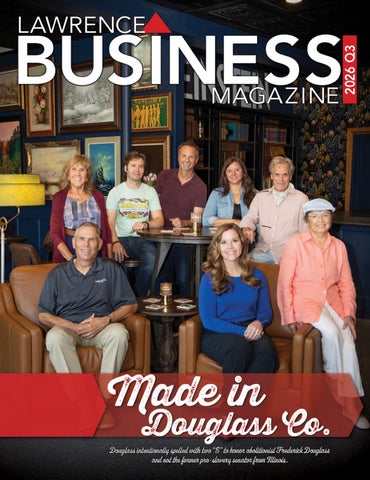
Back row: Mary Jo Anemaat, Elliot Pees, Steve Maceli, Angie Pickman and Stan Sheldon Front row: Willem Anemaat, Amber Rowland, and Galina Conrad Photo by Steven Hertzog
Copy Editor: Tara Trenary Contributing Photographers: Jeff Burkhead Ann Dean Kali Deno Dinesha LaShay Dave Thurman
INQUIRIES & ADVERTISING INFORMATION CONTACT: editor@LawrenceBusinessMagazine.com LawrenceBusinessMagazine.com
Publishing this magazine has also allowed us to build friendships we never expected. Behind every company logo is someone who took a risk, worked long hours, solved problems, and created opportunities for others. Those are the stories worth telling.
Lawrence Business Magazine, LLC 3514 Clinton Parkway, Suite A-113 Lawrence, KS 66047
As we begin our 16th year, we want to thank our readers, advertisers, sponsors, writers, photographers, partners, and, most importantly, the people who have trusted us to share their stories. Your support has allowed us to continue doing what we love: celebrating the people who make this a remarkable place to live, work, and build a business.
© 2026 Lawrence Business Magazine, LLC Lawrence Business Magazine, is published quarterly by Lawrence Business Magazine, LLC and is distributed by direct mail to businesses in the Lawrence & Douglass* County Community. It is also distributed at key retail locations throughout the area and mailed to individual subscribers. All rights reserved. No part of this publication can be reprinted or reproduced without the publisher’s permission. Lawrence Business Magazine, LLC assumes no responsibility for unsolicited materials. Statements and opinions printed in the Lawrence Business Magazine are the those of the author or advertiser and are not necessarily the opinion of Lawrence Business Magazine.
Please note that all our advertisers have a stake in the local economy. Try to shop locally and resist the temptation to order online. If you find something online, see if one of our local businesses has it. When we Shop Local - Shop Baldwin, Eudora, Lecompton, and Lawrence (and use Local Services) - we are supporting those businesses, giving back to our community, and building a future together.
Ann Frame Hertzog Editor-in-Chief/Publisher
Steven Hertzog Chief Photographer/Publisher
www.LawrenceBusinessMagazine.com
*Douglass intentionally spelled with an extra “s” to honor abolitionist Frederick Douglass and not the former pro-slavery senator from Illinois.
7
8
2026 Q3
& DOUGLASS COUNTY
CONTENTS: Features: 10
20 28 34 44 52 60
Lawrence in Perspective:
Lawrence in the 19th Century by Patricia Michaelis, Ph.D.
A Cure for What Ails
by Emily Mulligan
Labor of Love
by Sara Maloney
Innovation in the Heartland
by Bob Luder
Where Art Blooms
by Darin White
Beyond the Hype
by Tara Trenary
Hear the Music
by Nick Spacek
Departments: 7 14
Letter From the Publishers Professional Spotlight:
Steve Maceli
70
Local Scene
80
Newsmakers
82
What or Where?
Our Mission:
We are dedicated to telling the stories of people and businesses making a positive impact on Lawrence & Douglass County. /lawrencebusinessmagazine
@LawrenceBizMag
TO UPDATE YOUR ADDRESS OR FOR SUBSCRIPTION INFORMATION: LawrenceBusinessMagazine.com/subscriptions/
9
LAWRENCE & DOUGLAS CO [ IN PERSPECTIVE ]
Lawrence in the Nineteenth Century by Pat Michaelis, Ph.D., Historical Research & Archival Consulting photos provided by Kansas Historical Society, KansasMemory.org
The 19th century in Lawrence consisted of much turmoil but also progress toward a new way of life for the town. In the 1870s, Lawrence, Kansas, was a prosperous community with a diverse economy. It was founded during the Kansas territorial conflict, but after the Civil War, it went through the processes of becoming a thriving town. The city of Lawrence was established in 1855, but its early years were turbulent, with two attacks on the young community. In the years preceding the Civil War, the United States was engaged in a controversy over the expansion of slavery. The Kansas-Nebraska Act of 1854, enacted on May 30, 1854, created the territories of Kansas and Nebraska. It was assumed that Nebraska would be a free state, but the conflict about whether Kansas would be proslave or free commenced immediately. The Act also repealed the Missouri Compromise by allowing slavery to be decided by popular sovereignty. Lawrence was at the center of the territorial conflict (also known as Bleeding Kansas) preceding the Civil War. The city was established in 1855 by the New England Emigrant Aid Company, which helped Free State settlers travel to Kansas Territory. The first confrontation between Free State supporters and proslavery proponents occurred on May 21, 1856. It was called the sacking of Lawrence, when pro-slavery supporters shut down Lawrence’s newspapers—the Kansas Free State and the Herald of Freedom. The offices and the presses were destroyed, and although the Herald of Freedom resumed publication, it was several months before that occurred. The Free State Hotel was destroyed, as was Charles Robinson’s home. Robinson served as the New England Emigrant Aid Company's official financial agent, and his efforts eventually led to the founding of Lawrence. The second turbulent event was a raid by William Quantrill, a Confederate guerilla. His band of about 300- to 400-plus men arrived in Lawrence at daybreak on Aug. 21, 1863. By noon, the raiders had destroyed more than 200 homes and businesses, and left 150 men dead or dying. On Quantrill's orders, his guerillas killed around 150 men and boys who could carry a rifle. When Quantrill's men rode out of the city, most of Lawrence's buildings were burning, including all but two businesses. In spite of these devasting events for Lawrence, by the mid-1870s, Lawrence was experiencing the typical existence of a new town on the Kansas prairie. The population in 1875 was 7,268, and the surrounding Douglas County had 18,505 residents. This included 9,334 males and 9,171 females, with 5, 805 born in Kansas. Other settlers immigrated from Denmark, France, Germany, Great Britain, Ireland, Norway and Sweden. Lesser numbers came from other parts of Europe and British America. One of the usual questions census takers asked was, “Where from to Kansas?” The largest number of settlers came from Missouri, followed by Illinois, Indiana and Ohio. Others came from a variety of other states. Douglas County waterways included the Kansas and Wakarusa rivers. It also had a number of small streams and springs. Well water could be accessed at a depth of 25 feet. While there was some coal in the county, it was of poor quality. The area around Lawrence had a large quantity of good-quality building stone, with many limestone structures being constructed. Though not plentiful, the varieties of timber included walnut, ash, hackberry, oak, elm and cottonwood. A number of railroads had portions of routes in Douglas County. The Kansas Pacific Railway had a principal station in Lawrence. The Lawrence and Southwestern Railroad connected with the Atchison, Topeka and Santa Fe Railroad in Carbondale, in Osage County. The Leavenworth, Lawrence and Galveston Railway had stations in Lawrence, Baldwin and Prairie City. Several other railroads operated in the county. 10
EASLEE
ROMISE
Building a$10M Endowment for Debt-Free Careers
The Peaslee Promise ensures that Douglas County residents can attend Peaslee Tech programs and build great careers debt-free.
Strengthening Douglas County One Person, One Career at a Time YOUR GIFT WILL:
Provide funding for juniors and seniors from our partner high schools and Douglas County residents from low-income households to attend Peaslee Tech programs and build life-changing careers DEBT-FREE. Help close the skilled labor gap for Douglas County employers. Establish a permanent funding source for Peaslee Tech. Create career opportunities and fuel economic growth in Douglas County for generations.
GIVE NOW! At peasleetech.org/peasleepromise or mail a check to: Douglas County Community Foundation Attn: Peaslee Promise Endowment Fund 900 Massachusetts, Suite 406 Lawrence, KS 66044 Schedule a campus visit! Contact Megan Hill at megan.hill@peasleetech.org or 785-856-1801 ext 104
MORE ABOUT PEASLEE
peasleetech.org
11
Business buildings on Massachusetts Street in Lawrence, Kansas. Signs for the State Bank and Nathan Frank, a wholesale grocer, are visible.
Massachusetts Street looking north from Henry Street (now Eighth Street) photos courtesy Kansas Historical Society, KansasMemory.org. Copy and reuse restrictions apply.
Occupations of residents included 47.9% engaged in agriculture, 23.9% in professional and personal services, 13.9% in trade and transportation, and 14.1% in manufactures and mining. A listing of business in an 1873 county atlas contained 20 lawyers, two architects, five banks, 10 contractors and builders, three druggists, 15 grocers and markets, and six realtors. Other business listed included two agricultural implement dealers, boots and shoes, blacksmithing, baker, dry goods, hotels and boarding houses, lumber dealers, liveries, four physicians and a number of other businesses. The 1875 Kansas State Board of Agriculture report listed manufacturers as a planning mill, machine shop, seven wagon and carriage factories, four grist mills, two breweries, four packing houses, three furniture factories and a brick manufactory, among others. As for income, farm laborers earned $8 to $20 per month with room and board;, city laborers, 75 cents to $1.50 per day; bricklayers and stone masons $2 to 3.50 per day. Clerks made $25 to $100 per month. Other workers were paid a variety of wages. Other community amenities in Douglas County included 84 organized school districts with 93 schoolhouses. The State University (Kansas University) was located in Lawrence. A number of denominations had organized churches. This included five Presbyterian, six Congregational, five Baptist, four Methodist, six Catholic and a number of other churches with one building. This profile of Lawrence in the 1870s provides a great glimpse into life in the town. But as is very unusual for this period, a photographer named W.H. Lamon took several stereopticon views of downtown Lawrence. p 12
PROFESSIONAL [ SPOTLIGHT ]
Steve Maceli ————————
Scaling New From cooking in the dorm for students to owning his own event spaces, he started small and rose up with the help of his community.
14
Steve Maceli's catering business has benefited from community since its earliest days. During his time as director of the Grace Pearson Scholarship Hall at The University of Kansas (KU), Maceli didn' t want to eat bad food, so he taught himself to cook for large groups.
Heights
“Then I taught the guys, and we created a system to make sure, to the best of our ability, that we had good food,” the owner of Maceli's Catering & Events recalls. Because of the knowledge he gained at the scholarship hall, a friend asked Maceli to cater her wedding. By happenstance, Lenoir Ekdahl, former head of KU Dining, was in attendance at the church where the wedding took place. “She asked for my business card,” Maceli explains. “And I said, 'I don't have a business card. I'm just a dude. I'm just a guy doing stuff.' ” The thought that the former head of KU Dining, for whom the Daisy Hill dining hall is named, thought his food was good got Maceli's head spinning. From there, the nascent entrepreneur began catering events for women at his church and community groups. Five years later, he opened his first commercial kitchen at 1119 Massachusetts St., the former Campus Hideaway location. “We outgrew that place probably in 3½ years, and we were just looking for a commercial kitchen, and we ended up having this whole space,” says Maceli, gesturing around the ballroom at 1031 New Hampshire St., where his catering business has been headquartered since 2005.
by Nick Spacek, photos by Steven Hertzog
It wasn't a straight line to this point, however. In its earliest days, Maceli's wasn't run out of an actual business space but in various homes throughout Lawrence. “I used to live in professors' homes for several years,” Maceli says. “The first two years of Maceli's was out of professors' homes that were on sabbatical.” From there, he moved to 1220 Rhode Island St. and ran the business out of that house for the three years he lived there. Maceli used electric roasters placed strategically around the house so as to not blow circuits to cook dishes such as herb and garlic beef, a dish still on the catering menu to this day. “And my poor roommates would wake up in the middle of the night and try not to trip over a roaster,” Maceli recalls with a wry grin. “The whole house would reek of the herb and garlic beef, which is really tender and really yummy, but it could be a lot. They were very patient with me, knowing that I was building this business.” Despite all of the hard work and perseverance, as well as understanding roommates, Maceli's might not be here today had the community around it not stepped up at a crucial point.
Helping Hands One of the organizers of the Omega Outdoor Music Festival, a weekend long camping and music celebration just outside of town, came to Maceli looking for someone to provide vegetarian food. Given the transmission on Maceli's Honda had just gone out, and he needed $1,000 to repair it, he agreed. “I was like, OK, I've really gotta make this work, because I need the money,” Maceli says. From there, he borrowed a friend's van, rented a tent from Sunflower Outdoor and bought tons of groceries. “My friends all helped me. We went there to serve all this food.” It turns out the majority of the concert attendees brought their own food, and no one was buying anything Maceli had prepared. “If they had money to spend, it wasn't on food,” says Maceli with a knowing look. The first night, Friday, they closed up early feeling numb but hopeful things would be different the next day. They weren't. “So by noon, maybe 1, we just said, 'That's it,' ” Maceli remembers. “I'm done. Let's just pack it all up and go home.'” When he got home, Maceli called Sunflower asking if he could pay for the tent rental in hummus to help discount the fees. He was freaking out, he says, because not only did he still owe for his car repairs, but he'd put everything on his credit card to fund what had ended up being a complete bust. This is where the relationships Maceli formerly made began to come together. While in the scholarship hall, he and his roommate, Amy, had become friends with a woman named Juanita Strait, who owned a home right across from the scholarship halls. Strait spent the last couple years of her life in that house, homebound, and students such as Maceli adopted her as an auntie. And she adopted them in return, having dinner with the students every Sunday. “Amy was talking to Juanita and said, 'Hey, we're in this little predicament,' ” Maceli explains. From there, Strait called Juanita Henry from the Methodist Church and said, “Steve's in a predicament. Can you help?” While at first, Henry said she didn't have time for such a thing, five minutes later, she started calling everyone she knew in the Methodist Church. Maceli's phone started ringing, and soon, his friends were delivering food all over the city of Lawrence until it was all sold. “And my debt was paid,” Maceli says, visibly tearing up at the memory. “It was like 'It's a Wonderful Life.' I was George Bailey that day. And I'll never forget it. It's in my soul. 'Cause the people you help, they help you back. We help each other survive in many ways.”
Work Hard, Play Hard In the years since, Maceli's has grown steadily. They started catering at the KU Alumni Association, and Maceli credits the expectations and the education he got to Bryan Greve, senior vice president of hospitality services, who helped raise him up several notches. He says that experience is likely what gave SpringHill Suites the confidence to use Maceli's as the in-house caterer for the new hotel when it opened in 2001. It hasn't all been work for Steve Maceli, however. He met his husband, John Connolly, in February of 2005 when a mutual friend introduced the two at a Mardi Gras fundraiser for the Douglas County AIDS Project at Abe & Jake's Landing. Connolly is quiet and introspective, but Maceli says that's what makes their relationship work. “We're the yin-yang, or we balance each other out,” Maceli explains. “I push him, and he calms me down.” Connolly describes the experience of working at Maceli's an interesting one. Prior to coming on as an employee, he'd been a program coordinator in KU's College of Liberal Arts and Sciences, where he worked for 38 years before retiring in 2022. “I didn't work in this industry at all,” he says. “I worked up at KU, and then I retired from KU, and I worked with Steve for Maceli's for a few years. Now, I'm actually officially retired, but I come and help out when we're superbusy. But it's been a lot.” Four years ago, Maceli and Connolly attended their first Foundation Awards event as a recipient. For many years, the business had made it a priority to support community organizations—especially nonprofits that serve their most vulnerable friends and neighbors. "Mental health has remained one of our central causes since we lost a dear friend to suicide many years ago," Maceli says. "Until that first awards ceremony, we had never considered supporting a different kind of initiative because our budget simply did not allow it." Around that time, one lasting effect of COVID became clear: The catering and events business' previous reliance on part-time employees was no longer sustainable, Maceli continues. So in response, they combined responsibilities to create more full-time positions, helping them build a more reliable and dedicated team. "That transformation continues today, along with the need to keep growing sales so we can provide our expanding staff with stronger pay and benefits," he explains. "The beauty of growing means we have the funds to hire other people to help us perform at better and higher levels." When Maceli's was recognized with its first Foundation award in 2023, Maceli saw how the Foundation Awards celebrated the achievements of all types of local businesses. 16
"At that time, we were beginning to plan a renovation to expand and modernize our facility, and knew that our new spaces could help this event grow and become even more successful," the owner says. "Over the past three years, we have proudly hosted the Foundation Awards, and it has become one of our signature events—one we are honored to support both as a venue and as a financial contributor." The growth of Maceli's came at the same time as the growth of the Foundation Awards ceremony itself, Steve and Ann Hertzog agree. "We needed a bigger venue, so we moved the Foundation Awards to Maceli’s; we knew it would be a good fit," the Hertzogs say. "But it has been amazing. We were excited to be the first in his new lounge space and help him showcase it. Since then, each year, Steve Maceli has brought something new and inventive to help us showcase the Foundation Awards, and he continues helping us make them better. What a great partner; we are so lucky to have him in Lawrence."
Looking Ahead While COVID slowed down public events and, thus, Maceli's business model in the years since the pandemic, the catering and events business has only grown. After Scotch Cleaners moved out of its downtown space, Maceli's expanded into that space with its bistro room, as well as purchasing Arterra Event Gallery, at 2161 Quail Creek Dr., in 2022. Now, Maceli's is expanding once again, having purchased and taken over the former Einstein Bros. Bagel shop, at 1026 Massachusetts St. The new space offers a slew of benefits to the business, beginning with the fact that it's located directly across the alley from their main space. Also, while it might be smaller, that's the point, Maceli says. “We want it to be smaller,” he continues, “because it doesn't make sense for us to host groups of 30 or 35 here at Maceli's or at Arterra.” Maceli describes the newest location as a highly stylized event space with a speakeasy feel—having higher-end cocktails and, hopefully, espresso drinks and mocktails. All of this wouldn't be possible without the community, which has supported Maceli's throughout its more than three decades of business. So Maceli gives back, as well, noting that many community groups don't pay room rental fees. “My early days were started by helping community groups,” he explains. “Those are my first customers, and they got me out of some predicaments a couple times. I will be eternally grateful, and I know my roots. I know my history.” p 18
These bioscience companies create products right here in Lawrence they hope will help prevent or treat illnesses all over the world.
A Cure for by Emily Mulligan, photos by Steven Hertzog
Thousands of Kansans work in the biosciences, and the state continues to grow bioscientific businesses and increase relevance in the field. In Lawrence and Douglas County, bioscience startups have what is now a well-established incubator at KU Innovation Park (KUIP). The startup companies’ research and scientific achievement at KUIP transcend geographic borders, and the discoveries and innovations forge new pathways in bioscience over time. What follows are profiles of three companies whose ideas, technology and science already are emanating nationally and internationally. Design-Zyme holds patents for ongoing vaccine development in areas such as Lyme disease and opioid-use disorder. Oak Therapeutics is developing oral paper strips as an alternative way to administer medicine, whether for medical reasons or for simplifying portability and storage. Vytas Bio is working to develop noninvasive early cancer screenings using urine samples for earlier detection of typically difficult-to-detect cancers such as ovarian and pancreatic. Each company is based at KUIP and building from there. 20
What Ails Design-Zyme
KU Innovation Park - phase 1 & 2. KUIP is now in the process of building phase 4. Photo courtesy of KUIP
Design-Zyme specializes in creating enzymes and vaccines for ailments or diseases that aren’t being addressed by large pharmaceutical companies for any number of reasons. With three U.S. patents and 13 more U.S. patents pending, Design-Zyme is blazing a trail of discovery and solutions using polyvalent displays to create vaccines for opioid-use disorder (OUD), Lyme disease, Kush usage and fescue toxicosis. Design-Zyme scientists engineer haptens that attach to carrier proteins and create an antibody response. The company’s technology is for novel types of vaccines, which is why Design-Zyme is continually patenting its methods. Media attention and changing attitudes about vaccines in the U.S. reinforce the need for safeguards and adherence to the Food and Drug Administration (FDA) processes. “Everything we do is exceedingly safe, and safety is right at the top of our process,” CEO Pete Petillo says. “For example, it would take hundreds to thousands of times the vaccine dose to get any side effects.” 21
The company’s opioid-use disorder vaccine has the potential to diminish the high that users feel when using opioids, which Petillo says could lead to improved morbidity and mortality rates. “It could be used for active OUD to help in recovery or prophylactically to prevent becoming addicted. The vaccine is not curing OUD but rather preventing one underlying element of addiction,” he says. The Lyme disease vaccine came to fruition as an offshoot of the company’s work during the COVID-19 pandemic. Design-Zyme wanted to apply its platform to a potential COVID-19 vaccine and needed a way to test it without working with the COVID virus itself. So Petillo says they developed polyvalent peptide and protein technology, and developed a working Lyme disease vaccine for testing. Once the pandemic diminished, Design-Zyme’s team continued its work with Lyme disease using a National Institutes of Health-funded contract. Their vaccine targets the Lyme disease bacteria once it is disgorged into the human body, in contrast to other concurrent vaccines that target the bacteria while it is inside the infecting tick. The OUD vaccine and the Kush vaccine, which addresses a drug-use disorder in western Africa, are seeking more funding with hopes to pursue clinical trials in early 2028, Petillo says. The Lyme disease vaccine is probably nine months to one year behind that, he adds. “The testing process is the cheapest process. A clinical trial is much more expensive,” Petillo says.
Top to bottom: The Design-Zyme team - the chemists, immunologists, biochemists, animal physiologists and business development staff behind the Company’s vaccine pipeline. Dr. Julia Galvez at the bench- Every vaccine candidate starts here. Design-Zyme designs and synthesizes its vaccine components, including its haptens, in-house. This allows the Company to iterate on vaccine structure far faster than an outsourced model allows Chief Science Officer Dr. Dwight Deay III preparing a sample for bioanalysis –The melding of synthetic chemistry and structural biochemistry supports the systematic exploration that turns an hapten idea into a new vaccine candidate.
22
He appreciates both the environment and the facilities at KUIP, where Design-Zyme has been since 2015. The laboratories can accommodate the latest technologies as those technologies develop, and the facilities have allowed for growth, as the company has expanded from 400 square feet of space to its current 3,100 square feet. Ultimately, Design-Zyme’s success is attributed to a combination of consistent funding from the Department of Defense’s Defense Advanced Research Projects Agency (DARPA), the NIH, the National Institute of Allergy and Infectious Diseases and the Wellcome Leap and its scientific team’s work. “Our team is passionate about the work they do but also very, very good at what they do,” Petillo says.
Oak Therapeutics’ executive team: Edward Maliski, PhD, CEO, and Sally Maliski, PhD, Chief Communications Officer. Not pictured: Gerhard Apfelthaler, PhD, Chairman of the Board and CFO
Oak Therapeutics “If people don’t take their medicine, it doesn’t do them any good.” That is something that Oak Therapeutics CEO and Chief Science Officer Ed Maliski often says as a basis for the company’s work in creating oral dissolvable strips as a way to administer medications. If people cannot gain access to their medicine or can’t physically swallow it, they won’t be able to take their medicine. The strips with embedded medication address many barriers to taking medicine, some of which are medical and others of which are logistical, such as efficient storage and transportation of the medicines. No water is required to ingest the medicated strips, and they are lightweight to ship and don’t need refrigeration. So they can more easily reach populations in underdeveloped countries or remote locations. “Complicated answers are easy to come by. Finding something simple that works is more difficult,” Maliski explains. Oak Therapeutics didn’t set out to be a company that specialized in oral dissolvable strips, but Maliski says they came to that solution by talking with the people involved in prescribing, administering and taking medications. Treating pediatric latent tuberculosis (TB) is a prime example of how the strips could greatly increase the likelihood that patients will take their medicine. Usually, treatment involves taking multiple pills every day or every week for at least four to six months—and the medication has a terrible taste, says Sally Maliski, the company’s vice president of health-care relations. Though there are pediatric TB patients in the U.S., there are many more in developing countries, where the flavored strips can be easily shipped. The oral dissolvable strips medication is both easily distributable and masks the nasty taste. With hundreds of thousands of children dying from TB annually, distributing life-saving medicine efficiently that they will actually ingest is mission critical. “What we’re talking about with TB deaths is the daily equivalent of three 747s, with a child in every seat, crashing. How many days would you let that happen?” Ed Maliski asks. Thus far, Oak Therapeutics has brought one of its oral dissolvable strips to market, a slow-release nutraceutical to treat dry mouth called Xerostrip. For future products and the path ahead, Ed Maliski says the company is working to build efficiency for both the scientific end of encapsulating the pharmaceutical ingredients on the different types of strips and for the regulatory end of navigating the drug approval and clinical trial processes. “If we can get to where we use the same encapsulant for different medications, then that makes every strip all the same. So we’ll be able to adapt what we’ve learned to other products and achieve efficiency in making and manufacturing,” he explains. “We’re working toward efficiency in distribution, as well.” Both Ed and Sally Maliski rave about the networking, community and expertise they have encountered at KU Innovation Park since arriving in 2015. “Without these people, we would’ve been out of business. They take great pride in seeing us become successful. They never gave up on us, and it’s starting now to pay a dividend for us,” Ed Maliski says. 24
Top to bottom: Research Scientist Lauren Staus weighs a slurry that forms the basis of the oral strip. At this stage, the material has a consistency similar to cake batter Xerostrip is an example of a finished product. Used during sleep, it helps reduce dry mouth, an important concern for cancer patients receiving chemotherapy or radiation therapy to the head and neck Senior Research Scientist Zachary Nicolay tests new equipment designed to increase manufacturing efficiency and reduce production costs.
25
Vytas Bio Pancreatic and ovarian cancers, among others, are difficult to detect, so by the time patients receive their diagnosis, the cancer is often too late-stage to treat with much hope of long-term survival. What if people could screen for those stealth cancers and be diagnosed with them long before the cancer produces symptoms and with enough time to either significantly slow or prevent the cancer from growing? Early, painless, noninvasive cancer screenings are precisely what Vytas Bio is working to develop. Urine tests could detect fallopian tube cancer, kidney cancer, ovarian or pancreatic cancer, and give the patient time to develop a treatment path with hopefully better odds of survival. “Getting diagnosed earlier and treating the cancer earlier would shrink the amount of suffering of women, families and doctors. Plus, they would save time and money by treating the cancer early instead of late-stage treatments,” says Vytas Bio founder David Alburty. Urine contains what Alburty calls “cell garbage,” shed by every cell in the body. Scientists are now coming to understand that each of those submicroscopic particles, called exosomes, holds unique information that can be accessed and tested. Exosomes carry waste from cancerous cells that can be traced back to specific tissues—all of which can be detected from urine—so there is no complicated or invasive procedure involved. Alburty says he founded Vytas Bio, his fifth startup, four years ago as a basis for detecting pancreatic and kidney cancers. He has since begun exploring ovarian and fallopian tube cancers, as well, because women’s health issues tend to be underserved by medical research. One of the biggest challenges of working with the exosomes in urine tests, Alburty says, is that the particles themselves are so tiny. They are smaller than bacteria, so accessing biomarkers and analyzing them requires specialized laboratory equipment. Coincidentally, he found a research group at The University of Kansas (KU) that is trying to identify similar types of biological markers, so he and that group have shared some samples and have collaborated some. His entrepreneurial experience has served him well as he forges new pathways with ideas and science. Detailed planning is essential, but so is managing when the plan is disrupted or destroyed. It is a balancing act. “You have to do early work to know it’s feasible. If you don’t have a goal and a plan, you’re adrift. You have to keep your sense of urgency and drive, because so much is happening so fast, but also it takes a lot of patience and perseverance,” he says. The Vytas Bio pipeline hopefully eventually will include developing one urine test after another to the market for various cancers and possibly other types of illnesses, Alburty says. Vytas Bio has been at KU Innovation Park almost four years. Initially, Alburty was interested because of the specialized equipment that already was on-site. But he says colleagues at KUIP and at the broader University have helped propel his scientific explorations and access to other opportunities. “I have proximity to KU and scientists, specialized facilities, room to expand, a community of other entrepreneurs, and we’re surrounded by the coolness of Lawrence,” he says. p 26
Top to bottom: Dave Alburty, Captain & Principal Investigator Nano tracking analysis process for the exosomes Human cancer exosomes being analyzed
Labor of Love Discover the passion and grit behind some of Lawrence’s favorite artisan foods.
by Sara Maloney, photos by Steven Hertzog
In an era often dominated by large-scale commercial manufacturing, local entrepreneurs selling tofu, natural preserves and kombucha showcase how production can thrive in Douglas County through connection and community. Local business owners have to wear a lot of hats to make a business successful, both behind the scenes and with customers. That might look like managing inventory and accounting, as well as honing and selling new products, and keeping up with production scaling. But these three business owners shared a couple common threads: the idea that Lawrence and Douglas County’s support for local businesses has helped them succeed, and the Lawrence Farmers Market is helping these owners reach new audiences. 28
Cultivating Craft in the Backyard Galina Conrad, owner of Le Petit Garden, began her business in 2005 as a personal journey to stay busy following the passing of her husband in 2003. What started small has continued to overtake the entirety of her backyard. With a more than 5,800-square-foot backyard, she has about 125 varieties of plants. Her goal was to grow foods that weren't necessarily as common in this area, like persimmons, rhubarb, gooseberry, black currant, jostaberries and hardy kiwi. Galina Conrad in her forest like garden in Lawrence
“It's my backyard farm,” Conrad says. “It is just not a big backyard. I have about 100 to 135 varieties on this small amount of land." Creating handmade jams and preserves was something she started doing for friends. When they recommended she start taking her items to the Lawrence Farmers Market, she took the advice. She filled out an application, and the rest is history. Now, she’s known around town as the “Pesto Lady.” But it’s not been an easy ride. It takes a lot of time, labor and perseverance. Without other employees, Conrad manages all pruning, harvesting and cooking herself. To comply with food safety regulations for her pesto and cooked salsas, she built a small commercial kitchen inside her home garage. Conrad adheres to traditional Russian jam- and preserve-making techniques, cooking berries over a two- to three-day process without added pectin or preservatives to allow the fruit to absorb the sugar syrup naturally. Her ever-changing menu is made up of unique creations like rhubarb-orange marmalade, strawberry-rose petal preserves and garlic scape pesto. That’s what sets her apart from other types of jams or jellies. "I try to create something new to surprise my customers," she explains. Conrad has been at the Lawrence market for more than 20 years now, and she previously spent almost a decade also traveling to the Overland Park Farmers Market before stepping back during the pandemic. She continues to try new recipes and surprise her customers with options that are not otherwise available in town. Conrad agreed that the Lawrence community has rallied behind her all these years. “They help when you need help,” she says. 29
Clay Burkhead with Elliot Pees, serving Kanbucha at the Lawrence Farmer’s Market
The Passion Behind the Brew Elliot Pees started producing kombucha around 2008. Started as a home-brewing do-it-yourself experiment during the height of the recession, the passion project evolved into a full-fledged operation with the creation of KANbucha in 2012, when he shifted his focus entirely to the business. "In around 2009 or 10, it was difficult to get a job during that part of the time of the recession,” Pees says. “I just decided, well, this would be fun, nobody's really doing it.” Because of kombucha’s fermentation process, navigating the steps to licensing in the beginning of his journey turned out to be a learning curve for both Pees and state regulators. "The KDA [Kansas Department of Agriculture], who grants the food-processing licenses, didn't really know how to categorize it," he explains. "They didn't know much about it, so it was kind of a learning process for them, as well." To meet commercial standards, Pees initially built out a licensed commercial kitchen in his home basement before scaling up into a dedicated commercial
30
Elliot and Clay filling bottles of Kanbucha for distribution
facility in North Lawrence to handle manufacturing, packaging and storage. As he continues to scale up the business, Pees has had to consider how to carefully reinvest hard-earned profit into better equipment to continue to grow production numbers. It’s something that’s been daunting and scary at times. "Usually when you scale up, it's just a big, up-front cost, and you do that at the risk of things maybe not working out, so that incremental leveling up is something that I've always bootstrapped. I've always owned every part of my business because I'm always reinvesting some of the profits to buy better equipment,” he says. Today, Pees is able to produce nearly 300 gallons of kombucha per batch, a maximum for the business so far, and distributes to local coffee shops, grocery stores such as The Merc Co+op and the farmers market. The way the community wants to support local businesses has made the experience what it is, he says. Not only customers, but the way retailers in the local space want to have other nearby producers in their stores has made a big difference in his journey as a business owner. "The support here in Lawrence just made it a perfect place to start a local business," Pees adds. Watching the culture around kombucha change has also impacted how customers show up for KANbucha. When he started the business and jugs at the market, nearly every conversation included educating people on what kombucha even was. Now, it seems every year, he has to explain less and less what it is. Being recognized around town as "the kombucha guy" brought a lot of gratitude and inspiration to Pees, and has created a close-knit way to receive real feedback. 31
Tim Quillin, owner of Central Soyfoods, engages with a customer as he works his stand at the Lawrence Farmers Market
A Local Legacy of Tofu Taking over Central Soyfoods in 2024 wasn't just a business acquisition for Tim Quillin; it was stepping into a legacy that has been part of the Lawrence community since 1978. The tofu company is the only manufacturer in the region. Quillin is a former executive chef who spent years leading high-volume local kitchens like Pachamama’s, Big Mill and Ladybird Diner. Several years ago, he decided he was looking for a career shift. “The idea of getting to do one thing instead of a million things at the same time … not that this place doesn’t have its trials and tribulations, but at the same time, I'm not being pulled in a million different directions …” he explains. It’s not an easy production process because of the nature of tofu—it requires extremely hot temperatures to create and steam. Quillin plays a big role in the production process but has another team member helping with some of the hardest parts of the process. With customers being both grocery stores and restaurants, he gets a look into where his creations end up while also traveling around Kansas City to see how new places are bringing his tofu to life. Currently, Central Soyfoods supplies more than 30 grocery stores and restaurants in the area, and produces more than 2,000 pounds of fresh tofu weekly. Quillin recently started taking his tofu to the local farmers market, and it’s been rewarding to see who he’s selling to at the ground level. The clientele at the market has continued to grow, and in August, he sold out of all his tofu for the first time. The market has also allowed him to bridge all different generations of customers. Longtime residents stop by and share stories of buying Central Soyfoods decades ago, and Quillin is able to share cooking and preparation inspiration with new customers who may not know what to do with the product. "I really appreciate that this town is so excited to tell me their stories about my business that I don't even know,” he says. “I'm really proud to be able to carry this on into the future." For Quillin, the experience reinforces the bond between Lawrence residents and local makers. He’s lived in the area almost his whole life and has seen firsthand that people don't just buy the product, they invest in the family, the history and the craft behind it. “When you wake up every day, and you know that your neighbor has this kind of business, it makes you feel proud about your community,” he says. “You have a stake in your community because you know this is a person, they have a family, and you know their name.” 32
p
33
Innovation in
by Bob Luder, photos by Steven Hertzog
From aerospace components to innovative health-care products to acoustic automobile features, products made or developed by Lawrence-based companies reach millions of people every day, giving this college town an outsized role in industries that span science, health care, manufacturing and beyond. As a CEO of one of the city’s wide-reaching businesses put it, Lawrence isn’t just perhaps a surprising hub of national and international business reach, it’s a home well-suited to research, development and manufacturing of products that impact and benefit millions nationally and worldwide. “Lawrence isn’t just home to companies that can design and manufacture valuable products for people across the globe,” says Dr. Nick Love, cofounder and CEO of Love Lifesciences, “it is a place where students are educated, trained and can subsequently be employed to utilize and hone those valuable skill sets. “Lawrence is a place where ideas become prototypes, prototypes become clinical-trials-ready products, and products can be manufactured and scaled—all in one location," he adds. "And that is just on the physical product side.” Love knows this from personal experience. His company, Love Lifesciences, started in 2021 and, cofounded by Chief Technology Officer Bradley Hopper, is part of KU Innovation Park (KUIP). It invented, manufactures and distributes the UNIPEN, a pharmaceutical injection device designed to optimize efficiency, safety and precision across a diverse range of therapies. Love Lifesciences isn’t alone among area businesses whose products are consumed far and wide. 34
the Heartland These local companies may ship their products worldwide, but they are perfectly happy being based right here in the middle.
USAF Fifth Generation Target Drone Wind Tunnel Test ran by DARcorporation
DARcorporation (DAR stands for Design, Analysis and Research) is an aeronautical engineering company on the northern edge of the city that provides aircraft design and analysis, wind energy, engineering and prototyping, and software and books not only for companies nationally and internationally, but for the U.S. government and NASA. Adler Pelzer Group is a German company with one of its nine U.S. manufacturing locations on the eastern edge of Eudora. It operates under its subsidiary brand name, HP Pelzer Automotive Systems, and is a worldwide leader in the design, engineering and manufacturing of acoustical and thermal components and systems for the automotive sector. While these three companies operate in completely different business sectors, all can agree on one thing: Lawrence and the Douglas County area provide an environment ripe for innovation, creation and productivity. “I know Lawrence, (The University of Kansas), KU Innovation Park and the community as a whole have been integral to Love Lifesciences’ success and the success of many other businesses in the medtech and pharmaceutical spaces,” Love says. “Lawrence really is a place that has many of the key components necessary to build a thriving business, from talent development to product development.”
A Lifetime Love of Flight Willem Anemaat gets visibly animated when showing a visitor around DARcorporation’s new office and shop facilities, especially when it comes to presenting some of the current projects on which his team of engineers are working. On one table is a small aircraft the team is designing for NASA, to be used for research and scouting. A small side room houses several 3D printers busily carving out creations and components. There is another small aircraft Anemaat’s team is designing to compete in an upcoming aeronautics competition. To win the DARPA Lift Challenge and its $6.5-million prize money, the team must design and engineer a drone that can vertically lift at least four times its own weight. “We’re in the process now of building a fuel-powered engine for it,” Anemaat says. “We started with an electric engine, but the batteries weighed too much.”
35
DARcorporation emerged as a company in 1991 and was founded by Jan Roskam, a distinguished professor in aerospace engineering at The University of Kansas (KU). But the company’s conceptualization occurred a couple years earlier when he and one of his graduate students, Anemaat, began throwing around ideas. “Jan wrote eight books on aircraft design,” says Anemaat, who attained a Ph.D. in aerospace engineering from KU in 2007. “We automated that into educational software for aircraft design. It sold in over 60 countries.” When Roskam retired in 2004, Anemaat and his wife, Mary Jo, bought him out, and Willem became DARcorp’s president. Mary Jo is vice president. The business has been headquartered at several locations throughout Lawrence—First on Ninth streets, out on Wakarusa for 16 years and then out near Haskell Indian Nations University before moving to its current location on Lakeview Road, just north of Interstate 70, last year. “We moved here Feb. 1, 2025,” Anemaat says. “It’s one level, which worked out better layoutwise for us.” While he says 90 percent of his company’s revenue (which was around $2.5 million last year) comes from software and consulting services, DARcorporation’s team of 12 full-time employees, along with help from a handful of KU interns, is involved in a dizzying array of projects that include, but are not limited to, single-engine propeller aircraft, multiengine propeller, jet-powered kit aircraft, light-sport aircraft, experimental hybrid air/ground vehicles and wind turbines.
Top: Dr. Willem Anemaat, President, and Rob Zernickow, Flight Test Engineer, with the NASA MAVRIK Research UAS Bottom: Hi-Q 61 Full Scale Wind Turbine Designed and Built by DAR corporation
If it flies, DARcorporation most likely can create it. “We had 24 people and were doing $5 million a year before COVID,” Anemaat says. “Now, we’re being a little conservative. We’re starting to do more in hardware, making things.” He says DARcorporation has an ongoing partnership with Auburn University dealing with innovative research and small-business technology transfer. “We do a lot of subcontracting for other companies on design work,” Anemaat adds. “Reverse engineering.” 36
While much of the company’s work is now military and for the U.S. government and NASA, he says DARcorporation has done some military consulting with Turkey and provided some work for China on a skydiving simulator. “When I go to other Chamber of Commerces, people say, ‘Lawrence?’ ” he says. “I like being in the middle of the country. You don’t have to travel far to get anywhere. It’s low cost. We can do flight testing without prying eyes. There’s plenty of space. It’s worked perfectly for us.”
Transforming Health Care Love Lifesciences was formally founded in May 2021, but Nick Love says he had a concept for a different device, MultiPen, a couple of years earlier. The trouble was, while Love had the science and medical background needed to pursue this venture—he holds an undergraduate degree in molecular, cellular and developmental biology, a doctor of medicine degree and a master's degree, all from KU—he lacked the engineering and design skills needed to put ideas into action. The dilemma was quickly solved when he met Bradley Hopper, who joined Love as cofounder and chief technology officer after their wives, who were KU sorority sisters, introduced the two of them. “Bradley was in Topeka, I was in the Kansas City area … and with today’s technology of 3D printers, computer-generated modeling and Zoom, we were able to be remote for the first years of Love Lifesciences,” Love says. “A year ago, our team began growing, and we realized we needed a physical office and space for research and development. KUIP is a sweet spot in the middle of America. I knew of it, knew the staff there. It was perfect for us.” Love says he started thinking about self-administered injections from seeing his patients at KU Medical Center. He came up with a multidose device concept, MultiPen, and after meeting Hopper sent a collection of drawings to him. Being the good partner, Hopper candidly responded that the device was “too complex, the applicable market was too niche and that we should think about scaling back to a singleuse device.” Love agreed that he had seen patient problems with these single-use devices, too. Together, the team produced a 400-patient study to discover what problems patients faced with self-administered injections. The study showed patients had difficulty with pain and anxiety, were often overdosing or underdosing on medications, and ultimately would discontinue life-altering therapies because of these problems. Behold the UNIPEN. “We designed UNIPEN to be patient-controlled,” Love says. “Patients reported having anxiety about injecting and having bruising at the injection site. We wanted patients to control the process of how slowly or quickly medications are administered, provide comfort by hiding and protecting the needle, and remove the inconveniences of the traditional syringe and vial. “People want control,” he says. Love says UNIPEN can administer most injectable drugs and, in fact, combinations of drugs, which allows the device to employ into the rapidly developing personalized medicines and compounding pharmacy marketplace. Love Lifesciences, which has four full-time employees and works with more than 100 individuals across dozens of (primarily Kansas-based) contractors, distributes UNIPEN to 45 states; Love says that is on track to increase to 48 states by the end of the year. The company has launched UNIPEN with more than six injectable formulations to date. 38
WE LOVE PARTIES! Whatever the occasion, we want to help you celebrate.
JohnnysTavern.com
JWilsonsRestaurant.com
Two great restaurants, one big family. Johnny’s North | Johnny’s West | Johnny’s Topeka 785-842-0377
785-843-0704
785-329-5541
|
J. Wilson’s
785-312-9057
39
Bradley Hopper, CTO & Co-Founder and Nick Love, CEO & Co-Founder of Love LifeSciences Love Lifesciences UNIPEN
He added that 100 percent of the product is made at GemTech, out of Spring Hill, Kansas. “(UNIPEN is a) bridge from the pharmacy world to the major pharmaceutical products world,” Love says. “We have a pipeline lined up to sell more than a million units in 2027.” To support UNIPEN, Love Lifesciences has recently developed and deployed both semiautomated and fully automated fillfinish systems capable of producing millions of injectable units a year with a single operator in a small, 4-foot-wide space. These technologies not only enable compounding pharmacies to produce injection devices within their limited space but further allow them to increase production capacities while driving toward reductions in labor and cost requirements. In fact, its fully automated system—a robotic arm producing roughly four million units annually—has significant implications in the pharmaceuticals space. “What we have done is create the UNIPEN Platform,” Love says, “which provides the core infrastructure needed to launch an injectable drug product from the device, labeling, supply chain, packaging and the final product fulfillment. This has substantial applications for pharmacies, yes, but also for new drug development and generic pharmaceuticals.” This past month, Love Lifesciences installed its fully automated robotic arm system into pharmaceutical manufacturer Excite Pharma Services for validation testing and subsequent UNIPEN-based drug fulfillment. As time passes, Love expects Love Lifesciences to continue rolling out innovative new products in pharmaceutical delivery and manufacturing. “We’re always seeing valuable solutions to deploy,” Love says, “but we have to be mindful of how we do that. “We definitely have some cool stuff in the pipeline,” he adds. 40
Top to Bottom: Chris Lewis, Human Resources manager “It’s a great place to work” Foaming process of the Ram Truck TPO interior. Ram Truck interior going through final assembly.
Driving in Quiet, Climate-Controlled Comfort The Adler Pelzer Group is one of those companies that, if it’s doing its job properly, consumers never give a second thought. Even on its own website is a banner which, tongue-in-cheek, states, “Never heard of us? Good.” That’s what the company is all about really. When you get in your car, crank the stereo and hear pure acoustical notes and minimal engine or road noise, you have Adler Pelzer to thank, not that anyone ever would. “We keep your car quiet,” says Chris Lewis, human resources manager at HP Pelzer Automotive Systems Inc., in Eudora. “Our carpets keep road noise out of the car cabin. That’s important, because today’s four-cylinder engines are loud.” Adler Pelzer, founded in Witten, Germany, in 1969 and headquartered currently in Hagen, Germany, is a worldwide leader in the design, engineering and manufacturing of acoustical and thermal components and systems for the automotive sector. Acoustic performance and thermal efficiency, in order to achieve the best in comfort for the vehicles of customers, is what the company is all about. Worldwide, Pelzer employs 15,000 people in 23 countries. Its Eudora facility employs 91 but is expecting that number to double over the next two years. “This location services Ford, (General Motors), Tesla, Rivian, Mercedes and Stellantis,” says Lewis, who adds this location has been in place about 30 years. “We just won two 10-year contracts—GM Equinox/Buick Enclave and, in 2028, Ford F150, which is a big one.” Pelzer, which has its U.S. headquarters located in Troy, Michigan, designs, engineers and manufactures everything from hood insulation, acoustic heat shields, engine under shields, wheel liners, trunk insulation—there even is insulation for electric-motored vehicles that make little sound. “We do a lot of work with the Chevy Equinox,” Lewis says. “A lot of floor carpets and wheel liners. We just brought on the Ford Transit last year and brought on several new employees.” Just as these other companies—DARcorporation, Love Lifesciences and many others making impacts far and wide with innovative new products—Adler Pelzer Group loves making its products, at least some of them, in the heart of America in Lawrence and Douglas County. “We have a lot of employees that have been here 15 to 20 years,” Lewis says. “When we moved out here, I had no idea this industrial park stretched back as far as it does; and there’s no space available. “I just think it’s the coolest thing working out here,” he says. p
Where Art Blooms
Angie Pickman works in her East Lawrence studio.
44
Lawrence's large artist population not only contributes to the creative side of the local community but also connects it to the wider world through its artistic and business pursuits. by Darin White, photos by Steven Hertzog
Depending on the culture in which you live, an artist's response to “What do you do for a living?” may vary drastically. In cultures of the world that believe artwork has an intrinsic value, the response may be one of awe or reverence. For example, in Europe for thousands of years, art and artists have been highly valued. It is truly an eye-opening experience to walk through Florence or Rome, or other countries and cities in Europe and see murals lining the ceilings, the paintings one after another hung on walls and the sculptures becoming part of landscapes, in addition to being displayed on the inside and outside of buildings. These works were usually commissioned by the church, families or businesses. There are many other areas around the globe where art and artists are highly valued both culturally and monetarily, who champion expression, cultural worth, truth-seeking, beauty, challenge, pain and healing, and many other aspects of art. In our society, the response may be more mixed, as monetary denominations sometimes squeeze out the reasons artists create and the benefits creatives can bring. Through challenges, artists have been and will continue to be the canary in the coal mine for any culture. There is a small group of artists, a treasure trove that has broken the norms. These artists are not only able to make art because they are pulled with an internal drive that demands action for creation, obeying and cultivating the expression of their inner voice, they also have the uncanny ability to find a way to monetize this desire. We have a unique situation in Lawrence, as we have a larger percentage of professional artists living and working here than in a majority of cities in the U.S.
Adapt and Adjust Working professionally for around 17 years, Lawrence artist Angie Pickman is known nationally for her striking and welldesigned cut paper images. Now, after her work was also involved in the Lawrence/Algerian connection during the 2026 FIFA World Cup, it is also known internationally. Her work titled “Within Your Grasp” is a cut paper piece that includes a fox in the foreground and crescent moon peeking out from tree branches, with flowers radiating around the fox. It was chosen as an official diplomatic offering by the City of Lawrence to be gifted to the Algerian Ambassador Sabri Boukadoum. The fox in Angie's gifted artwork correlates to the Algerian team's fennec fox mascot, and the crescent moon corresponds to the symbol on their national flag. Pickman's work was inspired originally by animation artist Lotte Reiniger, “whose shadow puppet films inspired me to start doing what I do.” She says she “has been fortunate to have had a great response to my artwork since I started showing it ... so part of that I think is just luck. Part of it is writing down my artistic and business goals, and always doing something that stays on the path of achieving those." She explains that part of the positive response to her work is also listening to her audience and observing how it reacts to her work and adapting. And part of it is just following her own intuition and doing what feels right to her. For Pickman, a certain level of success in art is the ability to make a living off her work, but she doesn't think that is the only marker of success as an artist or person. "Ultimately, I think the biggest success is finding joy in what you are doing.” Above, Hand-cut paper collages, 48 in x 60 in. Where The Lantern Light Leads, 2025. Beyond The Rushes Tall, 2024.
She takes a very businesslike approach to her work, focusing on a few specific avenues, some seasonal. In the spring and summer, Pickman attends art festivals. “I also wholesale my printed reproductions to retailers around the country, do custom work, license my work to various companies for different products and have my studio and online store where people can visit and purchase art. If one avenue is in a lull, there is usually something else keeping me busy.” 45
A Tricky Path
I first saw Kris Kuksi's work at the PULSE Contemporary Art Fair during Art Basel Miami Beach and was drawn to the beauty, maximalism, references to baroque or Gothic architecture, surrealism and the sheer overwhelming number of objects highlighting allegories. Kuksi isn't a fan of limiting his work to a specific categorization or characterization. Topics that heavily influence his art? “Human psychology, history, architecture. I'm not particularly inspired by other art, as that is the result of someone else's inspirations," he explains. "I prefer the direct sources that lead to that for myself."
Kris Kuksi, working at his desk and putting the final touches on his new creation
He says he loves patterns, design, the macabre, very old things, ruins. Airplanes that no longer fly are one of his favorite concepts. "An object that was alive, burned fuel, flew long distances but now rusting in a museum on display as a form of its former glory. I like movement in stillness. Light with dark, chaos and order.” Kuksi didn't begin as a sculptor but was focused on drawing and painting naturalistic pieces. He says, “Building things, sculpture, this thing I do is my calling. I wanted to be a painter for my career, but it's not about ego. Drive is important, but art is a tricky path one can't force to fit your comfort levels. "Sculpture chose me because that is what the world wanted," he continues. "I wanted it, too, so here I am 20 years deep. I've always liked 'composer' more than 'artist' or 'sculptor.' I just love to make arrangements according to the relationships of forms in unity and balance.”
She also pays attention to the business, and if she finds that something needs to change, she adapts and makes adjustments. Pickman sells her original work but also sells prints, which is one way that she can keep her art accessible and always have something available to those who enjoy her work. "Over the last few years, I have significantly expanded my wholesale reach, now selling to several hundred stores across the country. Most of my retail sales are generally in person at art shows and online. I’ve been fortunate to have had strong sales in the last year, up from the previous year, both at art shows and through wholesale.” Because she stays quite busy, other than the art shows to which she applies, any exhibition or other opportunity most likely came about because she was invited. Pickman says, "I am proud to have my work represented in a number of public and private collections. Some of the most meaningful collections I’ve become part of in recent years are those of children’s hospitals and medical clinics." She says creating and providing work for these environments has influenced her to think more intentionally about the emotional experience her art can provide. "I want the pieces to create a sense of peace and wonder, and hopefully transport the viewer away from any worry and uncertainty of being in a medical setting,” Pickman explains. 46
The phrase “art is a tricky path” is one that is very true for any artist who would like to marry vocation with passion. Kuksi found that one of the biggest changes he had to make recently was stepping away from the necessity of working with galleries. He has moved on to the “realm of self-promotion, and just old-fashioned word of mouth still works in the tech boom fuzz of shortened attention spans.” When it comes to selling his work, “Communication is key," he says. "I've found that it's not about selling a product. Serious art collectors don't buy stuff, they buy experience. Art is the experience, so as an artist, you have to embrace that and allow yourself to be open and receptive. “Success arrives when other people copy you. Especially when big corporations do,” Kuksi explains. He says the U.S. copyright law and the legal system have helped him defend his work in these cases. “ ... There's going to be folks (who) tell you you can't do that or this, or that nothing can be done for certain situations or events. There's always a way; success has many different definitions.” When it comes to what's most important to artists: “Have your boundaries. Don't worry about being famous or wealthy; none of that stays with you when you reach the end of life. Purpose and servitude to your community, collectors, anyone else who believes in you is most important,” he says.
Fine Wine • Boutique Spirits Craft Beer • Knowledgeble Staff
WINE CLUB Memberships
AWARD-WINNING HAND CRAFTED ICE CREAM!
for you & as gifts
Professional WINE INSTRUCTION Available - CALL noW TO BOOK YOUR PRIVATE CLASS
www.CITYWINEMARKET.com
NOW OPEN 4821 WEST 6TH ST., SUITE M (Next to City Wine Market) www.bettyraes.com
47
The now universally famous Algerian Flag designed and created by Stan Herd Stan with Susan Tate and others at the Algerian Flag celebration
So his process to make art and to embrace a ‘life worth living' is to spend a little time daily or weekly lamenting the failure of responsible stewardship of the planet then bust loose for a good glass of wine and a KU football game—or paint just because it makes him feel good. The recent success of Herd's Algerian flag installation at the Lied Center in Lawrence created a substantial amount of positive press regionally, nationally and internationally. This notability came out of a year of frustration, trying to work with other organizations before the World Cup. The news from other countries that were planning to attend the World Cup also were not looking favorably on the situation, with challenges of international travel, including getting visas, high prices and a general sour feeling about how the U.S. was treating its visitors.
Moving With the Times Artist Stan Herd, most known for his large dramatic Earthworks, or Crop Art works, made mostly out of natural objects and land, has been a fixture in the Lawrence community for many years. Recently, Herd's public art utilized humans in the large reproduction of the Algerian flag at the Lied Center of Kansas, which was part of the 2026 FIFA World Cup. Herd firmly believes that “most successful artists, musicians, singer/songwriters, filmmakers and creative people ... have to embrace the new, move with the times and embrace the reality of the 'present.' " He believes humanity has never experienced anything remotely as "evolved" as the times we are living in at this moment—an era of the Anthropocene, wherein mankind has altered the planet in such a way that anyone who is not aware is just not paying attention. "It's important to me to mirror this 'zeitgeist,' ” he explains. Despite the challenges of the current human condition, Herd defines success as an artist: “It sometimes comes down to my ability to overcome cynicism about whether art really has much value in these modern times. Often enough, I seem to convince myself that it does, so I keep on creating. But studying the history of art over my lifetime leaves me intellectually cautious about assuming that ‘art made today' makes much of a difference in the big picture. I try not to become addicted to my fears and buy into a ‘psychosis of doom and gloom,' he says. 48
“At a time when most of the visiting FIFA countries were viewing America as an unfriendly destination, the citizens of Lawrence, Kansas, showed the world a level of hospitality and love that changed the perception globally,” he says. The Forbes article "The Top 5 Pop Culture Moments From The FIFA World Cup So Far," by Olivia Shalhoup, named "Algeria and Lawrence, Kansas, Fall in Love With Each Other" as No. 3. “Nobody saw this one coming, and that’s exactly what makes it the most wholesome subplot of the tournament," Shalhoup wrote. "In a matter of days, the Algerian national soccer team captivated the city of Lawrence, Kansas, with World Cup fever, a whirlwind romance that blossomed before they even played their first match in Kansas City. Lawrence, home to The University of Kansas (KU) Jayhawks, became an unexpected international darling as the college town made headlines around the world for its mutual love affair with the Algerian men's national soccer team, known as Les Fennecs." What a great example of the intrinsic value that art has to challenge biases and perceived notions, giving way to the opportunity for better relationships. What is life but for its quality defined by relationships within the community and throughout the world? “Making art is a ‘passion of the mind' that infects the heart and settles the stomach, soothes the soul and embellishes the dream state," Herd says. "In the end, it is really just a ‘state of mind’ ... and I believe … a ‘health' state of mind. So forget about all the cynicism espoused earlier and just follow the urge to create as ‘catharsis.'
RECRUITING SOLUTIONS
Y O U TA K E C A R E O F B U S I N E S S , W E TA K E C A R E O F Y O U 1000 Iowa Lawrence, KS 66044 | 785-749-7550 | www.expresspros.com
Kate.Chinn@expresspros.com
CONTINGENT STAFFING • CONTRACT STAFFING • PROFESSIONAL RECRUITMENT • SKILLED TRADES • ADMINISTRATIVE STAFFING • INDUSTRIAL STAFFING
Curiosity Is Key Stephen T. Johnson has been in Lawrence (and his family before him) for many years. He is comfortable communicating in not only foreign languages but also in many artistic mediums and processes. “My artistic practice, whether painting, illustrating or creating public art, revolves around joy and wonder. Whether I am illustrating a children's book, designing a mosaic for a public space or making an abstract painting, I am searching for relationships between perception and imagination, structure and spontaneity,” Johnson says. The joy and wonder are clear in Johnson's artwork, but this does not downplay the fact that it is hard work and also a business. There are many challenges that any artist starting out should be aware of, he explains. “One must have a thick skin being an artist, for there are just as many disappointments as there are successes. As someone who has spent many years applying for public art commissions, I know this well. They are extremely competitive, often requiring weeks of research, design and writing simply to become a finalist."
Johnson grew up in a home with “international flavor” here in Lawrence. Both of his parents were French professors at The University of Kansas. “The wonderful mix of talented people living and working in Lawrence has long inspired me through interactions at my family home, countless dinners, parties and friendships,” he says. He attended both Lawrence High School and KU. He played French horn in high school and lead guitar in rock bands, as well as doing various jobs growing up. “Those experiences continue to shape me today," he says. "I also rely on many talented local people to help bring the work to life. I like to say that it takes a village to make an art show, and in my case, that village has long been Lawrence, Kansas—rich with talent, generosity and creativity.”
Johnson says the ups and downs of a freelance lifestyle can create an emotional roller coaster where past successes and current work can be overshadowed at any moment by a rejection or a project that never comes to fruition.
Steven Johnson in his studio painting a large abstract
Scherzo, Colorful abstract forms based on musical notations and celebrate the rhythms, sounds, and ideas generated within this outstanding Marshalltown Performing Arts Center Xmas in Paris. Oil and Paris Métro posters on canvas, 48 × 48 inches, 2023
50
Alphabet City by Stephen Johnson is a Caldecott Honor Book, and a NY Times Best Illustrated Book of the Year winner
Johnson spent a number of years outside of Lawrence studying and living in New York City and France. One of his favorite projects was his Caldecott Honor-winning book "Alphabet City," which remains one of his most significant bodies of work, exploring the letter shapes hidden within urban environments from A through Z. "I had never painted such photorealistic imagery before, and the project challenged my skills anew,” he says. Johnson continues to challenge himself and look forward: “I'm most excited about ideas for projects I have yet to discover. I'm exploring new and unusual materials while developing several themes for a larger body of work that has been on the back burner for many years." He says he's also completing several private commissions and working on a children's book for his publisher, Simon & Schuster. "Each new project fills me with joy, gratitude and the excitement of discovering something I didn't know was there before.” Johnson, like his parents before him, also teaches at KU, although he is teaching classes in illustration. He believes curiosity, more than any skill, has always been his greatest teacher, whether picking up a new material or learning to work with fabricators. "Every new project asks something different of me, whether collaborating with architects and fabricators, or embracing new technologies. I see art as both a creative pursuit and a professional practice. Each project teaches me something that informs the next, allowing me to continue growing while remaining true to the core ideas that have guided me throughout my career.” Johnson also has his own definition of success. He says, “Success, for me, is less about awards and honors than my connection to a project and the people involved. If my work has made a positive impact on a place, a community or a client, I consider that success.” As a town, Lawrence is extremely lucky to have so many professional visual artists living and working here. They are creating, making, pushing boundaries, passionately challenging themselves and others, as well as interacting with our city, our state, our nation and internationally, all of which has brought the world to us. p 51
Beyond the As is evident in these local companies, when used well, AI has the ability to help solve difficult real-world problems and assist people in ways that can be good for all of humanity.
Inside of Euphemystic Ventures
by Tara Trenary, photos by Steven Hertzog
Artificial intelligence (AI) has vast potential and is designed to solve real problems in real time through innovation and automation. Some experts believe it is poised to be the most transformative technology of the century. But how did it get to where it is today? Some argue it all started in 1950 with one question: "Can machines think?" Mathematician Alan Turing explored this idea in his paper "Computing Machinery and Intelligence," now published in the journal Mind. A central concept in AI, the "Turing Test" measures machine intelligence by assessing a machine's ability to mimic human conversation and behavior. Through the years, AI has advanced from simply a concept being tested in myriad ways by scientists across the globe to a technology like no other. What started as scientific analyses being shared amongst academics transitioned into neural networks, early computers, talking robot pets, robots interacting with humans—even a chess-playing program that beat a world champion chess player. From CPUs to GPUs to interfaces like Siri, YouTube, chatbots and OpenAI, today's 52
artificial intelligence can understand and respond to humans in ways few believed possible. As AI continues to advance, innovation in 2026 "will be less theatrical and more technically pluralistic," according to the Forbes article "Predicting AI In 2026: A Year of Consequence," by Paulo Carvão. He says for artificial general intelligence or superintelligence to be achievable, the path will not be linear but will require conceptual breakthroughs. "Performance gains from ever-larger models are becoming incremental, costly and environmentally intensive," he explains. "This reality is forcing researchers and founders to explore alternatives that emphasize efficiency, specialization and integration rather than raw size." Companies that treat AI as plug-and-play software are hitting walls, Carvão continues. Those that succeed recognize that technology represents only 30 percent of AI success; people and processes account for the remaining 70 percent. And the ecosystem of local startups is already reflecting this belief.
Hype Thinking Outside the Box These days, many businesses don't need more data, they need their current data to be organized, easily accessible and understandable so they can deliver useful, quality results. That's exactly what Euphemystic Ventures (EV) offers. The company, founded in 2025 by Ted Kihm after 27 years with T-Mobile, solves difficult business problems with technology. "We’re particularly good at identifying what I think of as the 'stubborn workflow'—a process that is expensive, slow or frustrating, but has existed for so long that everyone has developed workarounds and stopped noticing how broken it is." He says every organization has expensive, frustrating work that it has learned to live with because fixing it was too difficult, too expensive or simply not practical. "AI is changing that boundary very quickly. Our job is to help organizations identify the problems that have become newly solvable, figure out which ones are actually worth solving then prove it with a small, real-world implementation before anyone makes a major investment." EV's approach? "Start with the business pain instead of the AI, combine deep technical capability with human judgment and be willing to build something specifically around the problem rather than simply selling a product we already have," Kihm explains. The company works with AI, large language models, search technology such as OpenSearch, automation, software engineering and high-performance computing. It also operates its own AI lab at KU Innovation Park, where the company is located. During Kihm's time at T-Mobile, the company took a massive, complicated and expensive system, and improved it dramatically through open-source technology, automation and AI. However, the financial impact was substantial, he says. "That made me realize these kinds of capabilities shouldn’t exist only inside enormous companies with enormous technology organizations. There are smaller businesses, researchers and organizations with equally interesting problems."
Euphemystic Ventures founder & CEO Ted Kihm with Chief Revenue Officer Craig Stoppel
Kihm says EV comes in with fresh eyes, determines the actual business problem then decides whether AI, search, automation or better software can remove that friction. "The important distinction is that we don’t begin by asking, 'Where can we put AI?' We begin by asking, 'What hurts?' " EV does both custom problem-solving and product development. One of the products currently being developed is CiteTerra, which grew out of their work with large collections of project information. It is designed to help organizations preserve and understand institutional knowledge—not simply find a document but reconstruct how information, decisions, terminology and relationships developed over time. "That becomes valuable anywhere important knowledge is spread across thousands of documents and years of decisions, including architecture, engineering, construction and other complex organizations," Kihm explains. He says AI is fundamental within EV's products, but he doesn’t think it should be the point. The business problem is the point. "AI gives us an extraordinary ability to interpret information, automate work and help people operate at a higher level. But our philosophy is that AI should assist humans, not replace humans." Technical capability is important, but it isn’t enough, he adds. "Human judgment, experience, relationships and taste still matter enormously." 53
The main obstacle EV faces is getting past the hype and fear of AI. "On one side, you have people behaving as though simply adding AI to something automatically makes it better. On the other, you have understandable anxiety that AI simply means replacing people," Kihm explains. But neither is particularly useful, he adds. "If our solution tomorrow is, 'Don’t go talk to that person—go ask the screen,' we may have made the workflow more efficient while making the profession worse. That is why we keep returning to the principle that AI should assist humans, not replace the human relationships through which judgment develops." Kihm says the goal of EV is to give people better tools, better access to knowledge and more time to do the things humans are actually good at. And he's optimistic about what is possible for the future. "I think AI can help us move toward a more abundant future—one where we spend less human effort on mechanical work and have more capacity for creativity, discovery, relationships and stewardship. That ambition is obviously much larger than anything one company can accomplish. But I would like Euphemystic Ventures to be one small part of moving us in that direction."
Giving Youth a Hand
VISIT OUR NEWEST LOCATION Sigler Pharmacy Downtown Lawrence 1046 Vermont Street
Designed to help students develop essential social skills for use in the real world, The University of Kansas (KU) spinout company VOISS got a license from the KU Center for Technology Commercialization in fall 2025 for its intellectual property so it could commercialize, co-founder and CEO Paul Epp explains. The original research team that has been developing VOISS for the last 15 years is all KU faculty, and the research lab at KU's Life Span Institute continues to drive the development of AI integrations into VOISS to create a more customized and personalized learning experience for youth. "The interactive, extended-reality platform helps youth learn and develop crucial social skills with and without a practitioner," Epp explains. "Developed over more than a decade of research with students and practitioners in real-world settings, the platform has been used by more than 3,000 students and 300 teachers, and is backed by research out of KU's No. 1-ranked special education program." VOISS is a completely new way of approaching social skill development that uses technology to help youth build skills for real life rather than replacing real-life interactions, he says.
Trust Pharmacy TrustininYour Your Hometown Hometown Pharmacy OUR LOCATIONS
Downtown Location | 1046 Vermont Street | Lawrence | 785-843-4160 6th Street Location | 4525 W 6th Street | Lawrence | 785-842-1225 18th Street Location | 4951 W 18th Street | Lawrence | 785-749-6740 Advent Health Lenexa | 23351 Prairie Star Pkwy A115 | Lenexa | 913-768-6000
SiglerPharmacy.com 54
Amber Rowland, inventor, VOISS cofounder and chief science officer, says VOISS gives students a safe place to learn and practice social skills in a simulated environment. Having served in many capacities in education throughout her long career, including with KU as a researcher for the last 24 years, she says it's typically adolescents between the ages of 11 and 18 who struggle the most with social skills. VOISS's research focuses on students with disabilities, specifically those with autism or learning disabilities, Rowland explains. "We work closely with our users to ensure that our content is culturally responsive. We wanted to create a safe place for students to learn and practice social skills, and extended reality was the best platform to engage students and incorporate evidence-based practices that we know work for teaching social skills."
EMiddle school students from the Olathe Unified School District participated in the iterative development process the team went through to test and scale VOISS. Here, one student is playing VOISS on an iPad and his peers are suggesting ways to further gamify it. National visibility for a local innovation: Students from Washington D.C. public schools playing VOISS at the mEducation Alliance Symposium, Arlington, Virginia.
55
Paul Epp, (center) co-founder & CEO of VOISS with partner (right) Amber Rowland co-founder and Chief Science Office chat with KUIP Chief Executive Officer Adam Courtney (left)
Using VOISS, students can practice 180 social skills through 140 three- to five-minute simulation scenarios, she adds. "The scenarios were written by educators and tested by adolescents. For the last three years, we have been working toward commercialization because we did not want the product to disappear after the grant funding ends." Social skills learning is delivered in a variety of different formats and software platforms throughout the country, but no other solution combines the accessibility and scalability across different types of devices with the library of content created by its research team for both instructional delivery and for helping youth to extend these skills into real life, Epp says. VOISS works with educators, school districts, schools, parents and mentalhealth practitioners across the United States, he continues, and is constantly exploring partnerships with other platforms and other educational software companies to make it easier for its audience to learn about and/or implement the program at their institutions. "There are two separate environments that are directly connected so that youth can use the app to learn social skills, and the educators, practitioners and parents can use their own app to help guide learning and monitor progress for the youth," Epp explains. The interactive app is accessible across many different types of devices, including the Apple, Google Play and Meta Horizon app stores. Youth can play VOISS on an iPad, Chromebook or Meta headset, for example. "Just about every kind of software technology you can imagine" is used by VOISS. "AI and other types of machine learning, VR and XR graphics processing, audio recording and processing, and the latest technologies for web development," he says. 56
AI isn't being used in the student application right now, Epp adds, but AI integrations are being developed in the research lab at KU to provide a more customized learning experience for students. "We use AI tools to help educators and parents make use of the tools that help them monitor student progress and guide their learning paths through the system, and in helping them generalize the skills they learn in the app into real life." Across the board, the explosion of AI tools has sped up a lot of software and business processes, he explains. "Traditional audio recording, for example, is no longer needed to create realistic character voices, and AI agents can be used both for creating underlying code and analyzing processes, and figuring out how to deliver our product more efficiently." The one hurdle, Epp says, is differentiating VOISS from other "edtech" products that may be developed quickly to capture a market but lack the rich history and investment of time and effort that has gone into VOISS for more than 15 years. In the meantime, VOISS will continue to innovate in the educational space. "We will build a number of different social skill learning experiences that offer customization for our users in order to maximize learning effectiveness for youth of all skill levels so we can really put the technology to work for them," he says. The company hopes to help youth build the foundation of skills they need to eventually enter the workforce so they know how to interact with others and become self-confident adults. "We are building on the years of work of our researchers so that we can use VOISS to establish a process for learning social communication skills that will eventually help youth of all skill levels," Epp says.
Keeping It Local Luckily, these startup companies didn't have to go far to be successful. They can build a high level of technical capability right here in Lawrence while solving problems wherever they happen to be, EV's Kihm says. "World-class technical work doesn’t have to come exclusively from the traditional technology centers." That's where KU Innovation Park (KUIP) comes in. KUIP is a growing community of innovation, entrepreneurship and commercialization, according to its website. It offers a variety of enterprise services for technology and bioscience businesses at any level, from concept to industry. Both EV and VOISS reside there. Relationships at KUIP cross boundaries very quickly, Kihm explains. "Entrepreneurs interact with researchers. Technology people encounter civic and economic-development leaders. Companies run into one another at the Innovation Park. It’s possible to become part of an ecosystem rather than simply occupy an office somewhere. That kind of interaction can happen because we’re physically in the same ecosystem. It isn’t a networking event six months from now. Sometimes it really is a conversation in the hallway." Epp agrees. He met the research team behind VOISS through the KUIP and says it made sense to base the company there since it provided so much support. "The KUIP is an amazing institution that helped make this company possible. They have been essential to our progress so far. Lawrence is inseparable from KU and KUIP, and also has an attractive set of economic and livability characteristics that make it a good place for attracting talent." "The deeper we get into AI, the more I believe the hardest questions aren’t purely technical," Kihm says. "They’re questions about trust, institutional knowledge, human judgment and how technology changes the way people work together." He believes AI is going to become extraordinarily capable, but more interesting is what we decide humans are for. Do we use these tools simply to replace people and optimize the numbers we already measure, he asks? Or do we use them to remove drudgery, preserve knowledge, expand human capability and give people more opportunity to exercise judgment, creativity and care? "I don’t want our community’s relationship with AI to be dictated entirely from somewhere else. I’d like us to participate in deciding what that future looks like," Kihm says.
p
Hear the Music Though the music industry is very much about artistry and creativity, it can also be about making a good living. by Nick Spacek
In addition to being the result of creative impulse and a desire to craft art, music can also be a commercial product. Those with musical talent can use their skills and knowledge to make something to fill a particular niche or use. While the process may seem similar from the outside with the end result a composition that pleases the ear, the skill set required to make music for a defined purpose is different than that of making a purely artistic work. Sam Billen cofounded Primary Color Music, the company of which he is now CEO, in 2015 with his brother, Dan, and friend Ryan Pinkston. After the breakup in 2009 of his and Dan's indie rock band, The Billions, Billen realized he wanted a new approach to making music. “I was just like, 'I wanna try to have a career in doing music,' " Billen recalls. “'I don't wanna tour. I don't wanna play live. I just wanna make music, and I wanna make all different styles.' And so I was like, 'Oh, maybe I'll do what my dad did in the '70s.' ” Billen's father, Bill, wrote jingles back in the 1970s in Oklahoma before moving the family to Topeka in the '80s to work at Admark, which has since become Callahan Creek. Billen himself started reaching out to places on both coasts—big music houses like Marmoset in Portland, Oregon, or AMBR in Brooklyn, New York—and became friends with a few people there. “I was like, 'Hey, I'm just trying to get into this industry,' ” Billen says. “ 'Here's a bunch of samples of band music I've done before, but I can make commercial music. Let me have a shot at it.' ” From there, the friends Billen had made let him create demos for various projects. He started to understand the process and how projects such as these work, and how it's big competition amongst professional composers to land commercial jobs with a music house as the middleman between ad agencies and composers. As Billen built up his portfolio working with BarkleyOKRP in Kansas City, Missouri, Jones Huyett Partners, in Topeka, and Callahan Creek, in Lawrence, he began to collaborate with Ryan Pinkston, who he knew from fellow indie band The Republic Tigers and was also working freelance. 60
Sam Billen at work in his studio
versity, wherein the instructor stated there was no good music or bad music. Billen disagreed. “I think that there is objectively quality music, and I will also say I like some music that I know is objectively bad,” he clarifies. “But also, I think our job in the commercial music world is we need to understand that there is a premium type of music, and that includes production, writing, everything. It needs to be a certain sound.” This is what sets Primary Color Music and its cadre of composers apart from others. Primary Color has done this work enough to know all the technical rules of how the music needs to be delivered. “The clients don't care who the artist is,” Billen says. “It's so much more about the process of landing the project with them.” Billen's brother, Dan, was working at Jones Huyett, and finally, Billen came to the conclusion they needed to team up. In the very beginning, Billen says, “It was like, 'Let's do music for anything. We're gonna do custom music, and we're gonna do it for films, video games, apps, commercials—whatever.' And Dan and Ryan and I would always kind of push back and forth. They smartly were like, 'Sam, we should focus on commercials. We keep wanting to do these films and little projects, but they don't pay, they take forever, and they take a ton of our resources.' ” Dan Billen and Pinkston were of the opinion that, while making music for indie video games and film was cool creatively, if they wanted to build a business, they should focus on commercials. So that's what they did, and over the past decade-plus, Primary Color Music has worked with national and global brands such as Wendy's, Gatorade, Puma, McDonald's, Google, and CocaCola, to name a few. When it comes to making music for commercial work, Billen says, it is not an objective science; everything's subjective. While not in a negative way, it's very much that there's no accounting for taste, he explains. “You hope after you've worked with a client a couple of times, you have an idea of what they like,” Billen says. “But sometimes, people wanna zig instead of zag.” Billen relates the story of a music appreciation class he took when he was at Washburn Uni-
He notes that it's very different from the artistic work he did as an indie musician in the past, but the end result is still the feeling that he chased from club stages. “It's funny, though, because the human interaction is so limited there, I think,” he explains. “You're connecting with people from a stage where you're like, 'Oh, I'm gonna play this concert for these people, and maybe I'll move them, and maybe they'll listen to my music.' ” To Billen, it's the commercial music experience involves so much more human connection. For him to work directly with a client, get done with that project and move on to the next client, and they're making music for an audience of three million people or more. “That's actually really fulfilling to me,” he says. “I love it.” 61
Tony Silvestri at work Tony Silvestri and Kansas City composer Mark Hayes on stage at Carnegie Hall
With a Little Help From My Friends Tony Silvestri's work as a lyricist for classical composers is a world apart from what Primary Color Music does, but the process is very much the same. As with Billen's company, it began by working with friends. “My story was a fluke,” Silvestri says. “I got involved because my friend was a composer, and he asked me to write some lyrics for him. I did it as a favor, and it turned out to be pretty good, and other composers noticed, and they contacted me.” The lesson, Silvestri explains, is when your quirky, creative friend asks you to do something, and your first instinct is, “I don't know,” just say yes. That goes double when the quirky, creative friend is composer Eric Whitacre, who is arguably the biggest name in choral music for the last 20 years. At the time, Whitacre's career was just beginning to take off, but he had a problem: He wanted to publish a piece setting the words of Robert Frost's poem “Stopping by Woods on a Snowy Evening” to his music, and he hadn't obtained permission to use the poem. “The piece was successful, but he was gonna get sued, and so he couldn't publish it,” Silvestri explains. “And so, he wanted me to replace that beloved poem with new lyrics to make it seem as though he had written it to my lyrics instead of to Robert Frost.” That piece became “Sleep,” published in 2001, and with its roaring success along with two other works on which the composer and Silvestri collaborated, Whitacre's career got a major boost. “And everybody started noticing,” Silvestri recalls. “And it was at that point that other composers began to call me and say, 'Hey, do you write lyrics for composers?' and I said, 'Yeah, I guess I do.' ” 62
40 YEARS EXPERIENCE
+
CUTTING EDGE TECHNOLOGY GET LYNN ON THE LINE! 758-843-LYNN ELECTRIC
• Commercial • Industrial • Multi-Family • Design Build • Design Assist • Remodel
SERVICE
• 24-Hour Service • Commercial • Industrial • Residential • Parking Lot Lighting • Panel Upgrades
725 N 2nd Street, Suite K, Lawrence KS 66044
www.LynnElectric.com
63
Silvestri has now been creating lyrics for 25 years with more than 100 composers and was just this summer selected as a member of The Recording Academy of the United States, meaning he can now nominate artists and works, and vote for Grammy Awards. “For 'Sleep' to be my debut poem, I just couldn't have gotten luckier,” Silvestri says, noting that he writes poetry as his job. The fact that he phrases it as writing poetry, not lyrics, is important in that the work he does is not dissimilar from what Primary Color does. While occasionally working to compose words for music that is complete, as in the case of “Sleep,” 99 percent of the time, “I write a poem in my little bubble, send it off to the composer, and then they live with the poem for a while, find the music in it and then compose," he says. "It's very rare that the music comes first.” To do this work, Silvestri begins by asking the composer if there are any definitive pieces they'd like to share to give him a sense of what their style is. “There are some composers where they'll take a haiku, and it's a sixminute piece,” he says. “And then other composers will burn through four pages of poetry in the same six minutes, depending on how they set it.” The magical pieces, Silvestri says, are the ones where the music and the words are intertwined in a way that they're grafted onto each other. They become a separate, complete thing where it feels as though the voice delivering the lyrics joins the ensemble as another instrument. “I want to get to know the composer—not just their music but their mental landscape, too,” he continues. “What is the emotional journey that they want the audience to go on in this piece? Do they have any kind of architecture for it? Those help me to structure the poem that I give to them.” Silvestri's work as a history professor at Washburn and his background in Roman and Medieval history informs a lot of what he does as a poet, often writing from an antiquarian perspective. When asked by a composer to write in an older style, he approaches the work almost as if he's forging a primary source document.
FAGANEMERT.COM (785) 331-0300
EXPERIENCE. KNOWLEDGE. RESULTS.
PROVIDING STRATEGIC, LEGAL REPRESENTATION TAILORED TO THE UNIQUE NEEDS OF INDIVIDUALS, FAMILIES, & BUSINESSES. 64
“Plus, it allows me to hide behind a persona that's not me,” he says. “It's not me, the poet, writing about my world and my sensibilities, because I'm like, 'Aw, shucks, nobody wants to read that,' and then all the imposter syndrome stuff comes in.” But if a client says to write a piece in the style of Sara Teasdale or Walt Whitman? "That is fun, 'cause it's not me,” Silvestri enthuses. “I'm creating, conjuring this other being that's writing the poem, and it's a level of self-protection.” For all the creativity and excitement in creation, there is a commercial end to what Silvestri does. He wants the piece to sell, not just get commissioned and have it be a one-off performance at the premiere and then it's done. “I try to always think about catalogs, sellability, what season this is for,” he says. “A winter piece that's not about baby Jesus? That's going to sell like hotcakes.”
Show Me the Way Musician Stan Sheldon knows a thing or two about music selling like hotcakes. The bassist, originally from Ottawa, played on Peter Frampton's "Frampton Comes Alive" and Lou Gramm's "Midnight Blue," and these days frequently works as a fill-in player for Grand Funk Railroad while not working on his "Stan and the Fan Podcast" with cohost Grant Ritchey. That said, money wasn't why Sheldon originally got into music. “We weren't thinking about girls or money or anything,” the musician says. “We just wanted to play the music. Eventually, we figured out that part came with dinner. It was attractive because we could make more doing that than we could doing an odd job working at the burger stand in Ottawa.” Sheldon and many other bands at the time would play covers of hits of the time, such as The Rascals, The Beatles and Motown, booking out the National Guard Armory in a town such as Garnett and packing the place. Bands like The Red Dogs or The Fabulous Flippers, who were signed to John Brown's Mid-Continent Entertainment, could do very well for themselves.
“It's just crazy how many bands could make a living,” Sheldon says of that time in the 1960s. “And not an existence but a good living. That was the focal point for regional players around here. If you could meet John Brown and get a job playing with one of the Mid-Continent bands, that was the pinnacle of success in our eyes.” Sheldon, however, had his eyes on a higher level, and he found it when he met guitarist Tommy Bolin and moved to Boulder. From there, they moved to Los Angeles, and because of Sheldon's friendship with Bolin, he got the audition to play with Frampton. “That was just 'cause I was basically just at the right place at the right time because of Tommy,” Sheldon says, explaining that another bandmate, Kenny Passarelli, referred Sheldon to Frampton. “Peter called him, and Kenny goes, 'I can't do it. I'm kinda busy. But you should try this guy, Stanley.'” Stan Sheldon, photo by Dave Thurman
Once "Frampton Comes Alive" came out, Sheldon says, that was it. 65
“It just hit like wildfire,” he recalls. “The whole pop industry was changed by one live album, and I happened to be on it. It's probably the defining feature of my career. I didn't get rich—and I could have, you know, if I'd saved my money. I squandered all my money on dope. But luckily, I survived it all.” After getting clean, Sheldon pursued his master's degree at The University of Kansas, writing his thesis on slave societies in the Caribbean and getting involved in the earliest incarnation of Lawrence Latin ensemble Son Venezuela. These days, he sometimes plays with Grand Funk Railroad as well as his main musical outlet, the Latin jazz group Stanley Sheldon's Rhythm Republic. Their Wednesday night shows at the Black Dolphin, in Kansas City, Missouri, as well as a monthly showcase at Lawrence's Lucia are the best-kept secrets that absolutely shouldn't be. “ I've been trying to put this Latin jazz thing together for 30 years,” Sheldon says. “We could never pull it together with the caliber of player I needed. I always knew if I could get Stan Kessler on board, that he would find everybody else over there, and boy, did he deliver.” It's jaw-dropping, the skill level that's on display when Stanley Sheldon's Rhythm Republic plays. “They're just world-class, all of them,” Sheldon says of his bandmates. “Who knew that you could play Puerto Rican, Cuban salsa right here in Kansas?” Needless to say, Sheldon is very much getting to live the life he dreamed of when he was playing in a garage band in Ottawa.
Stan Sheldon on bass with his Stan Sheldon Rhythm Republic Band Photos by Dave Thurman
“I get to play music and hang out with people I like pretty much,” he muses. “For me, it's just that moment on stage. That's all I live for.” While Sheldon says he can go a few weeks or a few months without doing a gig, he's always played locally with somebody. Even the decade he spent going to college and pursuing his master's, he was still playing. “That time on stage is a complete Zen experience for me to escape myself and just be in pure bliss,” Sheldon says. “It's like a high, and all musicians know it. That's why we do it. It's an out-of-body experience, really, when you've locked in with all of these disparate players, and it's a very spiritual feeling. And I feel it if I'm playing to 60,000 people or 10 people.” p
66
LAC - FREE STATE FESTIVAL photos by Ann Dean
70
71
LAC - FREE STATE FESTIVAL photos by Ann Dean
72
73
CLAIRE'S COMMUNITY - GIVE BACK BASH photos by Dinesha LaShay
74
75
VANGO - BENCHMARK photos provided by Kali Deno
76
COTTONWOOD - SALUTE photos provided by Cottonwood
78
THE CHAMBER -EVENTS photos provided by the Chamber
79
NEWS [ MAKERS] & PEOPLE ON THE MOVE BHS Construction Opens Lawrence Office
BHS Construction has officially opened the doors to its newly renovated Lawrence office. With more than 60 years of building across Kansas, BHS Construction is excited to grow its presence in Lawrence and become an even bigger part of the community. Founded in Manhattan in 1965, BHS has always approached construction with a simple philosophy: Build Together. Today, the company has roughly 120 employees and works with clients across K-12 and higher education, healthcare, religious, historic preservation, commercial, and other markets throughout the state. Opening an office in Lawrence is a natural next step for BHS and reflects the company's long-term commitment to the community and surrounding region. The office shares a building with fellow local businesses Petz CPA and Farm Bureau Financial Services Brent Ketter Agency.
Good Energy Solutions Announces 2026 Solar Giveaway for Local Nonprofit
Good Energy Solutions, a leading solar energy and electrical services company based in Lawrence, Kansas, is proud to announce its 2026 Solar Giveaway. This initiative will award a free solar panel system to a deserving nonprofit organization in northeast Kansas or the Kansas City area. Applications are open now through October 16, 2026. The Solar Giveaway aims to reduce operating costs for nonprofits by lowering their electric bills, allowing them to allocate more resources toward their missions. Since 2017, Good Energy Solutions has donated energy upgrades to several local nonprofits, including this year’s recipient, Lawrence Community Nursery School. Lawrence Community Nursery School has served Lawrence families for decades through its unique cooperative preschool model, where teachers and parents work together to create an engaging, play-based learning environment for young children. By generating clean, renewable electricity on-site, the new solar energy system will help lower the school's operating expenses, allowing more resources to be directed toward educational programming and student experiences.
The Chamber, Lawrence, Announces Two New Team Members
Reese Jones has joined the organization as Manager of Membership & Sales, where he will focus on cultivating new member relationships, supporting existing members, and strengthening engagement throughout the Lawrence business community. Reese has extensive experience in strategic sales, marketing, and business operations, most recently serving as Vice President Sales & Marketing and Chief Operating Officer at Professional Moving & Storage. He is also a Leadership Lawrence alumnus and President of Lawrence Young Professionals. Maria Fisher has been named Manager of Programs & Events. In her new role, Fisher will oversee the planning and execution of the Chamber's diverse portfolio of events and programs, continuing the organization's tradition of delivering meaningful opportunities for networking, professional development, and community engagement. Maria brings more than 15 years of chamber and nonprofit development, event planning, and development experience, including roles with the Louisville and Morristown Chambers, Leadership Louisville, the Boys & Girls Club, and most recently the Dole Institute of Politics at the University of Kansas. Maria is a Leadership Lawrence graduate. 80
NEWS [ MAKERS] & PEOPLE ON THE MOVE Dwayne Peaslee Technical Training Center Announces New Matching Fund Program
Dwayne Peaslee Technical Training Center is excited to announce a new matching fund program for the Peaslee Promise Endowment. Those who donate to the Peaslee Promise will have their donation matched until the $1,000,000 in funds are matched. Once this fund is expended, the Peaslee Promise will have attained 60% of its goal of raising 5 million dollars by 2030 and 30% of its overall goal of 10 million dollars. The Peaslee Promise Endowment Fund makes career training and education accessible without debt for students from partnering high schools or adults from low-income households in Douglas County. Donations will sponsor Debt-Free education. "I am not aware of another post-secondary institution in America that pledges to keep its student’s debt-free," said Kevin Kelley, PhD, Chief Executive Officer of Peaslee Tech. "Our Board is committed to helping our students start their careers without the burden of student loans," said Shirley Martin-Smith, Board President of Peaslee Tech. To help keep the Promise, donations can be made by contacting Kevin Kelley at 785- 856-1801, extension 101 or at kevin.kelley@peasleetech. org. Donations may also be made through the Douglas County Community Foundation,785-843-8727 or https://www.dccfoundation.org.
Watkins Museum of History Announces Partnership with Art Bridges Foundation
The Watkins Museum of History today announced a partnership with Art Bridges Foundation, the national arts nonprofit founded by philanthropist and arts patron Alice Walton, that will bring a major work of 19th-century American painting to Lawrence. Washington Passing the Delaware (ca. 1835–1840) by Edward Hicks, on loan from the Art Bridges Collection, will serve as the centerpiece of Sharing Heritage Through Art, a series of exhibitions exploring how cultural communities in Douglas County preserve and share their histories. The series opens in the museum’s third-floor gallery in April 2027.
Which local artist created this beautiful piece at the Lied Center?
And where is another red sculpture located in Lawrence, also by this artist? Be the first to correctly guess the answers to the questions above!! Winner receives a $50 gift card to 23rd Street Brewery. facebook.com/lawrencebusinessmagazine
83