La Voz News

![]()

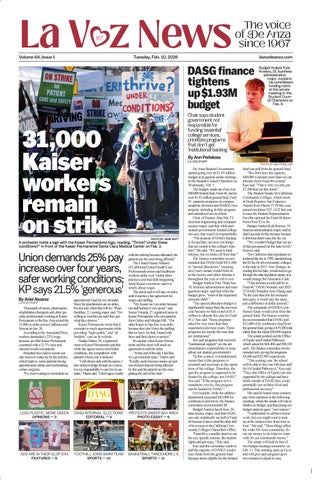
A protester holds a sign with the Kaiser Permanente logo, reading, "Thrive? Under these conditions?" in front of the Kaiser Permanente Santa Clara Medical Center on Feb. 2.
LA VOZ STAFF
Thousands of nurses, pharmacists, rehabilitation therapists and other specialty professionals working at Kaiser Permanente in the Bay Area joined the 31,000 on strike across California and Hawaii on Jan. 26.
According to the Associated Press, workers demanded a 25% wage increase, an offer Kaiser Permanente countered with a 21.5% raise and claimed would cost patients.
Hospitals have had to recruit outside nurses to make up for the strikers, which leads to some patients having appointments online and rescheduling certain surgeries.
"I've been waiting to reschedule an


appointment I had for my shoulder. Since the practitioners are on strike, I'm not sure when that will be,” Ryan Santillan, 21, nursing major said. “I'm willing to wait this out until they get what they deserve.”
Kaiser Permanente wrote that it commits to reach agreements while providing “high-quality” and “affordable” care on its website.
Natalie Mares, 39, a registered nurse at Kaiser Permanente said that while she agrees nurses need better conditions, she sympathizes with patients whose care is delayed.
“I will always side with the nurses. I also acknowledge though as a nurse, it is my responsibility to care for my patients,” Mares said. “I don't agree exactly


with the striking because ultimately the patients are the ones being affected.”
The United Nurses Alliance of California/United Health Care Professionals union said healthcare workers strike over “unfair labor practices and bad-faith bargaining,” while Kaiser executives said it is strictly about wages.
The union said it will stay on strike until it reaches a fair agreement for wages and staffing.
“My Kaiser isn’t on strike because our staff turnup is very good,” said Sonya Virrueta, 27, registered nurse at Kaiser Permanente who sees patients from Gilroy and Morgan Hill. “The other Kaiser in San Jose is on strike because they don’t have the staffing that we have; for that, I stand with them and their choice to protest.”
It's unclear when Kaiser Permanente and the union will reach an agreement to end the strike.
“At the end of the day I feel like it's a government issue,” Mares said. “It really sucks because nurses are just one division that are being affected by this and the patients are the ones getting the end of the stick.”


Chair says student government not responsible for funding 'essential' college services, prioritizes programs that don't get 'institutional' backing

De Anza Student Government started going over its $1.93 million budget at its general senate meeting in the Student Council Chambers on Wednesday, Feb. 5.
The budget, made up of an over $80,000 limited fund, Fund 46, and an over $1.85 million general fund, Fund 41, supports programs on campus, academic divisions and DASG's own projects, including its bike program and subsidized movie tickets.
Chair of Finance Alan Ma, 19, electrical engineering and computer science major, said that while past student governments funded college services, that wasn't its responsibility.
"The purpose of DASG funding is for ancillary services, not things that are central to the college's function," Ma said. "We used to fund referees, but we broke off from that."
The finance committee recommended that DASG hold $431,000 in "special allocations," meaning next year's senate would hold on to the money and either allocate it throughout the year or roll it over.
Budget Analyst Thin Thida Soe, 18, business administration and management major, said that while the budget grew, "most of the requested amounts didn't."
"The special allocation budget is significantly larger than the previous year because we had a total of $1.8 million to allocate this year (in Fund 41)," Soe said. "Some programs asked for way more than they requested in previous years. Those programs are mostly the ones that are institutional."
Soe said programs that received "institutional support" are the administration's responsibility to keep afloat, not student government's.
"In this context, it (institutional) means that it (the program) is essential and necessary to the operations of the college. Therefore, the specific program is supposed to be funded by the college, not DASG," Soe said. "If the program isn't a mandatory service, that program can be funded by DASG."
For example, while the athletics department requested $45,000 for conferences and travel, the finance committee recommended $0.
Budget Analyst Jacob Kao, 26, data science major, said that DASG can only realistically use half of Fund 46 because it has to send the other half of its revenue to the California Community Colleges Chancellor's Office.
"Fund 46 is a smaller fund we use for very specific reasons, like student rights and advocacy," Kao said. Kao said the committee wants to pull the majority of DASG's conference funds from the general fund because items eligible for the limited

fund can pull from the general fund.
"Wedon't have the capacity; $40,000 is already more than we can allocate (from Fund 46) in total," Kao said. "That is why we only put $7,200 here (in this fund)."
The Student Senate for California Community Colleges, which meets at Hyatt Regency San Francisco Airport from March 27-29 this year, passed resolution S25.14.02 last year to raise the Student Representation Fee (the optional fee Fund 46 draws from) from $2 to $6.
Budget Analyst Kyle Krawez, 19, business administration major, said he didn't account for the increase because California didn't raise the fee yet.
"We wouldn't budget that out until that got passed (at the state level)," Krawez said.
The California state legislature introduced the fee in 1998, standardizing the $2 fee for all community colleges in the state in 2013. Any changes, including this fee hike, would need to go through the state legislature again, as it would change the Education Code.
"That amount would still be in Fund 46," DASG Secretary and 202223 DASG President Amy Huang said. "In the case that (the fee increase) does pass, it would stay the same, just a difference in dollar amount."
The remainder of DASG's conference funds would come from the general fund. The finance committee recommended that DASG pull $12,000 of its conference fund from the general fund, giving it $19,200 total rather than the initial $40,000 request.
The senate pointed out the Office of Equity and Guided Pathways, which asked for $84,406 and $96,545 each. The finance committee recommended only giving the programs $5,600 and $25,905 respectively.
"This coming year, the school will be able to hire one full-time staff for it (Guided Pathways)," Kao said. "They (the Office of Equity) are also supported by the college and have funds outside of DASG they could potentially use on these (food and professional services)."
Ma said he hoped some senators pay more attention in the following meetings, where the senate will vote to finalize its budget, and that tuning out budget analysts gave "zero respect."
"I understand we all have homework, but you might want to look up at the senators here from time to time," Ma said. "These things affect the wider De Anza community. It's not our money to do what we want with, it's our constituents' money."
The senate will hold its first of two budget meetings tomorrow, on Feb. 11. This meeting starts at 4 p.m. and will give each program up to two minutes to plead its case.

De Anza hosted its first ever
Two Spirit drum circle to help queer campus communities build cross-cultural connections on Tuesday, Feb. 3 at the Euphrat Museum of Art.
The drum circle encouraged spiritual healing and communal bonding.
“We’ve been praying for this drum program for awhile,” Office of Equity Program Coordinator Adriana Garcia said. “This way of building community is so loving, gentle, and tender, and we need more of that in the world.”
The Two Spirit identity encompasses Indigenous people who exist
outside the Western binary gender system. This Two Spirit drum circle is uniquely open to everyone, centering Two Spirit and Indigequeer QTBIPOC people.
“Not all drums in native communities allow men, women and other folks that have different genders and identities… to sit at the drum together, but we can around our drum,” M. Zamora, drumkeeper and adjunct faculty of ethnic and women’s studies, said.
To begin the circle, attendees each took a pinch of tobacco and sprinkled it on the drum while sharing a dream, prayer or intention. Zamora said that tobacco is communication because “you’ve put a little piece of you down on the drum” to “say what you mean.”
Attendees joined the inner circle and drummed in unison, leading the first of four rounds of prayer.
Zamora said everyone’s energy “will further the drum, you are going to further the causa. The causa is us.”
The drum circle continued with prayers for the self and community, showing gratitude and saying farewell.
“When we pray for ourselves, … we are affecting and healing others in the future and the past,” Zamora said. The tobacco used during the ceremony is returned back to the ground as a blessing to the earth. As is tradition with drum circles, attendees are invited to eat and drink at the ceremony’s conclusion as an act of self-care.
“Physically and emotionally, I think you can tell there was a community created,” Fatima Artan, 19, Euphrat Museum of Art intern and psychology major, said. Zamora said there are plans for the Two Spirit drum circle to perform at the grand opening of the Women’s Resource and Advocacy Center in March and at the Queer and Now conference in April.
“I don’t carry the drum alone,” Zamora said. “The community holds the drum.”
By Katherine Fritz
On Feb. 2 the Foothill-De Anza Board of Trustees announced a 5% Safeway discount for all students enrolled at either college.
Scott Olsen, a client system specialist for central services at De Anza explained how the discount will work and how it will benefit students.
“You have to have the Safeway
app. You need either your student ID, current class schedule, tuition receipt, or a current transcript,” Olsen said.
“The ultimate thing is supporting basic needs. If I can help somebody save, that does something.” Jessenia Martinez, 34, psychology major, said she thinks the discount is a great idea and plans to take advantage of it, especially when purchasing items such as eggs and milk.
“Safeway is very accessible,” Martinez said. “I shop there all the time.”


By Jonathan Nguyen-Au LA VOZ STAFF
By Ariel Alvarez
LA VOZ STAFF
The Foothill-De Anza Board of Trustees announced a shuttle that travels between its two colleges at its Feb. 2 meeting.
This new shuttle will benefit students who commute between both Foothill College and De Anza College.
“This is really good, because from De Anza to Foothill it takes an hour to go there just by bus,” Alina Osmonova, 19, mass transfer major, said.
The shuttle is currently in use with many students, mainly those in student housing, using it to get between campuses and even to grocery stores to suffice their needs.


California’s Senate Bill 1054 went into effect at the beginning of this year, banning grocery stores from distributing plastic bags. Though a positive step toward sustainability, plastic waste accounts for only a portion of the environmental problems California faces.
SB 1053 replaces Senate Bill 270, a bill that prevented grocery stores from providing thin, single-use bags, and aimed to reduce plastic waste. This bill still allowed for plastic bags to be used, with only the thickness being of concern.
Even though SB 1053 addresses plastic waste, meat and fossil fuels contribute more to environmental damage than plastic bags because of the amount of water needed to feed animals and the carbon emissions from crude oil and gasoline.
SB 1053 is a great law in making plastic bags less prevalent in California, but aside from using less plastic, we should do more things for our environment. Less plastic, more green “Paper bags only” is good but state needs to do more
In 1866, the United States Congress banned the treasury from featuring living people on circulating currency. The law was meant to reinforce the country’s anti-monarchy roots. Fast forward to today and the law faces opposition at the hands of President Donald Trump. The U.S. Mint is considering plastering Trump’s face on the dollar coin this year to celebrate the country’s 250 years of existence. The Secretary of Treasury, Scott Bessent, who was appointed by Trump on Jan. 28, 2025, has final say in the decision. This comes after the Trump administration changed the previous dime and quarter designs, these designs that planned to honor Frederick Douglass and the abolition of slavery, highlight the 19th Amendment and women’s suffrage and tribute 6-year-old Ruby Bridges to celebrate the civil rights movement and desegregated schools. Instead, Trump’s new designs feature pilgrims, the Mayflower, George Washington, Thomas Jefferson and Abraham Lincoln, with a tribute to the Gettysburg Address. These coins have been in production and released into circulation since Jan. 5.

Trump’s administration continues to censor the historic struggles and suffrage minorities endured, which drastically shape the country. His agenda shows who he sees as “American.”

The last president to memorialize himself, Calvin Coolidge, featured himself with George Washington to commemorate the country’s 150th anniversary; the public detested the coins, returning 85% of them to smelt.
Ego-inflated dictators such as Mao Zedong, Saddam Hussein and Kim Il Sung glorify themselves through their currencies to further promote and boast power among their populations. It’s nothing short of a pretentious means of propaganda. Though manufacturing currency is not a top priority, as the current state of the country faces a plethora of its own issues, this coin symbolizes how our leader sees and glorifies himself. If this dollar coin went through, it would embarrass this country’s established foundations — further adding to the long list of laws Trump has bypassed to fulfill his own personal agenda.


From SJPD to FHDA Daniel Acosta looks to
By La Voz Editorial Board
them voting powers equal to elected senators, just without having to chair meetings) doesn’t lend internal officers and DASG as a whole legitimacy.
If anything, internals undermine the concept that De Anza Student Government is, in fact, a student government, accountable to its students.

it switched to becoming a mostly appointed body after it restructured in November 2022.
During internal “elections,” outgoing senators and the eight freshly elected “executive” senators appoint most of the next year’s senate.
This means the student government hasn’t let students vote for its entire senate since winter 2022.
In 2022’s DASG elections, at-large senators outnumbered chairs two to one; it’s roughly held that ratio since then. Calling these appointments “elections” at all waters down what it means to be an “elected” official — a group of less than 40 students picking most of who governs a college with over 15,000 students (and giving
Before DASG’s big restructuring, each senator had to go out and campaign for themself, earning legitimacy and a mandate to carry out their campaign promises.
Sure, senators could do it in coalitions — which the senate just banned again, following last year’s messy elections — but each senator had to at least earn enough students’ trust to get that popular mandate.
Instead, students just need enough current senators to like them more than the other candidates for their position to get in.
Now, it doesn’t matter if they’re deeply unpopular, or if most students either don’t know who they are or outright disapprove of them — even if the senate disqualified them earlier on in the general election, appointees get
numbers – not just physically but especially financially.
Even though citizens can’t vote in the midterm elections until November, everyone, non-citizens included, have other ways of making an impact, such as boycotting.
By La Voz Editorial Board
The Trump administration claims to be going after the “worst of the worst,” yet when children are used as bait, families are torn apart and LGBTQ couples are deported to countries where their lives are at stake, that narrative crumbles. These sad truths form a dystopian postcard of Donald Trump’s America where citizens and non-citizens alike are subjected to undue process based on the color of their skin.
If we are not outraged at the sound of screams over the news, Immigration and Customs Enforcement wins. If we stand up and take action, it can’t win.
We may underestimate the power of one person, but one person can turn into two, and then five, then 100, then 1,000 and so on and so forth. Believe in the power of
Many major companies currently have ties with ICE or the Department of Homeland Security, such as AT&T, FedEx, Google/YouTube and Spotify, to name a few. You can easily check if a company supports or funds ICE with the help of available sources online such as Truthout.org.
NPR recently published an article highlighting the anti-ICE protests in Washington D.C., which described the “calls for boycotts against retailers and businesses perceived to be in cooperation with U.S. Immigration and Customs Enforcement and U.S. Customs and Border Protection.”
This comes just after the false detainment of Jonathan Aguilar Garcia, a U.S. citizen and minor, who was assaulted and left in a Walmart parking lot after ICE discovered he was, in fact, a citizen.
In early January, organizers forced Avelo Airlines to sever its ICE contract, under which it deported detainees. These complicit companies are the closest personal relations many of us have to the DHS and ICE. Fortunately,
the same voting powers on the senate as elected officers with less responsibilities.
Internal “elections” rob the student body of its say in who makes decisions on its behalf, as well as its ability to hold senators accountable.
These “elections” also rob these senators of their legitimacy, since they only have to answer to a group of outgoing senators and other (also mostly unelected) senators, rather than making their case to the student body.
While internal senators aren’t outright illegitimate and this year’s senators have done their jobs, most senators have no obligation to serve the greater student body; their power doesn’t come from the student body as a whole, but rather, the faith of former senators.
While, yes, DASG will need to appoint senators in the middle of the year — especially if senators transfer
out or quit — that needs to be the exception, not the norm. As it stands, unelected senators have the power to overturn the will of senators that got their jobs because this campus believed in their campaign and goals.
If DASG wants to regain its legitimacy and show that its power comes from the students, it needs to change its elections code and get rid of internal “elections,” or otherwise make it so appointees can’t vote, like how the Associated Students of Foothill College doesn’t let its president’s cabinet members and other unelected members vote, as they aren’t senators and don’t derive power from the people. Otherwise, if this student government can’t trust its constituents to pick who leads them, it runs the risk of only being a “student” government in name.

these relations only exist as monetary transactions, and whether you’re a citizen or not, you can stop those relationships and close your wallets.
It’s time to vote with our dollars and stop feeding the companies complicit in this massacre of our constitutional rights, held by everyone, regardless of citizenship status.
The current state of ICE and their tactics is not just a political topic anymore, but rather a matter of human rights. While the Trump-aligned get to protect their personal bubble of
privilege, those that uproot their lives to help contribute to America are framed as “vermin.”
While not everyone has the ability to
Wylder Robison
Daniel Acosta still remembers one of the last things his grandmother told him before she died when she learned he wanted to become a police officer.
“Be one of the good ones.”
Her advice followed Acosta through his 41 years in law enforcement and now as he prepares to retire this spring as chief of police of the Foothill–De Anza Police Department. Born in Colusa, California to Mexican immigrants, Acosta was raised in San Jose and graduated from San Jose State University. His interest in law enforcement began in the third grade when police officers visited his classroom.
“I was an associate engineer and it was not what I thought it was,” Acosta said about his early career change.
“Helping people just seemed natural for me, and I enjoyed it.”
The San Jose Police Department hired Acosta in 1983 and he worked for 29 years in different units including sexual assault investigations.
Acosta mostly investigated child molestation cases and said they were the hardest.
“It was really, really difficult to see a child that’s gone through something traumatic,” Acosta said. “But those that had to testify, and did testify, grew to be my heroes.”
Acosta also recalled a time he and his partner entered a burning building in an attempt to save an elderly woman trapped inside.
“We got there and a woman about the age of our moms came running up … she said, ‘my mom’s still in there,’ so we ran in,” Acosta said. His partner remained outside, holding onto Acosta as he crawled inside to search for her.
“I was scared and I missed her, I couldn’t find her,” Acosta said. “Apparently, I missed her by one or two feet. The firefighters only found her because one of them stepped on her,” Acosta said. The woman did not survive, but Acosta said her daughter later thanked him and his partner for trying.
Acosta joined FHDA police in 2014 as assistant chief of police and in 2023, was sworn in as chief of police by the board of trustees and an Aztec dance performance by his daughter at Foothill College.
After joining De Anza, Acosta said he began to experience symptoms of post-traumatic stress disorder. He worked through his PTSD by having conversations with another officer on campus who had similar experiences and working with a campus psychiatrist.
Acosta said leading a community college police department required an approach rooted in training, communication and trust. In 2019 the force created the Police Chief’s Advisory Committee to bring faculty, staff and
community members into regular dialogue with campus police.
“That was hard to listen to,” Acosta said about the first PCAC board meetings. “But listen we did.”
Acosta said expanding officer training became one of his top priorities at Foothill–De Anza.
“If you want police officers to respond in an emergency … you have to substitute that lack of experience with training.” Acosta said.
Joy Garza, training and community relations supervisor for the FHDA Police Department, worked with Acosta for nearly five years and said his leadership helped build trust and community relationships across the district.
“One of the qualities I have most admired in his leadership is the value he places on family and integrity,” Garza wrote in an email statement.

“It has helped us all recognize that our responsibilities and lasting impact extend beyond the job.”
Vice Chancellor of Instruction Ram Subramaniam said Acosta played a strong role in building trust with campus police.
at our district,” Subramaniam said.
“He’s been a major source of support and he will be dearly missed.”
He still thinks about the advice his grandmother gave him that guided his career from the beginning.
“He’s paved the way for a very compassionate security system here
Acosta said he looks forward to focusing on his health and returning to running regularly which has always brought him peace.
“I always remember her holding up her finger and telling me to be ‘one of the good ones,’” Acosta said. “I hope I made her proud.”


Students, consumers find AI generated content, hyper-targeted marketing bring few benefits, many drawbacks
By Jonathan Nguyen-Au LA VOZ STAFF
Generative artificial intelligence has garnered attention over the past few years, with the Pew Research Center reporting that last year, half of surveyed United States citizens grew concerned about people using AI in everyday life.
Many Americans also showed concern about what was in the ads they got, how advertisers and platforms used data to target them and how long their ads were.
A few notable cases of generative AI use in advertising are Coca-Cola’s and McDonalds’ 2025 Christmas advertisements.
“The Coca-Cola Christmas ad that used AI pissed me off because there were so many inconsistencies,” Juliette Leyva, 21, animation and English major, said. “I’m not a fan of it because I’m an artist. Artificial intelligence removes any human input.” Oduro Takyi, adjunct faculty member in the business department, said while consumers prefer human-made content over AI, “businesses are not letting that stop them from using AI.” The marketing of certain products, ideas and services also raised ethical concerns.
“I see different smoking advertisements or even weight loss advertisements,” Catherine Crawford, 18, political science major, said.


“Targeting a lot of people who are struggling with these things makes it seem like this is the only solution.”
Takyi said that ads can be exploitative to children, elderly people, non-native speakers and poor people because these groups are “more susceptible to deceptive marketing, preying on their desperation, limited comprehension and cognition.”
By La Voz Editorial Board
“The most recent advertisement that made me deeply uncomfortable was one on Telemundo, which is a Hispanic TV network,” Leyva said. Leyva said the Department of Homeland Security advertisement encouraged “self-deportation.”
This and other advertisements led to a grassroots Telemundo boycott, which calls for the channels to stop airing ICE and DHS ads.
“The issue of privacy rights is always in the news,” Takyi said.
them voting powers equal to elected senators, just without having to chair meetings) doesn’t lend internal officers and DASG as a whole legitimacy.
If anything, internals undermine the concept that De Anza Student Government is, in fact, a student government, accountable to its students.


the same voting powers on the senate as elected officers with less responsibilities.
“Consumers also have to worry about hackers, state agents and digital thieves who seek to illegally profit by stealing private information stored on advertiser websites.”
Before DASG’s big restructuring, each senator had to go out and campaign for themself, earning legitimacy and a mandate to carry out their campaign promises.
Internal “elections” rob the student body of its say in who makes decisions on its behalf, as well as its ability to hold senators accountable.
By Katherine Fritz
During internal “elections,” outgoing senators and the eight freshly
“executive” senators appoint most of the next year’s senate. This means the student government hasn’t let students vote for its entire senate since winter 2022.
Streaming sites like YouTube have increased advertisement length to find niche audiences. Takyi said that ads can be “too long or poorly placed” in the current landscape, but it also came with nuances because of user experience.
“I’m watching a lot more cable lately,” Crawford said.“Every 20 minutes there’s a section of two minute advertisements; it breaks up
In 2022’s DASG elections, at-large senators outnumbered chairs two to one; it’s roughly held that ratio since then. Calling these appointments “elections” at all waters down what it means to be an “elected” official — a group of less than 40 students picking most of who governs a college with over 15,000 students (and giving
Sure, senators could do it in coalitions — which the senate just banned again, following last year’s messy elections — but each senator had to at least earn enough students’ trust to get that popular mandate.
Instead, students just need enough current senators to like them more than the other candidates for their position to get in.
the movie in a weird way.” Leyva said they generally don’t have an issue with placement and length of ads, but that YouTube served them 40-minute-long Oprah interviews as ads before. Crawford said she got ads for De Anza events on Instagram and that it’s good to inform students about what’s going on at campus.
tions gathered on them helped them access resources they otherwise wouldn’t have.
Takyi said advertisements help the economy and bolster employment. The competition that advertisements bring between different companies, Takyi said, helps keep prices down.
These “elections” also rob these senators of their legitimacy, since they only have to answer to a group of outgoing senators and other (also mostly unelected) senators, rather than making their case to the student body.
Mari Acob-Nash joined De Anza this winter quarter as Dean of Student Development and Extended Opportunity Programs and Services, bringing a focus on student wellness, connection and support.
From SJPD to FHDA
Daniel Acosta looks to life beyond the line of duty
‘Kokuho’ brings Japanese theater to silver screen Man must be woman to be the greatest kabuki actor
By Jason Huang
VOZ STAFF
Daniel Acosta still remembers one of the last things his grandmother told him before she died when she learned he wanted to become a police officer.
“Be one of the good ones.”
testify, grew to be my heroes.”
Acosta also recalled a time he and his partner entered a burning building in an attempt to save an elderly woman trapped inside.
mentored by Hanai Hanjiro II, played by the iconic Ken Watanabe. Hanjiro II’s son, Shunsuke Ogaki, played by Ryusei Yokohama, is also training to be a kabuki performer. Kikuo and Shunsuke learn the art while navigating their careers together side-byside, serving as foils for one another.
“We got there and a woman about the age of our moms came running up … she said, ‘my mom’s still in there,’ so we ran in,” Acosta said. His partner remained outside, holding onto Acosta as he crawled inside to search for her.
Leyva also said they got ads for gender affirming care products such as binders, which felt “healing” to them; they said the data corpora-
Now, it doesn’t matter if they’re deeply unpopular, or if most students either don’t know who they are or outright disapprove of them — even if the senate disqualified them earlier on in the general election, appointees get
While internal senators aren’t outright illegitimate and this year’s senators have done their jobs, most senators have no obligation to serve the greater student body; their power doesn’t come from the student body as a whole, but rather, the faith of former senators.
“I understand advertisement is something that, in a way, is necessary for companies to actually get their footing,” Leyva said. “I encourage small businesses to make use of advertisements in any way that they can.”
While, yes, DASG will need to appoint senators in the middle of the year — especially if senators transfer
By La Voz Editorial Board
name a few. You can easily check if a company supports or funds ICE with the help of available sources online such as Truthout.org.
NPR recently published an article highlighting the anti-ICE protests in Washington D.C., which described the “calls for boycotts against retailers and businesses perceived to be in cooperation with U.S. Immigration and Customs Enforcement and U.S. Customs and Border Protection.”
This comes just after the false detainment of Jonathan Aguilar Garcia, a U.S. citizen and minor, who was assaulted and left in a Walmart parking lot after ICE discovered he was, in
these relations only exist as
transactions, and whether you’re a citizen or not, you can stop those relationships and close your wallets. It’s time to vote with our dollars and stop feeding the companies complicit in this massacre of our constitutional rights, held by everyone, regardless of citizenship status. The current state of ICE
community members into regular dialogue with campus police.
with a traditional Japanese craft.
“That was hard to listen to,” Acosta said about the first PCAC board meetings. “But listen we did.”
Acosta said expanding officer training became one of his top priorities at Foothill–De Anza.
The film spends nearly three hours exploring the hero’s journey in a breathtaking fashion. No detail is spared the millionaire treatment. Every hair, both natural and wig, is immaculately placed.
The film is about men who dance in a feminine way which sets up a delightful viewing experience filled with inspirational moments and emotional catharsis. It explores themes such as brotherhood, masculinity, and the quest to master an art form.
“If you want police officers to respond in an emergency … you have to substitute that lack of expe rience with training.” Acosta said.
Her advice followed Acosta through his 41 years in law enforcement and now as he prepares to retire this spring as chief of police of the Foothill–De Anza Police Department.
“Kokuho” is a visually striking movie that blends dramatic storytelling with artistic perfection. The movie follows the life of Kikuo Tachibana, the son of a yakuza boss played by Ryo Yoshizawa, along with his quest to become a renowned kabuki actor.
Born in Colusa, California to Mexican immigrants, Acosta was raised in San Jose and graduated from San Jose State University. His interest in law enforcement began in the third grade when police officers visited his classroom.
“I was scared and I missed her, I couldn’t find her,” Acosta said. “Apparently, I missed her by one or two feet. The firefighters only found her because one of them stepped on her,” Acosta said. The woman did not survive, but Acosta said her daughter later thanked him and his partner for trying.
The costumes feel period-accurate, from the sack coats worn in the ‘60s, all the way to the beautifully adorned kimonos featured on stage. Make up on performers is heavily applied, creating a glamorous effect.
Director Sang-Il Lee deserves to be recognized for coherently exploring so many themes without making the film cumbersome.
Joy Garza, training and communi ty relations supervisor for the FHDA Police Department, worked with Acosta for nearly five years and said his leadership helped build trust and community relationships across the district.
Kabuki is a performance art where actors both dance and speak to the tune of traditional kabuki music. Imagine a beating drum, sparse string instruments, and a vocalist bellowing “YO!” to accentuate dramatic moments.
“I was an associate engineer and it was not what I thought it was,” Acosta said about his early career change.
Acosta joined FHDA police in 2014 as assistant chief of police and in 2023, was sworn in as chief of police by the board of trustees and an Aztec dance performance by his daughter at Foothill College.
Next to its contemporary films, such as “Marty Supreme” and “Hamnet”, the film holds its own and stands out in some ways. Those who like Marty for his drive and sacrifice will love “Kokuho,” and the story has emotional depth that rivals “Hamnet”.
“One of the qualities I have most admired in his leadership is the value he places on family and integrity,” Garza wrote in an email statement.
“The idea of development is to recognize that there’s a lot going on with students outside of the classroom, we’re talking about physical, mental health and wellness,” Acob-Nash said.
Read the full story at lavozdeanza.com
out or quit — that needs to be the exception, not the norm. As it stands, unelected senators have the power to overturn the will of senators that got their jobs because this campus believed in their campaign and goals. If DASG wants to regain its legitimacy and show that its power comes from the students, it needs to change its elections code and get rid of internal “elections,” or otherwise make it so appointees can’t vote, like how the Associated Students of Foothill College doesn’t let its president’s cabinet members and other unelected members vote, as they aren’t senators and don’t derive power from the people. Otherwise, if this student government can’t trust its constituents to pick who leads them, it runs the risk of only being a “student” government in name.


“Helping people just seemed natural for me, and I enjoyed it.”
The San Jose Police Department hired Acosta in 1983 and he worked for 29 years in different units including sexual assault investigations.
Specifically the protagonist is an “onnagata,” a man who performs the female characters in a play. There is a great deal of precision and grace required to be a skilled onnagata performer. Along the way, Kikuo is
Acosta mostly investigated child molestation cases and said they were the hardest.
“It was really, really difficult to see a child that’s gone through something traumatic,” Acosta said.
“But those that had to testify, and did
“Kokuho” (国宝) is a Japanese phrase that means national treasure, but when referring to a person it closely means “living legend.” The government uses this term to describe objects, but it can also be used for people who possess incredible skill
After joining De Anza, Acosta said he began to experience symptoms of post-traumatic stress disorder. He worked through his PTSD by having conversations with another officer on campus who had similar experiences and working with a campus psychiatrist.
Acosta said leading a community college police department required an approach rooted in training, communication and trust. In 2019 the force created the Police Chief’s Advisory Committee to bring faculty, staff and
Yoshizawa’s acting ability shines on and off the kabuki stage while Yokohama is a charismatic supporting character. The dialogue between the two aspiring performers is sentimental and humorous, which complements their relationship as adopted-brothers. Their acting dynamic is a highlight of the movie, both display a range of gripping emotions.
Watanabe also adds a domineering presence as the father-figure in the film. The female characters are mainly mothers and lovers, so viewers looking for an outstanding female support character will be disappointed.
“It has helped us all recognize that our responsibilities and lasting impact extend beyond the job.”
Vice Chancellor of Instruction Ram Subramaniam said Acosta played a strong role in building trust with campus police.


My favorite films explore the complexities of human relationships and Kikuo’s story affected me deeply. Combined with the fabulous set and cinematography, I think it’s
“He’s paved the way for a very compassionate security system here at our district,” Subramaniam said. “He’s been a major source of support and he will be dearly missed.” Acosta said he looks forward to focusing on his health and returning to running regularly which has always brought him peace.
By Hayden Rush LA VOZ STAFF
Ongoing construction of the bathrooms in buildings L5, S2 and S6 has been a significant inconvenience for both students and staff. With a selection of my own classes being close to the L5 wing, I’ve had my fair share of noise interruptions and walked through clouds of dust to class.
The expected completion of these renovations isn’t scheduled until April, leaving most students and staff having to improvise in the meantime.
This predicament has led me to explore the De Anza College campus in search of suitable substitute bathrooms for the time being. Through my investigation, I was able to deduce my top three locations.


He still thinks about the advice his grandmother gave him that guided his career from the beginning.
“I always remember her holding up her finger and telling me to be ‘one of the good ones,’” Acosta said. “I hope I made her proud.”

My experiences are in the form of a male; therefore, I am unable to speak of the quality of women’s and gender-neutral bathrooms in this list. Coming in third place is the Creative Arts Division building, located near the north entrance of the campus. Although the bathroom is small, with only two urinals and one stall, the absolute desolation of the area makes it ideal for privacy.
The Club Spotlight highlights an active club at De Anza that has demonstrated strong engagement, creativity, and impact on our campus community.
Fill out the Club Spotlight Nomination form and get a chance to be selected and be featured on our socials!
Where foot traffic and filled stalls prevail as an issue in more populated areas, you will feel unbothered and at peace here. With that said, this bathroom is one of the more outdated available.
Lacking automated toilets and sinks, users are dependent on flushing and turning off the faucet manually.
That said, the overall condition of the room is grimy at best, with dim yellow lighting and mildew-like stains complemented by subliminal graffiti. If you value privacy, this is the best spot on campus for you. Just be prepared for conditions to be those of a national forest public bathroom. In second place is the Science Center building, located near the south side of campus. This bathroom is the epitome of modern-day technology, a spacious environment complemented by a fully automated system of toilets, sinks and paper towel dispensers.
fore, this factors into the rankings. The foot traffic is relatively high but the plethora of available units inside the room is quite astonishing. Boasting the largest number of individual urinals/toilets on campus, I discovered through my research, it certainly makes for a mostly stressfree experience. With the vast selection of restrooms available on campus, what I consider to be the grand helm of all others is the Learning Center West building.

Unlike the bathroom in third place, the features implemented create more self sustainability in the sense of cleanliness. With consistent flows of students, maintenance can become difficult for a college of our size; there-
INTER-CLUB COUNCIL
This bathroom is similar in size to the Creative Arts Division building, having one more stall than its counterpart. But the overall state is in much better condition, consisting of a notable improvement of automatic sensors to manually operated appliances. The hand-operated sinks and
toilets, accompanied by the automatic paper towel dispensers, truly offer the outmost convenience a public bathroom can. Furthermore, the foot traffic of this building is minimal as the library and Media & Learning Center building take on most students. This has been a go-to spot for me since freshman year, as it acts as a middle ground between my classes. In addition, the water fountain around the corner of the restroom is one of the more regulated and thirst-quenching I’ve had at De Anza.
Despite the challenges that construction has brought in terms of convenience, I believe that students are still in good hands. Though it feels untimely, using it as a means to explore the campus in search of relief just might help you discover something new about this campus.
De Anza College’s aquatics team welcomed Foothill College swimmers and head coach after the Owls cancelled its program, which practiced the past four years at De Anza’s pool, while awaiting its pool’s repairs.
200 meter breaststroke.
Sophomore De Anza swimmer Nikki Volpe, 19, astrophysics major, said she appreciates Bissell’s emphasis on different skills outside of swimming.
By Xitlaly Martinez

Coach Jeffrey Bissell and Brandon Wang, 20, applied math major, are among the few transfers who’ve been competing as
By Katherine Fritz
Ceremony, circle
cross-cultural

Bissell pitched the transfer idea to Foothill’s athletic department multiple times but college administrators rejected it.
The administration changed its decision earlier this year when Bissell estimated only three to five athletes would join the Wang said he was done swimming competitively when he learned Foothill’s team would be suspended, which influenced his choice to compete as a Mountain Lion this season.
On Feb. 2 the Foothill-De Anza Board of Trustees announced a 5% Safeway discount for all students enrolled at either college.
app. You need either your student ID, current class schedule, tuition receipt, or a current transcript,” Olsen said. “The ultimate thing is supporting basic needs. If I can help somebody save, that does something.”
“The more coaches you have, the easier it is to touch base with all the kids at different levels.”
Scott Olsen, a client system specialist for central services at De Anza explained how the discount will work and how it will benefit students.
“You have to have the Safeway
“Then I heard De Anza was combining, so it was a good Bissell began coaching at Foothill in 2001 as the women’s water polo coach. The program won 15 Coast Conference titles and regularly qualified for state championships before the
“I probably have five or six years left before I retire,” Bissell said. “I like the opportunity to help a large team to reach a goal to win a Coast Conference Championship and reach top five in Bissell won three Coast Conference Championships with the Foothill swim team and two state championships for the
outside the Western binary gender system. This Two Spirit drum circle is uniquely open to everyone, centering Two Spirit and Indigequeer QTBIPOC people.
The drum circle continued with prayers for the self and community, showing gratitude and saying farewell.
“Not all drums in native communities allow men, women and other folks that have different genders and identities… to sit at the drum together, but we can around our drum,” M. Zamora, drumkeeper and adjunct faculty of ethnic and women’s studies, said.
Museum of Art.
The drum circle encouraged spiritual healing and communal bonding.
“We’ve been praying for this drum program for awhile,” Office of Equity Program Coordinator Adriana Garcia said. “This way of building community is so loving, gentle, and tender, and we need more of that in the world.”
The Two Spirit identity encompasses Indigenous people who exist
To begin the circle, attendees each took a pinch of tobacco and sprinkled it on the drum while sharing a dream, prayer or intention. Zamora said that tobacco is communication because “you’ve put a little piece of you down on the drum” to “say what you mean.”
Attendees joined the inner circle and drummed in unison, leading the first of four rounds of prayer. Zamora said everyone’s energy “will further the drum, you are going to further the causa. The causa is us.”
“When we pray for ourselves, … we are affecting and healing others in the future and the past,” Zamora said. The tobacco used during the ceremony is returned back to the ground as a blessing to the earth. As is tradition with drum circles, attendees are invited to eat and drink at the ceremony’s conclusion as an act of self-care.
“Physically and emotionally, I think you can tell there was a community created,” Fatima Artan, 19, Euphrat Museum of Art intern and psychology major, said. Zamora said there are plans for the Two Spirit drum circle to perform at the grand opening of the Women’s Resource and Advocacy Center in March and at the Queer and Now conference in April.
“I don’t carry the drum alone,” Zamora said. “The community holds the drum.”


By Gavin Rust
Jessenia Martinez, 34, psychology major, said she thinks the discount is a great idea and plans to take advantage of it, especially when purchasing items such as eggs and milk.
“Safeway is very accessible,” Martinez said. “I shop there all the time.”

De Anza. It’s
“The


By Ashritha Chand

De Anza College’s beach volleyball program opened its season on Feb. 6 with consecutive matches against Sacramento City College and Butte College.
Some players said they felt excited for their first ever games on campus.
to facing their opponents.
“We’ve been playing against each other for weeks now,” Claire Sugrue (De Anza No. 3), 20, accounting major, said. “It’s fun to see how well we do against new competition.”
Alper said the team prepares with cardio, weights training and scrimmages every day.
The five-year-old program hosted its first home games after its new $7.07 million beach volleyball courts finished construction.
By Hayden Rush LA VOZ STAFF
“Paper bags only” is good but state needs to do more
“It feels like an inaugural season having our own home courts,” Esther Alper (De Anza No. 11), 22, biology major, said. “Representing the team with a new chapter is an honor.” Guevara said the home field advantage shone through at the team’s practices.
“We haven’t had the opportunity yet,” head volleyball coach Dawnis Guevara said. “Prior to this, we’ve had to go to everybody else’s place to compete.”
By Jonathan Nguyen-Au LA VOZ STAFF
California’s Senate Bill 1054 went into effect at the beginning of this year, banning grocery stores from distributing plastic bags. Though a positive step toward sustainability, plastic waste accounts for only a portion of the environmental problems California faces.
SB 1053 replaces Senate Bill 270, a bill that prevented grocery stores from providing thin, single-use bags, and aimed to reduce plastic waste. This bill still allowed for plastic bags to be used, with only the thickness being of concern.
Even though SB 1053 addresses plastic waste, meat and fossil fuels contribute more to environmental damage than plastic bags because of the amount of water needed to feed animals and the carbon emissions from crude oil and gasoline.
SB 1053 is a great law in making plastic bags less prevalent in California, but aside from using less plastic, we should do more things for our environment.
“Our growth early in the season right now has been better,” Guevara said. “I’m hopeful it transitions into our wins and losses moving forward.” As the start of the season approaches, some players look forward
In 1866, the United States Congress banned the treasury from featuring living people on circulating currency. The law was meant to reinforce the country’s anti-monarchy roots. Fast forward to today and the law faces opposition at the hands of President Donald Trump.
“We’re playing actual games against each other, not giving that many breaks so that we know what to prepare,” Alper said. “When game day comes, those days aren’t as hard.” Sugrue said the team’s strong support and spirit brings energy to games.
“We’ll be super supportive, really loud,” Sugrue said. “We get super excited playing each other ... It’ll be fun to play against another team.”

By Jason Huang
De Anza’s lead 24-22.
The Mountain Lions battled the Las Positas College Hawks, losing 83-78 marking its 4th loss in a row on Feb. 4 at De Anza College. The Hawks boast an overall 21-1 record, making them the No. 2 team in the Coast-North Conference according to the California Community College Athletic Association. Early in the game the Mountain Lions trailed mostly, but a barrage of three pointers from Dominic Diaz (No. 4), business major, and Theo McDowell (No. 24), 19, business major, gave the Mountain Lions a 22-18 lead at the 11:51 mark.


Guard/forward Dasan Poston (De Anza No. 15), 19, psychology major, tripped mid-air over Mason Hudnall (Hawks No. 5), causing them to collide on the ground. Poston shot and scored two free throws after the exchange.
Trump’s choice to propose himself on America’s currency for the country’s
coin resembles moves from authoritarian regimes and will long outlive him and his presidency.
The players and crowd showed sportsmanship when they clapped for Hudnall rising to his feet.
Poston continued to make impactful scores during the first half, including two back-to-back three pointers that won the lead again, 37-35.
The last president to memorialize himself, Calvin Coolidge, featured himself with George Washington to commemorate the country’s 150th anniversary; the public detested the coins, returning 85% of them to smelt.
The U.S. Mint is considering plastering Trump’s face on the dollar coin this year to celebrate the country’s 250 years of existence. The Secretary of Treasury, Scott Bessent, who was appointed by Trump on Jan. 28, 2025, has final say in the decision. This comes after the Trump administration changed the previous dime and quarter designs, these designs that planned to honor Frederick Douglass and the abolition of slavery, highlight the 19th Amendment and women’s suffrage and tribute 6-year-old Ruby Bridges to celebrate the civil rights movement and desegregated schools. Instead, Trump’s new designs feature pilgrims, the Mayflower, George Washington, Thomas Jefferson and Abraham Lincoln, with a tribute to the Gettysburg Address. These coins have been in production and released into circulation since Jan. 5. Trump’s administration continues to censor the historic struggles and suffrage minorities endured, which drastically shape the country. His agenda shows who he sees as “American.”
The Mountain Lion’s successful offense tonight was noticed by other players including guard/forward McDowell.
“We were moving the ball a lot better than we have in these past couple games,” said McDowell.
The second period began with De Anza in front of the Hawks 41-39.
“I felt like for the majority of the game, we were beating them,” McDowell said. “We’ve got to keep playing as a team on offense.”
Head coach Joe Berticevich said the game came down to the wire but turnovers were the deciding factor to the loss.

Las Positas players’ size advantage showed when Wing Emerson Jones (Las Positas No. 2) hit a contested spin-move jump shot, which shortened
“I’ve been in a slump, so it felt good to hit those shots,” said Poston, who scored a two-handed slam dunk. “We handle ourselves well. We still need to get over that hump.”


By Sango Levonian
The Vasconcellos Institute for Democracy in Action (VIDA) hosted its 2026 Winter Project Fair in Conference Rooms A and B at De Anza on Jan. 14.
A variety of student support organizations and off-campus action groups such as the Pride Center, HEFAS, FA-PAC and Grassroots Ecology set up tables at the event. According to Cynthia Kaufman, director of VIDA, the institute maintains relationships with “community partners,” or local organizations that students are able to volunteer with.
“Sometimes for students, if you say, here’s a list of places you can volunteer, it can be a little bit intimidating,” Kaufman said. “And it’s less intimidating to just walk into a room and talk to a person.”
VIDA posted a sign advertising the event in the Hinson Campus Center, just outside the entrance to the cafeteria.
“There’s such a very good chance that

someone who didn’t know about this before could just see the sign there or check it out,” FA-PAC intern Gabe Manglona, 19, political science major said.
VIDA tries to host these events every quarter. On Oct. 13, the organization hosted its Fall 2025 Project Fair. This winter quarter marked the second in-person Winter Project Fair since the event was cancelled due to the Covid-19 pandemic. Kaufman expressed excitement to see “campus life starting to come back.”
VIDA intern Salvador Pedroza, 19, political science major, acknowledged that “there’s room for us (VIDA) to improve,” expressing his wish to invite more programs to future project fairs. “We have dozens of programs and organizations on campus that can come that would fit this event and the criteria we’re requiring,” he added.
See full video at lavozdeanza.com

Students gather to learn about opportunities and resources at the Winter Project Fair in Conference Rooms A and B on Jan. 14.


1. Handwritten message in envelope
3. The small heart-shaped candy with sweet messages
4. Two people in love
5. Carries a bow and arrow to make people fall in love
8. People may go out on a ____ to celebrate
9. Hugs and ______
12. La Voz loves me, La Voz loves me
13. A romantic message composed of rhyming words

Across
2. Roses, daisies, carnations and tulips are these
6. What month does Valentine’s day fall on?
7. Roses are red, _______ are blue 10. Be my __________?
11. My _____ beats for you
14. La Voz love column (two words)

