
Lavender Magazine 805

Page 1


MEET THE DESIGNER

PRIDE NIGHTJERSEY

MORGAN LACASSE

(THEY/THEM)

• Nonbinary and queer

• Born and raised in Minnesota

• Graphic Designer with an iconic use of color

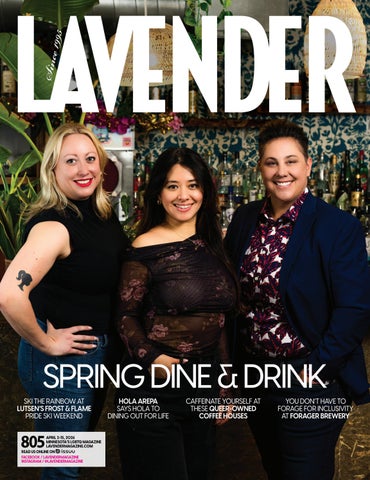
Spring Dine & Drink

Photo by Dain Rodriguez-Hines
24: Photo by Katelyn Christian, 14: Photo by Mike Hnida, 28:Photo courtesy of Annie Henderson 31: Photo by George Torline

In Greater Palm Springs, every traveler belongs. Explore a vibrant oasis where inclusivity and individuality shine beneath endless blue skies — and mark your calendars for November 5-8 to join us for Greater Palm Springs Pride, an annual celebration of love, joy, and community.

Volume 30, Issue 805 • April 2-15, 2026

EDITORIAL

Managing Editor Noah Mitchell (612) 461-8723

Editorial Assistant Linda Raines (612) 436-4660

Editor Emeritus Ethan Boatner

Contributors Lakey Bridge, E.B. Boatner, Bianca Caputo, Stacy Dahl, Natasha DeLion, Alyssa Homeier, Terrance Griep, Shane Lueck, Elise Maren, Jen Peeples-Hampton, Linda Raines, Aspen Rush, Gregg Shapiro, Allie Skarda, Randy Stern, Susan Swavely, Natalie Trimble, Sommer Wagen, Carla Waldemar, Todd P. Walker, Emma Walytka, Spencer White

ADVERTISING

Vice President of Sales & Advertising

Barry Leavitt (612) 436-4690

Account Executives

Nathan Johnson (612) 436-4695

Richard Kranz (612) 436-4675

Sales & Event Administration

Linda Raines (612) 436-4660

National Sales Representatives

Rivendell Media (212) 242-6863

CREATIVE

Creative/Digital Director Mike Hnida (612) 436-4679

ADMINISTRATION

Publisher Lavender Media, Inc.

President & CEO Stephen Rocheford (612) 436-4665

Senior Vice President & Chief Financial Officer Doug Starkebaum (612) 436-4664

Administrative Assistant Michael Winikoff (612) 436-4660

Distribution Metro Periodical Partners (612) 281-3249

Founders George Holdgrafer, Stephen Rocheford

Inspiration Steven W. Anderson (1954-1994), Timothy J. Lee (1968-2002), Russell Berg (1957-2005), Kathryn Rocheford (1914-2006), Jonathan Halverson (1974-2010), Adam Houghtaling (1984-2012), Walker Pearce (1946-2013), Tim Campbell (1939-2015), John Townsend (1959-2019), George Holdgrafer (1951-2024), Julie Dafydd (1951-2025)

editor@lavendermagazine.com.

For our Privacy Policy, go to LavenderMagazine.com/resources/ privacy-policy

Willson Road, Suite 316, Edina, MN 55424

I’ll Drink to That!

In this year’s Spring Dine & Drink issue, we have a lot to celebrate.

First of all — I’m going to go out on a limb here — it’s finally, actually spring. At time of writing, we’ve just been through what looks to be the last snowstorm of the year, following a few days of glorious but clearly false spring weather. Temperatures on the 10-day forecast look to be going in the right direction from here on out.

By the time you read this, I have faith that we’ll have finally broken through to real spring. It might still be slushy, but it’ll be sunny, and, more importantly, I think the collective realization that what has been a long, hard winter is finally over will put some much-needed pep into everyone’s steps. That seems to me like a worthy cause to head out to a restaurant or bar to celebrate.

On the other hand, if I’m wrong and it’s still gross outside, I think a trip to a bar might be even more necessary — to commiserate, rather than celebrate.

Regardless of the weather, a nice dinner out could be in the cards if you’re attending a concert or show like the ones featured in this issue’s Arts & Culture coverage. Ballet Co.Laboratory’s “Freddie: Break Free,” which tells the story of Queen frontman Freddie Mercury, is on at the Ordway April 10-12. Sommer Wagen, who’s been busy in the lead-up to

Photo courtesy of BigStock/DisobeyArt

this issue, also interviewed Lzzy Hale of Halestorm. While the soonest you can catch Halestorm without buying plane tickets (or subjecting yourself to a lengthy road trip) is June 25 at Summerfest in Milwaukee, you can make an evening out of any show you catch in town this spring with dinner out before, drinks after, or both!

And, last but not least — should be first and most, really, which is why we featured it on the cover — another reason to dine out this spring is the annual Dining Out for Life fundraiser benefitting The

Reproductive Medicine and Infertility Associates

Aliveness Project. I’ll leave it to Natasha DeLion to explain the details in her article, but the short version is, eat at a participating restaurant on April 30 and a portion of your bill will go to The Aliveness Project to support their work in HIV/AIDS prevention and support.

If my first two suggestions of reasons to dine out this spring didn’t convince you, I’m confident my last one will. So, one way or another, I’ll see you out there. Cheers! 

I’ve Ego, Pride, Ability Aplenty: The People Need … ME!

Really? Well, yes, sometimes we do. We’ve always needed men and women with these leadership qualities, if — and only if — they’re yoked to a desire to help their fellow citizens.

Doris Kearns Goodwin’s “Leadership in Turbulent Times” (2018) shows how qualities of leadership were developed and lived by four American presidents (who are also treated in in-depth biographies): Abraham Lincoln, Theodore Roosevelt, Franklin Delano Roosevelt and Lyndon B. Johnson. They made no bones about seeking the power inherent in the Oval Office. While each succeeded, their paths and temperaments differed widely.

This is not a handbook for anyone seeking a leadership role in the office hierarchy or to climb the managerial ladder, but rather a study of four personalities whose possessors guided our country through critical times in history, whose names will be remembered. Different personalities, who in their unique fashions shared certain crucial traits.

They each wanted the job. Bad. All wanted to be remembered by future generations. But by the time opportunity knocked, each had incorporated, in his deepest being, the knowledge that their physical and mental energies alone were not enough; they must be linked to serving the less privileged.

Log cabin or Harvard, trauma added to their education beyond the book learning through some specific psychic baptism. All four had survived some upheaval: depression, loss of loved ones or debilitating illness, from which each emerged imbued in his own manner with the clarity and stamina necessary to control the reins of power, to com-

mand, and to see the seemingly impossible through to the end.

Abraham Lincoln, struggling to birth the Emancipation Proclamation, agreed to hold until the tide of battle was more favorable. But, at the suggestion to negotiate the war’s ending without the inclusion of slaves’ freedom, he declared he’d rather face defeat; that with such a reversal he “should be damned in time & in eternity,” and as to the soldiers’ vote, “would rather be defeated with the soldier vote behind [him] than to be elected without it.”

While Lincoln’s father took away his precious study books, young Teddy Roosevelt was given entire libraries and whatever scientific equipment he desired. Part of his later explorations and military derring-do were to prove his own agency. His darkness fell when both his beloved wife and mother died within 24 hours. Grief drove him west to toughen and mature for two years on a Montana ranch. Politics beckoned, offering new life-skills — including governor of New York (1899) and on to VP with President William McKinley, by whose assassination Roosevelt became the youngest-ever U.S. president on September 14, 1901. His accumulated skills aided him in resolving the torturous political ballet of the 1902 Coal Strike, skillfully negotiating between J.P. Morgan, coal company owners and miners, saving the country from a lethal fuel loss and leading to social reforms.

Teddy Roosevelt’s fifth cousin, Franklin Delano Roosevelt, was hale, hearty, successful — until polio struck, thrusting him on his lifelong course of trauma, where he clawed his way back, not to health but to a highly function-

ing, widely-smiling simulacrum. Always cheerful, ever optimistic, to the point that he remains the only president to serve three terms and be elected to a fourth. He served 82 days, passing suddenly in Warm Springs, Ga., on April 12, 1945. He pulled the country out of the Great Depression and was leading us to the end of World War II.

Lyndon B. Johnson also assumed the presidency after an assassination, and as thirsty for power as any of his predecessors, he knew instinctively that he must complete and pass the civil rights bills left pending by John F. Kennedy. The most volatile and tempestuous-natured of the four presidents, the time 19-year-old Johnson spent teaching fifth to seventh grades at the segregated Welhausen School in Cotulla, Texas, affected him deeply. He personally bought sports equipment, organized a debating team and was truly committed during his term in office to passing civil rights bills and providing education. He was the engine behind his “Great Society” initiatives and in passing the Voting Rights Act of 1965. He was the right person and temperament for these issues, but not for the handling of the Vietnam War. Goodwin, who later assisted with Johnson’s memoirs, recalls that he felt his failure there intensely and feared he would be remembered solely for his actions there. His withdrawal, while in office, from the upcoming election was televised on March 31, 1968.

While each embodied flaws of their times and temperaments, each fought for those who had less, and each deserves honor and memory for what they gave. Goodwin’s book shows what was needed then, and what is crucial to restore to leadership today. 

‘Freddie: Break Free’ ballet promises ultimate homage to Queen frontman and his legacy

Ballet Co.Laboratory’s Ordway debut will be much more than a ballet set to rock music — it’s a retelling of a timeless story of inclusion, discovery and authenticity

St. Paul ballet studio Ballet Co.Laboratory’s upcoming Ordway Center debut, “Freddie: Break Free,” an interpretive performance of the life of Freddie Mercury, has been in the making for nearly a decade.

Choreographer and Ballet Co. artistic director Zoé Henrot says that a gala that merged pop music with ballet at the Kohl Center in Madison, Wisc. 10 years ago planted the initial seed, and that managing director Rachel Koep brought up the specific idea of a Queen and Freddie Mercury-inspired ballet.

“I knew that Freddie was queer, but I didn’t know a whole lot else about his life,” Henrot says. “So I started researching right away, and I fell in love pretty quickly.”

Indeed, before we began our interview, Henrot ran off for a “costume change.” She returned wearing a black T-shirt proudly proclaiming, “I (heart) FREDDIE.” The way she talks about the legendary Queen frontman feels like she did, in fact, know and love him.

The show was initially set to debut in March 2020, a bad time for anything to take place. After years of revisiting and reassessment, “Freddie” is set to debut on the Ordway stage April 10-12.

“(Rachel and I) agree, in hindsight, in 2020, we weren’t ready for this type of production, especially the way that we wanted to make it,” Henrot says. “And I don’t think that we had the right mélange of company, either, quite honestly, to tell this story authentically. I think it’s happening at exactly the right moment.”

It also seems that Ballet Co. is the right company to put on the show. Besides her love for Mercury and knowledge of his life, Henrot founded the company, now Minnesota’s largest professional dance company and school, to challenge the medium’s notorious restrictions. In other words, by uplifting dancers of all backgrounds and body types, Ballet Co. breaks free from expectations.

“There’s a lot more queer representation (in classical ballet) now, but there were no public, non-binary dancers when I was younger,” says company member Kit Ornelas, who plays Queen guitarist Brian May. “So being able to be in this space and a part of this production is so special and exciting.”

The time “Freddie: Break Free” took to incubate also allowed Henrot to expand the production beyond a ballet set to rock music. Along with 15 professional dancers, the show will also include live music from the Queen tribute band The Crown Jewels, a full choir and community members living with HIV/AIDS in partnership with the Aliveness Project, dancing while dressed in a variety of iconic Mercury looks.

Founded in 1985, a year after the release of the show’s namesake song, “I Want To Break Free,” the Aliveness Project has spent the last 40 years supporting the community living with HIV/AIDS, the same condition that took Mercury’s life in 1991, through medical services and community building.

“This is a deeply personal story for many of the people in the HIV community as well as the Aliveness Project,” says Kaizer Eikleberry, Aliveness Project community engagement coordinator. “A lot of our members are disenfranchised and face many barriers, and it’s super exciting that they get this opportunity to be on stage and perform a story that is personal to them and resonates with them.”

In a more subtle nod to those lost to HIV/AIDS, Ornelas, who is also the show’s costume designer, took inspiration from Keith Haring, the iconic ‘80s visual artist known for geometric figures that emphasized movement. Haring died of AIDS in 1990, a year before Mercury.

In this light, “Freddie” tells an over-40-year-old story that has never really ended. Eikleberry mentions how the federal government terminated $600 million in HIV and STD prevention and surveillance grants last month to four Democrat-led states, Minnesota included. In mid-February, a judge temporarily blocked the cuts to the Minnesota Department of Health after state Attorney General Keith Ellison filed a lawsuit, according to MPR.

“Even though it may seem like a problem from 30 years ago, we’re still dealing with it today,” Eikleberry says. “Minnesota sees a new HIV case every single day, so averaging over 300 (per year). And those cases are continuing to rise and not go down like we would expect 30 years later.”

Despite his larger-than-life persona, Mercury was a real person affected by HIV/AIDS. By highlighting those real people today, Ballet Co. seeks to paint a picture of how personal authenticity and curiosity about others can combat the prejudice that is shaping today’s cultural climate.

“A general theme, especially in this country, is othering. I think we saw a bout of that during COVID, which was very much reflective of the time in the ’80s with the HIV/AIDS epidemic as well, just by the way that certain communities were being treated,” Henrot says. “But now we’re seeing that again, you know, and now it happens to be over immigration, over trans rights, over so many things.”

Henrot and Koep agree that art can be a unifier in divisive times, and they both hope that “Freddie: Break Free” will help bridge gaps, build community and challenge notions about who ballet is for.

“My hope is that we have someone who has a lot of experience with ballet, sitting next to someone who’s never been to a ballet, sitting next to someone who’s a rocker, sitting next to someone who has HIV,” says Koep. “People from all these different backgrounds coming together and sharing a moment.”

She adds, “You get a ballet, and a rock concert, and a choir concert and a drag show, all these things, all in one evening. What could be more fun than that?” 

Halestorm’s Lzzy Hale hopes to make hard rock a queer haven

The bisexual songstress talks about the impact

of being

openly queer and the value of authenticity in music

On a dreary mid-February day in St. Paul, Lzzy Hale (spelled purposefully without the “i”), frontwoman for Grammy-winning hard rock outfit Halestorm, calls me from her home in Nashville. Her voice is bright, midrange with a light rasp, hinting at the powerful, Ann Wilson-style belting she unleashes when singing. She stumbles a bit over her answers, as if she’s chasing all of her thoughts before they get away, unshared.

Preparing for this story was a throwback. My sibling and I, two queer kids from semi-rural Wisconsin, got into hard music to channel our closeted teenage angst, and I remembered Halestorm from those days. It felt a little surreal to talk to her now.

Hale, 42, comes from a similar background, growing up bisexual in small-town Pennsylvania. It was her experiences feeling like a misfit, she says, that shaped her belief that rock and roll should be a sanctuary for the downtrodden.

“I didn’t necessarily fit in with the girl crowd and all of the music they were listening to, and I’d be trying to introduce them to the stuff that I was into, and they weren’t having that,” she says. “Rock and roll and heavy music doesn’t care about who you like to kiss. It truly doesn’t matter here. So I think, for me, from a very early age, that’s where I saw myself.”

Of course, it matters to the people who see themselves in Hale, a Grammy Award-winning musician and powerful singer who has made music her livelihood for almost 30 years now.

Hale formed Halestorm with her brother, Arejay, in 1997, when they were both teenagers. In 2013, they won the Grammy Award for Best Hard Rock/Metal Performance for their song “Love Bites… (So Do I),” becoming the first female-fronted band to both be nominated and win in that category and beating out juggernauts like Iron Maiden and Megadeth. Now they’re a little over seven months removed from their sixth studio album, “Everest,” for which Hale says they’re preparing to tour this year.

It’s an apt title, likening the band’s decades-long journey towards success and their famously lengthy tours to ascending the world’s tallest mountain.

“We’re obsessed with the one thing that we actually can all do right,” Hale chuckles. “All eggs in one basket. That kind of added edge of scariness kind of kept us going.”

Included on “Everest” is the soulful bisexual anthem “Like A Woman Can,” which Hale calls, “Venus asking Mars to meet her in the middle while in the midst of a bisexual awakening.”

It’s not the first time Hale has crooned unshyly about her sexuality. “Do Not Disturb,” off their 2018 album, “Viscious,” is a lewd romp through a one-night stand with someone of an unspecified gender who Hale tells, “And if I were you, I’d bring your girlfriend, too.”

Hale had long come to terms with her sexuality before she unintentionally yet casually came out over Twitter in 2015.

“I said something like, ‘Well, y’know, as a bisexual…’ and it was like, ‘Oh, really?’ and I’m like, ‘Oh yeah, I guess I haven’t really talked about that,” she recalls. “But it’s given me so much more than it’s taken away. I get so much love, and there is so much trust that so many of our fans put in me.”

Hale says young queer kids at meet and greets will share their life stories with her, sometimes things they haven’t even told their parents yet, which she says she cherishes.

“I think about when I was a young, confused kid, and I wish that I had had somebody to talk to. Even if they didn’t understand, to at least be like, ‘Hey, I’m at your side,’” she says. “I think my 13-year-old self would be very proud that I can be one of those people for even complete strangers, you know?”

Given her lengthy career in music, Hale has also paved the way for today’s up-andcoming woman-led hard rock groups. I tell her one group that came to mind was

Mannequin Pussy (“I love those guys so much,” she says), and ask if there are any other groups that remind her of a younger Halestorm.

“Amyl and the Sniffers, there’s something so incredibly pure about them,” Hale says. “Here’s a band that says, ‘Hey, this is who we are, and we actually believe what we’re saying.’ I’m like, ‘Yes, absolutely. I believe you.’ It does remind me of my younger self, back before anybody cared about anything that I was doing.”

I mention how jarring it is to see Amyl and the Sniffers at the Grammys and other highbrow events, given their roots in Australian hardcore punk.

Hale replies, “When we were watching them at the Grammys, I was like, ‘All right, they’re infiltrating the system! This is a heist!’”

Indeed, what Amyl and the Sniffers and Mannequin Pussy and Halestorm all do is cut through the commoditization that fuels the music industry, reminding the world of the real people at its core, playing, listening and sharing their truths. 

“STELLAR…Broadway caliber. Do not miss it!”
Photos by Jimmy Fontaine

Use It or Lose It

Business was slow … too slow to maintain, announced owner/patron Gavin Kaysen to his roster of customers at Spoon and Stable, his longtime (since 2014), Beard-noted restaurant in the North Loop. Maybe it was time to say goodbye?

As Minnesotans do, we rallied. On a recent Monday evening, the place, once again, was packed. A pleasant hum of conversation floated over the booths and tables in the historic setting as servers — some of the premier in town — did what they do best: treat every single table as if they’re visiting royalty (but in a chummy way.)

Almost as soon as we were seated, out came a complimentary amuse bouche: a pair of arancini (rice balls), invitingly crisp-crusted and still warm from the deep-fryer. Then, a loaf-let of wheat-forward bread, on the house (who else does that, these days?) to salve our hunger as we scanned the approachable wine list (an easy-going and non-cloying rosé did the trick).

This winter’s menu leads off with a short, five-item list of starters ($18-23, oysters excluded): oysters to wonton soup, Hamachi crudo to a red oak salad, and our choice, the bison tartare to share. The medium-grind of red meat provided a burst of sweet, true, juicy flavor, accented by a pop of harissa aioli, circlets of sweet radish and paper-thin crackers on which to spread the petite mound. Off to a good start: simple, no hot-dog tricks and supremely tasty.

Next, we scanned the short list of heritage-grain pastas (starter size portions $20-29, or make it your entree). My choice: the husky raviolo — a pasta pocket timed to ensure plenty of bite, plump with spinach, egg yolk, mushroom ragu, chestnuts and a Swiss-like Alpine Ridge cheese. Rich, rich, rich — and that’s just fine with me on this blustery evening. Smooth and wellconceived. I could have gone home happy.

But no! Then I would have missed sharing my pal’s order of spaghetti nero, inky with squid and attended by a sweet prawn, just-as-sweet mussels and a beguilingly peppery Fra Diavolo red sauce to lace through the strands of pasta.

On to the sextet of mains, $38-48, with a ribeye as the sole representative of beef. (And that’s just fine. Go eat in the adjoining bar if you crave a burger.) We shared two entrees, leading off with my rack of lamb, ordered medium-rare and delivered spot-on, its yielding flesh come-hither pink and juicy, sweet and tender as one dreams of, attended by a golf ball of kibbeh (which seemed an unnecessary accessory), along with sweet sultana raisins, chickpeas and a squirt of lime. It delivered on its promise, which (to me) was comfort food done in an immaculate but understated fashion. Lovely indeed, sans extraneous bells and whistles — well, except that kibbeh.

My friend’s snapper arrived in a tom yum broth, assisted by sticky rice, kaffir lime and Thai chili to awaken its mild demeanor. Bok choi and lotus root added crunch and filled out the Asian theme. Next time: the duck breast with wild rice, pickled black currant, duck heart and offal broth. (Don’t let those often-discarded ingredients put you off; they simply enrich the offering.) Or the pork chop in tamarind glaze with yucca, green papaya slaw and chili vinaigrette. Add french fries (the mountain heaped on a passing platter looked both formidable and wonderful), carrots or spinach if you choose ($14 each).

Instead, we chose to share a dessert ($17). What, what, what? The chocolate cannoli? Toffee butter cake? Chocolate pudding? Honey and cream cake? All sound like winners, including our selection. We summoned the lime leaf Pavlova, composed of a sweet but not cloying, hard but not brittle, meringue, a teaspoon-scoop of smooth and lively ginger ice cream, coconut tapioca and bits of sweet, so-juicy clementines. Good, but not life-changing. But (spoiler alert) along with the bill comes a presentation of complimentary sweets to end the evening — bits of brownie, a square of fruity gelatine, a plump macaron and more. Nice touch, indeed, and a lovely, lasting memory.

The room remained full. By setting the standard for easily-recognized comfort food, given the kitchen’s educated twists here and there to keep diners’ attention focused, guests seemed in no hurry to break the spell. And that’s the highest compliment a restaurant can boast.

Excuse me a minute: While I am typing out these thoughts, I just received an email asking me how my dining experience had been. They actually care. And I’ll be back. 

Spoon and Stable

211 N. First St., Minneapolis (612) 224-9852 spoonandstable.com

P.S. While many of us are once again dining whenever and wherever we choose, many of our immigrant neighbors aren’t currently able to support their neighborhood, immigrant-owned cafes, as they’ve done in the past. My condo building has arranged to visit one of these “endangered” cafes each week to help keep them in business. If you wish to do the same, you can easily locate cafes in need of support by Googling “Cafes on Central Avenue” or “Cafes on Lake Street,” for example. Last visit, I enjoyed my first camel taco. The week before, a yummy empanada.

Frost & Flame Combine at Lutsen’s Pride Ski Weekend

“People in the Cities, you usually have no snow at this time of year,” says Patrick Kindler, co-owner of Ski Hill Cabins & Saunas in Lutsen. “The saying everyone up here has is that if there’s no snow in the cities, nobody comes to Lutsen.”

Kindler is looking to change that with Frost & Flame, Lutsen’s Pride Ski Weekend, taking place April 9-12. He and his husband McCabe Plaas are hosting the event at their Ski Hill Cabins & Saunas resort, in conjunction with partner hotel Caribou Highlands.

First of all, yes, there will still be snow on the mountain in April! In fact, early April is Kindler’s favorite time of the year to ski in Lutsen.

“Our favorite time of year to ski is the beginning of April,” Kindler says. “There’s lots of snow. It’s warm out. Everyone’s coming out from the winter chill, and a lot of community members up here, even people who don’t ski, come out to the hill too, to hang out. And so it’s always been a really fun time up here.”

You don’t only have to take Kindler’s word for it, though — Lutsen Mountains has put out a snow guarantee through April 12, meaning at least 80% of the runs will be open, he says.

In addition to skiing on the mountain, there will be plenty more going on throughout the weekend. Frost & Flame kicks things off with a BBQ lunch on Friday, April 10, followed by a dance party featuring DJ Ty Jordan on Saturday and a breakfast tailgate on Sunday. There are also morning yoga sessions designed to prepare skiers for a full day on the slopes.

Kindler was excited to share the news that they had acquired the services of DJ Ty Jordan. Ty is not just a veteran DJ or a veteran skier — he’s a veteran LGBTQ+ ski weekend DJ, having performed at similar events around the world.

In addition to his remarkably relevant experience as a DJ, Ty’s connection to the Twin Cities community was a huge help to Kindler and Plaas in turning Frost & Flame from vision to reality.

“The hard part for us is like, we’re not as connected to the Twin Cities as we used to be,” Kindler says. “Now that we’re paired together [with Ty], and we’ve been working, it’s a lot easier, because we know everyone. We know the spaces. We know the managers. It’s a lot easier for us to get something done up here, and it’s a lot easier for him to get stuff done down there.”

The connection between Kindler and Ty, Lutsen and the Twin Cities, isn’t the only one skiers can take advantage of over the weekend. Frost & Flame is on at the same time as Mountain Meltdown, another ski event on Lutsen Mountain. Kindler expects there to be some crossover between the events, with Frost & Flame attendees able to experience parts of Mountain Meltdown like live music performances.

And that’s still not all the weekend has to offer — there’s more, even for those who don’t ski.

“If people want to come up and they don’t ski, come up!” Kindler says. “There’s so many other things to do. That’s what McCabe and I, my husband that runs the resort with me, that’s what we love with guests, is showing them other places in the county that a lot of vacationers never go to.”

Photos by Per Breiehagen

“It’s going to be waterfall season,” he continues. “With the snow we have, there’s gonna be some awesome waterfalls going. And so if you don’t want to ski, we’ll help people come up with other things to do during the day. We also are 25 minutes away from Grand Marais, which is, of course, the most beautiful small town in America.”

However they spend their time, Kindler is confident that once people experience April in Lutsen, they’ll want to come back for more — and bring friends, too.

“No matter how many people are here, I think it’ll definitely grow next year, once people have the chance to be up here for a spring ski weekend,” he says.

Greater numbers won’t be the only change next year. Kindler says that going forward, Frost & Flame will take place the first weekend in April. They went with the second weekend for the inaugural event because Easter falls on the first weekend in April this year.

For this first event, Kindler’s excitement for himself and attendees is the same — spending time with friends and experiencing the magic of Lutsen in spring.

You can learn more about Frost & Flame and book your tickets at lutsenfrostflame.com. 

Hot on the Trail of the Hot Brown

What do you do when you learn that it’s the 100th anniversary of the Hot Brown Sandwich? Choose one: Group A, book a flight ASAP to Louisville, where it originated; Group B, wait ‘til you reach the end of this story, then book your flight; Group C, yawn and turn the page (but you’ll regret it).

The Hot Brown was devised by the chef of Louisville’s Brown Hotel when party-goers showed up around midnight, demanding ham and eggs to forestall a hangover. Looking at a mound of use-it-or-lose-it turkey he had on hand, he devised an open-faced sandwich composed of thick-cut turkey breast topped with bacon under a final flourish of creamy, cheesy Morney sauce. He ran it under the broiler, slapped on a tomato slice and made history.

Today, the Hot Brown is on many a menu throughout town, some straightarrow and others with variations, like using crumbled bacon bits or cherry tomatoes. There’s even a Hot Brown pizza. And I arrived hungry.

First stop, the lobby bar in the Brown Hotel. (Go straight to the source, right?) Here, in a classy but relaxed setting (live piano music, white tablecloths topped with candles and rosebuds, all boosted by an extensive Bourbon list), out it came: tiny toast points, mounds of juicy turkey, two bacon strips, bits of tomato and a flood of rich and creamy Mornay. It turned out to be my favorite of the hunt (and maybe it should be, at $32).

Biscuit Belly, where I headed the next morning, mixed it up a little. Out it came in a white skillet, starring biscuits with an egg on top. Lunching at The Café, a maroon skillet arrives lined with shaved deli turkey and cheese with a signature tang. “It’s a hangover cure,” swears the manager. The menu also sports Hot Brown tater tots. This space shares quarters with a stoneware company that produces a handmade ceramic Hot Brown platter with the recipe inscribed.

At Lou Lou in NuLu (the city’s indie shopping/dining ’hood), that New Orleans-themed storefront delivers a mighty Hot Brown, weighty with turkey topped with bacon crumbles, as well as a Hot Brown pizza. Wild Eggs, today’s lunch go-to, presents a classic version, while the dive-y Sidebar on Whiskey Row also piles a platter with Hot Brown fries, along with a Hot Brown burger. All of them call for an Old Fashioned, the city’s official cocktail. I sipped one in solidarity.

While you’re in that neck of the woods on Main Street, stop in Old Forester for a 90-minute tour of its distillery — the first, in 1876, to sell its Bourbon in bottles. You’ll learn that by law, Bourbon must be composed of a minimum of 51 percent corn, then stored in barrels charred (as you watch here) to impart extra flavor. The tour ends with a tasting of four Old Forester samples, varying by age and proof.

The Brown Hotel’s iconic Hot Brown sandwich, tasting experience at the Old Forester Distilling Co., Louisville Main Street. Photos by Carla Waldemar

Fortunately, between sips and bites, Louisville is ready for visitors. And the most-visited day is — drum roll — Derby Day. But if your travel plans don’t include that first Saturday in May, fret not. Tours of the Churchill Downs racetrack and museum are offered all year round. They begin with a surround-sound filming of the iconic race, starting with the song that belongs in every local hymnal: “My Old Kentucky Home.” (Even this outsider from Minnesota was fumbling for her hankie.)

If baseball is your sport of choice, steer for Main Street’s Slugger Museum and Factory to follow the path of a bat from forest sapling to a league hitter’s grip. Shopping ops, too. A hitter of a different ilk gets his own museum downtown: the one-time world heavyweight boxing champ and native son, Muhammad Ali. Follow his life story leading up to his principled stance as a Vietnam War conscientious objector rather than be sent to fight other oppressed brothers of color.

While ambling along Main Street, pop into the Frazier History Museum, which hails famous Kentuckians, from George Clooney to Colonel Sanders. I became enmeshed in the expedition of explorers Lewis and Clark and the tra-

vails they encountered. (Will they choose the right fork in the river? Scrounge enough food to survive?) Exhibits hail Kentuckians’ inventions, too, including — wait for it! — the disco ball.

The neighboring Kentucky Museum of Arts and Crafts is a small but finely-curated Mecca for viewing/shopping for high-quality local art, the quirkier the better. That’s actually also the perceived goal of the free museum within the avant 21C Hotel (You’ll spot it by a two-story repro of Michelangelo’s barenekkid David on the sidewalk). Its restaurant is well worth a visit, too.

One of the newest kids on the museum block is the Roots 101 African American Museum, tracing the Black experience from a race of African kings to today’s bold names in the sports, academic and entertainment arenas. Museum founder Lamont Collier hands me a weighty set of chains and manacles to experience the despair its original wearer endured. Follow the story from outright torture (hello, KKK) to subtler humiliations (Aunt Jemima and Uncle Tom) and today’s version heralded in the account of our own George Floyd.

Raconteur David Domine leads daily walking tours spiced with juicy tales of Old Louisville, a neighborhood that boasts genteel stately homes in a beauty pageant of styles — Victorian to Queen Anne, Arts & Crafts to Federal — that originated in the 1880s and ’90s. They often arise from well-tended gardens near car-free walking paths, fanning from the grand green nucleus of Central Park (louisvillehistorictours.com). The gayborhood is vibrant here.

Then head just steps from downtown to NuLu, to patrol block after block crammed with bars, cozy cafes and indie boutiques such as Jones & Daughter. (Here, a needlepoint pillow proclaims that “‘Fancy’ is my second-favorite F word.”) Velvet Outlaw’s wares careen from mushroom candles to leather cuff bracelets, while Paxton is the final word in men’s clothing. Muth’s has been selling candies since 1921, while Red Tree delivers a trove of unique and craveable home accessories.

If you, too, wish you were in the land of cotton, where old times are not forgotten, check out gotolouisville.com. Then weep no more, my laddie, O weep no more today … for your Old Kentucky home, far away. Just get packing. 

HOLA AREPA Says Hola Aliveness

Eat delicious food and support a good cause on April 30!

It’s a Thursday night, and the aroma of braised beef, plantains and empanadas sweeps through the air, creating a vibrant energy as everyone gathers for delicious meals and a good cause. Sound like a good time? You’re in luck! The 30th annual Dining Out For Life Minnesota fundraiser, supporting The Aliveness Project, returns April 30, and Hola Arepa is participating!

Hola Arepa opened in 2011 by award-winning chef Christina Nguyen and her partner Birk Grudem. It started off as a food truck with next to nothing before opening up as a brick-and-mortar in 2014. The restaurant serves its take on Latin street food with a tropical Latin American beach-themed space inspired by their travels.

The star dish is the arepa, which is like a sandwich and a taco put together with flavor combos such as braised beef and plantains or sweet potato and bean, all topped with their signature Hola sauce. Nguyen’s takes on dishes aren’t always traditional; they are inspired by her travels throughout Latin America and have her own spin on the flavor palette she thinks will be delicious.

Nguyen started the food truck with very little experience in a professional kitchen and a small team of six, whereas now they have around 50 people. Although it was a wild learning curve, she says it was a fun challenge that led her down the path to owning two successful restaurants in the Twin Cities.

Since she was young, she dabbled in cooking and fell into the role of a chef without formally training to be one. Her love of food and feeding people amplified when she and Grudem started their food truck, which was inspired by street food vendors from her travels in Vietnam and Latin America.

“I just have always had an appreciation for the street food vendors of the world and their entrepreneurial spirit of setting up a little stand or shop and making a couple of things really well, so that’s what I wanted to do,” Nguyen says.

Nguyen traveled a lot to places in Latin America, India and Southeast Asia when she was younger and says her drive to learn how to cook dishes was fueled by wanting to recreate some of the dishes she tried, ultimately inspiring her love for and curiosity about cooking.

Both spaces are homages to places held dear to their heart and were designed by Nguyen and Grudem, curating an experience with authentic decor and colors traditionally used in the origin countries, such as blue and white pottery and woven furniture.

“I always just have the intention of wanting to create a great space that’s fun, that feeds the people, like we don’t do super fancy food or anything,” Nguyen says. “It’s approachable in atmosphere and price point, I’m just all about feeding people and giving them a space to gather.”

Hola Arepa has participated in Dining Out For Life for many years, helping out their neighbor Aliveness and supporting education and intention with this experience. Dining Out For Life is a 24-hour fundraiser where a portion of your bill at over 100 participating restaurants benefits The Aliveness Project and people living with HIV/AIDS in Minnesota.

Nguyen says it’s an especially important time to fundraise and support the community.

“Especially this year, especially in the Twin Cities, everybody has been doing so much giving,” Nguyen says. “The level of organization everybody has has been very inspiring and has made us so proud to be a part of our community and want to continue to do what we do and be where we are and to just serve our community the way that they have served and helped us.”

Their travels also inspired her second restaurant, Hai Hai, meaning “two two” in Vietnamese, a nod to the space’s past as a dive bar named Deuce Deuce. You’ll find more than traditional Vietnamese dishes there — the restaurant shines a light on lesser-known regional dishes and dishes inspired by her own childhood, as well as new and original offerings.

“It felt like a gamble at the time because I wasn’t a hundred percent sure if what we were working with was gonna be too unknown, too weird, too funky,” she says. “But, I was like, I want to have a place to bring all these delicious dishes that I just want to eat again, want other people to try, and have some bold flavors and unapologetically Southeast Asian food.”

To keep the giving spirit going, gather your friends, family, acquaintances, friends of friends and more and come out on April 30. Grab one of Nguyen’s arepas or tostones (a double-fried green plantain topped with braised beef or Colombian-style cornmeal) and support a good cause this spring!

You can check out Hola Arepa’s website at holaarepa.com and learn more about Dining Out For Life at diningoutforlifemn.org. 

Ruby Scher – Director of Operations // Hola Arepa & Hai Hai (she/her), Naomi Rathke – General Manager // Hola Arepa (she/her), Janene Holig – Culinary Director // Hola Arepa & Hai Hai (she/they). Photos by Dain Rodriguez-Hines

The Clapping Monkey House of Coffee

More than Coffee: LGBTQ+-Owned Cafes Serve Pride and Community

Local gay couple David Wenzel and Joshua Larson operate a multi-tiered business in Fridley. Their latest business, The Clapping Monkey House of Coffee, opened in 2023. Their other business, Wild Things Antiques, debuted almost 10 years ago.

“[Joshua] always wanted to have a coffee shop, but we could never make it work,” Wenzel shares. “Then four years ago, we opened the Wild Things Collective, which is like an antique mall, and with that, we hit the ground running pretty quickly and had a waitlist of people that wanted to be a part of the collective.”

When the owners of Clapping Monkey Coffee first moved into their location, they quickly realized the space offered more potential than they initially expected.

Because much of the infrastructure was already in place, the team was able to move forward with the project much faster than anticipated.

“It felt like the universe brought us this opportunity to build our own coffee shop,” the owner says. “Having that structure allowed us to implement things much faster than you would normally expect.”

From the beginning, the couple envisioned the Minneapolis-area coffee shop as more than just a place to grab a drink. They wanted it to be a third space, somewhere people can gather, relax and simply be themselves.

“When we opened, we said we’re going to be authentically us,” Wenzel says. “It’s two husbands that own this business, and we’re not going to shy away from that. We want to champion our community and create a space where people can be themselves.”

Today, Clapping Monkey Coffee has grown into a vibrant hub for LGBTQ+ patrons and allies alike, offering not only specialty drinks and comfort food but also a steady lineup of community-centered events.

The shop’s most popular drink highlights its playful personality.

“Our house flavor is called ‘Go Bananas,’” says Grayson Gable, the manager who helps run the coffee side of the business. “It’s banana, hazelnut and vanilla.”

Supporting other small businesses was an intentional choice.

“All of our pastries are from local bakers, and our coffee is roasted by a local roaster,” Gable says.

Wenzel says the region’s welcoming culture made it easier to embrace their identity openly.

“I look back and think, we could never have done this in Cincinnati,” he says. “The Twin Cities has such an expansive, accepting community.”

Still, he believes queer-centered sober spaces remain rare.

“We need more queer sober spaces,” he says. “We wanted to create something fun, engaging and welcoming — not just for the queer community, but for everybody.”

Photos by Katelyn Christian

WEISMAN ART MUSEUM

Community programming plays a major role in that vision.

The coffee shop hosts drag bingo twice a month, led by performer Tommy St. James. Other events include a monthly “Scrap and Yap” craft night where people gather to create art together and gaming meetups where LGBTQ+ gamers spend the day playing board games and tabletop role-playing games.

“We asked ourselves; how do we further support our community?” Wenzel says. “So, we created space where local makers can sell their goods every day while the shop is open.”

Much of the welcoming environment comes from the people behind the counter. Gable says the shop prioritizes making each customer interaction personal.

“One of the most important things we do is ask for every person’s name,” he says. “We want it to feel like a personable experience.”

Most of the coffee shop staff also identify as LGBTQ+, something Gable says helps many customers feel comfortable.

“People can come in and see themselves behind the counter,” he says. “That creates safety. A lot of our regulars are queer in some way, and it becomes a place where everyone feels like they belong.”

Visitors often discover the shop through word of mouth in LGBTQ+ community groups.

“That makes me really happy to hear,” Wenzel says when told the shop is frequently recommended online. “It means we’re doing what we set out to do.”

Community support

Perhaps the strongest example of the shop’s community support came three years ago, when a catastrophic water main break flooded the building.

“It was right around our one-year anniversary,” Wenzel says. “There was one to two inches of water and mud everywhere.”

After posting a call for help on social media during Fourth of July weekend — when many Minnesotans are at cabins or traveling — the response was overwhelming.

“Within four hours, we had about 125 people here,” he says. “They helped empty the space and clean it out.”

Over the next month, an estimated 200 to 250 volunteers helped the business recover.

“That was the defining moment when we realized we meant something to people,” Wenzel says. “The community lifted us up.”

Paying that support forward

The shop has tried to give back whenever possible.

Recently, Clapping Monkey Coffee donated an entire day’s sales to the Fridley Public Schools Foundation. The fundraiser raised more than $3,500 for the organization.

“It ended up being our biggest day ever,” Gable says. “People were ordering multiple drinks or just handing us cash donations because they wanted to contribute.”

For Wenzel, moments like that reinforce why the shop exists.

Five years from now, the owners say they simply hope to keep doing what they’re already doing.

“I think we’re on the right track,” Wenzel says. “It’s really just about continuing to be our authentic selves and continuing to be a space for the community.”

For first-time visitors walking through the door, the goal is simple.

“I hope they feel welcome,” Gable says. “You’ll see people from all different backgrounds doing all different things, but everyone feels safe here.”

Workhorse Coffee Bar

Located on University Avenue in Saint Paul, Workhorse Coffee Bar is an LGBTQ+-owned business founded by owners and partners Ty Barnett and Shannon Forney in May of 2015.

The coffee bar is known not only for its welcoming atmosphere but also for its fan-favorite picks, including cold brew, baked goods and quiche, all made in-house from scratch. The business sources locally and gets its coffee from Up Coffee in Minneapolis.

Barnett, who has worked as a barista since the age of 17, had a dream of opening her own coffee shop early on.

“It was oddly the most consistent thing,” Barnett says. “I went to many different colleges for many different things over the years, but always had a coffee shop job, and I loved it.”

After working at only her second coffee shop in her late teens, Barnett told herself that one day she was going to have her own shop. Since then, she has moved and worked all over the U.S., but always aimed to work at queer-owned establishments.

“It’s just a different layer of community building,” Barnett says. “There is something about a coffee shop, specifically in the queer community, where it becomes a beacon.”

In the past, the coffee shop has had community groups use the space to play board games or knit together, and they hope to increase that community involvement in the future.

“I’ve also worked in non-queer based places, and there is still community,” she continues. “I think it’s one of those gaps that coffee shops kind of fill in general society, but there is something special about being a queer safe space.”

Looking back at her own personal experience as a queer teenager living in Minnesota, Barnett recalls not having a safe space to go to.

“It’s really cool to see young people get something like that,” she shares. “That wasn’t necessarily a thing. I can’t think of one shop when I was a teenager in the Twin Cities that was a place for gay people, but it’s neat to provide that for young people specifically.” 

Forager Brewery Fosters an Inclusive Community (And Serves Great Beer)

Forager Brewery in Rochester has won enough awards to fill a couple of trophy cases. To name a couple, it was named the top brewery in Minnesota on The Takeout’s “Best Brewery in Every State” list, and its vanilla bean double stout, Nillerzzzzz, has been named the top-rated beer in Minnesota by VinePair for five years straight. Its taproom also boasts delicious food, live music and curated art exhibitions.

None of those things are founder/CEO Annie Henderson’s favorite thing about Forager, though.

“My favorite thing is, we are extremely inclusive, and the people that work there are so kind,” Henderson says. “I would go to bat for everyone that works there. They’re kind, thoughtful humans that I want to spend my time with, and I think that’s so important.”

Those kind, thoughtful humans are not only Henderson’s favorite part of Forager, but they also receive more praise from customers than anything else the brewery offers, she says. Those same customers, in turn, are also instrumental in forming Forager’s inclusive culture.

“We hosted our first drag show on Father’s Day,” Henderson recalls. “This is also like, let’s say nine years ago, where people were a little bit more surprised, I think, about a drag show in Rochester.”

“I love it that the people that come to Forager are also very like-minded and so inclusive,” Henderson continues. “You might not have planned on coming to a drag show, but you happen to come, and there were tickets available, and you’re like, ‘Yeah, that’d be cool.’”

In addition to drag shows, Forager hosts live music five nights per week (six if you count the DJ on Sunday nights), as well as open mic and jazz jam nights one per month. It also hosts a year-round visual art gallery, a monthly art social and two annual art fairs.

A unique part of Forager’s art offering is its CSA boxes, pioneered by its in-house art coordinator, Cassandra Buck. If that rings a bell, it may be because Forager’s CSA, community-supported art, uses a similar model to another CSA, community-supported agriculture.

“It was like back in the day when you got like a box of vegetables … But then like a lot of art organizations use it as basically an art box,” Henderson says. “So you get different things that you might not otherwise have bought that are handcrafted. We have a beer in there, there might be a CD in there from a local musician or artwork from a local artist. And then we have like a little pick-up party around it.”

Those beers — lest they be forgotten in an article about a brewery — are as numerous as they are well-regarded. Besides Nillerzzzzz, which will return to the menu on May 16, Forager offers a rotating tap list that includes, at time

Photos courtesy of Annie Henderson

of writing, dozens of options ranging from the Twiated Zeig: Pineapple Upside Down Cake fruited sour to the Pudding Goggles imperial porter.

The return of Nillerzzzzz heralds one of Forager’s two big annual celebrations (which also include the aforementioned art fairs). The other is ForagerFest, its anniversary celebration in September.

Forager stands alone as Rochester’s only brew pub, meaning it has both a brewery and a full kitchen. Their food menu includes pizzas, soup, salad, sandwiches, tacos, curry and rice noodles.

Forager isn’t alone, however, in its mission to serve good beer and good vibes in Rochester. Bill Von Bank, vice president of marketing & communications at Experience Rochester, says that all five breweries in Rochester — Kinney Creek Brewery, LTS Brewing Company, Little Thistle Brewing and Thesis Beer Project, alongside Forager — have a reputation for inclusivity. Those breweries support not only their communities, but each other, too.

“We’re all friends, we all work together in the same industry,” Henderson says. “We support each other. We were just at Thesis listening to live music on Friday night with Steve from Little Thistle. We spend a lot of time supporting each other in the industry. And so I do think it is a really cool, non-competitive thing that Rochester has going on.”

Whether it’s coming from employees, customers or even competitors, the culture of support and inclusivity around Forager Brewery and Rochester’s brewery scene in general runs deep. And yes, the beer is good, too.

You can learn more about Forager and check out its menu at foragerbrewery.com. 

“Killer Vibes”

Jack Friday

“Floodlines”

Friday (pen name here, he also writes queer thrillers) now introduces Peter Key, self-proclaimed “laziest private eye in Texas,” who nevertheless has time for bisexuality, drugs, and now, ownership of a distant uncle’s legacy; his decaying house in a high-profile neighborhood in Austin. Before even opening the door, Key is the recipient of insistent offers to buy the dilapidated wreck. Discovering a hidden bag of cash, he begins to suspect avuncular foul play, confirmed when a next-door neighbor with a similar car is blown to smithereens. Everyone, including this reader, loves a mouthy, witty, not-quite-on-the-level amateur sleuth with an inherited dog (from the incinerated neighbor), romance and… Billed as “The First Peter Key Mystery,” Jack Friday vows to continue strewing Key’s path with glistering iron pyrite.

“The

Genius of Trees”

Harriet Rix

Rix, tree science consultant and worldwide traveler who holds a biochemistry degree from Oxford, is less anthropomorphic than other tree chroniclers. She takes the reader back a couple billion years to when oceanborne cyanobacteria found a way to spin glucose cells together to make cellulose, then cell walls. Sun-scorched on land, they eventually created lignin, then, after eons of time and energy, trees. Entities whose probing roots shattered baked, unyielding stone to soil, whose leafy canopies provided shade and sustenance, enabling life on Earth. Rix posits that while lacking specifically “nurturing” feelings or intentions, trees planet-wide have (in the eight chapters) shaped Water, Soil, Fire, Air, Fungi, Plants, Animals and People, to establish and hold their place in the cosmos and on the planet. A fascinating, entertaining, thought-provoking read.

Haddad’s flowing tale centers on the last half of 2014, but harks back to 1925, when an artist grandfather is pardoned, and begets an acclaimed artist son, who marries a Brit, herself an artist. They have two daughters before he dies, leaving his wife pregnant. The daughters fight through life, living apart. Political upheavals have destroyed their childhood home. Their elderly, widowed mother declines, the daughters feud. Politics, parents and personal trauma infuse Haddad’s compelling prose, as the war debris in their ravaged land echoes their damaged lives. At the heart of family illness is a secret their mother kept for years. Worldwide political damage remains, but Haddad offers the possibility that broken threads within a family’s fabric may be rejoined and a fresh garment begun.

“Was That Normal?”

In his third graphic novel, Potts introduces Philip, whose every thought disseminates “failure” throughout his mind, eliminating every possibility. Entertaining, until you realize your brain is on the brink of surrendering to Philip’s self-immolation. Like many, Philip is searching for connection — to others, to himself. He works from his rented basement room, avoiding contact with others; “G’day” is an overload. He wafts at night through bars and cafés, until, one day, he’s attracted to Gina, a musician shadowed by a hulking ex. A collapsing simi-Eiffel structure hovers over the neighborhood, shedding iron. One day, a chunk strikes the ex. Gina withdraws. You wouldn’t suspect this tale could have a happy ending. And, it doesn’t, but it scores an acute awareness of one’s own lurking, inner Philip-ness. 

The Curtain Call

In the fall of 1989, one car changed the automotive world order.

At that time, the upwardly mobile had gone into a consumer frenzy for anything “premium” and “luxury.” In this country, that became the signal to reject anything traditionally American. Even though the domestic luxury brands still sold in volume, their market share was being gobbled up by their rivals from Germany.

Why? German-made flagship sedans were better engineered and built with a higher level of quality, and their dealerships catered to the needs of the newly rich by rolling out the highest level of service available.

While German automakers were reaping the spoils of wealthy Americans, Japanese manufacturers were plotting their entry into this exclusive club.

It took Toyota six years, thousands of personnel and billions of yen to finally meet the challenge of building a world-class flagship sedan. To do so, they created an entirely new brand to sell these cars to their intended demographic. They also priced them somewhere between the Americans and the Germans.

We not only witnessed the birth of the Lexus brand, but we also saw a star shining over the horizon — the 1990 Lexus LS 400.

In that first model year, the LS 400 outsold its German, British, Italian and American contemporaries. It went on to establish Lexus as one of the finest automobile brands sold in this country.

Five generations and 36 years later, the Lexus LS is about to take its final bow to the world. A flagship sedan that has made its mark upon the world will no longer be offered to its well-heeled clientele.

Photos by George Torline

Community Connection brings visibility to local LGBTQ-friendly non-profit organizations. To reserve your listing in Community Connection, email advertising@lavendermagazine.com.

ANIMAL RESCUE

Second Chance Animal Rescue

Dedicated to rescuing, fostering, caring for, and adopting out dogs and cats into forever homes.

P.O. Box 10533

White Bear Lake, MN 55110 (651) 771-5662 www.secondchancerescue.org

BUSINESS ASSOCIATIONS

Quorum

Minnesota's LGBTQ+ and Allied Chamber of Commerce working to build, connect, and strengthen for a diverse business community.

2446 University Ave. W., Ste 112 St. Paul, MN 55114 (612) 460-8153 www.twincitiesquorum.com

ENVIRONMENT

The Nature Conservancy

TNC is an environmental nonprofit working to create a world where people and nature thrive. 1101 W. River Pkwy., Ste. 200 Minneapolis, MN 55415-1291 (612) 331-0700 minnesota@tnc.org www.nature.org/minnesota

EVENT VENUES

Landmark Center

A classic venue, with a grand cortile and beautiful courtrooms, accommodates celebrations of all sizes.

75 W. 5th St. St. Paul, MN 55102 (651) 292-3228 www.landmarkcenter.org

FOUNDATIONS

University of Minnesota Foundation

Connecting passion with possibility to transform the future through philanthropy. 200 Oak St. SE, Ste. 500 Minneapolis, MN 55455 (612) 624-3333 giving@umn.edu www.give.umn.edu

GRANTMAKERS/FUNDERS

PFund Foundation

PFund is the LGBTQ+ community foundation that provides grants to students and grants to non-profits. PO Box 3640 Minneapolis, MN 55403 (612) 870-1806 www.pfundfoundation.org

HEALTH & WELLNESS

Aliveness Project

Community Center for individuals living with HIV/AIDS – on-site meals, food shelf, and supportive service. 3808 Nicollet Ave. S. Minneapolis, MN 55102 (612) 824-LIFE (5433) www.aliveness.org

COMMUNITY CONNECTION

MEDIA & COMMUNICATIONS

Radio K

Radio K is the award-winning studentrun radio station of the University of Minnesota. 330 21st. Ave. S. Minneapolis, MN 55455 (612) 625-3500 www.radiok.org

MEDICAL SERVICES

Red Door Clinic

HIV and STI screening, treatment, education, and referrals. Doxy PEP, nPEP, PrEP, and Reproductive Health. 525 Portland Ave., 4th Fl. Minneapolis, MN 55415 (612) 543-5555 reddoor@hennepin.us www.reddoorclinic.org

MUSEUM

Bell Museum, University of Minnesota

Discover Minnesota’s rich natural history through engaging exhibits, wildlife dioramas, and an exciting planetarium experience!

2088 Larpenteur Ave. W. St. Paul, MN 55113 (612) 626-9660 bellinfo@umn.edu www.bellmuseum.umn.edu

Minnesota Historical Society

Create your own adventure at MNHS historic sites and museums around Minnesota. www.mnhs.org

Minneapolis Institute of Art

Home to masterpieces from around the world and through the ages. Always free. Everyone welcome.

2400 3rd Ave. S. Minneapolis, MN 55404 (612) 870-3000 www.artsmia.org

Science Museum of Minnesota

Mississippi Riverfront Museum featuring dinosaurs, hands-on exhibits, Omnitheater films, and interactive science performances. Café onsite. 120 W. Kellogg Blvd. St. Paul, MN 55102 (651) 221-9444 www.smm.org

PERFORMING ARTS

ARENA DANCES

ARENA DANCES presents innovative contemporary dance, fostering community, dialogue, and inclusion through performance and education 711 W. Lake St., Studio 308 Minneapolis, MN 55408 (612) 804-0238 www.arenadances.org

Chanhassen Dinner Theatres

The nation's largest professional dinner theater and Minnesota's own entertainment destination.

501 W. 78th St. Chanhassen, MN 55317 (952) 934-1525 www.chanhassendt.com

Children’s Theatre Company

Children’s Theatre Company excites the imagination with world-class family-friendly theatre for kids, teens, and adults.

2400 3rd Ave. S. Minneapolis, MN 55404 (612) 874-0400 www.childrenstheatre.org

Guthrie Theater

Open to the public year-round, the Guthrie produces classic and contemporary plays on three stages. 818 S. 2nd St. Minneapolis, MN 55415 (612) 377-2224 www.guthrietheater.org

Minnesota Opera

World-class opera draws you into a synthesis of beauty; breathtaking music, stunning costumes & extraordinary sets. Performances at the Ordway Music Theater - 345 Washington St. St. Paul, MN 55102 (612) 333-6669 www.mnopera.org

Minnesota Orchestra

Led by Music Director Thomas Søndergård, the Minnesota Orchestra, one of America’s leading symphony orchestras. 1111 Nicollet Mall Minneapolis, MN 55403 (612) 371-5656, (800) 292-4141 www.minnesotaorchestra.org

Ordway Center for the Performing Arts

Leading performing arts center with two stages presenting Broadway musicals, concerts & educational programs that enrich diverse audiences. 345 Washington St. St. Paul, MN 55102 (651) 224-4222 info@ordway.org www.ordway.org

Twin Cities Gay Men’s Chorus

An award-winning chorus building community through music and offers entertainment worth coming out for! 1430 W. 28th St., Ste. B Minneapolis, MN 55408 (612) 339-SONG (7664) chorus@tcgmc.org www.tcgmc.org

RELIGIOUS & SPIRITUAL

All God's Children Metropolitan Community Church

A welcoming, inclusive, safe place to explore and discover God's love for ALL God's children. 3100 Park Ave. Minneapolis, MN 55407 (612) 824-2673 www.agcmcc.org

Hennepin Avenue United Methodist Church

Everyone is welcome at Hennepin Church! Vibrant Worship. Authentic Community. Bold Outreach. 511 Groveland Ave. Minneapolis, MN 55403 (612) 871-5303 www.hennepinchurch.org

Spirit Garage

A Christian community of creative, quirky, curious folx where All Means ALL. Sundays, 10:30am.

100 W. 46th St. Minneapolis, MN 55419 bigdoor@spiritgarage.org www.spiritgarage.org

Westminster Presbyterian Church

An open and affirming congregation, welcoming persons of all sexual orientations, gender expressions and identities. 1200 Marquette Ave. Minneapolis, MN 55403 (612) 332-3421 www.westminstermpls.org

SENIOR LIVING

Lyngblomsten

Offering caregiver education, resources, support groups, and The Gathering (daytime respite, memory-loss enrichment program).

1415 Almond Ave. St. Paul, MN 55108 (651) 632-5320 caregiving@lyngblomsten.org www.lyngblomsten.org/CServices

SOCIAL SERVICES

Lutheran Social Service of Minnesota

Serving all Minnesotans with individualized services that promote full and abundant lives.

lssmn.org | (651) 642-5990 | (800) 582-5260

Foster Care and Adoption | chlss.org | (651) 646.7771

PICS (Partners in Community Supports) | (651) 967-5060

Pooled Trust | (888) 806-6844

Supported Decision-Making | (888) 806-6844

SPORTS & RECREATION

The Loppet

Minneapolis nonprofit connecting people to the outdoors through experiences that grow community.

1301 Theodore Wirth Pkwy. Minneapolis, MN 55422 (612) 604-5330 www.loppet.org

TRAVEL DESTINATIONS

Westopolis

Minnesota’s Sweet Spot! St. Louis Park & Golden Valley offer exceptional dining, attractions, shopping, hotels and event space.

1660 Hwy 100 S., Ste. 501 St. Louis Park, MN 55416 (952) 426-4047 www.westopolis.org

Instead of giving it a memorial service, we’re going to give this 2025 LS 500 F Sport a fitting send-off by celebrating its accomplishments and impact on the luxury car market.

You are probably asking, “Why should we care?” Only a few of us have either owned or could own one. Or, rather, experienced one — or a few — during its time in production.

This final lap in the Lexus LS could be seen as an odd one. The F Sport trim appeared in the previous generation model as a way to extend its sportier trim across the Lexus lineup. It seems somewhat appropriate, given its competitors at the time, to offer a sportier version of their flagship models to attract younger consumers. It seemed to work, as they continued the trim level for this penultimate iteration.

Based on this final experience, it feels dynamic and athletic. Not exactly the image one has in mind of a Lexus LS, but it somehow works.

The 2025 F Sport is only available with the 416-horsepower 3.4-liter twin-turbocharged V6 with a 10-speed automatic transmission and all-wheel drive. It’s a very modern driveline that encourages you to either cruise or rocket down the highway. A hybrid driveline was available up until the 2025 model year.

The dynamic and athletic feeling comes from its precise cornering. Stopping power is what you expect from a six-piston caliper disc braking system at all four wheels. You can ratchet up the excitement by flipping the drive mode knob to Sport S+. That way, the suspension gets firmer, the steering effort is heavier and the shift points will come on sooner than usual. In all, you feel confident every time you take the wheel of this sporty flagship sedan.

Interior-wise, we were treated to a twotone leather upholstery in a black-and-white motif. F Sport seats are usually supportive with plenty of bolstering, encouraging drivers to take command of their flagship. You have space for up to five; however, the low roofline may be challenging for tall rear seat passengers. Once inside, you are comfortable enough for long journeys.

A digital instrument cluster and a headup display keep the driver informed without being distracted. In the middle is a 12.3-inch Lexus Interface touchscreen display. You can feel confident in it being tech-forward, despite more advanced efforts from its competitors.

The Silver Illusion exterior on our 2025 tester follows the F Sport formula with the signature mesh grille and dark-finished 20-inch alloy wheels. While form follows function, you cannot deny that this specific 2025 LS meets its promise of being dynamic and athletic.

You would need to get lucky to find a new 2025 Lexus LS 500 F Sport. Our test vehicle came with a sticker price of $94,990.

There is one more model year left for the Lexus LS. Only 250 of the 2026 version, called the Heritage Edition, are available in the U.S. for a price starting at $99,280. These final sedans only come in a Nighty Noir exterior color with darker finishes, a beautiful set of multi-spoke 20-inch alloy wheels and a Rioja Red interior. They will also feature a special engraving identifying it as the Heritage Edition.

If we look back, the base price of a 1990 LS 400 was around $35,000 when they first arrived at Lexus showrooms in the U.S. It was less expensive than the contemporary Mercedes-Benz S-Class and BMW 7-Series. That is still true today.

Lexus changed the luxury car business for good when they introduced the first LS 400 36 years ago. Every year since, they have won over previous owners of German, British, Italian and American flagship sedans while creating a loyal following. In total, that encompasses hundreds of thousands of LS sedans that broke the automotive world order.

Today’s flagship sedan market has changed. Even with the arrival of a South Korean entry, the old world order has been re-established. The Germans have regained control of the segment, although not at the volumes it used to yield — not with the proliferation of the SUV as the choice of flagship for the well-to-do.

On a personal note, I have worked with four different LS sedans since 2013. They cover two generations, three different drivelines and a lot of miles clocked between all of them. This fifth one hits differently, because it will be the last one I’ll ever work with — or drive.

I’m going to miss the Lexus LS.

As production of the Lexus LS ends later this year, a chapter has now closed. What a glorious chapter it was. One that began with a seismic shock to the automotive world order.

Now, the curtain falls. 

Photos by Randy Stern

Turn static files into dynamic content formats.
Create a flipbook
Lavender Magazine 805 by Lavender Magazine - Issuu