Any time you’re ready to start the conversation. For planners, that’s typically 2-3 months before you hope to begin building your
How do LGBTQ+ patients find the right fertility clinic?
Look for a clinic with a clear commitment to caring for LGBTQ+ individuals and couples. This includes using patient-centered language, addressing barriers to care, and fostering an inclusive environment where you feel respected and supported. It’s also important that the clinic offers services and treatment options aligned with your specific needs, preferences, and family-building goals.
Which family-building options are right for me?
Every individual’s or couple’s path is unique and depends on personal goals, preferences, and the results of a fertility evaluation.
Donor sperm
Donor egg
Intrauterine insemination (IUI)
In vitro fertilization (IVF)
Reciprocal IVF
Gestational carrier
Egg freezing
For fertility preservation, consider prior to starting gender affirming hormones or planning delayed child bearing
Spring Love & Marriage
A SWEET Spot for Sweethearts
Volume 30, Issue 801 • February 5-18, 2026
EDITORIAL
Managing Editor Noah Mitchell (612) 461-8723
Editorial Assistant Linda Raines (612) 436-4660
Editor Emeritus Ethan Boatner
Contributors Lakey Bridge, E.B. Boatner, Bianca Caputo, Stacy Dahl, Natasha DeLion, Alyssa Homeier, Terrance Griep, Shane Lueck, Elise Maren, Jen Peeples-Hampton, Linda Raines, Aspen Rush, Gregg Shapiro, Allie Skarda, Randy Stern, Susan Swavely, Natalie Trimble, Sommer Wagen, Carla Waldemar, Todd P. Walker, Emma Walytka, Spencer White
ADVERTISING
Vice President of Sales & Advertising
Barry Leavitt (612) 436-4690
Account Executives
Nathan Johnson (612) 436-4695
Richard Kranz (612) 436-4675
Sales & Event Administration
Linda Raines (612) 436-4660
National Sales Representatives
Rivendell Media (212) 242-6863
CREATIVE
Creative/Digital Director Mike Hnida (612) 436-4679
Administrative Assistant Michael Winikoff (612) 436-4660
Distribution Metro Periodical Partners (612) 281-3249
Founders George Holdgrafer, Stephen Rocheford Inspiration Steven W. Anderson (1954-1994), Timothy J. Lee (1968-2002), Russell Berg (1957-2005), Kathryn Rocheford (1914-2006), Jonathan Halverson (1974-2010), Adam Houghtaling (1984-2012), Walker Pearce (1946-2013), Tim Campbell (1939-2015), John Townsend (1959-2019), George Holdgrafer (1951-2024), Julie Dafydd (1951-2025)
editor@lavendermagazine.com.
For our Privacy Policy, go to LavenderMagazine.com/resources/ privacy-policy
In Memoriam: Renée Good
Renée Nicole Macklin Good, 37, was a poet, wife and mother of three children. She recently moved to Minneapolis along with her wife, Rebecca Good, and her 6-year-old son.
“Like people have done across place and time, we moved to make a better life for ourselves,” Rebecca Good said in a written statement to Minnesota Public Radio. “We chose Minnesota to make our home. Our whole extended road trip here, we held hands in the car while our son drew all over the windows to pass the time and the miles.”
“What we found when we got here was a vibrant and welcoming community, we made friends and spread joy,” Rebecca Good continued in the statement. “And while any place we were together was home, there was a strong shared sense here in Minneapolis that we were looking out for each other.”
Renée Good had a daughter, 15, and a son, 12, with her first husband, and another son, 6, with
her second husband, the late Timmy Macklin Jr., according to reporting from multiple outlets, including the Minnesota Star Tribune and the Washington Post. She was originally from Colorado Springs, Colo., and studied creative writing at Old Dominion University in Norfolk, Va.
Her poem “On Learning to Dissect Fetal Pigs” received the Academy of American Poets Prize for Old Dominion University in 2020.
The bio of the Instagram account renee.n.good, with a profile picture featuring instant photos of Renée and Rebecca Good, begins with a rainbow flag emoji and continues, “Poet and writer and wife and mom and shitty guitar strummer from Colorado; experiencing Minneapolis, MN.”
On January 7, Renée Good died after an altercation at the scene of a U.S. Immigration and Customs Enforcement operation near her home in South Minneapolis.
The incident, which was ruled a homicide by
a Hennepin County coroner, is currently under investigation by the Federal Bureau of Investigation. The term “homicide,” when used by a medical examiner, indicates the death was caused by another person and does not automatically imply a criminal act. The findings of fact of her death will be determined by a competent court.
“Nae was the beautiful light of our family and brought joy to anyone she met,” Renée Good’s parents, Tim and Donna Ganger, and her four siblings said in a written statement released through their lawyers. “She was relentlessly hopeful and optimistic which was contagious. We all already miss her more than words could ever express.”
“Renee leaves behind three extraordinary children; the youngest is just six years old and already lost his father,” Rebecca Good said in her statement. “I am now left to raise our son and to continue teaching him, as Renee believed, that there are people building a better world for him.”
MPLS Queer Hockey Provides a Safe Space for Sporty Queers
The pickup hockey club welcomes queer people of all stripes to take part in Minnesota’s official state sport and gain new skills and confidence
It may be surprising to learn that MPLS Queer Hockey founder and lead organizer Erin Melzer didn’t grow up playing hockey. They did skate a little bit growing up, but it wasn’t until after seeing a University of Minnesota women’s hockey game in 2019 that they asked themself, “Why don’t I play hockey?”
“‘These women are kicking so much ass, like, I want to do that, too,’” Melzer remembers thinking. “I woke up the next day, and I’m like, ‘I should do something about it.’”
In that sense, they say founding a queer pickup hockey club was a bit “selfserving,” since they could learn the sport alongside others who were interested. They also say they were inspired by New York City-based pickup soccer group Dyke Soccer, which they had been following for years.
While Queer Hockey didn’t take off right away, Melzer says that after their first season in 2021, someone reached out to let them know how much having a space to play meant to them. That gave Melzer the encouragement to hold a second season, and before long, about 50 people a week were coming to MPLS Queer Hockey pick-up games.
“We were just coming out of the deep end of COVID, and everyone was super desperate for social interaction, and it absolutely popped off,” Melzer recalls. “To be a part of organizing something that got people outside and socializing and active has been really a gift.”
Today, now in its seventh season, MPLS Queer Hockey draws between 20 and 35 players — still plenty for a hockey game — each Sunday at 11 a.m. to Lake Hiawatha Park or McRae Park. Melzer says spectators come to watch the action, sip coffee and cheer on their friends, too.
Accessibility is the core tenet of MPLS Queer Hockey. The best professional players often have been playing since they were toddlers, not to mention that the cost of gear quickly adds up. Pickup games only require a stick and skates (or just a stick, in the case of boot hockey), which can be bought used at resale shops like Play It Again Sports.
Still, Melzer says just showing up at a random rink can be intimidating.
“You’re kind of going into this unknown situation,” they say. “You’re probably going to end up on the rink with a bunch of hockey bros who have no interest in teaching you or slowing down to help you learn.”
It’s for this reason that MPLS Queer Hockey welcomes people of all skill levels, even those who have never had skates on their feet. Melzer says they would
Photo by Erin Melzer
run skating drills so folks could get the hang of it, and that there are always enough people each week who are ready to help the uninitiated.
“We had a couple people (recently) who were brand new to skates. One of them was born and raised in Alabama, where there’s no outdoor ice,” they share. “She had skated, like, a couple times in her life and she just got out there and she was hitting the puck and getting in there with the best of them. It was super fun to watch.”
Accessibility also comes in the form of a safe space for hockey-loving queers. Melzer says many people who have found MPLS Queer Hockey had previously left the sport because of its homophobic culture, and that Queer Hockey gave them their outlet back.
“There’s always a group of people who say, ‘I skated when I was growing up, and I haven’t found an outlet to play hockey with queer people, and I finally found one, and I can’t wait to play hockey again,’” Melzer says. “Regardless of abilities or sexuality or any other factors, people should have a place to learn and practice and play just like anyone else.”
The spirit of creating safe spaces for queer people in sports has inspired the creation of several spinoff groups, including MPLS Queer Basketball, Volleyball and Softball, the latter of which is organized by Melzer’s fiancée, Claire MathewsLingen.
Melzer and Mathews-Lingen actually met during season three of MPLS Queer Hockey and recently got engaged at a Sunday morning skate.
“Season 3 I met Claire at Sunday morning hockey and season 7 we are engaged !!!!!” Melzer writes in an Instagram post announcing their engagement. “If you show up here you just might meet the love of your life!”
Melzer, of course, has seen “Heated Rivalry” and says they “Can’t get enough.”
With the recent increased interest in hockey from queer folks, Melzer says it’s never too late to join in the fun.
“It’s really special to see people discover something that they had inside them the whole time and they didn’t ever have an outlet for it, and now they do,” Melzer says. “It might have taken them until they were 20 or 30 years old, but they’re finally getting the chance.”
Keep up with MPLS Queer Hockey via their Instagram (@mplsqueerhockey), where skate times and locations are posted.
Crafted for Commitment
Engagement. Wedding. Milestones.
Thoughtfully designed rings that honor love, partnership, and lasting commitment - custom or ready to wear.
A Place to Say ‘I Do’: Bearpath’s History of LGBTQ+-Inclusive Weddings
For many LGBTQ+ couples, selecting a wedding venue involves more than aesthetics and amenities; it also means finding a space where they feel safe, respected and fully welcomed during one of life’s most meaningful celebrations.
Even as marriage equality approaches its second decade nationwide, LGBTQ+ couples often remain cautious when choosing wedding venues and vendors. Concerns about subtle discrimination, lack of experience with queer weddings or feeling like an “exception” rather than the norm can weigh heavily during the planning process.
For many couples, inclusive language, staff training and a proven track record matter just as much as décor or menu options. Venues that demonstrate long-term, consistent support for LGBTQ+ couples help remove that burden, allowing couples to focus on celebration rather than self-advocacy.
Bearpath Golf and Country Club has operated its wedding venue as an LGBTQ+-inclusive space since its inception in 1996. Overlooking picturesque gardens and the prestigious Jack Nicklaus Golf Course, the venue offers an elegant and welcoming setting designed to celebrate love in all its forms.
The venue’s versatile setting accommodates a wide range of wedding styles and sizes, with the capacity to seat up to 300 guests. As a one-stop venue, Bearpath handles every detail from coordinating DJs and florists to arranging the wedding cake, allowing couples to relax and enjoy their special day knowing all logistics are seamlessly taken care of.
Overlooking the expansive golf course and rolling greens, the venue’s pergola serves as the primary ceremony space where couples say, “I do.” The versatile ballroom is another favorite among couples, as it allows for extensive personalization, transforming seamlessly from an elegant reception space to a high-energy celebration tailored to each couple’s vision.
Kim Davis, the Director of Catering and Events, has been working at Bearpath since 2001. Her role includes everything from sales and planning to the execution of weddings and other events. With more than two decades at Bearpath, Davis has helped ensure consistency, professionalism and a welcoming atmosphere for couples of all backgrounds.
Bearpath hosted its first queer wedding nearly 12 years ago, when Davis’ mother’s cousin married his partner. Since then, the venue has helped
Photo courtesy of Justin Graddy
plan and celebrate the love and marriage of three other queer couples.
“In my opinion, it doesn’t matter who’s getting married; we’re still celebrating a marriage of two people,” Davis says. “It’s all the same in my opinion. We just like to be a part of someone’s big day and do everything we can to make it exactly what they dreamed of or even more.”
One queer couple’s dream wedding that the venue helped bring to life was Jessie and Aaron, who married in the late summer of 2017. Katie Dix, the venue’s catering and events assistant director, recalls working closely with the couple to turn their vision into reality.
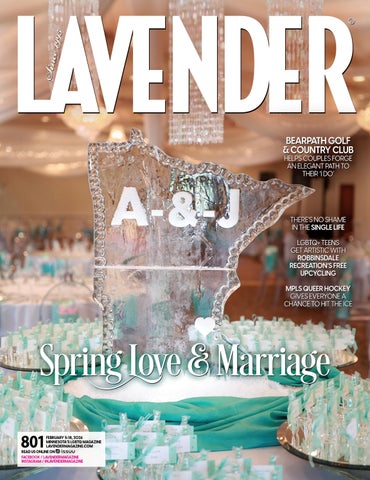
At the entrance of the ballroom, where the reception took place, there was a large ice sculpture in the shape of Minnesota, engraved with the couple’s initials. Crystal clear chairs circled the round tables dressed in white linens, teal runners and large bouquets of white hydrangeas sitting in the centers of the tables atop a tall clear vase.
“It was a very high-end and elaborate wedding,” Dix says. “When the two of them walked into the room for the first time, they were in awe. Everything came together exactly as they had envisioned.”
Aside from being a golf course, country club and wedding venue, Bearpath also makes community engagement a priority. Last December, they held a Santa Drive in which they delivered 778 pounds of food to PROP Food Shelf.
In the last few months, they held several events to get involved with the community, including Jammies and Gingerbread, Ugly Sweater Bingo Night, and an Annual Freaky Fun Fest that included pumpkin painting, apple launching and bounce houses.
As more LGBTQ+ couples continue to seek venues where they feel affirmed and supported, Bearpath remains committed to celebrating love in all its forms. In June, the venue will be planning its fifth queer wedding. They hope to make this couple’s wedding a dream come true just as they’ve done with all the others in the past.
“The Same Olde Shame”
Modern America Provides a Disgrace That’s Both Familiar and New
Before the United States was united by its citizens’ right to the pursuit of happiness, before the United States was the United Anything, one of its pre-United pre-States, the Massachusetts Bay Colony, was united in its attitude toward unions that did not meet the criteria of covenant theology. Such blessed unions, the citizens believed, were the only path to true, everlasting happiness. Intimate relationships that, uh, related outside of Puritanical marriage but inside the commonwealth of Massachusetts were a no-go, and when they did go, yo, they were punished by the baddest of bad medicines: public shame.
Perhaps the best-known version of this toxic tonic was put on display within the fictional-but-not-that-fictional pages of “The Scarlet Letter” by Nathaniel Hawthorne: single lady seamstress Hester Prynne becomes In A Family Way, only without the family. Having apparently indulged in a soiled bliss that somehow coagulated outside of Puritanical marriage, she was forced, as a punishment, to clamber onto a centrally-located scaffold and, with her head lowered and shoulders stooped, suffer the leers, jeers, sneers and cheers of her fellow citizens.
That scaffold was made of pine and societal expectation — the societal expectation that everyone in the colony, except for the witches, maybe, would adhere to the tenets that drove the Puritans to that wild, new world years earlier. American happiness-pursuing has since evolved, of course. If Hester were Prynning today, she might preside over a podcast called “Elected Single Moms Breaking the Sabbath For Fun and Prophet.”
Then again, if Hester were Prynning today, she might lead the charge against a sin that’s just as scarlet in our modern times as adultery was in 1640s Massachusetts: the scaffold upon which 21st-century love-oriented shame stands is the assumption that couplehood is inevitable.
The sin … is being single.
According to New York-based therapist and author Allison Abrams, single shaming is “negatively judging somebody for not being partnered up and not conforming to society’s expectations.” Just as Puritan Massachusetts projected certain assumptions onto its citizens, so too does modern-day America project modern-day assumptions onto the hoi polloi — everyone wants a partner, or should, and, if you don’t have one, then you’re looking for one, or should be. Because everyone wants a life partner, everyone not properly coupled must be lonely or immature or insecure or selfish or flawed or unhappy.
These assumptions might at first seem unlikely, but single shaming is repeatedly reported as a major problem by therapists all over the country. And like all the best manifestations of discrimination, it even has a clinicalsounding technical term — “singlism.”
Singlism’s effects on contemporary Hesters can be personally devastating: societal misunderstanding of deliberate singlehood might generate a shame that erodes the self-worth of such lone rangers. This can lead to an irresistible depression, which might drive a single person to seek out any relationship, even a toxic one, simply to meet society’s expectations.
Members of the queer community may encounter an extra dimension where single shaming is concerned. WeHo-based Licensed Professional Clinical Counselor, Matthew Dempsey, quotes a hypothetical gay shamee: “If I can only find a partner, I can validate my sexuality because I can prove that I can find love, too.”
But such validation is emotional fool’s gold, a rationalization to fall in line with society’s archaic expectations.
“Our sexuality is already valid on its own,” Dempsey affirms. “We don’t need a partner to validate that.”
The truth is, despite the shaming, more Americans than ever are choosing deliberate singlehood for a rainbow of reasons. Sometimes the reasons are practical — an individual might want to remain an individual so as to focus on her career or hobbies. Sometimes the reasons are more general — an individual might prioritize freedom, independence, self-focus or personal growth. And sometimes the reasons are more emotional — recovering from a bad, broken relationship might inspire determined singlehood, as might a cooler, general disinterest in commitment.
Until single shaming goes the way of Puritan adultery shaming, committed singles will have to continue reminding well-intended friends and family that avoiding romantic relationships is their way of pursuing happiness, their self-worth divorced from their relationship status.
Above all else, singlehood offers any individual an opportunity to focus on that often-overlooked form of affection, self-love. That amoré might be the biggest benefit of flying solo through life, building a sense of confidence and self-discovery that could come from no other source. As that disgraced seamstress of an earlier age might have thought during her public punishment — her neighbors intended her humiliation, but when perched on that scaffold of supposed shame, Hester Prynne stood head and shoulders above the rest.
BY STACY DAHL
Stories of Love and Belonging from Queer Couples in the Twin Cities
Kimberlee & Megan
31-year-old Kimberlee Littrel and 36-year-old Megan Anderson met on the dating app Bumble about three years ago and decided to meet for their first date at Texas Roadhouse. While waiting in the parking lot, Anderson received a text from Littrel saying she was nervous. Anderson replied that she felt the same way.
Littrel had been married before and was casually dating when she met Anderson, unsure of what she wanted at the time. Anderson was not dating anyone else and felt nervous about Littrel seeing other people. After some time casually dating, and even briefly dating another woman also named Megan, Littrel realized that Anderson was the one.
“I think that us being queer and different races has really affected us in the sense that we actively make an effort to find and make spaces for people that struggle to find their space,” Littrel says.
The couple noticed a lack of spaces for BIPOC lesbians in their social circles and decided to help change that.
“We have a really big group of lesbian friends but not a lot of BIPOC lesbian friends, so we tried to make a space for that,” Littrel says. “We made a community group that’s kind of open to everybody, queer, BIPOC, allies, whoever is willing to support us. We host community events at queer businesses.”
Both women say distance from family and difficult family dynamics have shaped their relationship.
“Neither of us have family close to the metro, and both of us have experienced a lot of homophobia and racism in our families,” Littrel says. “It’s not that I think anybody is doing it intentionally, but there’s been a big learning curve for both of us and our families about how to treat us as BIPOC and queer individuals.”
She says constantly having to reeducate others can be exhausting, even as it has strengthened their bond.
“A lot of our support has come from finding our chosen family,” Anderson says. “The group we mentioned has been a pretty solid support through and through. If we need a babysitter or someone to let the dog out, everybody steps up and helps, and we try to do the same for them.”
The couple also says they have support outside their immediate queer community.
“There are people who are very supportive, and it’s not even a question in their mind that anything is amiss as a queer couple,” Anderson says.
When it comes to date nights, Anderson says they are intentional about where they go.
“If the vibe’s not right, then we don’t go,” she says. “One of our tried-andtrue places is Stanley’s in northeast Minneapolis because they’re so open to the LGBTQ community.”
They also cited Queermunity, the Pride Cultural Arts Center and Twin Cities Lesbian Life as important spaces where they have volunteered, built friendships and felt supported.
Last February, the couple got engaged, though the proposal did not go exactly as planned. Anderson organized a brunch with friends at a Minneapolis restaurant and planned to propose there.
“We had it all set up with a group of eight to 10 people,” Anderson says. “We went up to the host and said we had a reservation, and the host asked if we were there for the surprise engagement, completely blowing the surprise.”
The host apologized and comped their meal. Anderson says the moment has since become a favorite story.
The couple plans to elope in Las Vegas on Jan. 5. They also plan to move to St. Paul to be closer to Anderson’s daughter as they begin the next chapter of their lives together.
Paul & Brad
On April 23, 2016, Paul Mateski and Brad Brockman met through a mutual friend at a fundraiser. Brockman was there to support a good cause, and Mateski attended because he wanted to see a friendly face.
Following the fundraiser, the pair stayed in touch and had their first date at the Minnesota Zoo.
What started as frequent visits to Brockman’s condo resulted in Mateski’s moving in a short time thereafter. Just over a year later, the happy couple purchased a new house.
In August 2018, a little over two years from the day they first met, Mateski planned a romantic proposal in the corner of the couple’s backyard. The setting featured a trail of rose petals leading to a picnic blanket on which Mateski stood. Overhead was a strand of white, illuminating Christmas lights with cut-out letters hanging from the lights that read, “Will you marry me?”
A bottle of champagne and a charcuterie spread awaited footside with Elvis Presley’s “Love Me Tender” playing in the background. Mateski felt the backyard was meaningful because it was the house the couple purchased together.
Although Mateski initiated the proposal, it was Brockman who took the reins when it came to planning and organizing the couple’s special wedding day.
Everything was on track for the pair to get married on the day that they met in April of 2020, when the global pandemic hit unexpectedly. After being forced to reschedule their wedding, re-coordinate all vendors and reduce the number
of guests by 75%, the couple finally married in August of 2020 at the Calhoun Beach Club in Minneapolis with family and friends present.
“Being married to a man is no different than being married to a woman,” Mateski says. “We each have our own roles and responsibilities, just like any other couple.”
The couple has a 13-year age gap. Brockman’s family has been more accepting of both the age difference and their same-sex marriage than Mateski’s family.
The newlywed couple never got to take a honeymoon, as shortly after the wedding, Brockman and Mateski met up with one of Brockman’s cousins for dinner. Brockman’s cousin informed the newlyweds of a birth mom who was seven months pregnant and considering placing her unborn child up for adoption.
After waiting eight long years for a successful adoption, Brockman knew this was the perfect opportunity for a child. His journey with adoption started back before he met Mateski and was still single. Not expecting to meet the love of his life, he had decided to adopt a child on his own and become a single parent. Brockman received multiple inquiries about adoption, but nothing transpired.
Say "I Do" in Stillwater
Once Brockman and Mateski were living together, Brockman left the adoption agency, and the couple together sought out adoption via the foster-to-adopt route. The couple had matched with twins; however, the match fell through just before Christmas 2019. In the end, it was word-of-mouth that brought Brockman and Mateski to their now 5-year-old daughter.
Today, the couple lives together in the western suburbs of the Twin Cities with their daughter and two 8-year-old Boston Terriers.
Their story continues as the couple looks forward to Mateski finishing his MBA and their hopes to grow their family through adoption one more time.
Community Connection brings visibility to local LGBTQ-friendly non-profit organizations. To reserve your listing in Community Connection, email advertising@lavendermagazine.com.
ANIMAL RESCUE
Second Chance Animal Rescue
Dedicated to rescuing, fostering, caring for, and adopting out dogs and cats into forever homes.
P.O. Box 10533
White Bear Lake, MN 55110 (651) 771-5662 www.secondchancerescue.org
BUSINESS ASSOCIATIONS
Quorum
Minnesota's LGBTQ+ and Allied Chamber of Commerce working to build, connect, and strengthen for a diverse business community.
2446 University Ave. W., Ste 112 St. Paul, MN 55114 (612) 460-8153 www.twincitiesquorum.com
ENVIRONMENT
The Nature Conservancy
TNC is an environmental nonprofit working to create a world where people and nature thrive. 1101 W. River Pkwy., Ste. 200 Minneapolis, MN 55415-1291 (612) 331-0700 minnesota@tnc.org www.nature.org/minnesota
EVENT VENUES
Landmark Center
A classic venue, with a grand cortile and beautiful courtrooms, accommodates celebrations of all sizes.
75 W. 5th St. St. Paul, MN 55102 (651) 292-3228 www.landmarkcenter.org
FOUNDATIONS
University of Minnesota Foundation
Connecting passion with possibility to transform the future through philanthropy. 200 Oak St. SE, Ste. 500 Minneapolis, MN 55455 (612) 624-3333 giving@umn.edu www.give.umn.edu
GRANTMAKERS/FUNDERS
PFund Foundation
PFund is the LGBTQ+ community foundation that provides grants to students and grants to non-profits. PO Box 3640 Minneapolis, MN 55403 (612) 870-1806 www.pfundfoundation.org
HEALTH & WELLNESS
Aliveness Project
Community Center for individuals living with HIV/AIDS – on-site meals, food shelf, and supportive service. 3808 Nicollet Ave. S. Minneapolis, MN 55102 (612) 824-LIFE (5433) www.aliveness.org
COMMUNITY CONNECTION
MEDIA & COMMUNICATIONS
Radio K
Radio K is the award-winning studentrun radio station of the University of Minnesota.
330 21st. Ave. S. Minneapolis, MN 55455 (612) 625-3500 www.radiok.org
MEDICAL SERVICES
Red Door Clinic
HIV and STI screening, treatment, education, and referrals. Doxy PEP, nPEP, PrEP, and Reproductive Health. 525 Portland Ave., 4th Fl. Minneapolis, MN 55415 (612) 543-5555 reddoor@hennepin.us www.reddoorclinic.org
MUSEUM
Bell Museum, University of Minnesota
Discover Minnesota’s rich natural history through engaging exhibits, wildlife dioramas, and an exciting planetarium experience!
2088 Larpenteur Ave. W. St. Paul, MN 55113 (612) 626-9660 bellinfo@umn.edu www.bellmuseum.umn.edu
Minnesota Historical Society
Create your own adventure at MNHS historic sites and museums around Minnesota. www.mnhs.org
Minneapolis Institute of Art
Home to masterpieces from around the world and through the ages. Always free. Everyone welcome.
2400 3rd Ave. S. Minneapolis, MN 55404 (612) 870-3000 www.artsmia.org
Science Museum of Minnesota
Mississippi Riverfront Museum featuring dinosaurs, hands-on exhibits, Omnitheater films, and interactive science performances. Café onsite. 120 W. Kellogg Blvd. St. Paul, MN 55102 (651) 221-9444 www.smm.org
PERFORMING ARTS
ARENA DANCES
ARENA DANCES presents innovative contemporary dance, fostering community, dialogue, and inclusion through performance and education
711 W. Lake St., Studio 308 Minneapolis, MN 55408 (612) 804-0238 www.arenadances.org
Chanhassen Dinner Theatres
The nation's largest professional dinner theater and Minnesota's own entertainment destination.
501 W. 78th St. Chanhassen, MN 55317 (952) 934-1525 www.chanhassendt.com
Children’s Theatre Company
Children’s Theatre Company excites the imagination with world-class family-friendly theatre for kids, teens, and adults.
2400 3rd Ave. S. Minneapolis, MN 55404 (612) 874-0400 www.childrenstheatre.org
Guthrie Theater
Open to the public year-round, the Guthrie produces classic and contemporary plays on three stages. 818 S. 2nd St. Minneapolis, MN 55415 (612) 377-2224 www.guthrietheater.org
Minnesota Opera
World-class opera draws you into a synthesis of beauty; breathtaking music, stunning costumes & extraordinary sets. Performances at the Ordway Music Theater - 345 Washington St. St. Paul, MN 55102 (612) 333-6669 www.mnopera.org
Minnesota Orchestra
Led by Music Director Designate Thomas Søndergård, the Minnesota Orchestra, one of America’s leading symphony orchestras. 1111 Nicollet Mall Minneapolis, MN 55403 (612) 371-5656, (800) 292-4141 www.minnesotaorchestra.org
Ordway Center for the Performing Arts
Leading performing arts center with two stages presenting Broadway musicals, concerts & educational programs that enrich diverse audiences. 345 Washington St. St. Paul, MN 55102 (651) 224-4222 info@ordway.org www.ordway.org
Twin Cities Gay Men’s Chorus
An award-winning chorus building community through music and offers entertainment worth coming out for! 1430 W. 28th St., Ste. B Minneapolis, MN 55408 (612) 339-SONG (7664) chorus@tcgmc.org www.tcgmc.org
RELIGIOUS & SPIRITUAL
All God's Children Metropolitan Community Church
A welcoming, inclusive, safe place to explore and discover God's love for ALL God's children. 3100 Park Ave. Minneapolis, MN 55407 (612) 824-2673 www.agcmcc.org
A Christian community of creative, quirky, curious folx where All Means ALL. Sundays, 10:30am.
100 W. 46th St. Minneapolis, MN 55419 bigdoor@spiritgarage.org www.spiritgarage.org
Westminster Presbyterian Church
An open and affirming congregation, welcoming persons of all sexual orientations, gender expressions and identities. 1200 Marquette Ave. Minneapolis, MN 55403 (612) 332-3421 www.westminstermpls.org
SENIOR LIVING
Lyngblomsten
Offering caregiver education, resources, support groups, and The Gathering (daytime respite, memory-loss enrichment program).
Minnesota’s Sweet Spot! St. Louis Park & Golden Valley offer exceptional dining, attractions, shopping, hotels and event space.
1660 Hwy 100 S., Ste. 501 St. Louis Park, MN 55416 (952) 426-4047 www.westopolis.org
Unhidden
The night hums now— no longer still, but alive, a pressure beneath the skin of the room. Amber light drifts through curtains that breathe with the city’s slow exhale; shadows move like water across the walls.
What was once quiet between them has learned its own rhythm— gathering like thunder beneath the ribs before the rain arrives.
Their bodies remember the stillness, but they do not return to it. They move with knowing now, hands and lips tracing each other’s maps, answering questions no words could hold.
Each breath strikes like a drumbeat; each touch, a spark— heat blooming where skin meets skin, the air rich with salt and summer, with the shock of being seen.
They are unhidden now.
In the sway and press of their bodies is a kind of worship— a hymn of motion and breath. Outside, basslines and footsteps thread the streets, sound lifting through open windows, a celebration unfurling in the night.
Voices rise like lanterns into the dark, carried on pavement and pulse, echoing the freedom inside the room: we are here, we are whole, we are flame.
Light spills across their skin— red, gold, violet— the spectrum of a flag caught in sweat and shadow, in the shimmer of motion.
They move not to possess, but to dissolve into each other, to feel where one ends and the other begins again.
Each pulse, each shiver— the world collapsing, remade in the space of a breath.
And when the rhythm softens, when the tide of their motion ebbs, they do not fall into silence, but into peace— steady, unafraid.
Outside, dawn unfurls its pale fire, painting the room in slow forgiveness. Inside, their bodies rest, but the dance continues— in the heartbeat shared between them, in the light that finds their faces, in the truth that to be seen, to stay, and to love without apology, is its own kind of revolution.
www.inkwellbooksellersco.com 426 E Hennepin Ave, Minneapolis, MN 55414 763-209-8117
GUN SHOPS
Supporting Community and Sustainability with Robbinsdale Recreation
About a year ago, William Cardenas, the community engagement coordinator for the city of Robbinsdale, Minn., applied for a grant to fund the creation of a program focusing on education, inclusivity and diversity.
Coming from a background in DEI, Cardenas knew that he wanted the program to reflect values of accessibility, inclusivity and protecting one’s differences. Therefore, he decided to center the program around teens who were members or allies of the LGBTQ+ community.
“I see a lot of what my community here in Robbinsdale is going through currently, and then also just other communities that are needing just that additional support and that additional sort of safety net,” Cardenas says. “So I guess it works out well in my position where I can be a resource for them and they can come into City Hall and feel heard … That’s what I’ve been trying to build here, just sort of a central hub where people can come in and ask questions and feel like they belong.”
Throughout the process of creating the program, Cardenas was connected with Harper Steinbach, a Twin Cities-based artist who had previously held the same role as Cardenas, being the community engagement coordinator for the city of Robbinsdale. During her time in the role, she had helped to organize an arts-based program for the city of Crystal, Minn. Taking inspiration from Steinbach’s artistic approach, Cardenas considered creating another art-based program.
“I knew what audience I wanted to provide more inclusive programming towards. I just had no clue … at first, what sort of program I could do. Because I know Harper … had done an arts program before … it was a spur in the moment where I was just visiting my parents and my mom was using a sewing machine.” Cardenas says. “It just hit me there where I realized that I didn’t know how to use this sort of thing, and then just with … priorities here in Robbinsdale around sustainability, it kind of all just worked out perfectly and meshed perfectly where it just felt right.”
Together, Steinbach and Harper worked to create an upcycling program targeted toward LGBTQ+ teens and allies. To make the program as accessible as possible, they had to consider the numerous obstacles that might prevent someone from being able to participate.
The first obstacle they sought to address was the difference in knowledge surrounding the arts. To ensure everybody from all different types of backgrounds could participate, it was essential that the program offered education to participants in a way that was easy to digest and understand.
“I work with HCMC and children’s hospitals, specifically with queer and trans teens and children … One thing that I was noticing is that … we’re starting to get both artists and teams that aren’t necessarily artistically inclined, want to come in and make stuff, especially when you lean towards more functional DIY stuff,” Steinbach says. “I think because of the gap in knowledge of like … there’s not a lot of young people that get exposure to fine arts anymore, we need to start shifting our subject matter towards things that are understandable and relatable to that age.”
In addition to education, Cardenas and Steinbach also considered any financial obstacles that may stand in the way of participants joining the program and attempted to eliminate them. They accomplished this by not only making the program free to join, including the materials used, but also the materials are something that are easy to source in the chance that someone would like to make the project again.
“I’m doing lesson planning, curriculum building, … I try and use materials in which people can get access to them very easily if they would like to replicate the project again,” Steinbach says. “That’s one thing is, I try and make lesson plans that people get excited because they can come and learn how to do stuff and then take that knowledge home with them. So, it’s really approachable in terms of both technical skill and supplies.”
Overall, Steinbach wants the event to feel welcoming for all. She attempts to foster a “light vibe” by allowing students to choose the music they would like to listen to. Students are also encouraged to get to know one another through the use of conversation starters sprinkled throughout the day. Through their efforts, and with a collaboration with the city of Crystal, Minn., Cardenas and Steinbach were able to launch the free upcycling program on January 6. Alternating every Tuesday until March 17, LGBTQ+ teens and allies who have registered for the program have the opportunity to join Steinbach at the Crystal Community Center as she shares new artistic techniques and skills. For more information, please visit robbinsdalemn.gov.