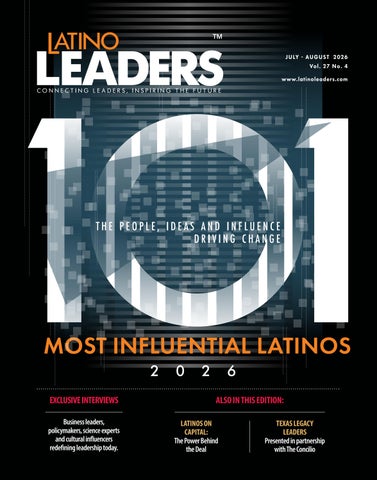
JULY - AUGUST 2026 Vol. 27 No. 4 www.latinoleaders.com
THE PEOPLE, IDEAS AND INFLUENCE DRIVING CHANGE
2 EXCLUSIVE INTERVIEWS Business leaders, policymakers, science experts and cultural influencers redefining leadership today.
PortadaLLV27N4Jul-Aug.indd 1
0
2
6 ALSO IN THIS EDITION:
LATINOS ON CAPITAL: The Power Behind the Deal
TEXAS LEGACY LEADERS Presented in partnership with The Concilio
10/09/26 2:19 p.m.
Congratulations, DAVID HINOJOSA Heritage Grocers Group proudly congratulates our CEO, David Hinojosa, on being recognized as one of the 101 Most Influential Latinos in the U.S. by Latino Leaders Magazine. This honor reflects his dedication to serving Hispanic communities, supporting and developing others, and leading with integrity, humility, and purpose. Throughout his journey, David has remained focused on what matters most: people. His ability to listen, build trust, and bring out the best in those around him has earned the respect of colleagues, Team Members, and industry peers alike. Since joining Heritage Grocers Group, David has brought a thoughtful and collaborative leadership style that reflects our values and strengthens our commitment to the communities we serve. We are grateful for David's leadership and proud to celebrate this well-deserved recognition.
00LL-Heritage Grocers.indd 2
10/09/26 10:55 a.m.
CONTENTS
JULY / AUGUST 2026
TABLE OF CONTENTS: Publisher Jorge Ferraez
President and CEO Raul Ferraez
Editor Andrea Pina andrea.pina@latinoleaders.com Administrative Director Lawrence Teodoro Business Development Manager Cristina Villaseñor cristina@latinoleaders.com Digital Media & Design Manager Wendy Zacarias wendy@latinoleaders.com Event Director Isabela Herrera isabela@latinoleaders.com Art Director Fernando Izquierdo Editorial Art & Design Carlos Cuevas Luis Enrique González Moisés Cervantes Human Resources Manager Susana Sanchez Administration and Bookkeeping Carlos Bernal
• 101 Most Influential Latinos 2026 The leaders, innovators and changemakers shaping what comes next. - Page.06 • Val M. Cantú The chef behind Californios on ambition, identity and redefining Mexican fine dining. - Page.33 • Darren Rebelez Leading with clarity, discipline and a deep understanding of the customer. - Page.36 • Mildred García The chancellor of the California State University system on education, opportunity and the power of access. - Page.42 • Marco Davis Leading CHCI and building the next generation of Latino leadership. - Page. 44 • Latinos on Capital Meet the Latino leaders influencing where capital moves, how it grows and what gets built next.- Page. 60 • Texas Legacy Awards Celebrating leadership, service and lasting impact in Texas, in partnership with The Concilio. - Page.65
Executive Assistant to the Publishers Liliana Morales For advertising inquiries, please call 214-206-9587
Latino Leaders: The National Magazine of the Successful American Latino (ISSN 1529-3998) is published seven times annually by Ferraez Publications of America Corp., 11300 N. Central Expressway, Suite 300, Dallas, TX, 75243, JULY / AUGUST 2026. Subscription rates: In U.S. and possessions, one year $15.00. Checks payable to Ferraez Publications of America, 15443 Knoll Trail, Suite 210, 75248 Dallas, TX, USA. POSTMASTER: Send address changes to Latino Leaders, 15443 Knoll Trail, Suite 210, 75248 Dallas, TX, USA.© 2001 by Ferraez Publications of America Corporation. All rights reserved. No part of this periodical may be reproduced without the consent of Latino Leaders: The National Magazine of the Successful American Latino. The periodical’s name and logo, and the various titles and headings therein, are trademarks of Ferraez Publications of America Corp.
Member of The National Association of Hispanic Publications
Audited by Member of Reg. # 283/01
MEMBER OF SRDS Latino Leaders The National Magazine of the Successful American Latino 11300 N. Central Expressway, Suite 300, Dallas, TX, 75243 Phone: 214-206-9587 / Fax: (214) 206-4970
01-TOC.indd 1
FOLLOW US @latinoleadersmag
FOLLOW US @LatinoLeadersUS
FOLLOW US LatinoLeadersMagazine
JULY / AUGUST 2026 LATINO LEADERS 1
11/09/26 4:51 p.m.
DE LA VEGA ON LEADERSHIP
When AI Meets Quantum Computing: What Comes Next? Ralph de la Vega
During my career, I have learned that the biggest technological transformations often occur when several powerful technologies converge. I saw this firsthand as CEO of AT&T Mobility. Broadband, the Internet, and increasingly powerful mobile devices were all advancing at the same time. When they came together, they didn’t simply create a better phone. They fundamentally changed how people live, work, and play and created businesses and applications few of us could have predicted.
I BELIEVE we may be approaching another important convergence: artificial intelligence and quantum computing. AI is already transforming how we use information and solve problems. Quantum computing is much earlier in its development. Today’s quantum computers are still specialized and prone to errors, and we don’t know exactly when large-scale, fault-tolerant quantum computers will become practical. But if they do, the combination could take AI—and human problem-solving— to an entirely new level.
Cybersecurity May Be First
One impact of quantum computing is already becoming clear: cybersecurity. Much of today’s digital security depends on mathematical problems that conventional computers find extremely difficult to solve. A sufficiently powerful quantum computer could eventually break some of the encryption protecting financial transactions, government communications, and sensitive information. The threat is serious enough that governments and businesses are already moving toward post-quantum cryptography, designed to withstand attacks from future quantum computers. So cybersecurity may be one of the first areas where quantum computing forces significant change. But to me, the more interesting question is: What comes next?
A Two-Way Relationship
One of the most fascinating aspects of AI and quantum computing is that the relationship works in both directions. AI may actually help make quantum computing practical. Researchers already use AI to correct quantum errors, improve control of fragile quantum systems, optimize quantum algorithms, and design better quantum circuits. In other words, AI may help us build better quantum computers, and quantum computers may eventually make AI more powerful. Think of today’s AI as an extraordinarily capable engineer with access to some of the world’s most powerful conventional computers. Now imagine giving that engineer access to an entirely new kind of computing that can explore certain problems in fundamentally different ways. The result isn’t simply faster AI. It could expand the kinds of problems AI can help us solve.
Imagine Optimizing an Entire Network
I think about this from my own experience in telecommunications. Operating a nationwide wireless network involves an enormous number of interconnected variables, cell sites, radio frequencies, network capacity, fiber connections, equipment, maintenance schedules, customer demand, and constantly changing traffic patterns. We have sophisticated tools to optimize those things today.
2 LATINO LEADERS JULY / AUGUST 2026
RalphDlaVega.indd 2
10/09/26 11:22 a.m.
But imagine optimizing the entire network simultaneously and in real time. AI could continuously analyze network conditions, predict demand, and establish the objectives. Quantum computing could eventually help search through an enormous number of possible configurations to identify solutions that conventional computers might struggle to find quickly. The same principle could apply to electrical grids, airlines, global supply chains, manufacturing systems, and transportation networks. Instead of optimizing individual pieces of enormously complicated systems, we may increasingly be able to optimize the whole system.
Accelerating Scientific Discovery
Perhaps the most exciting possibilities involve science. Nature itself operates according to quantum mechanics, yet accurately modeling complicated molecules can overwhelm conventional computers. Quantum computers could eventually become particularly valuable for simulating these systems. Combine that capability with AI, and we could potentially create a new model for scientific discovery: AI proposes possibilities, quantum computing helps evaluate them, and AI learns from the results and proposes better possibilities. Think about what that could mean: new medicines, better batteries, new materials, more efficient fertilizers, carbon capture, and perhaps even advances in fusion energy.We should be careful not to suggest that quantum computing will suddenly solve all of these problems. It won’t. But if the combination lets scientists explore far more possibilities in far less time, it could change the pace of discovery itself.
From Personalized Information to Personalized Medicine
One example makes this particularly human. AI is already becoming increasingly capable of analyzing medical records, genetics, images, and other health information. Now imagine that someday we could create a highly sophisticated digital model of an individual patient. Quantum computing could potentially help simulate molecular interactions involving a particular disease, genetic mutation, or treatment, while AI interprets the results. Instead of primarily asking, Does this drug work for people with this disease? we could move closer to asking, What treatment is most likely to work for this particular person? That could stand for an extraordinary change in medicine.
The Most Important Impact May Be Time
The common denominator in all these examples is time. A medicine that takes years to discover could potentially be discovered much faster. A new material requiring thousands of laboratory experiments might first be evaluated through advanced simulation. A complicated supply-chain problem involving an enormous number of possibilities could potentially be solved while the disruption is still occurring. A network could continuously adjust itself as conditions change. The breakthrough, therefore, may not simply be more computing power. It may be compressing the time between identifying a problem and finding a solution. And when you compress that time, you accelerate innovation.
The Applications We Cannot Yet Imagine
This is where my experience with the mobile revolution gives me some perspective. When we were building the mobile Internet, we knew combining broadband, the Internet, and increasingly powerful mobile devices would matter. But we didn’t foresee everything that would follow. Few people predicted that the smartphone would become our camera, bank, navigation system, entertainment center, workplace, and marketplace. We certainly didn’t anticipate every company and industry that would eventually be built upon it. The technology created possibilities, and human ingenuity discovered what to do with them. I believe we should think about AI and quantum computing in much the same way. We are still early, particularly with quantum computing. Major technical challenges remain, and we should be skeptical of anyone who claims to know precisely when this transformation will occur. But we should also avoid the opposite mistake: judging the future solely by what today’s technology can do. Twenty years ago, it would have been difficult to imagine everything we now routinely do with a device in our pocket. Twenty years from now, we may look back at today’s AI and quantum computers with the same sense of amazement. Having seen what happened when broadband, the Internet, and mobile devices converged, I have learned not to underestimate what can happen when powerful technologies come together. The most important applications of AI and quantum computing may be the ones we haven’t imagined yet. And that makes the question: what comes next? So exciting.
Ralph de la Vega is the former vice-chairman of AT&T Inc. He is the author of the best-selling book “Obstacles Welcome: Turn Adversity to Advantage in Business and Life.” He is also a LinkedIn Influencer, posting regularly on leadership and innovation.
JULY / AUGUST 2026 LATINO LEADERS 3
RalphDlaVega.indd 3
10/09/26 11:23 a.m.
LATINOS IN MUSIC
LIDO PIMIENTA
LIDO PIMIENTA:
TRAVELING WITHOUT LETTING AI DECIDE THE DESTINATION
Hada Jazmin Aguiler y Alexis Langagne Carlos Cuevas
lidopimienta.com @LidoPimienta Lido.Pimienta.Musica Lido Pimienta
S
ome artists are easy to categorize. Lido Pimienta is not one of them. Born in Barranquilla, Colombia, and based in Toronto, Canada, she is a singer, composer, visual artist and multidisciplinary creator whose music combines Colombian traditions with electronic experimentation, classical and pop music. Her album La Papessa won the prestigious Polaris Music Prize, awarded to the best full-length Canadian album based on artistic merit, beating a shortlist that included Leonard Cohen among others. She followed it with Miss Colombia, which earned Grammy and Latin Grammy nominations and further established her as one of the most original Latin American voices working today. I have always admired artists who resist labels, and Lido certainly does. Her work is bold, experimental and difficult to place inside conventional genres.When I asked her to describe her music, she invented her own genre: “Caribe Sublime” — Sublime Caribbean.
Her artistic exploration has also taken her into classical music and ballet, including a historic commission as the first woman of color to compose for the New York City Ballet. So naturally, I asked when she had decided to dedicate her life to music. She hadn't. In fact, Lido told me that music might be her fourth job—or even her “side gig.” She is a visual artist, a writer, a mother (probably her most demanding job), and a perpetual student. Her ultimate artistic manifestation, she believes, will be as a film director, where she can create the story, tell the story and compose the music. Music, in some ways, happened accidentally, although it has been with her since childhood. Her father encouraged her to sing when she was four years old in Barranquilla. Today, she describes herself almost as a passenger traveling alongside art. One day she wakes up wanting to paint; another day she wants to sing. Music becomes a response to whatever she needs to express at that moment.
4 LATINO LEADERS JULY / AUGUST 2026
4-5 Latinos in music.indd 4
11/09/26 13:24
When I asked which one song she would want to be remembered for 100 years from now, she chose “Eso Que Tú Haces” (“That Thing You Do”), a song she later performed at the 2021 Grammy Premiere Ceremony. For Lido, it represents an important moment in her evolution: when she began arranging music for multiple instruments, ensembles and orchestras. Our conversation became particularly interesting when we discussed the future of music. For the first time, Lido is questioning aspects of a career she had never really doubted. Creating a great album is no longer enough, she said. Musicians are increasingly expected to become social-media influencers, create viral content, edit videos and adapt their creativity to algorithms and prescribed lengths. Technology—and particularly artificial intelligence—makes the tension even more complex. Lido sees possibilities. She offered a hypothetical example: an artist with only one arm could use prompts and technology to create a painting. She has personally ben-
ative professions. But her most thought-provoking observation was also surprisingly optimistic: “There will be a moment where the artificial is so artificial, that people will want to see more natural and human things.” I think Lido may be onto something that extends well beyond music. As AI makes it possible to produce more content, faster and increasingly without human intervention, perhaps our uniquely human qualities become more valuable—not less. Creativity, imperfection, emotion, cultural roots and lived experience may become differentiators in a world where technological capabilities are increasingly accessible to everyone. Before finishing our conversation, I asked Lido what remained for her to accomplish. She returned to her dream of directing a film. Naturally, I asked when. “Two years.” Whether she is singing, painting, writing or someday directing that film, Lido Pimienta seems less interested in choosing an artistic lane than in continuing the journey. She is, after all, a passenger. Perhaps there is a lesson there for all of us. As technology becomes increasingly capable of creating for us, our challenge may be to embrace what it enables without surrendering the curiosity, culture and lived experiences that make creativity human. And perhaps in an increasingly artificial world, we need more artists -like Lido- willing to travel without letting the algorithm decide the destination.
Alexis Langagne the author is a Global High-Tech Executive, Global VP at Diebold-Nixdorf and previously Regional CEO/COO at HP and Oracle; Board Advisor for high-tech startups and Board Director for a sports nonprofit. Alexis is also a professional-level drummer.
AND PERHAPS IN AN INCREASINGLY ARTIFICIAL WORLD, WE NEED MORE ARTISTS -LIKE LIDO- WILLING TO TRAVEL WITHOUT LETTING THE ALGORITHM DECIDE THE DESTINATION.
efited from technology: she says much of what she knows about music comes from her Afro-Colombian roots and YouTube, while tools such as MIDI allow her to compose for orchestras without having the musicians physically present. And yet, she told me: “I am analog.” She has never used ChatGPT. She worries about AI’s environmental impact, the concentration of economic power and what technology could do to creJULY / AUGUST 2026 LATINO LEADERS 5
4-5 Latinos in music.indd 5
11/09/26 13:25
1 O1 MOST INFLUENTIAL
L ATINOS 2026
EVERY YEAR, Latino Leaders Magazine spotlights the trailblazers shaping communities, industries, and culture. This year’s 101 Most Influential Latinos is more than a list— it’s a celebration of impact, resilience, and leadership across every field of endeavor. These are the voices and visionaries redefining what it means to lead: executives transforming global companies, entrepreneurs pushing innovation forward, public servants inspiring change, and cultural icons who carry our stories onto the world stage. Congratulations! JULY / AUGUST 2026 LATINO LEADERS 6
101 Latinos 2026.indd 6
10/09/26 11:05 a.m.
BUSINESS
RAMON LAGUARTA Chairman & CEO, PepsiCo Spanish
BUSINESS
1
MARCELO CLAURE
@ramonlaguarta
@marceloclaure @marceloclaure
1988 Joined Chupa Chups compañía del Grupo Perfetti Van Melle as Business Director 1996 Spain VP Business Development of Snacks at PepsiCo 2010 President Developing Markets, Europe at PepsiCo 2014 CEO, Europe Sub-Saharan Africa at PepsiCo 2017 President at PepsiCo 2019 Chairman of the Board of Directors
CESAR CONDE
Chairman, NBCUniversal News Group American
Six months after leaving his position as the CEO position at the SoftBank Group International, Marcelo Claure announced a new chapter in his career: he is the Founder & Chairman of Claure Capital, a multi-billion-dollar global investment firm focused on public and private companies in different industries. Claure is also also a member of multiple boards, and the president of Bolivia’s largest professional soccer team Club Bolívar, and the co-owner of the Spanish soccer team Girona FC.
BUSINESS
3
CASTULO DE LA ROCHA
@cesarconde_ @cesarconde
@AltaMedHealthS @altamedhealths
2002 White House Fellow for Secretary of State Colin Powell 2003 Joined Univision 2013 Joined NBCUniversal as Executive VP 2020 Conde was named Chairman of the NBCUniversal News Group in May 2020 2021 he received the Leonard Zeidenberg First Amendment Award 2023 Media Award (Annual Hispanic Heritage Awards)
As Chairman of NBCUniversal News Group, Cesar Conde oversees NBC News, NBC News NOW, NBCUniversal Telemundo Enterprises Group and NBCUniversal Local. Under Conde’s leadership, the News Group reaches nearly half of Americans each month across its English and Spanish language broadcast, cable, streaming and digital platforms. NBC News NOW, its 24/7 streaming network, is also the fastest-growing streaming news network in the U.S. and continues to achieve record-breaking viewership numbers, along with significant distribution growth.
4
President and CEO, AltaMed Health Services Corporation Mexican-American
1992 U.S. Surgeon General's Gold Medallion for Public Health 1995 Community Service Award from the American Diabetes Association 1995 Significant Achievement Award from the Chicanos for Creative Medicine 2016 Leader in Action Award from UCLA Prime 2017 Awardee of the Medallion of Excellence from CHCI 2021 Honored with a Lifetime Achievement Award by the Southwestern Voter Registration Education Project.
MOS T INFLUENTIAL L ATINOS
BUSINESS
2001 Named Entrepreneur of the Year by USA Today and Ernst & Young; lifetime member of Ernst & Young's Entrepreneur Hall of Fame 2008 Acquired BAISA 2014 Selected as Sprint's CEO 2016 Featured in Carnegie Corporation's Great Immigrants: The Pride of America 2017 Joined Softbank's Board of Directors 2022 Founded Claure Capital
1O1
Born in Barcelona he is the CEO of PepsiCo, a global food and beverage leader with 23 brands generating more than $1 billion each in annual retail sales. Believer in purposeful leadership, sustainable performance, and fostering a culture of opportunity. Focused on simplicity, accountability, and executional excellence. He joined PepsiCo in 1996 and served as President of Developing Markets in Europe, CEO of Europe and Sub-Saharan Africa, and President of PepsiCo.
2
Founder & CEO, Claure Group; Co-Chair, Brightstar Capital Partners Bolivian-American
During the 1970s, Castulo de la Rocha noticed that low-income neighborhoods struggled with essential health resources and changed their realities through AltaMed Health Services, which offers affordable health care for 300,000 patients each year and has a staff of 3,200 employees. In 2016, he was honored with the Action award from the PRIME Program at the David Geffen School of Medicine at UCLA and in 2017 he received the Medallion of Excellence from the Congressional Hispanic Caucus Institute (CHCI), among other recognitions.
JULY / AUGUST 2026 LATINO LEADERS 7
101 Latinos 2026.indd 7
10/09/26 11:04 a.m.
BUSINESS
ANDRES GLUSKI
BUSINESS
5
JORGE / JOSE MAS
Chairman & CEO, The AES Corporation American @AndresGluski
@Jorge__Mas
1987 M.A. & Ph.D. in Economics, University of Virginia 1990s Held senior roles at Gener (Chile), Electricidad de Venezuela, CANTV (GTE), and Banco de Venezuela/Grupo Santander. 2004 EVP for Latin America, AES Corporation. 2007 COO, AES Corporation 2011–Present President & CEO, AES Corporation. 2013 Member, U.S. President’s Export Council; served on U.S./Brazil and U.S./India CEO Forums. 2015 Chairmanship of the COA and Boards of EEI and WM 2025 Co-chair of Electricity Governors Council of WEF
1O1 MOS T INFLUENTIAL L ATINOS
Andres was the leader of a reorganization of the company that resulted in the implementation of a cost savings model that has changed the way that AES does business and operates. These changes were implemented in 2011 and since that time, the company experiences a savings of more than $250 million per year. As a result of his efforts, AES was named by the Ethisphere Institute as one of the “World’s Most Ethical Companies. He set goals for the company that culminated in the inclusion of the company in the North American Dow Jones Sustainability Index and that has been ongoing for the past years.
BUSINESS
ENRIQUE LORES President & CEO, PayPal Spanish
1994 Founded MasTec Inc 1997 MasTec lists on the NYSE under MTZ, entering public markets 2007 Jose Mas appointed CEO 2008 Key acquisitions: Wanzek Construction (2008), Precision Pipeline (2009), EC Source (2010) strengthening energy and transmission capabilities 2011 Acquired Fabcor (Canadian ops) and Energy Services of America’s midstream business 2018 Named to the Fortune 500 list for the first time 2021 Acquired INTREN and Henkels & McCoy, expanding power delivery and communications scale 2023–2024 Revenue projected to reach approximately $12.4 billion
MasTec, Inc., founded in 1994 and based in Coral Gables, Florida, is a leading American infrastructure engineering and construction company serving energy, utility, and communications sectors across North America. It originated from the merger of Church & Tower and Burnup & Sims and has evolved into a diversified specialty contractor. MasTec now operates across segments like renewable energy, electric transmission, oil and gas pipelines, and wireless infrastructure, with over 35,000 employees and revenues growing from $930 million in 2007 to over $12 billion projected in 2024
BUSINESS
7
JAVIER RODRIGUEZ CEO, DaVita Mexican
@EnriqueJLores
8
@DaVita @davita
1989 Joined Hewlett-Packard as an engineering intern. PayPal 2015 Led the separation of Hewlett-Packard into HP Inc. and Hewlett Packard Enterprise. PayPal 2017 Led HP's acquisition of Samsung's printer business. PayPal 2019 Appointed President & CEO of HP Inc. PayPal 2024 Named Chair of PayPal's Board of Directors. PayPal 2026 Appointed President & CEO of PayPal. Investor
Enrique Lores is one of the world's leading technology executives, recognized for driving business transformation and innovation at global scale. Throughout his career, he has led major milestones, including the separation of HP, the expansion of its printing business, and the company's transition toward AI-driven solutions. As President and CEO of PayPal, he is now leading one of the world's largest digital payments companies, helping shape the future of commerce, financial technology, and artificial intelligence. PayPal
6
Chairman and Co-Founder of MasTec, Inc. / Chief Executive Officer, MasTec, Inc Cuban-american
1998 Senior Vice President at DaVita 2019 CEO DaVita 2020 Board of directors of Gilead Sciences, Inc.
Javier Rodriguez has continued to be recognized as one of Modern Healthcare’s Most Influential People in Healthcare, reflecting his leadership in advancing value-based care, improving outcomes for patients with kidney disease, and driving innovation across the healthcare industry. Under his leadership, DaVita has continued to strengthen its position as a leader in kidney care through continued investments in integrated care models, technology-enabled care delivery, and patient-centered innovation.
8 LATINO LEADERS JULY / AUGUST 2026
101 Latinos 2026.indd 8
10/09/26 11:04 a.m.
BUSINESS
ALVARO LUQUE
BUSINESS
9
VICENTE REYNAL
President & CEO Avocados from Mexico Costa Rica
10
Chairman, President and Chief Executive Officer, Ingersoll Rand American
@the_avo_man
Alvaro Luque has revolutionized produce marketing by transforming avocados from a commodity into one of the most recognizable consumer brands in the United States. As President and CEO of Avocados From Mexico, he pioneered industry-first marketing strategies, including the first-ever Super Bowl campaign by a fresh produce brand, while driving record consumption and positioning Mexican avocados as the dominant force in the U.S. market. His leadership has redefined how agricultural products are branded, marketed, and consumed.
Prior to Ingersoll Rand, Vicente served as chief executive officer of Gardner Denver and was a member of its board of directors. In this role, he was responsible for driving overall growth and profitability leading to the IPO of Gardner Denver in May 2017 and subsequently in early 2020 acquiring the Ingersoll Rand Industrial Segment. Vicente has led a tremendous value creation increasing the enterprise value by more than 7x over the past five years.
BUSINESS
ANTONIO NERI
BUSINESS
11
PEDRO PIZARRO
President and CEO of Hewlett Packard Enterprise Argentinian
12
President and Chief Executive Officer, Edison International Puerto Rican
@AntonioNeri_HPE
@edisonintl
1995 Joined HP in Amsterdam, starting in customer service 2004 Held leadership roles in Technology Services, servers, and networking 2015 EVP & GM of HPE’s Enterprise Group 2018 President & CEO of Hewlett Packard Enterprise. 2020s Led HPE’s transformation to edge-to-cloud, launched GreenLake, and oversaw major acquisitions like Cray and Zerto.
1999 Joined Edison International. 2001 Joined Southern California Edison. 2011 President & Board Chair of Edison Mission Energy. 2014 President of Southern California Edison. 2016 President & CEO of Edison International. 2019 U.S. Secretary of Energy’s Advisory Board. 2023 Chaired the Edison Electric Institute and co-chaired the Electricity Subsector Coordinating Council; joined 3M’s Board. 2025 Led energy resilience, grid modernization, and wildfire mitigation efforts at Edison International; SCE’s AI-powered AWARE platform received the 2025 EEI Edison Award. 2026 SEPA’s Excellence in Leadership Power Player Award.
Antonio Neri is the President and Chief Executive Officer of Hewlett Packard Enterprise. His journey at the company started over two decades ago, and he has held numerous leadership positions, including Executive Vice President and General Manager. Antonio led the strategy, development and introduction of many breakthrough innovations at HP and HPE, including HPE Apollo, the industry-leading high-performance compute platform; HPE Superdome X, the world’s most scalable and modular in-memory computing platform.
President and chief executive officer of Edison International, the parent company of Southern California Edison. He started his journey in the company in 1999 and served in several executive roles. Prior to SCE, he was a senior engagement manager with McKinsey & Company. Pedro currently serves on the boards of Edison International, Southern California Edison, 3M, Edison Electric Institute and Caltech. He co-chairs the Electricity Subsector Coordinating Council, which is the principal liaison between the federal government and the electric power industry.
MOS T INFLUENTIAL L ATINOS
2015 Joined Gardner Denver as CEO of its Industrials Segment 2016–2020 Served as President & CEO of Gardner Denver; led its IPO in May 2017, and orchestrated the merger with Ingersoll Rand’s industrial segment 2020 Became President & CEO of newly formed Ingersoll Rand after the merger 2021 Added the role of Chairman of the Ingersoll Rand Board (November) 2022 Appointed to American Airlines Board of Directors
1O1
2008 Led marketing for GRUMA's Latin American operations. 2010 Vice President of Marketing for Mission Foods and Azteca Milling in the US. 2013 President & CEO of Avocados From Mexico. 2015 Led Avocados From Mexico to first fresh produce brand to advertise during the Super Bowl. 2021 2x Mexican avocado imports in the U.S., while Avocados From Mexico was named one of Fast Company's World's Most Innovative Companies. 2023 Celebrated AFM's 10th anniversary as the No. 1 avocado brand in the United States. 2026 Led the organization record 2.76 billion lb of Mexican avocados imported into the U.S., the highest annual volume in the industry's history.
JULY / AUGUST 2026 LATINO LEADERS 9
101 Latinos 2026.indd 9
10/09/26 11:04 a.m.
BUSINESS
GUILLERMO PERALES
BUSINESS
13
DARREN REBELEZ
President and CEO, Sun Holdings Inc. Mexican
1997 Founded Sun Holdings 2008 Received Entrepreneur of the Year Award by Ernst & Young’s 2013 Achieved the American Dream Award 2015 Entrepreneur of the Year Award by the International Franchise association 2016 Received the Multi Unit Food Service Operations Golden Chain Award 2022 Top 175 Global Franchise Influencers by Franchise Magazine 2024 Sun Holdings Ranked 2nd largest franchisee organization in the U.S. Mega 99 2025 New Acquisitions venturing into the hotel industry to diversify Sun Holdings’ portfolio.
1O1 MOS T INFLUENTIAL L ATINOS
Guillermo Perales started his career opening one Franchised restaurant that became an empire with $2 billion in sales, 32,000 employees, and 1800 locations of recognized brands. He is the country’s second largest Franchisee, the top Hispanic Franchisee, and the owner of four nationwide brands – Bar Louie, Freebirds World Burrito, Taco Bueno, and Uncle Julio’s. Sun Holdings’ management portfolio also includes Arby’s, Papa John’s, Burger King, Applebee’s, Popeye’s, McAlister’s, GNC, IHOP, Golden Corral, Cantina Laredo, and T-Mobile.
BUSINESS
NINA VACA
@caseysgenstore 1988 Infantry Officer in the U.S. Army. 1991 Joined PepsiCo (KFC), advancing to Market Manager. 1995 Appointed Director of Operations Daka International. 1997 Leadership roles at Thornton Oil. 2001 Senior management at ExxonMobil. 2007 Advanced to COO at 7-Eleven. 2015 Served as President of IHOP. 2019–Present CEO Casey’s General Stores. 2024 NCSP Retail Leader of the Year, inducted into the Convenience Store News Hall of Fame, & led Casey’s largest acquisition. 2025 Barron’s Best CEOs. 2026 Barron’s Best CEOs, led Casey’s entry into the S&P 500, and launched a new three-year strategic plan.
He is President and CEO of Casey’s General Stores, one of the largest convenience store chains in the United States. With more than three decades of leadership experience across the retail, restaurant, and energy industries, he has driven the company’s growth through strategic acquisitions, operational excellence, and long-term innovation. Under his leadership, Casey’s joined the S&P 500, further solidifying its position as a leading force in the convenience retail sector.
BUSINESS
15
FERNANDO DELEON
Chairman and CEO, Pinnacle Group Ecuadorian
16
Founder and Chairman DeLeon Capital Mexican
@ninavaca @ninavaca
2009 Founded Leon Capital Group 2015 Became Manager of LCG Ventures 2018 Co-founded a European Industrial company with the Perot Companies 2020 Leon Capital Group reaches approximately $3 billion in assets
2005 Ernst & Young, Entrepreneur of the Year/ Hall of Fame Inductee 2013 Goldman Sachs, Most Intriguing Entrepreneurs 2013 NBCLatino Innovator 2016 Minority Business Hall of Fame and Museum Inductee 2018 PVBlic Foundation/United Nations Impacto Latino 2017–2019 ALPFA, 50 Most Powerful Latinas 2019 Hispanic Women’s Network of Texas Trailblazer of the Year 2008-2022 Latino Leaders, 101 Most Influential Latinos
Nina Vaca is an award-winning entrepreneur, CEO, board member, and philanthropist who is on a mission to connect people with opportunity. In 1996, she founded Pinnacle Group, which has grown into the largest Hispanic-owned global workforce solutions company in the country. Serving over 20% of the Fortune 100, Pinnacle Group’s global reach includes 20 countries and counting. Featured on the Staffing Industry Analysts’ Global Landscape and Differentiators 2024, Pinnacle Group is among the top companies in its industry globally.
14
Chairman, President & Chief Executive Officer, Casey’s General Stores Mexican-American
Fernando De Leon is the founder and CEO of Leon Capital Group, a holding company overseeing twelve independently-managed subsidiaries in the three divisions: financial services, healthcare and real estate. Leon is not a private equity fund, it operates as a family holding company that takes the lead conceiving, developing, owning, and operating businesses. De Leon is a co-founder of Crexi, one of the largest digital marketplaces connecting buyers, sellers, landlords and tenants in the commercial real estate sector.
10 LATINO LEADERS JULY / AUGUST 2026
101 Latinos 2026.indd 10
10/09/26 11:04 a.m.
BUSINESS
JOSEPH DOMINGUEZ
BUSINESS
17
JOHN J. DIEZ
President & CEO, Constellation Energy American
CEO, Ryder System, Inc. American
@constellationenergy
18
@rydersystem
Joseph Dominguez is President and CEO of Constellation Energy, the largest producer of carbon-free energy in the United States. A lawyer by training, he previously served as CEO of ComEd and as Executive Vice President at Exelon, specializing in governmental and regulatory affairs. Dominguez is a strong advocate for sustainability, equity, and clean energy policies, guiding Constellation’s mission to provide reliable, affordable, and environmentally responsible power while accelerating the nation’s transition toward a carbon-free energy future.
John J. Diez has spent more than two decades helping transform Ryder into one of North America's leading logistics and transportation companies. His leadership across finance, fleet management, and supply chain operations has driven growth and operational excellence, culminating in his appointment as CEO in 2026. Today, he oversees one of the industry's largest providers of transportation and supply chain solutions, serving customers across the United States, Canada, and Mexico.
BUSINESS
MIGUEL ZALDÍVAR CEO, Hogan Lovells Venezuelan-American
BUSINESS
19
ORLANDO BRAVO
@HoganLovells
@orlandobravotb @orlandobravotb
2002 Joined Hogan Lovells (legacy firm) and co-founded the Latin American practice. 2018 Appointed Regional Managing Partner for the Asia Pacific and Middle East regions. 2019 Unanimously nominated and voted by partners as the next Global CEO. 2020 Officially assumed office as Global CEO of Hogan Lovells. 2023 Re-appointed by partner vote to a second four-year term as CEO. 2026 Appointed CEO of Hogan Lovells Cadwalader following the historic Wall Street merger.
Miguel Zaldívar leads one of the world's largest international law firms, advising multinational companies on complex cross-border transactions and strategic business matters. Throughout his career, he has built a reputation as a trusted advisor in global corporate law while expanding Hogan Lovells' international reach and strengthening its position as a leading legal institution.
20
Founder and Managing Partner, Thoma Bravo Puerto Rican-American
1992 Graduated from Brown University. 1998 Earned a J.D. and MBA from Stanford University. 1998 Joined Thoma Cressey Equity Partners. 2008 Co-founded Thoma Bravo. 2019 Recognized by Forbes as "Wall Street's Best Dealmaker." 2019 Committed $100 million through the Bravo Family Foundation to support entrepreneurship in Puerto Rico. 2026 Continues leading Thoma Bravo, one of the world's largest software-focused private equity firms, with more than $170 billion in assets under management.
MOS T INFLUENTIAL L ATINOS
2002 Joined Ryder System. Ryder Website 2015 Joined Ryder's Executive Leadership Team. Ryder Inversores 2025 Named President & Chief Operating Officer. Comisión de Bolsa y Valores 2026 Appointed CEO and elected to Ryder's Board of Directors. Ryder Website
1O1
1993 J.D., Rutgers Law School 2001 Assistant U.S. Attorney, Eastern District of Pennsylvania 2018 CEO, ComEd (Exelon) 2022 CEO, Constellation Energy
Orlando Bravo is one of the world's most influential private equity investors and a pioneer in software investing. Through Thoma Bravo, he has transformed hundreds of technology companies while building one of the industry's leading investment firms. Beyond finance, he has become a strong advocate for entrepreneurship and economic development in Puerto Rico through the Bravo Family Foundation, supporting the next generation of business leaders.
JULY / AUGUST 2026 LATINO LEADERS 11
101 Latinos 2026.indd 11
10/09/26 11:05 a.m.
BUSINESS
DAVID HINOJOSA CEO, Heritage Grocers Group Mexican-American
BUSINESS
21
ANTONIO CARRILLO
22
President, CEO & Director, Arcosa, Inc. Mexican
1O1 MOS T INFLUENTIAL L ATINOS
1990s Began his retail career at H-E-B, where he spent 17 years in store and corporate leadership roles. GlobeNewswire 2010s Served as Executive Vice President of Metcash (Australia) and Chief Operating Officer of Makro (Thailand), expanding his international retail leadership experience. GlobeNewswire 2023 Appointed Chief Operating Officer of Vallarta Supermarkets. GlobeNewswire 2026 Named CEO of Heritage Grocers Group, leading one of the largest Hispanic-focused grocery retailers in the United States.
1990s Held executive leadership roles at Trinity Industries. 2012–2018 Served as CEO of Mexichem (now Orbia), leading global expansion and acquisitions. 2018 Appointed President, CEO & Director of Arcosa following its spin-off from Trinity Industries. 2024 Named Lead Director of NRG Energy. 2026 Led Arcosa’s $8.5 billion acquisition by CRH and was named Chairman of NRG Energy.
David Hinojosa is a veteran grocery executive with more than three decades of experience leading retail operations across the United States, Australia, and Asia. Throughout his career, he has focused on operational excellence, customer experience, and community-centered retail. As CEO of Heritage Grocers Group, he is leading one of the nation's largest Hispanic-focused grocery companies, strengthening its commitment to authentic products, fresh food, and the communities it serves.
Antonio Carrillo is one of the few Latino executives to have successfully led publicly traded companies in both the United States and Mexico. Throughout his career, he has driven business transformation, strategic growth, and value creation across the industrial sector. His leadership at Arcosa culminated in the company's $8.5 billion acquisition by CRH, while his service on the boards of leading public companies continues to strengthen his influence in corporate governance and global business leadership.
COMMUNITY
SOL TRUJILLO
COMMUNITY
23
RAMIRO CAVAZOS
Co-Founder of L'ATTITUDE and Chairman of the Latino Donor Collaborative American @LATTITUDEevent @lattitudeevent
@RAConomics @ramiroacavazos
1999 Presented with the Ronald H. Brown Corporate Bridge Builder Award by President Clinton for creating opportunities for women and minorities 2000 Corporate Recognition Award from A Better Chance, for his commitment to supporting and advancing educational opportunities for students of color 2008 Named “CEO of the Year” by Australian Telecom Magazine, recognizing achievements in the privatization and transformation of Telstra
2008 Named “CEO of the Year” by Australian Telecom Magazine 2012 National Association of Corporate Directors Top 100 Directors Award 2013 National Hero of the Year Award by United States Hispanic Leadership Institute 2016 Council of Urban Professionals (CUP) Lifetime Leadership Achievements Award 2017 Silicon Valley Latino Leaders (SVVL) Lifetime Achievement Award 2018 Hispanic Executive’s Top Ten Leaders of 2018 Award 2022 Bloomberg 100 Most Influential Latinos Award 2023 TIME Magazine Latino Leaders Making an Impact Award 2024 OCHCC Estrella Lifetime Achievement Award 2025 TIME100 Philanthropy 2025 Award
24
President & Chief Executive Officer, United States Hispanic Chamber of Commerce (USHCC) Mexican-American
1995 Director of Global Public Affairs at Levi Strauss & Co. 2000 Director of Economic Development for the City of San Antonio 2006 Director of Research & Economic Development at the University of Texas Health Science Center at San Antonio 2008 President and CEO of the San Antonio Hispanic Chamber of Commerce 2018-Present serves as the President & CEO of the United States Hispanic Chamber of Commerce
R amiro Cavazos is President and Chief Executive Officer of the USHCC. He is a trusted economic development expert and champion for bipartisan solutions that generate wealth to advance economic opportunity for the Hispanic community. Prior to his role at the USHCC, Ramiro was the President and Chief Executive Officer of the San Antonio Hispanic Chamber of Commerce (SAHCC). Ramiro has shared his views on Latino entrepreneurship, small business growth, trade, and commerce on various media outlets.
12 LATINO LEADERS JULY / AUGUST 2026
101 Latinos 2026.indd 12
10/09/26 11:05 a.m.
COMMUNITY
JANET MURGUIA
COMMUNITY
25
GARY ACOSTA
26
President and CEO of UnidosUS Mexican-American
Co-Founder and CEO, NAHREP American
@JMurguia_Unidos
@garynahrep @garyacosta7025
1994 - 2000 Served as Deputy Assistant to President Clinton, providing strategic and legislative advice to the president on key issues 2001 She joined the University of Kansas as executive vice chancellor for university relations 2005 Murguía has sought to strengthen UnidosUSA work and enhance its record of impact as a vital American institution. She received the University of Kansas (KU) Law Alumni Association Distinguished Alumnus/na Award
MARCO A. DAVIS
COMMUNITY
27
MILDRED GARCIA
President & CEO, Congressional Hispanic Caucus Institute Mexican-Jamaican
28
Chancellor, California State University American @CSUdrG @thecsu
@MarcoADavis @marcoadavis 2007 Director of Global Fellowship and Regional Manager for LatAm at Ashoka's Youth Venture, & leadership development for UnidosUS 2010 Director of Public Engagement for Corporation for National and Community Service 2012 Obama Administration as Deputy Director of the White House Initiative on Educational Excellence for Hispanics 2019 President & CEO of the Congressional Hispanic Caucus Institute 2021 Appointed to the President’s Commission on White House Fellowships
2001 CEO of Berkeley College. 2007 President of CSU Dominguez Hills. 2011 Appointed to White House Advisory Commission on Educational Excellence for Hispanics. 2012 President of CSU Fullerton. 2018 President & CEO of AASCU. 2022 AAHHE established the Mildred García Founders’ Award. 2023 Chancellor of the California State University. 2024 Inducted into the American Academy of Arts & Sciences. 2025 Launched CSU Forward and received the Hesburgh and Cavanaugh DEI Awards. 2026 Named President-Elect of IAUP & expanded CSU offerings.
Marco A. Davis is President and CEO of the Congressional Hispanic Caucus Institute (CHCI), a national nonprofit organization dedicated to developing the next generation of Latino leaders. Davis has over 25 years of experience and was a partner at New Profit and he served in the Obama Administration as Deputy Director of the White House Initiative on Educational Excellence for Hispanics and as Director of Public Engagement for the Corporation for National and Community Service.
Chancellor of the California State University, the nation’s largest fouryear public university system, and the first Latina to lead it. Throughout her career, she has championed access, equity, and student success, advocating for policies that expand opportunities for underserved communities. A nationally recognized leader in higher education, García has helped shape public education policy while advancing workforce development, social mobility, and the success of Hispanic-Serving Institutions.
MOS T INFLUENTIAL L ATINOS
COMMUNITY
Co-Founder and CEO of the National Association of Hispanic Real Estate Professionals (NAHREP) and a 25-year veteran of the housing industry. NAHREP is the largest Hispanic business organization in America. He founded several successful mortgages, real estate and technology companies, including Prado Mortgage, New Vista Asset Management, CounselorMax, and RealEstateEspanol.com. NAHREP brings a huge attendance of it's members to the L'Attitude event every year. Gary is a Co-Founder of L'Attitude Ventures, which provides funding and investment money to hispanic owned companies.
1O1
Janet Murguía has devoted her career in public service to opening the door to that dream to millions of American families. Now, as a key figure among this generation of leaders in the Latino community, she continues this mission as President and CEO of UnidosUS (previously known as NCLR, the National Council of La Raza), the largest national Hispanic civil rights and advocacy organization in the United States. She emphasized on turning Latino growth into empowerment through the Latino vote.
2000 Co-founder and CEO at NAHREP - National Association of Hispanic Real Estate Professionals 2014 Founder at HWP – Hispanic Wealth Project 2019 Co-founder at L’ATTITUDE Ventures 2023 Founder at AVANCE Sports 2025 Co-founder at AVANCE Global
JULY / AUGUST 2026 LATINO LEADERS 13
101 Latinos 2026.indd 13
10/09/26 11:05 a.m.
COMMUNITY
MARISA FRANCO
COMMUNITY
29
YADIRA SÁNCHEZ
Co-founder & Director, Mijente Mexican-American @Conmijente
@YadiraSanchezPL @YadiraSanchezPL
2014 Led #Not1MoreDeportation campaign, awarded Campaign of the Year 2015 Co-founded Mijente, Latinx advocacy and organizing hub 2016 Named to The Advocate’s 40 Under 40
1O1 MOS T INFLUENTIAL L ATINOS
Marisa Franco is Co-founder and Director of Mijente, a national grassroots organization that advances Latino and immigrant rights. With a long trajectory in community organizing, she has led campaigns addressing deportations, racial justice, and the impact of technology on vulnerable communities. Franco is recognized as a prominent progressive leader, dedicated to building collective power for Latinx communities across the United States. Her work emphasizes equity, visibility, and justice, making her a vital voice in shaping inclusive social movements.
COMMUNITY
ALICIA GUEVARA
2017 Named a Líderes Fellow by Hispanics in Philanthropy and a Trabajadoras Fellow by the Labor Council for Latin American Advancement. 2019 Founded Poder Latinx. 2020 Joined the Board of Directors of Family Values @ Work Action and was recognized by the American Association of Political Consultants' 40 Under 40. 2021 Joined the Boards of America's Voice and Western Resource Advocates, became a member of Democracy Partners' Managing Committee, and was selected as an American Express NGen Fellow.
Yadira Sánchez is a nationally recognized civic engagement leader dedicated to expanding Latino political participation and community leadership. As Founder and CEO of Poder Latinx, she has built one of the country's leading Latino-led civic organizations, mobilizing voters, developing grassroots leaders, and advancing policies that strengthen representation and economic opportunity for Latino communities across the United States.
COMMUNITY
31
JULIÁN CASTRO
CEO, America Needs You Afro-Latina, Puerto Rican, American
32
CEO, Latino Community Foundation Mexican, American
@americaneedsyou
@latinocommfdn
2019 CEO, Big Brothers Big Sisters of NYC 2023 Honored by Crain’s as a Notable Hispanic Leader 2024 Named CEO of America Needs You
With nearly three decades of nonprofit leadership, Alicia Guevara has committed her life to advancing education equity and mentorship for underrepresented youth. She has guided organizations dedicated to social justice, youth empowerment, and access to higher education. As the first woman of color to lead a major national mentoring program, Guevara brings deep expertise in building networks of support for first-generation college students. Her leadership is defined by a passion for helping young people succeed through opportunity, guidance, and community.
30
Executive Director & Co‑Founder, Poder Latinx Mexican-American
2009 Elected Mayor of San Antonio 2014 Appointed U.S. Secretary of Housing and Urban Development 2018 Published memoir An Unlikely Journey 2021 NBCUniversal political analysit 2024 Named CEO of Latino Community Foundation
A nationally recognized leader in public service, Julián Castro has built a career focused on expanding opportunity for underserved communities. He served as U.S. Secretary of Housing and Urban Development under President Obama and was previously mayor of San Antonio, Texas. Today, he leads efforts to strengthen Latino civic participation, philanthropy, and economic opportunity nationwide. Castro is a strong advocate for equity and inclusion, using his experience in government and community leadership to empower future generations of Latino leaders.
14 LATINO LEADERS JULY / AUGUST 2026
101 Latinos 2026.indd 14
10/09/26 11:05 a.m.
COMMUNITY
CLAUDIA ROMO EDELMAN
CULTURE
33
GUSTAVO DUDAMEL
Founder and Executive Chair, We Are All Human / Founder and CEO, Sotol Romo Mexican @claudiaromoedelman
@GustavoDudamel @GustavoDudamel
1999 WEF, Head of Public Relations. 2006 Co-launched (RED) 2009 Head of Marketing and Communications at The Global Fund. 2014 Chief of Public Advocacy at UNICEF. 2015 Led communications for the UN Sustainable Development Goals (SDGs) launch. 2017 Founded We Are All Human. 2018 Launched The Hispanic Star. 2019 Created The Hispanic Promise. 2023 Received the Ellis Island Medal of Honor. 2024 Launched A LA LATINA podcast and was named to TIME’s Latino Leaders list. 2025 Major recognitions and launched Sotol Romo. 2026 One of Bloomberg’s “Women Who Lead” at WEF
LOURDES I. RAMOS-RIVAS
Gustavo Dudamel is currently the Music & Artistic Director of the Los Angeles Philharmonic and Music Director of the Opéra National de Paris and Simón Bolívar Symphony Orchestra. One of the most decorated conductors of his generation, he started studying music during his childhood and became the Music Director of the Amadeus Chamber Orchestra at the age of 13 and received international recognition after winning the Bamberger Symphoniker Gustav Mahler Competition.
CULTURE
35
MARI HERNANDEZ
President & CEO, Museum of Latin American Art (MOLAA) Puerto Rican-American
36
President and CEO, National Association of Latino Arts and Cultures Mexican-American
@lourdesramosrivas
@nalac_arts
2005 Served 13 years as Executive Director & Curator at Museo de Arte de Puerto Rico and Institute of Puerto Rican Culture 2017 Became President & CEO of MOLAA, the first Latina to lead the museum
2022 Joined NALAC as Program Manager of Leadership Institutes & Convenings. NALAC 2024 Promoted to Deputy Director. NALAC 2025 Appointed President & CEO of NALAC. NALAC 2026 Led the launch of A Mirror and a Map, a national research initiative supporting the Latino arts and culture sector.
A leader in the arts and cultural sector, Lourdes I. Ramos-Rivas has dedicated her career to elevating Latin American and Latino voices in the global art world. With decades of experience in museum leadership, cultural policy, and education, she has expanded access to modern and contemporary art through exhibitions, collections, and educational initiatives. Her vision has positioned her institution as a hub for cultural dialogue, fostering innovation and exchange between Latin American artists and international audiences.
Mari Hernandez is an arts administrator, visual artist, and advocate dedicated to strengthening the Latino arts and culture ecosystem. Through her leadership at NALAC, she advances programs that support artists, expand leadership development, and promote research and advocacy for Latino cultural organizations nationwide. Her work continues to elevate Latino voices while fostering greater investment and visibility for the arts community.
MOS T INFLUENTIAL L ATINOS
CULTURE
2014 Leonard Bernstein Lifetime Achievement Award 2016 Americas Society Cultural Achievement Award 2018 Pablo Neruda Order of Artistic and Cultural Merit 2019 Konex Foundation Classical Music Award, ISPA Distinguished Artist Award, Gish Prize, and Paez Medal of Art 2022 Grammy for Mahler’s Symphony No. 8 2026 Conducted the NY Philharmonic and the Simón Bolívar Symphony Orchestra of Venezuela in the first-ever FIFA World Cup Final
1O1
A global advocate for equity and inclusion, Claudia Romo Edelman has championed humanitarian causes for more than two decades. After senior roles at UNICEF and the United Nations, she founded initiatives to promote Hispanic visibility, leadership, and corporate commitment to diversity. She also created a national platform to unite Latinos and launched a podcast showcasing Latina executives and their career journeys. Romo Edelman’s work highlights her belief in the power of representation, collaboration, and community to drive meaningful change.
34
Music Director at Simon Bolívar Symphony Orchestra of Venezuela/ Music and Artistic Director at Los Angeles Philharmonic Venezuelan
JULY / AUGUST 2026 LATINO LEADERS 15
101 Latinos 2026.indd 15
10/09/26 11:05 a.m.
CULTURE
MARCELA GUERRERO
CULTURE
37
LIN-MANUEL MIRANDA
The DeMartini Family Curator, Whitney Museum of American Art. Puerto Rican
38
Playwright, Composer & Founder, 5000 Broadway Productions. Puerto Rican
@whitneymuseum @marcelacguerrero
@lin_manuel @lin_manuel
1O1 MOS T INFLUENTIAL L ATINOS
2017 J Whitney Museum of American Art as Assistant Curator. 2021 Promoted to Jennifer Rubio Associate Curator. 2022 Curated no existe un mundo poshuracán, 1sr U.S. museum exhibition on Puerto Rican art in 50 years. 2023 The DeMartini Family Curator and Whitney Museum. 2024 Co-curate the 2026 Whitney Biennial. 2026 Co-curated the 82nd Whitney Biennial & received ArtTable's New Leadership Award.
2008 Premiered In the Heights on Broadway. 2015 Premiered Hamilton, becoming a global cultural phenomenon. 2016 Won the Pulitzer Prize for Drama for Hamilton and composed the songs for Disney's Moana. 2021 Made his feature film directorial debut with tick, tick...BOOM! through 5000 Broadway Productions. 2024 Wrote songs for Disney's Mufasa: The Lion King. 2026 Began production of the film adaptation of Octet through 5000 Broadway Productions.
Marcela Guerrero is one of the leading curatorial voices shaping the future of American art. As the Whitney Museum's first curator dedicated to Latinx art, she has expanded the visibility of Latino, Caribbean, and Indigenous artists through groundbreaking exhibitions, acquisitions, and scholarship. Her historic role as the first Latina to co-curate the Whitney Biennial underscores her influence in redefining the narrative of contemporary American art and advancing greater representation in major cultural institutions.
Lin-Manuel Miranda is one of the most influential creative voices of his generation, transforming musical theater through groundbreaking works that celebrate Latino stories and redefine American culture. As a playwright, composer, producer, and philanthropist, he has expanded opportunities for diverse voices in the arts while using his platform to support education, disaster relief, and cultural initiatives, particularly in Puerto Rico. His work continues to shape theater, film, music, and the broader cultural landscape.
FINANCE
SILVANA MONTENEGRO
FINANCE
39
LUIS MAIZEL
Global Head of the Office of Hispanic & Latino Affairs, JPMorganChase Brazilian
40
Senior Managing Director, LM Capital Group Mexican
2011 Built the firm's Latin America Talent, Diversity & Inclusion organization. 2015 Helped create JPMorganChase's Leadership Center of Excellence. 2018 Appointed Head of Commercial Banking Talent, Diversity & Inclusion. 2021 Inaugural Global Head of Advancing Hispanics & Latinos. 2022 HACE Board of Directors. 2023 Crain's New York Business Notable Hispanic Leader. 2024 Joined the American Latino Veterans Association Advisory Council and one of LATINA Style's Top 12 Highest-Ranking Latinas in Corporate America. 2026 Named LATINA Style Corporate Executive of the Year.
1974 Graduated from Harvard Business School as a Baker Scholar. 1979 Joined Harvard Business School as Senior Research Associate and Lecturer. 1981 Appointed President of Industrias Kuick, a leading agribusiness equipment manufacturer in Mexico. 1989 Founded LM Capital Group and LM Advisors. 2001 Joined the Board of Nacional Financiera, Mexico's National Development Bank. 2018 Joined the Advisory Board of the Center for U.S.-Mexican Studies at UC San Diego. 2026 Continued leading LM Capital Group after nearly four decades in investment management with more than $9 billion in assets under management.
Silvana Montenegro is Global Head of the Office of Hispanic & Latino Affairs at JPMorganChase, where she leads the firm's strategy to advance opportunities for Hispanic and Latino employees, clients, and communities. With nearly three decades at JPMorganChase, she has built and led talent, diversity, and inclusion initiatives across the U.S. and Latin America, helping develop leadership pipelines and strengthen the firm's engagement with Latino communities. Her work has made her a leading voice for inclusive leadership and workforce development
Luis Maizel is a pioneering investment executive with nearly four decades of experience in asset management and financial services. As founder of LM Capital Group, he has overseen billions of dollars in investments while advising institutions, pension funds, and nonprofit organizations. Beyond finance, he has contributed to higher education, U.S.-Mexico relations, and corporate governance through his service on numerous public, private, and nonprofit boards, making him one of the most respected Latino leaders in the investment industry.
16 LATINO LEADERS JULY / AUGUST 2026
101 Latinos 2026.indd 16
10/09/26 11:05 a.m.
FINANCE
EDUARDO TOBON
FINANCE
41
JOSE FELICIANO
Managing Director & Florida East Market Executive Colombian-American
@clearlake
2012 President of Diners Club 2015 Advisor at SpencerStuart 2021 CEO and Co-Founder Riverwoods.io 2022 Joined BMO
RAUL A. ANAYA
Beyond his success in private equity, José E. Feliciano has become a champion of education, diversity, and economic opportunity. He serves on the boards of leading institutions including Stanford University, Cedars-Sinai Medical Center, and LA28. Together with his wife, Kwanza Jones, he co-founded the SUPERCHARGED Initiative, which supports education, entrepreneurship, equal opportunity, and empowerment through philanthropy and impact investing. In 2026, he was honored with the Michael W. Osheowitz SEO Founder’s Award for his efforts to advance diverse representation in finance.
FINANCE
43
REBECA ROMERO
Head of Local Markets Strategy, Bank of America Mexican / American
romerorainey
1989 Joined Bank of America (Houston) 1999 Market Executive for Global Commercial Banking (San Antonio; Phoenix; Los Angeles) 2012 President - Greater Los Angeles 2015 Region Executive for Global Commercial Banking (Pacific Southwest Region) 2020 President of Business Banking; Joined Executive Management Team 2025 Head of Local Markets Strategy
Raúl continues to be recognized as one of the most influential Latino leaders for his commitment to advancing economic opportunity, community development, and corporate leadership. Most recently, he was appointed by Bank of America CEO Brian Moynihan to lead the bank's comprehensive response to the devastating Southern California wildfires, coordinating efforts to support businesses, communities, and long-term recovery. His leadership reflects a sustained commitment to creating meaningful impact through strategic partnerships and community engagement.
44
President and CEO, Independent Community Bankers of America American
2007 President of the Independent Community Bankers of New Mexico 2010 chairman of the ICBA Minority Bank Council 2016 ICBA chairman 2018 President and CEO ICBA
MOS T INFLUENTIAL L ATINOS
FINANCE
2006 Co-Founder and Managing Partner, Clearlake Capital Group 2014 Co-Founded SUPERCHARGED Initiative 2021 Robert F. Kennedy Ripple of Hope Laureates Member Board of Trustees 2025 Closed the acquisition of MV Credit, launched Clearlake Credit 2026 Closed the acquisition of Pathway Capital Management, doubling AUM and headcount
1O1
Eduardo is a seasoned, client-focused executive and entrepreneur with extensive experience in consumer goods, financial services, and consulting. He currently leads Wealth Management in Florida East for BMO, and is Co-Creator of the Latino Leaders Index 500 and Co-Founder and Board Director at Angeles Investors. He has held several board roles at RappiPay, Diners Club, Dinit, and Acculynk, and has personally advised thousands of clients and scaled multiple companies, extending his impact both nationally and internationally.
42
Co-Founder and Managing Partner, Clearlake Capital Group Puerto Rican-American
Romero Rainey led ICBA efforts to differentiate community banks from larger financial institutions following 2023 bank failures, leading the FDIC to exempt most community banks from its proposed Deposit Insurance Fund special assessment.
JULY / AUGUST 2026 LATINO LEADERS 17
101 Latinos 2026.indd 17
18/09/26 9:36 a.m.
FINANCE
MONIKA MANTILLA
FINANCE
45
JUAN ANDRADE
46
1O1 MOS T INFLUENTIAL L ATINOS
Co-Founder & CEO, Altura Capital Colombian
President & CEO, USAA American
1996 Began her finance career in investment management, private equity, and credit. 2005 Co-founded Altura Capital and became CEO. 2012 Co-founded Small Business Community Capital (SBCC). 2015 Joined the Board of Directors of Los Cidrines. 2024 Named one of ALPFA’s 50 Most Powerful Latinas. 2025 Led Altura’s investment funds for diverse-owned businesses and received multiple industry honors. 2026 Named a Super Mujer honoree and selected for Blueprint Capital Advisors’ Power100 Asset Management list.
1980s and 1990s National security roles at the Office of the Secretary of Defense, the Drug Enforcement Administration and the Executive Office of The President. 2000s Senior leadership roles at Progressive, The Hartford, and Chubb. 2019 President & CEO Everest Group. 2020 USAA Board of Directors. 2023 & 2025 The Wall Street Journal among the World's Most Influential Decision Makers. 2025 12th President & CEO of USAA. 2026 Led USAA to recognition in the Fortune 500 and World's Most Admired Companies rankings. Present Serves as a member of the Geneva Association, Business Roundtable, and The Business Council. Serves on the board of American Property and Casualty Insurance Association and the American Red Cross.
As a trailblazer in inclusive finance, Monika Mantilla has championed opportunities for diverse entrepreneurs and investment managers. She co-founded a growth fund supporting underrepresented businesses and has led efforts to expand institutional capital access to emerging markets. Her leadership emphasizes financial inclusion, diversity, and impact investing, helping to transform the investment landscape. Mantilla’s dedication has earned her national recognition as a voice for equity in finance. She continues to influence policy and practice, ensuring more equitable access to resources.
Shaped by a background in journalism, political science, international economics, business and national security, Juan Andrade has built a career leading complex organizations and serving communities. He has held senior roles across the insurance and financial services industries, with a strong track record of driving operational excellence, innovation and financial performance. Known for his purpose-driven leadership, Andrade has championed initiatives that strengthen member and employee trust while expanding opportunities for those he serves. His approach combines strategic vision with a deep commitment to people, culture and organizational resilience. He currently leads USAA with a deep commitment to serving the military community and their families.
FINANCE
ILEANA MUSA
FINANCE
47
RAMONA ORTEGA
Managing Director, Head of Sales – Private Banking Group Morgan Stanley Private Bank, National Association Cuban-American
@dinero_diva
@ileanamusa3 @ileanamusa3
2016 Founded My Money My Future, a financial literacy platform focused on wealth-building. 2018 Joined the founding team of Azlo, a BBVA-backed digital bank for small businesses 2021 Launched the THRIVE Campaign in partnership with the Nasdaq Foundation. 2022 Founded WealthBuild, an AI-powered fintech platform for financial services. 2026 WealthBuild joined IBM's FinTech Fast Pass program, expanding its AI-driven financial solutions.
2010s International banking & wealth management at Bank of America. 2017 Morgan Stanley as Head of International Banking and Lending. 2020 Citywire as a Top 20 U.S. Offshore Women Leader and joined the Girl Scouts National Board. 2021 Red Shoe Movement Hall of Fame. 2022 Bloomberg’s 500 Most Influential Latinos. 2023 ALPFA Lifetime Achievement Award. 2024 AHead of Sales for Morgan Stanley Private Bank. 2025 Forbes 50 Over 50 2026 First Vice President of the Girl Scouts USA National Board and Blueprint Capital Advisors Power100 Allocators Honoree.
A passionate advocate for diversity and inclusion in finance, Ileana Musa has built a distinguished career advising high-net-worth individuals and global families. She has held senior leadership positions at leading financial institutions, guiding teams in banking, lending, and wealth management. Beyond her business achievements, she is widely recognized for mentoring women and Hispanics, opening pathways to leadership and success in the financial sector. Musa’s influence extends across the industry, where she continues to champion innovation, excellence, and equitable access.
48
Founder and CEO, WealthBuild Mexican-American
Ramona Ortega is a fintech entrepreneur and advocate for financial inclusion, dedicated to helping underserved communities build longterm wealth through technology. After beginning her career as a Wall Street attorney, she founded companies focused on financial education and AI-powered financial services, creating innovative tools that make wealth-building more accessible. Through WealthBuild, she continues to advance the use of artificial intelligence to transform personal finance and expand economic opportunity.
18 LATINO LEADERS JULY / AUGUST 2026
101 Latinos 2026.indd 18
10/09/26 11:05 a.m.
FINANCE
GABRIELA BERROSPI
FINANCE
49
ENRIQUE PANI
Founder and CEO, Latino Wall Street Peruvian @gabywallstreet @gabywallstreet
2015 Named Head of Investment Banking for Mexico at Bank of America Merrill Lynch. 2016 Joined Advent International as Managing Director in Mexico. 2021 Joined Citi to help lead the firm's strategic transformation and the separation of Banamex. 2026 Promoted to Vice Chair of Financial Institutions at Citigroup, focused on Latin America.
2012 Graduated with honors from New York University. 2019 Founded Latino Wall Street. 2020 Joined the Forbes Finance Council. 2021 Recognition from U.S. Senator Robert Menendez for promoting financial education in the Latino community. 2025 Launched a strategic media partnership with FINTECH. TV and expanded Latino Wall Street's financial programming. 2026 Launched Wall Street University and hosted the inaugural Hispanic Prosperity Gala, bringing together business, finance, and community leaders.
OSMIN / FERNANDO RIVERA
GOVERNMENT
51
ALEJANDRA OCASIO CORTEZ
Co-Heads of Latin America Operations, Goldman Sachs Honduran
@AOC @aoc
2006 Fernando joined Goldman Sachs as an Associate. 2010 Osmin joined Goldman Sachs as a Vice President. 2012 Fernando promoted to Managing Director. 2013 Osmin promoted to Managing Director. 2020 Osmin promoted to Partner. 2022 Fernando promoted to Partner. 2023 Osmin named Co-head of Latin America. 2025 Fernando named Co-head of Latin America and Head of Investment Banking for Latin America, while Osmin was promoted to Global Co-head of Emerging Markets Trading in FICC. Together, they became the first brothers to lead Goldman Sachs' Latin America franchise.
Honduran-born brothers Fernando and Osmin Rivera have risen to the highest levels of Goldman Sachs, leading the firm's investment banking, trading, and regional strategy across Latin America. Together, they oversee some of the world's most important capital markets and advisory activities while serving as trailblazers for Latino leadership in global finance, becoming the first siblings to jointly lead Goldman Sachs' Latin America business.
52
U.S. Representative, New York's 14th Congressional District Mexican-American
2016 worked as an organizer for Bernie Sanders's presidential campaign 2018 won the Democratic Party's primary election for New York's 14th congressional district 2021 sworn-in for her second term in Congress.
MOS T INFLUENTIAL L ATINOS
FINANCE
Enrique Pani is a leading investment banker with decades of experience advising financial institutions and major corporations across Latin America. Throughout his career, he has led complex cross-border transactions and strategic initiatives, including Citi's landmark separation of Banamex. In his current role, he helps strengthen Citigroup's financial institutions franchise across the region, advising clients on mergers, acquisitions, capital markets, and long-term growth strategies.
1O1
Gabriela Berrospi is a financial educator and entrepreneur dedicated to expanding financial literacy and wealth-building opportunities for the Latino community. Through Latino Wall Street, she has helped thousands of Spanish-speaking investors gain access to financial education, investment strategies, and entrepreneurship resources. As a frequent media contributor and member of the Forbes Finance Council, she continues to advocate for greater Latino participation in investing and longterm wealth creation.
50
Vice Chair of Financial Institutions, Citigroup Mexican
Controversial and sometimes viewed as a radical democrat, Alexandria Ocasio-Cortez is an American Democratic Congress Representative who made headlines in 2018 by beating a 10-term New York Democrat incumbent in a congressional primary before becoming the youngest woman ever elected to Congress at the age of 29. She quickly gained a reputation as an effective questioner in committee hearings, and over her first term, she introduced a total of 23 pieces of legislation, including the Loan Shark Prevention Act, which would cap credit card interest rates at 15%.
JULY / AUGUST 2026 LATINO LEADERS 19
101 Latinos 2026.indd 19
10/09/26 11:05 a.m.
GOVERNMENT
TED CRUZ
U.S Senator, Texas Cuban-American
GOVERNMENT
53
BEN RAY LUJÁN
U.S. Senator, New Mexico. Mexican American
@tedcruz @tedcruz
54
@benraylujan @benraylujan
1O1 MOS T INFLUENTIAL L ATINOS
2003 Solicitor General of Texas 2012 appointed Vice-Chairman of the National Republican Senatorial Committee 2012 Elected to the Senate 2015 Announced his candidacy in the 2016 U.S. Presidential Election 2016 Suspended his campaign on May 4th
2004 Elected to the New Mexico Public Regulation Commission 2008 Luján won the Democratic primary, defeating five other candidates 2021 Became a member of the U.S. Senate from New Mexico
One of only three Latinos in the Senate, Cruz was among the first Republicans to announce his candidacy in the 2016 U.S. Presidential Election. Previously he served as the first Hispanic (and youngest) Solicitor General of Texas, the State’s chief lawyer before the U.S. Supreme Court. He suspended his presidential bid in May 2016. He returned to the Senate to resume his fight to require the Library of Congress to use the term ‘illegal aliens’. At the 2016 Republican Convention, he defied the GOP denying Trump his endorsement, urging the audience to “vote their own conscience.”
In 2018, Ben Ray successfully chaired the Democratic Congressional Campaign Committee, leading the Democratic effort to take back the majority in the U.S. House while electing the most diverse and youngest Congress in history. As Assistant Speaker of the U.S. House of Representatives, Ben Ray is the highest-ranking Hispanic in Congress and has helped put forward a people-first legislative agenda that addresses disparities to help all Americans achieve equity.
GOVERNMENT
SONIA SOTOMAYOR
GOVERNMENT
55
CATHERINE CORTEZ
Justice of the Supreme Court of the U.S. Puerto Rican-American
U.S. Senator, Nevada American
@soniafromthebronx
SenCortezMasto SenCortezMasto
1998 Judge of the U.S. Court of Appeals for the Second Circuit 2009 Confirmed as the 111th Justice of the U.S. Supreme Court 2013 Published a memoir about her earlier days My Beloved World 2015 Received the Katharine Hepburn medal from Bryn Mawr College
Sonia Sotomayor earned a B.A. in 1976 from Princeton University, receiving the Pyne Prize, the highest academic honor Princeton awards to an undergraduate. Later, she entered the record book as the first Hispanic and the third woman to serve on the High Court. In 2009, President Barack Obama nominated her as an Associate Justice of the Supreme Court. She is also vocal on the Court’s rulings and remains outspoken about decisions that she believes go against the interests of the American people.
56
1995 Assistant U.S. Attorney for the District of Nevada. 2001 Chief of Staff to Governor Bob Miller of Nevada. Attorney General of Nevada: 2007 Served two terms, focusing on consumer protection, the foreclosure crisis, and sex trafficking. U.S. Senate: 2016 Elected as the first Latina U.S. Senator, succeeding Senator Harry Reid. 2017-Present Active in various legislative efforts and key committees.
American lawyer, politician, and diplomat who is the United States ambassador to Mexico. He previously served as the 50th United States Secretary of the Interior in the administration of President Barack Obama, where he had a lead role on the Obama-Biden agenda on energy and climate, the nation’s conservation agenda including America’s Great Outdoors, and Indian Country. Ambassador Salazar has been a lifelong fighter for civil rights and the inclusion of Latinos in the American dream.
20 LATINO LEADERS JULY / AUGUST 2026
101 Latinos 2026.indd 20
10/09/26 11:05 a.m.
GOVERNMENT
GOVERNMENT
57
ALEX PADILLA
U.S. Senator, California Mexican-American
CISCO AGUILAR
Nevada Secretary of State Mexican American
SenAlexPadilla SenAlexPadilla
@CiscoAguilar 2000s Clerked for U.S. Senate Majority Leader Harry Reid; served 8 years on Nevada State Athletic Commission, including as chair 2022 Elected Secretary of State of Nevada 2023 Assumed office 2024 Pushed bipartisan legislation protecting election workers and expanded outreach to veterans, young and Native voters
2015 Served as the 30th Secretary of State of California 2021 Appointed to the U.S. Senate by Governor Gavin Newsom; sworn in by Vice President Kamala Harris 2022 Won special election to complete Harris's term and a full Senate term 2023 Became California's senior senator following Dianne Feinstein's death.
GOVERNMENT
59
BERNARDO (BERNIE) MORENO U.S. Senator, Ohio Colombian American
RUBÉN GALLEGO
U.S. Senator, Arizona Colombian American
@berniemoreno @berniemorenoforohio
@gallegoforaz and @senrubengallego 2005 Served in the U.S. Marine Corps, deployed to Iraq 2011 Elected to the Arizona House of Representatives. 2014 Elected to the U.S. House of Representatives, representing Arizona’s 7th district. 2025 Sworn in as U.S. Senator from Arizona, focusing on veterans’ issues, immigration reform, and economic opportunity.
2010 Founded Collection Auto Group, growing it into a top-performing luxury dealership group 2015 Opened Infiniti of Coral Gables 2018 Launched CHAMPtitles, a blockchain startup to digitize vehicle titles 2022 Chairman of Dryver 2023 Won Republican nomination for U.S. Senate, Ohio 2025 Took office as U.S. Senator from Ohio; serves on Homeland Security, Commerce, Banking, and Budget Committees
Bernie Moreno has emerged as a new voice in national politics. Known for his entrepreneurial background and civic involvement in Ohio, he has long been engaged in community development and philanthropy. His transition from business to public office reflects a focus on economic growth, security, and opportunity. Moreno’s career embodies the immigrant story, combining private sector leadership with a commitment to representing his state on the national stage.
60
MOS T INFLUENTIAL L ATINOS
Cisco Aguilar has dedicated his career to strengthening democracy and expanding civic participation. With a background in law, business, and education, he has served on various state boards and championed efforts to increase access to the electoral process. He is recognized for his commitment to ensuring fair and secure elections while modernizing voting systems. Aguilar’s leadership reflects his focus on transparency, equity, and empowering communities through active democratic engagement.
1O1
Padilla grew up in the San Fernando Valley and studied Mechanical Engineering at the Massachusetts Institute of Technology. He was drawn to politics in response to California’s anti-immigrant Proposition 187. Padilla was elected to the Los Angeles City Council in 1999 and the State Senate in 2006. As California’s Secretary of State, he oversaw a historic expansion of voting rights and voter participation. Padilla currently serves as Chairman of the Senate Judiciary Subcommittee on Immigration, Citizenship, and Border Safety. He is a member of the Senate Committees on Budget; Environment and Public Works; Homeland Security and Governmental Affairs; Judiciary; and Rules. GOVERNMENT
58
A U.S. Marine veteran and Harvard graduate, Rubén Gallego has dedicated his career to public service and advocacy for working families. After serving in the Arizona legislature, he was elected to Congress, where he became a strong voice on veterans’ issues, education, and immigration reform. His military background, including combat experience in Iraq, informs his leadership and commitment to national security. Gallego’s career reflects his deep dedication to equity, opportunity, and ensuring government delivers for all Americans.
JULY / AUGUST 2026 LATINO LEADERS 21
101 Latinos 2026.indd 21
10/09/26 11:05 a.m.
GOVERNMENT
MARCO RUBIO
U.S. Secretary of State Cuban-American
GOVERNMENT
61
NELLIE POU
@SecRubio @SecRubio
@RepNellie @nelliepoun
1998 Elected West Miami City Commissioner. 2000 Elected to the Florida House of Representatives. 2006 Became Speaker of the Florida House. 2010 Elected to the U.S. Senate. 2016 Ran for President of the United States. 2025 Appointed the 72nd U.S. Secretary of State. Oficina del Historiador
1O1
Marco Rubio has built a career in public service spanning local, state, and national leadership. As the first Cuban-American to serve as U.S. Secretary of State, he plays a central role in shaping American foreign policy and international diplomacy. Throughout his career, he has been a leading voice on national security, U.S.-Latin America relations, and global economic and geopolitical issues.
MOS T INFLUENTIAL L ATINOS
GOVERNMENT
LUZ RIVAS
62
U.S. Representative, New Jersey's 9th Congressional District Puerto Rican
1997 Elected to the New Jersey General Assembly as the first woman and first Latina to represent the 35th District. 2006 Named Chair of the New Jersey Legislative Latino Caucus. 2012 Elected to the New Jersey State Senate. 2022 Became Senate Majority Caucus Chair and President of the National Hispanic Caucus of State Legislators. 2025 Elected to the U.S. House of Representatives, becoming the first Latina and first person of Puerto Rican descent elected to Congress from New Jersey.
Nellie Pou has dedicated nearly three decades to public service, advocating for education, healthcare, economic opportunity, and equitable representation. As the first Latina and first person of Puerto Rican descent elected to Congress from New Jersey, she continues to champion policies that strengthen underserved communities while advancing Latino leadership and civic engagement at the national level.
GOVERNMENT
63
JOSELINE PEÑA-MELNYK
U.S. Representative, California's 29th Congressional District Mexican-American
64
Speaker, Maryland House of Delegates Dominican-American @jpenamelnyk @jpenamelnyk
@RepLuzRivas @RepLuzRivas 2000 Founded DIY Girls, a nonprofit encouraging girls from underserved communities to pursue STEM education. 2018 Elected to the California State Assembly. 2025 Elected to the U.S. House of Representatives as the first Latina to represent California's 29th Congressional District. 2025 Elected Freshman Leadership Representative for House Democrats.
1997 Served as Assistant U.S. Attorney for the District of Columbia. 2003 Elected to the College Park City Council. 2007 Elected to the Maryland House of Delegates. 2022 Became Chair of the House Health and Government Operations Committee. 2025 Elected Speaker of the Maryland House of Delegates, becoming the first Afro-Latina and first immigrant to hold the position.
Luz Rivas is an engineer, educator, and public servant dedicated to expanding opportunities in science, technology, engineering, and mathematics for underserved communities. Through her nonprofit leadership and public service, she has championed education, climate action, and economic opportunity. As the only Latina in Congress with a STEM background, she brings a unique perspective to shaping policies that strengthen innovation, workforce development, and equity.
Joseline Peña-Melnyk has built a distinguished career advancing healthcare, justice, and equity through public service. As Speaker of the Maryland House of Delegates, she has led landmark legislation on healthcare affordability, health equity, and criminal justice while breaking barriers as the first Afro-Latina and first immigrant to lead the Maryland House. Her leadership continues to strengthen Latino representation and public policy at the state and national levels.
22 LATINO LEADERS JULY / AUGUST 2026
101 Latinos 2026.indd 22
10/09/26 11:05 a.m.
SCIENCE
JOSÉ @DRJOSEMOREY CEO, Ad Astra Media Puerto Rican
SCIENCE
65
DANIEL COLÓN-RAMOS
66
Professor of Neuroscience and Cell Biology at Yale School of Medicine Puerto Rican
@DrMorey1 @drjosemorey
Dacolon
Colón-Ramos is a distinguished professor at Yale School of Medicine, where his pioneering research on neural circuits has advanced the understanding of how these networks control behavior. His recent publications in 2023 have provided critical insights into neural development, while his advocacy for diversity in science continues to create opportunities for underrepresented minorities. In 2024, Colón-Ramos secured significant grant funding to expand his research on neural circuits and their impact on neurological diseases. His community engagement efforts further highlight his commitment to fostering the next generation of diverse scientists.
SCIENCE
ÁNGEL F. ADAMES CORRALIZA
SCIENCE
67
ANA MARIA PORRAS
Associate Professor and Ned P. Smith Distinguished Chair of Climatology / Department of Atmospheric and Oceanic Sciences University of Wisconsin-Madison Puerto Rican
@anamaporras
angelf.adco
2016 Ph.D. in Biomedical Engineering, University of Wisconsin–Madison. 2019 Cornell Presidential Postdoctoral Fellow and AAAS IF/THEN Ambassador. 2021 Joined University of Florida and was named a UF Global Fellow. 2024 NSF CAREER Award and the AAAS Early Career Award for Public Engagement with Science. 2025 University of Florida Excellence Award for Assistant Professors and the UF Rising Star Award for Teaching Excellence. 2026 Emerging Leader by the American Institute for Medical and Biological Engineering (AIMBE).
2016 Published a theoretical paper on the Madden-Julian Oscillation 2018 Faculty at University of Michigan- Ann Arbor 2018 James R. Holton Early Career Award in Atmospheric Sciences, American Geophysical Union 2019 Kavli Fellow of the National Academy of Sciences 2020 Faculty at University of Wisconsin-Madison 2020 Started Seasonal Podcast Tiempo, Clima y Tierra 2023 Received NSF CAREER Award 2024 Published “The Stirring Tropics”. 2025 MacArthur Fellow
Ángel F. Adames Corraliza is redefining the field of atmospheric science through groundbreaking research on tropical weather and climate. A Puerto Rican scientist and MacArthur Fellow, his pioneering work has transformed scientific understanding of tropical climate systems while influencing the next generation of researchers. As the Ned P. Smith Distinguished Chair of Climatology at the University of Wisconsin–Madison, he combines world-class research, education, and public outreach to advance climate science and elevate Latino representation in STEM.
68
Associate Professor of Biomedical Engineering, University of Florida Colombian-American
MOS T INFLUENTIAL L ATINOS
José Morey is a physician, AI strategist, and technology innovator whose work bridges healthcare, space exploration, and artificial intelligence. Through leadership roles with IBM Watson, NASA, the White House Office of Science and Technology, and the United Nations World Food Programme, he has advanced the use of emerging technologies to address global health and scientific challenges. His work continues to position him as a leading Latino voice at the intersection of medicine, innovation, and the future of technology.
1O1
2003 Attended medical school at the University of South Florida. 2013 Served as Associate Chief Health Officer and Senior Medical Scientist at IBM Watson. 2020 Served as advisor to NASA, the White House Office of Science and Technology, Google’s CORD-19 Project, and the UN World Food Programme. 2021 Named an Eisenhower Foundation Zhi-Xing China Fellow. 2025–2026 The Doctor Is In received a Webby Honoree, Eco-Música earned a Silver Telly Award, and Dr. Morey received the Community Builders Award from HRCAP.
2010 Faculty member, currently a professor of neuroscience and cell biology. 2023 Published key research papers on neural circuit formation and function. Promoted diversity in science through mentorship and advocacy. 2024 Awarded major grants for research on neural circuits and neurological diseases. Enhanced science outreach programs for young, diverse scientists.
Ana Maria Porras is a biomedical engineer whose research is advancing the understanding of how microbes influence human health through tissue engineering and the microbiome. Beyond her scientific contributions, she is a leading advocate for inclusive science communication and greater representation of Latinas in STEM. Through her research, mentorship, and public engagement, she continues to inspire the next generation of scientists while addressing global health challenges.
JULY / AUGUST 2026 LATINO LEADERS 23
101 Latinos 2026.indd 23
10/09/26 11:05 a.m.
SCIENCE
LINDA LARA-JACOBO
SCIENCE
69
JUAN M. LAVISTA FERRES
Assistant Professor, School of Public Health, San Diego State University Imperial Valley / Co-Founder & Core Investigator of the Binational Observatory of WastewaterTransboundary Waters and Epidemiological Surveillance (OBARVE) Mexican
@BDataScientist 2001 Joined the InterAmerican Development Bank 2008 Cofounded alerts.com as CTO 2009 Joined Microsoft as a Senior Data Scientist 2019 Cofounded the Microsoft AI for Good Lab 2023 Received PhD from Vrije Universiteit Amsterdam 2024 Published AI for Good: Applications in Sustainability, Humanitarian Action, and Health 2025 TED Talk as a featured speaker highlighting Project SPARROW 2026 Published Degrees of Change: What AI Means for Education and the Next Generation as Director of the Microsoft AI Economy Institute
@llarajacobo 2020 EPhD in Water Sciences from INRS. 2021 Reactivated and chaired the Mexico chapter of UNESCO’s OWSD. 2022 Published the first detection of SARS-CoV-2 proteins in wastewater. 2022 San Diego State University Imperial Valley as Assistant Professor of Public Health. 2023 Homeward Bound Fellow. 2025 Launched BI-LAB, the first binational environmental health research laboratory.
1O1 MOS T INFLUENTIAL L ATINOS
Linda Lara-Jacobo is making a significant impact through innovative research that connects environmental science, wastewater surveillance, and public health. Her leadership in advancing binational collaboration along the U.S.-Mexico border is helping strengthen disease monitoring, improve community health outcomes, and address emerging public health challenges. Through her research and advocacy, she is expanding scientific knowledge while inspiring greater Latino representation in STEM and public health leadership.
SCIENCE
DAVID HAYES BAUTISTA
70
Corporate Vice President & Chief Data Scientist, Microsoft Uruguayan
A leading voice in artificial intelligence, Juan M. Lavista Ferres has championed the use of AI to tackle some of the world's most pressing challenges. His work in sustainability, humanitarian action, education, and public health, together with his research and publications, has helped demonstrate how technology can create meaningful social impact while shaping the future of responsible AI.
SPORTS
71
ARTURO MORENO
Professor of Medicine and Director of the Center for the Study of Latino Health and Culture, Division of General Internal Medicine and Health Services Research at the David Geffen School of Medicine, UCLA Mexican-American
Owner, Anaheim Angels Mexican-American
72
1996 Took Outdoor Systems public 1998 Sold Outdoor Systems to Infinity Broadcasting for $8 billion 1986 Purchased the Salt Lake Trappers minor league baseball team with 17 other investors 2003 Bought the Angels from Disney for $180 million 2006 Forbes valued the Angels at $368 millions 2020 Purchased Angel Stadium
@DavidHayesBauti @ceslacatucla 1990s–Present Advanced pioneering research on the Latino Epidemiological Paradox. 2008 Champions of Health Professions Diversity Award. 2012 Published El Cinco de Mayo: An American Tradition and r Herbert W. Nickens Award. 2017 Founded the Latino GDP Project. 2021 Indiana University Bicentennial Medal. 2023 Published The Latino Big Bang in California. 2026 Continues as Distinguished Professor at UCLA, Director of CESLAC.
David E. Hayes-Bautista has transformed the understanding of Latino health, demographics, and economic impact through decades of groundbreaking research and public scholarship. As the founder of UCLA’s Center for the Study of Latino Health and Culture and the Latino GDP Project, his work has influenced healthcare policy, expanded knowledge of Latino communities, and reshaped how their contributions to the United States are measured and recognized. His lifelong commitment to advancing health equity, diversity, and public policy has made him one of the nation’s most influential Latino scholars.
Arturo "Arte" Moreno is an American businessman. On May 15, 2003, he became the first Mexican-American to own a major sports team in the United States when he purchased the Anaheim Angels baseball team from the Walt Disney Company for $184 million. He donates millions of dollars annually to the Moreno Family Foundation, which supports underprivileged youth and education nonprofits. He made his fortune in the billboard advertising business, which he sold in 1999.
24 LATINO LEADERS JULY / AUGUST 2026
101 Latinos 2026.indd 24
10/09/26 11:05 a.m.
SPORTS
MARISSA SOLIS
SPORTS
73
LIONEL MESSI
74
SVP Global Brand and Consumer Marketing, NFL American
Inter Miami in Major League Soccer Argentine
2003 – 2021 held roles with increasing seniority and responsibility across Pepsico’s Frito Lay North America and Pepsico’s Beverage North America organizations 2021 joined NFL as SVP of Global Brand and Consumer Marketing 2022 Executive Board Member for Consolidated Communications; Advisory Board Member for AIMM (Alliance for Inclusive and Multicultural Marketing)
2000 Joined FC Barcelona’s youth academy, La Masia, at age 13 2004 Made first-team debut for Barcelona at age 17. 2009–2015 Won multiple UEFA Champions League titles and Ballon d’Or awards, becoming one of the most decorated players in history 2021 Joined Paris Saint-Germain (PSG) after leaving FC Barcelona 2022 Captained Argentina to victory in the FIFA World Cup, earning the Golden Ball as tournament’s best player 2023 Joined Inter Miami CF in Major League Soccer, boosting soccer’s profile in the U.S.
Solis has served since November 2021 as the Senior Vice President of Global Brand and Consumer Marketing at the National Football League. Prior to this, Solis spent 18 years at Pepsico where she held numerous marketing leadership roles in brand marketing, portfolio marketing, partnerships and omnichannel media. Solis was a management consultant at Deloitte Consulting from September 2000 to November 2003. She began her career in 1995 as a Brand Manager in Procter & Gamble Latin America.
Messi remains one of the most influential and celebrated soccer players globally. His career achievements include multiple Ballon d'Or awards and numerous league and Champions League titles with FC Barcelona. Messi's move to Inter Miami in MLS has attracted significant attention, highlighting the growing appeal of the league and further solidifying his status as a global soccer icon. His continued success and impact on the sport make him a pivotal figure in modern soccer history.
NFL Linebacker (Broncos) Cuban - Haitian
SPORTS
75
STEVE AVILA
NFL OL (Rams) Mexican - American
@nik_hendrix
@stevelavila
2022 Selected by the Denver Broncos in the 2nd round 2022 Played 15 games (1 start), recorded 13 tackles, 1.5 sacks, and a forced fumble as a rookie 2024 Earned Pro Bowl selection and named Second-team All-Pro after recording 23 sacks and 2 defensive TDs in first three seasons
Nik Bonitto is a dynamic linebacker known for his speed, instincts, and defensive versatility. He has distinguished himself with a strong work ethic, leadership, and the ability to perform in high-pressure situations. Bonitto’s dedication to excellence on the field has made him a standout athlete and a mentor to younger players. Off the field, he emphasizes discipline, resilience, and community engagement, serving as a role model for aspiring athletes seeking to balance professional success with personal growth and positive influence.
76
2023 Drafted 36th overall in 2nd round by the Los Angeles Rams 2023 Started all 17 games as a rookie guard, played every offensive snap, named to PFWA All‑Rookie Team 2024 Moved to his natural center position
MOS T INFLUENTIAL L ATINOS
NIK BONITTO
1O1
SPORTS
Leomessi
Steve Avila is celebrated for his strength, consistency, and technical skill in professional football. His dedication to training, discipline, and performance has earned him recognition as a reliable and effective player. Avila’s commitment to excellence reflects his ability to thrive in one of the most demanding positions in sports. He serves as a role model for aspiring athletes, showing how focus, perseverance, and strategic preparation can lead to success at the highest level while maintaining professionalism and leadership within a team.
JULY / AUGUST 2026 LATINO LEADERS 25
101 Latinos 2026.indd 25
10/09/26 11:05 a.m.
SPORTS
MAURICIO CULEBRO
SPORTS
77
GERSSON ROSAS
President of Soccer, AMB Sports and Entertainment Mexican
2011 Promoted to Operations Director at Club América. 2015 Promoted to Operations Vice President at Club América. 2017 Promoted to President of Club América. 2019 Named Chief Operating Officer of the Mexican Football Federation, leading operational planning for the 2026 FIFA World Cup. 2021 Appointed President of Tigres UANL, leading the club to multiple Liga MX and Liga MX Femenil championships while doubling commercial revenue. 2026 Named the first President of Soccer at AMB Sports and Entertainment, overseeing Atlanta United, Atlanta’s NWSL club, and the organization's partnership with the U.S. Soccer Federation.
1O1 MOS T INFLUENTIAL L ATINOS
Mauricio Culebro has established himself as one of the most influential executives in North American soccer, leading championship-winning organizations and driving commercial growth throughout his career. His leadership has strengthened some of the region’s most prominent clubs while helping shape the future of the sport through strategic innovation, operational excellence, and international collaboration. His appointment to lead soccer operations at AMB Sports and Entertainment further reflects his impact on the continued growth of the game across the Americas.
SPORTS
ANDRES FOCIL
@gerssonrosas @gerssonrosas 2003 Joined Houston Rockets. 2013 Became NBA's first Latino General Manager with the Dallas Mavericks. 2019 Appointed President of Basketball Operations for Minnesota Timberwolves. 2022 Joined the New York Knicks as Senior Basketball Consultant. 2023 Promoted to Senior Vice President of Basketball Operations and General Manager of the New York Knicks. 2026 Helped build the Knicks' NBA Championship team, the franchise's first title in 53 years.
Gersson Rosas is one of the most influential Latino executives in professional basketball. Throughout more than two decades in the NBA, he has helped build championship-caliber organizations while breaking barriers as the league's first Latino general manager. His leadership in scouting, player development, and team building has played a key role in the success of multiple franchises, culminating in the New York Knicks' historic 2026 NBA championship.
SPORTS
79
ALEJANDRO ZENDEJAS
Founder and CEO, WMT Digital; Minority Investor, Los Angeles Golf Club Ecuadorian
USA National Team Mexican-American
80
@AlexZendejas8 @azensaa_
2012 Founded WMT Digital. 2014 Became a founding team member of Ascenta, which was acquired by Facebook. 2017 Co-founded AthleticDirectorU. 2021 Co-founded College Sports Connect and Stakeholder Labs. 2024 Led WMT Digital's acquisitions of Aloompa and Event Dynamics, expanding the company's technology platform. 2025 Named to Sports Business Journal's Forty Under 40 and became a minority investor in Los Angeles Golf Club. 2026 Helped Los Angeles Golf Club capture the TGL SoFi Cup championship and continued expanding WMT Digital's AI-powered sports technology solutions.
Andres Focil is an entrepreneur transforming the sports industry through technology and artificial intelligence. Under his leadership, WMT Digital has become a leading technology partner for collegiate and professional sports organizations, providing digital platforms, fan engagement, ticketing, and data solutions to organizations including the SEC, USA Basketball, LaLiga, and major NCAA programs. His investments and leadership continue to shape the future of sports technology, fan experience, and innovation.
78
Senior Vice President of Basketball Operations and General Manager, New York Knicks Colombian-American
2014 Signed as Homegrown Player with FC Dallas. 2016 Joined Club Deportivo Guadalajara, winning the Liga MX, Copa MX, and Supercopa MX. 2020 Signed Club Necaxa. 2022 Joined Club América. 2023 Committed U.S. Men's National Team and won the Concacaf Nations League. 2024 Helped Club América win a historic 3rd consecutive Liga MX title and was named to the Concacaf Champions Cup Best XI. 2025 Selected for the Liga MX All-Star Team and named Liga MX Player of the Month. 2026 United States at the FIFA World Cup and continued as one of Club América's top performers.
Alejandro Zendejas has emerged as one of the most dynamic wingers in North American soccer, earning recognition for his creativity, technical ability, and consistent performances with Club América and the U.S. Men's National Team. His success at both the club and international levels has made him a key figure in the sport while inspiring a new generation of Mexican-American athletes competing on the global stage.
26 LATINO LEADERS JULY / AUGUST 2026
101 Latinos 2026.indd 26
18/09/26 9:37 a.m.
SPORTS
JESÚS FERREIRA Forward, Seattle Sounders FC Colombian-American
SPORTS
81
LUCA DE LA TORRE Midfielder, San Diego FC Spanish-American
@jesusf45
@delatorreluca @lucadelatorre_8
2017 MLS debut with FC Dallas, youngest player in club history to score. 2020 Debut with the U.S. Men's National Team. 2022 Named to the MLS Best XI, selected MLS All-Star, and represented the United States at the FIFA World Cup in Qatar. 2023 Won the Concacaf Nations League and Gold Cup with the U.S. Men's National Team, finishing as one of the top scorers. 2025 Joined Seattle Sounders FC & helped the club win the Leagues Cup. 2026 Broke the MLS record for the most regular-season goals scored before the age of 25 while continuing as a key contributor for Seattle Sounders.
MAX ARFSTEN Winger, Columbus Crew Mexican-American
Luca de la Torre has established himself as one of the leading American midfielders through a career spanning Europe's top leagues and international competition. Known for his technical ability, vision, and composure, he has become an important contributor to the U.S. Men's National Team while inspiring a new generation of Latino players. His return to San Diego FC marked a homecoming that brought international experience to one of Major League Soccer's newest clubs.
SPORTS
83
DIEGO LUNA
@maxarfsten @maxarfsten
@diegsterz 2022 Signed with Real Salt Lake after beginning his professional career with El Paso Locomotive FC. 2023 Won the MLS Young Player of the Matchday award multiple times and became one of Real Salt Lake's top young playmakers. 2024 Helped the U.S. Olympic Team reach the quarterfinals at the Paris Olympic Games. 2025 Won the Concacaf Gold Cup with the U.S. Men's National Team and was named Best Young Player of the tournament. 2026 Represented the United States at the FIFA World Cup and earned MLS All-Star honors.
2023 Selected 14th overall in the MLS SuperDraft and signed with the Columbus Crew, helping the club win the MLS Cup. 2024 Signed a multi-year contract extension and won the Leagues Cup with Columbus. 2025 Earned his first MLS All-Star selection and made his debut with the U.S. Men's National Team. 2026 Named an MLS All-Star for the second consecutive year and represented the United States at the FIFA World Cup.
Max Arfsten has emerged as one of Major League Soccer's rising stars through his versatility, speed, and attacking play. After helping the Columbus Crew capture multiple championships, he earned a place on the U.S. Men's National Team and represented his country at the 2026 FIFA World Cup. His rapid rise has established him as one of the most promising young Latino players in American soccer.
84
Midfielder, Real Salt Lake (MLS) Mexican-American
MOS T INFLUENTIAL L ATINOS
SPORTS
2017 Made his professional debut with Fulham FC. 2020 Joined Heracles Almelo in the Dutch Eredivisie. 2022 Signed with RC Celta de Vigo in Spain's La Liga and represented the United States at the FIFA World Cup. 2023 Won the Concacaf Nations League with the U.S. Men's National Team. 2024 Won a second consecutive Concacaf Nations League title with the United States. 2025 Joined San Diego FC for the club's inaugural MLS season, returning to his hometown after competing in England, the Netherlands, and Spain.
1O1
Jesús Ferreira has established himself as one of the most talented American forwards of his generation, earning success at both the club and international levels. Known for his versatility, technical ability, and goal-scoring instinct, he has become a key player for Seattle Sounders FC and the U.S. Men's National Team while inspiring a new generation of Latino athletes competing at the highest levels of the sport.
82
Diego Luna has quickly become one of the brightest young talents in American soccer, recognized for his creativity, vision, and technical ability in midfield. His performances with Real Salt Lake and the U.S. Men's National Team have established him as a key player for the future of American soccer, while inspiring a new generation of Latino athletes competing on the international stage.
JULY / AUGUST 2026 LATINO LEADERS 27
101 Latinos 2026.indd 27
10/09/26 11:05 a.m.
SPORTS
BENJAMIN CREMASCHI Midfielder, Inter Miami CF Argentine-American
VOICES
85
JAVIER PALOMAREZ
@benjacremaschi
@JPalomarez
2022 Signed his first professional contract with Inter Miami CF. 2023 Made his MLS debut, helped Inter Miami win the Leagues Cup, and debuted with the U.S. Men's National Team. 2024 Won the MLS Supporters' Shield with Inter Miami and represented the United States at the Paris Olympic Games. 2025 Earned MLS All-Star honors and became a key midfielder for Inter Miami. 2026 Represented the United States at the FIFA World Cup while continuing as one of Major League Soccer's top young midfielders.
1O1
Benjamin Cremaschi has emerged as one of the brightest young midfielders in American soccer, earning recognition for his technical ability, composure, and versatility. As a key contributor for Inter Miami CF and the U.S. Men's National Team, he has played an important role in the club's success while establishing himself as one of the most promising Latino players of his generation.
MOS T INFLUENTIAL L ATINOS
VOICES
LILI GIL VALLETTA
86
President & CEO, United States Hispanic Business Council American
2015 Mexican Government's Ohtli Award, the highest honor for non-Mexican citizens 2018 Spain’s Fundacion Inspirando Lideres – Most Influential Hispanic in America 2022 Prestigious Marquis Who's Who Biographical Registry 2023 'Disruptor' in the business world by Medium Magazine
Palomarez has a breadth of knowledge garnered from over 20 years of professional experience and workforce leadership. He has held senior leadership positions in marketing, business development, brand strategy and public relations and is credited with the creation of specialized insurance, telecommunications and financial services products, for leading corporations such as Allstate, Sprint and Bank of America.
VOICES
87
JANELLE RODRIGUEZ
CEO and Co-Founder, Culture+ Group Colombian
88
Executive Vice President of Programming, NBC News American
@liligil @liligilusa
@janelleNBC
1994-1999 Business Administration from Southwestern Adventist University 2012 Harvard Kennedy Scchool Global Leadership & Public Policy 2022 PRWeek Top 30 Most Influential in Healthcare
2005 Rodriguez led all of CNN’s cross-platform coverage of the 2008 presidential primary campaigns, and for coverage of Hurricane Katrina and was part of the CNN team that won an Alfred I. DuPont Award for coverage of the tsunami in Southeast Asia 2011 Royal Wedding, resulting in a Shorty Award for Best Use of Video in a Social Media Campaign 2011 Won Emmy Award when Hosni Mubarak stepped down as President of Egypt earned Peabody Awards for reporting of the Gulf Oil Spill 2015 joined NBC 2023 Variety Women’s Impact Report
Lili is a former corporate executive turned entrepreneur, Cultural Intelligence® expert, and television business commentator known for her analysis of data and cultural trends to impact businesses. Lili is one of less than 1% of Latinas serving on a Fortune 500+ public board, as an independent director for the global youth retailer Zumiez and RCN Television. She also serves as Chairwoman of the FRIENDS of the National American Latino Museum and is an investor and operating executive board member for AUA Private Equity Partners.
Janelle Rodriguez is NBC News’ Executive Vice President of Programming, overseeing NBC Nightly News with Tom Llamas, the network’s 24/7 streaming news network NBC News NOW, and breaking news special coverage. Under Rodriguez’s leadership, NBC News NOW has become the fastest growing streaming news network in the U.S. and has more live hours of programming than any other news streaming service. NOW also recently marked its best year ever in 2025, marking its seventh consecutive record year since launch.
28 LATINO LEADERS JULY / AUGUST 2026
101 Latinos 2026.indd 28
10/09/26 11:05 a.m.
VOICES
LILIA LUCIANO
VOICES
89
JOSE ANDRES
Journalist, filmmaker, and podcast host, currently working as a National Correspondent and anchor for CBS News Puerto Rican-American
Chef Spanish @chefjoseandres @chefjoseandres
@lilialuciano @lilialuciano
2003 Best Chef, Mid-Atlantic Region 2009 Chef of the Year, GQ 2010 Orden de las Artes y las Letras de España; Vilcek Prize in Culinary Arts. 2012 Named one of Time's 100 most influential people 2015 National Humanities Medal; appointed ambassador for citizenship and naturalization by President Obama 2016 2 Michelin stars for minibar by José Andrés 2018 James Beard Foundation Humanitarian of the Year 2022 Service to America Leadership Award
2010 National Correspondent NBC News 2014 Freelance Correspondent VICE Media 2016 Investigative reporter ABC-10; regional Emmy & Murrow awards & Director of HBO Wars of Others Documentary 2018 Chief National Correspondent Border Live (Discovery Channel) 2019 Walter Cronkite Award for Puerto Rico Rises 2020 CBS News as National Correspondent 2022 PCBS anchor and National Correspondent in NY 2023 Emmy nominee Uvalde shooting coverage
ILIA CALDERÓN Journalist Colombian
VOICES
91
92
BENITO (BAD BUNNY) MARTÍNEZ OCASIO Rapper Puerto Rico
@iliacalderon @iliacalderon
@sanbenito @badbunny.pr
2017 she won an Emmy Award for her 2017 interview of Christopher Barker, the Ku Klux Klan imperial wizard, she made history when she replaced former co-anchor Maria Elena Salinas on Noticiero Univision. This made her the first Afro-Latina to anchor a weekday primetime newscast for a major broadcast network in the United States 2020 she co-hosted the eleventh Democratic Presidential Debate on CNN
2016 First song charted on the US Billboard Hot 100 at number one and number three 2018 his debut album was awarded a Latin Grammy for Best Urban Music Album 2020 he performed att the Super Bowl LIV halftime show as a guest 2021 won ten Billboard Latin Music Awards, including artist of the year. He was the artist who won the most awards that night.
Ilia Calderón is co-anchor of Univision Network’s flagship evening newscast, “Noticiero Univision.” and she also co-hosts Univision’s primetime newsmagazine, “Aquí y Ahora.” Calderón is the first Afro-Latina anchoring an evening newscast for a major broadcast network in the United States. She previously a similar milestone in her native Colombia, was the first black woman to ever host a national news program in her country.
Bad Bunny won the Latin Grammy for best album two years in a row. In 2020, he received the award for two albums he released that year: YHLQMDLG and Oasis, this one was released with J Balvin. In 2021, he received the award again for his albun El Último Tour del Mundo. He was also the artist who received the most Billboard Latin Music Awards last year (ten in total) and was the first Latin urban music artist on the cover of Rolling Stone magazine.
MOS T INFLUENTIAL L ATINOS
VOICES
Chef José Andres is a pioneer of Spanish tapas in the United States and owns an award-wnning group of more than 30 restaurants ranging in a variety of culinary experiences from a food truck to his multi-location vegetable-focused fast casual Beefsteak, to world-class tasting menus like minibar by José Andrés and Somni, both of which have received two Michelin stars. A true celebrity that has gone beyond his original culinary universe to become a global ambassador for good causes.
1O1
Lilia Luciano is an award-winning journalist, filmmaker, and storyteller known for her investigative reporting and documentary work. She has covered complex topics including social justice, climate, and immigration, bringing depth, clarity, and cultural insight to her reporting. Her work uplifts diverse perspectives, highlighting resilience, identity, and human experience. Recognized with multiple honors, she blends investigative rigor with creative storytelling, making her a leading voice in media. Luciano’s commitment to excellence has inspired audiences and future journalists alike.
90
JULY / AUGUST 2026 LATINO LEADERS 29
101 Latinos 2026.indd 29
10/09/26 11:05 a.m.
VOICES
AMERICA FERRERA Actress, Producer, and Activist American
VOICES
93
AARÓN SÁNCHEZ
AmericaFerrera AmericaFerrera
@AaronSanchez @chefaaronsanchez
2002 Made her feature film debut in "Real Women Have Curves." 2006 Starred in "Ugly Betty," winning an Emmy Award 2016 Co-founded Harness to engage diverse communities in social change 2020 Actively mobilized Latino voters for the U.S. presidential election 2023 Starred in the critically acclaimed "Barbie" film 2024 Continued mobilizing Latino voters. Intensified efforts for immigrant rights and gender equality
1O1 MOS T INFLUENTIAL L ATINOS
Ferrera's role in the 2023 "Barbie" film highlighted diverse stories and provided significant representation in mainstream media. In 2024, she continued to play a crucial role in increasing political participation among Latino communities, focusing on mobilizing voters ahead of the elections. Additionally, Ferrera intensified her advocacy for immigrant rights, partnering with organizations to support comprehensive immigration reform. She also supported gender equality initiatives, participating in campaigns and speaking at major conferences to address workplace discrimination and harassment.
VOICES
PEDRO PASCAL Actor Chilean-American
94
Celebrity Chef, Judge on MasterChef, Restaurateur and the founder of the Aarón Sánchez Impact Fund Mexican-American
1996 Began culinary career in New York under Chef Paul Prudhomme. 2000 Opened restaurants including Johnny Sánchez. 2003 & 2011 Published cookbooks La Comida del Barrio & Simple Food, Big Flavor 2014 Hosted Emmy‑nominated Cooking Channel series Taco Trip 2016 Aarón Sánchez Impact Fund to support Latino youth in culinary arts. 2017 Became co-host and judge on FOX’s MasterChef, later joining MasterChef Junio Now – Celebrity chef, restaurateur, author, and TV personality.
Aarón Sánchez has built a distinguished career in the culinary world, blending traditional flavors with modern innovation. He is recognized for his skill, creativity, and commitment to mentoring the next generation of chefs. Beyond his work in restaurants and television, Sánchez actively promotes social impact through initiatives supporting culinary education and community development. His influence extends globally, inspiring aspiring chefs and food enthusiasts alike while raising awareness about culture, tradition, and the transformative power of food as both art and community-building tool.
VOICES
95
MARIBEL PEREZ WADSWORTH
96
Knight Foundation as President & CEO Cuban-American
@pazscalispunk @pascalispunk
@mwadsworth @knightfdn
2014 Game of Thrones 2015-2017 Narcos 2019 Disney+ Star Wars series The Mandalorian 2023 The Last of Us
1993 Earned B.S.C. in Journalism from University of Miami 1994 Began journalism career at Associated Press and then Rockford Register Star 2015 Became Gannett’s first Chief Strategy & Transformation Officer 2018 Served as President of Gannett Media and Publisher of USA Today; oversaw the winning of five Pulitzer Prizes in five years 2024 Appointed President & CEO of the Knight Foundation 2025 Named one of the leaders in Time 100 Philanthropy
He has emerged as one of the most versatile and compelling actors of his generation. Known for his captivating performances across television, film, and streaming platforms, he has received acclaim for his depth, charisma, and dedication to his craft. Pascal brings authenticity and nuance to each role, connecting with audiences worldwide. Beyond acting, he advocates for social causes, uses his platform to amplify underrepresented voices, and inspires emerging performers with his work ethic, artistic vision, and commitment to storytelling that resonates across cultures.
She has spent her career driving initiatives that strengthen communities, advance civic engagement, and support nonprofit innovation. She has led large-scale programs focused on education, arts, and technology access, promoting equity and inclusion. Recognized for her strategic leadership, Wadsworth fosters partnerships across sectors, encouraging collaboration and impactful solutions. Her work emphasizes sustainability, community empowerment, and creating opportunities for meaningful participation. She is admired for her ability to combine vision, advocacy, and operational excellence to achieve lasting social impact.
30 LATINO LEADERS JULY / AUGUST 2026
101 Latinos 2026.indd 30
10/09/26 11:05 a.m.
VOICES
JULIO VARELA
VOICES
97
PAOLA RAMOS
Senior Producer and Strategist for Free Press, Founder of The Latino Newsletter, and Columnist for MS NOW Puerto Rican
@paoramos @paoramos
@julito77 @julito77
2016 Served as Deputy Director of Hispanic Media for Hillary Clinton's presidential campaign. 2017 Joined VICE News as a correspondent and producer. 2021 Published Finding Latin-X: In Search of the Voices Redefining Latino Identity. 2024 Published Defectors: The Rise of the Latino Far Right and What It Means for America. 2025 Named a Poynter Fellow at Yale University. 2026 Continued as an MSNBC political commentator while expanding her reporting on Latino identity, democracy, and political polarization.
1991 Educational publishing at Houghton Mifflin. 2003 VP & Editorial Director at Houghton Mifflin. 2008 Founded Publish/V5 LLC. 2011 Founded Latino Rebels. 2015 NAHJ DALE Presidential Award and joined Futuro Media. 2016 Co-hosting In The Thick. 2022 President of Futuro Media. 2024 Founded The Latino Newsletter. 2025 Named HPRA ¡BRAVO! Journalist of the Year, joined Free Press, and recognized on ALX100 list. 2026 Launched American Colony
ZAYDEE SANCHEZ
VOICES
99
ANA RAQUEL MINIAN
Documentary Photographer and Visual Journalist Mexican-American @zaydee_s @zaydee.s
2013 Ph.D. in History Stanford University. 2018 Published Undocumented Lives: The Untold Story of Mexican Migration, winner of multiple awards. 2019 Stanford University as Associate Professor of History. 2022 Clifford G. Morrison Professor of Population and Resources Studies at Stanford University. 2024 Published In the Shadow of Liberty: The Invisible History of Immigrant Detention in the United States. 2026 Continued leading research on migration, immigration policy, and U.S.-Mexico relations while serving as a leading public voice on immigration history.
2021 USC Annenberg Center for Health Journalism California Fellow. 2023 Economic Hardship Reporting Project Fellowship and 2 Society of Professional Journalists Excellence in Journalism Awards. 2024 Recognized as part of The Washington Post team honored for Portrait of a Year in Migration Turmoil. 2025 American Mosaic Journalism Prize for her reporting on farmworkers, migrants, and Latino communities. 2026 Continued documenting migration, labor, and Latino communities the National Association of Hispanic Journalists' Visual Task Force.
Zaydee Sanchez is an award-winning documentary photographer and visual journalist whose work brings national attention to underreported communities across the United States and Latin America. Through compelling visual storytelling, she documents migration, labor, environmental justice, and human rights, with her work appearing in leading publications including The New York Times, The Washington Post, The Wall Street Journal, ProPublica, NPR, and National Geographic. Her photography has established her as one of the leading emerging voices in documentary journalism.
100
Clifford G. Morrison Professor of Population and Resources Studies, Stanford University & Author. Mexican
MOS T INFLUENTIAL L ATINOS
VOICES
Paola Ramos is an award-winning journalist and author whose work explores the evolving identity, culture, and political influence of Latino communities in the United States. Through her reporting, books, and television commentary, she has become one of the leading voices examining the intersection of politics, immigration, and social change, helping shape national conversations about the future of America's fastest-growing demographic.
1O1
Julio Ricardo Varela is an award-winning journalist, media entrepreneur, and digital innovator dedicated to amplifying Latino voices in American media. Through the founding of Latino Rebels, his leadership at Futuro Media, and his work across podcasts, newsletters, and public media, he has helped redefine independent Latino journalism while elevating conversations on politics, culture, identity, and social justice. His commitment to authentic storytelling has made him one of the most influential voices in Latino media today.
98
Journalist, Author, and MSNBC Political Commentator. Mexican-Cuban
Ana Raquel Minian is a leading historian whose research has reshaped the understanding of migration, immigration policy, and the lived experiences of undocumented communities. Through her award-winning scholarship, books, and public engagement, she has become one of the foremost experts on U.S.-Mexico migration, helping inform academic research, public policy, and national conversations on immigration and human rights.
JULY / AUGUST 2026 LATINO LEADERS 31
101 Latinos 2026.indd 31
10/09/26 11:05 a.m.
VOICES
VAL M. CANTÚ
101
Executive Chef and Owner, Californios Mexican-American @valmcantu
2015 Opened Californios in San Francisco. 2017 Earned Californios' first Michelin star. 2019 Became the first Mexican restaurant in the United States to receive two Michelin stars. 2023 Received the James Beard Award for Best Chef: California. 2024 Retained two Michelin stars and expanded Californios' reputation as one of the country's premier fine dining destinations. 2026 Continued leading Californios as one of the most celebrated Mexican fine dining restaurants in the world.
1O1 MOS T INFLUENTIAL L ATINOS
Val M. Cantú has redefined modern Mexican cuisine by elevating regional flavors and traditions through contemporary fine dining. As the chef behind Californios, he became the first to earn two Michelin stars for a Mexican restaurant in the United States, helping transform global perceptions of Mexican gastronomy. His innovative approach has established him as one of the most influential chefs in the country and a leading ambassador for Mexican culinary excellence.
32 LATINO LEADERS JULY / AUGUST 2026
101 Latinos 2026.indd 32
10/09/26 11:05 a.m.
101 MOST INFLUENTIAL LATINOS
VAL CANTU
MEXICAN CUISINE ON ITS OWN TERMS
Val Cantu did not know what was coming when he arrived at the Michelin Guide ceremony. Californios, the San Francisco restaurant he operates with his wife, had already earned considerable recognition, but when three Michelin stars were announced live, the moment still caught him by surprise. For Cantu, the significance went beyond another accolade. It was recognition of 12 years of work and, perhaps more importantly, another statement about where Mexican cuisine belongs in the culinary world.
By Latino Leaders Magazine Courtesy of f Val Cantu & Californios
VAL CANTU CHEF, CALIFORNIOS
THE ANNOUNCEMENT became confirma-
tion that people were paying attention to what Californios had been building. Cantu describes it as a recognition that “people are willing to recognize Mexican cuisine as one of the best in the world.” It is a cuisine, he adds, with “some of the strongest history of any cuisine anywhere in the world,” and one that deserves greater recognition. The roots of that conviction reach back to Brownwood, Texas, where Cantu grew up around Doña Rosa, the restaurant and tortilla operation his father and uncle opened with their family and named for his grandmother. What stayed with him was not only the food, but the way a restaurant could function when people worked together. He remembers seeing “how beautiful a restaurant could be when everybody’s working together and how team oriented it can be.” JULY / AUGUST 2026 LATINO LEADERS 33
33-35-Val Cantu.indd 33
11/09/26 12:38 p.m.
101 MOST INFLUENTIAL LATINOS VAL CANTU
“THREE MICHELIN STARS HAVE GIVEN CALIFORNIOS A PLACE IN CULINARY HISTORY.” Today, Cantu and his wife try to create a professional, calm environment at Californios, one where people want to work and where respect does not depend on seniority or the size of someone’s résumé. The restaurant may not use the word “family” to describe its team, but the principles he associates with it, supporting one another, giving people the benefit of the doubt and treating them with respect, remain central to how he leads. Cantu did not initially plan to make restaurants his career. He went to college expecting to eventually attend law school, but working in fine dining restaurants changed his direction. He became fascinated by innovation, presentation, new flavors and ingredients, while the Mexican culture his father had instilled in him remained fundamental. Californios emerged from the meeting of those two worlds. When the restaurant opened, its early menu was roughly four courses for $57, an introductory price intended
to encourage people to find the restaurant, have a good meal and try something new. What Californios was doing, however, did not fit neatly into some diners’ expectations of Mexican food. There was pushback then, Cantu says, and there is still pushback today over whether his cooking should be considered traditional. “Of course, it’s not what their grandmother made, but for me, we’re continuing tradition,” he says. “I don’t see our food as some sort of avant-garde cuisine. It’s traditional Mexican cuisine.” That distinction is essential to understanding Californios. Cantu sees his cooking as Mexican cuisine shaped by where he lives, what grows around him and the ingredients available at a particular moment. When people ask what region of Mexico the restaurant represents, his answer brings the idea home to California. “We represent right here in San Francisco,” he says. “We represent this city, right this time and place right now.” That can mean working with black cod or abalone, ingredients that may be unusual in more familiar expressions of
34 LATINO LEADERS JULY / AUGUST 2026
33-35-Val Cantu.indd 34
11/09/26 12:38 p.m.
Mexican cooking, or sourcing quail from Vacaville in Northern California. The restaurant has increasingly focused on finding farmers and producers close to home, allowing the ingredients themselves to guide the menu and its constant evolution. Innovation, then, is less about changing Mexican cuisine than exploring what can be done within it. A fish taco batter, for example, has gone through more than a dozen versions. New dishes typically require five to 12 iterations before reaching the menu. Yet Cantu does not want presentation or experimentation to become the point. He wants the food to remain true to “the flavors and the comfort and love and care that goes into Mexican cuisine.” His ideal is a balance that can bridge two very different dining experiences. He wants the food to taste as though “you could be at a cart in Mexico or you could be in a fine dining restaurant as well.” That philosophy has not changed with the arrival of the third Michelin star. If anything, the recognition has created another reason to keep moving. Cantu and his team are still processing the achievement, but his attention has already turned toward how Californios can continue growing, changing and improving. “I don’t want Californios to become a museum of Californios,” he says. “I want it to be a living restaurant, living, breathing, changing restaurant.” The larger dining landscape has changed as well. Cantu believes diners have become more familiar with Mexican cuisine presented in different formats, while internationally recognized Mexican restaurants have helped broaden expectations. For him, however, progress does not mean creating distance from familiar flavors. One of the measures that matters is whether a cook who grew up around a Mexican family can taste the food and say, “I recognize these flavors.”
“I WANT IT TO BE A LIVING RESTAURANT, LIVING, BREATHING, CHANGING RESTAURANT.” Ultimately, Cantu hopes the significance of Californios extends beyond his own restaurant. He points to Indian, Chinese, Vietnamese and other cuisines that also deserve greater recognition and believes culinary traditions should be treasured without being measured against an old hierarchy of what fine dining is supposed to look like. A tortilla and protein, he says, can be “just as special, if not even more complicated” than a French sauce or a piece of nigiri. Three Michelin stars have given Californios a place in culinary history. Cantu’s larger contribution may be helping make the case that Mexican cuisine never needed to become something else to belong there.
“I DON’T SEE OUR FOOD AS SOME SORT OF AVANT-GARDE CUISINE. IT’S TRADITIONAL MEXICAN CUISINE.” JULY / AUGUST 2026 LATINO LEADERS 35
33-35-Val Cantu.indd 35
11/09/26 12:38 p.m.
101 MOST INFLUENTIAL LATINOS 2026 DARREN REBELEZ
Latino Leaders Magazine
Courtesy of Casey’s
Carlos Cuevas
When Darren Rebelez talks about Casey’s transformation, he does not begin with store counts, technology, or the company’s entry into the S&P 500. He begins with people. Since taking the helm, he has helped guide Casey’s through a period of significant growth, but he sees the company’s culture, not any single business initiative, as the foundation of that progress.
“ GROWTH BUILT AROUND PEOPLE
Darren Rebelez, CEO, Casey’s
One is really building a people-centered culture and focusing on our people, on our team, and establishing the culture that we win as a team, we lose as a team,” Rebelez says. That principle extends directly to Casey’s frontline employees. Rather than viewing its stores as the endpoint of a corporate strategy, he describes the rest of the organization as existing to support the people serving guests each day. That focus has accompanied remarkable expansion. Casey’s now has approximately 3,000 stores and 50,000 team members, a scale that recently earned the company a place in the S&P 500. Rebelez considers the milestone a recognition of the people behind the business and a validation of a strategy that has delivered sustained growth. The strategy rests on three priorities. The first is growing Casey’s food business, which has become its clearest point of differentiation. The company is the fifth-largest pizza chain in the United States, a surprising distinction for those who still think of Casey’s primarily as a convenience retailer. The second priority is expanding the store base, particularly into small towns and communities that do not yet have a Casey’s. The third is operating the business more efficiently. All three, Rebelez em-
36 LATINO LEADERS JULY / AUGUST 2026
34-35 Darren Rebelez.indd 36
11/09/26 13:27
phasizes, depend on strengthening the capabilities of the team responsible for executing them. Expansion, however, creates a challenge: how does a company preserve a community-centered identity as its footprint grows? For Rebelez, the answer lies in a purpose that reaches back to Casey’s earliest days. The company enters communities to serve the people who live there, and its local teams engage with schools, civic leaders, and residents to understand what each place needs. Growth may increase Casey’s scale, but Rebelez believes its relevance must continue to be earned one community at a time.
Over time, his own priorities have evolved. He arrived intensely focused on strategy and execution. As the organization grew stronger in those areas, he was able to devote more attention to developing talent. Today, one of the most rewarding parts of his role is helping people advance, take on unfamiliar assignments, and build new skills. His experience has taught him that the positions in which he learned the most were often those he understood the least when he accepted them. The same practical thinking shapes how Casey’s approaches innovation. Rebelez is not interested in adopting technology simply because it is avail-
“YOU HAVE TO GET COMFORTABLE BEING UNCOMFORTABLE,” HE SAYS, BECAUSE UNFAMILIAR CHALLENGES EXPAND A LEADER’S CAPABILITIES. His own approach to leadership was shaped long before he arrived at Casey’s. Rebelez’s military experience taught him that success is collective and that leaders must remain composed when circumstances become difficult. “You win and lose as a team in business, I believe, and you definitely win or lose as a team in the military,” he says. He also learned to stay calm in a crisis, think clearly, organize people, and address the issue without overreacting. That preparation became especially relevant when COVID-19 arrived only six months after he joined Casey’s. The disruption was an unexpected early test, but it reinforced something he had always believed: people matter, and the culture a leader builds determines what an organization can accomplish. Rebelez credits a culture of trust, mutual support, and limited ego with helping Casey’s leadership team execute its plans through uncertainty.
able. “We have a rule around here: you can’t have an inconvenient convenience store,” he says. “When we think about technology, we don’t think about technology first. We think about the guest experience first.” That distinction guides investments in e-commerce, the Casey’s app, and its rewards program, as well as tools that help employees perform their work more effectively. Technology matters when it removes friction, supports the team, or improves the experience for guests. The principle is straightforward: listen to guests and give them what they want, then listen to employees and give them what they need to deliver it. As a prominent Latino chief executive, Rebelez also recognizes the importance of widening access to leadership opportunities. He believes companies should cast a broad enough net that people from different backgrounds feel included and able to compete. His
advice to aspiring Latino executives is equally direct: take pride in the cultural strengths their heritage provides, but concentrate on becoming exceptionally qualified for the opportunities they seek. When Rebelez identifies future senior leaders, he looks beyond individual performance. He wants people who can develop others and create genuine teamwork. Humility and resilience are essential. Casey’s describes the ideal as “high integrity and low ego,” a standard that reflects the culture Rebelez has worked to reinforce. He also values those willing to step outside their established expertise. “You have to get comfortable being uncomfortable,” he says, because unfamiliar challenges expand a leader’s capabilities. At this stage of his career, Rebelez measures impact increasingly through the success of others. He remembers the people who supported his own advancement and wants to provide that same support to those following him. His desired legacy is simple but substantial: to leave Casey’s stronger than he found it, to help people achieve their career goals, and to ensure the company has made life better in the communities it serves. www.caseys.com caseys caseys
JULY / AUGUST 2026 LATINO LEADERS 37
34-35 Darren Rebelez.indd 37
11/09/26 13:27
101 MOST INFLUENTIAL LATINOS 2026
WHERE SCIENCE AND IDENTITY MEET
S
he eventually discovered ANA MARÍA PORRAS, ASSISTANT biomedical engineering, a PROFESSOR, J. CRAYTON PRUITT field that brought together the different parts of science FAMILY DEPARTMENT OF BIOMEDICAL she enjoyed. At the time, there ENGINEERING, HERBERT WERTHEIM were few programs in Colombia, so she began looking COLLEGE OF ENGINEERING, at universities in the United States. A former high school classmate UNIVERSITY OF FLORIDA Latino Leaders Magazine
Ana Maria Porras
Carlos Cuevas
Ana María Porras has always enjoyed solving puzzles and building things. Growing up in Colombia with two engineers and university professors as parents, she was surrounded by conversations about mathematics, science, and technology. Biology and medicine interested her most, although she did not immediately know what that interest might become. For a time, she imagined herself as a marine biologist and later as a dentist.
had already been accepted to the University of Texas at Austin and helped her understand the application process. “I feel like that’s a very common Latino story,” she says. “You know a friend of a friend of a friend.” Porras applied only to UT Austin and was accepted. There, she began studying how researchers could build models and tissues that mimic those found in the human body. Her initial interest was in the possibility of creating organs that could one day be used for transplants. As her research developed, she became more interested in using those models to understand why diseases begin and how they progress. Microbiology came later. Porras had not studied it as an undergraduate or during her doctoral training, but she
“MY MOTIVATION, BEING LATINA ITSELF, WAS A REALLY BIG MOTIVATION FOR STARTING TO THINK ABOUT STUDYING MICROBES AND HOW THEY INTERACT WITH THE HUMAN BODY,” SHE SAYS.
ANA MARIA PORRAS
38 LATINO LEADERS JULY / AUGUST 2026
36-37 Ana Maria Porras.indd 38
11/09/26 13:35
was searching for a way to collaborate more closely with scientists in Latin America. Some of her earlier research was highly specialized, expensive, and difficult to connect to the priorities of the region. Infectious disease and the human microbiome offered a different path. Researchers across Latin America were already doing significant work in those fields, and the questions were directly relevant to local communities. “My motivation, being Latina itself, was a really big motivation for starting to think about studying microbes and how they interact with the human body,” she says. That decision illustrates something that runs through much of Porras’s work. Her identity does not sit outside her scientific career. It influences the subjects she studies, the researchers she collaborates with, and the students she hopes to reach. Today, her laboratory examines how microbes interact with human tissue and what those interactions can reveal about disease. The gut microbiome has become a popular subject, accompanied by an endless stream of advice about probiotics, prebiotics, and foods that promise to improve gut health. Porras is more cautious. Scientists know the microbiome matters, but they do not yet understand many of the specific mechanisms behind its influence on the body. Her team hopes to make those connections clearer. The long-term possibility is a more targeted approach in which doctors could identify a missing microbe or function and recommend a particular food or treatment to address it. That would be very different from the generalized supplements and “miracle probiotics” frequently promoted online. For Porras, understanding the microbiome more precisely is essential if it is going to lead to better medical care. Her work has changed some of her own habits. She drinks kefir, eats fermented foods, and tries to maintain a diet with a diverse mix of fruits and vegetables. She does not take probiotic supplements because she believes there is still not enough research on Latin American microbiomes or the microbiomes of immigrants to know whether findings from other populations apply. She has also become more attentive to dental care after learning how microbes in the mouth can affect other parts of the body.
Research on heart valve disease changed another part of her routine. During her doctoral work, Porras studied oxidized LDL and how it could activate cells in the heart valve in ways that contribute to disease. Because fried foods can play a role in the oxidation process, she now tries to limit them. She still makes an exception for “the occasional empanada.” Running a laboratory requires more than scientific curiosity. It also requires funding, and receiving it can be a long and difficult process. “I submitted around 19 grant applications before I got my first one,” Porras says. Support from the National Science Foundation and the National Institutes of Health now allows her to pay the graduate students and staff who conduct experiments, purchase laboratory supplies, attend conferences, and develop collaborations. The funding has also supported an international virtual exchange between her students and students at Pontificia Universidad Javeriana in Colombia. Students in the United States work on a health problem affecting Colombia, while the Colombian students examine a problem in the United States. The exchange asks both groups to consider how health challenges look from outside their own countries and communities. Porras has also found a more unexpected way to make science accessible. In 2018, she was invited to participate in a science and engineering festival in Washington, D.C. Her group needed to explain microbiomes, but microbes cannot be seen without a microscope. Competing for attention alongside exhibitors such as NASA and Shark Week, she remembers wondering, “How are we going to attract people to our booth?” Her answer was to crochet colorful versions of different microorganisms. The crocheted microbes gave visitors something tangible to see and made it easier for volunteers to explain how the organisms function. Porras later brought the idea to social media, where the combination of science and art helped her reach audiences beyond the laboratory. What began as a solution for one festival became another expression of her larger goal: helping people see science as something they can understand and participate in. That same goal led her to co-found Latinx in BME, an organization for
Latinos in biomedical engineering that has grown to more than 600 members. The network offers workshops, an annual symposium, and support with job applications, fellowships, mentoring relationships, and career decisions. “Now we have a bigger network of people that we can call on if we need a favor or if we need somebody to read our grants,” she says. Some members who joined as undergraduate students in 2019 are now preparing to apply for faculty positions. Porras believes progress has been made in bringing more Latino students into STEM, but retaining them remains difficult. The path from an undergraduate degree to graduate school, postdoctoral training, and academia often requires people to move far from their families and support systems. Some Latino students may also see academic or industry environments as incompatible with the importance they place on family, community, and work-life balance. A lack of visible role models can make that path feel even less certain. She hopes her career helps younger Latinos see that they do not have to leave their identity behind to succeed in science. More importantly, she wants them to understand that their experiences are valuable to the work itself. “There are likely many, many, many scientific problems that those of us who are already in these careers have not thought of yet, because we don’t have the right life experiences to come up with those questions,” she says. For Porras, representation in science is not only about who is present in a laboratory. It affects which problems receive attention, which populations are included in research, and which questions are asked in the first place. Science needs the perspectives of the people it hopes to serve.
JULY / AUGUST 2026 LATINO LEADERS 39
36-37 Ana Maria Porras.indd 39
11/09/26 13:35
101 MOST INFLUENTIAL LATINOS 2026 DAVID HINOJOSA
FROM THE GROUND UP: DAVID HINOJOSA’S VISION AS CEO FOR HERITAGE GROCERS GROUP
David Hinojosa began his retail career at 17, stocking shelves at night. More than three decades later, he leads Heritage Grocers Group as CEO, but the lessons from that first job still shape the way he works. He learned to master the fundamentals, to take pride in work that may go unnoticed and to understand the importance of every role within a company. The experience also gave him a lasting respect for the people working closest to the customer. “THERE IS no substitute for understanding the work at the ground level,” Hinojosa said. When he visits a store today, he does not see frontline employees as just part of the workforce. He sees the people who ultimately determine whether a customer has a good experience. His responsibility as a leader, he explained, is to make their jobs easier, give them the tools and resources they need, and then allow them to do their work. After leading retail operations in the United States, Australia and Asia, Hinojosa was not looking for another title when the opportunity at Heritage Grocers Group emerged. He wanted a challenge where his experience could make a meaningful difference. Heritage offered strong regional brands, committed employees and close relationships with the communities its stores serve. It also gave
DAVID HINOJOSA CEO, HERITAGE GROCERS GROUP
him the chance to help build a company around one of the most important consumer groups in the country. “The Hispanic consumer is one of the most important and fastest-growing forces in American retail,” Hinojosa said. He believes Heritage is well positioned to serve that customer authentically. The company operates several grocery banners, each shaped by the preferences and traditions of the community around it. His goal is not to make those stores indistinguishable from one another. He wants to bring greater operational discipline and scale to the organization while preserving the local knowledge that gives each banner its identity. For Hinojosa, leading a company so closely connected to Hispanic families also carries personal meaning. He sees parts of his own upbringing in the experiences of many Heritage customers and employees. Grocery stores in Hispanic communities are often tied to family recipes, celebrations, cultural traditions and
“FOR HINOJOSA, LEAVING THE ORGANIZATION STRONGER MEANS MAKING SURE HIS JOURNEY FROM THE STOCKROOM TO THE EXECUTIVE OFFICE IS NOT AN EXCEPTION, BUT A PATH OTHERS CAN FOLLOW.”
40 LATINO LEADERS JULY / AUGUST 2026
40-41-David Hinojosa.indd 40
11/09/26 12:40 p.m.
By Latino Leaders Magazine
Courtesy of Heritage Grocers Group
“THERE IS NO SUBSTITUTE FOR UNDERSTANDING THE WORK AT THE GROUND LEVEL,” HINOJOSA SAID.
memories passed down through generations. That connection gives Heritage an opportunity, but it also brings a responsibility to understand the people who walk through its doors. “Authenticity isn’t something you put in a marketing campaign,” he said. “Authenticity is what happens when the customer walks through the front door and says, ‘They understand me.’” Creating that sense of recognition begins with acknowledging that Hispanic consumers do not make up a single, uniform market. Heritage serves customers from different countries, generations and communities, all with their own food preferences, traditions and shopping habits. Meeting those needs requires listening carefully and allowing each banner to remain relevant to its local customer. Hinojosa describes the company’s approach as “local soul, enterprise scale.” Certain functions, including safety, compliance, technology, supply chain, financial management and talent development, can benefit from shared standards and resources. The elements that give a store its personality require a different approach. Those include its product assortment, local relationships and understanding of the community. “The goal isn’t to create one Heritage brand,” he said. “The goal is to create one high-performing Heritage organization that allows great individual brands to become even stronger.” That balance has become increasingly important as families feel more pressure on their household budgets. Hinojosa does not define value by price alone. Customers also consider freshness, quality, selection and whether they trust the store where they shop. Produce, meat, seafood, bakery items and prepared foods are central to Heritage’s relationship with its customers. The company must remain disciplined about reducing waste and inefficiency so it can return more value to the shopping basket. “We have to earn the customer’s dollar every single trip,” he said. Hinojosa’s international experience has also influenced how he thinks about customers. Retail may look different from one country to another, but people tend to want many of the same things: respect, value, quality and convenience. They want to feel understood by the businesses serving them. Working across different markets taught him to question his assumptions and avoid believing that a strategy that succeeds in one place will automatically translate to another. “You have to listen first,” he said. That lesson is reflected in his approach to innovation.
Hinojosa sees significant opportunities in omnichannel retail, personalization, private brands, prepared foods, digital engagement and the use of data to understand customers more deeply. At the same time, he is careful about allowing technology to become a substitute for personal service. Its purpose, he believes, should be to strengthen the relationship between the company and the customer. The retailers that succeed will be those that use new tools without losing the human connection that builds trust. Hinojosa applies a similar balance to his servant-leadership philosophy. “Servant leadership doesn’t mean being soft,” he said. “It means being accountable for the success of other people.” Putting people first, in his view, requires leaders to create clarity, remove obstacles and invest in the development of their teams. It does not remove the need for high standards. Hinojosa wants leaders who care deeply about their people while continuing to question how the company can serve its customers better, improve its operations and create more opportunities for employees. His own progression from night stocker to CEO shows what can happen when talent is recognized and given room to grow. Still, Hinojosa does not see reaching the corner office as the conclusion of his story. He hopes his leadership will contribute to a broader understanding of Latino influence on American culture, food, business and the workforce. He also wants Heritage to be known as a company that does more than serve Hispanic communities. It should celebrate them and create opportunities within them. “The real measure of success will be how many other people we help develop along the way,” he said. Years from now, the achievement that would matter most to Hinojosa would not be a title or a financial milestone. It would be hearing from someone who started in one of Heritage’s stores and went on to become a leader because the company gave that person an opportunity. For Hinojosa, leaving the organization stronger means making sure his journey from the stockroom to the executive office is not an exception, but a path others can follow. JULY / AUGUST 2026 LATINO LEADERS 41
40-41-David Hinojosa.indd 41
11/09/26 12:40 p.m.
101 MOST INFLUENTIAL LATINOS 2026 MILDRED GARCIA
By Latino Leaders Magazine
Courtesy of CalState
“WE GREW UP in a wonderful, di-
MILDRED GARCIA CHANCELLOR, CALIFORNIA STATE UNIVERSITY
OPENING THE DOOR WIDER
For Mildred García, the purpose of higher education has never been abstract. It is personal. She grew up one of seven children in Brooklyn, in two tenement buildings in what is now DUMBO, surrounded by Italian American, Jewish American, Puerto Rican American and African American families. They did not have much, García remembers, but they shared something important: the expectation that their children could build lives beyond the circumstances into which they were born.
verse neighborhood of poor people who wanted the best thing for their children,” García says. “Being first generation, living in a community that was poor but proud, and who wanted their children to do better than they did, has followed me throughout my entire career.” That experience has taken García remarkably far. In 2023, she became the first Latina and first Afro-Latina to serve as chancellor of the California State University, leading the nation’s largest and one of its most diverse four-year public university systems. Today, nearly half a million students study across the CSU, many of them first-generation, low-income students and students of color. For García, reaching the position represented both the pinnacle of a career in higher education and an opportunity to expand what leadership can look like. She sees her role not simply as leading an institution, but as opening doors for the people who will come next. That conviction begins with her own family. García was 12 when her father died, leaving her mother to raise the children. She remembers a strong woman determined to make sure her children never felt defined by what they lacked. “She was a strong woman,” García says. “She was making sure that her children never felt poor and had hope.” Education eventually became García’s own route forward. She was the first in her family to attend college and worked four part-time jobs to put herself through school. Decades later, those experiences remain close enough that when she speaks about students balancing classes, jobs and family responsibilities, she is not describing a population from a distance. “I get that. I understand that,” she says. That understanding shapes her priorities for the CSU. Social and economic mobility sits at the top of the system’s strategic plan, followed
42 LATINO LEADERS JULY / AUGUST 2026
42-43-Mildred Garcia.indd 42
11/09/26 12:41 p.m.
closely by affordability and access. García wants students not only to enter college, but to finish their degrees without being overwhelmed by debt and to see a tangible return on the years they have invested. The challenge, she argues, is recognizing that today’s college student does not necessarily fit the traditional model. Many CSU students work because they have to. Some are parents. Others help support parents or extended family. For them, access can depend on something as practical as whether the right course is available after a work shift. “We need to adapt to meeting the students where they are,” García says. That means offering schedules that accommodate working students, creating services for adults returning to college and making sure support extends beyond the classroom. Across CSU campuses, García points to counselors, advisors, mental health resources and food banks as part of the infrastructure required to help students remain enrolled and move toward graduation. Her definition of student success also extends beyond receiving a diploma. Through the CSU Promise, García wants graduates to move into jobs connected to their studies or continue into graduate education. Paid internships are particularly important to her because unpaid opportunities can force working students to choose between gaining professional experience and earning the income their families depend on. Technology is another part of that changing equation. García believes universities cannot ignore artificial intelligence simply because its arrival has raised difficult questions. Students are already using it, she says. Higher education therefore has a responsibility to teach them to use it effectively and ethically, while preparing them for workplaces being reshaped by the same technology. Yet for all the attention paid to programs, technology and institutional strategy, García repeatedly returns to something less easily measured: families. In Latino communities especially, she believes universities need to understand the role families play in decisions about where students study and whether they persist. That requires institutions to communicate with families not only in
“SHE WANTS THE WORK TO BE MEASURED: MORE STUDENTS SERVED, MORE STUDENTS GRADUATING AND MORE GRADUATES ABLE TO BUILD SATISFYING LIVES WHILE CONTRIBUTING TO THEIR COMMUNITIES.”
their language, but “in their space,” whether that means Spanish in Latino neighborhoods or other languages in the communities CSU campuses serve. For García, the point is not simply enrollment. It is creating a cycle in which educational opportunity changes what a family believes is possible. She can see that transformation within herself. “My nieces and nephews never ask, ‘Will I go to college?’” she says. “My nieces and nephews say, ‘What college am I going to go to?’” It is perhaps the clearest expression of what García wants the CSU to accomplish at scale. Higher education changed the trajectory of her life. Now she leads a system capable of doing the same for hundreds of thousands of families. The stakes are especially high in California, where CSU graduates become teachers, business leaders, public officials, university presidents and community leaders. García says roughly 80 percent of CSU graduates remain in California, many within 50 miles of where they lived, creating an impact that extends well beyond individual careers. As higher education faces financial pressure and questions about its value, García believes universities must be prepared to demonstrate that impact. Affordability matters, but so does what happens after graduation. Students and families want to know that a degree can lead somewhere. When García eventually looks back on her tenure, that is how she wants the work to be measured: more students served, more students graduating and more graduates able to build satisfying lives while contributing to their communities. For someone whose journey began in a Brooklyn tenement with a mother determined to give her children hope, the mission has remained remarkably consistent. The scale has simply become much larger.
“GARCÍA BELIEVES UNIVERSITIES CANNOT IGNORE ARTIFICIAL INTELLIGENCE SIMPLY BECAUSE ITS ARRIVAL HAS RAISED DIFFICULT QUESTIONS.” JULY / AUGUST 2026 LATINO LEADERS 43
42-43-Mildred Garcia.indd 43
11/09/26 12:41 p.m.
101 MOST INFLUENTIAL LATINOS 2026 MARCO DAVIS
LEADERSHIP BEYOND REPRESENTATION
MARCO A. DAVIS PRESIDENT AND CEO, CONGRESSIONAL HISPANIC CAUCUS INSTITUTE
Courtesy of courtesy of CHCI
By Latino Leaders Magazine
After more than three decades devoted to developing Latino leaders, Marco A. Davis continues to find his greatest source of motivation in the young people entering public service. Each new group brings its own ideas and questions, but what strikes him most is the persistence of their optimism, even during difficult moments for the Latino community. Their willingness to challenge existing conditions and imagine something better keeps the work from ever feeling finished. “THEY HAVE so much idealism. They have so much hope for
the future, no matter the current situation,” Davis says. “They want to make positive change. They want to contribute.” After 30 years, he adds, young leaders still surprise him with perspectives he has not encountered before, continually renewing his belief in what the next generation can accomplish. As president and CEO of the Congressional Hispanic Caucus Institute, Davis leads an organization that provides internships, fellowships and leadership development opportunities connecting young Latinos with public policy and centers of influence. His approach to leadership has been shaped gradually, beginning with parents who taught him to take pride in his identity and culture while remaining committed to community service. Later, managers and organizational leaders provided examples of both effective leadership and the mistakes that can prevent a team from moving forward. Davis describes himself as a late bloomer in some respects, noting that his position at CHCI is his first role as a CEO. Ar-
riving at that responsibility later in his career gave him years to observe how leaders inspire people, establish expectations and sometimes fall short. Today, he tries to lead by example, holding himself to the same standards of effort, commitment and excellence that he asks of his team, while giving people the autonomy to make decisions and take ownership of their work. “I like to think of myself as an inclusive leader,” he says. “The true nature of good leadership is getting the right people and then setting them free to lead themselves, to make decisions and have autonomy on their own.” For Davis, leadership is less about controlling every outcome than creating the conditions in which talented people can contribute fully. He sees greater confidence and self-assurance among today’s emerging leaders. Earlier generations, including his own, often spent more time trying to understand their place in society and hesitated to challenge systems they assumed would eventually make sense. Young people today have earlier access to information and appear far less willing to wait patiently for institutions to change on their own. “They’re not waiting their turn,” Davis says. “They’re introducing new ideas and really trying to shape the trajectory of our society in a much more proactive way.” That confidence is particularly important in spaces where Latinos remain underrepresented. When young people enter Capitol Hill through CHCI internships and fellowships, they begin to understand that these institutions are neither unreachable nor reserved for people with different backgrounds.
44 LATINO LEADERS JULY / AUGUST 2026
44-45-Marco Davis.indd 44
11/09/26 12:41 p.m.
“You can’t be what you can’t see,” Davis says. Exposure changes that equation by helping participants recognize not only that they can enter those rooms, but that they have every right to be there. As they grow more comfortable taking up space and contributing to decisions, they also become examples for their peers, creating what Davis describes as a multiplier effect. CHCI’s network now includes more than 5,200 alumni working throughout the country and across government, business and other sectors. Their collective strength extends beyond individual professional success because alumni can support one another, share knowledge and build on each other’s influence. Davis believes that network is beginning to plant the seeds of “changing the face of leadership in this country,” while also countering the fragmentation that has limited the Latino community’s power. That fragmentation is one of three major barriers Davis identifies. Despite its size and diversity, the Latino community does not always coordinate, collaborate or build coalitions effectively enough to leverage its collective influence. At the same time, Latinos continue to confront an external narrative that too often portrays the community as foreign, misunderstands its experiences or overlooks it entirely. Those forces contribute to a third challenge: a shortage of resources. Davis points to both the insufficient pooling of resources within the community and the lack of adequate investment from government, business and philanthropy. The result is a population whose access to support does not reflect its numbers, contributions or potential influence on the country’s future. While Latino representation has increased, Davis distinguishes between visibility, influence and genuine decision-making authority. Latino leaders are beginning to enter more rooms, participate in important conversations and advocate for the community, but they are not yet present in sufficient numbers in the positions where final decisions are made. Cultural influence can be profound, he explains, but it is not the same as holding institutional power. For lasting change to occur, Davis believes organizations must look beneath laws, policies and formal
“TEN YEARS FROM NOW, DAVIS HOPES LATINO LEADERSHIP WILL BEGIN TO REFLECT THE COMMUNITY’S SHARE OF THE AMERICAN POPULATION.” structures. Those systems are shaped by culture, practices, habits and narratives, which are ultimately created and maintained by people. “To really make lasting change, you have to ultimately change people,” he says, including how they think and how they see the world. That understanding also shapes the lesson about leadership he wishes he had learned earlier. “True leadership actually plays out through relationships,” Davis says. It does not come from reaching a position where someone can tell others what to do, but from listening carefully, understanding what people want to accomplish and helping them do it. When people feel heard and supported, they choose to look to someone for leadership rather than following solely because a title requires it. Ten years from now, Davis hopes Latino leadership will begin to reflect the community’s share of the American population. That means more Latino CEOs, university presidents, law firm partners, philanthropic leaders, sports team owners and public officials occupying the highest levels of their respective fields. Meaningful progress, in his view, will be visible when leadership across the United States finally looks more like the country itself.
“DAVIS BELIEVES ORGANIZATIONS MUST LOOK BENEATH LAWS, POLICIES AND FORMAL STRUCTURES.” JULY / AUGUST 2026 LATINO LEADERS 45
44-45-Marco Davis.indd 45
11/09/26 12:42 p.m.
101 MOST INFLUENTIAL LATINOS 2026 JUAN M. LAVISTA
TRUSTING AI
As Microsoft’s Chief Data Scientist, what do you see as the most important responsibility of an AI leader today? JML: The heart of Microsoft’s mission has always been empowering people through technology, and this is just as true with AI. The future isn’t determined, and societally, we have the opportunity to innovate with AI in ways that are going to make us more prosperous and more secure. One essential aspect of that is to work with domain experts, such as doctors, first responders, and conservationists, to build technology that helps them do their jobs. This is something I’m focused on in my role leading the Microsoft AI for Good Lab. You have said that AI is sometimes the only solution to problems of extraordinary scale. Where do you believe it can make the greatest difference right now? JML: AI can make the greatest difference where the speed and scale required to accomplish something or overcome a challenge exceeds the capacity we have working with other tools. For example, we're seeing this in our work with humanitarian organizations and conservationists, where AI can analyze massive amounts of data, identify patterns, and help organizations make faster, better-informed decisions that ultimately save lives and protect communities.
JUAN M. LAVISTA FERRES CORPORATE VICE PRESIDENT AND CHIEF DATA SCIENTIST, MICROSOFT Courtesy of Microsoft
Through Microsoft’s AI for Good Lab, you have applied AI to healthcare, humanitarian response and environmental conservation. Which project has most changed your understanding of what technology can accomplish? JML: One project that has changed my understanding of what technology can accomplish is HASTE, an open source platform for rapid damage assessments developed by the Microsoft AI for Good Lab in collaboration with our partners.
46 LATINO LEADERS JULY / AUGUST 2026
46-47-Juan M. Lavista.indd 46
11/09/26 12:42 p.m.
Seeing how AI and satellite data can help assess damage and identify impacted communities, after the recent earthquakes in Colombia and Venezuela, for example, showed how integrating AI into response efforts can inform where to land aid helicopters, how much food and clean water to provide, and where temporary shelters need to be built. There are important operational decisions our partners need to make. How do you determine whether an AI initiative is creating meaningful, measurable impact rather than simply demonstrating technical potential? JML: For us, impact happens when people’s lives are changed for the better. Sometimes, getting to that point requires building frontier models and advancing the state of the art in a certain discipline. But as an applied research lab, we work hand-in-hand with our partners to ensure that what we’re building together ultimately informs actions they can take that make a positive difference. For example, the AI-powered wildfire monitoring system we’re building with ALERTCalifornia analyzes over 8 million images every day with high-performing models we developed with California firefighters. The impact, though, happens when AI detections of wildfires become trusted signals that they can act on, supporting faster response time to protect their communities. As AI adoption accelerates worldwide, what must leaders do to ensure its benefits reach communities that have historically been underserved? JML: Our research shows that language is one of the most significant barriers to AI adoption. For many people around the world, AI models simply do not “speak their language,” limiting their ability to access and benefit from the AI tools increasingly being adopted elsewhere. This is why we launched LINGUA in Europe and in Africa, to support organizations that are building low-resource language datasets and AI models based on those datasets. It’s one of the fundamental ways we can support underserved communities’ access to AI. How should organizations balance the speed of AI innovation with the need for accuracy, transparency and public trust? JML: At Microsoft, we often say “Microsoft runs on trust.” Every day, we work to earn the trust of our customers and partners through the responsible development and use of AI; protecting privacy; and prioritizing cybersecurity.
We develop AI with humans at the center, and we’re committed to sharing our learnings with regulators, other stakeholders, and the general public. You were born and educated in Uruguay before building a global career in technology. How has that background shaped the way you approach leadership and problem-solving? JML: Growing up in Uruguay taught me to be resourceful and learn by doing. Working on development problems across Latin America exposed me firsthand to the gap between major human needs and the technology available to address them. Those experiences continue to influence my leadership today. I believe the best solutions come from bringing together people from different backgrounds and sectors to use technology to solve problems and create opportunities for others. What role can Latin America play in the next chapter of global AI innovation? JML: This AI transformation is already a reality in Latin America, where sectors such as energy, finance, health, education, and manufacturing are adopting AI and cloud technologies to reinvent how they operate and compete. Microsoft has also made strategic investments in the region, consolidating a strong business ecosystem and promoting digital growth and transformation. What barriers still prevent more Latinos from reaching senior positions in data science and artificial intelligence, and how can those barriers be addressed? JML: One of the biggest barriers is access to advanced technical education, mentorship, research opportunities, and professional networks that can open doors to leadership roles. I've seen firsthand how transformative these opportunities can be. There is extraordinary talent across Latin America and within Latino communities globally, and expanding the reach of these opportunities is essential to ensuring more Latino leaders help shape the future of AI. When you think about your long-term legacy, what impact do you hope your work will have on the relationship between technology and society? JML: I hope my legacy is that I helped demonstrate how technology and AI in particular can be used as a force for positive impact. Through the AI for Good Lab, our goal has always been to harness the transformative power of AI to help tackle global challenges and improve lives worldwide. JULY / AUGUST 2026 LATINO LEADERS 47
46-47-Juan M. Lavista.indd 47
11/09/26 12:42 p.m.
101 MOST INFLUENTIAL LATINOS 2026 LUZ RIVAS
Latino Leaders Magazine Courtesy of the Office of Congresswoman Luz Rivas
Carlos Cuevas
Luz Rivas grew up in Pacoima, California, raised by a single mother in a community where working hard was a given. Her family had immigrated from Mexico in search of better opportunities, and from an early age, she understood education as the way to make the most of those opportunities.
“
MAKING OPPORTUNITY VISIBLE
LUZ RIVAS, CONGRESSWOMAN, CALIFORNIA’S 29TH DISTRICT
I always felt that I had to work hard for opportunity,” she says. “My family are immigrants from Mexico, came here for better opportunities. I have to make sure that I take advantage of that.” Rivas did well in school and genuinely enjoyed it. That path eventually took her to MIT, where she studied electrical engineering, and later to Motorola in the Chicago area, where she began her career as an engineer. At the time, she was one of very few Latino or Latina engineers at the company. But while living in Chicago, another part of her career began to take shape. Rivas started volunteering at a community-based organization where many of the children were Latino or African American. When they asked what she did for work, they often did not understand her answer. Many told her they hated math and science. She began thinking about what that meant for their futures. “If they’re not being prepared now and getting excited about STEM when they’re in middle school or high school, they’re never going to know that these are great opportunities or that they’re good careers for the future,” she says. This was the late 1990s, before STEM became a familiar part of the national conversation around education. The internet and the startup economy were beginning to transform the workplace, yet Rivas could see that many young people in com-
48 LATINO LEADERS JULY / AUGUST 2026
48-49 Luz Rivas.indd 48
11/09/26 13:38
munities like hers were not being prepared to participate. There was no single moment that pushed her away from engineering. Her interests simply began moving toward education, particularly how math and science were taught and how early exposure could change what a child considered possible. Years later, that interest became DIY Girls, the nonprofit Rivas founded to introduce young women in her community to technology and engineering. The organization continues today, and alumni of the program are starting their own careers in STEM.
Making sure federal resources reach those communities has become an important part of how she sees her job. During the past year, Rivas has secured $15 million in federal funding through community funding projects for priorities including STEM education, environmental justice and public safety. “I think that is my role, to make sure that federal resources, including funding, come back and that my constituents are able to see the impact that it makes directly,” she says. Her engineering training has also found a place in Congress. Rivas serves on the House Committee on
ers can work together. She points to bipartisan cooperation on housing as an example, arguing that some concerns cross political lines because families face many of the same pressures regardless of party. For Rivas, there is another part of serving in Congress that is harder to measure. She remembers being 18 years old, a freshman engineering student with no plans to enter politics, when she saw news about Latinas being elected to Congress in 1992. She noticed. More than three decades later, she understands why that mattered. Today, many of the elected officials
“I HOPE THAT WHEN YOUNG LATINAS SEE ME AND OTHER LATINAS IN CONGRESS, THAT THEY FEEL THAT ANYTHING IS POSSIBLE.” The first participants were 10-yearold girls, most of them Latinas, who had little exposure to STEM before joining the program. Give them the chance to work with technology themselves, Rivas found, and they were interested. “Young people need to be presented with an opportunity, whatever it is,” she says. “If I had started a young attorneys program, they would be all lawyers right now.” For Rivas, the issue was often not ability or ambition. It was simply knowing that a career existed and having someone show you a way into it. She talks about children whose parents are gardeners, seamstresses or factory workers and who may not grow up around engineers, lawyers or other professionals. Their experience is different from that of children who encounter those careers through their families and social circles. That understanding has carried into her work in public office. Rivas is now the first Latina to represent California’s 29th Congressional District, which includes communities in the San Fernando Valley. She describes a district that can sometimes feel removed from the institutions making decisions on its behalf, not only in Washington but even within Los Angeles.
Science, Space, and Technologyat a time when lawmakers are being asked to make increasingly complex decisions around artificial intelligence and other emerging technologies. For Rivas, having a technical background changes the way she approaches those conversations. She understands the technology being discussed and, importantly, the implications that decisions around it can have on the people those policies are meant to serve. She has also taken on a leadership role among her congressional peers. Elected freshman leadership representative, Rivas attends Democratic leadership meetings with House Democratic Hakeem Jeffries as the freshman voice at the table. She describes her class as a varied group, representing rural communities as well as large cities, and sees her job as understanding what they need from their first term and bringing those priorities into the room. Back home, the concerns she hears are immediate. Rivas says immigration enforcement operations have created fear across her district, making immigration reform and a pathway to citizenship particularly important to her and many of her constituents. Even in a divided Washington, however, she still sees areas where lawmak-
young girls see in her community are Latinas. “That’s all they know,” Rivas says. “Their representatives are Latina.” Rivas hopes seeing women who look like them in Congress will make the next generation think differently about where they belong and what they might do. “I hope that when young Latinas see me and other Latinas in Congress, that they feel that anything is possible,” she says, “and that we are there to support them and help them. That they don’t need to figure a pathway to success on their own.” It is a fitting extension of the work Rivas began years before entering politics: giving young people a clearer view of the opportunities in front of them and, whenever possible, helping make those opportunities easier to reach.
“YOUNG PEOPLE NEED TO BE PRESENTED WITH AN OPPORTUNITY.” JULY / AUGUST 2026 LATINO LEADERS 49
48-49 Luz Rivas.indd 49
11/09/26 13:38
101 MOST INFLUENTIAL LATINOS 2026 JOSELINE PEÑA-MELNYK
Inside Joseline Peña-Melnyk, there is still an eight-year-old girl who arrived in the United States with no money, unable to speak English, from a family where no one had attended college or run for public office. Decades later, that girl is never far from the woman who now leads the Maryland House of Delegates. Becoming Speaker, chosen by the colleagues with whom she has served, is an honor she approaches with gratitude and a strong sense of responsibility. “I’m blessed, I’m humbled, and I’m determined to prove worthy of the trust and responsibility they’ve given me.”
KIND AND FIERCE: VISION OF LEADERSHIP
JOSELINE PEÑA-MELNYK, 109TH SPEAKER OF THE MARYLAND HOUSE OF DELEGATES Latino Leaders Magazine Courtesy of the Office of Joseline Peña-Melnyk Carlos Cuevas
H
er rise carries particular significance. As Maryland’s first immigrant and Afro-Latina Speaker, Peña-Melnyk occupied a position that would have been difficult to imagine when she first arrived in Annapolis and found few Latinos in prominent roles. Still, she does not speak about leadership primarily in terms of titles or milestones. She talks about who gets invited into the room, who is given an opportunity and what the government can accomplish for people when public service works as intended. That thinking is reflected in the way she has approached the Speaker’s office. Peña-Melnyk has emphasized civility and respect, including with lawmakers whose politics differ sharply from her own. She prioritized regular meetings with the House Minority Leader and created the House’s first Rural Caucus with bipartisan leadership to bring greater attention to communities and issues she believes have been overlooked. “I strongly believe that we can disagree without being disagreeable,” she says. For her, having a political majority does not remove the responsibility to listen to the minority or treat its members fairly. But civility does not mean avoiding difficult fights. Peña-Melnyk describes herself with two words that say a great deal about the way she sees leadership: “kind and fierce.” Kindness is present in her emphasis on listening, opportunity and inclusion, while the fierceness comes through when she talks about the principles she believes
50 LATINO LEADERS JULY / AUGUST 2026
50-51 Joseline.indd 50
11/09/26 13:39
government has a responsibility to defend. For Maryland families, she sees affordability as the most immediate concern. Housing, health care, child care, utilities and groceries have all become central to her agenda. As Speaker, she points to efforts to reduce utility costs, increase housing supply and rental assistance, eliminate the state’s child care waitlist, address predatory grocery pricing and preserve food and Medicaid assistance amid federal cuts.The common thread is practical: whether families can afford the things they need in order to live and thrive. Health care has been one of the constants of her career. During two decades on the House health committee and four years as its Chair, Peña-Melnyk worked on measures including Maryland’s Prescription Drug Affordability Board, the Maryland Easy Enrollment Health Insurance Program, state-funded premium subsidies and continuation of the state-operated reinsurance program. The policy details vary, but the motivation behind them has remained remarkably consistent. “I believe that access to health care is a human right,” she says. To her, the contradiction between Maryland’s wealth and medical resources and the number of residents who still struggle to access care is unacceptable. Her Dominican heritage also informs the way she understands whom the government should serve. She describes growing up in a culture centered on faith, family and hard work, values that remain guiding forces in her life. Her immigrant experience keeps her connected to people who may never hold political power themselves. “I can’t forget who I am really working for,” she says, identifying those constituents not as powerful interests or wealthy corporations, but as ordinary people like the ones she grew up around. She also speaks about her Dominican identity as something inseparable from who she is, from the music and food to the cultural traditions that shaped her. That background makes representation deeply personal. When Peña-Melnyk first arrived in Annapolis, she remembers being an immigrant and Latina as “a pretty lonely thing.” There was no Latino Caucus, so she helped start one with a couple of colleagues. Today, she describes
it as one of the House’s largest and most active caucuses, part of a much broader transformation that has brought Latinos into positions across Maryland government and public life. She is now one of the people others can look toward and see a possibility for themselves. Peña-Melnyk is candid about the weight that comes with that visibility. Young women, particularly young women of color, may see possibilities in her career that they had not previously imagined, and her message to young Latinas is direct: “Your voice matters and your presence is needed.” But being a first comes with another reality. She believes that as an immigrant, Afro-Latina and woman, her failures can be judged as representative of entire communities rather than hers alone. That creates an additional burden to excel and to demonstrate that someone with her background can not only occupy the Speaker’s office but do the job well. For Peña-Melnyk, part of that responsibility is making sure she is not the last. She has promoted women within the House and sees developing younger leaders as an essential part of leadership. She enjoys identifying talent and giving people opportunities because, as she puts it, “None of us will be here forever.” Political power, in that sense, is not only about what a leader accomplishes while holding it, but whether others are prepared to continue the work. That idea extends to the legacy she hopes to leave. Peña-Melnyk wants to be remembered for improving opportunities, expanding access to education and health care and helping families afford their basic needs. She also wants to restore respect for public service at a time when faith in government is strained. She points to Social Security, Medicare, Medicaid, the interstate highway system and the Apollo program as reminders that the government has accomplished ambitious things before. “I still believe that the government can and should do big things,” she says. It is a conviction that connects naturally to the story of the little island girl she still carries with her. Peña-Melnyk entered this country without speaking its language and eventually found her way to one of Maryland’s most powerful offices. Now her attention is not simply on the significance of having reached that office, but on what she can do from it and who might have a clearer path because she was there. It is also where her description of herself feels most fitting: kind enough to make room for others, and fierce enough to insist that the room can change.
PEÑA-MELNYK ENTERED THIS COUNTRY WITHOUT SPEAKING ITS LANGUAGE AND EVENTUALLY FOUND HER WAY TO ONE OF MARYLAND’S MOST POWERFUL OFFICES. JULY / AUGUST 2026 LATINO LEADERS 51
50-51 Joseline.indd 51
11/09/26 13:39
101 MOST INFLUENTIAL LATINOS AARÓN SÁNCHEZ
FOOD, A UNIVERSAL LANGUAGE AARÓN SÁNCHEZ
By Latino Leaders Magazine
CHEF, RESTAURATEUR AND FOUNDER, AARÓN SÁNCHEZ IMPACT FUND
Courtesy of Aaron Sanchez
FOOD HAS GIVEN HIM A CAREER, A PLATFORM AND AN OPPORTUNITY TO INFLUENCE THE FUTURE OF HIS INDUSTRY, BUT ITS DEEPEST MEANING REMAINS PERSONAL. For Aarón Sánchez, food has never existed separately from family, culture or responsibility. It is this intertwine that highlights his uniqueness. His career has taken him from restaurant kitchens to television screens, but the foundation to all success was established long before anyone knew his name. It began with the women in his family and with a culinary tradition rooted in northern Mexico. HIS MOTHER, chef and restaurateur Zarela Martinez, was the pioneer who turned that tradition into a professional calling. Raised on a cattle ranch in Chihuahua, she grew up surrounded by food and later carried those flavors with her to El Paso and New York. Sánchez remembers the courage it took for her to move to New York in the 1980s as a single mother of twin boys and bet on herself by opening a restaurant. “She taught me a lot about knowing and traveling to Mexico, understanding the food,” he says. That commitment also extended to his grandmother, Aída Gabilondo, author of Mexican Family Cooking. As a third-generation cook-
book author, Sánchez sees his own work as part of a continuum, one shaped by women who understood that recipes could preserve much more than flavor. Still, he did not assume that his heritage automatically gave him the authority to represent Mexican cuisine. Early in his career, Sánchez cooked what he describes as Nuevo Latino food, bringing together influences from several Latin cultures. Before focusing more deeply on Mexican cooking, he felt a responsibility to travel throughout the country, learn its traditions and immerse himself in its regional identities. What surprised him most was the extraordinary range contained within
a single national cuisine. “The regionality is like no other,” he says. “There’s 32 states, and each one of them has their own sort of culinary identity.” He points to the relationship between Indigenous ingredients, New World foods and European influences as essential to understanding how Mexican cuisine developed. Within that vast landscape, Sánchez feels particularly responsible for celebrating the cooking of northern Mexico. It is the food closest to his family history, yet he believes it remains less understood than other regional traditions. Green chile, flour tortillas and burritos are among the foods he wants people
52 LATINO LEADERS JULY / AUGUST 2026
AaronSanchez.indd 52
10/09/26 11:28 a.m.
to recognize not as simplified representations of Mexican cooking, but as expressions of a specific place and culture. Growing up Mexican American also gave Sánchez a voice that could move between cultures. Spanish was his first language, and his ability to communicate with Latino kitchen teams became a meaningful advantage throughout his career. “They’re the heartbeat and the backbone of most kitchens,” he says of the Latino workers he has encountered in restaurants across the country. Television expanded the scale of that communication. For Sánchez, appearing on screen has offered far more than professional visibility. It has allowed him to introduce elements of Mexican and Latino culture to viewers who may not have a large Mexican community around them or regular access to its food. “You can’t put a value on that,” he says, imagining someone watching from a place such as Wichita, Kansas. “Food is the language we all speak.” He has seen public awareness of Mexican and Latin American cuisine grow exponentially, as ingredients have become easier to find and diners have grown more confident in exploring unfamiliar flavors. Yet Sánchez’s definition of success has changed as his influence has grown. Owning a restaurant was once his central ambition, and television arrived unexpectedly when he was still young. Today, although cooking and restaurants remain part of his life, he measures his impact increasingly through the opportunities he can create for others. That mission is embodied in the Aarón Sánchez Impact Fund, which provides education, mentorship and professional opportunities for emerging Latino culinary talent. Sánchez traces its beginnings to his years working in kitchens filled with Latino employees while leadership positions frequently went to others. He began asking what prevented talented Latino cooks from advancing and concluded that education, exposure to accomplished chefs and access to professional networks could help create a more equitable path.
GROWING UP MEXICAN AMERICAN ALSO GAVE SÁNCHEZ A VOICE THAT COULD MOVE BETWEEN CULTURES. “I just wanted to see an even playing field,” he says. The results that make him proudest are not limited to culinary technique. He has watched scholarship recipients mature as people, form friendships and build a community while navigating the challenge of leaving their families to study and pursue their ambitions. Sánchez believes legal documentation remains a significant obstacle for some Latino culinary workers. Separation from family can also take a personal toll, particularly for young people who have moved away from Mexico or other parts of Latin America. His answer reflects an industry in which determination and talent are abundant, but the structures needed to convert them into long-term advancement are not always equally accessible. Mentorship, in his view, is inseparable from being a chef. “The word ‘chef’ really means teacher or mentor,” he says. Teaching technique and flavor principles matters, but so does helping young professionals develop the attitude, discipline and resilience required to succeed in a demanding industry. He also encourages them to understand that a passion for food can lead to many kinds of careers. Restaurants are only one possibility in a field that now includes recipe development, personal-chef services, catering and culinary work aboard cruise ships. Expanding the way young people imagine their futures is another important part of the Impact Fund’s purpose. Within his own teams, Sánchez tries to create that sense of possibility through direct communication. He sits down with employees, asks about their experience and tries to understand whether they want to advance to another level. The goal is to build an environment where people feel heard, supported and able to envision a future for themselves. His hopes for the next generation also reflect the changes he has witnessed in professional kitchens. Sánchez entered an industry of-
ten defined by old-school leaders, aggressive personalities and environments in which screaming was normalized. He now sees kitchens becoming more compassionate and understanding, without eliminating the patience and discipline necessary to learn the craft properly. Although mentorship occupies more of his attention today, Sánchez rejects the idea that he has stepped away from cooking. He continues to develop recipes, participate in events and cook on television. Chipotles in adobo remain one of his favorite ingredients because they are versatile, widely available and capable of bringing depth to many different recipes. Asked to imagine the perfect food-centered itinerary, Sánchez builds it around understanding a destination’s evolution. He would begin with a contemporary restaurant, then visit an oldschool establishment to see the trajectory between tradition and innovation. A market would be essential because that is where “all the magic happens,” and the experience would end by cooking with a grandmother. His favorite Mexican food cities reflect the regional curiosity that has guided his career. He names Oaxaca, Puebla, Mexico City, Querétaro and Aguascalientes, praising Mexico City in particular as a place where travelers can encounter cuisines from throughout the country. But when asked where he would travel for a single meal anywhere in the world, his answer returns to the place where everything began: his mother’s house. That choice captures Sánchez’s story more clearly than any list of restaurants or accomplishments could. Food has given him a career, a platform and an opportunity to influence the future of his industry, but its deepest meaning remains personal. For Sánchez, moving forward does not mean leaving the past behind. It means carrying the people, flavors and lessons that shaped him into every kitchen, classroom and community he enters. JULY / AUGUST 2026 LATINO LEADERS 53
AaronSanchez.indd 53
10/09/26 11:28 a.m.
101 MOST INFLUENTIAL LATINOS 2026 ALEJANDO ZENDEJAS
PRIDE ON BOTH SIDES
ALEJANDRO ZENDEJAS, SOCCER PLAYER,USA NATIONAL TEAM Latino Leaders Magazine Courtesy of Club América Carlos Cuevas
Alejandro Zendejas has spent much of his life moving between places, cultures and expectations. Born in Ciudad Juárez and raised in El Paso, he learned early that identity did not have to fit neatly within one border. His childhood unfolded between the United States and Mexico, giving him a connection to both countries that would later shape his career and his understanding of who he is.
54 LATINO LEADERS JULY / AUGUST 2026
54-55 Zendejas.indd 54
“IT DOESN’T MATTER SIZE, WEIGHT, WHATEVER, THAT YOU CAN ACHIEVE YOUR DREAMS IF YOU’RE WILLING TO DO ALL THE SACRIFICE, ALL THE HARD WORK AND DISCIPLINE.” 14/09/26 16:27
Liga MX titles, becoming the first team to accomplish a three-peat during the league’s short-tournament era. While the titles reflected talent on the field, Zendejas believes the deeper reason for that success was the trust the players built among themselves. “We were just all pushing each other, motivating each other, helping each other on and off the field,” he says. “And we just created a family that at the end of the day we were able to have all this success.” For Zendejas, sustained success was not the result of one performance or one player. It grew from a group willing to support one another through both difficult periods and historic victories. His own evolution at América has also involved learning to play with greater freedom. Zendejas admits that earlier in his career he sometimes hesitated to try certain things during training sessions or matches. Working with different coaches and testing the limits of his game allowed him to become more confident in his instincts. “I started doing those things that I was scared to do, and I realized that it worked out,” he says. “It was helping me out, it was making me a better player.” That confidence now accompanies one of the most visible responsibilities at the club: wearing América’s number 10, a shirt associated with some of its most celebrated players. “Great legends have worn this number,” Zendejas says. “It demands, besides goals and assists, I think it has a responsibility that not everyone can take.” He understands the expectations, but the number has not changed the standards he sets for himself. Instead, he sees it as an additional expression of the intensity and creativity he already brings to the field. Zendejas has also carried his cross-border story onto the international stage as a member of the U.S. Men’s National Team. His journey gives young Latino athletes an example of an identity that can embrace two cultures without treating either as secondary. The qualities he hopes they recognize are the same ones that have guided him: sacrifice, discipline, responsibility and pride. “You should be proud of it,” he says of growing up between cultures. He credits his Mexican household and his parents for teaching him hard work, respect and education, values that remain visible in how he approaches soccer. Beyond championships, goals and individual recognition, he hopes his career encourages children to believe that their circumstances do not determine how far they can go. He does not want young players to imitate him. He wants them to recognize what may also be possible for them. “It doesn’t matter size, weight, whatever, that you can achieve your dreams if you’re willing to do all the sacrifice, all the hard work and discipline.”
“I THINK I TAKE PRIDE IN THAT. IT’S NICE TO BE ABLE TO LIVE, I GUESS YOU CAN SAY TWO DIFFERENT WORLDS AT THE SAME TIME.”
“
I think, living, I guess, you could say two worlds,” Zendejas says. His memories of crossing into Juárez are simple and personal: eating at restaurants, attending church early in the morning and then returning home. Rather than seeing the border as something that divided his life, he came to appreciate the experience of belonging to both sides. “I think I take pride in that. It’s nice to be able to live, I guess you can say two different worlds at the same time.” That ability to adapt became essential when soccer began asking more of him. At 13, Zendejas left home to pursue the sport in Dallas, where he joined the FC Dallas academy. Five years later, another transition took him to Guadalajara. Although he was Mexican, living in Mexico was entirely new to him after spending most of his childhood in the United States. Those moves required independence at an age when most young people are still discovering what they want. For Zendejas, they also established the discipline and willingness to sacrifice that would become central to his career. Each new environment required him to adjust, prove himself and continue moving forward without losing the values he had learned at home. His path eventually included time with Guadalajara and Necaxa before he joined Club América in 2022. At one of the United States and Mexico's expectations are constant and patience is limited. Zendejas found his place gradually, through the disappointments of tournaments that ended in the quarterfinals or semifinals and through the determination to return stronger. The defining moment came when América captured its 14th league title in the Apertura 2023 tournament. “There were tournaments where we were so close to achieving it,” he says. “So just, I guess, the build-up that we had, from reaching the quarterfinals, semifinals, just being a little bit short, then to finally achieving it, I think that’s when I realized that I was happier.” The championship began an extraordinary period for América. The club went on to win three consecutive
JULY / AUGUST 2026 LATINO LEADERS 55
54-55 Zendejas.indd 55
11/09/26 13:40
101 MOST INFLUENTIAL LATINOS 2026 SANTIAGO GARCIA ALVAREZ
“ONCE YOU HAVE seen first-hand the impact a
LEADING THROUGH SERVICE AND PURPOSE For Santiago García Álvarez, a university’s true impact is measured by the lives it helps transform. Throughout his career in higher education, the chancellor of Universidad Panamericana’s Mexico City campus has watched students arrive uncertain of their direction, discover their vocation and ultimately use their abilities to serve others. He has also seen ideas born in classrooms and hallways evolve into projects that make a tangible difference in communities. These experiences have shaped a leadership philosophy focused less on managing institutional structures and more on creating the conditions in which people can flourish. By Latino Leaders Magazine
Courtesy of Universidad Panamericana
well-directed life can have, you cannot lead any other way,” García Álvarez says. That conviction shapes his understanding of what universities must provide at a time of profound change in Mexico and higher education alike. A university’s first responsibility, he argues, remains its core academic mission: pursuing rigorous research, supporting students as they engage deeply with their studies and encouraging future graduates to aim higher. Without that foundation, broader claims of social impact amount to little more than rhetoric. Yet education cannot be limited to preparing students for a professional role. García Álvarez believes universities must help them understand that their lives have meaning and that education is not a privilege intended solely for personal benefit. It is also a capacity that can be placed at the service of others. Universities have an important role to play in addressing Mexico’s social challenges, he explains, but they must do so by drawing on their distinctive strengths: knowledge, research and the formation of people. That mission is becoming more complex as students reconsider what higher education should offer. Professional certifications, digital platforms, self-directed study and immediate access to information can all appear to offer alternatives to a traditional degree. Students are also less likely to imagine spending their entire careers within a single organization. They expect to change jobs, continue learning and balance professional goals with family, health, personal projects and a sense of purpose. García Álvarez sees these expectations not as a threat but as a challenge for universities to demonstrate the value of a well-rounded education that no stand-alone course can provide. This distinction will become especially important as artificial intelligence reshapes education and work. Young professionals will need technical knowledge, including an understanding of how new technologies operate, what they can accomplish and where their limitations lie. At the same time, their most valuable abilities may be precisely those that technology cannot automate: interpreting context, understanding others, communicating clearly, exercising sound judgment in ambiguous situations and collaborating with diverse teams. “Those who are able to bring together both dimensions, technical competence and human depth, will have an advantage that is difficult to match,” he says. Universities, however, must be careful not to let technology replace essential stages of learning. Before students delegate tasks to artificial intelligence, García Álvarez wants them to understand how algorithms work and how they are programmed. He also defends practices that may appear simple but remain fundamental: engaging with a difficult text, devel-
56 LATINO LEADERS JULY / AUGUST 2026
56-57-Santiago García.indd 56
11/09/26 12:43 p.m.
“GARCÍA ÁLVAREZ BELIEVES UNIVERSITIES MUST HELP THEM UNDERSTAND THAT THEIR LIVES HAVE MEANING AND THAT EDUCATION IS NOT A PRIVILEGE INTENDED SOLELY FOR PERSONAL BENEFIT. ” oping a written argument, solving a problem without shortcuts or working with pencil and paper. In his view, critical thinking, a humanistic education and proficiency in artificial intelligence form a particularly powerful combination. This integration of academic rigor and personal formation reflects Universidad Panamericana’s educational philosophy. “When the university educates someone, it is educating the whole person, not simply someone to perform a professional role,” García Álvarez says. He regards rigor as a form of respect for each person’s intellectual potential but insists that knowledge must be accompanied by values and virtues. Otherwise, education becomes unbalanced. As he puts it, “What good is it to know the how’s and the what’s if we are not capable of understanding the whys and the what-fors?” Companies, too, share responsibility for the formation of future professionals. Young employees need time to mature, opportunities to make mistakes and supportive environments in which they can learn before assuming greater responsibility. This is particularly important as artificial intelligence accelerates certain processes and creates pressure to bypass essential stages of development. Businesses must also recognize that education no longer ends at graduation. Companies that create meaningful opportunities for continuous learning can develop stronger
professionals while improving talent retention and strengthening their culture. García Álvarez sees Ciudad Panamericana as a physical expression of this vision and a sign of hope for Mexico. The project embodies the possibility of embracing modernity without abandoning deep roots, pursuing innovation while keeping the human person at the center and combining demanding academic standards with a commitment to the common good. It is also a declaration of confidence in the country’s ability to undertake ambitious projects amid political polarization, social complexity and uncertainty. In 2012, Universidad Panamericana acquired land in the new Bosque Real development in Huixquilucan, México, laying the groundwork for its expansion. The 100-acre Ciudad Panamericana Campus is conceived as an “academic village” that will function as a small university city, with teaching and research facilities, sports areas, libraries, student residences and a high school. At its final stage, it will serve more than 10,000 students. It is a long-term project, spanning 15 to 20 years, that will also include a hospital, laboratories, a museum and additional educational and research spaces. For García Álvarez, this growth is not an end in itself, but rather how Universidad Panamericana expands its capacity to form the business, academic and social leaders that Mexico’s future will require. Expanding means multiplying the university’s ability to prepare people with intellectual rigor and a genuine sense of service, capable of driving the country’s development across different spheres. Ultimately, García Álvarez hopes his legacy will be defined by a model of leadership rooted in service rather than power. That means making decisions for the common good, including those that may be personally uncomfortable, and listening with a genuine openness to being persuaded. It also means recognizing that a university is more than a collection of courses: it is a community of students and professors capable of taking pride in their work and sharing a deep commitment to their mission. For García Álvarez, if that conviction endures, the work will have been worthwhile.
“GARCÍA ÁLVAREZ HOPES HIS LEGACY WILL BE DEFINED BY A MODEL OF LEADERSHIP ROOTED IN SERVICE RATHER THAN POWER. ”
JULY / AUGUST 2026 LATINO LEADERS 57
56-57-Santiago García.indd 57
11/09/26 12:44 p.m.
101 MOST INFLUENTIAL LATINOS 2026 EDUARDO TOBON
FROM GROWTH TO LEGACY EDUARDO TOBON, MANAGING DIRECTOR & FLORIDA EAST MARKET EXECUTIVE, BMO WEALTH MANAGEMENT – U.S. Latino Leaders Magazine
Courtesy of BMO
Carlos Cuevas
For years, Eduardo Tobon has been “OUR GOAL part of the conversation around IS TO HELP Latino economic growth. He has worked with entrepreneurs, helped CLIENTS MAKE build BMO’s Latino commercial CONFIDENT banking segment and advocated FINANCIAL for greater access to capital and opportunity. Now, in his newest DECISIONS AND role as Managing Director and ACHIEVE THEIR Florida East Market Executive for BMO Wealth Management – U.S., LONG-TERM he is looking at what comes next. OBJECTIVES,” HE
SAYS.
T
he question is no longer only how wealth is created, but how it is managed, preserved, and passed forward.Tobon believes the economic trajectory of the Latino community is creating an entirely new landscape for financial services. “We will see more millionaires and multimillionaires in the Latino community than we’ve ever seen in the past,” he says. It is a prediction grounded in what he sees happening across the U.S. economy and particularly in Florida, where he is now based. Latino purchasing power and wealth continue to grow, while Palm Beach County and Miami-Dade are attracting significant wealth and investment. For Tobon, the convergence creates an opportunity both for BMO and for families increasingly navigating more complex financial decisions. Wealth management had been on Tobon’s radar long before he accepted his current position. Earlier in his career, as president of Diners Club International, he worked with a business historically associated with affluent international
58 LATINO LEADERS JULY / AUGUST 2026
38-39 Eduardo Tobon.indd 58
11/09/26 13:37
HIS NEWEST CHAPTER IS INCREASINGLY ABOUT HOW THE WEALTH CREATED TODAY CAN ENDURE, EVOLVE, AND CREATE OPPORTUNITIES FOR THE GENERATIONS THAT FOLLOW. travelers, giving him exposure to the type of clients traditionally served by wealth management. Today, however, the opportunity at BMO is fundamentally about growth. BMO has a significant commercial banking presence in the United States and North America, while its wealth management operation has room to expand comparatively. Tobon sees an opportunity to leverage those existing commercial relationships and capabilities to accelerate growth across the wealth business. “My expertise is in growth,” he says. “That’s part of the reason I’ve been so intrigued and interested in this opportunity.” He is already hiring talent in the East region and developing new relationships with families in Florida. His mandate reaches well beyond Latino clients, but his previous experience building BMO’s Latino segment gives him a particular perspective on a population whose relationship with wealth is rapidly evolving. For Tobon, one of the most important conversations is what happens after an entrepreneur succeeds. He describes wealth as a multigenerational journey in which one generation may create a company or financial legacy, and the next may expand it. “By the third gen-
eration, the question is: Would that third generation continue with a legacy in that business or decide to put their focus on a different business?” he says. A business transition requires families to think beyond accumulation toward preservation, portfolio management, estate planning, philanthropy, and the preparation of younger generations. “As wealth grows, the mindset sometimes changes naturally to wealth preservation from wealth accumulation,” Tobon explains. He is also careful not to characterize the challenges Latino entrepreneurs face as mistakes. Instead, he sees opportunities to begin certain conversations earlier, particularly within families. Sharing financial information, strategies, and lessons with younger generations can give them a stronger foundation from which to make their own decisions. Those younger generations may have more education, greater access to information, and, because of what their parents created, a greater capacity to take calculated risks. For families that have already accumulated significant wealth, the conversation can shift again toward questions of how much should be preserved, what should pass to the next generation and what role philanthropy should play. These are financial deci-
sions, but they are also deeply connected to the values and legacy of each family. Tobon believes wealth creation will continue on a long-term upward trajectory despite inevitable economic and market fluctuations. “I’m a very big believer in the power of compounding,” he says. For the Latino community, he believes that trajectory will create increasingly visible wealth, although he resists defining progress with a single number. For someone beginning the wealth-building journey, progress may mean greater freedom and flexibility. For a family that has already accumulated considerable wealth, it may mean using those resources to contribute to society or creating a legacy that survives long after its founders are gone. “For me, progress means that more and more people get access to tools that will allow them to accomplish their goals, their personal goals, their family goals, their mission, their values,” he says. That philosophy also informs how Tobon intends to lead his new position. As he builds his team in Florida, he says client needs, long-term relationships and sustainable growth will remain at the center of the business. “Our goal is to help clients make confident financial decisions and achieve their long-term objectives,” he says. Tobon describes BMO’s culture as grounded in trust, accountability, and sound advice, where success is measured by helping clients reach their goals while upholding the highest professional and regulatory standards. Ultimately, Tobon measures his own success in similar terms. He wants the people he hires to feel their careers accelerated because of the opportunities they received, and clients feel that BMO helped them build whatever legacy they chose for themselves. “Growth begets growth, and success begets success,” Tobon says. After a career spent helping businesses grow, Tobon now finds himself at another point in that economic journey. His newest chapter is increasingly about how the wealth created today can endure, evolve, and create opportunities for the generations that follow. JULY / AUGUST 2026 LATINO LEADERS 59
38-39 Eduardo Tobon.indd 59
11/09/26 13:37
LATINOS
ON CAPITAL 2026
Latino leaders are increasingly shaping not only the companies they lead, but also where capital flows and which ideas have the opportunity to grow. Latinos on Capital recognizes 30 investors and financial leaders influencing private equity, venture capital, asset management and other areas of investment, highlighting a growing Latino presence at the tables where capital decisions are made.
60 LATINO LEADER S JULY / AUGUST 2026
Leaders in Finance 2026.indd 60
10/09/26 11:06 a.m.
Private Equity
Private Equity
Thoma Bravo • Miami, FL Founder & Managing Partner
Clearlake Capital • Santa Monica, CA Co-Founder & Managing Partner
Orlando Bravo
José Feliciano
Puerto Rican investor who built one of the world's largest software-focused private equity firms.
Co-founder of Clearlake Capital, one of the largest Latino-led private equity firms in the U.S.
Investment Management
Growth Equity
Claure Group • Miami, FL Founder & CEO
General Atlantic • New York, NY Co-President & Head of Global Growth Equity
Marcelo Claure
Bolivian-American entrepreneur and investor active in technology, venture, and growth investing.
Martin Escobari
Leads global growth equity investing at one of the world's leading investment firms.
Private Equity
Private Equity
Valor Equity Partners • Chicago, IL Founder & CEO
Altura Capital • Miami, FL Founder & Managing Partner
Antonio Gracias
Investor known for backing transformational companies and long-term growth opportunities.
Private Equity
Ivelisse Rodriguez Simon
Avante Capital Partners • Los Angeles, CA Founder & Managing Partner Founder of a leading women-owned private credit and investment firm.
Monika Mantilla Latina private equity leader investing in middle-market businesses and growth opportunities.
Private Equity
Marcos Rodriguez
Palladium Equity Partners • New York, NY Founder & Chairman Founder of a major Hispanic-owned private equity firm focused on middle-market companies.
JULY / AUGUST 2026 LATINO LEADERS 61
Leaders in Finance 2026.indd 61
10/09/26 11:06 a.m.
LATINOS ON CAPITAL LIST
Private Equity
Private Equity
AUA Private Equity Partners • Rye Brook, NY Managing Partner
New Majority Capital • Boston, MA Managing Partner
Andy Unanue
Investor focused on consumer, industrial, and business services sectors.
Mike Valdes-Fauli
Acquires and grows lower middlemarket businesses through entrepreneurship.
Private Equity
Venture Capital
Nexus Capital Partners • Los Angeles, CA Managing Partner
Ulu Ventures • Palo Alto, CA Managing Director
Javier Palomarez
Miriam Rivera
Investor and operator focused on acquisitions, growth, and value creation.
Co-founded Ulu Ventures, the first Latina-led venture fund in Silicon Valley, backing high-growth technology startups and expanding access to venture capital.
Venture Capital
Venture Capital
Ganas Ventures • Los Angeles, CA General Partner
Premise VC • Menlo Park, CA Partner
Lolita Taub
Backs underestimated founders through Ganas Ventures. Named to Forbes The Culture 50 and LAVCA Top Women Investors in LatAm. Author of What Actually Matters.
Mercedes Bent
Investor focused on consumer technology, marketplaces, and nextgeneration startups.
Venture Capital
Venture Capital
Chingona Ventures • Chicago, IL Founding Partner
VamosVentures • Los Angeles, CA Co-Founder & Managing Partner
Samara Hernandez
Leading 100+ early-stage investments in fintech, health tech, future of work & learning. A Kauffman Fellow and Kellogg MBA, she's expanding capital access beyond legacy networks.
Marcos Gonzalez
Invests in diverse founders building scalable technology businesses.
62 LATINO LEADER S JULY / AUGUST 2026
Leaders in Finance 2026.indd 62
10/09/26 11:06 a.m.
Venture Capital
Venture Capital
Act One Ventures • Los Angeles, CA Founder & Managing Partner
Angeles Investors • Chicago, IL Co-Founder
Alejandro Guerrero
Early-stage investor supporting founders building transformative companies.
Adela Cepeda
Serves on the boards of leading financial institutions while expanding access to venture capital through Angeles Investors, one of the nation's largest Latino angel investor networks.
Venture Capital
Venture Capital
Angeles Investors • Orlando, FL Co-Founder
Moonshots Capital • Austin, TX Founder & Managing Partner
David Olivencia
Henry Muñoz III
Entrepreneur and investor supporting Latino founders and venture growth.
Investor and entrepreneur focused on exceptional founders and scalable businesses.
Investment Management
Investment Banking
Cabrera Capital Markets • Chicago, IL Founder & CEO
Ramirez & Co. • New York, NY Chairman & CEO
Martin Cabrera Jr.
Samuel Ramírez
Founder of a leading Latino-owned investment banking and capital
Leader of the largest Hispanic-owned investment bank in the United States.
Investment Management
Venture Capital
Four-Factor Capital • Coral Gables, FL Founder & CIO
Sincerus Advisory • Austin, TX Managing Partner
markets firm.
Carlo Arroyo
David Flores Wilson
Investment executive focused on disciplined asset management strategies.
Investor backing businesses generating financial returns and measurable impact.
JULY / AUGUST 2026 LATINO LEADERS 63
Leaders in Finance 2026.indd 63
10/09/26 11:06 a.m.
LATINOS ON CAPITAL LIST
Wealth Management / Fintech
Venture Capital
Finhabits • Houston, TX Founder & CEO
L'ATTITUDE Ventures • San Francisco, CA General Partner
Carlos Garcia
Founded Finhabits, the first bilingual fintech platform helping Latino families in the U.S. build wealth through investing and financial education.
Laura Moreno Lucas
Leads purpose-driven venture investments through Libra and L'ATTITUDE Ventures, expanding access to capital while backing the next generation of AI and technology founders.
Venture Capital
Venture Capital
Mako Capital GroupMa • San Francisco, CA Managing Partner
LEAP Global Partners • Miami, FL Founder & Managing Partner
Pete Amaro
Former Raine Group and Morgan Stanley investor focused on venture-backed technology companies and Latino founders.
Roman Leal
Venture investor focused on fintech, SaaS, and cross-border innovation connecting U.S. and Latin American markets.
Venture Capital
Private Equity / Asset Management
Roble Ventures • Palo Alto, CA Founding Partner
Grupo Romero Asset Management • Miami, FL CEO & Chief Investment Officer
Sergio Monsalve
Early-stage venture capitalist and former entrepreneur investing in enterprise software and emerging technologies.
Marco Peschiera
Investment executive leading institutional strategies focused on growth opportunities across the Americas.
WRITE AND SHARE #ConnectLL
64 LATINO LEADER S JULY / AUGUST 2026
Leaders in Finance 2026.indd 64
10/09/26 11:06 a.m.
Congratulations to
DR. MILDRED GARCÍA California State University Chancellor Mildred García is the first Latina in the nation to lead a four-year public university system. Under her leadership, the CSU is expanding opportunities for nearly half a million dynamically diverse students while strengthening communities and advancing California’s economic vitality and social well-being.
The CSU congratulates Chancellor García on her recognition by Latino Leaders.
¡ADELANTE! 2026LatinoLeadersAd_15931_v4.0.indd 1
00LL-Mildred ad.indd 2
9/10/26 3:50 PM
11/09/26 11:37 a.m.
THE CONCILIO
TEXAS LATINO LEGACY AWARDS
TEXAS LATINO LEGACY AWARDS Leadership is measured not only by achievement, but by the lives strengthened along the way. The inaugural Texas Latino Legacy Awards recognize 25 remarkable leaders whose dedication, vision, and service have helped shape communities across Texas. Presented by The Concilio and Latino Leaders Magazine, this special edition celebrates individuals whose influence reaches across industries and generations. Through their leadership, they inspire change. Through their service, they uplift others. Through their impact, they strengthen our state. Most importantly, through the paths they create for those who follow, they are building a legacy that will endure. We are proud to introduce the 25 inaugural honorees of the Texas Latino Legacy Awards.
66 LATINO LEADERS JULY / AUGUST 2026
Intro concilio.indd 66
10/09/26 11:04 a.m.
THE CONCILIO
LETTER
TEXAS LATINO LEADERSHIP AWARDS A LEGACY WORTH HONORING. A FUTURE WORTH BUILDING
T
he Latino experience has always been woven into the story of Texas. We have never been a footnote in that story. We have been among its authors: in our history and our workforce, our entrepreneurship and our institutions, our arts, our military, our neighborhoods, and our families. Today that story continues, as Latino leaders drive innovation, economic growth, and civic engagement in every corner of our state. This year marks an important milestone for The Concilio. For 45 years, we have had the privilege of working alongside families, community partners, educators, businesses, philanthropists, and civic leaders to expand opportunity and strengthen communities across North Texas. Anniversaries naturally invite reflection. They offer a chance to celebrate accomplishments, recognize milestones, and look back on the journey. But as we considered how to commemorate this moment, we found ourselves asking a different question:
Who made our progress possible?
The answer reaches far beyond any one organization. It belongs to generations of leaders whose vision, courage, generosity, and perseverance have helped shape Texas into the dynamic, diverse, and prosperous state it is today. Their contributions have transformed businesses, strengthened institutions, improved education and healthcare, advanced public service, enriched our culture, and opened doors of opportunity for countless others.
That conviction inspired the creation of the Texas Latino Legacy Awards, launched in partnership with Latino Leaders Magazine. Together, we share a belief that leadership deserves to be recognized, not simply for individual achievement, but for the lasting impact it leaves on communities, industries, and future generations. These inaugural awards honor 25 remarkable individuals whose lives remind us that leadership is measured not only by success, but by service, by vision, and by the willingness to create opportunity for others. Because leadership is not about looking backward. It is about investing in what comes next. As Texas continues to grow and change, its future will depend on leaders who build bridges across communities, create pathways to opportunity, and inspire others to serve with purpose and integrity. It is our hope that these awards become more than an annual recognition. We hope they become a lasting tradition, one that celebrates excellence, preserves the stories of those who paved the way, and encourages the next generation to lead with courage, generosity, and vision. The best chapters of our state's story are still being written. They will be written by the leaders, families, and communities we invest in today, the ones who will shape a stronger future for all of Texas. To our inaugural honorees, thank you for the example you have set and the legacy you continue to build. Your leadership has strengthened our communities, enriched our state, and inspired countless others.
Congratulations on this well-deserved recognition. Florencia Velasco Fortner President & CEO The Concilio JULY / AUGUST 2026 LATINO LEADERS 67
Concilio carta.indd 67
10/09/26 11:03 a.m.
THE CONCILIO
TEXAS LATINO LEGACY AWARDS
EMERGING LEADERS THOSE SHAPING WHAT’S NEXT Emerging Leaders represent the future of service and community leadership in Texas. They are rising professionals whose work already reflects vision, initiative, and a commitment to meaningful change. While their journeys are still unfolding, their contributions point to lasting influence and a new generation prepared to lead, serve, and create opportunities for the communities that will shape Texas’ future.
68 LATINO LEADERS JULY / AUGUST 2026
Concilio Awardees 2026.indd 68
10/09/26 11:02 a.m.
CONCILIO
AWARDEES LIST
Emerging Leaders
Jesus Perales Tovar Austin, Texas Program Officer, Trellis Foundation
Jesus Perales joined Trellis Foundation in 2024 with more than ten years of experience in policy and advocacy. Prior to his arrival at the Foundation, he served as the Immigration Policy and Programs Coordinator at the Texas AFL-CIO, the state federation of labor unions. Jesus’ previous experience in higher education includes research, advocacy, and policy work at United We Dream and Young Invincibles and as a legislative staff member at the Texas Senate. Jesus earned a Bachelor of Arts in political science from Lamar University and a master’s degree in government and public service from the Bush School of Government and Public Service at Texas A&M University, focusing on state and local government. Meaningful impact Serving as a program officer at the Trellis Foundation has given me the opportunity to deepen my community impact across the state. Through catalytic investments, I manage grant portfolios supporting nonprofits, community colleges, and advocacy groups working to improve postsecondary attainment. This work has been the most meaningful to me because of its statewide scope, reaching students and communities across Texas, including many Latino students and families, and creating an impact that extends well beyond any single campus or region. Legacy The legacy I hope to leave is rooted in a simple truth: no one is coming to save our community but us. I hope future generations see that creating change starts from within, driven by those who share the same lived experience. My personal growth has never been separate from that mission. I hope future generations who grow as leaders will also work to improve conditions for others navigating the same path.
"Quisieron enterrarnos, pero se les olvidó que somos semillas." Emerging Leaders
Lizabeth Garza-García Dallas-Fort Worth, TX Founder & CEO, Mujeres with Doctorates
Lizabeth Garza-García is an educational leader, researcher, and advocate dedicated to expanding opportunities for multilingual learners and advancing educational equity across Texas. She is the Founder and CEO of Mujeres with Doctorates, a nonprofit that supports women of color throughout their doctoral journey while fostering a strong community of scholars and mentors. Through the DESMADRE Summit and her professional leadership, she has helped improve educational outcomes and promote systems change across Texas. A first-generation college graduate and the first person in five generations of her family to earn a doctorate, she is committed to opening doors for others through leadership and service. Meaningful impact Her most meaningful impact has been the creation of the DESMADRE Summit, which has grown into a statewide movement uniting educators, families, researchers, students, and community leaders to advocate for equitable opportunities for multilingual learners and students with disabilities. Through Mujeres with Doctorates, she has also empowered countless doctoral students and educational leaders across Texas. Legacy She hopes to leave a legacy of opening doors for future generations, ensuring that people from all backgrounds know they belong wherever decisions are made. Her goal is to inspire others to lead with courage, advocate with compassion, and create opportunities for those who follow.
"Leadership is not measured by the titles we hold, but by the doors we open and the people we empower to walk through them." JULY / AUGUST 2026 LATINO LEADERS 69
Concilio Awardees 2026.indd 69
10/09/26 11:02 a.m.
THE CONCILIO
TEXAS LATINO LEGACY AWARDS
Emerging Leaders
Eli Molina
Dallas, TX Director of Forensic Services, Dallas Children's Advocacy Center Eli Molina is the Director of Forensic Services at the Dallas Children's Advocacy Center (DCAC), where he oversees the organization's forensic interview program for children impacted by abuse. Born and raised in Dallas, he is also the Founder of Molina Consulting Group, advancing best practices in child abuse investigations and forensic interviewing. With more than 13 years of experience, he has conducted over 2,400 forensic interviews and serves nationally as a bilingual forensic interviewer, trainer, consultant, and expert witness. Passionate about providing culturally and linguistically responsive services, Eli is committed to strengthening child abuse response systems and mentoring the next generation of forensic interviewers. Meaningful impact Eli's greatest impact has been helping children begin their healing journey through the work of Dallas Children's Advocacy Center while mentoring forensic interviewers who provide high-quality, research-informed, and linguistically responsive services. His leadership has strengthened child abuse response systems and expanded access to trauma-informed care for children and families across Texas. Legacy Eli hopes his legacy lives on through the professionals he has mentored, the children whose voices have been heard, and the future leaders who continue lifting others. He believes that if his influence continues to reach children he will never meet, his work will have truly mattered.
"If I can help one child find their voice and one professional strengthen theirs, then I have done meaningful work." Emerging Leaders
Adan Gonzalez
Dallas, TX Founder & Executive Director, Puede Network Adan Gonzalez is the Founder and Executive Director of the Puede Network. He graduated from Georgetown University with a degree in Government and a minor in Education, Inquiry and Justice while working for the U.S. Department of Education and the White House. He earned a Master of Education in Education Policy and Management from the Harvard Graduate School of Education and a second Master of Education in Educational Leadership and Administration from Columbia University. Through Puede Network, he partners with C-suite executives to provide college access services, mentorship, volunteer opportunities, and educational support for underserved students in inner-city public schools. His work has impacted more than 105,000 students and parents through presentations, blogs, and radio programs promoting higher education, parental engagement, and community involvement. Meaningful impact Adan considers Puede Network the most meaningful part of his community impact because it is built alongside the families of Dallas. Through the organization, parents lead programs, mentor youth, and help create opportunities where children of immigrants can thrive. He is especially proud of creating a space where young people see themselves succeeding on national and global stages—from speaking with astronauts to participating in the World Cup, state leadership boards, and elite athletic program Legacy Adan hopes to leave a legacy of a neighborhood that owns its story. He wants future generations to believe they do not have to leave their community to succeed, but instead return, invest, and inspire others. His vision is for today's Puede Scholars to become tomorrow's teachers, coaches, and community leaders in Oak Cliff.
"We don't need Superman to save us — we have our own powers." 70 LATINO LEADERS JULY / AUGUST 2026
Concilio Awardees 2026.indd 70
10/09/26 11:02 a.m.
CONCILIO
AWARDEES LIST
Emerging Leaders
Emmanuel Guerrero Pasadena, TX Pasadena City Councilman, District C
Emmanuel Guerrero is the Pasadena City Councilman for District C, representing more than 18,500 residents. A first-generation college graduate from the University of Houston's Bauer Business School, he earned dual bachelor's degrees in Finance and Marketing while working two jobs fulltime. At age 26, he made history as the youngest elected city councilman in Pasadena's history and only the second candidate to defeat an incumbent. Professionally, he has worked in Fortune 100 companies and became the youngest manager in MPACT Strategic Consulting's history, helping oversee more than $400 million in federal disaster recovery and economic development funds. Meaningful impact Emmanuel credits partnerships with local small businesses as the foundation of his community impact. He is especially proud of creating an annual back-to-school initiative that, now in its fourth year, has provided haircuts and school supplies to more than 500 students. His broader mission also includes scholarship programs, toy drives, Thanksgiving food distributions, and yearround support for families throughout Pasadena. Legacy Emmanuel hopes his legacy demonstrates that one person truly can make a difference. He wants future generations to remember the importance of investing in others and to continue paying that impact forward by creating opportunities and serving their own communities.
"Almost every successful person begins with two beliefs: the future can be better than the present, and I have the power to make it so." Emerging Leaders
Bethany Rivera Molinar
El Paso, TX Executive Director, Ciudad Nueva Community Outreach Bethany Rivera Molinar is a fronteriza Chicana and Executive Director of Ciudad Nueva Community Outreach in downtown El Paso, Texas. For more than a decade, she has partnered with neighbors to develop youth, support families, equip leaders, and strengthen communities through holistic, asset-based community development. Before becoming Executive Director in 2020, she served in several leadership roles within the organization. Bethany also serves as Chair of the national Christian Community Development Association (CCDA), holds Master of Divinity and Master of Social Work degrees from Baylor University, and was named one of the 100 leaders in the 2023 Obama Leaders USA program. Meaningful impact Bethany's most meaningful impact has come through her work with Ciudad Nueva Community Outreach and the Christian Community Development Association. She is most proud of empowering neighbors to recognize their own leadership, build on their strengths, and work together to create thriving communities. Her leadership emphasizes long-term relationship building, community ownership, and developing emerging leaders both locally and nationally. Legacy Bethany hopes her legacy reflects a life of faithfully serving God, loving her neighbors, and helping communities recognize their own gifts and leadership. She aspires to cultivate communities where people invest in one another and pass that responsibility on to future generations.
"Go to the people. Live with them. Learn from them. Love them. Start with what they know. Build with what they have. But of the best leaders, when the work is done, the task accomplished, the people will say 'We have done this ourselves.'" — Lao Tzu JULY / AUGUST 2026 LATINO LEADERS 71
Concilio Awardees 2026.indd 71
10/09/26 11:02 a.m.
THE CONCILIO
TEXAS LATINO LEGACY AWARDS
ESTABLISHED LEADERS THOSE DRIVING IMPACT TODAY Established Leaders are making a meaningful difference across Texas today. From nonprofits and schools to foundations, healthcare organizations, and community institutions, they combine experience with purposeful action. Their leadership strengthens the organizations they serve, responds to the needs of their communities, and demonstrates the essential role Latino leaders play in shaping a stronger and more inclusive Texas.
72 LATINO LEADERS JULY / AUGUST 2026
Concilio Awardees 2026.indd 72
10/09/26 11:02 a.m.
CONCILIO
AWARDEES LIST
Emerging Leaders
Dr. Rachael C. Capua
Fort Worth, TX Vice President of External Operations & Dean of Tarleton State Fort Worth, Tarleton State University Dr. Rachael C. Capua is a higher education executive and community leader dedicated to expanding educational opportunity and creating pathways to student success. As Vice President for External Operations and Dean of Tarleton State Fort Worth, she leads the university's multi-site and online enterprise, oversees the development of Tarleton State Fort Worth's 80-acre campus, and advances partnerships connecting education, workforce, and community needs across North Texas. A proud community college graduate, Dr. Capua has built her career around increasing access to higher education and helping learners thrive. She holds degrees from Collin College, Texas Christian University, the University of Oklahoma, and Southern Methodist University. Meaningful impact Dr. Capua's most meaningful impact has come through her leadership of the Tarrant To & Through (T3) Partnership, where she helped unite school districts, colleges, employers, and community organizations to create coordinated educational pathways, scholarships, and support systems. The initiative has helped thousands of students access higher education, persist to graduation, and connect their education to meaningful careers. She also considers her service on the board of the Center for Transforming Lives especially meaningful for its work breaking cycles of poverty for women, children, and families. Legacy Dr. Capua hopes her legacy will be measured by the opportunities she creates for others rather than by titles or recognition. She wants future generations to inherit stronger educational pathways, deeper community partnerships, and the confidence to believe that their starting point does not determine their future.
"Live life inspired, not intimidated." Emerging Leaders
Celeste S. Nevarez
El Paso, TX Chief Clinical Officer, Emergence Health Network Celeste S. Nevarez is the Chief Clinical Officer at Emergence Health Network, El Paso's Local Mental Health Authority, where she has led clinical services for more than nine years. A Licensed Professional Counselor-Supervisor, she holds both a Master of Counseling and a Master of Public Health and specializes in adolescent mental health, trauma-informed care, and women's empowerment. Her clinical work incorporates evidence-based approaches including Cognitive Behavioral Therapy (CBT), Eye Movement Desensitization and Reprocessing (EMDR), Dialectical Behavior Therapy (DBT), and Motivational Interviewing. Since 2016, she has also served as Adjunct Faculty in Counseling and Special Education at The University of Texas at El Paso, mentoring graduate students through coursework and clinical supervision. She serves on Motivo's National Advisory Council and the Sun Bowl Association's Board of Advisors, supporting workforce development and mentoring young women in her community. Meaningful impact Celeste considers her work at Emergence Health Network the most meaningful because it has allowed her to improve behavioral health through direct care, leadership, advocacy, and workforce development. She is especially proud of helping build sustainable behavioral health services, expanding access to care, developing clinical programs, training professionals, and advancing public education and legislative advocacy to better serve individuals and families throughout her community. Legacy Celeste hopes to leave a legacy of developing future leaders, clinicians, and advocates who will continue improving behavioral health in El Paso and beyond. She wants to inspire others to lead with purpose, strengthen their communities, and create lasting positive change through collaboration, compassion, and service.
"If your actions inspire others to dream more, learn more, do more and become more, you are a leader." — John Quincy Adams JULY / AUGUST 2026 LATINO LEADERS 73
Concilio Awardees 2026.indd 73
10/09/26 11:02 a.m.
THE CONCILIO
TEXAS LATINO LEGACY AWARDS
Established Leaders
Mary Elizabeth "Liz" Cedillo-Pereira Dallas, TX Assistant City Manager, City of Dallas
Mary Elizabeth "Liz" Cedillo-Pereira serves as Assistant City Manager for the City of Dallas, where she leads departments focused on housing, homelessness, community services, environmental sustainability, arts and culture, and the Dallas Public Library. With more than 20 years of experience in public service, federal government, and law, she previously served as a Presidential Appointee at the U.S. Department of Homeland Security, founded the City's Office of Welcoming Communities and Immigrant Affairs, and became Dallas' first Chief of Equity and Inclusion. A lifelong Dallas resident, attorney, and former small business owner, Liz is dedicated to strengthening public institutions and expanding opportunity for all residents. Meaningful impact Liz's most meaningful impact has been serving the City of Dallas by building stronger institutions that expand opportunity and earn public trust. Through leadership roles in equity, immigrant affairs, housing, community services, and municipal operations, she has worked to create more resilient systems that improve quality of life for Dallas residents. She is also proud of leading initiatives such as Dallas' first Racial Equity Plan and helping launch the North Texas Chapter of the Local Government Hispanic Network to develop future public service leaders. Legacy Liz hopes her legacy reflects stewardship, institution-building, and creating lasting opportunities for future generations. Inspired by her grandparents' work ethic, she aspires to leave every institution stronger than she found it, help rebuild a fair and humane immigration system, and ensure future leaders have the opportunity to serve and strengthen their communities.
"Leadership is an act of stewardship... our responsibility is to leave our institutions, communities, and country stronger than we found them. Progress is built through thoughtful collaboration, courage, and accountability." Established Leaders
Aracely P. Muñoz
Dallas, TX Senior Director, Corporate Partnerships, Children's Health Aracely P. Muñoz is the Senior Director of Corporate Partnerships at Children's Health, where she leads corporate philanthropy initiatives and engages local and national companies in advancing the health system's mission. With nearly 20 years of experience in corporate philanthropy, social responsibility, and strategic partnerships, she has helped expand donor outreach to diverse communities across North Texas. She serves on the boards of Texas Women's Foundation and Educational Opportunities and is actively involved with DFW Hispanic 100, Dallas Assembly, and The Alumni Society. Aracely holds a bachelor's degree in Latin American Studies from Brown University, a master's degree in Global Leadership from Dallas Baptist University, and an MBA from the University of Massachusetts Amherst. Meaningful impact Aracely is passionate about expanding educational opportunities for first-generation college students and empowering women and girls. During the COVID-19 pandemic, she led efforts to support frontline healthcare workers, patients, and families by coordinating meals and critical assistance for hospital staff. Through her professional and volunteer work, she continues to strengthen philanthropy, education, and community leadership across North Texas. Legacy Aracely hopes to be remembered as someone who showed up authentically, generously shared her time, and mentored future leaders. Inspired by those who invested in her own growth, she strives to help others become confident, authentic leaders who will continue serving their communities.
"We may not know the answer to everything we are doing, but showing up with confidence and asking questions along the way can influence the outcome. It's also about being humble enough to seek solutions, even when you don't have all the answers." 74 LATINO LEADERS JULY / AUGUST 2026
Concilio Awardees 2026.indd 74
10/09/26 11:02 a.m.
CONCILIO
AWARDEES LIST
Established Leaders
Emma Leza
Laredo, TX Associate Superintendent, United Independent School District Emma Leza is the Associate Superintendent for Curriculum and Instruction at United Independent School District (United ISD), where she has dedicated more than 30 years to advancing educational excellence. Beginning her career as a bilingual mathematics teacher, she has served in multiple leadership roles, including Curriculum Specialist, Assistant Principal, Bilingual Director, and Executive Director for Instructional Accountability. Under her leadership, United ISD has earned six consecutive A ratings from the Texas Education Agency while maintaining graduation rates above 96% and exceptional student achievement. A proud alumna of Texas A&M International University, Emma is committed to empowering educators and expanding opportunities for Latino students. Meaningful impact Emma's most meaningful impact has been improving educational outcomes for the predominantly Hispanic students and families served by United ISD. She is especially proud of leading a districtwide early literacy initiative that transformed reading instruction, resulting in 88% of kindergarten students reading at or above grade level. Her leadership has strengthened teaching, learning, and long-term student success through innovation, data-informed decision-making, and educator development. Legacy Emma hopes her legacy lives on through the educators she has mentored and the students whose lives they continue to transform. By championing literacy, leadership, and educational excellence, she aims to inspire future generations to strengthen families, enrich communities, and become responsible global leaders.
"I believe the best decisions are student-driven and data-informed because every child deserves the opportunity to discover their strengths, fulfill their potential, and positively impact the world around them." Established Leaders
Dalia Flores Contreras
San Antonio, TX Chief Executive Officer, City Education Partners Dalia Flores Contreras is the Chief Executive Officer of City Education Partners, a San Antonio nonprofit dedicated to expanding access to high-quality public education. A native of San Antonio's Westside, Dalia attended 19 schools before graduating from high school, an experience that shaped her commitment to ensuring every child has access to educational opportunity. With more than 20 years of experience in education—including roles as a teacher, principal, superintendent, and nonprofit leader—she has worked across Texas, Illinois, and Oklahoma. Under her leadership, City Education Partners has helped secure more than $40 million in education funding and expand access to quality schools for over 20,000 students. Meaningful impact Dalia's work is driven by the belief that every child deserves access to an excellent education regardless of background or ZIP code. Through City Education Partners, she has helped bring more than $40 million in education funding to San Antonio, expanded educational opportunities for more than 20,000 students, and built a coalition of educators, families, funders, and community leaders committed to student success. Legacy Dalia hopes to leave a San Antonio where no child's future is determined by ZIP code, income, hardship, or luck. She wants future generations to inherit excellent schools, courageous leaders, and a community that believes every young person has the opportunity to live a life of purpose, choice, and impact.
"I take on the impossible knowing who—and whose—I am."
JULY / AUGUST 2026 LATINO LEADERS 75
Concilio Awardees 2026.indd 75
10/09/26 11:02 a.m.
THE CONCILIO
TEXAS LATINO LEGACY AWARDS
Established Leaders
Sharon Herrera
Fort Worth, TX Founder and Executive Director, LGBTQ S.A.V.E.S. Sharon Herrera is a native Texan, U.S. Air Force veteran, and Founder and Executive Director of LGBTQ S.A.V.E.S. She is a respected LGBTQ+ community leader in Tarrant County and a nationally recognized advocate dedicated to advancing equity, inclusion, and opportunity through education, advocacy, and community engagement. Throughout her career, she has partnered with community organizations, policymakers, school districts, and families to create safer, more inclusive environments. She also helped secure a comprehensive non-discrimination policy for Fort Worth ISD, strengthening protections for students and staff across one of Texas' largest school districts. Meaningful impact Sharon founded LGBTQ S.A.V.E.S. after witnessing the loss of nine LGBTQ+ youth to suicide and reflecting on her own lived experience. Through the organization, she has built life-saving support systems, educational resources, advocacy initiatives, and community partnerships that help LGBTQ+ youth and families feel seen, valued, and supported while fostering safer and more inclusive communities across Texas. Legacy Sharon hopes to leave a legacy of hope, courage, and lives saved. She wants future generations to know that one person can make a difference by turning pain into purpose, standing up for others, and creating a world where LGBTQ+ youth feel safe, valued, and loved.
"When tragedy reminded me of my own struggle, I chose to build hope. I didn't start LGBTQ S.A.V.E.S. because it was my dream—I started it because lives depended on it." Established Leaders
Lourdes G. Zuñiga
Austin, TX Executive Director & Founder, Financial Health Pathways Lourdes G. Zuñiga is a nationally recognized social impact leader, Presidential Leadership Scholar, and Founder and CEO of Financial Health Pathways. An immigrant from Peru, she has dedicated her career to advancing economic opportunity, addressing systemic inequities, and combating the criminalization of poverty through innovative partnerships across the nonprofit, judicial, and public sectors. She is a passionate advocate for philanthropy, education, women's leadership, and the Hispanic community. Her leadership has earned numerous honors, including induction into the City of Austin Women's Hall of Fame (2024) and recognition as the Austin Business Journal's Best CEO in the Nonprofit Sector (2025). Meaningful impact Lourdes' most meaningful impact has come through Financial Health Pathways, where she has pioneered financial empowerment initiatives within the criminal justice system. Her work helps justice-involved individuals break cycles of poverty and recidivism, rebuild their lives with dignity, and create lasting pathways to economic mobility, stronger families, and safer communities. Legacy Lourdes hopes her legacy will redefine leadership by ensuring future generations of Latino leaders are not the exception but the expectation. She strives to create greater representation in decision-making spaces, open doors of opportunity for others, and inspire young Latinos to believe they belong wherever important decisions are made.
"Leadership is not about being the first through the door; it is about holding it open for those who follow, because success is only meaningful when it creates a path for someone else to succeed." 76 LATINO LEADERS JULY / AUGUST 2026
Concilio Awardees 2026.indd 76
10/09/26 11:02 a.m.
CONCILIO
AWARDEES LIST
Established Leaders
Veronica Castro
El Paso, TX Director of Tourism Development & Strategic Alliances, Visit El Paso Veronica Castro is the Director of Tourism Development & Strategic Alliances at Visit El Paso, where she has dedicated more than 23 years to advancing tourism, economic development, and strategic partnerships. Throughout her career, she has led initiatives in destination marketing, travel trade development, international partnerships, cultural heritage tourism, and community engagement, helping position El Paso as a premier destination across Texas, the United States, Mexico, and Canada. A Certified Tourism Executive (CTE) and Texas Destination Marketer (TDM), Veronica is recognized for building lasting partnerships that strengthen the region's economy and celebrate the unique culture of the Borderland. In 2024, the City of El Paso proclaimed May 16 as "Veronica Castro Day" in recognition of her leadership and service. Meaningful impact Veronica's most meaningful impact has been through Visit El Paso, where she has created partnerships that support local businesses, celebrate the region's culture and history, promote military appreciation, and strengthen the local economy. She is especially proud of helping transform how El Paso is perceived by visitors and industry leaders, elevating the city's reputation on both national and international stages through innovative tourism initiatives and collaborative leadership. Legacy Veronica hopes to leave a legacy of service, opportunity, kindness, and community pride. She wants future generations to understand that success comes from hard work, treating everyone with respect, serving with humility, and recognizing the power of compassion and meaningful relationships to create lasting positive change.
"I believe true leadership begins with hard work, treating everyone with respect, building genuine relationships, never forgetting where you came from, and always lending a helping hand." Established Leaders
Dr. Kayla Devora-Jones
Beeville, TX Associate Vice President of Academic Affairs, Coastal Bend College Dr. Kayla Devora-Jones is a lifelong Texan and first-generation Latina college graduate who serves as Associate Vice President of Academic Affairs at Coastal Bend College, a Hispanic-Serving Institution in Beeville. For more than 20 years in education—16 of them at Coastal Bend College—she has dedicated her career to expanding educational opportunity for South Texas students and families. She has secured more than $10 million in competitive grant funding, advanced the goals of the Texas Higher Education Coordinating Board, and developed Mi Camino, a bilingual AI navigation tool designed to support first-generation college students. An Aspiring Latino Leaders Fellow through Latinos for Education, Dr. Devora-Jones remains committed to removing barriers and creating pathways to student success. Meaningful impact Dr. Devora-Jones considers her work at Coastal Bend College the most meaningful because it allows her to serve the same community that shaped her. She is especially proud of inspiring her own father to return to college and earn his bachelor's degree, a personal reflection of her belief in education's transformative power. Through grants, student success initiatives, and innovative programs, she continues expanding opportunities for first-generation students across South Texas. Legacy Dr. Devora-Jones hopes future generations of South Texas students will see themselves reflected in Coastal Bend College's leadership, programs, and opportunities. She wants them to know the institution was built for them and that, as a first-generation Latina who returned to serve her community, she worked to ensure every student has the chance to succeed.
"Every door I open, I hold open — because someone did that for me." JULY / AUGUST 2026 LATINO LEADERS 77
Concilio Awardees 2026.indd 77
10/09/26 11:02 a.m.
THE CONCILIO
TEXAS LATINO LEGACY AWARDS
Established Leaders
Austra Y. Zapata
Houston, TX Associate Director, Office of Aging, Archdiocese of Galveston-Houston Austra Y. Zapata, MSW, is the Associate Director of the Office of Aging for the Archdiocese of Galveston-Houston, where she leads Spanish-language programming and initiatives that promote the dignity, well-being, and engagement of older adults. With more than 20 years of experience, she has dedicated her career to serving immigrant and underserved communities through social work, immigration services, nonprofit leadership, advocacy, and community outreach. An Afro-Indigenous Garifuna woman, Austra is deeply committed to preserving Garifuna culture while advocating for immigrants, older adults, and underserved populations. She also serves in leadership roles with several community organizations and is passionate about creating culturally responsive programs that strengthen families and communities. Meaningful impact Austra's most meaningful impact has come through her advocacy for immigrant and underserved communities. She credits organizations such as Power on Heels, which supported her education and now allows her to mentor other women, as well as her work with Naturalize Now Houston and the Fairness to Freedom campaign, where she has advocated for fair legal, social, and cultural representation for immigrants. She is also especially proud of using her leadership to elevate and represent the Garifuna community. Legacy Austra hopes to leave a legacy of preserving and celebrating the Afro-Indigenous Garifuna culture while inspiring future generations to embrace their identity, pursue education, use their voices, and lead with purpose. She wants her work to empower others to honor their heritage while creating opportunities for their communities.
"Never forget where you come from, and as you move forward, use your education, experiences, and opportunities to open doors and bring others with you."
78 LATINO LEADERS JULY / AUGUST 2026
Concilio Awardees 2026.indd 78
10/09/26 11:02 a.m.
CONCILIO
AWARDEES LIST
LEGACY LEADERS THOSE WHO PAVED THE WAY Legacy Leaders are pioneers whose decades of service have strengthened communities and expanded opportunities across Texas. Through vision, perseverance, and a deep commitment to others, they built institutions, opened doors, and created pathways for those who followed. Their influence is measured not only by what they accomplished, but by the lasting impact of the people and communities they helped shape.
JULY / AUGUST 2026 LATINO LEADERS 79
Concilio Awardees 2026.indd 79
10/09/26 11:02 a.m.
THE CONCILIO
TEXAS LATINO LEGACY AWARDS
Legacy Leaders
Patricia Estrada Dallas, TX Freelance Journalist
Patricia Estrada is an accomplished bilingual journalist, community advocate, and public affairs communicator with more than 30 years of experience in broadcast, print, and digital media. Originally from Monterrey, Nuevo León, Mexico, she studied Journalism and Public Relations at the Universidad Autónoma de Nuevo León and became a U.S. citizen in 2023. Throughout her career, she has worked with leading media organizations including MVS Noticias, Telemundo, NBC Dallas, Univision Radio, iHeartRadio, Clear Channel Radio, The Dallas Morning News, and other major Hispanic media outlets. Her reporting focuses on immigration, education, health, consumer advocacy, and issues affecting Hispanic families across Texas. Meaningful impact Patricia has dedicated her career to connecting the Hispanic community with reliable information and essential resources. Through her journalism, she raises awareness about immigration, education, health, and community issues. She is also proud to have co-founded Familia Nuevo León, a nonprofit that has supported immigrants in the Dallas–Fort Worth area for more than two decades through conferences, health fairs, vocational programs, and educational partnerships with universities in Monterrey, Mexico. Legacy Patricia hopes future generations will understand that journalism is built on dedication, curiosity, and the relentless pursuit of truth. She believes journalists have a responsibility to amplify underrepresented voices, tell stories that inspire change, and strengthen communities through honest, compassionate reporting.
"My philosophy as a community journalist is simple: be present, listen with empathy, and pursue the truth with integrity. Journalism is not a nine-to-five profession—it's a commitment that extends beyond the newsroom and into the heart of the community." Legacy Leaders
Pete C. Garcia
Kingwood, TX President, Pete Garcia International Pete C. Garcia is President of Pete Garcia International, a Texas-based consulting firm that helps businesses expand globally. After a 30-year career with Continental Airlines (now United Airlines), where he served as Vice President for Latin America, he founded the consultancy in 2008. He also founded the Houston–The Woodlands–Gulf Coast Chapter of the United States–Mexico Chamber of Commerce and has served in numerous leadership roles supporting international trade, tourism, aviation, and cross-cultural business development. Known as the “Father of Latinization,” Pete is recognized for pioneering culturally focused marketing and customer service strategies that transformed the travel experience for Latin American travelers. Meaningful impact Pete's most significant impact has been strengthening economic, trade, and tourism ties between Texas, the United States, Latin America, and the Caribbean. As Vice President of Latin America for Continental Airlines, he helped establish Houston as a major international gateway while creating bilingual, culturally aware services for travelers. He also founded the Houston chapter of the U.S.– Mexico Chamber of Commerce, helping position Texas as the leading state in bilateral trade with Mexico and generating long-term economic opportunities for the region. Legacy Pete hopes his legacy inspires future generations to always do their best, treat others with dignity and respect, and understand that learning about different cultures creates stronger relationships, businesses, and communities.
"First learn about people both similar and different from you, then use what you have learned to influence all those around you to do the same. The more we know about others the better we can be and DO!" 80 LATINO LEADERS JULY / AUGUST 2026
Concilio Awardees 2026.indd 80
10/09/26 11:02 a.m.
CONCILIO
AWARDEES LIST
Legacy Leaders
Renato De Los Santos
Dallas, TX Dallas Center Director, LULAC National Educational Service Centers (LNESC) Renato De Los Santos is the Dallas Center Director for the LULAC National Educational Service Centers (LNESC), where he has dedicated more than 35 years to expanding educational opportunities for students. An eighth-generation Tejano, he earned a Bachelor of Science in Biology from St. Mary's University and a Master of Science in Counseling from Texas A&M University–Corpus Christi. Since founding the LNESC Dallas Regional Office in 1998, Renato has led federally funded TRIO programs and other initiatives that help low-income and first-generation students succeed in higher education. He is also an active community leader, serving on numerous educational, civic, and healthcare advisory boards across North Texas. Meaningful impact Renato has devoted his career to helping thousands of young people recognize their potential and pursue higher education through LNESC. His proudest achievement is co-founding the Dallas educational outreach and advising center, which has served students and families for more than 27 years. Through his leadership of TRIO programs and community service, he has expanded educational access and inspired generations of first-generation college students to become lifelong learners and ethical leaders. Legacy Renato hopes to leave a legacy of young people who are committed to serving their communities as lifelong learners and lifelong ethical leaders. Guided by integrity and the belief that leaders must practice what they preach, he strives to inspire future generations through education, service, and ethical leadership.
"The future belongs to those who believe in the beauty of their dreams." — Eleanor Roosevelt Legacy Leaders
Simón G. Salas
San Antonio, TX Chief Executive Officer, Good Samaritan Community Services Simón G. Salas is the Chief Executive Officer of Good Samaritan Community Services, a San Antonio nonprofit serving more than 3,500 individuals annually across Bexar County and South Texas. With more than 30 years of executive leadership experience, he has built service-delivery infrastructures for nonprofit and public sector organizations. Before joining Good Samaritan in 2017, he served in leadership roles with the New York City Department of Finance and the New York City Council. A San Antonio native, Simón earned his BA, JD, and MPA from Columbia University, where he later served as an adjunct professor. In 2026, Columbia SIPA recognized him with its Distinguished Alumni Award. Meaningful impact Simón believes education is the greatest force for expanding opportunity. Under his leadership, Good Samaritan Community Services has strengthened its cradle-to-community model, providing education, workforce development, family support, senior services, and other essential resources while serving more than 3,500 people each year. His work focuses on ensuring that children, families, and older adults have the support needed to thrive and build brighter futures. Legacy Simón hopes to leave a legacy of empowering people to reach the next stage of their lives— whether earning a degree, securing a better job, or becoming homeowners. He wants future leaders and the families Good Samaritan serves to know that where someone starts in life does not determine where they will finish.
"Don't let where you come from decide where you're going."
JULY / AUGUST 2026 LATINO LEADERS 81
Concilio Awardees 2026.indd 81
10/09/26 11:02 a.m.
THE CONCILIO
TEXAS LATINO LEGACY AWARDS
Legacy Leaders
Juan B. Sosa
Houston, TX President, U.S.-Panama Business Council Ambassador Juan B. Sosa is President of the U.S.-Panama Business Council and a distinguished international business leader and former diplomat with more than 60 years of professional experience. Born and raised in Panama, he served as Panama's Ambassador to the United States during a pivotal period in the country's history, leading Panama's Government-in-Exile after opposing the Noriega regime. Since relocating to Houston in 2007, he has become a leading advocate for strengthening business, trade, and diplomatic relations between Texas and Latin America. He previously served as Panama's Consul General in Houston and as Dean of the Consular Corps of Houston. Meaningful impact Ambassador Sosa has dedicated his career to building stronger economic and diplomatic ties between Texas and Latin America. Through the U.S.-Panama Business Council, the Consular Corps of Houston, and the relaunch of GRULAC, he has promoted international trade, investment, and collaboration while creating initiatives that improve opportunities for Latino communities. He also established the Gateway of the Americas conference to elevate Latin America's role as a strategic partner for Houston and Texas. Legacy Ambassador Sosa hopes his work will strengthen economic partnerships between Texas and Latin American countries, creating opportunities that allow families to prosper in their home countries while reducing forced migration and preserving family unity. He believes sustainable economic development leads to stronger communities and lasting regional prosperity.
"Work hard, be honest, have integrity, and a high level of loyalty." Legacy Leaders
Amanda Moreno-Lake
Dallas, TX Interim President/Chair, Greater Dallas Hispanic Chamber of Commerce; Partner and President of Redevelopment, Jim Lake Companies Amanda Moreno-Lake is a visionary real estate developer, entrepreneur, and community advocate with more than two decades of experience transforming communities across North Texas. She serves as President of Redevelopment at Jim Lake Companies and Founder & CEO of Moreno-Lake Redevelopment and Lake Moreno Partners, LLC. Throughout her career, she has led major redevelopment projects that preserve historic landmarks, revitalize neighborhoods, and create economic opportunities. Beyond real estate, Amanda is an active supporter of entrepreneurship and civic leadership, serving as Interim President and Chair of the Greater Dallas Hispanic Chamber of Commerce while investing in businesses across multiple industries. Meaningful impact Amanda's most meaningful community impact has been through The Mammogram Poster Girls, which partners with medical centers and mobile mammography units to provide free breast cancer screenings and diagnostic services to uninsured and underinsured patients. She is also especially proud of helping redevelop the Bishop Arts District, a transformative project that reinforced her commitment to community revitalization and economic development. Legacy Amanda hopes to leave a legacy of community engagement, service, and opportunity. She wants to inspire future generations to work hard, dream big, pursue their passions, and give back by helping others succeed. Through leadership, advocacy, and civic involvement, she strives to strengthen communities and empower others to create meaningful change.
"Dime con quién andas y te diré quién eres."
82 LATINO LEADERS JULY / AUGUST 2026
Concilio Awardees 2026.indd 82
10/09/26 11:02 a.m.
CONCILIO
AWARDEES LIST
Legacy Leaders
Rosa Ríos Valdez
Austin, TX CEO Emerita, Business Community Lenders of Texas (BCL of Texas) Rosa Ríos Valdez is a founder, trailblazer, and lifelong community builder whose work has expanded access to capital, housing, and economic opportunity for families across Texas. Originally from Guanajuato, Mexico, she immigrated to the United States as a child and built a distinguished career spanning more than four decades in economic development. In 1990, she founded Business & Community Lenders of Texas (BCL), transforming it into one of the state's most diverse nonprofit Community Development Financial Institutions (CDFIs). A passionate advocate for civil rights, women's rights, and economic justice, Rosa has dedicated her career to creating pathways to financial stability and generational wealth for underserved communities. Meaningful impact Rosa's most meaningful impact has been expanding access to capital for individuals and communities traditionally excluded from financial systems. Through BCL of Texas, she built a statewide institution that grew from less than $100,000 in assets to more than $24 million in lending capital, leveraging over $1.9 billion in loans and supporting more than 8,000 economically disadvantaged families through small business financing, homeownership, and financial literacy initiatives. Legacy Rosa hopes to leave a legacy of stronger families, thriving small businesses, expanded homeownership, and greater generational wealth. She wants future generations to benefit from increased access to financial opportunity while continuing to strengthen their communities and open doors for others.
"Haz todo con orgullo"
Legacy Leaders
Luis Alfredo Lucio
Houston, TX Co-Founder and COO, CCMR Solutions LLC | Educational & Community Leader Dr. Luis Alfredo Lucio is a lifelong educator, community advocate, and first-generation college graduate with more than 30 years of leadership dedicated to expanding educational opportunities across Texas. Raised in Aldine, he returned to serve his community as a bilingual teacher, principal, district administrator, and later as Founding Dean of Lone Star College–East Aldine Center and Founding Director of the Dallas College Workforce Center at RedBird. Today, as Co-Founder and COO of CCMR Solutions LLC, he partners with school districts, colleges, and community organizations to expand college, career, and military readiness through innovative dual-credit and workforce pathways. Meaningful impact Dr. Lucio's most meaningful contribution has been expanding educational access for underserved communities across Texas. From helping establish Lone Star College–East Aldine Center and launching the Dallas College Workforce Center at RedBird to creating sustainable college and career pathways through CCMR Solutions, his work has focused on bringing opportunity directly into communities and building systems that continue benefiting students long after his leadership. Legacy Dr. Lucio hopes his legacy demonstrates that communities are transformed by investing in people. He wants future generations to inherit stronger educational systems, greater access to college and careers, and leaders committed to ensuring opportunity is never limited by circumstance.
"True leadership is not measured by the positions we hold, but by the opportunities we create and the lives we empower long after we're gone." JULY / AUGUST 2026 LATINO LEADERS 83
Concilio Awardees 2026.indd 83
10/09/26 11:02 a.m.
THE CONCILIO
THE CONCILIO
THE CONCILIO Since 1981, The Concilio has helped North Texas families unlock education, health and wellness, and economic opportunities. We couldn’t have done it without the creativity and professionalism of our team and our champions, the backbone of our organization.
BOARD OF DIRECTORS Board Chair: Juan Muñoz Jr., Wealth Advisor, Muñoz Wealth Management Vice Chair: Iris Lopez, Senior Director of Away From Home - Texoma Region, PepsiCo Treasurer: Nichole Edmonds, VP, Community Benefits, Baylor Scott & White Secretary: Gaston Sirito, Managing Director, JP Morgan Chase & Co Beatriz Joseph | Vice Chancellor of Student Success, Dallas College Dania Duncan Moreno | Partner, Duane Morris LLP Gerardo Garcia | SVP, Private Wealth Advisor, Fifth Third Private Bank Tyrus Sanders | Executive VP, Dallas Market Executive & Commercial Banking Leader, Regions Bank Victor Hernandez Ramos | Vice President, HR & Labor Relations, GXO Logistics Corporate Services, Inc Wil Murphy | President, K Strategies Yousef Kattan | Founder/CEO, TRUth Advertising
ADVISORY COUNCIL Ben Leal | President, The Addy Foundation Cristina Zertuche Wong | Founder and CEO, Insights Elevate Dr. Froswa' Booker-Drew | President, Soulstice Consultancy, LLC Francisco de Jesus | President & CEO, Universal Display & Fixtures Company Margie Aguilar | CEO, ISP Creative Monica Christopher | Chief Philanthropy Officer, Meadows Foundation Regina Montoya | CEO and Chairperson, Regina T. Montoya, PLLC Sophia R. Johnson | Founder and President, ABI Ximena Antunez de Mayolo | Program Officer at Commit Partnership
TEXAS LATINO LEGACY AWARDS SELECTION COMMITTEE Ben Leal | The Addy Foundation Linda Valdez Thompson | Valdez Thompson Consulting Ximena Antunez de Mayolo | Commit Partnership Sineria Ordonez | Charles Schwab Bank Juan F. Solis III | Truist Michael Iyescas | Fossil Group Leighton Watts | JPMorgan Chase Juan Muñoz Jr. | Raymond James Dania Duncan Moreno | Duane Morris LLP
84 LATINO LEADERS JULY / AUGUST 2026
Boards carta Concilio.indd 84
10/09/26 11:00 a.m.
By William Hanhausen Courtesy of William Hanhausen
Carlos Cuevas
LATINO ART LEADERSHIP WHAT WE NEED TO LEARN FROM IT
THE MAKING OF AN ICON— OR THE UNMAKING OF AN ARTIST?
T
here are moments when a museum ceases to be a sanctuary for art and becomes instead a cathedral devoted to the worship of its own narrative. The paintings remain on the walls, but they begin to disappear behind a fog of explanation, branding, merchandising, and institutional certainty. One leaves not remembering the brushstroke, but the slogan. Frida: The Making of an Icon, presented by the Museum of Fine Arts, Houston before traveling to Tate Modern, is one such exhibition. Its stated ambition is to explain how Frida Kahlo evolved from a relatively little-known Mexican painter into one of the world’s most recognizable cultural figures. Yet the exhibition repeatedly seems less interested in Kahlo the painter than in Kahlo the product. Instead of restoring the primacy of her artistic achievement, it risks reaffirming the very phenomenon it claims to examine: “Fridamania.” Years ago, my friend, the distinguished artist Marcos Raya, and I began referring to this phenomenon as “Taco Art”—not as a criticism of Mexican culture, but as a criticism of the commercial packaging of Latin American culture into an easily consumable stereotype. Frida Kahlo deserves far better than becoming another decorative logo on tote bags, coffee mugs, refrigerator magnets, socks, flower crowns, and fashionable accessories. When museums elevate this commercial mythology rather than challenge it, they inadvertently participate in reducing an extraordinary artist into a marketable lifestyle. Ironically, Leslie Moody Castro’s thoughtful critique in Glasstire reaches a similar conclusion. Her central observation is devastatingly simple: visitors leave talking about Frida’s biography
rather than her paintings. They remember the accident, the suffering, the marriage, the politics, and the mythology—but far less about composition, color, surface, or the remarkable discipline behind her paintings. That should concern every serious student of art. Only days before visiting the Houston exhibition, I stood quietly before Kahlo’s paintings in Mexico City’s Museo de Arte Moderno, within the Gelman Collection. There, without excessive theatricality or endless explanatory texts, her paintings spoke for themselves. They possessed a dignity rarely afforded them inside Houston’s sprawling spectacle. One cannot ignore the broader institutional language surrounding the exhibition. The accompanying interviews, including “The Week in Art” podcast (June 25, 2026), emphasize Kahlo’s physical suffering, her disability following the catastrophic bus accident, her experiences as a woman navigating an intensely patriarchal society, and her symbolic place within discussions of identity. These are unquestionably important dimensions of her life. Yet one is left asking an uncomfortable question: where, amidst this dense interpretive framework, is the sustained discussion of painting? The conversation frequently describes Kahlo through contemporary identity categories. At one point, she is characterized principally through a “Brown woman” framework. Such language may resonate with current academic discourse, but it risks flattening a far more complex biography. Kahlo herself embodied multiple inheritances. She was the
daughter of Wilhelm (Guillermo) Kahlo, a German immigrant who became a naturalized Mexican citizen, and Matilde Calderón y González, whose ancestry reflected both Spanish and Indigenous Mexican heritage. Like countless Latin Americans, Frida Kahlo cannot be reduced to a single racial category without sacrificing historical complexity. Likewise, discussions of her personal life often privilege selected narratives while overlooking others that complicate simplistic readings. Kahlo’s marriage to Diego Rivera was famously turbulent, marked by repeated infidelities on both sides, while historical scholarship also documents her relationships with women. Her self-fashioning—including photographs in masculine attire and her deliberate embrace of features such as her joined eyebrows and visible facial hair—revealed an artist consciously constructing identity rather than merely suffering under it. These choices deserve thoughtful examination as acts of artistic self-invention, not merely as supporting details for contemporary ideological frameworks. Perhaps the greatest irony is that the exhibition promises to explain “the making of an icon,” while inadvertently demonstrating how institutions themselves manufacture icons. They surround paintings with exhaustive didactics, social narratives, celebrity associations, and commercial artifacts until the work itself becomes only one voice among many. Frida Kahlo does not require another coronation. She has already entered history. What she requires is liberation—from merchandising, from institutional over-explanation, from fashionable simplifications, and from the endless temptation to substitute biography for artistic analysis.
“When museums lose sight of the artist, they risk teaching future generations not how to look—but merely what to think.”
JULY / AUGUST 2026 LATINO LEADERS 85
02 Hanhausen.indd 85
14/09/26 16:28
DESTINATION
For more travel inspiration follow me on at: @TheCuratedItinerary
MEXICO CITY
IF I COULD GO ANYWHERE: MEXICO CITY EDITION Mexico City is a destination that hardly needs an introduction. It is trendy, chaotic, cultural, and completely unique. I feel it is one of those cities you can visit over and over again, and each time, it will introduce you to a different side of itself. By Andrea Pina
THE CITY’S MANY personalities reveal them-
selves through its neighborhoods. Roma Norte feels creative and contemporary, while Coyoacán and San Ángel draw you into a quieter world of cobblestone streets, historic homes, gardens, and art. Move from one area to another, and it can almost feel as though you have arrived in a different city. A stay at El Cortés offers an introduction to Mexico City’s more intimate side. One of the city’s newest boutique hotels, it occupies a restored 1915 residence in Roma Norte. With only 15 individually designed rooms and suites, it provides an alternative to the large luxury hotels that have long defined the city’s hospitality scene. What makes El Cortés particularly interesting is that it does not attempt to separate itself from Mexico City. Its architecture, design, food, and sense of place allow the city to become part of the stay. It represents the kind of independent hospitality that feels increasingly important: personal, rooted in its surroundings, and created with a clear point of view. Then there is the food. Mexico City offers restaurants representing almost every cuisine in the world, frequently interpreted through the ingredients, creativity, and energy of the people who live here. You can plan an elaborate tasting menu one evening and find yourself eating an unforgettable taco from a small counter the next day. La Once Mil captures that contrast perfectly. The taquería recently earned a Michelin star, proving that excellence in Mexico City does not depend on white tablecloths or formality. Sometimes, it arrives on a tortilla, served in a setting where the food and the people behind it speak for themselves. This is one of the things I love most about the city: ambition can be found everywhere, and it takes many different forms. The city’s cultural history is just as layered. Frida Kahlo’s presence can still be felt throughout Mexico
City, particularly in Coyoacán and San Ángel. Visiting Casa Azul allows you to step inside the intimate world she created, while the Museo Casa Estudio Diego Rivera y Frida Kahlo reveals another side of her life and work. Designed by Juan O’Gorman, the connected studios tell a story not only about two artists, but also about independence, creativity, and the complicated ways in which two lives can remain intertwined. Afterward, I would cross the street to San Ángel Inn and order a margarita in the courtyard. Housed in a historic hacienda, the restaurant feels almost suspended in time, with its gardens, fountains, and unmistakable sense of occasion. It is one of those experiences that reminds you that Mexico City does not preserve its past behind glass. It continues to live alongside it. Despite these shifting personalities, something remains constant: Mexico City has a backbone built on hard work and warmth. As you walk through its neighborhoods, you encounter independent businesses everywhere. Some may be offering similar things, while others are creating something entirely their own.What deserves to be noticed is the determination to work, build something, and make a living. The warmth comes from the deep sense of family rooted in Mexican culture. More often than not, travelers are met with a smile. There is an instinct to welcome people, feed them, guide them, and make them feel that, even in one of the largest cities in the world, they are not entirely strangers. Perhaps that is the lesson Mexico City offers leaders. Growth does not have to come at the expense of identity, and ambition does not have to make us less human. The city moves quickly, creates constantly, and welcomes the world, yet it remains firmly connected to the people and traditions that shaped it. Mexico City is more than a destination I would simply choose to visit. It is a destination I would choose to experience deeply, going beyond its surface to discover its core. If I could go anywhere, I would dive into Mexico City.
86 LATINO LEADERS JULY / AUGUST 2026
86-Travel.indd 86
11/09/26 1:35 p.m.
CIGARDEN
BY FRANCISCO ARIAS
BEYOND THE SMOKE
TRINIDAD — CUBA’S CIGAR OF DIPLOMACY
BY FRANCISCO ARIAS, CERTIFIED CIGAR & HABANO SOMMELIER
If Cohiba was Cuba’s cigar of power, Trinidad became its cigar of diplomacy.
FRANCISCO ARIAS CERTIFIED CIGAR SOMMELIER
FEW NAMES in the
world of premium cigars have carried such an aura of mystery. Created in 1969 and produced for years at Havana’s legendary El Laguito factory—the same house associated with Cohiba—Trinidad was never originally conceived as a cigar for the marketplace. For almost three decades, it existed largely beyond the reach of ordinary aficionados. Its purpose was different. Trinidad cigars were produced in extremely limited quantities and used by the Cuban state as gifts for foreign dignitaries. Kings, presidents, prime ministers and visiting personalities were among the privileged few who could encounter them. You could not simply walk into a tobacconist and buy a box. That scarcity created something money alone cannot manufacture: mystique. Even Trinidad’s relationship with Fidel Castro became part of its legend. Avelino Lara, the celebrated former director of El Laguito, described an extraordinarily exclusive cigar closely connected to Cuba’s diplomatic gift tradition. Other accounts—including Castro’s own recollections—make the story less certain. Like many great cigar stories, Trinidad exists somewhere between documented history and mythology. What is certain is what happened next. In February 1998, after nearly thirty years behind the curtain, Trinidad finally entered the
commercial world. Its introduction centered on a single elegant vitola: the Fundadores, a long, slender cigar measuring 192 mm with a 40 ring gauge. Its tobacco came from Cuba’s celebrated Vuelta Abajo region, but Trinidad developed an identity distinctly its own: aromatic, refined and generally medium in strength. The name itself pays tribute not to a tobacco plantation, but to Trinidad, Cuba, the remarkably preserved colonial city founded in the early 16th century and today recognized, together with the nearby Valley de los Ingenios, as a UNESCO World Heritage Site. Perhaps that is fitting. Both the city and the cigar seem to belong to another time.
The Sommelier's Reflection
Trinidad reminds us that true exclusivity was not always measured by price. Before luxury became something marketed, photographed and displayed, sometimes its greatest currency was simply access. Cohiba became an icon because the world learned its name. Trinidad became a legend because, for decades, the world could not have it. And sometimes what remains beyond our reach is precisely what captures our imagination.
JULY / AUGUST 2026 LATINO LEADERS 87
87-Cigarden.indd 87
11/09/26 12:47 p.m.
LATINO LEADERS CELLAR
A LEADERSHIP CELLAR Jorge Ferráez
@ JFerraez_Latino
@ferraez.wine
Luis E. González
FERNANDO REMIREZ DE GANUZA RIOJA GRAN RESERVA 2013. • Mmmmm... Great concentration of fruits; plum, cherry, hibiscus, and licorice. Silky, powerful, and abundant in broad, long-lasting aromas and flavors. The wine is complex and loaded with vanilla, raspberries, and a bit of espresso towards the finish. Delicious! One of my favorites from La Rioja to drink with Spanish dishes.
VIÑA ALMAVIVA BARON ROTSCHILD AND CONCHA Y TORO 2014, PUENTE ALTO. • This is a wine of great class and shows incredible flavors of fruits when opening tasty and sophisticated. The wine is striking, deep and round, with silky texture and complexity of aromas such as dark chocolate, ripe plums, black cherries and pepper. What a delight to appreciate with cheeses and cold meats.
CONCHA Y TORO "AMELIA" CHARDONNAY 2023 • On the first nose it opens with buttery notes of vanilla and citrus. Opening on the palate it shows great acidity, mineral tones of crushed stones and notes of pear. The wine is ample and dry, with balance and harmony. It goes well with any white fish or shellfish with a hard shell and, of course, salmon sushi.
PALMAZ VINEYARDS, CABERNET SAUVIGNON, "GASTON" NAPA VELLEY 2021 • Wow! A very well constructed wine. A very pleasing balance and structure that make this wine a delicious Cabernet Sauvignon with hints of mint, chocolate, and nuts. Deep and punchy, the wine is a fantastic expression of the best Cabernets in Napa. A great cut of meat are the perfect match for this wine.
FAIVELEY MERCUREY CLOS ROCHETTE 2022. • A good White Burgundy from a reliable producer, it shows aromas of green apple, pear and orange peel on the first nose, with white flowers, vanilla and white pepper on a balanced, medium-bodied structure. Pure Chardonnay here! Elegant and sophisticated! Cheeses, Sushi, Seafood or even roast chicken go very well with it.
CANALICCHIO DE SOPRA, ROSSO DI MONTALCINO 2023. • Delicious and easy to appreciate. Opens wide, expressive and with a fruity and solid character from the first nose. Further forward there is red plum, cherry and hints of anise, currant and licorice. A great Sangiovese to enjoy at weeknight dinner at home. Try it with pasta, sandwiches, tortas or tacos.
88 LATINO LEADERS JULY / AUGUST 2026
88-CELLAR.indd 88
FOLLOW US @latinoleadersmag
FOLLOW US LatinoLeadersMagazine
FOLLOW US @LatinoLeadersUS
FOLLOW US www.latinoleaders.com
11/09/26 1:34 p.m.
OMOS=i~íáåç=iÉ~ÇÉêë=^Ç|`ÜáäÇêÉåë=eÉ~äíÜ|^ìÖìëíKéÇÑ===N===ULSLOMOS===OWRQWPR=mj
`
j
v
`j
jv
`v
`jv
h
your giving creates more incredible momentitos for kids like Jace Living without a sacrum means spending a lot of time at Children’s Health SM. For Jace, momentitos like having a therapy dog by his side or turning a feeding tube into a dinosaur made a real difference in his recovery. With your support, more children can experience their own incredible momentitos while receiving leading-edge care, child life support and the emotional care they and their families need.
Scan or visit dona.childrens.com to make more momentazos possible.
00LL-Childrens.indd 2
08/09/26 11:10 a.m.
Celebrating excellence: 101 Most Influential Latinos.
Congratulations to Latino Leaders Magazine’s 2026 Most Influential Latinos. At BMO, we believe in the power of diverse perspectives to shape a better future. We’re proud to support leaders who are breaking barriers, building communities, and driving impact in every industry. By offering inclusive access to tools, opportunities, and financial resources, we help empower success for everyone.
00LL-BMO.indd 2
08/09/26 11:09 a.m.