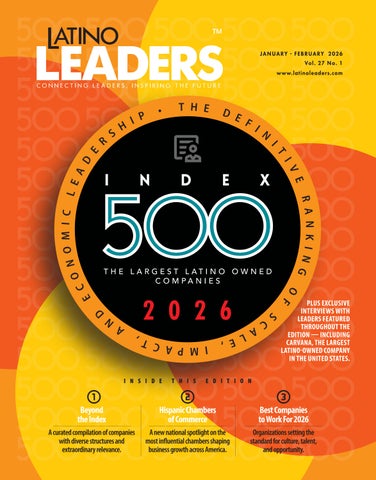
JANUARY - FEBRUARY 2026 Vol. 27 No. 1 www.latinoleaders.com
•
T H E
D E
F
I N
A
I V
D
T
E
I
R
S
H
I P
C
O M I C N O
R A N K I N G
L E
E
C
A
L E
,
I M P A C T T H I S
D
S
,
A
N
I N S I D E
F
E
O
2 0 2 6
PLUS EXCLUSIVE INTERVIEWS WITH LEADERS FEATURED THROUGHOUT THE EDITION — INCLUDING CARVANA, THE LARGEST LATINO-OWNED COMPANY IN THE UNITED STATES.
E D I T I O N
Beyond the Index
Hispanic Chambers of Commerce
Best Companies to Work For 2026
A curated compilation of companies with diverse structures and extraordinary relevance.
A new national spotlight on the most influential chambers shaping business growth across America.
Organizations setting the standard for culture, talent, and opportunity.
PortadaLLV27N1-Winner.indd 1
27/02/26 11:18 a.m.
WHERE PEOPLE GROW. LEADERS RISE. TRUST ENDURES.
Pan-American Life Insurance Group proudly celebrates being named among Latino Leaders Magazine’s 15 Best Companies for Latinos to Work For – 2026. Our people are the reason we continue to grow, serve, and earn the trust of millions. Their leadership, passion, and cultural pride define who we are—and the future we’re building together. At PALIG, we stand with our communities, upholding trust, honoring our promises, and living our purpose every day. Pan-American Life Insurance Group
00LL-PALIG.indd 2
26/02/26 4:05 p.m.
CONTENTS
JANUARY / FEBRUARY 2026
TABLE OF CONTENTS: Publisher Jorge Ferraez
President and CEO Raul Ferraez
• Foreword: Jorge Ferraez & Eduardo Tobon Co-Creators of the Index 500 - Page.9 INTRODUCTION
Editor Andrea Pina andrea.pina@latinoleaders.com Administrative Director Lawrence Teodoro Business Development Manager Cristina Villaseñor cristina@latinoleaders.com
• The Ranking of largest Latino-owned companies in the United States: Full List & Company Profiles - Page.14
• What the Numbers Say: Insights and Analysis from the Index 500 - Page. 42 • Exclusive Interview with the #1
Digital Media & Design Manager Wendy Zacarias wendy@latinoleaders.com
largest company Carvana: Teresa Aragon shares her insights: - Page. 44
Event Director Isabela Herrera isabela@latinoleaders.com
• Leadership Highlights: Voices from the Top Executives of the Index 500 - Page. 75
Art Director Fernando Izquierdo Editorial Art & Design Carlos Cuevas Luis Enrique González Moisés Cervantes Human Resources Manager Susana Sanchez Administration and Bookkeeping Carlos Bernal
• New section: Up & coming, companies with great potential - Page.90 • Best Companies for Latinos to Work 2026 - Page. 87 • Hispanic Chambers of Commerce:
A special feature highlighting those advocating for Latino entrepreneurs - Page. 94
Executive Assistant to the Publishers Liliana Morales For advertising inquiries, please call 214-206-9587
Latino Leaders: The National Magazine of the Successful American Latino (ISSN 1529-3998) is published seven times annually by Ferraez Publications of America Corp., 11300 N. Central Expressway, Suite 300, Dallas, TX, 75243, JANUARY / FEBRUARY 2026. Subscription rates: In U.S. and possessions, one year $15.00. Checks payable to Ferraez Publications of America, 15443 Knoll Trail, Suite 210, 75248 Dallas, TX, USA. POSTMASTER: Send address changes to Latino Leaders, 15443 Knoll Trail, Suite 210, 75248 Dallas, TX, USA.© 2001 by Ferraez Publications of America Corporation. All rights reserved. No part of this periodical may be reproduced without the consent of Latino Leaders: The National Magazine of the Successful American Latino. The periodical’s name and logo, and the various titles and headings therein, are trademarks of Ferraez Publications of America Corp.
Member of The National Association of Hispanic Publications
Audited by Member of Reg. # 283/01
MEMBER OF SRDS Latino Leaders The National Magazine of the Successful American Latino 11300 N. Central Expressway, Suite 300, Dallas, TX, 75243 Phone: 214-206-9587 / Fax: (214) 206-4970
01-TOC.indd 1
FOLLOW US @latinoleadersmag
FOLLOW US @LatinoLeadersUS
FOLLOW US LatinoLeadersMagazine
JANUARY / FEBRUARY 2026 LATINO LEADERS 1
27/02/26 9:57 a.m.
LATINO ART LEADERSHIP WHAT WE NEED TO LEARN FROM IT
By William Hanhausen
Courtesy of William Hanhausen
Carlos Cuevas
HERITAGE AND BRILLIANCE; THE UNIVERSAL VOICE OF LATINO AND CHICANO ARTISTS
T
here are moments when art ceases to be mere decoration and becomes revelation. Latino artists carry within their canvases, sculptures, and words a force that transcends borders, classifications, and labels. Their works are not an appendix to American art; they are American art— bold, unapologetic, and alive. In this spirit, we gather in celebration— not simply to hand out awards, but to honor the luminous contributions of men and women whose paths wind through business, education, civil service, religion, medicine, art, and more. These awardees are not defined solely by their professions; they are defined by their relentless service, their devotion, and their courage to leave a mark. It is a moment that creates not only recognition, but also a setting of intimacy and meaning, where gratitude is stronger than ceremony.
The Essence of “Damn Good Art”
“Damn Good American Art: The Truth of Latino Expression”
Let me be clear: Latino Art is not an “X.” It is not a checkmark in a box, nor a marketing label meant to satisfy institutions’ hunger for diversity optics. It is, first and foremost, damn good art. I write, collect, and speak about this genre not because it belongs to my heritage alone, but because it belongs to the human story. These artists speak with brush, stone, and voice—expressing stories layered with intellect, spirituality, and resilience. Their courage lies not in chasing validation, but in stripping away disguises to stand authentically before the world. Like Cervantes’ knight-errant tilting at windmills, they refuse to settle for token recognition. Instead, they demand their work be judged by mastery, depth, and beauty. And when you stand before their creations, you do not see a marginalized group asking for mercy—you see universality, discipline, and brilliance.
a box,” but because they command presence. They embody the truth: this is art that cannot be ignored.
Toward a True Platform
“Not an X: The Universal Voice of Latino Artists”
Latino art deserves to be lifted not by the crutch of an “X,” but by the undeniable force of excellence. When artists embrace this truth, they liberate themselves from the weight of expectation and enter the space where all great creators’ dwell: the realm of universality.
It is Damn Good American Art.
“Heritage and Brilliance: Latino Art as Damn Good Art”
The goal is not to erase heritage, but to transcend it—to let heritage enrich the work without imprisoning it. For in the end, Latino art is not “other.” It is not sepLatino art like it’s something other than art. arate. It is not an appendix. As if brushstrokes suddenly know the passport of the hand that paints them.” He would And that, in itself, is reason enough to celbe right. Too often, the conversation begins ebrate the genre. with identity politics and ends with diluted appreciation. But in the first division galleries around the world, or in the living rooms of serious collectors, art is judged not by the accent of its maker but by the fire it carries. This is why Latino artworks are coveted abroad. There, critics and curators look past the surname and toward the canvas itself. And when they do, they find excellence.
Exemplars of Leadership
“The Art of Courage: Latino Voices in America”
Consider the brilliance of Isabel Creixell, Devon Rodriguez, Vincent Valdez, Johan Barrios, Fernando Casas, Manfred Delgado, Benito Huerta, Eddy Martinez, Lara Alcántara, Alberto Godoy, Carmen Herrera, Teresita Fernández, Enrique Cabrera, Frank Romero, John Valadez, Marcos Raya, Luis Jimenez, Jesus Moroles, Aliza Nisenbaum, Ramiro Gomez, Alessandra Albin, Gabriela Monterroso, Vania Leporowski and Ana A Matter of Recognition Mendieta, to name a few. These names do “Beyond Labels: The Power of Latino Art” not rest on heritage alone—they stand on Andy Rooney might have said: “You know mastery. Their pieces live in museums, collecwhat bothers me? When people talk about tions, and galleries not because they “checked
01 “Mi crispo es mi crispo”
2 LATINO LEADERS JANUARY / FEBRUARY 2026
04 Hanhausen.indd 2
27/02/26 10:41
DE LA VEGA ON LEADERSHIP
Obstacles Welcome:
Leading Through Relentless Change
Ralph de la Vega
We are living in an era of continuous disruption. At home, families navigate shifting career paths, digital overload, and technologies that reshape how we learn and connect. At work, business models that once endured for decades are being reinvented in quarters. Artificial intelligence is accelerating this transformation—reshaping productivity, decision-making, and talent expectations—but it is only one force among many. Geopolitics, regulation, cybersecurity threats, demographic change, and evolving stakeholder demands are all redefining leadership. Change is no longer episodic. It is constant. THE REAL QUESTION is not how to
avoid obstacles and challenges, but how to respond to them. When I arrived in the United States as an immigrant, uncertainty was not a concept - it was daily life. I faced a new language, new systems, and limited resources. There was no roadmap. That experience shaped a conviction that has guided me ever since: obstacles are not interruptions to progress; they are the pathway to it.You can allow them to define you, or you can use them to grow stronger and move forward with greater clarity and confidence. That lesson has proven just as relevant in boardrooms as it was in my early years. Today’s leaders operate in an environment where disruption is routine. A competitor emerges with a new model. A regulatory shift changes economics overnight. A technology such as AI alters workflows and skill requirements. In these moments, the instinct is often to defend what exists. But leadership is not about preserving comfort; it is about creating clarity amid uncertainty. The real obstacle is rarely the external event. It is the internal resistance to change.
Over time, I have learned that navigating unexpected change begins with composure. Leaders must stabilize their own reactions before they can guide others. From there, the focus must shift to what is within control— values, execution, communication, and discipline. Every obstacle contains information. It reveals where capabilities are weak, where assumptions were flawed, and where new opportunities may exist. When anchored to a clear purpose, even disruptive forces can become catalysts for innovation. My journey—from immigrant to corporate leader and community servant has reinforced that resilience and credibility compound over time. When trust has been built consistently, stakeholders grant leaders the room to adapt and adjust. In volatile environments, character becomes a competitive advantage. Obstacles are inevitable. What is optional is your posture toward them. You can resist change and be overtaken by it, or you can welcome it, learn from it, and grow through it. In a world defined by velocity and uncertainty, the most powerful mindset remains simple and enduring: Obstacles Welcome.
Ralph de la Vega is the former vice-chairman of AT&T Inc. He is the author of the best-selling book “Obstacles Welcome: Turn Adversity to Advantage in Business and Life.” He is also a LinkedIn Influencer, posting regularly on leadership and innovation.
JANUARY / FEBRUARY 2026 LATINO LEADERS 3
RalphVegaJan-Feb26.indd 3
27/02/26 11:08 a.m.
LATINOS IN MUSIC
MAGOS HERRERA
MAGOS HERRERA: FROM JAZZ SINGER TO OPERA COMPOSER REINVENTING THE ARTIST — AND THE BUSINESS OF CREATIVITY
Alexis Langagne the author is a Global High-Tech Executive, Global VP at Diebold-Nixdorf and previously Regional CEO/COO at HP and Oracle; Board Advisor for high-tech startups and Board Director for a sports non-profit. Alexis is also a professional-level drummer.
4 LATINO LEADERS JANUARY / FEBRUARY 2026
06-Latinos in Music.indd 4
27/02/26 9:56 a.m.
Magos Herrera has built a career that reads like a masterclass in reinvention. Born in Mexico City and now based in New York, she evolved from a jazz vocalist with a distinctive sound into a composer, producer, educator, and most recently an opera creator. In business language, she didn’t pivot, she expanded her audience.
If you were remembered in 100 years for one piece? A Magos sees herself as a storyteller. She points to instrumental works from her album Aire, especially Papalote, and to the opera Primero Sueño, co-composed with Paola Prestini and inspired by the baroque literary masterpiece of Sor Juana Inés de la Cruz. For her, music is narrative architecture — not just sound, but meaning.
If not a musician? A A contemporary dancer - creative energy does not believe in single-industry specialization. When did music become your life? A While studying fashion design in Italy, watching a jazz singer in a bar. One performance redirected an entire career — a reminder that inspiration often arrives unannounced and completely ignores long term career plans.
SINGING in Spanish, English, and Portuguese, Magos embodies multicultural fluency long before globalization became a corporate buzzword. Beyond music, she is an active advocate for gender equality and the fight against violence against women — proof that leadership in the arts can extend well beyond the stage. After releasing five albums, she moved to the U.S. at 22 to study at the Musicians Institute in Los Angeles, continued in Boston, and eventually settled in New York to pursue her international ambitions. Today she teaches masterclasses at Berklee College of Music — effectively investing in the next generation while continuing to grow her own brand. If artists had annual reports, hers would show strong performance in both innovation and talent development. As a performer, Magos has toured nearly every continent, from Europe to Asia to Latin America. As a guest educator, she has taught in Malaysia, India, Switzerland, and Mexico. Few executives maintain that level of global presence without a jet lag strategy. During a recent visit to New York, I asked her my favorite questions:
Career setbacks? A “All the time.” She describes an artist’s path as a journey of constant recalibration. Even supportive parents worry when their child chooses music — the original startup career. Next big project? A New collaborations with artists she admires. For Magos, growth comes through partnership - a lesson equally valid in boardrooms and rehearsal rooms. On generative AI, she notes how technology has already transformed how we consume music, shrinking attention spans and fragmenting albums into singles.Yet she remains confident in the enduring value of live performance. Humans, it seems, still prefer humans. Magos creates not for market positioning but for the experience itself. Her curiosity remains the engine. Watching her career unfold feels like observing a company that refuses to plateau — always exploring new products, new territories, new stories. And if innovation has a soundtrack, Magos Herrera is happily composing it. JANUARY / FEBRUARY 2026 LATINO LEADERS 5
06-Latinos in Music.indd 5
27/02/26 9:56 a.m.
LATINO LEADERS
PRIVATE DIRECTORS ASSOCIATION (PDA)
PDA FIRST EVENT IN SAN JUAN BRINGS TOGETHER CEOS, KEY LEADERS IN PUERTO RICO
I
nterest in the Private Directors Association (PDA) and its mission “to drive private company success through the creation and optimization of governance boards, comprised of qualified and diverse members” is resonating as more than 35 chief executives and key leaders in Puerto Rico attended PDA’s first-ever meeting there on Jan. 28 at the historic Condado Vanderbilt Hotel in San Juan. KPMG’s Puerto Rico Office generously sponsored the by-invitation-only luncheon and presentation. The Board Harbor Foundation and Latino Leaders magazine also provided support for the event. “This is a special time for PDA,” said Debra McGuire, FASAE, MBA, IOM, CAE, President & CEO of the Private Directors Association. “With the large number of private companies in Puerto Rico—especially those with founders still active in their businesses and the incredible legacies of multi-generational family-owned companies—it is important in today’s rapidly changing marketplace to advocate on the value of leveraging governing boards to propel private companies to greater success. “We know that private companies are economic drivers of communities, and in Puerto Rico, this is certainly the case,” she continued. “PDA wants to be part of the growth that independent board members and good gover-
nance can bring to strengthen Puerto Rico’s business community.”
What Is PDA?
The Private Directors Association is a not-for-profit organization, founded in 2014 and headquartered in Chicago. It is virtual, with more than 3,400 members located throughout North America and around the globe. “Effective governance is essential for private organizations to thrive in today’s dynamic business environment”,” stated Luis Perez, Partner
at KPMG, Puerto Rico Office. “The Private Directors Association brings a robust network and deep experience, to foster collaboration with Puerto Rico’s business leaders as we navigate these times of change.” PDA currently has 21 Chapters, with two new Chapters in formation: Puerto Rico and the Kansas City Metro area. Private companies may join as Corporate Members; organizations may participate as Organizational Members, and those who currently serve on a board or who are preparing for service on a private company board, may become part of PDA as Individual Members. As part of “One PDA,” PDA members may participate in both National and Chapter events for free or at the discounted member rates when a registration fee is charged, regardless if they belong to the Chapter hosting the event or not, whether in-person or virtual. “One PDA” allows members
6 LATINO LEADERS JANUARY / FEBRUARY 2026
6 Debra.indd 6
27/02/26 10:42
to take advantage of a huge network of valuable contacts, participate in a wide array of quality educational programming, and post (or apply for) board opportunities.
Why Become Part of PDA?
During the luncheon, former Governor of Puerto Rico, Pedro Pierluisi, Managing Member of PRP Strategies, LLC, also spoke. “The Private Directors Association’s interest in having a local Chapter in Puerto Rico is good news for us,” Pierluisi stated. “PDA’s mission is to help private companies grow and prosper, and Puerto Rico’s private sector must be part of that equation.” Pierluisi shared his experiences as a PDA Member and provided insight about PDA’s signature event, PRISM—the Association’s annual
conference and exhibition that brings together PDA members throughout North America and around the globe. Pierluisi attended PRISM 2025 in October, which was held in Anaheim, CA. Hundreds of PDA members participated, with more than 30 educational sessions on a wide array of hot topics affecting private companies and their boards, along with specialized programs for those beginning their board journey. PRISM 2026 will take place at the Grand Hyatt Atlanta in Buckhead, Oct. 5-7. Edmund Green, Co-Founder and Board Chairman of The Board Harbor Foundation Inc. added: "PDA is at the forefront of driving the importance of demon-
strably high-quality corporate governance with its focus on the unique challenges and opportunities most prevalent in the private board governance arena. Given PDA's keen focus on private companies, including family owned, ESOPs, etc., the membership base is naturally comprised of individuals skilled at corporate governance for all stages of organizational maturity from start-ups to large, family-owned businesses with over a century of longevity. “There is no other organization in the corporate governance ecosystem that delivers the level of value in the private company governance space delivered by the PDA."
For more information about PDA, visit www.privatedirectors.org or to join the Puerto Rico Chapterin-Formation, please contact Kimberly Aldworth, PDA Director of Membership, at kaldworth@ privatedirectors.org or call 847.986.9350.
JANUARY / FEBRUARY 2026 LATINO LEADERS 7
6 Debra.indd 7
27/02/26 10:42
INDEX 500
OF THE LARGEST LATINO‑OWNED BUSINESSES 2026
8 LATINO LEADERS JANUARY / FEBRUARY 2026
Intro index.indd 8
02/03/26 9:15 a.m.
INDEX 500 2026 A VERY SPECIAL CLUB
OUR REASON BEHIND THIS CLUB: SCALE, IMPACT, AND RESPONSIBILITY When we created the Latino Leaders Index platform, we immediately set it to become a special, community, group and better said: a club. A very special club of the five hundred largest companies and organizations owned by Latinos in our country. This exclusive club goes well beyond the publication of a list; it is about a sense of community so it brings greater visibility, structure, and recognition to one of the most dynamic forces in our American economy. WHAT BEGAN as an effort to orga-
nize and validate data has grown into a broader reflection of scale, impact, and responsibility. With this fourth edition of the Index 500, we are still identifying and elevating the largest Latino-owned companies as well as key organizations that are beyond the primary list in the United States. Across industries, these businesses continue to expand with creativity and ambition. From manufacturing and technology to construction, healthcare, financial services, energy, food, and logistics, Latino-owned companies are building and growing at scale. The largest company this year, Carvana, reached nirvana level growth at scale. Several private equity players and venture capital firms understand the opportunities with all these companies in terms of impact. These companies and their respective owners as well as other organizations beyond the Index are generating revenue, creating jobs, investing in their communities, and contributing to long-term wealth creation. As these companies and organizations move from early growth into sustained scale, the focus naturally shifts. Governance, succession planning, capital strategy, operational excellence, and long-term resilience become defining priorities.
Their leadership carries both opportunity and responsibility. Last year, the introduction of “Beyond the Index” recognitions acknowledged a broader ecosystem of leaders, institutions, and partners who contribute to the advancement of Latino enterprise. Sustainable progress is rarely achieved alone. It is shaped by collaboration, mentorship, access to capital, and shared accountability.
The Index 500 club serves as both a benchmark and a resource. Reliable information helps founders measure progress, supports boards in guiding strategy, and provides investors and institutions with clearer insight into a powerful and expanding segment of the economy. In a time of rapid technological change and scrutinized capital allocation, clarity and credibility matter. Each edition reveals new milestones, new companies reaching scale, and a growing presence of Latinas in executive and ownership roles. The network continues to deepen, reflecting both achievement and potential. The Latino business community represents a vital engine of economic growth in the United States. Its continued expansion strengthens industries, communities, and the broader national landscape. To the founders, CEOs, executives, board members, and aspiring entrepreneurs featured in these pages, we have one message: we admire and celebrate you. Your leadership sets the standard for what is possible. We are honored to continue to watch and promote your work supporting you.
Jorge Ferraez & Eduardo Tobon Co-creators of the Index 500
JANUARY / FEBRUARY 2026 LATINO LEADERS 9
Jorge&Eduardo.indd 9
27/02/26 11:41 a.m.
INDEX 500 2025
BMO FOREWORD
EXECUTIVE FOREWORD FOR LATINO LEADERS INDEX 500 BMO is proud to continue our multi-year partnership with Latino Leaders Magazine as we present the 2026 Latino Leaders Index 500. Now in its fourth year, the Index has become a trusted platform for recognizing the scale, impact, and leadership of Latino-owned companies across the United States. Each edition highlights the influence of Latino executives, founders, and owners who are shaping the direction and competitiveness of American enterprise. THE STRENGTH of this community is evident in the data.The U.S. Latino GDP has reached $4.0 trillion - an economy that, if measured independently, would rank as the fifth largest in the world. This growth reflects not only market participation, but also leadership, innovation, and disciplined execution across industries essential to the nation’s economic future. Latino-led organizations are expanding market presence, strengthening supply chains, and setting new standards in industries central to national growth. That influence is evident in the rapid expansion of the Latino economic engine. Between 2015 and 2023, the U.S. Latino GDP grew more than twice as fast as the rest of the U.S. economy, underscoring the agility, innovation, and leadership of this community. By highlighting their work, the Index underscores the importance of representation among decision-makers influencing strategy, investment, and growth at the highest levels. The Index plays a meaningful role in amplifying the achievements of Latino leaders, showcasing their success and impact at scale. Their stories demonstrate how leadership shaped by diverse experience strengthens organizations, fuels innovation, and enhances long-term competitiveness. Just as importantly, the Index underscores the importance of representation among decision-makers influencing strategy, investment, and growth at the highest levels.
ERIC SMITH VICE CHAIR, BMO
At BMO, our purpose—to Boldly Grow the Good in business and in life—guides our commitment to supporting clients and stakeholders who are shaping stronger communities. We provide strategic financial insights, advisory capabilities, and tailored solutions to help organizations navigate opportunities with clarity and confidence. We’re proud to be a trusted partner to the leaders shaping the next era of American industry. As we present the 2026 Latino Leaders Index 500, BMO celebrates the extraordinary accomplishments of this year’s honorees. Their success demonstrates what is possible when vision, determination, and disciplined execution come together. We are proud to stand alongside these leaders and remain committed to boldly growing the good by supporting their continued success, influence, and impact across the national business landscape.
10 LATINO LEADERS JANUARY / FEBRUARY 2026
10-Erick.indd 10
27/02/26 9:55 a.m.
INDEX 500 USHCC
T
CAPITAL, CONNECTIONS, AND CAPACITY: FOREWORD TO THE INDEX 500 2026
he United States Hispanic Chamber of Commerce (USHCC) is accelerating business growth and prosperity in America by strengthening three pillars of business success: capital, connections, and capacity. Focusing on these foundational “Three Cs” allows us to help America’s Hispanic-owned businesses scale up and align their products and services with the needs of Fortune 500 corporations and U.S. government contracts. This work has paid significant dividends for our community and for the nation. The U.S. GDP has tripled since the year 2000, growing from $10 trillion to over $31 trillion in 2025, thanks in large part to the contributions of America’s roughly 5 million Hispanic-owned businesses, which are supported by a network of 260 Hispanic Chambers of Commerce and the business and buying power of over 68 million Americans of Hispanic origin. The overall contribution of America’s Latinos to the U.S. GDP has surged to over $4 trillion — exceeding the GDPs of India, the United Kingdom, and France. In fact, despite representing only 20% of the U.S. population, Latinos were responsible for over 30% of American GDP growth since 2019.
Hispanic-owned businesses growth outpaces the national average as well. They have grown at an average annual rate of 7.7%, far surpassing the 0.46% growth rate for other employer businesses nationwide.
And there’s still room to grow.
Since America’s Latino population represents 20% of the nation’s total population, increasing the share of Hispanic-owned businesses to match this proportion would result in the creation of 812,440 new businesses, generating a combined $1.1 trillion in additional revenue and $250 billion in payroll. America’s economy grows stronger and more competitive every day thanks to the hard work, innovation, and dynamic business sense of our Hispanic entrepreneurs. The USHCC is proud to partner with Latino Leaders magazine to recognize and celebrate the outsized economic impact of America’s Latino community. Jorge Ferraez and the Latino Leaders team have made it their mission to recognize Latino leaders, and this year’s Latino Top 200 Index is a veritable “Who’s Who” of the men and women shaping the future of a strong American economy.
RAMIRO A. CAVAZOS President & CEO, United States Hispanic Chamber of Commerce JANUARY / FEBRUARY 2026 LATINO LEADERS 11
USHCC.indd 11
27/02/26 9:10 a.m.
INDEX 500 2026
BMO
ON THE INDEX 500 A CONVERSATION WITH ARON LEVINE PRESIDENT, BMO U.S.
You recently stepped into a role that brings together U.S. Personal and Business Banking, Commercial Banking, and Wealth Management under one leadership structure. How would you describe your approach to leading this unified platform and the kind of experience you want business leaders to have when they work with BMO? AL: Bringing these businesses together is grounded in a belief I hold deeply: we win when our clients win. Business owners don’t organize their lives around banking categories; they think about growth, opportunity, and long-term impact. Our responsibility is to support those goals with clarity, consistency, and a deep understanding of their full financial picture. At BMO, alignment and simplicity matter because they lead to better client outcomes. When our teams work together to bring everything BMO offers to a client’s unique financial goals, clients experience seamless, relationship-driven support that combines strong advice with convenience in how they manage their money. Leaders who partner with BMO should feel confident that we’re accountable at every stage of their journey – focused on long-term progress, not just individual transactions. BMO has the best team in banking – talented, empowered bankers who are focused on helping our clients and communities make progress now and in the future.
Your background includes work across consumer banking, commercial real estate, strategy, marketing, and global wealth. How do these experiences shape the way you think about supporting entrepreneurs and leaders in building high-growth companies? AL: Those experiences have reinforced that growth is rarely linear. And for business owners, growth is often deeply personal. Business decisions don’t happen in isolation – they intersect with market conditions, capital needs, and personal financial considerations. That perspective shapes how I think about our role as a bank. Supporting high-growth companies means taking a holistic view: anticipating what’s next, helping leaders weigh trade-offs, and offering guidance grounded in experience across cycles and industries. Whether it’s capital structure, risk management, or long-term planning, our responsibility is to help leaders move forward with clarity and confidence—not simply react to the moment in front of them. As businesses grow, their financial needs evolve quickly. How does BMO guide companies through the different stages of that journey? AL: We view growth as a continuous journey, not a series of disconnected moments. Early on, businesses are focused on cash flow, efficiency, and day-to-day operations. As they scale, the conversation expands to strategic investment, talent, and risk management. Later, leaders may be thinking about acquisitions, entering new markets, or long-term momentum. Continuity matters. Our role at BMO is to be a partner through every stage of that evolution, with advice that grows alongside the business and helps them smoothly bridge the stages of growth. As our client relationships deepen, we’re better positioned to anticipate what’s next, offer proactive guidance, and help leaders prepare rather than react. It’s how we turn banking relationships into long-term partnerships – and help clients move forward with confidence.
“WHEN BANKS HELP CONNECT ENTREPRENEURS TO THE RIGHT RELATIONSHIPS AND PERSPECTIVES – NOT JUST THE RIGHT FINANCING – THEY HELP BUILD STRONGER BUSINESSES.” Q BMO partners with Latino Leaders Magazine on the Latino Leaders Index500. When you spend time with leaders in this community, what stands out to you? AL: What stands out most is ambition grounded in purpose. Leaders I’ve met through the Latino Leaders Index500 are building highly competitive, growth-oriented companies while staying deeply connected to their employees, families and communities. Many are focused not only on scaling their business, but on building a legacy—creating opportunity and opening doors for others along the way. There’s also a remarkable level of resilience.These leaders are navigating complex environments, yet they continue to innovate, expand, and contribute meaningfully to the broader economy and the community around them. That combination of drive, responsibility, and long-term vision aligns closely with how we think about partnership at BMO.
12 LATINO LEADERS JANUARY / FEBRUARY 2026
12-13-Aron Levine.indd 12
27/02/26 9:54 a.m.
Strong relationships often reveal their value during challenging moments. What helps build genuine trust between a business leader and their financial partner? AL: Trust is built over time, long before a challenging moment arrives. It’s earned through consistency, transparency, and ac‑ countability – especially when decisions are com‑ plex, and outcomes are not guaranteed. In my experience, trust is shaped by the smaller mo‑ ments: listening carefully, returning the call, and offering an honest perspective when the answer isn’t easy. Some‑ times that means having difficult conversations, but lead‑ ers value partners who are focused on what’s right for their long‑term success. In uncertain environments, those relationships create the confidence leaders need to make informed decisions and keep moving forward. Technology has become central to how companies operate and compete. How do you blend digital tools with personal guidance? AL: Technology should simplify complexity, not re‑ place relationships. Digital tools give business lead‑ ers greater visibility, efficiency, and control – but when decisions are high-stakes or nuanced, per‑ sonal guidance still matters. At BMO, we pair strong digital capabilities with experi‑ enced bankers who can interpret information and provide context. When data and human judgment work together, clients are better informed, better supported, and more confident in the decisions they make. That balance is critical as technology continues to re‑ shape how companies operate and compete. Our goal is to make banking easier and more intuitive, while ensuring our clients always have access to trusted advice. BMO has introduced programs designed to expand access to capital and financial resources for historically underserved communities. What principles guide that approach? AL: In 2023, we launched a five‑year, $40+ billion commitment to help more individuals, families, businesses, and communities make real financial progress. Altogether, the effort reflects our drive to support a thriving economy and strong neigh‑ borhoods. It supports economic growth through financial solutions and community programs that
expand access to capital, make homeowner‑ ship more affordable, support small business growth, and strengthen financial literacy. Our approach is grounded in access, readiness, and trust. Expanding opportunity starts with removing barriers to capital and financial re‑ sources, but it doesn’t stop there. It also means ensuring clients have the knowledge, tools, and support to use those resources effectively. Inclusion isn’t about a single product or moment — it’s about build‑ ing pathways and relationships over time. When clients are prepared, in‑ formed, and supported, access to capital becomes more meaningful and sustainable.That’s how we help businesses grow, strengthen communities, and drive long-term economic progress. Latino founders often emphasize the importance of networks and advisory support. What role should financial institutions play beyond lending? AL: Capital is important, but it’s only part of what entrepreneurs need to succeed. Financial institutions can play a meaningful role by helping founders access broader networks of advisors, peers, and resources that support sustainable growth. That means convening leaders, fostering mentorship, sharing insight, and investing in education that strengthens decision-making. Platforms like the Latino Leaders Index500, which recognizes top Latino‑owned businesses across the U.S., add real value by elevating business leaders, increasing visibility, and creating opportunities for connection within a broader national ecosystem. When banks help connect entrepreneurs to the right relationships and perspectives – not just the right financing – they help build stronger businesses. Supporting that broader ecosystem isn’t ancillary to our role; it’s central to long-term success. When entrepreneurs are surrounded by strong networks and trusted guidance, they’re better positioned to grow, adapt, and create lasting impact. Looking ahead, what gives you the most optimism about the future of U.S. banking and the next generation of business leaders? AL: What gives me the most optimism is the talent, creativity, and purpose I see in today’s business leaders. Entrepreneurs across the country are building companies that are more inclusive, more innovative, and more globally connected than ever before.They’re not just focused on growth – they’re focused on impact, resilience, and building businesses that reflect their values. At the same time, banking is evolving in powerful ways. Advances in technology and data allow us to be more responsive, more per‑ sonalized, and more proactive in how we support clients. When you combine that progress with a generation of leaders who are both pur‑ pose-driven and ambitious, the opportunity ahead is incredibly strong — not just for businesses, but for the communities and economies they help shape.
WHEN YOU COMBINE THAT PROGRESS WITH A GENERATION OF LEADERS WHO ARE BOTH PURPOSE-DRIVEN AND AMBITIOUS, THE OPPORTUNITY AHEAD IS INCREDIBLY STRONG. JANUARY / FEBRUARY 2026 LATINO LEADERS 13
12-13-Aron Levine.indd 13
27/02/26 9:54 a.m.
Powered by
INDEX 500
INDEX 500 LIST
2026 1
6
11
Auto Retail • Auto sales Tempe, AZ
Advertising, Marketing & Media • Broadcasting Miami, FL
Auto Retail • Auto dealerships Orlando, FL
Leadership: Ernie Garcia Employee count: 23,100 Company website: carvana.com Revenue per year: $ 20,322,000
Leadership: Daniel Alegre (CEO) Employee count: 3,000 Company website: televisaunivision.com Revenue per year: $ 4,800,000
Leadership: Frank Rodriguez (Chair) Employee count: 3,000 Company website: greenway.com Revenue per year: $ 2,900,000
2
7
12
Engineering / Construction • Engineering construction Miami, FL
Food and Beverage • Food distributor Coral Gables, FL
Engineering / Construction • Real estate Miami, FL
Leadership: Jose Mas Employee count: 33,000 Company website: mastec.com Revenue per year: $ 14,075,000
Leadership: Frank Grande Employee count: 1,849 Company website: quirchfoods.com Revenue per year: $ 4,434,178
Leadership: Jorge Perez (Chair, CEO) Employee count: 3,000 Company website: relatedgroup.com Revenue per year: $ 2,800,000
3
8
13
Information / Technology • Government technology solutions Huntsvil e, AL
Information / Technology • IT consulting firm Atlanta, GA
Auto Retail • Multi brand dealerships Miami, FL
Leadership: Vergenia Shelton Employee count: 350 Company website: https://irtc-hq.com/ Revenue per year: $ 10,000,000
Leadership: Neil M. Ashe Employee count: 13,800 Company website: https://www.acuityinc.com/ Revenue per year: $ 4,300,000
Leadership: Mario Murgado Employee count: 1,913 Company website: murgadoautomotivegroup.com Revenue per year: $ 2,547,713
4
9
14
Food Services & Retail • Global bakery products leader Horsham, PA
Food and Beverage • Beverages distributor Dallas, TX
Information / Technology • Enterprise software solutions Santa Monica, CA
Leadership: Daniel Servitje Employee count: 149,000 Company website: grupobimbo.com/ Revenue per year: $ 8,400,000
Leadership: Jean-Claude Tissot (President) Employee count: 8,800 Company website: cocacolaswb.com Revenue per year: $ 4,280,000
Leadership: Alex Israel Employee count: 20,000 Company website: https://www.metropolis.io/ Revenue per year: $ 2,500,000
5
10
15
Food and Beverage • Sugar refining, real estate West Palm Beach, FL
Food Services & Retail • Subsidiary GRUMA Irving, TX
Food Services & Retail • Restaurant franchises Dallas, TX
Leadership: Juan Antonio Gonzalez Moreno Employee count: 3,470 Company website: missionfoods.com/ Revenue per year: $ 3,447,500
Leadership: Guillermo Perales Employee count: 33,000 Company website: sunholdings.net Revenue per year: $ 2,000,000
CARVANA *
INDEX 500
MASTEC *
INTUITIVE RESEARCH AND TECHNOLOGY CORPORATION **
BIMBO BAKERIES USA ***
FANJUL CORPORATION/FLORIDA CRYSTALS ***
Leadership: Alfonso Fanjul (CEO) Employee count: 3,000 Company website: floridacrystalscorp.com Revenue per year: $ 7,749,000
TELEVISAUNIVISION *
QUIRCH FOODS *
ACUITY INC. **
COCA COLA SW BEVERAGES ***
GRUMA CORPORATION *
14 LATINO LEADERS JANUARY / FEBRUARY 2026
Index 500 - 2026.indd 14
GREENWAY AUTOMOTIVE ***
THE RELATED GROUP ***
MURGADO AUTOMOTIVE GROUP *
METROPOLIS TECHNOLOGIES **
SUN HOLDINGS *
* Revenue 2025 amount confirmed by company ** Revenue 2025 amount estimate based on research of public information *** 2024 revenue, no new information was provided All revenues are displayed in thousands of dollars
06/03/26 1:23 p.m.
Powered by
INDEX 500 LIST
16
22
28
Food and Beverage • Meat products manufacturer El Paso, TX
Manufacturing • Aluminum, steel sales Dearborn, MI
Industrial / Building Materials • Miami, FL
THE DIEZ GROUP *
TECNOGLASS INC *
Leadership: Eugenio Baeza Employee count: 13,020 Company website: https://www.bafarinternational.com/ Revenue per year: $ 1,800,000
Leadership: Gerald (April) Diez (Chair, CEO) Employee count: 515 Company website: thediezgroup.com Revenue per year: $ 1,000,000
Leadership: Jose M. Daes Employee count: 9,675 Company website: WWW.TECNOGLASS.COM Revenue per year: $ 983,610
17
23
29
Health Care • Medical and living assistance Doral, FL
Administrative & Managing Services • HR solutions New York, NY
Food and Beverage • Food manufacture Frisco, TX
INDEPENDENT LIVING SYSTEMS, LLC *
PRIDE GLOBAL ***
RUIZ FOODS ***
Leadership: Nestor Plana (CEO and Owner) Employee count: 1550 Company website: ilshealth.com Revenue per year: $ 1,700,000
Leadership: Leo Russell Employee count: 479 Company website: prideglobal.com Revenue per year: $ 1,000,000
Leadership: Kimberly Ruiz Beck Employee count: 3,000 Company website: ruizfoods.com Revenue per year: $ 960,000
18
24
30
Food and Beverage • Hispanic foods Jersey City, NJ
Food and Beverage • Retail groceries Anaheim, CA
Financial Services • Lender San Mateo, CA
GOYA ***
NORTHGATE MARKETS ***
OPORTUN *
Leadership: Roberto Unanue (CEO) Employee count: 3,000 Company website: goya.com Revenue per year: $ 1,500,000
Leadership: Miguel Gonzalez Employee count: 7,500 Company website: northgatemarket.com Revenue per year: $ 1,000,000
Leadership: Raul Vazquez Employee count: 2,498 Company website: oportun.com Revenue per year: $ 955,000
19
25
31
Food Services & Retail • Hispanic grocery chain San Fernando, CA
Financial Services • Real estate, fitness, & media Coral Gables, FL
Auto Retail • Used auto retailer Phoenix, AZ
VALLARTA SUPERMARKETS *
A-ROD CORP ***
DRIVETIME AUTOMOTIVE ***
Leadership: Enrique Gonzalez, Jr. Employee count: 2,300 Company website: https://www.vallartasupermarkets.com Revenue per year: $ 1,500,000
Leadership: Alexander Rodriguez Employee count: 350 Company website: arodcorp.com Revenue per year: $ 1,000,000
Leadership: Ernie Garcia II Employee count: 3,000 Company website: drivetime.com Revenue per year: $ 950,000
20
26
32
Food and Beverage • Supplies meat to global chains Oklahoma City, OK
Administrative & Managing Services • Commercial real estate Houston, TX
Administrative & Managing Services • Outsourcing Milan, IL
LOPEZ DORADA *
NAN AND COMPANY PROPERTIES **
GROUP O INC. ***
Leadership: Francisco Gonzalez (CEO) / Ed Sanchez Employee count: 1,900 Company website: lopezdorada.com Revenue per year: $ 1,482,000
Leadership: Nancy Almodovar Employee count: 206 Company website: https://nanproperties.com/ Revenue per year: $ 1,000,000
Leadership: Kevin Kotecki/ Gregg Ontiveros Employee count: 1,000 Company website: groupo.com Revenue per year: $ 950,000
21
27
33
Administrative & Managing Services • Security guards Pasadena, CA
Financial Services • Residential mortgage lender Corona, CA
Financial Services • Mortgages Tustin, CA
INTER-CON SECURITY *
Leadership: Henry & Rick Hernandez Employee count: 40,000 Company website: icsecurity.com Revenue per year: $ 1,300,000
PRMG (PARAMOUNT RESIDENTIAL MORTAGE GROUP) **
Leadership: Paul Rozo (CEO) Employee count: 1,882 Company website: www.prmg.net Revenue per year: $ 1,000,000
* Revenue 2025 amount confirmed by company ** Revenue 2025 amount estimate based on research of public information *** 2024 revenue, no new information was provided All revenues are displayed in thousands of dollars
Index 500 - 2026.indd 15
INDEX 500
BAFAR INTERNATIONAL **
NEW AMERICAN FUNDING *
Leadership: Rick and Patty Arvielo (Owners) Employee count: 5,100 Company website: newamericanfunding.com Revenue per year: $ 925,000 JANUARY / FEBRUARY 2026 LATINO LEADERS 15
06/03/26 1:23 p.m.
Powered by
INDEX 500 LIST
34
40
46
Manufacturing • Manufacturer and marketer of apparel Miami, FL
Information / Technology • Digital advertising solutions Riverside, CA
Engineering / Construction • Construction services Detroit, MI
PERRY ELLIS INTERNATIONAL *
Leadership: Oscar Feldenkreis Employee count: 2,000 Company website: pery.com Revenue per year: $ 860,000
Leadership: Jales D. Mello Employee count: 1,396 Company website: https://alephholding.com/ Revenue per year: $ 700,000
Leadership: Loren Venegas/Frank Venegas Employee count: 845 Company website: weareideal.com Revenue per year: $ 600,000
35
41
47
Manufacturing • Renewable energy equipment Somervil e, MA
Health Care • Accountable care organization Miami, FL
Professional Services • Advisory consulting firm Solana Beach, CA
FORM ENERGY ***
GENUINE HEALTH ***
EVOTEK, INC. *
Leadership: Matteo Jaramillo (CEO/Founder) Employee count: 300 Company website: formenergy.com Revenue per year: $ 850,007
Leadership: Joe Caruncho/Orlando Lopez-Fernandez, Jr. Employee count: 120 Company website: genuinehealthgroup.com Revenue per year: $ 700,000
Leadership: César Enciso Employee count: 215 Company website: evotek.com Revenue per year: $ 600,000
36
42
48
Food and Beverage • Mexican foods Norcross, GA
Industrial / Building Materials • Ceramic tile manufacturer Carrollton, TX
Financial Services • AI-powered spend platform San Francisco, CA
OLÉ MEXICAN FOODS INC ***
INDEX 500
IDEAL GROUP ***
ALEPH GROUP INC **
INTERCERAMIC **
BREX ***
Leadership: Maria Veronica Moreno (CEO) Employee count: 2,000 Company website: olemex.com Revenue per year: $ 775,000
Leadership: Víctor Almeida García Employee count: 3,000 Company website: https://interceramic.com/ Revenue per year: $ 679,500
Leadership: Henrique Dubugras (Founder/Co-CEO) Employee count: 1,150 Company website: brex.com Revenue per year: $ 592,900
37
43
49
Financial Services • Auto insurance provider El Paso, TX
Retail • Grocery Store Commerce, CA
Professional Services • Workforce Solutons Troy, MI
FRED LOYA INSURANCE **
CHEDRAUI ***
POPULUS GROUP ***
Leadership: Fred Loya Jr. Employee count: 3,500 Company website: https://www.fredloya.com/ Revenue per year: $ 756,100
Leadership: José Antonio Chedraui Eguía Employee count: 10,000 Company website: chedrauiusa.com Revenue per year: $ 650,000
Leadership: Bobby Herrera Employee count: 125 Company website: populusgroup.com Revenue per year: $ 592,000
38
44
50
Auto Retail • Auto sales, dealerships Littleton, CO
Financial Services • Health and Life Insurance Miami, FL
Administrative & Managing Services • Purchasing solutions Coral Gables, FL
ALPINE AUTOMOTIVE GROUP *
BMI / BEST MERIDIAN INSURANCE COMPANY *
LEADER GLOBAL SOLUTIONS LLC *
Leadership: Ivette Dominguez Employee count: 625 Company website: alpinebuickgmc.com Revenue per year: $ 754,687
Leadership: Anthony F. Sierra (CEO/Owner) Employee count: 949 Company website: bmicos.com Revenue per year: $ 641,000
Leadership: Jose Antonio Gonzalez (CEO) Employee count: 20 Company website: leaderglobalsolutions.com Revenue per year: $ 585,000
39
45
51
Auto Retail • Auto sales, service Kansas City, MO
Food and Beverage • Retail supermarket chain Miami, FL
Food and Beverage • Meat products Houston, TX
CABLE DAHMER AUTOMOTIVE ***
Leadership: Carlos Ledezme Employee count: 750 Company website: cabledahmer.com Revenue per year: $ 736,000
SEDANO'S SUPERMARKET MANAGEMENT, INC. ***
Leadership: Guerra and Herran Families Employee count: 3,000 Company website: sedanos.com Revenue per year: $ 602,000
16 LATINO LEADERS JANUARY / FEBRUARY 2026
Index 500 - 2026.indd 16
AMIGOS MEAT DISTRIBUTORS ***
Leadership: Max Hurtado (President) Employee count: 122 Company website: amigosmeat.com Revenue per year: $ 565,000 * Revenue 2025 amount confirmed by company ** Revenue 2025 amount estimate based on research of public information *** 2024 revenue, no new information was provided All revenues are displayed in thousands of dollars
06/03/26 1:23 p.m.
Powered by
INDEX 500 LIST
52
58
64
Engineering / Construction • Building materials Santa Ana, CA
Food and Beverage • Protein snack brand Naples, FL
Food Services & Retail • Sugar supply innovation Coral Gables, FL
CHOMPS **
SUCRO CAN ***
Leadership: Ruben Mendoza Employee count: 3,000 Company website: fbmsales.com Revenue per year: $ 521,300
Leadership: Pete Maldonado Employee count: 78 Company website: https://chomps.com/ Revenue per year: $ 500,000
Leadership: Jonathan Taylor Employee count: 35 Company website: sucro.us/ Revenue per year: $ 441,044
53
59
65
Food and Beverage • Food distribution Maywood, CA
Manufacturing • Subsidiary Braskem BR Philadelphia, PA
Information / Technology • Sotware development Addison, TX
TAPIA BROTHERS COMPANY *
BRASKEM AMERICA ***
SOFTTEK INTEGRATION SYSTEMS ***
Leadership: Raul, Ramon, and Francisco Tapia (Owners) Employee count: 380 Company website: tapiabrothers.com Revenue per year: $ 510,000
Leadership: Mark Nikolich Employee count: 9,000 Company website: braskem.com.br/usa Revenue per year: $ 470,000
Leadership: Blanca Treviño(CEO for USA) Employee count: 15,000 Company website: softtek.com Revenue per year: $ 403,650
54
60
66
Engineering / Construction • General contractor Frisco, TX
Food and Beverage • Restaurant holding company Greenwood Vil age, CO
Manufacturing • Traditional Mexican Foods Mira Loma, CA
PEINADO CONSTRUCTION ***
PALO ALTO, INC. ***
DEL REAL FOODS LLC *
Leadership: Frank Peinado Employee count: 126 Company website: fapeinado.com Revenue per year: $ 508,000
Leadership: Rob Alvarado (CEO/Owner) Employee count: 4,750 Company website: teamarn.com Revenue per year: $ 469,200
Leadership: Ricardo Perdomo Employee count: 650 Company website: delrealfoods.com Revenue per year: $ 400,000
55
61
67
Manufacturing • Electro-hydraulic controls Waukesha, WI
Food and Beverage • Restaurants, food franchises Plano, TX
Professional Services • Government consulting services Valrico,FL
HUSCO INTERNATIONAL, INC. *
TASTY RESTAURANT GROUP, LLC *
OPIFEX-SYNERGY **
Leadership: Austin Ramirez (CEO) Employee count: 1,500 Company website: husco.com Revenue per year: $ 500,000
Leadership: Robert Rodriguez (CEO) Employee count: 8,500 Company website: tastyrg.com Revenue per year: $ 461,000
Leadership: Jay Vaughn III Employee count: 938 Company website: https://www.synergyequip.com/ Revenue per year: $ 397,700
56
62
68
Retail • Online wholesale marketplace San Francisco, CA
Auto Retail • Auto dealerships San Antonio, TX
Engineering / Construction • Engineering, construction Concord, CA
FAIRE *
ANCIRA ENTERPRISES ***
BAY CITIES PAVING & GRATING *
Leadership: Marcelo Cortes Employee count: 1,000 Company website: faire.com/ Revenue per year: $ 500,000
Leadership: Ernesto Ancira Employee count: 750 Company website: ancira.com Revenue per year: $ 456,000
Leadership: Ben Rodriguez Jr. Employee count: 350 Company website: baycities.us Revenue per year: $ 382,694
57
63
69
Engineering / Construction • Electrical contracting services Tempe, AZ
Retail • Grocery retail Cataño, PR
Retail • Home and care products Los Angeles, CA
DP ELECTRIC **
Leadership: Dan Puente Employee count: 750 Company website: https://dpelectric.com/ Revenue per year: $ 500,000
BALLESTER HERMANOS, INC. ***
Leadership: Alejandro Ballester Employee count: 272 Company website: ballesterhermanos.com/ Revenue per year: $ 445,844
* Revenue 2025 amount confirmed by company ** Revenue 2025 amount estimate based on research of public information *** 2024 revenue, no new information was provided All revenues are displayed in thousands of dollars
Index 500 - 2026.indd 17
INDEX 500
FOUNDATION BUILDING MATERIALS ***
THE HONEST COMPANY *
Leadership: Carla Vernón, CEO Employee count: 155 Company website: honest.com Revenue per year: $ 378,000 JANUARY / FEBRUARY 2026 LATINO LEADERS 17
06/03/26 1:23 p.m.
Powered by
INDEX 500 LIST
70
76
82
Administrative & Managing Services • Towing Los Angeles, CA
Information / Technology • IT Consulting Salem, NH
Retail • Beverage, food, and household goods distributor Bayamón, PR
VIERTEL'S TOWING SERVICES ***
V. SUAREZ & CO., INC. ***
Leadership: Art Mercer Employee count: 13 Company website: Revenue per year: $ 368,969
Leadership: Belisario Rosas Employee count: 100 Company website: wei.com Revenue per year: $ 344,124
Leadership: Diego Suarez Employee count: 250 Company website: vsuarez.com Revenue per year: $ 327,172
71
77
83
Advertising, Marketing & Media • Global ad-tech Santa Monica, CA
Manufacturing • Medical Devices & Equipment El Paso, TX
Manufacturing • Auto and electrical components Nogales, AZ
ENTRAVISION COMMUNICATIONS ***
SEISA MEDICAL, INC. ***
E.D.S. MANUFACTURING, INC. ***
Leadership: Michael Christenson (CEO) Employee count: 1,200 Company website: entravision.com Revenue per year: $ 366,630
Leadership: Julio Chiu Employee count: 245 Company website: seisa.com/ Revenue per year: $ 341,659
Leadership: Luis Moreno Sr. Employee count: 40 Company website: edsmanufacturing.com Revenue per year: $ 323,955
72
78
84
Information / Technology • Engineering support Huntsvil e, AL
Food and Beverage • Specialty foods to restaurants Atlanta, GA
Industrial / Building Materials • Petrochemical marketing Houston, TX
COLSA CORP. ***
INDEX 500
WORLDCOM EXCHANGE, INC. (WEI) ***
DIAZ WHOLESALE & MANUFACTURING ***
THE PLAZA GROUP ***
Leadership: Frank J. Collazo (Founder) Employee count: 3,000 Company website: colsa.com Revenue per year: $ 357,800
Leadership: Rene Diaz (CEO) Employee count: 350 Company website: diazfoods.com Revenue per year: $ 338,000
Leadership: Randy Velarde Employee count: 30 Company website: theplazagrp.com Revenue per year: $ 323,000
73
79
85
Engineering / Construction • General Contractor Davie, FL
Miscellaneous • Major League Baseball franchise Anaheim, CA
Auto Retail • Cars, parts, services Troy, MI
ANF GROUP, INC. ***
ANAHEIM ANGELS ***
ELDER AUTO GROUP ***
Leadership: ‘Al’ & Nelson Fernandez, and Alberto Gil Employee count: 104 Company website: anfgroup.com Revenue per year: $ 355,000
Leadership: Arturo Moreno (Owner) Employee count: 350 Company website: mlb.com Revenue per year: $ 331,000
Leadership: Rob Elder (President) Employee count: 750 Company website: elderautogroup.com Revenue per year: $ 319,000
74
80
86
Information / Technology • Computer security Miramar, FL
Construction • Commercial & Residential Construction Orlando, FL
Engineering / Construction • Engineering Downey, CA
UNITED DATA TECHNOLOGIES/UDT *
J.C.Q. SERVICES, INC. ***
MERUELO GROUP LLC ***
Leadership: Henry Fleches and Gerard Amaro Employee count: 400 Company website: UDTonline.com Revenue per year: $ 350,000
Leadership: Juan Quiroga Employee count: 72 Company website: jcqservices.com/company.php Revenue per year: $ 330,000
Leadership: Alex Meruelo (Owner) Employee count: 1,000 Company website: meruelogroup.com Revenue per year: $ 310,900
75
81
87
Food Services & Retail • Popular bakery café Burbank, CA
Professional Services • Workforce staffing solutions Auburn Hil s, MI
Retail • "El Mexicano" brand owner San Jose, CA
PORTO’S BAKERY AND CAFE **
Leadership: Raul Porto, Jr. Employee count: 1,500 Company website: https://www.portosbakery.com/ Revenue per year: $ 350,000
RELIANCE ONE **
Leadership: James Beath Employee count: 500 Company website: https://www.reliance-one.com/ Revenue per year: $ 329,000
18 LATINO LEADERS JANUARY / FEBRUARY 2026
Index 500 - 2026.indd 18
MARQUEZ BROTHERS INTERNATIONAL, INC. ***
Leadership: Victor Marquez (CEO) Employee count: 750 Company website: marquezbrothers.com Revenue per year: $ 305,767 * Revenue 2025 amount confirmed by company ** Revenue 2025 amount estimate based on research of public information *** 2024 revenue, no new information was provided All revenues are displayed in thousands of dollars
06/03/26 1:23 p.m.
Powered by
INDEX 500 LIST
88
94
100
Food and Beverage • Confectionery. & gourmet Chicago, IL
Information / Technology • IT hardware & support Dakota Dunes, SD
Industrial / Building Materials • Architectural glass contractor City of Industry, CA
STERLING COMPUTERS CORPORATION **
PRL GLASS AND ALUMINUM SYSTEMS **
Leadership: Raul Pelaéz (CEO) Employee count: 1,200 Company website: kuaus.com Revenue per year: $ 301,000
Leadership: Brad Moore Employee count: 404 Company website: https://sterling.com/ Revenue per year: $ 280,000
Leadership: David Landeros Employee count: 750 Company website: https://prlglass.com/ Revenue per year: $ 250,000
89
95
101
Food and Beverage • Franchisee Pizza Hut, Denny's Irving, TX
Food and Beverage • Hispanic food distributor Bloomington, MN
Engineering / Construction • Mission critical construction Chicago, IL
EYM GROUP ***
SABROSURA FOODS, LLC *
VIATECHNIK **
Leadership: Eduardo Diaz (CEO, President) Employee count: 7,500 Company website: eymgroup.com Revenue per year: $ 300,000
Leadership: Manuel Martínez Employee count: 500 Company website: https://www.sabrosurafoods.com/ Revenue per year: $ 275,000
Leadership: Danielle Dy Buncio Employee count: 350 Company website: https://www.viatechnik.com/ Revenue per year: $ 250,000
90
96
102
Health Care • Health care clinics Miami, FL
Engineering / Construction • Contractor Branchburg, NJ
Food Services & Retail • Latino dairy products Perth Amboy, NJ
LEON MEDICAL CENTERS ***
FERREIRA CONSTRUCTION ***
TROPICAL CHEESE INDUSTRIES ***
Leadership: Benjamin Leon / Summit Partners Employee count: 3,000 Company website: leonmedicalcenters.com Revenue per year: $ 300,000
Leadership: Nelson Ferreira Employee count: 225 Company website: ferreiraconstruction.com Revenue per year: $ 273,000
Leadership: Victor Mehren (CEO) Employee count: 567 Company website: tropicalcheese.com Revenue per year: $ 246,251
91
97
103
Engineering / Construction • Construction contractor Burbank, CA
Administrative & Managing Services • Security & admin San Antonio, TX
Engineering / Construction • Multi-firm construction Wall, NJ
SEMA CONSTRUCTION, INC. ***
MVM INC. ***
JAG COMPANIES, INC. *
Leadership: Thomas G. Ames Employee count: 312 Company website: sema.inc Revenue per year: $ 293,360
Leadership: Dario Marquez, CEO Employee count: 800 Company website: mvminc.com Revenue per year: $ 272,000
Leadership: Rolando Acosta (CEO, President) Employee count: 350 Company website: jaginc.co Revenue per year: $ 240,000
92
98
104
Retail • Premium Denim Manufacturing El Paso, TX
Financial Services • Insurance Miami, FL
Miscellaneous • Movie theater chain Dallas, TX
BORDER APPAREL LAUNDRY LTD ***
UNIVISTA INSURANCE *
CINEPOLIS USA *
Leadership: Enrique Cervantes (President) Employee count: 1,500 Company website: border-apparel.com Revenue per year: $ 290,000
Leadership: Ivan A Herrera Employee count: 530 Company website: univistainsurance.com Revenue per year: $ 257,260
Leadership: Luis Olloqui (CEO) Employee count: 2,000 Company website: cinepolisusa.com Revenue per year: $ 240,000
93
99
105
Advertising, Marketing & Media • Spanish-language media Burbank, CA
Food and Beverage • Premium tequila producer San Francisco, CA
Food Services & Retail • Multi-brand restaurant operator Fort Lauderdale, FL
ESTRELLA MEDIA ***
Leadership: José and Lenard Liberman, Miguel Banojian Employee count: 800 Company website: estrellamedia.com Revenue per year: $ 283,691
CLASE AZUL TEQUILA *
Leadership: Juan Sanchez (Founder & CEO) Employee count: 870 Company website: https://claseazul.com/ Revenue per year: $ 250,000
* Revenue 2025 amount confirmed by company ** Revenue 2025 amount estimate based on research of public information *** 2024 revenue, no new information was provided All revenues are displayed in thousands of dollars
Index 500 - 2026.indd 19
INDEX 500
KUA LLC *
JAI RESTAURANT GROUP *
Leadership: Jhonny Mercado Employee count: 3,800 Company website: https://jairg.com/home Revenue per year: $ 240,000 JANUARY / FEBRUARY 2026 LATINO LEADERS 19
06/03/26 1:23 p.m.
Powered by
INDEX 500 LIST
106
112
118
Information / Technology • Transformative technologies Woodinvil e, WA
Administrative & Managing Services • Utilities Corona, CA
Financial Services • Subsidiary Banco Bradesco S.A. Coral Gables, FL
REDAPT INC ***
Leadership: Rick Cantu Employee count: 200 Company website: redapt.com Revenue per year: $ 239,932
Leadership: Luis Ramirez Employee count: 350 Company website: agilesourcingpartners.com Revenue per year: $ 222,512
Leadership: Henrique Leme Pinto Lima Employee count: 319 Company website: bradescobank.com/en/ Revenue per year: $ 208,581
107
113
119
Engineering / Construction • Commercial Paint Contractor Farmers Branch, TX
Retail • Furniture Miami Gardens, FL
Information / Technology • Systems integration Plano, TX
CHERRY COATINGS *
EL DORADO FURNITURE CORPORATION ***
ARGENT ASSOCIATES ***
Leadership: Zack Cherry Employee count: 1,400 Company website: cherrycoatings.com Revenue per year: $ 230,000
Leadership: Luis E. Capó (CEO) / Capó Family (Owners) Employee count: 749 Company website: eldoradofurniture.com Revenue per year: $ 221,030
Leadership: Beatriz Manetta Employee count: 30 Company website: argentassociates.com Revenue per year: $ 206,000
108
114
120
Professional Services • International development consulting Chevy Chase, MD
Engineering / Construction • Engineering services Denver, CO
Transportation • Truck driver recruiting Alexandria, VA
CREATIVE ASSOCIATES INTERNATIONAL **
INDEX 500
BRADESCO BANK USA ***
AGILE SOURCING PARTNERS, INC ***
TRANSFORCE *
CAMPOS HOLDING COMPANY, LLC ***
Leadership: Leland Kruvant Employee count: 200 Company website: https://www.creativeassociatesinternational.com/ Revenue per year: $ 230,000
Leadership: Marco Campos (Owner) Rob Sawaya (CEO) Employee count: 759 Company website: camposepc.com Revenue per year: $ 220,000
Leadership: Rafael Andres Diaz-Granados Employee count: 1,733 Company website: transforce.com Revenue per year: $ 205,002
109
115
121
Financial Services • Commercial banking, insurance Miami, FL
Professional Services • Diverse design practice San Antonio, TX
Engineering / Construction • General contracting Dallas, TX
OCEAN BANK ***
ALTA ARCHITECTS ***
AZTECA-OMEGA GROUP *
Leadership: A. Alfonso Macedo (CEO, President) Employee count: 750 Company website: oceanbank.com Revenue per year: $ 225,690
Leadership: Geof Edwards (CEO) Employee count: 30 Company website: Alta-architects.com Revenue per year: $ 214,000
Leadership: Luis Spinola (CEO/President) Employee count: 125 Company website: Azteca-omega.com Revenue per year: $ 205,000
110
116
122
Engineering / Construction • General contractor Fort Worth, TX
Information / Technology • Cloud storage Boston, MA
Manufacturing • Food/exotic flavors Santa Fe Springs, CA
BYRNE CONSTRUCTION ***
NASUNI ***
FUJI FOODS USA ***
Leadership: Matthew Avila Employee count: 115 Company website: tsbyrne.com Revenue per year: $ 225,000
Leadership: Andres Rodriguez (CEO) Employee count: 750 Company website: nasuni.com Revenue per year: $ 213,300
Leadership: Alex Meruelo (Owner) Employee count: 700 Company website: fujifoodsusa.com Revenue per year: $ 203,277
111
117
123
Engineering / Construction • Light industrial building Charlotte, NC
Health Care • Digital health, employee benefits San Francisco, CA
Manufacturing • Oil field equipment supplier Houston, TX
MARAND BUILDERS *
Leadership: Francisco Alvarado (CEO/Owner) Employee count: 215 Company website: marandbuilders.com Revenue per year: $ 225,000
HINGE HEALTH ***
Leadership: Daniel Perez Employee count: 3,000 Company website: hingehealth.com Revenue per year: $ 210,000
20 LATINO LEADERS JANUARY / FEBRUARY 2026
Index 500 - 2026.indd 20
TEJAS TUBULAR PRODUCTS, INC. ***
Leadership: Max Jr Tejeda Employee count: 397 Company website: tejastubular.com Revenue per year: $ 200,766 * Revenue 2025 amount confirmed by company ** Revenue 2025 amount estimate based on research of public information *** 2024 revenue, no new information was provided All revenues are displayed in thousands of dollars
06/03/26 1:23 p.m.
Powered by
INDEX 500 LIST
124
130
136
Information / Technology • Government and enterprise businesses Albuquerque, NM
Food and Beverage • Tortilla manufacturer Chicago, IL
Engineering / Construction • General contracting La Feria, TX
EL MILAGRO TORTILLERIA **
NOBLE TEXAS BUILDERS *
Leadership: Francis Jaramillo Employee count: 40 Company website: wwcpinc.com Revenue per year: $ 200,000
Leadership: Raul Lopez Employee count: 350 Company website: https://el-milagro.com/ Revenue per year: $ 189,000
Leadership: Rene Capistran Employee count: 190 Company website: nobletx.com Revenue per year: $ 176,000
125
131
137
Financial Services • Private equity firm New York, NY
Media & Communications • Music distribution platform Tampa, FL
Engineering / Construction • General Contractor Fort Lauderdale, FL
PALLADIUM EQUITY PARTNERS ***
SYMPHONIC DISTRIBUTION **
HERNANDEZ CONSTRUCTION & DEVELOPMENT *
Leadership: Marcos Rodriguez (Founder/CEO, Chairman) Employee count: 70 Company website: palladiumequity.com Revenue per year: $ 200,000
Leadership: Jorge Brea (CEO) Employee count: 135 Company website: https://symphonic.co Revenue per year: $ 188,000
Leadership: Alex Hernandez (CEO/Owner) Employee count: 42 Company website: www.buildwithhernandez.com Revenue per year: $ 175,000
126
132
138
Professional Services • Freight Services Riverview, FL
Engineering / Construction • Construction, architecture Chicago, IL
Information / Technology • Managed IT services Detroit, MI
BLUEGRACE LOGISTICS ***
REFLECTION WINDOW + WALL LLC *
VISION IT **
Leadership: Bobby Harris Employee count: 750 Company website: mybluegrace.com Revenue per year: $ 195,900
Leadership: Rodrigo d'Escoto (President) Employee count: 152 Company website: reflectionwindow.com Revenue per year: $ 184,000
Leadership: David Segura Employee count: 15,000 Company website: https://visionit.us/ Revenue per year: $ 175,000
127
133
139
Engineering / Construction • Developer Coconut Grove, FL
Financial Services • Property and casualty insurance Coral Gables, FL
Professional Services • Healthcare staffing, recruitment San Antonio, TX
TERRA ***
ASCENDANT COMMERCIAL INSURANCE *
INGENESIS ***
Leadership: David Martin (CEO) Employee count: 92 Company website: Terragroup.com Revenue per year: $ 195,540
Leadership: Pablo L. Cejas Employee count: 131 Company website: ascendantgroup.com Revenue per year: $ 183,076
Leadership: Veronica Muzquiz Edwards (CEO) Employee count: 7,500 Company website: ingenesis.com Revenue per year: $ 174,000
128
134
140
Food and Beverage • Specialty produce Vernon, CA
Financial Services • Credit union Miami, FL
Engineering / Construction • Developer Los Angeles, CA
MELISSA'S WORLD VARIETY FOODS ***
BANESCO USA *
TELACU INDUSTRIES ***
Leadership: John/Sharon Hernandez Founders Employee count: 350 Company website: melissas.com Revenue per year: $ 194,327
Leadership: Calixto Garcia-Velez (CEO/president) Employee count: 456 Company website: banescousa.com Revenue per year: $ 181,700
Leadership: David Lizarraga (Chair) Employee count: 400 Company website: telacu.com Revenue per year: $ 174,000
129
135
141
Auto Retail • Dealerships and used car retail Shorewood, IL
Advertising, Marketing & Media • Latin entertainment Chicago, IL
Information / Technology • Federal defense contractor Delray Beach, FL
TYSON MOTOR LLC ***
Leadership: Anthony H. Blake (President) Employee count: 100 Company website: tysonmotor.com Revenue per year: $ 189,025
CARDENA MARKETING NETWORK *
Leadership: Henry Cardenas Employee count: 75 Company website: cmnevents.com Revenue per year: $ 180,734
* Revenue 2025 amount confirmed by company ** Revenue 2025 amount estimate based on research of public information *** 2024 revenue, no new information was provided All revenues are displayed in thousands of dollars
Index 500 - 2026.indd 21
INDEX 500
WESTWIND COMPUTER PRODUCTS INC ***
MICROTECH *
Leadership: Tony Jimenez (CEO/Owner) Employee count: 145 Company website: microtech.net Revenue per year: $ 172,000 JANUARY / FEBRUARY 2026 LATINO LEADERS 21
06/03/26 1:23 p.m.
Powered by
INDEX 500 LIST
142
148
154
Food and Beverage • Beer brewer and distributor San Antonio, TX
Engineering / Construction • Architecture & engineering services New York, NY
Engineering / Construction • Hospital & General Contracting Rio Rancho, NM
THE GAMBRINUS CO. ***
BRYCON CORPORATION ***
Leadership: Carlos Alvarez Employee count: 125 Company website: gambrinus.com Revenue per year: $ 170,000
Leadership: Frederik Riefkohl Employee count: 490 Company website: https://csagroup.com/ Revenue per year: $ 160,000
Leadership: Phil Casaus Employee count: 750 Company website: brycon.com Revenue per year: $ 157,000
143
149
155
Retail • Manufacturer, importer and distributor Industry, CA
Industrial / Building Materials • Chemical products distribution Pearland, TX
Engineering / Construction • Commercial, general construction Denver, CO
MERCADO LATINO INC ***
SOLVCHEM ***
ALVARADO CONSTRUCTION/COLORADO ROCKIES ***
Leadership: Roberto Rodriguez, Gilberto Arias Employee count: 300 Company website: mercadolatinoinc.com Revenue per year: $ 165,989
Leadership: Gabriel Baizan & Jean-Pierre Baizan Employee count: 300 Company website: packserv.com Revenue per year: $ 159,485
Leadership: Linda Alvarado (CEO) Employee count: 30 Company website: alvaradoconstruction.com Revenue per year: $ 156,000
144
150
156
Engineering / Construction • General Contractor Goodyear, AZ
Administrative & Managing Services • Seller productivity Seattle, WA
Health Care • Pharmaceutical, medical,consumer goods Guaynabo, PR
H&B BUILDERS LLC ***
INDEX 500
CSA GROUP ARCHITECTS AND ENGINEERS **
OUTREACH ***
CESAR CASTILLO, LLC ***
Leadership: Erik Hernandez Employee count: 50 Company website: linkedin.comcompanyhbbuilders Revenue per year: $ 165,000
Leadership: Manny Medina Employee count: 1,155 Company website: outreach.io Revenue per year: $ 158,000
Leadership: Cesar Castillo Employee count: 148 Company website: cesarcastillo.com/ Revenue per year: $ 155,530
145
151
157
Professional Services • Executive search firm San Jose, CA
Food and Beverage • Ready-to-eat products Santa Rosa, CA
Auto Retail • Dealerships Denver, CO
PIERPOINT INTERNATIONAL **
LA TORTILLA FACTORY INC. ***
MIKE SHAW AUTOMOTIVE ***
Leadership: Alyssa Terrizzano Employee count: 350 Company website: https://pierpoint.com/ Revenue per year: $ 164,000
Leadership: Samuel Carlos Tamayo Employee count: 350 Company website: latortillafactory.com Revenue per year: $ 157,862
Leadership: Mike Shaw (CEO) Employee count: 275 Company website: mike-shaw-automotive-group.com Revenue per year: $ 155,200
146
152
158
Engineering / Construction • Commercial and Residential San Dimas, CA
Food and Beverage • Hispanic brands import & distribution San Antonio, TX
Administrative & Managing Services • Facilities management Saginaw, MI
ATHENA ENGINEERING ***
VILORE FOODS ***
CARAVAN FACILITIES MANAGEMENT LLC ***
Leadership: Jannie Chiera Employee count: 125 Company website: athenaengineering.com Revenue per year: $ 160,500
Leadership: Marco Mena (Owner/President) Employee count: 350 Company website: vilore.com Revenue per year: $ 157,800
Leadership: Brandon J. Bordeaux Employee count: 3,000 Company website: caravanfm.com Revenue per year: $ 151,236
147
153
159
Miscellaneous • Multi-Media Entertainment Company Miami, FL
Administrative & Managing Services • HR, outsourcing Fitchburg, MA
Financial Services • Equipment financing Los Angeles, CA
ESTEFAN ENTERPRISE INC. ***
Leadership: Emilio Estefan Employee count: 350 Company website: estefan.com Revenue per year: $ 160,000
RESOURCE MANAGEMENT ***
Leadership: Reinaldo Lopez (CEO) Employee count: 30 Company website: rmi-solutions.com Revenue per year: $ 157,000
22 LATINO LEADERS JANUARY / FEBRUARY 2026
Index 500 - 2026.indd 22
JULES AND ASSOCIATES INC ***
Leadership: Jules Buenabenta (CEO/Owner) Employee count: 42 Company website: julesandassociates.com Revenue per year: $ 151,200 * Revenue 2025 amount confirmed by company ** Revenue 2025 amount estimate based on research of public information *** 2024 revenue, no new information was provided All revenues are displayed in thousands of dollars
06/03/26 1:23 p.m.
Powered by
INDEX 500 LIST
160
166
172
Retail • Wholesale flowers Miami, FL
Administrative & Managing Services • Cross-border staffing solutions San Antonio, TX
Retail • California Fuels & Lubricants Garden Grove, CA
SANTANA GROUP ***
AAA OIL INC. (DBA CALIFORNIA FUELS AND LUBRICANTS) ***
Leadership: Juan Carlos Hannaford, CEO Employee count: 120 Company website: eliteflower.com Revenue per year: $ 150,000
Leadership: Rosa Santana Employee count: 3,000 Company website: santanagrp.com/ Revenue per year: $ 145,400
Leadership: Efrain Davalos and Jaime Duenas (Owners) Employee count: 95 Company website: cafueling.com Revenue per year: $ 140,000
161
167
173
Engineering / Construction • General contracting Fort Worth, TX
Food and Beverage • Chain of 30-plus restaurants Washington, DC
Financial Services • Mortgage lending Las Vegas, NV
KING & GEORGE, LLC ***
JOSE ANDRES GROUP ***
PANORAMA MORTGAGE GROUP, LLC ***
Leadership: George F. Bernard Employee count: 200 Company website: kinggeorge.us/ Revenue per year: $ 149,633
Leadership: Sam Bakhshandehpour (CEO) Employee count: 2,000 Company website: joseandres.com Revenue per year: $ 145,000
Leadership: Miguel Narvaez Employee count: 750 Company website: panoramamortgagegroup.com Revenue per year: $ 137,800
162
168
174
Information / Technology • IT solutions and services Houston, TX
Food and Beverage • Food ingredient manufacturer Donora, PA
Food and Beverage • Food products distribution New York, NY
NETSYNC NETWORK SOLUTIONS INC ***
BARCHEMY **
BARTLETT DAIRY *
Leadership: Diane Gonzales Employee count: 538 Company website: netsync.com/ Revenue per year: $ 148,252
Leadership: Lawrence Toscano Employee count: 195 Company website: https://barchemyllc.com/ Revenue per year: $ 144,300
Leadership: Thomas A. Malave Jr. Employee count: 125 Company website: Bartlettny.com Revenue per year: $ 135,000
163
169
175
Administrative & Managing Services • Environmental nuclear services Oak Ridge, TN
Transportation • Logistics, supply chain solutions Woodlands, TX
Professional Services • Project Management Houston, TX
NAVARRO RESEARCH AND ENGINEERING ***
SOURCE LOGISTICS, LLC *
POSSIBLE MISSIONS *
Leadership: Susana Navarro, PhD (CEO/Owner) Employee count: 626 Company website: Navarro-inc.com Revenue per year: $ 148,000
Leadership: Raul Villarreal Employee count: 976 Company website: sourcelogistics.com/ Revenue per year: $ 143,757
Leadership: Paula Mendoza (CEO/Founder) Employee count: 25 Company website: possiblemissions.com Revenue per year: $ 135,000
164
170
176
Transportation • Petrochemical product & logistics Houston, TX
Miscellaneous • Direct sales of beauty products Doral, FL
Transportation • Interstate transportation services Baton Rouge, LA
RIO ENERGY INTERNATIONAL, INC. ***
MONAT GLOBAL ***
PALA INTERSTATE **
Leadership: William I. Employee count: 28 Company website: rioenergy.com/ Revenue per year: $ 147,452
Leadership: Rayner Urdaneta (CEO) Employee count: 750 Company website: monatglobal.com Revenue per year: $ 142,300
Leadership: Scott Barringer Employee count: 750 Company website: https://www.palagroup.com/ Revenue per year: $ 135,000
165
171
177
Advertising, Marketing & Media • Media Coconut Grove, FL
Manufacturing • Metal products, services Miami, FL
Administrative & Managing Services • Traffic engineering Long Beach, CA
SPANISH BROADCASTING SYSTEM ***
Leadership: Raul Alarcon (Chair,CEO) Employee count: 357 Company website: spanishbroadcasting.com Revenue per year: $ 145,770
EVERGLADES STEEL ***
Leadership: Orlando Garcia (President) Employee count: 30 Company website: evergladessteel.com Revenue per year: $ 142,000
* Revenue 2025 amount confirmed by company ** Revenue 2025 amount estimate based on research of public information *** 2024 revenue, no new information was provided All revenues are displayed in thousands of dollars
Index 500 - 2026.indd 23
INDEX 500
ELITE FLOWER SERVICE ***
TRAFFIC MANAGEMENT, INC. ***
Leadership: Christopher H. Spano Employee count: 3,000 Company website: trafficmanagement.com Revenue per year: $ 134,040 JANUARY / FEBRUARY 2026 LATINO LEADERS 23
06/03/26 1:23 p.m.
Powered by
INDEX 500 LIST
178
184
190
Financial Services • Investment bank, insurance New York, NY
Financial Services • Investment bank, brokerage firm Coral Gables, FL
Financial Services • Loans Bronx, NY
SAMUEL A. RAMIREZ & CO. ***
Leadership: Samuel A. Ramirez Sr. (CEO/President) Employee count: 125 Company website: ramirezco.com Revenue per year: $ 134,000
Leadership: Leopoldo Guzman (Founder/CEO) Employee count: 540 Company website: guzman.com Revenue per year: $ 129,000
Leadership: Carlos P. Naudon (CEO/President) Employee count: 209 Company website: poncebank.com Revenue per year: $ 125,000
179
185
191
Engineering / Construction • Concrete product supplier Miami, FL
Retail • Jewelry and accesories Culver City, CA
Food and Beverage • Latin cuisine Dallas, TX
CENTRAL CONCRETE SUPERMIX ***
DANIEL'S JEWELERS *
GLORIA'S LATIN CUISINE *
Leadership: Felipe Campos Dias (President) Employee count: 95 Company website: supermix.com Revenue per year: $ 133,000
Leadership: David Sherwood (CEO) Employee count: 667 Company website: danielsjewelers.com Revenue per year: $ 128,078
Leadership: Gloria Fuentes and Jose Fuentes (Owners) Employee count: 2,000 Company website: gloriascuisine.com Revenue per year: $ 125,000
180
186
192
Aviation & Aerospace • Aerospace engineering Rockvil e, MD
Financial Services • Commercial, deposits, loans Irvine, CA
Retail • Fashion and accessories, home products New York, NY
ATA AEROSPACE, LLC ***
INDEX 500
PONCE FINANCIAL GROUP/PONCE BANK *
GUZMAN & COMPANY ***
OSCAR DE LA RENTA ***
COMMERCIAL BANK OF CALIFORNIA ***
Leadership: Anthony Tenorio Employee count: 51 Company website: ataaerospace.com/ Revenue per year: $ 132,540
Leadership: Ash Patel (CEO) / Alex Meruelo (Owner) Employee count: 202 Company website: cbcal.com Revenue per year: $ 127,363
Leadership: Alexander Bolen (CEO) Employee count: 430 Company website: oscardelarenta.com Revenue per year: $ 123,000
181
187
193
Information / Technology • Cybersecurity, IT services, solutions Luray, VA
Professional Services • Security services, investigations, operations San Juan, PR
Food Services & Retail • Mexican food distribution, supplies Joplin, MO
PANAMERICA COMPUTERS, INC. ***
RANGER AMERICAN OF PUERTO RICO, INC. ***
SPECIALTY FOODS DISTRIBUTION, INC. ***
Leadership: Rosina Kling Employee count: 30 Company website: pcitec.com/ Revenue per year: $ 130,716
Leadership: Juan F. Bravo-Najul Employee count: 157 Company website: rangeramerican.com Revenue per year: $ 126,484
Leadership: Dean Hansen Employee count: 74 Company website: specfoodinc.com/ Revenue per year: $ 121,588
182
188
194
Food and Beverage • Diary products, meats Chicago, IL
Engineering / Construction • Electrical Services Plano, TX
Information / Technology • IT services Tampa, FL
V&V SUPREMO FOODS ***
CRITICAL ELC SYSTEMS GROUP LLC ***
MISSION CRITICAL SOLUTIONS OF FLORIDA ***
Leadership: Philip & Gilberto Villaseñor Employee count: 350 Company website: vvsupremo.com Revenue per year: $ 130,000
Leadership: Danny Espino (Owner/President) Employee count: 350 Company website: cesg.com Revenue per year: $ 126,000
Leadership: Gilbert Gonzalez (Owner/CEO) Employee count: 200 Company website: missioncriticalsolutions.net Revenue per year: $ 121,000
183
189
195
Professional Services • Drilling Fluids Houston, TX
Professional Services • Workforce training solutions Lakewood, CO
Food Services & Retail • Fast food chain Costa Mesa, CA
PARAGON ISG *
Leadership: Rafael Andres Diaz-Granados Employee count: 140 Company website: paragonisg.com Revenue per year: $ 130,000
ATA SERVICES **
Leadership: Bernie Velasquez Employee count: 350 Company website: https://ataservices.net/ Revenue per year: $ 125,600
24 LATINO LEADERS JANUARY / FEBRUARY 2026
Index 500 - 2026.indd 24
EL POLLO LOCO ***
Leadership: Pancho Ochoa Employee count: 4,900 Company website: elpolloloco.com Revenue per year: $ 120,400 * Revenue 2025 amount confirmed by company ** Revenue 2025 amount estimate based on research of public information *** 2024 revenue, no new information was provided All revenues are displayed in thousands of dollars
06/03/26 1:23 p.m.
Powered by
INDEX 500 LIST
196
202
208
Engineering / Construction • Full service construction Houston, TX
Engineering / Construction • General contractor Opa-locka, FL
Administrative & Managing Services • Job training Upper Marlboro, MD
THORNTON CONSTRUCTION CO. *
MELWOOD HORTICULTURAL TRAINING CENTER ***
Leadership: Gregg T. Reyes Employee count: 350 Company website: reytec.net Revenue per year: $ 120,000
Leadership: Thomas Thornton Employee count: 74 Company website: thornton-inc.com Revenue per year: $ 119,000
Leadership: Larysa Katz (CEO/President) Employee count: 1600 Company website: melwood.org Revenue per year: $ 115,000
197
203
209
Information / Technology • Communications Orlando, FL
Engineering / Construction • Utility construction Riverside, CA
Transportation • Transportation service Dallas, TX
QUALITY ONE WIRELESS ***
HERMAN WEISSKER INC ***
TORNADO BUS ***
Leadership: Claudia Chiorando (Chairman) Employee count: 160 Company website: q1w.com Revenue per year: $ 120,000
Leadership: Luis Armona, Alex Meruelo Employee count: 500 Company website: hermanweissker.com Revenue per year: $ 118,274
Leadership: Juan Vazquez Tornado (President/Founder) Employee count: 750 Company website: tornadobus.com Revenue per year: $ 115,000
198
204
210
Food and Beverage • Imported food distributor Miami, FL
Engineering / Construction • Building materials Houston, TX
Information / Technology • Software development services Cary, NC
TRANSNATIONAL FOODS LLC ***
ISC ACQUISITION CORP. ***
USFALCON INC. **
Leadership: Marcelo Young (CEO) Employee count: 45 Company website: transnationalfoods.com Revenue per year: $ 120,000
Leadership: Chicho Flores Employee count: 100 Company website: iscbm.com Revenue per year: $ 117,105
Leadership: Peter von Jess Employee count: 350 Company website: https://www.usfalcon.com/ Revenue per year: $ 114,000
199
205
211
Engineering / Construction • Commercial & residential Orlando, FL
Food and Beverage • Food service supplier Miami, FL
Retail • Tire supply and distribution Miami, FL
T&G CONSTRUCTION ***
TRUJILLO & SONS, INC. ***
TIRE GROUP INTERNATIONAL LLC *
Leadership: Rick Gonzalez (President) Employee count: 75 Company website: t-and-g.com Revenue per year: $ 120,000
Leadership: Ron Trujillo Employee count: 42 Company website: trujilloandsons.com Revenue per year: $ 117,046
Leadership: Joaquin Gonzalez Jr & Antonio Gonzalez Employee count: 135 Company website: tiregroup.com/ Revenue per year: $ 113,000
200
206
212
Professional Services • Reliability engineering services Dublin, PA
Engineering / Construction • Commercial building Doral, FL
Engineering / Construction • Concrete contractor Phoenix, AZ
RELIABILITY & PERFORMANCE TECHNOLOGIES **
LINK CONSTRUCTION GROUP ***
HARDROCK CONCRETE PLACEMENT CO., INC. ***
Leadership: Jeff Riedel Employee count: 340 Company website: https://rp-tech.net/ Revenue per year: $ 120,000
Leadership: Guillermo Fernandez (President) Employee count: 125 Company website: linkconstructiongroup.net Revenue per year: $ 116,500
Leadership: Elias “Lee” Lopez (CEO/Owner) Employee count: 359 Company website: hrconcrete.com Revenue per year: $ 112,519
201
207
213
Media & Entertainment • Event production company Woodside, NY
Financial Services • Insurance solutions Tacoma, WA
Engineering / Construction • Mechanical Contractor Port Lavaca, TX
ZAMORA ENTERTAINMENT, INC **
Leadership: Pedro Zamora Employee count: 750 Company website: https://zamoralive.com/ Revenue per year: $ $120,000
PROPEL INSURANCE AGENCY LLC ***
Leadership: Kurt Carlson Employee count: 200 Company website: propelinsurance.com Revenue per year: $ 115,658
* Revenue 2025 amount confirmed by company ** Revenue 2025 amount estimate based on research of public information *** 2024 revenue, no new information was provided All revenues are displayed in thousands of dollars
Index 500 - 2026.indd 25
INDEX 500
REYTEC CONSTRUCTION RESOURCES, INC. ***
PALACIOS MARINE & INDUSTRIAL ***
Leadership: Greg Garcia (Owner and CEO) Employee count: 3,000 Company website: palaciosmarineindustrial.com Revenue per year: $ 111,600 JANUARY / FEBRUARY 2026 LATINO LEADERS 25
06/03/26 1:23 p.m.
Powered by
INDEX 500 LIST
214
220
226
Manufacturing • Commercial displays and fixtures Lewisvil e, TX
Engineering / Construction • Heavy construction, infrastructure services. Fort Lauderdale, FL
Financial Services • Community banking McAllen, TX
UNIVERSAL DISPLAY AND FIXTURES COMPANY ***
LONE STAR NATIONAL BANK ***
Leadership: Francisco De Jesus (CEO/Owner) Employee count: 500 Company website: udfc.com Revenue per year: $ 110,000
Leadership: Carlos Hernandez Employee count: 329 Company website: championssc.com/ Revenue per year: $ 108,053
Leadership: Alonzo Cantú (Chair) Employee count: 690 Company website: lonestarnationalbank.com Revenue per year: $ 104,845
215
221
227
Food and Beverage • Nutritional wellness products Plano, TX
Information / Technology • Hardware & software integration Petaluma, CA
Food Services & Retail • Meat, seafood, grocery distribution San Juan, PR
OMNILIFE USA **
GC MICRO CORPORATION *
NORTHWESTERN SELECTA, INC. ***
Leadership: Jorge Tiznado, Head of Operations Employee count: 146 Company website: portal.omnilife.com/grupo-omnilife Revenue per year: $ 110,000
Leadership: Belinda Guadarrama Employee count: 35 Company website: gcmicro.com Revenue per year: $ 107,000
Leadership: Elpidio Nuñez Ojeda Employee count: 34 Company website: northwesternselecta.com Revenue per year: $ 104,431
216
222
228
Retail • Paper product distribution Hialeah, FL
Auto Retail • New and pre-owned vehicle sales. McKinney, TX
Engineering / Construction • Utility relocations Santa Fe Springs, CA
ALL FLORIDA PAPER, LLC *
INDEX 500
CHAMPION PAINTING SPECIALTY SERVICES CORP. ***
VALVERDE CONSTRUCTION INC *
MCKINNEY AUTOPLEX, INC. ***
Leadership: Armando Caceres Employee count: 180 Company website: allfloridapaper.com/ Revenue per year: $ 109,400
Leadership: Gus Rodriguez Employee count: Company website: chryslerjeepdodgecityofmckinney.com Revenue per year: $ 105,000
Leadership: Joe Valverde Employee count: 306 Company website: valverde.webflow.io Revenue per year: $ 104,000
217
223
229
Financial Services • Community banking Miami, FL
Engineering / Construction • Asphalt paving Miami, FL
Administrative & Managing Services • Staffing Orlando, FL
U.S. CENTURY BANK ***
RESOURCE EMPLOYMENT SOLUTIONS ***
GENERAL ASPHALT ***
Leadership: Luis de la Aguilera (CEO/President) Employee count: 125 Company website: uscentury.com Revenue per year: $ 109,000
Leadership: Robert A. Lopez Employee count: 40 Company website: generalasphalt.com Revenue per year: $ 105,000
Leadership: Sam Rossa (CEO) Employee count: 220 Company website: resourceemployment.com Revenue per year: $ 103,000
218
224
230
Information / Technology • IT solutions provider San Marcos, TX
Professional Services • HR services Austin, TX
Retail • Refrigeration equipment, supplies Miami, FL
ONESUPPORT ***
REFRICENTER OF MIAMI *
BETTERUP ***
Leadership: Anthony Herrera Employee count: 3,000 Company website: telenetwork.com Revenue per year: $ 108,443
Leadership: Alexi Robichaux, Eddie Medina (Co-Founder) Employee count: 750 Company website: betterup.com Revenue per year: $ 105,000
Leadership: Jose C. Hernandez (CEO/President) Employee count: 140 Company website: refricenter.net Revenue per year: $ 103,000
219
225
231
Administrative & Managing Services • Janitorial Wauconda, IL
Information / Technology • IT services for government Pawleys Island, SC
Financial Services • Commercial lending solutions Miami, FL
LACOSTA FACILITY SUPPORT ***
Leadership: Karla Mota Johnson Employee count: 3,000 Company website: Lacostaservices.com Revenue per year: $ 108,300
MERCOM INC. ***
Leadership: Stella Mercado (CEO) Employee count: 14 Company website: mercomcorp.com Revenue per year: $ 104,900
26 LATINO LEADERS JANUARY / FEBRUARY 2026
Index 500 - 2026.indd 26
COLUMBUS CAPITAL LENDING LLC. **
Leadership: Sonia Benitez Employee count: 135 Company website: https://www.columbuscl.com/ Revenue per year: $ 103,000 * Revenue 2025 amount confirmed by company ** Revenue 2025 amount estimate based on research of public information *** 2024 revenue, no new information was provided All revenues are displayed in thousands of dollars
06/03/26 1:23 p.m.
Powered by
INDEX 500 LIST
232
238
244
Food and Beverage • Produce industry Elgin, IL
Information / Technology • Mental fitness New York, NY
Food Services & Retail • Upscale Mexican restaurant Newport Beach, CA
WONDERMIND ***
JAVIER’S **
Leadership: Luis Solarte (CEO/Owner) Employee count: 140 Company website: fortunegrowers.com Revenue per year: $ 102,000
Leadership: Daniella Pierson Employee count: 30 Company website: wondermind.com Revenue per year: $ 100,000
Leadership: Javier Sosa Employee count: 800 Company website: https://javiersfinestfoods.com Revenue per year: $ 100,000
233
239
245
Food Services & Retail • Food processing and distribution Guaynabo, PR
Food and Beverage • Chips & snacks San Bernardino, CA
PAN AMERICAN GRAIN MANUFACTURING CO. INC. ***
ANITA'S FOODS ***
RCC-BGM (RELIABLE CONCEPTS CORPORATION/BRILLIANT GENERAL MAINTENANCE) ** Professional Services • Building maintenance solutions Hayward, CA
Leadership: José González Freyre Employee count: 234 Company website: panamericangrain.com Revenue per year: $ 101,722
Leadership: Ricardo Robles/Jackie Robles Employee count: 350 Company website: anitasmfc.com Revenue per year: $ 100,000
234
240
246
Food Services & Retail • Mexican food restaurants Chicago, IL
Engineering / Construction • Oil and gas industry Winnie, TX
Engineering / Construction • Civil engineering services San Francisco, CA
AZTECA FOODS **
Leadership: Daniel Montes Employee count: 300 Company website: https://rcc-bgm.com/rcc Revenue per year: $ 100,000
VORTECH CONTRACTING, INC. *
DE HARO RAMIREZ GROUP **
Leadership: Renee Velasquez Togher Employee count: 150 Company website: https://www.aztecafoods.com/ Revenue per year: $ 101,000
Leadership: Frank Abalos (CEO/Owner) Employee count: 450 Company website: vortechcontracting.com Revenue per year: $ 100,000
Leadership: Marco Ramirez Employee count: 125 Company website: https://www.dhrgconcrete.com/ Revenue per year: $ 100,000
235
241
247
Food Services & Retail • Premium alcohol distribution Guaynabo, PR
Food and Beverage • Organic food products Oakland, CA
Food and Beverage • Family restaurant group Ybor City, FL
MENDEZ & CO INC ***
BACK TO THE ROOTS *
1905 FAMILY OF RESTAURANTS **
Leadership: Jose A Alvarez Employee count: 314 Company website: mendezcopr.com/ Revenue per year: $ 100,472
Leadership: Alejandro Velez Ramirez & Nikhil Arora, founders & CEOs Employee count: 40 Company website: Www.backtotheroots.com Revenue per year: $ 100,000
Leadership: Richard Gonzmart Employee count: 3,500 Company website: https://www.1905familyofrestaurants.com/ Revenue per year: $ 100,000
236
242
248
Food Services & Retail • Multinational meat producer Los Angeles, CA
Professional Services • Construction project management Ann Arbor, MI
Engineering / Construction • General contracting Guaynabo, PR
SUKARNE (VIZ CATTLE CORP.) ***
PMA CONSULTANTS **
CIC CONSTRUCTION GROUP, S. E. ***
Leadership: Edwin Botero Employee count: 10,000 Company website: sukarne.com Revenue per year: $ 100,000
Leadership: Dax Ponce de Leon Employee count: 400 Company website: https://pmaconsultants.com/ Revenue per year: $ 100,000
Leadership: Gustavo A. Hermida Employee count: 120 Company website: cicconstruction.com/ Revenue per year: $ 99,891
237
243
249
Professional Services • Accounting Firm Miami, FL
Education • Language education publisher Boston, MA
Auto Retail • Used car sales and service Orlando, FL
BDO USA ***
Leadership: Tony Argiz Employee count: 10,001 Company website: mbafcpa.com Revenue per year: $ 100,000
VISTA HIGHER LEARNING **
Leadership: Jon Aram Employee count: 150 Company website: https://vistahigherlearning.com Revenue per year: $ 100,000
* Revenue 2025 amount confirmed by company ** Revenue 2025 amount estimate based on research of public information *** 2024 revenue, no new information was provided All revenues are displayed in thousands of dollars
Index 500 - 2026.indd 27
INDEX 500
FORTUNE GROWERS ***
FORD GREENWAY INC ***
Leadership: Theresa Hordge Employee count: 146 Company website: greenwayford.com/ Revenue per year: $ 99,002 JANUARY / FEBRUARY 2026 LATINO LEADERS 27
06/03/26 1:23 p.m.
Powered by
INDEX 500 LIST
250
256
262
Food and Beverage • Grocery distributor Chicago, IL
Information / Technology • IT/HR solutions Webster, TX
Information / Technology • IT solutions provider Reston, VA
LA GALERA PRODUCE ***
Leadership: Francisco (Paco Jr.) Vega (Owner) Employee count: 125 Company website: Lagaleraproduce.com Revenue per year: $ 99,000
Leadership: Israel Galvan (CEO) Employee count: 350 Company website: ghgcorp.com Revenue per year: $ 96,000
Leadership: Robert Santos Employee count: 350 Company website: https://www.metrostar.com/ Revenue per year: $ 92,200
251
257
263
Auto Retail • New and used vehicle sales. San Antonio, TX
Auto Retail • New and used car dealership Hialeah, FL
Professional Services • Background screening services Irvine, CA
PARK NORTH LINCOLN-MERCURY INC ***
BELLA AUTOMOTIVE GROUP, LTD. ***
ACCURATE BACKGROUND, LLC ***
Leadership: Diego Iturbe / Matt Barrientez Employee count: Company website: nplincoln.com/ Revenue per year: $ 97,924
Leadership: Jeronimo Esteve Employee count: 750 Company website: bellaautomotivegroup.com Revenue per year: $ 95,899
Leadership: Tim Dowd Employee count: 1650 Company website: accurate.com/ Revenue per year: $ 90,950
252
258
264
Transportation • Shell oil distributor Long Beach, CA
Health Care • Solution for errands and everyday needs Miami, FL
Engineering / Construction • Integrated construction services Guaynabo, PR
RAMOS OIL CO., INC. ***
INDEX 500
METROSTAR SYSTEMS LLC **
GHG CORP ***
BERMUDEZ, LONGO, DIAZ-MASSO, LLC ***
PAPA ***
Leadership: Kent Ramos Employee count: 125 Company website: ramosoil.com Revenue per year: $ 97,563
Leadership: Alfredo Vaamonde Employee count: Company website: Revenue per year: $ 95,400
Leadership: Francisco Diaz -Masso Employee count: 800 Company website: bldmpr.com/ Revenue per year: $ 90,517
253
259
265
Energy • Electricity supply, customer service Fort Lauderdale, FL
Food Services & Retail • Full-line foodservice distributor Bayamon, PR
Information / Technology • Software Santa Fe, NM
LIBERTY POWER CORP, L.L.C. ***
WILDFLOWER INTERNATIONAL ***
JOSE SANTIAGO, INC. ***
Leadership: David Hernandez & Alberto Daire Employee count: 162 Company website: libertypowercorp.com/ Revenue per year: $ 96,993
Leadership: Jose Santiago Employee count: 350 Company website: josesantiago.com/ Revenue per year: $ 95,290
Leadership: Kimberly deCastro (CEO, Pres) Employee count: 350 Company website: wildflowerintl.com Revenue per year: $ 90,300
254
260
266
Food Services & Retail • Baked goods, Puerto Rican tradition Toa Baja, PR
Professional Services • Space R&D and testing services Webster, TX
Engineering / Construction • Engineering, design Albuquerque, NM
HOLSUM DE PUERTO RICO, INC . ***
ALPHA SPACE TEST AND RESEARCH ALLIANCE, LLC ***
PERIKIN ENTERPRISES LLC ***
Leadership: Denzil Sardina Employee count: 800 Company website: holsumpr.com/ Revenue per year: $ 96,851
Leadership: Mark Gittleman Employee count: 410 Company website: alphaspace.com Revenue per year: $ 95,110
Leadership: Frank Garcia Employee count: 125 Company website: perikin.com Revenue per year: $ 90,000
255
261
267
Retail • Wholesale trade of office supply products Long Beach, CA
Retail • HVAC distributor San Antonio, TX
Real Estate • Coworking office spaces Stamford, CT
LD PRODUCTS, INC. ***
Leadership: Aaron Leon Employee count: 125 Company website: ldproducts.com Revenue per year: $ 96,636
INSCO DISTRIBUTING, INC. ***
Leadership: Rudy Trevino Employee count: 350 Company website: insco.com Revenue per year: $ 93,473
28 LATINO LEADERS JANUARY / FEBRUARY 2026
Index 500 - 2026.indd 28
SERENDIPITY LABS **
Leadership: John P. Arenas Employee count: 154 Company website: https://serendipitylabs.com/ Revenue per year: $ 90,000 * Revenue 2025 amount confirmed by company ** Revenue 2025 amount estimate based on research of public information *** 2024 revenue, no new information was provided All revenues are displayed in thousands of dollars
06/03/26 1:23 p.m.
Powered by
INDEX 500 LIST
268
274
280
Information / Technology • Cybersecurity platform provider Boston, MA
Health Care • Personal assistance San Antonio, TX
Food Services & Retail • Consumer products distribution Bayamon, PR
EN SU CASA CAREGIVERS ***
B. FERNANDEZ & HNOS., INC. ***
Leadership: Paul Martini Employee count: 347 Company website: https://www.iboss.com/ Revenue per year: $ 90,000
Leadership: Laura Ramon (CEO) Employee count: 750 Company website: ensucasacaregivers.com Revenue per year: $ 88,000
Leadership: Marco Teixidor Employee count: 235 Company website: bfernandez.com/ Revenue per year: $ 86,483
269
275
281
Food and Beverage • Bakery food products Bayamon, PR
Engineering / Construction • Petrochem Field Services Humble, TX
Information / Technology • IT modernization consulting Reston, VA
PAN PEPIN **
PETROCHEM FIELD SERVICES INC ***
METAPHASE CONSULTING **
Leadership: Angel Vazquez Employee count: 500 Company website: https://panpepin.com/ Revenue per year: $ 90,000
Leadership: Sergio Sanchez (President/Co-founder) Employee count: 750 Company website: pfs-us.com Revenue per year: $ 87,800
Leadership: Fred Costa Employee count: 350 Company website: https://metaphase.tech/ Revenue per year: $ 86,000
270
276
282
Financial Services • Home mortgage lending Atlanta, GA
Transportation • Aviation and maritime support Chesapeake, VA
Transportation • Freight shipping services Miami, FL
EQUITY PRIME MORTGAGE LLC ***
AVMAC LLC *
TEAM DGD INC. ***
Leadership: Eddy Perez Employee count: 708 Company website: epmwholesale.com/ Revenue per year: $ 89,980
Leadership: Bert Ortiz Employee count: 606 Company website: avmacllc.com/ Revenue per year: $ 87,500
Leadership: Luis Lopez Employee count: 120 Company website: goteamdgd.io/ Revenue per year: $ 85,779
271
277
283
Food and Beverage • Mexican foods, cheese Monrovia, CA
Retail • Consumer packaged goods Houston, TX
Miscellaneous • Engineering and technical services Houston, TX
CACIQUE FOODS ***
MEXILINK INCORPORATED ***
BASTION TECHNOLOGIES ***
Leadership: Gil de Cardenas Employee count: 333 Company website: caciquefood.com Revenue per year: $ 88,600
Leadership: Jesus Salvador Escalona Employee count: 125 Company website: mexilink.com Revenue per year: $ 87,318
Leadership: Jorge Hernandez (Founder/President) Employee count: 350 Company website: bastiontechnologies.com Revenue per year: $ 85,600
272
278
284
Transportation • Third-party logistics services Miami, FL
Financial Services • Online, mobile banking Laredo, TX
Food and Beverage • Frozen food Vernon, CA
GROUND LOGISTICS & TRANSPORTATION INC. ***
FALCON INTERNATIONAL BANK ***
CAMINO REAL FOODS, INC. ***
Leadership: Federico Restrepo Employee count: 396 Company website: goglt.com/ Revenue per year: $ 88,423
Leadership: Gilbert Narvaez (CEO/President) Employee count: 350 Company website: falconbank.com Revenue per year: $ 87,000
Leadership: Rob Cross Employee count: 193 Company website: crfoods.com Revenue per year: $ 85,470
273
279
285
Engineering / Construction • Full service construction Cicero, IL
Industrial / Building Materials • Building Materials Houston, TX
Professional Services • Facilities and building services Chicago, IL
ALL CONSTRUCTION GROUP *
Leadership: Luis Puig Employee count: 240 Company website: https://allconstructiongroup.com/ Revenue per year: $ 88,087
ACTION GYPSUM SUPPLY LP ***
Leadership: Lenin Juarez and Terri King (Owners) Employee count: 125 Company website: actiongypsum.com Revenue per year: $ 86,800
* Revenue 2025 amount confirmed by company ** Revenue 2025 amount estimate based on research of public information *** 2024 revenue, no new information was provided All revenues are displayed in thousands of dollars
Index 500 - 2026.indd 29
INDEX 500
IBOSS **
MZI GROUP INC. ***
Leadership: Arthur Zayas Miller (CEO/Owner) Employee count: 350 Company website: mzigroup.com Revenue per year: $ 85,000 JANUARY / FEBRUARY 2026 LATINO LEADERS 29
06/03/26 1:23 p.m.
Powered by
INDEX 500 LIST
286
292
298
Auto Retail • Car dealership San Diego, CA
Engineering / Construction • Landscape contractor San Antonio, TX
Engineering / Construction • Exterior, interior projects Honolulu, HI
SUNROAD AUTO HOLDING CORP ***
Leadership: Marcelo Andrade Employee count: 400 Company website: sunroadauto.com Revenue per year: $ 84,847
Leadership: Jerry Maldonado (Owner) Employee count: 600 Company website: mnlsa.com Revenue per year: $ 82,875
Leadership: Lito Alcantra Employee count: 36 Company website: groupbuilders.net Revenue per year: $ 80,700
287
293
299
Administrative & Managing Services • Supply chain Dunedin, FL
Transportation • Logistics and supply chain solutions Laredo, TX
Manufacturing • Plastic strapping machinery Virginia Beach, FL
THE BERND GROUP ***
INTERCON LOGISTICS LLC ***
DYNARIC INC. ***
Leadership: Pilar Berndy Employee count: 125 Company website: berndgroup.com Revenue per year: $ 84,700
Leadership: Zoran Cucukovic Employee count: 30 Company website: interconclc.com/ Revenue per year: $ 82,780
Leadership: Joseph Martinez (President) Employee count: 350 Company website: dynaric.com Revenue per year: $ 80,600
288
294
300
Engineering / Construction • General contractin San Clemente, CA
Manufacturing • Uniforms and equipage manufacturing Corozal, PR
Information / Technology • IT solutions provider San Antonio, TX
CONSOLIDATED CONTG SVCS INC ***
INDEX 500
GROUP BUILDERS ***
MALDONADO NURSERY & LANDSCAPING INC. ***
M2 TECHNOLOGY, INC. ***
BLUEWATER DEFENSE, INC. ***
Leadership: Tony Elias-Calles Employee count: 60 Company website: consolidatedcontracting.com Revenue per year: $ 84,375
Leadership: Eric Spackey Employee count: 51 Company website: bluewaterdefense.com Revenue per year: $ 82,689
Leadership: Mark Martinez Employee count: 30 Company website: m2ti.com Revenue per year: $ 80,523
289
295
301
Manufacturing • High quality paper products Albuquerque, NM
Professional Services • Custom design solutions College Station, TX
Health Care • Tech-enabled healthcare Miami, FL
ROSE'S SOUTHWEST PAPERS INC ***
ALIVI HEALTH ***
C.C. CREATIONS **
Leadership: Roberto Espat Employee count: 200 Company website: rosessouthwestpapers.com Revenue per year: $ 84,114
Leadership: Kenny Lawson Employee count: 750 Company website: https://www.cccreationsusa.com/ Revenue per year: $ 82,600
Leadership: Magdiel Rodriguez Employee count: 213 Company website: alivi.com Revenue per year: $ 80,020
290
296
302
Professional Services • Scientific staffing services Alexandria, VA
Manufacturing • Food manufacturing for restaurants Albuquerque, NM
Food Services & Retail • Supermarket stores Carolina, PR
PRIORITY ONE SERVICES INC ***
SUPERMERCADOS ECONO INC. ***
EL ENCANTO INC (BUENO FOODS) ***
Leadership: Jose Figueroa Employee count: 198 Company website: priorityoneservices.com Revenue per year: $ 83,900
Leadership: Jacqueline Baca Employee count: 400 Company website: buenofoods.com Revenue per year: $ 82,578
Leadership: Eduardo Marxuach Colón Employee count: 800 Company website: superecono.com Revenue per year: $ 80,000
291
297
303
Engineering / Construction • Project mgmt & real estate Sacramento, CA
Food and Beverage • Food manufacturing company Las Vegas, NV
Manufacturing • Industrial equipment distributor Albuquerque, NM
VANIR CONSTRUCTION MANAGEMENT ***
Leadership: Dorene C Dominguez (CEO/Owner) Employee count: 390 Company website: vanir.com Revenue per year: $ 83,000
TREBOL FOODS LLC *
Leadership: Manuel Pun, Marco Morelos, Alfonso Espindola Employee count: 20 Company website: trebolfoods.com Revenue per year: $ 80,800
30 LATINO LEADERS JANUARY / FEBRUARY 2026
Index 500 - 2026.indd 30
HOLMANS USA *
Leadership: John Santoru Employee count: 53 Company website: https://www.holmans.com/ Revenue per year: $ 80,000
* Revenue 2025 amount confirmed by company ** Revenue 2025 amount estimate based on research of public information *** 2024 revenue, no new information was provided All revenues are displayed in thousands of dollars
06/03/26 1:23 p.m.
Powered by
INDEX 500 LIST
304
310
316
Media & Communications • Latino radio network Santa Fe, NM
Professional Services • Workforce staffing solutions McLean, VA
Administrative & Managing Services • Cleaning Yonkers, NY
SIERRA7 *
A&A MAINTENANCE ENTERPRISE ***
Leadership: Stephanie Valencia Employee count: 135 Company website: https://latinomedianetwork.com/ Revenue per year: $ 80,000
Leadership: Rafael Fagundo Employee count: 292 Company website: https://sierra7.com/ Revenue per year: $ 76,700
Leadership: Armando Rodriguez Jr. (CEO) Employee count: 3000 Company website: aamaintenance.com Revenue per year: $ 75,300
305
311
317
Administrative & Managing Services • HR & staffing Miami, FL
Manufacturing • Diverse manufacturing Warren, MI
Information / Technology • Computer equipment Centennial, CO
FUTURE FORCE PERSONNEL ***
BAE INDUSTRIES, INC. ***
DHE COMPUTER SYSTEMS LLC ***
Leadership: Adela Gonzalez (Founder/CEO) Employee count: 290 Company website: futureforcepersonnel.com Revenue per year: $ 78,000
Leadership: Jesse Lopez (CEO/Owner) Employee count: 350 Company website: baeind.com Revenue per year: $ 76,597
Leadership: Elena Hammack Employee count: 45 Company website: dhecs.com Revenue per year: $ 75,000
306
312
318
Engineering / Construction • Doors & frames Ontario, CA
Food and Beverage • Food service distributor El Paso, TX
Information / Technology • IT & comms Laguna Hil s, CA
STAR HARDWARE INC ***
NOVAMEX ***
CYNERGY PROF SYSTEMS LLC ***
Leadership: Sherry Reynoso Employee count: 100 Company website: Revenue per year: $ 78,000
Leadership: Luis Fernandez (CEO) Employee count: 350 Company website: novamex.com Revenue per year: $ 76,400
Leadership: Cynthia "Cindy" Mason Employee count: 30 Company website: cynergy.pro Revenue per year: $ 75,000
307
313
319
Professional Services • Defense logistics support Poway, CA
Manufacturing • Metal & plastic parts auto industry Lake City, GA
Professional Services • International business services Colorado Springs, CO
PKL SERVICES **
DIXIEN LLC ***
VALDEZ INTERNATIONAL CORPORATION **
Leadership: Michael Naylor Employee count: 435 Company website: https://www.pklservices.com/ Revenue per year: $ 77,000
Leadership: Juan Garcia (CEO) Employee count: 40 Company website: dixien.com Revenue per year: $ 76,000
Leadership: Christine Valdez Employee count: 350 Company website: Revenue per year: $ 75,000
308
314
320
Administrative & Managing Services • Staffing El Paso, TX
Administrative & Managing Services • Staffing Somerset, NJ
Financial Services • Full-service mortgage lender Wilmington, NC
RM PERSONNEL ***
DELTA PERSONNEL, INC. ***
ALPHA MORTGAGE **
Leadership: Ceci Miles Mulvihill (President/CEO/Founder) Employee count: 30 Company website: rmpersonnel.com Revenue per year: $ 76,800
Leadership: Teresa Lawrence Employee count: Company website: deltapersonnel.com Revenue per year: $ 75,500
Leadership: Michael Lopez Employee count: 135 Company website: https://www.alphamortgage.com/ Revenue per year: $ 75,000
309
315
321
Advertising, Marketing & Media • Advertising Dallas, TX
Professional Services • Remediation Boston, MA
Engineering / Construction • Commercial construction services Colorado Springs, CO
DIESTE INC. ***
Leadership: Tony Dieste (Founder) Employee count: 125 Company website: dieste.com Revenue per year: $ 76,800
CHARTER CONTRACTING ***
Leadership: Robert Delhome Employee count: 125 Company website: charter.us Revenue per year: $ 75,400
* Revenue 2025 amount confirmed by company ** Revenue 2025 amount estimate based on research of public information *** 2024 revenue, no new information was provided All revenues are displayed in thousands of dollars
Index 500 - 2026.indd 31
INDEX 500
LATINO MEDIA NETWORK **
SHAW CONSTRUCTION **
Leadership: Steve Meyer Employee count: 195 Company website: https://shawconstruction.net/ Revenue per year: $ 75,000 JANUARY / FEBRUARY 2026 LATINO LEADERS 31
06/03/26 1:23 p.m.
Powered by
INDEX 500 LIST
322
328
334
Information / Technology • IT consulting services Albuquerque, NM
Engineering / Construction • Construction contractors Pasadena, CA
Information / Technology • Identity verification software San Francisco, CA
ABBA TECHNOLOGIES, INC *
INCODE TECHNOLOGIES ***
Leadership: Andrew Baca Employee count: 46 Company website: https://www.abbatech.com/ Revenue per year: $ 74,500
Leadership: Rosbel Ramos Employee count: 268 Company website: serconstruction.nett Revenue per year: $ 72,828
Leadership: Ricardo Amper Employee count: 350 Company website: incode.com Revenue per year: $ 71,450
323
329
335
Food and Beverage • Hispanic foods grocer Milwaukee, WI
Food and Beverage • Gourmet coffees Vernon, CA
Manufacturing • Multi-industry automation Madison Heights, MI
EL REY MEXICAN PRODUCTS ***
F. GAVINA & SONS ***
GONZALEZ DESIGN GROUP ***
Leadership: Ernesto Villareal Employee count: 750 Company website: elreyfoods.com Revenue per year: $ 74,000
Leadership: Lisette Gaviña Lopez Employee count: 350 Company website: Gavina.com Revenue per year: $ 72,600
Leadership: Gary Gonzalez (CEO) Employee count: 750 Company website: gonzalez-group.com Revenue per year: $ 70,000
324
330
336
Manufacturing • Automation leader Healdsburg, CA
Manufacturing • Manufacturing, packing Anaheim, CA
Professional Services • Staffing, talent management St. Louis, MO
E & M ELECTRIC & MACHINERY, INC ***
INDEX 500
SER CONSTRUCTION PARTNERS, LLC ***
BAY CORRUGATED CONTAINER, INC. ***
NEXTGEN INFORMATION SERVICES ***
Leadership: Steven Edgar Deas Employee count: 70 Company website: eandm.com Revenue per year: $ 73,726
Leadership: Connie Reuther Employee count: 350 Company website: baycorr.com Revenue per year: $ 72,376
Leadership: Maria del Carmen Jacob Employee count: 350 Company website: nextgen-is.com Revenue per year: $ 70,000
325
331
337
Engineering / Construction • Government projects Pomona, CA
Food Services & Retail • Vine-ripened tomato farming Wimauma, FL
Manufacturing • Vegan and cruelty free make-up El Segundo, CA
REYES CONSTRUCTION ***
TOMATO THYME CORPORATION ***
RARE BEAUTY ***
Leadership: Ricardo Jimenez (President) Employee count: 125 Company website: reyesconstruction.com Revenue per year: $ 73,700
Leadership: Javier Torres Employee count: 50 Company website: tomatothyme.com/ Revenue per year: $ 72,247
Leadership: Selena Gomez Employee count: 200 Company website: rarebeauty.com Revenue per year: $ 70,000
326
332
338
Engineering / Construction • General contractors Monroe, CT
Advertising, Marketing & Media • Digital streaming New York, NY
Manufacturing • Dietary supplement manufacturing solutions Valencia, CA
HEATING AND PLUMBING ENGINEERS, INC. ***
CANELA MEDIA ***
LIEF ORGANICS, LLC *
Leadership: William T. Eustace (CEO) Employee count: 350 Company website: hpeinc.com Revenue per year: $ 73,385
Leadership: Isabel Rafferty Zavala (Founder/CEO) Employee count: 151 Company website: canelamedia.com Revenue per year: $ 72,000
Leadership: Adel Villalobos Employee count: 100 Company website: lieflabs.com/ Revenue per year: $ 70,000
327
333
339
Information / Technology • Workforce solutions Richardson, TX
Engineering / Construction • Civil construction El Paso, TX
Information / Technology • IT staffing solutions Pasadena, CA
TSP ***
Leadership: Frank Gonzalez (CEO/Co-Founder) Employee count: 350 Company website: mytsp.net Revenue per year: $ 73,100
ZTEX CONSTRUCTION INC ***
Leadership: Richard Ortiz (Founder) Employee count: 350 Company website: ztexconstruction.com Revenue per year: $ 71,900
32 LATINO LEADERS JANUARY / FEBRUARY 2026
Index 500 - 2026.indd 32
DIRECTEDLINK, LLC *
Leadership: Luis Gonzalez Employee count: 250 Company website: https://directedlink.com/ Revenue per year: $ 70,000 * Revenue 2025 amount confirmed by company ** Revenue 2025 amount estimate based on research of public information *** 2024 revenue, no new information was provided All revenues are displayed in thousands of dollars
06/03/26 1:23 p.m.
Powered by
INDEX 500 LIST
340
346
352
Engineering / Construction • Construction management services Leesburg, VA
Engineering / Construction • General contractor services Toa Baja, PR
Manufacturing • Test equipment services Santa Clara, CA
DEL VALLE GROUP, S.P. ***
SIMCO ELECTRONICS **
Leadership: Lawrence Melton Employee count: 350 Company website: https://thebuildingpeople.com/ Revenue per year: $ 70,000
Leadership: Humberto Reynolds Employee count: 100 Company website: delvallegroup.net/ Revenue per year: $ 68,958
Leadership: Brian Kenna Employee count: 376 Company website: https://www.simco.com/ Revenue per year: $ 68,000
341
347
353
Engineering / Construction • Aircraft parts manufacturer Addison, TX
Transportation • Trucking company San Juan, TX
Manufacturing • Manufacturing, material handling Buena Park, CA
KING AEROSPACE **
SPIRIT TRUCK LINES LLC ***
CORDOVA BOLT, INC. ***
Leadership: Jarid King Employee count: 350 Company website: https://kingaerospace.com/ Revenue per year: $ 70,000
Leadership: Joh, Raul, David, Ramiro & Leonel Garza Employee count: 350 Company website: spirittrucklines.comindex.php Revenue per year: $ 68,800
Leadership: Matthew Cordova Employee count: 30 Company website: cordovabolt.com Revenue per year: $ 67,906
342
348
354
Health Care • Primary and preventive health services Gurabo, PR
Food and Beverage • Fresh produce Houston, TX
Engineering / Construction • Concrete mix and delivery Miami, FL
NEOMED CENTER, INC. ***
HOUSTON AVOCADO COMPANY, INC. ***
ADONEL CONCRETE ***
Leadership: Rosa Castro Avila Employee count: 500 Company website: neomedcenter.org/ Revenue per year: $ 69,948
Leadership: Alex Flores Employee count: 125 Company website: houstonavocadocompany.com Revenue per year: $ 68,659
Leadership: Luis Garcia Employee count: 350 Company website: adonelconcrete.com Revenue per year: $ 67,700
343
349
355
Health Care • Community healthcare provider San Jose, CA
Food and Beverage • Produce San Antonio, TX
Engineering / Construction • Railroad contractors Hialeah, FL
GARDNER HEALTH SERVICES **
RIVER CITY PRODUCE COMPANY, INC. ***
GONZALEZ & SONS EQUIPMENT, INC. ***
Leadership: Guillermo Viveros (CFO) Employee count: 750 Company website: https://gardnerhealthservices.org/ Revenue per year: $ 69,200
Leadership: Gonzalez Family Employee count: 125 Company website: rivercityproduce.com Revenue per year: $ 68,463
Leadership: Arnie Gonzalez (Founder) Employee count: 350 Company website: gonzalezandsons.net Revenue per year: $ 67,686
344
350
356
Professional Services • Contract staffing solutions Stafford, VA
Transportation • Customs brokerage and logistics Laredo, TX
Manufacturing • Electro-optic and infrared systems Eaglevil e, PA
PATRICIO ENTERPRISES, INC **
J. O. ALVAREZ, INC. ***
CLEAR ALIGN LLC ***
Leadership: Carlos Patricio Employee count: 350 Company website: https://patricioenterprises.com/ Revenue per year: $ 69,100
Leadership: J.O. Alvarez Employee count: 100 Company website: joalvarez.com/ Revenue per year: $ 68,139
Leadership: Angelique X. Irvin Employee count: 83 Company website: clearalign.com/ Revenue per year: $ 67,000
345
351
357
Professional Services • Office furniture management services East Rochester, NY
Engineering / Construction • General contracting Tampa, FL
Engineering / Construction • Remediation Norcross, GA
INTIVITY INC. *
Leadership: Fabricio Morales Employee count: 95 Company website: intivity.com/ Revenue per year: $ 69,000
CONSTRUCTION SERVICES OF TAMPA ***
Leadership: Fred Lay (Founder/President) Employee count: 15 Company website: csioftampa.com Revenue per year: $ 68,000
* Revenue 2025 amount confirmed by company ** Revenue 2025 amount estimate based on research of public information *** 2024 revenue, no new information was provided All revenues are displayed in thousands of dollars
Index 500 - 2026.indd 33
INDEX 500
THE BUILDING PEOPLE **
CAPE ENVIRONMENTAL MGT. ***
Leadership: Fernando Rios (CEO) Employee count: 125 Company website: cape-inc.com Revenue per year: $ 66,000 JANUARY / FEBRUARY 2026 LATINO LEADERS 33
06/03/26 1:23 p.m.
Powered by
INDEX 500 LIST
358
364
370
Engineering / Construction • Structural steel contractor Columbia, SC
Engineering / Construction • Electrical construction Kansas City, MO
Information / Technology • IT software & solutions Arlington, VA
OWEN STEEL ***
DEVTECH SYSTEMS **
Leadership: Anny Zalesne (CEO) Employee count: 140 Company website: owensteel.com Revenue per year: $ 66,000
Leadership: Rosana Privitera Biondo Employee count: 125 Company website: markone.com Revenue per year: $ 64,205
Leadership: Rafael Romeu Employee count: 113 Company website: https://devtechsys.com/ Revenue per year: $ 63,400
359
365
371
Information / Technology • Healthcare IT services N. Kansas City, MO
Information / Technology • Blockchain intelligence platform San Francisco, CA
Transportation • Global transportation logistics San Juan, PR
ECCO SELECT CORPORATION *
TRM LABS **
LUIS A. AYALA COLON SUCRS, INC. ***
Leadership: Jeanette Hernandez Prenger (CEO/Owner) Employee count: 300 Company website: eccoselect.com Revenue per year: $ 65,900
Leadership: Esteban Castaño Employee count: 325 Company website: https://www.trmlabs.com/ Revenue per year: $ 64,000
Leadership: Hernan Ayala-Parsi Employee count: 36 Company website: ayacol.com/ Revenue per year: $ 63,077
360
366
372
Retail • Glass manufacturing Corona, CA
Retail • Mobil Mobil Oil Lubricants Distributor Fresno, CA
Retail • Office products, furniture and space planning Yorba Linda, CA
LIBERTY GLASS FABRICATORS *
INDEX 500
MARK ONE ELECTRIC CO., INC. ***
SILVAS OIL COMPANY INC ***
OFFICE SOLUTIONS BUS PDTS SVCS IN ***
Leadership: Mario Landeros & Nancy Martinez Employee count: 260 Company website: libertyglassfabricators.com Revenue per year: $ 65,000
Leadership: Charles Silvas Employee count: 90 Company website: silvasoilcoinc.com Revenue per year: $ 63,986
Leadership: Robert and Cindy Mairena Employee count: 50 Company website: officesolutions.com Revenue per year: $ 63,027
361
367
373
Professional Services • Event security, management Chicago, IL
Engineering / Construction • Engineering & consulting services Los Angeles, CA
Manufacturing • Vitamins, supplements, herbal foods Davie, FL
MONTERREY SECURITY *
CORDOBA CORPORATION **
ARNET PHARMACEUTICAL ***
Leadership: Juan Gaytan, Jr. Employee count: 4,400 Company website: monterreysecurity.com Revenue per year: $ 65,000
Leadership: George L. Pla Employee count: 750 Company website: https://www.cordobacorp.com/ Revenue per year: $ 63,900
Leadership: Jose Tabacinic (President) Employee count: 350 Company website: arnetusa.com Revenue per year: $ 63,000
362
368
374
Professional Services • Promotional merchandise Los Angeles, CA
Media & Communications • Classified ads platform Norwalk, CA
Food and Beverage • Tortilla products Eagan, MN
PROMO SHOP INC *
EL CLASIFICADO **
CATALLIA MEXICAN FOODS *
Leadership: Guillermo Kahan Employee count: 120 Company website: promoshopinc.com Revenue per year: $ 65,000
Leadership: Martha de la Torre Employee count: 300 Company website: https://elclasificado.com/ Revenue per year: $ 63,700
Leadership: Cathy Cruz Gooch (Founder) Employee count: 125 Company website: catallia.com Revenue per year: $ 63,000
363
369
375
Manufacturing • Tier 1 Toyota Automotive San Antonio, TX
Professional Services • Residential management Houston, TX
Manufacturing • Printing Montebello, CA
REYES AUTOMOTIVE GROUP, LLC ***
Leadership: Fernando Reyes Employee count: 350 Company website: reyesautomotivegroup.com Revenue per year: $ 64,989
ALLIED ORION GROUP ***
Leadership: Ricardo Rivas Employee count: 750 Company website: aogliving.com Revenue per year: $ 63,600
34 LATINO LEADERS JANUARY / FEBRUARY 2026
Index 500 - 2026.indd 34
MONARCH LITHO INC ***
Leadership: Robert Lopez Employee count: 300 Company website: monarchlitho.com Revenue per year: $ 62,312 * Revenue 2025 amount confirmed by company ** Revenue 2025 amount estimate based on research of public information *** 2024 revenue, no new information was provided All revenues are displayed in thousands of dollars
06/03/26 1:23 p.m.
Powered by
INDEX 500 LIST
376
382
388
Auto Retail • Vehicle dealers Green Brook, NJ
Food and Beverage • Juices, smoothies and bowls New York, NY
Manufacturing • Precision machined components Ontario, CA
JUICE GENERATION ***
JCM ENGINEERING CORP ***
Leadership: David Ferraez (President) Employee count: 75 Company website: greenbrookauto.com Revenue per year: $ 62,000
Leadership: Salma Hayek Employee count: 350 Company website: juicegeneration.com Revenue per year: $ 60,600
Leadership: José and Carlo Moyano Employee count: 80 Company website: jcmcorp.com Revenue per year: $ 59,397
377
383
389
Nonprofit / Social Services • Latino community empowerment organization New York, NY
Food and Beverage • Spices, flavorings Doral, FL
Manufacturing • Electric equipment manufacturing Wood Dale, IL
HISPANIC FEDERATION **
BADIA SPICES ***
TEMPCO ELECTRIC HEATER CORPORATION ***
Leadership: Frankie Miranda Employee count: 158 Company website: https://www.hispanicfederation.org/ Revenue per year: $ 61,800
Leadership: Joseph Badia (Owner) Employee count: 750 Company website: badiaspices.com Revenue per year: $ 60,380
Leadership: Fermin Adames Employee count: 350 Company website: tempco.com Revenue per year: $ 59,209
378
384
390
Information / Technology • Software applications Plano, TX
Information / Technology • Software solutions Jacksonvil e, FL
Professional Services • Supply chain management San Antonio, TX
ENSEO ***
INFORMATION & COMPUTING SERVICES INC (RF SMART) ***
OPTECH ENTERPRISE SOLUTIONS, LLC ***
Leadership: Vanessa Ogle Employee count: 125 Company website: enseo.com Revenue per year: $ 61,000
Leadership: Michael Morales Employee count: 350 Company website: rfsmart.com Revenue per year: $ 60,000
Leadership: Richard Sanchez Employee count: 30 Company website: oesglobal.com Revenue per year: $ 59,136
379
385
391
Engineering / Construction • Architectural, engineering Orlando, FL
Professional Services • Aviation consulting services Chicago, IL
Engineering / Construction • Water and wastewater infrastructure Livermore, CA
BAKER BARRIOS ARCHITECTS ***
RICONDO & ASSOCIATES INC. **
GSE CONSTRUCTION COMPANY INC ***
Leadership: Timothy Baker (CEO) Employee count: 180 Company website: bakerbarrios.com Revenue per year: $ 61,000
Leadership: Doug Trezise Employee count: 135 Company website: https://www.ricondo.com/home Revenue per year: $ 60,000
Leadership: Orlando Gutierrez (Founder) Employee count: 100 Company website: gseconstruction.com Revenue per year: $ 58,787
380
386
392
Engineering / Construction • Heavy civil construction Harvey, LA
Entertainment / Events • Live event production Miami, FL
Transportation • Commercial space flight services Houston, TX
APC CONSTRUCTION, LLC ***
LOUD AND LIVE **
AEGIS AEROSPACE *
Leadership: Keith Porta Employee count: 125 Company website: apcconstruction.com/ Revenue per year: $ 60,846
Leadership: Nelson Albareda Employee count: 135 Company website: https://loudlive.com/ Revenue per year: $ 60,000
Leadership: Stephanie Muñiz Murphy Employee count: 297 Company website: aegisaero.com Revenue per year: $ 58,732
381
387
393
Miscellaneous • Aerospace and defense contractor Albuquerque, NM
Retail • Wholesale trade Beloit, WI
Professional Services • Vegetation management Webster, TX
FIORE INDUSTRIES *
Leadership: Bill Miera Employee count: 490 Company website: fiore-ind.com Revenue per year: $ 60,738
CB DISTRIBUTORS, INC. ***
Leadership: Carlos J. Bengoa Employee count: 30 Company website: cbprices.com Revenue per year: $ 59,484
* Revenue 2025 amount confirmed by company ** Revenue 2025 amount estimate based on research of public information *** 2024 revenue, no new information was provided All revenues are displayed in thousands of dollars
Index 500 - 2026.indd 35
INDEX 500
GREEN BROOK BUICK GMC ***
ABC PROFESSIONAL TREE SERVICES ***
Leadership: Martin Arriola (CEO) Employee count: 3,000 Company website: abctree.com Revenue per year: $ 58,200 JANUARY / FEBRUARY 2026 LATINO LEADERS 35
06/03/26 1:23 p.m.
Powered by
INDEX 500 LIST
394
400
406
Manufacturing • Mexican and Central American foods Modesto, CA
Health Care • Social services, community development San Diego, CA
Engineering / Construction • Construction partner Vista, CA
RIZO LOPEZ FOODS INC ***
NEAL ELECTRIC CORP ***
Leadership: Ivan and Edwin Rizo Employee count: 300 Company website: rizolopez.com Revenue per year: $ 58,007
Leadership: Arnulfo Manriquez Employee count: 438 Company website: maacproject.org/ Revenue per year: $ 55,893
Leadership: Alex Meruelo (Owner) Employee count: 300 Company website: nealelectric.com Revenue per year: $ 54,455
395
401
407
Financial Services • Mortgage lending services Denver, CO
Food and Beverage • Bakery and foodservice supplier Arecibo, PR
Retail • Office products, furniture Tampa, FL
MEGASTAR FINANCIAL CORP. **
PASTELERÍA CIDRINES **
APEX OFFICE PRODUCTS ***
Leadership: Anita Padilla-Fitzgerald Employee count: 210 Company website: https://www.megastarfinancial.com/ Revenue per year: $ 58,000
Leadership: María Cidre Employee count: 260 Company website: https://cidrines.com/en/ Revenue per year: $ 55,700
Leadership: Aurelio Llaurente Jr. (President) Employee count: 50 Company website: apexofficeproducts.com Revenue per year: $ 54,000
396
402
408
Transportation • Transportation projects Tampa, FL
Manufacturing • Manufacturer of textile and polymer Monrovia, CA
Engineering / Construction • Infrastructure & civil construction services Oxnard, CA
KISINGER CAMPO & ASSOCIATES ***
INDEX 500
MAAC ***
VINYL TECHNOLOGY INC ***
TORO ENTERPRISES, INC. ***
Leadership: Paul Foley (President/CEO) Employee count: 350 Company website: kisingercampo.com Revenue per year: $ 57,000
Leadership: Carlos Mollura Employee count: 200 Company website: vinyltechnology.com Revenue per year: $ 55,237
Leadership: Fernando Toro Employee count: 70 Company website: toroenterprises.com/ Revenue per year: $ 53,947
397
403
409
Transportation • International transportation industry Laredo, TX
Information / Technology • IT services provider Virginia Beach, VA
Advertising, Marketing & Media • Marketing, PR & events Miami, FL
SUPER TRANSPORT INTERNATIONAL LTD. ***
CLIENT SOLUTION ARCHITECTS **
C-COM GROUP, INC. ***
Leadership: Ernesto Gaytan (President) Employee count: 750 Company website: sti-laredo.com Revenue per year: $ 56,800
Leadership: Greg Blue Employee count: 750 Company website: https://www.csaassociates.com/ Revenue per year: $ 55,000
Leadership: Luis Gonzalez Esteves Employee count: 81 Company website: ccomgroupinc.com/ Revenue per year: $ 53,711
398
404
410
Information / Technology • IT strategy solutions Columbus, OH
Manufacturing • High-performance windows, doors Barceloneta, PR
Manufacturing • Automotive lubricants & car care Yabucoa, PR
SINGLESOURCE IT, L.L.C. ***
AIR MASTER GROUP ***
OLEIN RECOVERY CORPORATION ***
Leadership: Andrew Fruechtnicht Employee count: 20 Company website: singlesource-it.com/ Revenue per year: $ 56,463
Leadership: Nico Megwinoff Employee count: 800 Company website: airmasterwindows.com/ Revenue per year: $ 54,706
Leadership: Jorge Gonzalez Employee count: 80 Company website: oleinrefinery.com Revenue per year: $ 53,163
399
405
411
Engineering / Construction • Materials contractor Tulsa, OK
Engineering / Construction • General construction Dallas, TX
Information / Technology • IT for health care New York, NY
INSULATION SPECIALISTS OF TULSA, INC. ***
Leadership: Jaime Barraza Employee count: 750 Company website: istips.com Revenue per year: $ 56,433
SCHWOB ENERGY SERVICES ***
Leadership: Andre Rodriguez (President) Employee count: 750 Company website: schwobenergy.com Revenue per year: $ 54,500
36 LATINO LEADERS JANUARY / FEBRUARY 2026
Index 500 - 2026.indd 36
PAGER ***
Leadership: Walter Jin (Chairman/CEO) Employee count: 150 Company website: pager.com Revenue per year: $ 53,000 * Revenue 2025 amount confirmed by company ** Revenue 2025 amount estimate based on research of public information *** 2024 revenue, no new information was provided All revenues are displayed in thousands of dollars
06/03/26 1:23 p.m.
Powered by
INDEX 500 LIST
412
418
424
Professional Services • Global management consulting West Conshohocken, PA
Professional Services • R&D, engineering, and technical support Alexandria, VA
Manufacturing • Floor and roof trusses Phoenix, AZ
GEOLOGICS CORPORATION ***
MADERA COMPONENT SYSTEMS ***
Leadership: Araceli Guenther (Executive principal) Employee count: 50 Company website: victrixglobal.com Revenue per year: $ 53,000
Leadership: Fernando Arroyo Employee count: 150 Company website: geologics.com/ Revenue per year: $ 51,766
Leadership: Bobby Singh (CEO/Owner) Employee count: 125 Company website: maderacomponents.com Revenue per year: $ 50,500
413
419
425
Professional Services • Equipment leasing provider Fort Worth, TX
Manufacturing • Truck, trailer, and bus parts San Juan, PR
Professional Services • Security guard services Corpus Christi, TX
D&M LEASING **
SUPER AUTOMOTIVE PRODUCTS INC ***
ASSET PROTECTION AND SECURITY SERVICE ***
Leadership: Mike Hernandez III Employee count: 135 Company website: https://www.dmautoleasing.com/ Revenue per year: $ 53,000
Leadership: Jorge Mederos Employee count: Company website: supertruckparts.com/ Revenue per year: $ 51,659
Leadership: Charles Scott Mandel Employee count: 500 Company website: asset-security-pro.com Revenue per year: $ 50,000
414
420
426
Manufacturing • Automotive components Modesto, CA
Professional Services • IT, healthcare & financial San Antonio, TX
Administrative & Managing Services • Staffing Coral Gables, FL
VISTECH MANUFACTURING SOLUTIONS LLC ***
OPTECH CORPORATION ***
ASCENDO RESOURCES ***
Leadership: John Jacinto Employee count: 60 Company website: vistechmfg.com Revenue per year: $ 52,477
Leadership: Max Navarro Employee count: Company website: otcorp.com Revenue per year: $ 51,400
Leadership: Gustavo Pena/Eugene Holzer Employee count: 114 Company website: ascendo.com Revenue per year: $ 50,000
415
421
427
Manufacturing • Wooden pallets Industry, CA
Manufacturing • Construction products and coatings San Lorenzo, PR
Manufacturing • Hand sanitizer, skin care Miami, FL
COMMERCIAL LUMBER & PALLET CO INC ***
LANCO MANUFACTURING CORP ***
TOUCHLAND ***
Leadership: Raymond Gutierrez Employee count: 300 Company website: clcpallets.com Revenue per year: $ 51,881
Leadership: Eduardo Blanco Employee count: 200 Company website: lancopaints.com/ Revenue per year: $ 51,208
Leadership: Andrea Lisbona (Founder/CEO) Employee count: 50 Company website: touchland.com Revenue per year: $ 50,000
416
422
428
Food and Beverage • Quality food & vegetables Anaheim, CA
Industrial / Building Materials • Steel products, fabrication services Caguas, PR
Information / Technology • Communication technology solutions Houston, TX
CAL FRESCO LLC ***
STEEL AND PIPES INC. ***
MCA COMMUNICATIONS INC ***
Leadership: Fernando Vargas Employee count: 100 Company website: calfresco.com Revenue per year: $ 51,811
Leadership: Felipe Vidal Employee count: 130 Company website: steelandpipes.com/ Revenue per year: $ 51,137
Leadership: Rick Cortez (Founder) Employee count: 350 Company website: mcacom.com Revenue per year: $ 50,000
417
423
429
Information / Technology • Utility software solutions Reston, VA
Engineering / Construction • Furniture & interior solutions San Diego, CA
Professional Services • Health & safety consulting Irvine, CA
CELPLAN TECHNOLOGIES INC. **
Leadership: Leonhard Korowajczuk Employee count: 100 Company website: https://celplan.com/ Revenue per year: $ 51,800
RAL INVESTMENT CORPORATION ***
Leadership: Ricardo Lopez Employee count: 90 Company website: teamral.com Revenue per year: $ 50,507
* Revenue 2025 amount confirmed by company ** Revenue 2025 amount estimate based on research of public information *** 2024 revenue, no new information was provided All revenues are displayed in thousands of dollars
Index 500 - 2026.indd 37
INDEX 500
VICTRIX GLOBAL ***
ADVANCED ENVIRONMENTAL GROUP LLC ***
Leadership: Ruben Garcia Employee count: 20 Company website: aegconsultants.com Revenue per year: $ 50,000 JANUARY / FEBRUARY 2026 LATINO LEADERS 37
06/03/26 1:23 p.m.
Powered by
INDEX 500 LIST
430
436
442
Manufacturing • Packaging for produce Nogales, AZ
Professional Services • Personal security services Albuquerque, NM
Industrial / Building Materials • Construction equipment and services Bayamon, PR
AGRI-PACKING SUPPLY INC ***
PUERTO RICO WIRE PRODUCTS INC ***
Leadership: Omar Cabrera Employee count: 20 Company website: agripacking.neten Revenue per year: $ 50,000
Leadership: Brenda Cordova (CEO) Employee count: 362 Company website: adcltdnm.com Revenue per year: $ 49,508
Leadership: José Cestero Employee count: 86 Company website: trekkergroup.com/ Revenue per year: $ 49,030
431
437
443
Miscellaneous • Oil & Energy company Lafayette, LA
Miscellaneous • Oil filtration machine Las Vegas, NV
Engineering / Construction • Architectural metal panels San Antonio, TX
BREWSTER PROCUREMENT GROUP ***
RENUOIL OF AMERICA INC ***
QUALITY METALS *
Leadership: Janet Brewster Employee count: 18 Company website: brewsterprocurement.com Revenue per year: $ 50,000
Leadership: Isabell Yssassi-Godinez Employee count: 100 Company website: gogreenwithrenuoil.com Revenue per year: $ 49,431
Leadership: Mauricio Albo Employee count: 65 Company website: saqualitymetals.com Revenue per year: $ 49,015
432
438
444
Advertising, Marketing & Media • Marketing Dallas, TX
Engineering / Construction • Electrical and lighting services Bayamon, PR
Information / Technology • Software, tech consulting, supplies Sparta, NJ
LERMA *
INDEX 500
ADC LTD NM ***
ROGER ELECTRIC, CORP. ***
HIGHPOINT SOLUTIONS ***
Leadership: Pedro Lerma (CEO and Founder) Employee count: 122 Company website: lermaagency.com Revenue per year: $ 50,000
Leadership: Aaron Rogers Employee count: 601 Company website: rogerelectric.com/tiendas Revenue per year: $ 49,419
Leadership: Mike Mendiburu (President/Founder) Employee count: 140 Company website: highpoint.com Revenue per year: $ 49,000
433
439
445
Food and Beverage • Heirloom bean producer Napa, CA
Engineering / Construction • Award-winning general contractor San Antonio, TX
Information / Technology • Vehicle safety technology Houston, TX
RANCHO GORDO **
ALPHA BUILDING CORPORATION ***
SAFETY VISION **
Leadership: Steve Sando Employee count: 35 Company website: https://www.ranchogordo.com/ Revenue per year: $ 50,000
Leadership: Kathleen Acock Employee count: 91 Company website: alphabuilding.com/ Revenue per year: $ 49,335
Leadership: Bruce Smith Employee count: 135 Company website: https://www.safetyvision.com/ Revenue per year: $ 48,900
434
440
446
Manufacturing • Marine and industrial fabrication services Portsmouth, VA
Miscellaneous • Chemical distribution services Caguas, PR
Professional Services • IT staffing and solutions Dallas, TX
EAST COAST REPAIR & FABRICATION, L.L.C. ***
SACHS CHEMICAL INC ***
PINNACLE TECHNICAL RESOURCES, INC. ***
Leadership: Jorge Rivera Employee count: 101 Company website: ecrfab.com/ Revenue per year: $ 49,948
Leadership: Fernando Ortega Employee count: 18 Company website: sachschemical.com/ Revenue per year: $ 49,213
Leadership: Nina Vaca Employee count: 1,172 Company website: pinnacle1.com/ Revenue per year: $ 48,872
435
441
447
Engineering / Construction • Federal construction contractor services KELSO, WA
Food Services & Retail • Food service & distribution Duluth, GA
Industrial / Building Materials • Electrical distribution services Barceloneta, PR
PACIFIC TECH CONSTRUCTION, INC. ***
Leadership: Joseph Lane Employee count: 57 Company website: pactechgroup.com/ Revenue per year: $ 49,875
NORSAN GROUP ***
Leadership: Noberto Sanchez Employee count: 750 Company website: norsan.net Revenue per year: $ 49,200
38 LATINO LEADERS JANUARY / FEBRUARY 2026
Index 500 - 2026.indd 38
WHOLESALE ELECTRIC CARIBE, INC ***
Leadership: Miguel Barrios Employee count: 40 Company website: wecipr.com/ Revenue per year: $ 48,851 * Revenue 2025 amount confirmed by company ** Revenue 2025 amount estimate based on research of public information *** 2024 revenue, no new information was provided All revenues are displayed in thousands of dollars
06/03/26 1:23 p.m.
Powered by
INDEX 500 LIST
448
454
460
Engineering / Construction • Engineering and technical services Fremont, OH
Food Services & Retail • Consumer brand manufacturing Vega Baja, PR
Health Care • Emergency and medical transportation Marietta, GA
MATOSANTOS COMMERCIAL CORP ***
METRO-ATLANTA AMBULANCE SERVICE, INC. ***
Leadership: George Satornino Employee count: 355 Company website: sierralobo.com/ Revenue per year: $ 48,531
Leadership: Manuel Matosantos Employee count: 72 Company website: matosantos.com/es/ Revenue per year: $ 47,925
Leadership: Pete Quinones Employee count: 146 Company website: maas911.com/ Revenue per year: $ 46,624
449
455
461
Transportation • Transportation company Laredo, TX
Industrial / Building Materials • Solar energy solutions Caguas, PR
Professional Services • Legal services and litigation Miami, FL
PAN AMERICAN EXPRESS, INC. ***
AIREKO CONSTRUCTION, LLC ***
QUINTAIROS, PRIETO, WOOD & BOYER PA ***
Leadership: Ric Guardado (Owner/CEO) Employee count: 250 Company website: panamex-zero.com Revenue per year: $ 48,499
Leadership: Hector Russe Employee count: 600 Company website: aireko.com Revenue per year: $ 47,923
Leadership: Hugh Wood / Eric W. Boyer Employee count: 867 Company website: qpwblaw.com/ Revenue per year: $ 46,433
450
456
462
Food Services & Retail • Restaurant company Centennial, CO
Manufacturing • Contract and shelter manufacturing El Paso, TX
Food Services & Retail • Frozen tropical food products Miami, FL
RAMIREZ HOSPITALITY GROUP ***
MFI INTERNATIONAL MANUFACTURING, LLC ***
MERCADAGRO INTERNATIONAL CORPORATION ***
Leadership: Daniel Ramirez (CEO) Employee count: 3,000 Company website: ramirezhg.com Revenue per year: $ 48,000
Leadership: Lawrence Wollschlager Employee count: 850 Company website: machinetools.com Revenue per year: $ 47,813
Leadership: Alfredo Lardizabal Employee count: 46 Company website: micfood.com Revenue per year: $ 46,408
451
457
463
Engineering / Construction • Electrical and construction services San Antonio, TX
Professional Services • Home and business security Carolina, PR
Advertising, Marketing & Media • Integrated marketing services Coral Gables, FL
HJD CAPITAL ELECTRIC, INC. ***
GENESIS SECURITY SERVICES, INC. ***
WOW FACTOR MARKETING GROUP, INC. ***
Leadership: John Warren Employee count: 56 Company website: hjdcapital.com/ Revenue per year: $ 48,000
Leadership: Camil Dubuc Employee count: 1568 Company website: genesistechsolarpr.com/ Revenue per year: $ 47,751
Leadership: Jose Dans Employee count: 83 Company website: wowmktg.com/ Revenue per year: $ 46,067
452
458
464
Health Care • Healthcare and life sciences products Carolina, PR
Engineering / Construction • Design and engineering services Raleigh, NC
Engineering / Construction • Commercial, residential Charlotte, NC
PUERTO RICO HOSPITAL SUPPLY INC ***
STEWART ENGINEERING, INC. ***
NICHOLSON CORP. ***
Leadership: Felix José Santos Employee count: 103 Company website: bd.com Revenue per year: $ 47,983
Leadership: Willy Stewart Employee count: 296 Company website: wearestewart.com/ Revenue per year: $ 47,571
Leadership: Cynthia Nicholson (CEO) Employee count: 450 Company website: auroragrocery.com Revenue per year: $ 46,000
453
459
465
Food Services & Retail • Pharmaceutical and food ingredients Cataño, PR
Information / Technology • Emerging retail technologies Tampa, FL
Professional Services • Nonprofit job placement Chicago, IL
ABLE SALES COMPANY, INC. ***
Leadership: Luis Silva Employee count: 70 Company website: Revenue per year: $ 47,949
ablesales.com
SMART EDGE TECHNOLOGIES ***
Leadership: Christina Dills Employee count: 30 Company website: smartedgetech.io Revenue per year: $ 47,100
* Revenue 2025 amount confirmed by company ** Revenue 2025 amount estimate based on research of public information *** 2024 revenue, no new information was provided All revenues are displayed in thousands of dollars
Index 500 - 2026.indd 39
INDEX 500
SIERRA LOBO, INC. ***
CAREERS IN NONPROFITS **
Leadership: Eric Gregg Employee count: 35 Company website: https://careersinnonprofits.com/ Revenue per year: $ 46,000 JANUARY / FEBRUARY 2026 LATINO LEADERS 39
06/03/26 1:23 p.m.
Powered by
INDEX 500 LIST
466
472
478
Industrial / Building Materials • Lath and plaster specialists Westbury, NY
Transportation • FTL carrier solutions Fort Worth, TX
Administrative & Managing Services • Staffing & packaging Indianapolis, IN
PADILLA CONSTRUCTION SERVICES, INC. ***
MS IL STAFFING & PACKAGING ***
Leadership: Samuel Padilla Employee count: 55 Company website: pcscst.com/ Revenue per year: $ 45,905
Leadership: Carlos Llanes Employee count: 100 Company website: spartancarriergroup.com/ Revenue per year: $ 45,000
Leadership: Leticia Snoddy (Owner) / Elias Serrano (CEO) Employee count: 48 Company website: ms-il.com Revenue per year: $ 44,000
467
473
479
Miscellaneous • International science collaboration Doral, FL
Professional Services • Consulting and coaching services Orinda, CA
Transportation • Transportation, logistics & storage San Antonio, TX
INTERNATIONAL SECURITY AND TRADING CORP. ***
VITALIA CONSULTING **
HERO LOGISTICS ***
Leadership: Augusto Perez Employee count: 127 Company website: istccorp.com/ Revenue per year: $ 45,452
Leadership: Marc Ortiz de Candía Employee count: 35 Company website: https://vitaliaconsulting.com/ Revenue per year: $ 45,000
Leadership: Raymond Romero Employee count: Company website: Revenue per year: $ 44,000
468
474
480
Transportation • Warehouse space Nogales, AZ
Professional Services • Procurement and supply chain solutions Boca Raton, FL
Professional Services • Landscape maintenance Irwindale, CA
BIG CHUY & SONS DISTRIBUTORS CO INC ***
INDEX 500
SPARTAN CARRIER GROUP LLC ***
SDI INTERNATIONAL CORP. ***
MARIPOSA LANDSCAPES INC ***
Leadership: Jesus Lopez Employee count: 10 Company website: bigchuy.com Revenue per year: $ 45,390
Leadership: Carmen Castillo Employee count: 201 Company website: sdintl.com/ Revenue per year: $ 44,976
Leadership: Terry Noriega Employee count: 300 Company website: mariposa-ca.com Revenue per year: $ 43,743
469
475
481
Manufacturing • Chemical materials distributor Cataño, PR
Financial Services • B2B payment solutions Santa Cruz, CA
Transportation • Logistics for cross-border San Antonio, TX
MAYS CHEMICAL COMPANY OF PUERTO RICO, INC. ***
PAYSTAND **
TBM CARRIERS INC ***
Leadership: Rafael Marti Employee count: 113 Company website: mayschem.com/ Revenue per year: $ 45,310
Leadership: Jeremy Almond Employee count: 300 Company website: https://www.paystand.com/ Revenue per year: $ 44,700
Leadership: Jose Villareal (CEO/President) Employee count: 350 Company website: tbmcarriers.com Revenue per year: $ 43,600
470
476
482
Engineering / Construction • Civil construction services Lanham, MD
Engineering / Construction • General and specialized contracting Markham, IL
Information / Technology • Multi-domain framework integration Evans, GA
TOTAL CIVIL CONSTRUCTION & ENGINEERING, LLC ***
REYES GROUP, LTD. ***
JANUS RESEARCH GROUP, LLC ***
Leadership: Greg Deweese Employee count: 110 Company website: tcce.biz/ Revenue per year: $ 45,102
Leadership: Marcos G. Reyes Employee count: 100 Company website: reyesgroup.com/ Revenue per year: $ 44,346
Leadership: John Dewey Employee count: 609 Company website: janusresearch.com/ Revenue per year: $ 43,453
471
477
483
Information / Technology • Engineering and IT staffing Campbell, CA
Professional Services • Environmental, health, safety consulting Germantown, MD
Engineering / Construction • Contracting San Juan, PR
OSI ENGINEERING *
Leadership: Javier Diaz Employee count: 322 Company website: https://osiengineering.com/ Revenue per year: $ 45,050
PROJECT ENHANCEMENT CORP ***
Leadership: Rick Martinez Employee count: 152 Company website: projectenhancement.com/ Revenue per year: $ 44,068
40 LATINO LEADERS JANUARY / FEBRUARY 2026
Index 500 - 2026.indd 40
LORD CONSTRUCTION GROUP, INC. ***
Leadership: Manuel Rosabal Employee count: 300 Company website: lordcg.com/ Revenue per year: $ 43,343 * Revenue 2025 amount confirmed by company ** Revenue 2025 amount estimate based on research of public information *** 2024 revenue, no new information was provided All revenues are displayed in thousands of dollars
06/03/26 1:23 p.m.
Powered by
INDEX 500 LIST
484
490
496
Media & Communications • Hispanic advertising agency Houston, TX
Industrial / Building Materials • Propane sales, distribution San Juan, PR
Professional Services • Landscape services Orange, CA
EMPIRE GAS COMPANY, INC. ***
VILLA PARK LANDSCAPE ***
Leadership: Alex López Negrete Employee count: 135 Company website: https://www.lopeznegrete.com/ Revenue per year: $ 43,200
Leadership: Jose Sisco Employee count: 35 Company website: empiregaspr.com/ Revenue per year: $ 42,532
Leadership: Valerie Hernandez Employee count: 350 Company website: villaparklandscape.com Revenue per year: $ 42,000
485
491
497
Industrial / Building Materials • Propane energy sales, distribution Bayamon, PR
Transportation • Customs, freight, warehousing Laredo TX
Information / Technology • Managed IT Services Trumbull, CT
TROPIGAS DE PUERTO RICO, INC. ***
JAMCO INTERNATIONAL, INC. ***
CORSERVA, INC. ***
Leadership: Humberto Berrios Employee count: 120 Company website: tropigaspuertorico.com/ Revenue per year: $ 43,160
Leadership: Juan Menchaca Employee count: 750 Company website: jamcointl.com Revenue per year: $ 42,037
Leadership: Camilo S. Employee count: 125 Company website: corserva.com/ Revenue per year: $ 41,574
486
492
498
Retail • Supplier of metal Los Angeles, CA
Engineering / Construction • Land use planning Folsom, CA
Transportation • Transportation service El Paso, TX
RAMCAST ORNAMENTAL SUP CO INC ***
MOUNTAIN G ENTERPRISES INC ***
SOUTHWEST FREIGHTLINES ***
Leadership: Ismael Ramirez Employee count: 100 Company website: ramcaststeel.net Revenue per year: $ 43,156
Leadership: Marcos Gomez Employee count: 300 Company website: mgeinc.com Revenue per year: $ 42,017
Leadership: Gustavo Jimenez (President) Employee count: 750 Company website: swflines.com Revenue per year: $ 41,400
487
493
499
Engineering / Construction • Construction services Pacheco, CA
Manufacturing • Munitions, equipment Tampa, FL
Food Services and Retail • Mexican casual dining San Jose, CA
RICHLEN PARTITION COMPANY ***
GLOBAL ORDNANCE ***
LUNA MEXICAN KITCHEN **
Leadership: David Zavala Employee count: 30 Company website: richlen.comabout-us Revenue per year: $ 42,930
Leadership: Marc Morales (CEO/President) Employee count: 50 Company website: global-ordnance.com Revenue per year: $ 42,000
Leadership: Jo Lerma-Lopez Employee count: 350 Company website: https://www.lunamexicankitchen.com/ Revenue per year: $ 41,200
488
494
500
Manufacturing • High-precision medical molding Añasco, PR
Engineering / Construction • Electronic installation New York, NY
Administrative & Managing Services • Product & Technical Support Phoenix, AZ
TECHNO PLASTICS INDUSTRIES, INC. ***
ALLRAN ELECTRIC ***
Leadership: Benito Diaz Employee count: 200 Company website: technoplastics.com/ Revenue per year: $ 42,924
Leadership: Selim (Sal) Rusi (CEO) Employee count: 70 Company website: nyallran.com Revenue per year: $ 42,000
489
495
Professional Services • Human resources solutions San Juan, PR
Engineering / Construction • Construction & remediation San Antonio, TX
CARIBBEAN TEMPORARY SERVICES LLC ***
Leadership: Tere Durand Manzanal Employee count: 1660 Company website: ctspr.com/ Revenue per year: $ 42,668
PAC BIZ CONTACT CENTER OUTSOURCING ***
Leadership: Eric Mulvin Employee count: 125 Company website: pac-biz.com Revenue per year: $ 41,000
ALAMO 1 ***
Leadership: Alex Salas (CEO/Owner) Employee count: 350 Company website: alamo1.com Revenue per year: $ 42,000
* Revenue 2025 amount confirmed by company ** Revenue 2025 amount estimate based on research of public information *** 2024 revenue, no new information was provided All revenues are displayed in thousands of dollars
Index 500 - 2026.indd 41
INDEX 500
LOPEZ NEGRETE COMMUNICATIONS **
JANUARY / FEBRUARY 2026 LATINO LEADERS 41
06/03/26 1:23 p.m.
INDEX 500 2026
STATS
INDEX 500 2026: STATISTICAL SNAPSHOT All 500 companies generated a total of 183.8B Revenue in thousands
1 2 3 4 5 6 7 8 9 10
Top 10 companies generated $81.8B, representing 44.5% of total Index 500 revenue.
Company
Carvana MasTec Intuitive Research And Technology Corporation Bimbo Bakeries USA Fanjul Corporation/Florida Crystals TelevisaUnivision Quirch Foods Acuity Inc. Coca Cola SW Beverages GRUMA Corporation
20,322,000 14,075,000 10,000,000 8,400,000 7,749,000 4,800,000 4,434,178 4,300,000 4,280,000 3,447,500
The remaining 490 companies generated $102.0B, representing 55.5% of the total.
Geographical composition
58% of the total revenue comes out of the top 3 states, which represent 57.6% of the companies in the index.
Top 10 states CO
NY
MI IL
CA
VA NM
The top 10 states represent 81% of all companies
TX FL
PR
State
Company Count
CA TX FL PR IL NY VA CO NM MI
104 101 89 39 19 17 14 11 11 10
% of Total
21% 20% 18% 8% 4% 3% 2% 2% 2% 2%
42 LATINO LEADERS JANUARY / FEBRUARY 2026
Stats.indd 42
09/03/26 2:30 p.m.
The 18 U.S. States Not Represented in the Index 500 2026
Alaska (AK) Arkansas (AR) Delaware (DE) Iowa (IA) Idaho (ID) Kansas (KS) Kentucky (KY) Maine (ME) Mississippi (MS)
Industry composition Top 5 industries = 60% of all companies in the Index:
Engineering / Construction — 93 (18.6%) Professional Services — 53 (10.6%) Information / Technology — 53 (10.6%) Food and Beverage — 53 (10.6%) Manufacturing — 49 (9.8%)
Montana (MT) North Dakota (ND) Nebraska (NE) Oregon (OR) Rhode Island (RI) Utah (UT) Vermont (VT) West Virginia (WV) Wyoming (WY)
Comparison versus stats 2025 • Total revenue for 2025 was 135B, which represents a growth of 37% for 2026. • The top 10 companies grew a total of 46% compared to 2025, in which they amounted to a total of 56B overall compared to 81.8B for 2026. • The 2026 Index 500 brings no change in geographic concentration: California, Florida and Texas remain the axis of Latino entrepreneurship. In summary: • Total revenue surged
The top 5 industries represent 71.4% of the total revenue, and represent 48% of the companies.
• Top 10 expanded faster than the rest • Geographic concentration stable • Industry concentration stable
JANUARY / FEBRUARY 2026 LATINO LEADERS 43
Stats.indd 43
09/03/26 2:32 p.m.
INDEX 500 2026
CARVANA
DESIGNING TRUST AT SCALE
TERESA ARAGON, SENIOR VICE PRESIDENT OF CUSTOMER CARE, CARVANA Courtesy of Carvanan
Carlos Cuevas
When Carvana launched, it set out to reinvent a car-buying process that had remained largely unchanged for decades. Buying a car traditionally meant spending hours at a dealership, negotiating in person, and completing paperwork on site. Carvana rebuilt the experience into a fully online transaction. That shift required customers to feel confident completing one of the largest purchases of their lives in a completely different way. TERESA ARAGON, Carvana’s Senior Vice President of Customer Care, helped build that confidence from the very beginning. In Carvana’s earliest days, just getting the phone to ring was cause for celebration. Each call was a test of whether customers would move forward with something entirely new. “In the beginning, customer care was instinct, empathy, and a lot of figuring things out in real time,” Aragon recalls. “There were no playbooks or systems, just a small group of people sitting together, taking calls, and learning directly from customers. Every conversation mattered because the entire business model was on the line.” Carvana was introducing an entirely new way to transact in an industry built on in-person interaction. Many customers had detailed questions about financing, vehicle condition, and delivery timing, and Aragon understood just how much clarity mattered in those moments. “We were selling trust,” she says. “Most people had never even consid-
ered buying a car online, so our job was simply to help them feel comfortable enough to stay on the phone. We celebrated every win because it meant someone trusted us with one of the biggest purchases of their life.” Those early conversations shaped the DNA of Carvana’s customer experience. At Carvana, customer care representatives are called “Advocates,” reflecting the expectation that they advocate for the customer. Their role is not just to process transactions, but to help resolve issues with clarity, accountability, and the customer’s best interests in mind. “We designed everything around one core idea: your next customer may be your mom,” Aragon explains. “That means clarity over jargon, empathy over efficiency, and honesty even when it’s uncomfortable.” That concept influenced hiring standards, training programs, technology development, and cross-functional decision-making. It reframed almost every question into, “How does this feel to the customer?”
44 LATINO LEADERS JANUARY / FEBRUARY 2026
44-47 Carvana.indd 44
27/02/26 10:43
AT CARVANA, THE TRANSACTION MAY TAKE PLACE ONLINE, BUT THE EXPERIENCE IS SHAPED BY THE PEOPLE BEHIND IT.
JANUARY / FEBRUARY 2026 LATINO LEADERS 45
44-47 Carvana.indd 45
27/02/26 10:43
INDEX 500 2026
CARVANA
BEHIND EVERY INBOUND CALL OR DIGITAL INTERACTION, SHE REMINDS HER TEAMS, IS A REAL PERSON NAVIGATING A SIGNIFICANT MOMENT.
It took nearly a year for the company to consistently sell one car per day - an early goal. By the end of its second year, Carvana was averaging nearly six vehicles per day. In 2025, the company sold almost 600,000 vehicles — an average of more than 1,600 per day. As headcount grew and systems became more complex, Aragon saw how easily culture could fragment. “Culture doesn’t scale on its own,” she says. “Culture has to be protected, taught, and lived every day.” “The moment we began scaling rapidly, I realized culture couldn’t be left to chance,” she says. “Growth can dilute what makes a company special if you’re not intentional.” For Aragon, that meant being deliberate about hiring people who genuinely care, promoting from within, and continuously reinforcing the company's purpose. “If you hire people who genuinely care and give them the support and trust to act like humans, they’ll do the right thing for customers every time.” Today, as Senior Vice President of Customer Care, Aragon oversees large teams supported by purpose-built technology, data systems, and performance metrics. “Metrics matter. Efficiency matters. But people matter more,” she says. “We invest heavily in hiring people with natural empathy and curiosity, because those traits can’t be taught.Then we support them with technology that helps them be more human, not less.”
Behind every inbound call or digital interaction, she reminds her teams, is a real person navigating a significant moment. “When you keep that front and center,” she says, “humanity follows.” “I want customers to feel relieved, confident, and respected,” she says. “Even if something doesn’t go perfectly — and sometimes it won’t — I want them to feel that we cared, we listened, and we stood behind them.” If customers walk away thinking, “That was easier than I expected, and they really had my back,” then she believes the company has succeeded. While Aragon’s operational discipline and customer-first philosophy have helped shape Carvana’s growth, her leadership perspective is rooted in something far more personal. As a first-generation Latina, she grew up acutely aware of how communication shapes dignity. She observed how tone could empower or diminish and learned how quickly someone could feel misunderstood in unfamiliar systems. “Growing up as a first-generation Latina gave me a deep appreciation for
INSIGHT:
• “In 2025, Carvana grew 43% year-over-year, delivered record unit economics, and passed significant value back to customers through better selection, faster delivery times, and lower costs. Achieving all of this at once is rare and speaks to the powerful positive feedback our model generates as we grow. Carvana is still very small relative to our opportunity, but with 5 million cumulative customer transactions and counting, we are actively changing the way people buy and sell cars,” said Ernie Garcia, Carvana founder and CEO.
46 LATINO LEADERS JANUARY / FEBRUARY 2026
44-47 Carvana.indd 46
27/02/26 10:43
communication and empathy,” she says. “I watched how people spoke to my mom because of her accent, and I learned early how powerful words, tone, and body language can be.” That experience reinforced the importance of clarity and respect in every interaction. She remains mindful that buying or selling a car can be stressful, especially when customers are navigating financing or life transitions. “Not everyone processes information the same way, especially during something stressful or unfamiliar, like buying a car online,” she explains. “From day one, I wanted our customers to feel understood, not talked down to, and our teams to feel safe bringing their full selves to work.” For many customers, a car can represent a first job, a growing family, a move across the country, or a fresh start. That reality informs how Aragon approaches customer communication. “I still think about how my mom would hear something, process it, and feel about it,” she says. “Would this make sense? Would it feel respectful? Would it feel clear?” Early on, she recognized that Carvana’s Customer Advocates embodied the company’s values in real time. “I saw that when we slowed down, showed empathy, and explained things clearly, everything changed,” she says. “The customer relaxed. Trust formed.”
For Aragon, representation in leadership carries both responsibility and possibility. “Representation means showing people what’s possible, even if they don’t see themselves reflected in leadership roles yet,” she says. “You don’t have to lead by being the loudest voice in the room. You can lead with empathy, accountability, and heart, and still drive results.” Aragon adds, “If my presence helps even one young Latino believe they belong in leadership, then that matters.” As Carvana continues to scale, the principles established in those early days remain visible in how the company operates. In an industry historically associated with friction, negotiation, and opacity, Aragon has helped architect a system built on transparency and reassurance. Her journey reflects a broader shift in American business leadership. Empathy and representation do not come secondary; they are at the core of successful operations. “I hope it shows that you don’t have to fit a mold to lead,” she says. “Your background, your experiences, and your perspective are strengths, not obstacles. You belong in rooms where decisions are made. You can build things from scratch. You can take risks and learn as you go. And most importantly, you can lead with empathy and still change an industry.” At Carvana, the transaction may take place online, but the experience is shaped by the people behind it.
AS CARVANA CONTINUES TO SCALE, THE PRINCIPLES ESTABLISHED IN THOSE EARLY DAYS REMAIN VISIBLE IN HOW THE COMPANY OPERATES.
www.carvana.com @Carvana GoCarvana gocarvana carvana
JANUARY / FEBRUARY 2026 LATINO LEADERS 47
44-47 Carvana.indd 47
27/02/26 10:43
INDEX 500 2026
BANESCO USA
THE DISCIPLINE OF LONG-TERM THINKING
Courtesy of Banesco USA
Carlos Cuevas
CALIXTO GARCIA-VELEZ, PRESIDENT AND CEO, BANESCO USA
IF I COULD GIVE ONE PIECE OF ADVICE TO MY YOUNGER SELF STEPPING INTO Q When you look at your career today, which moment Q What is one leadership habit or belief LEADERSHIP forced you to grow the most as a leader on a personal you held early in your career that you level, not just professionally? had to unlearn once you reached the FOR THE FIRST CGV: Leading through the global banking crisis during CEO level? the Great Recession from 2008 to 2012, while be- CGV: One belief I had to unlearn as I TIME, IT WOULD ing responsible for more than 3,000 employees, was advanced in my career was the traditional communication structure. BE TO BALANCE the most defining chapter of my career. As financial institutions collapsed around us, I had to make From an early age, we’re taught extraordinary decisions to navigate this period of to structure our communication YOUR LONGuncertainty while keeping the organization operamemos with an introduction, a TERM CAREER tional. This included raising capital from investors body, and a conclusion. In business, to stabilize the bank, downsizing teams, and even that approach doesn’t always work. GOALS WITH eliminating lines of business to ensure our survival. It’s far more effective to lead with It was a time when our employees and clients looked the answer first. Decision-makers SHORT TERM to us for stability and direction and guiding them want the bottom line up front, followed by the context and reasoning OPPORTUNITIES. through that uncertainty forced me to grow not just behind it. as a professional, but as a person and a leader. 48 LATINO LEADERS JANUARY / FEBRUARY 2026
48-49 Banesco.indd 48
27/02/26 10:44
banescousa.com BanescoUSA banescousa Banesco USA
Q As President and CEO, what is the hardest type of decision you face regularly, and how do you personally work through those moments? CGV: As President and CEO, the hardest decisions I face are those involving the termination of an employee. It’s a responsibility that never gets easier, regardless of whether it’s due to performance issues or broader business circumstances. These decisions affect people’s lives, livelihoods, and families, and that weight is something I take very seriously.
cially entrepreneurs or small business leaders, I find that they sometimes underestimate the importance of forecasting and planning for future needs. Many are so focused on day-to-day operations that they lose sight of long-term vision and strategic business planning. Helping them understand how today’s financial decisions impact tomorrow’s results is often where the most meaningful conversations begin. Long-term planning allows businesses to anticipate change, manage risk more effectively, and make strategic investments that strengthen their future.
Q How has stepping into the CEO role changed the way you think about responsibility to your team, your clients, and the broader community? CGV: I wouldn’t say stepping into the CEO role changed my sense of responsibility. Throughout my time as an executive leader, I’ve always viewed responsibility to our team, clients, and community as interconnected. The difference now is that, as CEO, the final decision ultimately rests with me. It’s all about finding the right balance between what’s best for our employees, our clients, and the broader community, and mak- Q What lessons from periods of economic uncertainty or volatility ing sure those decisions align with our organization’s values. have stayed with you and continue to guide how you lead today? CGV: The experience of leading a bank through a major financial crisis where survival was key has stayed with me and Q In what ways has your cultural background shaped how you continues to shape how I lead today. It taught me the imporlead, particularly in an industry that has not always reflected tance of balancing risk-taking with prudence, making bold that diversity? decisions when necessary, but always with a clear underCGV: Culturally, as Hispanics, we tend to be warmer and more standing of potential long-term consequences. It’s always in relationship-oriented, leaning toward a more paternal approach that isn’t always common in corporate America. At the back of my mind to ensure that the choices we make Banesco, it's essential that our employees feel valued, suptoday won’t create adverse outcomes down the road. That ported, and inspired to contribute their best, because they perspective drives a more disciplined approach to growth truly are our greatest asset. We take great pride in fosterand reinforces the importance of strong fundamentals. ing collaboration and creating a welcoming environment for both our employees and clients. This spirit shapes our Q If you could give one piece of advice to your younger self stepping culture and reinforces the personalized, relationship-driven into leadership for the first time, what would it be, and why? way we conduct business every day. CGV: If I could give one piece of advice to my younger self stepping into leadership for the first time, it would be to What differentiates Banesco’s philosophy of banking from more balance your long-term career goals with short term opportunities. Early in your career, it’s easy to focus on imtraditional institutions, and how do you personally make sure mediate progress, titles, promotions, or financial rewards, that philosophy shows up in everyday decisions? but true growth sometimes requires taking a step sideways CGV: What sets Banesco USA apart from more traditional or even backward to move forward. Those moments can banking institutions is our ability to think long term. As a privately owned company, we’re not driven by quarterly market feel like setbacks, but they often position you for greater pressures, which allows us to make decisions that prioritize opportunities in the long run. Leadership is a journey, and sustainable and sustained growth over short-term gains. We making decisions with a long-term perspective almost always pays off in ways you can’t yet see. also pride ourselves on our local decision-making capabilities. Ultimately, it all comes down to people. Our success depends on selecting the right team, ensuring our communication is consistent, and our messaging is clear, so that every employee understands and executes according to our philosophy. That alignment is what allows our values to show up in every interaction, with clients, within our teams, and across the communities we serve.
LONG-TERM PLANNING ALLOWS BUSINESSES TO ANTICIPATE CHANGE, MANAGE RISK MORE EFFECTIVELY, When you sit across from a business owner today, what do you think AND MAKE STRATEGIC INVESTMENTS they most often misunderstand about their financial reality? CGV: Often, when I sit across from business owners, espe- THAT STRENGTHEN THEIR FUTURE.
JANUARY / FEBRUARY 2026 LATINO LEADERS 49
48-49 Banesco.indd 49
27/02/26 10:45
INDEX 500 2026
JAI RESTAURANT GROUP
BUILDING SCALE WITH DISCIPLINE Courtesy of JAI Restaurant Group
JHONNY MERCADO OWNER AND CHAIRMAN, JAI RESTAURANT GROUP
A PIVOTAL MOMENT came in 2007, when Jhonny
Mercado made the decision to invest in the United States at a time of growing geopolitical and economic uncertainty in Venezuela. While many entrepreneurs were retrenching, Mercado doubled down on the U.S. market, consolidating assets in pro-business regions and building what would later become JAI Restaurant Group. The move was not simply expansion—it was a long-term bet on market stability, operational scale, and disciplined capital deployment. From the outset, Mercado’s vision extended beyond simple growth. Over time, JAI evolved from a strong operating platform into something more strategic. The organization operates not only as a franchise operator, but as a capital allocator and market builder—selecting brands, markets, and development opportunities with long-term durability in mind.
LOOKING AHEAD, MERCADO REMAINS FOCUSED ON STRATEGIC EXPANSION AND LEADERSHIP CONTINUITY.
50 LATINO LEADERS JANUARY / FEBRUARY 2026
JAI.indd 50
27/02/26 11:39 a.m.
“DISCIPLINE, CONSISTENCY, AND ACCOUNTABILITY, SUPPORTED BY A CULTURE OF ‘HOSPITALITY ALWAYS.“ Today, JAI oversees more than 109 Wendy’s and Taco Bell restaurants in the United States, alongside 20 locations in Panama, employing over 3,000 team members. JAI consistently ranks among top-performing operators in key markets, reflecting a disciplined focus on execution, cost control, and operational consistency across brands and regions. Growth has not come without challenges. Rising labor costs, supply disruptions, and the pressures of the COVID era forced rapid adaptation across the industry. Mercado credits resilience to choosing the right brands, investing in strong markets, and surrounding the organization with leaders capable of solving problems at scale while maintaining a culture centered on accountability and hospitality. For Mercado, leadership is not about centralized control but about building capable teams that execute consistently across markets. That philosophy has allowed JAI to expand across multiple states while maintaining operational discipline and brand alignment.
FOR MERCADO, LEADERSHIP IS NOT ABOUT CENTRALIZED CONTROL, BUT ABOUT BUILDING CAPABLE TEAMS. Looking ahead, JAI continues to pursue strategic expansion while preparing the next generation of leadership. New brand development, continued growth with existing partners, and expansion into additional markets remain central to the company’s long-term strategy. In an industry often driven by rapid expansion, JAI’s philosophy is different: growth must be sustainable. Built through discipline, adaptability, and leadership continuity, the company continues to expand with a long-term view of value creation across markets and generations. For JAI Restaurant Group, growth is not about size alone, but about building an enduring platform capable of thriving across cycles, brands, and generations. JANUARY / FEBRUARY 2026 LATINO LEADERS 51
JAI.indd 51
27/02/26 11:40 a.m.
INDEX 500 2026
SUN HOLDINGS
THE ARCHITECTURE OF SUCCESS GUILLERMO PERALES CEO & PRESIDENT, SUN HOLDINGS
OVERSEEING thousands of employCourtesy of Sun Holdings
Guillermo Perales built Sun Holdings on a simple but demanding principle: reinvest, refine, repeat. “It was the decision to reinvest every dollar from our early wins back into growth that changed everything,” he says. “Instead of celebrating small successes, we doubled down.” That decision became structural. Underperforming stores became turnaround opportunities, and capital flowed back into systems, people, and operating discipline. Growth was never accidental. It was engineered. “That commitment to reinvestment created the momentum that still drives Sun Holdings today.”
ees across multiple states requires more than ambition. It requires architecture. “Leadership at scale means creating clarity,” Perales explains. “Clear expectations, clear values, and clear accountability.When you can’t be in every store, culture must carry your voice.” His role, he says, is not control but empowerment. “My job is to give operators the right systems, real ownership, and a clear understanding of why their work matters.” He draws a distinction between those who manage stores and those who build organizations. “Average operators manage stores. Exceptional operators build organizations. They invest in people development, maintain operational discipline, and understand their numbers.” For him, operational excellence is not episodic. “It’s a lifestyle.” That discipline shapes how Sun Holdings evaluates new brands. “We look for three things,” he says. “A strong and relevant brand with long term consumer demand, operational simplicity that can scale without sacrificing quality, and a franchisor that values partnership and sustainable unit economics.” Alignment matters more than optics. A past misstep reinforced that lesson. “On paper it looked like a strong fit, but their values and quality standards didn’t align with ours.” The experience clarified his approach. “You have to dig deeper than name recognition. Long term fit matters more than short term opportunity.”
“I WANT SUN HOLDINGS TO BE RECOGNIZED AS THE COMPANY THAT PROVED THE AMERICAN DREAM IS STILL ALIVE.”
52 LATINO LEADERS JANUARY / FEBRUARY 2026
SunHoldings.indd 52
27/02/26 11:42 a.m.
IN THE END, THE ARCHITECTURE OF SUN HOLDINGS WAS NEVER ONLY ABOUT SCALE. IT WAS ABOUT BUILDING SYSTEMS STRONG ENOUGH TO ENDURE AND VALUES STRONG ENOUGH TO CARRY FORWARD As the company expanded, pro-
tecting culture became as important as growing revenue. “Culture is protected through intentional hiring, strong training, and consistent leadership,” he says. “We promote people who live our values and recognize performance that reflects our standards.” Despite the company’s scale, he remains close to the field, making regular store visits and maintaining constant dialogue with operators. “Culture isn’t written,” he says. “It’s reinforced through what we model, reward, and hold accountable.” In recent years, Sun Holdings has expanded beyond restaurants into hospitality, with investments tied to Hilton, Marriott, and Hyatt. For Perales, the move is strategic rather than opportunistic. “Hospitality is a natural extension of what we already do, which is serving people,” he says. “It allows us to diversify while leveraging our strengths in operations and asset management.” Diversification, he stresses, is intentional. “We are building a hospitality vertical with purpose, not experimentation. At the same time, we are evolving our core platform to manage more complex assets.” Fitness, health, coffee, and bakery represent the next horizon. The objective is resilience and durability, not simply size. Yet when asked what drives him most today, the answer shifts from expansion to permanence. “Legacy,” he says. “Because legacy includes both growth and profitability.” For Perales, legacy is not sentimental. It is structural. It reflects the same discipline applied to reinvestment, brand selection, and operator development, only with a longer time horizon. “I want to build something that outlives me. Opportunities for our people. Stability for their families. A company that continues to make a positive impact for decades.” That long view extends beyond operations and into community impact. Guillermo and his wife Adriana have
BRANDS THAT SUN HOLDINGS OWNS:
BRANDS THAT ARE FRANCHISED:
• • • • •
• • • • •
Freebirds Taco Bueno Uncle Julio’s Bar Louie Rodeo Bar
three children, one daughter and two sons, contributing to the Sun Holdings legacy in meaningful ways. Their daughter, Dani, leads the company’s community giving initiatives, including a 2024 Taco Bueno campaign that has raised over $500,000 to support domestic violence nonprofits, with a $1 million goal by 2026. She also oversees scholarship and tuition programs for employees and families across all brands, a long-standing internship partnership with Tecnológico de Monterrey, the Certificates of Achievement Awards program providing nearly 11 million free meals annually, and charitable efforts supporting pediatric cancer research, food security, veterans, campus pantries, and disaster relief. His son Luis works alongside him to expand the company’s hospitality division and diversification strategy, while his youngest son, Alejandro, is in college preparing to join the family business.
Applebee’s McAlister’s IHOP Arby’s GNC
• • • • •
Popeye’s Papa John’s Burger King Golden Corral Cantina Laredo
• • • •
T Mobile Hilton Marriott Hyatt
For Perales, these efforts are not side initiatives. They are extensions of the same belief that built the company. “Opportunity should multiply,” he says. “That is the responsibility of leadership.” Twenty years from now, he hopes Sun Holdings will be known for more than store count or market share. “I want Sun Holdings to be recognized as the company that proved the American dream is still alive. A company that grew responsibly, elevated thousands of leaders, and created meaningful impact in every community we served.” In the end, the architecture of Sun Holdings was never only about scale. It was about building systems strong enough to endure and values strong enough to carry forward. “If people say, ‘They built opportunities for others,’ then we succeeded.” For Guillermo Perales, scale is not the objective. It is the responsibility that comes with building something designed to last.
JANUARY / FEBRUARY 2026 LATINO LEADERS 53
SunHoldings.indd 53
27/02/26 11:43 a.m.
INDEX 500 2026
QUIRCH FOODS
THE OPERATOR BEHIND THE SCALE
COO: THE DISCIPLINE DRIVING QUIRCH FOODS FORWARD
JOE WARD
At nearly $5 billion in revenue and approaching six decades in operation, Quirch Foods stands at a defining moment in its evolution. Growth at that scale is not accidental. It is engineered with intention.
54 LATINO LEADERS JANUARY / FEBRUARY 2026
54-57-Quirch.indd 54
27/02/26 9:52 a.m.
A
s President and Chief Operating Officer, Joe Ward understands that operational leadership is not about maintaining momentum. It is about building the infrastructure that sustains it. “Our top operational priority is delivering exceptional, consistent service to our customers, every market, every channel, every day,” Ward explains. “As we continue to grow, scale can never come at the expense of reliability or trust.” That philosophy defines how Quirch approaches expansion. In food distribution, where margins are tight, volatility is constant, and customer relationships are everything, consistency becomes currency. For Ward, scale is not simply about footprint or revenue. It is about balance. Quirch is optimizing its network to leverage economies of scale while preserving strong local execution. The company continues advancing improvement initiatives across routing, energy usage, inventory turns, and the thoughtful adoption of technology that enhances accuracy and efficiency. Ward makes a critical distinction when discussing efficiency. “Efficiency is not about cutting costs. It is about working smarter and operating better.” In a volatile cost environment shaped by fluctuations in energy, labor, and commodities, discipline becomes a strategic advantage. Cost management is not defensive. It strengthens Quirch’s competitiveness and reinforces its value to customers.
Medley
Quirch Foods Coral Gables Office
UNDER WARD’S LEADERSHIP, QUIRCH FOODS DEMONSTRATES THAT OPERATIONAL EXCELLENCE IS NOT A SINGLE INITIATIVE. JANUARY / FEBRUARY 2026 LATINO LEADERS 55
54-57-Quirch.indd 55
27/02/26 9:53 a.m.
INDEX 500 2026
QUIRCH FOODS
“When we manage our costs effectively, we become a stronger, more competitive partner for our customers. When we win, they win.” One of the most consequential operational decisions in recent years was organizational. Approximately twelve months ago, Quirch implemented a corporate restructuring designed to position the company for long term growth. Leadership recognized a pivotal truth. What powered prior success would not automatically sustain the next phase. “We aligned around a simple truth. What got us here would not get us where we want to go.” The company introduced a regional operating structure that maximizes scale while preserving strong local market execution. The impact has been measurable. Alignment improved. Accountability sharpened. Decision making accelerated. Quirch achieved more than 10 percent growth in both revenue and EBITDA last year, a significant accomplishment in a mature and highly competitive industry. Ward attributes the results not only to structure, but to leadership placement. “That success is entirely driven by our people and by putting the right leaders in the right roles to succeed.” In an industry undergoing rapid digitization, Ward maintains a pragmatic view of technology. “We view technology as a tool, not a replacement for judgment, relationships, or experience.” Quirch leverag-
LOOKING THREE TO FIVE YEARS FORWARD, WARD DEFINES OPERATIONAL EXCELLENCE IN EXPANSIVE TERMS. IT IS NOT ONLY ABOUT OPTIMIZING TECHNOLOGY. es nearly 60 years of operating data to improve inventory planning, demand forecasting, and operational alignment. Technology provides a shared source of truth that reduces ambiguity, minimizes rework, and strengthens accountability across departments. Still, culture remains central. Efficiency gains are often incremental, but they are cumulative. Small improvements applied consistently across a large organization create meaningful long term impact. It is a philosophy rooted in operational discipline and steady refinement. Balancing scale and consistency in food distribution requires clarity and structure. Ward emphasizes clear operating standards and measurable key performance indicators that align the organization. Within those guardrails, autonomy flows outward. “We think globally while acting locally, giving our teams defined parameters and the autonomy to make decisions close to the customer.” Training, communication, and leadership development ensure growth does not outpace culture. “Growth can never come at the expense of service, food safety, or trust. Those principles are non-negotiable.” As President & Chief Operating Officer, Ward’s focus extends beyond growth into risk management. Supply chain disruption and vendor concentration remain top concerns. The response is proactive partnership and operational flexibility. Labor availability, along with rising healthcare and benefit costs, requires sustained attention. Quirch addresses these pressures
56 LATINO LEADERS JANUARY / FEBRUARY 2026
54-57-Quirch.indd 56
27/02/26 9:53 a.m.
Mia warehouse
by investing in talent and fostering an environment where employees can build long term careers. “We are deeply invested in talent development. Our people are our greatest asset.” Cybersecurity represents another critical risk. The company manages it through training, strong internal protocols, and collaboration with specialized partners. For Ward, risk management is rooted in foresight. “Risk management, for us, is about preparation, vigilance, and leadership, not reaction.” Looking three to five years forward, Ward defines operational excellence in expansive terms. It is not only about optimizing technology. It is about maximizing its value while keeping people at the center of every decision. It means delivering best in class service across every customer segment. It means becoming the gold standard for cross functional collaboration in food distribution. And it means being the employer of choice in every community Quirch serves. That ambition reveals something deeper about Ward’s leadership lens. Growth is not an endpoint. It is a responsibility. Developing leaders. Creating opportunity. Building a company that reflects the future of its industry. At scale, operations can become abstract, reduced to dashboards and metrics. Ward’s approach remains grounded in fundamentals. Service. Discipline. Structure. Culture. Nearly 60 years of history. Billions in revenue. Thousands of customer relationships. The mandate is not reinvention for its own sake. It is evolution with intention. Under Ward’s leadership, Quirch Foods demonstrates that operational excellence is not a single initiative. It is a mindset practiced daily, across every facility, every route, and every decision. In an industry where execution defines reputation and trust determines longevity, that mindset may be the company’s most enduring advantage.
QF Warhouse Forklift
QUIRCH ACHIEVED MORE THAN 10 PERCENT GROWTH IN BOTH REVENUE AND EBITDA LAST YEAR, A SIGNIFICANT ACCOMPLISHMENT IN A MATURE AND HIGHLY COMPETITIVE INDUSTRY.
JANUARY / FEBRUARY 2026 LATINO LEADERS 57
54-57-Quirch.indd 57
27/02/26 9:53 a.m.
INDEX 500
BEYOND THE INDEX 2026
BEYOND THE INDEX 2026 THIS EDITION BUILDS on the inaugural Beyond the Index list, representing the second year of this expanded effort. Beyond the Index highlights influential organizations and leaders whose impact extends across capital, policy, education, and community-building, complementing the Index 500 by capturing the broader ecosystem of Latino leadership.
As awareness and engagement continue to grow, we have broadened the scope and refined the categorization of organizations with diverse operational models that are making a measurable impact. This evolution reflects our commitment to continuously deepen and detail the ecosystem surrounding Latino leadership and influence.
PRIVATE EQUITY FIRMS
NON-PROFIT ORGANIZATIONS
Altura Capital
Monika Mantilla
AltaMed
Cástulo de la Rocha
Avance Investment Management
David Perez & Luis Zaldivar
Hispanas Organized for Political Equality (HOPE)
Helen Iris Torres
Avante Capital Partners
Ivelisse Rodriguez Simon
Antonio R. Flores
Clearlake Capital Group LP
José Feliciano
Hispanic Association of Colleges and Universities
Palladium Equity Partners
Marcos Rodriguez
Latino Business Action Network (LBAN)
Arturo Cazares
Thoma Bravo
Orlando Bravo
League of United Latin American Citizens
Juan Proaño
Valor Equity Partner Holdings, LLC
Antonio J. Gracias
Los Angeles Community College District (LACCD)
Dr. Alberto J. Román
GRAM (Grupo Romero Asset Management)
UnidosUS
Janet Murguía
Marco Peschiera
United States Hispanic Chamber of Commerce
Ramiro A. Cavazos
AUA Equity Partners
Andy Unanue
TELACU Education Foundation
Michael Lizarraga
“OUR BEYOND THE INDEX CATEGORIES ARE MEANT TO SHOWCASE LATINO LED AND OWNED ORGANIZATIONS WHO ARE LIFTING EVERY PART OF OUR AMERICAN ECONOMY BY INVESTING IN OUR COMMUNITIES, AND COMPANIES” EDUARDO TOBON
58 LATINO LEADERS JANUARY / FEBRUARY 2026
58-59 Beyond the index.indd 58
27/02/26 10:45
INVESTMENT MANAGEMENT
Cabrera Capital Markets LLC
Martin Cabrera Jr
Claure Group
Marcelo Claure
DEODATE Corporation
Rodrigo Gonzalez & Mauricio Nunez
Four-Factor Capital, LLC
Carlo Arroyo
Ramirez & Co.
Samuel Ramírez
PRIVATE EQUITY FIRMS
Act One Ventures
Alejandro Guerrero
Angeles Investors & Ventures
Adela Cepeda & David Olivencia
Chingona Ventures
Samara Hernandez
L'ATTITUDE Ventures
Laura Moreno Lucas
LEAP Global Partners
Roman Leal
L2 Point
Kerstin Dittmar
NextEquity Partners
Rami Reyes
ULU
Miriam Rivera
VamosVentures
Marcos Gonzalez
TOP HISPANIC-SERVING INSTITUTIONS
California State University
Northridge, CA
Florida International University
Miami, FL
Miami Dade College
Miami, FL
Rio Hondo College
Whittier, CA
The University of Texas Rio Grande Valley
Edinburg, TX
University of La Verne
La Verne, CA
University of Texas at El Paso
El Paso, TX
“BEYOND THE INDEX RECOGNIZES THAT ECONOMIC LEADERSHIP DOES NOT OPERATE IN ISOLATION. BEHIND EVERY SCALED COMPANY IS A NETWORK OF CAPITAL, INSTITUTIONS, AND ADVOCATES SHAPING THE CONDITIONS FOR GROWTH. THIS SECTION HONORS THE ECOSYSTEM THAT MAKES LATINO ENTERPRISE POSSIBLE.” JORGE FERRAEZ
JANUARY / FEBRUARY 2026 LATINO LEADERS 59
58-59 Beyond the index.indd 59
27/02/26 10:46
INDEX 500 2026
LEON CAPITAL GROUP
THE DISCIPLINE OF SEEING THROUGH SYSTEMS FERNANDO DE LEON CEO LEON CAPITAL GROUP
When Fernando De Leon talks about business, it quickly becomes clear that he is not really talking about business. He is talking about systems. How they are formed, how they protect themselves, and how they eventually fail. Capital, in his view, is simply the scoreboard. The real work happens in the mind.
Courtesy of Leon Capital Group
60 LATINO LEADERS JANUARY / FEBRUARY 2026
FernandoDeLeon.indd 60
27/02/26 11:38 a.m.
DE LEON grew up between two countries, two edu-
cational systems, and two economic realities. Born in Brownsville, Texas, and raised in Matamoros, Mexico, he learned early to live inside contrast. Opportunity on one side of the border was structured and institutional. On the other, it was improvised and personal. Most people only encounter this duality later in life. For him, it was daily. He was the youngest of six siblings in a family whose stability had already begun to erode. When his father died while Fernando was still a child, the family’s financial situation deteriorated quickly. His mother, who had never worked outside the home, was left to hold together a household with extremely limited resources. Electricity was cut off more than once. Candlelight became routine. Economic hardship never felt romanticized to him. It felt unnecessary. “I was angry, not because it was unfair,” he once explained. “It felt unnecessary. We were not supposed to be here.” That distinction shaped everything that followed. De Leon did not frame hardship as destiny or injustice. He saw it as a misalignment. Something in the system had failed, and failure, to him, demanded correction. As a child, he attended school in Brownsville in the mornings and a modest public school in Matamoros in the afternoons. Every day, he recalibrated. Teachers, expectations, infrastructure, and bureaucracy differed completely. Without realizing it, he was training what he would later describe as his mental algorithm, a way of decoding how systems actually function beneath their narratives. That algorithm sharpened during a national spelling competition in the United States. Initially barred from competing because English was not his first language, De Leon challenged the decision. Not out of pride, but calculation. The prize money mattered. “I told them I did not know if I would win,” he recalled. “I just wanted the chance to compete.” He won locally, then in the South Texas region, and eventually placed second nationally. The money he earned, modest by American standards, supported his family in Mexico for months. It was the first time he saw a clear pattern. Disciplined effort, when aimed precisely, could materially change circumstances. Today, he calls that a noise to signal ratio, which focuses his energy on the clearest objectives.
“THE BUILDING IS NOT THE ASSET,” DE LEON EXPLAINED. “THE INFORMATION IS.”
By his mid teens, De Leon was already operating inside the real estate and industrial development ecosystem along the US Mexico border. Fluent in both languages and cultures, he began as a translator, quickly became an office manager, and soon negotiated equity participation in projects tied to NAFTA era manufacturing expansion. At fifteen, he secured a five percent stake in a factory development by navigating permits, labor relationships, and political friction that others could not. The lesson was foundational. Value is created where friction exists, not where titles reside. This pattern of identifying contradictions became central to his career. Unlike many entrepreneurs, De Leon did not romanticize disruption. He studied it. At university, he immersed himself in evolutionary biology, philosophy, and political theory. Rousseau, Kant, Nietzsche. Not as abstractions, but as frameworks for understanding why societies organize power the way they do. Humans, he learned, are wired to imitate. Innovation is difficult because non imitation feels physically wrong. “The human instinct is to copy,” he said. “When you do not imitate, your body tells you something is wrong.”
JANUARY / FEBRUARY 2026 LATINO LEADERS 61
FernandoDeLeon.indd 61
27/02/26 11:38 a.m.
INDEX 500 2026
LEON CAPITAL GROUP
HIS EDGE IS NOT PREDICTION, BUT DIAGNOSIS. HE DOES NOT CLAIM TO SEE THE FUTURE. HE SIMPLY REFUSES TO ACCEPT INHERITED EXPLANATIONS OF THE PRESENT. That insight matters because De Leon does not present himself as naturally rebellious. On the contrary, he admits irreverence is painful. Doubt is constant. The fear of being wrong never disappears. But the ability to endure that discomfort, to remain outside consensus long enough for evidence to accumulate, is what separates disruption from noise. This mindset defined his approach to real estate investing. While incumbents accumulated physical assets, office buildings, prestige addresses, fixed infrastructure, De Leon questioned the premise itself. Why assume value would remain tied to immobility. Why bet on concrete when mobility, data, and flexibility were becoming more valuable. The answer was not another building. It was information. Instead of owning space, his team built platforms. Instead of controlling square footage, they controlled data. Millions of users voluntarily uploaded property information, which could then be synthesized, structured, and analyzed using artificial intelligence. “The building is not the asset,” De Leon explained. “The information is.” To traditional real estate power brokers, the approach initially appeared counterintuitive. But systems always defend themselves before they fracture. What De Leon understood was simple. The marginal cost of processing information is dramatically lower than the cost of building physical infrastructure, and markets ultimately reward efficiency.
That logic governs his investment philosophy at Leon Capital Group. He does not chase industries. He interrogates them. Every sector, in his view, sustains itself through narratives designed to protect incumbents. Opportunity emerges where those narratives stop matching reality. “Every industry lies to itself,” he said. “Your job is to find the lie that protects the status quo and poke at it, to observe if it sustains pressure.” Performance, for De Leon, is non negotiable. Returns are not ego. They are evidence. Over his first twenty years as an investor, he generated audited annual returns exceeding thirty four percent, outperforming even Warren Buffett’s early career benchmark. He does not cite this to posture. He cites it to calibrate. “The market does not care about your intentions,” he said. “It only cares if you were right.” Yet his motivation today is not purely financial. What gives him the greatest satisfaction is people. He speaks of his teams in the language of shared struggle, not hierarchy. Business, to him, is a laboratory where ideas are tested, but also where individuals learn to think independently. What matters most, he says, is helping others develop judgment. That emphasis runs through his family life as well. Raised by siblings who introduced him to chess, philosophy, and debate at an unusually young age, De Leon now asks the same of his children and extended family. “I tell them to think for themselves,” he said. “Bring ideas to the table. Do not wait for permission.” Legacy, interestingly, does not interest him in the conventional sense. He does not frame his life around remembrance. “I will not be around to feel a legacy,” he said plainly. “What matters is whether people around me can think clearly when I am gone.” In an era obsessed with certainty, Fernando De Leon remains comfortable living inside doubt. His edge is not prediction, but diagnosis. He does not claim to see the future. He simply refuses to accept inherited explanations of the present. And in a world increasingly shaped by fragile systems, that discipline may be the most valuable asset of all.
62 LATINO LEADERS JANUARY / FEBRUARY 2026
FernandoDeLeon.indd 62
27/02/26 11:47 a.m.
INDEX 500 2026
ANITA’S MEXICAN FOODS/LA REINA
STEWARDING LEGACY AND SCALING WITH INTENTION JACKIE ROBLES AND THE NEXT CHAPTER OF ANITA’S MEXICAN FOODS In food manufacturing, growth can dilute identity. At Anita’s Mexican Foods and La Reina, growth has clarified it. Under the leadership of President Jackie Robles, the company has expanded from a regional tortilla producer into a national manufacturing partner while preserving the governance discipline and values that define a multigenerational enterprise.
JANUARY / FEBRUARY 2026 LATINO LEADERS 63
Anitas.indd 63
27/02/26 11:27 a.m.
INDEX 500 2026
ANITA’S MEXICAN FOODS/LA REINA
YEARS AGO, the Robles family formalized its gover-
nance structure by establishing a Family Council and drafting a Family Charter. One of the most important decisions they made still guides the company today. Today it is the 3rd generation that has taken over the business, and even the 4th generation is starting to show interest in learning about it, especially over the summers where their schedules are more flexible. “We agreed we would be business first, not family first,” Jackie says. “Because if we take care of the business, the business will take care of the family.” For her, that principle is not symbolic. It is operational. Carrying the family legacy means responsibility. “It’s a big responsibility,” she reflects. “Every decision has to protect the business so it can protect the family.” That clarity has shaped Anita’s transformation. What once required larger labor teams on the production floor has evolved through automation and modernization. Photos lining the company’s walls document the shift from a regional tortilla manufacturer to a national and international partner serving major consumer packaged goods companies. “We’ve grown intentionally,” she says. “It didn’t happen overnight. Every step has been strategic.” More than thirty nine years ago, Anita’s introduced organic chips and tortillas to the market, well before clean label and ingredient transparency became industry expectations.Today, the company continues to manufacture products that are organic, non GMO, and made with cleaner ingredients.
JACKIE ROBLES
LEADERSHIP COMPASS Jackie Robles’ shares part of her Family Charter created with her siblings Family: All descendants of a common ancestor, partners, and children. A social unit held together by traditions and values. Love: An unconditional attachment of deep affection toward one another. Health: A commitment to spiritual, emotional, physical, and mental well being. Wisdom: The quality of having experience, knowledge, and good judgment. Happiness: Living with gratitude, contentment, and a sense of being blessed. Spirituality: A personal relationship with God, lived with sincerity, humility, and trust.
“I love the fact that we are better for you,” Jackie says. “We were one of the first to introduce organic chips and tortillas. I don’t want to be a me too in the industry. If we’re going to sell something, it has to be quality.” Her path to leadership was not predetermined. After graduating from the University of Southern California with a degree in International Relations, she imagined a future in diplomacy or law. Instead, she married young, started her family, and later made the deliberate decision to return to the business.
64 LATINO LEADERS JANUARY / FEBRUARY 2026
Anitas.indd 64
27/02/26 11:28 a.m.
COMPANY MILESTONES • Anita’s Mexican Foods and La Reina • Family owned, multi- generational enterprise.
“I had three daughters very young,” she says. “And I looked around and thought, we have a family business. Why not help my family?” She began in sales. It was there that she noticed operational gaps that needed attention. “While I was in sales, I saw a gap in operations,” she explains. “I realized if we were going to build the business, we had to be strong in manufacturing. That’s our forte.” Rather than remain in a comfortable role, she leaned in. She worked closely with her father, Mauro Robles, who mentored and challenged her. “He was a driver,” she says with a smile. “It was never good enough. But it inspired me. I would say, can we celebrate this for a second? And he would listen. He was a good listener.” His mentorship extended beyond internal training. “He also gave me mentors outside the company. I’m a big believer in mentors,” she says. “He wanted me prepared.” When he passed away three years ago, the loss was profound. “I miss my dad,” she says quietly. “He was my trainer, my mentor, my inspiration.” One of the defining moments of her presidency came after the pandemic. Anita’s made the difficult decision to sell its East Coast facility. It was not easy, but it was necessary. “It was a tough decision,” she says. “But it was the right decision. It made us stronger. We came out leaner and more focused.” The move allowed the company to concentrate resources, strengthen core operations, and position itself for long term profitability. Although Anita’s is privately held and not required to disclose performance metrics, Jackie has made transparency a leadership priority. “We are not obligated to share our performance,” she explains. “But I believe in communication, transparency matters.” She implemented biannual town hall meetings where leadership shares results and outlines future goals. “If people understand the why, they support the direction,” she says. “Communication is probably my biggest strength.” Her leadership style is collaborative and thoughtful. She listens carefully, weighs data, and trusts her
• Established a formal Family Council and Family Charter governance structure. • Expanded from regional tortilla production to national and international manufacturing partnerships. • Pioneer in organic and non GMO chips and tortillas more than 39 years ago. • Operates a tortilla facility in East Los Angeles and a snack facility in San Bernardino. • Currently expanding owned brands while maintaining strong co pack partnerships. • They are a Co-pack and Private label business.
A FAVORITE AT HOME When asked about her favorite recipe using one of Anita’s products, Jackie smiles before answering. It is not a complex innovation or a modern twist. It is buñuelos. Made from tortillas and finished with cinnamon and sugar, they represent something deeply personal. “Who doesn’t love tortillas coated with cinnamon and sugar," she says candidly.
instincts. Emotional intelligence plays a central role in her approach. “I trust my EQ as much as data,” she says. “I can sense when a department needs support or when something is off. Relationships matter. It’s not just transactions.” In an industry historically dominated by men, she has had to learn to trust herself. “Earlier in my career, I had to really learn to trust myself,” she admits. “Women often feel like we have to prove ourselves before we step into a role. Men sometimes just say, put me in and I’ll figure it out. We want to be prepared first.” Her message to other women is direct. “Trust yourself. You can do it. And if you don’t have support, find it.” Looking ahead, the next chapter for Anita’s centers on diversification. The company has built strong capacity in co pack and private label manufacturing for major customers. Now it is expanding its customer base and growing its owned brands within the snack portfolio. Their vision is collaborative as opposed to transactional. “That is our strength, we see ourselves as partners and that approach has manifested itself into long term customer relationships and in very successful innovative new product launches,”she says. “We’re introducing new products in categories we’ve never manufactured before. That’s exciting for me.” Her role, she explains, is clear. “My job is to make sure it happens. To give the team the resources and tools they need, and to make sure we are profitable for our shareholders.” When pressure rises, she returns to what grounds her. “Prayer is the biggest thing,” she says. “I’m Catholic. My faith reminds me to take it one day at a time and to trust.” She also leans on her family. “My husband and my three daughters are my biggest supporters and cheerleaders,” she says. “And I have an executive mentorship group that keeps me accountable. They’ve become trusted friends.” Anita’s Mexican Foods today stands as a disciplined family enterprise that has modernized without losing its identity. Legacy, in Jackie Robles’ leadership, is not nostalgia. It is a responsibility carried forward with conviction.
JANUARY / FEBRUARY 2026 LATINO LEADERS 65
Anitas.indd 65
27/02/26 11:28 a.m.
INDEX 500 2026
CABLE DAHMER AUTOMOTIVE GROUP
BUILT TO ENDURE THE STORY OF CARLOS LEDEZMA CEO, CABLE DAHMER AUTOMOTIVE GROUP By Latino Leaders Magazine
Today, Carlos Ledezma leads Cable Dahmer Automotive Group—a multi-dealership organization employing more than 1,200 people and generating 3.7 billion in revenue in 2025 across automotive, insurance, real estate, marketing, and service operations. But the operating system behind that growth was built long before the rooftops, the expansion strategy, or the milestones.
Carlos & Sheila
IT STARTED on a ranch in Texas, in a family that believed in
the power of work. He grew up watching his parents build a life the hard way. His father was caught and sent back seven times to Mexico— before finally securing stability in the United States. My father and mother saw in America the possibility of prosperity for his family. Formal education ended after first grade, yet he carried something more powerful than credentials: an unwavering work ethic and a refusal to surrender to circumstance. His mother worked just as tirelessly. Together, his parents labored on ranches, maintained properties, cleaned rooms, and took on whatever responsibilities were necessary to create opportunity for their six children. He was the youngest—and the only one born in the United States. English wasn’t spoken at home, so his older siblings taught him what they learned in school. He picked up vocabulary from television and discipline from observation. The message in the household was never dramatic. It was practical: if you want a different life, you work for it.
66 LATINO LEADERS JANUARY / FEBRUARY 2026
CableDahmer.indd 66
27/02/26 11:35 a.m.
“NOW MY JOB IS TO BE THE DUMBEST GUY IN THE ROOM. IF I’M THE SMARTEST, I’VE HIRED THE WRONG PEOPLE.”
A simple belief that shaped everything
Growing up in working-class environments also meant learning that belonging can be complicated. Opportunity and acceptance don’t always arrive at the same pace. What stood out, though, was not resentment—it was perspective. When he once asked his father why he endured difficult environments without complaint, his father answered: “People are good. They just have bad days.” That line stayed with him. It shaped how he interpreted setbacks, how he treated employees, and how he absorbed criticism. It became a filter for business and life: endurance doesn’t require bitterness, it does require gratitude.
Early success—and an early mistake
He began his career in the car business because he had two bald tires and reversed out on his transmission, with one daughter on the ground and one on the way, he applied in a car dealership because they advertised you can sell cars and get a demo in 1984 at a Chevrolet dealership in Dallas Texas. By the mid1990s, he was running a Chevrolet dealership that ranked among the top performers in the country.
AT A GLANCE • Role: CEO & President, Cable Dahmer Automotive Group • Workforce: 1,200+ employees • Enterprise: Billions in revenue across automotive, insurance, real estate, marketing, and service operations • Core belief: “You want to multiply, you grow people.”
Success brought momentum. It also brought an assumption. “I thought great leaders had to be the smartest person in every room,” he reflects now. “I was wrong.” I now know I need to get the best people around me to be able to scale and develop into a world class company.
The 2002 deal that tested him
In 2002, he made the bold decision to purchase his first Chevrolet dealership. The price of the tag of $20.5 million, it was more than a transaction. It was a personal test.
JANUARY / FEBRUARY 2026 LATINO LEADERS 67
CableDahmer.indd 67
27/02/26 11:35 a.m.
INDEX 500 2026
CABLE DAHMER AUTOMOTIVE GROUP
Fifteen banks declined to finance the deal. Each rejection could have reinforced doubt. Instead, it strengthened resolve. He moved forward, assembled the right structure, and paid off the loan in four years. That first acquisition proved he could take risks. It also revealed a limit: individual talent doesn’t scale by itself. When he later pursued a second dealership, a key financing partner declined support—questioning whether he could scale beyond one location. He proceeded anyway. The experience forced a hard realization: what wins in a single-store environment doesn’t automatically translate to a larger enterprise. As Peter Drucker says – “What got you here, will not get you there” “The second store kicked my butt,” he admits.
Leadership, redefined
set became a growth strategy. Not just adding rooftops but building leaders.
Growth measured in people KEY MOMENTS
Mid-1990s:
Running a top-performing Chevrolet dealership
2002:
Purchases first Chevrolet dealership for $20.5 million; 15 banks decline financing; loan paid off in four years
2016:
Expansion demanded humility. It demanded trust. It demanded leaders who could operate independently while staying aligned to a shared vision. We need to have Common – Language, beliefs and behaviors. Over time, he reframed the job. “Now my job is to be the dumbest guy in the room,” he says. “If I’m the smartest, I’ve hired the wrong people.” That mind-
Anchors the company more intentionally around Christian values
1976:
His father purchases El Ranchito (five acres in Texas)
When he talks about expansion, he doesn’t start with numbers. He starts with trust. Trust from manufacturers, lenders, and partners matters. But he points first to employees. In the stores, there are people who have stayed for decades. Longevity isn’t accidental. It reflects a culture built on shared aspiration. “You want to multiply,” he says, “you grow people.” He has invested heavily in leadership development, long-term incentive programs, and retirement contributions— designed so team members participate meaningfully in the enterprise’s success. For him, operational excellence isn’t rigid standardization. It’s repeatable systems that still leave room for human connection.
“PEOPLE ARE GOOD. THEY JUST HAVE BAD DAYS.”
68 LATINO LEADERS JANUARY / FEBRUARY 2026
CableDahmer.indd 68
27/02/26 11:36 a.m.
INSIGHTS
Perspective in the market
THREE NONNEGOTIABLES IN HIS DAILY ROUTINE
His experience as a Latino leader has added both dimension and complexity to the journey. Early in the Kansas City expansion, he made a bold marketing decision to feature Spanish-language advertising prominently. It was authentic to his identity and reflective of his roots. It also required adaptation—learning how to balance cultural pride with local market realities. “The advantage is perspective,” he says. “It gives you hunger and gratitude.” He also acknowledges being underestimated along the way. He chose not to dwell on it. He used it.
• Up before 3:30 a.m. for prayer and reflection
Ownership as a habit
The Bible—especially Proverbs and the Gospels—along with timeless business thinkers such as John Maxwell and Peter Drucker.
If one thread ties the story together, it’s responsibility and accountability to those you lead.When challenges arise, his first question isn’t outward. “Where did I fail as a leader?” he asks himself. That reflex of ownership before explanation helped carry the organization through cycles of growth and pressure.
Faith, focus, and the early hours
Faith plays a role in his grounding, though he speaks about it with steady restraint. In 2016, he made the decision to anchor the company more intentionally around Christian values. For him, it wasn’t about public positioning. It was internal alignment. Today we have a Chaplin, and health coach with Christian based values to help the people through whatever struggles they are facing. His day starts early—often before 3:30 a.m.— with prayer, reflection, and preparation. The discipline mirrors what he learned growing up: consistency creates stability.
The next chapter: succession and continuity
Now he’s thinking about succession. Building an enterprise is one challenge. Ensuring continuity is another. One of his daughters has stepped forward with interest in leading the organization forward. He approaches that possibility with pride—and realism. Leadership, he knows, is heavier than it looks.
• Exercise to maintain clarity and stamina • Honoring the work ethic his father instilled in him
HIS GO-TO LEADERSHIP RESOURCES
“Simple, enduring principles beat trendy advice every time.”
WHAT HE SAYS “NO” TO NOW Early in his career, he accepted every meeting, opportunity, and side project. Today, he protects his time—prioritizing vision casting, leadership development, and family over distraction. Growth, he believes, comes from focus.
FAVORITE VEHICLE A restored 1954 Chevrolet fivewindow truck holds his heart.
Beyond family succession, he is exploring ownership models and compensation structures that would allow leaders at multiple levels to hold meaningful stakes in the company’s future. The goal isn’t only to preserve what’s been built. It’s to institutionalize opportunity.
The man behind the titles
He leads a multi-brand enterprise that includes Cadillac, Chevrolet, Buick GMC Kia and Stellantis franchises. But his emotional loyalty remains tied to Chevrolet, where the journey began. He keeps a Colorado truck at the ranch and is restoring a 1954 five-window Chevrolet pickup—his prized possession. Not because it’s the most valuable, but because it carries history, patience, and craftsmanship that can’t be rushed. A few weekends each year, he returns to El Ranchito—the same fiveacre plot his father purchased in Texas in 1976. He and his brother still mow the land themselves. It isn’t nostalgia for nostalgia’s sake. It’s a reminder: do not ever forget where you came from… that is what his father would say to him as a young man. His story is often described as an American Dream, and in many ways it is. But beneath the headlines is something quieter: work builds dignity, leadership requires humility, and opportunity is meant to be shared. Long before there were dealerships, there was endurance. Long after the titles pass to the next generation, that lesson remains—grounded, deliberate, and built to last.
JANUARY / FEBRUARY 2026 LATINO LEADERS 69
CableDahmer.indd 69
27/02/26 11:36 a.m.
INDEX 500 2025
UNITED DATA TECHNOLOGIES
AGILITY FOR SURVIVAL
HENRY FLECHES
CEO, UNITED DATA TECHNOLOGIES
How has UDT’s founding vision evolved since 1995? HF: Over the last 30 years, we have seen remarkable growth both as a company and in our industry. However, our promise to our customers has remained the same throughout: being a trusted advisor that delivers insight-driven IT strategies to accelerate innovation, streamline costs, and reduce risk. While the evolution of technology continues to advance rapidly, we are proud that our original vision for UDT has stayed true, even as we’ve grown into the national technology solutions provider we are today. Products and systems will always come and go, but our dedication to deliver on our promise to our customers is something that will always be the hallmark of our company. What enabled you to scale nationally while keeping client trust? HF: We have grown from a tiny team operating out of my parent’s home to today having more than 600 professionals nationwide and growing operationally across North America. As we have scaled, we have been intentional about never stretching our resources too thin so that we never overlook a current customer’s needs in the pursuit of new business. Slow and steady wins the race, and we’ve never pursued growth solely for growth’s sake. Hiring high-quality, talented individuals as we’ve grown our footprint has also enabled us to bring in new business and add verticals while not interfering with legacy clients and operations. You are only as good as your team in the field, and that doesn’t change for us from market to market. How do you balance founder agility with operational discipline? HF: Even larger organizations must retain and fuel agility. Operational discipline is necessary to support our largest customers and to deliver on the promise of consistent execution. The technology industry however is driving record breaking innovation and that demands an organization that is agile in its adoption, delivery and use of innovation to deliver outcomes to our clients. Agility is the only way to survive and thrive.
Courtesy of UDT
Where do you see the biggest AI and cybersecurity opportunity ahead? HF: It’s no secret that AI presents a challenge - and an opportunity - on a number of fronts that we have never before encountered. I firmly believe that it is a tool that will revolutionize our world, and we’re already seeing the effects. Every day, our team is working in the space, using AI to help our customers and improve our internal operations. At the same time, the threats from AI are real, and there are bad actors who will use it to lie, cheat and steal. It’s our job to protect our customers. It’s why we have dedicated in-house teams solely focused on ensuring the highest level of cybersecurity for our customers, and we know it is not a one-size-fits-all approach. In an ever-evolving space, we must be vigilant in our efforts to stay at the forefront of innovation and provide the best service we can to our customers. AI will deliver tremendous value over time for all that learn how to use it to deliver answers to customers. From an industry perspective AI will drive datacenter and infrastructure growth opportunities. It will fuel the ability to move from information to insights and inevitably answers. But not all customers will rely on public AI models. Many clients will need a version of AI that can be sovereign, on premise or in a secure enclave. These are organizations that must ensure that AI does not train on their data for public consumption and that AI cannot take credit for helping create new intellectual property. This drives the need to further secure our most value assets for today and the future. The value of intellectual property creation and ownership. Cyber will continue to be an area of compounded growth as we provide customers with services that enable them to protect themselves against an ever changing security landscape where bad actors are also leveraging the power of AI. What leadership principle has most fueled UDT’s growth? HF: “Do the right thing and then do things right”. This has been a staple of myself and my co-founder as well as the whole leadership team. It is a trait that must be found in the DNA of everyone that works at UDT. Short term gains do not deliver long term value. We must maintain a customer first approach and that means ensuring we are always placing their needs before ours. It is the only way to be trusted over time and especially when it matters the most to all stakeholders, those at the customer as well as those within UDT.
“WE MUST MAINTAIN A CUSTOMER FIRST APPROACH AND THAT MEANS ENSURING WE ARE ALWAYS PLACING THEIR NEEDS BEFORE OURS.” 70 LATINO LEADERS JANUARY / FEBRUARY 2026
70-UDT.indd 70
27/02/26 9:45 a.m.
INDEX 500 2026 TELEVISAUNIVISION
DANIEL ALEGRE CEO, TELEVISAUNIVISION
CLOSE-KNITTED TO AUDIENCE: SUCCESS JANUARY / FEBRUARY 2026 LATINO LEADERS 71
71-73-Televisa Univision.indd 71
27/02/26 9:42 a.m.
INDEX 500 2026
TELEVISAUNIVISION
You have led at Google, Activision Blizyoung and old are reconINSIGHT: necting with some of their zard, and now TelevisaUnivision. What most beloved shows from leadership skills have been most trans“2025 was a pivotal ferable across industries? the past and the present year for our company, DA: At every company, the tech– on ViX. We have deep our first as a new nology, products, and markets roots in live sports, news, leadership team and the first in which may change, but leadership and culturally resonant we showcased our fundamentals don’t. What reentertainment that people revamped content mains consistent is the ability care about in real time. and platform The challenge is operating to build clarity around purpose, investment and in a media and entertainment empower strong teams, and windowing strategy. landscape that is increasingly make decisions grounded in We meaningfully transformed our being shaped by global tech both data and values. business and delivered Whether you’re leading a global platforms with massive balon the expectations ance sheets. But scale alone technology platform or a culturally that we set at the doesn’t guarantee success or rooted media company like Televioutset of the year,” said saUnivision, success comes from relevance.What does it is to deDaniel Alegre, Chief liver content consistent to your listening deeply, setting a clear viExecutive Officer of TelevisaUnivision. sion, and creating an environment audience's value and love, that where people feel accountable and is when and how they want it. inspired. It is also imperative to love How should brands think differently about what you do and feel passion for the mission reaching Hispanic audiences today versus that you are setting for the company. To be five years ago? truly effective in executing a mission, leaders need to be willing to challenge assumptions, DA: They need to move away from viewing Hispanic audiences as a niche or a monolith. including their own, and stay close to both Today’s Hispanic consumers are young, biconsumers, partners and creators. lingual, digitally fluent, and culturally influential at a national scale. After all, Hispanics TelevisaUnivision holds enormous cultural influence. How do you balance commercial scale represent more than 20% of the US population and have the fastest growing purchasing with cultural responsibility? and voting power in the nation. DA: For us, cultural responsibility is not separate from commercial success — it drives it. When we say that “We are the Voice of Hispanics”, it is a focus and a responsibility we don’t take lightly. TelevisaUnivision exists to serve Spanish-speaking audiences with authenticity, respect, and excellence. When you get that right, scale and commercial success follows naturally. We think of ourselves as stewards of culture. That means investing in original storytelling, protecting access to trusted news, and reflecting the diversity and complexity of Hispanic communities. Commercial growth comes from honoring that responsibility, not As such, Hispanics are culcompromising it. ture-shapers, not just consumers. Brands that appreciate this and apIn the streaming war, what are your advantages and proach this influential audience with disadvantages? authenticity and relevance will earn DA: Our greatest advantage is our content – it comes from over 70 decades of creattheir trust and loyalty. Brands who ignore this demographic are missing out ing the most beloved content in Spanish on a much larger economic and culturlanguage. That content is now available al opportunity. on our streaming platform and audiences
“WHEN PEOPLE SEE THEMSELVES REFLECTED IN THE WORK AND FEEL THE VALUE OF THEIR EFFORTS IN THE BENEFITS TO THE COMMUNITIES WE LIVE IN, THE IMPACT IS DEEPER AND THE RESPONSIBILITY IS GREATER.”
72 LATINO LEADERS JANUARY / FEBRUARY 2026
71-73-Televisa Univision.indd 72
27/02/26 9:43 a.m.
“NEVERTHELESS, GREAT STORYTELLING STILL BEGINS WITH HUMAN INSIGHT AND CULTURAL AWARENESS.” You’ve operated inside algorithm-driven companies. How does data now shape content strategy at TelevisaUnivision? DA: Data plays a critical role, but it is a complement—not a replacement—for creative instinct. We use data to understand audience behavior and optimize distribution. Our ViX streaming platform leverages deep data analytics to ensure we put the right content in front of our varied audiences. Nevertheless, great storytelling still begins with human insight and cultural awareness, which is why we challenge ourselves to be seen as a company that understands the voice of Hispanics. What are most people underestimating about the U.S. Hispanic market? DA: Many still underestimate its scale, growth, and influence on mainstream American culture – in entertainment, sports and politics. This is a young, entrepreneurial population that is shaping trends far beyond Spanish-language media. The other blind spot is how important it is to engage with Hispanics in their own language. To truly connect with our audience, it is imperative to speak to them in Spanish – it shows connection and understanding and drives the strongest results. Is Spanish-language content still a niche category, or is it becoming mainstream American content? DA: Spanish-language content is already mainstream—it just hasn’t always been recognized as such. Great stories transcend language, and Hispanic culture increasingly drives what’s next in entertainment. Look no further than the rise of Bad Bunny as proof that what we’ve known
for decades at TelevisaUnivision is increasingly becoming obvious to the rest of the world. Want to know where culture is headed next? Watch our awards show, Premio Lo Nuestro, or follow the headlines of our N + Univision news division. They reflect what’s culturally universal. Where do you see the biggest opportunity over the next three years? DA: Our biggest opportunity is fully realizing TelevisaUnivision’s potential as a unified, global media company, one that is content-centric, platform agnostic, and passionate about being relevant to audiences. What has been the hardest transformation inside the organization since you stepped in? DA: Speed. If we want to continue to lead with our audience, we must move first, not follow. On a personal level, how has leading culturally rooted companies shaped your understanding of identity? DA It has reinforced that identity is a source of strength. When people see themselves reflected in the work and feel the value of their efforts in the benefits to the communities we live in, the impact is deeper and the responsibility is greater.
INSIGHT: “ViX delivered record revenue, achieved profitability in every quarter, and expanded operating margins throughout the year, evolving into a scalable growth engine that is now a strategically central component to our business model. In 2026, we are building on this momentum to deepen audience engagement, unlock greater value for our partners, and reinforce our leadership as the Voice of Hispanics.”
WRITE AND SHARE #ConnectLL
“GREAT STORIES TRANSCEND LANGUAGE, AND HISPANIC CULTURE INCREASINGLY DRIVES WHAT’S NEXT IN ENTERTAINMENT.” JANUARY / FEBRUARY 2026 LATINO LEADERS 73
71-73-Televisa Univision.indd 73
27/02/26 9:43 a.m.
INDEX 500 2025
INDEPENDENT LIVING SYSTEMS
EXPANDING THE CIRCLE OF CARE: HOW NESTOR PLANA IS EXTENDING INDEPENDENT LIVING SYSTEMS INTO THE IDD FRONTIER For more than two decades, Nestor Plana has built his company around a disciplined NESTOR PLANA but deeply human conviction: the FOUNDER, CHAIRMAN & CEO most vulnerable individuals in our communities deserve to live safely behavioral specialists, social services agencies, and community providers largely on own. Care coordination often falls on caregivers, not institutions. The result can and independently, not caught their be instability, crisis-driven intervention, and unnecessary institutionalization. inside fragmented systems of care. “Our role is to build the bridge inside the system,” he explains. “Families shouldn’t THROUGH INDEPENDENT Living Systems and its health plan, Florida Community Care, Plana has developed a model that integrates long-term services and supports with medical and social care, focusing on individuals whose needs are too complex for traditional healthcare systems to manage effectively. The organization has concentrated on helping people remain in their homes and communities rather than defaulting to institutional settings.
Now that mission is expanding.
Florida Community Care has entered the intellectual and developmental disabilities space, bringing managed care infrastructure to a population that has long navigated disconnected medical, behavioral, and social services. Intellectual and developmental disabilities, often referred to as IDD, include lifelong conditions such as autism, Down syndrome, cerebral palsy, and other cognitive or physical impairments that begin before adulthood and require coordinated support across multiple systems.
Plana does not describe the move as a pivot. He sees it as continuity.
“We’re watching a structural shift happen in real time,” he says. “States are recognizing that fragmented, fee-for-service systems were never designed to meet the needs of individuals with complex, lifelong conditions. Managed care, when built correctly, creates accountability around outcomes, not just transactions.” Over the next five years, he expects long-term services and supports to continue moving away from siloed reimbursement structures toward integrated, coordinated frameworks. For individuals with IDD, that shift is particularly consequential. Families have historically been forced to manage overlapping networks of physicians,
have to be the ones stitching services together.” As ILS scales into more complex populations, Plana has also evolved the organization itself. Supporting individuals with intellectual and developmental disabilities requires multidisciplinary leadership and deeper clinical specialization. Entrepreneurial vision alone is not sufficient. “We’ve invested heavily in clinical leadership and behavioral health expertise,” he says. “This is not traditional healthcare management. It requires teams who understand the lived realities of families and caregivers.” That investment signals a transition from founder-driven growth to scalable systems. Compassion remains central, but operational rigor now carries equal weight. The objective is sustainability. As managed care expands statewide, the organization must grow without losing accountability. The greatest operational challenge, Plana acknowledges, is alignment. Individuals with IDD often depend on a complex network of providers and community supports. When even one element fails, stability erodes quickly. “The hardest part is coordination at scale,” he says. “It’s making sure medical providers, behavioral specialists, social services, and caregivers are all operating from the same playbook.” To address that, ILS is designing care management models that anticipate needs rather than react to crises. Technology platforms track risk indicators early. Care teams intervene before small issues escalate into emergencies. The evolution into IDD has reinforced that lesson. Comprehensive support requires a single coordinated framework, not parallel systems operating independently. For Plana, the ambition is not simply to manage contracts or expand market share. It is to create measurable stability for individuals whose lives depend on consistency. Five years from now, he says success will be visible in independence. Individuals with intellectual and developmental disabilities will be living healthier, more stable lives within their communities. Caregivers will feel supported rather than overwhelmed. Reliance on institutional settings will decline. “Success will be measured in dignity,” he says. “If families feel confident navigating care and individuals are thriving in their communities, then we’ve built something that matters.” Independent Living Systems began by focusing on vulnerable populations whose needs did not fit neatly into traditional reimbursement models. As managed care continues to evolve, Plana sees the IDD space not as a new frontier, but as unfinished work. “The system is changing,” he reflects. “The question is whether we build it around billing structures or around people. We’ve chosen people.”
74 LATINO LEADERS JANUARY / FEBRUARY 2026
74-ILS.indd 74
27/02/26 9:41 a.m.
INDEX 500 2026
LEADING WITH VISION Great leadership has always required decisiveness. Today, it also requires adaptability, empathy, and the discipline to think beyond the next quarter. In the following pages, CEOs and presidents from this year’s ranking share the principles that guide them — from building culture to making high-stakes decisions — offering insight into what it truly takes to lead in a rapidly evolving business landscape.
JANUARY / FEBRUARY 2026 LATINO LEADERS 75
HighlightQuotes.indd 75
27/02/26 11:23 a.m.
INDEX 500 2026
HIGHLIGHT QUOTES
“Building this company as a Latino entrepreneur taught me that resilience, community, and innovation are just as important as technology itself. We have built a company where diverse perspectives drive smarter solutions and lasting impact.”
JEANETTE PRENGER EXECUTIVE CHAIR, FOUNDER, ECCO SELECT
"Monterrey Security was built on resilience, accountability, and an unwavering commitment to our people and the communities we serve. Our roots in Chicago’s Latino community continue to shape who we are, but our vision extends far beyond geography. We invest in our team, develop leaders from within, and reinvest in our operations to ensure long-term strength and stability. Growth, for us, is not measured solely in contracts or expansion—it is measured in trust earned, partnerships strengthened, and opportunities created for the next generation. That philosophy continues to guide our success and positions us for sustained impact nationwide."
JUAN GAYTAN JR, CHAIRMAN, MONTERREY SECURITY
76 LATINO LEADERS JANUARY / FEBRUARY 2026
HighlightQuotes.indd 76
27/02/26 11:23 a.m.
“At NOBLE, leadership goes beyond the projects we deliver. It’s about investing in people, expanding access to opportunity, and making sure the next generation inherits communities that are stronger, more vibrant, and full of possibility. Our responsibility isn’t just to build structures, it’s to build pathways with purpose, so others can rise, lead, and succeed.”
RENE CAPISTRAN PRESIDENT & CHIEF EXECUTIVE OFFICER , NOBLE TEXAS BUILDERS
“True leadership is service in action. At Azteca-Omega, we lead with courage, execute with discipline, and win with integrity—because sustainable success is built on trust, unity, and relentless forward motion with a ‘can do’ attitude.”
LUIS SPINOLA PRESIDENT & CEO, AZTECA-OMEGA
JANUARY / FEBRUARY 2026 LATINO LEADERS 77
HighlightQuotes.indd 77
02/03/26 2:02 p.m.
INDEX 500 2026
BMO
The voices of Banking BMO leaders share their thoughts on the Latino segment
ALEXIS BABB
Director and Market Leader, South Bay, and Peninsula How is BMO supporting the growth and long-term success of Latino-owned businesses and their employees? AB: BMO is deeply committed to supporting the growth and long-term success of Latino-owned businesses through a comprehensive ecosystem of advisory resources, industry expertise, and relationship-driven banking. We have dedicated bilingual bankers embedded in local communities who understand the dynamics of their regional markets and are empowered to provide tailored, hands-on guidance to business owners. Beyond core relationship support, BMO brings robust industry expertise across sectors such as Engineering & Construction, Food and Beverage, and Technology. This gives business owners access to sector-specific insights, benchmarking, and best practices that help them operate more competitively and sustainably. We also help our clients invest in their employees through our Financial Wellness Program—offered in both Spanish and English. These customized sessions equip employees with tools, education, and resources to build stronger financial habits and long-term stability. A financially secure workforce is more engaged, more resilient, and better positioned to contribute to business success. Together, these resources create a holistic platform designed to help Latino-owned businesses grow, scale, and thrive across generations. How is BMO expanding access to capital and financial resources for Latino entrepreneurs and strengthening their broader business ecosystem? AB: For Latino entrepreneurs pursuing strategic expansion, capital optimization, or ownership transitions, BMO’s Cor-
porate Advisory team offers a powerful combination of unbiased analysis and deep middle market expertise. Our advisory professionals operate solely with the client’s long-term goals in mind, providing clear, data-driven evaluations of inorganic growth opportunities (M&A), organic expansion paths, and both partial and full liquidity options. What makes this approach especially valuable is that it remains outcome agnostic—meaning our recommendations are not tied to a specific transaction but instead focused on helping entrepreneurs define and achieve the path that aligns most closely with their vision, values, and longterm ambitions. BMO also takes a holistic view of support. Our bankers work closely together to help ensure that both the company and the individuals who lead it are fully supported throughout periods of growth, liquidity events, or business transitions. Entrepreneurs often face highly personal financial decisions during these moments, and having a coordinated advisory team makes the process more strategic and grounded. The combination of unbiased Corporate Advisory insights and collaborative support across BMO enables Latino entrepreneurs to make confident decisions that strengthen their businesses, their leadership teams, and their long-term financial success.
78 LATINO LEADERS JANUARY / FEBRUARY 2026
BMO.indd 78
27/02/26 9:04 a.m.
ANNA LEON
Managing Director, Bay Area How is BMO supporting the growth and long-term success of Latino-owned businesses and their employees? AL: In the Bay Area, our work supporting Latino-owned businesses is rooted in personal connection and meaningful community engagement. We provide both strategic guidance and hands-on partnerships, working closely with private business owners through every stage of their entrepreneurial journey. This includes extending resources, education, and support not only to the businesses themselves but also to their employees. A key focus of our work is building customized financial planning roadmaps that help clients with wealth creation, preservation, and transfer—a crucial element of multigenerational wellbeing, which is central to Latino culture. Beyond individual client support, we create opportunities for mentorship, career development, and increased visibility for Latino-owned businesses across the region. Our community commitment is strengthened through partnerships with organizations that share BMO’s purpose of boldly growing the good in business and life. These collaborations help amplify Latino voices, elevate local entrepreneurs, and build pathways for long-term
success. Our efforts aim to uplift the broader community and create lasting impact for generations to come. How is BMO expanding access to capital and financial resources for Latino entrepreneurs and strengthening their broader business ecosystem? AL: Our approach to supporting Latino entrepreneurs is deeply personal and grounded in our understanding of the community. In a region as innovative and diverse as the Bay Area, expanding access to capital requires creative thinking and helping business owners understand the full range of resources available to them. We guide clients through both short and long-term planning, helping them leverage financial tools strategically. This is why we bring BMO to clients through personalized relationships rooted in knowing their stories, values, and goals. These one-onone conversations empower entrepreneurs to navigate financial decisions with clarity and confidence, supported by a best-in-class banking experience. Strengthening the broader business ecosystem requires a multifaceted approach. In addition to financial guidance, we help expand clients’ networks, connect them to community partners, and increase their access to advisory resources. By combining advocacy, education, and relationship-driven support, we work to create an environment where Latino-owned businesses can grow, scale, and thrive. One-on-one conversations empower entrepreneurs to navigate financial decisions with clarity and confidence, supported by personalized advice, deep local expertise, and a relationship-driven banking experience designed around their goals.
JANUARY / FEBRUARY 2026 LATINO LEADERS 79
BMO.indd 79
27/02/26 9:04 a.m.
INDEX 500 2026
BMO
CARLOS ECHEVERRY
Managing Director, Treasury & Payments, Florida How is BMO supporting the growth and long-term success of Latino-owned businesses and their employees? CE: BMO supports the growth and long-term success of Latino-owned businesses by partnering with trusted organizations such as chambers of commerce and economic development councils to strengthen local business ecosystems. These partnerships help connect Latino entrepreneurs with broader regional and national networks, enabling peer learning, benchmarking, and collaboration across industries. By facilitating access beyond the traditional Latino marketplace, BMO helps business owners diversify customer bases, expand into new markets, and scale more sustainably. Through these community-anchored relationships, we also gain deeper insight into the evolving needs of Latino business owners, allowing us to connect them to the right resources at the right time. This network-driven approach supports stronger businesses, more stable employment, and inclusive economic growth. In addition, BMO leverages Treasury & Payments expertise to help companies modernize operations. By streamlining cash flow, automating payments, and improving financial visibility, we help Latino-owned businesses strengthen efficiency and free up capacity to focus on strategic growth. Together, these efforts create a supportive environment that empowers Latino entrepreneurs to scale confidently and build long-term success for their teams and communities.
How is BMO expanding access to capital and financial resources for Latino entrepreneurs and strengthening their broader business ecosystem? CE: BMO expands access to capital for Latino entrepreneurs by combining financing with financial education and workforce-focused banking solutions. We recognize that business performance is closely tied to employee financial stability. By supporting financial education initiatives that help reduce personal financial stress, we enable stronger productivity, payroll stability, and job continuity— key factors that reinforce business resilience. For employers, these tools strengthen talent attraction and retention, while creating a more stable operational foundation. By investing in both the entrepreneur and their workforce, BMO helps build a healthier business environment where teams feel supported and empowered. This approach extends beyond access to capital. By working alongside community partners, we help connect Latino businesses with additional resources when they are not yet ready for traditional financing. Through financial education, community partnerships, and workforce-focused solutions, BMO contributes to a stronger, more resilient Latino business ecosystem and advances long-term economic mobility and wealth creation in Latino communities.
80 LATINO LEADERS JANUARY / FEBRUARY 2026
BMO.indd 80
27/02/26 9:04 a.m.
CLAUDIA GAMBOA
Director, Global Transaction Banking | Investment & Corporate Banking How is BMO supporting the growth and longterm success of Latino-owned businesses and their employees? CG: BMO supports the long-term success of Latino owned businesses by helping them operate more efficiently and manage their cash flow with greater precision. Our Global Transaction Banking team improves how money moves through a business—accelerating receivables, simplifying, and integrating payments, and giving owners clearer visibility into liquidity for more informed decision-making. We build this foundation through Capital Markets, aligning financing, risk management solutions, and market insights with each company’s long-term strategy. Through our BMO One model, we connect these capabilities under a unified relationship structure, offering seamless access to treasury services, lending, capital markets expertise, and employee financial wellness solutions. Together, these resources help Latino-owned businesses strengthen resilience, optimize operations, and position themselves for sustainable growth.
How is BMO expanding access to capital and financial resources for Latino entrepreneurs and strengthening their broader business ecosystem? CG: BMO expands opportunities for Latino entrepreneurs by strengthening the ecosystem that fuels their success. Our Global Transaction Banking team creates meaningful opportunities for business leaders to connect, share experiences, and learn from one another through industry events, peer networking, and strategic partnerships designed to increase visibility and support business development. These efforts are reinforced by our more than US $40 billion community benefits plan focused on providing access to capital and resources for the communities we serve. By combining community investment, targeted financial tools, and relationship building opportunities, we help elevate Latino leadership and support long-term business growth.
JANUARY / FEBRUARY 2026 LATINO LEADERS 81
BMO.indd 81
27/02/26 9:04 a.m.
INDEX 500 2026
BMO
ED SUAREZ
US Head, Premier Banking and Bank At Work (BAW) How is BMO supporting the growth and longterm success of Latino-owned businesses and their employees? ES: BMO supports the long-term success of Latino-owned businesses and their employees by offering dedicated expertise and programs designed to meet the unique needs of business owners at every stage of their journey. First, we have specialized teams across BMO who help entrepreneurs navigate the complexities of starting, growing, and eventually transitioning or selling a business. By combining strategic planning with a full suite of financial solutions, we provide Latino business owners with guidance that is both comprehensive and culturally attuned—making BMO a trusted partner for those seeking informed, long-term advice. We offer programs, including our Bank at Work program, to extend this support to employees of our business clients. Through these programs, we offer financial education, retirement planning, and access to essential banking services directly through their employer. By improving
financial confidence and stability at the employee level, we help strengthen the businesses and communities they support. Together, these efforts reflect BMO’s commitment to advancing economic mobility and building multigenerational success within Latino communities. How is BMO expanding access to capital and financial resources for Latino entrepreneurs and strengthening their broader business ecosystem? ES: BMO plays an active role in strengthening the broader business ecosystem through community engagement and networking opportunities. A standout example is the BMO Index500, where we recognize and celebrate the top 500 Latino owned businesses in the United States. This event not only honors business excellence but also brings entrepreneurs together to connect, collaborate, and build valuable relationships. Through these combined efforts—capital access, education, and community convening—BMO supports a more inclusive, resilient, and thriving Latino business landscape.
82 LATINO LEADERS JANUARY / FEBRUARY 2026
BMO.indd 82
27/02/26 9:04 a.m.
LETTICIA FLORES-POOLE
Market President, Small Business Officers, Chicagoland How is BMO supporting the growth and longterm success of Latino-owned businesses and their employees? LFP: BMO is committed to supporting the growth and long-term success of Latino-owned businesses by providing education, resources, and personalized guidance through dedicated bilingual bankers who are truly on the ground in our communities. These teams offer one-on-one coaching and support, helping entrepreneurs navigate the complexity of business growth while making essential information accessible in Spanish. We also equip business owners with practical tools designed to help them scale sustainably. Resources such as the Grow Your Business Checklist, Business Plan templates, and the Profit Improvement Calculator provide structure and insight to strengthen operations, improve performance, and plan for future success. Through culturally relevant education and bilingual expertise, BMO helps to ensure Latino business owners and their
employees have the knowledge and confidence to build resilient businesses for generations to come. How is BMO expanding access to capital and financial resources for Latino entrepreneurs and strengthening their broader business ecosystem? LFP: BMO expands access to capital for Latino entrepreneurs by meeting them where they are and equipping them with the financial knowledge and preparation needed to qualify for funding. Our teams collaborate closely with community organizations to host financial literacy workshops focused on the fundamentals of accessing capital—covering cash flow, capacity, credit readiness, and what lenders look for. During these sessions, we take deep dives into the business financials to help owners strengthen their ability to qualify for capital and become loan-ready. Through education, partnership, and a commitment to readiness, BMO strengthens the Latino business ecosystem and expands access to capital in meaningful, sustainable ways.
JANUARY / FEBRUARY 2026 LATINO LEADERS 83
BMO.indd 83
27/02/26 9:04 a.m.
INDEX 500 2026
BMO
MICHAEL BECERRA
Managing Director, Market Executive – Greater Los Angeles Area How is BMO supporting the growth and longterm success of Latino-owned businesses and their employees? MB: At BMO, we remain focused on empowering Latino business owners and their employees by providing the education, tools, and resources they need to scale with confidence. We prioritize building financial knowledge, expanding access to guidance, and equipping entrepreneurs with practical support that helps them navigate growth opportunities with clarity. Through coaching, tailored programs, and ongoing relationship support, we work to remove barriers that often limit Latino-led organizations. This includes strengthening operational capacity, improving financial readiness, and offering resources that help business owners make informed decisions during key moments of expansion. We also invest in meaningful community partnerships and networks that uplift Latino entrepreneurs and their workforces. By creating direct pathways to expertise,
mentorship, and opportunity, BMO helps to ensure Latino-owned businesses—and the people they employ—are positioned for long-term stability, resilience, and success. How is BMO expanding access to capital and financial resources for Latino entrepreneurs and strengthening their broader business ecosystem? MB: We work closely with business owners to secure the funding, knowledge, and financial tools needed to grow sustainably. Beyond lending, we provide bilingual resources, financial education, and advisory support that strengthen overall business readiness. We also connect entrepreneurs to community partners, networks, and initiatives that broaden access to opportunity and reinforce the surrounding business ecosystem. By addressing persistent challenges and creating clear pathways to capital and expertise, BMO is fostering a more inclusive and resilient economic landscape for Latino business owners and the communities they support.
84 LATINO LEADERS JANUARY / FEBRUARY 2026
BMO.indd 84
27/02/26 9:04 a.m.
NICK MOSAQUITES
Director, Wealth Advisor, Los Angeles How is BMO supporting the growth and long-term success of Latino-owned businesses and their employees? NM: BMO supports the long-term success of Latino-owned businesses by investing in the overall strength of the communities where these businesses operate. A core part of that commitment is advancing workforce development— particularly in neighborhoods where increased access to education, skills, and career pathways can meaningfully expand economic mobility. In Los Angeles, I serve on the Board of the Adventist Health White Memorial Foundation, a hospital deeply rooted in the Latino community. Through this work, I have seen firsthand how essential a skilled and prepared workforce is to both healthcare systems and the broader regional economy. Recently, BMO provided significant support to the hospital’s Workforce Development Program, which equips community members with the training and credentials needed to pursue stable and meaningful careers. By strengthening this program, BMO is helping to ensure current hospital employees have access to high-quality upskilling opportunities, while also creating pathways for community members who are new to healthcare to become work-ready. These individuals go
on to support local businesses, strengthen families, and contribute to a more resilient and vibrant local economy. This approach reflects BMO’s broader philosophy: we don’t just serve Latino-owned businesses — we help build the ecosystem that enables them to thrive. When communities have access to training, opportunity, and mobility, business owners benefit from a stronger talent pipeline, a healthier customer base, and the foundation needed for long-term, sustainable growth. How is BMO expanding access to capital and financial resources for Latino entrepreneurs and strengthening their broader business ecosystem? NM: BMO is expanding access to capital for Latino entrepreneurs by combining relationship-based banking with tailored financial solutions that meet businesses at every stage of growth. Through personalized advisory support, lending and credit options, and financial education, we help entrepreneurs navigate complexity, build long-term resilience, and scale with confidence. By investing not only in individual businesses but also in the networks and communities around them, BMO is helping strengthen a broader Latino business ecosystem that drives economic growth and generational opportunity.
JANUARY / FEBRUARY 2026 LATINO LEADERS 85
BMO.indd 85
27/02/26 9:04 a.m.
INDEX 500 2026
BMO
LIZZY DIAZ-ORTIZ
Vice President – Director, Acquisition Segments (Hispanic/Latino, Student & Best of BMO) How is BMO supporting the growth and long-term success of Latino-owned businesses and their employees? LDO: As BMO’s Director of Acquisition Segments, I had the privilege of launching our Hispanic/Latino customer segment within Retail Banking—an effort built on meeting customers where they are, in their language, and with cultural understanding. We designated more than 150 retail branches with bilingual bankers and Spanish-language resources so families and business owners can build financial confidence in environments that reflect their community. Partnership is at the heart of our work. Across key markets—including Los Angeles, Denver, Chicago, and Phoenix—we collaborate with Hispanic Chambers of Commerce to better understand the needs of Latino-owned businesses and their communities.We are strengthening the Spanish-language customer experience through culturally relevant marketing, Spanish-language branch screens, and deeper engagement with community partners. By connecting Retail Banking with Business Banking, Commercial Banking, and Wealth, we create a seamless pathway for Latino entrepreneurs to grow, scale, and create jobs. Our commitment is simple: help customers make real financial progress while strengthening the long-term economic mobility of Latino communities.
How is BMO expanding access to capital and financial resources for Latino entrepreneurs and strengthening their broader business ecosystem? LDO: Expanding access to capital for Latino entrepreneurs begins with trust—and trust begins with presence. Through the launch of BMO’s Hispanic/Latino customer segment, we established a foundation of bilingual, culturally competent support across more than 150 designated branches, enabling business owners to receive guidance from teams who understand their values and experiences. Strengthening the broader business ecosystem requires a unified approach. My work focuses on connecting Retail Banking with Business Banking, Commercial Banking, and Wealth so Latino-owned businesses can seamlessly access capital, advisory expertise, and growth tools at every stage—from startup to scale. This One Client model provides continuity and confidence for long-term success. Community organizations are essential partners in this effort. Our collaborations with Hispanic Chambers of Commerce in Los Angeles, Denver, Chicago, and Phoenix create pathways for entrepreneurs to engage with BMO bankers, attend financial education workshops, and prepare for or obtain capital. These partnerships were central to our Premier Banking pilot, which offered businesses and employees tailored financial resources to strengthen financial resilience. By centering community, connection, and culturally relevant support, BMO is helping Latino entrepreneurs access the capital and resources they need to thrive for generations.
86 LATINO LEADERS JANUARY / FEBRUARY 2026
BMO.indd 86
27/02/26 9:04 a.m.
MARIAN JIMENEZ
Treasury Consultant, Emerging Middle Market, Midwest How is BMO supporting the growth and longterm success of Latino-owned businesses and their employees? MJ: BMO supports the long-term success of Latino-owned businesses by taking a relationship-driven, One Bank approach that goes far beyond transactional banking. We partner closely with entrepreneurs to understand their vision, challenges, and long-term goals, then align the right teams and solutions to support each stage of growth. By helping business owners’ step back and view the broader picture of their operations, BMO encourages thoughtful planning, responsible expansion, and long-term sustainability. This includes strengthening financial foundations, preparing future opportunities, and building stability that benefits not only the business, but also its employees and their families. Additionally, BMO invests in financial education and trusted community partnerships that reduce barriers and build confidence. Through this holistic and culturally informed approach, we help businesses grow in ways that create jobs, strengthen families, and contribute to the long-term economic vitality of Latino communities.
How is BMO expanding access to capital and financial resources for Latino entrepreneurs and strengthening their broader business ecosystem? MJ: BMO expands access to capital by meeting Latino entrepreneurs where they are and helping them become fully prepared to leverage financial resources effectively. We believe access is most impactful when paired with education, guidance, and long-term partnership. Through hands-on support, BMO works with business owners to improve financial practices, strengthen operational readiness, and build a clear growth strategy—positioning them to confidently navigate lending and investment opportunities. We also collaborate with community development organizations and Latino-led partners to extend trusted networks and resources to businesses that have historically been underserved. These partnerships amplify opportunities, increase visibility, and foster community connections that help strengthen business resilience. By focusing on readiness, collaboration, and ecosystem building, BMO helps create pathways to capital that fuel sustainable growth, job creation, and inclusive economic progress.
JANUARY / FEBRUARY 2026 LATINO LEADERS 87
BMO.indd 87
27/02/26 9:04 a.m.
INDEX 500 2026
BMO
OSCAR OROZCO
Managing Director, Region Executive, LA & Central Coast How is BMO supporting the growth and longterm success of Latino-owned businesses and their employees? OO: BMO supports Latino-owned middle market businesses by serving as a longterm commercial banking partner focused on scale, continuity, and resilience. Across Los Angeles and the Central Coast, many Latino entrepreneurs are leading businesses that are growing in complexity— expanding operations, professionalizing leadership teams, and preparing for future phases of growth. Our role is to bring experienced relationship leadership and deep local insight to help owners navigate these changes confidently. Through our dedicated middle market banking teams, we work closely with business owners to strengthen operational efficiency, reinforce cash flow management, and support reinvestment in facilities, equipment, and workforce growth. This focus is especially important for industries that anchor the region, including manufacturing, logistics, distribution, and professional services. Because many of these companies are founders or family-led, we also support long-term planning around succession, governance, and business continuity. Beyond direct client work, BMO partners with regional chambers, nonprofit organizations, and business networks to support Latino leadership development across Southern California. By combining in-
dustry-specific expertise with community-focused engagement, we help businesses grow responsibly while creating lasting economic opportunity. How is BMO expanding access to capital and financial resources for Latino entrepreneurs and strengthening their broader business ecosystem? OO: For Latino middle market entrepreneurs, access to capital is built on preparation, financial transparency, and trusted commercial banking relationships. BMO focuses on helping businesses across Los Angeles and the Central Coast strengthen their financial readiness by aligning reporting, reinforcing cashflow discipline, and developing longterm strategic and investment plans. Our commercial banking teams often partner with clients early—before acquisitions, expansions, or ownership transitions—to determine the right capital structure, liquidity strategy, and risk approach. To strengthen the broader ecosystem, BMO collaborates with chambers of commerce, industry associations, and Latino-led community organizations to expand access to financial education, mentorship, and professional networks. Our commitment is consistent and long-term: providing Latino-owned middle market businesses access to the capital, advisory expertise, and connections needed to grow enterprise value, create jobs, and drive inclusive economic progress.
88 LATINO LEADERS JANUARY / FEBRUARY 2026
BMO.indd 88
27/02/26 9:04 a.m.
KARINA ROSADO
Senior Manager, U.S. Corporate Communications How is BMO supporting the growth and longterm success of Latino-owned businesses and their employees? KR: BMO supports the growth and longterm success of Latino-owned businesses by providing entrepreneurs and their employees clear visibility into the resources, tools, and financial solutions designed to help them thrive. Through culturally grounded outreach and bilingual communications, we help business owners access critical information with confidence and feel supported in their financial journey. A key part of this work is elevating programs that address common barriers Latino entrepreneurs face—from accessing capital to building long-term financial stability. We also amplify tools, workshops, and educational resources that support small business readiness and workforce development. By connecting entrepreneurs to bilingual advisors, financial education, and community partners, we strengthen the ecosystem that sustains Latino businesses and their employees. Through consistent storytelling and visibility into these resources—BMO helps ensure Latino-owned businesses have the knowledge, pathways, and stability needed to grow and succeed across generations.
How is BMO expanding access to capital and financial resources for Latino entrepreneurs and strengthening their broader business ecosystem? KR: Expanding access to capital for Latino entrepreneurs begins with helping to ensure they understand what resources exist and feel confident navigating them. Beyond capital, we strengthen the broader business ecosystem by connecting entrepreneurs to workshops, chambers of commerce, regional collaborations, and community partners offering education, mentorship, and operational guidance. As Co-Chair of Communications for BMO’s National Latino Alliance, I help ensure our messaging reflects lived experiences and highlights programs driving economic mobility. This includes elevating initiatives like the Latino Leaders Index500, which celebrates top Latino-owned businesses nationwide and reinforces a vibrant ecosystem of entrepreneurship and representation. Through bilingual resources, access-driven communications, and programs that reduce financial barriers, BMO is helping Latino entrepreneurs secure the capital, knowledge, and networks needed to strengthen their businesses—and the communities they power.
JANUARY / FEBRUARY 2026 LATINO LEADERS 89
UP & COMING:
THE NEXT WAVE OF LATINO-OWNED GROWTH COMPANIES Every year, our Index 500 recognizes the largest Latino-owned companies in the United States. But scale tells only part of the story. This new feature highlights a different tier of leadership — companies generating between $10 and $25 million in annual revenue in 2025. These are businesses that have moved beyond startup risk and into disciplined execution. They have proven product-market fit. They are creating jobs. They are building systems. And they are positioning themselves for scale. This short ranking recognizes Latino-owned companies operating in what may be the most decisive growth stage of their trajectory — the moment where founder vision begins to institutionalize into enterprise value. This is where the next generation of Latino corporate leadership is taking shape.
90 LATINO LEADERS JANUARY / FEBRUARY 2026
Up and coming 2026.indd 90
27/02/26 9:10 a.m.
Powered by
INDEX 500 UP & COMING
1
8
15
Engineering / Construction Hoffman Estates, IL
Education Bayamon, PR
Manufacturing Miami, FL
CARIBBEAN UNIVERSITY **
IMECA HOLDINGS, LLC **
Leadership: Troy Triphahn
Leadership: Ana E. Cucurella Adorno
Leadership: Tony Cocchiola
Revenue per year: $ 25,000
Revenue per year: $ 20,000
Revenue per year: $ 17,300
2
9
16
Information / Technology Beavercreek, OH
Manufacturing Perry, GA
Transportation San Antonio, TX
BTAS INC. **
SIGMA DEFENSE SYSTEMS LLC **
UNILINK TRANSPORTATION **
Leadership: Angela Fronista
Leadership: Matt Jones
Leadership: Erick Mendoza
Revenue per year: $ 24,600
Revenue per year: $ 20,000
Revenue per year: $ 15,800
3
10
17
Professional Services Schaumburg, IL
Healthcare Cardiff, CA
Engineering / Construction Fort Lauderdale, FL
GSG CONSULTANTS **
CARE SOLACE *
MARLIN ENGINEERING INC **
Leadership: Guillermo Garcia
Leadership: Chad Castruita
Leadership: Ramon Soria
Revenue per year: $ 24,400
Revenue per year: $ 20,000
Revenue per year: $ 15600
4
11
18
Engineering / Construction Albuquerque, NM
Professional Services Elmhurst, IL
Professional Services Mesa, AZ
CGI CUSTOM GRADING **
DIAZ GROUP LLC **
BANDA GROUP INTERNATIONAL **
Leadership: Michael Montoya
Leadership: Rafael Diaz
Leadership: Zeferino Banda Jr.
Revenue per year: $ 23,000
Revenue per year: $ 19,800
Revenue per year: $ 15,600
5
12
19
Professional Services Milwaukee, WI
Retail Aventura, FL
Manufacturing Wood Dale, IL
TERRA TRANSLATIONS **
DESIGN PLACE HOLDINGS CORP, DBA ARTEFACTO **
WYNNDALCO **
Leadership: Marina Ilari
Leadership: Paulo B Bacchi
Leadership: David R. Andalcio
Revenue per year: $ 21,700
Revenue per year: $ 19,400
Revenue per year: $ 15,000
6
13
20
Professional Services The Woodlands, TX
Professional Services Miami, FL
Professional Services South Jordan, UT
ALLEGIANCE STAFFING LLC **
CES CONSULTANTS **
LINGUISTICA INTERNATIONAL **
Leadership: Danny Minor
Leadership: Rudy M. Ortiz
Leadership: Sabrina Morales
Revenue per year: $ 21,000
Revenue per year: $ 18,000
Revenue per year: $ 15,000
7
14
21
Information / Technology Virginia Beach, VA
Professional Services Los Alamos, NM
Real Estate Pico Rivera, CA
DOMA TECHNOLOGIES **
COMPA INDUSTRIES INC. **
EXCELLENCE RE REAL ESTATE INC. **
Leadership: Pat Feliciano
Leadership: Edna Lopez
Leadership: Jeanette Casas-Gonzalez
Revenue per year: $ 20,200
Revenue per year: $ 17,500
Revenue per year: $ 15,000
* Revenue 2025 amount confirmed by company ** Revenue 2025 amount estimate based on research of public information *** 2024 revenue, no new information was provided All revenues are displayed in thousands of dollars
Up and coming 2026.indd 91
INDEX 500 • Up & coming
WT GROUP AEC **
JANUARY / FEBRUARY 2026 LATINO LEADERS 91
27/02/26 9:10 a.m.
Powered by
INDEX 500 UP & COMING
22
27
32
Health Care Sayvil e, NY
Food Services & Retail Vernon, CA
Professional Services Newport News, VA
IGNITE IPA **
ITA INTERNATIONAL **
Leadership: Mark Shivers
Leadership: Richard Medina
Leadership: Mark Honecker
Revenue per year: $ 15,000
Revenue per year: $ 12,000
Revenue per year: $ 11,000
23
28
33
Information / Technology Orlando, FL
Professional Services Ponce, PR
Education Hialeah, FL
AVT SIMULATION **
INDEX 500 • Up & coming
LOS ANGELES DISTRIBUTING **
INDIVIDUAL MANAGEMENT & CONSULTANT **
FLORIDA NATIONAL UNIVERSITY **
Leadership: Kyle Crooks
Leadership: Isabel Madera
Leadership: Frank Andreu
Revenue per year: $ 15,000
Revenue per year: $ 12,000
Revenue per year: $ 11,000
24
29
34
Media & Communications Bethesda, MD
Healthcare Guaynabo, PR
Professional Services Chicago, IL
COLLAGE GROUP **
PHARMPIX **
ROZALADO SERVICES **
Leadership: Kevin Daly
Leadership: Martty Martinez-Fraticelli
Leadership: Alex Regalado
Revenue per year: $ 13300
Revenue per year: $ 12,000
Revenue per year: $ 10,000
25
30
35
Engineering / Construction Dallas, TX
Professional Services Davis, CA
Retail Houston, TX
CAMPOS ENGINEERING INC. **
AVANTPAGE **
MEXCOR INTERNATIONAL **
Leadership: Joseph Campos
Leadership: Luis Miguel Musi
Leadership: Eduardo J. Morales
Revenue per year: $ 12,900
Revenue per year: $ 12,000
Revenue per year: $ 10,000
26
31
Engineering / Construction Albuquerque, NM
Professional Services Playa Del Rey, CA
VALLEY FENCE COMPANY **
CHIPTON-ROSS **
Leadership: Tyler Chavez
Leadership: Michele Reposa
Revenue per year: $ 12,800
Revenue per year: $ 11,700
WRITE AND SHARE #ConnectLL
92 LATINO LEADERS JANUARY / FEBRUARY 2026
Up and coming 2026.indd 92
* Revenue 2025 amount confirmed by company ** Revenue 2025 amount estimate based on research of public information *** 2024 revenue, no new information was provided All revenues are displayed in thousands of dollars
27/02/26 9:10 a.m.
HISPANIC CHAMBERS OF COMMERCE
USHCC
STRENGTHENING AMERICA’S ECONOMIC FUTURE THROUGH HISPANIC BUSINESS LEADERSHIP America’s economic might has been unrivaled for generations. Even during periods of global economic downturn, the American economy has demonstrated exceptional resilience. This strength is due in no small part to the innovation and business acumen of America’s Hispanic community, supported by the U.S. Hispanic Chamber of Commerce (USHCC) and a powerful network of state and local Hispanic Chambers nationwide. MORE THAN 5 million Hispanic-owned American
businesses contribute over $800 billion to the U.S. economy each year, and they have the potential to contribute even more. A 2025 report by the Brookings Institution found that Hispanic-owned businesses have grown at an annual rate of nearly 8% — far outpacing the 0.46% growth rate of all other employer businesses. The same study concluded that if the share of Hispanic-owned businesses matched the share of America’s Hispanic population, there would be 812,440 more businesses generating a combined $1.1 trillion in revenue and $250 billion in payroll. The USHCC is helping drive this extraordinary economic growth by leveraging increased capital, strengthening capacity-building efforts, and expanding connections through ongoing collaboration with, and support for, state and local Hispanic Chambers across the United States. Like when we brought together leaders from the Colorado Springs Hispanic Chamber of Commerce and executives from Bank of America, leading to a new partnership between the two organizations that added long-term value to the local business community. Likewise, the USHCC connected the Hispanic Chamber of Commerce of Louisiana with JPMorgan Chase, leading to enhanced programming, deeper community engagement, and new opportunities for Louisiana businesses. Liliam M. Lopez, President and CEO of the South Florida Hispanic Chamber of Commerce, credits the USHCC’s support with helping her organization se-
cure an Open for Business grant from Wells Fargo. Beyond connecting state and local Chambers with corporate partners, the USHCC also strengthens connections among Chambers themselves. Joe Aldaz, Jr., President and CEO of the Colorado Springs Hispanic Chamber of Commerce, shared that through the USHCC he developed a collaborative relationship with Ernie C’deBaca, President and CEO of the Albuquerque Hispano Chamber of Commerce, resulting in an ongoing exchange of ideas and strategies that benefits both organizations. Similarly, Michel Zajur, founder and CEO of the Virginia Hispanic Chamber of Commerce, describes how the USHCC opened doors to relationships that strengthened his Chamber’s influence at both the state and national levels. By connecting Chambers with corporate partners and with one another, the USHCC cultivates strong business networks that generate new growth opportunities for the Chambers and the businesses they serve. The USHCC is proud to serve as America’s largest Latino business advocacy organization, and we are equally proud of all we have accomplished on behalf of our members and the broader Hispanic business community. We look forward to continuing to build on this legacy of Hispanic excellence well into the future.
RAMIRO CAVAZOS CEO AND PRESIDENT OF THE U.S. HISPANIC CHAMBER OF COMMERCE
JANUARY / FEBRUARY 2026 LATINO LEADERS 93
RamiroChambers.indd 93
27/02/26 11:11 a.m.
CHAMBERS
LIST
THE LEADING HISPANIC CHAMBERS OF COMMERCE IN THE UNITED STATES Hispanic chambers of commerce across the United States play a pivotal role in advancing economic opportunities, fostering entrepreneurship, and amplifying the voice of Latino business leaders in local and national markets. From regional powerhouses to national institutions, the following Hispanic chambers are shaping the landscape of commerce by empowering Hispanic-owned enterprises and strengthening the economic fabric of the nation. USHCC United States & Puerto Rico (national network) Foundation: 1979
• Membership: NA
Ramiro A. Cavazos, President & CEO
Cross-industry business advocacy, corporate partnerships, and public policy
California Hispanic Chambers of Commerce
South Florida Hispanic Chamber of Commerce
State of California
Miami- Dade, Broward and Florida Keys
Foundation: 1978
• Membership: 130
Foundation: 1994
• Membership: 1459
Julian Cañete, President & CEO
Liliam M. Lopez, President & CEO
All emerging businesses regardless of industry
Small businesses; Healthcare; Food & Beverages; Real Estate; Investment; Non-profit Organizations, Finance; Law Firms
94 LATINO LEADERS JANUARY / FEBRUARY 2026
Lista Chambers 2026.indd 94
27/02/26 9:08 a.m.
Florida State Hispanic Chamber of Commerce
Illinois Hispanic Chamber of Commerce
Arizona Hispanic Chamber of Commerce
Florida statewide
Illinois with an emphasis in Chicagoland and surrounding suburbs
Arizona, as well as 35 states within the United States
Foundation: 2000
• Membership: NA
Julio A. Fuentes, President & CEO
Foundation: 1990
• Membership: 3,000
Foundation: 1948
• Membership: 1,200
Jaime di Paulo, President & CEO
Monica S. Villalobos, President & CEO
Construction; Hospitality; Finance; Professional Services
All emerging and established businesses regardless of the industry.
Georgia Hispanic Chamber of Commerce
Alburquerque Hispano Chamber of Commerce
San Antonio Hispanic Chamber of Commerce
Georgia statewide
New Mexico, United States, Mexico
Greater San Antonio region, including Comal, Guadalupe, Wilson, Kendall, and Medina counties.
Cross-industry statewide advocacy for all business owners
Foundation: 1993
• Membership: 1,000
Foundation: 1975
• Membership: 1,400
Foundation: 1929
• Membership: 900
Verónica Maldonado-Torres, President & CEO
Ernie C'deBaca, President & CEO
Cross-industry entrepreneurship support
Small, medium and large businesses of all industries
Hispanic Chamber - Metro Orlando
Greater Dallas Hispanic Chamber of Commerce
Hispanic Metropolitan Chamber of Commerce
Central Florida (Orange, Seminole, and Osceola counties)
Dallas County
Oregon and Southwest Washington
Foundation: 1993
• Membership: 2,600
Foundation: 1939
• Membership: 1,200
Luis A. Rodriguez, President & CEO
Accommodation & Food Services; Hospitality; Waste Management & Remediation Services; Advertising & Media Publications; Arts, Entertainment & Recreation; Construction
Foundation: 1994
• Membership: 467
Amanda Moreno-Lake, Interim President & CEO
Nicole Davison León, Executive Director
Logistics; Construction; Wellness; Legal Services and beyond
Construction; Manufacturing; Food Services, Wholesale Trade; Transportatiom; Administrative Support
Business & professional services; Government & Education; Finance & Insurance; Food & Beverage; Construction; Advertising, Marketing & Media; Healthcare; Arts & Culture; Automotive and Transportation services
NYC Hispanic Chamber of Commerce
Greater North Texas Hispanic Chamber of Commerce
Pedro Turushina, President & CEO
New York City Foundation: 2005
• Membership: NA
Nick Lugo, President & CEO
Cross-industry small and medium businesses
Houston Hispanic Chamber of Commerce
North Texas, with a concentration in Collin, Denton, Wise, Dallas, and Grayson Counties. Foundation: 2019
• Membership: 200
Greater Houston Foundation: 1977
• Membership: 4,000
Laura Murillo, President & CEO
Acela Gómez-Garrett, Founder & Board President Acting Executive Director
Energy, Banking, Medical, Entrepreneurs, QuasiGovernmental
Restaurants, Real Estate, Insurance, Legal Services, Banking & Financial Services, Retail Shops, Food Trucks &, Food Vendors, Travel, Accounting JANUARY / FEBRUARY 2026 LATINO LEADERS 95
Lista Chambers 2026.indd 95
27/02/26 9:08 a.m.
HISPANIC CHAMBERS OF COMMERCE
SOUTH FLORIDA HISPANIC CHAMBER OF COMMERCE
THE WOMAN BEHIND THE SOUTH FLORIDA HISPANIC CHAMBER LILIAM M. LOPEZ PRESIDENT/CEO, SOUTH FLORIDA HISPANIC CHAMBER OF COMMERCE
Liliam M. Lopez does not romanticize her story. She tells it plainly, sometimes with a laugh, sometimes returning to a detail that still matters decades later. What becomes clear, quickly, is that the South Florida Hispanic Chamber of Commerce was not born from a grand plan or a polished strategy deck. It began because life demanded flexibility, and because a young woman refused to stop moving forward. WHEN LILY graduated from St Thomas Univer-
sity with a degree in political science, she intended to go to law school. That plan changed when her mother became ill. Chronic obstructive pulmonary disease reshaped their lives, forcing Lily to rethink everything, from career ambitions to daily routines. The nonprofit world gave her something essential. It gave her time. Time to care for her mother, time to stay present, and time to keep building a future without abandoning what mattered most at home. At the time, Lily was working as Executive Director of the Spanish American League Against Discrimination. It was there that she learned the me-
chanics of nonprofit leadership, and it was there that she worked alongside influential figures, including Dr Osvaldo Soto and Dr Eduardo Padron. The experience did more than teach her how organizations function. It showed her what leadership looks like when it is anchored in community and built through relationships. Then came the idea that would change everything. Friends began nudging her toward something that felt obvious once it was said out loud. South Florida was already deeply Hispanic, but there was no Hispanic chamber designed to represent young professionals and emerging business owners in a meaningful way. The suggestion landed at exactly the right time. Lily needed a path that could coexist with caregiving. The community needed a forum for connection, mentorship, and support. What neither could have predicted was that a practical solution, born in a season of personal responsibility, would grow into one of the most influential chambers in the country. “I did not start this thinking it would become what it is today,” Lily says. “It was a big dream, but it started very simply.” The early years were not easy, and Lily does not pretend they were. She was young. She was a woman. She was Hispanic. And she was asking established leaders, many of them men, to support an organization that did not yet have a long track record, only a clear mission and a founder who meant what she said. “There was discrimination,” she says, without drama. “Against Hispanics. Against women. And I was both.” That reality shaped her leadership style early. Lily learned that the first no was rarely the final answer, and she learned how to keep moving without becoming bitter. She focused on the people who did believe, the ones willing to take a meeting, make an introduction, or show up to an event. Over time, those people became momentum, and momentum became credibility.
96 LATINO LEADERS JANUARY / FEBRUARY 2026
SFLHCC.indd 96
27/02/26 9:09 a.m.
“I do not take no for an answer,” she says. “If one person says no, I find another who says yes. You do not give up. You wait. You come back. Perseverance is everything.” It is not just a mantra. It is a method. Lily speaks about persistence the way a builder speaks about tools. You use it daily, and you keep using it, especially when the work gets heavy. Today, the South Florida Hispanic Chamber of Commerce represents more than 1,600 members across a wide range of industries. Airlines, banks, cruise lines, government entities, and large corporations sit alongside beauty salons, local service providers, and small family businesses that are still finding their footing. That mix is not accidental. It reflects Lily’s view of what a chamber should be. Not a club for the already connected, but a bridge for those trying to grow. Lily is especially clear about one point. Small businesses often need the most support, but they are the quickest to be priced out of professional networks. “If you charge a small business seven hundred or a thousand dollars, they will not join,” she explains. “And those are the people who need the help the most.” That belief shapes one of the Chamber’s defining choices. Keeping small business membership at three hundred dollars a year, while larger organi-
zations pay more. It is a model built on access, and it is a philosophy that shows up in the Chamber’s programming. Events are frequent, consistent, and designed to be useful, not ceremonial. Each month includes major gatherings, including signature luncheons that draw hundreds of people, and the calendar is filled with networking receptions, panels, and educational sessions. For Lily, the point of a chamber is not to create noise. It is to create traction. Not just contacts, but real connections, especially for those who do not have a natural entry point. Mentorship sits at the center of that effort. Lily describes it in simple terms, with the clarity of someone who has watched the same pattern play out again and again.
“SMALL BUSINESS OWNERS NEED A MENTOR THE SAME WAY CHILDREN NEED A PARENT AND A TEACHER,” SHE SAYS. “SOMEONE TO GUIDE THEM, TO INTRODUCE THEM, AND TO SHOW THEM THE STEPS.” JANUARY / FEBRUARY 2026 LATINO LEADERS 97
SFLHCC.indd 97
27/02/26 9:09 a.m.
HISPANIC CHAMBERS OF COMMERCE
SOUTH FLORIDA HISPANIC CHAMBER OF COMMERCE
The Chamber’s mentorship approach is practical. It is not a slogan. It is people meeting people, leaders making introductions, and experienced operators helping newer entrepreneurs avoid common mistakes. Lily’s emphasis is always on the handoff, the transfer of knowledge, and the idea that success should not isolate you from the people still climbing. Two years after founding the Chamber, Lily extended the mission further by launching the South Florida Hispanic Chamber of Commerce Foundation. The purpose was straightforward and ambitious at the same time. Invest in students early, especially those with talent but limited resources, and give them exposure to pathways they might not otherwise see. Over time, that work has added up to more than one point two million dollars in scholarships and programs, including paid internships and educational enrichment opportunities. “I see them now,” Lily says, and you can hear the pride. “Presidents, executives, leaders. And I think: You were just a student with us. That is legacy.” The Foundation’s work has also evolved with community needs, including health and nutrition initiatives focused on preventing childhood obesity. Lily talks about these additions the same way she talks about business support. You pay attention, you respond, and you build what helps. Operating in South Florida also means navigating a complex political and cultural environment. Lily is deliberate about keeping the Chamber nonpartisan. In a time when so many organizations are pulled into ideological identity, she insists on something simpler. The mission comes first. People from all sides are welcome, because business owners and community builders do not benefit from division.
“We are nonpolitical,” she says. “Everyone is invited. That balance is hard, but it is necessary.” She is also candid about what business owners are facing right now. Miami is thriving, but it is also straining. Growth has made the region more expensive, and that pressure lands hardest on small businesses and working families. “Everything is expensive,” Lily says. “Rent, food, labor. It is a beautiful city, but it is a difficult one.” Her concern is practical. A city cannot function without the people who keep it running. Small businesses provide services, jobs, and stability. If costs rise faster than opportunity, the system begins to crack. That is why, when Lily talks about the next three to five years, she talks about steady growth, consistent programming, and deeper connections between established leaders and those still building. She wants top executives to remember that they were once small, too, and she wants the Chamber to remain a place where that remembering turns into action. When Lily talks about legacy, she does not lead with awards or titles. She talks about continuity. She talks about building something that holds, something that grows, and something that outlasts one person.
“I WANT PEOPLE TO SEE THAT IF I WAS ABLE TO DO THIS AS A YOUNG HISPANIC WOMAN, THERE IS ALWAYS A WAY,” SHE SAYS. Her advice, after all these years, is simple and unwavering. Think positively. Do not freeze in fear. And never accept the first no as the final answer. Lily did not just build an institution. She built momentum, and she taught an entire community how to keep moving forward.
98 LATINO LEADERS JANUARY / FEBRUARY 2026
SFLHCC.indd 98
27/02/26 9:09 a.m.
INDEX 500 2026 USHCC
Courtesy of USHCC
Linda Costa Communications Group.
JANUARY / FEBRUARY 2026 LATINO LEADERS 99
USHCCstats.indd 99
27/02/26 11:45 a.m.
INDEX 500 2026
USHCC
100 LATINO LEADERS JANUARY / FEBRUARY 2026
USHCCstats.indd 100
27/02/26 11:45 a.m.
JANUARY / FEBRUARY 2026 LATINO LEADERS 101
USHCCstats.indd 101
27/02/26 11:45 a.m.
HISPANIC CHAMBERS OF COMMERCE
GREATER NORTH TEXAS HISPANIC CHAMBER OF COMMERCE
LEADING WITH INTENT FOR NORTH TEXAS ACELA GÓMEZ-GARRET
The Greater North Texas Hispanic Chamber of Commerce (GNTHCC) Founder & Madam Chair Courtesy of Acela Gomez-Garrett & GNTHCC
What gap in NorthTexas made launching this Chamber necessary? AGG: North Texas has experienced incredible economic growth, yet Hispanic-owned businesses in many of the counties north of Dallas and Tarrant Counties often remained fragmented or underrepresented. While well-established organizations exist in Dallas and Tarrant Counties that serve our Hispanic business communities, many entrepreneurs in surrounding counties did not have the same level of access, representation, or culturally aligned support. In many cases, they were present in broader business spaces but did not always feel fully welcomed or connected. This Chamber was created to bridge that gap—to extend our reach into areas where no organization was consistently addressing the needs of Hispanic entrepreneurs and the community at large. Our focus has been on building a multicounty ecosystem where Hispanic business owners are not just participants, but leaders, decision-makers, and collaborators. We didn’t set out to create just another chamber, we set out to build a movement rooted in culture, commerce, and community, and to ensure that opportunity reaches every corner of North Texas.
TODAY, I LEAD WITH TRUST, STRUCTURE, AND INTENTION.
102 LATINO LEADERS JANUARY / FEBRUARY 2026
NorthTexas.indd 102
27/02/26 11:14 a.m.
THIS CHAMBER WAS CREATED TO BRIDGE THAT GAP—TO EXTEND OUR REACH INTO AREAS WHERE NO ORGANIZATION WAS CONSISTENTLY ADDRESSING THE NEEDS OF HISPANIC ENTREPRENEURS AND THE COMMUNITY AT LARGE. How do you personally measure success for the Chamber today? AGG: Success isn’t just the number of members or events: it’s momentum. I measure success by seeing members doing business with each other, gaining confidence, showing up consistently, and stepping into leadership roles. When someone tells me, “I finally feel like I belong somewhere,” or “This connection changed my business,” that’s success. We are deeply committed to bringing educational programs that strengthen both the confidence and the practical knowledge business owners need to successfully run and grow their businesses. Through strong partnerships and meaningful collaborations, our workshops have become highly successful and consistently well attended, reflecting the real value they provide for our community. If the Chamber is creating opportunity, visibility, trust, and equipping our members with the tools to succeed—then we’re doing our job. Where do Hispanic-owned businesses still face the biggest barriers in this region? AGG: Access and visibility remain the biggest challenges: access to capital, contracts, decisionmakers, and information, and visibility beyond cultural silos. Many Hispanic entrepreneurs are resourceful and resilient, but they’re often navigating systems that weren’t designed with them in mind. Language, generational gaps, and lack of mentorship can compound those challenges. Our role is to open doors, translate systems, and build bridges so talent and effort can meet opportunity.
How has your leadership style changed since founding the Chamber? AGG: In the beginning, I led with urgency, doing a lot myself to make sure the Chamber survived. Today, I lead with trust, structure, and intention. I’ve learned that strong leadership isn’t about control—it’s about building teams, creating systems, and empowering others to lead. I’m more focused on sustainability now: governance, policy, and long-term impact. The mission is bigger than me—and that’s exactly how it should be. What do you want the Chamber to represent five years from now? AGG: I want this Chamber to be known as a credible, influential regional voice for Hispanic business in North Texas. A place where policymakers listen, corporations partner intentionally, and entrepreneurs at every stage—startup to legacy—find support. I want it to represent business with purpose, culture with pride, and community with impact. Most importantly, I want it to be a model that can be replicated—not just sustained. What moment confirmed for you that building this Chamber was worth it? AGG: The confirmation came quietly. It came when people started saying “we” instead of “you.” When members took ownership, stepped up, and protected the mission as their own. When I saw relationships form that had nothing to do with me. That’s when I knew this Chamber had become bigger than my vision—it had become a shared purpose.
JANUARY / FEBRUARY 2026 LATINO LEADERS 103
NorthTexas.indd 103
27/02/26 11:14 a.m.
HISPANIC CHAMBERS OF COMMERCE
HOUSTON HISPANIC CHAMBER OF COMMERCE
LAURA MURILLO PRESIDENT AND CEO, HOUSTON HISPANIC CHAMBER OF COMMERCE
SCALING FOR SUCCESS
When Laura Murillo accepted the role of President and CEO of the Houston Hispanic Chamber of Commerce in 2007, the organization was at a crossroads. Membership had declined. Revenue was unstable. There was internal uncertainty about whether the chamber would continue operating.
S
he did not see a struggling institution. She saw scale.“I saw the chamber for what it could be, not for what it was,” she says. Nearly two decades later, the Houston Hispanic Chamber of Commerce stands as one of the most visible and structurally disciplined business organizations in the region. Murillo, along with the support of the Chamber Board & Staff, did not reposition it as a cultural association. They built it as a business platform. Houston’s demographics provide context, but not the strategy. The city is approximately 45 percent Latino. Seventy percent of Latinos in Houston are between 18 and 44 years old. That represents workforce density, consumer growth, and entrepreneurial expansion. Murillo understood that demographic relevance alone would not create influence. Institutional credibility would. “We’re not your typical Chamber of Commerce,” she says. “We don’t host networking cocktails. We don’t host golf tournaments.” Instead, the chamber focused on measurable convening power. Today it hosts the largest business luncheon and expo in Houston, drawing approximately 2,000 attendees. Not the largest Hispanic luncheon — the largest business luncheon in the city. Its CEO Breakfast convenes more than 60 chief executives in a structured environment designed for policy dialogue and capital alignment. Murillo diversified the board across sectors, industries, and decision-makers. She also diversified revenue streams, reducing dependency on any single sponsor or corporate block. She rejects operating “in a silo of just Latinos.” Her model integrates corporate America, financial institutions, entrepreneurs, and public officials into one platform.
104 LATINO LEADERS JANUARY / FEBRUARY 2026
104-105-Houston.indd 104
27/02/26 9:56 a.m.
The chamber’s media presence is another structural differentiator. It produces a weekly CBS-affiliated television segment in English and maintains partnerships with six English-language radio stations. The reported reach is 3.3 million. The purpose is not promotion; it is narrative positioning. Entrepreneurs are introduced to broader markets. Sponsors receive exposure beyond event banners. The chamber inserts Latino business leadership into mainstream economic conversations. Murillo understands that access is not accidental. It must be engineered. Under her leadership, the chamber also strengthened its foundation. A single donor contributed $1 million — the largest gift in the organization’s history. That capital expanded scholarship and leadership programming, reinforcing the chamber’s long-term pipeline strategy. One of its most structured initiatives is the Young Leaders program, designed for professionals under 40. More than 600 graduates have completed the program. The intent is not mentorship for optics, it is training and business readiness. Murillo’s leadership framework is simple. “People, passion and persistence.” The simplicity masks discipline. When she arrived in 2007, she was hired as what she describes as a change agent. The board was evaluating whether to close operations. She restructured operations, redefined programming, and professionalized internal systems. Events were redesigned around measurable attendance and sponsor return. Strategic partnerships were negotiated with media outlets and major corporations. The chamber’s reputation shifted from community networking to economic influence. Her approach also reframed how Hispanic chambers interact with broader business ecosystems. Rather than advocating from the margins, she positioned the organization as a convening authority. Houston’s growth reinforces that positioning. The region remains one of the most dynamic energy, healthcare, and trade markets in the country. Latino entrepreneurs are increasingly represented in construction, logistics, professional services, and technology. Murillo emphasizes that these founders require access to capital, contracts, and decision-making rooms — not just recognition. The chamber’s role is to shorten that distance. “We were at a crossroads,” she recalls of her early tenure. “Whether we were going to close our doors.” That moment still informs her operational posture. Stability cannot be assumed. Institutional relevance must be earned annually.
Murillo does not present the chamber as finished. She describes it as infrastructure — an ongoing build. Board diversification continues. Corporate partnerships evolve. Media exposure expands. Programming is recalibrated based on market demand rather than tradition. Her work also challenges assumptions about Hispanic chambers as niche or secondary institutions. By claiming the largest business luncheon in Houston, she reframed the scale. By securing a seven-figure foundation gift, she reframed philanthropy. By embedding media strategy into chamber operations, she reframed visibility. Murillo often returns to the idea of integration. Houston’s Latino population is not separate from the city’s economic engine. It is central to it. The chamber’s function is to make that reality visible to corporate boards, procurement teams, and policy makers. After nearly twenty years, the Houston Hispanic Chamber of Commerce is no longer evaluated on survival. It is evaluated on reach, convening authority, and leadership development. The organization has become a platform where executives, entrepreneurs, and institutions intersect with measurable purpose. “People, passion and persistence.” The phrase repeats not as branding, but as operating discipline. Institutions rarely transform through inspiration alone. They transform through structure. In Houston, that structure now includes 2,000-person convenings, CEO roundtables, national media exposure, governance pipelines, and diversified capital support. What was once at risk of closure has become a central node in one of America’s largest Latino business markets. Murillo saw the chamber for what it could be. She, along with the support of the Chamber Board & Staff, built it accordingly.
JANUARY / FEBRUARY 2026 LATINO LEADERS 105
104-105-Houston.indd 105
27/02/26 9:57 a.m.
BEST COMPANIES TO WORK FOR LATINOS 2026
Each year, Latino Leaders Magazine recognizes the organizations that are not only hiring Latino talent, but intentionally investing in its growth, leadership development, and long-term success. The companies featured in this edition have demonstrated a deep and measurable commitment to creating environments where Latino professionals can thrive, lead, and influence the future of their industries. They have embedded opportunity into their corporate DNA, opening pathways to advancement, strengthening mentorship pipelines, supporting employee resource groups, and ensuring that representation extends beyond entry-level roles into executive leadership and boardrooms. The 2026 honorees represent diverse industries and business models, yet they share a common conviction: investing in Latino talent strengthens organizations, communities, and the broader economy. 106 LATINO LEADERS JANUARY / FEBRUARY 2026
Best companies 2026.indd 106
27/02/26 9:04 a.m.
BEST COMPANIES 2025 LIST
BEST COMPANIES TO WORK FOR LATINOS Carnival Cruise Line
Chipotle Mexican Grill
Culture+ Group
Employees: 160,00 Diversity: 25.0 % Latinx in Csuite Or Board: Latino Talent Acquisition: ERG in place:
Employees: 130,000 Diversity: 60.0 % Latinx in Csuite Or Board: Latino Talent Acquisition: ERG in place:
Employees: 80 Diversity: 93.0 % Latinx in Csuite Or Board: Latino Talent Acquisition: ERG in place:
General Motors
Kemper
King & George, LLC
Employees: 162,00 Diversity: 6.7 % Latinx in Csuite Or Board: Latino Talent Acquisition: ERG in place:
Employees: 7,500 Diversity: 63.5 % Latinx in Csuite Or Board: Latino Talent Acquisition: ERG in place:
Employees: 1,200 Diversity: 80.0 % Latinx in Csuite Or Board: Latino Talent Acquisition: ERG in place:
NVIDIA
Pan-American Life Insurance Group Progressive Insurance Insurance
Insurance
Employees: 19,902 Diversity: 61.0 % Latinx in Csuite Or Board: Latino Talent Acquisition: ERG in place:
Employees: 2,200 Diversity: Latinx in Csuite Or Board: Latino Talent Acquisition: ERG in place:
Employees: 70,053 Diversity: 44.0 % Latinx in Csuite Or Board: Latino Talent Acquisition: ERG in place:
Southwest Airlines
Sprouts Farmers Market
WEC Energy Group
Employees: 72,00 Diversity: 35.0 % Latinx in Csuite Or Board: Latino Talent Acquisition: ERG in place:
Employees: 31,000 Diversity: 50.0 % Latinx in Csuite Or Board: Latino Talent Acquisition: ERG in place:
Employees: 7,159 Diversity: 41.0 % Latinx in Csuite Or Board: Latino Talent Acquisition: ERG in place:
Wesco International Inc
Vision y Compromiso
Zocalo Health
Employees: 20,000 Diversity: 36.0 % Latinx in Csuite Or Board: Latino Talent Acquisition: ERG in place:
Employees: 190 Diversity: 90.00 % Latinx in Csuite Or Board: Latino Talent Acquisition: ERG in place:
Employees: 150 Diversity: 70.0 % Latinx in Csuite Or Board: Latino Talent Acquisition: ERG in place:
Cruise Travel
Automotive Manufacturing
Technology
Passenger Airline
Supply Chain and Distribution
Restaurants
Insurance
Retail
Non-Profit Organization
Strategy, Marketing, Advertising
Government
Energy
Healthcare Technology
JANUARY / FEBRUARY 2026 LATINO LEADERS 107
Best companies 2026.indd 107
27/02/26 9:04 a.m.
LATINO LEADERS
ENRIQUE PEREX
WHERE PURPOSE MEETS PROSPERITY THE STORY OF ENRIQUE PEREX, ROE CAPITAL
ENRIQUE PEREX ROE CAPITAL FOLLOW US @latinoleadersmag
FOLLOW US LatinoLeadersMagazine
FOLLOW US @LatinoLeadersUS
Some leaders rise through structured plans and carefully designed career paths. Others, like Enrique Perex, are shaped by the unpredictable rhythm of life — by resilience built in silence, by crises that become teachers, and by the quiet force of purpose. His story begins not in boardrooms or financial models, but in two small towns in Yucatán whose spirit shaped his parents long before he existed. His mother, born in Colonia Yucatán in 1952, taught first grade for twenty-five years and believed that “teaching a child to write their name was teaching them to claim their destiny.” His father, raised in the artisan town of Ticul, inherited rhythm from a saxophone-playing father and courage from a grandmother who ran her own lending business at a time when few women managed money.
108 LATINO LEADERS JANUARY / FEBRUARY 2026
108-109-Enrique Perex.indd 108
27/02/26 11:54 a.m.
FROM THEM, Perex inherited two complementary visions of the world: the
transformative power of education and the entrepreneurial instinct to build from scratch. Those early lessons traveled with him to Chetumal, where he spent his childhood observing, thinking, and learning. Asthma kept him away from sports for years, but it sharpened another part of him: patience, empathy, and a love for numbers. “Mathematics became my refuge. Numbers were safe — they made sense when the body didn’t,” he recalls. Later, when his health improved, music filled the space that illness had once taken. He played piano from the age of five, eventually forming a rock band where he was both guitarist and singer. In those years, he didn’t dream of entrepreneurship; he dreamed of becoming an engineer or a musician. But creativity, structure, and curiosity were already pointing him toward a different future. The journey to the Tecnológico de Monterrey — a lifelong dream for his parents — marked a new chapter. Monterrey felt like another universe compared to small, coastal Chetumal. The financial pressure was real, and the academic environment was intense. But what shaped him most wasn’t the engineering degree itself — it was the discipline of survival, the maturity that comes from carrying a family’s hope, and the strength it takes to rebuild yourself at nineteen. “Even after losing almost everything in the 1994 crisis, my parents prioritized education above all,” he says. Their sacrifice became his compass. Entrepreneurship entered his life almost by accident, born not out of ambition but out of necessity. In 2003, his family’s finances collapsed again. He failed three subjects — one due to a grading mistake — and his father told him he couldn’t afford to send him back to Monterrey. Perex returned to Chetumal, helping in the family’s nearly bankrupt auto-parts store. “Some days we barely sold 200 pesos when we needed 5,000 just to survive,” he recalls. The days were “slow and sorrowful,” like the Erik Satie piece that became the soundtrack of that chapter. When his father sold one of his last assets — a small piece of land in Bacalar — Perex received one last chance to return and finish his studies. That return sparked the moment that changed everything. Seeing a gap in the market for European soccer jerseys, he invested the 1,000 pesos his mother had given him for clothes and bought ten jerseys to resell outside the ITESM stadium. He sold everything the same day. “That afternoon changed my life,” he says. “I discovered that entrepreneurship isn’t about ambition — it’s about creativity under pressure.” From that point on, he financed his final year — and even his future experiences in Washington D.C. and France — through that small but powerful idea. He didn’t choose entrepreneurship; adversity chose it for him. Today, Perex leads ROE Capital, but he describes his work in terms far deeper than investment strategy. For him, linking capital with consciousness is not just a business philosophy — it’s a personal calling. “Prosperity must serve evolution,” he says. Whether developing projects in Mahahual or Bacalar, his goal is to create value that “heals places, empowers people, and leaves a spiritual footprint as real as the economic one.” His daily motivation comes from resilience — from his parents, his team, and from anyone who decides to rise again after hardship. “Leadership today must be more than efficiency — it must be consciousness in motion.”
“HIS LIFE PROVES THAT VISION IS NOT BORN FROM COMFORT, BUT FROM THE UNWAVERING BELIEF THAT EVEN IN ADVERSITY, ONE CAN BUILD SOMETHING MEANINGFUL, CONSCIOUS, AND ENDURING.” The lessons he carries from his journey are a blend of philosophy, pragmatism, and spirituality. He believes firmly that “we fall in order to rise,” and that crises carry both danger and opportunity — a duality that has guided him through every turning point. Quotes from Einstein, the U.S. national anthem, por Carl Jung’s philosophy, and Steve Jobs shape his worldview. He sees life as a pattern of dots that connect only in hindsight, each moment — even the hardest — part of a larger design. Looking ahead, Perex is focused on building bridges that align local roots with global opportunity. He has consolidated strategic land positions in Mahahual and Bacalar, regions that sit at the center of what he calls “the new growth corridor of the Mexican Caribbean.” With a major Royal Caribbean development underway, he sees a decade of transformation coming to the area. Through ROE Capital, he intends to connect North American investors with purpose-driven real estate, blending financial sophistication with natural capital. His vision is bold but grounded: sustainable prosperity where economic growth, environmental respect, and human development coexist. When asked about legacy, Perex doesn’t speak in metrics or accomplishments. He speaks in values, in spirit, in continuity. “More than being remembered, I would simply like to have been a spirit of my time,” he says. His true legacy, he insists, is not material — it is emotional and ethical, something his sons Emilio, Sergio, and Quique will carry forward. For him, legacy is “the affirmation of life itself,” the thread that connects past, present, and future through purpose and love. Enrique Perex’s story is a reminder that resilience is not built in the spotlight. It is forged in silence — in the slow, sorrowful days, in the courage to start again with almost nothing, and in the decision to walk forward with purpose when everything around you asks you to give up. His life proves that vision is not born from comfort, but from the unwavering belief that even in adversity, one can build something meaningful, conscious, and enduring.
WHEN ASKED ABOUT LEGACY, PEREX DOESN’T SPEAK IN METRICS OR ACCOMPLISHMENTS. HE SPEAKS IN VALUES, IN SPIRIT, IN CONTINUITY. JANUARY / FEBRUARY 2026 LATINO LEADERS 109
108-109-Enrique Perex.indd 109
27/02/26 11:54 a.m.
00LL-Ad LL.indd 2
26/02/26 4:04 p.m.
CIGARDEN
BY FRANCISCO ARIAS
A WHISKY & CIGAR PAIRING YOU CAN NEVER GO WRONG WITH You want to gift a bottle of whisky to a friend who smokes cigars, but you have no idea where to begin. The shelves are full, opinions are loud, and the fear of getting it wrong is real. So let me give you a simple tip: if you want a whisky that almost never fails with cigars, look for balance, approachability, FRANCISCO ARIAS and a touch of sweetness rather than extremes. CERTIFIED CIGAR SOMMELIER Three Bottles, Zero Guesswork
Glenfiddich 12 Year Sherry Cask
Three bottles consistently deliver exactly that: The Macallan 12 Year Sherry Oak, Glenfiddich 12 Year Sherry Cask, and The Balvenie Caribbean Cask 14 Year. These are not experimental releases or trend-driven bottles. They come from top-shelf, heritage brands with decades—if not centuries—of credibility behind them. Simply put, you never go wrong with these names on the label.
“When balance leads the pairing, both the cigar and the whisky win.”
Why These Whiskies Work
The Macallan 12 Sherry Oak
The Macallan 12 Sherry Oak, typically retailing in the $100–$110 range, sits firmly in the premium category. It delivers rich notes of dried fruit, baking spice, and polished oak—flavors that mirror the cocoa, leather, and cedar found in many medium-bodied cigars. It feels intentional and refined, making it ideal when the gift itself needs to carry weight and presence. The Glenfiddich 12 Sherry Cask, usually priced around $65–$70, offers a lighter, brighter profile with notes of pear, apple, soft spice, and gentle sherry sweetness. This is one of the safest pairing bottles in the category, working across a wide range of cigars and palates. The Balvenie Caribbean Cask 14 Year, commonly found between $90– $95, is finished in rum casks and introduces vanilla, brown sugar, and subtle tropical notes that pair beautifully with creamy, rounded cigars. It often becomes the bottle that sparks conversation.
The Confidence Factor The Balvenie Caribbean Cask 14 Year
What truly makes these whiskies dependable is restraint. None are overly peated, aggressively oaked, or high-proof. They complement the cigar instead of competing with it. When you choose a top-shelf brand that understands balance, you’re choosing confidence. If your goal is to give a bottle that feels thoughtful, elevated, and universally appreciated, start here. These whiskies have earned their place on the top shelf—and at the cigar table.
JANUARY / FEBRUARY 2026 LATINO LEADERS 111
111-Cigarden.indd 111
27/02/26 9:33 a.m.
LATINO LEADERS CELLAR
STEPPING INTO 2026 WITH GREAT PAIRINGS Jorge Ferráez
@ JFerraez_Latino
@ferraez.wine
Luis E. González
CLARENDON HILLS CABERNET SAUVIGNON, HICKINBOTHAM, 2008
DOMAINE JAEGER-DEFAIX RULLY PREMIER CRU, LES CLOUX, 2023
chocolate, plum and licorice wrapped in a medium to full-bodied structure. The wine is round and intense, very tannic but delicious. Muscular and at the same time Complex. It opens in layers and gradually with a long aftertaste. I would drink it with grilled steak, lamb chops or roast beef.
good white Burgundies, with perfumes of chamomile tea, white pear and green apple. Medium to full body on a sophisticated and complex structure. Spicy, creamy and rich. Delicious wine to drink with smoked salmon, cheeses of all kinds, or chicken enchiladas with salsa verde!
• Delicious notes of ripe red fruit,
• Absolutely incredible! As are the
MARITA'S VINEYARD CABERNET SAUVIGNON, COOMBSVILLE NAPA VALLEY 2016
CHÂTEAU GLORIA ST. JULIEN, 2003
• This is a Bordeaux that is still more
or less accessible and consistent with quality, a great virtue for this region. Smooth and rounded with ripe red fruit such as blackberries and dried cherries. It opens with spicy notes, roasted cappuccino coffee and black pepper. It evolves with more sophisticated notes of fig, date and chocolate. Medium, balanced and mature body! A good aged Bordeaux that will pair with baked or roasted duck, grilled steak or roast chicken.
• Concentrated and very aromatic notes
of blueberry and blackberry jam. Sophisticated, complex and scented with loads of blueberries, licorice, blackberries and blueberry jam as well. Full-bodied, elegant and full of structure, flavor and grace. It evolves over time and becomes a delicious wine for a great juicy steak or roast leg of lamb. A great wine, without a doubt.
VIÑA VALDIVIESO "CABALLO LOCO" GRAND CRU, CURICÓ, 2022
CHÂTEAU DE BEAUCASTEL, CHÂTEAUNEUF-DU-PAPE, 2022
• This is one of my favorites from
• This is one of the best and most reliable Chateneuf-du-Papes out there. It's not cheap, but this house has been making it for years. Deep, complex and intense, with a good load of ripe red fruit, blueberries, plum on a full bodied structure. The wine is tasty, mature and expressive, although it is too young to show all its beauty. A great CDP. A pork chop, or pork ribs would go wonderfully.
Chile. Fresh, powerful and fruity notes will give way to a classic Chilean Cabernet Sauvignon. Well-built and very expressive of its terroir; Blueberries, raspberries and licorice with full body structure and a long finish! A great wine for a steak with grilled onions or chorizos, sausages or empanadas with chimichurri sauce.
FOLLOW US @latinoleadersmag
FOLLOW US LatinoLeadersMagazine
FOLLOW US @LatinoLeadersUS
FOLLOW US www.latinoleaders.com
112 LATINO LEADERS JANUARY / FEBRUARY 2026
112-CELLAR.indd 112
27/02/26 9:33 a.m.
00LL-Ad LL.indd 1
26/02/26 4:04 p.m.
Celebrating Latino Leaders Index500 companies.
Honoring the 2026 Latino Leaders Index500 companies and their significant contributions to our economy. In our fourth year supporting the Index500, BMO remains committed to championing Latino leaders and their continued success. Eduardo Tobon, Latino Segment Head 773-835-2821 eduardo.tobon@bmo.com
00LL-BMO.indd 2
17/02/26 11:17 a.m.
LATINO LEADERS
J A N UA RY - F E B R UA RY 2026 V O L . 27 N O. 1