UPSHIFT
THE QUARTERLY JOURNAL OF THE LARZ ANDERSON AUTO MUSEUM
THE SUMMER ISSUE
VOL. 8, ISSUE 2 AUG. 2026
MAGAZINE
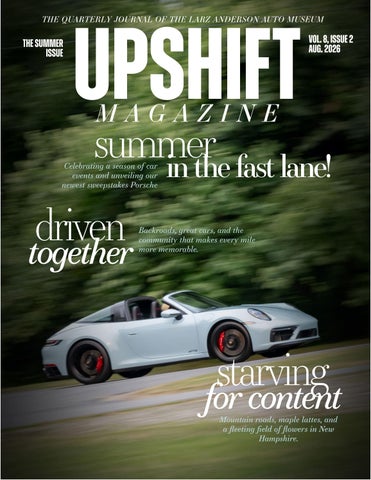
summer in the fast lane!
Celebrating a season of car events and unveiling our newest sweepstakes Porsche
driven
together
Backroads, great cars, and the community that makes every mile more memorable.
starving
for content Mountain roads, maple lattes, and a fleeting field of flowers in New Hampshire.
table OF CONTENTS 4
16
34
A celebration of the classic machines, craftsmanship, and community that keep automotive passion alive.
Meet the team who makes this and every issue possible
The Stanley twins transformed curiosity and ingenuity into steam-powered machines that became enduring icons of automotive and New England history.
8
18
42
WHY DO WE CARE ABOUT THE ANDERSONS?
JOY OF THE RIDE
LETTER FROM THE EXECUTIVE EDITOR
Larz and Isabel Anderson’s legacy lives on through the places, collections, and communities they generously supported.
10 ABOUT THE MUSEUM
Housed in a historic carriage house, the Larz Anderson Auto Museum preserves America’s oldest car collection and the enduring legacy of Larz and Isabel Anderson.
12 ELECTRIC EVOLUTION
Ferrari’s electric Luce may seem revolutionary, but Larz and Isabel Anderson’s early enthusiasm for EVs suggests they might’ve welcomed it.
2
UPSHIFT MAGAZINE
MEET OUR CONTRIBUTORS
On the open road, the true destination is the shared joy of remarkable cars, memorable miles, and the community traveling alongside you.
21 REMEMBER WHEN?
Poster Cars brings childhood dreams to life through the unforgettable machines that once ruled the road, the screen, and our bedroom walls.
22 THE LOCAL HACK
A mysterious highway hesitation turns one Lotus owner into the car’s most determined detective.
26 STARVING FOR CONTENT
A weekend chasing lupines through New Hampshire became the perfect mix of mountain roads, beautiful blooms, great food, and unexpected adventure.
40 OPENING DAY
Cars & Coffee launched the season with
STEAM AND SPEED
AFFORDABLE CLASSICS
These fuel-sipping classics prove that driving something fun and memorable does not have to mean spending a fortune at the pump.
CONTRIBUTORS Executive Editor Sheldon Steele Editor-in-chief Andrew Newton Art Director Jenn Corriveau Contributors Andrew Newton Jenn Corriveau Jim Travers Natalie Harrington Paul Knutrud Rachel Lemons Rob Siegel Ryan Phenegar Cover Photo Josh Sweeney Photo Contributors Anne Marie Goguen Andrew Newton Bonhams Boston University Evan Ide Ferrari Hagerty Marketplace Honda Isaac Walker Jenn Corriveau Jim Travers Josh Sweeney Lane Dailida Mecum Mini Paul Knutrud Personal Best Photography Redfin RM Sotheby’s Rob Siegel Ryan Phenegar UpShift Quarterly Publication of the Larz Anderson Auto Museum
Photo: Isaac Walker
Larz Anderson Auto Museum Larz Anderson Park 15 Newton St. Brookline, MA 02445 | larzanderson.org 3 617-522-6547
A NOTE FROM THE
EXECUTIVE EDITOR There is a question that seems to arise with increasing frequency: Why, in an age of autonomous driving, electric propulsion, and digital convenience, are so many people still captivated by machines built decades ago? The answer extends well beyond nostalgia. Classic automobiles and motorcycles ask something of us. They invite us to understand how they work, to listen, observe, solve problems, and appreciate the craftsmanship that transformed raw materials into machines of remarkable beauty and purpose. Whether restoring an engine, adjusting a carburetor, or simply driving a vintage sports car down a winding road, these experiences demand our complete attention. For a while, the endless distractions of modern life fall away, replaced by focus, curiosity, and satisfaction. It is no surprise that psychologists have found that immersive, hands-on pursuits can reduce stress, quiet the mind, and create the rewarding state known as “flow.” Yet these machines offer something equally valuable. They create community. Across the country, Cars & Coffee gatherings, concours, motorcycle meets, and museum lawn events continue to attract growing and increasingly diverse audiences. People may come for the automobiles, but they return for the friendships, the shared knowledge, and the opportunity to experience history together. In an increasingly digital world, these gatherings remind us that some of life’s greatest pleasures are still found face to face. That spirit has defined the Larz Anderson Auto Museum for generations. Our lawn events are more than exhibitions of remarkable automobiles. They are living classrooms where engineering, design, history, and personal memory come together. Every vehicle has a story, every owner becomes an educator, and every visitor leaves with a deeper appreciation for the people and ingenuity behind the automobile.
4
UPSHIFT MAGAZINE
Appropriately, this Summer 2026 edition of UpShift is decidedly Anderson-centric. UpShift Editor-in-Chief Andrew Newton contributes two fascinating features: one exploring fuelsipping classics and another revisiting the remarkable history of the Stanley Motor Carriage Company of nearby Newton, Massachusetts. Rachel Lemons examines the enduring legacy of Larz and Isabel Anderson in Why We Care About Larz and Isabel Anderson. Ryan Phenegar recaps another successful Cars & Coffee season, shares highlights from a recent museum driving tour, and uncovers the unexpected story behind the bedroom-inspired layout of our Poster Car exhibit. Jim Travers asks whether the Andersons, enthusiastic early adopters of automotive innovation, would have embraced Ferrari’s new electric-era Luce. Rounding out the issue are insightful contributions from other outstanding writers, including our longtime friend and master storyteller, Hack Mechanic Rob Siegel. Together, these pages celebrate more than remarkable automobiles. They celebrate the curiosity, craftsmanship, and fellowship that have sustained this hobby for generations. As you enjoy this issue, I encourage you to attend a local automotive gathering, visit a museum, take the scenic route home, or simply spend time with a fellow enthusiast. The automobiles themselves are extraordinary, but it is the people they bring together who ensure this passion will endure. I hope you enjoy the Summer 2026 edition of UpShift as much as we enjoyed bringing it to you.
EXECUTIVE EDITOR Sheldon Steele
5
6
UPSHIFT MAGAZINE
Photos: Isaac Walker
Photo: Lane Dailida
7
THE MUSEUM’S HISTORY
WHY DO WE CARE ABOUT THE ANDERSONS? A LASTING LEGACY OF GENEROSITY, SERVICE, AND COMMUNITY
W
WORDS: RACHEL LEMONS PHOTO: BOSTON UNIVERSITY
hy do we care about Larz and Isabel Anderson?
Larz Anderson Park is well known and loved by those who live in Brookline, Jamaica Plain, and the Boston area. So many of us have memories of sledding, skating at the rink, enjoying the dog park, or just taking in the view at the top of the hill. The Larz Anderson Auto Museum, too, is a beautiful part of the community enjoyed by residents and visitors alike. And we only get to enjoy these things because the land, the house, and the carriage house that made up the Weld Estate were left to the Town of Brookline by Isabel when she passed away in 1948. Because the main house was lost in 1950, the carriage house built in 1888 is the only major structure left standing. The carriage house, and the permanent collection of alloriginal automobiles within it, are perhaps the most visible parts of their legacy. All of this is already known to people familiar with the museum, but the park and the carriage house are only part of what Larz and Isabel gave to their community. The Andersons also funded the building of the Anderson Memorial Bridge, which connects Boston and Cambridge over the Charles River. Finished in 1915, it was a much-needed replacement for the socalled “Great Bridge,” which had been falling apart since its construction in 1662. The bridge was built in memory of Larz’s father, Nicholas Longworth Anderson, and lasted 100 years before it needed refurbishment. Larz and Isabel lived in both Washington, D.C., and Brookline, Massachusetts, and their communityminded efforts extended to both cities. Among their contributions to Washington National Cathedral were multiple tapestries as well as $500,000, which was used to pay for the sculptures on the East End of the Cathedral. These sculptures are of Ter Sanctus, 8
UPSHIFT MAGAZINE
which are made up of 110 figures that back the Jerusalem Altar. When Larz and Isabel passed, they were both interred at Washington National Cathedral in the St. Mary Chapel. The Andersons were generous with their money and their collections, and it was Isabel who bequeathed the Weld Estate to the town of Brookline and the collection of cars to The Vintage Motor Car Club of America so they may be used for the museum. But Isabel also donated her time during World War I. She was a part of the American Red Cross and trained as a nurse during the war. She worked in aid stations in France and Belgium, which earned her the French Croix de Guerre and the Medal of Elisabeth of Belgium. Once she was back in the United States, she used her training from the war to help out during the 1918 influenza pandemic in Washington, D.C. During World War II, she funded and hosted the Massachusetts Women’s Defense Corps at the Weld Estate in Brookline. Although she was by that time too old to serve in the Red Cross, she still wanted to help in any way possible. She donated money to the Navy fund since her family had a rich maritime history, but the regional field exercises at Weld allowed her to be present and more involved with her community, allowing her to help train the next generation of women aiding the war effort. This is why we care about Larz and Isabel Anderson. Because while they were alive, they cared about the people around them. Their donations, and the work done by Isabel are proof of that care. The impact of their actions is still being felt today, every time we visit the park, drive over the bridge, or get to experience the Anderson Collection at the Larz Anderson Auto Museum.
This photo is at the Howard Gotlieb Archival Research Center at Boston University. 9
ABOUT THE MUSEUM STEP INTO THE HISTORIC CARRIAGE HOUSE, HOME TO “AMERICA’S OLDEST CAR COLLECTION,” AND EMBARK ON AN IMMERSIVE JOURNEY THROUGH THE RICH HISTORY OF AUTOMOTIVE INNOVATION. The Larz Anderson Auto Museum is located in the lavish and original 1888 carriage house on the grounds of the former Weld Estate, now Larz Anderson Park, in Brookline, Massachusetts. The building was inspired by the Château de Chaumont-Sur-Loire in France and designed by Edmund M. Wheelwright, the city architect of Boston. First constructed as a working stable, it later served to house and maintain the Andersons’ growing collection of motorcars. Larz and Isabel Anderson began their love affair with the automobile before the turn of the century. In 1899, soon after they married, they purchased a new Winton Runabout, a true horseless carriage. From 1899 to 1948, the Andersons purchased at least 32 new motorcars in addition to numerous carriages, thus creating “America’s Oldest Car Collection.” As each car became obsolete, it would be retired to the Carriage House. By 1927, the Andersons began opening the building to the public for
10
UPSHIFT MAGAZINE
tours of their “ancient” vehicles. When Isabel Anderson passed away in 1948, it was her wish that the motorcar collection be known as the “Larz Anderson Collection,” and that a separate non-profit organization be created to promote the mission of preserving the collection and automotive history. The grounds of Larz Anderson Park include a romantic pond, a picturesque view of the Boston skyline just four miles away, acres of lush open space with walking paths throughout, and an ice skating rink that is open to the public during the winter months. Today, the Carriage House is on the National Register of Historic Places. A landmark within the community and both a cultural and educational hub in the automotive world, it continues to house and preserve the fourteen motorcars that remain in the Larz Anderson Collection.
Photo: Isaac Walker
Photo: Ethan Pellegrino
Photo: Jenn Corriveau
11
ELECTRIC EVOLUTION
THE ANDERSONS MEET THE LUCE
a century of electric motoring WORDS: Jim Travers PHOTOS: Ferrari and Evan Ide
T
he recently announced Ferrari Luce has created more buzz than usual for a new model from Maranello, including more than a little hand-wringing from both Ferrari faithful and devoted wannabes alike. Most of the howls have little to do with the Luce’s four-door layout or the non-traditional electric blue paint seen in early photos. No, what has really blown the minds of traditionalists is that that there is no rumbling 12-cylinder engine, nor any cylinders at all. The Luce is Ferrari’s first model powered entirely by electricity. While some Ferrarista may decry the Luce’s lack of internal combustion, fans of the museum might wonder whether early EV adopters Larz and Isabel Anderson would have reacted to the Luce. Among the many vehicles the Andersons collected over the years were two EVs, a 1905 Electromobile and a 1908 Bailey Electric, both highend motorcars in their day. Like the rest of the Andersons’ collection, both are still on display at the Larz Anderson Auto Museum more than a century later. The Andersons’ 1908 Bailey Electric on 17-Mile Drive, Monterey, California, during the 2021 Pebble Beach Concours d’Elegance. 12
UPSHIFT MAGAZINE
Owning an EV or two didn’t make the Andersons especially unusual
among car buyers in the early days of the twentieth century, when the automobile industry as a whole was in its infancy, and the couple was building their collection. Electric vehicles handily outsold gaspowered models for a time, and for many of the same reasons buyers are drawn to an EV today. With their smooth and quiet operation against the smells, noise, and pollution associated with gasolinepowered alternatives, EVs made up 38% of all automobiles on US roads in 1900, and some 300 different manufacturers were screwing together electrics at the turn of the century. In comparison, gas models made up just 22% of sales. The remaining vehicles were powered by steam, another popular option at the time that the Andersons welcomed into their fleet. Remember also that back in the day, gas stations were a rare sight compared to today, while an electric car could be charged at home, provided that the home had electricity. Perhaps best of all, starting an electric was far easier and less likely to cause an injury than hand-cranking a gasoline engine to fire it up in the days before the advent of the electric starter.
Much like today, to make the most of EV ownership required the Andersons to invest in a home charger for their fleet. Standing about as tall as a typical motorist, the charger bears little resemblance to the sleek, compact chargers found today. Rather, it looks like something out of a horror movie, with thick wires, mysterious exposed connections, dials, and doodads that might give any Fire Marshall some concerns. It’s probably just as well that the charger has long been retired from service, but it too remains on display at the museum. A 1905 Electromobile is one of two EVs the Andersons bought new, and like the bulk of the Andersons’ collection, it remains at the museum just as they left it in original and unrestored condition. Manufactured by Electromobile in Great Britain with a body designed by French coachbuilder Kellner, it is said to have had a top speed of 12 mph and a range of about 40 miles when new, respectable figures for the mostly urban driving of the time. The Andersons’ other EV is a 1908 Bailey Electric, said to have been among Isabel’s favorites. Like many buyers at the time, she preferred the Bailey’s quiet, reliable operation, something touted in period advertisements targeting female buyers. As the first woman in Massachusetts to obtain a driver’s license, she had a special appreciation for the Bailey, which cemented its reputation for reliability by traveling 1500 miles from Boston to Chicago with no issues. As early automobile enthusiasts and adventurers, the Andersons may have missed out on the Ferrari Luce by more than 100 years. But with their adventurous spirit and early adopter status, they might have been tempted to add one to the fleet. Chances are they wouldn’t have cared whether it was bright red or electric blue. Like their other vehicles, they’d probably have painted it gray anyway, in line with their preference for keeping a low profile.
13
avi is a proud sponsor of
AVI provides bespoke performance car audio and video. We are capable of providing you with the latest technology and styles available for your vehicle. You may add new components to your system or have it rebuilt from the ground up. Our professional staff performs custom work at competitive prices. Locally owned and operated, AVI truly has all of the quality products and experience you need to personalize your car. We pride ourselves on personalized service and helping make your automotive dreams reality. We are open Monday through Friday from 8:00am to 5:00pm. Premium consultation services available on Saturday by appointment only.
Visit Today MON.-FRI. 8AM TO 5PM SAT. BY APPOINTMENT ONLY avi | 14 Needham Street • Newton, MA 02461 aviboston.com 14
UPSHIFT MAGAZINE
15
THE CONT ANDREW NEWTON
JENN CORRIVEAU
Andrew came of age around old cars and vintage racing, and first came to the museum through an internship while attending Clark University. He then served as the Education Manager at Larz Anderson while writing about cars both old and new for Sports Car Digest, James Edition and CarGurus. In 2014, Andrew joined Hagerty as Auction and Valuation Editor to cover the collector car market worldwide and contribute to the Hagerty Price Guide. Andrew has written hundreds of articles on classic car values, market trends and history for Hagerty as well as hosted webinars and attended dozens of auctions each year. He currently lives in Houston, Texas, but gets back to Larz Anderson as often as he can.
As a child, Jenn accompanied her “Car Guy” dad to car events across New England, so it’s fitting she now serves as the Lawn Events Manager at Larz Anderson Museum. In college, Jenn studied Graphic Design and discovered a passion for various design forms, from photography and logos to brochures and wedding invitations. Her skills and role at the Museum are key to shaping its image and message.
EDITOR-IN- CHIEF
16
UPSHIFT MAGAZINE
ART DIRECTOR
RYAN PHENEGAR EDITOR CONTRIBUTOR
+
Influenced by a childhood surrounded with his father’s passion for modified German cars, Ryan has always had a love for all things German. Joining the Larz Anderson family in 2022, Ryan is the newest addition to our team. As a recent graduate from Bridgewater State University, he’s already making a name for himself as the go-to guy for all things audi-related. When he’s not tinkering under the hood or cleaning one of his cars, you can find him running car registration at all the Museum lawn events, ensuring every car is ready to go on the lawn.
TRIBUTORS ROB SIEGEL
JIM TRAVERS
Rob Siegel has written the monthly column The Hack Mechanic™ for Roundel, the magazine of The BMW Car Club of America, for 35 years, and writes weekly online for Hagerty and BimmerLife. Rob has also written for Road & Track, Sports Car Market, and Forbes, and is the author of eight automotiverelated books, including The New York Times-reviewed Memoirs of a Hack Mechanic. Rob has owned over 70 BMWs, most of them 1970s-era cars. He currently owns 13 cars including eight vintage BMWs and a Lotus Europa, and yes, his wife knows where all of them are.
Jim Travers is a lifelong gearhead, and a freelance writer, editor, and photographer specializing in all things automotive. A classic car enthusiast and collector, Jim is a regular judge on the car show circuit and is the author of the Smithsonian Institute’s Extreme Cars. His work has also appeared in Automobile, Autoblog, BBC Autos, Car and Driver, Cars.com, Car Talk, Consumer Reports, Hagerty, The NY Daily News, US News, and others. He lives in Duxbury, Massachusetts, a town known for both its beach and its dump. On weekends, Jim can often be found at one or the other.
CONTRIBUTOR
CONTRIBUTOR
NATALIE HARRINGTON CONTRIBUTOR
Natalie Harrington is a Bostonbased motorcyclist, writer, and auto enthusiast. More than any one marque or vintage, Natalie appreciates the joy and passion she sees in the car community. She loves car shows, races, and museums and seeks them out around the world, but thinks that LAAM’s unique community and collection top them all.
17
18
18
UPSHIFT MAGAZINE
Magazine
BACKROADS & BREWS
JOY OF THE RIDE with some new friends
WORDS: Natalie Harrington | PHOTOS: Personal Best Photography
T
hey say it’s about the journey, not the destination. For car people, this has an extra measure of meaning: It’s about the machine, the time you spend with it, and the way it makes you feel on the roads you tackle together. And for attendees of Larz Anderson rolling events, it’s also about the community that makes the journey with you. This season’s first Backroads & Brews, held on a beautiful Sunday in May, was a perfect example of the way community adds to our enjoyment of our cars. The morning began at Garage 42. The collector car storage business has partnered with the Larz Anderson Auto Museum on this year’s drives, and the company’s beautiful facility serves as an ideal starting point. Located in a lovely, driver-friendly corner of Acton, MA, the space is large, clean, and intentionally designed, with droolworthy cars visible through floor-to-ceiling windows from the common areas. For those of us who arrived a little later than planned, there was a particular thrill to finding the lot already lined with cars–almost like pulling into Cars & Coffee on the Great Lawn. If Garage 42’s space set the tone, its staff reinforced it with their warmth and attentiveness, making us feel instantly welcome. Participants gathered in the thoughtfully appointed kitchen and lounge area to enjoy coffee and a light breakfast while Tourmaster Evan Pasewark briefed the group on the route and agenda. Here we began to see the new element that makes this year’s Backroads & Brews feel extra-special:
the joining of two communities. Garage 42 has its cohort of clients who consider it home base, the museum has its band of members who go to every event they can, and the two have a lot in common, including the decision to spend their Sunday morning driving just for the joy of it. Those who lagged behind as departure began were treated to a private parade of special automobiles. The Larz Anderson members who had descended on the parking lot took off first. Then, out came the Garage 42 members’ cars, emerging from the depths of the building into the sunlight in an extended slow reveal to delight any enthusiast’s heart. And then, the parade went public. The route wound through back roads and down highway stretches from Acton into southern New Hampshire. The variety in the route meant every car had a chance to shine, but for many of us, Joppa Hill Road was a highlight– the kind of road that reminds you why you drove something special in the first place. And when it comes to Backroads & Brews, “special” is no exaggeration. Exotic metal was wellrepresented, with a Porsche 992.1 GT3 RS and a 992.2 GT3 Touring, a BMW Z8, a Lexus LC500, and an Alfa Romeo 4C, among others. But it was the range that made the lineup truly impressive. A Mitsubishi Lancer Evo and a land yacht of a Lincoln held their own, while a McLaren 650S Spider in full Talladega Nights livery added levity. Anyone considering attending our next driving event should know that whatever car you consider special will be sure to find an appreciative 19
audience in this crowd. En route, the group turned heads passing a dealership’s Cars & Coffee event, a satisfying moment that, who knows, may have also served as a recruitment tool. Time will tell. 603 Brewery was our destination, and it was crowded on this particularly beautiful day, but the tourers were able to take their time admiring each other’s cars in the lot, knowing reserved tables awaited. With an open tab already covered by registration fees, participants could relax and focus on the best part: reliving the journey with the people who shared it.
20
UPSHIFT MAGAZINE
REMEMBER WHEN?
STEP INSIDE A HIDDEN TEEN BEDROOM AND RELIVE THE CARS, POSTERS, AND POP CULTURE THAT DEFINED A GENERATION WORDS: Ryan Phenegar PHOTO: Anne Marie Goguen
I
n May, the Larz Anderson Auto Museum opened its newest exhibit, Poster Cars: Icons of the Road and of the Wall. If you have visited the museum since its opening, you’ll notice some variations from our typical exhibit styling. The walls are clean, with no elaborate banners, allowing the cars to truly speak for themselves. For this exhibit, the museum has curated an ever-evolving array of dream cars. From the beautiful Ferrari Testarossa, the unmistakable Lamborghini Countach, the sleek Porsche Carrera GT, and even the best “sleeper car” of the 1980s–the Buick GNX–there’s something for every kind of automotive enthusiast. Unlike many exhibits that focus on technical specifications or historical significance, Poster Cars celebrates the emotional connection these vehicles have inspired across generations. Many of these automobiles earned their legendary status not only through performance but also through appearances in magazines, television, films, and, of course, on bedroom walls around the world. For countless car people, these were the machines that fueled our daydreams long before we ever saw them in person. Check out the 1980s-2000s-inspired bedroom in the back gallery, which perfectly summarizes the goal of the exhibit. Inspired by the bedrooms many of us grew up in, the space is complete with period décor, posters, and nostalgic touches that transport visitors back to a time when these cars represented their ultimate aspirations. We hope that standing among these dream cars will bring back memories of flipping through car magazines, playing Need for Speed, Gran Turismo, and Forza, or imagining what it would be like to one day get behind the wheel on the open road. Whether you remember these vehicles from your childhood or are discovering them for the first time, Poster Cars captures the excitement, nostalgia, and enduring appeal that have made these automobiles true legends of both the road and the wall. Come check out the exhibit and get your own taste of nostalgia, open Tuesday-Sunday from 10:00 am to 3:00 pm. 21
THE LOCAL HACK THE CHALLENGE OF DIAGNOSING A HIGHWAY-RUNNING PROBLEM
WORDS & PHOTOS: Rob Siegel
T
his spring, my ’69 Lotus Elan +2 began having an odd problem where, when cruising on the highway at about 65mph or above, it would run out of power. It wasn’t the kind of power loss that comes from a dying fuel pump or a clogged fuel filter where the engine stumbles and then runs out of gas even though there’s fuel in the tank. This was a subtler hesitation and bogging down. Whenever it happened, I’d get into the right lane and take the first exit, and once I was off the highway and driving more slowly on a smaller road, the problem would vanish. There were several odd twists to the problem. The first was that initially it only happened when I switched on the electricallydriven air conditioning I wrote about several months ago. This made me think that it had to be caused by the 80-ish amp draw of the electric compressor and the fans causing a voltage drop to the fuel pump, the ignition, or both. I took the car for several decently long highway drives without turning on the air conditioning and didn’t have the problem appear. But then this changed, and the problem began happening even with the A/C off, but still only at speeds above about 65mph. The next quirk was very significant in terms of troubleshooting: I have an air-fuel meter in the car connected to an ultra-wideband oxygen sensor, and I noticed that every time the problem appeared, the meter would swing all the way lean, indicating that either the engine wasn’t getting enough fuel or was getting too much air (e.g., a vacuum leak). The last weird thing was that the problem wasn’t tied to engine rpm—I never had it occur when winding the car out, running in third gear at a high rpm on a local road. It only happened in fourth gear at highway speeds of about 65mph. 22
UPSHIFT MAGAZINE
While thinking about how to diagnose and fix the problem, two things occurred to me. The first was that if you took a car exhibiting these symptoms to even a reputable vintage car specialist, I think it’s unlikely they’d actually run it on the highway and experience the problem. Instead, they’d probably listen to your description, replace the fuel pump and filter, return the car to you, and say “Let us know if it happens again.” Well, either that or rebuild or replace the carbs without being certain that that was the cause of the problem. This made it so I, as the owner, was the person best-equipped to troubleshoot this odd problem. But how exactly to do it? On the one hand, I want to catch it in the act, but on the other, I don’t want it to be so in the act that the car dies and leaves me stranded. Plus, living in suburban Boston means that needing to test at a sustained 65mph requires doing it on the highway, and from a safety standpoint, you really don’t want to be troubleshooting things in the breakdown lane of the Mass Pike during high traffic. I live in West Newton, two miles from the intersection of I-90 and I-95. The exits on I-95 are spaced closer, allowing me to bail at the first sign of trouble, but I-90 gives more running room for the problem to manifest itself. Stretches of Rt. 2 are more hospitable to breakdown-lane troubleshooting, but you need to get past the Concord rotary. Rt. 3 is also pretty good. I alternated between all of these, testing mostly on weekend mornings. My gut said that, even though the car didn’t sputter and die, this was a fuel delivery issue. I unscrewed the fuel filter and drained it over a paper towel. A little sediment came out, but not much. When it was dry, I blew through it. It didn’t feel restricted, but I replaced it anyway and drove the car. There was no change. I checked fuel pressure at idle, and it was fine. But what I really needed to do was watch the pressure actually being delivered to
Stumped, I began to wonder if maybe the root of the problem was not a general fuel-delivery-pump-and-filter issue, but was instead a subtler carburetion issue, like if the level in one of the float bowls was adjusted too low, and under high load, was causing that bowl to run dry. Great theory, but how do you prove it?
The filter in front of my aftermarket electric fuel pump wasn’t the problem.
On the Weber carbs that I’m used to, you’d wait for it to stumble, pull over, unscrew the top off the carburetor, and look into the float bowl. If it’s nearly empty, you’ve nailed it. It’s easy, really, as long as you’re somewhere safe enough to do it. However, on the Elan’s Strombergs, the float bowls are underneath and thus not nearly as easy to get to. I wanted to know if it was possible to drop them roadside, so I first did it in my garage. And it didn’t work because the Stromberg’s float bowls have a strange design where there’s a big brass plug with a rubber O-ring around it right in the middle, and when you drop the bowl, all the fuel leaks out where
the carbs while I was driving, and this was only possible with the gauge raised and the hood off. Fortunately, it, like the rest of the car, is fiberglass, so it’s trivial to remove. It took a few iterations of ordering gauges and fittings from Amazon to get something that I could see. However, while driving at speed on the highway, I saw no correlation between fuel pressure and the bog-down/ lean reading on the air-fuel gauge. I checked for voltage drop next. I ran a wire from the hot side
The capped-off vacuum line to the pop-up headlights. the plug had been. Instead, to check float level, you need to pull off both carbs, turn them upside down, and measure the float height, not the fuel level. I was hesitant to do this unless I had to, so I checked what I could with the carbs installed. I undid the tops and inspected the rubber diaphragms for holes. I found none, but the diaphragm on the rear carb appeared slightly misshapen. This worked just well enough to be useful, but didn’t help me find the problem. of the ignition coil into the cabin, and another one from the hot side of the electric fuel pump, and looked at both of these on my multimeter while driving. As with the fuel pressure gauge, there was no voltage drop on the coil or the fuel pump that accompanied the onset of low power and lean running. On my checklist, that left a vacuum leak. Whatever emission controls were on the car in 1969 are gone—the only vacuum lines are to the brake booster and the pop-up headlights. I disconnected and capped them and drove the car. It made no difference.
I carefully lifted it up and noticed that a little rectangular protrusion on the bottom edge of the diaphragm wasn’t seated into the alignment notch on the rim where it’s supposed to go. I wondered if that could be the cause of a vacuum leak above a certain engine load. I carefully aligned the diaphragm with the notch and reassembled the carb, took the car onto the highway, raised the speed to 65, turned on the A/C, and waited. No bog-down. No air-fuel meter swinging hard lean. I drove the car for about 20 more miles, varying the speed between 65 and 70. The problem never recurred. Sometimes you really are the best person to find and fix a problem with your car. I was thrilled that I was able to solve this without 23
subjecting myself to the safety hazard of a breakdown-lane repair. And if the problem recurs, well, there’s still quite a bit of summer left. -Rob This didn’t look quite right.
The gaping hole in the float bowl left by the plug when you drop it (and, yes, a little bit of rubber and sediment in the fuel).
24
UPSHIFT MAGAZINE
(Rob Siegel wrote the column The Hack Mechanic™ for BMW CCA Roundel Magazine for 40 years, and is the author of eight automotive books.)
25
Starving for Content
WHERE THE LUPINES GROW A FLOWER-FILLED ROAD TRIP THROUGH SUGAR HILL, LITTLETON, AND THE WHITE MOUNTAINS WORDS & PHOTOS: Jenn Corriveau
F
or a brief window each summer, the small town o f S u ga r Hi l l , New Hampshire, turns into a sea of purple, pink, and white. Known as the lupine capital of the state, Sugar Hill draws visitors from all over during the roughly two weeks when the flowers are in bloom.
resting up for the drive to Sugar Hill the sausage on a biscuit. We both got maple cream lattes. next morning. North Conway made a great home base for the weekend. There are plenty of mountain views, charming shops, and quirky local stops like the famous Zeb’s General Store. It also gave us the perfect excuse to visit one of my favorite coffee spots.
As somewhat of a flower lover, I decided this was reason enough to drag my Breakfast at Frontside Coffee husband to New Hampshire for the On Saturday morning, we headed into weekend and go chasing the lupines.\ downtown North Conway for breakfast at Frontside Coffee. They have the most incredible bagels, with a slightly crispy Our North Conway Home Base We stayed in a beautiful condo in North coating that makes them so good. Conway for two nights. It was fully updated, cozy, and had gorgeous views I ordered the avocado bagel with fresh of the Moat Mountains. Since we did avocado, kosher salt, red pepper flakes, not have much planned for our arrival and lemon juice. My husband ordered the day, we spent the evening relaxing and breakfast sandwich with egg, cheese, and 26
UPSHIFT MAGAZINE
The entire order was so good that we went back the next morning and ordered the exact same thing. After breakfast, we returned to the condo, got dressed, and headed toward Sugar Hill. The Drive to Sugar Hill The drive took us through the mountains on winding roads with little to no cell service. The scenery was beautiful, the road was full of twists and turns, and there was plenty of ear-popping along the way. Once we reached Sugar Hill, we drove around for a while trying to find the lupine field. We stopped along the side of the road so I could take a few pictures but, to be honest, the views were a little
Our lunch at Schilling Beer Company
27
lackluster compared to what I had seen online. Then we tried another location, and someone nearby asked us… “Are you looking for the lupines? They’re over there.” Thankfully, they pointed us in the right direction. Finding the Lupine Field When we finally arrived, all I could say was “wow.” The field was incredible. Purple, pink, and white lupines stretched across the landscape, with groups of visitors wandering through the flowers and stopping to take photos. It was exactly what I had hoped to find. Lupines don’t bloom for long, so timing is everything. Visiting during peak bloom made the drive completely worth it. A Note About the Lupines While the fields are undeniably beautiful, the lupines commonly seen in Sugar Hill are not native to the area and are considered invasive. There is some controversy surrounding the flowers because they can crowd out native plants and affect the surrounding ecosystem. New Hampshire is also home to the endangered Karner blue butterfly, which relies on native wild lupine rather than the large big-leaf lupines found in many roadside fields. As native lupine populations decline, the Karner blue butterfly population declines as well. It is an important reminder that beautiful landscapes can sometimes have a more complicated environmental story.
World’s Longest Candy Counter at Chutter’s in Littleton
28
UPSHIFT MAGAZINE
Lunch in Littleton After traipsing through the lupine field, we were ready for lunch. We headed to Littleton, New Hampshire, a charming town located along the Ammonoosuc River that has been named one of the nicest places in America. We decided to eat at Schilling Beer Company and ordered the house-made pretzel twist with beer cheese and beer mustard. It was out of this world. We also shared a charcuterie board and each ordered a beer. After lunch, we spent some time walking around downtown Littleton and browsing a few of the local stores before heading back to North Conway. Our day of chasing the lupines included mountain roads, coffee, beautiful flowers, good food, and a little bit of wandering around without service. It may not have gone exactly according to plan, but it ended up being a pretty perfect New Hampshire day. Tips for Visiting the Sugar Hill Lupines • The lupines are only in bloom for about two weeks, so check local updates before making the trip. • Download directions or save the address ahead of time because cell service can be limited in the mountains. • Do not rely on Waze to lead you directly to the fields. We learned that one the hard way. • Bring comfortable shoes since you may be walking through uneven or grassy areas. • Be respectful of the flowers, nearby properties, and other visitors.
Beer Chalets at SBC
Ammonoosuc River
A Charming Stop at Maison Bohème
Yours truly in the Lupine field
29
30
UPSHIFT MAGAZINE
31
32
UPSHIFT MAGAZINE
33
34
UPSHIFT MAGAZINE
A LEGACY OF STEAM
AND SPEED
WORDS: Andrew Newton PHOTOS: Bonhams, Mecum, RM Sotheby’s, Redfin
HOW THE STANLEY TWINS BUILT THE WORLD’S MOST FAMOUS STEAM CARS RIGHT HERE IN MASSACHUSETTS
I
In the early 1900s, some of the fastest and best cars in the world came not from Detroit or New York or California, but from a small factory in Watertown, started by a pair of remarkably clever identical twins. Their firm, officially known as the Stanley Motor Carriage Company, has been defunct for over a century, but Stanley is also the only steam car manufacturer most car enthusiasts can name, if they can name one at all. Stanley Steamers and the Renaissance men who built them are a fascinating part of both automotive and New England history. Francis Edgar and Freelan Oscar (FE and FO, for short) were born in 1849 to a large farming family in southern Maine. They were two of seven children, surrounded by mechanically inclined, inventive siblings with highfalutin names like Isaac Newton Stanley and John Calvin French Stanley. The twins were tinkerers as well, and in early adulthood, FE became fascinated with portrait photography. After opening a successful studio in Lewiston, his experiments led to him patenting a photographic airbrush as well as a process for massproducing photographic dry plates. These breakthroughs brought on a rush of business, and FO soon joined his brother in running the operation. By 1884, they were the principal partners of the Stanley Dry Plate Company. Around this time, FE and FO really leaned into the whole identical twin thing, growing the same beards and wearing the same clothes to the point that even their own employees couldn’t tell them apart. When it became apparent that they’d outgrown their operation in Lewiston, the Stanleys constructed a new plant in Watertown, Massachusetts, in 1890 and built homes for themselves and their families in neighboring Newton, with FE’s house on Centre Street and FO’s on Hunnewell Avenue. The Hunnewell Ave house is still standing. Next door to the Watertown facility was a bicycle manufacturer, and indeed, Massachusetts was a hotbed of vehicular innovation in this period. Sylvester Roper of Roxbury had started building steam-powered two-, three-,
and four-wheeled vehicles in the 1860s, and another pair of brothers—Charles and Frank Duryea—became the first Americans to build and market an internal-combustion, gasoline-powered automobile in 1893. Most of the country’s top automakers in the 1890s were still in the Northeast. The Stanley twins nevertheless spent the first half of the decade preoccupied with the dry plate business, and in 1896 even built one of the first X-ray machines in the country, but that same year they attended the Fall Fair in Brockton. A “horseless carriage,” fresh off the boat from France, was one of the main attractions. According to a 1918 issue of the company’s house organ, The Steam Car, a friend asked one of the Stanleys what he thought of the new motorcar. “Pretty good,” Mr. Stanley replied, “but I think I could build a better one myself.” And so, that same fall, the twins began tinkering on it. They had no experience with engines or vehicles, but were quick learners. And inquisitive. While FE’s wife was on tour in Europe, he wrote to her asking “one thing I want you to keep your eyes open to see, and that is the motor carriages… in Paris, and I want you to ascertain the price at which they sell. And also the kind of motor in most common use.” For their first and every subsequent car, the Stanleys settled on steam power for multiple reasons. Gasoline internal combustion and electric power were the main alternatives, but both were relatively new means of propulsion and in an experimental stage. Internal combustion cars were noisy, smelly, complex, and difficult to start, while early electrics lacked power and took a long time to charge. Steam propulsion, meanwhile, was a known, proven technology used on boats and trains for nearly the entire nineteenth century. Another reason was simplicity. Early Stanley steam engines boasted just 13 moving parts, and though burners ran on kerosene or gasoline, the heaviest consumable in a Stanley steam car was water. Steam cars could consume more than a gallon of water per mile of travel, but the stuff was at least easy to come by. The instant torque delivered by a steam engine also eliminated the need for a complex, heavy transmission. 35
By September 1897, the Stanleys’ first car, wearing wooden carriage bodywork over a chassis purchased from a bicycle factory and a two-cylinder steam drivetrain under the seats, was ready. Their innovative boiler combined a shell and boiler tubes made of copper with an outer wrapping of high-grade steel wire, which allowed for higher pressure tolerances. Famously, there are no documented cases of a Stanley boiler exploding. Even by 1898, “we had not the slightest idea of ever engaging in the manufacturing of automobiles as a business,” said FO. “It was an interesting hobby and not a trade.” But at that year’s auto show in Boston, held at the city’s Mechanics building, multiple motorcars from both Europe and America were on exhibit, and one of the highlights was the “Motor Carriage Contest” held at the nearby Charles River Park, a bicycle track. The Stanleys brought their new car, and while their two-mile time of 5:19 was slower than the winning French De Dion tricycle, their one-mile time of 2:11 was a world record, and the Stanley won the hill climb contest, too. Within two weeks, the twins were swamped with orders. The Stanleys had only been in the carmaking business for a few months when, in February 1899, Cosmopolitan magazine owner John B. Walker walked into the factory wanting to buy a half interest in the operation. The Stanleys rebuffed him, but he persisted, replying that he wanted to buy the whole operation. So, they answered with what they thought was a preposterously high asking price: $250,000. Walker said yes on the spot, partnering with asphalt magnate Amzi Barber on the purchase and keeping the Stanleys on as general managers in what soon became known as Locomobile. The Locomobiles improved on the Stanleys’ earlier designs with better suspension and longer chassis, and plans were even drawn up to move into a new factory in Tarrytown, NY. Bickering between the principals led to a rapid split, however, with Walker moving his carmaking operation to New York and Barber moving Locomobile down to Bridgeport. While they were no longer owners and their contract prohibited FE and FO from making their own cars for a year (1899 to 1900), they kept themselves busy. FO, for example, drove with his wife to the top of Mount Washington, the highest peak in the Northeast, in August 1899. This was the first time a car had made it there, and it would take another three years for a gasoline-powered car to do it. FO also drove President McKinley around Washington, DC, in one of their steamers, marking the first time a sitting US 36
UPSHIFT MAGAZINE
president ever rode in an automobile. In July of 1900, FE made the drive from Newton to Auburn, Maine, in nine hours flat, which was enough to make the local news. Once free from their contract, the Stanleys officially formed the Stanley Motor Carriage Company in 1902 and resumed production in Massachusetts. The company’s 1903 catalog featured a runabout and a surrey model, with prices ranging from $750 to $790. The next year introduced model designations for the Stanley lineup, with straightforward names like Type A and Type B. In 1905, the Stanleys sold their dry plate business to Eastman Kodak and were all-in on car production. That year’s steam cars moved the boiler to the front of the car, which freed up more passenger space, allowed for larger boilers to be fitted, and gave Stanleys a distinctive “coffin-nosed” appearance. The 1906 lineup introduced the company’s first sporty model, the Model H “Gentlemen’s Speedy Roadster,” complete with wire wheels and cycle fenders for light weight. The Stanley catalog called it “the fastest stock car in the world…intended for those who wish to hit up a speed of 75 or 80 mph on a good safe road, without going to the expense of importing a $10,000 racing machine with its noisy cylinders and high expense for tires and maintenance.” FE and FO never expressed much interest in mass production, preferring to keep a few hundred employees building fewer than 1000 cars per year. In its early years, Stanley didn’t even advertise. But Stanley did rely on another means of promotion in its early years: competition. A Stanley won a hill climb event on Commonwealth Avenue in Boston in 1903, and Stanleys quickly became the cars to beat in hill climb and sprint competition throughout the region. The most extreme steamer, though, was the racer used in 1906 for speed runs at Ormond Beach, FL, just north of Daytona Beach. It wore long, cigar-shaped bodywork built by a canoe company in Auburndale, MA, and featured a stovepipe-looking exhaust exiting behind the driver’s head. The Florida Times-Union newspaper described it as “some monstrous bug of the nether world.” It may not have been pretty, but Stanley’s driver, Fred Marriott, drove it to 127.66 mph, becoming the first person to travel at two miles per minute and setting world records for the kilometer and the mile in the process. Stanley and Marriott returned to the beach in 1907, but the improved streamlined racer crashed heavily, destroying the car and putting the Stanleys off from competition from then on.
37
There was no official timing at the time of the crash, but some estimates put the speed at 150. The 1906 world land speed record stood for another three years, and the speed record for steam-powered vehicles wouldn’t be broken again until 2009. Back in New England, the road car business kept humming along. The Stanley Mountain Wagon was introduced in 1908 and became popular with tourist resorts out West. The standard models were evolving, too. By the teens, Stanleys had electric lights and condensers, which reclaim water by converting spent steam back into condensate water for reuse in the boiler. Placement of the condenser resulted in different v-shaped and later flat, grilled noses that made Stanleys look much more like conventional, gasoline-powered cars. Speaking of gas cars, they had been getting progressively better, too, and cheaper. Cadillac introduced the electric starter in 1912, which eliminated the dangerous and difficult hand-crank starter. Then there was Ford’s Model T, first introduced in 1908, which democratized the automobile with its mass production and resulting low price. Henry Ford could build more cars in a few hours than the Stanleys could in a year, and while prices for the steamers stretched into the thousands, a new Model T could be had for a few hundred bucks. And as the gas-powered competition improved, the disadvantages of steam power were still there. Bringing boilers up to pressure took a long time, up to half an hour in some cases, and with all the procedures and controls needed to operate steam cars, a common joke was that owners needed an engineering degree as well as a driver’s license. As the car business faced grim prospects, the Stanley twins pursued other interests. By the time the First World War broke out in Europe, they were already 65 years old. FO, stricken with tuberculosis, had been spending more time taking in the dry mountain air of Colorado and opened up a luxury hotel in Estes Park. FE, meanwhile, dove into house projects in Maine and New York, and both twins worked in the 1910s on a steam-powered self-contained rail car, forming the Unit Railway Car Company in Boston in 1915. In 1917, they stepped down from management at the car company that bore their name, and a new Stanley Motor Carriage Company was incorporated in Delaware. The following year, FE was driving down the Newburyport Turnpike (now Route 1) in a Stanley Model 735 touring car and swerved to avoid a pair of farm wagons stopped in the road. The car flipped, and he died on the way to Beverly
38
UPSHIFT MAGAZINE
Hospital. FO then sold his remaining interest in the car company to his nephew-in-law. Stanley, the company soldiered on for several more years. By 1925, their cars had relatively advanced four-wheel hydraulic brakes, and the catalog still boasted the advantages of steam: “Its minimum speed may be maintained all day with no vibration, no overheating, no stalling…On the hills it is a revelation…there is always a reserve of power…no gears to shift, no engine speed to think of, no headway to consider— just a movement of the throttle, as simple as a wish.” Steam’s days were nevertheless numbered, and in late 1925 production moved to Allentown, PA. The company, now called the Steam Vehicle Corporation of America, filed for bankruptcy in 1926, and the factory in Massachusetts was sold to Bachrach Studios, a photography company that operated there until the 1990s. FO, meanwhile, continued to split his time between Colorado and Newton. In 1937, aged 88, he installed a new air conditioning system of his own design in the Newton home. He died there of heart failure three years later, aged 91, while going out to get the morning paper. The Stanleys built approximately 11,000 automobiles in their day, becoming both steam and New England’s bestknown carmaker in the process. Sources: The Stanley Steamer: America’s Legendary Steam Car, by Kit Foster
39
OPENING DAY ON THE LAWN ...AND THE FANS WERE LOVING IT! WORDS & PHOTOS: Paul Knutrud
This May marked the start of car show season at the Larz Anderson Auto Museum with the year’s first Cars & Coffee. The event was packed, and the lawn was full by 9 am. The variety of cars always amazes me at these events, where many people come in their daily drivers. There were also plenty of exotics and classics, and this Brazilian Furia Blanco S, which defies categorization, caught my eye. Wesley and his team were great at getting people into the park, parked, and ready to show off. This Fiat Abarth received a unique exterior treatment for the day with a working slot car track and hand-painted exterior. Proof that cars are meant to be fun.
40
UPSHIFT MAGAZINE
The museum is always a great background for pictures of classic car as we can see from the trio of cars. A visit to the Museum is never complete without a visit to the lower level of the building and America’s oldest car collection. It always amazes me that this collection, on this property, started 127 years ago in 1899. Cars & Coffee happens on one Saturday each month during the season through October. The marque- and country-specific lawn events are also a great time and happen nearly every weekend during the season.
! e er th see you
41
AFFORDABLE
classics
SIX FUEL-SIPPING CLASSICS FOR THE SUMMER WORDS: Andrew Newton PICTURES: Mecum, Hagerty Marketplace, Honda, Mini
C
ar people tend to obsess over the numbers, don’t they? Horsepower, gear ratio, production totals, the exact day the factory switched from round turn signals to rectangular ones, etc., etc. When it comes to classic and enthusiast cars, though, fuel economy isn’t one we think about much. First, because a lot of the cars we love just don’t get great gas mileage, but also because we aren’t commuting or doing school/grocery/soccer practice runs in our classics, so the numbers on the gas station sign don’t mean as much as they do for our daily drivers. Still, it ain’t easy to ignore that fuel has been expensive this year. According to AAA, as of this writing the national average right now is over $4 for a gallon of regular unleaded, and the current average in Massachusetts is $4.10.. Since it’s unclear which way these high prices will move or when, let’s look back at some vintage cars that are both relatively affordable to buy and cheap to fill up. One note first, though. Fuel economy is measured in different ways in different countries. Miles per gallon is measured differently in the UK vs. the US, for example. The go-to standard in this country, ratings from the Environmental Protection Agency (EPA), weren’t adopted until the mid-1970s, and in 2008 the EPA significantly changed the way it measures mpg, typically resulting in lower ratings. So, the numbers here aren’t exactly gospel, but the cars themselves are still fuel sippers.
42
UPSHIFT MAGAZINE
HONDA CRX
Fondly remembered for its sport compact bona fides, especially in “Si” (“Sport injected”) trim, the Honda CRX is also a serious fuel-sipper that came in economyoriented trims like the “HF” (“High Fuel”). Effectively a short-wheelbase, two-seat Civic, the original base CRX from 1984 came with a carbureted 1.3-liter fourcylinder that returned a legitimate, EPA-rated 51mpg city/67 highway by the standards of the day, which translates to 38mpg city/47 highway using today’s standards. Any later HF or base trim CRX will do at least mid- to high-40s on the highway according to current EPA ratings, with some HF models getting up to 51 mpg on the highway. And this is all on regular gas. Even the newest CRXs are 35 years old now. There aren’t a ton of good ones left, and most of the CRXs that are still on the road are sportier Sis, which weren’t tuned or geared for max efficiency. They’re still tiny four-cylinder Hondas, however, and they should still easily return 30+ mpg on the highway. That helps alleviate the fact that a CRX Si has become fairly collectible, and prices for them have effectively doubled since 2020. Solid examples can be found in the mid- to high-teens, with excellent-condition examples selling in the mid-$30K range.
MERCEDES BENZ 190D
It’s neither fast nor clean-burning, but it is built like a tank and it is roomy. Its 2492cc, 90 hp five-cylinder even returns up to 30 combined MPG (27 city/36 highway) according to its EPA rating, and you get to tell people you drive a Mercedes even though you can easily buy a good one for four figures. The 190 series represented Mercedes-Benz’s huge effort to offer a lower-priced entry-level model. Its elegantly simple Sacco-designed shape was both handsome and aerodynamic, and its platform was versatile, spawning everything from Cosworth-powered touring car racers down to soft-riding diesel taxis. A 190D is among the cheapest ways to get a threepointed star on your keychain, with even excellentcondition prices barely stretching into the teens. Getting 30 mpg is also pretty impressive for a hefty old German sedan, though the catch with diesel is that it’s pricier than regular old gasoline. Diesel is well over $5 a gallon as of this writing.
43
C I T RO Ë N 2 C V
Conceived in the 1930s as a people’s car able to tackle the French countryside, the 2CV (for deux chevaux, or two horsepower, in tax terms) made a postwar debut as “the most intelligent application of minimalism ever to succeed as a car,” as English journalist LJK Setright put it. Indeed, simplicity, usability, and affordability were baked in from the start. They were there at the finish, too, as the 2CV changed remarkably little over a 42-year production run. The size and output of the 2CV’s engine did grow over time, but all standard 2CVs feature a tiny, air-cooled flat-twin driving the front wheels. They also have very thin steel body panels, a fabric roof and almost nothing in the way of interior appointments, so they’re also very light. And light means efficient. Citroëns never got an EPA rating, but to get an idea of how frugal these French runabouts are, Motor Trend reviewed a 2CV Fourgonnette (van) in 1957, and even with that heftier bodywork averaged 35–45 mpg. A 1975 test of a standard model by Britain’s Autocar found that it “betters 60 mpg [50 US mpg] at a steady 40 mph, and is still doing 44 mpg [36.6 US mpg] at a steady 60… a gentle run from the Midlands to the south coast gave 53-5 mpg [44.1-45.8 US mpg].” Even a ten-tenths lap around the MIRA test track only lowered the fuel economy to 33 mpg (27.5 US mpg), so it’s basically impossible to get bad mileage in a deux chevaux. Prices for good 2CVs generally range from the mid-teens to the mid-20s.
44
UPSHIFT MAGAZINE
BMW ISETTA 300
People in much of postwar Europe faced both fuel shortages and cash shortages, but the demand for personal transport was high. Tiny, efficient, barelymore-than-a-bike bubble cars and microcars like the Isetta arose to fill that demand. The first Isettas came from Iso in Italy in 1953, but the next year, the Italians sold the whole Isetta operation, tooling and all, to BMW. The Bavarians made several serious changes, including ditching the two-stroke engines of the early cars for a four-stroke single from one of their motorcycles. The most well-known Isetta is the Isetta 300, sold by BMW from 1956 to ’62 and powered by a 298-cc engine good for 13 hp and 53 mph. There isn’t much to an Isetta, but the fun factor is off the charts. As for fuel economy, most sources point to mpg in the 60s and 70s, so you can really beat on it it while neither speeding nor burning much gas. All that personality comes at a cost, though, as prices range from the low-30s to the high-$40K range.
BMC MINI
The original 1959 Mini perfected the layout used by later economy cars all over the world. Its transversely mounted engine and front-wheel drive kept the car compact and freed up interior space, so four people really can fit comfortably in a Mini. It could be manufactured and sold cheaply, too, which meant that a real, usable automobile was now an option for people who previously could only shop for motorcycles or microcars. Minis stayed in production all the way through the new millennium. They were built all over the world, powered by different engines, and covered in different body styles. Mileage varies widely, then, but they’re all frugal. A 1959 Autocar test of the early 848-cc Mini, for example, returned 40.1 mpg (33.4 U.U.S> mpg). When the magazine tested the significantly sportier 1275 Cooper S in 1964, it returned 35 mpg (29.1 US mpg). Minis were only sold in the US until 1967, but a decent number of later, foreign-market fuel-injected cars have been imported here by enthusiasts, and these 1.0- and 1.3-liter Minis should also return mpg well into the 30s and even 40s. While genuine Coopers and Cooper Ss can be somewhat expensive to buy, normal Austin/ Morris cars as well as the later imports can be had in the mid-teens to mid-$20K range, depending on equipment and condition, of course. .
HONDA INSIGHT
Introduced in late 1999, the Insight was the first massproduction gas-electric hybrid automobile available in the US Toyota’s Prius arrived a few months later and, in terms of sales and relevance, ate the little Honda’s lunch. From a design and driving perspective, though, the Insight is the more interesting of the two. Yes, it even has a following among car enthusiasts, and it’s old enough for antique or historic plates in many states. Unlike the Prius, the Insight sacrificed mass appeal for max efficiency. The aluminum body and compact, two-seat liftback proportions kept weight under a ton, and the smooth body with its distinctive covered rear wheels allowed a drag coefficient of just 0.25. The 1.0-liter SOHC triple makes heavy use of aluminum, magnesium, and plastic in the interest of weight savings as well, and makes 67 hp on its own. The electric motor adds another 13 horses, and buyers could also get their Insight with a five-speed manual. Insights were even screwed together at the same factory as the S2000 and NSX. Speaking of the S2000, that roadster’s racy digital gauges and steering wheel are surprisingly similar to the ones found in the commuter-oriented Insight that came out at the same time. When equipped with a five-speed, first-gen Insights have an EPA rating of 49 mpg city/61 highway/53 combined. That’s one of the highest ratings of any automobile, ever. A serious sports car it isn, but a first-gen Insight is a piece of retrofuturistic fun that’s not only cheap to run, but cheap to buy. An exceptionally clean five-speed Insight sold for an exceptionally high price of nearly $25K on Bring a Trailer last year, but it’s not hard to find ones selling for four figures.
45
WHEN TRAVELING, WE ENCOURAGE YOU TO EXPLORE AND SUPPORT OTHER AUTO MUSEUMS. BELOW, YOU’LL FIND A LIST OF AUTO MUSEUMS IN NEW ENGLAND. FOR A COMPREHENSIVE LIST, VISIT AUTOMOTIVEMUSEUMGUIDE. COM. Connecticut New England Auto Museum Norwalk, CT 06851 neautomuseum.org Maine Owls Head Transportation Museum Owls Head, ME 04854 owlshead.org Seal Cove Auto Museum Seal Cove, Mount Desert Island, ME 04674 sealcoveautomuseum.org Maine Classic Car Museum Arundel, ME 04046 mainecarmuseum.com Massachusetts Springfield Museums Association Springfield, MA 01103 springfieldmuseums.org
Larz Anderson Auto Museum Brookline, MA 02445 larzanderson.org Heritage Museums & Gardens Sandwich, MA 02563 heritagemuseumsandgardens.org Rhode Island Audrain Automobile Museum Newport, RI 02840 audrainautomuseum.org Piston Palace Warwick, RI 02886 pistonpalace.com Vermont Z Motorsports Car Museum South Hero, VT 05486 zmotorsports.org Photo: Ethan Pellegrino
Photos: Jenn Corriveau + Ethan Pellegrino