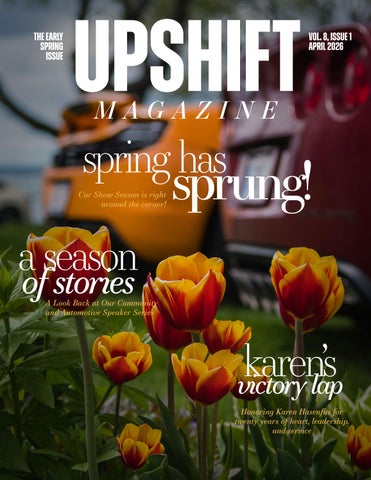
Car Show Season is right around the corner!
stories aseason
A Look Back at Our Community and Automotive Speaker Series

Honoring Karen Hasenfus for twenty years of heart, leadership, and service
4
LETTER FROM THE EXECUTIVE EDITOR
As summer ends, we reflect on a vibrant season and upcoming automotive celebrations.
8
EXPANDING YOUR BENEFITS
New digital cards, expanded reciprocal access, and added event discounts make LAAM membership more rewarding than ever in 2026. 10
ABOUT THE MUSEUM
Learn about the Museum’s history
17
WINTER WARMER
With snow outside and celebration inside, this year’s Members Party offered a welcome taste of car season and community.
18 MEET OUR CONTRIBUTORS
Meet the team who makes this and every issue possible
CLARK’S COVAIR PARTS
Still devoted to the marque they helped preserve, Cal and Joan continue to enjoy and restore Corvairs of their own, including a rare and beautifully restored Rampside pickup.
44 HARD WON!
Why New England’s brutal winters make NEMPA’s vehicle testing especially valuable to consumers
OF CARS & CHRONOGRAPHS
Why craftsmanship, performance, and design attract enthusiasts to both cars and mechanical watches. 24
THE LOCAL HACK
What was once a simple, inexpensive repair has become a costly and complicated gamble in the age of catalytic converters. 28
46
A SEASON OF STORIES
A look back at our Community Speaker Series
STARVING FOR CONTENT
Feeding that Cabin Fever in Providence, RI
TRACKING YOUR DAILY
How a dual-purpose street car slowly stops being a daily at all
38
AFFORDABLE CLASSICS
The rise, fall, and lasting appeal of Chevrolet’s air-cooled compact oddball 40
HARD GOODBYES
A cherished one-family Buick, a lasting family legacy, and a meaningful gift to the museum
48
KAREN’S VICTORY LAP
A Legacy of kindness and dedication

Executive Editor
Sheldon Steele
Editor-in-chief
Andrew Newton
Art Director
Jenn Corriveau
Contributors
Andrew Newton
Ryan Phenegar
Rob Siegel
Gibb Phenegar
Jim Travers
Cover Photo
Josh Sweeney
Photo Contributors
Andrew Newton
Ryan Phenegar
Rob Siegel
Jim Travers
Jenn Corriveau
Josh Sweeney
Natalie Harrington
RM Sotheby’s Bonhams
Omega Phillips Auctions
Getty Images/Matthew Stockman.
UpShift
Quarterly Publication of the Larz Anderson Auto Museum
Larz Anderson Auto Museum
Larz Anderson Park 15 Newton St. Brookline, MA 02445 | larzanderson.org 617-522-6547
A NOTE FROM THE
EXECUTIVE EDITOR

Spring in New England doesn’t arrive - it breaks through.
Yup, after months of snow, salt, slush, storage, and restraint, the light stretches, the air softens, and engines fire again. Quiet garages come alive. The seasonal reset.
You know what that means. It’s driving season.
At the Larz Anderson Auto Museum, that shift is immediate. The lawns turn green, the Carriage House sharpens against a brighter sky, and everything moves outward. What was static becomes kinetic. What was in quiet repose returns to motion.
This is when the museum hits its stride. Bam! And just like that, we begin again.
Cars get driven. Stories get told. People show up for Cars and Coffee and Lawn Events and not just to look, but to engage. Because driving isn’t passive. It’s connection: to history, to design, to the visceral experience that made us care in the first place.
Spring makes it clear; this has never been just about transportation. It’s ritual. Identity. Community. And here in Brookline, on these historic grounds, that community comes fully into focus. Here at LAAM, it’s Lawn Events, conversations, shared obsessions, set against more than a century of automotive continuity. It holds.
In This Issue
Inside, you’ll find a cross-section of what it means to be an enthusiast right now and how we use these machines, how we think about them, and why they still absolutely matter.
We look at the “daily driver” and what happens when it stops being daily and starts becoming something sharper, faster, more intentional. A familiar slope: practicality gives way to performance, and one car becomes two.
We revisit the Chevrolet Corvair - an American outlier that challenged convention, got misunderstood, and now stands as one of the most approachable entry points into classic ownership.
We step sideways into the world of mechanical watches, yet another arena where precision, heritage, and collecting instincts collide, and where the overlap with car culture is anything but accidental.
We also get real about ownership. Maintenance isn’t what it used to be. Even simple repairs have become layered, expensive, and occasionally absurd, requiring equal parts persistence and strategy to keep older and newer machines on the road.
You’ll find highlights from a standout Speaker Series season as well, with authors, historians, racers, and industry voices, all reinforcing that this museum isn’t just a place for cars, but a place for ideas. Through the fall and winter months, the community came out. Hopefully you were present for a talk or two as well.
And that’s only part of it. There’s far more between these covers - unexpected stories, sharp insights, and the kind of details that reward a closer read. The throughline is simple: energy on every page. We work at it.
We close UpShift, appropriately, with people. Really, a singular person. And we never forget that it’s always about the people that enrich our lives.
This issue includes a tribute to Karen Hasenfus, whose more than twenty years of dedication behind the scenes helped define the Larz Anderson Auto Museum as it exists today. Operations, Events, Member Services, Karen touched all of it. The impact is lasting. The absence will be felt.
So as the season turns fully, finally, we invite you back. Back to the Great Lawn. To the road. To the experience that started all of this for so many.
Spring has sprung! Joy Spring!
See you out there,
EXECUTIVE EDITOR
Sheldon Steele


MUSEUM MEMBERSHIP
EXPANDING YOUR HORIZONS
NEW MEMBER BENEFITS AT THE LARZ ANDERSON AUTO MUSEUM
WORDS: Ryan Phenegar
You asked, we listened! To help bring in the new year, the team at the Larz Anderson Auto Museum recently released new membership perks, greatly expanding the benefits of being a Larz Anderson member.
Starting in early February, we released the new Digital Membership Cards. When signing up for a membership, you are automatically enrolled to receive a new digital card. No more searching through your pockets for your paper card at a Lawn Event. Now, simply add your digital card to your Apple or Google Wallet on your phone, and have access to your membership card anywhere you go (assuming you don’t forget your phone).
Also new for 2026 is the offering of a Couple Plus membership level. This new level provides free admission to the museum for the individual who purchased the membership and a guest of their choosing. This new plus level also grants access to the NARM (North American Reciprocal Museum)
Association and ROAM (Reciprocal Organization of Associated Museums) Association reciprocal membership. When visiting a new museum, simply check to see if the museum offers NARM or ROAM memberships, flash your digital card (if you have a Couple Plus or higher memberships through LAAM), and enjoy your free admission to thousands of great cultural institutions.
Finally, members can now enjoy exclusive perks to our museum offerings. From early access and discounts for vehicle pre-registration at Lawn Events to discounts for any of our Automotive and Community History pre-registrations, there are new member perks all around. Support America’s oldest car collection by becoming a member or renewing your membership today. We hope to see you at our next event.

ABOUT THE MUSEUM
STEP INTO THE HISTORIC CARRIAGE HOUSE, HOME
TO “AMERICA’S OLDEST CAR COLLECTION,” AND EMBARK ON AN IMMERSIVE JOURNEY THROUGH THE RICH HISTORY OF AUTOMOTIVE INNOVATION.
The Larz Anderson Auto Museum is located in the lavish and original 1888 carriage house on the grounds of the former Weld Estate, now Larz Anderson Park, in Brookline, Massachusetts. The building was inspired by the Château de Chaumont-Sur-Loire in France and designed by Edmund M. Wheelwright, the city architect of Boston. First constructed as a working stable, it later served to house and maintain the Andersons’ growing collection of motorcars.
Larz and Isabel Anderson began their love affair with the automobile before the turn of the century. In 1899, soon after they married, they purchased a new Winton Runabout, a true horseless carriage. From 1899 to 1948, the Andersons purchased at least 32 new motorcars in addition to numerous carriages, thus creating “America’s Oldest Car Collection.”
As each car became obsolete, it would be retired to the Carriage House. By 1927, the Andersons began opening the building to the public for
tours of their “ancient” vehicles. When Isabel Anderson passed away in 1948, it was her wish that the motorcar collection be known as the “Larz Anderson Collection,” and that a separate non-profit organization be created to promote the mission of preserving the collection and automotive history. The grounds of Larz Anderson Park include a romantic pond, a picturesque view of the Boston skyline just four miles away, acres of lush open space with walking paths throughout, and an ice skating rink that is open to the public during the winter months. Today, the Carriage House is on the National Register of Historic Places. A landmark within the community and both a cultural and educational hub in the automotive world, it continues to house and preserve the fourteen motorcars that remain in the Larz Anderson Collection.


DRIVEN BY DREAMS
CLARK’S COVAIR PARTS
a new england family business driven by passion
WORDS & PHOTOS: Jim Travers

Cal Clark was just 16 years old when he bought his first Corvair. It was a turbocharged ’64 Monza Spyder coupe, one of the most performance-focused and desirable Corvair models when new. It is a car prized by collectors today, but this one was buried in a snowbank at the time. Undaunted, he paid $50 for it and was immediately hooked.
“Some of my friends had Fords, ’57 Chevys, muscle cars,” Cal says with a smile. “They couldn’t keep up in turns. As long as I could get in front of the others before the corners, I could lose them.”
Cal’s fondness for turning a corner in addition to going fast in a straight line made him a Corvair acolyte, and led to a life-changing decision to start his own business with his wife Joan in 1973. More than half a century later, the Shelburne Falls, MA-based Clark’s Corvair Parts Inc. is the largest and best-known supplier of Corvair parts and components in the world.
No stranger to the Corvair before buying that first turbo, Cal was first introduced to the model by his parents. The family owned more than one while he was growing up, and he and Joan
once did a cross-country road trip in one of the family Corvairs. The adventure covered several thousand miles without incident, helping cement his appreciation for the model. A job helping out at a local Chevrolet dealership furthered his knowledge, providing access to parts and know-how, and he was mentored by mechanics familiar with the model.
“In those days, there was usually one mechanic in any Chevrolet dealership who worked on Corvairs and appreciated them.”
It was while restoring one of their first Corvairs that the Clarks realized they might be onto something more than a hobby. Another collector inquired about buying some exhaust system components, and they negotiated a price.
“I think I made $5,” he says.
First sale made, Clark’s Corvair Parts began in a modest three-room apartment that Cal and Joan shared with 20 shelves of parts. The bed doubled as a shipping table. Business steadily picked up as word got out, even as the couple continued with their day jobs as educators.


“We’d come home, have a nap, and take orders until midnight.”
Within a year, things were getting tight, to say the least. So, the couple bought their first home, spreading out into the larger space. More shelves and work surfaces were added. Marketing began in earnest when the Clarks added a small printing press to the living room furnishings. The staff continued to grow, and space got tight again.
“We had 12 people working out of that 1200-square-foot-house,” he says.
By 1977, the business desperately needed its own home, as did the Clarks. Company employees assembled the first of several Quonset huts that would become the new home of Clark’s Corvair Parts. As soon as they finished the first one, they started on the second. The third one went up immediately after that. Today, there are about a half dozen of them on nine acres, all powered by solar panels.
While all that construction was going on, Cal and Joan quit their day jobs to devote all their working hours to the Corvair business. Buying trips led to more inventory as the Clarks bought out collections and even unsold NOS (new-old-stock) inventory from dealers. The Clarks also took their act on the road, bringing trailer loads of inventory to Corvair shows and other events.
By 1983, they installed a much-needed computer system to help run the business. Finding no appropriate offthe-shelf software available, the Clarks hired a local computer whiz to design a ground-up, DOS-based system. It worked so well that it is still used today for everything from inventory control to pricing and shipping. Fortunately, the individual who designed it is still in the area.
“I hope he never retires,” says Cal with a grin.
As of 2026, the days of printing catalogs and driving to events are over, as the business has evolved and become so well-known in the Corvair community. Most orders come in through the phone or Clark’s website, which is also a tremendous resource for Corvair enthusiasts with technical tips, background information, Corvair history and info, and links to clubs and other relevant sites.
Their extensive inventory is spread over 60,000 square feet of Quonset huts, all stacked to the ceiling with somewhere in the neighborhood of 15,000 different parts and components for every year and model Corvair ever built. Clark’s even manufactures hardto-find components such as interior door panels and seat covers in a variety of original colors.
Even today, nearly 60 years after GM killed the Corvair, interest in the cars remains strong. The internet has also led to a serious increase in business from overseas, particularly in Europe, where thriving Corvair clubs hold regular get-togethers and rally events. Clark’s is ready to help, with a staff that now numbers more than 20 employees, several of whom have been with the company for as long as 46 years.
The business has adapted to meet the needs of customers from around the world, and to do business in the internet age. That’s not bad for what began as a home business and passion project devoted to a niche car that hasn’t been built in over half a century.
Clearly, they must be doing something right.


When they’re not busy with the business, Cal and Joan remain Corvair enthusiasts. They enjoy driving, maintaining, and restoring several examples of their own, including the 1966 Corsa convertible that was one of their first.
But this immaculate 95 Rampside pickup truck is truly something special. A prized part of their personal collection, it is one of the hardest Corvair models to find today, as most saw a hard life of commercial work.
This one served as a company work vehicle for many years after the Clarks purchased it in 1974. Finished in its original orange and white colors, it served as a highway department vehicle before that. After being retired from service, the Clarks completed a complete restoration in 2012. Now in like-new condition, the van still sees regular use.

AVI provides bespoke performance car audio and video. We are capable of providing you with the latest technology and styles available for your vehicle You may add new components to your system or have it rebuilt from the ground up Our professional staff performs custom work at competitive prices
Locally owned and operated, AVI truly has all of the quality products and experience you need to personalize your car We pride ourselves on personalized service and helping make your automotive dreams reality.
We are open Monday through Friday from 8:00am to 5:00pm. Premium consultation services available on Saturday by appointment only.


ANNUAL MEMBERS PARTY
A WINTER WARMER
CELEBRATING THE ANNUAL MEMBERS PARTY
WORDS: Ryan Phenegar
For many automotive enthusiasts, this winter has been quite a wakeup call compared to the mild weather we enjoyed last year. With record snowfall in the Boston area, and the roads so white with salt you can’t tell what’s snow and what’s pavement, many of us have been eagerly waiting to pull our cherished automobiles out of this long winter hibernation. Although the snow and cold temperatures mean no Lawn Events are happening this time of year, there was a glimmer of “car season” this winter.
On Saturday, February 21st, the museum hosted its annual Members Party, celebrating our beloved members and the community that supports the museum. Joining together in the warm ambiance of the carriage house on a cold winter’s day, over 100 members came to celebrate another year of our great automotive community, making this year’s Winter Warmer a smashing success.
This year, guests enjoyed an amazing array of our favorite comfort foods. Calla Catering generously provided the appetizers and desserts, while Tastings Catering also generously provided the small plates stations, including a fabulous Mac & Cheese station. Brad Jarvis, Scotch connoisseur known as “The Whiskey Professor,” brought his
knowledge to our well-enjoyed scotch tasting.
The talented Mark Greel and his band provided some smooth jazz for our listening pleasure, and Casino Productions brought back our everpopular roulette and blackjack tables with their very professional and informative dealers.
Rounding out the party, we had a heart-warming tribute to our long time Operations, Events Manager, Karen Hasenfus. This year marked Karen’s last time hosting our annual members’ party before her well-deserved retirement coming up in May. From all of us here at the museum, thank you, Karen, for your years of dedication and fantastic events.

THE CONTRIBUTORS

ANDREW NEWTON EDITOR-IN-CHIEF
Andrew came of age around old cars and vintage racing, and first came to the museum through an internship while attending Clark University. He then served as the Education Manager at Larz Anderson while writing about cars both old and new for Sports Car Digest, James Edition and CarGurus. In 2014, Andrew joined Hagerty as Auction and Valuation Editor to cover the collector car market worldwide and contribute to the Hagerty Price Guide. Andrew has written hundreds of articles on classic car values, market trends and history for Hagerty as well as hosted webinars and attended dozens of auctions each year. He currently lives in Houston, Texas, but gets back to Larz Anderson as often as he can.

JENN CORRIVEAU ART DIRECTOR
As a child, Jenn accompanied her “Car Guy” dad to car events across New England, so it’s fitting she now serves as the Lawn Events Manager at Larz Anderson Museum. In college, Jenn studied Graphic Design and discovered a passion for various design forms, from photography and logos to brochures and wedding invitations. Her skills and role at the Museum are key to shaping its image and message.

RYAN PHENEGAR EDITOR + CONTRIBUTOR
Influenced by a childhood surrounded with his father’s passion for modified German cars, Ryan has always had a love for all things German. Joining the Larz Anderson family in 2022, Ryan is the newest addition to our team. As a recent graduate from Bridgewater State University, he’s already making a name for himself as the go-to guy for all things audi-related. When he’s not tinkering under the hood or cleaning one of his cars, you can find him running car registration at all the Museum lawn events, ensuring every car is ready to go on the lawn.
CONTRIBUTORS

ROB SIEGEL CONTRIBUTOR
Rob Siegel has written the monthly column The Hack Mechanic™ for Roundel, the magazine of The BMW Car Club of America, for 35 years, and writes weekly online for Hagerty and BimmerLife. Rob has also written for Road & Track, Sports Car Market, and Forbes, and is the author of eight automotiverelated books, including The New York Times-reviewed Memoirs of a Hack Mechanic. Rob has owned over 70 BMWs, most of them 1970s-era cars. He currently owns 13 cars including eight vintage BMWs and a Lotus Europa, and yes, his wife knows where all of them are.

JIM TRAVERS CONTRIBUTOR
Jim Travers is a lifelong gearhead, and a freelance writer, editor, and photographer specializing in all things automotive. A classic car enthusiast and collector, Jim is a regular judge on the car show circuit and is the author of the Smithsonian Institute’s Extreme Cars. His work has also appeared in Automobile, Autoblog, BBC Autos, Car and Driver, Cars.com, Car Talk, Consumer Reports, Hagerty, The NY Daily News, US News, and others. He lives in Duxbury, Massachusetts, a town known for both its beach and its dump. On weekends, Jim can often be found at one or the other.

NATALIE HARRINGTON CONTRIBUTOR
Natalie Harrington is a Bostonbased motorcyclist, writer, and auto enthusiast. More than any one marque or vintage, Natalie appreciates the joy and passion she sees in the car community. She loves car shows, races, and museums and seeks them out around the world, but thinks that LAAM’s unique community and collection top them all.

OF CARS & CHRONOGRAPHS
WORDS: Andrew Newton | PHOTOS: RM Sotheby’s, Bonhams, Omega, Phillips Auctions, Getty Images/Matthew Stockman.
We all have our own personal reasons for loving automobiles. Many of those reasons, however, boil down to an appreciation for any well-executed blend of engineering and design, of form and function. It’s no wonder, then, that so many people who love cars also love watches. Specifically, luxury mechanical watches. The similarities are all over the place, and the car hobby arguably has more crossover with the watch hobby than any other, both at the personal level and at the corporate level.
What are those similarities? To start, both a watch and an automobile are mechanical systems made up of moving and non-moving parts, working together to perform a function. The love for mechanical objects and the craftsmanship that goes into them attracts a certain type of person, and both hobbies are mostly (but by no means exclusively) masculine ones.
Both enthusiast cars and mechanical watches require at least some level of specialist service, the bills for which get more expensive as the designs get more exotic and complex. Enthusiasts develop deep emotional connections with the brands they love, not just with their products on a surface level but with history, technical specifications, subtle differences from product to product or from year to year, how these products work, what their use cases are, how they perform, etc.
Both a special car and an interesting watch also serve as a status symbol,
or at least as a way to stand out in a crowd of “crossover SUVs” or socalled “smartwatches.” They’re both things that are nice to have, but not things that one needs to have. Both are hobbies that the ultra-wealthy enjoy, but they’re not hobbies where you need to be ultra-wealthy to dabble. You can spend a few grand on a project car or $142M on a Mercedes-Benz 300SLR Coupe. Likewise, you can spend a few hundred bucks on a nice collectible watch or $31.2M on a Patek Philippe Grandmaster Chime.
Both hobbies have developed their own, hyper-specific lingo. “Hulk,” “Speedy,” “Pepsi,” or “Root Beer” are as incomprehensible to a non-watch person as “PTS,” “DOHC,” or the various chassis codes used to denote German or Japanese vehicles are to a non-car person. Both watches and cars also have a way of hooking us into collecting them. Once bitten, we can’t just have one, and both hobbies are highly efficient at draining our bank accounts.
Many of our favorite cars and watches are also capable of impressive feats, but are often not used to their full potential. You’re more likely to see a supercar in front of a fancy restaurant than driving ten-tenths on the track, and you’re more likely to see a dive watch worn with a business suit than with a SCUBA suit. Many luxury 4x4s see nothing rougher than a gravel driveway, and very few take their Omega Speedmaster to the Moon anymore.
Both car companies and watchmakers


market themselves by leaning heavily into “heritage” and “tradition,” sometimes to a nauseating degree, but there has been some serious intermingling between these industries over the years. In the prewar era, many watchmakers, including Massachusetts’ own Waltham Watch Company, produced dash clocks for luxury automobiles. A sister company to Jaeger-Lecoultre also produced full instrumentation for British and European cars starting in the 1920s. In the 1970s, Cartier supplied clocks for Lincolns. These are just a few examples.
Given the importance of timekeeping to motorsports, watch companies have played a historic role in that corner of the automotive world. In the pre-digital era, race drivers and crew chiefs used chronograph wristwatches and mechanical stopwatches to keep time, and over time, watchmakers’ connection to racing has led to models like Tag Heuer’s “Monaco” and “Carrera” as well as Rolex’s “Daytona.” Speaking of Rolex, it is probably the most visible Swiss watch brand on the racing scene today. Rolex’s collaborations with Daytona Speedway go back to the 1950s, and Rolex started sponsoring the 24-hour race at Daytona in 1992. Each year’s race winner gets an Oyster Perpetual Cosmograph as a prize. Rolex is also the official timepiece of the 24 Hours of Le Mans and is a major sponsor in historic racing.
Other car/watch crossovers include everything from Honda and Toyota edition Casios to six-figure, Ferrari-branded Hublot watches. Bentley partnered with Breitling for nearly two decades, and IWC has collaborated with MercedesAMG since 2004. There are even watch brands whose entire identity is connected to automobiles. Porsche Design makes watches, for example, and the tagline for American watchmaker Autodromo is “Instruments for Motoring.” For the company’s founder, Bradley Price, “my singular goal is to create beautiful products that express my passion for classic cars and racing history.”
The markets for enthusiast cars and watches, like the markets for many collectibles, have been through a very active few years, with serious growth and a more recent cooling off. The Annual Knight Frank Wealth Report, last released for 2025, has various indexes measuring the performance of various luxury goods like art, wine, jewelry,ry and coins, as well as cars and watches. As of the 2025 report, cars had grown 30% over the previous five years and 59% over the previous 10. Watches, meanwhile, had grown 53% over the previous five years and 125% over the previous 10. So far in 2026, though, not all signs are pointing up. The Federation of the Swiss Watch industry recorded a -1.7% decline in exports in 2025 and a -1.3% decline in the number of people employed in the sector, while the monthly Hagerty Market Rating, which measures the current status of the collector car market in terms of activity, has been gradually declining since its peak in 2022.
As for what car and watch collectors seek out, there are more similarities there, too. Rare and/or important brands and models command a premium. Consistent and documented service histories are desirable. Both markets also value originality. A restored ‘60s Ferrari, for example, can fetch serious money. But one with low mileage, well-kept original paint and interior, and an unbroken, documented history can carry a significant preservation premium. The difference can be even more pronounced in the watch world. As watch dealer Eric Wind noted to Hagerty in a 2024 interview, “There’s a huge difference between, say, a 1950s, small-crown Submariner that has a service-replacement dial, and bezels, bracelets, et cetera—that might be an $8000 watch—but an original example could be $500,000 at auction.”
Regardless of what the market is doing and regardless of what your tastes are or what your budget is, another similarity between these two great hobbies is that there is something for everyone. There is always something to learn, and there are always new people to meet and share your passion with. If you aren’t already a watch person, a word of warning— watches are irrational, expensive, and sometimes frustrating things to get into. But let’s face it, so are our cars.


THE LOCAL HACK
THE INCREASING DIFFICULTY OF EXHAUST REPAIR
WORDS & PHOTOS: Rob Siegel
A
s an inveterate bottom-feeder and deal-hunter, I search for cars I’m interested in that are being sold below market value because they need work. Obviously, the easier the work, the better—something like “needs brakes” is music to my ears.
It used to be that “needs exhaust” was right up there as well. These days, not so much.
So what’s changed?
Back in the day, the exhausts on my four-cylinder European cars had four sections—the headpipe that attaches to the lasts-the-life-of-the-car exhaust manifold, the center resonator, the muffler, and possibly a separate tailpipe. Other than a few gaskets, U-clamps, and hangers, that was it. If you didn’t want to pay dealer prices for replacement exhaust components, aftermarket companies like Ansa, Supersprint, and others usually offered sport exhausts that sounded throatier for less money. They may not have lasted as long as the originals, but when the car rotted as quickly as the exhaust, it hardly mattered.
With my vintage cars, one of the things I’m seeing is that unless the car is a popular model, there’s sometimes no exhaust components available. Such was the case when I readied my ’73 BMW Bavaria
for sale last summer. It had a hole in the muffler for a decade, and I’d avoided replacing it by wrapping it in chimney pipe and putting four big hose clamps over it. These days, it’s just assumed that you’d need to bring the car into a custom exhaust shop and have them bend one up for you. Fortunately, I was able to find a new-old-stock muffler on eBay.
But on newer cars, the dynamic is different. It’s not a lack of availability of parts. In addition to the dealer, RockAuto.com will likely show you at least a dozen different vendors, with two dozen more unbranded ones on eBay. The user’s forums will also generally tell you that all the aftermarket exhausts, except for expensive stainless-steel ones, will last just a few years.
No, the problem is the catalytic converters. Make no mistake, I keep all mine installed and functional. But boy, it costs you. Both time and in money.
Beginning around 1996, to meet more stringent emissions standards, many manufacturers began using two cats on each bank of cylinders—a pre-cat located close to the engine so the cat can warm up quickly and reduce emissions as soon as possible after startup, and a post-cat to handle the larger volume of the warmed-up and driving exhaust. On a V-6 or V-8, there’s usually a pre- and post-cat for each bank of cylinders, so that makes four cats. Further, it’s become common to integrate the pre-cats into the exhaust manifolds themselves. That means that if the pre-cat
needs to be replaced, the exhaust manifold needs to be unbolted from the head, something that carries with it the risk of snapping the studs that hold it in place and grinding the process to a halt.
While I try to pinch pennies on DIY repairs, the problem with exhaust work is that if, say, the muffler has a hole in it, likely, the other exhaust components living under the car next to it (actually, attached to it) aren’t going to be in much better condition. After all, they’re exposed to the same heat, exposure, and corrosion. And even if, say, the muffler is toast, but the center resonator is solid, separating the two is often difficult or impossible. Even if you can separate them, you may find that the new replacement part doesn’t seal properly against the flange of the old part, either because the old flange is corroded or because the original and aftermarket parts are different sizes.
“A-HA!” you say. “So you should replace the entire exhaust front-to-back, and this is one of those times when the do-it-once-do-it-all people are right!” Not so fast. If you want to err on the side of spending to replace four catalytic converters, go ahead. Me, I will use every trick in the book to avoid sliding down that slippery slope.
I recently went through this with my 2008 Nissan Armada. I really only own it to occasionally tow cars with, but it’s a perfect example of the problem. I knew it had a leak in the exhaust when I bought it, but the price was right, and I figured I could deal with it. The leak turned out to be from a bad weld attempt to join the muffler and the tailpipe, which were of two different sizes. I bought a new

tailpipe and grafted it on with a couple of adapters and U-clamps. That was enough to get through the first year’s inspection.
Then the muffler began leaking at the seam. Because it was welded to the pipes in front of it, there was no way for me to replace it without replacing the pipes leading all the way to the back of the cats. Yes, a custom exhaust shop could’ve cut the pipes and welded a muffler on, but this kind of work isn’t cheap around Boston. I was concerned that one of the post-cat flanges looked awfully rusty, but I was able to get the exhaust off it without breaking it.
This year, the connection at that post-cat flange began leaking. So that means either trying to seal it, or paying a custom exhaust shop to cut the flange off and weld a pipe between the back of the cat and the intermediate pipe, or replacing that post-cat.
The problem is that the flange between it and the pre-cat also looks awfully weak, and if I break it, I’ll cry, as people on the Armada forum report that, if you need to replace the front cats, it’s a lot easier if you remove the front differential, and I’m just not going to do that.
I’ll do what I’ve done before—adopt a “first, do no harm” approach, which means taking that joint apart, trying to reseal it with a new gasket and muffler putty, and hoping to get another inspection out of it before I do anything more invasive. Also, like other exhaust components, the aftermarket cats reportedly don’t last as long as the originals, so it behooves you to try to eke as much life out of the original cats as you can.

The exhaust on my 2008 Nissan Armada showing two pre-cats with integrated exhaust manifolds, two post-cats, three intermediate pipes, the muffler, and the tailpipe, for a total of nine major components.


(Left) This is the flange between the two left-side catalytic converters. The rear (post) cat is the flange on the top. The one in better shape is the front (pre) cat flange on the bottom. But if I touch those nuts and bolts, they’ll snap, and I’ll have an afternoon ahead of me with a drill and a tap.
But you can see how most normal people would solicit quotes for getting it repaired, balk at a price that’s more than the value of the car, and just sell it for whatever someone will pay for it.
Hopefully my next car will just need brakes!
(Rob Siegel has been writing the column The Hack Mechanic™ for BMW CCA Roundel Magazine for 40 years, and is the author of eight automotive books.)


Starving for Content
A BRUNCH WORTH LEAVING THE LAUNDRY BEHIND FOR
WORDS
& PHOTOS: Jenn Corriveau | PHOTO, LEFT:
Rogue Island FB page
N FEEDING THAT CABIN FEVER
ow and then, my husband and I get a rare weekend off from parenting. Sometimes that means catching up on laundry, or tackling the garage. We really know how to party.
But sometimes we get to really enjoy a weekend, and after the Blizzard of ’26 had us cooped up for days, we were determined to do something that didn’t involve any grown-up chores. I had heard about a new restaurant in Providence called Rogue Island, so I made brunch reservations, and we headed out.
Naturally, in peak New England fashion, it started snowing again. We climbed into a 2025 Mazda CX-50 and headed south. We’ve owned Mazdas before, and this one might be our favorite yet. It’s lower than your typical SUV, making it at least feel a bit sportier, and the striped seats give it a surprisingly fun touch. Most importantly, it handled the snowy roads like a champ, which felt essential given the weather’s sense of humor.
Rogue Island is in Providence’s Financial District, and somehow, we scored free street parking, basically the Boston area’s equivalent of spotting a unicorn. The restaurant is tucked inside Westminster Arcade, a historic gem built in 1828 in the Greek Revival style and widely
considered the first enclosed shopping mall in the United States. Stepping inside feels like stepping back in time, with skylights and walkways lined with ornate cast iron railings capped in mahogany. It’s stunning before you even smell the food.

The restaurant itself is cozy, seating about 100 guests, with a warm, rustic vibe. Wood, reclaimed from early twentieth century Rhode Island barns, lines the space, and you can feel the local pride in every detail. The tables and bar top were handcrafted in Coventry, and the custom metalwork for the bar rail and draft system was done by local artisans. You immediately sense that this place cares about where things come from. That philosophy extends to the menu, which is chef-driven and sourced from farms often within 50 to 60 miles, as well as a drink list focused on Southern New England breweries, vineyards, and distilleries.
We decided to order strategically and split everything.
First up was the poutine. My husband is French Canadian, so skipping poutine is just not an option whenever it’s on the menu. This version leaned into brunch with homemade tots, rich gravy, a fried egg, squeaky cheese curds, pickled onions, and microgreens. It was everything you want a winter poutine to be: indulgent, messy, savory perfection.
Then came a maple pear homemade “Pop-Tart,” which felt like the pastry version of a flannel shirt. Flaky, lightly sweet, and topped with pastry cream, it tasted more like a delicate slice of pie than anything that ever came out of a foil wrapper.
The true showstopper was the Hot

Nashville Chicken and Waffles. When it arrived, we both laughed. The chicken was massive, crispy, and coated in a spicy sauce, then finished with white Alabama sauce, an unexpected twist that absolutely worked. It sat on a golden waffle and was topped with homemade pickles and pickled red onions for the perfect bite of heat, sweetness, and tang. We were very glad we decided to split it.
We left full, happy, and already talking about what we’d order next time. Laundry can wait. Brunch at Rogue Island cannot.


TRACKING YOUR DAILY
THE DEMISE OF THE DAILY DRIVER
WORDS & PHOTOS: Ana K. Malone Oliver
Tracking Your Daily usually begins innocently enough. But then, one track day leads to another. Soon, the garage floor is crowded with stacks of track tires and countless boxes of fresh brake pads beside their worn predecessors. Somewhere along the way, the obsession takes hold. One day, the daily driver simply isn’t anymore.
Initially, balancing a commuter car with a weekend warrior feels manageable. Then, what was just a handful of track days on the calendar slowly grows into a schedule that takes up more and more time. And it’s not just days at the track. It’s also preparing for those days at the track, making the car as good as it can be.
The first modifications are typically focused on driver safety and car longevity. Higher temperature brake pads and fluid allow for consistent threshold braking lap after lap, while more capable tires help the car withstand repeated on-pace sessions over a full track weekend. Soon, however, the focus begins to shift. Modifications start chasing lap times rather than reliability. Stickier tires appear, and before long, a second set of dedicated rain tires is being hauled to the track as well. Alignments favor aggressive camber, toe, and caster to sharpen the car’s responsiveness and feedback. Each adjustment makes the car faster and more predictable on track while quietly eroding the civility expected from a daily driver.
For many drivers, the realization arrives gradually as the compromises begin to accumulate. Sticky 200-treadwear tires, a staple for many track-day drivers, can lose most of their useful grip after only a few hard weekends. Tires quickly become the single most expensive consumable once lap times begin to drop. Aggressive camber settings that protect the outer shoulders during cornering quietly chew through the inside edges of tires during normal street driving. Track pads that regularly operate in temperatures exceeding 800–1000ºF during repeated sessions can warp rotors and later announce every stoplight along the commute with high-pitched squeals.
None of this is unusual for a track car. It just starts to feel out of place on something that still needs to be driven to work on Monday. For these drivers, the final decision often comes down to a single question: prioritize commuting comfort, or maximize the car’s potential on track?
For others, the decision arrives much more suddenly. A mechanical failure can transform an exciting track weekend into a logistical headache dominated by repair decisions and questions about the car’s future. Track driving has a way of exposing weaknesses in both machines and plans. When major components like the engine fail under track stress, the conversation surrounding the car changes quickly. Instead of planning next year’s modifications to hunt for a new personal record, the driver is suddenly forced to confront a larger question: What role should this car play moving forward, really? Does it make sense to repair the car so it can return to daily-driver duty, assuming that is financially practical? Or does the failure present an opportunity to rebuild the car with stronger components that support more aggressive track driving with fewer compromises?
This is the moment the lid on Pandora’s Box cracks open. Returning the car to its original commuter role may not be realistic if the damage is extensive or the repair costs are substantial.
In that scenario, the driver is no longer deciding how to fix one car. The driver is suddenly figuring out how to own two: a replacement daily driver and a dedicated track car.
Alternatively, returning the car to its commuter duty may still leave the driver searching for a separate machine better suited for track work. That single thought opens Pandora’s Box even wider and introduces a new possibility entirely: a different platform to build.
What type of car should come next? A hot hatch, coupe, sedan? Porsche, BMW, Miata? Rear-wheel drive, all-wheel drive, or front-wheel drive? What condition is it in? Does it require a full rebuild, or only targeted upgrades to withstand aggressive track use? What do the total costs look like for each choice?
The questions rarely stop there. Is the car road legal? If not, is the driver prepared to obtain and operate a truck and trailer? If it is road legal, can it realistically carry spare wheels, tools, gear, and the equipment needed for a full track weekend?
For some drivers, the decision to stop Tracking Your

Daily is a gradual progression of compromises, while for others, a mechanical failure delivers the deciding blow. In both cases, the destination is often the same. The car that once balanced commuter duty with weekend track sessions slowly becomes something else entirely.
Once Pandora’s Box has been opened, it rarely closes again. In that moment, it becomes clear that Tracking Your Daily was never meant to last forever.


AFFORDABLE CLASSICS
I THE CORVAIR
f the story of Clark’s Corvair Parts piqued your interest in Chevrolet’s small ‘60s oddball, we can’t blame you. The story behind them, their quirky design, their rise and fall in America’s famously fickle automotive market. It’s all fascinating stuff. Even better, Corvairs make excellent entry-level classic cars. They’re affordable to buy. They’re easy to find. Parts are readily available. There is also a wide range of use cases for Corvairs because there are so many different kinds. Corvair was almost like a marque in its own right, albeit a short-lived one. There are basic sedans for puttering about, convertibles for easy cruising, sporty turbocharged coupes, even utilitarian vans and pickups. And none of them will break the bank to buy, own, or maintain.
The Corvair came out of Detroit’s realization in the late 1950s that not all American motorists wanted to drive massive V-8 tanks with sky-high tailfins and several acres of chrome. There was a clear appetite for smaller cars, and the Big Three were ceding ground in the small car segment to imports like Volkswagen, Fiat, and Renault, as well as domestic rivals like Rambler and Studebaker. In a short period, they introduced their own compacts in the form of Chrysler’s Plymouth Valiant, Ford’s Falcon, and General Motors’ Chevrolet Corvair.
The Ford and Plymouth were essentially scaleddown versions of conventional American cars, but the new-for-1960 Corvair was a radical departure for an American car company. Under the direction of GM bigwig Ed Cole and with VW in its sights, Chevrolet used a rear-mounted air-cooled flat-six engine. It also embraced four-wheel independent suspension and unibody construction, both fairly advanced for the time. Styling wasn’t exactly elegant, but it was clean and unfussy. Prices for the first ones started at around $2000, or about $22K adjusted for inflation.
WORDS: Andrew Newton
PHOTOS: GM, Mecum Auctions
Body styles included sedan, convertible, coupe, and “Lakewood” station wagon. From 1961-65, there was also the “Corvair” 95 series that included a passenger van, commercial van, and a pickup truck with a VW Transporter-like cab-over design. Vans were marketed as the “Greenbrier,” and pickups were available in either “Rampside” or “Loadside” configurations. Loadsides had a conventional tailgate at the back for accessing the cargo area, while Rampsides featured a ramp that lowered from the right side of the bed between the wheels.
GM designed the Corvair to be an economy car first and foremost, and the Corvair offered practicality advantages. The rear-mounted engine and transaxle meant that there was no driveshaft or transmission tunnel taking up interior space, so they were quite roomy. Bigger and more powerful than its foreign competition but priced competitively, Corvairs offered a good value. The design also delivered good traction, a low center of gravity, and good balance, which made Corvairs fun to drive. Chevrolet sold the “Monza” as the Corvair‘s upscale trim, while the 1962 “Monza Spyder” (available as both coupe and convertible, despite the name) was the second production automobile ever available with a factory turbocharger, its 145 cubic inch flat-six putting out a respectable 150 horsepower.
The period of 1964-65 was a big and ultimately bad time for the Corvair. Introduced at the 1964 New York World’s Fair, the all-new Ford Mustang was a smash hit that undoubtedly stole sales from the quirkier Corvair. Then, in 1965, Ralph Nader’s book Unsafe at Any Speed: The Designed-In Dangers of the American Automobile made the case that American carmakers deliberately resisted putting safety features into their cars in the interest of saving money. The Corvair, with supposedly
unpredictable handling characteristics resulting from the car’s swing-axle rear suspension, is the book’s main antagonist. Later studies showed that the firstgeneration Corvair was no less likely to lose control than its contemporary competitors, but its reputation was irreparably damaged.
Chevrolet redesigned the Corvair for its second generation in 1965. Only sedan, coupe, and convertible body styles remained, and Chevrolet dropped the Corvair 95 line of vans and pickups. The second-gen Corvair offered a slew of improvements, but the biggest two were a new multilink design for the rear suspension and a completely new look. The former eliminated the handling problems associated with the pre-1965 cars, and the latter made the Corvair one of the sharpest-looking cars on sale with its Coke-bottle flanks and smooth profile.
The Corsa model became the sporty turbocharged version with a full 180hp, though turbos were dropped after 1966. Before he became legendary for his Camaros, Pennsylvania Chevy dealer Don Yenko also converted roughly 185 Corvairs into “Yenko Stingers.” Aimed at the Sports Car Club of America’s D-Production race category, Stingers ditched the Corvair’s rear seat and added beefier suspension, a quicker steering ratio, a Positraction limited-slip differential, an oil cooler, and dual brake master cylinders. Stingers were available in 160-, 190-, 220-, or 240-hp tune.
Once the second half of the 1960s got underway, the Corvair’s days were numbered despite its improvements. The Camaro came out in 1967, and thethird-genn Nova came out in 1968, further cannibalizing Corvair sales. By 1969, production had moved to a special area of the factory, and cars were essentially hand-built. By 1970, the Corvair was gone, and no part of its rear-engined, air-cooled architecture lived on in any subsequent GM products. The Corvair established the “finally get it right, then kill it” pattern that GM followed repeatedly over the coming decades.
When it comes to classic cars, few have remained as consistently affordable as Corvairs. There have been some ups and downs in value over the years, including some noticeable appreciation in the early 2020s (when everything with four wheels and an

engine was getting more expensive), but nothing drastic ever seems to happen with the Corvair price. First-gen (1960-64) Corvairs can be downright cheap. Very clean cars in the lower Corvair 500 and Corvair 700 trims can still be had for four figures, and even early Monza coupes still barely crack five. Lakewood station wagons can stretch into the teens, while Monza Spyders are closer to $20K.
The more attractive and more developed secondgen (1965-69) Corvairs get a little more expensive, understandably, but they’re still very attainable. Turbocharged Corsa models in excellent condition stretch into the $20K range, but that’s it. Only a Yenko Stinger could be considered a properly expensive Corvair, but they are generally worth around $50,000. And that doesn’t seem so bad considering the rarity, race heritage, and the six-figure prices people pay for Yenko Camaros.
As for the vans and pickups, they make up a small fraction of the roughly 1.8M Corvairs built in total, but they are still relatively affordable. Clean pickups have been selling in the $20K-plus range in recent years, with Greenbrier vans a little pricier than that. They have most of the charm of the equivalent Volkswagen Transporters, but sell for much, much less.
They’re unconventional cars and a little odd, but the community around Corvairs is large, enthusiastic, and widespread. They’re surprisingly fun from behind the wheel, and it’s almost impossible to spend a ton of money on one. Which makes them a great choice for anyone on the hunt for a fun old vehicle, whether it’s your first classic car or your fortieth.


LASTING MEMORIES
AND HARD GOODBYES
SUPPORTING THE MUSEUM THROUGH VEHICLE DONATIONS
WORDS & PHOTOS: Ryan Phenegar
Over the past few years of working at the Larz Anderson Auto Museum, we have received a wide range of vehicles. From vintage motorcycles and cars to more modern daily drivers, we accept all kinds of automobiles to help fuel the museum’s mission. Last June, we got a call about a potential donation for a 1978 Buick LeSabre. I will admit that at first I was wondering what condition the car would be in. Once the Museum Director and I traveled a few towns over to see the vehicle, my question was answered.
One of my favorite aspects about working at the museum isn’t just the revolving door of automobiles coming in and out. Sure, it’s always exciting to see something new arrive, but the real joy for me is hearing the stories behind the car.
The Buick is in phenomenal condition, with beautiful original paint, an intact interior, and an almost rust-free undercarriage. Something you don’t often see on late 70’s cars, especially when living in New England. This car was originally purchased by the current owner’s father, brand new in 1978. Shortly after purchasing the car, her father passed away, leaving his cherished new Buick to her.
And it really went through a lot, serving as a daily driver to Boston and back for many years, and eventually retiring to secondary use. But the Buick was clearly well-loved, always kept in a garage and on a battery tender. It was clear as day that she really took care of this Buick.
She eventually decided it was time for the Buick to move to a new home, a decision that can often be hard for us car enthusiasts, especially with a car that has many years of family history. She decided to donate her beloved Buick to a non-profit, and after carefully considering, she ultimately decided that the Larz Anderson Auto Museum was the best place to honor her father’s, and now her, legacy.
Are you interested in supporting the Larz Anderson Auto Museum? You may receive a tax deduction by donating your car, truck, or motorcycle today! Call 617-522-6547 x21, or visit our website, www.larzanderson.org, for more details!
HARD WON!
WINTER VEHICLE TESTING
HOW NEW ENGLAND’S AUTO JOURNALISTS CROWN THE BEST WINTER VEHICLES
WORDS & PHOTOS: Natalie Harrington
To the journalists of the New England Motor Press Association (NEMPA), winter is not just a season. It’s a proving ground. With black ice, bomb cyclones, nor’easters, and mountains of compacted slush, if a car can perform here, it can perform anywhere. That, according to NEMPA, is what makes journalistic insights from this region so valuable, and it’s what makes the organization’s annual Winter Vehicle awards so meaningful.
Winter Vehicle testing culminates in an annual Winter Test Day, but evaluation is conducted year-round. A total of 75 journalists across six states share the region’s press fleet, spending days or weeks with everything from budget crossovers to six-figure trucks and even the occasional supercar. These professionals actually live with each new vehicle, commuting, driving their families around, and hauling groceries while contending with some of the most punishing driving conditions in the country. That seat time gives journalists an intimate understanding of the new-car competitive landscape.
“Our continual revisiting of every brand and every model allows us to see the evolution,” says Zane Merva, NEMPA President and co-founder of GM-Trucks.com.
Winter Test Day enhances the review process in two important ways: First, it ensures that journalists can get behind the wheel of every vehicle before casting their votes. Second, Merva observes that NEMPA’s collaborative culture contributes to better evaluations.
“NEMPA is like a family. Our members really like to help each other out,” he says. “There’s so much institutional knowledge that gets shared, because nobody is hoarding that experience for themselves. People are genuinely there to help the entire group make a better decision.”
The result is awards consumers can trust, founded on lived experience and cultivated expertise.
No amount of spec-sheet research can replicate handson testing. “There are a lot of fine differences between vehicles, and if you look at them on paper, they might seem the same,” says NEMPA Vice President John Goreham, a contributor to TorqueNews and Car Talk, among other outlets. “Unless you’ve driven a car, it’s hard
to really say how well it’ll do in winter weather.” Vehicles with aggressive lifts, big wheels, and rugged styling may look purpose-built for challenging conditions, but sometimes they’re among the worst performers in NEMPA tests. Four-wheel drive (4WD), widely assumed to be a winter asset, can actually become a liability, as it’s hard to steer when engaged. “I think that’s misunderstood by a lot of consumers,” Goreham says.
So, what do seasoned testers look for? Both Merva and Goreham identify all-wheel drive (AWD) as a baseline, along with comfort and convenience features that make winter living more bearable: heated seats, heated steering wheels, easy-to-clean floor mats, and controls that are manageable with gloved hands. Goreham also applauds the Kia Sportage X-Pro Prestige’s fully heated windshield, which facilitates de-icing far better than those that just heat the wiper area. It’s a feature he’d previously encountered on far more expensive, six-figure luxury models.
Of course, safety is paramount. “What kind of vehicle would I want to put my wife in during a blizzard?” says Merva. “From the factory, how does it drive?” Answering that means also paying attention to the tires a vehicle ships with. “Tires are expensive now,” says Goreham. “If you’re going to swap them, you’re looking at $1300 including mounting and balancing, so nobody’s going to take the all-season tires off when they first get their new car. They’re going to try to suffer through that first winter, and it’s dangerous.” He emphasizes that all-weather tires are essential and recommends looking for the Three-Peak Mountain Snowflake (3PMSF) symbol designating a severe snow service rating. He also considers a spare tire to be table stakes for any winter vehicle. “If it doesn’t have a spare, it’s off my list.”
When asked for a standout from recent testing, both experts mention Subaru. In Goreham’s experience, the brand is “in a class by itself: In the affordable world, there are only a few specialty models that can do as well.” Merva singles out the Subaru Forester Wilderness. “That thing is a tank,” he says, noting that Subaru’s AWD system and the trim’s meatier tires make it a package he’d


choose over his own Hummer EV in any snowstorm.
For consumers shopping on their own, choosing a winter-capable vehicle often comes down to anecdotal evidence. NEMPA’s winners’ list is a worthwhile tool. “It’s not so much a tally of individual votes,” Merva says. “It turns out to be a consensus of a large group of extremely experienced people whose job is comparing cars all year round, in all different circumstances — people who are genuinely interested in testing the limits of vehicles and seeing which ones come out on top.”


A SEASON of stories
A LOOK BACK AT OUR COMMUNITY AND AUTOMOTIVE SPEAKER SERIES
WORDS & PHOTOS: Ryan Phenegar
The days are getting longer and the cold weather finally seems to be in our rearview mirror, which means our Community and Automotive Speaker Series events are coming to a close. This season, we hosted a wide variety of speakers in the hallowed halls of the Larz Anderson Auto Museum. From local authors to big-name automotive icons, this season’s events have provided a little something for everyone. Check out the highlights of this season.

We kicked off the Speaker Series on Thursday, September 18th, with Myles Kornblatt, the author of Max Hoffman: Million Dollar Middleman. The book recounts the compelling story of Max Hoffman, the man who forever changed America’s relationship with European automobiles in the decades following World War II.
Hoffman’s keen eye for design, marketing, and opportunity brought legendary marques such as Porsche, Mercedes-Benz, BMW, Alfa Romeo, and Jaguar to U.S. shores, introducing models like the Mercedes 300SL Gullwing, Porsche Speedster, and BMW 507 that would become timeless icons.
On Thursday, October 9, we hosted Pulitzer Prizewinning journalist Stephen Kurkjian for a compelling discussion of his book Master Thieves. A founding member of The Boston Globe’s Spotlight Team, Kurkjian shared insights from his 40-year career and his deep reporting on the infamous 1990 Isabella Stewart Gardner Museum heist, when two men posing as police officers stole 13 masterpieces by artists including Rembrandt, Vermeer, Manet, and Degas, works now valued at more than $500M. Despite decades of investigation and a $10M reward, the crime remains unsolved, making it one of the most fascinating mysteries in art history.
On October 23rd, we had the pleasure of hosting legendary classic car expert Wayne Carini for an unforgettable evening to a standing-room-only crowd. Best known as the host of the television show Chasing Classic Cars, Wayne shared captivating stories from his book, Steering Through Life, offering a personal look at the experiences and passions that have shaped his remarkable journey in the automotive world.
Guests enjoyed behind-the-scenes insights, cherished memories from Wayne’s early days around rare automobiles, and valuable advice on collecting and restoring classic cars. It was a special opportunity for enthusiasts and fans alike to connect with Wayne in person, ask questions, and celebrate a shared love of automotive history.
On Thursday, November 20th, we welcomed our friends from RayTeam for an electrifying evening exploring the
thrilling world of hillclimb racing. Guests were taken on a high-adrenaline journey from RayTeam’s incredible leap at Pikes Peak, climbing from 60th to 16th, to the legendary Audi Quattro S1 and the unforgettable era of Group B rallying.
Rayteam dove into the evolution of both car and team, featuring strategy breakdowns, race prep insights, and exciting in-car footage from Okemo Mountain, Mount Ascutney, and Pikes Peak. Attendees also learned how New England Hillclimb Association events keep this unique motorsport alive and thriving. To top it off, guests had the rare opportunity to see the teams’ Audi rally cars in person for an unforgettable experience celebrating the icons of rally’s golden age.
This is just a small sampling of the events we hosted at the museum this season. Thank you to all of our speakers and guests who came out, learned something new, and embraced the cultural hub of the Larz Anderson Auto Museum. Make sure to check out our website and subscribe to our email blast to never miss one of these amazing events. There’s always something new going on at the Larz Anderson Auto Museum, and we hope to see you at our next event.


We’ll miss you, Karen!
KAREN’S VICTORY LAP
CELEBRATING TWENTY YEAR’S OF AMAZING SERVICE
WORDS: Ryan Phenegar
This May marks the departure of a longtime fixture here at the Larz Anderson Auto Museum. For over 20 years, Karen Hasenfus has helped keep this museum and its mission alive and well. From managing our daily operations, organizing the museum’s annual events, scheduling weddings in the picturesque museum, and being the warm, receptive face behind our member services, Karen has quite literally done it all.
When I first joined the team at the museum, I started as a part-time lawn events intern. I was still in college, working two part-time jobs to pay my way through school. I realized early on that I loved this museum, the culture, and most importantly, my co-workers. In a desperate plea to leave my other job to work here more, I asked if there was anything I could do to get more hours. The person who threw me a line was, of course, Karen. She put me on the private events schedule, had me trained to work the front desk, work as a docent, and, most importantly, trusted me with being the coveted golf cart chauffeur during weddings.
Now, a few years later, when I arrive at the museum for work, one of the first faces I always stop by and say
hello to is Karen. Karen is always smiling and welcoming, despite her insanely busy schedule. Walking past Karen’s office, she’s always up to something. Whether it’s a phone call with a member or client, an interview with a new museum employee, or responding to the hundreds of emails that constantly flood her inbox, she smiles through it all. Sometimes, her fast-paced nature and stacks of paperwork can seem like an endless pile of work from an outsider, and yet she always has an answer and is on top of everything. From ordering basic office supplies to asking me to fill out my availability on the next week’s schedule (I promise Karen, I will remember eventually), this museum runs smoothly, efficiently, and successfully with Karen’s help.
Karen, from all of us here at the museum, thank you for everything. We truly hope you have a wonderful retirement, spend time with the grandkids, and maybe even pick up a new hobby or two. There’s certainly going to be some big shoes to fill.


WHEN TRAVELING, WE ENCOURAGE YOU TO EXPLORE AND SUPPORT OTHER AUTO MUSEUMS. BELOW, YOU’LL FIND A LIST OF AUTO MUSEUMS IN NEW ENGLAND. FOR A COMPREHENSIVE LIST, VISIT AUTOMOTIVEMUSEUMGUIDE. COM.
Connecticut New England Auto Museum Norwalk, CT 06851 neautomuseum.org
Maine
Owls Head Transportation Museum Owls Head, ME 04854 owlshead.org
Seal Cove Auto Museum
Seal Cove, Mount Desert Island, ME 04674 sealcoveautomuseum.org
Maine Classic Car Museum Arundel, ME 04046 mainecarmuseum.com
Massachusetts
Springfield Museums Association Springfield, MA 01103 springfieldmuseums.org

Larz Anderson Auto Museum Brookline, MA 02445 larzanderson.org
Heritage Museums & Gardens Sandwich, MA 02563 heritagemuseumsandgardens.org
Rhode Island
Audrain Automobile Museum Newport, RI 02840 audrainautomuseum.org
Piston Palace Warwick, RI 02886 pistonpalace.com
Vermont Z Motorsports Car Museum South Hero, VT 05486 zmotorsports.org
Photo: Ethan Pellegrino