LC Section Three 3 2026

Page 1


LACMA Geffen Galleries to open across Wilshire in April

After two decades in the making—and, some might say, as the icing on the cake of an overall expansion of the LACMA campus—the David Geffen Galleries is set to open Sun., April 19.

Pritzker Prize-winning architect Peter Zumthor designed the 900-foot-long elevated concrete space, which spans across Wilshire Boulevard. The new 90-gallery home of LACMA’s permanent collection features city and hillside views.

In a first among museums, new commissions will sit alongside European antiquities, and objects from around the globe will be installed to forge connections across time and place, instead of traditional markers of countries and periods. Visitors will be able to discover works for themselves, without following a prescribed path, LACMA CEO and Wallis Annenberg Director Michael Govan has said.

“The horizontality of the new building is both a reflection of Los Angeles and a core concept within LACMA’s vision for presenting the permanent collection,” Govan wrote on LACMA’s website. He continued, “It positions art from all areas of the museum’s diverse collections on the same plane, to better accommodate the shift in LACMA’s curatorial strategy from fixed presentations to rotating exhibitions of the permanent collection. The building is designed to mir-

ror the diversity of our vast city and, through design and spirit, to advance LACMA’s mission to serve the public by encouraging profound cultural experiences for the widest array of audiences.”

It’s a path forged with controversy. After the design was introduced, one of the museum’s original donors, the Ahmanson Foundation, withdrew contributions.

Among issues reported at the time, in 2020, was the planned demolition of the original Ahmanson building to make room for the Geffen as well as possible reduced permanent gallery space for the largest art museum in the Western United States.

The museum has actually increased in gallery space during its yearslong transformation, which included the addition of Broad Contemporary Art Museum (BCAM) in 2008 and the Lynda and Stewart Resnick Exhibi-

tion Pavilion in 2010. The additions have increased LACMA’s exhibitions space from 130,000 to 220,000.

Founded in the 1950s by banker Howard F. Ahmanson, the Ahmanson Foundation is a major donor of European Old Master paintings and other works to LACMA. Its current president is William Ahmanson of Hancock Park.

The new gallery space has 110,000 square feet of gallery space, replacing approximately 120,000 square feet of gallery space overall. The new building includes a theater, educational spaces, restaurants and cafes, a museum shop, and covered multipurpose event spaces.

Gallery space was increased by moving LACMA’s administrative offices across the street and moving art storage off-site.

Among the reasons to elevate the $720,000 Geffen was the desire to create more park

space in the otherwise urban setting. Some 3.5-acres of additional outdoor space showcase new and beloved public artworks, making LACMA unlike any other urban museum in the U.S.

“Glass walls invite museum visitors to look out at the landscape and light of Los Angeles, and allow passersby to see in,” Govan wrote on the LACMA site. “This translucent exterior visually connects the galleries to everyday life on Wilshire Boulevard and in the surrounding park, and offers spectacular views of the city and mountains beyond. Zumthor’s design also adds ample new public outdoor space to create an even more accessible cultural and social hub for the community.”

A total of 45 curators are collaborating on the initial non-traditional installation to fill the 110,000-square-foot space, which will include up to 3,000 objects from its permanent collection of 170,000.

“We hope that our collaborative, cross-departmental approach to our display will allow the collection to convey a variety of histories—some of which haven’t been able to be told before—rather than reinforcing traditional museum hierarchies,” Leah Lehmbeck, curator and Department Head of European Paintings & Sculpture and American Art, explained in an email.

“It is important to us to have the installations present a more expansive view of art history, where our visitors are

pieces.

invited to explore the collection in multiple ways rather than through a prescribed path,” she added.

Works by Georges de La Tour, Matisse and Van Gogh will be among those on display.

On the ground floor Plaza Level, the new outdoor space features sculptures by Jeff Koons, Calder and Rodin, among others.

A ribbon-cutting will mark the start of a two-week priority member access of the museum through Sun., May 3. A free day of activities will be offered on May 3 and access to the galleries for NexGenLA members, a free youth membership for L.A. County residents 17 and younger. Online ticket reservations are available to members now.

Miracle Mile to be connected by rail for first time in 79 years

Two new Metro subway stations will be opening along Wilshire Boulevard in the coming months as Metro completes Phase One of its D Line Extension project. Both located in Miracle Mile, stations at Wilshire/La Brea and Wilshire/Fairfax will allow better, more reliable transit for the roughly 65,000 people living within the surrounding mile. Alongside these two will be the opening of another station located in Beverly Hills at Wilshire/La Cienega.

Not since the old Red Car electric trams drove the streets of Los Angeles has Miracle Mile had a rail station. Los Angeles used to have more electric railcars than any city in the world, but after World War II the city shifted away from transit and began investing in its extensive freeway system. Pacific Electric discontinued Red Car tram service to Miracle Mile in 1947.

While a specific opening date has yet to be announced,

Metro Board member and CD5 Councilmember Katy Yaroslavsky stated recently that the new stations would open mid-April, and the Metro Construction Committee has announced “Spring 2026” as the forecasted opening date. Service testing of the trains began in mid-February.

The creation of these subway stops is just one part of a massive underground transit project Metro has been working on for decades. The project seeks to extend Metro’s D Line (formerly the Purple Line) subway from Koreatown to Westwood. In the coming years L.A. will see the completion of Phase Two, which establishes stops near Rodeo Drive and Century City, and finally Phase Three, which creates stations at UCLA and the Westwood V.A. Hospital. When the project is finished riders will be able to go from downtown to Westwood in 25 minutes.

After nearly 20 years of planning, legal battles, and public forums, Metro official-

ly broke ground on the project in 2014. Initially the Phase One stations were projected to open in November 2023. The current opening forecast is nearly 900 days late.

One major reason for the delays, not to mention cost increases, has been opposition from the City of Beverly Hills. While most Angelenos are glad to see the expansion of public transit, residents and politicians in Beverly Hills have filed several lawsuits in the past two decades against Metro claiming that the extension project endangers residents. Some have hoped that President Trump, who has owned several properties in the city, could get the project rerouted or postponed. Despite the city’s efforts, Phase One of the Extension will continue.

Both stations will feature artwork by award-winning L.A.-based artists. Extensive landscaping and beautification efforts have been realized, extending beyond the stations themselves and into the im-

mediate surroundings. New medians and safety measures on Wilshire near each station were added to ensure that riders feel comfortable taking the new line.

The final cost of Phase One is $3.5 billion. The majority of funds came from federal grants and loans, and about $800 million came from Measure R taxes. Measure R adds 0.5% sales tax in Los Angeles County, and revenue goes directly to transportation measures like rail projects and highway improvements.

It was passed by a two-thirds majority of voters in 2008.

WILSHIRE/FAIRFAX STATION is opening this spring.
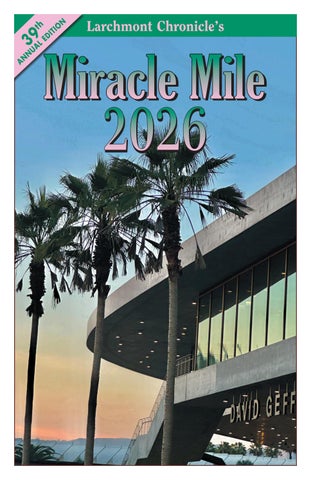
Cover photo: Geffen Galleries
AERIAL VIEW of LACMA buildings, including David Geffen Galleries, in the Miracle Mile. photo © Iwan Baan
ARTWORK IS MOVED into the Geffen Gallery, where it is uncrated, and the museum’s white-glove service begins installing the

Section of historic Berlin Wall stands on Wilshire Boulevard

In a country that won’t stop arguing about walls—both metaphorical and physical—

Los Angeles already lives with one of the most famous ones in modern history. On Wilshire Boulevard, 10 con crete slabs from the Berlin Wall—once part of a forti fied border between the East German government called the “Antifascist Protective Rampart” and the West Ger man government—now face rush‑hour traffic and the La Brea Tar Pits.

Wall Along Wilshire sits on the 5900 block of the busy thoroughfare. It was installed in 2009 as a public art and history piece to mark the 20th anniversary of the Wall’s fall. It’s the longest stretch of the Berlin Wall on public dis play outside of Germany, and was the brainchild of Justin Jampol, founder and execu tive director of Culver City’s

Wende Museum, and the late Wayne Ratkovich, the Wende Museum’s founding board chair and owner of the building on Wilshire where the monument stands.

Rather than a tra ditional memorial or commemoration, the in stallation was imagined as provocation—not to look to the past, but to ask ques tions about the present day. It included, for one night,

Mirabel

the h

ebuild the c ommunity

eimagine the m ile .

the construction of a tempo rary wall across Wilshire that was then ceremonially torn down at midnight, mirroring the events of 1989.

“It was the evolution of an idea that originated from the notion that walls are univer sal—we all face them in some ways,” explains Jampol. “The idea is to give people an op portunity to connect with the historical event on their own terms and as a catalyst to re

flect on their own lives here and now.”

While the slabs were only initially destined to stay on Wilshire for a week, they’ve become a permanent pres ence, stopping passersby in their tracks to marvel at both the size of the monoliths and the art commissioned to be painted upon them. Its 10 panels include images of Presidents Kennedy and Rea gan. Los Angeles artists Kent

Twitchell, Farrah Karapetian, and Marie Astrid Gonzalez were invited to paint panels alongside Thierry Noir, one of the first artists to paint direct ly on the Berlin Wall in the 1980s.

“I now see it as part of Los Angeles’ cultural memory, not just Berlin’s,” says Gonzalez. “Over time, the Wall has come to feel less like a site specific historical reference and more like a reflection of global cy cles: how easily narratives around borders, freedom, and division resurface in different forms and different places. In the current climate, it’s impossible to ignore how of ten walls are invoked again as solutions, symbols, or ral lying cries, which makes the presence of this one feel espe cially pointed. It stands there quietly, reminding us of what walls cost humanly, socially, and historically.”

Since its installation 17 years ago, Jampol says the structure has been host to ev erything from protests around Chinese censorship to rallies about the border with Mexico, and most recently, demon strations against immigration policies. For years, it was also a touchpoint for young Kore an Americans.

“The Wall really continues to be more than just some thing that happened halfway around the world in 1989,” he continues. “It’s a living canvas for the evolution of political ideas and tells us more about what’s going on today than what happened back then.”

WILSHIRE BOULEVARD
SECTIONS OF THE BERLIN WALL, called the Wall along Wilshire, across from the La Brea Tar Pits.
TEMPORARY WALL across Wilshire Boulevard that was ceremonially torn down in 2009.
OPENING NIGHT on Wilshire Boulevard in 2009.

New look to expand on La Brea Tar Pits’ Ice Age past

The La Brea Tar Pits—the richest Ice Age fossil site on the planet—continues to reveal stories of mammoths, dire wolves, and other creatures who lived in L.A. 10,000 years ago, many of whom were found in the sticky tar that still bubbles to the surface here.

Those stories of the area, now home to bustling Wilshire Boulevard, will continue into the future thanks to a recent pledge for much of the $240 million cost of the Reimagining La Brea Tar Pits campaign to transform the museum and surrounding park. The update includes the addition of a world-class global research center, all in time for the 2028 Summer Olympics, museum officials said.

Plans for the Samuel Oschin Global Center for Ice Age Research were announced last month on the heels of the philanthropic gift from the Mr. and Mrs. Samuel Oschin Family Foundation. It’s the largest donation the Natural History Museum of Los Angeles County, which oversees the La Brea Tar Pits, has ever received.

So far, $131 million of the $240 million goal has been raised.

“There is no place on earth like La Brea Tar Pits,” said Lynda Oschin, secretary and chairman of the board of the foundation.

Lynda and her husband, Samuel, started the foundation “to inspire future generations by supporting organizations that deepen our understanding of the world around us,” she said.

The Global Center is part of the larger “Loops and Lenses” project, underway at the 13-acre site and led by architecture firm Weiss/Manfredi.

The design includes a one-kilometer triple pedestrian loop that connects active excavation sites, research and exhibition spaces, and the museum’s beloved grass slopes, which will be preserved and expanded. An ascending crescent of sloped walkways will provide access to a roof terrace with views of the museum’s historic frieze and campus.

The project includes renovation and expansion of the George C. Page Museum, first opened in 1977, a new Wilshire Boulevard-facing entrance, and a contiguous zone of free, public amenities, including shaded seating, outdoor gathering areas, and an outdoor amphitheater.

Amsterdam-based design studio Kossmanndejong is leading the design for the exhibitions and outdoor spaces to include Pleistocene gardens that will connect landscape and ecology to the

site’s Ice Age past.

Among favorites set to stay will be the iconic mammoth family sculpture in Lake Pit. The body of water is left over from asphalt mining operations in the late 1800s. Rain and groundwater collected above the bubbling asphalt, creating the small lake. The lake’s bubbles and distinctive odor come from a deep underground oil field.

the bubbling asphalt and created the small lake. The lake’s bubbles, sheet, and distinctive odor come from a deep underground oil field.

Among specimens in the museum is the skull of the Columbian mammoth Zed,

which can be seen in the Fossil Lab. The near complete mammoth was found in 2006 during the construction of the

Los Angeles County Museum of Art’s underground parking structure, which is adjacent to La Brea Tar Pits.

City sucks out asphalt underneath around Hancock Park

Ever wondered if there is more tar beneath the surface of Hancock Park? The answer is yes, and plenty of it. One can see it at the surface of the iconic Lake Pit that features statues of mammoths trapped in asphalt. There’s so much of the substance that the City of Los Angeles has been sucking out the black sticky goo, officially known as asphalt/bitumen, for decades, according to Dan Halden, director of external relations at StreetsLA. “This is a naturally occurring feature of the area,” said Halden.

This black goo is the heaviest form of crude oil according to Halden. There are about 30 sumps, also known as collectors, under Hancock Park. “The city employs a specialized contractor to inspect and service the sumps twice a week during dry weather and three times a week during wet weather. A StreetsLA contractor pumps out and assesses the publicly located sumps. This is a proactive and regular maintenance performed by the City,” commented Halden. It has been happening for decades.

Karin Rice, preparator for the La Brea Tar Pits and Museum concurred with Halden: “There may be sumps that would spill asphalt onto road surfaces if they weren’t pumped regularly. We’ve been told that some of the residential buildings east of the park need to regularly pump asphalt from sumps in their underground parking structures.”

Rice also said that there is always a mix of oil and gas seeping to the surface in this part of the city because the park sits atop the southern edge of the Salt Lake oil field. Salt Lake is the name of the oil field beneath Hancock Park with pools ranging from 1,000 to more than 3,000 feet below the topsoil. It was discovered in 1902 and became the most productive field in California, producing more than 50 million barrels of oil before being completely dismantled in 2001.

The smell emanating from the trucks that remove the underground substance can occasionally be foul, and, one might think, noxious. Rice said, “Asphalt by itself is stinky because it’s a mix of

hydrocarbons, but what most of us are probably reacting to is the rotten egg smell of the sulfur in the natural gases

PREPARATORS clean part of the skull of a Columbian mammoth known as Zed in the Fossil Lab at La Brea Tar Pits.
VIEW OF MAIN ENTRANCE and ramp gallery. Renderings: Weiss/Manfredi, courtesy of NHMLAC
AERIAL VIEW shows the “triple pedestrian loop” path that connects excavation sites, research labs, the museum, and central lawn.
STUCK IN THE MUD. Iconic mammoth family sculpture shows a mammoth becoming trapped in “tar” at Lake Pit left over from asphalt mining operations in the late 1800s. Rain and groundwater collected above
CHILDREN and adults can’t resist poking the tar.
MAP SHOWING THE subsurface asphalt of the Salt Lake oil field. THE ICONIC
Lake Pit in Hancock Park.

Enter the world of Studio Ghibli

The Academy Museum is once again hosting an exhibit from Studio Ghibli, and this time it celebrates the film “Ponyo” and its theme of human connection and transformation through Jan. 2027.

Local resident and cartoonist Finnegan Walker said, “If you’re a fan of animation or Studio Ghibli you should definitely go, because it takes you through the process of how the movie was made.”

The exhibit includes art boards, original hand drawings by filmmaker Hayao Miyazaki and Studio Ghibli, a wooden drawing desk used by Ghibli animators, and interactive experiences which invite the youngest museum patrons to participate including one that gives visitors the ability to make Ponyo run across the waves, or to run with her!

The film is projected on a wall, and there are additional videos chronicling the script being written and the voice actors performing.

For more information, visit academymuseum.org.

ELEMENTARY SCHOOLS

Cathedral Chapel School

755 S. Cochran Ave.

Ph: 323-938-9976

Principal: Agustina Vasquez Grades: K to 8 cathedralchapelschool.org

Hancock Park Elementary

408 S. Fairfax Ave.

Ph: 323-935-5272

Principal: Robin Wynne-Davis Grades: TK to 5 hancockparkes-lausd-ca. schoolloop.com

Third St. Elementary

201 S. June St.

Ph: 323-939-8337

Principal: Hae Lee

Once a bakery, then Arthur Murray Dance Studio, then eatery and gift shop Egg and the Eye, Craft Contemporary is known as the space reflective of Los Angeles’ population.

Edith R. Wyle founded the museum in 1965 as a place in contrast to the institutional museums—which it happens to be surrounded by on Museum Row in Miracle Mile. Her grandson, Noah Wyle, an L.A. native and actor on the hospital series “The Pit,” said in a video (released by the museum and Architectural Digest) of the museum founded by his grandmother, “She said art should be a democratic thing, for all the people to experience.”

The museum offers classes for adults and children and has a gift shop (where Noah Wyle worked as a teenager). It’s filled with one-of-a-kind objects from around the world. The actor said, “You won’t find these gifts anywhere else.”

For a fee the museum

Miracle Mile School Directory

Grades: TK to 5 3rdstes.lausd.org

Wilshire Crest Elementary 5241 W. Olympic Blvd.

Ph: 323-938-5291

Principal: Gayle Robinson Grades: UTK to 5 wilshirecrestes.lausd.org

Yavneh Hebrew Academy 5353 W. Third St. Ph: 323-931-5808

Principal: Pavel Lieb Grades: K to 8 yha.org

Larchmont Charter 4900 Wilshire Blvd. Ph: 323-836-0860

Principal: Eva Orozco Grades: TK to 3

larchmontcharter.org

MIDDLE SCHOOLS

Fusion Miracle Mile 5757 Wilshire Blvd. Promenade One

Ph: 323-692-0603

Head of School: Jason Lions Grades: 6 to 12 fusionacademy.com

John Burroughs 600 S. McCadden Pl. Ph: 323-549-5000

Principal: Steve Martinez Grades: 6 to 8 burroughsms.lausd.org

New LA Middle

1919 S. Burnside Ave. Ph: 323-939-6400

Principal: Terrence Wright Grades: 6 to 8 newlaclic.org

HIGH SCHOOLS

Fairfax High School 7850 Melrose Ave. Ph: 323-370-1200

Principal: Leonard Choi Grades: 9 to 12 fairfaxhs.lausd.org

Los Angeles High School 4650 W. Olympic Blvd. Ph: 323-900-2700

Principal: Marguerette Gladden Grades: 9 to 12 lahigh.org

Machon Los Angeles

is offering two classes in March—”Chair Making 101: From Tree to Chair” with Julian Rich teaching sawing, drilling, and design, as well as “The House that Love Built: Mid Mod House and Finger Puppet Making” with Linda Santiman. For information, visit craftcontemporary.org.

5870 W. Olympic Blvd. Ph: 424-274-0955

Rabbi Yisroel Gordon Grades: 9 to 12 machonla.org

Shalhevet School

910 S. Fairfax Ave. Ph: 323-930-9333

Principal: Daniel Weslow Grades: 9 to 12 shalhevet.org

Yeshiva Gedolah of Los Angeles/Michael Diller High School

5444 W. Olympic Blvd. Ph: 323-938-2071

Rabbi Aron Tzvi Gross Grades: 9 to 12 ygla.org

CRAFT CONTEMPORARY museum on Wilshire Boulevard has a painted façade designed by L.A. artist Shrine.
ENTER THE WORLD of Ponyo and Studio Ghibli.
Photo by Emily Shur
INTERACTIVE EXHIBIT includes creating an underwater scene to your liking.

Residential Association meets amid development worries

By Jack Brownlee Tenants, landlords, and homeowners gathered recently in the penthouse of the Petersen Automotive Museum for the 40th annual meeting of the Miracle Mile Residential Association. Foremost on the agenda was California Senate Bill 79, a housing measure signed by Gov. Newsom in October.

Intended to increase affordable housing near public transit, SB79 gives multiunit housing developments located near transit stops streamlined approval, allowing them to bypass various zoning restrictions. This includes Historic Preservation Overlay Zones, one of which protects most of Miracle Mile.

When new subway stations open at Wilshire/La Brea and Wilshire/Fairfax this year, SB79 will affect the vast majority of the area. As a neighborhood made up primarily of single-family homes, fears of quaint houses

‘Collecting

being razed and gaudy apartment complexes taking their place were palpable among the 150-member crowd at the Jan. 24 meeting.

MMRA President Greg Goldin echoed those fears with a presentation subtitled “SB79: Destroying Miracle Mile One Block at a Time.” Goldin noted that, contrary to the bill’s stated purpose, if developers build projects with less than 10 units SB79 does not require any to be low-income. The audience groaned. “This is not mom and pop. These are multi-billionaire investors,” said Goldin. “I don’t think that’s what we want. I don’t think that’s what L.A. needs.”

SB79 goes into effect July 1. Partnering with the L.A. City Council, the MMRA created a petition to delay its implementation. “We’re looking to the city to push that deadline back to 2030,” said Goldin. “There’s probably no likelihood that the bill itself will be overturned.”

Also speaking at the meeting were City Councilmembers Katy Yaroslavsky, CD5, and Heather Hutt, CD10. Yaroslavsky emphasized a 27% decrease in street homelessness between 2024 and 2025. “We’ve done it right,” Yaroslavsky stated regarding a recent increase in interim housing units. “We haven’t just pushed people around.”

Hutt celebrated homelessness rates falling 24% in her district and highlighted new parks and recreation investments in Koreatown.

The crowd grew restless when Goldin, Yaroslavsky, and Hutt opened themselves up to questions. “The streets are too dark!” one man shouted, and others exclaimed in agreement. Yaroslavsky asked property owners to vote “yes”

on a ballot they will receive in the mail from the Bureau of Street Lighting which will temporarily increase annual property assessment fees. The ballot will be sent to 550,000 property owners citywide, and if the measure is passed it will decrease streetlight repair turnaround times from one year to about two weeks. “It’s the single best investment we can make,” Yaroslavsky said. One resident asked, “Why can’t we move all drug addicts and homeless to facilities or uninhabited areas far from the city?” The audience laughed and the panelists looked uncertain. “I don’t believe that that’s legal,” Hutt began. “Homeless folks are not a monolith,” added Yaroslavsky. “Personally, I feel like we have a responsibility to take care of those that we can take care of…We get busloads of people here sent from Texas every week. It is a huge nationwide problem.” “Ship them back!”

(Please turn to Page 19)

Impressionism at LACMA’ examines community collections

It takes a village to build a world-class art collection, as evidenced by the elucidating exhibit “Collecting Impressionism at LACMA.” Open through Jan. 7, 2027, “Collecting” looks, in order of acquisition, at the process and people—from curators to gallerists to patrons to historians and art critics—who contributed to the development of, interest in, and continued growth of what has become one of the museum’s most beloved collections.

The anticipation around the design, build, and now the impending opening of the Los Angeles County Museum of Art’s new David Geffen Galleries, opening to the general public on Mon., May 4, spurred a flurry of donations, especially of works from the perennially popular Impressionist and Post-Impressionist movements. This exhibit showcases those recent acquisitions—such as the museum’s first Vincent van Gogh painting, “Tarascon Stagecoach,” a gift of the Henry and Rose Pearlman Foundation, and “The Artist’s Garden, Vétheuil,” by Claude Monet, one of many gifts tied to the new building from A. Jerrold Perenchio—and traces the development of the collection from the earliest days of the museum’s existence.

Even before LACMA became LACMA by separating from the Los Angeles Museum of History, Science, and Art in 1961 (opening its Wilshire Boulevard campus

in 1965), donors contributed to their collections, especially examples of Impressionism from American artists. One of the first paintings to join the collection was “Point Lobos, Carmel” painted in 1914 by the artist F. Childe Hassam, who is generally recognized as the dean of American Impressionism. The New York artist asked his art dealer to get him an exhibit in California, and he came to paint in Northern California to ready a show. His acclaim helped open doors for other California artists working in the genre. “Point Lobos” and many more of Hassam’s works were sold to American art collector William Preston Harrison, who settled in Los Angeles and donated them to the museum, forming the first significant holding of American Impressionism, which today includes many paintings by important women artists such as Mary Cassatt and Evelyn McCormick.

Co-curator David Bardeen (with Leah Lehmbeck) said, “I hope people come away from the show appreciating that Impressionism is much

broader than France in the late 19th century.

“The movement is also contextualized, with photography, fashion, and dinnerware also on display.”

Bardeen explained, “It is impossible to understand Impressionism without understanding developments in photography and etchings of the time…In photos, there’s the cropping, establishing the fleeting moment. The exhibit includes costumes and textiles. Impressionist painters were fascinated with how fabrics behave in sun and wind.”

Edgar Degas, Claude Monet, Henri de Toulouse-Lautrec, Cézanne, Camille Pissarro,

Sucking Tar

(Continued from Page 7)

that seep to the surface. California oil has a greater sulfur content than oil from other parts of the country. Casual exposure is more unpleasant than dangerous.”

And, while it’s messy, and yes, smelly, children and adults alike can’t resist poking the gooey tar.

Paul Gauguin are names that most museumgoers recognize as welcome friends. “Collecting Impressionism at LACMA” goes beyond the surface beauty of their art, explaining the hows and whys of creating a collection that resonates with scholars and the public alike.

As Bardeen stated, “The community comes together to build institutions.”

“Collecting Impressionism at LACMA;” Los Angeles County Museum of Art, 5905 Wilshire Blvd.; 323857-6000;  lacma.org. The exhibit runs through Jan. 7, 2027. Some works will change during the run of the show.

MMRA PRESIDENT GREG GOLDIN presents on Senate Bill 79.
INSTALLATION PHOTO, “Collecting Impressionism at LACMA,”
F. CHILDE HASSAM, “Point Lobos, Carmel,” 1914, Los Angeles County Museum of Art, Mr. and Mrs. William Preston Harrison Collection.
VINCENT VAN GOGH, “Tarascon Stagecoach,” 1888, Los Angeles County Museum of Art, gift of the Henry and Rose Pearlman Foundation.
Photo by Bruce White
MARY CASSATT, “Peasant Mother and Child,” 1895, Los Angeles County Museum of Art, Graphic Arts Council in memory of Ruth Sprecher. Photo © Museum Associates/ LACMA
photo © Museum Associates/LACMA, by Jonathan Urban Photo © Museum Associates/LACMA
TRUCK REMOVING asphalt/bitumen from below the street’s surface.

Countdown begins for unveiling of reimagined HMLA campus

Holocaust Museum LA has ramped up construction on the expansion of its Pan Pacific Park campus, museum officials said. It is expected to open in June.

Named the Jona Goldrich Campus and designed by award-winning architect Hagy Belzberg, the expanded facility will feature outdoor reflective spaces; expansive galleries for temporary ex-

Real Estate Sales*

Single-family homes

806 S. Cochran Ave. $1,260,000

Condominiums

600 S. Ridgeley Dr., #1

*Sale prices for January.

$975,000

hibits and classrooms; and a theater for survivor talks, film screenings, concerts, conferences, and public programs.

Also debuting will be a pavilion to house an authentic boxcar found outside the Majdanek death camp in Poland and a dedicated theater for a holographic exhibition featuring a conversation with a virtual survivor.

The expanded campus will double the museum’s existing footprint and increase visitor capacity to 500,000 visitors annually, including 150,000 students. The permanent exhibit will undergo a refresh and include cutting-edge technology to preserve Holocaust survivor testimonies.

Holocaust Museum LA Chief Executive Officer Beth Kean said, “There will be no other museum quite like this in not only Los Angeles, but in the U.S. For instance, our one-of-a-kind boxcar pavilion will evoke powerful emotions ranging from pathos to striking resilient hope for humanity.”

The museum will continue to host events, including screenings, concerts, book talks, survivor talks, and panels at off-site locations.

Visit holocaustmuseumla. org.

POLICE BEAT IN THE MILE

Man strangles ex-girlfriend, app meetup ends at gunpoint

MIRACLE MILE

DIVISION

BURGLARIES: A suspect entered a victim’s house on the 7500 block of South Ogden Drive Feb. 4 at 4:45 p.m. through a bedroom window, slashing the screen and breaking the window. The victim realized multiple pieces of jewelry and cash were missing from the residence. The suspect fled the scene.

The driver of a grey Lexus pulled up to an apartment building on the 6000 block of West Third Street Feb. 7 at 6 a.m. A suspect used a tool to open the community mailbox and put mail into her personal bag. A witness grabbed the suspect and held onto her until the police showed up.

ROBBERY: A victim met a “girl” on a dating app who wanted to meet in person. At the meeting point, two male suspects pointed a gun at the victim, told him to give them his wallet, and slapped his left cheek, Feb. 2 at 6 p.m. on the 5000 block of West Olympic Boulevard. The suspects fled down Masselin Avenue.

A suspect stole the victim’s phone when he went to confront the suspect about a stolen item and wanted to record the suspect. An altercation occurred with the suspect grabbing the phone and victim fighting to hold on to the phone. The suspect hit the victim on the forehead and the victim ran away after

the incident, Feb. 6 at 4 a.m. on the 5600 block of Wilshire Boulevard.

An Uber driver picked up a suspect on Wilshire and Hauser boulevards Feb. 3 around 2:30 a.m. The passenger refused to get out of the vehicle and demanded money. The driver explained he needed to leave, and the suspect hit him on the head with a wine bottle and took the victim’s personal items, exiting the vehicle.

WILSHIRE DIVISION

Furnished by Senior Lead Officer

Andrew Jones

Text 213-793-0782

41719@lapd.online

AGGRAVATED ASSAULT:

A victim and suspect who had previously been romantically involved and are parents to a

child got into a verbal argument which led the suspect to become aggressive. The victim tried to walk away and told the suspect to stop trying to push her. He slapped the victim’s hands and then grabbed her, threw her on the floor, and tried to strangle her. The suspect dragged the victim by the shirt and the victim punched him to free herself. The fight took place Feb. 6 at 7:30 a.m. on the 200 block of Vista Street.

Helpful local numbers, crisis hotlines, websites

Here are phone numbers and websites to know about.

Domestic violence hotline: 800-978-3600

Mental health hotline: 800-

854-7771

Suicide hotline: 800-273-8255

Substance use: 800-564-6600

Child protection/child abuse hotline: 800-540-4000

Teen Line, a confidential crisis hotline: 800-852-8336

National domestic violence: thehotline.org

Sexual assault: rainn.org

98th Academy Awards: Who will win and who should win

It is awards season and Sun., March 15, the Academy will hand out the most coveted awards for the film industry. This year there are some interesting contests and clear favorites. “Sinners” received the most nominations of all time with 16. To put that in perspective, “The Godfather” had 11 nominations, “Citizen Kane” nine, and “Titanic” had 14. This year there is also an award for best casting, which seems like a bit of a stretch, but if it is a way to recognize some of the more below-theline jobs, who are we to argue? On to our predictions:

Best Picture: Sinners

F1

One Battle After Another

Frankenstein

Marty Supreme

Hamnet

Sentimental Value

Bugonia

Train Dreams

The Secret Agent

Who should win: One Battle After Another—innovative and fun, but also real drama.

Who will probably win: Hamnet—seems to fit the mold of what the Academy likes.

Best Actress:

Emma Stone

Kate Hudson

Jessie Buckley

Rose Byrne

Renate Reinsve

Who should win: Jessie Buckley—a standout performance that is perfect for the Academy.

Who will probably win: Jessie Buckley; see above.

Best Actor: Leonardo DiCaprio

Timothée Chalamet

Michael B. Jordan

Ethan Hawke

Wagner Moura

Who should win: Leonardo DiCaprio—vulnerable, funny, and on point. Who will probably win:

Timothée Chalamet—a star that the Academy will want to recognize.

Best Supporting Actor: Teyana Taylor

Wunmi Mosaku

Inga Ibsdotter Lilleaas

Amy Madigan

Elle Fanning

Who should win: Wunmi Mosaku—the highlight of the most nominated film.

Who will probably win: Inga Ibsdotter Lilleaas—a performance that will resonate with the Academy.

Best Supporting Actor: Stellan Skarsgård

Jacob Elordi

Benicio Del Toro

Sean Penn

Delroy Lindo

Who should win:

Sean Penn—so real and scary in “One Battle After Another”—probably too real for the Academy.

Who will probably win: Stellan Skarsgård—another performance that will sit right with the Academy.

Best Director nominees: Chloé Zhao

Joachim Trier

Paul Thomas Anderson

Ryan Coogler

Josh Safdie

but only one nominee takes the statue home.

Who should win: Paul Thomas Anderson— made an entertaining thrill ride with humor and realism. Who will probably win: Chloe Zhao—made a touching film that resonates with Academy voters.

THE NOMINEES are all “winners,”
Leonardo DiCaprio One Battle After Another
Emma Stone Bugonia
Michael B. Jordan Sinners

Newly opened site features extensive menu of Japanese favorites

A new Japanese restaurant recently joined the growing collection of eateries flanking the intersection of Wilshire Boulevard and La Brea Avenue. (See “Stunning panAsian restaurant encourages romance—and good eating,” January 2026).

Taking over the former La Brea Ramen space, Umito Sushi & Ramen offers a reasonably priced extensive menu of Japanese favorites and an assortment of fancier unusual dishes, from classic salmon sashimi and a chicken teriyaki bento box to okonomiyaki (a savory pancake), and bluefin tuna sushi topped with uni, caviar, and gold leaf.

Umito put some effort into adding Japanese touches to what is essentially a faceless commercial space. Two walls of windows look out over busy cross streets, but the interior wall has been designed to conjure old-fashioned Japanese storefronts. Waitstaff were friendly and efficient.

Sushi and rolls were successful. We ordered a sushi combination that consisted of

On the Menu

eight pieces of assorted sushi and the choice of a California or spicy tuna roll. We opted for a hand roll version of the spicy tuna, which was served a tad too cold for optimum flavor release, but was otherwise satisfying. The array of sushi included mild, almost sweet, yellowtail; silvery, oily mackerel; and silky, fatty salmon belly. We also ordered a cut spicy tuna roll, which had the rice around the outside of the seaweed wrapper, a particularly appealing arrangement.

Vegetable tempura was an excellent dish. The breading was smoother and crunchier than the standard recipe, but dunking tempura-fried onion rings, asparagus spears, carrots, and sweet potato slices into a sweet mirin-based dipping sauce, then biting through their cracking coating, was a terrific way to add some vegetables to a protein- and carbohydrate-laden menu.

Our main complaint was with the ramen. Seven styles of the soup are offered, including vegetarian and seafood versions. My son and I decided to split a bowl of bulgogi beef ramen in pork broth. In fact, it wasn’t a standard pork broth, but rather tonkatsu, a cloudy white broth made from long-simmered pork trotters (feet) and ham hocks (like the pig’s ankles). Usually rich and unctuous, Umito’s was thin and nearly flavorless. The accompanying ramekin of a spicy sauce helped but didn’t rescue the ramen. The noodles weren’t especially springy or tasty, either. They graciously took the soup off

our bill.

Wanting to linger, we opted for dessert, and the waiter recommended one of the two ice creams: a split orange filled with orange ice cream, and the pineapple version, which he said tasted like a piña colada. We couldn’t resist that!

A frozen half pineapple quickly appeared, filled with delicious and creamy pineapple ice cream. However, the premade dessert was clearly just rescued from the deep freeze, and half the ice cream was so hard that even hacking away at it produced no results. Very sad, because the edible portion was truly delicious.

Umito Sushi & Ramen; 5224 Wilshire Blvd.; 213-266-8581; umito90036@gmail.com

Quirks and crafts appear throughout the Original Farmers Market

The Original Farmers Market at Third Street and Fairfax Avenue truly is original. Under a veil of food and shopping destinations

visitors can find a treasure trove of individuality.

Tabletop plaque

Grabbing a donut on the East Patio, one could sit at one of the five tables where the Market has honored someone who meant a lot to the space. Three unfortunately have passed away; the other two are still around.

The late councilmember Tom LaBonge, director Paul Mazursky, Los Angeles Times journalist and Market regular Allan Malamud, along with two retired Market employees have the coveted tables.

Ilysha Buss, director of marketing at The Original Farmers Market, proclaimed,

“It’s kind of a random tribute. People have called over the years asking if they can place a remembrance, but it doesn’t work like that. It’s just a quirky Farmers Market tradition.”

Green Grocery Carts

Buss next mentioned their grocery carts, which have been a staple since the Market opened in 1934. In the ‘30s and ‘40s, the carts were wicker. Then in the ‘40s and ‘50s, they morphed into the green grocery carts seen today. Each one is handmade and painted on-site at the Facility Shop, which is comprised of five craftspeople, most of whom have been with the Market for decades, according to Buss. “They are talented craftspeople,” she said.

The Market tries to keep the carts on their property, but

people are fond of them and occasionally steal them. She relayed that she once got a call from a woman in Texas who was cleaning out her mom’s house. Her mom found a cart in the garage. She had moved halfway across the country

with it!

Looking around, you can spot a few oversized carts, more like sculptures, at entrances and parking kiosks.

The Facility Shop is also responsible for the metal statues seen around the market, including the bull guiding traffic in the parking lot. And they make and paint all the colorful tables and chairs on the plaza behind the Clock Tower.

The Market is still owned

PINEAPPLE ICE CREAM, served in half pineapple.
UMITO’S INTERIOR DESIGN conjures Japanese storefronts. SUPER CRISPY vegetable tempura.
JAPANESE FEAST (clockwise from top left), bulgogi beef ramen, spicy tuna cut roll, assorted sushi, spicy tuna hand roll.
LATE COUNCILMAN TOM LABONGE is one of a select few who is memorialized on a tabletop.
ONE OF FIVE TABLES with a memorial page inset.
CLASSIC GREEN BASKETS under a timeline of the Famers Market.

‘Are you excited for the World Cup coming up in June?’

That’s the question our inquiring photographer asked locals.

“Oh my gosh, yes! I live right behind SoFi in the apartment buildings. I’ve got my tickets, believe it or not, [for] $1,500—for my family. They’re excited too!”

Christopher McClain

“We [he and his spouse] would like it boycotted to be completely honest. This country’s an embarrassment right now—it’s like having people over to your house when your house is a complete mess. I don’t feel like it puts us on display for the world in a good light.”

Michael Wickham

“It’s a powerful event. It’s a beautiful thing, and we all get to see it as a human race right here in the United States—an enjoyable thing for the whole world,” said Mustafa. “I’m going to agree with him,” said Hibbler.

Macella Hibbler (left) and Geronimo Zulu Mustafa

Tom Bergin’s on Fairfax turns 90

Tom Bergin’s and St. Patrick’s Day go hand in hand. This year, the tavern is celebrating its 90th anniversary. Doors open on St. Patrick’s Day, Tue. March 17 at 7 a.m. At 11 a.m.

Councilmember Katy Yaroslavsky of CD 5 will honor the establishment with a certificate of recognition. All are welcome to watch owner Fran Castagnetti receive this honor at this classic spot at 840 S. Fairfax Ave.

Original Farmers Market

Family friendly St. Patrick’s Day can be found at the Original Farmers Market with Glen the bagpiper piping from 12:30 p.m. to 3:30 p.m. Magee’s Kitchen has your corned beef and E.B.’s Beer and Wine Bar your green beer.

Farmers Market

(Continued from Page 17)

and run by the family who established it in 1934. Employees tend to keep their jobs for decades. Buss has been with the company for 20 years, and many consider her a newbie.

The next time you pop in for your favorite chocolate, drink, or sandwich, look around to notice the artistic and creative embellishments.

And for Farmers Market fans, they sell swag upstairs— and they offer a free illustrated poster of the Market.

METAL BULL SCULPTURE

helps drivers through the parking lot.

Residential Association

(Continued from Page 11)

shouted one woman, whose comment was met with murmurs of disagreement from the crowd.

Other speakers included LAPD Senior Lead Officer Tim Estevez, who stated that crime is down 25% in Miracle Mile between 2024 and 2025, and Stay in LA Co-Founder Noelle Stehman, who discussed her organization’s efforts to promote film industry work in Los Angeles.

For more information, visit miraclemilela.com.

Turn static files into dynamic content formats.

Create a flipbook