New thinking on prepreg materials
New carbon prepreg material made with recycled carbon fibre nonwoven mat
Groundbreaking prepreg tooling technology
Standard and fire-retardant snap cure systems –including the new RFA570 adhesive film for core bonding applications
Providing technical innovation, exceptional quality, lowering cost-per-part and offering improved sustainability. Kit cut to our customers’ requirements, with standard products available from stock.


Editor
Paul Attwood editor@mpemagazine.co.uk
Senior Editorial Assistant
John Reynolds editorial@mpemagazine.co.uk
Features Editor
Harry Peters editorial@mpemagazine.co.uk
Production/Design
Laura Whitehead laura@lapthornmedia.co.uk
Sales Manager
Charlotte Chapman charlotte@mpemagazine.co.uk
Accounts
Richard Lapthorn accounts@lapthornmedia.co.uk
Admin Assistant
Jade Still jade@lapthornmedia.co.uk
Circulation Manager
Leo Phillips subs@mpemagazine.co.uk
Publishing Director
Maria Lapthorn maria@lapthornmedia.co.uk
Lapthorn Media Ltd
5-7 Ozengell Place, Eurokent Business Park, Ramsgate, Kent, CT12 6PB
Phone: 01843 808 106


AWI targeting £2m reaction after securing major nuclear quality accreditation
Atlas Copco launches SMART AIRnet pipework to remove manufacturing’s blind spot
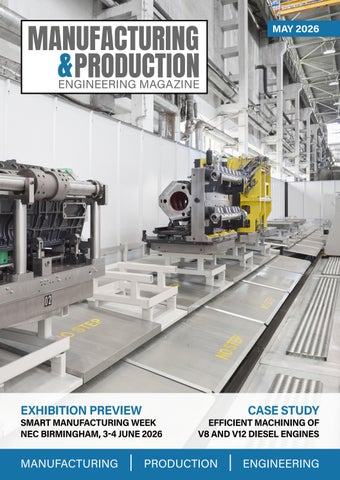
Case Study: Efficient machining of V8 and V12 diesel engines
Smart Manufacturing Week returns for its fifth edition, 3-4 June 2026, NEC Birmingham
The unbearable heaviness of supply chain impact on the manufacturing sector in 2026
Editors Note
Welcome to the latest issue of Manufacturing & Production Engineering Magazine, where the sector’s resilience and innovation continue to take centre stage. Across this edition, we explore how manufacturers are embracing new technologies and strategic investment to remain competitive in an increasingly complex landscape.

From advances in automation and autonomous vehicles to breakthroughs in sustainable production methods and energy efficiency, the stories in this issue highlight a clear shift towards smarter, more responsible manufacturing . At the same time, businesses are navigating supply chain pressures, rising costs and evolving regulatory demands, prompting a stronger focus on flexibility and risk management.
We also showcase the partnerships, funding initiatives and technical developments driving growth across the UK and beyond. Together, these insights underline an industry not only adapting to change, but actively shaping its future.
We hope you enjoy this edition, and if you have news to share, please contact editorial@mpemagazine.co.uk.
Paul Attwood Editor
Laser cleaning arrives in UK after WEP investment
Wolverhampton Electro Plating (WEP) has become the first metal finisher in the UK to invest in groundbreaking new laser technology for cleaning and pretreatment of parts.
WEP, part of the Anochrome Group, has taken delivery of a SLCR Lasertechnik LAMA™ machine, which effectively cleans nuts, bolts and parts in bulk prior to coating without the need for water, chemicals or shotblasting.
Using just lasers, instead of traditional methods, produces huge environmental and cost-saving benefits, while simplifying the cleaning process from many steps to just one.
WEP has worked with SLCR Lasertechnik for more than two years to develop a pre-treatment machine specifically for its zinc flake dip-spin operations at its Wolverhampton facilities.
Denis Rainbird, General Manager at WEP, said: “We are delighted to be leading the way in the industry with a significant investment in this game-changing new technology, which arrived from Germany last month and has been assembled ready for final testing. All parts need to be thoroughly cleaned
before they are coated by dip-spin to ensure they are completely free of contaminants. Up until now, this has involved huge amounts of water, chemistry and power.
“The LAMA machine removes all that energy and expense by using high-powered lasers, at just a fraction of the electricity. This will improve our carbon footprint as a business, as well as lowering costs and speeding up turnaround times. Final testing will now take place before we start using the technology for our customers later in the year.”
The purchase of the LAMA machine follows other recent investments at WEP, including the introduction of a fourth dip-spin line last year.
Final testing will now take place before we start using the technology for our customers later in the year.


Olav Schulz, Managing Director of SLCR Lasertechnik, personally visited WEP to oversee the installation of the machine.
“WEP is the first coatings business in the UK to be using lasers for preparation of parts, which is a significant step forward for the industry. Using the LAMA machine, coatings or surface pollutants are vaporised by repetitive laser pulses without damaging adjacent layers or the substrate.
“We believe this unique surface treatment method will improve efficiencies and reduce WEP’s CO2 footprint by over 35%, eliminating chemicals and media blasting in the preparation process.”
Advanced door manufacturing facility
and machinery
for sale following Bridgman
The manufacturing assets of fire and safety door specialist Bridgman IBC have been brought to market following the company’s entry into administration.
The Hartlepool-based business operated from an 88,000 sq ft facility on the Longhill Industrial Estate, equipped with a range of modern wood and metalworking machinery used in the production of bespoke fire-rated and safety doors.
Joint administrators Bob Maxwell and Ian Royle of BTG were appointed
IBC administration
on 6 March after ongoing cashflow challenges impacted the company’s ability to sustain production. The firm’s 56 employees were made redundant shortly afterwards.
Ian Royle said: “The business had successfully secured a strong pipeline of work, with a full order book, but was ultimately unable to manage the working capital demands associated with materials procurement and ongoing manufacturing. This presents an opportunity for buyers to acquire a well-invested production facility with
the capability to manufacture highspecification, bespoke fire and safety doors.”
Founded in the 1960s, Bridgman IBC specialised in the manufacture of certified fire-rated door sets for use across healthcare, education and commercial environments. Its client base included major organisations such as the NHS, Newcastle University, Cineworld, Hilton and McDonald’s.
www.eddisonsassets.com/ assets-for-sale/bridgmanibc
Aurrigo International signs landmark £6.28m contract with Ultra Global to build 25 autonomous vehicles
Aurrigo International plc has signed the largest vehicle manufacturing order in its history to manufacture an initial 25-strong fleet of autonomous guided vehicles (AGVs) for a leading rapid transit system specialist.
The £6.28m deal with Ultra Global Limited will see the provider of autonomy software, fully autonomous vehicles and mobile robotic platforms modernise existing vehicle platforms to meet current performance, safety and technology standards.
Engineering development work will be completed by the end of this year, with vehicle production and testing to follow, with a completion date of September 2027.
The programme draws on Aurrigo International’s deep technical capability across vehicle architecture, systems engineering and advanced technology deployment, ensuring the enhanced platform is robust, futureready and commercially scalable.
This includes engineers and software developers transitioning the battery architecture from lead-acid to lithium-ion systems, whilst upgrading


HVAC systems for improved efficiency and passenger comfort.
Latest sensor technologies will be integrated into the design with advanced electrical control units and software also chosen to futureproof future models.
Retooling and the modernisation of mechanical components will be the final element of the contract that will ensure the delivery of 25, world class, real world AGVs for use in airport and passenger settings in the UK.
Jonathan Keeling, Director of Ultra Global Limited, commented: “In evaluating partners globally, Aurrigo distinguished itself through its ability to deliver the complete vehicle solution


- from core platform development through to advanced technology implementation.
“We are proud to have found that expertise here in the UK, with manufacturing capability based in the heart of the West Midlands. This contract marks a significant step in advancing the Ultra Global platform to the next level. It also gives us the opportunity demonstrate how this technology can address real passenger transport needs across the UK.”
The first batch of autonomous vehicles will be utilised for customer demonstrations and supporting commercial engagement activity in the UK and in international markets, as new deployment opportunities are explored.
Pictured Left: David Keene MBE

RS Group completes acquisition of automation and control specialist, BPX Group

Scottish specialist manufacturer secures funding to drive rapid growth
A Scottish business is targeting significant growth and large-scale automation with support from Lombard and the Royal Bank of Scotland through partfunding.
Chemco International, an employee-owned manufacturer of specialist protective and marine coatings, has secured a £670k trade loan to be invested in additional machinery to increase capacity and automate its processes.
Through the upgrades, the business, which currently employs 35 people, aims to triple its turnover by 2036 and create new jobs locally through this expansion.
Established in 1990, the Coatbridge based business designs and manufactures advanced protective coating used across marine and industrial sectors, including energy, offshore, petrochemical, and the cruise industry.
Colin Wade, Managing Director at Chemco International
Ltd, said “This funding is actively supporting us in our growth journey. As an employee-owned business, it’s vital that we invest in technology that supports our people and strengthens our capabilities.
“In this instance, securing part-funding to safeguard the long-term interest of our employee owners.
Scott McGhie, Senior Relationship Manager at Lombard, said: “By providing this trade loan alongside Royal Bank of Scotland, we are helping the business invest in automation, increase capacity and deliver sustainable growth, while continuing to support jobs and communities in Scotland.”
RS Group, a high-service global product and service solutions provider for industrial customers, has today announced its acquisition of BPX Group, a specialist distributor of industrial automation and control products. The deal will see BPX become part of the RS Group.
A compelling strategic and commercial fit
As a result of this acquisition, BPX is now part of a global organisation with circa 8,500 employees, serving millions of customers every day. The deal is designed to support the RS Group strategy to deepen its technical capabilities. BPX brings specialist automation and control (A&C) knowledge, serving industrial customers, high service intensity, combined with strong supplier relationships.
Raj Patel, Managing Director, RS UK & Ireland, said: “This acquisition will strengthen our product technical capabilities in the A&C category and help to accelerate our growth plans within the UK & Ireland markets.
“Through the technical expertise and specialist knowledge of BPX, combined with the scale, knowledge and reach of RS Group, we will find new opportunities to win in the markets in which we operate, and continue to grow our businesses together.
Guy Collins, Director from BPX Group, said: “This is an exciting step for BPX Group which will take the business to the next level. BPX is a complementary business to RS in the UK & Ireland, both are highservice level distributors of automation and control products with an overlap of product range and a customer-centric focus, but each serving the market in different ways.
“BPX will operate as a standalone business within RS Group, and we will look to draw upon our common culture, values and customer-first approach, to create a dynamic and innovative partnership that works for our customers, suppliers and for the BPX team.”


Science and Technology
Nuclear Science and Technology
MSc - 1 year full time
time part time Certificate for CPD
MSc - 1 year full time
MSc - 2 or 3 year part time
PG Diploma • PG Certificate
MSc - 2 or 3 year part time
Short Courses for CPD
Designed
Designed


PepsiCo UK invests £3.6m to install roof-mounted solar power system in Leicester
PepsiCo UK has announced a multi-millionpound investment in a new solar power project at its Southern Region Distribution Centre (SRDC) in Leicester.
Working together with energy infrastructure specialist Ineco Energy, the project will see solar panels installed across 30,000 square metres of roof space – equivalent to around four football pitches. Once complete, the panels are expected to generate 100% of the energy needed to power the logistics centre over the course of a year, reducing demand on the national electricity grid.
The 3.56 MWp solar power system is expected to generate around 2.84 GWh of renewable electricity each year – enough to power approximately 1000 UK homes for a year.

Hazel 4D, Acopia and Kwikpac
Unite Under the
Hazel 4D, Acopia’s transit packaging division and Kwikpac have agreed to combine their operations to form a new entity, Orkka.
On formation, Orkka will rank among the UK’s top five packaging distributors by revenue, establishing a scaled national platform capable of supporting enterprise customers across consultancy, systems, machinery and supply.
The combined business unites Hazel 4D’s strategic consultancy
Name Orkka
expertise with the operational strength and supply capability of Acopia’s transit packaging division and Kwikpac. Both Hazel 4D and Kwikpac have built their reputations on a consultancy-led approach, focused on developing practical packaging solutions rather than simply supplying products.
The decision reflects a shared view of how the packaging market is evolving. Larger, multisite operations increasingly require broader capability, stronger geographic
reach and deeper technical support. By bringing their complementary strengths together, the businesses are creating a more integrated structure designed to support customers operating at scale.
Neil Christie, Chief Executive Officer, said: “I’ve spent my whole career in packaging, working closely with customers to understand their operations and how packaging can support them more effectively.
“Hazel 4D, Acopia and Kwikpac have each built strong reputations by focusing on practical solutions and longterm customer relationships, and bringing those strengths together is a natural next step. Each business has developed real expertise in its
Any surplus electricity will go towards powering the Walkers crisps manufacturing plant, one of the world’s largest crisp factories, located just next door to the distribution centre.
The solar project is the latest in a series of sustainability investments across PepsiCo’s UK sites. In recent years, PepsiCo has switched to electric ovens at its site in Leicester, installed more efficient machinery on its manufacturing line in Coventry, and invested in new, more efficient fryers at its Brigg site, the home of Pipers crisps. Together, these three initiatives have reduced PepsiCo’s greenhouse gas (GHG) emissions by around 2,400 tonnes a year.
The £3.6m solar panel installation follows a £14m investment to upgrade the distribution centre in 2021. The distribution centre plays a key part in PepsiCo’s UK supply
chain, employing 240 people and distributing products made at the company’s six factories across the country. This marked one of the biggest UK logistics investments in PepsiCo’s history and saw state of the art equipment and technology introduced across the site.
Construction of the solar power system is already underway, with installation expected to be by completed by September 2026.
Andy Smethurst, UK Warehousing & Logistics Director at PepsiCo said: “Leicester is already home to one of the world’s largest crisp factories, and now we’re delivering one of the most complex solar power systems, right here in the East Midlands. It’s a major milestone for PepsiCo UK and shows how we’re continuing to find new ways to power our sites and operate more sustainably.”
Leicester is already home to one of the world’s largest crisp factories, and now we’re delivering one of the most complex solar power systems, right here in the East Midlands. It’s a major milestone for PepsiCo UK and shows how we’re continuing to find new ways to power our sites and operate more sustainably.
- Andy Smethurst, UK Warehousing & Logistics Director at PepsiCo

own area, and by combining those capabilities we can now support customers at a broader, enterprise level. The new structure allows us to bring strategy, specification and supply together in a more integrated way, helping customers manage packaging performance across multiple sites and over the long term.”

New Partnership to Meet Growing Demand for Lead Frames in North America
World-class stamping and plating specialist Batten & Allen has forged a partnership with the US-based Neu Dynamics Corporation to help meet North America’s growing demand for precision-manufactured semiconductor lead frames.
AI, data centres and the automotive industry are driving demand for semiconductors. Global Information, Inc. (GII) forecasts compound annual growth of 6.18% (2024-2030) in the requirement for semiconductors. The market is expected to reach $303.4 billion (£224.83 billion) by 2030.
North America is a key market for Batten & Allen which manufactures high-quality precision stamped and plated parts for electronics, automotive, telecoms and aerospace manufacturers across the world.
In a new agreement, Batten & Allen is being represented in the USA, Canada and Mexico by Neu Dynamics, which offers a unique combination of technology and experience in the design and production of precision moulds and dies for the medical, commercial and semiconductor industries.
Batten & Allen and Neu Dynamics both offer over half a century of precision engineering expertise and experience. By coincidence, the two companies were founded in the same year, 1972.
Cirencester-based Batten & Allen manufactures up to 650 million parts per month. It ensures consistency and quality by combining stamping and electroplating under one roof.
Supply chains under pressure: a new operating reality for manufacturers
Global supply chains have been reshaped at pace in recent years. For manufacturers, a combination of pandemic disruption, geopolitical tension and ongoing economic pressure has exposed just how vulnerable highly optimised supply models can be.
Where supply chains were once designed primarily for efficiency and cost control, the focus is now shifting towards resilience, flexibility and visibility.
Recent research from global insurance broker Gallagher, based on insights from over 1,200 business leaders, highlights the scale of this change. Supply chains are increasingly viewed not as fixed systems, but as dynamic networks requiring active management and continual reassessment.
From efficiency to resilience
The limitations of just-in-time models were brought into sharp focus during the pandemic. While lean supply chains supported cost efficiency, they often lacked the flexibility to absorb disruption.
In response, many manufacturers are diversifying supplier bases, holding greater levels of inventory and exploring nearshoring or reshoring strategies. These approaches can help reduce reliance on single regions or suppliers, although they often introduce additional cost and operational complexity.


An increasingly complex landscape
Despite efforts to simplify supply chains, complexity remains a defining feature. Many manufacturers operate across multi-tier supplier networks, where visibility beyond immediate partners can be limited.
This lack of transparency can make it difficult to identify vulnerabilities, particularly when disruption occurs deeper within the supply chain. At the same time, evolving regulatory requirements and global trade dynamics continue to add further layers of complexity.
Geopolitical and economic pressures
Geopolitical uncertainty is now a central consideration. Trade tensions, regional instability and changing international relationships are influencing sourcing decisions and logistics strategies.
For manufacturers, this can mean balancing cost with stability — for example, by sourcing from regions perceived as lower risk, even where this impacts margins.
Technology: enabling and exposing
Digital tools are playing an increasingly important role in supply chain management. Data analytics,
automation and AI are helping organisations improve forecasting, optimise inventory and respond more quickly to disruption.
However, greater digital connectivity also introduces new risks. Cyber threats affecting suppliers or logistics providers can quickly cascade through the supply chain, creating operational and financial impacts.
A more strategic approach to risk
Perhaps the most significant shift is how supply chains are viewed internally. Increasingly, they are recognised as a core risk management priority rather than simply an operational function.
This is driving investment in areas such as supply chain mapping, scenario planning and supplier due diligence. Many organisations are also strengthening contingency plans, including identifying alternative suppliers and logistics routes.
Looking ahead
For UK manufacturers, the direction of travel is clear. Supply chains are unlikely to become less complex or less exposed to disruption in the near term.
Those best positioned to navigate this environment will be organisations that take a proactive, structured approach — building flexibility into their operations, improving visibility across their networks and embedding risk management into decision-making. In doing so, resilience becomes more than a defensive measure; it becomes a source of competitive advantage.
Scan the QR code to read Gallaghers full analysis on supply chain developments and emerging risks.


Would Your Insurance Programme Pass
AWI targeting £2m reaction after securing major nuclear quality accreditation
Successful accreditation to a prestigious quality standard is set to create £2m of global opportunities for Alloy Wire International (AWI).
The UK’s leading manufacturer of precision drawn, flat and profile wire has taken just nine months to gain ISO 19443, the international benchmark for supplying critical components and material to the nuclear sector.
AWI recorded zero nonconformities during the assessment, with the business praised for its strong quality management systems, employee culture and enhanced communications strategy that was integral to the successful application.
The firm’s 62-strong range of exotic alloys is in growing demand from the sector, with sales to this market increasing to 10% of the firm’s annual £16.5m turnover.
“We pride ourselves on delivering world class manufacturing performance for the best part of eight decades, so we knew we had a lot of things already in place,” explained Kevin Guest, Head of Quality, Health & Safety and

Environmental Management at Alloy Wire International.
“Culture was a critical part of the review, and we had to create a special questionnaire that proved all our 33-strong workforce understood their roles and how they impact on the finished part that is heading to clients in the nuclear industry.”
He continued: “This has proved to be an excellent introduction. It has opened new dialogue within different parts of our business and has further enhanced an already impressive ‘people first’ culture.
“Securing ISO 19443 will ensure we not only retain existing turnover, but importantly it will open up new doors for us both in the UK and overseas. In fact, we’re already quoting for an additional £1m of new work.”
Material manufactured at AWI’s state-of-the-art facility in the West

Midlands has high temperature and corrosion resistant properties ideal for end-use applications and components destined for nuclear reactors, development of new mini reactors and in the complex world of decommissioning.
Inconel 718, Inconel X750, Alloy 400, Nimonic 90, Alloy 80A and Stainless Steel 316 are the six most popular alloys being requested by the company’s global client base and all are currently available in just three weeks from placing the order.
“Traceability is a major prerequisite and the ability to prove the authenticity of the materials (traced back all the way to the mills) we process at our factory,” added Kevin.
“A close working relationship with our suppliers ensures we get their original data that we can then build into our management system, a management system that now meets the stringent demands of ISO 19443.”
Alongside this, AWI has invested more than £400,000 into its inhouse testing department so it can retain as much control as possible, not to mention speed of turnaround with the well-documented backlog being seen at testing houses.


Testing equipment - including tensile testers, a Micro-Vickers Hardness tester and the purchase of new lab furnaces to support heat treatment - means the firm can offer 90% of all mechanical tests at its factory.
The newly refurbished and updated metallography lab has also benefitted from the purchase of new automatic mounting and polishing machines to enhance macro, micro, metallography and visual inspection capabilities.
Tom Mander, Managing Director of Alloy Wire International, concluded: “More and more countries are returning to nuclear as a viable power source moving forward. Sizewell C is a big project getting underway in the UK and Rolls-Royce has developed a strong reputation in mini reactors.
“Our material is often at the very start of these supply chains and that’s a big opportunity for us and one we’re looking to discuss when we head to Wire 2026 in April.”


We’ve got a brand-new limited time offer: The HPC KAESER Package Promotion!
Take advantage of a Special Offer we have on a 3-in-1 bundle* and ensure maximum reliability and air quality across your compressed air system.
Ideal for garages & workshops, this 3-in-1 compressed air package includes a compact belt-driven screw compressor, refrigeration dryer and afterfilter.
HPC KAESER screw compressors featured in this promotion: SXC, SM, SM RM, SK and ASK Series.
* Under the terms of this Special Offer, the SXC Series - which already comes with an integrated refrigeration dryer- includes an afterfilter only.
To find out more, visit www.hpcplc.co.uk/package, email info@hpcplc.co.uk, or call us via 0845 4300472.


Compressed Air, Pumps & Valves

Atlas Copco launches SMART AIRnet pipework to remove manufacturing’s blind spot
Atlas Copco has launched SMART AIRnet, a connected pipework system that extends IIoT-based monitoring beyond the compressor room and into the compressed air distribution network itself, giving manufacturers greater visibility of how air is delivered, used and lost across their sites.
While digital monitoring has become increasingly common at the point of air generation, much of the air distribution network has historically remained a blind spot. SMART AIRnet addresses this by integrating sensors directly into the pipework, capturing live data on pressure, flow, energy use, air quality and overall system behaviour at multiple points from

generation through to point of use. This allows manufacturers to see how compressed air is behaving as it moves through the network, rather than inferring performance from compressor output data alone.
Compressed air leakage remains a persistent challenge across industry, particularly within large sites or complex distribution systems where losses can be difficult to detect and quantify. By comparing conditions between different sections of pipework, SMART AIRnet highlights pressure drops, flow anomalies and changes in energy consumption that may indicate leakage, inappropriate usage or developing faults. These indicators can then be used to prompt targeted investigation and maintenance, rather than relying solely on periodic ultrasonic inspections.
SMART AIRnet works in conjunction with Atlas Copco’s SmartLink remote monitoring platform, which acts as the secure conduit for transferring system data to the cloud. From there, performance across the compressed air system can be visualised in a single, consolidated view, allowing trends to be analysed and alerts to be generated when predefined thresholds are breached. This enables maintenance teams to identify abnormal behaviour remotely and respond before inefficiencies escalate into higher energy costs or operational disruption.
Compressed air quality can also be monitored directly within the distribution pipework through the addition of air quality meters. This enables continuous tracking of moisture levels to help protect equipment, support consistent air quality and provide data that can inform air quality audits aligned with ISO 8573-1 and ISO 8573-3 requirements.
Neil Frater, Optimisation Manager at Atlas Copco, said on the launch: “Compressed air systems tend to change gradually rather than fail suddenly. Compressors may run longer, pressure behaviour may shift, or air may be generated when there is no real demand. By extending visibility into the air network itself, SMART AIRnet helps manufacturers understand what is happening across the whole system, not just at the point of generation.
Compressed Air, Pumps & Valves

While digital monitoring has become increasingly common at the point of air generation, much of the air distribution network has historically remained a blind spot.
“This insight improves the accuracy of identifying where system deviations occur and when corrective action is operationally necessary.”
SMART AIRnet is intended to complement established maintenance practices such as ultrasonic leak detection, not replace them. By combining continuous system insight via SmartLink with periodic physical surveys, manufacturers can build a clearer picture of compressed air performance over time and focus maintenance resource where it will deliver the greatest benefit.
To find out more about SMART AIRnet and how it can be applied across compressed air distribution systems, visit: https://tinyurl. com/SMART-AIRnet
KNF Introduces Intelligent Pump Features for Flow, Pressure and Vacuum Control and Versatile Dosing
KNF announces the introduction of four innovative diaphragm pump features for Flow, Pressure, and Vacuum Control as well as Versatile Dosing. These solutions set a new benchmark for precision, reliability, and adaptability.
Four New Intelligent Pumps
For liquid metering applications, KNF has developed the FMS-FC 1.400. This diaphragm pump with integrated Flow Control uses a precise flow sensor and ensures precise, accurate, and stable liquid delivery. It achieves a maximum flow rate of 3.4 l/min, a maximum pressure of 6 bar (rel.) and offers a maximum suction height of 3 mH2O.
Another intelligent liquid diaphragm pump innovation is the FD 1.200 with Versatile Dosing which delivers precise and repeatable volumes for demanding applications. For this, it uses advanced stepper motor technology and actively actuated valves. It offers a maximum flow rate of 40 ml/min, a maximum pressure of 6 bar (rel.), and a suction height of at least 4.5 mH₂O. Compact, chemically resistant, and customizable, it sets a new standard for accurate dosing.
The new MGP 75 diaphragm gas pump with intelligent Pressure Control maintains precise and consistent gas pressure even under changing conditions. Using the latest KNF motor technology, it achieves a maximum flow rate of 78 l/min, a maximum pressure of 1 bar (rel.), and a maximum vacuum down to 25 mbar (abs.).

Equipped with the intelligent feature Vacuum Control, the new micro vacuum pump NVC 830 maintains exact vacuum levels in demanding environments. This compact pump delivers a maximum flow rate of 4.7 l/min and a maximum vacuum down to 55 mbar (abs.).
Intelligent Features for Maximum Precision
Each pump integrates modern sensor technology and proprietary motor control to maintain exact setpoints, even under dynamic conditions like changing pressure or media temperature. This integrated closed-loop control reduces engineering efforts to a minimum. It makes the potentially difficult integration of external sensor and development of new control logic from scratch obsolete.
Flexible Connectivity and Integration
The pumps can operate autonomously or can be controlled via analog signals such as control voltage. For use in complex systems, the pumps also support modern communication protocols like UART, enabling seamless integration into smart environments.
Customization for Demanding Applications
Based on a modular design, the pumps can be customized quickly and cost-effectively. Options include material selection, electrical and line connections, and digital settings such as output setpoint, rampup speed or maximum motor speed limits, depending on the pump. This flexibility makes the pumps an ideal choice for critical applications in industries including medical technology, analytical systems, and industrial processes.
iconsys launches dedicated industrial cyber security solution
Leandro Gasparini

A leading control and automation specialist has reinforced its commitment to becoming a full industrial lifecycle partner by introducing a dedicated cyber security offer.
iconsys, which has delivered over 5,000 automation projects across heavy industry, marine, offshore and advanced manufacturing, is helping new and existing clients protect their operational technology (OT) environments and production facilities from the threat of downtime and financial exposure caused by increasing cyberattacks.
The Telford-based company’s ‘GUARD’ solution has been designed to offer a five-stage approach for manufacturers looking to protect their automation and operational equipment, starting with initial consultation and assessment, through to protection, training and ongoing resilience.
In order to deliver a singlesource service, it has signed agreements with leaders in the Cyber space, including OPSWAT and Rhelative to deliver industryleading cyber software support and risk assessment respectively.
Leandro Gasparini, Director of Services at iconsys, commented: “Last year, we saw the devastating financial impact and economic shock that cyber security attacks can have on business. Worryingly, threat actors are getting braver and widening their net to focus on businesses of all sizes.
“Strengthening industrial resilience is a growing priority, yet few management teams know where to start or have the in-house capability.”
He continued: “This is where we come in. We have listened and responded by launching a solution that covers all industrial systems, automation and operational technology.
FAULHABER BXI: Made for the Next Generation of Robotics
Into the future of drive technology with new dimensions and features for robotics: The new BXI is the most powerful integrated drive system in the FAULHABER portfolio thus far and was developed to meet new requirements of modern robotic applications.
Human-like movements place extremely high demands on precision, force and dynamics––from delicate grip movements to powerful, coordinated joint movements. This is where the FAULHABER BXI steps in. The internal rotor motor of the 9317 BXI G series combines robustness and exceptional compactness and defines
new standards for integrated drive systems in robotics. With a maximum torque of up to 20 Nm, it enables dynamic movements, fast reaction times and a highly precise movement control.
The motor covers a voltage range of up to 50 V and, thanks to the available interfaces and an installation length of just 34 mm, is easy to integrate in existing system architectures. The BXI is thereby especially well suited for applications in which every millimeter, every gram and––above all––high power density are decisive, e.g., as a compact joint drive in humanoid robots.
Maximum performance with minimum space requirements
The drive system forms a functional unit made up of motor, integrated stepped planetary gearhead and highresolution encoder. Its special strength lies in the systematic integration: maximum performance with minimum space requirements. The flat aluminum housing offers corrosion resistance and also supports optimized thermal dissipation. The internal rotor construction with 21 pole pairs, grooved stator and iron-core
“The integrated service safeguards critical assets, ensures regulatory compliance and gives confidence to customers, suppliers and stakeholders that their businesses are cyber secure. Several production facilities have already signed up to this new offer and we expect to recruit further internal specialists to help us grow this service over the next twelve months.”
Approaching its 40th year in business, iconsys has evolved from an automation and control specialist into a business delivering full lifecycle industrial automation support for customers, from pre-FEED, design and integration through to installation, commissioning, ongoing service support and optimisation reviews.
Investment in its £3m smart factory in Shropshire has given it the platform to introduce a range of new consultancy services, including functional safety, site assessments and a new OT cyber security solution.
The company has leveraged decades of expertise to develop and deploy its GUARD cyber security framework, a solution developed specifically for industrial environments where uptime, safety and legacy system integration
Regulation around cyber security is tightening, especially if you’re selling overseas.
- Leandro Gasparini
present unique challenges compared to traditional IT networks.
This starts with comprehensive audits, vulnerability analysis and network assessment, which leads into tailored security roadmaps that are aligned with IEC 62443, ISO 27001 and emerging UK and EU regulatory requirements.
From there, iconsys experts will secure architecture design, threat detection and access control implementation across all operational technology, with client’s receiving training on how to deal with incident response.
The final element is delivering ongoing resilience through recovery support, managed cyber services and continual best practice deployment.
winding ensures a low cogging torque and a high torque density. The integrated absolute encoder with 15-bit SSI, line driver and compensation algorithm performs the precise positioning, is resistant to interference and makes a significant contribution to the reliability and accuracy of the entire system.
Perfectly matched to the overall system
In combination with the FAULHABER MC5010 Motion Controller, an optimally matched overall system is created for torque-sensitive and highly precise positioning tasks. At the same time, motor and drive are reliably protected, while commissioning is particularly simple and efficient thanks to the Motion Manager software. The FAULHABER BXI thus offers a high-performance, future-oriented solution for demanding robotic applications in which innovation, application and new technology interact seamlessly.
Leandro continued: “Regulation around cyber security is tightening, especially if you’re selling overseas. NIS2 Directive is exerting supply chain pressure, and this will be exacerbated when the EU Cyber Resilience Act comes into force in December 2027.
“The UK is expected to follow suit by publishing its UK Cyber Security and Resilience Bill shortly, creating an increasingly complex regulatory landscape for industrial operators and their supply chains.
“Taking advantage of our new offer means we’ll ensure your operations are compliant with existing and new legislation being introduced, leaving you free to concentrate on day-to-day activities.”
Nick Darrall, Managing Director of iconsys, concluded: “By combining deep industrial expertise with proven OT cyber capability, we are removing complexity from what is often a fragmented and high-risk process. It underlines our move towards becoming a strategic full lifecycle partner that delivers security, reliability and operational resilience across your entire industrial operation.”
For further information, please visit www.iconsys.co.uk

Door Systems
Hart’s high speed doors should join North East England’s Hall of Fame writes Chris Dobson
The immediate question in readers’ minds is what ‘Hall of Fame’. Even to those who have spent most of their lives in the North East very few can point to any of the inventions that have made this glorious region of Great Britain a renowned centre for invention defined as something that has never been made before.
What can these be? The development of the lifeboat, the steam locomotive, the electric safety lamp for coal mines, the hydraulic crane, the power grid and hydroelectricity. Looking at the
last invention, a day out at Rothbury’s Cragside estate will reinforce how hydroelectricity was used by William Armstrong in 1880 to power incandescent bulbs.
Combined, these inventions place the North East as a leader in innovation, not stopping at the initial concept stage but complete product development.
This leads me to the high speed door. This is another example of fresh thinking. Clearly industry needs buildings and ways into and out

of them. “I had just that industrial building where the principal activity of manufacture of roller shutters was carried out,” explains Douglas Hart, chairman of Hart Door Systems. “I noticed on several occasions the doors into the factory were left open, even on a chilly winter’s day. Clearly energy costs must have been increased as heated air was effectively blown away. There was just one solution - a door which opened/closed automatically.
“The trusty roller shutter worked extremely well but it was slow, better left open in some people’s minds. I had to come up with a solution which I did after consideration and initial product development,” says Mr Hart. Welcome to the world of the high-speed door, in the case of Hart, Speedor, now a recognised global brand made by Hart Door Systems in Newcastle upon Tyne.
Hart’s Speedor is designed to open and close rapidly to control temperature, airflow, hygiene, and traffic flow in commercial and industrial buildings. Speedors are widely used in warehouses, factories, cleanrooms, and logistics sites for example. However this Newcastle gem is in use across the globe in 36 countries, a remarkable success story of an industrial door now promoted as several sub-brands such as Mini, Storm, Smart and Cleanroom.
As an extremely busy company Hart Door Systems has several other brands such as its Firebrand range of fire shutters, Terror Screen security and roller shutters and Typhoon, tropical storm shutters. It’s success can be measured by the fact that Hart has thousands of doors and shutters in action in 36 countries.
PICTURED LEFT: A Speedor Storm installation

New EcoLine® Surface Reveal Offers Fast Paint Removal and a Higher 77%
Biobased
Cortec® is pleased to unveil EcoLine® Surface Reveal, a next-generation industrial paint remover that contains 77% USDA certified biobased content and is made with biodegradable materials. Building on Cortec’s earlier biobased paint strippers, this upgraded formula delivers strong performance with improved user experience and significantly higher biobased content (up from 50%).
No Methylene Chloride or NMP
Like Cortec’s previous biobased paint removers, EcoLine® Surface Reveal does not contain methylene chloride or NMP (N-methylpyrrolidone), two extremely dangerous paint removal chemicals only recently banned from consumer paint strippers by the EPA. EcoLine® Surface Reveal also has much better wetting properties than methylene chloride paint strippers, making it easier to apply and leave on painted surfaces to soften, penetrate, and remove the coating.
Formula
EcoLine® Surface Reveal offers a costeffective starting point for powerful biobased industrial paint strippers that do not contain methylene chloride or NMP.
Improved Odor and User Experience
EcoLine® Surface Reveal is designed to remove coatings and resin from metal surfaces such as tanks, pipes, and other equipment. It can be applied by dipping, brushing, or rolling. It works quickly, stripping acrylic and alkyd coatings in 15-30 minutes, depending on conditions. It does not tarnish ferrous metals, aluminum, copper, or brass, and it prevents flash corrosion after cleaning.
During warehouse trials, Cortec® workers reported a significantly improved odor compared to the previous formulation, contributing to a better overall user experience. They also noted impressive performance: thick paint buildup on one of their mixers was removed overnight, instead of over several days.
Key Benefits of EcoLine® Surface Reveal
EcoLine® Surface Reveal offers a cost-effective starting point for powerful biobased industrial paint strippers that do not contain methylene chloride or NMP. Key highlights of the new product include the following:
• Contains 77% USDA certified biobased content
• Free of methylene chloride and NMP
• Fast removal of acrylic and alkyd coatings in 15–30 minutes (depending on conditions)
• Improved odor profile based on warehouse testing
• Non-tarnishing on ferrous and nonferrous metals
• Prevents flash corrosion postcleaning
Advancing the Future of Sustainable Paint Removal
As sustainability continues to shape industrial product development, solutions like EcoLine® Surface Reveal represent an important step forward. With higher biobased content, improved odor characteristics, and greater availability, this upgraded formulation supports ongoing progress toward more responsible coating-removal methods. Contact
Cortec® to request a sample or learn how EcoLine® Surface Reveal can support your industrial coating-removal needs.

Machining & Machinery
Strategic aircraft component with all the trimmings
As part of a joint project, MAPAL and machine manufacturer bavius designed and manufactured a demonstration part for the aerospace industry.
The aluminium component, measuring approximately three by one metres, is based on a real rear spar from aircraft manufacturing enhanced with a variety of complex features. Besides its complexity, the component is also impressive due to the short machining time of ten hours thanks to the productivity of the bavius AeroCell and the special MAPAL tools used for aluminium machining.
bavius technologie, based in Baienfurt in Southern Germany, is specialised in the high-speed volume machining of structural components made of aluminium, which are typically required in the aerospace industry for wings and fuselages. Previously known as Handtmann A-Punkt Automation, bavius has been active as an independent family business since 2017, concentrating on two product lines: HBZ and AeroCell horizontal machining centres and the PBZ profile machining centres. With around 120 employees, bavius generates more


than 80 per cent of its turnover in the aerospace industry. As an OEM or supplier, their customers produce components for commercial and military applications. Components for satellites or rockets like the Ariane 6 are also produced on their machines.

Entirely ‘Made in Germany’
Most bavius machines are located in Europe, but they are also strong in North American and Asian markets. While the company has offices in the United States, production for all markets worldwide exclusively takes place in Baienfurt in two airconditioned halls with a production area of approximately 10,000 square metres.
A particular strength of bavius’s fiveaxis machining centres is that they are extraordinarily dynamic, which ensures high productivity during high-speed machining. To get every last drop of productivity out of their machines, bavius manufactures its own milling heads. The flagship of their product range is the bavius AeroCell 160 | 400 with a spindle power of 140 kW and top speeds of 30,000 rpm. The 140 kW are already reached at 18,000 rpm, i.e. the maximum power is available over a wide range of speeds. “When we do something, we make sure it’s done excellently – we are global technology leaders with our AeroCell 160 | 400”, says Dominik Merz, Director Global Sales.
Over 90 per cent chips
The rear spar is selected as a demonstration part because it fits perfectly on the machine with a table height of 1.6 metres and width of 4 metres. The rear spar is a common structural component in wings. Ribs run between the rear spar and front spar, which are arranged perpendicularly to the spars. These structural components define the geometry of the wings. The outer skin is riveted onto them. The completed component is made of 7075 aircraft aluminium and measures 2977 × 748 mm. Its flat form measuring 138 mm
high is typical of aircraft components. From one ton of starting weight, only 70.61 kg remain after machining – a proportion that is quite common in the aerospace industry.
Among other factors, legal reasons prevented bavius and MAPAL from using a real aeroplane component for the machining. This however gave those responsible the freedom to use the design for a variety of applications. As a result, this demonstration piece is much more complex than any normal rear spar. It includes features that are not necessarily associated with a spar but could be useful for other components. “A customer who knows structural components and sees our part will recognise it and notice characteristics that are also found in their own components”, Merz says, explaining this approach.
Machining takes place in Baienfurt in two clamping setups. While setup 1 uses low tension, setup 2 harnesses vacuum for secure hold. At first glance, the front looks simpler than it actually is. The surface is not flat but curves slightly outward over a radius of 9.5 metres. This means that the component cannot simply be face milled. Instead, five-axis machining is necessary. For roughing and finishing, MAPAL employs the NeoMillAlu-QBig with a 50 mm diameter

Machining & Machinery
and the OptiMill-Alu-Wave with a 25 mm diameter. The surface finish is performed by a PCD custom milling cutter.
All sorts of pockets
The machining of the back is particularly sophisticated. It is separated in nine different sections, each with its own special features. Like any rear spar, the demonstration part has many pockets. They are however completed here in all sorts of forms: rectangular, triangular, round, open, closed, some with inclined or curved bottoms. The ribs are very thin; the walls are mostly inclined. The pockets are up to 137 mm deep.
After pre-machining with the NeoMillAlu-QBig, the pockets are cleared out by an OptiMill-Alu-Wave of various lengths. The semi-finishing is performed by a shoulder milling cutter modified specifically for aerospace applications. Thanks to its special geometry, the tool is particularly suitable for machining residual material in the corners as well as subsequent finish milling of the floors and walls. The special core rise ensures optimal stability during the machining process. To machine all the areas efficiently, MAPAL experts use different diameters and lengths of the modified shoulder milling cutter.
MAPAL also sets great store by efficiency during programming, as component manager Alexander Follenweider explains: “We work with a zigzag strategy in the parallel and counter feed to save on travel time.

- Dominik Merz
We thus constantly switch strategies during machining.” Despite the high machining speeds, the aluminium may not be damaged as it changes properties when overheated.
At top speeds, the OptiMill-Alu-Wave achieves a feed of 12 m/min at a cutting depth of 48 mm at 29,000 rpm. The bigger NeoMill-Alu-QBig achieves a feed of 25 m/min at 10 mm cutting depth. Alone in the first 55 minutes of machining of the second clamping, 425 kg of aluminium are thus machined. At its peak, this results in a chip volume of more than 14 l/min. “The results we were able to achieve here are excellent – and we were also able to create very good surfaces in the process”, says Stefan Diem, application engineer at bavius.

Efficient machining of V8 and V12 diesel engines
Tatra Trucks is said to be the oldest manufacturer of road and off-road vehicles and the second oldest manufacturer of lorries with internal combustion engines in the world. It is now bringing its engine production up to the latest standards. A production cell with three Heckert HEC 800 machining centres, automated by a pallet system to increase efficiency and reduce the space requirement to almost a quarter is the route forward.
Tatra, an automotive manufacturer from Kopřivnice, Czech Republic, started producing carriages as early as 1850 and has been making cars since the end of the 19th century. Today, it is mainly the heavy Tatra trucks that impress with their off-road performance, high reliability, and outstanding utility properties – even in extreme weather conditions such as frost and desert temperatures.
One of the special features of the vehicles is the Tatra concept, a chassis with a central support tube and individually suspended semi-axles, which makes it possible to mount a chassis with any number of axles, from 4x4 to 12x12 and more. The direct aircooled V8 and V12 diesel engines of the Tatra T3 series with supercharging and intake air cooler are also among the USPs.
Production takes place at the company’s headquarters in Kopřivnice, Czech Republic. The complete chassis for the T158 Phoenix vehicles, which are available with various superstructures such as containers, concrete mixers, tanks, and special superstructures, is produced there. In addition, vehicles from the T815-7 Force series are produced, which are available in both civilian versions (e.g. as fire engines, etc.) and military versions.
Technology and Process Manager Martin Kappler explains: “We manufacture almost all components for our Force series vehicles ourselves: the complete chassis, cabin, engine, and gearbox.” Tatra’s production portfolio also includes the Tactic series of medium-sized vehicles, which are designed exclusively for military purposes.

Automated production cell replaces transfer line
As far as the engine equipment is concerned, Tatra Trucks lets its customers choose from several options. Liquid-cooled engines from proven manufacturers and Tatra’s own V8 and V12 engines in various power variants are available. The latter have been manufactured on a transfer line in Kopřivnice since 1980. “Despite its age, the technical condition of this plant is still good,” says Martin Kappler, “but the energy costs are extremely high, as is the consumption of coolants. That’s why we decided to switch engine housing production to a cell with automated machining centres.”
He also argues that the changeover from V8 to V12 on the transfer line takes a long time, usually several production shifts: “In view of the flexibility required today, the new production cell also impresses in this respect. With our universal fixture, we are quick to retool and can customise any motor housing. This means that we are much more efficient with the machining centres, even if the pure machining time of a motor housing on the transfer line is shorter.”
We bought the first Heckert CWK 630 for machining gearbox housings 25 years ago.
Tatra trucks impress with their off-road performance
As a result, in 2024 the production managers at Tatra Trucks decided to order a Heckert HEC 800 from Starrag as the basis for the planned production cell – supplemented by an automation solution in the form of a Fastems FPC3000 system.
25 years’ experience with Heckert machines
A decision with a history: Tatra replaced an ageing machining centre back in 2017. Its original tasks were cutting base surfaces and machining index holes, which are required for clamping and positioning the cast parts in the transfer line. Purchaser Libor Kalíšek recalls: “After comparing several suppliers at the time, we decided in favour of a Heckert HEC 800, as it seemed the most suitable and offered a wider range of machining applications.”
Since then, Tatra has been using the Heckert HEC 800 to pre-machine 8 and 12-cylinder motor housings. The lower housing section is completely machined in a single operation, including the index holes and all holes for attaching the oil basin. Technologist Dušan Kelnar adds:
“We also rough machine the motor housing surfaces on the Heckert HEC 800 and drill holes that cannot be machined on the line. Before we send the pre-machined housing to the transfer line, the motor housing is completely reworked, including the various covers, the pump seat, etc.”
Dušan Kelnar points out that he and his colleagues have been familiar with Starrag and the Heckert centres for a long time: “We bought the first Heckert CWK 630 for machining gearbox housings 25 years ago.” In the years that followed, Tatra regularly invested
in further Heckert machines: two CWK 630s for machining axle housings, three CWK 500s for swing arms and wheel reduction housings and two CWK 500s for components in the Tatra Tactic series. By 2017, three HEC 630 and two HEC 500 machining centres had also replaced other old machines. “That’s why we have extensive experience with Heckert machines,” emphasises Kelnar. “These machines have proven themselves thanks to their design, reliability and long-term accuracy.”


Tatra chose a pallet system as the automation solution, which initially contains twelve pallet spaces
Tatra’s own V8 and V12 engines are built in Kopřivnice in various power variants
Expanding production step by step
The new Heckert HEC 800, which was delivered at the beginning of 2025, is the basis for the production cell that has now been put into operation. The machine has special equipment, including a travel path extended to 2,050mm in the Z-axis, an NC axis in the spindle for controlling special tools and a magazine for long tools up to 1,250mm.
Process Manager Kappler explains: “The cell takes over the complete machining of our 8 and 12-cylinder motor housings and is increasingly replacing the transfer line.” The blanks are cast parts made of copper-alloyed GG20 cast iron with dimensions of around 1,200 by 600 by 700mm and a weight of around 400kg. Complete machining is carried out in four clamping processes with special hydraulic clamping devices developed and manufactured by Starrag.
In a second step, the production cell will soon be expanded to include an identical Heckert HEC 800 machine. And in a third expansion stage, Starrag is integrating the eight-year-old Heckert HEC 800, which is currently still responsible for the external premachining of the cast blanks.
A flexible pallet storage system, which consists of a shelf with twelve pallet spaces and a linear conveyor, automates the production cell. The latter handles the pallet transfer between the machines and the machine setup stations. The pallet storage system will also be further expanded as the number of machines grows.

Enormous increase in space productivity
Martin Kappler compares the two production systems: “Our transfer line recently had a capacity of around 1,600 units per year, which we are currently only utilising half of. Our production cell will also reach this quantity in the final expansion stage in a two-shift operation, which is important for us. Because we expect demand to grow strongly. We can cover any further increase in demand with a third shift if necessary.”
His enthusiasm for the new production solution is primarily due to its high level of efficiency. There are several reasons for this, as Kappler emphasises: “Thanks to the automation, our new

The new Heckert HEC 800, which was delivered at the beginning of 2025, is the basis for the production cell that has now been put into operation.
production cell can be operated by a single employee. Compared to the previous transfer line, the operating costs are considerably lower, and the space requirement of the production cell is just over a quarter at 570m².”
Purchaser Libor Kalíšek, who initiated the purchase of the Heckert HEC 800, has since retired. His successor, Tomáš Holčák, also praises the cooperation with Starrag: “All offers and negotiations were at a high technical and commercial level. We greatly appreciate the fact that Starrag supplies us with turnkey machines, as a fully functional unit comprising machine, tools, fixtures, technologies, testing and handover. The technical support, service and maintenance are also excellent.” Based on the positive experience, further projects to modernise and rationalise production are already being planned.
The Heckert HEC 800 machining centre guarantees optimum results in the economical machining of large and heavy motor housings
Special tool for in-line machining of the crankshaft bearing seats of the Tatra V12 engine
Super-fast Sterility Testing with RiboNAT™
Accurate Results in Hours Instead of Days
Delivering rapid 7 hour sterility testing with sensitivity comparable to compendial methods, RiboNAT™ targets rRNA for broader, more sensitive contaminant detection, and degrades residual DNA to minimise false positives.
9 Ideal for drugs and therapies with short shelf-lives
9 Results in as little as 7 hours
9 High accuracy and sensitivity
9 Minimises false positives
9 Detects a wide range of bacteria and fungi
To find out more about RiboNAT™ alphalabs.co.uk/rapid-sterility-testing


Babcock Wanson Launches New Product Range Brochure


Babcock Wanson UK has released a new brochure that provides a comprehensive overview of the Babcock Wanson Group’s extensive product portfolio. It highlights how the Group’s sustained growth through strategic acquisitions has enabled it to become a true multi-solution provider for modern industry.
The new brochure sets out the full scope of Babcock Wanson’s solutions. This includes fire-tube, water-tube, coil-type and hybrid steam boilers, capable of outputs from 250kg/h to 150t/h; thermal fluid heaters for precise high-temperature process heating; and a comprehensive burner range delivering high efficiency with ultra-low NOx emissions. In response to the drive for decarbonisation, the brochure also details a complete electric boiler line-up, from compact low-voltage immersion heater models to high-capacity electrode boilers producing up to 85 barg steam. Hybrid systems, which allow seamless switching between conventional fuels and electricity, are also covered.
Download the brochure from www.babcock-wanson-group.com/our-solutions

Measurement, Sensors & Monitoring
Ovarro expands EnigmaREACH UK roll-out
Ovarro’s end-to-end leakage detection system, EnigmaREACH, has entered its fifth UK strategic deployment, as water companies adopt the proven technology to meet ambitious water loss targets.
Southern Water and Affinity Water were among the first companies to introduce EnigmaREACH, doing so in the opening year of the 2025-2030 investment period (AMP8). A total of five UK utilities are now using the system, which has been rolled out across multiple district metered areas (DMAs), consistently achieving conversion rates above 90 percent.
The EnigmaREACH package combined 32 or 64 acoustic loggers, a management app and cloud-based analytics to deliver automated leakage detection as a single service.
By integrating every stage of the process - from logger planning, deployment and retrieval, to data upload, analytics, point-of-interest (PoI) assignment and follow-up –the service streamlines mobile leak detection.
A typical deployment is delivering measurable results for leakage teams:
• Around four to five leaks detected per technician, per dayequivalent to 25 per week and up to 1,200 annually
• Up to 90% pinpoint accuracy, normally within one metre
• Approximately 10km coverage per day with 300m logger spacing
• Operational savings of up to 56% compared with traditional active leakage control methods

Tony Gwynne, global leakage solution director, Ovarro, said: “Winning first contracts with new technologies always difficult. Winning repeat contracts is proof of the huge efficiencies EnigmaREACH is delivering for leakage detection. It has been fantastic to see Southern Water and Affinity Water among those deploying EnigmaREACH to accelerate AMP8 targets in year one. By moving from a manual to an automated, managed process, they are seeing consistent time savings, particularly in data analysis and PoI follow-ups. Tasks that once took hours are now completed in a fraction of the time, enabling more ground to be covered each day.”

ifm Launches Compact PMD Sensor for High-Performance Automation

ifm has announced the launch of its new O6D100 PMD distance sensor, an all-rounder designed to deliver exceptional performance in a compact O6 housing. This powerful new sensor is engineered for universal application in materials handling, robotics, assembly automation, and logistics, offering a versatile solution for confined spaces and complex detection tasks.
Cornerstone 8.2 Delivers Stronger Measurement
Confidence
and Quality Engineering
New features and functionalities including MSA strengthen quality engineering and manufacturing decision-making.
The release of Cornerstone version 8.2 introduces significant enhancements designed to support professionals in quality engineering, manufacturing, and process improvement with more robust statistical and analytical capabilities
What’s new in Cornerstone 8.2?
A key focus of the version 8.2 is the new Measurement System Analysis (MSA) functionality. The new release now supports Type 1 gage studies, gage bias and linearity studies, attribute gage studies, and gage R&R analysis, enabling organizations to systematically assess and improve the capability of their measurement systems.
In addition, version 8.2 introduces Logistic Regression, allowing users to analyze binary quality outcomes such as pass/fail decisions and defect occurrence. This capability supports
The O6D100 leverages PMD timeof-flight technology to ensure reliable and robust object detection, regardless of an object’s colour, angle, or surface characteristics. A key feature is its high excess gain, which enables it to accurately detect challenging objects, including those that are deep black or highly reflective. With an extended detection range of up to 3 metres, the sensor provides flexibility for applications both within and outside the immediate process environment.
To meet the demands of a wide range of applications, the O6D100 features three distinct operating
deeper root-cause analysis and more data-driven quality improvement initiatives.
The release also expands the range of available hypothesis tests, including standard deviation tests, mean rates tests, proportion tests, and frequencies (goodness-of-fit) tests. These tools support statistically sound comparisons of processes, defect rates, and variation.
To improve data preparation, Cornerstone 8.2 adds flexible dataset join options, including inner joins, left and right outer joins, and full outer joins. In addition, the new variables editor for derived datasets and summary statistics lets you now get back into the variable selection dialog to edit input variables and subset selection, making the analysis
workflow even more flexible and easier to edit.
Probability plotting has also been enhanced with support for lognormal, and Weibull distributions, next to Normal distributions, commonly used in capability, reliability, and lifetime analysis.
Finally, a new computed column function enables the generation of linearly spaced values for engineering calculations, simulations, and analytical studies. With version 8.2, Cornerstone continues to support organizations in achieving reliable measurements, compliant analyses, and confident quality decisions.
Cornerstone 8.2 is now available. Customers should contact their key account manager or info-cornerstone@camline.com.

modes - Fine, Standard, and Fast - which can be easily switched via IO-Link. This adaptability allows a single device to fulfil multiple sensing requirements, enhancing efficiency and reducing stockholding. The sensor also includes adjustable hysteresis, with a factory setting optimised for stable switching states even with changing object colours, which can be customised by the user for single-colour object detection.
Designed for rapid integration, the O6D100 fits seamlessly into existing machine setups using the industrystandard O6 design and a simple M8 connector for electrical connection.
Its IO-Link capability allows for quick integration into modern control architectures and enables remote configuration, streamlining setup and maintenance procedures for automation professionals.

Putting the Pressure On:
Proven Flow Measurement Where Failure is Not an Option
In high-pressure fluid systems, inaccuracy is more than a measurement problem - it’s a performance, safety, and cost risk. From hydraulic power units to oilfield chemical injection skids, reliable flow data under extreme pressure is essential to keeping critical systems running efficiently and safely.
Titan Enterprises designs its high-pressure Oval Gear flow meters specifically for environments where operating conditions push components to their limits. These meters deliver stable, repeatable measurement across extreme pressures, fluctuating viscosities, and chemically aggressive fluids - conditions that quickly expose the weaknesses of less robust technologies.
Why High-Pressure Flow Measurement Demands More
Hydraulic and fluid power systems operate at pressures high enough to magnify even minor inefficiencies. In applications such as additive injection, lubrication monitoring, or hydraulic actuation, inaccurate flow measurement can lead to overdosing, premature wear, energy loss, or unplanned shutdowns.
This is why positive displacement technologies, particularly oval gear flowmeters, continue to be widely specified in high-pressure systems. Their ability to directly measure volume, independent of flow profile or turbulence, makes them especially effective where precision and repeatability are non-negotiable.
Industries that rely on highpressure hydraulic systems include aerospace, offshore energy, marine propulsion, heavy equipment, and high-performance automotive engineering. In oil and gas operations, the requirement is even more stringent, with flow meters expected to perform reliably in continuous service while exposed to high pressure, high viscosity fluids, and aggressive chemicals.

Designing for Pressure Starts with Testing
A component’s pressure rating is only meaningful if it has been proven. Pressure testing is a critical stage in validating the mechanical integrity, safety, and long-term reliability of hydraulic components.
Titan Enterprises has a dedicated in-house pressure test facility to validate every aspect of its oval gear flow meter designs. By pressure testing during manufacturing and development, Titan can identify potential failure points early, verify compliance with safety standards, and ensure each product is fit for purpose before deployment.
In-House Capability That Goes Beyond Compliance
Titan’s Hydratron pressure test rig can test flow meters at pressures up to 1,400 Bar, exceeding the maximum operating pressure of its current product range. This allows Titan not only to qualify production meters, including models rated up to 950 Bar, but also to push designs beyond their nominal limits during development.
This capability has accelerated product refinement, enabling improvements in gear geometry, material selection, and platform standardisation. The result is a more interchangeable, robust product range and the potential to increase the maximum operating pressure of Titan’s standard oval gear flow meters by approximately 50%.
The test facility also supports advanced R&D work, including cavitation simulation and the evaluation of new materials for future high-pressure applications.
Performance Where It Counts
Titan’s Oval Gear flowmeters are designed to improve accuracy as viscosity increases, achieving measurement performance from approximately ±1% down to ±0.1% of reading. This characteristic makes them particularly suited to high-pressure additive injection and lubrication systems, where fluids often fall outside the operating envelope of other meter technologies.
With pressure ratings from 10 bar to 950 bar, operating temperatures up to 150°C, and intrinsically safe ATEX-approved options, the meters are engineered for long service life in hazardous and demanding environments.
Built Around the Application
Beyond its standard flow measurement products, Titan works closely with OEM customers to develop customised flow measurement solutions tailored to specific pressure, viscosity, and chemical compatibility requirements. This collaborative approach ensures flow meters integrate seamlessly into complex systems across oil and gas, petrochemical processing, marine, and emerging energy sectors.
By combining proven positive displacement technology with rigorous pressure validation and in-house development capability, Titan Enterprises delivers flow measurement solutions that perform reliably when systems are operating under pressure and when there is no margin for error.
For more information please visit Titan Enterprise’s website: flowmeters.co.uk


Why so many manufacturing ERP projects fail and how to get it right
By Ashish Kumar, Managing Director, Web Alliance
Enterprise Resource Planning (ERP) systems are the backbone of modern manufacturing. They promise visibility across production, procurement, finance, stock and customer management, hand-in-hand with an increase in efficiency, control and scalability. But ERP failure rates in manufacturing remain stubbornly high. Budgets overrun. Timelines slip. Staff disengage. Systems go live but never truly embed. In some cases, businesses quietly revert to spreadsheets and manual workarounds within months.
The uncomfortable truth is that most ERP failures are not caused by technology but are instead caused by decisions made long before the system is built or even selected. The good news is that most failures are predictable, which means they are absolutely avoidable.
Automating chaos instead of designing process
One of the most common mistakes in manufacturing ERP projects is digitising processes that have never been clearly defined in the first place.

Technology should support an optimised workflow, rather than preserving and sometimes exacerbating inefficiencies.
Many manufacturers operate with a mix of legacy systems, spreadsheets and specific knowledge held by experienced staff. Production managers know how things work; estimators understand the margins; procurement teams have the supplier relationships. But very often, no one has formally mapped the end-to-end workflow.
When businesses rush into ERP implementation without documenting how orders move from enquiry to delivery, for example, they simply automate confusion.
Questions frequently go unasked: How does a quote translate into a works order? Where do approvals sit? How are material shortages flagged? How does shop-floor data feed back into costing? Where are margin leaks occurring?
If these processes aren’t clarified before system selection or development, all that happens is the ERP becomes a digital version of an already inefficient structure. Successful projects begin with operational mapping. That means sitting with each department, identifying handovers, bottlenecks and duplication, all to challenge legacy habits. Technology should
then support an optimised workflow, rather than preserving and sometimes exacerbating inefficiencies.
The risk of generic platforms
Another frequent pitfall is assuming that a generic, off-theshelf ERP will flex easily to suit complex manufacturing needs. Many mainstream platforms are designed to serve broad industries and can work very well in standardised environments. However, manufacturing (particularly engineering-led or project-based manufacturing) rarely fits neatly into standard templates.
Manufacturers often require complex Bill of Materials structures, multi-stage production workflows, variable pricing models, shop-floor data capture, traceability and compliance tracking, as well as integration between CRM, production and finance. When manufacturing businesses attempt to force their sometimes-unique workflows into rigid systems, they end up compromising on process efficiency or reporting accuracy, or even both.
This doesn’t mean that every manufacturer needs a fully bespoke ERP, but it does mean that careful evaluation is essential. The selection process must assess how configurable the system is, whether it supports real manufacturing workflows, the cost and feasibility of customisation and longterm scalability.
Choosing software purely on brand recognition or initial licence cost can prove to be more expensive than originally thought as the implementation progresses.
Limited stakeholder involvement
ERP systems in manufacturing impact everyone: directors, production managers, warehouse teams, sales, finance, supply chain partners and even customers. Yet many projects are led by a small decision-making group without enough meaningful
While every business is different, several principles consistently reduce risk.
involvement from the very people who will be using the system. The result is predictable resistance.
When shop-floor teams feel a system has been imposed on them, adoption suffers. Data accuracy declines and workarounds appear. All too often, the ERP becomes “the management system” rather than “our system.”
The most effective implementations treat ERP as a business transformation project, not an IT purchase. That means involving department heads early, running workshops across operational teams, testing reallife scenarios before go-live and continuously gathering feedback.
When users see their actual workflows reflected in the system, engagement increases dramatically, as cultural buy-in can often be just as important, if not more so, than features and functionality.
Cultural change is often underestimated
ERP implementation is as much about people as it is about systems. Many manufacturing businesses have strong operational cultures built over decades. As such, the introduction of structured workflows, real-time dashboards and automated approvals can be a real challenge culturally.
Moving from verbal job allocation to system scheduling, replacing manual stock checks with live inventory management, enforcing structured data entry where informal notes were previously accepted and shifting from reactive problem-solving to preventative analytics all require quite a bit of behavioural adjustment.
To overcome this challenge, what’s needed is effective leadership, communication and training. Change management must include clear communication on why the
system is being implemented, training tailored to each role, champions within each department and measured rollout phases rather than abrupt transitions. Without visible senior buy-in, employees may see ERP as additional administrative burden rather than operational support. But when change is managed well, there is always a significant improvement in adoption.
Fragmented systems and data silos
It’s not uncommon to find manufacturers using separate systems for CRM, stock control, production planning and finance. Indeed, one of ERP’s core promises is integration. However, some projects unintentionally recreate silos by bolting systems together without proper data architecture, leading to duplicated data entry, inconsistent reporting and reconciliation challenges.
A well-designed ERP environment should provide a single source of truth, real-time visibility across departments, automated data flow between sales, production and accounts, and accurate job costing linked to operational activity. But if data architecture isn’t considered early on in the project, integration complexity can undermine the entire investment.
Measuring the wrong outcomes
Many ERP projects define success as going live on time and within budget. While important, these metrics alone are insufficient. True success should be measured in operational outcomes: reduced lead times, improved ontime delivery, increased production visibility, better stock accuracy, clearer margin reporting and lower administrative burden.
If these improvements aren’t clearly defined from the outset, it becomes difficult to evaluate whether the system is delivering value. Clear KPIs aligned with business objectives provide accountability and focus.
Building for today instead of tomorrow
ERP systems should be scalable and adaptable. Manufacturing businesses evolve; product lines expand; customer requirements change;
regulatory environments shift. Projects that focus solely on solving immediate operational pain points run the risk of creating new constraints within a few years.
Forward-looking considerations include multi-site capability, API integrations with emerging technologies, advanced reporting and analytics, cloud accessibility and capacity planning tools. And, for SMEs in particular, scalability simply must be part of the initial architecture, not an afterthought.
A more strategic approach
While every business is different, several principles consistently reduce risk.
Manufacturers benefit from starting with operational clarity and mapping processes thoroughly before selecting software, with ERP treated as a strategic business initiative involving leadership alignment and crossdepartment engagement. Flexibility matters more than features lists and change management must be planned and resourced. Success metrics should focus on productivity, visibility and profitability rather than simply system deployment and long-term growth plans, and forecasts should shape decisions from the outset.
An ERP solution isn’t a silver bullet, but it is a real growth enabler. When rushed, under-scoped or treated as a technology purchase alone, it can become an expensive frustration. But when designed around real workflows, integrated thoughtfully and well supported culturally, it can transform productivity and decision-making, building resilient, scalable systems that genuinely support growth.
The difference between failure and success rarely lies in the software itself. It lies in the preparation, the process design and the willingness to treat transformation as a strategic journey rather than a technical upgrade. It’s the manufacturers who approach ERP with this mindset that significantly increase their chances of building systems that deliver measurable value, for today, tomorrow and the foreseeable future.
web-alliance.co.uk
British Steel increases production after signing £70m export deal for Nigeria
British Steel is increasing production after securing one of its largest ever export orders – a £70-million contract for port redevelopments in Nigeria.
British Steel CEO Allan Bell said:
“This is a record-breaking contract for British Steel and a major boost to our 4,000 employees and many more people in our supply chains. After government intervention last April, everyone at British Steel has worked hard to stabilise the company. This deal represents us moving from stabilisation to building long-term sustainability for the business.
“As one of the largest ever orders for billet in the history of this company, it marks a tremendous vote of confidence in British Steel and UK manufacturing.
“And as the biggest order we have ever secured with UK Export Finance, it demonstrates how we are working with the UK Government to meet the global demand for our products.We thank the government for its support

and look forward to working with Hitech Construction Africa Ltd on this transformative project.”
The development British Steel is supplying into is a flagship initiative designed to modernise Nigeria’s port infrastructure, boost operational efficiency, and expand the country’s trade capacity.
The announcement was made in a special ceremony in London and follows the signing of a Memorandum of Understanding last year. It underscores the continued strengthening of UK-Nigeria trade relations and the role of private sector partnerships in delivering vital infrastructure.
The billets British Steel will supply are of a 140mm rebar type grade with deliveries starting this Spring and continuing over the next 3 years.
Tim Reid, CEO at UK Export Finance, said: “This deal represents a milestone for UK-Nigeria trade relations and demonstrates the full capacity of UK Export Finance to unlock transformational opportunities for British businesses, while supporting sustainable economic growth in key markets.
“With over £200-million feeding back to British companies, including one of the largest steel billet contracts in British Steel’s history and our new Memorandum of Understanding, UKEF are laying the foundations for a deeper, long-term relationship with Nigeria, that will open doors for British exporters across the entire region.”
The Nigeria contract is the second major export order British Steel has secured in as many months. In February, the company announced a new order worth tens of millions of pounds for a major high-speed electric railway in Türkiye.
Billets being manufactured at British Steel in Scunthorpe
Atkin Automation releases new coil strip straightener for improving efficiencies in the building metalwork sector
Atkin Automation, a leading manufacturer of coil processing equipment and part of Group Rhodes, is delighted to

announce an addition to its portfolio of products aimed at improving the efficiency of the building metalwork sector when producing narrow wall ties and straps.
This latest addition to the Atkin Automation range is the MS59-50, a 50mm wide coil strip straightener based on the proven BHP 3 over 4 design of the unit. The unit can handle from 0.6mm to 5mm thickness with throughput speeds of up to 35m/min.
The unit has also been designed to accommodate individual servo
settings of the upper three rolls, with the option to save recipes for individual material thicknesses and types. The settings can be adjusted safely “on the fly” from a remote station positioned at the press to maintain strip flatness without any interruption to production.
The unit complements the Atkin RF100-50 Servo Roll Feed, which is used extensively within the industry for narrow coils with long feed lengths and high press stroking rates.
Pairing the above with Atkin’s versatile coil holder range allows the end user to utilise either multiple single or traverse wound coils on the same line, ensuring maximum output.
While this option gives high efficiency on single track tools, twin strip lines have also been produced, where two coils are processed through a single tool, effectively doubling production.


Events & Awards News
Epson Achieves EcoVadis Platinum Rating for Sustainability for Second Consecutive Year
Recognition places Epson among the top 1% of companies assessed globally
Epson has been awarded the Platinum rating for sustainability by EcoVadis, one of the world’s most trusted providers of business sustainability ratings. The recognition places Epson in the top 1% of more than 130,000 companies assessed globally, reflecting the company’s strong performance across environmental, social and governance (ESG) criteria.
In its most recent assessment, Epson achieved an overall score of 84 out of 100, placing the company in the 99th percentile of all companies evaluated by EcoVadis. The assessment evaluates performance across four key areas: Environment (91), Labour & Human Rights (89), Ethics (72), and Sustainable Procurement (77).
EcoVadis ratings provide an independent assessment of companies’ sustainability management systems, policies, actions, and reporting, helping organisations demonstrate responsible business practices throughout their operations and supply chains.
Takanori Inaho, President of Epson Europe, said: “Achieving EcoVadis Platinum status once again is a significant recognition of Epson’s long-standing commitment to sustainability and responsible business practices. Sustainability is embedded in our corporate philosophy and guides how we design products, operate our business, and engage with our partners and customers.”
Epson’s sustainability strategy is guided by its Environmental Vision 2050, which aims for the company to become carbon negative and underground resource-free. Through continuous innovation and operational improvements, Epson is working to reduce its environmental
Sustainability is embedded in our corporate philosophy and guides how we design products, operate our business, and engage with our partners and customers.
- Takanori Inaho, President of Epson Europe
impact while contributing to a more sustainable society.
Recent sustainability initiatives include:
Decarbonisation progress: Epson has transitioned to 100% renewable electricity at its global sites, significantly reducing operational emissions. The company continues to implement initiatives to optimise logistics and reduce travelrelated emissions while investing in renewable energy and energy efficiency projects.
Responsible supply chains: Epson works closely with suppliers to strengthen responsible sourcing practices and improve sustainability performance across its supply chain.
Social responsibility and ethical business practices: Epson continues to strengthen labour and human rights policies, promote diversity and inclusion, and support responsible labour practices across its global operations.
Boris Manev, Sustainability Director at Epson Europe B.V., commented: “This recognition from EcoVadis reflects the collective effort of our global teams and our partners. Sustainability is central to Epson’s strategy, and we will continue to invest in innovations and partnerships that help address environmental and social challenges while creating value for our customers.”
EcoVadis assesses companies across more than 220 industries in over 180 countries, evaluating policies, actions, and results related to sustainability performance.
For more information about Epson’s sustainability initiatives, visit: Epson Europe’s Sustainability Report

Events & Awards News

Record backing for Leeds Manufacturing Festival 2026 as employers unite to tackle skills shortage
A record number of sponsors are backing this year’s Leeds Manufacturing Festival, as employers and industry organisations in the region seek innovative ways to address the sector’s skills gap and inspire the next generation to consider careers in manufacturing.
The festival, now in its ninth year, launched earlier this month amid rising youth unemployment, which has reached the highest level in over a decade. Its programme, running until autumn, connects school and college students with local employers, giving young people hands-on insight into careers in manufacturing and engineering, along with the skills and qualifications required.
The headline sponsors for the 2026 festival have been announced. They include manufacturing and engineering recruiter E3 Recruitment; skills charity Enginuity; Next Gen Makers; Made in Yorkshire; Made Smarter Yorkshire and Humber, a business support initiative raising standards in engineering apprenticeships;
Leeds Beckett University; Leeds City College School of Engineering; and Leeds City Council.
Stephanie Plazzi, marketing manager at E3 Recruitment, said: “We’re proud to support Leeds Manufacturing Festival, which connects local talent with real opportunities.
At a time when the manufacturing and engineering industry faces a growing skills shortage alongside rising youth unemployment, initiatives like this are essential in bridging that gap and inspiring the next generation.
- Stephanie Plazzi, marketing manager at E3 Recruitment,
“At a time when the manufacturing and engineering industry faces a growing skills shortage alongside rising youth unemployment, initiatives like this are essential in bridging that gap and inspiring the next generation.”
She added: “Our longstanding involvement has helped us build stronger relationships with employers, educators, and future talent, while supporting businesses in developing sustainable workforce pipelines. It’s an initiative that aligns closely with our commitment to strengthening UK manufacturing and creating long-term career opportunities.”
Industry sponsors include large manufacturers such as textile producer AW Hainsworth, which employs over 180 people in Leeds, and RSE Control Systems, part of the RSE group which has a workforce of nearly 2,000 across the UK and two manufacturing facilities. Specialist water treatment and clean energy solutions provider RSE has a combined annual apprenticeship and graduate intake of over 160.
Other manufacturing firms supporting the festival include Greyhound Box, Leeds Welding Company, MPM Group, Sound Leisure, Kirkstall Precision Engineering, Bensons Panels, Faculatieve Technologies, MA Ford Europe, Brandon Medical, and Involution.
Paul Stead, business stream lead at RSE Control Systems, said: “The festival provides a great opportunity to meet education providers and network with other businesses in the local area who are tackling the same skills gaps.
“Apprenticeships, a key focus of the festival, are increasingly important in bringing new people into the business and developing the skills they need.
“Essentially, apprentices are the future of our workforce, not only in engineering but across other areas of the business, allowing us to develop and grow talent from day one.”
Leeds Manufacturing Festival is once again supporting the Howarth Foundation, which helps people who are homeless or in unstable accommodation to access work or training.
Technology & Software
3 Real-Life Manufacturing Challenges
Resolved with MRP Software
As tough as the manufacturing industry is, growing manufacturers are increasingly turning to software to solve their day-to-day issues. Here are some real-life manufacturing challenges that genuine companies have overcome with the help of MRP software.
1. Stockouts and overstocking
One of the biggest issues that MRP software tackles is material planning. The need to find a balance between stockouts and excess inventory is very acute in small manufacturing companies as each unit represents tied-up cash that could be used elsewhere. MRP software is made to accurately determine material requirements, ensure timely stock replenishments, and facilitate demand planning, allowing companies to optimise inventory.
James Watt, Supply Chain Coordinator at Cambridge-based radar systems company Blighter Surveillance Systems, shares his insights: “MRPeasy has helped us hugely with controlling the flow of goods and making sure we haven’t got loads of bits sitting around that we don’t know the use of. It has saved us from having too much cash tied up in stock.”
2. Data getting lost
Data is key to making good business decisions. But managing business information in spreadsheets (or
Since we started using MRPeasy, we have achieved over 100% growth in revenue...
-
Chris Landen, Managing Director at Exacta Technologies Group
even worse, physical archives) is unsustainable in the long run as finding the correct piece of data becomes increasingly difficult as the company grows. Within an MRP system, however, your data is organised in a way that enables easy navigation and quick search.
“I can manage the business even on my phone at home,” says Lee Brien, Director at Whitstable-based precision engineering company Intake Engineering. “I can look at the jobs,

see where the material is, see what’s coming in, see progress on the shop floor, and so forth. It’s fantastic!”
3. Traceability regulations
Being able to track the flow of goods throughout the value chain benefits any company, but especially those working in heavily regulated industries. Achieving regulatory compliance is a daunting challenge that MRP software effortlessly resolves.
“I had a target to install MRPeasy and become ISO 9001 approved within 6 months. After 6 months, SGS came in to undertake the certification audit and we passed without a single nonconformance. On the report, SGS also commented on how good MRPeasy was with traceability,” states Paul Watson from MPW Precision.
Bonus challenge: scaling up
Scaling up operations can be exhausting for managers. Apart from spreadsheets, even some MRP systems can become an impediment if their functionality is not up to par with what serious manufacturers need. That is why your future requirements are as important as current ones when choosing software.
“Since we started using MRPeasy, we have achieved over 100% growth in revenue,” says Chris Landen, Managing Director at Exacta Technologies Group. “And we have almost tripled our employee count from 25 to 70 without adding the same proportion of administrative overhead.”
For more information and a free trial, visit mrpeasy.co.uk


People on the Move
IMA Appoints Laurent Verheyden as President
Insulation Manufacturers Association (IMA), the trade association representing PIR insulation manufacturers, has announced the appointment of Laurent Verheyden, Managing Director of SOPREMA UK, as its new President.
Laurent brings extensive experience from leading a major UK manufacturer of insulation and waterproofing products and systems, alongside a clear, practical vision for the future of housing and the role PIR insulation manufacturers play within it. His appointment comes at
This role carries significant responsibility, not only to the Association’s members, but to the wider construction industry and the homes and buildings we collectively help to deliver.
- Laurent Verheyden, Insulation Manufacturers Association President

a time when the construction sector faces increasing regulatory scrutiny, heightened expectations around building performance, and the need to translate policy ambition into consistent, measurable outcomes on site.
Speaking on his appointment, Laurent Verheyden said: “It is a real privilege to be appointed President of Insulation Manufacturers Association. This role carries significant responsibility, not only to the Association’s members, but to the wider construction industry and the homes and buildings we collectively help to deliver.”
Laurent has consistently highlighted that while the industry shares strong ambitions around sustainability, safety and energy efficiency, good intentions alone do not build good houses. In his view, delivering better outcomes requires technical rigour, clear accountability and a shared commitment to best practice across the supply chain.
“If we want to build homes that genuinely perform as intended, we must move beyond aspiration and focus on how buildings are designed, specified and constructed in practice. That means clear product information, robust standards and close collaboration between manufacturers, designers and contractors.”
A central priority of Laurent’s presidency will be reinforcing the role
of IMA as a trusted, independent voice within the construction market. He believes the Association has a critical responsibility not only to represent its members, but also to contribute constructively to industry-wide dialogue, providing clarity, technical leadership and evidence-based guidance.
He is a strong advocate for the UK Code for Construction Product Information (CCPI), alongside compliance with Building Regulations and the Future Homes Standard, viewing these frameworks as essential to restoring confidence and consistency across the sector.
“The CCPI represents an important step forward for our sector. As manufacturers, we have a duty to provide clear, accurate and substantiated information that supports informed decision-making. This isn’t about compliance for its own sake; it’s about reinforcing trust, and ensuring the insulation industry remains a credible and responsible contributor to the built environment.”
Laurent Verheyden

Walter GB Bolsters North West Presence with New Appointment
Walter GB has strengthened its UK sales operation with the appointment of Jack Sturgeon as Field Sales Engineer for the North West of England. The appointment signals Walter GB’s continued commitment to expanding its regional presence and delivering an enhanced level of technical support and customer service to manufacturers across this key industrial heartland.
Jack brings with him a career deeply rooted in manufacturing and precision engineering. He began his journey in 2011 as an apprentice machinist in Southport, working as a trainee machinist and setter – roles that gave him a thorough grounding in the manufacturing arena. After building a wealth of experience over a decade, in 2021, Jack joined a subcontract manufacturer serving the oil & gas, medical and general engineering
Jack Sturgeon
Balmoral Tanks appoints manufacturing leader Paul Edwards as Managing Director as Allan Joyce retires after 31 years’ service
Balmoral Tanks, a Balmoral Group company and a leading provider of innovative and reliable bulk liquid storage solutions, has announced the appointment of Paul Edwards as Managing Director, marking the beginning of a new chapter for the business as longstanding Managing Director, Allan Joyce, prepares to retire after more than three decades of leadership.
Paul Edwards will join Balmoral Tanks in March 2026 and assume full responsibility in May. Allan
Joyce will remain until the end of April to ensure a smooth transition. The appointment comes as Balmoral Tanks continues to deliver its strategic five-year plan and strengthen its position as a global leader in service-led bulk liquid storage.
Bringing over 30 years’ experience in commercial and leadership positions within complex, performance-driven industrial and manufacturing environments, Paul Edwards has held senior executive roles across UK and international

sectors, where he took on broader responsibilities as a machinist, CNC programmer and designer of jigs and fixtures, further deepening his appreciation of how cutting tools perform under realworld production conditions.
In 2023, Jack transitioned into field sales with a world-renowned cutting tool manufacturer, where he combined technical advice with customer-focused sales support. It is this blend of handson engineering knowledge and commercial acumen that makes him an outstanding addition to the Walter GB team.
Commenting on the appointment, Ashley Battison, Managing Director of Walter GB, says: “We are delighted to welcome Jack to the Walter GB team. His background as an apprentice machinist, CNC programmer and field sales engineer gives him a unique perspective that our customers in the North West will immediately benefit from. Jack understands what manufacturers need because he has lived it. His appointment reinforces our dedication to providing worldclass tooling solutions supported by genuinely expert local service.”
operations, including Europe and Asia. Most recently, he served as Managing Director at Jonesco Group, and prior to this Michelin (formerly Fenner Plc), Fenner Precision Polymers and James Dawsons and Sons.
Paul has built a strong track record of driving profitable growth, leading cultural transformation and delivering operational excellence. He has held full P&L responsibility for multi-site manufacturing operations, consistently improving gross margin, strengthening safety cultures and delivering strategic capital investment programmes to support long-term growth.
Paul Edwards said: “Allan has built something very special over the past three decades, and I am honoured to have the opportunity to build on that legacy. What stands out to me is Balmoral Tanks’ commitment to service-led delivery, consistent quality and the people behind the product. That combination is powerful. I’m looking forward to working closely with the team as we continue to strengthen operational performance and deliver for customers around the world.”
Allan Joyce has led Balmoral Tanks for 31 years, overseeing significant expansion, operational development and market growth. Under his leadership, the company has strengthened its reputation for engineering excellence, customer focus and dependable delivery, establishing itself as an international market leader.
His background as an apprentice machinist, CNC programmer and field sales engineer gives him a unique perspective that our customers in the North West will immediately benefit from.
- Ashley Battison
Paul Edwards & Allan Joyce
Smart Manufacturing Week 2026
The biggest festival of advanced manufacturing and engineering: Smart Manufacturing Week 2026
Smart Manufacturing Week returns for its fifth edition at the NEC in Birmingham on 3-4 June 2026. The show is home to six exclusive live events: Smart Factory, Drives & Controls, Maintec, Design & Engineering and Manufacturing Digitalisation Summit, proving it a must attend for event for anyone in the sector.
Other fringe events will also be taking place as part of Smart Manufacturing Week 2026, including The Manufacturer Directors’ Forum breakfasts and dinners, the Marketing to Manufacturers Breakfast and partner events. The show is designed to help support the sector in all


Smart Manufacturing Week 2026 will also showcase over 150 expert speakers across its seven theatres for its visitors.
stages of its smart manufacturing and engineering journeys.
Last year Smart Manufacturing Week welcomed 13,500 manufacturers, engineers, designers, maintenance professionals, industry leaders and technology solution providers from across every vertical sector.
What’s going on?
Smart Manufacturing Week 2026 will include a raft of new features and attractions for visitors, delegates and sponsors alike.
2026 will see the introduction of Fight Fest – taking place on the Accu Bots stand, this is a new, high-energy competitive element of the show aligned with automation and robotics – a core theme of the event - and located within Drives & Controls. In addition, there will be professional teams competing live at the show throughout the course of the two days.
Back again is the Ambassador Programme, celebrating individuals passionate about driving change in manufacturing and engineering, giving them a platform to share insights that help the whole industry thrive. New for 2026, the programme goes further, introducing exclusive networking time for ambassadors to connect, collaborate and tackle today’s most pressing challenges together.
Smart Manufacturing Week will also provide a dedicated networking platform with the ability to arrange 1-2-1 meetings making it easier for attendees to find the right people who match their requirements.
Manufacturing keynotes
Smart Manufacturing Week 2026 will also showcase over 150 expert speakers across its seven theatres for its visitors. The first six keynotes have been announced.
• Alexia Williams, Technical Lead Rolls-Royce
• Carl Milborne, Group Operations Director, Sertec
• David Roberts, Founder, Evtec
• Kirstie Kennedy, HR Manager, Lisi Aerospace
• Rebecca Galley, CEO, Tornado Wire
• Rob Blanchard, Research, Development and Quality Systems Manager Executive, I Holland
Over the two days, each of these manufacturing leaders will take to the stage to discuss leadership, strategy, workforce development, trade, sales and sustainability. Not only that, but last years spotlight keynote, was ex-Haas Formula 1 Team principal, Guenther Steiner, who filled the theatre seats with his fireside chat, giving insider knowledge of managing big personalities, inside and outside the factory.
This year, the show is ramping it up with another spotlight keynote, although, no spoilers yet, so stay tuned to find out who will be taking to the stage.
Plan your visit
We know leaving the office can be tricky; businesses are busy and work continues even when you’re not there, so taking time out must be worth it. That’s why for another year Smart Manufacturing Week (including Smart Factory Expo, Drives + Controls, Maintec and Design + Engineering Expo) is partnering with Interplas, TCT 360, Med-Tech and Subcon, all taking place at the NEC on the same dates. Your single ticket will give you access to every show.
So, what are you waiting for? Secure your free ticket today.


The unbearable heaviness of supply chain impact on the manufacturing sector in 2026
By Simon Thompson, VP Northern Europe at JAGGAER
The UK manufacturing sector, still grappling with the effects of trade-policy shifts, accelerating digitalisation and mounting sustainability expectations took another blow this March with risk aversion among customers, surging price pressures, higher interest rates, travel and supply chain disruptions driving the UK’s
purchasing managers’ index for the manufacturing sector to its lowest level in three months.
After a complex and volatile 2025, the first quarter of this year has increased pressure on the sector which needs to respond decisively. In particular, cost competitiveness is no longer at odds with structural

resilience, and businesses will need to build transparency and real-time monitoring into relationships with tier-n suppliers, adopting digital tools that improve forecasting, risk management and overall decision-making. A number of major trends will shape the manufacturing supply chain agenda in the year ahead.
First and foremost, the changing geopolitical environment will continue to impact the supply chain and transportation costs. To protect their production from volatility, more and more manufacturers are moving to dualsourcing models and regional supply chains, putting in place pre-qualified alternatives in case they need to rapidly pivot.
The frequent shocks to the supply chain have profoundly impacted the way that material costs and operational continuity are balanced. Specifically, having seen how disruption can have a waterfall effect, businesses are now prioritizing gaining more visibility over end-to-end delivery costs, risk, potential pressure points instead of focusing exclusively on savings from lean inventory or singlesource procurement. Modular network architectures that are capable of rapid pivots, shifting suppliers, geographies, and transport modes without putting operational integrity at risk will become essential.
Staying ahead of regulatory change and managing compliance in real-time are becoming imperatives to keep track of sanctions, trans-shipment risks and export bans. Predictive trade-compliance engines that evaluate impacts of tariffs, landed cost, MRP consumption, and engineering responsiveness for timesensitive BOM changes will help manage the cost of compliance, avoiding unpleasant surprises.
Additional compliance requirements are also stemming from the need for greater transparency over sustainability. Consumer expectations are aligned with
Simon Thompson, VP Northern Europe at JAGGAER
new regulations on waste-reduction, demanding that businesses show tangible metrics around their net-zero commitments. Circularity and greater transparency in scope 1 - 3 emissions data, accurate product-level footprinting and tier-2/3 traceability are being transcribed into law, but with 45% of businesses declaring they lack full confidence in the accuracy of their Scope 3 data (Sphera Group), so new tools enabling this level of scrutiny will become essential.
A new digital toolkit will therefore become the norm for businesses wanting to stay competitive while navigating today’s complex environment: AI to support predictive risk management and autonomous planning; IoT to provide real-time operational data; blockchain to support solid sustainability claims and cloud platforms will unify data to reduce latency will need to combine into powerful supply chain platforms. No tool, however sophisticated, will be able to live up to its potential unless
the data it draws on is in pristine condition. Inconsistencies, siloed systems and lack of integration can kill the best projects at the start. Data quality will thus become a priority as its role as a strategic asset is confirmed with governance, taxonomies, and cross-system integration topping the C-suite agenda.
In addition to improving data quality, in order to extract a full range of benefits from the advancements of technology, businesses will need to invest in training and educating their workforce. Manufacturers should start building digital academies to bridge the widening AI skills gap before it widens further. Redesigning roles, and creating new career paths that blend supply-chain expertise with analytics, IoT and AI will be required to support the transformation of the business.
Finally, in an increasingly digital supply chain environment, cybersecurity risks are also increasing. The 2025 cyberattack on JLR’s supplier

systems was a stark reminder that one compromised system can wreak havoc across the entire ecosystem. As AI increasingly weaves into operations it is also becoming an increasingly attractive target for cyberattacks further reinforcing the need for cybersecurity to be built into any system by design. Secure collaboration architectures, zero-trust models, continuous monitoring of IoT/ OT environments, and cybersecurityscoring can help protect systems from threats including OT vulnerabilities, freight theft, and supplier breaches.
The global supply chain has transformed irreversibly over the last decade, shifting the foundations of competitive and secure production to a greater need for resilience. Manufacturers in all types of industries from healthcare to automotive, defence and renewables will need to reinvent their approach to the supply chain based on greater transparency, data-driven decision-making and flexibility.
CAMOZZI TRAINING ACADEMY
DEVELOP SKILLS. SAVE ENERGY. IMPROVE SAFETY.


INTRODUCTION TO PNEUMATICS
Our foundation course, perfect for those new to pneumatics or looking to strengthen their skills.


ADVANCED PNEUMATICS & ELECTRO-PNEUMATICS
Take your knowledge further with mechanical and electrical integration.
SAFETY IN PNEUMATICS & ENERGY SAVING
Focused training on safe working practices and optimising energy use.
WHY CHOOSE CAMOZZI?

Hands-on learning in a dedicated training facility


Blend of theory and practical application
Learn techniques that save time, money, and energy
Certification awarded upon successful course completion
Camozzi Automation Ltd 024 7637 4114 training@camozzi.co.uk www.camozzi.co.uk store.camozzi.co.uk
Prism Power tackles engineering skills shortage and workforce crunch
As the power sector grapples with an aging workforce, with experienced electricians and engineers retiring at pace, Prism Power Group, a UK-based specialist in smart switchgear and
critical power systems, has long been focusing on training the next generation.
This talent and skills shortage is putting grid reliability at risk, but Prism Power - with its HQ in Watford – now

has in excess of 10% of its workforce on apprenticeship ‘earn & learn’ schemes, which combine study with a breadth of practical experience both in the factory, design and production offices, as well as out in the field on site.
The company is also an elite Platinum member of The 5% Club, which represents a powerful movement of prominent businesses focussed on driving momentum into the recruitment of apprentices, graduates, plus sponsored studentsand making workplace training more inclusive, diverse, and accessible.
Adhum Carter Wolde-Lule, Director at Prism Power Group, explains: “Achieving the highest possible Platinum status puts us at the forefront of workplace learning innovation and underscores our belief that investment in new people is the cornerstone of success. Each year, we still commit to taking on a new cohort of apprentices to develop a thriving young workforce that diversifies our company and influences the development and growth of engineering for the future.”
Two such individuals at Prism Power have gone on to qualify as
Made Smarter passes 250 leaders milestone as demand for digital skills surges
Over 250 manufacturing leaders have now been equipped to lead digital transformation through Made Smarter North West’s flagship skills programmes.
The milestone reflects the growing demand among SME

manufacturers to invest in people as well as technology, building the skills, confidence and strategic vision needed to accelerate change.
At the heart of this achievement are Made Smarter’s two flagship leadership programmes, Leading Digital Transformation (LDT), a three-month course for senior leaders to develop digital strategies, and Leading Change for Digital Champions (LCDC), a shorter programme equipping operational teams to deliver change on the ground.
Increasingly, businesses are taking a whole-organisation approach, using LDT to shape strategy at leadership level while
deploying LCDC to empower teams to implement and sustain change day to day.
Since 2023, the LDT programme has supported 72 owners and directors from 57 businesses, helping leaders develop bespoke digital strategies and the confidence to lead transformation.
Complementing this, the LCDC programme has supported 97 people from 61 businesses, driving adoption across their organisations and creating a growing peer network of digital champions.
The overall milestone of 256 leaders also reflects wider skills activity delivered through the programme, including earlier pilot
It’s been a rewarding six years, with lots of opportunities coming my way and with Prism financially sponsoring me I’m also undertaking an HNC in Electrical and Electronic Engineering at Uxbridge College to further my knowledge and skills in the industry.
- Liam Ryan
highly competent engineers. Liam Ryan (age 26) started out as an apprentice fitter/wireman, but this quickly developed into working at onsite installations around the UK, as well as in the Prism factory mechanically and electrically assembling switchgear. He’s now a Test Engineer performing skilled LV testing and commissioning in the workshop and on-site, while also conducting factory and site acceptance tests.
Liam says: “It’s been a rewarding six years, with lots of opportunities coming my way and with Prism financially sponsoring me I’m also undertaking an HNC in Electrical and Electronic Engineering at Uxbridge College to further my knowledge and skills in the industry. This could also open up doors into commissioning or controls engineer roles.”
James Mayhew (age 24) completed his engineering apprenticeship, supported by day-release study at college, rotating through key departments including design (CAD), mechanical fitting, electrical wiring and testing to build a broad technical foundation. He’s now taking an Electrical Installation course, also at Uxbridge College and backed by Prism.
James adds: “The pathway at Prism is great because they have structured improvement plans for their young employees involving both practical and theoretical learning. I’ve also developed strong teamwork, communication, and problemsolving abilities and I particularly like the on-site work where you’re surrounded by new people from other companies, all working together toward a shared goal.”

initiatives such as the Amazon Innovation Accelerator.
Ruth Hailwood, Head of Organisation and Workforce Development at Made Smarter, government-backed technology and skills adoption programme, said: “Reaching more than 250 digital leaders is a significant milestone, but what’s most encouraging is how manufacturers are embracing a people-first approach to
digital transformation. Digital change works best when it’s embraced at every level of the organisation. By empowering strategic leaders and building a network of digital champions, we are creating vital links between leadership and the shopfloor, helping businesses overcome barriers, improve communication, and embed new technologies in ways that deliver lasting benefits.”

New College Durham and Dyer Partnership Boosts Local Engineering Skills
New College Durham (NCD) has strengthened its partnership with engineering firm Dyer through the company’s backing of the Skills Forge initiative and sponsorship of the Level 2 Fabrication and Welding course.
Based at the college, the Skills Forge is a state-of-the-art training facility designed to replicate modern engineering environments, providing students aged 16 and above, as well as apprentices, with direct access to industry leading equipment.
The partnership will nurture local talent while addressing recognised skills gaps across the region’s engineering and manufacturing sector by delivering tailored training opportunities that develop the next generation of highly skilled workers.
The facility features advanced manufacturing technologies including laser cutting, press brakes and dedicated welding bays, enabling learners to gain hands on experience with the tools and processes used across today’s demanding engineering sector.
As part of the initiative, students will also benefit from enhanced employability support, including monthly sessions with senior operational team members from Dyer, who will coach learners in industry leading techniques. Students will also receive vital guidance on CV and cover letter writing, alongside mock interview sessions designed to prepare them for real world recruitment processes and careers in engineering.
Specialist Equipment & Tools
Why Choose a Junair Industrial Box Oven?
More Than an Oven — A Partner in Your Process
Junair industrial box ovens are engineered to deliver precise thermal control, consistent performance, and long-term reliability across a wide range of manufacturing applications. Just as importantly, they’re backed by experienced UK-based engineers who work closely with you from initial specification through to installation and ongoing support.
These ovens are commonly used across industries such as:
• Powder coating and surface finishing
• Aerospace (AMS2750)
• automotive manufacturing
• Metal fabrication
• Electronics and electrical components
• General industrial curing and drying
The benefit to our customers is confidence
Confidence that parts are processed correctly, first time. Confidence that quality issues won’t appear weeks later in the field. Confidence that when an audit happens, the oven can demonstrate compliance rather than become a risk. Over the lifetime of the oven, that confidence translates into less scrap, fewer process adjustments, lower energy costs, and far less downtime.
Real-World Performance You Can Rely On
Junair box ovens are designed to perform reliably in harsh production environments. Carefully engineered airflow systems, robust construction, and high-performance insulation work together to maintain stable conditions throughout the chamber.
For your production team, this means predictable results, fewer process issues, and the confidence that every batch will meet specification without constant adjustment or oversight.
Expertise You Can Trust in Powder Coating
Powder coating is one of Junair’s core areas of expertise, and that experience shows in the way our box ovens are designed. By delivering controlled heat and airflow, Junair ovens support consistent curing, strong coating adhesion, and highquality finishes.
Our engineers understand the practical challenges of powder coating lines and work with you to ensure the oven enhances throughput and finish quality rather than limiting productivity.
A well-designed box oven ensures:
• Proper adhesion of the coating
• Consistent film thickness
• A smooth, durable finish
• Reduced risk of under- or overcuring
Regulated and AMS2750 Environments
In regulated environments, not all ovens deliver the same level of control — which is precisely why standards such as AMS2750 exist. The standard recognises that oven design, sensor layout, airflow, insulation, and control architecture all directly affect whether a process is repeatable and auditable. An oven that struggles to meet temperature uniformity today will only get worse as time goes on.
A major difference between a basic heated enclosure and a properly engineered industrial oven is control. Heat on its own doesn’t guarantee a successful process. What matters is how evenly that heat is delivered, how accurately it’s measured, how consistently it’s maintained, and how reliably it performs throughout years of use. If temperature varies across the chamber, even by a few degrees, coatings can cure inconsistently, materials can distort, and parts can


fall outside specification without being noticed until it’s too late.
Junair offer all AMS2750
Furnace Classes and Temperature Uniformity requirements
Furnace Maximum Class Temperature Variation
Class 1 ±3°C (±5°F)
Class 2 ±6°C (±10°F)
Class 3 ±8°C (±15°F)
Class 4 ±10°C (±20°F)
Class 5 ±14°C (±25°F)
Class 6 ±28°C (±50°F)
In heavily regulated industries such as aerospace and defence, getting the specification right from the outset is critical. Junair has extensive experience designing industrial box ovens to meet these AMS2750 requirements, including furnace class selection, instrumentation, temperature uniformity, and data recording.
By working closely with your quality and engineering teams, Junair helps ensure audit-ready compliance, full traceability, and reduced risk of costly non-conformance — both now and as standards evolve.
Engineered for Efficiency and Long-Term Value
Junair ovens are designed with efficiency and longevity in mind. Intelligent control systems, optimised airflow, and high-quality insulation reduce energy consumption while maintaining stable process conditions. Combined with durable construction and proven components, this results in lower running costs, reduced maintenance, and equipment that continues to deliver value over many years of service.
Built to Fit Your Facility — and Grow with It
Because Junair ovens are customengineered, they integrate smoothly into existing facilities and workflows. Whether it’s chamber size, access configuration, material handling, or data integration, each oven is designed to suit your space and process.
Specialist Equipment & Tools


A major difference between a basic heated enclosure and a properly engineered industrial oven is control.
This flexibility also makes it easier to adapt the oven as production demands change, helping protect your investment over the long term.
Ongoing Support From a UKBased Engineering Team
Working with Junair means having access to responsive, UK-based
technical support throughout the life of your oven. From commissioning and training to maintenance support and future upgrades, our team remains involved long after installation.
For our clients, this means shorter lead times, practical engineering advice, and the reassurance of working with a manufacturer that stands behind its equipment.
A Long-Term Partner in Thermal Processing
A Junair industrial box oven is not just a piece of heating equipment — it’s a critical part of your manufacturing process. By combining proven oven design with hands-on engineering expertise and long-term support, Junair helps manufacturers protect quality, improve efficiency, and operate with confidence.
For organisations looking for dependable thermal processing and a collaborative engineering partner, Junair offer a proven and trusted solution.
For more information visit: junair-spraybooths.co.uk
Specialist Equipment & Tools
The UK-Made Material Powering Satellite Bearings
As the global space race accelerates and the UK’s aerospace sector gains momentum, Beldam Crossley has revealed that one of its advanced engineering materials has already been quietly supporting components destined for orbit.
The material, Crossflon® 905, is a high-strength PTFE-based compound engineered to deliver exceptional wear resistance, dimensional stability and ultra-low friction in demanding mechanical environments.
Long trusted across critical industrial applications, it has remained largely undisclosed — until now — that Crossflon® 905 has also been used in satellite bearing applications, where it maintains low friction and structural integrity in cryogenic temperatures and vacuum conditions. In these environments, reliability is measured not just in years, but in orbital lifetimes.
With its distinctive space-grey finish, Crossflon® 905 has become a quiet performer in systems operating under some of the harshest conditions known to engineering.
Engineered for Extremes — From Cryogenics to Orbit
Crossflon® 905 was originally developed to solve a fundamental engineering challenge: maintaining strength, dimensional stability and low friction under continuous mechanical load.
Unlike conventional PTFE materials, it delivers enhanced structural performance while retaining the low-friction characteristics essential to moving mechanical systems.
Operating across an exceptional temperature range of –200°C to +280°C, it performs reliably in environments spanning cryogenic systems through to hightemperature industrial machinery. This capability makes it ideally suited to aerospace environments, where components must endure rapid temperature fluctuations, vacuum exposure and extended operational lifetimes without lubrication.
Put simply, it is a material that continues performing when others begin to fail.
A Material Designed to Carry the Load
Crossflon® 905 is engineered for mechanically demanding applications, offering high strength and wear resistance across components including bearings, wear pads, guide elements, sliding surfaces, and pump and compressor components. These are applications where friction, load and dimensional precision intersect.

Precision Manufacturing on Earth — Performance Beyond It
Crossflon® 905 also offers excellent machinability, enabling precision manufacturing of complex components with tight tolerances and high-quality surface finishes.
Typical capabilities include tolerances of ±0.05–0.10 mm, alongside controlled surface finishes optimised for lowfriction interfaces. For aerospace engineers, this combination of material stability and machining precision supports the development of highly reliable, performancecritical assemblies.
A Hidden Aerospace Pedigree
While Beldam Crossley has long been recognised for its polymer engineering expertise, the use of Crossflon® 905 in space-related applications has remained largely behind the scenes — reflecting the aerospace sector’s focus on proven reliability over publicity.
However, with the UK space industry expanding rapidly and new satellite programmes emerging, the company believes the time is right to bring this capability into the spotlight.
Ready for the Next Phase of the Space Race
The UK’s space economy is entering a new phase of growth, driven by investment in satellite manufacturing, launch capability and advanced aerospace engineering. This demands materials that can perform in environments with zero margin for error.
In satellite systems — where maintenance is impossible and failure is not an option — these properties become even more critical. This is where Crossflon® 905 has proven its value.
Crossflon® 905 delivers high load capability, ultra-low friction, cryogenic performance and dry-running operation without lubrication. It is a material engineered for extremes — from industrial systems to the vacuum of space.
And while its role in satellite applications may have been one of Beldam Crossley’s best-kept secrets, it now stands as a powerful demonstration of the UK’s advanced manufacturing capability.


Specialist Equipment & Tools
New Legionella testing selective agar plates launched by AnalytiChem
AnalytiChem, manufacturer of specialized laboratory equipment, reagents and consumables, has launched a new addition to its high-quality Redipor® microbiological prepared media portfolio. The new Redipor Legionella Agar Plate range offers a suite of ready-to-use, selective culture media options. These are formulated to support ISO 11731-compliant Legionella culture workflows, enabling enumeration of Legionnaires’ Disease-causing Legionella spp. bacteria as colonyforming units (CFU) for regulatory reporting.
AnalytiChem’s new Redipor Legionella media range covers the full culture pathway required for ISO-aligned testing, ensuring reliable recovery, quality control, and compliance with international standards. This makes it ideal for use in laboratories and organizations responsible for water safety and regulatory compliance, including environmental, public-health and industrial monitoring laboratories, as well as water utilities.
Redipor Legionella media delivers a comprehensive range of ISO 11731–aligned culture media, designed for parallel plating on non-selective and selective media, as required by ISO 11731 to maximize recovery across diverse environmental sample types. Plate options include BCYE (Buffered Charcoal Yeast Extract), GVPC (Glycine Vancomycin Polymyxin Cycloheximide) and MWY (Modified Wadowsky-Yee) agar variants with growth factors and selective agents, and a cysteine-free option for comparative studies.
Each Redipor medium in the new range serves a distinct role within the Legionella culture workflow: non-selective recovery (BCYE), selective isolation (GVPC, MWY), and confirmation via cysteine dependency. AnalytiChem experts can advise on the right combination by application - from testing clinical respiratory specimens (e.g. BAL, sputum) to differing environmental water or heavily contaminated environmental samples, such as biofilms and cooling tower sludge.

Our new suite of ready to use Redipor Legionella agar plates are designed to make this workflow simple, consistent, and aligned with ISO 11731.
- Nico van Stallen, Segment Director Life Science & Lab Essentials, AnalytiChem
“Culture remains the internationally accepted reference method for the detection, enumeration, and confirmation of Legionella in water systems, forming the basis of regulatory compliance and outbreak investigation,” said Nico van Stallen, Segment Director Life Science & Lab Essentials, AnalytiChem.
“Our new suite of ready to use Redipor Legionella agar plates are designed to make this workflow simple, consistent, and aligned with ISO 11731. This is the benchmark international reference method for Legionella detection, supporting official investigations and reporting.”
AnalytiChem’s Redipor ready-touse culture media range not only supports critical applications in Water testing, but also Pharmaceutical quality control, Food & Beverage, and Healthcare sectors.
For more information about AnalytiChem and its full range of high-quality and specialized consumable products for lab research and analytical applications across life sciences and industrial markets, please visit: www.analytichem.com.

Change is on the horizon, and our renewable, recyclable paper-based multipacks can help you meet evolving consumer preferences and impending legislation.
Prepare for tomorrow today with our wide range of Better Planet Packaging solutions.