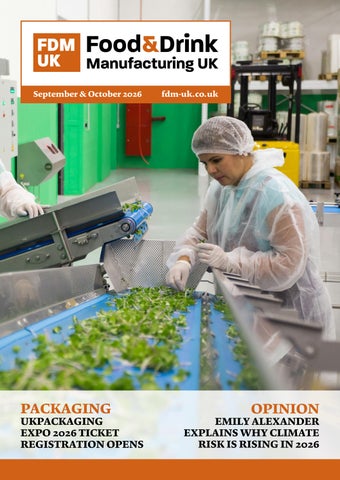
September & October 2026
PACKAGING
UKPACKAGING EXPO 2026 TICKET REGISTRATION OPENS
fdm-uk.co.uk
OPINION
EMILY ALEXANDER EXPLAINS WHY CLIMATE RISK IS RISING IN 2026
TRUSTED PERFORMANCE. UNBEATABLE VALUE.
When the job’s straightforward, the truck should be too. Cat® EQ range 3 and 4 wheel 1.6 to 3.5t lithium counterbalance forklifts deliver proven performance for everyday handling, indoors or out. Built tough. Easy to operate. Cost-effective to run and backed by Impact’s premium support as standard.
Experience unbeatable value backed with premium support. Let’s talk.
®
0800 169 9789 sales@impact-handling.com www.impact-handling.com © 2026 Logisnext Europe B.V. All rights reserved. CAT, CATERPILLAR, LET’S DO THE WORK, and their respective logos “Caterpillar Corporate Yellow”, the “Power Edge” and Cat “Modern Hex” trade dress as well as corporate and product identity used herein are trademarks of Caterpillar used under license and may not be used without permission from Caterpillar. Specifications are indicative and may vary depending on operating conditions. Failure to assess all factors may result in performance deviations. All relevant sales support materials and technical expertise of the official distributor must be considered when identifying the best product/solution. Options and technical details may change without notice. Full legal notice and up-to-date product information: www.catlifttruck.com.
CONTENTS 05
20 Editor Paul Attwood editor@fdm-uk.co.uk Editorial Assistant John Reynolds editorial@fdm-uk.co.uk
42
26
48
05 CBRE finds buyer for Noble Foods’ production site in multi-million-pound deal 20 Deli 24 strengthens reliability with Atlas Copco Oil-Free Compressors 26 The Case for Frozen - By Jack Rutherford, MD UK & Ireland, Crosta Mollica 42 Registration opens for UKPackaging Expo 2026 48 London Packaging Week unveils major new features for 2026 event
Features Editor Henry Peters editorial@fdm-uk.co.uk Production/Design Laura Whitehead laura@lapthornmedia.co.uk
Editor’s Note
Sales Manager Holly Jones sales@fdm-uk.co.uk
Welcome to the latest issue of Food & Drink Manufacturing UK, where innovation, sustainability and resilience take centre stage.
Publishing Director Maria Lapthorn maria@lapthornmedia.co.uk Admin Assistant Jade Still jade@lapthornmedia.co.uk Lapthorn Media Ltd 5-7 Ozengell Place, Eurokent Business Park, Ramsgate, Kent, CT12 6PB
01843 808 106 www.fdm-uk.co.uk @fdmanufacturing
This issue explores how manufacturers are responding to rising costs, evolving regulations and changing consumer expectations, from smarter, more sustainable packaging to advances in automation, processing and energy efficiency.
Paul Attwood Editor
We also examine the growing importance of climate resilience and supply-chain preparedness, alongside the latest developments in food safety, production technology and packaging. With investment driving greater efficiency and flexibility across the sector, this issue highlights the ideas and solutions shaping the future of food and drink manufacturing. We hope you enjoy this issue. As always, if you have news you’d like us to feature, please email us at editorial@fdm-uk.co.uk.
Every effort is made to ensure the accuracy and reliability of material published in Food & Drink Manufacturing UK however, the publishers accept no responsibility for the claims or opinions made by advertisers, manufactures or contributors. No part of this publication may be reproduced or transmitted in any form or by any means, mechanical, electronic (including photocopying) or stored in any information retrieval system without the prior consent of the publisher.
03
Latest News
Meat industry input helps secure better access to Swiss market The British Meat Processors Association (BMPA) has welcomed the conclusion of negotiations on the new UK-Switzerland Free Trade Agreement, describing it as a positive step that will make trading with one of the UK’s important export markets simpler, quicker and more competitive for British meat businesses.
certainty for exporters and strengthen the competitiveness of UK meat products in the Swiss market.
While the existing UK-Switzerland agreement already provides tariff-free trade for most goods, the new FTA goes further by making trade easier and more efficient, while delivering targeted improvements for UK exporters. These include better market access for beef, tariff-free access for lamb within Switzerland’s WTO quota, simplified rules of origin, and faster customs procedures designed to reduce delays for perishable goods. Together, these measures will help reduce friction at the border, improve
John Powell, Chief Executive of the BMPA, said: “This is a welcome agreement that should make it easier for UK meat businesses to trade with Switzerland. Anything that reduces unnecessary bureaucracy, speeds up the movement of goods and improves market access is good news for exporters. We’re pleased that Defra worked closely with industry throughout the negotiations and recognised the value of practical input from businesses. It’s encouraging to see that collaborative approach reflected in an agreement that delivers real benefits for our sector.”
BMPA has worked closely with Defra throughout the negotiations, providing technical expertise and practical industry insight to help ensure the agreement reflects the needs of UK meat processors and exporters.
It’s encouraging to see that collaborative approach reflected in an agreement that delivers real benefits for our sector. - John Powell
While the agreement will still need to be signed and implemented before businesses can begin using its provisions, BMPA believes it represents a welcome step towards smoother trade and improved opportunities for the UK’s world-class meat processing sector.
Food and drink firms seek greater control over volatile energy costs Rooftop solar is becoming an increasingly important part of the energy strategy for factories, chilled warehouses and distribution centres of food and drink. A birds-eye view of any commercial estate across the UK will increasingly reveal hundreds of solar panels on the roofs of factories and warehouses, helping to produce the energy they need. And, with the addition of conflict in the Middle East and global uncertainty over energy costs and supplies, even more food and drink companies are looking to invest in solar energy. That’s according to Fusion 360, a UKwide installer of solar panel systems
04
Latest News
CBRE finds buyer for Noble Foods’ production site in multi-million-pound deal
Previously used as an egg-packing facility, the self-contained site features all the necessary facilities for a manufacturing operation including two office buildings, two warehouses, 19 loading bays and additional storage buildings.
Leading commercial real estate firm, CBRE, has successfully completed the sale of 115,000 sq ft industrial site in a multi-million pound deal on behalf of the seller, Noble Foods.
The site also came with 15.2 acres of vacant land with outline planning permission to build additional warehouses already granted. Will Davis, associate director at CBRE, said: “This deal reflects the strong demand for industrial space both in Witney and across wider Oxfordshire. “A self-contained site of this size is incredibly rare, especially in such a popular location. “The fact it came with outline planning permission for additional warehouses was the cherry on top and made it the perfect site for a business looking to expand its operations.” Will Cadbury, Chief Financial Officer at Noble Foods, said: “When our Witney site became surplus to requirements, we were keen to find the right buyer who would be able to make the site purposeful again.”
on large structures including the premises of manufacturers and distributors of food and beverages.
their supply chains and take measures to reduce risks from fluctuating energy costs.
“One of the strongest benefits of installing solar panels is the reduced reliance on mains energy.
Fusion 360 specialises in electrical design and installation, including new-building electrics, communications networking and installing solar PV panels on both new and existing buildings.
“Add to that the increased sustainability and lower costs, particularly when powering energy-hungry refrigeration and chillers, and it’s perhaps clear why we’re seeing growing interest from businesses helping to feed Britain” says Joanne Skinner, Commercial Director of Fusion 360. Due to the widespread use of refrigeration and chillers within processing and storage facilities, as well as the energy consumed by refrigerated trailers, the food and drink sector can be highly energydependent. International instability caused by the pandemic and wars in Europe and Asia has encouraged many UK food and drink companies to strengthen
The firm recently completed a major project for Aldi’s regional distribution centre in Bathgate, Scotland, where they replaced over 4,000 solar panels with the latest technology to provide self-generated and lower-cost electricity. “From food factories to packing plants and distribution warehouses, many food and drink related companies have expansive roofs which lend themselves well to solar energy. With continuous advances in PV technology, every new generation of solar panels is delivering greater power, longer life and a faster return-on-investment” adds Joanne.
Fusion 360 has installed solar PV systems which help businesses generate sustainable power for use on site. Depending on the customer’s requirements and grid connection, surplus power can either be restricted from entering the grid or exported where suitable arrangements are in place. Since the beginning of 2026, and the impact of the US-Iran conflict in particular, they’ve reported a notable increase in enquiries, particularly from companies related to food and drink. “Businesses tell us they’re looking to gain greater control over their energy use and make costs both lower and more predictable. With continuing inflationary pressure across the food sector, investing in onsite solar is one practical way businesses can reduce their exposure to volatile electricity prices,” concludes Joanne. Find out more about Fusion 360 at fusion360group.co.uk
05
Latest News Two in three Brits concerned about health impact of hidden plastics in food packaging
or ‘forever chemicals’, are persistent chemicals that are used in industrial processes and consumer products.
As Plastic Free July challenged millions to reduce their consumption of single-use plastics, new research reveals growing public concern about the hidden plastics used to line paper and card food packaging.
Ground-breaking developments from businesses such as Xampla eliminate the need for plastic coatings in food packaging.
Three in five UK adults (62%) are concerned about the impact of plastic on their health, rising to 67% when asked specifically about plastics in food packaging. Microplastics are a particular concern for the public. Recent studies have shown that microplastics have been found throughout the human body, including in human tissues and blood. There is also rising concern over the use of PFAS in food packaging. PFAS,
06
National biomonitoring surveys have detected hundreds of synthetic chemicals, including PFAS, in people of all ages, including newborns exposed in utero, across the globe.
Xampla’s world-first Morro™ materials are made from plants and are free from plastics, microplastics, and PFAS. Their flagship product range, Morro Coating, is currently in market across Europe with global brands such as Just Eat Takeaway. com. Consumer demand for these new plastic-free materials is growing. Two-thirds of people (65%) say that, given two similar takeaway options, they would choose the one using plastic-free packaging. However, the problem is that these plastics are difficult for the public to spot. Half of Brits (49%) say they did not know many takeaway containers,
like burger boxes and fry cartons, are plastic-lined at all. Recent years have seen single-use plastic items such as straws and cutlery banned across the UK, with new EU regulations set to restrict the levels of PFAS allowed in food packaging. Earlier this year, the Government published its first plan to assess the risks posed by PFAS. However, eight in ten people (78%) believe the Government should do more to reduce the amount of plastic in food packaging. Increasing numbers of MPs have backed calls to ramp up the transition towards plastic-free packaging as emerging solutions are scaling to address health concerns. Experts say plastic pollution could triple by 2060 if decisive action is not taken. As scrutiny of plastic’s impact on health continues, alternatives such as Morro Coating offer a practical route to plastic-free packaging that people can trust.
Protect what matters.
» Food safety in any form! See us at
PPMA
Stand B52!
Detect foreign bodies and product weight errors. Did you know that up to one in four food recalls is due to foreign body contamination? Our solutions are engineered to safely secure your brand, your products and your consumers from contaminants and beyond. From weighing ingredients to controlling recipes and fill levels to inspecting final packaging, we’re here to support you: For food safety in any form!
» X-ray inspection » Metal detection » Checkweighing » Statistical process control
Minebea lntec UK Ltd. 2670 Kings Court, The Crescent Birmingham Business Park, Solihull Parkway I Birmingham B37 7YE Phone +44.121 779 3131 | Email sales.uk@minebea-intec.com
Company News
Roberts Of Port Dinorwic invests £425K in next stage of growth Latest round of investment will deliver new state of the art refrigeration plant and precision x-ray portioning machine
Roberts of Port Dinorwic, a longestablished and trusted supplier of ready-to-cook meal components to leading QSR brands, pub and restaurant groups, and foodservice wholesalers, has announced its next round of investment as it accelerates its growth strategy and strengthens its position as a leading UK food manufacturing partner. The announcement builds on the company's recent return to profitability and wider business transformation under CEO Mark Rodgers. The latest phase forms part of a £750,000 investment programme designed to improve operational efficiency, enhance sustainability and unlock new commercial opportunities. Following the successful completion of a £300,000 microwave tempering system, Roberts has now committed
Image from Roberts of Port Dinorwic
LTS Global Solutions Completes Major Warehouse Expansion to Support Long-Term Growth Strategy LTS Global Solutions has completed a major racking expansion project at its Hams Hall warehouse, creating 17,000 additional pallet spaces and significantly increasing capacity to support growing demand from existing and new customers. The investment, which totals £500,000, has expanded the company's 130,000 sq ft storage capacity in Coleshill from approximately 10,000 pallet spaces to around 27,000 pallet spaces. LTS’ Hams Hall site plays a central role in the company’s end-to-end logistics offering, which includes warehousing, transport, freight forwarding and value-added supply chain services – and its expanded capacity will further provide customers with access to secure,
08
scalable storage solutions and efficient nationwide distribution links. The project forms part of LTS' ambitious and ongoing longterm growth strategy, which will see the business target revenues in excess of £23 million by 2030 through continued investment in infrastructure, technology and customer service. The additional capacity also comes at a poignant time for LTS, as the business is experiencing a sharp increase in
demand for its warehousing services, driven by a series of new contract wins in recent months and continued strong growth across its logistics division. With the company already 14% ahead of last year's performance, the additional capacity will enable LTS to accommodate to this increased demand, helping them support new and existing customers and provide greater flexibility for businesses looking to scale their operations. Alongside the new racking installation, LTS has invested in an additional Linde Very Narrow Aisle (VNA) forklift truck, enabling the business to maximise operational efficiency while maintaining its high service standards as activity levels across the facility continue to increase.
Company News a further £425,000 of self-funded investment into a new energyefficient refrigeration plant and a state-of-the-art X-ray precision portioning machine. The microwave tempering technology has already exceeded expectations, delivering better yields and product quality, meat tempering time from 72 hours to just 20 minutes, the system enables same-day processing of shortnotice customer orders, significantly improving responsiveness and production flexibility. The next stage of investment focuses on both sustainability and precision manufacturing. A new refrigeration plant will replace ageing, carbonintensive equipment, reducing energy consumption and delivering projected annual savings of around £200,000, with an expected return on investment in under two years. Alongside this, Roberts has ordered a next-generation X-ray precision portioning machine capable of cutting products to within 1mm accuracy. The technology will further
support yield optimisation and help reduce give way and wastage with near-zero production waste. The investment comes as Roberts continues to build momentum across the business. Having recently returned to monthly profitability, the company is targeting sustained month-onmonth and year-on-year profit growth over the next six months. Roberts are actively diversifying into wholesale, public sector catering and new food manufacturing partnerships as part of a newly approved threeyear commercial strategy targeting sustainable new business growth over the next three years. The company's transformation aligns with Roberts' wider strategy of positioning itself as a trusted, end-toend manufacturing partner capable of supporting customers from concept through to large-scale production. Mark Rodgers, CEO, Roberts of Port Dinorwic, said: "This investment is about much more than new machinery. It's about building a smarter, more sustainable and more responsive manufacturing business
CEO Mark Rodgers - Image from Roberts of Port Dinorwic
that delivers real value for our customers. The results from our first investment have exceeded expectations, improving yield, reducing processing times and giving us the flexibility to respond much more quickly to customer demand. We're now building on that success with technology that will reduce waste, lower our environmental impact and open new market opportunities.
Dave Hands, Managing Director at LTS Global Solutions said: “We are delighted that the racking expansion at our site in Coleshill is finally complete. “The project has been many months in the making but to see it finally come to fruition is hugely exciting as the opportunity it brings us as a business to scale is nothing short of significant. "Not only does the additional capacity allow us to support our existing customers as they grow, but it also ensures that we have the infrastructure in place to cater to new clients and respond quickly to increasing demand.” Speaking on how the racking expansion project will support LTS’ growth plans as it gears up for growth in the coming years, Dave Hands said it represents a “sizeable leap” towards the company’s end goal. Dave continued: “We've experienced steady growth across the business over the past 12 months, and this investment demonstrates our commitment to staying ahead of that, rather than reacting to it. “By expanding our warehousing capabilities and investing in new
equipment, we're strengthening our ability to deliver the flexible, reliable and scalable logistics solutions our customers rely on, and that we’re known for. "We see this project as a sizeable leaps towards our pending growth plans, and with demand for our services continuing to increase over this past year, it conveniently puts us in a strong position to capitalise on new opportunities as they come about over the coming months and years.”
We are delighted that the racking expansion at our site in Coleshill is finally complete.
09
Company News
FIS Group is reimagining the future of food and drink Three businesses consolidated into one powerful specialist insight, innovation and product testing partner for food and drink FIS Group, a specialist insight, innovation and product testing partner for the food and drink industry, has formally launched. Food Innovation Solutions, Good Sense Research and Cambridge Market Research have come together as one business, working as a single team under one name, with one point of access for clients. The launch brings together established specialist teams with more than 30 years of combined heritage in the food and drink sector. Rather than operating as separate businesses, the group now works as one connected team across insight, innovation and product testing, reflecting how clients already engage across the full range of its expertise.
The group is clear that the move was about capability, not scale for its own sake. The founding businesses were brought together for their complementary skills, experience and people, with Good Sense Research and Cambridge Market Research each contributing more than 30 years in the sector. The group works across retail, foodservice, branded FMCG and own label, fresh produce growers and scaling businesses. FIS Group runs largescale fresh produce benchmarking programmes for the largest food retailers in the UK. The group has also created proprietary insight programmes including Appetite Shift, an ongoing, syndicated study tracking how GLP-1 medications are reshaping consumer diets, habits and lifestyles.
Why now
What it means for clients
The decision is about clarity and strength. As the businesses have grown, so has the way clients work with them, across more services, more specialisms and more connected briefs. A single brand makes that full range easier to understand, easier to access and better connected.
For clients, the change brings clearer access to the full offer, joined-up thinking across insight, innovation and product, and one connected team to work with. The people, expertise and standards they already know do not change. The group puts the right team on each project, matched to the brief.
10
The group is clear that the move was about capability, not scale for its own sake. The founding businesses were brought together for their complementary skills, experience and people, with Good Sense Research and Cambridge Market Research each contributing more than 30 years in the sector. book. We bought complementary skills, experience and people. Joined up, that knowledge is the whole point.” Kelly Dowson, Group Managing Director, FIS Group: “For me, this is about building a simpler, stronger and more connected organisation, easier to understand and better positioned for the future. It brings real benefits to our customers: greater clarity, consistency and confidence, with all of our expertise now accessible through one trusted name.”
From the leadership team
The vision
Mike Faers, Founder and Group CEO, FIS Group: “Pride is the first word I would use. I am immensely proud of our business, our team and our people, and I am excited in equal measure. People ask why we made the acquisitions we did. The honest answer is that we never bought an order
FIS Group wants to be the goto partner for food and drink businesses that need sharp, forwardthinking insight and innovation support. The ambition is to be the people clients call first, because the group understands their world, challenges their thinking and helps them get to better answers faster. It is captured in a single line that now sits at the top of everything the group does: reimagining the future of food and drink.
Efficient HACCP Cook & Chill CCP Validation
! s t n u o c e c n ie r Where expe
Product Safety Process Efficiency Improved Product Yields Rapid Fault Finding Full HACCP Certification
ü
Thru-process temperature monitoring solutions for all your cook applications
PhoenixTM Technology • Accurate IP67 data logger (Type K or T) • 10 Measurement Points for full oven mapping • Thermal barrier options to suit cook regime • Comprehensive thermocouple range • Standard miniature thermocouple plugs • Calibrated thermocouple options • Food trays and thermocouple jig options • Full lethality (Fo/Pu) and reporting • Real Time RF Telemetry options • Local efficient calibration and service support
Phoenix Temperature Measurement 25 Earith Business Park, Meadow Drove, Earith, Cambridgeshire PE28 3QF, UK
T: 01353 223100 E: sales@phoenixtm.com
www.phoenixtm.com
Technology News
How Intelligent Vacuum Technology Choices Improve Efficiency The type of vacuum technology you choose has a direct impact on the efficiency of your process. Outdated technology, or a vacuum pump design that is not well matched to the application, can lead to higher energy consumption, accelerated wear, and reduced reliability. By selecting the right vacuum technology for the process, operators can achieve better performance and improved overall efficiency. Aligning your equipment strategy with proven, modern technologies helps ensure long-term operational and financial resilience. The following sections outline how choosing or upgrading to the right technology ultimately leads to significant reductions in the total cost-ofownership of your vacuum system.
How your choice of vacuum pump technology affects efficiency A vacuum pump may be able to achieve the required process conditions, but that does not necessarily make it the most efficient option. There are often multiple vacuum pump technologies available that can reach the desired vacuum level (for example, rotary vane, dry claw, dry screw or liquid ring vacuum pumps), but each will operate at a different efficiency level at the duty point. Beyond energy efficiency, there are several other factors to consider when identifying which vacuum technology is most suited to the application. Key factors to consider: • Operating pressure/vacuum range: Each vacuum pump technology performs best at a specific pressure range. Choose a vacuum pump that operates efficiently across your required range. • Variability of vacuum demand: Vacuum processes that are continuous and stable require different solutions to those that
12
are intermittent and with variable demand. Technologies that can be fitted with a variable speed drive (VSD) can adapt to these changes, preventing energy from being wasted. • Contamination and corrosion resistance: Processes with condensable vapors and aggressive chemicals require vacuum pumps that are specifically resistant to contamination and corrosion. Consider factors like material compatibility and process gas handling to prevent corrosion and ensure reliable performance. • Maintenance requirements: In applications where downtime is costly, technologies with reduced maintenance requirements or straightforward field serviceability could help.
preserves oil properties, and reduces the thermal stresses that accelerate wear. • Materials and functional coatings: Wear-resistant alloys and engineered coatings reduce abrasion and corrosion. These surface technologies help maintain dimensional accuracy and performance. • Service-friendly construction: A service-friendly construction can shorten the time taken to complete maintenance activities, reducing downtime. • Filtration: Filtration should effectively capture particulates or oil mist and resist clogging, while simultaneously maintaining a low drop in pressure. This ensures both vacuum performance and system reliability.
• Physical constraints: Sound pressure levels, heat rejection, and footprint may influence vacuum pump selection, especially in space-limited or noise-sensitive environments. Consider whether a central vacuum system could better match operational needs.
Advances in motor technology for further efficiency gains
How vacuum pumps are designed to be efficient
Here is how the latest motors can help to improve efficiency:
A vacuum pump’s design directly influences how efficiently and reliably it can perform in specific applications. Here are some of the ways vacuum pumps are engineered with efficiency in mind: • Optimized compression chamber and internal geometry: Precision rotor profiles and tuned flow paths reduce internal leakage (slip) and turbulence losses. This results in higher volumetric efficiency and requires lower motor power for the same pumping speed. • Thermal management and cooling airflow: Efficient cooling systems, such as jackets or directed airflow channels, maintain stable operating temperatures. This stabilizes performance across duty cycles,
Advances in motor technology offer another practical route to improved efficiency and reduced running costs.
• Energy efficiency classes: International efficiency classes indicate how effectively a motor converts electrical input to mechanical output. Upgrading from older classes to later classes (for example, from IE1 to IE5) reduces losses and can substantially decrease energy consumption. • Compatibility with variable speed drive operation: Some motors are compatible with variable speed drive operation and can power a vacuum pump within a specific range without overheating. These motors can be retrofitted with low cost and disruption. • Reliability and maintenance advantages: Modern motor designs use improved materials, high-grade insulation, and optimized bearing arrangements to extend service life.
Technology News
Image from Busch Group
Benefits of optimizing or upgrading your vacuum technology Choosing or upgrading to optimized vacuum pump and motor technology can deliver significant reductions in the total cost-of-ownership of your vacuum supply, whilst also improving reliability and process quality. Typical benefits include: • Energy savings: The latest efficiencyoptimized vacuum pump designs, combined with high-efficiency motors, can significantly cut energy consumption. For example, singlestage rotary vane vacuum pumps (e.g. the Busch RD range) achieve energy consumption reductions of up to 30% compared with conventional rotary vane pumps. Likewise, scroll vacuum pumps (e.g. the Pfeiffer HiScroll series) can reduce energy consumption by up to 50 % compared with other rough vacuum pump technologies. • Reduced downtime and longer life: Improved designs, enhanced thermal management, and materials engineered for durability reduce wear. Such improvements maximize reliability, lower the frequency of emergency repairs, make maintenance costs more predictable, and extend the life of your vacuum pump. • Improved process stability and product quality: Consistent vacuum performance can reduce process variation, decrease reject rates and increase throughput. • Compliance and sustainability: Reducing energy consumption lowers carbon emissions and supports regulatory or corporate sustainability goals. Image from Busch Group
Output Industries and 42 Technology join forces to help manufacturers reduce production losses Output Industries, creator of Busroot, the shop-floor operating system that helps improve manufacturing performance, and 42 Technology (42T) have announced a strategic partnership to help manufacturers identify hidden production losses faster and accelerate operational improvements. The collaboration combines Busroot’s real-time tracking and production intelligence capabilities with 42T’s manufacturing innovation consultancy to identify where value is being lost and to implement targeted improvements. By integrating live production data with hands-on engineering and manufacturing expertise, the two companies can help manufacturers reduce downtime and waste, improve efficiency and protect their margins. Manufacturers are facing growing pressure to improve productivity as rising energy, labour, and material costs, along with supply chain disruptions, continue to squeeze profit margins. Some estimates suggest companies could be losing over 11% of their annual turnover to machine failures, human error and supply chain issue, which is further intensifying the urgency to find and fix hidden production losses.
The Busroot platform connects to any machine or industrial asset within a production environment and provides a clear view of where value is being lost: for example from equipment failures and breakdowns to minor stoppages and products being scrapped during start-up. It also tracks energy use in real time, helping manufacturers understand how much energy is required to produce each product and where unnecessary energy waste is occurring. 42T brings extensive experience in helping manufacturers improve operational efficiency and product quality across sectors including food and beverage, personal care and industrial manufacturing. The consultancy has particular expertise in root cause analysis on production lines; skills in areas such as automation, machine vision and edge AI; and a track record in developing practical solutions for market-leading consumer and industrial brands. Mike Wright, co-founder and CEO of Output Industries, said: “Manufacturers know they’re losing value but often can’t see where or why. Busroot gives them real-time operational visibility to identify production losses, and by partnering with 42T we can help manufacturers act on those insights more quickly and accelerate operational improvements.” David Griffin, principal consultant in manufacturing innovation and automation at 42T, said: “Our manufacturing clients are facing intense cost pressures, and reducing production downtime represents a major improvement opportunity. “Busroot is typically up and running in less than a day and can provide detailed analytics on equipment uptime, throughput and energy use.”
13
Packaging
How tailor-made packaging is pushing premium spirits beyond the bottle By Nicolas Le Goaëc, Key Account Manager at MM Packaging Food & Specialities
In premium spirits, the liquid inside the bottle is only a small part of the overall value proposition. That value is defined by its packaging. But in an era of ever-tightening sustainability regulations that impact every element of a pack, from its use of materials to the amount of empty space featured in its design, creating this value is more challenging than it might seem. Brands can no longer dominate shelves with heavyweight premium materials and oversized secondary packaging designs. Instead, they must lean on packaging expertise and creativity to create more impactful stories, placing new importance on supply chain partners like MM Packaging.
Shaping identity In premium spirits, secondary packaging designs were traditionally variations on the theme of rectangular cartons. The materials, colours, and finishing techniques used might have changed, but the structure remained the same. Today, regulations and, increasingly, consumers demand a smarter, more tailored approach to structural design. While this comes with challenges, it also presents new opportunities
14
Creative ambition and packaging engineering must work side by side. for brands willing to take them. A new approach gives these brands the freedom to create a uniquely recognisable physical identity by – literally – thinking outside the box. METPET lamination clearly illustrates how evolving sustainability regulations are influencing material selection and driving innovation in premium packaging. Board-to-board lamination is another option, combining different board grades to achieve greater stiffness, improved durability, and a superior hand-feel for premium folding cartons.
the strength and cushioning properties of corrugated material with the highquality printed surface expected in premium markets. Brands can then explore more robust fibre-based structures without sacrificing visual refinement.
Finishing the story Structure creates the stage, but finishing is the spotlight that brings the story into focus. Embossing and debossing add depth. Hot stamping and cold transfer effects catch the light. Carefully selected varnishes create contrast between gloss and matt surfaces, while tactile effects encourage the consumer to slow down and engage with the pack.
Unusual silhouettes, angled panels, curved profiles and unexpected opening mechanisms can turn a pack into something consumers want to explore while still limiting empty space. Inside, bespoke inserts can hold bottles and accessories securely while controlling the pace of the reveal. For limited editions and gift sets, this sense of discovery is an important part of the appeal.
The strongest designs use these techniques with clear intent. A single embossed detail or precisely placed metallic accent can feel more luxurious than decoration applied across every surface in the right context. Each finish should reinforce something distinctive about the spirit, whether that is its provenance, ingredients, craft credentials, or contemporary character.
This must be considered alongside product protection requirements. In this category in particular, packs need to protect often heavy, fragile bottles throughout distribution while remaining practical to manufacture and assemble. Creative ambition and packaging engineering must work side by side.
MM Packaging’s range of finishing technologies enables these sensory cues to be integrated into the wider structural concept rather than added as an afterthought. The creative opportunity is greater than mere substitution - beyond the bottle, every fold, finish, and closure has something to say.
This unlocks solutions like the use of litho-laminated microflute, combining
The best premium spirits packaging simply makes that message heard.
Packaging
PaperFlow(re) P-type:
Recyclable paper packaging combinescircularity, performance and shelf appeal The requirements for modern food packaging continue to evolve. Packaging must be recyclable, provide reliable product protection, deliver strong shelf appeal and enable efficient processing on existing production lines. With PaperFlow(re) P-type, adapa Group offers a paper-based packaging solution that successfully combines these requirements, providing manufacturers with a practical pathway towards more circular packaging concepts. Having successfully passed the demanding CEPI recyclability test, PaperFlow(re) P-type has demonstrated its recyclability within standard paper recycling streams. The solution combines a high paper content with the functional performance required for industrial packaging applications and is already being successfully used by international customers across multiple product categories. “PaperFlow(re) P-type exemplifies our approach to developing packaging solutions that combine sustainability with technical performance,” says Richard Bell (pictured), Director of Innovation at adapa Group. “What makes this solution particularly valuable is that it enables customers to advance their circular economy goals while remaining fully compatible with existing production environments. The growing adoption of PaperFlow(re) P-type
maintain an attractive presentation at the point of sale and enhancing shelf appeal. To further expand application possibilities, PaperFlow(re) P-type is also available as a pre-made pouch with a reclosable zipper feature, combining consumer convenience with the benefits of paper-based packaging.
Designed for seamless integration into existing packaging processes A key advantage of PaperFlow(re) P-type is its machine compatibility. A thin PP layer provides the dimensional stability and reliable heat-sealing performance required for industrial packaging operations. Suitable for both horizontal and vertical form-fill-seal machines (HFFS/VFFS), the solution supports efficient production while meeting the performance requirements of modern packaging applications.
The best premium spirits packaging simply makes that message heard.
Recognition for circular packaging innovation
demonstrates that circular packaging can also be practical and commercially viable.”
The recognition follows successful customer implementations of PaperFlow(re) P-type, including a solution developed to meet APCOA requirements. The project demonstrated how CEPI-certified recyclability can be combined with the technical performance, product protection and processability required in demanding commercial applications.
Developed for a wide range of food applications The PaperFlow(re) P-type product family is available in paper grammages of 70, 80 and 90 gsm and comes in both standard and high-barrier versions. This makes the solution suitable for a broad range of applications, including snacks, crisps, chocolate, biscuits, and cereals. In addition to its recyclability, the packaging also delivers a premium shelf appearance. Its specially engineered structure reduces creases and fold marks, helping brands
The innovation behind PaperFlow(re) P-type was recently recognised with the Pap’Award in the category “Circularity in Food Packaging”. The award honours packaging solutions that make a measurable contribution to the circular economy while meeting the practical requirements of industrial packaging applications.
“This recognition reflects a broader shift in the packaging industry towards solutions that combine recyclability, performance and economic viability,” adds Richard Bell. “With PaperFlow(re) P-type, we demonstrate that recyclability, product protection and processability can be successfully combined within one packaging solution.”
15
Packaging
Panesar Foods Invests in YPS Shrink Wrapping Technology to Support Business Growth Yorkshire Packaging Systems (YPS) has supplied new automated shrink wrapping equipment to Panesar Foods as the manufacturer expands production at its West Midlands facility. The repeat investment reflects Panesar Foods’ confidence in YPS machinery and the company’s in-house engineering support. Founded in 1992, Panesar Foods produces spices and sauces for a broad customer base and manufactures approximately 12,000 tonnes of product per year across more than 750 SKUs. In October 2024, Panesar Foods became part of Paulig, following Paulig’s acquisition of the UK-based manufacturer. The two companies had already collaborated for 17 years prior to the acquisition, which supports Paulig’s ambition to strengthen its position in the World Foods category and accelerate international growth. Today, Panesar Foods continues to expand under Paulig’s ownership, prompting investment in highperformance, flexible packaging solutions.
YPS sleeve sealers deliver speed, flexibility and fast changeovers To meet increasing demand, Panesar Foods installed inline and side-feed sleeve sealers from YPS to wrap trays of curry sauce jars. With a highmix production environment and frequent SKU changes, fast and simple
We already had YPS lines on site and had found them extremely reliable. changeovers were a critical requirement when selecting new equipment. The YPS shrink wrapping lines allow operators to switch efficiently between different product formats and tray sizes, reducing downtime and maximising throughput. This flexibility ensures production can keep
pace with customer demand while maintaining consistent pack quality. Machine reliability was another key factor in Panesar Foods’ decision to return to YPS. The site already operates YPS equipment and has built up extensive experience of its robust design and dependable performance in a demanding production environment. As volumes continue to grow, consistent uptime and repeatable performance are essential. The new YPS sleeve sealers provide the reliability required to support continuous operation and long-term production planning.
Engineering-led installation, training and ongoing support Beyond the machinery itself, Panesar Foods highlighted YPS’ in-house engineering capability as a major reason for the repeat order. The project was delivered through an engineerled installation, ensuring smooth integration with existing lines and minimal disruption to production. YPS also provided comprehensive operator training and continues to offer responsive technical support, giving Panesar Foods confidence that expertise is always available when required. “We already had YPS lines on site and had found them extremely reliable. The machines deliver the fast changeovers we need, and YPS’ in-house engineering support — from installation through to training and ongoing service — made them the natural choice for this next stage of growth.” Stephen Ansell, Engineering Manager, Panesar Foods
Packaging solutions built for future growth With further expansion planned under Paulig’s ownership, Panesar Foods now has a scalable, future-ready shrink wrapping solution in place. The combination of speed, flexibility, fast changeovers and engineering support ensures the business is well equipped to meet rising demand.
16
01327 810370 sales@angelrefrigeration.co.uk
www.angelrefrigeration.co.uk
Cooling, Production, and Storage Refrigeration
For Food and Drink Industry Professionals When time and temperature really matters Blast Chillers, Retarder Provers, Meat Aging & Curing Simply and efficiently increase daily production Automatic end of cycle chilled and frozen storage Programmable intuitive touch screen controllers Full installation & training by our experienced team
‘The right refrigeration to do the right job’
Opinion Piece
Why Climate Risk is Rising in 2026 By Emily Alexander, Senior Associate Scientist at Tunley Environmental
The evidence is difficult to ignore. 2023, 2024, and 2025 were the three hottest years on record, and the UK’s Met Office expects 2026 to rank among the warmest years ever observed, with global temperatures projected to remain around 1.46°C above pre-industrial levels. The cause- increased pressure on our natural systems which result in aggravated changes in climate regulation. We often view climate risk as a future challenge, but for many organisations it is already a present-day operational reality. This extreme weather caused by inflated pressure from human-induced activities leads to a knockdown effect: communities and businesses are experiencing more frequent and severe heatwaves, flooding, droughts, wildfires, and storms, creating growing disruption to operations, infrastructure, and supply chains. The stable climate that is used as a reference point for infrastructure, supply chains, and business models, which underpin modern economies are changing drastically. Thus, how can we continue to rely on such climate conditions of
Even under optimistic emissions scenarios, many climate risks are already locked into the coming decades.
operational continuity, and creating value in an increasingly uncertain future.
Early Warning Signals from the Insurance Industry An unlikely warning signal of the present-day reality of climate change comes from the insurance industry. A variety of examples are available to directly showcase the uncertainty of climate change translating into increased insurance premiums and restrictions. Recent example is in Florida, where home insurance rates have increased at double the rate of the rest of the U.S. due to the increased risk of hurricanes. Another is the announcement from major insurance companies limiting new homeowner policies in wildfire-prone areas of California, with “rapidly growing catastrophe exposure” cited among other reasons for limiting their coverage area.
- Emily Alexander
Insurance markets often act as the economy’s early warning system. When insurers struggle to price climate risk, businesses should take notice and prepare for this uncertainty in their financial planning.
the past when they no longer represent the present?
Outdated Infrastructure and the Need for Resilience
The changing climate is creating a growing range of climate hazards that organisations must now consider as part of their risk landscape. Extreme rainfall, flooding, heatwaves, droughts, wildfires, and severe storms are no longer rare events that can be treated as exceptions. Instead, they represent increasingly material threats to infrastructure, operations, supply chains, employees, and customers. As historical weather patterns become less reliable predictors of future conditions, understanding exposure to climate hazards is quickly becoming a critical component of effective risk management. As climate hazards become a more prominent feature of the business landscape, organisations are increasingly experiencing their operational and financial consequences. Climate change is no longer solely an environmental issue; it is a strategic challenge that requires proactive management. In response, adaptation, resilience, and long-term risk management are becoming central to protecting assets, maintaining
Much of the infrastructure in use today was designed using historical climate data. Asset lifetimes, design tolerances, maintenance schedules, and operational assumptions were developed based on environmental conditions that were considered relatively stable and predictable. As these conditions change, many assets are being exposed to stresses beyond those anticipated during their design. The consequences are increasingly visible, from drainage systems operating beyond capacity to transport networks, power systems, and other critical infrastructure experiencing greater disruption and deterioration. In response, organisations, governments, and infrastructure operators are increasingly adopting resilience-focused approaches that account for a wider range of future climate conditions rather than relying solely on historical records for system designs. This may include incorporating climate projections into planning and investment decisions, enhancing asset design
Opinion Piece reduction remains essential, it addresses only part of the challenge. Greenhouse gases already accumulated in the atmosphere will continue to influence the climate for decades to come, meaning many of the physical changes we are experiencing today are already underway.
standards, implementing naturebased solutions, and strengthening maintenance and monitoring programmes. By considering future climate uncertainty during design and operation, infrastructure systems can become more adaptable, reducing the likelihood of costly failures, service disruptions, and premature asset degradation. As climate risks continue to evolve, resilience is becoming not just an environmental consideration, but a fundamental component of longterm infrastructure performance and value.
Cascading Risks and the Trickle-Down Effect Climate risks are rarely confined to a single asset, location, or organisation. Today’s global economy is built on highly interconnected infrastructure, supply chains, and services, and as a result the impacts of extreme weather can spread far beyond the area directly affected. Organisations may face significant disruption or financial stress even when their own facilities avoid physical damage. Many assume that because they are not located in a floodplain, wildfire zone, or coastal area, they have limited exposure to climate risk. However, climate impacts increasingly arrive indirectly through supply chains and critical dependencies. Drought can
reduce agricultural yields and disrupt raw material availability and cost. Low river levels can restrict freight transport, while heatwaves can reduce labour productivity and strain logistics networks. In a connected economy, disruption in one region can quickly create operational and financial consequences elsewhere. These interconnected impacts are often referred to as cascading risks. Unlike traditional risk events, where a single hazard causes a single consequence, climate-related events can trigger a chain reaction of secondary and tertiary impacts. Understanding these cascading risks is becoming increasingly important for effective climate risk management. Building resilience therefore requires organisations to look beyond their own assets and consider the wider systems in which they operate. Those that identify vulnerabilities across their supply chains, infrastructure networks, and operational dependencies will be better positioned to adapt to and withstand future climate-related disruptions. Regulatory expectations are also evolving. Frameworks such as the EU Corporate Sustainability Reporting Directive (CSRD), ESRS E1, and IFRS S2 (TCFD) increasingly require organisations to identify, assess, and disclose climate-related risks, including physical climate hazards and their potential impacts on business operations, assets, supply chains, and long-term resilience.
Why is Risk Rising Even if Emissions Halted Tomorrow? At this point, it may be tempting to conclude that reducing GHG emissions is the solution. While emissions
Even under optimistic emissions scenarios, many climate risks are already locked into the coming decades. The effects of decades of environmental degradation will continue to influence natural and human systems long after emissions begin to decline. At the same time, the degradation of natural systems can amplify these risks by reducing the ability of landscapes to absorb floodwaters, regulate temperatures, store carbon, and support biodiversity. Protecting and restoring nature represents an opportunity to strengthen resilience. Nature-based solutions such as wetland restoration, sustainable water management, and habitat enhancement can help reduce climate risks and deliver wider benefits. This changes the nature of the conversation. Climate resilience is no longer solely about protecting assets from individual hazards; it is about strengthening the systems that support long-term business continuity and societal wellbeing. Organisations that understand their exposure, invest in adaptive measures, and work with natural systems rather than against them will be better positioned to manage uncertainty and recover from disruption. The question is no longer whether change is coming, but whether we are building the resilience needed to navigate it. The organisations that thrive in the coming decades will not necessarily be those that predict every risk correctly. They will be the ones that recognise uncertainty, invest in resilience, and adapt before disruption forces their hand. As climate risk continues to grow, preparation is no longer a competitive advantage. It is rapidly becoming a prerequisite for long-term success.
For more information visit: www.tunley-environmental. com/climate-risk-resiliencestrategy Written by Emily Alexander
19
Case Study
Peace of mind under pressure Deli 24 strengthens reliability in food manufacturing with Atlas Copco Oil-Free Compressors For a business operating at the forefront of food safety, confidence in its critical utilities is nonnegotiable. At Deli 24’s Milton Keynes facility, where high-pressure processing (HPP) is used to extend shelf life without heat, compressed air underpins everything from product handling to packaging. Ensuring that supply is consistent, clean and resilient is therefore central to maintaining both operational continuity and product integrity. Deli 24 is the UK’s leading contract HPP processor, supporting food manufacturers across a wide range of categories including baby food, meat, seafood, dairy and prepared products. Its process applies intense pressure to packaged foods, delivering the same pathogen reduction as pasteurisation while preserving taste, colour and nutritional value. Within
this environment, compressed air plays a vital supporting role, powering machinery and enabling processes such as air knives for drying packaging prior to date coding. “Compressed air is an essential part of our whole process,” says Paul Winter, Director at Deli 24. “From conveyor systems to the operation of key machinery, it underpins a lot of what we do day to day. When you’re producing food for major retailers, everything must work exactly as it should.”
A joined-up approach to system performance Deli 24 had operated an oil-free compressor on site for more than 15 years, supported by a long-standing service relationship. As operational requirements evolved, however, the company took the opportunity to reassess its compressed air system more holistically.
Atlas Copco began with a full air audit, examining not just the compressor itself but the wider distribution network and how air was being used across the site. This identified inefficiencies including previously undetected air leaks, prompting upgrades to pipework and connections using more modern systems. A followup audit confirmed the improvements, ensuring that the compressed air being generated was now being used effectively across the process. “It wasn’t just about replacing a machine,” Winter explains. “It was about understanding what we had, how we were using it, and where improvements could be made. That gave us a much clearer picture of what the right solution looked like.”
Building resilience into production Alongside system optimisation, Deli 24 introduced a second ZT22 VSD oil-free rotary tooth compressor, creating a duty/standby arrangement to support production continuity. The new compressor sits alongside the existing ZT22 VSD unit, providing additional capacity while maintaining operational flexibility for future growth. This configuration means that maintenance can now be carried out during normal working hours, without impacting production schedules. It also ensures that compressed air supply can be maintained even if one unit is offline.
20
Case Study “For us, the biggest benefit is peace of mind,” says Winter. “We’ve had a very reliable system over the years but having that additional compressor in place gives us confidence that we can keep running without interruption. That’s particularly important in a food environment like ours.”
Supporting food safety and compliance Given the nature of Deli 24’s operations, air quality is equally critical. Oil-free compressed air from Atlas Copco’s ZT rotary tooth compressors supports applications where there is potential contact with food products or packaging, helping to eliminate contamination risk and support compliance with food safety standards.
was reconfigured to accommodate both compressors side by side, alongside additional equipment including an air receiver to support system stability. Installation was carried out in stages to minimise disruption, with work scheduled around production requirements. Once complete, the upgraded system was integrated seamlessly into operations. “We wanted a turnkey solution, and that’s exactly what we got,” says Winter. “From the initial discussions through to installation and commissioning, everything was handled as one joined-up process. That made a big difference for our engineering team.”
Looking ahead
The company operates to strict retailer and certification requirements, with regular audits from both customers and regulatory bodies. Within this context, the reliability and quality of compressed air are closely linked to maintaining those standards.
In addition to improving reliability, the system has been designed with future growth in mind, providing additional capacity as Deli 24 continues to expand its operations. The company is also exploring digital monitoring tools to provide greater visibility over performance and maintenance planning.
“As we work with a wide range of food products, including ready-to-eat and baby food, maintaining a clean and controlled environment is essential,” Winter adds. “That extends to utilities like compressed air, which form part of the overall process.”
For Atlas Copco, the project highlights the importance of taking a system-level view of compressed air needs rather than focusing solely on equipment replacement.
A turnkey installation The project was delivered as a fully managed installation, covering planning, equipment positioning, pipework modifications and commissioning. Despite the constraints of an existing plant room, the system
“Understanding how compressed air is used across the site was key,” says Michelle Tripp, Oil-Free Sales Engineer at Atlas Copco. “The audit allowed us to identify inefficiencies, address them, and then specify a solution that supports both current operations and future plans. Alongside that, introducing a duty/standby arrangement gives Deli 24 the resilience and flexibility they were looking for.” For a business built on delivering safe, high-quality food at scale, that combination of performance and reassurance is critical. By strengthening its compressed air infrastructure, Deli 24 has created a more robust foundation for its HPP operations, ensuring that essential processes continue to run smoothly, day in and day out.
For more information on Atlas Copco’s oil-free compressed air solutions for food and beverage production, visit: https://hubs.li/Q04ptKSB0
21
Chilled & Frozen Foods
Fridge failures: why temperature monitoring needs to move beyond the clipboard By Chris Potts, Marketing Director at ANT Telecom
For any organisation storing chilled or frozen goods, temperature control is not a back-office task. It directly affects safety, compliance, stock protection and, in some sectors, the quality of research or patient care. Food businesses, for example, have clear responsibilities around chilled storage. The Food Standards Agency states that chilled food must be kept at 8°C or below, with fridges ideally operating at 5°C or below. Temperature checks and accurate records are a core part of showing due diligence.
However, many businesses still rely on manual checks, basic thermometers and paper-based logs. While these methods can work in simple environments, they leave gaps. A fridge may fail overnight. A freezer door may be left open between checks. A power cut may go unnoticed until stock has already been compromised. For organisations holding high-value or sensitive goods, those gaps can quickly become expensive. Chris Potts, Marketing Director, ANT Telecom, explains why temperature monitoring needs to move beyond the clipboard.
Why manual monitoring is a thing of the past The problem with manual temperature checks is that they depend on someone being available and remembering to take the reading. If this is done then the next step is to record it correctly. If an issue does occur they then need to react to it in a timely manner. In a busy workplace, this process is very easily forgotten or disrupted.
The Food Standards Agency states that chilled food must be kept at 8°C or below, with fridges ideally operating at 5°C or below. Chris Potts
22
- Chris Potts
Chilled & Frozen Foods Of course, there are solutions to this. A thermometer with an audible alarm is a popular solution, and can help - but only if someone is close enough to hear it. This doesn’t, however, solve the record-keeping burden as staff still need to write down readings, maintain logs and provide evidence during audits or inspections. Manual monitoring essentially creates three common risks. The first is a delayed response. If a fault happens outside working hours, the alarm may not be acted upon until the next day. The second is human error, with checks missed or recorded incorrectly. The third is limited visibility, especially for businesses managing multiple fridges, freezers or sites. These risks may be manageable for smaller operations. But for larger organisations, or those storing high-value food, pharmaceuticals, samples or other temperature-sensitive goods, they can become a serious operational weakness.
The risk of getting it wrong There are many risks for businesses if they get temperature monitoring wrong, some of which carry serious consequences. There is not just a visible cost, but a reputational cost that some businesses may never recover from. If temperature control creates a food safety risk for example then bacteria could spread and make customers ill. For healthcare businesses and pharmaceutical companies incorrect storage conditions can compromise medicines, samples or research materials, which could cost people their lives. This is why businesses need a clear process for monitoring temperatures, escalating alerts and recording the action taken.
Moving from manual to continuous monitoring One way to navigate this problem effectively is to install an automated temperature monitoring system to ensure continuous monitoring 24/7. This works by inserting wireless sensors in the fridge and freezers to constantly measure temperatures around the clock. If a temperature moves outside of its designed threshold, alerts can be sent to the right people by phone call, SMS or email. Just as importantly, temperature data can be recorded automatically, creating a digital audit trail that
As with everything in life, there is no one size fits all system. And businesses will need to invest in systems that best fit their organisation. - Chris Potts
supports compliance and removes much of the manual administration. This is perhaps most valuable when the business is out of hours. Automated alerts give teams the chance to move stock, check the appliance, close a door, investigate a power issue or call out maintenance before goods are lost. For multi-site businesses, cloud-based monitoring can also provide a central view of appliances across different locations. This helps teams identify recurring issues, compare performance and spot equipment that may need attention.
Choosing the right approach As with everything in life, there is no one size fits all system. And businesses will need to invest in systems that best fit their organisation. So, when selecting which technology works best for a business, it is recommended to
Selecting an approach that can grow with the organisation avoids unnecessary replacement costs later.
consider which technology best suits the operating environment. As well as this, businesses should factor in the value of goods being stored, the number of appliances needed, whether there are any compliance requirements and the resources available to manage checks. The questions to ask are: How often are temperatures checked? Who is responsible for recording them? What happens if an alarm sounds overnight? How quickly could staff respond to a breach? Are records easy to access during an audit? How much stock could be lost if an appliance failed unnoticed? The answers often reveal whether automated monitoring would provide better protection than a manual check. Alarm management is another important factor. Systems should allow thresholds and escalation routes to be set in a way that reflects real working practices. Too many unnecessary alerts can lead to alarm fatigue, where staff begin to ignore notifications. Too few alerts can leave the business exposed. The balance matters. Scalability also needs consideration. A business monitoring one fridge today may need to monitor multiple appliances, locations or environmental conditions in future. Selecting an approach that can grow with the organisation avoids unnecessary replacement costs later.
To conclude… Basic thermometers, manual checks and logs certainly have a place in smaller lower risk environments. But when storage requirements become more complex and businesses face greater pressure to prove compliance these processes will always struggle to keep pace. Automated temperature monitoring is not about replacing responsibility. It is about giving teams better information, faster alerts and more reliable records. For any organisation storing perishable, sensitive or high-value goods, the question is not simply whether the fridge is cold enough during a scheduled check, it is whether the business would know quickly enough if it wasn’t.
For more information visit: www.anttelecom.co.uk
- Chris Potts
23
Chilled & Frozen Foods
Optimising operations and managing margins: approaching freezing technology as a strategic decision By Becky Raisewell-Bunn, Food Application Specialist at Air Products
The popularity and performance of the frozen food category are growing thanks to product innovation and convenience. For manufacturers, particularly those looking to expand frozen ranges or enter the market for the first time, it’s important to make technology choices that align with strategic business direction.
Mechanical or cryogenic? There’s no universal ‘best option’ when it comes to freezing technology, and the optimal choice depends on a multitude of factors. The frozen food market continues to boom and, for any manufacturer looking to evolve in this space, it’s critically important to align the choice of freezing process with strategic direction. While mechanical freezing is the more common approach, it’s best suited to continuous high-throughput lines and
long-term stable production of foods such as poultry and bulk proteins. It works best when there is ample floor space available and where product quality is important but premium grade is not critical. Cryogenic freezing, meanwhile, offers a preferable freezing solution for manufacturers who need to combine excellent product quality with high yield. It also requires far less floor space, making it ideal for space-constrained factories or sites that need to add extra capacity. Most of the commercial benefits of cryogenic freezing come down to the rapid freeze time. For example, Cryogenic freezing can freeze soy-based burgers in only four minutes, which protects cellular structure and ensures they retain their shape, texture and freshness. This makes it particularly valuable across a range of applications, from individual ingredients such as fruit, vegetables and diced proteins, to seafood, poultry, baked and prepared meals. While commonly associated with Individual Quick Freezing (IQF), the flexibility of cryogenic freezing means it can handle both small, free-flowing products and larger or more complex items where consistent quality and yield are essential. Faster freezing also reduces dehydration, helping minimise waste and maximise output.
From deployment to delivery In selecting cryogenic or mechanical freezing, it is important for manufacturers to take a more holistic view and choose the technology that best aligns with commercial priorities. Where initial outlay is a key consideration, cryogenic freezing requires far lower capital expenditure than mechanical freezing. It’s also a
24
low maintenance option, reducing downtime and protecting valuable resources. Speed of installation is also a factor. Mechanical freezers require a larger footprint and fixed installation, making them slower to install and therefore suited to continuous highvolume lines. Cryogenic freezers, however, are fast to deploy, meaning they work well for pilots, new product launches and seasonal lines or where rapid extra capacity is required. This makes them especially appealing to start-ups, smaller companies, and manufacturers entering frozen food production for the first time - or indeed more established providers that want or need the flexibility and agility to quickly expand. With so many factors in play, it’s critical that manufacturers draw on the knowledge and expertise of their freezing partner to consider not just the here and now but also the longterm outlook and direction for their business. This will ensure that, with the right support and guidance, they select the best freezing technology for their operations, manufacturing environment and bottom line.
Chilled & Frozen Foods
Redistributing Frozen Surplus: The Missing Link in Sustainable Food Manufacturing By Chris Burns, Group Managing Director, Company Shop Group
Whether you have ambient, chilled or frozen surplus, we can redistribute it.
Making and maintaining sustainability goals is hugely important for the food and drink manufacturing sector. The UK produces around 10.7million tonnes of food waste each year, including 6.4m tonnes post-farm gate. Not only does this cost around £17billion, it poses a potentially catastrophic threat to our planet and unnecessary waste of natural resources - highlighting the need to ensure all parts of the manufacturing and supply chain are minimising waste. No supply chain is totally perfect and some surplus production remains inevitable, which is why having a redistribution plan is key. Surplus can happen for many reasons mislabelling, incorrect allergen information, under or overweight products, discontinued or seasonal ranges, new product trials, work-inprogress or simple over-production. But none of these mean the food cannot be consumed, it just means it needs some form of intervention before it can be redistributed. And with the right partner the outcomes will be far more than just
- Chris Burns
environmental benefits - surplus food can also support people and communities experiencing food insecurity. Redistributing surplus in line with the food waste hierarchy ensures that edible surplus stays in the human food chain getting it where it was intended, on to peoples plates. We work in partnership with over 800 of the UK’s leading retailers and food manufacturers, finding solutions to stop their surplus stock becoming waste through redistribution, and we have permission from all the leading retailers to redistribute their own label products.
By reselling surplus through our network of Company Shop ‘Surplus Supermarkets’ we can deliver financial returns for this stock. In the last 12 months alone, we have redistributed 47,000 tonnes of food and drink - that equates to 117million individual units and a saving of 121,0000 tonnes of CO2. And over the last five years we’ve paid our partners £219million for their surplus stock. Many partners choose to donate their surplus stock to our award-winning social supermarket, Community Shop, to deliver long term positive impact for people experiencing food insecurity. Whether you have ambient, chilled or frozen surplus, we can redistribute it. And we’re investing for the future. Having doubled the amount of frozen surplus we have handled over the last five years, we have recently invested in a new 73,007 sq ft redistribution centre which will specifically handle frozen products to help stop even more perfectly good products from going to waste. We understand that even the most efficient supply chains will create surplus. We also know that surplus is unpredictable, happening any time in the manufacturing and supply chain. But if we want to continue moving the food manufacturing industry forwards in its sustainable goals, we must work together and do all we can to keep surplus in the human food chain, reducing negative environmental impacts and getting good food onto people’s plates.
25
Chilled & Frozen Foods
The Case for Frozen By Jack Rutherford, Managing Director UK & Ireland, Crosta Mollica
Britain has a frozen food problem and it isn’t the food. In many supermarkets on the continent, the frozen section sits at the front of store, alongside fresh, rather than hidden away at the back. Picard, one of France’s most successful supermarket chains, sells nothing but frozen and has built a premium, much-loved business on the back of it. In the UK, we still treat the freezer aisle as somewhere to visit only when the weekly shop has gone wrong. That instinct is out of date and it’s costing shoppers, retailers and manufacturers a big opportunity. Frozen’s image problem is inherited rather than earned. For years, the category was characterised by lowerquality, lowest-price products and Jack Rutherford
The quality argument for frozen is, frankly, stronger than most consumers realise.
not opposites. At Crosta Mollica, we’ve built a significant share of our pizza business in frozen and in our European markets, all of it is frozen - with no loss of the standard people expect from us. Our newest launches this year reflect that direction of travel too, with several new pizzas going into frozen exclusively, sitting alongside new chilled listings rather than being treated as the lesser format.
- Jack Rutherford
The quality argument for frozen is, frankly, stronger than most consumers realise. Fish frozen at sea within hours of being caught is very often in better condition than “fresh” fish that can be a week or more old by the time it reaches a plate. Peas frozen within hours of harvest lock in flavour and nutrients that start degrading the moment any vegetable is picked. None of this is new information, but it’s a message the industry has largely stopped bothering to tell people and it shows in how little credit frozen gets for it.
shoppers learned to associate the freezer cabinet with compromise. It’s only in the last couple of years that genuinely premium brands have started to change that story, proving that frozen and quality are
Then there’s waste, which may be the single strongest argument frozen has going for it and the one we talk about least. In-store, fresh food waste runs many times higher than frozen. At home, a freezer lets you use exactly what you need from a pack and put the rest away for another day - try doing that with a pack of blueberries or a bag of pre-cut vegetables sitting in the fridge on a countdown. If sustainability is truly a priority for retailers and shoppers alike, frozen deserves to be treated as part of the solution rather than an afterthought. The commercial case is compelling, even if the growth story is more nuanced than it might first appear. Frozen still occupies noticeably less shelf space than chilled in most UK supermarkets, and that gap represents real headroom for retailers and manufacturers alike, even as both formats grow. In UK pizza, chilled and frozen are both currently in growth, with chilled slightly ahead, up 3.7% year-on-year against 3.5% for frozen.
26
Chilled & Frozen Foods We’ve seen a similar pattern at Crosta Mollica, where our chilled range has grown 88.0% year-on-year, and our frozen range 45.3%¹, both exceptional growth rates, even if chilled is currently ahead. What matters is that this growth isn’t coming at either format’s expense: the two ranges are growing together, which suggests shoppers increasingly see frozen and chilled pizza as different occasions, stocking the freezer for later versus picking something for dinner tonight, rather than one simply substituting for the other. This is proof that premium and frozen are not mutually exclusive and that shoppers will pay for quality in the freezer aisle exactly as readily as they will in chilled, provided the product earns it and the packaging and in-store experience don’t work against it. Which is really the crux of the challenge now. It isn’t a product problem, it’s a communication and presentation one. Frozen aisles are still physically harder to shop in, reaching into a cabinet, opening a door,
It isn’t a product problem, it’s a communication and presentation one.
browsing through a frosted pane isn’t as easy as lifting something off an open, chilled shelf. Packaging in frozen often hasn’t kept pace with the standards shoppers expect elsewhere in the store. And the wider story about why frozen deserves its place, the freshness, the waste reduction, the quality, simply isn’t being told loudly or consistently enough.
- Jack Rutherford
Fixing that isn’t down to any one part of the industry. Manufacturers need to keep proving, through premium products, that frozen isn’t a downgrade. Retailers need to think harder about how frozen is merchandised and packaged, so that browsing it feels as easy and appealing as browsing chilled. And trade bodies, media and the wider industry voice all have a role in making the case publicly and consistently, rather than leaving frozen to make its own argument quietly from inside a cabinet at the back of the store.
growing strongly, premium brands are proving it can carry a quality story just as well as any other format and the sustainability case for it is only getting stronger. The opportunity is there for anyone willing to make the case properly. At Crosta Mollica, we intend to keep making it.
For more information visit: www.crostamollica.com
We’re already seeing what happens when that starts to change. Frozen is
Outsource your Manufacturing, Filling or Packing projects to one of our 200+ BCMPA members
Co-Pack & Label
Confectionery Snacks
Food Drink
NPD, Blend & Fill
Chilled/ Frozen
Whatever your project requirements search our free database of members at: bcmpa.org.uk
Store & Deliver
Health/
White/ Private Label
Nutraceuticals
The Association for Contract Manufacturing, Packing, Fulfilment & Logistics
BCM712_AD_FDM_half.indd 1
30/03/2023 15:49
27
Case Study
EU PPWR: What small food manufacturers are still missing By Tom Robinson, founder of Prodara Ltd and developer of ProdaraOS
There’s a date that a lot of small and mid-sized food manufacturers haven’t quite clocked yet: 12 August 2026. That’s when the EU’s Packaging and Packaging Waste Regulation, PPWR, becomes
enforceable. If you sell packaged food into the EU, or your packaging touches the EU supply chain at any point, that date matters to you whether you’ve heard of PPWR or not.
The bigger manufacturers have compliance teams tracking this already. Smaller ones are more likely to find out about it from a customer asking awkward questions, or worse, from packaging getting turned away at the border. Neither is a good way to find out.
What actually changes on 12 August PPWR isn’t one single rule, it’s a rolling set of deadlines running out to 2040. But the first one, in August, is the one to worry about right now, and it’s not small. From that date, every type of packaging you place on the EU market needs a signed Declaration of Conformity, backed up by proper technical documentation. No declaration, no market access. There’s no grace period for this bit.
If your supplier can’t tell you what’s in the packaging they’re sending you, that’s now your problem, not just theirs. Tom Robinson
28
- Tom Robinson
Case Study Packaging conformity isn’t getting its own dedicated resource. It’s getting added to someone’s existing list. Alongside that, there are hard limits coming in on substances in packaging. PFAS in anything that touches food is being restricted to very low thresholds, and there’s a combined limit on lead, cadmium, mercury and hexavalent chromium across all packaging types, not just the stuff that touches food. If your supplier can’t tell you what’s in the packaging they’re sending you, that’s now your problem, not just theirs.
Why this catches smaller manufacturers out None of this is really about whether your packaging is safe or sensible. Most manufacturers already meet the physical requirements without trying very hard. The problem is proving it, on paper, for every packaging type you use, and that’s a documentation job most small manufacturers simply haven’t built into how they work. Think about what that actually involves. You need test results and material breakdowns from every supplier, for every pack format you use, kept somewhere you can actually find them when someone asks. If your supplier changes their packaging spec halfway through the year, or you switch suppliers, you need new documentation for that too. Most businesses this size are managing this over email threads and folders, if they’re managing it at all, and it drifts out of date within months. Add to that the fact that whoever’s chasing this information is usually the same person already running QMS, HACCP and allergen compliance, technical, or production. Packaging conformity isn’t getting its own dedicated resource. It’s getting added to someone’s existing list.
What to actually do about it You don’t need to panic, but you do need to start now if you haven’t already. A few practical steps: Work out where you actually stand. List every packaging type you place on the EU market, and for each one, ask whether you’ve got a Declaration of Conformity and the paperwork behind it. If the honest answer is “no idea,” that’s your starting point. Go back to your suppliers now. Ask for PFAS test data and material breakdowns for anything that touches food. Suppliers are getting the same request from a lot of customers at once, and the ones who ask early will get answered first.
Work out who owns this. Not in theory, but actually, day to day. If it’s landing on someone who’s already stretched across other compliance work, that’s fine, but they need to know it’s now part of their job, and they need somewhere proper to keep the records rather than another spreadsheet nobody else can find. Don’t treat it as separate from what you already do. If you’re already tracking supplier data, batch records, and technical documentation for food safety reasons, packaging conformity data should sit alongside that, not in a completely different system that nobody remembers to update.
The honest bit This is genuinely a lot to take in for a business that’s already stretched thin, and there isn’t a shortcut that makes the documentation work disappear. With less than a fortnight left, the honest advice is to get the supplier conversations moving today, not next week. Manufacturers who do that now, and who build packaging compliance into how they already manage records rather than bolting it on separately, will get through this with the least possible disruption. The ones who leave it will find out the hard way that “we didn’t know” isn’t a defence the EU market is interested in.
Tom Robinson is founder of Prodara Ltd and developer of ProdaraOS, a compliance and production management platform for UK food, drink and animal feed manufacturers.
29
Sustainability
Recyclable packaging is often nothing of the sort, warns top industry expert A leading packaging manufacturer is urging brands to stop treating sustainable packaging as a tick-box exercise, warning that many products marketed as "recyclable" are being undermined by production choices made long after the material sourcing decision has been ticked off. Packaging expert Nick Jones, managing director of Ultragraph, a print and packaging manufacturer based in Burscough that produces more than five million cartons and three million printed pages every month across over 400 client projects, was speaking in the wake of a new report out earlier this month. It showed that even Mars, one of the world's biggest packaging buyers, has only 67.6% of its consumer-facing packaging currently designed to be reusable, recyclable or compostable, well short of the 100% it originally targeted for 2025. Jones says the industry's fixation on sourcing sustainable board is only
"the start of the story." And in a new white paper aimed at brand owners and packaging buyers, he argues that decisions made further down the production line, from ink and coating selection to film lamination and press technology, can quietly cancel out the environmental credentials a brand believes it has secured. He is particularly critical of the continued use of UV inks and film lamination on paper-based packaging, both of which can make board difficult or impossible to recycle despite carrying sustainable sourcing credentials such as FSC certification. Mr Jones, whose family business has been running since 1973 and now operates one of the UK's most
We are all under pressure to look at the impact of what we are doing on the environment. This needs to be balanced against the financial pressures from rising energy and raw material costs whilst trying to deliver maximum returns for our customers. - Nick Jones
advanced print and packaging facilities, says there is no single fix that works for every brand or every product, and that buyers need to ask harder questions of their suppliers. He said: "We are all under pressure to look at the impact of what we are doing on the environment. This needs to be balanced against the financial pressures from rising energy and raw material costs whilst trying to deliver maximum returns for our customers. A 'one size fits all' approach simply doesn't cut it when considering working with a print supplier. Depending on your needs, you may even need two or three suppliers and play to each of their strengths to deliver on your aspirations. From my own experiences advising and working with clients over the last thirtyfive years or so, I think that it is extremely important for the buyer to understand what suppliers can offer and, through dialogue, work out how to deliver an end product that is firstly fit for purpose and secondly meets sustainability and recycling goals." Here, Jones answers the key questions raised by his white paper.
30
Sustainability Q&A with Nick Jones, Managing Director, Ultragraph. Q: What's the biggest misconception brands have about sustainable packaging? "Most brands think the job is done once they've chosen an FSC-certified board. That's a good first step, but it's genuinely only the start. What happens to that board during printing and finishing can undo all of that good work. I wanted to challenge people on that." Q: Why single out UV printing specifically? "UV inks and coatings make de-inking during recycling much harder. Pigment traces get left behind in the recycled paper. Some ink manufacturers are working on formulations that pass ISO de-inking tests, but it's not universal yet, so it's a conversation buyers need to have directly with their printer." Q: Is film lamination as much of a problem? "It can be. A thin plastic film on paperboard often can't be separated at recycling facilities, so the material gets downcycled into something lower grade rather than turned back into new board. It looks and feels premium, but it comes at a real cost to recyclability." Q: So what should buyers actually be asking their suppliers?
Celebrating a Partnership That’s Committed to the Future: Shake Shack UK Marks One Year of Wildfarmed Partnership Over the past year, the partnership has helped make Shake Shack UK's burger buns more sustainable by incorporating regeneratively grown flour. June marked one year since Shake Shack UK introduced regenerative flour into burger buns in collaboration with Wildfarmed. Since the partnership launch in 2025, more than 35 tonnes of Wildfarmed flour used across the initiative. Shake Shack's burger buns continue to contain regeneratively farmed flour. The partnership makes the brand one of the first fine-casual restaurant concepts in the UK to introduce regenerative flour. The work speaks to Shake Shack’s Stand For Something Good® mission, which prioritises everything from premium, ethically sourced ingredients to employee development and community investment. Made from regeneratively farmed wheat grown in the UK using methods that put nature first, Wildfarmed flour is produced using a regenerative agriculture approach. This focuses on improving soil health, increasing biodiversity, minimising water pollution and reducing carbon
emissions through farming practices that work in partnership with nature. Richard Franks, Business Director at Shake Shack UK, comments: “Our burger buns make up part of the core foundation of Shake Shack, so we’re proud they continue to deliver the same great taste and quality, now made with regeneratively grown flour from Wildfarmed. This partnership reflects our commitment to doing what’s right over what’s easy, investing in better farming practices and greater transparency, while ensuring the Shake Shack experience stays exactly as our guests expect.” Edd Lees, Co-founder of Wildfarmed, adds: “Shake Shack has helped bring regenerative farming to a wider audience through a product millions of people already know and love. " Initiatives like this help raise awareness of how food is grown and the positive impact farming can have on the environment. We’re proud to continue working together to make regenerative agriculture more visible and accessible across the UK.”
"Ask what happens to the board after it leaves the press. Ask about ink type, coatings, and whether lamination is really necessary or whether an inline effect could achieve the same look. And don't assume one supplier can do everything well. Sometimes the right answer is using two or three suppliers who each play to their strengths." Q: What would you say to a brand that thinks this is too complicated to fix? "It doesn't need to be. It just needs a proper conversation early on, rather than treating sustainability as something you bolt on at the material sourcing stage and forget about. That's really the whole point of the white paper."
31
Sustainability locations, and measure outcomes including the area restored, tree species, and carbon sequestration estimates. BioPak's partnership with veritree builds on its environmental restoration legacy, with 210,630 trees planted through partnerships with Rainforest Rescue and other environmental organisations since 2010, Greenfleet and Ecologi.
BioPak commits to planting almost 60,000 trees through partnership with veritree BioPak has announced a new partnership with verified restoration platform veritree, committing to fund almost 60,000 verified trees over the next 18 months to support ecosystem restoration projects in British Columbia, Canada, and Tanzania. Through veritree's technology platform, every planting session is monitored and verified using realtime field data, enabling BioPak to track restoration outcomes across biodiversity, water systems, land recovery, local livelihoods, and carbon sequestration estimates. The initiative marks a significant evolution in BioPak's long-standing tree planting commitment, providing full transparency into where trees are planted and the environmental and community outcomes they generate. This builds on BioPak's broader sustainability strategy, with 95% of its products now made from renewable materials and 74% of its paper and wood products FSC® certified. "Planting trees has been part of who we are since 2010, but this partnership takes our commitment to a new level," said Richard Fine, Founder of BioPak. "With veritree, our restoration efforts are triple-verified, backed by photo evidence and walking paths, and we're able to measure the real impact on ecosystems and communities. That accountability is exactly what meaningful climate action requires."
32
As part of the partnership, BioPak has launched a dedicated Impact Hub, a publicly accessible dashboard that provides real-time visibility into the company's restoration efforts. The platform allows customers, partners and stakeholders to track progress as trees are planted, explore project
"Our platform was built to bring transparency and trust to nature restoration” said David Luba, Head of Partnerships at veritree. "BioPak's commitment to measuring real outcomes, rather than simply counting trees, demonstrates the kind of leadership needed to scale meaningful environmental action." According to the United Nations, forests cover approximately 31 per cent of the Earth's land area, yet nearly 100 million hectares have been lost since 1990. BioPak's latest commitment contributes to global efforts to restore degraded landscapes and strengthen ecosystem resilience. The announcement builds on BioPak's Give Back Fund program, which has supported tree planting and environmental restoration initiatives for more than 15 years, reflecting a holistic approach to creating positive impact and demonstrates how business can be a genuine force for good. To learn more and follow BioPak's restoration journey, visit the BioPak Impact Hub: https:// impact.veritree.com/BioPak
Expertise that helps turn ambition into action. No two challenges are the same. Neither is our approach. Whether you’re getting started or scaling up, tackling minor challenges or major changes, we’re here to help - with tailored solutions that match your pace and ambition. Together, we’re helping organisations optimise processes, improve performance and make meaningful progress towards their sustainability ambitions.
Get in touch to discover how we’re helping thousands of food & beverage customers optimise their processes. uk.endress.com
Processing & Measurement Control
The invisible force behind food manufacturing How electric motors and variable speed drives control critical stages of modern food production
Electric motors and variable speed drives (VSDs) play a critical role in modern food manufacturing, providing the precise control needed to keep production lines running efficiently. As food manufacturers face rising energy costs, strict hygiene requirements, variable product loads and constant pressure to reduce downtime, balancing precision and reliability is becoming increasingly challenging. Here, David Strain, technical director at Technidrive, a specialist in industrial gearboxes and motors, examines the motor and drive technologies underpinning commercial food production and explains how these technologies give manufacturers tighter control across production lines. Despite having the world’s fourthlargest food and soft drinks manufacturing sector, the UK is not self-sufficient in food production. According to the Global Food Security programme, a UK governmentsupported research initiative, around 48 per cent of food consumed in the UK is imported.
34
With the UK relying heavily on imported food, improving the efficiency and resilience of domestic food manufacturing has become increasingly important. This places greater emphasis on production technologies such as motors and variable speed drives that help maximise output while reducing operating costs. Motors rarely operate in isolation. They are often connected to wider systems that rely on consistent speed, torque and process control. A poorly specified motor can therefore create bottlenecks elsewhere on the production line, meaning that correct specification and integration are critical to avoiding production disruption and downtime.
Handling variable loads automatically One of the main benefits of VSDs is their ability to manage highly variable production loads without constant operator input. A VSD adjusts motor speed to match actual demand by monitoring operating conditions such
as speed, current, voltage and torque, then automatically responding to changing process requirements. In a meat-processing environment, for example, electric motors and gearboxes help to maintain operating conditions in which food products are safely prepared. Motors power extraction systems that remove fumes and drive refrigeration fans that maintain tightly controlled temperatures. Without a VSD, these systems may operate at a fixed speed regardless of demand. With a VSD, airflow and
Compact, Flexible Industrial Slicing: Weber weSLICE 2000 and 2500 Now Available From Interfood Technology
Processing & Measurement Control cooling capacity can increase or decrease automatically as production volumes change.
where bacteria can accumulate. These features support compliance with food safety regulations.
picture. Greater savings can come from using VSDs to control motor speed and reduce energy use.
The result is a more stable line, reduced waste and fewer interventions from operators who can instead focus on higher-value tasks.
Historically, repeated exposure to detergents and high-pressure washdowns shortened the service life of many motors used in food processing. Today, manufacturers can specify gear units and motors with enhanced protection, which are designed specifically for food-grade and corrosive environments.
By reducing motor speed during lower-demand periods, a VSD can cut unnecessary power consumption on conveyors, pumps, mixers, fans and refrigeration systems. Across a food factory with dozens of motors running for thousands of hours each year, these incremental savings can add up to a significant reduction in energy costs.
Programmable logic controllers (PLCs) and human-machine interfaces (HMI)s allow operators to monitor and adjust drive systems in real time, creating a fully integrated control environment across the production line. Instead of responding to problems after they occur, operators can identify developing issues through real-time performance data.
A business decision, not just an engineering one
Built for the harshest environments Food manufacturing environments place exceptional demands on electrical equipment. Washdown regimes using high-pressure water and aggressive detergents are standard practice, and motors must be specified accordingly. An IP55 rating is typically the minimum acceptable, with many applications requiring higher ingress protection. Beyond the rating itself, installation matters. Careful positioning, the use of gravity to prevent water ingress and correctly placed drainage points all contribute to long-term reliability.
The energy efficiency misconception
Hygiene requirements are also driving changes in motor design. Smoothbody motors with food-safe coatings are increasingly common because they eliminate crevices and surfaces
When specifying motors, procurement teams often focus heavily on IE efficiency ratings. Although these ratings are important, they represent only part of the energy-efficiency
Interfood Technology has announced the availability of two new Weber slicers: the weSLICE 2000 and weSLICE 2500. The compact industrial slicers are designed for food processors that need reliable slicing performance across varied products and output requirements, without the footprint of a larger highcapacity slicing line. This makes them well suited to small and medium production environments, component manufacturing, and producers looking to upgrade from manual or semi-automated slicing.
effective use of the available machine footprint. They can be supplied with a portioning unit for use within a wider line concept, or with a universal portioning and discharge conveyor. An optional integrated checkweigher is also available for businesses that would benefit from automatic weight control to reduce give-away, while an optional automatic end piece ejection function reduces reloading time.
While the Weber weSLICE 2000 is a circular blade slicer, capable of cutting up to 330mm utilising the Weber Durablade™, the weSLICE 2500 has a cutting height of up to 180mm using an involute blade, suiting large, natural artisan products. Both slicers feature a large product cutting throat which supports multi-track applications, helping processors handling varied products, pack formats or batch sizes to make
Hygienic design is a further consideration. The weSLICE 2000 and weSLICE 2500 feature an open blade head design from Weber, which enables quick and thorough cleaning in support of food safety standards. Both machines are also mobile, so they can be easily moved for cleaning or repositioned across multiple production lines as needed. Low-maintenance components and ergonomic functions are designed to reduce downtime and support smoother operation.
Motor and drive specification is often treated as a technical purchasing decision. In practice, it affects some of the most important performance measures in food manufacturing. The right motor and drive combination reduces costly downtime, cuts energy bills, simplifies maintenance and supports compliance with food safety standards. Electric motors influence almost every stage of food production. As manufacturers continue to seek greater efficiency and resilience, the systems controlling these motors will remain central to how food is produced, processed and delivered.
“Selecting an industrial slicer is about more than speed. The right solution needs to suit the product, the available space, hygiene requirements, portioning goals and the downstream packing process, and it has to be backed up by local expertise and spare parts. “The weSLICE 2000 and 2500 give manufacturers another option within the Weber slicing portfolio, whether they are planning a new slicing line, upgrading existing equipment or improving performance in a flexible production environment.”
Tom Foran, Slicing Sales Manager at Interfood Technology, comments:
35
Processing & Measurement Control
Fricy food trend needs reliable processing equipment By Matt Hale, Global Business Development Director, HRS Heat Exchangers
If hot honey and ‘swicy’ (sweet plus spicy) were the must-try flavour combinations of 2025, then there’s no doubt amongst those in the know that this year’s (literal) hot food trend is ‘fricy’, an intriguing mixture of fruity and spicy. Google reports that interest in the search term ‘fruity and spicy’ doubled globally between February 2025 and February 2026, and the potential options are increasing. From condiments to salads, stir fries to cocktails, this culinary sensation is introducing consumers to interesting dishes from around the world – such as Mexico’s vasito loco, Filipino pork hamonado or Thai som tam – as well as creating new mashups and flavour combinations. While many of these flavour combinations will be created at home or in restaurant kitchens, the accompanying demand for condiments, sauces and drinks – such as spicy margaritas – presents both opportunities and challenges for food and drink manufacturers.
A festival of flavour Combinations of spice, heat and fruit are not unique to South America or Asia. Italy’s Mostarda di Frutta has been accompanying grilled and cold meats and cheese for centuries, while North African tagines and Indian chutneys have long combined strong spice flavours and fruit. In fact, there is a scientific reason for the popularity of such flavour pairings – not only does the sweetness help to temper and counter the heat and spice (for example, soothing the taste receptors in the mouth that have been stimulated by capsaicin), but both create pleasure signals in the brain, offering the diner a multi-layered experience greater than the sum of its parts.
Preserving product properties For manufacturers, the fricy trend presents two key challenges in terms of processing. The first is that the importance of flavour and texture in these (sometimes novel) foodstuffs means that it is vital that processes such as heating, cooling and pasteurisation do not affect the quality or organoleptic properties of the finished product. Secondly, as an identified ‘trend’, the current demand for many of the more exotic fricy ingredients, like Mexican chamoy or Japanese yuzu kosho, may be somewhat transient. Therefore,
being able to produce products in small batches using existing equipment allows companies to trial demand without making significant capital investment to create products which may have limited or finite demand. Many products which fall into the fricy category will have textures which are as complex as their flavour profiles. Fruit pieces and purees, thick textures and emulsions will need to be preserved during manufacturing and thermal processing, so it is important to choose a heat exchanger that is suitable for both the product and the process. In many cases, a scraped surface heat exchanger (SSHE) will be required to ensure the necessary combination of product mixing – without damage – plus heat transfer. The HRS Unicus Series of reciprocal SSHEs is ideal for processing fricy foodstuffs as it features separately controlled hydraulic scrapers. Available in a range of designs, the Unicus is fully controllable, enabling a variety of products to be moved gently but effectively through the heat exchanger, providing timely and efficient heat transfer without damaging product integrity. Where more thorough mixing is required, or where materials are particularly thick or viscous (such as hot honey), then the HRS R Series, with its proven rotary scraper action, is more suitable. FAR LEFT: Prior to cleaning, as much product as possible should be removed, to minimise wastage and energy use LEFT: The HRS Unicus Series of reciprocal SSHEs is ideal for most situations
36
Processing & Measurement Control ...the fricy trend presents two key challenges in terms of processing. Short runs and easy changeovers Having flexible equipment which is capable of producing a range of different product types is a major benefit when trialling new products or producing short runs. Speed of changeover is a key consideration, as any downtime will increase overall production costs. All HRS heat exchangers and food processing systems are designed for effective and thorough Cleaning-inPlace (CIP) via integrated components and controls. Prior to cleaning, as much product as possible should be removed to minimise wastage and energy use. This is often done by physical removal or using air or water under pressure, although in certain situations the HRS R Series can be run in reverse to remove and recover some product. Common elements found in most CIP systems include pre-rinsing, a high temperate caustic or chemical wash, and intermediate and final rinses. Washing processes use a combination of chemicals and agitation (such as turbulent flow in corrugated pipes) to remove dirt. As a food and drink manufacturer, whether or not you are responding to the current fricy trend, it is vital to have reliable and efficient heat exchange equipment which is quick to adapt to changing consumer demands. Speak to HRS Heat Exchangers today to discuss our full range of corrugated tube and scraped surface heat exchangers for food and drink products. BELOW: HRS systems are designed for effective and thorough Cleaning-in-Place (CIP) via integrated components and controls
Titan Enterprises Unveils Next-Generation Hygienic Oval Gear Flowmeters Titan Enterprises has announced the release of a newly engineered design for its OG3 and OG4 oval gear flowmeter models. While delivering enhanced performance for hygienic processing applications, these models still maintain the original dimensions of the previous oval gear products to allow interchangeability within customers’ existing systems. Designed for use in industries where cleanliness, accuracy and reliability are critical, the new OG3 and OG4 flowmeters feature an electropolished stainless-steel finish that provides a smooth, easyto-clean surface suitable for food and beverage, pharmaceutical, biotechnology, cosmetics and personal care manufacturing environments. A key advancement in the redesign is the transition from a cast body construction to a fully machined, engineered design. The precisionmachined construction not only enhances mechanical strength but also supports the high levels of measurement accuracy and repeatability for which Titan’s oval gear flowmeters are recognised. “The redesigned OG3 and OG4 flowmeters reflect our commitment to continuous product advancement and responding to the evolving needs of hygienic processing industries,” said Jeremy Thorne, Operations Manager at Titan Enterprises.
outputs as standard (up to 100°C max). The OG3 and OG4 flowmeters provide precise volumetric measurement of liquids across a wide viscosity range. Their robust construction and compact footprint make them suitable for both OEM integration and end-user installations where dependable flow measurement is essential. The new models strengthen Titan Enterprises’ portfolio of highperformance flow measurement solutions and provide customers with a combination of hygienic design, enhanced durability and proven oval gear technology. The redesigned OG3 and OG4 hygienic flowmeters are available now. More information can be found at www.flowmeters.co.uk
“By moving to a fully machined design, we have achieved an advanced product that meets the cleanliness requirements of modern manufacturing environments.” The new OG flowmeter design with Hall effect detection, also benefits from an upgraded circuit board with added protection from mis-wiring or electrical surges, as well as offering both NPN and PNP
37
Opinion Piece
Moving Inspection Upstream: Protecting Food Quality Before Problems Escalate By Rob Allen, Divisional Manager (Packing Solutions) at Interfood Technology
Inspection sometimes happens too late
Why late detection creates avoidable cost
Manufacturers are under pressure to protect quality, meet specifications, reduce waste and keep production producing. Inspection is essential, but it is often treated as the final barrier before a product leaves the factory. Final checks such as checkweighing, vision inspection, seal inspection, metal detection, X-ray and coding verification help protect consumers, customers and brands.
Catching a problem late may protect the consumer, but it does not always protect the operation. By the time rejects appear at the end of a line, product, packaging, labour, energy and production time may already have been committed.
If inspection is used only to pass or fail finished packs, much of its operational value is missed. The better question is, “What is this inspection point telling us about the process?”. Where information is visible early enough, teams can spot drift, act sooner and prevent a small issue from affecting more products.
Rejecting defects is not the same as preventing them Detecting a non-conforming pack and finding the condition that caused it are different things. A checkweigher may reject an underweight tray, but the cause may sit upstream; inconsistent filling, product temperature, poor transfer, a worn part or raw material variation. Repeated seal failures may not start at the sealer. They may be linked to products on the flange, tray presentation, product height, film tension or timing between connected machines. Inspection should not replace quality teams, HACCP plans or food-safety procedures. It should strengthen them by giving line teams another practical control point.
38
On a ready-meal line, trays may continue to be filled while a depositor drifts out of tolerance. The final checkweigher rejects the failures, but borderline packs may still need review. Operators must then sort the product, investigate the cause and recover the schedule. Not every deviation needs a major engineering intervention. Often the cause is ordinary; product flow into a lane, guide rail position, filler-tosealer timing, build-up on a transfer or line speed. The cost is not only the rejected pack. It is the production affected before action is taken - and the disruption created while teams work backwards to find the cause.
Turning inspection signals into production information Inspection becomes more useful when its signals are clear, visible and acted on by the right people. A single reject may be expected. A cluster from one lane, after one changeover, or at the same point in each run is different. That pattern is operational information. Clear thresholds help teams decide when an isolated reject remains a quality record and when repeated events trigger a line check, engineering
review or process adjustment. This prevents two common problems: missing early warning signs, and overwhelming operators with alerts that do not help solve the root cause. Visibility is just as important. Production teams need to know whether rejects are linked to a product, lane, shift, recipe, setting or handling stage. Engineers need to see whether repeated issues point towards wear, alignment, timing or maintenance needs. Quality teams need a shared view of whether the process is drifting or isolated. Useful inspection data does not have to be complicated. Rising underweights after a product temperature change can prompt a slicer check. Repeated seal rejects on one lane can direct attention to transfer and tray presentation. Coding failures after a reel change can prompt a review of set-up and operator checks. The aim is to shorten the distance between detection, understanding and action.
Inspection works best as part of a connected line Interfood Technology’s experience of integrated processing, inspection and packing lines shows that inspection points work best when considered as part of the complete process.
Opinion Piece Inspection remains essential for compliance, product quality and consumer safety. - Rob Allen
Raw-material handling, processing, portioning, filling, transfer, packing, labelling, checkweighing, inspection and rejection are all connected. A latestage reject may show the consequence of a problem that first appeared earlier. Designed into the wider line with the process risk in mind, inspection can help show where deviations first emerge. This does not always mean adding more equipment. Sometimes it means
using existing information better, reviewing where checks sit in the line, or making reject trends more visible in production meetings, maintenance planning and continuous-improvement reviews.
Questions worth asking Before changing equipment or adding inspection points, manufacturers should ask: Where are deviations detected? How much production is affected before the cause is identified? Do inspection trends reach the people who can act? Are recurring rejects linked back to upstream conditions? Do production, engineering and quality teams share the same view? Are inspection points positioned to prevent waste, rather than simply identify it? Could existing data be used better before further investment?
A better use of inspection Inspection remains essential for compliance, product quality and
Shrink Sleeves the Solution to Can Supply Crisis, says Prism Geopolitical instability has caused a major supply shock in aluminium, resulting in limited access to printed cans, a source of significant concern for beverage manufacturers.
According to The Aluminium Federation (ALFED), conflict associated shutdowns have removed in excess of 1.5 million tonnes of primary aluminium from global circulation, driving material price to record highs and introducing significant volatility to the supply chain. The shortage, which has caused panic buying in certain global locations, leaves UK manufacturers with printed can lead times stretching to October and beyond. As drinks manufacturers feel the impact of this supply pressure around aluminium, and the lack of availability of printed cans, the option of shrink sleeving is helping answer the question of how to maintain continuity during the ongoing geopolitical disruption. Ian Wright, Managing Director at Prism eLogistics commented: “Many beverage brands have been hit by the state of the aluminium market, and as a result
consumer safety. Its value, however, should not end when a product is rejected. When inspection information is treated as a live source of operational insight, it can help manufacturers respond earlier, reduce avoidable waste and build more stable production performance. Use inspection not just to remove defects, but to understand why they appeared and prevent the next ones.
interfoodtechnology.com Rob Allen is the Divisional Manager (Packing Solutions) at Interfood Technology. With a robust background in the food and packaging industries, Rob has been the key contact at Interfood for end of line solutions including inspection, automation and packing for the last 14 years.
we’re seeing a surge in demand for shrink sleeving. “Rather than waiting on fully printed stock, manufacturers can use high-quality printed sleeves on blank cans to achieve the branded finish they need and avoid any disruption to retailer partners or consumers. “As well as blank can sleeving, we’re also speaking to customers who want to repurpose existing can stock, which allows them to stay agile while the printed can supply chain catches up without investing in additional material. “With the shortage set to continue for the next few months, we’re working hard to ensure we can provide alternative solutions to drinks manufacturers affected.” As the situation evolves, organisations such as ALFED are liaising with the Department for Business and Trade to discuss potential commercial implications for UK businesses – concerned parties should speak to their relevant trade association for support. Visit: www.prismelogistics.co.uk
39
Labelling What if Your Label Actually Improved Recycling? Unlocking the Untapped Value of Shrink Sleeve Labels
relevant in recycling environments, as it eliminates glue residues and reduces the risk of ink contamination, helping to achieve higher purity recyclate. Once the sleeve is removed, the underlying packaging remains clean.
By Gabriel Magdaleno, Strategic Product Development & Marketing Director, Masterpress
important, with options available to provide UV protection and support broader sustainability objectives.
However, not all shrink sleeve labels perform equally in recycling systems. Their performance depends on factors such as material choice, print technology and overall design. When the bottle and sleeve are made from the same material, separation becomes ineffective because their densities are too similar potentially increasing contamination.
However, the value of shrink sleeves extends beyond their marketing impact. When correctly specified, they contribute to cleaner recycling processes by enabling easier separation and reducing contamination within recyclate streams. This is increasingly important for brand owners as the EU Packaging and Packaging Waste Regulation (PPWR) introduces binding requirements and timelines for ensuring packaging is designed for recycling.
Achieving effective recyclability requires careful alignment between the shrink sleeve substrate and the container material, ensuring that labels can be accurately identified, separated and removed during sorting and washing stages. Where this alignment is missing, shrink sleeves can negatively impact proper detection, won’t get properly separated or introduce contamination into recyclate streams, ultimately compromising the recyclability of the entire packaging.
Maximising Recyclability Without Compromising Brand Impact
Designing With End of Life in Mind: A Recyclability Imperative for Brands
For FMCG manufacturers, designfor-recycling guidelines translate into clear, practical requirements: packaging components must be compatible with existing recycling systems, avoid leaving residues, and allow effective separation during steps such as wind sifting and sink-to-float washing. Shrink sleeves, using the right material, can help manufacturers meet these requirements while maintaining strong packaging performance.
For brand owners aiming to improve recyclability, the priorities are clear:
Shrink sleeve labelling is widely used to transform blank packaging into a 360-degree, high impact communication platform, allowing brands to pair striking visual differentiation with essential product details and promotional content. With vivid colours, premium print quality and durable finishes, it delivers strong on-shelf presence while supporting a wide range of communication needs. Shrink sleeves are customised for each product and brand, ensuring the label not only fits the container perfectly but also reinforces the visual identity and on shelf impact. Every element, from film type and material performance to print effects and application method, is selected to support brand’s positioning, production requirements and consumer experience. Advances such as hybrid printing make it possible to achieve more intricate decorative effects, higher print quality and stronger brand protection, all while maintaining efficient application at scale. Material selection is equally
Shrink sleeve labels offer a nonadhesive decorative solution, with all inks and graphics contained on the sleeve itself rather than applied directly to the container by adhesion. This is
• Packaging and sleeve material compatibility is essential for effective separation • Shrink sleeves as non-adhesive labelling solutions can support cleaner recycling streams • Design decisions directly influence recyclability and recyclate quality. Brands committed to delivering packaging that is both marketing effective and circular recognise the importance of partnering with an experienced industry supplier. Moreover, by working with experts who are up to date on changing regulations and understand the nuances of materials, technologies and design options, brand owners ensure that every component contributes to both brand impact and end-of-life performance. This is more than a technical consideration, it’s a commercial, regulatory and brand defining responsibility.
40
From air fryer guesswork to consistent results
When 1 in 3 consumers are guessing cooking times and temperatures, clear on‑pack instructions matter more than ever. As air fryer cooking expands beyond chips and chicken nuggets, our expert food technicians help remove consumer guesswork. Through science‑led trials, we verify food‑safe outcomes and the textures people expect – from crispiness and crunch to succulence – across domestic air fryers.
✓ On-pack cooking instructions verification or generation and validation ✓ Product safety testing and quality assessment
✓ UKAS‑accredited testing laboratory no. 9365 ✓ 24‑ and 48‑hour service options
Over 9,000 air fryer cooking trials completed. Find out how we help you deliver clear, consumer‑ready cooking instructions: www.leatherheadfood.com/service/cooking-instructions cooking.instructions@leatherheadfood.com | +44 (0)1372 822 278 Leatherhead’s UKAS accredited testing laboratory (no. 9365) status covers: cooking instructions testing (air fryer, microwave oven, gas and electric thermal oven, electric fan oven, gas and electric hob, gas and electric grill, deep fat fryer, defrost) and in cook temperature measuring techniques. The accreditation relates to ISO/IEC 17025:2017 (general requirements for the competence of testing and calibration laboratories).
Show Preview
Registration opens for UKPackaging Expo 2026 Northern Powerhouse event returns on 10th-11th November at the Exhibition Centre Liverpool
Registration is now open for the second edition of UKPackaging Expo, a groundbreaking packaging trade exhibition which is set to run from 10th-11th November 2026 at the Exhibition Centre, Liverpool. Visitors can look forward to seeing over 120 exhibitors from across the UK and overseas present their latest packaging innovations and solutions in Hall C of the Exhibition Centre, a fantastic contemporary exhibition space in the Northern Powerhouse city of Liverpool. This inspired choice of venue will offer an exceptional launch platform for packaging professionals across the supply chain to network, collaborate and come up with solutions to every kind of packaging challenge or opportunity. 50 world class speakers and industry experts are also confirmed to participate in the Future Packaging Conference running alongside the Expo, coming together to explore
42
the various trends, technologies and industry directives that are shaping the future of packaging. The conference will offer visitors a golden opportunity to gain insight into sustainable best practice, cutting edge materials, smart packaging and other emerging technologies that are set to define the decade to come for the packaging industry.
UK Packaging provides an excellent platform for connecting with brands looking to differentiate their products in an increasingly competitive marketplace.
A packed agenda will run throughout the two-day conference, covering the crucial topics of Sustainability & Circular Economy; Artificial Intelligence & Machine Learning in Packaging; Smart Packaging and IoT Integration; Advanced Materials & Nanotechnology; Consumer Trends & Market Dynamics; Regulatory Compliance & Standards and Digital Transformation & Industry 4.0.
- Sarah Webster
Find out more about the Future Packaging Conference Agenda: www.ukpackagingexpo.co.uk/live/ en/page/conference-agenda
The Co-Founder and Commercial Director of UKPackaging, Mauricio Montes, commented: “Following a very successful launch in Manchester last year, we’re incredibly excited about the show coming up in Liverpool this November, which will really give us the chance to show how much we’ve grown and evolved already. We’ve already got an exceptional roster of exhibitors confirmed and a limited amount of exhibition space remaining. Any other suppliers in this sector that are seeking to
Packaging
expand their customer networks, enhance the profile of their brand and demonstrate their manufacturing capabilities to new and existing clients should get in touch with us as soon as possible if they want to secure space at the event.”
Meet the exhibitors UKPackaging Expo 2026 will unite international bellwether brands with exciting new entrants to the marketplace, together offering a breadth of solutions that will serve a huge swathe of industry categories. These will range from Food & Beverage through to Automotive and eCommerce, Beauty, Pharmaceuticals and more. Specifiers, buyers and allround decision makers will discover best-in-class turnkey solutions alongside niche developments and groundbreaking sustainable concepts. An impressive lineup of exhibitors already confirmed to join the show includes: Unilever, Protek Packaging, Cpack, Fides Reklam, Jowat, Avery Dennison, BRC Proms Ltd / Macmillan Cancer Support, MPMA, Carrick Packaging, Deniz Plastik, Origin Packaging, Vikang Masek, Air Sea Containers, Castle Industrial, Recoup,
Beyondly, Markem Imaje, DuraID, Tirrit UK, Chubby Gorilla, Cap Coder, Impress, BlueSky, Zevero, Stax Converting, Elried, Sunula / Travetec, Avantade, BPF, Steadfast Tapes, Cerrion, Discovery Flexibles, Abra Pack, Gainsborough Engineering / GSH, Cloud ERP, Rotion, Cradloop, The Label Makers, Omori, Paramount Packaging, Integrated Air Systems, LyonPro, Nelson Wrap Dispenser, Advanced Labelling Systems, River Packaging, Alpi UK, UKRI, Sheffield University, OpenDate, Kotra, North of England Packaging Society, SEFE, Liverpool Chamber of Commerce, Polypaq, Brook Green Supply, Toreto, New Code, Printpark, mbn Plastik, Simsek Ambalaj, Yenel, Realplast, Marinpack, SARIBEKIR Ambalaj, Lapack Plastik Ambalaj, Polyplas, Ecoplast Film, Mozaik Ofset Ambalaj, EMA Plastik, Kimpak and Sarten. Kimpak representative, Mustafa Tunk said: “We have chosen to exhibit at UK Packaging Expo to strengthen our presence in the UK market, meet existing customers, and establish new relationships with distributors, converters, and brand owners. The UK is an important market for innovative and sustainable packaging solutions, making this exhibition an excellent opportunity to connect with key industry stakeholders.”
The Label Makers representative, Sarah Webster, was also enthusiastic about the event, commenting: “UK Packaging provides an excellent platform for connecting with brands looking to differentiate their products in an increasingly competitive marketplace. Our goals are to showcase the creative and technical possibilities enabled by modern label production, build new relationships with brand owners and packaging professionals and demonstrate how labels can play a critical role in both sustainability and the consumer experience.” Onder Polat from Ecoplast agreed, saying: “The UK market is among the markets we prioritise. We look forward to strengthening our relationships with existing customers and, most importantly, getting new ones.”
Secure your free ticket to attend this essential industry event by Registering via this link: https://register. ukpackagingexpo.co.uk/ Stand enquiries - Email: sales@ukpackagingexpo.co.uk Tel: 020 3038 6292
43
Training & Education News
McCain Celebrates 2026 Manufacturing Academy Graduates McCain Foods, the UK’s largest manufacturer of frozen potato products, has celebrated the graduation of 18 colleagues from its Manufacturing Academy. The ceremony was held at the company’s Scarborough headquarters and was attended by Alison Hume, MP for Scarborough and Whitby.
The milestone celebrates the achievements of colleagues who have completed nationally recognised qualifications (NVQs) and reflects McCain’s ongoing investment in strengthening skills across its UK manufacturing operations. Launched in 2022, the Manufacturing Academy provides colleagues with the opportunity to complete NVQs from level 2 to level 5, combining structured, on-the-job learning with formal training. Delivered across McCain’s four UK sites – Scarborough, Whittlesey, Wombourne and Hull – the programme supports employees to build capabilities across logistics, food and drink production, business operations and leadership. Since its launch, 118 colleagues have enrolled in the Academy with new cohorts taken on every four months. The programme is helping empower employees and build critical skills across McCain’s operations, with more than 25% of participants progressing into new roles – supporting a growing pipeline of talent across the business.
IGD launches two free learning courses: ‘Inside the Industry’ and ‘Work Ready’ IGD has launched two new online learning courses, designed to help colleagues across food and consumer goods build their understanding of the industry, as well as the workplace skills they need to thrive. The new courses, Inside the Industry: How it Really Works and Work Ready: Core Skills for Success, are an evolution of IGD’s existing New Starter Skills Course. Both courses are free to access, and each course is delivered over 3 hours, across 4 weeks in a self-led, easily accessible format.
Inside the Industry: How it Really Works This course helps learners see the bigger picture and make an impact by
44
building essential context on how the UK food system operates end-to-end. From farm to fork, the course explores what happens at every stage and why it matters, helping people understand how suppliers, manufacturers and retailers work as one connected system. It also looks ahead to what will shape the future of the industry and why that is important. Designed for all colleagues working in, and with, the food and consumer goods industry, the course is particularly relevant for new hires,
career changers, professionals from other sectors and anyone looking to strengthen their industry and commercial awareness. By the end of the course, learners will understand how goods move from source to consumer, how each stage of the value chain connects, and how commercial, operational and sustainability dynamics shape real-world decisionmaking.
Work Ready: Core Skills for Success Designed to build the essential professional skills needed to succeed in modern workplaces across the food system, this course focuses on how work happens in practice. It helps learners master the workplace skills that no one teaches but
Training & Education News I’m passionate about initiatives like this because I want to see more people from Scarborough building successful careers in Scarborough. Programmes like the Manufacturing Academy prove you don’t have to leave our town to get on in life. - Alison Hume, MP for Scarborough and Whitby
The Academy plays an important role in developing the capabilities needed for the future of food manufacturing, while creating accessible pathways for colleagues at different stages of their careers.
Alison Hume, MP for Scarborough and Whitby, said: “Congratulations to this year’s Manufacturing Academy graduates. They should be incredibly proud of what they’ve achieved. "I’m passionate about initiatives like this because I want to see more people from Scarborough building successful careers in Scarborough. Programmes like the Manufacturing Academy prove you don’t have to leave our town to get on in life. "McCain has been at the heart of our community for generations, and I want to thank them for continuing to invest in people of all ages here in Scarborough and across the UK. By championing lifelong learning and helping people develop new skills at every stage of their careers, they are creating opportunities that change lives. "The impact extends far beyond the factory gates. When local people can learn and build rewarding careers close to home, it strengthens families, supports local businesses and helps our whole community thrive. This is the kind of investment that creates a lasting legacy for Scarborough.” Alison Rance, VP of Manufacturing, McCain GB&I, said: “It is a real privilege
to celebrate this year’s Manufacturing Academy graduates and the dedication they have shown to building their skills. It’s brilliant to see the ongoing impact the programme is having, supporting colleagues from all ages across the business to grow and progress in their careers. Moments like these highlight the role our people play in shaping the future of manufacturing at McCain.” Paul Hilton, Hygiene Lead, McCain Hull, added: “Taking part in the Manufacturing Academy has been a real turning point for me. It’s given me the confidence and skills to step into a leadership role and take ownership of my development. It’s opened new opportunities and shown what’s possible with the right support, and I’d encourage others to give it a go and see where it can take them.” The McCain Manufacturing Academy is open to all McCain employees who are invited to apply through a consultation with their line manager to ensure the programme aligns with their professional development plan. For more information about working at McCain, and career development opportunities, please visit www.careers.mccain.com.
every employer expects, including communication, productivity, collaboration and professional confidence. Aimed at those starting a career in food and grocery, or colleagues moving into a supervisory or corporate role. This course is also ideal for apprentices, graduates or interns. The course uses real-world scenarios and actionable strategies to build confidence navigating organisational dynamics and developing a professional presence. Kimberley Chapman, Director of Learning at IGD, said: “The food and consumer goods industry is one of the most connected, complex and fast-moving sectors in the UK, and people joining or progressing within it need both a clear understanding of how the whole system fits together and the practical skills to succeed at work. “These two free courses have been designed to give learners that foundation. Inside the Industry helps people think beyond
their role, organisation and sector, while Work Ready supports the core professional behaviours and skills employers value most. Together, they will help colleagues build confidence, make more informed decisions and contribute more effectively across the industry.” Both courses are free to access and form part of IGD’s Learning
offer for food and consumer goods professionals, supporting lifelong skill development and helping organisations build the capability needed to respond to change across the sector. To sign up for the courses or to find out more, visit: https://www.igd. com/learning.
45
Case Study
Trade mark protection for hybrid bakery products is catching on By Laurie Bray, senior associate and trade mark attorney, at European IP firm, Withers & Rogers
The hybrid bakery trend is showing no signs of slowing down. From the popular ‘cronut’ to ever more inventive mashups that blur the boundaries between breakfast, desserts and snacks, food businesses are searching for new standout products to grab consumers’ attention. In the race to create the next viral hybrid bakery product, food businesses are increasingly opting to protect the name of their new creation by applying for trade mark registrations – a sign of growing market competition. Created by French pastry chef Dominique Ansel, the ‘cronut’, a unique croissant-doughnut combination, became an overnight success in New York in 2013, and the name ‘cronut’ was registered as a trade mark in the US in 2014. The move was an important lesson for food businesses, demonstrating that while it may be difficult to prevent others from recreating a product concept, it is possible to protect the brand name associated with it. Since 2014, a growing number of hybrid bakery product names have been registered as trade marks in the UK, Europe and around the world, as creators search for the next product capable of generating consumer excitement and social media engagement. This includes “Yumnut”, which was registered by Marks & Spencer in 2020, and more recently “Froffle Toast”, a hybrid version of French toast and waffle, which was registered earlier this year by One Saracen Ltd.
46
For innovative food and drink businesses considering intellectual property (IP) protection, timing is critical. Trade mark protection should be considered as early as possible, ideally during product development. - Laurie Bray
This growing interest in trade mark protection is closely linked to the way food trends can spread, particularly on social media platforms, where a viral post can transform a locally made curiosity into a national consumer must-have within days. The speed at which new products can gain traction, and the relative ease with which they can be reproduced by others, means they are especially vulnerable to imitation, and without trade mark protection there is little to stop competitors from creating their own version of the new product and calling it the same name. With trade mark protection in place, the business owns an exclusive right to use the name of its new creation, and can prevent competitors from using it. Trade marks can also create commercial opportunities beyond direct product
sales. A successful hybrid bakery product with trade mark protection could generate licensing opportunities. For example, other bakeries may wish to produce and sell products under the protected name in return for royalty payments. Depending on the terms of the licensing agreement, trade mark owners can opt to retain control over how the brand is used and take steps to protect quality standards, whilst generating an additional revenue stream. For innovative food and drink businesses considering intellectual property (IP) protection, timing is critical. Trade mark protection should be considered as early as possible, ideally during product development. Once a new product is available to buy and promoted online, the risk of copying rises sharply. Delaying a trade mark application can give competitors an opportunity to act first and potentially register the product name themselves. Early filing can also help prevent a product name from becoming generic. If a business waits too long, it may no longer be possible to protect the name if it has become the general descriptive term for the product. Not every hybrid bakery product name is guaranteed to be successful in securing trade mark protection,
Case Study however, so care is needed when choosing a name. For example, if a product name is too descriptive from the outset, it will be difficult to register as a trade mark under UK and European law, or there could be existing registrations containing the term in the same or other market categories. Selecting the correct product categories or classes is also important when seeking trade mark protection. In the past, some businesses have sought protection in a wide range of use categories, regardless of their actual commercial activities. However, trade mark offices and courts are increasingly scrutinising such expansive filings. Instead of taking this broad approach, businesses should concentrate on preparing a detailed and accurate application in the use categories which reflect the actual product offering. This will help to ensure that the trade mark rights secured are enforceable and defensible. Then there is the question of the geographical scope of protection needed. Whether a bakery business selling its products in the UK should seek trade mark protection further afield, for example, in Europe, will
largely depend on its ambitions and budgets. Larger businesses with plans to expand or otherwise invest in efficiency drivers or new product development are more likely to need trade marks in key overseas markets. Seeking trade mark protection in jurisdictions where the business is not yet operating, but might in future, can block third parties from registering the name ahead of them in these markets. It is also important for businesses to remember that, while trade marks are often the primary IP asset for consumer-facing bakery brands, they are not the only form of protection available. For many such businesses, it would be worthwhile considering whether packaging or the particular appearance of a product may be suitable for registered design protection. For any businesses operating at the forefront of innovation, patent protection could potentially secure a 20-year monopoly for a new invention. It should be remembered that, once the business has disclosed a new product, it may no longer be possible to secure design or patent protection, so early legal advice is particularly important. With the hybrid bakery trend continuing and more manufacturers
Larger businesses with plans to expand or otherwise invest in efficiency drivers or new product development are more likely to need trade marks in key overseas markets. - Laurie Bray
trying their hand at creating new products that they hope will catch on, competition is set to intensify. The businesses that succeed will not simply be those who invent the next viral pastry, but those who have the foresight to protect its name and brand identity, so that they can market it exclusively.
For more information visit: withersrogers.com
47
Events & Awards News
London Packaging Week unveils major new features for its most ambitious visitor experience yet From breakthrough innovations and award-winning design to worldclass insight and unrivalled networking, London Packaging Week 2026 has been reimagined to help packaging professionals discover practical solutions to today’s biggest brand and packaging challenges.
As packaging takes on an increasingly strategic role within modern brands, the need to make faster, smarter and more informed decisions has never been greater. Whether responding to changing regulations, evolving consumer expectations, material innovation or commercial pressure, today’s packaging teams are expected to solve increasingly complex challenges. London Packaging Week 2026 has been designed with exactly that in mind. Built around the theme of Discovery, the show’s most ambitious programme to date has been shaped to help visitors uncover the ideas, innovations, expertise and connections they need to move projects forward, all in one place. Among the major new features is the new-look Innovation Gallery, offering a curated showcase of the industry’s most exciting packaging developments, complete with twice-daily guided tours highlighting the thinking behind the innovations shaping tomorrow’s packaging landscape.
48
Joining it is the Design Hub, powered by Pentawards, a dedicated destination for brand and design professionals that combines expert talks, curated content and networking opportunities. Pentawards’ celebrated exhibition also returns in an expanded format, showcasing 50 award-winning packaging designs alongside an exclusive networking reception. The spirit of discovery continues with a series of experiences designed to take visitors closer to the ideas, people and stories behind packaging. In an exclusive first, London Packaging Week will premiere the trailer for an upcoming documentary taking audiences behind the scenes at James Cropper, the UK’s last remaining paper mill producing coloured paper, revealing the extraordinary craft,
people and processes behind a material we all think we know. The new Podcast Studio brings together some of the industry’s leading voices for candid conversations exploring the commercial realities, creative challenges and breakthrough thinking influencing packaging today. Elsewhere, the Start-up Zone and Discovery Theatre provide visitors with early access to emerging businesses, disruptive technologies and fresh ideas that could shape their next project or product launch. New for 2026, the Trail of Secrets invites visitors to uncover the latest packaging innovations, inspiring exhibitors and must-see features as they explore the show floor. Completing the trail unlocks a complimentary refreshment
Events & Awards News
at The Inner Circle Bar, rewarding participants for everything they’ve discovered. Throughout both days, visitors can also enjoy dedicated Happy Hours and an end-of-day networking drinks reception, creating even more opportunities to continue conversations, strengthen new connections and celebrate a day of discovery. Recognising that some of the most valuable conversations happen away from the exhibition stands, London Packaging Week is also expanding its networking programme. New additions include the Women in
Packaging Networking Breakfast & Powerhour, delivered in partnership with Packaging News, creating an exclusive forum for senior leaders to share experiences, build connections and inspire the next generation of talent. Josh Brooks, Divisional Director – Packaging at Easyfairs, said: “A great event isn’t measured by how much there is to see. It’s measured by what visitors take away from it. Every new feature we’ve introduced this year has been designed around helping people solve real problems, discover new ideas and make valuable connections that they can take back into their business.
“We’ve listened carefully to our community and looked at every stage of the visitor journey. Whether someone is searching for their next packaging innovation, navigating new regulations, looking for design inspiration or meeting new suppliers, we want every hour they spend at London Packaging Week to deliver genuine value.” The new features complement London Packaging Week’s world-class conference programme, bringing together leading voices from across packaging, branding, sustainability and retail, alongside returning highlights including the London Packaging Week Innovation Awards, sponsored by Nuon, the VIP Lounge, sponsored by Hunter Luxury, and The Inner Circle Bar, sponsored by Ecosurety. Together with more than 220 leading exhibitors and over 5,700 visitors, the event offers one of the industry’s most valuable opportunities to discover the people, ideas and innovations shaping the future of packaging.
londonpackagingweek.com Register now for your free ticket to London Packaging Week 2026, taking place at Excel London on 16 & 17 September.
49
People on the Move
Endoline Strengthens In-House Expertise with Engineering Manager Appointment Endoline Automation has appointed Christopher Tracey as Engineering Manager, reinforcing the company’s continued investment in its in-house expertise as demand grows for its end-of-line packaging systems in the UK and international markets. Christopher’s appointment reflects Endoline’s continued growth and commitment to investing in its engineering capability. He will lead the engineering team while working alongside Trevor King, who has been part of Endoline since its early days in the 1980s. With more than 40 years’ service, Trevor has played an instrumental role in shaping Endoline’s engineering expertise and reputation for quality. He will continue to support the business, ensuring his extensive technical knowledge and experience remain an integral part of Endoline’s future as the company continues to grow. Working alongside Endoline’s experienced team of mechanical, electrical and automation engineers, Christopher will oversee the design and development of the company’s end-of-line packaging machinery. His role will focus on driving continuous improvement, supporting new product development and ensuring customers continue to benefit from innovative, reliable engineering solutions. “What attracted me to Endoline was the opportunity to join a highly specialised engineering business that’s genuinely committed to delivering bespoke solutions for its customers,” said Christopher. “There’s a real sense of pride throughout the company, and every machine is designed with a clear focus on meeting the customer’s specific requirements. The complexity behind many of these projects is far greater than people realise, and it’s incredibly rewarding to be part of a team that creates innovative solutions to meet those challenges. It’s also a privilege to be part of a business that champions British manufacturing excellence both here in the UK and internationally.” For more than 45 years, Endoline has designed and manufactured robust, high-quality end-of-line packaging systems for customers across the food, beverage and consumer goods sectors.
50
Christopher Tracey
Kingsmoor Packaging strengthens commercial team with new business development manager Thermoformed packaging specialist, Kingsmoor Packaging, has appointed Kieran Thomas as business development manager. The move further strengthens its commercial team as the company continues to invest in customer relationships and support its continued growth. Bringing more than 12 years’ experience in the thermoforming industry, Kieran joins Kingsmoor with a broad understanding of manufacturing operations, having progressed through customer service, procurement and production planning roles. Most recently, he spent four and a half years as a production planner,
Kieran Thomas
giving him valuable insight into the challenges and opportunities faced by manufacturers and packaging buyers alike. Reporting directly to MD, James Hill, Kieran will be responsible for developing and supporting both existing and new customer accounts. Working closely with customers, he will ensure their requirements are fully understood while keeping them informed of Kingsmoor’s latest products, services and manufacturing capabilities. His role will include regular customer visits, site meetings and ongoing communication, helping customers maximise the benefits of Kingsmoor’s thermoformed packaging expertise. Kieran was attracted to Kingsmoor by the opportunity to broaden his experience within the thermoforming sector by moving into a customer-facing commercial role, while continuing to build on his technical knowledge.
People on the Move
Windsor Food Machinery Announces New Managing Director After building one of the UK’s most influential suppliers of food processing machinery for over 30 years, Directors Tim and Karen Stuart are delighted to be welcoming one of the industry’s most well-known and respected figures, George Holliday, to guide Windsor Food Machinery into a new era as Managing Director. From processing and packaging, Windsor Food Machinery has been supplying retail, hospitality and industrial food manufacturers across the UK since 1994. With strong and exclusive partnerships with international brands, the company has quietly built an industry reputation for quality service, expert knowledge and an extensive range of range of stocked parts over the past three decades. Now, Windsor Food Machinery has appointed a new Managing Director, George Holliday, who brings the same length of experience in the food sector. Growing up in Kent, George did
his school work experience at Brake Brothers Foodservice. George’s natural rapport with customers was bringing in major sales and he was made one of Brakes’ Key Account Managers. In 2004, he was headhunted by meat wholesaler DB Foods in Dorset in order to build its sales team. By 2012, the company’s turnover had risen from £15 million to £60 million and George was made Director. After 22 years at DB Foods, George was starting to feel ready for a new challenge, just as Tim Stuart, founder of Windsor Food Machinery, was
George, Tim & Karen
We were ready to invest in expanding our parts support, engineering capability and customer experience, and wanted someone with fresh expertise to lead our ambitions... making plans for the next chapter for his business. “We were ready to invest in expanding our parts support, engineering capability and customer experience, and wanted someone with fresh expertise to lead our ambitions,” explains Tim. “It has been really exciting to welcome George, see the business through his eyes and hear his ideas for its immediate and long-term future growth,’ says fellow Director, Karen Stuart. “He knows the industry from so many different angles and has immediately understood the potential of Windsor Food Machinery.”
Alfa Laval Targets Strategic Growth with Appointment of New Managing Director Alfa Laval UK & Ireland has appointed Alessandro Bracco as its new managing director, as part of a targeted push for growth in a number of key strategic sectors, including food and beverage. With a 20-year career spanning B2B sales, marketing and commercial strategy – including five years at Alfa Laval – Alessandro is poised to usher a new era of success for the world-leader in heat transfer, separation and fluid handling. His previous experience includes roles in finance, renewable energy and building materials. “There has never been a more exciting time to take the helm at Alfa Laval”, he said. “While challenges persist in the market, there are also opportunities– particularly in the food and beverage sector.
“Despite being a Scandinavian company, Alfa Laval UK has been established in the UK & Ireland for well over 100 years. I’d like to think this has shaped my style of leadership, which is the product of both British and Swedish approaches to business – empowerment and trust, but above all pragmatism and efficiency!” “The UK’s decarbonisation journey is one that presents both challenges and opportunities in every sector, with food and beverage no exception, all while power demand continues to grow. At Alfa Laval, we believe that a kilowatt-hour saved is better than a kilowatt-hour created, and the concept of efficiency – in every sense of the word – will continue to be a driving force behind our business strategy.” Alessandro has been in post from May, with the company’s previous managing
director, Rachel Bridges, transitioning to portfolio unit president of growth and partnerships for the ocean division. Find out more about Alfa Laval UK & Ireland. Alessandro Bracco
Health & Safety
Rodent infestation risks to businesses Below, Mark Hall, food waste expert at BusinessWaste.co.uk and Tony King, owner of pest control firm The Pied Piper break down how rat-infested waste can cost your business, and how to prevent this.
1. Rats can lead to compliance and inspection failures
is in place, and thorough records of these collection schedules are kept.
Mark: “Maintaining regulatory compliance is a core responsibility for any business. In sectors like hospitality, catering, and food manufacturing, just one rodent sighting can be enough to trigger a failed inspection from Environmental Health Officers. This could mean an immediate closure order, large fines, and the loss of trading days while measures are being implemented.
“Even minor lapses in waste management can escalate into serious compliance issues, so operating a careful waste management strategy is essential.”
“Overflowing bins, food waste left in open areas, or improperly maintained waste storage are one of the fastest ways to attract rodents and pests in general. Once rodents are on site, it’s extremely difficult to remove them without serious disruption to operations. “Businesses must ensure all waste is stored in secure and clearly designated areas, that bins are robust, lockable, and kept in good condition, a regular waste collection schedule
Tony: “One of the fastest ways rodents can hurt you is through the breakdown of inspections. One rodent sighting will trigger fines or a shutdown for a number of businesses temporarily. I never hesitate to tell clients that waste management is seen by regulators as a first line of defence, so securing bins and collections is not a decision; it’s a requirement. The cost in money of a failure in compliance always greatly outweighs the investment in preventative pest control.”
2. Contamination of stock Mark: “Rodents don’t just damage food, they contaminate it, meaning entire batches
of stock cannot be sold. In food retail, even unopened items near an infestation often have to be destroyed to comply with food safety regulations. This results in significant loss of revenue, increased disposal fees, and urgent restocking. It’s important that businesses implement strong waste management practices as they’re key to reducing these risks. “Secure, pest-resistant waste management is only part of the solution - ensuring that organic or food waste is separate from general waste, as well as limiting the time waste remains onsite before collection makes it harder for pests to find food sources and nest. Also, it reduces a loss in stock, and makes it easier for staff to spot early signs of activity.” Tony: “Rodents are notorious for carrying disease in their fur, urine, and droppings, and once contaminated, entire stock lots have to be destroyed. I have witnessed companies losing thousands of dollars in a single incident when they stored waste in close proximity to raw materials. I strongly recommend keeping food or organic waste separate from general waste and limiting how long it stays on site. It only takes one lapse of contamination to undo months of operational work.”
3. Equipment and property damage Mark: “Rodents are highly destructive. They can chew through wiring, insulation, packaging and even refrigeration seals to reach food sources. This establishes hygiene and safety hazards such as broken infrastructure and equipment, and an increased fire risk, which can result in a loss of operations while repairs are made, and a loss of revenue. “By keeping waste storage separate from machinery and critical infrastructure, as well
52
Health & Safety In today’s digital world, a single incident shared online can have longlasting repercussions on a business. - Mark Hall
LEFT: Mark Hall, food waste expert at BusinessWaste.co.uk
5. How to deal with an infestation Mark: “Once a business experiences a rodent infestation, it’s often extremely difficult to solve the problem on its own, as rodents breed rapidly in number. While businesses can implement the above measures, it’s important to note that these won’t solve an ongoing infestation, which often requires the assistance of a professional.
as using raised storage areas and ensuring all entranceways are sealed, businesses can reduce the chances of rodents nesting near sensitive equipment and causing costly damage.” Tony: “Rodents don’t just go after food; they gnaw constantly to keep their teeth in check, and I’ve seen them damage wiring, insulation, and even machinery. This not only results in expensive repairs but can create dangerous fire hazards or downtime in production. Businesses need to ensure that refuse areas are never placed close to core infrastructure and access points such as bays, vents, and plugged-up pipes. Keeping them away from nesting around sensitive equipment prevents massive long-term costs.”
4. Reputational damage and commercial impact Mark: “Maintaining high standards of cleanliness and hygiene is critical to protecting a business’s brand and commercial performance. In today’s digital world, a single
incident shared online can have long-lasting repercussions on a business. Any visible pest activity can rapidly undermine customer confidence, damage client relationships, involve an inspection and result in lost revenue. “Implementing a strict waste management strategy signals that a business is complying with high cleanliness and hygiene standards. Methods in which businesses can do this include placing clear signage in waste areas, clearly labelling disposal points, and delivering staff training on correct waste management practices.” Tony: “When customers or clients spot pest activity, the reputational fallout is often immediate. No matter how strong a brand is, the association with poor hygiene can be extremely difficult to recover from. In sectors like hospitality or retail, I’ve seen businesses lose contracts and customers overnight. A strict waste management and pest prevention plan is not just about cleanliness; it’s about protecting the trust that underpins your business relationships.”
“If a rodent problem has become a large issue for your business, it’s recommended that you partner with an accredited pest control provider, who will implement effective prevention strategies and can educate staff on prevention best practices. For businesses operating in the food and beverage sector, consider taking out a contract that includes regular maintenance inspections, as this will help minimise any problems before they escalate.” Tony: “Even the best-managed businesses can’t always stay one step ahead of rodents without professional help, and that is where accredited pest control services prove worth it. My advice is to look at pest control as a long-term partnership, not an ad hoc fix. Regular checks, monitoring, and preventative solutions tailored to your facility will always be less expensive than dealing with an infestation in full swing. Those companies that stay compliant and pest-free are those that spend money on proactive, professional service.”
For more information visit: www.businesswaste.co.uk/ your-waste/food-waste and thepiedpiper.co.uk
53
Health & Safety
14th annual Farm Safety Week
highlighted the devastating impact of life changing injuries on farms As Farm Safety Week returned for the 14th year, the Farm Safety Foundation (Yellow Wellies) is calling on the agricultural industry to shine a light on an often overlooked reality: while fatalities rightly demand attention, serious injuries on farms are leaving thousands of lives permanently changed every year.
• New figures released show that farming continues to have the poorest safety record of any occupation in the UK & Ireland • Fatal injuries on GB farms continue to remain stbbornly high – 22 farm worker deaths were again recorded in 2025/26 • Half the workers killed were aged 65 and over • 10% of all fatalities in 2025/26 involved children • Threat to livestock, machinery and farm workers increases as temperatures soar during continued heatwaves this summer. • Farm Safety Week aims to challenge and change the attitudes to risktaking and working safely that give farming the poorest safety record of any occupation in the UK
Led and funded by the Farm Safety Foundation, this year’s Farm Safety Week campaign will focus on the long term, life changing consequences of serious injuries - injuries that farmers, workers and families must live with long after the headlines fade. HSE data shows farming remains the industry with the poorest safety record with high levels of both fatal and life changing injuries. 22 workers lost their lives on farms in England, Scotland and Wales in 2025/26. The figures also reveal that workers in agriculture, forestry and fishing are around 7 times more likely to be killed at work than those in construction and 21 times more likely than the all industry average.
While this year the sector has recorded one of the highest numbers of fatalities in over a decade, thousands more farm workers are suffering injuries and ill health that fundamentally alter their ability to work, live independently and enjoy family life. The campaign also comes as the UK is experiencing its third official heatwave of the year. Farm Safety Foundation (Yellow Wellies) is warning that the current heatwave could increase the risk of serious and fatal incidents in an industry that already has the poorest safety record of any occupation in the UK. Latest figures show around 9,000 workers in the sector are suffering from work-related ill health, with 67% linked to musculoskeletal disorders, while an estimated 8,000 non-fatal workplace injuries have occurred over the last five years. According to NFU Mutual, the UK’s leading rural insurer, farm accident claims fell marginally from 894 in 2024/25 to 868 in 2025/26. While modest, the decline suggests that sustained safety training and awareness campaigns may be beginning to take effect. Notably, there has been a shift among younger workers: those under 40 accounted for 20 per cent of claims in 2025/26, down from 23 per cent the previous year. Yet statistics tell only part of the story. Behind every statistic is a person, and often a family, dealing with the aftermath of an incident that does not have to be fatal to be devastating. There is a widely shared belief in farm safety circles that many farmers fear a life
54
Health & Safety changing injury more than death. A new survey of farmers and agricultural workers carried out by the Farm Safety Foundation during May-June 2026 revealed that the biggest fear on UK farms may not be dying in an accident but surviving one with a life-changing injury. The survey, released for day one of this year’s Farm Safety Week sampled 408 farming respondents across the UK. Nearly half of those surveyed aged under 40 (49.7%) said that if they were to have a farm accident, they were more worried about ending up with a disability, compared with 36.6% who said they were more worried about dying. Older respondents showed a similar pattern, with 51.7% concerned about disability compared to 31.4% worried about death. This suggests that while farmers are aware of the risks they take on farm, there remains a lack of emotional connection to the potential consequences which means serious injury or death is often not fully considered in their day to day decision making. Stephanie Berkeley, Manager of the Farm Safety Foundation, said: “When we talk about farm safety, fatalities understandably dominate the conversation, but serious injuries can be just as life changing. The reality is that there is no such things as a papercut on a farm and the margin between a near miss, a serious injury and a fatal incident is often frighteningly small. “A fall from height, an encounter with machinery, a vehicle incident - these don’t always result in death, but they can leave someone living with chronic pain, reduced mobility, disability or an inability to
If we are really serious about making our farms safer, we must broaden the conversation. We must take injuries just as seriously as fatalities and recognise that preventing harm, not just death has to be our goal. - Stephanie Berkeley
continue working. That impact doesn’t stop with the individual; it affects the family, the farm business and the community as a whole.” Particularly at the moment, the added stress of heatwave conditions are causing further challenges. Workers receive around five to ten times more annual sun exposure than people who work indoors. Working in agriculture is also one of the highest-risk occupations for deaths linked to sun exposure. While construction workers record the highest number of fatalities, agriculture is second and accounts for 23% of these deaths - around one farm worker every month dies from skin cancer due to sun exposure. During periods of extreme heat, the risks extend beyond sunburn.
Dehydration, heat stress, fatigue and poor concentration can all increase the likelihood of mistakes around vehicles, livestock, machinery and working at height. These are the same hazards that already dominate the sector’s serious and fatal injury record. With this in mind, the Farm Safety Foundation is urging those working outdoors this week to take simple but potentially life-saving steps: • Keep a top on when working. • Wear a hat with a brim or flap to protect the ears and back of the neck. • Stay in the shade whenever possible, especially during breaks and at lunchtime. • Use high-factor sunscreen of at least SPF30 on exposed skin. • Drink plenty of water - little and often and avoid alcohol. • Take sufficient breaks and watch for signs of fatigue, stress and poor mental health. • Check skin regularly for unusual moles or spots and speak to a doctor about anything changing in shape, size or colour or anything itching or bleeding. • Keep machinery clean and wellmaintained during harvest. • Be alert to dust build-up, overheating parts and fire risks. • Make sure fire extinguishers are accessible and in working order. Stephanie added: “If we are really serious about making our farms safer, we must broaden the conversation. We must take injuries just as seriously as fatalities and recognise that preventing harm, not just death has to be our goal. “And we must bring the people behind the statistics into the open, not to alarm, but to connect. Because connection is what changes behaviour.” Because on farms, injuries do not have to be fatal to be life-changing.
55
Food Production Safety
Fire risk in food production – are your extract systems and fire dampers compliant? By Gary Nicholls, Director and Founder of Swift Fire Compliance and a co-editor of TR19 Grease published by the Building & Engineering Services Association (BESA).
Fire risk in food manufacturing environments is shaped by two factors that facilities teams don’t always manage together: grease accumulation in kitchen extract systems and the condition of fire dampers within ventilation ductwork. Both carry legal compliance obligations, both are scrutinised by insurers, and both fall under the Building Safety Act’s requirement for auditable maintenance records. Grease-laden vapours generated during food production don’t simply disappear through extraction systems. Over time, fats, oils and grease (FOG) accumulate inside ductwork, creating a combustible fuel source capable of allowing fire to spread rapidly through a building. Effective management of grease accumulation and extract cleaning in appropriate time periods is therefore a critical fire prevention measure rather than simply a hygiene task. Food manufacturing facilities must comply with the Regulatory Reform (Fire Safety) Order. The recognised industry standard for kitchen extract cleaning is the TR19® Grease specification, which specifies that extract systems should be cleaned to less than 50 microns, effectively bare metal and that grease deposits are measured to verify compliance. Food manufacturing facilities processing
high volumes of grease may require bespoke cleaning schedules based on grease accumulation levels, rather than relying solely on standard intervals. Equally important in terms of fire safety are fire dampers, passive fire safety devices designed to close automatically in the event of a fire to slow the spread of flames and smoke between compartments. Fire dampers require routine inspection, testing and maintenance to confirm they will operate correctly when called upon, but they are often hidden from view, therefore unknown, or inaccessible.
Failing to test fire dampers can undermine an otherwise robust fire safety strategy and leave duty holders unable to prove compliance in the event of a fire. With increased scrutiny on the fire safety industry, facilities managers must provide documented evidence that work has been completed to recognised industry standards. Failure to meet these requirements can have serious financial and legal consequences. There have been many cases where insurers have refused to settle multi-million-pound claims after fires, due to non-compliance with grease extract cleaning conditions. A compliant TR19® service requires the provider to deliver a full photographic report with a formal Ventilation Hygiene Register (VHR) Certificate of Cleaning, including a full system schematic, Wet Film Thickness (WFT) measurements and before-and-after photographic evidence at all major access points. Similarly, a compliant Fire & Smoke Control Damper Report should include details of all dampers, access status, inspection notes, clear test results and remedial actions, together with photographic evidence. Detailed reports don’t just prove the job was done, they demonstrate the ‘golden thread’ of compliance that can prove invaluable in the event of an inspection, insurance claim or fire investigation.
For more information visit: wiftfirecompliance.co.uk
56
Register now