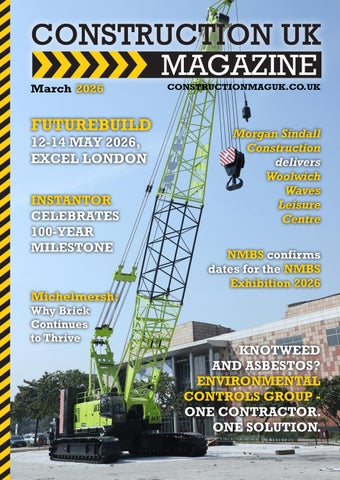
Construction UK Magazine - March 2026

Page 1


2026

12-14 MAY 2026, EXCEL LONDON

Morgan Sindall Construction delivers Woolwich Waves Leisure Centre

NMBS confirms dates for the NMBS Exhibition 2026

Michelmersh: Why Brick Continues to Thrive

KNOTWEED AND ASBESTOS? ENVIRONMENTAL CONTROLS GROUPONE CONTRACTOR. ONE SOLUTION.

The Health & Safety Event, 28-30 April 2026, NEC Birmingham

Fire safety in construction: why 2026 marks a turning point for the sector

Michelmersh: Why Brick Continues to Thrive

Instantor celebrates 100-year milestone

The Fire Safety Event, 28-30 April 2026, NEC Birmingham

Leading Tool Supplier ITS to Open New Luton Store

UK Construction Week London returns with ‘super event’ format

Futurebuild, 12-14 May 2026, Excel London

New Yeovil Diagnostic Centre set to improve patient care

Morgan Sindall Construction delivers a winning finish at Woolwich Waves Leisure Centre

Admin Assistant Jade Still jade@constructionmaguk.co.uk

Production/Design Laura Whitehead laura@constructionmaguk.co.uk

Accounts Richard Lapthorn accounts@lapthornmedia.co.uk

Editor Maria Lapthorn

Editorial Assistant John Reynolds editorial@constructionmaguk.co.uk

Sales Manager Hannah Marshall hannah@constructionmaguk.co.uk

Circulation Manager Leo Phillips subs@constructionmaguk.co.uk

Website: constructionmaguk.co.uk

Twitter: @constructionukm

LinkedIn: @constructionmaguk

HOUSEBUILDING SECTOR SHOWS EARLY SIGNS OF RECOVERY AS FIRMS RAMP UP PRODUCTIVITY AND INNOVATION INVESTMENT

The latest Barclays Business Prosperity Index report reveals that despite affordability pressures, regulatory challenges and financial caution, four in five businesses (83 per cent) operating in housebuilding and its supply chains remain confident about their outlook for the year ahead.

Barclays’ anonymised client data from around 70,000 UK businesses, combined with research from 500 industry leaders1 and 2000 consumers, also shows strengthening activity at the start of the development pipeline, sustained buyer demand for new-build homes and a major uplift in planned investment.

Sector investment and innovation gathers pace

Talent, skills and AI are all becoming major investment focus areas.

Four in 10 (40 per cent) businesses with skills shortages are investing in new construction methods to reduce manual labour, alongside developing early career schemes (39 per cent), and focusing on training and upskilling (36 per cent).

Meanwhile the average intended AI investment of £441,281 reflects growing demand for AI assisted design and planning (37 per cent), renewable and energy efficient materials (36 per cent),

business management automation software (35 per cent) and building information modelling (29 per cent).

Momentum is particularly strong in Electronics, where intended AI spend exceeds £500,000, while trades such as Plumbing (£380,000), Carpentry (£347,320) and Painting & Decorating (£328,371) signal smaller, though material allocations.

Future Homes Standard: A top priority but confidence in readiness lags

Nearly all firms (98 per cent) say aligning with the Government’s Future Homes Standard is a priority for the next 12 months, yet 82 per cent express concern about their readiness. Key areas where support is most needed include installing low carbon heating systems (21 per cent), applying the new Home Energy Model (20 per cent) and meeting updated ventilation standards (18 per cent).

Despite this, businesses are taking proactive steps, with 30 per cent investing in specialist equipment, training and technology to boost compliance.

Strong Gen Z new-build appetite despite affordability pressures

A quarter of homeowners (25 per cent) report they live in a new-build property. This rises amongst first-time buyers, with nearly half (47 per cent) of those who bought their first home in the past year opting for a new build property.

New properties are most popular amongst Gen Z (61 per cent of homeowners) with desirable location named as the top driver of purchases (28 per cent). A fifth (20 per cent) cited favourable mortgage terms, such as higher loan-to-value ratio, and 17 per cent also reported energy efficiency as a major reason for buying new. This comes as young people report improving, but significant affordability challenges, as 61 per cent of Gen Z hoping to buy a home in the next 12 months said that mortgage rates have a bigger impact on affordability than house prices themselves.

Despite strong buyer demand, there are still barriers to building. A quarter (25 per cent) of housebuilders report high construction costs as a major barrier, followed by rising inflation, cost of raw materials and meeting the requirements of the Future Homes Standard (all 19 per cent).

Location, location, location

Over the next 12 months, new-build property developers expect that consumers’ desire for customisation options, such as layout and finishes, to have the greatest impact on their approach (31 per cent), followed by expectations for upgraded digital infrastructure including high speed broadband (27 per cent).

However, consumers report slightly different priorities. When surveyed about which features most influence their choice of property, the top factor was access to gardens or communal green spaces (42 per cent), followed by proximity to transport hubs (31 per cent) and proximity to parks or countryside (30

Jason Constable

per cent). Just 17 per cent named digital infrastructure as a key influence, and just 11 per cent cited customisation.

Jason Constable, Head of Real Estate, Barclays Corporate Banking, said: “The level of innovation we’re seeing across the industry from larger developers to specialist trades is encouraging, with businesses investing in technology, skills and modern construction methods to boost productivity. These innovations, combined with stronger consumer demand for new-builds, present a significant opportunity for housebuilders. While affordability and planning delays still pose challenges, the underlying strength of demand points to clear potential for growth as market conditions stabilise.”

John Ainsworth, Head of Real Estate, Barclays Business Banking, added: “Activity is generally subdued among SME housebuilders, with nearly three in 10 expecting no increase in output in the year ahead. Yet SMEs are working hard to overcome skills shortages and regulatory alignment, with their resilience coming through strongly as they show confidence in their future success.

If the industry is to hit the Government’s target and build the much-needed homes of the future, it’s vital we continue to support the scaleup of smaller regional players.

“At Barclays we are committed to providing the external finance needed to scale via our Business Prosperity Fund.”

The Barclays Business Prosperity Fund is available to new and existing Business Banking and Corporate Banking clients across the UK to apply for lending and refinancing on existing projects. Terms and conditions apply.

Businesses can read the full Barclays Business Prosperity Index Housebuilding report and find out more about the Business Prosperity Fund at home.barclays/businessprosperity.

27 FIRMS APPOINTED TO £500M SOCIAL HOUSING

EMERGING DISRUPTORS FRAMEWORK AS DEMAND ACCELERATES

Procurement for Housing (PfH) has appointed 27 suppliers to the fifth generation of its Social Housing Emerging Disruptors (SHED) framework - the largest cohort since the framework was established in 2022.

The value of contracts awarded under SHED quadrupled in 2025 compared with 2024. With the framework increasingly used by councils and housing associations to compliantly procure emerging technologies from fledgling innovators, the new generation of the framework - SHED 5 - is worth £500m over three years, up from £100m for the previous iteration.

PfH has worked again with social housing membership community the Disruptive Innovators Network (DIN) to identify early stage tech firms whose services solve challenges facing the sector but can’t be sourced easily through traditional public procurement routes.

By their nature, these products are new or highly specialised, and this means social housing procurement teams often lack the technical reference points needed to specify them or compare competing offers, meaning they don’t fit easily into established procurement routes.

On the other side, small suppliers have difficulty breaking into the social housing market, excluded by complex bid documentation, high financial thresholds and other tender requirements designed for established contractors.

SHED addresses these issues by offering a simplified, SME-friendly bidding process and a compliant way of social landlords testing and adopting new solutions. Through a quick desk-based selection process, they identify the supplier that best meets their requirements, get pricing information and swiftly complete the contracting process.

This year’s suppliers offer a broad mix of emerging solutions, including modular housing panels made from recycled glass, a self-testing fire door that monitors its own compliance, a platform predicting home hazards and health risks, a smart heat scheduler allowing residents to better control their heating costs, a long term anti-mould coating system and a solution to helps social landlords engage and communicate more meaningfully with their residents.

ESSEX BUILDING

HIRE COMPANY HAS ROOM TO GROW THANKS TO HSBC UK

Wernick Hire, a major provider of portable and modular buildings based in Essex, has secured a sevenfigure funding package from HSBC UK to expand its operations to meet growing demand.

The Sustainability Improvement Loan will enable the company to purchase 465 new cabins, along with a selection of modular buildings, typically used for temporary offices, classrooms and site accommodation. This will strengthen Wernick Hire’s UK-wide capacity and fuel its continued growth. The funding also enabled the company to achieve its projected turnover of £250 million by the end of 2025.

In addition, the HSBC UK funding will support Wernick Hire’s goal to become net zero by 2040 through enabling fleet upgrades. Recent additions include Green Space cabins, energy-efficient units offering water and energy saving features for low carbon sites, reinforcing the company’s ongoing commitment to providing sustainable products for its customers.

The funding was made possible through HSBC UK’s partnership with EcoVadis, a sustainability ratings company, which enables mid-market businesses like Wernick Hire to link the cost of their financing directly to their sustainability performance.

FUSION ELECTRICS ANNOUNCES STRATEGIC REBRAND TO FUSION 360

Specialist electrical and solar panel contractors, Fusion Electrics Limited, have announced a strategic rebrand of their company, embracing the new name Fusion 360 Group Limited.

Fusion 360 will serve as the parent brand for the company’s range of services, encompassing their electrical and cabling system, solar PV panel installation and expert system design divisions.

The change comes as Fusion continues to expand across its divisions and establish itself as a leading specialist in each field, delivering projects for British businesses across the commercial, industrial, housing and public sectors.

“This rebrand to Fusion 360 reflects our growth and expanded offering - bringing solar, electrics and design together under one group, with a complete 360° approach to the services we provide” says Joanne Skinner, Commercial Director of Fusion 360.

Fusion 360 has confirmed that there will be no changes to their team or structure, with all current projects continuing seamlessly under the new company name.

“While our name has changed, our values remain more ingrained than ever. Our group and each division will continue to demonstrate an unwavering commitment to service, quality and partnership – the values that our customers have come to expect from Fusion” adds Joanne.

INTRODUCING THE AMICUS ALTUS

112

High-performance modular air-to-water heat pump for commercial applications

Lochinvar are pleased to announce the launch of the Amicus Altus 112, a powerful new addition to the range of air-to-water heat pumps. Designed specifically for large-scale commercial heating, cooling and hot water applications where reliability and efficiency are critical.

Delivering outputs from 112 kW up to 1,120 kW per cascade, and capable of achieving water flow temperatures of up to 75 °C, the Amicus Altus 112 is ideally suited to applications such as healthcare facilities, sports and leisure centres, hotels, and renovation projects. Its modular design allows systems to be precisely sized to meet project requirements, whether for new-build or retrofit installations.

A Sustainable Solution for Decarbonising Heat

The Amicus Altus 112 uses R290 (propane), a natural refrigerant with an exceptionally low Global Warming Potential (GWP) of just 3.

This makes it a highly sustainable solution for decarbonising heat without compromising on performance or operating temperatures.

As a fully electric system, the Amicus Altus 112 produces zero on-site emissions. When combined with renewable electricity or photovoltaic systems, it enables completely carbonfree operation, supporting long-term sustainability and net-zero objectives.

Key Features

• Output range from 112 kW to 1,120 kW

• R290 (propane) refrigerant with GWP = 3

• High supply temperatures up to 75 °C,

• Full operation down to –20 °C ambient

• Low-noise operation

• Modular 2-pipe and 4-pipe configurations

• Integrated flow and return pipework headers with primary pump per unit

Imperium™ System Controller Compatible

The Amicus Altus 112 is fully compatible with the Imperium™ System Controller, developed by our in-house engineering team. Imperium™ optimises system performance without the need for BMS modifications and provides intelligent, cloud-based monitoring. This enables real-time performance insights, proactive maintenance, and maximum operational reliability throughout the system lifecycle.

SRL AND GTM SIGN LONG-TERM DEAL TO PROMOTE ROAD WORKER SAFETY

SRL Traffic Systems has delivered the first long-term contract for its flexible REMOS package, in a seven-figure deal with Go Traffic Management that allows the traffic management specialist to provide construction contractors, highways authorities and utilities providers operating short-term schemes with swift and extensive ad-hoc access to what is believed to be the UK’s first scalable remotely operated mobile signal solution, designed to promote road worker safety.

Europe’s largest manufacturer and supplier of portable and temporary intelligent transport system (ITS) solutions developed REMOS in association with GTM. The flexible package enabling ad-hoc deployment on short-term schemes was launched in July 2025, following customer feedback generated by the product’s trials and market familiarisation exercises.

The three-year contract covers the delivery of an initial 20 x three-way REMOS bundles to GTM’s nationwide network of depots, with a view to providing an additional 70 in the first half of 2026.

Comprising portable traffic signals with built-in radar sensors and CCTV cameras that detect vehicle movement and stream footage of approaching traffic, REMOS captures and transmits data from remote traffic management control (RTMC) boxes to SRL’s Solihull Control Centre, where dedicated staff analyse it in real time and efficiently make interventions to ensure optimal traffic flow.

SRL estimates that REMOS typically increases the rate of traffic flow around roadworks by 30-50% in relation to mobile solutions operated on site. It is available in two- three- and four-way packages.

The flexible, ad-hoc REMOS package requires users to provide SRL with just two hours’ notice to commence remote operation, and they may decide how to allocate up to 12 hours of remote monitoring and control per day.

The contract will help GTM’s customers to minimise the number of traffic management operatives stationed on site in live traffic lanes and improve road worker safety.

Over 2,300 UK personnel reported verbal or physical assault by road users in 2023, with over 50% claiming weekly abuse. Between 2024 and 2025, 35 UK construction workers were killed, 9% by moving vehicles.

VIRIDIS LIVING SECURES FIRST BUILDING SAFETY REGULATOR APPROVALS

AT UNIVERSITY OF MANCHESTER’S FALLOWFIELD CAMPUS

Viridis Living has reached a major milestone in the delivery of new student accommodation at the University of Manchester’s Fallowfield Campus, with the Building Safety Regulator granting Gateway 2 approval for the first two higher-risk buildings (HRBs) on the development.

The consortium, comprising Equitix, GRAHAM and Derwent FM, has now submitted seven HRBs to the Building Safety Regulator, with approvals secured for two of these. The two approved buildings each comprise 14 storeys, with one providing 205 beds and the other 207 beds, with all rooms being en-suite.

With Gateway 2 approval in place, structural works on the two buildings will start this month. The consortium expects to receive decisions from the Building Safety Regulator on the remaining five HRBs within the next two months.

From securing planning approval to achieving the first Building Safety Regulator approvals in just 15 weeks, this success reflects the project team’s collaborative and rapid approach to meeting the new regulatory requirements.

The Fallowfield Campus redevelopment will deliver up to 3,300 modern, high-quality student homes across the previous sites of Owens Park, Oak House and Woolton Hall, alongside amenity spaces and extensive green infrastructure.

The project, designed by architects, Sheppard Robson, will create five distinct neighbourhoods, each inspired by Manchester’s cultural, sporting and musical heritage. The scheme is targeting Passivhaus certification and, once achieved, will become the largest certified Passivhaus project in Europe. It is also pursuing a BREEAM Excellent rating, with Modern Methods of Construction helping to enhance efficiency, reduce waste, and accelerate delivery.

Commenting on the approvals, Neil McFarlane, GRAHAM Project Director for the Fallowfield Campus, said:

Securing Gateway 2 approval for the first two HRBs is a significant milestone for the Fallowfield Campus project and testament to the collaborative approach taken by the whole team.

“With structural works now able to commence on these two buildings, and further approvals expected in the coming months, we are making strong progress towards delivering safe, high-quality and sustainable student accommodation for Manchester.”

Ben Leech, Managing Director, Investments, Equitix, said: “We’re delighted that the Fallowfield Campus student accommodation project has reached this important stage. This is a key step forward for the University of Manchester in delivering modern, highquality living spaces that ensure a safe, comfortable, and sustainable student experience for years to come. Equitix is proud to work closely with the university and our partners at GRAHAM throughout planning and construction to bring this vision to life.”

Natalia Maximova, Partner, Sheppard Robson, said: “The Gateway 2 approval for the first two high-risk residential blocks is a testament to successful teamwork and effective collaboration, which would not have been possible without early supply chain input and specialist expertise. The focus of the Gateway 2 review was technical compliance, requiring a high level of coordination and design quality throughout the proposal. Key design decisions, such as the adoption of a precast cross-wall system and the extended use of concrete, added inherent fire safety properties to the scheme and simplified facade co-ordination. This has been a learning process for all participants and required full commitment from everyone. Well done to the project team.”

For more information on the Fallowfield Campus redevelopment, please visit here.

Dependable Door Control Solutions

We recognise the critical role that doors and their hardware play in the safety and security of any building.

Our core product range includes:

• Door Closers

• Access Control

• Electric Locking

• Door Hardware

• Locks & Security

• Fire Door Ironmongery

• Panic Hardware

Whatever your project requires, you can depend on Door Controls Direct.

Health & Safety

TAKING THE PRESSURE OFF SITE TEAMS: A SMARTER APPROACH TO SAFETY ADMINISTRATION

Across the construction sector, health and safety compliance has never been more critical—or more complex. Between inductions, permits, risk assessments, insurance documentation and ongoing reporting requirements, the administrative load placed on site management and operational staff continues to grow. For many projects, particularly smaller or fast-moving sites, there may be no dedicated resource available to manage this workload at all.

The result? Site managers and supervisors spending valuable time behind a screen instead of on the ground, subcontractors delayed by paperwork, and compliance risks increasing as documentation struggles to keep pace with project demands.

This is where a Remote Safety Administrator Service offers a modern, practical alternative—providing consistent, professional safety administration without the need for an onsite presence.

A Fully Managed, Remote Solution

Designed specifically for construction environments, the Remote Safety Administrator Service delivers daily safety administration support through a secure, online safety management platform. The service removes the administrative burden from site teams while ensuring safety processes remain compliant, auditable, and up to date.

Rather than relying on already stretched site personnel, safety administration is handled remotely by experienced professionals who manage documentation, inductions, permits, and reporting in real time. This allows site teams to focus on delivering projects efficiently, while maintaining

high safety standards across every stage of the build.

Centralised Online Safety Management

At the core of the service is a centralised digital safety management platform. This system provides secure access to all safety documentation, including inductions, permits, weekly inspection forms, statutory records and contractor information.

By housing all documentation in one location, the platform eliminates paper-based systems and fragmented record keeping. Site management gains instant visibility over who is on site, what documentation has been approved, and where potential compliance gaps may exist—anytime, from anywhere.

Site-Specific Inductions That Save Time

Inductions are a critical first step in ensuring site safety, but they can be

Remote Safety Administrator Service – Let us look after your health and safety administration

time-consuming and inconsistent when managed manually. Remote Safety Administrator Service includes the development of a site-specific induction, delivered in a professional video format tailored to the project’s risks and requirements.

Workers can complete their induction remotely before arriving on site or on arrival using their mobile device. This reduces congestion at site access points, speeds up mobilisation, and ensures everyone receives the same clear, consistent safety messaging.

Daily Review, Approval and Reporting

All completed inductions are reviewed and approved daily by the remote safety team. Each day, a clear induction report is issued to site management, identifying exactly who has been inducted and approved to work on site.

This provides site managers with confidence that only authorised personnel are present, while also creating a robust audit trail that can be easily accessed if required.

Contractor Documentation Managed Professionally

Managing subcontractor documentation is one of the most time-intensive aspects of site safety administration. Under the Remote Safety Administrator Service, all contractor safety documentation is collected, reviewed and approved centrally.

This includes Safety Statements, Risk Assessments and Method Statements (RAMS), insurance certificates, and relevant training records. All documentation is uploaded and securely stored within the platform, ensuring consistency, traceability and easy retrieval.

In an industry where time, compliance and productivity are all under pressure, the Remote Safety Administrator Service offers a smarter way to manage health and safety administration.

Proactive Compliance Monitoring

Compliance doesn’t end once documents are approved. Expiry dates for insurance, training and safety documentation must be actively monitored to avoid lapses that could expose projects to risk.

As part of the service, clients receive monthly compliance reports issued at the start of each month. These reports clearly identify upcoming expiry dates, allowing contractors and site management to address issues proactively rather than reactively.

Digital Toolbox Talks Made Simple

Regular toolbox talks are a key part of maintaining safety awareness on site. The Remote Safety Administrator Service includes the preparation and issue of toolbox talks on a weekly, fortnightly or monthly basis, depending on your project needs.

Toolbox talks are completed digitally by workers on arrival to site via their mobile devices. Once completed, records are downloaded and issued to site management, ensuring full visibility and a clear audit trail with minimal disruption to site operations. These toolbox talks can be provided in video format, workers will view these on their mobile phone when they sign back in to the site.

Permits and Statutory Forms— Digitally Managed

Permits to work, statutory plant records and inspection forms are also managed

Health & Safety

digitally through the platform. Workers and subcontractors can complete permits and statutory forms directly from their mobile phones, reducing paperwork delays and improving accuracy.

This digital approach ensures critical safety controls are documented correctly, while making records instantly accessible for management and inspection purposes.

Clear Benefits for Modern Construction Projects

The benefits of outsourcing safety administration through a remote service are tangible:

• Significant reduction in administrative workload for site staff

• Improved compliance and document control

• Consistent induction and training standards across all personnel

• Clear, defensible audit trails and reporting

• Increased efficiency through streamlined digital processes

A Practical, Cost-Effective Way Forward

In an industry where time, compliance and productivity are all under pressure, the Remote Safety Administrator Service offers a smarter way to manage health and safety administration. By outsourcing these critical tasks to experienced professionals, construction companies gain peace of mind, improved compliance, and the freedom for site teams to focus on what they do best—delivering projects safely and successfully.

For modern construction businesses looking to streamline operations without compromising on safety, remote safety administration is no longer a future concept—it’s a proven solution.

Let us look after your safety needs, contact us at:

Email: info@sitesafetyadmin.com

Website: www.sitesafetyadmin.com

SWISS AIR PAPR – BREATHING WITHOUT LIMITS

Various hazards lurk on construction sites. For the lungs, these include dust, smoke, toxic gases and vapours. That is why respiratory protection is as indispensable for construction workers as the hard hat. The Optrel swiss air makes a significant contribution to the long-term health of workers.

As versatile as the challenges in construction, so flexible is the swiss air in use. Whether in dusty environments, during welding work or in areas with chemical fumes, it always provides optimal protection. Thanks to the particle filter, even the finest particles, such as sharp-edged quartz dust, are removed from the breathing air. This protects the lungs and reduces the risk of respiratory diseases and long-term health damage. Chronic coughing, shortness of breath, bronchitis and even pulmonary fibrosis or silicosis are avoidable when using the swiss air continuously.

A major advantage of the swiss air is its wearing comfort. The flexible fabric half-

mask with a protection factor of 500 for TH3 protection adapts perfectly to any face shape, even if someone is not cleanshaven. The fabric half-mask completely covers the mouth and nose. If needed, the mask can be switched to a tightly fitting silicone mask with a protection factor of 2000. Both mask types can be cleaned with little effort.

The swiss air supports breathing with a slight overpressure, eliminating the tiring breathing resistance known from passive masks and allowing higher worker performance even during long usage durations.

The ultra-light blower unit of the swiss air is ergonomically shaped and comfortably worn on the back with an adjustable shoulder strap for maximum freedom of movement. The high wearing comfort makes you forget the respiratory protection is even there and wearing it becomes a permanent state.

This continuous protection helps to prevent health-related consequential damage caused by exposure to contaminants during active work or by traversing the working environment.

To ensure that the innovative swiss air can also be used in exposed and humid working environments, Optrel offers an IP 54 certified protective cover. It provides effective protection for the swiss air against malfunctions caused by conductive dirt or water.

To check the capacity of the battery or filter, a quick glance at the user-friendly control panel is sufficient. If the battery is empty or the filter is full, an alarm will be displayed in good time. The fan can

swiss air is the revolutionary PAPR from Optrel and represents everything the company stands for.

also be switched on or off via the panel and the air volume can be adjusted to the users liking.

Overall, the respiratory protection system is well accepted thanks to its high level of comfort. This helps ensure compliance with respiratory protection guidelines while improving working conditions and long-term health protection.

Curious to see the swiss air in action? The Optrel sales team will be happy to arrange a demonstration of the swiss air and its features.

Welcome to the Swiss Alps –Welcome to optrel swiss air

swiss air is the revolutionary PAPR from Optrel and represents everything the company stands for. As a Swiss manufacturer of innovative PPE, Optrel is committed to continuously delivering useful products to make workdays easier and safer. Read more about swiss air on the Optrel website.

Breath the purest air thanks to the revolutionary swiss air PAPR!

· Eliminates 99.8% of particles, including quartz dust, from the air

· No face shaving and no fit test required

· Ultra easy to use

· Compatible with all common helmets, ear defenders and goggles

The Health & Safety Event

THE HEALTH & SAFETY EVENT

TO REUNITE 14,500+ HEALTH & SAFETY PROFESSIONALS

The Health & Safety Event will return bigger and better than ever on 28-30 April 2026 at the NEC Birmingham. This large-scale event will reunite the entire health and safety sector, featuring a wide range of exhibitors, valuable networking opportunities, and CPDaccredited content.

The latest and innovative products and services across the industry will be showcased, with 400+ exhibitors providing visitors the chance to find out what’s new on the market and source new suppliers. Exhibitors will include Draeger, JSP, Mascot Workwear, Milwaukee, Portwest, RS, U-Power and many more.

Over the course of three days, attendees will have access to 60+ hours of free CPD-accredited content across multiple theatres, alongside live demonstrations, interactive workshops, and exclusive networking opportunities.

CPD accredited content

The Keynote Theatre (supported by IOSH) is the main stage at The Health & Safety Event will welcome key industry speakers who will be providing the latest news and updates as well as regulations, guidance, and training within the health and safety industry.

Visit the Practical Safety Theatre to hear from the experts on how to create a safe and compliant working environment.

Gain the practical tools and knowledge to protect you and your employees from danger, whilst helping to look after the future of your business or organisation.

Our Knowledge Exchange Theatre will feature a series of sessions covering the challenges faced by health and safety professionals and practitioners. Hear from industry experts who are making a difference in the workplace and safety culture.

A popular theatre is The Driver Safety Theatre (in partnership with Driving for Better Business). Hear from leading experts share a series of presentations

and panel discussions covering legislation updates, driver fatigue, distraction, staff culture, vehicle safety and much more.

Finally, our Lone Worker Safety Live will be bring bite-size interactive sessions, experts, and those with practical experience will share their knowledge to bring you best practice ways to manage the key issues of wellbeing, safety, and security for lone and remote workers.

Industry partnerships

In partnership with British Safety Industry Federation and their Registered Safety Supplier Scheme, this dedicated trail will help visitors navigate around the show to meet BSIF members who have signed a binding contract to offer safety equipment and services that meets the appropriate standards, fully complies with the PPE regulations, and are appropriately marked.

The event is continually backed by the leading associations in the sector including the British Safety Industry Federation, NEBOSH and UK Asbestos Training Association and more.

Co-located events

The Health and Safety Event 2026 will be co-located with The Security Event, The Fire Safety Event, The Workplace Event, and the National Cyber Security Show. Access all shows with just one pass.

Timber & Timber Frame News

PREMIER FOREST PRODUCTS STRENGTHENS TIMBER ENGINEERING CAPABILITY WITH ACQUISITION OF NATIONAL TIMBER SYSTEMS

Premier Forest Products has acquired engineered timber specialist National Timber Systems (NTS), strengthening and enhancing its timber engineering capability and solutions across the UK.

National Timber Systems was previously part of National Timber Group England Ltd, which entered administration in late November. The business has been acquired from the administrators, securing continuity for NTS’s operations, customers and manufacturing footprint. The acquisition safeguards 160 jobs at NTS, with plans to grow this number to 250.

National Timber Systems supplies national and regional housebuilders, as well as the construction and modular sectors, with a range of engineered timber products and services. These include the BBA-accredited NTSROOF® panelised roof system, roof trusses, engineered joists, and specialist roof and floor cassette solutions.

Commenting on the acquisition, Terry Edgell, Co-founder and Chief Executive Officer of Premier Forest Products, said: “With our strategic experience in timber and long-term financial stability, we see National Timber Systems as an excellent fit for Premier Forest. NTS aligns with and enhances our existing Mon Timber Engineering offer in south-Wales and the south-west, and broadens our engineered timber solutions for customers across the UK.

This acquisition will help support faster, more efficient housebuilding and modular construction through continued product innovation and the potential for additional manufacturing capacity in the future.”

RISING TENDER PRICES RISK

SQUEEZING SPECIALIST SUPPLY CHAINS, WARNS THINK TIMBER

Think Timber, strategic partner to the UK timber staircase sector, warns that rising construction tender prices risk placing further strain on specialist manufacturers – unless housebuilders engage earlier and adopt more realistic, clearly defined specifications.

Recent market intelligence from Turner & Townsend forecasts tender price inflation of around 3.5% per year across real estate, and up to 5% in infrastructure through 2026 and 2027. While this reflects ongoing capacity and labour constraints, Think Timber says the greater risk lies in how inflation pressure is managed within the supply chain.

“Tender inflation doesn’t automatically translate into healthier supply chains,” said Gav Brown, CEO of Think Timber. “For specialist manufacturers operating

on tight margins, particularly in regulated and labour intensive areas, cost pressure is already very real, and specialist components, such as timber staircases, often feel inflation first, as they are frequently specified late in the process and procured on price alone.”

He added: “When cost risk is pushed down the chain, it doesn’t disappear. It shows up as margin erosion, reduced capacity and, over time, fewer specialist suppliers able to support volume housing.”

Gav says projects that involve manufacturers earlier, and lock down specifications at an early stage, are better placed to control cost and project risk. Unclear or outdated specifications, by contrast, introduce inefficiency, rework and uncertainty, which ultimately feeds back into tender pricing. Without better alignment

The transaction sees Premier Forest acquiring NTS operations in Bristol, Catterick and Newcastle, plus the assets of the Sheffield site, with the aim to return to full production capacity to meet customer demand.

Nick Kershaw, Managing Director of National Timber Systems, added: “I am delighted to be joining such a well-established timber distribution and manufacturing specialist. Premier Forest has a strong reputation for quality and service, and we see them as an excellent cultural fit, enabling NTS to continue to grow and develop.

“On behalf of my team, I would like to thank Premier Forest Products for the trust and confidence they have shown in NTS and its senior leadership team. We look forward to achieving further growth in 2026 and beyond.”

The acquisition supports the UK Government’s housebuilding strategy by increasing capacity and capability in modern methods of construction, helping the industry deliver new homes more quickly, efficiently and sustainably.

between tender pricing, specification and manufacturing realities, rising tender prices risk accelerating the loss of specialist capacity at the very point the industry needs it most.

To mitigate these risks, Think Timber is urging developers, housebuilders and specifiers to engage specialist suppliers earlier in the design and procurement process.

“Early engagement isn’t just about cost control – it’s about protecting the supply chain that makes delivery possible,” Gav said.

“Staircases for instance are a critical element in any home, yet they’re often treated as an afterthought. Bringing specialist manufacturers into the conversation earlier helps ensure projects remain viable, compliant and on programme.

“You can’t manage inflation at the point of tender alone. The projects that perform best are those that lock down their specifications early, work with their supply chain as partners, and focus on long term value rather than headline price.”

FIRE SAFETY IN CONSTRUCTION: WHY 2026 MARKS A TURNING POINT FOR THE SECTOR

Fire risk has long been an accepted reality in construction, but it has become more complex, more scrutinised and more consequential in recent years. Modern building methods, lightweight materials, temporary electrics and ambitious designs have made fire risk harder to predict and control. As a result, fire safety is no longer a one-off compliance exercise for contractors, but a live operational risk that evolves throughout the construction lifecycle.

In parallel, regulatory expectations continue to tighten. In the years following the Grenfell Tower tragedy, fire safety has remained firmly in focus, with policymakers and regulators seeking to close gaps in both building design and site management. As the industry enters 2026, fire safety is emerging as one of the defining challenges shaping how projects are planned, delivered and ultimately insured.

The changing nature of fire risk on site

Construction sites present a unique combination of hazards that can amplify fire risk if not carefully managed. Hot works such as welding, cutting and grinding remain a persistent concern, particularly because ignition can occur hours after work has finished. Smouldering materials, hidden voids and poorly monitored areas continue to feature prominently in post-incident investigations.

Material selection and storage also play a significant role. Timber, insulation products, solvents, adhesives and fuels can all contribute to high fire loads, especially on constrained or fast-moving sites. Where flammable liquids or gases are stored incorrectly, the potential consequences escalate rapidly.

Temporary electrical systems add another layer of risk. Exposed wiring, overloaded circuits and makeshift connections are common features on construction sites,

As sites become more complex and regulation continues to tighten, fire safety is quickly becoming one of the most critical risks contractors need to manage — operationally, financially and reputationally.

-

Tracy Keep, Managing Director of Gallagher’s National Construction Practice Group

yet they remain a frequent source of ignition. Environmental exposure — including moisture, dust and mechanical damage — only increases the likelihood of failure.

One of the most notable emerging risks is the widespread use of lithium-ion batteries. Cordless tools, site equipment and e-mobility solutions are now standard across many projects. While these technologies bring clear efficiency benefits, battery failures can generate extreme heat, release toxic fumes and prove difficult to extinguish. For sites not designed with these risks in mind, lithium-ion incidents represent a fundamentally different fire profile.

Regulation continues to raise the bar

Fire safety regulation in the UK construction sector is evolving rapidly, with further change expected into 2026 and beyond. Recent updates to British Standards have extended guidance on fire safety in residential buildings, including high-rise developments and specialist accommodation such as care homes. Height thresholds, material classifications, escape strategies and

firefighting access requirements have all been reassessed, with significant implications for design decisions made early in the project lifecycle.

Alongside this, the phased transition away from long-established fire testing standards towards the European classification system marks a major shift in how materials are assessed and specified. For contractors, this has introduced new considerations around procurement, product selection and demonstrating compliance.

Mandatory sprinkler requirements in new care homes, introduced in 2025, further illustrate the direction of travel. Fire suppression systems are increasingly viewed not as optional enhancements, but as essential components of safe building design — particularly in environments housing vulnerable occupants.

Taken together, these developments signal a broader regulatory intent: fire safety is no longer about meeting minimum standards. It is becoming an integrated part of how buildings are designed, constructed and operated.

A defining issue for the years ahead

For many contractors, the challenge lies not in understanding individual requirements, but in managing how they interact. Fire risk now spans design, materials, site operations and sequencing, often requiring closer collaboration between contractors, designers, fire engineers and clients. As construction activity continues to evolve, fire safety is set to remain a central concern for the sector. The combination of more complex sites, new technologies and heightened scrutiny means fire risk can no longer be treated as an isolated compliance issue.

Looking ahead, fire safety represents more than another regulatory milestone. It marks a shift in expectations — one that requires fire risk to be embedded into decision-making at every stage of a project, from design and procurement through to construction and occupation. Those who recognise this shift early will be better positioned to protect their people, their projects and their long-term resilience in an increasingly demanding environment.

Gallagher offers the strength and positioning of a global insurance group, combined with the personalised care and attention of a local UK broker. With a rich history dating back to 1927, we believe we have the expertise and experience to meet your construction insurance needs.

CONNECT WITH A

For further information, please scan the QR code.

People on the Move

BRIAN UY FISTRUCTE CENG APPOINTED AS ISTRUCTE PRESIDENT FOR 2026

The Institution of Structural Engineers (IStructE), the representative body for the profession worldwide, is pleased to announce the appointment of Brian Uy FIStructE CEng as its 105th President for 2026.

Brian, who is currently Scientia Professor at the School of Civil and Environmental Engineering, University of New South Wales (UNSW), Sydney, Australia brings decades of expertise and experience to the role.

His career has been as rich as it is varied, spanning roles at leading consultancies including Arcadis, Worley and Arup, working on some of the world’s largest and most complex projects. He has also been actively involved in the development of landmark industry codes and standards as well as being instrumental in ensuring they’re both fit-for-purpose and deliver positive outcomes.

In addition to his role at UNSW, Brian chairs the Australian/New Zealand Standards on Steel and Composite Structures and serves as Vice President of the International Association of Bridge and Structural Engineering (IABSE).

Involved in research in steel and composite structures for over 30 years, Brian has served on the editorial boards of fourteen international journals for structural engineering and is Chief Editor (AsiaPacific) for Steel and Composite Structures and serves on the Editorial Board of IStructE’s flagship research journal Structures.

He is also a significant contributor to international codes of practice in steel and composite construction and has served on the American Institute of Steel Construction (AISC) Task Committee 5 on Composite Construction and the American Society of Civil Engineers (ASCE) Structural Engineering Institute (SEI), Technical Committee on Composite Construction.

His singular and visionary approach combines academic leadership with practical application, and his presidential year will focus on three interconnected themes that align with IStructE’s 2026-2030 strategic pillars:

Brian succeeds Mohamad Al-Dah and takes up the presidency for the entirety of 2026.

Visit: www.istructe.org

ECOFILL APPOINTS MARK WATFORD AS CHIEF FINANCIAL OFFICER

Ecofill Group Limited has appointed Mark Watford as Chief Financial Officer, strengthening its leadership team as the business continues to scale its operations and accelerate growth in the UK and beyond.

Mark brings over 25 years’ experience in senior financial, commercial, and operational leadership roles across construction, infrastructure, and technology-led businesses. His career spans both SME and large corporate environments, with significant international exposure, including senior roles within global organisations operating across Europe, North America, and Asia.

He has a strong track record of supporting high-growth businesses through periods of expansion, acquisition, and transformation, providing the financial discipline and strategic insight required to scale sustainably. Mark’s experience includes working with private equity-backed groups, leading complex corporate restructures, and supporting businesses through international growth and integration.

In his role as CFO, Mark will provide strategic financial oversight and governance for Ecofill. His primary focus will be supporting Ecofill’s continued growth, ensuring the business has the financial structure, controls, and insight required to scale responsibly while maintaining strong commercial foundations.

WHY BRICK CONTINUES TO THRIVE

Clay brick has been used in construction for centuries, valued for its reliability, versatility and quiet strength in the built environment. From historic cityscapes and conservation areas to contemporary housing and large-scale commercial schemes, brick continues to play a central role in shaping the appearance, performance, and longevity of our built environment. Brick offers designers and specifiers a material that strikes a balance between aesthetic quality and long-term performance.

The Benefits of Brick

One of brick’s greatest strengths is its durability. Properly specified and installed, brickwork can last for generations with minimal maintenance. This longevity contributes directly to its cost efficiency over a building’s lifetime, reducing the need for replacement or intensive repair.

Brick is also a robust material. Individual units can be replaced without affecting the wider façade, supporting long-term adaptability and offering re-usability that aligns with circular economy principles. Many clay bricks can be reused or recycled at the end of a building’s life, reducing environmental impact.

From a sustainability perspective, clay brick performs well thermally, helping to regulate internal temperatures by absorbing and releasing heat gradually. Combined with modern insulation strategies, brick façades support the creation of efficient and comfortable buildings.

Aesthetically, clay brick offers a wide range of natural colours, textures, sizes and finishes allows designers to respond sensitively to context or make a bold, deliberate architectural statement. Whether the goal is to blend seamlessly into a historic setting or introduce contrast and rhythm to a contemporary elevation, brick provides flexibility.

Choosing the Right Brick

Selecting the right brick begins with understanding context. In conservation areas, matching tone, texture and format is often essential, ensuring new development respects its surroundings. Traditional colours and handmade or stock finishes are frequently chosen to

achieve visual continuity. Colour, size and bond all influence how a building is perceived, making early and informed selection an important part of the design process.

For modern builds, designers may explore bolder colours, smoother textures or elongated formats to create clean lines and strong architectural identity. Brick cladding systems also offer solutions where speed of construction or restricted site conditions are critical.

Tools That Support Confident Specification

Finding the right brick is supported by a range of practical tools. Michelmersh’s Swatchbook allows specifiers to assess colour, texture and technical info on the go and case studies provide valuable inspiration, demonstrating how bricks perform across different sectors and architectural styles.

Behind these resources is a team of skilled and knowledgeable staff who understand both product and application.

Brick remains a trusted material because it has proven itself over time. Discover more reasons to pick brick at mbhplc.co.uk.

Drainage & Plumbing

GILL INSTRUMENTS LAUNCHES NEW OPTICAL RAIN GAUGE TO REDEFINE PRECIPITATION MEASUREMENT

Gill Instruments, award-winning designer and manufacturer of meteorological and environmental measurement instruments, today announced the launch of TruMet PW100, its new infrared optical rain gauge.

For decades, rainfall measurement has relied on mechanical tipping bucket gauges. While trusted, these systems are prone to clogging, mechanical drift (requiring frequent calibration for reliable data), and under-counting during high-intensity rainfall, leading to maintenance demands and data uncertainty when accuracy matters most.

Gill’s TruMet PW100 Optical Rain Gauge is meticulously engineered to overcome these long-standing challenges, ensuring true reliability and precision.

A new approach to rainfall measurement

The TruMet PW100 uses a solid-state optical measurement principle rather than mechanical collection. LEDs (light-emitting diodes) create a beam of light across a defined sensing area, and a receiver monitors interruptions in the beam caused by rainfall. By analysing the size and velocity of droplets, the system accurately measures rainfall accumulation and filters out non-rain interference, such as insects or debris.

With no moving parts, collection funnel, or tipping mechanism, the infrared optical rain gauge delivers accuracy equal to that of traditional tipping buckets, but without the mechanical parts that can fail, reducing maintenance and long-term costs.

Designed for modern monitoring challenges

The TruMet PW100 provides reliable rainfall measurement at a lower lifetime cost, with less complexity or servicing than traditional or specialist instruments.

Typical applications include:

• meteorological and hydrological networks

• flood forecasting and early-warning systems

• smart city and urban drainage monitoring

• transport, aviation and infrastructure operations

• renewable energy and environmental monitoring

By minimising routine maintenance, the TruMet PW100 Optical Rain Gauge lowers ownership costs and improves data reliability for widely distributed networks.

Engineering confidence from Gill

“Rainfall is changing, yet the industry relies on legacy mechanical technology,,” said Greg Koch, Product Manager at Gill.

We didn’t set out to reinvent rain measurement for novelty’s sake. We set out to remove the weakest link. This optical rain gauge delivers trusted accuracy without moving parts and minimal maintenance, which fundamentally changes how rain data can be collected at scale.

Seamless integration with existing networks

At launch, TruMet PW100 Optical Rain Gauge outputs the standard pulse signal (an electronic output used by weather equipment) that tipping bucket rain gauges use, so it can be deployed as a direct replacement within existing monitoring networks without system changes or retraining.

Software and hardware updates will further expand the optical rain gauge’s capabilities and data options.

The TruMet PW100 Optical Rain Gauge will be available both as:

• a standalone rainfall sensor, and

• an integrated option within Gill’s MaxiMet product line, including the upcoming GMX603, which incorporates the optical rainfall technology into a compact weather station (an instrument that measures multiple meteorological parameters) for best-in-class meteorological monitoring in a single instrument.

& Plumbing

INSTANTOR CELEBRATES 100-YEAR MILESTONE

Instantor, a market leader in press solutions, officially celebrated its 100th anniversary on 4th February 2026, marking a century of innovation that has helped shape and transform the plumbing and heating industry.

Founded in 1926, Instantor began operations from a foundry at St James’s Gate in Dublin, close to the iconic Guinness Brewery. From the outset, the company established a reputation for engineering excellence and innovation. That same year, Instantor patented the original brass compression fitting, setting a new benchmark for reliability and ease of installation – a legacy that continues to influence the industry today.

Over the past 100 years, Instantor has consistently driven progress within the plumbing and heating sector, evolving from a pioneering manufacturer into a premium brand synonymous with installation efficiency, safety and performance. Innovation remains at the heart of Instantor’s DNA. In 2025 alone, the company launched six ground breaking new products, including a revolutionary new press tool, a dedicated range of press fittings for ACR applications, and lead free brass compression fittings fully compliant with the revised European Commission Drinking Water Directive.

Instantor has played a pivotal role in simplifying plumbing and heating installations, championing solutions designed to save installers both time and money. Its comprehensive portfolio

of press solutions delivers a safer, faster and more reliable way to join pipework, providing quality assured, fit and forget installations backed by guarantees of up to 50 years.

Alan Hogan, Managing Director –Plumbing, Heating & Kitchen Division at Sanbra Group, Instantor’s parent company, comments: “Reaching our 100th year is a remarkable milestone for Instantor, but what truly defines our success is the impact we’ve made along the way. In recent years alone, the business has evolved at pace – entering new markets, delivering industry changing innovations and earning prestigious awards. This progress is driven by an exceptional team, and as we look ahead

to the next century, our focus remains firmly on continuing to lead and transform the market.”

To mark its centenary, Instantor has planned a full programme of celebrations throughout 2026, recognising both its rich heritage and its ongoing commitment to the industry. Activities will include exclusive product promotions for installers and merchants; customer, employee and community engagement initiatives; new merchandise and brochures; and a strong presence at InstallerSHOW in June, where Instantor will host its largest stand to date.

Martin Murphy, Managing Director of Sanbra Group, adds: “From the very beginning, Instantor has stood for innovation and leadership. Over the past 100 years, the brand hasn’t just witnessed change in our industry – it has helped drive it. Reaching this milestone is a proud moment for everyone involved, and we look forward to celebrating with our colleagues, customers, partners and the wider industry throughout the year.”

To find out more information about Instantor, its heritage and its latest innovations, please visit the website: www.instantor.co.uk.

To make further enquiries, please email sales@instantor.co.uk or call 0121 737 2515.

Drainage & Plumbing

Drainage & Plumbing

WHEN FIXING MATTERS: RETHINKING GRATING STABILITY IN URBAN PROJECTS

As urban infrastructure evolves, the humble drainage grating continues to play a quiet but critical role in ensuring the safety, longevity and usability of shared public spaces. While often regarded as a standard component within a larger system, its design, particularly its method of fixation, can have disproportionate consequences over time.

In standard low-traffic pedestrian areas, gratings with two-point fixing systems have proven to be effective and reliable. However, as infrastructure faces heavier loads, greater use and more frequent maintenance cycles, the performance of such components is facing increasing scrutiny.

A Shift in the Sector: From A15 to B125

Within the drainage sector, a growing number of urban and residential projects are moving from load class A15 to B125. This change reflects an undeniable reality: streets, pavements and shareduse zones are being subjected to more pressure than ever, whether from delivery vehicles, bin lorries, or simply heavier

pedestrian use with increased public activity.

As a result, specifiers are reassessing not only the load class of drainage channels and gratings but also the mechanical reliability of their fixing systems. When load increases, so does the risk of displacement, vibration, and long-term wear.

When Two Points Aren’t Always Enough

While two-point fixing remains standard and suitable in many cases, there are scenarios where it may fall short — particularly where pavement resilience, public safety or legal liability are at stake.

This is where four-point fixing systems offer an added layer of assurance. By anchoring the grating more securely at four corners rather than two, the risk of movement, loosening or uneven loading is greatly reduced. This isn’t about overengineering — it’s about responding realistically to site conditions, especially in places that combine foot traffic with occasional vehicles or maintenance machinery.

ULMA’s Heelguard B125 cast iron grating, developed for use with its RapidSelf channel range, is a clear example of this thinking in practice. Designed with four dedicated fixing points, it is purpose-built for applications where standard solutions might not go far enough.

Design for Safety, Not Just Specification

The Heelguard B125 grating also integrates other safety-focused features: an anti-heel design that protects pedestrians from trapping or slipping, and compliance with EN 1433 standards, class B125 (up to 12.5 tonnes). It’s a grating developed not simply to meet a load class requirement, but to provide robust performance in the environments that most need it.

The grating also features a practical oneclick locking system, allowing for quick and secure installation without the need for additional tools, a small detail that saves valuable time on site.

Beyond performance, this approach helps to minimise long-term maintenance costs and reduce liability risks, especially in public realm or residential developments where user safety and perception matter.

Fix Once, Fix It Right

As budgets tighten and the demand for reliable, low-maintenance solutions rises, choosing the right grating becomes more than a functional decision, it becomes strategic.

Not every installation needs four-point fixing. But when it does, knowing that the option exists , and understanding why it matters, helps engineers, specifiers and contractors deliver infrastructure that works quietly in the background, year after year.

In the end, it’s often not the most visible components that determine how well infrastructure performs, but the quiet ones that are fixed properly, built to last, and designed with care. Drainage may be beneath our feet, but it should never be beneath our attention.

ULMA Architectural Solutions is a leading European manufacturer of high-performance drainage channels and gratings, with a UKbased warehouse in Avonmouth, Bristol and full technical support available nationwide.

www.ulmaarchitectural.co.uk

COST ISN’T THE ENEMY: WHY VALUE ENGINEERING IS ABOUT SO MUCH MORE THAN PRICE

When it comes to construction, keeping costs in check is key. In the current economic climate of fluctuating prices and supply chain issues it can be difficult to keep projects within budget, and this challenge is only set to get worse.

According to the BCIS Construction Industry Forecast 2025-2030, building costs are expected to increase by 14 per cent over the next five years, while tender prices are predicted to rise by 15 per cent over the same period. When costs are tight, quality can be compromised – but this isn’t a risk we should be taking as an industry.

This is where value engineering comes in. Value engineering is a method of problem solving that keeps projects on time and within budget, without compromising on quality or results. This approach examines every aspect of the project, creating solutions for alternative construction methods,

designs, or materials to improve overall value.

But value engineering is about more than just keeping costs down. This approach can also be used to improve efficiency, functionality, and sustainability outcomes for projects. It’s all about maximising value at every stage, resulting in the highest quality end product.

The five-step process

Value engineering follows a five-step process, in which a team of designers, engineers and other construction professionals work together to problem solve and assess how the best value can be achieved.

Each project follows the stages of information gathering [collecting data on requirements, constraints and objectives], function analysis

[identifying the functions of a project], creative brainstorming [producing ideas to meet the objectives and functions], evaluation and selection [assessing the feasibility and cost-effectiveness of each proposed idea], and development [progressing with the agreed options].

This process ensures functionality is considered at every stage, in addition to cost. It also ensures the desired outcomes are agreed upon by all stakeholders, putting all parties on the same page and working towards a common goal. Beyond cost, this process is about effective teamwork and idea generation.

Enhancing efficiency

Improving efficiency needs to be a priority for the construction sector. According to Mace’s 2025 report ‘The Future of Major Programme Delivery’, the UK underperforms in terms of delivery speed and has one of the longest average delivery times globally, standing at nearly 12.5 years.

Value engineering helps speed up various parts of the planning and construction process. For instance, spotting flaws in building materials or methods at the evaluation and selection stage means designers can get in early and change these decisions, saving time further down the line.

Changing tack when a project is well underway can cause more problems, so it’s always best to thoroughly evaluate and analyse in the earlier stages.

Maximising functionality

Value engineering can also be used to boost the performance of buildings or to overcome other obstacles: value doesn’t always have to be about monetary gains.

For example, planning permission restrictions may mean the building process can’t go ahead in some cases.

Value engineering addresses any issues early on, and alternative methods or solutions can be introduced to fix the problem, such as changing elements of a design.

Or perhaps an architect is seeking to optimise space in a building. Value engineering encourages collaboration between architectural design and an appropriate engineering solution to make this possible. Ultimately, the architecture leads, and the engineering solution helps facilitate the design. Through close collaboration and clever solutions, real value can be created.

Tackling sustainability

It’s estimated that the built environment produces around 25 per cent of the UK’s greenhouse gas emissions thanks to the various stages of the construction process, including building, operating machinery, and creating materials. If we are to reach our target of achieving net zero by 2050, things need to change.

Value engineering creates the opportunity to choose more sustainable ways of working that

reduce the environmental impact of the construction or function of any given building. For instance, swapping out environmentally harsh materials, such as concrete, for options such as mass timber. Thanks to its renewable nature, lower carbon footprint and potential to reduce greenhouse gas emissions, mass timber is a greener, more sustainable option.

Generally speaking, sustainable solutions are more expensive. But if a building is made from mass timber, there is likely to be a premium to that building: people will be willing to pay more for its biophilic properties. Cost aside, there is huge value in sustainable solutions.

What’s more, the value engineering process can help design teams consider the feasibility of reusing a building, rather than building from scratch. This is the most sustainable solution of all, and clever engineering solutions paired with sophisticated design can produce impressive, high-quality results.

Final thoughts

Cost is important, but value engineering is about so much more than price. From enhancing efficiency and maximising functionality, to working towards tackling sustainability, value engineering transforms decision-making and projects of all shapes and sizes without compromising quality.

Working together closely gives designers and engineers the opportunity to develop an effective approach to analysis that drives projects forwards within agreed budgets and timeframes.

Catching any issues early on and adding value at every stage is vital if the construction industry is to perform at its best, and value engineering has the answer.

The Fire Safety Event OVER 13,500 FIRE SAFETY PROFESSIONALS TO GATHER AT THE FIRE SAFETY EVENT 2026

The Fire Safety Event will open its doors at the NEC Birmingham on 28-30 April 2026 and will play host to leading manufacturers and suppliers to showcase their latest approved products and solutions. Dedicated to supporting industry practitioners, professionals and organisations in achieving and maintaining the very highest standards of fire safety management.

The UK’s Largest Showcase of Exhibitors and Supporters

With over 300 exhibitors participating at the show, some of the industry’s leading brands including: Apollo, Checkmate Fire, LFS, Sentry Doors, Strongdor and many more, will be showcasing their latest research and development, product and solution launches and live demonstrations.

A number of key association and industry bodies will be supporting The Fire Safety Event and will be on hand to offer guidance and expert advice to visitors. These include the Association for Specialist Fire Protection, BAFE, FireQual and many more.

Education is at the heart of The Fire Safety Event. Boasting three industry-led theatres and offering 45+ hours of freeto-attend CPD content this is the perfect opportunity for visitors to gain direct insight into improving, maintaining, and championing fire safety for all businesses.

The Passive Fire Conference is in partnership with the Association for Specialist Fire Protection (ASFP), this conference theatre will cover passive fire protection topics and various fire safety measures in the built environment. Hear from the experts and get the essential advice from specification, installation, inspection and maintenance.

The Innovation & Compliance Theatre will showcase presentations on the important industry updates and guidance for practitioners and business owners. With a focus on standards, regulations and industry best practice, these sessions will be vital to ensure businesses remain compliant and are best equipped to meet the needs of their clients.

The Fire Safety Leaders Summit will feature a line-up of leading industry experts and keynotes, get the insight and expertise on best practice, regulatory updates and topical areas impacting the fire safety sector. To show our support for women in the fire safety industry, a dedicated panel discussion will be returning for 2026.

Networking Opportunities

To enhance networking opportunities and foster new connections, networking receptions will be held at the end of day one and two. Visitors, exhibitors, and partners are invited to relax and recharge in a casual atmosphere to enjoy complimentary drinks and live music, whilst building valuable relationships.

The Largest UK tradeshow Dedicated to the Protection of People, Places and Assets

The Fire Safety Event is uniquely colocated with The Security Event, The Health & Safety Event, The Workplace Event and The National Cyber Security Show, which together form The Safety & Security Series. With only one registration, delegates have access to all shows, making this one unmissable opportunity.

In addition, the event offers free onsite parking at the NEC, reinforcing its position as the most accessible venue for fire and security sector events. With a train station, airport, and direct access to the M42 motorway, the NEC provides unmatched convenience for all attendees.

For more information visit www.firesafetyevent.com

Unmissable CPD-Accredited Conference Theatres

SMARTER, SAFER SITES: WHY AI FLEET SAFETY TECHNOLOGY SHOULD BE A PRIORITY FOR CONSTRUCTION

The construction sector is one of the most dynamic and challenging industries in the world—but it’s also one of the most dangerous. Every day, teams work in environments filled with moving vehicles, heavy machinery, and constantly changing site layouts. It’s no surprise that vehicle-related incidents remain a leading cause of injuries and fatalities. Many of these incidents share common contributing factors: blind spots, poor visibility, and human error.

The good news is that we now have the technology to address these risks in a meaningful way. Artificial Intelligence (AI) and advanced fleet safety systems aren’t speculative concepts for some distant future—they’re practical tools available right now. These technologies have already proved their worth in sectors like waste management, where they’ve reduced accidents, improved operational efficiency, and ensured compliance with demanding safety standards.

Yet, adoption in the construction sector has been slower. In my experience, this comes down to a combination of perceived high upfront costs, fears

around complexity, and, perhaps most importantly, a lack of familiarity with proven success stories from similar industries. The result is that many operators continue to rely on manual processes and legacy systems that simply can’t match the capabilities of today’s AI-enhanced solutions.

The case for AI in fleet safety is compelling. It reduces accidents, protects lives, improves compliance, and streamlines operations.

Moving from Reactive to Proactive Safety

For decades, site safety has often meant reacting after an incident

occurs; investigating what went wrong, tightening procedures, and hoping for better outcomes next time. AI allows us to flip that script.

With the right systems in place, we can detect driver fatigue before it becomes dangerous, issue real-time alerts when a pedestrian steps into a blind spot and even apply automatic braking to prevent collisions. AI-enabled cameras, radarassisted reversing, and in-cab monitoring can all work together to give operators better awareness and faster response times. These aren’t just incremental improvements; they represent a fundamental shift towards prevention rather than reaction.

Beyond Compliance: Business Benefits

It’s easy to see AI and safety technology as tools for meeting regulatory standards like FORS, CLOCS, and the Direct Vision Standard (DVS). And while compliance is essential, it’s only part of the story.

AI systems can deliver operational efficiencies that go straight to the bottom line. Route optimisation reduces fuel use and emissions while ensuring delivery windows are met. Automated reporting removes much of the administrative burden from daily safety checks and audits. And with integrated dashboards, managers can monitor vehicle health, driver behaviour, and site-level risk patterns in one place, making it far easier to make informed decisions quickly.

Data: The Foundation of AI

Like any intelligent system, AI’s value depends on the quality of the data it receives. Reliable, consistent, and secure data enables accurate risk modelling, effective driver coaching, and sitespecific safety interventions. That’s why construction firms should look for technology partners who not only

deliver robust analytics but are also transparent about how data is collected, governed, and protected.

Cybersecurity is a key part of this conversation. As fleets and sites become more connected, strong data protection policies, which cover access controls, encryption, and audit trails, are essential to maintain trust and safeguard sensitive information.

Building a Smarter, Greener Future

The push towards net zero, the adoption of electric and hybrid plant vehicles, and the growing role of automated site logistics all point to an industry that’s becoming more connected and data driven. AI-powered safety systems fit naturally into this evolution, helping firms operate more efficiently, reduce environmental impact, and, most importantly, protect their people.

Forward-thinking fleet managers are already investing in AI-based

solutions such as real-time video analytics and operational management software. They understand that these tools are not just about avoiding incidents—they’re about building a safer, smarter, and more competitive business.

The Bottom Line

The case for AI in fleet safety is compelling. It reduces accidents, protects lives, improves compliance, and streamlines operations. In an industry as high-risk and high-pressure as construction, that’s not just an advantage, it’s a necessity.

The question isn’t whether AI belongs on construction sites it’s how soon it can be integrated into daily operations so that the benefits - safer workers, stronger compliance and more efficient projectscan be realised. Those who act now will lead the way in shaping the future of a safer, smarter construction sector.

Safety & Security

CSCS SMART CHECK REACHES 60 MILLION SCANS, SUPPORTING CONSISTENT WORKFORCE VERIFICATION ACROSS CONSTRUCTION

The verification platform CSCS Smart Check has recorded its 60 millionth scan - reflecting its growing use by employers and contractors to support workforce verification and Building Safety Act compliance.

CSCS Smart Check is the only platform to verify all 2.3 million cards displaying the CSCS logo, providing a quick, easy and secure way of ensuring everyone has the correct card, training and qualifications for the job they do.

Developed by the CSCS Alliance, the platform’s API is built into the site access and induction systems used by construction’s largest contractors such as Wates, Vinci, Balfour Beatty, as well as housebuilders such as Persimmon Homes and Taylor Wimpey.

It also provides valuable real-time insights on the skills and occupational mixes for those using the API.

Sean Kearns, CSCS Group Chief Executive, said:

Reaching 60 million reads is a significant milestone and reflects the commitment across the sector to strengthen assurance around skills, training and qualifications.

“CSCS Smart Check as the industry’s border control technology provides realtime verification of CSCS Alliance cards as well as compliance and operational support - reducing admin, boosting efficiency, and strengthening confidence in workforce checks. In addition, it’s providing valuable real-time insights on skills and occupational trends for both contractors and Government.”

The 60 millionth read was completed in January by BAM, verifying a Craft card issued by the Electrotechnical

As the industry continues to evolve and define occupational standards, CSCS Smart Check, as referenced in the Construction Leadership Council recommendations, is the tool that industry should be using to verify that individuals hold the correct card for the occupation they are undertaking.

CSCS is continuing to enhance reporting, with the addition of reason codes, such as pre-induction, induction and site access, as well as site IDs for extra granularity. This is designed so industry can better distinguish how and where checks are being made and access clearer, more actionable insight.

For further details building the CSCS Smart Check API into your organisation and site protocols, visit CSCSGroup.co.uk/SmartCheck.

Chris Waller, CTO, Fleetclear
Certification Scheme (ECS) – a member of the CSCS Alliance.

ENHANCING LONE WORKER SAFETY: KNOW EXACTLY WHERE YOUR STAFF ARE

In today’s day and age, when lone workers sound the alarm for help, swift support is essential. Therefore, knowing exactly where that individual is can help a business’s response team locate them as quickly as possible, saving crucial time in an emergency.

Unfortunately, though, many lone worker solutions run off of GPS or GNSS location technology. And while these are effective when detailing a user’s location accurately on a mapping service, like Google Maps, they don’t always work well indoors. This is mainly because the signal to the satellite can be blocked by the floors or ceiling above and the lack of building granularity provided by the mapping service. As a result, the location provided can be the last-known position outside the premises, or a fix inside, which often lacks sufficient detail to be any use to a response team.

Therefore, more dependable technology is required, and businesses should be considering other location methods to fully enhance the safety of their teams

when working indoors. Chris Potts, Marketing Director at ANT Telecom, discusses the options available with the aim of helping enhance the safety of lone workers whilst they are working indoors.

One way to ensure the safety of lone workers when they are indoors is to strategically place Beacons throughout the site to serve as location markers.

Equipping the Work Environment with Beacons

One way to ensure the safety of lone workers when they are indoors is to strategically place Beacons throughout the site to serve as location markers. These are effective tools due to the fact that whenever a worker walks past a beacon it automatically updates their

handset with its position. The benefit of this is that in the event of an alert, the alarm message includes the location of the last beacon the worker passed, stored in their handset, providing more accurate location data. This information is then displayed on a site map for the response team to easily identify. Additionally, some solutions may also run a quick scan for the nearest beacon too in case there is a closer one that the user hasn’t reached.

Beacons come in different versions too: indoor, outdoor, ATEX as well as battery or mains powered. So, it’s essential for businesses to do their due diligence before investing in the technology to establish what is best for their needs. It’s also important to remember that the more beacons used, the more accurate the location is, and ultimately, the safer employees are. However, even with a small number they can reduce the search time for lone workers by indicating which building or floor the lone worker is located.

Investing in Base Station (WIFI and DECT) Location

Utilising private voice or data networks with DECT base stations or Access Points (both commonly referred to as base stations) can also provide indoor location information.

When an alarm is raised, handsets like DECT, smartphones, and VoWiFi can indicate the specific base station they are connected to, providing a general location of the user within approximately a 30-meter radius. This data can then be showcased on a site map to help the response team.

While base stations may have a wider coverage area that can extend across multiple floors or external spaces, when combined with Beacons, they can enhance accuracy by narrowing down the search area to a particular floor or section of the building. This coupling of

Beacon and Base Station technologies can significantly improve location accuracy in emergency situations.

Using Light and Sound on Lone Worker Devices

Some lone worker devices can emit a light and audible sound once a mandown alarm has been raised, making it easier for responders to locate their colleague in an emergency. When searching large areas quickly, individuals may be easily overlooked, especially if they’re lying low or concealed behind equipment or fixtures. However, the sound generated from the device can draw a responder’s attention once they’re in the vicinity, making them aware they’re nearby and prompting a thorough search. Additionally, the emitted light makes the worker more visible, further assisting in their quick rescue.

Another option is to motivate users to get in the habit of detailing their location as and when they undertake a task alone. This works well for users that are in one or two locations each day. Apps like Atlas SOS streamline this process for

users, making it effortless to input their task duration and location details on the timer screen. In the event of an alarm, responders receive the alarm message containing the user’s name, contact number, and precise location details.

Encouraging

workers to input their location and utilising Push-to-Talk technology further enhances the effectiveness of emergency responses.

Using Push to Talk Technology

In times of need, responders can all work together to help locate their colleagues by using, either Radio or Cellular based, Push to Talk (PTT) technology, that allows them to communicate over a signal channel. PTT technology works well in emergency situations as it allows teams to designate tasks and provide updates all-on-the-go. Users simply push a button on their handset to broadcast their message to their team, who can respond in a similar manner.

Safety & Security

For instance, if a worker is hurt in an unknown location, this technology allows response teams the opportunity to spread out and check different areas simultaneously, whilst keeping each other updated so that they do not duplicate efforts or miss certain places. By working together effectively in a coordinated effort, they can help to save crucial time when locating a colleague.

Conclusion

Ensuring the safety of lone workers, particularly in indoor environments, requires a combination of advanced technologies and strategic planning. While GPS and GNSS have limitations indoors, alternative solutions like Beacons, Base Stations, and light or sound-emitting devices can significantly improve location accuracy and response times. Encouraging workers to input their location and utilising Push-toTalk technology further enhances the effectiveness of emergency responses.

By adopting these methods, businesses can better protect their lone workers, ensuring swift assistance and reducing risks in critical situations.

Fast

Easy to dismantle and relocate

Adaptable and expandable at any time www.containex.com

FLANNERY PLANT HIRE

MAJOR FLEET RENEWAL AND SELECTS EURO AUCTIONS TO DELIVER

SINGLE-SOURCE DISPERSAL SALE OF

HEAVY PLANT FLEET ON 10TH MARCH

The Euro Auctions Group has been commissioned by Flannery Plant Hire to conduct a single-sourced dispersal sale of its heavy plant fleet, following its announcement of a £107 million investment in new machinery for 2025. Building on a £448 million investment over the past four years, Flannery Plant Hire has confirmed that it will undertake a major fleet renewal programme this spring.

The auction will take place at Flannery’s site on Sorby Road, Irlam, Manchester, M44 5BA, on Tuesday 10th March. This landmark event will bring to market one of the largest and most diverse selections of modern, well-maintained heavy plant equipment seen in the UK in recent years.

Martin Flannery, Managing Director at Flannery Plant Hire, said: “As the construction industry continues to grow, so does the demand for high-performance, reliable, and sustainable plant machinery. At Flannery, we are committed to staying ahead of industry needs by investing in the latest innovations.”

“Our investment reflects our dedication to providing our customers with a fleet that is not only versatile and innovative but also meets the highest standards of efficiency and sustainability. This latest investment builds on our ongoing commitment to reinvesting in our fleet. Over the past four years, we have invested £448m in new machinery, ensuring our customers have access to the best equipment on the market.”

CRANE HIRE SPECIALIST REACHES NEW HEIGHTS WITH HSBC UK SUPPORT

A Surrey-based crane hire specialist is scaling up its operations after buying a custom-built new crane with HSBC UK support.

The all-terrain SANY SAC2500E crane purchased by Terranova Cranes is the largest road-operable SANY crane in the UK.

Designed to exact specifications, the crane is the first of its kind in the UK and will play a dual role: supporting complex lifting projects and acting as a product tester, providing direct feedback to the manufacturer to refine future models.

The new addition to the fleet will enable Terranova Cranes to take on larger, more

technically demanding jobs across the UK, boosting the capacity and efficiency of the business.

Terranova Cranes anticipates a 15 per cent increase in turnover over the next 12 months as a result of this HSBC UK supported growth.

Alec Glover, Owner of Terranova Cranes, said:

This crane is a significant upgrade for our fleet and a smart investment in the future of our business. It gives us the capability to take on more complex projects and operate at a greater scale.

“To make way for these new machines we are utilising Euro Auctions’ trusted industry reputation and their standing as the largest machinery auctioneer in Europe to sell this equipment on our behalf and realise maximum asset value.

“We have a great relationship with Euro Auctions and know the professionalism of their team will make this a simple and easy process for us.”

The dispersal sale will include equipment from leading manufacturers such as CAT, Komatsu, Hitachi, JCB, Volvo, Bell, Wacker Neuson, Hydrema, and more.

“HSBC UK’s support made this possible – the team’s backing and understanding of our goals helped us move forward with confidence.

“We’ve also worked closely with David Grosse and his team at Number Eight Business Finance, whose advice throughout the process was invaluable and enabled us to secure a competitive facility that suits our business and sets the foundation for future investments.”

Dale Culshaw, Relationship Manager at HSBC UK, added:

Terranova Cranes is a great example of a business investing in advanced equipment to strengthen its capabilities and stay ahead in a competitive market.

“We’re committed to providing tailored financial solutions that help businesses realise their growth ambitions, something Terranova have shown clarity on throughout this process.

“It has been a pleasure to collaborate with the team at Terranova Cranes and Number Eight Business Finance to support their growth plans.”

Tools, Plant & Equipment News

LEADING TOOL SUPPLIER ITS TO OPEN NEW LUTON STORE

ITS, one of the UK’s leading suppliers of tools, workwear and equipment for trade professionals, has announced plans to open a brand-new store in Luton, creating new local jobs and strengthening its commitment to supporting tradespeople in the area.

The new branch, located on Bilton Way, is scheduled to open its doors on Saturday 7th March, bringing ITS’ well-known combination of expert advice, competitive pricing and strong stock availability to the local community.

The Luton store forms part of ITS’ continued investment in bricksand-mortar retail, complementing its growing online business while ensuring tradespeople have access to local, face-to-face support when they need it.

ITS says it is focused on recruiting locally, providing training and long-term career opportunities within the business.

“This isn’t just about opening another store — it’s about investing in the local area,” said Paul Hubbard, Director at ITS. “We want to create jobs, support local trades, and become a genuine part of the Luton business community.”

ITS says its Luton branch will offer something noticeably different from traditional trade counters, with a strong focus on hands-on browsing and product choice.

Unlike many trade retailers, where stock is largely kept behind the counter or in racking, the new store will feature a huge number of tools and products out on open display, allowing customers to see, compare and explore before they buy.

There will be a wide range of leading tool brands on display to get hands on with, including dedicated ‘Power Zones’ for Milwaukee, Dewalt, Makita and Bosch.

The store will also stock workwear, storage, hand tools and site essentials like electrical and landscaping equipment. There will be click and collect services for online orders and knowledgeable staff with real trade experience will be on hand to help with buying decisions and questions.

Events & Awards News

UK CONSTRUCTION WEEK LONDON RETURNS WITH NEW ‘SUPER EVENT’ FORMAT TO REFLECT INDUSTRY’S

SCALE AND AMBITION

After celebrating its 10th anniversary last year, UK Construction Week London will come together with Futurebuild from 12–14 May at Excel London, creating the UK’s largest event uniting the entire built environment, where every stage of a project gets decided.

Bringing together construction leaders, innovators and decision makers from across the industry, UKCW will run alongside both Futurebuild and The Stone & Surfaces Show, attracting over 25,000 industry professionals.

The collaborative co-location will form the UK’s Built Environment super event, designed to reflect the full scale, complexity and ambition of an industry facing unprecedented change.

Together, the events will bring 25,000 built environment professionals, 600+ exhibitors and 700+ speakers across 6 dedicated stages under one roof - making it the largest and most comprehensive construction event in the UK calendar.

Opened by architect and Channel 4 presenter George Clarke, free registration is now open for UKCW - the only event designed to cater for the whole construction supply chain in the UK.

The event will once again feature an unbeatable speaker programme, with an exciting line-up of high profile industry figures and thought leaders set to be announced in the coming months.

Face-to-face networking remains at the heart of the multi award-winning show. Delegates can make the most of the dedicated show app to book meetings in advance, alongside CPD-accredited seminars, industry roundtables, live workshops, and meet the buyer sessions in the Build Connect Networking Lounge.

The NMBS Exhibition will return to the Coventry Building Society Arena in Coventry on 15 and 16 April 2026.

This news follows a hugely successful 2025 event, which brought merchants and suppliers together in record numbers. The NMBS Exhibition welcomed over 280 exhibitors and 1,125 visitors over two days, reinforcing the event’s reputation as the UK’s leading exhibition for merchants.

Attendees took full advantage of the buying and networking opportunities, with more than 15,000 interactions recorded between members and exhibitors, which was the highest figure in the event’s history.

With a strong line-up of exhibitors expected again for 2026, NMBS suppliers will offer substantial exhibition rebates, discounts and promotions only available to NMBS members who attend, visit supplier stands and place orders during the week of the event.

NMBS will also host its annual Gala Dinner after the first day of the NMBS Exhibition, providing an evening of networking and entertainment for the attendees.

Kevin Williams, CEO at NMBS, said: “Building on the momentum and record engagement we saw in 2025, this year’s event will once again allow merchants to do business, strengthen supplier relationships and discover new products and services that can make a real difference for their customer relationships and branch performance. As a buying society, our role is to help members stay competitive and resilient in a market as it continues to evolve. We are looking forward to welcoming members and suppliers back to Coventry in April and making 2026 another standout event for the merchant community.”

To find out more and register for a free ticket, visit www.nmbs.co.uk/events/nmbsexhibition-2026

SDMO, THEN KOHLER, NOW REHLKO - THE TRUSTED PARTNER FOR CONSTRUCTION PROFESSIONALS

A brand story built on continuity

Rehlko is the result of continuous evolution rather than a sudden change. Building upon the industrial expertise of SDMO and further enhanced by its integration into the KOHLER group, the brand now operates under the name Rehlko, maintaining its trajectory of growth and development.

This transition affirms an identity focused on mobile and backup energy solutions, while maintaining the standards of excellence that have established its equipment’s reputation over many years. Although the name might differ, construction professionals know that the core principles stay consistentdurability, job-site reliability, industrial standards and relevance to practical applications.

Energy designed for real on-site conditions: simplicity, strength and efficiency

On a construction site, energy determines productivity, safety and the ability to meet deadlines. Whether it’s an unexpected outage, a remote location or an emergency intervention, electrical power must be immediately available and reliable.

Rehlko is primarily aimed at construction professionals, offering solutions tailored to the everyday challenges of on job sites. Masons, roofers, electricians and plumbers are looking for equipment that is easy to use, quick to deploy and able to withstand intensive use. The product range stands out for its durability, featuring structures and components designed to resist impacts, vibrations and demanding conditions. This combination of durability and simplicity allows on-site workers to focus on what matters most: their work.

Safety and Compliance: Core Priorities

Safety is an absolute priority on construction sites. Rehlko equipment incorporates advanced electrical protection features to safeguard users, tools and temporary installations. Compliant with the most stringent standards, they ensure reliable use, even in challenging environments.

Proven Reliability on a Global Scale

Rehlko products have been used on job sites worldwide for many years, proving their value through consistent performance. This experience ensures reliable performance, easy repair and long-term spare part availability - all vital for reducing downtime.

A solution designed for equipment rental companies

These advantages also make Rehlko a preferred partner for equipment rental companies. Designed for frequent turnover and simplified maintenance, the equipment ensures high fleet availability. Rental companies can tailor products to match their fleet’s identity and composition, while providing clients with established and reputable solutions.

Rehlko products have been used on job sites worldwide for many years, proving their value through consistent performance.

A brand focused on performance

From SDMO to KOHLER and now Rehlko, the brand has evolved to better meet market expectations. For both trades people and rental companies, Rehlko stands for reliable, effective, and longlasting energy solutions.

Futurebuild 2026

FUTUREBUILD CONFERENCE CONFRONTS THE 3RS: RESILIENCE, REUSE AND REGENERATIVE DESIGN

Futurebuild 2026 has unveiled an unashamedly provocative main conference programme, placing resilience firmly at the centre of the built environment conversation.

Taking place from 12-14 May 2026 at Excel London, big hitters representing UKGBC, RIBA, ACAN, Architects Declare and The Sustainable Development Foundation, among others, are set to explore how construction can move beyond business as usual and deliver genuinely resilient outcomes.

“In education, the ‘Three Rs’ define the fundamentals of learning: reading, (w)riting and (a)rithmetic. As the built environment faces accelerating climate, social and economic pressures, the question becomes more urgent. What are the critical Rs for our future?,” says Event Director, Martin Hurn.

For Futurebuild 2026, the Arena Conference answers that question by focusing on Resilience, examined through the lens of Reuse and Regenerative design in the built and natural environment. Together, they form a deliberately challenging framework that asks whether the industry is prepared to fundamentally rethink how it designs, builds and operates.

“For Futurebuild, resilience means facing the realities of climate, nature and social change head on,” adds Event Director, Martin Hurn. “In 2026, we’re doubling down on sustainability and innovation in the arena - and across the entire show - to connect strategy with delivery and ambition with action.”

Mitsubishi Electric are supporting the Arena Conference as the main sponsor and reinforcing the role of advanced building technologies in delivering resilient outcomes. The programme will address everything from circular economy policy and ethical practice to cultural change, innovation and the role of communities in delivering on decarbonisation and broader sustainability issues.

Day one sets the tone with a high-level exploration of the circular economy as a driver of growth, chaired by David Greenfield, President of The Chartered Institute of Wastes Management (CIWM) and featuring Yetunde Abdul, Director of Industry Transformation at UKGBC. Speakers from Mace Group, the Green Alliance and the Green Construction Board are also joining the panel.

Other opening day line-ups include Chris Williamson, President of the Royal Institute of British Architects (RIBA), leading a headline discussion on reuse as a first principle in design, alongside the acclaimed architect, author and environmental campaigner, Duncan Baker-Brown.

Day two shifts the focus to regenerative design, exploring both mindset and method. A series of curated sessions will unpack what it means in practice, moving beyond static definitions towards systems thinking, circular resource flows and net positive outcomes for people and nature.

Day three broadens the lens to the economic and policy context shaping delivery, with sessions on climate action as the new normal, sustainable housing at scale, the UK Net Zero Carbon Buildings Standard and visionary thinking from the next generation of built environment professionals.

Alongside the Main Conference and The National Retrofit Conference arenas, three seminar stages dedicated to buildings and materials, placemaking and energy will also be hosting a CPDaccredited knowledge programme packed with insightful content and curated by leading industry bodies. What’s more, with organisers strategically collaborating with UK Construction Week London and The Stone & Surfaces Show, visitors can access 700+ high profile speakers across 11 stages - making it Futurebuild’s richest content programme yet.

Use the QR code below to register for Futurebuild today and explore a conference programme that’s helping to set a more ambitious industry agenda on resilience, reuse and regenerative design. Visitors will also benefit from free entry to the co-located events UK Construction Week London and The Stone & Surfaces Show.

Shaping the future of the built environment

The only UK event dedicated to connecting innovation with specification to drive sustainable change.

Start connecting today

GEOPOLYMER STABILISATION FUTURE-PROOFS

BLACKHEATH TUNNEL

Specialist ground engineering firm Geobear has completed major stabilisation and watersealing works to restore Blackheath Tunnel to full rail traffic capacity. These essential repairs constituted part of a £10 million maintenance project on south east London’s rail network between Blackheath and Charlton. The project was completed on July 25, carried out over five weeks during a scheduled ten-week line closure, ensuring the tunnel’s long-term stability and protection against water ingress.

The mile-long tunnel, first opened in 1849, had suffered progressive lining degradation over decades, leading to water ingress that washed out fine sediments from behind the brickwork.

Persistent leakage damaged the brick face and overhead lines, while pooling water on the track corroded rails. These issues contributed to around 1,000 minutes of delays in the last year for Southeastern passengers.

VolkerFitzpatrick, the project’s tier-one contractor, considered traditional methods, such as grouting or concrete lining, but dismissed them due to their high water requirements and the logistical challenges of transporting water inside the confined tunnel environment.

The contractor approached Geobear in January 2025 for its expertise in water sealing with geopolymer technology. Unlike cement-based grouts, geopolymer requires no added water, is five times lighter than traditional materials, and technicians can deploy it twice as fast.

Civil

engineering contractor Kilnbridge played a critical role in the preparation phase, drilling 1,000 core holes over 900 metres of tunnel lining to allow the installation of 4,000 injection tubes, a total of 13 km of pipework.

Engineers worked in coordinated day and night shifts to complete the injection phase within five weeks of the blockade injecting a total on 55 tonnes of geopolymer. It was critical a five-week deadline was set to allow for finalised works to follow for final completion within the ten-week blockade. The works also included diverting water into controlled drainage channels through weep holes connected to drainage tracks.

Blackheath Tunnel remains an essential rail link. These works ensure that this 175-year-old structure can continue to serve passengers well into the future.

NEW YEOVIL DIAGNOSTIC CENTRE SET TO IMPROVE PATIENT CARE AND REDUCE NHS WAITING TIMES

NHS patients in east Somerset and west Dorset are set to benefit from faster diagnoses and improved healthcare access with the opening of the cutting-edge Yeovil Diagnostic Centre. Developed by Prime plc in partnership with Somerset NHS Foundation Trust, this state-ofthe-art facility will offer a one-stop shop for diagnostic tests and outpatient appointments, enabling the Trust to deliver on its diagnostic strategy and reducing waiting times.

The achievement was marked at a celebratory event attended by Prime and the Trust along with funder M&G, contractor Darwin Group, employers agent Ridge and radiology and endoscopy service providers InHealth, recognising the collaboration and dedication that made the project a success.

Located adjacent to Yeovil District Hospital, the new three-storey, 2,687m² centre will provide over 70,000 diagnostic tests and outpatient appointments annually.

A key feature of the scheme is its focus on sustainability, meticulously designed to achieve net zero embodied carbon. The building achieved BREEAM Excellent certification, placing it among the top 10% of new-build non-domestic buildings in the UK for environmental performance. Prime achieved significant Biodiversity Net Gain on site that far exceeds Local Authority requirements, by reaching nearly 300%.

When knotweed or contaminated ground makes you press ‘pause’

Don’t Dig. Don’t Panic. Call Us.

Japanese knotweed, other invasive plants and contaminated ground are construction risks. But their impact can be avoided by taking prompt action.

ALL-IN-ONE MULTI-CONTAMINANT REMOVAL

Knotweed and asbestos often come as a pair, especially on brownfield sites. We deal with both — together. No need to appoint multiple specialist contractors or juggle overlapping programmes. We streamline the process so you can get back on site sooner. Talk to an expert today.

MORGAN SINDALL CONSTRUCTION DELIVERS A WINNING FINISH AT WOOLWICH WAVES LEISURE CENTRE

Morgan Sindall Construction’s London business has officially handed over the state-of-the-art Woolwich Waves Leisure Centre to the Royal Borough of Greenwich, marking the completion of one of the UK’s largest urban leisure facilities.

The £80 million project, which was procured via the Southern Construction Framework (SCF), is located at the heart of Woolwich town centre and plays a key role in the Royal Borough of Greenwich’s ambitious regeneration programme.

Morgan Sindall collaborated closely with the Council to design and develop the three-storey facility, creating an inclusive space that encourages physical activity for all, including people with disabilities and those living with dementia.

Sustainability has been at the forefront throughout the design, construction, and ongoing operation of Woolwich Waves Leisure Centre.

Given the limited space available on site, Morgan Sindall implemented an innovative stacked design, positioning the sports hall, gym, and cardio suites on the upper levels. The tier one contractor applied its Intelligent Solutions approach throughout the project, delivering a world-class 12,800 m² facility featuring advanced fit-out elements, including anti-vibration steelwork to optimise performance and user experience across the different leisure and sport activity spaces.

The completed development has delivered first class sports facilities to the Woolwich community, including four state-of-the-art swimming pools,

large splash play area, including sensory experience, a luxury spa, a six-court sports hall, an in-door five-a-side football pitch, a two-level gymnasium, dance and spinning studios, and two squash courts. By establishing these resources within the community, the leisure centre is supporting families, young people, and adults to live active, healthy lifestyles.

The centre also features flexible and accessible community spaces, along with a kitchen, café, creche, party rooms, and a soft play area, as well as two studios that are linked to the neighbouring Tramshed theatre and community arts hub.

The leisure centre’s rooftop hosts a planted green roof alongside an advanced Air Source Heat Pump (ASHP) system. one of largest ASHP arrays ever commissioned in the UK. The ASHP powers the building’s basement energy centre, delivering sustainable heating not only to the Leisure Centre itself but also to the neighbouring Tramshed venue. Looking ahead, the ASHP will extend its benefits to more than 500 new apartments currently under construction, further cementing the site’s role as a hub for green, community-focused energy innovation.

The building is on track to achieve a BREEAM Outstanding rating, making it only the second leisure centre in the UK to meet this standard for sustainable construction.

In line with Morgan Sindall’s commitment to delivering social value to the

communities in which it operates, the team utilised a local supply chain and created 31 new jobs to make a positive impact. The team also created a Knowledge Quad in the heart of the site to create a vital link between industry and education. Using the Knowledge Quad, the project team delivered two rounds of Construction Skills Certification Scheme (CSCS) card training, where 20 individuals gained a CSCS card, including 10 Greenwich residents.

The project team also delivered a 14week accredited construction study programme supporting 16 to 18-yearold young people who are no longer in mainstream education, employment, or training. Held on-site at the Woolwich Leisure Centre, the programme offered valuable practical experience and education about the opportunities within the construction sector. As a result, Morgan Sindall has successfully placed 39 individuals on apprenticeship programs.

Morgan Sindall collaborated with FaulknerBrowns Architects, Buro Happold Engineers, Arup fire consultants, and Max Fordham acoustics consultants, with client side consultants, Hadron Consulting, Gleeds, Van Zyl & de Villiers & DB3 in the delivery of Woolwich Waves Leisure Centre.

Richard Dobson, Area Director at Morgan Sindall Construction in London, said: “It’s a huge achievement to deliver this complex development to the Royal Borough of Greenwich and we are excited to see the

“We’ve also thoroughly enjoyed getting involved with the community through our onsite Knowledge Quad and working with local suppliers and teams to bring this leisure centre to life.”

community already starting to enjoy these state-of-the-art facilities. Sustainability has been at the forefront throughout the design, construction, and ongoing operation of Woolwich Waves Leisure Centre.

Cllr Anthony Okereke, Leader of the Royal Borough of Greenwich, said: “The start of 2026 saw the moment thousands of residents had been waiting for as they were able to experience for the first time the leisure centre they helped to name. It’s not just an exemplar leisure centre any city would be proud to have which is aiming for the highest sustainability measures –it’s also what’s come with it such as the refurbishment of Tramshed Theatre, as well as what’s to come in the form of muchneeded future new homes, shops, places to eat and public spaces.

“Woolwich Waves is at forefront of improving the quality of life and health of our residents. As well as three pools, there’s a gym, five-a-side pitch, spa, squash courts and more. Plus plenty for families. Woolwich Waves is once again proof that we not only get things done in Greenwich, but we get things done to an incredibly high standard so that residents can enjoy them for generations to come.”

Training & Education News

DRÄGER SUPPORTS TUNNELLING AND MINING SAFETY AT NEWCASTLE INTERNATIONAL TRAINING ACADEMY

Dräger, an international leader in medical and safety technology, is supplying breathing apparatus (BA) sets to an innovative new training course created by Triton Risk Management and Newcastle International Training Academy. It uses the fuselage of an aircraft simulator to create an environment suitable for training tunnelling and mining professionals.

The realistic, scenario-based training is supported by classroom learning, and is designed to ensure the safety of emergency responders by preparing them for the full range of incidents they may face in tunnelling and mining emergencies.

Dräger’s BA sets are used in training to ensure competency with equipment, help foster a realistic training environment and ensure trainees are protected from the fire and smoke created in the simulated environments.

Tom Pearson, Marketing Manager, Engineered Solutions and Government Agencies at Dräger, said they were thrilled to support this excellent

approach to training: “We have worked with Newcastle International Training Academy for many years in training aviation emergency responders. In its partnership with Triton, it’s great to see cross-sector expertise working to create an intelligent training programme that makes sustainable, and cost-effective use of existing simulation equipment.

Jonathan Davies from Triton Risk Management said Dräger’s equipment helped to create a realistic training environment for emergency responders: “Dräger’s equipment allows the trainees

to run through preparation checks, so they learn how to be more efficient when putting on the BA. Having the opportunity to practice wearing them within a classroom environment helps responders to feel prepared – ultimately meaning they are safer.”

EXPANSION OF TRAINING AND COMPLIANCE SERVICES TO MEET GROWING INDUSTRY DEMAND

Following increasing demand from clients and insurers, Carney Consultancy has expanded its training and compliance offering with the introduction of new accredited courses and additional services.

The portfolio includes an IOSH Avoiding Danger from Underground Buried Services course, Legionella Awareness Training and the introduction of Portable Appliance Testing (PAT) as an additional service for clients.

Established in 2002, Carney Consultancy, which has its headquarters in North Shields, specialises in the construction and engineering sectors, providing health and safety consultancy and training.

The firm works with clients across the UK, supporting organisations to meet regulatory requirements and improve safety performance.

The company created the IOSH Avoiding Danger from Underground Buried Services course to address increasing industry demand, as insurance companies increasingly require proof that operatives have the appropriate skills and knowledge gained through accredited training. This follows a rise in insurance claims caused by strikes on underground cables, with insurers moving away from non-accredited training provision.

The new one-day IOSH-accredited course provides delegates with

essential theoretical knowledge and practical skills to help prevent injury, damage and costly disruption. In addition to classroom-based learning, the course includes a practical element to ensure application of knowledge in real working environments.

Delegates will learn how to understand and apply HSG47 guidance, identify risks associated with underground services, conduct dynamic risk assessments, use and interpret utility documentation, detect buried services using the correct tools, plan and implement safe systems of work and understand the principles of safe digging techniques.

Turn static files into dynamic content formats.

Create a flipbook