Editorial Assistant John Reynolds editorial@architectprojects.co.uk
Production/Design
Laura Whitehead design@architectprojectsmagazine.co.uk
Sales Executive
Maria Sutton maria.sutton@architectprojects.co.uk
Admin Assistant Jade Still jade@lapthornmedia.co.uk
Circulation Manager Leo Phillips subs@architectprojectsmagazine.co.uk
Accounts Richard Lapthorn accounts@architectprojects.co.uk
Lapthorn Media Ltd 5-7 Ozengell Place Eurokent Business Park Ramsgate, Kent, CT12 6PB
01843 808103
Every effort is made to ensure the accuracy and reliability of material published in Architect Projects magazine however, the publishers accept no responsibility for the claims or opinions made by advertisers, manufacturers or contributors. No part of this publication may be reproduced or transmitted in any form or by any means, mechanical, electronic (including photocopying) or stored in any information retrieval system without the prior consent of the publisher.
Peter Pichler Architecture designs the new Kulturgüterdepot 15
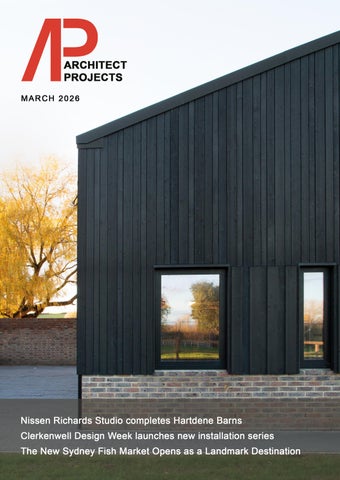
Nissen Richards Studio completes Hartdene Barns 24 - 28
Conversion of a car park into a social housing residence by NZI Architectes in Paris 34 - 35
The New Sydney Fish Market Opens as a Landmark Destination 42 - 45
Featured Company News 04 - 05
Events & Awards News 06 Latest News 10 - 11
Clerkenwell Design Week Preview 22 - 23
Project News 30 - 31
Cotto d’Este’s Façades: Where Architecture, Materials, and Excellence Converge 32
Futurebuild Preview 36 - 37
People On The Move 46
Training & Education News 48
NORRSKEN JOINS NBS SOURCE TO STREAMLINE SPECIFICATION FOR UK ARCHITECTS
Norrsken, a UK-based manufacturer of high-performance triple-glazed aluminium-clad timber windows and doors, has partnered with NBS to make its passive house certified products available on NBS Source, the UK's leading construction product specification platform.
The partnership gives architects, specifiers and designers free access to detailed technical specifications, CAD files and product data for nine of Norrsken's most specified products through the NBS Source platform, which is used by more than 5,000 architecture and engineering practices across the UK.
BIM objects in Revit and IFC formats for all nine products will roll out progressively over the next six weeks, with multiple opening configurations and timber or aluminium-clad variants available for each product type.
NBS Source allows architects to search, compare and select from more than 26,000 construction products, with direct integration into NBS Chorus specification
WINVIC ESTABLISHES DATA CENTRES AS FOURTH CORE SECTOR
software and plugins for Revit, ArchiCAD and Vectorworks. Norrsken's listing includes comprehensive technical data for three passive house certified window ranges and six door ranges, all manufactured to bespoke specifications with U-values as low as 0.64 W/m²K.
"Architects need reliable partners who understand the technical demands of modern, low-energy building design," said Alex Alsop, sales director at Norrsken.
Winvic Construction Ltd, a leading main contractor that specialises in the design and delivery of private and public sector construction and civil engineering projects, has announced its expansion into the Data Centre market.
Building on 25 years of proven delivery, Winvic will now deliver purpose-built, resilient, and scalable data centre solutions to meet growing market demand, reinforcing its commitment to innovation, operational excellence and supporting the digital economy.
Data Centres is Winvic’s fourth core sector, sitting alongside Industrial & Logistics, Multi-room, and Civils & Infrastructure.
As a Tier 1 partner of the UK’s most complex industrial and infrastructure developments, Winvic has built an enviable record of disciplined delivery and the highest standards of quality. Its move into the Data Centre market is part of its ongoing growth and diversification, bringing its core values and expertise to a rapidly expanding market.
Danny Cross, Director - Head of Data Centre Delivery at Winvic, said: “Over the last eighteen months we have focused on developing our supply chain, upskilling our teams and recruiting new expertise. Working alongside specialist MEP partners, we’re combining civil engineering scale and management with technical precision to deliver data centres designed for uptime, resilience, and scalability. This marks a significant milestone in Winvic’s evolution as we expand into one of the fastestgrowing construction sectors whilst maintaining our commitment to quality, collaboration, and excellence.”
"By joining NBS Source, we're streamlining workflows for architect practices of all sizes and making it easier for specifiers to access the detailed product information they need at the earliest stages of a project. This partnership reinforces our commitment to supporting architects with award-winning service from manufacture through to installation and aftercare."
Danny Cross
Danny Nelson, Managing Director of Industrial, Logistics and Data Centres at Winvic, said: “Our entry into the Data Centre market is a natural evolution of our capabilities as these developments share similar attributes to buildings we've been specialising in for over 25 years. Our proven delivery of large-scale and complex industrial and logistics projects, rigorous safety and quality standards through our ‘Doing It Right’ culture, and a collaborative approach gives us a strong advantage. "
ECS COMMISSIONS UPGRADED
CONTROLS SYSTEM FOR STOKE CITY FC
Elite Control Services Limited (ECS) are delighted to have supported in a major lighting and controls upgrade at the iconic Bet365 Stadium at Stoke City Football Club. The state-of-the-art LED control system, commissioned and installed by ECS, marks a significant improvement in both lighting quality and energy efficiency and features scene programming for ultimate fan interaction.
The new cutting-edge system was designed by Midstream and replaces the previous floodlights, which had been in use since 2014, with an upgraded lighting solution. ECS, a leading expert in dynamic lighting controls and commissioning, was entrusted with ensuring seamless installation and optimal functionality of the controls system, RGBW, and under-bowl lighting - taking charge of the complex integration and infrastructure.
The refreshed Bet365 Stadium consists of 104 Modus S1500 and 66 Modus R1500 luminaires, 59 Modus 300 luminaires, two Robe iForte projectors, and 118 Traxon e:cue RGBW 6500K Washer Go Maxi floodlights. A fully integrated Pharos Architectural Controls system was installed, with three key control points via BPS keypads located in the Match Control, Media Suite, and Groundsman’s Shed. The system now operates at Premier League-standard illumination of 1650
ECS ran on-site demonstrations using demo projectors and Traxon e:cue floodlights to select the optimal beam angles and installation positions. Their extensive expertise ensured the RGBW lighting, projectors, data infrastructure and controls are fit for a Premier League club.
The project also showcases a brandnew feature for the stadium, an RGBW colour-changing system which was designed and supplied by ECS – transforming the stadium on matchdays for an incredible fan experience. This immersive lighting experience covers advertising boards, pitch-side screens, and under-bowl lighting. Additionally, custom Gobo projectors now display the Stoke City FC and Bet365 logos on the pitch pregame, adding to the excitement.
Adam Hardy, Director at ECS, said, "We’re thrilled to have partnered with Midstream Lighting and Stoke City FC on such a prestigious project. Our team worked tirelessly to ensure the lighting control system not only meets the Premier League specifications but also delivers an energy-efficient, dynamic experience for both players and fans.
"From concept to execution, our goal was to bring the stadium into the future, and we couldn’t be prouder of the result."
James Brunt from Midstream Lighting added, “It was fantastic working with ECS on this project. Their expertise in lighting control and commissioning was instrumental in delivering the high-quality, energy-efficient system Stoke City FC required. Together, we’ve created an environment that enhances both match visibility and fan engagement.”
Lux while reducing the stadium's energy consumption by 51%.
THE 2026 BRITISH POOL & HOT TUB AWARDS CELEBRATE OUTSTANDING DESIGN, LUXURY AND WELLNESS
The British Pool & Hot Tub Awards 2026 celebrated the very best in luxury outdoor living, wellness innovation, and exceptional design, spotlighting companies that elevate private homes into havens of relaxation and architectural beauty, as well as those shaping outstanding commercial pools, spas, and hot tub facilities in hospitality, leisure, and wellness settings.
Hosted by SPATA (the Swimming Pool and Allied Trade Association) and BISHTA
(the British and Irish Spa and Hot Tub Association), the awards took place on 3 February 2026 as part of SPATEX, the UK’s leading exhibition for pool, spa, and wellness innovation. The event celebrated the best in the swimming pool, spa, wellness, and hot tub industries, recognising companies that set new benchmarks in quality, creativity, and sustainability.
Adding a touch of sporting prestige, the evening’s awards were presented
by Anna Hopkin MBE, double Olympian, Olympic champion, and world record holder, whose presence underscored the awards’ celebration of excellence and performance at the highest level.
Showcasing the Best of British Luxury Design & Wellness
This year’s winners reflected the growing UK demand for beautifully designed outdoor spaces that support health, fitness, wellbeing and year-round living.
The awards highlighted an impressive range of projects, from private spa retreats and architecturally striking pools to carefully considered advanced hydrotherapy installations, including hot tubs, exercise spas, and cold-water therapy spas. Alongside these, judges recognised the growing use of energyefficient technology and sustainable systems that enable homeowners to enjoy resort-style wellness at home. Together, the winning entries demonstrated how water can enhance health, lifestyle, luxury, and relaxation, while showcasing the high standards and craftsmanship delivered by SPATA and BISHTA members across the UK.
RECORD-BREAKING SOUTH EAST HOMEBUILDING & RENOVATING
SHOW KICKSTARTS EXCITING 2026 SEASON
The South East Homebuilding & Renovating Show has opened the 2026 season with record-breaking momentum, welcoming over 10,500 visitors across two days (17–18 January) at the Farnborough International Exhibition & Conference Centre - a 25% year-on-year increase that points to renewed confidence and momentum across the industry.
This level of attendance sets a robust benchmark for the seven further shows scheduled nationwide, underlining the continued importance of live, faceto-face engagement between trade suppliers and homeowners actively progressing their projects.
The show also attracted a high concentration of project-ready homeowners, many attending with defined budgets, timelines and technical questions. Organisers report particularly strong interest in planning, sustainability, energy efficiency and
future-proofing, reflecting shifting priorities within the market as homeowners look to maximise longterm value and performance.
Advice centres, seminars and masterclasses attracted consistently high volumes of attendees, with experts noting that visitors were seeking detailed, actionable guidance as well as general inspiration. The breadth and depth of expertise available - with one of the largest expert line-ups assembled under one roof - reinforced the show’s role as a critical knowledge exchange for the sector.
More than 220 exhibitors, including manufacturers, suppliers, designers and specialist contractors, took part. Many reported a strong pipeline of qualified, near-term leads, driven by indepth conversations with homeowners actively comparing solutions and preparing to appoint suppliers.
Nick Noble, commercial & events director, Future PLC, says, “The quality of attendance throughout the weekend was particularly encouraging. Visitors arrived informed, engaged and ready to make decisions, which translated into meaningful conversations and tangible commercial opportunities for exhibitors. This performance clearly demonstrates the show’s strength as a results-driven platform for trade suppliers looking to connect directly with serious homeowners at a critical stage in their projects. With such a strong start to the year, we are confident about the scale and impact of the 2026 programme.”
A pilot project at Munich’s Olympic Stadium demonstrates how safetyrelevant screw connections in steel construction can be monitored digitally. Here, existing screw connections on the visitor platform integrated into the roofwere supplemented with fischer SensorBolts. These intelligent, highstrength screws feature integrated force measurement and transmission technology to measure their preload forces in real-time, thus enabling greater transparency and safety in building operation.
The Munich Olympic Stadium is unique in terms of steel construction – not least because of its filigree tent roof, which was honoured with the title “Historic Landmark of Engineering in Germany” on 22 September 2023. With an area of around 78,000 m², it covers almost half of the stadium as well as the adjacent halls (Olympic Hall and Swimming Hall) and intermediate roofs. At a height of around 40 to 50 m above the playing field, secured walkways lead across the roof structure, which are directly integrated into the filigree steel cable construction.
On a “tent roof tour”, visitors equipped with climbing gear can walk on the iconic tent roof – with a view over Munich, down onto the playing field, and, on a clear day, all the way to the Alps. All connections on the visitor platform must be absolutely reliable, additional safety requirements arise from the “Flying Fox”: a 200-metre-long zip line that runs across the stadium lawn at a height of around 35 metres and, if desired, forms the conclusion of the tour.
High-strength connections digitally monitored
Munich’s municipal utilities have now successfully supplemented the screw connections on the visitor platform
of the Olympic Stadium with fischer SensorBolts. These sensor-integrated bolts meet the safety requirements for heavily frequented and safety-relevant areas. Attached directly to the screw head, a sensor measures the preload force – the decisive factor in steel construction for indicating how tightly components are clamped together with the screw. A second sensor records the temperature, thus also taking environmental influences into account.
Each SensorBolt is equipped with a SensorNode, which securely transmits the measured values – in kilonewtons (kN) – from the bolts to a gateway installed in the stadium. From there, the data is sent to cloud storage with end-toend encryption and made accessible via a customer-specific dashboard. This allows stadium operators to conveniently view the condition of the fastening points at any time and from any location via PC or smartphone – in real-time.
The next level of intelligent screw technology in view
“With our SensorBolts, we are taking intelligent screw technology to the next level,” emphasises Dr Daniel Rill, Product Manager for Connected Products at fischer. Until now, it has been very
costly to determine the preload forces of installed screws in classic building operations – especially over longer periods of time and under changing loads. “Our sensor innovation now makes it possible to continuously monitor the screw connections remotely and collect precise, real-time data on their condition – including information on how forces change over time due to wind, temperature or snow loads, for example,” Dr Daniel Rill continues.
“The result is a significant increase in operational safety and controllability – especially in safety-critical areas such
as the visitor platform of the Olympic Stadium in Munich.” Safe and economical building operation is a clear advantage here. Dr Daniel Rill emphasises: “The integration of our SensorBolts into safety concepts allows for more targeted planning of maintenance measures. This reduces downtime and lowers costs –while further optimising the already very high safety standards of the visitor platform and extending its service life even further.”
Structural health monitoring is advancing
“Our SensorBolts make screw connections smarter, more future- proof and absolutely reliable – a milestone for the safe, sustainable and economical monitoring and maintenance of buildings and facilities,” summarises Martin Neumann, Head of Connected Products at the fischer Group. The SensorBolt is the latest addition to the fischer Construction Monitoring portfolio of digitally equipped fasteners, which also includes the SensorAnchor anchor rod and the SensorDisc washer. All three IoT-connected products enable the documentation and monitoring of structures and facilities. The condition
ENVISION THE F UT URE OF POWDER COATINGS FOR ARCHITECTURAL PROJECTS
of fastening points can be viewed in real-time via smartphone or PC – even remotely. “This improves maintenance efficiency, enables cost savings, increases safety, reduces downtime and extends the service life of the objects,” emphasises Martin Neumann.
The first pilot projects are running very successfully – further fields of application are in the planning stage.
Scan to learn more about our Architectural coatings
MULTIPLEX AWARDED £250+ MILLION CONSTRUCTION CONTRACT TO DELIVER 75 LONDON WALL
Malaysian engineering, infrastructure and property group, Gamuda Berhad and London-based real estate investor, Castleforge have signed a main construction contract valued at over £250 million with global construction leader Multiplex for the redevelopment of 75 London Wall in the City of London.
The contract, signed on 6th January 2026, marks a major milestone in the £1.2 billion landmark project,
BARNSLEY COUNCIL PROGRESSES
£4.8M AREA-BASED
More than 200 properties in Barnsley are now receiving energy efficiency upgrades and low carbon heating works through a project led by principal retrofit contractor Sustainable Building Services Ltd (UK) Ltd (SBS) in partnership with Barnsley Council and Berneslai Homes.
A minimum of 160 council-owned properties and 80 privately owned or
RETROFIT
rented properties are included in the £4.8m scheme, with capital funding coming from the government’s Warm Homes Social Housing Fund Wave 3 and Warm Homes Local Grant.
Through a property-by-property approach, appropriate energy efficiency measures for each property will be identified through retrofit assessments. The measures being installed will range from solid wall and cavity wall insulation through to smart heating controls and solar PV systems, and low carbon heating solutions such as air source heat pumps.
Daniel Owens, regional director at SBS, said: “We are excited to be working with a new client in Barnsley Council and Berneslai Homes, delivering retrofit decarbonisation works that will improve
SCHEME
the lives of residents and strengthen communities. Far greater efficiency can be achieved through an area-based approach to schemes like this, in comparison to piecemeal improvements, and the benefits will be felt much sooner for hundreds of people living in these homes in Barnsley.
“There is a great responsibility that comes with working on schemes made possible through the government’s Warm Homes funding, and we are aiming to demonstrate how to effectively deliver the intended outcomes so that the number of area-based schemes continues to rise. Every decision we make reflects our commitment to improving homes and lives simultaneously – and residents will always form a central part of our process, making sure we can deliver works that positively improve their lives.”
with Multiplex set to commence main construction at the beginning of 2026 following extensive enabling and demolition works led by the Erith Group.
The redevelopment, which will preserve and strategically enhance the building’s core infrastructure while expanding capacity by over 50 per cent, is now expected to achieve practical completion in Q1 2028.
Over the past year, under a PreConstruction Services Agreement (PCSA), Gamuda and Castleforge have led the project’s planning and design, drawing on their expertise in sustainable and innovative development, with Multiplex providing specialist technical input and construction solutions to support the delivery.
The formal contract signing follows the successful completion of enabling works, which have set a new benchmark for efficiency and innovation in the City. The Erith Group's groundbreaking work on heavy demolition, structural strengthening, new foundations, and core extensions has progressed well throughout 2025, supported by three tower cranes installed earlier this year.
Its successful delivery of Gamuda Berhad and Castleforge’s ambitious concept has demonstrated how adaptive reuse can deliver exceptional results in constrained environments.
SBS has been appointed via the Communities and Housing Investment Consortium’s (CHIC) Healthy Homes Framework for the scheme.
Councillor Robin Franklin, cabinet spokesperson for regeneration and culture at Barnsley Council, said:
“It’s fantastic to be working with an experienced team with such a strong track record for delivering successful retrofit programmes across the country."
“It’s vital to make the available funding stretch as far as possible, but even more importantly the people living in the homes set for improvements need to be at the heart of the journey.
That’s an area the SBS team really excels when delivering decarbonisation works and we know that working with them is the way to unlock the maximum benefit for Barnsley residents.”
UK MUST BECOME THE NEXT ‘GREEN AI SUPERPOWER’ SAYS UKAI
The UK must become the next ‘green AI superpower’ according to the country’s only trade association for AI businesses.
The report, produced by UKAI, argues that Britain has a clear opportunity to lead the next phase of global artificial intelligence by becoming the world’s foremost hub for Green AI. This includes ensuring that AI that is efficient, affordable, deployable at scale, and aligned with longterm economic and environmental sustainability.
That is the central conclusion of a new report published by UKAI, the trade body representing the UK’s AI industry. As AI scales rapidly, the report argues that global leadership will be shaped not just by technical capability, but by how effectively countries integrate AI with energy systems, infrastructure, markets, and public trust.
Rather than competing on raw compute alone, the report makes the case that future advantage will belong to countries that deliver the greatest economic and social value per unit of energy, infrastructure, and resource. UKAI argues that the UK is uniquely positioned to lead this shift. High energy costs, grid constraints, complex planning systems, and strong public scrutiny mean the UK is already operating under the conditions that many other AI economies will soon face. Far from holding the UK back, these pressures are driving innovation in efficiency, system design, and coordination, the foundations of Green AI.
Four priorities for Green AI leadership
The report sets out four mutually reinforcing priorities that together define a Green AI strategy. The include integrated infrastructure, fairer pricing, targeted innovation and smarter systems.
Tim Flagg, Chief Executive of UKAI said: “The UK is at a crossroads; with the opportunity to become the next
green AI superpower, if we seize the moment.”
Flagg continued, “We do not need to win the AI race by building scale. Our advantage is learning how to make AI work in the real world: efficiently, affordably, and responsibly. We already have the foundations: world-class research, strong innovation, and hard-won experience operating under energy and infrastructure constraints. That gives us a genuine opportunity to lead, and to export Green British AI to a global market that is starting to face the same challenges and require the solutions that we are pioneering. But this window will not stay open for long, we need to act now.”
A recent report from Capgemini’s Nikhil Gulati suggested that agentic AI could play a crucial role in creating more secure critical national infrastructure.
Charlotte Wilson, Head of Enterprise business UKI Check Point Software said: “The global race develop sustainable, energy-efficient AI solutions is vital for securing Britain’s long-term growth and the safety and security of its critical national infrastructure. With growing volumes of increasingly sophisticated cyber attacks targeted at utilities and power providers, it’s essential that any new AI deployments are secure by design, rather than having cyber protection simply bolted on as an afterthought.
She continued, “The opportunity to become a green AI superpower brings with it huge economic opportunities, but crucial to its success is rigorous protection of devices and data from outsider threats.”
A
strategic opportunity for the UK
The report concludes that Green AI is not a constraint on growth, but a strategic and global opportunity, one that allows the UK to align competitiveness, sustainability, and public trust as AI becomes a foundational part of the world economy.
• Natural materials and high-quality matt surfaces
• Harmonious, light colour palettes with gentle contrasts
• Minimalist aesthetic with balanced proportions
• Longevity thanks to quality, durable materials, and timeless design
QUIET LUXURY – THE LONGING FOR CALM, WARMTH, AND INDIVIDUALITY
Bathroom Trends 2026
Quiet luxury is not a trend to make a brash entrance, but rather it enters slowly, quietly winning you over. No elaborate productions, the focus is on an aesthetic that exudes calmness and longevity creating a bathroom that will retain its allure for many years to come.
The space is brought alive by an enduring design that opens space for refuge and
wellbeing. It is against this backdrop that the Studio F. A. Porsche Collection from Duravit makes its impact, combining minimalist design with the highest quality to create rooms that will outlast shortlived trends.
“Nowadays we no longer understand luxury to be about outward representation but rather treating ourselves well. The Studio F. A. Porsche Collection creates a personal place of retreat that fosters wellbeing and turns the bathroom into the most private area of the house,” explained Henning Rieseler, Design Director at Studio F. A. Porsche.
The Studio F. A. Porsche Collection – a bathroom range that creates benefits
The bathroom range from Duravit combines sleek lines with functional sophistication and an ageless design language. The products are characterized by sculptural precision, balanced proportions, and a minimalist aesthetic. However, the collection’s approach to design goes way beyond pure aesthetics.
“With the Studio F. A. Porsche Collection, we adopted the approach that our
founder Ferdinand Alexander Porsche took when designing the legendary 911. It’s an iconic design that’s the product of rigorous simplicity, which gives rise to a sensual design language that can be experienced with the emotions,” explained Rieseler.
The range additionally represents a conscious investment in quality and durability. With durability being an essential factor, especially in the bathroom a space that is used frequently over a period of many years and represents a contribution to sustainability. The Studio F. A. Porsche Collection creates rooms that are functional, have an emotional impact and outlast short-lived trends.
Luxury that quietly wins us over, guarantees long-term enjoyment, and creates genuine benefits thanks to its longevity. Two-bathroom installations that have an immediate impact show the Studio F. A. Porsche Collection blending harmoniously into a calm interior:
This bathroom interior is brought alive by a calm underlying approach that consciously leaves room for individual personalities. Clean lines and elegant design touches add structure, which is offset by gentle accents.
The centrepiece is the washing area which makes a bold statement with its clear design language and interplay of white and anthracite. An anthracitecoloured niche cuts between the generously proportioned ceramic washbasin and white drawers to lend the ensemble depth and character. The illuminated mirrored cabinet and the tall cabinet with case door follow this logic consistently: on the inside they keep things tidy, while a vertical niche in anthracite on the outside sets a clear tonal contrast.
The design of the wall-mounted toilet is restrained, blending with the calm lines of the room.
A half-open wall surrounds the bathtub offering space for essential items on its surface.
Semi-transparent drapes gently filter the light to create an airy ambience. Faucets and accessories with a matt stainless steel surface underscore the design. The elegant, brushed effect lends the metal a striking artisanal note.
The end result - a room that is brought alive by elegant contrasts and impresses with its calm, sensual charm.
Colour harmony with perceptible depth / bathroom 2
Gentle beige, sand, and taupe shades dictate the atmosphere of this bathroom and lend it a calm, warm depth. Details in black create clear graphical accents and add structure to the interior without disrupting its harmony.
The muted centrepiece is the gently shaped above-counter basin – sensual in its contours, reserved in its expression.
“ “
The
bathroom range from Duravit combines sleek lines with functional sophistication and an ageless design language.
The floating, monochrome vanity unit creates visual calmness and functional clarity.
The mirror element with its open shelf and integrated lighting rounds off the ensemble around the washing area. The tall cabinet blends in elegantly to the side, offering space for personal items in the integrated niche.
Positioned in front of a half-open wall, the bathtub continues the gentle formal language of the washbasin and creates a silent connection in the room. Black faucets and accessories create a continuous contrast that follows through to the toilet flush plate.
The shower area opens to the side, shielded by a wall that exudes structural stability and expansiveness. A strip made of glass bricks allows light and transparency without compromising privacy. Airy drapes gently diffuse the light for an intimate effect. The varying textures of fabrics and carefully positioned accessories lend the room depth, material presence, and a gentle sensuality.
An interior that impresses thanks to its creative consistency and warm elegance.
LIGHT, HEIGHT AND FUTURE-PROOF FLEXIBILITY
On Wimbledon’s high street, a new multi-level office needed lighting that looked refined on day one and could adapt gracefully for years to come. The client asked for high visual comfort, minimal visible containment to keep ceilings feeling taller, and an infrastructure that would let floors be subdivided later without tearing into the fabric.
Finding the look: a hands-on mockup
Before a single fitting was ordered, the team mocked up three finishes: silver, black and white against the project’s materials palette. The result was a clear winner: Zumtobel’s SR silver across luminaires, track and spotlights, giving the ceilings a calm, coherent language.
The backbone that makes change easy
Around the building core, continuous TECTON track carries power and DALI control, creating a tidy service spine. VIVO II medium spotlights mounted to TECTON wash walls and routes with clean vertical illumination, sharpening wayfinding and keeping the space legible as layouts evolve.
Comfort at the desk, light in the room
In the main office zones, LIGHT FIELDS III suspended deliver direct/indirect light: crisp task illumination downwards with a soft ceiling glow above. A neat, custom suspension detail lets LIGHT FIELDS III interface elegantly with the TECTON run, no clutter, no compromise. In reception and circulation areas, ONDARIA pendants add a gentle, welcoming signature.
Downstairs in the basement, tunableWhite versions of LIGHT FIELDS III and VIVO II support varied tasks and time-of-day ambience.
Control that works quietly in the background
A LITECOM system underpins presence and daylight strategies on every level, trimming energy without fuss and making future commissioning straightforward when spaces are partitioned. Emergency lighting is centralised via eBox remote
battery systems, integrated with the TECTON backbone to simplify testing and maintenance.
Martin Lee, Key Account Manager, Zumtobel Group, says, “The brief was all about flexibility without visual noise. TECTON gave us the clean infrastructure, while LIGHT FIELDS III and ONDARIA brought the comfort and character. With LITECOM handling daylight and presence, the building gets efficient operation today and simple re-commissioning when layouts change.”
The result
Ceilings feel higher, routes are defined clearly, and the landlord has a genuinely adaptable platform: luminaires can be relocated with the track, not the chisel. For incoming tenants, it’s comfort and clarity; for building operations, it’s efficiency and ease. Luke Taylor, Facilities & IT Director, Wimbledon Offices Ltd comments, “From day one we wanted a scheme that looked refined, lifted the ceilings and wouldn’t box us in later. The Zumtobel solution has done exactly that. The quality of light is excellent, and the TECTON backbone means we can re-shape floors without ripping anything out— future-proofing in the best sense.”
Peter Pichler Architecture DESIGNS
THE NEW Kulturgüterdepot (CULTURAL HERITAGE DEPOT)
FOR South Tyrol, Italy
In response to the need for a centralized facility dedicated to the protection, conservation, and enhanced public accessibility of the region’s cultural assets, the project challenges the pre-existing architectural language of local depots developed over the years. Thanks to a centralized facility such as this Cultural Heritage Depot, it will be possible not only to conserve over one million objects, but also to make them accessible to the public; from artworks belonging to the Unterberger and Eccel Kreuzer collections and the Museion, to the holdings of the provincial museums, as well as archaeological finds and photographic and film archives.
The new design was confronted with a dual obligation: to perform as an optimized preservation facility while
simultaneously responding to the cultural demands of the region. Unlike the historical distribution of depots of varying scales and programs scattered across South Tyrol, the new Museum Depot consolidates these functions into a unified facility, creating an integrated regional space for archaeological research. The building accommodates multiple functions, including offices, laboratories and workshops, storage spaces, and public galleries.
The spatial program is organized to prioritize circulation, relationships, and workflows between institutions, rather than functioning as a collection of discrete storage units. Offices are arranged around a central courtyard to maximize natural daylight while offering employees direct access to a green space during breaks. The depot and exhibition areas are located underground to ensure stable temperature and humidity conditions, which are essential for the long-term preservation of archaeological finds and historical artifacts.
Derived from the traditional architecture of South Tyrol’s alpine and valley regions,
the raised roof and street-facing entrance create an inviting and transparent foyer for visitors. By partially embedding the building into the ground, the project reduces its perceived scale and respects the surrounding context and typology. The green roof becomes an extension of the landscape, fostering continuity and a seamless dialogue between architecture and its natural setting.
The main entrance is accessible from the street and across the plaza, while both visitors and employees can also access the building directly via the underground parking. Upon entering the main foyer, visitors are welcomed by a sculptural spiral staircase that connects the underground exhibition area with the ground and first floor.
Upon completion, the facility will consolidate archaeological collections previously stored under inadequate conditions, ensuring appropriate conservation standards while strengthening their role as accessible and valued cultural assets.
DEKORDOR ® HD EXPRESSIONS
DURABLE LAMINATE DOORS WITH DISTINCTIVE WOOD CHARACTER
Vicaima, a major European player in the design and manufacture of advanced interior door solutions, has announced the launch of Dekordor® HD Expressions, a new collection of durable and versatile finishes. Engineered to fuse the authentic beauty of woodlook with additional resilience, the range offers a flexible solution that meets the dual demands of the modern construction market: providing architects and designers with sophisticated aesthetics, while assuring developers, contractors, and property owners of the enduring, certified performance required for any highquality project.
A key advantage of the Expressions range is its ability to create fully coordinated interiors. The finishes can be seamlessly applied across Vicaima’s extensive product portfolio, including doors, frames, wall panels, and skirting.
The Dekordor® HD Expressions range is a statement of character, celebrating the detailed grains, tones and textures that make wood a timeless choice. The collection presents a curated palette of finishes, ranging from distinct, pronounced textures such as HD Wild Oak and Nova Walnut to the clean, smooth surfaces of HD Oak and Citric Walnut. This versatility empowers contractors and interior designers to craft unique interior narratives, from stark modern minimalism to richly layered, textural schemes.
Beyond its visual appeal, the range is engineered to deliver excellent durability across a wide spectrum of demanding environments. The high-density (HD) surfaces offer reliable resistance to scratches, abrasion, stains, and heat, ensuring long-term surface integrity. This robust performance makes it perfectly suited for a myriad of applications where robust solutions are sought, such as in hospitality, corporate offices, or public buildings, while its distinctive wood character brings a sophisticated aesthetic to discerning residential developments, healthcare facilities, and educational institutions.
A key advantage of the Expressions range is its ability to create fully coordinated interiors. The finishes can be seamlessly applied across Vicaima’s extensive product portfolio, including doors, frames, wall panels, and skirting. Furthermore, these finishes are available on Vicaima’s certified performance solutions, including Portaro® and Easi-fit fire-rated (up to 90 minutes), acoustic (up to 45dB), and security door sets (including SBD), enabling an aesthetic continuity that achieves an unexpected
harmony between design integrity and technical requirements. All products are FSC® certified, reflecting Vicaima’s commitment to sustainable sourcing.
The integration of Dekordor® HD Expressions into Vicaima’s portfolio provides a significant advantage for
the specification market. It streamlines the design and procurement process by offering a single, reliable source for solutions that are both aesthetically aligned and technically certified. This synergy empowers architects and designers to maintain consistent visual language throughout a project—from residential spaces to high-performance common areas—without the complexity of managing multiple suppliers. Ultimately, it ensures that the specified design intent is perfectly matched with the required fire, acoustic, and security performance, guaranteeing a result that is cohesive, compliant, and built to last.
Discover the new Dekordor® HD Expressions range at www.vicaima.com.
WHAT 2025 TAUGHT US ABOUT INTERIOR DESIGN – AND HOW IT’S SHAPING 2026
By Gary Farrell, Founder of Nth Degree, designer of luxury outdoor furniture
Interior design in 2025 taught us that great spaces aren’t just about what looks good on day one, but what feels right six months later. From biophilic elements and thoughtfully designed outdoor areas to evolving spatial planning, last year showed us what works – and what doesn’t.
Design trends move incredibly fast, so it can be difficult to know which ones are worth investing in. To help make sense of it all, I reflect on what 2025 taught us about interior design and which trends to carry forward into 2026.
1. Colour drenching had its moment (but it didn’t last)
Colour drenching was a huge trend in 2025, delivering bold, dramatic spaces.
At first glance, this trend feels design-led, but in reality, living in a fully saturated room is more challenging than it looks on social media.
Over time, interiors that embrace colourdrenching become visually tiring, with many homeowners craving contrast and softness just months after implementing an all-over colour scheme. The lesson here is that applying a statement colour works best in considered moments, rather than overwhelming an entire room.
2. Outdoor spaces stopped being an afterthought
In 2025, we saw homeowners treat their outdoor areas as a true extension of their home, rather than a seasonal extra. Patios, balconies and gardens were designed with the same level of care and thought as interior living spaces. Temporary, trend-led furniture fell out of favour, with homeowners instead making considered choices that favoured refined, minimal designs that elevate outdoor spaces.
The lesson for 2026 is clear: design with longevity, comfort and aesthetics in
mind, and your outdoor spaces become fully functional rooms, rather than spaces that you occasionally use.
3. Biophilic design isn’t a trend. It’s here to stay
Biophilic design is timeless, but it was especially prominent in 2025. Homes continue to embrace elements of nature in their interiors, whether this be greenery and natural lighting or organic textures; we saw it all last year. It’s clear to see why this approach appeals to homeowners; it brings calm, connection and the outdoors inside. In 2026, biophilic design isn’t going anywhere – natural, restorative interiors are here to stay.
4. Defined spaces sounded good in theory, but open-plan still wins
Last year, many interiors experimented with highly defined, segmented rooms, aiming for more purpose-built spaces. On paper, these layouts promise privacy and comfort, but in practice, they often feel restricted and cramped.
Open-plan layouts remain the most versatile choice, allowing spaces to adapt for work, entertaining, and everyday
life, while offering better flow. They also foster sociability, making it easier for families to connect, something separate rooms can restrict.
In 2026, remember that walls aren’t always the answer. Subtle zoning utilising lighting, rugs and furniture creates a functional living space without sacrificing flow or connection.
5. The Rise of Afrohemian Interiors
Afrohemian design is set to make a major impact in 2026, according to the latest Pinterest Predicts report. Blending African and bohemian styles, this look embraces rich woods, woven details and globally inspired patterns to bring warmth and character into the home. Searches for “rattan accent chairs” have risen by 50%, signalling growing demand for natural textures in the home, while durable alternatives like woven rope are offering a longer-term option.
Afrohemian design leans into earthy materials and subtle patterning, creating interiors that feel homely and welcoming. One thing’s for certain: we will be seeing much more of this style in 2026.
“ “
From bold colour choices to liveable luxury and natural, restorative spaces, 2025 taught us plenty about interior design.
Colourless
Odourless EN 13501 – 1
EN 16755 (EXT1)according to EN 927-6
Euroclass B-s1-d0
Non Toxic - No Solvents
BS 476 part 6 & BS 476 part 7
Euro-class B-s1-d0 and C-s1-d0
BM TRADA ISO 9001 Certificate Meets the highest EU standards
Classification Reports & Certificates: Pine, Spruce, Scots Larch, Siberian Larch, Western Red Cedar, Oak, Thermowood, Birch, Birch Ply, and others, both Internal and External.
From bold colour choices to liveable luxury and natural, restorative spaces, 2025 taught us plenty about interior design. As we head into 2026, it’s the perfect time to take these insights and create interiors – and outdoor areas – that look the part and stand the test of time.
VIVO TRIALS ELECTRIC WALLPAPER TO CUT HEATING COSTS FOR MILITARY FAMILIES - AND
REDUCE
CARBON EMISSIONS
Electric heated wallpaper is being trialled in military housing in a bid to cut costs, prevent damp and mould and provide healthier homes for armed forces families.
VIVO Defence Services is carrying out data monitored testing at two homes in Fareham, Hampshire, over the next six months.
If successful, the technology, designed by British company NexGen Heating, could then be rolled out across further homes that VIVO looks after across southeast and southwest England.
It uses electric graphene heated paper, which is essentially a toughened white wallpaper that can be attached to walls or ceilings, and in this trial is being attached to the ceilings of the two Fareham homes.
The graphene paper can be painted over, and uses an energy efficient, low voltage system that produces low temperature far infrared waves of directional, radiant heat, replicating the comfortable warmth of sunshine.
This allows it to warm up objects and people rapidly – in just a few minutes - rather than only gradually changing the air temperature in a room as conventional radiator and wall heater systems do, meaning families living in the homes will only need to heat the space they are in – helping cut heating bills.
And this is something that is really important due to rising energy costs over the past few years.
The paper also heats up the fabric of a building as the infrared from the system saturates the entire room, including the ceiling, walls, floors and furniture, building up a regenerative energy source that will keep a space warm for hours.
Previous tests carried out by NexGen Heating show this lowers the moisture saturation in walls that triggers’ damp and mould from 35% to 5% in just five days. It also kills mould spores.
Graphen paper heating is already proven to be very energy efficient, but the Fareham trials are going a stage further and aim to show how it can be fully utilised to reach the MOD’s Net Zero targets.
This involves pairing PV Solar, Battery Storage (20 kWh), NexGen’s Infrared Heating and a SunAmp Phase Change Battery for on demand hot water.
VIVO Defence Services provides maintenance services on behalf of the MOD’s Defence Infrastructure Organisation to more than 27,000 military homes in southeast and southwest England.
Bottom Left: The paper heats up a building’s fabric to lower moisture saturation in walls
Bottom Right: The solution uses electrically heated graphene paper
“
We are constantly looking at innovative ways to improve the lived experience for military families...
“
James Forrester, Operations Director at VIVO Defence Services, said: “We are constantly looking at innovative ways to improve the lived experience for military families living in the Service Family Accommodation we look after as they deserve a place they can live in happily and be proud to call their home.
“In our trials, we hope to be able to show how using graphene heating paper will help make the homes we look after warmer for the families that live in them, and a good deal cheaper to run – all while reducing carbon emissions.”
Ian Sanderson, CEO at NexGen Carbon Zero Ltd, said: “As a British manufacturer, we are proud to be working with VIVO to trial our technology in military family homes as we believe this could help make them more comfortable, lower their energy bills significantly, and critically make these homes healthier to live in – as well as help the environment.”
CLERKENWELL DESIGN WEEK
Clerkenwell Design Week returns to London’s EC1 from 19–21 May 2026, celebrating its 15th anniversary with a new curated installation series, Design Interventions, and an expanded CDW Awards programme presented in partnership with digital design magazine Design Milk.
Introducing Design Interventions
Marking a major milestone year, CDW introduces Design Interventions, a curated collection of large-scale, site-specific installations by emerging and established designers and architects. Following an open call for innovative structural concepts, selected works will be installed across Clerkenwell’s streets, parks and venues. Designed to spark conversation around materials, sustainability and the built environment, the installations will create immersive and interactive moments throughout the festival.
Among the highlights is The Fountain of Technicolour Beads by Hong Kongbased studio One Bite Design, located on Clerkenwell Green. This immersive terrazzo installation explores Colour Vision Deficiency (CVD), integrating spatial design with social awareness. At St James’s Church, StudioFolk presents The Crinkle-Crankle Bench, a series of crescent-shaped benches crafted from natural stone bricks that encourage gathering and reflection.
Outside Haberdashers’ Hall, a new venue for 2026, visitors will encounter The Pulse of Becoming, a living installation by Portsmouth-based graduates Musab Umair, Amruta Ramesh Pullawar and Sharath Binu John. Featuring chia seeds embedded within two crescent shells, the structure will gradually turn
green over the course of the festival, symbolising cycles of life, death and renewal.
Expanded CDW Awards and new venues
Haberdashers’ Hall joins the festival as home to The Luxury Edit, a curated showcase of high-end design brands and the location for the CDW Awards ceremony on Tuesday 19 May. Building on a successful debut, the 2026 awards will celebrate not only standout furniture, lighting, materials and interior solutions, but also the individuals, teams and ideas
redefining contemporary design. New categories will spotlight disruptors and creative leaders shaping the industry’s future.
Several new venues further expand the festival’s footprint. The historic Museum of the Order of St John will host INTERIORS FROM SPAIN, a contemporary Spanish design platform produced by London-based design journal Disegno. Material Source Studio and Workplace on the Square (outside The Zetter hotel) join the line-up, alongside the return of Workplace at Goldsmiths’ at The Goldsmiths’ Centre.
Returning favourites include St Bartholomew the Great, once again transformed into the Church of Design and host to the Conversations at Clerkenwell talks programme curated by Katie Richardson. Sponsored by Dulux, the series will feature leading and emerging designers discussing key industry topics, with a student competition to design the talks stage backdrop. Exhibiting brands at the Church of Design include Roche Bobois, DEDON and MAGIS Spa, alongside CONFLUENCE, a monumental origamiinspired installation by Fung+Bedford suspended from the church ceiling.
The House of Detention returns as the home of Light, showcasing international lighting brands. Visitors will be welcomed by Loom Light, a 3D-printed sculptural installation created by MIMStudios, AI Build and SEAM Design. The popular [d] arc thoughts talks series also returns.
Across the district, a mix of historic and contemporary venues will host exhibitions and brand activations, including Old Sessions House, The Charterhouse, St James’s Church, St John Priory Church and St John’s Square. Dedicated showcases such as British Collection, Ceramics of Italy, Commercial Design in the Park, Commercial Interiors on the Green, Interior Hardware and Future Talent will highlight both established and emerging designers.
Hundreds of international brands will exhibit across the festival, spanning furniture, lighting, textiles, surfaces and product design. Confirmed names include String Furniture, Moroso, Swedese, Dornbracht and Vincent Sheppard, alongside national pavilions and collections from Austria, Denmark and Italy. Clerkenwell’s extensive showroom network will once again host product launches, talks and workshops.
Nissen Richards Studio COMPLETES
Hartdene Barns
A FORMER DAIRY FARM TRANSFORMED INTO NINE LUXURY, CARBON NET ZERO HOMES, BUILT TO RIBA CLIMATE CHALLENGE STANDARDS
Hartdene Barns is a stunning, newlycompleted collection of nine luxury, carbon-net-zero eco homes, set within forty acres of land within an Area of Outstanding Natural Beauty (AONB) in the UK’s green belt, close to the villages of Hartfield and Cowden on the border of West Kent and East Sussex. The development was designed by architects Nissen Richards Studio for Q New Homes. The whole-life carbon assessor regulating the project declared the properties to be 10-15 years ahead of the majority of new-builds, per floor area, stating early on in the process that the Hartdene Barns development ‘will easily be among some of the most environmentally friendly houses in the entire UK.’
The houses are clad in striking charred larch and come complete with a wide range of energy-efficient features, including air source heat pumps, solar photovoltaic panels, extensive insulation, MVHR systems and electric car charging points. The Hartdene Barns development of highly-sustainable homes was also designed to meet RIBA Climate Challenge 2025 criteria.
‘This has very much been a design-led development and it’s been a huge pleasure to work on – as well as huge learning curve for everyone involved’ Jim Richards, Director of Nissen Richards Studio commented.
‘Working with distinctive forms and silhouettes, meeting challenging sustainability targets, whilst providing generous and inspiring internal spaces that capture views of the surrounding landscape has been a delicate high-wire act, but the final buildings are all we hoped for. They have a sense of place and a notable link to the past, but the modern incarnations of these former agricultural buildings are also built to the highest specification to provide buyers with luxury, low-carbon homes.’
Q New Homes
Q New Homes is an ambitious private residential property development company operating in South East London and across the home counties of Kent, Surrey and Sussex. The company is owned and led by brothers Damien and Michael Wynne, the driving forces behind the Hartdene Barns project. Their unwavering commitment to the creation of high-quality housing breathes new life into underutilised sites, providing much-needed homes and transforming complex and challenging sites into captivating opportunities. Damien and Michael also act as both developer and main contractors on all projects to ensure complete quality control from concept to completion.
Damien Wynne, Director, Q New Homes, commented on Hartdene Barns:
‘The dwellings all have their own special architectural moments that set them apart from the norm and demonstrate our attention to detail and our willingness to embrace design excellence, with support from our long-standing relationship with Nissen Richards Studio.’
The Site
The site is a former dairy farm which had been in the same family for several generations until the death of the last farmer in 2017. Over the last years of the 93-year-old’s tenure, the farm had fallen into a state of disrepair, ending up as a series of rather dilapidated agricultural buildings and lean-tos.
Continued >>>
This has very much been a design-led development and it’s been a huge pleasure to work on – as well as huge learning curve for everyone involved.
- Jim Richards, Director of Nissen Richards Studio
The
house structures are made of lightweight timber, as opposed to heavy, carbon-intensive masonry.
Whilst some former farm buildings were demolished as part of the new vision, enabling the opening up of a central courtyard, as well as creating views out towards the landscape beyond, much was also retained, with the shape of the new-build dwellings dictated to a large extent by the existing agricultural structures.
The development features properties with distinctive curved roof forms, ranging from 3 to 6-bedrooms, with the largest measuring 6,500 square feet. Each has a private garden area and a separate allotment allocation, whilst one also has a pond in its grounds, whose shape was originally formed by a World War 2 bomb crater.
The Architectural Vision
When Q New Homes purchased the Hartdene Barns site, planning permission was already in place for a scheme created by a firm of local architects, which sought to retain ten buildings (nine former agricultural buildings and a farmhouse), whilst demolishing some of the smaller, peripheral structures.
The key stipulation of the existing permission was that the new dwellings should retain the majority of the structural frames of the existing farm buildings, so that the houses would echo their previous forms and retain a sense of place.
Q New Homes then appointed architect Nissen Richards Studio, with whom they had already worked on several residential developments, to develop the vision further.
Nissen Richards Studio kept to the proposed building footprints but created new internal layouts and radically-altered the homes’ external appearance to feature darkened, charred timber and dark multi bricks rather than the pale timber originally proposed. The practice developed the scheme further and resubmitted the plans to amend the planning permission, whilst retaining the original structures and respecting the footprint of the initial consent. The new designs offer a more contemporary appearance both externally and internally and also reflect the sensitive environment the buildings sit within.
Planning Consent for the development involved 25 conditions - 12 of which were pre-commencement, relating to ground investigations, archaeology, environment and ecology, as well as more standard conditions.
Low-carbon Construction
The development has adopted a high standard of environmental design, utilising special fabrics, plant enhancements and green technology to maximise energy savings. The buildings were constructed using structural insulated panels (SIPs) with a mixture of glulam and steel beams, together with low-carbon concrete. Former concrete slabs and pathways were removed and crushed for use as hardcore, helping ensure a build with very low embodied carbon.
Sustainability is also embedded in the fabric through the use of eco-friendly materials. The house structures are
made of lightweight timber, as opposed to heavy, carbon-intensive masonry. Weight-bearing SIPs also help to save money and reduce the scheme’s carbon footprint. The floor structures feature metal web joists, which have been manufactured off-site and use less timber to achieve the joist strength and loading capability required, providing easy access for mechanical and electrical services thereby, whilst also making them more labour- and cost-effective.
The structurally-insulated panels by SIPs Eco consist of a foam core sandwiched between two rigid facings, which reduce embodied carbon by 40% compared to traditional masonry construction. SIPs also create an unbroken, thermallyefficient envelope around each dwelling, enhancing the performance of green technologies and minimising cold bridging. Each home is also cocooned in insulation, fortified by an internal wrap vapour control layer and an air seal that ensures airtightness. The homes will also feature fireplaces that burn bioethanol—a renewable energy source derived from food.
Materials Palette
A rich palette of high-quality materials has been utilised for the development, which seeks to reflect the agricultural aesthetic of the original barns, augmented with a contemporary sensibility. The buildings’ exterior features black standing seam zinc roofing; dark black spruce charred
cladding; charred timber (spruce) board; black aluminium powder coated window and door frames; Michelmersh Selected Dark brickwork and clear glazing.
‘The process of charring timber makes it an extremely stable material that won’t shrink or move’ Jim Richards commented. ‘It also has a very long lifetime and doesn’t need upkeep. It’s an expensive process to go through, but very effective in the long run, making it a really high-performance external cladding material.’
A variety of cladding patterns has been utilised across the site to highlight entrances and feature areas. The variations add tactility and break up the large-scale elevations of the new homes. The family of patterns also helps create a unique design for each dwelling, whilst also unifying the overall scheme. It includes ship-lapped vertical boarding with varying widths of boards and rectangular boards and alternating vertical fins with open joints. Large glazing is used wherever there are large views – which are incredible in many instances - with smaller windows where the view is towards common areas.
In contrast to the dark exteriors, the property interiors are light, bright and filled with natural tones. The neutrality of the interior design creates a luxurious backdrop for prospective owners to inhabit and personalise. The design principle inside is to express the forms through, for example, vaulted high ceilings, whilst full-height, glazed Crittallstyle doors create a connection between
the primary living spaces and entrance hall. Stairs, some light and some solid, reflect the various internal layouts of the properties. The staircases feature a crafted handrail with metal balusters and either slatted or solid timber balustrades. A slatted wall sits next to any ‘floating’ stairs, along with a wall-mounted timber handrail.
The palette for the kitchens utilises a combination of rich materials, such as quartz worktops, alongside timber. Feature fireplaces have been utilised across the houses to help divide and spatially organise the large open plan kitchen, living, dining spaces. They create a warm focal point within each space from which furniture can be organised and laid out.
The master bedrooms feature light and neutral colours expressed through timber bespoke joinery and natural fabrics. Beds are orientated towards large windows to maximise views out to the surrounding landscape. There’s a neutral palette to the bathrooms with contrasting dark tapware. Large format tiling and textured small tiles create feature walls and distinguish different areas within the room. The bathroom tiling ranges from white for master bedrooms to dove grey for secondary bedrooms and green for guest WCs.
RIBA Climate Challenge
‘This was the practice’s first ever project to adopt the standards and requirements of the RIBA Climate Challenge, which was an exciting opportunity, but also presented significant challenges we needed to overcome’ Jim Richards commented.
‘We needed to balance sustainability with cost and practicality, while bridging any ‘knowledge gaps’, particularly with regard to the approach needed to reduce embodied carbon and its direct connection with supply chains – and with the sourcing of low carbon materials.’
Nissen Richards Studio worked to meet the project’s low operational energy targets by considering both regulated and unregulated energy consumption, regardless of the source. To do this, they adopted a hierarchy that started with a ‘fabric-first’ approach to minimise energy demand, followed by the use of efficient services and low-carbon heating, prioritising ways of maximising on-site renewable energy generation.
‘Meeting potable water use targets was definitely more challenging than anticipated’ Jim Richards added. ‘While we met the 2025 target of 105 litres through careful specification of appliances and fittings, we found that the 2030 target of 75 litres was only achievable with rainwater harvesting and site-wide water recycling. As a result, future projects will need to incorporate these strategies at an earlier stage in the process to reduce potable water consumption.’
Project Funding
The project was financed by a specialist low-carbon loan, a financial instrument designed to connect property developers working on sustainable projects with investors looking to put money into green schemes. The funders in this case are Atelier, who signed up for the RIBA Climate Change Challenge 2025 and 2030. As a condition of the funding, Q New Homes were required to undertake
The landscaping and planting across the site aim to support and enhance local habitats. “ “
a whole-life carbon assessment of the project.
Local Habitats
The landscaping and planting across the site aim to support and enhance local habitats. Careful consideration has been given to the chosen plants, with native species selected to support and benefit local wildlife. The 6,500-acre Ashdown Forest is also close by, offering unrivalled open space in the South East of England. The Forest is at the heart of the High Weald Area of Outstanding Natural Beauty and has national and international protection because of its wildlife.
Eco Luxury
‘This project proves that you really can push the boundaries of sustainability and still create homes that are luxurious’ Jim Richards concluded. ‘The forms and silhouettes of the old Dutch barn, the dairy, the hay barn, cottage and so on in the new buildings give a sense of place, and create a reminder of its past, but the modern incarnation is very much about providing high-spec, luxury eco homes.’
At Martina Ltd, we are a specialist joinery manufacturer dedicated to delivering high-quality, bespoke joinery solutions. With expert craftsmanship and attention to detail, we create custom joinery, tailored to each client’s vision. Combining traditional skills with modern techniques, we take pride in producing beautifully crafted spaces.
YORKSHIRE GLASS MANUFACTURER APPOINTED TO DELIVER ROYAL BOTANIC GARDEN PROJECT
Specialist Glass Products, a leading Yorkshire-based glass manufacturer, has partnered with Vision Architectural Glazing Ltd to deliver a bespoke glass installation for the Royal Botanic Garden, Edinburgh. The project was necessary to restore and safeguard the historic glasshouses, as their original glazing had deteriorated due to weathering and no longer met modern safety and performance standards.
Vision Architectural Glazing appointed Specialist Glass Products to supply custom-made glass panels as part of its consultancy, project management, and installation role for the botanical glasshouse.
Specialist Glass Products manufactured and supplied 3,500 curved panels and 3,000 flat panels of 6.8mm Pilkington Optiwhite™ glass, each laminated with Trosifol SentryGlas® Natural UV interlayer.
STANHOPE’S KETT HOUSE OFFICE SCHEME IN CAMBRIDGE SECURES RESOLUTION TO GRANT PLANNING
Stanhope, the development and asset manager, and Bennetts Associates, a leading UK architectural practice, have secured a resolution to grant planning permission from Cambridge City Council for the renewal of Kett House in Cambridge. The decision, granted on the 5th of February, will see the development of an eight-storey, c.160,000 sq. ft, best-in-class office
building, designed to contribute more positively to the surrounding area and support the continued success of the CB1 business district.
The proposals, originally submitted in October 2025, were agreed by Cambridge City Council and include contemporary and adaptable office accommodation defined by generous
ceiling heights, efficient structural grids and flexible floorplates, as well as end of trip facilities. They also include three landscaped gardens and a colonnaded public realm to extend the character of the nearby Botanic Garden into the site. As well as the reinstatement of the Kett Oak sculpture, a popular local landmark that honours the family of Robert Kett, who led a rebellion in 1549, and depicts the oak tree where the plotters met.
Sustainability considerations have been embedded from the outset, shaping the building’s form, structure and material strategy. Plans include a hybrid timber and steel frame that aims to deliver low embodied carbon, and stone brick façades within the design will be sourced from the UK using offcut stone. Water will be reduced through greywater recycling, blue roofs and rain gardens. Through layered habitats and green roofs, the scheme will aim to achieve over 20 per cent Biodiversity Net Gain, while circular economy principles such as design for disassembly support longterm resource efficiency.
The glass was installed throughout the structure to provide clarity and protection, and the SentryGlas® interlayer offers increased strength, UV stability, and durability.
Over half of the glass used on this project was curved, a defining feature of the Botanic Garden design that demonstrates the specialised manufacturing capabilities required to achieve it.
Jeremy Moore, Construction Director at Vision Architectural Glazing, commented on the collaboration: “We needed a fast turnaround and precise fabrication to match the existing old iron framework of the building.
"The primary Structure was first 3D scanned and existing glazed openings templated to enable each new glass unit to be cut and laminated to exact measurements. We worked closely with SGP to meet these tight requirements and keep the project running smoothly.”
Specialist Glass Products managed the process from cutting and lamination through to quality checks and delivery.
The Royal Botanic Garden Edinburgh delivers world-leading plant science, conservation and education programmes, and its mission is 'to explore, conserve and explain the world of plants'.
Andrew Taylor, Managing Director at Specialist Glass Products, adds: “It was a privilege to help bring this landmark building back to life. Working with Vision Architectural Glazing on such an iconic site shows what can be achieved when expertise and modern glass technology come together”.
ARCHITECTS DELIGHTED AS WORK TO RESTORE EAST ANGLIA’S LARGEST THEATRE IS COMPLETED
A leading architects in Ipswich are celebrating as work is completed on the £3.5million revamp of East Anglia’s largest theatre.
KLH Architects were tasked with the restoration of the Regent Theatre, ensuring the redevelopment carefully maintained the historic character of the 1920s, Grade II-listed building.
The revamp included redesigning the iconic canopy and foyer at the front of the 1,551-seater theatre, with improvements to access, as well as the repair of the theatre’s curved inner foyer, known as the Crush Hall, and the Circle Lounge on the first floor.
The theatre originally opened as a ‘cine-variety hall’ in 1929, one of the first theatres in the UK to play films with sound. It has historically been used as a cinema, restaurant, dance hall and returned to use as a theatre in the 1990s when Ipswich Borough Council took control of the building.
KLH started work on the project in 2013, completing the first phase of the ‘front of house’ design.
In 2018, KLH won the contract for phase two of the front of house, which included restoring original features in the theatre, including the ceilings, constructing additional toilet facilities and improving access.
After the project was put on hold due to Covid-19, the back of house
development started in 2022, including improvements to performers spaces, all new dressing rooms and a revamped green room.
The back of house work was completed in 2023 and contractors Mixbrow, based in Needham Market, were appointed to the project for the final phase of works in early 2025. The renovation was completed in November 2025, with the theatre reopening without a delay.
Accessibility has been paramount to the design of the new-look theatre, with great care taken to ensure easier access for disabled or lessabled patrons. This has included improvements to a ramped entrance, featuring a ‘wall of fame’, and a new extension to provide a lift to the circle lounge.
Bosco Verticale - Custom 14 mm
WHERE BEAUTY WELCOMES YOU INSTANTLY Cotto d’Este’s Façades: Where
Architecture, Materials, and Excellence
Converge
In contemporary architecture, the façade is no longer merely a physical boundary: it is a living surface, capable of expressing identity, technique, and vision. It is the element through which a building introduces itself to the world – the place where aesthetics, light, and material forge a relationship with one another.
Cotto d’Este’s ceramic surfaces embrace the profound connection between form and function, translating this into a universal architectural language. The brand’s manufacturing excellence – from its Kerlite ultra-thin slabs to its 14MM surfaces, icons of strength and aesthetic perfection – gives rise to cladding solutions designed not only to last, but to protect and enhance the structure,
making every project a unique and sublime creation.
Projects that celebrate the meeting of architecture, material, and landscape
In the heart of Milan, the Bosco Verticale – an international symbol of a new style of urban living – rises above the neighbourhood like a suspended garden.
Below: Villa Affinito - Elegance 3.5 mm
Its ventilated façades are clad in Cotto d’Este’s 14MM porcelain stoneware, produced using an exclusive manufacturing technology: slabs are pressed three times and fired at 1230°C for over 90 minutes, ensuring outstanding technical performance and superior colour stability. The surfaces, with their anthracite-grey hues, inspired by Northern European stone, were custom-made especially for this project. The honed finish, elegant and soft to the touch, envelops and enhances the vertical nature of the towers, blending seamlessly with the lush greenery, made up of over one thousand trees and shrubs, and establishing a poetic dialogue between nature and architecture.
From metropolis to Mediterranean scrub: on the Croatian coast, Villa K overlooks the cobalt-blue sea with sculptural elegance. The Limestone collection, in its luminous Clay nuance, clads the façade in an alternating pattern of Blazed and Natural finishes. The combination of 14 mm thick surfaces and Kerlite 5 plus (5.5 mm) ultra-thin slabs creates a dynamic interplay of depth and reflections that come alive in the sunlight.
Back in Italy, in the heart of Campania, in Aversa, Villa Affinito represents the purity of architectural volume through a sophisticated and minimalist language. Kerlite 3plus slabs from the Elegance collection, in the Via Condotti and Via Tornabuoni hues, clad the entire exterior shell, creating a continuum of materials that convey solidity and lightness, austerity and grace.
Villa K - Limestone 14 mm and Limestone 5.5 mm
WE PROTECT WHAT MATTERS
We’re huge stockists of fire and safety glass, offering fast delivery from local branches. Our team provides technical help and specification support, with options for supply-only or supply-and-fit to suit your project and budget needs.
Photography by Frédéric Delangle
Paris: CONVERSION OF A CAR PARK INTO A SOCIAL HOUSING RESIDENCE BY NZI Architectes
At 29 rue Nollet in Paris (17th arrondissement), for the Régie Immobilière de la Ville de Paris (RIVP), the client, the architectural firm NZI Architectes (Sandra de Giorgio, Gianluca Gaudenzi) completed in December 2025 the conversion of an obsolete car park into a social housing residence comprising 83 units.
Gross floor area: 2,450.1 sq m.
More specifically, within the former car park, NZI inserted two buildings, in addition to the streetfacing structure, accommodating 83 studio-type housing units (T1 and T1 bis), shared spaces and administrative offices to ensure the proper functioning of the residence, as well as a ground-floor activity space.
The whole project is organised around a newly landscaped, planted courtyard with open-air circulation spaces.
Context
Located at the corner of rue Nollet and rue de la Condamine, the highly enclosed site originally comprised a street-front car park and a main building at the heart of the block. Dating from the 1930s, the ensemble was built along the plot boundaries over four levels above ground floor, with translucent openings providing natural light to the car park.
The first three levels, built in concrete, were in good condition, while the top two levels featured a steel structure with generous ceiling height beneath the ridge. The garage roof consisted of asbestos cement panels, while the streetfacing building was covered with tiled roofing.
The plot is surrounded on all four sides by neighbouring buildings at close proximity and adjoins eight co-owned properties with limited visual depth. On such a fully
The ground floor of the streetfacing building acts as a catalyst for movement. “ “
constrained site, a new construction would have resulted in a highly restrictive outcome dictated by setback regulations, creating direct overlooking views with neighbouring party walls and a predominantly north-facing orientation for many dwellings. Moreover, total demolition would have generated significant waste, dust and disturbances.
By contrast, despite its nearly centurylong presence and its heritage qualities— such as artist-studio-type openings on the party walls—the building’s sound structure was well suited to accommodate the proposed programme.
Design Approach
The demolition of a complete structural bay along a north–south axis made it possible to create two distinct buildings and introduce direct sunlight into the heart of the block. This intervention allowed multiple dwellings to benefit from south-east light and enabled the creation of a true ground-level garden with restored soil, around which shared spaces—such as the leisure room, bicycle storage and staff offices—are organised, providing interfaces for collective life. All these spaces benefit from natural daylight.
The garage structure and steel trusses were retained, preserving the memory of the site, while the two new building volumes follow the structural logic of the existing framework. Set more than 14 metres apart and overlooking the new
landscaped courtyard, they offer a high level of residential comfort.
This new north–south axis also opens up new visual corridors and, within a previously enclosed plot, provides neighbouring buildings with deeper and more open views, all the more so as the project fits within the existing R+4 volume without any additional height.
Integration of the programme into the site
At the heart of the block, two sufficiently spaced buildings are thus freed. The first, west-facing, is connected to the streetfront building and follows the volumetric continuity of the existing structure. Its roof was fully renovated, replacing tiles with standing-seam metal roofing.
The street-facing building was entirely reconstructed using CLT timber panels (external walls, partitions and loadbearing walls), insulated with wood fibre. All window frames are made of wood.
The housing layouts are simple, clear and oriented east–west with views onto the courtyard. No dwelling faces north.
Access and circulation
The entrances to the housing units and the activity space, both located directly on rue Nollet, are clearly separated. The entrance hall, visually open through to the heart of the block, reveals the depth of the plot from the street. The permeability of the circulation spaces towards the courtyard opens views onto the garden level, which is visually connected to all shared areas. All circulation spaces are 100% naturally lit.
The ground floor of the street-facing building acts as a catalyst for movement.
Access to staff areas (offices) is distinct from public and residents’ access. The reception desk, strategically positioned, oversees the entrance hall and access to both buildings. The waste storage room is located along residents’ exit routes, as is the laundry room, which—considered a key shared space—also benefits from natural light. Finally, the common room is easily accessible from the entrance hall.
Each building is served by a naturally lit stairwell and an elevator. The existing basement beneath the street-front building was renovated and now houses technical rooms, storage areas and changing rooms.
The project includes 6 T1 bis units (average 33 sq m), 21 T1 units (average 18 sq m) and 56 T1’ units (average 21 sq m), for a total of 83 rooms and a net residential area of 1,765 sq m, including 5% of units designed for accessibility (PMR) at ground level—all within the existing building envelope.
FUTUREBUILD CONFERENCE CONFRONTS THE 3RS: RESILIENCE, REUSE AND REGENERATIVE DESIGN
Futurebuild 2026 has unveiled an unashamedly provocative main conference programme, placing resilience firmly at the centre of the built environment conversation.
Taking place from 12-14 May 2026 at Excel London, big hitters representing UKGBC, RIBA, ACAN, Architects Declare and The Sustainable Development Foundation, among others, are set to explore how construction can move beyond business as usual and deliver genuinely resilient outcomes.
“In education, the ‘Three Rs’ define the fundamentals of learning: reading, (w)riting and (a)rithmetic. As the built environment faces accelerating climate, social and economic pressures, the question becomes more urgent. What are the critical Rs for our future?,” says Event Director, Martin Hurn.
For Futurebuild 2026, the Arena Conference answers that question by focusing on Resilience, examined through the lens of Reuse and Regenerative design in the built and natural environment. Together, they form a deliberately challenging framework that asks whether the industry is prepared to fundamentally rethink how it designs, builds and operates.
“For Futurebuild, resilience means facing the realities of climate, nature and social change head on,” adds Event Director, Martin Hurn. “In 2026, we’re doubling down on sustainability and innovation in the arena - and across the entire show - to connect strategy with delivery and ambition with action.”
Mitsubishi Electric are supporting the Arena Conference as the main sponsor and reinforcing the role of advanced building technologies in delivering resilient outcomes. The programme will address everything from circular economy policy and ethical practice to cultural change, innovation and the role of communities in delivering on decarbonisation and broader sustainability issues.
Day one sets the tone with a high-level exploration of the circular economy as a driver of growth, chaired by David Greenfield, President of The Chartered Institute of Wastes Management (CIWM) and featuring Yetunde Abdul, Director of Industry Transformation at UKGBC. Speakers from Mace Group, the Green Alliance and the Green Construction Board are also joining the panel.
Other opening day line-ups include Chris Williamson, President of the Royal Institute of British Architects (RIBA), leading a headline discussion on reuse as a first principle in design, alongside the acclaimed architect, author and environmental campaigner, Duncan Baker-Brown.
Day two shifts the focus to regenerative design, exploring both mindset and method. A series of curated sessions will unpack what it means in practice, moving beyond static definitions towards systems thinking, circular resource flows and net positive outcomes for people and nature.
Day three broadens the lens to the economic and policy context shaping delivery, with sessions on climate action as the new normal, sustainable housing at scale, the UK Net Zero Carbon Buildings Standard and visionary thinking from the next generation of built environment professionals.
Alongside the Main Conference and The National Retrofit Conference arenas, three seminar stages dedicated to buildings and materials, placemaking and energy will also be hosting a CPDaccredited knowledge programme packed with insightful content and curated by leading industry bodies. What’s more, with organisers strategically collaborating with UK Construction Week London and The Stone & Surfaces Show, visitors can access 700+ high profile speakers across 11 stages - making it Futurebuild’s richest content programme yet.
Use the QR code below to register for Futurebuild today and explore a conference programme that’s helping to set a more ambitious industry agenda on resilience, reuse and regenerative design. Visitors will also benefit from free entry to the co-located events UK Construction Week London and The Stone & Surfaces Show.
Scan below to register.
Shaping the future of the built environment
The only UK event dedicated to connecting innovation with specification to drive sustainable change.
Start connecting today
BIM-READY HARDWARE: THE NEXT LEAP IN CONSTRUCTION
As a digital transformation continues to sweep across the industry, Daniel May of Consort Architectural Hardware examines the growing demand for Building Information Modelling (BIM) and how its use is influencing modern design projects.
The future of construction is digital. What was once considered a gradual shift toward greater information management has now become a basic requirement for so many. From early-stage design through to compliance, maintenance and product lifecycle management, digital product data is no longer considered added-value - it is mandatory.
Since 2016, UK central government clients have required collaborative digital information management on
centrally procured projects, commonly known as ‘BIM Level 2’. Today, these requirements are specified through the UK BIM Framework and BS EN ISO 19650 standards, setting a clear expectation that construction partners must provide accurate, structured and accessible digital information across their products.
With this in mind, conscious manufacturers throughout the supply chain are enhancing their BIM capabilities, as they look to support architects, specifiers and contractors with detailed product information. Architectural hardware - traditionally overlooked in digital planning - is rapidly entering the spotlight too, with 3D models, certification and performance data now offered across a growing library of products. But how is this movement to enhanced digital resources impacting projects?
Optional to operationally clinical
Only a decade ago, building specifications relied heavily on paper resources, where professionals were limited to product brochures, PDF catalogues and basic CAD line drawings. Today, the sector is converging around fully integrated digital workflows, with teams relying on platforms such as Revit and NBS as a way of connecting design, specification, compliance and facilities management.
Digital Product Passports (DPP), soon to be mainstream and mandated by the EU, will only accelerate this trend. Though, it’s important to recognise this evolution isn’t driven by convenience alone. In fact, BIM product data now plays a central role in meeting:
• UK Government mandates for digital construction and the ‘Golden Thread of Information’
• Fire safety regulations, which increasingly require accurate, up-todate, verifiable data
• Sustainability reporting, where Environmental Product Declarations (EPDs) and lifecycle data must be accessible at the design stage
Consequently, if a product can’t be conceptualised accurately in a digital model, it risks being excluded from a project’s specifications entirely.
BIM in Architectural Hardware
For some, door hardware may seem like a minor component in the grand scheme of building design and as a result, it is often overlooked as a small percentage of the project’s value. In reality, its role in safety, performance, accessibility and compliance is critical.
Fire doorsets for example, are only as effective as the hardware components that secure them. Within BIM, even a single component such as a door closer carries parametric data that can validate fire ratings, confirm accessibility and even identify potential clashes with ceiling details or door frames - helping design teams ensure both functionality and compliance are met early in the coordination process. When it comes to architectural hardware, access to reliable BIM objects enables teams to:
• Fulfil accurate design – using models with correct Level of Detail (LOD) to ensure they integrate accurately into project drawings
• Reach faster specification – architects and contractors can drag-and-drop products/objects into designs, saving hours of manual work
• Assure compliance – with product certifications, fire ratings, testing evidence and sustainability data embedded into product models
• Reduce on-site errors – accurate digital models also decrease the risk of incorrect products being installed
As digital coordination becomes routine, hardware that isn’t modelled is considered a specification risk.
Responding to new standards and digital realities
Where the tragic events of Grenfell Tower reshaped the regulatory and cultural expectations of the construction industry, the sector now faces an accelerated demand for traceable, verified product information. As new legislations continue to form, such as Martyn’s Law for example, updated guidelines will influence how public spaces are designed and secured, with each new standard placing an integral focus on resilience, traceability and responsibility in the process.
As digital coordination becomes routine, hardware that isn’t modelled is considered a specification risk.
These shifts underscore a clear reality that every hardware component, no matter how small, must be backed by verifiable data and performance credentials. Conscious hardware manufacturers play a crucial role then, in supporting building safety and security by providing architects, specifiers and contractors with the confidence to select hardware that meets the standards of today and tomorrow.
And so, as we arrive in a data-driven era where compliance, traceability and efficiency are key, BIM objects have evolved from beneficial to indispensable. Whether delivering a residential highrise, healthcare facility or a commercial development, professionals must be able to call upon trusted suppliers and their digital files as tools that help them design with confidence.
WHY 2025 WILL BE REMEMBERED AS DIGITAL TRANSFORMATION’S TIPPING POINT
Every industry has a moment that future leaders look back on as the point when everything changed. For architecture, 2025 could well be that moment.
This year will forever be remembered as the one in which digital transformation matured, AI adoption accelerated, and a new generation of digitally fluent professionals began quietly reshaping how organisations think, operate and grow. It is noteworthy that these changes are not merely theoretical or limited to the technology sector; they are now manifested in global workflows and are apparent in the increased confidence among organizations. As such, as we look forward to 2026, I have no doubt that AI adoption will continue to be defined by similar intentionality.
A workforce ready for change
Earlier this year, our own research found that confidence among UK project-based firms has surged, with organisations reporting that their ability to track profitability, budgets and actual costs climbing from 59% to 75% in just under twelve months. This kind of growth does not happen without a significant catalyst. It’s no coincidence that as teams are integrating AI tools deeply into standard elements of their everyday work, these organisations are reporting increased confidence.
AI now underpins essential workflows, from drafting and research to specification checking, sustainability modelling and realtime data analysis. “ “
This is echoed elsewhere across the industry. Almost half of architecture professionals (49%) now use AI tools, compared with fewer than one in ten five years ago. AI literacy is no longer the preserve of early adopters; it is becoming a baseline competency. But amid the surge, practices are also becoming more selective. Leaders increasingly recognise that purposeful innovation matters now more than ever: architects need AI that removes complexity and supports real project demands, not tools that add unwelcomed noise. This distinction is shaping how firms evaluate new technology and how they align it with the realities of pressured delivery environments.
From incremental changes to accelerated transformation
At the organisational level, the tone has shifted from tentative experimentation to sustained transformation. More than half of UK project-based firms now classify their digital maturity as ‘advanced’ or ‘mature’, marking another notable rise from 2024. This suggests that digital transformation isn’t viewed as a project any longer, but an ongoing operating model.
This reality is reflected heavily in the architecture sector. AI now underpins essential workflows, from drafting and research to specification checking, sustainability modelling and real-time data analysis. Tools that once sat at the periphery are now central to accelerating design cycles, reducing errors and freeing teams for higher-value creative work. Early industry concerns about disruption are evolving into pragmatic optimism. The emphasis has shifted from an initial fear of replacement to clarity about where human expertise continues to differentiate, and where technology can further enhance it.
Across each of these shifts, a recurring theme emerges: AI is the connective tissue between phases of the architecture project lifecycle. Whether firms are responding to RFP’s, planning resources, executing work or analysing outcomes, intelligent tools are helping to create a more predictable, data-led and resilient project environment. The result is faster, more confident work, to the benefit of all.
In short, 2025 may have delivered pressure for the architecture sector, but will forever stand out as a moment in which the industry collectively decided to galvanise and move forward. For the organisations that are embracing this change, the opportunities look not only significant, but profoundly transformative. The firms that lean into this moment, not wait for it, will be the ones shaping what the next decade of architecture looks like.
By Bret Tushaus (pictured
left),
VP of Product Management, Deltek
CERTIFICATE 22/6185
THE NEW Sydney Fish Market OPENS AS A LANDMARK DESTINATION
Signalling a transformative moment for Blackwattle Bay and the redevelopment of Sydney’s harbour foreshore, the now open new Sydney Fish Market demonstrates how thoughtfully designed public realm and contemporary market space can unite to create a landmark urban destination. By prioritising waterfront access and public amenity, the project reimagines one of Sydney’s most important civic assets for generations to come.
The building, designed by 3XN GXN in association with BVN Architecture and landscape architects ASPECT Studios and delivered by Infrastructure NSW on behalf of the NSW Government, is the largest fish market in the southern hemisphere and a major new civic landmark for the city. It establishes a 24/7 community hub where workers, locals and visitors can come together to celebrate the fishing industry in a world-class waterfront setting.
Audun Opdal, Senior Partner, 3XN: “The new Sydney Fish Market is transforming an underutilised harbour area into a vibrant public realm filled with programs that attract both locals and visitors. The fish market uniquely blends a fully functioning commercial operation with high-quality public space, delivering an authentic market experience rooted in the context of its prime waterfront location while enhancing the entire surrounding precinct.”
The first project to be delivered by Infrastructure NSW as part of the urban renewal of Blackwattle Bay, the 10.4-hectare site joins a string of the city’s iconic harbour sites, including Sydney Opera House, Royal Botanic Gardens, Circular Quay, Sydney Harbour Bridge, Barangaroo, and Darling Harbour, and expects to attract over six million visitors per year.
Catherine Skinner, Principal, BVN: “BVN collaborated with 3XN to realise the project’s ambition and develop a building that could carry both the weight of industry and the joy of public life. The project’s location demanded a structure capable of managing salt water and air, humidity, cold-chain logistics and heavy machinery - all while welcoming millions of visitors a year. Achieving that balance of opposing pressures shaped every decision that was made.”
This is a deeply technical building, but it never loses sight of its civic role.
BVN “ “
- Catherine Skinner,
Principal,
Where working industry meets public life
The publicly accessible market hall level will accommodate 12,200 sqm of fishmongers, restaurants, cafés and specialty vendors, creating the atmosphere of a lively, intimate marketplace.
The design carefully separates various circulation flows, enabling the daily operations of a working fish market to safely coexist with public visitors. Expansive, glazed facades create strong visual connections to the harbour, ensuring an authentic open-air market feel.
Integrating retail, tourism and wholesale operations under one roof, the project reveals the daily choreography of trade, offering visitors an authentic, behind-the-scenes insight into the inner workings of the market. The Auction Hall accommodates 160 buyers who will bid in a modern, Dutch-style auction where bidding always starts at the highest offer. Large screens display auction information, and visitors can watch the daily activity from the adjacent market hall or from the southern promenade through extensive glazing that provides a peak into the industrial backbone of the market.
Fred Holt, Partner and Australia Director, 3XN: “We have turned an introverted industry inside out, putting the back-of-house operations on display and making the theatrics and intense choreography of seafood trading and movement part of the public experience. The recognisable SFM blue bins with fish on ice remain at the heart of it all, but now visitors can witness an authentic, behind-the-scenes performance of one of Sydney’s biggest attractions.”
Within precisely controlled climate zones, bespoke equipment supporting live seafood, sorting the daily catch and producing up to 70 tonnes of ice per day is visible to the public as they move through the retail market, offering rare insight into the complex logistics that keep the market operating from pre-dawn hours.
Twenty-six lifts service four distinct levels, enabling seamless movement of product and personnel between an underwater basement, trading floors and administrative offices. Highly complex design solutions were required to meet stringent humidity, hygiene and operational demands, while also achieving 5 Star Green Star certification. Reimagined industrial processes have been incorporated throughout, diverting up to 80% of waste away from landfill.
Catherine Skinner, Principal, BVN: “This is a deeply technical building, but it never loses sight of its civic role. Our job was to reconcile intricate logistics, auction operations and industrial infrastructure with a challenging overwater public location in order to develop an environment that remains generous, intuitive and culturally grounded.”
A canopy of function and form
An undulating 20,000 m² floating roof unifies the entire complex with sustainable technology and stunning design. Weighing 2,500 tonnes, the 200-metre-long floating roof is composed of 594 glued laminated ‘glulam’ timber beams and 407 pyramidal aluminium cassettes lined with solar-panels, reducing the building’s daily energy consumption.
The form of the structure of the roof has been optimised to favour efficiency and sustainability, with the geometry and orientation of the cassettes designed to allow natural daylight into the space while also providing shading. The roof’s modular construction simplifies construction, significantly reducing the need for internal artificial lightning; and therefore, reducing energy loads.
In addition, its undulating geometry, informed by the programme below and topographically modelled, allows rainwater harvesting through the collection at two locations. Collecting every drop of rainwater that hits the roof and filtering half for reuse - as well as the introduction of a wastewater treatment plant - halves the potable water
We’re redefining what a sustainable market can be.
“ “
- Lasse Lind, Partner and Head of Consultancy, GXN
consumption of the new market. The two-hectare roof canopy hovers above the upper ground market hall and office spaces, providing a mixed-mode solution for climatic control, reducing energy loads by up to 35% due to natural ventilation and daylight.
Lasse Lind, Partner and Head of Consultancy, GXN: “We’re redefining what a sustainable market can be. This modular roof harvests every raindrop, generates solar power, provides natural ventilation, and enables complete space reconfiguration as needs evolve - reducing potable water use without compromising authenticity or architectural ambition.”
Naturally ventilated retail spaces embrace passive design principles, using the breeze blowing across the
harbour water to naturally cool the air. The plazas’ indigenous landscape palette includes wetland flora to filter stormwater. The sustainable ambitions of the project also extend to the restoration of fish habitats, where 3D-printed artificial coral panels cover the tidal edge of the market’s wharves and underwater lattice structures suspended from the underside of market provide new habitats for sea life.
A new scale of public engagement
The new building becomes part of the harbour’s edge, linking the Rozelle to Woolloomooloo foreshore walk, completing the scenic 15km path. It features over 6,000sqm of accessible public open space and establishes a generous, welcoming connection to Blackwattle Bay from neighbouring Wentworth Park.
Generous, external stairs gently ascend each face of the building’s perimeter, guiding visitors from the public domain into the heart of the public market experience, forming a seamless and active water’s edge. The stairs overlooking Blackwattle Bay double as informal seating creating an elevated public dining experience that extends the landscaped public realm into the heart of the market.
The new Sydney Fish Market aims to realise Blackwattle Bay as a vibrant, connected, inclusive and resilient gathering place for Sydneysiders and visitors alike. It represents more than a new building; it acts as an exemplar of harbourside development, integrating industry and the public realm, demonstrating that the two functions are not mutually exclusive.
JOHN LYONS APPOINTED MANAGING DIRECTOR UK & IRELAND AT ZUMTOBEL GROUP
Zumtobel Group has appointed John Lyons as Managing Director, UK & Ireland, with responsibility for the Group’s lighting brands Thorn and Zumtobel across the region.
John brings three decades of industry experience across manufacturing, operations, supply chain and commercial leadership. He began his career in 1995 with Philips Lighting in Scotland, working across quality, production, purchasing, warehousing and logistics before moving into senior commercial roles in Guildford.
John joined Thorn Lighting in 2012 and has since led specification and trade teams, partnering with end users, contractors, distributors and consultants on major programmes.
“John’s deep knowledge of our brands and product development, paired with a strong focus on customers and delivery, makes him the right leader,” said Marc-André Rusch, Vice President Region West & South Europe, Zumtobel Group.
John Lyons said: “It is a privilege to lead the UK and Ireland business for the Zumtobel Group. Thorn and Zumtobel are trusted by customers for quality, service and innovation. My priority is to build on that strength, support our partners and teams, and deliver sustainable growth through products and projects that make a real difference.”
shared commitment to shaping a more sustainable built environment.”
David joins the Belfast studio, located in Custom House on Belfast’s historic waterfront. The studio has been delivering award-winning design for over two decades.
STUDIO
Responding to growing demand for innovative, sustainable design across Northern Ireland, David brings extensive experience in leading the design and delivery of complex projects across public and private sectors.
Strengthening HLM’s presence in the region, David’s portfolio spans community, culture, education, residential, transport, and workplace projects.
Passionate about the social value of architecture, David champions human-centred design that responds to climate, context, and culture. As a certified Passivhaus designer, he is
committed to shaping a sustainable built environment and delivering highperformance buildings that make a positive difference to the people who use them.
Commenting on his appointment as Studio Director, David said: “I am delighted to be joining HLM as Studio Director of the Belfast studio. HLM’s commitment to creating socially responsible, thoughtfully designed places and spaces that make a meaningful, positive difference is something that I deeply value. I am looking forward to working with the exceptionally talented team in Belfast to grow our presence, champion thoughtful design and strengthen our
Flagship projects delivered from the studio include the Altnagelvin Hospital – a £42m project reshaping healthcare in Derry/Londonderry – and the Northern Ireland Fire & Rescue Service Support Centre – a £8.2m facility designed to enhance emergency service operations and staff wellbeing.
Simon Bell, Director of HLM Architects, added: “David’s appointment marks an exciting chapter for our Belfast studio. He is a highly respected figure in region and his expertise in sustainable, humancentred design aligns perfectly with our vision to create spaces that enrich lives and communities.
“We’re confident his leadership will drive innovation and help us to grow our presence and pipeline in Northern Ireland even further.”
The Only C5 Wa ter-Based Coa ting: RD Monoguard
Idea l Applica tions
Industria l Facilities & Production Plants
Bridges, Steelwork & Pla tfor ms
Refineries, Coasta l & Marine Environments
C5 Ver y High Protection
RD-Monoguard has achieved C5 Ver y High (VH) cer tifica tion, meaning it can provide more than 25 years of protection in harsh coastal and industrial environments
Environmenta l Friendliness
The wa ter-based for mula and low VOC levels make RDMonoguard a more environmentally responsible choice than traditional solventbased coa tings
Cost-Ef fective
By combining primer, inter media te, and topcoa t in one, RD-Monoguard streamlines applica tion and may lower costs, making it more ef ficient
ABLOY UK ANNOUNCES 2026 ACADEMY TRAINING PROGRAMME
Abloy UK has announced its 2026 Academy training dates, reinforcing its commitment to advancing knowledge and competence across security and access control specification and installation.
The Abloy Academy offers a comprehensive suite of training courses including Foundations, Foundations Plus, practical Digital Access Solutions (DAS) sessions, and a programme of RIBA-accredited CPD training designed to support professionals at every stage of their career.
The Foundations Course provides a fullday introduction to the core standards and legislation applicable to door sets and access control, helping delegates understand how different hardware and configurations affect compliance and safety.
It covers key standards including those for fire doors, escape routes and door hardware performance, and is suitable for installers, security managers, specifiers, facilities teams and end-users.
Building on this, the Foundations Plus Course offers advanced compliance insight for those who have completed Foundations. It explores deeper standards interpretation, specification requirements for electric locking and access control, and practical considerations for different door types and fail-safe/fail-secure scenarios.
The DAS training portfolio focuses on Abloy’s digital access technologies, including CLIQ and other digital key systems, in a hands-on environment at the dedicated Academy. Attendees gain practical skills in installation, system configuration, product analysis and application case studies that reflect realworld project demands.
In addition, Abloy UK continues to deliver a strong series of RIBA-approved CPDs, both online and face-to-face, covering important themes such as Digital Transformation in Physical Security, Electrical Locking for Fire and Escape Doors, Escape Door Systems (EN 13637) and Wireless Access Control.
These sessions support architects and designers with professional development while deepening understanding of access control standards and technology trends.
Pat Jefferies, Commercial Director at Abloy UK who leads the Foundations courses, said: “Our Foundations training is about building confidence while ensuring competence and compliance.
“Whether delegates are new to access control or looking to strengthen their technical knowledge, these courses provide a solid grounding in standards, legislation and best practice that can be applied immediately on site or at the specification stage, supporting safer, more effective access solutions across the built environment.”
Johnathon Dale, Digital Access Solutions (DAS) Academy Manager at Abloy UK, added: “Digital Access Solutions give organisations far greater control, flexibility and visibility over their access environments.
“Through our DAS training, we help attendees understand how digital key systems can enhance security, simplify access management and reduce the risks associated with lost or unmanaged keys, while ensuring solutions are specified and installed correctly for real-world applications.”
In person training courses take place at Abloy UK’s facilities in Willenhall, West Midlands, and most courses are offered free of charge with lunch provided, ensuring accessibility for professionals across the sector. In addition, there are a range of online webinar training sessions that can be accessed.
For the full 2026 course calendar, detailed course outlines and to book a place on any session, please visit https://bit.ly/3ZlDKoi, or contact Abloy UK on 01902 364 500 or info@abloy.co.uk.