LA+ Wild/spring 2015 21
+ You argue for large patches of land,
50,0000-150,000 hectares. What is your view on landscape connectivity, the idea of corridors?
D Corridors are absolute bullshit. W Ohhh! Maybe we could...maybe we could soften that. D Corridors are a myth generated by the conservation community on a blackboard
because they look nice. They have this piece here and this piece there. “Oh! We’ll have a strip of land...” But, organisms don’t flow like water. If you want to save this piece and you want to save this piece, you buy all the junk in between and make it one big piece and let it regenerate. But, you see, that didn’t sit well with the conservation community for several reasons. One is because you’re going to have take care of all that land, and the other is that the land in between often doesn’t look like much to start with. It’s often little fields, pastures, and such. But we come from the position that over time it regenerates, and we don’t care if it takes 100–300 years. We’re not in it for what kind of glory we can get today to impress some donor who will then give us more money so we can have a bigger overhead and a three-storey building in Washington, DC...our goal is to save the biodiversity. That’s our goal. It’s not to have a big NGO. It’s not to employ a thousand people in offices who have salaries. Those aren’t our goals. W I think there are some genuine people who want to save biodiversity—but who have a small list of species in mind—who are legitimately interested in corridors. I don’t think it has to be painted with such a scathing brush. D Well, that’s true. The conservation people got suckered with this word ‘corridor.’ So
then they plan like crazy and they draw all these maps with all the little lines and say, ‘See, we solved the problem: we’ve got 164 pieces of Costa Rican land conserved and they’re connected by corridors.’ And they draw a little thin strip like this and then you end up with the question, what’s actually happening in the corridor? We don’t actually know, but there it is on the map. Nothing there, and nothing ever will be there except agroscape. Ask someone how to improve the chances that the biodiversity of some large area will survive the next millennium, and he won’t say to use the money to promote corridors. He or she will say, expand the area to include more diversity and area of ecosystems and habitats.
IN conversation with
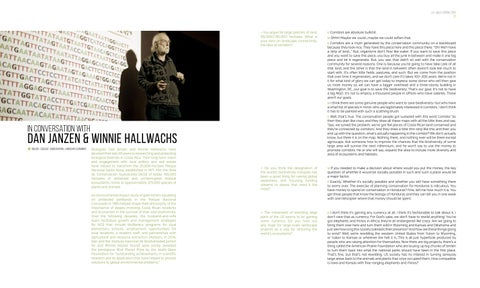
DAn janzen & winnie hallwachs biology, ecology, conservation, landscape economics
Biologists Dan Janzen and Winnie Hallwachs have devoted their last 29 years to researching and protecting biological diversity in Costa Rica. Their long-term vision and engagement with local politics and real estate have helped to transform the 20,000-hectare Parque Nacional Santa Rosa, established in 1971, into the Área de Conservación Guanacaste (ACG) of today: 165,000 hectares of protected and uninterrupted tropical ecosystems, home to approximately 375,000 species of plants and animals. An environmental impact study of gold miners squatting on protected parklands in the Parque Nacional Corcovado in 1985 helped shape their philosophy of the importance of deeply involving Costa Rican residents and economies in the survival of their wild biodiversity. Over the following decades, the husband-and-wife team facilitated growth and management strategies for ACG that include bioliteracy programs for local elementary schools, employment opportunities for local residents, a resident staff, and partnerships with agricultural and resource extraction interests. In 2014, Dan and the Instituto Nacional de Biodiversidad (which he and Winnie helped found) were jointly awarded the prestigious Blue Planet Prize by the Asahi Glass Foundation for “outstanding achievements in scientific research and its application that have helped to provide solutions to global environmental problems.”
+ Do you think the designation of the world’s biodiversity hotspots has been a good thing for raising global awareness and focusing funding streams to places that need it the most?
W If you needed to make a decision about where would you put the money, the key
+ The movement of rewilding large parts of the US seems to be gaining some currency. Do you hold out any hope for large-scale landscape projects as a way for restoring the world’s ecosystems?
D I don’t think it’s gaining any currency at all. I think it’s fashionable to talk about it. I
question of whether it would be socially possible in such and such a place would be a major factor.
D Exactly. Whether it’s socially possible and whether you still have something there
to worry over. The exercise of planning conservation for Honduras is ridiculous. You have money to spend on conservation in Honduras? Fine, tell me how much it is. You get three people that know the biology of Honduras and they can tell you in one week with one helicopter where that money should be spent.
don’t view that as currency. For God’s sake, we don’t have to rewild anything! You’ve got elephants and rhinos in Africa; they’re all endangered like crazy. Are we going to bring them over here and turn them wild in Wyoming and Kansas and Oklahoma and just see how long this society tolerates their presence? And how are these things going to exist? Well, we’re rewilding the western United States from Yukon to Wyoming, or Yukon to Kansas or wherever the hell it is. This is all just hyperbole produced by people who are raising attention for themselves. Now there are big projects; there’s a thing called the American Prairie Foundation who are buying up big chunks of terrain to turn them back into what the national parks should have been in the first place. That’s fine, but that’s not rewilding. US society has no interest in turning seriously large areas back to the animals and plants that once occupied them. How compatible is Iowa and Kansas with free-ranging elephants and rhinos?