The Super SUV That Actually Makes Sense
By Ovidio Lanteri - Dubai-based automotive expert with a motorsport background. I rent and test cars through DCR and write about what cars are actually like on Dubai roads.

Most people arrive in Dubai with a plan.
The city rearranges it within an hour.
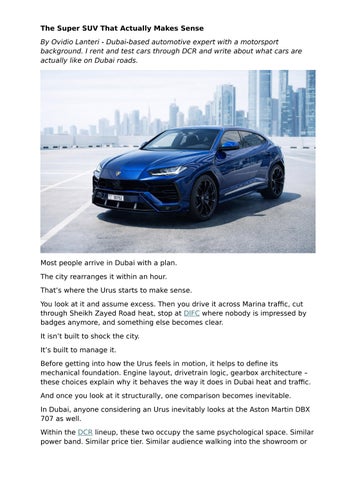
That’s where the Urus starts to make sense.
You look at it and assume excess. Then you drive it across Marina traffic, cut through Sheikh Zayed Road heat, stop at DIFC where nobody is impressed by badges anymore, and something else becomes clear.
It isn’t built to shock the city.
It’s built to manage it.
Before getting into how the Urus feels in motion, it helps to define its mechanical foundation. Engine layout, drivetrain logic, gearbox architecture –these choices explain why it behaves the way it does in Dubai heat and traffic.
And once you look at it structurally, one comparison becomes inevitable.
In Dubai, anyone considering an Urus inevitably looks at the Aston Martin DBX 707 as well.
Within the DCR lineup, these two occupy the same psychological space. Similar power band. Similar price tier. Similar audience walking into the showroom or
scrolling the site. If someone considers a Lamborghini Urus rent in Dubai, the 707 is usually the alternative in the next browser tab.
So the baseline matters.
Not to declare a winner yet. Just to understand what each machine is built from before we talk about how they behave.
Urus vs DBX 707
Specs
Lamborghini Urus (2023) Aston Martin DBX 707
Engine (configuration) 4.0-litre twin-turbo V8 4.0-litre twin-turbo V8
Transmission (type)
Exterior Form Under Harsh Dubai Light
Dubai sunlight is unfair. It wipes out timid shapes. It turns some expensive cars into anonymous blobs.
The Urus doesn’t disappear.
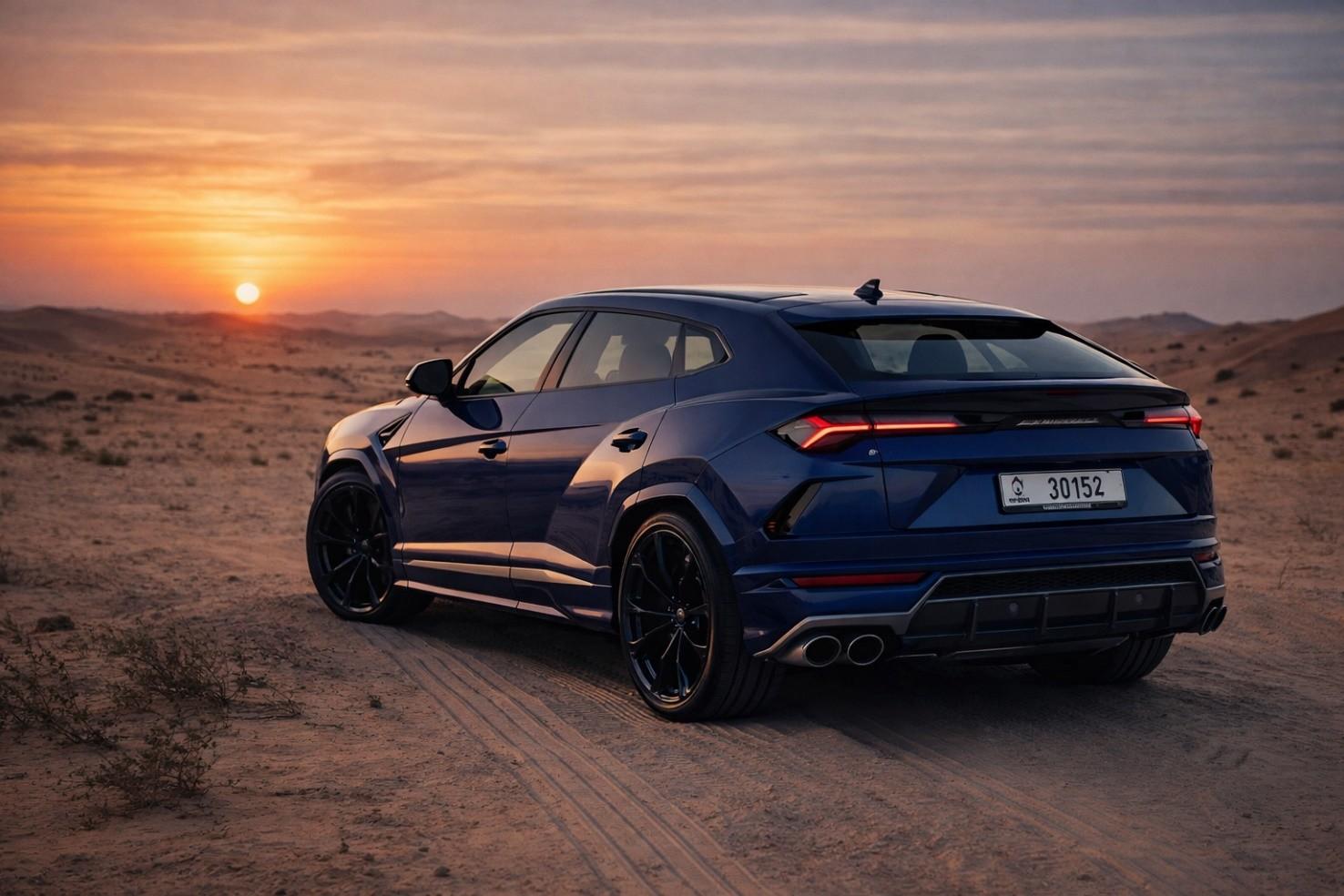
The body has those hard, geometric cuts that stay visible even at midday, even on the pale concrete around Downtown ramps. From certain angles it still reads like a supercar that got stretched upward. The roofline falls aggressively. The rear glass is tight. The shoulders are wide.
There’s a lot of carbon on the typical spec too - splitters, rear diffuser pieces, little details that look like they were designed by someone who hates smooth surfaces.
On Sheikh Zayed Road, it looks fast even when it’s doing a calm cruise. That’s not always a compliment. In Dubai it works.
Cabin Layout and Material Execution
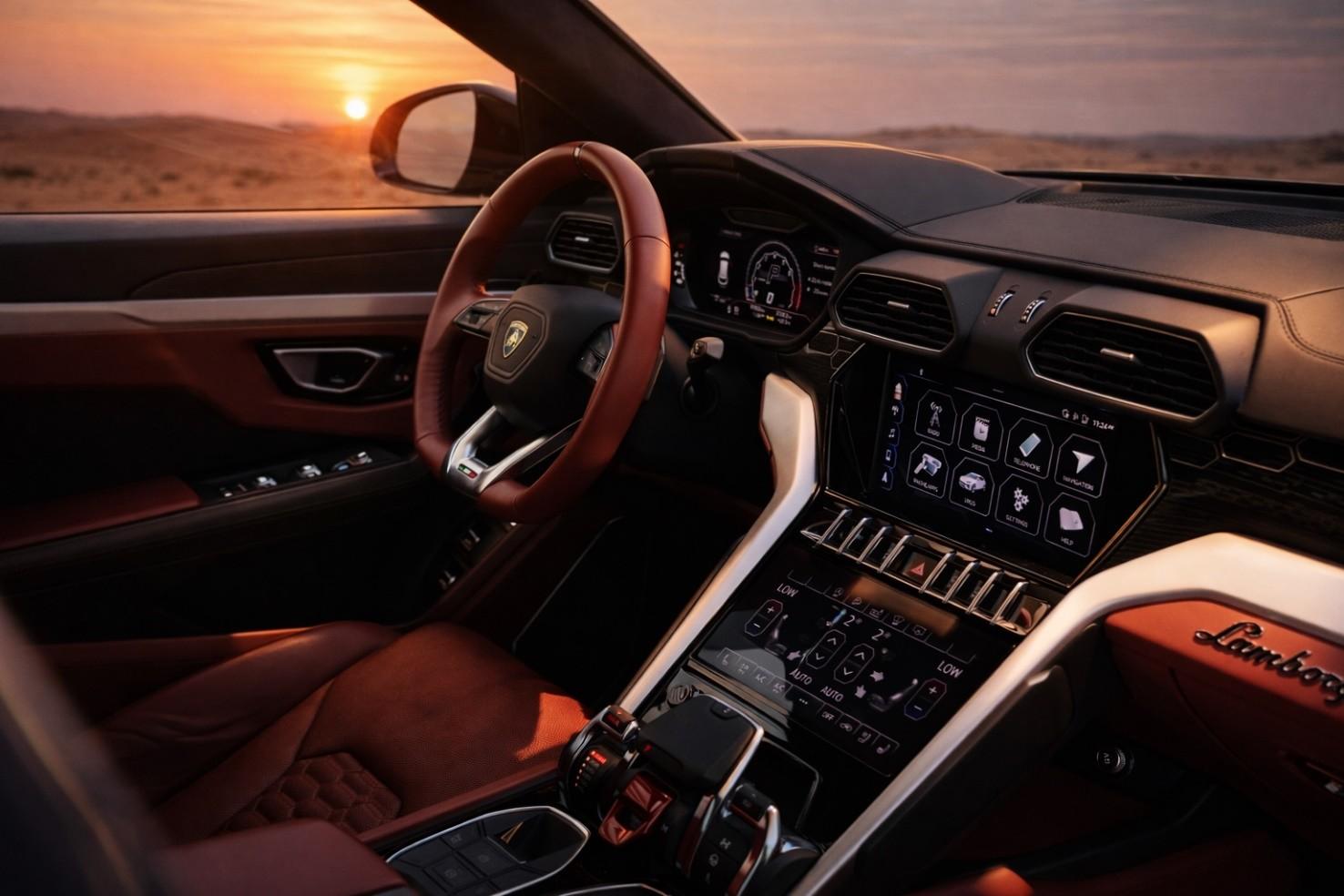
Inside, the Urus does the Lamborghini thing.
The driving position is lower than most SUVs. That changes the whole sensation of weight. You don’t feel perched. You feel placed.
The cockpit is angular and layered. Lots of stitched leather. Multiple screens. The start button under the red flip cover is still theatre, but it’s functional theatre. You don’t roll your eyes every time. You just start the engine.
There are a few things that feel very group-platform in logic - the layout is clean and usable, and yes, some switchgear philosophy is more "German efficiency" than Italian drama. But the overall interior still has the Lambo edge.
In Dubai heat, the interior test is simple: leave it parked, come back, start driving, then do repeated acceleration. Does the cabin stay comfortable, or do you feel the system begging for mercy.
This one holds.
Engine Behavior Under Load in Dubai Conditions
The Urus runs a 4.0-litre twin-turbo V8. On the spec sheet it’s 650 hp, and the important part isn’t the headline. It’s how it behaves under load in hot air.
There’s a small breath before full boost when you stab the throttle. Not oldschool turbo lag - more like a pause while the drivetrain decides how much of itself it wants to give you.
Then torque arrives and stays.
Between 80 and 160 km/h - the band you actually live in on Dubai highways - it feels dense. It doesn’t need to scream to move. It just compresses the distance.
Run after run, the response stays consistent. Cooling margins feel properly engineered for heat that never really ends.
Gearbox Calibration and Response
The 8-speed automatic is the quiet workhorse of this car.
In normal driving it’s smooth enough that you forget about it. Downtown stopstart, Marina traffic, short merges - it doesn’t get confused.
In Sport, it tightens up. Downshifts are held longer. Upshifts land with more intent. It doesn’t feel violent, it feels controlled.
The DBX 707’s wet-clutch gearbox feels sharper in the first instant. More mechanical. More immediate.
But over a long Dubai day, that sharpness can feel a bit edgy. The Urus is the one you can drive hard, then drive normally, without the car feeling like it needs to stay angry.
Chassis Control and Body Discipline
The Urus rides on big wheels and big brakes. That usually comes with penalties.
And yes, you feel edges more than you would in a soft luxury SUV.
But the suspension control is the point. The body stays flat in fast direction changes. The stabilisation systems work in a way that’s obvious if you push, but not annoying when you don’t.
Hit a rough section - the kind of patched road you get around older parts of the city - and it doesn’t crash. It stays composed.
The platform is clever. The tuning is what makes it feel like a Lamborghini rather than a fast family car.
Brake System Stability at Speed
Carbon ceramic brakes on an SUV can feel like marketing. Here, they feel like a requirement.
Brake hard from speed and the car stays stable. Pedal feel stays consistent. The nose settles without drama and the rear stays calm.
That matters in Dubai where lane changes are sometimes suggestions rather than decisions.
Mass Management and Directional Balance
You can’t hide 2+ tonnes.
But you can manage how it moves.
The Urus rotates more willingly than you expect. The front axle reacts quickly. There’s still mass, but it’s organized mass.
The steering isn’t chatty like a lightweight sports car. It’s accurate. And at speed, accuracy is what keeps your pulse down.
Where Their Characters Separate
On paper the Aston wins.
More power. More torque. A slightly quicker 0-100 km/h.
On the road, it’s personality.
The DBX 707 feels more muscular, more raw in the first hit. The wet-clutch shifts have that harder edge.
The Urus feels more eager to change direction. It feels slightly sharper on turnin, a little more impatient. The drivetrain is less abrupt and more progressive.
At DIFC valet, the Aston reads like tailored authority.
The Urus reads like controlled intent.
Neither is better in a vacuum. In Dubai, it depends what you’re doing that day.
Daily Usability in a Dubai Context
The trunk is 616 litres on this spec. That’s not theoretical. It swallows airport bags without negotiation.
Rear space is usable. Adults fit. You can do the Marina night drive with passengers and nobody feels punished.
And it’s still a Lamborghini, so you get the attention when you want it. Quietly, but it’s there.
Availability Through DCR in Dubai
If you’re looking at Lamborghini Urus hire in Dubai, this is the car you pick when you want one vehicle that can do the full Dubai loop - Sheikh Zayed Road speed, Downtown arrivals, and the practical reality in between.
The exact DCR listing is here: https://dcr.ae/cars/rent-lamborghini-urus-dubai/
A couple of conditions that matter in real life: no deposit, and insurance included. Daily mileage is 250 km, extra kilometres are 10 AED per km.
The Urus is not a traditional Lamborghini.
It’s the one that learned how to live in a city like this, without losing the edge completely.