



CEFRReference–
LanguageLab







The English Language Lab follows global standards to help learners grow with confidence. One such standard is the CEFR, a widely recognized framework that describes language proficiency clearly and consistently.
WhatIsCEFR?
If you’re curious about CEFR, it stands for the Common European Framework of ReferenceforLanguages.It’saguideusedallovertheworldtomeasurehowwell someone can use a language, whether they’re just starting out or nearly fluent.
WhyCEFRforLanguages?
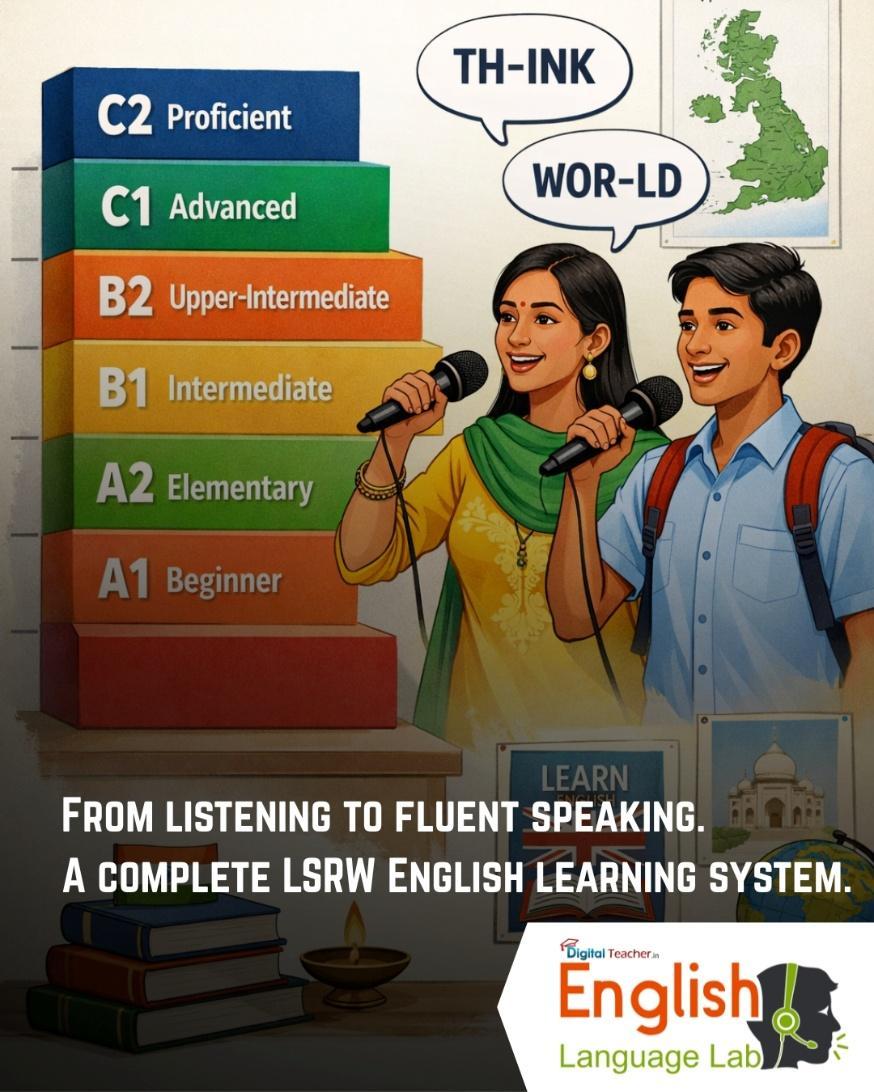
The CEFR for languages breaks learning into six simple levels:
• A1 & A2 Beginner and Elementary
• B1 & B2 Intermediate and Upper-Intermediate
• C1 & C2 Advanced and Proficient
These levels help teachers, students, and institutions clearlyunderstand where a learner stands and what they need to work on next.
OurCEFRReferenceApproach
The Language Lab, our content is mapped to the CEFR reference levels. This means:
• Students learn in a structured, level-based format
• Teachers can assess language skills more accurately.
• Progress is easy to track and report
Whether you’re teachinginaschool,college, orinstitute, using CEFR ensures that your learners are on the right path and in line with international language learning standards.



A1Aftercompletionofthislevel,user:
• Comprehensionandfamiliarizationofeverydayexpressionsandverybasic phrases aimed at the needs of a concrete type.
• Self-introduction, introduction of others personal details such as where he/she lives, people he/she knows and things he/she has.
• Will be able to interact in a simple way provided the other person talks slowly, clearly and is willing to help.
A2Aftercompletionofthislevel,user:
• Will be able to understand sentences and frequently used expressions relatedtoareasofmostimmediaterelevance(e.g.verybasicpersonaland family information, shopping, local geography, employment)
• Will be able to communicate in simpleand routine tasks requiringa simple and direct exchange of information on familiar and routine matters.
• Will be able to describe in simple terms aspects of his/her background, immediate environment and matters in areas of immediate need.
B1Aftercompletionofthislevel,user:
• Will be able to understand the main points of clear standard input on familiar matters regularly encountered in work, school, leisure, etc.
• Will be able to deal with most situations likely to arise whilst travelling in an area where the language is spoken.
• Will be able to produce simple connected text on topics which are familiar or of personal interest. Can describe experiences and events, dreams, hopes & ambitions and briefly give reasons and explanations for opinions and plans.
B2Aftercompletionofthislevel,user:
• Willbeabletounderstandthemainideasofcomplextextonbothconcrete and abstract topics, including technical discussions in his/her field of specialisation.
• Willbeabletointeractwithadegreeoffluencyandspontaneitythatmakes regular interaction with native speakers quite possible without strain for either party.
• Will be able to produce clear, detailed text on a wide rangeof subjects and explain a viewpoint on a topical issue giving the advantages and disadvantages of various options.
C1Aftercompletionofthislevel,user:
• Will be able to understand a wide range of demanding, longer texts, and recognise implicit meaning.
• Will be able to express him/ herself fluently and spontaneously without much obvious searching for expressions.
• Will be able to use language flexibly and effectively for social, academic and professional purposes.
• Will be able to produce clear, well-structured, detailed text on complex subjects, showing controlled use of organisational patterns, connectors and cohesive devices.
C2Aftercompletionofthislevel,user:
• Will be able to understand with ease virtually everything heard or read.
• Will be able to summarise information from different spoken and written sources, reconstructing arguments and accounts in a coherent presentation.
• Will be able to express him/herself spontaneously, very fluently and precisely, differentiating finer shades of meaning even in more complex situations.