![]()


BY JET TURNER

For many years, Dr. Ryan Johnson and the Langston University Department of Chemistry have worked diligently to create servicelearning and confidence-building programs in STEM fields for high school students.
Dr. Johnson’s goal has always been to expand this work statewide, but he’s learned an important lesson during his endeavors.
“Externally funded programs are powerful but temporary,” Dr. Johnson said. “When grants end, students lose access to support.”
That’s why the Chemistry Department has shifted its focus to sustainability by embedding this work directly into Langston University’s curriculum, building permanent pipelines that connect LU students to Oklahoma communities.
The Thomas E. English Chemistry Leadership Initiative is a curriculumembedded service-learning program named after Langston University’s 12th president, who emphasized education for community engagement and service.
Langston University General Chemistry I students develop and deliver interactive chemistry demonstrations to local high school students, positioning themselves as experts and leaders. During the Fall 2025 semester, more than 25 LU students presented demonstrations at Frederick A. Douglass High School in Oklahoma City on Nov. 11 and 18.
For some of LU’s chemistry students, this was the first time they felt confident calling themselves “scientists.” That change in mindset doesn’t just help students pass chemistry; it shapes their entire STEM journey and career trajectory, according to Dr. Johnson.
General Chemistry I students designed demonstrations on topics like acids and bases, chemical reactions and states of matter. They practiced extensively, then taught 40-minute sessions to Douglass High School chemistry classes.
“This opportunity was encouraging for me because I got a glimpse of how well I can do in the education field as an instructor,” said Oliviya Greenhoward, a General Chemistry I student last semester. “I was so surprised, appreciative of and humbled by the experience.”
The department of chemistry is expanding the Thomas E. English Chemistry Leadership Initiative this semester and has submitted a research proposal to determine whether this type of teaching experience helps students build confidence in STEM fields.
“The goal is to create a replicable model that can scale across Oklahoma and beyond,” Dr. Johnson said. “A sustainable approach to STEM pipeline development that doesn’t depend on external funding cycles.”


When Maya Offord arrived at Langston University as a freshman in Fall 2022, she was immediately greeted by a Student Ambassador.
The Ambassador welcomed her to Dear Langston and helped her find her way to student check-in. There, she met other Ambassadors who would continue to help her navigate the campus that was about to become her home for the next four years.
Throughout that first day, and her entire first week, Offord continued to have overwhelmingly positive interactions with Student Ambassadors. From putting on fun events in the evenings to doing “dorm storms” to check on her and her fellow freshmen, the Ambassadors made sure Offord truly felt like she was a member of the Lion Pride.
“As soon as I got on campus that first day, my first people that I had were Ambassadors,” Offord said. “It really inspired me to go be an Ambassador because they were good mentors, and I was like, ‘I really, really want to be a part of that.’”
Offord is now a senior quad major––psychology, corrections, general studies and criminal justice––and she is the Student Ambassadors’
membership and training chair. She is one of the thousands of students and alumni whose time at school has been made all the better thanks to LU Student Ambassadors.
The Langston University Student Ambassadors is an organization made up of model students who want to elevate their HBCU through community service and peer mentorship. They serve as freshman orientation leaders, assist with campus tours, help with ceremonial events, and volunteer around campus and in the Town of Langston community. They are heavily involved with student activities across organizations, and they are experts in LU history.
Student Ambassadors are an integral part of LU, but for most of the university’s proud history, the organization did not exist.
When Dr. JoAnn Haysbert became the President of Langston University in Fall 2005, she gave Dezz Lewis a mission: create a student ambassador program.
“Then, all we had, really, was the McCabes, Mister and Miss Langston,

Miss Black Langston and the three SGA elected officials,” Lewis said.
“Those were your student leaders. And (Dr. Haysbert) said, ‘Man, we need more when people come to campus.’”
She tasked Lewis, who was the Director of Student Life at the time, with creating a new group of students who could serve as “ambassadors” to help represent Langston University during campus visits and other important events. She left it up to him to decide how the club would be organized and run, and he embraced the challenge.
Lewis knew he wanted the organization to be different from any other student organization. As a proud alumnus himself, he wanted it to be a way to instill school spirit and pride in students while shaping them into young leaders. He wanted it to create a sense of belonging on campus because he knew students who felt they belonged were more likely to finish college. Most of all, he wanted it to be impactful not just for its members, but for Dear Langston as a whole.
After brainstorming for a while, Lewis created a set of goals and measurable outcomes for the program. Then, he went to work.
He decided rather than follow the standard student organization model of the time, where clubs were run by presidents and a few other executive positions who made all the decisions, the Student Ambassadors would be run by the Ambassadors’ Council. They would create committees for the various aspects and functions of the organization, and each committee would have a chair. Each chair would have a seat at the Ambassadors’ Council. The Ambassadors’ Council Chairman would be the spokesperson for the organization.
With the framework established, Lewis began working out how he would train the Student Ambassadors. In addition to their role as student representatives during campus visits, the administration had decided the Ambassadors should also serve as orientation leaders during Lion Camp, Langston University’s week-long freshman orientation program that takes place the week before classes begin in the fall semester.
“We needed orientation leaders for the freshman orientation,” Lewis said. “So when you drop your kids off, the first people you see are the Ambassadors. They’re your model Langston students, and they embody the Timeless Human Values.”
Once he had a plan ready, he set to work recruiting students. In Spring 2006, the Student Ambassadors had their first official meeting with a class of 36 students. At the end of the summer, they attended the Student Leadership Institute and held a retreat to prepare for Lion Camp. In Fall 2006, new students were greeted for the first time by Student Ambassadors.

When Lion Camp ended, the Student Ambassadors remained. They were meant to be student leaders year-round, and they were meant to serve the entire campus community.
The Student Ambassadors would reach out to other student organizations and ask what support was needed. They would help recruit students to attend various club events as well as official university programs and sporting events. They cultivated a shared sense of school pride with their peers, and they worked to better the student experience for everyone.
They also continued to receive training. On Wednesday evenings in the fall, Student Ambassadors attended a leadership class with Dr. Haysbert, giving them direct interaction with their president and an opportunity to influence their campus.
Lewis also continued to train them himself, teaching them to recite the Timeless Human Values and the Profile of a Langston Student so that they might take them to heart and learn to embody those qualities. He taught them about the history of the university, and he taught them poems he hoped would inspire the students to continue to strive for success.
“They learned everything that was poured into me as a young adult,” Lewis said. “A lot of affirmations and poems. They had a curriculum. It spawned out of conversations I had with my mentors in college, but most of all, my grandmother made me memorize every poem, affirmation you could think of. So, a lot of what they were doing was stuff that I learned as a kid and stuff I learned at Langston (University).”
As the Ambassadors established their role in campus life over the next few years, Lewis continued to refine what he called “the core” of the program. He would add to the curriculum as he saw needs arise. He changed the membership process so that instead of recruiting specific students who had shown leadership potential, any student with a 2.0 GPA could apply to join.
Eventually, Lewis relinquished his role as advisor to the Student Ambassadors. Now, Dr. A. Dominique Williams, the Assistant Dean of Students in the Office of Student Life, serves in that capacity. Since taking over the role, Dr. Williams has continued to improve the organization. She believes that as student leaders and representatives for the institution, the Student Ambassadors should be held to a high standard. Members must now maintain a 2.5 GPA minimum in addition to the thorough application and training process. Their role in the community has also been expanded.
After Lion Camp, the Ambassadors continue to mentor freshmen throughout their first year of school. They assist with campus tours and recruitment events like High School Day. They participate in service projects like serving meals in the cafeteria. A new service project they recently added was attending HBCU days at high schools and middle schools in Oklahoma.
“There’s still room for growth,” Dr. Williams said. “There’s still room for this organization to be bigger and better than it currently is. This is an awesome opportunity for students to be engaged and just spread the good word of Langston (University).”
The Student Ambassadors have become a staple of student life at Dear Langston, and dozens of students apply each spring to be inducted into

Attend class & university functions
the program in the fall. With each new Ambassador Class inducted and freshman class welcomed, their impact continues to grow.
After 20 years, there are many aspects of the Student Ambassadors program that have become tradition. Customs like “L’s Up” and many spirit chants originated from the organizations’ early years. Saying “I am a Langston Man” or “I am a Langston Woman” when introducing oneself is now common. The “Ask Me” t-shirts from Lion Camp are easily recognizable symbols of the club.
Now, students like Trinity King cannot imagine Langston University without the Student Ambassadors.
When King first came to Langston, the Student Ambassadors helped her feel at home. Her Ambassador mentor, Kayla, helped make her transition into college easier. She wanted to pass on that same support and encouragement she received, so King applied to become an Ambassador during the spring of her freshman year. Kayla even wrote her a letter of recommendation.
King was inducted into the Ambassador Class of 2023, and she has loved it ever since. She now serves as the Chair of the Student Ambassadors. As she prepares to graduate with her bachelor’s degree in animal science in May, King knows her time at LU wouldn’t have been the same without the program.
“That first interaction I had my freshman year (with Ambassadors), it really changed my trajectory,” King said. “Learning about the history of Langston, I take that to heart with me. I’m Langston ride or die.”
King and Offord were both inspired to join the Student Ambassadors because they had felt its positive impact early on in their time at LU, and they continue to see how its influence impacts the campus community beyond people’s first years.
Many students join Student Ambassadors at the end of their freshman or sophomore years, and they often go on to become leaders in other student organizations afterward. King tells new students that Ambassadors is a great “starter organization” because it helps you get involved on campus and teaches you to be an active member of the community. The program’s lessons on leadership, personal responsibility and school pride stay with you as you move on to your next club or internship or job.
“I believe Ambassadors shaped me into being a leader,” Offord said. “Although I’d been in leadership roles in high school, I didn’t really get that experience until I got here. Being an Ambassador, it encouraged me to be a really good leader and also to take accountability. It also taught me it’s OK to go other ways and work with other people because when you’re a leader, you have to be able to be flexible.
“And then it also helped me to love Langston (University).”
BY ELLIE MELERO


LANGSTON UNIVERSITY STUDENTS TAKE HOME AWARDS AT ANNUAL K-INBRE SYMPOSIUM
BY ELLIE MELERO

Following an eventful weekend filled with medical research and networking, two Langston University students took home awards for their research presentations at the annual Kansas IDeA Network of Biomedical Research Excellence (K-INBRE) Symposium.
Juliane Simmons, a graduating senior biology major, earned an Award of Excellence for his oral presentation on “Exploring the Connection Between NUAK and 14-3-3zeta in Muscle Tissue.” Justin Berryhill, a junior biology major, earned an Award of Excellence for his poster presentation on “Gait Differences in ASD/Fragile X Rodent Models.”
“I feel very honored to have received an award for my research,” Simmons said. “It amazes me that I was able to receive that honor with work that I was only able to do in six weeks.”
K-INBRE is a collaborative effort of medical and academic institutions in Kansas to “promote multidisciplinary research networks with a focus on Cell and Developmental Biology,” according to the K-INBRE website. Langston University is the only Oklahoma-based institution partnered with K-INBRE.
The program offers LU students mentored research opportunities as well as opportunities to present their research at events like the annual Symposium. Simmons and Berryhill were two of the 11 LU students who, along with several faculty members, participated in the 2026 K-INBRE Symposium in January.
Simmons worked with Dr. Erika Geisbrect at Kansas State University on his research project. What was supposed to be a summer-long internship was unfortunately cut short after just six weeks because of pauses in federal grant funding, but Simmons was still appreciative of the time he spent in Dr. Geisbrect’s lab.
His research used fruit flies to study how 14-3-3zeta, a common phosphorylation signaling protein found in muscle tissue, and NUAK, a kinase, affect muscle development. The study was meant to improve scientists’ understanding of what causes myopathy, or muscle disease.
“I would say the end goal pretty much for anybody’s research is to make quality of life better, helping people with certain diseases,” Simmons said.
Berryhill’s research compared normal rats to rats with mutations in the Fmr1 gene, which is linked to a genetic disorder affecting brain development and causing motor problems called Fragile X. The goal was

to see how the mutation changed movement, which may help scientists better understand motor symptoms and improve early detection and treatment strategies for Fragile X.
Berryhill has only been involved with K-INBRE for one year, and this was his first Symposium. He was excited for the opportunity to present his research, and he’s grateful for the connections with other student researchers he’s been able to make through the program so far.
“It feels good,” Berryhill said. “I’m very honored to have gotten this chance and award. I feel more confident in my ability to do more research and maybe continue it.”
Simmons and Berryhill both became involved with K-INBRE after doing research with Dr. K.J. Abraham, a biology professor in LU’s Department of Natural Sciences. Dr. Abraham saw potential in both young men and invited them to join the program, connecting them with his program colleagues in Kansas.
After their summers doing research, Simmons, Berryhill and the rest of the LU K-INBRE cohort returned to Dear Langston for the fall semester. As the Symposium approached in January, they worked with Dr. Abraham, Dr. Lindsay Davis and Dr. Sharon Lewis to practice, tweak and refine their presentations. Now that the Symposium is over, they’re both grateful to have had this undergraduate research experience.
“It’s been valuable in my educational journey,” Berryhill said. “It’s been valuable for networking and working with others, giving me better insight into how genes work and how that might affect one’s body.”
As Simmons prepares to graduate this spring, he knows that K-INBRE was a valuable experience not only to add to his resume, but also to prepare him for life after LU.
He wants to go to graduate school and pursue a career either as a physician assistant or an anesthesiologist assistant, and he knows having a research background will help him get wherever he wants to go.
“I hope this shows that I was active on my campus, but also active with my major,” Simmons said. “I was able to come to Langston and get out of my comfort zone, do research stuff. So when I go into future projects, who knows? I maybe could still do research while I’m in medical school or go into different graduate programs where I have opportunities to do more research.”


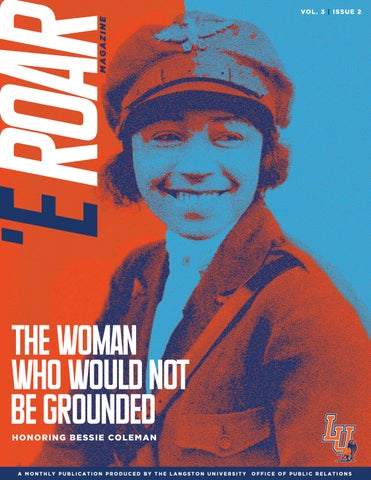
Bessie Coleman stepped onto the wheel of her Curtiss JN-4 biplane, often called her canary, and hopped into the cockpit. Word of Queen Bess’s performance had spread like wildfire. An audience had gathered in the pasture.
The engine growled beneath her as the propeller spun quicker and quicker. Bessie eased her canary forward, the nose lifting quickly. Soon, she was among the clouds, the roar of the audience becoming a distant rumble.
Showtime.
The wind screamed in her ears as she worked her canary into a loop, watching the earth twist and spin below her. Over and over she looped into figure eights. She couldn’t hear the crowd’s cheers from so high up, but she didn’t have to hear them to know they were impressed. Bessie continued to twist and roll in the sky with her canary. Each
trick a triumph; each stunt a defiance. Every time she stepped into her plane, soared in the sky and performed for the masses was an opportunity to defy all those who had told her, “No.”
Bessie was born in a one-room cabin on Jan.26, 1892, in Atlanta,Texas, as one of 13 children born to Susan and George Coleman. Her birth was neither recorded via birth certificate nor written in the family Bible, for her parents could not read nor write. Despite the violence and barriers of the Jim Crow era south, George purchased a small plot of land in Waxahachie, Texas, where Bessie grew up.
She began attending her racially segregated school in 1898. The oneroom building held grades one through eight, with only one teacher for all grades. Bessie walked four miles to school every day and quickly developed a love for learning and a determination that she carried with her throughout the rest of her life.
BY JET TURNER

Bessie always dreamed of leaving Waxahachie and briefly did when she attended the Colored Agricultural and Normal University (later named Langston University).
It was here where she learned about flying.
Although she could only afford one semester of college, that single semester sparked a lifelong passion for aviation when she read about the Wright Brothers’ first flight and the first American female pilot, Harriet Quimby.
Bessie couldn’t help but wonder what it would be like to fly like a bird.
Eventually, Bessie decided to chase her dream. Around the age of 27, she applied to nearly every American flight school but was continuously rejected because of her race and gender. When she
realized that even the skies above America were segregated, she began applying to French aviation schools.
On Nov. 20, 1920, Bessie sailed from New York City to France. She spent a year applying to French flying schools, learning the language and saving up for her travels. When she arrived, she selected the Ecole d’Aviation des Frères Caudron at Le Crotoy in the Somme. After seven months of training, she took the qualifying test for a license from the renowned Federation Aeronautique Internationale (FAI), the only organization at the time whose recognition granted one the right to fly anywhere in the world. She was the first American of any race or gender to be directly awarded these credentials.
She returned to New York in September 1921 and quickly began traveling across the country, performing shows and advocating for equality. She dreamed of one day opening her own aviation academy for Black students.
In April 1926, while preparing for a show, an accident led to Bessie's untimely death. Although she was only 34 years old, her advocacy and bravery continue to inspire generations. Bessie’s story is a testament not only to Black excellence and determination, but also to the impact education can have on an individual’s trajectory. In just one semester at Langston University, Bessie Coleman found her lifelong passion and pursued that passion across the ocean and back, and she used it to fight for the equality of others.
Langston University is proud of the legacy carried by alumni like Bessie Coleman, whose courage reshaped what was possible. Her life stands as enduring proof that access to education can ignite dreams powerful enough to challenge injustice, open doors for others and change history itself.


‘E ROAR IS PRODUCED BY THE LANGSTON UNIVERSITY OFFICE OF PUBLIC RELATIONS


Theresa Powell Vice President for Operations
want to be featured in next month's issue?
SEND US YOUR NEWS:
If you have any accomplishments or upcoming events in your department and you want them publicized, please send to the LU Office of Public Relations via the online project request form found at www.langston.edu


sheets Director of Public Relations
Assistant Director of Communications Editor-in-Chief
Media Relations Specialist
Contributing Editor
Senior Graphic Designer/Photographer
Design and Layout