
Seniors Project
Older locals are using their free time to create an outdoor living room by the riverbank. P4-5 FEATURE

New Outlook
The Falcons women’s team shows promise under new leadership. P8
Iranian Women
Our podcast explains the plight of women who’ve confronted violence in Iran. bit.ly/3NoEHtR

Students fear tuition hike
BY LIAM CLARKE
Aprovincial government review examining the financial sustainability of B.C.’s 25 public colleges and universities has created fear among faculty and students that tuition will increase.
The provincial government knows that “the status quo is not sustainable,” and “tuition increases are explicitly on the table,” said Debi Herrera Lira, chairperson of the B.C. Federation of Students. “The government is considering asking students to pay more, while also refusing to commit to new public funding.”

The federal government’s recent limits on international student study permits have reduced enrolment and revenue for many of B.C.’s postsecondary institutions. Langara’s projected deficit has doubled from $16 million to $32 million in the past six months, and 219 instructors have been laid off.
The provincial government launched a review to establish a plan to keep B.C.’s post-secondary system financially sustainable.
Herrera Lira said some postsecondary institutions have asked the provincial government to remove the two per cent annual tuition cap.
Lifting the tuition cap will make higher education less accessible, said Niall Christie, a history instructor at Langara.
“If you create a situation where colleges and universities can charge whatever they want for tuition, we go back to a situation where education becomes increasingly available to only the financial elite,” Christie said. “What the higher education sector needs is more funding.”
Sarah Warr, a first-year psychology student at Langara, said she came to Langara because it was cheaper than other schools.
“I’m paying for my tuition myself. It won’t help if they make it more expensive than it needs to be,” said Warr.
“I’d be pissed” if tuition at Langara was increased, said Bodhi Cutler, a second-year fine arts student at Langara.
“I already feel like I don’t get enough resources for the amount of money that I pay,” Cutler said.
The review will be delivered by Don Avison, former B.C. deputy minister and former board chair of Emily Carr University of Art + Design, by March 31.

Jessie Sunner, minister of postsecondary education and future skills, said in an email to the Voice that she understands “the stress and anxiety” felt by students and faculty because of the review. “I want to reassure all our partners that our number one priority throughout this work is ensuring accessible education.” Sunner said. “We’re open to exploring different options and pathways to help bring stability back to the sector.”
With public institutions unable
to rely so heavily on international students’ tuition fees, the financial burden will “absolutely” fall on domestic students said Korky Neufeld, post-secondary education critic for the Conservative Party of B.C.
“Without that money, they’re going to have to close some programs and those domestic students will have to go elsewhere,” Neufeld said.
Bernie Maroney, a business professor at Langara who will be laid off at the end of April, said he expects
layoffs to continue and fears the cost of Langara’s deficits will ultimately fall on students.
Maroney said there are instructors at Langara that have spent over 20 years in education have lost everything.
The post-secondary review is the provincial government “covering their ass, that’s it.”
“They’re going to come out with a bunch of blanket PR statements that justify them doing nothing.” Maroney said.
A response to theft
BY MARC GUIDO BOLEN
Last week, more than 900 copies of the Voice were taken overnight. After replacing them with new copies, additional stacks were removed this week. It is disheartening to see this happen, and we’re doing our best to ensure it will not happen again.
This situation is not just a disservice to our team, but to the students and staff at Langara and the residents of Vancouver who enjoy reading our stories. Taking all copies simply prevents others from having the chance to read them. The Voice is free and is intended to be readily available for everyone. We operate in good faith that people will take as many copies as they need but will not take, steal or throw away all available copies on campus.
It is wrong that our papers were stolen and thrown away. It is a greater wrong that whoever threw them away did not state their cause, reason or concern. Suppressing one voice does not amplify another, especially when that voice remains silent or anonymous.
The role the Voice plays in elevating the voices of our college’s students and staff is worth preserving. Sometimes our stories are read by thousands, sometimes by only a few dozen. Regardless of how many eyes the stories reach, the Voice, and journalism at large, is often meaningful and should be .That being said, the Voice is just one group of students, who cycle in and out within one to two years of education, taught by four or five instructors, in a school where many students will finish their studies elsewhere. In other words, the Voice does not represent every perspective on campus and we should not be, and aren’t, the only voice on campus. We encourage everyone to share their voice without destroying ours.
Like most media outlets, our newspaper exists within certain boundaries with unique tradeoffs. While many media outlets rely on ad revenue or subscriptions, the Voice is dependent on Langara College. The Voice is both a platform for journalism but also a means of education for students. Producing journalism within a classroom means our choices are shaped not only by our own perspectives but also by the oversight of instructors and the program at large.
PRODUCED
LANGARA JOURNALISM
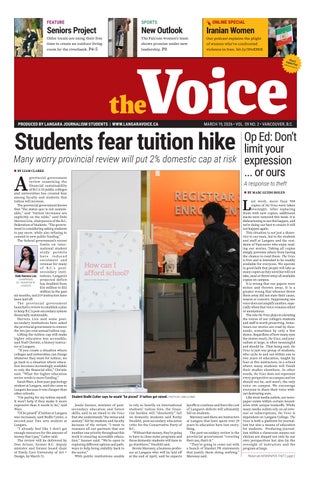
Student Bodhi Cutler says he would “be pissed” if tuition got raised. PHOTO BY LIAM CLARKE
Debi Herrera Lira CHAIRPERSON, B.C. FEDERATION OF STUDENTS


The construction of the new condos and the upgrading of the sewer systems on 49th Avenue is reaching the end of its phase 1, but the lengthy construction projects have made it difficult for some South Vancouver residents to get around. Bus lanes are planned for 49th Avenue. TransLink says the bus lanes along with stop changes will promise faster and more reliable commutes for thousands of South Vancouver transit riders, including students traveling to Langara and UBC. According to the City of Vancouver’s website, more than 35,000 daily trips on bus routes 49 and 430 are affected by traffic delays. Some residents in the area have raised concerns about how long the construction is taking, especially for students.
Victor Xi, first year nursing student, says while he normally takes the SkyTrain, he finds that having to use the sidewalk across the transit station can get annoying because “the other is closed.”
The sewage system along 49th Avenue between Cambie and Fraser streets is being replaced with a separated and larger capacity system, with separate pipes for rainwater runoff and sewage. The newer sewer system has an estimated life expectancy of 100 years. Aging watermains are also being replaced on 49th Avenue between Ontario and Fraser streets. Once these two projects are completed, the pavement along 49th Avenue will be restored.
The new bus stop changes and lanes are expected by June.


Follow Us langaravoice.ca
X: @LangaraVoice
YouTube: @VoiceLangara
Instagram: langaravoice.ca
NEWSPAPER THEFT, continues from page 1
With that, it is often difficult to balance the goal of providing good journalism with our education. Balancing journalism, education, student values and instructor priorities can result in gaps in our reporting and in the scope of our coverage.
If you feel your stories are not being heard, especially if the newspaper fails to present a balanced view on certain topics and issues, please contact the editors and share your thoughts and concerns.
To continue fair access to our paper, we will continue to reprint and share in its entirety any edition that is stolen from the stands, regardless of the time or cost required.
We ask that you limit the amount of free copies to five per reader. If you want more, please come to A226 and ask. Lastly, and most importantly, I would like to express gratitude to those who read, share and participate in our paper each week. Our cohort of student reporters and editors does its best to ensure our stories fairly represent the faculty, students and South Vancouver residents that fill our pages and website with their stories. We are dependent on them to continue both our journalism and education.
A sign saying “Crosswalk closed” along 49th Avenue across from bus stop near campus in Vancouver, B.C., on March 13, 2026. PHOTO BY EHXEA ANTOINE
A sign along 49th Avenue in front of Langara College, signalling a traffic control person ahead. PHOTO BY EHXEA ANTOINE
The 49 bus arriving along a new condo construction site near campus in Vancouver, B.C, on March 13, 2026. PHOTO BY EHXEA ANTOINE
BY EHXEA ANTOINE
No markers, no plan, no support
Markers funding ends April 1 with no alternative support for instructors
BY AJ WATT
Langara is eliminating markers who help instructors grade writing-heavy assignments, and faculty say the administration’s only guidance has been to “get creative.”
The college is cutting marker funding April 1 as part of an effort to address a financial crisis following a federal cap on international students in 2024.
In an emailed statement to the Voice , David Anderson, interim provost and vice-president, academic, said marker budgets “have been removed as part of broader efforts to manage costs responsibly.”
Instructors were told about the cuts mid-semester, after they had already planned their courses with markers in mind, said Erfan Rezaie, a physics and astronomy instructor and Langara Faculty Association board member-at-large.
even though instructors had already planned their semester, their syllabus, their course outlines, all their assessments,” he said.
When faculty asked administration how to manage the added workload, they were told the ‘get creative,’ Rezaie said. He said the response showed college administrators “have no idea what we do and they don’t really seem to care.”
Simon Rolston, an English instructor, said markers make a big difference in writing-heavy departments like English, where instructors read five-page essays line by line.

it’s helpful.
“[It’s] not a great way of supporting staff and supporting students,” Rolston said. “The thing with instructors is that we care about students and students’ work.
“[It’s] not a great way of supporting staff and supporting students.”
— SIMON ROLSTON, ENGLISH INSTRUCTOR
“So of course we’re going to get creative in order to be able to give students the kind of help and support that we think that they need, given the resources we have.”
sciences and science, said Spencer Dane, division chair of creative arts and industries, in an email to the Voice
The Langara Faculty Association says it has been given no indication the college plans to reduce class sizes or offer alternative supports to offset the loss of markers, said Raged Anwar, a vice-president of college relations for the LFA, in an email to the Voice. Langara has the largest class caps in the sector in the province, he said, with the college setting class sizes at 29 students “but in practice some classes are much larger and others are smaller.”
perspective instructors don’t have time for.
“I can pick out very quickly whether something sounds like AI or not. Patterns emerge,” said van Deijck.
She said while Langara only paid markers minimum wage, Douglas College, which still uses markers, pays her $25 an hour.
The Voice reached out to the college communications department on Tuesday to ask how many markers were employed and how much they were paid, but did not hear back by publication time.
“They told us … there’s not going to be any more money for markers,
He said he doesn’t know what “get creative” means, nor does he think
The departments most affected by the cuts are humanities, social
Andrea van Deijck, a professional marker at Langara and Douglas College, marked 4,500 papers last year. She said markers offer a
Rolston said markers are not simply an “added benefit.”
“It actually has an effect on our ability to support students in their own learning,” he said.
Another $13.5 million toward Workday
UBC students warn Langara peers to be prepared for frustration
The college is spending $13.5 million next fiscal year on Workday Student, an administrative information system that has drawn criticism from students at the only other B.C. school that uses the system.
Workday Student will replace Banner, which the college has used since 1996. Banner’s developer released its latest version in 2017, but Langara has been using an outdated version that lost support in 2025.
UBC is the only other post-secondary B.C. institution using Workday Student, which it launched in 2024. Students at UBC say the transition has been rough.
David Savage, a fourth-year cognitive systems student at UBC, said his graduation was delayed after transfer credits from a previous degree failed to appear in the system. His academic adviser was unsure about how to fix the issue.
“It’s not going to ruin your life, but it’s constantly annoying,” Savage said. He said the previous system used at UBC was easier to navigate, while Workday requires multiple clicks to
find documents like a transcript without clear instructions on the same page.
UBC has over 70,000 students, while Langara has approximately 19,000 students.
Shunsuke Ogawa, a fourth-year English student at UBC, said the platform doesn’t show schedule conflicts when students register for courses, forcing them to track their timetables manually.
“You have to open five tabs to make sure that you can register for a course without it conflicting with other courses,” Ogawa said. He said a fellow student even built a Chrome extension to facilitate course registration.
Ogawa said his advice for Langara students is to be prepared.
“Triple check everything before you close the site,” he said.
Langara faculty and administration already use Workday, designed to handle finance and human resources tasks for organizations.
The college launched the system in 2020 to manage payroll, benefits, time entry, hiring, budgets and expense claims.
ara for 10 years, said the transition to Workday generated complaints from faculty. He said the system

Avram Agov, an Asian studies instructor who has taught at Lang-
ment applications.
“It was supposed to work better,” he said.
“It’s not going to ruin your life, but it’s constantly annoying.”
— DAVID SAVAGE COGNITIVE SYSTEMS STUDENT AT UBC
has complex operational requirements for submitting reimburse -

Agov said Workday is more efficient for the college overall, but not for individual faculty.
“It’s a step ahead, but not a revolutionary step,” he said.
The spending on Workday comes as Langara faces a projected $15.5 million deficit for the 2027 fiscal year. The college has laid off staff and cut student services to address the deficit.
Michael Koke, Langara’s vicepresident of administration and finance, said in an email to the Voice that the $13.5 million covers testing and change management to prepare the system for launch.
The faculty understand the need to upgrade college systems, said Nina Winham, a Langara Faculty Association vice-president.
Despite this, she said they are “utterly dismayed and disappointed” by the spending.
An LFA report estimated the total cost of Workday will exceed $63 million, with $35 million already spent.
Akash Rattan, an instructor at Langara’s school of management, questioned whether the investment makes sense during a financial crisis.
“No new students are going to say, ‘I want to choose Langara because they’re using Workday,’” he said. “It’s a back office, back of the house system.”
Simon Rolston says English instructors read five-page essays line by line. Markers helped ease that workload.
PHOTO BY
AJ WATT
BY ZOE LI
PHOTO BY ZOE LI
SENIORS CREATE THEIR OWN
Outdoor living room comes alive
Hauling rocks, making furniture, older locals build a haven on the riverbank
Along West 75th Avenue in South Vancouver, across the Fraser River from Sea Island, a small gathering space has quietly taken shape at Fraser River Park.
There’s a fire pit surrounded by wooden seating, rocks carefully placed to form steps, and a table-like surface where people rest their drinks or share food. The river flows directly in front of it, and families, dog walkers and passersby often stop to sit and take in the view.
What makes this space unique is that it wasn’t built or sanctioned by the city.
It was created at their own expense by a group of older adults and seniors working for free.
Saja Summerville, 52, helped lead much of the work that shaped the space.
He said the project originally started with three regulars who began clearing rocks and shaping the area along the riverbank.
Over time, more people who visited the park started lending a hand. What began as a small effort gradually grew into a group of nearly 10 older adults and seniors who now help maintain and improve the space.
“It just kind of happened,” Summerville said. “We never really planned it as a project. We just started coming down here and doing one little thing
at a time.”
The group first started gathering around nine months ago after noticing a rocky section of the riverbank that seemed like it could be something more.
“We saw this little rock that needed to be removed,” Summerville said. “That was kind of the turning point.”
From there, the project slowly grew.
Members of the group started meeting regularly, sometimes every day, moving rocks, constructing a firepit and creating places to sit.
“We bring chainsaws, tools, whatever we have,” Summerville said. “Everyone just pitches in. Some people bring tools, some bring food, some bring ideas. It all just comes together.”
Despite the informal nature of the project, the builders have thought carefully about how the space interacts with the natural environment.
“We call it the living room,” he said. “Because it’s alive.”
“I made most of the wooden furniture you see here,” Summerville said. “The benches and some of the tables are made from logs we found nearby. It’s just using what’s already here.”
— SAJA SUMMERVILLE, MARPOLE RESIDENT
The work quickly became something the group looked forward to.
“It wasn’t work to survive or make money,” he said. “It was a work of passion. At the end of the day I’d go home feeling really good.”
In time, the project turned into a social routine. The group created a weekly tradition they call “Work Wednesdays.”
“When the tides come in, the water can reach right up here,” Summerville said, pointing toward the fire pit. “So we had to build things in a way that lets the water come and go without washing everything away.”
A regular park user, Michal Svoboda, who has watched the space develop, said the project has gradually changed how people use the area.
“I know this neighbourhood really well,” Svoboda said. “I noticed something was happening here. Somebody started working on it, building something, and other people started taking advantage of it too, which is fine. People join the space. It’s comfortable. Nice view too.”
He said the openness of the space makes it easy for anyone to take part.
“You don’t need a membership. If you want to show up, you show up,” he said. “Bring a couple of drinks, have a good time, enjoy the sun, then walk home.
Where’s the harm in that?”
Svoboda added that spaces like this are rare in Vancouver and help bring people together in a more natural way.
“After COVID, people were stuck inside and alone,” he said. “Spaces like this bring people together again. That’s what humans actually need.”
Because the structure was built in a public park, the Voice contacted the Vancouver park board to ask about the legality of the project and the city’s view on residents building informal gathering spaces in parks.
In a written statement, the park board said public spaces are typically created through consultation, research and long-term planning.
“The Vancouver Board of Parks and Recreation take into account public consultation, research and landscape design when creating public spaces to meet community needs,” the statement said. The board did not comment directly on the gathering space.
For Summerville, the real success of the project is uniting members of the community.
“We call it the living room,” he said. “Because it’s alive. It keeps changing depending on who comes down here.”


Photos
OWN GUERILLA PARK

and stories by Ridwaan Adas


ABOVE: An axe lodged in a chopping block in the foreground while community members work along a rocky shoreline, assembling a waterfront installation.
LEFT: Saja Summerville, one of the creators of the space, enjoys the seating area he helped build, featuring a backrest carved from wood.
TOP-RIGHT: A man leans back on a wooden backrest at Fraser River Park, with the photo taken from behind to show the carved seating structure.
BOTTOM-RIGHT: A chair carved from a tree stump sits at a gathering space in Fraser River Park, with additional seating made of rock and a carved tree backrest behind it.
Gathering spaces
key for golden age
Expert says gathering spaces foster a feeling of belonging, ward off isolation among seniors
Informal gathering spaces like the location at Fraser River Park can play an important role for older adults by providing a place to connect and socialize.
Jasmyne Rockwell, a gerontology instructor at Langara, said social interaction is essential to maintaining both mental and physical well-being as people age.
“I think instinctively we know that human contact is important,” Rockwell said. “If we don’t have that, it becomes a problem and we start to experience negative mental health effects.”
She said the issue goes beyond lone-
liness. A lack of regular interaction can also affect cognitive health.
“People who don’t hold conversations or speak in social situations begin to lose their language abilities, which can lead to higher rates of dementia,” she said.
Research has drawn comparisons between social isolation and other health risks.
“Not having social participation is about as harmful as smoking a pack of cigarettes a day,” Rockwell said.
She said that many older adults still want to be active and involved in their communities but often lack accessible places to do so, and public, low-cost spaces can help fill that gap.
“Older people have a lot of social capital. They know things. They know how to do things. They want to keep contributing to society,” she said.
“Sometimes people just need a place to gather, watch the world, and feel part of the community,” she said.
UNLOCK YOUR COMMUNICATION SKILLS & MASTER STORYTELLING
Masterful storytelling is the core of exceptional journalism. Gathering facts, cultivating a compelling narrative and harnessing the power of imagery are powerful skills that connect you with your audience.

Develop your storytelling skills with these journalism classes, now open to all general arts students:
THINKING OF A CAREER IN JOURNALISM OR COMMUNICATIONS?
SIGN UP FOR AN INFO SESSION TODAY!
JOUR 1122 Introduction to Media Research
JOUR 1128 Fundamentals of Reporting
JOUR 1288 Radio Storytelling and Podcasting
JOUR 1168 Photojournalism
JOUR 1290 Introduction to Digital Media Storytelling
JOUR 2398 Storytelling Through Video
JOUR 1224 Investigative Journalism


Small models behind large sculptures
Exhibition at Alliance Française Vancouver shows examples by Marie Khouri
BY VALENTINA BARRERA
Sculptor Marie Khouri is pulling back the curtain on her public art, inviting visitors to not only see the finished product, but where it begins.
Her new exhibition, From Maquette to Territory, at Alliance Française Vancouver, marks her first show in 12 years, tracing how small and handmade models evolve into large public artworks shaped by her personal history.
“It’s very physical,” she said. “From the moment of your concept that you start to the moment of the actual installation, especially in public art where scales are sometimes 27, 30 feet high.”
Born in Egypt and raised in Lebanon, Khouri settled in Canada after working as an interpreter and began sculpting at 34.
Louise Mabille, cultural assistant and rental coordinator at Alliance Française Vancouver, said the exhibition highlights a part of the process audiences rarely see.
“We honestly like the result … but we don’t necessarily think about what’s behind, what’s the process before it’s arrived here,” said Mabille.
The exhibition reflects how Khouri designs pieces for specific locations.
One of her sculptures, Look at the Clouds in North Vancouver, reflects the rainy weather using large, red, scribble-like forms inspired by the way a child might draw a cloud. They
are shaped by hand in durable materials so they can exist outdoors at a monumental scale.
Another piece, Eyes on the Street, is inspired by urban thinker Jane Jacobs and her idea that communities stay safer when people are present and watching. The piece, located near Science World, uses two large eye-like forms to overlook the space, turning that concept into something visual and immediate for the public.
Ashley Gesner, a designer and artist who attended the exhibition, said that the link between the art and the space is essential.
“The relationship between artwork and the space it inhabits is such a critical aspect for any designer or artist to consider, the context of
their work and the dialogue it has with the surrounding landscape and infrastructure. One desires to create a positive everlasting impact for the viewer,” she said.
“As you can see, the gallery is pretty untraditional,” said Mabille, noting the open space and natural light allow sculptures to be seen from inside and outside the building.

Hannah Steed, a first-year student in the design formation program at Langara College, said starting with small models is key to the design
process.
“I think that’s really smart because that way you can establish the flow [and] program the space before actually having it,” she said.
Tania Sotres, gallery manager at Lattimer Gallery in Vancouver who’s also familiar with Khouri’s work, says the role of public art extends beyond design.
“Art in public spaces has the power to create shared experiences and allows people to connect in ways they maybe wouldn’t have been able to otherwise. It inspires conversation which leads to a better understanding of each other.”
The exhibition runs until March 23 at Alliance Française Vancouver at 6161 Cambie St.
Studio 58 welcomes alum graduate as artistic director
Paul Moniz de Sá returns to lead Langara’s theatre program after three decades in the industry
BY GUILHERME
MÜLLER
Studio 58 has appointed a new artistic director, ending a period of transition as the program looks to the future amid new challenges.
Paul Moniz de Sá, who graduated from Studio 58 in 1997, was appointed as the new artistic director of Langara’s theatre arts program in February after nearly 30 years working as a professional actor, director and educator across Canada.
The position became vacant following the passing of artis -
tic director Courtenay Dobbie in November 2024. Dobbie had led Studio 58 since 2021. Before her, Kathryn Shaw held the role for 35 years, retiring in 2020.
Returning to the school that trained him felt like an opportunity Moniz de Sá could not let pass.
“It was a matter of now or never,” he said.
Moniz de Sá said his first weeks have been spent listening to faculty, staff and students before making any changes. He acknowledged the weight of what the program has been through.
“There’s a lot of healing to be done,” he said. “I want to make sure we have the room to heal while still moving forward.”
Looking back on his own training, he said Studio 58 transformed how he saw himself as an artist.
“I felt like I was a big fish, in a very small pond,” he said. “And then all of a sudden, coming to Studio 58, that pond just gets bigger. And you’re no longer that big fish.”
Susan Smith Alexander, senior director of programming at Arts Umbrella, worked alongside Moniz de Sá for years. She said students can expect a leader shaped by both history and current experience.
to think about what [the program] could be,” she said.
“We need an artistic director who can find ways to bring the high quality that we’re doing within the new realities.”
Acting instructor David Hudgins, who was part of the selection committee, said the program faces financial pressures, with budget constraints brought on by declining international student enrolment.
— DAVID HUDGINS, ACTING INSTRUCTOR
“He’ll be rooted in what was, but based on his current experiences as a working actor, he’ll also be able
“We are going to have to be creative as some of our budgets are getting tightened and changed,” Hudgins said. “We need an artistic director who can find ways to bring the high
quality that we’re doing within the new realities.”
For Studio 58 students, the program is more than a training ground.
Final-term theatre arts student Dylan McNulty came into the program with a goal that had little to do with acting. He did not know if he would love or hate it, hoping at minimum to leave a little less anxious about life.
“I have a crippling stage anxiety,” he said. “Even just running into people on the street, I just freeze up, and it was detrimental to my life.”
He said Studio 58 delivered both life and career skills.
“You learn so much about life skills in this program that you really can’t get anywhere else,” he said. “And in terms of acting, you can’t really beat this place.”
Artwork called Eyes on the Street by Marie Khouri, on display near Science World in Vancouver, B.C., on March 17, 2026. PHOTO BY VALENTINA BARRERA
Marie Khouri ARTIST AND SCULPTOR
Marpole seniors swelter in stucco
Old buildings are dangerous heat traps that endanger residents, advocates say
BY LIAM ROBERT SCOTT
Seniors in Marpole’s aging stucco and concrete walk-up apartments face serious risks during this year’s expected record-breaking heat, say community advocates as they work toward solutions.
BC Hydro building data show the materials these are built with absorb heat during the day and radiate it overnight. There are many such buildings, often built in the 1960s, clustered in southern Marpole.
According to the City of Vancouver’s urban heat map, Marpole experiences some of the hottest street-level temperatures in the city due to a lack of tree canopy, raising concerns as Environment and Climate Change Canada forecasts 2026 will likely be among the hottest years on record.
Seniors are especially vulnerable during extreme heat because aging bodies are less able to regulate temperature.
Maureen Jones, a senior who rents an apartment inside an old threestorey stucco building in southern Marpole, said temperatures inside her unit can climb well past 30 C during the summer months.
“I find that in the heat, if you don’t get sleep at nighttime, it affects you more during the day,” Jones said, adding it gets “very tiring.”
Although the city offers cooling centres, Jones said those in Marpole are mostly closed overnight.
A 2021 Vancouver equity report found Marpole has one of the city’s highest concentrations of lowincome seniors.
According to the Mayo Clinic, heatstroke is caused by the body overheating, usually due to exposure to high temperatures for too long, with the body temperature rising to 40 C or higher.
Sportsnews

“We function best at a given temperature range,” said Michael Brauer, a professor in the school of population and public health at UBC. “Above that, our organs basically start to fail.”
Brauer said the body normally regulates temperature by circulating blood and sweating to release heat absorbed from the surrounding environment.
“As you get older, you’re less able to actually remove that heat from your body,” he said. “All of the systems just become slower.”
It’s common to see seniors struggle with heat in older apartments, said Nilda Borrino, executive direc-
tor of Marpole Neighbourhood House, a non-profit community hub.
She called the apartments “ovens.”
“We are concerned this year,” Borrino said, noting that the organization has started distributing cooling kits and holding workshops to teach seniors “how to cool in place.”
Cooling kits include indoor thermometers, plastic footbaths, cooling towels, a spray bottle, cold packs and a reuseable water bottle.
Large-scale housing providers like Metro Vancouver — which supplies affordable rental homes to families, seniors and people with disabilities with low to moderate
incomes — are trying to balance immediate outreach and retrofitting buildings with air conditioning units, said Jag Gill Klair, the district’s director of housing operations.
During extreme heat events, Klair said the district converts common areas into “cooling rooms” within buildings they manage.
She said the district is now prioritizing cooling in its long-term building renewal plans, but noted change doesn’t happen “at the drop of a hat.”
“Ten years ago, we weren’t considering adding cooling to any of our buildings,” Klair said. “I can tell you now . . . that is absolutely high on considerations.”
According to Extreme Heat and Human Mortality: A Review of HeatRelated Deaths in B.C. in Summer 2021 by the BC Coroners Service, the 2021 heat dome killed 117 people in Vancouver.
Broad cooling strategies often fail to account for the aging infrastructure of older buildings, and senior tenants are often reluctant to ask for upgrades from landlords, said Rachel Stern, a PhD candidate in geography at UBC whose research includes how heat affects senior tenants in Marpole.
“My main concern is that they’re in the same situation,” she said. “Not much has changed.”
Falcons soar under new head coach
Women’s team advanced to quarterfinals for first time in 7 years
BY DUNCAN MCCARTHY
After placing fifth at the PACWEST championships, the Langara Falcons women’s basketball team has big hopes for next season.
The women made it to the quarterfinals of the conference championship on March 5 before losing to Columbia Bible College, 68-46. Playing under their new head coach Adriano Catena, the result was breakthrough for the women, marking their best showing since 2018-19 when they advanced to a bronzemedal game but lost to Camosun.

The PACWEST championships is an annual, high-stakes tournament where 58 post-secondary sports teams from the province compete to represent B.C. at the Canadian Collegiate Athletic Association nationals.
Catena, previous an assistant coach at UBC and joined the Falcons less than a year ago, said he was proud of the team.
“Seeing how open the girls were to everything that I was bringing into the table, it was really rewarding,” he said.
Catena said it was a challenge to step into the role of head coach
knowing the women had been struggling for the past few years, but he recognized there was a lot of potential with the team.
In their season performance, the women’s team won 11 games and lost 13, overall a better outcome than prior years.
He said focusing on “their skill set” this season has helped team motivation and drive.
“If you are disciplined, if you play with a lot of pride, then you trust each other, that’s usually something that you can control for the most part,” he said.
Bianca Padolina, a first-year player and a guard, said her team has gotten closer over the time they’ve played together.
“I’d say we’ve improved a lot more from September till now,” she said,
adding that a notable difference is their ability to bounce back from a rough start.
“We’re finding our groove and how to read what the defence is giving us and then to counteract that.
“I think our team’s flowing better,” she said.
Sean Shook, the manager of athletics and campus recreation, said Catena’s vast experience has allowed him to see exactly where Langara’s women needed to improve.
He said Catena understands “what it takes at that level to win.”
Avaani Pagely, third-year kinesiology student and a guard for the women’s team, has been playing basketball competitively for 10 years.
She said Catena has helped them correct their mistakes and improve their game.
“We’ve always been a super defensive focus team . . . this year even more so,” she said.
Like the women, Langara’s men were knocked out of the quarterfinal round against Okanagan College, finishing the game at 98-87. Vancouver Island University went on to win gold, Camosun College silver and Capilano beat Okanagan for bronze.
Langara women’s team gives head coach Adriano Catena a “rewarding” experience his first year. PHOTO BY DUNCAN MCCARTHY
Marpole seniors living in stucco buildings faced with projected record-breaking heat this summer making their homes feel like “ovens.” PHOTO BY LIAM ROBERT SCOTT