New jazz scene in South Van neighbourhood brings community together. P4-5 FEATURE
Alumni Project
Photographers in residence bring students behind the scenes with their work . P6
ONLINE SPECIAL
Sight App
Web Design and Development Program helping the visually impaired http://bit.ly/4ubhdc5
Worlds away, students adrift
Iranian students feel unsupported amid war crisis
BY LIAM ROBERT SCOTT
As the conflict involving Iran intensifies, Iranian students say support at Langara College has been insufficient, despite the college’s assertion that it has prioritized counselling and outreach.
The recent military attacks by the United States and Israel on Iran has renewed calls for better support for Iranian students at the college.
On Feb. 28, the United States and Israel began major coordinated air and missile strikes on Iran. The attack came after the Iranian government carried out mass killings of its citizens and imposed an internet blackout in the weeks prior.
The chaos at home has affected Iranian students at Langara, many of whom have family and friends living there.
Ryan Sadeghi, a second-year computer science student from Iran, said the turmoil has made it difficult to focus on school while worrying about family back home.
“I just couldn’t stop looking at the news whenever I wanted to start studying,” he said. “The extent of the killing was so much.”
After the two-week blackout ended, his mother reached him by phone.
“I just broke down on the phone with her,” Sadeghi said.
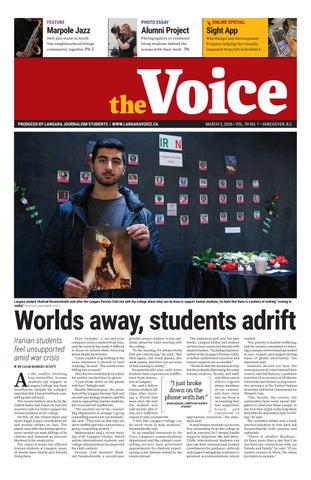
Shadab Mahavarpour, the president of the Langara Persian Club and second-year biology student, said the club is supporting Iranian students, but encountered roadblocks.
“We reached out to the counselling department to arrange a group counselling session for our students,” she said. “They told us that they are short-staffed and they cannot have a group counselling session.”
Mahavarpour said a recent meeting with Langara Global, which assists international students, and college administrators has improved the club’s outlook.
Persian club member Shahrad Nezamolmolki, a second-year
general science student, is less optimistic about the club’s meeting with the college.
“In the meeting, it’s always words that are convincing,” he said. “But then again, one week passes, two week passes, and then you see none of that coming to reality.”
Nezamolmolki also said some students have experienced indifference from instructors at Langara.
He said a fellow Iranian student left class after learning a friend had been shot. He said the student was told shortly after it was not a sufficient reason to miss coursework.
The statement said over the past weeks, Langara Global and student services have connected directly with student leaders, “including representatives of the [Langara Persian Club], to better understand concerns and ensure supports are accessible.”
“I just broke down on the phone with her.”
— RYAN SADEGHI, COMPUTER SCIENCE STUDENT
“I feel like Langara College can do much more to help students,” Nezamolmolki said.
In an emailed statement to the Voice, Langara’s communications department said the college’s counselling services have prioritized appointments for students experiencing acute distress related to the events abroad.
“We know that the situation in Iran has been deeply distressing for many Iranian students, faculty, and staff, and when unrest affects regions where members of our community have close ties, our focus is on ensuring they feel supported, heard, and connected to appropriate resources,” the statement said.
It said Iranian students can access free counselling from the college as well as external 24/7 mental health supports Empower Me and Here2Talk. International students can also ask their international student coordinators for guidance, referrals and support navigating academic or personal accommodations where
needed.
“Our priority is student wellbeing, and we remain committed to fostering a campus environment grounded in care, respect, and support during times of global uncertainty,” the statement said.
Students should not bear the consequences of crises beyond their control, said Atif Kubursi, a professor emeritus of economics at McMaster University and former acting executive secretary of the United Nations Economic and Social Commission for Western Asia.
“The faculty, the society, the universities have some moral obligation to tend over these people, to see how they might really help them deal with the deprivation they’re feeling,” he said.
The renewed strikes and a fresh internet blackout in Iran have left Nezamolmolki both anxious and optimistic.
“There is another blackout… it’s been more than a day that I do not have any connections with my friends and family,” he said. “If you cannot connect to them, the stress just starts to escalate.”
Langara student Shahrad Nezamolmolki said after the Langara Persian Club met with the college about what can be done to support Iranian students, he feels that there is a pattern of nothing “coming to reality.” PHOTO BY LIAM ROBERT SCOTT
Subway refuses coupons
Langara’s franchise doesn’t have same rules as other schools
Students are expressing frustration that the Subway restaurant at Langara will not accept coupons, leaving them to seek discounted sandwiches at off-campus locations.
Subway franchises at UBC, SFU, Capilano University and Columbia College all accept discount coupons that are a common part of Subway’s marketing and a chance at cheaper meals for cash-strapped students. Subway locations off-campus also takes discount coupons.
At the Langara location in the T Building, customers are greeted with a sign at the front counter that reads: “Unfortunately, Subway coupons are not currently accepted at this location.”
Sofia Bernaldez, a second-year history student, works in fast food and said she understands that smaller franchise locations sometimes lack the resources to accept coupons. However, she added that students in Vancouver face significant living expenses on top of tuition.
“I completely understand not being able to accept coupons, but it is really frustrating, especially because a lot of students are really struggling financially,” Bernaldez said.
Second-year film arts student Angela Nevy said not everyone has a steady income to cover food costs on campus.
“Some people are relying on government loans to be here,” she said.
The Voice reached out to the campus Subway manager and to
Chartwells, the company contracted to provide food services on campus. Both declined to comment. Subway Canada’s media contact and managing director did not respond by publication date.
June Francis, a marketing professor at SFU, said Subway franchises at post-secondary institutions might have different rules about coupons than restaurants located off-campus.
“If they don’t think they’re going to make back the loss . . . the coupon gives you, they’re not incentivized necessarily to accept your coupons right now,” she said.
But Francis said, the lack of coupons at a campus location is unfair to a student market served by a company that has a monopoly on food services.
“It’s a great hardship that students have to leave the campus to now
pursue Subway somewhere else,” she said.
Francis said a contract that gives an exclusive right to accompany on campus comes with specific responsibilities.
“And I think one of those responsibilities should be that students who shop at Subway on campus should be not ever put it at a disadvantage if they were to buy the subway somewhere else,” she said.
Reduced hours
Recent cuts to Langara College’s cafeteria hours and a later opening time has left some students having to choose between eating a morning meal or getting to class on time.
Students who have early morning classes, have long relied on cafeteria services. This semester, Chartwells, the company providing food services in the A Building, switched its opening time to 10:30 a.m. from 8:30 a.m. Tommy Tran, second-year student pursuing computer science, said he was expecting the A Building cafeteria to be opened early in the morning, but had not known of the time change prior to showing up for his early morning classes.
“I learned that the hard way. I came here and it was not open,” he said.
Xian Garcia, a first-year computer science student, said students should be able to access food when they need it.
“Food should be available all day because some students need to eat and drink, and vending machines aren’t reliable,” he said.
Chartwells declined to be interviewed the Voice
During early morning hours, students can buy food at Tim Hortons next to the cafeteria, but choices are limited. Students say the long line-ups at Tim Hortons in the early hours can mean they wait up to 30 minutes, leaving them scrambling to make their classes on time.
“I don’t like it mainly because I come earlier and not having it (the restaurant) accessible is kind of annoying,” Garcia said.
By Duncan McCarthy
Students line up during lunch hour outside the T Building’s Subway restaurant in Vancouver, B.C. on Feb. 12, 2026.
PHOTO BY. AVERY ST. GERMAIN
BY AVERY ST. GERMAIN
Provincial review under criticism
Student unions are not being examined in B.C. post secondary assessment
BY VALENTINA BARRERA
Aprovincial government review of British Colum-
bia’s post-secondary system is drawing criticism from advocates and critics who say it fails to examine student unions, some of which have long been considered problematic.
The Ministry of Post-Secondary Education and Future Skills launched the independent review last November to assess long-term sustainability of post-secondary institutions in B.C. Currently, colleges and universities are facing mounting financial pressure from global inflation, combined with plummeting enrolment and revenue due to federal cuts to international student visas.
The review, led by former deputy minister Don Avison, is expected to examine governance, operations, program delivery and tuition policies
across the public system. The province says the goal is to stabilize institutions, while ensuring programs align with labour market needs and remain accessible to students.
Korky Neufeld, post-secondary education critic for the B.C. Conservative Party, said not examining student unions misses a key perspective.
“I think they’re missing the mark,” he said. “Nobody wants to answer this. Nobody wants to take accountability for this, and I think that’s where the problem lies.”
Student unions collect mandatory student fees and operate independently under the Societies Act. This means they do not fall under the Freedom of Information Act, nor is there any oversight body monitoring their activities.
Historically, this has allowed some student unions to provide little to no transparency to its members, who
have no means to challenge their activities or finances.
The ministry said it does not have the authority to ever intervene because student societies are independent legal entities governed under the Societies Act, said Seina Cho, public affairs officer for the ministry, in an email to the Voice
The ministry also said students concerned about student unions governance can pursue remedies through society bylaws or a civil resolution tribunal.
Longtime government transparency advocate Stanley Tromp said broader scrutiny for student unions is needed from the provincial government. He called the current student union system “absolutely outrageous,” especially in cases where elections are voided or finances lack clarity.
He said a deeper structural reform is needed to tackle limited transpar-
ency and accountability in student unions.
“I was pleading that B.C. should create new standalone societies act because they’re distinct from other societies,” he said.
Tromp said he asked the Post Secondary Education and Future Skills public affairs branch whether the review would accept submissions from students about problems with their student societies.
However, he said he received an email back, saying Avison would consider input from student societies themselves as part of his consultation, but as independent organizations under the B.C. Societies Act, they were not considered within scope for the review.
“So it appears the review will take advice only from the student unions but nothing about them,” Tromp said.
Student groups have warned the
process is moving quickly and risks overlooking the lived realities of students navigating affordability, representation and campus governance.
For some students, the concerns are real. Vansh Gupta, who served as Langara Students’ Union vice president internal and external in spring 2025 was interviewed by the Voice in November.
He said transparency issues can discourage participation and limit trust in campus governance.
He questioned how decisions were made within the union.
“Usually, I think LSU staff makes the decisions for everyone. The board just follows whatever they do.” Neufeld said students should continue to speak up.
“Just keep going public with it. You have a right to be heard, and you have a right for this to be transparent,” he said.
Enrolment decline prompts service cuts
Students seek alternative mental health supports
BY GUILHERME MÜLLER
Cuts to services at Langara College in response to the drastic decline in international enrolment have left many students without clear support or guidance, prompting some to seek alternatives.
Due to financial strain following reductions to international student permits in 2024, the college has made sweeping cuts to services and supports, scaling back on mental health, library service hours, as well as some academic resources.
The Mental Health Ambassador program, a peer-led model that acted as an entry point to professional services, was a part of those cuts.
The program served more than 6,000 students annually and trained about 80 paid volunteer ambassadors.
Former co-ordinator Amanda Burkholder said the program connected students in distress to counsellors they might never have approached on their own.
“Maybe that student would have never gone to counselling, but because they have that rapport with their peer, they go,” Burkholder said.
When the program was cancelled last December, Edward Cai, a psychology student in his final year, began researching similar peer support models at other universities and reached out for guidance.
Cai, who used the program, envisions a dedicated peer listening service with a fixed location and set schedule, where trained student volunteers could provide support and refer peers to campus resources before struggles escalate.
“I would like to be part of a positive influence,” he said. “To catch someone before they get to that point.”
The cuts to student services form part of a broader reduction strategy
that faculty representatives say has not been evenly distributed. Pauline Greaves-Aylward, president of the Langara Faculty Association, said departments were directed to cut 25 per cent of their budgets.
While the college said it eliminated 31 administrative positions, more than 230 faculty members have received layoff notices with about 70 expected to leave at the end of April, according to the LFA.
“There are so many international students at Langara, but the Global office always has maybe two or three employees working to answer questions,” she said. “When I have any question, and I ask them, they just direct me towards Langara’s website.”
“When I have any question ... they just direct me towards Langara’s website.”
— KANCHAN KANCHAN, LANGARA STUDENT
Other student-facing services have also been affected.
Kanchan Kanchan, an eighthsemester health science arts student, said navigating Langara college as a newcomer to Canada meant juggling academic pressure, work and immigration requirements with little guidance. She said Langara Global, the main resource for international students like her, is understaffed.
“I have already read the website. What I want is an opinion on my specific situation,” she said.
Though counselling and mental health support services are provided through the college, she only realized she could access them in her final semester.
“If I’m paying for a service, I should know all about it,” she said.
Kanchan said services were available, but she lacked a supportive and accessible community to help guide her toward the specific resource she needed at every stage.
An emailed statement to the Voice
from the communications department said students’ mental health and wellbeing remain a priority.
“We recognize that many in our community are concerned about the impact of recent changes,” the statement said. “Like institutions across the province, Langara is responding to enrolment-related revenue loss following recent federal policy changes.”
The statement said students still have access to free 24/7 external supports, including Empower Me and Here2Talk.
Students have also been affected by other reductions.
Earlier this year, the college announced reduced library hours for spring 2026, including full Sunday closures, and GreavesAylward warned that the library “will continue to lose additional services.”
Lab assistant and marker positions have also been cut, leading to worries about late and limited feedback for students.
“There are many of us who are willing to help and are trying to make things happen,” Cai said.
Student sitting at the Langara Students’ Union lounge on Feb. 24, 2026.
PHOTO BY VALENTINA BARRERA
A Different kind of brew
Coffee and jazz blend at East Café to support artist, homeless
Aneighbourhood outside Vancouver’s music scene is home to a new jazz venue that supports its community in more ways than one.
Josh Kim, the owner of the coffee shop East Café on Hastings, opened a second location in Marpole four months ago and has been organizing jazz nights in the basement of the cafe, called The Pocket.
Despite South Vancouver not being considered part of the city’s live music core, he said he had “a first love at first sight” with the Marpole location, at West 70th Avenue and Cartier Street, and saw the potential to create a community there.
Shortly after opening its first location on Hastings two and a half years
ago, East Café served free meals to the homeless as a part of its program, City Smiles. According to Kim, the initiative has served over 4,500 meals.
As donations to the charity have never fully covered the cost of meals served, Kim started to organize ticketed jazz nights to fund the charity and musicians.
At East Café, Kim organizes free community events including jazz jams with like-minded artists. He said he wanted people to stay as long as they want and connect with others. Kim said he did not expect the community response when tickets sold out until March 21. He said it was “quite insane.”
Since opening, East Café has become an essential gathering spot
Photos and stories by Zoe Li
to its Marpole patrons.
Tetiana Voitseshchuk, a former Marpole resident, said East Café was welcoming and less formal compared to jazz events she has attended in other countries.
“I personally find it beautiful,” Voitseshchuk said.
She said East Café is not just a business, but a community that offers a space for musicians to grow and express themselves.
“Loneliness is skyrocketing,” Voitseshchuk said. “Such events, they have a tremendous meaning.”
Saxophonist Alfred Abrenica, who performed at the cafe, said he was happy that the venue brings together many live music lovers in the community. Unlike other venues where
Abrenica usually deals with a middleman, he said he could directly work with Kim at East Café. “I’d love to get my own band together and perform here,” Abrencia said.
Julian Jayme, another performer at East Café, said the experience was intimate and that it “feels more interactive with the audience.”
Knowing that many local artists struggle to perform because they are not generating profit for the venues, Kim created The Pocket as a gesture of gratitude to the jazz artists he worked with to gather and practise.
Being a jazz fan, Kim said “jazz has been more of a bond that brought everybody together.”
In addition to jazz shows, the café hosts books clubs and meet-ups.
brew in marpole
From bottom left to top right
Man playing the drums during a jazz jam.
Josh Kim makes coffee during his shift.
Julian Jayme sings while playing the guitar at jazz jam.
Artists playing music during the jazz jam.
Growth in the jazz community
A renewed interest in jazz growing throughout Vancouver
Just as East Café marks a new inroad for jazz in South Vancouver, the rest of the city is experiencing a rise in jazz interest.
Jim Hopson, the director of UBC Jazz Ensemble and the president of the Vancouver Musicians’ Association, said public interest in jazz surged to unprecedented levels after the pandemic.
“I would say the jazz scene really is thriving in many ways,” he said.
Vancouver has seen the establishment of new venues and comprehensive jazz education with skilled veteran musicians and young talents, Hopson said. He said the city now has more diverse engagement in the genre.
Professional drummer Arvind Ramdas said while more performance opportunities are available to young
musicians, it is a challenge to maintain the performance standards long upheld by veteran players.
“Venues are using younger people, which is good, but they’re also using a lot of young people who are not ready to be on the bandstand yet,” he said.
Tim Reinert, the owner of a music event company Infidels Jazz, said small independent venues are crucial for musicians to improve their craft and develop an audience.
“It’s the lifeblood of the scene. It is the heart of the scene,” Reinert said.
One of his priorities is to extend Vancouver’s momentum into surrounding regions and other parts of the Lower Mainland and make jazz more accessible to the public.
“I don’t think they need to understand jazz,” Reinert said. “I think they need to enjoy jazz.”
Immersive art project returns to Langara
Former students debut a long-developed film project during their residency at the college
More than 16 years ago, an idea began as a small seed for Trevor Jacobson and Tanya Goehring while they were students at Langara. Now, the Vancouver-based artist duo is returning to the college, this time as artists-in-residence to finally bring that idea to life.
Their project, How to Make a Monster, is a seven-channel immersive film installation accompanied by an original electronic score. The concept traces back to Goehring’s childhood, when she became aware of an imagined “jury,” a feeling of being watched and judged that
self. Over evolved into an exploration of the inner critic and the ways people construct fear, doubt and identity. Jacobson and Goehring have spans beyond expanded
and live cinema, photography, new media and electronic music production. Known for creating surreal, emotionally charged environments, the duo blends cinematic imagery with experimental sound to produce immersive, multi-sensory experiences. Their projects have been presented across Canada, the United States, Germany and Denmark.
The residency is arranged by the department of profes-
Above: The actor lies on the hospital bed in her robe, waiting as the shoot continues to stretch over several hours. The photograph is taken from a compressed, zoomed-in perspective between the outstretched arms of Tanya and Trevor in the foreground, their bodies partially framing the bed without fully entering the scene. This tight vantage point emphasizes the actor’s stillness and isolation, while the blurred presence of the two figures suggests ongoing discussion and adjustment just beyond her reach. The image captures the tension between patience and control, a moment where performance pauses, yet the construction of the scene remains active around her.
Left: A young child actress studies her reflection in a handheld mirror while production continues around her. In the glass, faint reflections of other actors waiting nearby appear layered behind her, their presence softened by distance and time. Her expression remains steady and composed, as if quietly rehearsing or observing herself before the next take.
Bottom Left: The image excludes the technical crew, centering attention on the actors’ quiet stillness as time stretches between takes. Their expressions and posture suggest a pause filled with anticipation rather than inactivity, shaped by repetition and restraint.
Bottom Right: In the foreground, a crew member adjusts a ladder in preparation for the next lighting change, moving carefully so as not to disturb the actors holding their marks.
PHOTOS BY RIDWAAN ADAS
sional photography with a stipend of $15,000. The artists are developing and installing the multi-screen work within the college’s gallery space from January until April, inviting students to engage with both the production process and the final exhibition. The installation will be presented in the T Building starting April 1.
The residency allows the artists to engage directly with the students through lectures, mentorship and studio visits. Students have the opportunity to assist and observe throughout the production process, gaining practical experience in the creation of a large-scale immersive installation.
BY RIDWAAN ADAS
UNLOCK YOUR COMMUNICATION SKILLS & MASTER STORYTELLING
Masterful storytelling is the core of exceptional journalism. Gathering facts, cultivating a compelling narrative and harnessing the power of imagery are powerful skills that connect you with your audience.
Develop your storytelling skills with these journalism classes, now open to all general arts students:
THINKING OF A CAREER IN JOURNALISM OR COMMUNICATIONS?
SIGN UP FOR AN INFO SESSION TODAY!
JOUR 1122 Introduction to Media Research
JOUR 1128 Fundamentals of Reporting
JOUR 1288 Radio Storytelling and Podcasting
JOUR 1168 Photojournalism
JOUR 1290 Introduction to Digital Media Storytelling
JOUR 2398 Storytelling Through Video
JOUR 1224 Investigative Journalism
Marpole: all concrete, no canopy
Less
tree coverage and more pavement means residents could face a harsh summer
BY LIAM CLARKE
Five years after the 2021 heat wave, which killed more than 600 people in B.C., South Vancouver residents are grappling with its lasting impacts and questioning whether their neighbourhoods are prepared for the next extreme heat event.
As Environment and Climate Change Canada warns that 2026 will be one of the hottest years on record, Marpole residents could be more vulnerable to urban heat than other parts of the city.
Leonard Tang, geography instructor at Langara College, said that in urban areas, where tree canopy is limited, and where concrete-heavy streets and buildings trap heat,
Lifestyles
extreme temperatures can last longer and hit harder.
Five years after the 2021 heat wave, Marpole is still a heat sensitive hotspot.
Open data stats show that tree canopy coverage in Marpole is at 17 per cent. The highest canopy coverage in Vancouver is in Shaugnessy at 41 per cent. This imbalance is one of the reasons why Marpole is vulnerable to extreme heat.
“Concrete and asphalt trap a lot of heat,” Tang said. “You see quite a drastic difference between the temperatures in urban areas versus rural. Not just during the daytime, but also at night.”
“You need a lot more green areas.”
Between June 25 and July 1, 2021, B.C. experienced an unprecedented
Students entering post-secondary face social isolation
Social anxiety and academic pressure contribute to feelings of loneliness among new students
BY RHEA SINGH
As post-secondary students navigate loneliness on campus, a counsellor says their perceptions of social situations can make it worse.
Clinical counsellor Muge Celik Orucu said loneliness among postsecondary students often has less to do with being alone and more to do with how they interpret the social situations around them.
“It’s just my mind machine that is causing me to feel this way. How am I perceiving it?” she said.
Many Canadians are aware they need counselling but do not seek it, according to a Statistics Canada report published Jan. 21. Thirty-eight per cent prefer to manage alone, while 33 per cent say help is simply not available.
The experiences of loneliness young people have when attending post-secondary education set them up for their future, said Kiffer Card, an assistant professor in the faculty of health sciences at Simon Fraser University.
“We need safety, family, connection, identity and belonging. If we don’t find ways to get these when in college, we suffer loneliness, and we set ourselves up for a life course trajectory of unsatisfied social need,” Card said in an email to the Voice.
Without therapeutic sessions, recognizing negative cognition is difficult, Orucu said. She recommends low-cost counselling services, journaling apps and grounding techniques for students who need mental health resources.
“When you are grounded, you perceive things differently. So, [you]
heat wave that broke temperature records across Metro Vancouver. At its peak, temperatures reached over 40 C in many parts of the city. The heat wave exposed vulnerabilities in Vancouver’s buildings and social support systems, with a BC Coroners Service review finding that 619 British Columbians died in the six days of extreme heat. Most of those who died lived in homes without adequate cooling systems.
Environmental experts say that this summer is on track to be one of the hottest one in 43 years.
For residents, students and renters living in South Vancouver, particularly seniors or low income families who live in older apartment buildings, the BC Coroners’ review’s findings mirror local reality
in neighbourhoods with limited tree canopy and buildings that are not designed for rising temperatures.
“Vulnerability to extreme heat is economically, socially and politically produced,” said Gabriela Doebeli, a graduate researcher with the Centre for Climate Justice at UBC. “It’s the result of a set of factors that layer onto each other and compound.”
The City of Vancouver said in an email to the Voice it is working to reduce the risk of extreme heat, especially with disproportionately impacted populations through its Climate Change Adaptation Strategy.
Liv Yoon, an affiliate faculty member of the Centre for Climate Justice at UBC, which is a research and policy institute that provides recommendations and expertise
on policies, said that community knowledge is essential to come up with effective heat-responses.
“Communities apply for funding to mitigate the effects of heat in ways that they know work,” Yoon said. “They have local knowledge, so we need to listen to them.”
Ryan Vernon, a librarian and technical services coordinator at Langara College, said “the heat was something we just lived with before.”
But he says that, with temperatures in the summer “slowly increasing, little by little,” he feels lucky that a few years before the 2021 heat wave he was able to afford to have air conditioning installed in his home.
“All of my family members had to come to my house because I had AC and they didn’t,” Vernon said.
will have the courage to take action to engage with other people,” she said.
Edward Cai, a second-year Langara psychology club member, said that interpreting situations negatively leads students to continuously face loneliness long-term.
Some students tend to overthink about how others view themselves which leads them to retreating to their own spaces, he said.
This tendency to overthink “has a long-lasting impact on self-image and [the] ability to make connec-
tions,” Cai said.
For second-year health sciences student Maral Zade, Langara’s smaller campus makes the experience feel slightly less daunting.
She said that not knowing anyone at school can make her dread coming to campus, but it helps that Langara is a small school.
“I will say, luckily, this campus is smaller than other universities. So, you feel less...scared of going,” said Zade.
Ana Huerta, a first-year psychol-
ogy student at Simon Fraser University, said coming to post-secondary with friends from high school gave her an advantage, but also created its own barriers to making new ones.
“It was way easier to kind of stick with [high school friends],” she said.
Having that built-in group can make students less likely to seek out new connections, Huerta said. For those arriving alone, the feeling of being the only one without a readymade circle can make the campus feel isolating.
A tree stump near the neighbourhood of Marpole in Vancouver, B.C., on Feb. 15, 2026. PHOTO BY LIAM CLARKE
Students at the cafeteria in the A Building at Langara College, Vancouver, B.C., on Feb. 11, 2026.