How Might Minnesota be a Leader in Creating a Resilient Agriculture?
Note: On March 2, Minnesota Senate Agriculture Committee Chair Aric Putnam invited agricultural groups to share insights on their members’ concerns, frustrations, and current work in a special “State of Agriculture” hearing at the state Capitol. Below is an excerpt of testimony shared by Laura Schreiber, the Land Stewardship Project’s government relations director.
By Laura Schreiber
As you have heard today and will continue to hear, farmers and our communities at large are facing an extreme level of volatility and uncertainty — farmers and communities across the board are really struggling right now.
A few weeks ago, I traveled to Washington, D.C., with Adam Griebie, a Land Stewardship Project member and row-crop farmer from Hutchinson, Minn., along with partners from Renewing the Countryside, the Institute for Agriculture and Trade Policy, and Marbleseed, as well as Ellen Gardner, a farmer from Spring Grove, Minn., who raises pastured poultry. We were there to continue to advocate for the passage of a Farm Bill —which we are well overdue for — and share what impacts the current federal climate and the happenings in Minnesota have had on agriculture.
Their stories were stark and I want to share them with you today. Ellen has customers in Rochester and the Twin Cities— she sells at the Northeast Farmers’ Market — and her customers have been sheltering in place due to the presence of U.S. Immigration and Customs Enforcement agents; they had been staying home for weeks. After hearing that she has customers who needed help getting food, Ellen sent one e-mail to her list and was able to raise $4,000 and provide chicken and turkey to people in need. I know we have heard these types of stories from all across Minnesota, and I think it is important we continue to
share them. She shared that a mother resorted to washing disposable diapers because they were so scared to leave their home. We have farmers who are not sure if their skilled H-2A visa workers will be able to come back to the farm, leaving them struggling to figure out labor in an already stressful climate. BIPOC farmers are concerned about sustaining their farm businesses.
Immigrants & the Food System
Since November 2024, LSP has been in deep partnership with COPAL, a Latine power-building organization that has members across Minnesota. In 2025, COPAL launched the Immigrant Defense Network and LSP has been co-facilitating its rural
Your Rights” sessions, and with partners have created a network of support throughout the state. Together, we have supported food deliveries, rides and errands, mutual aid financial funds, local business support, and more.
It was important for us to get involved and support this work because we cannot have a truly just and sustainable farm and food system without supporting and recognizing the critical role that immigrants play in feeding our communities. And not only immigrants, but Black, Indigenous and people of color communities that have also been under attack during Operation Metro Surge. The future of agriculture demands that we have more farmers on the land, from all backgrounds and races. That is why Minnesota must continue to play a pivotal role in supporting the next generation of farmers through support of programs like the Farmland Down Payment Assistance Program, as well as via support of the Minnesota Department of Agriculture’s Emerging Farmers Office and continuing to explore more ways to help farmers secure land and the infrastructure and equipment needed to have a successful operation.
Federal Uncertainty
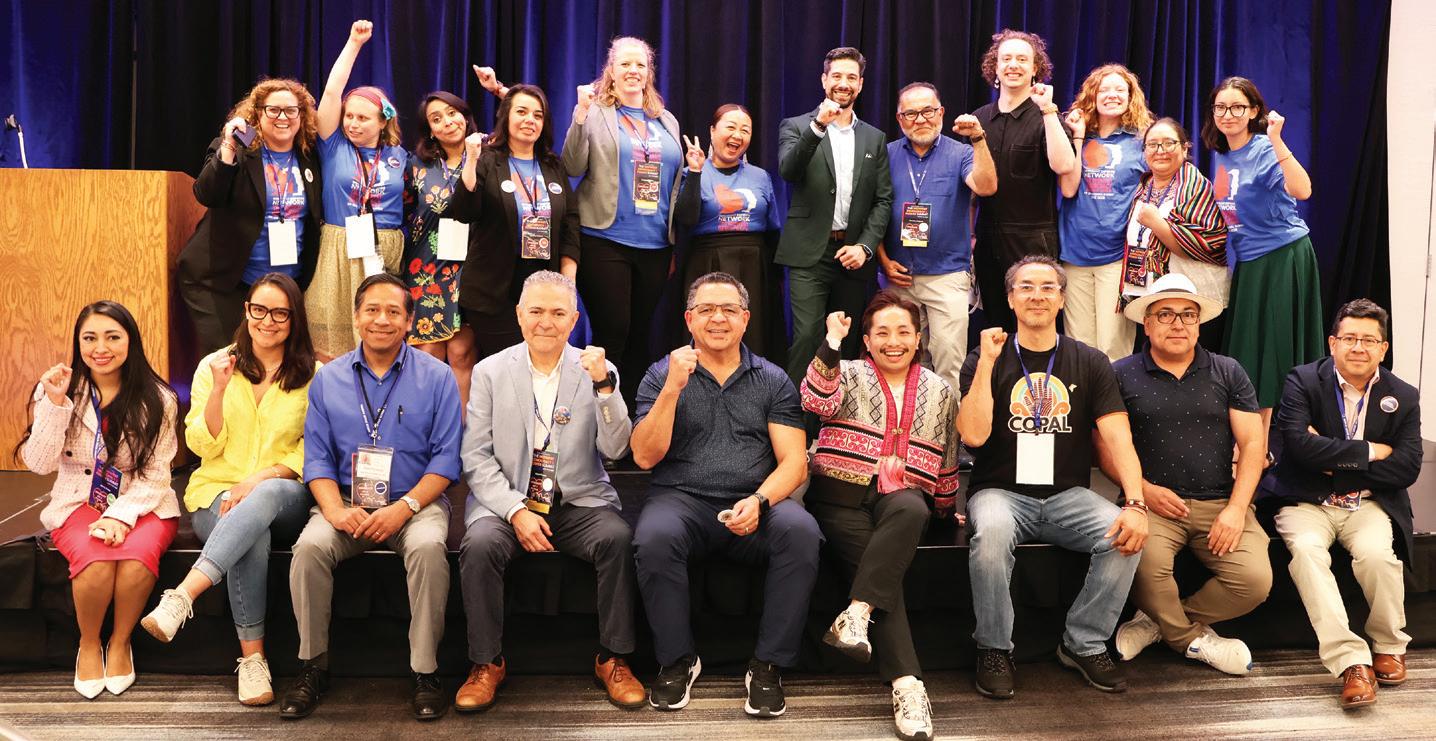
In June, LSP participated in the Immigrant Defense Network’s Midwest Power Summit. We cannot have a truly just and sustainable farm and food system without supporting and recognizing the critical role that immigrants play in feeding our communities. (LSP Photo)
initiative. Our role over the past year has been connecting, listening, and communitybuilding. We are connecting people in rural places to know their rights, listening to understand how rural communities are being impacted and what they need, and bringing people to be together in community. LSP has trained more than 550 people in “Know
I’d like to pivot now: I had mentioned that row crop farmer Adam Griebie was also in D.C. with me, and I want to share what he’s been experiencing. Right now, farmers are facing an intense amount of uncertainty as a result of export market volatility. They are facing the continuing rise of input prices, and are feeling the staffing shortages at the USDA’s Farm Service Agency and Natural Resources Conservation Service, also known as the NRCS. Nationwide, the NRCS has lost at least 2,400 employees since January 2025 due to the Trump administration’s efforts to reduce the federal workforce. Adam now has to travel two counties over to talk with Farm Service Agency and NRCS staff about his contracts.
We have farmers who had gaps or delays, like Adam, in receiving their payments for conservation program payments and last year, of course, a number of federal grants and contracts were cancelled; farmers are
Leader, see page 5…
still feeling the effects of those cancellations. Minnesota was set to receive over $17 million from the federal government for Farm to School and Local Food Purchase Assistance programs. You all as a committee stepped in and created a state Local Food Purchase Assistance initiative and increased the funding for Farm to School, but we know the need is much greater than current funding levels.
For commodity growers, there is $11 billion in the federal farmer bridge loan assistance payments that are now open and $1 million available for specialty crop growers, but these are temporary solutions. Our current farming system is not working for folks across the board; it’s time for some transformational changes. Part of that requires growing out our local markets and processing infrastructure.
Market Power for Farmers
At LSP, we have long been working to develop more local markets, and in the past two years especially we have seen a great interest in developing small-grains markets in Minnesota and the Midwest, providing an alternative to the raw commodity export system. Oats and small grains are attractive to farmers who are seeking water quality benefits and a reduction in the use of expensive inputs. Adding a third crop to the rotation also produces soil health benefits while providing food for their communities. This year in Rochester and last year in Albert Lea, LSP held our Winter Soil Health Workshops, which focused on building out local markets and the processing needed to support crops that are outside the dominant corn-soybean rotation.
We had more than 100 farmers come to Rochester and more than 200 come to Albert Lea for these workshops. There is an appetite from farmers to diversify what is on the landscape while creating fair, local markets that pay a good price. A new processing facility, Green Acres Milling, is being built in Albert Lea and is exactly the type of investment we need. The farmer organizing that went into this endeavor is awesome.
We know farmers are innovators and resilient, they are already working on solutions. Minnesota needs to continue to be a leader and supporter in building out the infrastructure and markets for these crops. We are seeing what consolidated markets have done to farmers, and it’s not great.
The Future of Livestock Farming
I want to address another area of concern for our members, and that is animal
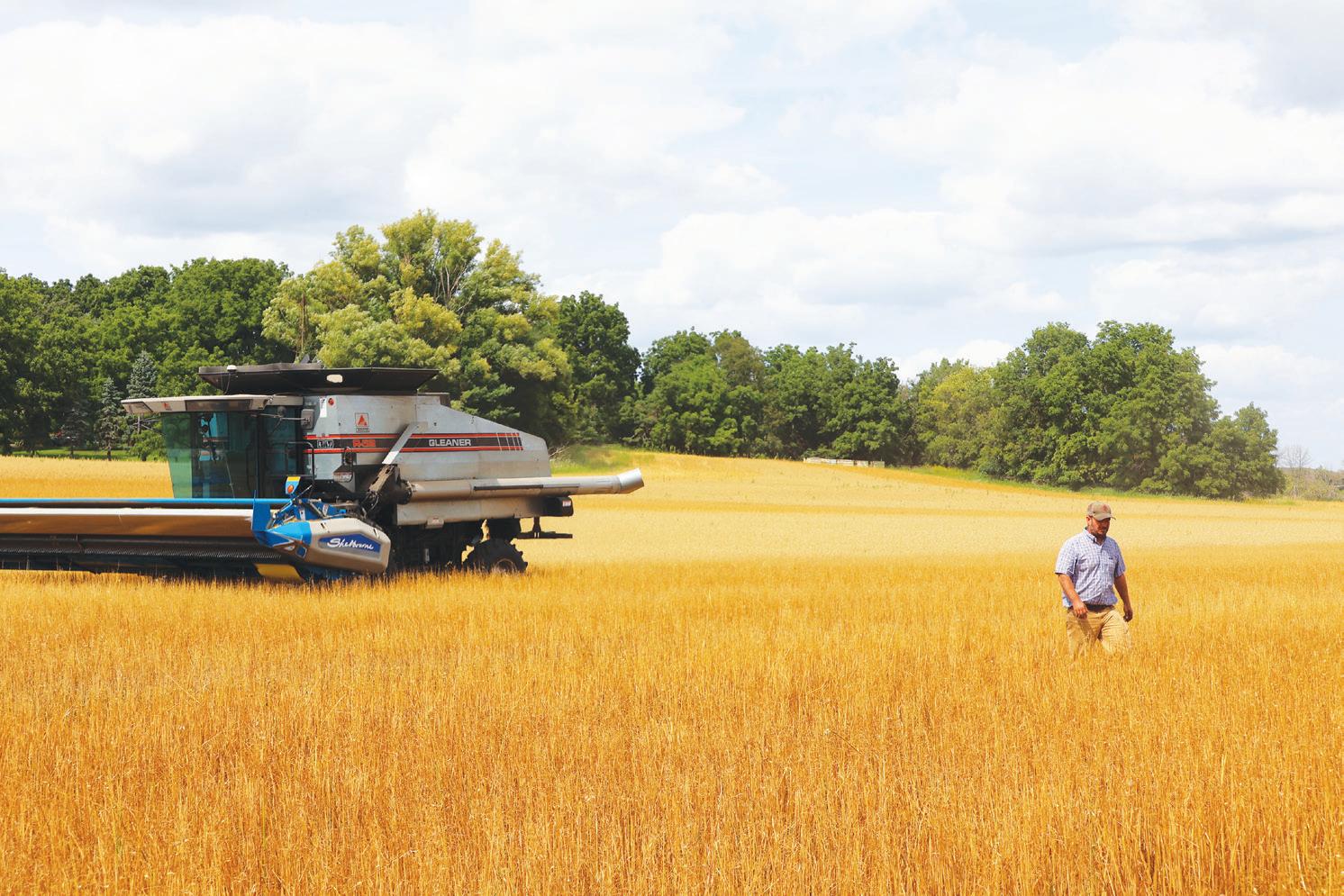
Southeastern Minnesota farmer Martin Larsen is diversifying his row cropping operation with oats. There is an appetite from farmers to diversify what is on the landscape while creating fair, local markets that pay a good price. (LSP Photo)
agriculture. A common thread that I hear through many of my conversations with LSP members is the impact that agricultural consolidation and concentration has on both farmers and our rural communities. For example, Minnesota has lost 528 dairy farms in the past four years; 1,987 since 2017. Our state is losing dairy farms due to inconsistent and often below cost-of-production milk prices. This price disaster is largely caused by massive dairy operations being able to glut the milk market with overproduction, making it hard for smaller family farms to compete.
I raise this today as we are hearing concerns about a planned dairy expansion out in Morris, Minn., that will involve expanding one facility from 7,800 dairy cattle to 18,855. There are concerns about what this move means for Minnesota dairy farmers who are already struggling with consolidation of the marketplace. Such a facility of unprecedented scale would have major negative impacts not only on rural economies but the environment as well, with water usage alone being of astronomical proportions.
Last week, in the House Environment hearing, we heard from staff at the Department of Natural Resources that there are already concerns in western Minnesota when it comes to groundwater and aquifer capacity; not all those aquifers are even mapped. Now data centers and larger dairy farms are adding to concerns about water in the region. A bill that was brought before this committee by Senator Aric Putnam would require an environmental impact statement for any new projects of 10,000 animal units
or more to better understand the potential environmental, economic, and social impacts of a proposed project and identify ways to minimize those impacts. This new proposal near Morris would be over 20,000 animal units. Members, I think it is critical we fully understand the potential risks of such an unprecedented facility.
What If?
To end, what is currently happening in D.C. has changed the equilibrium of our federal farm policy. I want to leave this committee with a question: how might Minnesota be a leader in supporting the next generation of farmers, creating fair, local markets that feed people while supporting a type of agriculture that keeps and welcomes new people in our rural towns and communities, and has the health of our people and the land guiding it? p
For a wrap-up of the 2026 session of the Minnesota Legislature, see page 8.
To read and download the Land Stewardship Project’s long range plan, The Roots of Resilience: Grow, Challenge, Build & Steward, see landstewardshipproject.org/long-rangeplan. Paper copies are available by emailing membership@landstewardshipproject.org or calling 612-722-6377.
Myth Buster Box
An Ongoing Series on Ag Myths & Ways of Deflating Them
➔ Myth: Big Ag is Keeping its Green Promises
➔ Fact:
They say talk is cheap, but when it comes to the world’s biggest meat and dairy companies, using words like “sustainable,” “natural,” and “ecofriendly” is worth a lot of money. Equally lucrative are words like “plan,” “future” and “potentially,” as in, “We plan to protect the future of the planet with potentially sustainable, eco-friendly, natural production methods.” Notice how that word salad is chock full of vague, hardto-substantiate claims? That’s one of the markers of what’s called “greenwashing,” which is defined as “the dissemination of false or deceptive information regarding an organization’s environmental strategies, goals, motivations, and actions.”
Greenwashing, along with its procrastinating cousin, “future-washing,” has become increasingly critical to the business model of Big Ag as eaters become more demanding that their food not be produced in a way that destroys the planet. Greenwashing can also be a way to fend off regulation. For evidence of that, look no further than the fossil fuel industry, which has used greenwashing techniques for decades to delay concrete action on climate change.
How prevalent is greenwashing in the corporate ag world? Well, a peer-reviewed study published earlier this year in the journal PLOS Climate found that 98% of the 1,233 environmental claims made by the world’s 33 largest meat and dairy companies could be categorized as greenwashing. These claims varied from using vague phrasing like committing to “sustainable beef production” to authentic-sounding claims that have the added heft of numbers attached. In that latter category, consider that in 2021, JBS, the largest meat company in the world — it produces more greenhouse emissions than Italy — claimed that it would have “net-zero” emissions by 2040. The company ran a full-page ad in The New York Times and issued a special “sustainability report” that, among other things, devoted eight pages to the net-zero promise. But JBS presented no achievable plan to reach that target, and the Attorney General of New York filed a lawsuit against the company, alleging its net-zero claims were misleading.
Some claims are almost laughable. Hormel Foods, the pride of Austin, Minn., has added a “How2Recycle” logo to 326 products as a way to supposedly make them more environmentally-friendly. This is an example of putting the onus on consumers to save the planet, all while the company continues business as usual.
Consumers have become more sophisticated in their ability to differentiate between claims that are authentic and those that are phony baloney. As a result, companies have worked harder to attach scientific credibility to their claims. JBS has an entire “net-zero” website that name-checks academic institutions the company supports, including Colorado State University’s AgNext program, which is directed by a former sustainability executive for JBS. The PLOS Climate study found that 29% of the claims it examined offering some sort of supporting evidence, but more than half of that evidence was based on a company’s internal pilot program or case study.
If giant meat and dairy companies were to act on their claims, it would be a big deal for aspects of the environment such as the climate. Food systems account for roughly a third of all human-caused greenhouse gases, and emissions from animal-based food production represent 57% of that share. One analysis found that the meat and dairy industry’s top five emitters — JBS, Marfrig, Tyson, Minerva, and Cargill — combined produce more greenhouse gases than individual major oil companies.
A major downside to these word games is that it distracts from production practices and business models that are inherently unsustainable, no matter how much green paint you slap on them. For example, a giant pork company may tout putting solar panels on a packing plant, or a dairy processor may feature happy, pastured cows on its milk cartons, all while ignoring that they source their animal products from giant concentrated animal feeding operations (CAFOs) which are polluting local water and producing plenty of greenhouse gases. A company can crow about supporting research into beef cattle feed additives that reduce methane emissions, all while continuing to rely on a carbon-intensive feedlot system and dismissing the fact that managed rotational grazing systems based on perennial plants can sequester carbon.
The owners of large-scale CAFOs are
taking a cue from folks further up the food chain and utilizing their own version of greenwashing. That’s been on full display in Minnesota, where Riverview LLP is attempting to create the largest milking operation in the state (see page 12). Everything about the West River Dairy is unprecedented: from the quantities of water it will slurp up and the amount of manure produced, to the truckloads of milk production it will dominate. The company’s owners claim they will utilize recycled water and store and dispose of manure in a way that it becomes “organic fertilizer.”
Meanwhile, they are ignoring the fact that putting almost 19,000 cows in one spot in a watershed that is already compromised by factory farming is not sustainable in the first place. Riverview is correct when it says that claims around manure management, for example, need to be verified by regulatory entities such as the Minnesota Pollution Control Agency (MPCA). However, such agencies have a spotty record when it comes to enforcing CAFO regulations, and the MPCA’s failure to order a full environmental assessment of the West River Dairy proposal, despite its unprecedented nature, doesn’t bolster confidence in the system.
As part of its winning hearts and minds initiative, Riverview recently donated $1 million to Minnesota 4-H. Riverview officials also boast that their mega-facility will employ 40 people. Those are prime examples of a diversion tactic at work: tout a donation to an organization dedicated to young agrarians and promise job creation, all while ignoring that this model of dairying is putting dozens of farm families out of business every year.
Before greenwash was a thing, there was another term for it: hogwash.
More Information
• “Environmental claims, climate promises, and ‘greenwashing’ by meat and dairy companies,” PLOS Climate journal, journals.plos.org/climate
• “Feeding Climate Change: A scoring of major meat and dairy companies’ climaterelated risks emissions reporting,” Institute for Agriculture & Trade Policy, iatp.org/ feeding-climate-change-scorecard-report
• More Myth Busters are at landstewardshipproject.org/myth-busters.
LSP News
LSP Staff & Board Update
EAlex Kiminski has left LSP’s staff to work for Renewing the Countryside.
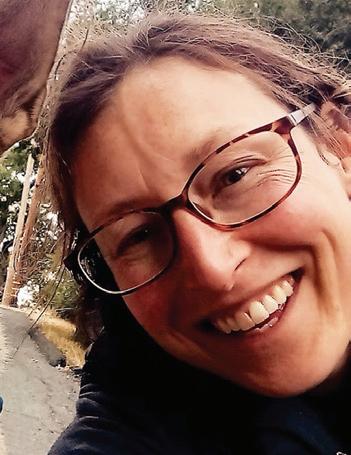

mily Minge has left the Land Stewardship Project after serving six years on its Policy and Organizing team. Before joining LSP’s staff as a fulltime organizer in 2020, Minge worked as an intern helping to coordinate two Family Farm Breakfast and Day at the Capitol events (see below). Over the years, she had worked with LSP members and allies to organize around issues related to local, state, and federal policy. Most recently, Minge served as a political organizer for Land Steward-
2026
LSP
Guaranteeing
ship Action, LSP’s partner organization that focuses on building power through electoral politics (see page 15). In that role, she worked extensively with rural allies to bolster local democracy initiatives.
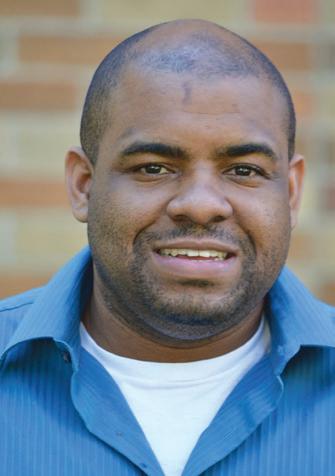
Timothy Kenney has wrapped up a 12year career as LSP’s director of finance and operations. After joining LSP’s staff in 2014, Kenney focused on extensively modernizing accounting and financial management systems in a way that better served the organization’s growing staff and program work.
Kiminski joined LSP’s staff in 2024 and worked on land access issues and assisting farmers in adopting practices that build soil health. She also facilitated workshops for the group Minnesota Women in Conservation. In 2025, she facilitated an LSP meeting in western Minnesota focused on ways to get more small grains integrated into corn-soybean cropping rotations. p
Contact LSP Staffers
To contact any member of the Land Stewardship Project’s staff, see landstewardshipproject.org/ staff-directory. Information on our offices is at landstewardshipproject.org/ contact. For details on LSP’s board of directors, see landstewardshipproject.org/ board-of-directors.
Family Farm Breakfast at the Capitol
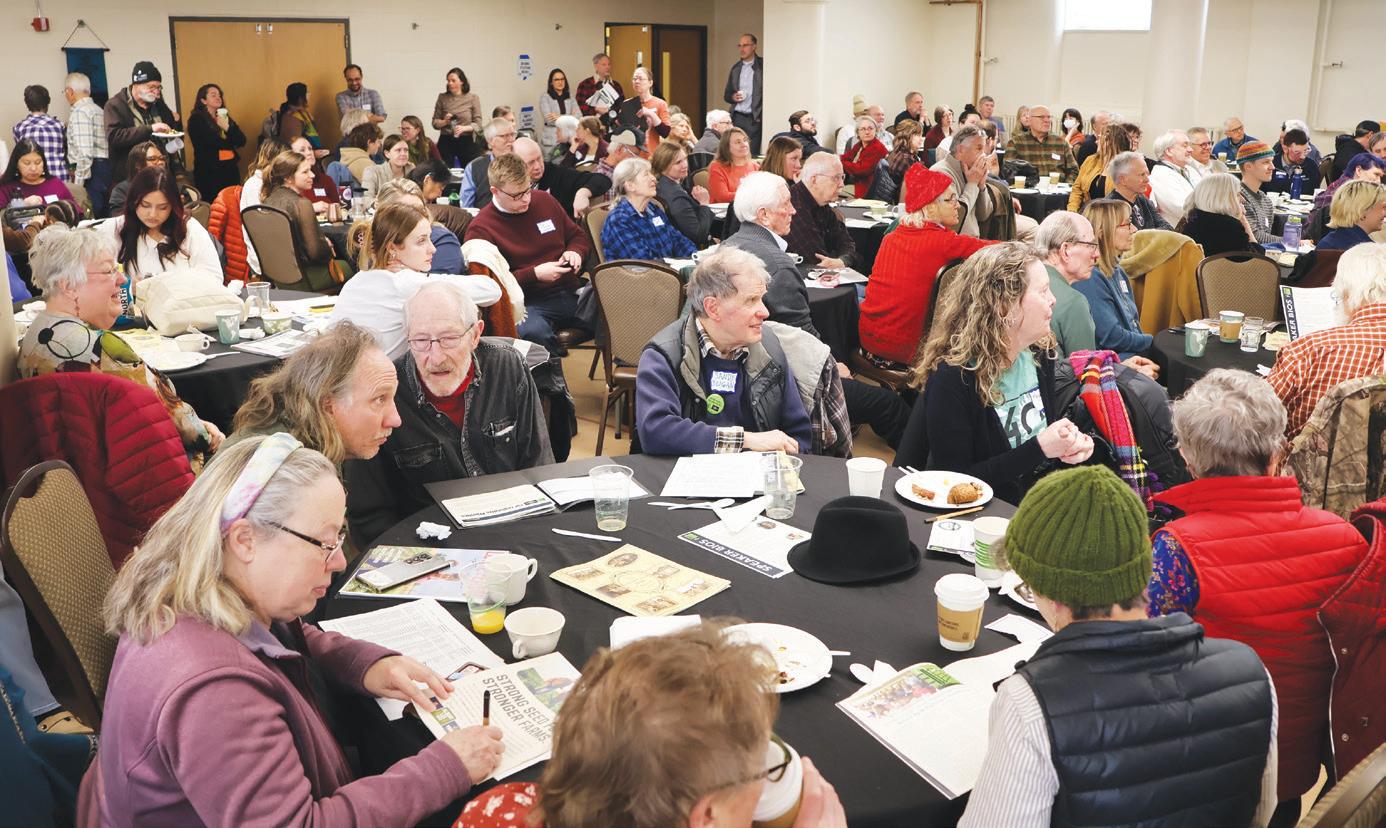
a brighter future for rural Minnesota is about creating the opportunity for farmers and nonfarmers to make choices, Pine County, Minn., livestock producer Hannah Bernhardt told over 150 Land Stewardship Project members and allies gathered at Christ Lutheran Church on Capitol Hill in Saint Paul on March 11. The event Bernhardt spoke at marked the 21st iteration of LSP’s Family Farm Breakfast and Lobby Day at the Capitol.
“Wherever we look, there are monopolies,” said Bernhardt, who is a member of LSP’s board of directors. “We are not free as Americans when we only have one choice: one place to get groceries, one hospital system, one tractor repair shop, one choice of a market for farmers to sell into.”
Keynote speaker Francisco Segovia, the executive director of COPAL, talked to the breakfast crowd about the federal government’s massive “immigration enforcement” campaign in Minnesota last winter.
“This is not about immigrants,” he said. “The immigrant issue is a vehicle to destroy our democracy. If we want to shape the future we want, we must connect across communities and build a common vision.”
After the breakfast, over 80 LSP members and allies walked over to the Capitol building across the street to meet with lawmakers (see page 10), including the chairs of the House and Senate Agriculture Committees, to relay their stories and provide details on various legislative proposals related to LSP’s priorities. LSP members also met with Attorney General Keith Ellison to discuss corporate consolidation, unfair marketing practices, and an attempt on the part of Riverview Dairy to build the largest concentrated animal feeding operation in the state’s history.
For details on how LSP’s priorities fared during the 2026 legislative session, see page 8. (LSP Photo)
Timothy Kenney
Emily Minge
Alex Kiminski
Policy & Organizing
Legislative Wrap-up: Lack of Ag Bill Represents Lost Opportunities
Some Gains Made for Clean Water, Soil Health & Beginning Farmers
By Laura Schreiber
It’s been said that politics is the art of the compromise. But during the 2026 session of the Minnesota Legislature, that approach to policy making was undermined by disagreements about the role one particular herbicide should play in the state’s agricultural production system. As the session of the Minnesota Legislature entered its final month, it was clear that things were not looking good for passage of an overall Agriculture Bill as lawmakers representing both parties deadlocked over a proposal to ban paraquat, a toxic herbicide and crop desiccant that has been linked to Parkinson’s disease.
The paraquat proposal was spearheaded by Representative Brad Tabke and Senator John Hoffman. Both are DFLers, and Republicans made it clear throughout the session that a paraquat ban was a nonstarter for them. So, just a few days before the session adjourned on May 18, the Senate passed an Agriculture Bill that did not contain the ban, opening up an opportunity for an overall Agriculture Bill to be sent to Governor Tim Walz that would contain numerous proposals backed by the Land Stewardship Project and our allies. But proponents of the ban stood firm in the House, dooming passage of legislation dedicated exclusively to farm issues.
law during a Minnesota legislative session. At a time when farmers and rural residents are increasingly feeling left behind by both parties, the failure to pass this legislation is extremely disappointing. Propos-
What We Lost
➔ Bolstering Farmland Access: Since it was launched in 2022 as a way to provide financial assistance to beginning and emerging farmers who are seeking to purchase their first farm, the Farmland Down Payment Assistance Program has been wildly popular. So popular, in fact, that there are not nearly enough resources available to meet the demand.
“This grant program is vital to many of our farmers,” KaZoua Berry, the farm director at Big River Farms, a beginning farmer incubator, told members of the House Agriculture Committee during testimony she gave in March. “Land access has been named as a top barrier for many of them.”
LSP and our allies pushed for a handful of changes to the program that would make it more effective and ensure all funding allocated to this initiative is spent and applicants are fully ready to take advantage of these grants. During the session, we testified five times on this bill and we worked with the Senate Agriculture Committee Chair, Aric Putnam, along with House Agriculture Committee co-chair, Paul Anderson, as well as Representative Samantha Vang, to develop compromise language related to producing a more flexible program and creating readiness requirements for applicants. This compromise language had bi-partisan support, but because no Agriculture Bill was sent to the Governor, $800,000 in funding that would have supported the program was sent back to the state’s general fund. Not doing anything for this program this year will have a real cost — that money could have helped roughly 40 farmers purchase their first agricultural operation in the coming year.
This was a non-budgetary session, which means in theory only policy proposals that do not require new funding are typically passed. That’s why LSP focused on no-cost policy changes to the Farmland Down Payment Assistance Program as our top issue for this legislative session. However, regardless of it being a budget or policy year, it is rare for an Agriculture Bill to not be signed into
als related to supporting farmland access for beginning farmers, securing profitable markets for farmers, feeding low-income people, and developing a more secure local meat processing workforce were left high and dry. On the positive side, clean water and soil health, along with tax incentives for passing farms onto the next generation, received a boost through legislation unrelated to the doomed Agriculture Bill. The following pages include a summary of where we ended up.
➔ Local Food Security & Marketing: In recent years, the USDA’s Local Food Purchase Assistance (LFPA) Cooperative Agreement program had proved to be a highly effective way to get farmers paid a fair price for food that is then given to food shelves in their communities. As a result of federal budget cuts, during the 2025 state legislative session lawmakers created a Minnesota version of the LFPA, called the Farm to Food Security Program. This is an exciting way to get more people fed while supporting a local farm-to-table economy. However, during the program’s first year there were more than $7 million in grant
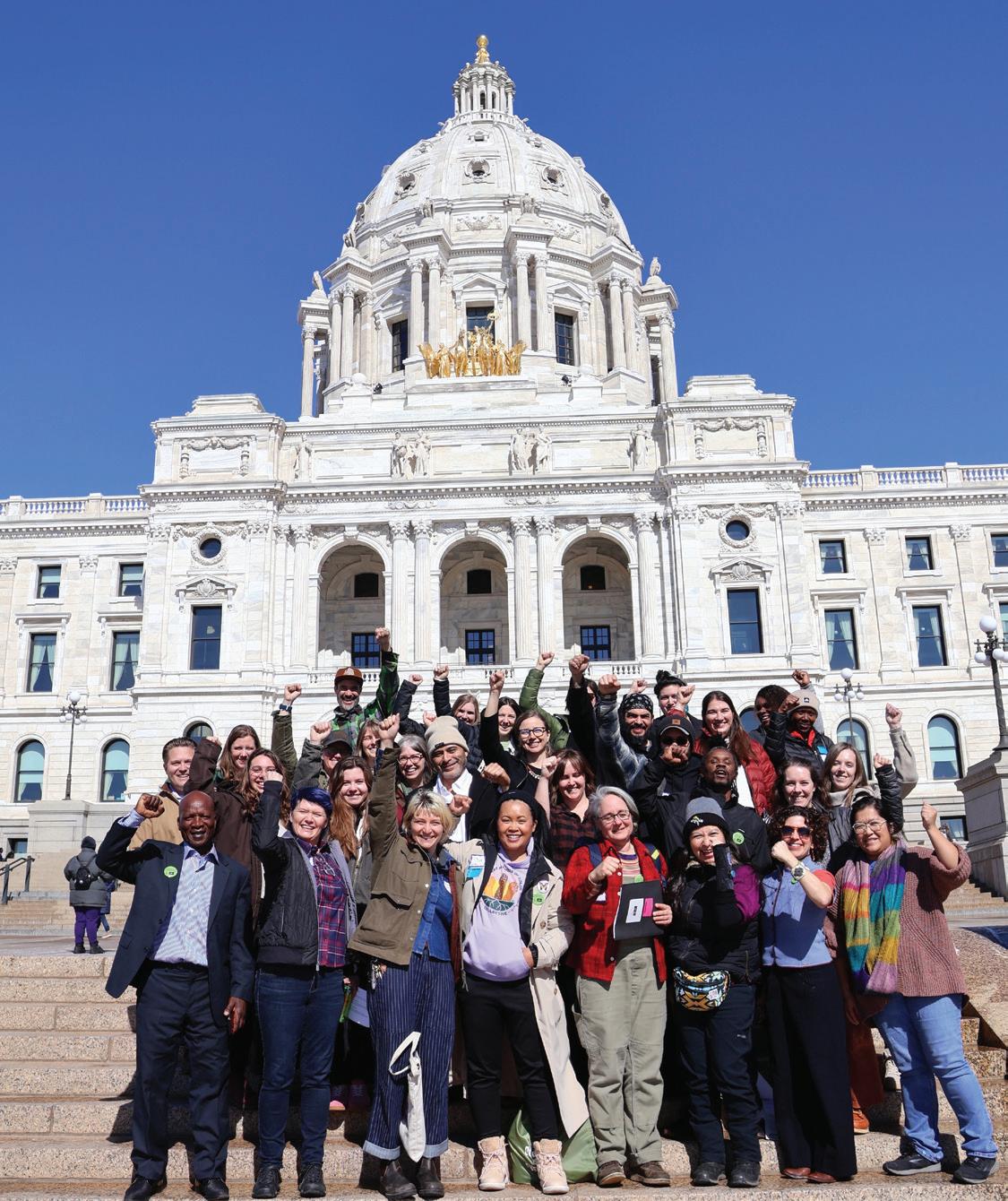
LSP members and allies gathered on the Capitol steps during the Family Farm Breakfast and Lobby Day. (LSP Photo)
requests for a program that has a budget of only $1.3 million, an indicator of the immense need out there.
On the second-to-the-last day of the 2026 session, Rep. Anderson brought forward a floor amendment — where the entire House votes on the provision — that would have, among things, shifted $300,000 from the state’s Green Fertilizer Program to the Farm to Food Security Program. This amendment also had LSP’s preferred changes for the Down Payment Assistance Program as well as the Meat Processing Train and Retain initiative (see below). In the final hours of the session, LSP sent out an action alert calling on lawmakers to vote yes on the Anderson amendment. Over 100 LSP members quickly took action on a Saturday and contacted their legislators. But again, those changes were lost when this amendment was voted down by all DFLers and a few Republicans in the House.
➔ Local Meat Processing Workforce Development: The COVID-19 pandemic made it clear that our inability to meet the demand for local meat processing makes farmers and eaters incredibly vulnerable, all while limiting the ability to advance regenerative livestock production. Recent legislative sessions have resulted in increased resources for supporting processors in their efforts to recruit, train, and retain employees, among other things. Another proposal that was a victim of the House’s inability to pass an Agriculture Bill was language that would have extended the fiscal deadline for the Meat Processing Train and Retain Program so that it would have more time to get off the ground and help support the creation of a resilient local meat processing infrastructure and workforce. The failure of the Anderson amendment I referenced above means hundreds of thousands of dollars is canceled for the meat processing training program this year.
What We Gained
ing fertilizer runoff by rewarding farmers for putting in cover crops, diversifying rotations, and utilizing regenerative grazing systems. LSP has long advocated for expanding this program beyond Olmsted County. Fortunately, via the Environment and Natural Resources Trust Fund, the 2026 Minnesota Legislature provided $2.8 million in funding to expand this initiative to 10 southeastern Minnesota counties. That’s not nearly enough money to address the problem, but it’s a start.
➔
The Next Generation:
During the 2017 session of the Minnesota Legislature, LSP worked with our allies to pass the Minnesota Beginning Farmer Tax Credit initiative. While other states — Nebraska, Iowa, and Wisconsin — have passed similar legislation that this initiative was based on, Minnesota’s law is the first to provide such a tax credit incentive for the sale, as well as rental, of farmland. Under this initiative, there is now a state tax credit for owners of agricultural assets — land, livestock, facilities, buildings, or machinery used for farming — who agree to sell or rent those assets to a beginning farmer. There is also a tax credit available for beginning farmers who participate in a financial management program, regardless if they are buying or renting from an asset owner.
At a time when farmers and rural residents are increasingly feeling left behind by both parties, the failure to pass this legislation is extremely disappointing.
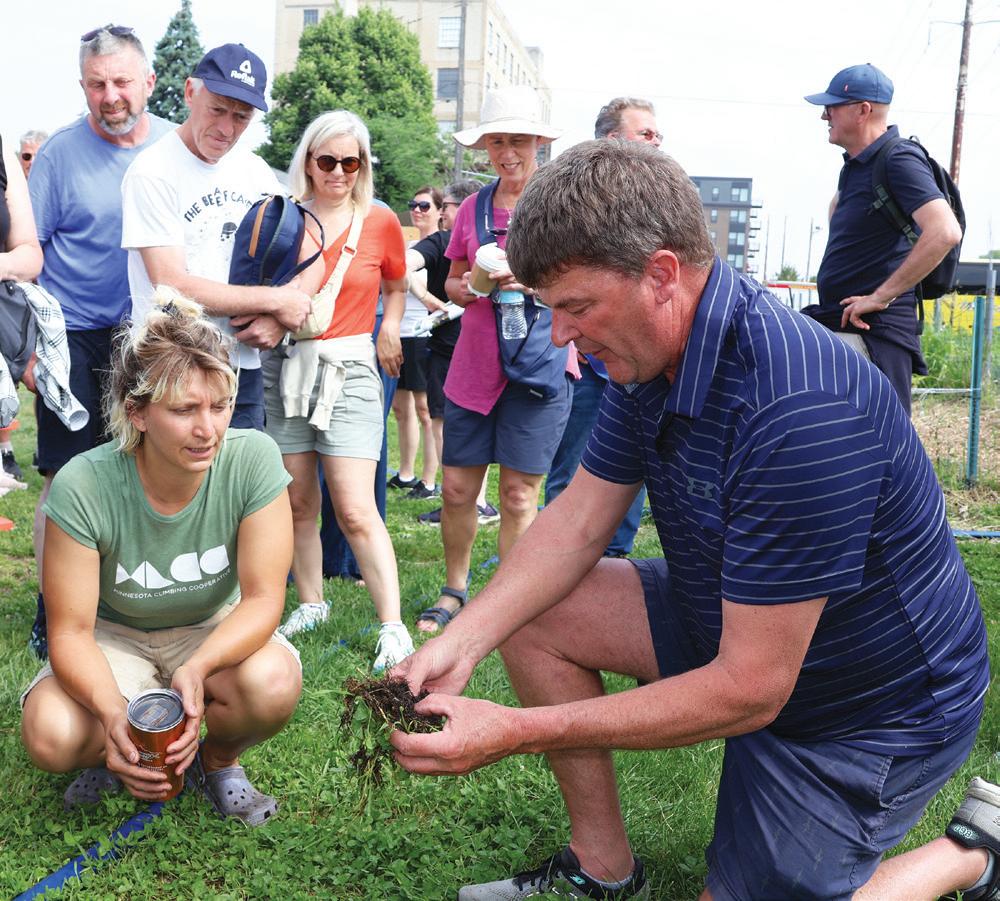
Eull (green shirt) recently hosted an international delegation of farmers and agriculture professionals on her California Street Farm, which produces vegetables on a small parcel of land in Northeast Minneapolis. “Farms needing to be large to be profitable — that’s just not true,” Eull said in testimony before the Minnesota House Agriculture Committee. (LSP Photo)
➔ Clean Water/Healthy Soil: As was highlighted during a special Senate hearing held on April 7 (landstewardshipproject.org/ nitrates-day-at-the-capitol), nitrate pollution of groundwater continues to be a serious problem in southeastern Minnesota and beyond. The innovative Olmsted County Groundwater Protection and Soil Health Program has shown great promise for reduc-
The program had an overall spending cap of
$4 million, but through the Tax Bill that was passed, the 2026 Legislature has removed that cap for one year. This means anyone who applies on time in 2026 and is eligible will be approved. It is still not totally clear what funding for this program will look like in 2027.
LSP’s Presence at the Legislature
The Land Stewardship Project’s members had a significant presence at the Legislature during this session. Besides lobbying done during the Family Farm Breakfast at the Capitol (see page 7), LSP members and allies communicated their stories to lawmakers via e-mails and telephone calls, as well as by testifying at hearings related to land
access, nitrate pollution, support for regenerative grazing systems, and requiring an environmental impact statement for our largest concentrated animal feeding operations, ones that are 10,000 animal units or more. Sometimes members had to respond at a moment’s notice. For example, Elyssa Eull, an LSP Farm Beginnings graduate who operates California Street Farm in Northeast Minneapolis, traveled to the Capitol just a few hours after hearing about a proposal to modify the Down Payment Assistance Program in a way that would make it more difficult to utilize it on land not zoned agricultural. During testimony before the House Agriculture Committee, she said her farm, which produces vegetables and flowers on a quarter-acre, is proving one can be profitable in an urban setting on a small parcel.
“Farms needing to be large to be profitable — that’s just not true,” she told the committee.
And at times farmers had a dual message for lawmakers: public support for regenerative practices can produce environmental and economic benefits. While testifying in favor of a proposal that would have created a pilot program for farmers wanting to transition to managed rotational grazing, southeastern Minnesota livestock producer Eric Heins explained to the Senate Agriculture Committee how over the past 10 years he’s converted row-cropped ground on highly
Legislature, see page 10…
Elyssa
…Legislature, from page 9
erosive land to perennial forages utilizing rotational grazing.
“By converting some of our more marginal ground into pasture we were preventing a lot of runoff from going down into streams. It’s a huge benefit for the community,” Heins said during his testimony, adding, “We have found those are our most profitable acres.”
LSP also had a chance to give lawmakers a “big picture” view of how public policy
can create a more resilient, regenerative future for farming and rural communities. In March, Sen. Putnam invited LSP and other agricultural groups to share insights on their members’ concerns, frustrations, and current work in a special “State of Agriculture” hearing at the Capitol. I represented LSP at the hearing (see page 4), and after describing the various challenges our farmers are facing, as well as highlighting opportunities that are available to innovative, emerging producers, I left lawmakers with a question: “How might Minnesota be a leader in supporting the next generation of farmers,
creating fair, local markets that feed people while supporting a type of agriculture that keeps and welcomes new people in our rural towns and communities, and has the health of our people and the land guiding it?”
That’s a question we need to ask all yearround, not just during the legislative season. If you are interested in getting involved in our legislative work, I want to hear from you. Feel free to reach out — we’re always happy to discuss possible policy solutions or support you in hosting legislators on your farm or in your community. p
LSP government relations director Laura Schreiber can be reached at lschreiber@ landstewardshipproject.org. More information on LSP’s state policy work is at landstewardshipproject.org/state-policy.
Flooding the (Legislative) Zone with Emerging Farmers
By Pam Hartwell
The Land Stewardship Project’s annual Family Farm Breakfast and Lobby Day at the Capitol (see page 7) serves as a prime opportunity for our members to get together with lawmakers and discuss the issues they most care about. As the lead organizer focusing on issues related to land access, it’s my job during the day to facilitate meetings between beginning farmers and legislators, where discussions about issues that impact the next generation of food and fiber producers can take place.
Here’s how LSP’s Lobby Day usually goes: members from around the state come to the Capitol to meet with their legislators to discuss two or three bills that LSP prioritizes. Folks usually have 15 minutes to meet with their legislator and in that short time start building a relationship, share stories, and deliver talking points. These critical meetings teach legislators what LSP members care deeply about and how they can support our priorities. The meetings can also be frustrating if the legislator has to cancel last minute, is not receptive to our issues, or doesn’t serve on committees relevant to moving our bills.
In 2025 and 2026, we tried a different strategy. Instead of members meeting separately with their own district legislators, we had a large, statewide group of farmers/ advocates directly impacted by land access issues come together and meet with lawmakers who serve on the House and Senate Agriculture Committees. These legislators
have the most direct decision-making impact on programs that affect land access. This strength-in-numbers approach is for the sake of impact and for the safety of our members, especially at a time when immigrant populations are being targeted with violence and hateful rhetoric.
A Land Access Helping Hand
In recent years, including 2026, the focus of our lobbying has been to make improvements to the Farmland Down Payment Assistance Program, which is administered by the Minnesota Department of Agriculture. This initiative was launched in 2022 by the Minnesota Legislature as a way to provide financial assistance to beginning and “emerging farmers” who are seeking to purchase their first farm. For clarity’s sake, “emerging farmers” are defined by the Minnesota Department of Agriculture as agricultural producers who face barriers to education, land, and resources. The term typically encompasses young, BIPOC, female, veteran, LGBTQIA+, and urban farmers, along with individuals with disabilities. Working with groups such as the Midwest Farmers of Color Collective, LSP supported the successful passage of the bill that created this program.
It’s turned out to be wildly popular. In just three years of implementation, 112 beginning farmers have utilized this grant to buy their first farm. However, the demand for the program far outstrips the resources available, and many applicants are turned away each year. The Minnesota Legislature
appropriated $500,000 for a first round of Down Payment Assistance Grants. In 2023, the first application period opened online and grant requests exceeded available funding in less than 10 minutes.
So, during the past few legislative sessions, we’ve worked with our allies to fight for increased funding for this program and to make policy tweaks that prioritize emerging farmers and support beginning farmers who are growing food for their communities. We’ve met with some success. In 2024 the grant’s overall funding was increased to $1 million and in 2025 to $1.25 million.
In 2026, LSP’s Land Access/Emerging Farmer Committee worked to push legislation that would provide the farmers with more time to spend the grant money, craft readiness requirements that would filter the lottery-based award to those who have farm experience and are committed to using the land for a farm business, and set aside a small portion of the funds for people who already had purchase agreements in hand so they wouldn’t have to participate in the lottery system.
Sharing Stories
To say the least, during this year’s Family Farm Breakfast and Lobby Day, we had a lot to talk about. We recruited impacted farmers from around the state and prepared and trained them to talk with decision-makers. We expanded our Land Access/Emerging Farmer Committee to include those who
from page 10
work directly on land access, including staff from Renewing the Countryside, the Commons Community Land Trust, and the Latino Economic Development Center. We hosted two virtual land access lobby training sessions so that people could better understand the legislation being promoted, practice their stories, and learn how to be an ally of impacted farmers.
Folks from Sharing
Our Roots, Big River Farms, and Kilimo joined our lobbying efforts — these three farms are incubators or collectives that provide critical paths for emerging farmers who are seeking land access and other support.
By the time of the Lobby Day, 16 farmers and allies came ready to meet with eight legislators serving on either the House or Senate Agriculture Committees. Just days before, many of our meetings were rescheduled, leaving us with having three meetings at the same time. We pivoted at the last minute by parsing out who would go where, and two core committee members, Lizzy Haywood and Taylor Olsen, along with LSP organizer Robin Moore, took the lead on getting folks where they needed to go, making sure they felt supported and were ready to jump in on legislation details.
Another group of farmers met with Senator Aric Putnam, chair of the Senate Agriculture Committee, while others met with Representative Paul Anderson, co-chair of the House Agriculture Committee, and Representative Fue Lee, who serves on that committee. Urban farmer and Farm Beginnings graduate Elyssa Eull spoke about the economic feasibility of growing food on a small acreage, while vegetable farmer and farm mentor Moses Momanyi addressed how
received bipartisan support on our amendments, were able to strike down or alter unfriendly amendments, and our bill passed in the House and Senate. We got to a place of bipartisan support for the bill with more empowered members/partners, stronger relationships, and new champions.
We’re proud of the process we engaged in, but unfortunately no Agriculture Bill was passed, so the majority of these proposals did not go anywhere. One bright spot was
Our first meeting of the day was held in the middle of the chaos that exists just off the Rotunda in the Capitol. It was loud and crowded with other groups and legislators, and many LSP members wanted to get the ear of Representative Rick Hansen, co-chair of the House Agriculture Committee. Vegetable farmer Lilian Mboss shared the challenge she faced when she received a Down Payment Assistance Grant but ended up not being able to use it in time to meet the program’s deadline. (She learned that others got extensions, but none were offered to her.) Farm Beginnings graduate Tessa Parks, a livestock producer who rents her grazing land, addressed how critical land access is to her business stability. Derek Ellis, a Farm Beginnings grad and successful Down Payment Assistance Grant awardee, thanked Hansen for his support on the bill.
Minnesota is a leader in supporting emerging farmers and should continue supporting the state’s growing population of immigrant farmers. Mboss and Ellis highlighted the barriers facing farmers of color when they are buying farmland outside of the Twin Cities Metropolitan Area and how potential sales often fall through when landowners realize a Black person is the wannabe buyer. KaZhoua Berry of Big River Farms spoke about small farmers’ needs and secure land access’s critical role in success. Sina War of Midwest Farmers of Color Collective spoke to the needs of beginning farmers and brought an emerging farmer for her first Lobby Day to share the challenges she faces.
Our Impact
During the 2026 legislative session, the proposal that would improve the Down Payment Assistance Program came up for discussion five times between House and Senate hearings, making it a top bill for the committees. Eull, Berry, and LSP government relations director Laura Schreiber testified in favor of the legislation, and we had conversations and meetings with legislators, Minnesota Department of Agriculture staffers, and partners at the Minnesota Farmers Union to hammer out details. We
that the cap for the Beginning Farmer Tax Credit was lifted for one year (see LSP’s legislative wrap-up on page 8).
In the end, our strategy of “flooding the zone” with emerging farmers paid off. p
Pam Hartwell is an LSP policy organizer leading the organization’s work on land access and emerging farmer issues. Interested in joining the Land Access/Emerging Farmer Committee? Contact Hartwell at phartwell@ landstewardshipproject.org or 507-3077435.
Farmland Access Resources
F or profiles, podcasts, and resources related to accessing farmland, see landstewardshipproject.org/ beginning-farmer-resources.
Are you a beginning farmer looking to rent or purchase farmland in the Midwest? Or are you an established farmer/landowner in the Midwest who is seeking a beginning farmer to purchase or rent your land, or to work with in a partnership/employee situation? Check out LSP’s Farmland Clearinghouse on page 26.
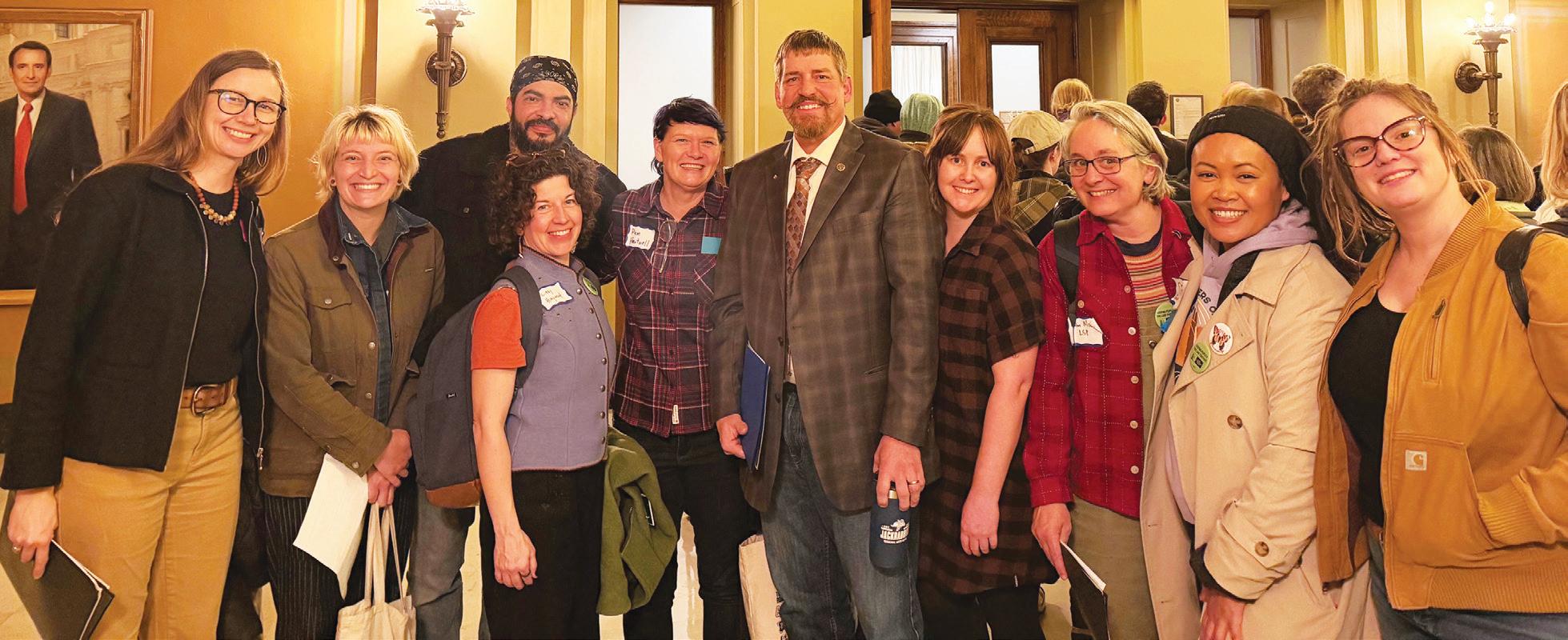
During LSP’s 2026 Family Farm Breakfast and Lobby Day at the Capitol, the organization brought farmers impacted by land access issues to meet with lawmakers such as Representative Nathan Nelson (center), who serves on the Minnesota House Agriculture Finance and Policy Committee. (Contributed Photo)
Riverview Dairy: an Unprecedented CAFO Gets MPCA Green Light
Stevens County Officials Still Have a Say on Operation’s Future; MDA Seeking Input on the Impacts of Mega-Dairies
The Minnesota Pollution Control Agency (MPCA) has given the green light to what would be the largest concentrated animal feeding operation (CAFO) in the state’s history. In June, the MPCA declined to require an environmental impact statement, also known as an EIS, for a proposal in western Minnesota’s Stevens County that would expand the West River Dairy facility from 7,855 cows to 18,855 cows. For the past several months, the Land Stewardship Project and allies such as the Minnesota Farmers Union have called for an EIS to be completed on this unprecedented project. An EIS provides detailed information about the extent of potentially significant environmental impacts of a proposed project, presents alternatives to the proposed project, and identifies methods for reducing adverse environmental effects.
The MPCA’s decision follows a public comment period on the Environmental Assessment Worksheet and draft feedlot permit for the proposed expansion. LSP and community members have repeatedly urged the agency to require a full EIS because of the scale of the proposal and its potential impacts on water resources, nearby communities, and independent livestock producers. More than 1,400 people submitted official public comments to the MPCA, and 1,140 people signed LSP’s petition calling for a full EIS.
liquid manure storage encompassing 250 million gallons of waste and would require 13,200 acres of farmland for manure application, according to the permit application.
The proposed Stevens County site sits within five miles of eight different protected waterfowl and wildlife production areas and is part of the Pomme de Terre River watershed, just 25 miles from its confluence with the Minnesota River. The MPCA already lists as impaired the two closest waterways to the facility, the Pomme de Terre River
cows in 2025. Minnesota has lost nearly 75% of its dairy farms over the past two decades as small and medium-sized operations get pushed out of the market by giant operations such as Riverview. An examination of Minnesota dairy operation statistics shows that Riverview represents practically all dairy cattle in several areas, and for those counties the USDA Agriculture Census now has a notation in the “number of cows” area that says simply: “Withheld to avoid disclosing data for individual farms.” That’s because all the dairy cows are Riverview animals in those particular counties.
“Riverview’s latest push for expansion would only exacerbate the situation and accelerate the loss of dairy farms in our state, decimating Main Street economies in the process,” says James Kanne, a Renville County dairy farmer.
According to a permit filed with the MPCA, the proposed Stevens County facility would be allowed to pump up to 226 million gallons of water per year from an off-site well. For reference, the City of Morris, which is home to over 5,000 people, is permitted to pump up to 300 million gallons of water a year. The facility would have
and an unnamed creek. According to a 2019 analysis conducted by researcher Dara Meredith Fedrow, the Pomme de Terre was already the most heavily used watershed for large-scale hog and dairy watering in 2017. And according to her examination of MPCA and Minnesota Department of Agriculture data, at that time Riverview’s cows consumed one-quarter of the water used by all hog and dairy concentrated animal feeding operations in the state.
The West River Dairy expansion would have an unprecedented impact on the region’s milk-producing economy. It would be more than 60 times the size of the average Minnesota dairy, which had fewer than 280
Duane Holker, who milks 85 cows in Minnesota’s Stearns County, says he’s already had to switch processors in recent years because the local one is now getting most of its milk from Riverview. As Riverview soaked up the processor’s payouts through volume and content premiums, that left less money to pay moderate-sized farms.
“But I was one of the lucky ones — too many farmers can’t find another milk buyer as consolidation throughout the industry accelerates,” says Holker. “When a giant like Riverview says it must place almost 19,000 milk cows in one location just to keep growing, I can’t help thinking that it’s replacing over 200 farms like ours.”
Although the MPCA declined to order an EIS, the Stevens County Board, through its permitting process, still has the authority
Riverview, see page 13…
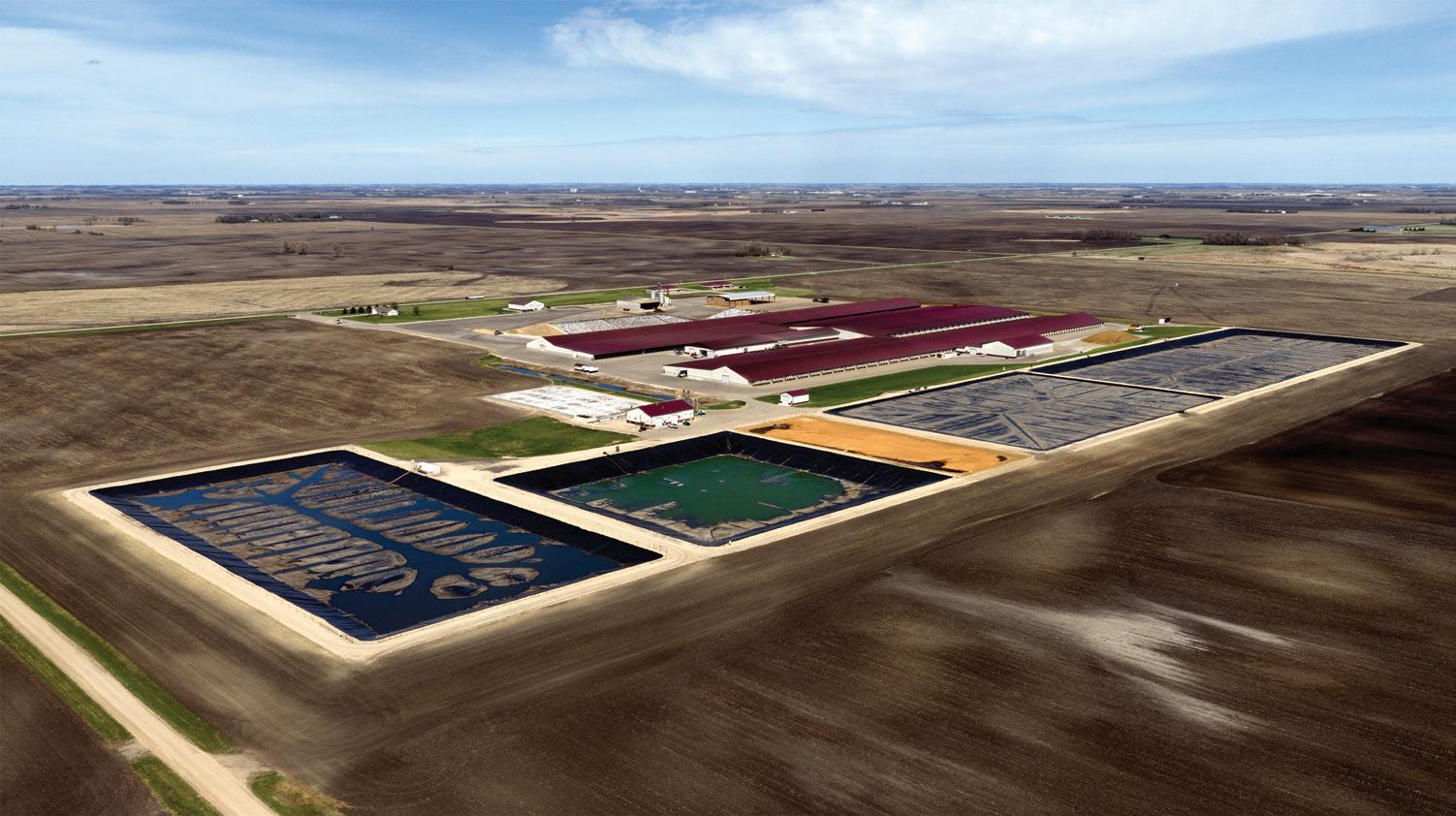
Riverview wants to more than double the number of milk cows currently housed at this Stevens County facility to 18,855 head. That would make it the largest concentrated animal feeding operation in Minnesota. (Drone Photo by Rob Levine)
over whether the West River Dairy expansion goes forward. The Board is expected to take up the proposal sometime this summer.
LSP will continue working with members and local residents to ensure community voices are heard at the county level, says Sean Carroll, LSP’s policy director.
“We know that people organizing together at the local level can make a difference,”
MDA Seeking Public Comments on Large Dairies Until Oct. 1
ACarroll says.
For more information on LSP’s work around the West River Dairy proposal, contact organizer Matthew Sheets at msheets@ landstewardshipproject.org or 320-5007375. p
s a result of the public outcry over Riverview’s attempts to create the largest livestock operation in Minnesota, the state Department of Agriculture announced in July that it is seeking comments on the “socioeconomic impact of large-scale dairies in the state.” (The Ag Department defines “larger dairies” as those with roughly 10,000 or more cows.) A summary of the comments will be shared with state lawmakers ahead of the 2027 legislative session. Online comments are being accepted until Oct. 1 at mda.state.mn.us/dairyinput. For more information on how to submit comments, see LSP’s Action Alerts web page: landstewardshipproject.org/category/action-alerts.
Citizens: We Can Fight Back
By Heather Benson
Riverview LLP’s push to dominate the dairy industry (see page 12) has a presence beyond Minnesota’s borders. In 2025 alone, Riverview submitted applications to construct and operate three dairy facilities in the Dakotas. Two of these operations — the 12,500-head Abercrombie Dairy and the 25,000-head Herberg Dairy — would quadruple the number of dairy cows in North Dakota. Riverview is also proposing a 25,000-cow operation in north-central South Dakota’s Edmunds County.
“We’ve seen in our home state the havoc Riverview can play in our rural communities,” says Julie Burgod, a cattle and grain farmer in the area of the proposed South Dakota dairy. “That’s why Minnesotans need to speak out.”
In early June, a multi-state coalition of organizations hosted a webinar where community members and advocates from the Upper Midwest shared what they are seeing on the ground when it comes to livestock consolidation in their communities. Speakers at the event, which was hosted by the
Land Stewardship Project, Dakota Rural Action, Dakota Resource Council, Food & Water Watch, FarmSTAND, and the Minnesota Center for Environmental Advocacy, described a dairy industry that has changed dramatically in recent years. In Minnesota, the number of dairy farms fell by half between 1997 and 2017, even as the average herd size doubled.
Riverview was identified in the webinar as one of the major forces behind this shift. Although each community is different, speakers from across the region raised many of the same concerns. Water was at the top of the list. Residents questioned how much groundwater large dairies would draw from local aquifers and what would happen to wells, streams, and rivers if manure runoff contaminated the water supply. There’s good reason to be concerned: earlier this year, Riverview came to an agreement with Arizona’s Attorney General to reduce its groundwater usage in the state and pay $11 million to residents affected by the company’s overpumping of water.
Accountability was another major theme. Participants described the challenge of getting clear answers from companies and
regulators during the permitting process. For many rural residents, the process can feel confusing, technical, and tilted toward approval before the public has had a meaningful chance to weigh in.
One of the strongest messages from the webinar was that industrial dairy proposals are not automatically a “done deal.” Speakers from South Dakota described how neighbors organized around a proposed dairy by hosting informational meetings, sharing research, talking with the media, and making sure local decision-makers heard directly from the people who would be affected.
The speakers made clear that the fight over industrial dairy is about more than one company or one permit — it’s about whether rural communities have the information, time, and political power they need to shape their own future. p
LSP communications specialist Heather Benson can be reached at hbenson@ landstewardshipproject.org. This article is excerpted from a blog that’s available at landstewardshipproject.org/dairyfight. A link to a video of the entire webinar is available on that blog.
LSP White Paper Highlights Dairy Consolidation’s Negative Impacts
As state regulators this summer gave the green light to an unprecedented proposal for creating the largest livestock operation in Minnesota, it’s clear a convergence of rapid consolidation, economic distress, and large-scale expansion raises urgent questions about whether existing policies are adequately protecting fair competition, rural communities, and public resources, argues a white paper published by the Land Stewardship Project
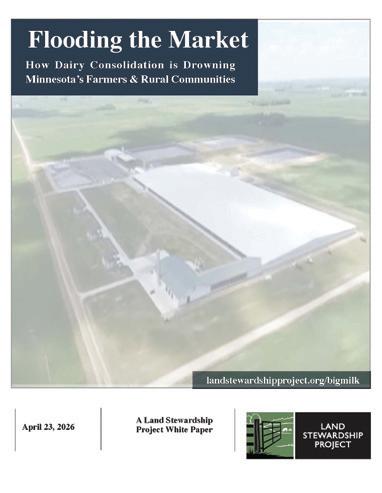
earlier this year. “Flooding the Market: How Dairy Consolidation is Drowning Minnesota’s Farmers & Rural Communities” outlines how the proposal by Riverview LLP to expand an operation so that it can house 18,855 milk cows in one location is a “game changer” that will push more independent dairy farmers out of business, resulting in significant negative economic and environmental impacts in rural communities.
Ensuring that more farmers can
remain on the land and participate in a fair market will require targeted action on the part of public policy makers, argues the white paper. Specifically, it outlines four policy proposals: strengthening fair market protections, protecting shared natural resources, investing in diversified and regional processing infrastructure, and expanding local and institutional markets for small and medium-sized farmers.
A copy of “Flooding the Market” is available at landstewardshipproject.org/bigmilk.
Policy & Organizing
Is it Your Turn to Run for Office?
Local Government & Local Officials Hold a Surprising Amount of Sway Over the Future of Our Communities
By Lizzy Haywood & Dawn Schreiber
For most people, occupying an elected position on the township or county level doesn’t sound very glamorous, but local officials hold a surprising amount of sway over the future of our communities. Minnesota is a state where local control laws are strong, which means that people serving in county and township government play a critical role in shaping the Minnesota we need. When it comes to land stewardship, the most influential local officials often serve as county commissioners or on a Soil and Water Conservation District (SWCD) board. They decide whether policies such as zoning rules or water quality rules need review, and oversee the distribution of state conservation funding requested by local farmers. As just one example, when a farmer seeks a variance (exception) from a land use ordinance, county planning and zoning commissioners decide whether that variance will be approved.
appointed and then stuck around for the following election; another was recruited by a retiring board member. If you are ready to serve, we recommend taking inventory of the landscape of your county’s elected officials as an important first step. Locate the various districts in your county by visiting
Once you commit and are ready to throw your hat in the ring, head to your county’s government building to file because it must be done in person. The Minnesota Secretary of State web page cited previously has a good run down of the requirements, and includes downloadable forms and the current base fee for filing. Requirements for candidacy are straightforward: you must be eligible to vote in Minnesota, have not filed for another office in the upcoming primary or general election, will be 21 years-of-age or more upon assuming office, and you must have maintained residence in the district for at least 30 days before the general election. Filling out an Affidavit of Candidacy form (a quick 1-pager) and paying the fee seals the deal. Fees can vary by county, or they can be avoided altogether if you get 500 signatures supporting your candidacy.
What it Takes to Win
Running for local office isn’t something many of us are familiar with, so we reached out to several people holding these important seats to ask them about their experience and process. Here we summarize some of the information we gleaned on how they ran for local office and what it took to win, what the day-to-day process of holding office looks like, and where they are making gains for the future of our air, water, and soil. We also address common questions and share basic information for those considering a run themselves.
How to Run
Each of the folks we spoke with had a helping hand to holding office: one was
mn.gov/portal/government/local/counties. You can then learn whether any of your local seats are up for election by calling your county administrator.
Whatever the path to office, two steps are the same for everyone: commit to service and file the paperwork. In 2026, the proper paperwork needed to be filed between May 19 and June 2; check the Minnesota Secretary of State’s website at sos.mn.gov/ election-administration-campaigns/ become-a-candidate for details on future filing deadlines.
To help you make an informed choice about whether an elected position is right for you, our interviewees highly recommend attending a meeting or two of the board you are interested in.
Whether or not a seat is contested will have a big impact on how robust your campaign is. In many cases, open seats receive little interest. In fact, Ballotpedia News has reported that 70% of regular elections in Minnesota in 2024 were uncontested. The elected officials we talked to didn’t campaign at all — no yard signs, parades, advertisements, or social media accounts required. But if the seat you’re running for is contested, thinking about why you are the best candidate and how to communicate that to voters are important steps. It’s always important to ask yourself “why” you are interested in running for office. Are you motivated by an important issue? Are you compelled to public service? Have you been encouraged to run by someone in your community? Successful candidates find help with a trusted circle of
Local government bodies such as Soil and Water Conservation Districts can influence how farmland conservation is supported in a community. (LSP Photo)
people who can sound out ideas, test-drive messages, and review data about your district. Finding your “why” and being able to articulate it is the most important thing you can do to connect with voters and trusted messengers in the community. When doorknocking, keep the message focused on your strengths and ambitions for the office, rather than on comparing yourself to your opponent or running them down. Good experiences are shared with friends and neighbors and can catapult your campaign’s reach.
Local campaigns are generally low-cost and you may not need to fundraise extensively or at all, depending on the race. If you raise or spend over $750, you’ll need to report it to the same office where you filed your candidacy. But free campaigning opportunities abound: social media, introducing yourself by door-knocking, or even chatting with folks over coffee at the farmers’ market. Often, counties will host forums where voters can get to know local candidates. If you’re considering additional ways of messaging, common expenses are yard signs, printed fliers, newspaper advertisements, and a website. Direct outreach to people in your district can be key to winning. Turn your “why” into a clear message you can share during any conversation.
What Happens if I Win?
Once you get elected, there are some fundamentals to know. From a time and money angle, holding public office isn’t going to make you rich. You can expect monthly, biweekly, or weekly meetings, and there will be prep time involved for each meeting. Most elected positions come with a cash
stipend per meeting attended, along with a mileage reimbursement. If you’re not familiar with the “Robert’s Rules of Order” meeting structure, you might want to spend some time on it before your first meeting. Reading the board’s previous year’s worth of minutes will also help bring you up to speed. There is training available to support newly elected officials. The people we interviewed stressed the value of the county staff in helping them navigate their new roles. Martin County SWCD chair Chantill Kahler Royer said she asked tons of questions and found the staff to be a great resource. Fillmore County SWCD Chair Jason Wetzel shared that the training and orientation he got from state officials was helpful. The Minnesota Association of Soil and Water Conservation Districts (maswcd. org) provides support for local SWCD board members. Additionally, the Minnesota Association of Townships (mntownships.org) and the Association of Minnesota Counties (mncounties.org) are good resources for township and county elected officials.
Biggest Wins?
Getting money into the hands of farmers so they can implement conservation practices provides a lot of satisfaction for the SWCD supervisors we talked to. Kahler Royer shared her enthusiasm for the opportunity to help implement innovative conservation practices in her district. Wetzel talked about a grant that allowed his SWCD to financially support not only new practices, but also offset expenses for farmers whose conservation techniques have become a routine part of their systems.
He also values witnessing the different voices and perspectives — farmers, bankers, hunters, and conservationists — weighing in
Land Stewardship Action
Land Stewardship Action (LSA) is LSP’s 501(c)(4) partner organization that provides the movement with political and electoral tools for reforming our farm and food system. For more information on LSA and to get involved in such initiatives as voter education and deep canvassing, see landstewardshipaction.org or contact organizer Laura Schreiber at lschreiber@ landstewardshipaction.org.
on board decisions. Such participation is at the heart of democracy.
The Importance of Civility
A common thread in our interviews for this article was the importance placed on practicing civility. Kahler Royer may have put it best when she said, “If I could say one thing it’s just that we may disagree on things, but we all need to treat one another with respect and that goes all directions, right? From an elected person to their constituents and vice-versa — humans just need to treat one another with some respect.” Ultimately, stepping forward to run — especially where seats often go uncontested — is one of the most direct ways to shape the future of your community’s land, water, and resources. In lieu of waiting for someone to directly ask you, take the information presented here and go for it, or share it with a friend you think would make a good public servant. p
Lizzy Haywood and Dawn Schreiber are members of the Land Stewardship Project’s Land Access and Emerging Farmer Steering Committee and Land Stewardship Action’s 2026 Electoral Committee. Through these roles they’ve been instrumental in shaping LSP’s voice at the Minnesota state Capitol and building long-term people power. Haywood lives in Houston County, Minn., and Schreiber in Martin County, Minn.
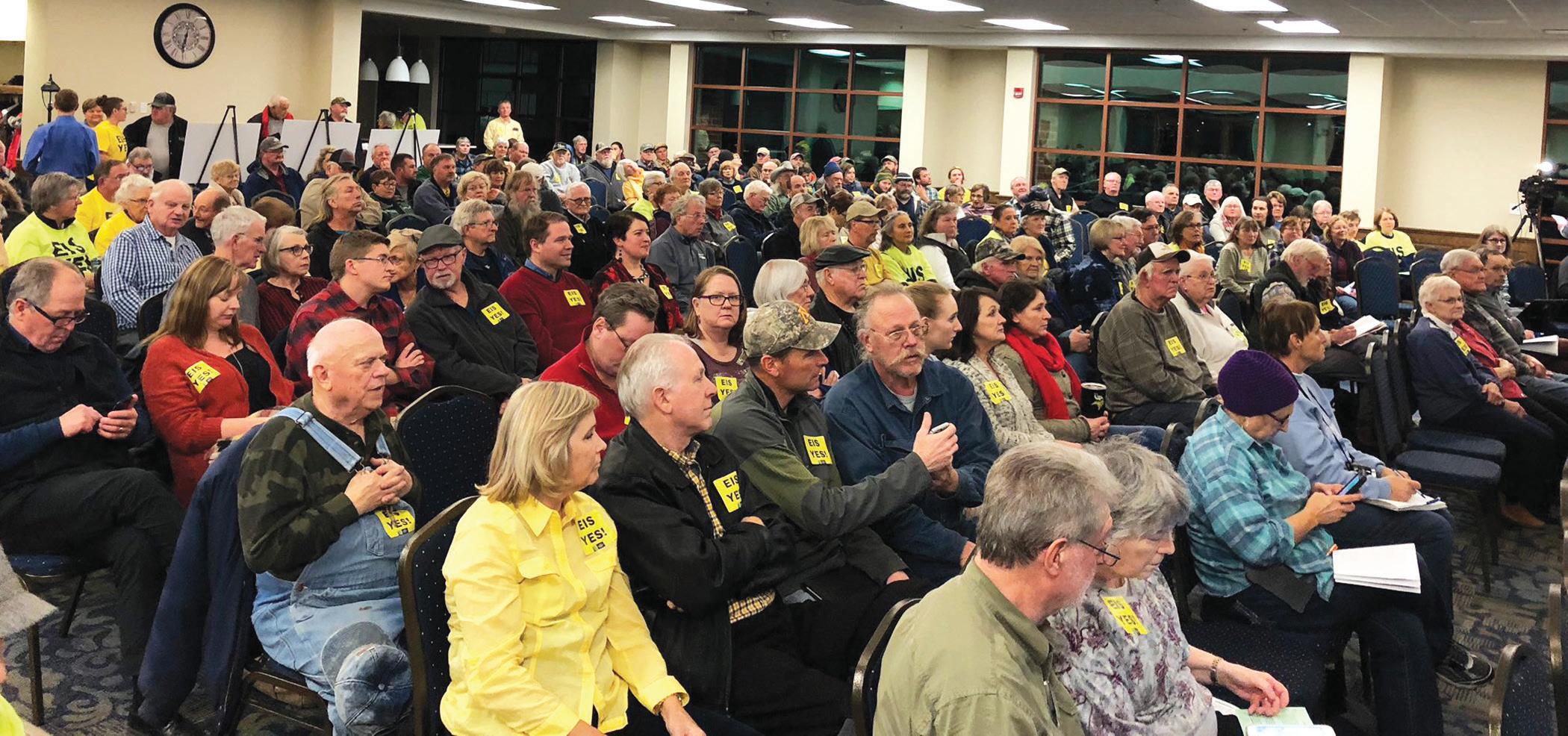
Local citizens gather for a township meeting on a proposal to build a large hog operation in southeastern Minnesota’s Fillmore County. Such proposals can bring into focus how key local government is to determining a community’s future. (Photo by Amanda Koehler)
Soil Health
Vision Quest
LSP Soil Hub Gathering Illustrates the Power of Dreams Anchored in Reality
On a bright morning in late February, a couple dozen farmers stood in front of a wall of words and hand-drawn pictures, imagining what the future might look like. Just a few minutes before, the farmers had sat at tables in a sunny room of the Chatfield Center for the Arts in southeastern Minnesota, using felt-tipped markers to respond to a prompt from Land Stewardship Project soil health organizer, Alex Romano.
“If you had it your way, what would the landscape look like as you drive across your region or state?” she asked. “What would you see as the norm? What crops would be growing, what livestock is being raised and how? What do the local economies look like? What else?”
As the farmers feverishly scribbled or sketched, it was clear they had a lot of opinions on this. No wonder: these were members of LSP’s Soil Health Hubs, a collection of four farmer-to-farmer networks representing three regions in southeastern Minnesota (Austin, Plainview, and Houston) and one in northeastern Iowa (Decorah).
These Hubs are opportunities for livestock and crop producers to take part in the kind of peer-to-peer learning required to step out of the mainstream and build a farming system based on living, biologically rich soil. As the current soil health revolution farming is in the midst of continues to evolve, it’s become clear that traditional methods of information transfer — educational and governmental “experts” handing down scientific knowledge from on-high — simply aren’t adequate to meet the needs of farmers seeking to take a different approach to food and fiber production.
ter line placement, weed management, grazing herd profitability, marketing headaches, pasture and cover crop seed mixes, and ways of wintering livestock. The meeting in February was an opportunity to bring as many of the hub members together as possible to hear a few presentations on innovative farming practices, forge more relationships, and yes, work up a vision for what their communities and landscape might look like in the future if some of the regenerative practices they were utilizing and hoping to try became more the norm.
This was the first time LSP had brought all the Hub members together into one room, and some of the farmers had never met each
Planting Practicality
Visioning sessions have long been a big part of LSP meetings and workshops. Southeastern Minnesota farmer Martin Larsen, one of the main players in the “Oat Mafia,” a group that’s trying to bring small grains back into regional rotations, often mentions that he got his start diversifying his cropping rotation after drawing up a new vision for his farm at an LSP event (he admits he thought the exercise was a little “woowoo” at first). Developing a vision for one’s farm (or future farm) is also a keystone of LSP’s Farm Beginnings, farmland transition, and land access educational offerings (see page 20).
Perhaps the farmers participating in the recent Soil Health Hub visioning session felt a little more confident about dreaming big as a result of a couple of presentations given earlier in the day. Eric Heins gave a talk entitled “From Cash Cropping to Cash Grazing.” Heins, who was trained as an accountant, went through a set of charts that outlined the financials of transitioning his Winona County farm from a basic row crop operation into a diverse set of enterprises that includes grass-based beef production as its anchor, but also includes small grains. “It’s all about connecting the dots for me,” he said at one point. “How can I make each acre generate income?”
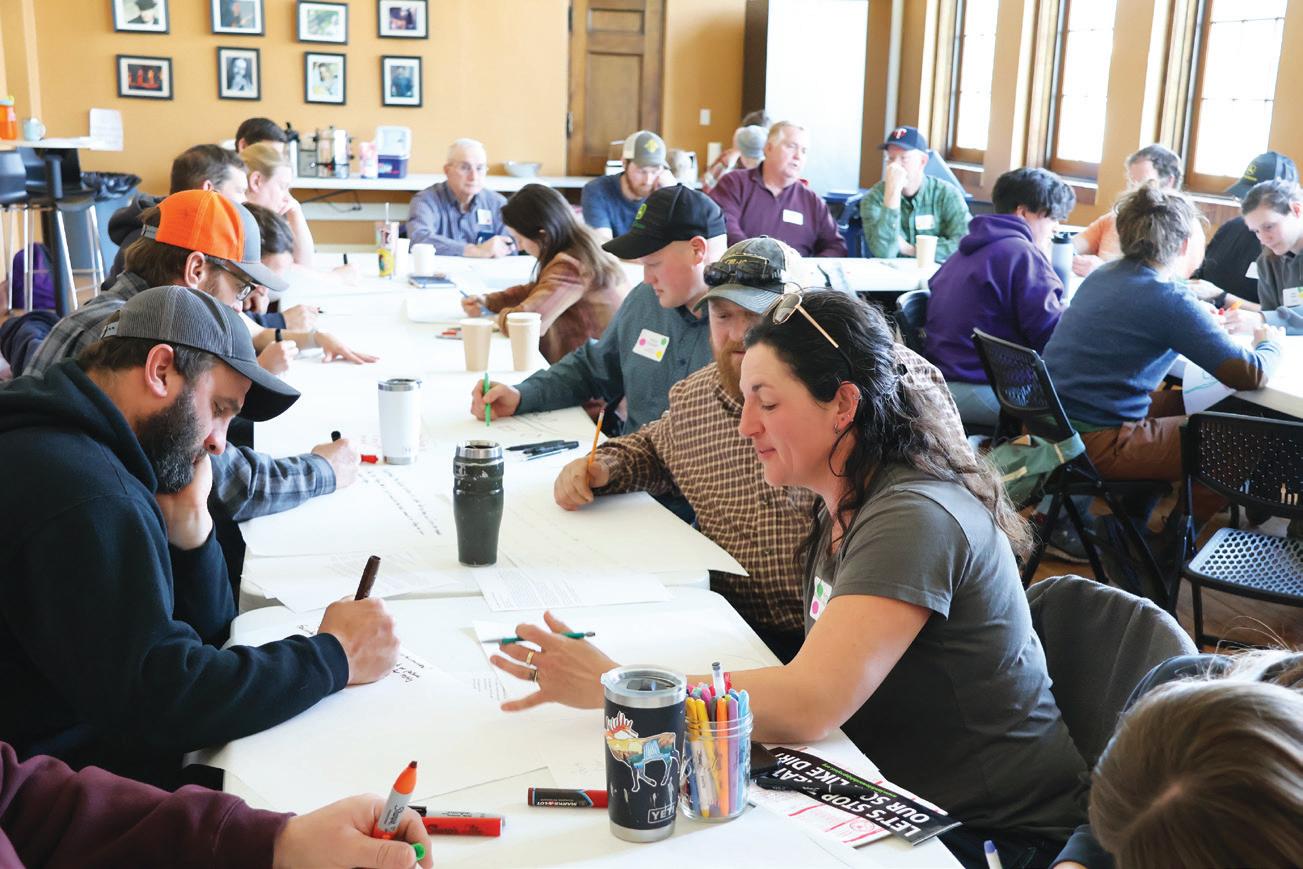
Each LSP Soil Health Hub is kept small enough — around a dozen members or so — to make one-to-one connections possible as farmers take turns hosting hub meetings. These gatherings are not just show-and-tell type exercises, but rather ways to address “burning questions” such as land access, wa-
other before. Around 30 of the 59 active hub members showed up at the Art Center, which is housed in a 110-year-old former schoolhouse. As soil health organizer Sarah Wescott described during the outset of the meeting, 39 Hub members are men, 20 are women. Fifty-one percent grow row crops, 39% small grains, and 66% graze livestock. It’s a mix of beginning, mid-career, and older farmers. At the Chatfield meeting, that demographic hodge-podge was pretty much represented, with a few toddlers skewing it to the younger end of the scale.
Ben Klein, a beginning farmer and graduate of LSP’s Farm Beginnings course, described how his family’s Olmsted County crop and livestock operation is balancing organic production, diverse rotations, and direct-toconsumer marketing of meat and eggs. Part of the attraction of the Soil Health Hubs is that farmers feel comfortable sharing missteps as well as successes. Klein described how, in 2025, his family tried to grow soybeans utilizing a no-till method based on planting the crop straight into a rye cover crop. Unfortunately, they couldn’t get the rye to lay down correctly and in the end weeds were a problem, resulting in a low soybean yield.
“It didn’t work,” Klein said with a wan smile.
On the plus-side, he said efforts to transition to organic a farm he and his brother, Andy, recently purchased are paying off as the soil, which had endured years of inten-
Farmers take part in a “visioning” exercise during a gathering of all the LSP Soil Health Hubs. (LSP Photo)
sive row-cropping, comes back to life thanks to the use of regenerative practices.
A Gallery Walk & Talk
After the farmers had the big pieces of paper they’d been working on taped to the wall, they began what Wescott called a “gallery walk.” Indeed, like art patrons in a museum, they stood in front of the wall of wonder for a few silent minutes contemplating each other’s handiwork. Then they began talking about some common themes and ideas that emerged in both pictures and words:
• Diversity
Question of the day: What should the landscape look like as you drive across your region or state?
where the cost of inputs and land has skyrocketed, while the prices farmers receive for their production have stayed the same or dropped when compared to what they got decades ago. “If we are going to get more people on the land, we have to have a way for them to make a living on the land and not just provide them ways to get exercise,” he said, pointing out that three decades ago he and his wife made a good living milking 45 to 50 cows. These days, the average milking herd in Minnesota is around 280 cows, and even at that size farmers have a hard time competing financially against mega-operations that can have tens of thousands of animals.
On that note, Romano wrapped up the discussion by putting all this visioning into context.
Join LSP’s Soil Builders’ Network
Interested in profitable ways to build soil health? Join hundreds of other like-minded farmers, natural resource professionals, and others in the Upper Midwest and become a member of the Land Stewardship Project’s Soil Builders’ Network. Members get regular updates on workshops, field days, and on-farm demonstrations, as well as the latest soil health and cover crop research. They also receive a subscription to the Soil Builders’ Network e-letter.
• Less corn and soybeans
• More food crops
• Healthy food
• Perennial plants
• Green year-round (lots of green felttipped markers were sacrificed for the sake of this sentiment)
• Livestock on the land
• Vibrant local businesses
• People and community
• Healthy soil
• Knowledge sharing
• Profits over maximum yield
• Not fearing being different from one’s neighbors
• Young farmers on the land
Beneath an illustration showing a diverse landscape with people on it, someone had written, “Independent family farms for people by people!” Someone else had written, “Working with nature instead of against it.” There was also a nicely done illustration showing what was not wanted on the landscape: a snow drift and snowman were stained with eroded soil and a giant “cancel circle” over the picture made it clear how the artist felt about snirting-up the landscape.
The gallery show sparked a lively discussion amongst some of the younger farmers around how it’s easy to get carried away with having lots of diversity on the farm and getting burned out in the process. Folks also spoke about the importance of balancing idealism with financial reality. “It has to cashflow at the end of the day,” said a middle-aged crop farmer. “If we’re all broke, it doesn’t do anything.” After a pause, he added, “Some of this will work.”
An older farmer pointed out that it’s tough to make a living in an economy
“When you think about a vision for the future, you’re thinking about the legacy you want to leave behind,” she said. “And that’s where you start to see values connect — values around family, values toward the land, towards your own community. That’s very evident in what you’ve done here.”
She went on to explain that LSP doesn’t just paint a rosy picture of the future — the organization likes to help farmers and other community members develop a practical roadmap for how to move forward successfully.
Initiatives such as the Soil Health Hubs are part of that path-building. Romano added, “And you guys are doing this kind of work on your own farm every day — living
For more information on joining, see landstewardshipproject.org/soil-health or contact Alex Romano at aromano@ landstewardshipproject.org, Shea-Lynn Ramthun at slramthun@landstewardshipproject.org, or Sarah Wescott at swescott@landstewardshipproject.org. You can also contact LSP’s office in Lewiston, Minn., at 507-523-3366.
and breathing these things, trying to figure them out.”
With that in mind, Romano, Wescott, and another LSP soil health organizer, SheaLynn Ramthun, finished up the day with that most practical of exercises: working with the farmers to plan the next round of on-thefarm Soil Health Hub meetings. p
For more information on LSP’s Soil Health Hubs, see the contact information in the sidebar above.
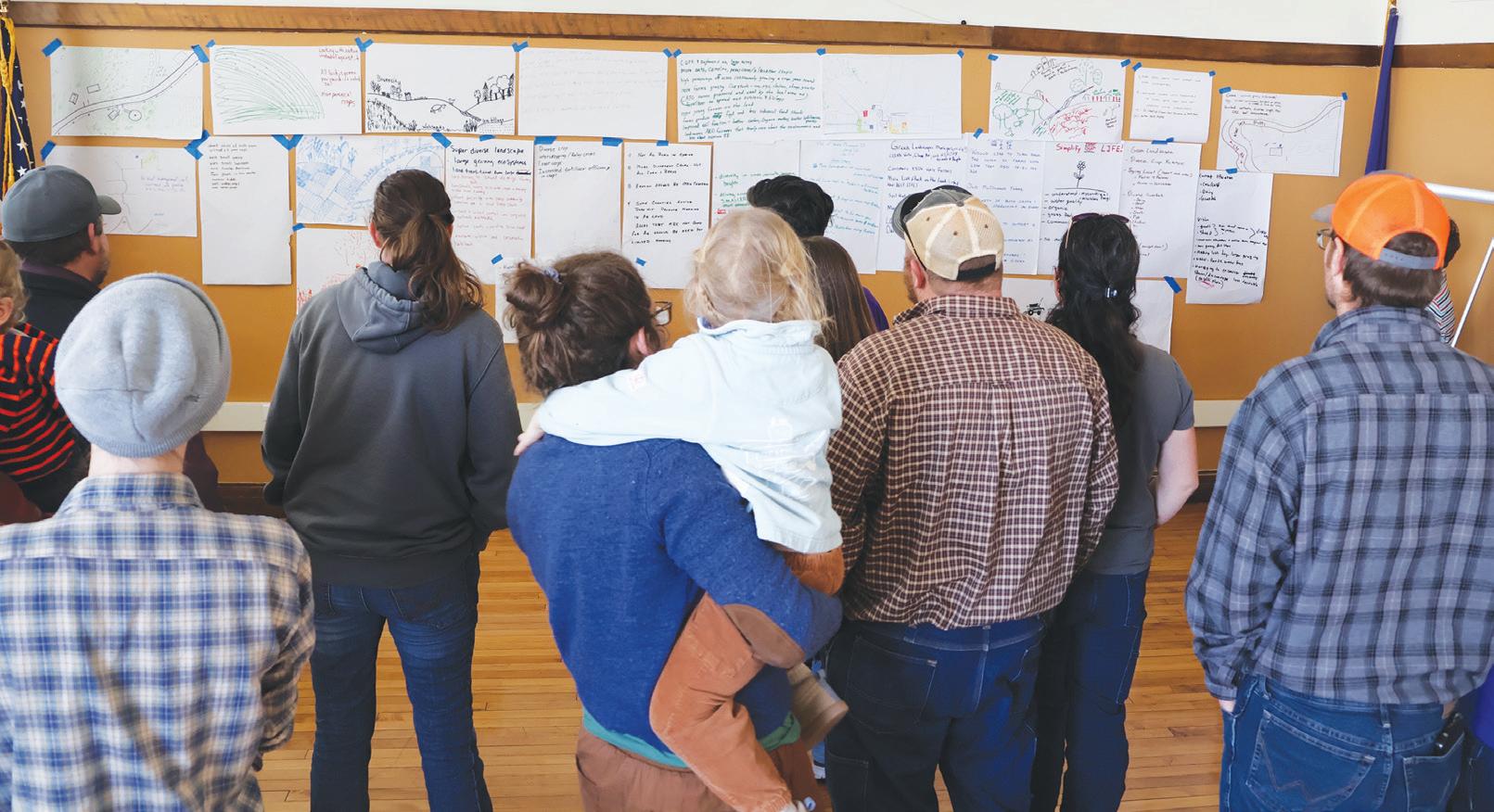
Hub members take a look at the various “vision posters” that were developed during the meeting. “When you think about a vision for the future, you’re thinking about the legacy you want to leave behind,” LSP organizer Alex Romano told the farmers. (LSP Photo)
Rethinking Nitrogen
Making Ag Accountable to Water
Corn Belt water is in trouble — 3 conservation farming ‘poster boys’ say it’s time for the ag industry, commodity groups, and government to take responsibility.
By Brian DeVore
On a muggy, overcast July day in northwestern Iowa, Matt Bormann and Zack Smith are standing in front of a sophisticated piece of conservation tillage equipment that farmers like themselves use to keep soil in place while planting corn and soybeans. A few yards away, another farmer, James Hepp, is standing in front of a high boy sprayer, which is part of his system for applying inputs in a way that protects water and saves money. Gathered around the two pieces of equipment are over 160 people, paying close attention to the farmers’ collective message: row crops can be raised in a way that doesn’t trash the soil and pollute the water.
“I’m just going to go ahead and say it,” says Bormann (this won’t be the last time on this day he utters a version of that phrase). “This stuff can be done. Once the public figures that out, they are going to demand that it be done.”
She made the two-hour drive up from West Des Moines. “Everybody I know has a family member with cancer.”
Like any farmers hosting a field day — the event was held on Hepp’s farm near Rockwell City — Bormann, Smith, and Hepp are happy to see other crop producers present. But it’s people like Lois they are trying to reach with their message: farmers, commodity groups, input suppliers, and politicians must acknowledge the region’s water
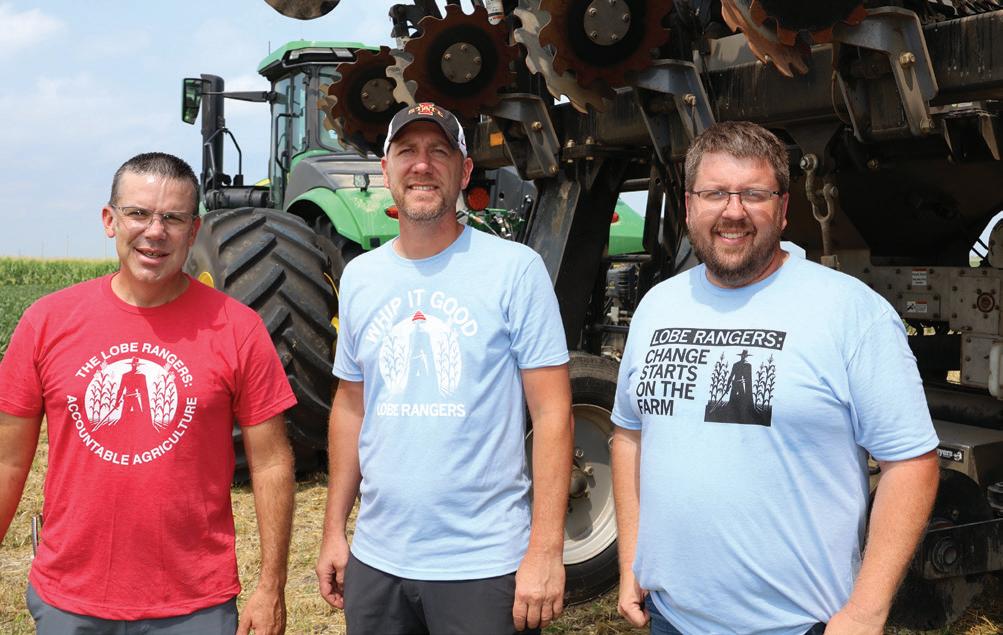
The irony of it is he’s letting the conservation cat out of the bag in front of a crowd of folks that represent a wide crosssection of the public: farmers were present, but also members of environmental and sporting groups, government agency staffers, university researchers, and a few people running for office in this fall’s election. Perhaps most importantly, there were people from cities and suburbs downstream who made it clear during the field day that they are increasingly concerned about the safety of their drinking water.
“Enough is enough,” says an older woman named Lois during the lunch break.
quality problem and get behind a proactive approach. And the non-farming public needs to apply pressure to these groups.
In the U.S. on average over 34 pounds of nitrogen fertilizer is lost on each cultivated crop acre per year (the average Midwestern corn grower annually applies roughly 150 pounds of nitrogen per acre). In Minnesota, 70% of nitrogen pollution comes from commercial fertilizer escaping cropland.
Nitrate is a form of nitrogen that, as a special Senate hearing at the Minnesota Capitol (landstewardshipproject.org/nitratesday-at-the-capitol) made clear in April, is
hazardous to human health. The past few years, levels of nitrates have been so high in the Des Moines River that the pricey machinery for removing the pollutant from the drinking water of that waterway’s namesake city has had to be activated in winter. Iowa has the nation’s second-highest cancer rate, and there are concerns it’s due to agrichemicals in the environment, including nitrates. Meanwhile, the Iowa Farm Bureau has issued statements saying the nitrate pollution situation in Iowa is improving, despite evidence to the contrary. The Bureau also worked successfully to get the Des Moines and Raccoon rivers, along with other Iowa waterways, removed from the Environmental Protection Agency’s impaired waters list.
The Woe of Status Quo
Smith, Bormann, and Hepp each farm over a thousand crop acres in northwestern and north-central Iowa in watersheds that feed directly into the Des Moines River; Hepp is 35 and Bormann and Smith are in their 40s. They all studied agriculture in college and have been active in groups like the Farm Bureau. Smith worked for a time selling chemicals and seed. Politically, two of them identify as Republican, and one as Independent. So they check a lot of Midwestern agrarian boxes.
But these farmers are part of a movement that’s centered around treating soil as a living ecosystem, rather than just dead dirt forced into production using chemicals and tillage. They utilize cover crops as well as soil-saving systems like no-till and strip till, and are believers in innovative “in-season” techniques for applying just the right amount of fertilizer. Their conservation efforts have garnered public recognition, including from the agadvocacy groups they criticize. They are excited these regenerative methods make money, and are proud they help keep pollutants out of the water; cover cropping alone can reduce nitrate leaching by half.
These three farmers have created a moniker for themselves that acknowledges the region they farm: the “Lobe Rangers.”
Rangers, see page 19…
What Do You Think? Join LSP’s ‘Rethinking Nitrogen’ Campaign
Better nitrogen management lowers costs, reduces risk, and keeps more nutrients in the field and out of our drinking water. Farmers are already proving these practices work. The solutions exist — we need to make them work at scale.
The Land Stewardship Project is launching the “Rethinking Nitrogen”campaign to build a farmer-led, public movement to show the power of nitrogen-reducing practices and create the political momentum needed to pass strong nutrient reduction policies during Minnesota’s 2027 legislative session. Through surveys and one-to-one conversations, LSP is identifying farmers interested in shaping outcomes, sharing their experiences, connecting with others, and helping build a stronger farmer-led movement for practical, common-sense solutions.
For more information, see landstewardshipproject.org/healthysoil/nitrogen-reduction, or contact LSP’s Alex Romano at aromano@ landstewardshipproject.org.
The Lobe Rangers (left to right): Matt Bormann, Zack Smith, and James Hepp. (LSP Photo)
from page 18
The Des Moines Lobe is a landform that was created when the last glaciers receded from northern Iowa, leaving behind rich soil. The Rangers’ founding principle: there is a direct connection between poor soil management, the economic devastation of rural communities, and polluted water.
Because they aren’t afraid to speak out publicly — many people attending the field day first heard about Smith, Bormann, and Hepp via their social media postings — about farming’s dysfunctional relationship to water, they represent an important voice that’s usually missing from the debate. Farmers can be unwilling to go public with their concerns about water quality. Even experimenting with a new practice might be seen as an acknowledgement that current systems are flawed.
“Peer pressure is one of the biggest things with change in agriculture,” Hepp says. “I’ll have a lot of guys tell me in the corner room, ‘I like what you’re doing, makes sense, but I can’t do that because they’ll make fun of me.’ ”
Roiled Waters
are excited about a new farmer-owned plant in southern Minnesota that’s scheduled to begin buying food-grade oats from growers this year. But for now, King Corn dominates and in the near-term we need to figure out how to make that crop more sustainable, they say. Although it pains them to admit it, these three see the solution involving government policy, and yes, that may even mean a regulatory approach.
“I am a Republican,” says Bormann. “I always thought being a Republican met less government. We have a Republican President and I’ve got more government involvement in my farm than I’ve ever seen.”
Give it a Listen
Atwo-part LSP Ear to the Ground podcast — episodes 395 and 396 — features a conversation with Zack Smith, James Hepp, and Matt Bormann: landstewardshipproject.org/ series/ear-to-the-ground, or on popular podcast platforms.
es. An added bonus: farmers seeking ways to manage fertility utilizing practices like cover cropping, in-season applications, and conservation tillage would improve soil health, paying dividends in the form of a decreased reliance on inputs.
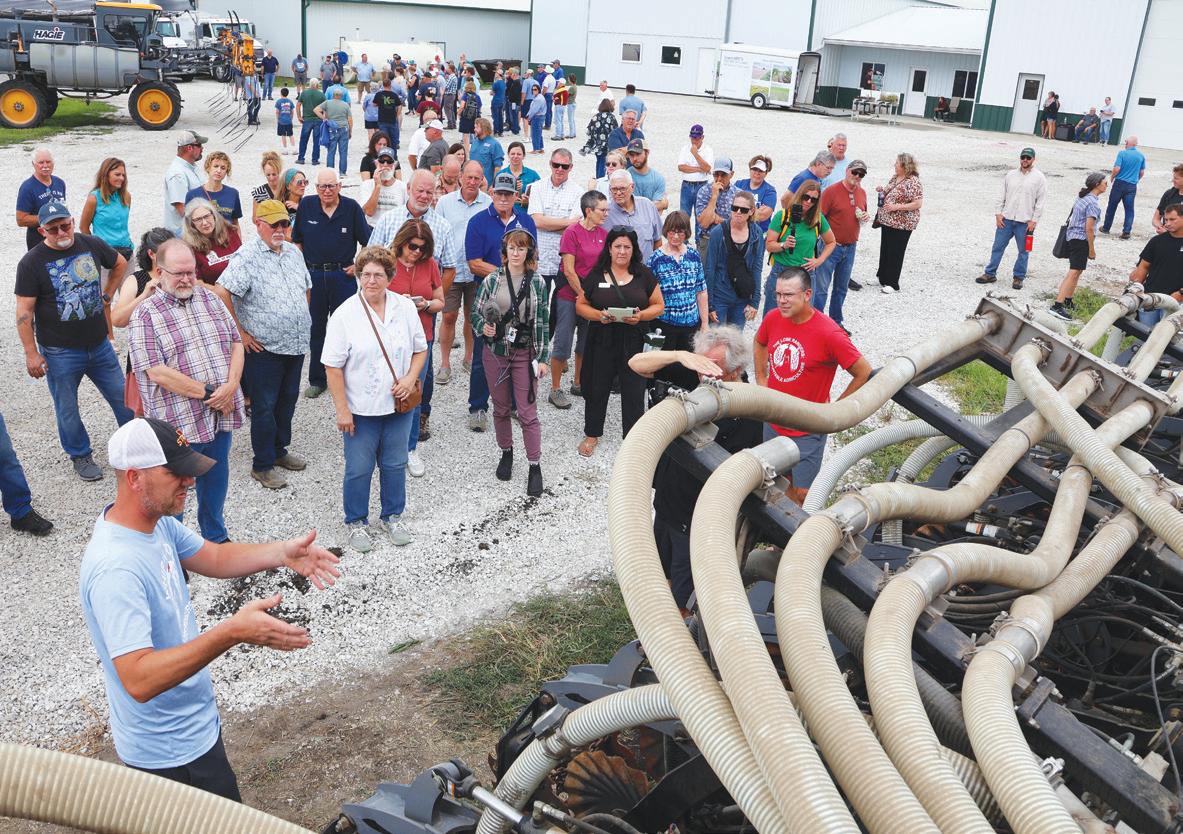
Groups like the Farm Bureau and National Corn Growers Association emphasize that a “voluntary”approach to conservation is the solution to pollution. However, only around 5% of U.S. crop acres are regularly cover cropped and less than 40% of corn acres are managed using no-till systems. The Minnesota Agricultural Water Quality Certification Program has utilized $32 million of public funds since 2013 to support farmer conservation practices. Nationally, the initiative is considered a groundbreaking way to voluntarily address water pollution. But this summer, a report by the Minnesota Office of the Legislative Auditor found that there were concerns around the number of farmers who weren’t meeting the standards required to qualify for funds and regulatory relief.
During a field day on the Hepp farm, Smith and Bormann describe the conservation cropping systems they use. “This stuff can be done,” says Bormann. (LSP Photo)
If agriculture is going to continue its dance with D.C., then the taxpayer needs to see something in return for all that public support, argue Bormann and the others.
Something like cleaner water. Consider anhydrous ammonia, for example. Its application may anchor spring field work, but many farmers apply anhydrous after harvest in the fall to save time during the following spring.
“Show me the data that suggests that the voluntary approach is working,” says Smith. The Rangers are particularly upset with how farmers like themselves are used as “poster boys” for conservation by ag groups hoping to, as Smith puts it, “virtue signal” and score public relations points.
One solution would be to diversify agriculture in a way that it’s not so reliant on an input-intensive crop like corn. The Rangers
There was a time when farmers wouldn’t even think of applying anhydrous before mid-November since biological activity in warmer soils can lead to loss of nitrogen before freeze-up. In fact, restrictions on fall applications of fertilizer are enforced in environmentally sensitive areas such as the karst region of southeastern Minnesota. But in the area the Lobe Rangers farm in, application dates are now being pushed well into October, increasing the chances that much of that fertility escapes the fields.
Smith wonders if a tax should be placed on applying fertilizer too early. If such a measure could be implemented over a period of years, it would provide farmers an opportunity to transition into regenerative practic-
One point of discussion has been the idea of making fertilizer dealers cover the cost of having too many nitrates in the environment. After all, as the Rangers point out, farmers often take their cues about fertilizer applications from these businesses. Another idea these three farmers are batting around is to tax the absentee landowners who are allowing heavy tillage and over-application of fertilizer to take place on acres they rent out.
“There are people in Des Moines that own land in my area, and they’re the ones complaining about water,” says Hepp. “I’m like, ‘You share in the blame too. You own the land — you have a say in how it’s farmed.’ ”
Community Conversation
Whether a tax or some other governmentrelated “smart regulation” action is the solution is almost beside the point, say the Rangers. They see such ideas as conversation starters, a way of, as Smith puts it, making “accountability” a part of the discussion around agriculture’s relationship to water. So, they are talking about the issue whenever and wherever they can: doing media interviews, hosting this July field day, launching a website (loberangers.com), and growing their social media presence. The Rangers shoot YouTube videos from their fields and machine sheds, answering questions from the public and talking about how, for example, blaming suburban lawns for the nitrate problem is a distraction. This is not a partisan or urban-rural issue, they argue — we all need clean water, no matter where we live, how we make a living, or our voting record. And, the farmers admit, time is running out.
“The public is starting to lose patience,” Bormann tells the field day crowd on this July day. Heads nod in agreement. p
Farm Beginnings
FB Course Accepting Applications for 2026-2027 Session
Beginning and prospective farmers are invited to apply to the Land Stewardship Project’s Farm Beginnings course, a training program that focuses on the goal-setting, marketing, and financial skills needed to establish a successful farm business. The next session will run from December 2026 through March 2027, and will be offered as a hybrid, with part of the class taking place virtually via Zoom and part of it in-person in Minnesota’s Twin Cities.
Class participants will walk away with a complete, professional farm business proposal and have an opportunity to connect directly with innovative, established Midwestern farmers and a supportive peer network. They can also participate in farm tours to observe regenerative practices firsthand.
The deadline for applications is Sept. 1. The cost of the class is $1,000 for up to two participants per farm. Scholarships are available. For more details and to apply, see landstewardshipproject.org/farm-beginnings-class. On that web page, you will find a 2026-2027 class schedule.
Reach out with any specific questions by contacting LSP’s Annelie Livingston-Anderson at annelie@landstewardshipproject.org or 507-473-8748. If you’re trying to figure out if farming is the right career path for you, take part in LSP’s self-led Farm Dreams Visioning Exercise at landstewardshipproject.org/farm-dreams-workshop. p
Farm Beginnings Profile
The Throughline
Crowded Table’s Commitment to Community
Sometimes a shot of reality can inject a sense of urgency into an educational experience. Roughly half-way through their participation in the 2024-2025 winter session of the Land Stewardship Project’s Farm Beginnings course (see above), Emily and Ryan KjesboJohnson purchased a 14-acre farm in Minnesota’s Sogn Valley, a little less than an hour’s drive from where they were living at the time in Saint Paul’s Frogtown Neighborhood. The couple had thought finding the right farm would take longer, so, suddenly, the course’s exercises, discussions, and homework around how to fit the right enterprises onto the right piece of land were no longer academic. Once the ground thawed, the Kjesbo-Johnsons would transition from urban backyard gardeners to rural farmers. It was show time.
“Before, it was all hypothetical, but it took on a different impact when we got the land and were picturing this community, this
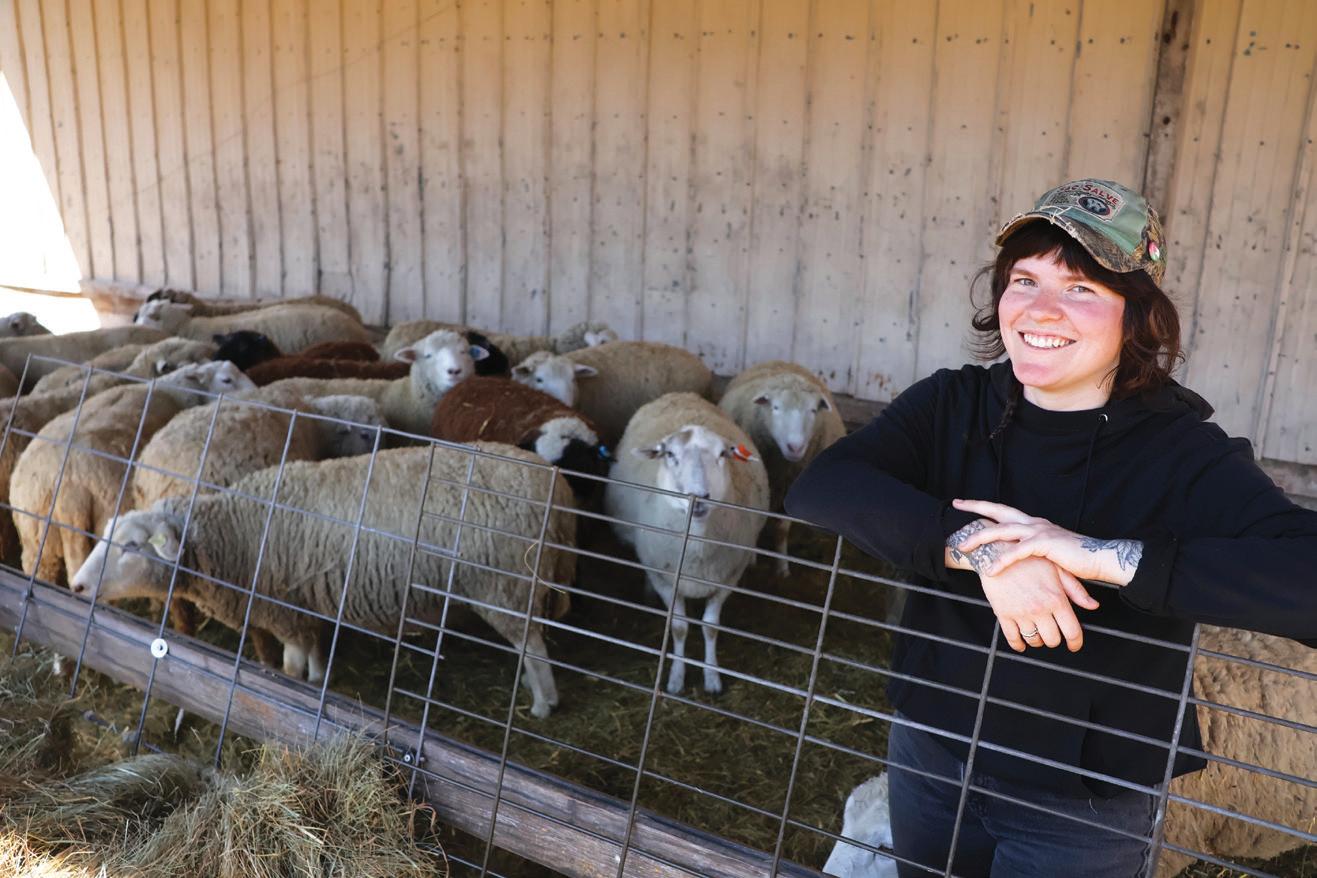
Farm Beginnings grad Frances Kelliher’s Riverbed Lamb enterprise is using rotational grazing to revamp grasslands while producing income through direct meat sales. For more on Kelliher’s operation, see page 24. (LSP Photo)
growing space,” recalls Emily while sitting in the kitchen of their farm on a stormy April morning.
Fortunately, the class helped the couple fortify what values would guide them in this new endeavor, no matter where they were farming or what they were raising.
The Glue of Life
A life well-lived requires adherence to some sort of connectivity that keeps things on track through good times and bad, surety and doubt. For the Kjesbo-Johnsons, who are both 40, that north star has always been crystal clear.
“Community connections were definitely the throughline of our careers,” says Ryan.
The couple adhered to that value while they were volunteering for various causes in college back in the early 2000s, and later when they served in both AmeriCorps and Peace Corps. That commitment to community continued while they lived in Frogtown,
raising two adopted children there and working in education (Emily) and nonprofit IT support (Ryan). Their Peace Corps experience in Uganda sparked a passion for raising fresh, healthy food, and figuring out how to get it to people in the community. They fed that passion while living in Saint Paul by using raised beds to grow vegetables in their yard. And once their children were launched, the Kjesbo-Johnsons began looking for a way to take that passion to the next level.
So, when they decided a few years ago to shift gears and become full-fledged rural agrarians, they enrolled in the Farm Beginnings course. A major part of the Farm Beginnings program is Holistic Financial Management, which focuses on “big picture” decision-making and goal-setting processes.
Ryan and Emily say the portion of the course where they were prompted to think about and write down what values guide them was particularly valuable. Through that exercise, it became even clearer to them that the main goal they shared as a couple was to have a farm that not only produced food
Crowded Table, see page 21…
…Crowded Table, from page 20
utilizing regenerative, soil-friendly methods, but was a welcoming space where folks could come and connect with the land and each other.
Key portions of the Farm Beginnings course are the presentations given by established farmers representing a variety of enterprises, sizes, and methods used. Emily’s family background is that her grandparents had a large conventional farm in southwestern Minnesota, so she says an added benefit of the class was being able to connect with farmers whose operations varied widely when it came to size, as well as types of practices used and foods produced.
“When I think, ‘farm,’ I think hundreds of acres and big combines and the whole deal,” she says. “So, it was powerful to hear from people who were growing on half-an-acre, an acre, two acres. Wow, you can do a lot even with a little bit of space.”
But, both Ryan and Emily say, just as important was the reality check the course provided; during the class, stories were shared of how difficult making a go of it in farming can be, and how at times the best decision for all involved is to step away from this particular career path. Ryan says another dose of reality the course offered was practical methods for dovetailing what they believe in with an economically viable way to raise food.
in the soil than we ever imagined,” he says. “When you have quality soil, it’s just amazing to see what vegetables can do.”
“And it makes us want to continue taking care of that soil, and developing and contributing to that even more,” adds Emily.
That first growing season, the couple settled on producing vegetables and eggs on a small scale and they marketed their production through a modest “friends and family” Community Supported Agriculture (CSA) enterprise. They’ve decided a lack of good fencing infrastructure precludes raising larger livestock for now, although they
trove of mistakes, honestly,” says Ryan with a laugh. “You have a narrow window from the time you close your laptop for work to the time the sun sets. So we really are thinking this year about how to streamline, how to improve our process. How do we ensure that we have the products going into the season now, so we’re not having to scrounge around things to pack later?”
But the 2025 growing season went well enough to give them confidence to double their CSA share offering to 20 members in 2026, and they’ve expanded their sales to a farmers’ market in Northfield, Minn. They’ve also established a Hip Camp spot as another way to share the scenic farm with a wider community. One thing that’s given the couple confidence to dream bigger is that there are other beginning farmers, including Farm Beginnings grads, making a go of it in the area.
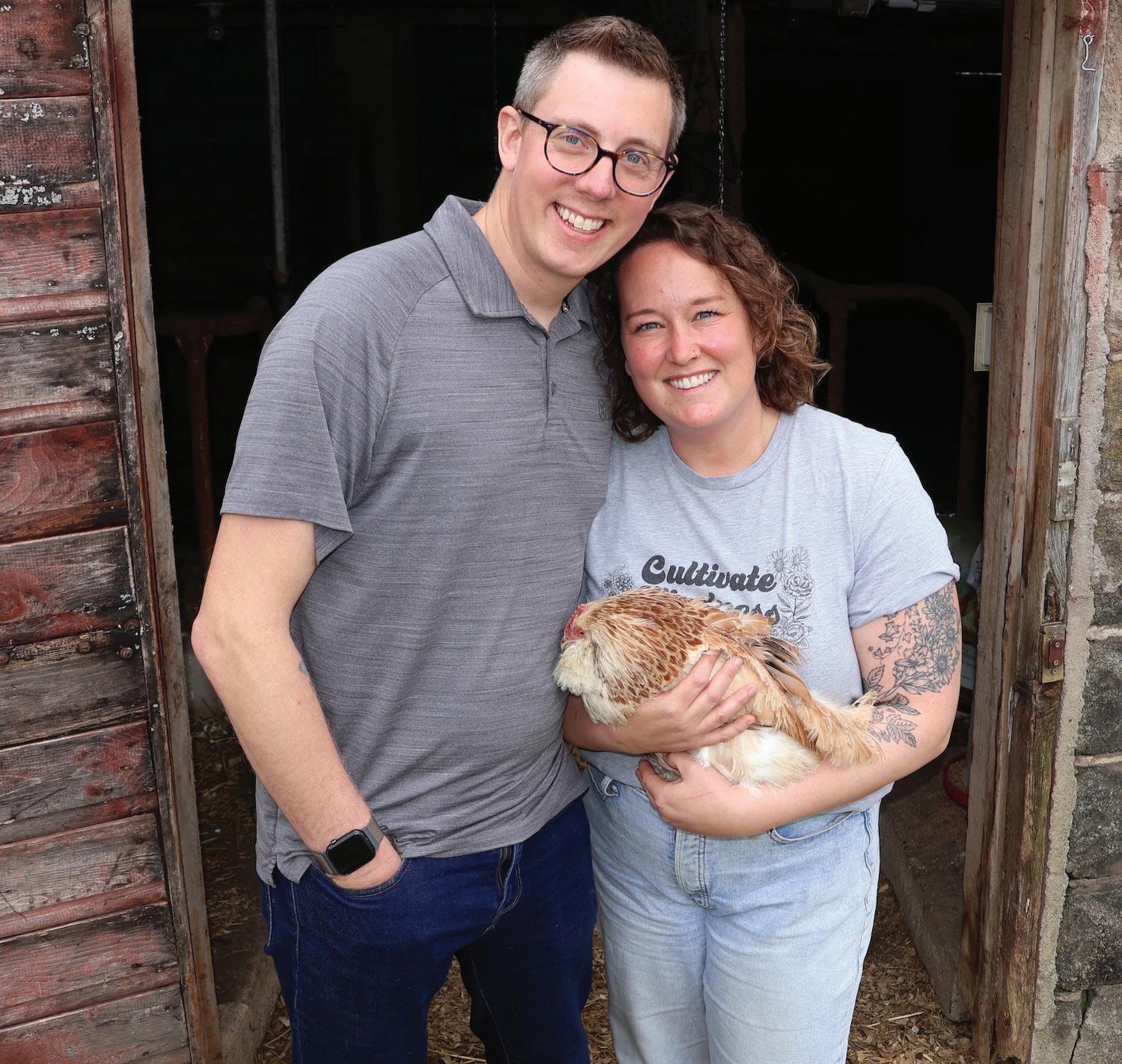
“How do you get insurance for something that’s your values? How do you budget for something that’s your values? It really connected those dots for us in a way that I don’t think we ever would have without Farm Beginnings,” he says.
Narrowing the Focus
Their operation, called Crowded Table Farm (crowdedtablefarmmn.com), is a mix of open fields and dense woods. There is also a patch of land that the former owner converted back to native prairie. Overall, the parcel has not been a working farm for at least three decades. But after a rainstorm passes on this April morning, Emily and Ryan provide a tour of the farm and show how its ag infrastructure, including a large barn and other sheds, has been kept up well. And then there’s the rich soil, something Ryan says he appreciates even more after participating in a Farm Beginnings session led by a soil scientist.
“Whoa, there’s so much more going on
have an interest in raising goats eventually as part of a silvopasturing enterprise. Honey production occupied a spot in their pre-land ownership dreaming, but they’ve axed that plan given such an endeavor could interfere with a neighboring beekeeper’s operation. The farm is on a dead-end road, so selling produce through a roadside stand is out.
Making the transition from a few raised beds to long rows of vegetables grown on half-an-acre wasn’t without its trials. There was a learning curve to learning how to lay out the rows efficiently, and the KjesboJohnsons, who are still working their city jobs remotely, found it to be a challenge to do everything from budget in time for washing and preparing produce for delivery to making sure they hadn’t misplaced a tool or used up all their packing boxes.
“The first year was just like a treasure
“It’s like Farm Beginnings gave us a built-in community and network that we’re connecting with,” says Emily.
And, in-between working their day jobs, growing vegetables, and feeding people, the couple continues to take the measure of the land and figure out what’s best for it as well as themselves and their community, both locally as well as through the connections they still have back in Saint Paul.
Long-term goals include stewarding the woodland and prairie habitat present on the land, as well as creating a gathering space for other parents of adoptees. It’s no accident the farm is called Crowded Table: the moniker was inspired by a song by Brandi Carlile and the Highwaywomen, which talks about everyone being a little bit broken, and in need of a space to find belonging.
Says Emily, “That’s the space we’d like to create here.” p
Give it a Listen
In episode 403 of LSP’s Ear to the Ground podcast, Emily and Ryan Kjesbo-Johnson describe how the Farm Beginnings “values exercise” helped them stay committed to community as they begin their farming career. It’s available at landstewardshipproject.org/podcast/ear-to-the-ground403-values-on-the-table, or on various podcast platforms.
“Community connections were definitely the throughline of our careers and we wanted that to be what this farm was about,” says Ryan Kjesbo-Johnson, shown with his wife, Emily. (LSP Photo)
Farm Beginnings
Farm Beginnings Profile
The Enemy of Good
Farming’s Reality Challenges Jane Marynik’s Pursuit of Perfection
The phrase “Perfect is the enemy of good” is often attributed to the French Enlightenment writer and historian Voltaire. His actual quote is, “The best is the enemy of the good.” But you get the point. Either way, to Jane Marynik, the pursuit of perfection could have stood in the way of succeeding at a career that is inherently adverse to having everything go as planned.
“I would say that I definitely was over the top with perfectionism, and farming has really helped calm that down a little bit,” she says while sitting in a shed at Food Farm in northeastern Minnesota with her partner, Craig, and Grady, their 15-year-old son. As she’s talking, the late March sun outside is liquefying snow at a fast pace in the North Country, and the next growing season is obviously on Marynik’s mind. “I can read all the things and know all the products to use and know all these different things, but it doesn’t work when the weather doesn’t cooperate or the machinery doesn’t cooperate or you have an injury or whatever,” she adds.
Marynik also benefited from her experience taking the Land Stewardship Project’s Farm Beginnings course, which, among other things, provides students grounding in balancing quality of life with productive farming (see page 20). Such training is particularly important to someone who came to farming at a relatively late stage in life. Marynik is 45, and underwent hip replacement surgery last November.
“I can’t pretend that I’m 30 anymore,”
working on the university’s student-run farm, where she learned the basics of raising produce in an area that has a short growing season and less than optimal soil conditions. Jane went on to get other farming experience, and today she manages the seasonal crew at Food Farm, a large organic vegetable operation just outside of Wrenshall, Minn. Food Farm, which was launched by John and Jane Fisher-Merritt in the early 70s, has a long tradition of utilizing innovative production and storage techniques to provide food to local Community Supported Agriculture (CSA) and wholesale customers. The operation, which today is owned and operated by the Fisher-Merrits’ son, Janaki, along with his wife, Annie Dugan, also has a reputation for launching other farming careers in the region.
So, it’s no surprise Marynik is using her experience on Food Farm to get her own farm dream established via an operation she calls Four Beans Farm (fourbeansfarm.com) in honor of her and Craig’s four children. Besides utilizing some of the larger-operation’s vegetable plots to grow her own product, Jane has started farming at her home within the city limits of Superior, Wis., which is about a 20-minute drive northeast of Food Farm. She and Craig have tilled up part of their yard, as well as a neighboring property they purchased. They even have a small Wayfair greenhouse that’s attached to one side of a garage, and Grady is managing a small chicken enterprise.
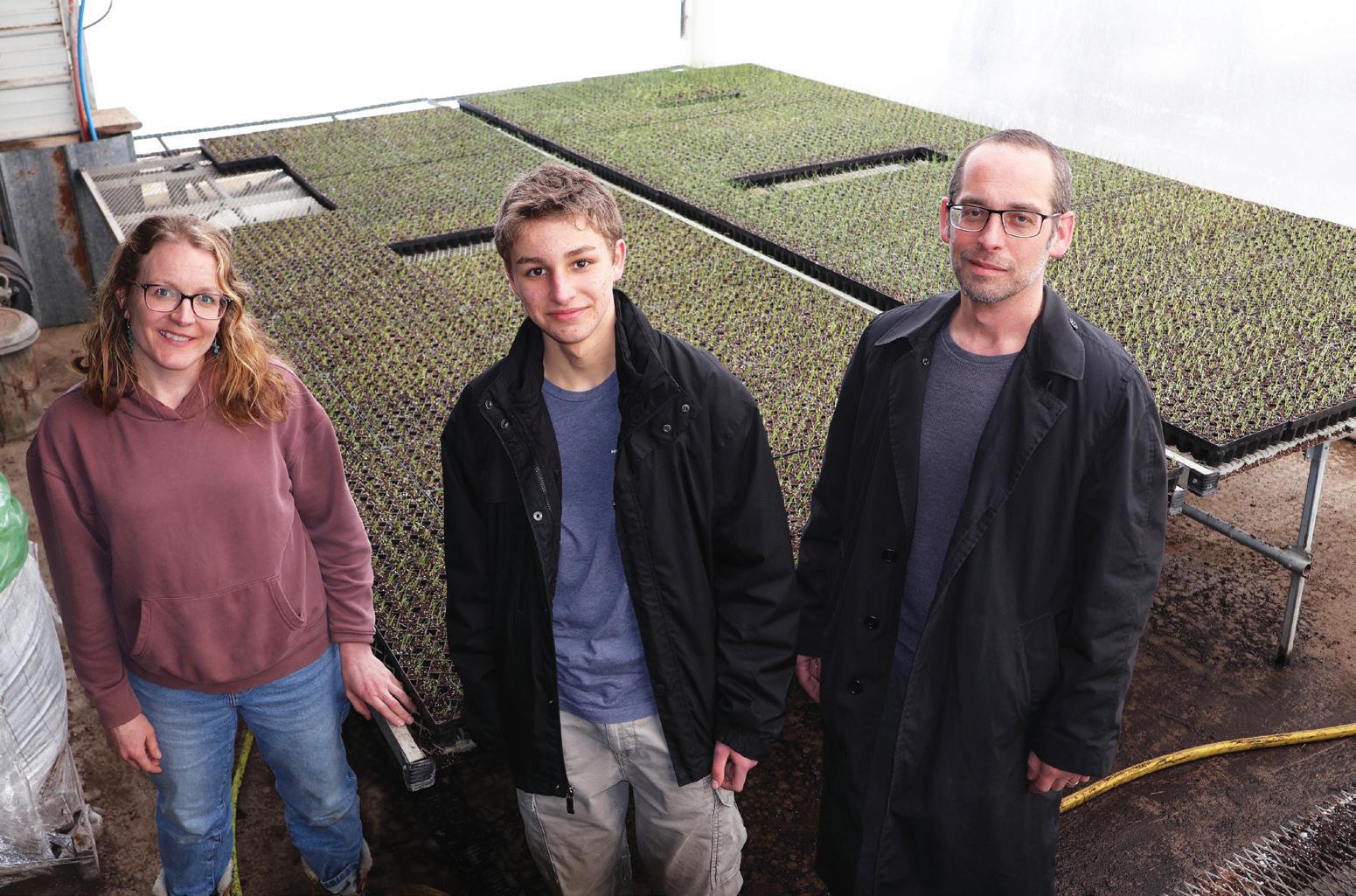
Jane, Grady, and Craig Marynik at Food Farm. “I would say that I definitely was over the top with perfectionism, and farming has really helped calm that down a little bit,” says Jane. (LSP Photo)
Marynik has come to terms with her sometimes fraught relationship with imperfection thanks in part to the real-world experience she’s received while working on vegetable farms in the Lake Superior region of northeastern Minnesota during the past few years. After all, if Voltaire were farming today, he might rephrase his famous quote to say, “Perfect is the enemy of getting it done before the final killing frost.”
says the former marathon runner. “I’ve got to take care of myself and be aware — making sure I’m using the right tools and not lifting the 60-pound thing by myself.”
Commuter Ag
Around a dozen years ago, while studying biology and sustainability at the University of Minnesota-Duluth, Marynik got interested in the role farming could play in not only providing healthy food, but supporting a resilient natural environment. She began
“It’s so amazing — a pet that gives you eggs,” quips the teenager.
Jane says farming in two different locations has its advantages. For one, since Superior is right on its namesake lake, it has a microclimate that makes for a longer growing season than what Food Farm has. By commuting between the two farms, Marynik is getting experience not only with different weather and soil conditions, but contrasting models of running a vegetable business: a backyard operation versus a larger farm with lots of infrastructure and a number of employees. Farming in a residential neighborhood in
Four Beans, see page 23…
Superior also has the added benefit of showing people in the city that vegetables can indeed be grown this far north.
“It’s on a pretty public sidewalk and there’s an elementary school on the other side, so you get a lot of kids walking by, and I think it’s nice for them to actually see that,” says Jane of her city veggie operation. “One year the garlic was coming up, it was pretty tall, and a guy walking by was like, ‘Is that corn?’ So, there’s an education piece too.”
That kind of education is important to the beginning farmer given her commitment to supporting a local food infrastructure. “Why do we eat lettuce from California? It’s like you’re just importing water,” she says with a laugh. “We have water, they don’t.”
Sincere Sustenance
Jane feels she’s well on her way to having the agronomic skills needed to grow a variety of foods, including her specialty — numerous varieties of edible beans. And it turns out there is a big demand for locally produced food in this part of the North Country. Besides selling through a farmers’ market, a food co-op, and a few restaurants, Jane is also part of something called Twin Ports REKO, which uses Facebook as a platform through which eaters can order food from local farmers. (The REKO model, which originated in Finland, translates to “real or sincere consumption.”)
“big picture” decision-making and goalsetting processes. In a Holistic Management system, a farmer’s quality of life is put on the same level as the health of the soil or the operation’s economic viability.
Jane says the financial management training she got through Farm Beginnings was critical. She also benefited greatly from presentations given by established farmers who talked about the challenges, as well as opportunities, involved in this career path.
“I don’t care what kind of farming other people are doing — I feel like there’s always something you can take away from their story on how they started,” she says.
True Balance
But of particular benefit for Jane was the focus on how to holistically balance work with quality of life issues. She’s mindful that, unlike a 20-something farmer, putting in endless hours of hard labor in vegetable plots, high tunnels, and greenhouses is not an option. Managing a farm (and life) holistically has provided the beginning farmer with the ability to step back and take care of herself and leave room for things like attending her kids’ cross-country meets. It’s also helped her get over the drive to have everything go perfectly.
“I don’t care what kind of farming other people are doing — I feel like there’s always something you can take away from their story on how they started.”
— Jane Marynik
Jane has been so happy with her agricultural progress that she and her family have begun looking for land in a rural area where they can set up shop permanently. But she realized a few years ago that before she jumped into farming as a full-fledged entrepreneur, she’d need some background in business management. Jane sought out various organizations that offered basic courses on running a business, but none of them were geared specifically towards making a living raising food.
So, with the encouragement of Janaki, Jane and Craig took LSP’s Farm Beginnings course during the winter of 2024 and 2025. Farm Beginnings is a training program that focuses on the goal-setting, marketing, and financial skills needed to establish a successful farm business. A major part of the course consists of training in Holistic Financial Management, which focuses on
But Jane makes it clear not pushing oneself to the limit doesn’t mean neglecting to make big plans. Once the family finds a permanent, rural home for their farm, she’d like to focus on raising specialty crops for local markets. She’s especially excited about leaning into raising edible beans. Jane’s fascination with that food crop began when she was in college and someone handed her a packet of bean seeds. She was impressed with the many types of beans that could be raised in the region, and began planting varieties that were not only striking in appearance, but had colorful names: Calypso, Marfax, Lina Sisco Bird Egg, Jacob’s Cattle Gold, Tiger’s Eye, Dakota Bumble, Kenearly Yellow Eye, Hidatsa Red, Barbunya, Haudenosaunee Skunk, Hidatsa Shield, and Eclipse.
“It was like, whoa, look at that. It wasn’t just a black bean or a kidney bean or whatever,” recalls Jane. “So I just became obsessed with them because they were pretty. But I think it’s also a good thing to have up here because for people who want to eat local and they need that protein source but don’t eat meat, it’s a good option.”
On this March day, Jane, Craig, and
Give it a Listen
In episode 402 of the Land Stewardship Project’s Ear to the Ground podcast, Jane Marynik talks about grappling with her desire to pursue perfection in farming. It’s available at landstewardshipproject.org/ podcast/ear-to-the-ground-402-enemyof-good, or on various podcast platforms.
Grady check out a Food Farm greenhouse sprouting trays of onion seedlings. As they head back to the farm’s equipment shed, Jane talks about another benefit of working on the operation: it’s given her a glimpse of what kind of farming she’d prefer to be doing on her own: big enough to make a dent in the local food system, but small enough that she wouldn’t need to manage a lot of employees and run big equipment.
It’s all part of her plan to keep that pursuit of perfection at bay. Like running a marathon, it’s one step at time. Jane describes one wet fall day when she was looking to harvest a few more pounds of beans from a plot at Food Farm.
“The weather was just garbage, and I was thinking to myself, ‘This is the last day I can do this,’ ” the farmer recalls.
But she had plans to go to a cross-country meet and there was no way to get those last beans brought in before the end of the day anyway. As she drove away, Jane knew in the future there would be other seasons, other fields, and other harvests.
“I used to hate that saying, ‘good enough,’ ” she says. “But truly, good enough. It’s good enough.” p
Stories of Farming’s Next Generation
I n a long-running series of Land Stewardship Letter articles, Farm Beginnings graduates talk about the challenges of launching a farm business, how the course got them started on their path, and what their goals are. Read these profiles at landstewardshipproject.org/category/farm-beginningsprofiles. LSP’s Ear to the Ground “Fresh Voices” podcast series also features interviews with beginning and emerging farmers: landstewardshipproject.org/ fresh-voices.
And you can read about farmers passing their operations on to the next generation on LSP’s “Transition Stories” web page: landstewardshipproject. org/transition-stories.
Farm Beginnings
Farm Beginnings Profile
The Belly of Belief
Riverbed Lamb’s Renewed Relationship With the Land & Community
It was the winter of 2024-2025, and Frances Kelliher wasn’t exactly in the mood to sit in a room with a lot of idealistic agrarians. She was participating in her first few sessions of the Land Stewardship Project’s Farm Beginnings course (see page 20), hearing about all the great plans her classmates had for building their own farming futures. At that point, Kelliher had been working on livestock and vegetable farms in Minnesota and Wisconsin for around five years — some of that experience had been not as positive as she’d hoped. In fact, a stretch on one cooperative farm had left her finances in a mess and wondering if she would even keep the small flock of ewes she’d built up through sweat equity. Getting consistent access to good grazing land was a challenge and she had to scramble just to scare up transportation for her flock.
excited about the future.”
Now, in the midst of her second season grazing sheep on her family’s farm near Mankato, Minn., Kelliher is feeling positive enough to move forward with a pretty
nesota River Valley near Mankato, where, in 1862, 38 Dakota men were hung in the largest mass execution in history.
The Anderson family farm, which was a dairy at one time, sits on the bottom of a steeply sloping dead-end road, just across a tree line from the Minnesota River. The farm also borders Minneopa State Park (a mill in the park was built by a great, great, great grandfather of Kelliher’s).
Frances refers to the 46 acres that remain of the family land as the “belly of the valley.” Such a location makes for a scenic setting, but comes with downsides. The Minnesota River flows through one of the most intensely cropped regions in the country and has long suffered from erosion and agrichemical runoff.
At one point Kelliher’s mother, who grew up on the farm, was diagnosed with breast cancer without genetic markers. Then a cousin who grew up in the area got the same diagnosis. Kelliher wondered: was there a connection between the farming methods that dominate the watershed and the cancers? She started thinking a lot about abuse of the land and of the people, and the connections to environmental and human health. She admits to spending a lot of time feeling shame and guilt, and overwhelmed about what to do.
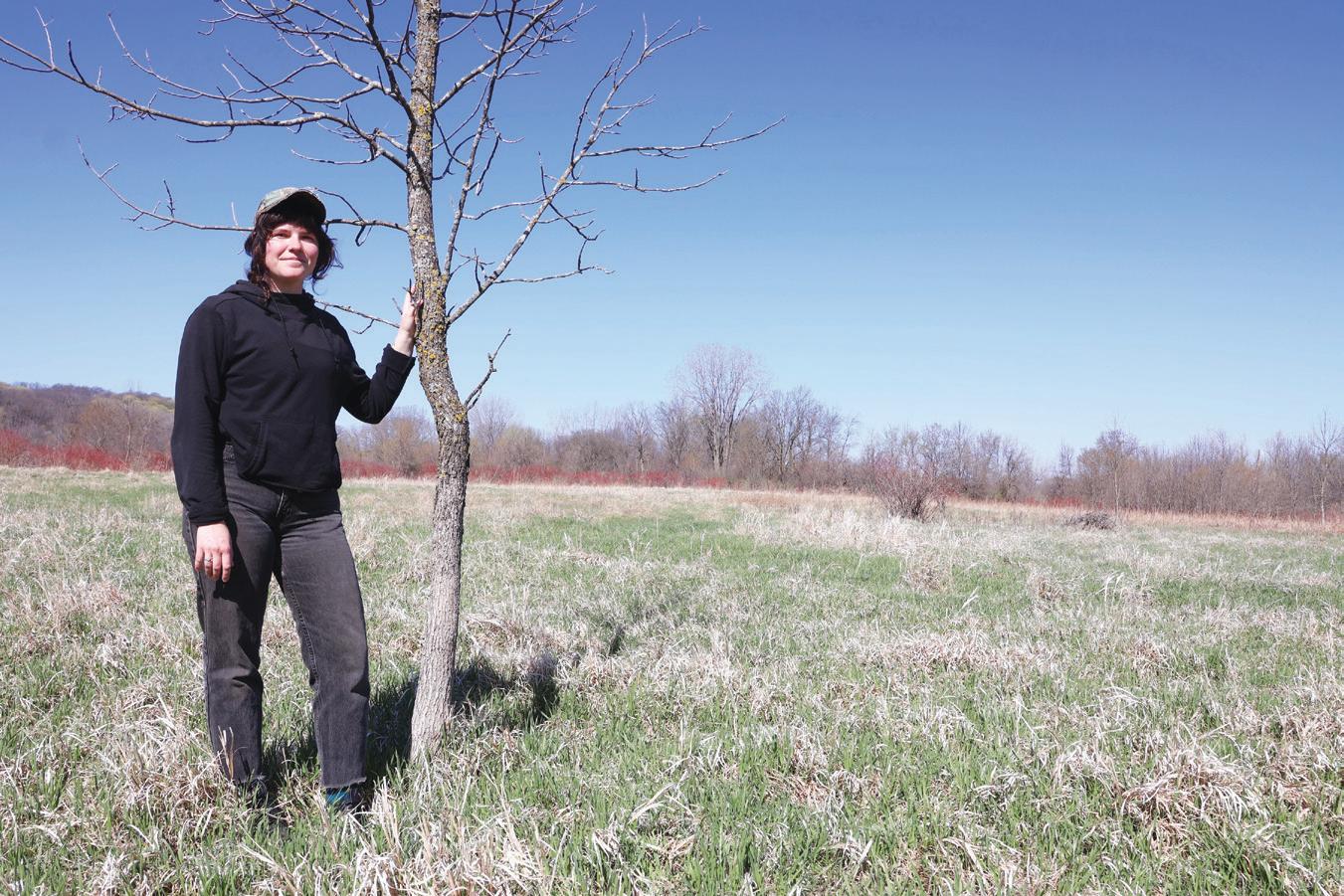
Frances Kelliher in a pasture where she’s using rotational grazing of sheep to revamp soil that hasn’t seen animal impact in three decades. “I’m here for some amount of time and I’d like to leave it better if I can,” she says. (LSP Photo)
“I definitely went into the class feeling really burnt out and cynical. I remember the first few sessions I was like, ‘Wow, everybody’s really dreamy, but like, do they know about flystrike? Do they know what it’s like to pull a lamb or deal with a prolapse?’ I definitely was a curmudgeon,” recalls Kelliher with a laugh on a sunny morning in April.
But as she’s relating this story, the farmer is preparing for another lambing season, a sign that the course didn’t totally sour her on agriculture. And it isn’t just because the class was able to impart some valuable practical skills when it comes to financial management and goal-setting. It turns out being around idealistic energy can sometimes be a cure for the curmudgeon condition.
“The class did open me up to a little more dreaminess,” Kelliher concedes. “I do think it’s good to be around people who are
ambitious dream: utilizing regenerative livestock production to rebuild the relationship between people, the land, and the water in the Minnesota River Valley.
It All Connects
Kelliher, 28, grew up in Minneapolis and got interested in farming and food while taking public health classes in college. She says a life-changing experience was reading What Does Justice Look Like? In that book, Wahpetunwan Dakota scholar and activist Waziyatawin of Pezihutazizi Otunwe describes the generations of genocide and broken treaties that have marked the relationship between Indigenous people in the region, white settlers, and the government. The book struck home for Kelliher, given that her family had long farmed in the Min-
“In What Does Justice Look Like? Waziyatawin talks about land back to Indigenous people on the part of the state and institutions, but she also talks about settler responsibility to heal land,” recalls Kelliher. “And one of the things that really stuck with me was settlers’ responsibility to heal land and not just give land back and wash your hands and be free of the guilt and the shame and the damage. But how do we actively move toward building relationship with land, healing the damage that we’ve done?”
Kelliher had always been a self-described “animal person,” and was fascinated with the role regenerative grazing could play in rebuilding soil health and reclaiming natural grassland habitats. After college, she learned as much as she could about rotationally grazing sheep by working on farms and networking with mentors such as Hannah Bernhardt, a veteran grazier in northeastern Minnesota. She also worked for a time with Josie Trople and Arlo Hark, whose Cannon
…Riverbed, from page 24
Valley Graziers enterprise has carved out a business niche using rotational grazing of sheep to control vegetation beneath solar arrays in the region.
Kelliher is interested in cooperative farming models and has long felt she wouldn’t want to own her own farming operation in order to produce food and fiber. But about the time the grazier’s experience with cooperative farming didn’t go as planned, her grandmother, Elaine Anderson, died, and the family invited Kelliher to use Anderson’s farm near the Minnesota River as a home base for her operation.
It was starting to look like being an entrepreneurial farmer could perhaps be in the cards for Frances after all. And to do that, she realized she would need some background in financial management. Kelliher says she benefited immensely from time she spent working on Little Big Sky Farm in Henderson, Minn., where the owners regularly opened up their books and allowed her to take a look at what it takes financially to run an agricultural operation.
“That experience helped me realize if I was going to do this as my own business, I needed financial planning training,” the beginning farmer recalls.
Bernhardt, Hark, and Trople are all Farm Beginnings grads, and encouraged Kelliher to take the class, which provides training in, among other things, financial planning and goal-setting. So, that’s how Kelliher found herself sitting in a classroom with a bunch of idealistic wannabe farmers. The financial literacy she gained through the class was invaluable, she says, and she ended up taking an extra Farm Beginnings-sponsored workshop on Holistic Financial Management.
anchor and guide her as she worked through that first growing season on her family’s farm. In the end, Kelliher decided to keep her flock and take advantage of the shot she had to farm and live on family land. Why not? She could always reassess after a year, given that she doesn’t have a lot of money invested in expensive infrastructure.
“It’s one of the reasons I think sheep are so great to start out with, because the investment is electronet fencing, a solar energizer, my veterinary supplies, and two dogs,” she says. “I can be scrappy with the sheep and have these pretty low investments.”
Also in 2025, Kelliher added aluminum panels she can make corrals with and a used pickup truck she picked up at a state government auction so that she could move the sheep to other grazing areas in the neighborhood. The farmer admits that she’s so close to the bone financially that paying $500 for a solar charger hurts, but she’s been able to apply for regenerative livestock production grants, which have helped alleviate the costs of doing business.
“I definitely went into the class feeling really burnt out and cynical.”
— Frances Kelliher
Keeping the farm relatively mobile is an important consideration given that the current location of Kelliher’s enterprise, the Anderson farm, is in flux — six extended family members own the property, and it’s not clear if river bottom land is the best place to raise sheep. Her flock has already gone through a serious bout of flystrike, a condition where parasitic blowflies lay eggs in wool or open wounds; it tends to thrive in areas like river bottoms where wool has a hard time getting properly dried out.
The Land Responds
And, given her attitude going into Farm Beginnings, Kelliher says she was pleasantly surprised by how much she got out of an aspect of the class that at first glance wouldn’t appear to have as many “practical” applications. Participants are asked to write down what values drive them and to plan what kinds of farming enterprises and methods might help them stay true to those values.
“One of the things that kind of surprised me and has really helped is the work around values and kind of dreaming and accessing some things that I’ve been feeling really pessimistic and burnt out about,” Frances says. Going through the values exercise helped
Almost a year to the day since Kelliher brought livestock back to a farm that hadn’t seen domesticated hooves in some three decades, she walks past a former dairy barn and silo to inspect a low-lying meadow between a railroad track and the river. The farmer reflects on the past year and lets herself dream a little bit about the future.
In 2025, she sold out the grass-fed meat her Riverbed Lamb (riverbedlamb.com) enterprise produces, and she’d like to expand her flock of 20 ewes to meet the demand.
“I think sometimes I get a little, ‘Oh, marketing, whatever. I don’t like doing that part.’ But I actually do like the customer connection part of all this,” Kelliher concedes. “Getting pictures throughout the year of what people have cooked and getting to be part of people’s lives is a really joyful
Give it a Listen
In episode 401 of LSP’s Ear to the Ground podcast, Frances Kelliher talks about the role Farm Beginnings is playing in Riverbed Lamb’s future. It’s available at landstewardshipproject.org/podcast/ear-to-the-ground401-the-belly-of-belief, or on various podcast platforms.
part of this work. I’m so excited to get more lamb to more people this year.”
Her main source of income is through work as a personal care attendant, and for now, although it’s more than a fulltime gig, farming doesn’t provide enough income to preclude a town job. Even so, she’s excited about the prospect of doing contract grazing on other people’s land. Frances likes the idea of using animals to improve soil health and grassland habitat in the community, and also sees this approach as a way to increase cash flow while staying nimble.
But perhaps the ultimate sign that the self-described pessimist sees some future in farming is that she’s agreed to serve as a mentor to another beginning farmer via a Women, Food, and Agriculture Network (WFAN) program. Kelliher says she benefited tremendously from being mentored by Bernhardt through a similar program administered through Food Animal Concerns Trust (FACT). Such an arrangement provides exposure to the practical skills — building fence, vet care, dealing with pests, setting up watering systems, etc. — needed to run a viable livestock operation. Kelliher particularly liked that through the FACT arrangement, Bernhardt was getting paid. The WFAN program also pays mentors.
“Because I knew Hannah was getting paid for her time, I felt a lot more comfortable asking for help,” says Frances.
Walking through the former dairy meadow on this spring morning, she’s thrilled to see green shoots of vegetation poking up. She explains that for years a thick thatch of dead vegetation seemed to smother all new growth, creating an unpalatable mat.
“It has been interesting already this spring to see the difference grazing can make,” she says. “You can see the lines where I’ve grazed and just in the last week it’s really popping.”
It’s a sign that regenerative grazing can help the beginning farmer make connections between good treatment of the land, the people, and healthy food.
“I’m here for some amount of time and I’d like to leave it better if I can,” Kelliher says as she walks back to the farmstead. p
Seeking Farmers-Seeking Land Clearinghouse
Are you a beginning farmer looking to rent or purchase farmland in the Midwest? Or are you an established farmer/landowner in the Midwest who is seeking a beginning farmer to purchase or rent your land, or to work with in a partnership/employee situation? Then consider having your information circulated via the Land Stewardship Project’s Seeking Farmers-Seeking Land Clearinghouse. To fill out an online form and for more information, see landstewardshipproject.org/farmland-clearinghouse. You can also obtain forms by e-mailing LSP’s Karen Stettler at stettler@landstewardshipproject.org, or by calling her at 507-473-8741. Below are a few recent listings. For the latest listings, see landstewardshipproject.org/farmland-clearinghouse.
Farmland Available
u Jennifer Williams is seeking a farmer to buy 15 acres of tillable and forested land in Frederic, Wis., in Polk County. There is a house available and a 32 x 48 shed/garage. Contact: Jennifer Williams, 612-600-5101, solsticefarmwi@gmail.com.
u Tom Plocher is seeking a farmer to buy 10 acres (5 tillable, 2 pastured, 2 forested, 1 other) in Hugo, Minn., in Washington County. There is a house available, an unattached garage, and footings installed for a 30 x 15 greenhouse. The house was built in 1991-92 with four bedrooms and two bathrooms, plus a 450-square-foot studio apartment for guests or rental. There is a well, raised bed septic system, gravel driveway, and pond. Asking $950,000. Contact: Tom Plocher, 651-323-7118, tom.plocher@ gmail.com.
u Reuben Peterson is seeking a farmer to rent 2 tillable acres in Ames, Iowa. There is irrigation from a shallow well. He is open to diverse non-chemical intensive agricultural pursuits. The land has not been sprayed in 2.5 years and is set hundreds of feet away from roads and chemically-exposed fields. There is no house. Contact: Reuben Peterson, rjpeterson71@gmail.com.
u Judith Driscoll is selling a 768-squarefoot single-story rambler on approximately half-an-acre of mature permaculture-planted edible landscape in Maplewood, Minn. The lot has been chemical-free for 25 years. There are edible plants such as ramps, as well as fruit trees and shrubs. There is a detached one-car garage and storage shed. The asking price is $275,000. Contact: Judith Driscoll, 612-207-6383, judithadriscoll@ gmail.com.
u Scott Roser is seeking a farmer to rent or buy a 0.56 acre urban homestead in the city limits of Fergus Falls, Minn., in Otter Tail County. There are 66 raised beds sized 25 x 30 each and with 18-inch wood chip paths between them. The front yard is a terraced south-facing slope sized about 20 x 100 with raised beds and mounds for squash. All the beds are prepared for connection to an irrigation system, which is partially installed. There is a tool shed, covered com-
post bins, a 14 x 25 high tunnel, and chain link fence surrounding most of the property. Peach trees, native pollinator plants, and berry bushes have been planted. A permit to raise chickens has previously been used. A robust farmers’ market and indoor winter market, as well as local health foods store/farm-to-table restaurants, herbalists, and public and private schools can support in-town market opportunities. Photos and a description of the farm are at tiny.cc/r63z001. Contact: Scott Roser, 507438-5445, rjpeterson71@gmail.com.
u John Lenarz is renting part of a farm, including 10 acres of hay (cool season grasses) and 18 acres of a former Conservation Reserve Program field, on a former dairy operation in Spring Valley, Wis. — 45 miles east of Minnesota’s Twin Cities. No chemical herbicides or fertilizers have been used for decades. Lenarz is looking for someone to continue working this land for hay, row crops, or prairie. The owner is willing to offer assistance conditioning the land, a long term low-rent contract, and possible sale of the land to anyone who can practice sustainable agriculture on this property. There is a water hydrant available on a shared, residential well. Lenarz would consider low-impact livestock pasturing, but fencing and watering infrastructure is needed. Contact: John Lenarz, 715-698-2277, je1954@baldwin-telecom.net.
Seeking Farmland
u Jake Knighton is seeking 10-20 acres of land (at least half tillable and the remaining land a combination of pastured and forested) within 30 minutes of Northfield, Minn. Knighton is a beginning farmer who intends to develop a diversified operation centered on regenerative poultry production. He is open to slow transitions of ownership that allow retiring farmers to access cash while they see the stewardship of their land passed to new hands. Ideally, there is an existing house on-site, but lack of one is not a deal breaker. Contact: Jake Knighton, 952-457-0303, jake. knighton@gmail.com.
u Steve Loucks is seeking farmland in the Wisconsin Driftless Region. He is an organic farmer looking to raise produce and perennials. Loucks would like some pasture to run
chicken tractors and/or sheep on. Some sort of small off-grid dwelling would be great, but not necessary. He is open to anything, including renting, lease with future option to buy, sharecropping, labor in trade for land use, etc. Loucks has experience in residential construction remodeling as well as farm/garden work such as building chicken coops, planter boxes, greenhouses and fencing. Contact: Steve Loucks, 208-610-7543, offgridfarmer@hotmail.com.
u Amy Bach is seeking 40 acres of farmland to buy in Wisconsin. Bach is looking to purchase 40+ acres with the intention of developing only 5 acres initially. The remaining acreage would be leased back to the seller for $0 for a period of 10 years, with the buyer retaining the right to develop up to 2 additional acres per year. This would provide a liquidity event now for the seller while maintaining current farming operations. No house is needed. Contact: Amy Bach, 262689-2525, amyleebach@gmail.com.
Seeking Farmer
u Anton Ptak and Rachel Henderson are seeking a farmer(s)/orchardist(s) to transition into running an orchard and/or diversified farming operation on their 60acre farm in southern Dunn County near Menomonie, Wis. Specific arrangements and options for involvement are flexible, but could include managing the business, purchasing all or part of the operation, or other creative arrangements. A 6.8 kilowatt solar array is installed on roofs of two buildings and provides a significant portion of the energy use of the farm. There are about 12 acres of electric fenced pasture, waterlines for grazing, and supplies for rotational grazing. Other outbuildings include a fully enclosed and insulated 2,200 square-foot packing facility with a walk-in cooler. The certified organic orchard operation includes about 10 acres of fenced-in trees and bushes. The principal crop is apples with smaller plantings of pears, plums, currants, and blueberries. The orchard has obtained a license to sell farmstead hard cider. Contact: Anton Ptak, 612-387-2205, anton.ptak@gmail.com.
Cultivating Connections
Avian Ag
5 Examples of Farmers Bending the Bird Curve
Birds are in trouble, and nowhere is that more evident than in farm country. A study published in the journal Science earlier this year found that while bird populations are declining precipitously all across the United States, areas of intensive agricultural production in particular were “hot spots” for avian drop-offs. “What we found is that any metric of agricultural intensity was always the best predictor of acceleration of the decline” in birds, the lead author of the study told The New York Times. And birds that rely on diverse, healthy stands of grasslands to survive and thrive have suffered the most. During the past 50 years, this country has lost over half of its grassland songbirds — think bobolinks, meadowlarks, dickcissels, and savannah sparrows.
This may not come as a surprise to anyone who’s spent any time driving through the Corn Belt — over the decades deep-rooted tallgrass prairie has been plowed up to make way for plantings of annual crops like corn and soybeans. Besides not having much wildlife cover available, these crops are reliant on heavy dosages of pesticides, which indiscriminately kill off insects, including beneficial bugs and the ones that birds rely on to survive.
rely on managed rotational grazing of perennials and diverse crop rotations as tools for supporting wildlife habitat, including areas grassland birds rely on.
Traditionally, wildlife ecologists have had a negative view of the relationship between birds and working farmland. For good reason: overgrazing, for example, can have a devastating impact on nesting success. However, advancements in managed rotational grazing, also know as regenerative grazing, have helped make it possible to balance profitable livestock production with healthy habitat.
Bobolinks are key indicators of healthy grassland habitat.
(Photo courtesy of Cornell Lab or Ornithology)
The decline of birds doesn’t just mean less color in the skies and quieter mornings — it’s an indicator of how healthy the landscape is.
“Birds are a fantastic indicator species,” says Krysten Zummo, a grassland ecologist with the National Audubon Society’s Upper Mississippi River office. No bobolinks means there are no pollinators or other insects. No insects goes hand-in-hand with a lack of the kind of deep-rooted grass and forb habitat that can sequester carbon, build biology, and keep contaminants out of the water.
The good news is that here in the Midwest an increasing number of scientists and natural resource professionals are seeing agriculture’s potential for slowing this downward trajectory, or, as Zummo puts it, “bending the bird curve.” They see regenerative practices that
During the 1990s, a group of Minnesota livestock graziers, scientists, natural resource professionals, and others — working collectively as the “Monitoring Team” — made direct connections between regenerative grazing and healthy grassland bird habitat. What the farmer-members of the Land Stewardship Project-led Monitoring Team learned was that the more grassland songbirds they saw on their land, the higher the probability that they were managing it in a way that grassland habitats were thriving. And the more high-quality grasslands they had, the better their livestock did.
This and other research has helped convince groups such as the Audubon Society of the value of utilizing livestock to regenerate the soil universe and the habitat it supports.
“Grasslands, if they’re going to remain as grasslands, have to have some kind of disturbance,” says Zummo.
The following pages include reports from the field on recent connections farmers and ecologists are making between the avian and the agricultural. These stories show that birds not only can serve as pest controllers, indicators of a farm’s productivity, and ecological bellwethers — they can also help make farming an enjoyable way to make a living.
— Brian DeVore
1) Sounds of Success
On a muggy September day in northcentral Wisconsin, Kevin Mahalko moved a strand of polywire fencing so a group of his dairy heifers could crowd their way into a new grazing paddock. As the bovines tucked into the bright green stand of forage, the farmer listened for signs of success. Sure enough, there was the satisfying thrum of the ruminants chomping away. But Mahalko also had his ears tuned into other indications that the managed rotational grazing system he’s been utilizing for the past three decades is working for the land, the animals, and his bottom line.
“Listen to the insects,” he said. Yep, the electric buzz of bees and other pollinators as they cruised from plant-to-plant in the diverse pasture could be heard.
In a sense, it was a cascading auditory effect showing the interconnection of grass, cows, and insects. And the entities that had a final say, so to speak, on the quality of this habitat were giving their two cents as well: meadowlarks, killdeer, and other grassland species could be heard calling in this and other grazing paddocks.
“The catalog of bird calls every time we’re moving animals or working out in the field is pretty rewarding,” said the farmer.
Mahalko studied wildlife and natural resources, as well as business, in college. This sparked an interest in how to produce food in a way that supported natural habitat. When he returned to the family farm, he was struck at how pioneering rotational graziers in the region were using livestock to build soil health and keep the land covered yeararound, all while producing meat and milk at a low cost. So, in the mid-1990s, he started transitioning the farm into a grass-based system. Today his 45-head herd of Holstein cows is supplying 100% forage-based milk to Organic Valley Cooperative for its “Grassmilk” label.
Mahalko sees community building as a key part of sustaining a regenerative farming system. He has hosted school groups on the farm and nursing students and even college ornithology class members have hiked the operation’s pastures and woods to see firsthand the relationship between regenerative livestock production, biologically-active soil, wildlife habitat, and healthy food. No matter who’s visiting, one thing Mahalko always makes certain to show off is the part of the farm where two bald eagle nests are perched in giant white pines that are separated by about 100 yards of grazing paddocks. On this September day, he rode his four-wheeler to that spot and watched as a giant eagle wheeled over the nest closest Avian Ag, see page 28…
Cultivating Connections
to the farmer and settled in the further one. When the raptor swooped over that first nest, a hidden eagle crouched down amongst stacked sticks gave out a call.
“That’s what I was waiting for,” Mahalko said with a smile as he fired up the fourwheeler and headed back across his pastures.
2) Return of the Bird
Ashly Steinke guided his Polaris sideby-side through a diverse stand of grasses and forbs in north-central Wisconsin one morning in early fall. As he parked the vehicle near a paddock where his beef cow
the landscape can make.”
He might be understating it when saying converting the farm from annual row crops to perennial grasslands is a “little” change, but there’s no doubt it’s produced big results. A 2024 bird survey on the farm identified 28 male bobolinks, 14 male eastern meadowlarks, and a couple dozen savannah sparrows — all species that require high quality grassland habitat to do well. “So it can be done — grassland birds can colonize an area,” said the farmer.
It’s clear such a transformation thrills Steinke, who, besides being a beef producer, is trained in wildlife biology. And since he began working for the National Audubon
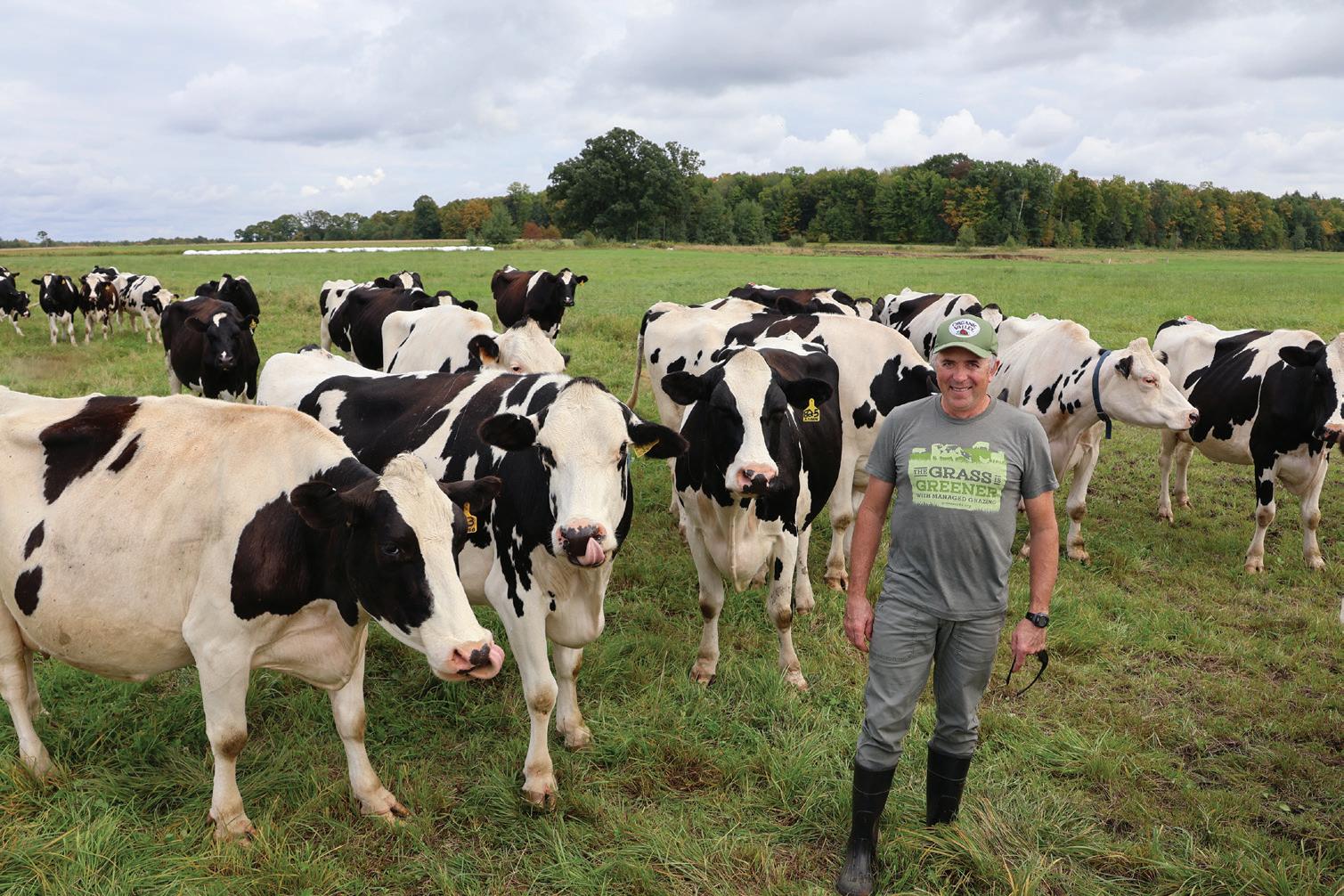
herd was grazing, he described the very day when he realized his efforts to re-perennialize the land were paying off. When his family bought this 340-acre farm in 2014, it was virtually all corn and soybeans, and had, as Steinke puts it, “zero grassland birds.” He went to work seeding it down to pasture species, set up a fencing and watering system, and began rotationally grazing cattle on it. By 2017, the entire farm was in grass.
“I remember the first bobolink, and I actually took a picture of it sitting on the barbed wire fence along the gravel road here,” Steinke said. “It was really an eyeopener of what a difference little changes on
Society a few years ago as a grassland ecologist, he’s been helping other farmers share in this experience of blending ag and ecology. In that role, his primary job is to work with farmers and other landowners in expanding the growth of the organization’s wildlife certification program. Called Audubon Conservation Ranching, this initiative certifies livestock producers who are utilizing managed grazing systems that are considered “bird friendly” — in other words they are rotating their animals in a way that they are contributing to a diverse mosaic of grass-based wildlife habitat.
Previously, the certification and habitat
restoration program had its biggest presence in the Western U.S., but in recent years Audubon has started working with Midwestern producers in states like Wisconsin, Minnesota, and Iowa. Nationally, there are 155 Audubon Certified Bird-Friendly livestock operations, and they account for some 4.5 million acres of grassland habitat.
Such a program is an acknowledgement by a major environmental group that regenerative livestock production can play a key role in wildlife conservation. It’s hoped that farmers and ranchers can utilize the certification to, for example, market their beef to eaters who value having more grassland birds on the land.
And finding a way to viably return soilfriendly perennial forages to the landscape isn’t just good news for the birds. Steinke farms in the Yellow River watershed, which drains into the Chippewa, which eventually dumps its aquatic load into the Mississippi. Having deep-rooted perennials growing in areas like this can play a major role in keeping nitrates and other agricultural pollutants out of water downstream.
While his cow herd bellowed impatiently for him to move them to a new paddock — which the farmer eventually did with a quick relocation of a strand of wire— Steinke talked about how in much of the Upper Midwest and the Great Plains, recognizing and encouraging good management of agricultural grasslands is critical to supporting perennial habitat and all of the ecological benefits it can provide.
“Much of this land is owned by families who are farming and ranching it — a lot of it’s working landscapes,” he said. “If we’re going to make a difference, we can’t rely on just publicly managed lands.”
3) Earning Their Keep
Any doubt that the owners of Keewaydin Farms see birds as an integral part of their agricultural enterprise flutters away once you pull into their driveway. There, rising above the former milking parlor that now serves as a vegetable packing shed is a concrete silo sporting a colorful mural featuring an eastern meadowlark, a barn swallow, and an orchard oriole. And behind the silo is a birding trail that winds its way through the rugged Driftless Region terrain here in southwestern Wisconsin.
On a rainy April morning, Keewaydin’s owners, Joy Miller and Rufus Haucke, were able to show a couple dozen visitors firsthand the inspirations for that mural. As they hiked on the birding trail, the visitors spied a northern harrier, an eastern meadowlark, various sparrow species, a goldfinch, and a
Avian Ag, see page 29…
Kevin Mahalko with his dairy herd in north-central Wisconsin. “The catalog of bird calls every time we’re moving animals or working out in the field is pretty rewarding,” he says. (LSP Photo)
…Avian Ag, from page 27
ruby-crowned kinglet, among others. At one point, Miller literally yelled out in delight when an eastern bluebird emerged from one of the nesting boxes that the farmers have erected along the trail.
Keewaydin Farms has been in the Haucke family since 1976, when Rufus’s parents started a dairy operation there. In the early 2000s, Rufus came back to the farm and started a certified organic vegetable operation. He and Miller now raise vegetables on four acres of the 200-acre parcel, which is a combination of grassland, hay ground, and woods. A recent addition to the farm is a flock of sheep, which helps them add value to the perennial forages that have replaced row crops over the years.
“After 20 years of organic farming and having a lot of diversity, the birds just showed up,” said Miller. “Those are the things that tell us, ‘You’re doing something right, you’re a good steward of the land.’ ”
The April tour of Keewaydin Farms was being sponsored by the Wild Farm Alliance, a nonprofit that works to help farmers balance wildlife habitat restoration with profitable food and fiber production. The event featured presentations on building nesting boxes, the role birds can play in controlling pests, and what governmental and nongovernmental programs are available to establish and support habitat.
being, the birds play key practical roles on an organic operation like theirs.
“We see how often they are taking insects back to their nests,” Miller said of species such as bluebirds. “When you don’t have the tools of the chemical side, you have to lean on the natural side. They are our natural pest control.”
The bird trail hike wrapped up near where the sheep herd was being kept, which prompted a discussion about recent research showing that barn swallows can play a major role in controlling fly infestations in
the flock — a flock of birds and a flock of sheep,” quipped Miller.
4) Boundary Busting
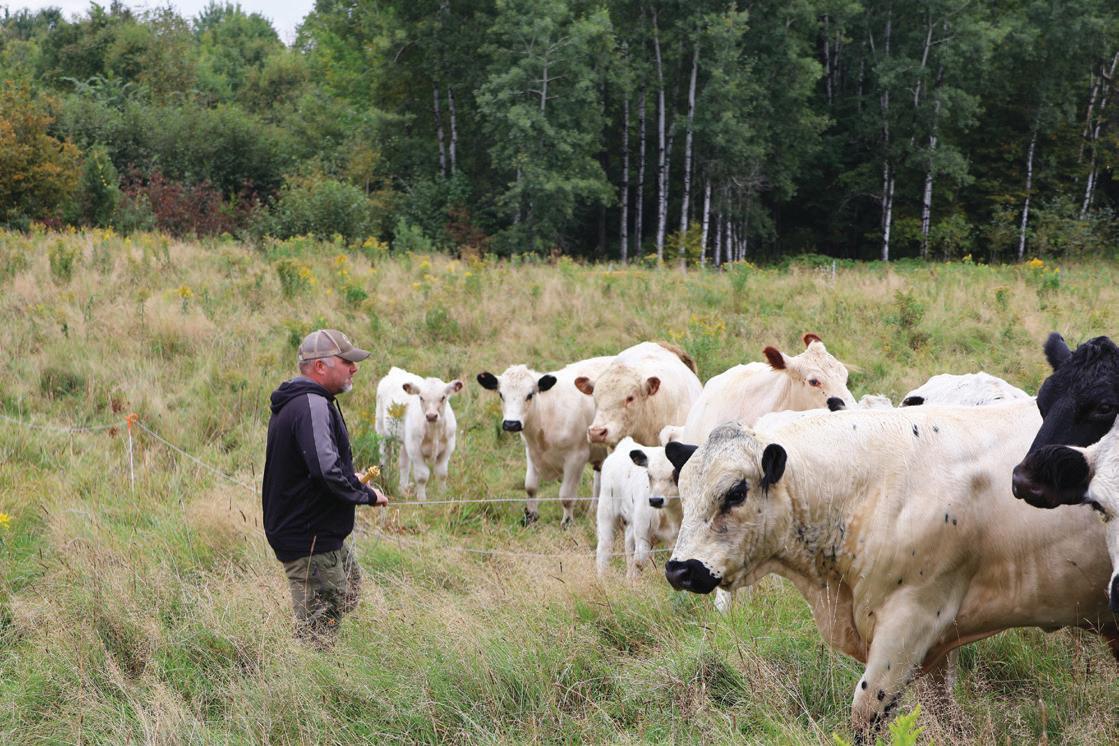
OMiller and Haucke made it clear during the day that the mere presence of birds lifts their spirits as they work in the vegetable plots. But besides providing a sense of well-
livestock by creating a “landscape of fear” for the pests. In fact, a University of Milan researcher recently documented a correlation between healthy sheep and higher barn swallow populations at Keewaydin. The farmers partially credit the presence of swallows with warding off flystrike, a devastating condition where parasitic blowflies lay eggs in wool or open wounds.
“It’s a cool symbiosis to see evolve in
And this farmland is sitting in the midst of a National Audubon Society Globally …Avian Ag, from page 28
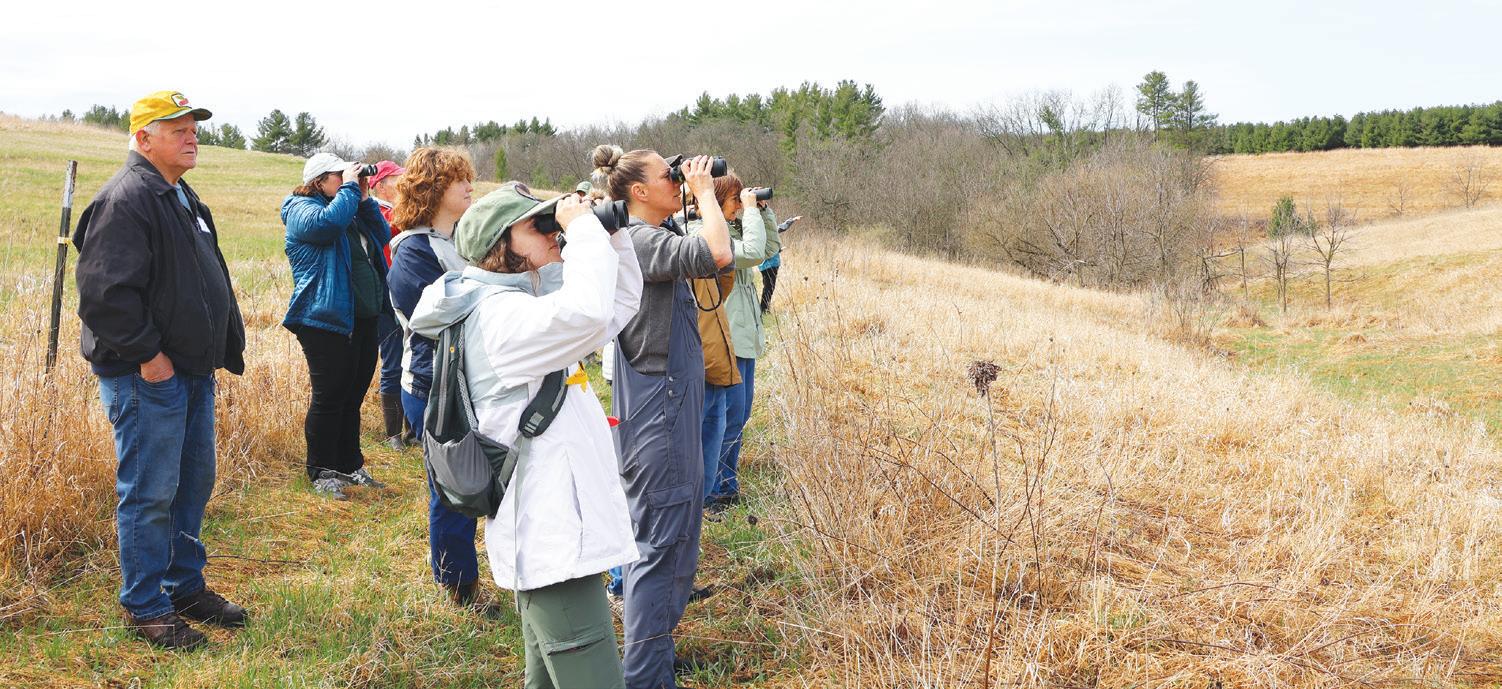
Joy Miller (in gray overalls) leads a birding walk at Keewaydin Farms. “When you don’t have the tools of the chemical side, you have to lean on the natural side. They are our natural pest control,” she says of the birds that make the farm home. (LSP Photo)
n a sunny May morning, a ribboncutting ceremony highlighted what happens when a farmer blurs the boundaries between the wild and the tame. “We will now trespass onto the birds’ sanctuary,” said the farmer in question, Phil Specht, as a couple dozen people passed through a gate, binoculars in hand. But this sanctuary is not only a home to birds, it’s also a working part of his farm. The ceremony was marking a special agreement Specht’s family developed with the Iowa Natural Heritage Foundation and the USDA’s Natural Resources Conservation Service.
A lifetime agricultural easement has been placed on this 244 acres of rolling grassland and trees just up the hill from the Mississippi River town of Marquette in northeastern Iowa. That means that the land can never be put into subdivisions or similar development. Just as importantly, it can never be tilled or row-cropped. What can occur on this land is that it can be grazed by livestock. To the wildlife experts who have hiked and studied the Specht farm, that last allowance is not a compromise. In fact, it’s because of the decades of managed rotational grazing that’s taken place on these acres that this is prime bird habitat.
“The more I carefully managed the cattle for the birds, everything else got healthier,” Specht said. Indeed, during a tour of the “Grassland Bird Sanctuary,” Paul Skrade, a biology professor at Upper Iowa University, pointed out the numerous eastern bluebirds and kingbirds that were perched on fence lines. And flitting around the edge area where the pasture grass met a thick stand of timber were woodland-centric species such as rose breasted grosbeaks, Baltimore orioles, red eyed vireos, pileated woodpeckers, and indigo buntings.
But the star of the day was the bobolink, that flashy black-and-white grassland bird that had just arrived in the area after winging thousands of miles from South America. Skrade explained that because for decades Specht has utilized a grazing system that moves cattle frequently and thus leaves plenty of vegetation behind, it produces not only healthy feed for livestock, but the kind of heterogeneous habitat that grassland birds such as bobolinks need to thrive.
Avian Ag, see page 30…
Ashly Steinke moves cattle on land that was converted from annual row crops to perennial pasture. “It was really an eyeopener,” he says of how birds responded to the landscape change.
(LSP Photo)
Cultivating Connections
…Avian Ag, from page 29
Important Bird Area and the Effigy MoundsYellow River Forest Bird Conservation Area. The Iowa Department of Natural Resources’ Bloody Run Wildlife Management Area is adjacent to the farm. Ecologists argue that isolated islands of habitat are not enough for birds and other wildlife if they are to have healthy, sustainable populations. In agricultural areas, the ideal situation is to have nature reserves bordering working farmland being managed in a regenerative manner, thus extending environmental benefits across a broad swath of the landscape.
“You usually picture wilderness for wildlife,” said Skrade. But, he added, the Specht property shows that working lands and natural habitat can coexist and even be mutually beneficial. “Honestly, it really does bring my heart joy when I go onto that property.”
5) Attracting the Future
How does one make a farm attractive to the next generation? That was a point of discussion on a soft June evening near the southeastern Minnesota community of Lake City. Beef and crop producers Paul and Delores Moechnig were hosting half-adozen other farmers for a Land Stewardship Project Soil Health Hub gathering. Such gatherings (see page 16) give farmers who are utilizing regenerative production methods like managed rotational grazing, cover
cropping, or conservation tillage a chance to get together and share ideas, frustrations, and in general offer each other support.
Topics of discussion on this particular evening centered around pasture improvement, ways of reducing a reliance on expensive inputs like fuel and fertilizer, marketing challenges, and pasture watering systems. Oh yeah, and what the future holds for farms like this.
The Moechnigs sold their dairy herd in 2020 and since then have focused on raising beef cattle utilizing managed rotational grazing. They have their own cow herd, and also do custom grazing. Everything grown on the farm — grass, corn, hay forages — is fed through the cattle, creating a tight nutrient cycle that’s economically efficient.
The Moechnigs are in their 70s, and starting to think about the future of their 160acre operation. Paul feels that by tapping into practices that avoid intensive row-cropping, build soil health, and reduce a reliance on expensive equipment and inputs, he and Delores are making the farm something that is viable for the next generation to take on.
“We have to show the next generation there are alternatives to just corn and beans in this country,” he said.
As it happens, their son, Jim, who’s in the process of taking over the farm, participated in the Hub meeting. Along for the ride were his daughters, Eliza, 11, and Evelyn, 14.
While Paul and the other Hub members checked out a herd of cattle grazing in a hilltop paddock, Delores walked a few yards
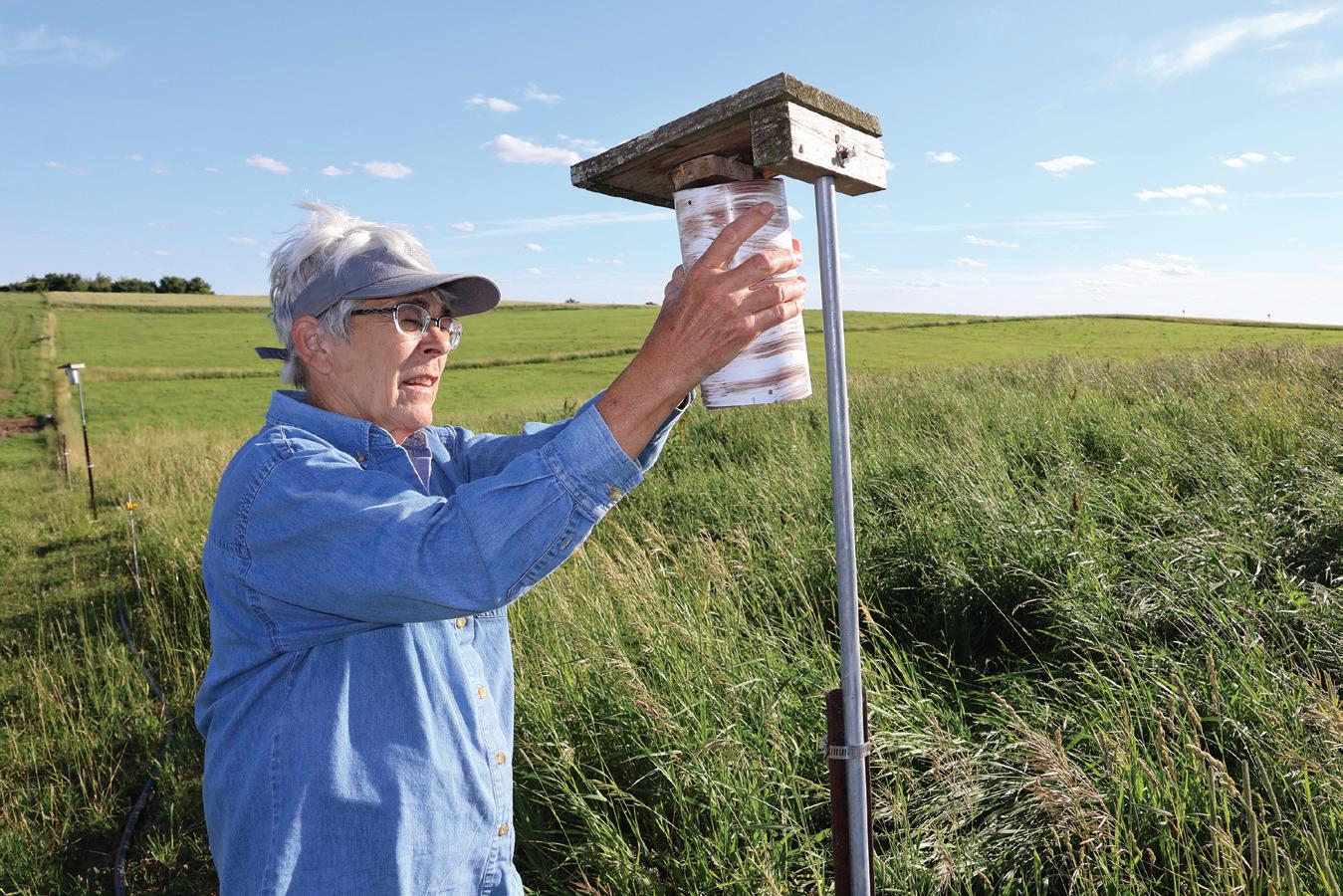
Avian Audio
Check put these LSP Ear to the Ground podcast episodes featuring farmers and ecologists discussing the relationship between regenerative farming and bird habitat:
➔ 404: Closing the Loop
➔ 391: Grounded in Grazing
➔ 390: Sounds of Success
➔ 371: Avian Award
➔ 370: Bending the Bird Curve
➔ 275: Blurring the Bobolink Boundaries
These episodes are available at landstewardshipproject.org/series/ ear-to-the-ground, or on various podcast platforms.
away and took down a piece of PVC pipe mounted on a fence line. Three tree swallow chicks, all fluff and beaks, were tucked in the bottom. This “nesting station” is one of 12 the Moechnigs have set up around the farm to support swallows as well as bluebirds. The farmers have noticed that if they set up two nesting containers at each station, swallows will nest in one container, while bluebirds will take residence in the other.
“The bluebird won’t let another bluebird live close and the tree swallow won’t let another tree swallow live close,” Delores said. “But the bluebirds and swallows can live close to each other.”
Noting the nuances of bird behavior has gone hand-in-hand with the farmers’ adoption of managed rotational grazing 25 years ago. After all, the more time you spend in the grazing paddocks moving fence and doing other tasks, the more opportunity you have to observe your feathered neighbors. For example, bluebirds seldom use the houses made from PVC unless they don’t have any other choice (the Moechnigs also have traditional wooden nest boxes), swallow eggs are smaller, and wrens will kill baby bluebirds and build nests on top of existing ones, so mounting a nest box next to brushy wren habitat is not advisable.
Given that a livestock production practice like rotational grazing relies on close observations and making adjustments based on trial and error, it’s no surprise the Moechnigs have become adept at using their monitoring skills to make the farm a home for birds.
Besides bluebirds and tree swallows, their pastures now attract eastern meadowlarks, bobolinks, dickcissels, and ring-necked pheasants — all species that require diverse
Avian Ag, see page 31…
Delores Moechnig checks a nesting container for tree swallow chicks on the southeastern Minnesota farm she and her husband, Paul, rotationally graze beef cattle on. (LSP Photo)
…Avian Ag, from page 30
stands of grass to thrive. The farmers also have woods and windbreaks on their land, and such habitat brings in rose-breasted grosbeaks, purple finches, orioles, and various kinds of woodpeckers, including the redheaded woodpecker, which has experienced serious population losses in Minnesota over the years. “It’s just nice to know that they’re in the area and enjoy our farm,” said Delores of the birds that frequent their land. She conceded her favorite is the bluebird, with its sky-colored feathers and soft, whistle-like

A Creek Runs Through This
Driftless Land
A Farm Family’s Journey Toward a Land Ethic
By Richard L. Cates Jr.
244 pages Little Creek Press littlecreekpress.com
Reviewed by Dale Hadler
Richard Cates believes every farm has a story to tell, one that involves relationships — between people and between people and the land. And we need some sort of indicator that those relationships are healthy enough to benefit all involved. So, when Cates sat down to write about his own family’s decades-long relationship with a gorgeous piece of land in the Driftless Region of southwestern Wisconsin, it makes sense that the farmer and educator chose as his relationship barometer Lowery Creek, which flows three and a half miles through the Cates property.
As he makes clear in A Creek Runs Through This Driftless Land: A Farm Family’s Journey Toward a Land Ethic, when his father purchased the Iowa County farm in 1967, the soil and the creek were showing the negative results of farming methods that had a broken ecological relationship with the land. Today, Lowery Creek is, as Cates proudly writes, a Class 1 Trout Stream. This transformation didn’t come about easily.
“My journey on this farm would have been less arduous if I had observed the lessons of nature from the beginning, but like
call. “They’re serenading us,” she said.
As the Soil Health Hub participants headed back to the farmstead at the conclusion of the pasture walk, dozens of tree swallows acrobatically swooped low over the grasses and forbs, their blue-green feathers flashing in the slanting rays of the summer evening as they snatched flies and other insects out of the air. Somewhere a bobolink called while Delores and Paul’s granddaughters marveled at the swallow chicks nestled at the bottom of the PVC nesting tube. It turns out it’s not just agronomic and economic considerations that make a farm attractive to the next generation. p
most farmers, I had to unlearn before I could learn,” writes the author.
This delightful book describes, in a deeply personal manner, the Cates family’s journey into the world of regenerative agriculture, and the impacts that has had on Lowery Creek and the land and community it flows through. The book begins where it all began by describing the geological forces that created the Driftless Region, an area in southwestern Wisconsin, southeastern Minnesota, northeastern Iowa, and northwestern Illinois that was not scraped flat by the last ice age. Cates then describes the relationship Indigenous people such as the Ho-Chunk had with the land. Settlers introduced Europeanstyle farming to the region, resulting in the worn-out farm Cates’ father bought.
This book also tracks the journey the author, along with his wife, Kim, have taken. They both have advanced college degrees, with Richard eventually getting his doctorate in soil science. While in Saudi Arabia, he helped manage a massive dairy farm. That and other experiences convinced Cates that an industrialized approach to farming was not sustainable for the land, people, or communities.
Avian Ag Resources
Interested
in learning more about how to blend bird habitat and productive farming? Check out LSP’s Ear to the Ground podcast episode no. 372: landstewardshipproject.org/podcast/ ear-to-the-ground-372-dancing-withdiversity. It features a discussion of how the Wild Farm Alliance helps farmers and other rural landowners build and support good relationships with wildlife, including birds.
conference in Wisconsin in 1990, and he served for a time as the director of the University of Wisconsin’s Center for Integrated Agricultural Systems, as well as the School for Beginning Dairy and Livestock Farmers.
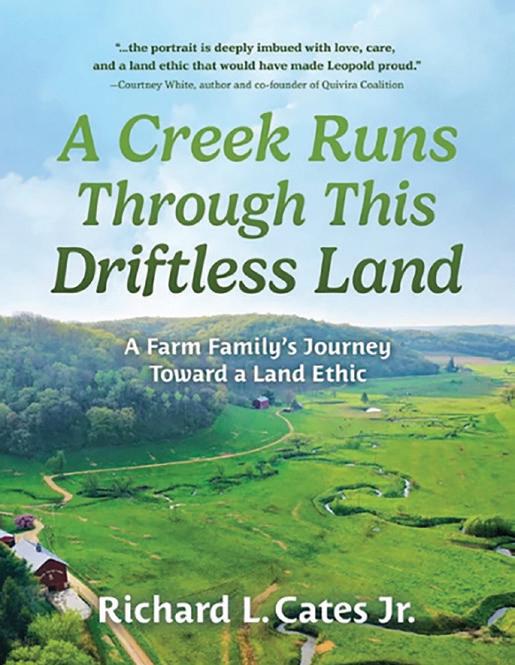
Cates practiced what he preached, and his family transformed their farm’s eroded crop fields and overgrown, thistle-dominated pastures into a working lands paradise consisting of perennial forages, healthy soil, wildlife, and, of course, clean water. And they’ve figured out a way to make care of the land pay off by building up a thriving grass-fed meat business. That financial success is key, given that nothing is sustainable unless it can be carried on by future generations. Cates acknowledges this. Since his family purchased the farm, “our family is the only one in the rugged terrain of the Town of Wyoming, in Iowa County, Wisconsin, that has started and maintained a farm business over the past fifty years,” he writes.
Cates is influenced by writers such as Aldo Leopold, Wendell Berry, and Robin Wall Kimmerer. In fact, Leopold’s argument for adoption of a “land ethic” that recognizes that people and the land are all part of one community permeates this book.
Fortunately, when, over three decades ago, Richard and Kim began revitalizing the farm with the help of beef cattle, there were numerous innovations in regenerative grazing getting off the ground. Thus, the philosophy behind a land ethic could be grounded in practical, working lands conservation. Cates helped plan the first statewide grazing
The good news is that by doing right by Lowery Creek, Richard and Kim have made the farm attractive to a new generation: a son and his wife have taken over the operation as the elder Cates step back from active farming. That successful transference to the next generation helps fortify the author’s belief in the power of an ethic built not just on good soil and clean water, but on people.
Writes Cates, “Today our farm runs on sunshine and rain, healthy soil, and good relationships. Period.” p
Land Stewardship Project member Dale Hadler lives in southeastern Minnesota’s Driftless Region.

Living Roots
The Promise of Perennial Foods
Edited by Liz Carlisle &
Aubrey Streit Krug
288 pages Princeton University Press press.princeton.edu
Reviewed by Dana Jackson
What are “perennial foods”?
Foods you eat every few years? Not exactly. Liz Carlisle and Aubrey Streit Krug, the editors of Living Roots: The Promise of Perennial Foods, use the term to describe foods that humans harvest from perennial plants, those plants that do not die back annually after producing seeds, but emerge from living roots each growing season.
As we have throughout our evolution, humans today eat fruits, seeds, and roots from both annual and perennial plants: fresh and dried seeds of annual legumes (beans, peas), the roots of mature annual plants (potatoes, onions, garlic), and the fruits (apples, raspberries, walnuts) of perennial trees and shrubs. We also eat what has become the basis of our diet: seeds of annual grasses ground into flours and baked into breads (wheat, rye, corn). Humans evolved by eating animals that grazed on perennial grasses, legumes, and other flowering plants, but then we fenced them in and started feeding livestock mostly grains — seeds from annual corn and soybeans.
The editors of Living Roots — Carlisle is an agroecologist and associate professor at the University of California-Santa Barbara and Streit Krug is director of the Perennial Cultures Lab at The Land Institute — explain in the preface that humans need more food from perennial plants to help mitigate the climate crisis. They acknowledge that to lower carbon emissions we must, of course, first stop burning fossil fuels. But part of the solution is also to stop plowing up the land every year to plant annuals, which releases carbon into the air, as well as nitrous oxide, another greenhouse gas that’s produced from applying fertilizer to crops like corn. Instead, we should depend upon food crops from plants whose leaves pull carbon out of the air through multiple seasons to be stored in roots that interact with microorganisms in a process that builds soil continually.
Today, annuals are grown on 60% to 80% of global cropland. The thirty-four different essays in this book are written by farmers, scientists, ranchers, and community leaders who are engaged in studying or growing perennial plants or plant systems and support changing the dominance of annual crops in our food production system. Chapters are grouped under the headings: “Forest,” “Grassland,” and “Grain.”
The subjects in the “Forest” section range widely: Leah Penniman describes land reclamation on Soul Fire Farm in Grafton, N.Y., through agroforestry; Gary Nabhan expounds on the long-term productivity of native desert forest plants like agave and prickly pear; and Omar Tesdell explains how villagers searched for their destroyed homes in Palestine after war by looking for the backyard fig and mulberry and olive trees that had fed generations. In Reginaldo Haslett-Marroquin’s chapter, called “TreeRange Chicken,” he describes the junglelike habitat he created in southern Minnesota for chickens, which are domesticated jungle fowl. Hazelnut bushes and basswood, oaks, sugar maples, hickory, and mulberry trees surround the chicken houses, providing shade and food in return for manurebased fertilizer.
results in extreme soil loss and immense carbon emissions. A human diet of seeds from perennial plants instead of annual ones would lower carbon emissions and create other ecological benefits akin to those of forest and grassland foods. This revolution in agriculture was first proposed by Wes Jackson — with whom I co-founded The Land Institute in Salina, Kans., in 1976 — in his 1980 book New Roots for Agriculture. The book argued that soil loss, not climate change, should be the prime motivation for creating an agricultural system based on perennial polycultures. The threat posed by the buildup of carbon in the atmosphere was less understood in those days.
In the “Grassland” section, indigenous writer Rosalyn LaPier reminds readers that the diets of native peoples on the huge grasslands of North America not only depended upon eating buffalo, but also on harvesting the berries and roots in the landscape. Kelly Kindscher, a Kansas ethnobotanist, explains how Native Americans in the Midwest harvested the roots of prairie perennials, tipsin (tumbleweed) and hopniss, and knew that the bitter egg-shaped roots required slow baking, hot rock cookery to make them sweet. In her chapter “From Corn Belt to Pasture,” Laura Paine explains how the “template for ecologically sound, profitable, regenerative agriculture is a well-managed pasture,” with grass-eating beef in a rotational grazing system as the food product. She doesn’t say it, but beef is plant-based food.
The third section, “Grain,” doesn’t follow logically after “Forest” and “Grassland” as a third ecosystem involving perennial food. However, the dominance of annual grains in our diets and the diets of meat animals
New Roots for Agriculture proposed a biotechnical fix for soil loss through crop systems that mimicked the communities of different grasses and forbs found in a prairie, which come back year-after-year. Such a prairie-like field of food crops would be “a truly sustainable agriculture” wrote Jackson Since I left The Land Institute in 1993, scientists there have made progress in developing perennial crops, but the complex ecological associations proposed by a polycultural system have barely been explored. For over 25 years, Land Institute scientists have done the tedious work of breeding perennial plants, selecting for high yielding seeds and other necessary characteristics of successful crops. Today, it holds the patent for Kernza, which was bred from perennial wheatgrass. The Forever Green Initiative at the University of Minnesota has played a key role in Kernza’s commercial development, resulting in products like flour and pancake mix.
Four writers in the “Grain” section are Land Institute scientists, and I was moved by their humility and dedication to the development of perennial crops. Lee DeHaan, David Van Tassel, and Tim Crews were hired around 2000-2002, and their plant breeding work is producing good results, but not big headlines. The title of DeHaan’s essay, “Joyful, Needed Work, ” expresses the spirit and attitude of all four towards their research. Van Tassel explains the repetition and slow steps forward in breeding oil-rich silphium seeds that taste like sunflower kernels. He describes this as “accelerated evolution,” and notes the cultural advances that must also be made for the domestication process to succeed.
In “Shallow Roots Run Deep,” Crews gives examples of successful and promising projects in 30 countries around the world
Roots, see page 33…
that include perennial rice in China, the development of perennial sorghum in Kenya and barley in Scandinavia, and the potential for perennial quinoa in Bolivia. Soil scientist Laura van der Pol describes gathering data to learn whether the greater root growth of Kernza increases the carbon in soil compared with annual crops.
While working at The Land Institute from 1976 to 1993, I wrote grant proposals for funds to start research into candidates for perennial crops, and I edited articles in
Barn Gothic
Three Generations and the Death of the Family Dairy Farm
By Ryan Dennis
264 pages Princeton University Press press.princeton.edu
Reviewed by Gina Johnson
While I was back in Minnesota earlier this year my dad and I were discussing the latest issue of Mother Jones magazine. He said, once in a while, he gets so upset about a story that he doesn’t want to finish it. We decided, for our emotional wellbeing, that we don’t have to read every article. We can continue to support journalism that uncovers important stories without weighing ourselves down with all of the bad news. Each of us can bear witness to some tough stories. When I started Barn Gothic: Three Generations and the Death of the Family Dairy Farm, I thought this might have been one of the stories I did not want to finish. I was wrong. This is a tough story I needed to read. The title of this book makes clear from the start what the reader is asked to bear witness to. Author Ryan Dennis begins the acknowledgements section by stating, “Writing this book was hard.” Reading this book was hard. Land Stewardship Project members who have experienced firsthand the challenges of dairy farming may not be surprised by the stories shared in this book. Being farming-adjacent, they surprised me with their deeply personal and honest details. Dennis writes, “Every farm has two histories. One is the version given to visitors, whether 4-H’ers, members of an
The Land Report explaining to constituents the revolutionary proposal to change crop systems to perennial polycultures. That research had barely begun when I left and started working for the Land Stewardship Project in Minnesota. At LSP, I wrote grant proposals and articles promoting sustainable agriculture in a broader environmental/social/economic context, with soil stewardship at the core.
I read the last section of Living Roots with a special, personal interest. The chapters by the highly-educated, dedicated scientists at The Land Institute show they are
FFA club, or distant cousins dropping by.” Being two generations removed from our family dairy farms, I am prone to romanticize farm life. I am a visitor, but reading this book allowed me a glimpse of another history, one that forced me to check my judgement.
Dennis’ writing feels very honest. He tells the reader when he is imagining how his father or grandfather may have felt or what they may have done when he is describing experiences he did not witness himself. He invites the reader into these moments to consider how they might act in similar circumstances. Given the clear descriptions he offers of himself and his family, the reader also explores, right along with the author, which challenges and tragedies were due to the internal and external pressures placed on small family farms, and which were due to the people themselves and the dynamics of this family. There are no clear answers.
not only making progress toward developing perennial grains, but they are also excited about the mission we were working toward when New Roots for Agriculture was first published. Today, these researchers have the additional goal of lowering carbon emissions to motivate them. p
Former Land Stewardship Project associate director Dana Jackson will be a special guest at The Land Institute’s 2026 Prairie Festival, being held Sept. 25-27 in Salina, Kans.: landinstitute.org/events/prairiefestival-2026.
to most people it wouldn’t make sense. And, despite all that, we have to keep doing it.”
Without farmers we do not eat. But must they continually battle in order to feed us?
A reader looking for an ending that wraps things up into a tidy cause and effect history may not be satisfied with this book. I wanted a clear answer about who to blame. As a teen, Dennis also yearned to have somewhere to place the blame. To honor his teenaged self and educate the reader, he identifies the “twelve moments that killed the American family dairy farm” and writes, “We owe it to those families to recognize that what they went through wasn’t inevitable, but a way in which they were failed by others.”
This satisfies the reader looking for someone or something to blame. The question remains, what is to be done about it? We can recognize these outside forces, but what can we do about them?
Without farmers we do not eat. But must they continually battle in order to feed us?
As challenging as this book is to read, given the author’s description of it as a eulogy — for his grandfather and father or for their family farm, he is unclear himself — I was driven to continue reading. I needed a satisfactory ending to the lives Dennis lays bare. How can people keep going when it seems everything is against them? “Instead of looking to shield my innocence or lessen my hurt, or even callous me against the world ahead, some instinct told him that there was a more important message I needed to know: that sometimes farming is absurd,” Dennis writes of his father. “It can be un-clinical and illogical, and
This book follows three generations through their journeys and explores the choices they made, or didn’t, in reaction to these external forces. I am left unsure what to do beyond bearing witness. Perhaps that is all we can do after the fact — acknowledge the reality without judging the individuals, and consider their actions in the context of external factors continually working against their way of life. Then, I hope, we can turn to those in the midst of this work in the present and seek answers to what we can do right now.
LSP member Gina Johnson honors the many generations of her family who stewarded Midwestern dairy farms and now understands even better the agonizing decisions made by the generation that felt it was time to move on.
Membership Update
Planned Giving as a Way to Act on Your Stewardship Values
Dear LSP Member,
As a longtime member of the Land Stewardship Project, I want to thank you for joining me in financially supporting this organization over the years. Together, we’ve advanced LSP’s important mission to care for the land and promote healthy farming communities. Like you, I want to see this work carried forward for generations to come. That’s why I made a planned gift to LSP and hope you will too.
My husband, Rick, and I have made residence in the natural splendor of a protected river valley. We’ve seen, firsthand, how LSP farmer-members in the surrounding watershed are coming together through LSP to care for our shared ecology. I’ve had the good fortune to meet some of them and hear directly about how LSP is supporting them to drive positive change on the land and in their communities. We began financially supporting LSP nearly 30 years ago because this organization is committed to meeting people where they’re at, training and supporting them as they successfully grow good food while stewarding farmland.
Ten years ago, we knew that we wanted to make a gift to LSP that was going to make a difference for our community and so many others throughout the region. After talking with our financial advisor, we made a gift out of a retirement account and notified LSP staff.
Whether you make a planned gift during your lifetime or leave a bequest or gift of land to LSP, your support of this powerful organization’s work will be remembered and serve as an inspiration to others. I didn’t wait to make my planned gift and I’m so glad that acted sooner rather than later. I hope that you too will act with urgency on your values and ensure the sustained success of the Land Stewardship Project.
In togetherness.
— Joan Meierotto Land Stewardship Project Member
If you would like to notify the Land Stewardship Project of your intentions to make a planned gift to the organization, or if you are just interested in an exploratory conversation about this option, contact LSP’s Olivia Blanchflower at oblanchflower@landstewardshipproject.org or by calling 612-400-6356.
Membership???
I
f you have questions about your Land Stewardship Project membership, contact LSP’s Clara Sanders at 612-400-6340 or csanders@landstewardshipproject.org.
To renew, mail in the envelope included in this Land Stewardship Letter , or see landstewardshipproject.org/join.
New Address?
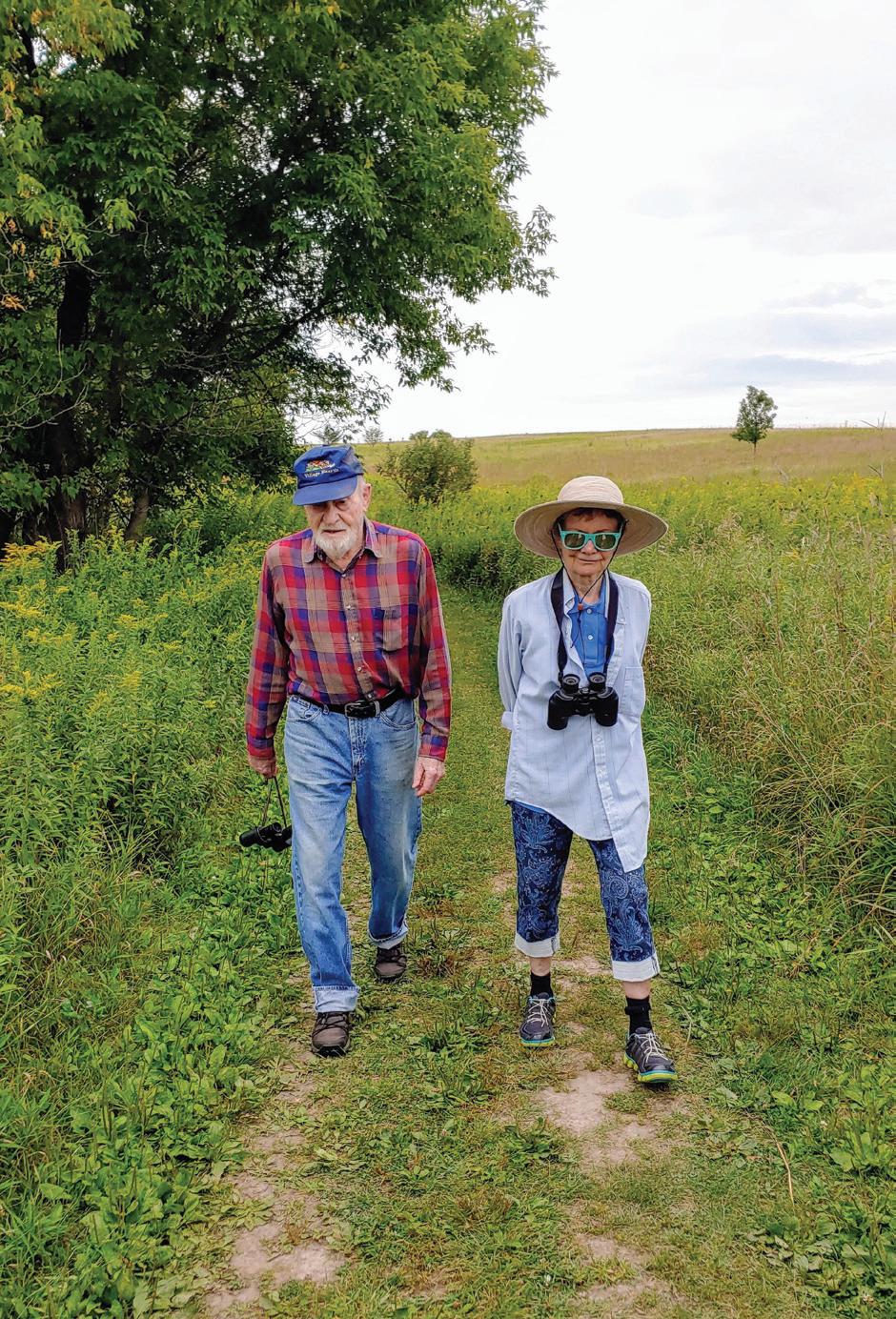
T400 Podcast Conversations
LSP ’s long running Ear to the Ground podcast recently recorded its 400th episode. All shows since 2005 are at landstewardshipproject.org/series/ ear-to-the-ground. Ear to the Ground is also available on various podcast platforms. p
to enter data and set up meetings. Remote opportunities are available.
o update your address, see landstewardshipproject.org/address. Make sure you use the e-mail address you have on file with LSP so your data updates correctly.
Volunteer for LSP
LSP could not fulfill its mission without volunteers. They help us do everything from stuff envelopes and make telephone calls
To volunteer for the Land Stewardship Project, go to landstewardshipproject.org/volunteer-for-lsp, or contact Clara Sanders at csanders@ landstewardshipproject.org, 612-400-6340. LSP e-mails monthly “Volunteer Digests” that list opportunities to help out. Contact Sanders if you’d like to be on that e-mail list.
Rick and Joan Meierotto ( Photo contributed by the Meierottos)
Black Energy
Life is seething in this soil which has been millions of years in the making. It has been forever in the making.
A mingling of everything which ever whistled here, leaped or waved in the wind.
Plants and animals, grasses of this prairie. Buffalo and antelope grazing down into roots and back again into the sun.
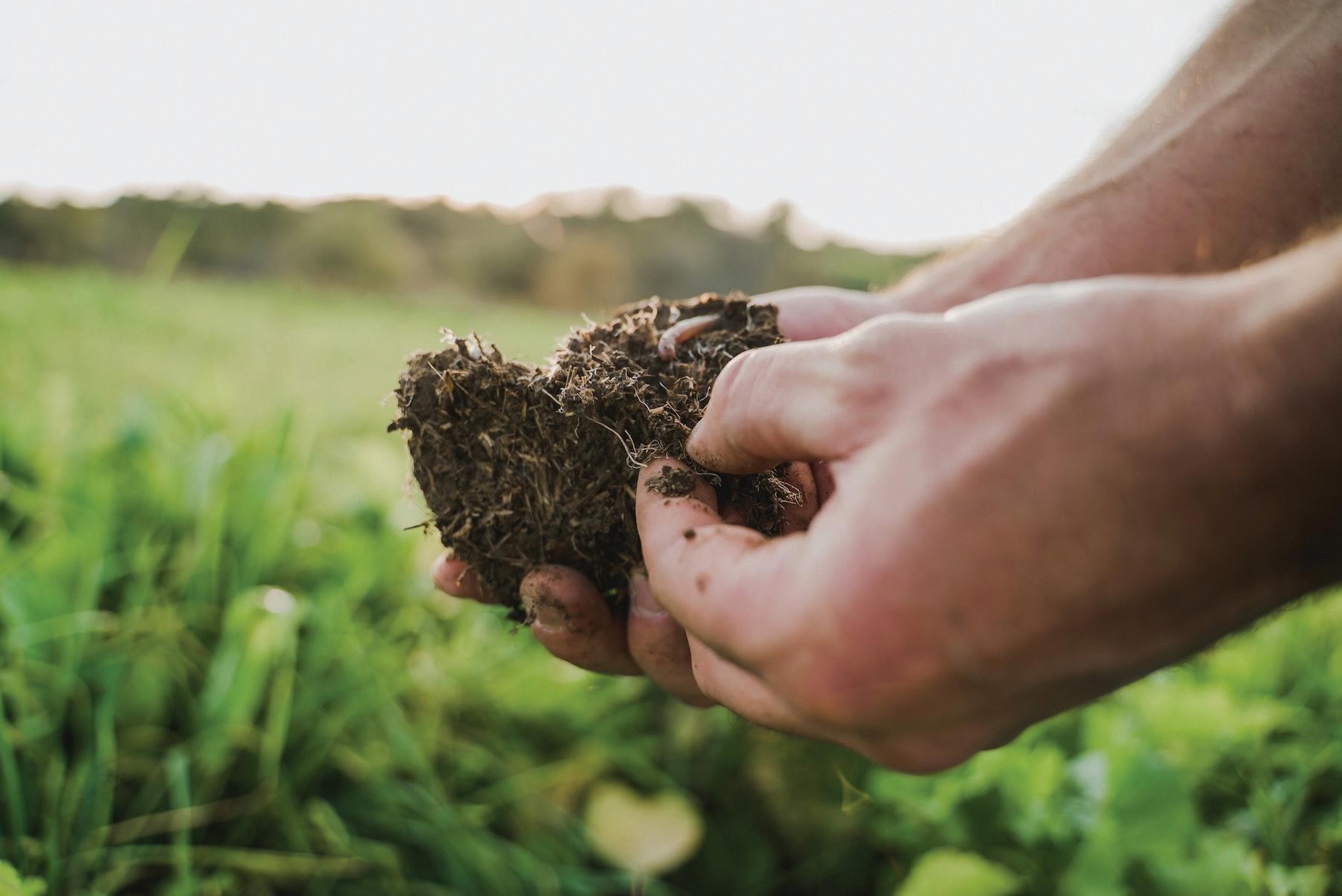
In Memory & in Honor…
TBirds and insects, their wings still hum in this soil.
And this swarm drinks sunlight and rain, and rises again and again into corn and beans and flesh and bone.
The quick bodies of animals and men risen from this black energy.
— Joe Paddock
For more on Joe Paddock, see page 3.
he Land Stewardship Project is grateful to have received the following gifts made to honor and remember loved ones and friends:
In Memory of Dennis Johnson
u Carole Johnson
In Memory of Mary Wagner
u Bill Moore
In memory of Marcus & Lucille Dittrich
u Mike & Connie Schad
In honor of Harlan & Dorothy Maland & Maland Farms
u Jane Maland
In Honor of Rob & Melissa Gordon
u Dale Hadler
In honor of Rev. Craig Barry Anderson
u Christine & Jerry Moench
In Memory of Kenneth Gowdy
u Patty Martinson
In Memory of Robert Dunsmore
u Elizabeth Reishus & Michael Dunsmore
In Memory of the First-Generation
Washington State Dry Wheat Farmers: Joseph, Frank, John & George
u Rom Madsen
In Honor of Bob Walser
u Daniel O’Connell
In Honor of Doug Nopar
u John Carmody & Lynda Horness
In Honor of Dick Nopar
u John Carmody
In honor of the 2026 School
Sisters of Notre Dame Jubilarians
u Kathleen Mary Kiemen
To donate to LSP in the name of someone, contact Clara Sanders at 612-400-6340 or csanders@landstewardshipproject.org. Online donations: landstewardshipproject.org/join.
821 E 35TH ST STE 200 MINNEAPOLIS, MN 55407-2102
Address Service Requested
Your timely renewal saves paper and reduces the expense of sending out renewal notices. To renew, use the envelope inside or visit landstewardshipproject.org/join.
Stewardship Calendar
➔ SEPT. 1 — Application Deadline for 2026-2027 LSP Farm Beginnings Course; Details: page 20
➔ OCT. 10 — LSP-COPAL Community Farm Tour & Meal, Dennison, Minn., 11 a.m.-2:30 p.m.; Details: landstewardshipproject.org/upcoming-events, Elizabeth Makarewicz, LSP, emakarewicz@ landstewardshipproject.org, 612-400-6354
➔ OCT. 17 — LSP-LEDC SpanishLanguage Land Access Workshop, Saint Paul, Minn., 10 a.m.-4 p.m.; Details: landstewardshipproject.org/upcomingevents, Danny Jacobo, danny@ledcmn.org
➔ OCT. 21 — LSP “Lewi Lunch” Discussion, Lewiston, Minn., noon-2 p.m.; Details: landstewardshipproject.org/ lewilunch
➔ OCT. 24 — LSP Farm Beginnings Field Day on Urban Farming & Youth Education, Saint Paul, Minn., 3 p.m.-4:30 p.m.; Details: bit.ly/farmbegintours, Annelie Livingston-Anderson, LSP, annelie @landstewardshipproject.org, 507-473-8748
➔ DEC. 5 — 1st Farm Beginnings Class: Introduction to Whole Farm Planning & Goal Setting; Details: page 20
Latest LSP Events: landstewardshipproject.org/ upcoming-events
Get Current With

Sign up for the LIVE-WIRE e-letter to get monthly updates from the Land Stewardship Project sent straight to your inbox. Details are at landstewardshipproject. org/live-wire-sign-up. p
Wear Your Stewardship Support with Pride
The Land Stewardship Project’s official t-shirt was created by graphic designer Meg Studer. It’s a visual representation of some of LSP’s strongest qualities: bridging communities across geographies, keeping the land and people together, and representing a diverse cross-section of farmers. The shirts are made of high quality organic cotton and are selling for $25.
To order a t-shirt and other LSP-themed merchandise — caps, bandanas, bumper stickers, barn signs, and more — visit our online store at landstewardshipproject.org/shop, or call the Minneapolis office at 612-722-6377.
➔ DEC. 12 — 2nd Farm Beginnings Class: Assessing Your Resources — Beginning Farmer Panel, Soil Health & Regenerative Practices; Details: page 20
➔ JAN. 5 — 3rd Farm Beginnings Class — Marketing Your Farm Products & Services; Details: page 20
➔ JAN. 12 — 4th Farm Beginnings Class: Financial Planning with a Holistic Lens; Details: page 20
➔ JAN. 20 — LSP “Lewi Lunch” Discussion, Lewiston, Minn., noon-2 p.m.; Details: landstewardshipproject.org/lewilunch
➔ JAN. 23 — 5th Farm Beginnings Class: Financial Planning with a Holistic Lens — Start-up Costs & Enterprise Budgets,
40 LSP Stories
WRecord-keeping; Details: page 20
➔ FEB. 2 — 6th Farm Beginnings Class: Risk Management— Legal Structure & Insurance, Farmer Wellbeing; Details: page 20
➔ FEB. 16 — 7th Farm Beginnings Class:
Farm Taxes; Details: page 20
➔ MARCH 6 — 8th Farm Beginnings Class: Land Access, Connecting with Local Resources; Details: page 20
➔ MARCH 20 — 9th Farm Beginnings Class: Participant Show & Tell, Policy & Leadership; Details: page 20
➔ WINTER 2027 — LSP Soil Health Workshop (date to be determined); Details: landstewardshipproject.org/upcoming-events
ant to read the stories of Land Stewardship Project members who have had firsthand experiences with the organization’s over four decade’s worth of work to bring the land and people together? Making Change from the Ground Up: 40 Stories for 40 Years of Land Stewardship Project pulls together the recollections of LSP’s impact on people, the land, and communities.
Copies are available for $30 through our online shop: landstewardshipproject.org/shop. You can also order a copy by calling 612-722-6377.