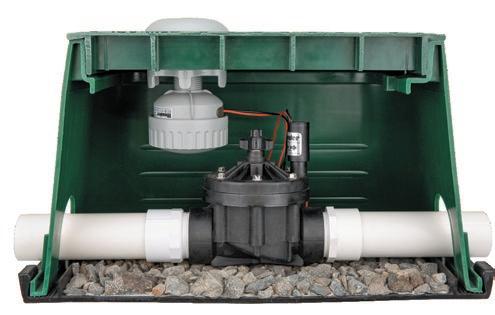
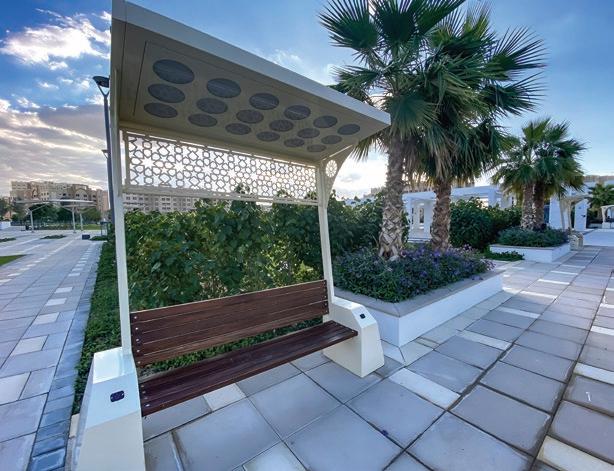
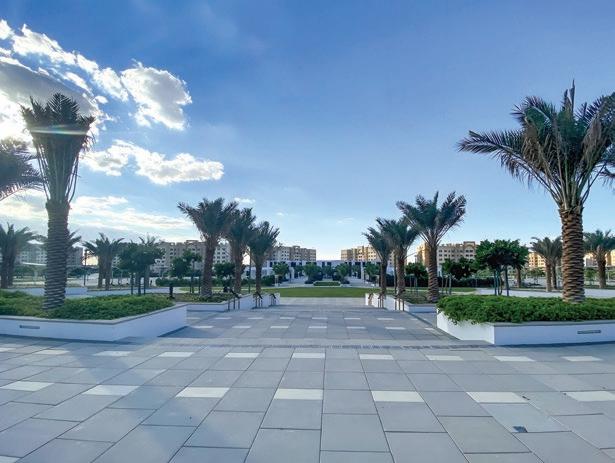
Go wire-free with the Wireless Valve Link! Using advanced radio technology, this innovative system makes it easy to connect valves without running wire or cutting into hardscape. Designed for Hunter ICC2 and HCC Controllers, it saves time and money with simplified installation, quick station expansion, and reduced maintenance. When complex landscapes pose a challenge, go wireless!
To learn more, visit hunter.info/ WVLem
LANDSCAPE IRRIGATION | Built on Innovation® Learn more. Visit hunterirrigation.com
This month’s issue brings together voices and projects that challenge us to look beyond surface narratives and examine the real foundations of landscape practice.
In Designing with Depth, we revisit the core discipline of landscape architecture and the technical, scientific, and ethical rigour that underpins it . It is a reminder that landscape is not a finishing touch - it is infrastructure, ecology, and long-term stewardship combined. That theme continues in Pride in the Finish, where Arun Titus reflects on the craft of construction and the quiet satisfaction of walking a completed project end to end. Design intent only matters if it can be delivered with precision.
Elsewhere, this issue stretches our perspective globally. From airborne wind energy and its evolving relationship with visual impact and terrain, to Phillip Dunn’s candid reflections on lived sustainability and reconnecting communities to nature, the message is consistent: innovation must be grounded in responsibility.
We explore regeneration at continental scale through Generation R, celebrate landscape-led waterfront transformation in Perth, and highlight both emerging studios and major biodiversity milestones closer to home. Even global mergers in planning and design speak to a collective ambition to shape more resilient cities.
Across every article, one thread is clear: landscape today is not decorative. It is decisive.
Enjoy the issue.
Managing Partner: Ziad Maarouf Amine
Copy Editor: John Hampton Phillip Higgins
Administrative Assistance: Sarry Gan
Art Director: Ramon Andaya
Contributors: Annie Baillie, Arun Titus, Dr. Haroon Ur Rashid, Hala Shiblaq, Jimena Martignoni, Nick Vellacott, Phillip Dunn, Tina Heers
Printed by: Al Nisr Publishing LLC
Webmaster: www.pdinventive.com
For free subscription and to view the magazine please visit our website: www.landscape-me.com
The First Specialised Landscape magazine in the Middle East
Our magazine is available in app store and google play, search under Landscape Middle East.
MIDDLE EAST
CONVERSATIONS THAT SHAPE THE REGION
SUSTAINABILITY FROM THE GROUND UP
Date: 25th February 2026
Time: 4:00 PM (UAE)
Hosted by: Phil Higgins
Co-host: Annie Baillie
LIVE WEBINAR
Baami Studio Land has a memory: Some
landscapes are designed, others are remembered.
Every piece of land has a story. Some are whispered through native plants, others through patterns of movement, memory and use. In the Middle East, many of these stories have been overwritten, simplified, imported or ignored. Most often the people most affected by this are the least visible
Baami Studio enters the Middle Eastern design scene with a belief that land carries stories long before a line is ever drawn. Founded on a vision shaped by heritage, culture, and an intuitive understanding of place, the Dubai-based landscape architecture studio approaches each project as a narrative waiting to be told.
The name Baami is derived from Bamiyan, the historic Afghan city where ancient stories still echo through vast valleys and sculpted mountains. A place where nature and culture have coexisted for centuries, Bamiyan represents more than geography; it embodies harmony, resilience, and memory. These ideas form the foundation of Baami Studio’s design language.
Rooted in Tina Heers’ Afghan heritage and shaped by her upbringing in Australia, the studio draws inspiration from landscapes that are layered, meaningful, and deeply connected to their people. At Baami, landscapes are not treated as decorative backdrops but as living environments that reflect identity, tradition, and time.
“Growing up in Australia, I was taught that land holds memory, that stories are embedded in the ground beneath your feet. Indigenous Dreaming narratives shaped how I understand landscape as something living, spiritual, and enduring.
Combined with my Afghan heritage, where culture and terrain are inseparable, this became the foundation of Baami. Every project is an opportunity to listen to the land first and let its story guide the design.”
— Tina Heers, Founder
At the heart of Baami Studio is storytelling, the belief that landscapes should communicate meaning, reflect culture, and create emotional connection. This philosophy extends into a broader set of values centred on thriving through nature, where landscapes are designed not just to exist, but to nurture wellbeing, resilience, and long-term connection between people and place.
Culture and community play a defining role in Baami’s work. Each project considers how spaces can bring people together, encourage interaction, and support shared experiences across generations. Inclusivity is fundamental to this approach ensuring landscapes are welcoming, accessible, and reflective of diverse voices and ways of inhabiting space.
A key focus within the studio’s ethos is designing for girls, recognising the importance of outdoor environments that empower, inspire confidence, and support freedom of movement and play. Through thoughtful spatial planning, visibility, and choice, Baami seeks to create landscapes where females of all ages and cultures feel safe, represented, and encouraged to explore.
This commitment extends naturally into nature-based play, where landscapes are shaped to spark imagination rather than prescribe activity. Instead of conventional
play equipment, Baami favours organic forms, loose materials, planting, and topography looking at environments that invite curiosity, creativity, and connection to the natural world.
Being based in Dubai, Baami Studio translates this value-led philosophy into a regional context where storytelling has always been embedded in the terrain. From desert landscapes shaped by wind and water to gardens that speak of hospitality and ritual, Emirati narratives are interpreted through spatial sequences, materiality, planting, and shade. The result is work that feels contemporary yet deeply grounded where these modern landscapes that could only belong where they are.
Baami’s approach is intentionally timeless. Rather than following trends, the studio focuses on crafting spaces that mature with age, respond to climate, and hold emotional weight. Sustainability is woven naturally into the design process, not as a label, but as a responsibility to the land and its future.
As Baami Studio begins its journey, led by Tina Heers, it does so with quiet confidence shaping landscapes that honour heritage, celebrate nature, and strengthen community, while reimagining how stories live through the land.
Tina Heers Founder of Baami Studio
Dr. Sultan Al Jaber Plants ADNOC’s
5 Millionth Mangrove, Marking Major Biodiversity Milestone
ADNOC surpasses halfway point toward planting 10 million mangroves by 2030
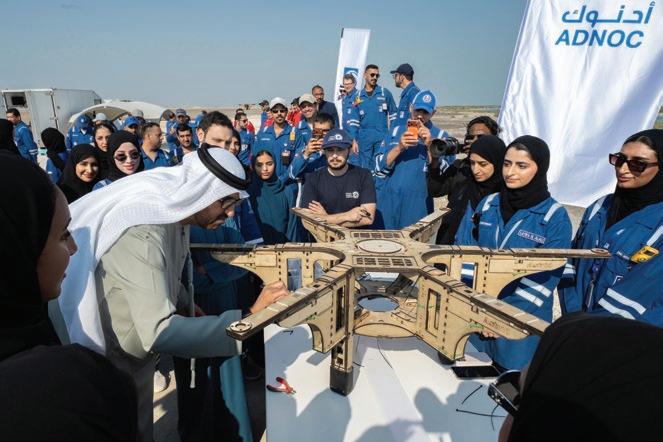
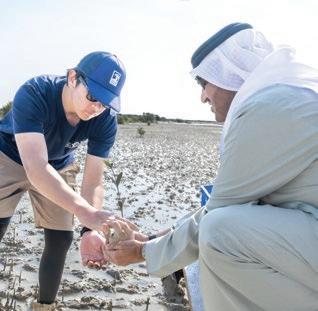
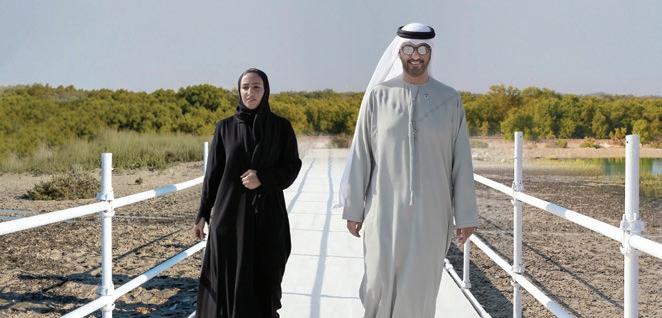
AI-enabled drones have helped plant millions of mangroves to scale restoration with UAE-made technology Abu Dhabi, UAE – January 15, 2026: His Excellency Dr. Sultan Ahmed Al Jaber, UAE Minister of Industry and Advanced Technology and ADNOC Managing Director and Group CEO, has planted ADNOC’s five millionth mangrove seedling during a visit to the Al Nouf mangrove forest in Abu Dhabi, marking a milestone in ADNOC’s ambition to plant 10 million mangroves by 2030.
progress towards our target to plant 10 million mangroves by 2030 by leveraging advanced technologies to support biodiversity and responsibly provide the energy that people and economies need to thrive.”
ADNOC’s mangrove planting program, which began in 2023, uses advanced artificial intelligence (AI)-enabled drone technology developed in the UAE to plant mangroves efficiently and at scale. The program also integrates advanced monitoring tools, such as machine learning, to track mangrove health, growth and restoration success over time.
Community engagement is a core pillar of the mangrove planting initiative. In 2025 alone, more than 1,000 volunteers participated in planting activities, contributing thousands of hours to conservation efforts. Since the program’s launch, around 6,000 people have taken part in mangrove planting, coastal cleanups and biodiversity restoration initiatives in Abu Dhabi. This includes youth volunteers ADNOC Classification: Public from schools, community groups, and
ADNOC has now surpassed the halfway mark towards this goal, advancing its drive to protect biodiversity through scalable, naturebased solutions that support the UAE’s aim to plant 100 million mangroves by 2030 and deliver long-term value and positive impact for the nation.
H.E. Dr. Al Jaber said: “Environmental stewardship is central to ADNOC’s strategy and underpins our commitment to creating sustainable longterm value for the UAE and the communities in which we operate. We have made excellent
People of Determination, as well as ADNOC employees, who have actively contributed at every stage of the program.
In 2024, ADNOC joined the Abu Dhabi Mangrove Initiative, led by the Environment Agency – Abu Dhabi (EAD), to accelerate mangrove restoration, drive research and promote private sector and community participation. These efforts align with the UAE’s Plant the Emirates Program and the World Economic Forum’s One Trillion Trees Initiative.
Lights the way, not the sky
The Dark Sky luminaire head for the modular system bollard luminaires protects the night sky and nocturnal wildlife. Optionally available with BEGA BugSaver® technology to switch the colour temperature to an amber tone. Bollard tubes optionally available in sustainable Accoya® wood. bega.com/systembollards
WW+P and SvN merge with collective vision to become world leader in urban planning and design
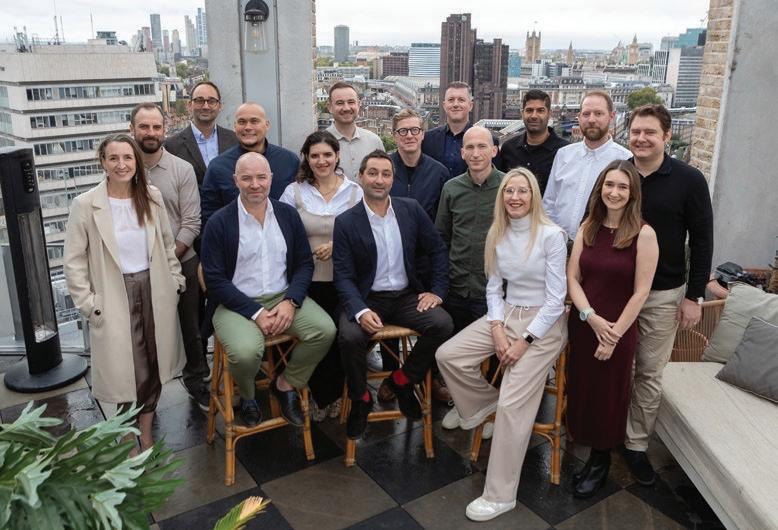
Driven by a collective vision and expertise, the unification of WW+P and SvN Architects + Planners will set a new standard, globally, for a regenerative approach to architecture, planning, and urban design.
The partnership combines over 400 design professionals in 12 studios worldwide. The merger leverages WW+P’s infrastructure expertise alongside SvN’s communityfirst planning to focus on Transit-Oriented Development and Regenerative Urban Design.
Practices merge under the stewardship of 10N Collective, the collective of urbanism, architecture and related design experts brought together by Egis Group.
15 January 2026 - World-renowned design practices WW+P and SvN have just announced the merger of their practices, unifying their diverse teams of architects, urban planners, urban designers and landscape architects into a global powerhouse of expertise and delivery for complex urban projects. Boasting a project portfolio that spans across continents, the new practice will integrate planning, urban design,
landscape, and architecture to deliver projects that are people-focused, inventive, and responsible.
Headquartered in London, WW+P (formerly Weston Williamson + Partners) is a global leader in the design and delivery of architecture, urban design, and strategic masterplanning for city-shaping projects. Headquartered in Toronto, SvN is a multidisciplinary regenerative design practice, shaping the built environment in regions, cities and towns across Canada and worldwide.
Both award-winning practices boast experience in transit-oriented development, transport infrastructure and more, making the partnership a natural evolution of their joint offerings. By coming together, the practice will support and empower clients to be ambitious – leading the next chapter in regenerative design thinking.
The joint practice will merge with 12 combined global studios and adopt the name and branding of WW+P, under the stewardship of 10N Collective, a collective of urbanism, architecture and related design experts brought together by Egis Group.
Ali Mowahed, CEO, WW+P, says: “WW+P’s partnership with SvN was a natural fit from the offset. Together, we can drive forward a collective vision with a more amplified voice, delivering projects that create meaningful urban transformation for the greater good.
This merger represents the coming together of two brands to create a global practice that builds better cities, smarter infrastructure, and more inclusive communities. Partners want confidence. Cities need leadership. We offer both: with a brand that stands for quality, innovation, and bold ideas.”
“The DNA of both practices is remarkably similar,” adds Drew Sinclair, Managing Principal, SvN. “Both practices place a unique value on listening, meaningful consultation, and a deep understanding of history and context; both practices share a capacity for design innovation; and both practices have a total commitment to a regenerative, deeply sustainable approach to planning and architecture.”
Post merger, Drew Sinclair will join the global executive leadership team as Executive Director.
“The merger of our two practices stands to create something that is truly unprecedented in the global community of design practices: a firm that will create a measurable change in the way infrastructure and housing can support a greener and more equitable future.”
Colin Hutchison, CEO, 10N says: “SvN and WW+P coming together as one compelling brand creates a powerful vehicle through which 10N can offer cohesive placemaking and planning strategy, architecture, civic infrastructure and design expertise. With their incredible track records and reputations, this combined practice will enable us to pursue a wide range of projects internationally and positively influence citymaking and communities.”
SPACE TO GROW
A uniquely organic community that balances the natural world with the built in a way that must be felt to be believed.
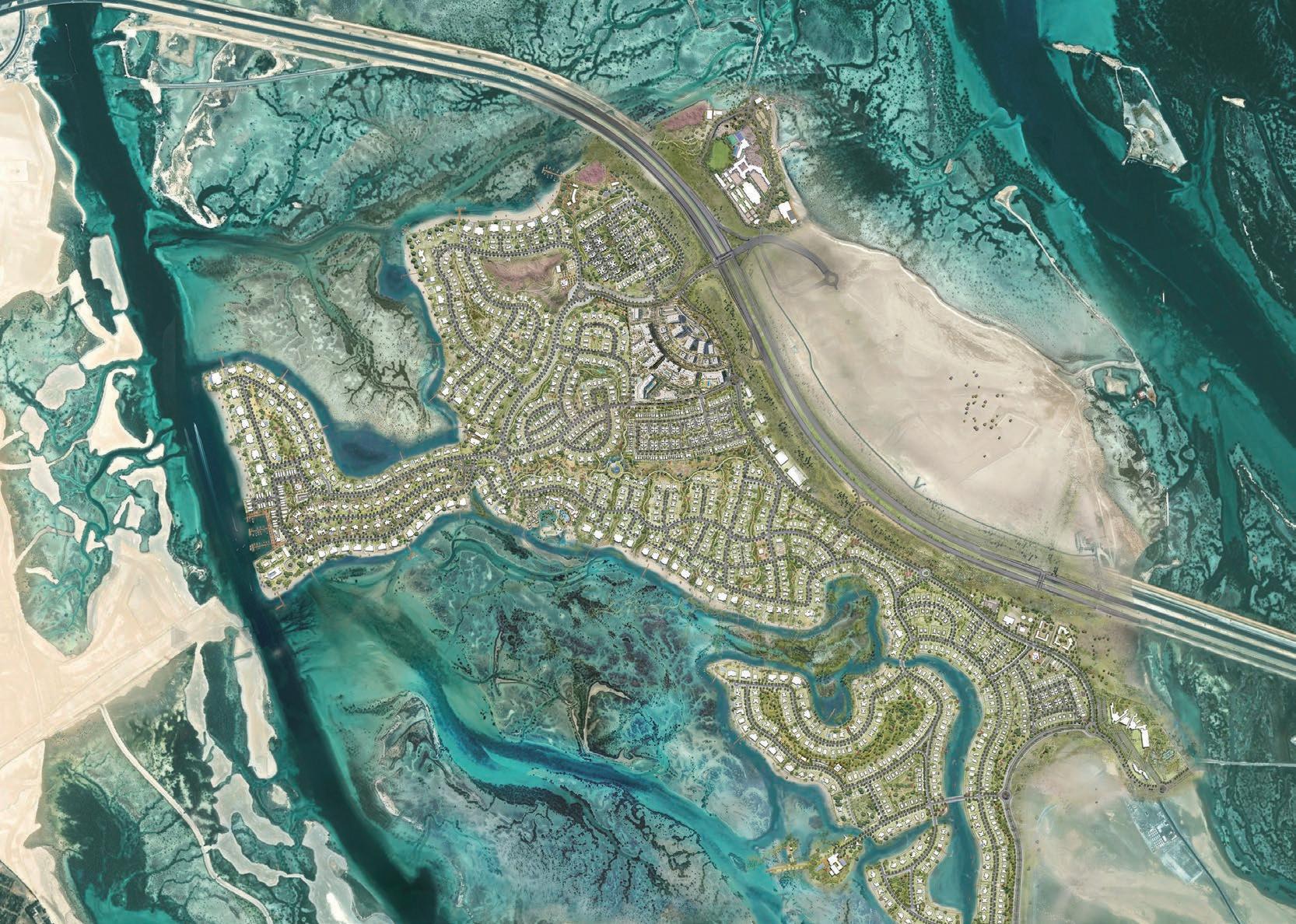
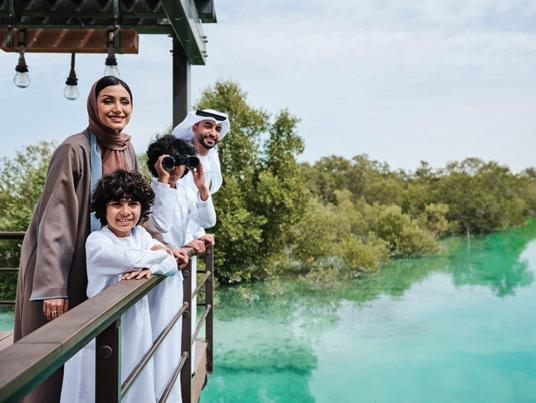
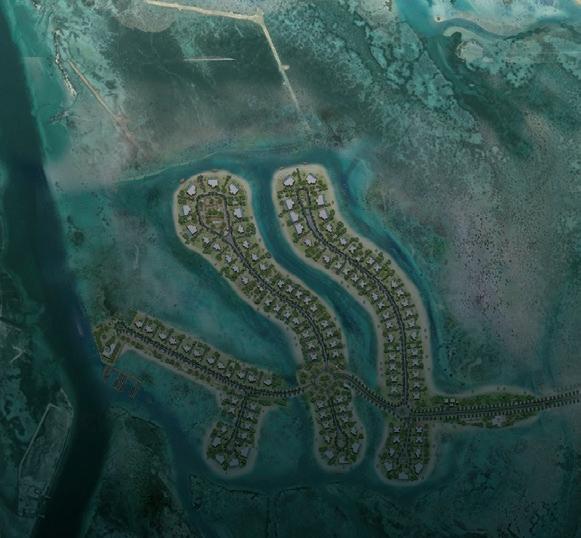
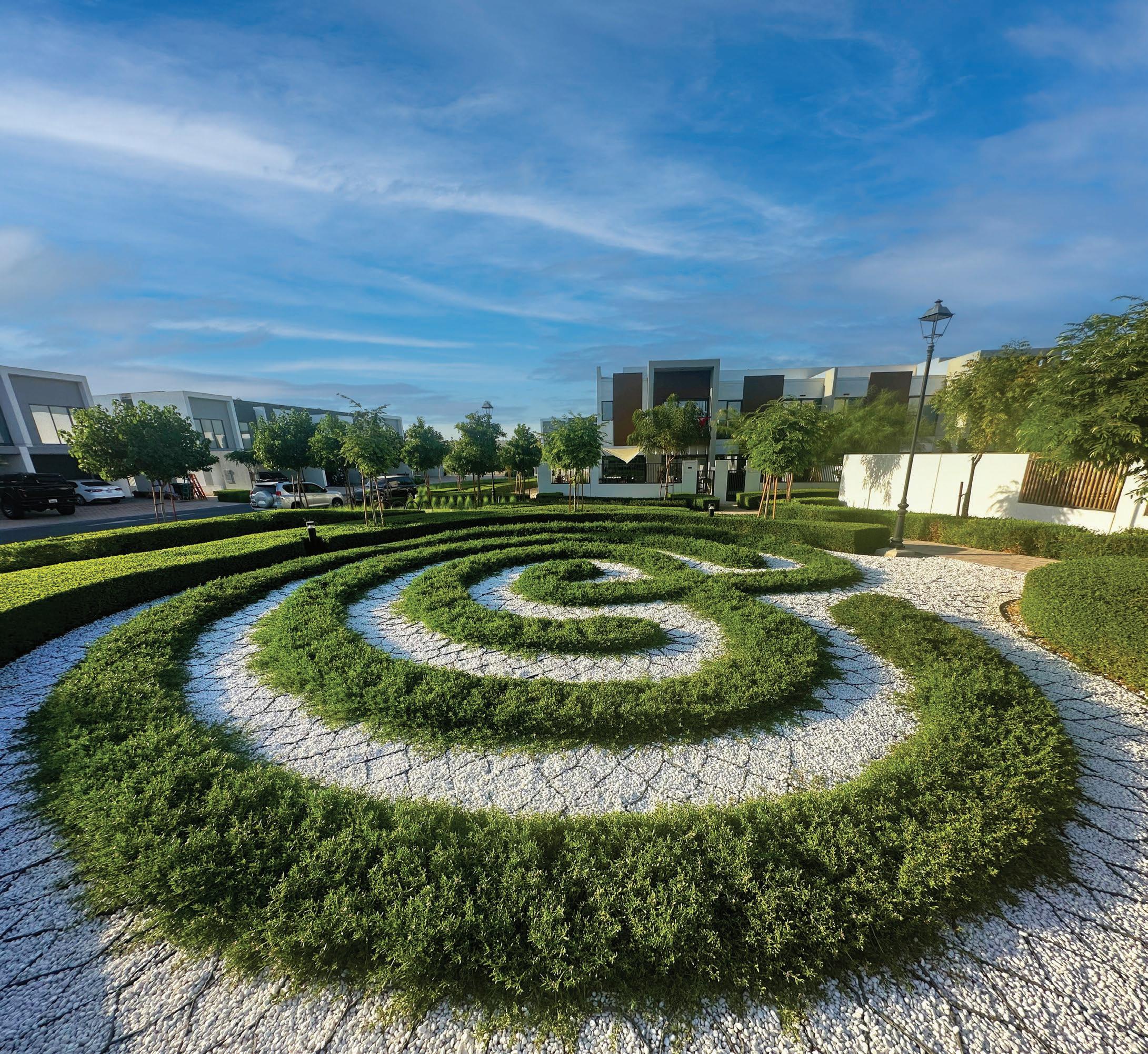
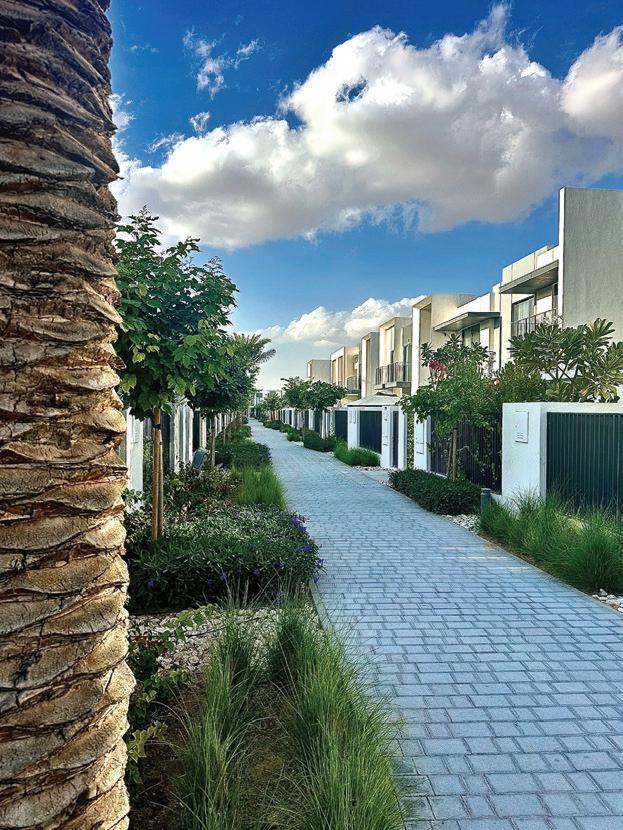
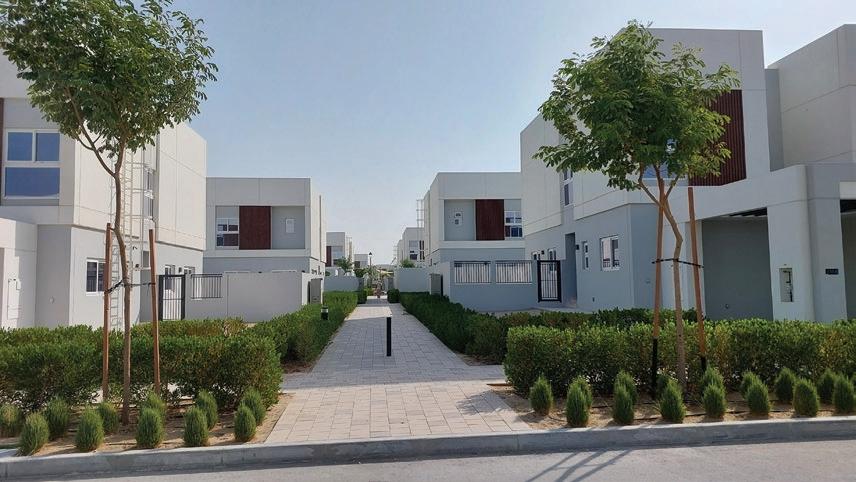
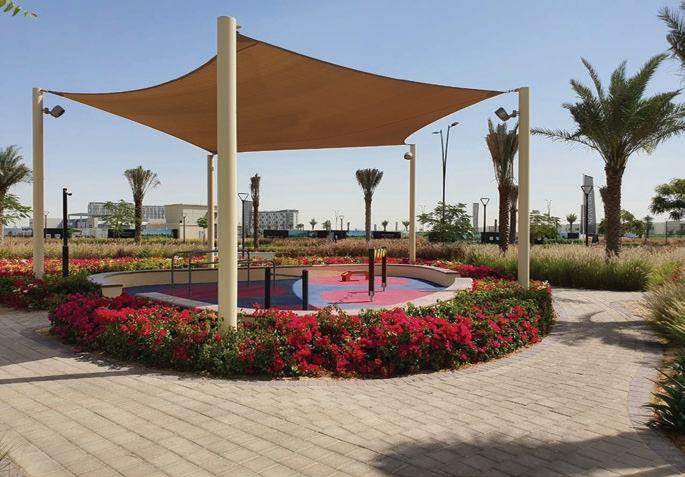
Jubail Island is Abu Dhabi’s rare natural sanctuary where modern living meets the restorative power of nature. Surrounded by thriving mangroves and inspired by the island’s unique ecological heritage, Jubail Island offers an organic community that balances progress with preservation, exclusivity with ease, and belonging with individuality.
Life finds its rhythm where land, water, and community converge.
More than a place to live, Jubail Island is a haven designed for total wellbeing, a setting where nature, community, and growth interact seamlessly to enrich everyday life. The island features luxury homes, vibrant retail and F&B offerings, schools and nurseries, sports facilities, and the award-winning Jubail Island Mangrove Park. Jubail Island provides the freedom to belong, to breathe and to grow.
SPACES DESIGNED TO ENHANCE COMMUNITY AND TOGETHERNESS
SPACES DESIGNED TO ENHANCE COMMUNITY AND TOGETHERNESS
A LIFESTYLE THAT CONNECTS PEOPLE, NATURE AND SUPPORTS GROWTH
A LIFESTYLE THAT CONNECTS PEOPLE, NATURE AND SUPPORTS GROWTH
A place shaped by nature, rooted in ecology and built for future generations
A place shaped by nature, rooted in ecology and built for future generations
DESIGNING WITH DEPTH
The Real Value of Landscape Architectural Expertise
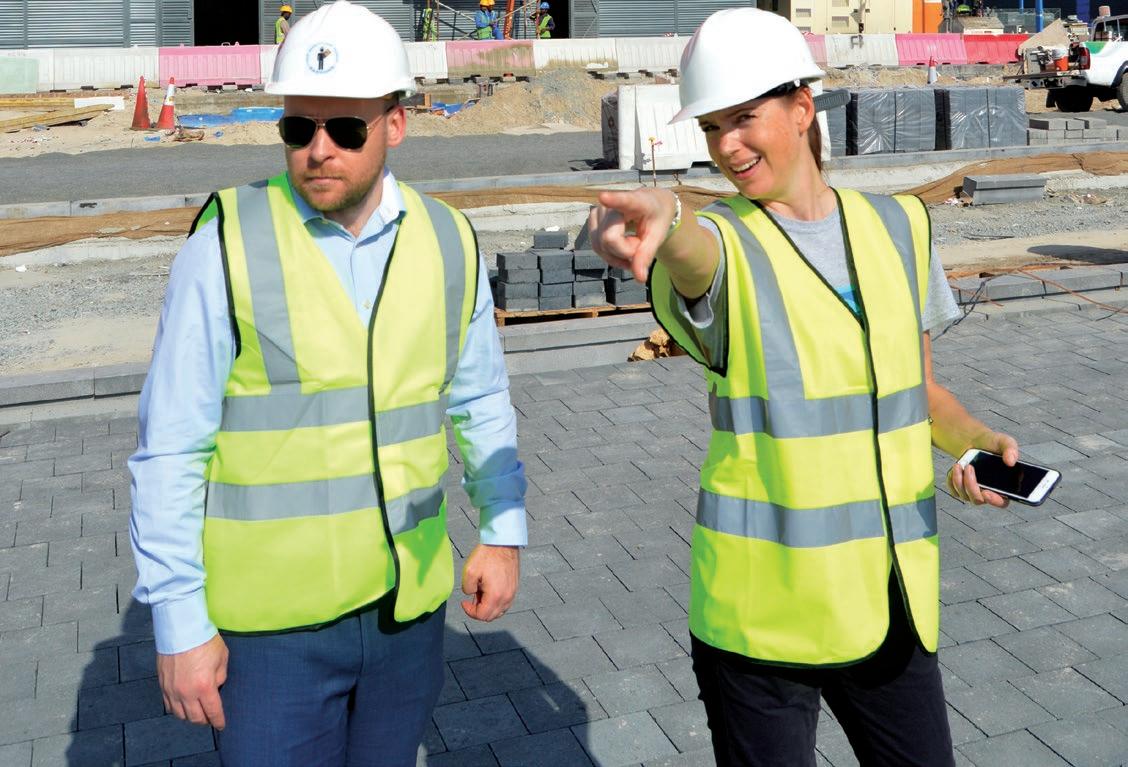
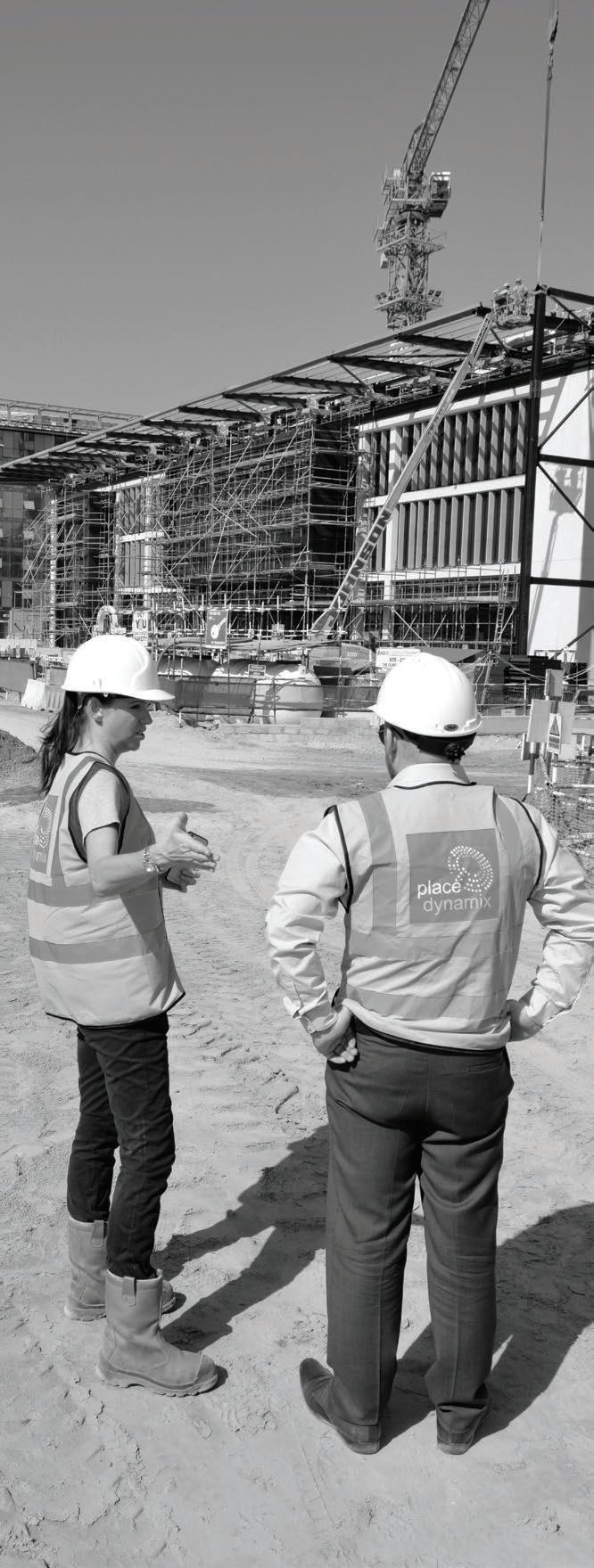
By: Annie Baillie Place Dynamix
Landscape architecture is often described as the “soft” side of development, a layer of planting or a decorative flourish applied at the end. Anyone working in the profession knows that couldn’t be further from the truth. Landscape architecture is a technical, scientific, and intensely strategic discipline that determines how cities breathe, how people move, how ecosystems survive, and how public places function long after the ribbon-cutting ceremony.
In reality, landscape architecture is the discipline that ties together land, water, climate, infrastructure, and human behaviour. It’s the engine room behind resilient cities and genuinely livable communities. And as expectations rise for better public spaces, higher sustainability standards, and climate-ready environments, the need for qualified landscape architects has never been greater.
What the Discipline Really Covers
Landscape architecture sits at the crossroads of ecology, engineering, design, and urban planning. It stretches from regional green networks and waterfront frameworks to the precise detailing of streetscapes, plazas, mobility corridors, parks, and intimate courtyards.
A landscape architect must understand far more than aesthetics. The discipline demands fluency in microclimate behaviour, hydrology, soil performance, shade and thermal comfort, user psychology, material behaviour, and long-term maintenance cycles. Few professions require such a broad integration of science, engineering, and cultural awareness.
This depth of training is what enables landscape architects to create places that are functional, inclusive, climateresilient, and socially meaningful—not just visually appealing on opening day.
The Years of Training Behind the Profession
A formal degree in landscape architecture is a demanding, multidisciplinary education, something often underestimated outside the profession.
Students study ecology, plant physiology, biodiversity systems, hydrology, and soil science. They learn drainage design, grading, utility coordination, irrigation engineering, and material selection. They become adept at modelling microclimates and understanding how heat, shade, wind, and water behave across real environments. But technical competence is only part of it. Landscape architects also learn design thinking, masterplanning, cultural analysis, community engagement, behavioural psychology, and public-realm programming. They develop the ability to understand how people use space— and how to shape places that encourage interaction, inclusivity, and wellbeing.
Professional practice modules round out the training: legislation, procurement, contracts, cost control, authority approvals, and construction documentation. No short course or adjacent profession can replicate this depth. The discipline requires years of structured study, critique, and immersion in a specialised body of knowledge.
Why Real-World Practice Is Where Landscape
Architects
Are Made
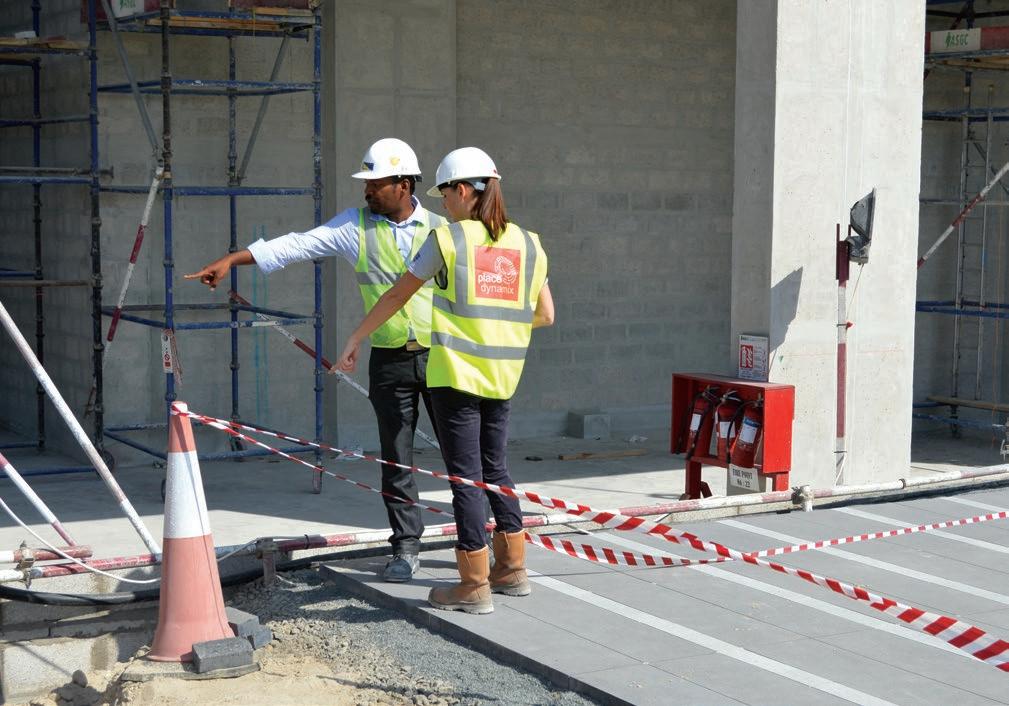
A degree lays the foundation, but real expertise is forged on the ground. This is where landscape architects navigate the realities of budgets, contractor capability, authority requirements, climatic extremes, and long-term operational demands.
On-site experience teaches what no textbook can: how a grading decision affects drainage and accessibility why a misjudged material selection can break down in five years how planting behaves in the region’s climate— not in idealised global examples how poor coordination with civil, structural, or MEP teams triggers long-term problems
ARCHITECTURAL LANDSCAPE
These are not minor details. They determine whether a space works, lasts, and remains safe. Professional accreditation signals that a practitioner has reached the level of technical judgment and ethical responsibility required to lead complex landscape work.
When Expertise Is Missing, the Problems Are Predictable
This is where the discipline’s value becomes undeniable. When landscape architecture is substituted, minimised, or handed over to professionals without formal training, the same failures appear again and again: plant loss due to incorrect species selection or inadequate soil profiles drainage issues, ponding, or unsafe walking conditions unusable public spaces caused by heat, wind, or lack of shade premature material deterioration from misunderstood climate performance accessibility failures in slopes, alignments, and surfaces excessive maintenance burdens caused by unrealistic or inappropriate detailing These failures are expensive. They undermine asset value, increase operational costs, frustrate users, and often require redesign or reconstruction—costs that far exceed the investment in proper landscape architectural leadership.
The Living Dimension: Designing for Tomorrow, Not Just Opening Day
Perhaps the most overlooked distinction between trained landscape architects and adjacent disciplines is an understanding that landscapes are alive. They evolve. They mature. They shift with climate, season, maintenance, and time. A project that looks impressive on opening day is only the beginning—its real performance is measured years later.
Qualified landscape architects design with this long arc in mind. They know how root systems will develop, how canopies expand, how shade patterns shift, how soil volumes settle, how irrigation needs change as plants mature, and how species interact as ecosystems stabilise. They anticipate growth, succession, and the natural rhythms that define a landscape’s life cycle.
Without this expertise, landscapes are designed as static objects rather than dynamic systems. That’s when trees outgrow their spaces and fail, shrubs choke pathways, irrigation overshoots or starves plantings, and carefully constructed views or microclimate strategies collapse because no one accounted for what the space would become in five, ten, or twenty years.
Landscape architects don’t design for opening day—they design for the future. They create landscapes that grow richer, stronger, and more resilient with age, ensuring communities inherit spaces that are even better than those unveiled on day one.
What You Get When You Hire a Landscape Architect—And What You Lose When You Don’t
When qualified landscape architects are engaged early and given the scope to apply their training, the results are consistently stronger.
Technical Integration
Landform, drainage, irrigation, utilities, and circulation work together, not against each other—and perform reliably in harsh climates.
Environmental Resilience
Correct soil systems, climate-responsive species, microclimate optimisation, and habitat creation enhance biodiversity and urban cooling.
Human-Centred Design
Landscape architects understand how people feel and behave outdoors. They design for comfort, safety, culture, social connection, and wellbeing.
Economic Value
Good landscape design reduces maintenance burdens, increases asset longevity, elevates property value, and improves life-cycle performance.
A Core Discipline for the Cities Ahead
As cities confront hotter climates, water scarcity, biodiversity
loss, and growing population needs, landscape architecture is no longer a “nice to have.” It is a strategic requirement. The profession now shapes national discussions on sustainability, urban cooling, blue–green infrastructure, walkability, mobility networks, and nature-based solutions.
Landscape architects are influencing policy, guiding major infrastructure, and redefining how communities experience the public realm.
Seeing the Profession Clearly
Landscape architecture is a mature, technically rich profession grounded in science, engineering, culture, and creativity. It cannot be replicated through informal exposure, nor can it be substituted by related fields without significant risk.
Projects led by qualified landscape architects consistently deliver landscapes that are resilient, functional, safe, and meaningful for the communities they serve. To build cities that endure, the role of the landscape architect must be understood, valued, and integrated from the beginning.
When that happens, landscapes don’t just look good, they work, they last, and they genuinely enrich the lives of the people who use them.
PRIDE IN THE FINISH
How Arun Titus Builds Landscapes with Purpose and Passion
For most people, landscaping is about what they see: the trees, lawns, and paving that complete a project and make it feel alive. But for Arun Titus, Head of Projects Delivery & Construction at Emirates Landscape, landscape construction is a deeply technical, highly coordinated process — one that demands precision, patience, and pride.
“People often think landscaping is just about planting trees and laying grass — a kind of final decorative touch,” says Titus. “But in reality, it’s an engineering discipline that demands precision and coordination. From soil science to irrigation systems and external architectural elements, every component must integrate seamlessly with the completed infrastructure — and that’s where the real challenge begins. By the time we arrive on site, all underground services are already in place, and every misalignment made earlier suddenly becomes visible. The success of a project often depends on how well we can resolve these issues and bring all the final layers together.”
An
interview with Arun Titus, Head of Project Delivery & ConstructionEmirates Landscape
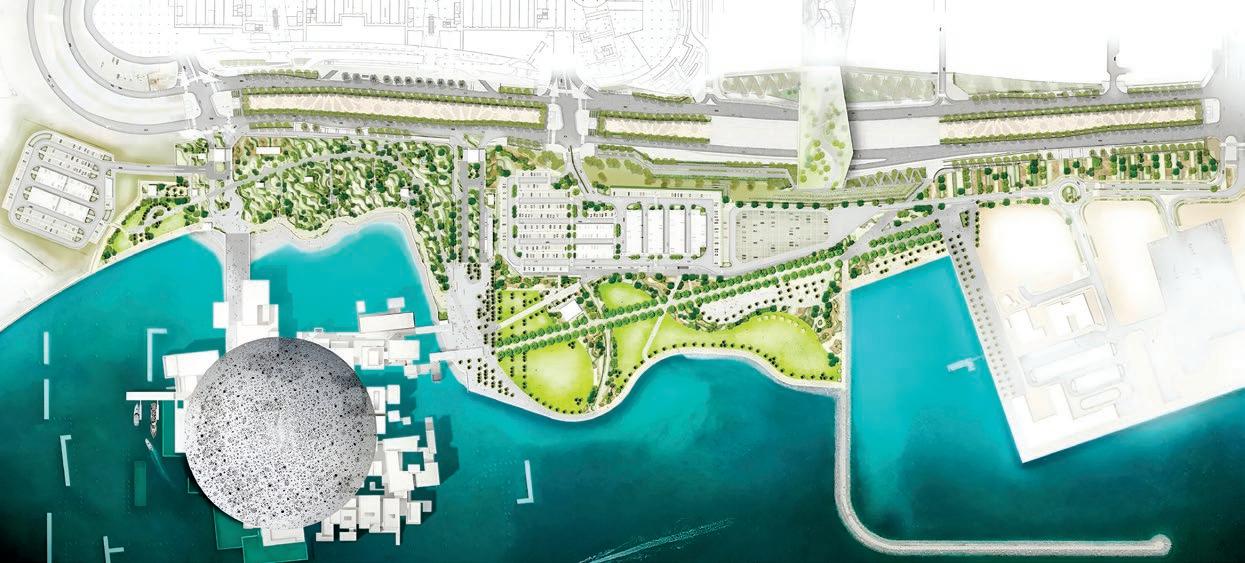
With more than 25 years of experience delivering Iconic projects across the UAE and Saudi Arabia, including Louvre Abu Dhabi, Ruwais Central Park, and Luxury Island development with Red Sea Global - Titus has seen every stage of landscape construction - from the first excavation to the final inspection. His role bridges the space between design and delivery, translating ambitious architectural visions into durable, buildable environments that support both nature and community. “Every design has challenges,” he explains. “In my entire career, I’ve never seen a perfect set of drawings. Design evolves, site conditions change, and coordination gaps are inevitable. Our job is to identify these issues early in the engineering phase, propose solutions that respect the design intent, and ensure that what gets built on site truly reflects what was envisioned on paper.”
That collaboration begins long before construction starts. Titus describes sitting with designers to dissect plans, breaking them down into practical details. “We spend a lot of time reviewing each area, preparing shop
drawings, and conducting mock-ups,” he says. “These steps are critical. They bridge the gap between the artistic vision and the engineering reality.”
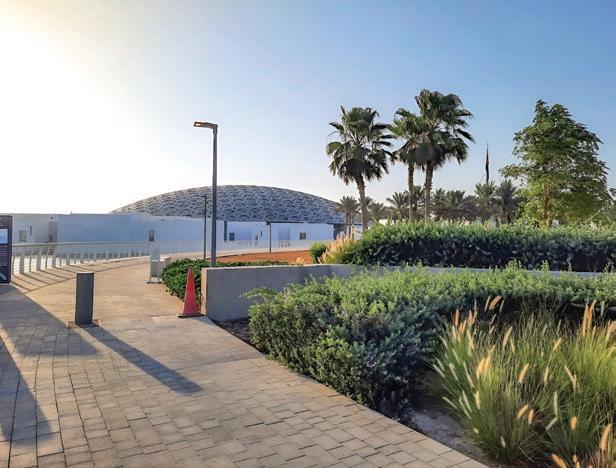
The Making of a Landmark Few projects capture that process better than Louvre Abu Dhabi, a design-and-build project that tested every element of technical delivery.
“It was one of the most challenging, yet rewarding, projects of my career,” he recalls. “Our team had to honour the design’s elegance while overcoming strict site constraints. Everything - from materials to finishes and plant placement - had to reflect the original concept. When it was completed, it wasn’t just functional; it looked and felt world-class.”
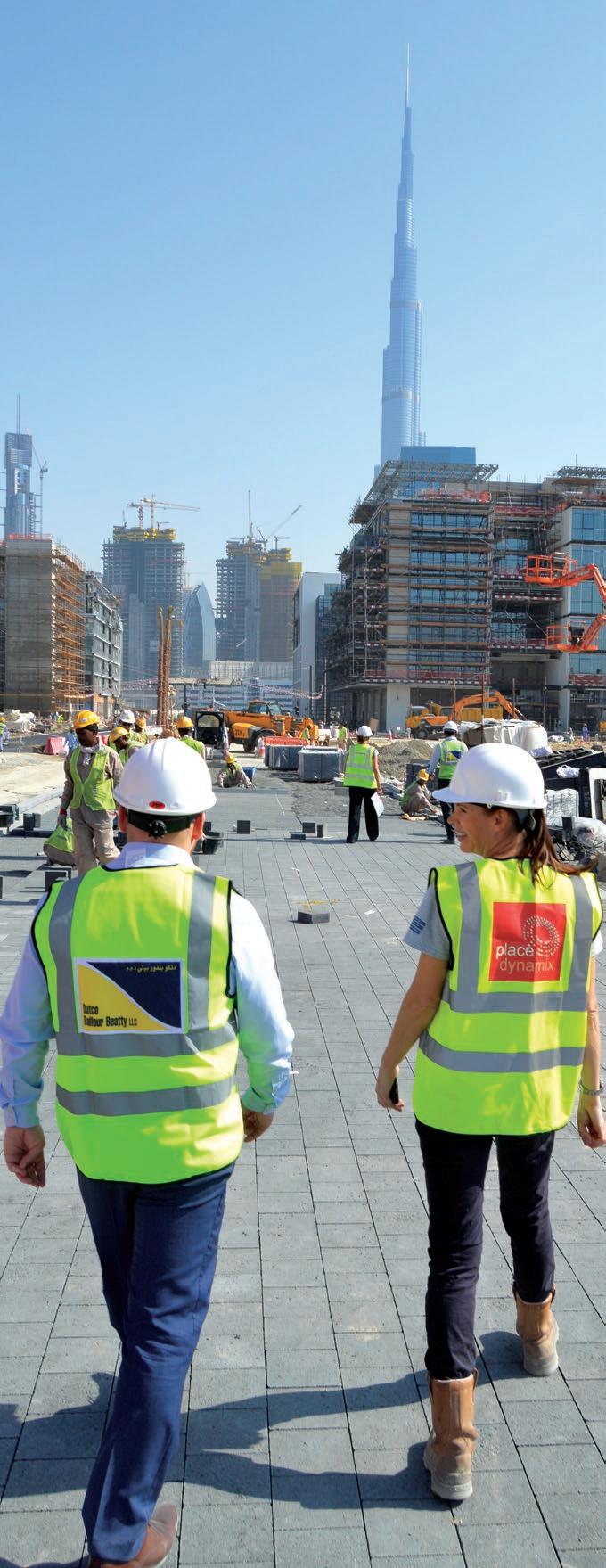
For Titus, the sense of satisfaction comes not from the handover certificate, but from seeing the finished site come alive. He still remembers the day, after the Louvre’s grand opening, when he returned alone to walk the site.
“I just wanted to experience it in silence,” he says with a smile. “No workers, no noise, just the finished landscape. I walked from one end to the other, taking it all in. It’s like seeing your own child grow up - you’ve nurtured it through challenges, and then one day you stand back and feel proud of what you’ve built.”
Delivering Nature and Community
The theme of Nature and Community resonates deeply with Titus. For him, the construction team’s role goes beyond execution; it’s about creating spaces that genuinely improve daily life.
“When we work with government clients, the goal is always to make spaces that are resilient, functional, and welcoming,” he explains. “It’s not only about aesthetics - it’s about ensuring that the landscape serves the community for years to come.”
Working in the UAE’s arid environment, however, presents unique logistical challenges. “The extreme heat is one part of it,” says Titus. “But the bigger issue is coordination. On large mixed-use sites, multiple contractors work side by side — infrastructure, MEP, facades and landscape. Landscape is the final trade, and we must reconcile everything that came before us. That requires meticulous planning, sequencing and communication”.
Engineering Value Without Compromise
In an industry where “value engineering” is often misunderstood as cost-cutting, Titus takes a different view. “True value engineering isn’t about reducing quality,” he says. “It’s about finding alternatives that perform just as well, maintain design integrity while optimizing cost and long-term maintenance. It might mean choosing a high-quality local stone instead of an imported one, improving soil mixes, or optimizing
systems to reduce water demand. The aim is to maintain design character while achieving efficiency.”
That philosophy echoes in Emirates Landscape’s current direction. With around 800 employees and many projects under construction, the company has expanded from its original maintenance roots into fullscale landscape construction. Titus, who joined to lead and restructure the construction division, focuses on strengthening project delivery standards, resource mobilization, and operational planning.
“We’re establishing a structured system that ensures quality from day one, strong engineering, good procurement, and continuous client coordination,” he says. “It’s about taking Emirates Landscape to the next level.”
Sustainability in Practice
Titus’s years in Saudi Arabia also left a strong impression, particularly through his work with Red Sea Global, where sustainability was not just a design feature but a contractual obligation.
“Those projects were on pristine islands surrounded by coral reefs and mangroves,” he recalls. “Everything had to be sustainable — from modular prefabrication and recycled materials to renewable energy systems and zero waste management. It showed how construction can protect and even enhance the environment when the commitment is genuine.”
He adds that similar principles are now embedded in the UAE through Estidama and LEED projects, intelligent irrigation systems, and native planting. “Even small changes, like soil additives that retain moisture, make a big difference in long-term water efficiency,” he says.
A Lifelong Passion
After more than two decades in the field, Titus’s enthusiasm for landscaping remains undiminished.
“Landscaping can make or break a project,” he says firmly. “No matter how impressive the architecture, if there’s no greenery, no water, no life, it’s incomplete. The landscape gives a project its soul.”
Based in Abu Dhabi for over 21 years, Titus considers the city his true home. “It’s where I’ve grown both professionally and personally,” he says. “Every project I’ve built here, from the Louvre to the newest community parks, feels like part of my own story.”
And like any proud builder, he still enjoys that simple moment at the end of each job: standing on site, breathing in the fresh air, and knowing that every stone, every tree, and every pathway tells a story of craft, coordination, and care.
“At the end of the day,” he says, “you look around and think — yes, this will be here long after me. That’s what makes it all worthwhile.”
Wind Without Turbines Rethinking Clean Energy Tech.
Hala Shiblaq Landscape Architect
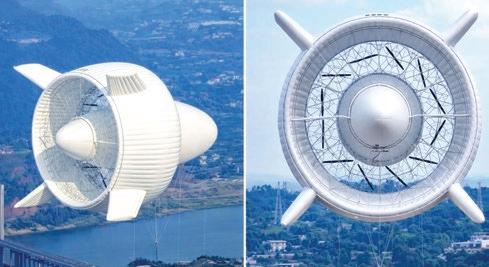
In January 2026, China’s S2000 Stratosphere Airborne Wind Energy System completed its first successful test flight in Yibin, Sichuan Province, marking a milestone in airborne wind power development. Unlike conventional wind turbines, the S2000 generates electricity at altitude using a tethered airborne platform, challenging assumptions about how renewable energy infrastructure is positioned within the landscape.
Seeing Energy, Seeing Change
Visual and landscape impacts are central considerations in environmental impact assessments for renewable energy projects. Ground-based wind turbines can significantly alter landscape character and viewsheds, particularly in scenic, coastal, or residential settings. These effects are commonly assessed by considering magnitude, how sensitive viewers are to it (receptor sensitivity), how long it lasts, and whether the landscape can return to its original condition (reversibility).
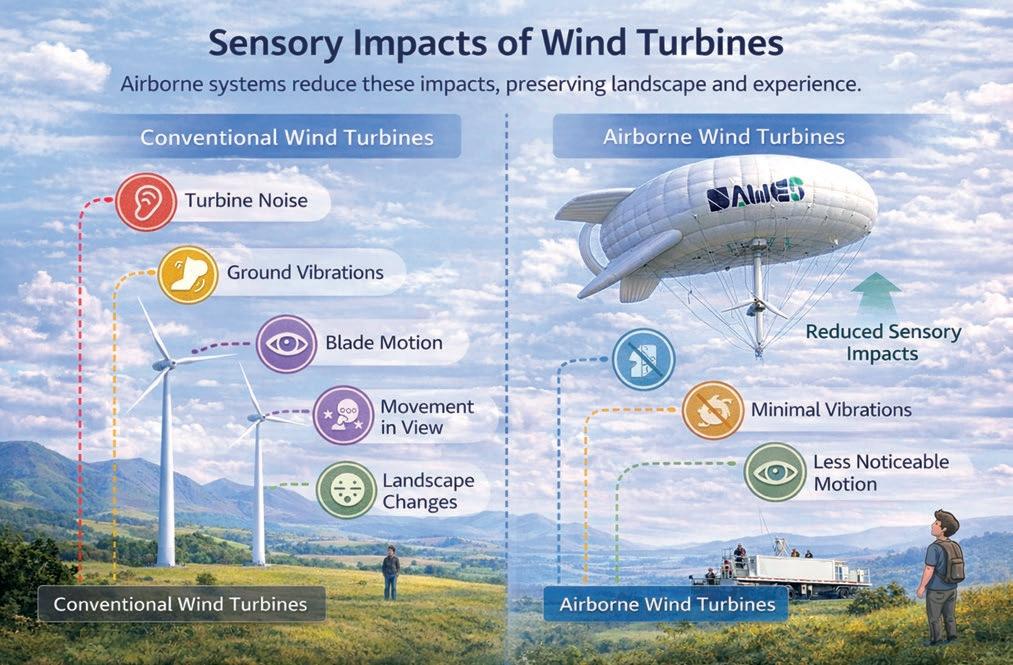
Beyond visibility alone, perception of wind energy infrastructure is shaped by scale, motion, contrast, audible noise, and secondary effects such as shadow flicker. Tall towers and rotating blades often become dominant horizon elements, contributing to cumulative visual effects across regions.
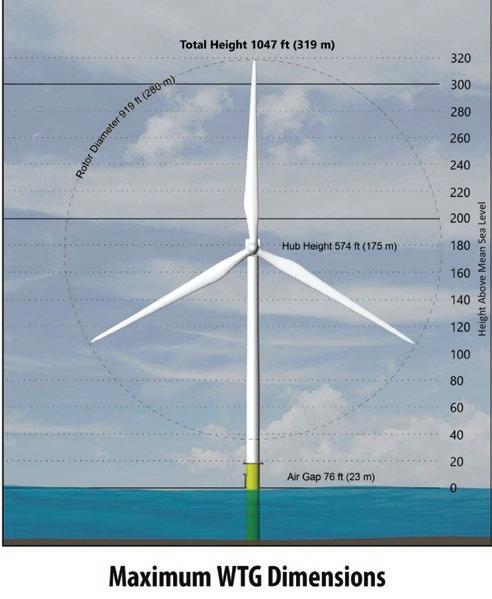
According to the U.S. Bureau of Ocean Energy Management (BOEM), turbines proposed for recent offshore projects often exceed 200 meters, with the Atlantic Shores South project reaching tip heights of nearly 319 meters above coastal landmarks. By contrast, airborne wind energy systems place primary components outside the near- and mid-field views typically considered in visual impact studies. While visibility may still occur, the absence of permanent towers can limit the intensity and persistence of visual change, making effects more temporary and reversible than those of fixed installations.
Redefining Scale and Coexisting With the Land
Publicly available reports indicate that the S2000 prototype reached operating altitudes of approximately 2,000 meters during test flights and successfully generated electricity during a grid-connected demonstration. The system is described by its developers as targeting megawatt-scale capacity, although these figures represent intended performance rather than long-term operational output.
Developed by Beijing Linyi Yunchuan Energy Technology and Beijing SAWES Energy Technology, the S2000 is a heliumfilled airborne platform constructed from lightweight fabrics and composite materials. Operating as a tethered system, it remains physically connected to a ground station by a cable that stabilizes the platform and transmits generated electrical power. The aerostat supports multiple turbines that produce electricity at altitude and convey it to the ground. During initial testing and prototype demonstrations, the system reportedly reached operating height in approximately thirty minutes, indicating rapid deployment feasibility for an emerging form of wind energy infrastructure.
Temporary Visual Effects and Landscape Sensitivity
From an environmental assessment perspective, the visual effects associated with airborne wind energy systems are more likely to be temporary and reversible than those of fixed installations, although
further empirical study is needed. Conventional wind turbines introduce long-term visual elements that require careful siting, mitigation, and ongoing community engagement, particularly in visually sensitive landscapes where built structures are more noticeable and strongly influence how places are experienced, such as open desert terrain, scenic coastlines, dense urban skylines, or tourism-oriented settings. In parts of the Middle East and North Africa, these considerations are further shaped by extreme climatic and geological conditions, including strong seasonal winds, sand and dust storms, and regional seismic activity.
By contrast, the absence of permanent towers and ground-level rotating blades allows airborne systems to limit visual effects to periods of active operation. Their deployable nature also allows temporary removal during severe weather or seismic events, reducing long-term visual, structural, and safety exposure. Rather than replacing established siting and mitigation practices, this flexibility demonstrates how adaptive infrastructure can complement existing approaches in sensitive or hazard-prone landscapes.
Visual Impact Assessment of Airborne Turbines
Visual impact assessment (VIA) is a methodological tool used to evaluate how infrastructure affects landscape appearance and visual perception, considering factors such as height, scale, contrast, motion, duration of view, and visibility from representative viewpoints. Existing VIA methodologies have largely been developed for static, ground-based structures, presenting challenges when applied to airborne systems.
Because airborne turbines operate within a dynamic, threedimensional airspace, their visual presence interacts differently with atmospheric conditions, movement patterns, and layered landscapes. Variables such as tether visibility, the collective motion of multiple airborne units, and contrast against changing sky backgrounds introduce considerations not yet fully addressed in current visual impact assessment guidance, largely because the technology is still new.
As a result, future assessments are likely to require a combination of visual simulations, atmospheric modeling, field observation, and public engagement. Tools such as virtual and augmented reality may play an important role in this process, allowing stakeholders to compare airborne systems with conventional energy infrastructure and supporting more informed, context-sensitive evaluation of their landscape and perceptual effects.
Understanding Wildlife Use of Wind and Terrain
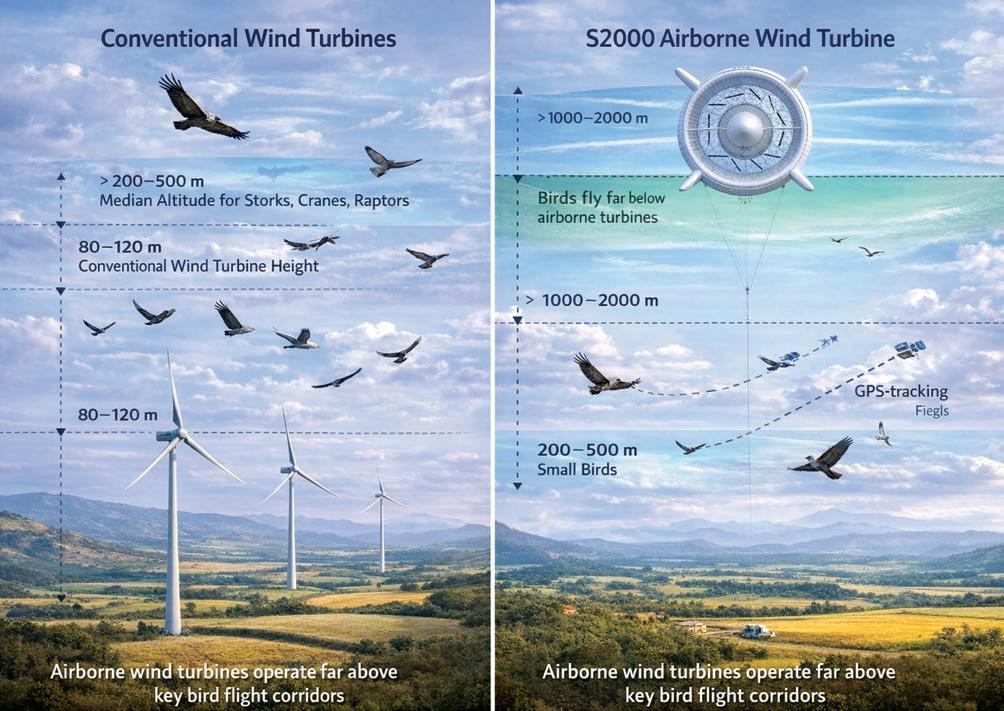
Bird and bat interactions remain an important consideration in environmental impact assessment for wind energy projects, particularly for large uplift-dependent species that rely on atmospheric processes such as thermal and orographic uplift for long-distance movement. These species often use soaring flight, gaining altitude through rising air rather than continuous flapping, which allows energy-efficient travel across large distances. Most migratory birds, including many soaring species, typically fly well below extreme altitudes, with flight heights shaped more by available uplift and landscape features than by fixed elevation levels.
CLEAN ENERGY
Orographic uplift occurs when wind is pushed upward as it moves over terrain such as mountains, ridgelines, or coastal slopes. The location and strength of this rising air depend on landform characteristics and basic wind conditions, including wind speed and direction. Because these uplift areas tend to recur in the same places, they help guide where birds fly and gather, making them an important factor in siting wind energy infrastructure and assessing ecological interactions.
Potential interactions may still occur, particularly with moving airborne components such as tethering cables. However, empirical evidence remains limited, and the key concern is not altitude alone but whether systems overlap with areas where uplift-dependent species concentrate. Environmental impact assessments that combine radar monitoring, GPS tracking, and airflow modeling remain essential for evaluating these interactions and informing responsible deployment strategies.
For landscape and clean energy planning, this highlights that wind, landform, and wildlife interact in largely predictable ways. Recognizing these patterns helps guide renewable energy placement that works with existing landscape and ecological conditions rather than against them.
Power Without Presence
Rather than replacing conventional wind turbines, airborne systems may expand the renewable energy toolkit in contexts where visual sensitivity, terrain constraints, or temporary deployment make fixed infrastructure less suitable. Airborne wind energy systems propose a shift not in renewable energy goals, but in how infrastructure is positioned and experienced within the landscape. While conventional wind projects are carefully designed through siting studies, mitigation strategies, and public consultation to manage long-term visual presence, airborne systems introduce a more flexible relationship between energy production and terrain.
From a visual impact perspective, the absence of fixed towers alters both the scale and duration of visual change, as airborne turbines can be deployed and retrieved in response to operational needs, resulting in energy infrastructure that appears intermittently rather than occupying the landscape continuously.
At the end of the day, designers and developers may argue that it is impossible to satisfy all stakeholders or account for every ecological variable. Yet the emergence of new ideas shows how design choices can meaningfully influence the scale and character of impacts in specific contexts. It suggests that renewable energy infrastructure can be both productive and adaptive in its relationship to the landscape, using different tools for different spatial, climatic, and social conditions.
Acclimatisation and Hormesis
A Physiological Approach to Sustainable Irrigation in Arid Urban Landscapes
By Dr. Haroon Ur Rashid
Urban landscapes in arid regions, particularly the UAE, face the dual challenge of sustaining plant vigour and conserving limited water resources. Conventional irrigation practice applies 100% of evapotranspiration (ETc), ensuring immediate survival but causing shallow rooting, nutrients leaching, algae proliferation, and largescale water wastage. This review examines Acclimatisation, a controlled deficit irrigation strategy based on the principle of hormesis, where mild stress stimulates adaptive physiological responses.
Evidence from peer-reviewed literature and UAE case studies demonstrates that a stepwise acclimatisation protocol, reducing irrigation by 10% every two weeks, allows plants to adapt physiologically and stabilize at 60–70% ETc. Key adaptive mechanisms include deeper rooting, osmotic adjustment, stomatal regulation, and synthesis of protective proteins. Field data confirm that date palms (Phoenix dactylifera), bougainvillaea (Bougainvillea glabra), and turfgrass maintain vigor under Acclimatisation, with 25–35% water savings compared to conventional irrigation.
While soil additives may enhance water retention, their role is secondary to plant-driven adaptation. Acclimatisation, when combined with treated sewage effluent (TSE) networks, outperforms tanker irrigation in cost, efficiency, and sustainability. Findings position Acclimatisation not as a minor irrigation adjustment, but as a paradigm shift supporting the UAE’s National Water Strategy 2036 and Net Zero 2050 goals.
The United Arab Emirates (UAE) has undergone a remarkable transformation in the past four decades, turning arid desert landscapes into thriving urban greenery. This greening effort, achieved through large-scale irrigation infrastructure, has enhanced liveability, urban cooling, and tourism value. The primary backbone of this transformation is treated sewage effluent (TSE), widely adopted as a sustainable irrigation resource compared with groundwater abstraction (Shahin & Salem, 2015).
Despite this achievement, irrigation practices remain inefficient. Landscapes are typically irrigated at 100% ETc, particularly during summer months when temperatures often exceed 45 °C. While this practice is perceived as essential for survival and visual quality, it contributes to shallow rooting, nutrient leaching, algae proliferation, emitter clogging, and substantial water loss (Mattar et al., 2021). During shortages, supplementary tanker irrigation is used, further escalating costs, energy consumption, and greenhouse gas emissions (Kaizen AMS, 2023).
The prevailing assumption that landscape plants must be irrigated at 100% ETc is increasingly subject to scientific scrutiny. Acclimatization, a process of stepwise deficit irrigation, provides
an alternative. Rooted in the biological principle of hormesis, Acclimatization leverages the capacity of plants to adapt under mild stress. Hormesis describes how sub-lethal stress enhances resilience to future challenges (Calabrese & Baldwin, 2003). In plants, this translates into deeper rooting, osmotic adjustment, stomatal regulation, and the synthesis of protective proteins.
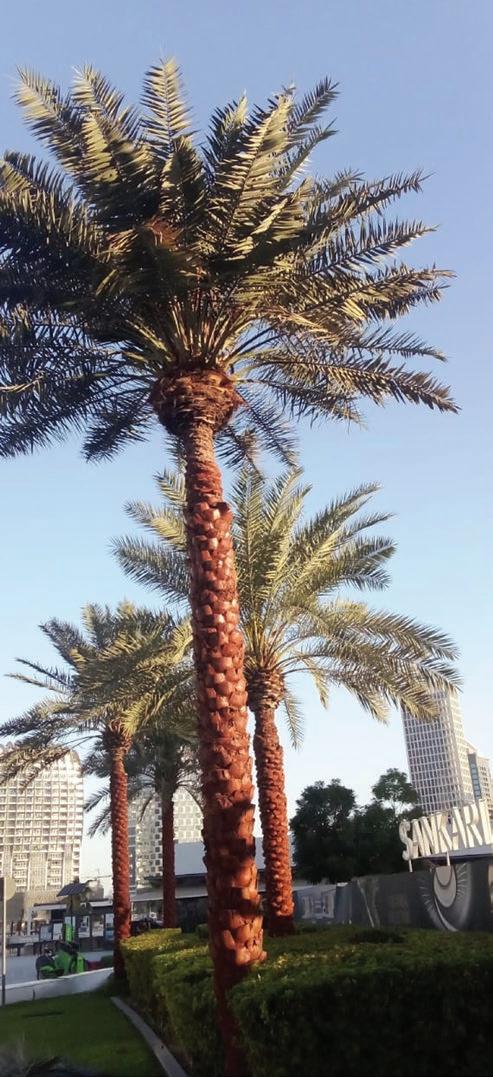
Unlike sudden water reduction, Acclimatization follows a stepwise protocol, gradually reducing irrigation by 10% every two weeks until plants stabilize at 60–70% ETc. Case studies from UAE landscapes demonstrate that common species, including date palms (Phoenix dactylifera), bougainvillea (Bougainvillea glabra), and turfgrass, sustain vigor under reduced irrigation with 25–35% water savings (Al-Muaini & Dakheel, 2019).
This review synthesizes global physiological knowledge and regional case studies to evaluate Acclimatization as a natureinspired irrigation management strategy. It provides insights into the mechanisms of plant adaptation, compares TSE and tanker irrigation, and proposes practical recommendations aligned with the UAE’s National Water Strategy 2036 and Net Zero 2050 targets.
2. Methodology
This review followed a structured evidence-based approach, combining systematic and narrative review elements (Grant & Booth, 2009).
Literature Search: Peer-reviewed literature was sourced from Scopus, Web of Science, ScienceDirect, and SpringerLink using keywords: Acclimatization, hormesis, deficit irrigation, plant physiology, UAE landscapes. Regional grey literature, government reports, and case studies were also included.
Selection Criteria:
•Research on deficit irrigation and plant physiological adaptation.
•UAE-based field trials on palms, turfgrass, and ornamentals.
•Studies comparing TSE vs tanker irrigation.
•Policy documents on UAE water strategies.
Analytical Framework:
1.Conventional irrigation (100% ETc) vs Acclimatization (60–70% ETc).
2.TSE vs tanker irrigation.
3.Physiological mechanisms underlying adaptation.
Acclimatization Protocol:
•Weeks 0–2: 100% ETc (baseline).
•Weeks 3–4: 90% ETc (onset of ABA signaling, osmotic adjustment).
•Weeks 7–8: 70% ETc (stomatal regulation, protective protein synthesis).
•Maintenance: 60–70% ETc (stable adaptation, water savings 25–35%).
CASE STUDY
3. Results and Discussion
3.1
Impacts of Full Irrigation
While irrigation at 100% ETc ensures immediate survival, it encourages shallow root systems, nutrient leaching, algae proliferation, and inefficient use of water resources. This practice is therefore physiologically sub-optimal and environmentally unsustainable.
3.2
Plant Physiology Under Acclimatisation
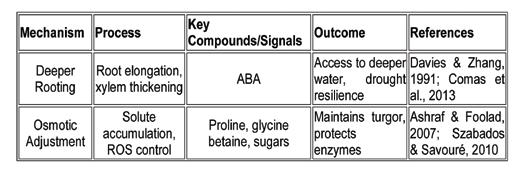
Acclimatisation stimulates four core adaptive responses: Deeper Rooting: Water deficit increases root-sourced ABA, suppressing shoot overgrowth and directing assimilates to root elongation (Davies & Zhang, 1991). Root systems extend deeper (30–50 cm in turfgrass, >1 m in palms), improving access to subsoil water. Anatomical modifications include thicker xylem vessels and suberization, enhancing hydraulic conductivity while reducing cavitation risk (Comas et al., 2013).
Osmotic Adjustment: Plants accumulate compatible solutes, proline, glycine betaine, soluble sugars, that lower osmotic potential and maintain turgor. Proline scavenges ROS, glycine betaine stabilizes Rubisco and PSII proteins, while sugars regulate stress-responsive gene expression (Ashraf & Foolad, 2007; Couée et al., 2006; Szabados & Savouré, 2010).
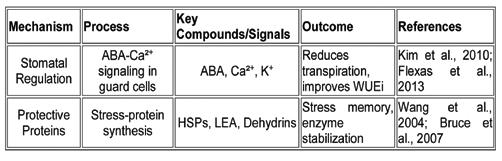
Stomatal Regulation: Elevated ABA activates Ca² signalling cascades in guard cells, leading to partial closure of stomata (Kim et al., 2010). This reduces transpiration while maintaining sufficient CO uptake, improving intrinsic water use efficiency (Flexas et al., 2013).
Protective Proteins & Stress Memory: Repeated mild stress induces HSPs, dehydrins, and LEA proteins, which stabilise proteins and membranes, while epigenetic modifications enhance stress memory (Wang et al., 2004; Bruce et al., 2007; Tunnacliffe & Wise, 2007). These mechanisms prepare plants for recurring irrigation deficits.
However, the success of these adaptations is strongly influenced by environmental constraints. High evaporation during peak sun hours reduces the effective volume of water reaching the root zone, with surface losses reported at 20–30% under arid climates (Howell,
2001; Pereira et al., 2012). At the same time, elevated total dissolved solids (TDS) in irrigation water increase soil osmotic pressure, reducing water uptake and forcing plants to invest additional energy in osmotic adjustment (Maas & Hoffman, 1977; Munns & Tester, 2008). If unmanaged, these stresses can offset the physiological gains of acclimatisation. Practical measures—such as scheduling irrigation in early morning or evening to minimize evaporation (Steduto et al., 2012), periodic leaching to flush salts from the root zone (Ayers & Westcot, 1994), mulching to suppress surface evaporation (AbuAwwad, 1998), and routine monitoring of irrigation water quality— are therefore essential to ensure that Acclimatization delivers its full potential in arid landscapes.
Table 1. Physiological mechanisms of Acclimatization
3.3 UAE Case Studies
Table 2. Irrigation savings across species
3.4 TSE vs Tanker Irrigation
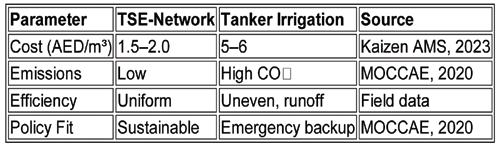
Treated sewage effluent (TSE) has become the backbone of sustainable irrigation in the UAE, offering low-cost, uniform, and policy-compliant water delivery through automated networks. By contrast, tanker irrigation is almost 4-5 times more expensive, carbon-intensive, and inefficient, with uneven application that leads to runoff and wastage. In practice, TSE represents the future of smart landscape management, while tanker supply should remain a last-resort emergency measure.
4. Conclusion
The long-standing practice of irrigating landscapes at 100% ETc is no longer defensible, as both physiological evidence and field data from arid regions demonstrate its inefficiency and ecological cost. In contrast, Acclimatisation—a carefully managed, stepwise reduction in irrigation—allows plants to stabilise at 60–70% ETc, achieving 25–35% water savings without any decline in vigour or aesthetic performance. This resilience is not incidental but the result of well-documented physiological adaptations: roots penetrating 30–50 cm deeper into the soil profile, osmotic adjustment through solute accumulation, ABA-driven stomatal regulation that optimizes water use, and the synthesis of protective proteins that equip plants to withstand extreme heat and drought.
When combined with treated sewage effluent (TSE) networks, Acclimatisation delivers reliable, uniform, and cost-efficient irrigation, positioning itself as a superior alternative to tanker irrigation, which is unsustainable, carbon-intensive, and best reserved for emergencies. In essence, Acclimatisation is more than an irrigation adjustment—it is a scalable and transformative strategy that can cut urban landscape water demand by one-quarter to one-third, directly advancing the UAE’s National Water Strategy 2036 and Net Zero 2050 ambitions, while serving as a replicable model for water-scarce regions across the globe.
5. Recommendations
Full irrigation at 100% ETc should be phased out as standard practice, and acclimatisation protocols with stepwise 10% reductions every two weeks adopted until stabilising at 60–70% ETc, achieving 25–35% water savings. Irrigation should be scheduled during early morning or late evening to minimise evaporation, combined with mulching and periodic leaching to manage soil salinity. Regular monitoring of TDS is essential, with TSE prioritised over tanker irrigation, which should be restricted to emergencies. Smart irrigation systems with IoT-enabled sensors and automated controllers should be introduced to support acclimatisation, while long-term species-specific trials are required to confirm thresholds across key landscape plants. Training for practitioners on physiologybased irrigation, coupled with policy integration under the UAE National Water Strategy 2036 and Net Zero 2050, will ensure scalable and sustainable adoption.
Table 3. Comparison of TSE and tanker irrigation
BEYOND THE BUZZWORDSLIVING SUSTAINABILITY
An interview with Phillip Dunn
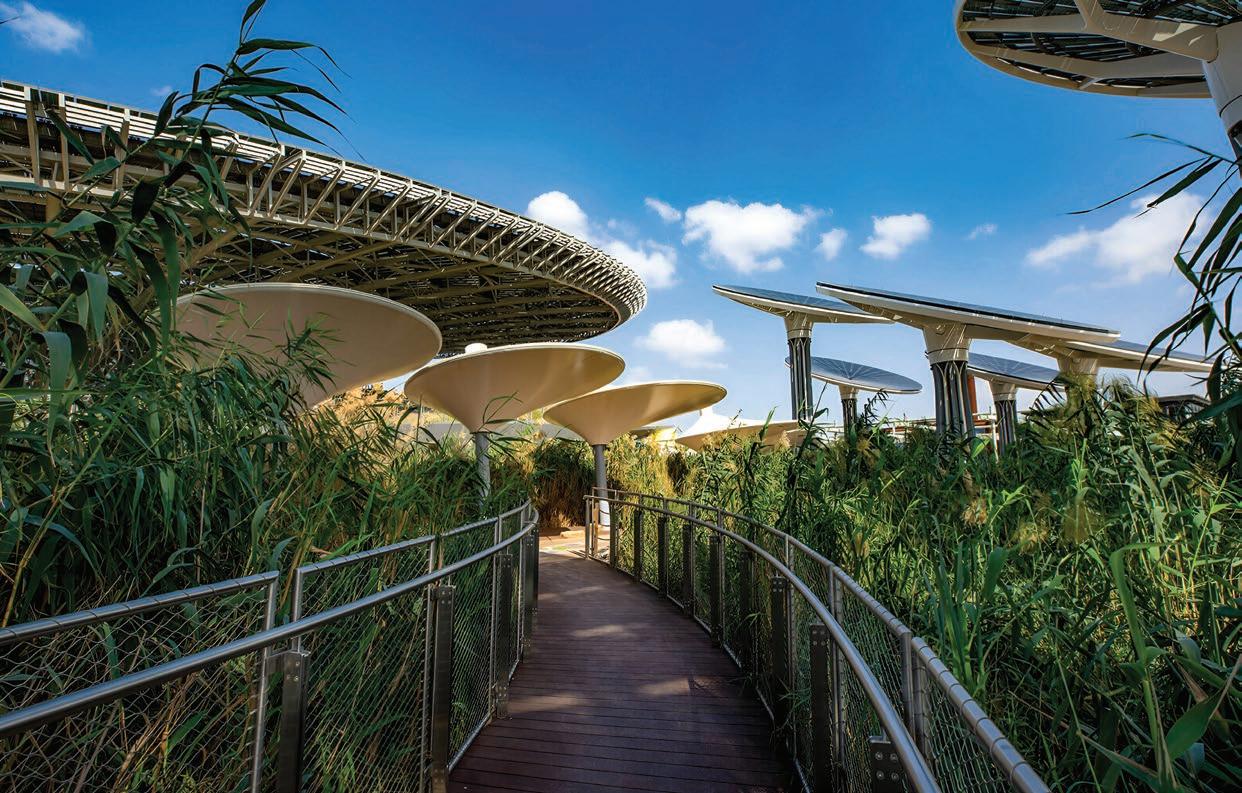
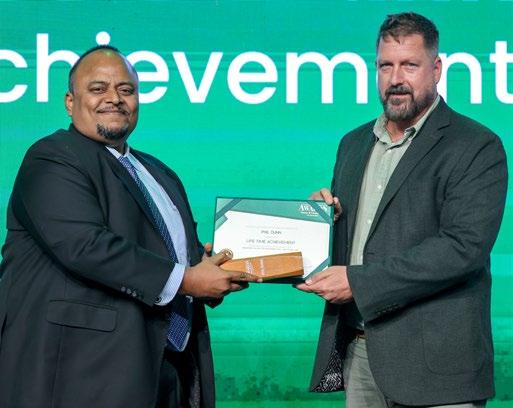
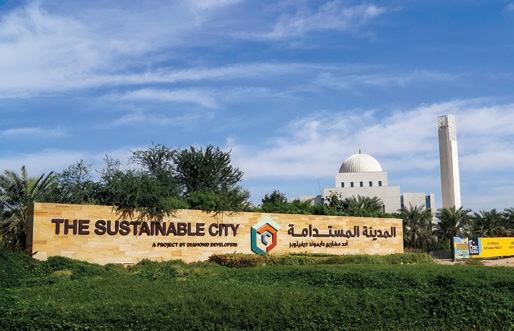
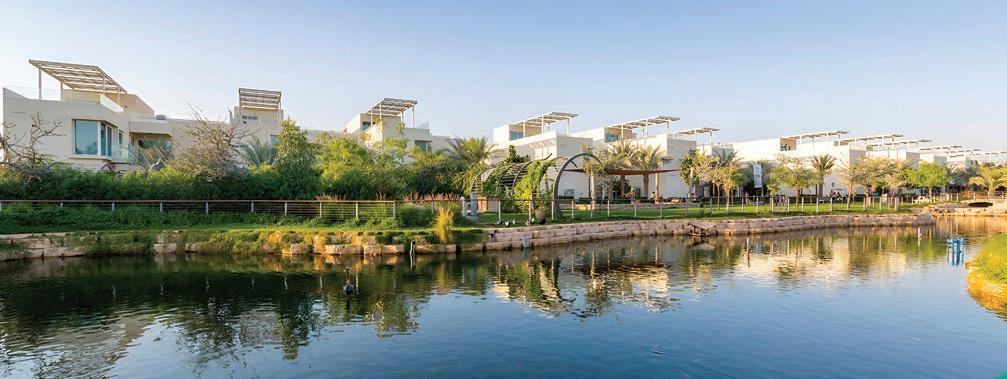
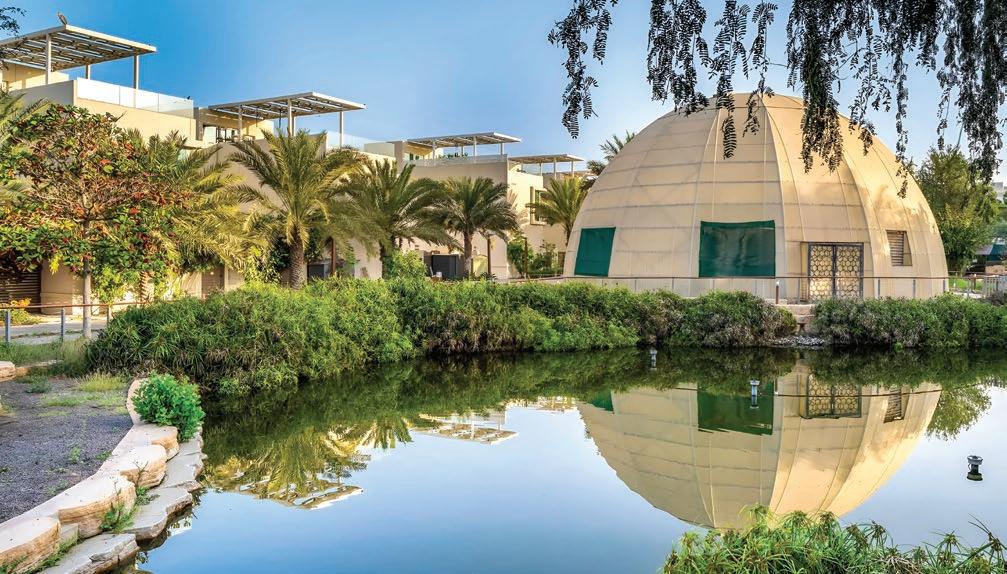
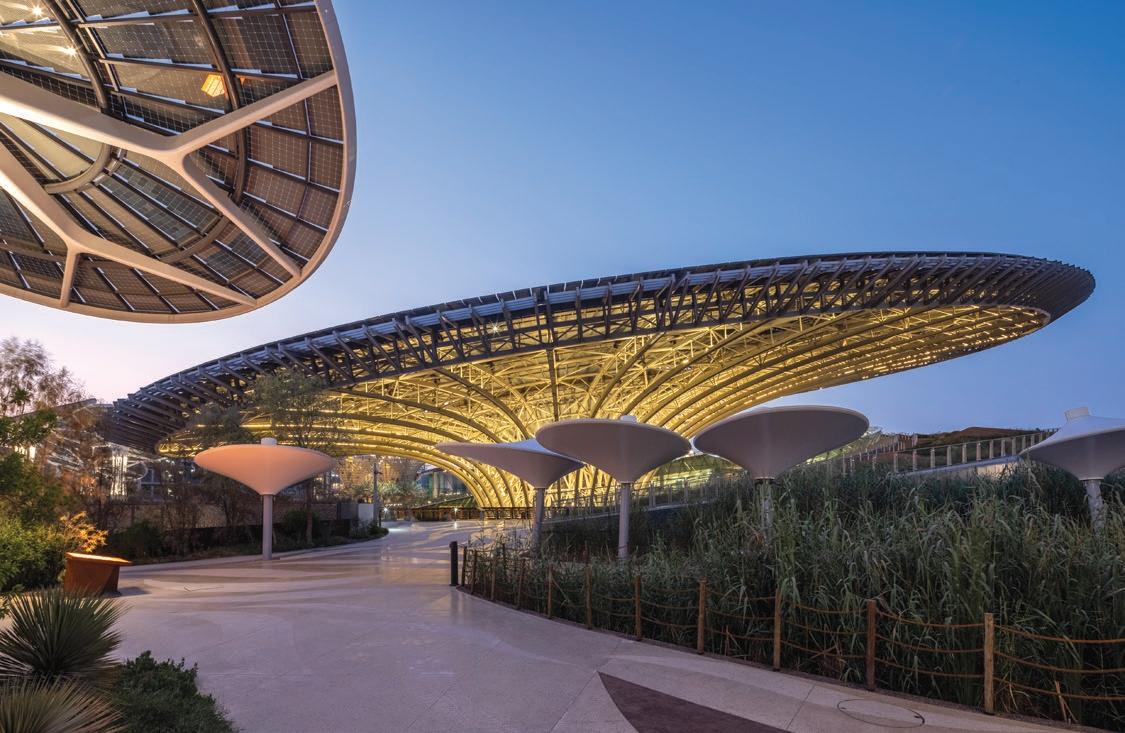
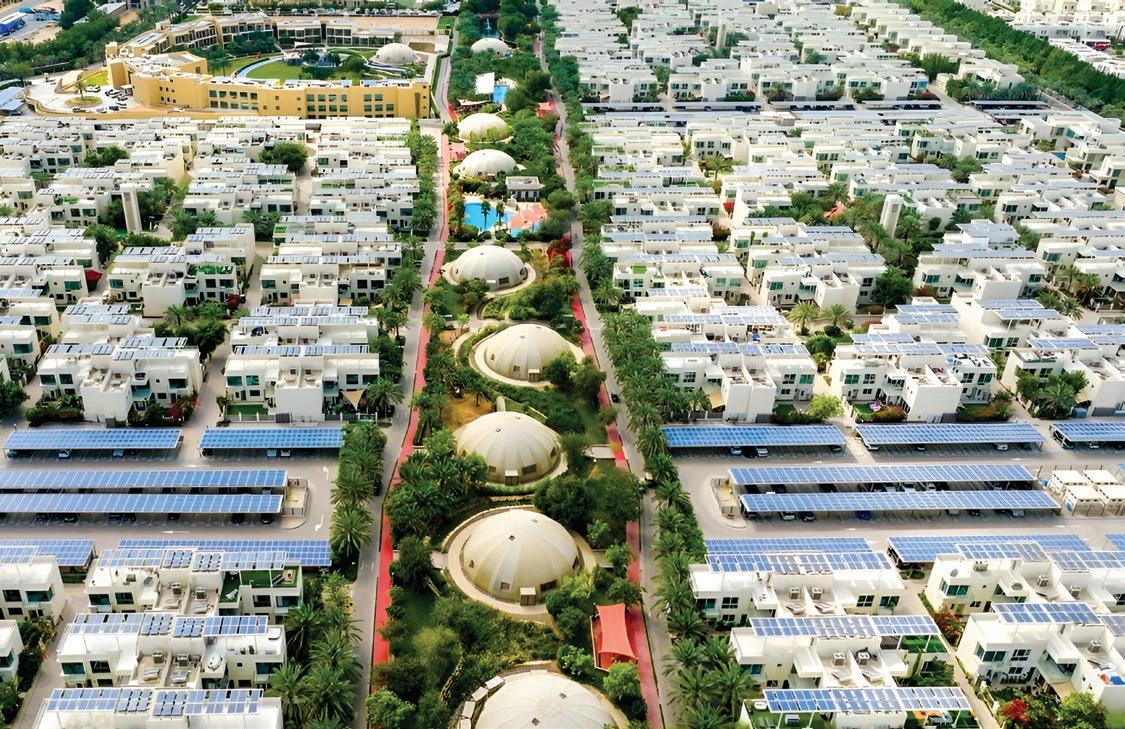
With more than two decades of experience shaping some of the region’s most ambitious sustainability projects, Masdar City, The Sustainable City in Dubai, and Expo 2020’s Terra Pavilion, Phillip Dunn has become a leading voice in redefining what sustainability truly means. His career as a landscape architect and sustainability advocate is marked by a refusal to accept surface-level solutions. For Dunn, the challenge is not about collecting green “tick boxes,” but about reimagining how cities function, how communities live, and how individuals connect with the natural world.
Building at Scale
Dunn has had a front-row seat to the Gulf’s sustainability experiments. Masdar City, spanning 640 hectares, was a bold attempt to establish a renewable energy hub. The Sustainable City in Dubai, where Dunn not only designed and built the public realm but also lived for six years, turned sustainable living into a working community. At Expo 2020, he helped deliver Terra—the Sustainability Pavilion—an architectural showcase that became a living laboratory for ideas on water, food, and energy. “What these projects have shown,” Dunn says, “is that sustainability can move from theory into the built environment. If it’s embedded from day one, it doesn’t have to cost more. The real challenge now is integration.
Too often, they remain pockets of innovation rather than reshaping entire systems.”
The financial argument, long seen as a barrier, is also shifting. In The Sustainable City, thicker insulation and higher-performance windows increased upfront costs but reduced energy demand, shrinking air conditioning units and cables while slashing long-term utility bills. “People want to live in places like this—and over time it actually costs less,” Dunn explains. “That’s a powerful lesson.”
From Checklists to Connection
For Dunn, the problem with sustainability discourse is that it too often gets reduced to gestures like banning plastic bags. “These conversations do matter; they build momentum. But the overlooked challenge is how we treat shared planetary resources. Until people feel planetary problems personally, apathy will outweigh action,” he says.
At Terra - part of Expo City Dubai, he regularly encounters this reality. Visitors are asked: Who is responsible for reducing waste—government, industry, or consumers? “Most people look to government,” Dunn notes, “but I believe change is bottom-up. If consumers demand it, industry follows. Regulations matter, but without individual responsibility and cultural buy-in, progress stalls.”
This bottom-up philosophy also shapes Dunn’s skepticism around carbon credits and offsets. He acknowledges their potential to channel funding into biodiversity and carbon reduction projects, but warns they can become an “easy way out.” For him, economic mechanisms must be coupled with genuine stewardship of nature, not as a substitute for it.
Lessons from Living Sustainably Dunn’s views are grounded not just in theory but in personal experience. At The Sustainable City, he embarked on the
Sustainable Human Project, living for a year on food he grew himself or bartered from neighbors.
“I started thinking it would be an environmental challenge,” he recalls, “but it quickly became a social project. Selfsufficiency is a myth; you need community. That year taught me that sustainability isn’t about perfection. It’s about aligning daily life with nature, even in small steps, and recognizing that resilience comes from relationships.”
Trading vegetables for bread, building birdhouses from scrap wood in exchange for produce, or relying on shared aquaponics systems, Dunn experienced firsthand how shared responsibility builds stronger, more sustainable communities. “Nature will continue without us. The real question is whether humanity will continue without her,” he says.
Reconnecting in an Age of Apathy Dunn often describes the present moment less as a climate crisis than a “disconnection crisis.” He argues that decades of warnings have rendered environmental urgency into background noise. “People have become apathetic. We’ve disconnected from ourselves, from each other, and by extension from nature. And you can’t expect people to fight for something they don’t feel connected to.”
Here, landscape architecture becomes more than aesthetics; it becomes a bridge. “Nature is the conduit that reconnects us,” Dunn explains. “We won’t fight to save what we don’t feel connected to. Green spaces in cities are not luxuries; they’re essential to cultivating stewardship.” With more than 70 percent of humanity projected to live in cities by mid-century, this is not a minor point: “How we design our cities in the next decade will determine whether sustainability is a label or a lived reality.”
Innovation Rooted in Nature
In the Gulf, where extreme temperatures and resource scarcity are daily realities, Dunn believes solutions lie in pairing ancestral wisdom with modern innovation. He points to vernacular architecture—narrow sikka streets, inward courtyards, natural ventilation—as design traditions worth reimagining today. At Expo City, many of these cues shaped the masterplan, ensuring shade, airflow, and human-scaled spaces.
He is also an advocate of biomimicry, seeing nature as a 3.8-billion-year-old teacher. His work at Terra included a biosaline agriculture project that turned brine waste from desalination into a farming system producing fish,
quinoa, and livestock fodder. “This is exactly where the Gulf’s future lies—regenerative landscapes that cool, feed, and sustain us.”
Certification vs. Culture
Asked about the global fixation on certifications such as LEED and WELL, Dunn is pragmatic. “They have raised the bar, and they help align teams. But they’re not the end point. Certifications must evolve into tools that measure lived outcomes, not just compliance. Ultimately, exposure to natural spaces matters more than a plaque on a wall.”
His analogy for Terra Pavilion illustrates the point: “It’s like a high-performance electric sports car. The design is world-class. But if you hand it over and people drive it like a tricycle, you miss the mark. Sustainable design succeeds only when communities adopt it and operations reinforce it.”
Sustainability as Lifestyle
Beyond his professional role, Dunn lives his philosophy. Known for his green wardrobe—a quiet symbol of his convictions—he spends his free time paddleboarding, camping in the Hajar Mountains, woodworking with
reclaimed timber, and growing native plants from seed. His lifestyle choices reflect the same ethos that defines his work: aligning with nature, community, and simplicity.
“I sometimes say we don’t need more knowledge, we need more action,” he reflects. “And that action often begins with reconnecting—to each other, to our environment, to what really sustains us.”
Looking Ahead
As he looks toward the next decade, Dunn is clear about the task ahead: to move sustainability out of isolated projects and into mainstream urban life. That means scaling best practices, restoring trust in systems like recycling, designing with vernacular wisdom, and, above all, creating cities where people feel connected to nature and to each other.
“It comes down to this,” he says. “Imagine two people are drowning—one is a stranger, one is a friend. You’ll save the friend first, because you’re connected. If we want people to save nature, we must first restore that connection. Only then do we stand a chance of changing our trajectory.”
A portrait of timely projects across the Americas offers a model for replication Landscape architecture, today.
By: Jimena Martignoni
Gen R
“Generation R: Regenerating Perspectives / Regenerating Landscapes” is a comprehensive curatorial undertaking of 100 landscape architecture projects across the American continent. Its digital version was completed in December 2025 and shared with the 42 participating teams from 11 different countries in the Americas. As next steps, the publication will follow an integrated dissemination plan and, with favorable conditions, a printed edition.
Essentially, this curatorial work constitutes a sampling that brings together “timely solutions to timely problems.” In this regard, one of the conditions for participation and project inclusion was that the works could not predate the year 2020, thus ensuring a selection aligned with the contemporary context, in a world marked by accelerated and constantly changing rhythms.
The title of the work—which explicitly refers to processes of landscape regeneration, themselves rooted in the necessary regeneration of thought on a large scale— encompasses all possible actions that involve looking again, returning to certain origins, returning to nature, and to a respectful way of approaching it, engaging with it, and transforming it. “Regeneration” stands as the conceptual foundation, but so do Rehabilitation, Reconstitution, Reconstruction, Revaluation, Re-education, Repair, and, from a distinctly poetic perspective, Revolution: of ideas and processes that lead to solutions that are visionary yet responsible, innovative yet truly attentive to environmental and social contexts.
Originating within a group of respected Latin American landscape architects and academics—who also served as an advisory team and later included a North American specialist (full credits detailed at the end)—and supported by IFLA Americas (International Federation of Landscape Architects, Americas Region), Generation R received a far greater response than anticipated, with thoroughly positive results.
The project unveils not only the strength of today’s landscape thinkers and practitioners, but also an underlying line of thought binding them together. Indeed, a “collective vision” was another of the project’s conceptual conditions, powerfully demonstrated through the body of projects exhibited.
Curatorial Framework and Vision
The conceptual structuring of the work had the clear objective of standardizing the reception of the submitted material but, above all, of enabling the clear
We want everyone, without exception, to be POLLINATORS.
identification of differentiating ideas, so that participants could respond within a pre-established framework. One of the first questions posed in the “base document” addresses the motivations and approaches behind the work, stating:
We aim to:
Convey what landscape architects can — and must — contribute today.
Showcase meaningful projects, bold ideas, and concrete actions.
Share these collectively, through a shared lens and mindset. Present them as part of a unified effort, driven by a common purpose of repair.
Highlight regional identity — specifically, that of the Americas.
This geographic conceptualization remains clearly meaningful, since even in the context of global problems, potential solutions naturally respond to regional and local frameworks.
However, one of the long-term objectives is the replication of this curatorial work in other IFLA regions, including both member and non-member designers and teams. Focused on the Americas, this work seeks to serve as a model to be replicated and adapted, in order to obtain responses in other regions and, ideally, to create a contemporary landscape architecture platform that is collective yet diverse.
Particularly, this publication sought to bring together young and emerging designers, with new and youthful perspectives, moving away from names that are already professionally established, well known, and repeatedly published. The selection of teams primarily responded to these characteristics, and each team was invited with full freedom to participate or decline the invitation. Of the 50 teams invited, 42 ultimately took part, representing the United States and Canada in North America, and Brazil, Chile, Argentina, Uruguay, Colombia, Venezuela, Peru, Ecuador, and Mexico in Latin America.
Buscamos que todos transmitan el mensaje, lo divulguen y colaboren para que crezca y resista.
We want everyone to share the message, to help it reach farther, and to make it grow.
Queremos que todos, sin excepción, seamos POLINIZADORES.
I COLLECTIVE WORK
The key themes guiding the work, and which had to be represented by the 42 selected teams, are four: Resilience; Equity; Conservation; and Educational and Awareness-Raising Actions . The first three were to be represented primarily by built projects, while the latter was represented by specific processes and actions, whether completed or still in progress. Regarding Actions, an important clarification is that greater attention was placed on non-academic programs such as “Alternative and experimental learning methods (hybrid approaches, collaborations, field explorations); Replication of learning beyond academia (popular education, schools, participatory community activities); Implementation, management, and innovation for inclusion in public policy.” Surprisingly, this theme gathered the greatest number of examples, demonstrating the current willingness to open up and blur professional and academic boundaries that have until now been relatively inflexible.
In addition, there were three transversal lines that had to be taken into account across all themes and that provided a broader conceptual framework: 1) Perspective and thinking in a collective way (in and for the community); 2) Integration of themes into systems and networks (holistic vision and solutions); 3) The “Urban” as a basic reality and preexistence (we live on an urban planet).
Despite the great complexity that this structure implies, there was nevertheless an “essential philosophy” to adhere to—simplifying the complex and focusing on the regeneration of perspectives and landscapes. This philosophy, or core message, was summarized in the following questions:
How do we engage with the land and modify it, wherever it may be?
How do we preserve / create healthy connections between all living systems and their environments? How do we return to Nature, and to its essence as a system in balance?
Both pleased and genuinely moved, the curatorial team has received 100 projects which respond to, deepen, and multiply these questions. As stated in the Preface: “We seek to multiply ideas. We seek to Resist (Resilience), Respect (Equity), Safeguard (Conservation), and Replicate (Actions).”
Results
The concrete outcome of this curatorial work is 100 projects.
Of this total, there are 24 project examples focused on the theme of Resilience; 21 examples focused on Equity; 26 examples focused on Conservation; and 29 examples focused on Educational and AwarenessRaising Actions. Based on a very simple statistical reading by country, Canada and Brazil stand out for their examples addressing Equity, with a focus on Indigenous communities; the United States stands out for examples related to Conservation and Actions; and the remaining Latin American countries show an overall balance across themes.
The names of the teams are all credited at the end— together with each of their projects—in line with one of the initial ideas of the work: to center attention on ideas and tangible outcomes, and to emphasize a collective vision.
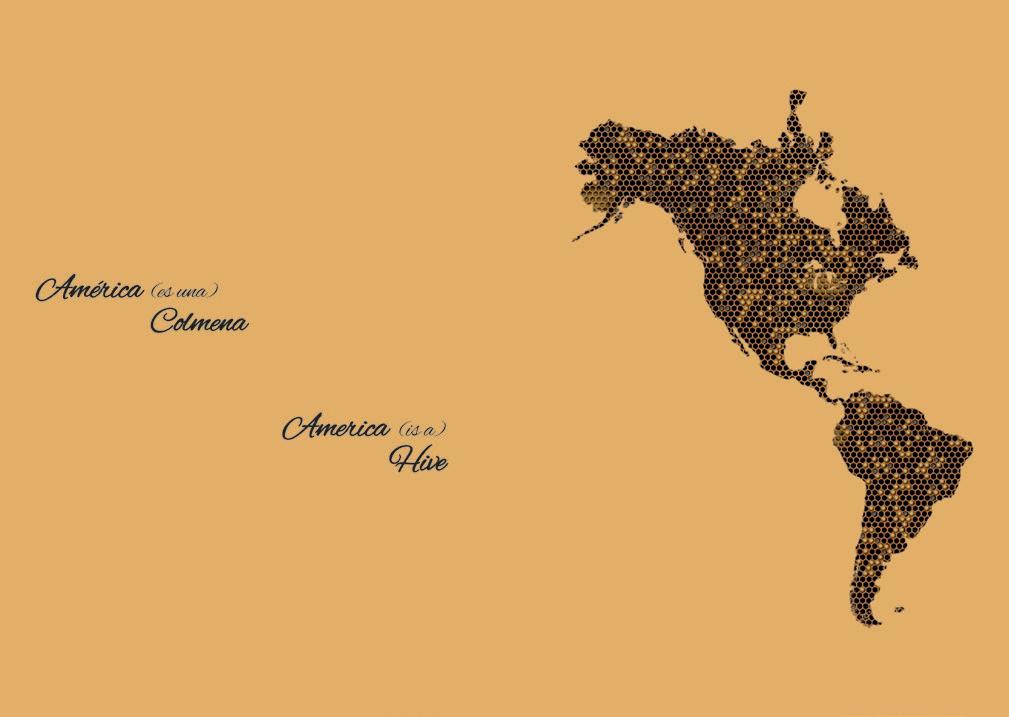
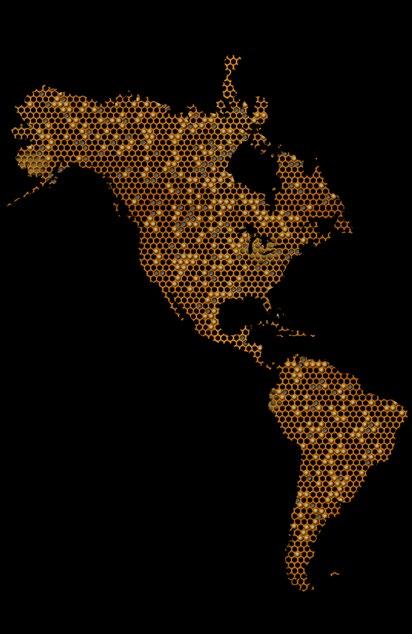
Honoring this idea of collaborative, integrated, and generous work among all parties, the publication introduces a conceptual image that we hope will also be widely replicated: “America (is a) Hive,” or “Hive America.” Drawing on the community-based, productive structure of bees—and amplifying pollination as a model of integration and interconnectivity essential to the preservation of life—we present the image of the American map as a great hive. Thinkers and makers, planners and designers, researchers and advocates of landscape and environment, working toward a shared remedial objective.
We are beginning to adapt to nature. And we also want to think the world as a hive.
Curatorial Vision and Framework. Lead Editing and Editorial Design: Jimena Martignoni
Main Advisors: Pedro Camarena (Mexico). Diana Wiesner (Colombia). North America Advisor: Tim Schuler (United States)
Design: Mili Vainstein
“Hive America” Original Idea/Original Illustration: Jimena Martignoni / Mili Vainstein
Funding Management, IFLA Americas President: Rafael Dodera
Executive Oversight, IFLA President: Dr Bruno Marques
objetivo de resaltar el énfasis
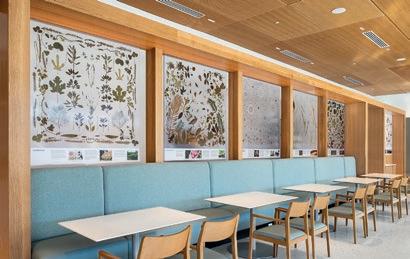
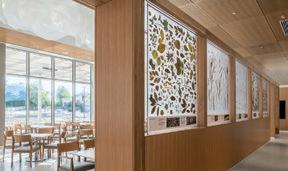
Jardín en
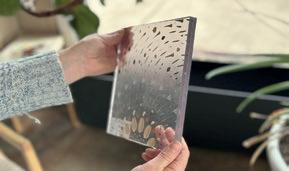
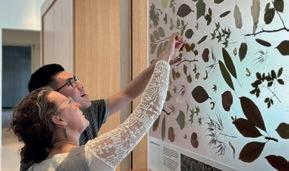
se solicitó el diseño de un conjunto de obras de arte permanentes para en el nuevo centro. Este conjunto proporciona un inspirador panel de fondo para visitantes y exhibe detalles e historia de la investigación y las colecciones del Jardín. Especímenes de plantas de todo el Jardín se recolectaron, prensaron, secaron y se colocaron en un conjunto de nueve paneles de vidrio fusionado
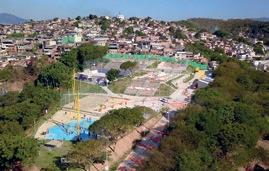
One of the examples in Latin America, in this case representing “Equity” with a project in Brasil (Designers: EMBYÁ Paisagismo Ecossistêmico).
One of the examples in North America, in this case representing “Educational and Awareness-Raising Actions” with a project in the US (Designers: Arbolope Studio).
OPEN SPACES
PLANNING SUBMITTED FOR BURSWOOD POINT IN PERTH, WESTERN AUSTRALIA
Grant Associates
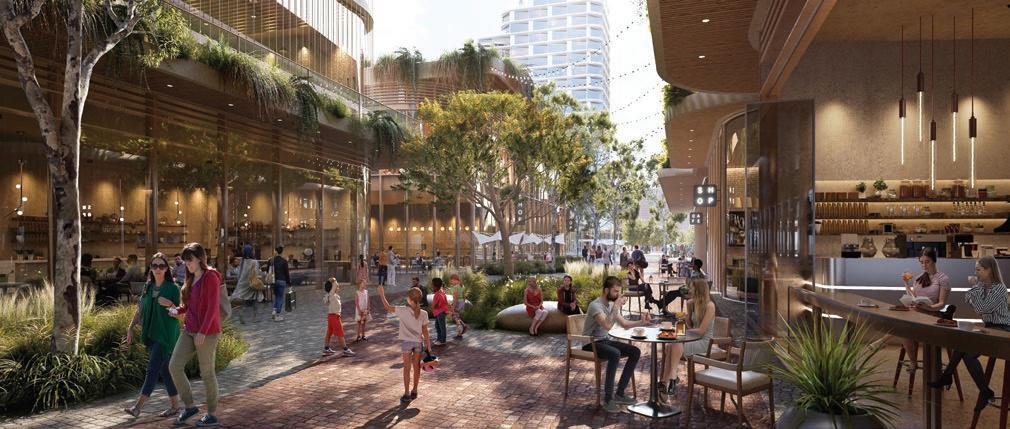
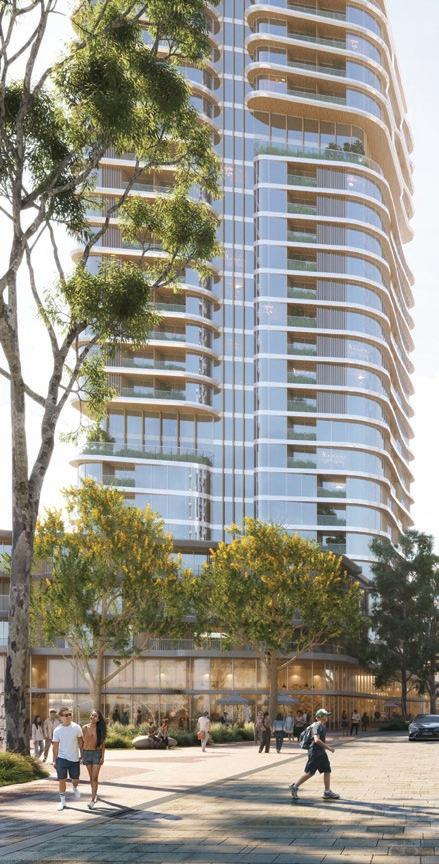
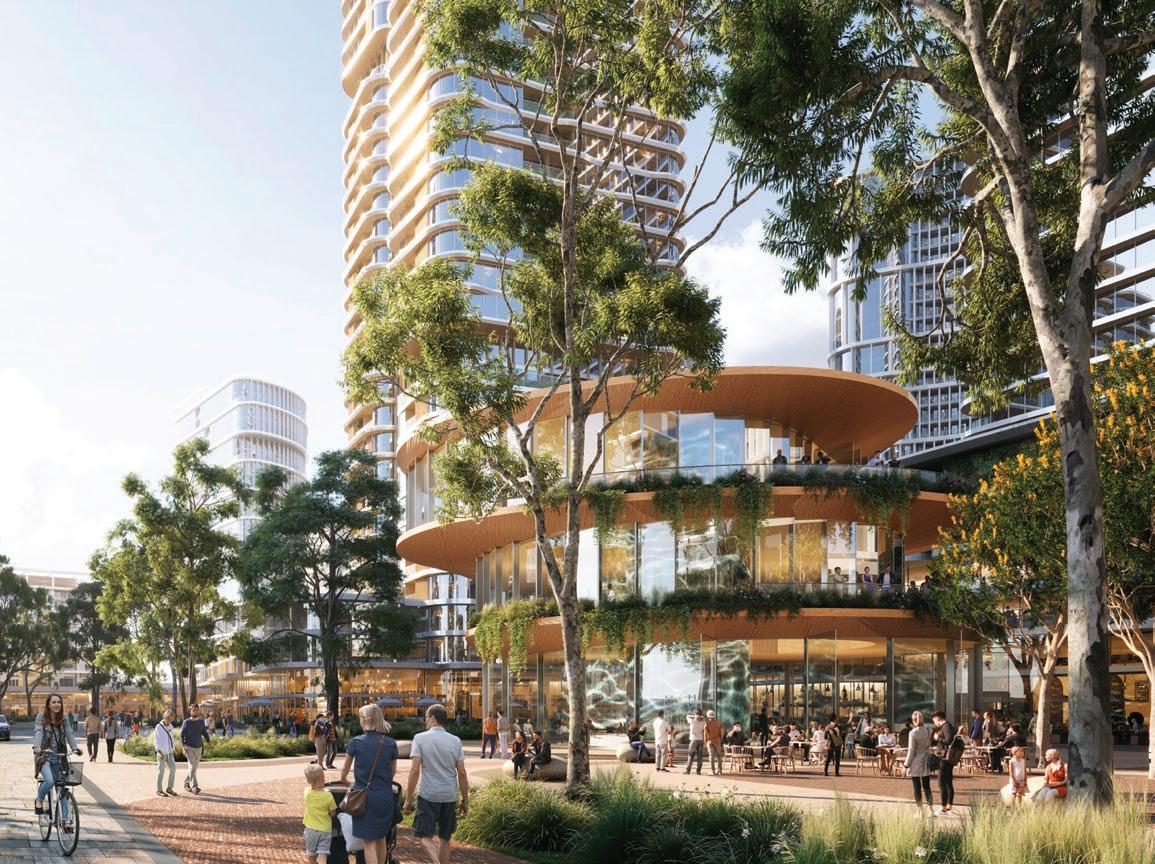
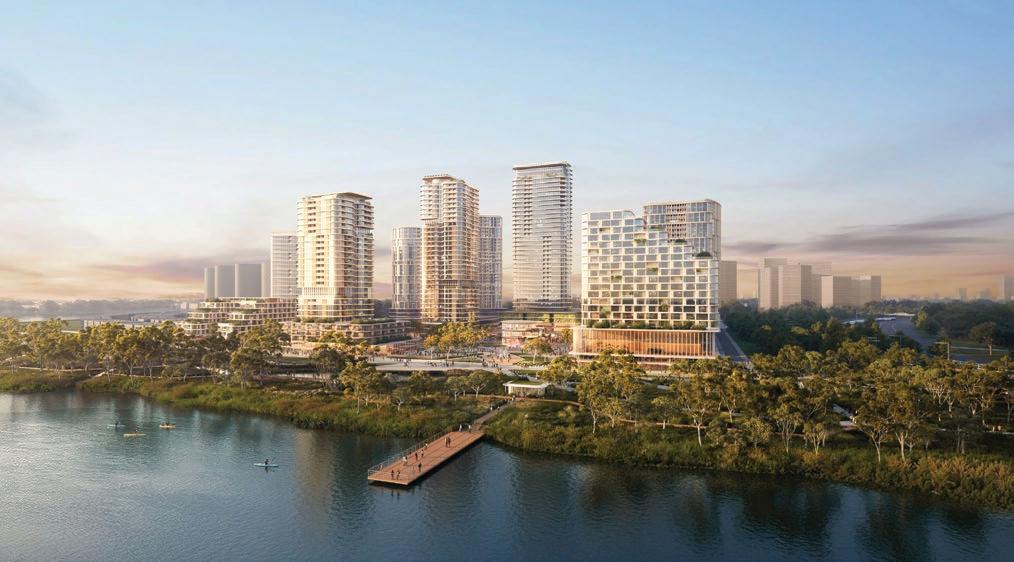
Australian developer Golden Sedayu has submitted planning for Precinct B of the multi-billion dollar Burswood Point waterfront redevelopment, marking the next stage in the transformation of one of Perth’s most significant riverfront sites.
The masterplan is being led by Skidmore, Owings & Merrill (SOM), with the landscape and public realm for Precinct B designed by Grant Associates.
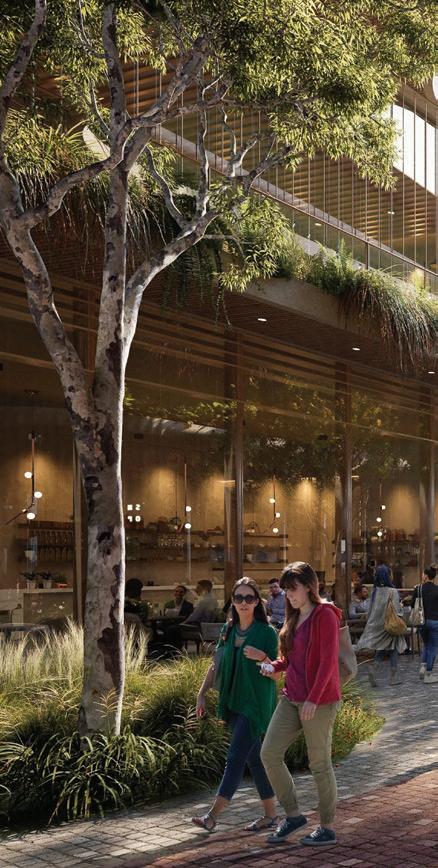
Set along the Swan River at the tip of Burswood Peninsula just 3.5km from Perth CBD, Precinct B will deliver a new mixed-use waterfront neighbourhood on a previously untouched stretch of the Swan River foreshore. It will be anchored by a generous network of public open spaces, riverfront parkland and civic gathering places. Golden Sedayu has described the wider project as a worldclass riverside destination for Perth, and the recently submitted Local Development Plan for Precinct B places landscape at the heart of that ambition.
Grant Associates’ landscape concept is inspired by the historic estuarine character of the Swan River, known as Derbarl Yerrigan in the Noongar language, reinterpreting former tidal inlets and wetlands as a contemporary urban waterfront. Sculpted landforms, rehabilitated foreshore edges, constructed wetlands, boardwalks and viewing platforms will combine to create a sheltered lagoon-like river edge that reconnects people directly with the water.
OPEN SPACES
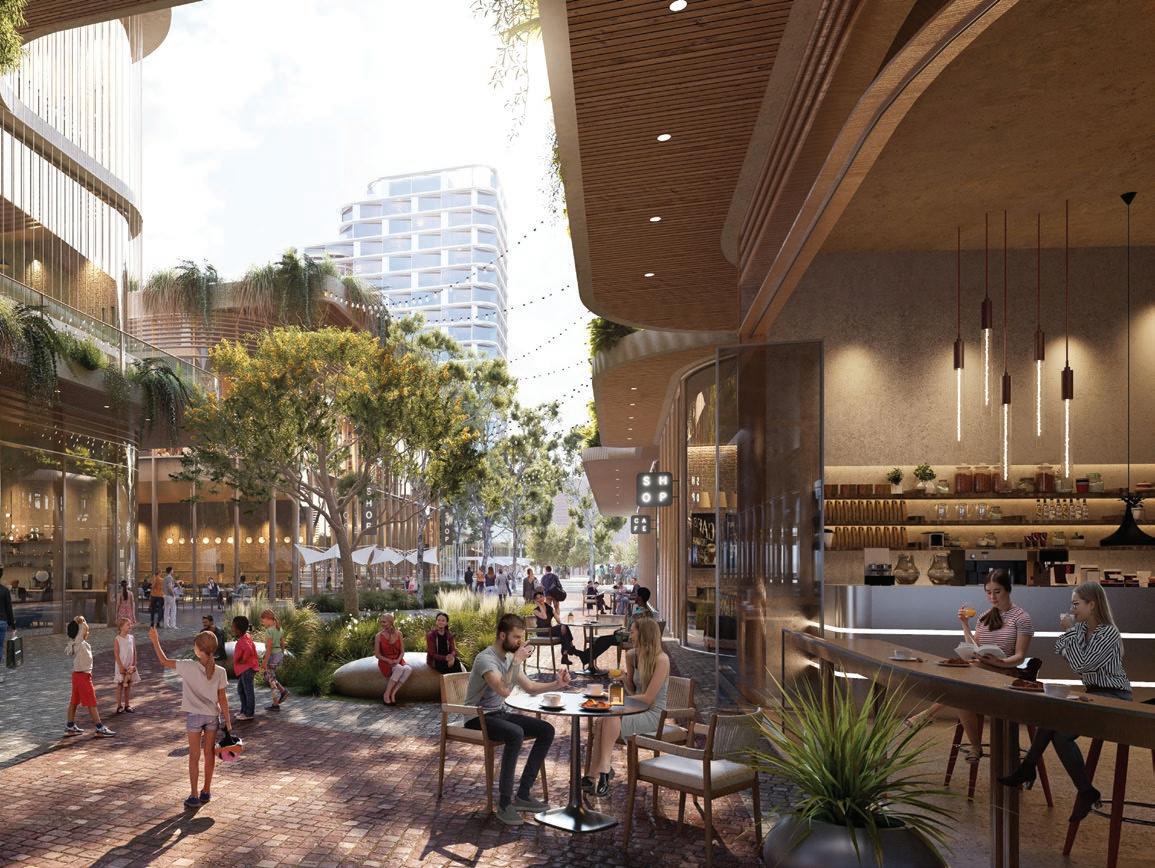
Alongside the public open space in Precinct B, is a new district-scale foreshore park designed to host everyday recreation, community gathering and major public events. This is supported by a finer-grain sequence of neighbourhood spaces including family play areas, lawns, civic plazas, shaded seating and informal recreational areas embedded within the urban blocks. Together, these spaces connect the significant residential, commercial, entertainment and retail offering to establish the public realm as the social and environmental backbone of the new precinct
The landscape has been conceived as the primary structure for movement, activity and identity across the site. Waterfront promenades, retail edges, laneways and hospitality terraces are all shaped around public open space, ensuring that daily life within the precinct is closely connected to green spaces and water at every touchpoint.
A comprehensive Water Sensitive Urban Design strategy underpins the proposal, with rain gardens, vegetated swales, permeable surfaces and extensive native planting working together to manage stormwater, support biodiversity and improve water quality before runoff reaches the river. This approach positions Precinct B as a climate-resilient waterfront neighbourhood designed for long-term environmental performance.
Cultural identity also plays a central role. The landscape draws from Whadjuk Noongar heritage, Indigenous art and native ecologies, with material palettes, planting and spatial patterns grounded in local Country and Perth’s distinctive river environment.
With planning now submitted, Precinct B represents one of Australia’s most vibrant new waterfront neighbourhoods currently progressing through approval. For Grant Associates, the project demonstrates how the public realm, ecology and urban life can be brought together at scale to shape a distinctive, liveable and future-focused riverside destination.
Agnes Soh, Senior Associate at Grant Associates, comments:
“Precinct B is conceived as a contemporary estuary - a place where river, landscape and city are gently woven back together. By shaping the land in response to water, heritage and climate, the public realm becomes both grounded and fluid - a sequence of spaces that shift from wetland to plaza, from quiet edge to civic gathering. It’s a landscape designed to be experienced slowly, across seasons and generations, always in dialogue with the Swan River.”
Project Team
Developer: Golden Sedayu
Precinct B Masterplan Architect: Skidmore, Owings & Merrill (SOM) Landscape Architect: Grant Associates Location: Burswood Point, Perth, Western Australia
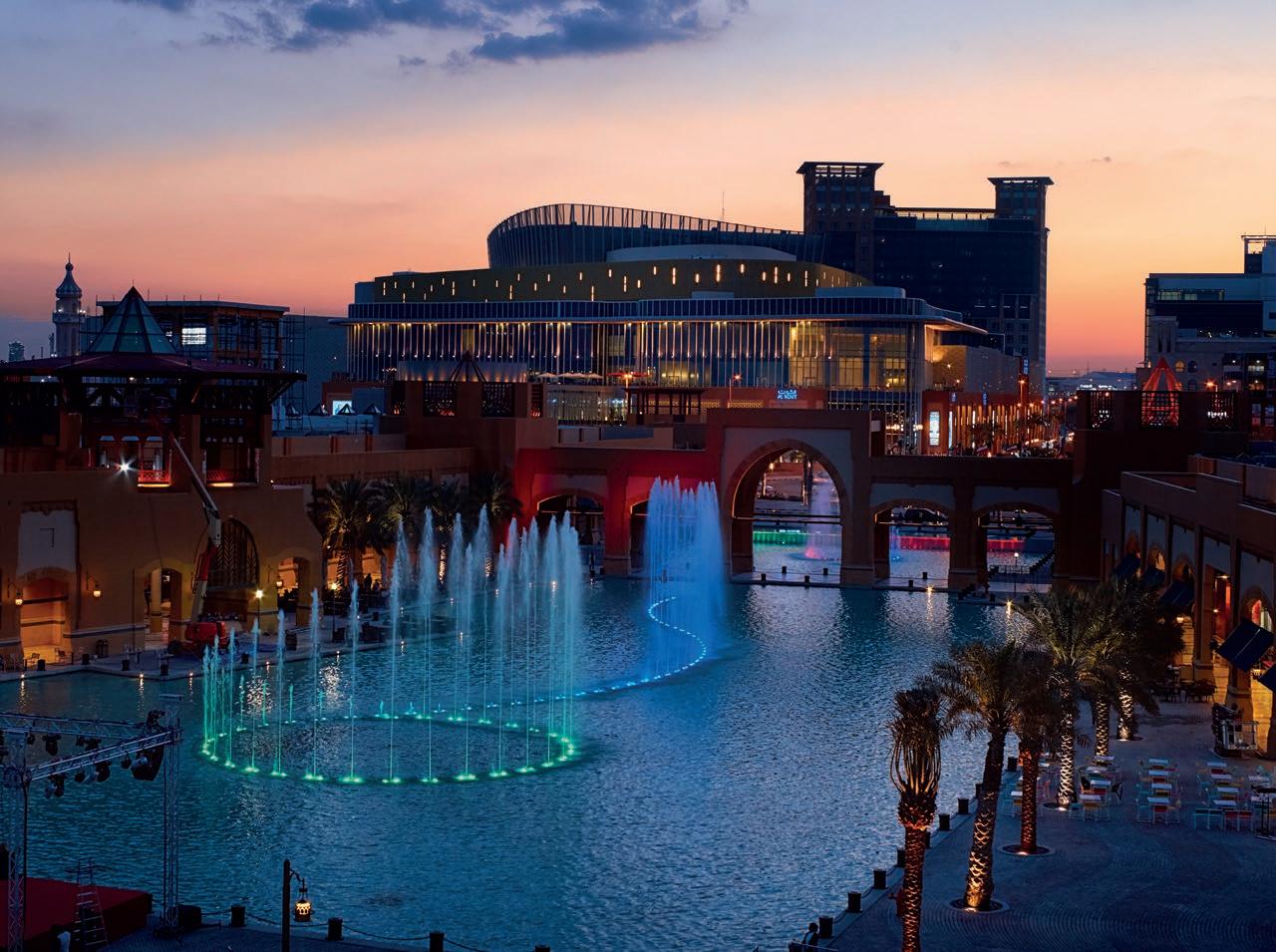
Creating unique urban landmarks, setting world records, designing contemplative quiet zones or attracting millions of enthusiastic visitors - whatever you have in mind, OASE Fountain Technology makes your architectural water vision come true.
Innovative and high-quality German technology paired with a passion for extraordinary creations and the experience gained from over 100,000 unique projects worldwide - this is what makes OASE one of the world’s leading specialists for fountain systems.
With our global network of qualified partners, we are at your sidealso here in the Middle East, at our office in the Dubai Design District.
www.oase-professional.com
books of interest
design for outdoor recreation
ISBN-13: 9780415441728
Paperback: 240 pages
Publisher: Taylor & Francis; 2 edition (August 15, 2008)
Language: English
Product Dimensions: 0.8 x 8.8 x 10.8 inches
Price: 319.00 Dhs.
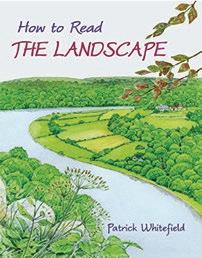
How to read tHe Landscape
ISBN-13: 9781856231855
Paperback: 226 pages
Publisher: Permanent Publications ( January 12, 2015)
Language: English
Product Dimensions: 8.6 x 6.9 x 0.6 inches
Price: 111.00 AED
Book’s Description:
According to an ICM poll, 77 percent of UK adults, or about 38 million people, say they walk for pleasure at least once a month. It is remarkable, therefore, that no one has written about the landscapes they’re walking through and enjoying...until now. Patrick Whitefield has spent a lifetime living and working in the countryside and twenty
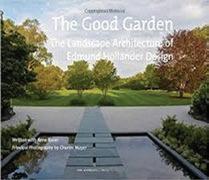
tHe good garden, tHe Landscape arcHitecture of edmund HoLLander design
ISBN: 9781580934152
AUTHOR: Anne Raver
PUBLICATION DATE : 20 July 2015
HARDCOVER: 320 pages
BOOK DESCRIPTION:
This book presents dozens of gorgeous estate gardens across the Northeastern states of the US, approached thematically; individual sections reveal how components such as gateways, paths, pool terraces, bisques and
Books Description
Design for Outdoor Recreation takes a detailed look at all aspects of design of facilities needed by visitors to outdoor recreation destinations. The book is a comprehensive manual for planners, designers and managers of recreation taking them through the processes of design and enabling them to find the most appropriate balance between visitor needs and the capacity of the landscape. A range of different aspects are covered including car parking, information signing, hiking, waterside activities, wildlife watching and camping.
years of that taking notes of what he sees, everywhere from the Isle of Wight to the Scottish Highlands. This book is the fruit of those years of experience. In How to Read the Landscape, Patrick explains everything from the details, such as the signs that wild animals leave as their signatures and the meaning behind the shapes of different trees, to how whole landscapes, including woodland, grassland, and moorland, fit together and function as a whole. Rivers and lakes, roads and paths, hedgerows and field walls are also explained, as well as the influence of different rocks, the soil, and the ever-changing climate. There’s even a chapter on the fascinating history of the landscape and one about natural succession, how the landscape changes of its own accord when we leave it alone. The landscape will never look the same again. You will not only appreciate its beauty, it will also come alive with a whole new depth of appreciation and understanding.
groves, walls, and borders contribute to lush garden rooms, windblown seaside gardens, calming meadow gardens, intricate formal gardens, and shady tracts of woodland. Over 300 color photographs of beautiful properties in the Hamptons, Connecticut, and upstate New York provide glimpses of the best garden design happening today while breaking down its ideas for the home gardener.
Author Anne Raver details how the firm works to envelop visitors in landscapes that feel entirely whole: plantings near architecture create a dynamic entry progression; hardscape features that lead out into a broader garden gradually cede to more natural, living elements; pools are surrounded by gracious swaths of flowers that bloom in sequence as the season progresses to provide privacy for bathers and a sense of quiet seclusion.
With its headquarter in Tokyo, Japan and world class stores spread over countries like America, Singapore, Indonesia, Malaysia, Thailand, Australia, Taiwan and now in DUBAI – UAE, Kinokuniya is a globally known book seller of repute.
The store in Dubai Mall is a massive 68,000 square feet wide paragon book gallery which stocks more than half a million books and thousand magazines in English, Arabic, Japanese, French, German and Chinese at any given time.
The Store is also a distinct cross cultural hub wide range of time to time multicultural events such a comic art demonstrations, language learning workshops, book launches etc.
The pleasant ambiance, stenographic design and add to it the impressive view of modern skyline – world’s tallest building, Burj Khalifa, Kinokuniya at The Dubai Mall is just the place to evoke emotions and add pleasure to your book shopping. You may like to visit our website for more information. www.kinokuniya.com